EP2816433A2 - Bearbeitungsmaschine zur autonomen Bearbeitung eines zugeordneten Arbeitsbereichs - Google Patents
Bearbeitungsmaschine zur autonomen Bearbeitung eines zugeordneten Arbeitsbereichs Download PDFInfo
- Publication number
- EP2816433A2 EP2816433A2 EP20140169402 EP14169402A EP2816433A2 EP 2816433 A2 EP2816433 A2 EP 2816433A2 EP 20140169402 EP20140169402 EP 20140169402 EP 14169402 A EP14169402 A EP 14169402A EP 2816433 A2 EP2816433 A2 EP 2816433A2
- Authority
- EP
- European Patent Office
- Prior art keywords
- detection unit
- processing machine
- base station
- air flow
- supplied
- Prior art date
- Legal status (The legal status is an assumption and is not a legal conclusion. Google has not performed a legal analysis and makes no representation as to the accuracy of the status listed.)
- Granted
Links
Images




Classifications
-
- G—PHYSICS
- G05—CONTROLLING; REGULATING
- G05D—SYSTEMS FOR CONTROLLING OR REGULATING NON-ELECTRIC VARIABLES
- G05D1/00—Control of position, course, altitude or attitude of land, water, air or space vehicles, e.g. using automatic pilots
- G05D1/02—Control of position or course in two dimensions
- G05D1/021—Control of position or course in two dimensions specially adapted to land vehicles
- G05D1/0231—Control of position or course in two dimensions specially adapted to land vehicles using optical position detecting means
- G05D1/0246—Control of position or course in two dimensions specially adapted to land vehicles using optical position detecting means using a video camera in combination with image processing means
-
- A—HUMAN NECESSITIES
- A01—AGRICULTURE; FORESTRY; ANIMAL HUSBANDRY; HUNTING; TRAPPING; FISHING
- A01D—HARVESTING; MOWING
- A01D34/00—Mowers; Mowing apparatus of harvesters
- A01D34/006—Control or measuring arrangements
- A01D34/008—Control or measuring arrangements for automated or remotely controlled operation
-
- B—PERFORMING OPERATIONS; TRANSPORTING
- B60—VEHICLES IN GENERAL
- B60L—PROPULSION OF ELECTRICALLY-PROPELLED VEHICLES; SUPPLYING ELECTRIC POWER FOR AUXILIARY EQUIPMENT OF ELECTRICALLY-PROPELLED VEHICLES; ELECTRODYNAMIC BRAKE SYSTEMS FOR VEHICLES IN GENERAL; MAGNETIC SUSPENSION OR LEVITATION FOR VEHICLES; MONITORING OPERATING VARIABLES OF ELECTRICALLY-PROPELLED VEHICLES; ELECTRIC SAFETY DEVICES FOR ELECTRICALLY-PROPELLED VEHICLES
- B60L1/00—Supplying electric power to auxiliary equipment of vehicles
- B60L1/003—Supplying electric power to auxiliary equipment of vehicles to auxiliary motors, e.g. for pumps, compressors
-
- B—PERFORMING OPERATIONS; TRANSPORTING
- B60—VEHICLES IN GENERAL
- B60L—PROPULSION OF ELECTRICALLY-PROPELLED VEHICLES; SUPPLYING ELECTRIC POWER FOR AUXILIARY EQUIPMENT OF ELECTRICALLY-PROPELLED VEHICLES; ELECTRODYNAMIC BRAKE SYSTEMS FOR VEHICLES IN GENERAL; MAGNETIC SUSPENSION OR LEVITATION FOR VEHICLES; MONITORING OPERATING VARIABLES OF ELECTRICALLY-PROPELLED VEHICLES; ELECTRIC SAFETY DEVICES FOR ELECTRICALLY-PROPELLED VEHICLES
- B60L1/00—Supplying electric power to auxiliary equipment of vehicles
- B60L1/02—Supplying electric power to auxiliary equipment of vehicles to electric heating circuits
-
- B—PERFORMING OPERATIONS; TRANSPORTING
- B60—VEHICLES IN GENERAL
- B60L—PROPULSION OF ELECTRICALLY-PROPELLED VEHICLES; SUPPLYING ELECTRIC POWER FOR AUXILIARY EQUIPMENT OF ELECTRICALLY-PROPELLED VEHICLES; ELECTRODYNAMIC BRAKE SYSTEMS FOR VEHICLES IN GENERAL; MAGNETIC SUSPENSION OR LEVITATION FOR VEHICLES; MONITORING OPERATING VARIABLES OF ELECTRICALLY-PROPELLED VEHICLES; ELECTRIC SAFETY DEVICES FOR ELECTRICALLY-PROPELLED VEHICLES
- B60L15/00—Methods, circuits, or devices for controlling the traction-motor speed of electrically-propelled vehicles
- B60L15/20—Methods, circuits, or devices for controlling the traction-motor speed of electrically-propelled vehicles for control of the vehicle or its driving motor to achieve a desired performance, e.g. speed, torque, programmed variation of speed
-
- B—PERFORMING OPERATIONS; TRANSPORTING
- B60—VEHICLES IN GENERAL
- B60L—PROPULSION OF ELECTRICALLY-PROPELLED VEHICLES; SUPPLYING ELECTRIC POWER FOR AUXILIARY EQUIPMENT OF ELECTRICALLY-PROPELLED VEHICLES; ELECTRODYNAMIC BRAKE SYSTEMS FOR VEHICLES IN GENERAL; MAGNETIC SUSPENSION OR LEVITATION FOR VEHICLES; MONITORING OPERATING VARIABLES OF ELECTRICALLY-PROPELLED VEHICLES; ELECTRIC SAFETY DEVICES FOR ELECTRICALLY-PROPELLED VEHICLES
- B60L3/00—Electric devices on electrically-propelled vehicles for safety purposes; Monitoring operating variables, e.g. speed, deceleration or energy consumption
- B60L3/0023—Detecting, eliminating, remedying or compensating for drive train abnormalities, e.g. failures within the drive train
- B60L3/0061—Detecting, eliminating, remedying or compensating for drive train abnormalities, e.g. failures within the drive train relating to electrical machines
-
- B—PERFORMING OPERATIONS; TRANSPORTING
- B60—VEHICLES IN GENERAL
- B60L—PROPULSION OF ELECTRICALLY-PROPELLED VEHICLES; SUPPLYING ELECTRIC POWER FOR AUXILIARY EQUIPMENT OF ELECTRICALLY-PROPELLED VEHICLES; ELECTRODYNAMIC BRAKE SYSTEMS FOR VEHICLES IN GENERAL; MAGNETIC SUSPENSION OR LEVITATION FOR VEHICLES; MONITORING OPERATING VARIABLES OF ELECTRICALLY-PROPELLED VEHICLES; ELECTRIC SAFETY DEVICES FOR ELECTRICALLY-PROPELLED VEHICLES
- B60L3/00—Electric devices on electrically-propelled vehicles for safety purposes; Monitoring operating variables, e.g. speed, deceleration or energy consumption
- B60L3/0023—Detecting, eliminating, remedying or compensating for drive train abnormalities, e.g. failures within the drive train
- B60L3/0069—Detecting, eliminating, remedying or compensating for drive train abnormalities, e.g. failures within the drive train relating to the isolation, e.g. ground fault or leak current
-
- B—PERFORMING OPERATIONS; TRANSPORTING
- B60—VEHICLES IN GENERAL
- B60L—PROPULSION OF ELECTRICALLY-PROPELLED VEHICLES; SUPPLYING ELECTRIC POWER FOR AUXILIARY EQUIPMENT OF ELECTRICALLY-PROPELLED VEHICLES; ELECTRODYNAMIC BRAKE SYSTEMS FOR VEHICLES IN GENERAL; MAGNETIC SUSPENSION OR LEVITATION FOR VEHICLES; MONITORING OPERATING VARIABLES OF ELECTRICALLY-PROPELLED VEHICLES; ELECTRIC SAFETY DEVICES FOR ELECTRICALLY-PROPELLED VEHICLES
- B60L50/00—Electric propulsion with power supplied within the vehicle
- B60L50/50—Electric propulsion with power supplied within the vehicle using propulsion power supplied by batteries or fuel cells
- B60L50/52—Electric propulsion with power supplied within the vehicle using propulsion power supplied by batteries or fuel cells characterised by DC-motors
-
- B—PERFORMING OPERATIONS; TRANSPORTING
- B60—VEHICLES IN GENERAL
- B60L—PROPULSION OF ELECTRICALLY-PROPELLED VEHICLES; SUPPLYING ELECTRIC POWER FOR AUXILIARY EQUIPMENT OF ELECTRICALLY-PROPELLED VEHICLES; ELECTRODYNAMIC BRAKE SYSTEMS FOR VEHICLES IN GENERAL; MAGNETIC SUSPENSION OR LEVITATION FOR VEHICLES; MONITORING OPERATING VARIABLES OF ELECTRICALLY-PROPELLED VEHICLES; ELECTRIC SAFETY DEVICES FOR ELECTRICALLY-PROPELLED VEHICLES
- B60L53/00—Methods of charging batteries, specially adapted for electric vehicles; Charging stations or on-board charging equipment therefor; Exchange of energy storage elements in electric vehicles
- B60L53/10—Methods of charging batteries, specially adapted for electric vehicles; Charging stations or on-board charging equipment therefor; Exchange of energy storage elements in electric vehicles characterised by the energy transfer between the charging station and the vehicle
- B60L53/14—Conductive energy transfer
-
- B—PERFORMING OPERATIONS; TRANSPORTING
- B60—VEHICLES IN GENERAL
- B60L—PROPULSION OF ELECTRICALLY-PROPELLED VEHICLES; SUPPLYING ELECTRIC POWER FOR AUXILIARY EQUIPMENT OF ELECTRICALLY-PROPELLED VEHICLES; ELECTRODYNAMIC BRAKE SYSTEMS FOR VEHICLES IN GENERAL; MAGNETIC SUSPENSION OR LEVITATION FOR VEHICLES; MONITORING OPERATING VARIABLES OF ELECTRICALLY-PROPELLED VEHICLES; ELECTRIC SAFETY DEVICES FOR ELECTRICALLY-PROPELLED VEHICLES
- B60L53/00—Methods of charging batteries, specially adapted for electric vehicles; Charging stations or on-board charging equipment therefor; Exchange of energy storage elements in electric vehicles
- B60L53/30—Constructional details of charging stations
- B60L53/35—Means for automatic or assisted adjustment of the relative position of charging devices and vehicles
-
- B—PERFORMING OPERATIONS; TRANSPORTING
- B60—VEHICLES IN GENERAL
- B60L—PROPULSION OF ELECTRICALLY-PROPELLED VEHICLES; SUPPLYING ELECTRIC POWER FOR AUXILIARY EQUIPMENT OF ELECTRICALLY-PROPELLED VEHICLES; ELECTRODYNAMIC BRAKE SYSTEMS FOR VEHICLES IN GENERAL; MAGNETIC SUSPENSION OR LEVITATION FOR VEHICLES; MONITORING OPERATING VARIABLES OF ELECTRICALLY-PROPELLED VEHICLES; ELECTRIC SAFETY DEVICES FOR ELECTRICALLY-PROPELLED VEHICLES
- B60L58/00—Methods or circuit arrangements for monitoring or controlling batteries or fuel cells, specially adapted for electric vehicles
- B60L58/10—Methods or circuit arrangements for monitoring or controlling batteries or fuel cells, specially adapted for electric vehicles for monitoring or controlling batteries
- B60L58/18—Methods or circuit arrangements for monitoring or controlling batteries or fuel cells, specially adapted for electric vehicles for monitoring or controlling batteries of two or more battery modules
- B60L58/21—Methods or circuit arrangements for monitoring or controlling batteries or fuel cells, specially adapted for electric vehicles for monitoring or controlling batteries of two or more battery modules having the same nominal voltage
-
- B—PERFORMING OPERATIONS; TRANSPORTING
- B60—VEHICLES IN GENERAL
- B60L—PROPULSION OF ELECTRICALLY-PROPELLED VEHICLES; SUPPLYING ELECTRIC POWER FOR AUXILIARY EQUIPMENT OF ELECTRICALLY-PROPELLED VEHICLES; ELECTRODYNAMIC BRAKE SYSTEMS FOR VEHICLES IN GENERAL; MAGNETIC SUSPENSION OR LEVITATION FOR VEHICLES; MONITORING OPERATING VARIABLES OF ELECTRICALLY-PROPELLED VEHICLES; ELECTRIC SAFETY DEVICES FOR ELECTRICALLY-PROPELLED VEHICLES
- B60L58/00—Methods or circuit arrangements for monitoring or controlling batteries or fuel cells, specially adapted for electric vehicles
- B60L58/10—Methods or circuit arrangements for monitoring or controlling batteries or fuel cells, specially adapted for electric vehicles for monitoring or controlling batteries
- B60L58/24—Methods or circuit arrangements for monitoring or controlling batteries or fuel cells, specially adapted for electric vehicles for monitoring or controlling batteries for controlling the temperature of batteries
- B60L58/27—Methods or circuit arrangements for monitoring or controlling batteries or fuel cells, specially adapted for electric vehicles for monitoring or controlling batteries for controlling the temperature of batteries by heating
-
- G—PHYSICS
- G02—OPTICS
- G02B—OPTICAL ELEMENTS, SYSTEMS OR APPARATUS
- G02B27/00—Optical systems or apparatus not provided for by any of the groups G02B1/00 - G02B26/00, G02B30/00
- G02B27/0006—Optical systems or apparatus not provided for by any of the groups G02B1/00 - G02B26/00, G02B30/00 with means to keep optical surfaces clean, e.g. by preventing or removing dirt, stains, contamination, condensation
-
- B—PERFORMING OPERATIONS; TRANSPORTING
- B60—VEHICLES IN GENERAL
- B60L—PROPULSION OF ELECTRICALLY-PROPELLED VEHICLES; SUPPLYING ELECTRIC POWER FOR AUXILIARY EQUIPMENT OF ELECTRICALLY-PROPELLED VEHICLES; ELECTRODYNAMIC BRAKE SYSTEMS FOR VEHICLES IN GENERAL; MAGNETIC SUSPENSION OR LEVITATION FOR VEHICLES; MONITORING OPERATING VARIABLES OF ELECTRICALLY-PROPELLED VEHICLES; ELECTRIC SAFETY DEVICES FOR ELECTRICALLY-PROPELLED VEHICLES
- B60L2200/00—Type of vehicles
- B60L2200/40—Working vehicles
-
- B—PERFORMING OPERATIONS; TRANSPORTING
- B60—VEHICLES IN GENERAL
- B60L—PROPULSION OF ELECTRICALLY-PROPELLED VEHICLES; SUPPLYING ELECTRIC POWER FOR AUXILIARY EQUIPMENT OF ELECTRICALLY-PROPELLED VEHICLES; ELECTRODYNAMIC BRAKE SYSTEMS FOR VEHICLES IN GENERAL; MAGNETIC SUSPENSION OR LEVITATION FOR VEHICLES; MONITORING OPERATING VARIABLES OF ELECTRICALLY-PROPELLED VEHICLES; ELECTRIC SAFETY DEVICES FOR ELECTRICALLY-PROPELLED VEHICLES
- B60L2240/00—Control parameters of input or output; Target parameters
- B60L2240/10—Vehicle control parameters
- B60L2240/36—Temperature of vehicle components or parts
-
- B—PERFORMING OPERATIONS; TRANSPORTING
- B60—VEHICLES IN GENERAL
- B60L—PROPULSION OF ELECTRICALLY-PROPELLED VEHICLES; SUPPLYING ELECTRIC POWER FOR AUXILIARY EQUIPMENT OF ELECTRICALLY-PROPELLED VEHICLES; ELECTRODYNAMIC BRAKE SYSTEMS FOR VEHICLES IN GENERAL; MAGNETIC SUSPENSION OR LEVITATION FOR VEHICLES; MONITORING OPERATING VARIABLES OF ELECTRICALLY-PROPELLED VEHICLES; ELECTRIC SAFETY DEVICES FOR ELECTRICALLY-PROPELLED VEHICLES
- B60L2240/00—Control parameters of input or output; Target parameters
- B60L2240/60—Navigation input
- B60L2240/66—Ambient conditions
- B60L2240/662—Temperature
-
- B—PERFORMING OPERATIONS; TRANSPORTING
- B60—VEHICLES IN GENERAL
- B60L—PROPULSION OF ELECTRICALLY-PROPELLED VEHICLES; SUPPLYING ELECTRIC POWER FOR AUXILIARY EQUIPMENT OF ELECTRICALLY-PROPELLED VEHICLES; ELECTRODYNAMIC BRAKE SYSTEMS FOR VEHICLES IN GENERAL; MAGNETIC SUSPENSION OR LEVITATION FOR VEHICLES; MONITORING OPERATING VARIABLES OF ELECTRICALLY-PROPELLED VEHICLES; ELECTRIC SAFETY DEVICES FOR ELECTRICALLY-PROPELLED VEHICLES
- B60L2240/00—Control parameters of input or output; Target parameters
- B60L2240/60—Navigation input
- B60L2240/66—Ambient conditions
- B60L2240/667—Precipitation
-
- B—PERFORMING OPERATIONS; TRANSPORTING
- B60—VEHICLES IN GENERAL
- B60L—PROPULSION OF ELECTRICALLY-PROPELLED VEHICLES; SUPPLYING ELECTRIC POWER FOR AUXILIARY EQUIPMENT OF ELECTRICALLY-PROPELLED VEHICLES; ELECTRODYNAMIC BRAKE SYSTEMS FOR VEHICLES IN GENERAL; MAGNETIC SUSPENSION OR LEVITATION FOR VEHICLES; MONITORING OPERATING VARIABLES OF ELECTRICALLY-PROPELLED VEHICLES; ELECTRIC SAFETY DEVICES FOR ELECTRICALLY-PROPELLED VEHICLES
- B60L2260/00—Operating Modes
- B60L2260/20—Drive modes; Transition between modes
- B60L2260/32—Auto pilot mode
-
- Y—GENERAL TAGGING OF NEW TECHNOLOGICAL DEVELOPMENTS; GENERAL TAGGING OF CROSS-SECTIONAL TECHNOLOGIES SPANNING OVER SEVERAL SECTIONS OF THE IPC; TECHNICAL SUBJECTS COVERED BY FORMER USPC CROSS-REFERENCE ART COLLECTIONS [XRACs] AND DIGESTS
- Y02—TECHNOLOGIES OR APPLICATIONS FOR MITIGATION OR ADAPTATION AGAINST CLIMATE CHANGE
- Y02T—CLIMATE CHANGE MITIGATION TECHNOLOGIES RELATED TO TRANSPORTATION
- Y02T10/00—Road transport of goods or passengers
- Y02T10/60—Other road transportation technologies with climate change mitigation effect
- Y02T10/64—Electric machine technologies in electromobility
-
- Y—GENERAL TAGGING OF NEW TECHNOLOGICAL DEVELOPMENTS; GENERAL TAGGING OF CROSS-SECTIONAL TECHNOLOGIES SPANNING OVER SEVERAL SECTIONS OF THE IPC; TECHNICAL SUBJECTS COVERED BY FORMER USPC CROSS-REFERENCE ART COLLECTIONS [XRACs] AND DIGESTS
- Y02—TECHNOLOGIES OR APPLICATIONS FOR MITIGATION OR ADAPTATION AGAINST CLIMATE CHANGE
- Y02T—CLIMATE CHANGE MITIGATION TECHNOLOGIES RELATED TO TRANSPORTATION
- Y02T10/00—Road transport of goods or passengers
- Y02T10/60—Other road transportation technologies with climate change mitigation effect
- Y02T10/70—Energy storage systems for electromobility, e.g. batteries
-
- Y—GENERAL TAGGING OF NEW TECHNOLOGICAL DEVELOPMENTS; GENERAL TAGGING OF CROSS-SECTIONAL TECHNOLOGIES SPANNING OVER SEVERAL SECTIONS OF THE IPC; TECHNICAL SUBJECTS COVERED BY FORMER USPC CROSS-REFERENCE ART COLLECTIONS [XRACs] AND DIGESTS
- Y02—TECHNOLOGIES OR APPLICATIONS FOR MITIGATION OR ADAPTATION AGAINST CLIMATE CHANGE
- Y02T—CLIMATE CHANGE MITIGATION TECHNOLOGIES RELATED TO TRANSPORTATION
- Y02T10/00—Road transport of goods or passengers
- Y02T10/60—Other road transportation technologies with climate change mitigation effect
- Y02T10/7072—Electromobility specific charging systems or methods for batteries, ultracapacitors, supercapacitors or double-layer capacitors
-
- Y—GENERAL TAGGING OF NEW TECHNOLOGICAL DEVELOPMENTS; GENERAL TAGGING OF CROSS-SECTIONAL TECHNOLOGIES SPANNING OVER SEVERAL SECTIONS OF THE IPC; TECHNICAL SUBJECTS COVERED BY FORMER USPC CROSS-REFERENCE ART COLLECTIONS [XRACs] AND DIGESTS
- Y02—TECHNOLOGIES OR APPLICATIONS FOR MITIGATION OR ADAPTATION AGAINST CLIMATE CHANGE
- Y02T—CLIMATE CHANGE MITIGATION TECHNOLOGIES RELATED TO TRANSPORTATION
- Y02T10/00—Road transport of goods or passengers
- Y02T10/60—Other road transportation technologies with climate change mitigation effect
- Y02T10/72—Electric energy management in electromobility
-
- Y—GENERAL TAGGING OF NEW TECHNOLOGICAL DEVELOPMENTS; GENERAL TAGGING OF CROSS-SECTIONAL TECHNOLOGIES SPANNING OVER SEVERAL SECTIONS OF THE IPC; TECHNICAL SUBJECTS COVERED BY FORMER USPC CROSS-REFERENCE ART COLLECTIONS [XRACs] AND DIGESTS
- Y02—TECHNOLOGIES OR APPLICATIONS FOR MITIGATION OR ADAPTATION AGAINST CLIMATE CHANGE
- Y02T—CLIMATE CHANGE MITIGATION TECHNOLOGIES RELATED TO TRANSPORTATION
- Y02T90/00—Enabling technologies or technologies with a potential or indirect contribution to GHG emissions mitigation
- Y02T90/10—Technologies relating to charging of electric vehicles
- Y02T90/12—Electric charging stations
-
- Y—GENERAL TAGGING OF NEW TECHNOLOGICAL DEVELOPMENTS; GENERAL TAGGING OF CROSS-SECTIONAL TECHNOLOGIES SPANNING OVER SEVERAL SECTIONS OF THE IPC; TECHNICAL SUBJECTS COVERED BY FORMER USPC CROSS-REFERENCE ART COLLECTIONS [XRACs] AND DIGESTS
- Y02—TECHNOLOGIES OR APPLICATIONS FOR MITIGATION OR ADAPTATION AGAINST CLIMATE CHANGE
- Y02T—CLIMATE CHANGE MITIGATION TECHNOLOGIES RELATED TO TRANSPORTATION
- Y02T90/00—Enabling technologies or technologies with a potential or indirect contribution to GHG emissions mitigation
- Y02T90/10—Technologies relating to charging of electric vehicles
- Y02T90/14—Plug-in electric vehicles
-
- Y—GENERAL TAGGING OF NEW TECHNOLOGICAL DEVELOPMENTS; GENERAL TAGGING OF CROSS-SECTIONAL TECHNOLOGIES SPANNING OVER SEVERAL SECTIONS OF THE IPC; TECHNICAL SUBJECTS COVERED BY FORMER USPC CROSS-REFERENCE ART COLLECTIONS [XRACs] AND DIGESTS
- Y02—TECHNOLOGIES OR APPLICATIONS FOR MITIGATION OR ADAPTATION AGAINST CLIMATE CHANGE
- Y02T—CLIMATE CHANGE MITIGATION TECHNOLOGIES RELATED TO TRANSPORTATION
- Y02T90/00—Enabling technologies or technologies with a potential or indirect contribution to GHG emissions mitigation
- Y02T90/10—Technologies relating to charging of electric vehicles
- Y02T90/16—Information or communication technologies improving the operation of electric vehicles
Definitions
- the present invention relates to a processing machine for the autonomous processing of an associated work area, with a detection unit for detecting current environmental parameters that can be evaluated for controlling the processing machine in the associated work area.
- This autonomous lawnmower is provided with a camera-type detection unit for detecting, in operation of the autonomous lawnmower, current environmental parameters that are evaluable to provide suitable control of the autonomous lawnmower, e.g. to allow navigation on the lawn.
- a disadvantage of the prior art is that during operation of such an autonomous lawnmower operational pollution and / or fogging of the camera and / or condensation on the camera can lead to a limitation of the functionality of the camera. Such a limitation can lead to a limited and erroneous detection of the current environmental parameters and thus to an imprecise and incorrect control of the autonomous lawnmower.
- An object of the invention is therefore to provide a new processing machine for the autonomous processing of an associated work area, which has a detection unit, with each of the current environmental parameters can be detected safely and reliably.
- a processing machine for the autonomous processing of an associated work area with a detection unit for detecting current environmental parameters that can be evaluated to control the processing machine in the associated work area.
- the detection unit is associated with a free-hold device, which is at least adapted to at least reduce operating-related contamination and / or fogging of the detection unit and / or condensation on the detection unit in the autonomous operation of the processing machine.
- the invention thus makes it possible to provide a processing machine for the autonomous processing of an associated work area, in which an operational contamination and / or fogging of an associated detection unit and / or condensation on the detection unit in the operation of the processing machine by a use of the free-hold device in a simple manner at least substantially safe and reliable can be prevented.
- the detection unit has at least one camera and / or at least one optical sensor.
- the environmental parameters preferably include localization, desktop recognition and / or background detection parameters.
- navigation data and / or suitable work surface or substrate-specific processing data for controlling the processing machine can be determined in a simple manner.
- the free-hold device has at least one air guiding device, which is supplied with airflow at least in the autonomous operation of the processing machine.
- the air guiding device is designed to guide the supplied air flow at least partially in the direction of the detection unit.
- the invention thus makes it possible to provide a processing machine with a simple and uncomplicated free-hold device.
- the at least partially directed in the direction of the detection unit air flow is at least designed to at least substantially prevent settling of dirt and / or water particles on the detection unit and / or to cool the detection unit at least in sections.
- the free-hold device has at least one fan wheel for generating the supplied air flow.
- the supplied air flow can be generated in a simple manner.
- a drive motor is provided for driving in the autonomous operation of the processing machine, which is assigned to the engine cooling at least one fan, which is adapted to generate the supplied air flow at least partially.
- a fan wheel already provided as an integral part of the processing machine can be used to generate the supplied air flow, so that a space-saving and resource-saving implementation of the present invention is made possible.
- At least one battery pack is provided for the power supply in the autonomous operation of the processing machine, for cooling purposes at least one fan wheel is assigned, which is designed to generate the supplied air flow at least partially.
- the invention thus makes it possible to provide a battery-operated processing machine in which a fan wheel already provided as an integral part of an associated battery pack can be used to generate the supplied air flow, so that a space-saving and resource-saving implementation of the present invention is also made possible in this embodiment.
- the supplied air flow from the drive motor and / or battery pack is heated.
- the drive motor can be energized to allow heating of the drive motor and / or the battery pack for heating the supplied air flow.
- the air flow can be heated in a simple manner.
- the processing machine is designed in the manner of an autonomous lawnmower or an autonomous vacuum cleaner.
- an autonomous lawn mower or vacuum cleaner is merely exemplary in nature and is not to be construed as limiting the invention, which may apply to other autonomous work machines, e.g. in an autonomous windscreen wiper.
- a base station for a processing unit provided with a detection unit for autonomously processing an associated work area, wherein the detection unit is designed to detect each current environmental parameters that are evaluable for controlling the processing machine in an associated work area, wherein a cleaning device is provided, which is at least adapted to contamination and / or fogging of the detection unit and / or condensation on the detection unit at least reduce.
- the invention thus makes it possible to provide a base station with a cleaning device for a processing machine, with a contamination and / or fogging of a processing unit associated detection unit and / or condensation on this detection unit before and / or after operation of the machine easily Way at least substantially safe and reliable can be reduced.
- the cleaning device is associated with at least one fan for generating an at least partially the detection unit can be supplied to the air flow.
- the detection unit can be safely and reliably cleaned.
- an efficient cooling of the detection unit can be made possible.
- the air flow is at least designed to at least substantially prevent the settling of dirt and / or water particles on the detection unit of the processing machine and / or to cool the detection unit at least in sections.
- the cleaning device is associated with at least one air duct, which is adapted to direct the at least partially the detection unit can be supplied to the air flow to the detection unit.
- the air flow can be passed accurately and precisely to the detection unit.
- a bottom plate is provided, in which the air duct is arranged.
- the air duct can be easily and safely placed in the base station.
- the cleaning device is associated with a heat source for generating heat.
- heat can be provided in a simple manner, at least for reducing a fitting of the detection unit associated with the processing machine.
- a bottom plate is provided, in which the heat source is arranged.
- the heat source can be safely and reliably placed in the base station.
- the heat source is preferably designed in the manner of a heating mat.
- the heat source is preferably designed for heating the air flow, which can be supplied at least partially to the detection unit.
- a heated air flow can be provided in a simple manner.
- the base station is preferably designed to provide energy for the processing machine in order to enable at least charging of a battery pack assigned to the processing machine.
- the battery pack can be safely and reliably charged in the base station.
- a system having at least: a processing machine for autonomous processing of an associated work area, with a detection unit for detecting current environmental parameters, which are evaluable for controlling the processing machine in the associated work area, and a base station for the processing machine, which is designed at least to at least reduce soiling and / or fogging of the detection unit and / or condensation on the detection unit.
- the invention thus also makes it possible to provide a system consisting of a processing machine described above and a base station for the processing machine described above.
- FIG. 10 shows an example processing machine 100 for autonomously processing an associated workspace 110 according to the present invention.
- the processing machine 100 has a machine housing 102 provided with at least one air inlet opening 107, which can be moved autonomously in the working area 110, for example via at least three wheels and / or rollers 103, 104, 105.
- the air inlet opening 107 may be provided, for example, with a grid and / or a filter.
- the processing machine 100 has a processing unit 106 for processing the working area 110, which can be activated illustratively via an on / off switch 108.
- processing unit 106 activation of the processing unit 106 by operation of the on / off switch 108 is merely exemplary in nature and should not be considered as limiting the invention. Rather, the processing unit 106 may also be activated in any other manner, e.g. by means of a remote control or automatically upon introduction of the processing machine 100 into the associated working area 110.
- the processing machine 100 preferably has at least one detection unit 120 arranged on the machine housing 102 for detecting respectively current environmental parameters, which preferably comprise at least localization, work surface recognition and / or background recognition parameters. These respective current environmental parameters are preferably evaluable at least for controlling the processing machine 100 in the associated working area 110, in order to achieve this, for example. Navigation data and / or suitable Hä inhabitg. Substrate specific machining data to determine. A corresponding evaluation can take place via a suitable control unit in any manner known to the person skilled in the art and, like the suitable control unit, is not the subject matter of the present invention. Therefore, for the sake of brevity, the description is omitted here for a detailed description thereof.
- the detection unit 120 is assigned at least one free-hold device 150.
- This is preferably designed at least to operate in the autonomous operation of the processing machine 100 Contamination of the detection unit 120, at least to reduce fogging of the detection unit 120 and / or condensation on the detection unit 120 and preferably substantially completely prevented.
- the free-hold device 150 preferably has at least one air guiding device 152, which is designed at least to guide an air flow 154 in the direction of the detection unit 120 during operation of the processing machine 100, which flows around it at least in sections.
- the air guiding device 152 surrounds the detection unit 120 in an illustrative annular manner and in this case forms an annular air outlet opening in the region of the detection unit 120.
- the air guide 152 may also form one or more punctiform air outlet openings.
- the airflow 154 may be directed in any direction via the detection unit 120.
- the airflow 154 may also be jerked over the detection unit 120, including e.g. On the air guide 152, a suitable valve or a suitable slide can be provided.
- the processing machine 100 is designed in the manner of an autonomous lawnmower and is therefore also referred to below as "robotic lawnmower" for the purpose of simplifying the description.
- the processing unit 106 is formed in the manner of a lawn mowing apparatus, wherein the associated work area 110 represents a lawn.
- the robotic lawnmower 100 is described by way of example only and not for the purpose of illustrating one possible embodiment of the present invention. Rather, it can be applied quite generally to autonomous processing machines where the detection unit 120 is used, e.g. for autonomous vacuum cleaners, autonomous windscreen wipers, etc.
- the robotic lawnmower 100 is preferably battery operated and provided with a suitable battery pack, as in Fig. 4 and 7 described. It should be understood, however, that the present invention is not limited to electrically driven, and in particular battery powered, robotic lawnmowers, but rather is generally applicable to autonomous processing machines, whether electrically or non-electrically drivable.
- Fig. 2 shows the mowing robot 100 provided with the processing unit 106 Fig. 1 who like at Fig. 1 described the machine housing 102 and the detection unit 120 disposed thereon.
- This is designed according to a first embodiment in the manner of an image detection unit 220, in particular in the manner of a camera, which is preferably at least partially integrated into the machine housing 102 and in the area provided with the louver 152 free-hold device 150 of Fig. 1 is provided.
- the processing unit 106 is as in Fig. 1 described in the manner of a lawn mowing device and accordingly has illustratively one or more mower blades 208, to the drive in the autonomous operation of the robotic lawnmower 100, a drive motor 206 is provided. At least one fan wheel 207 is associated with this for engine cooling, which, for example, can suck in air through the air inlet opening 107 provided on the machine housing 102 in order to generate a cooling air stream 209 flowing past at least on the outer circumference of the drive motor 206.
- an air deflection device 210 is provided, which is arranged illustratively in the machine housing 102 and is adapted to divert at least a portion of an air flow generated by the fan 207, or a portion of the cooling air flow 209, to the air guide 152 of the free-hold device 150.
- the free-hold device 150 can be supplied with an air flow marked 212 in the operation of the robotic lawnmower 100. Therefore, the fan 207 is illustratively associated with the blanking device 150 as well.
- the fan wheel 207 at least partially generates the free air device 150 supplied air stream 212. This is at least partially directed by the air guide 152 as the air flow 154 in the direction of the camera 220 to flow around them at least partially, and thus a setting of Dirt and / or water particles on the camera 120 to reduce at least and preferably at least substantially prevented.
- the free flow device 150 supplied air flow 212 and thus the air flow 154 is preferably heated by the drive motor 206 and thus, in particular, can effectively prevent fogging of the camera 220.
- Fig. 3 shows the mowing robot 100 provided with the processing unit 106 Fig. 1 who has the camera 220 of Fig. 2 having.
- the free-space device 150 has a separate fan wheel 310 for the at least partial generation of an airflow 312 supplied to the air-guiding device 152, so that the use of the fan wheel 207 of FIG Fig. 2 can be omitted and this is thus optional in the second embodiment.
- the fan 310 may be used to generate the airflow 312, e.g. Suck in air via the air inlet opening 107 of the machine housing 102.
- the air flow 312 is at least partially directed by the air guiding device 152 as the air flow 154 in the direction of the camera 220 in order to flow around it at least in regions.
- the air flow 154 may cool the camera 220 at least in sections.
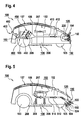
- Fig. 4 shows the mowing robot 100 provided with the processing unit 106 Fig. 1 who has the camera 220 of Fig. 2 having.
- the robotic lawnmower 100 is battery-operated here and has at least one battery pack 450 for autonomous power supply, which is provided with a plurality of battery cells 452 by way of example.
- At least one fan impeller 460 is associated with this battery pack 450, which according to a third embodiment is designed to at least partially generate an airflow 412 supplied to the air conduction device 152, so that the use of the fan impeller 207 of FIG Fig. 2 can be omitted and this is thus optional in the third embodiment. Therefore, the fan 460 is illustratively associated with the blanking device 150 as well.
- the fan wheel 460 for generating the air flow 412 for example, air via the air inlet opening 107 of the machine housing 102, or an additional provided thereon air inlet opening 402, suck, as indicated by an arrow 462.
- the air stream 412 is supplied, for example, via an air duct 410 to the air guiding device 152 and is at least partially conducted by the latter as the air stream 154 in the direction of the camera 220, to flow around this at least partially.
- the air flow 412 and thus the air flow 154 are preferably heated by the battery pack 450 and can thus effectively prevent fogging of the camera 220 in particular.
- Fig. 5 shows that with the Fig. 2 described processing unit 106 provided mower robot 100 of Fig. 1 who like at Fig. 1 described the machine housing 102 and the detection unit 120 disposed thereon.
- This has, according to a second embodiment, at least one and illustratively two optical sensors 522, 524, which are preferably at least partially integrated into the machine housing 102 and in their area the provided with an alternative air guide 552 free-hold device 150 of Fig. 1 is provided.
- an air deflection device 510 is provided, which is arranged illustratively in the machine housing 102 and designed to divert at least a portion of an air flow generated by the fan 207, or a portion of the cooling air flow 209, to the air guide 552 of the free-hold device 150.
- the freestanding device 150 can be supplied with an air flow marked 512 in the operation of the robotic lawnmower 100.
- the fan wheel 207 at least partially generates the air flow 512 supplied to the free-hold device 150.
- the latter is guided by the air-guiding device 552 at least partially as air flow 554 in the direction of the optical sensors 522, 524 in order to flow around them at least in regions and thus Stopping of dirt and / or water particles on the optical sensors 522, 524 at least to reduce and preferably at least substantially prevented.
- the air flow 512 supplied to the free-hold device 150 and thus the air flow 554 are preferably heated by the drive motor 206 and can thus effectively prevent fogging of the optical sensors 522, 524 in particular.
- Fig. 6 shows the robotic lawnmower 100 of Fig. 5 having the optical sensors 522, 524.
- the free-space device 150 according to a fifth embodiment has a separate fan wheel 610 for at least partially generating one of the air-guiding device 552 supplied air flow 612, so that a use of the fan 207 of Fig. 5 can be omitted and this is thus optional in the fifth embodiment.
- the fan 610 may be used to generate the air flow 612, e.g. Suck in air via the air inlet opening 107 of the machine housing 102.
- the air flow 612 is at least partially directed by the air guide device 552 as the air flow 154 in the direction of the optical sensors 522, 524 in order to flow around them at least in regions.
- the air flow 554 can cool the optical sensors 522, 524 at least in sections.
- Fig. 7 shows the robotic lawnmower 100 of Fig. 5 comprising the optical sensors 522, 524 of Fig. 5 having.
- the robotic lawnmower 100 is battery-operated here and has at least one battery pack 750 for autonomous power supply, which is provided with a plurality of battery cells 752 by way of example.
- At least one fan wheel 760 which according to a sixth embodiment is designed to at least partially generate an air flow 712 supplied to the air guide device 552, is assigned to this battery pack 750 for cooling, so that the use of the fan wheel 207 of FIG Fig. 5 can be omitted and this is thus optional in the sixth embodiment. Therefore, the fan 760 is illustratively associated with the blanking device 150 as well.
- the fan 760 may be used to generate the airflow 712, e.g. Air via the air inlet opening 107 of the machine housing 102, or an additional thereto provided air inlet opening 702, suck, as indicated by an arrow 762.
- the air stream 712 is e.g. supplied via an air duct 710 of the louver 552 and from this at least partially as the air flow 554 in the direction of the optical sensors 522, 524 passed to flow around them at least partially.
- the air flow 712 and thus the air flow 554 are preferably heated by the battery pack 750 and can thus effectively prevent fogging of the optical sensors 522, 524 in particular.
- the robotic lawnmower 100 for detecting water particles on the detection unit 120 or the optical sensors 522, 524 may be preferred have a moisture detection device. This can be designed, for example, in the manner of a temperature sensor and / or a rain sensor.
- the optical sensors 522, 524 can detect fogging eg by no, a very weak or a very untypical signal from the transmitter to the receiver itself.
- the optical sensors 522, 524 may output corrupted readings if their temperature is too high during operation.
- the robotic lawnmower 100 or the free-space device 150 of the robotic lawnmower 100 according to a seven embodiment with a fan (1170 in Fig.
- This cooling air flow (1171, 1172 in Fig. 10 ) for generating a cooling air flow (1171, 1172 in Fig. 10 ), eg at high ambient temperatures, as may be the case for example in midsummer.
- This cooling air flow (1171, 1172 in Fig. 10 ) is preferably designed for cooling the optical sensors 522, 524 and / or the drive motor 206 and / or the battery pack 750 and / or any other temperature-sensitive part of the robotic lawnmower 100.
- the drive motor 206 of the robotic lawnmower 100 is preferably designed such that it is preferably energized without commissioning the robotic lawnmower 100 to allow heating of the drive motor 206 and / or the battery pack 450, 750 for heating the supplied air flow 212, 412.
- the robotic lawnmower 206 pauses and the drive motor 206 is energized in a targeted manner, eg a motor output stage assigned to the drive motor 206 can be heated by slow switching.
- the heating of the drive motor 206 by a Bremsbestromung in which the drive motor 206 is heated by constant rapid reversal of the motor rotation direction, can be generated.
- the generated heat can then be conducted to the optical sensors 522, 524 with the aid of the fan wheel 207 assigned to the drive motor 206 and thus at least reduce the occurring water particles.
- the energization is not limited to the drive motor 206, but rather can be done on any, the robotic lawnmower 100 associated engine, for example on a Radantriebsmotor.
- FIG. 3 shows the robotic lawnmower 100 of FIG. 1 in a base station 1100 in an exemplary parking and / or charging position, which is hereinafter referred to simply as a parking position for the sake of simplicity Fig. 5 ,
- the robotic lawnmower 100 and the base station 1100 preferably form a system 1500.
- the robotic lawnmower 100 is located between two operations in the base station 1100.
- the battery pack 750 can preferably be charged and / or the optical sensors 522, 524 are cleaned.
- a contamination and / or water particles on the optical sensors 522, 524 may optionally be as described above, e.g. be detected by a temperature sensor and / or a rain sensor.
- the base station 1100 may have at its bottom plate 1110 in the region of the optical sensors 522, 524 a reflector surface with a known reflectance, via which a contamination and / or water particles on the optical sensors 522, 524 can be determined.
- Fig. 8 For example, such contamination and / or fogging of the optical sensors 522, 524 will occur by way of example with the aid of the heat generated by the drive motor 206, which is analogous to, for example Fig. 5 is passed with a fan 207 to the optical sensors 522, 524, at least reduced.
- the drive motor 206 is designed such that it can be operated in the parking position analogously to autonomous operation or analogously to Fig. 7 can be energized.
- the drive motor 206 can optionally be supplied via the battery pack 750 of the robotic lawnmower 100 or via the base station 1100, which is preferably designed to provide energy for the robotic lawnmower 100.
- Fig. 9 shows that in the base station 1100 of Fig. 8 parking robots 100 of Fig. 7 , Analogous to Fig. 7
- contamination and / or fogging of the detection unit 120 is at least reduced by means of the heat generated by the battery pack 750 of the robotic lawnmower 100 and at least partially conducted to the optical sensors 522, 524 by the fan wheel 760.
- the battery pack 750 is preferably heated via a specific charging process, which is preferably completed or completed before the following operation of the robotic lawnmower 100.
- the battery pack 750 via a targeted Overloading which is finished, for example, shortly before the following operation of the robotic lawnmower 100 and is performed in the non-battery-damaging area, are heated.
- Fig. 10 shows that in the base station 1100 of Fig. 8 parking robots 100 of Fig. 7 with a free-hold device 150 designed according to the seventh embodiment, in which, between the battery pack 750 and the optical sensors 522, 524, an impeller 1170 is illustratively arranged for generating a cooling air flow 1171, 1172 preferably conducted in the air duct 710.
- This fan 1170 may optionally or additionally eg at and / or before operation in warm or hot ambient temperatures, eg. B. on high summer days, for cooling the battery pack 750 and / or for cooling the optical sensors 522, 524 application, so that at such high temperatures possible corruption of measured values can be prevented.
- Fig. 11 shows the robotic lawnmower 100 of Fig. 7 in the base station 1100 of Fig. 8 , which according to a second embodiment has an air duct 1125.
- the air duct 1125 is disposed in the bottom plate 1110 of the base station 1100 and directs an analogous to the air flow 712 of Fig. 7 heated air flow 1127 preferably at least partially to the optical sensors 522, 524.
- the air flow 1127 for this purpose on an underside 1126 of the robotic lawnmower 100 preferably in the range of a wheel 103, 104, 105 of the robotic lawnmower 100 discharged and via the air duct 1127 to the passed optical sensors 522, 524.
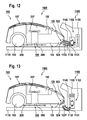
- Fig. 12 shows the robotic lawnmower 100 with the detection unit 120 of FIG Fig. 5 and the base station 1100 of Fig. 8 , which according to a third embodiment comprises a cleaning device 1102.
- the cleaning device 1102 is designed at least to at least reduce fouling and / or fogging of the optical sensors 522, 524 and / or condensation on the optical sensors 522, 524.
- the cleaning device 1102 preferably has at least one fan 1120 for generating an air flow 1131, 1132, 1133 which can be supplied at least partially to the optical sensors 522, 524.
- This air flow 1131, 1132, 1133 is at least designed to settle dirt and / or water particles on the optical sensors 522, 524 of the robotic lawnmower 100 at least substantially to prevent and / or to cool the optical sensors 522, 524 at least in sections.
- the cleaning device 1102 preferably has a heat source 1140 for generating heat.
- This heat source 1140 is preferably designed to heat the air stream 1131, 1132, 1133 which can be supplied at least partially to the optical sensors 522, 524 and is preferably arranged in the region of the optical sensors 522, 524.
- Fig. 13 shows the robotic lawnmower 100 with the detection unit 120 of FIG Fig. 5 and the base station 1100 of Fig. 12 ,
- the at least partially the optical sensors 522, 524 feedable air flow 1131, 1132 in Fig. 13 analogous to at least one air duct 1125 of Fig. 11 via at least one preferably in the bottom plate 1110 of the base station 1100 arranged air duct 1327 directed to the detection unit 120.
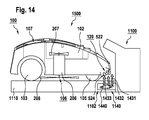
- Fig. 14 shows the robotic lawnmower 100 with the detection unit 120 of FIG Fig. 5 and the base station 1100 of Fig. 8 according to a fourth embodiment comprising a heat source 1140 arranged in the bottom plate 1110 of the base station 1100.
- the heat source 1140 is configured to generate rising heat 1431, 1432, 1433, which reduces at least one of soiling and / or condensing the optical sensors 522, 524.
- a heating of the bottom plate 1110 in the region of the battery pack 750 can take place, by means of which the usable power of the robotic lawnmower 100 battery capacity of the battery pack 750 can be preferably increased.
- the heat source 1140 is designed as a heating mat 1440.
- the detection unit 120 is realized in each case either with an image acquisition unit, in particular a camera, or with optical sensors.
- the invention is not limited to such detection units, but can be used in a variety of other detection units application, eg in ToF (Time of Flight) cameras, ultrasonic sensors, laser sensors, lighting elements such as LEDs, etc.
- processing machine 100 and / or the base station 1100 can also be combined with one another as desired.
Landscapes
- Engineering & Computer Science (AREA)
- Power Engineering (AREA)
- Transportation (AREA)
- Mechanical Engineering (AREA)
- Life Sciences & Earth Sciences (AREA)
- Physics & Mathematics (AREA)
- Sustainable Development (AREA)
- Sustainable Energy (AREA)
- General Physics & Mathematics (AREA)
- Radar, Positioning & Navigation (AREA)
- Computer Vision & Pattern Recognition (AREA)
- Multimedia (AREA)
- Electromagnetism (AREA)
- Aviation & Aerospace Engineering (AREA)
- Remote Sensing (AREA)
- Automation & Control Theory (AREA)
- Environmental Sciences (AREA)
- Optics & Photonics (AREA)
- Harvester Elements (AREA)
- Control Of Position, Course, Altitude, Or Attitude Of Moving Bodies (AREA)
Abstract
Description
- Die vorliegende Erfindung betrifft eine Bearbeitungsmaschine zur autonomen Bearbeitung eines zugeordneten Arbeitsbereichs, mit einer Erfassungseinheit zur Erfassung von jeweils aktuellen Umgebungsparametern, die zur Steuerung der Bearbeitungsmaschine im zugeordneten Arbeitsbereich auswertbar sind.
- Aus dem Stand der Technik ist eine derartige, z.B. nach Art eines Mähroboters bzw. eines autonomen Rasenmähers ausgebildete Bearbeitungsmaschine zur autonomen Bearbeitung eines zugeordneten Arbeitsbereichs, z.B. einer Rasenfläche, bekannt. Dieser autonome Rasenmäher ist mit einer nach Art einer Kamera ausgebildeten Erfassungseinheit versehen, mit der im Betrieb des autonomen Rasenmähers jeweils aktuelle Umgebungsparameter erfasst werden, die auswertbar sind, um eine geeignete Steuerung des autonomen Rasenmähers z.B. zur Navigation auf der Rasenfläche zu ermöglichen.
- Nachteilig am Stand der Technik ist, dass im Betrieb eines derartigen, autonomen Rasenmähers eine betriebsbedingte Verschmutzung und/oder ein Beschlagen der Kamera und/oder eine Kondensatbildung an der Kamera zu einer Einschränkung der Funktionalität der Kamera führen können. Eine derartige Einschränkung kann zu einer eingeschränkten und fehlerhaften Erfassung der jeweils aktuellen Umgebungsparameter führen und somit zu einer unpräzisen und inkorrekten Steuerung des autonomen Rasenmähers.
- Eine Aufgabe der Erfindung ist es daher, eine neue Bearbeitungsmaschine zur autonomen Bearbeitung eines zugeordneten Arbeitsbereichs bereitzustellen, die eine Erfassungseinheit aufweist, mit der jeweils aktuelle Umgebungsparameter sicher und zuverlässig erfasst werden können.
- Dieses Problem wird gelöst durch eine Bearbeitungsmaschine zur autonomen Bearbeitung eines zugeordneten Arbeitsbereichs, mit einer Erfassungseinheit zur Erfassung von jeweils aktuellen Umgebungsparametern, die zur Steuerung der Bearbeitungsmaschine im zugeordneten Arbeitsbereich auswertbar sind. Der Erfassungseinheit ist eine Freihalteeinrichtung zugeordnet, die zumindest dazu ausgebildet ist, im autonomen Betrieb der Bearbeitungsmaschine eine betriebsbedingte Verschmutzung und/oder ein Beschlagen der Erfassungseinheit und/oder eine Kondensatbildung an der Erfassungseinheit zumindest zu reduzieren.
- Die Erfindung ermöglicht somit die Bereitstellung einer Bearbeitungsmaschine zur autonomen Bearbeitung eines zugeordneten Arbeitsbereichs, bei der eine betriebsbedingte Verschmutzung und/oder ein Beschlagen einer zugeordneten Erfassungseinheit und/oder eine Kondensatbildung an der Erfassungseinheit im Betrieb der Bearbeitungsmaschine durch eine Verwendung der Freihalteeinrichtung auf einfache Art und Weise zumindest im Wesentlichen sicher und zuverlässig verhindert werden können.
- Gemäß einer Ausführungsform weist die Erfassungseinheit mindestens eine Kamera und/oder mindestens einen optischen Sensor auf.
- Somit kann die Bereitstellung einer robusten und stabilen Erfassungseinheit ermöglicht werden.
- Die Umgebungsparameter weisen bevorzugt Lokalisierungs-, Arbeitsflächenerkennungs- und/oder Untergrunderkennungsparameter auf.
- Somit können auf einfache Art und Weise Navigationsdaten und/oder geeignete Arbeitsflächen- bzw. Untergrundspezifische Bearbeitungsdaten zur Steuerung der Bearbeitungsmaschine bestimmt werden.
- Gemäß einer Ausführungsform weist die Freihalteeinrichtung mindestens eine Luftleiteinrichtung auf, der zumindest im autonomen Betrieb der Bearbeitungsmaschine ein Luftstrom zugeführt wird. Die Luftleiteinrichtung ist dazu ausgebildet, den zugeführten Luftstrom zumindest teilweise in Richtung der Erfassungseinheit zu leiten.
- Die Erfindung ermöglicht somit die Bereitstellung einer Bearbeitungsmaschine mit einer einfachen und unkomplizierten Freihalteeinrichtung.
- Bevorzugt ist der zumindest teilweise in Richtung der Erfassungseinheit geleitete Luftstrom zumindest dazu ausgebildet, ein Festsetzen von Schmutz- und/oder Wasserpartikeln auf der Erfassungseinheit zumindest im Wesentlichen zu verhindern und/oder die Erfassungseinheit zumindest abschnittsweise zu kühlen.
- Somit kann ein Festsetzen von Schmutz- und/oder Wasserpartikeln auf der Erfassungseinheit sicher und zuverlässig verhindert werden. Darüber hinaus kann eine effiziente Kühlung der Erfassungseinheit ermöglicht werden.
- Gemäß einer Ausführungsform weist die Freihalteeinrichtung mindestens ein Lüfterrad zur Erzeugung des zugeführten Luftstroms auf.
- Somit kann der zugeführte Luftstrom auf einfache Art und Weise erzeugt werden.
- Bevorzugt ist zum Antrieb im autonomen Betrieb der Bearbeitungsmaschine ein Antriebsmotor vorgesehen, dem zur Motorkühlung mindestens ein Lüfterrad zugeordnet ist, das dazu ausgebildet ist, den zugeführten Luftstrom zumindest teilweise zu erzeugen.
- Somit kann ein bereits als integraler Bestandteil der Bearbeitungsmaschine vorgesehenes Lüfterrad zur Erzeugung des zugeführten Luftstroms Anwendung finden, sodass eine Bauraum- und Ressourcensparende Umsetzung der vorliegenden Erfindung ermöglicht wird.
- Gemäß einer Ausführungsform ist zur Stromversorgung im autonomen Betrieb der Bearbeitungsmaschine mindestens ein Akkupack vorgesehen, dem zur Kühlung mindestens ein Lüfterrad zugeordnet ist, das dazu ausgebildet ist, den zugeführten Luftstrom zumindest teilweise zu erzeugen.
- Die Erfindung ermöglicht somit die Bereitstellung einer akkubetriebenen Bearbeitungsmaschine, bei der ein bereits als integraler Bestandteil eines zugeordneten Akkupacks vorgesehenes Lüfterrad zur Erzeugung des zugeführten Luftstroms Anwendung finden kann, sodass auch bei dieser Ausführungsform eine Bauraum- und Ressourcensparende Umsetzung der vorliegenden Erfindung ermöglicht wird.
- Bevorzugt ist der zugeführte Luftstrom vom Antriebsmotor und/oder vom Akkupack angewärmt.
- Hierdurch kann insbesondere ein Beschlagen der zugeordneten Erfassungseinheit wirksam verhindert werden.
- Gemäß einer Ausführungsform ist der Antriebsmotor bestrombar, um ein Aufheizen des Antriebsmotors und/oder des Akkupacks zum Erwärmen des zugeführten Luftstroms zu ermöglichen.
- Somit kann der Luftstrom auf einfache Art und Weise erwärmt werden.
- Bevorzugt ist die Bearbeitungsmaschine nach Art eines autonomen Rasenmähers oder eines autonomen Staubsaugers ausgebildet.
- Somit kann die Erfindung auf einfache Art und Weise bei unterschiedlichen Bearbeitungsmaschinen zur autonomen Bearbeitung eines zugeordneten Arbeitsbereichs Anwendung finden. Es wird jedoch darauf hingewiesen, dass ein autonomer Rasenmäher bzw. Staubsauger lediglich beispielhaften Charakter hat und nicht als Einschränkung der Erfindung zu verstehen ist, die auch bei anderen autonomen Arbeitsmaschinen Anwendung finden kann, z.B. bei einer autonomen Scheibenwischmaschine.
- Darüber hinaus wird oben stehendes Problem gelöst durch eine Basisstation für eine mit einer Erfassungseinheit versehene Bearbeitungsmaschine zur autonomen Bearbeitung eines zugeordneten Arbeitsbereichs, wobei die Erfassungseinheit zur Erfassung von jeweils aktuellen Umgebungsparametern ausgebildet ist, die zur Steuerung der Bearbeitungsmaschine in einem zugeordneten Arbeitsbereich auswertbar sind, wobei eine Reinigungsvorrichtung vorgesehen ist, die zumindest dazu ausgebildet ist, eine Verschmutzung und/oder ein Beschlagen der Erfassungseinheit und/oder eine Kondensatbildung an der Erfassungseinheit zumindest zu reduzieren.
- Die Erfindung ermöglicht somit die Bereitstellung einer Basisstation mit einer Reinigungsvorrichtung für eine Bearbeitungsmaschine, mit der eine Verschmutzung und/oder ein Beschlagen einer der Bearbeitungsmaschine zugeordneten Erfassungseinheit und/oder eine Kondensatbildung an dieser Erfassungseinheit vor und/oder nach dem Betrieb der Bearbeitungsmaschine auf einfache Art und Weise zumindest im Wesentlichen sicher und zuverlässig reduziert werden kann.
- Vorzugsweise ist der Reinigungsvorrichtung mindestens ein Lüfter zur Erzeugung eines zumindest teilweise der Erfassungseinheit zuführbaren Luftstroms zugeordnet.
- Somit kann die Erfassungseinheit sicher und zuverlässig gereinigt werden. Darüber hinaus kann eine effiziente Kühlung der Erfassungseinheit ermöglicht werden.
- Gemäß einer Ausführungsform ist der Luftstrom zumindest dazu ausgebildet, ein Festsetzen von Schmutz- und/oder Wasserpartikeln auf der Erfassungseinheit der Bearbeitungsmaschine zumindest im Wesentlichen zu verhindern und/oder die Erfassungseinheit zumindest abschnittsweise zu kühlen.
- Somit können eine Verschmutzung der Erfassungseinheit und deren thermische Beschädigung zumindest weitgehend verhindert werden.
- Bevorzugt ist der Reinigungsvorrichtung mindestens ein Luftleitkanal zugeordnet, der dazu ausgebildet ist, den zumindest teilweise der Erfassungseinheit zuführbaren Luftstrom zur Erfassungseinheit zu leiten.
- Somit kann der Luftstrom exakt und präzise zur Erfassungseinheit geleitet werden.
- Vorzugsweise ist eine Bodenplatte vorgesehen, in der der Luftleitkanal angeordnet ist.
- Somit kann der Luftleitkanal unkompliziert und sicher in der Basisstation angeordnet werden.
- Bevorzugt ist der Reinigungsvorrichtung eine Wärmequelle zur Erzeugung von Wärme zugeordnet.
- Somit kann auf einfache Art und Weise Wärme zumindest zur Reduzierung eines Beschlags der der Bearbeitungsmaschine zugeordneten Erfassungseinheit bereitgestellt werden.
- Gemäß einer Ausführungsform ist eine Bodenplatte vorgesehen, in der die Wärmequelle angeordnet ist.
- Somit kann die Wärmequelle sicher und zuverlässig in der Basisstation angeordnet werden.
- Die Wärmequelle ist vorzugsweise nach Art einer Heizmatte ausgebildet.
- Somit kann eine einfache und kompakte Wärmequelle bereitgestellt werden.
- Die Wärmequelle ist bevorzugt zur Erwärmung des zumindest teilweise der Erfassungseinheit zuführbaren Luftstroms ausgebildet.
- Somit kann auf einfache Art und Weise ein erwärmter Luftstrom bereitgestellt werden.
- Vorzugsweise ist die Basisstation zur Bereitstellung von Energie für die Bearbeitungsmaschine ausgebildet, um zumindest ein Aufladen eines der Bearbeitungsmaschine zugeordneten Akkupacks zu ermöglichen.
- Somit kann der Akkupack sicher und zuverlässig in der Basisstation aufgeladen werden.
- Darüber hinaus wird oben stehendes Problem auch noch gelöst durch ein System, das zumindest aufweist: eine Bearbeitungsmaschine zur autonomen Bearbeitung eines zugeordneten Arbeitsbereichs, mit einer Erfassungseinheit zur Erfassung von jeweils aktuellen Umgebungsparametern, die zur Steuerung der Bearbeitungsmaschine im zugeordneten Arbeitsbereich auswertbar sind, und eine Basisstation für die Bearbeitungsmaschine, die zumindest dazu ausgebildet ist, eine Verschmutzung und/oder ein Beschlagen der Erfassungseinheit und/oder eine Kondensatbildung an der Erfassungseinheit zumindest zu reduzieren.
- Die Erfindung ermöglicht somit auch die Bereitstellung eines Systems bestehend aus einer oben beschriebenen Bearbeitungsmaschine sowie einer oben beschriebenen Basisstation für die Bearbeitungsmaschine.
- Die Erfindung ist anhand von in den Zeichnungen dargestellten Ausführungsbeispielen in der nachfolgenden Beschreibung näher erläutert. Es zeigen:
-
Fig. 1 eine perspektivische Ansicht einer Bearbeitungsmaschine zur autonomen Bearbeitung eines zugeordneten Arbeitsbereichs gemäß der vorliegenden Erfindung, -
Fig. 2 eine schematische Ansicht der Bearbeitungsmaschine vonFig. 1 , mit einer Erfassungseinheit und einer Freihalteeinrichtung gemäß einer ersten Ausführungsform, -
Fig. 3 eine schematische Ansicht der Bearbeitungsmaschine vonFig. 1 , mit der Erfassungseinheit vonFig. 2 und einer Freihalteeinrichtung gemäß einer zweiten Ausführungsform, -
Fig. 4 eine schematische Ansicht der Bearbeitungsmaschine vonFig. 1 , mit der Erfassungseinheit vonFig. 2 und einer Freihalteeinrichtung gemäß einer dritten Ausführungsform, -
Fig. 5 eine schematische Ansicht der Bearbeitungsmaschine vonFig. 1 , mit einer Erfassungseinheit gemäß einer zweiten Ausführungsform und einer Freihalteeinrichtung gemäß einer vierten Ausführungsform, -
Fig. 6 eine schematische Ansicht der Bearbeitungsmaschine vonFig. 1 , mit der Erfassungseinheit vonFig. 5 und einer Freihalteeinrichtung gemäß einer fünften Ausführungsform, -
Fig. 7 eine schematische Ansicht der Bearbeitungsmaschine vonFig. 1 , mit der Erfassungseinheit vonFig. 5 und einer Freihalteeinrichtung gemäß einer sechsten Ausführungsform, -
Fig.8 eine schematische Ansicht der Bearbeitungsmaschine vonFig. 5 mit einer Basisstation gemäß einer ersten Ausführungsform, -
Fig. 9 eine schematische Ansicht der Bearbeitungsmaschine vonFig. 7 mit der Basisstation vonFig. 8 , -
Fig. 10 eine schematische Ansicht der Bearbeitungsmaschine vonFig. 7 , mit einer Freihalteeinrichtung gemäß einer siebten Ausführungsform, sowie der Basisstation vonFig. 8 , -
Fig. 11 eine schematische Ansicht der Bearbeitungsmaschine vonFig. 7 mit einer Basisstation gemäß einer zweiten Ausführungsform, -
Fig. 12 eine schematische Ansicht der Bearbeitungsmaschine vonFig. 1 , mit der Erfassungseinheit vonFig. 5 und einer Basisstation gemäß einer dritten Ausführungsform, -
Fig. 13 eine schematische Ansicht der Bearbeitungsmaschine vonFig. 12 mit einer Basisstation gemäß einer vierten Ausführungsform, und -
Fig. 14 eine schematische Ansicht der Bearbeitungsmaschine vonFig. 12 mit einer Basisstation gemäß einer fünften Ausführungsform. -
Fig. 1 zeigt eine beispielhafte Bearbeitungsmaschine 100 zur autonomen Bearbeitung eines zugeordneten Arbeitsbereichs 110 gemäß der vorliegenden Erfindung. Die Bearbeitungsmaschine 100 weist ein mit mindestens einer Lufteintrittsöffnung 107 versehenes Maschinengehäuse 102 auf, das z.B. über mindestens drei Räder und/oder Rollen 103, 104, 105 autonom in dem Arbeitsbereich 110 verfahrbar ist. Die Lufteintrittsöffnung 107 kann z.B. mit einem Gitter und/oder einem Filter versehen sein. Darüber hinaus weist die Bearbeitungsmaschine 100 eine Bearbeitungseinheit 106 zur Bearbeitung des Arbeitsbereichs 110 auf, die illustrativ über einen Ein-/Aus-Schalter 108 aktivierbar ist. - Es wird jedoch darauf hingewiesen, dass eine Aktivierung der Bearbeitungseinheit 106 durch eine Betätigung des Ein-/Aus-Schalters 108 lediglich beispielhaften Charakter hat und nicht als Einschränkung der Erfindung zu verstehen ist. Vielmehr kann die Bearbeitungseinheit 106 auch auf eine beliebige andere Art und Weise aktiviert werden, z.B. mittels einer Fernbedienung oder automatisch bei einem Einbringen der Bearbeitungsmaschine 100 in den zugeordneten Arbeitsbereich 110.
- Die Bearbeitungsmaschine 100 weist bevorzugt mindestens eine am Maschinengehäuse 102 angeordnete Erfassungseinheit 120 zur Erfassung von jeweils aktuellen Umgebungsparametern auf, die vorzugsweise zumindest Lokalisierungs-, Arbeitsflächenerkennungs- und/oder Untergrunderkennungsparameter umfassen. Diese jeweils aktuellen Umgebungsparameter sind bevorzugt zumindest zur Steuerung der Bearbeitungsmaschine 100 im zugeordneten Arbeitsbereich 110 auswertbar, um hierzu z.B. Navigationsdaten und/oder geeignete Arbeitsflächenbzw. Untergrundspezifische Bearbeitungsdaten zu bestimmen. Eine entsprechende Auswertung kann über eine geeignete Steuereinheit auf eine beliebige, auch dem Fachmann bekannte Art und Weise erfolgen und ist, ebenso wie die geeignete Steuereinheit, nicht Gegenstand der vorliegenden Erfindung. Deshalb wird hier zwecks Knappheit der Beschreibung auf eine eingehende Beschreibung hiervon verzichtet.
- Gemäß einer Ausführungsform ist der Erfassungseinheit 120 mindestens eine Freihalteeinrichtung 150 zugeordnet. Diese ist bevorzugt zumindest dazu ausgebildet, im autonomen Betrieb der Bearbeitungsmaschine 100 eine betriebsbedingte Verschmutzung der Erfassungseinheit 120, ein Beschlagen der Erfassungseinheit 120 und/oder eine Kondensatbildung an der Erfassungseinheit 120 zumindest zu reduzieren und vorzugsweise im Wesentlichen vollständig zu verhindern. Hierzu weist die Freihalteeinrichtung 150 bevorzugt mindestens eine Luftleiteinrichtung 152 auf, die zumindest dazu ausgebildet ist, im Betrieb der Bearbeitungsmaschine 100 einen Luftstrom 154 in Richtung der Erfassungseinheit 120 zu leiten, der diese zumindest abschnittsweise umströmt.
- Die Luftleiteinrichtung 152 umgreift die Erfassungseinheit 120 illustrativ ringförmig und bildet hierbei eine ringförmige Luftaustrittsöffnung im Bereich der Erfassungseinheit 120 aus. Alternativ hier kann die Luftleiteinrichtung 152 auch eine oder mehrere punktförmige Luftaustrittsöffnungen ausbilden.
- Der Luftstrom 154 kann in eine beliebige Richtung über die Erfassungseinheit 120 geleitet werden. Darüber hinaus kann der Luftstrom 154 auch stoßartig über die Erfassungseinheit 120 geleitet werden, wozu z.B. an der Luftleiteinrichtung 152 ein geeignetes Ventil oder ein geeigneter Schieber vorgesehen sein können.
- Illustrativ ist die Bearbeitungsmaschine 100 nach Art eines autonomen Rasenmähers ausgebildet und wird deshalb nachfolgend zur Vereinfachung der Beschreibung auch als "Mähroboter" bezeichnet. Bei diesem Mähroboter 100 ist die Bearbeitungseinheit 106 nach Art einer Rasenmähvorrichtung ausgebildet, wobei der zugeordnete Arbeitsbereich 110 eine Rasenfläche repräsentiert. Es wird jedoch darauf hingewiesen, dass der Mähroboter 100 lediglich beispielhaft zur Illustration einer möglichen Ausführung der vorliegenden Erfindung beschrieben ist und nicht zu deren Einschränkung. Diese kann vielmehr ganz allgemein bei autonomen Bearbeitungsmaschinen Anwendung finden, bei denen die Erfassungseinheit 120 verwendet wird, z.B. bei autonomen Staubsaugern, autonomen Scheibenwischmaschinen usw.
- Der Mähroboter 100 ist bevorzugt akkubetrieben und mit einem geeigneten Akkupack versehen, wie bei
Fig. 4 und7 beschrieben. Es wird jedoch darauf hingewiesen, dass die vorliegende Erfindung nicht auf elektrisch angetriebene, und insbesondere akkubetriebene, Mähroboter beschränkt ist, sondern vielmehr ganz allgemein bei autonomen Bearbeitungsmaschinen Anwendung finden kann, unabhängig davon, ob diese elektrisch oder nicht-elektrisch antreibbar sind. -
Fig. 2 zeigt den mit der Bearbeitungseinheit 106 versehenen Mähroboter 100 vonFig. 1 , der wie beiFig. 1 beschrieben das Maschinengehäuse 102 und die daran angeordnete Erfassungseinheit 120 aufweist. Diese ist gemäß einer ersten Ausführungsform nach Art einer Bilderfassungseinheit 220 ausgebildet, insbesondere nach Art einer Kamera, die bevorzugt zumindest teilweise in das Maschinengehäuse 102 integriert ist und in deren Bereich die mit der Luftleiteinrichtung 152 versehene Freihalteeinrichtung 150 vonFig. 1 vorgesehen ist. - Die Bearbeitungseinheit 106 ist wie bei
Fig. 1 beschrieben nach Art einer Rasenmähvorrichtung ausgebildet und weist dementsprechend illustrativ ein oder mehrere Mähmesser 208 auf, zu deren Antrieb im autonomen Betrieb des Mähroboters 100 ein Antriebsmotor 206 vorgesehen ist. Diesem ist zur Motorkühlung mindestens ein Lüfterrad 207 zugeordnet, das z.B. durch die am Maschinengehäuse 102 vorgesehene Lufteintrittsöffnung 107 Luft ansaugen kann, um einen zumindest am Außenumfang des Antriebsmotors 206 vorbeiströmenden Kühlluftstrom 209 zu erzeugen. - Gemäß der ersten Ausführungsform ist eine Luftumlenkeinrichtung 210 vorgesehen, die illustrativ im Maschinengehäuse 102 angeordnet ist und dazu ausgebildet ist, zumindest einen Teil eines vom Lüfterrad 207 erzeugten Luftstroms, bzw. einen Teil des Kühlluftstroms 209, zur Luftleiteinrichtung 152 der Freihalteeinrichtung 150 umzulenken. Hierdurch kann der Freihalteeinrichtung 150 im Betrieb des Mähroboters 100 ein mit 212 gekennzeichneter Luftstrom zugeführt werden. Deshalb ist das Lüfterrad 207 illustrativ auch der Freihalteeinrichtung 150 zugeordnet.
- Im autonomen Betrieb des Mähroboters 100 erzeugt das Lüfterrad 207 zumindest teilweise den der Freihalteeinrichtung 150 zugeführten Luftstrom 212. Dieser wird von der Luftleiteinrichtung 152 zumindest teilweise als der Luftstrom 154 in Richtung der Kamera 220 geleitet, um diese zumindest bereichsweise zu umströmen und somit ein Festsetzen von Schmutz- und/oder Wasserpartikeln auf der Kamera 120 zumindest zu reduzieren und bevorzugt zumindest im Wesentlichen zu verhindern. Hierbei ist der der Freihalteeinrichtung 150 zugeführte Luftstrom 212 und somit der Luftstrom 154 bevorzugt vom Antriebsmotor 206 angewärmt und kann somit insbesondere ein Beschlagen der Kamera 220 wirksam verhindern.
-
Fig. 3 zeigt den mit der Bearbeitungseinheit 106 versehenen Mähroboter 100 vonFig. 1 , der die Kamera 220 vonFig. 2 aufweist. Im Gegensatz zur ersten Ausführungsform vonFig. 2 weist die Freihalteeinrichtung 150 hierbei gemäß einer zweiten Ausführungsform ein separates Lüfterrad 310 zur zumindest teilweisen Erzeugung eines der Luftleiteinrichtung 152 zugeführten Luftstroms 312 auf, sodass auf eine Verwendung des Lüfterrads 207 vonFig. 2 verzichtet werden kann und dieses in der zweiten Ausführungsform somit optional ist. - Im autonomen Betrieb des Mähroboters 100 kann das Lüfterrad 310 zur Erzeugung des Luftstroms 312 z.B. Luft über die Lufteintrittsöffnung 107 des Maschinengehäuses 102 ansaugen. Der Luftstrom 312 wird von der Luftleiteinrichtung 152 zumindest teilweise als der Luftstrom 154 in Richtung der Kamera 220 geleitet, um diese zumindest bereichsweise zu umströmen. Hierbei kann der Luftstrom 154 die Kamera 220 zumindest abschnittsweise kühlen.
-
Fig. 4 zeigt den mit der Bearbeitungseinheit 106 versehenen Mähroboter 100 vonFig. 1 , der die Kamera 220 vonFig. 2 aufweist. Illustrativ ist der Mähroboter 100 hier akkubetrieben und weist zur Stromversorgung im autonomen Betrieb mindestens ein Akkupack 450 auf, das beispielhaft mit einer Mehrzahl von Akkuzellen 452 versehen ist. Diesem Akkupack 450 ist zur Kühlung mindestens ein Lüfterrad 460 zugeordnet, das gemäß einer dritten Ausführungsform dazu ausgebildet ist, einen der Luftleiteinrichtung 152 zugeführten Luftstrom 412 zumindest teilweise zu erzeugen, sodass auf eine Verwendung des Lüfterrads 207 vonFig. 2 verzichtet werden kann und dieses in der dritten Ausführungsform somit optional ist. Deshalb ist das Lüfterrad 460 illustrativ auch der Freihalteeinrichtung 150 zugeordnet. - Im autonomen Betrieb des Mähroboters 100 kann das Lüfterrad 460 zur Erzeugung des Luftstroms 412 z.B. Luft über die Lufteintrittsöffnung 107 des Maschinengehäuses 102, oder eine zusätzliche daran vorgesehene Lufteintrittsöffnung 402, ansaugen, wie mit einem Pfeil 462 angedeutet. Der Luftstrom 412 wird z.B. über einen Luftleitkanal 410 der Luftleiteinrichtung 152 zugeführt und von dieser zumindest teilweise als der Luftstrom 154 in Richtung der Kamera 220 geleitet, um diese zumindest bereichsweise zu umströmen. Hierbei ist der Luftstrom 412 und somit der Luftstrom 154 bevorzugt vom Akkupack 450 angewärmt und kann somit insbesondere ein Beschlagen der Kamera 220 wirksam verhindern.
-
Fig. 5 zeigt den mit der beiFig. 2 beschriebenen Bearbeitungseinheit 106 versehenen Mähroboter 100 vonFig. 1 , der wie beiFig. 1 beschrieben das Maschinengehäuse 102 und die daran angeordnete Erfassungseinheit 120 aufweist. Diese weist gemäß einer zweiten Ausführungsform mindestens einen und illustrativ zwei optische Sensoren 522, 524 auf, die bevorzugt zumindest teilweise in das Maschinengehäuse 102 integriert sind und in deren Bereich die mit einer alternativen Luftleiteinrichtung 552 versehene Freihalteeinrichtung 150 vonFig. 1 vorgesehen ist. - Gemäß einer vierten Ausführungsform ist eine Luftumlenkeinrichtung 510 vorgesehen, die illustrativ im Maschinengehäuse 102 angeordnet ist und dazu ausgebildet ist, zumindest einen Teil eines vom Lüfterrad 207 erzeugten Luftstroms, bzw. einen Teil des Kühlluftstroms 209, zur Luftleiteinrichtung 552 der Freihalteeinrichtung 150 umzulenken. Hierdurch kann der Freihalteeinrichtung 150 im Betrieb des Mähroboters 100 ein mit 512 gekennzeichneter Luftstrom zugeführt werden.
- Im autonomen Betrieb des Mähroboters 100 erzeugt das Lüfterrad 207 zumindest teilweise den der Freihalteeinrichtung 150 zugeführten Luftstrom 512. Dieser wird von der Luftleiteinrichtung 552 zumindest teilweise als Luftstrom 554 in Richtung der optischen Sensoren 522, 524 geleitet, um diese zumindest bereichsweise zu umströmen und somit ein Festsetzen von Schmutz- und/oder Wasserpartikeln auf den optischen Sensoren 522, 524 zumindest zu reduzieren und bevorzugt zumindest im Wesentlichen zu verhindern. Hierbei ist der der Freihalteeinrichtung 150 zugeführte Luftstrom 512 und somit der Luftstrom 554 bevorzugt vom Antriebsmotor 206 angewärmt und kann somit insbesondere ein Beschlagen der optischen Sensoren 522, 524 wirksam verhindern.
-
Fig. 6 zeigt den Mähroboter 100 vonFig. 5 , der die optischen Sensoren 522, 524 aufweist. Im Gegensatz zur vierten Ausführungsform vonFig. 5 weist die Freihalteeinrichtung 150 hierbei gemäß einer fünften Ausführungsform ein separates Lüfterrad 610 zur zumindest teilweisen Erzeugung eines der Luftleiteinrichtung 552 zugeführten Luftstroms 612 auf, sodass auf eine Verwendung des Lüfterrads 207 vonFig. 5 verzichtet werden kann und dieses in der fünften Ausführungsform somit optional ist. - Im autonomen Betrieb des Mähroboters 100 kann das Lüfterrad 610 zur Erzeugung des Luftstroms 612 z.B. Luft über die Lufteintrittsöffnung 107 des Maschinengehäuses 102 ansaugen. Der Luftstrom 612 wird von der Luftleiteinrichtung 552 zumindest teilweise als der Luftstrom 154 in Richtung der optischen Sensoren 522, 524 geleitet, um diese zumindest bereichsweise zu umströmen. Hierbei kann der Luftstrom 554 die optischen Sensoren 522, 524 zumindest abschnittsweise kühlen.
-
Fig. 7 zeigt den Mähroboter 100 vonFig. 5 , der die optischen Sensoren 522, 524 vonFig. 5 aufweist. Illustrativ ist der Mähroboter 100 hier akkubetrieben und weist zur Stromversorgung im autonomen Betrieb mindestens ein Akkupack 750 auf, das beispielhaft mit einer Mehrzahl von Akkuzellen 752 versehen ist. Diesem Akkupack 750 ist zur Kühlung mindestens ein Lüfterrad 760 zugeordnet, das gemäß einer sechsten Ausführungsform dazu ausgebildet ist, einen der Luftleiteinrichtung 552 zugeführten Luftstrom 712 zumindest teilweise zu erzeugen, sodass auf eine Verwendung des Lüfterrads 207 vonFig. 5 verzichtet werden kann und dieses in der sechsten Ausführungsform somit optional ist. Deshalb ist das Lüfterrad 760 illustrativ auch der Freihalteeinrichtung 150 zugeordnet. - Im autonomen Betrieb des Mähroboters 100 kann das Lüfterrad 760 zur Erzeugung des Luftstroms 712 z.B. Luft über die Lufteintrittsöffnung 107 des Maschinengehäuses 102, oder eine zusätzliche daran vorgesehene Lufteintrittsöffnung 702, ansaugen, wie mit einem Pfeil 762 angedeutet. Der Luftstrom 712 wird z.B. über einen Luftleitkanal 710 der Luftleiteinrichtung 552 zugeführt und von dieser zumindest teilweise als der Luftstrom 554 in Richtung der optischen Sensoren 522, 524 geleitet, um diese zumindest bereichsweise zu umströmen. Hierbei ist der Luftstrom 712 und somit der Luftstrom 554 bevorzugt vom Akkupack 750 angewärmt und kann somit insbesondere ein Beschlagen der optischen Sensoren 522, 524 wirksam verhindern.
- Darüber hinaus kann der Mähroboter 100 zur Detektion von Wasserpartikeln auf der Erfassungseinheit 120 bzw. den optischen Sensoren 522, 524 vorzugsweise eine Feuchtigkeitserkennungseinrichtung aufweisen. Diese kann z.B. nach Art eines Temperatursensors und/oder eines Regensensors ausgebildet sein. Optional können die optischen Sensoren 522, 524 ein Beschlagen z.B. durch kein, ein sehr schwaches oder ein sehr untypisches Signal vom Sender zum Empfänger selbst erkennen. Ebenfalls können die optischen Sensoren 522, 524 verfälschte Messwerte ausgeben, wenn ihre Temperatur im Betrieb zu hoch ist. Um dies zumindest weitgehend zu verhindern, ist der Mähroboter 100 bzw. die Freihalteeinrichtung 150 des Mähroboters 100 gemäß einer sieben Ausführungsform mit einem Lüfterrad (1170 in
Fig. 10 ) zur Erzeugung eines Kühlluftstroms (1171, 1172 inFig. 10 ), z.B. bei hohen Umgebungstemperaturen, wie dies beispielsweise im Hochsommer der Fall sein kann, versehen. Dieser Kühlluftstrom (1171, 1172 inFig. 10 ) ist bevorzugt zur Kühlung der optischen Sensoren 522, 524 und/oder des Antriebsmotors 206 und/oder des Akkupacks 750 und/oder einem beliebig anderen temperaturempfindlichen Teil des Mähroboters 100 ausgebildet. - Gemäß einer Ausführungsform können darüber hinaus auf den optischen Sensoren 522, 524 auftretende Wasserpartikel durch einen zusätzlichen Reinigungsvorgang zumindest teilweise reduziert werden. Hierfür ist der Antriebsmotor 206 des Mähroboters 100 bevorzugt derart ausgebildet, dass dieser bevorzugt ohne eine Inbetriebnahme des Mähroboters 100 bestrombar ist, um ein Aufheizen des Antriebsmotors 206 und/oder des Akkupacks 450, 750 zum Erwärmen des zugeführten Luftstroms 212, 412 zu ermöglichen. Bei diesem Vorgang pausiert der Mähroboter 206 und der Antriebsmotor 206 wird gezielt bestromt, z.B. kann eine dem Antriebsmotor 206 zugeordnete Motoren-Endstufe durch langsames Umschalten erwärmt werden. Optional kann die Erwärmung des Antriebsmotors 206 durch eine Bremsbestromung, bei der der Antriebsmotor 206 durch konstante schnelle Umpolung der Motor-Drehrichtung erwärmt wird, erzeugt werden. Die erzeugte Wärme kann anschließend mit Hilfe des dem Antriebsmotor 206 zugeordneten Lüfterrads 207 zu den optischen Sensoren 522, 524 geleitet werden und somit die auftretenden Wasserpartikel zumindest reduzieren. Es wird darauf hingewiesen, dass die Bestromung nicht auf den Antriebsmotor 206 beschränkt ist, sondern vielmehr an einem beliebigen, dem Mähroboter 100 zugeordneten Motor erfolgen kann, z.B. an einem Radantriebsmotor. Darüber hinaus kann optional oder zusätzlich eine Bestromung bzw. ein Reinigungsvorgang der optischen Sensoren 522, 524 im zugewiesenen Arbeitsbereich 110 des Mähroboters 100 oder in einer Basisstation (1100 in
Fig. 9 ) erfolgen. -
Fig. 8 zeigt den in einer Basisstation 1100 in einer beispielhaften Park- und/oder Aufladeposition, die nachfolgend der Einfachheit halber nur noch als Parkposition bezeichnet wird, angeordneten Mähroboter 100 vonFig. 5 . Der Mähroboter 100 und die Basisstation 1100 bilden dabei bevorzugt ein System 1500 aus. - Vorzugsweise ist der Mähroboter 100 zwischen zwei Arbeitsvorgängen in der Basisstation 1100 angeordnet bzw. geparkt. Dabei kann der Akkupack 750 bevorzugt aufgeladen werden und/oder die optischen Sensoren 522, 524 gereinigt werden. Hierzu können eine Verschmutzung und/oder Wasserpartikel auf den optischen Sensoren 522, 524 optional wie oben beschrieben z.B. über einen Temperatursensor und/oder einen Regensensor erkannt werden. Alternativ oder zusätzlich hierzu kann die Basisstation 1100 an ihrer Bodenplatte 1110 im Bereich der optischen Sensoren 522, 524 eine Reflektorfläche mit einer bekannten Reflektanz aufweisen, über die eine Verschmutzung und/oder Wasserpartikel auf den optischen Sensoren 522, 524 ermittelt werden können.
- In
Fig. 8 wird eine derartige Verschmutzung und/oder ein Beschlagen der optischen Sensoren 522, 524 beispielhaft mit Hilfe der vom Antriebsmotor 206 erzeugten Wärme, die beispielhaft analog zuFig. 5 mit einem Lüfterrad 207 zu den optischen Sensoren 522, 524 geleitet wird, zumindest reduziert. Zur Erzeugung von Wärme ist der Antriebsmotor 206 derart ausgebildet, dass er analog zum autonomen Betrieb in der Parkposition betrieben werden kann oder analog zuFig. 7 bestromt werden kann. Hierzu kann der Antriebsmotor 206 wahlweise über den Akkupack 750 des Mähroboters 100 oder über die Basisstation 1100, die bevorzugt zur Bereitstellung von Energie für den Mähroboter 100 ausgebildet ist, versorgt werden. -
Fig. 9 zeigt den in der Basisstation 1100 vonFig. 8 parkenden Mähroboter 100 vonFig. 7 . Analog zuFig. 7 wird eine Verschmutzung und/oder ein Beschlagen der Erfassungseinheit 120 mit Hilfe der vom Akkupack 750 des Mähroboters 100 erzeugten und mit dem Lüfterrad 760 zumindest teilweise zu den optischen Sensoren 522, 524 geleiteten Wärme zumindest reduziert. Dabei wird der Akkupack 750 vorzugsweise über einen gezielten Aufladevorgang, der vorzugsweise vor dem folgenden Arbeitsvorgang des Mähroboters 100 beendet bzw. vervollständigt ist, erwärmt. Alternativ hierzu kann der Akkupack 750 auch über ein gezieltes Überladen, das z.B. kurz vor dem folgenden Arbeitsvorgang des Mähroboters 100 beendet ist und im nicht akku-schädigenden Bereich ausgeführt wird, erwärmt werden. -
Fig. 10 zeigt den in der Basisstation 1100 vonFig. 8 parkenden Mähroboter 100 vonFig. 7 mit einer gemäß der siebten Ausführungsform ausgebildeten Freihalteeinrichtung 150, bei der illustrativ zwischen dem Akkupack 750 und den optischen Sensoren 522, 524 ein Lüfterrad 1170 zur Erzeugung eines bevorzugt in dem Luftleitkanal 710 geleiteten Kühlluftstroms 1171, 1172 angeordnet ist. Dieses Lüfterrad 1170 kann optional oder zusätzlich z.B. bei und/oder vor einem Betrieb in warmen bzw. heißen Umgebungstemperaturen, z. B. an Hochsommertagen, zur Kühlung des Akkupacks 750 und/oder zur Kühlung der optischen Sensoren 522, 524 Anwendung finden, damit eine bei derart hohen Temperaturen mögliche Verfälschung von Messwerten verhindert werden kann. -
Fig. 11 zeigt den Mähroboter 100 vonFig. 7 in der Basisstation 1100 vonFig. 8 , die gemäß einer zweiten Ausführungsform einen Luftleitkanal 1125 aufweist. Vorzugsweise ist der Luftleitkanal 1125 in der Bodenplatte 1110 der Basisstation 1100 angeordnet und leitet einen analog zum Luftstrom 712 vonFig. 7 erwärmten Luftstrom 1127 bevorzugt zumindest teilweise zu den optischen Sensoren 522, 524. Gemäß einer Ausführungsform wird der Luftstrom 1127 hierzu an einer Unterseite 1126 des Mähroboters 100 vorzugsweise im Bereich eines Rades 103, 104, 105 des Mähroboters 100 ausgeleitet und über den Luftleitkanal 1127 zu den optischen Sensoren 522, 524 geleitet. -
Fig. 12 zeigt den Mähroboter 100 mit der Erfassungseinheit 120 vonFig. 5 und der Basisstation 1100 vonFig. 8 , die gemäß einer dritten Ausführungsform eine Reinigungsvorrichtung 1102 aufweist. Die Reinigungsvorrichtung 1102 ist zumindest dazu ausgebildet, eine Verschmutzung und/oder ein Beschlagen der optischen Sensoren 522, 524 und/oder eine Kondensatbildung an den optischen Sensoren 522, 524 zumindest zu reduzieren. - Hierzu weist die Reinigungsvorrichtung 1102 bevorzugt mindestens einen Lüfter 1120 zur Erzeugung eines zumindest teilweise den optischen Sensoren 522, 524 zuführbaren Luftstroms 1131, 1132, 1133 auf. Dieser Luftstrom 1131, 1132, 1133 ist zumindest dazu ausgebildet, ein Festsetzen von Schmutz- und/oder Wasserpartikeln auf den optischen Sensoren 522, 524 des Mähroboters 100 zumindest im Wesentlichen zu verhindern und/oder die optischen Sensoren 522, 524 zumindest abschnittsweise zu kühlen.
- Darüber hinaus weist die Reinigungsvorrichtung 1102 bevorzugt eine Wärmequelle 1140 zur Erzeugung von Wärme auf. Diese Wärmequelle 1140 ist vorzugsweise zur Erwärmung des zumindest teilweise den optischen Sensoren 522, 524 zuführbaren Luftstroms 1131, 1132, 1133 ausgebildet und bevorzugt im Bereich der optischen Sensoren 522, 524 angeordnet.
-
Fig. 13 zeigt den Mähroboter 100 mit der Erfassungseinheit 120 vonFig. 5 und der Basisstation 1100 vonFig. 12 . Gemäß einer Ausführungsform wird der zumindest teilweise den optischen Sensoren 522, 524 zuführbare Luftstrom 1131, 1132 inFig. 13 analog zum mindestens einen Luftleitkanal 1125 vonFig. 11 über mindestens einen vorzugsweise in der Bodenplatte 1110 der Basisstation 1100 angeordneten Luftleitkanal 1327 zur Erfassungseinheit 120 geleitet. -
Fig. 14 zeigt den Mähroboter 100 mit der Erfassungseinheit 120 vonFig. 5 und der Basisstation 1100 vonFig. 8 , die gemäß einer vierten Ausführungsform eine in der Bodenplatte 1110 der Basisstation 1100 angeordnete Wärmequelle 1140 aufweist. Vorzugsweise ist die Wärmequelle 1140 dazu ausgebildet aufsteigende Wärme 1431, 1432, 1433 zu erzeugen, die zumindest eine Verschmutzung und/oder Kondensatbildung an den optischen Sensoren 522, 524 reduziert. Darüber hinaus kann eine Erwärmung der Bodenplatte 1110 im Bereich des Akkupacks 750 erfolgen, durch die die vom Mähroboter 100 nutzbare Akkukapazität des Akkupacks 750 bevorzugt erhöht werden kann. Gemäß einer Ausführungsform ist die Wärmequelle 1140 als Heizmatte 1440 ausgebildet. - Es wird darauf hingewiesen, dass bei
Fig. 2 bis 14 die Erfassungseinheit 120 jeweils entweder mit einer Bilderfassungseinheit, insbesondere einer Kamera, oder mit optischen Sensoren realisiert wird. Die Erfindung ist jedoch nicht auf derartige Erfassungseinheiten beschränkt, sondern kann bei einer Vielzahl anderer Erfassungseinheiten Anwendung finden, z.B. bei ToF-(Time of Flight) Kameras, Ultraschallsensoren, Lasersensoren, Beleuchtungselementen wie LEDs usw. - Darüber hinaus wird darauf hingewiesen, dass die unterschiedlichen Ausführungsformen der Bearbeitungsmaschine 100 und/oder der Basisstation 1100 auch beliebig miteinander kombinierbar sind.
Claims (22)
- Bearbeitungsmaschine (100) zur autonomen Bearbeitung eines zugeordneten Arbeitsbereichs (110), mit einer Erfassungseinheit (120) zur Erfassung von jeweils aktuellen Umgebungsparametern, die zur Steuerung der Bearbeitungsmaschine (100) im zugeordneten Arbeitsbereich (110) auswertbar sind, dadurch gekennzeichnet, dass der Erfassungseinheit (120) eine Freihalteeinrichtung (150) zugeordnet ist, die zumindest dazu ausgebildet ist, im autonomen Betrieb der Bearbeitungsmaschine (100) eine betriebsbedingte Verschmutzung und/oder ein Beschlagen der Erfassungseinheit (120) und/oder eine Kondensatbildung an der Erfassungseinheit (120) zumindest zu reduzieren.
- Bearbeitungsmaschine nach Anspruch 1, dadurch gekennzeichnet, dass die Erfassungseinheit (120) mindestens eine Kamera (220) und/oder mindestens einen optischen Sensor (522, 524) aufweist.
- Bearbeitungsmaschine nach Anspruch 1 oder 2, dadurch gekennzeichnet, dass die Umgebungsparameter Lokalisierungs-, Arbeitsflächenerkennungs- und/oder Untergrunderkennungsparameter aufweisen.
- Bearbeitungsmaschine nach einem der vorhergehenden Ansprüche, dadurch gekennzeichnet, dass die Freihalteeinrichtung (150) mindestens eine Luftleiteinrichtung (152) aufweist, der zumindest im autonomen Betrieb der Bearbeitungsmaschine (100) ein Luftstrom (212) zugeführt wird, wobei die Luftleiteinrichtung (152) dazu ausgebildet ist, den zugeführten Luftstrom (212) zumindest teilweise in Richtung der Erfassungseinheit (120) zu leiten.
- Bearbeitungsmaschine nach Anspruch 4, dadurch gekennzeichnet, dass der zumindest teilweise in Richtung der Erfassungseinheit (120) geleitete Luftstrom (154) zumindest dazu ausgebildet ist, ein Festsetzen von Schmutz- und/oder Wasserpartikeln auf der Erfassungseinheit (120) zumindest im We-sentlichen zu verhindern und/oder die Erfassungseinheit (120) zumindest abschnittsweise zu kühlen.
- Bearbeitungsmaschine nach Anspruch 4 oder 5, dadurch gekennzeichnet, dass die Freihalteeinrichtung (150) mindestens ein Lüfterrad (310) zur Erzeugung des zugeführten Luftstroms (312) aufweist.
- Bearbeitungsmaschine nach einem der Ansprüche 4 bis 6, dadurch gekennzeichnet, dass zum Antrieb im autonomen Betrieb der Bearbeitungsmaschine (100) ein Antriebsmotor (206) vorgesehen ist, dem zur Motorkühlung mindestens ein Lüfterrad (207) zugeordnet ist, das dazu ausgebildet ist, den zugeführten Luftstrom (212) zumindest teilweise zu erzeugen.
- Bearbeitungsmaschine nach einem der Ansprüche 4 bis 7, dadurch gekennzeichnet, dass zur Stromversorgung im autonomen Betrieb der Bearbeitungsmaschine (100) mindestens ein Akkupack (450) vorgesehen ist, dem zur Kühlung mindestens ein Lüfterrad (460) zugeordnet ist, das dazu ausgebildet ist, den zugeführten Luftstrom (412) zumindest teilweise zu erzeugen.
- Bearbeitungsmaschine nach Anspruch 7 oder 8, dadurch gekennzeichnet, dass der zugeführte Luftstrom (212; 412) vom Antriebsmotor (206) und/oder vom Akkupack (450) angewärmt ist.
- Bearbeitungsmaschine nach Anspruch 9, dadurch gekennzeichnet, dass der Antriebsmotor (206) bestrombar ist, um ein Aufheizen des Antriebsmotors (206) und/oder des Akkupacks (450) zum Erwärmen des zugeführten Luftstroms (212; 412) zu ermöglichen.
- Bearbeitungsmaschine nach einem der vorhergehenden Ansprüche, die nach Art eines autonomen Rasenmähers oder eines autonomen Staubsaugers ausgebildet ist.
- Basisstation (1100) für eine mit einer Erfassungseinheit (120) versehene Bearbeitungsmaschine (100) zur autonomen Bearbeitung eines zugeordneten Arbeitsbereichs (110), wobei die Erfassungseinheit (120) zur Erfassung von jeweils aktuellen Umgebungsparametern ausgebildet ist, die zur Steuerung der Bearbeitungsmaschine (100) in einem zugeordneten Arbeitsbereich (110) auswertbar sind, dadurch gekennzeichnet, dass eine Reinigungsvorrichtung (1102) vorgesehen ist, die zumindest dazu ausgebildet ist, eine Verschmutzung und/oder ein Beschlagen der Erfassungseinheit (120) und/oder eine Kondensatbildung an der Erfassungseinheit (120) zumindest zu reduzieren.
- Basisstation nach Anspruch 12, dadurch gekennzeichnet, dass der Reinigungsvorrichtung (1102) mindestens ein Lüfter (1120) zur Erzeugung eines zumindest teilweise der Erfassungseinheit (120) zuführbaren Luftstroms (1131, 1132, 1133) zugeordnet ist.
- Basisstation nach Anspruch 13, dadurch gekennzeichnet, dass der Luftstrom (1131, 1132, 1133) zumindest dazu ausgebildet ist, ein Festsetzen von Schmutz- und/oder Wasserpartikeln auf der Erfassungseinheit (120) der Bearbeitungsmaschine (100) zumindest im Wesentlichen zu verhindern und/oder die Erfassungseinheit (120) zumindest abschnittsweise zu kühlen.
- Basisstation nach Anspruch 13 oder 14, dadurch gekennzeichnet, dass der Reinigungsvorrichtung (1102) mindestens ein Luftleitkanal (1125) zugeordnet ist, der dazu ausgebildet ist, den zumindest teilweise der Erfassungseinheit (120) zuführbaren Luftstrom (1131, 1132, 1133) zur Erfassungseinheit (120) zu leiten.
- Basisstation nach Anspruch 15, dadurch gekennzeichnet, dass eine Bodenplatte (1110) vorgesehen ist, in der der Luftleitkanal (1125) angeordnet ist.
- Basisstation nach einem der Ansprüche 12 bis 16, dadurch gekennzeichnet, dass der Reinigungsvorrichtung (1102) eine Wärmequelle (1140) zur Erzeugung von Wärme zugeordnet ist.
- Basisstation nach Anspruch 17, dadurch gekennzeichnet, dass eine Bodenplatte (1110) vorgesehen ist, in der die Wärmequelle (1140) angeordnet ist.
- Basisstation nach Anspruch 17 oder 18, dadurch gekennzeichnet, dass die Wärmequelle (1140) nach Art einer Heizmatte (1440) ausgebildet ist.
- Basisstation nach einem der Ansprüche 16 bis 19, dadurch gekennzeichnet, dass die Wärmequelle (1140) zur Erwärmung des zumindest teilweise der Erfassungseinheit (120) zuführbaren Luftstroms (1131, 1132, 1133) ausgebildet ist.
- Basisstation nach einem der Ansprüche 12 bis 20, die zur Bereitstellung von Energie für die Bearbeitungsmaschine (100) ausgebildet ist, um zumindest ein Aufladen eines der Bearbeitungsmaschine (100) zugeordneten Akkupacks (750) zu ermöglichen.
- System, das zumindest aufweist: eine Bearbeitungsmaschine (100) zur autonomen Bearbeitung eines zugeordneten Arbeitsbereichs (110), mit einer Erfassungseinheit (120) zur Erfassung von jeweils aktuellen Umgebungsparametern, die zur Steuerung der Bearbeitungsmaschine (100) im zugeordneten Arbeitsbereich (110) auswertbar sind, und eine Basisstation (1100) für die Bearbeitungsmaschine (100), die zumindest dazu ausgebildet ist, eine Verschmutzung und/oder ein Beschlagen der Erfassungseinheit (120) und/oder eine Kondensatbildung an der Erfassungseinheit (120) zumindest zu reduzieren.
Applications Claiming Priority (2)
| Application Number | Priority Date | Filing Date | Title |
|---|---|---|---|
| DE102013211339 | 2013-06-18 | ||
| DE201410204091 DE102014204091A1 (de) | 2013-06-18 | 2014-03-06 | Bearbeitungsmaschine zur autonomen Bearbeitung eines zugeordneten Arbeitsbereichs |
Publications (3)
| Publication Number | Publication Date |
|---|---|
| EP2816433A2 true EP2816433A2 (de) | 2014-12-24 |
| EP2816433A3 EP2816433A3 (de) | 2015-09-30 |
| EP2816433B1 EP2816433B1 (de) | 2020-10-21 |
Family
ID=50771131
Family Applications (1)
| Application Number | Title | Priority Date | Filing Date |
|---|---|---|---|
| EP14169402.6A Active EP2816433B1 (de) | 2013-06-18 | 2014-05-22 | Bearbeitungsmaschine zur autonomen Bearbeitung eines zugeordneten Arbeitsbereichs |
Country Status (3)
| Country | Link |
|---|---|
| EP (1) | EP2816433B1 (de) |
| CN (1) | CN104221575B (de) |
| DE (1) | DE102014204091A1 (de) |
Cited By (11)
| Publication number | Priority date | Publication date | Assignee | Title |
|---|---|---|---|---|
| CN105940870A (zh) * | 2016-06-13 | 2016-09-21 | 常州格力博有限公司 | 动力头及其割草机 |
| CN106659346A (zh) * | 2014-07-04 | 2017-05-10 | 东芝生活电器株式会社 | 电动吸尘器 |
| DE102017100672A1 (de) | 2017-01-16 | 2018-07-19 | Connaught Electronics Ltd. | Kameravorrichtung für ein Kraftfahrzeug mit Reinigungseinrichtung zum Bereitstellen des Luftstroms, Kamerasystem sowie Kraftfahrzeug |
| EP3430880A4 (de) * | 2016-03-17 | 2019-02-27 | Honda Motor Co., Ltd. | Autonom fahrendes nutzfahrzeug |
| DE102018216123A1 (de) * | 2018-09-21 | 2020-03-26 | Robert Bosch Gmbh | Sensoreinheit mit Reinigungsfunktion |
| US10691000B2 (en) | 2015-07-17 | 2020-06-23 | Positec Power Tools (Suzhou) Co., Ltd. | Autonomous moving device |
| DE112016001913B4 (de) | 2015-12-28 | 2022-03-17 | Fujitsu Ten Limited | Fremdmaterial-Beseitigungsgerät |
| EP3950412A4 (de) * | 2019-03-28 | 2022-04-20 | Honda Motor Co., Ltd. | Autonom fahrende arbeitsmaschine und ladestation |
| US20220201936A1 (en) * | 2020-12-29 | 2022-06-30 | Agco Corporation | Skid plate for sensor integration |
| DE102021006363A1 (de) | 2021-01-13 | 2022-07-14 | Husqvarna Ab | Eine Roboterarbeitsvorrichtung mit verbesserter Kühlung |
| US11490566B2 (en) | 2019-04-08 | 2022-11-08 | Honda Motor Co., Ltd. | Apparatus and method for cooling lawnmower components |
Families Citing this family (8)
| Publication number | Priority date | Publication date | Assignee | Title |
|---|---|---|---|---|
| DE102015221658A1 (de) | 2015-11-04 | 2017-05-04 | Robert Bosch Gmbh | Gartensensorvorrichtung |
| DE102016115321A1 (de) * | 2016-08-18 | 2018-02-22 | Vorwerk & Co. Interholding Gmbh | Serviceeinrichtung für ein Feuchtreinigungsgerät |
| US9807930B1 (en) * | 2016-08-25 | 2017-11-07 | Irobot Corporation | Blade guard for a robot lawnmower |
| JP2020068895A (ja) * | 2018-10-29 | 2020-05-07 | 大成建設株式会社 | 清掃ロボット |
| CN112327705B (zh) * | 2020-11-12 | 2021-12-31 | 浙江工业大学 | 一种基于铜丝溶断的智能小车停车控制系统、方法 |
| CN113276080B (zh) * | 2021-05-20 | 2022-11-11 | 杭州海康威视数字技术股份有限公司 | 底盘模组和移动机器人 |
| US20240280675A1 (en) * | 2023-02-20 | 2024-08-22 | Apple Inc. | Sensor system |
| DE102023202646B4 (de) | 2023-03-23 | 2024-10-10 | BSH Hausgeräte GmbH | Reinigung eines Bodenroboters |
Family Cites Families (9)
| Publication number | Priority date | Publication date | Assignee | Title |
|---|---|---|---|---|
| DE10012004A1 (de) * | 2000-03-11 | 2001-09-27 | Bosch Gmbh Robert | Einrichtung zum Sauberhalten optischer Elemente in Kraftfahrzeugen, insbesondere von Sensor- oder Kamera-Abdeckungen |
| US6496754B2 (en) * | 2000-11-17 | 2002-12-17 | Samsung Kwangju Electronics Co., Ltd. | Mobile robot and course adjusting method thereof |
| DE10225151A1 (de) * | 2002-06-06 | 2003-12-18 | Bosch Gmbh Robert | Vorrichtung zur Vermeidung von Ablagerungen von Partikeln/Substanzen auf einem empfindlichen optischen Gerät, insbesondere einer Sensor-Oberfläche |
| GB0515840D0 (en) * | 2005-08-02 | 2005-09-07 | Bosch Gmbh Robert | Improvements in or relating to braking systems |
| CN101091428A (zh) * | 2006-10-20 | 2007-12-26 | 大连理工大学 | 一种自动割草机器人 |
| NL1036699C2 (nl) * | 2009-03-11 | 2010-09-14 | Lely Patent Nv | Inrichting voor het verrichten van werkzaamheden in een ruimte waarin verontreinigingen kunnen optreden. |
| CN102081232B (zh) * | 2010-11-20 | 2012-11-14 | 山西科达自控工程技术有限公司 | 摄像机镜头气体清洁设备 |
| CN202077380U (zh) * | 2011-04-01 | 2011-12-21 | 上海大学 | 一种gps导航割草机器人 |
| CN202958189U (zh) * | 2012-11-27 | 2013-06-05 | 上海大学 | 智能割草机器人 |
-
2014
- 2014-03-06 DE DE201410204091 patent/DE102014204091A1/de not_active Ceased
- 2014-05-22 EP EP14169402.6A patent/EP2816433B1/de active Active
- 2014-06-16 CN CN201410268407.2A patent/CN104221575B/zh active Active
Non-Patent Citations (1)
| Title |
|---|
| None |
Cited By (16)
| Publication number | Priority date | Publication date | Assignee | Title |
|---|---|---|---|---|
| CN106659346A (zh) * | 2014-07-04 | 2017-05-10 | 东芝生活电器株式会社 | 电动吸尘器 |
| US10691000B2 (en) | 2015-07-17 | 2020-06-23 | Positec Power Tools (Suzhou) Co., Ltd. | Autonomous moving device |
| DE112016001913B4 (de) | 2015-12-28 | 2022-03-17 | Fujitsu Ten Limited | Fremdmaterial-Beseitigungsgerät |
| EP3430880A4 (de) * | 2016-03-17 | 2019-02-27 | Honda Motor Co., Ltd. | Autonom fahrendes nutzfahrzeug |
| US10653058B2 (en) | 2016-03-17 | 2020-05-19 | Honda Motor Co., Ltd. | Unmanned operation vehicle |
| CN105940870A (zh) * | 2016-06-13 | 2016-09-21 | 常州格力博有限公司 | 动力头及其割草机 |
| DE102017100672A1 (de) | 2017-01-16 | 2018-07-19 | Connaught Electronics Ltd. | Kameravorrichtung für ein Kraftfahrzeug mit Reinigungseinrichtung zum Bereitstellen des Luftstroms, Kamerasystem sowie Kraftfahrzeug |
| DE102018216123A1 (de) * | 2018-09-21 | 2020-03-26 | Robert Bosch Gmbh | Sensoreinheit mit Reinigungsfunktion |
| WO2020058127A1 (de) * | 2018-09-21 | 2020-03-26 | Robert Bosch Gmbh | Sensoreinheit mit reinigungsfunktion |
| EP3950412A4 (de) * | 2019-03-28 | 2022-04-20 | Honda Motor Co., Ltd. | Autonom fahrende arbeitsmaschine und ladestation |
| US11490566B2 (en) | 2019-04-08 | 2022-11-08 | Honda Motor Co., Ltd. | Apparatus and method for cooling lawnmower components |
| US20220201936A1 (en) * | 2020-12-29 | 2022-06-30 | Agco Corporation | Skid plate for sensor integration |
| US11980131B2 (en) * | 2020-12-29 | 2024-05-14 | Agco Corporation | Skid plate for sensor integration |
| DE102021006363A1 (de) | 2021-01-13 | 2022-07-14 | Husqvarna Ab | Eine Roboterarbeitsvorrichtung mit verbesserter Kühlung |
| SE2150016A1 (en) * | 2021-01-13 | 2022-07-14 | Husqvarna Ab | A robotic work tool with enhanced cooling |
| SE544860C2 (en) * | 2021-01-13 | 2022-12-13 | Husqvarna Ab | A robotic work tool with enhanced cooling |
Also Published As
| Publication number | Publication date |
|---|---|
| CN104221575B (zh) | 2021-06-29 |
| CN104221575A (zh) | 2014-12-24 |
| EP2816433B1 (de) | 2020-10-21 |
| DE102014204091A1 (de) | 2014-12-18 |
| EP2816433A3 (de) | 2015-09-30 |
Similar Documents
| Publication | Publication Date | Title |
|---|---|---|
| EP2816433A2 (de) | Bearbeitungsmaschine zur autonomen Bearbeitung eines zugeordneten Arbeitsbereichs | |
| EP3441842B1 (de) | Verfahren zum betrieb eines sich selbsttätig fortbewegenden bodenbearbeitungsgerätes | |
| DE102015106536B4 (de) | Haushaltsroboter und Verfahren zum Betreiben eines Haushaltsroboters | |
| EP3412191B1 (de) | Sich selbsttätig fortbewegendes bodenbearbeitungsgerät | |
| EP3454715B1 (de) | System und ein verfahren zur reinigung eines fussbodens mit einem reinigungsroboter | |
| DE102010000607B4 (de) | Als Basisstation für ein selbsttätig verfahrbares Saug- und/oder Kehrgerät einsetzbarer Haushaltsstaubsauger | |
| EP3968621B1 (de) | Verfahrbares bodenreinigungsgerät sowie verfahren zum betreiben eines solchen gerätes | |
| EP2746681B1 (de) | Dunstabzugshaube und Verfahren zum Steuern des Betriebs einer Dunstabzugshaube | |
| EP2946710B1 (de) | Hand-werkzeugmaschine mit einem partikelabfuhr-anschluss | |
| EP3416018B1 (de) | System mit mindestens zwei bodenbearbeitungsgeräten | |
| DE102016100489B4 (de) | System und Verfahren zur Luftreinigung an mindestens zwei verschiedenen Orten | |
| EP3047781B1 (de) | Autonom betreibbarer Bodenstaubsauger, Verfahren zum Staubsaugen sowie Verwendung eines autonom betreibbaren Bodenstaubsaugers | |
| DE102008026884B4 (de) | Reinigungsgerät für Partikel aufweisende Flächen und Verfahren zu dessen Betrieb | |
| DE102016115321A1 (de) | Serviceeinrichtung für ein Feuchtreinigungsgerät | |
| DE102015121972A1 (de) | System und Verfahren zur Bearbeitung eines Bodens mit einer mobilen Robotereinheit | |
| EP3243418B1 (de) | System und verfahren zur reinigung eines fussbodens mit einem reinigungsroboter | |
| EP2944942A1 (de) | Selbsttätig verfahrbares reinigungsgerät | |
| DE102016205336A1 (de) | Autonome Vorrichtung zur Behandlung von Unkraut | |
| DE102012109938A1 (de) | Selbsttätig verfahrbares Bodenstaub-Aufsammelgerät, sowie Verfahren zum Betreiben eines solchen Gerätes | |
| DE102015226021A1 (de) | Absaugvorrichtung | |
| DE102007056770A1 (de) | Belüftungs- und/oder Klimatisierungssystem für ein Fahrzeug sowie Verfahren zur Steuerung oder Regelung desselben | |
| DE102019209381A1 (de) | Vorrichtung zum Schutz eines Sensorfensters | |
| DE102018216123A1 (de) | Sensoreinheit mit Reinigungsfunktion | |
| DE102016120362A1 (de) | Reinigungssystem zur zumindest teilweise automatischen Reinigung von wenigstens einem Objekt im Überbodenbereich | |
| DE102018126103A1 (de) | Saugreinigungsgerät mit einem Influenzsensor |
Legal Events
| Date | Code | Title | Description |
|---|---|---|---|
| PUAI | Public reference made under article 153(3) epc to a published international application that has entered the european phase |
Free format text: ORIGINAL CODE: 0009012 |
|
| 17P | Request for examination filed |
Effective date: 20140522 |
|
| AK | Designated contracting states |
Kind code of ref document: A2 Designated state(s): AL AT BE BG CH CY CZ DE DK EE ES FI FR GB GR HR HU IE IS IT LI LT LU LV MC MK MT NL NO PL PT RO RS SE SI SK SM TR |
|
| AX | Request for extension of the european patent |
Extension state: BA ME |
|
| RIC1 | Information provided on ipc code assigned before grant |
Ipc: G02B 27/00 20060101ALI20150430BHEP Ipc: G05D 1/02 20060101AFI20150430BHEP Ipc: B60S 1/54 20060101ALI20150430BHEP Ipc: B60S 1/02 20060101ALI20150430BHEP |
|
| PUAL | Search report despatched |
Free format text: ORIGINAL CODE: 0009013 |
|
| AK | Designated contracting states |
Kind code of ref document: A3 Designated state(s): AL AT BE BG CH CY CZ DE DK EE ES FI FR GB GR HR HU IE IS IT LI LT LU LV MC MK MT NL NO PL PT RO RS SE SI SK SM TR |
|
| AX | Request for extension of the european patent |
Extension state: BA ME |
|
| RIC1 | Information provided on ipc code assigned before grant |
Ipc: G05D 1/02 20060101AFI20150824BHEP Ipc: B60S 1/02 20060101ALI20150824BHEP Ipc: B60S 1/54 20060101ALI20150824BHEP Ipc: G02B 27/00 20060101ALI20150824BHEP |
|
| R17P | Request for examination filed (corrected) |
Effective date: 20160330 |
|
| RBV | Designated contracting states (corrected) |
Designated state(s): AL AT BE BG CH CY CZ DE DK EE ES FI FR GB GR HR HU IE IS IT LI LT LU LV MC MK MT NL NO PL PT RO RS SE SI SK SM TR |
|
| STAA | Information on the status of an ep patent application or granted ep patent |
Free format text: STATUS: EXAMINATION IS IN PROGRESS |
|
| 17Q | First examination report despatched |
Effective date: 20180214 |
|
| RAP1 | Party data changed (applicant data changed or rights of an application transferred) |
Owner name: ROBERT BOSCH GMBH |
|
| GRAP | Despatch of communication of intention to grant a patent |
Free format text: ORIGINAL CODE: EPIDOSNIGR1 |
|
| STAA | Information on the status of an ep patent application or granted ep patent |
Free format text: STATUS: GRANT OF PATENT IS INTENDED |
|
| INTG | Intention to grant announced |
Effective date: 20200504 |
|
| GRAS | Grant fee paid |
Free format text: ORIGINAL CODE: EPIDOSNIGR3 |
|
| GRAA | (expected) grant |
Free format text: ORIGINAL CODE: 0009210 |
|
| STAA | Information on the status of an ep patent application or granted ep patent |
Free format text: STATUS: THE PATENT HAS BEEN GRANTED |
|
| AK | Designated contracting states |
Kind code of ref document: B1 Designated state(s): AL AT BE BG CH CY CZ DE DK EE ES FI FR GB GR HR HU IE IS IT LI LT LU LV MC MK MT NL NO PL PT RO RS SE SI SK SM TR |
|
| REG | Reference to a national code |
Ref country code: GB Ref legal event code: FG4D Free format text: NOT ENGLISH |
|
| REG | Reference to a national code |
Ref country code: CH Ref legal event code: EP |
|
| REG | Reference to a national code |
Ref country code: IE Ref legal event code: FG4D Free format text: LANGUAGE OF EP DOCUMENT: GERMAN |
|
| REG | Reference to a national code |
Ref country code: DE Ref legal event code: R096 Ref document number: 502014014908 Country of ref document: DE |
|
| REG | Reference to a national code |
Ref country code: AT Ref legal event code: REF Ref document number: 1326454 Country of ref document: AT Kind code of ref document: T Effective date: 20201115 |
|
| REG | Reference to a national code |
Ref country code: NL Ref legal event code: MP Effective date: 20201021 |
|
| PG25 | Lapsed in a contracting state [announced via postgrant information from national office to epo] |
Ref country code: RS Free format text: LAPSE BECAUSE OF FAILURE TO SUBMIT A TRANSLATION OF THE DESCRIPTION OR TO PAY THE FEE WITHIN THE PRESCRIBED TIME-LIMIT Effective date: 20201021 Ref country code: FI Free format text: LAPSE BECAUSE OF FAILURE TO SUBMIT A TRANSLATION OF THE DESCRIPTION OR TO PAY THE FEE WITHIN THE PRESCRIBED TIME-LIMIT Effective date: 20201021 Ref country code: PT Free format text: LAPSE BECAUSE OF FAILURE TO SUBMIT A TRANSLATION OF THE DESCRIPTION OR TO PAY THE FEE WITHIN THE PRESCRIBED TIME-LIMIT Effective date: 20210222 Ref country code: NL Free format text: LAPSE BECAUSE OF FAILURE TO SUBMIT A TRANSLATION OF THE DESCRIPTION OR TO PAY THE FEE WITHIN THE PRESCRIBED TIME-LIMIT Effective date: 20201021 Ref country code: NO Free format text: LAPSE BECAUSE OF FAILURE TO SUBMIT A TRANSLATION OF THE DESCRIPTION OR TO PAY THE FEE WITHIN THE PRESCRIBED TIME-LIMIT Effective date: 20210121 Ref country code: GR Free format text: LAPSE BECAUSE OF FAILURE TO SUBMIT A TRANSLATION OF THE DESCRIPTION OR TO PAY THE FEE WITHIN THE PRESCRIBED TIME-LIMIT Effective date: 20210122 |
|
| REG | Reference to a national code |
Ref country code: LT Ref legal event code: MG4D |
|
| PG25 | Lapsed in a contracting state [announced via postgrant information from national office to epo] |
Ref country code: PL Free format text: LAPSE BECAUSE OF FAILURE TO SUBMIT A TRANSLATION OF THE DESCRIPTION OR TO PAY THE FEE WITHIN THE PRESCRIBED TIME-LIMIT Effective date: 20201021 Ref country code: LV Free format text: LAPSE BECAUSE OF FAILURE TO SUBMIT A TRANSLATION OF THE DESCRIPTION OR TO PAY THE FEE WITHIN THE PRESCRIBED TIME-LIMIT Effective date: 20201021 Ref country code: SE Free format text: LAPSE BECAUSE OF FAILURE TO SUBMIT A TRANSLATION OF THE DESCRIPTION OR TO PAY THE FEE WITHIN THE PRESCRIBED TIME-LIMIT Effective date: 20201021 Ref country code: IS Free format text: LAPSE BECAUSE OF FAILURE TO SUBMIT A TRANSLATION OF THE DESCRIPTION OR TO PAY THE FEE WITHIN THE PRESCRIBED TIME-LIMIT Effective date: 20210221 Ref country code: ES Free format text: LAPSE BECAUSE OF FAILURE TO SUBMIT A TRANSLATION OF THE DESCRIPTION OR TO PAY THE FEE WITHIN THE PRESCRIBED TIME-LIMIT Effective date: 20201021 Ref country code: BG Free format text: LAPSE BECAUSE OF FAILURE TO SUBMIT A TRANSLATION OF THE DESCRIPTION OR TO PAY THE FEE WITHIN THE PRESCRIBED TIME-LIMIT Effective date: 20210121 |
|
| PG25 | Lapsed in a contracting state [announced via postgrant information from national office to epo] |
Ref country code: HR Free format text: LAPSE BECAUSE OF FAILURE TO SUBMIT A TRANSLATION OF THE DESCRIPTION OR TO PAY THE FEE WITHIN THE PRESCRIBED TIME-LIMIT Effective date: 20201021 |
|
| REG | Reference to a national code |
Ref country code: DE Ref legal event code: R097 Ref document number: 502014014908 Country of ref document: DE |
|
| PG25 | Lapsed in a contracting state [announced via postgrant information from national office to epo] |
Ref country code: RO Free format text: LAPSE BECAUSE OF FAILURE TO SUBMIT A TRANSLATION OF THE DESCRIPTION OR TO PAY THE FEE WITHIN THE PRESCRIBED TIME-LIMIT Effective date: 20201021 Ref country code: SK Free format text: LAPSE BECAUSE OF FAILURE TO SUBMIT A TRANSLATION OF THE DESCRIPTION OR TO PAY THE FEE WITHIN THE PRESCRIBED TIME-LIMIT Effective date: 20201021 Ref country code: LT Free format text: LAPSE BECAUSE OF FAILURE TO SUBMIT A TRANSLATION OF THE DESCRIPTION OR TO PAY THE FEE WITHIN THE PRESCRIBED TIME-LIMIT Effective date: 20201021 Ref country code: CZ Free format text: LAPSE BECAUSE OF FAILURE TO SUBMIT A TRANSLATION OF THE DESCRIPTION OR TO PAY THE FEE WITHIN THE PRESCRIBED TIME-LIMIT Effective date: 20201021 Ref country code: EE Free format text: LAPSE BECAUSE OF FAILURE TO SUBMIT A TRANSLATION OF THE DESCRIPTION OR TO PAY THE FEE WITHIN THE PRESCRIBED TIME-LIMIT Effective date: 20201021 Ref country code: SM Free format text: LAPSE BECAUSE OF FAILURE TO SUBMIT A TRANSLATION OF THE DESCRIPTION OR TO PAY THE FEE WITHIN THE PRESCRIBED TIME-LIMIT Effective date: 20201021 |
|
| PLBE | No opposition filed within time limit |
Free format text: ORIGINAL CODE: 0009261 |
|
| STAA | Information on the status of an ep patent application or granted ep patent |
Free format text: STATUS: NO OPPOSITION FILED WITHIN TIME LIMIT |
|
| PG25 | Lapsed in a contracting state [announced via postgrant information from national office to epo] |
Ref country code: DK Free format text: LAPSE BECAUSE OF FAILURE TO SUBMIT A TRANSLATION OF THE DESCRIPTION OR TO PAY THE FEE WITHIN THE PRESCRIBED TIME-LIMIT Effective date: 20201021 |
|
| 26N | No opposition filed |
Effective date: 20210722 |
|
| PG25 | Lapsed in a contracting state [announced via postgrant information from national office to epo] |
Ref country code: AL Free format text: LAPSE BECAUSE OF FAILURE TO SUBMIT A TRANSLATION OF THE DESCRIPTION OR TO PAY THE FEE WITHIN THE PRESCRIBED TIME-LIMIT Effective date: 20201021 Ref country code: IT Free format text: LAPSE BECAUSE OF FAILURE TO SUBMIT A TRANSLATION OF THE DESCRIPTION OR TO PAY THE FEE WITHIN THE PRESCRIBED TIME-LIMIT Effective date: 20201021 |
|
| PG25 | Lapsed in a contracting state [announced via postgrant information from national office to epo] |
Ref country code: SI Free format text: LAPSE BECAUSE OF FAILURE TO SUBMIT A TRANSLATION OF THE DESCRIPTION OR TO PAY THE FEE WITHIN THE PRESCRIBED TIME-LIMIT Effective date: 20201021 |
|
| REG | Reference to a national code |
Ref country code: CH Ref legal event code: PL |
|
| GBPC | Gb: european patent ceased through non-payment of renewal fee |
Effective date: 20210522 |
|
| PG25 | Lapsed in a contracting state [announced via postgrant information from national office to epo] |
Ref country code: LI Free format text: LAPSE BECAUSE OF NON-PAYMENT OF DUE FEES Effective date: 20210531 Ref country code: LU Free format text: LAPSE BECAUSE OF NON-PAYMENT OF DUE FEES Effective date: 20210522 Ref country code: MC Free format text: LAPSE BECAUSE OF FAILURE TO SUBMIT A TRANSLATION OF THE DESCRIPTION OR TO PAY THE FEE WITHIN THE PRESCRIBED TIME-LIMIT Effective date: 20201021 Ref country code: CH Free format text: LAPSE BECAUSE OF NON-PAYMENT OF DUE FEES Effective date: 20210531 |
|
| REG | Reference to a national code |
Ref country code: BE Ref legal event code: MM Effective date: 20210531 |
|
| PG25 | Lapsed in a contracting state [announced via postgrant information from national office to epo] |
Ref country code: IE Free format text: LAPSE BECAUSE OF NON-PAYMENT OF DUE FEES Effective date: 20210522 Ref country code: GB Free format text: LAPSE BECAUSE OF NON-PAYMENT OF DUE FEES Effective date: 20210522 |
|
| PG25 | Lapsed in a contracting state [announced via postgrant information from national office to epo] |
Ref country code: IS Free format text: LAPSE BECAUSE OF FAILURE TO SUBMIT A TRANSLATION OF THE DESCRIPTION OR TO PAY THE FEE WITHIN THE PRESCRIBED TIME-LIMIT Effective date: 20210221 Ref country code: FR Free format text: LAPSE BECAUSE OF NON-PAYMENT OF DUE FEES Effective date: 20210531 |
|
| REG | Reference to a national code |
Ref country code: AT Ref legal event code: MM01 Ref document number: 1326454 Country of ref document: AT Kind code of ref document: T Effective date: 20210522 |
|
| PG25 | Lapsed in a contracting state [announced via postgrant information from national office to epo] |
Ref country code: BE Free format text: LAPSE BECAUSE OF NON-PAYMENT OF DUE FEES Effective date: 20210531 |
|
| PG25 | Lapsed in a contracting state [announced via postgrant information from national office to epo] |
Ref country code: AT Free format text: LAPSE BECAUSE OF NON-PAYMENT OF DUE FEES Effective date: 20210522 |
|
| PG25 | Lapsed in a contracting state [announced via postgrant information from national office to epo] |
Ref country code: HU Free format text: LAPSE BECAUSE OF FAILURE TO SUBMIT A TRANSLATION OF THE DESCRIPTION OR TO PAY THE FEE WITHIN THE PRESCRIBED TIME-LIMIT; INVALID AB INITIO Effective date: 20140522 |
|
| PG25 | Lapsed in a contracting state [announced via postgrant information from national office to epo] |
Ref country code: CY Free format text: LAPSE BECAUSE OF FAILURE TO SUBMIT A TRANSLATION OF THE DESCRIPTION OR TO PAY THE FEE WITHIN THE PRESCRIBED TIME-LIMIT Effective date: 20201021 |
|
| REG | Reference to a national code |
Ref country code: DE Ref legal event code: R079 Ref document number: 502014014908 Country of ref document: DE Free format text: PREVIOUS MAIN CLASS: G05D0001020000 Ipc: G05D0001430000 |
|
| REG | Reference to a national code |
Ref country code: DE Ref legal event code: R084 Ref document number: 502014014908 Country of ref document: DE |
|
| PG25 | Lapsed in a contracting state [announced via postgrant information from national office to epo] |
Ref country code: MK Free format text: LAPSE BECAUSE OF FAILURE TO SUBMIT A TRANSLATION OF THE DESCRIPTION OR TO PAY THE FEE WITHIN THE PRESCRIBED TIME-LIMIT Effective date: 20201021 |
|
| PG25 | Lapsed in a contracting state [announced via postgrant information from national office to epo] |
Ref country code: MT Free format text: LAPSE BECAUSE OF FAILURE TO SUBMIT A TRANSLATION OF THE DESCRIPTION OR TO PAY THE FEE WITHIN THE PRESCRIBED TIME-LIMIT Effective date: 20201021 |
|
| PGFP | Annual fee paid to national office [announced via postgrant information from national office to epo] |
Ref country code: DE Payment date: 20250716 Year of fee payment: 12 |
|
| PG25 | Lapsed in a contracting state [announced via postgrant information from national office to epo] |
Ref country code: TR Free format text: LAPSE BECAUSE OF FAILURE TO SUBMIT A TRANSLATION OF THE DESCRIPTION OR TO PAY THE FEE WITHIN THE PRESCRIBED TIME-LIMIT Effective date: 20201021 |