EP2811377B1 - Manipulations-Eingabegerät, Eingabesystem und Eingabemethode - Google Patents
Manipulations-Eingabegerät, Eingabesystem und Eingabemethode Download PDFInfo
- Publication number
- EP2811377B1 EP2811377B1 EP14170153.2A EP14170153A EP2811377B1 EP 2811377 B1 EP2811377 B1 EP 2811377B1 EP 14170153 A EP14170153 A EP 14170153A EP 2811377 B1 EP2811377 B1 EP 2811377B1
- Authority
- EP
- European Patent Office
- Prior art keywords
- manipulation
- inclination
- light
- information
- manipulation object
- Prior art date
- Legal status (The legal status is an assumption and is not a legal conclusion. Google has not performed a legal analysis and makes no representation as to the accuracy of the status listed.)
- Not-in-force
Links
Images




Classifications
-
- G—PHYSICS
- G06—COMPUTING OR CALCULATING; COUNTING
- G06F—ELECTRIC DIGITAL DATA PROCESSING
- G06F3/00—Input arrangements for transferring data to be processed into a form capable of being handled by the computer; Output arrangements for transferring data from processing unit to output unit, e.g. interface arrangements
- G06F3/01—Input arrangements or combined input and output arrangements for interaction between user and computer
- G06F3/03—Arrangements for converting the position or the displacement of a member into a coded form
- G06F3/041—Digitisers, e.g. for touch screens or touch pads, characterised by the transducing means
- G06F3/042—Digitisers, e.g. for touch screens or touch pads, characterised by the transducing means by opto-electronic means
- G06F3/0425—Digitisers, e.g. for touch screens or touch pads, characterised by the transducing means by opto-electronic means using a single imaging device like a video camera for tracking the absolute position of a single or a plurality of objects with respect to an imaged reference surface, e.g. video camera imaging a display or a projection screen, a table or a wall surface, on which a computer generated image is displayed or projected
-
- G—PHYSICS
- G06—COMPUTING OR CALCULATING; COUNTING
- G06F—ELECTRIC DIGITAL DATA PROCESSING
- G06F3/00—Input arrangements for transferring data to be processed into a form capable of being handled by the computer; Output arrangements for transferring data from processing unit to output unit, e.g. interface arrangements
- G06F3/01—Input arrangements or combined input and output arrangements for interaction between user and computer
- G06F3/03—Arrangements for converting the position or the displacement of a member into a coded form
- G06F3/033—Pointing devices displaced or positioned by the user, e.g. mice, trackballs, pens or joysticks; Accessories therefor
- G06F3/0354—Pointing devices displaced or positioned by the user, e.g. mice, trackballs, pens or joysticks; Accessories therefor with detection of 2D relative movements between the device, or an operating part thereof, and a plane or surface, e.g. 2D mice, trackballs, pens or pucks
- G06F3/03545—Pens or stylus
-
- G—PHYSICS
- G06—COMPUTING OR CALCULATING; COUNTING
- G06F—ELECTRIC DIGITAL DATA PROCESSING
- G06F3/00—Input arrangements for transferring data to be processed into a form capable of being handled by the computer; Output arrangements for transferring data from processing unit to output unit, e.g. interface arrangements
- G06F3/01—Input arrangements or combined input and output arrangements for interaction between user and computer
- G06F3/03—Arrangements for converting the position or the displacement of a member into a coded form
- G06F3/041—Digitisers, e.g. for touch screens or touch pads, characterised by the transducing means
- G06F3/042—Digitisers, e.g. for touch screens or touch pads, characterised by the transducing means by opto-electronic means
- G06F3/0425—Digitisers, e.g. for touch screens or touch pads, characterised by the transducing means by opto-electronic means using a single imaging device like a video camera for tracking the absolute position of a single or a plurality of objects with respect to an imaged reference surface, e.g. video camera imaging a display or a projection screen, a table or a wall surface, on which a computer generated image is displayed or projected
- G06F3/0426—Digitisers, e.g. for touch screens or touch pads, characterised by the transducing means by opto-electronic means using a single imaging device like a video camera for tracking the absolute position of a single or a plurality of objects with respect to an imaged reference surface, e.g. video camera imaging a display or a projection screen, a table or a wall surface, on which a computer generated image is displayed or projected tracking fingers with respect to a virtual keyboard projected or printed on the surface
Definitions
- the present invention generally relates to a manipulation input device and a manipulation input method. More specifically, the present invention relates to a manipulation input device and a manipulation input method for executing input by user manipulation on a projected screen.
- Patent Literature 1 Japanese Unexamined Patent Application Publication No. 2012-026936 (Patent Literature 1), for example).
- Patent Literature 1 Japanese Unexamined Patent Application Publication No. 2012-026936
- a photodetector receives the light beam reflected by the manipulation object, and generates a light reception signal.
- This sensor device outputs a timing signal at a timing corresponding to discrete scanning points of the light beam on the irradiated surface.
- the sensor device recognizes an object by determining the coordinates of the manipulation object on the irradiated surface based on the timing signal and the output of the photodetector.
- the sensor device in Patent Literature 1 is configured to allow reflected light from the manipulation object to be received by the photodetector.
- the light reception signal of the photodetector is monitored to detect that the manipulation object has moved into a detection space, and the detection position is determined from this and from the above-mentioned timing signal. This makes possible user input manipulation corresponding to the specified detection position.
- US 2012/249482 A1 discloses a manipulation input device comprising a projection component configured to project an image on a projection surface by scanning light from a light source; a photodetector configured to detect as scattered light the light reflected by a manipulation object that has moved into a specific detection range including the projection surface; and an inclination determination component configured to acquire, for a plurality of scan lines of the light, position information of the manipulation object that is specified based on scanning angle information when the photodetector has detected the scattered light.
- US 2010/181121 A1 discloses a method of presenting on a presentation device a mark modeling a contact area between an implement surface and a marking surface.
- the method comprises receiving a marking event that specifies a tilt measurement of a tilt sensitive input device, determining a geometry of the mark and an intensity distribution within the mark based on the tilt measurement, wherein the geometry of the mark and the intensity distribution within the mark are based on variations in pressure between the implement surface and the marking surface over the modeled contact area for the tilt measurement, and presenting the mark via the presentation device.
- One aspect is to provide a manipulation input device according to claim 1, a manipulation input system according to claim 5, and a manipulation input method according to claim 6 with which user manipulation convenience are ensured with a simplified device configuration while user input manipulation can be accurately detected.
- a manipulation input device includes a projection component, a photodetector and an inclination determination component.
- the projection component is configured to project an image on a projection surface by scanning light from a light source.
- the photodetector is configured to detect as scattered light the light reflected by a manipulation object that has moved into a specific detection range including the projection surface.
- the inclination determination component is configured to acquire, for a plurality of scan lines of the light, position information of the manipulation object that is specified based on scanning angle information when the photodetector has detected the scattered light, and width information of the manipulation object that corresponds to a continuous detection duration during which the photodetector continuously detects the scattered light, the inclination determination component being further configured to determine inclination of the manipulation object based on at least one of a temporal change in a plurality of sets of the width information and a temporal change in a plurality of sets of the position information, the projection component being further configured to project the image on the projection surface by alternately scanning the light in a main scanning direction that is perpendicular to a projection direction of the light, and in a sub-scanning direction that is perpendicular to the main scanning direction; and the inclination determination component being further configured to determine the inclination of the manipulation object in the plurality of sets of the sub-scanning direction according to a change rate in the plurality of sets of the width information
- FIG. 1 is a simplified diagram of the configuration of the manipulation input system in accordance with a first embodiment.
- the manipulation input system 1 in accordance with this embodiment basically includes a manipulation input device 2, a manipulation display board 3, and a manipulation pen 4 (e.g., a manipulation object).
- the manipulation input device 2 emits projected light, scanning it horizontally and vertically, from a projection opening 23 toward a projection area 31 (e.g., a projection surface) disposed on the surface of the manipulation display board 3. Consequently, a manipulation input-use image is projected in the projection area 31.
- a projection area 31 e.g., a projection surface
- the user looks at the projected image on the projection area 31, and designates a position on the projection area 31 with a rod-shaped manipulation object, such as the manipulation pen 4 or a finger, relative to the projected image.
- a rod-shaped manipulation object such as the manipulation pen 4 or a finger
- the manipulation pen 4 is used as the manipulation object.
- the manipulation input device 2 uses a light receiver 21 to detect projected light that has been reflected or scattered by the manipulation pen 4 (hereinafter referred to collectively as scattered light).
- the light receiver 21 recognizes the position of the manipulation pen 4 based on the above-mentioned detection result and the scanning state of the projected light beam, and specifies the coordinates of the manipulation pen 4 on the projection area 31 for each of a plurality of scan lines of the projected light beam.
- the light receiver 21 also calculates the detection width of the manipulation pen 4 for each of the plurality of scan lines, and calculates the inclination of the manipulation pen 4 based on a temporal change in these detection widths.
- An opening region is provided to the light receiver 21 so that the light receiver 21 will be able to detect the scattered light from the manipulation pen 4 located in the projection area 31.
- the manipulation input device 2 is a projector that measures position information and inclination information about the manipulation pen 4 and designates the display content outputted to the projection area 31, which is the projection surface, or the control content of a computer (not shown) that is connected to the manipulation input device 2.
- FIG. 2 is a block diagram of the manipulation input system 1.
- the manipulation input device 2 that is part of the manipulation input system 1 includes the light receiver 21, a scanning projection component 22, the projection opening 23, a CPU 24, and a manipulation component 25.
- the constituent elements of the manipulation input device 2 will now be described.
- the scanning projection component 22 is a projector that makes use of the laser scanning method, and includes a laser beam generator and a driver controller.
- the laser beam outputted by the laser beam generator is alternately scanned in the main scanning direction (horizontally), which is perpendicular to the projection direction of the laser beam, and the sub-scanning direction (vertically), which is perpendicular to the main scanning direction, to project an image on the surface of the projection area 31.
- the laser beam generator for example, includes three laser light sources 226A, 226B, and 226C, dichroic mirrors 227A and 227B, and a lens 228, and generates a laser beam that corresponds to image information for use in image formation in the projection area 31.
- the laser light sources 226A to 226C are laser diodes (LDs) that output laser beams with mutually different color components, and are driven independently of each other by drive current supplied individually from a light source driver 223, thereby outputting laser beams of monochromatic components. Consequently, monochromatic component laser beams of specific wavelengths are emitted, such as a red component (R) from the laser light source 226A, a green component (G) from the laser light source 226B, and a blue component (B) from the laser light source 226C.
- LDs laser diodes
- the dichroic mirrors 227A and 227B transmit only laser light of a specific wavelength, and reflect the rest, which combines the laser beams of the various color components emitted from the laser light sources 226A to 226C. More specifically, laser beams of red and green components emitted from the laser light sources 226A and 226B are combined at the dichroic mirror 227A on the upstream side of the optical path, and the resulting beam is emitted to the dichroic mirror 227B on the downstream side of the optical path. The combined beam thus emitted is further combined with the laser beam of the blue component emitted from the laser light source 226C at the dichroic mirror 227B, and is emitted at a scanning mirror 229 as the final, targeted color light.
- the scanning mirror 229 deflects and scans the laser beam combined at the above-mentioned laser beam generator, and thereby projects an image in the projection area 31 on the manipulation display board 3.
- a MEMS (micro-electro-mechanical system) type of scanning mirror which is advantageous in terms of small size, low power consumption, and faster processing, for example, is used as the scanning mirror 229.
- the scanning mirror 229 is scanned and displaced in the horizontal direction (X) and the vertical direction (Y) by a scanning driver 225 to which drive signals are inputted from a scanning controller 224.
- a video processor 221 sends video data to a light source controller 222 at regular time intervals based on video signals inputted from the outside (such as a personal computer). As a result, the light source controller 222 obtains pixel information at a specific scanning position. The video processor 221 also sends scanning angle information, that is, information about the scanning position of projected light at a certain time, to the light receiver 21.
- the light source controller 222 controls the light source driver 223 with drive current waveform signals in order to project video formed of a plurality of pixels in a projection range based on the above-mentioned pixel information.
- the light source driver 223 generates light by driving the laser light sources 226A to 226C under control by the light source controller 222.
- the laser light sources 226A to 226C generate and output laser beams when current is supplied at or above an oscillation threshold current value from the light source driver 223, and output laser beams whose output (light quantity) increases in proportion to the amount of current being supplied.
- the laser light sources 226A to 226C stop outputting laser beams when current below the oscillation threshold current value is supplied.
- the light receiver 21 includes a photodetector 211, a position specification component 212, and an inclination determination component 213.
- the photodetector 211 detects scattered light from the manipulation pen 4 that has moved into the detection space (this light coming from the projected light beam scanned by the scanning projection component 22), and sends a detection signal indicating the detection to the position specification component 212 and the inclination determination component 213.
- the position specification component 212 specifies the scanning position in the projection area 31 of the projected light beam at the point of detection of the manipulation pen 4 that has moved into the detection space based on the scanning angle information received from the video processor 221.
- the inclination determination component 213 acquires, for a plurality of scan lines of the projected light beam, the continuous detection duration during which the photodetector 211 continuously detects the scattered light while the scanning projection component 22 is scanning in the main scanning direction (horizontally), based on the detection signal of the photodetector 211.
- the inclination determination component 213 calculates, as the detection width of the manipulation pen 4, the scanning interval in the projection area 31 corresponding to the continuous detection duration, from the continuous detection duration and the scanning rate or speed at which the projected light beam is scanned.
- the inclination determination component 213 calculates the above-mentioned detection width for each of the plurality of scan lines.
- the inclination determination component 213 also acquires the above-mentioned scanning position of the manipulation pen 4 specified by the position specification component 212, for each of the plurality of scan lines. The inclination determination component 213 then determines the inclination of the manipulation pen 4 based on a temporal change in the plurality of detection widths and/or a temporal change in the scanning positions. In other words, the inclination determination component 213 acquires the width and the scanning position at each portion of the manipulation pen 4 in the main scanning direction when the manipulation pen 4 is detected, and calculates the inclination of the manipulation pen 4 based on the change in the plurality of acquired widths and scanning positions.
- the CPU 24 is a processor that gives instructions to the drive controller of the scanning projection component 22.
- the CPU 24 has a memory that holds data for controlling the scanning state of the scanning mirror 229, etc.
- the manipulation component 25 accepts manipulation to switch on the power supply of the manipulation input device 2, manipulation to change the angle of projection of image information, manipulation to change the resolution of the projected image, and so on.
- the manipulation input device 2 executes the above-mentioned control content or displays the above-mentioned display content based on the inclination of the manipulation pen 4 determined by the inclination determination component 213.
- executing of the control content or displaying the display content is an example of a manipulation event of the present invention.
- FIG. 3 is a perspective view of the manipulation input system 1, illustrating the inclination direction of the manipulation pen 4, the detection space, and the scanning range of the manipulation input device 2.
- the projected light beam emitted from the scanning projection component 22 through the projection opening 23 displays the projected image in the projection area 31 by scanning over the projection area 31.
- the light receiver 21 also detects the scattered light from the manipulation pen 4 when the manipulation pen 4 has moved into the detection space, which is a light detection range (e.g., a specific detection range) of the light receiver 21 that is limited to within a predetermined range in a direction perpendicular to the projection area 31.
- a light detection range e.g., a specific detection range
- the state S0 is a state in which the manipulation pen 4 is pointed in the normal direction of the surface of the projection area 31.
- the states S1 and S2 are states in which the manipulation pen 4 has been inclined from the state S0 in the negative direction of the Y axis (a direction moving toward the light source O (see FIG. 4 )) and the positive direction (a direction moving away from the light source O), respectively.
- the states S3 and S4 are states in which the manipulation pen 4 has been inclined from the state S0 in the negative direction of the X axis (the negative horizontal scanning direction at line m) and the positive direction (the positive horizontal scanning direction at line m), respectively.
- the manipulation input device 2 in accordance with this embodiment detects this state change and produces manipulation input that reflects this detection result.
- the light source O as a reference point is defined by a light emitting or reflecting point on the scanning mirror 229 that deflects and scans the laser beam.
- the light source O can be differently defined as needed and/or desired.
- FIG. 3 illustrates a state in which the manipulation pen 4 is inclined only in either the X axis direction or the Y axis direction.
- the inclination can be in a mixture of both axial directions.
- FIG. 4 is a schematic diagram illustrating the principle behind detecting the detection width of the manipulation pen 4 in the main scanning direction.
- the manipulation pen 4 is detected in the interval while the projected light beam is being scanned horizontally between the starting point P(ts(m)) of the m-th horizontal scan (in the main scanning direction) and the starting point P(ts(m+1)) of the (m+1)-th horizontal scan.
- P(t) is a function expressing the scanning angle at time t.
- the scattered light is detected in the scanning interval between P(t0) and P(t1), as best shown in the middle and on the right side in FIG. 4 .
- the scanning interval of P(t0) to P(t1) here is the interval in which the scanning light beam crosses the manipulation pen 4 while the scanning projection component 22 is scanning horizontally, and is the detection width W(m) at which the photodetector 211 continuously detects the scattered light from the manipulation pen 4.
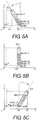
- FIG. 5A is a diagram illustrating a state when the plurality of detection widths of the manipulation pen 4 are detected in the state S3.
- FIG. 5B is a diagram illustrating a state when the plurality of detection widths of the manipulation pen 4 are detected in the state S0.
- FIG. 5C is a diagram illustrating a state when the plurality of detection widths of the manipulation pen 4 are detected in the state S4.
- FIGS. 5A to 5C are views of the manipulation pen 4 from the light source O side, and illustrate how the scan lines [N] to [N+7] cross the manipulation pen 4 in a plurality of main scanning directions (horizontal directions).
- the continuous detection duration during which the photodetector 211 continuously detects the scattered light changes according to the inclination of the manipulation pen 4 in the X axis direction. Furthermore, the X coordinate detection positions (i.e., the scanning angles) at which the scan lines pass through the manipulation pen 4 change, respectively.
- FIG. 5D is a graph illustrating the changes in the detection widths in states S0, S3, and S4.
- the horizontal axis indicates the position of the scan lines (e.g., line number), and the vertical axis indicates the detection width.
- the manipulation pen 4 can have a shape that is pointed at the distal end, rather than being uniformly cylindrical. In this case, as shown in the graph in FIG. 5D , sharp inclination near the scan line [N] indicates a sudden change in the detection width from the distal end of the manipulation pen 4 to the main cylindrical part.
- the states S0, S3, and S4 are all the same in that the detection width increases slightly when there is an increase in the line number of the scan lines. This can be attributed to the following.
- the distance between the light source O and the distal end of the manipulation pen 4 is longer than the distance between the light source O and the upper part of the manipulation pen 4. Therefore, at the surface of the projection area 31, the detection width will be greater at the upper part of the manipulation pen 4, where the distance to the light source O is shorter.
- the detection width in states S3 and S4 is greater than the detection width in state S0. That is, the greater is the inclination in the X axis direction from the normal line of the projection area 31, the greater will be the detection width at each scan line.
- the inclination determination component 213 acquires from the position specification component 212 the X coordinate detection position (P(t)) in FIG. 4 ) for every scan line in which the continuous detection duration is detected. Consequently, the inclination determination component 213 can acquire the scanning distance (X1 - XO) in FIG. 5A .
- the inclination determination component 213 determines the inclination of the manipulation pen 4 in the main scanning direction according to the change rate in the above-mentioned X coordinate detection position with respect to the change in the plurality of scan lines projected on the same manipulation pen 4.
- the inclination determination component 213 determines the inclination of the manipulation pen 4 in the main scanning direction to be greater the larger is the above-mentioned change rate.
- the inclination determination component 213 can determine the inclination in the X axis direction of the manipulation pen 4 in the states S4 and S0.
- FIG. 6A is a diagram illustrating a state when the plurality of detection widths of the manipulation pen 4 are detected in the state S2.
- FIG. 6B is a diagram illustrating a state when the plurality of detection widths of the manipulation pen 4 are detected in the state S0.
- FIG. 6C is a diagram illustrating a state when the plurality of detection widths of the manipulation pen 4 are detected in the state S1.
- FIGS. 6A to 6C are views of the manipulation pen 4 from the light source O side, and illustrate how the scan lines [N] to [N+7] cross the manipulation pen 4 in a plurality of main scanning directions (horizontal directions).
- the continuous detection duration during which the photodetector 211 continuously detects the scattered light changes according to the inclination of the manipulation pen 4 in the Y axis direction. Consequently, the detection width obtained for each scan line varies. This can be attributed to the following.
- the height of the light source O as shown in FIG. 3 , is taken into account, the size relation between the distance from the light source O to the distal end of the manipulation pen 4 and the distance from the light source O to the upper part of the manipulation pen 4 varies according to the inclination of the manipulation pen 4 in the Y axis direction.
- the detection width will be greater the shorter is the distance between the light source and the various parts of the manipulation pen 4 at the surface of the projection area 31. That is, the distance between the light source O and the detected part of the manipulation pen 4 will vary for each scan line depending on the inclination of the manipulation pen 4 in the Y axis direction.
- FIG. 6D is a graph illustrating changes in the detection widths in the states S0, S1, and S2.
- the horizontal axis indicates the position of the scan lines (e.g., line number), and the vertical axis indicates the detection width.
- the manipulation pen 4 can have a shape that is pointed at the distal end, rather than being uniformly cylindrical. In this case, as shown in the graph in FIG. 6D , sharp inclination near the scan line [N] indicates a sudden change in the detection width from the distal end of the manipulation pen 4 to the main cylindrical part.
- the states S0, S1, and S2 are all the same in that the detection width increases along with the line number of the scan lines. This can be attributed to the following.
- the distance between the light source O and the distal end of the manipulation pen 4 is longer than the distance between the light source O and the uppermost part of the manipulation pen 4. Accordingly, at the surface of the projection area 31, the detection width is greater at the uppermost part of the manipulation pen 4 where the distance to the light source O is shorter.
- the increase in the detection width in the state S0 is greater than that in the state S2, and greater in the state S1 than in the state S2, with respect to a positive change in the scan line (as the line number increasing). That is, the greater is the inclination in the negative direction of the Y axis direction from the normal line of the projection area 31, the greater will be the change rate in the detection width at each scan line.
- the inclination determination component 213 calculates the detection width at each scan line based on the detection signal of the photodetector 211. Consequently, the inclination determination component 213 can acquire the change rate in the detection width between the plurality of scan lines. Thus, it is possible to calculate the inclination of the manipulation pen 4 in the Y axis direction. That is, the inclination determination component 213 determines the inclination of the manipulation pen 4 in the sub-scanning direction according to the change rate in the detection width with respect to the change in the plurality of scan lines projected on the same manipulation pen 4.
- the inclination determination component 213 determines the inclination of the manipulation pen 4 in the sub-scanning direction to be greater the larger is the change rate in the detection width.
- the inclination determination component 213 can determine the inclination in the Y axis direction of the manipulation pen 4 in the states S2 and S0.
- FIG. 7 is a graph illustrating changes in the position information and the width information when the inclination of the manipulation pen 4 is dynamically changed in the Y axis direction.
- FIG. 7 illustrates a graph of the temporal change in the detection width and the X coordinate detection position when the manipulation pen 4 is dynamically changed from the state S0 to the state S1, back to the state S0, and then to the state S2.
- the scan line [N+a] is the scan line that scans the distal end of the manipulation pen 4
- the scan line [N+b] is the scan line that scans the upper part of the manipulation pen 4.
- the manipulation pen 4 does not change in the X axis direction.
- the X coordinate detection position remains constant for both the scan lines [N+a] and [N+b].
- the manipulation pen 4 is inclined in the Y axis negative direction (i.e., from the state S0 to the state S1), then the detection width at the scan line [N+b] increases steadily, and if the manipulation pen 4 is inclined in the Y axis positive direction (i.e., from the state S1 to the state S2 via the state S0), then the detection width at the scan line [N+b] decreases steadily.
- FIG. 8 is a graph illustrating changes in the position information and the width information when the inclination of the manipulation pen 4 is dynamically changed in the X axis direction.
- FIG. 8 illustrates a graph of the temporal change in the detection width and the X coordinate detection position when the manipulation pen 4 is dynamically changed from the state S0 to the state S3, back to the state S0, and then to the state S4.
- the manipulation pen 4 is inclined in the X axis negative direction (i.e., from the state S0 to the state S3), then the X coordinate detection position at the scan line [N+b] decreases steadily.
- the detection width at the scan lines [N+a] and [N+b] increases steadily as the inclination angle increases.
- the manipulation pen 4 is inclined in the X axis positive direction (i.e., from the state S3 to the state S4 via the state S0)
- the X coordinate detection position at the scan line [N+b] increases steadily.
- the detection widths at the scan lines [N+a] and [N+b] increases or decreases along with the inclination angle.
- the inclination determination component 213 is able to calculate the dynamic change in the inclination of the manipulation pen 4.
- a plurality of photodiodes with different light reception ranges in the height direction can be used for example.
- object detection can be performed, and the inclination of the manipulation object can be calculated based on the width information about the object detected by each of the photodiodes.
- the photodiodes must be disposed precisely, which makes the device configuration more complicated.
- the scattered light from the manipulation pen 4 (e.g., the manipulation object) can be detected in the projected image without the use of the plurality of light receiving elements.
- the plurality of sets of width information and the plurality of sets of position information corresponding to the various parts of the manipulation pen 4 can be acquired with a single light receiving element.
- FIG. 9 is a flowchart illustrating the manipulation input method in accordance with the first embodiment.
- the manipulation input method in accordance with this embodiment is a method for designating the display content to be outputted to the projection area 31 (e.g., the projection surface) or the control content of the computer by using the manipulation pen 4 (e.g., the manipulation object) to manipulate the desired position on the projection area 31 on which the image is displayed. More specifically, this manipulation input method involves detecting the static state of the manipulation pen 4 and storing the inclination state at that point. Then, a manipulation event is produced based on the amount of change relative to the stored inclination state.
- Step S10 is a projection step in which the image is projected on the surface of the projection area 31 by scanning the light outputted by the laser light sources 226A, 226B, and 226C (e.g., the light sources) in the main scanning direction (horizontally) and the sub-scanning direction (vertically).
- the laser light sources 226A, 226B, and 226C e.g., the light sources
- the position specification component 212 of the light receiver 21 receives the scattered light from the manipulation pen 4 and determines whether or not the manipulation pen 4 is stationary (e.g., in the static state) (S11).
- step S11 if the manipulation pen 4 is determined to be stationary (Yes in step S11), then the inclination determination component 213 decides on a plurality of scan lines of the projected light beam for determining the inclination of the manipulation pen 4 (S21).
- Step S22 includes a position specification step of specifying, for the plurality of scan lines, the position information about the manipulation pen 4 based on the scanning angle information for when the scattered light from the manipulation pen 4 is detected.
- the scanning position approximation coefficient can be calculated by approximating the relation between the scan line position and the scanning position of the manipulation pen 4 using a linear function.
- the scanning position approximation coefficient can be calculated in a different manner.
- the inclination determination component 213 calculates the inclination of the scanned object (e.g., the manipulation pen 4) in the main scanning direction (e.g., the X axis direction) based on the above-mentioned scanning position approximation coefficient (S23).
- the inclination of the manipulation pen 4 in the X axis direction can be calculated based on the first derivative or slope of the linear function (step S22) indicative of the relation between the scan line position and the scanning position of the manipulation pen 4.
- the inclination determination component 213 can calculate the inclination of the manipulation pen 4 based on a predetermined table storing the relation between the inclination of the manipulation pen 4 and the slope of the linear function (step S22).
- the inclination of the manipulation pen 4 can be calculated in a different manner.
- Step S24 is a width acquisition step of acquiring, for the plurality of scan lines, the width information about the manipulation pen 4 corresponding to the continuous detection duration during which the scattered light from the manipulation pen 4 is continuously detected.
- W aL + b
- the inclination determination component 213 calculates the inclination of the scanned object (e.g., the manipulation pen 4) in the sub-scanning direction (e.g., the Y axis direction) based on the above-mentioned detection width approximation coefficient (S25).
- the inclination of the manipulation pen 4 in the Y axis direction can be calculated based on the first derivative or slope of the linear function (step S24) indicative of the relation between the scan line position and the detection width of the manipulation pen 4.
- the inclination determination component 213 can calculate the inclination of the manipulation pen 4 based on a predetermined table storing the relation between the inclination of the manipulation pen 4 and the slope of the linear function (step S24).
- the inclination of the manipulation pen 4 can be calculated in a different manner.
- the CPU 24 acquires the inclination of the manipulation pen 4 in the main scanning direction and the sub-scanning direction from the inclination determination component 213, and stores this inclination as the reference inclination state of the manipulation pen 4 (S26).
- Steps S23, S25, and S26 are static state storage steps in which the inclination of the manipulation pen 4 in the static state is determined based on the temporal change in the above-mentioned plurality of sets of position information and/or the temporal change in the above-mentioned plurality of sets of width information, and the inclination information about this static state is stored.
- step S11 determines whether or not the distal end of the manipulation pen 4 is stationary (S31).
- Step S31 if it is determined in step S31 that the distal end of the manipulation pen 4 is stationary (Yes in step S31), then the inclination determination component 213 calculates the scanning position approximation coefficient indicating the relation between the scan line position (e.g., the line number) and the scanning position of the manipulation pen 4 detected by this scan line (S32).
- Step S32 includes a position specification step of specifying, for the plurality of scan lines, the position information about the manipulation pen 4 based on the scanning angle information for when the scattered light from the manipulation pen 4 is detected.
- the scanning position approximation coefficient can be calculated in a manner same as the calculation in step S22.
- the inclination determination component 213 calculates the inclination of the scanned object (e.g., the manipulation pen 4) in the main scanning direction (e.g., the X axis direction) from the above-mentioned scanning position approximation coefficient (S33).
- the inclination of the manipulation pen 4 can be calculated in a manner same as the calculation in step S23.
- step S31 If it is determined in step S31 that the distal end of the manipulation pen 4 is not stationary (No in step S31), then the inclination determination component 213 ends calculation of the inclination of the manipulation pen 4.
- Step S34 is a width acquisition step of acquiring, for the plurality of scan lines, the width information about the manipulation pen 4 corresponding to the continuous detection duration during which the scattered light from the manipulation pen 4 is continuously detected.
- the detection width approximation coefficient can be calculated in a manner same as the calculation in step S24.
- the inclination determination component 213 calculates the inclination of the scanned object (e.g., the manipulation pen 4) in the sub-scanning direction (e.g., the Y axis direction) based on the above-mentioned detection width approximation coefficient (S35).
- the inclination of the manipulation pen 4 can be calculated in a manner same as the calculation in step S25.
- the CPU 24 acquires the current inclination of the manipulation pen 4 in the main scanning direction and the sub-scanning direction from the inclination determination component 213, and calculates difference information about the inclination of the manipulation pen 4 based on the current inclination and the previously acquired reference inclination (S36).
- Step S36 is a difference information calculation step in which, if the inclination of the manipulation pen 4 is changing dynamically, then the inclination of the manipulation pen 4 in the dynamic state is determined based on the temporal change in the above-mentioned plurality of sets of position information and/or the temporal change in the above-mentioned plurality of sets of width information, and the difference information about the inclination of the manipulation object is calculated from the inclination information in this dynamic state and the inclination information in the static state.
- Step S37 is an input step of executing the above-mentioned control content or of displaying the above-mentioned display content, based on the inclination of the manipulation pen 4.
- the inclination is detected independently for the main scanning direction and the sub-scanning direction.
- the manipulation event can be produced by combining the inclination in the above two directions by weighting, etc.
- it can be produced by employing just the direction with the greater amount of inclination.
- the configuration can be such that inclination information in the two directions is combined or selected according to the application.
- the scattered light from the manipulation pen 4 (e.g., the manipulation object) can be detected in the projected image without using the plurality of light receiving elements. Furthermore, the plurality of sets of width information and the plurality of sets of position information corresponding to the various parts of the manipulation pen 4 can be acquired with a single light receiving element. Thus, the manipulation event using the inclination information about the manipulation pen 4 can be produced without sacrificing user manipulation convenience and without making the device configuration more complicated.
- the manipulation input system in accordance with this embodiment includes the manipulation input device 2 (see FIG. 1 ) in accordance with the first embodiment, the manipulation pen 4 (see FIG. 1 ) that designates the position within the projection area 31 to be inputted, and the manipulation display board 3 on which the projection area 31 is displayed.
- the manipulation input device 2 calculates input coordinates of the manipulation pen 4 in the projection area 31 based on the scanning position of the manipulation pen 4 specified by the position specification component 212, and changes the size of the cursor or image to be displayed at these coordinates according to the inclination information determined by the inclination determination component 213.
- this manipulation input system can be applied as a graphic tool that corresponds the inclination information of the manipulation pen 4 relative to the normal line of the projection area 31 to the thickness of the drawing lines.
- the inclination information about the manipulation pen 4 can be effectively used.
- this inclination information can be used to provide the user with an application that is more convenient.
- the present invention can also be applied to various kinds of image display device that displays a color image by combining laser beams of different color components outputted from a plurality of laser light sources.
- the combined light is in a state of white balance.
- the present invention can also be applied to other specific color states.
- a laser light source is used as the light source in the above embodiments, but this is not the only option, and an LED (light emitting diode) light source or the like can be used, for example, as the light source.
- the drive controller, the position specification component 212, the inclination determination component 213, the CPU 24, and the manipulation component 25 forming the above-mentioned manipulation input device and the manipulation input system can more specifically be formed by a computer system made up of a microprocessor, a ROM, a RAM, a hard disk drive, a display unit, a keyboard, a mouse, and so forth.
- Computer programs can be stored in the RAM or on the hard disk drive.
- the microprocessor operates according to a computer program, so that the manipulation input device and the manipulation input system of the present invention achieve their function.
- the "computer program” here is made up of a combination of a plurality of command codes that give instructions to a computer in order to achieve a specific function.
- processors can be formed by a single system LSIC (large scale integrated circuit).
- a system LSIC is a super-multifunctional LSIC manufactured by integrating a plurality of components on a single chip, and more specifically is a computer system that includes a microprocessor, a ROM, a RAM, etc. Computer programs are stored in the RAM.
- the system LSIC achieves its function when the microprocessor operates according to a computer program.
- These processors can also be formed by a single module or an IC card that can be inserted into and removed from the above-mentioned manipulation input device and the manipulation input system.
- This module or IC card is a computer system made up of a microprocessor, a ROM, a RAM, etc.
- the module or IC card can also include the above-mentioned super-multifunctional LSIC.
- the microprocessor operates according to a computer program, the module or IC card achieves its function.
- This module or IC card can be tamper resistant.
- the manipulation input method in accordance with the present invention is a manipulation input method for designating the display content to be outputted to a projection surface or the control content of a computer by using a manipulation object to manipulate the desired position on a projection surface on which an image is displayed, the method comprising a projection step of projecting the image on the projection surface by scanning light outputted by a light source, a detection step of detecting scattered light from the manipulation object when the manipulation object has moved into a specific detection range that includes the projection surface, a position specification step of specifying, for a plurality of scan lines, position information about the manipulation object based on scanning angle information for when the scattered light is detected in the detection step, a width acquisition step of acquiring, for the plurality of scan lines, width information about the manipulation object corresponding to a continuous detection duration during which the scattered light is continuously detected in the detection step, an inclination determination step of determining the inclination of the manipulation object based on a temporal change in the plurality of sets
- the present invention can also be a computer program with which the above-mentioned manipulation input method is carried out by a computer, or a digital signal formed of the above-mentioned computer program.
- the present invention can be such that the above-mentioned computer program or the above-mentioned digital signal is recorded to a permanent recording medium that can be read by a computer, such as a flexible disk, a hard disk, a CD-ROM, an MO, a DVD, a DVD-ROM, a DVD-RAM, a BD (Blu-rayTM Disc), or a semiconductor memory. It can also be the above-mentioned digital signal that is recorded to one of these permanent recording media.
- a computer such as a flexible disk, a hard disk, a CD-ROM, an MO, a DVD, a DVD-ROM, a DVD-RAM, a BD (Blu-rayTM Disc), or a semiconductor memory.
- BD Blu-rayTM Disc
- the present invention can also be such that the above-mentioned computer program or the above-mentioned digital signal is transmitted via an electrical communications line, a wireless or wired communications line, a network (such as the Internet), data broadcast, etc.
- the present invention can also be a computer system including a microprocessor and a memory, in which the memory stores the above-mentioned computer program, and the microprocessor operates according to the above-mentioned computer program.
- the present invention can be realized by another, independent computer system, if the above-mentioned program or the above-mentioned digital signal is recorded to one of the above-mentioned permanent recording media and transferred, or if the above-mentioned program or the above-mentioned digital signal is transferred via the above-mentioned network, etc.
- the present invention can be applied to a projector or the like that projects onto a projection surface an image outputted by a personal computer, for example.
- a manipulation input device includes a projection component, a photodetector and an inclination determination component.
- the projection component is configured to project an image on a projection surface by scanning light from a light source.
- the photodetector is configured to detect as scattered light the light reflected by a manipulation object that has moved into a specific detection range including the projection surface.
- the inclination determination component is configured to acquire, for a plurality of scan lines of the light, position information of the manipulation object that is specified based on scanning angle information when the photodetector has detected the scattered light, and width information of the manipulation object that corresponds to a continuous detection duration during which the photodetector continuously detects the scattered light, the inclination determination component being further configured to determine inclination of the manipulation object based on at least one of a temporal change in a plurality of sets of the width information and a temporal change in a plurality of sets of the position information.
- the scattered light from the manipulation object on the projection screen can be detected without using a plurality of light receiving elements. Furthermore, the plurality of sets of the width information and the plurality of sets of the position information corresponding to various parts of the manipulation object can be acquired. Thus, user input manipulation using inclination information about the manipulation object can be performed based on the plurality of sets of the width information and the plurality of sets of the position information, without sacrificing user manipulation convenience and without complicating the device configuration.
- the manipulation input device in accordance with one aspect of the present invention can further includes a processor configured to produce a manipulation event based on the inclination of the manipulation object determined by the inclination determination component.
- the manipulation event can be produced based on the inclination of the manipulation object.
- designating display content to be outputted to the projection surface or executing control content of a computer for example, can be performed by using the manipulation object to manipulate a desired position on the projection surface on which the image is displayed.
- the projection component can be further configured project the image on the projection surface by alternately scanning the light in a main scanning direction that is perpendicular to a projection direction of the light, and in a sub-scanning direction that is perpendicular to the main scanning direction, and the inclination determination component can be further configured to determine the inclination of the manipulation object in the sub-scanning direction according to a change rate in the width information with respect to a change in the scan lines.
- the inclination determination component can be further configured to determine the inclination of the manipulation object in the sub-scanning direction to be greater the larger is the change rate in the width information.
- the projection component can be further configured to project the image on the projection surface by alternately scanning the light in a main scanning direction that is perpendicular to a projection direction of the light, and in a sub-scanning direction that is perpendicular to the main scanning direction, and the inclination determination component is further configured to determine the inclination of the manipulation object in the main scanning direction according to a change rate in the position information with respect to a change in the scan lines.
- the inclination determination component can be further configured to determine the inclination of the manipulation object in the main scanning direction to be greater the larger is the change rate in the position information.
- a manipulation input system in accordance with one aspect of the present invention includes the manipulation input device discussed above, the manipulation object configured to indicate an input position within the projection surface, and a manipulation display board on which the projection surface is displayed.
- the manipulation input device is further configured to change size of the image displayed at coordinates of the manipulation object on the projection surface according to the inclination of the manipulation object determined by the inclination determination component.
- the present invention can be realized not only as the manipulation input device and the manipulation input system having characteristic processors as described above, but also as an inclination manipulation input method having characteristic steps that execute processings by the characteristic processors included in the manipulation input device and manipulation input system.
- the present invention can also be realized as a program for causing a computer to function as the characteristic processors included in the manipulation input device and manipulation input system, or a program that causes a computer to execute the characteristic steps included in the manipulation input method. It should also go without saying that this program can be distributed via a communications network such as the Internet, or a permanent recording medium that can be read by a computer, such as a CD-ROM (compact disc - read only memory).
- the scattered light from the manipulation object over the projected screen can be detected, and the plurality of sets of the width information and the plurality of sets of the position information corresponding to various parts of the manipulation object can be acquired, without using a plurality of light receiving elements.
- user input manipulation using inclination information about the manipulation object can be performed based on the plurality of sets of the width information and the plurality of sets of the position information, without sacrificing user manipulation convenience and without complicating the device configuration.
- any other similar directional terms refer to those directions of a manipulation input device in an upright position. Accordingly, these directional terms, as utilized to describe the manipulation input device should be interpreted relative to a manipulation input device in an upright position on a horizontal surface. Also, terms of degree such as “substantially”, “about” and “approximately” as used herein mean an amount of deviation of the modified term such that the end result is not significantly changed.
Landscapes
- Engineering & Computer Science (AREA)
- General Engineering & Computer Science (AREA)
- Theoretical Computer Science (AREA)
- Human Computer Interaction (AREA)
- Physics & Mathematics (AREA)
- General Physics & Mathematics (AREA)
- Multimedia (AREA)
- Position Input By Displaying (AREA)
Claims (8)
- Manipulationseingabevorrichtung (2) mit:einer Projektionskomponente (22), die konfiguriert ist,durch Scannen von Licht aus einer Lichtquelle ein Bild auf eine Projektionsfläche (31) zu projizieren;einem Fotodetektor (211), der konfiguriert ist, das durch ein Manipulationsobjekt (4) reflektierte Licht als gestreutes Licht zu detektieren; undeiner Neigungsbestimmungskomponente (213), die konfiguriert ist, für eine Vielzahl von Scanlinien des Lichts zu erfassen:Positionsinformationen des Manipulationsobjekts (4), die beruhend auf Abtastwinkelinformationen spezifiziert werden,wenn der Fotodetektor (211) das gestreute Licht detektiert hat, undBreiteninformationen des Manipulationsobjekts (4), die einer kontinuierlichen Detektionsdauer entsprechen, während derer der Fotodetektor (211) kontinuierlich das gestreute Licht detektiert,dadurch gekennzeichnet, dassdie Neigungsbestimmungskomponente (213) ferner konfiguriert ist, eine Neigung des Manipulationsobjekts (4) beruhend auf einer zeitlichen Änderung einer Vielzahl von Sätzen der Breiteninformationen und/oder einer zeitlichen Änderung einer Vielzahl von Sätzen der Positionsinformationen zu bestimmen,die Projektionskomponente (22) ferner konfiguriert ist, das Bild auf die Projektionsfläche (31) durch abwechselndes Scannen des Lichts in eine Hauptscanrichtung, die senkrecht zu einer Projektionsrichtung des Lichts ist, und in eine Unterscanrichtung zu projizieren, die senkrecht zur Hauptscanrichtung ist, unddie Neigungsbestimmungskomponente (213) ferner konfiguriert ist, die Neigung des Manipulationsobjekts (4) in die Unterscanrichtung gemäß einer Änderungsgeschwindigkeit der Vielzahl der Sätze der Breiteninformationen bezüglich einer Änderung der Scanlinien zu bestimmen und/oder die Neigung des Manipulationsobjekts (4) in die Hauptscanrichtung gemäß einer Änderungsgeschwindigkeit der Vielzahl der Sätze der Positionsinformationen bezüglich einer Änderung der Scanlinien zu bestimmen.
- Manipulationseingabevorrichtung (2) nach Anspruch 1, die ferner aufweist
einen Prozessor (24), der konfiguriert ist, beruhend auf der Neigung des Manipulationsobjekts (4), die durch die Neigungsbestimmungskomponente (213) bestimmt wird, ein Manipulationsereignis zu erzeugen. - Manipulationseingabevorrichtung (2) nach Anspruch 1, wobei die Neigungsbestimmungskomponente (213) ferner konfiguriert ist, festzustellen, dass die Neigung des Manipulationsobjekts (4) in die Unterscanrichtung größer wird, je größer die Änderungsgeschwindigkeit der Vielzahl der Sätze der Breiteninformationen ist.
- Manipulationseingabevorrichtung (2) nach Anspruch 1, wobei die Neigungsbestimmungskomponente (213) ferner konfiguriert ist, festzustellen, dass die Neigung des Manipulationsobjekts (4) in die Hauptscanrichtung größer wird, je größer die Änderungsgeschwindigkeit der Vielzahl der Sätze der Positionsinformationen ist.
- Manipulationseingabesystem (1), das aufweist:die Manipulationseingabevorrichtung nach einem der Ansprüche 1 bis 4;das Manipulationsobjekt (4), das konfiguriert ist, eine Eingabeposition innerhalb der Projektionsfläche (31) anzuzeigen; undeine Manipulationsanzeigetafel (3), auf der die Projektionsfläche (31) angezeigt wird,wobei die Manipulationseingabevorrichtung ferner konfiguriert ist, die Größe des Bilds, das an Koordinaten des Manipulationsobjekts (4) auf der Projektionsfläche (31) angezeigt wird, entsprechend der Neigung des Manipulationsobjekts (4) zu ändern, die durch die Neigungsbestimmungskomponente (213) bestimmt wird.
- Manipulationseingabeverfahren, das aufweist:Projizieren eines Bilds auf eine Projektionsfläche (31) durch Scannen von Licht aus einer Lichtquelle;Detektieren des Lichts, das durch ein Manipulationsobjekt (4) reflektiert wird, das in einen spezifischen Detektionsbereich bewegt worden ist, der die Projektionsfläche (31) umfasst, als gestreutes Licht;Bestimmen von Positionsinformationen des Manipulationsobjekts (4) für eine Vielzahl von Scanlinien des Lichts beruhend auf Abtastwinkelinformationen, wenn das gestreute Licht detektiert worden ist; undErfassen für die Vielzahl der Scanlinien von Breiteninformationen des Manipulationsobjekts (4), die einer kontinuierlichen Detektionsdauer entsprechen, während derer das gestreute Licht kontinuierlich detektiert wird;gekennzeichnet durchBestimmen der Neigung des Manipulationsobjekts (4) beruhend auf einer zeitlichen Änderung einer Vielzahl von Sätzen der Positionsinformationen und/oder einer zeitlichen Änderung einer Vielzahl von Sätzen der Breiteninformationen,Projizieren des Bilds auf Projektionsfläche (31) durch abwechselndes Scannen des Lichts in eine Hauptscanrichtung, die senkrecht zu einer Projektionsrichtung des Lichts ist, und in eine Unterscanrichtung, die senkrecht zur Hauptscanrichtung ist, undBestimmen der Neigung des Manipulationsobjekts (4) in die Unterscanrichtung gemäß einer Änderungsgeschwindigkeit der Vielzahl der Sätze der Breiteninformationen bezüglich einer Änderung der Scanlinien und/oder Bestimmen der Neigung des Manipulationsobjekts (4) in die Hauptscanrichtung gemäß einer Änderungsgeschwindigkeit der Vielzahl der Sätze der Positionsinformationen bezüglich einer Änderung der Scanlinien.
- Manipulationseingabeverfahren nach Anspruch 6, die ferner das Erzeugen eines Manipulationsereignisses beruhend auf der Neigung des Manipulationsobjekts (4) aufweist.
- Manipulationseingabeverfahren nach Anspruch 6 oder 7, wobei das Bestimmen der Neigung des Manipulationsobjekts (4) ferner aufweist:Bestimmen der Neigung des Manipulationsobjekts (4) in einem statischen Zustand beruhend auf der zeitlichen Änderung der Vielzahl der Sätze der Positionsinformationen und/oder der zeitlichen Änderung der Vielzahl der Sätze der Breiteninformationen,Speichern von Neigungsinformationen, die die Neigung des Manipulationsobjekts (4) im statischen Zustand anzeigen, Bestimmen der Neigung des Manipulationsobjekts (4) in einem dynamischen Zustand beruhend auf der zeitlichen Änderung der Vielzahl der Sätze der Positionsinformationen und/oder der zeitlichen Änderung der Vielzahl der Sätze der Breiteninformationen, während sich die Neigung des Manipulationsobjekts (4) dynamisch ändert, undBerechnen von Differenzinformationen der Neigung des Manipulationsobjekts (4) beruhend auf Neigungsinformationen, die die Neigung des Manipulationsobjekts (4) im dynamischen Zustand anzeigen, und den Neigungsinformationen im statischen Zustand, und das Erzeugen des Manipulationsereignisses ferner das Erzeugen des Manipulationsereignisses beruhend auf den Differenzinformationen aufweist.
Applications Claiming Priority (1)
| Application Number | Priority Date | Filing Date | Title |
|---|---|---|---|
| JP2013118130A JP6175913B2 (ja) | 2013-06-04 | 2013-06-04 | 入力装置、入力システム及び入力方法 |
Publications (2)
| Publication Number | Publication Date |
|---|---|
| EP2811377A1 EP2811377A1 (de) | 2014-12-10 |
| EP2811377B1 true EP2811377B1 (de) | 2018-11-28 |
Family
ID=50980914
Family Applications (1)
| Application Number | Title | Priority Date | Filing Date |
|---|---|---|---|
| EP14170153.2A Not-in-force EP2811377B1 (de) | 2013-06-04 | 2014-05-28 | Manipulations-Eingabegerät, Eingabesystem und Eingabemethode |
Country Status (3)
| Country | Link |
|---|---|
| US (1) | US9454264B2 (de) |
| EP (1) | EP2811377B1 (de) |
| JP (1) | JP6175913B2 (de) |
Families Citing this family (2)
| Publication number | Priority date | Publication date | Assignee | Title |
|---|---|---|---|---|
| JP6098386B2 (ja) * | 2013-06-18 | 2017-03-22 | 船井電機株式会社 | プロジェクタ |
| JP6834614B2 (ja) * | 2016-07-12 | 2021-02-24 | ソニー株式会社 | 情報処理装置、情報処理方法、およびプログラム |
Citations (3)
| Publication number | Priority date | Publication date | Assignee | Title |
|---|---|---|---|---|
| US20050107979A1 (en) * | 2003-11-04 | 2005-05-19 | Buermann Dale H. | Apparatus and method for determining an inclination of an elongate object contacting a plane surface |
| US20090167726A1 (en) * | 2007-12-29 | 2009-07-02 | Microvision, Inc. | Input Device for a Scanned Beam Display |
| US20100253618A1 (en) * | 2009-04-01 | 2010-10-07 | Hiroshi Nishigaki | Device and method for displaying an image |
Family Cites Families (6)
| Publication number | Priority date | Publication date | Assignee | Title |
|---|---|---|---|---|
| US8493340B2 (en) | 2009-01-16 | 2013-07-23 | Corel Corporation | Virtual hard media imaging |
| EP2580645B1 (de) * | 2010-06-11 | 2019-11-27 | Microsoft Technology Licensing, LLC | Objektausrichtungserkennung mit einem digitalisierer |
| JP2012026936A (ja) | 2010-07-26 | 2012-02-09 | Panasonic Electric Works Co Ltd | センサ装置 |
| JP2012208926A (ja) * | 2011-03-15 | 2012-10-25 | Nikon Corp | 検出装置、入力装置、プロジェクタ、及び電子機器 |
| JP5754216B2 (ja) | 2011-04-04 | 2015-07-29 | セイコーエプソン株式会社 | 入力システム及びペン型入力機器 |
| JP2013065061A (ja) * | 2011-09-15 | 2013-04-11 | Funai Electric Co Ltd | プロジェクタ |
-
2013
- 2013-06-04 JP JP2013118130A patent/JP6175913B2/ja not_active Expired - Fee Related
-
2014
- 2014-05-19 US US14/280,961 patent/US9454264B2/en not_active Expired - Fee Related
- 2014-05-28 EP EP14170153.2A patent/EP2811377B1/de not_active Not-in-force
Patent Citations (3)
| Publication number | Priority date | Publication date | Assignee | Title |
|---|---|---|---|---|
| US20050107979A1 (en) * | 2003-11-04 | 2005-05-19 | Buermann Dale H. | Apparatus and method for determining an inclination of an elongate object contacting a plane surface |
| US20090167726A1 (en) * | 2007-12-29 | 2009-07-02 | Microvision, Inc. | Input Device for a Scanned Beam Display |
| US20100253618A1 (en) * | 2009-04-01 | 2010-10-07 | Hiroshi Nishigaki | Device and method for displaying an image |
Also Published As
| Publication number | Publication date |
|---|---|
| EP2811377A1 (de) | 2014-12-10 |
| JP6175913B2 (ja) | 2017-08-09 |
| US20140354599A1 (en) | 2014-12-04 |
| US9454264B2 (en) | 2016-09-27 |
| JP2014235660A (ja) | 2014-12-15 |
Similar Documents
| Publication | Publication Date | Title |
|---|---|---|
| US8690337B2 (en) | Device and method for displaying an image on a VUI screen and also a main projection screen | |
| JP5646148B2 (ja) | プロジェクタ | |
| US8902435B2 (en) | Position detection apparatus and image display apparatus | |
| US9794531B2 (en) | Image display apparatus and image display adjusting method | |
| US20120026319A1 (en) | Distance measuring system and distance measuring method | |
| EP2960758B1 (de) | Eingabevorrichtung | |
| US10782789B2 (en) | Input device | |
| EP3079045A1 (de) | Position abfühlvorrichtung und position abtastmethode | |
| JP6269463B2 (ja) | 画像表示装置および画像表示調整方法 | |
| EP2811377B1 (de) | Manipulations-Eingabegerät, Eingabesystem und Eingabemethode | |
| EP2787731A2 (de) | Bildprojektionsgerät und den Eingang Objekterkennungsverfahren | |
| US20150185321A1 (en) | Image Display Device | |
| US20130257702A1 (en) | Image projecting apparatus, image projecting method, and computer program product | |
| US11125551B2 (en) | Light modulation for inspection probes | |
| US9405407B2 (en) | Projector | |
| EP2808768A1 (de) | Manipulation Eingabegerat, Manipulation Eingabesystem, Manipulation und Eingabemethode | |
| JP2010122127A (ja) | 光学式変位センサシステム、コンソール、コントローラ、およびプログラム | |
| CN114467035A (zh) | 激光传感器、反射镜控制方法以及程序 | |
| JP2016157141A (ja) | プロジェクタ | |
| US20140300583A1 (en) | Input device and input method | |
| JP6171502B2 (ja) | プロジェクタおよびプロジェクタ機能を有する電子機器 | |
| EP2879000A1 (de) | Projektorvorrichtung | |
| WO2021205647A1 (ja) | 距離測定装置、画角制御方法、及びプログラム | |
| TW201301078A (zh) | 體感偵測方法 | |
| KR102068309B1 (ko) | 3차원 스캐닝 장치 및 3차원 스캐닝 방법 |
Legal Events
| Date | Code | Title | Description |
|---|---|---|---|
| PUAI | Public reference made under article 153(3) epc to a published international application that has entered the european phase |
Free format text: ORIGINAL CODE: 0009012 |
|
| 17P | Request for examination filed |
Effective date: 20140528 |
|
| AK | Designated contracting states |
Kind code of ref document: A1 Designated state(s): AL AT BE BG CH CY CZ DE DK EE ES FI FR GB GR HR HU IE IS IT LI LT LU LV MC MK MT NL NO PL PT RO RS SE SI SK SM TR |
|
| AX | Request for extension of the european patent |
Extension state: BA ME |
|
| R17P | Request for examination filed (corrected) |
Effective date: 20150609 |
|
| RBV | Designated contracting states (corrected) |
Designated state(s): AL AT BE BG CH CY CZ DE DK EE ES FI FR GB GR HR HU IE IS IT LI LT LU LV MC MK MT NL NO PL PT RO RS SE SI SK SM TR |
|
| STAA | Information on the status of an ep patent application or granted ep patent |
Free format text: STATUS: EXAMINATION IS IN PROGRESS |
|
| 17Q | First examination report despatched |
Effective date: 20170127 |
|
| GRAP | Despatch of communication of intention to grant a patent |
Free format text: ORIGINAL CODE: EPIDOSNIGR1 |
|
| STAA | Information on the status of an ep patent application or granted ep patent |
Free format text: STATUS: GRANT OF PATENT IS INTENDED |
|
| INTG | Intention to grant announced |
Effective date: 20180810 |
|
| GRAS | Grant fee paid |
Free format text: ORIGINAL CODE: EPIDOSNIGR3 |
|
| GRAA | (expected) grant |
Free format text: ORIGINAL CODE: 0009210 |
|
| STAA | Information on the status of an ep patent application or granted ep patent |
Free format text: STATUS: THE PATENT HAS BEEN GRANTED |
|
| AK | Designated contracting states |
Kind code of ref document: B1 Designated state(s): AL AT BE BG CH CY CZ DE DK EE ES FI FR GB GR HR HU IE IS IT LI LT LU LV MC MK MT NL NO PL PT RO RS SE SI SK SM TR |
|
| REG | Reference to a national code |
Ref country code: CH Ref legal event code: EP |
|
| REG | Reference to a national code |
Ref country code: AT Ref legal event code: REF Ref document number: 1070992 Country of ref document: AT Kind code of ref document: T Effective date: 20181215 |
|
| REG | Reference to a national code |
Ref country code: IE Ref legal event code: FG4D |
|
| REG | Reference to a national code |
Ref country code: DE Ref legal event code: R096 Ref document number: 602014036808 Country of ref document: DE |
|
| REG | Reference to a national code |
Ref country code: NL Ref legal event code: MP Effective date: 20181128 |
|
| REG | Reference to a national code |
Ref country code: LT Ref legal event code: MG4D |
|
| REG | Reference to a national code |
Ref country code: AT Ref legal event code: MK05 Ref document number: 1070992 Country of ref document: AT Kind code of ref document: T Effective date: 20181128 |
|
| PG25 | Lapsed in a contracting state [announced via postgrant information from national office to epo] |
Ref country code: IS Free format text: LAPSE BECAUSE OF FAILURE TO SUBMIT A TRANSLATION OF THE DESCRIPTION OR TO PAY THE FEE WITHIN THE PRESCRIBED TIME-LIMIT Effective date: 20190328 Ref country code: BG Free format text: LAPSE BECAUSE OF FAILURE TO SUBMIT A TRANSLATION OF THE DESCRIPTION OR TO PAY THE FEE WITHIN THE PRESCRIBED TIME-LIMIT Effective date: 20190228 Ref country code: FI Free format text: LAPSE BECAUSE OF FAILURE TO SUBMIT A TRANSLATION OF THE DESCRIPTION OR TO PAY THE FEE WITHIN THE PRESCRIBED TIME-LIMIT Effective date: 20181128 Ref country code: ES Free format text: LAPSE BECAUSE OF FAILURE TO SUBMIT A TRANSLATION OF THE DESCRIPTION OR TO PAY THE FEE WITHIN THE PRESCRIBED TIME-LIMIT Effective date: 20181128 Ref country code: LV Free format text: LAPSE BECAUSE OF FAILURE TO SUBMIT A TRANSLATION OF THE DESCRIPTION OR TO PAY THE FEE WITHIN THE PRESCRIBED TIME-LIMIT Effective date: 20181128 Ref country code: AT Free format text: LAPSE BECAUSE OF FAILURE TO SUBMIT A TRANSLATION OF THE DESCRIPTION OR TO PAY THE FEE WITHIN THE PRESCRIBED TIME-LIMIT Effective date: 20181128 Ref country code: HR Free format text: LAPSE BECAUSE OF FAILURE TO SUBMIT A TRANSLATION OF THE DESCRIPTION OR TO PAY THE FEE WITHIN THE PRESCRIBED TIME-LIMIT Effective date: 20181128 Ref country code: NO Free format text: LAPSE BECAUSE OF FAILURE TO SUBMIT A TRANSLATION OF THE DESCRIPTION OR TO PAY THE FEE WITHIN THE PRESCRIBED TIME-LIMIT Effective date: 20190228 Ref country code: LT Free format text: LAPSE BECAUSE OF FAILURE TO SUBMIT A TRANSLATION OF THE DESCRIPTION OR TO PAY THE FEE WITHIN THE PRESCRIBED TIME-LIMIT Effective date: 20181128 |
|
| PG25 | Lapsed in a contracting state [announced via postgrant information from national office to epo] |
Ref country code: GR Free format text: LAPSE BECAUSE OF FAILURE TO SUBMIT A TRANSLATION OF THE DESCRIPTION OR TO PAY THE FEE WITHIN THE PRESCRIBED TIME-LIMIT Effective date: 20190301 Ref country code: PT Free format text: LAPSE BECAUSE OF FAILURE TO SUBMIT A TRANSLATION OF THE DESCRIPTION OR TO PAY THE FEE WITHIN THE PRESCRIBED TIME-LIMIT Effective date: 20190328 Ref country code: RS Free format text: LAPSE BECAUSE OF FAILURE TO SUBMIT A TRANSLATION OF THE DESCRIPTION OR TO PAY THE FEE WITHIN THE PRESCRIBED TIME-LIMIT Effective date: 20181128 Ref country code: SE Free format text: LAPSE BECAUSE OF FAILURE TO SUBMIT A TRANSLATION OF THE DESCRIPTION OR TO PAY THE FEE WITHIN THE PRESCRIBED TIME-LIMIT Effective date: 20181128 Ref country code: AL Free format text: LAPSE BECAUSE OF FAILURE TO SUBMIT A TRANSLATION OF THE DESCRIPTION OR TO PAY THE FEE WITHIN THE PRESCRIBED TIME-LIMIT Effective date: 20181128 |
|
| PG25 | Lapsed in a contracting state [announced via postgrant information from national office to epo] |
Ref country code: NL Free format text: LAPSE BECAUSE OF FAILURE TO SUBMIT A TRANSLATION OF THE DESCRIPTION OR TO PAY THE FEE WITHIN THE PRESCRIBED TIME-LIMIT Effective date: 20181128 |
|
| PG25 | Lapsed in a contracting state [announced via postgrant information from national office to epo] |
Ref country code: IT Free format text: LAPSE BECAUSE OF FAILURE TO SUBMIT A TRANSLATION OF THE DESCRIPTION OR TO PAY THE FEE WITHIN THE PRESCRIBED TIME-LIMIT Effective date: 20181128 Ref country code: PL Free format text: LAPSE BECAUSE OF FAILURE TO SUBMIT A TRANSLATION OF THE DESCRIPTION OR TO PAY THE FEE WITHIN THE PRESCRIBED TIME-LIMIT Effective date: 20181128 Ref country code: CZ Free format text: LAPSE BECAUSE OF FAILURE TO SUBMIT A TRANSLATION OF THE DESCRIPTION OR TO PAY THE FEE WITHIN THE PRESCRIBED TIME-LIMIT Effective date: 20181128 Ref country code: DK Free format text: LAPSE BECAUSE OF FAILURE TO SUBMIT A TRANSLATION OF THE DESCRIPTION OR TO PAY THE FEE WITHIN THE PRESCRIBED TIME-LIMIT Effective date: 20181128 |
|
| REG | Reference to a national code |
Ref country code: DE Ref legal event code: R097 Ref document number: 602014036808 Country of ref document: DE |
|
| PG25 | Lapsed in a contracting state [announced via postgrant information from national office to epo] |
Ref country code: EE Free format text: LAPSE BECAUSE OF FAILURE TO SUBMIT A TRANSLATION OF THE DESCRIPTION OR TO PAY THE FEE WITHIN THE PRESCRIBED TIME-LIMIT Effective date: 20181128 Ref country code: SM Free format text: LAPSE BECAUSE OF FAILURE TO SUBMIT A TRANSLATION OF THE DESCRIPTION OR TO PAY THE FEE WITHIN THE PRESCRIBED TIME-LIMIT Effective date: 20181128 Ref country code: SK Free format text: LAPSE BECAUSE OF FAILURE TO SUBMIT A TRANSLATION OF THE DESCRIPTION OR TO PAY THE FEE WITHIN THE PRESCRIBED TIME-LIMIT Effective date: 20181128 Ref country code: RO Free format text: LAPSE BECAUSE OF FAILURE TO SUBMIT A TRANSLATION OF THE DESCRIPTION OR TO PAY THE FEE WITHIN THE PRESCRIBED TIME-LIMIT Effective date: 20181128 |
|
| PLBE | No opposition filed within time limit |
Free format text: ORIGINAL CODE: 0009261 |
|
| STAA | Information on the status of an ep patent application or granted ep patent |
Free format text: STATUS: NO OPPOSITION FILED WITHIN TIME LIMIT |
|
| PG25 | Lapsed in a contracting state [announced via postgrant information from national office to epo] |
Ref country code: SI Free format text: LAPSE BECAUSE OF FAILURE TO SUBMIT A TRANSLATION OF THE DESCRIPTION OR TO PAY THE FEE WITHIN THE PRESCRIBED TIME-LIMIT Effective date: 20181128 |
|
| 26N | No opposition filed |
Effective date: 20190829 |
|
| REG | Reference to a national code |
Ref country code: CH Ref legal event code: PL |
|
| GBPC | Gb: european patent ceased through non-payment of renewal fee |
Effective date: 20190528 |
|
| PG25 | Lapsed in a contracting state [announced via postgrant information from national office to epo] |
Ref country code: MC Free format text: LAPSE BECAUSE OF FAILURE TO SUBMIT A TRANSLATION OF THE DESCRIPTION OR TO PAY THE FEE WITHIN THE PRESCRIBED TIME-LIMIT Effective date: 20181128 Ref country code: LI Free format text: LAPSE BECAUSE OF NON-PAYMENT OF DUE FEES Effective date: 20190531 Ref country code: CH Free format text: LAPSE BECAUSE OF NON-PAYMENT OF DUE FEES Effective date: 20190531 |
|
| REG | Reference to a national code |
Ref country code: BE Ref legal event code: MM Effective date: 20190531 |
|
| PG25 | Lapsed in a contracting state [announced via postgrant information from national office to epo] |
Ref country code: LU Free format text: LAPSE BECAUSE OF NON-PAYMENT OF DUE FEES Effective date: 20190528 |
|
| PG25 | Lapsed in a contracting state [announced via postgrant information from national office to epo] |
Ref country code: TR Free format text: LAPSE BECAUSE OF FAILURE TO SUBMIT A TRANSLATION OF THE DESCRIPTION OR TO PAY THE FEE WITHIN THE PRESCRIBED TIME-LIMIT Effective date: 20181128 |
|
| PG25 | Lapsed in a contracting state [announced via postgrant information from national office to epo] |
Ref country code: IE Free format text: LAPSE BECAUSE OF NON-PAYMENT OF DUE FEES Effective date: 20190528 Ref country code: GB Free format text: LAPSE BECAUSE OF NON-PAYMENT OF DUE FEES Effective date: 20190528 |
|
| PG25 | Lapsed in a contracting state [announced via postgrant information from national office to epo] |
Ref country code: BE Free format text: LAPSE BECAUSE OF NON-PAYMENT OF DUE FEES Effective date: 20190531 |
|
| PG25 | Lapsed in a contracting state [announced via postgrant information from national office to epo] |
Ref country code: FR Free format text: LAPSE BECAUSE OF NON-PAYMENT OF DUE FEES Effective date: 20190531 |
|
| PG25 | Lapsed in a contracting state [announced via postgrant information from national office to epo] |
Ref country code: CY Free format text: LAPSE BECAUSE OF FAILURE TO SUBMIT A TRANSLATION OF THE DESCRIPTION OR TO PAY THE FEE WITHIN THE PRESCRIBED TIME-LIMIT Effective date: 20181128 |
|
| PG25 | Lapsed in a contracting state [announced via postgrant information from national office to epo] |
Ref country code: MT Free format text: LAPSE BECAUSE OF FAILURE TO SUBMIT A TRANSLATION OF THE DESCRIPTION OR TO PAY THE FEE WITHIN THE PRESCRIBED TIME-LIMIT Effective date: 20181128 Ref country code: HU Free format text: LAPSE BECAUSE OF FAILURE TO SUBMIT A TRANSLATION OF THE DESCRIPTION OR TO PAY THE FEE WITHIN THE PRESCRIBED TIME-LIMIT; INVALID AB INITIO Effective date: 20140528 |
|
| PG25 | Lapsed in a contracting state [announced via postgrant information from national office to epo] |
Ref country code: MK Free format text: LAPSE BECAUSE OF FAILURE TO SUBMIT A TRANSLATION OF THE DESCRIPTION OR TO PAY THE FEE WITHIN THE PRESCRIBED TIME-LIMIT Effective date: 20181128 |
|
| PGFP | Annual fee paid to national office [announced via postgrant information from national office to epo] |
Ref country code: DE Payment date: 20230404 Year of fee payment: 10 |
|
| REG | Reference to a national code |
Ref country code: DE Ref legal event code: R119 Ref document number: 602014036808 Country of ref document: DE |
|
| PG25 | Lapsed in a contracting state [announced via postgrant information from national office to epo] |
Ref country code: DE Free format text: LAPSE BECAUSE OF NON-PAYMENT OF DUE FEES Effective date: 20241203 |