EP2807486B1 - Verfahren zur in-vitro-vorhersage der entwicklung einer schweren dengue-erkrankung eines patienten auf basis einer blutprobe - Google Patents
Verfahren zur in-vitro-vorhersage der entwicklung einer schweren dengue-erkrankung eines patienten auf basis einer blutprobe Download PDFInfo
- Publication number
- EP2807486B1 EP2807486B1 EP13704195.0A EP13704195A EP2807486B1 EP 2807486 B1 EP2807486 B1 EP 2807486B1 EP 13704195 A EP13704195 A EP 13704195A EP 2807486 B1 EP2807486 B1 EP 2807486B1
- Authority
- EP
- European Patent Office
- Prior art keywords
- protein
- marker
- dengue
- severe dengue
- leucine
- Prior art date
- Legal status (The legal status is an assumption and is not a legal conclusion. Google has not performed a legal analysis and makes no representation as to the accuracy of the status listed.)
- Active
Links
Images



Classifications
-
- G—PHYSICS
- G01—MEASURING; TESTING
- G01N—INVESTIGATING OR ANALYSING MATERIALS BY DETERMINING THEIR CHEMICAL OR PHYSICAL PROPERTIES
- G01N33/00—Investigating or analysing materials by specific methods not covered by groups G01N1/00 - G01N31/00
- G01N33/48—Biological material, e.g. blood, urine; Haemocytometers
- G01N33/50—Chemical analysis of biological material, e.g. blood, urine; Testing involving biospecific ligand binding methods; Immunological testing
- G01N33/53—Immunoassay; Biospecific binding assay; Materials therefor
- G01N33/569—Immunoassay; Biospecific binding assay; Materials therefor for microorganisms, e.g. protozoa, bacteria, viruses
- G01N33/56983—Viruses
-
- G—PHYSICS
- G01—MEASURING; TESTING
- G01N—INVESTIGATING OR ANALYSING MATERIALS BY DETERMINING THEIR CHEMICAL OR PHYSICAL PROPERTIES
- G01N33/00—Investigating or analysing materials by specific methods not covered by groups G01N1/00 - G01N31/00
- G01N33/48—Biological material, e.g. blood, urine; Haemocytometers
- G01N33/50—Chemical analysis of biological material, e.g. blood, urine; Testing involving biospecific ligand binding methods; Immunological testing
- G01N33/68—Chemical analysis of biological material, e.g. blood, urine; Testing involving biospecific ligand binding methods; Immunological testing involving proteins, peptides or amino acids
- G01N33/6893—Chemical analysis of biological material, e.g. blood, urine; Testing involving biospecific ligand binding methods; Immunological testing involving proteins, peptides or amino acids related to diseases not provided for elsewhere
-
- G—PHYSICS
- G01—MEASURING; TESTING
- G01N—INVESTIGATING OR ANALYSING MATERIALS BY DETERMINING THEIR CHEMICAL OR PHYSICAL PROPERTIES
- G01N33/00—Investigating or analysing materials by specific methods not covered by groups G01N1/00 - G01N31/00
- G01N33/48—Biological material, e.g. blood, urine; Haemocytometers
- G01N33/50—Chemical analysis of biological material, e.g. blood, urine; Testing involving biospecific ligand binding methods; Immunological testing
- G01N33/82—Chemical analysis of biological material, e.g. blood, urine; Testing involving biospecific ligand binding methods; Immunological testing involving vitamins or their receptors
-
- G—PHYSICS
- G01—MEASURING; TESTING
- G01N—INVESTIGATING OR ANALYSING MATERIALS BY DETERMINING THEIR CHEMICAL OR PHYSICAL PROPERTIES
- G01N2333/00—Assays involving biological materials from specific organisms or of a specific nature
- G01N2333/005—Assays involving biological materials from specific organisms or of a specific nature from viruses
- G01N2333/08—RNA viruses
- G01N2333/18—Togaviridae; Flaviviridae
- G01N2333/183—Flaviviridae, e.g. pestivirus, mucosal disease virus, bovine viral diarrhoea virus, classical swine fever virus (hog cholera virus) or border disease virus
- G01N2333/185—Flaviviruses or Group B arboviruses, e.g. yellow fever virus, japanese encephalitis, tick-borne encephalitis, dengue
-
- G—PHYSICS
- G01—MEASURING; TESTING
- G01N—INVESTIGATING OR ANALYSING MATERIALS BY DETERMINING THEIR CHEMICAL OR PHYSICAL PROPERTIES
- G01N2333/00—Assays involving biological materials from specific organisms or of a specific nature
- G01N2333/435—Assays involving biological materials from specific organisms or of a specific nature from animals; from humans
- G01N2333/46—Assays involving biological materials from specific organisms or of a specific nature from animals; from humans from vertebrates
- G01N2333/47—Assays involving proteins of known structure or function as defined in the subgroups
- G01N2333/4701—Details
- G01N2333/4728—Details alpha-Glycoproteins
-
- G—PHYSICS
- G01—MEASURING; TESTING
- G01N—INVESTIGATING OR ANALYSING MATERIALS BY DETERMINING THEIR CHEMICAL OR PHYSICAL PROPERTIES
- G01N2800/00—Detection or diagnosis of diseases
- G01N2800/50—Determining the risk of developing a disease
-
- G—PHYSICS
- G01—MEASURING; TESTING
- G01N—INVESTIGATING OR ANALYSING MATERIALS BY DETERMINING THEIR CHEMICAL OR PHYSICAL PROPERTIES
- G01N2800/00—Detection or diagnosis of diseases
- G01N2800/56—Staging of a disease; Further complications associated with the disease
-
- Y—GENERAL TAGGING OF NEW TECHNOLOGICAL DEVELOPMENTS; GENERAL TAGGING OF CROSS-SECTIONAL TECHNOLOGIES SPANNING OVER SEVERAL SECTIONS OF THE IPC; TECHNICAL SUBJECTS COVERED BY FORMER USPC CROSS-REFERENCE ART COLLECTIONS [XRACs] AND DIGESTS
- Y02—TECHNOLOGIES OR APPLICATIONS FOR MITIGATION OR ADAPTATION AGAINST CLIMATE CHANGE
- Y02A—TECHNOLOGIES FOR ADAPTATION TO CLIMATE CHANGE
- Y02A50/00—TECHNOLOGIES FOR ADAPTATION TO CLIMATE CHANGE in human health protection, e.g. against extreme weather
- Y02A50/30—Against vector-borne diseases, e.g. mosquito-borne, fly-borne, tick-borne or waterborne diseases whose impact is exacerbated by climate change
Definitions
- the present invention relates to a method for the early prognosis of severe dengue or dengue haemorrhagic using protein markers.
- dengue fever a viral disease transmitted by urban blood-sucking mosquitoes of the genus Aedes . It is currently a real public health problem for more than 100 countries in the subtropical zone, particularly in the Pacific-West, South-America and South-East Asia zones. The emergence of the disease is largely due to the population explosion and anarchic urbanization. Climatic anomalies also have a significant role. As such, dengue fever could emerge in the western regions of the world until then spared by the virus. Thus, Aedes albopictus, one of the vectors of the disease, has recently been found in northern Italy and southern France. Recently, cases of indigenous dengue have been reported in southern France.
- the dengue virus is a single-stranded enveloped RNA virus of positive polarity of the family Flaviviridae.
- the genome of the virus (11,000 nucleotides) encodes a polyprotein of about 3,400 amino acids that undergoes co- and post-translational cleavage that results in structural proteins (C, prM, E) and nonstructural proteins (NS1 , NS2A, NS2B, NS3, NS4A, NS4B, NS5).
- structural proteins C, prM, E
- DSS Dengue Shock Syndrome
- DHF cases occur during secondary infection with a heterologous serotype and 10% during a primary infection, usually in infants 6 months to 1 year of age.
- factors that influence the severity of infection such as host factors, serotype and genotype of the virus, the order of succession of infecting viruses, the quality and quantity of antibodies to reactions crossed and the CD4 / CD8 response.
- the exact causes of the occurrence of DHF are still not known with certainty.
- it is the selection forces exerted on the virus that lead to the selection of a "super-virus”.
- Studies have shown a correlation between viral load and the severity of the disease.
- the sequence of infective serotypes, the interval between each infection are also important clinical determinants.
- a secondary infection with a different serotype is often associated with the severity of the disease, but is not a factor of certainty.
- This is the basis of the second hypothesis, the hypothesis of the facilitation of infection with low affinity anti-dengue antibodies, which could never be confirmed in vivo in the absence of an animal model. It is based on the presence of neutralizing antibodies low affinity that facilitate the in vitro infection of macrophages via their Fc receptor immunoglobulins. The presence of immune complexes also promotes complement activation.
- Pawitan Jeanne A [5] describes the evaluation of the viral load, the use of cytokines, interferons, tumor factors, interleukins or the NS1 protein as a biological marker of the prediction of severe dengue fever.
- Srikiatkhachorn A et al., 2010 [6] also disclose the use of cytokines (such as sCD4, sCD8, IL-1Ra ...), vascular endothelial growth factor (VEGF), or protein.
- NS1 as early markers of progression to severe dengue.
- Lidiane M Albuquerque et al. [7] describe the use of several proteins including vitamin D-binding protein (DBP), fibrinogen gamma chain (FGG), apolipoprotein J or C3 complement as biomarkers for diagnosis, prognosis or the treatment of dengue.
- DBP vitamin D-binding protein
- FGG fibrinogen gamma chain
- apolipoprotein J or C3 complement biomarkers for diagnosis, prognosis or the treatment of dengue.
- the patent application WO 2009/145810 describes, for its part, the use of a member of the cytokine receptor (ST2) family for the diagnosis of severe dengue and not for the prognosis of the probability of progressing to severe dengue fever.
- ST2 cytokine receptor
- LGR has already been described but for the diagnosis of different diseases.
- the patent application WO 2011/092219 describes the use of LRG as a biomarker for the diagnosis of cardiovascular diseases, particularly ventricular dysfunction and heart failure, and for the prediction of cardiac arrest.
- the publication of Weivoda S et al. (2008) [9] also describes a study on the level of glycoprotein LRG in the serum of patients with bacterial infection, AIDS, arthritis, neurological disorders or Parkinson's disease.
- the methods currently used to diagnose dengue do not predict a progression to severe dengue fever. At most, serological methods can discriminate primary and secondary infections and molecular methods can detect the virus and perform serotyping.
- the present invention addresses the problems presented above by a method that allows both early and specific detection of proteins in a blood sample to predict severe dengue cases (DHF and / or DSS). Indeed, the Applicant has found that proteins are quantitatively more abundant or overexpressed in cases of severe dengue in comparison with their quantity or expression in cases of conventional dengues in blood samples corresponding to blood total, serum or plasma. In particular, they showed for the first time and in a totally unexpected way that Leucine-rich alpha-2 glycoprotein (LRG) is overexpressed in the case of DHF and therefore it is a prognostic marker for severe dengue fever.
- LRG Leucine-rich alpha-2 glycoprotein
- step a) the quantity of at least one other marker selected from vitamin D binding protein and ferritin in the blood sample and in the blood sample is further determined.
- step b) comparing the amount of said other marker of step a) with a reference amount of said other marker obtained from a group of individuals who have been diagnosed with non-severe dengue fever and whether the amount of said at least one other marker determined in step a) is greater than the reference amount established in step b), it is predicted that the patient will progress to severe dengue fever.
- step a) the quantity of at least two other markers chosen from vitamin D Binding Protein and ferritin in the blood sample and in the blood sample is determined.
- step b) comparing the amount of each of the other two markers of step a) with a reference amount for each of said other markers obtained from a group of individuals who have been diagnosed as being with non-severe dengue and if the amount of each of the other markers determined in step a) is greater than the reference amount of each of the markers established in step b), it is predicted that the patient will progress to severe dengue
- blood sample is meant whole blood, serum and plasma.
- binding partner is meant, for example, receptors, antibodies, antibody fragments, antibody analogs and any other ligand capable of binding to a protein.
- the binding partner antibodies are, for example, either polyclonal antibodies or monoclonal antibodies.
- Polyclonal antibodies can be obtained by immunizing a animal with the appropriate immunogen, followed by the recovery of the desired antibodies in purified form, by removal of the serum of said animal, and separation of said antibodies from the other constituents of the serum, in particular by affinity chromatography on a column to which an antigen is attached. specifically recognized by antibodies.
- the monoclonal antibodies can be obtained by the hybridoma technique whose general principle is recalled below.
- an animal is immunized with the appropriate immunogen whose B cells are then capable of producing antibodies against this antigen.
- These antibody-producing lymphocytes are then fused with "immortal" myeloma cells (murine in the example) to give rise to hybridomas.
- the cells capable of producing a particular antibody and of multiplying indefinitely are then selected.
- Each hybridoma is multiplied in the form of a clone, each leading to the production of a monoclonal antibody whose protein recognition properties can be tested, for example by ELISA, by immunoblot (Western blot) in one or two-dimensional, in immunofluorescence, or with a biosensor.
- the monoclonal antibodies thus selected are subsequently purified, in particular according to the affinity chromatography technique described above.
- the monoclonal antibodies can also be recombinant antibodies obtained by genetic engineering, by techniques well known to those skilled in the art.
- antibody analogues biological and / or chemical compounds which possess the same binding capacities as antibodies or antibody fragments or similar binding capacities.
- the antibody analogs include small proteins which, like antibodies, are capable of binding to a biological target, thus making it possible to detect, capture or simply target it within an organism or an organism. biological sample.
- the fields of application of these antibody analogues are almost as large as those of the antibodies.
- Nanofitines TM small proteins marketed by AFFILOGIC.
- the specific binding partners of the desired protein can be used as a capture reagent, as a detection reagent or as capture and detection reagents.
- the visualization of the immunological reactions i.e., the protein / binding partner binding, may be performed by any means of detection via labeling of the binding partner.
- labeling is meant the attachment of a marker reagent capable of generating a detectable signal, ie a compound, a substance or a particle that can be detected by visual, fluorescent, instrumental means.
- This kit allows depletion of the 20 most abundant plasma proteins.
- the protocol used was that recommended by the supplier.
- 2 groups of samples were available: a depleted DF pool and a depleted DHF pool.
- the pools were checked on 4-12% Bis-Tris polyacrylamide gel (InVitrogen TM, UK) to validate the depletion step.
- each pool was analyzed differentially by the ICPL technique ( Isotope Coded Labeled Protein ) , developed by Brucker TM.
- Haptoglobin was excluded because it is one of the major plasma proteins and should normally have been removed by the Proteoprep20 column.
- the C7 complement protein was also not retained because of its ubiquitous nature.
- Table 1 Proteins Identified by ICPL on Tahiti Plasma Pools Protein Accession H / L Avg Max.
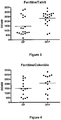
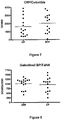
- each marker-candidate was tested in quantitative ELISA on individual samples. These samples were samples of patients who developed either "classic" dengue fever or severe dengue fever during the acute phase of the disease (viremic phase). All patients had secondary dengue fever. Only serotypes 1, 2 and 3 were represented (no serotype 4). These samples originated from the Institut Louis Malardé (Tahiti, French Polynesia) or from the Universidad Industrial de Santander (Bucaramanga, Colombia). These were part of a retrospective study conducted in agreement with the local ethics committee.
- anti-peroxyredoxin-2 polyclonal antibodies obtained either in the rabbit (SAB2101878, Sigma-Aldrich USA) or in the goat (SAB2500777, Sigma-Aldrich) were used. These antibodies are diluted to 2 ⁇ g / ml in Tris-Maleate buffer, pH 6.2 and used at the bottom of the plate. After washing, the plates sensitized with these antibodies are saturated for 1 h at 37 ° C. with a PBS-0.5% gelatin buffer.
- test sample is then added at different dilutions in PBS-0.05% Tween20-0.1% gelatin and incubated for 1 hour at 37 ° C.
- a mouse monoclonal antibody anti-peroxyredoxin-2 is added (WHO007001M Sigma-Aldrich, dilution: 1 ⁇ g / ml) and incubated for 1 hour at 37 ° C.
- the development is carried out using the NBT-BCIP TM One-Step Kit (Thermo Scientific, USA) in the presence of an alkaline phosphatase labeled anti-species conjugate diluted to 0.1 ⁇ g / mL (Jackson, USA).
- Table 2 p values for the different candidate markers tested on Tahitian and / or Colombian samples P value markers Colombia (serum) Tahiti (plasma) Mixed VitaminD BP 0.01 0,008 0.0017 LRG 0.1 0,015 0,072 ferritin 0.07 0.005 0.0018 CRP 0.1 0.4 NT afamin NT 0.7 NT Peroxyredoxine2 NT 0.4 0.38 G3BP NT 0.6 NT
Landscapes
- Health & Medical Sciences (AREA)
- Life Sciences & Earth Sciences (AREA)
- Engineering & Computer Science (AREA)
- Immunology (AREA)
- Molecular Biology (AREA)
- Biomedical Technology (AREA)
- Chemical & Material Sciences (AREA)
- Hematology (AREA)
- Urology & Nephrology (AREA)
- Food Science & Technology (AREA)
- Biochemistry (AREA)
- Cell Biology (AREA)
- Biotechnology (AREA)
- Medicinal Chemistry (AREA)
- Physics & Mathematics (AREA)
- Analytical Chemistry (AREA)
- Microbiology (AREA)
- General Health & Medical Sciences (AREA)
- General Physics & Mathematics (AREA)
- Pathology (AREA)
- Virology (AREA)
- Tropical Medicine & Parasitology (AREA)
- Proteomics, Peptides & Aminoacids (AREA)
- Peptides Or Proteins (AREA)
- Investigating Or Analysing Biological Materials (AREA)
Claims (8)
- Verfahren für eine in-vitro-Prognose, in einer Blutprobe, der Wahrscheinlichkeit, dass sich bei einem Patienten ein schweres Denguefieber entwickelt, wobeia) in der Blutprobe die Menge mindestens eines Markers bestimmt wird, bei welchem es sich das leucinreiche alpha-2-Glycoprotein handelt,b) die Menge an leucinreichem alpha-2-Glycoprotein, wie sie in Schritt a) bestimmt wurde, mit einer Bezugsmenge ebendieses Markers verglichen wird, die ausgehend von einer Gruppe von Personen erhalten wurde, bei welchen das Vorliegen einer nicht-schweren Form des Denguefiebers diagnostiziert wurde,wobei, wenn die Menge an leucinreichem alpha-2-Glycoprotein, wie sie in Schritt a) bestimmt wurde, größer als die Bezugsmenge ist, wie sie in Schritt b) erhalten wurde, die Prognose gestellt wird, dass sich bei dem Patienten ein schweres Denguefieber entwickeln wird.
- Verfahren nach Anspruch 1, wobei in Schritt a). in der Blutprobe zusätzlich die Menge an mindestens einem weiteren Marker bestimmt wird, der aus dem Vitamin-D-bindenden Protein und Ferritin ausgewählt ist, und in Schritt b) die Menge des weiteren Markers des Schritts a) mit einer Bezugsmenge ebendieses Markers verglichen wird, wie sie ausgehend von einer Gruppe von Personen erhalten wurde, bei welchen das Vorliegen einer nicht-schweren Form des Denguefiebers diagnostiziert wurde, und wobei, wenn die Menge des mindestens einen weiteren Markers, wie sie in Schritt a) bestimmt wurde, größer als die Bezugsmenge ist, wie sie in Schritt b) erhalten wurde, die Prognose gestellt wird, dass sich bei dem Patienten ein schweres Denguefieber entwickeln wird.
- Verfahren nach Anspruch 1, wobei in Schritt a) in der Blutprobe zusätzlich die Menge an mindestens zwei weiteren Markern bestimmt wird, die aus dem Vitamin-D-bindenden Protein und Ferritin ausgewählt sind, und in Schritt b) die Menge jedes der beiden weiteren Marker des Schritts a) jeweils mit einer Bezugsmenge für diese weiteren Marker verglichen wird, wie sie ausgehend von einer Gruppe von Personen erhalten wurde, bei welchen das Vorliegen einer nicht-schweren Form des Denguefiebers diagnostiziert wurde, und wobei, wenn die Menge jedes der weiteren Marker, wie sie in Schritt a) bestimmt wurde, größer als die jeweilige Bezugsmenge der weiteren Marker ist, wie sie in Schritt b) erhalten wurde, die Prognose gestellt wird, dass sich bei dem Patienten ein schweres Denguefieber entwickeln wird.
- Verwendung des leucinreichen alpha-2-Glycoproteins als Marker für die in-vitro-Prognose eines schweren Denguefiebers bei einem Patienten.
- Verwendung nach Anspruch 4 des Vitamin-D-bindenden Proteins oder von Ferritin als zusätzlicher Marker für die in-vitro-Prognose eines schweren Denguefiebers bei einem Patienten.
- Verwendung nach Anspruch 4 des Vitamin-D-bindenden Proteins und von Ferritin als zusätzliche Marker für die in-vitro-Prognose eines schweren Denguefiebers bei einem Patienten.
- Anwendungseinheit zur in-vitro-Prognose eines schweren Denguefiebers, wobei diese einen Bindungspartner des leucinreichen alpha-2-Glycoproteins, einen Bindungspartner des Vitamin-D-bindenden Proteins und einen Bindungspartner von Ferritin umfasst.
- Anwendungseinheit nach Anspruch 7, wobei diese darüber hinaus mindestens einen Bindungspartner eines Proteins des Denguefiebervirus umfasst, welches aus dem Protein NS1, dem Hüllprotein und dem Protein prM ausgewählt ist.
Applications Claiming Priority (2)
| Application Number | Priority Date | Filing Date | Title |
|---|---|---|---|
| FR1250646A FR2986071B1 (fr) | 2012-01-24 | 2012-01-24 | Procede pour pronostiquer,in vitro, dans un echantillon sanguin, la probabilite pour un patient d'evoluer vers une dengue severe |
| PCT/FR2013/050143 WO2013110894A1 (fr) | 2012-01-24 | 2013-01-23 | Procede pour pronostiquer in vitro dans un echantillon sanguin la probabilite pour un patient d'evoluer vers une dengue severe |
Publications (2)
| Publication Number | Publication Date |
|---|---|
| EP2807486A1 EP2807486A1 (de) | 2014-12-03 |
| EP2807486B1 true EP2807486B1 (de) | 2017-03-15 |
Family
ID=46826603
Family Applications (1)
| Application Number | Title | Priority Date | Filing Date |
|---|---|---|---|
| EP13704195.0A Active EP2807486B1 (de) | 2012-01-24 | 2013-01-23 | Verfahren zur in-vitro-vorhersage der entwicklung einer schweren dengue-erkrankung eines patienten auf basis einer blutprobe |
Country Status (7)
| Country | Link |
|---|---|
| US (2) | US9863948B2 (de) |
| EP (1) | EP2807486B1 (de) |
| BR (1) | BR112014017952B1 (de) |
| ES (1) | ES2627940T3 (de) |
| FR (1) | FR2986071B1 (de) |
| PT (1) | PT2807486T (de) |
| WO (1) | WO2013110894A1 (de) |
Families Citing this family (3)
| Publication number | Priority date | Publication date | Assignee | Title |
|---|---|---|---|---|
| FR3017713B1 (fr) * | 2014-02-18 | 2018-01-12 | Biomerieux | Procede et kit pour determiner la probabilite pour un patient d'evoluer vers une dengue severe |
| FR3017714A1 (fr) | 2014-02-18 | 2015-08-21 | Biomerieux Sa | Procede et kit pour determiner la probabilite pour un patient d'evoluer vers une dengue severe |
| MY168633A (en) * | 2014-06-13 | 2018-11-14 | Univ Malaya | Biomarker for severe dengue |
Family Cites Families (5)
| Publication number | Priority date | Publication date | Assignee | Title |
|---|---|---|---|---|
| US20110045501A1 (en) * | 2008-01-08 | 2011-02-24 | Irene Bosch | St2-based dengue fever diagnostic |
| WO2010040029A1 (en) * | 2008-10-02 | 2010-04-08 | Celtaxsys, Inc. | Methods of modulating the negative chemotaxis of immune cells |
| WO2011092219A1 (en) * | 2010-01-26 | 2011-08-04 | University College Dublin, National University Of Ireland | Biomarkers of cardiovascular disease including lrg |
| JP2013526852A (ja) * | 2010-04-06 | 2013-06-27 | カリス ライフ サイエンシズ ルクセンブルク ホールディングス | 疾患に対する循環バイオマーカー |
| EP2723372A4 (de) * | 2011-06-24 | 2015-03-04 | Jolla Inst Allergy Immunolog | Schutz gegen das dengue-virus und vorbeugung gegen schwere dengue-erkrankungen |
-
2012
- 2012-01-24 FR FR1250646A patent/FR2986071B1/fr not_active Expired - Fee Related
-
2013
- 2013-01-23 US US14/364,456 patent/US9863948B2/en active Active
- 2013-01-23 EP EP13704195.0A patent/EP2807486B1/de active Active
- 2013-01-23 ES ES13704195.0T patent/ES2627940T3/es active Active
- 2013-01-23 PT PT137041950T patent/PT2807486T/pt unknown
- 2013-01-23 BR BR112014017952-2A patent/BR112014017952B1/pt active IP Right Grant
- 2013-01-23 WO PCT/FR2013/050143 patent/WO2013110894A1/fr not_active Ceased
-
2017
- 2017-12-22 US US15/852,528 patent/US10823732B2/en active Active
Non-Patent Citations (1)
| Title |
|---|
| None * |
Also Published As
| Publication number | Publication date |
|---|---|
| US20150126386A1 (en) | 2015-05-07 |
| PT2807486T (pt) | 2017-06-22 |
| US20180120316A1 (en) | 2018-05-03 |
| BR112014017952B1 (pt) | 2022-05-24 |
| ES2627940T3 (es) | 2017-08-01 |
| FR2986071A1 (fr) | 2013-07-26 |
| BR112014017952A8 (pt) | 2017-07-11 |
| US9863948B2 (en) | 2018-01-09 |
| EP2807486A1 (de) | 2014-12-03 |
| US10823732B2 (en) | 2020-11-03 |
| WO2013110894A1 (fr) | 2013-08-01 |
| FR2986071B1 (fr) | 2014-02-28 |
| BR112014017952A2 (de) | 2017-06-20 |
Similar Documents
| Publication | Publication Date | Title |
|---|---|---|
| KR101531949B1 (ko) | 아밀로이드 베타 펩티드의 개선된 검출 방법 및 시약 | |
| EP2807486B1 (de) | Verfahren zur in-vitro-vorhersage der entwicklung einer schweren dengue-erkrankung eines patienten auf basis einer blutprobe | |
| Lin et al. | A time-resolved fluoroimmunoassay for the quantitation of rabies virus nucleoprotein in the rabies vaccine | |
| KR102012123B1 (ko) | 뎅기 바이러스 및 지카 바이러스의 비구조단백질 1에 동시에 결합 가능한 항체를 생산하는 하이브리도마 및 이로부터 생성된 항체, 이의 용도 | |
| Benabdessalem et al. | Development and comparative evaluation of SARS-CoV-2 S-RBD and N based ELISA tests in various African endemic settings | |
| EP3108251B1 (de) | Verfahren und kit zur bestimmung der wahrscheinlichkeit eines patienten, einen schweren fall von dengue zu entwickeln | |
| EP3108250B1 (de) | Verfahren und kit zur bestimmung der wahrscheinlichkeit eines patienten, einen schweren fall von dengue zu entwickeln | |
| US20220390449A1 (en) | New serological marker for the latent form of toxoplasmosis | |
| JP7783172B2 (ja) | フラビウイルス非構造ns1タンパク質と血漿リポタンパク質との間に形成される新規複合体 | |
| FR2996918A1 (fr) | Antigenes gra recombinants et leur application pour le diagnostic precoce de la toxoplasmose | |
| KR102218561B1 (ko) | 단일클론항체 쌍을 이용한 뎅기 바이러스의 검출 방법 | |
| Paiva et al. | Involvement of Th1Th17 Cell Subpopulations in the Immune Responses of Mothers Who Gave Birth to Children with Congenital Zika Syndrome (CZS). Viruses 2022, 14, 250 | |
| WO2017121963A1 (fr) | Procede de determination d'une reponse humorale chez un sujet immunodeprime | |
| Pastor et al. | Evaluation of the recombinant antigens Wb14 and WbTEvaluation of the recombinant antigens Wb14 and WbTfor the capture antibody diagnosis of lymphatic filariasis | |
| BR112016017953B1 (pt) | Método e kit para determinar a probabilidade que um paciente desenvolverá um caso severo da dengue |
Legal Events
| Date | Code | Title | Description |
|---|---|---|---|
| PUAI | Public reference made under article 153(3) epc to a published international application that has entered the european phase |
Free format text: ORIGINAL CODE: 0009012 |
|
| 17P | Request for examination filed |
Effective date: 20140625 |
|
| AK | Designated contracting states |
Kind code of ref document: A1 Designated state(s): AL AT BE BG CH CY CZ DE DK EE ES FI FR GB GR HR HU IE IS IT LI LT LU LV MC MK MT NL NO PL PT RO RS SE SI SK SM TR |
|
| DAX | Request for extension of the european patent (deleted) | ||
| RIN1 | Information on inventor provided before grant (corrected) |
Inventor name: BEDIN, FREDERIC |
|
| 17Q | First examination report despatched |
Effective date: 20160129 |
|
| GRAP | Despatch of communication of intention to grant a patent |
Free format text: ORIGINAL CODE: EPIDOSNIGR1 |
|
| RIC1 | Information provided on ipc code assigned before grant |
Ipc: G01N 33/569 20060101AFI20160901BHEP |
|
| INTG | Intention to grant announced |
Effective date: 20160929 |
|
| GRAS | Grant fee paid |
Free format text: ORIGINAL CODE: EPIDOSNIGR3 |
|
| GRAA | (expected) grant |
Free format text: ORIGINAL CODE: 0009210 |
|
| AK | Designated contracting states |
Kind code of ref document: B1 Designated state(s): AL AT BE BG CH CY CZ DE DK EE ES FI FR GB GR HR HU IE IS IT LI LT LU LV MC MK MT NL NO PL PT RO RS SE SI SK SM TR |
|
| REG | Reference to a national code |
Ref country code: CH Ref legal event code: EP Ref country code: GB Ref legal event code: FG4D Free format text: NOT ENGLISH |
|
| REG | Reference to a national code |
Ref country code: IE Ref legal event code: FG4D Free format text: LANGUAGE OF EP DOCUMENT: FRENCH |
|
| REG | Reference to a national code |
Ref country code: AT Ref legal event code: REF Ref document number: 876116 Country of ref document: AT Kind code of ref document: T Effective date: 20170415 |
|
| REG | Reference to a national code |
Ref country code: DE Ref legal event code: R096 Ref document number: 602013018541 Country of ref document: DE |
|
| REG | Reference to a national code |
Ref country code: NL Ref legal event code: FP |
|
| REG | Reference to a national code |
Ref country code: PT Ref legal event code: SC4A Ref document number: 2807486 Country of ref document: PT Date of ref document: 20170622 Kind code of ref document: T Free format text: AVAILABILITY OF NATIONAL TRANSLATION Effective date: 20170608 |
|
| REG | Reference to a national code |
Ref country code: LT Ref legal event code: MG4D |
|
| PG25 | Lapsed in a contracting state [announced via postgrant information from national office to epo] |
Ref country code: HR Free format text: LAPSE BECAUSE OF FAILURE TO SUBMIT A TRANSLATION OF THE DESCRIPTION OR TO PAY THE FEE WITHIN THE PRESCRIBED TIME-LIMIT Effective date: 20170315 Ref country code: FI Free format text: LAPSE BECAUSE OF FAILURE TO SUBMIT A TRANSLATION OF THE DESCRIPTION OR TO PAY THE FEE WITHIN THE PRESCRIBED TIME-LIMIT Effective date: 20170315 Ref country code: LT Free format text: LAPSE BECAUSE OF FAILURE TO SUBMIT A TRANSLATION OF THE DESCRIPTION OR TO PAY THE FEE WITHIN THE PRESCRIBED TIME-LIMIT Effective date: 20170315 Ref country code: GR Free format text: LAPSE BECAUSE OF FAILURE TO SUBMIT A TRANSLATION OF THE DESCRIPTION OR TO PAY THE FEE WITHIN THE PRESCRIBED TIME-LIMIT Effective date: 20170616 Ref country code: NO Free format text: LAPSE BECAUSE OF FAILURE TO SUBMIT A TRANSLATION OF THE DESCRIPTION OR TO PAY THE FEE WITHIN THE PRESCRIBED TIME-LIMIT Effective date: 20170615 |
|
| REG | Reference to a national code |
Ref country code: ES Ref legal event code: FG2A Ref document number: 2627940 Country of ref document: ES Kind code of ref document: T3 Effective date: 20170801 |
|
| REG | Reference to a national code |
Ref country code: AT Ref legal event code: MK05 Ref document number: 876116 Country of ref document: AT Kind code of ref document: T Effective date: 20170315 |
|
| PG25 | Lapsed in a contracting state [announced via postgrant information from national office to epo] |
Ref country code: RS Free format text: LAPSE BECAUSE OF FAILURE TO SUBMIT A TRANSLATION OF THE DESCRIPTION OR TO PAY THE FEE WITHIN THE PRESCRIBED TIME-LIMIT Effective date: 20170315 Ref country code: BG Free format text: LAPSE BECAUSE OF FAILURE TO SUBMIT A TRANSLATION OF THE DESCRIPTION OR TO PAY THE FEE WITHIN THE PRESCRIBED TIME-LIMIT Effective date: 20170615 Ref country code: SE Free format text: LAPSE BECAUSE OF FAILURE TO SUBMIT A TRANSLATION OF THE DESCRIPTION OR TO PAY THE FEE WITHIN THE PRESCRIBED TIME-LIMIT Effective date: 20170315 Ref country code: LV Free format text: LAPSE BECAUSE OF FAILURE TO SUBMIT A TRANSLATION OF THE DESCRIPTION OR TO PAY THE FEE WITHIN THE PRESCRIBED TIME-LIMIT Effective date: 20170315 |
|
| PG25 | Lapsed in a contracting state [announced via postgrant information from national office to epo] |
Ref country code: CZ Free format text: LAPSE BECAUSE OF FAILURE TO SUBMIT A TRANSLATION OF THE DESCRIPTION OR TO PAY THE FEE WITHIN THE PRESCRIBED TIME-LIMIT Effective date: 20170315 Ref country code: SK Free format text: LAPSE BECAUSE OF FAILURE TO SUBMIT A TRANSLATION OF THE DESCRIPTION OR TO PAY THE FEE WITHIN THE PRESCRIBED TIME-LIMIT Effective date: 20170315 Ref country code: RO Free format text: LAPSE BECAUSE OF FAILURE TO SUBMIT A TRANSLATION OF THE DESCRIPTION OR TO PAY THE FEE WITHIN THE PRESCRIBED TIME-LIMIT Effective date: 20170315 Ref country code: EE Free format text: LAPSE BECAUSE OF FAILURE TO SUBMIT A TRANSLATION OF THE DESCRIPTION OR TO PAY THE FEE WITHIN THE PRESCRIBED TIME-LIMIT Effective date: 20170315 Ref country code: AT Free format text: LAPSE BECAUSE OF FAILURE TO SUBMIT A TRANSLATION OF THE DESCRIPTION OR TO PAY THE FEE WITHIN THE PRESCRIBED TIME-LIMIT Effective date: 20170315 |
|
| PG25 | Lapsed in a contracting state [announced via postgrant information from national office to epo] |
Ref country code: PL Free format text: LAPSE BECAUSE OF FAILURE TO SUBMIT A TRANSLATION OF THE DESCRIPTION OR TO PAY THE FEE WITHIN THE PRESCRIBED TIME-LIMIT Effective date: 20170315 Ref country code: SM Free format text: LAPSE BECAUSE OF FAILURE TO SUBMIT A TRANSLATION OF THE DESCRIPTION OR TO PAY THE FEE WITHIN THE PRESCRIBED TIME-LIMIT Effective date: 20170315 Ref country code: IS Free format text: LAPSE BECAUSE OF FAILURE TO SUBMIT A TRANSLATION OF THE DESCRIPTION OR TO PAY THE FEE WITHIN THE PRESCRIBED TIME-LIMIT Effective date: 20170715 |
|
| REG | Reference to a national code |
Ref country code: DE Ref legal event code: R097 Ref document number: 602013018541 Country of ref document: DE |
|
| PLBE | No opposition filed within time limit |
Free format text: ORIGINAL CODE: 0009261 |
|
| STAA | Information on the status of an ep patent application or granted ep patent |
Free format text: STATUS: NO OPPOSITION FILED WITHIN TIME LIMIT |
|
| REG | Reference to a national code |
Ref country code: FR Ref legal event code: PLFP Year of fee payment: 6 |
|
| PG25 | Lapsed in a contracting state [announced via postgrant information from national office to epo] |
Ref country code: DK Free format text: LAPSE BECAUSE OF FAILURE TO SUBMIT A TRANSLATION OF THE DESCRIPTION OR TO PAY THE FEE WITHIN THE PRESCRIBED TIME-LIMIT Effective date: 20170315 |
|
| 26N | No opposition filed |
Effective date: 20171218 |
|
| PG25 | Lapsed in a contracting state [announced via postgrant information from national office to epo] |
Ref country code: SI Free format text: LAPSE BECAUSE OF FAILURE TO SUBMIT A TRANSLATION OF THE DESCRIPTION OR TO PAY THE FEE WITHIN THE PRESCRIBED TIME-LIMIT Effective date: 20170315 |
|
| PG25 | Lapsed in a contracting state [announced via postgrant information from national office to epo] |
Ref country code: MT Free format text: LAPSE BECAUSE OF FAILURE TO SUBMIT A TRANSLATION OF THE DESCRIPTION OR TO PAY THE FEE WITHIN THE PRESCRIBED TIME-LIMIT Effective date: 20170315 |
|
| PG25 | Lapsed in a contracting state [announced via postgrant information from national office to epo] |
Ref country code: LU Free format text: LAPSE BECAUSE OF NON-PAYMENT OF DUE FEES Effective date: 20180123 |
|
| REG | Reference to a national code |
Ref country code: IE Ref legal event code: MM4A |
|
| REG | Reference to a national code |
Ref country code: BE Ref legal event code: MM Effective date: 20180131 |
|
| PG25 | Lapsed in a contracting state [announced via postgrant information from national office to epo] |
Ref country code: BE Free format text: LAPSE BECAUSE OF NON-PAYMENT OF DUE FEES Effective date: 20180131 |
|
| PG25 | Lapsed in a contracting state [announced via postgrant information from national office to epo] |
Ref country code: IE Free format text: LAPSE BECAUSE OF NON-PAYMENT OF DUE FEES Effective date: 20180123 |
|
| PG25 | Lapsed in a contracting state [announced via postgrant information from national office to epo] |
Ref country code: MC Free format text: LAPSE BECAUSE OF FAILURE TO SUBMIT A TRANSLATION OF THE DESCRIPTION OR TO PAY THE FEE WITHIN THE PRESCRIBED TIME-LIMIT Effective date: 20170315 |
|
| PG25 | Lapsed in a contracting state [announced via postgrant information from national office to epo] |
Ref country code: TR Free format text: LAPSE BECAUSE OF FAILURE TO SUBMIT A TRANSLATION OF THE DESCRIPTION OR TO PAY THE FEE WITHIN THE PRESCRIBED TIME-LIMIT Effective date: 20170315 |
|
| PG25 | Lapsed in a contracting state [announced via postgrant information from national office to epo] |
Ref country code: HU Free format text: LAPSE BECAUSE OF FAILURE TO SUBMIT A TRANSLATION OF THE DESCRIPTION OR TO PAY THE FEE WITHIN THE PRESCRIBED TIME-LIMIT; INVALID AB INITIO Effective date: 20130123 |
|
| PG25 | Lapsed in a contracting state [announced via postgrant information from national office to epo] |
Ref country code: CY Free format text: LAPSE BECAUSE OF FAILURE TO SUBMIT A TRANSLATION OF THE DESCRIPTION OR TO PAY THE FEE WITHIN THE PRESCRIBED TIME-LIMIT Effective date: 20170315 Ref country code: MK Free format text: LAPSE BECAUSE OF NON-PAYMENT OF DUE FEES Effective date: 20170315 |
|
| PG25 | Lapsed in a contracting state [announced via postgrant information from national office to epo] |
Ref country code: AL Free format text: LAPSE BECAUSE OF FAILURE TO SUBMIT A TRANSLATION OF THE DESCRIPTION OR TO PAY THE FEE WITHIN THE PRESCRIBED TIME-LIMIT Effective date: 20170315 |
|
| REG | Reference to a national code |
Ref country code: CH Ref legal event code: U11 Free format text: ST27 STATUS EVENT CODE: U-0-0-U10-U11 (AS PROVIDED BY THE NATIONAL OFFICE) Effective date: 20260201 |
|
| PGFP | Annual fee paid to national office [announced via postgrant information from national office to epo] |
Ref country code: NL Payment date: 20260126 Year of fee payment: 14 |
|
| PGFP | Annual fee paid to national office [announced via postgrant information from national office to epo] |
Ref country code: GB Payment date: 20260127 Year of fee payment: 14 |
|
| PGFP | Annual fee paid to national office [announced via postgrant information from national office to epo] |
Ref country code: ES Payment date: 20260202 Year of fee payment: 14 |
|
| PGFP | Annual fee paid to national office [announced via postgrant information from national office to epo] |
Ref country code: DE Payment date: 20260128 Year of fee payment: 14 |
|
| PGFP | Annual fee paid to national office [announced via postgrant information from national office to epo] |
Ref country code: IT Payment date: 20260121 Year of fee payment: 14 |
|
| PGFP | Annual fee paid to national office [announced via postgrant information from national office to epo] |
Ref country code: FR Payment date: 20260126 Year of fee payment: 14 |
|
| PGFP | Annual fee paid to national office [announced via postgrant information from national office to epo] |
Ref country code: PT Payment date: 20260108 Year of fee payment: 14 Ref country code: CH Payment date: 20260201 Year of fee payment: 14 |