EP2806565A1 - Procede de decodage d'un code correcteur, par exemple un turbo-code, par analyse du spectre etendu des mots du code - Google Patents
Procede de decodage d'un code correcteur, par exemple un turbo-code, par analyse du spectre etendu des mots du code Download PDFInfo
- Publication number
- EP2806565A1 EP2806565A1 EP14168398.7A EP14168398A EP2806565A1 EP 2806565 A1 EP2806565 A1 EP 2806565A1 EP 14168398 A EP14168398 A EP 14168398A EP 2806565 A1 EP2806565 A1 EP 2806565A1
- Authority
- EP
- European Patent Office
- Prior art keywords
- code
- code word
- decoding
- bit
- decoding method
- Prior art date
- Legal status (The legal status is an assumption and is not a legal conclusion. Google has not performed a legal analysis and makes no representation as to the accuracy of the status listed.)
- Granted
Links
Images

Classifications
-
- H—ELECTRICITY
- H03—ELECTRONIC CIRCUITRY
- H03M—CODING; DECODING; CODE CONVERSION IN GENERAL
- H03M13/00—Coding, decoding or code conversion, for error detection or error correction; Coding theory basic assumptions; Coding bounds; Error probability evaluation methods; Channel models; Simulation or testing of codes
- H03M13/37—Decoding methods or techniques, not specific to the particular type of coding provided for in groups H03M13/03 - H03M13/35
- H03M13/3746—Decoding methods or techniques, not specific to the particular type of coding provided for in groups H03M13/03 - H03M13/35 with iterative decoding
- H03M13/3753—Decoding methods or techniques, not specific to the particular type of coding provided for in groups H03M13/03 - H03M13/35 with iterative decoding using iteration stopping criteria
-
- H—ELECTRICITY
- H03—ELECTRONIC CIRCUITRY
- H03M—CODING; DECODING; CODE CONVERSION IN GENERAL
- H03M13/00—Coding, decoding or code conversion, for error detection or error correction; Coding theory basic assumptions; Coding bounds; Error probability evaluation methods; Channel models; Simulation or testing of codes
- H03M13/29—Coding, decoding or code conversion, for error detection or error correction; Coding theory basic assumptions; Coding bounds; Error probability evaluation methods; Channel models; Simulation or testing of codes combining two or more codes or code structures, e.g. product codes, generalised product codes, concatenated codes, inner and outer codes
- H03M13/2957—Turbo codes and decoding
-
- H—ELECTRICITY
- H03—ELECTRONIC CIRCUITRY
- H03M—CODING; DECODING; CODE CONVERSION IN GENERAL
- H03M13/00—Coding, decoding or code conversion, for error detection or error correction; Coding theory basic assumptions; Coding bounds; Error probability evaluation methods; Channel models; Simulation or testing of codes
- H03M13/37—Decoding methods or techniques, not specific to the particular type of coding provided for in groups H03M13/03 - H03M13/35
- H03M13/3746—Decoding methods or techniques, not specific to the particular type of coding provided for in groups H03M13/03 - H03M13/35 with iterative decoding
-
- H—ELECTRICITY
- H03—ELECTRONIC CIRCUITRY
- H03M—CODING; DECODING; CODE CONVERSION IN GENERAL
- H03M13/00—Coding, decoding or code conversion, for error detection or error correction; Coding theory basic assumptions; Coding bounds; Error probability evaluation methods; Channel models; Simulation or testing of codes
- H03M13/37—Decoding methods or techniques, not specific to the particular type of coding provided for in groups H03M13/03 - H03M13/35
- H03M13/3776—Decoding methods or techniques, not specific to the particular type of coding provided for in groups H03M13/03 - H03M13/35 using a re-encoding step during the decoding process
Definitions
- the invention relates to a method for decoding a correction code by analyzing the code word spectrum and advantageously applies to a correction code of the family of turbo codes.
- This phenomenon is related to the fact that certain code words have a minimum distance, that is to say a distance vis-à-vis the nearest code word, weak. However, the minimum distance has a direct impact on the correction power of the code. If a received code word is at a distance less than the minimum distance of the transmitted codeword, then the decoder converges suddenly to the correct code word. On the other hand, the longer the received code word is at a significant distance from the transmitted code word, the more difficult the convergence of the decoder.
- a first solution is to add an external code, for example a BCH code or a Reed-Solomon code to form a concatenated schema.
- an external code for example a BCH code or a Reed-Solomon code
- This technique improves the decoding performance by eliminating the error floor phenomenon but presents the failure to reduce the spectral efficiency or the effective bit rate of the transmission. Indeed, the overall efficiency of the two concatenated codes is lower than the yield alone of the turbo-code.
- a second solution, proposed in the publication [1], consists in analyzing the code word spectrum in order to identify the least protected bits in the code frame. Indeed it is known that on these codes, all the bits are not protected in a fair way. So the impact of an error on a given bit is not the same as that of an error on the neighboring bit.
- a turbo encoder inserts at the positions indicated by the set ⁇ of the known bits. Consequently, during the decoding, the set ⁇ as well as the values of the inserted bits being known, a high reliability is declared at the input of the turbo-decoder in order to improve the performances. The inserted bits are then removed at the output of the turbo-decoder to find the information frame.
- This solution also has the drawback of reducing the effective efficiency of the code since bits are added by the coder, which reduces the number of bits that are useful for a given information frame size.
- a third solution proposed in document [2] consists in introducing pulses at given positions in the frame. These positions are determined based on the bit likelihood information at the input of the decoder. This information is sorted according to its magnitude only and the pulses are introduced one by one beginning with the least reliable likelihoods.
- the invention proposes an improved decoding method making it possible to solve the problem of the error floor of a turbo-code or an LDPC code, or more generally of a correction code of the "turbo-like codes" family. , while maintaining the same spectral efficiency that is to say without decreasing the useful rate of the encoded stream.
- This result is obtained by an identification, at the input of the decoder, of the bits on which an error has a strong impact, and a modification of the likelihoods corresponding to these bits in order to improve the convergence of the decoder.
- the method according to the invention further comprises a process stop test step.
- the stopping test may be a test on the number of iterations of the decoding step.
- the stopping test can also be a convergence test of the decoding step.
- the convergence test includes, for example, the detection of an error in the result of the decoding step by application of an error detection code (CRC).
- CRC error detection code
- the convergence test comprises, for example, the comparison of the global likelihood information IM (i) with a predetermined threshold value.
- the global likelihood information IM (i) is, for example, a mutual information or is equal to the inverse of the Euclidean distance between the decoded and then re-encoded code word and the received code word.
- said subset of the bits of the received code word is equal to the entirety of the bits of the received code word or to a subset consisting of bits whose local likelihood LLR has an absolute value. below a predetermined threshold.
- the correction code is a turbo-code or an LDPC code.
- the invention also relates to a computer program comprising instructions for executing the iterative decoding method according to the invention, when the program is executed by a processor, a recording medium readable by a processor on which is recorded a program comprising instructions for executing the iterative decoding method according to the invention, when the program is executed by a processor and a device comprising means adapted to perform the steps of the method according to the invention.
- the invention aims in particular to improve the performance of standard decoding methods turbo codes or correction codes of the same family.
- the figure 1 represents a diagram of the theoretical performances of a corrector code of the family of turbo-codes.
- the abscissa SNR corresponds to the signal-to-noise ratio expressed in decibels and the ordinate BER corresponds to the bit error rate.
- the curve of bit error rate characteristic of a turbo-code comprises, as is well known in the field, three zones 1,2,3 which can be distinguished according to the signal-to-noise ratio.
- the first zone 1 is an area where the bit error rate saturates at a maximum value due to a signal to noise ratio that is too low.
- the second zone 2 is an area where the bit error rate decreases rapidly with increasing signal-to-noise ratio.
- the third zone 3 is a zone called "floor" which corresponds to a maximum signal-to-noise ratio beyond which the decoder reaches a limit in bit error rate below which it no longer manages to improve the decoding.
- An object of the invention is to solve the effect of the "floor" zone of a turbo-code without impacting the spectral efficiency.
- the problem of the high signal-to-noise floor zone is intrinsically related to the low-order code words, i.e., the codewords at a low distance from another code word.
- the figure 2 illustrates the notion of distance between several codewords.
- the code word MC1 is of lower weight than the code word MC2 because its minimum distance, that is to say the smallest distance to another code word, is lower than that of the code word MC2.
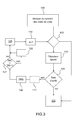
- the figure 3 illustrates, on a flowchart, the implementation steps of the decoding method according to the invention.
- the method according to the invention consists in realizing the decoding of at least one code word by a correction code of the family of turbo-codes.
- the invention also applies to LDPC (Low Density Parity Check) codes or to any code known as the "turbo like codes" family, in other words correction codes constructed from graphs and which are decoded iteratively.
- LDPC Low Density Parity Check
- a codeword is defined by a first vector of size N containing the bits or symbols received and a second vector, denoted by the following LLR, of the same size N, containing information on the reliability or likelihood of the received bits or symbols.
- this information may be defined by a likelihood ratio or "log-likelihood ratio" in English which constitutes a soft (i.e., non-binary) information giving an indication of the reliability of the received bit.
- the higher the magnitude of an LLR value the greater the probability that there will be no error on the corresponding bit.
- the sign of the LLR value defines the corresponding bit (O or 1) according to the constellation of the modulation chosen.
- An input code word of the decoding method according to the invention may have been subjected to disturbances, for example related to the imperfections of the transmission channel, which cause errors on the received bits and on the LLR likelihood information.
- An object of the invention is to improve the error rate after decoding compared to conventional decoding methods.
- the first step 101 of the method is a step prior to decoding and can be executed separately from the decoding itself. She consists in performing an analysis of the extended spectrum of the words of the correction code.
- the spectrum analysis of a correction code consists in determining the distribution of the words of the code according to their distance to another code word.
- the minimum distance of a code word is the smallest distance between this code word and the other code words of the alphabet of the correction code under consideration.
- the most commonly used distance is the Hamming distance, ie the number of different bits between two codewords.
- the first step 101 of the method consists in determining the extended spectrum of the correction code. More precisely, it is a question, for each codeword, of imposing one of the bits of the word on an erroneous value and of calculating the distance between this code word and the same modified code word decoded then recoded.
- the analysis of the extended spectrum leads to generating N distances, each corresponding to the same code word but in which one of the bits is erroneous.
- the distance is calculated after decoding the code word whose bit is intentionally forced to an incorrect value by calculating the Hamming distance between the decoded word obtained and then recoded and the initial code word.
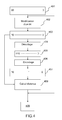
- the figure 4 details, according to an exemplary embodiment, the substeps of step 101 for analyzing the extended spectrum of the codewords.
- the organization chart of the figure 4 schematizes the substeps necessary for extended spectrum analysis for a given codeword. The steps represented must be repeated for all code words or a subset of this set.
- the substeps of step 101 comprise in particular a first step of selecting a code word 401.
- the code word 401 chosen is the code word comprising all its bits at 0. But the code word 401 chosen can be any of the code words.
- the analysis of the extended spectrum can only be performed for this unique code word 401 because the correction code used is a linear code and therefore the properties of the codewords are identical and can be transposed from one codeword to another. . It is therefore unnecessary to apply the steps described in figure 4 for several different 401 codewords.
- the code word 401 then undergoes a modification 402 of one of its bits, in other words the value of this bit is inverted.
- the modified code word 403 is then decoded 404 by preferentially using the same decoder as that used by the decoding method according to the invention.
- a decoded word 405 is thus obtained which is then encoded again 406 to obtain a new code word 407.
- This new code word 407 is then compared with the initial code word 401 by calculating a Hamming distance 408 between the two words. of code that is stored in a 409 file or a memory.
- Steps 402 to 408 are repeated by modifying one by one each of the bits of codeword 401 to finally obtain a table 409 indicating for each bit index, the Hamming distance between the code word obtained when the corresponding bit is erroneous. and the correct code word.
- This Hamming distance is an information on the impact of an error on a code word as a function of the erroneous bit.
- the analysis of the extended spectrum is performed on a subset of the bits of the codeword 401, by searching only the bits on which an error results in a decoded word 407. remote from the original word 401 by a predetermined threshold distance.
- step 101 extended spectrum analysis can be carried out once and for all using the same iterative decoding algorithm that used to perform the decoding according to the invention.
- Step 101 results in the generation of a table 409, which may be stored, for example in a file or database, containing, for each bit index of a code word, an associated distance.
- the decoding method according to the invention is an iterative method which receives as input a vector of the received bits and an associated vector containing the likelihood information of the received bits and outputs a decoded vector and an associated vector also containing the likelihood information. decoded bits.
- a usual decoding 103 is applied, for example an iterative decoding.
- a stopping test is performed to stop the decoding 103 when the latter has converged or before convergence to limit the complexity.
- This stopping test can be performed via at least one of the following methods or by using several of these methods taken in combination.
- a first stopping test consists of using a CRC (Cyclic Redundancy Check) type error detector code to protect the data before encoding.
- a detection test is performed after decoding 103 to check if the obtained codeword is correct.
- the decoding 103 is iterated as long as the decoding of the CRC is not positive in order to test the convergence of the decoder.
- a second stopping test consists in setting a stopping criterion to the decoder 103 as a function of the number of iterations, in other words to setting a maximum number of iterations beyond which the decoding 103 is stopped.
- a third stopping test consists in calculating an overall likelihood criterion at the decoding output 103 and comparing this criterion with a threshold.
- a global likelihood criterion is an indication of the reliability of decoding on a code word. For example, it can be a value between 0 and 1, the value 0 corresponding to a totally erroneous decoding (with an error rate of 50%) and the value 1 corresponding to a correct decoding (with an error rate of 50%). error rate of 0%).
- An example of an overall likelihood calculation is to compute a mutual information criterion as described in the publication [6].
- the third stopping test may consist in stopping the decoding 103 when the overall likelihood criterion is greater than a threshold value, for example a value equal to 0.9.
- stopping tests are possible, in particular based on a detection of the convergence of the decoding 103, that is to say the stopping of the evolution of the decoding, so as to stop the decoding when he no longer evolves in his decision.
- the convergence test 104 is positive, that is, if the decoding 103 has converged to a decision, this decision is considered as the final decision 105, it consists of the decoded binary vector and a second vector containing local likelihood information. of each decoded bit.
- the production of local likelihood information at the decoding output requires the use of a decoder adapted to receive soft information input (as opposed to binary information) and to output soft information, such a decoder is known.
- SISO decoder Soft Input Soft Output
- stop test 104 is negative, for example if the decoding 103 has not converged towards a stable decision, then a new iteration of the method according to the invention is triggered.
- a global likelihood criterion IM (i) is computed from the vector of the local likelihood information of the decoded bits.
- This criterion can be mutual information as indicated in the publication [6] or can be calculated by other equivalent means.
- the global likelihood criterion can also be equal to the inverse of a calculation of Euclidean distance between the decoded vector then recoded and the input vector of the decoding method.
- a test step 107 the global likelihood criterion IM (i) calculated for the current iteration i is compared with the global likelihood criterion IM (i-1) calculated for the previous iteration i-1.
- an index of the input vector is selected and the value corresponding to this index is modified by a sign value opposite to the initial value and of amplitude at least equal to the minimum distance of the correction code considered.
- the table 409 generated at the end of the extended spectrum analysis step 101 is searched for the index corresponding to the lowest Hamming distance.
- This index corresponds to the bit which if it is wrong will be the most difficult to correct for the decoder. Indeed, in the error floor area, it may be noted that the errors made by an iterative decoder are often due to so-called low weight code words, ie code words which have few bits different from each other. to the original code word. By modifying the value of the bits (using a pulse) which are naturally the least protected by the structure of the code itself, it is thus possible to get around the error floor phenomenon. If this index has already been used during a previous iteration of the process it is no longer eligible, the index selected is then that which is associated with the lowest distance, among the indices still eligible.
- the steps 106, 107, 108, 109 are iterated 110 and a test 102 is applied to check that all the values of the input vector have been modified by the step 109 in which case the decoding method is finalized with the decision 105 obtained during the last iteration. .
- an additional step 111 is performed when the stop test 104 is negative and before the step 106 of overall likelihood calculation.
- This additional step 111 consists in selecting a subset of the values of the input LLR vector of the decoder, this subset consisting of the lowest local likelihood values, which correspond to the bits most likely to be erroneous.
- the decoding method according to the invention can be implemented from hardware and / or software elements. It can in particular be implemented as a computer program including instructions for its execution.
- the computer program can be recorded on a processor-readable recording medium.
- It can also be executed from a coded data stream and stored in a storage device.
- the different steps of the method according to the invention can also be executed by a device comprising a processor and a memory.
- the processor may be a generic processor, a specific processor, an application-specific integrated circuit (also known as the ASIC for "Application-Specific Integrated Circuit") or a network of programmable gates in situ (also known as the English name of FPGA for "Field-Programmable Gate Array”).
Landscapes
- Physics & Mathematics (AREA)
- Probability & Statistics with Applications (AREA)
- Engineering & Computer Science (AREA)
- Theoretical Computer Science (AREA)
- Error Detection And Correction (AREA)
Abstract
Description
- L'invention concerne un procédé de décodage d'un code correcteur par analyse du spectre des mots du code et s'applique avantageusement à un code correcteur de la famille des turbo-codes.
- Les algorithmes connus de décodage des codes correcteurs de la famille des turbo-codes présentent des limitations du point de vue des performances de taux d'erreurs bits après décodage à fort rapport signal à bruit. En effet, il est connu qu'au delà d'une valeur seuil de rapport signal à bruit, le taux d'erreurs bits après décodage d'un turbo-code ne peut pas être amélioré avec un algorithme de décodage usuel. Ce phénomène est connu sous l'appellation « plancher d'erreur » ou « error-floor » en anglais qui caractérise le niveau minimal du taux d'erreurs bits en dessous duquel il n'est pas possible d'améliorer les performances.
- Ce phénomène, bien connu du domaine, est lié au fait que certains mots de code présentent une distance minimum, c'est-à-dire une distance vis-à-vis du mot de code le plus proche, faible. Or la distance minimum a un impact direct sur le pouvoir de correction du code. Si un mot de code reçu se situe à une distance inférieure à la distance minimum du mot de code émis, alors le décodeur converge à coup sur vers le bon mot de code. Au contraire, plus le mot de code reçu se situe à une distance importante du mot de code émis, plus la convergence du décodeur est difficile.
- Plusieurs méthodes sont connues pour résoudre le problème du plancher d'erreur des codes correcteurs de la famille des turbo-codes.
- Une première solution consiste à ajouter un code externe, par exemple un code BCH ou un code Reed-Solomon pour former un schéma concaténé. Cette technique permet d'améliorer les performances de décodage en éliminant le phénomène de plancher d'erreur mais présente le défaut de diminuer l'efficacité spectrale ou le débit utile de la transmission. En effet, le rendement global des deux codes concaténés est inférieur au rendement seul du turbo-code.
- Une deuxième solution, proposée dans la publication [1], consiste à consiste à analyser le spectre des mots du code afin d'identifier les bits les moins protégés dans la trame du code. En effet il est connu que sur ces codes, tous les bits ne sont pas protégés de manière équitable. Donc l'impact d'une erreur sur un bit donné n'est pas le même que celui d'une erreur sur le bit voisin. Une fois l'ensemble Ω de ces bits déterminé, un turbo codeur insère aux positions signifiées par l'ensemble Ω des bits connus. En conséquence, lors du décodage, l'ensemble Ω ainsi que les valeurs des bits insérés étant connus, une fiabilité importante est déclarée à l'entré du turbo-décodeur afin d'en améliorer les performances. Les bits insérés sont ensuite retirés à la sortie du turbo-décodeur afin de retrouver la trame d'information.
- Cette solution présente également le défaut de diminuer le rendement effectif du code puisque des bits sont ajoutés par le codeur ce qui diminue le nombre de bits utiles pour une taille de trame d'information donnée.
- Une troisième solution, proposée dans le document [2] consiste à introduire des impulsions à des positions données dans la trame. Ces positions sont déterminées en se basant sur les informations de vraisemblance des bits à l'entrée du décodeur. Ces informations sont triées en fonction de leur magnitude uniquement et les impulsions sont introduites une a une en commençant par les vraisemblances les moins fiables.
- Cette solution à pour défaut d'être très complexe. En effet, elle apparaît efficace uniquement pour un grand nombre de positions et repose sur le principe que tous les bits dans la trame ont la même importance, ce qui n'est pas vrai pour un turbo-code.
- L'invention propose un procédé de décodage amélioré permettant de résoudre le problème du plancher d'erreur d'un turbo-code ou d'un code LDPC, ou plus généralement d'un code correcteur de la famille des « turbo-like codes », tout en conservant la même efficacité spectrale c'est-à-dire sans diminution du débit utile du flux encodé. Ce résultat est obtenu par une identification, en entrée du décodeur, des bits sur lesquels une erreur a un impact fort, et une modification des vraisemblances correspondants à ces bits afin d'améliorer la convergence du décodeur.
- L'invention a pour objet un procédé itératif de décodage d'un mot de code reçu d'un code correcteur, ledit mot de code étant représenté par une information de vraisemblance locale de chaque bit dont il est constitué, ledit procédé itératif étant caractérisé en ce qu'il comporte les étapes suivantes :
- Une étape d'analyse du spectre étendu des mots du code pour générer une table contenant, pour chaque bit d'un mot de code, une information de distance entre ledit mot de code et le mot de code obtenu par décodage puis ré-encodage dudit mot de code dont la valeur d'un bit est erronée,
- Pour chaque bit d'indice i d'un sous ensemble des bits du mot de code reçu, exécuter de façon itérative les étapes suivantes :
- Une étape de décodage dudit mot de code reçu,
- Une étape de calcul d'une information de vraisemblance globale IM(i) du mot de code décodé,
- Une étape de comparaison de l'information de vraisemblance globale IM(i) calculée à l'itération courante avec l'information de vraisemblance globale IM(i-1) calculée à l'itération précédente,
- Une étape de modification de l'amplitude et du signe de l'information de vraisemblance locale LLR(i) d'un bit d'indice i dudit mot de code reçu, l'indice i sélectionné correspondant à l'indice de ladite table associé à la distance la plus faible dans la table, parmi les indices non sélectionnés à une itération précédente,
- Si l'information de vraisemblance globale IM(i) calculée à l'itération courante est inférieure à l'information de vraisemblance globale IM(i-1) calculée à l'itération précédente, une étape de réinitialisation de l'information de vraisemblance locale LLR(i-1) dudit bit d'indice i-1 dudit mot de code reçu modifiée à l'itération précédente.
- Selon un mode de réalisation particulier, le procédé selon l'invention comprend en outre une étape de test d'arrêt du procédé.
- Lorsque l'étape de décodage est itérative, le test d'arrêt peut être un test sur le nombre d'itérations de l'étape de décodage.
- Le test d'arrêt peut aussi être un test de convergence de l'étape de décodage.
- Le test de convergence comprend, par exemple, la détection d'une erreur dans le résultat de l'étape de décodage par application d'un code détecteur d'erreurs (CRC).
- Le test de convergence comprend, par exemple, la comparaison de l'information de vraisemblance globale IM(i) à une valeur seuil prédéterminée.
- L'information de vraisemblance globale IM(i) est, par exemple, une information mutuelle ou est égale à l'inverse de la distance Euclidienne entre le mot de code décodé puis ré-encodé et le mot de code reçu.
- Selon un aspect particulier de l'invention, ledit sous ensemble des bits du mot de code reçu est égal à l'intégralité des bits du mot de code reçu ou à un sous-ensemble constitué des bits dont la vraisemblance locale LLR présente une valeur absolue inférieure à un seuil prédéterminé.
- Selon un aspect particulier de l'invention, l'étape d'analyse du spectre étendu comprend les sous-étapes suivantes :
- Sélectionner un mot de code,
- Pour chaque bit dudit mot de code, exécuter de façon itérative les étapes suivantes :
- Modifier la valeur dudit bit,
- Décoder le mot de code modifié,
- Encoder le résultat du décodage,
- Calculer une distance entre le résultat de l'encodage et le mot de code modifié.
- Selon un aspect particulier de l'invention, le code correcteur est un turbo-code ou un code LDPC.
- L'invention a également pour objet un programme d'ordinateur comportant des instructions pour l'exécution du procédé itératif de décodage selon l'invention, lorsque le programme est exécuté par un processeur, un support d'enregistrement lisible par un processeur sur lequel est enregistré un programme comportant des instructions pour l'exécution du procédé itératif de décodage selon l'invention, lorsque le programme est exécuté par un processeur et un dispositif comprenant des moyens adaptés pour exécuter les étapes du procédé selon l'invention.
- D'autres caractéristiques et avantages de la présente invention apparaîtront mieux à la lecture de la description qui suit en relation aux dessins annexés qui représentent:
- La
figure 1 , un diagramme des performances théoriques d'un code correcteur de la famille des turbo-codes, en taux d'erreur fonction du rapport signal à bruit, illustrant les limitations des méthodes de décodage usuelles, - La
figure 2 , un schéma illustrant la notion de distance minimum d'un code correcteur, - La
figure 3 , un organigramme illustrant les étapes de mise en oeuvre du procédé de décodage selon l'invention, - La
figure 4 , un organigramme détaillant, dans un exemple de réalisation, les sous- étapes de mise en oeuvre de l'étape d'analyse du spectre étendu des mots de code, - L'invention vise notamment à améliorer les performances des procédés de décodage usuels des turbo-codes ou de codes correcteurs de la même famille.
- La
figure 1 représente un diagramme des performances théoriques d'un code correcteur de la famille des turbo-codes. L'abscisse SNR correspond au rapport signal à bruit exprimé en décibels et l'ordonnée BER correspond au taux d'erreurs bits. - La courbe de taux d'erreurs bits caractéristique d'un turbo-code comporte, comme cela est bien connu du domaine, trois zones 1,2,3 qui peuvent être distinguées en fonction du rapport signal à bruit. La première zone 1 est une zone où le taux d'erreurs bits sature à une valeur maximale du fait d'un rapport signal à bruit trop faible. La deuxième zone 2 est une zone où le taux d'erreurs bits diminue rapidement avec l'augmentation du rapport signal à bruit. La troisième zone 3 est une zone dite « plancher » qui correspond à un rapport signal à bruit maximum au delà duquel le décodeur atteint une limite en taux d'erreurs bits en dessous de laquelle il ne parvient plus à améliorer le décodage.
- Un objectif de l'invention est de résoudre l'effet de la zone « plancher » d'un turbo-code sans impacter l'efficacité spectrale.
- Le problème de la zone plancher à fort rapport signal à bruit est intrinsèquement lié aux mots de codes de poids faible, c'est-à-dire aux mots de code se trouvant à une distance d faible d'un autre mot de code.
- La
figure 2 illustre la notion de distance entre plusieurs mots de code. Sur l'exemple de lafigure 2 , le mot de code MC1 est de poids plus faible que le mot de code MC2 car sa distance minimale, c'est-à-dire la plus petite distance à un autre mot de code, est plus faible que celle du mot de code MC2. - La
figure 3 illustre, sur un organigramme, les étapes de mise en oeuvre du procédé de décodage selon l'invention. - Le procédé selon l'invention consiste à réaliser le décodage d'au moins un mot de code par un code correcteur de la famille des turbo-codes. L'invention s'applique également aux codes LDPC (Low Density Parity Check) ou à tout code dit de la famille des « turbo like codes », autrement dit des codes correcteurs construits à partir de graphes et qui sont décodés de façon itérative.
- Un mot de code est défini par un premier vecteur de taille N contenant les bits ou symboles reçus et un second vecteur, noté par la suite LLR, de même taille N, contenant une information sur la fiabilité ou la vraisemblance des bits ou symboles reçus. Par exemple, cette information peut être définie par un rapport de vraisemblance ou « log-likelihood ratio » en anglais qui constitue une information souple (c'est-à-dire non binaire) donnant une indication sur la fiabilité du bit reçu. Par exemple, plus la magnitude d'une valeur LLR est élevée, plus la probabilité qu'il n'y ait pas d'erreur sur le bit correspondant est élevée. Le signe de la valeur LLR défini le bit correspondant (O ou 1) selon la constellation de la modulation choisie.
- Un mot de code en entrée du procédé de décodage selon l'invention peut avoir été soumis à des perturbations, par exemple liées aux imperfections du canal de transmission, qui entrainent des erreurs sur les bits reçus et sur les informations de vraisemblance LLR.
- Un objectif de l'invention est d'améliorer le taux d'erreurs après décodage par rapport aux méthodes de décodage usuelles.
- La première étape 101 du procédé est une étape préalable au décodage et peut être exécutée séparément du décodage lui-même. Elle consiste à réaliser une analyse du spectre étendu des mots du code correcteur.
- L'analyse du spectre d'un code correcteur consiste à déterminer la répartition des mots du code en fonction de leur distance à un autre mot de code. La distance minimum d'un mot de code est la plus petite distance entre ce mot de code et les autres mots de code de l'alphabet du code correcteur considéré. La distance la plus couramment utilisée est la distance de Hamming, autrement dit le nombre de bits différents entre deux mots de code.
- Différentes techniques sont connues pour réaliser une analyse du spectre d'un code correcteur parmi lesquelles celles décrites dans les publications [3],[4] et [5].
- La première étape 101 du procédé consiste à déterminer le spectre étendu du code correcteur. Plus précisément, il s'agit, pour chaque mot de code, d'imposer un des bits du mot à une valeur erronée et de calculer la distance entre ce mot de code et le même mot de code modifié décodé puis recodé.
- Autrement dit, pour un mot de code de taille N, l'analyse du spectre étendu conduit à générer N distances, chacune correspondant au même mot de code mais dans lequel un des bits est erroné. La distance est calculée après décodage du mot de code dont un bit est volontairement forcé à une valeur incorrecte en calculant la distance de Hamming entre le mot décodé obtenu puis recodé et le mot de code initial.
- La
figure 4 détaille, selon un exemple de réalisation, les sous-étapes de l'étape 101 d'analyse du spectre étendu des mots de code. - L'organigramme de la
figure 4 schématise les sous-étapes nécessaires pour l'analyse du spectre étendu pour un mot de code donné. Les étapes représentées doivent être réitérées pour l'ensemble des mots de code ou un sous-ensemble de cet ensemble. - Les sous-étapes de l'étape 101 comportent notamment une première étape de sélection d'un mot de code 401. Avantageusement, le mot de code 401 choisi est le mot de code comportant tous ses bits à 0. Mais le mot de code 401 choisi peut être n'importe lequel des mots du code. L'analyse du spectre étendu peut n'être effectuée que pour cet unique mot de code 401 car le code correcteur utilisé est un code linéaire et par conséquent les propriétés des mots de code sont identiques et transposables d'un mot de code vers un autre. Il est donc inutile d'appliquer les étapes décrites à la
figure 4 pour plusieurs mots de code 401 différents. - Le mot de code 401 subit ensuite une modification 402 de l'un de ses bits, autrement dit la valeur de ce bit est inversée.
- Le mot de code modifié 403 est ensuite décodé 404 en utilisant préférentiellement le même décodeur que celui utilisé par le procédé de décodage selon l'invention. On obtient ainsi un mot décodé 405 qui est ensuite à nouveau encodé 406 pour obtenir un nouveau mot de code 407. Ce nouveau mot de code 407 est ensuite comparé avec le mot de code initial 401 en calculant une distance de Hamming 408 entre les deux mots de code qui est stockée dans un fichier 409 ou une mémoire.
- Les étapes 402 à 408 sont réitérées en modifiant un à un chacun des bits du mot de code 401 pour obtenir au final un tableau 409 indiquant pour chaque indice de bit, la distance de Hamming entre le mot de code obtenu lorsque le bit correspondant est erroné et le mot de code correct. Cette distance de Hamming est une information sur l'impact d'une erreur sur un mot de code en fonction du bit erroné.
- Dans une variante de réalisation, afin de limiter le temps de calcul nécessaire, l'analyse du spectre étendu est réalisée sur un sous-ensemble des bits du mot de code 401, en recherchant uniquement les bits sur lesquels une erreur entraine un mot décodé 407 distant du mot d'origine 401 d'une distance seuil prédéterminée.
- La mise en oeuvre de l'étape 101 d'analyse du spectre étendu peut être réalisée une fois pour toutes en utilisant le même algorithme de décodage itératif que celui utilisé pour réaliser le décodage selon l'invention.
- L'étape 101 aboutit à la génération d'une table 409, qui peut être stockée, par exemple dans un fichier ou une base de données, contenant, pour chaque indice de bit d'un mot de code, une distance associée.
- On poursuit à présent la description des étapes du procédé de décodage selon l'invention tel qu'illustré à la
figure 3 . - Le procédé de décodage selon l'invention est un procédé itératif qui reçoit en entrée un vecteur des bits reçus et un vecteur associé contenant les informations de vraisemblance des bits reçus et produit en sortie un vecteur décodé et un vecteur associé contenant également les informations de vraisemblance des bits décodés.
- Dans une première itération, un décodage 103 usuel est appliqué, par exemple un décodage itératif.
- Dans une étape 104, un test d'arrêt est réalisé pour arrêter le décodage 103 lorsque celui-ci a convergé ou avant convergence pour limiter la complexité.
- Ce test d'arrêt peut être réalisé via au moins l'une des méthodes suivantes ou en utilisant plusieurs de ces méthodes prises en combinaison.
- Un premier test d'arrêt consiste à utiliser un code détecteur d'erreurs du type CRC (Cyclic Redundancy Check) pour protéger les données avant codage. Un test de détection est effectué après décodage 103 pour vérifier si le mot de code obtenu est correct. Le décodage 103 est itéré tant que le décodage du CRC n'est pas positif afin de tester la convergence du décodeur.
- Un deuxième test d'arrêt consiste à fixer un critère d'arrêt au décodeur 103 en fonction du nombre d'itérations, autrement dit à fixer un nombre d'itérations maximum au delà duquel le décodage 103 est arrêté.
- Un troisième test d'arrêt consiste à calculer un critère de vraisemblance globale en sortie de décodage 103 et à comparer ce critère à un seuil. Un critère de vraisemblance globale est une indication de la fiabilité du décodage sur un mot de code. Par exemple, il peut s'agit d'une valeur comprise entre 0 et 1, la valeur 0 correspondant à un décodage totalement erroné (avec un taux d'erreur de 50%) et la valeur 1 correspondant à un décodage correct (avec un taux d'erreur de 0%). Un exemple de calcul de vraisemblance globale consiste à calculer un critère d'information mutuelle tel que décrit dans la publication [6]. Le troisième test d'arrêt peut consister à arrêter le décodage 103 lorsque le critère de vraisemblance globale est supérieur à une valeur seuil, par exemple une valeur égale à 0,9.
- De façon générale, d'autres tests d'arrêt sont possibles, notamment basés sur une détection de la convergence du décodage 103, c'est-à-dire l'arrêt de l'évolution du décodage, de sorte à arrêter le décodage lorsqu'il n'évolue plus dans sa décision.
- Si le test de convergence 104 est positif, autrement dit si le décodage 103 a convergé vers une décision, cette décision est considérée comme la décision finale 105, elle est constituée du vecteur binaire décodé et d'un second vecteur contenant une information de vraisemblance locale de chaque bit décodé.
- La production d'informations de vraisemblances locales en sortie de décodage nécessite l'utilisation d'un décodeur apte à recevoir en entrée des informations souples (par opposition à des informations binaires) et à générer en sortie des informations souples, un tel décodeur est connu dans le domaine des codes correcteurs sous l'appellation décodeur SISO (Soft Input Soft Output).
- Si le test d'arrêt 104 est négatif, par exemple si le décodage 103 n'a pas convergé vers une décision stable, alors une nouvelle itération du procédé selon l'invention est déclenchée.
- Dans une étape 106, on calcule un critère de vraisemblance globale IM(i) à partir du vecteur des informations de vraisemblances locales des bits décodés. Ce critère peut être une information mutuelle comme indiquée dans la publication [6] ou peut être calculé par d'autres moyens équivalents. En particulier le critère de vraisemblance globale peut également être égal à l'inverse d'un calcul de distance Euclidienne entre le vecteur décodé puis recodé et le vecteur en entrée du procédé de décodage. Par exemple, ce calcul de distance Euclidienne peut être réalisé à l'aide de la relation suivante:

- Dans une étape de test 107, on compare le critère de vraisemblance globale IM(i) calculé pour l'itération courante i au critère de vraisemblance globale IM(i-1) calculé pour l'itération précédente i-1. Bien entendu, ce test n'est appliqué qu'à partir de la seconde itération (i=2).
- Si le critère de vraisemblance globale IM(i) calculé pour l'itération courante est supérieur au critère de vraisemblance globale IM(i-1) calculé pour l'itération précédente i-1 ou si l'itération est la première (i=1) alors une étape 109 de modification du vecteur d'entrée des informations de vraisemblances locales est opérée.
- Selon cette étape de modification 109, un indice du vecteur d'entrée est sélectionné et la valeur correspondante à cet indice est modifiée par une valeur de signe opposée à la valeur initiale et d'amplitude au moins égale à la distance minimum du code correcteur considéré.
- Pour déterminer l'indice à sélectionner, on recherche, dans la table 409 générée à l'issue de l'étape d'analyse de spectre étendu 101, l'indice correspondant à la distance de Hamming la plus faible. Cet indice correspond au bit qui si il est erroné sera le plus difficile à corriger pour le décodeur. En effet, dans la zone de plancher d'erreurs, on peut remarquer que les erreurs commises par un décodeur itératif sont souvent dues à des mots de codes dits de poids faible, autrement dit des mots de codes qui comportent peu de bits différents par rapport au mot de code original. En modifiant la valeur des bits (à l'aide d'une impulsion) qui sont naturellement les moins protégés par la structure même du code, il est ainsi possible de parvenir à contourner le phénomène de plancher d'erreurs.
Si cet indice a déjà été utilisé lors d'une itération précédente du procédé il n'est plus éligible, l'indice sélectionné est alors celui qui est associé à la distance la plus faible, parmi les indices encore éligibles. - Si le critère de vraisemblance globale IM(i) calculé pour l'itération courante est inférieur ou égal au critère de vraisemblance globale IM(i-1) calculé pour l'itération précédente i-1 et si l'itération est différente de la première (i≠1), alors, dans une étape 108 supplémentaire, la valeur modifiée dans le vecteur d'entrée à l'étape précédente i-1 est réinitialisée à sa valeur d'origine.
- Les étapes 106,107,108,109 sont itérées 110 et un test 102 est appliqué pour vérifier que la totalité des valeurs du vecteur d'entrée ont été modifiées par l'étape 109 auquel cas le procédé de décodage est finalisé avec la décision 105 obtenue lors de la dernière itération.
- Dans une variante de réalisation de l'invention, une étape 111 supplémentaire est exécutée lorsque le test d'arrêt 104 est négatif et en préalable à l'étape 106 de calcul de vraisemblance globale. Cette étape 111 supplémentaire consiste à sélectionner un sous-ensemble des valeurs du vecteur LLR d'entrée du décodeur, ce sous-ensemble étant constitué des valeurs de vraisemblances locales les plus faibles, qui correspondent aux bits les plus susceptibles d'être erronés.
- Les itérations sur les indices du vecteur LLR d'entrée sont ensuite opérées uniquement sur ce sous-ensemble, dans l'optique de limiter la complexité de l'algorithme ainsi que son temps d'exécution.
- Le procédé de décodage selon l'invention peut être implémenté à partir d'éléments matériel et/ou logiciel. Il peut notamment être mis en oeuvre en tant que programme d'ordinateur comportant des instructions pour son exécution. Le programme d'ordinateur peut être enregistré sur un support d'enregistrement lisible par un processeur.
- Il peut être utilisé dans un contexte de transmission d'un flux de données codées entre un émetteur et un récepteur, le procédé selon l'invention étant implémenté dans le récepteur.
- Il peut également être exécuté à partir d'un flux de données codées et stockées dans un dispositif de stockage.
- Les différentes étapes du procédé selon l'invention peuvent également être exécutées par un dispositif comprenant un processeur et une mémoire. Le processeur peut être un processeur générique, un processeur spécifique, un circuit intégré propre à une application (connu aussi sous le nom anglais d'ASIC pour « Application-Specific Integrated Circuit ») ou un réseau de portes programmables in situ (connu aussi sous le nom anglais de FPGA pour « Field-Programmable Gate Array »).
-
- [1] M. Oberg & P. Siegel, « Application of distance spectrum analysis to turbo code performance improvement », Proc. 35th Annu. Conf. Commun, Control and Computing. pp 701-710, Sept 1997.
- [2] Y. Ould-Cheikh-Mouhamedou, "A Method for Lowering Turbo Code Error Flare using Correction Impulses and Repeated Decoding", 6th international ITG-Conference on Source and Channel Coding (Turbocoding), 2006 4th international symposium on
- [3] C. Berrou and S. Vaton, Computing the minimum distance of linear codes by the error impulse method, proc. of IEEE ISIT, 2002
- [4] S. Crozier et al, Estimating the Minimum Distance of Turbo-Codes using double and Triple Impulse Methods, IEEE Comm. Letters, 2005
- [5] R. Garello and A. Vila, The All-zero iterative decoding algorithm for turbo code minimum distance computation, in proc of IEEE ICC, 2004.
- [6] J. Hagenauer, The Exit Chart - Introduction to Extrinsic Information Transfer in iterative Processing, in Proc. of 12th Europ. Signal. Proc. (EUSIPCO), 2004.
Claims (14)
- Procédé itératif de décodage d'un mot de code reçu d'un code correcteur, ledit mot de code étant représenté par une information de vraisemblance locale (LLR) de chaque bit dont il est constitué, ledit procédé itératif étant caractérisé en ce qu'il comporte les étapes suivantes :- Une étape (101) d'analyse du spectre étendu des mots du code pour générer une table (409) contenant, pour chaque bit d'un mot de code, une information de distance entre ledit mot de code et le mot de code obtenu par décodage puis ré-encodage dudit mot de code dont la valeur d'un bit est erronée,- Pour chaque bit d'indice i d'un sous ensemble des bits du mot de code reçu, exécuter (102) de façon itérative les étapes suivantes :• Une étape (103) de décodage dudit mot de code reçu,• Une étape (106) de calcul d'une information de vraisemblance globale IM(i) du mot de code décodé,• Une étape (107) de comparaison, à partir de la deuxième itération (i=2), de l'information de vraisemblance globale IM(i) calculée à l'itération courante avec l'information de vraisemblance globale IM(i-1) calculée à l'itération précédente,• Une étape (109) de modification de l'amplitude et du signe de l'information de vraisemblance locale LLR(i) d'un bit d'indice i dudit mot de code reçu, l'indice i sélectionné correspondant à l'indice de ladite table (409) associé à la distance la plus faible dans la table, parmi les indices non sélectionnés à une itération précédente,• A partir de la deuxième itération (i=2), si l'information de vraisemblance globale IM(i) calculée à l'itération courante est inférieure à l'information de vraisemblance globale IM(i-1) calculée à l'itération précédente, une étape (108) de réinitialisation de l'information de vraisemblance locale LLR(i-1) dudit bit d'indice i-1 dudit mot de code reçu modifiée à l'itération précédente.
- Procédé itératif de décodage selon la revendication 1 comprenant en outre une étape de test d'arrêt (104) du procédé.
- Procédé itératif de décodage selon la revendication 2 dans lequel ladite étape (103) de décodage est itérative et le test d'arrêt (104) est un test sur le nombre d'itérations de l'étape (103) de décodage.
- Procédé itératif de décodage selon la revendication 2 dans lequel le test d'arrêt (104) est un test de convergence de l'étape (103) de décodage.
- Procédé itératif de décodage selon la revendication 4 dans lequel le test de convergence comprend la détection d'une erreur dans le résultat de l'étape (103) de décodage par application d'un code détecteur d'erreurs (CRC).
- Procédé itératif de décodage selon la revendication 4 dans lequel le test de convergence comprend la comparaison de l'information de vraisemblance globale IM(i) à une valeur seuil prédéterminée.
- Procédé itératif de décodage selon l'une des revendications précédentes dans lequel l'information de vraisemblance globale IM(i) est une information mutuelle.
- Procédé itératif de décodage selon l'une des revendications 1 à 6 dans lequel l'information de vraisemblance globale IM(i) est égale à l'inverse de la distance Euclidienne entre le mot de code décodé puis ré-encodé et le mot de code reçu.
- Procédé itératif de décodage selon l'une des revendications précédentes dans lequel ledit sous ensemble des bits du mot de code reçu est égal à l'intégralité des bits du mot de code reçu ou à un sous-ensemble constitué des bits dont la vraisemblance locale LLR présente une valeur absolue inférieure à un seuil prédéterminé.
- Procédé itératif de décodage selon l'une des revendications précédentes dans lequel l'étape (101) d'analyse du spectre étendu comprend les sous-étapes suivantes :- Sélectionner (401) un mot de code,- Pour chaque bit dudit mot de code, exécuter de façon itérative les étapes suivantes :• Modifier (402) la valeur dudit bit,• Décoder (404) le mot de code modifié (403),• Encoder (405) le résultat du décodage (404),• Calculer une distance entre le résultat de l'encodage (405) et le mot de code modifié (403).
- Procédé itératif de décodage selon l'une des revendications précédentes dans lequel le code correcteur est un turbo-code ou un code LDPC.
- Programme d'ordinateur comportant des instructions pour l'exécution du procédé itératif de décodage selon l'une quelconque des revendications 1 à 11, lorsque le programme est exécuté par un processeur.
- Support d'enregistrement lisible par un processeur sur lequel est enregistré un programme comportant des instructions pour l'exécution du procédé itératif de décodage selon l'une quelconque des revendications 1 à 11, lorsque le programme est exécuté par un processeur.
- Dispositif comprenant des moyens adaptés pour exécuter les étapes du procédé selon l'une des revendications 1 à 11.
Applications Claiming Priority (1)
| Application Number | Priority Date | Filing Date | Title |
|---|---|---|---|
| FR1301181A FR3006133B1 (fr) | 2013-05-24 | 2013-05-24 | Procede de decodage d'un code correcteur, par exemple un turbo-code, par analyse du spectre etendu des mots du code |
Publications (2)
| Publication Number | Publication Date |
|---|---|
| EP2806565A1 true EP2806565A1 (fr) | 2014-11-26 |
| EP2806565B1 EP2806565B1 (fr) | 2018-06-27 |
Family
ID=49578330
Family Applications (1)
| Application Number | Title | Priority Date | Filing Date |
|---|---|---|---|
| EP14168398.7A Active EP2806565B1 (fr) | 2013-05-24 | 2014-05-15 | Procede de decodage d'un code correcteur, par exemple un turbo-code, par analyse du spectre etendu des mots du code |
Country Status (5)
| Country | Link |
|---|---|
| US (1) | US9391644B2 (fr) |
| EP (1) | EP2806565B1 (fr) |
| JP (1) | JP6522889B2 (fr) |
| KR (1) | KR102136428B1 (fr) |
| FR (1) | FR3006133B1 (fr) |
Cited By (2)
| Publication number | Priority date | Publication date | Assignee | Title |
|---|---|---|---|---|
| CN112212807A (zh) * | 2020-10-14 | 2021-01-12 | 福建师范大学 | 基于单幅频谱动态采样进行迭代的相位加速读取方法和读取装置 |
| CN113612582A (zh) * | 2021-08-12 | 2021-11-05 | 西安电子科技大学 | 类Turbo变序列消息传递高速并行的LDPC译码器 |
Families Citing this family (8)
| Publication number | Priority date | Publication date | Assignee | Title |
|---|---|---|---|---|
| US9893800B2 (en) * | 2015-03-20 | 2018-02-13 | Qualcomm Incorporated | Method and apparatus for spectral efficient data transmission in satellite systems |
| US10110346B1 (en) * | 2016-04-14 | 2018-10-23 | Mbit Wireless, Inc. | Method and apparatus for soft bit computation in MIMO decoders |
| US10515710B2 (en) | 2016-11-28 | 2019-12-24 | Taiwan Semiconductor Manufacturing Co., Ltd. | Hamming-distance analyzer |
| US10515713B2 (en) * | 2016-11-28 | 2019-12-24 | Taiwan Semiconductor Manufacturing Co., Ltd. | Hamming-distance analyzer and method for analyzing hamming-distance |
| KR102226174B1 (ko) * | 2017-05-15 | 2021-03-10 | 에스케이하이닉스 주식회사 | 반복 복호기, 반복 복호 방법 및 반도체 메모리 시스템 |
| US10579473B2 (en) * | 2017-09-29 | 2020-03-03 | Intel Corporation | Mitigating silent data corruption in error control coding |
| US10848182B2 (en) | 2018-09-13 | 2020-11-24 | Apple Inc. | Iterative decoding with early termination criterion that permits errors in redundancy part |
| US11923977B1 (en) | 2022-08-26 | 2024-03-05 | Qualcomm Incorporated | Decoder success predictor signaling for adjusting MIRS scheduling policy |
Citations (1)
| Publication number | Priority date | Publication date | Assignee | Title |
|---|---|---|---|---|
| WO2011091845A1 (fr) * | 2010-01-27 | 2011-08-04 | Telefonaktiebolaget Lm Ericsson (Publ) | Réduction de plancher d'erreur dans des codes fec décodés par itération |
Family Cites Families (11)
| Publication number | Priority date | Publication date | Assignee | Title |
|---|---|---|---|---|
| JP3239795B2 (ja) * | 1997-04-23 | 2001-12-17 | 三菱電機株式会社 | 誤り訂正復号装置および誤り訂正復号方式 |
| KR100516586B1 (ko) * | 2002-12-10 | 2005-09-22 | 삼성전자주식회사 | 부호 분할 다중 접속 이동 통신 시스템의 오류 정정 장치및 방법 |
| TWI350066B (en) * | 2003-04-17 | 2011-10-01 | Icera Inc | Apparatus and method for turbo decoder termination |
| JP2006060695A (ja) * | 2004-08-23 | 2006-03-02 | Science Univ Of Tokyo | 情報復号方法、情報符号化方法、情報通信方法、情報復号装置、送信装置及び情報通信システム |
| US8127209B1 (en) * | 2007-07-30 | 2012-02-28 | Marvell International Ltd. | QC-LDPC decoder with list-syndrome decoding |
| JP2009225325A (ja) * | 2008-03-18 | 2009-10-01 | Sony Corp | 復号方法および復号装置、並びにプログラム |
| US8601338B2 (en) * | 2008-11-26 | 2013-12-03 | Broadcom Corporation | Modified error distance decoding of a plurality of signals |
| US8347195B1 (en) * | 2009-01-22 | 2013-01-01 | Marvell International Ltd. | Systems and methods for near-codeword detection and correction on the fly |
| US8677225B1 (en) * | 2011-02-11 | 2014-03-18 | Marvell International Ltd. | Low-density parity-check decoder |
| US8938660B1 (en) * | 2011-10-10 | 2015-01-20 | Marvell International Ltd. | Systems and methods for detection and correction of error floor events in iterative systems |
| US8949697B1 (en) * | 2011-10-11 | 2015-02-03 | Marvell International Ltd. | Low power Reed-Solomon decoder |
-
2013
- 2013-05-24 FR FR1301181A patent/FR3006133B1/fr not_active Expired - Fee Related
-
2014
- 2014-05-15 EP EP14168398.7A patent/EP2806565B1/fr active Active
- 2014-05-22 US US14/285,160 patent/US9391644B2/en active Active
- 2014-05-22 JP JP2014105856A patent/JP6522889B2/ja active Active
- 2014-05-23 KR KR1020140062503A patent/KR102136428B1/ko active Active
Patent Citations (1)
| Publication number | Priority date | Publication date | Assignee | Title |
|---|---|---|---|---|
| WO2011091845A1 (fr) * | 2010-01-27 | 2011-08-04 | Telefonaktiebolaget Lm Ericsson (Publ) | Réduction de plancher d'erreur dans des codes fec décodés par itération |
Non-Patent Citations (11)
| Title |
|---|
| BERROU C ET AL: "Computing the minimum distance of linear codes by the error impulse method", GLOBECOM'02. 2002 - IEEE GLOBAL TELECOMMUNICATIONS CONFERENCE. CONFERENCE PROCEEDINGS. TAIPEI, TAIWAN, NOV. 17 - 21, 2002; [IEEE GLOBAL TELECOMMUNICATIONS CONFERENCE], NEW YORK, NY : IEEE, US, vol. 2, 17 November 2002 (2002-11-17), pages 1017 - 1020, XP010636299, ISBN: 978-0-7803-7632-8, DOI: 10.1109/GLOCOM.2002.1188348 * |
| C. BERROU; S. VATON: "Computing the minimum distance of linear codes by the error impulse method", PROC. OF IEEE ISIT, 2002 |
| J. HAGENAUER: "The Exit Chart - Introduction to Extrinsic Information Transfer in iterative Processing", PROC. OF 12TH EUROP. SIGNAL. PROC. (EUSIPCO, 2004 |
| JINGYU KANG ET AL: "An Iterative Decoding Algorithm with Backtracking to Lower the Error-Floors of LDPC Codes", IEEE TRANSACTIONS ON COMMUNICATIONS, IEEE SERVICE CENTER, PISCATAWAY, NJ. USA, vol. 59, no. 1, 1 January 2011 (2011-01-01), pages 64 - 73, XP011341754, ISSN: 0090-6778, DOI: 10.1109/TCOMM.2010.101210.090628 * |
| M. OBERG; P. SIEGEL: "Application of distance spectrum analysis to turbo code performance improvement", PROC. 35TH ANNU. CONF. COMMUN, CONTROL AND COMPUTING, September 1997 (1997-09-01), pages 701 - 710 |
| ÖBERG M ET AL: "Application of Distance Spectrum Analysis to Turbo Code Performance Improvement", INTERNATIONAL SYMPOSIUM ON TURBO CODES AND RELATED TOPICS, XX, XX, 3 September 1997 (1997-09-03), pages 1 - 10, XP002251688 * |
| PAPAGIANNIS E ET AL: "Approaching the ML performance with iterative decoding", COMMUNICATIONS, 2004 INTERNATIONAL ZURICH SEMINAR ON ZURICH, SWITZERLAND FEB.18-20, 2004, PISCATAWAY, NJ, USA,IEEE, 18 February 2004 (2004-02-18), pages 220 - 223, XP010697709, ISBN: 978-0-7803-8329-6, DOI: 10.1109/IZS.2004.1287429 * |
| R. GARELLO; A. VILA: "The All-zero iterative decoding algorithm for turbo code minimum distance computation", PROC OF IEEE ICC, 2004 |
| S. CROZIER ET AL.: "Estimating the Minimum Distance of Turbo-Codes using double and Triple Impulse Methods", IEEE COMM. LETTERS, 2005 |
| Y. OULD-CHEIKH-MOUHAMEDOU: "A Method for Lowering Turbo Code Error Flare using Correction Impulses and Repeated Decoding", 6TH INTERNATIONAL ITG-CONFERENCE ON SOURCE AND CHANNEL CODING (TURBOCODING, 2006 |
| YOUSSOUF OULD-CHEIKH-MOUHAMEDOU1 ET AL: "A Method for Lowering Turbo Code Error Flare using Correction Impulses and Repeated Decoding", 6TH INTERNATIONAL ITG-CONFERENCE ON SOURCE AND CHANNEL CODING (TURBOCODING), 3 April 2006 (2006-04-03), XP055095610, Retrieved from the Internet <URL:http://ieeexplore.ieee.org/ielx5/5755587/5755588/05755908.pdf?tp=&arnumber=5755908&isnumber=5755588> [retrieved on 20140109] * |
Cited By (4)
| Publication number | Priority date | Publication date | Assignee | Title |
|---|---|---|---|---|
| CN112212807A (zh) * | 2020-10-14 | 2021-01-12 | 福建师范大学 | 基于单幅频谱动态采样进行迭代的相位加速读取方法和读取装置 |
| CN112212807B (zh) * | 2020-10-14 | 2022-03-01 | 福建师范大学 | 基于单幅频谱强度图像动态采样进行迭代的相位加速读取方法和读取装置 |
| CN113612582A (zh) * | 2021-08-12 | 2021-11-05 | 西安电子科技大学 | 类Turbo变序列消息传递高速并行的LDPC译码器 |
| CN113612582B (zh) * | 2021-08-12 | 2022-06-07 | 西安电子科技大学 | 类Turbo变序列消息传递并行的LDPC译码器 |
Also Published As
| Publication number | Publication date |
|---|---|
| KR102136428B1 (ko) | 2020-07-21 |
| US9391644B2 (en) | 2016-07-12 |
| KR20140138080A (ko) | 2014-12-03 |
| JP6522889B2 (ja) | 2019-05-29 |
| US20140351667A1 (en) | 2014-11-27 |
| JP2014230284A (ja) | 2014-12-08 |
| FR3006133B1 (fr) | 2016-09-02 |
| FR3006133A1 (fr) | 2014-11-28 |
| EP2806565B1 (fr) | 2018-06-27 |
Similar Documents
| Publication | Publication Date | Title |
|---|---|---|
| EP2806565B1 (fr) | Procede de decodage d'un code correcteur, par exemple un turbo-code, par analyse du spectre etendu des mots du code | |
| EP3443678B1 (fr) | Methode de décodage d'un code polaire avec inversion de bits peu fiables | |
| US8751907B2 (en) | Joint encoding and decoding methods for improving the error rate performance | |
| US7587657B2 (en) | Method and apparatus for iterative error-erasure decoding | |
| EP0654910B1 (fr) | Procédé de décodage itératif de codes en blocs concaténés | |
| EP0995272B1 (fr) | Decodage iteratif de codes produits | |
| FR2909499A1 (fr) | Procede et dispositif de decodage pour codes ldpc, et appareil de communication comprenant un tel dispositif | |
| EP3082266B1 (fr) | Procedes de codage et decodage a protection differenciee | |
| EP2833555B1 (fr) | Procede ameliore de decodage d'un code correcteur avec passage de message, en particulier pour le decodage de codes ldpc ou codes turbo | |
| WO2007028834A2 (fr) | Procede d'amelioration de decodage iteratif de codes | |
| EP2865100B1 (fr) | Dispositif de correction de deux erreurs avec un code de distance de hamming trois ou quatre | |
| FR2871631A1 (fr) | Procede de decodage iteractif de codes blocs et dispositif decodeur correspondant | |
| WO2006108768A1 (fr) | Procédé et dispositif de décodage d'un code à longueur variable prenant en compte une information de probabilité a priori | |
| EP1443658A1 (fr) | Procédé de contrôle du nombre d'itérations d'un processus de décodage itératif et dispositif pour la mise en oeuvre du procédé | |
| FR2972878A1 (fr) | Procede d'encodage correcteur d'erreur, procede de decodage et dispositifs associes. | |
| FR2882480A1 (fr) | Procede et dispositif de synchronisation trame | |
| FR2924288A1 (fr) | Procede et dispositif de decodage iteratif par effacement, produit programme d'ordinateur et moyen de stockage correspondants | |
| FR2913836A1 (fr) | Codage et decodage de signaux de donnees de rendements variables | |
| FR2829636A1 (fr) | Procede de qualification de codes correcteurs d'erreurs, procede d'optimisation, codeur, decodeur et application correspondants | |
| FR3037457A1 (fr) | Procedes et dispositifs de codage et de decodage bases sur un ensemble de treillis construits avec des sections auto-complementaires a 4 etats et programmes d'ordinateur correspondants | |
| WO2010112607A1 (fr) | Procédé de décodage par ré-encodage, dispositif et programme d'ordinateur correspondants | |
| WO2013079540A1 (fr) | Decodeur de faible complexite pour codage convolutif | |
| WO2015107315A1 (fr) | Codage et décodage de code linéaire à partir de treillis |
Legal Events
| Date | Code | Title | Description |
|---|---|---|---|
| PUAI | Public reference made under article 153(3) epc to a published international application that has entered the european phase |
Free format text: ORIGINAL CODE: 0009012 |
|
| 17P | Request for examination filed |
Effective date: 20140515 |
|
| AK | Designated contracting states |
Kind code of ref document: A1 Designated state(s): AL AT BE BG CH CY CZ DE DK EE ES FI FR GB GR HR HU IE IS IT LI LT LU LV MC MK MT NL NO PL PT RO RS SE SI SK SM TR |
|
| AX | Request for extension of the european patent |
Extension state: BA ME |
|
| R17P | Request for examination filed (corrected) |
Effective date: 20150511 |
|
| RBV | Designated contracting states (corrected) |
Designated state(s): AL AT BE BG CH CY CZ DE DK EE ES FI FR GB GR HR HU IE IS IT LI LT LU LV MC MK MT NL NO PL PT RO RS SE SI SK SM TR |
|
| STAA | Information on the status of an ep patent application or granted ep patent |
Free format text: STATUS: EXAMINATION IS IN PROGRESS |
|
| 17Q | First examination report despatched |
Effective date: 20170816 |
|
| GRAP | Despatch of communication of intention to grant a patent |
Free format text: ORIGINAL CODE: EPIDOSNIGR1 |
|
| STAA | Information on the status of an ep patent application or granted ep patent |
Free format text: STATUS: GRANT OF PATENT IS INTENDED |
|
| INTG | Intention to grant announced |
Effective date: 20180130 |
|
| GRAS | Grant fee paid |
Free format text: ORIGINAL CODE: EPIDOSNIGR3 |
|
| GRAA | (expected) grant |
Free format text: ORIGINAL CODE: 0009210 |
|
| STAA | Information on the status of an ep patent application or granted ep patent |
Free format text: STATUS: THE PATENT HAS BEEN GRANTED |
|
| RAP1 | Party data changed (applicant data changed or rights of an application transferred) |
Owner name: THALES Owner name: CENTRE NATIONAL D'ETUDES SPATIALES |
|
| AK | Designated contracting states |
Kind code of ref document: B1 Designated state(s): AL AT BE BG CH CY CZ DE DK EE ES FI FR GB GR HR HU IE IS IT LI LT LU LV MC MK MT NL NO PL PT RO RS SE SI SK SM TR |
|
| REG | Reference to a national code |
Ref country code: GB Ref legal event code: FG4D Free format text: NOT ENGLISH |
|
| REG | Reference to a national code |
Ref country code: AT Ref legal event code: REF Ref document number: 1013209 Country of ref document: AT Kind code of ref document: T Effective date: 20180715 |
|
| REG | Reference to a national code |
Ref country code: IE Ref legal event code: FG4D Free format text: LANGUAGE OF EP DOCUMENT: FRENCH |
|
| REG | Reference to a national code |
Ref country code: DE Ref legal event code: R096 Ref document number: 602014027458 Country of ref document: DE |
|
| PG25 | Lapsed in a contracting state [announced via postgrant information from national office to epo] |
Ref country code: LT Free format text: LAPSE BECAUSE OF FAILURE TO SUBMIT A TRANSLATION OF THE DESCRIPTION OR TO PAY THE FEE WITHIN THE PRESCRIBED TIME-LIMIT Effective date: 20180627 Ref country code: SE Free format text: LAPSE BECAUSE OF FAILURE TO SUBMIT A TRANSLATION OF THE DESCRIPTION OR TO PAY THE FEE WITHIN THE PRESCRIBED TIME-LIMIT Effective date: 20180627 Ref country code: NO Free format text: LAPSE BECAUSE OF FAILURE TO SUBMIT A TRANSLATION OF THE DESCRIPTION OR TO PAY THE FEE WITHIN THE PRESCRIBED TIME-LIMIT Effective date: 20180927 Ref country code: FI Free format text: LAPSE BECAUSE OF FAILURE TO SUBMIT A TRANSLATION OF THE DESCRIPTION OR TO PAY THE FEE WITHIN THE PRESCRIBED TIME-LIMIT Effective date: 20180627 Ref country code: BG Free format text: LAPSE BECAUSE OF FAILURE TO SUBMIT A TRANSLATION OF THE DESCRIPTION OR TO PAY THE FEE WITHIN THE PRESCRIBED TIME-LIMIT Effective date: 20180927 |
|
| REG | Reference to a national code |
Ref country code: NL Ref legal event code: MP Effective date: 20180627 |
|
| REG | Reference to a national code |
Ref country code: LT Ref legal event code: MG4D |
|
| PG25 | Lapsed in a contracting state [announced via postgrant information from national office to epo] |
Ref country code: HR Free format text: LAPSE BECAUSE OF FAILURE TO SUBMIT A TRANSLATION OF THE DESCRIPTION OR TO PAY THE FEE WITHIN THE PRESCRIBED TIME-LIMIT Effective date: 20180627 Ref country code: GR Free format text: LAPSE BECAUSE OF FAILURE TO SUBMIT A TRANSLATION OF THE DESCRIPTION OR TO PAY THE FEE WITHIN THE PRESCRIBED TIME-LIMIT Effective date: 20180928 Ref country code: LV Free format text: LAPSE BECAUSE OF FAILURE TO SUBMIT A TRANSLATION OF THE DESCRIPTION OR TO PAY THE FEE WITHIN THE PRESCRIBED TIME-LIMIT Effective date: 20180627 Ref country code: RS Free format text: LAPSE BECAUSE OF FAILURE TO SUBMIT A TRANSLATION OF THE DESCRIPTION OR TO PAY THE FEE WITHIN THE PRESCRIBED TIME-LIMIT Effective date: 20180627 |
|
| REG | Reference to a national code |
Ref country code: AT Ref legal event code: MK05 Ref document number: 1013209 Country of ref document: AT Kind code of ref document: T Effective date: 20180627 |
|
| PG25 | Lapsed in a contracting state [announced via postgrant information from national office to epo] |
Ref country code: NL Free format text: LAPSE BECAUSE OF FAILURE TO SUBMIT A TRANSLATION OF THE DESCRIPTION OR TO PAY THE FEE WITHIN THE PRESCRIBED TIME-LIMIT Effective date: 20180627 |
|
| PG25 | Lapsed in a contracting state [announced via postgrant information from national office to epo] |
Ref country code: PL Free format text: LAPSE BECAUSE OF FAILURE TO SUBMIT A TRANSLATION OF THE DESCRIPTION OR TO PAY THE FEE WITHIN THE PRESCRIBED TIME-LIMIT Effective date: 20180627 Ref country code: SK Free format text: LAPSE BECAUSE OF FAILURE TO SUBMIT A TRANSLATION OF THE DESCRIPTION OR TO PAY THE FEE WITHIN THE PRESCRIBED TIME-LIMIT Effective date: 20180627 Ref country code: IS Free format text: LAPSE BECAUSE OF FAILURE TO SUBMIT A TRANSLATION OF THE DESCRIPTION OR TO PAY THE FEE WITHIN THE PRESCRIBED TIME-LIMIT Effective date: 20181027 Ref country code: EE Free format text: LAPSE BECAUSE OF FAILURE TO SUBMIT A TRANSLATION OF THE DESCRIPTION OR TO PAY THE FEE WITHIN THE PRESCRIBED TIME-LIMIT Effective date: 20180627 Ref country code: CZ Free format text: LAPSE BECAUSE OF FAILURE TO SUBMIT A TRANSLATION OF THE DESCRIPTION OR TO PAY THE FEE WITHIN THE PRESCRIBED TIME-LIMIT Effective date: 20180627 Ref country code: AT Free format text: LAPSE BECAUSE OF FAILURE TO SUBMIT A TRANSLATION OF THE DESCRIPTION OR TO PAY THE FEE WITHIN THE PRESCRIBED TIME-LIMIT Effective date: 20180627 Ref country code: RO Free format text: LAPSE BECAUSE OF FAILURE TO SUBMIT A TRANSLATION OF THE DESCRIPTION OR TO PAY THE FEE WITHIN THE PRESCRIBED TIME-LIMIT Effective date: 20180627 |
|
| PG25 | Lapsed in a contracting state [announced via postgrant information from national office to epo] |
Ref country code: ES Free format text: LAPSE BECAUSE OF FAILURE TO SUBMIT A TRANSLATION OF THE DESCRIPTION OR TO PAY THE FEE WITHIN THE PRESCRIBED TIME-LIMIT Effective date: 20180627 Ref country code: IT Free format text: LAPSE BECAUSE OF FAILURE TO SUBMIT A TRANSLATION OF THE DESCRIPTION OR TO PAY THE FEE WITHIN THE PRESCRIBED TIME-LIMIT Effective date: 20180627 Ref country code: SM Free format text: LAPSE BECAUSE OF FAILURE TO SUBMIT A TRANSLATION OF THE DESCRIPTION OR TO PAY THE FEE WITHIN THE PRESCRIBED TIME-LIMIT Effective date: 20180627 |
|
| REG | Reference to a national code |
Ref country code: DE Ref legal event code: R097 Ref document number: 602014027458 Country of ref document: DE |
|
| PLBE | No opposition filed within time limit |
Free format text: ORIGINAL CODE: 0009261 |
|
| STAA | Information on the status of an ep patent application or granted ep patent |
Free format text: STATUS: NO OPPOSITION FILED WITHIN TIME LIMIT |
|
| PG25 | Lapsed in a contracting state [announced via postgrant information from national office to epo] |
Ref country code: DK Free format text: LAPSE BECAUSE OF FAILURE TO SUBMIT A TRANSLATION OF THE DESCRIPTION OR TO PAY THE FEE WITHIN THE PRESCRIBED TIME-LIMIT Effective date: 20180627 |
|
| 26N | No opposition filed |
Effective date: 20190328 |
|
| PG25 | Lapsed in a contracting state [announced via postgrant information from national office to epo] |
Ref country code: SI Free format text: LAPSE BECAUSE OF FAILURE TO SUBMIT A TRANSLATION OF THE DESCRIPTION OR TO PAY THE FEE WITHIN THE PRESCRIBED TIME-LIMIT Effective date: 20180627 |
|
| PG25 | Lapsed in a contracting state [announced via postgrant information from national office to epo] |
Ref country code: AL Free format text: LAPSE BECAUSE OF FAILURE TO SUBMIT A TRANSLATION OF THE DESCRIPTION OR TO PAY THE FEE WITHIN THE PRESCRIBED TIME-LIMIT Effective date: 20180627 |
|
| REG | Reference to a national code |
Ref country code: CH Ref legal event code: PL |
|
| PG25 | Lapsed in a contracting state [announced via postgrant information from national office to epo] |
Ref country code: CH Free format text: LAPSE BECAUSE OF NON-PAYMENT OF DUE FEES Effective date: 20190531 Ref country code: MC Free format text: LAPSE BECAUSE OF FAILURE TO SUBMIT A TRANSLATION OF THE DESCRIPTION OR TO PAY THE FEE WITHIN THE PRESCRIBED TIME-LIMIT Effective date: 20180627 Ref country code: LI Free format text: LAPSE BECAUSE OF NON-PAYMENT OF DUE FEES Effective date: 20190531 |
|
| PG25 | Lapsed in a contracting state [announced via postgrant information from national office to epo] |
Ref country code: LU Free format text: LAPSE BECAUSE OF NON-PAYMENT OF DUE FEES Effective date: 20190515 |
|
| PG25 | Lapsed in a contracting state [announced via postgrant information from national office to epo] |
Ref country code: TR Free format text: LAPSE BECAUSE OF FAILURE TO SUBMIT A TRANSLATION OF THE DESCRIPTION OR TO PAY THE FEE WITHIN THE PRESCRIBED TIME-LIMIT Effective date: 20180627 |
|
| PG25 | Lapsed in a contracting state [announced via postgrant information from national office to epo] |
Ref country code: IE Free format text: LAPSE BECAUSE OF NON-PAYMENT OF DUE FEES Effective date: 20190515 |
|
| PG25 | Lapsed in a contracting state [announced via postgrant information from national office to epo] |
Ref country code: PT Free format text: LAPSE BECAUSE OF FAILURE TO SUBMIT A TRANSLATION OF THE DESCRIPTION OR TO PAY THE FEE WITHIN THE PRESCRIBED TIME-LIMIT Effective date: 20181029 |
|
| PG25 | Lapsed in a contracting state [announced via postgrant information from national office to epo] |
Ref country code: CY Free format text: LAPSE BECAUSE OF FAILURE TO SUBMIT A TRANSLATION OF THE DESCRIPTION OR TO PAY THE FEE WITHIN THE PRESCRIBED TIME-LIMIT Effective date: 20180627 |
|
| PG25 | Lapsed in a contracting state [announced via postgrant information from national office to epo] |
Ref country code: MT Free format text: LAPSE BECAUSE OF FAILURE TO SUBMIT A TRANSLATION OF THE DESCRIPTION OR TO PAY THE FEE WITHIN THE PRESCRIBED TIME-LIMIT Effective date: 20180627 Ref country code: HU Free format text: LAPSE BECAUSE OF FAILURE TO SUBMIT A TRANSLATION OF THE DESCRIPTION OR TO PAY THE FEE WITHIN THE PRESCRIBED TIME-LIMIT; INVALID AB INITIO Effective date: 20140515 |
|
| PG25 | Lapsed in a contracting state [announced via postgrant information from national office to epo] |
Ref country code: MK Free format text: LAPSE BECAUSE OF FAILURE TO SUBMIT A TRANSLATION OF THE DESCRIPTION OR TO PAY THE FEE WITHIN THE PRESCRIBED TIME-LIMIT Effective date: 20180627 |
|
| PGFP | Annual fee paid to national office [announced via postgrant information from national office to epo] |
Ref country code: DE Payment date: 20250416 Year of fee payment: 12 |
|
| PGFP | Annual fee paid to national office [announced via postgrant information from national office to epo] |
Ref country code: GB Payment date: 20250417 Year of fee payment: 12 |
|
| PGFP | Annual fee paid to national office [announced via postgrant information from national office to epo] |
Ref country code: BE Payment date: 20250422 Year of fee payment: 12 |
|
| PGFP | Annual fee paid to national office [announced via postgrant information from national office to epo] |
Ref country code: FR Payment date: 20250422 Year of fee payment: 12 |