EP2803191B1 - Verfahren und vorrichtung zur codierung eines bildblocks, entsprechendes verfahren und decodierungsvorrichtung - Google Patents
Verfahren und vorrichtung zur codierung eines bildblocks, entsprechendes verfahren und decodierungsvorrichtung Download PDFInfo
- Publication number
- EP2803191B1 EP2803191B1 EP13700112.9A EP13700112A EP2803191B1 EP 2803191 B1 EP2803191 B1 EP 2803191B1 EP 13700112 A EP13700112 A EP 13700112A EP 2803191 B1 EP2803191 B1 EP 2803191B1
- Authority
- EP
- European Patent Office
- Prior art keywords
- block
- filter
- image
- coding
- horizontal
- Prior art date
- Legal status (The legal status is an assumption and is not a legal conclusion. Google has not performed a legal analysis and makes no representation as to the accuracy of the status listed.)
- Active
Links
Images





Classifications
-
- H—ELECTRICITY
- H04—ELECTRIC COMMUNICATION TECHNIQUE
- H04N—PICTORIAL COMMUNICATION, e.g. TELEVISION
- H04N19/00—Methods or arrangements for coding, decoding, compressing or decompressing digital video signals
- H04N19/10—Methods or arrangements for coding, decoding, compressing or decompressing digital video signals using adaptive coding
- H04N19/169—Methods or arrangements for coding, decoding, compressing or decompressing digital video signals using adaptive coding characterised by the coding unit, i.e. the structural portion or semantic portion of the video signal being the object or the subject of the adaptive coding
- H04N19/17—Methods or arrangements for coding, decoding, compressing or decompressing digital video signals using adaptive coding characterised by the coding unit, i.e. the structural portion or semantic portion of the video signal being the object or the subject of the adaptive coding the unit being an image region, e.g. an object
- H04N19/172—Methods or arrangements for coding, decoding, compressing or decompressing digital video signals using adaptive coding characterised by the coding unit, i.e. the structural portion or semantic portion of the video signal being the object or the subject of the adaptive coding the unit being an image region, e.g. an object the region being a picture, frame or field
-
- H—ELECTRICITY
- H04—ELECTRIC COMMUNICATION TECHNIQUE
- H04N—PICTORIAL COMMUNICATION, e.g. TELEVISION
- H04N19/00—Methods or arrangements for coding, decoding, compressing or decompressing digital video signals
- H04N19/10—Methods or arrangements for coding, decoding, compressing or decompressing digital video signals using adaptive coding
- H04N19/102—Methods or arrangements for coding, decoding, compressing or decompressing digital video signals using adaptive coding characterised by the element, parameter or selection affected or controlled by the adaptive coding
- H04N19/117—Filters, e.g. for pre-processing or post-processing
-
- H—ELECTRICITY
- H04—ELECTRIC COMMUNICATION TECHNIQUE
- H04N—PICTORIAL COMMUNICATION, e.g. TELEVISION
- H04N19/00—Methods or arrangements for coding, decoding, compressing or decompressing digital video signals
- H04N19/10—Methods or arrangements for coding, decoding, compressing or decompressing digital video signals using adaptive coding
- H04N19/102—Methods or arrangements for coding, decoding, compressing or decompressing digital video signals using adaptive coding characterised by the element, parameter or selection affected or controlled by the adaptive coding
- H04N19/103—Selection of coding mode or of prediction mode
- H04N19/105—Selection of the reference unit for prediction within a chosen coding or prediction mode, e.g. adaptive choice of position and number of pixels used for prediction
-
- H—ELECTRICITY
- H04—ELECTRIC COMMUNICATION TECHNIQUE
- H04N—PICTORIAL COMMUNICATION, e.g. TELEVISION
- H04N19/00—Methods or arrangements for coding, decoding, compressing or decompressing digital video signals
- H04N19/10—Methods or arrangements for coding, decoding, compressing or decompressing digital video signals using adaptive coding
- H04N19/134—Methods or arrangements for coding, decoding, compressing or decompressing digital video signals using adaptive coding characterised by the element, parameter or criterion affecting or controlling the adaptive coding
- H04N19/146—Data rate or code amount at the encoder output
-
- H—ELECTRICITY
- H04—ELECTRIC COMMUNICATION TECHNIQUE
- H04N—PICTORIAL COMMUNICATION, e.g. TELEVISION
- H04N19/00—Methods or arrangements for coding, decoding, compressing or decompressing digital video signals
- H04N19/10—Methods or arrangements for coding, decoding, compressing or decompressing digital video signals using adaptive coding
- H04N19/169—Methods or arrangements for coding, decoding, compressing or decompressing digital video signals using adaptive coding characterised by the coding unit, i.e. the structural portion or semantic portion of the video signal being the object or the subject of the adaptive coding
- H04N19/17—Methods or arrangements for coding, decoding, compressing or decompressing digital video signals using adaptive coding characterised by the coding unit, i.e. the structural portion or semantic portion of the video signal being the object or the subject of the adaptive coding the unit being an image region, e.g. an object
- H04N19/176—Methods or arrangements for coding, decoding, compressing or decompressing digital video signals using adaptive coding characterised by the coding unit, i.e. the structural portion or semantic portion of the video signal being the object or the subject of the adaptive coding the unit being an image region, e.g. an object the region being a block, e.g. a macroblock
-
- H—ELECTRICITY
- H04—ELECTRIC COMMUNICATION TECHNIQUE
- H04N—PICTORIAL COMMUNICATION, e.g. TELEVISION
- H04N19/00—Methods or arrangements for coding, decoding, compressing or decompressing digital video signals
- H04N19/42—Methods or arrangements for coding, decoding, compressing or decompressing digital video signals characterised by implementation details or hardware specially adapted for video compression or decompression, e.g. dedicated software implementation
- H04N19/423—Methods or arrangements for coding, decoding, compressing or decompressing digital video signals characterised by implementation details or hardware specially adapted for video compression or decompression, e.g. dedicated software implementation characterised by memory arrangements
-
- H—ELECTRICITY
- H04—ELECTRIC COMMUNICATION TECHNIQUE
- H04N—PICTORIAL COMMUNICATION, e.g. TELEVISION
- H04N19/00—Methods or arrangements for coding, decoding, compressing or decompressing digital video signals
- H04N19/42—Methods or arrangements for coding, decoding, compressing or decompressing digital video signals characterised by implementation details or hardware specially adapted for video compression or decompression, e.g. dedicated software implementation
- H04N19/439—Methods or arrangements for coding, decoding, compressing or decompressing digital video signals characterised by implementation details or hardware specially adapted for video compression or decompression, e.g. dedicated software implementation using cascaded computational arrangements for performing a single operation, e.g. filtering
-
- H—ELECTRICITY
- H04—ELECTRIC COMMUNICATION TECHNIQUE
- H04N—PICTORIAL COMMUNICATION, e.g. TELEVISION
- H04N19/00—Methods or arrangements for coding, decoding, compressing or decompressing digital video signals
- H04N19/44—Decoders specially adapted therefor, e.g. video decoders which are asymmetric with respect to the encoder
-
- H—ELECTRICITY
- H04—ELECTRIC COMMUNICATION TECHNIQUE
- H04N—PICTORIAL COMMUNICATION, e.g. TELEVISION
- H04N19/00—Methods or arrangements for coding, decoding, compressing or decompressing digital video signals
- H04N19/50—Methods or arrangements for coding, decoding, compressing or decompressing digital video signals using predictive coding
- H04N19/503—Methods or arrangements for coding, decoding, compressing or decompressing digital video signals using predictive coding involving temporal prediction
- H04N19/51—Motion estimation or motion compensation
- H04N19/523—Motion estimation or motion compensation with sub-pixel accuracy
-
- H—ELECTRICITY
- H04—ELECTRIC COMMUNICATION TECHNIQUE
- H04N—PICTORIAL COMMUNICATION, e.g. TELEVISION
- H04N19/00—Methods or arrangements for coding, decoding, compressing or decompressing digital video signals
- H04N19/50—Methods or arrangements for coding, decoding, compressing or decompressing digital video signals using predictive coding
- H04N19/59—Methods or arrangements for coding, decoding, compressing or decompressing digital video signals using predictive coding involving spatial sub-sampling or interpolation, e.g. alteration of picture size or resolution
-
- H—ELECTRICITY
- H04—ELECTRIC COMMUNICATION TECHNIQUE
- H04N—PICTORIAL COMMUNICATION, e.g. TELEVISION
- H04N19/00—Methods or arrangements for coding, decoding, compressing or decompressing digital video signals
- H04N19/80—Details of filtering operations specially adapted for video compression, e.g. for pixel interpolation
-
- H—ELECTRICITY
- H04—ELECTRIC COMMUNICATION TECHNIQUE
- H04N—PICTORIAL COMMUNICATION, e.g. TELEVISION
- H04N19/00—Methods or arrangements for coding, decoding, compressing or decompressing digital video signals
- H04N19/80—Details of filtering operations specially adapted for video compression, e.g. for pixel interpolation
- H04N19/82—Details of filtering operations specially adapted for video compression, e.g. for pixel interpolation involving filtering within a prediction loop
-
- H—ELECTRICITY
- H04—ELECTRIC COMMUNICATION TECHNIQUE
- H04N—PICTORIAL COMMUNICATION, e.g. TELEVISION
- H04N19/00—Methods or arrangements for coding, decoding, compressing or decompressing digital video signals
- H04N19/10—Methods or arrangements for coding, decoding, compressing or decompressing digital video signals using adaptive coding
- H04N19/134—Methods or arrangements for coding, decoding, compressing or decompressing digital video signals using adaptive coding characterised by the element, parameter or criterion affecting or controlling the adaptive coding
- H04N19/146—Data rate or code amount at the encoder output
- H04N19/152—Data rate or code amount at the encoder output by measuring the fullness of the transmission buffer
-
- H—ELECTRICITY
- H04—ELECTRIC COMMUNICATION TECHNIQUE
- H04N—PICTORIAL COMMUNICATION, e.g. TELEVISION
- H04N19/00—Methods or arrangements for coding, decoding, compressing or decompressing digital video signals
- H04N19/10—Methods or arrangements for coding, decoding, compressing or decompressing digital video signals using adaptive coding
- H04N19/134—Methods or arrangements for coding, decoding, compressing or decompressing digital video signals using adaptive coding characterised by the element, parameter or criterion affecting or controlling the adaptive coding
- H04N19/157—Assigned coding mode, i.e. the coding mode being predefined or preselected to be further used for selection of another element or parameter
- H04N19/159—Prediction type, e.g. intra-frame, inter-frame or bidirectional frame prediction
-
- H—ELECTRICITY
- H04—ELECTRIC COMMUNICATION TECHNIQUE
- H04N—PICTORIAL COMMUNICATION, e.g. TELEVISION
- H04N19/00—Methods or arrangements for coding, decoding, compressing or decompressing digital video signals
- H04N19/30—Methods or arrangements for coding, decoding, compressing or decompressing digital video signals using hierarchical techniques, e.g. scalability
- H04N19/33—Methods or arrangements for coding, decoding, compressing or decompressing digital video signals using hierarchical techniques, e.g. scalability in the spatial domain
Definitions
- the invention relates to the general domain of image coding.
- the invention more particularly relates to a method for reconstructing an image block from a current image and a method for coding such a block from a block of a reference image reconstructed at a different size from the size of the current image.
- the invention also relates to the corresponding decoding and coding devices.
- the coder comprises a bitrate control module able to adapt the value of the quantization step so as to obtain the best compromise between the output bitrate of the coder and the distortion of the image signal.
- the intended output bitrate or target bitrate is low, greatly increasing the quantization step is not always the best adapted solution as it generally leads to a significant increase in the distortion of the image signal.
- the decoder subsamples the decoded image before its display as shown in figure 2 .
- the coded stream comprises a field specifying the size of the original image of the coded image.
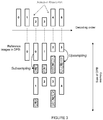
- the adaptive resolution of the size of the image requires the storage in DPB memory (Decoded Picture Buffer) of reconstructed reference images at different sizes.
- the reconstructed images used as reference images are stored in the DPB memory.
- the stored reference images are used to determine motion compensated reference blocks.
- the reference image used for the motion compensation and the current image to code or to reconstruct from this reference image can be of a different size.
- the reference image when the reference image has a size less than (respectively greater than) the size of the current image, the reference image must be upsampled (respectively subsampled) to the size of the current image before being motion compensated.
- the subsampled or upsampled version of the reference image is also stored in the DPB memory. More generally, each reference image is stored in the DPB memory with N different sizes, N being an integer representing the number of sizes allowed by the adaptive resolution method.
- the last two reconstructed images are used as reference image for the current image.
- the image 2 uses the images 0 and 1 as reference images
- the image 3 uses the images 1 and 2 as reference images, etc.
- N 2.
- the upsampled and subsampled versions of the reconstructed reference images are greyed out in figure 3 and correspond to the additional reference images stored in the DPB memory.
- the reference images not greyed out are the reconstructed reference images.
- the adaptive resolution method thus requires more memory space as several versions (reconstructed image and upsampled and/or subsampled versions) of a same reference image are stored.
- Increasing the memory size is a problem notably in the hardware implementations for which the surface of the component is notably critical.
- the invention relates to a decoding method according to claim 1.
- the invention also relates to a coding method according to claim 4.
- the invention further relates to a decoding device according to claim 7.
- the invention also relates to a coding device according to claim 9.
- the 2D interpolation filters used for the motion compensation and the 2D upsampling and subsampling filters are generally separable filters. Hence, each 2D filter is divided into a 1D vertical filter and a 1D horizontal filter, which are successively applied to the columns and lines of a pixel block or of an image. It is immaterial to apply first the horizontal filter on the lines then the vertical filter on the columns or conversely to apply first the vertical filter on the columns then the horizontal filter on the lines.
- the separable interpolation filters typically used for motion compensation are noted MCIF (Motion Compensation Interpolation Filter) and are composed of a vertical filter noted MCIF V (fraC y ) and a horizontal filter noted MCIF H (frac x ).
- frac x ,frac y represents the non-integer part of the position of the pixel to interpolate in relation to the initial grid of pixels or even the fractional part of the motion vector used for the motion compensation.
- the motion compensation of a pixel block of a reference image is thus obtained by successively applying the filters MCIF H (frac x ) and MCIF V (fraC y ).
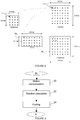
- the black squares represent the initial grid of pixels, the other squares represent pixels interpolated by means of the filters MCIF H (frac x ) and MCIF V (frac y ).
- the pixel H2 is obtained from at least two black pixels located on the same line by applying the filter MCIF H (0.25).
- the invention relates to a method for reconstructing a current pixel block of a current image from at least one block of a reconstructed reference image at a different size from the size of the current image.
- the reconstruction method is described with reference to figure 6 .
- only the reconstructed reference images are stored in the DPB memory, i.e. the images not greyed out in figure 3 .
- no other upsampled or subsampled version is stored.
- the reference block used to reconstruct the current block is motion compensated by means of filters GF H and GF V to determine a prediction block Bp.
- the reference block is generally identified by means of a decoded motion vector MV of components (MVx, MVy).
- the horizontal filters MCIF H and SCF H are grouped into a single filter GF H applied on the lines of a pixel block.
- the vertical filters MCIF V and SCF V are grouped into a single filter GF V applied on the columns of a pixel block.
- GF H (n, ⁇ x ,frac x ) MCIF H (frac x ) o SCF H (n, ⁇ x )
- "o" is the function composition operator.
- GF H and GF V are always 1D filters.
- the filters for interpolation and resampling horizontally on the one hand and vertically on the other hand no resampled reference image, i.e. over- or subsampled, is stored in the DPB memory in addition to the reconstructed reference image.
- the operations of upsampling or subsampling of the data of the reference image and of motion compensation of a reference block are performed jointly by applying a separable interpolation filter successively on the lines and on the columns of pixels of the reference block, which filter depends on the 'n' index, i.e. on the size of the reference image and on the size of the current image.
- Two different current pixels can be associated with the same pixel (Xref, Yref) in the reference image. They are then distinguished by their phase ( ⁇ x , ⁇ y ). Thus, to predict these two different pixels from the same reference pixel (Xref, Yref) two different filters are applied to the same pixels of the reference image according to the value of the phases. In figure 8 , the pixels ⁇ a,b,c,d ⁇ are all associated with the same value (Xref,Yref). They are distinguished by their phase:
- the invention relates to a method for coding a current pixel block of a current image from at least one block of a reconstructed reference image at a different size from the size of the current image.
- the coding method is described with reference to figure 9 .
- only the reconstructed reference images are stored in the DPB memory, i.e. the images not greyed out in figure 3 .
- no other upsampled or subsampled version is stored.
- the reference block used to code the current block is motion compensated by means of filters GF H and GF V to determine a prediction block Bp.
- the reference block is generally identified by means of a motion vector MV of components (MVx, MVy).
- the MV is determined by a motion estimation method, for example of block matching type.
- the horizontal filters MCIF H and SCF H are grouped into a single filter GF H applied on the lines of a pixel block.
- the vertical filters MCIF V and SCF V are grouped into a single filter GF V applied on the columns of a pixel block.
- GF H (n, ⁇ x ,frac x ) MCIF H (frac x ) o SCF H (n, ⁇ x )
- GF V (n, ⁇ y ,frac y ) MCIF V (frac y ) o SCF V (n, ⁇ y )
- (f o h)(x) f(h(x)).
- "o" is the filter composition operator.
- GF H and GF V are always 1D filters.
- the operations of upsampling or subsampling of the data of the reference image and of motion compensation of a reference block are performed jointly by applying an interpolation filter successively separable on the lines and the columns of pixels of the reference block, which filter depends on the 'n' index, i.e. on the size of the reference image and on the size of the current image.
- MVx MVx int + frac x
- MVx int int MVx
- MVy MVy int + frac y
- MVx int + Xcur / SXcur Yref Ycur int SYref .
- the filters GF H and GF V are then successively applied as shown in figure 8 to determine the prediction block Bp.
- Two different current pixels (Xcur, Ycur) can be associated with the same pixel (Xref, Yref) in the reference image. They are then distinguished by their phase ( ⁇ x , ⁇ y ).
- phase ⁇ x , ⁇ y .
- two different filters are applied to the same pixels of the reference image according to the value of the phases.
- the pixels ⁇ a,b,c,d ⁇ are all associated with the same value (Xref,Yref). They are distinguished by their phase:
- the filters SCF H (n) and SCF V (n) are separate from ⁇ x and ⁇ y (e.g. subsampling by 2).
- This variant is applicable to the reconstruction method and to the coding method. It is described in relation to figures 10, 11 and 12 .
- Figure 10 corresponds to figure 5
- figure 11 corresponds to figure 7
- figure 12 corresponds to figure 8 .
- the values Xref(Xcur) and Yref(Ycur) are calculated in the following manner as shown in figure 10 :
- MVx MVx i + frac x
- MVx int int MVx
- MVy MVy i + frac y
- MVy int int MVy Xref
- Xcur int SXref .
- MVx int + Xcur / SXcur Yref Ycur int SYref .
- MVy int + Ycur / SYcur (Xref(Xcur), Yref(Ycur)) is the position in the reference image of the motion compensated current pixel with the integer part of MV.
- (SXref, SYref) represents the size of the reference image and (SXcur, SYcur) represents the size of the current image.
- the filters GF H and GF V are then successively applied as follows to determine the prediction block Bp.
- the binary stream is a scalable binary stream.
- the scalable binary stream comprises a base layer coding low resolution images and at least one enhancement layer coding high resolution images, i.e. the resolution of which is greater than that of the low resolution images.
- the current image is one of the high resolution images and the reference image is one of the low resolution images.
- the reconstructed low resolution images thus being used to predict the high resolution images are then stored in low resolution, i.e. in their original resolution, in the DPB memory of the enhancement layer.
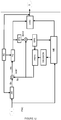
- the invention further relates to a coding device ENC described with reference to figure 12 and a decoding device DECOD described with reference to figure 13 .
- the modules shown are functional units that may or may not correspond to physically distinguishable units.
- these modules or some of them can be grouped together in a single component or circuit, or constitute functions of the same software.
- some modules may be composed of separate physical entities.
- the coding device ENC receives at input images I belonging to a sequence of images. Each image is divided into blocks of pixels each of which is associated with at least one item of image data, e.g. of luminance and/or of chrominance.
- the coding device ENC notably implements a coding with temporal prediction. Only the modules of the coding device ENC relating to coding by temporal prediction or INTER coding are represented in figure 12 . Other modules not represented and known to those skilled in the art of video coders implement the INTRA coding with or without spatial prediction.
- the coding device ENC notably comprises a calculation module ADD1 capable of subtracting pixel by pixel from a current block Bc a prediction block Bp to generate a residue or residual block noted res.
- the coding device ENC further comprises an entropy coding module COD able to code the quantized data into a binary stream S. It further comprises a module ITQ carrying out the reverse operation of module TQ.
- the module ITQ carries out a reverse quantization followed by an inverse transform.
- the module ITQ is connected to a calculation module ADD2 able to add pixel by pixel the block of data from the module ITQ and the prediction block Bp to generate a block of reconstructed image data that is stored in a DPB memory.
- the module AR is able to subsample the images at the input of the coder notably with a view to improving the bitrate-distortion compromise, i.e. notably to increase the constant bitrate reconstruction quality, the bitrate being determined by a bitrate control module.
- the coding device ENC further comprises a motion estimation module ME able to estimate at least one motion vector MV between the block Bc and a reference image Ir stored in the DPB memory or between the block Bc and the version Ir' of the resampled reference image Ir at the size of the current image.
- the motion estimation is made between the current block Bc and the source image corresponding to Ir, in which case the DPB memory is not connected to the motion estimation module ME.
- the motion data are transmitted by the motion estimation module ME to a decision module DECISION able to select a coding mode for the block Bc in a predefined set of coding modes.
- the chosen coding mode is for example the one that minimises a bitrate-distortion type criterion.
- the invention is not restricted to this selection method and the mode chosen can be selected according to another criterion for example an a priori type criterion.
- the coding mode selected by the decision module DECISION as well as the motion data, for example the motion vector or vectors in the case of the temporal prediction mode or INTER mode are transmitted to a prediction module PRED, also called motion compensation module.
- the motion vector or vectors and the selected coding mode are moreover transmitted to the entropy coding module COD to be coded in the stream S. If a coding mode INTER is retained by the decision module DECISION the prediction module PRED then determines from the reference image Ir previously reconstructed and stored in the DPB memory, the prediction block Bp from the motion vector MV determined by the motion estimation module ME. The prediction module PRED is able to determine the prediction block according to step 20 of the coding method described with reference to figure 9 .
- the calculation module ADD1 is able to implement step 22 of the coding method. Step 24 of the coding method is implemented by the modules TQ and COD.
- the decoding device DECOD is described with reference to figure 13 .
- the decoding device DECOD receives at input a binary stream S representative of a sequence of images.
- the stream S is for example transmitted by a coding device ENC.
- the decoding device DECOD comprises an entropy decoding module DEC able to generate decoded data, for example coding modes and decoded data relating to the content of the images.
- the decoding device DECOD further comprises a motion data reconstruction module.
- the motion data reconstruction module is the entropic decoding module DEC that decodes a part of the stream S representative of motion vectors.
- the motion data reconstruction module is a motion estimation module.
- the decoding device DECOD further comprises a prediction module PRED identical to the prediction module PRED of the coding device 12.
- the prediction module PRED determines from a reference image Ir previously reconstructed and stored in the DPB memory, the reference block Bp from the motion vector Vp decoded for the current block Bc by the entropy decoding module DEC.
- the prediction module PRED is able to determine the prediction block according to step 10 of the reconstruction method described with reference to figure 6 .
- the calculation module ADD3 is able to implement step 14 of the reconstruction method. Step 12 of the reconstruction method is implemented by the modules DEC and ITQ.
Landscapes
- Engineering & Computer Science (AREA)
- Multimedia (AREA)
- Signal Processing (AREA)
- Computing Systems (AREA)
- Theoretical Computer Science (AREA)
- Compression Or Coding Systems Of Tv Signals (AREA)
Claims (10)
- Decodierungsverfahren eines binären Datenstroms zum Rekonstruieren eines gegenwärtigen Blocks eines gegenwärtigen Bilds aus einem Referenzblock eines mit einer anderen Größe als der Größe des gegenwärtigen Bilds rekonstruierten Referenzbilds:- Bewegungskompensieren (10) des Referenzblocks des rekonstruierten Referenzbilds mit mindestens einem Interpolationsfilter, das aus einem Interpolationsfilter für horizontale Bewegungskompensation und aus einem Interpolationsfilter für vertikale Bewegungskompensation zusammengesetzt ist,- Decodieren (12) eines Restblocks für den gegenwärtigen Block, und- Rekonstruieren (14) des gegenwärtigen Blocks aus dem Restblock und aus dem bewegungskompensierten Referenzblock,
wobei das Verfahren dadurch gekennzeichnet ist, dass gemeinsam mit dem Bewegungskompensieren durch Anwenden eines vertikalen Filters gleich dem Interpolationsfilter für vertikale Bewegungskompensation, das mit einem vertikalen Neuabtastfilter zusammengesetzt ist, und eines horizontalen Filters gleich dem Interpolationsfilter für horizontale Bewegungskompensation, das mit einem horizontalen Neuabtastfilter zusammengesetzt ist, eine Neuabtastung ausgeführt wird. - Decodierungsverfahren nach Anspruch 1, wobei das horizontale Filter und das vertikale Filter durch Filterungskoeffizienten definiert sind, wobei das Decodierungsverfahren ferner einen Decodierungsschritt der Filterungskoeffizienten umfasst.
- Decodierungsverfahren nach Anspruch 1 oder 2, wobei der binäre Datenstrom ein skalierbarer Datenstrom ist, der eine Basisschicht, die niedrigauflösende Bilder codiert, und mindestens eine Erweiterungsschicht, die hochauflösende Bilder codiert, umfasst, wobei das gegenwärtige Bild eines der hochauflösenden Bilder ist und das Referenzbild eines der niedrigauflösenden Bilder ist.
- Codierungsverfahren eines gegenwärtigen Blocks eines gegenwärtigen Bilds aus einem Referenzblock eines mit einer anderen Größe als der Größe des gegenwärtigen Bilds rekonstruierten Referenzbilds, wobei das Codierungsverfahren umfasst:- Bewegungskompensieren (20) des Referenzblocks des rekonstruierten Referenzbilds mit mindestens einem Interpolationsfilter, das aus einem Interpolationsfilter für horizontale Bewegungskompensation und aus einem Interpolationsfilter für vertikale Bewegungskompensation zusammengesetzt ist,- Berechnen (22) eines Restblocks aus dem gegenwärtigen Block und aus dem bewegungskompensierten Referenzblock für den gegenwärtigen Block, und- Codieren (24) des Restblocks in einen binären Datenstrom,
wobei das Verfahren dadurch gekennzeichnet ist, dass gemeinsam mit dem Bewegungskompensieren durch Anwenden eines vertikalen Filters gleich dem Interpolationsfilter für vertikale Bewegungskompensation, das mit einem vertikalen Neuabtastfilter zusammengesetzt ist, und eines horizontalen Filters gleich dem Interpolationsfilter für horizontale Bewegungskompensation, das mit einem horizontalen Neuabtastfilter zusammengesetzt ist, eine Neuabtastung ausgeführt wird. - Codierungsverfahren nach Anspruch 4, wobei das horizontale Filter und das vertikale Filter durch Filterungskoeffizienten definiert sind, wobei das Codierungsverfahren ferner einen Codierungsschritt der Filterungskoeffizienten umfasst.
- Codierungsverfahren nach Anspruch 4 oder 5, wobei der binäre Datenstrom ein skalierbarer Datenstrom ist, der eine Basisschicht, die niedrigauflösende Bilder codiert, und mindestens eine Erweiterungsschicht, die hochauflösende Bilder codiert, umfasst, wobei das gegenwärtige Bild eines der hochauflösenden Bilder ist und das Referenzbild eines der niedrigauflösenden Bilder ist.
- Decodierungsvorrichtung (DECOD) eines binären Datenstroms zum Rekonstruieren eines gegenwärtigen Blocks eines gegenwärtigen Bilds aus einem Referenzblock eines mit einer anderen Größe als der Größe des gegenwärtigen Bilds rekonstruierten Referenzbilds, wobei die Decodierungsvorrichtung umfasst:- ein Mittel zum Bewegungskompensieren (PRED) des Referenzblocks des rekonstruierten Referenzbilds mit mindestens einem Interpolationsfilter, das aus einem Interpolationsfilter für horizontale Bewegungskompensation und aus einem Interpolationsfilter für vertikale Bewegungskompensation zusammengesetzt ist,- ein Mittel zum Decodieren (DEC, ITQ) eines Restblocks für den gegenwärtigen Block, und- ein Mittel zum Rekonstruieren (ADD3) des gegenwärtigen Blocks aus dem Restblock und aus dem bewegungskompensierten Referenzblock,
wobei die Decodierungsvorrichtung dadurch gekennzeichnet ist, dass ein selbes Mittel zum gemeinsamen Ausführen eines Neuabtastens und des Bewegungskompensierens durch Anwenden eines vertikalen Filters gleich dem Interpolationsfilter für vertikale Bewegungskompensation, das mit einem vertikalen Neuabtastfilter zusammengesetzt ist, und eines horizontalen Filters gleich dem Interpolationsfilter für horizontale Bewegungskompensation, das mit einem horizontalen Neuabtastfilter zusammengesetzt ist, konfiguriert ist. - Decodierungsvorrichtung nach Anspruch 7, wobei die Vorrichtung dafür geeignet ist, das Decodierungsverfahren nach einem der Ansprüche 1 bis 3 auszuführen.
- Codierungsvorrichtung (ENC) eines gegenwärtigen Blocks eines gegenwärtigen Bilds aus einem Referenzblock eines mit einer anderen Größe als der Größe des gegenwärtigen Bilds rekonstruierten Referenzbilds, wobei die Codierungsvorrichtung umfasst:- ein Mittel zum Bewegungskompensieren (PRED) des Referenzblocks des rekonstruierten Referenzbilds mit mindestens einem Interpolationsfilter, das aus einem Interpolationsfilter für horizontale Bewegungskompensation und aus einem Interpolationsfilter für vertikale Bewegungskompensation zusammengesetzt ist,- ein Mittel zum Berechnen (ADD1) eines Restblocks aus dem gegenwärtigen Block und aus dem bewegungskompensierten Referenzblock für den gegenwärtigen Block, und- ein Mittel zum Codieren (TQ, COD) des Restblocks, wobei die Codierungsvorrichtung dadurch gekennzeichnet ist, dass ein selbes Mittel zum gemeinsamen Ausführen eines Neuabtastens und des Bewegungskompensierens durch Anwenden eines vertikalen Filters gleich dem Interpolationsfilter für vertikale Bewegungskompensation, das mit einem vertikalen Neuabtastfilter zusammengesetzt ist, und eines horizontalen Filters gleich dem Interpolationsfilter für horizontale Bewegungskompensation, das mit einem horizontalen Neuabtastfilter zusammengesetzt ist, konfiguriert ist.
- Codierungsvorrichtung nach Anspruch 9, wobei die Vorrichtung dafür ausgelegt ist, das Codierungsverfahren nach einem der Ansprüche 4 bis 6 auszuführen.
Priority Applications (1)
| Application Number | Priority Date | Filing Date | Title |
|---|---|---|---|
| EP21164841.5A EP3879829A1 (de) | 2012-01-13 | 2013-01-10 | Verfahren und vorrichtung zur codierung eines bildblocks, entsprechendes verfahren und decodierungsvorrichtung |
Applications Claiming Priority (2)
| Application Number | Priority Date | Filing Date | Title |
|---|---|---|---|
| FR1250334 | 2012-01-13 | ||
| PCT/EP2013/050399 WO2013104713A1 (en) | 2012-01-13 | 2013-01-10 | Method and device for coding an image block, corresponding method and decoding device |
Related Child Applications (2)
| Application Number | Title | Priority Date | Filing Date |
|---|---|---|---|
| EP21164841.5A Division-Into EP3879829A1 (de) | 2012-01-13 | 2013-01-10 | Verfahren und vorrichtung zur codierung eines bildblocks, entsprechendes verfahren und decodierungsvorrichtung |
| EP21164841.5A Division EP3879829A1 (de) | 2012-01-13 | 2013-01-10 | Verfahren und vorrichtung zur codierung eines bildblocks, entsprechendes verfahren und decodierungsvorrichtung |
Publications (2)
| Publication Number | Publication Date |
|---|---|
| EP2803191A1 EP2803191A1 (de) | 2014-11-19 |
| EP2803191B1 true EP2803191B1 (de) | 2021-05-05 |
Family
ID=47522701
Family Applications (2)
| Application Number | Title | Priority Date | Filing Date |
|---|---|---|---|
| EP13700112.9A Active EP2803191B1 (de) | 2012-01-13 | 2013-01-10 | Verfahren und vorrichtung zur codierung eines bildblocks, entsprechendes verfahren und decodierungsvorrichtung |
| EP21164841.5A Pending EP3879829A1 (de) | 2012-01-13 | 2013-01-10 | Verfahren und vorrichtung zur codierung eines bildblocks, entsprechendes verfahren und decodierungsvorrichtung |
Family Applications After (1)
| Application Number | Title | Priority Date | Filing Date |
|---|---|---|---|
| EP21164841.5A Pending EP3879829A1 (de) | 2012-01-13 | 2013-01-10 | Verfahren und vorrichtung zur codierung eines bildblocks, entsprechendes verfahren und decodierungsvorrichtung |
Country Status (5)
| Country | Link |
|---|---|
| US (1) | US10250877B2 (de) |
| EP (2) | EP2803191B1 (de) |
| DK (1) | DK2803191T3 (de) |
| HU (1) | HUE055104T2 (de) |
| WO (1) | WO2013104713A1 (de) |
Families Citing this family (6)
| Publication number | Priority date | Publication date | Assignee | Title |
|---|---|---|---|---|
| EP2804375A1 (de) | 2013-02-22 | 2014-11-19 | Thomson Licensing | Codierungs- und Decodierungsverfahren eines Bildblocks, zugehörige Vorrichtungen und Datenstrom |
| GB2539241B (en) * | 2015-06-11 | 2019-10-23 | Advanced Risc Mach Ltd | Video processing system |
| US11109057B2 (en) | 2018-04-16 | 2021-08-31 | Mediatek Inc. | Overlapped block motion compensation based on blended predictors |
| US12200190B2 (en) * | 2019-09-23 | 2025-01-14 | Interdigtal Vc Holdings, Inc. | Switching logic for bi-directional optical flow |
| WO2021101356A1 (ko) | 2019-11-22 | 2021-05-27 | 한국전자통신연구원 | 참조 픽처의 해상도를 이용하는 비디오 처리 방법, 장치 및 기록 매체 |
| WO2021134222A1 (en) * | 2019-12-30 | 2021-07-08 | Alibaba Group Holding Limited | Selective control of conditional filters in resolution-adaptive video coding |
Family Cites Families (7)
| Publication number | Priority date | Publication date | Assignee | Title |
|---|---|---|---|---|
| US5614952A (en) * | 1994-10-11 | 1997-03-25 | Hitachi America, Ltd. | Digital video decoder for decoding digital high definition and/or digital standard definition television signals |
| JP2000059793A (ja) * | 1998-08-07 | 2000-02-25 | Sony Corp | 画像復号装置及び画像復号方法 |
| US8199812B2 (en) * | 2007-01-09 | 2012-06-12 | Qualcomm Incorporated | Adaptive upsampling for scalable video coding |
| US8638852B2 (en) * | 2008-01-08 | 2014-01-28 | Qualcomm Incorporated | Video coding of filter coefficients based on horizontal and vertical symmetry |
| US20100226437A1 (en) * | 2009-03-06 | 2010-09-09 | Sony Corporation, A Japanese Corporation | Reduced-resolution decoding of avc bit streams for transcoding or display at lower resolution |
| US9813738B2 (en) * | 2010-10-05 | 2017-11-07 | Hfi Innovation Inc. | Method and apparatus of adaptive loop filtering |
| JP5956571B2 (ja) * | 2011-06-30 | 2016-07-27 | ヴィディオ・インコーポレーテッド | スケーラブルビデオ符号化における動き予測 |
-
2013
- 2013-01-10 EP EP13700112.9A patent/EP2803191B1/de active Active
- 2013-01-10 EP EP21164841.5A patent/EP3879829A1/de active Pending
- 2013-01-10 DK DK13700112.9T patent/DK2803191T3/da active
- 2013-01-10 US US14/372,021 patent/US10250877B2/en active Active
- 2013-01-10 HU HUE13700112A patent/HUE055104T2/hu unknown
- 2013-01-10 WO PCT/EP2013/050399 patent/WO2013104713A1/en not_active Ceased
Also Published As
| Publication number | Publication date |
|---|---|
| US20150049802A1 (en) | 2015-02-19 |
| HUE055104T2 (hu) | 2021-10-28 |
| US10250877B2 (en) | 2019-04-02 |
| EP2803191A1 (de) | 2014-11-19 |
| DK2803191T3 (da) | 2021-07-19 |
| EP3879829A1 (de) | 2021-09-15 |
| WO2013104713A1 (en) | 2013-07-18 |
Similar Documents
| Publication | Publication Date | Title |
|---|---|---|
| CN1253008C (zh) | 空间可分级压缩的方法和设备 | |
| KR101354741B1 (ko) | 다중 해상도 비디오 코딩 및 디코딩을 위한 리샘플링 및 픽처 크기조정 동작 | |
| JP5623640B2 (ja) | 高解像度の参照フレームを用いるビデオコーディング | |
| US6873655B2 (en) | Codec system and method for spatially scalable video data | |
| EP1769633B1 (de) | Verfahren zur räumlichen und snr-bildkomprimierung | |
| EP2803191B1 (de) | Verfahren und vorrichtung zur codierung eines bildblocks, entsprechendes verfahren und decodierungsvorrichtung | |
| JP6042899B2 (ja) | 映像符号化方法および装置、映像復号方法および装置、それらのプログラム及び記録媒体 | |
| US20240146939A1 (en) | Derivation of resampling filters for scalable video coding | |
| KR20180057676A (ko) | 선택 가능한 보간 필터를 구비한 비디오 모션 보상 장치 및 방법 | |
| JP2006246474A (ja) | カラー成分間の単一符号化モードを利用して予測映像を生成する方法、およびその装置と、該単一符号化モードを利用して映像およびビデオを符号化/復号化する方法およびその装置 | |
| HUP0500030A2 (hu) | Eljárás digitális video képsor képeinek kódolására | |
| US20190253707A1 (en) | Video coding method and apparatus utilizing adaptive interpolation filter | |
| WO2009151563A1 (en) | Methods and apparatus for locally adaptive filtering for motion compensation interpolation and reference picture filtering | |
| JP2001285867A (ja) | Idctミスマッチについて補償するdctドメイン下方変換システム | |
| KR20090080452A (ko) | 영상 부호화/복호화 장치 및 방법 | |
| Liang et al. | Arbitrary downsizing video transcoding using fast motion vector reestimation | |
| CN1947146B (zh) | 下采样数据值的方法 | |
| CN1726725A (zh) | 弹性存储 | |
| KR20130056834A (ko) | 픽셀 블록을 코딩하고 재구성하는 방법 및 대응하는 장치 | |
| KR101668133B1 (ko) | 화상 데이터의 블록을 예측하는 방법, 이 방법을 실행하는 복호 장치 및 부호화 장치 | |
| HK40059250A (en) | Method and device for coding an image block, corresponding method and decoding device | |
| CN103002279B (zh) | 编码并重构像素块的方法及其对应设备 | |
| JP2018032913A (ja) | 映像符号化装置、プログラム及び方法、並びに、映像復号装置、プログラム及び方法、並びに、映像伝送システム | |
| Kim et al. | Exploiting pseudo-quadtree structure for accelerating HEVC spatial resolution downscaling transcoder | |
| EP4512075A1 (de) | Wiederabtastung von referenzbildern zur videocodierung |
Legal Events
| Date | Code | Title | Description |
|---|---|---|---|
| PUAI | Public reference made under article 153(3) epc to a published international application that has entered the european phase |
Free format text: ORIGINAL CODE: 0009012 |
|
| 17P | Request for examination filed |
Effective date: 20140716 |
|
| AK | Designated contracting states |
Kind code of ref document: A1 Designated state(s): AL AT BE BG CH CY CZ DE DK EE ES FI FR GB GR HR HU IE IS IT LI LT LU LV MC MK MT NL NO PL PT RO RS SE SI SK SM TR |
|
| DAX | Request for extension of the european patent (deleted) | ||
| RAP1 | Party data changed (applicant data changed or rights of an application transferred) |
Owner name: THOMSON LICENSING DTV |
|
| STAA | Information on the status of an ep patent application or granted ep patent |
Free format text: STATUS: EXAMINATION IS IN PROGRESS |
|
| 17Q | First examination report despatched |
Effective date: 20180404 |
|
| RAP1 | Party data changed (applicant data changed or rights of an application transferred) |
Owner name: INTERDIGITAL MADISON PATENT HOLDINGS |
|
| REG | Reference to a national code |
Ref country code: DE Ref legal event code: R079 Ref document number: 602013077291 Country of ref document: DE Free format text: PREVIOUS MAIN CLASS: H04N0007260000 Ipc: H04N0019172000 |
|
| RIC1 | Information provided on ipc code assigned before grant |
Ipc: H04N 19/159 20140101ALI20200710BHEP Ipc: H04N 19/59 20140101ALI20200710BHEP Ipc: H04N 19/523 20140101ALI20200710BHEP Ipc: H04N 19/172 20140101AFI20200710BHEP Ipc: H04N 19/82 20140101ALI20200710BHEP Ipc: H04N 19/42 20140101ALI20200710BHEP Ipc: H04N 19/423 20140101ALI20200710BHEP Ipc: H04N 19/152 20140101ALI20200710BHEP |
|
| GRAP | Despatch of communication of intention to grant a patent |
Free format text: ORIGINAL CODE: EPIDOSNIGR1 |
|
| STAA | Information on the status of an ep patent application or granted ep patent |
Free format text: STATUS: GRANT OF PATENT IS INTENDED |
|
| INTG | Intention to grant announced |
Effective date: 20200826 |
|
| RIN1 | Information on inventor provided before grant (corrected) |
Inventor name: ANDRIVON, PIERRE Inventor name: SALMON, PHILIPPE Inventor name: BORDES, PHILIPPE |
|
| GRAJ | Information related to disapproval of communication of intention to grant by the applicant or resumption of examination proceedings by the epo deleted |
Free format text: ORIGINAL CODE: EPIDOSDIGR1 |
|
| STAA | Information on the status of an ep patent application or granted ep patent |
Free format text: STATUS: EXAMINATION IS IN PROGRESS |
|
| GRAP | Despatch of communication of intention to grant a patent |
Free format text: ORIGINAL CODE: EPIDOSNIGR1 |
|
| STAA | Information on the status of an ep patent application or granted ep patent |
Free format text: STATUS: GRANT OF PATENT IS INTENDED |
|
| INTC | Intention to grant announced (deleted) | ||
| INTG | Intention to grant announced |
Effective date: 20201127 |
|
| GRAS | Grant fee paid |
Free format text: ORIGINAL CODE: EPIDOSNIGR3 |
|
| GRAA | (expected) grant |
Free format text: ORIGINAL CODE: 0009210 |
|
| STAA | Information on the status of an ep patent application or granted ep patent |
Free format text: STATUS: THE PATENT HAS BEEN GRANTED |
|
| AK | Designated contracting states |
Kind code of ref document: B1 Designated state(s): AL AT BE BG CH CY CZ DE DK EE ES FI FR GB GR HR HU IE IS IT LI LT LU LV MC MK MT NL NO PL PT RO RS SE SI SK SM TR |
|
| REG | Reference to a national code |
Ref country code: GB Ref legal event code: FG4D |
|
| REG | Reference to a national code |
Ref country code: CH Ref legal event code: EP |
|
| REG | Reference to a national code |
Ref country code: AT Ref legal event code: REF Ref document number: 1391325 Country of ref document: AT Kind code of ref document: T Effective date: 20210515 |
|
| REG | Reference to a national code |
Ref country code: IE Ref legal event code: FG4D |
|
| REG | Reference to a national code |
Ref country code: DE Ref legal event code: R096 Ref document number: 602013077291 Country of ref document: DE |
|
| REG | Reference to a national code |
Ref country code: DK Ref legal event code: T3 Effective date: 20210714 |
|
| REG | Reference to a national code |
Ref country code: NL Ref legal event code: FP |
|
| REG | Reference to a national code |
Ref country code: LT Ref legal event code: MG9D |
|
| REG | Reference to a national code |
Ref country code: AT Ref legal event code: MK05 Ref document number: 1391325 Country of ref document: AT Kind code of ref document: T Effective date: 20210505 |
|
| REG | Reference to a national code |
Ref country code: HU Ref legal event code: AG4A Ref document number: E055104 Country of ref document: HU |
|
| PG25 | Lapsed in a contracting state [announced via postgrant information from national office to epo] |
Ref country code: BG Free format text: LAPSE BECAUSE OF FAILURE TO SUBMIT A TRANSLATION OF THE DESCRIPTION OR TO PAY THE FEE WITHIN THE PRESCRIBED TIME-LIMIT Effective date: 20210805 Ref country code: AT Free format text: LAPSE BECAUSE OF FAILURE TO SUBMIT A TRANSLATION OF THE DESCRIPTION OR TO PAY THE FEE WITHIN THE PRESCRIBED TIME-LIMIT Effective date: 20210505 Ref country code: HR Free format text: LAPSE BECAUSE OF FAILURE TO SUBMIT A TRANSLATION OF THE DESCRIPTION OR TO PAY THE FEE WITHIN THE PRESCRIBED TIME-LIMIT Effective date: 20210505 Ref country code: LT Free format text: LAPSE BECAUSE OF FAILURE TO SUBMIT A TRANSLATION OF THE DESCRIPTION OR TO PAY THE FEE WITHIN THE PRESCRIBED TIME-LIMIT Effective date: 20210505 Ref country code: FI Free format text: LAPSE BECAUSE OF FAILURE TO SUBMIT A TRANSLATION OF THE DESCRIPTION OR TO PAY THE FEE WITHIN THE PRESCRIBED TIME-LIMIT Effective date: 20210505 |
|
| PG25 | Lapsed in a contracting state [announced via postgrant information from national office to epo] |
Ref country code: RS Free format text: LAPSE BECAUSE OF FAILURE TO SUBMIT A TRANSLATION OF THE DESCRIPTION OR TO PAY THE FEE WITHIN THE PRESCRIBED TIME-LIMIT Effective date: 20210505 Ref country code: SE Free format text: LAPSE BECAUSE OF FAILURE TO SUBMIT A TRANSLATION OF THE DESCRIPTION OR TO PAY THE FEE WITHIN THE PRESCRIBED TIME-LIMIT Effective date: 20210505 Ref country code: LV Free format text: LAPSE BECAUSE OF FAILURE TO SUBMIT A TRANSLATION OF THE DESCRIPTION OR TO PAY THE FEE WITHIN THE PRESCRIBED TIME-LIMIT Effective date: 20210505 Ref country code: IS Free format text: LAPSE BECAUSE OF FAILURE TO SUBMIT A TRANSLATION OF THE DESCRIPTION OR TO PAY THE FEE WITHIN THE PRESCRIBED TIME-LIMIT Effective date: 20210905 Ref country code: GR Free format text: LAPSE BECAUSE OF FAILURE TO SUBMIT A TRANSLATION OF THE DESCRIPTION OR TO PAY THE FEE WITHIN THE PRESCRIBED TIME-LIMIT Effective date: 20210806 Ref country code: NO Free format text: LAPSE BECAUSE OF FAILURE TO SUBMIT A TRANSLATION OF THE DESCRIPTION OR TO PAY THE FEE WITHIN THE PRESCRIBED TIME-LIMIT Effective date: 20210805 Ref country code: PT Free format text: LAPSE BECAUSE OF FAILURE TO SUBMIT A TRANSLATION OF THE DESCRIPTION OR TO PAY THE FEE WITHIN THE PRESCRIBED TIME-LIMIT Effective date: 20210906 Ref country code: PL Free format text: LAPSE BECAUSE OF FAILURE TO SUBMIT A TRANSLATION OF THE DESCRIPTION OR TO PAY THE FEE WITHIN THE PRESCRIBED TIME-LIMIT Effective date: 20210505 Ref country code: ES Free format text: LAPSE BECAUSE OF FAILURE TO SUBMIT A TRANSLATION OF THE DESCRIPTION OR TO PAY THE FEE WITHIN THE PRESCRIBED TIME-LIMIT Effective date: 20210505 |
|
| PG25 | Lapsed in a contracting state [announced via postgrant information from national office to epo] |
Ref country code: RO Free format text: LAPSE BECAUSE OF FAILURE TO SUBMIT A TRANSLATION OF THE DESCRIPTION OR TO PAY THE FEE WITHIN THE PRESCRIBED TIME-LIMIT Effective date: 20210505 Ref country code: SK Free format text: LAPSE BECAUSE OF FAILURE TO SUBMIT A TRANSLATION OF THE DESCRIPTION OR TO PAY THE FEE WITHIN THE PRESCRIBED TIME-LIMIT Effective date: 20210505 Ref country code: SM Free format text: LAPSE BECAUSE OF FAILURE TO SUBMIT A TRANSLATION OF THE DESCRIPTION OR TO PAY THE FEE WITHIN THE PRESCRIBED TIME-LIMIT Effective date: 20210505 Ref country code: CZ Free format text: LAPSE BECAUSE OF FAILURE TO SUBMIT A TRANSLATION OF THE DESCRIPTION OR TO PAY THE FEE WITHIN THE PRESCRIBED TIME-LIMIT Effective date: 20210505 Ref country code: EE Free format text: LAPSE BECAUSE OF FAILURE TO SUBMIT A TRANSLATION OF THE DESCRIPTION OR TO PAY THE FEE WITHIN THE PRESCRIBED TIME-LIMIT Effective date: 20210505 |
|
| REG | Reference to a national code |
Ref country code: DE Ref legal event code: R097 Ref document number: 602013077291 Country of ref document: DE |
|
| PLBE | No opposition filed within time limit |
Free format text: ORIGINAL CODE: 0009261 |
|
| STAA | Information on the status of an ep patent application or granted ep patent |
Free format text: STATUS: NO OPPOSITION FILED WITHIN TIME LIMIT |
|
| 26N | No opposition filed |
Effective date: 20220208 |
|
| PG25 | Lapsed in a contracting state [announced via postgrant information from national office to epo] |
Ref country code: IS Free format text: LAPSE BECAUSE OF FAILURE TO SUBMIT A TRANSLATION OF THE DESCRIPTION OR TO PAY THE FEE WITHIN THE PRESCRIBED TIME-LIMIT Effective date: 20210905 Ref country code: AL Free format text: LAPSE BECAUSE OF FAILURE TO SUBMIT A TRANSLATION OF THE DESCRIPTION OR TO PAY THE FEE WITHIN THE PRESCRIBED TIME-LIMIT Effective date: 20210505 |
|
| PG25 | Lapsed in a contracting state [announced via postgrant information from national office to epo] |
Ref country code: MC Free format text: LAPSE BECAUSE OF FAILURE TO SUBMIT A TRANSLATION OF THE DESCRIPTION OR TO PAY THE FEE WITHIN THE PRESCRIBED TIME-LIMIT Effective date: 20210505 |
|
| REG | Reference to a national code |
Ref country code: CH Ref legal event code: PL |
|
| REG | Reference to a national code |
Ref country code: BE Ref legal event code: MM Effective date: 20220131 |
|
| PG25 | Lapsed in a contracting state [announced via postgrant information from national office to epo] |
Ref country code: LU Free format text: LAPSE BECAUSE OF NON-PAYMENT OF DUE FEES Effective date: 20220110 |
|
| PG25 | Lapsed in a contracting state [announced via postgrant information from national office to epo] |
Ref country code: BE Free format text: LAPSE BECAUSE OF NON-PAYMENT OF DUE FEES Effective date: 20220131 |
|
| PG25 | Lapsed in a contracting state [announced via postgrant information from national office to epo] |
Ref country code: LI Free format text: LAPSE BECAUSE OF NON-PAYMENT OF DUE FEES Effective date: 20220131 Ref country code: CH Free format text: LAPSE BECAUSE OF NON-PAYMENT OF DUE FEES Effective date: 20220131 |
|
| PG25 | Lapsed in a contracting state [announced via postgrant information from national office to epo] |
Ref country code: IE Free format text: LAPSE BECAUSE OF NON-PAYMENT OF DUE FEES Effective date: 20220110 |
|
| P01 | Opt-out of the competence of the unified patent court (upc) registered |
Effective date: 20230514 |
|
| PG25 | Lapsed in a contracting state [announced via postgrant information from national office to epo] |
Ref country code: MK Free format text: LAPSE BECAUSE OF FAILURE TO SUBMIT A TRANSLATION OF THE DESCRIPTION OR TO PAY THE FEE WITHIN THE PRESCRIBED TIME-LIMIT Effective date: 20210505 Ref country code: CY Free format text: LAPSE BECAUSE OF FAILURE TO SUBMIT A TRANSLATION OF THE DESCRIPTION OR TO PAY THE FEE WITHIN THE PRESCRIBED TIME-LIMIT Effective date: 20210505 |
|
| PG25 | Lapsed in a contracting state [announced via postgrant information from national office to epo] |
Ref country code: TR Free format text: LAPSE BECAUSE OF FAILURE TO SUBMIT A TRANSLATION OF THE DESCRIPTION OR TO PAY THE FEE WITHIN THE PRESCRIBED TIME-LIMIT Effective date: 20210505 |
|
| PG25 | Lapsed in a contracting state [announced via postgrant information from national office to epo] |
Ref country code: MT Free format text: LAPSE BECAUSE OF FAILURE TO SUBMIT A TRANSLATION OF THE DESCRIPTION OR TO PAY THE FEE WITHIN THE PRESCRIBED TIME-LIMIT Effective date: 20210505 |
|
| PGFP | Annual fee paid to national office [announced via postgrant information from national office to epo] |
Ref country code: DE Payment date: 20250129 Year of fee payment: 13 |
|
| PGFP | Annual fee paid to national office [announced via postgrant information from national office to epo] |
Ref country code: DK Payment date: 20250127 Year of fee payment: 13 |
|
| PGFP | Annual fee paid to national office [announced via postgrant information from national office to epo] |
Ref country code: FR Payment date: 20250127 Year of fee payment: 13 |
|
| PGFP | Annual fee paid to national office [announced via postgrant information from national office to epo] |
Ref country code: IT Payment date: 20250122 Year of fee payment: 13 Ref country code: GB Payment date: 20250121 Year of fee payment: 13 |
|
| PGFP | Annual fee paid to national office [announced via postgrant information from national office to epo] |
Ref country code: NL Payment date: 20260122 Year of fee payment: 14 |
|
| PGFP | Annual fee paid to national office [announced via postgrant information from national office to epo] |
Ref country code: HU Payment date: 20260115 Year of fee payment: 14 |