EP2800189A1 - Heat exchange type prereformer - Google Patents
Heat exchange type prereformer Download PDFInfo
- Publication number
- EP2800189A1 EP2800189A1 EP12863069.6A EP12863069A EP2800189A1 EP 2800189 A1 EP2800189 A1 EP 2800189A1 EP 12863069 A EP12863069 A EP 12863069A EP 2800189 A1 EP2800189 A1 EP 2800189A1
- Authority
- EP
- European Patent Office
- Prior art keywords
- heat exchange
- prereformer
- gas
- exhaust gas
- catalyst layer
- Prior art date
- Legal status (The legal status is an assumption and is not a legal conclusion. Google has not performed a legal analysis and makes no representation as to the accuracy of the status listed.)
- Withdrawn
Links
Images
Classifications
-
- C—CHEMISTRY; METALLURGY
- C01—INORGANIC CHEMISTRY
- C01B—NON-METALLIC ELEMENTS; COMPOUNDS THEREOF; METALLOIDS OR COMPOUNDS THEREOF NOT COVERED BY SUBCLASS C01C
- C01B3/00—Hydrogen; Gaseous mixtures containing hydrogen; Separation of hydrogen from mixtures containing it; Purification of hydrogen; Reversible storage of hydrogen
- C01B3/02—Production of hydrogen; Production of gaseous mixtures containing hydrogen
- C01B3/32—Production of hydrogen; Production of gaseous mixtures containing hydrogen by reaction of gaseous or liquid organic compounds with gasifying agents, e.g. water, carbon dioxide or air
-
- C—CHEMISTRY; METALLURGY
- C01—INORGANIC CHEMISTRY
- C01B—NON-METALLIC ELEMENTS; COMPOUNDS THEREOF; METALLOIDS OR COMPOUNDS THEREOF NOT COVERED BY SUBCLASS C01C
- C01B3/00—Hydrogen; Gaseous mixtures containing hydrogen; Separation of hydrogen from mixtures containing it; Purification of hydrogen; Reversible storage of hydrogen
- C01B3/02—Production of hydrogen; Production of gaseous mixtures containing hydrogen
- C01B3/32—Production of hydrogen; Production of gaseous mixtures containing hydrogen by reaction of gaseous or liquid organic compounds with gasifying agents, e.g. water, carbon dioxide or air
- C01B3/34—Production of hydrogen; Production of gaseous mixtures containing hydrogen by reaction of gaseous or liquid organic compounds with gasifying agents, e.g. water, carbon dioxide or air by reaction of hydrocarbons with gasifying agents
- C01B3/38—Production of hydrogen; Production of gaseous mixtures containing hydrogen by reaction of gaseous or liquid organic compounds with gasifying agents, e.g. water, carbon dioxide or air by reaction of hydrocarbons with gasifying agents using catalysts
- C01B3/384—Production of hydrogen; Production of gaseous mixtures containing hydrogen by reaction of gaseous or liquid organic compounds with gasifying agents, e.g. water, carbon dioxide or air by reaction of hydrocarbons with gasifying agents using catalysts with external heating of the catalyst
-
- H—ELECTRICITY
- H01—ELECTRIC ELEMENTS
- H01M—PROCESSES OR MEANS, e.g. BATTERIES, FOR THE DIRECT CONVERSION OF CHEMICAL ENERGY INTO ELECTRICAL ENERGY
- H01M8/00—Fuel cells; Manufacture thereof
- H01M8/06—Combination of fuel cells with means for production of reactants or for treatment of residues
-
- B—PERFORMING OPERATIONS; TRANSPORTING
- B01—PHYSICAL OR CHEMICAL PROCESSES OR APPARATUS IN GENERAL
- B01J—CHEMICAL OR PHYSICAL PROCESSES, e.g. CATALYSIS OR COLLOID CHEMISTRY; THEIR RELEVANT APPARATUS
- B01J19/00—Chemical, physical or physico-chemical processes in general; Their relevant apparatus
- B01J19/24—Stationary reactors without moving elements inside
- B01J19/2415—Tubular reactors
- B01J19/2425—Tubular reactors in parallel
-
- C—CHEMISTRY; METALLURGY
- C01—INORGANIC CHEMISTRY
- C01B—NON-METALLIC ELEMENTS; COMPOUNDS THEREOF; METALLOIDS OR COMPOUNDS THEREOF NOT COVERED BY SUBCLASS C01C
- C01B3/00—Hydrogen; Gaseous mixtures containing hydrogen; Separation of hydrogen from mixtures containing it; Purification of hydrogen; Reversible storage of hydrogen
- C01B3/02—Production of hydrogen; Production of gaseous mixtures containing hydrogen
-
- H—ELECTRICITY
- H01—ELECTRIC ELEMENTS
- H01M—PROCESSES OR MEANS, e.g. BATTERIES, FOR THE DIRECT CONVERSION OF CHEMICAL ENERGY INTO ELECTRICAL ENERGY
- H01M8/00—Fuel cells; Manufacture thereof
- H01M8/04—Auxiliary arrangements, e.g. for control of pressure or for circulation of fluids
-
- H—ELECTRICITY
- H01—ELECTRIC ELEMENTS
- H01M—PROCESSES OR MEANS, e.g. BATTERIES, FOR THE DIRECT CONVERSION OF CHEMICAL ENERGY INTO ELECTRICAL ENERGY
- H01M8/00—Fuel cells; Manufacture thereof
- H01M8/06—Combination of fuel cells with means for production of reactants or for treatment of residues
- H01M8/0606—Combination of fuel cells with means for production of reactants or for treatment of residues with means for production of gaseous reactants
- H01M8/0612—Combination of fuel cells with means for production of reactants or for treatment of residues with means for production of gaseous reactants from carbon-containing material
- H01M8/0618—Reforming processes, e.g. autothermal, partial oxidation or steam reforming
-
- B—PERFORMING OPERATIONS; TRANSPORTING
- B01—PHYSICAL OR CHEMICAL PROCESSES OR APPARATUS IN GENERAL
- B01J—CHEMICAL OR PHYSICAL PROCESSES, e.g. CATALYSIS OR COLLOID CHEMISTRY; THEIR RELEVANT APPARATUS
- B01J2219/00—Chemical, physical or physico-chemical processes in general; Their relevant apparatus
- B01J2219/24—Stationary reactors without moving elements inside
- B01J2219/2401—Reactors comprising multiple separate flow channels
-
- C—CHEMISTRY; METALLURGY
- C01—INORGANIC CHEMISTRY
- C01B—NON-METALLIC ELEMENTS; COMPOUNDS THEREOF; METALLOIDS OR COMPOUNDS THEREOF NOT COVERED BY SUBCLASS C01C
- C01B2203/00—Integrated processes for the production of hydrogen or synthesis gas
- C01B2203/02—Processes for making hydrogen or synthesis gas
- C01B2203/0205—Processes for making hydrogen or synthesis gas containing a reforming step
- C01B2203/0227—Processes for making hydrogen or synthesis gas containing a reforming step containing a catalytic reforming step
-
- C—CHEMISTRY; METALLURGY
- C01—INORGANIC CHEMISTRY
- C01B—NON-METALLIC ELEMENTS; COMPOUNDS THEREOF; METALLOIDS OR COMPOUNDS THEREOF NOT COVERED BY SUBCLASS C01C
- C01B2203/00—Integrated processes for the production of hydrogen or synthesis gas
- C01B2203/02—Processes for making hydrogen or synthesis gas
- C01B2203/0205—Processes for making hydrogen or synthesis gas containing a reforming step
- C01B2203/0227—Processes for making hydrogen or synthesis gas containing a reforming step containing a catalytic reforming step
- C01B2203/0233—Processes for making hydrogen or synthesis gas containing a reforming step containing a catalytic reforming step the reforming step being a steam reforming step
-
- C—CHEMISTRY; METALLURGY
- C01—INORGANIC CHEMISTRY
- C01B—NON-METALLIC ELEMENTS; COMPOUNDS THEREOF; METALLOIDS OR COMPOUNDS THEREOF NOT COVERED BY SUBCLASS C01C
- C01B2203/00—Integrated processes for the production of hydrogen or synthesis gas
- C01B2203/04—Integrated processes for the production of hydrogen or synthesis gas containing a purification step for the hydrogen or the synthesis gas
- C01B2203/0435—Catalytic purification
- C01B2203/0445—Selective methanation
-
- C—CHEMISTRY; METALLURGY
- C01—INORGANIC CHEMISTRY
- C01B—NON-METALLIC ELEMENTS; COMPOUNDS THEREOF; METALLOIDS OR COMPOUNDS THEREOF NOT COVERED BY SUBCLASS C01C
- C01B2203/00—Integrated processes for the production of hydrogen or synthesis gas
- C01B2203/06—Integration with other chemical processes
- C01B2203/066—Integration with other chemical processes with fuel cells
-
- C—CHEMISTRY; METALLURGY
- C01—INORGANIC CHEMISTRY
- C01B—NON-METALLIC ELEMENTS; COMPOUNDS THEREOF; METALLOIDS OR COMPOUNDS THEREOF NOT COVERED BY SUBCLASS C01C
- C01B2203/00—Integrated processes for the production of hydrogen or synthesis gas
- C01B2203/08—Methods of heating or cooling
- C01B2203/0805—Methods of heating the process for making hydrogen or synthesis gas
-
- C—CHEMISTRY; METALLURGY
- C01—INORGANIC CHEMISTRY
- C01B—NON-METALLIC ELEMENTS; COMPOUNDS THEREOF; METALLOIDS OR COMPOUNDS THEREOF NOT COVERED BY SUBCLASS C01C
- C01B2203/00—Integrated processes for the production of hydrogen or synthesis gas
- C01B2203/08—Methods of heating or cooling
- C01B2203/0805—Methods of heating the process for making hydrogen or synthesis gas
- C01B2203/0833—Heating by indirect heat exchange with hot fluids, other than combustion gases, product gases or non-combustive exothermic reaction product gases
-
- H—ELECTRICITY
- H01—ELECTRIC ELEMENTS
- H01M—PROCESSES OR MEANS, e.g. BATTERIES, FOR THE DIRECT CONVERSION OF CHEMICAL ENERGY INTO ELECTRICAL ENERGY
- H01M8/00—Fuel cells; Manufacture thereof
- H01M8/14—Fuel cells with fused electrolytes
- H01M2008/147—Fuel cells with molten carbonates
-
- H—ELECTRICITY
- H01—ELECTRIC ELEMENTS
- H01M—PROCESSES OR MEANS, e.g. BATTERIES, FOR THE DIRECT CONVERSION OF CHEMICAL ENERGY INTO ELECTRICAL ENERGY
- H01M8/00—Fuel cells; Manufacture thereof
- H01M8/04—Auxiliary arrangements, e.g. for control of pressure or for circulation of fluids
- H01M8/04007—Auxiliary arrangements, e.g. for control of pressure or for circulation of fluids related to heat exchange
- H01M8/04067—Heat exchange or temperature measuring elements, thermal insulation, e.g. heat pipes, heat pumps, fins
- H01M8/04074—Heat exchange unit structures specially adapted for fuel cell
-
- H—ELECTRICITY
- H01—ELECTRIC ELEMENTS
- H01M—PROCESSES OR MEANS, e.g. BATTERIES, FOR THE DIRECT CONVERSION OF CHEMICAL ENERGY INTO ELECTRICAL ENERGY
- H01M8/00—Fuel cells; Manufacture thereof
- H01M8/04—Auxiliary arrangements, e.g. for control of pressure or for circulation of fluids
- H01M8/04082—Arrangements for control of reactant parameters, e.g. pressure or concentration
- H01M8/04089—Arrangements for control of reactant parameters, e.g. pressure or concentration of gaseous reactants
-
- Y—GENERAL TAGGING OF NEW TECHNOLOGICAL DEVELOPMENTS; GENERAL TAGGING OF CROSS-SECTIONAL TECHNOLOGIES SPANNING OVER SEVERAL SECTIONS OF THE IPC; TECHNICAL SUBJECTS COVERED BY FORMER USPC CROSS-REFERENCE ART COLLECTIONS [XRACs] AND DIGESTS
- Y02—TECHNOLOGIES OR APPLICATIONS FOR MITIGATION OR ADAPTATION AGAINST CLIMATE CHANGE
- Y02E—REDUCTION OF GREENHOUSE GAS [GHG] EMISSIONS, RELATED TO ENERGY GENERATION, TRANSMISSION OR DISTRIBUTION
- Y02E60/00—Enabling technologies; Technologies with a potential or indirect contribution to GHG emissions mitigation
- Y02E60/30—Hydrogen technology
- Y02E60/50—Fuel cells
Definitions
- the present invention relates to a prereformer for preprocessing gas supplied to the anode of a fuel cell.
- a fuel cell is a cell for directly converting chemical energy, generated by the oxidation of fuel, into electrical energy.
- the methanation of carbonate hydrogen series that belong to carbonate hydrogen series and that have a carbon number of 2 (C2) or higher other than CH 4 , hydrogen conversion, etc. are performed through the prereformer. Accordingly, a reduction in the performance of a fuel cell stack attributable to coking generated when C2 or higher is introduced into the fuel cell stack can be prevented. Furthermore, produced hydrogen gas maintains a reduction atmosphere within the fuel cell stack, and functions as a controller in thermal management. Furthermore, if some oxidants are introduced, the produced hydrogen gas functions as an oxidizer, and is responsible for a buffer that collects sulfur when the sulfur is introduced and protects the fuel cell stack.
- a steam reforming reaction that is, a main reaction of the prereformer, is a heat absorption reaction, and there is a case where the temperature conditions of gas supplied to the anode are not satisfied. To this end, there is a need for a structure for satisfying the temperature conditions.
- the present invention proposes a prereformer of a new structure which is capable of prereforming gas supplied to an anode and also satisfying temperature conditions.
- a heat exchange type prereformer in accordance with an embodiment of the present invention includes a shell side equipped with a channel through which an exhaust gas is supplied and flows so that an exhaust gas of an anode is subject to a heat exchange with a mixture gas supplied for prereforming, a catalyst layer disposed to overlap with one region of the shell side and configured so that the mixture gas generates a prereforming reaction, and a tube side connected to the catalyst layer, disposed to overlap with the other region of the shell side, and formed so that the prereformed mixture gas is subject to a heat exchange with the exhaust gas.
- the mixture gas may include a fuel gas and steam.
- the internal space of the shell side is partitioned, the channel is formed in the partitioned internal spaces, and baffles configured to control a flow of the exhaust gas are installed in the partitioned internal spaces.
- the catalyst layer and the tube side may be extended and formed in one direction, and the baffles may be disposed vertically to the one direction.
- the tube side is disposed adjacent to one end of the shell side into which the exhaust gas is introduced, and the catalyst layer is disposed adjacent to the other end of the shell side from which the exhaust gas is drained.
- the tube side is not filled with a catalyst.
- the catalyst layer and the tube side form a set, a plurality of the sets is formed and spaced from each other, one ends of the plurality of the sets are connected to a fuel gas inlet into which a fuel gas is introduced, and other ends of the plurality of the sets are connected to a fuel gas outlet from which the fuel gas is drained.
- the catalyst layer may include a plurality of pipes connected to the fuel gas inlet so that the mixture gas is distributed and introduced.
- the tube side may include a tube bundle connected to the plurality of pipes in a bundle form so that a heat exchange area is increased.
- the mixture gas drained from the tube side is supplied to an anode.
- the catalyst layer includes at least one of CRG F, CRG LH, C11PR, AR-301, RKNGR, an oxidizer catalyst, a propane reforming catalyst, and a multi-fuel processing catalyst.
- a mixture gas generates a prereforming reaction in the catalyst layer, and satisfies the temperature conditions of gas supplied to the anode through a heat exchange with the exhaust gas discharged by the cathode in the tube side.
- an occupied space can be minimized compared to the case where the temperature conditions are satisfied using a separate apparatus, and efficiency can be improved because the exhaust gas discharged by the cathode is used.
- the above structure can have improved reactivity because the cold spot of the catalyst layer is reduced and can satisfy the same performance conditions using a small amount of catalyst compared to an existing catalyst because the structure corresponds to a heat exchange method. Furthermore, the above structure is advantageous in terms of a cost reduction because a commercial pipe may be used in the catalyst layer instead of a reactor vessel.
- the heat of the prereformer can be controlled and the lifespan of the catalyst layer can be extended because the tube bundle is connected to the catalyst layer and configured to control the flow rate of a mixture gas. Power can be stably produced because gas having a specific concentration is supplied to the fuel cell stack.
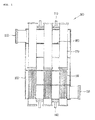
- FIG. 1 is a conceptual diagram illustrating a prereformer according to an embodiment of the present invention.
- the heat exchange type prereformer of the present invention is configured to generate hydrogen fuel supplied to a fuel cell.
- the fuel cell may be a Molten Carbonate Fuel Cell (MCFC), for example.
- MCFC Molten Carbonate Fuel Cell
- FIG. 1 is a conceptual diagram illustrating a prereformer according to an embodiment of the present invention.
- the prereformer 100 is configured to prereform gas supplied to an anode and also to satisfy the temperature conditions of gas to be supplied to the anode.
- an exhaust gas of a high temperature that is discharged by a cathode is introduced into a shell side 150 through an exhaust gas inlet 110.
- the shell side 150 is equipped with a channel.
- the exhaust gas is subject to a heat exchange with a mixture gas, supplied for prereforming, while flowing along the channel. After the heat exchange, the exhaust gas is externally discharged through an exhaust gas outlet 120.
- the mixture gas is introduced into a catalyst layer 170 through a mixture gas inlet 130.
- the mixture gas may be formed of gas in which a carbonate hydrogen-based fuel gas (e.g., NG, NPG, or bio gas) and steam are mixed at a specific ratio.
- a carbonate hydrogen-based fuel gas e.g., NG, NPG, or bio gas
- the catalyst layer 170 is disposed to overlap with one region of the shell side 150, and is configured to perform a heat exchange with the exhaust gas.
- the mixture gas injected into the catalyst layer 170 generates reactions, including side reactions, in addition to main reactions, such as a water gas shift reaction, a steam reforming reaction, and a methanation reaction so that the component conditions of gas to be supplied to the anode are satisfied.
- the catalyst layer 170 includes at least one of the catalyst layers 170 in which CRG F, CRG LH, C11PR, AR-301, RKNGR, or an oxidizer catalyst, a propane reforming catalyst, and a multi-fuel processing catalyst are mixed, if necessary.
- a commercial pipe may be used as the catalyst layer 170.
- a tube side 180 is connected to the catalyst layer 170, and is disposed to overlap with the other region of the shell side 150.
- the tube side 180 has a tube shape in which a catalyst is not filled.
- the mixture gas that is introduced into the tube side 180 through the catalyst layer 170 and that is prereformed is subject to a heat exchange with the exhaust gas that flows through the channel of the shell side 150, and is formed to satisfy the temperature conditions of gas to be supplied to the anode.
- the mixture gas that is drained from the tube side 180 and that satisfies component conditions and temperature conditions is discharged through a mixture gas outlet 140, and is supplied to the anode.
- the flow of the exhaust gas is described below.
- the exhaust gas of a high temperature that is discharged by the cathode is supplied to the exhaust gas inlet 110.
- the supplied exhaust gas is subject to a primary heat exchange with the mixture gas not having a catalyst that flows through the tube side 180 and that has been prereformed so that temperature conditions for which the mixture gas is supplied to the anode are satisfied. Thereafter, the exhaust gas generates reactions through a secondary heat exchange while passing through the catalyst layer 170, and is discharged by the prereformer 100 through the exhaust gas outlet 120.
- Baffles 160 for forming a channel through which the exhaust gas flows by partitioning the internal space of the shell side 150 are installed in the shell side 150.
- the baffles 160 are configured to guide the flow of the exhaust gas.
- the baffles 160 may be disposed to be crisscross on both sides of the inside of the shell side and to guide the flow of the exhaust gas so that the exhaust gas may flow in a meandering way.
- the pipe of the catalyst layer 170 and the tube side 180 are extended and formed in one direction, and the baffles 160 may be disposed vertically to the one direction. Furthermore, the tube side 180 is disposed adjacent to one end
- the catalyst layer 170 may be disposed adjacent to the other end [the exhaust gas outlet (120) side] of the shell side 150 from which the exhaust gas is drained.
- the exhaust gas of a high temperature that is introduced through the exhaust gas inlet 110 is sequentially subject to a heat exchange with the tube side 180 and the catalyst layer 170 according to the flow of the channel, and a stable operation is enabled because the heat exchange is generally performed without being biased to any one point.
- the catalyst layer 170 and the tube side 180 form one set.
- a plurality of the sets is formed and spaced apart from each other.
- One end of the set is connected to a fuel gas inlet into which a fuel gas is introduced, and the other end thereof is connected to a fuel gas outlet from which the fuel gas is discharged.
- a flow tipping effect that is, channeling
- differential pressure is reduced due to a reduction of temperature attributable to heat absorption.
- a catalyst is degraded in a part where the channeling is generated, thereby reducing the lifespan of the catalyst and thus increasing maintenance cost.
- the catalyst layer 170 may be configured to include a plurality of pipes so that it controls the flow rate of the mixture gas.
- a phenomenon in which the quantity of flow is concentrated on any one side can be prevented because the mixture gas is properly distributed to the pipes.
- the lifespan of the catalyst layer 170 can be extended, and power can be stably produced because gas having a specific concentration is supplied to a fuel cell stack.
- the tube side 180 may be formed of a tube bundle so that heat exchange efficiency is improved through an increase of a heat exchange area. That is, the prereformer 100 can be configured more compactly, and efficiency thereof can be improved through the structure in which the catalyst layer 170 including the plurality of pipes in order to prevent the flow tipping effect and the tube bundle for improving heat exchange efficiency are coupled.
- This drawing illustrates that the tube bundle for a heat exchange is connected to each of the pipes that form the catalyst layers 170.
- the mixture gas generates a prereforming reaction in the catalyst layer 170, and satisfies the temperature conditions of gas, supplied to the anode, through a heat exchange with the exhaust gas discharged by the cathode in the tube side 180.
- an occupied space can be minimized compared to the case where the temperature conditions are satisfied using a separate apparatus, and efficiency can be improved because the exhaust gas discharged by the cathode is used.
- the above structure can reduce the cold spot of the catalyst layer 170 and improve reactivity because it is a heat exchange method, and can satisfy the same performance conditions using a small amount of a catalyst compared to an existing catalyst. Furthermore, the above structure has an advantage in terms of a cost reduction because a commercial pipe can be used in the catalyst layer 170 instead of a reactor vessel.
- the aforementioned heat exchange type prereformer is not limited and applied to the configurations and methods of the aforemtioned embodiments, and all or some of the embodiments may be selectively combined and configured so that the embodiments may be modified in various ways.
- the embodiments of the present invention propose the prereformer having a new structure which is capable of prereforming gas supplied to the anode and also satisfying temperature conditions, and thus can be applied to various industry fields related to the prereformer.
Landscapes
- Chemical & Material Sciences (AREA)
- Chemical Kinetics & Catalysis (AREA)
- Organic Chemistry (AREA)
- Engineering & Computer Science (AREA)
- Inorganic Chemistry (AREA)
- Combustion & Propulsion (AREA)
- General Chemical & Material Sciences (AREA)
- Electrochemistry (AREA)
- Life Sciences & Earth Sciences (AREA)
- Sustainable Energy (AREA)
- Sustainable Development (AREA)
- Manufacturing & Machinery (AREA)
- Health & Medical Sciences (AREA)
- General Health & Medical Sciences (AREA)
- Fuel Cell (AREA)
- Hydrogen, Water And Hydrids (AREA)
Abstract
Description
- The present invention relates to a prereformer for preprocessing gas supplied to the anode of a fuel cell.
- A fuel cell is a cell for directly converting chemical energy, generated by the oxidation of fuel, into electrical energy.
- Most of fuel cells use hydrogen as fuel. However, the use of a fuel cell using hydrogen in the state in which the supply system of hydrogen fuel has not been constructed as it is now is limited.
- Accordingly, there is a need for a transitional system that generates hydrogen by prereforming carbonate hydrogen-based fuel and uses the hydrogen as fuel. For this reason, a fuel cell system that is now being developed is equipped with such a prereformer.
- The methanation of carbonate hydrogen series that belong to carbonate hydrogen series and that have a carbon number of 2 (C2) or higher other than CH4, hydrogen conversion, etc. are performed through the prereformer. Accordingly, a reduction in the performance of a fuel cell stack attributable to coking generated when C2 or higher is introduced into the fuel cell stack can be prevented. Furthermore, produced hydrogen gas maintains a reduction atmosphere within the fuel cell stack, and functions as a controller in thermal management. Furthermore, if some oxidants are introduced, the produced hydrogen gas functions as an oxidizer, and is responsible for a buffer that collects sulfur when the sulfur is introduced and protects the fuel cell stack.
- A steam reforming reaction, that is, a main reaction of the prereformer, is a heat absorption reaction, and there is a case where the temperature conditions of gas supplied to the anode are not satisfied. To this end, there is a need for a structure for satisfying the temperature conditions.
- The present invention proposes a prereformer of a new structure which is capable of prereforming gas supplied to an anode and also satisfying temperature conditions.
- To achieve the above objects of the present invention, a heat exchange type prereformer in accordance with an embodiment of the present invention includes a shell side equipped with a channel through which an exhaust gas is supplied and flows so that an exhaust gas of an anode is subject to a heat exchange with a mixture gas supplied for prereforming, a catalyst layer disposed to overlap with one region of the shell side and configured so that the mixture gas generates a prereforming reaction, and a tube side connected to the catalyst layer, disposed to overlap with the other region of the shell side, and formed so that the prereformed mixture gas is subject to a heat exchange with the exhaust gas. The mixture gas may include a fuel gas and steam.
- In accordance with an embodiment related to the present invention, the internal space of the shell side is partitioned, the channel is formed in the partitioned internal spaces, and baffles configured to control a flow of the exhaust gas are installed in the partitioned internal spaces. The catalyst layer and the tube side may be extended and formed in one direction, and the baffles may be disposed vertically to the one direction.
- In accordance with another embodiment of the present invention, the tube side is disposed adjacent to one end of the shell side into which the exhaust gas is introduced, and the catalyst layer is disposed adjacent to the other end of the shell side from which the exhaust gas is drained.
- In accordance with another embodiment of the present invention, the tube side is not filled with a catalyst.
- In accordance with another embodiment of the present invention, the catalyst layer and the tube side form a set, a plurality of the sets is formed and spaced from each other, one ends of the plurality of the sets are connected to a fuel gas inlet into which a fuel gas is introduced, and other ends of the plurality of the sets are connected to a fuel gas outlet from which the fuel gas is drained.
- In the above structure, the catalyst layer may include a plurality of pipes connected to the fuel gas inlet so that the mixture gas is distributed and introduced.
- Furthermore, the tube side may include a tube bundle connected to the plurality of pipes in a bundle form so that a heat exchange area is increased.
- In accordance with another embodiment of the present invention, the mixture gas drained from the tube side is supplied to an anode.
- In accordance with another embodiment of the present invention, the catalyst layer includes at least one of CRG F, CRG LH, C11PR, AR-301, RKNGR, an oxidizer catalyst, a propane reforming catalyst, and a multi-fuel processing catalyst.
- In accordance with the present invention having the above configuration, a mixture gas generates a prereforming reaction in the catalyst layer, and satisfies the temperature conditions of gas supplied to the anode through a heat exchange with the exhaust gas discharged by the cathode in the tube side. In this case, an occupied space can be minimized compared to the case where the temperature conditions are satisfied using a separate apparatus, and efficiency can be improved because the exhaust gas discharged by the cathode is used.
- The above structure can have improved reactivity because the cold spot of the catalyst layer is reduced and can satisfy the same performance conditions using a small amount of catalyst compared to an existing catalyst because the structure corresponds to a heat exchange method. Furthermore, the above structure is advantageous in terms of a cost reduction because a commercial pipe may be used in the catalyst layer instead of a reactor vessel.
- The heat of the prereformer can be controlled and the lifespan of the catalyst layer can be extended because the tube bundle is connected to the catalyst layer and configured to control the flow rate of a mixture gas. Power can be stably produced because gas having a specific concentration is supplied to the fuel cell stack.
-
FIG. 1 is a conceptual diagram illustrating a prereformer according to an embodiment of the present invention. - Hereinafter, a heat exchange type prereformer related to the present invention is described in detail with reference to the drawings. An expression of the singular number used in this specification includes an expression of the plural number unless clearly defined otherwise in the context.
- The heat exchange type prereformer of the present invention is configured to generate hydrogen fuel supplied to a fuel cell. The fuel cell may be a Molten Carbonate Fuel Cell (MCFC), for example.
-
FIG. 1 is a conceptual diagram illustrating a prereformer according to an embodiment of the present invention. - Referring to
FIG. 1 , theprereformer 100 is configured to prereform gas supplied to an anode and also to satisfy the temperature conditions of gas to be supplied to the anode. - More specifically, an exhaust gas of a high temperature that is discharged by a cathode is introduced into a
shell side 150 through anexhaust gas inlet 110. Theshell side 150 is equipped with a channel. The exhaust gas is subject to a heat exchange with a mixture gas, supplied for prereforming, while flowing along the channel. After the heat exchange, the exhaust gas is externally discharged through anexhaust gas outlet 120. - The mixture gas is introduced into a
catalyst layer 170 through amixture gas inlet 130. The mixture gas may be formed of gas in which a carbonate hydrogen-based fuel gas (e.g., NG, NPG, or bio gas) and steam are mixed at a specific ratio. - The
catalyst layer 170 is disposed to overlap with one region of theshell side 150, and is configured to perform a heat exchange with the exhaust gas. The mixture gas injected into thecatalyst layer 170 generates reactions, including side reactions, in addition to main reactions, such as a water gas shift reaction, a steam reforming reaction, and a methanation reaction so that the component conditions of gas to be supplied to the anode are satisfied. - The
catalyst layer 170 includes at least one of thecatalyst layers 170 in which CRG F, CRG LH, C11PR, AR-301, RKNGR, or an oxidizer catalyst, a propane reforming catalyst, and a multi-fuel processing catalyst are mixed, if necessary. A commercial pipe may be used as thecatalyst layer 170. - A
tube side 180 is connected to thecatalyst layer 170, and is disposed to overlap with the other region of theshell side 150. Thetube side 180 has a tube shape in which a catalyst is not filled. The mixture gas that is introduced into thetube side 180 through thecatalyst layer 170 and that is prereformed is subject to a heat exchange with the exhaust gas that flows through the channel of theshell side 150, and is formed to satisfy the temperature conditions of gas to be supplied to the anode. - The mixture gas that is drained from the
tube side 180 and that satisfies component conditions and temperature conditions is discharged through amixture gas outlet 140, and is supplied to the anode. - The flow of the exhaust gas is described below. The exhaust gas of a high temperature that is discharged by the cathode is supplied to the
exhaust gas inlet 110. The supplied exhaust gas is subject to a primary heat exchange with the mixture gas not having a catalyst that flows through thetube side 180 and that has been prereformed so that temperature conditions for which the mixture gas is supplied to the anode are satisfied. Thereafter, the exhaust gas generates reactions through a secondary heat exchange while passing through thecatalyst layer 170, and is discharged by theprereformer 100 through theexhaust gas outlet 120. - Baffles 160 for forming a channel through which the exhaust gas flows by partitioning the internal space of the
shell side 150 are installed in theshell side 150. Thebaffles 160 are configured to guide the flow of the exhaust gas. For example, thebaffles 160 may be disposed to be crisscross on both sides of the inside of the shell side and to guide the flow of the exhaust gas so that the exhaust gas may flow in a meandering way. - The pipe of the
catalyst layer 170 and thetube side 180 are extended and formed in one direction, and thebaffles 160 may be disposed vertically to the one direction. Furthermore, thetube side 180 is disposed adjacent to one end - [the exhaust gas inlet (110) side] of the
shell side 150 into which the exhaust gas is introduced. Thecatalyst layer 170 may be disposed adjacent to the other end [the exhaust gas outlet (120) side] of theshell side 150 from which the exhaust gas is drained. - In accordance with the above configuration, the exhaust gas of a high temperature that is introduced through the
exhaust gas inlet 110 is sequentially subject to a heat exchange with thetube side 180 and thecatalyst layer 170 according to the flow of the channel, and a stable operation is enabled because the heat exchange is generally performed without being biased to any one point. - The
catalyst layer 170 and thetube side 180 form one set. A plurality of the sets is formed and spaced apart from each other. One end of the set is connected to a fuel gas inlet into which a fuel gas is introduced, and the other end thereof is connected to a fuel gas outlet from which the fuel gas is discharged. - In this case, in distributing the mixture gas, a flow tipping effect, that is, channeling, may occur because differential pressure is reduced due to a reduction of temperature attributable to heat absorption. A catalyst is degraded in a part where the channeling is generated, thereby reducing the lifespan of the catalyst and thus increasing maintenance cost.
- In order to structurally prevent the channeling, the
catalyst layer 170 may be configured to include a plurality of pipes so that it controls the flow rate of the mixture gas. In accordance with the above configuration, a phenomenon in which the quantity of flow is concentrated on any one side can be prevented because the mixture gas is properly distributed to the pipes. As a result, the lifespan of thecatalyst layer 170 can be extended, and power can be stably produced because gas having a specific concentration is supplied to a fuel cell stack. - Furthermore, the
tube side 180 may be formed of a tube bundle so that heat exchange efficiency is improved through an increase of a heat exchange area. That is, theprereformer 100 can be configured more compactly, and efficiency thereof can be improved through the structure in which thecatalyst layer 170 including the plurality of pipes in order to prevent the flow tipping effect and the tube bundle for improving heat exchange efficiency are coupled. This drawing illustrates that the tube bundle for a heat exchange is connected to each of the pipes that form the catalyst layers 170. - In accordance with the present invention having the above configuration, the mixture gas generates a prereforming reaction in the
catalyst layer 170, and satisfies the temperature conditions of gas, supplied to the anode, through a heat exchange with the exhaust gas discharged by the cathode in thetube side 180. In this case, an occupied space can be minimized compared to the case where the temperature conditions are satisfied using a separate apparatus, and efficiency can be improved because the exhaust gas discharged by the cathode is used. - The above structure can reduce the cold spot of the
catalyst layer 170 and improve reactivity because it is a heat exchange method, and can satisfy the same performance conditions using a small amount of a catalyst compared to an existing catalyst. Furthermore, the above structure has an advantage in terms of a cost reduction because a commercial pipe can be used in thecatalyst layer 170 instead of a reactor vessel. - The aforementioned heat exchange type prereformer is not limited and applied to the configurations and methods of the aforemtioned embodiments, and all or some of the embodiments may be selectively combined and configured so that the embodiments may be modified in various ways.
- The embodiments of the present invention propose the prereformer having a new structure which is capable of prereforming gas supplied to the anode and also satisfying temperature conditions, and thus can be applied to various industry fields related to the prereformer.
Claims (10)
- A heat exchange type prereformer, including:a shell side equipped with a channel through which an exhaust gas is supplied and flows so that an exhaust gas of an anode is subject to a heat exchange with a mixture gas supplied for prereforming;a catalyst layer disposed to overlap with one region of the shell side and configured so that the mixture gas generates a prereforming reaction; anda tube side connected to the catalyst layer, disposed to overlap with then other region of the shell side, and formed so that the prereformed mixture gas is subject to a heat exchange with the exhaust gas.
- The heat exchange type prereformer of claim 1, wherein an internal space of the shell side is partitioned, the channel is formed in the partitioned internal spaces, and baffles configured to control a flow of the exhaust gas are installed in the partitioned internal spaces.
- The heat exchange type prereformer of claim 2, wherein:the catalyst layer and the tube side are extended and formed in one direction, andthe baffles are disposed vertically to the one direction.
- The heat exchange type prereformer of claim 1, wherein:the tube side is disposed adjacent to one end of the shell side into which the exhaust gas is introduced, andthe catalyst layer is disposed adjacent to the other end of the shell side from which the exhaust gas is drained.
- The heat exchange type prereformer of claim 1, wherein the tube side is not filled with a catalyst.
- The heat exchange type prereformer of claim 1, wherein:the catalyst layer and the tube side form a set,a plurality of the sets is formed and spaced from each other,one ends of the plurality of the sets are connected to a fuel gas inlet into which a fuel gas is introduced, andother ends of the plurality of the sets are connected to a fuel gas outlet from which the fuel gas is drained.
- The heat exchange type prereformer of claim 6, wherein the catalyst layer comprises a plurality of pipes connected to the fuel gas inlet so that the mixture gas is distributed and introduced.
- The heat exchange type prereformer of claim 7, wherein the tube side comprises a tube bundle connected to the plurality of pipes in a bundle form so that a heat exchange area is increased.
- The heat exchange type prereformer of claim 1, wherein the mixture gas drained from the tube side is supplied to an anode.
- The heat exchange type prereformer of claim 1, wherein the catalyst layer comprises at least one of CRG F, CRG LH, C11PR, AR-301, RKNGR, an oxidizer catalyst, a propane reforming catalyst, and a multi-fuel processing catalyst.
Applications Claiming Priority (3)
| Application Number | Priority Date | Filing Date | Title |
|---|---|---|---|
| KR20110147789 | 2011-12-30 | ||
| KR1020120155167A KR101422630B1 (en) | 2011-12-30 | 2012-12-27 | Heat exchange type prereformer |
| PCT/KR2012/011766 WO2013100708A1 (en) | 2011-12-30 | 2012-12-28 | Heat exchange type prereformer |
Publications (2)
| Publication Number | Publication Date |
|---|---|
| EP2800189A1 true EP2800189A1 (en) | 2014-11-05 |
| EP2800189A4 EP2800189A4 (en) | 2015-09-23 |
Family
ID=48991975
Family Applications (1)
| Application Number | Title | Priority Date | Filing Date |
|---|---|---|---|
| EP12863069.6A Withdrawn EP2800189A4 (en) | 2011-12-30 | 2012-12-28 | PRE-REFORMER OF THE HEAT EXCHANGE TYPE |
Country Status (5)
| Country | Link |
|---|---|
| US (1) | US9382114B2 (en) |
| EP (1) | EP2800189A4 (en) |
| JP (1) | JP2015508381A (en) |
| KR (1) | KR101422630B1 (en) |
| WO (1) | WO2013100708A1 (en) |
Families Citing this family (2)
| Publication number | Priority date | Publication date | Assignee | Title |
|---|---|---|---|---|
| US9145299B2 (en) | 2013-12-13 | 2015-09-29 | King Fahd University Of Petroleum And Minerals | Steam methane reforming reactor of shell and tube type with cylindrical slots |
| ITUB20150576A1 (en) * | 2015-04-24 | 2016-10-24 | Hexsol Italy Srl | HEAT EXCHANGER WITH BUNDLE TUBE AND IMPROVED STRUCTURE |
Family Cites Families (27)
| Publication number | Priority date | Publication date | Assignee | Title |
|---|---|---|---|---|
| DE2614670A1 (en) * | 1976-04-05 | 1977-10-13 | Siemens Ag | GAS GENERATOR FOR THE CATALYTIC CONVERSION OF LIQUID, HYDROCARBON-CONTAINING FUEL WITH AN OXYGEN-CONTAINING GAS AT INCREASED TEMPERATURE INTO A FUEL GAS, IN PARTICULAR FROM FUEL FUEL |
| JPS58180246U (en) * | 1982-05-25 | 1983-12-02 | 岩谷産業株式会社 | Hydrogen storage container |
| JPS63162503A (en) * | 1986-12-25 | 1988-07-06 | Toyo Eng Corp | Gas producer |
| JP2572251B2 (en) * | 1988-02-12 | 1997-01-16 | 東京瓦斯株式会社 | Fuel reformer |
| JP2625551B2 (en) * | 1989-08-17 | 1997-07-02 | 三菱重工業株式会社 | Methanol reformer |
| JPH06325783A (en) * | 1993-05-11 | 1994-11-25 | Toyo Eng Corp | Internal reforming type fused carbonate type fuel cell system |
| JP3442167B2 (en) * | 1993-12-28 | 2003-09-02 | 千代田化工建設株式会社 | Heat transfer method in reformer |
| JP3789677B2 (en) * | 1999-03-31 | 2006-06-28 | 三洋電機株式会社 | Fuel cell reformer |
| DE19956376A1 (en) | 1999-11-24 | 2001-06-13 | Xcellsis Gmbh | Arrangement with fuel cells and gas supply system and method for operating the arrangement |
| JP3920516B2 (en) * | 2000-01-12 | 2007-05-30 | 三洋電機株式会社 | Reformer |
| WO2002002220A1 (en) | 2000-06-29 | 2002-01-10 | H2Gen Innovations Inc. | Improved system and integrated chemical reactor for hydrogen production through steam reforming of hydrocarbons |
| EP2361899B1 (en) * | 2002-01-11 | 2015-07-22 | Mitsubishi Chemical Corporation | Vapor phase catalytic oxidation method using a multitube reactor of the heat-exchange type |
| US6967064B2 (en) * | 2002-06-24 | 2005-11-22 | Delphi Technologies, Inc. | Co-flow anode/cathode supply heat exchanger for a solid-oxide fuel cell assembly |
| DE50304485D1 (en) * | 2003-09-15 | 2006-09-14 | Balcke Duerr Gmbh | Reforming module for fuel cell systems for the conversion of hydrocarbon-containing fuel gases into hydrogen-containing process gases |
| JP4477432B2 (en) * | 2004-06-29 | 2010-06-09 | 東洋エンジニアリング株式会社 | Reformer |
| JP4205035B2 (en) * | 2004-09-27 | 2009-01-07 | 住友化学株式会社 | Multi-tube reactor for catalytic gas phase reaction |
| EP1650160A1 (en) | 2004-10-20 | 2006-04-26 | Stichting Energieonderzoek Centrum Nederland | Process for the production of synthesis gas and reactor for such process |
| JP4450756B2 (en) * | 2005-03-18 | 2010-04-14 | 本田技研工業株式会社 | Fuel reformer |
| US8034135B2 (en) * | 2005-03-18 | 2011-10-11 | Honda Motor Co., Ltd. | Fuel modification apparatus having an evaporator arranged around a superheater |
| GB0507269D0 (en) * | 2005-04-11 | 2005-05-18 | Johnson Matthey Plc | Steam reforming |
| FR2890955B1 (en) | 2005-09-21 | 2008-02-01 | Inst Francais Du Petrole | PROCESS FOR PRODUCING SYNTHESIS GAS BY VAPOREFORMING IN REACTOR-EXCHANGER |
| JP4667298B2 (en) * | 2006-04-24 | 2011-04-06 | 株式会社豊田中央研究所 | Heat exchanger and heat exchange type reformer |
| EP2013141A2 (en) * | 2006-04-24 | 2009-01-14 | Toyota Jidosha Kabushiki Kaisha | Heat exchange reformer unit and reformer system |
| US7635456B2 (en) * | 2006-08-08 | 2009-12-22 | Kellogg Brown & Root Llc | Low pressure drop reforming reactor |
| AT502131B1 (en) * | 2006-10-03 | 2008-02-15 | Avl List Gmbh | ENERGY GENERATION UNIT WITH AT LEAST ONE HIGH TEMPERATURE FUEL CELL |
| JP2008230929A (en) * | 2007-03-22 | 2008-10-02 | Toshiba Corp | Chemical reactor, hydrogen generator and fuel cell system |
| JP5309620B2 (en) * | 2008-03-10 | 2013-10-09 | 株式会社Ihi | Tar reforming method and apparatus for gasification equipment |
-
2012
- 2012-12-27 KR KR1020120155167A patent/KR101422630B1/en not_active Expired - Fee Related
- 2012-12-28 US US14/369,863 patent/US9382114B2/en active Active
- 2012-12-28 WO PCT/KR2012/011766 patent/WO2013100708A1/en not_active Ceased
- 2012-12-28 EP EP12863069.6A patent/EP2800189A4/en not_active Withdrawn
- 2012-12-28 JP JP2014550025A patent/JP2015508381A/en not_active Ceased
Also Published As
| Publication number | Publication date |
|---|---|
| WO2013100708A1 (en) | 2013-07-04 |
| KR20130079260A (en) | 2013-07-10 |
| JP2015508381A (en) | 2015-03-19 |
| EP2800189A4 (en) | 2015-09-23 |
| US9382114B2 (en) | 2016-07-05 |
| US20140369900A1 (en) | 2014-12-18 |
| KR101422630B1 (en) | 2014-07-23 |
Similar Documents
| Publication | Publication Date | Title |
|---|---|---|
| US9884303B2 (en) | Reformer | |
| US8500875B2 (en) | Desulfurizer | |
| US10381665B2 (en) | Device and method for heating fuel cell stack and fuel cell system having the device | |
| JP2010132551A (en) | Fuel reforming device for solid polyelectrolyte fuel cell | |
| US9240604B2 (en) | Hydrogen generation apparatus and fuel cell power generation system | |
| KR102044766B1 (en) | High Efficiency Fuel Cell System Improved Thermal Efficiency and Performance of the Maintenance | |
| US9941535B2 (en) | Fuel cell module | |
| KR102316259B1 (en) | Fuel reformer system and reforming method for fuel | |
| KR101350127B1 (en) | Solid oxide fuel cell and reformer | |
| US9382114B2 (en) | Heat exchange type prereformer | |
| KR101250418B1 (en) | fuel processor of fuel cell | |
| KR101598686B1 (en) | an integrated equipment of fuel processors and heat exchange units in the fuel cell systems and operating methods using the same | |
| WO2007077791A1 (en) | Indirect internal reforming solid oxide fuel cell | |
| KR101316042B1 (en) | Integrated Reformer System for a Fuel Cell | |
| JP4556393B2 (en) | Fuel reformer | |
| KR102889017B1 (en) | Quick Start-up Plasma Solid Oxide Fuel Cell (SOFC) Integrated System Using Biogas | |
| KR100774528B1 (en) | Fuel cell system | |
| KR101294469B1 (en) | Indirect internal reformer for solid oxide fuel cell | |
| KR20120122312A (en) | Reformer Efficiency Improving Device for a Fuel Cell |
Legal Events
| Date | Code | Title | Description |
|---|---|---|---|
| PUAI | Public reference made under article 153(3) epc to a published international application that has entered the european phase |
Free format text: ORIGINAL CODE: 0009012 |
|
| 17P | Request for examination filed |
Effective date: 20140728 |
|
| AK | Designated contracting states |
Kind code of ref document: A1 Designated state(s): AL AT BE BG CH CY CZ DE DK EE ES FI FR GB GR HR HU IE IS IT LI LT LU LV MC MK MT NL NO PL PT RO RS SE SI SK SM TR |
|
| DAX | Request for extension of the european patent (deleted) | ||
| RA4 | Supplementary search report drawn up and despatched (corrected) |
Effective date: 20150824 |
|
| RIC1 | Information provided on ipc code assigned before grant |
Ipc: H01M 8/04 20060101ALN20150818BHEP Ipc: C01B 3/26 20060101ALI20150818BHEP Ipc: H01M 8/06 20060101AFI20150818BHEP Ipc: C01B 3/38 20060101ALI20150818BHEP Ipc: H01M 8/14 20060101ALI20150818BHEP |
|
| 17Q | First examination report despatched |
Effective date: 20180205 |
|
| STAA | Information on the status of an ep patent application or granted ep patent |
Free format text: STATUS: THE APPLICATION IS DEEMED TO BE WITHDRAWN |
|
| 18D | Application deemed to be withdrawn |
Effective date: 20180616 |