EP2798487B1 - Spreadsheet-based programming language adapted for report generation - Google Patents
Spreadsheet-based programming language adapted for report generation Download PDFInfo
- Publication number
- EP2798487B1 EP2798487B1 EP12861998.8A EP12861998A EP2798487B1 EP 2798487 B1 EP2798487 B1 EP 2798487B1 EP 12861998 A EP12861998 A EP 12861998A EP 2798487 B1 EP2798487 B1 EP 2798487B1
- Authority
- EP
- European Patent Office
- Prior art keywords
- report
- spreadsheet
- template
- tags
- worksheet
- Prior art date
- Legal status (The legal status is an assumption and is not a legal conclusion. Google has not performed a legal analysis and makes no representation as to the accuracy of the status listed.)
- Active
Links
Images






Classifications
-
- G—PHYSICS
- G06—COMPUTING OR CALCULATING; COUNTING
- G06F—ELECTRIC DIGITAL DATA PROCESSING
- G06F9/00—Arrangements for program control, e.g. control units
- G06F9/06—Arrangements for program control, e.g. control units using stored programs, i.e. using an internal store of processing equipment to receive or retain programs
- G06F9/44—Arrangements for executing specific programs
-
- G—PHYSICS
- G06—COMPUTING OR CALCULATING; COUNTING
- G06F—ELECTRIC DIGITAL DATA PROCESSING
- G06F16/00—Information retrieval; Database structures therefor; File system structures therefor
-
- G—PHYSICS
- G06—COMPUTING OR CALCULATING; COUNTING
- G06F—ELECTRIC DIGITAL DATA PROCESSING
- G06F40/00—Handling natural language data
- G06F40/10—Text processing
-
- G—PHYSICS
- G06—COMPUTING OR CALCULATING; COUNTING
- G06F—ELECTRIC DIGITAL DATA PROCESSING
- G06F40/00—Handling natural language data
- G06F40/10—Text processing
- G06F40/103—Formatting, i.e. changing of presentation of documents
-
- G—PHYSICS
- G06—COMPUTING OR CALCULATING; COUNTING
- G06F—ELECTRIC DIGITAL DATA PROCESSING
- G06F40/00—Handling natural language data
- G06F40/10—Text processing
- G06F40/103—Formatting, i.e. changing of presentation of documents
- G06F40/117—Tagging; Marking up; Designating a block; Setting of attributes
-
- G—PHYSICS
- G06—COMPUTING OR CALCULATING; COUNTING
- G06F—ELECTRIC DIGITAL DATA PROCESSING
- G06F40/00—Handling natural language data
- G06F40/10—Text processing
- G06F40/166—Editing, e.g. inserting or deleting
- G06F40/174—Form filling; Merging
-
- G—PHYSICS
- G06—COMPUTING OR CALCULATING; COUNTING
- G06F—ELECTRIC DIGITAL DATA PROCESSING
- G06F40/00—Handling natural language data
- G06F40/10—Text processing
- G06F40/166—Editing, e.g. inserting or deleting
- G06F40/177—Editing, e.g. inserting or deleting of tables; using ruled lines
-
- G—PHYSICS
- G06—COMPUTING OR CALCULATING; COUNTING
- G06F—ELECTRIC DIGITAL DATA PROCESSING
- G06F40/00—Handling natural language data
- G06F40/10—Text processing
- G06F40/166—Editing, e.g. inserting or deleting
- G06F40/177—Editing, e.g. inserting or deleting of tables; using ruled lines
- G06F40/18—Editing, e.g. inserting or deleting of tables; using ruled lines of spreadsheets
-
- G—PHYSICS
- G06—COMPUTING OR CALCULATING; COUNTING
- G06F—ELECTRIC DIGITAL DATA PROCESSING
- G06F40/00—Handling natural language data
- G06F40/10—Text processing
- G06F40/166—Editing, e.g. inserting or deleting
- G06F40/183—Tabulation, i.e. one-dimensional [1D] positioning
-
- G—PHYSICS
- G06—COMPUTING OR CALCULATING; COUNTING
- G06F—ELECTRIC DIGITAL DATA PROCESSING
- G06F40/00—Handling natural language data
- G06F40/10—Text processing
- G06F40/166—Editing, e.g. inserting or deleting
- G06F40/186—Templates
-
- G—PHYSICS
- G06—COMPUTING OR CALCULATING; COUNTING
- G06F—ELECTRIC DIGITAL DATA PROCESSING
- G06F9/00—Arrangements for program control, e.g. control units
- G06F9/06—Arrangements for program control, e.g. control units using stored programs, i.e. using an internal store of processing equipment to receive or retain programs
- G06F9/44—Arrangements for executing specific programs
- G06F9/448—Execution paradigms, e.g. implementations of programming paradigms
Definitions
- the present invention relates, in general, to the generation of reports using a spreadsheet-based programming language within a report design template spreadsheet using tags that designate procedural functions that specify the content and form of the report.
- a parameter-based form is rendered based on a metadata sheet comprised in the report design template spreadsheet which gives a user the ability to either filter and narrow a dataset and/or sort a resulting dataset.
- US2004/221233 A1 discloses a system and method for generating reports from a data source using a word processing template having at least one field that expresses a command and at least one field that expresses a reference to the data source.
- a processor generates a report using the data source and the word processing template to define conditional text, layout, and formatting based on information determined at runtime.
- WO 03/098500 A1 discloses a spreadsheet-based model which uses a spreadsheet for generating a report whereby the spreadsheet comprises the data for the report and tags and parameters for the customisation of the report.
- a user interface is generated from the parameters which allows the user to provide the values for the parameters for the customisation of the report.
- WO 03/007118 A2 discloses the creation of a template within a spreadsheet comprising formulas, written in a "spreadsheet formula language", which are associated with a data source.
- a user interface is provided in a browser where the use can specify certain (filter) criteria which are used as parameters for the spreadsheet template for the generation of the report which is then presented in the browser.
- the inventions disclosed herein enable users to design reports by leveraging their preexisting knowledge of spreadsheets and by maximizing that knowledge base and expanding it with a markup tag language.
- the system utilizes a simple file system structure to represent the hierarchy of the store reports and displays these objects through a web-based user interface.
- a Uniform Resource Locator URL
- a spreadsheet-based programming language adapted for report generation
- said system comprising: an optionally networked computer comprising a processor, an operating system configured to perform executable instructions, and a memory device; a computer program including instructions executable by the digital processing device to create an environment to implement a spreadsheet-based programming language for report generation, wherein said environment comprises: a software module for storing the structure of one or more designated, external datasets within a spreadsheet, wherein references to each dataset are created through cell-based formulas; a software module (e.g., an interpreter) to interpret procedural functions, wherein procedural functions are designated via tags in a report design template; and a software module for generating reports.
- an optionally networked computer comprising a processor, an operating system configured to perform executable instructions, and a memory device
- a computer program including instructions executable by the digital processing device to create an environment to implement a spreadsheet-based programming language for report generation, wherein said environment comprises: a software module for storing the structure of one or more designated, external datasets
- one or more external datasets are databases.
- one or more databases are relational databases, non-relational databases, object oriented databases, object databases, entity-relationship model databases, associative databases, or XML databases.
- one or more external datasets are tabular datasets.
- one or more tabular datasets are comma separated text files, tab delimited text files, or binary files with a native dataset embedded with a tabular structured dataset.
- the software module for storing the structure of one or more designated, external datasets stores the structure as symbolic references.
- the software interpreter interprets said procedural functions to execute a query.
- a query optionally includes one or both of: search and sort parameters.
- the environment further comprises a software module for saving queries for later execution.
- each saved query is represented by a URL that executes the query when activated.
- the report design template is a spreadsheet.
- the spreadsheet is any version of Microsoft Excel.
- the spreadsheet is any version and derivative of OpenOffice Calc.
- the spreadsheet is any version and derivative of Lotus 1-2-3.
- the software module for generating reports applies the properties of a report design template to a report.
- the software module for generating reports generates reports as binary data in the form of one or more spreadsheets, XML documents, HTML documents, reporting software documents, word processor documents, or presentation software documents.
- a computer program including instructions executable by a computer to create a reporting environment comprising: a software module for storing the structure of one or more designated, external datasets within a spreadsheet, wherein references to each dataset are created through cell-based formulas; a software interpreter to interpret procedural functions, wherein procedural functions are designated via tags in a report design template; and a software module for generating reports.
- the software module for generating reports applies the properties of a report design template to a report.
- the encoding is permanent, substantially permanent, semi-permanent, or non-transitory.
- the software interpreter interprets said procedural functions to execute a query.
- a query optionally includes one or both of: search and sort parameters.
- the reporting environment further comprises a software module for saving queries for later execution.
- each saved query is represented by a URL that executes the query when activated.
- interpreting one or more report design templates to format an output comprises the steps of: reading one or more templates into memory; reading one or more tags defining programming instructions into memory; reading one or more datasets into memory; generating a new spreadsheet; applying the properties of the template to the new spreadsheet; inserting rows and columns into the new spreadsheet based on each dataset; performing the defined programming instructions; and outputting the new spreadsheet in binary data format.
- the output is a report.
- the report is binary data in the form of one or more spreadsheets, XML documents, HTML documents, reporting software documents, word processor documents, or presentation software documents.
- a computer program including instructions executable by a computer to create a reporting environment comprising: a software module for referencing one or more datasets through cell-based formulas in a spreadsheet; and a software module for interpreting one or more report design templates to format an output, wherein procedural functions are designated in the report design template via tags.
- the cell-based formulas are to some extent input by a user.
- the cell-based formulas are to some extent input by a computer system through an auto-generation wizard.
- the procedural functions are to some extent input by a user.
- the procedural functions are to some extent input by a computer through an auto-generation wizard.
- the output is a report.
- the encoding is permanent, substantially permanent, semi-permanent, or non-transitory.
- identifying programming instructions for report generation comprising storing specific tags in a spreadsheet in computer memory, for example, non-volatile and non-transitory memory, to identify programming instructions selected from the group consisting of: designating input; designating output; designating mathematical calculations; designating conditional execution of instructions; and designating repetition of instructions.
- one or more tags are utilized in pairs of tags consisting of an opening tag and a closing tag.
- one or more tags are utilized as single tags.
- dataset means a set of rows or records.
- spreadsheet means a single page or sheet in a spreadsheet program.
- row means a single, implicitly structured data record in a table, worksheet, spreadsheet, or database.
- a row of data is a set of cells that run horizontally in a worksheet.
- column means a set of cells that run vertically in a worksheet.
- cell indicates where data is entered into a table, worksheet, spreadsheet, or database. In some embodiments, a cell sits at the intersection between a row and a column.
- formula means a mathematical equation used to calculate a value.
- a spreadsheet programming language is language which follows certain methods of tagging within a spreadsheet which allows an outside interpreter to abstract the tags and functions into different type of programmatic functions or entities.
- a suitable spreadsheet consists of multiple worksheets within a spreadsheet.
- one designated worksheet represents the external dataset or datasets and the means to retrieve from the dataset or datasets.
- Fig. 1 depicts a non-limiting, exemplary process for generating a report by implementing spreadsheet-based programming language.
- the exemplary process of Fig. 1 includes a first phase of rendering a parameter based web form to accommodate user input.
- the system loads a spreadsheet 105 into memory and introspects a metadata sheet 100 contained therein. From the metadata sheet, the system finds the respective fields that are used for filtering and sorting. In further embodiments, the system then renders a web page 110, which displays available fields to be sorted. These parameters are prepared for feeding into the interpreter once the user executes the report generation 120.
- the exemplary process of Fig. 1 also includes a second phase of report generation, which is multistage with stages (A)-(G):
- the systems, platforms, environments, applications, and methods disclosed herein access, read, and store the structure of one or more designated, external datasets.
- the structure of one dataset is accessed, read, and stored.
- the structures of a plurality of datasets are accessed, read, and stored simultaneously, substantially simultaneously, or in series.
- the structure of 2, 3, 4, 5, 6, 7, 8, 9, 10, 20, 30, 40, 50, 60, 70, 80, 90, 100, 200, 300, 400, 500, 600, 700, 800, 900, 1000, 2000, 3000, 4000, 5000 or more datasets, including increments therein are accessed, read, and stored.
- each dataset is stored within a spreadsheet.
- references to each dataset are created through cell-based formulas in a spreadsheet.
- suitable datasets include tabular datasets and object oriented datasets.
- suitable tabular datasets include databases such as Oracle, Microsoft SQL Server, Informix, Sybase, and MySQL. Other suitable databases include, for example, IBM DB2, Postgres, and dBASE.
- suitable tabular datasets include flat files such as character delimited flat files (e.g., CSV, tab delimited, etc.), fixed length flat files (e.g., COBOL), binary flat files, and proprietary ASCII flat files (e.g., DBF).
- suitable object oriented datasets include, by way of non-limiting examples XML and JSON.
- Suitable datasets are of any size.
- the size of a dataset is potentially hundreds of millions of rows before the system filters and sorts the dataset.
- a dataset is, by way of non-limiting examples, 1, 10, 1 ⁇ 10 2 , 1 ⁇ 10 3 , 1 ⁇ 10 4 , 1 ⁇ 10 5 , 1 ⁇ 10 6 , 1 ⁇ 10 7 , 1 ⁇ 10 8 , 1 ⁇ 10 9 , 1 ⁇ 10 10 , 1 ⁇ 10 11 , 1 ⁇ 10 12 , 1 ⁇ 10 13 , 1 ⁇ 10 14 , 1 ⁇ 10 15 , 1 ⁇ 10 16 , 1 ⁇ 10 17 , 1 ⁇ 10 18 , 1 ⁇ 10 19 , 1 ⁇ 10 20 , or more rows, including increments therein.
- Suitable datasets reside in a variety of locations.
- a datasets is a local database or flat file.
- a dataset resides in the same memory or storage device as the software disclosed herein.
- a dataset resides in the same network (e.g., LAN or WAN) as the software disclosed herein.
- a dataset is accessible via the Internet.
- a dataset resides with a third party data source (e.g., a cloud provider).
- the systems, platforms, environments, applications, and methods disclosed herein access, read, and store the structure of one or more designated, external datasets.
- the one or more external datasets are held in an "in memory" database that does not maintain any database storage mechanism.
- the system keeps a complete list of queries in metadata objects, wherein each query is symbolically represented as a single table.
- the system joins the tables and layers on additional processing to return a finalized result set for the query.
- the finalized result set is used to create a report.
- a cross-database query initiates a plurality of simultaneous queries, wherein each is symbolically represented as a single table.
- a cross-database query initiates, 2, 3, 4, 5, 6, 7, 8, 9, 10, 11, 12, 13, 14, 15, 16, 17, 18, 19, 20 or more simultaneous queries.
- a cross-database query initiates, 10, 20, 30, 40, 50, 60, 70, 80, 90, 100 or more simultaneous queries, including increments therein.
- a cross-database query initiates, 100, 200, 300, 400, 500, 600, 700, 800, 900, 1000 or more simultaneous queries, including increments therein.
- a cross-database query initiates, 1000, 2000, 3000, 4000, 5000, 6000, 7000, 8000, 9000, 10000 or more simultaneous queries, including increments therein.
- a cross-database query disclosed herein keeps a list of any suitable number of queries in metadata objects and initiates any suitable number of simultaneous queries.
- each of the result sets reside within the in memory database as table objects and the table objects are then processed and run through the cross-database engine to assemble a final result set.
- a cross-database query is based on a list or assortment of disparate queries to be issued by the cross-database query engine. In further embodiments, these queries are stored within a metadata sheet. In still further embodiments, query assembly for each sub-query is based on the field labels of the metadata sheet, wherein each sub query or child query is a direct query to a database.
- a cross-database query stores reference queries as aliased tables.
- join points are defined using spreadsheet reference formulas utilizing the equal sign to reference the corresponding field from where that field could potentially pull from.
- the engine constructs a new result set.
- the new result set is based on field mappings defined in the metadata sheet, wherein the fields reference the metadata sheets through the reference formula methodology disclosed herein.
- the systems, platforms, environments, applications, and methods disclosed herein utilize cell-based formulas to reference each external dataset.
- Cell-based formulas in spreadsheet programs such as Microsoft Excel, Open Office Calc, and Google spreadsheets utilize a mathematical equation to calculate a value.
- Cell based formulas are, for example, strings which represent some type of calculation or reference to another cell. See, e.g., Fig. 2 .
- cell H2 is designated as a representative sample data to reference an external dataset.
- this referenced cell symbolizes the data mapping position from the external datasets when inserted into the targeted report.
- the systems, platforms, environments, applications, and methods disclosed herein include procedural functions to specify the content and format of a report.
- procedural functions are carried out once. In other embodiments, procedural functions are looped. A loop is a way of repeating a process or statement a particular number of times or until a particular event occurs. In further embodiments, a loop has identifiers that mark where the rows begin and end. In still further embodiments, loops are nested such that one or more loops are embedded within other loops.
- procedural functions are designated via tags in a report design template.
- a tag is a letter, number, code, word, phrase, or symbol.
- a tag is enclosed or bracketed by a distinguishing character or series of characters such as brackets (e.g., ⁇ , >, [, ], ⁇ , ⁇ , (, ), etc.).
- tags are utilized in pairs.
- a pair of tags includes an opening tag and a closing tag.
- tags are used singly.
- a procedural function is designated by one tag.
- a procedural function is designated by more than one tag.
- the systems, platforms, environments, applications, and methods disclosed herein include a software interpreter to interpret procedural functions.
- a software interpreter interprets procedural functions by reading tags in a report design template.
- an interpreter reads the tags into the system and is capable of, for example, the following functions:
- suitable templates follow an explicit structure which reserves a single worksheet as the metadata sheet which contains the properties of an external dataset.
- suitable templates which make reference through formulas to the defined external datasets in conjunction with tags to define the beginning and end of loops.
- a report design template is the initial canvas a user or developer creates in order to design a report.
- the template constitutes of the following:
- each template worksheet carries the tags and symbolic references to the external datasets. For example, they contain the logic a user might utilize to generate a report with regards to summation, averages, ratios, or other complex calculations supported by the spreadsheet.
- each template represents a form of what the resulting output report potentially looks like with sample data.
- Fig. 3 depicts an exemplary customer report template with system reserved tag rows highlighted in rows 2 and 4 as well as columns G and H.
- system reserved rows represent procedural functions (rows 2 and 4 with the ⁇ item> ⁇ /item> tags) or external datasets (columns G and H).
- templates represent four major functions:
- each template is copied into the designated output spreadsheet while maintaining its respective page, row, column, and cell properties.
- the interpreter will read one or more external datasets and map them into each targeted template worksheet within the designated output spreadsheet while maintaining the aesthetic and logical functions designed from the original template worksheet.
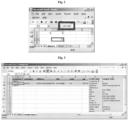
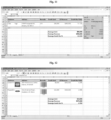
- Fig. 4 depicts an exemplary customer report generated based on the exemplary report template of Fig. 3 .
- an external dataset has been run through an interpreter and the procedural language has been rendered according to the tags in the template.
- Fig. 5 depicts an exemplary report template that is more complex in nature.
- a report template includes a nested loop represented with the additional ⁇ detail> ⁇ /detail> tags.
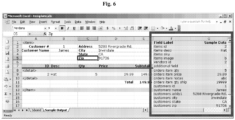
- Fig. 6 shows a non-limiting example of the template of Fig. 5 with the references to the external datasets highlighted.
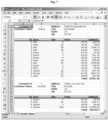
- Fig. 7 shows a non-limiting example of the resulting report from the templates of Figs. 5 and 6 after an external dataset is polled into the interpreter.
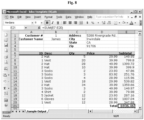
- Fig. 8 shows a non-limiting example of the newly formed formula from Fig. 7 to demonstrate the interpreter introspecting and readjusting the values of the cells based on the resulting external datasets and the respective row insertions for the iterations.
- a template spreadsheet contains one or more metadata worksheets.
- each metadata worksheet includes the following:
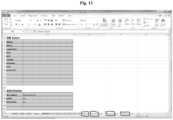
- Fig. 9 depicts an exemplary metadata sheet containing two sections.
- one section is marked as sort options.
- the sort section is between rows 27 and 29.
- Row 29 represents the possible sort options, which are to be loaded by the report form made available to the user.
- the search section is made available to the user through rows 31-33. Further, in this embodiment, each of these sections is read into the system and creates an application for the user in the form of HTML for the user to define their input parameters.
- Fig. 10 depicts the resulting form in this particular embodiment.
- a report is the generated output from the interpreter in binary form.
- the binary form is the binary format of spreadsheet applications including, but not limited to: Excel 95, Excel 97, Excel 2000, Excel XP, Excel 2003, Excel 2007, Excel 2010, Open Office Calc 1.0, Open Office Calc 2.0, and Open Office Calc 3.0.
- the binary form of the report is the binary format of a word processing application.
- the report is a plain text file.
- the report is a PDF file.
- a suitable query is against a wide range of disparate, external datasets to generate a report.
- a suitable query is a cross-database query, wherein the systems, platforms, environments, applications, and methods disclosed herein initiate a plurality of simultaneous queries, each query symbolically represented as a single table.
- the systems, platforms, environments, applications, and methods described herein include a computer (e.g., digital processing device), or use of the same.
- the computer includes one or more hardware central processing units (CPU) that carry out the device's functions.
- the computer further comprises an operating system configured to perform executable instructions.
- the computer is optionally connected a computer network.
- the computer is optionally connected to the Internet such that it accesses the World Wide Web.
- the computer is optionally connected to a cloud computing infrastructure.
- the computer is optionally connected to an intranet.
- the computer is optionally connected to a data storage device.
- suitable computers include, by way of non-limiting examples, server computers, desktop computers, laptop computers, notebook computers, sub-notebook computers, netbook computers, netpad computers, set-top computers, handheld computers, Internet appliances, mobile smartphones, tablet computers, and personal digital assistants.
- server computers desktop computers, laptop computers, notebook computers, sub-notebook computers, netbook computers, netpad computers, set-top computers, handheld computers, Internet appliances, mobile smartphones, tablet computers, and personal digital assistants.
- smartphones are suitable for use in the system described herein.
- Suitable tablet computers include those with booklet, slate, and convertible configurations, known to those of skill in the art.
- the computer includes an operating system configured to perform executable instructions.
- the operating system is, for example, software, including programs and data, which manages the device's hardware and provides services for execution of applications.
- suitable server operating systems include, by way of non-limiting examples, FreeBSD, OpenBSD, NetBSD ® , Linux, Apple ® Mac OS X Server ® , Oracle ® Solaris ® , Windows Server ® , and Novell ® NetWare ® .
- suitable personal computer operating systems include, by way of non-limiting examples, Microsoft ® Windows ® , Apple ® Mac OS X ® , UNIX ® , and UNIX-like operating systems such as GNU/Linux ® .
- the operating system is provided by cloud computing.
- suitable mobile smart phone operating systems include, by way of non-limiting examples, Nokia ® Symbian ® OS, Apple ® iOS TM , Research In Motion ® BlackBerry OS ® , Google ® Android ® , Microsoft ® Windows Phone TM OS, Microsoft ® Windows Mobile ® OS, Linux ® , and Palm ® WebOS ® .
- the computer includes a storage and/or memory device.
- the storage and/or memory device is one or more physical apparatuses used to store data or programs on a temporary or permanent basis.
- the device is volatile memory and requires power to maintain stored information.
- the device is non-volatile memory and retains stored information when the digital processing device is not powered.
- the non-volatile memory comprises flash memory.
- the non-volatile memory comprises dynamic random-access memory (DRAM).
- the non-volatile memory comprises ferroelectric random access memory (FRAM).
- the non-volatile memory comprises phase-change random access memory (PRAM).
- the device is a storage device including, by way of non-limiting examples, CD-ROMs, DVDs, flash memory devices, magnetic disk drives, magnetic tapes drives, optical disk drives, and cloud computing based storage.
- the storage and/or memory device is a combination of devices such as those disclosed herein.
- the computer includes a display to send visual information to a user.
- the display is a cathode ray tube (CRT).
- the display is a liquid crystal display (LCD).
- the display is a thin film transistor liquid crystal display (TFT-LCD).
- the display is an organic light emitting diode (OLED) display.
- OLED organic light emitting diode
- on OLED display is a passive-matrix OLED (PMOLED) or active-matrix OLED (AMOLED) display.
- the display is a plasma display.
- the display is a video projector.
- the display is a combination of devices such as those disclosed herein.
- the computer includes an input device to receive information from a user.
- the input device is a keyboard.
- the input device is a pointing device including, by way of non-limiting examples, a mouse, trackball, track pad, joystick, game controller, or stylus.
- the input device is a touch screen or a multi-touch screen.
- the input device is a microphone to capture voice or other sound input.
- the input device is a video camera to capture motion or visual input.
- the input device is a combination of devices such as those disclosed herein.
- Non-transitory computer readable medium
- the systems, platforms, environments, applications, and methods disclosed herein include one or more non-transitory computer readable media encoded with a program including instructions executable by the operating system of a digital processing device.
- a computer readable medium is a tangible component of a digital processing device.
- a computer readable medium is optionally removable from a digital processing device.
- a computer readable medium includes, by way of non-limiting examples, CD-ROMs, DVDs, flash memory devices, solid state memory, magnetic disk drives, magnetic tape drives, optical disk drives, cloud computing systems and services, and the like.
- the encoding is permanent, substantially permanent, semi-permanent, or non-transitory.
- the systems, platforms, environments, applications, and methods disclosed herein include one or more computer programs.
- a computer program includes a sequence of instructions, executable in the digital processing device's CPU, written to perform a specified task.
- a computer program may be written in various versions of various languages. Suitable programming languages include, by way of non-limiting examples, Java, VB, VB.NET, C#, C, C++, CFML, Python, Perl, Ruby, PHP, Objective C, JavaScript, Delphi, Lisp, Pascal, Ada, Assembly, ABAP, and Cocoa, or combinations thereof.
- a computer program is created upon a software framework.
- Suitable software frameworks include, by way of non-limiting examples, Spring, Struts, Django, Ruby on Rails, ASP.NET, Struts, Lift, Tapestry, Seam, Wicket, Symfony, Yii, Joomla, Joomla, Grails, JBoss, Shale, Sling, Eclipse RAP, Oracle ADF, OpenXava, Richfaces, Google Web Toolkit, IceFaces, WebObjects, TurboGears, Zope, ColdFusion, BFC, DotNetNuke, MonoRail, Flex, and AJAX, or combinations thereof.
- a computer program comprises one sequence of instructions. In some embodiments, a computer program comprises a plurality of sequences of instructions. In various embodiments, a computer program comprises a file, a section of code, a programming object, a programming structure, or combinations thereof. In further various embodiments, a computer program comprises a plurality of files, a plurality of sections of code, a plurality of programming objects, a plurality of programming structures, or combinations thereof. In some embodiments, a computer program is delivered from one location. In other embodiments, a computer program is delivered from a plurality of locations. In yet other embodiments, a computer program is delivered from a cloud computing platform or service. In various embodiments, a computer program includes one or more software modules. In various embodiments, a computer program includes, in part or in whole, one or more web applications, one or more mobile applications, one or more standalone applications, one or more web browser plug-ins, extensions, add-ins, or add-ons, or combinations thereof.
- a software module comprises a file, a section of code, a programming object, a programming structure, or combinations thereof.
- a software module comprises a plurality of files, a plurality of sections of code, a plurality of programming objects, a plurality of programming structures, or combinations thereof.
- the one or more software modules comprise, by way of non-limiting examples, a web application, a mobile application, and a standalone application.
- software modules are in one computer program or application. In other embodiments, software modules are in more than one computer program or application. In some embodiments, software modules are hosted on one machine. In other embodiments, software modules are hosted on more than one machine. In further embodiments, software modules are hosted on cloud computing platforms. In some embodiments, software modules are hosted on one or more machines in one location. In other embodiments, software modules are hosted on one or more machines in more than one location.
- the CEO of a company asks his head of sales to create a report of their top two customers that includes their credit limit, last year revenue, and credit to receivable ratio on a single report with a total at the bottom of the report with total credit limit, total last year revenue, and an average credit to revenue ratio.
- the head of sales does the following:
- the CEO opens this bookmarked link and runs the report at his convenience without the intervention of developers, managers, or staff. See Fig. 12 .
- This simple process takes a matter of 5-10 minutes to develop a new report without requiring a developer to understand a new procedural language.
- a product development designer wants a specification sheet with a list of materials that includes the weights, costs, and quantities of all the respective components to produce a final good. He loads the URL for the system and types in the product stock-keeping unit (SKU) number into a search form and retrieves the resulting report. The report is formatted according to the manufacturer's specifications. The designer checks and verifies all the data is correct. The spreadsheet is e-mailed to the manufacturer to further product development.
- SKU product stock-keeping unit
- a freight forwarding company wants a tally of all the containers they had exported for the day broken down by the respective countries.
- the company president runs a report with the begin date and end date of that particular day.
- the system lists all the SKUs, containers, vessels, and countries sorted in that same order.
- the sales manager of a company needs to compile a month end report of all the commission payable to her sales force. She enters 12/1/2011 as the start date and 12/31/2011 as the end date of her report sorted by salesman.
- the report has all the dollar amounts and commission rates in a tabular form with each line item containing a subtotal of quantity * price * commission rate.
- At the bottom of the spreadsheet are a number of calculations including summary of the total units shipped for that month, the average price point for all goods sold for the month, and the total commission rate to be paid for the month.
- a cross-database query utilizes an in memory database that does not maintain any database storage mechanism.
- the system keeps a complete list of queries in metadata objects. Each query is symbolically represented as a single table. After all the independent result sets are converted to tables, the XDB database joins the tables and layers on additional processing to return a finalized result set.
- a particular embodiment involves two queries:
- Each query is given a table alias.
- Query 1 is aliased as xdb1 and Query 2 is aliased as xdb2.
- the cross-database query is:
- the cross-database query initiates two simultaneous queries. Each of the result sets will reside within the in memory database as table objects.
- the table objects are then processed and run through the XDB database engine to assemble a final result set.
- the workflow in this example is:
- the cross-database engine receives the query:
- the cross-database engine issues queries the following queries to disparate remote databases:
- the cross-database engine receives a result set from each of Query 1 and Query 2 simultaneously and assembles a new result set to pass back to the XDB client.
- the system reviews the number of columns that were selected and constructs a two column result set (xdb1.customer_name, xdb2.order_date) based off the number of rows after the two result sets have been joined based on the inner join statement.
- the cross-database query is based off a list or assortment of disparate queries to be issued by the cross-database query engine. These queries are actually stored within a metadata sheet described herein.
- the metadata sheets are labeled within the system with a prefix of "bibomd.”
- Each sub query or child query is a direct query to a database.
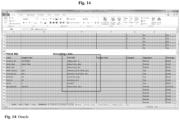
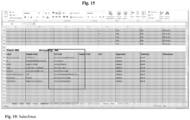
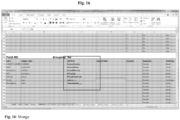
- Figs. 14-16 shown are multiple metadata sheets coming from multiple data sources. See, e.g., Fig. 14 (Oracle), Fig. 15 , (Salesforce), and Fig. 16 (Mongo).
- a cross-database query described herein stores the reference queries as aliased tables like the ones in column D.
- the join points are defined using the Microsoft Excel reference formulas using the equal sign to reference the corresponding field from where that field could potentially pull from.
- the table aliases are the same as the metadata sheet names that were declared above. They match verbatim in name.
- the highlighted cell, F26 contains a formula to another worksheet within labeled "bibomd_sforce" to cell E84. This reference/mapping is used to "join” the resulting datasets aliased in column D as tables.
- the XDB engine needs to construct a brand new result set.
- the new result set is based off the field mappings defined in the metadata sheet.
- the fields are referencing the metadata sheets through the reference formula methodology.
- Fig. 18 if one were to map the AccountNumber as a field from the Salesforce result set, the system would use a reference formula to the "bibomd_sforce" worksheet targeted at cell E90. The mapping process would put together an aggregated result set from the disparate data sources.
Landscapes
- Engineering & Computer Science (AREA)
- Theoretical Computer Science (AREA)
- General Physics & Mathematics (AREA)
- Physics & Mathematics (AREA)
- General Engineering & Computer Science (AREA)
- Health & Medical Sciences (AREA)
- Artificial Intelligence (AREA)
- Audiology, Speech & Language Pathology (AREA)
- Computational Linguistics (AREA)
- General Health & Medical Sciences (AREA)
- Software Systems (AREA)
- Databases & Information Systems (AREA)
- Data Mining & Analysis (AREA)
- Information Retrieval, Db Structures And Fs Structures Therefor (AREA)
- Stored Programmes (AREA)
- Management, Administration, Business Operations System, And Electronic Commerce (AREA)
- Devices For Executing Special Programs (AREA)
Priority Applications (4)
| Application Number | Priority Date | Filing Date | Title |
|---|---|---|---|
| HRP20250753TT HRP20250753T1 (hr) | 2011-12-29 | 2012-12-27 | Programski jezik baziran u proračunskoj tabeli prilagođen za generiranje izvještaja |
| EP25174666.5A EP4571566A3 (en) | 2011-12-29 | 2012-12-27 | Spreadsheet-based programming language adapted for report generation |
| RS20250619A RS67042B1 (sr) | 2011-12-29 | 2012-12-27 | Programski jezik baziran u proračunskoj tabeli prilagođen za generisanje izveštaja |
| SM20250242T SMT202500242T1 (it) | 2011-12-29 | 2012-12-27 | Linguaggio di programmazione basato su fogli di calcolo atto alla generazione di report |
Applications Claiming Priority (2)
| Application Number | Priority Date | Filing Date | Title |
|---|---|---|---|
| US201161581515P | 2011-12-29 | 2011-12-29 | |
| PCT/US2012/071788 WO2013101914A1 (en) | 2011-12-29 | 2012-12-27 | Spreadsheet-based programming language adapted for report generation |
Related Child Applications (1)
| Application Number | Title | Priority Date | Filing Date |
|---|---|---|---|
| EP25174666.5A Division EP4571566A3 (en) | 2011-12-29 | 2012-12-27 | Spreadsheet-based programming language adapted for report generation |
Publications (4)
| Publication Number | Publication Date |
|---|---|
| EP2798487A1 EP2798487A1 (en) | 2014-11-05 |
| EP2798487A4 EP2798487A4 (en) | 2015-09-09 |
| EP2798487C0 EP2798487C0 (en) | 2025-05-07 |
| EP2798487B1 true EP2798487B1 (en) | 2025-05-07 |
Family
ID=48698608
Family Applications (2)
| Application Number | Title | Priority Date | Filing Date |
|---|---|---|---|
| EP12861998.8A Active EP2798487B1 (en) | 2011-12-29 | 2012-12-27 | Spreadsheet-based programming language adapted for report generation |
| EP25174666.5A Pending EP4571566A3 (en) | 2011-12-29 | 2012-12-27 | Spreadsheet-based programming language adapted for report generation |
Family Applications After (1)
| Application Number | Title | Priority Date | Filing Date |
|---|---|---|---|
| EP25174666.5A Pending EP4571566A3 (en) | 2011-12-29 | 2012-12-27 | Spreadsheet-based programming language adapted for report generation |
Country Status (14)
| Country | Link |
|---|---|
| US (1) | US10824802B2 (enExample) |
| EP (2) | EP2798487B1 (enExample) |
| JP (1) | JP6134737B2 (enExample) |
| KR (1) | KR101977972B1 (enExample) |
| CN (1) | CN104285209B (enExample) |
| AU (1) | AU2012362383B2 (enExample) |
| CA (1) | CA2862387C (enExample) |
| ES (1) | ES3032661T3 (enExample) |
| HR (1) | HRP20250753T1 (enExample) |
| HU (1) | HUE072416T2 (enExample) |
| PL (1) | PL2798487T3 (enExample) |
| RS (1) | RS67042B1 (enExample) |
| SM (1) | SMT202500242T1 (enExample) |
| WO (1) | WO2013101914A1 (enExample) |
Families Citing this family (59)
| Publication number | Priority date | Publication date | Assignee | Title |
|---|---|---|---|---|
| US9483456B2 (en) | 2011-09-19 | 2016-11-01 | Jeffrey Dean Honsowetz | Grid data management |
| US9292571B1 (en) * | 2013-01-18 | 2016-03-22 | Microstrategy Incorporated | Joining database tables |
| US9244971B1 (en) | 2013-03-07 | 2016-01-26 | Amazon Technologies, Inc. | Data retrieval from heterogeneous storage systems |
| US9189515B1 (en) * | 2013-03-08 | 2015-11-17 | Amazon Technologies, Inc. | Data retrieval from heterogeneous storage systems |
| US9164977B2 (en) * | 2013-06-24 | 2015-10-20 | International Business Machines Corporation | Error correction in tables using discovered functional dependencies |
| US9600461B2 (en) * | 2013-07-01 | 2017-03-21 | International Business Machines Corporation | Discovering relationships in tabular data |
| USD749612S1 (en) * | 2013-07-19 | 2016-02-16 | Robert Bosch Gmbh | Display screen with a graphical user interface |
| US9830314B2 (en) | 2013-11-18 | 2017-11-28 | International Business Machines Corporation | Error correction in tables using a question and answer system |
| US10013396B2 (en) * | 2015-01-29 | 2018-07-03 | Dropbox, Inc. | Modifying native documents with formulas in a preview |
| US10095740B2 (en) | 2015-08-25 | 2018-10-09 | International Business Machines Corporation | Selective fact generation from table data in a cognitive system |
| JP1553723S (enExample) * | 2015-10-30 | 2016-07-11 | ||
| JP1553722S (enExample) * | 2015-10-30 | 2016-07-11 | ||
| CN105488019B (zh) * | 2015-11-30 | 2018-05-29 | 云南电网有限责任公司电力科学研究院 | 一种电能质量监测装置检测报告自动生成方法 |
| CN106021303B (zh) * | 2016-05-05 | 2019-12-17 | 北京轻元科技有限公司 | 一种用于持续集成报告发布的系统和方法 |
| US10303757B2 (en) * | 2016-08-19 | 2019-05-28 | Cognex Corporation | Apparatuses, systems, and methods for providing a visual program for machine vision systems |
| KR102035277B1 (ko) * | 2016-10-28 | 2019-10-22 | 단국대학교 천안캠퍼스 산학협력단 | 화장품 노출인자 분석 장치 및 방법 |
| CN106446598A (zh) * | 2016-11-15 | 2017-02-22 | 上海派森诺生物科技股份有限公司 | 项目报告自动生成方法 |
| US10216494B2 (en) | 2016-12-03 | 2019-02-26 | Thomas STACHURA | Spreadsheet-based software application development |
| US10540153B2 (en) | 2016-12-03 | 2020-01-21 | Thomas STACHURA | Spreadsheet-based software application development |
| US11726753B2 (en) | 2016-12-03 | 2023-08-15 | Thomas STACHURA | Spreadsheet-based software application development |
| JP1606618S (enExample) * | 2017-09-21 | 2018-06-11 | ||
| US10877735B1 (en) | 2017-09-25 | 2020-12-29 | Amazon Technologies, Inc. | Automated generation of software applications using analysis of submitted content items |
| CN107845033A (zh) * | 2017-11-08 | 2018-03-27 | 上海壹账通金融科技有限公司 | 风控报告生成方法、装置、设备及计算机可读存储介质 |
| US10740550B1 (en) | 2017-11-20 | 2020-08-11 | Amazon Technologies, Inc. | Network-accessible data management service with web-of-sheets data model |
| CA3084152C (en) * | 2017-12-03 | 2023-10-17 | Thomas Stachura | Spreadsheet-based software application development |
| US10705805B1 (en) | 2017-12-12 | 2020-07-07 | Amazon Technologies, Inc. | Application authoring using web-of-sheets data model |
| CN110083339A (zh) * | 2018-01-26 | 2019-08-02 | 拜椰特(上海)软件技术有限公司 | 一种新型计算机编程语言 |
| US11216706B2 (en) * | 2018-03-15 | 2022-01-04 | Datorama Technologies Ltd. | System and method for visually presenting interesting plots of tabular data |
| CN108647196B (zh) * | 2018-04-16 | 2022-10-25 | 北京航空航天大学 | 数字飞行器仿真报告中表格的人工智能生成方法和装置 |
| US11586603B1 (en) | 2018-05-23 | 2023-02-21 | Amazon Technologies, Inc. | Index sheets for robust spreadsheet-based applications |
| CN109241514A (zh) * | 2018-09-10 | 2019-01-18 | 深圳市泰洲科技有限公司 | 数据自动导入方法、装置、计算机设备及存储介质 |
| US11429558B2 (en) * | 2018-10-11 | 2022-08-30 | Dealvector, Inc. | Mapping tests of spreadsheets in server-browser environments |
| US12223262B1 (en) * | 2019-03-27 | 2025-02-11 | Amazon Technologies, Inc. | Expressions management service for data sheet-based applications |
| CN110427599A (zh) * | 2019-06-06 | 2019-11-08 | 北京辰森世纪科技股份有限公司 | 报表小计的统计方法及装置、存储介质、电子装置 |
| CN114270313B (zh) * | 2019-07-22 | 2025-05-02 | 邹明 | 一种计算机实现的方法、计算机程序产品以及物理计算系统 |
| CN111126019B (zh) * | 2019-11-28 | 2024-01-05 | 泰康保险集团股份有限公司 | 基于模式定制的报表生成方法、装置和电子设备 |
| CN111178027B (zh) * | 2019-12-09 | 2023-03-31 | 北京尊冠科技有限公司 | 基于在线创建模板和在线指定数据的报告生成系统和方法 |
| CN111144082B (zh) * | 2019-12-23 | 2023-05-12 | 中国建设银行股份有限公司 | 多表格迭代计算方法、装置、电子设备及存储介质 |
| CN111158650B (zh) * | 2019-12-25 | 2023-06-27 | 中国建设银行股份有限公司 | 报表模板、报表的生成方法、装置 |
| CN111241091B (zh) * | 2019-12-29 | 2023-05-16 | 云帐房网络科技有限公司 | 一种商业报表数据的分布式列式数据存储转换方法及系统 |
| TWI796545B (zh) * | 2020-01-15 | 2023-03-21 | 訊光科技系統股份有限公司 | 文件式智能程式產生方法及其電子裝置 |
| USD974370S1 (en) * | 2020-04-03 | 2023-01-03 | Markup Llc | Display screen portion with graphical user interface |
| CN111680478B (zh) * | 2020-06-17 | 2024-04-16 | 华自科技股份有限公司 | 基于组态软件的报表生成方法、装置、设备和存储介质 |
| CN111723129B (zh) * | 2020-06-24 | 2024-03-29 | 中国工商银行股份有限公司 | 报表生成方法、报表生成装置和电子设备 |
| KR102230729B1 (ko) * | 2020-08-31 | 2021-03-23 | (주)비아이매트릭스 | 템플릿 기반 엑셀 문서 온라인 작업 시스템 |
| CN112233498B (zh) * | 2020-10-14 | 2023-01-06 | 烟台鼎钰电子科技有限公司 | 一种表格式可编程显示控制器 |
| USD957452S1 (en) * | 2020-11-19 | 2022-07-12 | Autel Intelligent Technology Corp., Ltd. | Display screen or portion thereof of a device with transitional graphical user interface |
| CN112541033B (zh) * | 2020-12-01 | 2023-05-05 | 山东师范大学 | Vba栈结构的演示方法、系统、存储介质及计算机设备 |
| KR102499832B1 (ko) * | 2020-12-18 | 2023-02-15 | (주)비아이매트릭스 | 쿼리 바인딩 기능을 구비한 온라인 보고서 작성 시스템 |
| US12450426B1 (en) * | 2020-12-21 | 2025-10-21 | Mehrdad Samadani | Method and system for cellular computation and display |
| US11822878B2 (en) * | 2021-02-24 | 2023-11-21 | Think Research Corporation | Systems, methods and devices for structured dynamic electronic forms |
| US11797430B2 (en) | 2021-12-03 | 2023-10-24 | T-Mobile Usa, Inc. | Configuration-driven data conversion and hosting for software development systems and methods |
| US11599718B1 (en) | 2022-03-23 | 2023-03-07 | Acuitive Solutions, Inc. | Database system for storing electronic spreadsheets |
| CN115169303B (zh) * | 2022-06-16 | 2025-12-16 | 国网福建省电力有限公司经济技术研究院 | 一种报表的生成方法及终端 |
| CN115408453B (zh) * | 2022-09-14 | 2026-01-23 | 中国平安人寿保险股份有限公司 | 一种配置化报表生成方法、装置、计算机设备及存储介质 |
| EP4620173A4 (en) * | 2022-11-15 | 2026-03-04 | Rakuten Mobile Inc | Generation of a Wireless Network Configuration Dump Report |
| CN116306545A (zh) * | 2023-03-16 | 2023-06-23 | 中国建设银行股份有限公司 | 表格生成方法、装置、设备、介质及程序产品 |
| US20250013820A1 (en) * | 2023-07-05 | 2025-01-09 | Adaptam Inc. | Methods and systems for specifying and using in spreadsheet cell formulas joins between data sets |
| CN117454862A (zh) * | 2023-12-25 | 2024-01-26 | 青岛民航凯亚系统集成有限公司 | 一种基于引擎模式的报表生成方法及自助bi系统 |
Family Cites Families (35)
| Publication number | Priority date | Publication date | Assignee | Title |
|---|---|---|---|---|
| JPH11161656A (ja) | 1997-11-27 | 1999-06-18 | Asahi Chem Ind Co Ltd | データベース検索・抽出システムおよびデータベース検索・抽出用制御プログラムを記録した記録媒体 |
| US6078924A (en) * | 1998-01-30 | 2000-06-20 | Aeneid Corporation | Method and apparatus for performing data collection, interpretation and analysis, in an information platform |
| US6631497B1 (en) | 1999-07-19 | 2003-10-07 | International Business Machines Corporation | Binding data from data source to cells in a spreadsheet |
| US6816630B1 (en) * | 2000-05-22 | 2004-11-09 | Electro-Sensors, Inc. | System and method for creating and processing data forms |
| US7251776B2 (en) | 2001-07-13 | 2007-07-31 | Netview Technologies, Inc. | System and method for efficiently and flexibly utilizing spreadsheet information |
| AU2002313103A1 (en) * | 2002-05-16 | 2003-12-02 | Decision Curve Limited | Method and apparatus for automatically producing spreadsheet-based models |
| US20040111666A1 (en) * | 2002-12-05 | 2004-06-10 | Hollcraft James G. | Software replicator functions for generating reports |
| US20040221233A1 (en) | 2003-04-29 | 2004-11-04 | David Thielen | Systems and methods for report design and generation |
| US6965978B2 (en) * | 2003-05-15 | 2005-11-15 | Microsoft Corporation | Memory tracking tool |
| US7197696B1 (en) * | 2003-06-05 | 2007-03-27 | Pavan Vidyadhar Muzumdar | System, method and computer program product to populate data into spreadsheets and execute functions and programs within the same |
| US7694315B2 (en) * | 2004-02-13 | 2010-04-06 | Microsoft Corporation | Schema-based machine generated programming models |
| US20060085444A1 (en) * | 2004-10-19 | 2006-04-20 | Microsoft Corporation | Query consolidation for retrieving data from an OLAP cube |
| US7426688B2 (en) * | 2004-11-02 | 2008-09-16 | Hewlett-Packard Development Company, L.P. | Embedded spreadsheet commands |
| US7487446B2 (en) | 2004-11-10 | 2009-02-03 | Microsoft Corporation | Using a word processor with accounting data |
| US20060107196A1 (en) * | 2004-11-12 | 2006-05-18 | Microsoft Corporation | Method for expanding and collapsing data cells in a spreadsheet report |
| US7647551B2 (en) * | 2004-12-15 | 2010-01-12 | Microsoft Corporation | System and method for formatting a cell in response to data stored in a separate location |
| US20060136436A1 (en) * | 2004-12-22 | 2006-06-22 | At&T Corp. | Arrangement enabling thin client to access and present data in custom defined reports |
| US7792847B2 (en) * | 2005-09-09 | 2010-09-07 | Microsoft Corporation | Converting structured reports to formulas |
| US7805433B2 (en) * | 2005-10-14 | 2010-09-28 | Microsoft Corporation | Multidimensional cube functions |
| JP4140919B2 (ja) * | 2006-03-14 | 2008-08-27 | インターナショナル・ビジネス・マシーンズ・コーポレーション | 表計算などの処理を行うシステムおよびその方法 |
| US20080104542A1 (en) * | 2006-10-27 | 2008-05-01 | Information Builders, Inc. | Apparatus and Method for Conducting Searches with a Search Engine for Unstructured Data to Retrieve Records Enriched with Structured Data and Generate Reports Based Thereon |
| JP2008234370A (ja) * | 2007-03-21 | 2008-10-02 | Just Syst Corp | 文書処理装置及び文書処理方法 |
| US8095870B2 (en) * | 2007-06-06 | 2012-01-10 | Oracle International Corporation | Extensible document transformation language: an innovative way of generating business document and report |
| US20090055341A1 (en) | 2007-08-22 | 2009-02-26 | American Express Travel Related Services Company, Inc. | Regulatory Survey Automation System (RSAS) |
| US8407668B2 (en) * | 2007-10-26 | 2013-03-26 | Microsoft Corporation | Model based spreadsheet scripting language |
| US8341512B2 (en) * | 2007-10-31 | 2012-12-25 | Microsoft Corporation | Method for capturing design-time and run-time formulas associated with a cell |
| US8856182B2 (en) * | 2008-01-25 | 2014-10-07 | Avaya Inc. | Report database dependency tracing through business intelligence metadata |
| US9104738B2 (en) * | 2008-06-19 | 2015-08-11 | Tropare, Inc. | Leveraging collaborative cloud services to build and share apps |
| US8788928B2 (en) * | 2009-07-15 | 2014-07-22 | Clandscale, Inc. | System and methodology for development of stream processing applications utilizing spreadsheet interface |
| AU2010201974A1 (en) * | 2009-10-23 | 2011-05-12 | Iconstruct (Aus) Pty Ltd | System and Method for Managing Information |
| CN102053975A (zh) * | 2009-10-30 | 2011-05-11 | 国际商业机器公司 | 数据库系统和跨数据库查询优化方法 |
| US20110173529A1 (en) * | 2010-01-11 | 2011-07-14 | Microsoft Corporation | Template processing engine for business systems |
| JP2011227631A (ja) * | 2010-04-16 | 2011-11-10 | Wincube Co Ltd | 業務管理用システム |
| US8843814B2 (en) * | 2010-05-26 | 2014-09-23 | Content Catalyst Limited | Automated report service tracking system and method |
| US8677230B2 (en) * | 2011-09-15 | 2014-03-18 | Morgan Stanley | Network-based data consolidation, calculation and reporting engine |
-
2012
- 2012-12-27 EP EP12861998.8A patent/EP2798487B1/en active Active
- 2012-12-27 KR KR1020147021271A patent/KR101977972B1/ko active Active
- 2012-12-27 PL PL12861998.8T patent/PL2798487T3/pl unknown
- 2012-12-27 CN CN201280069713.2A patent/CN104285209B/zh active Active
- 2012-12-27 US US13/728,702 patent/US10824802B2/en active Active
- 2012-12-27 JP JP2014550459A patent/JP6134737B2/ja active Active
- 2012-12-27 AU AU2012362383A patent/AU2012362383B2/en active Active
- 2012-12-27 CA CA2862387A patent/CA2862387C/en active Active
- 2012-12-27 EP EP25174666.5A patent/EP4571566A3/en active Pending
- 2012-12-27 HU HUE12861998A patent/HUE072416T2/hu unknown
- 2012-12-27 RS RS20250619A patent/RS67042B1/sr unknown
- 2012-12-27 WO PCT/US2012/071788 patent/WO2013101914A1/en not_active Ceased
- 2012-12-27 ES ES12861998T patent/ES3032661T3/es active Active
- 2012-12-27 SM SM20250242T patent/SMT202500242T1/it unknown
- 2012-12-27 HR HRP20250753TT patent/HRP20250753T1/hr unknown
Also Published As
| Publication number | Publication date |
|---|---|
| KR20140126311A (ko) | 2014-10-30 |
| KR101977972B1 (ko) | 2019-05-14 |
| EP2798487A1 (en) | 2014-11-05 |
| HRP20250753T1 (hr) | 2025-11-07 |
| EP2798487C0 (en) | 2025-05-07 |
| EP4571566A3 (en) | 2025-09-03 |
| US10824802B2 (en) | 2020-11-03 |
| WO2013101914A1 (en) | 2013-07-04 |
| PL2798487T3 (pl) | 2025-09-08 |
| ES3032661T3 (en) | 2025-07-23 |
| AU2012362383A1 (en) | 2014-07-24 |
| HUE072416T2 (hu) | 2025-11-28 |
| JP6134737B2 (ja) | 2017-05-24 |
| EP2798487A4 (en) | 2015-09-09 |
| EP4571566A2 (en) | 2025-06-18 |
| US20130290822A1 (en) | 2013-10-31 |
| HK1205303A1 (en) | 2015-12-11 |
| CN104285209B (zh) | 2018-01-30 |
| CA2862387A1 (en) | 2013-07-04 |
| CA2862387C (en) | 2023-03-14 |
| CN104285209A (zh) | 2015-01-14 |
| RS67042B1 (sr) | 2025-08-29 |
| JP2015504213A (ja) | 2015-02-05 |
| AU2012362383B2 (en) | 2018-05-10 |
| SMT202500242T1 (it) | 2025-09-12 |
Similar Documents
| Publication | Publication Date | Title |
|---|---|---|
| US10824802B2 (en) | Spreadsheet-based programming language adapted for report generation | |
| CN101971176B (zh) | 用于建立可扩展业务应用的类型系统 | |
| US10025565B2 (en) | Integrated software development environments, systems, methods, and memory models | |
| US9659073B2 (en) | Techniques to extract and flatten hierarchies | |
| US20130166550A1 (en) | Integration of Tags and Object Data | |
| US20110087708A1 (en) | Business object based operational reporting and analysis | |
| US20110072340A1 (en) | Modeling system and method | |
| US8527867B2 (en) | Enabling users to edit very large XML data | |
| US8762934B2 (en) | Method of extensible business object modeling and generation of system artifacts from the models | |
| US20100121883A1 (en) | Reporting language filtering and mapping to dimensional concepts | |
| US20120023130A1 (en) | Facilitation of extension field usage based on reference field usage | |
| US8407235B2 (en) | Exposing and using metadata and meta-metadata | |
| Sattar et al. | Incorporating nosql into a database course | |
| US20230385745A1 (en) | Computer methods and software for processing sap erp tasks | |
| HK1205303B (en) | Spreadsheet-based programming language adapted for report generation | |
| US20070214029A1 (en) | For each item enumerator | |
| US20130086128A1 (en) | Business content hierarchy | |
| Jukić et al. | Framework for integrating process and data logic: Connecting UML use cases and ER diagrams | |
| Raaf | Murphy’s Law in Electronic Lexicography: What Can Go Wrong, Will Go Wrong. Frequent Challenges on the Example of Bavaria’s Dialects Online | |
| CN107992509A (zh) | 职位词典信息的生成方法及装置 | |
| Choo et al. | Data Warehouse Design and Implementation for Research Literature Mining | |
| Sverdlov et al. | Applied software synthesis | |
| Ristić et al. | Form-driven application generating: A case study | |
| Sattar et al. | Bits& Bytes | |
| Westin | An efficient tool for customer data imports into Ipendo Platform |
Legal Events
| Date | Code | Title | Description |
|---|---|---|---|
| REG | Reference to a national code |
Ref country code: HR Ref legal event code: TUEP Ref document number: P20250753T Country of ref document: HR |
|
| PUAI | Public reference made under article 153(3) epc to a published international application that has entered the european phase |
Free format text: ORIGINAL CODE: 0009012 |
|
| 17P | Request for examination filed |
Effective date: 20140710 |
|
| AK | Designated contracting states |
Kind code of ref document: A1 Designated state(s): AL AT BE BG CH CY CZ DE DK EE ES FI FR GB GR HR HU IE IS IT LI LT LU LV MC MK MT NL NO PL PT RO RS SE SI SK SM TR |
|
| DAX | Request for extension of the european patent (deleted) | ||
| RA4 | Supplementary search report drawn up and despatched (corrected) |
Effective date: 20150811 |
|
| RIC1 | Information provided on ipc code assigned before grant |
Ipc: G06F 9/44 20060101AFI20150805BHEP Ipc: G06F 17/30 20060101ALI20150805BHEP Ipc: G06F 17/24 20060101ALI20150805BHEP |
|
| 17Q | First examination report despatched |
Effective date: 20160517 |
|
| STAA | Information on the status of an ep patent application or granted ep patent |
Free format text: STATUS: EXAMINATION IS IN PROGRESS |
|
| REG | Reference to a national code |
Ref country code: DE Ref legal event code: R079 Free format text: PREVIOUS MAIN CLASS: G06F0009440000 Ipc: G06F0009448000 Ref country code: DE Ref legal event code: R079 Ref document number: 602012081504 Country of ref document: DE Free format text: PREVIOUS MAIN CLASS: G06F0009440000 Ipc: G06F0009448000 |
|
| GRAP | Despatch of communication of intention to grant a patent |
Free format text: ORIGINAL CODE: EPIDOSNIGR1 |
|
| STAA | Information on the status of an ep patent application or granted ep patent |
Free format text: STATUS: GRANT OF PATENT IS INTENDED |
|
| RIC1 | Information provided on ipc code assigned before grant |
Ipc: G06F 40/18 20200101ALI20241121BHEP Ipc: G06F 9/448 20180101AFI20241121BHEP |
|
| INTG | Intention to grant announced |
Effective date: 20241205 |
|
| RAP3 | Party data changed (applicant data changed or rights of an application transferred) |
Owner name: BIBO LABS, INC. |
|
| GRAS | Grant fee paid |
Free format text: ORIGINAL CODE: EPIDOSNIGR3 |
|
| GRAA | (expected) grant |
Free format text: ORIGINAL CODE: 0009210 |
|
| STAA | Information on the status of an ep patent application or granted ep patent |
Free format text: STATUS: THE PATENT HAS BEEN GRANTED |
|
| AK | Designated contracting states |
Kind code of ref document: B1 Designated state(s): AL AT BE BG CH CY CZ DE DK EE ES FI FR GB GR HR HU IE IS IT LI LT LU LV MC MK MT NL NO PL PT RO RS SE SI SK SM TR |
|
| REG | Reference to a national code |
Ref country code: GB Ref legal event code: FG4D |
|
| REG | Reference to a national code |
Ref country code: CH Ref legal event code: EP |
|
| REG | Reference to a national code |
Ref country code: DE Ref legal event code: R096 Ref document number: 602012081504 Country of ref document: DE |
|
| REG | Reference to a national code |
Ref country code: IE Ref legal event code: FG4D |
|
| U01 | Request for unitary effect filed |
Effective date: 20250606 |
|
| U07 | Unitary effect registered |
Designated state(s): AT BE BG DE DK EE FI FR IT LT LU LV MT NL PT RO SE SI Effective date: 20250616 |
|
| REG | Reference to a national code |
Ref country code: ES Ref legal event code: FG2A Ref document number: 3032661 Country of ref document: ES Kind code of ref document: T3 Effective date: 20250723 |
|
| RAP4 | Party data changed (patent owner data changed or rights of a patent transferred) |
Owner name: BIBO LABS, INC. |
|
| U1H | Name or address of the proprietor changed after the registration of the unitary effect |
Owner name: BIBO LABS, INC.; US |
|
| RAP4 | Party data changed (patent owner data changed or rights of a patent transferred) |
Owner name: BIBO LABS, INC. |
|
| U1H | Name or address of the proprietor changed after the registration of the unitary effect |
Owner name: BIBO LABS, INC.; US |
|
| REG | Reference to a national code |
Ref country code: SK Ref legal event code: T3 Ref document number: E 46778 Country of ref document: SK |
|
| REG | Reference to a national code |
Ref country code: GR Ref legal event code: EP Ref document number: 20250401578 Country of ref document: GR Effective date: 20251009 |
|
| U20 | Renewal fee for the european patent with unitary effect paid |
Year of fee payment: 14 Effective date: 20251001 |
|
| REG | Reference to a national code |
Ref country code: HR Ref legal event code: T1PR Ref document number: P20250753 Country of ref document: HR |
|
| REG | Reference to a national code |
Ref country code: HU Ref legal event code: AG4A Ref document number: E072416 Country of ref document: HU |
|
| REG | Reference to a national code |
Ref country code: CH Ref legal event code: U11 Free format text: ST27 STATUS EVENT CODE: U-0-0-U10-U11 (AS PROVIDED BY THE NATIONAL OFFICE) Effective date: 20260101 |
|
| REG | Reference to a national code |
Ref country code: HR Ref legal event code: ODRP Ref document number: P20250753 Country of ref document: HR Payment date: 20251119 Year of fee payment: 14 |
|
| PGFP | Annual fee paid to national office [announced via postgrant information from national office to epo] |
Ref country code: IS Payment date: 20251205 Year of fee payment: 14 |
|
| PGFP | Annual fee paid to national office [announced via postgrant information from national office to epo] |
Ref country code: GB Payment date: 20251113 Year of fee payment: 14 |
|
| PGFP | Annual fee paid to national office [announced via postgrant information from national office to epo] |
Ref country code: MC Payment date: 20251113 Year of fee payment: 14 Ref country code: NO Payment date: 20251112 Year of fee payment: 14 |
|
| PGFP | Annual fee paid to national office [announced via postgrant information from national office to epo] |
Ref country code: SM Payment date: 20251112 Year of fee payment: 14 |
|
| PGFP | Annual fee paid to national office [announced via postgrant information from national office to epo] |
Ref country code: HR Payment date: 20251119 Year of fee payment: 14 Ref country code: HU Payment date: 20251211 Year of fee payment: 14 |
|
| PGFP | Annual fee paid to national office [announced via postgrant information from national office to epo] |
Ref country code: TR Payment date: 20251121 Year of fee payment: 14 Ref country code: AL Payment date: 20251118 Year of fee payment: 14 Ref country code: GR Payment date: 20251211 Year of fee payment: 14 |
|
| PGFP | Annual fee paid to national office [announced via postgrant information from national office to epo] |
Ref country code: IE Payment date: 20251110 Year of fee payment: 14 |
|
| PGFP | Annual fee paid to national office [announced via postgrant information from national office to epo] |
Ref country code: PL Payment date: 20251223 Year of fee payment: 14 |
|
| PGFP | Annual fee paid to national office [announced via postgrant information from national office to epo] |
Ref country code: SK Payment date: 20251118 Year of fee payment: 14 |
|
| PGFP | Annual fee paid to national office [announced via postgrant information from national office to epo] |
Ref country code: RS Payment date: 20251118 Year of fee payment: 14 |
|
| PLBE | No opposition filed within time limit |
Free format text: ORIGINAL CODE: 0009261 |
|
| STAA | Information on the status of an ep patent application or granted ep patent |
Free format text: STATUS: NO OPPOSITION FILED WITHIN TIME LIMIT |
|
| REG | Reference to a national code |
Ref country code: CH Ref legal event code: L10 Free format text: ST27 STATUS EVENT CODE: U-0-0-L10-L00 (AS PROVIDED BY THE NATIONAL OFFICE) Effective date: 20260318 |
|
| PGFP | Annual fee paid to national office [announced via postgrant information from national office to epo] |
Ref country code: ES Payment date: 20260121 Year of fee payment: 14 |
|
| 26N | No opposition filed |
Effective date: 20260210 |
|
| PGFP | Annual fee paid to national office [announced via postgrant information from national office to epo] |
Ref country code: CH Payment date: 20260101 Year of fee payment: 14 Ref country code: CZ Payment date: 20251212 Year of fee payment: 14 |
|
| PGFP | Annual fee paid to national office [announced via postgrant information from national office to epo] |
Ref country code: CY Payment date: 20251204 Year of fee payment: 14 |