EP2797147A1 - Solid oxide fuel cell - Google Patents
Solid oxide fuel cell Download PDFInfo
- Publication number
- EP2797147A1 EP2797147A1 EP12860994.8A EP12860994A EP2797147A1 EP 2797147 A1 EP2797147 A1 EP 2797147A1 EP 12860994 A EP12860994 A EP 12860994A EP 2797147 A1 EP2797147 A1 EP 2797147A1
- Authority
- EP
- European Patent Office
- Prior art keywords
- cathode
- standard deviation
- site
- fuel cell
- anode
- Prior art date
- Legal status (The legal status is an assumption and is not a legal conclusion. Google has not performed a legal analysis and makes no representation as to the accuracy of the status listed.)
- Granted
Links
Images



Classifications
-
- H—ELECTRICITY
- H01—ELECTRIC ELEMENTS
- H01M—PROCESSES OR MEANS, e.g. BATTERIES, FOR THE DIRECT CONVERSION OF CHEMICAL ENERGY INTO ELECTRICAL ENERGY
- H01M4/00—Electrodes
- H01M4/86—Inert electrodes with catalytic activity, e.g. for fuel cells
- H01M4/8663—Selection of inactive substances as ingredients for catalytic active masses, e.g. binders, fillers
-
- B—PERFORMING OPERATIONS; TRANSPORTING
- B01—PHYSICAL OR CHEMICAL PROCESSES OR APPARATUS IN GENERAL
- B01J—CHEMICAL OR PHYSICAL PROCESSES, e.g. CATALYSIS OR COLLOID CHEMISTRY; THEIR RELEVANT APPARATUS
- B01J23/00—Catalysts comprising metals or metal oxides or hydroxides, not provided for in group B01J21/00
- B01J23/002—Mixed oxides other than spinels, e.g. perovskite
-
- B—PERFORMING OPERATIONS; TRANSPORTING
- B01—PHYSICAL OR CHEMICAL PROCESSES OR APPARATUS IN GENERAL
- B01J—CHEMICAL OR PHYSICAL PROCESSES, e.g. CATALYSIS OR COLLOID CHEMISTRY; THEIR RELEVANT APPARATUS
- B01J23/00—Catalysts comprising metals or metal oxides or hydroxides, not provided for in group B01J21/00
- B01J23/70—Catalysts comprising metals or metal oxides or hydroxides, not provided for in group B01J21/00 of the iron group metals or copper
- B01J23/76—Catalysts comprising metals or metal oxides or hydroxides, not provided for in group B01J21/00 of the iron group metals or copper combined with metals, oxides or hydroxides provided for in groups B01J23/02 - B01J23/36
- B01J23/83—Catalysts comprising metals or metal oxides or hydroxides, not provided for in group B01J21/00 of the iron group metals or copper combined with metals, oxides or hydroxides provided for in groups B01J23/02 - B01J23/36 with rare earths or actinides
-
- B—PERFORMING OPERATIONS; TRANSPORTING
- B01—PHYSICAL OR CHEMICAL PROCESSES OR APPARATUS IN GENERAL
- B01J—CHEMICAL OR PHYSICAL PROCESSES, e.g. CATALYSIS OR COLLOID CHEMISTRY; THEIR RELEVANT APPARATUS
- B01J35/00—Catalysts, in general, characterised by their form or physical properties
- B01J35/30—Catalysts, in general, characterised by their form or physical properties characterised by their physical properties
- B01J35/33—Electric or magnetic properties
-
- C—CHEMISTRY; METALLURGY
- C04—CEMENTS; CONCRETE; ARTIFICIAL STONE; CERAMICS; REFRACTORIES
- C04B—LIME, MAGNESIA; SLAG; CEMENTS; COMPOSITIONS THEREOF, e.g. MORTARS, CONCRETE OR LIKE BUILDING MATERIALS; ARTIFICIAL STONE; CERAMICS; REFRACTORIES; TREATMENT OF NATURAL STONE
- C04B35/00—Shaped ceramic products characterised by their composition; Ceramics compositions; Processing powders of inorganic compounds preparatory to the manufacturing of ceramic products
- C04B35/01—Shaped ceramic products characterised by their composition; Ceramics compositions; Processing powders of inorganic compounds preparatory to the manufacturing of ceramic products based on oxide ceramics
-
- C—CHEMISTRY; METALLURGY
- C04—CEMENTS; CONCRETE; ARTIFICIAL STONE; CERAMICS; REFRACTORIES
- C04B—LIME, MAGNESIA; SLAG; CEMENTS; COMPOSITIONS THEREOF, e.g. MORTARS, CONCRETE OR LIKE BUILDING MATERIALS; ARTIFICIAL STONE; CERAMICS; REFRACTORIES; TREATMENT OF NATURAL STONE
- C04B35/00—Shaped ceramic products characterised by their composition; Ceramics compositions; Processing powders of inorganic compounds preparatory to the manufacturing of ceramic products
- C04B35/01—Shaped ceramic products characterised by their composition; Ceramics compositions; Processing powders of inorganic compounds preparatory to the manufacturing of ceramic products based on oxide ceramics
- C04B35/26—Shaped ceramic products characterised by their composition; Ceramics compositions; Processing powders of inorganic compounds preparatory to the manufacturing of ceramic products based on oxide ceramics based on ferrites
-
- H—ELECTRICITY
- H01—ELECTRIC ELEMENTS
- H01M—PROCESSES OR MEANS, e.g. BATTERIES, FOR THE DIRECT CONVERSION OF CHEMICAL ENERGY INTO ELECTRICAL ENERGY
- H01M4/00—Electrodes
- H01M4/86—Inert electrodes with catalytic activity, e.g. for fuel cells
- H01M4/90—Selection of catalytic material
- H01M4/9016—Oxides, hydroxides or oxygenated metallic salts
- H01M4/9025—Oxides specially used in fuel cell operating at high temperature, e.g. SOFC
- H01M4/9033—Complex oxides, optionally doped, of the type M1MeO3, M1 being an alkaline earth metal or a rare earth, Me being a metal, e.g. perovskites
-
- H—ELECTRICITY
- H01—ELECTRIC ELEMENTS
- H01M—PROCESSES OR MEANS, e.g. BATTERIES, FOR THE DIRECT CONVERSION OF CHEMICAL ENERGY INTO ELECTRICAL ENERGY
- H01M8/00—Fuel cells; Manufacture thereof
- H01M8/02—Details
- H01M8/0202—Collectors; Separators, e.g. bipolar separators; Interconnectors
- H01M8/0204—Non-porous and characterised by the material
- H01M8/0215—Glass; Ceramic materials
- H01M8/0217—Complex oxides, optionally doped, of the type AMO3, A being an alkaline earth metal or rare earth metal and M being a metal, e.g. perovskites
-
- B—PERFORMING OPERATIONS; TRANSPORTING
- B01—PHYSICAL OR CHEMICAL PROCESSES OR APPARATUS IN GENERAL
- B01J—CHEMICAL OR PHYSICAL PROCESSES, e.g. CATALYSIS OR COLLOID CHEMISTRY; THEIR RELEVANT APPARATUS
- B01J2523/00—Constitutive chemical elements of heterogeneous catalysts
-
- B—PERFORMING OPERATIONS; TRANSPORTING
- B01—PHYSICAL OR CHEMICAL PROCESSES OR APPARATUS IN GENERAL
- B01J—CHEMICAL OR PHYSICAL PROCESSES, e.g. CATALYSIS OR COLLOID CHEMISTRY; THEIR RELEVANT APPARATUS
- B01J27/00—Catalysts comprising the elements or compounds of halogens, sulfur, selenium, tellurium, phosphorus or nitrogen; Catalysts comprising carbon compounds
- B01J27/14—Phosphorus; Compounds thereof
- B01J27/186—Phosphorus; Compounds thereof with arsenic, antimony, bismuth, vanadium, niobium, tantalum, polonium, chromium, molybdenum, tungsten, manganese, technetium or rhenium
- B01J27/188—Phosphorus; Compounds thereof with arsenic, antimony, bismuth, vanadium, niobium, tantalum, polonium, chromium, molybdenum, tungsten, manganese, technetium or rhenium with chromium, molybdenum, tungsten or polonium
-
- C—CHEMISTRY; METALLURGY
- C04—CEMENTS; CONCRETE; ARTIFICIAL STONE; CERAMICS; REFRACTORIES
- C04B—LIME, MAGNESIA; SLAG; CEMENTS; COMPOSITIONS THEREOF, e.g. MORTARS, CONCRETE OR LIKE BUILDING MATERIALS; ARTIFICIAL STONE; CERAMICS; REFRACTORIES; TREATMENT OF NATURAL STONE
- C04B2235/00—Aspects relating to ceramic starting mixtures or sintered ceramic products
- C04B2235/02—Composition of constituents of the starting material or of secondary phases of the final product
- C04B2235/30—Constituents and secondary phases not being of a fibrous nature
- C04B2235/32—Metal oxides, mixed metal oxides, or oxide-forming salts thereof, e.g. carbonates, nitrates, (oxy)hydroxides, chlorides
- C04B2235/3205—Alkaline earth oxides or oxide forming salts thereof, e.g. beryllium oxide
- C04B2235/3213—Strontium oxides or oxide-forming salts thereof
-
- C—CHEMISTRY; METALLURGY
- C04—CEMENTS; CONCRETE; ARTIFICIAL STONE; CERAMICS; REFRACTORIES
- C04B—LIME, MAGNESIA; SLAG; CEMENTS; COMPOSITIONS THEREOF, e.g. MORTARS, CONCRETE OR LIKE BUILDING MATERIALS; ARTIFICIAL STONE; CERAMICS; REFRACTORIES; TREATMENT OF NATURAL STONE
- C04B2235/00—Aspects relating to ceramic starting mixtures or sintered ceramic products
- C04B2235/02—Composition of constituents of the starting material or of secondary phases of the final product
- C04B2235/30—Constituents and secondary phases not being of a fibrous nature
- C04B2235/32—Metal oxides, mixed metal oxides, or oxide-forming salts thereof, e.g. carbonates, nitrates, (oxy)hydroxides, chlorides
- C04B2235/3224—Rare earth oxide or oxide forming salts thereof, e.g. scandium oxide
- C04B2235/3227—Lanthanum oxide or oxide-forming salts thereof
-
- C—CHEMISTRY; METALLURGY
- C04—CEMENTS; CONCRETE; ARTIFICIAL STONE; CERAMICS; REFRACTORIES
- C04B—LIME, MAGNESIA; SLAG; CEMENTS; COMPOSITIONS THEREOF, e.g. MORTARS, CONCRETE OR LIKE BUILDING MATERIALS; ARTIFICIAL STONE; CERAMICS; REFRACTORIES; TREATMENT OF NATURAL STONE
- C04B2235/00—Aspects relating to ceramic starting mixtures or sintered ceramic products
- C04B2235/02—Composition of constituents of the starting material or of secondary phases of the final product
- C04B2235/30—Constituents and secondary phases not being of a fibrous nature
- C04B2235/32—Metal oxides, mixed metal oxides, or oxide-forming salts thereof, e.g. carbonates, nitrates, (oxy)hydroxides, chlorides
- C04B2235/327—Iron group oxides, their mixed metal oxides, or oxide-forming salts thereof
- C04B2235/3275—Cobalt oxides, cobaltates or cobaltites or oxide forming salts thereof, e.g. bismuth cobaltate, zinc cobaltite
-
- C—CHEMISTRY; METALLURGY
- C04—CEMENTS; CONCRETE; ARTIFICIAL STONE; CERAMICS; REFRACTORIES
- C04B—LIME, MAGNESIA; SLAG; CEMENTS; COMPOSITIONS THEREOF, e.g. MORTARS, CONCRETE OR LIKE BUILDING MATERIALS; ARTIFICIAL STONE; CERAMICS; REFRACTORIES; TREATMENT OF NATURAL STONE
- C04B2235/00—Aspects relating to ceramic starting mixtures or sintered ceramic products
- C04B2235/02—Composition of constituents of the starting material or of secondary phases of the final product
- C04B2235/30—Constituents and secondary phases not being of a fibrous nature
- C04B2235/32—Metal oxides, mixed metal oxides, or oxide-forming salts thereof, e.g. carbonates, nitrates, (oxy)hydroxides, chlorides
- C04B2235/327—Iron group oxides, their mixed metal oxides, or oxide-forming salts thereof
- C04B2235/3279—Nickel oxides, nickalates, or oxide-forming salts thereof
-
- C—CHEMISTRY; METALLURGY
- C04—CEMENTS; CONCRETE; ARTIFICIAL STONE; CERAMICS; REFRACTORIES
- C04B—LIME, MAGNESIA; SLAG; CEMENTS; COMPOSITIONS THEREOF, e.g. MORTARS, CONCRETE OR LIKE BUILDING MATERIALS; ARTIFICIAL STONE; CERAMICS; REFRACTORIES; TREATMENT OF NATURAL STONE
- C04B2235/00—Aspects relating to ceramic starting mixtures or sintered ceramic products
- C04B2235/02—Composition of constituents of the starting material or of secondary phases of the final product
- C04B2235/50—Constituents or additives of the starting mixture chosen for their shape or used because of their shape or their physical appearance
- C04B2235/54—Particle size related information
- C04B2235/5418—Particle size related information expressed by the size of the particles or aggregates thereof
- C04B2235/5436—Particle size related information expressed by the size of the particles or aggregates thereof micrometer sized, i.e. from 1 to 100 micron
-
- C—CHEMISTRY; METALLURGY
- C04—CEMENTS; CONCRETE; ARTIFICIAL STONE; CERAMICS; REFRACTORIES
- C04B—LIME, MAGNESIA; SLAG; CEMENTS; COMPOSITIONS THEREOF, e.g. MORTARS, CONCRETE OR LIKE BUILDING MATERIALS; ARTIFICIAL STONE; CERAMICS; REFRACTORIES; TREATMENT OF NATURAL STONE
- C04B2235/00—Aspects relating to ceramic starting mixtures or sintered ceramic products
- C04B2235/02—Composition of constituents of the starting material or of secondary phases of the final product
- C04B2235/50—Constituents or additives of the starting mixture chosen for their shape or used because of their shape or their physical appearance
- C04B2235/54—Particle size related information
- C04B2235/5418—Particle size related information expressed by the size of the particles or aggregates thereof
- C04B2235/5445—Particle size related information expressed by the size of the particles or aggregates thereof submicron sized, i.e. from 0,1 to 1 micron
-
- C—CHEMISTRY; METALLURGY
- C04—CEMENTS; CONCRETE; ARTIFICIAL STONE; CERAMICS; REFRACTORIES
- C04B—LIME, MAGNESIA; SLAG; CEMENTS; COMPOSITIONS THEREOF, e.g. MORTARS, CONCRETE OR LIKE BUILDING MATERIALS; ARTIFICIAL STONE; CERAMICS; REFRACTORIES; TREATMENT OF NATURAL STONE
- C04B2235/00—Aspects relating to ceramic starting mixtures or sintered ceramic products
- C04B2235/70—Aspects relating to sintered or melt-casted ceramic products
- C04B2235/72—Products characterised by the absence or the low content of specific components, e.g. alkali metal free alumina ceramics
-
- C—CHEMISTRY; METALLURGY
- C04—CEMENTS; CONCRETE; ARTIFICIAL STONE; CERAMICS; REFRACTORIES
- C04B—LIME, MAGNESIA; SLAG; CEMENTS; COMPOSITIONS THEREOF, e.g. MORTARS, CONCRETE OR LIKE BUILDING MATERIALS; ARTIFICIAL STONE; CERAMICS; REFRACTORIES; TREATMENT OF NATURAL STONE
- C04B2235/00—Aspects relating to ceramic starting mixtures or sintered ceramic products
- C04B2235/70—Aspects relating to sintered or melt-casted ceramic products
- C04B2235/72—Products characterised by the absence or the low content of specific components, e.g. alkali metal free alumina ceramics
- C04B2235/725—Metal content
-
- C—CHEMISTRY; METALLURGY
- C04—CEMENTS; CONCRETE; ARTIFICIAL STONE; CERAMICS; REFRACTORIES
- C04B—LIME, MAGNESIA; SLAG; CEMENTS; COMPOSITIONS THEREOF, e.g. MORTARS, CONCRETE OR LIKE BUILDING MATERIALS; ARTIFICIAL STONE; CERAMICS; REFRACTORIES; TREATMENT OF NATURAL STONE
- C04B2235/00—Aspects relating to ceramic starting mixtures or sintered ceramic products
- C04B2235/70—Aspects relating to sintered or melt-casted ceramic products
- C04B2235/72—Products characterised by the absence or the low content of specific components, e.g. alkali metal free alumina ceramics
- C04B2235/727—Phosphorus or phosphorus compound content
-
- C—CHEMISTRY; METALLURGY
- C04—CEMENTS; CONCRETE; ARTIFICIAL STONE; CERAMICS; REFRACTORIES
- C04B—LIME, MAGNESIA; SLAG; CEMENTS; COMPOSITIONS THEREOF, e.g. MORTARS, CONCRETE OR LIKE BUILDING MATERIALS; ARTIFICIAL STONE; CERAMICS; REFRACTORIES; TREATMENT OF NATURAL STONE
- C04B2235/00—Aspects relating to ceramic starting mixtures or sintered ceramic products
- C04B2235/70—Aspects relating to sintered or melt-casted ceramic products
- C04B2235/74—Physical characteristics
- C04B2235/76—Crystal structural characteristics, e.g. symmetry
- C04B2235/768—Perovskite structure ABO3
-
- H—ELECTRICITY
- H01—ELECTRIC ELEMENTS
- H01M—PROCESSES OR MEANS, e.g. BATTERIES, FOR THE DIRECT CONVERSION OF CHEMICAL ENERGY INTO ELECTRICAL ENERGY
- H01M8/00—Fuel cells; Manufacture thereof
- H01M8/10—Fuel cells with solid electrolytes
- H01M8/12—Fuel cells with solid electrolytes operating at high temperature, e.g. with stabilised ZrO2 electrolyte
- H01M2008/1293—Fuel cells with solid oxide electrolytes
-
- H—ELECTRICITY
- H01—ELECTRIC ELEMENTS
- H01M—PROCESSES OR MEANS, e.g. BATTERIES, FOR THE DIRECT CONVERSION OF CHEMICAL ENERGY INTO ELECTRICAL ENERGY
- H01M8/00—Fuel cells; Manufacture thereof
- H01M8/02—Details
- H01M8/0202—Collectors; Separators, e.g. bipolar separators; Interconnectors
-
- Y—GENERAL TAGGING OF NEW TECHNOLOGICAL DEVELOPMENTS; GENERAL TAGGING OF CROSS-SECTIONAL TECHNOLOGIES SPANNING OVER SEVERAL SECTIONS OF THE IPC; TECHNICAL SUBJECTS COVERED BY FORMER USPC CROSS-REFERENCE ART COLLECTIONS [XRACs] AND DIGESTS
- Y02—TECHNOLOGIES OR APPLICATIONS FOR MITIGATION OR ADAPTATION AGAINST CLIMATE CHANGE
- Y02E—REDUCTION OF GREENHOUSE GAS [GHG] EMISSIONS, RELATED TO ENERGY GENERATION, TRANSMISSION OR DISTRIBUTION
- Y02E60/00—Enabling technologies; Technologies with a potential or indirect contribution to GHG emissions mitigation
- Y02E60/30—Hydrogen technology
- Y02E60/50—Fuel cells
Definitions
- the present invention relates to a solid oxide fuel cell.
- Patent Literature 1 discloses the use of an LSCF powder as a raw material powder for the cathode of a solid oxide fuel cell (SOFC).
- SOFC solid oxide fuel cell
- Patent Literature 1 JPA-2006-32132
- the available voltage may be reduced during repeated power generation using the fuel cell.
- the present inventors gained the new insight that one cause of this reduction in output is deterioration of the cathode.
- the technique disclosed herein is based on this new insight and addresses the problem of providing a solid oxide fuel cell that inhibits deterioration of a cathode.
- the present inventors conducted diligent research into solving the above problem and as a result gained the insight that the deterioration of a cathode can be suppressed by increasing the uniformity of the concentration of the cathode components.
- the solid oxide fuel cell disclosed herein includes a cathode, an anode and a solid electrolyte disposed between the cathode and the anode.
- the cathode contains a complex oxide having a perovskite structure expressed by the general formula ABO 3 .
- the standard deviation value of the atomic percentage of each element in the A site measured at the sectional surface of the cathode using energy dispersive X-ray spectroscopy at 10 spots in a single field is no more than 10.4.
- the technique disclosed herein provides a solid oxide fuel cell that enables suppression of deterioration of a cathode.
- the electrode material includes a complex oxide having a perovskite structure.
- the electrode material may include components other than a complex oxide.
- the electrode material according to the present embodiment is suitably used as a material to configure the cathode of the solid oxide fuel cell.
- the composition of the complex oxide is expressed by the general formula ABO 3 . Furthermore, at least one of La and Sr may be contained in the A site.
- An actual example of this type of complex oxide for use as a cathode material includes LSCF, that is to say, (La, Sr)(Co, Fe)O 3 , LSF that is to say, (La, Sr) FeO 3 , LSC that is to say, (La, Sr)CoO 3 , LNF that is to say, La(Ni, Fe)O 3 , SSC that is to say, (Sm, Sr)CoO 3 , and the like.
- These complex oxides are materials that combine characteristics related to oxygen ion conductivity and electron conductivity, and are termed mixed conducting materials.
- the electrode material may include the complex oxide as a "principal component".
- the feature "include as a principal component" when a composition X contains a material Y means that the material Y comprises preferably at least 60 wt% overall of composition X, more preferably 70 wt%, and still more preferably at least 90 wt% of the overall composition X.
- the electrode material may be configured as a powder (for example, with an average particle diameter of about 1 micrometer to 5 micrometers) or a disintegrated product (for example, with an average particle diameter of about 5 micrometers to 500 micrometers), or may be a agglomerate that is larger than the disintegrated product.
- the electrode material preferably includes a highly uniform composition distribution. More specifically, a value of the standard deviation for the atomic percentage of respective elements contained at the A site are acquired by use of energy dispersive X-ray spectroscopy (EDS) at 10 spots in an arbitrary field in the electrode material is preferably no more than 10.3. Furthermore, the atomic percentage of the respective elements contained at the B site is acquired, and when the standard deviation of the atomic percentage is calculated, the standard deviation at the B site is preferably no more than 5.03.
- EDS energy dispersive X-ray spectroscopy
- n types of elements A1, A2, A3,...An are contained at the A site.
- the value of the standard deviation for the atomic percentage of the respective elements is acquired with reference to the atomic percentage obtained at 10 spots, if the value of the standard deviation for the atomic percentage for the element A1 is larger than the respective values for the standard deviation of the elements A2 - An, it is preferred that the value of the standard deviation of the element A1 is no more than 10.3.
- the arbitrary field as used herein is suitably within a range observed by an electron microscope such as an electron probe micro analyzer (EPMA) or a scanning electron microscope (SEM), or the like with a magnification of 100 times to 5000 times.
- the analysis spot size of the respective 10 spots may be no more than 1 micrometer.
- magnification of the electron microscope is in the range of 100 times to 5000 times.
- the position of the 10 spots may be selected for example on the basis of the concentration level in 10 stages that are determined in response to the distribution of the atomic percentages measured using an electron probe micro analyzer (EPMA).
- the concentration level in the 10 stages is preferably set with reference to substantially the entire range of the distribution of the atomic percentages.
- the concentration level in the 10 stages can be set by creating 10 divisions in the interval between the maximum value and the minimum value in the characteristic X-ray intensity in the arbitrary field.
- the ideal unit lattice for the complex oxide having a perovskite structure expressed by the general formula ABO 3 is in the shape of a cube.
- An A element is disposed at the corner of the unit lattice, and a B element is disposed in the body center of the unit lattice.
- the oxygen element is disposed at the face center of the unit lattice.
- the position of the corner of the unit lattice at which the A element is disposed is termed the "A site”
- the position of the corner of the unit lattice at which the B element is disposed is termed the "B site”.
- the method of manufacture includes acquisition of a complex oxide compound having a perovskite structure.
- the method of obtaining the complex oxide compound includes a solid phase method, a liquid phase method (citrate process, Pechini method, co-precipitation method) or the like.
- a “solid phase method” refers to a method in which a mixture obtained by mixing a starting material (powder) including constituent elements at a predetermined ratio is fired, and then subjected to comminution to obtain the target material.
- a “liquid phase method,” is a method for obtaining a target material that includes the steps of dissolving a starting material including constituent elements into a solution, obtaining a precursor of the target material from the solution by precipitation or the like, and then performing drying, firing and comminution.
- FIG. 1 is a flowchart describing a method of manufacturing an electrode material using a solid phase method.
- a starting material is prepared according to the type of complex oxide.
- La 2 O 3 , SrCO 3 , Co 3 O 4 and Fe 2 O 3 are prepared.
- the average particle diameter of La 2 O 3 may be 0.1 micrometer to 0.7 micrometer
- the average particle diameter of SrCO 3 may be 0.1 micrometer to 0.5 micrometer
- the average particle diameter of Co 3 O 4 may be 0.1 micrometer to 1.0 micrometer
- the average particle diameter of Fe 2 O 3 may be 0.1 micrometer to 0.8 micrometer.
- the particle size distribution of the starting material is controlled. More specifically, it is desirable that coarse particles of greater than or equal to 20 micrometers are removed in advance by use of an air classifier or the like. The removal of coarse particles is effective for uniformity when executing mixing and synthesizing in subsequent steps.
- step S102 the starting materials are classified. More specifically, for example, the specific surface area of each starting material is adjusted by classification using an air classifier or example.
- the specific surface area of La 2 O 3 is adjusted to 1 m 2 /g to 5 m 2 /g
- the specific surface area of SrCO 3 is adjusted to 1 m 2 /g to 7 m 2 /g
- the specific surface area of Co 3 O 4 is adjusted to 1 m 2 /g to 7 m 2 /g
- the specific surface area of Fe 2 O 3 is adjusted to 1 m 2 /g to 10 m 2 /g.
- the respective starting materials are mixed at a predetermined mixing ratio.
- the mixing process preferably includes the steps of weighing the respective starting materials at a predetermined mixing ratio and placing the materials into a pot mill together with pebbles (for example, application is possible of the pebbles used in the manufacture of zirconia or alumina), rotating the pot mill for a predetermined time (10hrs to 120 hrs) in a dry state and then introducing a predetermined amount (weight ratio relative to the starting material of 50% to 200%) of solvent (for example, when using an aqueous solvent, ion-exchanged water may be used, and when using a solvent-based material, acetone may be used), and rotating the pot mill further for a predetermined time (10hr to 300hr) in a wet state.
- solvent for example, when using an aqueous solvent, ion-exchanged water may be used, and when using a solvent-based material, acetone may be used
- the pebbles preferably have a diameter of 0.5 mm to 5 mm, and are preferably adjusted to 0.5 to 3 times the weight of the starting material powder.
- the additives are phosphorus (P), chrome (Cr), and boron (B).
- P phosphorus
- Cr chrome
- B boron
- the added amount of P is preferably at least 1 ppm to no more than 50 ppm in a weight ratio relative to the starting materials, and more preferably at least 1 ppm and no more than 30 ppm.
- the added amount of Cr is preferably at least 1 ppm to no more than 500 ppm in a weight ratio relative to the starting materials, and more preferably at least 1 ppm and no more than 100 ppm.
- the added amount of B is preferably at least 1 ppm to no more than 50 ppm in a weight ratio relative to the starting materials, and more preferably at least 1 ppm and no more than 10 ppm.
- the additives are preferably added as oxides.
- the additives have the function of creating a uniform dispersion and mixture in the constituent components.
- an important factor in the control (uniformity) of the composition distribution of the electrode material is the combination of a process of wet mixing in later steps.
- the mixing ratio of each starting material when manufacturing LSCF as a complex oxide may be performed by adjusting the starting material ratio of La 2 O 3 , SrCO 3 , Co 3 O 4 and Fe 2 O 3 in accordance with the composition of the complex oxide.
- the electrode material is synthesized by firing of the starting materials mixed in the pot mill.
- the synthesis conditions may be suitably adjusted within a range of a synthesis temperature of 900 degrees C to 1400 degrees C and a synthesis time of 1 to 30 hrs in an oxidizing atmosphere.
- step S105 the electrode material in a synthesized agglomerated configuration is subjected to comminution. More specifically, the average particle diameter of the electrode material is adjusted to 0.3 micrometers to 1.2 micrometers by introducing the electrode material with pebbles (for example, application is possible of the pebbles used in the manufacture of zirconia or alumina) into the pot mill and rotating for a predetermined time (5 hrs to 20 hrs). Furthernore, prior to comminution, the electrode material in an agglomerated configuration may be subjected to preparatory disintegration.
- pebbles for example, application is possible of the pebbles used in the manufacture of zirconia or alumina
- step S106 the electrode material after comminution is classified. More specifically, the specific surface area of each starting material is adjusted by classification using an air classifier or the like. When manufacturing LSCF as a complex oxide, the specific surface area is adjusted to 3 m 2 /g to 12 m 2 /g.
- FIG. 2 is a flowchart describing a method of manufacturing an electrode material using a liquid-phase method.
- step S201 a starting material is prepared corresponding to the type of complex oxide.
- LSCF LSCF as the complex oxide by use of a co-precipitation method or citrate method
- La(NO 3 ) 3 • 6H 2 O, Sr(NO 3 ) 2 , Co(NO 3 ) 3 • 9H 2 O and Fe(NO 3 ) 3 • 9H 2 O are prepared.
- the average particle diameter of La(NO 3 ) 3 • 6H 2 O may be 0.3 micrometers to 0.6 micrometers
- the average particle diameter of Sr(NO 3 ) 2 may be 0.1 micrometers to 0.4 micrometers
- the average particle diameter of Co(NO 3 ) 3 • 9H 2 O may be 0.2 micrometers to 0.5 micrometers
- the average particle diameter of Fe(NO 3 ) 3 • 9H 2 O may be 0.3 micrometers to 0.8 micrometers.
- La 2 O 3 , SrO 3 , Co 3 O 4 and Fe(NO 3 ) 3 • 9H 2 O are prepared to have the above average particle diameter.
- controlling the particle size distribution of the starting materials is important. More specifically, it is desirable to remove coarse particles of greater than or equal to 15 micrometers in advance by use of an air classifier. The removal of coarse particles is effective for uniformity when executing mixing and synthesizing (calcinating) in subsequent steps.
- step S202 the starting materials are classified. More specifically, for example, the specific surface area of each starting material is adjusted by classification using an air classifier.
- the specific surface area of La(NO 3 ) 3 • 6H 2 O is adjusted to 2 m 2 /g - 8 m 2 /g
- the specific surface area of Sr(NO 3 ) is adjusted to 1 m 2 /g - 5 m 2 /g
- the specific surface area of Co(NO 3 ) 3 • 9H 2 O is adjusted to 2 m 2 /g - 5 m 2 /g
- the specific surface area of Fe(NO 3 ) 3 • 9H 2 O is adjusted to 3 m 2 /g - 10 m 2 /g.
- the respective starting materials are mixed at a predetermined mixing ratio. More specifically, when manufacturing LSCF by use of co-precipitation, after dissolving the starting materials in a pure state to prepare a 0.2M aqueous solution, an aqueous nitrate solution is added while stirring in a precipitation agent.
- an aqueous nitrate solution is added while stirring in a precipitation agent.
- the respective starting materials are dissolved in a pure state and citric acid is added until all the metal is precipitated, and the viscosity is adjusted by use of heating after immersion to approximately 60 degrees C to dehydrate.
- citric acid and ethylene glycol are added.
- the additives are phosphorus (P), chrome (Cr), and boron (B).
- the concentration of P contained in the additive is preferably at least 1 ppm to no more than 50 ppm in a weight ratio relative to the starting materials, and more preferably at least 1 ppm and no more than 30 ppm.
- the concentration of Cr contained in the additive is preferably at least 1 ppm to no more than 500 ppm in a weight ratio relative to the starting materials, and more preferably at least 1 ppm and no more than 100 ppm.
- the concentration of B contained in the additive is preferably at least 1 ppm to no more than 50 ppm in a weight ratio relative to the starting materials, and more preferably at least 1 ppm and no more than 10 ppm.
- the additives have the function of creating a uniform dispersion and mixture in the constituent components, or during thermal synthesis processes, and non-uniformity in each of the elements (for example, resulting from phase splitting, heterogeneous phase precipitation, or the like) can be inhibited as a result of these additives. As a result, uniformity of the composition distribution of the electrode material is enabled by suitable control of the added amount of the additives.
- step S204 the aqueous solution prepared in step S203 is dried.
- vacuum drying is used at approximately 110 degrees C
- drying is performed at approximately 70 degrees C
- drying is performed at approximately 200 degrees C.
- the electrode material is synthesized by firing of the dried starting materials.
- the synthesis conditions are suitably adjusted within a range of a synthesis temperature of 900 degrees C to 1400 degrees C and a synthesis time of 1 to 30 hrs in an oxidizing atmosphere.
- step S206 the electrode material that is in a configuration of a synthesized agglomerate is subjected to comminution.
- step S207 the electrode material after comminution is classified. The details of these steps are the same as steps S105 and S106 described above.
- a solid oxide fuel cell is an example of a fuel cell.
- a SOFC will be mainly described that has a cell stack structure in which a plurality of fuel cells are stacked.
- the fuel cell 10 includes a fuel cell (hereinafter simply referred to as "cell") 1, and a current collecting member 4.
- cell a fuel cell
- current collecting member 4 a current collecting member
- the cell 1 is a thin ceramic plate.
- the thickness of the cell 1 is for example 30 micrometers to 700 micrometers, and the diameter of the cell 1 is for example 5 mm to 50 mm.
- the cell 1 as illustrated in FIG. 3 includes an anode 11, a barrier layer 13, a cathode 14, and an electrolyte layer 15 (solid electrolyte layer).
- the material used in the anode 11 for example includes a material used in the formation of the anode in a known fuel cell. More specifically, the material used in the anode 11 may include NiO - YSZ (nickel oxide - yttria-stabilized zirconia) and/or NiO-Y 2 O 3 (nickel oxide - yttria). The anode 11 may include these materials as a main component. The anode 11 functions as the anode.
- the anode 11 may function as a base plate that supports the other layers included in the cell 1 (in other words, a support body). That is to say, the thickness of the anode 11 may have the maximum thickness of the plurality of layers contained in the cell 1. More specifically, the thickness of the anode 11 is of the order of 10 micrometers to 600 micrometers.
- the anode 11 can be imparted with conductive properties by application of a reduction treatment (for example, a treatment of reducing NiO to Ni).
- a reduction treatment for example, a treatment of reducing NiO to Ni.
- the anode 11 may include at least two layers.
- the anode 11 may have two layers, that is to say, a base plate and an anode-active layer (fuel-side electrode) formed thereon.
- the material in the base plate is configured by a material that includes properties such as electron conductivity.
- the anode-active layer is configured by a material that includes properties such as electron conductivity and properties such as oxidizing ion (oxygen ion) conductivity.
- the "proportion of the volume of material that has oxidizing ion (oxygen ion) conductivity relative to the total volume excluding the pores" in the anode active layer is greater than the "proportion of the volume of material that has oxidizing ion (oxygen ion) conductivity relative to the total volume excluding the pores" in the base plate.
- the material in the base plate and the anode active layer can be selected from the materials for the anode 11 described above. More specifically, a combination is possible of a base plate configured from NiO-Y 2 O 3 and the anode active layer configured by NiO-YSZ.
- the barrier layer 13 is provided between the cathode 14 and the anode 11, and more specifically, is provided between the cathode 14 and the electrolyte layer 15.
- the barrier layer 13 includes cerium.
- the barrier layer may include cerium as the ceria (cerium oxide). More specifically, materials that are used in the barrier layer 13 include ceria and ceria-based materials including rare-earth metal oxides configured as a solid solution in ceria.
- the barrier layer 13 may include a ceria-based material as a main component.
- the ceria-based material includes GDC ((Ce, Gd)O 2 : gadolinium doped ceria), and SDC ((Ce, Sm)O 2 : samarium doped ceria).
- the concentration of the rare earth metal in the ceria-based material is preferably 5 to 20 mol%.
- the barrier layer 13 may include an additive in addition to a ceria-based material.
- the thickness of the barrier layer 13 is no more than 30 micrometers.
- the barrier layer 13 suppresses the diffusion of cations from the cathode 14 into the electrolyte layer 15. As a result, the barrier layer 13 enables suppression of a reduction in the output density, and increases the product life of the cell 1.
- the cathode 14 contains a complex oxide having a perovskite structure expressed by the general formula ABO 3 .
- This type of complex oxide is preferably the electrode material that was described in Section 1 above. More specifically, the complex oxide includes LSCF, LSF, LSC, LNF, SSC, or the like.
- the cathode 14 may include components other than the above types of complex oxide.
- the cathode 14 may be configured as a composite with the material (ceria or zirconia, or the like) of the electrolyte layer 15 described below.
- the composition distribution of the cathode 14 is preferably exhibits a highly uniform configuration. More specifically, in an arbitrary field on a sectional surface of the cathode 14, the respective atomic percentages of each element contained at the A site is acquired using EDS at 10 spots, and when the standard deviation of the atomic percentage is calculated, it is preferred that the standard deviation value of the A site is no more than 10.4. For example, it is assumed that n types of elements A1, A2, A3,...An are present at the A site.
- the standard deviation value of the atomic percentage of each element is acquired based on the atomic percentage obtained at 10 spots, it is preferred that the standard deviation value of the atomic percentage of element A1, and the standard deviation value of the atomic percentage of the element A1 when larger than the standard deviation value respectively of A2 to An is no more than 10.4.
- the cathode 14 when the cathode 14 contains a component other than the complex oxide, the standard deviation of the atomic percentage of the elements contained at the A site of the complex oxide may be more no more than 10.4. Therefore, when the cathode 14 is configured from a composite of the material of the electrolyte layer 15 and the complex oxide, only the complex oxide that is present on the sectional surface of the cathode 14 may be selected and observed.
- An arbitrary field may be defined as the range that can be observed at a magnification of 100x to 5000x when using an electron microscope such as an SEM, EPMA, or the like.
- the analysis spot size of the respective 10 spots may have a configuration of less than or equal to 1 micron.
- the position of the 10 spots may be selected in response to the concentration level of the 10 stages for example set based on the distribution of the atomic percentage measured using EPMA. In other words, the concentration level in the 10 stages may be set by dividing into 10 the interval between the maximum value and the minimum value of the specific X-ray intensity in an arbitrary field.
- the cathode 14 is preferably includes an additive (P, Cr, and B) at a predetermined weight ratio relative to the total weight of the electrode material.
- the content amount of P is preferably at least 1 ppm to no more than 50 ppm in a weight ratio relative to the starting materials, and more preferably at least 1 ppm and no more than 30 ppm.
- the content amount of Cr is preferably at least 1 ppm to no more than 500 ppm in a weight ratio relative to the starting materials, and more preferably at least 1 ppm and no more than 100 ppm.
- the content amount of B is preferably at least 1 ppm to no more than 50 ppm in a weight ratio relative to the starting materials, and more preferably at least 1 ppm and no more than 10 ppm.
- the cathode 14 may include additives other than P, Cr and B, and for example, the cathode 14 may include trace amounts of Na, Mg, Al, Si, Ca, Sc, Ti, Ni, Zn, Y, Zr, Ba, Ce, Gd, or the like.
- the thickness of the cathode 14 may be of the order of 5 micrometers to 50 micrometers.
- the electrolyte layer 15 is provided between the barrier layer 13 and the anode 11.
- the electrolyte layer 15 includes zirconium.
- the electrolyte layer 15 may include zirconium in the form of zirconia (ZrO 2 ). More specifically, the electrolyte layer 15 may include zirconia as a main component.
- the electrolyte layer 15 may include an additive such as Y 2 O 3 and/or Sc 2 O 3 in addition to zirconia. These additives may function as a stabilizer.
- the added amount of the additive in the electrolyte layer 15 is of the order of 3 to 20 mol%.
- the material used in the electrolyte layer 15 includes yttria-stabilized zirconia such as 3YSZ, 8YSZ, and 10YSZ or zirconia-based materials such as ScSZ (scandia-stablized zirconia).
- the thickness of the electrolyte layer 15 may be no more than 30 micrometers.
- a current collecting member 4 includes a plurality of conductive connection portions 41.
- the conductive connection portions 41 are configured as a depressed portion provided in the current collecting member 4, and the bottom portion thereof is connected through a conductive adhesive 411 to the cathode 14.
- the bottom portion of the conductive connection portions 411 includes a periphery and a non-connected position.
- fuel gas is supplied to the anode 11.
- the supply of air to the cathode 14 draws air from the side surface of the cell stack structure (for example, the front of the face of the page in FIG. 3 ).
- the fuel cell 10 further includes a member such as a lead that sends a current generated by the cell stack to an external apparatus, and a gas reforming unit that includes a catalyst or the like for reforming the fuel gas.
- a member such as a lead that sends a current generated by the cell stack to an external apparatus
- a gas reforming unit that includes a catalyst or the like for reforming the fuel gas.
- the anode 11 can be formed by powder compaction. That is to say, the anode 11 may include the feature of introducing powder, in which material for the anode 11 is mixed, into a mold, and compressing to thereby mold a compacted powder body.
- the material for the anode 11 may be configured according to the description above in relation to the configuration of the fuel cell.
- the material includes use of nickel oxide, zirconia and a pore forming agent as required.
- a pore forming agent is an additive that forms pores in the anode.
- the pore forming agent includes use of a material that is removed in later processing steps. Examples of such materials include cellulose powder.
- the mixing ratio of the material may be suitably set in response to the characteristics or the like required by the fuel cell.
- the pressure applied to the powder during powder compaction molding is set to impart sufficient rigidity to the anode.
- the internal structure of the anode 11 such as the gas conduit (not shown) is formed by powder compaction molding in a configuration in which a member that is removed by firing (a cellulose sheet or the like) is disposed in an inner portion of the powder body and then firing is performed.
- the method of manufacturing the fuel cell includes formation of the electrolyte layer on a molded body of the anode formed by powder compaction.
- the method of formation of the electrolyte is a method such as CIP (cold isostatic pressing) that uses an electrolyte material that is processed into a sheet configuration, or thermo-compression bonding. Otherwise, a slurry dip method may be used in which the anode is immersed into an electrolyte material adjusted to a slurry configuration.
- CIP cold isostatic pressing
- a slurry dip method may be used in which the anode is immersed into an electrolyte material adjusted to a slurry configuration.
- the pressure during the pressing operation on the sheet is preferably 50 to 300 MPa.
- the method of manufacturing the fuel cell includes co-firing (co-sintering) of the electrolyte layer and the anode formed by powder compaction.
- the temperature and the time for firing are set in response to the cell material.
- Degreasing may be performed prior to firing in 4-3.
- the degreasing is executed by heating.
- the conditions such as temperature and time are set in response to the material of the cell or the like.
- the cathode is formed by firing after formation of a layer of material for the cathode by a printing method, powder compaction or the like on a stacked body of the barrier layer, the electrolyte layer and the anode. More specifically, in case of an electrode material configured from LSCF, when using a printing method, a paste prepared by mixing LSCF together with a binder, dispersal agent and dispersal medium is printed onto the stacked body and fired (firing temperature 900 degrees C to 1100 degrees C, and firing time 1 hr to 10 hrs).
- the manufacturing method may include a step of providing a reaction prevention layer between the electrolyte layer and the cathode, or may include a step of forming a double layered structure in the anode (a step of forming the base plate and a step of forming the anode active layer).
- the fuel cell 10 described above includes a plurality of stacked cells 1 and a current collecting member 4 connecting the cells 1 electrically.
- the fuel cell 10 is a vertically-striped fuel cell.
- the technique disclosed herein may also be applied to a segmented-in-series fuel cell. A segmented-in-series fuel cell will be described below.
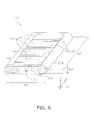
- the segmented-in-series fuel cell (hereinafter simply referred to as a "fuel cell”) 100 includes a support base plate 102, an anode 103, an electrolyte layer 104, a cathode 106, an interconnector 107, a current collecting unit 108, and a barrier layer 13.
- the fuel cell 100 includes a plurality of cells 110.
- Those component elements that are the same as the component elements already described above are denoted by the same reference numerals, and such description will not be repeated.
- the current collecting unit 108 is not illustrated.
- the fuel cell 100 includes the cells 110 disposed on the support base plate 102 and an interconnector 107 that electrically connects the cells 110.
- the cells 110 are units that include an anode 103 and a cathode 106 that corresponds to the anode 103. More specifically, the cells 110 include an anode 103, an electrolyte layer 104 and a cathode 106 stacked in the thickness direction (y axis direction) of the support base plate 102.
- the anode 103, the electrolyte layer 104 and the cathode 106 configure the power generation element of the cell 110.
- the support base plate 102 is flat and elongated in one direction (z axis direction).
- the support base plate 102 is a porous body that has electrical insulating properties.
- the support base plate 102 may include nickel. More specifically, the support base plate 102 may contain Ni-Y 2 O 3 (nickel yttria) as a main component.
- the nickel may be included as an oxide (NiO). During power generation, NiO may be reduced to Ni by hydrogen gas.
- a conduit 123 is provided in an inner portion of the support base plate 102.
- the conduit 123 extends along the longitudinal direction (z axis direction) of the support base plate 102.
- fuel gas flows into the conduit 123, through a hole that is provided in the support base plate 102 to thereby supply fuel gas to the anode 103 described below.
- the anode 103 is provided on the support base plate 102.
- a plurality of anodes 103 is disposed on a single support base plate 102 and is arranged in the longitudinal direction (z axial direction) of the support base plate 102. That is to say, a space is provided between adjacent anodes 103 with respect to the longitudinal direction (z axis direction) of the support base plate 102.
- composition of the anode 103 may be the same as the composition of the anode 11.
- the anode 103 may include an anode current collecting layer and an anode active layer.
- the anode current collecting layer is provided on the support base plate 102, and the anode active layer is provided on the anode current collecting layer while avoiding superimposition with respect to the interconnector 107.
- the anode 103 may include an anode current collecting layer and an anode active layer.
- the anode current collecting layer is provided on the support base plate 102 and the anode active layer is provided on the anode current collecting layer.
- the composition of the anode current collecting layer and the anode active layer has been described above.
- the electrolyte layer 104 is also termed a solid electrolyte layer. As illustrated in FIG. 7 , the electrolyte layer 104 is provided on the anode 103. In a region that is not provided with the anode 103 on the support base plate 102, the electrolyte layer 104 may be provided on the support base plate 102.
- the electrolyte layer 104 includes a non-connected position in the longitudinal direction (z axis direction) of the support base plate 102. In other words, a plurality of electrolyte layers 104 is disposed at an interval in the z axis direction. Namely, a plurality of electrolyte layers 104 is provided along the longitudinal direction (z axis direction) of a single support base plate 102.
- Electrolyte layers 104 adjacent in the z axis direction are connected by an interconnector 107.
- the electrolyte layers 104 are connected from an interconnector 107 to an interconnector 107 that is adjacent to that interconnector 107 in the longitudinal direction (z axis direction) of the support base plate 102.
- the interconnector 107 and the electrolyte layer 104 have a dense structure in comparison to the support base plate 102 and the anode 103. Therefore, the interconnector 107 and the electrolyte layer 104 function as a sealing portion that partitions air and fuel gas by the provision of a connected structure in the z axis direction in the fuel cell 100.
- the composition of the electrolyte layer 104 may include a composition that is the same as the electrolyte layer 15 as described above.
- the same description provided in relation to the vertical-striped fuel cell applies to the configuration of the barrier layer 13.
- the barrier layer 13 is provided between the cathode 106 and the electrolyte layer 104.
- the cathode 106 is disposed on the barrier layer 13 without projecting from the outer edge of the barrier layer 13.
- One cathode 106 is stacked on one anode 103. That is to say, a plurality of cathodes 106 is provided along the longitudinal direction (z axis direction) of the support base plate 102 on a single support base plate 102.
- the cathode 106 is configured by a complex oxide having a perovskite structure expressed by the general formula ABO 3 in the same manner as the cathode 14 described above.
- the cathode 106 may include the complex oxide as a "principal component", and may include components other than the complex oxide.
- the material used to configure the cathode 106 is preferable the electrode described in "Section 1.".
- the composition distribution of the cathode 106 is preferably exhibits a highly uniform configuration. More specifically, in an arbitrary field on a sectional surface of the cathode 106, the respective atomic percentages of each element contained at the A site is acquired using EDS at 10 spots, and when the standard deviation of the atomic percentage is calculated, it is preferred that the standard deviation value of the A site is no more than 10.4. The position of the 10 spots and the analysis spot size in an arbitrary field is as described in "Section 1.".
- the cathode 106 preferably includes an additive (P, Cr, and B) at a predetermined weight ratio relative to the total weight of the electrode material in the same manner as the cathode 15 of the vertically-striped fuel cell described above.
- the content amount of P is preferably at least 1 ppm to no more than 50 ppm in a weight ratio relative to the starting materials, and more preferably at least 1 ppm and no more than 30 ppm.
- the content amount of Cr is preferably at least 1 ppm to no more than 500 ppm in a weight ratio relative to the starting materials, and more preferably at least 1 ppm and no more than 100 ppm.
- the content amount of B is preferably at least 1 ppm to no more than 50 ppm in a weight ratio relative to the starting materials, and more preferably at least 1 ppm and no more than 10 ppm.
- the interconnector 107 may be disposed to configure electrical contact between the cells 110.
- the interconnector 107 is stacked onto the anode 103.
- stack includes the disposition of two elements in connection, and a disposition that provides an overlap in the y axis direction although there is not a connection.
- the interconnector 107 is disposed to span the interval between the electrolyte layers 104 in the longitudinal direction (z axis direction) of the support base plate 102. In this manner, cells 110 that are adjacent in the longitudinal direction (z axis direction) of the support base plate 102 are electrically connected.
- the interconnector 107 configures an electrode that is used for the electrical connection between the plurality of cells 110. More specifically, the interconnector 107 illustrated in FIG. 7 functions as an electrode for the cells 110 disposed on the right side of FIG. 7 .
- a chromite-based material such as lanthanum chromite (LaCrO 3 ) is an example of a perovskite complex oxide used in the interconnector 107.
- composition formula for the lanthanum chromite is expressed by general formula (1) below.
- Ln is at least one type of element selected from the group of Y and a lanthanoid
- A is at least one type of element selected from the group of Ca, Sr and Ba
- B is at least one type of element selected from the group of Ti, V, Mn, Fe, Co, Cu, Ni, Zn, Mg and Al, and wherein 0.025 ⁇ x ⁇ 0.3, 0 ⁇ y ⁇ 0.22, 0 ⁇ z ⁇ 0.15.
- Lanthanum chromite is a material that can stably exist under both an atmospheric and reducing atmosphere at the operating temperature (600 to 1000 degrees C) of the SOFC, and is preferably used as an interconnector material (electrode material) of an SOFC cell that includes horizontal stripes.
- lanthanum chromite is a sintering resistant material, and addition is required of an additive that facilitates firing, such as a sintering agent (CaO, SrO, or the like), to co-sinter with the support base plate 102, the anode 103 and the electrolyte layer 104 for application to the SOFC cell.
- a sintering agent CaO, SrO, or the like
- the current collecting unit 108 is disposed to electrically connect the interconnector 107 and the cell 110. More specifically, the current collecting unit 108 is provides a connection from the cathode 106 to the interconnector 107 that is included in the cell 110 that is adjacent to the cell 110 that includes the cathode 106.
- the current collecting unit 108 may include conductive properties.
- the cathode 106 that is included in the cell 110 is electrically connected to the anode 103 of the adjacent cell 110 through the current collecting unit 108 and the interconnector 107. That is to say, the current collecting unit 108 participates in the connection between cells 110 in addition to the interconnector 107.
- each component of the fuel cell 100 may be set as shown below.
- the solid oxide fuel cell includes a cathode, an anode and a solid electrolyte disposed between the cathode and the anode, the cathode including a complex oxide material that has a perovskite structure expressed by the general formula ABO 3 .
- the complex oxide is preferably such that P is at least 1 ppm and no more than 50 ppm, Cr is at least 1 ppm and no more than 500 ppm, and B is at least 1 ppm and no more than 50 ppm in a weight ratio relative to the total weight of the complex oxide.
- the content amount of P included in the cathode is more preferably no more than 30 ppm in a weight ratio relative to the total weight of the cathode.
- the content amount of Cr included in the cathode is more preferably no more than 100 ppm in a weight ratio relative to the total weight of the cathode.
- the content amount of B included in the cathode is more preferably no more than 10 ppm in a weight ratio relative to the total weight of the cathode.
- NiO-8YSZ anode active layer (10 micrometers), an 8YSZ electrolyte layer (3 micrometers) and a GDC barrier layer (3 micrometers) are stacked on an NiO-8YSZ anode base plate (500 micrometers), and fired under conditions of 1400 degrees C for 2 hours.
- Electrodes that are expressed using the same general formula but denoted by different reference numerals differ in relation to starting materials, firing conditions, or comminution conditions. Furthermore, the tables indicate whether each electrode material was synthesized using a solid phase method or a liquid phase method. Furthermore, the content amount of the additive (P, Cr or B) included in the electrode material is disclosed in the table.
- the average particle diameter of the resulting disintegrated product is 200 micrometers.
- the disintegrated product was used in the measurement of the composition distribution described below.
- the disintegrated product was subjected to comminution using a ball mill apparatus.
- the average particle diameter of the electrode material (powder) was all no more than 1.0 micrometer upon measurement using a laser diffraction/scattering type particle size distribution measurement apparatus (LA-700 manufactured by Horiba Ltd.).
- a paste was prepared using the resulting powder and the paste was used to form a film with a screen printing method resulting in a cathode (30 micrometers) on the barrier layer.
- the cathode was attached by firing onto the barrier layer by heating to no more than 1000 degrees C for 2 hours.
- the atomic percentage distribution of each element in the disintegrated product formed of electrode material according to No. 1 to No. 22 was measured using EPMA. More specifically, measurements are performing using an electron probe micro analyzer manufactured by JEOL Ltd. (model: JXA-8500F). Next, in an arbitrary field, EDS is used to measure the atomic percentage (mol%) of an oxide of each element at the A site and each element at the B site in relation to 10 spots in a section not forming a cavity that can be identified in an SEM image. More specifically, measurements were performed using a field emission scanning electron microscope (model: ULTRA55) manufactured by Zeiss AG (Germany).
- the respective concentration of La and Sr at the A site was measured at 10 spots in relation to each of the samples No. 1 to No. 10 to obtain an average value for the La concentration and the standard deviation of the La concentration at each spot and the average value for the Sr concentration and the standard deviation of the Sr concentration at each spot.
- a concentration average value and a standard deviation for the concentration at each spot were obtained for Co and Fe at the B site.
- the maximum value of the standard deviation in relation to the atomic percentage of elements at the A site and the maximum value of the standard deviation in relation to the atomic percentage of elements at the B site were obtained for each sample No. 1 to No. 10.
- the atomic percentage distribution of each element was measured using an EPMA (JEOL Ltd. model: JXA-8500F) on a sectional surface of the cathode formed from the cathode material according to No. 1 to No. 22.
- the atomic percentage (mol%) as an oxide of each element in the A site and the B site in 10 spots in the SEM image in an arbitrary field was measured using EDS (model: ULTRA55, manufactured by Zeiss AG (Germany) on a sectional surface of the cathode.
- the respective concentration of La and Sr at the A site on a sectional surface of the cathode formed from the cathode material according to No. 1 to No. 10 was measured at 10 spots to thereby obtain a standard deviation of the concentration at each spot and the average value of the Sr concentration in addition to the standard deviation of the concentration at each spot and the average value of the La concentration. Furthermore, the standard deviation of the concentration at each spot and the concentration average value was obtained in the same manner in relation to Co and Fe at the B site. The maximum value of the standard deviation at the atomic percentage of each element at the A site and maximum value of the standard deviation of the atomic percentage of each element at the B site were obtained in relation to each sample according to No. 1 to No. 10.
- Table 1 shows the measurement results for the concentration of No. 1 sample as an example and the results of the calculation of the average value and the standard deviation.
- Table 2 shows the maximum value of the standard deviation for the atomic percentage of each element in relation to samples No. 1 to No. 10.
- Table 3 shows the maximum value of the standard deviation at the A site and the maximum value of the standard deviation at the B site shown in Table 2, the voltage drop rate (deterioration rate) per 1000 hours, and the evaluation result based on the voltage drop rate for samples No. 1 to No. 10.
- FIG. 4 and FIG. 5 show respective SEM images and concentration mapping images for the same field in relation to samples No. 1 and No. 7.
- the actual positions of high atomic percentage are shown by a red color and positions of low atomic percentage are shown with a blue color.
- Table 4 shows the measurement results for the concentration and the results of the calculation of the average value and the standard deviation on the sectional surface of the cathode according to sample No. 1 of samples No. 1 to No. 10.
- Table 5 shows the maximum value of the standard deviation of the atomic percentage of each element in the cathode according to No. 1 to No. 10.
- an underline is applied to the maximum value of the standard deviation at the B site and the maximum value of the standard deviation at the A site.
- Table 6 shows the evaluation results based on the voltage drop rate (deterioration rate) per 1000 hours, and the maximum value of the standard deviation at the B site and the maximum value of the standard deviation at the A site shown in Table 5 in relation to the cathode according to No. 1 to No. 10.
- the deterioration rate was suppressed to a small value for samples No. 1 to No. 4, and No. 7 to No. 10. These samples exhibit a standard deviation (scattering) for the atomic percentage of elements at the A site of less than 11.5, more specifically, the value was no more than 10.3. The standard deviation for the atomic percentage of elements at the B site was no more than 3.99.
- the deterioration rate is reduced by a large extent at the cathode configured from samples No. 1 to No. 4 and No. 7 to No. 10.
- the standard deviation of the atomic percentage of each element at the A site is less than 11.3, and more specifically, is less than or equal to 10.4.
- the standard deviation of the atomic percentage of each element at the B site is less than or equal to 4.32.
- the standard deviation of the atomic percentage of each element at the A site is at least 11.3.
- the standard deviation of the atomic percentage of each element at the B site is at least 4.85.
- Table 7 shows the maximum value of the standard deviation for the atomic percentage of each element in relation to samples No. 11 to No. 16.
- Table 9 shows the maximum value of the standard deviation at the A site and the maximum value of the standard deviation at the B site shown in Table 8, the voltage drop rate (deterioration rate) per 1000 hours, and the evaluation results based on the voltage drop rate for samples No. 11 to No. 16.
- Table 10 shows the measurement results for the concentration and the calculation results for the average value and standard deviation at the sectional surface of the cathode according to sample No. 11 of the samples No. 11 to No. 16.
- Table 11 shows the maximum value of the standard deviation value of the atomic percentage of each element for the cathode according to No. 11 to No. 16.
- an underline is applied to the maximum value for the standard deviation value at the A site and the maximum value for the standard deviation value at the B site.
- Table 12 shows the maximum value of the standard deviation at the A site and the maximum value of the standard deviation at the B site shown in Table 11, the voltage drop rate (deterioration rate) per 1000 hours, and the evaluation results based on the voltage drop rate for the cathode according to samples No. 11 to No. 16.
- the deterioration rate is reduced by a large extent on the cathode configured from samples No. 11 to No. 13 and No. 15 to No. 16.
- the standard deviation of the atomic percentage of each element at the A site is less than 11.2, and more specifically, is less than or equal to 8.15.
- the standard deviation of the atomic percentage of each element at the B site is less than or equal to 4.13.
- sample No. 14 which exhibited a large deterioration rate, the standard deviation for the atomic percentage of elements at the A site was at least 10.95. In sample No. 14, the standard deviation for the atomic percentage of elements at the B site was comparatively large at 4.98.
- Table 13 shows the measurement results using the concentration of No. 17 sample as an example, and the results of the calculation of the average value and the standard deviation are shown in Table 13.
- Table 14 shows the maximum value of the standard deviation for the atomic percentage of each element in relation to samples No. 17 to No. 22.
- the maximum value of the standard deviation at the A site and the maximum value of the standard deviation at the B site are underlined in relation to each sample.
- Table 15 shows the maximum value of the standard deviation at the A site and the maximum value of the standard deviation at the B site shown in Table 14, the voltage drop rate (deterioration rate) per 1000 hours, and the evaluation results based on the voltage drop rate for samples No. 17 to No. 22.
- Table 16 shows the measurement results for the concentration and the calculation results for the average value and standard deviation at the sectional surface of the cathode according to sample No. 17 of the samples No. 17 to No. 22.
- Table 17 shows the maximum value of the standard deviation value of the atomic percentage of each element for the cathode according to No. 17 to No. 22.
- an underline is applied to the maximum value for the standard deviation value at the A site and the maximum value for the standard deviation value at the B site.
- Table 18 shows the maximum value of the standard deviation at the A site and the maximum value of the standard deviation at the B site shown in Table 17, the voltage drop rate (deterioration rate) per 1000 hours, and the evaluation results based on the voltage drop rate for the cathode according to samples No. 17 to No. 22.
- the deterioration rate is reduced by a large extent on the cathode configured from samples No. 17 and No. 19 to No. 22.
- the standard deviation of the atomic percentage of each element at the A site is less than 10.8, and more specifically, is less than or equal to 6.64.
- the standard deviation of the atomic percentage of each element at the B site is less than or equal to 5.03.
- Table 10 shows the measurement results for the voltage drop rate (deterioration rate) per 1000 hours and the concentration of the additive (P, Cr and B) for Samples No. 23 to No. 28.
- Table 19 Sample No. Synthesis Method Additive content amount (ppm) Deterioration Rate (%/1000hr) Evaluation Result P Cr B 23 Solid phase method 60 530 75 1.66 Poor ( ⁇ ) 24 Liquid phase method 50 500 50 0.65 Good ( ⁇ ) 25 Solid phase method 40 250 25 0.56 Good ( ⁇ ) 26 Liquid phase method 30 100 10 0.38 Good ( ⁇ ) 27 Liquid phase method 15 65 5 0.23 Good ( ⁇ ) 28 Liquid phase method less than 1 less than 1 less than 1 1.23 Poor ( ⁇ )
- the deterioration rate was not suppressed to a small value in relation to sample No. 23. Therefore it was confirmed that the preferred content amount in the electrode material of P is no more than 50 ppm, the preferred content amount in the cathode material of Cr is no more than 500 ppm, and the preferred content amount in the electrode material of B is no more than 50 ppm. In the same manner, it is confirmed that a content amount of P in the cathode of less than or equal to 50 ppm, a content amount of Cr of less than or equal to 500 ppm, and a content amount of B of less than or equal to 50 ppm are preferred.
- a comparison of No. 24, 25 and No. 26, 27 enables confirmation that the preferred content amount in the electrode material of P is no more than 30 ppm, the preferred content amount in the cathode material of Cr is no more than 100 ppm, and the preferred content amount in the electrode material of B is no more than 10 ppm.
- a content amount of P in the cathode of less than or equal to 30 ppm, a content amount of Cr of less than or equal to 100 ppm, and a content amount of B of less than or equal to 10 ppm are more preferred.
- the deterioration of the cathode can be suppressed by a relatively uniform configuration in the distribution of atoms (small standard deviation) in the cathode and the cathode material.
- the content amount of additives (P, Cr and B) contained in the cathode and the cathode material has been confirmed to be 1 ppm ⁇ P ⁇ 30 ppm, 1 ppm ⁇ Cr ⁇ 100 ppm and 1 ppm ⁇ B ⁇ 10 ppm.
- the relationship between the atomic distribution and the deterioration of the cathode is purported to be as follows.
- the technique disclosed herein is useful in relation to a solid oxide fuel cell to thereby suppress deterioration of the cathode.
Landscapes
- Chemical & Material Sciences (AREA)
- Engineering & Computer Science (AREA)
- Materials Engineering (AREA)
- Chemical Kinetics & Catalysis (AREA)
- Ceramic Engineering (AREA)
- Organic Chemistry (AREA)
- Electrochemistry (AREA)
- General Chemical & Material Sciences (AREA)
- Manufacturing & Machinery (AREA)
- Structural Engineering (AREA)
- Sustainable Development (AREA)
- Sustainable Energy (AREA)
- Life Sciences & Earth Sciences (AREA)
- Inert Electrodes (AREA)
- Fuel Cell (AREA)
- Compositions Of Oxide Ceramics (AREA)
- Compounds Of Iron (AREA)
- Inorganic Compounds Of Heavy Metals (AREA)
Abstract
Description
- The present invention relates to a solid oxide fuel cell.
- In recent years, several materials and structures have been proposed in relation to fuel cell batteries due to the attention focused on fuel cell batteries in light of effective use of energy resources and environmental problems.
-
Patent Literature 1 discloses the use of an LSCF powder as a raw material powder for the cathode of a solid oxide fuel cell (SOFC). - Patent Literature 1: JPA-2006-32132
- However, the available voltage may be reduced during repeated power generation using the fuel cell. The present inventors gained the new insight that one cause of this reduction in output is deterioration of the cathode.
- The technique disclosed herein is based on this new insight and addresses the problem of providing a solid oxide fuel cell that inhibits deterioration of a cathode.
- The present inventors conducted diligent research into solving the above problem and as a result gained the insight that the deterioration of a cathode can be suppressed by increasing the uniformity of the concentration of the cathode components.
- In that context, the solid oxide fuel cell disclosed herein includes a cathode, an anode and a solid electrolyte disposed between the cathode and the anode. The cathode contains a complex oxide having a perovskite structure expressed by the general formula ABO3. The standard deviation value of the atomic percentage of each element in the A site measured at the sectional surface of the cathode using energy dispersive X-ray spectroscopy at 10 spots in a single field is no more than 10.4.
- The technique disclosed herein provides a solid oxide fuel cell that enables suppression of deterioration of a cathode.
-
-
FIG. 1 is a flowchart describing a method of manufacturing an electrode material using a solid-phase method; -
FIG. 2 is a flowchart describing a method of manufacturing an electrode material using a liquid-phase method; -
FIG. 3 is a sectional view illustrating the principal features of configuration of a vertically-striped fuel cell; -
FIG. 4 is a SEM image of a single field and an image of concentration mapping in relation to a sample No.1 according to the example; -
FIG. 5 is a SEM image of a single field and an image of concentration mapping in relation to a sample No.7 according to the examples; -
FIG. 6 is a perspective view illustrating the external appearance of a segmented-in-series fuel cell; and -
FIG. 7 is a sectional view along the direction I-I of the arrow inFIG. 6 . - The electrode material includes a complex oxide having a perovskite structure. The electrode material may include components other than a complex oxide. As described below, the electrode material according to the present embodiment is suitably used as a material to configure the cathode of the solid oxide fuel cell.
- The composition of the complex oxide is expressed by the general formula ABO3. Furthermore, at least one of La and Sr may be contained in the A site. An actual example of this type of complex oxide for use as a cathode material includes LSCF, that is to say, (La, Sr)(Co, Fe)O3, LSF that is to say, (La, Sr) FeO3, LSC that is to say, (La, Sr)CoO3, LNF that is to say, La(Ni, Fe)O3, SSC that is to say, (Sm, Sr)CoO3, and the like. These complex oxides are materials that combine characteristics related to oxygen ion conductivity and electron conductivity, and are termed mixed conducting materials.
- The electrode material may include the complex oxide as a "principal component". The feature "include as a principal component" when a composition X contains a material Y means that the material Y comprises preferably at least 60 wt% overall of composition X, more preferably 70 wt%, and still more preferably at least 90 wt% of the overall composition X.
- Furthermore, the electrode material may be configured as a powder (for example, with an average particle diameter of about 1 micrometer to 5 micrometers) or a disintegrated product (for example, with an average particle diameter of about 5 micrometers to 500 micrometers), or may be a agglomerate that is larger than the disintegrated product.
- The electrode material preferably includes a highly uniform composition distribution. More specifically, a value of the standard deviation for the atomic percentage of respective elements contained at the A site are acquired by use of energy dispersive X-ray spectroscopy (EDS) at 10 spots in an arbitrary field in the electrode material is preferably no more than 10.3. Furthermore, the atomic percentage of the respective elements contained at the B site is acquired, and when the standard deviation of the atomic percentage is calculated, the standard deviation at the B site is preferably no more than 5.03.
- For example, it is assumed that n types of elements A1, A2, A3,...An are contained at the A site. When the value of the standard deviation for the atomic percentage of the respective elements is acquired with reference to the atomic percentage obtained at 10 spots, if the value of the standard deviation for the atomic percentage for the element A1 is larger than the respective values for the standard deviation of the elements A2 - An, it is preferred that the value of the standard deviation of the element A1 is no more than 10.3.
- The arbitrary field as used herein is suitably within a range observed by an electron microscope such as an electron probe micro analyzer (EPMA) or a scanning electron microscope (SEM), or the like with a magnification of 100 times to 5000 times. The analysis spot size of the respective 10 spots may be no more than 1 micrometer. When the distribution of the atomic percentage as described below is evaluated based on an observation at an excessively small magnification of less than 100 times, there are difficulties associated with the determination of the uniformity of the distribution of each element in the micro range that is the object of the present invention. On the other hand, when the distribution of the atomic percentage is evaluated based on an observation at an excessively large magnification that exceeds 5000 times, there is an increased possibility that only a non-uniform region or only a uniform region will be observed as a result of the narrow observation range. As a result, as stated above, it is preferred that the magnification of the electron microscope is in the range of 100 times to 5000 times.
- The position of the 10 spots may be selected for example on the basis of the concentration level in 10 stages that are determined in response to the distribution of the atomic percentages measured using an electron probe micro analyzer (EPMA). The concentration level in the 10 stages is preferably set with reference to substantially the entire range of the distribution of the atomic percentages. For example, the concentration level in the 10 stages can be set by creating 10 divisions in the interval between the maximum value and the minimum value in the characteristic X-ray intensity in the arbitrary field.
- The ideal unit lattice for the complex oxide having a perovskite structure expressed by the general formula ABO3 is in the shape of a cube. An A element is disposed at the corner of the unit lattice, and a B element is disposed in the body center of the unit lattice. The oxygen element is disposed at the face center of the unit lattice. In the present embodiment, the position of the corner of the unit lattice at which the A element is disposed is termed the "A site", and the position of the corner of the unit lattice at which the B element is disposed is termed the "B site".
- An example of a method of manufacturing the electrode material described in "
Section 1." above will be described below. - More specifically, the method of manufacture includes acquisition of a complex oxide compound having a perovskite structure.
- The method of obtaining the complex oxide compound includes a solid phase method, a liquid phase method (citrate process, Pechini method, co-precipitation method) or the like.
- A "solid phase method" refers to a method in which a mixture obtained by mixing a starting material (powder) including constituent elements at a predetermined ratio is fired, and then subjected to comminution to obtain the target material.
- A "liquid phase method," is a method for obtaining a target material that includes the steps of dissolving a starting material including constituent elements into a solution, obtaining a precursor of the target material from the solution by precipitation or the like, and then performing drying, firing and comminution.
- The sequence of steps will be described below making reference to the figures in relation to a configuration in which the electrode material is manufactured using a solid phase method, and a configuration in which the electrode material is manufactured using a liquid phase method.
-
FIG. 1 is a flowchart describing a method of manufacturing an electrode material using a solid phase method. - Firstly, in a step S101, a starting material is prepared according to the type of complex oxide. When manufacturing LSCF as a complex oxide, for example, La2O3, SrCO3, Co3O4 and Fe2O3 are prepared. The average particle diameter of La2O3 may be 0.1 micrometer to 0.7 micrometer, the average particle diameter of SrCO3 may be 0.1 micrometer to 0.5 micrometer, the average particle diameter of Co3O4 may be 0.1 micrometer to 1.0 micrometer, and the average particle diameter of Fe2O3 may be 0.1 micrometer to 0.8 micrometer. Furthermore, it is preferred that the particle size distribution of the starting material is controlled. More specifically, it is desirable that coarse particles of greater than or equal to 20 micrometers are removed in advance by use of an air classifier or the like. The removal of coarse particles is effective for uniformity when executing mixing and synthesizing in subsequent steps.
- Next, in step S102, the starting materials are classified. More specifically, for example, the specific surface area of each starting material is adjusted by classification using an air classifier or example. When manufacturing LSCF as a complex oxide, the specific surface area of La2O3 is adjusted to 1 m2/g to 5 m2/g, the specific surface area of SrCO3 is adjusted to 1 m2/g to 7 m2/g, the specific surface area of Co3O4 is adjusted to 1 m2/g to 7 m2/g, and the specific surface area of Fe2O3 is adjusted to 1 m2/g to 10 m2/g.
- Next, in a step S103, the respective starting materials are mixed at a predetermined mixing ratio. In the present embodiment, the mixing process preferably includes the steps of weighing the respective starting materials at a predetermined mixing ratio and placing the materials into a pot mill together with pebbles (for example, application is possible of the pebbles used in the manufacture of zirconia or alumina), rotating the pot mill for a predetermined time (10hrs to 120 hrs) in a dry state and then introducing a predetermined amount (weight ratio relative to the starting material of 50% to 200%) of solvent (for example, when using an aqueous solvent, ion-exchanged water may be used, and when using a solvent-based material, acetone may be used), and rotating the pot mill further for a predetermined time (10hr to 300hr) in a wet state. When performing a uniform mixture of respective starting material powders using wet mixing, it is preferred to perform sufficient disintegration under suitable mixing conditions of the starting material powder using dry mixing. The pebbles preferably have a diameter of 0.5 mm to 5 mm, and are preferably adjusted to 0.5 to 3 times the weight of the starting material powder.
- In this mixing process, it is preferred to add a predetermined additive to the respective starting materials. The additives are phosphorus (P), chrome (Cr), and boron (B). The added amount of P is preferably at least 1 ppm to no more than 50 ppm in a weight ratio relative to the starting materials, and more preferably at least 1 ppm and no more than 30 ppm. The added amount of Cr is preferably at least 1 ppm to no more than 500 ppm in a weight ratio relative to the starting materials, and more preferably at least 1 ppm and no more than 100 ppm. The added amount of B is preferably at least 1 ppm to no more than 50 ppm in a weight ratio relative to the starting materials, and more preferably at least 1 ppm and no more than 10 ppm. The additives are preferably added as oxides. The additives have the function of creating a uniform dispersion and mixture in the constituent components. In addition to comminution of the starting materials in a dry mix in the previous step, an important factor in the control (uniformity) of the composition distribution of the electrode material is the combination of a process of wet mixing in later steps. The mixing ratio of each starting material when manufacturing LSCF as a complex oxide may be performed by adjusting the starting material ratio of La2O3, SrCO3, Co3O4 and Fe2O3 in accordance with the composition of the complex oxide.
- Next, in step S104, the electrode material is synthesized by firing of the starting materials mixed in the pot mill. The synthesis conditions may be suitably adjusted within a range of a synthesis temperature of 900 degrees C to 1400 degrees C and a synthesis time of 1 to 30 hrs in an oxidizing atmosphere.
- Next, in step S105, the electrode material in a synthesized agglomerated configuration is subjected to comminution. More specifically, the average particle diameter of the electrode material is adjusted to 0.3 micrometers to 1.2 micrometers by introducing the electrode material with pebbles (for example, application is possible of the pebbles used in the manufacture of zirconia or alumina) into the pot mill and rotating for a predetermined time (5 hrs to 20 hrs). Furthernore, prior to comminution, the electrode material in an agglomerated configuration may be subjected to preparatory disintegration.
- Next, in step S106, the electrode material after comminution is classified. More specifically, the specific surface area of each starting material is adjusted by classification using an air classifier or the like. When manufacturing LSCF as a complex oxide, the specific surface area is adjusted to 3 m2/g to 12 m2/g.
-
FIG. 2 is a flowchart describing a method of manufacturing an electrode material using a liquid-phase method. - Firstly, in step S201, a starting material is prepared corresponding to the type of complex oxide. When manufacturing LSCF as the complex oxide by use of a co-precipitation method or citrate method, La(NO3)3 • 6H2O, Sr(NO3)2, Co(NO3)3 • 9H2O and Fe(NO3)3 • 9H2O are prepared. The average particle diameter of La(NO3)3 • 6H2O may be 0.3 micrometers to 0.6 micrometers, the average particle diameter of Sr(NO3)2 may be 0.1 micrometers to 0.4 micrometers, the average particle diameter of Co(NO3)3 • 9H2O may be 0.2 micrometers to 0.5 micrometers, and the average particle diameter of Fe(NO3)3 • 9H2O may be 0.3 micrometers to 0.8 micrometers. When manufacturing LSCF using a Pechini method, La2O3, SrO3, Co3O4 and Fe(NO3)3 • 9H2O are prepared to have the above average particle diameter. Furthermore, controlling the particle size distribution of the starting materials is important. More specifically, it is desirable to remove coarse particles of greater than or equal to 15 micrometers in advance by use of an air classifier. The removal of coarse particles is effective for uniformity when executing mixing and synthesizing (calcinating) in subsequent steps.
- Next, in step S202, the starting materials are classified. More specifically, for example, the specific surface area of each starting material is adjusted by classification using an air classifier. When manufacturing LSCF as a complex oxide by use of co-precipitation or a citrate method, the specific surface area of La(NO3)3 • 6H2O is adjusted to 2 m2/g - 8 m2/g, the specific surface area of Sr(NO3) is adjusted to 1 m2/g - 5 m2/g, the specific surface area of Co(NO3)3 • 9H2O is adjusted to 2 m2/g - 5 m2/g, and the specific surface area of Fe(NO3)3 • 9H2O is adjusted to 3 m2/g - 10 m2/g.
- Next, in a step S203, the respective starting materials are mixed at a predetermined mixing ratio. More specifically, when manufacturing LSCF by use of co-precipitation, after dissolving the starting materials in a pure state to prepare a 0.2M aqueous solution, an aqueous nitrate solution is added while stirring in a precipitation agent. When preparing the LSCF using a citrate method, the respective starting materials are dissolved in a pure state and citric acid is added until all the metal is precipitated, and the viscosity is adjusted by use of heating after immersion to approximately 60 degrees C to dehydrate. When preparing LSCF using a Pechini method, after preparing an aqueous nitrate solution for each of the starting materials and mixing all solutions, citric acid and ethylene glycol are added.
- In this mixing process, it is preferred to add a predetermined additive to the respective starting materials. The additives are phosphorus (P), chrome (Cr), and boron (B). The concentration of P contained in the additive is preferably at least 1 ppm to no more than 50 ppm in a weight ratio relative to the starting materials, and more preferably at least 1 ppm and no more than 30 ppm. The concentration of Cr contained in the additive is preferably at least 1 ppm to no more than 500 ppm in a weight ratio relative to the starting materials, and more preferably at least 1 ppm and no more than 100 ppm. The concentration of B contained in the additive is preferably at least 1 ppm to no more than 50 ppm in a weight ratio relative to the starting materials, and more preferably at least 1 ppm and no more than 10 ppm. The additives have the function of creating a uniform dispersion and mixture in the constituent components, or during thermal synthesis processes, and non-uniformity in each of the elements (for example, resulting from phase splitting, heterogeneous phase precipitation, or the like) can be inhibited as a result of these additives. As a result, uniformity of the composition distribution of the electrode material is enabled by suitable control of the added amount of the additives.
- Next, in step S204, the aqueous solution prepared in step S203 is dried. When using co-precipitation, vacuum drying is used at approximately 110 degrees C, when using a citrate method, drying is performed at approximately 70 degrees C, and when using a Pechini method, drying is performed at approximately 200 degrees C.
- Next, in step S205, the electrode material is synthesized by firing of the dried starting materials. The synthesis conditions are suitably adjusted within a range of a synthesis temperature of 900 degrees C to 1400 degrees C and a synthesis time of 1 to 30 hrs in an oxidizing atmosphere.
- Next, in step S206, the electrode material that is in a configuration of a synthesized agglomerate is subjected to comminution. In step S207, the electrode material after comminution is classified. The details of these steps are the same as steps S105 and S106 described above.
- A solid oxide fuel cell is an example of a fuel cell. In particular, a SOFC will be mainly described that has a cell stack structure in which a plurality of fuel cells are stacked.
- As illustrated in
FIG. 3 , thefuel cell 10 includes a fuel cell (hereinafter simply referred to as "cell") 1, and acurrent collecting member 4. - The
cell 1 is a thin ceramic plate. The thickness of thecell 1 is for example 30 micrometers to 700 micrometers, and the diameter of thecell 1 is for example 5 mm to 50 mm. Thecell 1 as illustrated inFIG. 3 includes ananode 11, abarrier layer 13, acathode 14, and an electrolyte layer 15 (solid electrolyte layer). - The material used in the
anode 11 for example includes a material used in the formation of the anode in a known fuel cell. More specifically, the material used in theanode 11 may include NiO - YSZ (nickel oxide - yttria-stabilized zirconia) and/or NiO-Y2O3 (nickel oxide - yttria). Theanode 11 may include these materials as a main component. Theanode 11 functions as the anode. - Furthermore, the
anode 11 may function as a base plate that supports the other layers included in the cell 1 (in other words, a support body). That is to say, the thickness of theanode 11 may have the maximum thickness of the plurality of layers contained in thecell 1. More specifically, the thickness of theanode 11 is of the order of 10 micrometers to 600 micrometers. - The
anode 11 can be imparted with conductive properties by application of a reduction treatment (for example, a treatment of reducing NiO to Ni). - The
anode 11 may include at least two layers. For example, theanode 11 may have two layers, that is to say, a base plate and an anode-active layer (fuel-side electrode) formed thereon. The material in the base plate is configured by a material that includes properties such as electron conductivity. The anode-active layer is configured by a material that includes properties such as electron conductivity and properties such as oxidizing ion (oxygen ion) conductivity. The "proportion of the volume of material that has oxidizing ion (oxygen ion) conductivity relative to the total volume excluding the pores" in the anode active layer is greater than the "proportion of the volume of material that has oxidizing ion (oxygen ion) conductivity relative to the total volume excluding the pores" in the base plate. The material in the base plate and the anode active layer can be selected from the materials for theanode 11 described above. More specifically, a combination is possible of a base plate configured from NiO-Y2O3 and the anode active layer configured by NiO-YSZ. - The
barrier layer 13 is provided between thecathode 14 and theanode 11, and more specifically, is provided between thecathode 14 and theelectrolyte layer 15. - The
barrier layer 13 includes cerium. The barrier layer may include cerium as the ceria (cerium oxide). More specifically, materials that are used in thebarrier layer 13 include ceria and ceria-based materials including rare-earth metal oxides configured as a solid solution in ceria. Thebarrier layer 13 may include a ceria-based material as a main component. - More specifically, the ceria-based material includes GDC ((Ce, Gd)O2: gadolinium doped ceria), and SDC ((Ce, Sm)O2: samarium doped ceria). The concentration of the rare earth metal in the ceria-based material is preferably 5 to 20 mol%. The
barrier layer 13 may include an additive in addition to a ceria-based material. - The thickness of the
barrier layer 13 is no more than 30 micrometers. - The
barrier layer 13 suppresses the diffusion of cations from thecathode 14 into theelectrolyte layer 15. As a result, thebarrier layer 13 enables suppression of a reduction in the output density, and increases the product life of thecell 1. - The
cathode 14 contains a complex oxide having a perovskite structure expressed by the general formula ABO3. This type of complex oxide is preferably the electrode material that was described inSection 1 above. More specifically, the complex oxide includes LSCF, LSF, LSC, LNF, SSC, or the like. Thecathode 14 may include components other than the above types of complex oxide. For example, thecathode 14 may be configured as a composite with the material (ceria or zirconia, or the like) of theelectrolyte layer 15 described below. - As used herein the composition distribution of the
cathode 14 is preferably exhibits a highly uniform configuration. More specifically, in an arbitrary field on a sectional surface of thecathode 14, the respective atomic percentages of each element contained at the A site is acquired using EDS at 10 spots, and when the standard deviation of the atomic percentage is calculated, it is preferred that the standard deviation value of the A site is no more than 10.4. For example, it is assumed that n types of elements A1, A2, A3,...An are present at the A site. When the standard deviation value of the atomic percentage of each element is acquired based on the atomic percentage obtained at 10 spots, it is preferred that the standard deviation value of the atomic percentage of element A1, and the standard deviation value of the atomic percentage of the element A1 when larger than the standard deviation value respectively of A2 to An is no more than 10.4. - However, when the
cathode 14 contains a component other than the complex oxide, the standard deviation of the atomic percentage of the elements contained at the A site of the complex oxide may be more no more than 10.4. Therefore, when thecathode 14 is configured from a composite of the material of theelectrolyte layer 15 and the complex oxide, only the complex oxide that is present on the sectional surface of thecathode 14 may be selected and observed. - An arbitrary field may be defined as the range that can be observed at a magnification of 100x to 5000x when using an electron microscope such as an SEM, EPMA, or the like. The analysis spot size of the respective 10 spots may have a configuration of less than or equal to 1 micron. Furthermore, the position of the 10 spots may be selected in response to the concentration level of the 10 stages for example set based on the distribution of the atomic percentage measured using EPMA. In other words, the concentration level in the 10 stages may be set by dividing into 10 the interval between the maximum value and the minimum value of the specific X-ray intensity in an arbitrary field.
- The
cathode 14 is preferably includes an additive (P, Cr, and B) at a predetermined weight ratio relative to the total weight of the electrode material. In this configuration, the content amount of P is preferably at least 1 ppm to no more than 50 ppm in a weight ratio relative to the starting materials, and more preferably at least 1 ppm and no more than 30 ppm. The content amount of Cr is preferably at least 1 ppm to no more than 500 ppm in a weight ratio relative to the starting materials, and more preferably at least 1 ppm and no more than 100 ppm. The content amount of B is preferably at least 1 ppm to no more than 50 ppm in a weight ratio relative to the starting materials, and more preferably at least 1 ppm and no more than 10 ppm. - The
cathode 14 may include additives other than P, Cr and B, and for example, thecathode 14 may include trace amounts of Na, Mg, Al, Si, Ca, Sc, Ti, Ni, Zn, Y, Zr, Ba, Ce, Gd, or the like. - The thickness of the
cathode 14 may be of the order of 5 micrometers to 50 micrometers. - The
electrolyte layer 15 is provided between thebarrier layer 13 and theanode 11. - The
electrolyte layer 15 includes zirconium. Theelectrolyte layer 15 may include zirconium in the form of zirconia (ZrO2). More specifically, theelectrolyte layer 15 may include zirconia as a main component. Theelectrolyte layer 15 may include an additive such as Y2O3 and/or Sc2O3 in addition to zirconia. These additives may function as a stabilizer. The added amount of the additive in theelectrolyte layer 15 is of the order of 3 to 20 mol%. In other words, the material used in theelectrolyte layer 15 includes yttria-stabilized zirconia such as 3YSZ, 8YSZ, and 10YSZ or zirconia-based materials such as ScSZ (scandia-stablized zirconia). - The thickness of the
electrolyte layer 15 may be no more than 30 micrometers. - A current collecting
member 4 includes a plurality ofconductive connection portions 41. - As illustrated in
FIG. 3 , theconductive connection portions 41 are configured as a depressed portion provided in the current collectingmember 4, and the bottom portion thereof is connected through aconductive adhesive 411 to thecathode 14. The bottom portion of theconductive connection portions 411 includes a periphery and a non-connected position. - During power generation, fuel gas is supplied to the
anode 11. The supply of air to thecathode 14 draws air from the side surface of the cell stack structure (for example, the front of the face of the page inFIG. 3 ). - Although this is not shown, the
fuel cell 10 further includes a member such as a lead that sends a current generated by the cell stack to an external apparatus, and a gas reforming unit that includes a catalyst or the like for reforming the fuel gas. - The
anode 11 can be formed by powder compaction. That is to say, theanode 11 may include the feature of introducing powder, in which material for theanode 11 is mixed, into a mold, and compressing to thereby mold a compacted powder body. - The material for the
anode 11 may be configured according to the description above in relation to the configuration of the fuel cell. The material includes use of nickel oxide, zirconia and a pore forming agent as required. A pore forming agent is an additive that forms pores in the anode. The pore forming agent includes use of a material that is removed in later processing steps. Examples of such materials include cellulose powder. - This is no particular limitation on the mixing ratio of the material, and the mixing ratio may be suitably set in response to the characteristics or the like required by the fuel cell.
- The pressure applied to the powder during powder compaction molding is set to impart sufficient rigidity to the anode.
- The internal structure of the
anode 11 such as the gas conduit (not shown) is formed by powder compaction molding in a configuration in which a member that is removed by firing (a cellulose sheet or the like) is disposed in an inner portion of the powder body and then firing is performed. - The method of manufacturing the fuel cell includes formation of the electrolyte layer on a molded body of the anode formed by powder compaction.
- The method of formation of the electrolyte is a method such as CIP (cold isostatic pressing) that uses an electrolyte material that is processed into a sheet configuration, or thermo-compression bonding. Otherwise, a slurry dip method may be used in which the anode is immersed into an electrolyte material adjusted to a slurry configuration. When using the CIP method, the pressure during the pressing operation on the sheet is preferably 50 to 300 MPa.
- The method of manufacturing the fuel cell includes co-firing (co-sintering) of the electrolyte layer and the anode formed by powder compaction. The temperature and the time for firing are set in response to the cell material.
- Degreasing may be performed prior to firing in 4-3. The degreasing is executed by heating. The conditions such as temperature and time are set in response to the material of the cell or the like.
- The cathode is formed by firing after formation of a layer of material for the cathode by a printing method, powder compaction or the like on a stacked body of the barrier layer, the electrolyte layer and the anode. More specifically, in case of an electrode material configured from LSCF, when using a printing method, a paste prepared by mixing LSCF together with a binder, dispersal agent and dispersal medium is printed onto the stacked body and fired (firing
temperature 900 degrees C to 1100 degrees C, and firingtime 1 hr to 10 hrs). - Other steps may be included in the manufacturing method depending on the configuration of the fuel cell. For example, the manufacturing method may include a step of providing a reaction prevention layer between the electrolyte layer and the cathode, or may include a step of forming a double layered structure in the anode (a step of forming the base plate and a step of forming the anode active layer).
- The
fuel cell 10 described above includes a plurality ofstacked cells 1 and acurrent collecting member 4 connecting thecells 1 electrically. In other words, thefuel cell 10 is a vertically-striped fuel cell. However, the technique disclosed herein may also be applied to a segmented-in-series fuel cell. A segmented-in-series fuel cell will be described below. - The segmented-in-series fuel cell (hereinafter simply referred to as a "fuel cell") 100 includes a
support base plate 102, ananode 103, anelectrolyte layer 104, acathode 106, aninterconnector 107, acurrent collecting unit 108, and abarrier layer 13. Thefuel cell 100 includes a plurality ofcells 110. Those component elements that are the same as the component elements already described above are denoted by the same reference numerals, and such description will not be repeated. InFIG. 6 , for sake of convenience of description, thecurrent collecting unit 108 is not illustrated. - The
fuel cell 100 includes thecells 110 disposed on thesupport base plate 102 and aninterconnector 107 that electrically connects thecells 110. Thecells 110 are units that include ananode 103 and acathode 106 that corresponds to theanode 103. More specifically, thecells 110 include ananode 103, anelectrolyte layer 104 and acathode 106 stacked in the thickness direction (y axis direction) of thesupport base plate 102. Theanode 103, theelectrolyte layer 104 and thecathode 106 configure the power generation element of thecell 110. - The
support base plate 102 is flat and elongated in one direction (z axis direction). Thesupport base plate 102 is a porous body that has electrical insulating properties. Thesupport base plate 102 may include nickel. More specifically, thesupport base plate 102 may contain Ni-Y2O3 (nickel yttria) as a main component. The nickel may be included as an oxide (NiO). During power generation, NiO may be reduced to Ni by hydrogen gas. - As illustrated in
FIG. 6 andFIG. 7 , aconduit 123 is provided in an inner portion of thesupport base plate 102. Theconduit 123 extends along the longitudinal direction (z axis direction) of thesupport base plate 102. During power generation, fuel gas flows into theconduit 123, through a hole that is provided in thesupport base plate 102 to thereby supply fuel gas to theanode 103 described below. - The
anode 103 is provided on thesupport base plate 102. A plurality ofanodes 103 is disposed on a singlesupport base plate 102 and is arranged in the longitudinal direction (z axial direction) of thesupport base plate 102. That is to say, a space is provided betweenadjacent anodes 103 with respect to the longitudinal direction (z axis direction) of thesupport base plate 102. - The composition of the
anode 103 may be the same as the composition of theanode 11. - The
anode 103 may include an anode current collecting layer and an anode active layer. The anode current collecting layer is provided on thesupport base plate 102, and the anode active layer is provided on the anode current collecting layer while avoiding superimposition with respect to theinterconnector 107. - The
anode 103 may include an anode current collecting layer and an anode active layer. The anode current collecting layer is provided on thesupport base plate 102 and the anode active layer is provided on the anode current collecting layer. The composition of the anode current collecting layer and the anode active layer has been described above. - The
electrolyte layer 104 is also termed a solid electrolyte layer. As illustrated inFIG. 7 , theelectrolyte layer 104 is provided on theanode 103. In a region that is not provided with theanode 103 on thesupport base plate 102, theelectrolyte layer 104 may be provided on thesupport base plate 102. - The
electrolyte layer 104 includes a non-connected position in the longitudinal direction (z axis direction) of thesupport base plate 102. In other words, a plurality of electrolyte layers 104 is disposed at an interval in the z axis direction. Namely, a plurality of electrolyte layers 104 is provided along the longitudinal direction (z axis direction) of a singlesupport base plate 102. - Electrolyte layers 104 adjacent in the z axis direction are connected by an
interconnector 107. In other words, the electrolyte layers 104 are connected from aninterconnector 107 to aninterconnector 107 that is adjacent to thatinterconnector 107 in the longitudinal direction (z axis direction) of thesupport base plate 102. Theinterconnector 107 and theelectrolyte layer 104 have a dense structure in comparison to thesupport base plate 102 and theanode 103. Therefore, theinterconnector 107 and theelectrolyte layer 104 function as a sealing portion that partitions air and fuel gas by the provision of a connected structure in the z axis direction in thefuel cell 100. - The composition of the
electrolyte layer 104 may include a composition that is the same as theelectrolyte layer 15 as described above. - The same description provided in relation to the vertical-striped fuel cell applies to the configuration of the
barrier layer 13. Thebarrier layer 13 is provided between thecathode 106 and theelectrolyte layer 104. - The
cathode 106 is disposed on thebarrier layer 13 without projecting from the outer edge of thebarrier layer 13. Onecathode 106 is stacked on oneanode 103. That is to say, a plurality ofcathodes 106 is provided along the longitudinal direction (z axis direction) of thesupport base plate 102 on a singlesupport base plate 102. - The
cathode 106 is configured by a complex oxide having a perovskite structure expressed by the general formula ABO3 in the same manner as thecathode 14 described above. Thecathode 106 may include the complex oxide as a "principal component", and may include components other than the complex oxide. The material used to configure thecathode 106 is preferable the electrode described in "Section 1.". - As used herein the composition distribution of the
cathode 106 is preferably exhibits a highly uniform configuration. More specifically, in an arbitrary field on a sectional surface of thecathode 106, the respective atomic percentages of each element contained at the A site is acquired using EDS at 10 spots, and when the standard deviation of the atomic percentage is calculated, it is preferred that the standard deviation value of the A site is no more than 10.4. The position of the 10 spots and the analysis spot size in an arbitrary field is as described in "Section 1.". - The
cathode 106 preferably includes an additive (P, Cr, and B) at a predetermined weight ratio relative to the total weight of the electrode material in the same manner as thecathode 15 of the vertically-striped fuel cell described above. In this configuration, the content amount of P is preferably at least 1 ppm to no more than 50 ppm in a weight ratio relative to the starting materials, and more preferably at least 1 ppm and no more than 30 ppm. The content amount of Cr is preferably at least 1 ppm to no more than 500 ppm in a weight ratio relative to the starting materials, and more preferably at least 1 ppm and no more than 100 ppm. The content amount of B is preferably at least 1 ppm to no more than 50 ppm in a weight ratio relative to the starting materials, and more preferably at least 1 ppm and no more than 10 ppm. - As described above, the
interconnector 107 may be disposed to configure electrical contact between thecells 110. InFIG. 7 , theinterconnector 107 is stacked onto theanode 103. - In the present specification, "stack" includes the disposition of two elements in connection, and a disposition that provides an overlap in the y axis direction although there is not a connection.
- In
FIG. 7 , as described above, theinterconnector 107 is disposed to span the interval between the electrolyte layers 104 in the longitudinal direction (z axis direction) of thesupport base plate 102. In this manner,cells 110 that are adjacent in the longitudinal direction (z axis direction) of thesupport base plate 102 are electrically connected. - The
interconnector 107 configures an electrode that is used for the electrical connection between the plurality ofcells 110. More specifically, theinterconnector 107 illustrated inFIG. 7 functions as an electrode for thecells 110 disposed on the right side ofFIG. 7 . - The
interconnector 107 that configures the electrode as described above, in the same manner as thecathode 106 described above, includes a main component of a perovskite complex oxide as a main component. In particular, a chromite-based material such as lanthanum chromite (LaCrO3) is an example of a perovskite complex oxide used in theinterconnector 107. - The composition formula for the lanthanum chromite is expressed by general formula (1) below.

- In Formula (1), wherein Ln is at least one type of element selected from the group of Y and a lanthanoid, A is at least one type of element selected from the group of Ca, Sr and Ba, and B is at least one type of element selected from the group of Ti, V, Mn, Fe, Co, Cu, Ni, Zn, Mg and Al, and wherein 0.025≦x≦0.3, 0≦y≦0.22, 0≦z≦0.15.
- Lanthanum chromite is a material that can stably exist under both an atmospheric and reducing atmosphere at the operating temperature (600 to 1000 degrees C) of the SOFC, and is preferably used as an interconnector material (electrode material) of an SOFC cell that includes horizontal stripes.
- However, it is known that lanthanum chromite is a sintering resistant material, and addition is required of an additive that facilitates firing, such as a sintering agent (CaO, SrO, or the like), to co-sinter with the
support base plate 102, theanode 103 and theelectrolyte layer 104 for application to the SOFC cell. - The
current collecting unit 108 is disposed to electrically connect theinterconnector 107 and thecell 110. More specifically, thecurrent collecting unit 108 is provides a connection from thecathode 106 to theinterconnector 107 that is included in thecell 110 that is adjacent to thecell 110 that includes thecathode 106. Thecurrent collecting unit 108 may include conductive properties. - The
cathode 106 that is included in thecell 110 is electrically connected to theanode 103 of theadjacent cell 110 through thecurrent collecting unit 108 and theinterconnector 107. That is to say, thecurrent collecting unit 108 participates in the connection betweencells 110 in addition to theinterconnector 107. - The specific dimensions of each component of the
fuel cell 100 may be set as shown below. - Width W1 of support base plate 102: 1 to 10 cm
- Thickness W2 of support base plate 102: 1 to 10 mm
- Length W3 of support base plate 102: 5 to 50 cm
- Distance W4 from outer surface of support base plate 102 (interface between
support base plate 102 and anode) to conduit 123: 0.1 - 4 mm - Thickness of Anode 103: 50 - 500 micrometers (When the
anode 103 includes an anode current collecting layer and an anode active layer: thickness of anode current collecting layer: 50 - 500 micrometers, thickness of anode active layer: 5 - 30 micrometers) - Thickness of electrolyte layer 104: 3 - 50 micrometers
- Thickness of cathode 106: 10 - 100 micrometers
- Thickness of interconnector 107: 10 - 100 micrometers
- Thickness of current collecting unit 108: 50 - 500 micrometers
- The dimensions described in relation to a vertically-striped fuel cell may be adopted for the constituent elements that are not specifically disclosed. However it goes without saying that the technique herein disclosed is not limited to these values.
- The solid oxide fuel cell includes a cathode, an anode and a solid electrolyte disposed between the cathode and the anode, the cathode including a complex oxide material that has a perovskite structure expressed by the general formula ABO3. The complex oxide is preferably such that P is at least 1 ppm and no more than 50 ppm, Cr is at least 1 ppm and no more than 500 ppm, and B is at least 1 ppm and no more than 50 ppm in a weight ratio relative to the total weight of the complex oxide.
- The content amount of P included in the cathode is more preferably no more than 30 ppm in a weight ratio relative to the total weight of the cathode.
- The content amount of Cr included in the cathode is more preferably no more than 100 ppm in a weight ratio relative to the total weight of the cathode.
- The content amount of B included in the cathode is more preferably no more than 10 ppm in a weight ratio relative to the total weight of the cathode.
- A NiO-8YSZ anode active layer (10 micrometers), an 8YSZ electrolyte layer (3 micrometers) and a GDC barrier layer (3 micrometers) are stacked on an NiO-8YSZ anode base plate (500 micrometers), and fired under conditions of 1400 degrees C for 2 hours.
- As illustrated in Table 1 to Table 3, 10 types of electrode materials (No. 1 to No. 10) including (La0.6Sr0.4)(Co0.2Fe0.8)O3, 6 types of electrode materials (No. 11 to No. 16) including (La0.8Sr0.2)FeO3 as shown in Table 7 to Table 9, and 6 types of electrode materials (No. 17 to No. 22) including (Ni0.6Fe0.4) O3 as shown in Table 13 to Table 15 were obtained. Then as illustrated in Table 19, 6 types of electrode materials (No. 23 to No. 28) including (La0.6Sr0.4)(Co0.2Fe0.8)O3 in the same manner as No. 1 to No. 10 were obtained. However, no additives were actively added to No. 28. ICP analysis is used to confirm that the added amount of the additive (at least one of P, Cr and B) during electrode operation corresponds to the content amount of the additive in the electrode material after calcination (synthesis).
- Those electrode materials that are expressed using the same general formula but denoted by different reference numerals differ in relation to starting materials, firing conditions, or comminution conditions. Furthermore, the tables indicate whether each electrode material was synthesized using a solid phase method or a liquid phase method. Furthermore, the content amount of the additive (P, Cr or B) included in the electrode material is disclosed in the table.
- The average particle diameter of the resulting disintegrated product is 200 micrometers. The disintegrated product was used in the measurement of the composition distribution described below.
- The disintegrated product was subjected to comminution using a ball mill apparatus. The average particle diameter of the electrode material (powder) was all no more than 1.0 micrometer upon measurement using a laser diffraction/scattering type particle size distribution measurement apparatus (LA-700 manufactured by Horiba Ltd.).
- A paste was prepared using the resulting powder and the paste was used to form a film with a screen printing method resulting in a cathode (30 micrometers) on the barrier layer. The cathode was attached by firing onto the barrier layer by heating to no more than 1000 degrees C for 2 hours.
- SOFCs were obtained in the above manner.
- The atomic percentage distribution of each element in the disintegrated product formed of electrode material according to No. 1 to No. 22 was measured using EPMA. More specifically, measurements are performing using an electron probe micro analyzer manufactured by JEOL Ltd. (model: JXA-8500F). Next, in an arbitrary field, EDS is used to measure the atomic percentage (mol%) of an oxide of each element at the A site and each element at the B site in relation to 10 spots in a section not forming a cavity that can be identified in an SEM image. More specifically, measurements were performed using a field emission scanning electron microscope (model: ULTRA55) manufactured by Zeiss AG (Germany).
- Then, the respective concentration of La and Sr at the A site was measured at 10 spots in relation to each of the samples No. 1 to No. 10 to obtain an average value for the La concentration and the standard deviation of the La concentration at each spot and the average value for the Sr concentration and the standard deviation of the Sr concentration at each spot. In the same manner a concentration average value and a standard deviation for the concentration at each spot were obtained for Co and Fe at the B site. Furthermore, the maximum value of the standard deviation in relation to the atomic percentage of elements at the A site and the maximum value of the standard deviation in relation to the atomic percentage of elements at the B site were obtained for each sample No. 1 to No. 10.
- The same operation was performed in relation to the concentration of Fe at the B site and La and Sr at the A site for each sample No. 11 to No. 16, and the same operation was performed in relation to the concentration of Fe and Ni at the B site and La at the A site for each sample No. 17 to No. 22.
- The atomic percentage distribution of each element was measured using an EPMA (JEOL Ltd. model: JXA-8500F) on a sectional surface of the cathode formed from the cathode material according to No. 1 to No. 22. Next, the atomic percentage (mol%) as an oxide of each element in the A site and the B site in 10 spots in the SEM image in an arbitrary field was measured using EDS (model: ULTRA55, manufactured by Zeiss AG (Germany) on a sectional surface of the cathode.
- More specifically, the respective concentration of La and Sr at the A site on a sectional surface of the cathode formed from the cathode material according to No. 1 to No. 10 was measured at 10 spots to thereby obtain a standard deviation of the concentration at each spot and the average value of the Sr concentration in addition to the standard deviation of the concentration at each spot and the average value of the La concentration. Furthermore, the standard deviation of the concentration at each spot and the concentration average value was obtained in the same manner in relation to Co and Fe at the B site. The maximum value of the standard deviation at the atomic percentage of each element at the A site and maximum value of the standard deviation of the atomic percentage of each element at the B site were obtained in relation to each sample according to No. 1 to No. 10.
- The same operation was performed in relation to the concentration of Fe at the B site and La and Sr at the A site on the sectional surface of the cathode according to No. 11 and No. 16, and the same operation was performed in relation to the concentration of Fe and Ni at the B site and La at the A site on the sectional surface of the cathode according to No. 17 and No. 22.
- Continuous power generation was performed using the prepared SOFC cell. The voltage drop rate (deterioration rate) was calculated per 1000 hours using power generation conditions of 750 degrees C and current density: 0.3A/cm2. A deterioration rate of no more than 1% was evaluated as "good".
- In relation to the samples No. 1 to No. 10, the measurement results for the concentration of No. 1 sample as an example and the results of the calculation of the average value and the standard deviation are shown in Table 1. Table 2 shows the maximum value of the standard deviation for the atomic percentage of each element in relation to samples No. 1 to No. 10. The maximum value of the standard deviation at the A site and the maximum value of the standard deviation at the B site are underlined in relation to each sample. Table 3 shows the maximum value of the standard deviation at the A site and the maximum value of the standard deviation at the B site shown in Table 2, the voltage drop rate (deterioration rate) per 1000 hours, and the evaluation result based on the voltage drop rate for samples No. 1 to No. 10.
-
FIG. 4 andFIG. 5 show respective SEM images and concentration mapping images for the same field in relation to samples No. 1 and No. 7. InFIG. 4 andFIG. 5 , the actual positions of high atomic percentage are shown by a red color and positions of low atomic percentage are shown with a blue color. - Furthermore, Table 4 shows the measurement results for the concentration and the results of the calculation of the average value and the standard deviation on the sectional surface of the cathode according to sample No. 1 of samples No. 1 to No. 10. Table 5 shows the maximum value of the standard deviation of the atomic percentage of each element in the cathode according to No. 1 to No. 10. In Table 5, an underline is applied to the maximum value of the standard deviation at the B site and the maximum value of the standard deviation at the A site. Table 6 shows the evaluation results based on the voltage drop rate (deterioration rate) per 1000 hours, and the maximum value of the standard deviation at the B site and the maximum value of the standard deviation at the A site shown in Table 5 in relation to the cathode according to No. 1 to No. 10.
Table 1 Concentration Analysis Results for 10 Spots in Sample No. 1 of(La0.6Sr0.4)(Co0.2Fe0.8)O3 Analysis Spot La (mol%) Sr (mol%) Co (mol%) Fe (mol%) 1 17.1 30.9 6.9 45.1 2 19.4 28.7 6.5 45.4 3 24.4 22.3 7.9 45.4 4 24.1 22.5 8.6 44.8 5 22.1 28.8 7.7 42.1 6 29.7 20.1 9.1 41.1 7 32.5 22.5 10.3 34.7 8 38.3 16.8 9.5 35.4 9 25.6 20.3 10.4 43.7 10 19.5 26.8 7.3 46.4 Average Value 25.27 23.97 8.35 42.41 Standard Deviation 6.23 4.34 1.36 3.99 Table 2 Maximum Value for Standard Deviation and Additive Content Amount for Samples No. 1 to No. 10 of (La0.6Sr0.4)(Co0.2Fe0.8)O3 Sample No. Synthesis Method Standard Deviation Additive content amount (ppm) A site B site La Sr Co Fe P Cr B 1 Solid phase method 6.23 4.34 1.36 3.99 40 400 30 2 Solid phase method 3.12 4.11 0.82 1.54 35 300 20 3 Solid phase method 10.3 8.32 2.87 3.61 50 500 50 4 Solid phase method 1.56 0.89 0.68 0.56 40 250 20 5 Solid phase method 7.52 13.2 4.98 2.86 70 800 80 6 Solid phase method 11.5 6.32 3.15 4.88 60 630 60 7 Liquid phase method 0.05 0.04 0.1 0.05 20 20 3 8 Liquid phase method 0.27 0.46 0 0.07 30 100 5 9 Liquid phase method 1.13 1.03 0.68 0.36 45 460 50 10 Liquid phase method 0.2 0.25 0.03 0.05 20 60 10 Table 3 Evaluation Result for Deterioration Rate and Maximum Value of Standard Deviation in Samples No. 1 to No. 10 of (La0.6Sr0.4)(Co0.2Fe0.8)O3 Sample No. Maximum Value Standard Deviation at A site Maximum Value Standard Deviation at B site Deterioration Rate (%/1000 hr) Evaluation Result 1 6.23 3.99 0.76 Good 2 4.11 1.54 0.63 Good 3 10.3 3.61 0.95 Good 4 1.56 0.68 0.65 Good 5 13.2 4.98 1.85 Poor 6 11.5 4.88 1.52 Poor 7 0.05 0.10 0.30 Good 8 0.46 0.07 0.52 Good 9 1.13 0.68 0.87 Good 10 0.25 0.05 0.45 Good Table 4 Concentration Analysis Result for 10 Spots on Cathode configured from Sample No. 1 of (La0.6Sr0.4)(Co0.2Fe0.8)O3 Analysis Spot La(mol%) Sr(mol%) Co(mol%) Fe(mol%) 1 18.5 15.3 7.3 48.3 2 23.5 22.3 10.5 36.3 3 31.2 21.6 7.1 42.3 4 23.5 25.3 9.3 37.5 5 36.3 16.2 8.8 44.4 6 37.5 23.2 10.5 33.8 7 24.5 25.3 6.3 39.6 8 26.5 23.4 12.3 41.6 9 21.1 18.8 8.6 46.3 10 23.6 20.3 9.1 43.2 Average Value 26.62 21.17 8.98 41.33 Standard Deviation 6.02 3.31 1.72 4.32 Table 5 Additive Content Amount and Maximum Value of Standard Deviation for Cathode configured from Sample No. 1 to No. 10 of (La0.6Sr0.4)(Co0.2Fe0.8)O3 Sample No. Standard Deviation Additive Content Amount (ppm) A Site B Site La Sr Co Fe P Cr B 1 6.02 3.31 1.72 4.32 40 400 30 2 2.98 4.08 1.21 1.68 35 300 20 3 10.4 9.12 2.68 3.78 50 500 50 4 1.36 0.92 0.55 0.45 40 250 20 5 7.88 14.1 5.21 3.12 70 800 80 6 11.3 6.45 3.01 4.85 60 630 60 7 0.03 0.03 0.12 0.08 20 20 3 8 0.32 0.48 0.06 0.08 30 100 5 9 1.25 0.98 0.72 0.45 45 460 50 10 0.25 0.33 0.05 0.09 20 60 10 Table 6 Evaluation Result of Deterioration Rate and Maximum Value of Standard Deviation for Cathode configured from Sample No. 1 to No. 10 of (La0.6Sr0.4)(Co0.2Fe0.8)O3 Sample No. Maximum Value Standard Deviation at A site Maximum Value Standard Deviation at B site Deterioration Rate (%/1000hr) Evaluation Result 1 6.02 4.32 0.76 Good 2 4.08 1.68 0.63 Good 3 10.4 3.78 0.95 Good 4 1.36 0.55 0.65 Good 5 14.1 5.21 1.85 Poor 6 11.3 4.85 1.52 Poor 7 0.03 0.12 0.3 Good 8 0.48 0.08 0.52 Good 9 1.25 0.72 0.87 Good 10 0.33 0.09 0.45 Good - As illustrated in
FIG. 4 to FIG. 5 and Table 1 to Table 3, the deterioration rate was suppressed to a small value for samples No. 1 to No. 4, and No. 7 to No. 10. These samples exhibit a standard deviation (scattering) for the atomic percentage of elements at the A site of less than 11.5, more specifically, the value was no more than 10.3. The standard deviation for the atomic percentage of elements at the B site was no more than 3.99. - As shown by Table 4 to Table 6, the deterioration rate is reduced by a large extent at the cathode configured from samples No. 1 to No. 4 and No. 7 to No. 10. In these cathodes, the standard deviation of the atomic percentage of each element at the A site is less than 11.3, and more specifically, is less than or equal to 10.4. The standard deviation of the atomic percentage of each element at the B site is less than or equal to 4.32.
- In samples No. 5 and No. 6 which exhibited a large deterioration rate, the standard deviation for the atomic percentage of elements at the A site was at least 11.5, and the standard deviation for the atomic percentage of elements at the B site was at least 4.88.
- In cathodes configured by samples No. 5 to No. 6 in which the deterioration rate was increased, the standard deviation of the atomic percentage of each element at the A site is at least 11.3. The standard deviation of the atomic percentage of each element at the B site is at least 4.85.
- In relation to the samples No. 11 to No. 16, the measurement results using the concentration of No. 11 sample as an example, and the results of the calculation of the average value and the standard deviation are shown in Table 7. Table 8 shows the maximum value of the standard deviation for the atomic percentage of each element in relation to samples No. 11 to No. 16. The maximum value of the standard deviation at the A site and the maximum value of the standard deviation at the B site are underlined in relation to each sample. Table 9 shows the maximum value of the standard deviation at the A site and the maximum value of the standard deviation at the B site shown in Table 8, the voltage drop rate (deterioration rate) per 1000 hours, and the evaluation results based on the voltage drop rate for samples No. 11 to No. 16.
- Table 10 shows the measurement results for the concentration and the calculation results for the average value and standard deviation at the sectional surface of the cathode according to sample No. 11 of the samples No. 11 to No. 16. Table 11 shows the maximum value of the standard deviation value of the atomic percentage of each element for the cathode according to No. 11 to No. 16. In Table 11, an underline is applied to the maximum value for the standard deviation value at the A site and the maximum value for the standard deviation value at the B site. Table 12 shows the maximum value of the standard deviation at the A site and the maximum value of the standard deviation at the B site shown in Table 11, the voltage drop rate (deterioration rate) per 1000 hours, and the evaluation results based on the voltage drop rate for the cathode according to samples No. 11 to No. 16.
Table 7 Concentration Analysis Results for 10 Spots in Sample No. 11 of (La0.8Sr0.2)FeO3 Analysis Spot La (mol%) Sr (mol%) Fe (mol%) 1 36.4 8.8 54.8 2 35.9 9.1 55.0 3 30.5 11.4 58.1 4 36.1 8.8 55.1 5 41.8 6.5 51.7 6 36.9 8.5 54.6 7 49.7 6.1 44.2 8 28.2 11.1 60.7 9 36.8 8.7 54.5 10 42.0 6.6 51.4 Average Value 37.43 8.56 54.01 Standard Deviation 5.74 1.71 4.16 Table 8 Maximum Value for Standard Deviation and Additive Content Amount for Samples No. 11 to No. 16 of (La0.8Sr0.2)FeO3 Sample No. Synthesis Method Standard Deviation Additive content amount (ppm) A site B site La Sr Fe P Cr B 11 Solid phase method 5.74 1.71 4.16 20 100 10 12 Solid phase method 4.28 2.95 3.25 30 300 20 13 Solid phase method 7.91 2.77 3.68 50 500 50 14 Solid phase method 10.95 2.65 4.98 60 550 70 15 Liquid phase method 1.04 1.73 0.65 20 80 10 16 Liquid phase method 0.43 0.09 0.21 10 30 5 Table 9 Evaluation Result for Deterioration Rate and Maximum Value of Standard Deviation in Samples No. 11 to No. 16 of (La0.8Sr0.2)FeO3 Sample No. Maximum Value Standard Deviation at A site Maximum Value Standard Deviation at B site Deterioration Rate (%/1000 hr) Evaluation Result 11 5.74 4.16 0.34 Good 12 4.28 3.25 0.42 Good 13 7.91 3.68 0.55 Good 14 10.95 4.98 1.23 Poor 15 1.73 0.65 0.32 Good 16 0.43 0.21 0.22 Good Table 10 Concentration Analysis Result for 10 Spots on Cathode configured from Sample No. 11 of (La0.8Sr0.2) FeO3 Analysis Spot La(mol%) Sr(mol%) Fe(mol%) 1 39.1 9.3 58.6 2 45.3 9.8 46.9 3 33.3 11.3 51.2 4 38.1 8.6 44.4 5 42.1 12.1 48.9 6 36.9 7.9 55.8 7 44.4 7.6 46.3 8 41.2 8.7 51.2 9 39.6 10.3 52.6 10 33.8 11.3 51.8 Average Value 39.38 9.69 50.77 Standard Deviation 3.83 1.46 4.13 Table 11 Additive Content Amount and Maximum Value of Standard Deviation for Cathode configured from Sample No. 11 to No. 16 of (La0.8Sr0.2) FeO3 Sample No. Standard Deviation Additive Content Amount (ppm) A Site B Site La Sr Fe P Cr B 11 3.83 1.46 4.13 20 100 10 12 4.44 3.02 3.33 30 300 20 13 8.15 2.55 3.58 50 500 50 14 11.2 2.98 5.11 60 550 70 15 1.25 1.89 0.88 20 80 10 16 0.59 0.12 0.25 10 30 5 Table 12 Evaluation Result of Deterioration Rate and Maximum Value of Standard Deviation for Cathode configured from Sample No. 11 to No. 16 of (La0.8Sr0.2) FeO3 Sample No. Maximum Value Standard Deviation at A site Maximum Value Standard Deviation at B site Deterioration Rate (%/1000hr) Evaluation Result 11 3.83 4.13 0.34 Good 12 4.44 3.33 0.42 Good 13 8.15 3.58 0.55 Good 14 11.2 5.11 1.23 Poor 15 1.89 0.88 0.32 Good 16 0.59 0.25 0.22 Good - As illustrated in Table 7 to Table 9, the deterioration rate was suppressed to a small value for samples No. 11 to No. 13, No. 15 and No. 16. These samples exhibit a standard deviation (scattering) for the atomic percentage of elements at the A site of no more than 7.91, and the standard deviation for the atomic percentage of elements at the B site was no more than 4.16.
- As shown by Table 10 to Table 12, the deterioration rate is reduced by a large extent on the cathode configured from samples No. 11 to No. 13 and No. 15 to No. 16. In these cathodes, the standard deviation of the atomic percentage of each element at the A site is less than 11.2, and more specifically, is less than or equal to 8.15. The standard deviation of the atomic percentage of each element at the B site is less than or equal to 4.13.
- In sample No. 14 which exhibited a large deterioration rate, the standard deviation for the atomic percentage of elements at the A site was at least 10.95. In sample No. 14, the standard deviation for the atomic percentage of elements at the B site was comparatively large at 4.98.
- In cathodes configured by sample No. 14 in which the deterioration rate was increased, the standard deviation of the atomic percentage of each element at the A site is 11.2, and the standard deviation of the atomic percentage of each element at the B site is 5.11.
- In relation to the samples No. 17 to No. 22, the measurement results using the concentration of No. 17 sample as an example, and the results of the calculation of the average value and the standard deviation are shown in Table 13. Table 14 shows the maximum value of the standard deviation for the atomic percentage of each element in relation to samples No. 17 to No. 22. The maximum value of the standard deviation at the A site and the maximum value of the standard deviation at the B site are underlined in relation to each sample. Table 15 shows the maximum value of the standard deviation at the A site and the maximum value of the standard deviation at the B site shown in Table 14, the voltage drop rate (deterioration rate) per 1000 hours, and the evaluation results based on the voltage drop rate for samples No. 17 to No. 22.
- Table 16 shows the measurement results for the concentration and the calculation results for the average value and standard deviation at the sectional surface of the cathode according to sample No. 17 of the samples No. 17 to No. 22. Table 17 shows the maximum value of the standard deviation value of the atomic percentage of each element for the cathode according to No. 17 to No. 22. In Table 17, an underline is applied to the maximum value for the standard deviation value at the A site and the maximum value for the standard deviation value at the B site. Table 18 shows the maximum value of the standard deviation at the A site and the maximum value of the standard deviation at the B site shown in Table 17, the voltage drop rate (deterioration rate) per 1000 hours, and the evaluation results based on the voltage drop rate for the cathode according to samples No. 17 to No. 22.
Table 13 Concentration Analysis Results for 10 Spots in Sample No. 17 of La(Ni0.6Fe0.4)O3 Analysis Point La (mol%) Ni (mol%) Fe (mol%) 1 40.3 28.7 31.0 2 37.4 33.9 28.7 3 48.7 31.5 19.8 4 58.1 25.4 16.5 5 41.8 32.0 26.2 6 40.9 34.8 24.3 7 42.1 29.9 28.0 8 59.2 23.9 16.9 9 35.7 36.4 27.9 10 47.9 28.9 23.2 Average Value 45.21 30.54 24.25 Standard Deviation 7.72 3.79 4.81 Table 14 Maximum Value for Standard Deviation and Additive Content Amount for Samples No. 17 to No. 22 of La(Ni0.6Fe0.4)O3 Sample No. Synthesis Method Standard Deviation Additive content amount (ppm) A site B site La Ni Fe P Cr B 17 Solid phase method 7.72 3.79 4.81 40 400 50 18 Solid phase method 10.5 6.35 1.23 60 600 60 19 Solid phase method 5.23 4.35 2.35 50 500 30 20 Solid phase method 3.52 4.23 1.85 30 250 20 21 Liquid phase method 1.35 1.23 0.85 20 100 10 22 Liquid phase method 0.35 0.33 0.36 10 50 5 Table 15 Evaluation Result for Deterioration Rate and Maximum Value of Standard Deviation in Samples No. 17 to No. 22 of La(Ni0.6Fe0.4)O3 Sample No. Maximum Value Standard Deviation at A site Maximum Value Standard Deviation at B site Deterioration Rate (%/1000 hr) Evaluation Result 17 7.72 4.81 0.78 Good 18 10.5 6.35 1.65 Poor 19 5.23 4.35 0.75 Good 20 3.52 4.23 0.68 Good 21 1.35 1.23 0.46 Good 22 0.35 0.36 0.45 Good Table 16 Concentration Analysis Result for 10 Spots on Cathode configured from Sample No. 17 of La(Ni0.6Fe0.4)O3 Analysis Spot La(mol%) Ni(mol%) Fe(mol%) 1 41.6 31.2 28.6 2 33.6 36.3 19.6 3 46.3 30.3 22.2 4 41.3 22.2 26.5 5 56.5 23.6 28.6 6 44.3 38.6 18.6 7 38.5 31.2 23.6 8 55.1 33.3 27.4 9 46.5 25.6 21.6 10 42.5 32.5 20.6 Average Value 44.62 30.48 23.73 Standard Deviation 6.64 5.03 3.59 Table 17 Additive Content Amount and Maximum Value of Standard Deviation for Cathode configured from Sample No. 17 to No. 22 of La(Ni0.6Fe0.4)O3 Sample No. Standard Deviation Additive Content Amount (ppm) A Site B Site La Ni Fe P Cr B 17 6.64 5.03 3.59 40 400 50 18 10.8 6.26 1.65 60 600 60 19 4.89 4.12 2.12 50 500 30 20 3.02 3.99 2.01 30 250 20 21 1.89 1.65 1.13 20 100 10 22 0.38 0.42 0.45 10 50 5 Table 18 Evaluation Result of Deterioration Rate and Maximum Value of Standard Deviation for Cathode configured from Sample No. 17 to No. 22 of La(Ni0.6Fe0.4)O3 Sample No. Maximum Value Standard Deviation at A site Maximum Value Standard Deviation at B site Deterioration Rate (%/1000hr) Evaluation Result 17 6.64 5.03 0.78 Good 18 10.8 6.26 1.65 Poor 19 4.89 4.12 0.75 Good 20 3.02 3.99 0.68 Good 21 1.89 1.65 0.46 Good 22 0.38 0.45 0.45 Good - As illustrated in Table 13 to Table 15, the deterioration rate was suppressed to a small value for samples No. 17, No.19 to No. 22. These samples exhibit a standard deviation (scattering) for the atomic percentage of elements at the A site of no more than 7.72. These samples exhibit the standard deviation for the atomic percentage of elements at the B site was no more than 4.81.
- As shown by Table 16 to Table 18, the deterioration rate is reduced by a large extent on the cathode configured from samples No. 17 and No. 19 to No. 22. In these cathodes, the standard deviation of the atomic percentage of each element at the A site is less than 10.8, and more specifically, is less than or equal to 6.64. The standard deviation of the atomic percentage of each element at the B site is less than or equal to 5.03.
- On the other hand, the standard deviation for the atomic percentage of elements at the A site in sample No. 18 which exhibited a large deterioration rate was relatively large at 10.5, and the standard deviation for the atomic percentage of elements at the B site was also comparatively large at 6.35.
- In cathodes configured by sample No. 18 in which the deterioration rate was increased, the standard deviation of the atomic percentage of each element at the A site is 10.8, and the standard deviation of the atomic percentage of each element at the B site is 6.26.
- Table 10 shows the measurement results for the voltage drop rate (deterioration rate) per 1000 hours and the concentration of the additive (P, Cr and B) for Samples No. 23 to No. 28.
Table 19 Sample No. Synthesis Method Additive content amount (ppm) Deterioration Rate (%/1000hr) Evaluation Result P Cr B 23 Solid phase method 60 530 75 1.66 Poor (×) 24 Liquid phase method 50 500 50 0.65 Good (○) 25 Solid phase method 40 250 25 0.56 Good (○) 26 Liquid phase method 30 100 10 0.38 Good (⊚) 27 Liquid phase method 15 65 5 0.23 Good (⊚) 28 Liquid phase method less than 1 less than 1 less than 1 1.23 Poor (×) - As illustrated in Table 19, the deterioration rate was not suppressed to a small value in sample No. 28. Therefore, it is determined that addition of at least 1 ppm of all of P, Cr and B to the cathode material is preferred. In the same manner, it is determined that the addition of all of P, Cr and B at least 1 ppm to the cathode is preferred.
- The deterioration rate was not suppressed to a small value in relation to sample No. 23. Therefore it was confirmed that the preferred content amount in the electrode material of P is no more than 50 ppm, the preferred content amount in the cathode material of Cr is no more than 500 ppm, and the preferred content amount in the electrode material of B is no more than 50 ppm. In the same manner, it is confirmed that a content amount of P in the cathode of less than or equal to 50 ppm, a content amount of Cr of less than or equal to 500 ppm, and a content amount of B of less than or equal to 50 ppm are preferred.
- A comparison of No. 24, 25 and No. 26, 27 enables confirmation that the preferred content amount in the electrode material of P is no more than 30 ppm, the preferred content amount in the cathode material of Cr is no more than 100 ppm, and the preferred content amount in the electrode material of B is no more than 10 ppm. In the same manner, it is confirmed that a content amount of P in the cathode of less than or equal to 30 ppm, a content amount of Cr of less than or equal to 100 ppm, and a content amount of B of less than or equal to 10 ppm are more preferred.
- From the above results, the deterioration of the cathode can be suppressed by a relatively uniform configuration in the distribution of atoms (small standard deviation) in the cathode and the cathode material.
- It was confirmed that the content amount of additives (P, Cr and B) contained in the cathode and the cathode material results in a small standard deviation when 1 ppm ≦P≦50 ppm, 1 ppm≦Cr≦500 ppm and 1 ppm≦B≦50 ppm.
- From the point of view of a stable microstructure in a porous electrode, the content amount of additives (P, Cr and B) contained in the cathode and the cathode material has been confirmed to be 1 ppm≦P≦30 ppm, 1 ppm≦Cr≦100 ppm and 1 ppm≦B≦10 ppm. These results demonstrate an effect of strengthening of the backbone of a porous electrode by addition of a microscopic amount of the additives.
- Wet assay (ICP analysis) was used to confirm that the macro composition of each sample coincides with the well-formed composition of the raw materials.
- The relationship between the atomic distribution and the deterioration of the cathode is purported to be as follows.
- Even when the overall composition of the powdered cathode material coincides with the well-formed composition, if the location (distribution) of respective elements is not uniform when the micro-portions are observed, the composition of those portions deviates from the overall composition. Catalytic activity and conductivity is low in such portions, and thereby a cathodic function during power generation operations is low. When operating as a fuel cell, current flow tends to avoid such inactive portions, and thereby the current density is increased in the periphery of such portions. As the result, the deterioration of such peripheral portions is accelerated.
- Although the scattering of the atomic percentage was calculated in each table by use of a disintegrated product, since the spot diameter during analysis for a powdered material is smaller than the diameter of a disintegrated product, it was confirmed for all materials that there is no difference in relation to the atomic distribution configuration (scattering) from a disintegrated product.
- The technique disclosed herein is useful in relation to a solid oxide fuel cell to thereby suppress deterioration of the cathode.
-
- 1
- Fuel cell
- 10
- Fuel cell stack
- 11
- Anode
- 13
- Barrier Layer
- 14
- Cathode
- 15
- Electrolyte Layer
- 4
- Current Collecting Member
- 41
- Conductive Connection Portions
Claims (10)
- A solid oxide fuel cell comprising:a cathode including a complex oxide having a perovskite structure expressed by the general formula ABO3,an anode, anda solid electrolyte layer disposed between the cathode and the anode, anda standard deviation value for the atomic percentage of respective elements in the A site measured using energy dispersive X-ray spectroscopy at 10 spots in a single field on a sectional surface of the cathode being no more than 10.4.
- The solid oxide fuel cell according to claim 1, wherein
a standard deviation value for the atomic percentage of respective elements at the B site measured using energy dispersive X-ray spectroscopy at 10 spots in a single field is less than or equal to 5.03. - The solid oxide fuel cell according to claim 1 or claim 2, wherein
the A site is selected from the group including La and Sr. - The solid oxide fuel cell according to any one of claim 1 to claim 3, wherein
at least one atom of Co and Fe is included at the B site. - The solid oxide fuel cell according to any one of claim 1 to claim 4, wherein
the complex oxide is (La, Sr)(Co, Fe)O3, (La, Sr) FeO3, (La, Sr)CoO3, or La(Ni, Fe)O3. - The solid oxide fuel cell according to any one of claims 1 to 5, wherein
the single field is a range observed by an electron microscope with a magnification of 100 times to 5000 times. - The solid oxide fuel cell according to any one of claims 1 to 6, wherein
a size of the respective 10 spots is no more than 1 micrometer. - The solid oxide fuel cell according to any one of claims 1 to 7, wherein
the position of the 10 spots is selected from the single field on the basis of the concentration level in 10 stages determined in response to a distribution of the atomic percentage in the single field. - The solid oxide fuel cell according to claim 8, wherein
the concentration level of the 10 stages is set across the whole range of the distribution of the atomic percentage. - A solid oxide fuel cell comprising a cathode comprising:a cathode including a complex oxide having a perovskite structure expressed by the general formula ABO3;an anode; anda solid electrolyte layer that is disposed between the cathode and the anode,a standard deviation value for the atomic percentage of respective elements in the B site measured using energy dispersive X-ray spectroscopy at 10 spots in a single field on a sectional surface of the cathode being less than or equal to 5.03.
Priority Applications (1)
| Application Number | Priority Date | Filing Date | Title |
|---|---|---|---|
| EP17185353.4A EP3300149B1 (en) | 2011-12-19 | 2012-12-13 | Solid oxide fuel cell |
Applications Claiming Priority (4)
| Application Number | Priority Date | Filing Date | Title |
|---|---|---|---|
| JP2011277507 | 2011-12-19 | ||
| JP2012033102 | 2012-02-17 | ||
| PCT/JP2012/073682 WO2013094260A1 (en) | 2011-12-19 | 2012-09-14 | Air electrode material, interconnector material, and solid oxide fuel cell |
| PCT/JP2012/082357 WO2013094516A1 (en) | 2011-12-19 | 2012-12-13 | Solid oxide fuel cell |
Related Child Applications (2)
| Application Number | Title | Priority Date | Filing Date |
|---|---|---|---|
| EP17185353.4A Division EP3300149B1 (en) | 2011-12-19 | 2012-12-13 | Solid oxide fuel cell |
| EP17185353.4A Division-Into EP3300149B1 (en) | 2011-12-19 | 2012-12-13 | Solid oxide fuel cell |
Publications (3)
| Publication Number | Publication Date |
|---|---|
| EP2797147A1 true EP2797147A1 (en) | 2014-10-29 |
| EP2797147A4 EP2797147A4 (en) | 2015-12-09 |
| EP2797147B1 EP2797147B1 (en) | 2018-07-18 |
Family
ID=48189429
Family Applications (3)
| Application Number | Title | Priority Date | Filing Date |
|---|---|---|---|
| EP12859479.3A Active EP2750227B1 (en) | 2011-12-19 | 2012-09-14 | Air electrode material and solid oxide fuel cell |
| EP17185353.4A Active EP3300149B1 (en) | 2011-12-19 | 2012-12-13 | Solid oxide fuel cell |
| EP12860994.8A Active EP2797147B1 (en) | 2011-12-19 | 2012-12-13 | Solid oxide fuel cell |
Family Applications Before (2)
| Application Number | Title | Priority Date | Filing Date |
|---|---|---|---|
| EP12859479.3A Active EP2750227B1 (en) | 2011-12-19 | 2012-09-14 | Air electrode material and solid oxide fuel cell |
| EP17185353.4A Active EP3300149B1 (en) | 2011-12-19 | 2012-12-13 | Solid oxide fuel cell |
Country Status (4)
| Country | Link |
|---|---|
| US (3) | US9520597B2 (en) |
| EP (3) | EP2750227B1 (en) |
| JP (6) | JP5140787B1 (en) |
| WO (2) | WO2013094260A1 (en) |
Families Citing this family (28)
| Publication number | Priority date | Publication date | Assignee | Title |
|---|---|---|---|---|
| WO2009075303A1 (en) | 2007-12-12 | 2009-06-18 | Mitsubishi Chemical Corporation | Aliphatic polyester resin and method for producing the same |
| JP5280151B2 (en) * | 2008-10-31 | 2013-09-04 | 日本碍子株式会社 | Solid oxide fuel cell thin plate and solid oxide fuel cell |
| US20120321994A1 (en) * | 2011-06-15 | 2012-12-20 | Zhien Liu | Fuel cell system with interconnect |
| WO2013094260A1 (en) * | 2011-12-19 | 2013-06-27 | 日本碍子株式会社 | Air electrode material, interconnector material, and solid oxide fuel cell |
| KR20130097962A (en) * | 2012-02-27 | 2013-09-04 | 한국생산기술연구원 | Manufacturing method of cathode powder for solid oxide fuel cell using sol-gel process |
| JP6181941B2 (en) * | 2013-02-27 | 2017-08-16 | Dowaエレクトロニクス株式会社 | Perovskite complex oxide precursor powder and method for producing the same |
| JP6181940B2 (en) * | 2013-02-27 | 2017-08-16 | Dowaエレクトロニクス株式会社 | Perovskite complex oxide and method for producing the same |
| JP5603515B1 (en) * | 2013-08-23 | 2014-10-08 | 日本碍子株式会社 | Air electrode material and solid oxide fuel cell |
| KR102091455B1 (en) * | 2014-02-17 | 2020-03-23 | 울산과학기술원 | Dual mode battery having double perovskite structure |
| JP6441055B2 (en) * | 2014-12-10 | 2018-12-19 | 三菱日立パワーシステムズ株式会社 | Solid oxide fuel cell and method for producing solid oxide fuel cell |
| DE112016000044T5 (en) * | 2015-07-01 | 2017-08-17 | Ngk Insulators, Ltd. | fuel cell |
| CN107710478B (en) * | 2015-07-07 | 2020-08-25 | 日本碍子株式会社 | The fuel cell |
| JP6317711B2 (en) * | 2015-08-04 | 2018-04-25 | 日本特殊陶業株式会社 | Solid oxide electrochemical cell, solid oxide fuel cell, and high temperature steam electrolyzer |
| JP6832636B2 (en) * | 2016-05-31 | 2021-02-24 | 株式会社ノリタケカンパニーリミテド | Solid oxide fuel cell and composition for air electrode of the battery |
| JP6234628B1 (en) * | 2016-07-27 | 2017-11-22 | 日本碍子株式会社 | Fuel cell |
| US11024856B2 (en) * | 2016-08-08 | 2021-06-01 | Morimura Sofc Technology Co., Ltd. | Electrochemical reaction single cell having cathode including cerium oxide and strontium sulfate and electrochemical reaction cell stack including the same |
| JP2018142419A (en) * | 2017-02-27 | 2018-09-13 | アイシン精機株式会社 | Solid oxide fuel cell |
| JP6671331B2 (en) * | 2017-11-28 | 2020-03-25 | 日本碍子株式会社 | Electrochemical cell |
| CN112740445B (en) * | 2018-09-27 | 2024-05-24 | 堺化学工业株式会社 | Powder for air electrode of solid oxide fuel cell and method for producing the same |
| CN113330613B (en) * | 2019-01-30 | 2024-02-02 | 日本碍子株式会社 | electrochemical cell |
| WO2020158339A1 (en) * | 2019-01-30 | 2020-08-06 | 日本碍子株式会社 | Electrochemical cell |
| CN113330612B (en) * | 2019-01-30 | 2022-04-01 | 日本碍子株式会社 | Electrochemical cell |
| WO2021162975A1 (en) * | 2020-02-11 | 2021-08-19 | Phillips 66 Company | Solid oxide fuel cell cathode materials |
| JP7082637B2 (en) * | 2020-04-02 | 2022-06-08 | 森村Sofcテクノロジー株式会社 | Electrochemical reaction cell stack |
| CN111584911B (en) * | 2020-05-11 | 2022-11-01 | 合肥学院 | A kind of Fe3O4-BCFN medium temperature composite solid electrolyte and preparation method thereof |
| CN114054032B (en) * | 2021-11-23 | 2023-11-07 | 东莞理工学院 | Preparation method and application of strontium perovskite catalytic cathode |
| WO2025095094A1 (en) * | 2023-11-02 | 2025-05-08 | 日本特殊陶業株式会社 | Air electrode of solid oxide electrolytic cell and use thereof |
| WO2025095095A1 (en) * | 2023-11-02 | 2025-05-08 | 日本特殊陶業株式会社 | Air electrode for solid oxide electrolyzer, and use thereof |
Family Cites Families (24)
| Publication number | Priority date | Publication date | Assignee | Title |
|---|---|---|---|---|
| JPS5140787B2 (en) | 1971-09-16 | 1976-11-05 | ||
| JPH06122571A (en) * | 1992-10-14 | 1994-05-06 | Ngk Insulators Ltd | Porous sintered compact and solid electrolytic type fuel cell |
| JP3359412B2 (en) * | 1994-03-11 | 2002-12-24 | 京セラ株式会社 | Solid oxide fuel cell |
| JP3342616B2 (en) * | 1995-09-28 | 2002-11-11 | 京セラ株式会社 | Cylindrical fuel cell and method of manufacturing the same |
| US5916700A (en) * | 1998-01-23 | 1999-06-29 | Siemens Westinghouse Power Corporation | Lanthanum manganite-based air electrode for solid oxide fuel cells |
| US6358567B2 (en) * | 1998-12-23 | 2002-03-19 | The Regents Of The University Of California | Colloidal spray method for low cost thin coating deposition |
| JP3456436B2 (en) | 1999-02-24 | 2003-10-14 | 三菱マテリアル株式会社 | Solid oxide fuel cell |
| JP2001297783A (en) * | 2000-04-11 | 2001-10-26 | Toto Ltd | Solid state electrolite fuel cell |
| US20020127455A1 (en) * | 2001-03-08 | 2002-09-12 | The Regents Of The University Of California | Ceria-based solid oxide fuel cells |
| JP2003308846A (en) * | 2002-02-13 | 2003-10-31 | Toyota Motor Corp | Perovskite oxide and air electrode for fuel cell |
| JP2004265746A (en) | 2003-03-03 | 2004-09-24 | Toto Ltd | Solid oxide fuel cell |
| JP2004273143A (en) * | 2003-03-05 | 2004-09-30 | Japan Fine Ceramics Center | Solid oxide fuel cell and air electrode material for solid oxide fuel cell |
| JP2006032132A (en) | 2004-07-16 | 2006-02-02 | Hosokawa Funtai Gijutsu Kenkyusho:Kk | Powder material for air electrode of solid oxide fuel cell, air electrode, and solid oxide fuel cell |
| JP5065046B2 (en) | 2005-11-25 | 2012-10-31 | 日本電信電話株式会社 | Solid oxide fuel cell |
| US20080124598A1 (en) * | 2006-11-29 | 2008-05-29 | Monika Backhaus-Ricoult | Activation of solid oxide fuel cell electrode surfaces |
| JP5191708B2 (en) * | 2007-08-21 | 2013-05-08 | 東京瓦斯株式会社 | Horizontally-striped solid oxide fuel cell stack and manufacturing method thereof |
| ATE528812T1 (en) * | 2007-08-31 | 2011-10-15 | Univ Denmark Tech Dtu | REMOVAL OF IMPURITY PHASES FROM ELECTROCHEMICAL DEVICES |
| JP2011190148A (en) | 2010-03-15 | 2011-09-29 | Sumitomo Osaka Cement Co Ltd | Composite ceramic powder and method for producing the same, and solid oxide fuel cell |
| JP2012043774A (en) | 2010-07-21 | 2012-03-01 | Ngk Insulators Ltd | Electrode material and solid oxide fuel cell including the same |
| JP5543297B2 (en) * | 2010-08-25 | 2014-07-09 | Agcセイミケミカル株式会社 | Air electrode material powder for solid oxide fuel cell and method for producing the same |
| JP5520210B2 (en) | 2010-12-27 | 2014-06-11 | Agcセイミケミカル株式会社 | Air electrode material powder for solid oxide fuel cell and method for producing the same |
| JP5097867B1 (en) * | 2011-10-14 | 2012-12-12 | 日本碍子株式会社 | Fuel cell |
| JP5242840B1 (en) * | 2011-10-14 | 2013-07-24 | 日本碍子株式会社 | Fuel cell |
| WO2013094260A1 (en) | 2011-12-19 | 2013-06-27 | 日本碍子株式会社 | Air electrode material, interconnector material, and solid oxide fuel cell |
-
2012
- 2012-09-14 WO PCT/JP2012/073682 patent/WO2013094260A1/en not_active Ceased
- 2012-09-14 EP EP12859479.3A patent/EP2750227B1/en active Active
- 2012-09-14 JP JP2012542715A patent/JP5140787B1/en not_active Expired - Fee Related
- 2012-09-14 US US13/616,905 patent/US9520597B2/en active Active
- 2012-11-20 JP JP2012254563A patent/JP5178956B1/en active Active
- 2012-11-20 JP JP2012254564A patent/JP5178957B1/en not_active Expired - Fee Related
- 2012-12-13 JP JP2013519673A patent/JP5395311B1/en not_active Expired - Fee Related
- 2012-12-13 EP EP17185353.4A patent/EP3300149B1/en active Active
- 2012-12-13 WO PCT/JP2012/082357 patent/WO2013094516A1/en not_active Ceased
- 2012-12-13 EP EP12860994.8A patent/EP2797147B1/en active Active
-
2013
- 2013-04-25 JP JP2013092900A patent/JP5389287B2/en not_active Expired - Fee Related
- 2013-04-25 JP JP2013092901A patent/JP5326061B2/en not_active Expired - Fee Related
-
2014
- 2014-06-13 US US14/304,434 patent/US10056620B2/en active Active
-
2018
- 2018-07-17 US US16/037,366 patent/US10862134B2/en active Active
Also Published As
| Publication number | Publication date |
|---|---|
| JP2013191535A (en) | 2013-09-26 |
| JP5178956B1 (en) | 2013-04-10 |
| EP3300149A1 (en) | 2018-03-28 |
| JPWO2013094516A1 (en) | 2015-04-27 |
| EP2797147B1 (en) | 2018-07-18 |
| US20130244132A1 (en) | 2013-09-19 |
| US10862134B2 (en) | 2020-12-08 |
| JP2013191569A (en) | 2013-09-26 |
| JP5178957B1 (en) | 2013-04-10 |
| EP3300149B1 (en) | 2019-05-22 |
| EP2750227A4 (en) | 2015-06-24 |
| US10056620B2 (en) | 2018-08-21 |
| US20180323440A1 (en) | 2018-11-08 |
| EP2797147A4 (en) | 2015-12-09 |
| US9520597B2 (en) | 2016-12-13 |
| JP5140787B1 (en) | 2013-02-13 |
| EP2750227B1 (en) | 2016-11-30 |
| US20140315116A1 (en) | 2014-10-23 |
| JPWO2013094260A1 (en) | 2015-04-27 |
| JP5395311B1 (en) | 2014-01-22 |
| JP2013191570A (en) | 2013-09-26 |
| WO2013094260A1 (en) | 2013-06-27 |
| WO2013094516A1 (en) | 2013-06-27 |
| EP2750227A1 (en) | 2014-07-02 |
| JP2013191534A (en) | 2013-09-26 |
| JP5326061B2 (en) | 2013-10-30 |
| JP5389287B2 (en) | 2014-01-15 |
Similar Documents
| Publication | Publication Date | Title |
|---|---|---|
| US10862134B2 (en) | Solid oxide fuel cell | |
| EP2410598A1 (en) | Electrode Material and Solid Oxide Fuel Cell Containing the Electrode Material | |
| EP2903067A1 (en) | Half cell for solid oxide fuel cells, and solid oxide fuel cell | |
| JP4928642B1 (en) | Solid oxide fuel cell | |
| JP5242840B1 (en) | Fuel cell | |
| JP6042320B2 (en) | Electrode materials and their use | |
| JP4989774B2 (en) | Electrode material and solid oxide fuel cell including the same | |
| JP5117605B2 (en) | Electrode material and solid oxide fuel cell including the same | |
| JP2022181976A (en) | Hydrogen electrode for water vapor electrolysis | |
| JP7134646B2 (en) | Solid oxide fuel cells and electrode materials used therefor | |
| JP6088949B2 (en) | Fuel cell single cell and manufacturing method thereof | |
| JP5555682B2 (en) | Solid oxide fuel cell | |
| KR101698210B1 (en) | Solid oxide electrolyte, solid oxide fuel cell containing solid oxide electrolyte, and preparation method thereof | |
| JP2024137341A (en) | Fuel electrode for solid oxide water electrolysis cell and solid oxide water electrolysis cell | |
| JP5603515B1 (en) | Air electrode material and solid oxide fuel cell | |
| WO2025095094A1 (en) | Air electrode of solid oxide electrolytic cell and use thereof | |
| WO2025095095A1 (en) | Air electrode for solid oxide electrolyzer, and use thereof |
Legal Events
| Date | Code | Title | Description |
|---|---|---|---|
| PUAI | Public reference made under article 153(3) epc to a published international application that has entered the european phase |
Free format text: ORIGINAL CODE: 0009012 |
|
| 17P | Request for examination filed |
Effective date: 20140703 |
|
| AK | Designated contracting states |
Kind code of ref document: A1 Designated state(s): AL AT BE BG CH CY CZ DE DK EE ES FI FR GB GR HR HU IE IS IT LI LT LU LV MC MK MT NL NO PL PT RO RS SE SI SK SM TR |
|
| DAX | Request for extension of the european patent (deleted) | ||
| RA4 | Supplementary search report drawn up and despatched (corrected) |
Effective date: 20151111 |
|
| RIC1 | Information provided on ipc code assigned before grant |
Ipc: B01J 23/00 20060101ALI20151105BHEP Ipc: H01M 4/90 20060101ALI20151105BHEP Ipc: H01M 4/86 20060101AFI20151105BHEP Ipc: B01J 23/83 20060101ALI20151105BHEP Ipc: H01M 8/12 20060101ALI20151105BHEP Ipc: B01J 27/188 20060101ALN20151105BHEP Ipc: B01J 35/00 20060101ALI20151105BHEP Ipc: H01M 8/02 20060101ALI20151105BHEP |
|
| 17Q | First examination report despatched |
Effective date: 20170220 |
|
| GRAP | Despatch of communication of intention to grant a patent |
Free format text: ORIGINAL CODE: EPIDOSNIGR1 |
|
| RIC1 | Information provided on ipc code assigned before grant |
Ipc: B01J 35/00 20060101ALI20170731BHEP Ipc: H01M 8/12 20160101ALI20170731BHEP Ipc: C04B 35/01 20060101ALI20170731BHEP Ipc: H01M 4/86 20060101AFI20170731BHEP Ipc: H01M 4/90 20060101ALI20170731BHEP Ipc: C04B 35/26 20060101ALI20170731BHEP Ipc: B01J 23/83 20060101ALI20170731BHEP Ipc: B01J 27/188 20060101ALN20170731BHEP Ipc: B01J 23/00 20060101ALI20170731BHEP Ipc: H01M 8/0217 20160101ALI20170731BHEP Ipc: H01M 8/124 20160101ALI20170731BHEP Ipc: H01M 8/0202 20160101ALN20170731BHEP |
|
| INTG | Intention to grant announced |
Effective date: 20170906 |
|
| RIN1 | Information on inventor provided before grant (corrected) |
Inventor name: OHMORI, MAKOTO Inventor name: FUJISAKI, SHINJI Inventor name: KOBAYASHI, AYANO |
|
| GRAJ | Information related to disapproval of communication of intention to grant by the applicant or resumption of examination proceedings by the epo deleted |
Free format text: ORIGINAL CODE: EPIDOSDIGR1 |
|
| GRAP | Despatch of communication of intention to grant a patent |
Free format text: ORIGINAL CODE: EPIDOSNIGR1 |
|
| INTG | Intention to grant announced |
Effective date: 20180209 |
|
| RIC1 | Information provided on ipc code assigned before grant |
Ipc: B01J 35/00 20060101ALI20180129BHEP Ipc: B01J 23/83 20060101ALI20180129BHEP Ipc: H01M 8/0217 20160101ALI20180129BHEP Ipc: H01M 4/90 20060101ALI20180129BHEP Ipc: H01M 8/0202 20160101ALN20180129BHEP Ipc: H01M 8/12 20160101ALI20180129BHEP Ipc: H01M 4/86 20060101AFI20180129BHEP Ipc: C04B 35/26 20060101ALI20180129BHEP Ipc: B01J 23/00 20060101ALI20180129BHEP Ipc: C04B 35/01 20060101ALI20180129BHEP Ipc: B01J 27/188 20060101ALN20180129BHEP Ipc: H01M 8/124 20160101ALI20180129BHEP |
|
| GRAS | Grant fee paid |
Free format text: ORIGINAL CODE: EPIDOSNIGR3 |
|
| GRAA | (expected) grant |
Free format text: ORIGINAL CODE: 0009210 |
|
| AK | Designated contracting states |
Kind code of ref document: B1 Designated state(s): AL AT BE BG CH CY CZ DE DK EE ES FI FR GB GR HR HU IE IS IT LI LT LU LV MC MK MT NL NO PL PT RO RS SE SI SK SM TR |
|
| REG | Reference to a national code |
Ref country code: GB Ref legal event code: FG4D |
|
| REG | Reference to a national code |
Ref country code: CH Ref legal event code: EP |
|
| REG | Reference to a national code |
Ref country code: IE Ref legal event code: FG4D |
|
| REG | Reference to a national code |
Ref country code: AT Ref legal event code: REF Ref document number: 1020320 Country of ref document: AT Kind code of ref document: T Effective date: 20180815 |
|
| REG | Reference to a national code |
Ref country code: DE Ref legal event code: R096 Ref document number: 602012048736 Country of ref document: DE |
|
| REG | Reference to a national code |
Ref country code: NL Ref legal event code: MP Effective date: 20180718 |
|
| REG | Reference to a national code |
Ref country code: LT Ref legal event code: MG4D |
|
| REG | Reference to a national code |
Ref country code: AT Ref legal event code: MK05 Ref document number: 1020320 Country of ref document: AT Kind code of ref document: T Effective date: 20180718 |
|
| PG25 | Lapsed in a contracting state [announced via postgrant information from national office to epo] |
Ref country code: NL Free format text: LAPSE BECAUSE OF FAILURE TO SUBMIT A TRANSLATION OF THE DESCRIPTION OR TO PAY THE FEE WITHIN THE PRESCRIBED TIME-LIMIT Effective date: 20180718 |
|
| PG25 | Lapsed in a contracting state [announced via postgrant information from national office to epo] |
Ref country code: NO Free format text: LAPSE BECAUSE OF FAILURE TO SUBMIT A TRANSLATION OF THE DESCRIPTION OR TO PAY THE FEE WITHIN THE PRESCRIBED TIME-LIMIT Effective date: 20181018 Ref country code: GR Free format text: LAPSE BECAUSE OF FAILURE TO SUBMIT A TRANSLATION OF THE DESCRIPTION OR TO PAY THE FEE WITHIN THE PRESCRIBED TIME-LIMIT Effective date: 20181019 Ref country code: BG Free format text: LAPSE BECAUSE OF FAILURE TO SUBMIT A TRANSLATION OF THE DESCRIPTION OR TO PAY THE FEE WITHIN THE PRESCRIBED TIME-LIMIT Effective date: 20181018 Ref country code: SE Free format text: LAPSE BECAUSE OF FAILURE TO SUBMIT A TRANSLATION OF THE DESCRIPTION OR TO PAY THE FEE WITHIN THE PRESCRIBED TIME-LIMIT Effective date: 20180718 Ref country code: AT Free format text: LAPSE BECAUSE OF FAILURE TO SUBMIT A TRANSLATION OF THE DESCRIPTION OR TO PAY THE FEE WITHIN THE PRESCRIBED TIME-LIMIT Effective date: 20180718 Ref country code: LT Free format text: LAPSE BECAUSE OF FAILURE TO SUBMIT A TRANSLATION OF THE DESCRIPTION OR TO PAY THE FEE WITHIN THE PRESCRIBED TIME-LIMIT Effective date: 20180718 Ref country code: PL Free format text: LAPSE BECAUSE OF FAILURE TO SUBMIT A TRANSLATION OF THE DESCRIPTION OR TO PAY THE FEE WITHIN THE PRESCRIBED TIME-LIMIT Effective date: 20180718 Ref country code: IS Free format text: LAPSE BECAUSE OF FAILURE TO SUBMIT A TRANSLATION OF THE DESCRIPTION OR TO PAY THE FEE WITHIN THE PRESCRIBED TIME-LIMIT Effective date: 20181118 Ref country code: FI Free format text: LAPSE BECAUSE OF FAILURE TO SUBMIT A TRANSLATION OF THE DESCRIPTION OR TO PAY THE FEE WITHIN THE PRESCRIBED TIME-LIMIT Effective date: 20180718 Ref country code: RS Free format text: LAPSE BECAUSE OF FAILURE TO SUBMIT A TRANSLATION OF THE DESCRIPTION OR TO PAY THE FEE WITHIN THE PRESCRIBED TIME-LIMIT Effective date: 20180718 |
|
| PG25 | Lapsed in a contracting state [announced via postgrant information from national office to epo] |
Ref country code: HR Free format text: LAPSE BECAUSE OF FAILURE TO SUBMIT A TRANSLATION OF THE DESCRIPTION OR TO PAY THE FEE WITHIN THE PRESCRIBED TIME-LIMIT Effective date: 20180718 Ref country code: AL Free format text: LAPSE BECAUSE OF FAILURE TO SUBMIT A TRANSLATION OF THE DESCRIPTION OR TO PAY THE FEE WITHIN THE PRESCRIBED TIME-LIMIT Effective date: 20180718 Ref country code: LV Free format text: LAPSE BECAUSE OF FAILURE TO SUBMIT A TRANSLATION OF THE DESCRIPTION OR TO PAY THE FEE WITHIN THE PRESCRIBED TIME-LIMIT Effective date: 20180718 |
|
| REG | Reference to a national code |
Ref country code: DE Ref legal event code: R097 Ref document number: 602012048736 Country of ref document: DE |
|
| PG25 | Lapsed in a contracting state [announced via postgrant information from national office to epo] |
Ref country code: EE Free format text: LAPSE BECAUSE OF FAILURE TO SUBMIT A TRANSLATION OF THE DESCRIPTION OR TO PAY THE FEE WITHIN THE PRESCRIBED TIME-LIMIT Effective date: 20180718 Ref country code: IT Free format text: LAPSE BECAUSE OF FAILURE TO SUBMIT A TRANSLATION OF THE DESCRIPTION OR TO PAY THE FEE WITHIN THE PRESCRIBED TIME-LIMIT Effective date: 20180718 Ref country code: RO Free format text: LAPSE BECAUSE OF FAILURE TO SUBMIT A TRANSLATION OF THE DESCRIPTION OR TO PAY THE FEE WITHIN THE PRESCRIBED TIME-LIMIT Effective date: 20180718 Ref country code: CZ Free format text: LAPSE BECAUSE OF FAILURE TO SUBMIT A TRANSLATION OF THE DESCRIPTION OR TO PAY THE FEE WITHIN THE PRESCRIBED TIME-LIMIT Effective date: 20180718 Ref country code: ES Free format text: LAPSE BECAUSE OF FAILURE TO SUBMIT A TRANSLATION OF THE DESCRIPTION OR TO PAY THE FEE WITHIN THE PRESCRIBED TIME-LIMIT Effective date: 20180718 |
|
| PLBE | No opposition filed within time limit |
Free format text: ORIGINAL CODE: 0009261 |
|
| STAA | Information on the status of an ep patent application or granted ep patent |
Free format text: STATUS: NO OPPOSITION FILED WITHIN TIME LIMIT |
|
| PG25 | Lapsed in a contracting state [announced via postgrant information from national office to epo] |
Ref country code: SK Free format text: LAPSE BECAUSE OF FAILURE TO SUBMIT A TRANSLATION OF THE DESCRIPTION OR TO PAY THE FEE WITHIN THE PRESCRIBED TIME-LIMIT Effective date: 20180718 Ref country code: DK Free format text: LAPSE BECAUSE OF FAILURE TO SUBMIT A TRANSLATION OF THE DESCRIPTION OR TO PAY THE FEE WITHIN THE PRESCRIBED TIME-LIMIT Effective date: 20180718 Ref country code: SM Free format text: LAPSE BECAUSE OF FAILURE TO SUBMIT A TRANSLATION OF THE DESCRIPTION OR TO PAY THE FEE WITHIN THE PRESCRIBED TIME-LIMIT Effective date: 20180718 |
|
| 26N | No opposition filed |
Effective date: 20190423 |
|
| REG | Reference to a national code |
Ref country code: CH Ref legal event code: PL |
|
| GBPC | Gb: european patent ceased through non-payment of renewal fee |
Effective date: 20181213 |
|
| PG25 | Lapsed in a contracting state [announced via postgrant information from national office to epo] |
Ref country code: MC Free format text: LAPSE BECAUSE OF FAILURE TO SUBMIT A TRANSLATION OF THE DESCRIPTION OR TO PAY THE FEE WITHIN THE PRESCRIBED TIME-LIMIT Effective date: 20180718 Ref country code: LU Free format text: LAPSE BECAUSE OF NON-PAYMENT OF DUE FEES Effective date: 20181213 Ref country code: SI Free format text: LAPSE BECAUSE OF FAILURE TO SUBMIT A TRANSLATION OF THE DESCRIPTION OR TO PAY THE FEE WITHIN THE PRESCRIBED TIME-LIMIT Effective date: 20180718 |
|
| REG | Reference to a national code |
Ref country code: IE Ref legal event code: MM4A |
|
| REG | Reference to a national code |
Ref country code: BE Ref legal event code: MM Effective date: 20181231 |
|
| PG25 | Lapsed in a contracting state [announced via postgrant information from national office to epo] |
Ref country code: FR Free format text: LAPSE BECAUSE OF NON-PAYMENT OF DUE FEES Effective date: 20181231 Ref country code: IE Free format text: LAPSE BECAUSE OF NON-PAYMENT OF DUE FEES Effective date: 20181213 |
|
| PG25 | Lapsed in a contracting state [announced via postgrant information from national office to epo] |
Ref country code: BE Free format text: LAPSE BECAUSE OF NON-PAYMENT OF DUE FEES Effective date: 20181231 |
|
| PG25 | Lapsed in a contracting state [announced via postgrant information from national office to epo] |
Ref country code: GB Free format text: LAPSE BECAUSE OF NON-PAYMENT OF DUE FEES Effective date: 20181213 Ref country code: LI Free format text: LAPSE BECAUSE OF NON-PAYMENT OF DUE FEES Effective date: 20181231 Ref country code: CH Free format text: LAPSE BECAUSE OF NON-PAYMENT OF DUE FEES Effective date: 20181231 |
|
| PG25 | Lapsed in a contracting state [announced via postgrant information from national office to epo] |
Ref country code: MT Free format text: LAPSE BECAUSE OF NON-PAYMENT OF DUE FEES Effective date: 20181213 |
|
| PG25 | Lapsed in a contracting state [announced via postgrant information from national office to epo] |
Ref country code: TR Free format text: LAPSE BECAUSE OF FAILURE TO SUBMIT A TRANSLATION OF THE DESCRIPTION OR TO PAY THE FEE WITHIN THE PRESCRIBED TIME-LIMIT Effective date: 20180718 |
|
| PG25 | Lapsed in a contracting state [announced via postgrant information from national office to epo] |
Ref country code: PT Free format text: LAPSE BECAUSE OF FAILURE TO SUBMIT A TRANSLATION OF THE DESCRIPTION OR TO PAY THE FEE WITHIN THE PRESCRIBED TIME-LIMIT Effective date: 20180718 |
|
| PG25 | Lapsed in a contracting state [announced via postgrant information from national office to epo] |
Ref country code: CY Free format text: LAPSE BECAUSE OF FAILURE TO SUBMIT A TRANSLATION OF THE DESCRIPTION OR TO PAY THE FEE WITHIN THE PRESCRIBED TIME-LIMIT Effective date: 20180718 Ref country code: MK Free format text: LAPSE BECAUSE OF NON-PAYMENT OF DUE FEES Effective date: 20180718 Ref country code: HU Free format text: LAPSE BECAUSE OF FAILURE TO SUBMIT A TRANSLATION OF THE DESCRIPTION OR TO PAY THE FEE WITHIN THE PRESCRIBED TIME-LIMIT; INVALID AB INITIO Effective date: 20121213 |
|
| PGFP | Annual fee paid to national office [announced via postgrant information from national office to epo] |
Ref country code: DE Payment date: 20251028 Year of fee payment: 14 |