EP2795832B1 - Verfahren zum kontaktlosen auslesen eines identifikationsdokuments - Google Patents
Verfahren zum kontaktlosen auslesen eines identifikationsdokuments Download PDFInfo
- Publication number
- EP2795832B1 EP2795832B1 EP12813765.0A EP12813765A EP2795832B1 EP 2795832 B1 EP2795832 B1 EP 2795832B1 EP 12813765 A EP12813765 A EP 12813765A EP 2795832 B1 EP2795832 B1 EP 2795832B1
- Authority
- EP
- European Patent Office
- Prior art keywords
- key
- data
- terminal
- microprocessor
- memory
- Prior art date
- Legal status (The legal status is an assumption and is not a legal conclusion. Google has not performed a legal analysis and makes no representation as to the accuracy of the status listed.)
- Active
Links
Images

Classifications
-
- H—ELECTRICITY
- H04—ELECTRIC COMMUNICATION TECHNIQUE
- H04L—TRANSMISSION OF DIGITAL INFORMATION, e.g. TELEGRAPHIC COMMUNICATION
- H04L9/00—Cryptographic mechanisms or cryptographic arrangements for secret or secure communications; Network security protocols
- H04L9/32—Cryptographic mechanisms or cryptographic arrangements for secret or secure communications; Network security protocols including means for verifying the identity or authority of a user of the system or for message authentication, e.g. authorization, entity authentication, data integrity or data verification, non-repudiation, key authentication or verification of credentials
-
- G—PHYSICS
- G06—COMPUTING OR CALCULATING; COUNTING
- G06K—GRAPHICAL DATA READING; PRESENTATION OF DATA; RECORD CARRIERS; HANDLING RECORD CARRIERS
- G06K19/00—Record carriers for use with machines and with at least a part designed to carry digital markings
- G06K19/06—Record carriers for use with machines and with at least a part designed to carry digital markings characterised by the kind of the digital marking, e.g. shape, nature, code
- G06K19/067—Record carriers with conductive marks, printed circuits or semiconductor circuit elements, e.g. credit or identity cards also with resonating or responding marks without active components
- G06K19/07—Record carriers with conductive marks, printed circuits or semiconductor circuit elements, e.g. credit or identity cards also with resonating or responding marks without active components with integrated circuit chips
- G06K19/0723—Record carriers with conductive marks, printed circuits or semiconductor circuit elements, e.g. credit or identity cards also with resonating or responding marks without active components with integrated circuit chips the record carrier comprising an arrangement for non-contact communication, e.g. wireless communication circuits on transponder cards, non-contact smart cards or RFIDs
- G06K19/0724—Record carriers with conductive marks, printed circuits or semiconductor circuit elements, e.g. credit or identity cards also with resonating or responding marks without active components with integrated circuit chips the record carrier comprising an arrangement for non-contact communication, e.g. wireless communication circuits on transponder cards, non-contact smart cards or RFIDs the arrangement being a circuit for communicating at a plurality of frequencies, e.g. for managing time multiplexed communication over at least two antennas of different types
-
- G—PHYSICS
- G06—COMPUTING OR CALCULATING; COUNTING
- G06F—ELECTRIC DIGITAL DATA PROCESSING
- G06F21/00—Security arrangements for protecting computers, components thereof, programs or data against unauthorised activity
- G06F21/30—Authentication, i.e. establishing the identity or authorisation of security principals
- G06F21/31—User authentication
- G06F21/34—User authentication involving the use of external additional devices, e.g. dongles or smart cards
- G06F21/35—User authentication involving the use of external additional devices, e.g. dongles or smart cards communicating wirelessly
-
- G—PHYSICS
- G06—COMPUTING OR CALCULATING; COUNTING
- G06K—GRAPHICAL DATA READING; PRESENTATION OF DATA; RECORD CARRIERS; HANDLING RECORD CARRIERS
- G06K19/00—Record carriers for use with machines and with at least a part designed to carry digital markings
- G06K19/06—Record carriers for use with machines and with at least a part designed to carry digital markings characterised by the kind of the digital marking, e.g. shape, nature, code
- G06K19/067—Record carriers with conductive marks, printed circuits or semiconductor circuit elements, e.g. credit or identity cards also with resonating or responding marks without active components
- G06K19/07—Record carriers with conductive marks, printed circuits or semiconductor circuit elements, e.g. credit or identity cards also with resonating or responding marks without active components with integrated circuit chips
- G06K19/077—Constructional details, e.g. mounting of circuits in the carrier
- G06K19/07749—Constructional details, e.g. mounting of circuits in the carrier the record carrier being capable of non-contact communication, e.g. constructional details of the antenna of a non-contact smart card
- G06K19/07766—Constructional details, e.g. mounting of circuits in the carrier the record carrier being capable of non-contact communication, e.g. constructional details of the antenna of a non-contact smart card comprising at least a second communication arrangement in addition to a first non-contact communication arrangement
- G06K19/07767—Constructional details, e.g. mounting of circuits in the carrier the record carrier being capable of non-contact communication, e.g. constructional details of the antenna of a non-contact smart card comprising at least a second communication arrangement in addition to a first non-contact communication arrangement the first and second communication means being two different antennas types, e.g. dipole and coil type, or two antennas of the same kind but operating at different frequencies
-
- H—ELECTRICITY
- H04—ELECTRIC COMMUNICATION TECHNIQUE
- H04L—TRANSMISSION OF DIGITAL INFORMATION, e.g. TELEGRAPHIC COMMUNICATION
- H04L9/00—Cryptographic mechanisms or cryptographic arrangements for secret or secure communications; Network security protocols
- H04L9/32—Cryptographic mechanisms or cryptographic arrangements for secret or secure communications; Network security protocols including means for verifying the identity or authority of a user of the system or for message authentication, e.g. authorization, entity authentication, data integrity or data verification, non-repudiation, key authentication or verification of credentials
- H04L9/3215—Cryptographic mechanisms or cryptographic arrangements for secret or secure communications; Network security protocols including means for verifying the identity or authority of a user of the system or for message authentication, e.g. authorization, entity authentication, data integrity or data verification, non-repudiation, key authentication or verification of credentials using a plurality of channels
-
- H—ELECTRICITY
- H04—ELECTRIC COMMUNICATION TECHNIQUE
- H04L—TRANSMISSION OF DIGITAL INFORMATION, e.g. TELEGRAPHIC COMMUNICATION
- H04L9/00—Cryptographic mechanisms or cryptographic arrangements for secret or secure communications; Network security protocols
- H04L9/32—Cryptographic mechanisms or cryptographic arrangements for secret or secure communications; Network security protocols including means for verifying the identity or authority of a user of the system or for message authentication, e.g. authorization, entity authentication, data integrity or data verification, non-repudiation, key authentication or verification of credentials
- H04L9/3226—Cryptographic mechanisms or cryptographic arrangements for secret or secure communications; Network security protocols including means for verifying the identity or authority of a user of the system or for message authentication, e.g. authorization, entity authentication, data integrity or data verification, non-repudiation, key authentication or verification of credentials using a predetermined code, e.g. password, passphrase or PIN
-
- H—ELECTRICITY
- H04—ELECTRIC COMMUNICATION TECHNIQUE
- H04L—TRANSMISSION OF DIGITAL INFORMATION, e.g. TELEGRAPHIC COMMUNICATION
- H04L9/00—Cryptographic mechanisms or cryptographic arrangements for secret or secure communications; Network security protocols
- H04L9/32—Cryptographic mechanisms or cryptographic arrangements for secret or secure communications; Network security protocols including means for verifying the identity or authority of a user of the system or for message authentication, e.g. authorization, entity authentication, data integrity or data verification, non-repudiation, key authentication or verification of credentials
- H04L9/3234—Cryptographic mechanisms or cryptographic arrangements for secret or secure communications; Network security protocols including means for verifying the identity or authority of a user of the system or for message authentication, e.g. authorization, entity authentication, data integrity or data verification, non-repudiation, key authentication or verification of credentials involving additional secure or trusted devices, e.g. TPM, smartcard, USB or software token
Definitions
- the invention relates to a method for accelerated contactless readout of an electronic identification document by means of a terminal.
- An electronic identification document in the sense of the invention comprises at least one microprocessor chip, in which identification data of the person to whom the identification document is assigned are stored in encrypted form with a data key, and a key memory in which the key used to encrypt the identification data is stored.
- an electronic passport or an electronic identification card for example electronic identity card
- an electronic identification document may be provided as the electronic identification document.
- Electronic identification documents are e.g. at border controls or other control stations, e.g. are provided at airports for people control by terminals (read / write devices) massively contactless read.
- the identification data from the data memory of the identification document are transmitted without contact to the terminal, decrypted at any point with the key, and checked in the terminal.
- BSI TR-03110 Recommended mechanisms for secure communication between machine-readable travel documents, such as electronic passports, and corresponding terminals are described in Technical Guideline TR-03110, Version V 2.05, of the Federal Office for Information Security (BSI) (BSI Technical Guideline TR-03110 Version 2.05 ) (hereinafter BSI TR-03110).
- BSI TR-03110 mechanisms for authentication between the terminal and a microprocessor chip of the travel document are described, as well as mechanisms for agreeing and deriving shared session keys between the terminal and the microprocessor chip of the machine-readable travel document.
- BSI TR-03110 is listed in Chapter 4: in Chap.
- PACE Password Authenticated Connection Establishment
- EC Elliptic Curve
- Diffie-Hellman key agreement for the agreement of session keys between the microprocessor chip and the terminal
- chip authentication with authentication of the microprocessor chip to the terminal and agreement of session keys from which data keys can be derived.
- a first session key KMAC is generated by both the microprocessor chip and the terminal, which is used for authentication between chip and terminal, and generates a second session key KENC, from which subsequently a transport key KSE is derived, with the between chip and terminal encrypted data is encrypted.
- DE 10 2005 038 092 A1 discloses a method for machine checking electronically stored data in a passport book.
- DE 100 37176 C2 discloses as an electronic identification document a badge with an optical memory and an integrated circuit, wherein in the optical memory personalized data is stored encrypted, encrypted with a cryptographic key that is stored in the integrated circuit of the badge.
- the ID card should be read out by an external read / write device (terminal).
- the integrated circuit performs an authentication check on the read / write device and, after a positive authentication check, releases the key for transmission to the read / write device.
- the encrypted stored in the optical memory personalized Data is transmitted to the read / write device for decryption with the key.
- a person control on hand of electronic identification documents with the in DE 100 37176 C2 described method is time consuming, since first an authentication of the terminal must be performed, then the key must be read, and finally the identification data must be read and decrypted.
- RFID radio-frequency identification
- the readout of integrated circuits in electronic identification documents is usually carried out contactlessly with RFID technology (RFID: radio-frequency identification) in the short-range radio range, more precisely in the proximity coupling range, which covers ranges of up to a maximum of about 15 centimeters, at a transmission frequency of most 13.56 MHz, corresponding to ranges of about 7 to about 15 centimeters.
- RFID radio-frequency identification
- the communication for identification cards in the short-range proximity coupling radio range is standardized in ISO / IEC 14443. The short range provides protection against spying on the data while it is being transmitted wirelessly.
- contactless communication is used in the long-range radio range, with operating frequencies in the range of a few gigahertz and ranges of a few meters, typically 3-6 meters.
- long-range radio links in the UHF range are used, with operating frequencies in the range of a few GHz, and ranges in the range of several tens of meters to several hundred meters, eg WLAN (Wireless Local Area Network), for example, 2.4 GHz or 5 GHz operating frequency, or IrDA (Infrared Data Association).
- WLAN Wireless Local Area Network
- IrDA Infrared Data Association
- the invention is based on the object to provide a method for accelerated contactless readout of an electronic identification document by means of a terminal that is fast and secure at the same time.
- the encrypted identification data which form a comparatively large amount of data, is transmitted over a long-range radio link. This can be done, for example, while the holder of the identification document is in a queue at a checkpoint at which the identification document is to be checked. As a result, the large amount of data of the identification data can be read out during a conventionally unused period of time, for example during the waiting in the queue.
- the particularly safety-critical transmission of the data key with which the encrypted identification data can be decrypted, to the terminal then takes place via a short-range radio link.
- a method for accelerated non-contact readout of an electronic identification document by means of a terminal is provided, which is fast and at the same time secure.
- the key memory is accessible to a microprocessor (chip) of the identification document.
- the data key is, for example, a symmetric key with which the identification data has been encrypted.
- a radio link having a range in the range of about 1 meter to about several hundred meters is optionally provided and / or with an operating frequency in the range of about 0.3 GHz to about 10 GHz, preferably about 2 GHz to about 6 GHz, eg 2.4 GHz or 5 GHz, e.g. UHF-RFID or WLAN or IrDA.
- a radio link having a range in the range of about 1 centimeter to about 15 centimeters is optionally provided and / or with an operating frequency in the range of about 3 MHz to about 20 GHz, preferably 13.56 GHz, e.g. according to ISO / IEC 14443.
- the identification data are simply read out, without prior authentication, and without prior encryption of the identification data. Since the identification data are stored in encrypted form in the data memory, an unauthorized person who reads out the identification data can not decrypt it. The simple readout thus still offers limited security.
- an authentication is optionally required for access to the data memory, as described below.
- the data memory must have a connection to a microprocessor for this purpose, whereas a data memory without microprocessor connection is sufficient for simple readout.
- the data memory is accessible to the microprocessor, e.g. if data memory, key memory and microprocessor are integrated directly in the identification document, in particular integrated on a single chip.
- the identification document has another microprocessor, and the data memory is accessible to it.
- the data memory and the further microprocessor are arranged in a separate label or tag affixed to the identification document, e.g. is glued on.
- a first authentication process is optionally performed in the data reading step before the identification data is transmitted to the terminal, in which at least one authentication between the microprocessor and the terminal or the further microprocessor and the terminal is performed.
- a transport key for encrypting the identification data to be transmitted is further calculated, and the identification data is encrypted with the transport key.
- a transport key can optionally be dispensed with, since they are already encrypted stored in the data memory.
- an authentication process is carried out - for the sake of distinctness "second" - in which at least one authentication is performed between the microprocessor chip and the terminal.
- a key transport key for encrypting the data key to be transmitted is also calculated, and the data key is encrypted with the key transport key before being transmitted to the terminal.
- the data key is stored unencrypted in the key memory and should therefore be encrypted before being transmitted to the terminal. If the data key is stored in encrypted form in the key memory, optionally the additional encryption with the key transport key can be omitted. Then, however, the key for decrypting the data key to the terminal must be disclosed.
- the "second” authentication process can optionally be the only authentication process, in the case when the previous data read step without authentication against the data memory or the associated microprocessor.
- an authentication is carried out only in the data reading step, in particular authentication of the terminal with respect to the data memory or, more precisely, authentication of the terminal with respect to the microprocessor associated with the data memory, and no authentication is performed in the key-reading step.
- This solution is conceivable since the key reading step is performed via the short-range radio link, and thus not easy to listen to.
- a transport key is calculated in the data reading step, which is optionally used only for encrypting the identification data for the data reading step, optionally only for encrypting the data key for the key step, either for encrypting the identification data as well as for encrypting the data key, each before transmission of the respective Data to the terminal.
- a total of two authentication processes are performed, one in the data reading step and one in the key reading step.
- a separate transport key is generated in each authentication process, in each case as described above.
- a transport key generated in the first authentication process, in the data read step is also used or only for encrypting the data key in the key-reading step.
- one or more session keys are agreed between the microprocessor or further microprocessor and the terminal, and derived from at least one session key of the transport key or key transport key.
- a mutual or one-sided authentication and Diffie-Hellman key agreement between the microprocessor or further microprocessor and the terminal is carried out in the - possibly respective - authentication process, in particular according to PACE Protocol Chap. 4.2 or according to Chip Authentication Chap. 4.3 or according to terminal authentication chap. 4.4 of BSI TR-03110.
- An identification document has a microprocessor, a data memory in which identification data are stored or stored in encrypted or at least decipherable form with a data key, and a key memory accessible to the microprocessor in which the data key is stored or stored, and is characterized by a long-range Interface via which a long-range radio link between the data memory and a terminal can be produced, and a considerablereichweitige interface over which a completelyreichweitige wireless connection between the key memory and a terminal can be produced, and in that the data key or the key memory is secured such that a Transmission of the data key or other data from the key memory to a terminal via the short-range wireless connection is possible and over the long-range Funkve binding is not possible.
- an unnoticed spying of the data key from the air interface that is, while the data key is just radio-transmitted, prevented or at least greatly aggravated.
- the data memory is optionally permanently integrated in the identification document.
- the data memory, the key memory and the microprocessor are integrated on a single chip which can be coupled or coupled to the long-range interface and the short-range interface.
- the data memory for the microprocessor which is also assigned to the key memory, accessible.
- the data memory and the long-range interface are arranged in a separate label attached to a main body of the identification document.
- the label or tag can be a pure memory RFID tag without a microprocessor.
- the label indicates another microprocessor, optionally the data memory for the further microprocessor is accessible.
- the label is eg glued on the main body.
- the data memory and the long-range interface are structurally separate from the main document of the identification document.
- the key memory arranged in the main document is structurally protected against access to the long-range interface.
- access to the key store against the long-range interface is achieved, for example at software level or protocol level, by suitable software or protocols for accessing the key store and data store.
- An inventive terminal for contactless reading of an electronic identification document is characterized by: a long-range terminal interface over which, over the long-range interface of the identification document, a long-range radio link to the data memory of the identification document can be produced; and a short-range terminal interface via which, via the short-range interface of the identification document, a short-range radio link to the key memory of the identification document can be produced.
- the short-range terminal interface has exclusive access to the key memory of the identification document, ie the long-range terminal interface can not access the key memory.
- Fig. 1 shows an identification document 10 (eg identity card) according to an embodiment of the invention, in a schematic representation.
- the identification document 10 has a microprocessor P, a key memory 14 attached to it and a likewise linked data memory 11.
- identification data ID are stored in encrypted form.
- the identification data ID is encrypted with a symmetric data key KD.
- the data key KD is stored unencrypted in the specially secured key memory 14.
- the identification document 10 further has a long-range interface 12, via which a long-range radio link to a terminal 20 can be produced, and a short-range interface 13, via which a short-range radio link to a terminal 20 can be produced.
- the data key KD is secured in such a way that a transmission of the data key KD to the terminal 20 via the short-range radio link 13 is possible and is not possible over the long-range radio link 12.
- a read access to the key memory 14 is possible via the long-range interface 12, however, not.
- the data memory 11, in which the encrypted identification data ID are stored is connected to the long-range interface 12.
- the key memory 14, the long-range interface 12 and the short-range interface 13 are coupled to the same and single microprocessor P of the identification document 10.
- the access security to the key memory 14 with respect to the long-range radio interface 13 is achieved on-chip, eg at the protocol level or software level.
- Fig. 2 shows a data reading step according to an embodiment of a method according to the invention.
- the data reading step comprises an authentication process carried out over the long-range interface 12, in which a mutual authentication and Diffie-Hellman key agreement is carried out between the microprocessor P with respect to the data memory 11 and the terminal 20, according to the PACE protocol Chap. 4.2 of BSI TR-03110.
- Two session keys KMAC, KENC are calculated. Based on the authentication session key KMAC, the microprocessor P and the terminal 20 mutually authenticate each other. From the second session key KENC, a transport key KT is derived with which the identification data ID from the data memory 11 is encrypted in the microprocessor P. On the occasion of a successful terminal authentication, the terminal 20 is considered to be authorized.
- the encryption of the identification data ID with the transport key KT can be dispensed with at this point, since the identification data ID is encrypted with the data key KD anyway.
- the possibly encrypted with KT identification data ID are transmitted from the microprocessor 11 via the long-range interface 12 to the terminal 20 and possibly decrypted with KT at the terminal 20.
- the decrypted identification data ID is still encrypted with the data key KD.
- Fig. 3 shows a key step according to an embodiment of a method according to the invention.
- the key-reading step comprises an authentication process carried out via the short-range interface 13, in which a mutual authentication and Diffie-Hellman key agreement is carried out between the microprocessor P and the terminal 20, in accordance with the PACE Protocol Chap. 4.2 of BSI TR-03110.
- Two session keys KMAC-KD, KENC-KD are calculated.
- the terminal 20 and the microprocessor P mutually authenticate with respect to the key memory 14.
- a second transport key KT-KD will be derived, with which the data key KD is encrypted from the key memory 14 by the microprocessor P or under control of the microprocessor P.
- the encrypted with the transport key KT-KD data key KD is transmitted from the microprocessor P via the short-range interface 12 to the terminal 20 and decrypted at the terminal 20.
- the terminal decrypts the encrypted identification data ID with the decrypted data key KD.
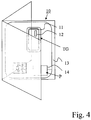
- Fig. 4 shows, in schematic representation, an electronic passport, with a data page 10 as an identification document 10, according to an embodiment of the invention.
- the data page 10 has a microprocessor chip P with an integrated key memory 14 and a short-range contactless interface (radio interface) 13, via which, after successful authentication, the data key KD stored in the key memory 14 can be read out.
- a UHF RFID tag TG is glued, with a long-range contactless interface (antenna) 13 and a data memory 11 coupled to the long-range contactless interface (antenna) 13, in which encrypted identification data ID are stored, encrypted with the symmetric data key KD stored in the key memory 14.
- the UHF RFID tag TG has in the example Fig. 4 no microprocessor and is therefore a pure memory label.
- the UHF RFID tag TG may additionally have its own microprocessor P-2.
Landscapes
- Engineering & Computer Science (AREA)
- Computer Security & Cryptography (AREA)
- Computer Networks & Wireless Communication (AREA)
- Theoretical Computer Science (AREA)
- Signal Processing (AREA)
- Computer Hardware Design (AREA)
- Physics & Mathematics (AREA)
- General Physics & Mathematics (AREA)
- Microelectronics & Electronic Packaging (AREA)
- General Engineering & Computer Science (AREA)
- Software Systems (AREA)
- Storage Device Security (AREA)
- Mobile Radio Communication Systems (AREA)
Description
- Die Erfindung betrifft ein Verfahren zum beschleunigten kontaktlosen Auslesen eines elektronischen Identifikationsdokuments mittels eines Terminals.
- Ein elektronisches Identifikationsdokument im Sinn der Erfindung umfasst zumindest einen Mikroprozessorchip, in dem Identifikationsdaten der Person, welcher das Identifikationsdokument zugeordnet ist, in mit einem Datenschlüssel verschlüsselter Form abgespeichert sind, und einen Schlüsselspeicher, in dem der zur Verschlüsselung der Identifikationsdaten verwendete Schlüssel abgespeichert ist. Als elektronisches Identifikationsdokument kann insbesondere ein elektronischer Reisepass oder eine elektronische Identifikationskarte (z.B. elektronischer Personalausweis) vorgesehen sein.
- Elektronische Identifikationsdokumente werden z.B. an Grenzkontrollen oder anderen Kontrollstationen, wie sie z.B. an Flughäfen vorgesehen sind, zur Personenkontrolle durch Terminals (Schreib-/Lesegeräte) massenhaft kontaktlos ausgelesen. Dabei werden die Identifikationsdaten aus dem Datenspeicher des Identifikationsdokuments kontaktlos an das Terminal übertragen, an irgend einer Stelle mit dem Schlüssel entschlüsselt, und im Terminal überprüft.
- Empfohlene Mechanismen zur gesicherten Kommunikation zwischen maschinenlesbaren Reisedokumenten, wie z.B. elektronischen Reisepässen, und entsprechenden Terminals sind in der Technischen Richtlinie TR-03110, Version V 2.05, des Bundesamtes für Sicherheit in der Informationstechnik (BSI) beschrieben (BSI Technical Guideline TR-03110 Version 2.05) (im Folgenden BSI TR-03110). Insbesondere sind in BSI TR-03110 Mechanismen zur Authentisierung zwischen dem Terminal und einem Mikroprozessorchip des Reisedokuments beschrieben, sowie Mechanismen zur Vereinbarung und Ableitung gemeinsamer Sitzungsschlüssel zwischen dem Terminal und dem Mikroprozessorchip des maschinenlesbaren Reisedokuments. Insbesondere ist in BSI TR-03110 in Kapitel 4 angeführt: in Kap. 4.2 das PACE Protokoll (PACE = Password Authenticated Connection Establishment), das die gegenseitige Authentisierung und (optional EC, Elliptic Curve) Diffie-Hellman Schlüsselvereinbarung zur Vereinbarung von Sitzungsschlüsseln zwischen dem Mikroprozessorchip und dem Terminal beschreibt; in Kap. 4.3 die Chip Authentisierung, mit Authentisierung des Mikroprozessorchip gegenüber dem Terminal und Vereinbarung von Sitzungsschlüsseln, aus denen Datenschlüssel ableitbar sind. Dabei wird durch sowohl den Mikroprozessorchip als auch das Terminal jeweils ein erster Sitzungsschlüssel KMAC erzeugt, der zur Authentisierung zwischen Chip und Terminal verwendet wird, und ein zweiter Sitzungsschlüssel KENC erzeugt, aus dem anschließend ein Transportschlüssel KSE abgeleitet wird, mit dem zwischen Chip und Terminal zu übertragende Daten verschlüsselt werden.
-
DE 10 2005 038 092 A1 offenbart ein Verfahren zur maschinellen Prüfung von in einem Passbuch elektronisch gespeicherten Daten. -
DE 100 37176 C2 offenbart als elektronisches Identifikationsdokument eine Ausweiskarte mit einem optischen Speicher und einem integrierten Schaltkreis, wobei im optischen Speicher personalisierte Daten verschlüsselt abgespeichert sind, verschlüsselt mit einem kryptographischen Schlüssel, der in dem integrierten Schaltkreis der Ausweiskarte abgespeichert ist. Die Ausweiskarte soll durch ein externes Schreib-/Lesegerät (Terminal) ausgelesen werden. Der integrierte Schaltkreis führt hierzu eine Authentifikationsprüfung an dem Schreib-/Lesegerät durch und gibt nach positiver Authentifikationsprüfung den Schlüssel zur Übermittlung an das Schreib-/Lesegerät frei. Die im optischen Speicher verschlüsselt abgespeicherten personalisierten Daten werden an das Schreib-/Lesegerät zur Entschlüsselung mit dem Schlüssel übermittelt. - Eine Personenkontrolle an Hand von elektronischen Identifikationsdokumenten mit dem in
DE 100 37176 C2 beschriebenen Verfahren ist zeitaufwändig, da zunächst eine Authentisierung des Terminals durchgeführt werden muss, dann der Schlüssel ausgelesen werden muss, und schließlich die Identifikationsdaten ausgelesen und entschlüsselt werden müssen. - Das Auslesen von integrierten Schaltkreisen in elektronischen Identifikationsdokumenten erfolgt üblicherweise kontaktlos mit RFID-Technik (RFID: radio-frequency identification) im kurzreichweitigen Funkbereich, genauer im proximity coupling Bereich, der Reichweiten von bis zu maximal ca. 15 Zentimeter umfasst, bei einer Übertragungsfrequenz von meistens 13,56 MHz, entsprechend Reichweiten von ca. 7 bis ca. 15 Zentimetern. Die Kommunikation für Identifikationskarten im kurzreichweitigen proximity coupling Funkbereich ist in ISO/IEC 14443 standardisiert. Die kurze Reichweite gewährt Schutz vor Ausspähen der Daten, während sie gerade funkübertragen werden.
- Speziell im Bereich der Logistik und Lagerhaltung mittels RFID-Etiketten wird Kontaktlos-Kommunikation im langreichweitigen Funkbereich verwendet, mit Betriebsfrequenzen im Bereich von einigen Gigahertz und Reichweiten von einigen Metern, typischerweise 3-6 Metern. Zur Kommunikation zwischen elektronischen Geräten werden langreichweitige Funkverbindungen im UHF-Bereich verwendet, mit Betriebsfrequenzen im Bereich einiger weniger GHz, und Reichweiten im Bereich von einigen zehn Metern bis einigen hundert Metern, z.B. WLAN (Wireless Local Area Network), mit z.B. 2,4 GHz oder 5 GHz Betriebsfrequenz, oder IrDA (Infrared Data Association). Die langen Reichweiten erleichtern ein Abfangen von übertragenen Daten während der Funkübertragung, weshalb langreichweitige Funkverbindungen für die Übertragung sicherheitskritischer Daten nachteilig sind.
- Der Fachartikel Bruce Christianson et al, "Multi-Channel Key Agreement Using Encrypted Public Key Exchange", Security Protocols 2007, Springer Berlin, Heidelberg, pp. 133-138, offenbart ein aufgeteiltes Schlüselableitungs-Protokoll, z.B. Diffie-Hellman-Schlüsselableitungs-Protokoll, bei dem Teilschlüssel über zwei Kanäle, nämlich einen langreichweitigen (z.B. RF) und einen kurzreichweitigen (z.B. kontaktbehaftet) übertragen werden.
- Der Erfindung liegt die Aufgabe zu Grunde, ein Verfahren zum beschleunigten kontaktlosen Auslesen eines elektronischen Identifikationsdokuments mittels eines Terminals zu schaffen, das schnell und zugleich sicher ist.
- Die Aufgabe wird gelöst durch ein Verfahren nach Anspruch 1. Vorteilhafte Ausgestaltungen der Erfindung sind in den abhängigen Ansprüchen angegeben.
- Bei dem Verfahren nach Anspruch 1 werden zunächst, im Datenleseschritt, die verschlüsselten Identifikationsdaten, die eine vergleichsweise große Datenmenge bilden, über eine langreichweitige Funkverbindung übertragen. Dies kann beispielsweise geschehen, während der Inhaber des Identifikationsdokuments in einer Warteschlange an einer Kontrollstelle steht, an der das Identifikationsdokument kontrolliert werden soll. Hierdurch kann die große Datenmenge der Identifikationsdaten während einer herkömmlicherweise ungenutzten Zeitspanne, z.B. während des Wartens in der Warteschlange, ausgelesen werden. Die besonders sicherheitskritische Übertragung des Datenschlüssels, mit dem die verschlüsselten Identifikationsdaten entschlüsselt werden können, an das Terminal, erfolgt anschließend über eine kurzreichweitige Funkverbindung. Durch die geringe Reichweite der kurzreichweitigen Funkverbindung ist ein guter Schutz gegen missbräuchliches Ausspähen des Datenschlüssels, während er in der Luft ist, d.h. gerade funkübertragen ist, gewährleistet. In der Regel kann die Datenschlüssel-Übertragung erst erfolgen, nachdem der Inhaber das Identifikationsdokument bewusst an der Kontrollstelle vorgelegt hat.
- Daher ist gemäß Anspruch 1 ein Verfahren zum beschleunigten kontaktlosen Auslesen eines elektronischen Identifikationsdokuments mittels eines Terminals geschaffen, das schnell und zugleich sicher ist.
- Der Schlüsselspeicher ist für einen Mikroprozessor (Chip) des Identifikationsdokuments zugänglich. Der Datenschlüssel ist beispielsweise ein symmetrischer Schlüssel, mit dem die Identifikationsdaten verschlüsselt worden sind.
- Als langreichweitige Funkverbindung ist wahlweise eine Funkverbindung mit einer Reichweite aus dem Bereich von ungefähr 1 Meter bis ungefähr einigen hundert Metern vorgesehen und/oder mit einer Betriebsfrequenz aus dem Bereich von ungefähr 0,3 GHz bis ungefähr 10 GHz, vorzugsweise ungefähr 2 GHz bis ungefähr 6 GHz, z.B. 2,4 GHz oder 5 GHz, z.B. UHF-RFID oder WLAN oder IrDA.
- Als kurzreichweitige Funkverbindung ist wahlweise eine Funkverbindung mit einer Reichweite aus dem Bereich von ungefähr 1 Zentimeter bis ungefähr 15 Zentimetern vorgesehen und/oder mit einer Betriebsfrequenz aus dem Bereich von ungefähr 3 MHz bis ungefähr 20 GHz, vorzugsweise bei 13,56 GHz, z.B. gemäß ISO/IEC 14443.
- Wahlweise werden im Datenleseschritt die Identifikationsdaten einfach ausgelesen, ohne vorherige Authentisierung, und ohne vorherige Verschlüsselung der Identifikationsdaten. Da die Identifikationsdaten in verschlüsselter Form im Datenspeicher abgespeichert sind, kann ein Unberechtigter, der die Identifikationsdaten ausliest, sie nicht entschlüsseln. Das derartige einfache Auslesen bietet somit dennoch eine beschränkte Sicherheit.
- Optional ist gewünscht, dass ein Unbefugter auch die verschlüsselten Identifikationsdaten nicht auslesen kann oder sogar keinerlei Zugriffsmöglichkeit auf den Datenspeicher hat. Deshalb ist wahlweise für den Zugriff auf den Datenspeicher eine Authentisierung erforderlich, wie nachfolgend beschrieben ist. Der Datenspeicher muss hierfür Verbindung zu einem Mikroprozessor haben, wohingegen beim einfachen Auslesen ein Datenspeicher ohne Mikroprozessor-Anbindung ausreichend ist.
- Wahlweise ist der Datenspeicher für den Mikroprozessor zugänglich, z.B. falls Datenspeicher, Schlüsselspeicher und Mikroprozessor direkt im Identifikationsdokument integriert sind, insbesondere auf einem einzigen Chip integriert sind. Alternativ hat das Identifikationsdokument einen weiteren Mikroprozessor, und der Datenspeicher ist für diesen zugänglich. Beispielsweise sind der Datenspeicher und der weitere Mikroprozessor in einem gesonderten Etikett oder Tag angeordnet, das an dem Identifikationsdokument angebracht ist, z.B. aufgeklebt ist.
- Bei Ausführungsformen, wo der Datenspeicher für den Mikroprozessor, z.B. im Hauptdokument, oder den weiteren Mikroprozessor, z.B. in einem Tag oder Etikett, zugänglich ist, wird wahlweise im Datenleseschritt, bevor die Identifikationsdaten an das Terminal übermittelt werden, ein erster Authentisierungsvorgang durchgeführt, bei dem mindestens eine Authentisierung zwischen dem Mikroprozessor und dem Terminal oder dem weiteren Mikroprozessor und dem Terminal durchgeführt wird. Wahlweise wird weiter ein Transportschlüssel zur Verschlüsselung der zu übermittelnden Identifikationsdaten berechnet, und werden die Identifikationsdaten mit dem Transportschlüssel verschlüsselt. Auf die Verschlüsselung der Identifikationsdaten mit einem Transportschlüssel kann optional verzichtet werden, da sie ohnehin verschlüsselt im Datenspeicher abgespeichert sind.
- Wahlweise wird im Schlüsselleseschritt, bevor der Datenschlüssel an das Terminal übermittelt wird, ein - der Unterscheidbarkeit halber "zweiter" genannter - Authentisierungsvorgang durchgeführt, bei dem mindestens eine Authentisierung zwischen dem Mikroprozessorchip und dem Terminal durchgeführt wird. Vorzugsweise wird zudem ein Schlüssel-Transportschlüssel zur Verschlüsselung des zu übermittelnden Datenschlüssels berechnet, und der Datenschlüssel mit dem Schlüssel-Transportschlüssel verschlüsselt, bevor er an das Terminal übertragen wird. Wahlweise ist der Datenschlüssel unverschlüsselt im Schlüsselspeicher abgespeichert und sollte somit vor der Übermittlung an das Terminal verschlüsselt werden. Falls der Datenschlüssel in verschlüsselter Form im Schlüsselspeicher abgespeichert ist, kann wahlweise die zusätzliche Verschlüsselung mit dem Schlüssel-Transportschlüssel entfallen. Dann muss allerdings der Schlüssel zum Entschlüsseln des Datenschlüssels an das Terminal bekanntgegeben werden.
- Der "zweite" Authentisierungsvorgang kann wahlweise der einzige Authentisierungsvorgang sein, in dem Fall, wenn der vorhergehende Datenleseschritt ohne Authentisierung gegenüber dem Datenspeicher bzw. dem zugeordneten Mikroprozessor erfolgt.
- Alternativ wird nur im Datenleseschritt eine Authentisierung durchgeführt, insbesondere Authentisierung des Terminals gegenüber dem Datenspeicher bzw. genau gesagt Authentisierung des Terminals gegenüber dem dem Datenspeicher zugeordneten Mikroprozessor, und im Schlüsselleseschritt keine Authentisierung durchgeführt. Diese Lösung ist denkbar, da der Schlüsselleseschritt über die kurzreichweitige Funkverbindung durchgeführt wird und somit nicht so leicht abgehorcht werden kann. Wahlweise wird hierbei im Datenleseschritt ein Transportschlüssel berechnet, der wahlweise nur zur Verschlüsselung der Identifikationsdaten für den Datenleseschritt, wahlweise nur zur Verschlüsselung des Datenschlüssels für den Schlüsselleseschritt, wahlweise sowohl zur Verschlüsselung der Identifikationsdaten als auch zur Verschlüsselung des Datenschlüssels verwendet wird, jeweils vor Übermittlung der jeweiligen Daten an das Terminal.
- Alternativ werden insgesamt zwei Authentisierungsvorgänge durchgeführt, je einer im Datenleseschritt und einer im Schlüsselleseschritt. Wahlweise wird in jedem Authentisierungsvorgang ein eigener Transportschlüssel erzeugt, jeweils wie weiter oben beschrieben. Wahlweise wird ein im ersten Authentisierungsvorgang, beim Datenleseschritt erzeugter Transportschlüssel auch oder nur zur Verschlüsselung des Datenschlüssels im Schlüsselleseschritt verwendet.
- Wahlweise werden während des ersten und/oder zweiten Authentisierungsvorgangs ein oder mehrere Sitzungsschlüssel zwischen dem Mikroprozessor bzw. weiteren Mikroprozessor und dem Terminal vereinbart, und aus zumindest einem Sitzungsschlüssel der Transportschlüssel bzw. Schlüssel-Transportschlüssel abgeleitet.
- Wahlweise wird im - ggf. jeweiligen - Authentisierungsvorgang eine gegenseitige oder einseitige Authentisierung und Diffie-Hellman Schlüsselvereinbarung zwischen dem Mikroprozessor bzw. weiteren Mikroprozessor und dem Terminal durchgeführt, insbesondere gemäß PACE Protokoll Kap. 4.2 oder gemäß Chip Authentisierung Kap. 4.3 oder gemäß Terminal Authentisierung Kap. 4.4 der BSI TR-03110.
- Ein erfindungsgemäßes Identifikationsdokument hat einen Mikroprozessor, einen Datenspeicher, in dem Identifikationsdaten in mit einem Datenschlüssel verschlüsselter oder zumindest entschlüsselbarer Form abgespeichert oder abspeicherbar sind, und einen für den Mikroprozessor zugänglichen Schlüsselspeicher, in dem der Datenschlüssel abgespeichert oder abspeicherbar ist, und ist gekennzeichnet durch eine langreichweitige Schnittstelle, über die eine langreichweitige Funkverbindung zwischen dem Datenspeicher und einem Terminal herstellbar ist, und eine kurzreichweitige Schnittstelle, über die eine kurzreichweitige Funkverbindung zwischen dem Schlüsselspeicher und einem Terminal herstellbar ist, und dadurch, dass der Datenschlüssel oder der Schlüsselspeicher derart gesichert ist, dass eine Übertragung des Datenschlüssels oder sonstiger Daten aus dem Schlüsselspeicher an ein Terminal über die kurzreichweitige Funkverbindung möglich ist und über die langreichweitige Funkverbindung nicht möglich ist. Hierdurch wird ein unbemerktes Ausspähen des Datenschlüssels aus der Luftschnittstelle, also während der Datenschlüssel gerade funkübertragen wird, verhindert oder zumindest stark erschwert.
- Der Datenspeicher ist wahlweise in das Identifikationsdokument fest integriert. Wahlweise sind der Datenspeicher, der Schlüsselspeicher und der Mikroprozessor auf einem einzigen Chip integriert, der mit der langreichweitigen Schnittstelle und der kurzreichweitigen Schnittstelle gekoppelt oder koppelbar ist. Wahlweise ist der Datenspeicher für den Mikroprozessor, der auch dem Schlüsselspeicher zugeordnet ist, zugänglich.
- Wahlweise sind der Datenspeicher und die langreichweitige Schnittstelle in einem gesonderten, an einem Hauptkörper des Identifikationsdokuments angebrachten Etikett angeordnet. Das Etikett oder Tag kann ein reines Speicher-RFID-Etikett ohne Mikroprozessor sein. Alternativ weist das Etikett einen weiteren Mikroprozessor auf, wobei optional der Datenspeicher für den weiteren Mikroprozessor zugänglich ist. Das Etikett ist z.B. auf dem Hauptkörper aufgeklebt.
- Bei der Variante des Identifikationsdokuments mit einem separaten Etikett für den Datenspeicher und dem Schlüsselspeicher im Hauptdokument sind der Datenspeicher und die langreichweitige Schnittstelle baulich vom Hauptdokument des Identifikationsdokuments getrennt. Somit ist der im Hauptdokument angeordnete Schlüsselspeicher baulich gegenüber der langreichweitigen Schnittstelle zugriffsgeschützt. Im Fall, dass Datenspeicher, Schlüsselspeicher und Mikroprozessor im Hauptdokument, wahlweise auf demselben Chip, vorgesehen sind, wird Zugriffsschutz auf den Schlüsselspeicher gegenüber der langreichweitigen Schnittstelle beispielsweise auf Softwareebene oder Protokollebene erreicht, durch geeignete Software oder geeignete Protokolle zum Zugreifen auf den Schlüsselspeicher und Datenspeicher.
- Ein erfindungsgemäßes Terminal zum kontaktlosen Auslesen eines elektronischen Identifikationsdokuments zeichnet sich aus durch: eine langreichweitige Terminal-Schnittstelle, über die, über die langreichweitige Schnittstelle des Identifikationsdokuments, eine langreichweitige Funkverbindung zu dem Datenspeicher des Identifikationsdokuments herstellbar ist; und eine kurzreichweitige Terminal-Schnittstelle, über die, über die kurzreichweitige Schnittstelle des Identifikationsdokuments, eine kurzreichweitige Funkverbindung zu dem Schlüsselspeicher des Identifikationsdokuments herstellbar ist. Die kurzreichweitige Terminal-Schnittstelle hat exklusiven Zugriff auf den Schlüsselspeicher des Identifikationsdokuments, d.h. die langreichweitige Terminal-Schnittstelle kann nicht auf den Schlüsselspeicher zugreifen.
- Im Folgenden wird die Erfindung an Hand von Ausführungsbeispielen und unter Bezugnahme auf die Zeichnung näher erläutert, in der zeigen:
- Fig. 1
- ein Identifikationsdokument gemäß einer Ausführungsform der Erfindung, in schematischer Darstellung;
- Fig. 2
- einen Datenleseschritt gemäß einer Ausführungsform eines erfindungsgemäßen Verfahrens;
- Fig. 3
- einen Schlüsselleseschritt gemäß einer Ausführungsform eines erfindungsgemäßen Verfahrens;
- Fig. 4
- einen elektronischen Reisepass, gemäß einer Ausführungsform der Erfindung.
-
Fig. 1 zeigt ein Identifikationsdokument 10 (z.B. Personalausweis) gemäß einer Ausführungsform der Erfindung, in schematischer Darstellung. Das Identifikationsdokument 10 hat einen Mikroprozessor P, einen daran angebundenen Schlüsselspeicher 14 und einen ebenfalls angebundenen Datenspeicher 11. Im Datenspeicher 11 sind Identifikationsdaten ID in verschlüsselter Form abgespeichert. Die Identifikationsdaten ID sind mit einem symmetrischen Datenschlüssel KD verschlüsselt. Der Datenschlüssel KD ist in dem speziell gesicherten Schlüsselspeicher 14 unverschlüsselt abgespeichert. Das Identifikationsdokument 10 hat weiter eine langreichweitige Schnittstelle 12, über die eine langreichweitige Funkverbindung zu einem Terminal 20 herstellbar ist, und eine kurzreichweitige Schnittstelle 13, über die eine kurzreichweitige Funkverbindung zu einem Terminal 20 herstellbar ist. Der Datenschlüssel KD ist derart gesichert, dass eine Übertragung des Datenschlüssels KD an das Terminal 20 über die kurzreichweitige Funkverbindung 13 möglich ist und über die langreichweitige Funkverbindung 12 nicht möglich ist. Über die kurzreichweitige Schnittstelle 13 ist also ein auslesender Zugriff auf den Schlüsselspeicher 14 möglich, über die langreichweitige Schnittstelle 12 hingegen nicht. An die langreichweitige Schnittstelle 12 ist dagegen der Datenspeicher 11 angebunden, in dem die verschlüsselten Identifikationsdaten ID abgespeichert sind. Im Beispiel ausFig. 1 sind der Datenspeicher 11, der Schlüsselspeicher 14, die langreichweitige Schnittstelle 12 und die kurzreichweitige Schnittstelle 13 an denselben und einzigen Mikroprozessor P des Identifikationsdokuments 10 angekoppelt. Die Zugriffssicherung auf den Schlüsselspeicher 14 gegenüber der langreichweitigen Funkschnittstelle 13 ist chipintern gelöst, z.B. auf Protokollebene oder Softwareebene. -
Fig. 2 zeigt einen Datenleseschritt gemäß einer Ausführungsform eines erfindungsgemäßen Verfahrens. Der Datenleseschritt umfasst einen über die langreichweitige Schnittstelle 12 durchgeführten Authentisierungsvorgang, in dem eine gegenseitige Authentisierung und Diffie-Hellman Schlüsselvereinbarung zwischen dem Mikroprozessor P in Bezug auf den Datenspeicher 11 und dem Terminal 20 durchgeführt wird, gemäß dem PACE Protokoll Kap. 4.2 der BSI TR-03110. Dabei werden zwei Sitzungsschlüssel KMAC, KENC berechnet. Anhand des Authentisierungs-Sitzungsschlüssels KMAC authentisieren sich der Mikroprozessor P und das Terminal 20 gegenseitig. Aus dem zweiten Sitzungsschlüssel KENC wird ein Transportschlüssel KT abgeleitet, mit dem im Mikroprozessor P die Identifikationsdaten ID aus dem Datenspeicher 11 verschlüsselt werden. Anlässlich einer erfolgreichen Terminal-Authentisierung wird das Terminal 20 als berechtigt angesehen. Optional kann die Verschlüsselung der Identifikationsdaten ID mit dem Transportschlüssel KT an dieser Stelle entfallen, da die Identifikationsdaten ID ohnehin mit dem Datenschlüssel KD verschlüsselt sind. Die ggf. mit KT verschlüsselten Identifikationsdaten ID werden vom Mikroprozessor 11 über die langreichweitige Schnittstelle 12 an das Terminal 20 übertragen und ggf. mit KT beim Terminal 20 entschlüsselt. Die entschlüsselten Identifikationsdaten ID sind immer noch mit dem Datenschlüssel KD verschlüsselt. -
Fig. 3 zeigt einen Schlüsselleseschritt gemäß einer Ausführungsform eines erfindungsgemäßen Verfahrens. Der Schlüsselleseschritt umfasst einen über die kurzreichweitige Schnittstelle 13 durchgeführten Authentisierungsvorgang, in dem eine gegenseitige Authentisierung und Diffie-Hellman Schlüsselvereinbarung zwischen dem Mikroprozessor P und dem Terminal 20 durchgeführt wird, gemäß dem PACE Protokoll Kap. 4.2 der BSI TR-03110. Dabei werden zwei Sitzungsschlüssel KMAC-KD, KENC-KD berechnet. Anhand des Authentisierungs-Sitzungsschlüssels KMAC-KD authentisieren sich das Terminal 20 und der Mikroprozessor P in Bezug auf den Schlüsselspeicher 14 gegenseitig. Aus dem zweiten Sitzungsschlüssel KENC-KD wird ein zweiter Transportschlüssel KT-KD abgeleiten, mit dem durch den Mikroprozessor P oder unter Steuerung des Mikroprozessors P der Datenschlüssel KD aus dem Schlüsselspeicher 14 verschlüsselt wird. Der mit dem Transportschlüssel KT-KD verschlüsselte Datenschlüssel KD wird vom Mikroprozessor P über die kurzreichweitige Schnittstelle 12 an das Terminal 20 übertragen und beim Terminal 20 entschlüsselt. - Nun entschlüsselt das Terminal mit dem entschlüsselten Datenschlüssel KD die verschlüsselten Identifikationsdaten ID.
-
Fig. 4 zeigt, in schematischer Darstellung, einen elektronischen Reisepass, mit einer Datenseite 10 als Identifikationsdokument 10, gemäß einer Ausführungsform der Erfindung. Die Datenseite 10 hat einen Mikroprozessorchip P mit einem integrierten Schlüsselspeicher 14 und eine kurzreichweitige Kontaktlos-Schnittstelle (Funkschnittstelle) 13, über die nach erfolgreicher Authentisierung der im Schlüsselspeicher 14 abgespeicherte Datenschlüssel KD auslesbar ist. Auf eine Oberfläche der Datenseite 10 ist ein UHF-RFID-Etikett TG aufgeklebt, mit einer langreichweitigen Kontaktlos-Schnittstelle (Antenne) 13 und einem mit der langreichweitigen Kontaktlos-Schnittstelle (Antenne) 13 gekoppelten Datenspeicher 11, in dem verschlüsselte Identifikationsdaten ID abgespeichert sind, verschlüsselt mit dem im Schlüsselspeicher 14 abgespeicherten symmetrischen Datenschlüssel KD. Das UHF-RFID-Etikett TG hat im Beispiel ausFig. 4 keinen Mikroprozessor und ist somit ein reines Speicheretikett. Alternativ kann das UHF-RFID-Etikett TG zusätzlich einen eigenen Mikroprozessor P-2 haben.
Claims (11)
- Verfahren zum kontaktlosen Auslesen eines elektronischen Identifikationsdokuments (10) mittels eines Terminals (20),
wobei das Identifikationsdokument (10) umfasst:- einen Mikroprozessor (P),- einen Datenspeicher (11), in dem Identifikationsdaten (ID) in verschlüsselter, mit einem Datenschlüssel (KD) entschlüsselbarer Form abgespeichert sind,- und einen für den Mikroprozessor (P) zugänglichen Schlüsselspeicher (14), in dem der Datenschlüssel (KD) abgespeichert ist,wobei bei dem Verfahren- in einem Datenleseschritt die verschlüsselten Identifikationsdaten (ID) aus dem Datenspeicher (11) an das Terminal (20) übermittelt werden,- in einem Schlüsselleseschritt der Datenschlüssel (KD) aus dem Schlüsselspeicher (14) an das Terminal (20) übermittelt wird und- in einem Entschlüsselungsschritt im Terminal (20) die Identifikationsdaten (ID) mit dem Datenschlüssel (KD) entschlüsselt werden,dadurch gekennzeichnet, dass
der Datenleseschritt unter Verwendung einer langreichweitigen Funkverbindung durchgeführt wird und der Schlüsselleseschritt unter Verwendung einer kurzreichweitigen Funkverbindung durchgeführt wird. - Verfahren nach Anspruch 1, wobei als langreichweitige Funkverbindung eine Funkverbindung mit einer Reichweite aus dem Bereich von 1 Meter bis einigen hundert Metern vorgesehen ist und/oder mit einer Betriebsfrequenz aus dem Bereich von 0,3 GHz bis 10 GHz.
- Verfahren nach Anspruch 1 oder 2, wobei als kurzreichweitige Funkverbindung eine Funkverbindung mit einer Reichweite aus dem Bereich von 1 Zentimeter bis 15 Zentimetern vorgesehen ist und/oder mit einer Betriebsfrequenz aus dem Bereich von 3 MHz bis 20 GHz, vorzugsweise bei 13,56 GHz.
- Verfahren nach einem der Ansprüche 1 bis 3, wobei- der Datenspeicher (11) für den Mikroprozessor (P) oder einen weiteren Mikroprozessor (P-2) zugänglich ist, und- im Datenleseschritt, bevor die Identifikationsdaten (ID) an das Terminal (20) übermittelt werden, ein erster Authentisierungsvorgang durchgeführt wird, bei dem mindestens eine Authentisierung zwischen dem Mikroprozessor (P) und dem Terminal (T) oder dem weiteren Mikroprozessor (P-2) und dem Terminal (T) durchgeführt wird, und wahlweise weiter ein Transportschlüssel (KT) zur Verschlüsselung der zu übermittelnden Identifikationsdaten (ID) berechnet wird, und die Identifikationsdaten (ID) mit dem Transportschlüssel (KT) verschlüsselt werden.
- Verfahren nach einem der Ansprüche 1 bis 4, wobei im Schlüsselleseschritt, bevor der Datenschlüssel (KD) an das Terminal (20) übermittelt wird, ein zweiter Authentisierungsvorgang durchgeführt wird, bei dem mindestens eine Authentisierung zwischen dem Mikroprozessorchip (P) und dem Terminal (20) durchgeführt wird, und wahlweise weiter ein Schlüssel-Transportschlüssel (KT-KD) zur Verschlüsselung des zu übermittelnden Datenschlüssels (KD) berechnet wird, und der Datenschlüssel (KD) mit dem Schlüssel-Transportschlüssel (KT-KD) verschlüsselt wird.
- Verfahren nach Anspruch 4 oder 5, wobei während des ersten und/oder zweiten Authentisierungsvorgangs ein oder mehrere Sitzungsschlüssel (KMAC, KENC) zwischen dem Mikroprozessor (P) bzw. weiteren Mikroprozessor (P-2) und dem Terminal (20) vereinbart werden, und aus zumindest einem Sitzungsschlüssel (KENC) der Transportschlüssel (KT) bzw. Schlüssel-Transportschlüssel (KT-KD) abgeleitet wird.
- Verfahren nach Anspruch 6, wobei im Authentisierungsvorgang eine gegenseitige oder einseitige Authentisierung und Diffie-Hellman Schlüsselvereinbarung zwischen dem Mikroprozessorchip (P) bzw. weiteren Mikroprozessor (P-2) und dem Terminal (20) durchgeführt wird, insbesondere gemäß PACE Protokoll Kap. 4.2 oder gemäß Chip Authentisierung Kap. 4.3 oder gemäß Terminal Authentisierung Kap. 4.4 der BSI TR-03110.
- Identifikationsdokument (10) mit- einem Mikroprozessor (P),- einem Datenspeicher (11), in dem Identifikationsdaten (ID) in verschlüsselter, mit einem Datenschlüssel (KD) entschlüsselbarer Form abgespeichert oder abspeicherbar sind,- und einem für den Mikroprozessor (P) zugänglichen Schlüsselspeicher (14), in dem der Datenschlüssel (KD) abgespeichert oder abspeicherbar ist,gekennzeichnet durch- eine langreichweitige Schnittstelle (12), über die eine langreichweitige Funkverbindung zwischen dem Datenspeicher (11) und einem Terminal (20) herstellbar ist, und- eine kurzreichweitige Schnittstelle (13), über die eine kurzreichweitige Funkverbindung zwischen dem Schlüsselspeicher (14) einem Terminal (20) herstellbar ist,und dadurch, dass
der Datenschlüssel (KD) oder Schlüsselspeicher (14) derart gesichert ist, dass eine Übertragung des Datenschlüssels (KD) aus dem Schlüsselspeicher (14) an ein Terminal über die kurzreichweitige Funkverbindung (13) möglich ist und über die langreichweitige Funkverbindung (12) nicht möglich ist. - Identifikationsdokument (10) nach Anspruch 8, wobei der Datenspeicher fest in das Identifikationsdokument integriert ist, wobei der Datenspeicher (11), der Schlüsselspeicher (14) und der Mikroprozessor (P) auf einem einzigen Chip integriert sind.
- Identifikationsdokument (10) nach Anspruch 8, wobei der Datenspeicher (11) und die langreichweitige Schnittstelle (12) in einem gesonderten, an einem Hauptkörper des Identifikationsdokuments (10) angebrachten Etikett angeordnet sind, wobei das Etikett einen weiteren Mikroprozessor (P-2) aufweist, wobei der Datenspeicher (11) für den weiteren Mikroprozessor (P-2) zugänglich ist.
- Terminal (20) zum kontaktlosen Auslesen eines elektronischen Identifikationsdokuments (10) nach einem der Ansprüche 8 bis 10,
gekennzeichnet durch- eine langreichweitige Terminal-Schnittstelle, über die, über die langreichweitige Schnittstelle (12) des Identifikationsdokuments (10), eine langreichweitige Funkverbindung zu dem Datenspeicher (11) des Identifikationsdokuments (10) herstellbar ist, und- eine kurzreichweitige Terminal-Schnittstelle, über die, über die kurzreichweitige Schnittstelle (13) des Identifikationsdokuments (10), eine kurzreichweitige Funkverbindung zu dem Schlüsselspeicher (14) des Identifikationsdokuments (10) herstellbar ist.
Applications Claiming Priority (2)
| Application Number | Priority Date | Filing Date | Title |
|---|---|---|---|
| DE102011121567A DE102011121567A1 (de) | 2011-12-20 | 2011-12-20 | Verfahren zum kontaktlosen Auslesen eines Identifikationsdokuments |
| PCT/EP2012/005238 WO2013091840A1 (de) | 2011-12-20 | 2012-12-18 | Verfahren zum kontaktlosen auslesen eines identifikationsdokuments |
Publications (2)
| Publication Number | Publication Date |
|---|---|
| EP2795832A1 EP2795832A1 (de) | 2014-10-29 |
| EP2795832B1 true EP2795832B1 (de) | 2019-03-20 |
Family
ID=47557012
Family Applications (1)
| Application Number | Title | Priority Date | Filing Date |
|---|---|---|---|
| EP12813765.0A Active EP2795832B1 (de) | 2011-12-20 | 2012-12-18 | Verfahren zum kontaktlosen auslesen eines identifikationsdokuments |
Country Status (4)
| Country | Link |
|---|---|
| US (1) | US10050788B2 (de) |
| EP (1) | EP2795832B1 (de) |
| DE (1) | DE102011121567A1 (de) |
| WO (1) | WO2013091840A1 (de) |
Families Citing this family (5)
| Publication number | Priority date | Publication date | Assignee | Title |
|---|---|---|---|---|
| US9660803B2 (en) * | 2015-09-15 | 2017-05-23 | Global Risk Advisors | Device and method for resonant cryptography |
| EP3185159A1 (de) * | 2015-12-24 | 2017-06-28 | Gemalto Sa | Verfahren und system zur verbesserung der sicherheit einer transaktion |
| EP3480736B1 (de) * | 2017-11-06 | 2021-01-27 | Nxp B.V. | Elektrische identifizierungsvorrichtung |
| US11595189B2 (en) * | 2020-10-27 | 2023-02-28 | Microsoft Technology Licensing, Llc | Secure key exchange using key-associated attributes |
| DE102023201725A1 (de) | 2023-02-24 | 2024-08-29 | Fraunhofer-Gesellschaft zur Förderung der angewandten Forschung eingetragener Verein | Transceiver und zugehöriges Betriebsverfahren |
Family Cites Families (20)
| Publication number | Priority date | Publication date | Assignee | Title |
|---|---|---|---|---|
| JP3786993B2 (ja) * | 1995-12-14 | 2006-06-21 | 株式会社日立製作所 | データ記憶ユニット及び該ユニットを用いたデータ記憶装置 |
| DE10037176C2 (de) | 2000-07-31 | 2002-10-17 | Orga Kartensysteme Gmbh | Datenträger mit verschlüsselten personalisierten Daten |
| DE10317257A1 (de) | 2003-04-14 | 2004-11-04 | Giesecke & Devrient Gmbh | Kontaktloser Datenträger |
| US7607012B2 (en) | 2003-10-01 | 2009-10-20 | Nokia Corporation | Method for securing a communication |
| US7566010B2 (en) * | 2003-12-26 | 2009-07-28 | Semiconductor Energy Laboratory Co., Ltd. | Securities, chip mounting product, and manufacturing method thereof |
| EP1806869A4 (de) * | 2004-10-28 | 2009-05-27 | Mitsubishi Electric Corp | Kommunikationsgerät und kommunikationsverfahren |
| US7457952B2 (en) * | 2004-12-16 | 2008-11-25 | Xerox Corporation | Authentication tag for S/W media |
| GB0428543D0 (en) * | 2004-12-31 | 2005-02-09 | British Telecomm | Control of data exchange |
| US20070046467A1 (en) * | 2005-08-31 | 2007-03-01 | Sayan Chakraborty | System and method for RFID reader to reader communication |
| DE102005038092A1 (de) | 2005-08-11 | 2007-02-15 | Giesecke & Devrient Gmbh | Verfahren und Einrichtung zur Prüfung eines elektronischen Passes |
| US8041339B2 (en) * | 2006-01-31 | 2011-10-18 | Alcatel Lucent | Method for secure authentication of mobile devices |
| US20070233612A1 (en) * | 2006-03-31 | 2007-10-04 | Ricoh Company, Ltd. | Techniques for generating a media key |
| US20080089519A1 (en) * | 2006-10-12 | 2008-04-17 | Nokia Corporation | Secure key exchange algorithm for wireless protocols |
| US8063769B2 (en) * | 2007-03-30 | 2011-11-22 | Broadcom Corporation | Dual band antenna and methods for use therewith |
| JP5141173B2 (ja) * | 2007-10-05 | 2013-02-13 | 富士通株式会社 | 読取り書込み装置との間で無線通信が可能な情報装置、プログラムおよび方法 |
| US8515070B2 (en) * | 2007-10-12 | 2013-08-20 | Emc Corporation | Access control for implanted medical devices |
| US20100045425A1 (en) * | 2008-08-21 | 2010-02-25 | Chivallier M Laurent | data transmission of sensors |
| US8224246B2 (en) * | 2010-05-10 | 2012-07-17 | Nokia Corporation | Device to device connection setup using near-field communication |
| CN102918550B (zh) * | 2010-05-17 | 2016-08-10 | Zih公司 | 双应答器射频识别 |
| KR20130123606A (ko) * | 2012-05-03 | 2013-11-13 | 한국과학기술원 | 플렉서블 디스플레이를 이용한 정보 동기화 방법 |
-
2011
- 2011-12-20 DE DE102011121567A patent/DE102011121567A1/de not_active Withdrawn
-
2012
- 2012-12-18 US US14/364,222 patent/US10050788B2/en active Active
- 2012-12-18 EP EP12813765.0A patent/EP2795832B1/de active Active
- 2012-12-18 WO PCT/EP2012/005238 patent/WO2013091840A1/de not_active Ceased
Non-Patent Citations (1)
| Title |
|---|
| None * |
Also Published As
| Publication number | Publication date |
|---|---|
| DE102011121567A1 (de) | 2013-06-20 |
| WO2013091840A1 (de) | 2013-06-27 |
| US20140333416A1 (en) | 2014-11-13 |
| US10050788B2 (en) | 2018-08-14 |
| EP2795832A1 (de) | 2014-10-29 |
Similar Documents
| Publication | Publication Date | Title |
|---|---|---|
| DE102007016467B3 (de) | Transponder mit Zugriffsschutz und Verfahren zum Zugriff auf den Transponder | |
| AT506344B1 (de) | Verfahren und vorrichtung zur steuerung der zutrittskontrolle | |
| DE102008023914A1 (de) | Verfahren zur Authentifizierung eines RFID-Tags | |
| AT513461A1 (de) | Verfahren zur Zutrittskontrolle | |
| EP2795832A1 (de) | Verfahren zum kontaktlosen auslesen eines identifikationsdokuments | |
| EP3391278B1 (de) | Id-token mit geschütztem mikrocontroller | |
| EP3017432B1 (de) | Gesicherte kommunikationseinrichtung für ein fahrzeug und fahrzeugsystem | |
| EP2584539B1 (de) | Verfahren zum Konfigurieren eines elektromechanischen Schlosses | |
| DE602005001395T2 (de) | Überprüfung der Verbindung eines drahtlosen Smartkartenlesers | |
| EP0825316B2 (de) | Verfahren und System zum Einschreiben einer Schlüsselinformation | |
| WO2017032452A1 (de) | Transaktionssystem | |
| EP3345364A1 (de) | Indirekter berechtigungstransport | |
| DE102005003647A1 (de) | Identifizierungssystem | |
| EP2009581B1 (de) | Anordnung und Funkeinrichtung zur Informationsübertragung | |
| EP3671506B1 (de) | Chipkarte, computersystem, verfahren zur aktivierung einer chipkarte und verfahren zur personalisierung einer chipkarte | |
| EP2486551B1 (de) | Personalisieren eines telekommunikationsmoduls | |
| EP1980977B1 (de) | Authentifizierbares Etikett sowie Vorrichtung zum Authentifizieren eines authentifizierbaren Etiketts | |
| EP2613491B1 (de) | Ausführung von kryptografischen Operationen mit Daten eines Nutzerendgeräts | |
| AT13608U1 (de) | Verfahren und Vorrichtung zur Steuerung der Zutrittskontrolle | |
| DE60213375T2 (de) | Kontaktloses elektronisches Identifizierungssystem | |
| WO2017032453A1 (de) | Verwaltung, authentifizierung und aktivierung eines datenträgers | |
| DE10028821A1 (de) | Chipkarte mit Lesekennungen | |
| EP2876575A1 (de) | Chipkartenlesegerät | |
| DE102011112855A1 (de) | Verfahren zur elektronischen Durchführung einer Zahlungstransaktion | |
| DE102012025418A1 (de) | Verfahren, portabler Datenträger und Terminaleinrichtung zum Durchführen einer kontaktlosen Transaktion |
Legal Events
| Date | Code | Title | Description |
|---|---|---|---|
| PUAI | Public reference made under article 153(3) epc to a published international application that has entered the european phase |
Free format text: ORIGINAL CODE: 0009012 |
|
| 17P | Request for examination filed |
Effective date: 20140721 |
|
| AK | Designated contracting states |
Kind code of ref document: A1 Designated state(s): AL AT BE BG CH CY CZ DE DK EE ES FI FR GB GR HR HU IE IS IT LI LT LU LV MC MK MT NL NO PL PT RO RS SE SI SK SM TR |
|
| DAX | Request for extension of the european patent (deleted) | ||
| RAP1 | Party data changed (applicant data changed or rights of an application transferred) |
Owner name: GIESECKE+DEVRIENT MOBILE SECURITY GMBH |
|
| STAA | Information on the status of an ep patent application or granted ep patent |
Free format text: STATUS: EXAMINATION IS IN PROGRESS |
|
| 17Q | First examination report despatched |
Effective date: 20180309 |
|
| GRAP | Despatch of communication of intention to grant a patent |
Free format text: ORIGINAL CODE: EPIDOSNIGR1 |
|
| STAA | Information on the status of an ep patent application or granted ep patent |
Free format text: STATUS: GRANT OF PATENT IS INTENDED |
|
| INTG | Intention to grant announced |
Effective date: 20181102 |
|
| GRAS | Grant fee paid |
Free format text: ORIGINAL CODE: EPIDOSNIGR3 |
|
| GRAA | (expected) grant |
Free format text: ORIGINAL CODE: 0009210 |
|
| STAA | Information on the status of an ep patent application or granted ep patent |
Free format text: STATUS: THE PATENT HAS BEEN GRANTED |
|
| AK | Designated contracting states |
Kind code of ref document: B1 Designated state(s): AL AT BE BG CH CY CZ DE DK EE ES FI FR GB GR HR HU IE IS IT LI LT LU LV MC MK MT NL NO PL PT RO RS SE SI SK SM TR |
|
| REG | Reference to a national code |
Ref country code: GB Ref legal event code: FG4D Free format text: NOT ENGLISH |
|
| REG | Reference to a national code |
Ref country code: CH Ref legal event code: EP |
|
| REG | Reference to a national code |
Ref country code: DE Ref legal event code: R096 Ref document number: 502012014483 Country of ref document: DE |
|
| REG | Reference to a national code |
Ref country code: AT Ref legal event code: REF Ref document number: 1111630 Country of ref document: AT Kind code of ref document: T Effective date: 20190415 |
|
| REG | Reference to a national code |
Ref country code: IE Ref legal event code: FG4D Free format text: LANGUAGE OF EP DOCUMENT: GERMAN |
|
| REG | Reference to a national code |
Ref country code: NL Ref legal event code: MP Effective date: 20190320 |
|
| PG25 | Lapsed in a contracting state [announced via postgrant information from national office to epo] |
Ref country code: LT Free format text: LAPSE BECAUSE OF FAILURE TO SUBMIT A TRANSLATION OF THE DESCRIPTION OR TO PAY THE FEE WITHIN THE PRESCRIBED TIME-LIMIT Effective date: 20190320 Ref country code: NO Free format text: LAPSE BECAUSE OF FAILURE TO SUBMIT A TRANSLATION OF THE DESCRIPTION OR TO PAY THE FEE WITHIN THE PRESCRIBED TIME-LIMIT Effective date: 20190620 Ref country code: FI Free format text: LAPSE BECAUSE OF FAILURE TO SUBMIT A TRANSLATION OF THE DESCRIPTION OR TO PAY THE FEE WITHIN THE PRESCRIBED TIME-LIMIT Effective date: 20190320 Ref country code: SE Free format text: LAPSE BECAUSE OF FAILURE TO SUBMIT A TRANSLATION OF THE DESCRIPTION OR TO PAY THE FEE WITHIN THE PRESCRIBED TIME-LIMIT Effective date: 20190320 |
|
| REG | Reference to a national code |
Ref country code: LT Ref legal event code: MG4D |
|
| PG25 | Lapsed in a contracting state [announced via postgrant information from national office to epo] |
Ref country code: NL Free format text: LAPSE BECAUSE OF FAILURE TO SUBMIT A TRANSLATION OF THE DESCRIPTION OR TO PAY THE FEE WITHIN THE PRESCRIBED TIME-LIMIT Effective date: 20190320 Ref country code: RS Free format text: LAPSE BECAUSE OF FAILURE TO SUBMIT A TRANSLATION OF THE DESCRIPTION OR TO PAY THE FEE WITHIN THE PRESCRIBED TIME-LIMIT Effective date: 20190320 Ref country code: GR Free format text: LAPSE BECAUSE OF FAILURE TO SUBMIT A TRANSLATION OF THE DESCRIPTION OR TO PAY THE FEE WITHIN THE PRESCRIBED TIME-LIMIT Effective date: 20190621 Ref country code: HR Free format text: LAPSE BECAUSE OF FAILURE TO SUBMIT A TRANSLATION OF THE DESCRIPTION OR TO PAY THE FEE WITHIN THE PRESCRIBED TIME-LIMIT Effective date: 20190320 Ref country code: BG Free format text: LAPSE BECAUSE OF FAILURE TO SUBMIT A TRANSLATION OF THE DESCRIPTION OR TO PAY THE FEE WITHIN THE PRESCRIBED TIME-LIMIT Effective date: 20190620 Ref country code: LV Free format text: LAPSE BECAUSE OF FAILURE TO SUBMIT A TRANSLATION OF THE DESCRIPTION OR TO PAY THE FEE WITHIN THE PRESCRIBED TIME-LIMIT Effective date: 20190320 |
|
| PG25 | Lapsed in a contracting state [announced via postgrant information from national office to epo] |
Ref country code: AL Free format text: LAPSE BECAUSE OF FAILURE TO SUBMIT A TRANSLATION OF THE DESCRIPTION OR TO PAY THE FEE WITHIN THE PRESCRIBED TIME-LIMIT Effective date: 20190320 Ref country code: PT Free format text: LAPSE BECAUSE OF FAILURE TO SUBMIT A TRANSLATION OF THE DESCRIPTION OR TO PAY THE FEE WITHIN THE PRESCRIBED TIME-LIMIT Effective date: 20190720 Ref country code: ES Free format text: LAPSE BECAUSE OF FAILURE TO SUBMIT A TRANSLATION OF THE DESCRIPTION OR TO PAY THE FEE WITHIN THE PRESCRIBED TIME-LIMIT Effective date: 20190320 Ref country code: CZ Free format text: LAPSE BECAUSE OF FAILURE TO SUBMIT A TRANSLATION OF THE DESCRIPTION OR TO PAY THE FEE WITHIN THE PRESCRIBED TIME-LIMIT Effective date: 20190320 Ref country code: IT Free format text: LAPSE BECAUSE OF FAILURE TO SUBMIT A TRANSLATION OF THE DESCRIPTION OR TO PAY THE FEE WITHIN THE PRESCRIBED TIME-LIMIT Effective date: 20190320 Ref country code: RO Free format text: LAPSE BECAUSE OF FAILURE TO SUBMIT A TRANSLATION OF THE DESCRIPTION OR TO PAY THE FEE WITHIN THE PRESCRIBED TIME-LIMIT Effective date: 20190320 Ref country code: EE Free format text: LAPSE BECAUSE OF FAILURE TO SUBMIT A TRANSLATION OF THE DESCRIPTION OR TO PAY THE FEE WITHIN THE PRESCRIBED TIME-LIMIT Effective date: 20190320 Ref country code: SK Free format text: LAPSE BECAUSE OF FAILURE TO SUBMIT A TRANSLATION OF THE DESCRIPTION OR TO PAY THE FEE WITHIN THE PRESCRIBED TIME-LIMIT Effective date: 20190320 |
|
| PG25 | Lapsed in a contracting state [announced via postgrant information from national office to epo] |
Ref country code: PL Free format text: LAPSE BECAUSE OF FAILURE TO SUBMIT A TRANSLATION OF THE DESCRIPTION OR TO PAY THE FEE WITHIN THE PRESCRIBED TIME-LIMIT Effective date: 20190320 Ref country code: SM Free format text: LAPSE BECAUSE OF FAILURE TO SUBMIT A TRANSLATION OF THE DESCRIPTION OR TO PAY THE FEE WITHIN THE PRESCRIBED TIME-LIMIT Effective date: 20190320 |
|
| PG25 | Lapsed in a contracting state [announced via postgrant information from national office to epo] |
Ref country code: IS Free format text: LAPSE BECAUSE OF FAILURE TO SUBMIT A TRANSLATION OF THE DESCRIPTION OR TO PAY THE FEE WITHIN THE PRESCRIBED TIME-LIMIT Effective date: 20190720 |
|
| REG | Reference to a national code |
Ref country code: DE Ref legal event code: R097 Ref document number: 502012014483 Country of ref document: DE |
|
| PLBE | No opposition filed within time limit |
Free format text: ORIGINAL CODE: 0009261 |
|
| STAA | Information on the status of an ep patent application or granted ep patent |
Free format text: STATUS: NO OPPOSITION FILED WITHIN TIME LIMIT |
|
| PG25 | Lapsed in a contracting state [announced via postgrant information from national office to epo] |
Ref country code: DK Free format text: LAPSE BECAUSE OF FAILURE TO SUBMIT A TRANSLATION OF THE DESCRIPTION OR TO PAY THE FEE WITHIN THE PRESCRIBED TIME-LIMIT Effective date: 20190320 |
|
| 26N | No opposition filed |
Effective date: 20200102 |
|
| PG25 | Lapsed in a contracting state [announced via postgrant information from national office to epo] |
Ref country code: SI Free format text: LAPSE BECAUSE OF FAILURE TO SUBMIT A TRANSLATION OF THE DESCRIPTION OR TO PAY THE FEE WITHIN THE PRESCRIBED TIME-LIMIT Effective date: 20190320 |
|
| PG25 | Lapsed in a contracting state [announced via postgrant information from national office to epo] |
Ref country code: TR Free format text: LAPSE BECAUSE OF FAILURE TO SUBMIT A TRANSLATION OF THE DESCRIPTION OR TO PAY THE FEE WITHIN THE PRESCRIBED TIME-LIMIT Effective date: 20190320 |
|
| REG | Reference to a national code |
Ref country code: CH Ref legal event code: PL |
|
| REG | Reference to a national code |
Ref country code: BE Ref legal event code: MM Effective date: 20191231 |
|
| PG25 | Lapsed in a contracting state [announced via postgrant information from national office to epo] |
Ref country code: MC Free format text: LAPSE BECAUSE OF FAILURE TO SUBMIT A TRANSLATION OF THE DESCRIPTION OR TO PAY THE FEE WITHIN THE PRESCRIBED TIME-LIMIT Effective date: 20190320 |
|
| PG25 | Lapsed in a contracting state [announced via postgrant information from national office to epo] |
Ref country code: IE Free format text: LAPSE BECAUSE OF NON-PAYMENT OF DUE FEES Effective date: 20191218 Ref country code: LU Free format text: LAPSE BECAUSE OF NON-PAYMENT OF DUE FEES Effective date: 20191218 |
|
| PG25 | Lapsed in a contracting state [announced via postgrant information from national office to epo] |
Ref country code: LI Free format text: LAPSE BECAUSE OF NON-PAYMENT OF DUE FEES Effective date: 20191231 Ref country code: BE Free format text: LAPSE BECAUSE OF NON-PAYMENT OF DUE FEES Effective date: 20191231 Ref country code: CH Free format text: LAPSE BECAUSE OF NON-PAYMENT OF DUE FEES Effective date: 20191231 |
|
| REG | Reference to a national code |
Ref country code: AT Ref legal event code: MM01 Ref document number: 1111630 Country of ref document: AT Kind code of ref document: T Effective date: 20191218 |
|
| PG25 | Lapsed in a contracting state [announced via postgrant information from national office to epo] |
Ref country code: CY Free format text: LAPSE BECAUSE OF FAILURE TO SUBMIT A TRANSLATION OF THE DESCRIPTION OR TO PAY THE FEE WITHIN THE PRESCRIBED TIME-LIMIT Effective date: 20190320 Ref country code: AT Free format text: LAPSE BECAUSE OF NON-PAYMENT OF DUE FEES Effective date: 20191218 |
|
| PG25 | Lapsed in a contracting state [announced via postgrant information from national office to epo] |
Ref country code: HU Free format text: LAPSE BECAUSE OF FAILURE TO SUBMIT A TRANSLATION OF THE DESCRIPTION OR TO PAY THE FEE WITHIN THE PRESCRIBED TIME-LIMIT; INVALID AB INITIO Effective date: 20121218 Ref country code: MT Free format text: LAPSE BECAUSE OF FAILURE TO SUBMIT A TRANSLATION OF THE DESCRIPTION OR TO PAY THE FEE WITHIN THE PRESCRIBED TIME-LIMIT Effective date: 20190320 |
|
| PG25 | Lapsed in a contracting state [announced via postgrant information from national office to epo] |
Ref country code: MK Free format text: LAPSE BECAUSE OF FAILURE TO SUBMIT A TRANSLATION OF THE DESCRIPTION OR TO PAY THE FEE WITHIN THE PRESCRIBED TIME-LIMIT Effective date: 20190320 |
|
| P01 | Opt-out of the competence of the unified patent court (upc) registered |
Effective date: 20230520 |
|
| REG | Reference to a national code |
Ref country code: DE Ref legal event code: R081 Ref document number: 502012014483 Country of ref document: DE Owner name: GIESECKE+DEVRIENT EPAYMENTS GMBH, DE Free format text: FORMER OWNER: GIESECKE+DEVRIENT MOBILE SECURITY GMBH, 81677 MUENCHEN, DE |
|
| PGFP | Annual fee paid to national office [announced via postgrant information from national office to epo] |
Ref country code: GB Payment date: 20251218 Year of fee payment: 14 |
|
| PGFP | Annual fee paid to national office [announced via postgrant information from national office to epo] |
Ref country code: FR Payment date: 20251218 Year of fee payment: 14 |
|
| PGFP | Annual fee paid to national office [announced via postgrant information from national office to epo] |
Ref country code: DE Payment date: 20251222 Year of fee payment: 14 |