EP2789840A2 - Anordnung zur Abgasrückführung - Google Patents
Anordnung zur Abgasrückführung Download PDFInfo
- Publication number
- EP2789840A2 EP2789840A2 EP20140154642 EP14154642A EP2789840A2 EP 2789840 A2 EP2789840 A2 EP 2789840A2 EP 20140154642 EP20140154642 EP 20140154642 EP 14154642 A EP14154642 A EP 14154642A EP 2789840 A2 EP2789840 A2 EP 2789840A2
- Authority
- EP
- European Patent Office
- Prior art keywords
- exhaust gas
- gas recirculation
- arrangement
- channel
- recirculation according
- Prior art date
- Legal status (The legal status is an assumption and is not a legal conclusion. Google has not performed a legal analysis and makes no representation as to the accuracy of the status listed.)
- Granted
Links
Images
Classifications
-
- F—MECHANICAL ENGINEERING; LIGHTING; HEATING; WEAPONS; BLASTING
- F16—ENGINEERING ELEMENTS AND UNITS; GENERAL MEASURES FOR PRODUCING AND MAINTAINING EFFECTIVE FUNCTIONING OF MACHINES OR INSTALLATIONS; THERMAL INSULATION IN GENERAL
- F16K—VALVES; TAPS; COCKS; ACTUATING-FLOATS; DEVICES FOR VENTING OR AERATING
- F16K15/00—Check valves
- F16K15/14—Check valves with flexible valve members
- F16K15/16—Check valves with flexible valve members with tongue-shaped laminae
-
- F—MECHANICAL ENGINEERING; LIGHTING; HEATING; WEAPONS; BLASTING
- F02—COMBUSTION ENGINES; HOT-GAS OR COMBUSTION-PRODUCT ENGINE PLANTS
- F02M—SUPPLYING COMBUSTION ENGINES IN GENERAL WITH COMBUSTIBLE MIXTURES OR CONSTITUENTS THEREOF
- F02M26/00—Engine-pertinent apparatus for adding exhaust gases to combustion-air, main fuel or fuel-air mixture, e.g. by exhaust gas recirculation [EGR] systems
- F02M26/52—Systems for actuating EGR valves
- F02M26/59—Systems for actuating EGR valves using positive pressure actuators; Check valves therefor
-
- F—MECHANICAL ENGINEERING; LIGHTING; HEATING; WEAPONS; BLASTING
- F02—COMBUSTION ENGINES; HOT-GAS OR COMBUSTION-PRODUCT ENGINE PLANTS
- F02M—SUPPLYING COMBUSTION ENGINES IN GENERAL WITH COMBUSTIBLE MIXTURES OR CONSTITUENTS THEREOF
- F02M26/00—Engine-pertinent apparatus for adding exhaust gases to combustion-air, main fuel or fuel-air mixture, e.g. by exhaust gas recirculation [EGR] systems
- F02M26/52—Systems for actuating EGR valves
- F02M26/59—Systems for actuating EGR valves using positive pressure actuators; Check valves therefor
- F02M26/61—Systems for actuating EGR valves using positive pressure actuators; Check valves therefor in response to exhaust pressure
-
- F—MECHANICAL ENGINEERING; LIGHTING; HEATING; WEAPONS; BLASTING
- F02—COMBUSTION ENGINES; HOT-GAS OR COMBUSTION-PRODUCT ENGINE PLANTS
- F02M—SUPPLYING COMBUSTION ENGINES IN GENERAL WITH COMBUSTIBLE MIXTURES OR CONSTITUENTS THEREOF
- F02M26/00—Engine-pertinent apparatus for adding exhaust gases to combustion-air, main fuel or fuel-air mixture, e.g. by exhaust gas recirculation [EGR] systems
- F02M26/65—Constructional details of EGR valves
- F02M26/70—Flap valves; Rotary valves; Sliding valves; Resilient valves
Definitions
- the invention relates to an arrangement for exhaust gas recirculation for an internal combustion engine with a housing, at least one arranged in the housing check valve with flap elements and a channel with deflections.
- exhaust gas is returned to the combustion process to reduce the emission of pollutants. Due to pulsations, the pressure in the exhaust gas recirculation line may be temporarily lower than the pressure in the charge air line. To prevent backflow of the exhaust gases, check valves are installed in the exhaust gas recirculation line.
- Such a check valve is known, which is designed as a flutter valve and is therefore particularly well suited for use in exhaust gas recirculation.
- an exhaust gas cooling module which has two valve element pairs which function as check valves.
- the channels are generally not straight, but adapted to the space requirements and therefore have deflections and cross-sectional jumps. Through these deflections as well as through the check valves themselves occur strong turbulence. These turbulences cause pressure losses, which have a negative effect on the amount of recirculated exhaust gas and thus on the efficiency of the exhaust gas recirculation and therefore must be minimized.
- deflection of the channel in the housing is continuous and extends downstream of the check valve at least one partition wall along the deflection and divides the channel into subchannels.
- the pulsating exhaust gas and the check valves opening and closing thereby generate large swirls behind the check valve.
- the desired, the limited space owed, non-linear design of the channel also causes vortex and thus pressure losses, which have a negative effect on the efficiency of the exhaust gas recirculation.
- By the at least one partition wall along the deflection of the channel this is divided into subchannels. Despite the deflection and the check valves, only smaller vortices can form in the subchannels, whereby the pressure loss is minimized and the efficiency of the exhaust gas recirculation is increased.
- each flap element has a passage opening, on which a leaf spring element and an opening of the leaf spring element limiting counter-holder is fastened by means of screws.
- This design prevents too wide opening and consequent damage to the leaf spring element and thus has a positive effect on the life of the flap element.
- the attachment by means of screws is easy and inexpensive to implement and allows easy replacement of individual components of the flap element.
- the check valve consists of two mutually trapezoidally arranged flap elements. This trapezoidal arrangement of the flap elements to each other is particularly advantageous in terms of flow.
- a plurality of valve elements of the non-return valves arranged in each case in a trapezoidal manner are arranged in a row.
- a plurality of check valves are arranged in the housing and an upstream end of the at least one first partition wall is arranged in the outflow region of the check valves between the check valves.
- a first partition wall is arranged, which extends from the outflow region of the flap elements to at least the end of the deflection, so that it divides the channel into subchannels, which at an upstream and a downstream end of the first partition wall having substantially equal flow cross-sections.
- the first partition wall has a continuous curvature.
- the first partition wall extends in a downstream end region parallel to the main flow direction in the channel. In this way, an approximately trouble-free flow guidance through the channel housing is achieved and the pressure loss is minimized.
- the first partition wall is formed as an arrow-shaped mounting element and the arrow shaft extends from the beginning of the channel to the downstream end of the flap elements, wherein the wall facing outer surfaces of the arrow arms have a curvature in the same direction as the contours of the adjacent wall.
- the arrow-shaped configuration avoids vortex-inducing dead spaces between the flap elements.
- the subchannels formed by the wall and the outer surfaces of the arrow arms facing the wall have at their upstream and downstream ends substantially equal flow cross sections of the subchannels.
- the channel has at least one second partition wall which extends parallel to the main flow direction and perpendicular to the first partition wall.
- the channel has a constriction downstream of which at least one second partition extends parallel to the main flow direction and perpendicular to a plane along the cross section of the minimum diameter constriction.
- the constriction creates the effect of a nozzle, which additionally reduces backflow. In addition, pulsations are reduced.
- the second partition divides the mass flow and reduces turbulence behind the constriction.
- two second partitions are arranged in the channel, whose distance corresponds to the smallest distance of the walls delimiting the channel at the constriction. The turbulence caused by the constriction are so effectively reduced.
- two second partitions in the main flow direction in the extension of two maximum open flap elements of the check valve are arranged in the channel.
- the turbulences are reduced by the edges of the leaf spring elements particularly effective.
- a downstream end of the at least one second partition wall is upstream of a downstream end of the first Dividing wall arranged, whereby turbulence behind the partitions made at most gradually and thus be particularly effectively reduced.
- the upstream ends of the partition walls are arranged parallel to the outlet cross section of the check valve. This achieves a simultaneous and uniform separation of the exhaust gas flow into partial flows.
- the partitions are formed as Blecheinlegeteil.
- Sheet metal inserts are simple and inexpensive to manufacture and can be adapted to existing housing and easily retrofitted.
- the partitions are formed as injection, sand or diecasting. As a result, the assembly is simplified and the shape of the partitions can be varied.
- the partitions are at least partially formed integrally with the housing, whereby the number of parts is reduced, which simplifies the assembly.
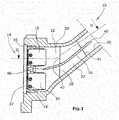
- FIG. 1 and FIG. 2 an inventive arrangement for exhaust gas recirculation 10 is shown, which has a housing 12 with a channel 20, at the upstream end of a check valve 14 is arranged. Downstream of the check valve 14, the channel 20 has a continuous deflection in the cutting plane of the FIG. 1 on, wherein the diameter of the channel 20 in the sectional plane of the FIG. 1 steadily reduced along the deflection until the end of the deflection.
- a first partition 26 and perpendicular to two second partitions 28 are arranged, which divide the channel 20 into six approximately equal sub-channels 22 with approximately equal flow cross-sections.
- the check valve 14 has a valve body 32 and is designed as a four-valve flap valve, wherein each two flap elements 16 are trapezoidal to each other and arranged side by side.
- Each flap element 16 has a passage opening, not shown, in the valve body 32, on which a leaf spring element, not shown, and an opening 34 of the leaf spring element limiting counter-holder 34 is fastened by means of screws 18.
- the check valve 14 is fixed in the housing 12 with fastening means, not shown, wherein a part of the valve body 32 is formed as a sealing surface 36 to the housing 12.
- the first partition wall 26 is arranged so that it halves the flow cross-section of the channel 20 in the outflow region of the check valves 14.
- the first partition wall 26 extends downstream along the deflection substantially parallel to the main flow direction.
- the diameter of the channel 20 decreases steadily in the deflection plane up to a cross section of maximum constriction 66 so far that there corresponds to the minimum flow cross-section largely the sum of the maximum open opening cross sections of the upstream flap elements 16.
- the throughflow cross section increases continuously up to a point of maximum flow cross section 68 downstream of which further components of the exhaust gas recirculation can be formed.
- second partitions 28 Parallel to the deflection plane, there are formed two second partitions 28 extending downstream of the maximum constriction section 66 parallel to the main flow direction and extending the minimum cross section of the constriction, with two upstream ends 42 of the second partitions 28 located downstream of the upstream end 46 of the first divider wall 26 , In this case, the upstream ends 42, 46 are arranged parallel to the outlet cross section of the check valve 14.
- Two downstream ends 44 of the second partition walls 28 are disposed upstream of a downstream end 48 of the first partition wall 26, the downstream ends 44, 48 of the partition walls 26, 28 being formed perpendicular to the main flow direction.
- the recirculated exhaust gas flows through the openings formed in the valve body 32 of the four flap elements 16 of the check valve 14 as soon as a sufficiently large pressure is present, to open the leaf spring elements of the flap members 16. Behind and due to the flap elements 16 occur turbulence.
- the first partition wall 26 of the exhaust gas flow is already separated early in the outflow of the flap elements 16 into two partial streams and the channel 20 divided into two approximately equal sub-channels 22.
- the guidance of the exhaust gas flow along the deflection takes place through the wall 30 of the channel 20 and the partitions 26, 28. In the outflow region of the flap elements 16, the wall 30 runs close to the flap elements 16 in order to minimize vortex-promoting spaces.
- the exhaust gas flow through the second dividing walls 28 is further divided into substreams. Downstream of the return flow downstream of the downstream ends 44 of the second dividing walls 28, the six substreams reunite into and out of two substreams downstream of the downstream end 48 of the first dividing wall 26 in a vortex-free and rectified main exhaust stream.
- the shape of the check valve 14 adapted contour of the channel 20, the narrowing of the channel 20 and the second partitions 28 and the avoidance of any cross-section jumps is a space-saving, not rectilinear configuration formed Exhaust gas recirculation, which despite deflection has a largely rectified flow and thereby minimizes the pressure losses in the exhaust gas recirculation created.
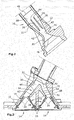
- FIG. 3 shown arrangement for exhaust gas recirculation differs from the first especially in that two check valves 14 are arranged side by side so that the sealing surfaces 36 of the two check valves 14 lie in a plane.
- Each check valve has four flap elements 16 each, wherein each two flap elements 16 are arranged trapezoidal and juxtaposed to each other.
- the check valves are so arranged that the respective inner flap elements 16 of the two check valves 14 are opposite.
- the arrow shaft 56 extends substantially perpendicular to the Ausströmungsquerroughen the flap members 16 of the check valves 14, wherein at the upstream end of the arrow shaft 56 sealing surfaces for each other facing sides of the check valves 14 are formed.
- the arrow arms 62, 64 extend upstream in the direction of the downstream ends of the leaf spring elements of the opposing flap elements 16 opening at flow.
- At least the arrow arms 62, 64 of the mounting element 54 extend over the entire width of the channel 20 and close to the backstops 34 the mutually facing flap elements 16th
- the outer surfaces 58, 60 of the arrow arms 62, 64 are formed so that the flow cross sections of the subchannels 22 formed by the outer surfaces 58, 60 and the facing portions of the wall 30, at least at the upstream and downstream ends of the subchannels 22 equal are big.
- the curvatures of the outer surfaces 58, 60 and the facing wall sections are continuous.
- the pairs trapezoidal to each other and juxtaposed flap elements 16 and the mutually facing flap elements 16 of the two check valves 14 arise turbulence generating spaces. These are minimized by the wall 30 facing flap members 16 by close along the counter-holder 34 extending portions of the wall 30. The cavity lying between the mutually facing flap elements 16 is minimized by the arrow arms 62, 64. This will be the Partial flows passed and it is given to the partial flows no space for the formation of turbulence.
- the second partition wall 70 is formed parallel to the deflection plane and to the main flow direction with its downstream end 72 located downstream of the arrow-shaped installation member 54 and perpendicular to the main flow direction. The second partition wall 70 extends upstream through the subchannels 22 and beyond the upstream ends of the anvil 34, so that even in the outflow of the check valves 14 is a first separation into four partial flows of each other trapezoidally arranged flap members 14.
- the exhaust gas flows without swirling through the four subchannels 22, instead of through the turbulence generating, not rectilinear channel 20.
- the pressure losses can be minimized and thus the flow rates can be increased.
- the resulting, increased exhaust gas recirculation rates lead to an increase in the efficiency of the internal combustion engine.
Landscapes
- Engineering & Computer Science (AREA)
- General Engineering & Computer Science (AREA)
- Mechanical Engineering (AREA)
- Chemical & Material Sciences (AREA)
- Combustion & Propulsion (AREA)
- Exhaust-Gas Circulating Devices (AREA)
Abstract
Description
- Die Erfindung betrifft eine Anordnung zur Abgasrückführung für eine Verbrennungskraftmaschine mit einem Gehäuse, mindestens einem im Gehäuse angeordneten Rückschlagventil mit Klappenelementen sowie einem Kanal mit Umlenkungen.
- In modernen Verbrennungsmotoren wird Abgas in den Verbrennungsprozess zurückgeführt, um den Ausstoß von Schadstoffen zu verringern. Aufgrund von Pulsationen kann der Druck in der Abgasrückführleitung zeitweise niedriger sein als der Druck in der Ladeluftleitung. Um ein Rückströmen der Abgase zu verhindern, werden Rückschlagventile in der Abgasrückführleitung verbaut.
- Aus der
DE 199 53 198 A1 ist ein solches Rückschlagventil bekannt, das als Flatterventil ausgebildet ist und dadurch besonders gut für den Einsatz in der Abgasrückführung geeignet ist. - Aus der
WO 2011 128 194 A1 ist ein Abgaskühlmodul bekannt das zwei Klappenelementpaare aufweist die als Rückschlagventile arbeiten. Um den begrenzten Bauraum optimal zu nutzen sind die Kanäle in der Regel nicht gerade ausgebildet, sondern den Bauraumanforderungen angepasst und weisen deswegen Umlenkungen und Querschnittssprünge auf. Durch diese Umlenkungen wie auch durch die Rückschlagventile selber treten starke Verwirbelungen auf. Diese Verwirbelungen bedingen Druckverluste, die sich negativ auf die Menge des rückgeführten Abgases und damit auf die Effizienz der Abgasrückführung auswirken und deswegen minimiert werden müssen. - Es stellt sich daher die Aufgabe, eine kompakte Anordnung zur Abgasrückführung zu schaffen, die so gestaltet ist, dass ein gleichgerichteter Abgasmassenstrom entsteht, Pulsationen und Druckverlust des Abgasstroms bei zugleich kompakten Abmessungen sowie geringen Produktionskosten minimiert werden.
- Diese Aufgabe wird dadurch gelöst, dass die Umlenkung des Kanals im Gehäuse stetig ist und sich stromabwärts des Rückschlagventils mindestens eine Trennwand entlang der Umlenkung erstreckt und den Kanal in Unterkanäle aufteilt.
- Das pulsierende Abgas und die sich dadurch öffnenden und schließenden Rückschlagventile erzeugen große Wirbel hinter dem Rückschlagventil. Die angestrebte, dem beschränkten Bauraum geschuldete, nicht geradlinige Ausbildung des Kanals bedingt ebenso Wirbel und dadurch Druckverluste, die sich negativ auf die Effizienz der Abgasrückführung auswirken. Durch die zumindest eine Trennwand entlang der Umlenkung des Kanals wird dieser in Unterkanäle aufgeteilt. Es können sich trotz der Umlenkung und der Rückschlagventile lediglich kleinere Wirbel in den Unterkanälen ausbilden, wodurch der Druckverlust minimiert und die Effizienz der Abgasrückführung erhöht wird.
- In einer bevorzugten Ausführungsform weist jedes Klappenelement eine Durchtrittsöffnung auf, auf der ein Blattfederelement und ein die Öffnung des Blattfederelements begrenzender Gegenhalter mittels Schrauben befestigt ist.
Diese Bauform verhindert eine zu weite Öffnung und eine dadurch bedingte Beschädigung des Blattfederelements und wirkt sich somit positiv auf die Lebensdauer des Klappenelements aus. Zudem ist die Befestigung mittels Schrauben einfach und kostengünstig zu realisieren und ermöglicht einen einfachen Austausch einzelner Komponenten des Klappenelements. - Vorzugsweise besteht das Rückschlagventil aus zwei, zueinander trapezförmig angeordnet Klappenelementen.
Diese trapezförmige Anordnung der Klappenelemente zueinander ist strömungstechnisch besonders vorteilhaft. - In einer weiteren bevorzugten Ausführungsform sind mehrere, jeweils zueinander trapezförmig angeordnete Klappenelemente der Rückschlagventile in einer Reihe angeordnet.
Durch die Erhöhung der Anzahl der Klappenelemente vergrößert sich die verfügbare Durchtrittsfläche und somit das rückführbare Abgas-Volumen. - In einer weiteren bevorzugten Ausführungsform sind im Gehäuse mehrere Rückschlagventile angeordnet und ein stromaufwärtiges Ende der zumindest einen ersten Trennwand ist im Ausströmungsbereich der Rückschlagventile zwischen den Rückschlagventilen angeordnet.
Durch die Verwendung mehrerer Rückschlagventile ist es sehr einfach möglich, bei einer Fehlfunktion statt eines mehrflutigen Rückschlagventils nur eins von mehreren Rückschlagventilen zu ersetzen. Zudem verhindert das stromaufwärtige Ende der zumindest einen ersten Trennwand im Ausströmungsbereich der Rückschlagventile zwischen den Rückschlagventilen ein Zusammenfließen der einzelnen Teilströme und dadurch bedingte Wirbel. - In einer weiteren bevorzugten Ausführungsform ist senkrecht zu der Ebene, in der die Umlenkung ausgebildet ist, eine erste Trennwand angeordnet, die sich vom Ausströmungsbereich der Klappenelemente bis mindestens zum Ende der Umlenkung erstreckt, so dass sie den Kanal in Unterkanäle aufteilt, die an einem stromaufwärtigen und einem stromabwärtigen Ende der ersten Trennwand im Wesentlichen gleich große Durchströmungsquerschnitte aufweisen.
Dadurch, dass die Durchströmungsquerschnitte an den beiden Enden der ersten Trennwand gleich groß sind, bleiben die Abgasmassenströme annähernd gleich, was eine besonders gleichgerichtete und verwirbelungsarme Durchströmung bedingt. - In einer anderen bevorzugten Ausführungsform weist die erste Trennwand eine stetige Krümmung auf.
Dadurch wird die negative Auswirkung einer unvermeidbaren Krümmung minimiert, insbesondere strömungsverändernde Querschnittssprünge werden vermieden. - In einer vorteilhaften Ausgestaltung der Erfindung verläuft die erste Trennwand in einem stromabwärtigen Endbereich parallel zu der Hauptströmungsrichtung im Kanal.
Auf diese Weise wird eine annähernd störungsfreie Strömungsführung durch das Kanalgehäuse erreicht und der Druckverlust wird minimiert. - In einer alternativen Ausführungsform ist die erste Trennwand als pfeilförmiges Einbauelement ausgebildet und der Pfeilschaft erstreckt sich vom Anfang des Kanals bis zum stromabwärtigen Ende der Klappenelemente, wobei die der Wand zugewandten Außenflächen der Pfeilarme eine Krümmung in derselben Richtung wie die Konturen der jeweils benachbarten Wand aufweisen.
Durch die pfeilförmige Ausgestaltung werden wirbelfördernde Toträume zwischen den Klappenelementen vermieden. Durch den Konturen der Wand angepasste Außenflächen der Pfeilarme im sich verjüngenden Umlenkungsbereich des Kanals werden die Durchströmungsquerschnitte annähernd konstant gehalten sowie Querschnittssprünge vermieden. - In einer weiterführenden bevorzugten Ausführungsform weisen die durch die Wand und die der Wand zugewandten Außenflächen der Pfeilarme gebildeten Unterkanäle an ihren stromaufwärtigen und stromabwärtigen Enden im Wesentlichen gleich große Durchströmungsquerschnitte der Unterkanäle auf. Dadurch wird eine besonders gleichgerichtete und verwirbelungsarme Durchströmung bedingt.
- In einer alternativen Ausführungsform weist der Kanal zumindest eine zweite Trennwand auf, die sich parallel zur Hauptströmungsrichtung und senkrecht zur ersten Trennwand erstreckt. Somit wird die Anzahl der Teilströme verdoppelt, was eine weitere Unterteilung, insbesondere eine Halbierung der Durchströmungsquerschnitte der Unterkanäle und eine Führung der Teilströme und dadurch eine weitere Verringerung der Verwirbelungen bedingt.
- In einer verbesserten Ausführungsform weist der Kanal eine Einschnürung auf, stromabwärts derer sich zumindest eine zweite Trennwand parallel zur Hauptströmungsrichtung und senkrecht zu einer Ebene entlang des Querschnitts der Einschnürung mit minimalem Durchmesser erstreckt.
Durch die Einschnürung entsteht der Effekt einer Düse, wodurch zusätzlich ein Rückströmen vermindert wird. Zudem werden Pulsationen verringert. Die zweite Trennwand teilt den Massenstrom und vermindert Verwirbelungen hinter der Einschnürung. - In einer optimierten Ausführungsform sind im Kanal zwei zweite Trennwände angeordnet, deren Abstand dem geringsten Abstand der den Kanal begrenzenden Wände an der Einschnürung entspricht.
Die durch die Einschnürung auftretenden Verwirbelungen werden so besonders effektiv vermindert. - In einer alternativen Ausführungsform sind im Kanal zwei zweite Trennwände in Hauptströmungsrichtung in Verlängerung zweier maximal geöffneter Klappenelemente des Rückschlagventils angeordnet.
Somit werden die Verwirbelungen durch die Kanten der Blattfederelemente besonders effektiv vermindert. - Vorzugsweise ist ein stromabwärtiges Ende der zumindest einen zweiten Trennwand stromaufwärts eines stromabwärtigen Endes der ersten Trennwand angeordnet, wodurch Verwirbelungen hinter den Trennwänden höchstens stufenweise erfolgen und dadurch besonders effektiv vermindert werden.
- In einer alternativen Ausführungsform sind die stromaufwärtigen Enden der Trennwände parallel zum Austrittsquerschnitt des Rückschlagventils angeordnet.
Dadurch wird eine zeitgleiche und gleichmäßige Trennung des Abgasstroms in Teilströme erreicht. - In einer weiteren bevorzugten Ausführungsform sind die Trennwände als Blecheinlegeteil ausgebildet. Blecheinlegeteile sind einfach und kostengünstig herzustellen und können an bestehende Gehäuse angepasst und einfach nachgerüstet werden.
- In einer alternativen Ausführung sind die Trennwände als Spritz-, Sandoder Druckgussteil ausgebildet.
Dadurch wird die Montage vereinfacht und die Form der Trennwände kann variiert werden. - In einer weiteren bevorzugten Ausführungsform sind die Trennwände zumindest teilweise einteilig mit dem Gehäuse ausgebildet, wodurch die Anzahl der Teile verringert wird was den Zusammenbau vereinfacht.
- Somit wird eine kompakte Anordnung zur Abgasrückführung geschaffen, die Pulsationen und Druckverluste minimiert und einen gleichgerichteten Abgasmassenstrom erzeugt. Durch die geringe Anzahl von Trennwänden wird eine Anlagerung von Rückständen und eine damit verbundene Verringerung des Durchströmungsquerschnitts dauerhaft verhindert.
- Weitere wesentliche Merkmale und zwei bevorzugte Ausführungsformen werden im Folgenden anhand der Figur beschrieben.
-
Figur 1 zeigt eine Seitenansicht einer erfindungsgemäßen Anordnung zur Abgasrückführung in teilgeschnittener Darstellung. -
Figur 2 zeigt eine um 90° Grad gedrehte Seitenansicht der erfindungsgemäßen Anordnung zur Abgasrückführung derFigur 1 in geschnittener Darstellung. -
Figur 3 zeigt eine Seitenansicht einer alternativen erfindungsgemäßen Anordnung zur Abgasrückführung in teilgeschnittener Darstellung. - In
Figur 1 undFigur 2 ist eine erfindungsgemäße Anordnung zur Abgasrückführung 10 dargestellt, die ein Gehäuse 12 mit einem Kanal 20 aufweist, an dessen stromaufwärtigen Ende ein Rückschlagventil 14 angeordnet ist.
Stromabwärts des Rückschlagventils 14 weist der Kanal 20 eine stetige Umlenkung in der Schnittebene derFigur 1 auf, wobei sich der Durchmesser des Kanals 20 in der Schnittebene derFigur 1 entlang der Umlenkung bis zum Ende der Umlenkung stetig verringert.
Im Kanal 20 sind eine erste Trennwand 26 und dazu senkrecht zwei zweite Trennwände 28 angeordnet, die den Kanal 20 in sechs etwa gleich große Unterkanäle 22 mit in etwa gleich großen Durchströmungsquerschnitten aufteilen.
Das Rückschlagventil 14 weist einen Ventilkörper 32 auf und ist als vierflutiges Klappenventil ausgebildet, wobei je zwei Klappenelemente 16 trapezförmig zueinander und nebeneinander angeordnet sind.
Jedes Klappenelement 16 weist eine nicht dargestellte Durchtrittsöffnung im Ventilkörper 32 auf, auf der ein nicht dargestelltes Blattfederelement und ein die Öffnung des Blattfederelements begrenzender Gegenhalter 34 mittels Schrauben 18 befestigt ist.
Das Rückschlagventil 14 ist im Gehäuse 12 mit nicht dargestellten Befestigungsmitteln fixiert, wobei ein Teil des Ventilkörpers 32 als Dichtfläche 36 zum Gehäuse 12 ausgebildet ist.
Dabei ist die erste Trennwand 26 so angeordnet, dass sie den Durchströmungsquerschnitt des Kanals 20 im Ausströmungsbereich der Rückschlagventile 14 halbiert. Dabei ist ein stromaufwärtiges Ende 46 der ersten Trennwand 26 stromabwärts der durch die Schrauben 18 mit dem Ventilkörper 32 verbundenen Seite der Blattfederelemente und Gegenhalter 34 und stromaufwärts der dieser entgegengesetzten Seite angeordnet. Die erste Trennwand 26 erstreckt sich stromabwärts entlang der Umlenkung im Wesentlichen parallel zur Hauptströmungsrichtung. - Wie in
Figur 2 zu sehen ist, verringert sich in der Umlenkungsebene der Durchmesser des Kanals 20 stetig bis zu einem Querschnitt maximaler Einschnürung 66 so weit, dass dort der minimale Durchströmungsquerschnitt weitgehend der Summe der maximal geöffneten Öffnungsquerschnitte der stromaufwärts angeordneten Klappenelemente 16 entspricht. Stromabwärts des Querschnitts maximaler Einschnürung 66 vergrößert sich der Durchströmungsquerschnitt stetig bis zu einem Punkt maximalen Durchströmungsquerschnitts 68 stromabwärts dessen weitere Bauteile der Abgasrückführung ausgebildet sein können.
Parallel zur Umlenkungsebene sind zwei zweite Trennwände 28 ausgebildet die sich stromabwärts des Querschnitts maximaler Einschnürung 66 parallel zur Hauptströmungsrichtung und in Verlängerung des minimalen Querschnitts der Einschnürung erstrecken, wobei zwei stromaufwärtige Enden 42 der zweiten Trennwände 28 stromabwärts des stromaufwärtigen Endes 46 der ersten Trennwand 26 angeordnet sind.
Dabei sind die stromaufwärtigen Enden 42, 46 parallel zum Austrittsquerschnitt des Rückschlagventils 14 angeordnet.
Zwei stromabwärtige Enden 44 der zweiten Trennwände 28 sind stromaufwärts eines stromabwärtigen Endes 48 der ersten Trennwand 26 angeordnet, wobei die stromabwärtigen Enden 44, 48 der Trennwände 26, 28 senkrecht zur Hauptströmungsrichtung ausgebildet sind. - Das rückgeführte Abgas strömt durch die im Ventilkörper 32 ausgebildeten Durchtrittsöffnungen der vier Klappenelemente 16 des Rückschlagventils 14 sobald ein ausreichend großer Druck vorhanden ist, um die Blattfederelemente der Klappenelemente 16 zu öffnen. Hinter den und bedingt durch die Klappenelemente 16 treten Verwirbelungen auf. Durch die erste Trennwand 26 wird der Abgasstrom schon frühzeitig im Ausströmungsbereich der Klappenelemente 16 in zwei Teilströme getrennt und der Kanal 20 in zwei annähernd gleich große Unterkanäle 22 aufgeteilt. Die Führung des Abgasstroms entlang der Umlenkung erfolgt durch die Wand 30 des Kanals 20 sowie die Trennwände 26, 28. Dabei verläuft schon im Ausströmungsbereich der Klappenelemente 16 die Wand 30 nah an den Klappenelementen 16 um wirbelfördernde Räume zu minimieren. Stromabwärts des Querschnitts maximaler Einschnürung 66 wird der Abgasstrom durch die zweiten Trennwände 28 weiter in Teilströme aufgeteilt. Stromabwärts der Umlenkung hinter den stromabwärtigen Enden 44 der zweiten Trennwände 28 vereinen sich die sechs Teilströme wieder in zwei Teilströme und stromabwärts davon, hinter dem stromabwärtigen Ende 48 der ersten Trennwand 26 in einem wirbelfreien und gleichgerichteten Hauptabgasstrom.
- Durch die frühzeitige Trennung des Abgasstroms in Teilströme durch die erste Trennwand 26, die der Form des Rückschlagventils 14 angepasste Kontur des Kanals 20, die Verengung des Kanals 20 und die zweiten Trennwände 28 sowie die Vermeidung jeglicher Querschnittssprünge wird eine platzsparende, nicht geradlinige ausgebildete Anordnung zur Abgasrückführung, die trotz Umlenkung eine weitgehend gleichgerichtete Strömung aufweist und dadurch die Druckverluste bei der Abgasrückführung minimiert, geschaffen.
- Die alternative, in
Figur 3 dargestellte Anordnung zur Abgasrückführung unterscheidet sich von der ersten vor allem dadurch, dass zwei Rückschlagventile 14 nebeneinander so angeordnet sind, dass die Dichtflächen 36 der beiden Rückschlagventile 14 in einer Ebene liegen. Jedes Rückschlagventil weist je vier Klappenelemente 16 auf, wobei jeweils zwei Klappenelemente 16 zueinander trapezförmig und nebeneinander angeordnet sind. Hierbei sind die Rückschlagventile so angeordnet, dass sich die jeweils inneren Klappenelemente 16 der beiden Rückschlagventile 14 gegenüber liegen. - Zwischen den beiden Rückschlagventilen 14 ist statt einer ersten Trennwand 26 ein pfeilförmiges Einbauelement 54 mit Pfeilarmen 62, 64 angeordnet, dessen Pfeilschaft 56 sich weitgehend senkrecht zu den Ausströmungsquerschnitten der Klappenelemente 16 der Rückschlagventile 14 erstreckt, wobei am stromaufwärtigen Ende des Pfeilschafts 56 Dichtflächen für die zueinander weisenden Seiten der Rückschlagventile 14 ausgebildet sind.
Die Pfeilarme 62, 64 erstrecken sich stromaufwärts in Richtung der stromabwärtigen Enden der sich bei Durchströmung öffnenden Blattfederelementen der einander gegenüberliegenden Klappenelementen 16. Zumindest die Pfeilarme 62, 64 des Einbauelementes 54 erstrecken sich über die gesamte Breite des Kanals 20 und bis nah an die Gegenhalter 34 der zueinander weisenden Klappenelemente 16.
Die Außenflächen 58, 60 der Pfeilarme 62, 64 sind so ausgebildet, dass die Durchströmungsquerschnitte der Unterkanäle 22, die durch die Außenflächen 58, 60 und die ihnen zugewandten Abschnitte der Wand 30 gebildet werden, zumindest an den stromaufwärtigen und stromabwärtigen Enden der Unterkanäle 22 gleich groß sind. Zudem sind die Krümmungen der Außenflächen 58, 60 und der zugewandten Wandabschnitte stetig. - Durch die paarweise trapezförmig zueinander und nebeneinander angeordneten Klappenelemente 16 und die zueinander weisenden Klappenelemente 16 der zwei Rückschlagventile 14 entstehen Verwirbelungen erzeugende Räume. Diese werden durch an den der Wand 30 zugewandten Klappenelementen 16 durch sich nah entlang der Gegenhalter 34 erstreckende Abschnitte der Wand 30 minimiert. Der zwischen den zueinander weisenden Klappenelementen 16 liegende Hohlraum wird durch die Pfeilarme 62, 64 minimiert. Dadurch werden die Teilströme geleitet und es wird den Teilströmen kein Raum zur Bildung von Verwirbelungen gegeben.
Zudem ist die zweite Trennwand 70 parallel zur Umlenkungsebene und zur Hauptströmungsrichtung ausgebildet wobei ihr stromabwärtiges Ende 72 stromabwärts des pfeilförmiges Einbauelement 54 und senkrecht zur Hauptströmungsrichtung angeordnet ist. Die zweite Trennwand 70 erstreckt sich stromaufwärts durch die Unterkanäle 22 und bis über die stromaufwärtigen Enden der Gegenhalter 34 hinaus, so dass schon im Ausströmbereich der Rückschlagventile 14 eine erste Trennung in vier Teilströme der zueinander trapezförmig angeordneten Klappenelemente 14 erfolgt. - Dadurch strömt das Abgas verwirbelungsarm durch die vier Unterkanäle 22, statt durch den Verwirbelungen erzeugenden, nicht gradlinig ausgebildeten Kanal 20. So können die Druckverluste minimiert werden und somit die Strömungsmengen erhöht werden. Die daraus resultierenden, gesteigerten Abgasrückführraten führen zu einer Effizienzsteigerung des Verbrennungsmotors.
- Es sollte deutlich sein, dass der Schutzbereich der vorliegenden Anmeldung nicht auf die beschriebenen Ausführungsbeispiele beschränkt ist.
Denkbar wären auch andere, leicht abweichende Bauformen der Trennwände und Ausbildungen der Einbauelemente, die mit Hilfe von Strömungssimulationen errechnet werden, wie auch Kombinationen aus Einbauelementen und Trennwänden.
Auch sind Ausführungen mit vier, sechs, acht oder mehr Klappenelementen oder mehreren Rückschlagventilen und der korrespondierenden Anzahl von Unterkanälen vorstellbar.
Claims (19)
- Anordnung zur Abgasrückführung für eine Verbrennungskraftmaschine mit
einem Gehäuse (12),
mindestens einem im Gehäuse (12) angeordneten Rückschlagventil (14) mit Klappenelementen (16) und einem Kanal (20) mit zumindest einer Umlenkung
dadurch gekennzeichnet, dass
die Umlenkung des Kanals (20) im Gehäuse (12) stetig ist und sich stromabwärts des Rückschlagventils (14) mindestens eine Trennwand (26, 28) entlang der Umlenkung erstreckt und den Kanal (20) in Unterkanäle (22) aufteilt. - Anordnung zur Abgasrückführung nach Anspruch 1,
dadurch gekennzeichnet, dass
jedes Klappenelement (16) eine Durchtrittsöffnung aufweist, auf der ein Blattfederelement und ein die Öffnung des Blattfederelements begrenzender Gegenhalter (34) mittels Schrauben (18) befestigt ist. - Anordnung zur Abgasrückführung nach Anspruch 1 oder 2,
dadurch gekennzeichnet, dass
das Rückschlagventil (14) aus zwei, zueinander trapezförmig angeordnet Klappenelementen (16) besteht. - Anordnung zur Abgasrückführung nach Anspruch 3,
dadurch gekennzeichnet, dass
mehrere, jeweils zueinander trapezförmig angeordnete Klappenelemente (16) der Rückschlagventile (14) in einer Reihe angeordnet sind. - Anordnung zur Abgasrückführung nach einem der vorangegangenen Ansprüche,
dadurch gekennzeichnet, dass
im Gehäuse (12) mehrere Rückschlagventile (14) angeordnet sind und ein stromaufwärtiges Ende (46) der zumindest einen ersten Trennwand (26) im Ausströmbereich der Rückschlagventile (14) zwischen den Rückschlagventilen (14) angeordnet ist. - Anordnung zur Abgasrückführung nach einem der vorangegangenen Ansprüche,
dadurch gekennzeichnet, dass
senkrecht zu der Ebene in der die Umlenkung ausgebildet ist die erste Trennwand (26) angeordnet ist, die sich vom Ausströmungsbereich der Klappenelemente (16) bis mindestens zum Ende der Umlenkung erstreckt, so dass sie den Kanal (20) in Unterkanäle (22) aufteilt, die an einem stromaufwärtigen und einem stromabwärtigen Ende (44, 48) der ersten Trennwand (26) im Wesentlichen gleich große Durchströmungsquerschnitte der Unterkanäle (22) aufweisen. - Anordnung zur Abgasrückführung nach einem der vorangegangenen Ansprüche,
dadurch gekennzeichnet, dass
die erste Trennwand (26) eine stetige Krümmung aufweist. - Anordnung zur Abgasrückführung nach Anspruch 7,
dadurch gekennzeichnet, dass
die erste Trennwand (26) in einem stromabwärtigen Endbereich parallel zu einer Hauptströmungsrichtung im Kanal (20) verläuft. - Anordnung zur Abgasrückführung nach einem der Ansprüche 1 bis 5,
dadurch gekennzeichnet, dass
die erste Trennwand (26) als pfeilförmiges Einbauelement (54) ausgebildet ist und sich der Pfeilschaft (56) vom Anfang des Kanals (20) bis mindestens zum stromabwärtigen Ende der Klappenelemente (16) erstreckt, wobei die der Wand (30) zugewandten Außenflächen (58, 60) der Pfeilarme (62, 64) eine Krümmung in derselben Richtung wie die Konturen der jeweils benachbarten Wand aufweisen. - Anordnung zur Abgasrückführung nach Anspruch 9,
dadurch gekennzeichnet, dass
die durch die Wand (30) und die der Wand (30) zugewandten Außenflächen (58, 60) der Pfeilarme (62, 64) gebildeten Unterkanäle (22) an ihren stromaufwärtigen und stromabwärtigen Enden im Wesentlichen gleich große Durchströmungsquerschnitte aufweisen. - Anordnung zur Abgasrückführung nach einem der vorangegangenen Ansprüche,
dadurch gekennzeichnet, dass
der Kanal (20) zumindest eine zweite Trennwand (28) aufweist, die sich parallel zur Hauptströmungsrichtung und senkrecht zur ersten Trennwand (26) erstreckt. - Anordnung zur Abgasrückführung nach einem der Ansprüche 1-11,
dadurch gekennzeichnet, dass
der Kanal (20) eine Einschnürung aufweist, stromabwärts derer sich zumindest eine zweite Trennwand (28) parallel zur Hauptströmungsrichtung und senkrecht zu einer Ebene entlang des Querschnitts der Einschnürung mit minimalem Durchmesser erstreckt. - Anordnung zur Abgasrückführung nach Anspruch 12,
dadurch gekennzeichnet, dass
im Kanal (20) zwei zweite Trennwände (28) angeordnet sind, deren Abstand dem geringsten Abstand der den Kanal begrenzenden Wände an der Einschnürung entspricht. - Anordnung zur Abgasrückführung nach Anspruch 12 oder 13,
dadurch gekennzeichnet, dass
im Kanal (20) zwei zweite Trennwände (28) in Hauptströmungsrichtung in Verlängerung zweier maximal geöffneter Klappenelemente (16) des Rückschlagventils (14) angeordnet sind. - Anordnung zur Abgasrückführung nach einem der vorangegangenen Ansprüche,
dadurch gekennzeichnet, dass
ein stromabwärtiges Ende (44) der zumindest einen zweiten Trennwand (28) stromaufwärts eines stromabwärtigen Endes (48) der ersten Trennwand (26) angeordnet ist. - Anordnung zur Abgasrückführung nach einem der vorangegangenen Ansprüche,
dadurch gekennzeichnet, dass
die stromaufwärtigen Enden (46, 42) der Trennwände (26, 28) sich parallel zum Austrittsquerschnitt des Rückschlagventils (14) erstrecken. - Anordnung zur Abgasrückführung nach einem der vorangegangenen Ansprüche,
dadurch gekennzeichnet, dass
die Trennwände (26, 28) und/oder das pfeilförmiges Einbauelement (54) als Blecheinlegeteil ausgebildet sind. - Anordnung zur Abgasrückführung nach einem der Ansprüche 1-16,
dadurch gekennzeichnet, dass
die Trennwände (26, 28) und/oder das pfeilförmiges Einbauelement (54) als Spritz-, Sand- oder Druckgussteil ausgebildet sind. - Anordnung zur Abgasrückführung nach Anspruch 18,
dadurch gekennzeichnet, dass
die Trennwände (26, 28) und/oder das pfeilförmiges Einbauelement (54) zumindest teilweise einteilig mit dem Gehäuse (12) ausgebildet sind.
Applications Claiming Priority (1)
| Application Number | Priority Date | Filing Date | Title |
|---|---|---|---|
| DE102013103688.0A DE102013103688B4 (de) | 2013-04-12 | 2013-04-12 | Anordnung zur Abgasrückführung |
Publications (3)
| Publication Number | Publication Date |
|---|---|
| EP2789840A2 true EP2789840A2 (de) | 2014-10-15 |
| EP2789840A3 EP2789840A3 (de) | 2016-01-20 |
| EP2789840B1 EP2789840B1 (de) | 2017-04-12 |
Family
ID=50072963
Family Applications (1)
| Application Number | Title | Priority Date | Filing Date |
|---|---|---|---|
| EP14154642.4A Active EP2789840B1 (de) | 2013-04-12 | 2014-02-11 | Anordnung zur Abgasrückführung |
Country Status (2)
| Country | Link |
|---|---|
| EP (1) | EP2789840B1 (de) |
| DE (1) | DE102013103688B4 (de) |
Family Cites Families (4)
| Publication number | Priority date | Publication date | Assignee | Title |
|---|---|---|---|---|
| DE19953198A1 (de) * | 1999-11-05 | 2001-05-10 | Pierburg Ag | Rückschlagventil für eine Abgasrückführleitung |
| DE202005019518U1 (de) * | 2005-12-14 | 2007-04-26 | Hengst Gmbh & Co.Kg | Einrichtung zur Entlüftung des Kurbelgehäuses einer Brennkraftmaschine |
| DE102010014843B4 (de) | 2010-04-13 | 2020-06-25 | Pierburg Gmbh | Abgaskühlmodul für eine Verbrennungskraftmaschine |
| CN201739030U (zh) | 2010-04-22 | 2011-02-09 | 无锡隆盛科技有限公司 | 一种带双单向阀的egr阀 |
-
2013
- 2013-04-12 DE DE102013103688.0A patent/DE102013103688B4/de not_active Expired - Fee Related
-
2014
- 2014-02-11 EP EP14154642.4A patent/EP2789840B1/de active Active
Also Published As
| Publication number | Publication date |
|---|---|
| EP2789840B1 (de) | 2017-04-12 |
| DE102013103688B4 (de) | 2019-01-17 |
| DE102013103688A1 (de) | 2014-10-16 |
| EP2789840A3 (de) | 2016-01-20 |
Similar Documents
| Publication | Publication Date | Title |
|---|---|---|
| DE102021113249B4 (de) | Rohrbogen für einen Abluftkanal einer Dunstabzugshaube | |
| DE112015001899T5 (de) | Abgaswärmetauscher | |
| DE102006051987B4 (de) | Butterfly-Ventil | |
| EP4067753B1 (de) | Anordnung umfassend eine downdraft-dunstabzugshaube und eine flachkanalanordnung | |
| EP2870350B1 (de) | Rückschlagventilvorrichtung für eine verbrennungskraftmaschine | |
| DE112016004891T5 (de) | Abgaskühler | |
| DE102008048912A1 (de) | Abgasanlage und Abgasventil zur Steuerung eines Volumenstroms von Abgas sowie ein Verfahren zur Steuerung eines Volumenstroms | |
| DE10228247B4 (de) | Luftansaugkanalsystem | |
| DE202008004921U1 (de) | Sanitärarmatur | |
| EP2789840B1 (de) | Anordnung zur Abgasrückführung | |
| DE19525086C1 (de) | Ansaugluftleitung für einen Verbrennungsmotor | |
| DE102011001432B4 (de) | Steuerventil für Sekundärluft | |
| DE102008040293B4 (de) | Abgasanlage für einen Verbrennungsmotor | |
| CH668624A5 (de) | Ventil der ringplattenbauart fuer einen kolbenkompressor. | |
| DE20001746U1 (de) | Radialventilator und Düse für einen Radialventilator | |
| WO2000032923A1 (de) | Rohrkrümmer | |
| DE19856309B4 (de) | Einlaßkanalsystem für eine Brennkraftmaschine | |
| EP4296489B1 (de) | Lufteinlass | |
| DE102013106493B4 (de) | Anordnung zur Abgasmassenstrombestimmung | |
| DE3326592C2 (de) | ||
| WO2003095815A1 (de) | Klappenventil für luftansaugkanal einer brennkraftmaschine | |
| DE10250563B4 (de) | Luftansaugkanalsystem | |
| DE202016105410U1 (de) | Ölabscheideeinheit und Ölabscheider | |
| AT528316A4 (de) | Zylinderkopf für eine brennkraftmaschine | |
| DE102019129582A1 (de) | Ventilsystem |
Legal Events
| Date | Code | Title | Description |
|---|---|---|---|
| PUAI | Public reference made under article 153(3) epc to a published international application that has entered the european phase |
Free format text: ORIGINAL CODE: 0009012 |
|
| 17P | Request for examination filed |
Effective date: 20140211 |
|
| AK | Designated contracting states |
Kind code of ref document: A2 Designated state(s): AL AT BE BG CH CY CZ DE DK EE ES FI FR GB GR HR HU IE IS IT LI LT LU LV MC MK MT NL NO PL PT RO RS SE SI SK SM TR |
|
| AX | Request for extension of the european patent |
Extension state: BA ME |
|
| PUAL | Search report despatched |
Free format text: ORIGINAL CODE: 0009013 |
|
| AK | Designated contracting states |
Kind code of ref document: A3 Designated state(s): AL AT BE BG CH CY CZ DE DK EE ES FI FR GB GR HR HU IE IS IT LI LT LU LV MC MK MT NL NO PL PT RO RS SE SI SK SM TR |
|
| AX | Request for extension of the european patent |
Extension state: BA ME |
|
| RIC1 | Information provided on ipc code assigned before grant |
Ipc: F02M 25/07 00000000AFI20151216BHEP Ipc: F16K 15/16 20060101ALI20151216BHEP |
|
| R17P | Request for examination filed (corrected) |
Effective date: 20160711 |
|
| RBV | Designated contracting states (corrected) |
Designated state(s): AL AT BE BG CH CY CZ DE DK EE ES FI FR GB GR HR HU IE IS IT LI LT LU LV MC MK MT NL NO PL PT RO RS SE SI SK SM TR |
|
| REG | Reference to a national code |
Ref country code: DE Ref legal event code: R079 Ref document number: 502014003344 Country of ref document: DE Free format text: PREVIOUS MAIN CLASS: F02M0025070000 Ipc: F02M0026590000 |
|
| RIC1 | Information provided on ipc code assigned before grant |
Ipc: F02M 26/59 20160101AFI20160831BHEP Ipc: F02M 26/70 20160101ALI20160831BHEP Ipc: F02M 26/61 20160101ALI20160831BHEP |
|
| GRAP | Despatch of communication of intention to grant a patent |
Free format text: ORIGINAL CODE: EPIDOSNIGR1 |
|
| INTG | Intention to grant announced |
Effective date: 20161018 |
|
| STAA | Information on the status of an ep patent application or granted ep patent |
Free format text: STATUS: GRANT OF PATENT IS INTENDED |
|
| GRAS | Grant fee paid |
Free format text: ORIGINAL CODE: EPIDOSNIGR3 |
|
| GRAA | (expected) grant |
Free format text: ORIGINAL CODE: 0009210 |
|
| STAA | Information on the status of an ep patent application or granted ep patent |
Free format text: STATUS: THE PATENT HAS BEEN GRANTED |
|
| AK | Designated contracting states |
Kind code of ref document: B1 Designated state(s): AL AT BE BG CH CY CZ DE DK EE ES FI FR GB GR HR HU IE IS IT LI LT LU LV MC MK MT NL NO PL PT RO RS SE SI SK SM TR |
|
| REG | Reference to a national code |
Ref country code: GB Ref legal event code: FG4D Free format text: NOT ENGLISH |
|
| REG | Reference to a national code |
Ref country code: CH Ref legal event code: EP |
|
| REG | Reference to a national code |
Ref country code: IE Ref legal event code: FG4D Free format text: LANGUAGE OF EP DOCUMENT: GERMAN |
|
| REG | Reference to a national code |
Ref country code: AT Ref legal event code: REF Ref document number: 884155 Country of ref document: AT Kind code of ref document: T Effective date: 20170515 |
|
| REG | Reference to a national code |
Ref country code: DE Ref legal event code: R096 Ref document number: 502014003344 Country of ref document: DE |
|
| REG | Reference to a national code |
Ref country code: NL Ref legal event code: MP Effective date: 20170412 |
|
| REG | Reference to a national code |
Ref country code: LT Ref legal event code: MG4D |
|
| PG25 | Lapsed in a contracting state [announced via postgrant information from national office to epo] |
Ref country code: NL Free format text: LAPSE BECAUSE OF FAILURE TO SUBMIT A TRANSLATION OF THE DESCRIPTION OR TO PAY THE FEE WITHIN THE PRESCRIBED TIME-LIMIT Effective date: 20170412 |
|
| PG25 | Lapsed in a contracting state [announced via postgrant information from national office to epo] |
Ref country code: LT Free format text: LAPSE BECAUSE OF FAILURE TO SUBMIT A TRANSLATION OF THE DESCRIPTION OR TO PAY THE FEE WITHIN THE PRESCRIBED TIME-LIMIT Effective date: 20170412 Ref country code: GR Free format text: LAPSE BECAUSE OF FAILURE TO SUBMIT A TRANSLATION OF THE DESCRIPTION OR TO PAY THE FEE WITHIN THE PRESCRIBED TIME-LIMIT Effective date: 20170713 Ref country code: HR Free format text: LAPSE BECAUSE OF FAILURE TO SUBMIT A TRANSLATION OF THE DESCRIPTION OR TO PAY THE FEE WITHIN THE PRESCRIBED TIME-LIMIT Effective date: 20170412 Ref country code: ES Free format text: LAPSE BECAUSE OF FAILURE TO SUBMIT A TRANSLATION OF THE DESCRIPTION OR TO PAY THE FEE WITHIN THE PRESCRIBED TIME-LIMIT Effective date: 20170412 Ref country code: NO Free format text: LAPSE BECAUSE OF FAILURE TO SUBMIT A TRANSLATION OF THE DESCRIPTION OR TO PAY THE FEE WITHIN THE PRESCRIBED TIME-LIMIT Effective date: 20170712 Ref country code: FI Free format text: LAPSE BECAUSE OF FAILURE TO SUBMIT A TRANSLATION OF THE DESCRIPTION OR TO PAY THE FEE WITHIN THE PRESCRIBED TIME-LIMIT Effective date: 20170412 |
|
| PG25 | Lapsed in a contracting state [announced via postgrant information from national office to epo] |
Ref country code: PL Free format text: LAPSE BECAUSE OF FAILURE TO SUBMIT A TRANSLATION OF THE DESCRIPTION OR TO PAY THE FEE WITHIN THE PRESCRIBED TIME-LIMIT Effective date: 20170412 Ref country code: BG Free format text: LAPSE BECAUSE OF FAILURE TO SUBMIT A TRANSLATION OF THE DESCRIPTION OR TO PAY THE FEE WITHIN THE PRESCRIBED TIME-LIMIT Effective date: 20170712 Ref country code: SE Free format text: LAPSE BECAUSE OF FAILURE TO SUBMIT A TRANSLATION OF THE DESCRIPTION OR TO PAY THE FEE WITHIN THE PRESCRIBED TIME-LIMIT Effective date: 20170412 Ref country code: RS Free format text: LAPSE BECAUSE OF FAILURE TO SUBMIT A TRANSLATION OF THE DESCRIPTION OR TO PAY THE FEE WITHIN THE PRESCRIBED TIME-LIMIT Effective date: 20170412 Ref country code: LV Free format text: LAPSE BECAUSE OF FAILURE TO SUBMIT A TRANSLATION OF THE DESCRIPTION OR TO PAY THE FEE WITHIN THE PRESCRIBED TIME-LIMIT Effective date: 20170412 Ref country code: IS Free format text: LAPSE BECAUSE OF FAILURE TO SUBMIT A TRANSLATION OF THE DESCRIPTION OR TO PAY THE FEE WITHIN THE PRESCRIBED TIME-LIMIT Effective date: 20170812 |
|
| REG | Reference to a national code |
Ref country code: DE Ref legal event code: R097 Ref document number: 502014003344 Country of ref document: DE |
|
| PG25 | Lapsed in a contracting state [announced via postgrant information from national office to epo] |
Ref country code: RO Free format text: LAPSE BECAUSE OF FAILURE TO SUBMIT A TRANSLATION OF THE DESCRIPTION OR TO PAY THE FEE WITHIN THE PRESCRIBED TIME-LIMIT Effective date: 20170412 Ref country code: SK Free format text: LAPSE BECAUSE OF FAILURE TO SUBMIT A TRANSLATION OF THE DESCRIPTION OR TO PAY THE FEE WITHIN THE PRESCRIBED TIME-LIMIT Effective date: 20170412 Ref country code: EE Free format text: LAPSE BECAUSE OF FAILURE TO SUBMIT A TRANSLATION OF THE DESCRIPTION OR TO PAY THE FEE WITHIN THE PRESCRIBED TIME-LIMIT Effective date: 20170412 Ref country code: CZ Free format text: LAPSE BECAUSE OF FAILURE TO SUBMIT A TRANSLATION OF THE DESCRIPTION OR TO PAY THE FEE WITHIN THE PRESCRIBED TIME-LIMIT Effective date: 20170412 Ref country code: DK Free format text: LAPSE BECAUSE OF FAILURE TO SUBMIT A TRANSLATION OF THE DESCRIPTION OR TO PAY THE FEE WITHIN THE PRESCRIBED TIME-LIMIT Effective date: 20170412 |
|
| PLBE | No opposition filed within time limit |
Free format text: ORIGINAL CODE: 0009261 |
|
| STAA | Information on the status of an ep patent application or granted ep patent |
Free format text: STATUS: NO OPPOSITION FILED WITHIN TIME LIMIT |
|
| PG25 | Lapsed in a contracting state [announced via postgrant information from national office to epo] |
Ref country code: IT Free format text: LAPSE BECAUSE OF FAILURE TO SUBMIT A TRANSLATION OF THE DESCRIPTION OR TO PAY THE FEE WITHIN THE PRESCRIBED TIME-LIMIT Effective date: 20170412 Ref country code: SM Free format text: LAPSE BECAUSE OF FAILURE TO SUBMIT A TRANSLATION OF THE DESCRIPTION OR TO PAY THE FEE WITHIN THE PRESCRIBED TIME-LIMIT Effective date: 20170412 |
|
| 26N | No opposition filed |
Effective date: 20180115 |
|
| PG25 | Lapsed in a contracting state [announced via postgrant information from national office to epo] |
Ref country code: SI Free format text: LAPSE BECAUSE OF FAILURE TO SUBMIT A TRANSLATION OF THE DESCRIPTION OR TO PAY THE FEE WITHIN THE PRESCRIBED TIME-LIMIT Effective date: 20170412 |
|
| REG | Reference to a national code |
Ref country code: CH Ref legal event code: PL |
|
| PG25 | Lapsed in a contracting state [announced via postgrant information from national office to epo] |
Ref country code: MT Free format text: LAPSE BECAUSE OF FAILURE TO SUBMIT A TRANSLATION OF THE DESCRIPTION OR TO PAY THE FEE WITHIN THE PRESCRIBED TIME-LIMIT Effective date: 20170412 Ref country code: MC Free format text: LAPSE BECAUSE OF FAILURE TO SUBMIT A TRANSLATION OF THE DESCRIPTION OR TO PAY THE FEE WITHIN THE PRESCRIBED TIME-LIMIT Effective date: 20170412 |
|
| GBPC | Gb: european patent ceased through non-payment of renewal fee |
Effective date: 20180211 |
|
| REG | Reference to a national code |
Ref country code: BE Ref legal event code: MM Effective date: 20180228 |
|
| PG25 | Lapsed in a contracting state [announced via postgrant information from national office to epo] |
Ref country code: LU Free format text: LAPSE BECAUSE OF NON-PAYMENT OF DUE FEES Effective date: 20180211 Ref country code: LI Free format text: LAPSE BECAUSE OF NON-PAYMENT OF DUE FEES Effective date: 20180228 Ref country code: CH Free format text: LAPSE BECAUSE OF NON-PAYMENT OF DUE FEES Effective date: 20180228 |
|
| REG | Reference to a national code |
Ref country code: FR Ref legal event code: ST Effective date: 20181031 |
|
| REG | Reference to a national code |
Ref country code: IE Ref legal event code: MM4A |
|
| PG25 | Lapsed in a contracting state [announced via postgrant information from national office to epo] |
Ref country code: IE Free format text: LAPSE BECAUSE OF NON-PAYMENT OF DUE FEES Effective date: 20180211 |
|
| PG25 | Lapsed in a contracting state [announced via postgrant information from national office to epo] |
Ref country code: BE Free format text: LAPSE BECAUSE OF NON-PAYMENT OF DUE FEES Effective date: 20180228 Ref country code: FR Free format text: LAPSE BECAUSE OF NON-PAYMENT OF DUE FEES Effective date: 20180228 Ref country code: GB Free format text: LAPSE BECAUSE OF NON-PAYMENT OF DUE FEES Effective date: 20180211 |
|
| REG | Reference to a national code |
Ref country code: DE Ref legal event code: R082 Ref document number: 502014003344 Country of ref document: DE Representative=s name: TERPATENT PARTGMBB, DE Ref country code: DE Ref legal event code: R082 Ref document number: 502014003344 Country of ref document: DE Representative=s name: TERPATENT PATENTANWAELTE TER SMITTEN EBERLEIN-, DE |
|
| PG25 | Lapsed in a contracting state [announced via postgrant information from national office to epo] |
Ref country code: TR Free format text: LAPSE BECAUSE OF FAILURE TO SUBMIT A TRANSLATION OF THE DESCRIPTION OR TO PAY THE FEE WITHIN THE PRESCRIBED TIME-LIMIT Effective date: 20170412 |
|
| REG | Reference to a national code |
Ref country code: AT Ref legal event code: MM01 Ref document number: 884155 Country of ref document: AT Kind code of ref document: T Effective date: 20190211 |
|
| PG25 | Lapsed in a contracting state [announced via postgrant information from national office to epo] |
Ref country code: AT Free format text: LAPSE BECAUSE OF NON-PAYMENT OF DUE FEES Effective date: 20190211 |
|
| PG25 | Lapsed in a contracting state [announced via postgrant information from national office to epo] |
Ref country code: HU Free format text: LAPSE BECAUSE OF FAILURE TO SUBMIT A TRANSLATION OF THE DESCRIPTION OR TO PAY THE FEE WITHIN THE PRESCRIBED TIME-LIMIT; INVALID AB INITIO Effective date: 20140211 Ref country code: PT Free format text: LAPSE BECAUSE OF FAILURE TO SUBMIT A TRANSLATION OF THE DESCRIPTION OR TO PAY THE FEE WITHIN THE PRESCRIBED TIME-LIMIT Effective date: 20170412 |
|
| PG25 | Lapsed in a contracting state [announced via postgrant information from national office to epo] |
Ref country code: CY Free format text: LAPSE BECAUSE OF FAILURE TO SUBMIT A TRANSLATION OF THE DESCRIPTION OR TO PAY THE FEE WITHIN THE PRESCRIBED TIME-LIMIT Effective date: 20170412 Ref country code: MK Free format text: LAPSE BECAUSE OF NON-PAYMENT OF DUE FEES Effective date: 20170412 |
|
| PG25 | Lapsed in a contracting state [announced via postgrant information from national office to epo] |
Ref country code: AL Free format text: LAPSE BECAUSE OF FAILURE TO SUBMIT A TRANSLATION OF THE DESCRIPTION OR TO PAY THE FEE WITHIN THE PRESCRIBED TIME-LIMIT Effective date: 20170412 |
|
| REG | Reference to a national code |
Ref country code: DE Ref legal event code: R082 Ref document number: 502014003344 Country of ref document: DE |
|
| PGFP | Annual fee paid to national office [announced via postgrant information from national office to epo] |
Ref country code: DE Payment date: 20260218 Year of fee payment: 13 |