EP2784752B1 - Vorhersageverfahren, Erzeugungsverfahren und Speichermedium - Google Patents
Vorhersageverfahren, Erzeugungsverfahren und Speichermedium Download PDFInfo
- Publication number
- EP2784752B1 EP2784752B1 EP14157055.6A EP14157055A EP2784752B1 EP 2784752 B1 EP2784752 B1 EP 2784752B1 EP 14157055 A EP14157055 A EP 14157055A EP 2784752 B1 EP2784752 B1 EP 2784752B1
- Authority
- EP
- European Patent Office
- Prior art keywords
- map
- pixel
- ray
- light
- computation
- Prior art date
- Legal status (The legal status is an assumption and is not a legal conclusion. Google has not performed a legal analysis and makes no representation as to the accuracy of the status listed.)
- Active
Links
Images




Classifications
-
- G—PHYSICS
- G06—COMPUTING OR CALCULATING; COUNTING
- G06T—IMAGE DATA PROCESSING OR GENERATION, IN GENERAL
- G06T15/00—Three-dimensional [3D] image rendering
- G06T15/06—Ray-tracing
-
- G—PHYSICS
- G06—COMPUTING OR CALCULATING; COUNTING
- G06T—IMAGE DATA PROCESSING OR GENERATION, IN GENERAL
- G06T15/00—Three-dimensional [3D] image rendering
- G06T15/50—Lighting effects
-
- G—PHYSICS
- G06—COMPUTING OR CALCULATING; COUNTING
- G06T—IMAGE DATA PROCESSING OR GENERATION, IN GENERAL
- G06T15/00—Three-dimensional [3D] image rendering
- G06T15/50—Lighting effects
- G06T15/506—Illumination models
Definitions
- the present invention relates to a prediction method, a generation method, and a storage medium, and particularly to a technique for illuminating computation in 3D scene rendering.
- 3DCG Three-Dimensional Computer Graphics
- 3DCG generation in recent years, various methods have been proposed for more realistic depiction or for high quality rendering expression.
- processing for global illumination employs such things as a ray tracing method, which traces the complicated propagation of a light ray
- the amount of computation is large, and so usage for a scene for which real-time screen rendering is required, such as for a game, is difficult.
- this kind of light map is something generated by computing global illumination, and time is required for the generation. Because the generation of the light map is performed by integrating (rendering equation) the effects (the diffuse reflections, the specular reflections, etc.) due to virtual light sources that occur due to incident light.input into the target 3D scene reaching a surface of a rendering object, for various ray directions in a region on a rendering object to which the texels of the light map are applied, processing time increases in accordance with the number of rays considered, the number of ray directions, and so on.
- the amount of information differs depending on the sampling ray direction. For this reason, it was necessary to adjust so that memory did not overflow by allocating an excessive region of memory beforehand for ray-bundle generation processing, or by reducing the resolution (the number of rays) of the ray-bundles generated beforehand within a limited region of memory so that the processing was possible.
- the present invention was made in view of such problems in the conventional technique.
- the present invention provides a prediction method capable of suitably predicting memory usage in an illuminating computation, a method of generation and a storage medium.
- the present invention in its first aspect provides a prediction method as specified in claims 1 to 4.
- the present invention in its second aspect provides a method of generation as specified in claim 5.
- the present invention in its third aspect provides a computer-readable storage medium as specified in claim 6.
- the present invention in its fourth aspect provides a computer-readable storage medium as specified in claim 7.
- a ray-bundle will be explained as an aggregation of light paths (ray paths) for computation (light transport computation) of the inter-reflection effects that arise between rendering objects arranged in a target 3D scene.
- a ray-bundle parallel to a ray direction for an entire target 3D scene is defined for each set ray direction, and a light transport computation for each light path is performed.
- a plurality of inter-reflections occur on one light path, depending on the set ray direction, as shown in Figure 3 , for example. In such a case, because light transport computation is performed for an inter-reflection of each section, the light transport computation for one light path is reflected in different texels of the light map.
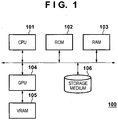
- Figure 1 is a block diagram for showing a functional configuration of a PC 100 according to embodiments of the present invention.
- a CPU 101 controls operation of each block that the PC 100 has. Specifically, the CPU 101 controls operations of the blocks by reading out operation programs of the blocks stored in a ROM 102 or a storage medium 106, loading them into a RAM 103, and executing them.
- the ROM 102 is a rewritable, non-volatile memory, for example.
- the ROM 102 in addition to storing operation programs of the blocks of the PC 100, stores parameters necessary for the operation of the blocks.
- the RAM 103 is a volatile memory.
- the RAM 103 as well as being a loading area of operation programs of the blocks, is also used as a storage area for storing intermediate data output in operation of the blocks.
- a GPU 104 performs rendering processing of 3D scenes in accordance with the later described light map generation processing. Specifically, the GPU 104 reads out model data for rendering objects recorded in a later described storage medium 106, for example, and loads them into a GPU memory (not shown). Also, the GPU 104 processes the model data in accordance with arrangement information provided from the CPU 101, and configures a 3D scene which is a target of light map generation in a VRAM 105, for example. Note, in this embodiment, the VRAM 105 is used in the light map generation processing as a light map generation region. Also, the VRAM 105 is used as a storage area of an importance map and a fragment number map generated in scene analysis for the light map generation of one ray direction.
- a storage medium 106 is a storage medium, such as an HDD, for example, connected detachably to the PC 100.
- data such as rendering objects comprised in the 3D scene of the light map generation processing and arrangement information, and a program that defines operation of the processing, are recorded in the storage medium 106.
- light maps generated by the light map generation processing are stored in the storage medium 106.
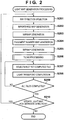
- step S201 the CPU 101 selects a direction (ray direction) of the ray-bundle to be generated.
- a direction (ray direction) of the ray-bundle In order to reproduce the indirect illumination that occurs due to incident light of various directions for one 3D scene, generally a light map is generated by integrating values of incident radiance of each of a plurality of ray directions. In this step, selection of a sampling ray direction in the generation processing of the light map is performed, but the selection method is not specifically limited.
- step S202 the GPU 104 performs importance analysis on the entire scene for the selected ray direction, and generates an importance map.
- the importance map is two-dimensional data rendered for a projection of the ray direction, and is defined so as to include the entire scene in the selected ray direction.
- Importance is a level of contribution to the light map, and corresponds to a texel density (number of pixels per a unit area in a system defined in the 3D scene of the light map applied to a surface of a rendering object which has a fragment) in a fragment.
- the fragment here indicates an intersection with the surface of a rendering object existing on one straight line (representative light path) corresponding to the pixels of the importance map as shown in Figure 3 .
- the importance map generated in this step stores an importance value of a fragment existing on a corresponding representative light path for each pixel of the two-dimensional data.
- the representative light path is defined so as to pass through the entire 3D scene, there are cases in which a plurality of fragments exist on one representative light path. In other words, there are cases in which multiple intersections with rendering objects exist on one representative light path. In such a case, the importance value stored for the pixel corresponding to the representative light path is made to be the maximum value out of the importances of the plurality of fragments.
- step S203 the GPU 104 generates a mipmap of the importance map generated in the VRAM 105, and stores it in the VRAM 105.
- the number of pixels of one side may be a power of two.
- a pixel value of a unit pixel of one layer may be generated with an average value of four pixels corresponding to one layer below, for example, and as a result, an average value of pixel values of all pixels of the importance map will be stored in one pixel of the top layer.
- step S204 the GPU 104 performs fragment number analysis on the entire scene for a selected ray direction, and generates a fragment number map.
- the fragment number map in this embodiment similarly to the importance map, is two-dimensional data rendered for a projection in a ray direction, and has a number of pixels identical to the importance map. Also, fragment numbers indicate the number of fragments existing on a representative light path of corresponding pixels of the fragment number map.
- the number of fragments are numbers of fragments that exist on the representative light paths corresponding to each of the pixels, that is the numbers of fragments indicate the numbers of surfaces of rendering objects existing on the representative light paths.
- the fragment number map generated in this step stores the number of fragments on a corresponding representative light path for each of the pixels of the two-dimensional data. Note, explanation is given having the generation of the fragment number map be performed after generation of the importance map in this embodiment, but working of the present invention is not limited to this. In other words, the generation of the two maps is in no particular order, and it should be easily understood that the two maps may be simultaneously generated in parallel.
- step S205 the GPU 104 generates a mipmap of the fragment number map generated in the VRAM 105 and stores it in the VRAM 105.
- generation rules of the mipmap are the same as in the method described for the generation of the mipmap of the importance map in step S203.
- step S206 the GPU 104 executes tiling processing to divide a two-dimensional region of the 3D scene in a projection of a ray direction adaptively into tiles each having an ideal size, which are units at which the GPU 104 generates the ray-bundles and performs the light transport computation.
- a ray-bundle is defined for the direction for each of a plurality of ray directions, and the light transport computation is performed.
- a predetermined limit in the number of light paths of the ray-bundles to be generated exists.
- the number of light paths of the ray-bundles that pass through the surface will be less than the number of pixels (texels) of the light map applied to the surface of a specific rendering object. In such a case, i.e.
- each of the tiles are defined, by executing the tiling processing of this step on the PC 100 of this embodiment, for two-dimensional regions of a 3D scene in a projection in a selected ray direction so that light that should be reflected is not missed.
- the tiling processing of this embodiment rather than simply defining tiles of a predetermined number of pixels for a two-dimensional region, as in Thibieroz, defines the tiles, causing to be different the number of pixels of the tiles adaptively in accordance with the texel density of the light map applied to rendering objects within a tile.
- each tile is defined so that the number of ray-bundles that can be generated within the limitations of the hardware is larger than the number of pixels of the light map applied to rendering objects within the tile.
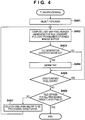
- step S401 the GPU 104 selects the top layer of the mipmaps of the importance map and the fragment number map respectively to be the processing target layers.
- step S402 the GPU 104 selects pixels (target pixels) for which tile generation is undetermined out of the pixels of the mipmaps of the processing target layer (pixels existing at the same position in each mipmap). Also, the GPU 104 sets a region corresponding to the target pixels in the importance map and the fragment number map to be "a tile candidate". The region corresponding to the target pixels is a region of the importance map or the fragment number map referenced in order to generate the target pixel on the mipmap.
- the GPU 104 referring to the pixel values of the target pixels of each of the mipmaps, computes a number of pixels of a light map to be generated for the tile candidate and a number of light paths (number of rays included in a ray-bundle) storable in a predetermined storage area (a node buffer), on the VRAM 105, to be defined for the tile candidate.
- the GPU 104 computes the number of pixels (the number of pixels on the importance map) of the light map to be generated for the tile candidate by multiplying a surface area of the tile candidate with the pixel value (importance) of the target pixel obtained from the mipmap of the importance map.
- min() is a function that outputs the minimum value of enumerated values.
- the maximum number of light paths is a value (for example, a power of 4096) predetermined to be the maximum value of the number of light paths included in the ray-bundles to be generated for one tile.
- one fragment on the light path for one node of the predetermined node buffer is stored.
- a node for storing individually the fragments for a plurality of fragments existing on one light path is necessary.
- the ray-bundles cannot be stored to the node buffer.
- the predicted number of fragments is the pixel value of the target pixel of the mipmap of the fragment number map, and is the average pixel value of the pixels included in the tile candidate of the fragment number map.
- the predicted number of fragments indicates that the light paths defined for the tile candidate have the pixel value number of fragments on average.
- it can be computed how many light paths having an average number of fragments are storable in the node buffer.
- the number of light paths that should be defined for the tile candidate is determined based on only the texel density on rendering objects included in the range of the tile candidate. In other words, the number of pixels of the fragment number map and the number of light paths that should be defined for the tile candidate are not necessarily the same.
- the average number of fragments obtained from one pixel of the top layer of the mipmap of the fragment number map is an average value of the number of fragments sampled for each of representative light paths defined to the number of pixels of the fragment number map.
- a portion of the light paths includes light paths not considered in the generation of the fragment number map. In other words, the number of fragments on the light path of this portion is unclear, and cannot be predicted from the average number of fragments.
- the number of light paths predicted to be storable is computed by compensating for an error in the number of fragments having considered the light paths for which the number of fragments is unclear, by adding an estimated prediction error to the predicted number of fragments obtained from the mipmap.
- step S403 the GPU 104 determines whether or not the target pixel satisfies a tile generation condition.
- tile generation condition is determined by the PC 100 by determining whether or not the relationship (the number of pixels of the light map generated for the target pixel ⁇ the number of light paths storable in the predetermined node buffer) holds true for the two values computed for the target pixels in step S402.
- This generation condition is a condition for light map having no loss of light being generatable, as described above.
- tile generation determination is always performed under the same conditions-independent of the ray direction and the surface normal of rendering objects having a fragment.
- the surface of a rendering object is directly facing in the selected ray direction, i.e. the ray direction and the surface normal are parallel, as shown in Figure 5A .
- the number of pixels of the light map to be generated for the tile candidate is obtained by multiplying the surface area of the tile candidate with the importance of the target pixel as described above. This is because since the surface of rendering object is directly facing the ray direction, the region on the surface corresponding to the tile candidate has the same surface area as the tile candidate.
- the region on the surface corresponding to the tile candidate is a surface area larger than the surface area of the tile candidate.
- the value one obtained by the surface area of the tile candidate being divided by the dot product of the ray direction ( ⁇ ' ⁇ n) and the surface normal n (inversely proportional to cos ⁇ ).
- the number of pixels of the light map applied to the region on the surface of a rendering object corresponding to the tile candidate is larger in this case than when the surface is directly facing the selected ray direction, the texel density increases when seen from such a selected ray direction.
- the number of pixels of the light map to be generated for the tile candidate should be a factor of 1/( ⁇ ' ⁇ n) compared to when the surface is directly facing the selected ray direction.
- the tile generation determination may be performed for the number of pixels of the light map to be generated for the tile candidate obtained simply by multiplying the surface area of the tile candidate with the importance of the target pixel. Also, in the generation of the importance map described above as well, there is no necessity of adding the relationship with the surface normal of the rendering object according to the ray direction, and it can be simply made to be the texel density of the light map to be applied to the fragment.
- The,GPU 104 moves the processing to step S404 in a case where it determines that the target pixel satisfies tile generation condition, and moves the processing to step S405 in a case where it determines that the target pixel does not satisfy the generation condition.
- step S404 the GPU 104 defines the tile for the tile candidate.
- the GPU 104 performs tile setting, for a region set as the tile candidate out of the two-dimensional region of the 3D scene in the projection of the selected ray direction, so as to include the region in one tile.
- step S405 the GPU 104 determines whether or not a pixel for which tile generation is undetermined (a pixel for which no tile is defined and which has not been selected as the target pixel) exists out of the pixels of the mipmap of the processing target layer.
- the GPU 104 moves the processing to step S402 in a case where it determines that a pixel for which tile generation is undetermined exists, and moves the processing to step S406 in a case where it determines that such a pixel does not exist.
- step S406 the GPU 104 determines whether or not a tile is defined for all of the pixels of the mipmap of the processing target layer.
- the GPU 104 completes the tiling processing in a case where it determines that a tile is defined for all of the pixels of the mipmap of the processing target layer.
- the GPU 104 selects one layer below the processing target layer to be the processing target layer in step S407, and returns the processing to step S402, in a case where it determines that a tile is not defined for all of the pixels.
- tiles can be defined adaptively such that the light map is generated with ideal conditions while predicting appropriately the number of light paths storable in a predetermined node buffer on the PC 100 of this embodiment.
- the tiling processing is explained as something that performs tiling by looping processing of selecting layers of a mipmap and pixels of the layers in order and performing tile generation determination, but embodiments of the tiling processing are not limited to this.
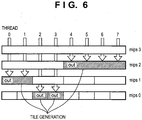
- the tiling processing is also realizable by generating threads that process in parallel the number of pixels of the lowest layer of the mipmap and executing the determination processing while going down through the layers in order from the top layer, as illustrated in Figure 6 , for example.
- the threads are generated for the number of pixels of the lowest layer of the mipmap, there is no necessity to perform the tile generation determination while selecting the pixels in the layer in order, and tiling can be completed at higher speed.
- control may be taken such that only one of the threads performing the determination of the tile generation condition for the same pixel performs the defining processing.
- step S207 the CPU 101 selects a tile for which the light transport computation has not been performed out of the defined tiles.
- step S208 the GPU 104, under the control of the CPU 101, updates the values of the light map being generated by generating ray-bundles for the selected tiles, and performing the light transport computation using the VRAM 105 for each ray-bundle.
- the CPU 101 in this embodiment maintains a region in which to store the pixels of the light map being generated in the storage medium 106. Pixels allocated to each surface of a rendering object, to which the pixels of the light map are applied, are determined and values stored in the storage area of the pixels corresponding to the ray-bundles are updated using the computation results of the light transport computation.
- step S209 the CPU 101 determines whether or not the light transport computation was performed for all of the defined tiles.
- the CPU 101 moves the processing to step S210 in a case where it determines that the light transport computation was performed for all of the tiles, and it returns the processing to step S207 in a case where it determines that the light transport computation has not been performed for all of the tiles.
- step S210 the CPU 101 determines whether or not to define ray-bundles for a separate ray direction and update the light map.
- the CPU 101 returns the processing to step S201 in a case where it determines that it will define ray-bundles for a separate ray direction and update the light map, and it completes the light map generation processing in a case where it determines not to update the light map.
- the prediction method of this embodiment can predict suitably the memory usage in the illuminating computation. Specifically, the prediction method predicts, in an illuminating computation of a 3D scene performed by defining a plurality of ray-bundles for a light transport computation for predetermined ray directions, a number of light paths of ray-bundles for a light transport computation storable in a predetermined memory region.
- the prediction method generates a fragment number map having a predetermined number of pixels wherein the pixel value of each pixel is made to be the number of fragments in the 3D scene on a straight line of a ray direction corresponding to the position of the pixel, and a mipmap of the fragment number map.
- an estimated number of fragments included on average on one light path in a case where a ray-bundle for the light transport computation is defined for a corresponding region in the 3D scene corresponding to the pixel is derived, and a value obtained by the size of a predetermined memory region divided by this value, is output as the predicted number of light paths of the ray-bundles for the light transport computation storable in the predetermined memory region for a pixel of one layer.
- the prediction method derives the estimated number of fragments by adding a compensation value in accordance with the layer of the pixel to the number of fragments which is the pixel value of one pixel.
- the processing for the light map generation can be speeded up on the whole, or the resolution can be improved for the light map.
- the above described generation condition only uses an average value of the importance of the region corresponding to the target pixel, it is not something that considers a density distribution of importance in the region.
- a region exists where importance is high locally within the defined tile, there is the possibility that a loss of light that should be reflected occurs in the region as described above.
- performing division of tiles excessively can be considered as a method of preventing loss of light from occurring.
- an increase in the number of tiles leads to an increase in computation time, this is not advantageous from the perspective of optimizing the speed of the generation of the light map.
- warping processing is disclosed in Paul Rosen, "Rectilinear Texture Warping for Fast Adaptive Shadow Mapping", I3D '12 Proceedings of the ACM SIGGRAPH Symposium on Interactive 3D Graphics and Games, p.151-158 .
- importance analysis is performed, and more pixels are allocated for regions for which importance is high, i.e. the generation of shadows having high resolution is required in a shadow mapping.
- warping processing is used in order to adaptively widen regions on a shadow map to which shadows of regions for which importance is high are rendered.
- adaptive ray bundles that prevent loss of light are generated without performing excessive tile division by expanding, by warping processing, the range of regions of high importance in two-dimensional region of the 3D scene in the projection of the selected ray direction in accordance with analysis results of importance.
- distribution change of ray-bundles is performed so as to generate more ray-bundle rays for regions of high importance by warping processing.
- step S205 After the generation of the mipmap of the fragment number map by the GPU 104 completes in step S205, the GPU 104 executes the tiling processing of this embodiment in step S701.
- step S801 the GPU 104 selects a target pixel for which tile generation is undetermined out of the mipmap pixels of the processing target layer. Also, the GPU 104 sets, as the tile candidate, the region corresponding to the target pixel in the importance map and the fragment number map. The GPU 104 computes the number of pixels of the light map to be generated for the tile candidate referring to the target pixel and the number of light paths storable in the predetermined node buffer defined for the tile candidate after the warping.
- the warping processing is applied for each tile defined by this tiling processing as later explained. For this reason, the number of pixels of the light map to be generated for the tile candidate computed in this step may be computed by a similar method to that of the first embodiment because it is not something that changes due to the execution of the warping processing.
- N is the number of pixels of the tile candidate.
- n i is the pixel value of the i-th pixel in the tile candidate of the fragment number map
- w i is the pixel value of the i-th pixel in the tile candidate of the importance map.
- the computation method of the predicted number of fragments in this embodiment is based on the premise that ideal warping processing is performed.
- Ideal warping processing is such that the size of the two-dimensional region corresponding to the pixels of the map after the warping processing is proportional to the importance value of the pixels in a case where the processing is executed for a tile. For example, a case is considered in which a tile is defined for one pixel of the mipmap of the processing target layer.
- the pixels of the importance map referenced in the generation of the pixel are four pixels having pixel values 1, 2, 3 and 4 respectively, in the tile after the warping, the area ratios of the regions corresponding to the pixels will be 1:2:3:4.
- step S702 the GPU 104, under the control of the CPU 101, generates the ray-bundles having executed the warping processing in accordance with the importance distribution for the selected tile, and updates the value of the light map being generated while performing the light transport computation using the VRAM 105 for each ray-bundle.
- the light map generation can be performed with more optimized memory usage by generating the ray-bundles adaptively using the warping processing.
- the prediction method and the method of generation according to the present invention are realizable by a program executing the methods on a computer.
- the program is providable/distributable by being stored on a computer-readable storage medium or through an electronic communication line.
Landscapes
- Engineering & Computer Science (AREA)
- Computer Graphics (AREA)
- Physics & Mathematics (AREA)
- General Physics & Mathematics (AREA)
- Theoretical Computer Science (AREA)
- Image Generation (AREA)
Claims (7)
- Computerimplementiertes Vorhersageverfahren, das in einer Beleuchtungsberechnung einer 3D-Szene, durchgeführt durch Definieren mehrerer Strahlenbündel für eine Lichttransportberechnung für vorbestimmte Strahlenrichtungen, eine Anzahl von Strahlenbündel-Lichtpfaden für eine Lichttransportberechnung vorhersagt, die in einer vorbestimmten Speicherregion gespeichert werden können, wobei das Vorhersageverfahren Folgendes beinhaltet:einen ersten Erzeugungsschritt (S204, S205) des Erzeugens einer Fragmentnummernkarte mit einer vorbestimmten Anzahl von Pixeln, und einer Mipmap der Fragmentnummernkarte, für die bewirkt wird, dass ein Pixelwert jedes Pixels eine Anzahl von Fragmenten in der 3D-Szene auf einer geraden Linie einer Strahlenrichtung entsprechend einer Position des Pixels ist;einen Ableitungsschritt (S402) des Ableitens, in einem Fall, in dem für ein Pixel einer Schicht in der Mipmap der im ersten Erzeugungsschritt erzeugten Fragmentnummernkarte Strahlenbündel für die Lichttransportberechnung für eine entsprechende Region in der 3D-Szene entsprechend dem Pixel definiert werden, einer geschätzten Anzahl von auf einem Lichtpfad durchschnittlich enthaltenen Fragmente; undeinen Vorhersageschritt (S402) des Ausgebens, als eine vorhergesagte Anzahl von Lichtpfaden von Strahlenbündeln für die Lichttransportberechnung, die in der vorbestimmten Speicherregion für das Pixel der einen Schicht gespeichert werden können, eines Wertes, der von einer Größe der vorbestimmten Speicherregion dividiert durch die geschätzte Anzahl von im Ableitungsschritt abgeleiteten Fragmenten erhalten wird, wobeiin dem Ableitungsschritt die geschätzte Anzahl von Fragmenten durch Addieren eines Kompensationswertes zu einer Anzahl von Fragmenten abgeleitet wird, der ein Pixelwert des Pixels der einen Schicht ist, wobei der Kompensationswert einer Schicht des Pixels entspricht.
- Computerimplementiertes Vorhersageverfahren, das in einer Beleuchtungsberechnung einer 3D-Szene, durchgeführt durch Definieren mehrerer Strahlenbündel für eine Lichttransportberechnung für vorbestimmte Strahlenrichtungen, eine Anzahl von Strahlenbündel-Lichtpfaden für eine Lichttransportberechnung vorhersagt, die in einer vorbestimmten Speicherregion gespeichert werden können, wobei das Vorhersageverfahren Folgendes beinhaltet:einen ersten Erzeugungsschritt (S204, S205) des Erzeugens einer Fragmentnummernkarte mit einer vorbestimmten Anzahl von Pixeln und einer Mipmap der Fragmentnummernkarte, für die bewirkt wird, dass ein Pixelwert jedes Pixels eine Anzahl von Fragmenten in der 3D-Szene auf einer geraden Linie einer Strahlenrichtung entsprechend einer Position des Pixels ist;einen zweiten Erzeugungsschritt (S202, S203) des Erzeugens einer Bedeutungskarte mit derselben Anzahl von Pixeln wie die Fragmentnummernkarte, für die bewirkt wird, dass ein Pixelwert jedes Pixels eine Texeldichte einer Beleuchtungstextur ist, die auf ein Fragment angewendet wird, das auf derselben geraden Linie vorliegt wie ein entsprechendes Pixel der Fragmentnummernkarte, und einer Mipmap der Bedeutungskarte;einen Ableitungsschritt (S801), der für ein Pixel einer Schicht in der Mipmap der im ersten Erzeugungsschritt erzeugten Fragmentnummernkarte Folgendes beinhaltet:Feststellen eines Parameters, der, gemäß einer Verteilung einer Texeldichte in einer Region der Bedeutungskarte, referenziert bei der Erzeugung eines Pixels der Mipmap der Bedeutungskarte entsprechend dem Pixel, eine Verteilung eines Strahlenbündels für die zu definierende Lichttransportberechnung ändert, undAbleiten, in einem Fall, in dem die Verteilung von Strahlenbündeln für den Lichttransportberechnung nach dem Ändern für eine entsprechende Region der 3D-Szene entsprechend dem Pixel der einen Schicht definiert wird, mit Bezug auf den festgestellten Parameter, einer geschätzten Anzahl von auf einem Lichtpfad durchschnittlich enthaltenen Fragmenten; undeinen Vorhersageschritt (S801) des Ausgebens, als eine vorhergesagte Anzahl von Lichtpfaden von Strahlenbündeln für die Lichttransportberechnung, die in der vorbestimmten Speicherregion für das Pixel der einen Schicht gespeichert werden können, eines Wertes, der von einer Größe der vorbestimmten Speicherregion dividiert durch die geschätzte Anzahl von Fragmenten wie im Ableitungsschritt abgeleitet erhalten wird, wobeiin dem Ableitungsschritt die geschätzte Anzahl von Fragmenten anhand eines gewichteten Durchschnitts abgeleitet wird, der mit einer Texeldichte, die ein entsprechender Pixelwerte der Bedeutungskarte ist, für eine Anzahl von Fragmenten genommen wird, die ein Pixelwert der Fragmentnummernkarte für die entsprechende Region ist, und wobei ein Kompensationswert gemäß einer Schicht der Pixel zu einer erhaltenen gewichteten durchschnittlichen Anzahl von Fragmenten addiert wird.
- Vorhersageverfahren nach Anspruch 1 oder 2, wobei der Kompensationswert auf der Basis einer Anzahl von Pixeln auf der Fragmentennummernkarte entsprechend einem Pixelwert eines Pixels einer obersten Schicht in der Mipmap der Fragmentnummernkarte und dem Pixel der einen Schicht festgestellt wird.
- Vorhersageverfahren nach einem der Ansprüche 1-3, wobei der Kompensationswert auf einen umso größeren Wert gesetzt wird, je niedriger die Schicht der Mipmap der Fragmentnummernkarte ist, unter die das Pixel der einen Schicht fällt.
- Computerimplementiertes Verfahren zum Erzeugen einer Lichtkarte durch eine Beleuchtungsberechnung einer 3D-Szene, durchgeführt durch Definieren von Strahlenbündeln für eine Lichttransportberechnung für jede von mehreren Strahlenrichtungen, das Folgendes beinhaltet:einen Einstellschritt (S201) des Einstellens einer Strahlenrichtung, die Strahlenbündel für die Lichttransportberechnung definiert;einen ersten Erzeugungsschritt (S204, S205) des Erzeugens einer Fragmentnummernkarte mit einer vorbestimmten Anzahl von Pixeln, und einer Mipmap der Fragmentnummernkarte, für die bewirkt wird, dass ein Pixelwert jedes Pixels eine Anzahl von Fragmenten in der 3D-Szene auf einer geraden Linie einer Strahlenrichtung ist, eingestellt in dem Einstellungsschritt entsprechend einer Position des Pixels;einen zweiten Erzeugungsschritt (S202, S203) des Erzeugens einer Bedeutungskarte mit derselben Anzahl von Pixeln wie die Fragmentnummernkarte, für die bewirkt wird, dass ein Pixelwert jedes Pixels eine Texeldichte einer Beleuchtungstextur ist, die auf ein Fragment angewendet wird, das auf derselben geraden Linie vorliegt wie ein entsprechendes Pixel der Fragmentennummernkarte, und einer Mipmap der Bedeutungskarte;einen Feststellungsschritt (S206) des Feststellens einer Verarbeitungsregion, die eine Einheit ist, für die, mit Bezug auf die 3D-Szene in der eingestellten Strahlenrichtung, die sich auf die Mipmap der Fragmentnummernkarte und die Mipmap der Bedeutungskarte bezieht, Strahlenbündel für die Lichttransportberechnung definiert werden und eine Beleuchtungsberechnung zur Lichtkartenerzeugung durchgeführt wird; undeinen Berechnungsschritt (S208) des Definierens von Strahlenbündeln für die Lichttransportberechnung und des Durchführens einer Beleuchtungsberechnung zur Lichtkartenerzeugung für jede in dem Feststellungsschritt festgestellte Verarbeitungsregion, wobeiin dem Feststellungsschritt für Pixel derselben Position einer Schicht in der Mipmap der Fragmentnummernkarte und der Mipmap der Bedeutungskarte, in einem Fall, in dem eine vorhergesagte Anzahl von Strahlenbündel-Lichtpfaden für die Lichttransportberechnung, die in einer vorbestimmten Speicherregion gespeichert werden können, ausgegeben an eine entsprechende Region in der 3D-Szene entsprechend den Pixeln mit dem Vorhersageverfahren nach einem der Ansprüche 1-4, größer ist als eine Anzahl von Texeln in der entsprechenden Region, die entsprechende Region als die Verarbeitungsregion festgestellt wird.
- Computerlesbares Speichermedium, auf dem ein Programm gespeichert ist, um zu bewirken, dass ein Computer jeden Schritt des Vorhersageverfahrens nach einem der Ansprüche 1-4 ausführt.
- Computerlesbares Speichermedium, auf dem ein Programm gespeichert ist, um zu bewirken, dass ein Computer jeden Schritt des Vorhersageverfahrens nach Anspruch 5 ausführt.
Applications Claiming Priority (1)
| Application Number | Priority Date | Filing Date | Title |
|---|---|---|---|
| JP2013074433A JP5711289B2 (ja) | 2013-03-29 | 2013-03-29 | 予測方法、生成方法、及び記録媒体 |
Publications (3)
| Publication Number | Publication Date |
|---|---|
| EP2784752A2 EP2784752A2 (de) | 2014-10-01 |
| EP2784752A3 EP2784752A3 (de) | 2016-03-02 |
| EP2784752B1 true EP2784752B1 (de) | 2017-02-22 |
Family
ID=50241092
Family Applications (1)
| Application Number | Title | Priority Date | Filing Date |
|---|---|---|---|
| EP14157055.6A Active EP2784752B1 (de) | 2013-03-29 | 2014-02-27 | Vorhersageverfahren, Erzeugungsverfahren und Speichermedium |
Country Status (3)
| Country | Link |
|---|---|
| US (1) | US9330492B2 (de) |
| EP (1) | EP2784752B1 (de) |
| JP (1) | JP5711289B2 (de) |
Families Citing this family (12)
| Publication number | Priority date | Publication date | Assignee | Title |
|---|---|---|---|---|
| JP2831360B2 (ja) | 1988-05-24 | 1998-12-02 | 株式会社リコー | 感熱昇華転写記録媒体 |
| US10713838B2 (en) * | 2013-05-03 | 2020-07-14 | Nvidia Corporation | Image illumination rendering system and method |
| KR102285840B1 (ko) * | 2013-11-11 | 2021-08-05 | 삼성전자주식회사 | 3차원 영상 렌더링 방법 및 이를 적용한 영상 출력 장치 |
| KR102370617B1 (ko) * | 2015-04-23 | 2022-03-04 | 삼성전자주식회사 | 적응적 샘플링을 수행하여 영상을 처리하는 방법 및 장치. |
| JP6202118B2 (ja) * | 2016-03-09 | 2017-09-27 | 日本電気株式会社 | 描画装置、描画方法およびプログラム |
| US10325401B2 (en) | 2016-03-11 | 2019-06-18 | Imagination Technologies Limited | Importance sampling for determining a light map |
| US11103778B1 (en) | 2017-03-28 | 2021-08-31 | Kabam, Inc. | Multi-level lighting system |
| US10275934B1 (en) * | 2017-12-20 | 2019-04-30 | Disney Enterprises, Inc. | Augmented video rendering |
| US11398072B1 (en) * | 2019-12-16 | 2022-07-26 | Siemens Healthcare Gmbh | Method of obtaining a set of values for a respective set of parameters for use in a physically based path tracing process and a method of rendering using a physically based path tracing process |
| CN111932664B (zh) * | 2020-08-27 | 2023-06-23 | 腾讯科技(深圳)有限公司 | 图像渲染方法、装置、电子设备及存储介质 |
| CN114331801B (zh) * | 2020-09-30 | 2024-04-02 | 想象技术有限公司 | 用于光线跟踪的相交测试 |
| GB2599407B (en) * | 2020-09-30 | 2022-10-12 | Imagination Tech Ltd | Intersection testing for ray tracing |
Family Cites Families (1)
| Publication number | Priority date | Publication date | Assignee | Title |
|---|---|---|---|---|
| WO2008091958A2 (en) * | 2007-01-23 | 2008-07-31 | Mental Images, Gmbh | Terminating spatial partition hierarchies by a priori bounding memory |
-
2013
- 2013-03-29 JP JP2013074433A patent/JP5711289B2/ja active Active
-
2014
- 2014-02-27 EP EP14157055.6A patent/EP2784752B1/de active Active
- 2014-03-10 US US14/202,243 patent/US9330492B2/en active Active
Non-Patent Citations (1)
| Title |
|---|
| None * |
Also Published As
| Publication number | Publication date |
|---|---|
| US9330492B2 (en) | 2016-05-03 |
| EP2784752A2 (de) | 2014-10-01 |
| JP2014199543A (ja) | 2014-10-23 |
| JP5711289B2 (ja) | 2015-04-30 |
| EP2784752A3 (de) | 2016-03-02 |
| US20140292757A1 (en) | 2014-10-02 |
Similar Documents
| Publication | Publication Date | Title |
|---|---|---|
| EP2784752B1 (de) | Vorhersageverfahren, Erzeugungsverfahren und Speichermedium | |
| US11030794B2 (en) | Importance sampling for determining a light map | |
| US9530241B2 (en) | Clipping of graphics primitives | |
| US9619937B2 (en) | Methods and apparatus for processing computer graphics primitives in tile-based graphics rendering system | |
| US9208610B2 (en) | Alternate scene representations for optimizing rendering of computer graphics | |
| US20130076761A1 (en) | Graphics processing systems | |
| WO2000028483A1 (en) | Shading 3-dimensional computer generated images | |
| US9824488B2 (en) | Systems and methods for rendering 2D grid data | |
| US10497150B2 (en) | Graphics processing fragment shading by plural processing passes | |
| EP2937838B1 (de) | Informationsverarbeitungsvorrichtung, steuerungsverfahren, programm und speichermedium | |
| CN120492679B (zh) | 大规模图数据可视化渲染的优化方法、设备和存储介质 | |
| EP3109831B1 (de) | Programm, aufzeichnungsmedium, luminanzberechnungsvorrichtung und luminanzberechnungsverfahren | |
| KR20170016156A (ko) | 경로 렌더링을 수행하는 방법 및 장치. | |
| US9401038B2 (en) | Information processing apparatus, generation method, and storage medium | |
| Kolivand et al. | Anti-aliasing in image based shadow generation techniques: a comprehensive survey | |
| Vasilakis et al. | Variable k-buffer using Importance Maps. | |
| Fischer | Vulkan terrain renderer based on real-world height-maps for embedded systems | |
| AU2015205827B2 (en) | Systems and methods for rendering 2d grid data |
Legal Events
| Date | Code | Title | Description |
|---|---|---|---|
| 17P | Request for examination filed |
Effective date: 20140227 |
|
| AK | Designated contracting states |
Kind code of ref document: A2 Designated state(s): AL AT BE BG CH CY CZ DE DK EE ES FI FR GB GR HR HU IE IS IT LI LT LU LV MC MK MT NL NO PL PT RO RS SE SI SK SM TR |
|
| AX | Request for extension of the european patent |
Extension state: BA ME |
|
| PUAI | Public reference made under article 153(3) epc to a published international application that has entered the european phase |
Free format text: ORIGINAL CODE: 0009012 |
|
| PUAL | Search report despatched |
Free format text: ORIGINAL CODE: 0009013 |
|
| RIC1 | Information provided on ipc code assigned before grant |
Ipc: G06T 15/50 20060101ALI20160120BHEP Ipc: G06T 15/06 20110101AFI20160120BHEP |
|
| AK | Designated contracting states |
Kind code of ref document: A3 Designated state(s): AL AT BE BG CH CY CZ DE DK EE ES FI FR GB GR HR HU IE IS IT LI LT LU LV MC MK MT NL NO PL PT RO RS SE SI SK SM TR |
|
| AX | Request for extension of the european patent |
Extension state: BA ME |
|
| R17P | Request for examination filed (corrected) |
Effective date: 20160201 |
|
| RBV | Designated contracting states (corrected) |
Designated state(s): AL AT BE BG CH CY CZ DE DK EE ES FI FR GB GR HR HU IE IS IT LI LT LU LV MC MK MT NL NO PL PT RO RS SE SI SK SM TR |
|
| GRAP | Despatch of communication of intention to grant a patent |
Free format text: ORIGINAL CODE: EPIDOSNIGR1 |
|
| INTG | Intention to grant announced |
Effective date: 20161121 |
|
| GRAS | Grant fee paid |
Free format text: ORIGINAL CODE: EPIDOSNIGR3 |
|
| GRAA | (expected) grant |
Free format text: ORIGINAL CODE: 0009210 |
|
| AK | Designated contracting states |
Kind code of ref document: B1 Designated state(s): AL AT BE BG CH CY CZ DE DK EE ES FI FR GB GR HR HU IE IS IT LI LT LU LV MC MK MT NL NO PL PT RO RS SE SI SK SM TR |
|
| REG | Reference to a national code |
Ref country code: GB Ref legal event code: FG4D |
|
| REG | Reference to a national code |
Ref country code: FR Ref legal event code: PLFP Year of fee payment: 4 |
|
| REG | Reference to a national code |
Ref country code: CH Ref legal event code: EP |
|
| REG | Reference to a national code |
Ref country code: AT Ref legal event code: REF Ref document number: 869799 Country of ref document: AT Kind code of ref document: T Effective date: 20170315 |
|
| REG | Reference to a national code |
Ref country code: IE Ref legal event code: FG4D |
|
| REG | Reference to a national code |
Ref country code: DE Ref legal event code: R096 Ref document number: 602014006841 Country of ref document: DE |
|
| REG | Reference to a national code |
Ref country code: LT Ref legal event code: MG4D |
|
| REG | Reference to a national code |
Ref country code: NL Ref legal event code: MP Effective date: 20170222 |
|
| REG | Reference to a national code |
Ref country code: AT Ref legal event code: MK05 Ref document number: 869799 Country of ref document: AT Kind code of ref document: T Effective date: 20170222 |
|
| PG25 | Lapsed in a contracting state [announced via postgrant information from national office to epo] |
Ref country code: LT Free format text: LAPSE BECAUSE OF FAILURE TO SUBMIT A TRANSLATION OF THE DESCRIPTION OR TO PAY THE FEE WITHIN THE PRESCRIBED TIME-LIMIT Effective date: 20170222 Ref country code: NO Free format text: LAPSE BECAUSE OF FAILURE TO SUBMIT A TRANSLATION OF THE DESCRIPTION OR TO PAY THE FEE WITHIN THE PRESCRIBED TIME-LIMIT Effective date: 20170522 Ref country code: HR Free format text: LAPSE BECAUSE OF FAILURE TO SUBMIT A TRANSLATION OF THE DESCRIPTION OR TO PAY THE FEE WITHIN THE PRESCRIBED TIME-LIMIT Effective date: 20170222 Ref country code: GR Free format text: LAPSE BECAUSE OF FAILURE TO SUBMIT A TRANSLATION OF THE DESCRIPTION OR TO PAY THE FEE WITHIN THE PRESCRIBED TIME-LIMIT Effective date: 20170523 Ref country code: FI Free format text: LAPSE BECAUSE OF FAILURE TO SUBMIT A TRANSLATION OF THE DESCRIPTION OR TO PAY THE FEE WITHIN THE PRESCRIBED TIME-LIMIT Effective date: 20170222 |
|
| PG25 | Lapsed in a contracting state [announced via postgrant information from national office to epo] |
Ref country code: BG Free format text: LAPSE BECAUSE OF FAILURE TO SUBMIT A TRANSLATION OF THE DESCRIPTION OR TO PAY THE FEE WITHIN THE PRESCRIBED TIME-LIMIT Effective date: 20170522 Ref country code: AT Free format text: LAPSE BECAUSE OF FAILURE TO SUBMIT A TRANSLATION OF THE DESCRIPTION OR TO PAY THE FEE WITHIN THE PRESCRIBED TIME-LIMIT Effective date: 20170222 Ref country code: PT Free format text: LAPSE BECAUSE OF FAILURE TO SUBMIT A TRANSLATION OF THE DESCRIPTION OR TO PAY THE FEE WITHIN THE PRESCRIBED TIME-LIMIT Effective date: 20170622 Ref country code: NL Free format text: LAPSE BECAUSE OF NON-PAYMENT OF DUE FEES Effective date: 20170222 Ref country code: SE Free format text: LAPSE BECAUSE OF FAILURE TO SUBMIT A TRANSLATION OF THE DESCRIPTION OR TO PAY THE FEE WITHIN THE PRESCRIBED TIME-LIMIT Effective date: 20170222 Ref country code: RS Free format text: LAPSE BECAUSE OF FAILURE TO SUBMIT A TRANSLATION OF THE DESCRIPTION OR TO PAY THE FEE WITHIN THE PRESCRIBED TIME-LIMIT Effective date: 20170222 Ref country code: ES Free format text: LAPSE BECAUSE OF FAILURE TO SUBMIT A TRANSLATION OF THE DESCRIPTION OR TO PAY THE FEE WITHIN THE PRESCRIBED TIME-LIMIT Effective date: 20170222 Ref country code: LV Free format text: LAPSE BECAUSE OF FAILURE TO SUBMIT A TRANSLATION OF THE DESCRIPTION OR TO PAY THE FEE WITHIN THE PRESCRIBED TIME-LIMIT Effective date: 20170222 |
|
| REG | Reference to a national code |
Ref country code: CH Ref legal event code: PL |
|
| PG25 | Lapsed in a contracting state [announced via postgrant information from national office to epo] |
Ref country code: LI Free format text: LAPSE BECAUSE OF NON-PAYMENT OF DUE FEES Effective date: 20170228 Ref country code: IT Free format text: LAPSE BECAUSE OF FAILURE TO SUBMIT A TRANSLATION OF THE DESCRIPTION OR TO PAY THE FEE WITHIN THE PRESCRIBED TIME-LIMIT Effective date: 20170222 Ref country code: CH Free format text: LAPSE BECAUSE OF NON-PAYMENT OF DUE FEES Effective date: 20170228 Ref country code: CZ Free format text: LAPSE BECAUSE OF FAILURE TO SUBMIT A TRANSLATION OF THE DESCRIPTION OR TO PAY THE FEE WITHIN THE PRESCRIBED TIME-LIMIT Effective date: 20170222 Ref country code: EE Free format text: LAPSE BECAUSE OF FAILURE TO SUBMIT A TRANSLATION OF THE DESCRIPTION OR TO PAY THE FEE WITHIN THE PRESCRIBED TIME-LIMIT Effective date: 20170222 Ref country code: RO Free format text: LAPSE BECAUSE OF FAILURE TO SUBMIT A TRANSLATION OF THE DESCRIPTION OR TO PAY THE FEE WITHIN THE PRESCRIBED TIME-LIMIT Effective date: 20170222 Ref country code: SK Free format text: LAPSE BECAUSE OF FAILURE TO SUBMIT A TRANSLATION OF THE DESCRIPTION OR TO PAY THE FEE WITHIN THE PRESCRIBED TIME-LIMIT Effective date: 20170222 |
|
| REG | Reference to a national code |
Ref country code: DE Ref legal event code: R097 Ref document number: 602014006841 Country of ref document: DE |
|
| REG | Reference to a national code |
Ref country code: IE Ref legal event code: MM4A |
|
| PG25 | Lapsed in a contracting state [announced via postgrant information from national office to epo] |
Ref country code: PL Free format text: LAPSE BECAUSE OF FAILURE TO SUBMIT A TRANSLATION OF THE DESCRIPTION OR TO PAY THE FEE WITHIN THE PRESCRIBED TIME-LIMIT Effective date: 20170222 Ref country code: MC Free format text: LAPSE BECAUSE OF FAILURE TO SUBMIT A TRANSLATION OF THE DESCRIPTION OR TO PAY THE FEE WITHIN THE PRESCRIBED TIME-LIMIT Effective date: 20170222 Ref country code: SM Free format text: LAPSE BECAUSE OF FAILURE TO SUBMIT A TRANSLATION OF THE DESCRIPTION OR TO PAY THE FEE WITHIN THE PRESCRIBED TIME-LIMIT Effective date: 20170222 Ref country code: DK Free format text: LAPSE BECAUSE OF FAILURE TO SUBMIT A TRANSLATION OF THE DESCRIPTION OR TO PAY THE FEE WITHIN THE PRESCRIBED TIME-LIMIT Effective date: 20170222 |
|
| PG25 | Lapsed in a contracting state [announced via postgrant information from national office to epo] |
Ref country code: LU Free format text: LAPSE BECAUSE OF NON-PAYMENT OF DUE FEES Effective date: 20170227 |
|
| PLBE | No opposition filed within time limit |
Free format text: ORIGINAL CODE: 0009261 |
|
| STAA | Information on the status of an ep patent application or granted ep patent |
Free format text: STATUS: NO OPPOSITION FILED WITHIN TIME LIMIT |
|
| 26N | No opposition filed |
Effective date: 20171123 |
|
| REG | Reference to a national code |
Ref country code: BE Ref legal event code: MM Effective date: 20170228 |
|
| REG | Reference to a national code |
Ref country code: FR Ref legal event code: PLFP Year of fee payment: 5 |
|
| PG25 | Lapsed in a contracting state [announced via postgrant information from national office to epo] |
Ref country code: IE Free format text: LAPSE BECAUSE OF NON-PAYMENT OF DUE FEES Effective date: 20170227 Ref country code: SI Free format text: LAPSE BECAUSE OF FAILURE TO SUBMIT A TRANSLATION OF THE DESCRIPTION OR TO PAY THE FEE WITHIN THE PRESCRIBED TIME-LIMIT Effective date: 20170222 |
|
| PG25 | Lapsed in a contracting state [announced via postgrant information from national office to epo] |
Ref country code: BE Free format text: LAPSE BECAUSE OF NON-PAYMENT OF DUE FEES Effective date: 20170228 |
|
| PG25 | Lapsed in a contracting state [announced via postgrant information from national office to epo] |
Ref country code: MT Free format text: LAPSE BECAUSE OF NON-PAYMENT OF DUE FEES Effective date: 20170227 |
|
| PG25 | Lapsed in a contracting state [announced via postgrant information from national office to epo] |
Ref country code: HU Free format text: LAPSE BECAUSE OF FAILURE TO SUBMIT A TRANSLATION OF THE DESCRIPTION OR TO PAY THE FEE WITHIN THE PRESCRIBED TIME-LIMIT; INVALID AB INITIO Effective date: 20140227 |
|
| PG25 | Lapsed in a contracting state [announced via postgrant information from national office to epo] |
Ref country code: CY Free format text: LAPSE BECAUSE OF FAILURE TO SUBMIT A TRANSLATION OF THE DESCRIPTION OR TO PAY THE FEE WITHIN THE PRESCRIBED TIME-LIMIT Effective date: 20170222 |
|
| PG25 | Lapsed in a contracting state [announced via postgrant information from national office to epo] |
Ref country code: MK Free format text: LAPSE BECAUSE OF FAILURE TO SUBMIT A TRANSLATION OF THE DESCRIPTION OR TO PAY THE FEE WITHIN THE PRESCRIBED TIME-LIMIT Effective date: 20170222 |
|
| PG25 | Lapsed in a contracting state [announced via postgrant information from national office to epo] |
Ref country code: TR Free format text: LAPSE BECAUSE OF FAILURE TO SUBMIT A TRANSLATION OF THE DESCRIPTION OR TO PAY THE FEE WITHIN THE PRESCRIBED TIME-LIMIT Effective date: 20170222 |
|
| PG25 | Lapsed in a contracting state [announced via postgrant information from national office to epo] |
Ref country code: AL Free format text: LAPSE BECAUSE OF FAILURE TO SUBMIT A TRANSLATION OF THE DESCRIPTION OR TO PAY THE FEE WITHIN THE PRESCRIBED TIME-LIMIT Effective date: 20170222 Ref country code: IS Free format text: LAPSE BECAUSE OF FAILURE TO SUBMIT A TRANSLATION OF THE DESCRIPTION OR TO PAY THE FEE WITHIN THE PRESCRIBED TIME-LIMIT Effective date: 20170622 |
|
| PGFP | Annual fee paid to national office [announced via postgrant information from national office to epo] |
Ref country code: DE Payment date: 20250218 Year of fee payment: 12 |
|
| PGFP | Annual fee paid to national office [announced via postgrant information from national office to epo] |
Ref country code: FR Payment date: 20250221 Year of fee payment: 12 |
|
| PGFP | Annual fee paid to national office [announced via postgrant information from national office to epo] |
Ref country code: GB Payment date: 20250219 Year of fee payment: 12 |