EP2781371A1 - Festigkeitsträgerlage für Fahrzeugluftreifen - Google Patents
Festigkeitsträgerlage für Fahrzeugluftreifen Download PDFInfo
- Publication number
- EP2781371A1 EP2781371A1 EP14150524.8A EP14150524A EP2781371A1 EP 2781371 A1 EP2781371 A1 EP 2781371A1 EP 14150524 A EP14150524 A EP 14150524A EP 2781371 A1 EP2781371 A1 EP 2781371A1
- Authority
- EP
- European Patent Office
- Prior art keywords
- reinforcing
- basalt fibers
- fibers
- basalt
- layer
- Prior art date
- Legal status (The legal status is an assumption and is not a legal conclusion. Google has not performed a legal analysis and makes no representation as to the accuracy of the status listed.)
- Granted
Links
Images

Classifications
-
- D—TEXTILES; PAPER
- D02—YARNS; MECHANICAL FINISHING OF YARNS OR ROPES; WARPING OR BEAMING
- D02G—CRIMPING OR CURLING FIBRES, FILAMENTS, THREADS, OR YARNS; YARNS OR THREADS
- D02G3/00—Yarns or threads, e.g. fancy yarns; Processes or apparatus for the production thereof, not otherwise provided for
- D02G3/02—Yarns or threads characterised by the material or by the materials from which they are made
- D02G3/16—Yarns or threads made from mineral substances
-
- B—PERFORMING OPERATIONS; TRANSPORTING
- B60—VEHICLES IN GENERAL
- B60C—VEHICLE TYRES; TYRE INFLATION; TYRE CHANGING; CONNECTING VALVES TO INFLATABLE ELASTIC BODIES IN GENERAL; DEVICES OR ARRANGEMENTS RELATED TO TYRES
- B60C9/00—Reinforcements or ply arrangement of pneumatic tyres
- B60C9/0028—Reinforcements comprising mineral fibres, e.g. glass or carbon fibres
-
- B—PERFORMING OPERATIONS; TRANSPORTING
- B60—VEHICLES IN GENERAL
- B60C—VEHICLE TYRES; TYRE INFLATION; TYRE CHANGING; CONNECTING VALVES TO INFLATABLE ELASTIC BODIES IN GENERAL; DEVICES OR ARRANGEMENTS RELATED TO TYRES
- B60C9/00—Reinforcements or ply arrangement of pneumatic tyres
- B60C9/0064—Reinforcements comprising monofilaments
-
- B—PERFORMING OPERATIONS; TRANSPORTING
- B60—VEHICLES IN GENERAL
- B60C—VEHICLE TYRES; TYRE INFLATION; TYRE CHANGING; CONNECTING VALVES TO INFLATABLE ELASTIC BODIES IN GENERAL; DEVICES OR ARRANGEMENTS RELATED TO TYRES
- B60C9/00—Reinforcements or ply arrangement of pneumatic tyres
- B60C9/18—Structure or arrangement of belts or breakers, crown-reinforcing or cushioning layers
- B60C9/20—Structure or arrangement of belts or breakers, crown-reinforcing or cushioning layers built-up from rubberised plies each having all cords arranged substantially parallel
- B60C9/2003—Structure or arrangement of belts or breakers, crown-reinforcing or cushioning layers built-up from rubberised plies each having all cords arranged substantially parallel characterised by the materials of the belt cords
-
- D—TEXTILES; PAPER
- D02—YARNS; MECHANICAL FINISHING OF YARNS OR ROPES; WARPING OR BEAMING
- D02G—CRIMPING OR CURLING FIBRES, FILAMENTS, THREADS, OR YARNS; YARNS OR THREADS
- D02G3/00—Yarns or threads, e.g. fancy yarns; Processes or apparatus for the production thereof, not otherwise provided for
- D02G3/44—Yarns or threads characterised by the purpose for which they are designed
- D02G3/48—Tyre cords
-
- B—PERFORMING OPERATIONS; TRANSPORTING
- B60—VEHICLES IN GENERAL
- B60C—VEHICLE TYRES; TYRE INFLATION; TYRE CHANGING; CONNECTING VALVES TO INFLATABLE ELASTIC BODIES IN GENERAL; DEVICES OR ARRANGEMENTS RELATED TO TYRES
- B60C9/00—Reinforcements or ply arrangement of pneumatic tyres
- B60C9/18—Structure or arrangement of belts or breakers, crown-reinforcing or cushioning layers
- B60C9/20—Structure or arrangement of belts or breakers, crown-reinforcing or cushioning layers built-up from rubberised plies each having all cords arranged substantially parallel
- B60C9/22—Structure or arrangement of belts or breakers, crown-reinforcing or cushioning layers built-up from rubberised plies each having all cords arranged substantially parallel the plies being arranged with all cords disposed along the circumference of the tyre
- B60C2009/2214—Structure or arrangement of belts or breakers, crown-reinforcing or cushioning layers built-up from rubberised plies each having all cords arranged substantially parallel the plies being arranged with all cords disposed along the circumference of the tyre characterised by the materials of the zero degree ply cords
Definitions
- the invention relates to a reinforcing layer for pneumatic vehicle tires, preferably for the belt bandage or the belt of a pneumatic vehicle tire, comprising at least one strength carrier embedded in elastomeric material, which has a plurality of Monogarnen.
- the invention relates to a pneumatic vehicle tire which contains at least one reinforcement layer according to the invention, in particular as a reinforcement layer of the belt and / or the belt bandage.
- Reinforcements for the reinforcement layers of pneumatic vehicle tires are known to those skilled in material and structure in different versions.
- the at least one strength support of such a reinforcement layer is in this case, e.g. By calendering, embedded in an elastomeric mixture to be used as a rubberized reinforcement layer in the pneumatic vehicle tire can.
- a “yarn” is a linear structure of one or more fibers or of one or more filaments.
- a “monogam” is understood as meaning a yarn made from exactly one filament or exactly one continuous fiber or also a spun fiber yarn made from twisted fibers of limited length.
- a yarn may thus be formed from one or more monogarnets.
- a “cord” is a thread-like product which consists of one or more yarns which are twisted together.
- the material based primarily (directly) on the fossil raw petroleum, such as PET (polyethylene terephthalate), aramid or nylon or hybrid cords their yarns. It is also known to use non-petroleum-based textile reinforcements made of viscose, such as rayon or lyocell, which are based on the renewable raw material cellulose.
- a disadvantage of materials based on renewable raw materials as a material for textile reinforcement is that they do not have an endless fiber structure and a strongly fluctuating fiber quality.
- rayon is sensitive to moisture and reduces the breaking strength of the reinforcing agent by moisture absorption.
- Rayon is costly in its purchase.
- the reinforcement layer should have a consistent product quality.
- the object is achieved by a plurality of Monogarne of the reinforcement are basalt fibers.
- basalt fibers are very well suited as a component of reinforcements of the belt and / or the belt bandage of vehicle tires.
- Reinforcing materials comprising basalt fibers have advantageous properties in comparison with reinforcements made of conventional fiber materials. In particular, they have, for example, compared to steel, advantageous compression behavior and, for example, compared to nylon, high elastic modulus. Compared to textile materials basalt also shows an advantageous thermal stability and a favorable chemical resistance.
- basalt is available on a large scale as a raw material:
- the material basalt is a basic volcanic effusion rock and thus a primary raw material. Like crude oil, the raw material basalt is not specifically renewable by humans. However, basalt is the most abundant volcanic rock and thus a natural resource from an almost inexhaustible, easily accessible source. In addition, basalt is modeled by volcanic activity and the internal movement of the earth's plates by nature. A shortage of raw material is therefore not expected.
- Basalt fibers are mineral fibers that are produced at high temperatures from a liquid basalt melt and can then be processed into yarns or cords, for example.
- Basalt is an aluminosilicate which, for example, aluminum oxide, Contains silica, calcium iodide and magnesium oxide.
- the exact chemical composition of the natural raw material is geologically determined and depends on the mining site. In order to set and optimize the product properties of the basalt fibers in a defined manner, basalts of different chemical composition can be combined and / or other additives can be added to the basalt melt in addition to the natural basalt.
- Base fiber is understood in the sense of the application as Endlosbasaltmaschine and is thus a monogamous. In the reinforcement, it extends substantially over the entire length of the reinforcement.
- Basalt fibers are considered harmless to health. Basalt fibers can be recycled and have a positive price-performance ratio.
- an advantageous reinforcement layer for pneumatic vehicle tires in particular for the belt or belt bandage of pneumatic vehicle tires, is thus provided, which is not based primarily on petroleum-based, iron-based or cellulose-based materials.
- basalt fibers can be produced in consistent quality and are therefore available in consistent product quality.
- the basalt fibers of the reinforcing agent may all have the same chemical composition.
- the strength member may also include a plurality of basalt fibers of one chemical composition and a plurality of basalt fibers of a different chemical composition.
- a "variety of” is meant a number of at least 20.
- the monogarne of a reinforcing agent can also differ in their fineness. By combining different monogarne their different positive properties can be combined and used.
- the basalt fibers contain at least 90% by weight, in particular at least 95% by weight, in particular 100% by weight, of natural basalt.
- the percent by weight relate here to the pure basalt fiber, ie the basalt fiber without an optional functionalization or an optional adhesion promoter.
- a reinforcement layer can be provided, at least one strength element of which consists partially or entirely of a raw material available on a large scale and is not based primarily on crude oil, iron or cellulose.
- all monogranes of the reinforcing agent are basalt fibers.
- the reinforcements of the reinforcing layer thus provided are based wholly or to a large extent on the commodity basalt available on a large scale and not primarily on petroleum, iron or cellulose. They are also available in consistent product quality.
- the strength member has a plurality of monogarnen from non-basalticianm material.
- the strength member has both a plurality of basalt fibers and a plurality of Monogarnen from non-basaltic material.
- the non-basaltic material may be selected from the group consisting of polyester (PE), polyamide (PA), aramid, arselone, polyetherketone (PEK), polyetheretherketone (PEEK), polyketone (POK), rayon, viscose , Chemical, natural, glass and / or carbon fibers.
- the polyamides may be polyamides PA 4.6, PA 6, PA 6.6, PA 10.10, PA 11 and / or PA 12.
- the polyesters may be polyester polyethylenenaphthalate (PEN), polybutylene terephthalate (PBT), polybutylene naphthalate (PBN), polypentylene terephthalate (PPT), polypropylene naphthalate (PPN), polyethylene terephthalate (PET), high-modulus low-shrinkage PET (HMLS). PET), in particular thermoplastic polyesters and / or crosslinked unsaturated polyesters act. Enumerations that contain "and / or” are to be understood to mean that all members of the enumeration are coupled with and / or. By using different materials, properties of the individual materials can be combined in a targeted manner and thus the properties of the reinforcement layer can be advantageously adjusted.
- PEN polyester polyethylenenaphthalate
- PBT polybutylene terephthalate
- PBN polybutylene naphthalate
- PPT polypentylene terephthalate
- PPN polypropylene naphthalate
- PET high-modulus
- the reinforcing member comprises a plurality of monogrants of completely or at least partially renewable raw materials, in particular of cellulose-based chemical fibers and / or of natural fibers.
- cellulose-based man-made fibers rayon and lyocell in particular should be mentioned.
- natural fibers in particular wool (keratin) may be mentioned.
- a reinforcement layer can be provided, the material of the Monogarne of the reinforcements wholly or partly based on basalt and renewable resources and thus renounce all or part of petroleum-, iron- or cellulose-based materials.
- the properties of the reinforcing agent can be adjusted specifically via the material selection.
- the basalt fibers are provided with an epoxy and / or vinyl functionalization. In this way, a reliable adhesion of the basalt fibers to the adhesive can be obtained.
- the reinforcement is a cord of at least one yarn, wherein the at least one yarn has a plurality of basalt fibers.
- a reinforcement layer is provided, which is particularly suitable as a reinforcement layer of the belt bandage and / or the belt bandage of a pneumatic vehicle tire whose at least one strength member at least partially made of a non-petroleum-based, non-iron-based or non-cellulose-based, but available on a large scale, material ,
- At least one yarn of the cord is formed from basalt fibers. It is also advantageous if all the yarns of the cord are formed from basalt fibers.
- a yarn count of 250 to 5000 dtex and a final twist of the pre-twisted material of 25 to 600 t / m is advantageous.
- the cord has two or more yarns.
- the at least two yarns of a reinforcing member may differ, for example, in the twisting direction and / or in the twisting number and / or in the titer and / or in the fineness.
- the properties of the reinforcement can thus be adjusted specifically.
- the cord has at least one yarn which has a large number of basalt fibers and a large number of monogarnets of non-basaltic material, in particular of non-basaltic material from the abovementioned group.
- the cord has at least one yarn of basalt fibers and at least one yarn of non-basaltic material, in particular of non-basaltic material from the above-mentioned group.
- This may be, for example, a cord of a yarn of basalt fibers and another yarn of PE, in particular PET or PEN, or another yarn of polyamide, in particular PA 6.6, PA 6 or PA 10.10, or another yarn of aramid, Arselon , PEK or POK, act.
- Another advantage is a cord of a yarn of basalt fibers and another yarn of rayon, lyocell or natural fibers.
- the advantages of the individual materials can be combined and optimally utilized via the geometric effect of the twisting.
- the properties of the cord can thus be targeted.
- the strength member is a band whose cross section corresponds to the condition a ⁇ b, where a defines the cross-sectional height and b the cross-sectional width of the band, that the band is arranged in the reinforcement layer such that the extension direction of b is aligned approximately parallel to the planar extent of the reinforcement layer, that the band contains a plurality of Monogarnen, which are arranged approximately parallel to the longitudinal extent of the band, wherein the Monogarne are held together within the band by means of a primer, and that a plurality of Monogarne Basalt fibers are.
- the Monogarne are essentially in the longitudinal direction arranged the band.
- the small cross-sectional height a and the cross-sectional width b of the band is caused by the arrangement of the monogarne, which are arranged primarily in the extension direction of the cross-sectional width b side by side.
- the tape itself is not intentionally twisted in the reinforcement layer.
- Each monogam is connected to a bonding agent and is at least partially held together with other monofilaments of the band by means of this bonding agent.
- the strip prefferably has a fineness of 50 to 7000 dtex, preferably 500 to 3500 dtex, particularly preferably 1200 to 1500 dtex, and if the strip has a number of 25 to 4500 filaments, preferably a number of 450 to 2000 filaments, more preferably a number of 500 to 1200 filaments. It is also expedient if the cross-sectional height a of the condition corresponds to 1 ⁇ m ⁇ a ⁇ 1500 ⁇ m, preferably 1 ⁇ m ⁇ a ⁇ 500 ⁇ m, preferably 1 ⁇ m ⁇ a ⁇ 200 ⁇ m.
- the cross-sectional width b satisfies the condition 100 ⁇ m ⁇ b ⁇ 15000 ⁇ m, preferably 300 ⁇ m ⁇ b ⁇ 10000 ⁇ m, and if the ratio of cross-sectional width b to cross-sectional height a satisfies the condition 4000> b / a> 1.5, in particular 200> b / a> 3.5, in particular 19> b / a> 6.5.
- the adhesion promoter of the strip is a crosslinkable resin, a liquid thermoplastic resin, a wax or a substance, for example of the type RFL (resorcinol-formaldehyde-latex), which can interact with elastomeric material. It is advantageous if the adhesion promoter is curable and hardened in the tape Condition exists. It is also advantageous if the band also has a multiplicity of monogarns made of non-basaltic material.
- the reinforcing agent In order to ensure a reliable adhesion of the reinforcing agent to the elastomeric material, it is expedient to additionally coat the basalt fibers and / or the reinforcing substance with an adhesive impregnation, e.g. with an RFL dip in 1-bath or 2-bath process.
- an adhesive impregnation e.g. with an RFL dip in 1-bath or 2-bath process.
- the invention relates to a pneumatic vehicle tire which contains at least one reinforcement layer according to the invention of the belt and / or the belt bandage. It is preferably a car tire or a commercial vehicle tire.
- the reinforcement layer has at least two different strength members in material and / or construction. These may be at least two cords, which differ, for example, in the yarn material and / or in the yarn structure and / or the yarn count and / or the yarn combination and / or the cord construction.
- the reinforcement layer may comprise at least one cord of basalt fibers and at least one nylon cord. It may also be at least two bands that differ in material and / or in the band cross-section and / or the number and / or fineness of the Monogarne and / or ribbon fineness.
- the reinforcing layer may, for example, in addition to at least one band comprising a plurality of Basaltmaschinen at least one other band whose Monogarne are formed of nylon.
- the reinforcement layer may also contain at least one yarn or a cord in addition to at least one band.
- the arrangement of the different strength members in the reinforcement layer can be done alternately. By using different strength carriers, the advantages of the individual strength members can be combined.
- the strength members can be aligned approximately parallel to each other. This may be at least two strength members that are aligned parallel to each other, or a strength member having parallel aligned portions. For example, this may be a strength member of the reinforcing layer of the belt bandage of a pneumatic vehicle tire, which is wound around a portion of the belt along the axial width approximately parallel to the circumferential direction of the pneumatic vehicle tire with more than two wraps.
- the Fig. 1 shows the right half of a cross section through a pneumatic vehicle tire for a passenger car.
- the essential components of which the illustrated pneumatic vehicle tire is composed are a largely air-impermeable inner layer 1, a carcass 2 containing at least one reinforcement layer 13, which in a conventional manner from the zenith region of the pneumatic vehicle tire over the side walls 3 to the bead regions 4, containing at least one reinforcement layer 13 as a bead reinforcement, and there is anchored by wrapping tensile bead cores 5, located radially above the carcass profiled tread 6 and arranged between the tread 6 and the carcass 2, two reinforcement layers 13 containing belt 7, which in a conventional manner radially outward the reinforcement layer 13 of the belt bandage 8 is covered.
- the strength of the carrier body strength layer 13 of the carcass 2 are arranged approximately parallel to each other approximately in the radial direction 14.
- the belt 7 has two reinforcement layers 13 arranged largely one above the other, wherein the reinforcement elements in the individual layers are each aligned approximately parallel to one another.
- the extension direction of the reinforcing elements in the two reinforcement layers 13 extend in the one layer at an acute angle to the tire circumference in one direction increasing, in the other position at an acute angle to the tire circumference in the other direction rising.
- the reinforcing layer 13 of the belt bandage 8 includes a reinforcing member continuously wound along the axial width.
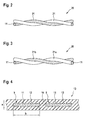
- FIG. 2 shows a cord 20 for a reinforcement layer 13 according to the invention.
- the cord 20 consists of two yarns 21, the Monogarne 11 have.
- the monofilaments 11 of the yarns 21 are basalt fibers.
- the fineness of the yarns 21 is 1000 dtex in each case. They are each first twisted at 50 t / m in the S direction and end-twisted together at 50 t / m in the Z direction.
- the basalt fibers are provided with vinyl functionalization and RFL adhesive impregnation.
- the cord 20 is also provided with RFL adhesive impregnation.
- FIG. 3 shows another cord 20 for a reinforcement layer 13 according to the invention.
- the cord 20 consists of two yarns 21a and 21b, which are twisted end to end with 75 t / m in the S direction.
- the mono yarns 11 of the yarn 21a are made of PA 6.6. They are first twisted together with 100 t / m.
- the yarn 21a has a fineness of 940 dtex.
- the monofilaments 11 of the yarn 21b are basalt fibers. They are first twisted together with 75 t / m.
- the yarn 21b has a fineness of 1000 dtex.
- the basalt fibers 11 of the yarn 21b are chemically activated, the cord 20 is provided with RFL adhesive impregnation.
- FIG. 4 shows a cross section through a portion of a reinforcement layer 13 according to the invention, comprising two strips 9 as a strength carrier, which in elastomeric material 10 are embedded.
- the cross-sectional plane is perpendicular to the longitudinal direction of the bands.
- the Monogarne 11 of the bands 9 are basalt fibers. For the sake of clarity, in Fig. 2 only a small number of basalt fibers are shown.
- the basalt fibers 11 are provided with an epoxy functionalization and held together by means of a crosslinkable resin as adhesion promoter 12.
- the bonding agent 12 accounts for 4 wt .-% of the weight of the bands 9.
- the bands 9 have a fineness of 1300 dtex and a number of 1000 filaments 11.
- the bands 9 are provided with an RFL dip for adhesion impregnation.
Landscapes
- Engineering & Computer Science (AREA)
- Mechanical Engineering (AREA)
- Textile Engineering (AREA)
- Tires In General (AREA)
- Tyre Moulding (AREA)
Abstract
Description
- Die Erfindung betrifft eine Festigkeitsträgerlage für Fahrzeugluftreifen, vorzugsweise für die Gürtelbandage oder den Gürtel eines Fahrzeugluftreifens, enthaltend mindestens einen in elastomeres Material eingebetteten Festigkeitsträger, welcher eine Vielzahl an Monogarnen aufweist. Zudem betrifft die Erfindung einen Fahrzeugluftreifen, der zumindest eine erfindungsgemäße Festigkeitsträgerlage, insbesondere als Festigkeitsträgerlage des Gürtels und/oder der Gürtelbandage, enthält.
- Festigkeitsträger für die Festigkeitsträgerlagen von Fahrzeugluftreifen sind dem Fachmann in Material und Aufbau in unterschiedlichen Ausführungen bekannt. Der mindestens eine Festigkeitsträger einer solchen Festigkeitsträgerlage wird hierbei, z.B. durch Kalandrieren, in eine Elastomermischung eingebettet, um als gummierte Festigkeitsträgerlage im Fahrzeugluftreifen eingesetzt werden zu können.
- Ein "Garn" ist ein linienförmiges Gebilde aus einer oder mehreren Fasern oder aus einem oder mehreren Filamenten. Als "Monogarn" wird im Sinne der Anmeldung ein Garn aus genau einem Filament oder genau einer Endlosfaser oder auch ein Spinnfasergarn aus verdrehten Fasern begrenzter Länge verstanden. Ein Garn kann somit aus einem oder mehreren Monogarnen gebildet sein. Ein "Kord" ist ein fadenförmiges Erzeugnis, welches aus einem oder mehreren Garnen besteht, welche miteinander endverdreht sind.
- Bisher werden als Festigkeitsträger der Gürtelbandage textile Festigkeitsträger eingesetzt, die stofflich primär (unmittelbar) auf dem fossilen Rohstoff Erdöl basieren, wie beispielsweise PET (Polyethylenterephthalat), Aramid oder Nylon oder Hybridkorde aus deren Garnen. Weiter ist bekannt, nicht-erdölbasierte textile Festigkeitsträger aus Viskose, wie beispielsweise Rayon oder Lyocell, einzusetzen, welche auf dem nachwachsenden Rohstoff Zellulose basieren.
- Nachteilig an auf nachwachsenden Rohstoffen basierenden Materialien als Material für textile Festigkeitsträger ist, dass diese keine endlose Faserstruktur und eine stark schwankende Faserqualität aufweisen.
- Zudem erschwert das fehlende Schrumpfverhalten die spezielle Anwendung von Rayon als Festigkeitsträger in der Gürtelbandage. Nachteilig an Rayon ist zudem, dass Rayon feuchtigkeitsempfindlich ist und sich die Bruchkraft des Festigkeitsträgers durch Feuchtigkeitsaufnahme verringert. Zudem ist Rayon in seiner Anschaffung kostenintensiv.
- Als Festigkeitsträger des Gürtels von Fahrzeugluftreifen werden üblicherweise auf dem Rohstoff Eisen basierende Stahlkorde eingesetzt. Nachteilig ist hierbei das hohe spezifische Gewicht.
- Die Entwicklung geht dahin, Produkte nicht nur in Hinblick auf ihre Eigenschaften sondern auch in Hinblick auf die verwendeten Rohstoffe zu optimieren. Hierbei ist die Verfügbarkeit der Rohstoffe von besonderer Bedeutung. Die Entwicklung geht somit dahin, Produkte zu entwickeln und bereitzustellen, die auf herkömmliche Rohstoffe wie Eisen oder das stark nachgefragte aber nur endlich verfügbare Erdöl verzichten, ohne z.B. Einbußen in der Reifenhaltbarkeit oder der Kordfestigkeit der daraus hergestellten Produkte hinnehmen zu müssen.
- Aus der Offenlegungsschrift
JP 2008-291395 A - Der vorliegenden Erfindung liegt nun die Aufgabe zu Grunde, eine Festigkeitsträgerlage, insbesondere für die Gürtelbandage und/oder den Gürtel eines Fahrzeugluftreifens, bereitzustellen, deren mindestens ein Festigkeitsträger zumindest teilweise aus einem nicht-erdölbasierten, nicht-eisenbasierten und nicht-zellulosebasierten, aber in großem Maßstab verfügbaren, Material besteht. Zudem soll die Festigkeitsträgerlage eine gleichbleibende Produktqualität aufweisen.
- Die Aufgabe wird gelöst, indem eine Vielzahl der Monogarne des Festigkeitsträgers Basaltfasern sind.
- Überraschenderweise eignen sich Basaltfasern sehr gut als Bestandteil von Festigkeitsträgern des Gürtels und/oder der Gürtelbandage von Fahrzeugreifen.
- Festigkeitsträger enthaltend Basaltfasern weisen im Vergleich zu Festigkeitsträgern aus herkömmlichen Fasermaterialien vorteilhafte Eigenschaften auf. Sie weisen insbesondere ein, beispielsweise im Vergleich zu Stahl, vorteilhaftes Kompressionsverhalten und ein, beispielsweise im Vergleich zu Nylon, hohes Elastizitätsmodul auf. Im Vergleich zu textilen Materialien zeigt Basalt zudem eine vorteilhafte thermische Stabilität sowie eine vorteilhafte chemische Beständigkeit.
- Zudem ist Basalt als Rohstoff in großem Maßstab verfügbar: Das Material Basalt ist ein basisches vulkanisches Ergussgestein und somit ein Primärrohstoff. Wie Erdöl ist der Rohstoff Basalt nicht durch den Menschen gezielt erneuerbar. Basalt ist allerdings das häufigste vulkanische Gestein und somit ein natürlicher Rohstoff aus einer fast unerschöpflichen, leicht zugänglichen Quelle. Zudem wird Basalt durch vulkanische Aktivität und die innere Bewegung der Erdplatten von der Natur nachgebildet. Eine Verknappung des Rohstoffes ist somit nicht zu erwarten.
- Basaltfasern sind Mineralfasern, die bei hohen Temperaturen aus einer flüssigen Basaltschmelze hergestellt werden und dann z.B. zu Garnen oder Korden weiterverarbeitet werden können. Basalt ist ein Alumosilikat, welches beispielsweise Aluminiumoxid, Siliciumdioxid, Calciumodix und Magnesiumoxid enthält. Die genaue chemische Zusammensetzung des natürlichen Rohstoffes ist geologisch determiniert und hängt vom Abbauort ab. Um die Produkteigenschaften der Basaltfasern definiert einzustellen und zu optimieren, können Basalte unterschiedlicher chemischer Zusammensetzung kombiniert werden und/oder der Basaltschmelze zusätzlich zum natürlichen Basalt andere Zusätze beigemischt sein.
- "Basaltfaser" wird im Sinne der Anmeldung als Endlosbasaltfaser verstanden und ist somit ein Monogarn. Im Festigkeitsträger erstreckt sie sich im Wesentlichen über die gesamte Länge des Festigkeitsträgers.
- Basaltfasern gelten als gesundheitlich unbedenklich. Basaltfasern können recycelt werden und weisen ein positives Preis-Leistungsverhältnis auf.
- Mit einer Festigkeitsträgerlage mit Festigkeitsträgern beinhaltend Basaltfasern wird somit eine vorteilhafte Festigkeitsträgerlage für Fahrzeugluftreifen, insbesondere für den Gürtel oder die Gürtelbandage von Fahrzeugluftreifen, bereitgestellt, die nicht vorrangig auf erdölbasierten, eisenbasierten oder zellulosebasierten Materialien beruht. Zudem können Basaltfasern in gleichbleibender Qualität erzeugt werden und stehen somit in gleichbleibender Produktqualität zur Verfügung.
- Die Basaltfasern des Festigkeitsträgers können alle die gleiche chemische Zusammensetzung aufweisen. Der Festigkeitsträger kann aber auch eine Vielzahl an Basaltfasern einer chemischen Zusammensetzung sowie eine Vielzahl an Basaltfasern einer anderen chemischen Zusammensetzung beinhalten. Unter einer "Vielzahl an" wird eine Anzahl von mindestens 20 verstanden. Die Monogarne eines Festigkeitsträgers können sich auch in ihrer Feinheit unterscheiden. Durch die Kombination unterschiedlicher Monogarne können deren unterschiedlichen positiven Eigenschaften kombiniert und genutzt werden.
- In einer vorteilhaften Weiterbildung der Erfindung ist vorgesehen, dass die Basaltfasern mindestens 90 Gew.-%, insbesondere mindestens 95 Gew.-%, insbesondere 100 Gew.-%, natürliches Basalt enthalten. Die Gewichtsprozent (Gew.-%) beziehen sich hierbei auf die reine Basaltfaser, also die Basaltfaser ohne eine optionale Funktionalisierung oder einen optionalen Haftvermittler. Hierdurch kann eine Festigkeitsträgerlage bereitgestellt werden, deren mindestens ein Festigkeitsträger teilweise oder ganz aus einem in großem Maßstab verfügbaren Rohstoff besteht und nicht primär auf Erdöl, Eisen oder Zellulose basiert.
- In einer vorteilhaften Weiterbildung der Erfindung ist vorgesehen, dass alle Monogarne des Festigkeitsträgers Basaltfasern sind. Die Festigkeitsträger der hierdurch bereitgestellten Festigkeitsträgerlage basieren somit ganz oder zu einem großen Teil aus dem in großem Maßstab verfügbaren Rohstoff Basalt und nicht primär auf Erdöl, Eisen oder Zellulose. Sie stehen zudem in gleichbleibender Produktqualität zur Verfügung.
- In einer vorteilhaften Weiterbildung der Erfindung ist vorgesehen, dass der Festigkeitsträger eine Vielzahl an Monogarnen aus nicht-basaltischem Material aufweist. Somit weist der Festigkeitsträger sowohl eine Vielzahl an Basaltfasern als auch eine Vielzahl an Monogarnen aus nicht-basaltischem Material auf. Das nicht-basaltische Material kann aus der Gruppe enthaltend Polyester- (PE), Polyamid- (PA), Aramid-, Arselon-, Polyetherketon- (PEK), Polyetheretherketon- (PEEK), Polyketon- (POK), Rayon-, Viskose-, Chemie-, Natur-, Glas- und/oder Karbonfasern ausgewählt sein. Bei den Polyamiden kann es sich um die Polyamide PA 4.6, PA 6, PA 6.6, PA 10.10, PA 11 und/oder PA12 handeln. Bei den Polyestern kann es sich um die Polyester Polyethylennaphthalat (PEN), Polybutylenterephthalat (PBT), Polybutylennaphttalat (PBN), Polpropylenterephthalat (PPT), Polypropylennaphthalat (PPN), Polyethylenterephthalat (PET), High-Modulus Low-Shrinkage-PET (HMLS-PET), insbesondere um thermoplastische Polyester und/oder vernetzte ungesättigte Polyester, handeln. Aufzählungen, die "und/oder" enthalten, sind so zu verstehen, dass alle Glieder der Aufzählung mit und/oder gekoppelt sind. Durch die Verwendung unterschiedlicher Materialien können Eigenschaften der einzelnen Materialien gezielt kombiniert und somit die Eigenschaften der Festigkeitsträgerlage vorteilhaft eingestellt werden.
- In einer vorteilhaften Weiterbildung der Erfindung ist vorgesehen, dass der Festigkeitsträger eine Vielzahl an Monogarnen aus vollständig oder zumindest teilweise nachwachsenden Rohstoffen, insbesondere aus zellulose-basierten Chemiefasern und/oder aus Naturfasern, aufweist. Bei den zellulose-basierten Chemiefasern ist insbesondere Rayon und Lyocell zu nennen. Bei den Naturfasern ist insbesondere Wolle (Keratin) zu nennen. Somit kann eine Festigkeitsträgerlage bereitgestellt werden, deren Material der Monogarne der Festigkeitsträger ganz oder teilweise auf Basalt sowie auf nachwachsenden Rohstoffen basieren und somit ganz oder teilweise auf erdöl-, eisen- oder zellulosebasierte Materialien verzichten. Als weiterer Vorteil können die Eigenschaften des Festigkeitsträgers über die Materialauswahl gezielt eingestellt werden.
- In einer vorteilhaften Weiterbildung der Erfindung ist vorgesehen, dass die Basaltfasern mit einer Epoxy- und/oder Vinyl-Funktionalisierung versehen sind. Hierdurch kann eine zuverlässige Haftung der Basaltfasern zum Haftmittel erwirkt werden.
- In einer vorteilhaften Weiterbildung der Erfindung ist vorgesehen, dass der Festigkeitsträger ein Kord aus mindestens einem Garn ist, wobei das mindestens eine Garn eine Vielzahl an Basaltfasern aufweist. Hierdurch ist eine Festigkeitsträgerlage geschaffen, die sich insbesondere als Festigkeitsträgerlage der Gürtelbandage und/oder der Gürtelbandage eines Fahrzeugluftreifens eignet, deren mindestens ein Festigkeitsträger zumindest teilweise aus einem nicht-erdölbasierten, nicht-eisenbasierten oder nicht-zellulosebasierten, aber in großem Maßstab verfügbaren, Material besteht.
- Vorteilhaft ist, wenn mindestens ein Garn des Kordes aus Basaltfasern gebildet ist. Vorteilhaft ist weiter, wenn alle Garne des Kordes aus Basaltfasern gebildet sind.
- Vorteilhaft ist eine Garnfeinheit von 250 bis 5000 dtex und eine Endverzwirnung des vorverdrehten Materials mit 25 bis 600 t/m.
- Vorteilhaft ist es weiter, wenn der Kord zwei oder mehr Garne aufweist.
- Dabei können sich die mindestens zwei Garne eines Festigkeitsträgers beispielsweise in der Verdrehungsrichtung und/oder in der Verdrehungszahl und/oder im Titer und/oder in der Feinheit unterscheiden. Die Eigenschaften des Festigkeitsträgers können somit gezielt eingestellt werden.
- Es ist zweckmäßig, wenn der Kord mindestens ein Garn aufweist, welches eine Vielzahl an Basaltfasern sowie eine Vielzahl an Monogarnen aus nicht-basaltischem Material, insbesondere aus nicht-basaltischem Material aus der oben genannten Gruppe, aufweist.
- Vorteilhaft ist weiter, wenn der Kord mindestens ein Garn aus Basaltfasern sowie mindestens ein Garn aus nicht-basaltischen Material, insbesondere aus nicht-basaltischem Material aus der oben genannten Gruppe, aufweist. Hierbei kann es sich beispielsweise um einen Kord aus einem Garn aus Basaltfasern sowie einem weiteren Garn aus PE, insbesondere PET oder PEN, oder einem weiteren Garn aus Polyamid, insbesondere PA 6.6, PA 6 oder PA 10.10, oder einem weiteren Garn aus Aramid, Arselon, PEK oder POK, handeln. Vorteilhaft ist weiter ein Kord aus einem Garn aus Basaltfasern sowie einem weiteren Garn aus Rayon, Lyocell oder Naturfasern.
- Durch die Verwendung unterschiedlicher Materialien können die Vorteile der einzelnen Materialien kombiniert und über den geometrischen Effekt der Verzwirnung optimal genutzt werden. Die Eigenschaften des Kordes können somit gezielte eingestellt werden.
- In einer vorteilhaften Weiterbildung der Erfindung ist vorgesehen, dass der Festigkeitsträger ein Band ist, dessen Querschnitt der Bedingung a < b entspricht, wobei a die Querschnittshöhe und b die Querschnittsbreite des Bandes definiert, dass das Band in der Festigkeitsträgerlage derart angeordnet ist, dass die Erstreckungsrichtung von b in etwa parallel zur flächigen Erstreckung der Festigkeitsträgerlage ausgerichtet ist, dass das Band eine Vielzahl an Monogarnen enthält, welche etwa parallel zur Längserstreckung des Bandes angeordnet sind, wobei die Monogarne innerhalb des Bandes mittels eines Haftvermittlers zusammengehalten werden, und dass eine Vielzahl der Monogarne Basaltfasern sind. Die Monogarne sind im Wesentlichen in Längserstreckung des Bandes angeordnet. Sie sind nicht gezielt miteinander verdreht, sondern größtenteils zumindest abschnittsweise parallel angeordnet, wobei auch Kreuzungen von Monogarnen möglich sind. Die geringe Querschnittshöhe a sowie die Querschnittsbreite b des Bandes wird durch die Anordnung der Monogarne, welche vorrangig in Erstreckungsrichtung der Querschnittsbreite b nebeneinander angeordnet sind, bewirkt. Das Band selbst ist in der Festigkeitsträgerlage nicht gezielt verdreht angeordnet. Jedes Monogam ist mit einem Haftvermittler verbunden und wird mittels dieses Haftvermittlers zumindest abschnittsweise mit anderen Monofilamenten des Bandes zusammengehalten.
- Bedeutend ist hierbei, dass durch den Einsatz von Bändern mit sehr flachem Querschnitt als Festigkeitsträger eine Festigkeitsträgerlage mit geringer Höhe bereitgestellt wird. Dies bedingt eine geringere Hysterese. Auch durch die Einsparung an elastomerem Material sowie an Festigkeitsträgermaterial sind Hysterese sowie Gewicht reduziert. Durch eine solch flache Festigkeitsträgerlage kann somit beim Einsatz im Fahrzeugluftreifen ein verringerter Rollwiderstand des Fahrzeugluftreifens erwirkt werden.
- Es ist zweckmäßig, wenn das Band eine Feinheit von 50 bis 7000 dtex, bevorzugt von 500 bis 3500 dtex, besonders bevorzugt von 1200 bis 1500 dtex, aufweist, und wenn das Band eine Anzahl von 25 bis 4500 Filamenten, bevorzugt eine Anzahl von 450 bis 2000 Filamenten, besonders bevorzugt eine Anzahl von 500 bis 1200 Filamenten, aufweist. Zweckmäßig ist es zudem, wenn die Querschnittshöhe a der Bedingung 1 µm < a < 1500 µm, vorzugsweise 1 µm < a < 500 µm, bevorzugt 1 µm < a < 200 µm, entspricht. Vorteilhaft ist es, wenn die Querschnittsbreite b der Bedingung 100 µm < b < 15000 µm, bevorzugt 300 µm < b < 10000 µm, genügt, und wenn das Verhältnis von Querschnittsbreite b zu Querschnittshöhe a die Bedingung 4000 > b / a > 1.5, insbesondere 200 > b / a > 3.5, insbesondere 19 > b / a > 6.5, erfüllt.
- Es ist vorteilhaft, wenn der Haftvermittler des Bandes ein vernetzbares Harz, ein flüssiges thermoplastisches Harz, ein Wachs oder eine Substanz, beispielsweise vom Typ RFL (Resorcin-Formaldehyd-Latex), welche mit elastomerem Material wechselwirken kann, ist. Vorteilhaft ist, wenn der Haftvermittler aushärtbar ist und im Band in ausgehärtetem Zustand vorliegt. Vorteilhaft ist weiter, wenn das Band auch eine Vielzahl an Monogarnen aus nicht-basaltischem Material aufweist.
- Es ist zweckmäßig, die Oberfläche des Festigkeitsträgers zur Gewährleistung der Haftung zwischen Festigkeitsträger und Haftimprägnierung oder Festigkeitsträger und elastomerem Material mechanisch, physikalisch und/oder chemisch zu aktivieren.
- Um eine zuverlässige Haftung des Festigkeitsträgers zum elastomeren Material zu gewährleisten, ist es zweckmäßig, die Basaltfasern und/oder den Festigkeitsträger zusätzlich mit einer Haftimprägnierung, z.B. mit einem RFL-Dip im 1- oder 2-Bad-Verfahren, zu versehen.
- Ferner betrifft die Erfindung einen Fahrzeugluftreifen, der zumindest eine erfindungsgemäße Festigkeitsträgerlage des Gürtels und/oder der Gürtelbandage enthält. Es handelt sich dabei vorzugsweise um einen PKW-Reifen oder einen Nutzfahrzeugreifen.
- Vorteilhaft ist es, wenn die Festigkeitsträgerlage zumindest zwei in Material und/oder Aufbau unterschiedliche Festigkeitsträger aufweist. Dabei kann es sich um mindestens zwei Korde handeln, die sich beispielsweise im Garnmaterial und/oder im Gamaufbau und/oder der Garnfeinheit und/oder der Garnkombination und/oder der Kordkonstruktion unterscheiden. Beispielsweise kann die Festigkeitsträgerlage mindestens ein Kord aus Basaltfasern sowie mindestens ein Kord aus Nylon aufweisen. Es kann sich auch um mindestens zwei Bänder handeln, die sich im Material und/oder im Bandquerschnitt und/oder der Anzahl und/oder Feinheit der Monogarne und/oder Bandfeinheit unterscheiden. Die Festigkeitsträgerlage kann beispielsweise neben mindestens einem Band enthaltend eine Vielzahl an Basaltfasern mindestens ein weiteres Band aufweisen, dessen Monogarne aus Nylon gebildet sind. Die Festigkeitsträgerlage kann auch neben mindestens einem Band mindestens ein Garn oder ein Kord enthalten. Die Anordnung der unterschiedlichen Festigkeitsträger in der Festigkeitsträgerlage kann alternierend erfolgen. Durch die Verwendung unterschiedlicher Festigkeitsträger können die Vorteile der einzelnen Festigkeitsträger kombiniert werden.
- Im Querschnitt der Festigkeitsträgerlage können die Festigkeitsträger in etwa parallel zueinander ausgerichtet sein. Hierbei kann es sich um mindestens zwei Festigkeitsträger handeln, die parallel zueinander ausgerichtet sind, oder um einen Festigkeitsträger, der parallel zueinander ausgerichtete Abschnitte aufweist. Beispielsweise kann es sich hierbei um einen Festigkeitsträger der Festigkeitsträgerlage der Gürtelbandage eines Fahrzeugluftreifens handeln, der in etwa parallel zur Umfangsrichtung des Fahrzeugluftreifens mit mehr als zwei Umwicklungen um einen Bereich des Gürtels entlang der axialen Breite gewickelt ist.
- Weitere Merkmale, Vorteile und Einzelheiten der Erfindung werden nun anhand der Figuren, die schematische Ausführungsbeispiele darstellen, näher beschrieben. Dabei zeigt die:
-
Fig. 1 einen Teilradialschnitt durch einen Fahrzeugluftreifen; -
Fig. 2 einen Kord 20 als Festigkeitsträger gemäß der Erfindung; -
Fig. 3 einen weiteren Kord 20 als Festigkeitsträger gemäß der Erfindung; -
Fig. 4 einen Querschnitt durch einen Abschnitt einer Festigkeitsträgerlage 13 enthaltend zwei Bänder 9 gemäß der Erfindung. - Die
Fig. 1 zeigt die rechte Hälfte eines Querschnittes durch einen Fahrzeugluftreifen für einen Personenkraftwagen. Die wesentlichen Bauteile, aus welchen sich der dargestellte Fahrzeugluftreifen zusammensetzt, sind eine weitgehend luftundurchlässige Innenschicht 1, eine zumindest eine Festigkeitsträgerlage 13 beinhaltende Karkasse 2, die in herkömmlicher Weise vom Zenitbereich des Fahrzeugluftreifens über die Seitenwände 3 bis in die Wulstbereiche 4, enthaltend mindestens eine Festigkeitsträgerlage 13 als Wulstverstärkung, reicht und dort durch Umschlingen zugfester Wulstkerne 5 verankert ist, einen radial oberhalb der Karkasse befindlichen profilierten Laufstreifen 6 und einen zwischen dem Laufstreifen 6 und der Karkasse 2 angeordneten, zwei Festigkeitsträgerlagen 13 beinhaltenden Gürtel 7, welcher in herkömmlicher Weise radial außen mit der Festigkeitsträgerlage 13 der Gürtelbandage 8 abgedeckt ist. - Bei Fahrzeugluftreifen in wie in
Fig. 1 gezeigter radialer Bauart sind die Festigkeitsträger der Festigkeitsträgerlage 13 der Karkasse 2 in etwa parallel zueinander in etwa in radialer Richtung 14 angeordnet. Der Gürtel 7 weist zwei weitgehend übereinander angeordnete Festigkeitsträgerlagen 13 auf, wobei die Festigkeitsträger in den einzelnen Lagen jeweils in etwa parallel zueinander ausgerichtet sind. Die Erstreckungsrichtung der Festigkeitsträger in den zwei Festigkeitsträgerlagen 13 verlaufen in der einen Lage in spitzem Winkel zum Reifenumfang in der einen Richtung steigend, in der anderen Lage in spitzem Winkel zum Reifenumfang in der anderen Richtung steigend. Die Festigkeitsträgerlage 13 der Gürtelbandage 8 beinhaltet einen Festigkeitsträger, der kontinuierlich entlang der axialen Breite gewickelt ist. -
Figur 2 zeigt einen Kord 20 für eine Festigkeitsträgerlage 13 gemäß der Erfindung. Der Kord 20 besteht aus zwei Garnen 21, die Monogarne 11 aufweisen. Die Monogarne 11 der Garne 21 sind Basaltfasern. Die Feinheit der Garne 21 beträgt jeweils 1000 dtex. Sie sind jeweils mit 50 t/m in S-Richtung erstverdreht und miteinander mit 50 t/m in Z-Richtung endverdreht. Die Basaltfasern sind mit einer Vinylfunktionalisierung sowie mit einer RFL Haftimprägnierung versehen. Auch der Kord 20 ist mit einer RFL Haftimprägnierung versehen. -
Figur 3 zeigt einen weiteren Kord 20 für eine Festigkeitsträgerlage 13 gemäß der Erfindung. Der Kord 20 besteht aus zwei Garnen 21a und 21b, welche mit 75 t/m in S-Richtung miteinander endverdreht sind. Die Monogarne 11 des Garns 21a sind aus PA 6.6. Sie sind mit 100 t/m miteinander erstverdreht. Der Garn 21a weist eine Feinheit von 940 dtex auf. Die Monogarne 11 des Garns 21b sind Basaltfasern. Sie sind mit 75 t/m miteinander erstverdreht. Der Garn 21b weist eine Feinheit von 1000 dtex auf. Die Basaltfasern 11 des Garns 21b sind chemische aktiviert, der Kord 20 ist mit einer RFL Haftimprägnierung versehen. -
Figur 4 zeigt einen Querschnitt durch einen Abschnitt einer erfindungsgemäßen Festigkeitsträgerlage 13, beinhaltend zwei Bänder 9 als Festigkeitsträger, welche in elastomeres Material 10 eingebettet sind. Die Querschnittsebene steht hierbei senkrecht zur Längserstreckungsrichtung der Bänder. Die Monogarne 11 der Bänder 9 sind Basaltfasern. Der Übersichtlichkeit halber sind inFig. 2 nur eine geringe Zahl der Basaltfasern dargestellt. Die Basaltfasern 11 sind mit einer Epoxyfunktionalisierung versehen und mittels eines vernetzbaren Harzes als Haftvermittler 12 zusammengehalten. Der Haftvermittler 12 macht dabei 4 Gew.-% des Gewichtes der Bänder 9 aus. Die Bänder 9 weisen eine Feinheit von 1300 dtex und eine Anzahl von 1000 Filamenten 11 auf. Die Querschnittshöhe a genügt der Bedingung a = 90 µm, das Verhältnis von Querschnittsbreite b zu Querschnittshöhe a genügt der Bedingung b / a = 15. Die Bänder 9 sind mit einem RFL-Dip zur Haftimprägnierung versehen. -
- 1
- Innenschicht
- 2
- Karkasse
- 3
- Seitenwand
- 4
- Wulstbereich
- 5
- Wulstkern
- 6
- Laufstreifen
- 7
- Gürtel
- 8
- Gürtelbandage
- 9
- Band
- 10
- elastomeres Material
- 11
- Monogarn
- 12
- Haftvermittler
- 13
- Festigkeitsträgerlage
- 14
- radiale Richtung
- 15
- axiale Richtung
- 20
- Kord
- 21
- Garn
- 21a
- Garn
- 21b
- Garn
- a
- Querschnittshöhe des Bandes
- b
- Querschnittsbreite des Bandes
Claims (10)
- Festigkeitsträgerlage (13) für Fahrzeugluftreifen, vorzugsweise für die Gürtelbandage (8) oder den Gürtel (7) eines Fahrzeugluftreifens, enthaltend mindestens einen in elastomeres Material (10) eingebetteten Festigkeitsträger, welcher eine Vielzahl an Monogarnen (11) aufweist,
dadurch gekennzeichnet, dass
eine Vielzahl der Monogarne (11) des Festigkeitsträgers Basaltfasern sind. - Festigkeitsträgerlage (13) nach Anspruch 1,
dadurch gekennzeichnet, dass die Basaltfasern mindestens 90 Gew.-%, insbesondere mindestens 95 Gew.-%, insbesondere 100 Gew.-%, natürliches Basalt enthalten. - Festigkeitsträgerlage (13) nach zumindest einem der vorangehenden Ansprüche, dadurch gekennzeichnet, dass alle Monogarne (11) des Festigkeitsträgers Basaltfasern sind.
- Festigkeitsträgerlage (13) nach zumindest einem der vorangehenden Ansprüche, dadurch gekennzeichnet, dass der Festigkeitsträger eine Vielzahl an Monogarnen (11) aus nicht-basaltischem Material aufweist.
- Festigkeitsträgerlage (13) nach zumindest einem der vorangehenden Ansprüche, dadurch gekennzeichnet, dass der Festigkeitsträger eine Vielzahl an Monogarnen (11) aus vollständig oder zumindest teilweise nachwachsenden Rohstoffen, insbesondere aus zellulose-basierten Chemiefasern und/oder aus Naturfasern, aufweist.
- Festigkeitsträgerlage (13) nach zumindest einem der vorangehenden Ansprüche, dadurch gekennzeichnet, dass die Basaltfasern mit einer Epoxy- und/oder Vinyl-Funktionalisierung versehen sind.
- Festigkeitsträgerlage (13) nach zumindest einem der vorangehenden Ansprüche, dadurch gekennzeichnet, dass der Festigkeitsträger ein Kord aus mindestens einem Garn ist, wobei das mindestens eine Garn eine Vielzahl an Basaltfasern aufweist.
- Festigkeitsträgerlage (13) nach zumindest den Ansprüchen 1 und 2, dadurch gekennzeichnet, dass der Festigkeitsträger ein Band (9) ist, dessen Querschnitt der Bedingung a < b entspricht, wobei a die Querschnittshöhe und b die Querschnittsbreite des Bandes (9) definiert, dass das Band (9) in der Festigkeitsträgerlage (13) derart angeordnet ist, dass die Erstreckungsrichtung von b in etwa parallel zur flächigen Erstreckung der Festigkeitsträgerlage (13) ausgerichtet ist, dass das Band (9) eine Vielzahl an Monogarnen (11) enthält, welche etwa parallel zur Längserstreckung des Bandes (9) angeordnet sind, wobei die Monogarne (11) innerhalb des Bandes (9) mittels eines Haftvermittlers (12) zusammengehalten werden, und dass eine Vielzahl der Monogarne (11) Basaltfasern sind.
- Festigkeitsträgerlage (13) nach zumindest einem der vorangehenden Ansprüche, dadurch gekennzeichnet, dass die Basaltfasern und/oder der Festigkeitsträger mit einer Haftimprägnierung zur Gewährleistung der Haftung des Festigkeitsträgers zum elastomeren Material (10) versehen ist.
- Fahrzeugluftreifen enthaltend zumindest eine Festigkeitsträgerlage (13), insbesondere eine Festigkeitsträgerlage (13) des Gürtels (7) und/oder der Gürtelbandage (8), nach zumindest einem der vorangehenden Ansprüche.
Applications Claiming Priority (1)
| Application Number | Priority Date | Filing Date | Title |
|---|---|---|---|
| DE201310102769 DE102013102769A1 (de) | 2013-03-19 | 2013-03-19 | Festigkeitsträgerlage für Fahrzeugluftreifen |
Publications (2)
| Publication Number | Publication Date |
|---|---|
| EP2781371A1 true EP2781371A1 (de) | 2014-09-24 |
| EP2781371B1 EP2781371B1 (de) | 2015-09-30 |
Family
ID=49911412
Family Applications (1)
| Application Number | Title | Priority Date | Filing Date |
|---|---|---|---|
| EP14150524.8A Active EP2781371B1 (de) | 2013-03-19 | 2014-01-09 | Festigkeitsträgerlage für Fahrzeugluftreifen |
Country Status (3)
| Country | Link |
|---|---|
| EP (1) | EP2781371B1 (de) |
| DE (1) | DE102013102769A1 (de) |
| ES (1) | ES2555305T3 (de) |
Cited By (6)
| Publication number | Priority date | Publication date | Assignee | Title |
|---|---|---|---|---|
| EP3031623A1 (de) * | 2014-12-12 | 2016-06-15 | Continental Reifen Deutschland GmbH | Hybridkord zur verwendung als festigkeitsträger in einer gürtelbandage eines fahrzeugluftreifens |
| EP3050719A1 (de) * | 2015-02-02 | 2016-08-03 | Continental Reifen Deutschland GmbH | Fahrzeugluftreifen |
| WO2016189126A1 (fr) * | 2015-05-28 | 2016-12-01 | Compagnie Generale Des Etablissements Michelin | Renfort plat multi-composite |
| JP2016203685A (ja) * | 2015-04-16 | 2016-12-08 | 株式会社ブリヂストン | 空気入りタイヤ |
| EP2999602B1 (de) * | 2013-05-21 | 2017-08-30 | Continental Reifen Deutschland GmbH | Fahrzeugluftreifen und verwendung eines garnes aus einem textilen material |
| DE102021205071A1 (de) | 2021-05-19 | 2022-11-24 | Continental Reifen Deutschland Gmbh | Verfahren zur Herstellung einer Spulbandage |
Families Citing this family (3)
| Publication number | Priority date | Publication date | Assignee | Title |
|---|---|---|---|---|
| WO2022074046A1 (en) | 2020-10-07 | 2022-04-14 | Bridgestone Europe Nv/Sa | Sustainable hybrid cord for tyres |
| WO2022090382A1 (en) | 2020-10-28 | 2022-05-05 | Bridgestone Europe Nv/Sa | Hybrid cord for tires using basalt and cellulose fibers |
| DE102020130183A1 (de) | 2020-11-16 | 2022-05-19 | Bayerische Maß-Industrie Arno Keller GmbH | Basaltfaserverstärktes Messband |
Citations (3)
| Publication number | Priority date | Publication date | Assignee | Title |
|---|---|---|---|---|
| JP2008291395A (ja) | 2007-05-25 | 2008-12-04 | Central Glass Co Ltd | ゴム補強用バサルト繊維およびそれを用いた伝動ベルト |
| DE102009040054A1 (de) * | 2009-09-03 | 2011-03-10 | Niederrheinische Leinenweberei Carl Billmann GmbH & Co. KG | Mineralfaden |
| EP2306045A2 (de) * | 2009-10-01 | 2011-04-06 | ContiTech Antriebssysteme GmbH | Antriebsriemen, insbesondere Zahnriemen, mit Basaltzugstrang |
-
2013
- 2013-03-19 DE DE201310102769 patent/DE102013102769A1/de not_active Withdrawn
-
2014
- 2014-01-09 ES ES14150524.8T patent/ES2555305T3/es active Active
- 2014-01-09 EP EP14150524.8A patent/EP2781371B1/de active Active
Patent Citations (3)
| Publication number | Priority date | Publication date | Assignee | Title |
|---|---|---|---|---|
| JP2008291395A (ja) | 2007-05-25 | 2008-12-04 | Central Glass Co Ltd | ゴム補強用バサルト繊維およびそれを用いた伝動ベルト |
| DE102009040054A1 (de) * | 2009-09-03 | 2011-03-10 | Niederrheinische Leinenweberei Carl Billmann GmbH & Co. KG | Mineralfaden |
| EP2306045A2 (de) * | 2009-10-01 | 2011-04-06 | ContiTech Antriebssysteme GmbH | Antriebsriemen, insbesondere Zahnriemen, mit Basaltzugstrang |
Cited By (10)
| Publication number | Priority date | Publication date | Assignee | Title |
|---|---|---|---|---|
| EP2999602B1 (de) * | 2013-05-21 | 2017-08-30 | Continental Reifen Deutschland GmbH | Fahrzeugluftreifen und verwendung eines garnes aus einem textilen material |
| EP3031623A1 (de) * | 2014-12-12 | 2016-06-15 | Continental Reifen Deutschland GmbH | Hybridkord zur verwendung als festigkeitsträger in einer gürtelbandage eines fahrzeugluftreifens |
| EP3050719A1 (de) * | 2015-02-02 | 2016-08-03 | Continental Reifen Deutschland GmbH | Fahrzeugluftreifen |
| JP2016203685A (ja) * | 2015-04-16 | 2016-12-08 | 株式会社ブリヂストン | 空気入りタイヤ |
| WO2016189126A1 (fr) * | 2015-05-28 | 2016-12-01 | Compagnie Generale Des Etablissements Michelin | Renfort plat multi-composite |
| FR3036651A1 (fr) * | 2015-05-28 | 2016-12-02 | Michelin & Cie | Renfort plat multi-composite |
| CN107690393A (zh) * | 2015-05-28 | 2018-02-13 | 米其林集团总公司 | 多复合平面增强件 |
| CN107690393B (zh) * | 2015-05-28 | 2019-09-13 | 米其林集团总公司 | 多复合平面增强件 |
| US10994573B2 (en) | 2015-05-28 | 2021-05-04 | Compagnie Generale Des Etablissements Michelin | Multi-composite planar reinforcement |
| DE102021205071A1 (de) | 2021-05-19 | 2022-11-24 | Continental Reifen Deutschland Gmbh | Verfahren zur Herstellung einer Spulbandage |
Also Published As
| Publication number | Publication date |
|---|---|
| DE102013102769A1 (de) | 2014-09-25 |
| EP2781371B1 (de) | 2015-09-30 |
| ES2555305T3 (es) | 2015-12-30 |
Similar Documents
| Publication | Publication Date | Title |
|---|---|---|
| EP2781371B1 (de) | Festigkeitsträgerlage für Fahrzeugluftreifen | |
| EP2576245B1 (de) | Verstärkungskord, insbesondere für eine karkasse oder einen gürtel eines luftreifens | |
| EP2590811B1 (de) | Elastomerprodukt, enthaltend ein linienförmiges, textiles gebilde zur verstärkung | |
| EP2895648B1 (de) | Verstärkungscord für elastomere erzeugnisse, insbesondere für einen fahrzeugluftreifen, und fahrzeugluftreifen | |
| EP2765333B1 (de) | Festigkeitsträgerlage für Fahrzeugluftreifen sowie für Antriebsriemen | |
| EP2867395B1 (de) | Festigkeitsträgerlage und fahrzeugluftreifen | |
| EP2708380B1 (de) | Verstärkungscord für elastomere Erzeugnisse, insbesondere für einen Fahrzeugluftreifen, und Fahrzeugluftreifen | |
| EP2598345B1 (de) | Fahrzeugluftreifen | |
| EP3071423A1 (de) | Hybridfestigkeitsträger | |
| EP2999602B1 (de) | Fahrzeugluftreifen und verwendung eines garnes aus einem textilen material | |
| EP3617355B1 (de) | Verstärkungscord für elastomere erzeugnisse, insbesondere für fahrzeugluftreifen, und elastomeres erzeugnis | |
| EP3006228B1 (de) | Hybridkord zur Verwendung als Festigkeitsträger in einem Bauteil eines Fahrzeugluftreifens und Fahrzeugluftreifen | |
| EP3204239A1 (de) | Fahrzeugluftreifen aufweisend eine gürtelbandage | |
| EP3073002B1 (de) | Festigkeitsträger für elastomere erzeugnisse, insbesondere für die gürtelbandage von fahrzeugluftreifen | |
| EP3724003A1 (de) | Festigkeitsträgerlage und fahrzeugluftreifen | |
| EP2113397A1 (de) | Festigkeitsträgerlage aus Hybridcorden für elastomere Erzeugnisse, insbesondere für die Gürtelbandage von Fahrzeugluftreifen | |
| EP3581688A1 (de) | Verstärkungscord für elastomere erzeugnisse, insbesondere für fahrzeugluftreifen, und elastomeres erzeugnis | |
| DE102014205700A1 (de) | Festigkeitsträgerlage für Fahrzeugluftreifen, insbesondere Karkassfestigkeitsträgerlage, aufweisend Hybridcorde | |
| EP3738790B1 (de) | Festigkeitsträgerlage eines fahrzeugluftreifens | |
| DE102017217597A1 (de) | Festigkeitsträger für eine Festigkeitsträgerlage |
Legal Events
| Date | Code | Title | Description |
|---|---|---|---|
| PUAI | Public reference made under article 153(3) epc to a published international application that has entered the european phase |
Free format text: ORIGINAL CODE: 0009012 |
|
| 17P | Request for examination filed |
Effective date: 20140109 |
|
| AK | Designated contracting states |
Kind code of ref document: A1 Designated state(s): AL AT BE BG CH CY CZ DE DK EE ES FI FR GB GR HR HU IE IS IT LI LT LU LV MC MK MT NL NO PL PT RO RS SE SI SK SM TR |
|
| AX | Request for extension of the european patent |
Extension state: BA ME |
|
| R17P | Request for examination filed (corrected) |
Effective date: 20150324 |
|
| RBV | Designated contracting states (corrected) |
Designated state(s): AL AT BE BG CH CY CZ DE DK EE ES FI FR GB GR HR HU IE IS IT LI LT LU LV MC MK MT NL NO PL PT RO RS SE SI SK SM TR |
|
| REG | Reference to a national code |
Ref country code: DE Ref legal event code: R079 Ref document number: 502014000117 Country of ref document: DE Free format text: PREVIOUS MAIN CLASS: B60C0009220000 Ipc: B60C0009000000 |
|
| GRAP | Despatch of communication of intention to grant a patent |
Free format text: ORIGINAL CODE: EPIDOSNIGR1 |
|
| RIC1 | Information provided on ipc code assigned before grant |
Ipc: B60C 9/20 20060101ALI20150520BHEP Ipc: D02G 3/48 20060101ALI20150520BHEP Ipc: B60C 9/22 20060101ALI20150520BHEP Ipc: B60C 9/00 20060101AFI20150520BHEP Ipc: D02G 3/16 20060101ALI20150520BHEP |
|
| INTG | Intention to grant announced |
Effective date: 20150616 |
|
| GRAS | Grant fee paid |
Free format text: ORIGINAL CODE: EPIDOSNIGR3 |
|
| GRAA | (expected) grant |
Free format text: ORIGINAL CODE: 0009210 |
|
| AK | Designated contracting states |
Kind code of ref document: B1 Designated state(s): AL AT BE BG CH CY CZ DE DK EE ES FI FR GB GR HR HU IE IS IT LI LT LU LV MC MK MT NL NO PL PT RO RS SE SI SK SM TR |
|
| REG | Reference to a national code |
Ref country code: CH Ref legal event code: EP Ref country code: GB Ref legal event code: FG4D Free format text: NOT ENGLISH |
|
| REG | Reference to a national code |
Ref country code: AT Ref legal event code: REF Ref document number: 752158 Country of ref document: AT Kind code of ref document: T Effective date: 20151015 |
|
| REG | Reference to a national code |
Ref country code: IE Ref legal event code: FG4D Free format text: LANGUAGE OF EP DOCUMENT: GERMAN |
|
| REG | Reference to a national code |
Ref country code: DE Ref legal event code: R096 Ref document number: 502014000117 Country of ref document: DE |
|
| REG | Reference to a national code |
Ref country code: ES Ref legal event code: FG2A Ref document number: 2555305 Country of ref document: ES Kind code of ref document: T3 Effective date: 20151230 |
|
| REG | Reference to a national code |
Ref country code: FR Ref legal event code: PLFP Year of fee payment: 3 |
|
| PG25 | Lapsed in a contracting state [announced via postgrant information from national office to epo] |
Ref country code: FI Free format text: LAPSE BECAUSE OF FAILURE TO SUBMIT A TRANSLATION OF THE DESCRIPTION OR TO PAY THE FEE WITHIN THE PRESCRIBED TIME-LIMIT Effective date: 20150930 Ref country code: LT Free format text: LAPSE BECAUSE OF FAILURE TO SUBMIT A TRANSLATION OF THE DESCRIPTION OR TO PAY THE FEE WITHIN THE PRESCRIBED TIME-LIMIT Effective date: 20150930 Ref country code: LV Free format text: LAPSE BECAUSE OF FAILURE TO SUBMIT A TRANSLATION OF THE DESCRIPTION OR TO PAY THE FEE WITHIN THE PRESCRIBED TIME-LIMIT Effective date: 20150930 Ref country code: GR Free format text: LAPSE BECAUSE OF FAILURE TO SUBMIT A TRANSLATION OF THE DESCRIPTION OR TO PAY THE FEE WITHIN THE PRESCRIBED TIME-LIMIT Effective date: 20151231 Ref country code: NO Free format text: LAPSE BECAUSE OF FAILURE TO SUBMIT A TRANSLATION OF THE DESCRIPTION OR TO PAY THE FEE WITHIN THE PRESCRIBED TIME-LIMIT Effective date: 20151230 |
|
| REG | Reference to a national code |
Ref country code: NL Ref legal event code: MP Effective date: 20150930 |
|
| REG | Reference to a national code |
Ref country code: LT Ref legal event code: MG4D |
|
| PG25 | Lapsed in a contracting state [announced via postgrant information from national office to epo] |
Ref country code: RS Free format text: LAPSE BECAUSE OF FAILURE TO SUBMIT A TRANSLATION OF THE DESCRIPTION OR TO PAY THE FEE WITHIN THE PRESCRIBED TIME-LIMIT Effective date: 20150930 Ref country code: SE Free format text: LAPSE BECAUSE OF FAILURE TO SUBMIT A TRANSLATION OF THE DESCRIPTION OR TO PAY THE FEE WITHIN THE PRESCRIBED TIME-LIMIT Effective date: 20150930 Ref country code: HR Free format text: LAPSE BECAUSE OF FAILURE TO SUBMIT A TRANSLATION OF THE DESCRIPTION OR TO PAY THE FEE WITHIN THE PRESCRIBED TIME-LIMIT Effective date: 20150930 |
|
| PG25 | Lapsed in a contracting state [announced via postgrant information from national office to epo] |
Ref country code: IT Free format text: LAPSE BECAUSE OF FAILURE TO SUBMIT A TRANSLATION OF THE DESCRIPTION OR TO PAY THE FEE WITHIN THE PRESCRIBED TIME-LIMIT Effective date: 20150930 Ref country code: CZ Free format text: LAPSE BECAUSE OF FAILURE TO SUBMIT A TRANSLATION OF THE DESCRIPTION OR TO PAY THE FEE WITHIN THE PRESCRIBED TIME-LIMIT Effective date: 20150930 Ref country code: EE Free format text: LAPSE BECAUSE OF FAILURE TO SUBMIT A TRANSLATION OF THE DESCRIPTION OR TO PAY THE FEE WITHIN THE PRESCRIBED TIME-LIMIT Effective date: 20150930 Ref country code: IS Free format text: LAPSE BECAUSE OF FAILURE TO SUBMIT A TRANSLATION OF THE DESCRIPTION OR TO PAY THE FEE WITHIN THE PRESCRIBED TIME-LIMIT Effective date: 20160130 Ref country code: NL Free format text: LAPSE BECAUSE OF FAILURE TO SUBMIT A TRANSLATION OF THE DESCRIPTION OR TO PAY THE FEE WITHIN THE PRESCRIBED TIME-LIMIT Effective date: 20150930 Ref country code: SK Free format text: LAPSE BECAUSE OF FAILURE TO SUBMIT A TRANSLATION OF THE DESCRIPTION OR TO PAY THE FEE WITHIN THE PRESCRIBED TIME-LIMIT Effective date: 20150930 |
|
| PG25 | Lapsed in a contracting state [announced via postgrant information from national office to epo] |
Ref country code: PL Free format text: LAPSE BECAUSE OF FAILURE TO SUBMIT A TRANSLATION OF THE DESCRIPTION OR TO PAY THE FEE WITHIN THE PRESCRIBED TIME-LIMIT Effective date: 20150930 Ref country code: BE Free format text: LAPSE BECAUSE OF NON-PAYMENT OF DUE FEES Effective date: 20160131 Ref country code: RO Free format text: LAPSE BECAUSE OF FAILURE TO SUBMIT A TRANSLATION OF THE DESCRIPTION OR TO PAY THE FEE WITHIN THE PRESCRIBED TIME-LIMIT Effective date: 20150930 Ref country code: PT Free format text: LAPSE BECAUSE OF FAILURE TO SUBMIT A TRANSLATION OF THE DESCRIPTION OR TO PAY THE FEE WITHIN THE PRESCRIBED TIME-LIMIT Effective date: 20160201 |
|
| REG | Reference to a national code |
Ref country code: DE Ref legal event code: R097 Ref document number: 502014000117 Country of ref document: DE |
|
| PLBE | No opposition filed within time limit |
Free format text: ORIGINAL CODE: 0009261 |
|
| STAA | Information on the status of an ep patent application or granted ep patent |
Free format text: STATUS: NO OPPOSITION FILED WITHIN TIME LIMIT |
|
| PG25 | Lapsed in a contracting state [announced via postgrant information from national office to epo] |
Ref country code: DK Free format text: LAPSE BECAUSE OF FAILURE TO SUBMIT A TRANSLATION OF THE DESCRIPTION OR TO PAY THE FEE WITHIN THE PRESCRIBED TIME-LIMIT Effective date: 20150930 Ref country code: LU Free format text: LAPSE BECAUSE OF FAILURE TO SUBMIT A TRANSLATION OF THE DESCRIPTION OR TO PAY THE FEE WITHIN THE PRESCRIBED TIME-LIMIT Effective date: 20160109 |
|
| 26N | No opposition filed |
Effective date: 20160701 |
|
| PG25 | Lapsed in a contracting state [announced via postgrant information from national office to epo] |
Ref country code: MC Free format text: LAPSE BECAUSE OF FAILURE TO SUBMIT A TRANSLATION OF THE DESCRIPTION OR TO PAY THE FEE WITHIN THE PRESCRIBED TIME-LIMIT Effective date: 20150930 |
|
| REG | Reference to a national code |
Ref country code: IE Ref legal event code: MM4A |
|
| PG25 | Lapsed in a contracting state [announced via postgrant information from national office to epo] |
Ref country code: SI Free format text: LAPSE BECAUSE OF FAILURE TO SUBMIT A TRANSLATION OF THE DESCRIPTION OR TO PAY THE FEE WITHIN THE PRESCRIBED TIME-LIMIT Effective date: 20150930 |
|
| REG | Reference to a national code |
Ref country code: FR Ref legal event code: PLFP Year of fee payment: 4 |
|
| PG25 | Lapsed in a contracting state [announced via postgrant information from national office to epo] |
Ref country code: IE Free format text: LAPSE BECAUSE OF NON-PAYMENT OF DUE FEES Effective date: 20160109 |
|
| PG25 | Lapsed in a contracting state [announced via postgrant information from national office to epo] |
Ref country code: MT Free format text: LAPSE BECAUSE OF FAILURE TO SUBMIT A TRANSLATION OF THE DESCRIPTION OR TO PAY THE FEE WITHIN THE PRESCRIBED TIME-LIMIT Effective date: 20150930 |
|
| REG | Reference to a national code |
Ref country code: CH Ref legal event code: PL |
|
| PG25 | Lapsed in a contracting state [announced via postgrant information from national office to epo] |
Ref country code: LI Free format text: LAPSE BECAUSE OF NON-PAYMENT OF DUE FEES Effective date: 20170131 Ref country code: CH Free format text: LAPSE BECAUSE OF NON-PAYMENT OF DUE FEES Effective date: 20170131 |
|
| REG | Reference to a national code |
Ref country code: FR Ref legal event code: PLFP Year of fee payment: 5 |
|
| PG25 | Lapsed in a contracting state [announced via postgrant information from national office to epo] |
Ref country code: SM Free format text: LAPSE BECAUSE OF FAILURE TO SUBMIT A TRANSLATION OF THE DESCRIPTION OR TO PAY THE FEE WITHIN THE PRESCRIBED TIME-LIMIT Effective date: 20150930 Ref country code: HU Free format text: LAPSE BECAUSE OF FAILURE TO SUBMIT A TRANSLATION OF THE DESCRIPTION OR TO PAY THE FEE WITHIN THE PRESCRIBED TIME-LIMIT; INVALID AB INITIO Effective date: 20140109 |
|
| PG25 | Lapsed in a contracting state [announced via postgrant information from national office to epo] |
Ref country code: MK Free format text: LAPSE BECAUSE OF FAILURE TO SUBMIT A TRANSLATION OF THE DESCRIPTION OR TO PAY THE FEE WITHIN THE PRESCRIBED TIME-LIMIT Effective date: 20150930 Ref country code: CY Free format text: LAPSE BECAUSE OF FAILURE TO SUBMIT A TRANSLATION OF THE DESCRIPTION OR TO PAY THE FEE WITHIN THE PRESCRIBED TIME-LIMIT Effective date: 20150930 Ref country code: TR Free format text: LAPSE BECAUSE OF FAILURE TO SUBMIT A TRANSLATION OF THE DESCRIPTION OR TO PAY THE FEE WITHIN THE PRESCRIBED TIME-LIMIT Effective date: 20150930 |
|
| PG25 | Lapsed in a contracting state [announced via postgrant information from national office to epo] |
Ref country code: BG Free format text: LAPSE BECAUSE OF FAILURE TO SUBMIT A TRANSLATION OF THE DESCRIPTION OR TO PAY THE FEE WITHIN THE PRESCRIBED TIME-LIMIT Effective date: 20150930 |
|
| GBPC | Gb: european patent ceased through non-payment of renewal fee |
Effective date: 20180109 |
|
| PG25 | Lapsed in a contracting state [announced via postgrant information from national office to epo] |
Ref country code: AL Free format text: LAPSE BECAUSE OF FAILURE TO SUBMIT A TRANSLATION OF THE DESCRIPTION OR TO PAY THE FEE WITHIN THE PRESCRIBED TIME-LIMIT Effective date: 20150930 |
|
| PG25 | Lapsed in a contracting state [announced via postgrant information from national office to epo] |
Ref country code: GB Free format text: LAPSE BECAUSE OF NON-PAYMENT OF DUE FEES Effective date: 20180109 |
|
| REG | Reference to a national code |
Ref country code: AT Ref legal event code: MM01 Ref document number: 752158 Country of ref document: AT Kind code of ref document: T Effective date: 20190109 |
|
| PG25 | Lapsed in a contracting state [announced via postgrant information from national office to epo] |
Ref country code: AT Free format text: LAPSE BECAUSE OF NON-PAYMENT OF DUE FEES Effective date: 20190109 |
|
| REG | Reference to a national code |
Ref country code: DE Ref legal event code: R081 Ref document number: 502014000117 Country of ref document: DE Owner name: CONTINENTAL REIFEN DEUTSCHLAND GMBH, DE Free format text: FORMER OWNER: CONTINENTAL REIFEN DEUTSCHLAND GMBH, 30165 HANNOVER, DE |
|
| PGFP | Annual fee paid to national office [announced via postgrant information from national office to epo] |
Ref country code: ES Payment date: 20260227 Year of fee payment: 13 |
|
| PGFP | Annual fee paid to national office [announced via postgrant information from national office to epo] |
Ref country code: DE Payment date: 20260131 Year of fee payment: 13 |
|
| PGFP | Annual fee paid to national office [announced via postgrant information from national office to epo] |
Ref country code: FR Payment date: 20260123 Year of fee payment: 13 |