EP2777952A2 - Pneumatic tire - Google Patents
Pneumatic tire Download PDFInfo
- Publication number
- EP2777952A2 EP2777952A2 EP13181349.5A EP13181349A EP2777952A2 EP 2777952 A2 EP2777952 A2 EP 2777952A2 EP 13181349 A EP13181349 A EP 13181349A EP 2777952 A2 EP2777952 A2 EP 2777952A2
- Authority
- EP
- European Patent Office
- Prior art keywords
- block
- sipe
- cycle
- dimensional sipe
- dimensional
- Prior art date
- Legal status (The legal status is an assumption and is not a legal conclusion. Google has not performed a legal analysis and makes no representation as to the accuracy of the status listed.)
- Granted
Links
Images


Classifications
-
- B—PERFORMING OPERATIONS; TRANSPORTING
- B60—VEHICLES IN GENERAL
- B60C—VEHICLE TYRES; TYRE INFLATION; TYRE CHANGING; CONNECTING VALVES TO INFLATABLE ELASTIC BODIES IN GENERAL; DEVICES OR ARRANGEMENTS RELATED TO TYRES
- B60C11/00—Tyre tread bands; Tread patterns; Anti-skid inserts
- B60C11/03—Tread patterns
- B60C11/12—Tread patterns characterised by the use of narrow slits or incisions, e.g. sipes
- B60C11/1204—Tread patterns characterised by the use of narrow slits or incisions, e.g. sipes with special shape of the sipe
- B60C11/1218—Three-dimensional shape with regard to depth and extending direction
-
- B—PERFORMING OPERATIONS; TRANSPORTING
- B60—VEHICLES IN GENERAL
- B60C—VEHICLE TYRES; TYRE INFLATION; TYRE CHANGING; CONNECTING VALVES TO INFLATABLE ELASTIC BODIES IN GENERAL; DEVICES OR ARRANGEMENTS RELATED TO TYRES
- B60C11/00—Tyre tread bands; Tread patterns; Anti-skid inserts
- B60C11/03—Tread patterns
- B60C11/12—Tread patterns characterised by the use of narrow slits or incisions, e.g. sipes
- B60C11/1272—Width of the sipe
-
- B—PERFORMING OPERATIONS; TRANSPORTING
- B60—VEHICLES IN GENERAL
- B60C—VEHICLE TYRES; TYRE INFLATION; TYRE CHANGING; CONNECTING VALVES TO INFLATABLE ELASTIC BODIES IN GENERAL; DEVICES OR ARRANGEMENTS RELATED TO TYRES
- B60C11/00—Tyre tread bands; Tread patterns; Anti-skid inserts
- B60C11/03—Tread patterns
- B60C11/12—Tread patterns characterised by the use of narrow slits or incisions, e.g. sipes
- B60C11/1204—Tread patterns characterised by the use of narrow slits or incisions, e.g. sipes with special shape of the sipe
- B60C2011/1213—Tread patterns characterised by the use of narrow slits or incisions, e.g. sipes with special shape of the sipe sinusoidal or zigzag at the tread surface
-
- B—PERFORMING OPERATIONS; TRANSPORTING
- B60—VEHICLES IN GENERAL
- B60C—VEHICLE TYRES; TYRE INFLATION; TYRE CHANGING; CONNECTING VALVES TO INFLATABLE ELASTIC BODIES IN GENERAL; DEVICES OR ARRANGEMENTS RELATED TO TYRES
- B60C11/00—Tyre tread bands; Tread patterns; Anti-skid inserts
- B60C11/03—Tread patterns
- B60C11/12—Tread patterns characterised by the use of narrow slits or incisions, e.g. sipes
- B60C11/1204—Tread patterns characterised by the use of narrow slits or incisions, e.g. sipes with special shape of the sipe
- B60C2011/1227—Tread patterns characterised by the use of narrow slits or incisions, e.g. sipes with special shape of the sipe having different shape within the pattern
Definitions
- the present invention relates to a pneumatic tire, more particularly to a studless or snow ti re having a tread block provided with a sipe for snowy and icy roads.
- a pneumatic tire designed for use on icy and snowy roads has a plurality of tread blocks each of which is provided with a plurality of sipes in order to improve traction force against icy or snowy road by increasing biting edges of sipes.
- the tread block having high sipe density gives large deformation thereon when it comes into contact wi th the road due to low block stiffness, whereby it would be difficult to effectively get much traction force on icy road.
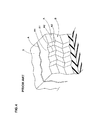
- the sipe "A” In a cross sectional view of the tread block being parallel to the top face s , the sipe “A” extends along its longitudinal direction in a zigzag manner. In another cross sectional view of the tread block being perpendicular to the longitudinal direction of the sipe, the sipe “A” also extends along its depth direction in a zigzag manner.
- the sipe "A” provides the tread block with a pair of facing sipe walls B that have a three dimensional unevenness surface comprising a plurality of inclined parallelogram planes. The sipe walls B engage each other when the tread block come into contact with the road so that the amount of deformation of the tread block mentioned above is reduced.
- the Miura-ori shaped sipe is defined using a lot of complicated parameters such as zigzag pitches, zigzag amplitude, a combination of the mountain fold A1 and the valley fold A2, intersection angle between two parallelogram surfaces, or the like, it is very difficult to design the Miura-ori shaped sipe with three dimensional unevenness surfaces into the tread block. Accordingly, the conventional studless tires with the same tread patterns had the same Miura-ori shaped sipes for saving these design cost in spite of having different tire sizes.
- parameters for defining the shape of the sipe should be designed according to the tire sizes or the tread block sizes.
- an improved si pe having three dimensional unevenness surfaces that are easy to design and tightly engage each other for effectively minimizing deformation of the tread block.
- Such an improved sipe may be modified easily according to each tread block size or shape in a tread portion of a ti re while minimizing deformation of the tread block, for example.
- a main object of the present i nventi on is to provide a pneumatic tire having an improved sipe that is easy to design and offers minimized deformation of the tread block while maintaining increased traction on snowy and icy roads and wear resistance of the tread block.
- a pneumatic ti re comprising a tread portion having at least one block, said at least one block having a top face provided with a three-dimensional sipe, said three-dimensional sipe extending along its longitudinal di rection having an angle ⁇ in a range of from 0 to 45 degrees with respect to an axial di rection of the ti re, said three dimensional sipe having a fist opening configuration that extends in a wavy manner having amplitude w and a cycle a1 in a cross sectional view of said block being parallel to the top face, said three dimensional sipe having a second opening configuration that extends in a wavy manner having amplitude w and a cycle a2 in a cross sectional view of said block being perpendicular to the longitudinal di rection of said three dimensional sipe, and sai d three dimensional sipe satisfying the following relation in a rectangular coordinate system of x, y, z axes in
- the cycle a1 of the first opening configuration of said three dimensional sipe is in a range of from 14% to 90% of a length BL of said block measured along the x-axis.
- the cycle a1 of the second opening configuration of said three dimensional sipe is in a range of from 14% to 90% of a height BH of said block measured along the z-axis.
- said tread portion comprises a pluralityof blocks, said blocks comprise a first block provided with a first three dimensional sipe and the second block provided with a second three dimensional sipe, wherein the first and second three dimensional sipes differ from at least one of the cycle a1, the cycle a2, and amplitude W.
- said first block has a maximum axial block width in said plurality of blocks
- said second block has a minimum axial block width in said plurality of blocks
- the first three dimensional sipe of the fi rst block has the cycle a2 larger than the cycle a2 of the second three dimensional sipe of the second block.
- Fig. 1 is a development view of a tread portion 2 of a pneumatic tire 1 in accordance with the present embodiment of the invention.
- the tire 1 has the tread portion 2 provided with a plurality of blocks 3 each having a top face S provided with a three-dimensional sipe 4.
- the tread portion 2 is provided with a plurality of circumferentially extending longitudinal grooves 7 to form a plurality of land portions between tread edges Te, Te, and a plurality of lateral grooves 8 traversing each land portion to form a plurality of blocks 3.
- land portions on the tread portion 2 comprise a center block row including a plurality of center blocks 3c arranged in a tire equator C, a pair of first middle block rows each including a plurality of first middle blocks 3m1 disposed axially both sides of the center blocks 3c, a pair of second middle block rows each including a plurality of second middle blocks 3m2 disposed axially outward of the first middle blocks 3m1, and a pair of shoulder block rows each including a plurality of shoulder blocks 3s di sposed axially outward of the second middle blocks 3m2.
- the tread pattern is not particularly limited to the embodiment mentioned above.
- the tread portion 2 may consist of four, five or six block rows.
- the tread portion 2 may include at least one continuously extending rib.
- each top face S of blocks 3 is provided with at least one si pe 4 that includes at least one three-dimensional sipe 6.
- the three-dimensional sipe 6 extends along its longitudinal direction having an angle ⁇ in a range of from 0 to 45 degrees with respect to an axial direction of the tire. In case that the angle ⁇ is more than 45 degrees, the bi ti ng edge effect of the si pe 6 against the circumferential direction of the tire may be decreased.
- the angle ⁇ of the sipe 6 may differ in each block row within the range of from 0 to 45 degrees, respectively.
- the three dimensional sipe 6 has a fist opening configuration 10 that extends in a wavy manner having amplitude W and a cycle a1 in a cross sectional view Sa of the block being parallel to the top face S. Additionally, the three dimensional sipe has a second opening configuration 20 that extends in a wavy manner having amplitude W and a cycle a2 in a cross sectional view Sb of the block being perpendicular to the longitudinal direction of the three-dimensional sipe 6.
- the three dimensional sipe 6 provides the block 3 with a pair of smoothly unevenness sipe surfaces that are logically and simply defined using a trigonometric function so that the first and second opening configurations extend in sine curves along with its longitudinal direction (x-axis) and its depth direction (z-axis).
- a point having a coordinates (x, y, z) on the unevenness sipe surface may be simply defined using the relation (1).
- the three dimensional sipe 6 or a blade for molding thereof is easy to be designed and manufactured using a numerical control machining in which the relation (1) mentioned above is previously stored, for example. Additionally, the three dimensional sipe 6 may be defined using only simply three parameters that contain cycles a1, a2 and amplitude W of the opening configurations 10, 20. Therefore, the three dimensional sipe 6 is easy to modified its opening configuration and size according to requirement such as a block size while offering high design efficiency.
- the relation (2) produces a complicated three dimensional sipe that has an irregularly large amplitude. Therefore, when the sipe defined using the relation (2) is molded by a blade, it may be difficult to pull the blade out from the block, whereby rubber around the sipe is broke away from the block.
- the cycle a1 of the first opening configuration 10 of the three dimensional sipe 6 is preferably in a range of not more than 90% of a length BL of the block 3 measured along the x-axi s.
- the cycl e a1 of the fi rst openi ng configuration 10 of the three dimensional sipe 6 is preferably in a range of not less than 14% of the length BL of the block 3 in order to maintain engaging effect of sipe surfaces as well as edge effect of the sipe.
- the cycle a1 is sill further preferably in a range of from 20% to 60% the length BL of the block 3.
- the cycle a2 of the second opening configuration of the three dimensional si pe 6 is preferably in a range of not more than 90% of a height BH of the block 3 measured along the z-axis.
- the cycle a2 of the second opening configuration of the three dimensional si pe 6 is preferably in a range of not less than 14% of the height BH of the block 3 in order to maintain engaging effect of sipe surfaces as well as edge effect of the sipe.
- the cycle a2 is sill further preferably in a range of from 20% to 60% the height BH of the block 3.
- each block 3 is provided with a plurality of three dimensional sipes that are arranged in parallel each other and have the same wavy phase with respect to the longitudinal direction of the sipe 6.
- rubber portion G between three dimensional sipes 6, 6 has uniform thickness along the longitudinal direction (x-axis) as well as the depth direction (z-axis) of the sipe 6, in order to prevent damage thereon when the blade for molding the sipe is pulled from the block 3.
- the width 6W of the three dimensional sipe 6 shown in Fig. 2 is preferably in a range of from 0.2 to 1.2 mm in order to maintain durability of blades for molding the sipe 6 while minimizing deformation of the block 3 by offering effective engagement of facing sipe walls during traveling.
- the tread portion 2 comprises a plurality of blocks 3 comprising at least one first block 3 max having a first three dimensional sipe and at least one second block 3 min having a second three dimensional sipe.
- the first block 3 max corresponds to the shoulder block 3s having the maximum axial block width in the tread portion 2
- the second block 3 min corresponds to the middle blocks 3m1, 3m2 each having the minimum axial block width in the tread portion 2, wherein the first and second three dimensional sipes differ from each other.
- the fi rst and second three dimensional sipes differ from each other with respect to at least one of the cycle a1, the cycle a2 and ampl i tude W. Since the cycle a1 and amplitude W are parameters that define the first opening configuration 10 of the sipe 6 on the top face S of the block 3, these parameters have a significant impact to the edge effect of the sipe 6 and a tire appearance. Accordingly, the first three dimensional sipe and the second three dimensional sipe have the same cycle a1 and amplitude w, but the different cycle a2. Thus, deformation difference between the first block 3 max and the second block 3 min tends to minimize, whereby running performance on icy and snowy roads may be further improved.
- the fi rst three dimensional sipe of the first block 3 max has the cycle a2 larger than the cycle a2 of the second three dimensional sipe of the second block 3 min .
- the block 3 may have at least one three dimensional sipe 6 having at least one its end that terminates within the block 3.
- the block 3 may also be provided with at least one so-called two dimensional sipe that extends in zigzag or wave manner along its longitudinal direction, but straightly extends in the depth direction of the si pe, or at least one so-called one dimensional sipe consisting a flat plane.
- studless ti res for a passenger vehicle of 195/65R15 having the tread pattern showing Fig. 1 were manufactured based on Table 1, and then running performance on icy, snowy and dry roads, uneven wear resistance, desi gn effi ci ency and durability of the bl ade for molding the si pe were evaluated.
- the ti res having the Miura-ori shaped si pes shown in Fig. 4 were also tested for comparison.
- Each tire had substantially the same tread pattern except for the shape of sipes.
- Each sipe had the same amplitude w of 2mm.
- the tires identified in Ex.11, Ex12 and Ex.13 had two kinds of sipes that include fi rst three dimensional sipes provided on first blocks corresponding to shoulder blocks and second three dimensional sipes provided on second blocks corresponding to other blocks. Test methods are as follows.
- test tires were mounted on wheel rims of 6JJx15 with an inner pressure of 200 kPa and installed on four wheels of a vehicle (FR car with a displacement of 2,000 cc).
- a test driver drove the vehicle on a test course having icy and snowy roads, and then the steering stability of each tire was evaluated based on the driver's feeling.
- the results are shown in Table 1 using an index based on Ref.1 being 100. The larger the value, the better the performance is.
- the number of tire manufacturable by a blade for molding a sipe was estimated based on its shape and stiffness.
- the results are shown in Table 1 by an index based on Ref.1 bei ng 100. The larger the value, the better the performance is.
Landscapes
- Engineering & Computer Science (AREA)
- Mechanical Engineering (AREA)
- Tires In General (AREA)
Abstract
Description
- The present invention relates to a pneumatic tire, more particularly to a studless or snow ti re having a tread block provided with a sipe for snowy and icy roads.
- Typically, a pneumatic tire designed for use on icy and snowy roads has a plurality of tread blocks each of which is provided with a plurality of sipes in order to improve traction force against icy or snowy road by increasing biting edges of sipes. However, the tread block having high sipe density gives large deformation thereon when it comes into contact wi th the road due to low block stiffness, whereby it would be difficult to effectively get much traction force on icy road.
- In order to reduce the amount of deformation of the tread block, Japanese patent application laid-open Nos.
2004-203128 2005-193867 Fig. 4 . - In a cross sectional view of the tread block being parallel to the top face s , the sipe "A" extends along its longitudinal direction in a zigzag manner. In another cross sectional view of the tread block being perpendicular to the longitudinal direction of the sipe, the sipe "A" also extends along its depth direction in a zigzag manner. The sipe "A" provides the tread block with a pair of facing sipe walls B that have a three dimensional unevenness surface comprising a plurality of inclined parallelogram planes. The sipe walls B engage each other when the tread block come into contact with the road so that the amount of deformation of the tread block mentioned above is reduced.
- since the Miura-ori shaped sipe is defined using a lot of complicated parameters such as zigzag pitches, zigzag amplitude, a combination of the mountain fold A1 and the valley fold A2, intersection angle between two parallelogram surfaces, or the like, it is very difficult to design the Miura-ori shaped sipe with three dimensional unevenness surfaces into the tread block. Accordingly, the conventional studless tires with the same tread patterns had the same Miura-ori shaped sipes for saving these design cost in spite of having different tire sizes.
- However, in order to effectively minimize deformation of the tread block having the Miura-ori shaped sipe or the like, parameters for defining the shape of the sipe should be designed according to the tire sizes or the tread block sizes.
- In view of above, the inventor has found an improved si pe having three dimensional unevenness surfaces that are easy to design and tightly engage each other for effectively minimizing deformation of the tread block. Such an improved sipe may be modified easily according to each tread block size or shape in a tread portion of a ti re while minimizing deformation of the tread block, for example.
- The present invention has been made in light of such circumstance descri bed above. A main object of the present i nventi on is to provide a pneumatic tire having an improved sipe that is easy to design and offers minimized deformation of the tread block while maintaining increased traction on snowy and icy roads and wear resistance of the tread block.
- According to one aspect of the present invention, there is provided A pneumatic ti re comprising a tread portion having at least one block, said at least one block having a top face provided with a three-dimensional sipe, said three-dimensional sipe extending along its longitudinal di rection having an angle α in a range of from 0 to 45 degrees with respect to an axial di rection of the ti re, said three dimensional sipe having a fist opening configuration that extends in a wavy manner having amplitude w and a cycle a1 in a cross sectional view of said block being parallel to the top face, said three dimensional sipe having a second opening configuration that extends in a wavy manner having amplitude w and a cycle a2 in a cross sectional view of said block being perpendicular to the longitudinal di rection of said three dimensional sipe, and sai d three dimensional sipe satisfying the following relation in a rectangular coordinate system of x, y, z axes in which the x-axis corresponds to the longitudinal direction of said three dimensional sipe, the z-axis corresponds to a depth di rection of sai d three-di mensi onal si pe, and the y-axis is perpendicular to the X and y axes:

- Preferably, the cycle a1 of the first opening configuration of said three dimensional sipe is in a range of from 14% to 90% of a length BL of said block measured along the x-axis.
- Preferably, the cycle a1 of the second opening configuration of said three dimensional sipe is in a range of from 14% to 90% of a height BH of said block measured along the z-axis.
- Preferably, said tread portion comprises a pluralityof blocks, said blocks comprise a first block provided with a first three dimensional sipe and the second block provided with a second three dimensional sipe, wherein the first and second three dimensional sipes differ from at least one of the cycle a1, the cycle a2, and amplitude W.
- Preferably, said first block has a maximum axial block width in said plurality of blocks, said second block has a minimum axial block width in said plurality of blocks, and the first three dimensional sipe of the fi rst block has the cycle a2 larger than the cycle a2 of the second three dimensional sipe of the second block.
-
-
Fig. 1 is a development view of a tread portion of a pneumatic tire in accordance with the present embodiment of the invention. -
Fig. 2 is an enlarged perspective view showing a block of the tread portion. -
Fig. 3 is a perspective view of a three dimensional sipe of the present embodiment. -
Fig. 4 is a conventional three dimensional sipe. - one embodiment of the present invention will be descri bed below with reference to the drawings.
-
Fig. 1 is a development view of a tread portion 2 of a pneumatic tire 1 in accordance with the present embodiment of the invention. Referring toFig. 1 , the tire 1 has the tread portion 2 provided with a plurality ofblocks 3 each having a top face S provided with a three-dimensional sipe 4. - The tread portion 2 is provided with a plurality of circumferentially extending
longitudinal grooves 7 to form a plurality of land portions between tread edges Te, Te, and a plurality oflateral grooves 8 traversing each land portion to form a plurality ofblocks 3. - In this embodiment, land portions on the tread portion 2 comprise a center block row including a plurality of
center blocks 3c arranged in a tire equator C, a pair of first middle block rows each including a plurality of first middle blocks 3m1 disposed axially both sides of thecenter blocks 3c, a pair of second middle block rows each including a plurality of second middle blocks 3m2 disposed axially outward of the first middle blocks 3m1, and a pair of shoulder block rows each including a plurality ofshoulder blocks 3s di sposed axially outward of the second middle blocks 3m2. However, the tread pattern is not particularly limited to the embodiment mentioned above. For example, the tread portion 2 may consist of four, five or six block rows. Additionally, the tread portion 2 may include at least one continuously extending rib. - In this embodiment, each top face S of
blocks 3 is provided with at least onesi pe 4 that includes at least one three-dimensional sipe 6. The three-dimensional sipe 6 extends along its longitudinal direction having an angle α in a range of from 0 to 45 degrees with respect to an axial direction of the tire. In case that the angle α is more than 45 degrees, the bi ti ng edge effect of thesi pe 6 against the circumferential direction of the tire may be decreased. The angle α of thesipe 6 may differ in each block row within the range of from 0 to 45 degrees, respectively. - Referring to
Fig. 3 , the threedimensional sipe 6 has afist opening configuration 10 that extends in a wavy manner having amplitude W and a cycle a1 in a cross sectional view Sa of the block being parallel to the top face S. Additionally, the three dimensional sipe has a secondopening configuration 20 that extends in a wavy manner having amplitude W and a cycle a2 in a cross sectional view Sb of the block being perpendicular to the longitudinal direction of the three-dimensional sipe 6. - The three
dimensional sipe 6 satisfies the following relation (1) in a rectangular coordinate system of x, y, z axes in which the x-axis corresponds to the longitudinal direction of the threedimensional sipe 6, the z-axis corresponds to a depth direction of the threedimensional sipe 6, and the y-axis is perpendicular to the X and y axes which corresponds to amplitude direction of the sipe:
- Namely, the three
dimensional sipe 6 provides theblock 3 with a pair of smoothly unevenness sipe surfaces that are logically and simply defined using a trigonometric function so that the first and second opening configurations extend in sine curves along with its longitudinal direction (x-axis) and its depth direction (z-axis). For example, a point having a coordinates (x, y, z) on the unevenness sipe surface may be simply defined using the relation (1). - Since these facing unevenness sipe surfaces may engage each other to maintain the block rigidity when the
block 3 comes into contact with the road, deformation of theblock 3 along its longitudinal (x-axis) and depth (z-axis) directions is minimized. - The three
dimensional sipe 6 or a blade for molding thereof is easy to be designed and manufactured using a numerical control machining in which the relation (1) mentioned above is previously stored, for example. Additionally, the threedimensional sipe 6 may be defined using only simply three parameters that contain cycles a1, a2 and amplitude W of theopening configurations dimensional sipe 6 is easy to modified its opening configuration and size according to requirement such as a block size while offering high design efficiency. - The following relation (2) may also define a three dimensional sipe that has the first and second opening configurations extending in sine curves along with its longitudinal direction (x-axis) and its depth direction (z-axis):

- However, the relation (2) produces a complicated three dimensional sipe that has an irregularly large amplitude. Therefore, when the sipe defined using the relation (2) is molded by a blade, it may be difficult to pull the blade out from the block, whereby rubber around the sipe is broke away from the block.
- Here, in case that the number of waves included in the first opening configuration of the three
dimensional sipe 6 is not more than one, increased traction on icy roads may not be obtained from thesipe 6. Accordingly, the cycle a1 of thefirst opening configuration 10 of the threedimensional sipe 6 is preferably in a range of not more than 90% of a length BL of theblock 3 measured along the x-axi s. on the other hand, the cycl e a1 of the fi rstopeni ng configuration 10 of the threedimensional sipe 6 is preferably in a range of not less than 14% of the length BL of theblock 3 in order to maintain engaging effect of sipe surfaces as well as edge effect of the sipe. The cycle a1 is sill further preferably in a range of from 20% to 60% the length BL of theblock 3. - In case that the number of waves included in the second openi ng
configuration 20 of the threedimensional sipe 6 is not more than one, it may be difficult to reduce deformation of theblock 3 during travel i ng on dry road, whereby stee ri ng stability and wear resistance tend to deteriorate. Accordingly, the cycle a2 of the second opening configuration of the threedimensional si pe 6 is preferably in a range of not more than 90% of a height BH of theblock 3 measured along the z-axis. On the other hand, the cycle a2 of the second opening configuration of the threedimensional si pe 6 is preferably in a range of not less than 14% of the height BH of theblock 3 in order to maintain engaging effect of sipe surfaces as well as edge effect of the sipe. The cycle a2 is sill further preferably in a range of from 20% to 60% the height BH of theblock 3. - In this embodiment, each
block 3 is provided with a plurality of three dimensional sipes that are arranged in parallel each other and have the same wavy phase with respect to the longitudinal direction of thesipe 6. Thus, rubber portion G between threedimensional sipes sipe 6, in order to prevent damage thereon when the blade for molding the sipe is pulled from theblock 3. - The
width 6W of the threedimensional sipe 6 shown inFig. 2 is preferably in a range of from 0.2 to 1.2 mm in order to maintain durability of blades for molding thesipe 6 while minimizing deformation of theblock 3 by offering effective engagement of facing sipe walls during traveling. - In order to further minimize deformation of
blocks 3, it is preferable to modify the three dimensional shape of thesipe 6 according to the block size or shape. In the present embodiment, the tread portion 2 comprises a plurality ofblocks 3 comprising at least onefirst block 3max having a first three dimensional sipe and at least onesecond block 3min having a second three dimensional sipe. In this embodiment, thefirst block 3max corresponds to theshoulder block 3s having the maximum axial block width in the tread portion 2, and thesecond block 3min corresponds to the middle blocks 3m1, 3m2 each having the minimum axial block width in the tread portion 2, wherein the first and second three dimensional sipes differ from each other. - The fi rst and second three dimensional sipes differ from each other with respect to at least one of the cycle a1, the cycle a2 and ampl i tude W. Since the cycle a1 and amplitude W are parameters that define the
first opening configuration 10 of thesipe 6 on the top face S of theblock 3, these parameters have a significant impact to the edge effect of thesipe 6 and a tire appearance. Accordingly, the first three dimensional sipe and the second three dimensional sipe have the same cycle a1 and amplitude w, but the different cycle a2. Thus, deformation difference between thefirst block 3max and thesecond block 3min tends to minimize, whereby running performance on icy and snowy roads may be further improved. Preferably, the fi rst three dimensional sipe of thefirst block 3max has the cycle a2 larger than the cycle a2 of the second three dimensional sipe of thesecond block 3min. - The
block 3 may have at least one threedimensional sipe 6 having at least one its end that terminates within theblock 3. Theblock 3 may also be provided with at least one so-called two dimensional sipe that extends in zigzag or wave manner along its longitudinal direction, but straightly extends in the depth direction of the si pe, or at least one so-called one dimensional sipe consisting a flat plane. - As in the foregoing, a preferred embodiment of the present invention is described above. However, the present invention is not limited to the illustrated embodiment, and can be modified and carried out in various manners.
- In order to confirm the advantage of the present invention, studless ti res for a passenger vehicle of 195/65R15 having the tread pattern showing
Fig. 1 were manufactured based on Table 1, and then running performance on icy, snowy and dry roads, uneven wear resistance, desi gn effi ci ency and durability of the bl ade for molding the si pe were evaluated. The ti res having the Miura-ori shaped si pes shown inFig. 4 were also tested for comparison. Each tire had substantially the same tread pattern except for the shape of sipes. Each sipe had the same amplitude w of 2mm. - The tires identified in Ex.11, Ex12 and Ex.13 had two kinds of sipes that include fi rst three dimensional sipes provided on first blocks corresponding to shoulder blocks and second three dimensional sipes provided on second blocks corresponding to other blocks. Test methods are as follows.
- The test tires were mounted on wheel rims of 6JJx15 with an inner pressure of 200 kPa and installed on four wheels of a vehicle (FR car with a displacement of 2,000 cc). A test driver drove the vehicle on a test course having icy and snowy roads, and then the steering stability of each tire was evaluated based on the driver's feeling. The results are shown in Table 1 using an index based on Ref.1 being 100. The larger the value, the better the performance is.
- The test vehicle above was run on dry asphalt road, and then the steering stability of each tire was evaluated based on the driver's feeling. The results are shown in Table 1 using an index based on Ref.1 being 100. The larger the value, the better the performance is.
- wear energy of each test tire was measured using an indoor wear energy measurement apparatus. The results are shown in Table 1 using an index based on Ref.1 being 100. The larger the value, the better the performance is.
- The number of tire manufacturable by a blade for molding a sipe was estimated based on its shape and stiffness. The results are shown in Table 1 by an index based on Ref.1 bei ng 100. The larger the value, the better the performance is.
- The time required to design only the sipe was measured. The results are shown reciprocal number of the time in Table 1 using an index based on Ref.1 being 100. The larger the value, the better the performance is.
Table 1-1 Ref. 1 Ex. 1 Ex. 2 Ex. 3 Ex. 4 Ref. 2 Ex. 5 Ex. 6 Ex. 7 Ex. 8 Ex. 9 Ex. 10 3D sipe spec. Cycle a1 (mm) 5 5 5 5 5 5 5 15 5 5 5 2. 1 Number of waves in first opening configuration 3 3 3 3 3 3 3 1.1 3 3 3 7. 1 Cycle a2 (mm) 5 5 5 5 5 5 15 5 5 5 2. 1 5 Number of waves in second opening configuration 3 3 3 3 3 3 1.1 3 3 3 7. 1 3 Sipe width 6W (mm) 0.4 0.4 0.2 1 1.2 0.4 0.4 0.4 0.3 0.4 0.4 0.4 Angle α (deg.) 0 0 0 0 0 50 0 0 20 45 0 0 Sufficiency of Relation (1) No * Yes Yes Yes Yes Yes Yes Yes Yes Yes Yes Yes Icy road performance 100 100 98 103 105 90 100 90 98 90 98 105 Snowy road performance 100 100 98 102 103 90 100 90 100 90 98 105 Dry road performance 100 100 103 100 95 100 90 100 98 100 100 100 Uneven wear resistance 100 100 103 90 80 80 90 105 98 80 100 100 Design efficiency 100 1000 1000 1000 1000 1000 1000 1000 1000 1000 1000 1000 Blade durability 100 100 80 105 105 100 100 100 95 100 100 100 * Miura-ori shaped Table 1-2 Ex. 11 Ex. 12 Ex. 13 3D sipe on first blocks Cycle a1 (mm) 5 5 5 Number of waves in first opening configuration 3 3 3 Cycle a2 (mm) 5 3 3 Number of waves in second opening configuration 2 3 2 Sipe width 6W (mm) 0.4 0.4 0.4 Angle α (deg.) 0 0 0 Sufficiency of Relation (1) Yes Yes Yes 3D sipe on second blocks Cycle a1 (mm) 5 5 5 Number of waves in first opening configuration 3 3 3 Cycle a2 (mm) 5 5 5 Number of waves in second opening configuration 3 3 3 Sipe width 6W (mm) 0.4 0.4 0.4 Angle α (deg.) 0 0 0 Sufficiency of Relation (1) Yes Yes Yes Icy road performance 100 100 100 Snowy road performance 100 100 100 Dry road performance 110 110 105 Uneven wear resistance 110 110 105 Design efficiency 1000 1000 1000 Blade durability 100 100 100
Claims (5)
- A pneumatic tire comprising
a tread portion having at least one block,
said at least one block having a top face provided with a three-dimensional sipe,
said three-dimensional sipe extending along its longitudinal direction having an angle α in a range of from 0 to 45 degrees with respect to an axial direction of the tire,
said three dimensional sipe having a fist opening configuration that extends in a wavy manner having amplitude w and a cycle a1 in a cross sectional view of said block being parallel to the top face,
said three dimensional sipe having a second opening configuration that extends in a wavy manner having amplitude w and a cycle a2 in a cross sectional view of said block being perpendicular to the longitudinal direction of said three dimensional sipe, and
said three dimensional sipe satisfying the following relation in a rectangul ar coordinate system of x, y, z axes in which the x-axi s corresponds to the longitudinal direction of said three dimensional sipe, the z-axis corresponds to a depth direction of said three-dimensional sipe, and the y-axi s is perpendicular to the X and y axes:
- The tire according to claim 1, wherein
the cycle a1 of the first opening configuration of said three dimensional sipe is in a range of from 14% to 90% of a length BL of said block measured along the x-axis. - The tire according to claim 1, wherein
the cycle a1 of the second opening configuration of said three dimensional sipe is in a range of from 14% to 90% of a height BH of said block measured along the z-axis. - The tire according to claim 1, wherein
said tread portion comprises a plurality of blocks,
said blocks comprise a fi rst block provided with a fi rst three dimensional sipe and the second block provided with a second three dimensional sipe, wherein
the first and second three dimensional sipes differ from at least one of the cycle a1, the cycle a2, and amplitude w. - The tire according to claim 4, wherein
said first block has a maximum axial block width in said plurality of blocks,
said second block has a minimum axial block width in said plurality of blocks, and
the first three dimensional sipe of the first block has the cycle a2 larger than the cycle a2 of the second three dimensional sipe of the second block.
Applications Claiming Priority (1)
| Application Number | Priority Date | Filing Date | Title |
|---|---|---|---|
| JP2013053723A JP5873455B2 (en) | 2013-03-15 | 2013-03-15 | Pneumatic tire |
Publications (3)
| Publication Number | Publication Date |
|---|---|
| EP2777952A2 true EP2777952A2 (en) | 2014-09-17 |
| EP2777952A3 EP2777952A3 (en) | 2017-04-12 |
| EP2777952B1 EP2777952B1 (en) | 2018-10-10 |
Family
ID=49000408
Family Applications (1)
| Application Number | Title | Priority Date | Filing Date |
|---|---|---|---|
| EP13181349.5A Not-in-force EP2777952B1 (en) | 2013-03-15 | 2013-08-22 | Pneumatic tire |
Country Status (4)
| Country | Link |
|---|---|
| US (1) | US9434214B2 (en) |
| EP (1) | EP2777952B1 (en) |
| JP (1) | JP5873455B2 (en) |
| CN (1) | CN104044406B (en) |
Cited By (1)
| Publication number | Priority date | Publication date | Assignee | Title |
|---|---|---|---|---|
| EP3815928A4 (en) * | 2018-06-27 | 2022-03-09 | Sumitomo Rubber Industries, Ltd. | Tire |
Families Citing this family (15)
| Publication number | Priority date | Publication date | Assignee | Title |
|---|---|---|---|---|
| NL2009980C2 (en) * | 2012-12-13 | 2014-06-16 | Ct Voor Tech Informatica B V | A method of producing glass products from glass product material and an assembly for performing said method. |
| JP6329010B2 (en) * | 2014-06-13 | 2018-05-23 | 株式会社ブリヂストン | Pneumatic tire |
| JP6107843B2 (en) * | 2015-01-22 | 2017-04-05 | 横浜ゴム株式会社 | Pneumatic tire |
| WO2017058224A1 (en) * | 2015-09-30 | 2017-04-06 | Compagnie Generale Des Etablissements Michelin | Egg crate sidewall features for sipes |
| WO2017058226A1 (en) | 2015-09-30 | 2017-04-06 | Compagnie Generale Des Etablissements Michelin | Variable thickness sipes |
| JP2019111845A (en) | 2017-12-20 | 2019-07-11 | 株式会社ブリヂストン | Pneumatic tire |
| JP7052412B2 (en) * | 2018-02-27 | 2022-04-12 | 住友ゴム工業株式会社 | tire |
| CN112654512B (en) * | 2018-09-19 | 2023-09-05 | 住友橡胶工业株式会社 | Tire with a tire body |
| CN109927489B (en) * | 2019-04-04 | 2022-03-29 | 万达集团股份有限公司 | All-weather tire tread structure |
| JP7489186B2 (en) * | 2019-11-29 | 2024-05-23 | 株式会社ブリヂストン | tire |
| US12122113B2 (en) | 2021-02-03 | 2024-10-22 | Bridgestone Bandag, Llc | Versatile sipe machine |
| EP4408679A4 (en) * | 2021-10-01 | 2025-08-20 | Bridgestone Americas Tire Operations Llc | Three-dimensional tire sipe with variable cross-section |
| US12447706B2 (en) | 2021-12-17 | 2025-10-21 | Bridgestone Bandag, Llc | Miter sipe machine having angle control, blade sharpening, and tread support |
| US12508786B2 (en) | 2022-02-03 | 2025-12-30 | Bridgestone Bandag, Llc | Auto skive filling system |
| USD1063809S1 (en) | 2023-10-16 | 2025-02-25 | Bridgestone Bandag, Llc | Tire |
Citations (2)
| Publication number | Priority date | Publication date | Assignee | Title |
|---|---|---|---|---|
| JP2004203128A (en) | 2002-12-24 | 2004-07-22 | Sumitomo Rubber Ind Ltd | Pneumatic tire and method of manufacturing the same |
| JP2005193867A (en) | 2004-01-09 | 2005-07-21 | Sumitomo Rubber Ind Ltd | Pneumatic tire |
Family Cites Families (12)
| Publication number | Priority date | Publication date | Assignee | Title |
|---|---|---|---|---|
| JP3110783B2 (en) * | 1991-04-02 | 2000-11-20 | 株式会社ブリヂストン | Pneumatic radial tire |
| FR2722144B1 (en) * | 1994-07-05 | 1996-09-27 | Michelin & Cie | TIRE TREAD |
| JP3471503B2 (en) * | 1995-11-20 | 2003-12-02 | 横浜ゴム株式会社 | Pneumatic tire |
| US6427737B1 (en) * | 1998-04-22 | 2002-08-06 | Bridgestone Corporation | Pneumatic tire having at least four sipes |
| JP2000177329A (en) * | 1998-12-14 | 2000-06-27 | Ohtsu Tire & Rubber Co Ltd :The | Tire tread |
| JP4441949B2 (en) * | 1999-06-22 | 2010-03-31 | 横浜ゴム株式会社 | Pneumatic tire |
| JP3648179B2 (en) * | 2001-07-18 | 2005-05-18 | 住友ゴム工業株式会社 | Pneumatic tire and its vulcanization mold |
| JP2005041393A (en) * | 2003-07-24 | 2005-02-17 | Bridgestone Corp | Pneumatic tire |
| JP2005170308A (en) * | 2003-12-12 | 2005-06-30 | Bridgestone Corp | Pneumatic tire |
| JP4138688B2 (en) * | 2004-03-25 | 2008-08-27 | 住友ゴム工業株式会社 | Pneumatic tire |
| JP4294532B2 (en) * | 2004-04-09 | 2009-07-15 | 株式会社ブリヂストン | Pneumatic tire |
| US9616716B2 (en) * | 2011-12-14 | 2017-04-11 | Bridgestone Americas Tire Operations, Llc | Three dimensional sipe |
-
2013
- 2013-03-15 JP JP2013053723A patent/JP5873455B2/en not_active Expired - Fee Related
- 2013-08-09 US US13/963,163 patent/US9434214B2/en not_active Expired - Fee Related
- 2013-08-22 EP EP13181349.5A patent/EP2777952B1/en not_active Not-in-force
- 2013-09-11 CN CN201310412126.5A patent/CN104044406B/en not_active Expired - Fee Related
Patent Citations (2)
| Publication number | Priority date | Publication date | Assignee | Title |
|---|---|---|---|---|
| JP2004203128A (en) | 2002-12-24 | 2004-07-22 | Sumitomo Rubber Ind Ltd | Pneumatic tire and method of manufacturing the same |
| JP2005193867A (en) | 2004-01-09 | 2005-07-21 | Sumitomo Rubber Ind Ltd | Pneumatic tire |
Cited By (2)
| Publication number | Priority date | Publication date | Assignee | Title |
|---|---|---|---|---|
| EP3815928A4 (en) * | 2018-06-27 | 2022-03-09 | Sumitomo Rubber Industries, Ltd. | Tire |
| US12427807B2 (en) | 2018-06-27 | 2025-09-30 | Sumitomo Rubber Industries, Ltd. | Tire |
Also Published As
| Publication number | Publication date |
|---|---|
| CN104044406B (en) | 2017-09-05 |
| EP2777952A3 (en) | 2017-04-12 |
| US20140261936A1 (en) | 2014-09-18 |
| EP2777952B1 (en) | 2018-10-10 |
| JP2014177237A (en) | 2014-09-25 |
| CN104044406A (en) | 2014-09-17 |
| US9434214B2 (en) | 2016-09-06 |
| JP5873455B2 (en) | 2016-03-01 |
Similar Documents
| Publication | Publication Date | Title |
|---|---|---|
| EP2777952A2 (en) | Pneumatic tire | |
| JP5099914B2 (en) | Pneumatic tire | |
| EP1961586B1 (en) | Studless tire | |
| US9802444B2 (en) | Pneumatic tire | |
| JP6092059B2 (en) | Pneumatic tire | |
| EP2682284B1 (en) | Pneumatic tire | |
| CN107921827B (en) | Tyre for vehicle wheels | |
| US9193217B2 (en) | Pneumatic tire | |
| US10166820B2 (en) | Pneumatic tire | |
| JP6585472B2 (en) | Pneumatic tire | |
| JPH04310407A (en) | Studless tire | |
| JP2015178337A (en) | pneumatic tire | |
| JP6236857B2 (en) | Pneumatic tire | |
| US9944130B2 (en) | Tire having grooves comprising sipes and/or other cross-groove negative geometry | |
| JP2014151748A (en) | Pneumatic tire | |
| EP4091842B1 (en) | Tire with hybrid sipe pattern | |
| JP6612587B2 (en) | Pneumatic tire | |
| JP5977851B2 (en) | Pneumatic tire | |
| JP2001001721A (en) | Pneumatic tire | |
| US20110186199A1 (en) | Pneumatic Tire | |
| EP4079539A1 (en) | Tire | |
| JP2015009627A (en) | Pneumatic tire | |
| JP2011162050A (en) | Pneumatic tire | |
| KR20150094613A (en) | Tire tread |
Legal Events
| Date | Code | Title | Description |
|---|---|---|---|
| PUAI | Public reference made under article 153(3) epc to a published international application that has entered the european phase |
Free format text: ORIGINAL CODE: 0009012 |
|
| 17P | Request for examination filed |
Effective date: 20130822 |
|
| AK | Designated contracting states |
Kind code of ref document: A2 Designated state(s): AL AT BE BG CH CY CZ DE DK EE ES FI FR GB GR HR HU IE IS IT LI LT LU LV MC MK MT NL NO PL PT RO RS SE SI SK SM TR |
|
| AX | Request for extension of the european patent |
Extension state: BA ME |
|
| PUAL | Search report despatched |
Free format text: ORIGINAL CODE: 0009013 |
|
| AK | Designated contracting states |
Kind code of ref document: A3 Designated state(s): AL AT BE BG CH CY CZ DE DK EE ES FI FR GB GR HR HU IE IS IT LI LT LU LV MC MK MT NL NO PL PT RO RS SE SI SK SM TR |
|
| AX | Request for extension of the european patent |
Extension state: BA ME |
|
| RIC1 | Information provided on ipc code assigned before grant |
Ipc: B60C 11/12 20060101ALI20170308BHEP Ipc: B60C 11/11 20060101AFI20170308BHEP |
|
| STAA | Information on the status of an ep patent application or granted ep patent |
Free format text: STATUS: REQUEST FOR EXAMINATION WAS MADE |
|
| R17P | Request for examination filed (corrected) |
Effective date: 20171005 |
|
| RBV | Designated contracting states (corrected) |
Designated state(s): AL AT BE BG CH CY CZ DE DK EE ES FI FR GB GR HR HU IE IS IT LI LT LU LV MC MK MT NL NO PL PT RO RS SE SI SK SM TR |
|
| GRAP | Despatch of communication of intention to grant a patent |
Free format text: ORIGINAL CODE: EPIDOSNIGR1 |
|
| STAA | Information on the status of an ep patent application or granted ep patent |
Free format text: STATUS: GRANT OF PATENT IS INTENDED |
|
| INTG | Intention to grant announced |
Effective date: 20180423 |
|
| GRAS | Grant fee paid |
Free format text: ORIGINAL CODE: EPIDOSNIGR3 |
|
| GRAA | (expected) grant |
Free format text: ORIGINAL CODE: 0009210 |
|
| STAA | Information on the status of an ep patent application or granted ep patent |
Free format text: STATUS: THE PATENT HAS BEEN GRANTED |
|
| AK | Designated contracting states |
Kind code of ref document: B1 Designated state(s): AL AT BE BG CH CY CZ DE DK EE ES FI FR GB GR HR HU IE IS IT LI LT LU LV MC MK MT NL NO PL PT RO RS SE SI SK SM TR |
|
| REG | Reference to a national code |
Ref country code: GB Ref legal event code: FG4D |
|
| REG | Reference to a national code |
Ref country code: CH Ref legal event code: EP Ref country code: AT Ref legal event code: REF Ref document number: 1050786 Country of ref document: AT Kind code of ref document: T Effective date: 20181015 |
|
| REG | Reference to a national code |
Ref country code: IE Ref legal event code: FG4D |
|
| REG | Reference to a national code |
Ref country code: DE Ref legal event code: R096 Ref document number: 602013044767 Country of ref document: DE |
|
| REG | Reference to a national code |
Ref country code: NL Ref legal event code: MP Effective date: 20181010 |
|
| REG | Reference to a national code |
Ref country code: LT Ref legal event code: MG4D |
|
| REG | Reference to a national code |
Ref country code: AT Ref legal event code: MK05 Ref document number: 1050786 Country of ref document: AT Kind code of ref document: T Effective date: 20181010 |
|
| PG25 | Lapsed in a contracting state [announced via postgrant information from national office to epo] |
Ref country code: NL Free format text: LAPSE BECAUSE OF FAILURE TO SUBMIT A TRANSLATION OF THE DESCRIPTION OR TO PAY THE FEE WITHIN THE PRESCRIBED TIME-LIMIT Effective date: 20181010 |
|
| PG25 | Lapsed in a contracting state [announced via postgrant information from national office to epo] |
Ref country code: HR Free format text: LAPSE BECAUSE OF FAILURE TO SUBMIT A TRANSLATION OF THE DESCRIPTION OR TO PAY THE FEE WITHIN THE PRESCRIBED TIME-LIMIT Effective date: 20181010 Ref country code: LT Free format text: LAPSE BECAUSE OF FAILURE TO SUBMIT A TRANSLATION OF THE DESCRIPTION OR TO PAY THE FEE WITHIN THE PRESCRIBED TIME-LIMIT Effective date: 20181010 Ref country code: LV Free format text: LAPSE BECAUSE OF FAILURE TO SUBMIT A TRANSLATION OF THE DESCRIPTION OR TO PAY THE FEE WITHIN THE PRESCRIBED TIME-LIMIT Effective date: 20181010 Ref country code: NO Free format text: LAPSE BECAUSE OF FAILURE TO SUBMIT A TRANSLATION OF THE DESCRIPTION OR TO PAY THE FEE WITHIN THE PRESCRIBED TIME-LIMIT Effective date: 20190110 Ref country code: IS Free format text: LAPSE BECAUSE OF FAILURE TO SUBMIT A TRANSLATION OF THE DESCRIPTION OR TO PAY THE FEE WITHIN THE PRESCRIBED TIME-LIMIT Effective date: 20190210 Ref country code: FI Free format text: LAPSE BECAUSE OF FAILURE TO SUBMIT A TRANSLATION OF THE DESCRIPTION OR TO PAY THE FEE WITHIN THE PRESCRIBED TIME-LIMIT Effective date: 20181010 Ref country code: AT Free format text: LAPSE BECAUSE OF FAILURE TO SUBMIT A TRANSLATION OF THE DESCRIPTION OR TO PAY THE FEE WITHIN THE PRESCRIBED TIME-LIMIT Effective date: 20181010 Ref country code: ES Free format text: LAPSE BECAUSE OF FAILURE TO SUBMIT A TRANSLATION OF THE DESCRIPTION OR TO PAY THE FEE WITHIN THE PRESCRIBED TIME-LIMIT Effective date: 20181010 Ref country code: BG Free format text: LAPSE BECAUSE OF FAILURE TO SUBMIT A TRANSLATION OF THE DESCRIPTION OR TO PAY THE FEE WITHIN THE PRESCRIBED TIME-LIMIT Effective date: 20190110 Ref country code: PL Free format text: LAPSE BECAUSE OF FAILURE TO SUBMIT A TRANSLATION OF THE DESCRIPTION OR TO PAY THE FEE WITHIN THE PRESCRIBED TIME-LIMIT Effective date: 20181010 |
|
| PG25 | Lapsed in a contracting state [announced via postgrant information from national office to epo] |
Ref country code: PT Free format text: LAPSE BECAUSE OF FAILURE TO SUBMIT A TRANSLATION OF THE DESCRIPTION OR TO PAY THE FEE WITHIN THE PRESCRIBED TIME-LIMIT Effective date: 20190210 Ref country code: SE Free format text: LAPSE BECAUSE OF FAILURE TO SUBMIT A TRANSLATION OF THE DESCRIPTION OR TO PAY THE FEE WITHIN THE PRESCRIBED TIME-LIMIT Effective date: 20181010 Ref country code: AL Free format text: LAPSE BECAUSE OF FAILURE TO SUBMIT A TRANSLATION OF THE DESCRIPTION OR TO PAY THE FEE WITHIN THE PRESCRIBED TIME-LIMIT Effective date: 20181010 Ref country code: RS Free format text: LAPSE BECAUSE OF FAILURE TO SUBMIT A TRANSLATION OF THE DESCRIPTION OR TO PAY THE FEE WITHIN THE PRESCRIBED TIME-LIMIT Effective date: 20181010 Ref country code: GR Free format text: LAPSE BECAUSE OF FAILURE TO SUBMIT A TRANSLATION OF THE DESCRIPTION OR TO PAY THE FEE WITHIN THE PRESCRIBED TIME-LIMIT Effective date: 20190111 |
|
| REG | Reference to a national code |
Ref country code: DE Ref legal event code: R097 Ref document number: 602013044767 Country of ref document: DE |
|
| PG25 | Lapsed in a contracting state [announced via postgrant information from national office to epo] |
Ref country code: DK Free format text: LAPSE BECAUSE OF FAILURE TO SUBMIT A TRANSLATION OF THE DESCRIPTION OR TO PAY THE FEE WITHIN THE PRESCRIBED TIME-LIMIT Effective date: 20181010 Ref country code: CZ Free format text: LAPSE BECAUSE OF FAILURE TO SUBMIT A TRANSLATION OF THE DESCRIPTION OR TO PAY THE FEE WITHIN THE PRESCRIBED TIME-LIMIT Effective date: 20181010 Ref country code: IT Free format text: LAPSE BECAUSE OF FAILURE TO SUBMIT A TRANSLATION OF THE DESCRIPTION OR TO PAY THE FEE WITHIN THE PRESCRIBED TIME-LIMIT Effective date: 20181010 |
|
| PLBE | No opposition filed within time limit |
Free format text: ORIGINAL CODE: 0009261 |
|
| STAA | Information on the status of an ep patent application or granted ep patent |
Free format text: STATUS: NO OPPOSITION FILED WITHIN TIME LIMIT |
|
| PG25 | Lapsed in a contracting state [announced via postgrant information from national office to epo] |
Ref country code: RO Free format text: LAPSE BECAUSE OF FAILURE TO SUBMIT A TRANSLATION OF THE DESCRIPTION OR TO PAY THE FEE WITHIN THE PRESCRIBED TIME-LIMIT Effective date: 20181010 Ref country code: EE Free format text: LAPSE BECAUSE OF FAILURE TO SUBMIT A TRANSLATION OF THE DESCRIPTION OR TO PAY THE FEE WITHIN THE PRESCRIBED TIME-LIMIT Effective date: 20181010 Ref country code: SM Free format text: LAPSE BECAUSE OF FAILURE TO SUBMIT A TRANSLATION OF THE DESCRIPTION OR TO PAY THE FEE WITHIN THE PRESCRIBED TIME-LIMIT Effective date: 20181010 Ref country code: SK Free format text: LAPSE BECAUSE OF FAILURE TO SUBMIT A TRANSLATION OF THE DESCRIPTION OR TO PAY THE FEE WITHIN THE PRESCRIBED TIME-LIMIT Effective date: 20181010 |
|
| 26N | No opposition filed |
Effective date: 20190711 |
|
| PG25 | Lapsed in a contracting state [announced via postgrant information from national office to epo] |
Ref country code: SI Free format text: LAPSE BECAUSE OF FAILURE TO SUBMIT A TRANSLATION OF THE DESCRIPTION OR TO PAY THE FEE WITHIN THE PRESCRIBED TIME-LIMIT Effective date: 20181010 |
|
| PG25 | Lapsed in a contracting state [announced via postgrant information from national office to epo] |
Ref country code: TR Free format text: LAPSE BECAUSE OF FAILURE TO SUBMIT A TRANSLATION OF THE DESCRIPTION OR TO PAY THE FEE WITHIN THE PRESCRIBED TIME-LIMIT Effective date: 20181010 |
|
| GBPC | Gb: european patent ceased through non-payment of renewal fee |
Effective date: 20190822 |
|
| PG25 | Lapsed in a contracting state [announced via postgrant information from national office to epo] |
Ref country code: LI Free format text: LAPSE BECAUSE OF NON-PAYMENT OF DUE FEES Effective date: 20190831 Ref country code: MC Free format text: LAPSE BECAUSE OF FAILURE TO SUBMIT A TRANSLATION OF THE DESCRIPTION OR TO PAY THE FEE WITHIN THE PRESCRIBED TIME-LIMIT Effective date: 20181010 Ref country code: LU Free format text: LAPSE BECAUSE OF NON-PAYMENT OF DUE FEES Effective date: 20190822 Ref country code: CH Free format text: LAPSE BECAUSE OF NON-PAYMENT OF DUE FEES Effective date: 20190831 |
|
| REG | Reference to a national code |
Ref country code: BE Ref legal event code: MM Effective date: 20190831 |
|
| PG25 | Lapsed in a contracting state [announced via postgrant information from national office to epo] |
Ref country code: IE Free format text: LAPSE BECAUSE OF NON-PAYMENT OF DUE FEES Effective date: 20190822 |
|
| PG25 | Lapsed in a contracting state [announced via postgrant information from national office to epo] |
Ref country code: GB Free format text: LAPSE BECAUSE OF NON-PAYMENT OF DUE FEES Effective date: 20190822 Ref country code: BE Free format text: LAPSE BECAUSE OF NON-PAYMENT OF DUE FEES Effective date: 20190831 |
|
| PG25 | Lapsed in a contracting state [announced via postgrant information from national office to epo] |
Ref country code: CY Free format text: LAPSE BECAUSE OF FAILURE TO SUBMIT A TRANSLATION OF THE DESCRIPTION OR TO PAY THE FEE WITHIN THE PRESCRIBED TIME-LIMIT Effective date: 20181010 |
|
| PG25 | Lapsed in a contracting state [announced via postgrant information from national office to epo] |
Ref country code: HU Free format text: LAPSE BECAUSE OF FAILURE TO SUBMIT A TRANSLATION OF THE DESCRIPTION OR TO PAY THE FEE WITHIN THE PRESCRIBED TIME-LIMIT; INVALID AB INITIO Effective date: 20130822 Ref country code: MT Free format text: LAPSE BECAUSE OF FAILURE TO SUBMIT A TRANSLATION OF THE DESCRIPTION OR TO PAY THE FEE WITHIN THE PRESCRIBED TIME-LIMIT Effective date: 20181010 |
|
| PG25 | Lapsed in a contracting state [announced via postgrant information from national office to epo] |
Ref country code: MK Free format text: LAPSE BECAUSE OF FAILURE TO SUBMIT A TRANSLATION OF THE DESCRIPTION OR TO PAY THE FEE WITHIN THE PRESCRIBED TIME-LIMIT Effective date: 20181010 |
|
| PGFP | Annual fee paid to national office [announced via postgrant information from national office to epo] |
Ref country code: DE Payment date: 20220621 Year of fee payment: 10 |
|
| PGFP | Annual fee paid to national office [announced via postgrant information from national office to epo] |
Ref country code: FR Payment date: 20220709 Year of fee payment: 10 |
|
| P01 | Opt-out of the competence of the unified patent court (upc) registered |
Effective date: 20230510 |
|
| REG | Reference to a national code |
Ref country code: DE Ref legal event code: R119 Ref document number: 602013044767 Country of ref document: DE |
|
| PG25 | Lapsed in a contracting state [announced via postgrant information from national office to epo] |
Ref country code: FR Free format text: LAPSE BECAUSE OF NON-PAYMENT OF DUE FEES Effective date: 20230831 Ref country code: DE Free format text: LAPSE BECAUSE OF NON-PAYMENT OF DUE FEES Effective date: 20240301 |