EP2774941A1 - Branched polycarboxylate ethers - Google Patents
Branched polycarboxylate ethers Download PDFInfo
- Publication number
- EP2774941A1 EP2774941A1 EP13157927.8A EP13157927A EP2774941A1 EP 2774941 A1 EP2774941 A1 EP 2774941A1 EP 13157927 A EP13157927 A EP 13157927A EP 2774941 A1 EP2774941 A1 EP 2774941A1
- Authority
- EP
- European Patent Office
- Prior art keywords
- general formula
- mol
- branched
- different
- polyether
- Prior art date
- Legal status (The legal status is an assumption and is not a legal conclusion. Google has not performed a legal analysis and makes no representation as to the accuracy of the status listed.)
- Withdrawn
Links
- 229920005646 polycarboxylate Polymers 0.000 title description 10
- 150000002170 ethers Chemical class 0.000 title description 5
- 239000004721 Polyphenylene oxide Substances 0.000 claims abstract description 106
- 229920000570 polyether Polymers 0.000 claims abstract description 106
- 229920001577 copolymer Polymers 0.000 claims abstract description 64
- 125000002947 alkylene group Chemical group 0.000 claims abstract description 49
- 239000004568 cement Substances 0.000 claims abstract description 45
- 239000000203 mixture Substances 0.000 claims abstract description 43
- 238000006243 chemical reaction Methods 0.000 claims abstract description 40
- 238000000034 method Methods 0.000 claims abstract description 40
- GYZLOYUZLJXAJU-UHFFFAOYSA-N diglycidyl ether Chemical compound C1OC1COCC1CO1 GYZLOYUZLJXAJU-UHFFFAOYSA-N 0.000 claims abstract description 20
- 238000004519 manufacturing process Methods 0.000 claims abstract description 19
- 239000002270 dispersing agent Substances 0.000 claims abstract description 16
- CERQOIWHTDAKMF-UHFFFAOYSA-N Methacrylic acid Chemical compound CC(=C)C(O)=O CERQOIWHTDAKMF-UHFFFAOYSA-N 0.000 claims abstract description 15
- 238000000227 grinding Methods 0.000 claims abstract description 10
- 239000004566 building material Substances 0.000 claims abstract description 9
- 239000010954 inorganic particle Substances 0.000 claims abstract description 8
- ACIAHEMYLLBZOI-ZZXKWVIFSA-N Unsaturated alcohol Chemical compound CC\C(CO)=C/C ACIAHEMYLLBZOI-ZZXKWVIFSA-N 0.000 claims abstract description 7
- 125000002887 hydroxy group Chemical group [H]O* 0.000 claims abstract description 7
- 230000009467 reduction Effects 0.000 claims abstract description 5
- 239000000178 monomer Substances 0.000 claims description 33
- 239000002253 acid Substances 0.000 claims description 31
- LFQSCWFLJHTTHZ-UHFFFAOYSA-N Ethanol Chemical compound CCO LFQSCWFLJHTTHZ-UHFFFAOYSA-N 0.000 claims description 30
- XLYOFNOQVPJJNP-UHFFFAOYSA-N water Substances O XLYOFNOQVPJJNP-UHFFFAOYSA-N 0.000 claims description 28
- 125000000217 alkyl group Chemical group 0.000 claims description 27
- OSGAYBCDTDRGGQ-UHFFFAOYSA-L calcium sulfate Chemical compound [Ca+2].[O-]S([O-])(=O)=O OSGAYBCDTDRGGQ-UHFFFAOYSA-L 0.000 claims description 27
- 125000002496 methyl group Chemical group [H]C([H])([H])* 0.000 claims description 24
- 125000004432 carbon atom Chemical group C* 0.000 claims description 23
- 239000011230 binding agent Substances 0.000 claims description 22
- 150000001768 cations Chemical class 0.000 claims description 21
- 229930195734 saturated hydrocarbon Natural products 0.000 claims description 13
- 125000004178 (C1-C4) alkyl group Chemical group 0.000 claims description 10
- 239000010881 fly ash Substances 0.000 claims description 10
- SNVLJLYUUXKWOJ-UHFFFAOYSA-N methylidenecarbene Chemical compound C=[C] SNVLJLYUUXKWOJ-UHFFFAOYSA-N 0.000 claims description 10
- 239000002893 slag Substances 0.000 claims description 10
- 235000008733 Citrus aurantifolia Nutrition 0.000 claims description 9
- 235000011941 Tilia x europaea Nutrition 0.000 claims description 9
- 229910052925 anhydrite Inorganic materials 0.000 claims description 9
- 235000011132 calcium sulphate Nutrition 0.000 claims description 9
- 239000004571 lime Substances 0.000 claims description 9
- 150000001298 alcohols Chemical class 0.000 claims description 8
- 239000003513 alkali Substances 0.000 claims description 8
- 229940095672 calcium sulfate Drugs 0.000 claims description 8
- 239000004058 oil shale Substances 0.000 claims description 8
- 229910021487 silica fume Inorganic materials 0.000 claims description 8
- QYKIQEUNHZKYBP-UHFFFAOYSA-N Vinyl ether Chemical compound C=COC=C QYKIQEUNHZKYBP-UHFFFAOYSA-N 0.000 claims description 7
- 150000001732 carboxylic acid derivatives Chemical class 0.000 claims description 7
- 238000009826 distribution Methods 0.000 claims description 6
- FPYJFEHAWHCUMM-UHFFFAOYSA-N maleic anhydride Chemical compound O=C1OC(=O)C=C1 FPYJFEHAWHCUMM-UHFFFAOYSA-N 0.000 claims description 6
- 238000010526 radical polymerization reaction Methods 0.000 claims description 6
- 239000011203 carbon fibre reinforced carbon Substances 0.000 claims description 5
- 238000006266 etherification reaction Methods 0.000 claims description 5
- 125000003342 alkenyl group Chemical group 0.000 claims description 4
- 125000000008 (C1-C10) alkyl group Chemical group 0.000 claims description 3
- QGZKDVFQNNGYKY-UHFFFAOYSA-O Ammonium Chemical compound [NH4+] QGZKDVFQNNGYKY-UHFFFAOYSA-O 0.000 claims description 3
- 229920000028 Gradient copolymer Polymers 0.000 claims description 3
- OFOBLEOULBTSOW-UHFFFAOYSA-N Propanedioic acid Natural products OC(=O)CC(O)=O OFOBLEOULBTSOW-UHFFFAOYSA-N 0.000 claims description 3
- 150000001450 anions Chemical class 0.000 claims description 3
- 125000003178 carboxy group Chemical group [H]OC(*)=O 0.000 claims description 3
- VZCYOOQTPOCHFL-UPHRSURJSA-N maleic acid Chemical compound OC(=O)\C=C/C(O)=O VZCYOOQTPOCHFL-UPHRSURJSA-N 0.000 claims description 3
- 239000011976 maleic acid Substances 0.000 claims description 3
- VZCYOOQTPOCHFL-UHFFFAOYSA-N trans-butenedioic acid Natural products OC(=O)C=CC(O)=O VZCYOOQTPOCHFL-UHFFFAOYSA-N 0.000 claims description 3
- YTAHJIFKAKIKAV-XNMGPUDCSA-N [(1R)-3-morpholin-4-yl-1-phenylpropyl] N-[(3S)-2-oxo-5-phenyl-1,3-dihydro-1,4-benzodiazepin-3-yl]carbamate Chemical compound O=C1[C@H](N=C(C2=C(N1)C=CC=C2)C1=CC=CC=C1)NC(O[C@H](CCN1CCOCC1)C1=CC=CC=C1)=O YTAHJIFKAKIKAV-XNMGPUDCSA-N 0.000 claims description 2
- 229910052783 alkali metal Inorganic materials 0.000 claims description 2
- 150000001340 alkali metals Chemical class 0.000 claims description 2
- 239000001257 hydrogen Substances 0.000 claims description 2
- 229910052739 hydrogen Inorganic materials 0.000 claims description 2
- 125000004435 hydrogen atom Chemical class [H]* 0.000 claims description 2
- 238000010348 incorporation Methods 0.000 claims description 2
- 239000004567 concrete Substances 0.000 abstract description 44
- LYCAIKOWRPUZTN-UHFFFAOYSA-N ethylene glycol Natural products OCCO LYCAIKOWRPUZTN-UHFFFAOYSA-N 0.000 abstract description 19
- -1 glycol glycidyl ethers Chemical class 0.000 abstract description 17
- WGCNASOHLSPBMP-UHFFFAOYSA-N hydroxyacetaldehyde Natural products OCC=O WGCNASOHLSPBMP-UHFFFAOYSA-N 0.000 abstract description 9
- IAYPIBMASNFSPL-UHFFFAOYSA-N Ethylene oxide Chemical compound C1CO1 IAYPIBMASNFSPL-UHFFFAOYSA-N 0.000 description 17
- 150000003839 salts Chemical group 0.000 description 12
- DQBPICZFQWJEKL-UHFFFAOYSA-N 2-[2-(2-methoxyethoxy)ethoxymethyl]oxirane Chemical compound COCCOCCOCC1CO1 DQBPICZFQWJEKL-UHFFFAOYSA-N 0.000 description 11
- 239000002245 particle Substances 0.000 description 11
- IJGRMHOSHXDMSA-UHFFFAOYSA-N Atomic nitrogen Chemical compound N#N IJGRMHOSHXDMSA-UHFFFAOYSA-N 0.000 description 10
- 229920000642 polymer Polymers 0.000 description 10
- HEMHJVSKTPXQMS-UHFFFAOYSA-M Sodium hydroxide Chemical compound [OH-].[Na+] HEMHJVSKTPXQMS-UHFFFAOYSA-M 0.000 description 9
- 239000011541 reaction mixture Substances 0.000 description 9
- 238000012360 testing method Methods 0.000 description 9
- NBIIXXVUZAFLBC-UHFFFAOYSA-N Phosphoric acid Chemical compound OP(O)(O)=O NBIIXXVUZAFLBC-UHFFFAOYSA-N 0.000 description 8
- 239000002585 base Substances 0.000 description 8
- 239000000376 reactant Substances 0.000 description 8
- SMZOUWXMTYCWNB-UHFFFAOYSA-N 2-(2-methoxy-5-methylphenyl)ethanamine Chemical compound COC1=CC=C(C)C=C1CCN SMZOUWXMTYCWNB-UHFFFAOYSA-N 0.000 description 7
- NIXOWILDQLNWCW-UHFFFAOYSA-N 2-Propenoic acid Natural products OC(=O)C=C NIXOWILDQLNWCW-UHFFFAOYSA-N 0.000 description 7
- CBTRJEXEEWVQHL-UHFFFAOYSA-N 2-[2-[2-(2-methoxyethoxy)ethoxy]ethoxymethyl]oxirane Chemical compound COCCOCCOCCOCC1CO1 CBTRJEXEEWVQHL-UHFFFAOYSA-N 0.000 description 7
- 229940052303 ethers for general anesthesia Drugs 0.000 description 7
- 238000007334 copolymerization reaction Methods 0.000 description 6
- 238000005886 esterification reaction Methods 0.000 description 6
- 239000000047 product Substances 0.000 description 6
- 239000011376 self-consolidating concrete Substances 0.000 description 6
- 239000007787 solid Substances 0.000 description 6
- 241000894007 species Species 0.000 description 6
- 239000000126 substance Substances 0.000 description 6
- LKMJVFRMDSNFRT-UHFFFAOYSA-N 2-(methoxymethyl)oxirane Chemical compound COCC1CO1 LKMJVFRMDSNFRT-UHFFFAOYSA-N 0.000 description 5
- VGGSQFUCUMXWEO-UHFFFAOYSA-N Ethene Chemical compound C=C VGGSQFUCUMXWEO-UHFFFAOYSA-N 0.000 description 5
- 239000005977 Ethylene Substances 0.000 description 5
- ZMANZCXQSJIPKH-UHFFFAOYSA-N Triethylamine Chemical compound CCN(CC)CC ZMANZCXQSJIPKH-UHFFFAOYSA-N 0.000 description 5
- 239000008367 deionised water Substances 0.000 description 5
- 229910021641 deionized water Inorganic materials 0.000 description 5
- 230000032050 esterification Effects 0.000 description 5
- 229910052757 nitrogen Inorganic materials 0.000 description 5
- 238000003756 stirring Methods 0.000 description 5
- ADXGNEYLLLSOAR-UHFFFAOYSA-N tasosartan Chemical compound C12=NC(C)=NC(C)=C2CCC(=O)N1CC(C=C1)=CC=C1C1=CC=CC=C1C=1N=NNN=1 ADXGNEYLLLSOAR-UHFFFAOYSA-N 0.000 description 5
- GAWIXWVDTYZWAW-UHFFFAOYSA-N C[CH]O Chemical group C[CH]O GAWIXWVDTYZWAW-UHFFFAOYSA-N 0.000 description 4
- XDTMQSROBMDMFD-UHFFFAOYSA-N Cyclohexane Chemical compound C1CCCCC1 XDTMQSROBMDMFD-UHFFFAOYSA-N 0.000 description 4
- RTZKZFJDLAIYFH-UHFFFAOYSA-N Diethyl ether Chemical compound CCOCC RTZKZFJDLAIYFH-UHFFFAOYSA-N 0.000 description 4
- WSFSSNUMVMOOMR-UHFFFAOYSA-N Formaldehyde Chemical compound O=C WSFSSNUMVMOOMR-UHFFFAOYSA-N 0.000 description 4
- XXROGKLTLUQVRX-UHFFFAOYSA-N allyl alcohol Chemical compound OCC=C XXROGKLTLUQVRX-UHFFFAOYSA-N 0.000 description 4
- 229910000147 aluminium phosphate Inorganic materials 0.000 description 4
- 125000002091 cationic group Chemical group 0.000 description 4
- 230000007423 decrease Effects 0.000 description 4
- 238000011161 development Methods 0.000 description 4
- 230000000694 effects Effects 0.000 description 4
- 239000004570 mortar (masonry) Substances 0.000 description 4
- 229920003023 plastic Polymers 0.000 description 4
- 239000004033 plastic Substances 0.000 description 4
- 239000007858 starting material Substances 0.000 description 4
- DKIDEFUBRARXTE-UHFFFAOYSA-N 3-mercaptopropanoic acid Chemical compound OC(=O)CCS DKIDEFUBRARXTE-UHFFFAOYSA-N 0.000 description 3
- HMBNQNDUEFFFNZ-UHFFFAOYSA-N 4-ethenoxybutan-1-ol Chemical compound OCCCCOC=C HMBNQNDUEFFFNZ-UHFFFAOYSA-N 0.000 description 3
- QTBSBXVTEAMEQO-UHFFFAOYSA-N Acetic acid Chemical compound CC(O)=O QTBSBXVTEAMEQO-UHFFFAOYSA-N 0.000 description 3
- NIXOWILDQLNWCW-UHFFFAOYSA-M Acrylate Chemical compound [O-]C(=O)C=C NIXOWILDQLNWCW-UHFFFAOYSA-M 0.000 description 3
- PEDCQBHIVMGVHV-UHFFFAOYSA-N Glycerine Chemical compound OCC(O)CO PEDCQBHIVMGVHV-UHFFFAOYSA-N 0.000 description 3
- OKKJLVBELUTLKV-UHFFFAOYSA-N Methanol Chemical compound OC OKKJLVBELUTLKV-UHFFFAOYSA-N 0.000 description 3
- 125000000129 anionic group Chemical group 0.000 description 3
- 230000008901 benefit Effects 0.000 description 3
- 229920001400 block copolymer Polymers 0.000 description 3
- 238000009835 boiling Methods 0.000 description 3
- 150000007942 carboxylates Chemical group 0.000 description 3
- 239000006185 dispersion Substances 0.000 description 3
- 150000002148 esters Chemical class 0.000 description 3
- 230000002209 hydrophobic effect Effects 0.000 description 3
- RAXXELZNTBOGNW-UHFFFAOYSA-N imidazole Natural products C1=CNC=N1 RAXXELZNTBOGNW-UHFFFAOYSA-N 0.000 description 3
- CPJRRXSHAYUTGL-UHFFFAOYSA-N isopentenyl alcohol Chemical group CC(=C)CCO CPJRRXSHAYUTGL-UHFFFAOYSA-N 0.000 description 3
- 238000006116 polymerization reaction Methods 0.000 description 3
- BDAWXSQJJCIFIK-UHFFFAOYSA-N potassium methoxide Chemical compound [K+].[O-]C BDAWXSQJJCIFIK-UHFFFAOYSA-N 0.000 description 3
- 238000002360 preparation method Methods 0.000 description 3
- SFCYMHLEVVTYMJ-UHFFFAOYSA-N 2-[2-[2-[2-[2-[2-[2-(2-methoxyethoxy)ethoxy]ethoxy]ethoxy]ethoxy]ethoxy]ethoxymethyl]oxirane Chemical compound COCCOCCOCCOCCOCCOCCOCCOCC1CO1 SFCYMHLEVVTYMJ-UHFFFAOYSA-N 0.000 description 2
- WGKYSFRFMQHMOF-UHFFFAOYSA-N 3-bromo-5-methylpyridine-2-carbonitrile Chemical compound CC1=CN=C(C#N)C(Br)=C1 WGKYSFRFMQHMOF-UHFFFAOYSA-N 0.000 description 2
- XLSZMDLNRCVEIJ-UHFFFAOYSA-N 4-methylimidazole Chemical compound CC1=CNC=N1 XLSZMDLNRCVEIJ-UHFFFAOYSA-N 0.000 description 2
- XFXPMWWXUTWYJX-UHFFFAOYSA-N Cyanide Chemical compound N#[C-] XFXPMWWXUTWYJX-UHFFFAOYSA-N 0.000 description 2
- LRHPLDYGYMQRHN-UHFFFAOYSA-N N-Butanol Chemical compound CCCCO LRHPLDYGYMQRHN-UHFFFAOYSA-N 0.000 description 2
- AMQJEAYHLZJPGS-UHFFFAOYSA-N N-Pentanol Chemical compound CCCCCO AMQJEAYHLZJPGS-UHFFFAOYSA-N 0.000 description 2
- 239000002202 Polyethylene glycol Substances 0.000 description 2
- VYPSYNLAJGMNEJ-UHFFFAOYSA-N Silicium dioxide Chemical compound O=[Si]=O VYPSYNLAJGMNEJ-UHFFFAOYSA-N 0.000 description 2
- 230000002378 acidificating effect Effects 0.000 description 2
- 150000007513 acids Chemical class 0.000 description 2
- 230000004913 activation Effects 0.000 description 2
- MTHSVFCYNBDYFN-UHFFFAOYSA-N anhydrous diethylene glycol Natural products OCCOCCO MTHSVFCYNBDYFN-UHFFFAOYSA-N 0.000 description 2
- BTANRVKWQNVYAZ-UHFFFAOYSA-N butan-2-ol Chemical compound CCC(C)O BTANRVKWQNVYAZ-UHFFFAOYSA-N 0.000 description 2
- 239000006227 byproduct Substances 0.000 description 2
- 239000003638 chemical reducing agent Substances 0.000 description 2
- 238000005352 clarification Methods 0.000 description 2
- 150000001875 compounds Chemical class 0.000 description 2
- 238000010276 construction Methods 0.000 description 2
- 238000001816 cooling Methods 0.000 description 2
- OPQARKPSCNTWTJ-UHFFFAOYSA-L copper(ii) acetate Chemical compound [Cu+2].CC([O-])=O.CC([O-])=O OPQARKPSCNTWTJ-UHFFFAOYSA-L 0.000 description 2
- 239000013530 defoamer Substances 0.000 description 2
- 238000013461 design Methods 0.000 description 2
- 238000005516 engineering process Methods 0.000 description 2
- 150000002118 epoxides Chemical class 0.000 description 2
- 239000011521 glass Substances 0.000 description 2
- 150000004676 glycans Chemical class 0.000 description 2
- ZSIAUFGUXNUGDI-UHFFFAOYSA-N hexan-1-ol Chemical compound CCCCCCO ZSIAUFGUXNUGDI-UHFFFAOYSA-N 0.000 description 2
- 238000006703 hydration reaction Methods 0.000 description 2
- 150000002500 ions Chemical class 0.000 description 2
- 229910000360 iron(III) sulfate Inorganic materials 0.000 description 2
- 229910052751 metal Inorganic materials 0.000 description 2
- 239000002184 metal Substances 0.000 description 2
- 125000000956 methoxy group Chemical group [H]C([H])([H])O* 0.000 description 2
- 238000012544 monitoring process Methods 0.000 description 2
- 229920000847 nonoxynol Polymers 0.000 description 2
- 150000003014 phosphoric acid esters Chemical group 0.000 description 2
- 238000006366 phosphorylation reaction Methods 0.000 description 2
- 239000004014 plasticizer Substances 0.000 description 2
- 229920000233 poly(alkylene oxides) Polymers 0.000 description 2
- 229920001515 polyalkylene glycol Polymers 0.000 description 2
- 229920001223 polyethylene glycol Polymers 0.000 description 2
- 229920001282 polysaccharide Polymers 0.000 description 2
- 239000005017 polysaccharide Substances 0.000 description 2
- 239000000843 powder Substances 0.000 description 2
- BDERNNFJNOPAEC-UHFFFAOYSA-N propan-1-ol Chemical compound CCCO BDERNNFJNOPAEC-UHFFFAOYSA-N 0.000 description 2
- 150000003254 radicals Chemical class 0.000 description 2
- 229920005989 resin Polymers 0.000 description 2
- 239000011347 resin Substances 0.000 description 2
- 239000004576 sand Substances 0.000 description 2
- 235000000346 sugar Nutrition 0.000 description 2
- 125000000999 tert-butyl group Chemical group [H]C([H])([H])C(*)(C([H])([H])[H])C([H])([H])[H] 0.000 description 2
- CNHDIAIOKMXOLK-UHFFFAOYSA-N toluquinol Chemical compound CC1=CC(O)=CC=C1O CNHDIAIOKMXOLK-UHFFFAOYSA-N 0.000 description 2
- GETQZCLCWQTVFV-UHFFFAOYSA-N trimethylamine Chemical compound CN(C)C GETQZCLCWQTVFV-UHFFFAOYSA-N 0.000 description 2
- 229960000834 vinyl ether Drugs 0.000 description 2
- 125000000391 vinyl group Chemical group [H]C([*])=C([H])[H] 0.000 description 2
- ZTWTYVWXUKTLCP-UHFFFAOYSA-N vinylphosphonic acid Chemical compound OP(O)(=O)C=C ZTWTYVWXUKTLCP-UHFFFAOYSA-N 0.000 description 2
- NLVXSWCKKBEXTG-UHFFFAOYSA-N vinylsulfonic acid Chemical compound OS(=O)(=O)C=C NLVXSWCKKBEXTG-UHFFFAOYSA-N 0.000 description 2
- 238000005303 weighing Methods 0.000 description 2
- DQNSRQYYCSXZDF-UHFFFAOYSA-N 1,4-bis(ethenoxymethyl)cyclohexane Chemical compound C=COCC1CCC(COC=C)CC1 DQNSRQYYCSXZDF-UHFFFAOYSA-N 0.000 description 1
- MCTWTZJPVLRJOU-UHFFFAOYSA-N 1-methyl-1H-imidazole Chemical compound CN1C=CN=C1 MCTWTZJPVLRJOU-UHFFFAOYSA-N 0.000 description 1
- STMDPCBYJCIZOD-UHFFFAOYSA-N 2-(2,4-dinitroanilino)-4-methylpentanoic acid Chemical compound CC(C)CC(C(O)=O)NC1=CC=C([N+]([O-])=O)C=C1[N+]([O-])=O STMDPCBYJCIZOD-UHFFFAOYSA-N 0.000 description 1
- BBBUAWSVILPJLL-UHFFFAOYSA-N 2-(2-ethylhexoxymethyl)oxirane Chemical group CCCCC(CC)COCC1CO1 BBBUAWSVILPJLL-UHFFFAOYSA-N 0.000 description 1
- SBASXUCJHJRPEV-UHFFFAOYSA-N 2-(2-methoxyethoxy)ethanol Chemical compound COCCOCCO SBASXUCJHJRPEV-UHFFFAOYSA-N 0.000 description 1
- DJCYDDALXPHSHR-UHFFFAOYSA-N 2-(2-propoxyethoxy)ethanol Chemical compound CCCOCCOCCO DJCYDDALXPHSHR-UHFFFAOYSA-N 0.000 description 1
- CWNOEVURTVLUNV-UHFFFAOYSA-N 2-(propoxymethyl)oxirane Chemical compound CCCOCC1CO1 CWNOEVURTVLUNV-UHFFFAOYSA-N 0.000 description 1
- XNWFRZJHXBZDAG-UHFFFAOYSA-N 2-METHOXYETHANOL Chemical compound COCCO XNWFRZJHXBZDAG-UHFFFAOYSA-N 0.000 description 1
- COBPKKZHLDDMTB-UHFFFAOYSA-N 2-[2-(2-butoxyethoxy)ethoxy]ethanol Chemical compound CCCCOCCOCCOCCO COBPKKZHLDDMTB-UHFFFAOYSA-N 0.000 description 1
- WFSMVVDJSNMRAR-UHFFFAOYSA-N 2-[2-(2-ethoxyethoxy)ethoxy]ethanol Chemical compound CCOCCOCCOCCO WFSMVVDJSNMRAR-UHFFFAOYSA-N 0.000 description 1
- TZLHRXUYSOSAGJ-UHFFFAOYSA-N 2-[2-(2-ethoxyethoxy)ethoxymethyl]oxirane Chemical compound CCOCCOCCOCC1CO1 TZLHRXUYSOSAGJ-UHFFFAOYSA-N 0.000 description 1
- KCBPVRDDYVJQHA-UHFFFAOYSA-N 2-[2-(2-propoxyethoxy)ethoxy]ethanol Chemical compound CCCOCCOCCOCCO KCBPVRDDYVJQHA-UHFFFAOYSA-N 0.000 description 1
- KBAOOQTYKWUDDV-UHFFFAOYSA-N 2-[2-(2-propoxyethoxy)ethoxymethyl]oxirane Chemical compound CCCOCCOCCOCC1CO1 KBAOOQTYKWUDDV-UHFFFAOYSA-N 0.000 description 1
- DSFWFWUTAXIEKM-UHFFFAOYSA-N 2-[2-[2-(2-ethoxyethoxy)ethoxy]ethoxymethyl]oxirane Chemical compound CCOCCOCCOCCOCC1CO1 DSFWFWUTAXIEKM-UHFFFAOYSA-N 0.000 description 1
- LJWVBTNWICIHTA-UHFFFAOYSA-N 2-[2-[2-(2-propoxyethoxy)ethoxy]ethoxymethyl]oxirane Chemical compound CCCOCCOCCOCCOCC1CO1 LJWVBTNWICIHTA-UHFFFAOYSA-N 0.000 description 1
- CBVIDRAVWQYZOT-UHFFFAOYSA-N 2-[2-[2-[2-(2-ethoxyethoxy)ethoxy]ethoxy]ethoxymethyl]oxirane Chemical compound CCOCCOCCOCCOCCOCC1CO1 CBVIDRAVWQYZOT-UHFFFAOYSA-N 0.000 description 1
- YBNLIMPNCMSLBE-UHFFFAOYSA-N 2-[2-[2-[2-(2-methoxyethoxy)ethoxy]ethoxy]ethoxymethyl]oxirane Chemical compound COCCOCCOCCOCCOCC1CO1 YBNLIMPNCMSLBE-UHFFFAOYSA-N 0.000 description 1
- CVPWJPARIHBNRJ-UHFFFAOYSA-N 2-[2-[2-[2-(2-propoxyethoxy)ethoxy]ethoxy]ethoxymethyl]oxirane Chemical compound CCCOCCOCCOCCOCCOCC1CO1 CVPWJPARIHBNRJ-UHFFFAOYSA-N 0.000 description 1
- UXDIZXLOIBGJHC-UHFFFAOYSA-N 2-[2-[2-[2-[2-(2-ethoxyethoxy)ethoxy]ethoxy]ethoxy]ethoxymethyl]oxirane Chemical compound CCOCCOCCOCCOCCOCCOCC1CO1 UXDIZXLOIBGJHC-UHFFFAOYSA-N 0.000 description 1
- CFKPGLHMGIBHHY-UHFFFAOYSA-N 2-[2-[2-[2-[2-(2-methoxyethoxy)ethoxy]ethoxy]ethoxy]ethoxymethyl]oxirane Chemical compound COCCOCCOCCOCCOCCOCC1CO1 CFKPGLHMGIBHHY-UHFFFAOYSA-N 0.000 description 1
- GISUWNFDAKANNC-UHFFFAOYSA-N 2-[2-[2-[2-[2-[2-(2-ethoxyethoxy)ethoxy]ethoxy]ethoxy]ethoxy]ethoxymethyl]oxirane Chemical compound CCOCCOCCOCCOCCOCCOCCOCC1CO1 GISUWNFDAKANNC-UHFFFAOYSA-N 0.000 description 1
- KXQJTWNHEUNJFJ-UHFFFAOYSA-N 2-[2-[2-[2-[2-[2-(2-methoxyethoxy)ethoxy]ethoxy]ethoxy]ethoxy]ethoxymethyl]oxirane Chemical compound COCCOCCOCCOCCOCCOCCOCC1CO1 KXQJTWNHEUNJFJ-UHFFFAOYSA-N 0.000 description 1
- BYACHAOCSIPLCM-UHFFFAOYSA-N 2-[2-[bis(2-hydroxyethyl)amino]ethyl-(2-hydroxyethyl)amino]ethanol Chemical compound OCCN(CCO)CCN(CCO)CCO BYACHAOCSIPLCM-UHFFFAOYSA-N 0.000 description 1
- POAOYUHQDCAZBD-UHFFFAOYSA-N 2-butoxyethanol Chemical compound CCCCOCCO POAOYUHQDCAZBD-UHFFFAOYSA-N 0.000 description 1
- VUIWJRYTWUGOOF-UHFFFAOYSA-N 2-ethenoxyethanol Chemical compound OCCOC=C VUIWJRYTWUGOOF-UHFFFAOYSA-N 0.000 description 1
- ZNQVEEAIQZEUHB-UHFFFAOYSA-N 2-ethoxyethanol Chemical compound CCOCCO ZNQVEEAIQZEUHB-UHFFFAOYSA-N 0.000 description 1
- XMHDLKFMJMNOAX-UHFFFAOYSA-N 2-methyl-3-(2-methylprop-2-enoxy)prop-1-ene Chemical group CC(=C)COCC(C)=C XMHDLKFMJMNOAX-UHFFFAOYSA-N 0.000 description 1
- BYDRTKVGBRTTIT-UHFFFAOYSA-N 2-methylprop-2-en-1-ol Chemical compound CC(=C)CO BYDRTKVGBRTTIT-UHFFFAOYSA-N 0.000 description 1
- 125000003903 2-propenyl group Chemical group [H]C([*])([H])C([H])=C([H])[H] 0.000 description 1
- YEYKMVJDLWJFOA-UHFFFAOYSA-N 2-propoxyethanol Chemical compound CCCOCCO YEYKMVJDLWJFOA-UHFFFAOYSA-N 0.000 description 1
- LPIAJAPTPKENOH-UHFFFAOYSA-N 3-methyl-4-methylideneoxet-2-ol Chemical group CC1=C(O)OC1=C LPIAJAPTPKENOH-UHFFFAOYSA-N 0.000 description 1
- ATVJXMYDOSMEPO-UHFFFAOYSA-N 3-prop-2-enoxyprop-1-ene Chemical group C=CCOCC=C ATVJXMYDOSMEPO-UHFFFAOYSA-N 0.000 description 1
- KLWGMEDURRDUPO-UHFFFAOYSA-N CC1CCC(COC=C)CC1 Chemical compound CC1CCC(COC=C)CC1 KLWGMEDURRDUPO-UHFFFAOYSA-N 0.000 description 1
- OKTJSMMVPCPJKN-UHFFFAOYSA-N Carbon Chemical group [C] OKTJSMMVPCPJKN-UHFFFAOYSA-N 0.000 description 1
- VEXZGXHMUGYJMC-UHFFFAOYSA-M Chloride anion Chemical compound [Cl-] VEXZGXHMUGYJMC-UHFFFAOYSA-M 0.000 description 1
- OCUCCJIRFHNWBP-IYEMJOQQSA-L Copper gluconate Chemical class [Cu+2].OC[C@@H](O)[C@@H](O)[C@H](O)[C@@H](O)C([O-])=O.OC[C@@H](O)[C@@H](O)[C@H](O)[C@@H](O)C([O-])=O OCUCCJIRFHNWBP-IYEMJOQQSA-L 0.000 description 1
- KFZMGEQAYNKOFK-UHFFFAOYSA-N Isopropanol Chemical compound CC(C)O KFZMGEQAYNKOFK-UHFFFAOYSA-N 0.000 description 1
- 229920001732 Lignosulfonate Polymers 0.000 description 1
- 239000004117 Lignosulphonate Substances 0.000 description 1
- 235000019738 Limestone Nutrition 0.000 description 1
- UEEJHVSXFDXPFK-UHFFFAOYSA-N N-dimethylaminoethanol Chemical compound CN(C)CCO UEEJHVSXFDXPFK-UHFFFAOYSA-N 0.000 description 1
- BPQQTUXANYXVAA-UHFFFAOYSA-N Orthosilicate Chemical compound [O-][Si]([O-])([O-])[O-] BPQQTUXANYXVAA-UHFFFAOYSA-N 0.000 description 1
- 229910019142 PO4 Inorganic materials 0.000 description 1
- FQYUMYWMJTYZTK-UHFFFAOYSA-N Phenyl glycidyl ether Chemical compound C1OC1COC1=CC=CC=C1 FQYUMYWMJTYZTK-UHFFFAOYSA-N 0.000 description 1
- 239000004793 Polystyrene Substances 0.000 description 1
- GOOHAUXETOMSMM-UHFFFAOYSA-N Propylene oxide Chemical compound CC1CO1 GOOHAUXETOMSMM-UHFFFAOYSA-N 0.000 description 1
- 241000350481 Pterogyne nitens Species 0.000 description 1
- XUIMIQQOPSSXEZ-UHFFFAOYSA-N Silicon Chemical compound [Si] XUIMIQQOPSSXEZ-UHFFFAOYSA-N 0.000 description 1
- WQDUMFSSJAZKTM-UHFFFAOYSA-N Sodium methoxide Chemical compound [Na+].[O-]C WQDUMFSSJAZKTM-UHFFFAOYSA-N 0.000 description 1
- QAOWNCQODCNURD-UHFFFAOYSA-L Sulfate Chemical compound [O-]S([O-])(=O)=O QAOWNCQODCNURD-UHFFFAOYSA-L 0.000 description 1
- 238000006959 Williamson synthesis reaction Methods 0.000 description 1
- 238000005299 abrasion Methods 0.000 description 1
- 150000001252 acrylic acid derivatives Chemical class 0.000 description 1
- 230000003213 activating effect Effects 0.000 description 1
- 239000000654 additive Substances 0.000 description 1
- 238000013019 agitation Methods 0.000 description 1
- 125000003545 alkoxy group Chemical group 0.000 description 1
- HSFWRNGVRCDJHI-UHFFFAOYSA-N alpha-acetylene Natural products C#C HSFWRNGVRCDJHI-UHFFFAOYSA-N 0.000 description 1
- 150000001413 amino acids Chemical class 0.000 description 1
- 150000001414 amino alcohols Chemical class 0.000 description 1
- 150000008064 anhydrides Chemical class 0.000 description 1
- 239000003225 biodiesel Substances 0.000 description 1
- ZOMBKNNSYQHRCA-UHFFFAOYSA-J calcium sulfate hemihydrate Chemical compound O.[Ca+2].[Ca+2].[O-]S([O-])(=O)=O.[O-]S([O-])(=O)=O ZOMBKNNSYQHRCA-UHFFFAOYSA-J 0.000 description 1
- 239000001175 calcium sulphate Substances 0.000 description 1
- 239000006229 carbon black Substances 0.000 description 1
- 235000019241 carbon black Nutrition 0.000 description 1
- 150000001244 carboxylic acid anhydrides Chemical class 0.000 description 1
- 150000001735 carboxylic acids Chemical class 0.000 description 1
- 239000003054 catalyst Substances 0.000 description 1
- 238000006555 catalytic reaction Methods 0.000 description 1
- 238000007385 chemical modification Methods 0.000 description 1
- 239000007795 chemical reaction product Substances 0.000 description 1
- 150000001805 chlorine compounds Chemical class 0.000 description 1
- 238000004132 cross linking Methods 0.000 description 1
- 125000004122 cyclic group Chemical group 0.000 description 1
- 229960002887 deanol Drugs 0.000 description 1
- 230000005595 deprotonation Effects 0.000 description 1
- 238000010537 deprotonation reaction Methods 0.000 description 1
- 150000008050 dialkyl sulfates Chemical class 0.000 description 1
- 150000001991 dicarboxylic acids Chemical class 0.000 description 1
- 229940028356 diethylene glycol monobutyl ether Drugs 0.000 description 1
- XXJWXESWEXIICW-UHFFFAOYSA-N diethylene glycol monoethyl ether Chemical compound CCOCCOCCO XXJWXESWEXIICW-UHFFFAOYSA-N 0.000 description 1
- 229940075557 diethylene glycol monoethyl ether Drugs 0.000 description 1
- VAYGXNSJCAHWJZ-UHFFFAOYSA-N dimethyl sulfate Chemical compound COS(=O)(=O)OC VAYGXNSJCAHWJZ-UHFFFAOYSA-N 0.000 description 1
- 239000012972 dimethylethanolamine Substances 0.000 description 1
- 150000002009 diols Chemical class 0.000 description 1
- 238000004821 distillation Methods 0.000 description 1
- 239000003480 eluent Substances 0.000 description 1
- 239000003995 emulsifying agent Substances 0.000 description 1
- 125000004185 ester group Chemical group 0.000 description 1
- BNKAXGCRDYRABM-UHFFFAOYSA-N ethenyl dihydrogen phosphate Chemical compound OP(O)(=O)OC=C BNKAXGCRDYRABM-UHFFFAOYSA-N 0.000 description 1
- VEWLDLAARDMXSB-UHFFFAOYSA-N ethenyl sulfate;hydron Chemical compound OS(=O)(=O)OC=C VEWLDLAARDMXSB-UHFFFAOYSA-N 0.000 description 1
- 125000005677 ethinylene group Chemical group [*:2]C#C[*:1] 0.000 description 1
- 238000011156 evaluation Methods 0.000 description 1
- 239000000945 filler Substances 0.000 description 1
- 238000001914 filtration Methods 0.000 description 1
- 239000012467 final product Substances 0.000 description 1
- 238000009408 flooring Methods 0.000 description 1
- 150000004673 fluoride salts Chemical class 0.000 description 1
- 150000004675 formic acid derivatives Chemical class 0.000 description 1
- 238000009472 formulation Methods 0.000 description 1
- VOZRXNHHFUQHIL-UHFFFAOYSA-N glycidyl methacrylate Chemical compound CC(=C)C(=O)OCC1CO1 VOZRXNHHFUQHIL-UHFFFAOYSA-N 0.000 description 1
- 125000003827 glycol group Chemical group 0.000 description 1
- 239000010440 gypsum Substances 0.000 description 1
- 229910052602 gypsum Inorganic materials 0.000 description 1
- 125000005842 heteroatom Chemical group 0.000 description 1
- 230000036571 hydration Effects 0.000 description 1
- 150000002430 hydrocarbons Chemical group 0.000 description 1
- NWVVVBRKAWDGAB-UHFFFAOYSA-N hydroquinone methyl ether Natural products COC1=CC=C(O)C=C1 NWVVVBRKAWDGAB-UHFFFAOYSA-N 0.000 description 1
- 230000006698 induction Effects 0.000 description 1
- 239000011261 inert gas Substances 0.000 description 1
- 239000013067 intermediate product Substances 0.000 description 1
- 235000019357 lignosulphonate Nutrition 0.000 description 1
- 239000006028 limestone Substances 0.000 description 1
- 238000005259 measurement Methods 0.000 description 1
- JDSHMPZPIAZGSV-UHFFFAOYSA-N melamine Chemical class NC1=NC(N)=NC(N)=N1 JDSHMPZPIAZGSV-UHFFFAOYSA-N 0.000 description 1
- 125000005394 methallyl group Chemical group 0.000 description 1
- 238000002156 mixing Methods 0.000 description 1
- 235000013379 molasses Nutrition 0.000 description 1
- 150000002763 monocarboxylic acids Chemical class 0.000 description 1
- 238000006386 neutralization reaction Methods 0.000 description 1
- 150000002823 nitrates Chemical class 0.000 description 1
- 150000007524 organic acids Chemical class 0.000 description 1
- 235000005985 organic acids Nutrition 0.000 description 1
- 229920000620 organic polymer Polymers 0.000 description 1
- JCGNDDUYTRNOFT-UHFFFAOYSA-N oxolane-2,4-dione Chemical compound O=C1COC(=O)C1 JCGNDDUYTRNOFT-UHFFFAOYSA-N 0.000 description 1
- 150000002978 peroxides Chemical class 0.000 description 1
- 239000010452 phosphate Substances 0.000 description 1
- 150000003009 phosphonic acids Chemical class 0.000 description 1
- 229920000151 polyglycol Polymers 0.000 description 1
- 239000010695 polyglycol Substances 0.000 description 1
- 229920002223 polystyrene Polymers 0.000 description 1
- 230000008092 positive effect Effects 0.000 description 1
- 229910052700 potassium Inorganic materials 0.000 description 1
- 230000002028 premature Effects 0.000 description 1
- 230000008569 process Effects 0.000 description 1
- 238000012545 processing Methods 0.000 description 1
- 238000005086 pumping Methods 0.000 description 1
- 230000009257 reactivity Effects 0.000 description 1
- 230000003014 reinforcing effect Effects 0.000 description 1
- 238000011160 research Methods 0.000 description 1
- 239000011435 rock Substances 0.000 description 1
- XWGJFPHUCFXLBL-UHFFFAOYSA-M rongalite Chemical compound [Na+].OCS([O-])=O XWGJFPHUCFXLBL-UHFFFAOYSA-M 0.000 description 1
- 238000007127 saponification reaction Methods 0.000 description 1
- 229920006395 saturated elastomer Polymers 0.000 description 1
- 229910052710 silicon Inorganic materials 0.000 description 1
- 239000010703 silicon Substances 0.000 description 1
- 239000002002 slurry Substances 0.000 description 1
- 229910052708 sodium Inorganic materials 0.000 description 1
- 229910000104 sodium hydride Inorganic materials 0.000 description 1
- 229920006301 statistical copolymer Polymers 0.000 description 1
- 150000005846 sugar alcohols Polymers 0.000 description 1
- 150000008163 sugars Chemical class 0.000 description 1
- BDHFUVZGWQCTTF-UHFFFAOYSA-N sulfonic acid Chemical compound OS(=O)=O BDHFUVZGWQCTTF-UHFFFAOYSA-N 0.000 description 1
- 150000003467 sulfuric acid derivatives Chemical class 0.000 description 1
- 229910021653 sulphate ion Inorganic materials 0.000 description 1
- JOXIMZWYDAKGHI-UHFFFAOYSA-N toluene-4-sulfonic acid Chemical compound CC1=CC=C(S(O)(=O)=O)C=C1 JOXIMZWYDAKGHI-UHFFFAOYSA-N 0.000 description 1
- 238000005809 transesterification reaction Methods 0.000 description 1
- 238000000101 transmission high energy electron diffraction Methods 0.000 description 1
- STCOOQWBFONSKY-UHFFFAOYSA-N tributyl phosphate Chemical compound CCCCOP(=O)(OCCCC)OCCCC STCOOQWBFONSKY-UHFFFAOYSA-N 0.000 description 1
- IMFACGCPASFAPR-UHFFFAOYSA-N tributylamine Chemical compound CCCCN(CCCC)CCCC IMFACGCPASFAPR-UHFFFAOYSA-N 0.000 description 1
- 229940086542 triethylamine Drugs 0.000 description 1
- JLGLQAWTXXGVEM-UHFFFAOYSA-N triethylene glycol monomethyl ether Chemical compound COCCOCCOCCO JLGLQAWTXXGVEM-UHFFFAOYSA-N 0.000 description 1
- YFTHZRPMJXBUME-UHFFFAOYSA-N tripropylamine Chemical compound CCCN(CCC)CCC YFTHZRPMJXBUME-UHFFFAOYSA-N 0.000 description 1
- 229920002554 vinyl polymer Polymers 0.000 description 1
Classifications
-
- C—CHEMISTRY; METALLURGY
- C08—ORGANIC MACROMOLECULAR COMPOUNDS; THEIR PREPARATION OR CHEMICAL WORKING-UP; COMPOSITIONS BASED THEREON
- C08G—MACROMOLECULAR COMPOUNDS OBTAINED OTHERWISE THAN BY REACTIONS ONLY INVOLVING UNSATURATED CARBON-TO-CARBON BONDS
- C08G65/00—Macromolecular compounds obtained by reactions forming an ether link in the main chain of the macromolecule
- C08G65/02—Macromolecular compounds obtained by reactions forming an ether link in the main chain of the macromolecule from cyclic ethers by opening of the heterocyclic ring
- C08G65/26—Macromolecular compounds obtained by reactions forming an ether link in the main chain of the macromolecule from cyclic ethers by opening of the heterocyclic ring from cyclic ethers and other compounds
- C08G65/2603—Macromolecular compounds obtained by reactions forming an ether link in the main chain of the macromolecule from cyclic ethers by opening of the heterocyclic ring from cyclic ethers and other compounds the other compounds containing oxygen
- C08G65/2606—Macromolecular compounds obtained by reactions forming an ether link in the main chain of the macromolecule from cyclic ethers by opening of the heterocyclic ring from cyclic ethers and other compounds the other compounds containing oxygen containing hydroxyl groups
- C08G65/2609—Macromolecular compounds obtained by reactions forming an ether link in the main chain of the macromolecule from cyclic ethers by opening of the heterocyclic ring from cyclic ethers and other compounds the other compounds containing oxygen containing hydroxyl groups containing aliphatic hydroxyl groups
-
- C—CHEMISTRY; METALLURGY
- C08—ORGANIC MACROMOLECULAR COMPOUNDS; THEIR PREPARATION OR CHEMICAL WORKING-UP; COMPOSITIONS BASED THEREON
- C08F—MACROMOLECULAR COMPOUNDS OBTAINED BY REACTIONS ONLY INVOLVING CARBON-TO-CARBON UNSATURATED BONDS
- C08F290/00—Macromolecular compounds obtained by polymerising monomers on to polymers modified by introduction of aliphatic unsaturated end or side groups
- C08F290/02—Macromolecular compounds obtained by polymerising monomers on to polymers modified by introduction of aliphatic unsaturated end or side groups on to polymers modified by introduction of unsaturated end groups
- C08F290/06—Polymers provided for in subclass C08G
- C08F290/062—Polyethers
-
- C—CHEMISTRY; METALLURGY
- C08—ORGANIC MACROMOLECULAR COMPOUNDS; THEIR PREPARATION OR CHEMICAL WORKING-UP; COMPOSITIONS BASED THEREON
- C08G—MACROMOLECULAR COMPOUNDS OBTAINED OTHERWISE THAN BY REACTIONS ONLY INVOLVING UNSATURATED CARBON-TO-CARBON BONDS
- C08G65/00—Macromolecular compounds obtained by reactions forming an ether link in the main chain of the macromolecule
- C08G65/02—Macromolecular compounds obtained by reactions forming an ether link in the main chain of the macromolecule from cyclic ethers by opening of the heterocyclic ring
- C08G65/04—Macromolecular compounds obtained by reactions forming an ether link in the main chain of the macromolecule from cyclic ethers by opening of the heterocyclic ring from cyclic ethers only
- C08G65/22—Cyclic ethers having at least one atom other than carbon and hydrogen outside the ring
-
- C—CHEMISTRY; METALLURGY
- C08—ORGANIC MACROMOLECULAR COMPOUNDS; THEIR PREPARATION OR CHEMICAL WORKING-UP; COMPOSITIONS BASED THEREON
- C08F—MACROMOLECULAR COMPOUNDS OBTAINED BY REACTIONS ONLY INVOLVING CARBON-TO-CARBON UNSATURATED BONDS
- C08F216/00—Copolymers of compounds having one or more unsaturated aliphatic radicals, each having only one carbon-to-carbon double bond, and at least one being terminated by an alcohol, ether, aldehydo, ketonic, acetal or ketal radical
-
- C—CHEMISTRY; METALLURGY
- C08—ORGANIC MACROMOLECULAR COMPOUNDS; THEIR PREPARATION OR CHEMICAL WORKING-UP; COMPOSITIONS BASED THEREON
- C08F—MACROMOLECULAR COMPOUNDS OBTAINED BY REACTIONS ONLY INVOLVING CARBON-TO-CARBON UNSATURATED BONDS
- C08F220/00—Copolymers of compounds having one or more unsaturated aliphatic radicals, each having only one carbon-to-carbon double bond, and only one being terminated by only one carboxyl radical or a salt, anhydride ester, amide, imide or nitrile thereof
- C08F220/02—Monocarboxylic acids having less than ten carbon atoms; Derivatives thereof
- C08F220/04—Acids; Metal salts or ammonium salts thereof
- C08F220/06—Acrylic acid; Methacrylic acid; Metal salts or ammonium salts thereof
-
- C—CHEMISTRY; METALLURGY
- C08—ORGANIC MACROMOLECULAR COMPOUNDS; THEIR PREPARATION OR CHEMICAL WORKING-UP; COMPOSITIONS BASED THEREON
- C08G—MACROMOLECULAR COMPOUNDS OBTAINED OTHERWISE THAN BY REACTIONS ONLY INVOLVING UNSATURATED CARBON-TO-CARBON BONDS
- C08G2650/00—Macromolecular compounds obtained by reactions forming an ether link in the main chain of the macromolecule
- C08G2650/28—Macromolecular compounds obtained by reactions forming an ether link in the main chain of the macromolecule characterised by the polymer type
- C08G2650/30—Macromolecular compounds obtained by reactions forming an ether link in the main chain of the macromolecule characterised by the polymer type branched
Definitions
- the invention relates to a polyether macromonomer, a method of manufacturing the polyether macromonomer and (co)polymers containing structural units being derived from the polyether macromonomers.
- the invention concerns also the use of the (co)polymers as dispersant for aqueous mixtures of inorganic particles, the use as a means for reduction of the viscosity of aqueous mixtures of inorganic particles and the use as a grinding aid for the production of (Portland) cement. Also concerned are building material mixtures containing a (co)polymer according to this invention.
- admixtures in the form of dispersants are often added to aqueous slurries of pulverulent inorganic or organic substances, such as clays, silicate powders, chalks, carbon blacks, powdered rocks and hydraulic binders, for improving their workability, i.e. kneadability, placeability, spreadability, sprayability, pumpability or flowability.
- Such admixtures are capable of breaking up solid agglomerates, dispersing the particles formed and in this way improving the fluidity.
- This effect is also utilised in a targeted manner in particular in the preparation of building material mixtures which contain hydraulic binders, such as cement, lime, gypsum, calcium sulphate hemihydrate (bassanite), anhydrous calcium sulphate (anhydrite), or latent hydraulic binders, such as fly ash, blast furnace slag or pozzolans.
- hydraulic binders such as cement, lime, gypsum, calcium sulphate hemihydrate (bassanite), anhydrous calcium sulphate (anhydrite), or latent hydraulic binders, such as fly ash, blast furnace slag or pozzolans.
- admixtures which are generally referred to as water-reducer compositions or plasticizers are used.
- copolymers which are prepared by free radical copolymerization of acid monomers with polyether macromonomers are used in practice as such compositions.
- Dispersants are used in the concrete technology in order to improve the workability (at the same W/C ratio) or in order to keep the same workability (at a lowered W/C ratio). In this way also the pumpability of the concrete can be improved.
- Used as dispersants are for example lignosulphonates, sulphonated melamin formaldehyde resins and naphthalin-formaldehyde resins.
- Especially important dispersants are polycarboxylates.
- polycarboxylates are copolymers of maleic acid and/or acrylic acid with polyether macromonomers (e.g. polyether macromonomers like alkoxylated vinyl ethers or (meth)acrylate esters of alkyl polyalkylene glycols).
- PCEs polycarboxylate ethers
- Dispersants based on polycarboxylate ethers can be adapted to the requirements of the concrete industry very individually by modifying the chemical composition of the polymers.
- PCEs show usually a carbon backbone with acid chains attached to it and polyether side chains. It is possible to introduce various side chain lengths and charges in order to be able to obtain concrete of a very high quality.
- Transport concrete needs a good slump-retention due to the rather long transport times of the concrete from the production site to the construction site.
- the pressure of concrete pumps used for pumping the concrete correlates with the viscosity of the concrete (Buckingham-Reiner equation)
- the viscosity should be low over a long period of time in order to keep the mechanical friction and abrasion of the equipment low.
- WO 2002/053611 A1 describes the use of glycidyl methacrylate for the introduction of polymerizable groups into water-soluble polyether macromonomers for the production of cement additives.
- EP 1 531 933 B1 discloses glycidyl ether copolymerized into poly alkylene oxides, with the glycidyl ether rests bearing 1 to 50 carbon atoms, the carbon atoms can comprise heteroatoms.
- Explicitly only hydrophobic side chains are mentioned (e.g. phenyl glycidylether oder 2-ethylhexyl glycidylether side chains). Said hydrophobic side chains are necessary for the use of the polymers as polymerizable emulsifier.
- the use of methoxy oligoalkylene oxide glycidylethers is not mentioned.
- WO 2000/068272 A1 discloses the use of methoxy polyethylene glycol glycidyl ethers for the chemical modification of sulphated polysaccharides.
- the polysaccharide derivatives are used as a cement dispersant. They differ essentially in the backbone and the side chain of the polymer in comparison to the polycarboxylates of this invention.
- EP 1 707 542 A2 discloses a powdery cement dispersant, which is said to possess superior dispersibility and seems to be easy to be pulverized.
- the dispersant comprises repeating units derived from an unsaturated polyalkylene glycol type monomer, unsaturated carboxylic acid type monomer and a repeating unit derived from a branched compound monomer having a branched structure containing 3 or more polyalkyleneimine chains or polyoxyalkylene chains in a molecule.
- the object of the present invention is therefore to overcome the problems of the current polycarboxylate ether technologies. Particular it is object to provide polycarboxlate ethers with a high dispersibility, which allow to produce concrete with a low viscosity and a good early strength development. In particular it is object of the present invention to provide low viscosity cementitious systems, especially low viscosity concretes.
- the structure -CH 2 -CH(CH 2 -N + ( C-1 to C-1 0 alkyl) 3 is -CH 2 -CH(CH 2 -N + (methyl) 3 .
- a 2 is the same or different and is independently from each other a branched or linear alkylene with 2 to 10 carbon atoms, preferably 2 carbon atoms.
- the solution to the object is also a method of manufacturing of a polyether macromonomer according to this invention and according to general formula (I), wherein in a polyaddition reaction in a first process step
- Solution to the object of the present invention are also (co)polymers containing structural units being derived from the polyether macromonomers according to this invention, preferably the polyether macromonomer being incorporated into the (co)polymer by radical polymerization, a method of use of the (co)polymers according to this invention as a dispersant and also as a means for reduction of the viscosity of aqueous mixtures of inorganic particles, preferably for inorganic binders selected from the group of (Portland) cement, ⁇ -calciumsulfate-hemihydrat, ⁇ -calciumsulfate-hemihydrate, calciumsulfate in the form of anhydrite, lime, furnace slag, fly ash, silica fume, natural puzzolane and/or calcined oil shale, preferably (Portland) cement is contained with a weight percentage higher than 40 % with respect to the sum of the inorganic binders.
- the object is also solved by the method of use of (co)polymers according to this invention as a grinding aid for the production of (Portland) cement and by building material mixtures containing a copolymer according to this invention and inorganic binders selected from the group of (Portland) cement, ⁇ -calciumsulfate-hemihydrat, ⁇ - calciumsulfate-hemihydrate, calciumsulfate in the form of anhydrite, lime, furnace slag, fly ash, silica fume, natural puzzolane and/or calcined oil shale, preferably (Portland) cement is contained with a weight percentage higher than 40 % with respect to the sum of the inorganic binders, optionally water is contained.
- inorganic binders selected from the group of (Portland) cement, ⁇ -calciumsulfate-hemihydrat, ⁇ - calciumsulfate-hemihydrate, calciumsulfate in the form of anhydrite, lime
- the polyether macromonomers according to this invention are hydrophilic branched structures.
- the branched structures have the advantage that an entanglement (as in the case of simple non-branched polyether side chains) is not so easily possible, because the hydrodynamic radius of the dispersed particles decreases when branched side-chains are used. This is also due to the fact that the radius of the dispersed cement particles decreases in the case of the branched structures.
- the branched side chains are on the average not so long (same mass of branched and not branched side-chain) compared to the not branched side-chains.
- U in general formula (I) is an unsaturated structural unit with 2 to 10 carbon atoms which comprises one polymerizable carbon-carbon double bond, preferably a hydrocarbon unit with one unsaturated polymerizable carbon-carbon double bond.
- w can be 0 or 1.
- a 1 in general formula (I) is the same or different and is independently from each other preferably a branched or linear alkylene with 2 to 10 carbon atoms and/or -CH 2 -CH(phenyl)-, more preferably an alkylene with 2 carbon atoms.
- a 1 is the same or different and is independently from each othera branched or linear alkylene with 2 to 10 carbon atoms. More preferably more than 70 mol % of A 1 are an alkylene with 2 carbon atoms (ethylene) in order to achieve sufficiently hydrophilic properties of the copolymers.
- repeating units (A 1 O) x and (CH 2 CH[V]O) y are contained in the polyether macromonomer, wherein in general formula (I) the alkylene oxide units A 1 O and units CH 2 CH[V]O are contained in a statistical distribution, in block form or in form of gradient.
- polyether macromonomers wherein in general formula (I) the alkylene oxide units A 1 O and units CH 2 CH[V]O are contained in a statistical distribution, in block form or in form of a gradient copolymer.
- the addition of the units A 1 O (in the form of the respective alkylene oxide(s)) and the units according to general formula (V) can be done in a consecutively, simultaneously or in a graded order, depending on the desired architecture and molecular shape of the polyether macromonomer, yielding block, gradient or statistical copolymers.
- a statistical distribution means that the alkylene oxide units A 1 O and units CH 2 CH[V]O are distributed along the chain uniformly.
- Block form means that the two or more kinds of repeating units are present in the form of two or more blocks. More preferably multiple blocks are present. This means that there are several blocks of each kind of repating units A 1 O and CH 2 CH[V]O present. Preferably between two and 20 blocks, more preferably between 4 and 15, most preferably between 4 and 10 of each units A 1 O and between two and 20 blocks, more preferably between 4 and 15, most preferably between 4 and 10, of each unit CH 2 CH[V]O are present independently from each other.
- a block is to be understood as a sequence of units of the same kind.
- the alkylene oxide units A 1 O and units CH 2 CH[V]O are contained in a multiple block copolymer form.
- a multiple block copolymer is preferably obtained by consecutive addition of the monomer units A 1 O (in the form of the respective alkylene oxide(s)) and units according to general formula (V) as is for example indicated in the experimental part.
- the unsaturated structural unit can be derived from a vinyl ether structure, an allylether structure, a methallyl ether structure or an isoprenol ether structure.
- polyether macromonomers are polyalkoxylates of hydroxybutyl vinyl ether, hydroxyethyl vinyl ether, (meth)allyl alcohol and isoprenol.
- (meth)acrylic acid derivatives are meant. Concrete examples are mono hydroxy functionalized polyalkoxylates, which are esterified with (meth)acrylic acid.
- the vinyl ether derivative is rather hydrophobic and this kind of monomer is supposed to be well polymerizable and has a lower tendency to hydrolyze at the vinyl function.
- the polyether macromonomer can be obtained in this case by treating the dialcohol cyclohexane dimethylol with acetylene.
- the obtained monoalcohol can be further alkoxylated to obtain the macromonomers according to this invention.
- polyether macromonomers wherein in general formula (I) x is an integer from 20 to 150, y is an integer from 1 to 30, preferably 1 to 20, and the mol percentage of C-2 alkylene (ethylene) in A 1 is higher than 80 mol % with respect to all alkylenes A 1 , and in general formula (II) the mol percentage of C-2 alkylene (ethylene) in A 2 is higher than 80 mol % with respect to all alkylenes A 2 and z is the same or different and is independently from each other an integer between 1 and 10, preferably an integer between 2 and 10.
- hydrophilic character of the polyether side chains is rather high in order to ensure a sufficient solubility in water.
- the number of branches is given by y and most preferably is 1 to 10, the effects of the branches are high dispersion stability at a low viscosity of the concrete and a high ratio of cement particle shielding to surface coverage.
- a high ratio of cement particle shielding to surface coverage means in particular that the concrete is well dispersed (the cement particles against each other), but the surface of the cement particles are not too much covered by the dispersant. If the cement particle would be too much covered by the dispersant, then an undesirable retardation effect often occurs.
- (meth)acrylic acid ester derivatives are used as the polyether macromonomer.
- R 1 as an end group has the advantage that it is possible to avoid possible side products, which would have two polymerizable groups and might lead to a cross linking of the copolymers in for example a radical copolymerization reaction involving the polyether macromonomers of this invention.
- polyether macromonomers wherein the mol percentage of -CH 2 -CH(CH 2 -COOR 4 )- or-CH 2 -CH(CH 2 -N + (C-1 to C-1 0 alkyl) 3 X - - is from 0.5 mol % to 5 mol % with respect to all units A 1 .
- R 4 is is the same or different and is independently from each other a C-1 to C-1 0 linear or branched alkyl group, H or a cation.
- the cation can be independently from each other an ammonium ion, alkali cation or any other cation with the proviso that the mol number of the cation is divided with its number of cationic charges, preferably the cation is 1 ⁇ 2 earth alkali cation.
- a 1 is derived from hydrolyzable 2,3-epoxypropionic acid ester monomers and A 1 is -CH 2 -CH(CH 2 -COOR 4 )-, R 4 is a C-1 to C-1 0 linear or branched alkyl group.
- the hydrolyzable group is the ester group, which provides then for the anionic charge, for example in form of carboxylate groups after saponification in a strongly alkaline system like concrete.
- the carboxylate group can be also present partially or wholly in its acid form.
- -CH 2 -CH(CH 2 -N + ( C-1 to C-1 0 alkyl) 3 preferably C-1 to C-10 alkyl is a C1 alkyl ( methyl group).
- a 1 is in the case of cationic charges derived from glycidyltri-C1-C10- alkylammonium salt monomers and A 1 is -CH 2 -CH(CH 2 -N + ( C-1 to C-1 0 alkyl) 3 )-X-, more preferably A 1 is -CH 2 -CH(CH 2 -N + ( methyl) 3 )-X - .
- X- is an anion with the proviso that the mol number of X- is divided with its number of anionic charges, preferably X- is a halogenide, more preferably a chloride.
- X - is not especially limited, preferably it is a halogenide or 1 ⁇ 2 sulphate.
- anionic or cationic charges in the polyether macromonomer side chain incorporated in A 1 have a positive effect due to their mutual repulsion force, which results in a better unfolding of the side chains and repulsion of dispersed cement particles, resulting in an increasing dispersion stability of the concrete made with the (co)polymers according to this invention.
- a branching factor is defined as the quotient of index y and index x (y/x) in general formula (I) and the value of the branching factor is from 0.01 to 0.8, preferably 0.05 to 0.2.
- the branching factor indicates the degree of the branchings of the side-chains. Effects of the branches are high dispersion stability at low viscosity of concrete and a high ratio of cement particle shielding to surface coverage.
- One method begins with the polyaddition of b) an alkylene oxide and c) a glycidylether according to general formula (V) to an unsaturated alcohol (first method).
- the other method is to add an alkyleneoxide A 1 O with c) a glycidylether according to general formula (V) to a saturated alcohol and then perform the esterification of the obtained alcohol with an unsaturated acid, preferably (meth)acrylic acid (second method).
- a 1 has in each case the before mentioned meaning.
- the invention relates also to a method of manufacturing a polyether macromonomer according to general formula (I), wherein in a polyaddition reaction in a first process step
- Preferable alkylene oxides b) A 1 O are for example ethylene oxide and/or propylene oxide.
- Preferable glycidylethers according to general formula (V) are ethylene glycole methyl glycidyl ether, diethylene glycol methyl glycidyl ether, triethylene glycol methyl glycidyl ether, tetraethylene glycol methyl glycidyl ether, pentaethylene glycol methyl glycidyl ether, hexaethylene glycol methyl glycidyl ether, heptaaethylene glycol methyl glycidyl ether, octaaethylene glycol methyl glycidyl ether, nonaethylene glycol methyl glycidyl ether, dekaethylene glycol methyl glycidyl ether, ethylene glycole ethyl glycidyl ether, diethylene glycol ethyl glycidyl ether, triethylene glycol ethyl glycidyl ether, tetraethylene glycol ethyl
- the reactant according to formula (IV) can be for example hydroxy butyl vinylether, allylalcohol or methallylalcohol or it can be isoprenol.
- Said alcohols are alkoxylated in a polyaddition reaction with the acid OH function serving as the starter functionality for the polyaddition reaction. It is possible to use the polyaddition methods well known in the prior art, like the double metal cyanide (DMC) method or by alkaline catalysis.
- DMC double metal cyanide
- the preferable 50 to 1000 ppm double metal cyanide, as described in WO 00/14045 for example, with regard to the final product is supended in the starting alcohol and the mixture is degassed. Then the reaction mixture is pressurized with nitrogen and set to a temperature preferably between 80 and 120 ° C and alkylene oxide is added. After an induction period the reaction starts and progress of the reaction can be monitored by pressure and temperature of the reaction mixture. Once the reaction is finished, the DMC catalyst can be removed by a filtration step.
- the polyaddition reaction may be done by using respective epoxides, preferably after activating a respective starter alcohol by suitable alkaline chemicals.
- bases are KOH, KOCH 3 , KO(t-Bu), KH, NaOH, NaO(t-Bu), NaOCH 3 , NaH, Na, K, trimethyl amine, triethyl amine, tripropyl amine, tributyl amine, dimethyl ethanolamine, imidazole, 1-methylimidazole and/or 4-methylimidazole.
- Preferred amounts of base that are used are in the range between 0.1 to 10 weight.-% with regard to the weight of the polyether macromonomer product.
- the polymerization comprises in the alkaline activation case preferably the following steps:
- the preferred polymerisation temperature is between 50 to 260 °C, preferably between 80 and 220 °C.
- the epoxides used as reactants comprise b) alkylene oxides A 1 O with A 1 having the same meaning as in formula (I) and c) glycidyl ethers according to general formula (V). Said reactants can be added simultaneously to the unsaturated starter alcohol according to formula (IV) or in block form (first addition of a) and the addition of b) or vice versa).
- the polyaddition reaction it is preferably to implement the polyaddition reaction in a way that after activation of the respective unsaturated starter alcohol b) alkylene oxides A 1 O, with A 1 having the same meaning as in formula (I), preferably with A 1 being an alkylene with 2 to 10 carbon atoms, and c) glycidyl ethers according to general formula (V) are added in consecutive steps.
- the polyaddition is preferably carried out in that b) and c) are reacted in consecutive steps, which leads to a structure with multiple blocks of b) and c).
- the reaction is controlled in a way that after every addition step almost all of the reactant used is consumed by the polyaddition reaction (can be measured and controlled by the pressure in the system) before the other reactant is added in the next step.
- the optional second process step ii) is an etherification reaction in which according to well known methods (Williamson ether synthesis, preferred by reaction with dialkyl sulfate, most preferred dimethyl sulfate) the obtained alcohol from the alkoxylation step is transformed to an alkoxy group.
- the polyaddition reaction is started with the saturated alcohol and in a last step the unsaturated polymerizable group is introduced by an esterification step.
- formula (I) is preferably replaced by formula (Ia). It is apparent that in this case R 1 and (A 1 O) u are bonded as -(A 1 O) u R 1 , whereas the sequence of each of the repeating units (A 1 O) (x-u) and each of the repeating units (CH 2 CH[V]O) y in the polymer of formula (la) is not especially limited and can be for example in block form or statistical distribution.
- glycidylethers according to general formula (V) and alkylene oxides A 1 O were mentioned already in the before standing text and are applicable in the same way.
- Preferable are for example methanol, ethanol, propan-1-ol, propan-2-ol, butan-1-ol, butan-2-ol, pentan-1-ol, hexan-1-ol, methoxyethanol, diethylene glycol monomethyl ether, triethylene glycol monomethyl ether, ethoxyethanol, diethylene glycol monoethyl ether, triethylene glycol monoethyl ether, propoxyethanol, diethylene glycol monopropyl ether, triethylene glycol monopropyl ether, butoxyethanol, diethylene glycol monobutyl ether, triethylene glycol monobutyl ether or mixtures thereof.
- Acid derivatives of the unsaturated acid U-COOH are preferably its halogenides (U-CO-halogenide), more preferably U-CO-Cl and its anhydrides U-CO-O-CO-U.
- U-CO-halogenide halogenides
- U-CO-Cl halogenide and anhydride derivatives of (meth)acrylic acid
- (meth)acrylic ester for example (meth)acrylic methyl ester or (meth)acrylic ethyl ester, which are reacted with the OH-terminated polyether in a transesterification reaction to yield the described (meth)acrylic ester functionalized macromonomers.
- the invention relates also to (co)polymers containing structural units being derived from the polyether macromonomers according to this invention, preferably the polyether macromonomer being incorporated into the (co)polymer by radical polymerization.
- the polyether macromonomers according to general formula (I) are in most of the cases contained in multiple form. Therefore it is possible that the meaning of the parameters in general formula (I) can be independently different in the (co)polymer, especially it is possible that in the same (co)polymer different types of parameters U, w, A 1 , A 2 , x, y, z, [V], R 1 and R 2 are present, because different types of polyether macromonomers according to general formula (I) can be used. It is also possible that the same type of polyether macromonomers according to general formula (I) is used in the (co)polymers. As was mentioned in the before standing text A 1 , [V], A 2 and R 2 can also differ in the same polyether macromonomer according to general formula (I).
- the general formula (I) shows the units A 1 O in the form of repeating units (A 1 O) x and the units CH 2 CH[V]O in the form of repeating units (CH 2 CH[V]O) y , each being characterized by the respective number of repeating units x and y.
- This is a general representation of said repeating units, as generally used in the technical field of polymer chemistry.
- the chosen way of formula representation does not limit in any way the sequence of said repeating units.
- any sequence of the two repeating units A 1 O and CH 2 CH[V]O can be present in the polymer of formula (I), like for example a statistical distribution or said repeating units can be in block form.
- the mol percentage of polyether macromonomers according to general formula (I) is higher than 10 mol %, more preferably higher than 30 mol %, with respect to the sum of all structural units derived from monomers incorporated into the (co)polymer.
- the upper limit of polyether macromonomers according to general formula (I) is 70 mol %, more preferably 60 mol %.
- Preferable monomers for copolymerizing the polyether macromonomers according to this invention to the copolymers according to this invention are monocarboxylic acids, dicarboxylic acids and monomers comprising phosphoric acid ester units, preferably phosphoric acid mono ester units.
- Hydroxyethyl(meth)acrylate phosphoric acid ester H(M)A - phosphate
- H(M)A - phosphate Hydroxyethyl(meth)acrylate phosphoric acid ester
- bis(hydroxyethyl methacrylate) phosphoric acid diester or bis(hydroxypropyl methacrylate) phosphoric acid diester is formed during the phosphorylation reaction when producing the monomer.
- (co)polymers containing acid structural units preferably carboxylic acid structural units, wherein preferably the (co)polymer is obtained by radical polymerization of acid monomers, preferably carboxylic acid monomers, and the polyether macromonomers according to this invention.
- acid structural units means structural units with acid functions as well as salt forms of the acid functions.
- the salts are not especially limited. Examples for acid structural units are sulphonic acids, phosphoric acid esters, phosphonic acids, carboxylic acids and/or carboxylic acid anhydrides, in each case the salt forms of the acids are comprised.
- the acid structural units in the (co)polymers do not contain polyether units.
- (co)polymers wherein the acid structural unit is produced in the copolymer by incorporation of the acid monomer in the form of polymerized units, which structural unit is in accordance with one of the general formulae (VIa), (VIb), (Vlc) and/or (VId) where
- the acid monomer according to formula (VIa) can be for example (meth)acrylic acid and its salts, hydroxyethyl(meth)acrylate phosphoric acid ester and its salts, hydroxypropyl(meth)acrylate phosphoric acid ester and its salts.
- the acid monomer according to formula (VIb) can be for example vinyl sulphonic acid and its salts, vinyl phosphonic acid and its salts and para-styrene sulphonic acid and its salts.
- (co)polymers wherein the acid structural unit is derived from carboxylic acid monomers selected from the group of (meth)acrylic acid, maleic acid and/or maleic anhydride.
- the invention also concerns a method of use of (co)polymers as a dispersant for aqueous mixtures of inorganic particles, preferably for inorganic binders selected from the group of (Portland) cement, ⁇ -calciumsulfate-hemihydrat, ⁇ -calciumsulfate-hemihydrate, calciumsulfate in the form of anhydrite, lime, furnace slag, fly ash, silica fume, natural puzzolane and/or calcined oil shale, preferably (Portland) cement is contained with a weight percentage higher than 40 % with respect to the sum of the inorganic binders.
- inorganic binders selected from the group of (Portland) cement, ⁇ -calciumsulfate-hemihydrat, ⁇ -calciumsulfate-hemihydrate, calciumsulfate in the form of anhydrite, lime, furnace slag, fly ash, silica fume, natural puzzolane and/or
- the dosage of the (co)polymers according to this invention is preferably between 0.25 and 0.40 weight % based on the solids content of the (co)polymer with respect to the weight of (Portland) cement.
- the water / cement ratio (W/C ratio) of the concrete or mortar prepared with the copolymers according to this invention is preferably between 0.4 and 0.8, more preferably 0.4 and 0.6.
- the invention also concerns a method of use of the (co)polymers according to this invention as a means for the reduction of the viscosity of aqueous mixtures of inorganic particles, preferably for inorganic binders selected from the group of (Portland) cement, ⁇ -calciumsulfate-hemihydrat, ⁇ -calciumsulfate-hemihydrate, calciumsulfate in the form of anhydrite, lime, furnace slag, fly ash, silica fume, natural puzzolane and/or calcined oil shale, preferably (Portland) cement is contained with a weight percentage higher than 40 % with respect to the sum of the inorganic binders.
- inorganic binders selected from the group of (Portland) cement, ⁇ -calciumsulfate-hemihydrat, ⁇ -calciumsulfate-hemihydrate, calciumsulfate in the form of anhydrite, lime, furnace slag, fly ash, si
- the invention concerns a method of use of (co)polymers according to this invention as a grinding aid for the production of (Portland) cement, preferably in the grinding of the clinker or clinker blend to give the cement.
- a clinker blend is preferably understood to mean a mixture of clinker and substitutes such as slag, fly ash and/or pozzolans.
- These grinding aid compositions are used in amounts of 0.001 % by weight to 5% by weight, preferably in amounts of 0.01 % by weight to 0.5% by weight, based in each case on the clinker or clinker blend to be ground. It is possible to use the inventive compositions as grinding aids in ball mills or else in vertical mills.
- the inventive compositions can be used as a grinding aid alone or else in combination with other grinding aids, for example mono-, di-, tri- and polyglycols, polyalcohols (for example glycerol of varying purities, for example from biodiesel production), amino alcohols (e.g. MEA, DEA, TEA, TIPA, THEED, DIHEIPA), organic acids and/or salts thereof (e.g. acetic acid and/or salts thereof, formates, gluconates), amino acids, sugars and residues from sugar production (e.g. molasses, vinasses), inorganic salts (chlorides, fluorides, nitrates, sulphates) and/or organic polymers (e.g. polyether carboxylates (PCEs)). It has been found that especially the early strengths of the cement thus produced can be improved.
- PCEs polyether carboxylates
- the invention concerns building material mixtures containing a (co)polymer according to this invention and inorganic binders selected from the group of (Portland) cement, ⁇ -calciumsulfate-hemihydrat, ⁇ -calciumsulfate-hemihydrate, calciumsulfate in the form of anhydrite, lime, furnace slag, fly ash, silica fume, natural puzzolane and/or calcined oil shale, preferably (Portland) cement is contained with a weight percentage higher than 40 % with respect to the sum of the inorganic binders, optionally water is contained.
- Preferred building material mixtures are water reducer compositions for concrete or mortar, for reinforcing mortars, grouting mortars and self-levelling formulations as used for flooring applications.
- the (co)polymer according to this invention is in dry form, preferably with a water content of less than 5 weight %. More preferably the (co)polymer according to this invention is in powder form. It is known that a too high water content in the building material mixture would cause an unwanted premature hydration reaction of the binder, especially of (Portland) cement with the water.
- polyether macromonomers according to formula (I) were produced according to two different production processes, which are explained in the following by general prescriptions and respective tables showing the details.
- the unsaturated starting alcohol (please compare table 1) and 0.1 weight % to 1 weight % with respect to the weight of the polyether macromonomer (product) of the base potassium methoxide, is placed in a reaction vessel and stirred at 90°C at a pressure of 20 mbar for 120 minutes. Eventually liberated water or alcohol from reaction of the base with the unsaturated alcohol is being distilled off by this procedure. The vacuum is released by addition of nitrogen. In case of unsaturated alcohols with a low boiling point, the loss of unsaturated alcohol by the vacuum procedure is determined by weighing and is substituted.
- reaction mixture is transferred into a dry reaction pressure vessel, rendered inert with nitrogene at a pressure of 3.5 bar and heated under stirring to 120°C.
- ethylene oxide and the respective glycidyl ethers as described in general formula (V) are added.
- the details of the consecutive addition steps are summarized in the table 1.
- the progress of the reaction is followed by monitoring the pressure and the heat evolvement curve.
- the complete reaction of an added monomer is ensured by the pressure and heat evolvement curve.
- the consecutive monomer (next portion of monomer, which is different to the before added one) is added, when the pressure has dropped down to the original magnitude before monomer addition and no further heat evolvement can be detected.
- Table 1 showing the sequential addition of monomers for macromonomers 100, 200, 300, 400 and 500: Step Macro-monomer 100 200 300 400 500 1 starting alcohol hydroxyl butyl vinyl ether (1 mol in each case) 2 ethylene oxide [mol] 10 10 10 10 3 diethylene glycol methyl glycidyl ether [mol] 0 1 0 0 1 4 triethylene glycol methyl glycidyl ether [mol] 0 0 1 1 0 5 heptaethylene glycol methyl glycidyl ether [mol] 2 0 0 0 6 ethylene oxide [mol] 17 20 20 10 5 7 heptaethylene glycol methyl glycidyl ether [mol] 2 0 0 0 0 8 diethylene glycol methyl glycidyl ether [mol] 0 1 0 0 1 9 triethylene glycol methyl glycidyl ether [mol] 0 0 1 1 0 10 ethylene oxide [mol] 0 20 10 10 10 10
- the saturated starting alcohol (please compare table 2) and 0.1 weight % to 1 weight % with respect to the weight of the polyether macromonomer (product) of the base potassium methoxide is placed in a reaction vessel and stirred at 90°C at a pressure of 20 mbar for 120 minutes. Eventually liberated water or alcohol from reaction of the base with the alcohol is being distilled off by this procedure. The vacuum is released by addition of nitrogen. In case of alcohols with a low boiling point, the loss of alcohol by the vacuum procedure is determined by weighing and substituted. The reaction mixture is transferred into a dry reaction pressure vessel, rendered inert with nitrogen at a pressure of 3.5 bar and heated under stirring to 120 °C.
- the mixture is cooled down to 80°C and purged for 30 minutes with nitrogen. Then 3 weight % of an acidic ion exchanger is added and the mixture is stirred at 100° C for 120 minutes and finally hot filtrated under nitrogene pressure.
- the described polyetherol is dissolved in cyclohexane and the resulting approximately 60 weight % mixture is placed in a flask, equipped with anchor stirrer, air inlet and Dean-Stark trap. 400 ppm methyl hydroquinone , 3000 ppm aqueous 5 % copper (II) acetate solution and 2.200 ppm aqueous 65 % para-toluene sulfonic acid solution are added.
- polyether macromonomers according to formula (I) were produced according to the following general instruction:
- solution A was now feeded into the vessel within 15 minutes.
- solution B was started to be feeded into the vessel at a rate of 3.1 ml/h. The addition of the solution B was continued until the reaction mixture in the vessel was peroxide free.
- the product mixture was neutralized with aqueous NaOH solution and diluted with water to obtain a solid content of 30 %.
- Plastic viscosities of concrete were determined using an ICAR-Rheometer (Reference: E.P. Koehler, D.W. Fowler (2007). " ICAR Mixture Proportioning Procedure for SCC” International Center for Aggregates Research, Austin, TX .).
- the mix design of traditional vibrated concrete is the following: Sand 0-4 1050 Kg/m3 Gravel 8-12 770 Kg/m3 Cement type I 52.5 400 kg/m3 Water 180 Kg/m3
- the amount of plasticizer was adjusted to have similar slump values (23 cm ⁇ 1 cm) after 5 min (according to DIN EN 12350).
- the mix design of self compacting concrete is the following: Sand 0-4 770 kg/m 3 Crushed 6-12 880 kg/m 3 Cement type I 52.5 370 kg/m 3 Limestone filler 130 kg/m 3 Water 160 l/m 3
- the slump flow is 60 ⁇ 10 cm, according to EN 12350-8.
- copolymer 8 showed a strongly reduced viscosity at only slightly higher dosage compared to Glenium® ACE 440.
- the second test series shows also a strong decrease of the plastic viscosity for copolymers 8 and 9, whereas the viscosity of the comparison Glenium® ACE 440 is higher. Slightly higher dosages of the copolymers according to this invention are needed compared to the comparison examples.
Landscapes
- Chemical & Material Sciences (AREA)
- Health & Medical Sciences (AREA)
- Chemical Kinetics & Catalysis (AREA)
- Medicinal Chemistry (AREA)
- Polymers & Plastics (AREA)
- Organic Chemistry (AREA)
- Macromonomer-Based Addition Polymer (AREA)
Abstract
The invention relates to branched polyether macromonomers, which comprise structural units, derived by copolymerisation of alkylene oxides and glycol glycidyl ethers. It relates to a method of manufacturing a polyether macromonomer wherein either in a polyaddition reaction an unsaturated alcohol is reacted with an alkylene oxide and an glycol glycidyl ether, or a branched mono hydroxy polyalkylenoxide, derived by polyaddition of alkylene oxides with alkylene glycol glycidyl ethers is esterified with (meth)acrylic acid. It further comprises a (co)polymer containing structural units being derived from the polyether macromonomers. As methods of use of the (co)polymers in aqueous mixtures of inorganic particles are concerned the use as dispersant, as a means for reduction of the viscosity of concrete and as grinding aid for the production of (Portland) cement. The invention concerns also building material mixtures containing a (co)polymer according to this invention.
Description
- The invention relates to a polyether macromonomer, a method of manufacturing the polyether macromonomer and (co)polymers containing structural units being derived from the polyether macromonomers. The invention concerns also the use of the (co)polymers as dispersant for aqueous mixtures of inorganic particles, the use as a means for reduction of the viscosity of aqueous mixtures of inorganic particles and the use as a grinding aid for the production of (Portland) cement. Also concerned are building material mixtures containing a (co)polymer according to this invention.
- It is known that admixtures in the form of dispersants are often added to aqueous slurries of pulverulent inorganic or organic substances, such as clays, silicate powders, chalks, carbon blacks, powdered rocks and hydraulic binders, for improving their workability, i.e. kneadability, placeability, spreadability, sprayability, pumpability or flowability. Such admixtures are capable of breaking up solid agglomerates, dispersing the particles formed and in this way improving the fluidity. This effect is also utilised in a targeted manner in particular in the preparation of building material mixtures which contain hydraulic binders, such as cement, lime, gypsum, calcium sulphate hemihydrate (bassanite), anhydrous calcium sulphate (anhydrite), or latent hydraulic binders, such as fly ash, blast furnace slag or pozzolans.
- In order to convert these building material mixtures based on said binders into a ready-to-use, workable form, as a rule substantially more mixing water is required than would be necessary for the subsequent hydration and hardening process. The proportion of cavities which are formed in the concrete body by the excess water which subsequently evaporates leads to significantly poorer mechanical strengths and durabilities.
- In order to reduce this excess proportion of water at a predetermined processing consistency and/or to improve the workability at a predetermined water/binder ratio, admixtures which are generally referred to as water-reducer compositions or plasticizers are used. In particular, copolymers which are prepared by free radical copolymerization of acid monomers with polyether macromonomers are used in practice as such compositions.
- Dispersants are used in the concrete technology in order to improve the workability (at the same W/C ratio) or in order to keep the same workability (at a lowered W/C ratio). In this way also the pumpability of the concrete can be improved. Used as dispersants are for example lignosulphonates, sulphonated melamin formaldehyde resins and naphthalin-formaldehyde resins. Especially important dispersants are polycarboxylates. Examples of polycarboxylates are copolymers of maleic acid and/or acrylic acid with polyether macromonomers (e.g. polyether macromonomers like alkoxylated vinyl ethers or (meth)acrylate esters of alkyl polyalkylene glycols).
- Dispersants based on polycarboxylate ethers (PCEs) can be adapted to the requirements of the concrete industry very individually by modifying the chemical composition of the polymers. PCEs show usually a carbon backbone with acid chains attached to it and polyether side chains. It is possible to introduce various side chain lengths and charges in order to be able to obtain concrete of a very high quality.
- For precast applications a high workability (good dispersibility) together with good early strength development properties is demanded. However such polycarboxylate ethers show usually a rather high viscosity of the concrete in the fresh state. Especially at lower water / cement ratios (W/C ratios) the viscosity becomes high. It is only possible to fill the precast moulds with a high labor input for consolidating the concrete (vibration) and it takes a rather long time. On the other side the PCEs showing a sufficient dispersibility and good early strength development have rather long polyethylene glycol side chains in their polymer structure. It is supposed that by entanglement of the rather long side chains the viscosity of the concrete increases, as the cement particles are due to said entanglement no more completely dispersed (separated) from each other.
- Transport concrete needs a good slump-retention due to the rather long transport times of the concrete from the production site to the construction site. As the pressure of concrete pumps used for pumping the concrete correlates with the viscosity of the concrete (Buckingham-Reiner equation), the viscosity should be low over a long period of time in order to keep the mechanical friction and abrasion of the equipment low.
- Technical solutions, which would combine in a sufficient way both low viscosity of the concrete as well as high dispersibility and good early strength development are currently required by the market.
- In
WO 2007037469 A1 allyl glycidylether is used in order to introduce polymerizable groups into amphiphilic polymers. -
WO 2002/053611 A1 describes the use of glycidyl methacrylate for the introduction of polymerizable groups into water-soluble polyether macromonomers for the production of cement additives. -
EP 1 531 933 B1 discloses glycidyl ether copolymerized into poly alkylene oxides, with the glycidyl ether rests bearing 1 to 50 carbon atoms, the carbon atoms can comprise heteroatoms. Explicitly only hydrophobic side chains are mentioned (e.g. phenyl glycidylether oder 2-ethylhexyl glycidylether side chains). Said hydrophobic side chains are necessary for the use of the polymers as polymerizable emulsifier. The use of methoxy oligoalkylene oxide glycidylethers is not mentioned. -
WO 2000/068272 A1 discloses the use of methoxy polyethylene glycol glycidyl ethers for the chemical modification of sulphated polysaccharides. The polysaccharide derivatives are used as a cement dispersant. They differ essentially in the backbone and the side chain of the polymer in comparison to the polycarboxylates of this invention. -
EP 1 707 542 A2 discloses a powdery cement dispersant, which is said to possess superior dispersibility and seems to be easy to be pulverized. The dispersant comprises repeating units derived from an unsaturated polyalkylene glycol type monomer, unsaturated carboxylic acid type monomer and a repeating unit derived from a branched compound monomer having a branched structure containing 3 or more polyalkyleneimine chains or polyoxyalkylene chains in a molecule. - In all of the prior art citations the use of mono-, oligo- or polyalkylene oxide glycidylethers is not mentioned in the context of polycarboxylate ethers obtainable by radical polymerization for the use as cement dispersants.
- The object of the present invention is therefore to overcome the problems of the current polycarboxylate ether technologies. Particular it is object to provide polycarboxlate ethers with a high dispersibility, which allow to produce concrete with a low viscosity and a good early strength development. In particular it is object of the present invention to provide low viscosity cementitious systems, especially low viscosity concretes.
- The solution to the object is polyether macromonomers according to general formula (I)
(I) U-(C=O)w-O-(A1)x-(CH2CH[V]O)y-R1,
wherein in general formula (I) - U is an unsaturated structural unit with 2 to 10 carbon atoms, which comprises one polymerizable carbon - carbon double bond, preferably not more than one polymerizable carbon - carbon double bond,
- w is 0 or 1, with the condition that w is 0 if U is different from CH2=CH- and CH2=C(Me)-,
- A1 is the same or different and is independently from each other a branched or linear alkylene with 2 to 10 carbon atoms, -CH2-CH(phenyl)-, -CH2-CH(CH2-COOR4)- and/or -CH2-CH(CH2-N+(C-1 to C-1 0 alkyl)3 X- - with the proviso that the mol percentage of - CH2-CH(CH2-COOR4)- and -CH2-CH(CH2-N+( C-1 to C-10 alkyl)3 X- - is in each case less than 30 mol %, more preferably less than 20 mol %, more preferably less than 10 mol %, with respect to all units A1, more preferably less than 5 mol % with respect to all units A1,
- R4 is is the same or different and is independently from each other a C-1 to C-1 0 linear or branched alkyl group, H or a cation, preferably an (earth) alkali metal,
- X- is an anion, preferably X- is a halogenide,
- x is an integer from 10 to 300,
- y is an integer from 1 to 50,
- R1 is H or a saturated hydrocarbon, preferably H and/or a C-1 to C-20 branched or linear alkyl group, most preferably H and/or a methyl group,
- [V] is represented by the general formula (II)
(II) -CH2-O-(A2O)z-R2,
- wherein in general formula (II)
- A2 is the same or different and is independently from each other a branched or linear alkylene with 2 to 10 carbon atoms, preferably 2 carbon atoms, -CH2-CH(phenyl)-, with the proviso that the mol percentage of -CH2-CH(phenyl)- is less than 30 mol %, preferably less than 20 mol %, more preferably less than 10 mol %, with respect to all units A2,
- z is the same or different and is independently from each other an integer between 1 and 50, preferably an integer between 2 and 20, more preferably an integer between 2 and 10, most preferably between 3 and 7,
- R2 is the same or different and is independently from each other a saturated hydrocarbon or hydrogen, preferably a C-1 to C-20 branched or linear alkyl group, most preferably a methyl group.
- Preferably the structure -CH2-CH(CH2-N+( C-1 to C-1 0 alkyl)3 is -CH2-CH(CH2-N+(methyl)3. Preferably A2 is the same or different and is independently from each other a branched or linear alkylene with 2 to 10 carbon atoms, preferably 2 carbon atoms.
- The solution to the object is also a method of manufacturing of a polyether macromonomer according to this invention and according to general formula (I), wherein in a polyaddition reaction in a
first process step - i) an a) unsaturated alcohol of the general formula
(IV) U-(C=O)w-OH,
wherein in general formula (IV)- U has the same meaning as in formula (I), w is 0 in general formula (IV) and in general formula (I),
- is reacted with
- b) one or more than one species of an alkylene oxide A1O with A1 having the same meaning as in formula (I) and
- c) one or more than one species of a glycidylether according to general formula (V)

- Solution to the object of the present invention are also (co)polymers containing structural units being derived from the polyether macromonomers according to this invention, preferably the polyether macromonomer being incorporated into the (co)polymer by radical polymerization, a method of use of the (co)polymers according to this invention as a dispersant and also as a means for reduction of the viscosity of aqueous mixtures of inorganic particles, preferably for inorganic binders selected from the group of (Portland) cement, α -calciumsulfate-hemihydrat, β -calciumsulfate-hemihydrate, calciumsulfate in the form of anhydrite, lime, furnace slag, fly ash, silica fume, natural puzzolane and/or calcined oil shale, preferably (Portland) cement is contained with a weight percentage higher than 40 % with respect to the sum of the inorganic binders. The object is also solved by the method of use of (co)polymers according to this invention as a grinding aid for the production of (Portland) cement and by building material mixtures containing a copolymer according to this invention and inorganic binders selected from the group of (Portland) cement, α -calciumsulfate-hemihydrat, β - calciumsulfate-hemihydrate, calciumsulfate in the form of anhydrite, lime, furnace slag, fly ash, silica fume, natural puzzolane and/or calcined oil shale, preferably (Portland) cement is contained with a weight percentage higher than 40 % with respect to the sum of the inorganic binders, optionally water is contained.
- The polyether macromonomers according to this invention (intermediate product for the production of the polycarboxylates) are hydrophilic branched structures. The branched structures have the advantage that an entanglement (as in the case of simple non-branched polyether side chains) is not so easily possible, because the hydrodynamic radius of the dispersed particles decreases when branched side-chains are used. This is also due to the fact that the radius of the dispersed cement particles decreases in the case of the branched structures. The branched side chains are on the average not so long (same mass of branched and not branched side-chain) compared to the not branched side-chains. It becomes apparent from the general formula (I) that in the polyether macromonomer besides the polymerizable group U and besides the alkylene oxide repeating units (A1O) further repeating units (CH2CH[V]O) are contained. It is said last unit, which introduces a branched structure, especially by the presence of V, which is according to formula (II) also a polyether structure. The use of the branched polyether macromonomers in the polymerization of the copolymers allows to reduce the viscosity of concrete as will be shown in the following text.
- U in general formula (I) is an unsaturated structural unit with 2 to 10 carbon atoms which comprises one polymerizable carbon-carbon double bond, preferably a hydrocarbon unit with one unsaturated polymerizable carbon-carbon double bond. Examples for U are CH2=CH- (vinyl residue), allyl residue, methallyl residue, isoprenol residue (CH2=C(CH3)-(CH2)2-), CH2=C-CH2-CH2- and a cyclic vinyl ether according to general formula (III)

- The parameter w in general formula (I) is 0 or 1, with the condition that w is 0 if U is different from CH2=CH- and CH2=C(Me)-.
- If U is CH2=CH-, then w can be 0 or 1. If U is CH2=C(Me)-, then w is preferably 1. This means that (meth)acrylic acid ester derivatives are concerned if w is 1 and U is CH2=CH- or CH2=C(Me)-.
- A1 in general formula (I) is the same or different and is independently from each other preferably a branched or linear alkylene with 2 to 10 carbon atoms and/or -CH2-CH(phenyl)-, more preferably an alkylene with 2 carbon atoms.
- Preferably the partial structural unit U-(C=O)w-O- in formula (I) can be selected from residues of vinyl ethers (w = 0), allyl ethers (w = 0), methallyl ethers (w = 0), isoprenol ethers (w = 0) and (meth)acrylic acid esters (w = 1).
- In the polyether macromonomers according to general formula (I) it is possible that the meaning of the parameters A1, [V], z, A2 and R2 in general formula (I) can be independently different. This is the case because said parameters can be present in multiple form as expressed by the indices x and y and do not have to be the same in one polyether macromonomer.
- Preferably A1 is the same or different and is independently from each othera branched or linear alkylene with 2 to 10 carbon atoms. More preferably more than 70 mol % of A1 are an alkylene with 2 carbon atoms (ethylene) in order to achieve sufficiently hydrophilic properties of the copolymers.
- It is possible that the repeating units (A1O)x and (CH2CH[V]O)y are contained in the polyether macromonomer, wherein in general formula (I) the alkylene oxide units A1O and units CH2CH[V]O are contained in a statistical distribution, in block form or in form of gradient. Preferable are polyether macromonomers, wherein in general formula (I) the alkylene oxide units A1O and units CH2CH[V]O are contained in a statistical distribution, in block form or in form of a gradient copolymer.
- The addition of the units A1O (in the form of the respective alkylene oxide(s)) and the units according to general formula (V) can be done in a consecutively, simultaneously or in a graded order, depending on the desired architecture and molecular shape of the polyether macromonomer, yielding block, gradient or statistical copolymers.
- A statistical distribution means that the alkylene oxide units A1O and units CH2CH[V]O are distributed along the chain uniformly.
- Block form means that the two or more kinds of repeating units are present in the form of two or more blocks. More preferably multiple blocks are present. This means that there are several blocks of each kind of repating units A1O and CH2CH[V]O present. Preferably between two and 20 blocks, more preferably between 4 and 15, most preferably between 4 and 10 of each units A1O and between two and 20 blocks, more preferably between 4 and 15, most preferably between 4 and 10, of each unit CH2CH[V]O are present independently from each other. A block is to be understood as a sequence of units of the same kind.
- Preferably in the polyether macromonomers in general formula (I) the alkylene oxide units A1O and units CH2CH[V]O are contained in a multiple block copolymer form. A multiple block copolymer is preferably obtained by consecutive addition of the monomer units A1O (in the form of the respective alkylene oxide(s)) and units according to general formula (V) as is for example indicated in the experimental part.
- Preferable are polyether macromonomers, wherein U is a) selected from alkenyl groups with 2 to 5 carbon atoms, with w is 0 or b) U is selected from CH2=C(R3)-, in which case in general formula (I) w is 1 and R3 is H or methyl, preferably R1 in general formula (I) is a saturated hydrocarbon, more preferably a C-1 to C-20 branched or linear alkyl group, most preferably a methyl group, or U is c) a vinyl ether according to formula (III) with w is 0:

- In the case a) the unsaturated structural unit can be derived from a vinyl ether structure, an allylether structure, a methallyl ether structure or an isoprenol ether structure. Concrete examples of such polyether macromonomers are polyalkoxylates of hydroxybutyl vinyl ether, hydroxyethyl vinyl ether, (meth)allyl alcohol and isoprenol.
- In the case b) (meth)acrylic acid derivatives are meant. Concrete examples are mono hydroxy functionalized polyalkoxylates, which are esterified with (meth)acrylic acid.
- In the case c) the vinyl ether derivative is rather hydrophobic and this kind of monomer is supposed to be well polymerizable and has a lower tendency to hydrolyze at the vinyl function. The polyether macromonomer can be obtained in this case by treating the dialcohol cyclohexane dimethylol with acetylene. The obtained monoalcohol can be further alkoxylated to obtain the macromonomers according to this invention.
- Preferable are polyether macromonomers, wherein w is 0 and U is an alkenyl group with 2 to 5 carbon atoms and is selected from CH2=CH-, CH2=CR3-CH2- or CH2=C(CH3)-(CH2)2-, wherein R3 is H or methyl. It is preferable that R3 is H as an additional reaction step (etherification of the OH group) becomes superfluous.
- Preferable are polyether macromonomers, wherein in general formula (I) x is an integer from 20 to 150, y is an integer from 1 to 30, preferably 1 to 20, and the mol percentage of C-2 alkylene (ethylene) in A1 is higher than 80 mol % with respect to all alkylenes A1, and in general formula (II) the mol percentage of C-2 alkylene (ethylene) in A2 is higher than 80 mol % with respect to all alkylenes A2 and z is the same or different and is independently from each other an integer between 1 and 10, preferably an integer between 2 and 10.
- It is preferably that the hydrophilic character of the polyether side chains is rather high in order to ensure a sufficient solubility in water.
- The number of branches is given by y and most preferably is 1 to 10, the effects of the branches are high dispersion stability at a low viscosity of the concrete and a high ratio of cement particle shielding to surface coverage. A high ratio of cement particle shielding to surface coverage means in particular that the concrete is well dispersed (the cement particles against each other), but the surface of the cement particles are not too much covered by the dispersant. If the cement particle would be too much covered by the dispersant, then an undesirable retardation effect often occurs.
- More preferable is a polyether macromonomer, wherein in general formula (I) x is an integer from 20 to 100, y is an integer from 3 to 10 and the mol percentage of C-2 alkylene (ethylene) in A1 is higher than 90 mol % with respect to all alkylenes A1, and in general formula (II) the mol percentage of C-2 alkylene (ethylene) in A2 is higher than 90 mol % with respect to all alkylenes A2 and z is an integer between 1 and 5, preferably an integer between 2 and 5.
- Preferable is a polyether macromonomer, wherein U is CH2=CR3-, w is 1, R3 is H or methyl, R1 is a saturated hydrocarbon, preferably a C-1 to C-20 branched or linear alkyl group, more preferably a C-1 to C-6 branched or linear alkyl group. Most preferably R1 is a methyl group. In this case (meth)acrylic acid ester derivatives are used as the polyether macromonomer. R1 as an end group has the advantage that it is possible to avoid possible side products, which would have two polymerizable groups and might lead to a cross linking of the copolymers in for example a radical copolymerization reaction involving the polyether macromonomers of this invention.
- Preferable are polyether macromonomers, wherein the mol percentage of -CH2-CH(CH2-COOR4)- or-CH2-CH(CH2-N+(C-1 to C-1 0 alkyl)3 X- - is from 0.5 mol % to 5 mol % with respect to all units A1. R4 is is the same or different and is independently from each other a C-1 to C-1 0 linear or branched alkyl group, H or a cation. The cation can be independently from each other an ammonium ion, alkali cation or any other cation with the proviso that the mol number of the cation is divided with its number of cationic charges, preferably the cation is ½ earth alkali cation. Preferably A1 is derived from hydrolyzable 2,3-epoxypropionic acid ester monomers and A1 is -CH2-CH(CH2-COOR4)-, R4 is a C-1 to C-1 0 linear or branched alkyl group. The hydrolyzable group is the ester group, which provides then for the anionic charge, for example in form of carboxylate groups after saponification in a strongly alkaline system like concrete. The carboxylate group can be also present partially or wholly in its acid form. In -CH2-CH(CH2-N+( C-1 to C-1 0 alkyl)3 preferably C-1 to C-10 alkyl is a C1 alkyl ( methyl group).
- Preferably A1 is in the case of cationic charges derived from glycidyltri-C1-C10- alkylammonium salt monomers and A1 is -CH2-CH(CH2-N+( C-1 to C-1 0 alkyl)3)-X-, more preferably A1 is -CH2-CH(CH2-N+( methyl)3)-X-. X- is an anion with the proviso that the mol number of X- is divided with its number of anionic charges, preferably X- is a halogenide, more preferably a chloride. X- is not especially limited, preferably it is a halogenide or ½ sulphate.
- It was found that anionic or cationic charges in the polyether macromonomer side chain incorporated in A1 have a positive effect due to their mutual repulsion force, which results in a better unfolding of the side chains and repulsion of dispersed cement particles, resulting in an increasing dispersion stability of the concrete made with the (co)polymers according to this invention.
- Preferable are polyether macromonomers, wherein a branching factor is defined as the quotient of index y and index x (y/x) in general formula (I) and the value of the branching factor is from 0.01 to 0.8, preferably 0.05 to 0.2. The branching factor indicates the degree of the branchings of the side-chains. Effects of the branches are high dispersion stability at low viscosity of concrete and a high ratio of cement particle shielding to surface coverage.
- There are basically two ways to produce the polyether macromonomers of this invention. One method begins with the polyaddition of b) an alkylene oxide and c) a glycidylether according to general formula (V) to an unsaturated alcohol (first method). The other method is to add an alkyleneoxide A1O with c) a glycidylether according to general formula (V) to a saturated alcohol and then perform the esterification of the obtained alcohol with an unsaturated acid, preferably (meth)acrylic acid (second method). A1 has in each case the before mentioned meaning.
- The invention relates also to a method of manufacturing a polyether macromonomer according to general formula (I), wherein in a polyaddition reaction in a first process step
- i) an a) unsaturated alcohol of the general formula
(IV) U-(C=O)w-OH,
wherein in general formula (IV) U has the same meaning as in formula (I),- w is 0 in general formula (IV) and in general formula (I),
- is reacted with
- b) one or more than one species of an alkylene oxide A1O, with A1 having the same meaning as in formula (I) and
- c) one or more than one species of a glycidylether according to general formula (V)

second process step ii), which is an etherification of the hydroxy group of the polyether macromonomer alcohol of formula (I), replacing H by a saturated hydrocarbon, preferably a C-1 to C-20 branched or linear alkyl group, most preferably a methyl group.
In general formula (I) R1 is preferably H. - Preferable alkylene oxides b) A1O are for example ethylene oxide and/or propylene oxide.
- Preferable glycidylethers according to general formula (V) are ethylene glycole methyl glycidyl ether, diethylene glycol methyl glycidyl ether, triethylene glycol methyl glycidyl ether, tetraethylene glycol methyl glycidyl ether, pentaethylene glycol methyl glycidyl ether, hexaethylene glycol methyl glycidyl ether, heptaaethylene glycol methyl glycidyl ether, octaaethylene glycol methyl glycidyl ether, nonaethylene glycol methyl glycidyl ether, dekaethylene glycol methyl glycidyl ether, ethylene glycole ethyl glycidyl ether, diethylene glycol ethyl glycidyl ether, triethylene glycol ethyl glycidyl ether, tetraethylene glycol ethyl glycidyl ether, pentaethylene glycol ethyl glycidyl ether, hexaethylene glycol ethyl glycidyl ether, heptaaethylene glycol ethyl glycidyl ether, octaaethylene glycol ethyl glycidyl ether, nonaethylene glycol ethyl glycidyl ether, dekaethylene glycol ethyl glycidyl ether, ethylene glycole propyl glycidyl ether, diethylene glycol propyl glycidyl ether, triethylene glycol propyl glycidyl ether, tetraethylene glycol propyl glycidyl ether. The more hydrophilic ethylene glycole glycidyl ethers are preferable, preferably A2 is in general formula (II) an alkylene with 2 carbon atoms.
- The reactant according to formula (IV) can be for example hydroxy butyl vinylether, allylalcohol or methallylalcohol or it can be isoprenol. Said alcohols are alkoxylated in a polyaddition reaction with the acid OH function serving as the starter functionality for the polyaddition reaction. It is possible to use the polyaddition methods well known in the prior art, like the double metal cyanide (DMC) method or by alkaline catalysis.
- In case of employing the DMC method, the preferable 50 to 1000 ppm double metal cyanide, as described in
WO 00/14045 - The polyaddition reaction may be done by using respective epoxides, preferably after activating a respective starter alcohol by suitable alkaline chemicals. Preferably used bases are KOH, KOCH3, KO(t-Bu), KH, NaOH, NaO(t-Bu), NaOCH3, NaH, Na, K, trimethyl amine, triethyl amine, tripropyl amine, tributyl amine, dimethyl ethanolamine, imidazole, 1-methylimidazole and/or 4-methylimidazole. Preferred amounts of base that are used are in the range between 0.1 to 10 weight.-% with regard to the weight of the polyether macromonomer product.
- The polymerization comprises in the alkaline activation case preferably the following steps:
- a) deprotonation of the alcohol with a base
- b) optionally followed by a dewatering step and/or distillation of the alcohol, resulting from the base
- c) addition of the monomers
- d) agitation of the reaction mixture under an inert gas until pressure is constant
- e) optionally neutralisation of the reaction product after complete polymerisation with acidic ion exchangers or acid, preferably phosphoric acid.
- The preferred polymerisation temperature is between 50 to 260 °C, preferably between 80 and 220 °C.
- The epoxides used as reactants comprise b) alkylene oxides A1O with A1 having the same meaning as in formula (I) and c) glycidyl ethers according to general formula (V). Said reactants can be added simultaneously to the unsaturated starter alcohol according to formula (IV) or in block form (first addition of a) and the addition of b) or vice versa).
- It is preferably to implement the polyaddition reaction in a way that after activation of the respective unsaturated starter alcohol b) alkylene oxides A1O, with A1 having the same meaning as in formula (I), preferably with A1 being an alkylene with 2 to 10 carbon atoms, and c) glycidyl ethers according to general formula (V) are added in consecutive steps. In this way it is possible that independently from the reactivities of the reactants b) and c) a defined molecular architecture of the macromonomer is achieved. The polyaddition is preferably carried out in that b) and c) are reacted in consecutive steps, which leads to a structure with multiple blocks of b) and c). Preferably the reaction is controlled in a way that after every addition step almost all of the reactant used is consumed by the polyaddition reaction (can be measured and controlled by the pressure in the system) before the other reactant is added in the next step.
- Generally the products obtained in the alkoxylation step i) have a OH group at the end of the polyether macromonomer (R1 = H).
- The optional second process step ii) is an etherification reaction in which according to well known methods (Williamson ether synthesis, preferred by reaction with dialkyl sulfate, most preferred dimethyl sulfate) the obtained alcohol from the alkoxylation step is transformed to an alkoxy group.
- Preferable is a method of manufacturing a polyether macromonomer in which in formula (I) U is CH2=CR3-, w is 1, R3 is H or methyl, R1 is a saturated hydrocarbon, preferably a C-1 to C-20 branched or linear alkyl group, most preferably methyl,
wherein in a polyaddition reaction in a first reaction step j) a - d) saturated alcohol R1-(OA1)uOH, wherein u is an integer from 0 to 200, preferably 1 to 200, more preferably 5 to 150, most preferably 10 to 100, R1 and A1 have the same meaning as in general formula (I), is reacted with
- b) x-u mols of one or more species of alkylene oxide A1O with A1 having the same meaning as in formula (I) and
- c) one or more species of a glycidylether according to general formula (V)

- In this case the polyaddition reaction is started with the saturated alcohol and in a last step the unsaturated polymerizable group is introduced by an esterification step.
- Preferably formula (I) is further defined as formula (Ia):
(la) U-(C=O)w-O-(A1O)(x-u)-(CH2CH[V]O)y-(A1O)u-R1.
with u being an integer from 1 to 200, - U is CH2=CR3-, w is 1, R3 is H or methyl, R1 is a saturated hydrocarbon, preferably a C-1 to C-20 branched or linear alkyl group, most preferably methyl and the parameter [V] has the same meaning as in formula (II). The parameters A1, x and y in formula (Ia) have the same meaning as in formula (I). More preferably the parameter u in formula (la) is 5 to 150, most preferably 10 to 100.
- If a saturated alcohol R1-(OA1)uOH with u being an integer from 1 to 200 is used as the starting alcohol for the polymerization reaction, then formula (I) is preferably replaced by formula (Ia). It is apparent that in this case R1 and (A1O)u are bonded as -(A1O)uR1, whereas the sequence of each of the repeating units (A1O)(x-u) and each of the repeating units (CH2CH[V]O)y in the polymer of formula (la) is not especially limited and can be for example in block form or statistical distribution.
- Preferable examples of glycidylethers according to general formula (V) and alkylene oxides A1O were mentioned already in the before standing text and are applicable in the same way.
- The alcohol d) R1-(OA1)uOH, wherein u is an integer from 0 to 200, R1 and A1 have the same meaning as in general formula (I), can be an alkoxylated chemical compound or not (if not u = 0). Preferable are for example methanol, ethanol, propan-1-ol, propan-2-ol, butan-1-ol, butan-2-ol, pentan-1-ol, hexan-1-ol, methoxyethanol, diethylene glycol monomethyl ether, triethylene glycol monomethyl ether, ethoxyethanol, diethylene glycol monoethyl ether, triethylene glycol monoethyl ether, propoxyethanol, diethylene glycol monopropyl ether, triethylene glycol monopropyl ether, butoxyethanol, diethylene glycol monobutyl ether, triethylene glycol monobutyl ether or mixtures thereof.
- Acid derivatives of the unsaturated acid U-COOH are preferably its halogenides (U-CO-halogenide), more preferably U-CO-Cl and its anhydrides U-CO-O-CO-U. In an analogous way the halogenide and anhydride derivatives of (meth)acrylic acid are preferable. Also preferable are (meth)acrylic ester, for example (meth)acrylic methyl ester or (meth)acrylic ethyl ester, which are reacted with the OH-terminated polyether in a transesterification reaction to yield the described (meth)acrylic ester functionalized macromonomers.
- The invention relates also to (co)polymers containing structural units being derived from the polyether macromonomers according to this invention, preferably the polyether macromonomer being incorporated into the (co)polymer by radical polymerization.
- In the (co)polymers the polyether macromonomers according to general formula (I) are in most of the cases contained in multiple form. Therefore it is possible that the meaning of the parameters in general formula (I) can be independently different in the (co)polymer, especially it is possible that in the same (co)polymer different types of parameters U, w, A1, A2, x, y, z, [V], R1 and R2 are present, because different types of polyether macromonomers according to general formula (I) can be used. It is also possible that the same type of polyether macromonomers according to general formula (I) is used in the (co)polymers. As was mentioned in the before standing text A1, [V], A2 and R2 can also differ in the same polyether macromonomer according to general formula (I).
- The general formula (I) shows the units A1O in the form of repeating units (A1O)x and the units CH2CH[V]O in the form of repeating units (CH2CH[V]O)y, each being characterized by the the respective number of repeating units x and y. This is a general representation of said repeating units, as generally used in the technical field of polymer chemistry. The chosen way of formula representation does not limit in any way the sequence of said repeating units. As was stated before in this description, any sequence of the two repeating units A1O and CH2CH[V]O can be present in the polymer of formula (I), like for example a statistical distribution or said repeating units can be in block form. In detail the formula (I) does not imply that (A1O)x has to be bonded to U-(C=O)w-O- and it does not imply that (CH2CH[V]O)yhas to be bonded to R1. Said chemical bonding mentioned in the before standing sentence can be implemented, but formula (I) is not limited to said chemical bonding.
- Preferably in the (co)polymers the mol percentage of polyether macromonomers according to general formula (I) is higher than 10 mol %, more preferably higher than 30 mol %, with respect to the sum of all structural units derived from monomers incorporated into the (co)polymer. Preferably the upper limit of polyether macromonomers according to general formula (I) is 70 mol %, more preferably 60 mol %. For example it is possible to copolymerize the following monomers with the polyether macromonomers according to this invention: acrylic acid, maleic anhydride, methacrylic acid, vinyl phosphonic acid, hydroxyethyl (meth)acrylate phosphoric acid mono ester, hydroxypropyl(meth)acrylate phosphoric acid mono ester, vinyl phosphate, vinyl sulfonic acid and vinyl sulfate.
- Preferable monomers for copolymerizing the polyether macromonomers according to this invention to the copolymers according to this invention are monocarboxylic acids, dicarboxylic acids and monomers comprising phosphoric acid ester units, preferably phosphoric acid mono ester units. Hydroxyethyl(meth)acrylate phosphoric acid ester (HE(M)A - phosphate) can be used in its pure form or it can be used in a mixture with side products from the phosphorylation reaction of hydroxyethyl(meth)acrylate. For example it is possible that bis(hydroxyethyl methacrylate) phosphoric acid diester or bis(hydroxypropyl methacrylate) phosphoric acid diester is formed during the phosphorylation reaction when producing the monomer.
- Preferable are (co)polymers containing acid structural units, preferably carboxylic acid structural units, wherein preferably the (co)polymer is obtained by radical polymerization of acid monomers, preferably carboxylic acid monomers, and the polyether macromonomers according to this invention. The term acid structural units means structural units with acid functions as well as salt forms of the acid functions. The salts are not especially limited. Examples for acid structural units are sulphonic acids, phosphoric acid esters, phosphonic acids, carboxylic acids and/or carboxylic acid anhydrides, in each case the salt forms of the acids are comprised. Preferably the acid structural units in the (co)polymers do not contain polyether units.
- Preferable are (co)polymers, wherein the acid structural unit is produced in the copolymer by incorporation of the acid monomer in the form of polymerized units, which structural unit is in accordance with one of the general formulae (VIa), (VIb), (Vlc) and/or (VId)

- R5 are identical or different and are represented by H and/or a non-branched chain or branched C1 - C4 alkyl group;
- X are identical or different and are represented by NH-(CnH2n) where n = 1, 2, 3 or 4 and/or O-(CnH2n) where n = 1, 2, 3 or 4 and/or by a unit not present;
- R6 are identical or different and are represented by OM, SO3M, PO3M2, O-PO3M2 and/or para-substituted C6H4-SO3M, with the proviso that, if X is a unit not present, R6 is represented by OM;
- M is independently from each other H, an ammonium ion, alkali cation or any other cation with the proviso that the mol number of the cation is divided with its number of cationic charges, preferably the cation is ½ earth alkali cation or an alkali cation,
- R7 are identical or different and are represented by H and/or a non-branched chain or a branched C1 - C4 alkyl group;
- n = 0, 1, 2, 3 or 4;
- R8 are identical or different and are represented by SO3M, PO3M2, O-PO3M2 and/or para-substituted C6H4-SO3M, M has the before mentioned meaning;
- R9 are identical or different and are represented by H and/or a non-branched chain or a branched C1 - C4 alkyl group;
- Z are identical or different and are represented by O and/or NH;
- R10 are identical or different and are represented by H and/or a non-branched chain or branched C1 - C4 alkyl group;
- Q are identical or different and are represented by NH and/or O;
- R11 are identical or different and are represented by H, (CnH2n)-SO3M where n = 0, 1, 2, 3 or 4, (CnH2n)-OH where n = 0, 1, 2, 3 or 4; (CnH2n)-PO3M2 where n = 0, 1, 2, 3 or 4, (CnH2n)-OPO3M2 where n= 0, 1, 2, 3 or 4, (C6H4)-SO3M, (C6H4)-PO3M2, (C6H4)-OPO3M2 and/or (CmH2m)e-O-(A'O)α -R12 where m = 0, 1, 2, 3 or 4, e = 0, 1, 2, 3 or 4, A' = Cx'H2x' where x' = 2, 3, 4 or 5 and/or CH2C(C6H5)H-, α= an integer from 1 to 350 where R12 are identical or different and are represented by a non-branched chain or a branched C1 - C4 alkyl group, M has the before mentioned meaning.
- The acid monomer according to formula (VIa) can be for example (meth)acrylic acid and its salts, hydroxyethyl(meth)acrylate phosphoric acid ester and its salts, hydroxypropyl(meth)acrylate phosphoric acid ester and its salts.
- The acid monomer according to formula (VIb) can be for example vinyl sulphonic acid and its salts, vinyl phosphonic acid and its salts and para-styrene sulphonic acid and its salts.
- Preferable are (co)polymers, wherein the acid structural unit is derived from carboxylic acid monomers selected from the group of (meth)acrylic acid, maleic acid and/or maleic anhydride.
- The invention also concerns a method of use of (co)polymers as a dispersant for aqueous mixtures of inorganic particles, preferably for inorganic binders selected from the group of (Portland) cement, α -calciumsulfate-hemihydrat, β-calciumsulfate-hemihydrate, calciumsulfate in the form of anhydrite, lime, furnace slag, fly ash, silica fume, natural puzzolane and/or calcined oil shale, preferably (Portland) cement is contained with a weight percentage higher than 40 % with respect to the sum of the inorganic binders.
- The dosage of the (co)polymers according to this invention is preferably between 0.25 and 0.40 weight % based on the solids content of the (co)polymer with respect to the weight of (Portland) cement. The water / cement ratio (W/C ratio) of the concrete or mortar prepared with the copolymers according to this invention is preferably between 0.4 and 0.8, more preferably 0.4 and 0.6.
- The invention also concerns a method of use of the (co)polymers according to this invention as a means for the reduction of the viscosity of aqueous mixtures of inorganic particles, preferably for inorganic binders selected from the group of (Portland) cement, α -calciumsulfate-hemihydrat, β-calciumsulfate-hemihydrate, calciumsulfate in the form of anhydrite, lime, furnace slag, fly ash, silica fume, natural puzzolane and/or calcined oil shale, preferably (Portland) cement is contained with a weight percentage higher than 40 % with respect to the sum of the inorganic binders.
- The invention concerns a method of use of (co)polymers according to this invention as a grinding aid for the production of (Portland) cement, preferably in the grinding of the clinker or clinker blend to give the cement.
- A clinker blend is preferably understood to mean a mixture of clinker and substitutes such as slag, fly ash and/or pozzolans. These grinding aid compositions are used in amounts of 0.001 % by weight to 5% by weight, preferably in amounts of 0.01 % by weight to 0.5% by weight, based in each case on the clinker or clinker blend to be ground. It is possible to use the inventive compositions as grinding aids in ball mills or else in vertical mills. The inventive compositions can be used as a grinding aid alone or else in combination with other grinding aids, for example mono-, di-, tri- and polyglycols, polyalcohols (for example glycerol of varying purities, for example from biodiesel production), amino alcohols (e.g. MEA, DEA, TEA, TIPA, THEED, DIHEIPA), organic acids and/or salts thereof (e.g. acetic acid and/or salts thereof, formates, gluconates), amino acids, sugars and residues from sugar production (e.g. molasses, vinasses), inorganic salts (chlorides, fluorides, nitrates, sulphates) and/or organic polymers (e.g. polyether carboxylates (PCEs)). It has been found that especially the early strengths of the cement thus produced can be improved.
- The invention concerns building material mixtures containing a (co)polymer according to this invention and inorganic binders selected from the group of (Portland) cement, α -calciumsulfate-hemihydrat, β-calciumsulfate-hemihydrate, calciumsulfate in the form of anhydrite, lime, furnace slag, fly ash, silica fume, natural puzzolane and/or calcined oil shale, preferably (Portland) cement is contained with a weight percentage higher than 40 % with respect to the sum of the inorganic binders, optionally water is contained. Preferred building material mixtures are water reducer compositions for concrete or mortar, for reinforcing mortars, grouting mortars and self-levelling formulations as used for flooring applications.
- Preferably the (co)polymer according to this invention is in dry form, preferably with a water content of less than 5 weight %. More preferably the (co)polymer according to this invention is in powder form. It is known that a too high water content in the building material mixture would cause an unwanted premature hydration reaction of the binder, especially of (Portland) cement with the water.
- The polyether macromonomers according to formula (I) were produced according to two different production processes, which are explained in the following by general prescriptions and respective tables showing the details.
- The unsaturated starting alcohol (please compare table 1) and 0.1 weight % to 1 weight % with respect to the weight of the polyether macromonomer (product) of the base potassium methoxide, is placed in a reaction vessel and stirred at 90°C at a pressure of 20 mbar for 120 minutes. Eventually liberated water or alcohol from reaction of the base with the unsaturated alcohol is being distilled off by this procedure. The vacuum is released by addition of nitrogen. In case of unsaturated alcohols with a low boiling point, the loss of unsaturated alcohol by the vacuum procedure is determined by weighing and is substituted.
- The reaction mixture is transferred into a dry reaction pressure vessel, rendered inert with nitrogene at a pressure of 3.5 bar and heated under stirring to 120°C. After this procedure ethylene oxide and the respective glycidyl ethers as described in general formula (V) are added. The details of the consecutive addition steps are summarized in the table 1. The progress of the reaction is followed by monitoring the pressure and the heat evolvement curve. The complete reaction of an added monomer is ensured by the pressure and heat evolvement curve. The consecutive monomer (next portion of monomer, which is different to the before added one) is added, when the pressure has dropped down to the original magnitude before monomer addition and no further heat evolvement can be detected.
- After completion of the reaction, the mixture is cooled down to 80°C and purged for 30 minutes with nitrogene. The yield of the reaction is quantitatively. Table 1 gives the details of the polyaddition reaction with the kind of reactants, their amount and the sequence of addition steps. For clarification, also temptative structures are given for each macromonomer.
Table 1 showing the sequential addition of monomers for macromonomers 100, 200, 300, 400 and 500: Step Macro-monomer 100 200 300 400 500 1 starting alcohol hydroxyl butyl vinyl ether (1 mol in each case) 
2 ethylene oxide [mol] 10 10 10 10 10 3 diethylene glycol methyl glycidyl ether [mol] 0 1 0 0 1 4 triethylene glycol methyl glycidyl ether [mol] 0 0 1 1 0 5 heptaethylene glycol methyl glycidyl ether [mol] 2 0 0 0 0 6 ethylene oxide [mol] 17 20 20 10 5 7 heptaethylene glycol methyl glycidyl ether [mol] 2 0 0 0 0 8 diethylene glycol methyl glycidyl ether [mol] 0 1 0 0 1 9 triethylene glycol methyl glycidyl ether [mol] 0 0 1 1 0 10 ethylene oxide [mol] 0 20 20 10 5 11 diethylene glycol methyl glycidyl ether [mol] 0 1 0 0 1 12 triethylene glycol methyl glycidyl ether [mol] 0 0 1 1 0 13 ethylene oxide [mol] 0 20 20 10 5 14 diethylene glycol methyl glycidyl ether [mol] 0 1 0 0 1 15 triethylene glycol methyl glycidyl ether [mol] 0 0 1 1 0 16 ethylene oxide [mol] 0 20 20 10 5 17 diethylene glycol methyl glycidyl ether [mol] 0 0 0 0 1 18 ethylene oxide [mol] 0 0 0 0 5 19 diethylene glycol methyl 0 0 0 0 1 glycidyl ether [mol] 20 ethylene oxide [mol] 0 0 0 0 5 21 diethylene glycol methyl glycidyl ether [mol] 0 0 0 0 1 22 ethylene oxide [mol] 0 0 0 0 5 23 diethylene glycol methyl glycidyl ether [mol] 0 0 0 0 1 24 ethylene oxide [mol] 0 0 0 0 5 Table 1 (continued) showing the sequential addition of monomers for macromonomers 600, 900, 1000, 700 and 800: Step Macro-monomer 600 900 1000 700 800 1 starting alcohol (1 mol) 
CHVE* isoprenole** 2 ethylene oxide [mol] 40 40 40 40 40 3 diethylene glycol methyl glycidyl ether [mol] 4 4 0 4 4 4 triethylene glycol methyl glycidyl ether [mol] 0 0 4 0 0 5 ethylene oxide [mol] 5 5 5 5 5 6 diethylene glycol methyl glycidyl ether [mol] 4 0 4 4 4 7 triethylene glycol methyl glycidyl ether [mol] 0 4 0 0 0 8 ethylene oxide [mol] 5 5 5 5 5 
- Prepared polyether macromonomers according to method 1:
- Polyether macromonomer 100

- Polyether macromonomer 200

- Polyether macromonomer 300

- Polyether macromonomer 400

- Polyether macromonomer 500

- Polyether macromonomer 600

- Polyether macromonomer 700

- Polyether macromonomer 800
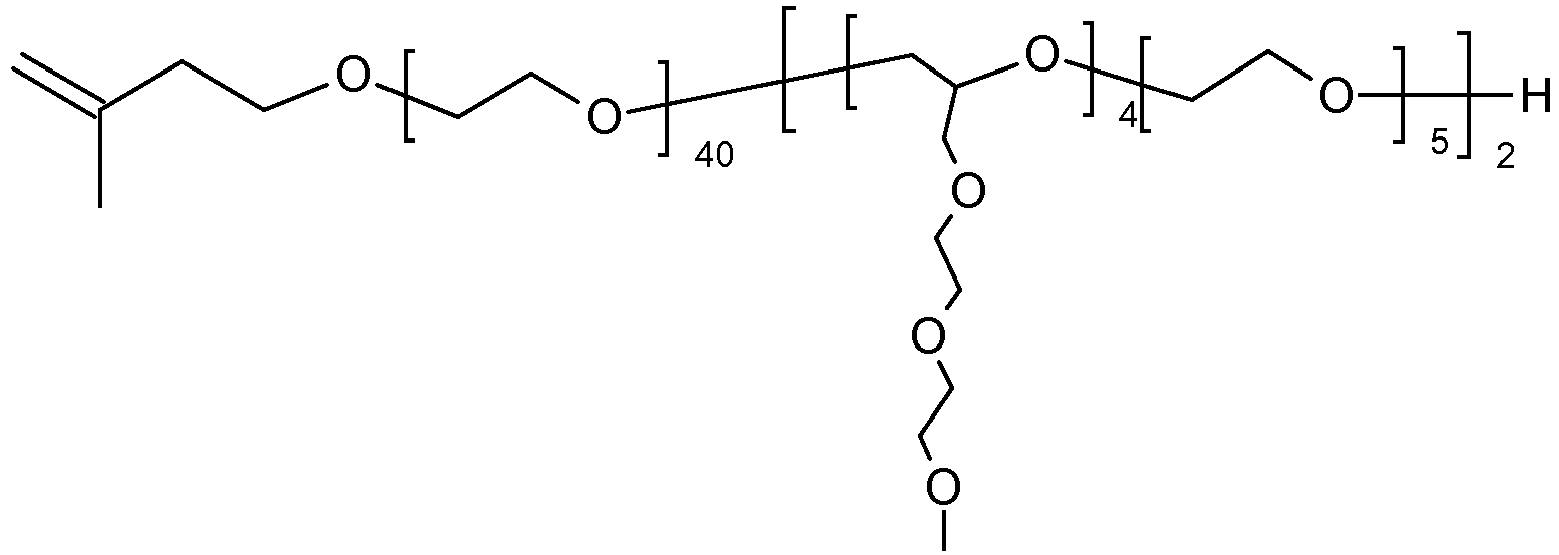
- Polyether macromonomer 900

- Polyether macromonomer 1000

- The saturated starting alcohol (please compare table 2) and 0.1 weight % to 1 weight % with respect to the weight of the polyether macromonomer (product) of the base potassium methoxide is placed in a reaction vessel and stirred at 90°C at a pressure of 20 mbar for 120 minutes. Eventually liberated water or alcohol from reaction of the base with the alcohol is being distilled off by this procedure. The vacuum is released by addition of nitrogen. In case of alcohols with a low boiling point, the loss of alcohol by the vacuum procedure is determined by weighing and substituted. The reaction mixture is transferred into a dry reaction pressure vessel, rendered inert with nitrogen at a pressure of 3.5 bar and heated under stirring to 120 °C. After this procedure ethylene oxide and the respective glycidylethers as described in general formula (V) are added. The details of the consecutive addition steps are summarized in the table 2. The progress of the reaction is followed by monitoring the pressure and the heat evolvement curve in order to determine the appropriate addition times as described in the before standing text. Table 2 gives the details of the polyaddition reaction with the kind of reactants, their amount and the sequence of addition steps
- After completion of the reaction, the mixture is cooled down to 80°C and purged for 30 minutes with nitrogen. Then 3 weight % of an acidic ion exchanger is added and the mixture is stirred at 100° C for 120 minutes and finally hot filtrated under nitrogene pressure.
- For the esterification (second step after the polyaddition), the described polyetherol is dissolved in cyclohexane and the resulting approximately 60 weight % mixture is placed in a flask, equipped with anchor stirrer, air inlet and Dean-Stark trap. 400 ppm methyl hydroquinone , 3000 ppm aqueous 5 % copper (II) acetate solution and 2.200 ppm aqueous 65 % para-toluene sulfonic acid solution are added.
- Air is let into the reaction mixture at a rate of 1.5 l/h and a slight excess of acrylic acid is added. The reaction mixture is heated up under stirring and at a temperature of approx. 85°C the mixture starts boiling. The resulting reaction water from the esterification is removed from the mixture by a Dean-Stark trap. The temperature of the reaction mixture raises up to 107 °C. After 6 hours the reaction is completed and cyclohexane as well as the excess of acrylic acid is distilled off under vacuum. For clarification, also temptative structures are given for each macromonomer.
Table 2 showing the sequential addition of monomers for the macromonomers 1100 and 1200: Step Macromonomer 1100 1200 1 starting alcohol (1 mol) 
2 ethylene oxide [mol] 8 8 3 diethylene glycol methyl glycidyl ether [mol] 8 8 5 ethylene oxide [mol] 20 40 followed by an esterification with 6 acrylic acid (mol) 1 1 - Prepared polyether macromonomers according to method 2:
- Polyether macromonomer 1100

- Polyether macromonomer 1200

- The obtained polyether macromonomers were analytically investigated. Table 3 summarizes the analytical results.
Table 3: Analytical results of polyether macromonomers Polyether Macromonomer Molecular weight Mw* [g/mol] Polydispersity Diol content [%] Method of preparation 100 7830 3,6 1 200 7350 1,2 0,8 1 300 6200 1,3 1,6 1 400 3720 1,3 2,4 1 500 5760 1,2 < 0,5 1 600 6980 1,2 < 0,5 1 700 4200 1,3 < 0,1 1 800 8240 1,3 < 0,1 1 900 8510 1,3 < 0,5 1 1000 8730 1,2 < 0,5 1 1100 4950** 1,3** 2 1200 6170** 1,3** 2 * standard: polystyrene, eluent: THF
** numbers before esterification reaction - The polyether macromonomers according to formula (I) were produced according to the following general instruction:
- Copolymerization method 1:
- A glass vessel, equipped with stirrer, pH-electrode and several pumps was charged with 1 equivalent (0.25 mol) of macromonomer and 40 g of deionized water. The solution was cooled down to 15 °C.
- In a separate tank, the desired amount of acrylic acid was dissolved in 15 g of deionized water (Solution A). In parallel, a 6 weight % solution of Brüggolit®E 01 was prepared (Solution B). Under cooling and stirring 0.68 g of 3-Mercaptopropionic acid, 0.012 g Fe2(SO4)3 and 0,64 g of a 30 % H2O2 solution were added to the vessel.
- At the same time, addition of solution A and B was started. Solution A was added within 45 min. Solution B was added with 24 ml/h until the solution was peroxide-free. After that, the product mixture was neutralized with aqueous NaOH solution and diluted with water to receive a solid content of 30 %.
- Copolymerization method 2:
- A glass vessel, equipped with stirrer, pH-electrode and several pumps was charged with 1 equivalent (0.1 mol) of macromonomer and 85 g of deionized water. The solution was cooled down to 15 °C.
- In a separate tank, the desired amount of maleic anhydride was dissolved in deionized water to get a 30 % solution. To this solution, 1.13 g of 3-mercaptopropionic acid was added (Solution A). 60 % of the solution A (containing maleic anhydride and 3-mercaptopropionic acid) was directly added to the vessel. In parallel, 2.5 g of Rongalit® was dissolved in 47.5 g of deionized water (Solution B). Under cooling and stirring 0.031 g Fe2(SO4)3 and 1.87 g 30 % H2O2 solution were added to the vessel.
- The remaining part of solution A was now feeded into the vessel within 15 minutes. At the same time as the starting of the feeding of solution A, solution B was started to be feeded into the vessel at a rate of 3.1 ml/h. The addition of the solution B was continued until the reaction mixture in the vessel was peroxide free.
- After that, the product mixture was neutralized with aqueous NaOH solution and diluted with water to obtain a solid content of 30 %.
- The results with the details of the (co)polymers are summarized in the following table 2.
Table 4: Details of (co)polymers Copolymer no. Polyether macromonomer (normalized to 1 mol) Acrylic acid (mol) Maleic anhydride (mol) Mw [g/mol] Copolymerization method 1 200 5 - 41000 1 2 200 3 - 61000 1 3 200 7 - 45000 1 4 400 3 31000 1 5 100 - 1.185 18000 2 6 100 - 1.6 21000 2 7 300 3 58000 1 8 400 3 - 57000 1 9 500 3 - 49000 1 10 600 3 - 53000 1 - Plastic viscosities of concrete were determined using an ICAR-Rheometer (Reference: E.P. Koehler, D.W. Fowler (2007). " ICAR Mixture Proportioning Procedure for SCC" International Center for Aggregates Research, Austin, TX.).
- Vibrated concrete and self compacting concrete were tested.
- The mix design of traditional vibrated concrete is the following:
Sand 0-4 1050 Kg/m3 Gravel 8-12 770 Kg/m3 Cement type I 52.5 400 kg/m3 Water 180 Kg/m3 - To receive comparable results, the amount of plasticizer was adjusted to have similar slump values (23 cm ± 1 cm) after 5 min (according to DIN EN 12350).
- The table below reports the results of the tests that were carried out with the ICAR rheometer. All polymers are 30% water solutions, formulated with 1 % of a silicon-based defoamer in order to adjust the amount of air entrained into the concrete.
Table 5: Details of concrete rheometer tests (vibrated concrete) Copolymer Dosage [weight % on cement] (based on solid content of the copolymer) Air (%) Slump (cm) Slump flow (cm) Plastic viscosity µ (Pa*s) Compressive Strength (MPa) 5 min 30 min 24h 7 d 28 d Glenium ACE® 440 (comparison) 0.26 2.0 24 12 195 - - - 47 2 0.38 2.3 23.5 17 189 - - - 48 4 0.34 2.5 23 18 96 - - - 47 7 0.38 2.1 23 13 127 - - - 46 Glenium ACE® 440 * (comparison) 0.27 2.6 22.5 11 280 51.0 62.7 65.3 40 8 0.27 2.8 22 9 214 48.6 63.2 65.6 33 9 0.29 2.6 22 4 275 52.7 59.3 66.4 38 10 0.33 2.7 23 - 170 52.7 55.4 63.9 43 * Glenium ACE 440 is a polycarboxylate ether (PCE) obtainable from BASF Construction Chemicals Italia Spa. - The concrete results show that for the first test series (Glenium® ACE 440, Copolymers 2, 4 and 7) a higher dosage was needed for obtaining the same slump and slump flow. However it was possible to obtain significantly lower viscosities of the concrete compared to the reference Glenium® ACE 440. This is a major advantage for applications where low viscosities are demanded.
- In the case of the second test series (Glenium® ACE 440, Copolymers 8, 9 and 10) the dosages are similar. It was also possible to decrease the viscosity of the concrete in most cases significantly. For the compressive strength evaluation, cubes of concrete were prepared and then cured in controlled conditions. The compressive strength data were then measured at specific times. Reference standards for cubes preparation and strength measurement were EN 12390-2 and EN 12390-3. The data show that it was possible to obtain low viscosities of the concrete without loss of compressive strength.
- The mix design of self compacting concrete is the following:
Sand 0-4 770 kg/m3 Crushed 6-12 880 kg/m3 Cement type I 52.5 370 kg/m3 Limestone filler 130 kg/m3 Water 160 l/m3 - The slump flow is 60 ± 10 cm, according to EN 12350-8.
- The table 6 below reports the results of the tests that were carried out with the ICAR rheometer. All polymers are 30% water solutions, formulated with 0.6 % of tributyl phosphate as defoamer in order to adjust the amount of air entrained into the concrete.
Table 6: Details of concrete rheometer tests (self compacting concrete) Copolymer Dosage [weight % on cement] (based on solid content of the copolymer) Air (%) slump flow (cm) Plastic viscosity µ (Pa*s) 5 minutes 20 minutes Glenium® ACE 440 (comparison) 0.81% 2.2 53 n.m. 268 8 1.00% 2.8 49 n.m. 221 Glenium® ACE 440 (comparison) 0.97% 2.2 65 55 226 9 1.20% 1.3 67 48 151 10 1.20% 1.3 67 48 130 - For the self compacting concrete it was found that copolymer 8 showed a strongly reduced viscosity at only slightly higher dosage compared to Glenium® ACE 440.
- The second test series shows also a strong decrease of the plastic viscosity for copolymers 8 and 9, whereas the viscosity of the comparison Glenium® ACE 440 is higher. Slightly higher dosages of the copolymers according to this invention are needed compared to the comparison examples.
- The concrete results show that it is possible to obtain concretes with a significantly reduced viscosity by use of the copolymers according to this invention.
and in a second reaction step jj) the resulting polyether alcohol from the first reaction step is esterified with an unsaturated acid U-COOH and/or its acid derivatives, preferably with (meth)acrylic acid and/or (meth)acrylic acid derivatives.


Claims (19)
- Polyether macromonomer according to general formula (I)
(I) U-(C=O)w-O-(A1O)x-(CH2CH[V]O)y-R1,
wherein in general formula (I)U is an unsaturated structural unit with 2 to 10 carbon atoms, which comprises one polymerizable carbon - carbon double bond,w is 0 or 1, with the condition that w is 0 if U is different from CH2=CH- and CH2=C(Me)-,A1 is the same or different and is independently from each other a branched or linear alkylene with 2 to 10 carbon atoms, -CH2-CH(phenyl)-, -CH2-CH(CH2-COOR4)- and/or-CH2-CH(CH2-N+(C-1 to C-1 0 alkyl)3 X- - with the proviso that the mol percentage of -CH2-CH(CH2-COOR4)- and -CH2-CH(CH2-N+( C-1 to C-10 alkyl)3X-- is in each case less than 30 mol % with respect to all units A1,R4 is is the same or different and is independently from each other a C-1 to C-1 0 linear or branched alkyl group, H or a cation, preferably an (earth) alkali metal, X- is an anion, preferably X- is a halogenide,x is an integer from 10 to 300,y is an integer from 1 to 50,R1 is H or a saturated hydrocarbon, preferably H and/or a C-1 to C-20 branched or linear alkyl group, most preferably H and/or a methyl group,[V] is represented by the general formula (II)
(II) -CH2-O-(A2O)z-R2,
wherein in general formula (II)A2 is the same or different and is independently from each other a branched or linear alkylene with 2 to 10 carbon atoms, preferably 2 carbon atoms, -CH2-CH(phenyl)-, with the proviso that the mol percentage of -CH2-CH(phenyl)-, is less than 30 mol % with respect to all units A2,z is the same or different and is independently from each other an integer between 1 and 50,R2 is the same or different and is independently from each other a saturated hydrocarbon or hydrogen, preferably a C-1 to C-20 branched or linear alkyl group, most preferably a methyl group. - Polyether macromonomer according to claim 1, wherein U is a) selected from alkenyl groups with 2 to 5 carbon atoms, with w is 0 or b) U is selected from CH2=C(R3)-, in which case in general formula (I) w is 1 and R3 is H or methyl, preferably R1 in general formula (I) is a saturated hydrocarbon, more preferably a C-1 to C-20 branched or linear alkyl group, most preferably a methyl group, or U is c) a vinyl ether according to formula (III) with w is 0:

- Polyether macromonomer according to claim 1, wherein w is 0 and U is an alkenyl group with 2 to 5 carbon atoms and is selected from CH2=CH-, CH2=CR3-CH2- or CH2=C(CH3)-(CH2)2-,
wherein R3 is H or methyl. - Polyether macromonomer according to any of claims 1 to 3, wherein in general formula (I)
x is an integer from 20 to 150,
y is an integer from 1 to 30 and
the mol percentage of C-2 alkylene in A1 is higher than 80 mol % with respect to all alkylenes A1,
and in general formula (II)
the mol percentage of C-2 alkylene in A2 is higher than 80 mol % with respect to all alkylenes A2 and
z is the same or different and is independently from each other an integer between 1 and 10. - Polyether macromonomer according to claim 4, wherein in general formula (I)
x is an integer from 20 to 100,
y is an integer from 3 to 10 and
the mol percentage of C-2 alkylene in A1 is higher than 90 mol % with respect to all alkylenes A1,
and in general formula (II)
the mol percentage of C-2 alkylene in A2 is higher than 90 mol % with respect to all alkylenes A2 and
z is an integer between 1 and 5. - Polyether macromonomer according to any of claims 1, 2, 4 or 5, wherein U is CH2=CR3-, w is 1, R3 is H or methyl, R1 is a saturated hydrocarbon, preferably a C-1 to C-20 branched or linear alkyl group, most preferably methyl.
- Polyether macromonomer according to any of claims 1 to 6, wherein the mol percentage of -CH2-CH(CH2-COOR4)- or -CH2-CH(CH2-N+(C-1 to C-1 0 alkyl)3X-- is from 0.5 mol % to 5 mol % with respect to all units A1.
- Polyether macromonomer according to any of claims 1 to 7, wherein a branching factor is defined as the quotient of index y and index x (y/x) in general formula (I) and the value of the branching factor is from 0.01 to 0.8, preferably 0.05 to 0.2.
- Polyether macromonomer according to any of claims 1 to 8, wherein in general formula (I) the alkylene oxide units A1O and units CH2CH[V]O are contained in a statistical distribution, in block form or in form of a gradient copolymer.
- Method of manufacturing of a polyether macromonomer according to any of claims 1 to 5 and according to general formula (I), wherein in a polyaddition reaction in a
first process stepi) an a) unsaturated alcohol of the general formula
(IV) U-(C=O)w-OH,
wherein in general formula (IV)U has the same meaning as in formula (I),w is 0 in general formula (IV) and in general formula (I),is reacted withb) one or more than one species of an alkylene oxide A1O with A1 having the same meaning as in formula (I) andc) one or more than one species of a glycidylether according to general formula (V)in general formula (V) the parameter [V] has the same meaning as in formula (II), to result in a polyether macromonomer alcohol of formula (I) with R1 being H, and optionally followed by a
second process step ii), which is an etherification of the hydroxy group of the polyether macromonomer alcohol of formula (I), replacing H by a saturated hydrocarbon, preferably a C-1 to C-20 branched or linear alkyl group, most preferably a methyl group. - Method of manufacturing a polyether macromonomer according to claim 6, wherein in a polyaddition reaction in a first reaction step j) a d) saturated alcohol R1-(OA1)uOH, wherein u is an integer from 0 to 200, R1 and A1 have the same meaning as in general formula (I), is reacted with b) x-u mols of one or more species of alkylene oxide A1O with A1 having the same meaning as in formula (I) andc) one or more species of a glycidylether according to general formula (V)

and in a second reaction step jj) the resulting polyether alcohol from the first reaction step is esterified with an unsaturated acid U-COOH and/or its acid derivatives, preferably with (meth)acrylic acid and/or (meth)acrylic acid derivatives. - (Co)polymer containing structural units being derived from the polyether macromonomers according to any of claims 1 to 9, preferably the polyether macromonomer being incorporated into the (co)polymer by radical polymerization.
- (Co)polymer according to claim 12 containing acid structural units, preferably carboxylic acid structural units, wherein preferably the (co)polymer is obtained by radical polymerization of acid monomers, preferably carboxylic acid monomers, and the polyether macromonomers according to any of claims 1 to 9.
- (Co)polymer according to claim 12 or 13, wherein the acid structural unit is produced in the copolymer by incorporation of the acid monomer in the form of polymerized units, which structural unit is in accordance with one of the general formulae (VIa), (VIb), (Vlc) and/or (VId)
 R5 are identical or different and are represented by H and/or a non-branched chain or branched C1 - C4 alkyl group;X are identical or different and are represented by NH-(CnH2n) where n = 1, 2, 3 or 4 and/or O-(CnH2n) where n = 1, 2, 3 or 4 and/or by a unit not present;R6 are identical or different and are represented by OM, SO3M, PO3M2, O-PO3M2 and/or para-substituted C6H4-SO3M, with the proviso that, if X is a unit not present, R6 is represented by OM;M is independently from each other H, an ammonium ion, alkali cation or any other cation with the proviso that the mol number of the cation is divided with its number of catonic charges, preferably the cation is ½ earth alkali cation or an alkali cation,
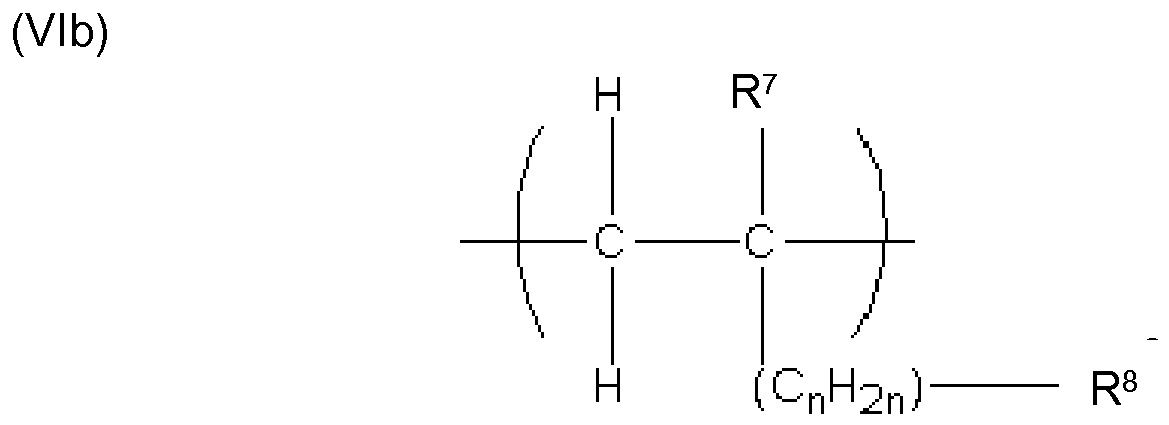 R7 are identical or different and are represented by H and/or a non-branched chain or a branched C1 - C4 alkyl group;n = 0, 1, 2, 3 or 4;R8 are identical or different and are represented by SO3M, PO3M2, O-PO3M2 and/or para-substituted C6H4-SO3M, M has the before mentioned meaning;
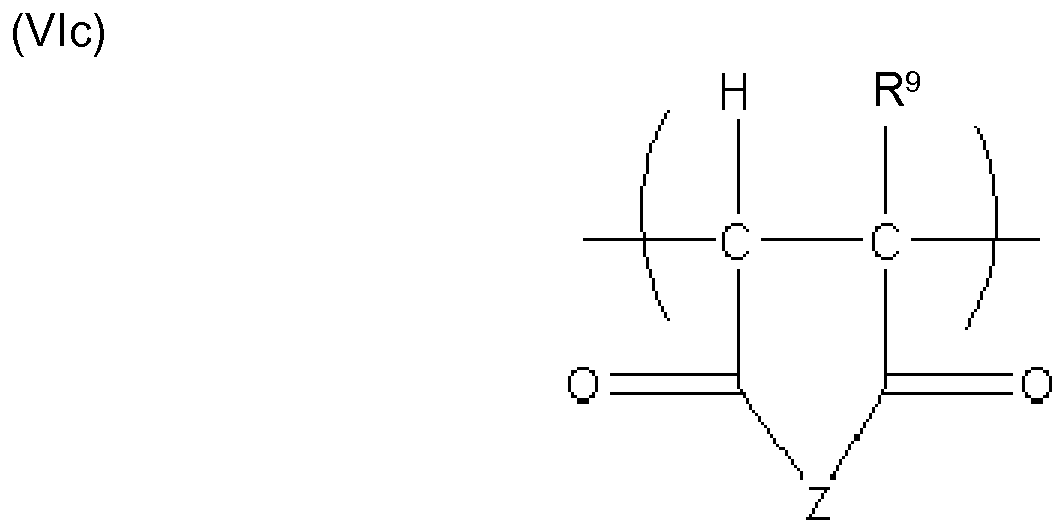 R9 are identical or different and are represented by H and/or a non-branched chain or a branched C1 - C4 alkyl group;Z are identical or different and are represented by O and/or NH;
 R10 are identical or different and are represented by H and/or a non-branched chain or branched C1 - C4 alkyl group;Q are identical or different and are represented by NH and/or O;R11 are identical or different and are represented by H, (CnH2n)-SO3M where n = 0, 1, 2, 3 or 4, (CnH2n)-OH where n = 0, 1, 2, 3 or 4; (CnH2n)-PO3M2 where n = 0, 1, 2, 3 or 4, (CnH2n)-OPO3M2 where n= 0, 1, 2, 3 or 4, (C6H4)-SO3M, (C6H4)-PO3M2, (C6H4)-OPO3M2 and/or (CmH2m)e-O-(A'O)α -R12 where m = 0, 1, 2, 3 or 4, e = 0, 1, 2, 3 or 4, A' = Cx'H2x' where x' = 2, 3, 4 or 5 and/or CH2C(C6H5)H-, α= an integer from 1 to 350 where R12 are identical or different and are represented by a non-branched chain or a branched C1 - C4 alkyl group, M has the before mentioned meaning.
 - (Co)polymer according to any of claims 12 to 14, wherein the acid structural unit is derived from carboxylic acid monomers selected from the group of (meth)acrylic acid, maleic acid and/or maleic anhydride.
- Method of use of (co)polymers according to any of claims 12 to 15 as a dispersant for aqueous mixtures of inorganic particles, preferably for inorganic binders selected from the group of (Portland) cement, α -calciumsulfate-hemihydrat, β - calciumsulfate-hemihydrate, calciumsulfate in the form of anhydrite, lime, furnace slag, fly ash, silica fume, natural puzzolane and/or calcined oil shale, preferably (Portland) cement is contained with a weight percentage higher than 40 % with respect to the sum of the inorganic binders.
- Method of use of (co)polymers according to any of claims 12 to 15 as a means for the reduction of the viscosity of aqueous mixtures of inorganic particles, preferably for inorganic binders selected from the group of (Portland) cement, α - calciumsulfate-hemihydrat, β-calciumsulfate-hemihydrate, calciumsulfate in the form of anhydrite, lime, furnace slag, fly ash, silica fume, natural puzzolane and/or calcined oil shale, preferably (Portland) cement is contained with a weight percentage higher than 40 % with respect to the sum of the inorganic binders.
- Method of use of (co)polymers according to any of claims 12 to 15 as a grinding aid for the production of (Portland) cement.
- Building material mixtures containing a (co)polymer according to any of claims 12 to 15 and inorganic binders selected from the group of (Portland) cement, α - calciumsulfate-hemihydrat, β-calciumsulfate-hemihydrate, calciumsulfate in the form of anhydrite, lime, furnace slag, fly ash, silica fume, natural puzzolane and/or calcined oil shale, preferably (Portland) cement is contained with a weight percentage higher than 40 % with respect to the sum of the inorganic binders, optionally water is contained.
Priority Applications (2)
| Application Number | Priority Date | Filing Date | Title |
|---|---|---|---|
| EP13157927.8A EP2774941A1 (en) | 2013-03-06 | 2013-03-06 | Branched polycarboxylate ethers |
| PCT/EP2014/052083 WO2014135317A1 (en) | 2013-03-06 | 2014-02-04 | Branched polycarboxylate ethers |
Applications Claiming Priority (1)
| Application Number | Priority Date | Filing Date | Title |
|---|---|---|---|
| EP13157927.8A EP2774941A1 (en) | 2013-03-06 | 2013-03-06 | Branched polycarboxylate ethers |
Publications (1)
| Publication Number | Publication Date |
|---|---|
| EP2774941A1 true EP2774941A1 (en) | 2014-09-10 |
Family
ID=47891414
Family Applications (1)
| Application Number | Title | Priority Date | Filing Date |
|---|---|---|---|
| EP13157927.8A Withdrawn EP2774941A1 (en) | 2013-03-06 | 2013-03-06 | Branched polycarboxylate ethers |
Country Status (2)
| Country | Link |
|---|---|
| EP (1) | EP2774941A1 (en) |
| WO (1) | WO2014135317A1 (en) |
Cited By (2)
| Publication number | Priority date | Publication date | Assignee | Title |
|---|---|---|---|---|
| CN109180056A (en) * | 2018-11-16 | 2019-01-11 | 中建商品混凝土有限公司 | A kind of nanometer of class molybdenum disulfide grinding aid and preparation method thereof |
| CN112374795A (en) * | 2020-12-01 | 2021-02-19 | 中冶建筑研究总院有限公司 | Preparation method of polycarboxylic admixture for reducing concrete viscosity |
Families Citing this family (1)
| Publication number | Priority date | Publication date | Assignee | Title |
|---|---|---|---|---|
| CN113929836B (en) * | 2021-11-01 | 2024-03-26 | 湖北凌安科技有限公司 | High-dispersion viscosity-reducing water reducer and preparation method thereof |
Citations (9)
| Publication number | Priority date | Publication date | Assignee | Title |
|---|---|---|---|---|
| WO2000014045A1 (en) | 1998-09-07 | 2000-03-16 | Basf Aktiengesellschaft | Method for the preparation of fatty alcohol alkoxylates |
| WO2000068272A1 (en) | 1999-05-07 | 2000-11-16 | Heidelberger Bauchemie Gmbh | Substituted polysaccharide sulfates, method for producing them and their use as high-performance flow agents for cement mixtures |
| EP1158009A2 (en) * | 2000-05-26 | 2001-11-28 | Nippon Shokubai Co., Ltd. | Production process for allyl ether-based polymer |
| WO2002053611A1 (en) | 2000-12-27 | 2002-07-11 | Nippon Shokubai Co., Ltd. | Polycarboxylic acid type copolymer and method for producing the same, and use of the same |
| EP1531933B1 (en) | 2002-08-21 | 2005-11-16 | Clariant GmbH | Copolymers made of alkylene oxides and glycidyl ethers and use thereof as polymerisable emulsifiers |
| EP1707542A2 (en) | 2005-03-31 | 2006-10-04 | Nippon Shokubai Co.,Ltd. | Powdery cement dispersant |
| WO2007037469A1 (en) | 2005-09-29 | 2007-04-05 | Nippon Shokubai Co., Ltd. | Polyalkylene glycol monomer, polyalkylene glycol polymer containing the same, and application thereof |
| US7812114B2 (en) * | 2002-08-21 | 2010-10-12 | Clariant Produkte (Deutschland) Gmbh | Block copolymer by reacting alkylene oxide and glycidyl ether in presence of unsaturated monomer |
| WO2010145761A1 (en) * | 2009-06-19 | 2010-12-23 | Byk-Chemie Gmbh | Terminal unsaturated, glycidol based macromonomers, polymers obtainable therefrom, production and use thereof |
-
2013
- 2013-03-06 EP EP13157927.8A patent/EP2774941A1/en not_active Withdrawn
-
2014
- 2014-02-04 WO PCT/EP2014/052083 patent/WO2014135317A1/en not_active Ceased
Patent Citations (10)
| Publication number | Priority date | Publication date | Assignee | Title |
|---|---|---|---|---|
| WO2000014045A1 (en) | 1998-09-07 | 2000-03-16 | Basf Aktiengesellschaft | Method for the preparation of fatty alcohol alkoxylates |
| WO2000068272A1 (en) | 1999-05-07 | 2000-11-16 | Heidelberger Bauchemie Gmbh | Substituted polysaccharide sulfates, method for producing them and their use as high-performance flow agents for cement mixtures |
| EP1158009A2 (en) * | 2000-05-26 | 2001-11-28 | Nippon Shokubai Co., Ltd. | Production process for allyl ether-based polymer |
| WO2002053611A1 (en) | 2000-12-27 | 2002-07-11 | Nippon Shokubai Co., Ltd. | Polycarboxylic acid type copolymer and method for producing the same, and use of the same |
| EP2003154A2 (en) * | 2000-12-27 | 2008-12-17 | Nippon Shokubai Co., Ltd. | Polycarboxylic acid type copolymer, method for producing the same, cement additive and cement composition |
| EP1531933B1 (en) | 2002-08-21 | 2005-11-16 | Clariant GmbH | Copolymers made of alkylene oxides and glycidyl ethers and use thereof as polymerisable emulsifiers |
| US7812114B2 (en) * | 2002-08-21 | 2010-10-12 | Clariant Produkte (Deutschland) Gmbh | Block copolymer by reacting alkylene oxide and glycidyl ether in presence of unsaturated monomer |
| EP1707542A2 (en) | 2005-03-31 | 2006-10-04 | Nippon Shokubai Co.,Ltd. | Powdery cement dispersant |
| WO2007037469A1 (en) | 2005-09-29 | 2007-04-05 | Nippon Shokubai Co., Ltd. | Polyalkylene glycol monomer, polyalkylene glycol polymer containing the same, and application thereof |
| WO2010145761A1 (en) * | 2009-06-19 | 2010-12-23 | Byk-Chemie Gmbh | Terminal unsaturated, glycidol based macromonomers, polymers obtainable therefrom, production and use thereof |
Non-Patent Citations (1)
| Title |
|---|
| E.P. KOEHLER; D.W. FOWLER, ICAR MIXTURE PROPORTIONING PROCEDURE FOR SCC, 2007 |
Cited By (3)
| Publication number | Priority date | Publication date | Assignee | Title |
|---|---|---|---|---|
| CN109180056A (en) * | 2018-11-16 | 2019-01-11 | 中建商品混凝土有限公司 | A kind of nanometer of class molybdenum disulfide grinding aid and preparation method thereof |
| CN109180056B (en) * | 2018-11-16 | 2021-01-19 | 中建商品混凝土有限公司 | Nanoscale molybdenum disulfide grinding aid and preparation method thereof |
| CN112374795A (en) * | 2020-12-01 | 2021-02-19 | 中冶建筑研究总院有限公司 | Preparation method of polycarboxylic admixture for reducing concrete viscosity |
Also Published As
| Publication number | Publication date |
|---|---|
| WO2014135317A1 (en) | 2014-09-12 |
Similar Documents
| Publication | Publication Date | Title |
|---|---|---|
| EP2291336B1 (en) | Copolymer admixture system for workability retention of cementitious compositions | |
| KR101507263B1 (en) | Copolymers with gem-bisphosphonate groups | |
| EP2886580A1 (en) | Additive for rheology improvement of inorganic binders | |
| US8519028B2 (en) | Early strengthening agent for hydraulic composition | |
| JP6053509B2 (en) | Admixture for hydraulic composition | |
| CN108046645B (en) | Long-acting stable slump retaining water reducer for medium-low slump concrete and preparation method thereof | |
| KR20170080628A (en) | Synthetic water retention agent and rheology modifier for use in cement admixtures | |
| CN102239196A (en) | Methods of producing copolymers | |
| EP2964586B1 (en) | Use of polycarboxylate ethers with branched side chains as dispersants for inorganic binders | |
| JP7107613B2 (en) | Additive for hydraulic composition | |
| JP5559192B2 (en) | Process for producing a semi-continuously operated copolymer | |
| JP2012511094A (en) | Copolymer containing acid building blocks and various polyether building blocks | |
| EP2774941A1 (en) | Branched polycarboxylate ethers | |
| US10501371B2 (en) | Copolymer as a water-reducing agent in a hydraulic composition and use of copolymers for improving the early mechanical strength of a hydraulic composition | |
| JP7291346B2 (en) | Admixture for hydraulic composition and hydraulic composition | |
| CN102414256B (en) | Method for preparing a superplasticizer | |
| KR100904607B1 (en) | Cement admixtures, preparation methods thereof, and cement compositions comprising the same | |
| KR100914597B1 (en) | Cement admixture, method for preparing the same, and cement composition containing the same | |
| US8907016B2 (en) | Dispersing agent containing copolymer mixture | |
| CN109320714B (en) | Special small-molecule superplasticizer for medium-low slump concrete and preparation method thereof | |
| JP2019112250A (en) | Admixture for low quality fine aggregate-containing concrete and cement composition containing the same | |
| US8563631B2 (en) | Viscosity-reducing super-plasticising copolymers | |
| CN117659377A (en) | An unsaturated branched polyether, its preparation method and its application in preparing phosphate-based water reducing agent | |
| JP7039280B2 (en) | SCM miscible material high content admixture for concrete, and admixture-containing composition and cement composition containing this | |
| JP7075692B1 (en) | Method for Producing Admixture for Hydraulic Composition |
Legal Events
| Date | Code | Title | Description |
|---|---|---|---|
| PUAI | Public reference made under article 153(3) epc to a published international application that has entered the european phase |
Free format text: ORIGINAL CODE: 0009012 |
|
| 17P | Request for examination filed |
Effective date: 20130306 |
|
| AK | Designated contracting states |
Kind code of ref document: A1 Designated state(s): AL AT BE BG CH CY CZ DE DK EE ES FI FR GB GR HR HU IE IS IT LI LT LU LV MC MK MT NL NO PL PT RO RS SE SI SK SM TR |
|
| AX | Request for extension of the european patent |
Extension state: BA ME |
|
| STAA | Information on the status of an ep patent application or granted ep patent |
Free format text: STATUS: THE APPLICATION IS DEEMED TO BE WITHDRAWN |
|
| 18D | Application deemed to be withdrawn |
Effective date: 20150311 |