EP2767514A1 - Ion exchanger and cooling device equipped with ion exchanger - Google Patents
Ion exchanger and cooling device equipped with ion exchanger Download PDFInfo
- Publication number
- EP2767514A1 EP2767514A1 EP12840056.1A EP12840056A EP2767514A1 EP 2767514 A1 EP2767514 A1 EP 2767514A1 EP 12840056 A EP12840056 A EP 12840056A EP 2767514 A1 EP2767514 A1 EP 2767514A1
- Authority
- EP
- European Patent Office
- Prior art keywords
- path
- coolant
- ion exchanger
- ion
- mesh
- Prior art date
- Legal status (The legal status is an assumption and is not a legal conclusion. Google has not performed a legal analysis and makes no representation as to the accuracy of the status listed.)
- Granted
Links
Images






Classifications
-
- H—ELECTRICITY
- H01—ELECTRIC ELEMENTS
- H01M—PROCESSES OR MEANS, e.g. BATTERIES, FOR THE DIRECT CONVERSION OF CHEMICAL ENERGY INTO ELECTRICAL ENERGY
- H01M8/00—Fuel cells; Manufacture thereof
- H01M8/04—Auxiliary arrangements, e.g. for control of pressure or for circulation of fluids
- H01M8/04298—Processes for controlling fuel cells or fuel cell systems
- H01M8/04694—Processes for controlling fuel cells or fuel cell systems characterised by variables to be controlled
- H01M8/04701—Temperature
-
- B—PERFORMING OPERATIONS; TRANSPORTING
- B01—PHYSICAL OR CHEMICAL PROCESSES OR APPARATUS IN GENERAL
- B01J—CHEMICAL OR PHYSICAL PROCESSES, e.g. CATALYSIS OR COLLOID CHEMISTRY; THEIR RELEVANT APPARATUS
- B01J47/00—Ion-exchange processes in general; Apparatus therefor
- B01J47/02—Column or bed processes
- B01J47/022—Column or bed processes characterised by the construction of the column or container
-
- C—CHEMISTRY; METALLURGY
- C02—TREATMENT OF WATER, WASTE WATER, SEWAGE, OR SLUDGE
- C02F—TREATMENT OF WATER, WASTE WATER, SEWAGE, OR SLUDGE
- C02F1/00—Treatment of water, waste water, or sewage
- C02F1/006—Water distributors either inside a treatment tank or directing the water to several treatment tanks; Water treatment plants incorporating these distributors, with or without chemical or biological tanks
-
- C—CHEMISTRY; METALLURGY
- C02—TREATMENT OF WATER, WASTE WATER, SEWAGE, OR SLUDGE
- C02F—TREATMENT OF WATER, WASTE WATER, SEWAGE, OR SLUDGE
- C02F1/00—Treatment of water, waste water, or sewage
- C02F1/42—Treatment of water, waste water, or sewage by ion-exchange
-
- H—ELECTRICITY
- H01—ELECTRIC ELEMENTS
- H01M—PROCESSES OR MEANS, e.g. BATTERIES, FOR THE DIRECT CONVERSION OF CHEMICAL ENERGY INTO ELECTRICAL ENERGY
- H01M8/00—Fuel cells; Manufacture thereof
- H01M8/04—Auxiliary arrangements, e.g. for control of pressure or for circulation of fluids
- H01M8/04007—Auxiliary arrangements, e.g. for control of pressure or for circulation of fluids related to heat exchange
- H01M8/04029—Heat exchange using liquids
-
- H—ELECTRICITY
- H01—ELECTRIC ELEMENTS
- H01M—PROCESSES OR MEANS, e.g. BATTERIES, FOR THE DIRECT CONVERSION OF CHEMICAL ENERGY INTO ELECTRICAL ENERGY
- H01M8/00—Fuel cells; Manufacture thereof
- H01M8/04—Auxiliary arrangements, e.g. for control of pressure or for circulation of fluids
- H01M8/04007—Auxiliary arrangements, e.g. for control of pressure or for circulation of fluids related to heat exchange
- H01M8/04044—Purification of heat exchange media
-
- B—PERFORMING OPERATIONS; TRANSPORTING
- B01—PHYSICAL OR CHEMICAL PROCESSES OR APPARATUS IN GENERAL
- B01J—CHEMICAL OR PHYSICAL PROCESSES, e.g. CATALYSIS OR COLLOID CHEMISTRY; THEIR RELEVANT APPARATUS
- B01J47/00—Ion-exchange processes in general; Apparatus therefor
- B01J47/02—Column or bed processes
- B01J47/026—Column or bed processes using columns or beds of different ion exchange materials in series
-
- C—CHEMISTRY; METALLURGY
- C02—TREATMENT OF WATER, WASTE WATER, SEWAGE, OR SLUDGE
- C02F—TREATMENT OF WATER, WASTE WATER, SEWAGE, OR SLUDGE
- C02F2103/00—Nature of the water, waste water, sewage or sludge to be treated
- C02F2103/02—Non-contaminated water, e.g. for industrial water supply
- C02F2103/023—Water in cooling circuits
-
- C—CHEMISTRY; METALLURGY
- C02—TREATMENT OF WATER, WASTE WATER, SEWAGE, OR SLUDGE
- C02F—TREATMENT OF WATER, WASTE WATER, SEWAGE, OR SLUDGE
- C02F2301/00—General aspects of water treatment
- C02F2301/02—Fluid flow conditions
- C02F2301/024—Turbulent
-
- C—CHEMISTRY; METALLURGY
- C02—TREATMENT OF WATER, WASTE WATER, SEWAGE, OR SLUDGE
- C02F—TREATMENT OF WATER, WASTE WATER, SEWAGE, OR SLUDGE
- C02F2301/00—General aspects of water treatment
- C02F2301/02—Fluid flow conditions
- C02F2301/026—Spiral, helicoidal, radial
-
- C—CHEMISTRY; METALLURGY
- C02—TREATMENT OF WATER, WASTE WATER, SEWAGE, OR SLUDGE
- C02F—TREATMENT OF WATER, WASTE WATER, SEWAGE, OR SLUDGE
- C02F2301/00—General aspects of water treatment
- C02F2301/02—Fluid flow conditions
- C02F2301/028—Tortuous
-
- H—ELECTRICITY
- H01—ELECTRIC ELEMENTS
- H01M—PROCESSES OR MEANS, e.g. BATTERIES, FOR THE DIRECT CONVERSION OF CHEMICAL ENERGY INTO ELECTRICAL ENERGY
- H01M8/00—Fuel cells; Manufacture thereof
- H01M8/10—Fuel cells with solid electrolytes
- H01M2008/1095—Fuel cells with polymeric electrolytes
-
- Y—GENERAL TAGGING OF NEW TECHNOLOGICAL DEVELOPMENTS; GENERAL TAGGING OF CROSS-SECTIONAL TECHNOLOGIES SPANNING OVER SEVERAL SECTIONS OF THE IPC; TECHNICAL SUBJECTS COVERED BY FORMER USPC CROSS-REFERENCE ART COLLECTIONS [XRACs] AND DIGESTS
- Y02—TECHNOLOGIES OR APPLICATIONS FOR MITIGATION OR ADAPTATION AGAINST CLIMATE CHANGE
- Y02E—REDUCTION OF GREENHOUSE GAS [GHG] EMISSIONS, RELATED TO ENERGY GENERATION, TRANSMISSION OR DISTRIBUTION
- Y02E60/00—Enabling technologies; Technologies with a potential or indirect contribution to GHG emissions mitigation
- Y02E60/30—Hydrogen technology
- Y02E60/50—Fuel cells
Definitions
- the present invention relates to an ion exchanger for removing an impurity ion from a fluid and a cooler having the ion exchanger.
- a fuel cell includes an anode, a cathode, and an electrolytic membrane interposed therebetween.
- the fuel cell generates electric power using an anode gas containing hydrogen supplied to the anode and a cathode gas containing oxygen supplied to the cathode.
- An electrochemical reaction generated in both the anode and the cathode can be expressed as follows. Anode: 2H 2 ⁇ 4H + + 4e - (1) Cathode: 4H + + 4e- + O 2 ⁇ 2H 2 O (2)
- a fuel cell stack obtained by stacking several hundreds of fuel cells is used.
- a fuel cell system capable of supplying an anode gas and a cathode gas to the fuel cell stack is provided to output electric power for driving a vehicle.
- a coolant circulation path is provided to cool the fuel cell stack.
- an impurity ion such as Na + or SO 4 2- is eluted to the coolant from a pipe or the like of the circulation path, so that electric conductivity of the coolant increases, and power generation performance of the fuel cell stack is deteriorated.
- an ion exchanger for removing an impurity ion from the coolant is provided in the coolant circulation path.
- an ion exchanger it is preferable that an ion exchange rate relating to impurity ion removal performance be high and a pressure loss which is a pressure difference between an inlet side and an outlet side be small.
- JP 2009-219954 A discloses a dual channel structure ion exchanger having an inner pipe and an outer pipe.
- this ion exchanger one of a path formed inside the inner pipe and a path formed between the inner and outer pipes serves as an ion exchange path filled with an ion exchange resin, and the other path serves as a bypass path.
- an ion exchanger configured to remove an impurity ion of a coolant for cooling a fuel cell.
- the ion exchanger includes an inflow portion having an inflow path where the coolant enters, a discharge portion having a discharge path for discharging the coolant, an outer casing having an upstream end where the inflow portion is provided and a downstream end where the discharge portion is provided, an inner casing housed inside the outer casing, an outer path formed between the inner casing and the outer casing to cause the inflow path and the discharge path to communicate with each other, and an inner path that is formed inside the inner casing to cause the inflow path and the discharge path to communicate with each other and is configured to enclose an ion exchange resin capable of removing an impurity ion of the coolant.
- the inner casing has a through-hole that causes the inner path and the outer path to communicate with each other.
- FIG. 1 is a schematic view illustrating a fuel cell system 1 having an ion exchanger 100 according to a first embodiment of the present invention.
- the fuel cell system 1 includes a fuel cell stack 10, a cooler 20 that cools the fuel cell stack 10, and a controller 30 that executes a system control.
- the fuel cell stack 10 is configured by stacking a predetermined number of fuel cells.
- the fuel cell stack 10 generates electric power using an anode gas supplied from an anode gas supply unit and a cathode gas supplied from a cathode gas supply unit.
- the electric power generated by the fuel cell stack 10 is supplied to various electric devices such as a driving motor for driving a vehicle.
- the cooler 20 is a device for cooling the fuel cell stack 10 using a coolant.
- a coolant pure water or a glycol-based antifreeze fluid may be employed.
- the cooler 20 includes a coolant circulation path 21, a radiator 22, a bypass path 23, a three-way valve 24, a reservoir 25, a circulating pump 26, and the ion exchanger 100.
- the coolant circulation path 21 is a path where a coolant for cooling the fuel cell stack 10 flows. One end of the coolant circulation path 21 is connected to a coolant inlet port of the fuel cell stack 10, and the other end is connected to a coolant outlet port of the fuel cell stack 10.
- the radiator 22 is a heat radiating device capable of cooling the coolant discharged from the fuel cell stack 10 and is provided in the coolant circulation path 21.
- the bypass path 23 is connected to the coolant circulation path 21 by bypassing the radiator 22.
- the three-way valve 24 is provided in a junction between the coolant circulation path 21 in the upstream side from the radiator 22 and the bypass path 23.
- the three-way valve 24 is a flow rate adjustment member that adjusts a flow rate of the coolant flowing to the radiator 22 and a flow rate of the coolant flowing to the bypass path 23.
- An opening degree of the three-way valve 24 is controlled by the controller 30 based on a cooling load state and the like.
- the reservoir 25 is provided in the coolant circulation path 21 between the radiator 22 and a downstream end junction of the bypass path 23.
- the reservoir 25 has a cap 25A opened and closed depending on a pressure of the coolant in the coolant circulation path 21.
- a pressure of the coolant in the coolant circulation path 21 is high, a part of the coolant flowing through the coolant circulation path 21 is supplied to the reservoir 25 through the cap 25A.
- the pressure in the coolant circulation path 21 is low, the coolant in the reservoir 25 is supplied to the coolant circulation path 21 through the cap 25A.
- the pressure of the coolant in the coolant circulation path 21 is maintained within a predetermined pressure range.
- the circulating pump 26 is a forced feed device for circulating the coolant.
- the circulating pump 26 is provided in the coolant circulation path 21 between the fuel cell stack 10 and the downstream end junction of the bypass path 23.
- a discharge flow rate of the circulating pump 26 is controlled by the controller 30.
- the ion exchanger 100 is provided in the coolant circulation path 21 between the circulating pump 26 and the coolant circulation path 21 in the downstream side from the radiator 22, for example, the downstream end junction of the bypass path 23.
- a granular ion exchanger resin capable of removing an impurity ion is enclosed in the ion exchanger 100.
- the ion exchanger 100 lowers the electric conductivity of the coolant by removing an impurity ion included in the coolant.
- the controller 30 includes a microcomputer having a central processing unit (CPU), a read-only memory (ROM), a random access memory (RAM), and an input/output interface (I/O interface).
- the controller 30 receives signals from various sensors that detect a driving condition of the fuel cell stack 10 and controls the three-way valve 24, the circulating pump 26, and the like based on such input signals.
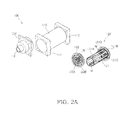
- FIG. 2A is an exploded perspective view illustrating the ion exchanger 100.
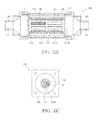
- FIG. 2B is a longitudinal cross-sectional view illustrating the ion exchanger 100, and
- FIG. 2C is a left side view illustrating the ion exchanger 100.
- the ion exchanger 100 includes an outer casing 110, an inner casing 120 coaxially arranged inside the outer casing 110, and cap members 130 and 140 installed in both ends of the outer casing 110.
- the outer casing 110 is a cylindrical frame. Each of the upstream end 111 and the downstream end 112 of the outer casing 110 is formed as an opening end.
- the cap member 130 is installed in the upstream end 111 of the outer casing 110, and the cap member 140 is installed in the downstream end 112 of the outer casing 110.
- the cap member 130 is configured as an inflow portion having an inflow path 131 for flowing the coolant into the ion exchanger 100 from the coolant circulation path 21.
- the inflow path 131 is formed such that a diameter of the inflow path 131 gradually increases along a flow direction of the coolant, that is, from the upstream side to the downstream side in an axial direction of the ion exchanger 100.
- the cap member 140 is configured as a discharge portion having a discharge path 141 for discharging the coolant from the ion exchanger 100 to the coolant circulation path 21.
- the discharge path 141 is formed such that a diameter of the discharge path 141 is gradually reduced along the flow direction of the coolant, that is, from the upstream side to the downstream side in the axial direction of the ion exchanger 100.
- the inner casing 120 is a cylindrical frame.
- the inner casing 120 is coaxially arranged inside the outer casing 110. While the inner casing 120 is provided inside the outer casing 110, the inside of the inner casing 120 serves as an inner path 150, and a gap between the outer casing 110 and the inner casing 120 serves as an outer path 160.
- the inner casing 120 includes a cylindrical portion 121 opened to the upstream end and a lid portion 122 provided in the opening end of the cylindrical portion 121.
- a plurality of rectangular through-holes 121A causing the inner path 150 to communicate with the outer path 160 are formed on the outer circumferential surface (side surface) of the cylindrical portion 121.
- the through-holes 121A are arranged side by side with a predetermined interval in an axial direction of the cylindrical portion 121 and with a predetermined interval in an outer circumferential direction of the cylindrical portion 121.
- the downstream end 121B of the cylindrical portion 121 is formed in a circular disk shape.
- a plurality of communicating portions 121C and 121D where the coolant can pass are formed in the downstream end 121B.
- a plurality of communicating portions 121C are arranged side by side with a predetermined interval around a center of the downstream end 121B.
- the communicating portions 121C are formed to cause the inner path 150 and the discharge path 141 to communicate with each other and are positioned in the vicinity of the center of the downstream end 121B.
- a plurality of communicating portions 121D are arranged side by side with a predetermined interval around the center of the downstream end 121B.
- the communicating portions 121D are formed to cause the outer path 160 and the discharge path 141 to communicate with each other and are positioned in the vicinity of an outer periphery of the downstream end 121B corresponding to an outer side from the communicating portion 121C in a radial direction.
- the lid portion 122 is a disk-like member detachably installed in the opening end of the cylindrical portion 121.
- the lid portion 122 serves as an upstream end of the cylindrical portion 121.
- a plurality of communicating portions 122A and 122B where the coolant can pass are formed in the lid portion 122A.
- a plurality of communicating portions 122A are arranged side by side with a predetermined interval around the center of the lid portion 122.
- the communicating portions 122A are formed to cause the inflow path 131 and the inner path 150 to communicate with each other and are positioned in the vicinity of the center of the lid portion 122.
- a plurality of communicating portions 122B are arranged side by side with a predetermined interval around the center of the lid portion 122.
- the communicating portions 122B are formed to cause the inflow path 131 and the outer path 160 to communicate with each other and are positioned in the vicinity of the outer periphery of the lid portion 122 corresponding to the outer side from the communicating portion 122A in a radial direction.
- An ion exchange resin for removing an impurity ion from the coolant is filled in the inside of the inner casing 120 including the cylindrical portion 121 and the lid portion 122, that is, inside the inner path 150. Since the ion exchange resin is granular, in order to prevent the ion exchange resin from leaking from the inner casing 120, a mesh M having a screen opening (sieve opening) smaller than a particle size of the ion exchange resin is provided in the through-hole 121A of the inner casing 120 and the communicating portions 121C and 122A. The screen opening of the mesh M is set to, approximately, 200 microns.
- the mesh M is provided only in a part of the through-holes 121A and the communicating portions 121C and 122A, the mesh M are provided in all through-holes 121A and communicating portions 121C and 122A in practice.
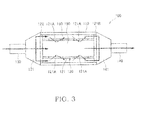
- FIG. 3 is a diagram schematically illustrating a longitudinal cross section of the ion exchanger 100.
- the coolant flowing through the coolant circulation path 21 enters the ion exchanger 100 through the inflow path 131 of the cap member 130.
- the coolant of the inflow path 131 enters the inner path 150 through the communicating portion 122A of the lid portion 122 of the inner casing 120.
- the coolant of the inflow path 131 enters the outer path 160 through the communicating portion 122B of the lid portion 122 of the inner casing 120.
- the coolant flowing through the inner path 150 and the outer path 160 flows to the downstream side by switching a channel between the inner path 150 and the outer path 160 through the through-hole 121A of the cylindrical portion 121 as indicated by the arrow of FIG. 3 . That is, a part of the coolant flowing through the outer path 160 flows to the inner path 150 through the through-hole 121A, and a part of the coolant flowing through the inner path 150 flows to the outer path 160 through the through-hole 121A.
- An impurity ion of the coolant is removed by the ion exchange resin when it passes through the inner path 150. As a result, the electric conductivity of the coolant decreases.
- the coolant arriving at the downstream of the inner path 150 flows to the discharge path 141 through the communicating portion 121C of the downstream end 121B of the inner casing 120.
- the coolant arriving at the downstream of the outer path 160 flows to the discharge path 141 through the communicating portion 121D of the downstream end 121B of the inner casing 120.
- the coolant output from the inner path 150 and the outer path 160 is discharged to the coolant circulation path 21 via the discharge path 141 and is supplied to the fuel cell stack 10.
- FIG. 4A is a diagram illustrating a relationship between an ion exchange rate of a cation and a flow rate of the coolant passing through the ion exchanger.
- FIG. 4B is a diagram illustrating a relationship between an ion exchange rate of an anion and a flow rate of the coolant passing through the ion exchanger.
- FIG. 5 is a diagram illustrating a relationship between a pressure loss and a flow rate of the coolant passing through the ion exchanger.
- the solid line denotes data of the ion exchanger 100 according to the first embodiment
- the dotted line denotes data of the ion exchanger of a comparative example in which no through-hole is provided in the inner casing.
- the coolant does not flow by switching a channel between the outer path and the inner path.
- the coolant flowing through the inflow path 131 enters the inner path 150, and the coolant flowing through the outer path 160 also enters the inner path 150 through the through-hole 121A. For this reason, it is possible to remove an impurity ion using the ion exchange resin in the vicinity of the outer circumferential surface as well as in the vicinity of the front side of the inner path 150 from an initial stage of the use of the ion exchanger 100. Therefore, it is possible to increase the ion exchange rate of the ion exchanger 100. As a result, as illustrated in FIGS.
- the ion exchange rates of cations and anions of the ion exchanger 100 increase, relative to the ion exchange rates of cations and anions of the ion exchanger of the comparative example, within a flow rate range of the coolant anticipated by the fuel cell stack 10.
- the ion exchanger 100 since a part of the coolant flowing through the inner path 150 flows to the outer path 160 through the through-hole 121A, a pressure reduction of the coolant generated when it passes through the inner path 150 and the outer path 160 is suppressed. Therefore, it is possible to suppress an increase of the pressure loss in the ion exchanger 100. As a result, as illustrated in FIG. 5 , the pressure loss of the ion exchanger 100 is reduced, relative to the pressure loss of the ion exchanger of the comparative example, within a flow rate range of the coolant anticipated by the fuel cell stack 10.
- the ion exchanger 100 has a dual channel structure using the outer casing 110 and the inner casing 120 where the ion exchange resin is filled.
- the through-hole 121A that causes the inner path 150 and the outer path 160 to communicate with each other is formed on the outer circumferential surface of the cylindrical portion 121 of the inner casing 120. Since the coolant flowing through the inner path 150 and the outer path 160 flows to the downstream side by switching a channel between the inner path 150 and the outer path 160 through the through-hole 121A, it is possible to remove an impurity ion using the ion exchange resin in the vicinity of the outer circumferential surface of the inner casing 120 from an initial stage of the use and increase the ion exchange rate of the ion exchanger 100. In addition, since a part of the coolant of the inner path 150 flows to the outer path 160 through the through-hole 121A, it is possible to suppress an increase of the pressure loss in the ion exchanger 100.
- the ion exchanger 100 is provided in the coolant circulation path 21 in the downstream side from the radiator 22, it is possible to supply a low-temperature coolant to the ion exchanger 100 and suppress thermal degradation of the ion exchange resin filled in the inside of the inner casing 120.
- FIGS. 6 and 7 An ion exchanger 100 according to a second embodiment of the invention will be described with reference to FIGS. 6 and 7 .
- the second embodiment is different from the first embodiment in the configuration of the through-hole 121A of the cylindrical portion 121 of the inner casing 120. It is noted that, in the following embodiments, like reference numerals denote like elements as in the first embodiment, and the description thereof will not be repeated.
- FIG. 6 is a longitudinal cross-sectional view illustrating the ion exchanger 100 according to the second embodiment.
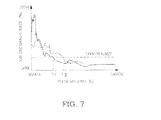
- FIG. 7 is a diagram illustrating a relationship between an ion exchange rate and a flow volume of the coolant passing through the ion exchanger.
- the solid line denotes data of the ion exchanger 100 according to the first embodiment
- the dotted line denotes data of the ion exchanger 100 according to the second embodiment.
- the through-hole 121A is formed on the outer circumferential surface in the vicinity of the downstream end 121B of the cylindrical portion 121 of the inner casing 120. That is, no through-hole 121A is formed in the upstream side of the cylindrical portion 121, but the through-holes 121A are arranged side by side with a predetermined interval along an outer circumferential direction in the downstream side of the cylindrical portion 121.
- the coolant flowing through the inflow path 131 and the outer path 160 flows into the upstream side of the inner path 150, it is likely that the ion exchange resin in the upstream side is locally used.
- the coolant flowing through the inflow path 131 flows into the upstream side of the inner path 150, and the coolant flowing through the outer path 160 flows into the downstream side of the inner path 150. Therefore, it is possible to relatively uniformly use the ion exchange resin across the entire area from an initial stage of the use of the ion exchanger 100.
- the flow volume L2 when the ion exchange rate of the ion exchanger 100 according to the second embodiment reaches the lower limit is larger than the flow volume L1 when the ion exchange rate of the ion exchanger 100 according to the first embodiment reaches the lower limit.
- the through-hole 121A is provided on the outer circumferential surface in the vicinity of the downstream of the cylindrical portion 121 of the inner casing 120, and the coolant flowing through the outer path 160 flows into the downstream side of the inner path 150. Therefore, it is possible to relatively uniformly use the ion exchange resin across the entire area. As a result, it is possible to lengthen a period until the ion exchange rate of the ion exchanger 100 reaches the lower limit and reliably remove an impurity ion from the coolant for a long time. In addition, since a part of the coolant of the inner path 150 flows to the outer path 160 through the through-hole 121A, it is possible to suppress an increase of a pressure loss in the ion exchanger 100.
- FIG. 8 An ion exchanger 100 according to a third embodiment of the invention will be described with reference to FIG. 8 .
- the third embodiment is different from the first and second embodiment in a configuration of the mesh M provided in the through-hole 121A of the inner casing 120 and the like.
- FIG. 8 is a diagram schematically illustrating a longitudinal cross section of the ion exchanger 100 according to the third embodiment.
- meshes M1 as first meshes are provided in the through-holes 121A of the cylindrical portion 121 and the communicating portions 121C of the downstream end 121B, and meshes M2 as second meshes are provided in the communicating portions 122A and 122B of the lid portion 122.
- the mesh M1 provided in the through-hole 121A and the communicating portion 121C has a screen opening smaller than a particle size of the ion exchange resin.
- the screen opening of the mesh M1 is set to, approximately, 200 microns.
- the mesh M1 prevents the ion exchange resin filled in the inner casing 120 from leaking to the outside.
- the mesh M2 provided in the communicating portions 122A and 122B has a screen opening smaller than that of the mesh M1 and is capable of removing a foreign object contained in the coolant.
- the screen opening of the mesh M2 is set to, approximately, 100 microns.
- the mesh M2 serves as a filter that prevents the ion exchange resin filled in the inner casing 120 from leaking to the outside and removes a foreign object when the coolant passes.
- the mesh M1 is provided in the through-hole 121A of the cylindrical portion 121 of the inner casing 120 and the communicating portion 121C of the downstream end 12 1 B, and the mesh M2 having a screen opening smaller than that of the mesh M1 is provided in the communicating portions 122A and 122B of the lid portion 122. Therefore, it is possible to prevent the ion exchange resin from leaking from the inner casing 120 and remove a foreign object contained in the coolant. As a result, it is possible to supply the fuel cell stack 10 with the coolant having a low electric conductivity and no foreign object.
- the mesh M2 is provided in the communicating portions 122A and 122B of the lid portion 122 of the inner casing 120 in the ion exchanger 100 according to the third embodiment, the mesh M2 may also be provided in the communicating portions 121C and 121D of the downstream end 121B of the cylindrical portion 121 as illustrated in FIG. 9 .
- the mesh M1 is provided in the through-hole 121A of the cylindrical portion 121 and the communicating portion 122A of the lid portion 122.
- FIG. 10 An ion exchanger 100 according to a fourth embodiment of the invention will be described with reference to FIG. 10 .
- the fourth embodiment is different from the first to third embodiments in that a guide wall 113 for guiding the flow of the coolant is provided in the outer path 160.
- FIG. 10 is a longitudinal cross-sectional view illustrating the ion exchanger 100 according to the fourth embodiment.
- a guide wall 113 as a wall for guiding the flow of the coolant is provided on the inner circumferential surface of the outer casing 110.
- the guide wall 113 is formed to protrude inward from the inner circumferential surface of the outer casing 110.
- the guide wall 113 is provided for each through-hole 121A of the inner casing 120 and is arranged to face the through-hole 121A.
- the guide wall 113 is formed such that the height protruding from the inner circumferential surface of the outer casing 110 increases from the upstream end 111 of the outer casing 110 to the downstream end 112.
- the coolant flowing through the outer path 160 is guided to the inner casing 120 side by the guide wall 113 provided in the outer path 160. Therefore, the coolant easily flows to the inner path 150 through the through-hole 121A. As a result, it is possible to improve the ion exchange rate.
- the guide wall 113 is arranged to face the through-hole 121 A and is formed such that the protrusion height increases from the upstream end 111 of the outer casing 110 to the downstream end 112, the coolant of the outer path 160 flows to the inner path 150 through the downstream side (the vicinity of the rear side) of each through-hole 121A. Therefore, it is possible to avoid the ion exchange resin from being locally used in the upstream side and relatively uniformly use the ion exchange resin across the entire area. As a result, it is possible to reliably remove an impurity ion of the coolant for a long time.
- FIGS. 11 and 12 An ion exchanger 100 according to a fifth embodiment of the invention will be described with reference to FIGS. 11 and 12 .
- the fifth embodiment is different from the first embodiment in that a partitioning wall 170 is provided in the outer path 160.
- FIG. 11 is a perspective view illustrating the ion exchanger 100 according to the fifth embodiment.
- FIG. 12 is a diagram schematically illustrating a longitudinal cross section of the ion exchanger 100 according to the fifth embodiment.
- a ring-like partitioning wall 170 is fitted to the outer circumferential surface of the cylindrical portion 121 of the inner casing 120.
- the partitioning wall 170 may be fixed to the inner circumferential surface of the outer casing 110 instead of the outer circumferential surface of the cylindrical portion 121.
- the partitioning wall 170 is provided in the outer path 160 so as to be positioned between the through-holes 121A of the upstream side of the cylindrical portion 121 and the through-holes 121A of the downstream side in order to partition the outer path 160 into an upstream portion and a downstream portion.
- the partitioning wall 170 has a plurality of communicating holes 171 that cause the upstream portion and the downstream portion of the outer path 160 to communicate with each other.
- the communicating holes 171 are arranged side by side along a circumferential direction of the partitioning wall 170.
- the coolant flowing into the outer path 160 flows from the upstream portion to the downstream portion through the communicating hole 171 of the partitioning wall 170. Since there is the partitioning wall 170 between the upstream portion and the downstream portion of the outer path 160, the coolant in the upstream portion of the outer path 160 easily flows into the inner path 150 through the through-hole 121A of the upstream side as indicated by the arrow of FIG. 12 .
- the mesh M1 as a first mesh is provided in the communicating portion 122A of the lid portion 122 and the through-hole 121A of the upstream side of the cylindrical portion 121
- the mesh M2 as a second mesh is provided in the through-hole 121A of the downstream side of the cylindrical portion 121, the communicating portion 121C of the downstream end 121B, and the communicating hole 171 of the partitioning wall 170.
- the mesh M1 has a screen opening smaller than a particle size of the ion exchange resin.
- the screen opening of the mesh M1 is set to, approximately, 200 microns.
- the mesh M1 prevents the ion exchange resin filled in the inner casing 120 from leaking to the outside.
- the mesh M2 has a screen opening smaller than that of the mesh M1 and is capable of removing a foreign object contained in the coolant.
- the screen opening of the mesh M2 is set to, approximately, 100 microns.
- the mesh M2 prevents the ion exchange resin filled in the inner casing 120 from leaking to the outside and serves as a filter that removes a foreign object as the coolant passes.
- the partitioning wall 170 having the communicating hole 171 is provided in the outer path 160 between the through-hole 121A of the upstream side and the through-hole 121A of the downstream side. Therefore, the coolant of the upstream portion of the outer path 160 easily flows to the inner path 150 through the through-hole 121A of the upstream side. As a result, it is possible to improve the ion exchange rate of the ion exchanger 100.
- the partitioning wall 170 Since the partitioning wall 170 is arranged in rear of the through-hole 121A of the upstream side, the coolant of the upstream portion of the outer path 160 flows into the inner path 150 through through-hole 121A of the upstream side in the vicinity of the partitioning wall 170, that is, the downstream position of through-hole 121A of the upstream side. For this reason, it is possible to prevent the ion exchange resin of the upstream side from being locally used and relatively uniformly use the ion exchange resin across the entire area. As a result, it is possible to reliably remove an impurity ion of the coolant for a long time.
- the mesh M1 is provided in the communicating portion 122A of the lid portion 122 and the through-hole 121A of the upstream side of the cylindrical portion 121, and the mesh M2 having a screen opening smaller than that of the mesh M1 is provided in the through-hole 121A of the downstream side of the cylindrical portion 121, the communicating portion 121C of the downstream end 121B, and the communicating hole 171 of the partitioning wall 170. Therefore, it is possible to prevent the ion exchange resin from leaking from the inner casing 120 and remove a foreign object contained in the coolant. As a result, it is possible to supply the fuel cell stack 10 with a coolant that does not contain a foreign object with a low electric conductivity.
- the ion exchanger 100 is provided in the coolant circulation path 21 between the downstream end junction of the bypass path 23 and the circulating pump 26.
- the ion exchanger 100 may be provided in the coolant circulation path 21 between the circulating pump 26 and the fuel cell stack 10 as illustrated in FIG. 13 . In this manner, in the cooler 20 having the ion exchanger 100 arranged immediately before the fuel cell stack 10, it is possible to reduce an electric conductivity of the coolant flowing to the fuel cell stack 10 and remove a foreign object of the coolant as small as possible.
Landscapes
- Chemical & Material Sciences (AREA)
- Life Sciences & Earth Sciences (AREA)
- Engineering & Computer Science (AREA)
- Chemical Kinetics & Catalysis (AREA)
- Organic Chemistry (AREA)
- Sustainable Development (AREA)
- Manufacturing & Machinery (AREA)
- Sustainable Energy (AREA)
- Electrochemistry (AREA)
- General Chemical & Material Sciences (AREA)
- Hydrology & Water Resources (AREA)
- Environmental & Geological Engineering (AREA)
- Water Supply & Treatment (AREA)
- Fuel Cell (AREA)
- Treatment Of Water By Ion Exchange (AREA)
Abstract

Description
- The present invention relates to an ion exchanger for removing an impurity ion from a fluid and a cooler having the ion exchanger.
- A fuel cell includes an anode, a cathode, and an electrolytic membrane interposed therebetween. The fuel cell generates electric power using an anode gas containing hydrogen supplied to the anode and a cathode gas containing oxygen supplied to the cathode. An electrochemical reaction generated in both the anode and the cathode can be expressed as follows.
Anode: 2H2 → 4H+ + 4e- (1)
Cathode: 4H+ + 4e- + O2 → 2H2O (2)
- Through the electrochemical reaction of Expressions (1) and (2), the fuel cell generates an electromotive force of, approximately, 1 V.
- When the fuel cell is employed as a power source of a vehicle, a fuel cell stack obtained by stacking several hundreds of fuel cells is used. In addition, a fuel cell system capable of supplying an anode gas and a cathode gas to the fuel cell stack is provided to output electric power for driving a vehicle.
- In such a fuel cell system, a coolant circulation path is provided to cool the fuel cell stack. If the fuel cell system is used for a long time, an impurity ion such as Na+ or SO4 2- is eluted to the coolant from a pipe or the like of the circulation path, so that electric conductivity of the coolant increases, and power generation performance of the fuel cell stack is deteriorated. For this reason, an ion exchanger for removing an impurity ion from the coolant is provided in the coolant circulation path. In the ion exchanger, it is preferable that an ion exchange rate relating to impurity ion removal performance be high and a pressure loss which is a pressure difference between an inlet side and an outlet side be small.
-
JP 2009-219954 A - In the ion exchanger described above, a cross-sectional area of the flow path is reduced in the center of the bypass path. Therefore, a pressure loss in the bypass path easily increases. In addition, it is difficult to improve both the ion exchange rate and the pressure loss.
- It is therefore an object of the present invention to provide an ion exchanger capable of suppressing an increase of the pressure loss and improving the ion exchange rate.
- According to an aspect of the present invention, an ion exchanger configured to remove an impurity ion of a coolant for cooling a fuel cell is provided. The ion exchanger includes an inflow portion having an inflow path where the coolant enters, a discharge portion having a discharge path for discharging the coolant, an outer casing having an upstream end where the inflow portion is provided and a downstream end where the discharge portion is provided, an inner casing housed inside the outer casing, an outer path formed between the inner casing and the outer casing to cause the inflow path and the discharge path to communicate with each other, and an inner path that is formed inside the inner casing to cause the inflow path and the discharge path to communicate with each other and is configured to enclose an ion exchange resin capable of removing an impurity ion of the coolant. The inner casing has a through-hole that causes the inner path and the outer path to communicate with each other.
- Embodiments and advantages of this invention will be described in detail below with reference to the attached figures.
-
-
FIG. 1 is a schematic view illustrating a fuel cell system having an ion exchanger according to a first embodiment of the invention. -
FIG. 2A is an exploded perspective view illustrating the ion exchanger provided in a cooler of the fuel cell system. -
FIG. 2B is a longitudinal cross-sectional view illustrating the ion exchanger. -
FIG. 2C is a side view illustrating an upstream end side of the ion exchanger. -
FIG. 3 is a diagram schematically illustrating a longitudinal cross section of the ion exchanger. -
FIG. 4A is a diagram illustrating a relationship between an ion exchange rate of a cation and a flow rate of a coolant passing through the ion exchanger. -
FIG. 4B is a diagram illustrating a relationship between an ion exchange rate of an anion and a flow rate of the coolant passing through the ion exchanger. -
FIG. 5 is a diagram illustrating a relationship between a pressure loss and a flow rate of the coolant passing through the ion exchanger. -
FIG. 6 is a longitudinal cross-sectional view illustrating an ion exchanger according to a second embodiment of the invention. -
FIG. 7 is a diagram illustrating a relationship between an ion exchange rate and a flow volume of the coolant passing through the ion exchanger. -
FIG. 8 is a diagram schematically illustrating a longitudinal cross section of an ion exchanger according to a third embodiment of the invention. -
FIG. 9 is a diagram schematically illustrating a longitudinal cross section of an ion exchanger according to a modification of the third embodiment. -
FIG. 10 is a longitudinal cross sectional view illustrating an ion exchanger according to a fourth embodiment of the invention. -
FIG. 11 is a perspective view illustrating an ion exchanger according to a fifth embodiment of the invention. -
FIG. 12 is a diagram schematically illustrating a longitudinal cross section of an ion exchanger according to the fifth embodiment. -
FIG. 13 is a schematic view illustrating a modification of the fuel cell system. - (First Embodiment)
FIG. 1 is a schematic view illustrating afuel cell system 1 having anion exchanger 100 according to a first embodiment of the present invention. - As illustrated in
FIG. 1 , thefuel cell system 1 includes afuel cell stack 10, acooler 20 that cools thefuel cell stack 10, and acontroller 30 that executes a system control. - The
fuel cell stack 10 is configured by stacking a predetermined number of fuel cells. Thefuel cell stack 10 generates electric power using an anode gas supplied from an anode gas supply unit and a cathode gas supplied from a cathode gas supply unit. The electric power generated by thefuel cell stack 10 is supplied to various electric devices such as a driving motor for driving a vehicle. - The
cooler 20 is a device for cooling thefuel cell stack 10 using a coolant. As the coolant, pure water or a glycol-based antifreeze fluid may be employed. Thecooler 20 includes acoolant circulation path 21, aradiator 22, abypass path 23, a three-way valve 24, areservoir 25, a circulatingpump 26, and theion exchanger 100. - The
coolant circulation path 21 is a path where a coolant for cooling thefuel cell stack 10 flows. One end of thecoolant circulation path 21 is connected to a coolant inlet port of thefuel cell stack 10, and the other end is connected to a coolant outlet port of thefuel cell stack 10. - The
radiator 22 is a heat radiating device capable of cooling the coolant discharged from thefuel cell stack 10 and is provided in thecoolant circulation path 21. - The
bypass path 23 is connected to thecoolant circulation path 21 by bypassing theradiator 22. - The three-
way valve 24 is provided in a junction between thecoolant circulation path 21 in the upstream side from theradiator 22 and thebypass path 23. The three-way valve 24 is a flow rate adjustment member that adjusts a flow rate of the coolant flowing to theradiator 22 and a flow rate of the coolant flowing to thebypass path 23. An opening degree of the three-way valve 24 is controlled by thecontroller 30 based on a cooling load state and the like. - The
reservoir 25 is provided in thecoolant circulation path 21 between theradiator 22 and a downstream end junction of thebypass path 23. Thereservoir 25 has acap 25A opened and closed depending on a pressure of the coolant in thecoolant circulation path 21. When the pressure in thecoolant circulation path 21 is high, a part of the coolant flowing through thecoolant circulation path 21 is supplied to thereservoir 25 through thecap 25A. When the pressure in thecoolant circulation path 21 is low, the coolant in thereservoir 25 is supplied to thecoolant circulation path 21 through thecap 25A. As a result, the pressure of the coolant in thecoolant circulation path 21 is maintained within a predetermined pressure range. - The circulating
pump 26 is a forced feed device for circulating the coolant. The circulatingpump 26 is provided in thecoolant circulation path 21 between thefuel cell stack 10 and the downstream end junction of thebypass path 23. A discharge flow rate of the circulatingpump 26 is controlled by thecontroller 30. - The
ion exchanger 100 is provided in thecoolant circulation path 21 between the circulatingpump 26 and thecoolant circulation path 21 in the downstream side from theradiator 22, for example, the downstream end junction of thebypass path 23. A granular ion exchanger resin capable of removing an impurity ion is enclosed in theion exchanger 100. Theion exchanger 100 lowers the electric conductivity of the coolant by removing an impurity ion included in the coolant. - The
controller 30 includes a microcomputer having a central processing unit (CPU), a read-only memory (ROM), a random access memory (RAM), and an input/output interface (I/O interface). Thecontroller 30 receives signals from various sensors that detect a driving condition of thefuel cell stack 10 and controls the three-way valve 24, the circulatingpump 26, and the like based on such input signals. - A configuration of the
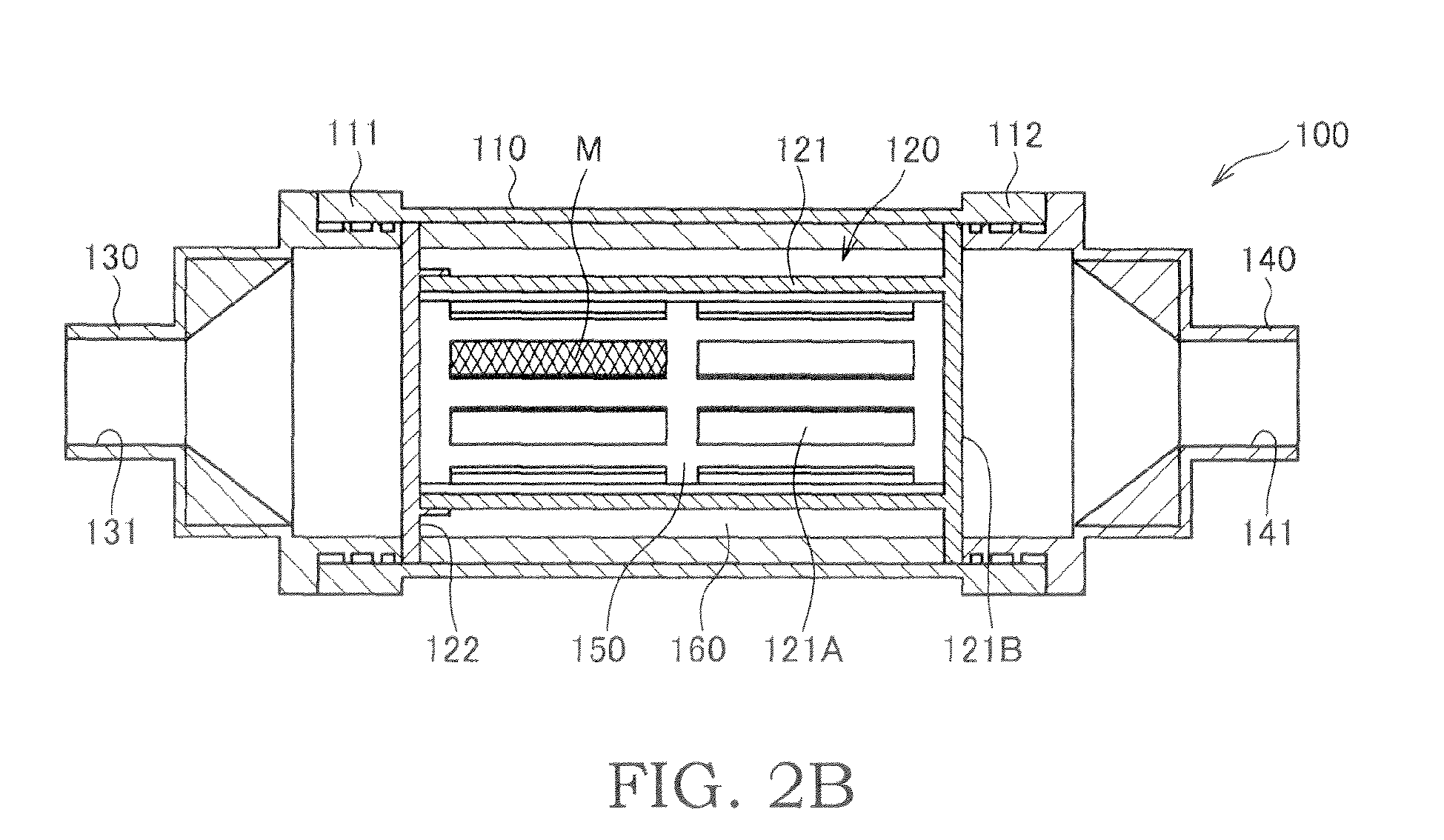
ion exchanger 100 will be described with reference toFIGS. 2A to 2C .FIG. 2A is an exploded perspective view illustrating theion exchanger 100.FIG. 2B is a longitudinal cross-sectional view illustrating theion exchanger 100, andFIG. 2C is a left side view illustrating theion exchanger 100. - Referring to
FIGS. 2A to 2C , theion exchanger 100 includes anouter casing 110, aninner casing 120 coaxially arranged inside theouter casing 110, andcap members outer casing 110. - The
outer casing 110 is a cylindrical frame. Each of theupstream end 111 and thedownstream end 112 of theouter casing 110 is formed as an opening end. Thecap member 130 is installed in theupstream end 111 of theouter casing 110, and thecap member 140 is installed in thedownstream end 112 of theouter casing 110. - The
cap member 130 is configured as an inflow portion having aninflow path 131 for flowing the coolant into theion exchanger 100 from thecoolant circulation path 21. Theinflow path 131 is formed such that a diameter of theinflow path 131 gradually increases along a flow direction of the coolant, that is, from the upstream side to the downstream side in an axial direction of theion exchanger 100. - The
cap member 140 is configured as a discharge portion having adischarge path 141 for discharging the coolant from theion exchanger 100 to thecoolant circulation path 21. Thedischarge path 141 is formed such that a diameter of thedischarge path 141 is gradually reduced along the flow direction of the coolant, that is, from the upstream side to the downstream side in the axial direction of theion exchanger 100. - The
inner casing 120 is a cylindrical frame. Theinner casing 120 is coaxially arranged inside theouter casing 110. While theinner casing 120 is provided inside theouter casing 110, the inside of theinner casing 120 serves as aninner path 150, and a gap between theouter casing 110 and theinner casing 120 serves as anouter path 160. - The
inner casing 120 includes acylindrical portion 121 opened to the upstream end and alid portion 122 provided in the opening end of thecylindrical portion 121. - A plurality of rectangular through-
holes 121A causing theinner path 150 to communicate with theouter path 160 are formed on the outer circumferential surface (side surface) of thecylindrical portion 121. The through-holes 121A are arranged side by side with a predetermined interval in an axial direction of thecylindrical portion 121 and with a predetermined interval in an outer circumferential direction of thecylindrical portion 121. - The
downstream end 121B of thecylindrical portion 121 is formed in a circular disk shape. A plurality of communicatingportions downstream end 121B. A plurality of communicatingportions 121C are arranged side by side with a predetermined interval around a center of thedownstream end 121B. The communicatingportions 121C are formed to cause theinner path 150 and thedischarge path 141 to communicate with each other and are positioned in the vicinity of the center of thedownstream end 121B. A plurality of communicatingportions 121D are arranged side by side with a predetermined interval around the center of thedownstream end 121B. The communicatingportions 121D are formed to cause theouter path 160 and thedischarge path 141 to communicate with each other and are positioned in the vicinity of an outer periphery of thedownstream end 121B corresponding to an outer side from the communicatingportion 121C in a radial direction. - The
lid portion 122 is a disk-like member detachably installed in the opening end of thecylindrical portion 121. Thelid portion 122 serves as an upstream end of thecylindrical portion 121. A plurality of communicatingportions lid portion 122A. A plurality of communicatingportions 122A are arranged side by side with a predetermined interval around the center of thelid portion 122. The communicatingportions 122A are formed to cause theinflow path 131 and theinner path 150 to communicate with each other and are positioned in the vicinity of the center of thelid portion 122. A plurality of communicatingportions 122B are arranged side by side with a predetermined interval around the center of thelid portion 122. The communicatingportions 122B are formed to cause theinflow path 131 and theouter path 160 to communicate with each other and are positioned in the vicinity of the outer periphery of thelid portion 122 corresponding to the outer side from the communicatingportion 122A in a radial direction. - An ion exchange resin for removing an impurity ion from the coolant is filled in the inside of the
inner casing 120 including thecylindrical portion 121 and thelid portion 122, that is, inside theinner path 150. Since the ion exchange resin is granular, in order to prevent the ion exchange resin from leaking from theinner casing 120, a mesh M having a screen opening (sieve opening) smaller than a particle size of the ion exchange resin is provided in the through-hole 121A of theinner casing 120 and the communicatingportions FIGS. 2A to 2C , the mesh M is provided only in a part of the through-holes 121A and the communicatingportions holes 121A and communicatingportions - A flow of the coolant passing through the
ion exchanger 100 will be described with reference toFIGS. 2A ,2B , and3. FIG. 3 is a diagram schematically illustrating a longitudinal cross section of theion exchanger 100. - The coolant flowing through the
coolant circulation path 21 enters theion exchanger 100 through theinflow path 131 of thecap member 130. The coolant of theinflow path 131 enters theinner path 150 through the communicatingportion 122A of thelid portion 122 of theinner casing 120. In addition, the coolant of theinflow path 131 enters theouter path 160 through the communicatingportion 122B of thelid portion 122 of theinner casing 120. - The coolant flowing through the
inner path 150 and theouter path 160 flows to the downstream side by switching a channel between theinner path 150 and theouter path 160 through the through-hole 121A of thecylindrical portion 121 as indicated by the arrow ofFIG. 3 . That is, a part of the coolant flowing through theouter path 160 flows to theinner path 150 through the through-hole 121A, and a part of the coolant flowing through theinner path 150 flows to theouter path 160 through the through-hole 121A. An impurity ion of the coolant is removed by the ion exchange resin when it passes through theinner path 150. As a result, the electric conductivity of the coolant decreases. - Then, the coolant arriving at the downstream of the
inner path 150 flows to thedischarge path 141 through the communicatingportion 121C of thedownstream end 121B of theinner casing 120. The coolant arriving at the downstream of theouter path 160 flows to thedischarge path 141 through the communicatingportion 121D of thedownstream end 121B of theinner casing 120. The coolant output from theinner path 150 and theouter path 160 is discharged to thecoolant circulation path 21 via thedischarge path 141 and is supplied to thefuel cell stack 10. - The effects of the
ion exchanger 100 will be described with reference toFIGS. 4A, 4B , and5 . -
FIG. 4A is a diagram illustrating a relationship between an ion exchange rate of a cation and a flow rate of the coolant passing through the ion exchanger.FIG. 4B is a diagram illustrating a relationship between an ion exchange rate of an anion and a flow rate of the coolant passing through the ion exchanger.FIG. 5 is a diagram illustrating a relationship between a pressure loss and a flow rate of the coolant passing through the ion exchanger. - It is noted that, in
FIGS. 4A, 4B , and5 , the solid line denotes data of theion exchanger 100 according to the first embodiment, and the dotted line denotes data of the ion exchanger of a comparative example in which no through-hole is provided in the inner casing. In the ion exchanger of the comparative example, the coolant does not flow by switching a channel between the outer path and the inner path. - In the
ion exchanger 100 according to the first embodiment, the coolant flowing through theinflow path 131 enters theinner path 150, and the coolant flowing through theouter path 160 also enters theinner path 150 through the through-hole 121A. For this reason, it is possible to remove an impurity ion using the ion exchange resin in the vicinity of the outer circumferential surface as well as in the vicinity of the front side of theinner path 150 from an initial stage of the use of theion exchanger 100. Therefore, it is possible to increase the ion exchange rate of theion exchanger 100. As a result, as illustrated inFIGS. 4A and 4B , the ion exchange rates of cations and anions of theion exchanger 100 increase, relative to the ion exchange rates of cations and anions of the ion exchanger of the comparative example, within a flow rate range of the coolant anticipated by thefuel cell stack 10. - In the
ion exchanger 100, since a part of the coolant flowing through theinner path 150 flows to theouter path 160 through the through-hole 121A, a pressure reduction of the coolant generated when it passes through theinner path 150 and theouter path 160 is suppressed. Therefore, it is possible to suppress an increase of the pressure loss in theion exchanger 100. As a result, as illustrated inFIG. 5 , the pressure loss of theion exchanger 100 is reduced, relative to the pressure loss of the ion exchanger of the comparative example, within a flow rate range of the coolant anticipated by thefuel cell stack 10. - The following effects can be obtained using the
ion exchanger 100 according to the first embodiment described above. - The
ion exchanger 100 has a dual channel structure using theouter casing 110 and theinner casing 120 where the ion exchange resin is filled. The through-hole 121A that causes theinner path 150 and theouter path 160 to communicate with each other is formed on the outer circumferential surface of thecylindrical portion 121 of theinner casing 120. Since the coolant flowing through theinner path 150 and theouter path 160 flows to the downstream side by switching a channel between theinner path 150 and theouter path 160 through the through-hole 121A, it is possible to remove an impurity ion using the ion exchange resin in the vicinity of the outer circumferential surface of theinner casing 120 from an initial stage of the use and increase the ion exchange rate of theion exchanger 100. In addition, since a part of the coolant of theinner path 150 flows to theouter path 160 through the through-hole 121A, it is possible to suppress an increase of the pressure loss in theion exchanger 100. - It is noted that, in the cooler 20 of
FIG. 1 , since theion exchanger 100 is provided in thecoolant circulation path 21 in the downstream side from theradiator 22, it is possible to supply a low-temperature coolant to theion exchanger 100 and suppress thermal degradation of the ion exchange resin filled in the inside of theinner casing 120. - (Second Embodiment) An
ion exchanger 100 according to a second embodiment of the invention will be described with reference toFIGS. 6 and7 . The second embodiment is different from the first embodiment in the configuration of the through-hole 121A of thecylindrical portion 121 of theinner casing 120. It is noted that, in the following embodiments, like reference numerals denote like elements as in the first embodiment, and the description thereof will not be repeated. -
FIG. 6 is a longitudinal cross-sectional view illustrating theion exchanger 100 according to the second embodiment.FIG. 7 is a diagram illustrating a relationship between an ion exchange rate and a flow volume of the coolant passing through the ion exchanger. InFIG. 7 , the solid line denotes data of theion exchanger 100 according to the first embodiment, and the dotted line denotes data of theion exchanger 100 according to the second embodiment. - As illustrated in
FIG. 6 , in theion exchanger 100 according to the second embodiment, the through-hole 121A is formed on the outer circumferential surface in the vicinity of thedownstream end 121B of thecylindrical portion 121 of theinner casing 120. That is, no through-hole 121A is formed in the upstream side of thecylindrical portion 121, but the through-holes 121A are arranged side by side with a predetermined interval along an outer circumferential direction in the downstream side of thecylindrical portion 121. - In the
ion exchanger 100 according to the first embodiment, since the coolant flowing through theinflow path 131 and theouter path 160 flows into the upstream side of theinner path 150, it is likely that the ion exchange resin in the upstream side is locally used. In comparison, in theion exchanger 100 according to the second embodiment, the coolant flowing through theinflow path 131 flows into the upstream side of theinner path 150, and the coolant flowing through theouter path 160 flows into the downstream side of theinner path 150. Therefore, it is possible to relatively uniformly use the ion exchange resin across the entire area from an initial stage of the use of theion exchanger 100. - Therefore, as illustrated in
FIG. 7 , the flow volume L2 when the ion exchange rate of theion exchanger 100 according to the second embodiment reaches the lower limit is larger than the flow volume L1 when the ion exchange rate of theion exchanger 100 according to the first embodiment reaches the lower limit. - In the
ion exchanger 100 according to the second embodiment, the through-hole 121A is provided on the outer circumferential surface in the vicinity of the downstream of thecylindrical portion 121 of theinner casing 120, and the coolant flowing through theouter path 160 flows into the downstream side of theinner path 150. Therefore, it is possible to relatively uniformly use the ion exchange resin across the entire area. As a result, it is possible to lengthen a period until the ion exchange rate of theion exchanger 100 reaches the lower limit and reliably remove an impurity ion from the coolant for a long time. In addition, since a part of the coolant of theinner path 150 flows to theouter path 160 through the through-hole 121A, it is possible to suppress an increase of a pressure loss in theion exchanger 100. - (Third Embodiment) An
ion exchanger 100 according to a third embodiment of the invention will be described with reference toFIG. 8 . The third embodiment is different from the first and second embodiment in a configuration of the mesh M provided in the through-hole 121A of theinner casing 120 and the like. -
FIG. 8 is a diagram schematically illustrating a longitudinal cross section of theion exchanger 100 according to the third embodiment. - As illustrated in
FIG. 8 , in theion exchanger 100, meshes M1 as first meshes are provided in the through-holes 121A of thecylindrical portion 121 and the communicatingportions 121C of thedownstream end 121B, and meshes M2 as second meshes are provided in the communicatingportions lid portion 122. - The mesh M1 provided in the through-
hole 121A and the communicatingportion 121C has a screen opening smaller than a particle size of the ion exchange resin. The screen opening of the mesh M1 is set to, approximately, 200 microns. The mesh M1 prevents the ion exchange resin filled in theinner casing 120 from leaking to the outside. - The mesh M2 provided in the communicating
portions inner casing 120 from leaking to the outside and removes a foreign object when the coolant passes. - In the
ion exchanger 100 according to the third embodiment, the mesh M1 is provided in the through-hole 121A of thecylindrical portion 121 of theinner casing 120 and the communicatingportion 121C of the downstream end 12 1 B, and the mesh M2 having a screen opening smaller than that of the mesh M1 is provided in the communicatingportions lid portion 122. Therefore, it is possible to prevent the ion exchange resin from leaking from theinner casing 120 and remove a foreign object contained in the coolant. As a result, it is possible to supply thefuel cell stack 10 with the coolant having a low electric conductivity and no foreign object. - It is noted that, although the mesh M2 is provided in the communicating
portions lid portion 122 of theinner casing 120 in theion exchanger 100 according to the third embodiment, the mesh M2 may also be provided in the communicatingportions downstream end 121B of thecylindrical portion 121 as illustrated inFIG. 9 . In this case, the mesh M1 is provided in the through-hole 121A of thecylindrical portion 121 and the communicatingportion 122A of thelid portion 122. In theion exchanger 100 according to a modification of the third embodiment illustrated inFIG. 9 , it is possible to prevent the ion exchange resin from leaking from theinner casing 120 and remove a foreign object contained in the coolant. As a result, it is possible to supply thefuel cell stack 10 with the coolant having a low electric conductivity and no foreign object. - (Fourth Embodiment) An
ion exchanger 100 according to a fourth embodiment of the invention will be described with reference toFIG. 10 . The fourth embodiment is different from the first to third embodiments in that aguide wall 113 for guiding the flow of the coolant is provided in theouter path 160. -
FIG. 10 is a longitudinal cross-sectional view illustrating theion exchanger 100 according to the fourth embodiment. - As illustrated in
FIG. 10 , in theion exchanger 100 according to the fourth embodiment, aguide wall 113 as a wall for guiding the flow of the coolant is provided on the inner circumferential surface of theouter casing 110. Theguide wall 113 is formed to protrude inward from the inner circumferential surface of theouter casing 110. Theguide wall 113 is provided for each through-hole 121A of theinner casing 120 and is arranged to face the through-hole 121A. Theguide wall 113 is formed such that the height protruding from the inner circumferential surface of theouter casing 110 increases from theupstream end 111 of theouter casing 110 to thedownstream end 112. - In the
ion exchanger 100 according to the fourth embodiment, the coolant flowing through theouter path 160 is guided to theinner casing 120 side by theguide wall 113 provided in theouter path 160. Therefore, the coolant easily flows to theinner path 150 through the through-hole 121A. As a result, it is possible to improve the ion exchange rate. - In addition, since the
guide wall 113 is arranged to face the through-hole 121 A and is formed such that the protrusion height increases from theupstream end 111 of theouter casing 110 to thedownstream end 112, the coolant of theouter path 160 flows to theinner path 150 through the downstream side (the vicinity of the rear side) of each through-hole 121A. Therefore, it is possible to avoid the ion exchange resin from being locally used in the upstream side and relatively uniformly use the ion exchange resin across the entire area. As a result, it is possible to reliably remove an impurity ion of the coolant for a long time. - (Fifth Embodiment) An
ion exchanger 100 according to a fifth embodiment of the invention will be described with reference toFIGS. 11 and12 . The fifth embodiment is different from the first embodiment in that apartitioning wall 170 is provided in theouter path 160. -
FIG. 11 is a perspective view illustrating theion exchanger 100 according to the fifth embodiment.FIG. 12 is a diagram schematically illustrating a longitudinal cross section of theion exchanger 100 according to the fifth embodiment. - As illustrated in
FIGS. 11 and12 , in theion exchanger 100 according to the fifth embodiment, a ring-like partitioning wall 170 is fitted to the outer circumferential surface of thecylindrical portion 121 of theinner casing 120. Thepartitioning wall 170 may be fixed to the inner circumferential surface of theouter casing 110 instead of the outer circumferential surface of thecylindrical portion 121. Thepartitioning wall 170 is provided in theouter path 160 so as to be positioned between the through-holes 121A of the upstream side of thecylindrical portion 121 and the through-holes 121A of the downstream side in order to partition theouter path 160 into an upstream portion and a downstream portion. Thepartitioning wall 170 has a plurality of communicatingholes 171 that cause the upstream portion and the downstream portion of theouter path 160 to communicate with each other. The communicatingholes 171 are arranged side by side along a circumferential direction of thepartitioning wall 170. - The coolant flowing into the
outer path 160 flows from the upstream portion to the downstream portion through the communicatinghole 171 of thepartitioning wall 170. Since there is thepartitioning wall 170 between the upstream portion and the downstream portion of theouter path 160, the coolant in the upstream portion of theouter path 160 easily flows into theinner path 150 through the through-hole 121A of the upstream side as indicated by the arrow ofFIG. 12 . - As illustrated in
FIG. 12 , in theion exchanger 100, the mesh M1 as a first mesh is provided in the communicatingportion 122A of thelid portion 122 and the through-hole 121A of the upstream side of thecylindrical portion 121, and the mesh M2 as a second mesh is provided in the through-hole 121A of the downstream side of thecylindrical portion 121, the communicatingportion 121C of thedownstream end 121B, and the communicatinghole 171 of thepartitioning wall 170. - The mesh M1 has a screen opening smaller than a particle size of the ion exchange resin. The screen opening of the mesh M1 is set to, approximately, 200 microns. The mesh M1 prevents the ion exchange resin filled in the
inner casing 120 from leaking to the outside. - The mesh M2 has a screen opening smaller than that of the mesh M1 and is capable of removing a foreign object contained in the coolant. The screen opening of the mesh M2 is set to, approximately, 100 microns. The mesh M2 prevents the ion exchange resin filled in the
inner casing 120 from leaking to the outside and serves as a filter that removes a foreign object as the coolant passes. - In the
ion exchanger 100 according to the fifth embodiment, thepartitioning wall 170 having the communicatinghole 171 is provided in theouter path 160 between the through-hole 121A of the upstream side and the through-hole 121A of the downstream side. Therefore, the coolant of the upstream portion of theouter path 160 easily flows to theinner path 150 through the through-hole 121A of the upstream side. As a result, it is possible to improve the ion exchange rate of theion exchanger 100. - Since the
partitioning wall 170 is arranged in rear of the through-hole 121A of the upstream side, the coolant of the upstream portion of theouter path 160 flows into theinner path 150 through through-hole 121A of the upstream side in the vicinity of thepartitioning wall 170, that is, the downstream position of through-hole 121A of the upstream side. For this reason, it is possible to prevent the ion exchange resin of the upstream side from being locally used and relatively uniformly use the ion exchange resin across the entire area. As a result, it is possible to reliably remove an impurity ion of the coolant for a long time. - In the
ion exchanger 100 according to the fifth embodiment, the mesh M1 is provided in the communicatingportion 122A of thelid portion 122 and the through-hole 121A of the upstream side of thecylindrical portion 121, and the mesh M2 having a screen opening smaller than that of the mesh M1 is provided in the through-hole 121A of the downstream side of thecylindrical portion 121, the communicatingportion 121C of thedownstream end 121B, and the communicatinghole 171 of thepartitioning wall 170. Therefore, it is possible to prevent the ion exchange resin from leaking from theinner casing 120 and remove a foreign object contained in the coolant. As a result, it is possible to supply thefuel cell stack 10 with a coolant that does not contain a foreign object with a low electric conductivity. - In the first to fifth embodiments, as illustrated in
FIG. 1 , theion exchanger 100 is provided in thecoolant circulation path 21 between the downstream end junction of thebypass path 23 and the circulatingpump 26. However, theion exchanger 100 may be provided in thecoolant circulation path 21 between the circulatingpump 26 and thefuel cell stack 10 as illustrated inFIG. 13 . In this manner, in the cooler 20 having theion exchanger 100 arranged immediately before thefuel cell stack 10, it is possible to reduce an electric conductivity of the coolant flowing to thefuel cell stack 10 and remove a foreign object of the coolant as small as possible. - When the
ion exchanger 100 is provided in the vicinity of the circulatingpump 26 between the circulatingpump 26 and thefuel cell stack 10, a high-pressure coolant discharged from the circulatingpump 26 is immediately supplied to theion exchanger 100. - As a volume of the ion exchange resin occupying the inside of the
inner casing 120 is reduced due to deterioration of the ion exchange resin and the like, a gap between the ion exchange resins increases, and the ion exchange rate decreases. However, if the high-pressure coolant discharged from the circulatingpump 26 is immediately supplied to theion exchanger 100, the ion exchange resin is surged to thedownstream end 121B side of theinner casing 120 by virtue of the discharge pressure, and thus it is possible to suppress an increase of the gap between the ion exchange resins. Therefore, in the cooler 20 having theion exchanger 100 arranged in the vicinity of the circulatingpump 26, it is possible to suppress reduction of the ion exchange rate of theion exchanger 100. - Embodiments of the present invention were described above, but the above embodiments merely illustrate a part of examples of applications of the present invention, and the technical scope of the present invention is not limited to the specific configurations described in the embodiments.
- The present application claims priority based on Japanese Patent Application No.
2011-226629
Claims (12)
- An ion exchanger configured to remove an impurity ion of a coolant for cooling a fuel cell, comprising:an inflow portion having an inflow path where the coolant enters;a discharge portion having a discharge path for discharging the coolant;an outer casing having an upstream end where the inflow portion is provided and a downstream end where the discharge portion is provided;an inner casing housed inside the outer casing;an outer path formed between the inner casing and the outer casing to cause the inflow path and the discharge path to communicate with each other; andan inner path that is formed inside the inner casing to cause the inflow path and the discharge path to communicate with each other and is configured to enclose an ion exchange resin capable of removing an impurity ion of the coolant,wherein the inner casing has a through-hole that causes the inner path and the outer path to communicate with each other.
- The ion exchanger according to claim 1, wherein a plurality of the through-holes are formed side by side on an outer circumferential surface of the inner casing along a circumferential direction and an axial direction of the inner casing.
- The ion exchanger according to claim 1, wherein a plurality of the through-holes are formed on an outer circumferential surface in the vicinity of a downstream side of the inner casing.
- The ion exchanger according to any one of claims 1 to 3, wherein a mesh having a screen opening smaller than a particle size of the ion exchange resin is provided in a communicating portion between the inner path and the inflow path, a communicating portion between the inner path and the discharge path, and the through-hole.
- The ion exchanger according to claim 4, wherein a first mesh having a screen opening smaller than a particle size of the ion exchange resin is provided in the communicating portion between the inner path and the discharge path and the through-hole, and a second mesh that is capable of removing a foreign object contained in the coolant and has a screen opening smaller than that of the first mesh is provided in the communicating portion between the inner path and the inflow path and the communicating portion between the outer path and the inflow path.
- The ion exchanger according to claim 4, wherein a first mesh having a screen opening smaller than a particle size of the ion exchange resin is provided in the communicating portion between the inner path and the inflow path and the through-hole, and a second mesh that is capable of removing a foreign object contained in the coolant and has a screen opening smaller than that of the first mesh is provided in the communicating portion between the inner path and the discharge path and the communicating portion between the outer path and the discharge path.
- The ion exchanger according to any one of claims 1 to 6, wherein a wall portion configured to guide the coolant is provided in the outer path in order to allow the coolant flowing through the outer path to easily enter the inner path through the through-hole.
- The ion exchanger according to claim 1 or 2, further comprising a partitioning wall configured to partition the outer path into an upstream portion and a downstream portion; and
a communicating hole formed in the partitioning wall to cause the upstream and downstream portions of the outer path to communicate with each other. - The ion exchanger according to claim 8, wherein a first mesh having a screen opening smaller than a particle size of the ion exchange resin is provided in a communicating portion between the inner path and the inflow path and the through-hole of an upstream side from the partitioning wall, and a second mesh that is capable of removing a foreign object contained in the coolant and has a screen opening smaller than that of the first mesh is provided in a communicating portion between the inner path and the discharge path, the through-hole of a downstream side from the partitioning wall, and the communicating hole of the partitioning wall.
- A cooler configured to cool a fuel cell using a coolant flowing through a coolant circulation path, comprising:an ion exchanger according to any one of claims 1 to 9 which is provided in the coolant circulation path;a radiator which is provided in the coolant circulation path and is configured to be capable of cooling the coolant; anda circulating pump which is provided in the coolant circulation path and is configured to circulate the coolant,wherein the ion exchanger is provided in the coolant circulation path in a downstream side from the radiator.
- The cooler according to claim 10, wherein the ion exchanger is provided in the coolant circulation path between the circulating pump and the fuel cell in a downstream side from the radiator.
- The cooler according to claim 1.1, wherein the ion exchanger is provided in the coolant circulation path in the vicinity of the circulating pump between the circulating pump and the fuel cell.
Applications Claiming Priority (2)
| Application Number | Priority Date | Filing Date | Title |
|---|---|---|---|
| JP2011226629 | 2011-10-14 | ||
| PCT/JP2012/075964 WO2013054758A1 (en) | 2011-10-14 | 2012-10-05 | Ion exchanger and cooling device equipped with ion exchanger |
Publications (3)
| Publication Number | Publication Date |
|---|---|
| EP2767514A1 true EP2767514A1 (en) | 2014-08-20 |
| EP2767514A4 EP2767514A4 (en) | 2015-05-20 |
| EP2767514B1 EP2767514B1 (en) | 2021-03-10 |
Family
ID=48081813
Family Applications (1)
| Application Number | Title | Priority Date | Filing Date |
|---|---|---|---|
| EP12840056.1A Not-in-force EP2767514B1 (en) | 2011-10-14 | 2012-10-05 | Ion exchanger and cooling device equipped with ion exchanger |
Country Status (5)
| Country | Link |
|---|---|
| US (1) | US9620801B2 (en) |
| EP (1) | EP2767514B1 (en) |
| JP (1) | JP5860472B2 (en) |
| CN (1) | CN103857628B (en) |
| WO (1) | WO2013054758A1 (en) |
Cited By (1)
| Publication number | Priority date | Publication date | Assignee | Title |
|---|---|---|---|---|
| DE102013001639B4 (en) | 2012-02-03 | 2026-01-15 | Mann+Hummel Gmbh | Ion exchange filter assembly |
Families Citing this family (8)
| Publication number | Priority date | Publication date | Assignee | Title |
|---|---|---|---|---|
| WO2014174982A1 (en) * | 2013-04-26 | 2014-10-30 | 日産自動車株式会社 | Ion exchanger and cooling device, and method for controlling cooling device |
| JP6257301B2 (en) * | 2013-12-16 | 2018-01-10 | 株式会社Roki | Ion exchanger |
| KR101724476B1 (en) * | 2015-10-12 | 2017-04-07 | 현대자동차 주식회사 | Method for managing ion filter of fuel cell vehicle |
| JP6604277B2 (en) * | 2016-07-05 | 2019-11-13 | 豊田合成株式会社 | Ion exchanger |
| CN106684411B (en) * | 2016-12-29 | 2019-06-18 | 上海小蓝新能源汽车有限公司 | The deionizer of Fuel Cell Vehicle Powertrain |
| JP7371449B2 (en) * | 2019-11-12 | 2023-10-31 | トヨタ紡織株式会社 | ion exchanger |
| DE102020214593A1 (en) | 2020-11-19 | 2022-05-19 | Mahle International Gmbh | Filter device, fuel cell system and internal combustion engine |
| CN113707905A (en) * | 2021-08-04 | 2021-11-26 | 海卓动力(青岛)能源科技有限公司 | Deionizer of vehicle fuel cell cooling system |
Family Cites Families (10)
| Publication number | Priority date | Publication date | Assignee | Title |
|---|---|---|---|---|
| JP2570030Y2 (en) * | 1992-12-29 | 1998-04-28 | 東邦レーヨン株式会社 | Water purification cartridge |
| US7291266B2 (en) * | 2001-12-20 | 2007-11-06 | Iida Kensetu Co., Ltd. | Composite filter and method and apparatus for producing high purity water using the composite filter |
| CN2625091Y (en) | 2003-06-09 | 2004-07-14 | 邵建军 | Cooling water ion exchanger of line cutting electric discharge machining apparatus |
| JP2005071709A (en) * | 2003-08-21 | 2005-03-17 | Toyo Roki Mfg Co Ltd | Ion removal filter for fuel cell |
| JP4114577B2 (en) * | 2003-09-16 | 2008-07-09 | トヨタ自動車株式会社 | Fuel cell cooling system |
| JP4102744B2 (en) * | 2003-11-28 | 2008-06-18 | 東洋▲ろ▼機製造株式会社 | Ion exchange filter |
| JP2008132403A (en) * | 2006-11-27 | 2008-06-12 | Calsonic Kansei Corp | Filter device |
| JP5043724B2 (en) | 2008-03-13 | 2012-10-10 | 本田技研工業株式会社 | Ion exchanger |
| JP2010153264A (en) * | 2008-12-25 | 2010-07-08 | Toyota Boshoku Corp | Fuel cell system |
| CA2780159A1 (en) * | 2009-08-13 | 2011-02-17 | Mann+Hummel Gmbh | Cooling device for a functional system |
-
2012
- 2012-10-05 JP JP2013538528A patent/JP5860472B2/en not_active Expired - Fee Related
- 2012-10-05 WO PCT/JP2012/075964 patent/WO2013054758A1/en not_active Ceased
- 2012-10-05 EP EP12840056.1A patent/EP2767514B1/en not_active Not-in-force
- 2012-10-05 CN CN201280050564.5A patent/CN103857628B/en not_active Expired - Fee Related
- 2012-10-05 US US14/351,288 patent/US9620801B2/en not_active Expired - Fee Related
Cited By (1)
| Publication number | Priority date | Publication date | Assignee | Title |
|---|---|---|---|---|
| DE102013001639B4 (en) | 2012-02-03 | 2026-01-15 | Mann+Hummel Gmbh | Ion exchange filter assembly |
Also Published As
| Publication number | Publication date |
|---|---|
| CN103857628A (en) | 2014-06-11 |
| US9620801B2 (en) | 2017-04-11 |
| WO2013054758A1 (en) | 2013-04-18 |
| US20140248550A1 (en) | 2014-09-04 |
| CN103857628B (en) | 2016-06-15 |
| JPWO2013054758A1 (en) | 2015-03-30 |
| EP2767514A4 (en) | 2015-05-20 |
| EP2767514B1 (en) | 2021-03-10 |
| JP5860472B2 (en) | 2016-02-16 |
Similar Documents
| Publication | Publication Date | Title |
|---|---|---|
| EP2767514B1 (en) | Ion exchanger and cooling device equipped with ion exchanger | |
| US8709251B2 (en) | Coolant demineralizer for fuel cell vehicle | |
| CN109278590B (en) | Hydrogen fuel cell automobile thermal management system | |
| US8518254B2 (en) | Coolant demineralizer for a fuel cell vehicle | |
| JP6069718B2 (en) | Ion exchanger, cooling device, and control method of cooling device | |
| JP4938925B2 (en) | Cooling device for fuel cell | |
| JP6308189B2 (en) | Fuel cell system | |
| US8980493B2 (en) | Fuel cell cooling system | |
| KR101090709B1 (en) | De-Mineralizer for fuel cell | |
| JP2020021667A (en) | Ion exchanger | |
| US20170187050A1 (en) | Fuel cell unit including an exchangeable deionization device and a vehicle including such a fuel cell unit | |
| KR101272593B1 (en) | De-Mineralizer for fuel cell | |
| US10581092B2 (en) | Fuel cell cooling system ion exchanger having introduction device for partitioning coolant in communicating pipe | |
| KR101601438B1 (en) | Thermal management system for fuel cell vehicles | |
| JP2014096353A (en) | Cooler for fuel cell | |
| JP2018018586A (en) | Battery module | |
| KR101090710B1 (en) | De-Mineralizer for fuel cell | |
| JP2004319206A (en) | Cooling device of fuel cell | |
| JP2005259636A (en) | Cooling system | |
| JP2008108483A (en) | Ion exchanger, heat exchanger with ion exchanger, fuel cell system and fuel cell vehicle | |
| JP2022065685A (en) | Fuel cell system | |
| CN213459800U (en) | Heat dissipation composite structure and fuel heat dissipation system | |
| CN221226389U (en) | Cell and cell module with same | |
| JP2018069226A (en) | Ion exchanger | |
| US20220258071A1 (en) | Ion exchanger |
Legal Events
| Date | Code | Title | Description |
|---|---|---|---|
| PUAI | Public reference made under article 153(3) epc to a published international application that has entered the european phase |
Free format text: ORIGINAL CODE: 0009012 |
|
| 17P | Request for examination filed |
Effective date: 20140428 |
|
| AK | Designated contracting states |
Kind code of ref document: A1 Designated state(s): AL AT BE BG CH CY CZ DE DK EE ES FI FR GB GR HR HU IE IS IT LI LT LU LV MC MK MT NL NO PL PT RO RS SE SI SK SM TR |
|
| DAX | Request for extension of the european patent (deleted) | ||
| RA4 | Supplementary search report drawn up and despatched (corrected) |
Effective date: 20150421 |
|
| RIC1 | Information provided on ipc code assigned before grant |
Ipc: B01J 47/02 20060101ALI20150415BHEP Ipc: H01M 8/04 20060101ALI20150415BHEP Ipc: C02F 1/42 20060101AFI20150415BHEP Ipc: H01M 8/10 20060101ALI20150415BHEP Ipc: B01J 41/04 20060101ALI20150415BHEP Ipc: B01J 39/04 20060101ALI20150415BHEP |
|
| STAA | Information on the status of an ep patent application or granted ep patent |
Free format text: STATUS: EXAMINATION IS IN PROGRESS |
|
| 17Q | First examination report despatched |
Effective date: 20171006 |
|
| REG | Reference to a national code |
Ref country code: DE Ref legal event code: R079 Ref document number: 602012074757 Country of ref document: DE Free format text: PREVIOUS MAIN CLASS: C02F0001420000 Ipc: B01J0047020000 |
|
| RIC1 | Information provided on ipc code assigned before grant |
Ipc: B01J 47/026 20170101ALI20200730BHEP Ipc: H01M 8/04 20160101ALI20200730BHEP Ipc: H01M 8/10 20160101ALI20200730BHEP Ipc: C02F 103/02 20060101ALI20200730BHEP Ipc: B01J 47/022 20170101ALI20200730BHEP Ipc: H01M 8/04029 20160101ALI20200730BHEP Ipc: H01M 8/04044 20160101ALI20200730BHEP Ipc: C02F 1/00 20060101ALI20200730BHEP Ipc: B01J 39/04 20170101ALI20200730BHEP Ipc: B01J 41/04 20170101ALI20200730BHEP Ipc: B01J 47/02 20170101AFI20200730BHEP Ipc: H01M 8/1018 20160101ALI20200730BHEP Ipc: C02F 1/42 20060101ALI20200730BHEP |
|
| GRAP | Despatch of communication of intention to grant a patent |
Free format text: ORIGINAL CODE: EPIDOSNIGR1 |
|
| STAA | Information on the status of an ep patent application or granted ep patent |
Free format text: STATUS: GRANT OF PATENT IS INTENDED |
|
| INTG | Intention to grant announced |
Effective date: 20200928 |
|
| GRAS | Grant fee paid |
Free format text: ORIGINAL CODE: EPIDOSNIGR3 |
|
| RIN1 | Information on inventor provided before grant (corrected) |
Inventor name: TAKEMOTO, SHINICHIRO Inventor name: SHIRAYANAGI, SATOSHI |
|
| GRAA | (expected) grant |
Free format text: ORIGINAL CODE: 0009210 |
|
| STAA | Information on the status of an ep patent application or granted ep patent |
Free format text: STATUS: THE PATENT HAS BEEN GRANTED |
|
| RAP1 | Party data changed (applicant data changed or rights of an application transferred) |
Owner name: NISSAN MOTOR CO., LTD. |
|
| AK | Designated contracting states |
Kind code of ref document: B1 Designated state(s): AL AT BE BG CH CY CZ DE DK EE ES FI FR GB GR HR HU IE IS IT LI LT LU LV MC MK MT NL NO PL PT RO RS SE SI SK SM TR |
|
| REG | Reference to a national code |
Ref country code: GB Ref legal event code: FG4D |
|
| REG | Reference to a national code |
Ref country code: AT Ref legal event code: REF Ref document number: 1369228 Country of ref document: AT Kind code of ref document: T Effective date: 20210315 Ref country code: CH Ref legal event code: EP |
|
| REG | Reference to a national code |
Ref country code: IE Ref legal event code: FG4D |
|
| REG | Reference to a national code |
Ref country code: DE Ref legal event code: R096 Ref document number: 602012074757 Country of ref document: DE |
|
| REG | Reference to a national code |
Ref country code: LT Ref legal event code: MG9D |
|
| PG25 | Lapsed in a contracting state [announced via postgrant information from national office to epo] |
Ref country code: FI Free format text: LAPSE BECAUSE OF FAILURE TO SUBMIT A TRANSLATION OF THE DESCRIPTION OR TO PAY THE FEE WITHIN THE PRESCRIBED TIME-LIMIT Effective date: 20210310 Ref country code: GR Free format text: LAPSE BECAUSE OF FAILURE TO SUBMIT A TRANSLATION OF THE DESCRIPTION OR TO PAY THE FEE WITHIN THE PRESCRIBED TIME-LIMIT Effective date: 20210611 Ref country code: HR Free format text: LAPSE BECAUSE OF FAILURE TO SUBMIT A TRANSLATION OF THE DESCRIPTION OR TO PAY THE FEE WITHIN THE PRESCRIBED TIME-LIMIT Effective date: 20210310 Ref country code: LT Free format text: LAPSE BECAUSE OF FAILURE TO SUBMIT A TRANSLATION OF THE DESCRIPTION OR TO PAY THE FEE WITHIN THE PRESCRIBED TIME-LIMIT Effective date: 20210310 Ref country code: BG Free format text: LAPSE BECAUSE OF FAILURE TO SUBMIT A TRANSLATION OF THE DESCRIPTION OR TO PAY THE FEE WITHIN THE PRESCRIBED TIME-LIMIT Effective date: 20210610 Ref country code: NO Free format text: LAPSE BECAUSE OF FAILURE TO SUBMIT A TRANSLATION OF THE DESCRIPTION OR TO PAY THE FEE WITHIN THE PRESCRIBED TIME-LIMIT Effective date: 20210610 |
|
| REG | Reference to a national code |
Ref country code: AT Ref legal event code: MK05 Ref document number: 1369228 Country of ref document: AT Kind code of ref document: T Effective date: 20210310 |
|
| REG | Reference to a national code |
Ref country code: NL Ref legal event code: MP Effective date: 20210310 |
|
| PG25 | Lapsed in a contracting state [announced via postgrant information from national office to epo] |
Ref country code: RS Free format text: LAPSE BECAUSE OF FAILURE TO SUBMIT A TRANSLATION OF THE DESCRIPTION OR TO PAY THE FEE WITHIN THE PRESCRIBED TIME-LIMIT Effective date: 20210310 Ref country code: LV Free format text: LAPSE BECAUSE OF FAILURE TO SUBMIT A TRANSLATION OF THE DESCRIPTION OR TO PAY THE FEE WITHIN THE PRESCRIBED TIME-LIMIT Effective date: 20210310 Ref country code: SE Free format text: LAPSE BECAUSE OF FAILURE TO SUBMIT A TRANSLATION OF THE DESCRIPTION OR TO PAY THE FEE WITHIN THE PRESCRIBED TIME-LIMIT Effective date: 20210310 |
|
| PG25 | Lapsed in a contracting state [announced via postgrant information from national office to epo] |
Ref country code: NL Free format text: LAPSE BECAUSE OF FAILURE TO SUBMIT A TRANSLATION OF THE DESCRIPTION OR TO PAY THE FEE WITHIN THE PRESCRIBED TIME-LIMIT Effective date: 20210310 |
|
| PG25 | Lapsed in a contracting state [announced via postgrant information from national office to epo] |
Ref country code: AT Free format text: LAPSE BECAUSE OF FAILURE TO SUBMIT A TRANSLATION OF THE DESCRIPTION OR TO PAY THE FEE WITHIN THE PRESCRIBED TIME-LIMIT Effective date: 20210310 Ref country code: SM Free format text: LAPSE BECAUSE OF FAILURE TO SUBMIT A TRANSLATION OF THE DESCRIPTION OR TO PAY THE FEE WITHIN THE PRESCRIBED TIME-LIMIT Effective date: 20210310 Ref country code: CZ Free format text: LAPSE BECAUSE OF FAILURE TO SUBMIT A TRANSLATION OF THE DESCRIPTION OR TO PAY THE FEE WITHIN THE PRESCRIBED TIME-LIMIT Effective date: 20210310 Ref country code: EE Free format text: LAPSE BECAUSE OF FAILURE TO SUBMIT A TRANSLATION OF THE DESCRIPTION OR TO PAY THE FEE WITHIN THE PRESCRIBED TIME-LIMIT Effective date: 20210310 |
|
| PG25 | Lapsed in a contracting state [announced via postgrant information from national office to epo] |
Ref country code: ES Free format text: LAPSE BECAUSE OF FAILURE TO SUBMIT A TRANSLATION OF THE DESCRIPTION OR TO PAY THE FEE WITHIN THE PRESCRIBED TIME-LIMIT Effective date: 20210310 Ref country code: PT Free format text: LAPSE BECAUSE OF FAILURE TO SUBMIT A TRANSLATION OF THE DESCRIPTION OR TO PAY THE FEE WITHIN THE PRESCRIBED TIME-LIMIT Effective date: 20210712 Ref country code: PL Free format text: LAPSE BECAUSE OF FAILURE TO SUBMIT A TRANSLATION OF THE DESCRIPTION OR TO PAY THE FEE WITHIN THE PRESCRIBED TIME-LIMIT Effective date: 20210310 Ref country code: SK Free format text: LAPSE BECAUSE OF FAILURE TO SUBMIT A TRANSLATION OF THE DESCRIPTION OR TO PAY THE FEE WITHIN THE PRESCRIBED TIME-LIMIT Effective date: 20210310 Ref country code: IS Free format text: LAPSE BECAUSE OF FAILURE TO SUBMIT A TRANSLATION OF THE DESCRIPTION OR TO PAY THE FEE WITHIN THE PRESCRIBED TIME-LIMIT Effective date: 20210710 Ref country code: RO Free format text: LAPSE BECAUSE OF FAILURE TO SUBMIT A TRANSLATION OF THE DESCRIPTION OR TO PAY THE FEE WITHIN THE PRESCRIBED TIME-LIMIT Effective date: 20210310 |
|
| REG | Reference to a national code |
Ref country code: DE Ref legal event code: R097 Ref document number: 602012074757 Country of ref document: DE |
|
| PLBE | No opposition filed within time limit |
Free format text: ORIGINAL CODE: 0009261 |
|
| STAA | Information on the status of an ep patent application or granted ep patent |
Free format text: STATUS: NO OPPOSITION FILED WITHIN TIME LIMIT |
|
| PG25 | Lapsed in a contracting state [announced via postgrant information from national office to epo] |
Ref country code: DK Free format text: LAPSE BECAUSE OF FAILURE TO SUBMIT A TRANSLATION OF THE DESCRIPTION OR TO PAY THE FEE WITHIN THE PRESCRIBED TIME-LIMIT Effective date: 20210310 Ref country code: AL Free format text: LAPSE BECAUSE OF FAILURE TO SUBMIT A TRANSLATION OF THE DESCRIPTION OR TO PAY THE FEE WITHIN THE PRESCRIBED TIME-LIMIT Effective date: 20210310 |
|
| 26N | No opposition filed |
Effective date: 20211213 |
|
| PG25 | Lapsed in a contracting state [announced via postgrant information from national office to epo] |
Ref country code: SI Free format text: LAPSE BECAUSE OF FAILURE TO SUBMIT A TRANSLATION OF THE DESCRIPTION OR TO PAY THE FEE WITHIN THE PRESCRIBED TIME-LIMIT Effective date: 20210310 |
|
| PG25 | Lapsed in a contracting state [announced via postgrant information from national office to epo] |
Ref country code: IT Free format text: LAPSE BECAUSE OF FAILURE TO SUBMIT A TRANSLATION OF THE DESCRIPTION OR TO PAY THE FEE WITHIN THE PRESCRIBED TIME-LIMIT Effective date: 20210310 |
|
| PG25 | Lapsed in a contracting state [announced via postgrant information from national office to epo] |
Ref country code: IS Free format text: LAPSE BECAUSE OF FAILURE TO SUBMIT A TRANSLATION OF THE DESCRIPTION OR TO PAY THE FEE WITHIN THE PRESCRIBED TIME-LIMIT Effective date: 20210710 |
|
| REG | Reference to a national code |
Ref country code: CH Ref legal event code: PL |
|
| REG | Reference to a national code |
Ref country code: BE Ref legal event code: MM Effective date: 20211031 |
|
| PG25 | Lapsed in a contracting state [announced via postgrant information from national office to epo] |
Ref country code: MC Free format text: LAPSE BECAUSE OF FAILURE TO SUBMIT A TRANSLATION OF THE DESCRIPTION OR TO PAY THE FEE WITHIN THE PRESCRIBED TIME-LIMIT Effective date: 20210310 |
|
| PG25 | Lapsed in a contracting state [announced via postgrant information from national office to epo] |
Ref country code: LU Free format text: LAPSE BECAUSE OF NON-PAYMENT OF DUE FEES Effective date: 20211005 Ref country code: BE Free format text: LAPSE BECAUSE OF NON-PAYMENT OF DUE FEES Effective date: 20211031 |
|
| PG25 | Lapsed in a contracting state [announced via postgrant information from national office to epo] |
Ref country code: LI Free format text: LAPSE BECAUSE OF NON-PAYMENT OF DUE FEES Effective date: 20211031 Ref country code: CH Free format text: LAPSE BECAUSE OF NON-PAYMENT OF DUE FEES Effective date: 20211031 |
|
| PG25 | Lapsed in a contracting state [announced via postgrant information from national office to epo] |
Ref country code: IE Free format text: LAPSE BECAUSE OF NON-PAYMENT OF DUE FEES Effective date: 20211005 |
|
| PG25 | Lapsed in a contracting state [announced via postgrant information from national office to epo] |
Ref country code: HU Free format text: LAPSE BECAUSE OF FAILURE TO SUBMIT A TRANSLATION OF THE DESCRIPTION OR TO PAY THE FEE WITHIN THE PRESCRIBED TIME-LIMIT; INVALID AB INITIO Effective date: 20121005 Ref country code: CY Free format text: LAPSE BECAUSE OF FAILURE TO SUBMIT A TRANSLATION OF THE DESCRIPTION OR TO PAY THE FEE WITHIN THE PRESCRIBED TIME-LIMIT Effective date: 20210310 |
|
| REG | Reference to a national code |
Ref country code: DE Ref legal event code: R084 Ref document number: 602012074757 Country of ref document: DE |
|
| REG | Reference to a national code |
Ref country code: GB Ref legal event code: 746 Effective date: 20230925 |
|
| PGFP | Annual fee paid to national office [announced via postgrant information from national office to epo] |
Ref country code: GB Payment date: 20230920 Year of fee payment: 12 |
|
| PGFP | Annual fee paid to national office [announced via postgrant information from national office to epo] |
Ref country code: FR Payment date: 20230920 Year of fee payment: 12 |
|
| PGFP | Annual fee paid to national office [announced via postgrant information from national office to epo] |
Ref country code: DE Payment date: 20230920 Year of fee payment: 12 |
|
| PG25 | Lapsed in a contracting state [announced via postgrant information from national office to epo] |
Ref country code: MK Free format text: LAPSE BECAUSE OF FAILURE TO SUBMIT A TRANSLATION OF THE DESCRIPTION OR TO PAY THE FEE WITHIN THE PRESCRIBED TIME-LIMIT Effective date: 20210310 |
|
| PG25 | Lapsed in a contracting state [announced via postgrant information from national office to epo] |
Ref country code: MT Free format text: LAPSE BECAUSE OF FAILURE TO SUBMIT A TRANSLATION OF THE DESCRIPTION OR TO PAY THE FEE WITHIN THE PRESCRIBED TIME-LIMIT Effective date: 20210310 |
|
| REG | Reference to a national code |
Ref country code: DE Ref legal event code: R119 Ref document number: 602012074757 Country of ref document: DE |
|
| GBPC | Gb: european patent ceased through non-payment of renewal fee |
Effective date: 20241005 |
|
| PG25 | Lapsed in a contracting state [announced via postgrant information from national office to epo] |
Ref country code: DE Free format text: LAPSE BECAUSE OF NON-PAYMENT OF DUE FEES Effective date: 20250501 |
|
| PG25 | Lapsed in a contracting state [announced via postgrant information from national office to epo] |
Ref country code: GB Free format text: LAPSE BECAUSE OF NON-PAYMENT OF DUE FEES Effective date: 20241005 |
|
| PG25 | Lapsed in a contracting state [announced via postgrant information from national office to epo] |
Ref country code: FR Free format text: LAPSE BECAUSE OF NON-PAYMENT OF DUE FEES Effective date: 20241031 |
|
| PG25 | Lapsed in a contracting state [announced via postgrant information from national office to epo] |
Ref country code: TR Free format text: LAPSE BECAUSE OF FAILURE TO SUBMIT A TRANSLATION OF THE DESCRIPTION OR TO PAY THE FEE WITHIN THE PRESCRIBED TIME-LIMIT Effective date: 20210310 |