EP2762592A1 - High-strength hot-dipped galvanized steel sheet and high-strength alloyed hot-dipped galvanized steel sheet, each having tensile strength of 980 mpa or more, excellent plating adhesion, excellent formability and excellent bore expanding properties, and method for producing same - Google Patents
High-strength hot-dipped galvanized steel sheet and high-strength alloyed hot-dipped galvanized steel sheet, each having tensile strength of 980 mpa or more, excellent plating adhesion, excellent formability and excellent bore expanding properties, and method for producing same Download PDFInfo
- Publication number
- EP2762592A1 EP2762592A1 EP12837548.2A EP12837548A EP2762592A1 EP 2762592 A1 EP2762592 A1 EP 2762592A1 EP 12837548 A EP12837548 A EP 12837548A EP 2762592 A1 EP2762592 A1 EP 2762592A1
- Authority
- EP
- European Patent Office
- Prior art keywords
- steel sheet
- hot
- base steel
- temperature
- strength
- Prior art date
- Legal status (The legal status is an assumption and is not a legal conclusion. Google has not performed a legal analysis and makes no representation as to the accuracy of the status listed.)
- Granted
Links
Classifications
-
- C—CHEMISTRY; METALLURGY
- C23—COATING METALLIC MATERIAL; COATING MATERIAL WITH METALLIC MATERIAL; CHEMICAL SURFACE TREATMENT; DIFFUSION TREATMENT OF METALLIC MATERIAL; COATING BY VACUUM EVAPORATION, BY SPUTTERING, BY ION IMPLANTATION OR BY CHEMICAL VAPOUR DEPOSITION, IN GENERAL; INHIBITING CORROSION OF METALLIC MATERIAL OR INCRUSTATION IN GENERAL
- C23C—COATING METALLIC MATERIAL; COATING MATERIAL WITH METALLIC MATERIAL; SURFACE TREATMENT OF METALLIC MATERIAL BY DIFFUSION INTO THE SURFACE, BY CHEMICAL CONVERSION OR SUBSTITUTION; COATING BY VACUUM EVAPORATION, BY SPUTTERING, BY ION IMPLANTATION OR BY CHEMICAL VAPOUR DEPOSITION, IN GENERAL
- C23C2/00—Hot-dipping or immersion processes for applying the coating material in the molten state without affecting the shape; Apparatus therefor
- C23C2/04—Hot-dipping or immersion processes for applying the coating material in the molten state without affecting the shape; Apparatus therefor characterised by the coating material
- C23C2/06—Zinc or cadmium or alloys based thereon
-
- B—PERFORMING OPERATIONS; TRANSPORTING
- B32—LAYERED PRODUCTS
- B32B—LAYERED PRODUCTS, i.e. PRODUCTS BUILT-UP OF STRATA OF FLAT OR NON-FLAT, e.g. CELLULAR OR HONEYCOMB, FORM
- B32B15/00—Layered products comprising a layer of metal
- B32B15/01—Layered products comprising a layer of metal all layers being exclusively metallic
- B32B15/013—Layered products comprising a layer of metal all layers being exclusively metallic one layer being formed of an iron alloy or steel, another layer being formed of a metal other than iron or aluminium
-
- C—CHEMISTRY; METALLURGY
- C21—METALLURGY OF IRON
- C21D—MODIFYING THE PHYSICAL STRUCTURE OF FERROUS METALS; GENERAL DEVICES FOR HEAT TREATMENT OF FERROUS OR NON-FERROUS METALS OR ALLOYS; MAKING METAL MALLEABLE, e.g. BY DECARBURISATION OR TEMPERING
- C21D8/00—Modifying the physical properties of ferrous metals or ferrous alloys by deformation combined with, or followed by, heat treatment
- C21D8/02—Modifying the physical properties of ferrous metals or ferrous alloys by deformation combined with, or followed by, heat treatment during manufacturing of plates or strips
- C21D8/04—Modifying the physical properties of ferrous metals or ferrous alloys by deformation combined with, or followed by, heat treatment during manufacturing of plates or strips to produce plates or strips for drawing, e.g. for deep-drawing
- C21D8/0421—Modifying the physical properties of ferrous metals or ferrous alloys by deformation combined with, or followed by, heat treatment during manufacturing of plates or strips to produce plates or strips for drawing, e.g. for deep-drawing characterised by the working steps
- C21D8/0426—Hot rolling
-
- C—CHEMISTRY; METALLURGY
- C21—METALLURGY OF IRON
- C21D—MODIFYING THE PHYSICAL STRUCTURE OF FERROUS METALS; GENERAL DEVICES FOR HEAT TREATMENT OF FERROUS OR NON-FERROUS METALS OR ALLOYS; MAKING METAL MALLEABLE, e.g. BY DECARBURISATION OR TEMPERING
- C21D8/00—Modifying the physical properties of ferrous metals or ferrous alloys by deformation combined with, or followed by, heat treatment
- C21D8/02—Modifying the physical properties of ferrous metals or ferrous alloys by deformation combined with, or followed by, heat treatment during manufacturing of plates or strips
- C21D8/04—Modifying the physical properties of ferrous metals or ferrous alloys by deformation combined with, or followed by, heat treatment during manufacturing of plates or strips to produce plates or strips for drawing, e.g. for deep-drawing
- C21D8/0421—Modifying the physical properties of ferrous metals or ferrous alloys by deformation combined with, or followed by, heat treatment during manufacturing of plates or strips to produce plates or strips for drawing, e.g. for deep-drawing characterised by the working steps
- C21D8/0436—Cold rolling
-
- C—CHEMISTRY; METALLURGY
- C21—METALLURGY OF IRON
- C21D—MODIFYING THE PHYSICAL STRUCTURE OF FERROUS METALS; GENERAL DEVICES FOR HEAT TREATMENT OF FERROUS OR NON-FERROUS METALS OR ALLOYS; MAKING METAL MALLEABLE, e.g. BY DECARBURISATION OR TEMPERING
- C21D8/00—Modifying the physical properties of ferrous metals or ferrous alloys by deformation combined with, or followed by, heat treatment
- C21D8/02—Modifying the physical properties of ferrous metals or ferrous alloys by deformation combined with, or followed by, heat treatment during manufacturing of plates or strips
- C21D8/04—Modifying the physical properties of ferrous metals or ferrous alloys by deformation combined with, or followed by, heat treatment during manufacturing of plates or strips to produce plates or strips for drawing, e.g. for deep-drawing
- C21D8/0447—Modifying the physical properties of ferrous metals or ferrous alloys by deformation combined with, or followed by, heat treatment during manufacturing of plates or strips to produce plates or strips for drawing, e.g. for deep-drawing characterised by the heat treatment
- C21D8/0473—Final recrystallisation annealing
-
- C—CHEMISTRY; METALLURGY
- C21—METALLURGY OF IRON
- C21D—MODIFYING THE PHYSICAL STRUCTURE OF FERROUS METALS; GENERAL DEVICES FOR HEAT TREATMENT OF FERROUS OR NON-FERROUS METALS OR ALLOYS; MAKING METAL MALLEABLE, e.g. BY DECARBURISATION OR TEMPERING
- C21D8/00—Modifying the physical properties of ferrous metals or ferrous alloys by deformation combined with, or followed by, heat treatment
- C21D8/02—Modifying the physical properties of ferrous metals or ferrous alloys by deformation combined with, or followed by, heat treatment during manufacturing of plates or strips
- C21D8/04—Modifying the physical properties of ferrous metals or ferrous alloys by deformation combined with, or followed by, heat treatment during manufacturing of plates or strips to produce plates or strips for drawing, e.g. for deep-drawing
- C21D8/0478—Modifying the physical properties of ferrous metals or ferrous alloys by deformation combined with, or followed by, heat treatment during manufacturing of plates or strips to produce plates or strips for drawing, e.g. for deep-drawing involving a particular surface treatment
-
- C—CHEMISTRY; METALLURGY
- C21—METALLURGY OF IRON
- C21D—MODIFYING THE PHYSICAL STRUCTURE OF FERROUS METALS; GENERAL DEVICES FOR HEAT TREATMENT OF FERROUS OR NON-FERROUS METALS OR ALLOYS; MAKING METAL MALLEABLE, e.g. BY DECARBURISATION OR TEMPERING
- C21D9/00—Heat treatment, e.g. annealing, hardening, quenching or tempering, adapted for particular articles; Furnaces therefor
- C21D9/46—Heat treatment, e.g. annealing, hardening, quenching or tempering, adapted for particular articles; Furnaces therefor for sheet metals
-
- C—CHEMISTRY; METALLURGY
- C21—METALLURGY OF IRON
- C21D—MODIFYING THE PHYSICAL STRUCTURE OF FERROUS METALS; GENERAL DEVICES FOR HEAT TREATMENT OF FERROUS OR NON-FERROUS METALS OR ALLOYS; MAKING METAL MALLEABLE, e.g. BY DECARBURISATION OR TEMPERING
- C21D9/00—Heat treatment, e.g. annealing, hardening, quenching or tempering, adapted for particular articles; Furnaces therefor
- C21D9/46—Heat treatment, e.g. annealing, hardening, quenching or tempering, adapted for particular articles; Furnaces therefor for sheet metals
- C21D9/48—Heat treatment, e.g. annealing, hardening, quenching or tempering, adapted for particular articles; Furnaces therefor for sheet metals deep-drawing sheets
-
- C—CHEMISTRY; METALLURGY
- C22—METALLURGY; FERROUS OR NON-FERROUS ALLOYS; TREATMENT OF ALLOYS OR NON-FERROUS METALS
- C22C—ALLOYS
- C22C18/00—Alloys based on zinc
-
- C—CHEMISTRY; METALLURGY
- C22—METALLURGY; FERROUS OR NON-FERROUS ALLOYS; TREATMENT OF ALLOYS OR NON-FERROUS METALS
- C22C—ALLOYS
- C22C18/00—Alloys based on zinc
- C22C18/04—Alloys based on zinc with aluminium as the next major constituent
-
- C—CHEMISTRY; METALLURGY
- C22—METALLURGY; FERROUS OR NON-FERROUS ALLOYS; TREATMENT OF ALLOYS OR NON-FERROUS METALS
- C22C—ALLOYS
- C22C38/00—Ferrous alloys, e.g. steel alloys
- C22C38/001—Ferrous alloys, e.g. steel alloys containing N
-
- C—CHEMISTRY; METALLURGY
- C22—METALLURGY; FERROUS OR NON-FERROUS ALLOYS; TREATMENT OF ALLOYS OR NON-FERROUS METALS
- C22C—ALLOYS
- C22C38/00—Ferrous alloys, e.g. steel alloys
- C22C38/002—Ferrous alloys, e.g. steel alloys containing In, Mg, or other elements not provided for in one single group C22C38/001 - C22C38/60
-
- C—CHEMISTRY; METALLURGY
- C22—METALLURGY; FERROUS OR NON-FERROUS ALLOYS; TREATMENT OF ALLOYS OR NON-FERROUS METALS
- C22C—ALLOYS
- C22C38/00—Ferrous alloys, e.g. steel alloys
- C22C38/005—Ferrous alloys, e.g. steel alloys containing rare earths, i.e. Sc, Y, Lanthanides
-
- C—CHEMISTRY; METALLURGY
- C22—METALLURGY; FERROUS OR NON-FERROUS ALLOYS; TREATMENT OF ALLOYS OR NON-FERROUS METALS
- C22C—ALLOYS
- C22C38/00—Ferrous alloys, e.g. steel alloys
- C22C38/02—Ferrous alloys, e.g. steel alloys containing silicon
-
- C—CHEMISTRY; METALLURGY
- C22—METALLURGY; FERROUS OR NON-FERROUS ALLOYS; TREATMENT OF ALLOYS OR NON-FERROUS METALS
- C22C—ALLOYS
- C22C38/00—Ferrous alloys, e.g. steel alloys
- C22C38/04—Ferrous alloys, e.g. steel alloys containing manganese
-
- C—CHEMISTRY; METALLURGY
- C22—METALLURGY; FERROUS OR NON-FERROUS ALLOYS; TREATMENT OF ALLOYS OR NON-FERROUS METALS
- C22C—ALLOYS
- C22C38/00—Ferrous alloys, e.g. steel alloys
- C22C38/06—Ferrous alloys, e.g. steel alloys containing aluminium
-
- C—CHEMISTRY; METALLURGY
- C22—METALLURGY; FERROUS OR NON-FERROUS ALLOYS; TREATMENT OF ALLOYS OR NON-FERROUS METALS
- C22C—ALLOYS
- C22C38/00—Ferrous alloys, e.g. steel alloys
- C22C38/12—Ferrous alloys, e.g. steel alloys containing tungsten, tantalum, molybdenum, vanadium, or niobium
-
- C—CHEMISTRY; METALLURGY
- C22—METALLURGY; FERROUS OR NON-FERROUS ALLOYS; TREATMENT OF ALLOYS OR NON-FERROUS METALS
- C22C—ALLOYS
- C22C38/00—Ferrous alloys, e.g. steel alloys
- C22C38/14—Ferrous alloys, e.g. steel alloys containing titanium or zirconium
-
- C—CHEMISTRY; METALLURGY
- C22—METALLURGY; FERROUS OR NON-FERROUS ALLOYS; TREATMENT OF ALLOYS OR NON-FERROUS METALS
- C22C—ALLOYS
- C22C38/00—Ferrous alloys, e.g. steel alloys
- C22C38/18—Ferrous alloys, e.g. steel alloys containing chromium
- C22C38/34—Ferrous alloys, e.g. steel alloys containing chromium with more than 1.5% by weight of silicon
-
- C—CHEMISTRY; METALLURGY
- C22—METALLURGY; FERROUS OR NON-FERROUS ALLOYS; TREATMENT OF ALLOYS OR NON-FERROUS METALS
- C22C—ALLOYS
- C22C38/00—Ferrous alloys, e.g. steel alloys
- C22C38/18—Ferrous alloys, e.g. steel alloys containing chromium
- C22C38/38—Ferrous alloys, e.g. steel alloys containing chromium with more than 1.5% by weight of manganese
-
- C—CHEMISTRY; METALLURGY
- C22—METALLURGY; FERROUS OR NON-FERROUS ALLOYS; TREATMENT OF ALLOYS OR NON-FERROUS METALS
- C22C—ALLOYS
- C22C38/00—Ferrous alloys, e.g. steel alloys
- C22C38/18—Ferrous alloys, e.g. steel alloys containing chromium
- C22C38/40—Ferrous alloys, e.g. steel alloys containing chromium with nickel
- C22C38/58—Ferrous alloys, e.g. steel alloys containing chromium with nickel with more than 1.5% by weight of manganese
-
- C—CHEMISTRY; METALLURGY
- C22—METALLURGY; FERROUS OR NON-FERROUS ALLOYS; TREATMENT OF ALLOYS OR NON-FERROUS METALS
- C22C—ALLOYS
- C22C38/00—Ferrous alloys, e.g. steel alloys
- C22C38/60—Ferrous alloys, e.g. steel alloys containing lead, selenium, tellurium, or antimony, or more than 0.04% by weight of sulfur
-
- C—CHEMISTRY; METALLURGY
- C23—COATING METALLIC MATERIAL; COATING MATERIAL WITH METALLIC MATERIAL; CHEMICAL SURFACE TREATMENT; DIFFUSION TREATMENT OF METALLIC MATERIAL; COATING BY VACUUM EVAPORATION, BY SPUTTERING, BY ION IMPLANTATION OR BY CHEMICAL VAPOUR DEPOSITION, IN GENERAL; INHIBITING CORROSION OF METALLIC MATERIAL OR INCRUSTATION IN GENERAL
- C23C—COATING METALLIC MATERIAL; COATING MATERIAL WITH METALLIC MATERIAL; SURFACE TREATMENT OF METALLIC MATERIAL BY DIFFUSION INTO THE SURFACE, BY CHEMICAL CONVERSION OR SUBSTITUTION; COATING BY VACUUM EVAPORATION, BY SPUTTERING, BY ION IMPLANTATION OR BY CHEMICAL VAPOUR DEPOSITION, IN GENERAL
- C23C2/00—Hot-dipping or immersion processes for applying the coating material in the molten state without affecting the shape; Apparatus therefor
- C23C2/02—Pretreatment of the material to be coated, e.g. for coating on selected surface areas
-
- C—CHEMISTRY; METALLURGY
- C23—COATING METALLIC MATERIAL; COATING MATERIAL WITH METALLIC MATERIAL; CHEMICAL SURFACE TREATMENT; DIFFUSION TREATMENT OF METALLIC MATERIAL; COATING BY VACUUM EVAPORATION, BY SPUTTERING, BY ION IMPLANTATION OR BY CHEMICAL VAPOUR DEPOSITION, IN GENERAL; INHIBITING CORROSION OF METALLIC MATERIAL OR INCRUSTATION IN GENERAL
- C23C—COATING METALLIC MATERIAL; COATING MATERIAL WITH METALLIC MATERIAL; SURFACE TREATMENT OF METALLIC MATERIAL BY DIFFUSION INTO THE SURFACE, BY CHEMICAL CONVERSION OR SUBSTITUTION; COATING BY VACUUM EVAPORATION, BY SPUTTERING, BY ION IMPLANTATION OR BY CHEMICAL VAPOUR DEPOSITION, IN GENERAL
- C23C2/00—Hot-dipping or immersion processes for applying the coating material in the molten state without affecting the shape; Apparatus therefor
- C23C2/02—Pretreatment of the material to be coated, e.g. for coating on selected surface areas
- C23C2/022—Pretreatment of the material to be coated, e.g. for coating on selected surface areas by heating
- C23C2/0224—Two or more thermal pretreatments
-
- C—CHEMISTRY; METALLURGY
- C23—COATING METALLIC MATERIAL; COATING MATERIAL WITH METALLIC MATERIAL; CHEMICAL SURFACE TREATMENT; DIFFUSION TREATMENT OF METALLIC MATERIAL; COATING BY VACUUM EVAPORATION, BY SPUTTERING, BY ION IMPLANTATION OR BY CHEMICAL VAPOUR DEPOSITION, IN GENERAL; INHIBITING CORROSION OF METALLIC MATERIAL OR INCRUSTATION IN GENERAL
- C23C—COATING METALLIC MATERIAL; COATING MATERIAL WITH METALLIC MATERIAL; SURFACE TREATMENT OF METALLIC MATERIAL BY DIFFUSION INTO THE SURFACE, BY CHEMICAL CONVERSION OR SUBSTITUTION; COATING BY VACUUM EVAPORATION, BY SPUTTERING, BY ION IMPLANTATION OR BY CHEMICAL VAPOUR DEPOSITION, IN GENERAL
- C23C2/00—Hot-dipping or immersion processes for applying the coating material in the molten state without affecting the shape; Apparatus therefor
- C23C2/02—Pretreatment of the material to be coated, e.g. for coating on selected surface areas
- C23C2/024—Pretreatment of the material to be coated, e.g. for coating on selected surface areas by cleaning or etching
-
- C—CHEMISTRY; METALLURGY
- C23—COATING METALLIC MATERIAL; COATING MATERIAL WITH METALLIC MATERIAL; CHEMICAL SURFACE TREATMENT; DIFFUSION TREATMENT OF METALLIC MATERIAL; COATING BY VACUUM EVAPORATION, BY SPUTTERING, BY ION IMPLANTATION OR BY CHEMICAL VAPOUR DEPOSITION, IN GENERAL; INHIBITING CORROSION OF METALLIC MATERIAL OR INCRUSTATION IN GENERAL
- C23C—COATING METALLIC MATERIAL; COATING MATERIAL WITH METALLIC MATERIAL; SURFACE TREATMENT OF METALLIC MATERIAL BY DIFFUSION INTO THE SURFACE, BY CHEMICAL CONVERSION OR SUBSTITUTION; COATING BY VACUUM EVAPORATION, BY SPUTTERING, BY ION IMPLANTATION OR BY CHEMICAL VAPOUR DEPOSITION, IN GENERAL
- C23C2/00—Hot-dipping or immersion processes for applying the coating material in the molten state without affecting the shape; Apparatus therefor
- C23C2/26—After-treatment
- C23C2/28—Thermal after-treatment, e.g. treatment in oil bath
-
- C—CHEMISTRY; METALLURGY
- C23—COATING METALLIC MATERIAL; COATING MATERIAL WITH METALLIC MATERIAL; CHEMICAL SURFACE TREATMENT; DIFFUSION TREATMENT OF METALLIC MATERIAL; COATING BY VACUUM EVAPORATION, BY SPUTTERING, BY ION IMPLANTATION OR BY CHEMICAL VAPOUR DEPOSITION, IN GENERAL; INHIBITING CORROSION OF METALLIC MATERIAL OR INCRUSTATION IN GENERAL
- C23C—COATING METALLIC MATERIAL; COATING MATERIAL WITH METALLIC MATERIAL; SURFACE TREATMENT OF METALLIC MATERIAL BY DIFFUSION INTO THE SURFACE, BY CHEMICAL CONVERSION OR SUBSTITUTION; COATING BY VACUUM EVAPORATION, BY SPUTTERING, BY ION IMPLANTATION OR BY CHEMICAL VAPOUR DEPOSITION, IN GENERAL
- C23C2/00—Hot-dipping or immersion processes for applying the coating material in the molten state without affecting the shape; Apparatus therefor
- C23C2/26—After-treatment
- C23C2/28—Thermal after-treatment, e.g. treatment in oil bath
- C23C2/29—Cooling or quenching
-
- C—CHEMISTRY; METALLURGY
- C21—METALLURGY OF IRON
- C21D—MODIFYING THE PHYSICAL STRUCTURE OF FERROUS METALS; GENERAL DEVICES FOR HEAT TREATMENT OF FERROUS OR NON-FERROUS METALS OR ALLOYS; MAKING METAL MALLEABLE, e.g. BY DECARBURISATION OR TEMPERING
- C21D2211/00—Microstructure comprising significant phases
- C21D2211/002—Bainite
-
- C—CHEMISTRY; METALLURGY
- C21—METALLURGY OF IRON
- C21D—MODIFYING THE PHYSICAL STRUCTURE OF FERROUS METALS; GENERAL DEVICES FOR HEAT TREATMENT OF FERROUS OR NON-FERROUS METALS OR ALLOYS; MAKING METAL MALLEABLE, e.g. BY DECARBURISATION OR TEMPERING
- C21D2211/00—Microstructure comprising significant phases
- C21D2211/005—Ferrite
-
- C—CHEMISTRY; METALLURGY
- C21—METALLURGY OF IRON
- C21D—MODIFYING THE PHYSICAL STRUCTURE OF FERROUS METALS; GENERAL DEVICES FOR HEAT TREATMENT OF FERROUS OR NON-FERROUS METALS OR ALLOYS; MAKING METAL MALLEABLE, e.g. BY DECARBURISATION OR TEMPERING
- C21D2211/00—Microstructure comprising significant phases
- C21D2211/008—Martensite
-
- C—CHEMISTRY; METALLURGY
- C21—METALLURGY OF IRON
- C21D—MODIFYING THE PHYSICAL STRUCTURE OF FERROUS METALS; GENERAL DEVICES FOR HEAT TREATMENT OF FERROUS OR NON-FERROUS METALS OR ALLOYS; MAKING METAL MALLEABLE, e.g. BY DECARBURISATION OR TEMPERING
- C21D2211/00—Microstructure comprising significant phases
- C21D2211/009—Pearlite
-
- C—CHEMISTRY; METALLURGY
- C21—METALLURGY OF IRON
- C21D—MODIFYING THE PHYSICAL STRUCTURE OF FERROUS METALS; GENERAL DEVICES FOR HEAT TREATMENT OF FERROUS OR NON-FERROUS METALS OR ALLOYS; MAKING METAL MALLEABLE, e.g. BY DECARBURISATION OR TEMPERING
- C21D8/00—Modifying the physical properties of ferrous metals or ferrous alloys by deformation combined with, or followed by, heat treatment
- C21D8/02—Modifying the physical properties of ferrous metals or ferrous alloys by deformation combined with, or followed by, heat treatment during manufacturing of plates or strips
- C21D8/0247—Modifying the physical properties of ferrous metals or ferrous alloys by deformation combined with, or followed by, heat treatment during manufacturing of plates or strips characterised by the heat treatment
- C21D8/0263—Modifying the physical properties of ferrous metals or ferrous alloys by deformation combined with, or followed by, heat treatment during manufacturing of plates or strips characterised by the heat treatment following hot rolling
-
- Y—GENERAL TAGGING OF NEW TECHNOLOGICAL DEVELOPMENTS; GENERAL TAGGING OF CROSS-SECTIONAL TECHNOLOGIES SPANNING OVER SEVERAL SECTIONS OF THE IPC; TECHNICAL SUBJECTS COVERED BY FORMER USPC CROSS-REFERENCE ART COLLECTIONS [XRACs] AND DIGESTS
- Y10—TECHNICAL SUBJECTS COVERED BY FORMER USPC
- Y10T—TECHNICAL SUBJECTS COVERED BY FORMER US CLASSIFICATION
- Y10T428/00—Stock material or miscellaneous articles
- Y10T428/12—All metal or with adjacent metals
- Y10T428/12493—Composite; i.e., plural, adjacent, spatially distinct metal components [e.g., layers, joint, etc.]
- Y10T428/12771—Transition metal-base component
- Y10T428/12785—Group IIB metal-base component
- Y10T428/12792—Zn-base component
- Y10T428/12799—Next to Fe-base component [e.g., galvanized]
Definitions
- the present invention relates to a high-tensile steel sheet having excellent formability (ductility and hole expandability) and to an alloyed hot-dip galvanized steel sheet using TRIP (Transformation Induced Plasticity) phenomenon and a manufacturing method thereof.
- TRIP Transformation Induced Plasticity
- Patent Literatures 3 and 4 A manufacturing method of a high-strength alloyed hot-dip galvanized steel sheet has been disclosed in Patent Literatures 3 and 4 which can achieve wettability improvement of plating and reduction of alloying temperature by performing Ni pre-plating on an Si-added high strength steel sheet and working a surface layer to activate.
- a hot-dip galvanized steel sheet and an alloyed hot-dip galvanized steel sheet can be manufactured by re-heating and plating a cold-rolled steel sheet, in which a material as an original sheet is previously integrated, produced by a cold rolling-annealing process.
- Patent Literature 5 which produces a high elongation-type alloyed hot-dip galvanized steel sheet by utilizing a Ni pre-plating technique.
- This method relates to manufacturing a high-strength steel sheet having excellent corrosion resistance by making steel consisting of ferrite and martensite by controlling steel components, annealing conditions, alloying hot-dip galvanizing conditions or the like and then performing hot-dip galvanizing.
- the present invention is to solve the above-described problems and to provide a high-strength hot-dip galvanized steel sheet and an alloyed hot-dip galvanized steel sheet having excellent ductility and hole expandability by combining a rolling process with heat treatment in a hot-dip galvanizing line.
- the present inventors examined in detail on a structure control due to heat treatment and effects of working and heat treatment with respect to various steels in which contents of C, Si, and Mn are varied. As a result, the present inventors have found that a steel sheet having unique structures can be obtained by working and heat treatment using heat treatment in continuous annealing, rolling working, and heat treatment during subsequent plating treatment. In addition, the inventors have found that the sheet can have ultimate tensile strength of 980 MPa or more which has been a problem until now, excellent formability (ductility and hole expandability), and plating property.
- the gist of the present invention are as follows.
- microstructures of a base steel sheet according to the present invention will be described.
- the microstructures of the base steel sheet according to the present invention include bainite, martensite, and a residual austenite.
- the martensite includes two or more kinds of three kinds of martensites (1), (2), and (3) defined below.
- Martensite (3) C concentration (when there is a cementite precipitation, also including C in cementite).
- CM3 is 0.8 mass% or more and nano-indentation test hardness Hit3 satisfies Expression 3. 0.5 ⁇ Hit ⁇ 3 / - 982.1 ⁇ CM ⁇ 3 2 + 1676 ⁇ CM ⁇ 3 + 189 ⁇ 0.80
- the lower limit of the volume fraction of the three kinds of martensites (1) to (3) was set to be 10%.
- the lower limit is 15% or more.
- the martensite (1) is a tempered martensite, which is low in C concentration and is not so hard.
- the C concentration CM1 of the martensite (1) is less than 0.8 mass%.
- C in cementite which is precipitated in the martensite (1) is also contained.
- the cementite in the martensite mentioned herein may be either of a precipitation in or between martensite laths, so that the effect of the present invention is exhibited.
- This structure originates from a fresh martensite to be formed at the time of cooling to 70°C or lower after being held at 350 to 450°C in an annealing process of the manufacturing method of the present invention.
- the martensite (1) is a tempered martensite in which the fresh martensite formed at the time of cooling to 70°C or lower after being held at 350 to 450°C is tempered during dipping treatment into a hot-dip galvanizing bath or alloying treatment.
- the C concentration CM1 of the martensite (1) is less than 0.8 mass%. This also includes a case in which C concentration was reduced to less than 0.8 mass% when C in the fresh martensite was diffused into austenite during the dipping treatment into the hot-dip galvanizing bath or the alloying treatment and thus the fresh martensite was tempered even though C concentration of the fresh martensite was 0.8 mass% or more, in addition to a case in which C concentration of the fresh martensite formed at the time of cooling to 70°C or lower after being held at 350 to 450°C was less than 0.8 mass%.
- the martensite (1) Since the martensite (1) has the C concentration CM1 as low as less than 0.8 mass% and is tempered, it is the softest among three kinds of martensites (1) to (3). Nano-indentation test hardness Hit1 of the martensite (1) satisfies Expression 1. When the volume fraction of the martensite (1) is 60% or more of a microstructure of the base steel sheet, a volume fraction of ferrite and residual austenite becomes too low, and the ductility deteriorates, so that the upper limit is preferably 60%.
- the martensite (2) has a high C concentration, but is martensite which is softened by tempering.
- C concentration CM2 of the martensite (2) is 0.8 mass% or more.
- C in the cementite which is precipitated in the martensite (2) is also contained.
- the cementite in the martensite may be either of precipitation in or between martensite laths.
- the martensite (2) originates from strain-induced transformation martensite which is induced by the rolling work and into which a part of a residual austenite is transformed.
- the Martensite (2) is a tempered martensite in which the strain-induced transformation martensite generated by the rolling is tempered during the dipping treatment into the hot-dip galvanizing bath or the alloying treatment.
- the martensite (3) is martensite which is high in C concentration, is not tempered, or is low in a quantity of tempering.
- C concentration CM3 of the martensite (3) is 0.8 mass% or more.
- C in the cementite which is precipitated in the martensite (3) is also contained.
- the cementite in the martensite may be either of precipitation in or between martensite laths.
- the martensite (3) is a fresh martensite which is formed by transforming at the time of cooling to 70°C or lower after the hot-dip galvanizing or the alloying-heating treatment.
- the martensite (3) is also martensite remaining in a state of fresh martensite without being tempered substantially during the alloying-heating treatment or the alloying treatment (not in a state of martensites (1) and (2)).
- the martensite (3) is the hardest structure of three kinds of martensites (1) to (3). Nano-indentation test hardness Hit3 of the martensite (3) satisfies Expression 3. For this reason, the martensite (3) contributes to high strengthening, but deteriorates the hole expandability. Accordingly, in order to achieve both of the strength and formability, the upper limit of the martensite (3) is 10% in the volume fraction of the microstructure of the base steel sheet. However, when the volume fraction of the martensite (3) becomes too small, it is difficult to ensure strength which is ultimate tensile strength of 980 MPa or more, so that the lower limit is preferably set to be 3% or more.
- Bainite is effective for ensuring the strength.
- a high strength steel sheet having tensile strength exceeding 980 MPa contains martensite and bainite of 40% or more by total volume fraction, it is possible to ensure the strength and to obtain the high hole expandability.
- the total volume fraction is less than 40%, the tensile strength is less than 980 MPa. Accordingly, the lower limit was set to be 40%.
- the residual austenite is a structure to raise ductility, particularly uniformly elongation by transformation-induced plasticity. In order to obtain particularly good elongation, it is necessary to contain the residual austenite of 8% or more by volume fraction. Furthermore, due to transform into martensite by working, the residual austenite also contributes to obtaining of the high strengthening.
- ferrite is not essential. However, since the ferrite causes the improvement of ductility, it may be contained. At the time of annealing, it is possible to control the volume fraction of ferrite by performing two-phase annealing. Furthermore, it is possible to control the volume fraction of ferrite by cooling after annealing. However, when the fraction of ferrite increases, the strength decreases. Although the high strengthening can be obtained by precipitation strengthening and solid solution strengthening, the volume fraction of ferrite is preferably 40% or less.
- Pearlite may be contained as long as the volume fraction is 10% or less. When the volume fraction of pearlite exceeds 10%, the strength and ductility are reduced. Therefore, the upper limit was set to be 10%.
- each phase of the microstructures such as martensite, bainite, austenite, pearlite, and ferrite can be identified and their locations and volume fraction can be observed and quantitatively measured using an optical microscope having a magnification of 1000 times and a scanning and transmission electron microscope having a magnification of 1000 times to 100000 times after a cross section of the steel sheet in a rolling direction or a cross section in the right angle direction of the rolling direction is etched using a Nital reagent and the reagent as disclosed in JP 59-219473A .
- the area fraction of each structure can be obtained by observing 20 or more fields and applying the point-count method or image analysis. Then, the obtained area fraction is defined as the volume fraction of each structure.
- the classification method of three kinds of martensites (1) to (3) is hardness and C concentration.
- the hardness may be obtained by measuring nano-indentation testing hardness for three or more points in martensite grains and calculating an average hardness Hit.
- a crystal grain diameter is small.
- an indentation size is greater than the grain diameter of martensite grains in measurement using a Vickers hardness test. Therefore, hardness measurement of a micro-region was performed by a nano-indenter. Samples cut out parallel to the rolling direction are embedded and then are subjected to mirror-polishing and electrolytic polishing.
- the hardness measurement was performed on the polished samples.
- an indentation depth was measured under the condition of 50 nm using a Berkovich-type indenter. Furthermore, this test method is small in an indentation depth, and is sensitive to relation between the grain diameter of martensite and the indentation size, or surface irregularities. Therefore, as a preliminary test, the electrolytic polishing in various conditions and the hardness measurement in the condition with varying an indentation depth are performed, and conditions for obtaining a most reproducible good value was set as test conditions.
- the C concentration of martensite grains may be measured by any measuring method which guarantees precision under the condition of obtaining an accurate decomposition concentration.
- the C concentration of martensite grains can be obtained by carefully measuring the C concentration at a pitch of 0.5 ⁇ m or below using EPMA attached to FE-SEM. Therefore, martensites (1) to (3) are classified according to the hardness and the C concentration.
- Expressions 1 to 3 use a relational expression between amounts of C CM1 to CM3 and nano-indentation test hardness Hit in each martensite.
- Denominators of the left sides of Expressions 1, 2, and 3, which are input values of C concentration represent hardness of carbides-free martensite (fresh martensite) of the C concentration.
- the hardness of the martensite contained in the base steel sheet of the present invention becomes lower than the hardness of a fresh martensite by precipitation of cementite at grains and tempering. Therefore, the classification is performed by taking a ratio between hardness of a fresh martensite of denominator and hardness of martensite of a steel sheet.
- % in the composition represents % by mass.
- C is added as an element which increases strength of steel and stabilizes a residual austenite to improve ductility.
- the content is less than 0.05%, it is difficult to ensure tensile strength of 980 MPa or more. Ductility, weldability, and toughness are remarkably deteriorated by excessive addition exceeding 0.40%. Therefore, the content of C was set to be 0.05 to 0.4%. A more preferred range is 0.13% to 0.3%.
- Si is an element useful for increasing the strength of the steel sheet by solid-solution strengthening.
- Si is an essential element which has an effect for promoting concentration of C in austenite during bainite transformation and generates a residual austenite while annealing, in order to suppress the formation of cementite.
- Mn is an element effective for improving hardenability. An effect of increasing the hardenability is not sufficiently exhibited when the content is less than 0.1% and the toughness is deteriorated by excessive addition exceeding 3.0%, Accordingly, the content of Mn was set to be 0.1 to 3.0%.
- Al is an element having a function of deoxidizer.
- Al is a ferrite stabilizing elements like Si and may be also used as an alternative of Si. Such an effect is not exhibited when the content is less than 0.01% and the toughness is deteriorated by excessive addition exceeding 2.0%. Therefore, the content of Al was set to be 0.01 to 2.0%.
- Al and Si are elements having the same functions of ferrite stabilization and cementite suppression. Accordingly, a total additive amount of Al and Si is important. When the total additive amount is 0.5% or less, the function of stabilizing the ferrite and suppressing the cementite becomes weak. Therefore, the content was added with an amount larger than 0.5%.
- P is an impurity element which segregates at grain boundaries to make grain boundary strength lower, thereby deteriorating the toughness.
- the upper limit of the content of P was limited to 0.04% in consideration of a current refining technology and manufacturing costs.
- the lower limit value of P is not particularly determined, but when the lower limit value is less than 0.0001%, it is disadvantageous economically, so this value is preferably set to the lower limit value.
- S is an impurity element which deteriorates hot workability and toughness, and the content is preferably reduced. Accordingly, the upper limit was limited to 0.05%.
- the lower limit value of S is not particularly determined, but when the lower limit value is less than 0.0001%, it is disadvantageous economically, so this value is preferably set to the lower limit value.
- N forms coarse nitrides to deteriorate bendability and hole expandability. Therefore, it is necessary to suppress the additive amount. The reason is because the tendency becomes remarkable when the content of N exceeds 0.01%. Thus, the content of N was in a range of 0.01% or less. In addition, this causes blowholes to occur at the time of welding, so the less the better.
- the effect of the present invention is exhibited without particularly determining the lower limit, but when the content of N is less than 0.0005%, the manufacturing cost dramatically increases, so this value is a substantial lower limit.
- one or two or more elements of Cr, Mo. Ni, and Cu may be added. These elements are elements effective for improving ductility and toughness. However, when the content of Cr, Mo, Ni, and Cu exceeds 1.0%, the toughness can be impaired due to an increase in strength. Accordingly, the upper limit of these elements was set to be 1.0%. Further, in order to improve the ductility and toughness, the necessary content of Cr is 0.05% or more, the necessary content of Mo is 0.05% or more, the necessary content of Ni is 0.05% or more, and the necessary content of Cu is 0.05% or more, so these values are set to the lower limit value, respectively.
- one or two or more elements of Ti, Nb, and V may be added. These elements are elements which form fine carbonitrides and are effective for suppressing coarsening of crystal grains, ensuring the strength, and improving the toughness. In order to ensure the strength and to improve the toughness, it is necessary to add 0.005% or more Ti and Nb and 0.01 % or more V. However, when these elements are excessively added, a precipitate becomes coarse and the toughness may be deteriorated. Accordingly, the additive amount ofNb and Ti is preferably set to be 0.3% or less, and the additive amount of V is preferably set to be 0.5 or less.
- B is an element which segregates at grain, boundaries to suppress grain boundary segregation of P and S. In addition, this element is also effective for improving the hardenability.
- the content of B exceeds 0.1%, a coarse precipitate occurs at the grain boundaries to impair the hot workability and the toughness. Accordingly, the content of B is set to be 0.1 % or lower.
- the addition of B is preferably 0.0001 % or more.
- one or two or more elements of Ca, Mg, and REM may be added. These elements are elements effective for controlling sulfide forms to suppress the deterioration of the hot workability and toughness due to S. REM indicates a rare earth metal. However, even when these elements are excessively added, since the effect is saturated, it is preferable that 0.01 % or less Ca, 0.01% or less Mg, and 0.01% or less REM be added, respectively. In order to improve the toughness, 0.0005% or more Ca, 0.0005% or more Mg, and 0.0005% or more REM are preferably added, respectively.
- the content of Fe exceeds 15 mass%, the adhesion of the galvanized layer itself is impaired, and the galvanized layer is broken and dropped out in machining, thereby causing scratches when forming by adhering to a mold. Accordingly, the content of Fe contained in the galvanized layer during the alloying treatment is within a range of 7 to 15 mass%.
- the corrosion resistance, the formability, and hole expandability which are effects obtained by the alloying are good except for the spot welding.
- the galvanized layer may contain Al, Mg, Mn, Si. Cr, Ni, Cu or the like in addition to Fe.
- a method of dissolving the galvanized layer with an acid and chemically analyzing the dissolved solution may be used. For example, with respect to the alloyed hot-dip galvanized steel sheet cut into 30 mm ⁇ 40 mm, only the galvanized layer is dissolved while suppressing elution of the base steel sheet with an inhibitor-added 5% HCl aqueous solution. Then, the content of Fe and Al is quantified using signal intensities obtained by ICP emission analysis of the dissolved solution and a calibration curve prepared from concentration-known solutions. Further, in consideration of measured variation of samples, an average value is employed obtained by measuring at least three samples which are cut out from the same alloyed hot-dip galvanized steel sheet.
- the coated amount of the plating is not particularly limited, but is preferably 5 g/m 2 or more in the coated amount on a single surface of the base steel sheet from the viewpoint of corrosion resistance.
- the coated amount on the single surface is preferably no greater than 100 g/m 2 from the viewpoint of ensuring the plating adhesion.
- the steel consisting of the above compositions is casted by melting in a conventional manner.
- the obtained steel billet (cast slab) is subjected to hot rolling.
- the cast slab is directly cooled or once cooled and then is heated to 1200°C or higher, and the hot rolling is finished at an Ar3 transformation temperature or higher.
- the base steel sheet (hot-rolled steel sheet) subjected to the hot rolling may be coiled at a temperature region of 700°C or lower.
- the coiling temperature exceeds 700°C, the structure of the hot-rolled steel sheet becomes a coarse ferrite or pearlite structure.
- a structure of a final steel sheet becomes a non-uniform structure, and thus it is difficult to obtain good hole expandability. Therefore, the upper limit of the coiling temperature is set to be 700°C. More preferably, the upper limit is 650°C or lower and, most preferably, is 550°C at which bainite-single phase is formed.
- the lower limit of the coiling temperature is not particularly defined. However, when the lower limit is lower than 300°C, the strength of the hot-rolled sheet increases and causes interference of a cold rolling in some cases. Therefore, the lower limit is preferably 300°C or higher.
- the base steel sheet (hot-rolled steel sheet) is subjected to pickling treatment as necessary and then is subjected to the cold rolling at a reduction ratio of 40 to 70%.
- the cold rolling is performed at the reduction ratio of 40% or more.
- the reduction ratio of the cold rolling exceeds 70%, a load is increased by work hardening to cause a loss of productivity. Accordingly, the reduction ratio of the cold rolling is set to be 40 to 70%.
- the base steel sheet is annealed at 730 to 900°C.
- a heating temperature of the annealing and cooling conditions are very important in the present invention.
- the annealing after the cold rolling is performed at the range of 730 to 900°C to obtain austenite in which C is sufficiently concentrated.
- the annealing temperature is lower than 730°C, carbides are melted and remain, and thus a required amount of austenite cannot be obtained.
- the annealing temperature exceeds 900°C, it is uneconomical.
- the annealing temperature is set to be 730 to 900°C.
- the base steel sheet After being subjected to the annealing, the base steel sheet is cooled to a temperature of 600 to 750°C at an average cooling rate of 0.1 to 200°C/second. Thereafter, the base steel sheet is cooled to a temperature of 450°C or lower from a temperature of 600 to 750°C at an average cooling rate of 20°C/second or faster.
- the purpose of cooling the base steel sheet to the temperature of 600 to 750°C at the average cooling rate of 0.1 to 200°C/second from the temperature region of the annealing is to suppress formation of pearlite which occurs during the cooling process.
- the average cooling rate from the temperature region of the annealing to the temperature of 600 to 750°C is set to be 0.1°C/second or faster.
- the cooling at the cooling rate of 200°C/second or faster causes not only saturation of the effect but also excessive facility investment, so that economic efficiency becomes poor. Therefore, the upper limit of the cooling rate is set to be 200°C/second.
- the upper limit is not limited, but when the cooling rate is excessively raised, manufacturing cost increases, and thus the upper limit is preferably 200°C/second or slower.
- the base steel sheet is held at the range of 350 to 450°C for 120 seconds or longer.
- a cooling stop temperature is set to be 350°C or higher, and then the base steel sheet may be held at the range of 350 to 450°C for 120 seconds or longer.
- the cooling stop temperature is set to be lower than 350°C, and then the base steel sheet is re-heated and may be held at the range of 350 to 450°C for 120 seconds or longer.
- the holding at the temperature region of 350 to 450°C is to control the stability of austenite.
- the holding time is short, the stabilization of austenite is not achieved and a residual austenite 8% or more by volume fraction cannot be obtained. As a result, the balance of the strength and the ductility will be failed.
- the holding for a long time causes excessive stabilization of the residual austenite, and thus martensite is not formed in the cooling process to room temperature to be subsequently performed and three kinds of martensites (1) to (3) are not obtained.
- the holding time is preferably set to be 1000 seconds or shorter.
- a cooling attainment temperature may be room temperature. However, since the attainment temperature varies depending on the season, the attainment temperature may be 70°C or lower in terms of securing materials and may vary depending on the season.
- the average cooling rate up to 70°C needs to be set to be 5°C/second or faster.
- the upper limit is not particularly determined, but the cooling at the cooling rate over 200°C/second causes not only saturation of the effect but also large facility investment, so that economic efficiency becomes poor. Therefore, the upper limit of the cooling rate is preferably, set to be 200°C/second or slower.
- the martensite obtained by the cooling up to the room temperature is a fresh martensite which is the origin of the martensite (1).
- the base steel sheet cooled to 70°C or lower is rolled.
- a part of residual austenite in the base steel sheet is transformed by the rolling working, and thus a strain-induced transformation martensite is generated.
- the strain-induced transformation martensite obtained by the rolling is the origin of the martensite (2).
- the austenite remaining at the room temperature contains C of 0.8 mass% or more, and the strain-induced transformation martensite formed by the transformation of the above austenite becomes hard.
- an elongation percentage (reduction ratio) of the rolling is set to be 0.2 to 2%. The effect is not sufficient when the elongation percentage is less than 0.2%, and the yield ratio is significantly increases and the elongation deteriorates when the elongation percentage exceeds 2%.
- the base steel sheet is subjected to galvanizing or galvanizing and alloying-heating treatment.
- the surface of the base steel sheet is removed by polishing to 0.1 ⁇ m or more in depth and then Ni is pre-plated on the surface of the base steel sheet with 0.2 to 2 g/m 2 .
- the surface of the steel sheet is preferably subjected to the polishing or the Ni pre-plating. The reason is because oxides are easily formed on the surface of the base steel sheet and the galvanizing faults and the alloying treatment delay of the hot-dip galvanizing easily occur through a plurality of heating treatment processes.
- oxides of Si, Mn and the like exist in the surface layer of the base steel sheet in some cases.
- the galvanizing faults occur in some cases. For this reason, it is necessary to remove the oxides by performing the polishing. Since the effect becomes remarkable by polishing to 0.1 ⁇ m or more in depth from the surface layer of the base steel sheet, a polishing quantity is set to be 0.1 ⁇ m. The upper limit is not particularly determined. However, since the steel sheet becomes thin and product yield is reduced according to the polishing quantity, the polishing quantity is preferably small.
- the galvanizing faults are suppressed at the time of subsequent hot-dip galvanizing.
- the lower limit thereof is set to be 0.2 g/m 2 .
- the effect of suppressing the galvanizing faults can be obtained without specifically determining the upper limit, but the upper limit exceeding 2.0 g/m 2 causes not only saturation of the effect but also excessive facility investment, so it is undesirable that the economic efficiency becomes poor. In addition, this requires the excessive facility investment or an operation dropped extremely in sheet-passing speed is required, so it is undesirable that the economic efficiency becomes poor.
- a temperature of the base steel sheet to be dipped in the hot-dip galvanizing bath is in a range from a temperature that is lower by 40°C compared with the temperature of the hot-dip galvanizing bath to a temperature that is higher by 50°C compared with the temperature of the hot-dip galvanizing bath.
- the temperature of the base steel sheet to be dipped is below "temperature of hot-dip galvanizing bath - 40" °C, the heat loss upon dipping into the galvanizing bath becomes large and a part of the molten zinc is solidified, thereby leading to a deterioration of the galvanized external appearance in some cases.
- the rolled base steel sheet should be heated to the "temperature of hot-dip galvanizing bath - 40"°C to the "temperature of hot-dip galvanizing bath + 50"°C.
- the base steel sheet is heated at an average temperature rising rate of 10°C/second or higher.
- the heating rate is slower than 10°C/second, the surface of the base steel sheet is polished and removed while the Ni pre-plating and the induced strain is relaxed, so that alloying-promoting effect cannot be obtained.
- the heating temperature is lower than the "temperature of hot-dip galvanizing bath - 40"
- the galvanizing faults easily occur during the hot-dip galvanizing.
- the heating temperature is above the "temperature of hot-dip galvanizing bath + 50"°C, the surface of the base steel sheet is polished and removed and the induced strain is relaxed, so that the alloying-promoting effect cannot be obtained.
- a jet flow of 10 m/min or more and 50 m/min or less be provided in the galvanizing bath to suppress the galvanizing faults and to promote the alloying.
- Scum which is an oxide film of Zn or Al, is floated on the surface of the galvanizing bath.
- the oxide film remains on the surface of the base steel sheet in large amounts, the scum adheres to the surface of the base steel sheet at the time of dipping in the galvanizing bath and the galvanizing faults easily occur. Further, the scum adhering to the steel sheet causes not only the galvanizing faults but also the alloying delay.
- the galvanizing bath may contain Fe, Al, Mg, Mn, Si, Cr and the like in addition to pure zinc.
- the martensite in the base steel sheet is tempered. That is, as described above, the fresh martensite which is the origin of the martensite (1) and the strain-induced transformation martensite which is the origin of the martensite (2) are contained in the base steel sheet to be dipped into the hot-dip galvanizing bath.
- the base steel sheet is subjected to the dipping and the alloying heat treatment in the hot-dip galvanizing bath, the fresh martensite and the strain-induced transformation martensite formed previously in the base steel sheet are tempered. As a result, the martensite (1) and the martensite (2) are formed.
- the hot-dip galvanized steel sheet subjected to the hot-dip galvanizing or the alloyed hot-dip galvanized steel sheet subjected to the hot-dip galvanizing and the alloying treatment is cooled to 70°C or lower.
- the cooling attainment temperature may be set to be room temperature. However, since the attainment temperature varies depending on the season, the attainment temperature may be 70°C or lower in terms of securing materials and may vary depending on the season.
- the average cooling rate up to 70°C needs to be set to be 5°C/second or faster. The upper limit is not particularly determined, but the cooling at the cooling rate over 200°C/second causes not only the saturation of the effect but also the large facility investment, so that it is economically undesirable.
- the upper limit of the cooling rate is preferably set to be 200°C/second or slower.
- the heating temperature of the base steel sheet is set to be 560°C or lower.
- an alloying treatment time is preferably set to be 40 seconds or shorter.
- the steel sheet is not cooled to the room temperature in a middle course and is not subjected to the rolling in a middle course. Consequently, structure controls of separately manufacturing three kinds of martensites as in the present invention and of ensuring the residual austenite could not be performed. Accordingly, it was difficult to achieve all of the strength, ductility, and hole expandability with a high level.
- the alloying is promoted during the alloying-heating treatment after the galvanizing to lower the heating temperature at the time of the alloying treatment. For this reason, the cementite is not generated during the alloying-heating treatment and the deterioration of the hole expandability is avoided.
- the mechanism of the alloying promotion is unclear, but it is considered that the surface is activated due to the strain induced into the surface layer of the steel sheet by the polishing. Examples of methods of polishing and removing the surface layer of the base steel sheet may include brush polishing, sandpaper polishing, or mechanical polishing.
- the method of the Ni pre-plating may be any one of electroplating, dipping-plating, and spraying-plating, and plating weight is preferably about 0.2 to 2 g/m 2 .
- the polishing and removal amount of the surface layer of the steel sheet is 0.1 ⁇ m or less and the Ni pre-plating is not performed, or when the pre-plating weight is 0.2 g/m 2 or less or 2 g/m 2 , the promotion effect of the alloying is not obtained and the alloying temperature is inevitably raised. Thus, as described below, the deterioration of the hole expandability is not prevented.
- the polishing and removal amount of the surface layer of the steel sheet is preferably set to be 0.5 ⁇ m or more.
- an effective Al concentration in the galvanizing bath is preferably controlled in the range of 0.05 to 0.500 mass% to control the properties of the galvanized layer.
- the effective Al concentration in the galvanizing bath is a value obtained by subtracting a Fe concentration in the galvanizing bath from the Al concentration in the galvanizing bath.
- the effective Al concentration in the galvanizing bath is preferably set to be 0.500 mass%.
- the surfaces of the hot-dip galvanized steel sheet and the alloyed hot-dip galvanized steel sheet of the present invention may be subjected to upper layer plating and to a variety of treatments, for example, a chromate treatment, a phosphate treatment, a lubricity-improving treatment, a weldability-improving treatment or the like.
- the rolling is preferably performed for the purpose of the final shape straightening and the loss of yield-point elongation.
- the elongation percentage is less than 0.2%, the effect is not sufficient.
- the elongation percentage exceeds 1%, the yield ratio dramatically increases and the elongation deteriorates. Therefore, the elongation percentage is preferably set to be 0.2 to 1%.
- the steel sheet may be subjected to the pickling after the annealing to remove scales generated while annealing.
- a hot-dip galvanized steel sheet and an alloyed hot-dip galvanized steel sheet were manufactured under conditions indicated in Tables 2 and 3 by casting steel having compositions indicated in Table 1.
- steel slabs having each composition were heated to a slab heating temperature (°C) and then the hot rolling was finished at a finish rolling temperature (°C).
- the obtained hot-rolled steel sheet was coiled at a coiling temperature (°C) and then was subjected to the cold rolling indicated by a cold rolling ratio (%).
- a sheet shape is poor when the steel sheet was subjected to the cold rolling at a cold rolling ratio of 30% (cold rolling ratio less than 40%) and occurrence of scratches was concerned when the sheet subsequently passed through an annealing facility, the sheet-passing was abandoned.
- the cold rolling was performed at a cold rolling ratio of 80% (cold rolling ratio exceeding 70%)
- the rolling load became a maximum value and a predetermined sheet thickness was not obtained, so that the cold rolling at the cold rolling ratio of 80% was abandoned.
- the base steel sheet was annealed at the annealing temperature (°C), was cooled (primary cooling) to a primary cooling temperature (°C) at a primary cooling rate (°C/sec.), and then was cooled (secondary cooling) to a cooling stop temperature(°C) at a secondary cooling rate (°C/sec.). Then, the base steel sheet was held at a holding temperature (°C) for a holding time (sec.).
- the base steel sheet was cooled to 70°C or lower for the average cooling rate of 5°C/second or faster and then was rolled at a rolling ratio (elongation percentage) (%).
- the sheet thickness was 1.4 mm.
- the surface of the base steel sheet was polished and removed up to a depth of a surface polishing quantity ( ⁇ m) and then was subjected to the Ni pre-plating with the Ni pre-plating weight (g/m 2 ).
- the base steel sheet was heated to the heating temperature (°C) at a temperature rising rate (°C/sec.) and then was subjected to the hot-dip galvanizing by dipping into the hot-dip galvanizing bath.
- the base steel sheet was subjected to the alloying-heating treatment for an alloying time (sec.) at the alloying temperature (°C), as necessary.
- the speed of the jet flow (m/min) in the galvanizing bath was provided in a hot-dip galvanizing tank.
- the temperature of the galvanizing bath was managed to 440 to 470°C.
- the base steel sheet was cooled to 70°C or lower at the average cooling rate of 5°C/second or faster.
- the galvanized external appearance was estimated as marks ⁇ and x by determining the presence or absence of the galvanizing faults through visual observation.
- the mark 0 indicates that no galvanizing fault is present
- the mark x indicates that the galvanizing faults are present.
- the alloying Fe% indicates a mass% of Fe contained in the galvanized layer. In the alloyed hot-dip galvanized steel sheet subjected to the alloying treatment, the content of 7 to 15% Fe indicates that the alloying has well advanced. In the hot-dip galvanized steel sheet which is not subjected to the alloying treatment, the content of Fe may be 7% or less.
- the present invention provides the high-strength galvanized steel sheet having excellent formability with the ultimate tensile strength of 980 MPa or more, which is stuitable for the structural member, the reinforcing member, and the suspension member of automobiles. Accordingly, the present invention can be expected to greatly contribute to the lighter-weight of automobiles and is extremely high in effect in industry.
Landscapes
- Chemical & Material Sciences (AREA)
- Engineering & Computer Science (AREA)
- Materials Engineering (AREA)
- Mechanical Engineering (AREA)
- Metallurgy (AREA)
- Organic Chemistry (AREA)
- Physics & Mathematics (AREA)
- Thermal Sciences (AREA)
- Chemical Kinetics & Catalysis (AREA)
- Crystallography & Structural Chemistry (AREA)
- Oil, Petroleum & Natural Gas (AREA)
- Heat Treatment Of Sheet Steel (AREA)
- Coating With Molten Metal (AREA)
Abstract
Description
- The present invention relates to a high-tensile steel sheet having excellent formability (ductility and hole expandability) and to an alloyed hot-dip galvanized steel sheet using TRIP (Transformation Induced Plasticity) phenomenon and a manufacturing method thereof.
- This application claims priority on Japanese Patent Application No.
2011-216967, filed on September 30, 2011 - High strengthening of a steel sheet which is a raw material has been in progress so as to realize both of compatibility between a weight saving of a body, components, and the like of a vehicle, and safety. Generally, when the strength of the steel sheet increases, formability (ductility and hole expandability) is damaged. Therefore, the balance of strength and formability is necessary in order to use the high-strength steel sheet for the members of the vehicles. For this requirement, hitherto, a so-called TRIP steel sheet using transformation induced plasticity of residual austenite has been suggested (for example, refer to Patent Literature 1 and Patent Literature 2). The high strength steel sheet for the vehicle requires corrosion resistance depending on components to be applied. An alloyed hot-dip galvanized steel sheet is applied to such a case. However, Si is added to the TRIP steel to improve the ductility. When the Si concentrated on the surface of the steel sheet oxidizes, the TRIP steel has a problem in that galvanizing faults easily occur at the time of hot-dip galvanizing.
- A manufacturing method of a high-strength alloyed hot-dip galvanized steel sheet has been disclosed in Patent Literatures 3 and 4 which can achieve wettability improvement of plating and reduction of alloying temperature by performing Ni pre-plating on an Si-added high strength steel sheet and working a surface layer to activate. In this method, a hot-dip galvanized steel sheet and an alloyed hot-dip galvanized steel sheet can be manufactured by re-heating and plating a cold-rolled steel sheet, in which a material as an original sheet is previously integrated, produced by a cold rolling-annealing process.
- In addition, a technique has been proposed in Patent Literature 5 which produces a high elongation-type alloyed hot-dip galvanized steel sheet by utilizing a Ni pre-plating technique. This method relates to manufacturing a high-strength steel sheet having excellent corrosion resistance by making steel consisting of ferrite and martensite by controlling steel components, annealing conditions, alloying hot-dip galvanizing conditions or the like and then performing hot-dip galvanizing.
- However, in the hot-dip galvanized steel sheet and the alloyed hot-dip galvanized steel sheet, the martensite, which is once generated, is softened when the steel sheet is re-heated in the galvanizing process, and thus a desired strength cannot be obtained. In this way, it is difficult to achieve both of high strengthening and formability, and a hot-dip galvanized steel sheet and an alloyed hot-dip galvanized steel sheet having good corrosion resistance with high tensile strength of 980 MPa or more and excellent formability have been desired.
-
- [Patent Literature 1]
JP 61-217529A - [Patent Literature 2]
JP 5-59429A - [Patent Literature 3]
JP 2526320B - [Patent Literature 4]
JP 2526322B - [Patent Literature 5]
JP 2006-283071A - The present invention is to solve the above-described problems and to provide a high-strength hot-dip galvanized steel sheet and an alloyed hot-dip galvanized steel sheet having excellent ductility and hole expandability by combining a rolling process with heat treatment in a hot-dip galvanizing line.
- The present inventors examined in detail on a structure control due to heat treatment and effects of working and heat treatment with respect to various steels in which contents of C, Si, and Mn are varied. As a result, the present inventors have found that a steel sheet having unique structures can be obtained by working and heat treatment using heat treatment in continuous annealing, rolling working, and heat treatment during subsequent plating treatment. In addition, the inventors have found that the sheet can have ultimate tensile strength of 980 MPa or more which has been a problem until now, excellent formability (ductility and hole expandability), and plating property.
- The gist of the present invention are as follows.
- [1] A high-strength hot-dip galvanized steel sheet having excellent plating adhesion, formability, and hole expandability with an ultimate tensile strength of 980 MPa or more, the hot-dip galvanized steel sheet comprising a hot-dip galvanized layer formed on a surface of a base steel sheet,
wherein the base steel sheet contains: by mass%,- C: 0.05% to 0.4%;
- Si: 0.01% to 3.0%;
- Mn: 0.1% to 3.0%;
- Al: 0.01 to 2.0%; in which Si + Al > 0.5%
- P: limited to 0.04% or less;
- S: limited to 0.05% or less;
- N: limited to 0.01% or less; and
- a balance including Fe and inevitable impurities,
- a microstructure of the base steel sheet contains 40% or more by total volume fraction of martensite and bainite, 8% or more by volume fraction of residual austenite, and a balance of the microstructure being ferrite or ferrite and 10% or less by volume fraction of pearlite,
- the martensite contains 10% or more by total volume fraction of two or more kinds of three kinds of martensites (1), (2), and (3) below, and
- the hot-dip galvanized layer contains less than 7 mass% of Fe,
- the martensite (1): C concentration (when there is a cementite precipitation, also including C in cementite): CM1 is less than 0.8 mass%, and nano-indentation test hardness Hit1 satisfies Expression 1.

- the martensite (2): C concentration (when there is a cementite precipitation, also including C in cementite); CM2 is 0.8 mass% or more, and nano-indentation test hardness Hit2 satisfies Expression 2.

- the martensite (3): C concentration (when there is a cementite precipitation, also including C in cementite); CM3 is 0.8 mass% or more, and nano-indentation test hardness Hit3 satisfies Expression 3.

- [2] The high-strength hot-dip galvanized steel sheet having the excellent plating adhesion, formability, and hole expandability with the ultimate tensile strength of 980 MPa or more according to [1], wherein the base steel sheet further contains one or two or more of: by mass%,
- Cr: 0.05 to 1.0%;
- Mo: 0.05 to 1.0%;
- Ni: 0.05 to 1.0%; and
- Cu: 0.05 to 1.0%.
- [3] The high-strength hot-dip galvanized steel sheet having the excellent plating adhesion, formability, and hole expandability with the ultimate tensile strength of 980 MPa or more according to [7], wherein the base steel sheet further contains one or two or more of: by mass%,
- Nb: 0.005 to 0.3%;
- Ti: 0.005 to 0.3%; and
- V:0.01 to 0.5%.
- [4] The high-strength hot-dip galvanized steel sheet having the excellent plating adhesion, formability, and hole expandability with the ultimate tensile strength of 980 MPa or more according to [1], wherein the base steel sheet further contains B: 0.0001 to 0.1% by mass%.
- [5] The high-strength hot-dip galvanized steel sheet having the excellent plating adhesion, formability, and hole expandability with the ultimate tensile strength of 980 MPa or more according to [I], wherein the base steel sheet further contains one or two or more of: by mass%,
- Ca: 0.0005 to 0.01%;
- Mg: 0.0005 to 0.01%; and
- REM: 0.0005 to 0.01%.
- [6] A high-strength alloyed hot-dip galvanized steel sheet having excellent plating adhesion, formability, and hole expandability with an ultimate tensile strength of 980 MPa or more, the alloyed hot-dip galvanized steel sheet comprising an alloyed hot-dip galvanized layer formed on a surface of a base steel sheet,
wherein the base steel sheet contains: by mass%,- C: 0.05% to 0.4%;
- Si: 0.01% to 3.0%;
- Mn: 0.1% to 3.0%;
- Al: 0.01 to 2.0%; in which Si + Al > 0.5%
- P: limited, to 0.04% or less;
- S: limited to 0.05% or less;
- N: limited to 0.01% or less; and
- a balance including Fe and inevitable impurities,
- a microstructure of the base steel sheet contains 40% or more by total volume fraction of martensite and bainite, 8% or more by volume fraction of residual austenite, and a balance of the microstructure being ferrite or ferrite and 10% or less by volume fraction of pearlite,
- the martensite contains 10% or more by total volume fraction of two or more kinds of three kinds of martensites (1), (2), and (3) below, and
- the alloyed hot-dip galvanized layer contains 7 to 15 mass% of Fe,
- the martensite (1): C concentration (when there is a cementite precipitation, also including C in cementite); CM1 is less than 0.8 mass%, and nano-indentation test hardness Hit1 satisfies Expression 1.

- the martensite (2): C concentration (when there is a cementite precipitation, also including C in cementite); CM2 is 0.8 mass% or more, and nano-indentation test hardness Hit2 satisfies Expression 2.

- the martensite (3): C concentration (when there is a cementite precipitation, also including C in cementite); CM3 is 0.8 mass% or more, and nano-indentation test hardness Hit3 satisfies Expression 3.

- [7] The high-strength alloyed hot-dip galvanized steel sheet having the excellent plating adhesion, formability, and hole expandability with the ultimate tensile strength of 980 MPa or more according to [6], wherein the base steel sheet further contains one or two or more of: by mass%,
- Cr: 0.05 to 1.0%;
- Mo: 0.05 to 1.0%;
- Ni : 0.05 to 1.0%; and
- Cu: 0.05 to 1.0%.
- [8] The high-strength alloyed hot-dip galvanized steel sheet having the excellent plating adhesion, formability, and hole expandability with the ultimate tensile strength of 980 MPa or more according to [6], wherein the base steel sheet further contains one or two or more of: by mass%,
- Nb: 0.005 to 0.3%;
- Ti: 0.005 to 0.3%; and
- V: 0.01 to 0.5%.
- [9] The high-strength alloyed hot-dip galvanized steel sheet having the excellent plating adhesion, formability, and hole expandability with the ultimate tensile strength of 980 MPa or more according to [6], wherein the base steel sheet further contains B: 0.0001 to 0.1% by mass%.
- [10] The high-strength alloyed hot-dip galvanized steel sheet having the excellent plating adhesion, formability, and hole expandability with the ultimate tensile strength of 980 MPa or more according to [6], wherein the base steel sheet further contains one or two or more of: by mass%,
- Ca: 0.0005 to 0.01%;
- Mg: 0.0005 to 0.01%; and
- REM: 0.0005 to 0.01%.
- [11] A manufacturing method of a high-strength hot-dip galvanized steel sheet having excellent plating adhesion, formability, and hole expandability with an ultimate tensile strength of 980 MPa or more, the manufacturing method comprising:
- with respect to a steel billet containing: by mass%,
- C: 0.05% to 0.4%;
- Si: 0.01 % to 3.0%;
- Mn: 0.1% to 3,0%;
- Al: 0.01 to 2.0%; in which Si + Al > 0.5%
- P: limited to 0.04% or less;
- S: limited to 0.05% or less;
- N: limited to 0.01% or less; and
- a balance including Fe and inevitable impurities,
- heating to 1200°C or higher and performing hot rolling at an Ar3 transformation temperature or higher;
- performing cold rolling on a base steel sheet after the hot rolling at a reduction ratio of 40 to 70%;
- annealing the base steel sheet after the cold rolling at 730 to 900°C;
- cooling the base steel sheet after the annealing to a temperature of 650 to 750°C at an average cooling rate of 0.1 to 200°C/second, and cooling the base steel sheet to 450°C or lower from the temperature of 650 to 750°C at an average cooling rate of 20°C/second or faster;
- holding the base steel sheet cooled to the 450°C or lower in a range of 350 to 450°C for 120 seconds or longer;
- cooling the base steel sheet held in the range of 350 to 450°C to 70°C or lower at an average cooling rate of 5°C/second or faster;
- rolling the base steel sheet cooled to the room temperature at an elongation percentage of 0.2 to 2%;
- heating the rolled base steel sheet to "temperature of hot-dip galvanizing bath-40"°C to "temperature of hot-dip galvanizing bath + 50"°C at an average temperature rising rate of 10°C/second or faster;
- dipping and hot-dip galvanizing the base steel sheet heated to the "temperature of hot-dip galvanizing bath - 40"°C to "temperature of hot-dip galvanizing bath + 50"°C into a hot-dip galvanizing bath; and
- cooling the hot-dip galvanized steel sheet, which is hot-dip galvanized, to 70°C or lower at an average cooling rate of 5°C/second or faster.
- [12] The manufacturing method of the high-strength hot-dip galvanized steel sheet having the excellent plating adhesion, formability, and hole expandability with the ultimate tensile strength of 980 MPa or more according to [11], wherein a hot-dip galvanizing bath flows at a flow rate of 10 m/min or more and 50 m/min or less at the time of the hot-dip galvanizing.
- [13] The manufacturing method of the high-strength hot-dip galvanized steel sheet having the excellent plating adhesion, formability, and hole expandability with the ultimate tensile strength of 980 MPa or more according to [11]. wherein before being heated to the "temperature of hot-dip galvanizing bath - 40"°C to "temperature of hot-dip galvanizing bath + 50"°C, the base steel sheet is subjected to pickling, and then a surface of the base steel sheet is polished and removed to a depth of 0.1 µm or more and is pre-plated with 0.2 to 2g/m2 of Ni.
- [14] A manufacturing method of a high-strength alloyed hot-dip galvanized steel sheet having excellent plating adhesion, formability, and hole expandability with an ultimate tensile strength of 980 Mpa or more, the manufacturing method comprising:
- with respect to a steel billet containing: by mass%,
- C: 0.05% to 0.4%;
- Si: 0.01% to 3.0%;
- Mn: 0.1% to 3.0%;
- Al: 0.01 to 2.0%; in which Si + A1 > 0.5%
- P: limited to 0.04% or less;
- S: limited to 0.05% or less;
- N: limited to 0.01% or less; and
- a balance including Fe and inevitable impurities,
- heating to 1200°C or higher and performing hot rolling at an Ar3 transformation temperature or higher;
- performing cold rolling on a base steel sheet after the hot rolling at a reduction ratio of 40 to 70%;
- annealing the base steel sheet after the cold rolling at 730 to 900°C;
- cooling the base steel sheet after the annealing to a temperature of 650 to 750°C at an average cooling rate of 0.1 to 200°C/second, and cooling the base steel sheet to 450°C or lower from the temperature of 650 to 750°C at an average cooling rate of 20°C/second or faster;
- holding the base steel sheet cooled to the 450°C or lower in a range of 350 to 450°C for 120 seconds or longer;
- cooling the base steel sheet held in the range of 350 to 450°C to 70°C or lower at an average cooling rate of 5°C/sccond or faster;
- rolling the base steel sheet cooled to the room temperature at an elongation percentage of 0.2 to 2%;
- heating the rolled base steel sheet to "temperature of hot-dip galvanizing bath-40"°C to "temperature of hot-dip galvanizing bath + 50"°C at an average temperature rising rate of 10°C/second or faster;
- dipping and hot-dip galvanizing the base steel sheet heated to the "temperature of hot-dip galvanizing bath - 40"°C to "temperature of hot-dip galvanizing bath + 50"°C into a hot-dip galvanizing bath and performing alloying-heating treatment at "temperature of hot-dip galvanizing bath - 40"°C or higher and 560°C or lower within 40 seconds; and
- cooling the alloyed hot-dip galvanized steel sheet, which is subjected to the alloying-heating treatment, to 70°C or lower at an average cooling rate of 5°C/second or faster.
- [15] The manufacturing method of the high-strength alloyed hot-dip galvanized steel sheet having the excellent plating adhesion, formability, and hole expandability with the ultimate tensile strength of 980 MPa or more according to [14], wherein a hot-dip galvanizing bath flows at a flow rate of 10 m/min or more and 50 m/min or less at the time of the hot-dip galvanizing.
- [16] The manufacturing method of the high-strength alloyed hot-dip galvanized steel sheet having the excellent plating adhesion, formability, and hole expandability with the ultimate tensile strength of 980 MPa or more according to [14], wherein before being heated to the "temperature of hot-dip galvanizing bath - 40"°C to "temperature of hot-dip galvanizing bath + 50"°C, the base steel sheet is subjected to pickling, and then a surface of the base steel sheet is polished and removed to a depth of 0.1 µm or more and is pre-plated with 0.2 to 2g/m2 of Ni.
- According to the present invention, it is possible to obtain a hot-dip galvanized steel sheet and an alloyed hot-dip galvanized steel sheet having excellent formability with high strength and to remarkably contribute to the industry.
- The present invention will be described below in detail.
- First, microstructures of a base steel sheet according to the present invention will be described. The microstructures of the base steel sheet according to the present invention include bainite, martensite, and a residual austenite. Further, the martensite includes two or more kinds of three kinds of martensites (1), (2), and (3) defined below.
- Martensite (1): C concentration (when there is a cementite precipitation, also including C in cementite). CM1 is less than 0.8 mass% and nano-indentation test hardness Hit1 satisfies Expression 1.

- Martensite (2): C concentration (when there is a cementite precipitation, also including C in cementite). CM2 is 0.8 mass% or more and nano-indentation test hardness Hit2 satisfies Expression 2.

- Martensite (3): C concentration (when there is a cementite precipitation, also including C in cementite). CM3 is 0.8 mass% or more and nano-indentation test hardness Hit3 satisfies Expression 3.

- Although the detailed reason is unclear, when two or more kinds of martensites among these three kinds of martensites (1) to (3) are contained 10% or more by total volume fraction, both of strength and hole expandability are achieved. The martensite, which has the hardest structure of structures contained in the base steel sheet of the present invention, is essential to ensure ultimate tensile strength of 980 MPa or more. On the other hand, in a hole expanding test and a bending test, since the martensite is a starting point of void formation, it is known that the martensite deteriorates hole expandability. Therefore, in order to ensure the hole expandability, deformation is prevented from concentrating on a specific martensite grain by mixing two or more kinds of martensites among these three different kinds of martensites. As a result, a technique that does not deteriorate the hole expandability while contributing to higher strengthening has been found. This effect can be obtained when the total volume fraction of the two or more martensites among the three kinds of martensites is set to be 10% or more. From this reason, the lower limit of the volume fraction of the three kinds of martensites (1) to (3) was set to be 10%. Preferably, the lower limit is 15% or more.
- The martensite (1) is a tempered martensite, which is low in C concentration and is not so hard. The C concentration CM1 of the martensite (1) is less than 0.8 mass%. When there is a cementite precipitation in the martensite (1), C in cementite which is precipitated in the martensite (1) is also contained. The cementite in the martensite mentioned herein may be either of a precipitation in or between martensite laths, so that the effect of the present invention is exhibited. This structure originates from a fresh martensite to be formed at the time of cooling to 70°C or lower after being held at 350 to 450°C in an annealing process of the manufacturing method of the present invention. The martensite (1) is a tempered martensite in which the fresh martensite formed at the time of cooling to 70°C or lower after being held at 350 to 450°C is tempered during dipping treatment into a hot-dip galvanizing bath or alloying treatment.
- The C concentration CM1 of the martensite (1) is less than 0.8 mass%. This also includes a case in which C concentration was reduced to less than 0.8 mass% when C in the fresh martensite was diffused into austenite during the dipping treatment into the hot-dip galvanizing bath or the alloying treatment and thus the fresh martensite was tempered even though C concentration of the fresh martensite was 0.8 mass% or more, in addition to a case in which C concentration of the fresh martensite formed at the time of cooling to 70°C or lower after being held at 350 to 450°C was less than 0.8 mass%.
- Since the martensite (1) has the C concentration CM1 as low as less than 0.8 mass% and is tempered, it is the softest among three kinds of martensites (1) to (3). Nano-indentation test hardness Hit1 of the martensite (1) satisfies Expression 1. When the volume fraction of the martensite (1) is 60% or more of a microstructure of the base steel sheet, a volume fraction of ferrite and residual austenite becomes too low, and the ductility deteriorates, so that the upper limit is preferably 60%.
- The martensite (2) has a high C concentration, but is martensite which is softened by tempering. C concentration CM2 of the martensite (2) is 0.8 mass% or more. When there is a cementite precipitation in the martensite (2), C in the cementite which is precipitated in the martensite (2) is also contained. Similarly, the cementite in the martensite may be either of precipitation in or between martensite laths. The martensite (2) originates from strain-induced transformation martensite which is induced by the rolling work and into which a part of a residual austenite is transformed. While the base steel sheet is held at a temperature range of 350 to 450°C after annealing, bainite transformation of the microstructure in the base steel sheet proceeds and thus C is diffused into a non-transformed austenite. A residual austenite, in which C is concentrated, is formed in the base steel sheet which is cooled to 70°C or lower. By strain-induced transformation of the residual austenite, in which C is concentrated, by rolling, martensite which is the origin of the martensite (2) can be obtained. The Martensite (2) is a tempered martensite in which the strain-induced transformation martensite generated by the rolling is tempered during the dipping treatment into the hot-dip galvanizing bath or the alloying treatment.
- Like the martensite (1), the martensite (2) is a tempered martensite, but is harder than the martensite (1) since the C concentration is high. Nano-indentation test hardness Hit2 of the martensite (2) satisfies Expression 2. When a volume fraction of the martensite (2) is 40% or more of the microstructure of the base steel sheet, the ductility deteriorates, so that the upper limit is preferably set to be 60%.
- The martensite (3) is martensite which is high in C concentration, is not tempered, or is low in a quantity of tempering. C concentration CM3 of the martensite (3) is 0.8 mass% or more. When there is a cementite precipitation in the martensite (3), C in the cementite which is precipitated in the martensite (3) is also contained. Similarly, the cementite in the martensite may be either of precipitation in or between martensite laths. The martensite (3) is a fresh martensite which is formed by transforming at the time of cooling to 70°C or lower after the hot-dip galvanizing or the alloying-heating treatment. In addition, the martensite (3) is also martensite remaining in a state of fresh martensite without being tempered substantially during the alloying-heating treatment or the alloying treatment (not in a state of martensites (1) and (2)).
- The martensite (3) is the hardest structure of three kinds of martensites (1) to (3). Nano-indentation test hardness Hit3 of the martensite (3) satisfies Expression 3. For this reason, the martensite (3) contributes to high strengthening, but deteriorates the hole expandability. Accordingly, in order to achieve both of the strength and formability, the upper limit of the martensite (3) is 10% in the volume fraction of the microstructure of the base steel sheet. However, when the volume fraction of the martensite (3) becomes too small, it is difficult to ensure strength which is ultimate tensile strength of 980 MPa or more, so that the lower limit is preferably set to be 3% or more.
- Bainite is effective for ensuring the strength. When a high strength steel sheet having tensile strength exceeding 980 MPa contains martensite and bainite of 40% or more by total volume fraction, it is possible to ensure the strength and to obtain the high hole expandability. When the total volume fraction is less than 40%, the tensile strength is less than 980 MPa. Accordingly, the lower limit was set to be 40%.
- The residual austenite is a structure to raise ductility, particularly uniformly elongation by transformation-induced plasticity. In order to obtain particularly good elongation, it is necessary to contain the residual austenite of 8% or more by volume fraction. Furthermore, due to transform into martensite by working, the residual austenite also contributes to obtaining of the high strengthening.
- In the microstructure of the base steel sheet of the present invention, ferrite is not essential. However, since the ferrite causes the improvement of ductility, it may be contained. At the time of annealing, it is possible to control the volume fraction of ferrite by performing two-phase annealing. Furthermore, it is possible to control the volume fraction of ferrite by cooling after annealing. However, when the fraction of ferrite increases, the strength decreases. Although the high strengthening can be obtained by precipitation strengthening and solid solution strengthening, the volume fraction of ferrite is preferably 40% or less.
- Pearlite may be contained as long as the volume fraction is 10% or less. When the volume fraction of pearlite exceeds 10%, the strength and ductility are reduced. Therefore, the upper limit was set to be 10%.
- Furthermore, each phase of the microstructures such as martensite, bainite, austenite, pearlite, and ferrite can be identified and their locations and volume fraction can be observed and quantitatively measured using an optical microscope having a magnification of 1000 times and a scanning and transmission electron microscope having a magnification of 1000 times to 100000 times after a cross section of the steel sheet in a rolling direction or a cross section in the right angle direction of the rolling direction is etched using a Nital reagent and the reagent as disclosed in
JP 59-219473A - The classification method of three kinds of martensites (1) to (3) is hardness and C concentration. The hardness may be obtained by measuring nano-indentation testing hardness for three or more points in martensite grains and calculating an average hardness Hit. In the base steel sheet according to the present invention, since a large amount of additive elements are contained, a crystal grain diameter is small. Moreover, in the base steel sheet according to the present invention, there is a case in which an indentation size is greater than the grain diameter of martensite grains in measurement using a Vickers hardness test. Therefore, hardness measurement of a micro-region was performed by a nano-indenter. Samples cut out parallel to the rolling direction are embedded and then are subjected to mirror-polishing and electrolytic polishing. Then, the hardness measurement was performed on the polished samples. As test conditions, an indentation depth was measured under the condition of 50 nm using a Berkovich-type indenter. Furthermore, this test method is small in an indentation depth, and is sensitive to relation between the grain diameter of martensite and the indentation size, or surface irregularities. Therefore, as a preliminary test, the electrolytic polishing in various conditions and the hardness measurement in the condition with varying an indentation depth are performed, and conditions for obtaining a most reproducible good value was set as test conditions.
- The C concentration of martensite grains may be measured by any measuring method which guarantees precision under the condition of obtaining an accurate decomposition concentration. For example, the C concentration of martensite grains can be obtained by carefully measuring the C concentration at a pitch of 0.5 µm or below using EPMA attached to FE-SEM. Therefore, martensites (1) to (3) are classified according to the hardness and the C concentration.
- Furthermore, in order to distinguish these martensites (1) to (3), Expressions 1 to 3 use a relational expression between amounts of C CM1 to CM3 and nano-indentation test hardness Hit in each martensite. Denominators of the left sides of Expressions 1, 2, and 3, which are input values of C concentration represent hardness of carbides-free martensite (fresh martensite) of the C concentration. The hardness of the martensite contained in the base steel sheet of the present invention becomes lower than the hardness of a fresh martensite by precipitation of cementite at grains and tempering. Therefore, the classification is performed by taking a ratio between hardness of a fresh martensite of denominator and hardness of martensite of a steel sheet.
- Next, a description of reasons for restricting the amounts of the compositions of the base steel sheet in the present invention will be described. Moreover, % in the composition represents % by mass.
- C: C is added as an element which increases strength of steel and stabilizes a residual austenite to improve ductility. When the content is less than 0.05%, it is difficult to ensure tensile strength of 980 MPa or more. Ductility, weldability, and toughness are remarkably deteriorated by excessive addition exceeding 0.40%. Therefore, the content of C was set to be 0.05 to 0.4%. A more preferred range is 0.13% to 0.3%.
- Si: Si is an element useful for increasing the strength of the steel sheet by solid-solution strengthening. In addition, Si is an essential element which has an effect for promoting concentration of C in austenite during bainite transformation and generates a residual austenite while annealing, in order to suppress the formation of cementite. These effects are not exhibited when the content is less than 0.01% and scale exfoliation and chemical convertibility generated in hot rolling are remarkably deteriorated by excessive addition exceeding 3.0%. Thus, the content of Si was set to be 0.01 to 3.0%.
- Mn: Mn is an element effective for improving hardenability. An effect of increasing the hardenability is not sufficiently exhibited when the content is less than 0.1% and the toughness is deteriorated by excessive addition exceeding 3.0%, Accordingly, the content of Mn was set to be 0.1 to 3.0%.
- Al: Al is an element having a function of deoxidizer. In addition, Al is a ferrite stabilizing elements like Si and may be also used as an alternative of Si. Such an effect is not exhibited when the content is less than 0.01% and the toughness is deteriorated by excessive addition exceeding 2.0%. Therefore, the content of Al was set to be 0.01 to 2.0%.
- Al + Si: Al and Si are elements having the same functions of ferrite stabilization and cementite suppression. Accordingly, a total additive amount of Al and Si is important. When the total additive amount is 0.5% or less, the function of stabilizing the ferrite and suppressing the cementite becomes weak. Therefore, the content was added with an amount larger than 0.5%.
- P: P is an impurity element which segregates at grain boundaries to make grain boundary strength lower, thereby deteriorating the toughness. Thus, the content is preferably reduced. The upper limit of the content of P was limited to 0.04% in consideration of a current refining technology and manufacturing costs. The lower limit value of P is not particularly determined, but when the lower limit value is less than 0.0001%, it is disadvantageous economically, so this value is preferably set to the lower limit value.
- S: S is an impurity element which deteriorates hot workability and toughness, and the content is preferably reduced. Accordingly, the upper limit was limited to 0.05%. The lower limit value of S is not particularly determined, but when the lower limit value is less than 0.0001%, it is disadvantageous economically, so this value is preferably set to the lower limit value.
- N: N forms coarse nitrides to deteriorate bendability and hole expandability. Therefore, it is necessary to suppress the additive amount. The reason is because the tendency becomes remarkable when the content of N exceeds 0.01%. Thus, the content of N was in a range of 0.01% or less. In addition, this causes blowholes to occur at the time of welding, so the less the better. The effect of the present invention is exhibited without particularly determining the lower limit, but when the content of N is less than 0.0005%, the manufacturing cost dramatically increases, so this value is a substantial lower limit.
- Further, one or two or more elements of Cr, Mo. Ni, and Cu may be added. These elements are elements effective for improving ductility and toughness. However, when the content of Cr, Mo, Ni, and Cu exceeds 1.0%, the toughness can be impaired due to an increase in strength. Accordingly, the upper limit of these elements was set to be 1.0%. Further, in order to improve the ductility and toughness, the necessary content of Cr is 0.05% or more, the necessary content of Mo is 0.05% or more, the necessary content of Ni is 0.05% or more, and the necessary content of Cu is 0.05% or more, so these values are set to the lower limit value, respectively.
- Further, one or two or more elements of Ti, Nb, and V may be added. These elements are elements which form fine carbonitrides and are effective for suppressing coarsening of crystal grains, ensuring the strength, and improving the toughness. In order to ensure the strength and to improve the toughness, it is necessary to add 0.005% or more Ti and Nb and 0.01 % or more V. However, when these elements are excessively added, a precipitate becomes coarse and the toughness may be deteriorated. Accordingly, the additive amount ofNb and Ti is preferably set to be 0.3% or less, and the additive amount of V is preferably set to be 0.5 or less.
- B: B is an element which segregates at grain, boundaries to suppress grain boundary segregation of P and S. In addition, this element is also effective for improving the hardenability. However, when the content of B exceeds 0.1%, a coarse precipitate occurs at the grain boundaries to impair the hot workability and the toughness. Accordingly, the content of B is set to be 0.1 % or lower. Further, in order to enhance the ductility, toughness, and hot workability and to improve the hardenability by the strengthening of the grain boundaries, the addition of B is preferably 0.0001 % or more.
- Further, one or two or more elements of Ca, Mg, and REM may be added. These elements are elements effective for controlling sulfide forms to suppress the deterioration of the hot workability and toughness due to S. REM indicates a rare earth metal. However, even when these elements are excessively added, since the effect is saturated, it is preferable that 0.01 % or less Ca, 0.01% or less Mg, and 0.01% or less REM be added, respectively. In order to improve the toughness, 0.0005% or more Ca, 0.0005% or more Mg, and 0.0005% or more REM are preferably added, respectively. Further, in the present invention, REM is generally added in a mischmetal, which in addition to La and Ce may also contain other lanthanoid series elements in combination. The effects of the invention are exhibited even when the lanthanoid series elements other than La and Ce are contained as inevitable impurities. However, the effects of the present invention are exhibited even when metals such as La and Ce are added.
- In the present invention, a hot-dip galvanized layer formed on the surface of the base steel sheet contains less than 7 mass% Fe, the balance being Zn and inevitable impurities. In addition, an alloyed hot-dip galvanized layer contains 7 to 15 mass% Fe, and the balance being Zn and inevitable impurities. The hot-dip galvanized layer and the alloyed hot-dip galvanized layer may further contain Al of 0.01 to 0.5 mass% and more preferably, may contain Al of 0.05 to 0.3 mass%. Further, the galvanizing bath may contain Fe, Mg, Mn, Si, Cr and the like in addition to pure zinc and Al.
- In a case where spot weldability and a coating property are desired, it is possible to improve these properties by forming the alloyed hot-dip galvanized layer containing 7 to 15 mass% Fe on the surface of the base steel sheet. Specifically, when the base steel sheet is subjected to the alloying treatment while being dipped in the galvanizing bath, Fe is incorporated into the galvanized layer, and thus the high-strength alloyed hot-dip galvanized steel sheet having an excellent coating property and spot weldability can be obtained. When the content of Fe after the alloying treatment is less than 7 mass%, the spot weldability becomes insufficient. On the other hand, when the content of Fe exceeds 15 mass%, the adhesion of the galvanized layer itself is impaired, and the galvanized layer is broken and dropped out in machining, thereby causing scratches when forming by adhering to a mold. Accordingly, the content of Fe contained in the galvanized layer during the alloying treatment is within a range of 7 to 15 mass%.
- Further, in a case where the alloying treatment is not performed, even when the content of Fe contained in the galvanized layer is less than 7 mass%, the corrosion resistance, the formability, and hole expandability which are effects obtained by the alloying are good except for the spot welding.
- Further, the galvanized layer may contain Al, Mg, Mn, Si. Cr, Ni, Cu or the like in addition to Fe.
- In order to measure the content of Fe and Al contained in the galvanized layer, a method of dissolving the galvanized layer with an acid and chemically analyzing the dissolved solution may be used. For example, with respect to the alloyed hot-dip galvanized steel sheet cut into 30 mm × 40 mm, only the galvanized layer is dissolved while suppressing elution of the base steel sheet with an inhibitor-added 5% HCl aqueous solution. Then, the content of Fe and Al is quantified using signal intensities obtained by ICP emission analysis of the dissolved solution and a calibration curve prepared from concentration-known solutions. Further, in consideration of measured variation of samples, an average value is employed obtained by measuring at least three samples which are cut out from the same alloyed hot-dip galvanized steel sheet.
- The coated amount of the plating is not particularly limited, but is preferably 5 g/m2 or more in the coated amount on a single surface of the base steel sheet from the viewpoint of corrosion resistance. In addition, the coated amount on the single surface is preferably no greater than 100 g/m2 from the viewpoint of ensuring the plating adhesion.
- Next, a manufacturing method will be described.
- In the present invention, the steel consisting of the above compositions is casted by melting in a conventional manner. The obtained steel billet (cast slab) is subjected to hot rolling. The cast slab is directly cooled or once cooled and then is heated to 1200°C or higher, and the hot rolling is finished at an Ar3 transformation temperature or higher.
- The base steel sheet (hot-rolled steel sheet) subjected to the hot rolling may be coiled at a temperature region of 700°C or lower. When the coiling temperature exceeds 700°C, the structure of the hot-rolled steel sheet becomes a coarse ferrite or pearlite structure. As a result, a structure of a final steel sheet becomes a non-uniform structure, and thus it is difficult to obtain good hole expandability. Therefore, the upper limit of the coiling temperature is set to be 700°C. More preferably, the upper limit is 650°C or lower and, most preferably, is 550°C at which bainite-single phase is formed. The lower limit of the coiling temperature is not particularly defined. However, when the lower limit is lower than 300°C, the strength of the hot-rolled sheet increases and causes interference of a cold rolling in some cases. Therefore, the lower limit is preferably 300°C or higher.
- Then, the base steel sheet (hot-rolled steel sheet) is subjected to pickling treatment as necessary and then is subjected to the cold rolling at a reduction ratio of 40 to 70%. In order to refine a microstructure after annealing, the cold rolling is performed at the reduction ratio of 40% or more. On the other hand, when the reduction ratio of the cold rolling exceeds 70%, a load is increased by work hardening to cause a loss of productivity. Accordingly, the reduction ratio of the cold rolling is set to be 40 to 70%.
- After the cold rolling, the base steel sheet is annealed at 730 to 900°C. In order to control the microstructure of the base steel sheet, a heating temperature of the annealing and cooling conditions are very important in the present invention. The annealing after the cold rolling is performed at the range of 730 to 900°C to obtain austenite in which C is sufficiently concentrated. When the annealing temperature is lower than 730°C, carbides are melted and remain, and thus a required amount of austenite cannot be obtained. When the annealing temperature exceeds 900°C, it is uneconomical. Further, in a case where the annealing temperature exceeds 900°C, recrystallization proceeds and a grain diameter becomes larger, thereby deteriorating toughness and ductility. Therefore, the annealing temperature is set to be 730 to 900°C.
- After being subjected to the annealing, the base steel sheet is cooled to a temperature of 600 to 750°C at an average cooling rate of 0.1 to 200°C/second. Thereafter, the base steel sheet is cooled to a temperature of 450°C or lower from a temperature of 600 to 750°C at an average cooling rate of 20°C/second or faster. The purpose of cooling the base steel sheet to the temperature of 600 to 750°C at the average cooling rate of 0.1 to 200°C/second from the temperature region of the annealing is to suppress formation of pearlite which occurs during the cooling process. When the cooling rate is slower than 0.1°C/second, it is difficult to avoid pearlite transformation and a part or all of the austenite, is transformed into the pearlite, so that it is difficult to obtain the high strength of 980 MP or more. Therefore, the average cooling rate from the temperature region of the annealing to the temperature of 600 to 750°C is set to be 0.1°C/second or faster. On the other hand, the cooling at the cooling rate of 200°C/second or faster causes not only saturation of the effect but also excessive facility investment, so that economic efficiency becomes poor. Therefore, the upper limit of the cooling rate is set to be 200°C/second.
- When the cooling rate from the temperature of 600 to 750°C to the temperature of 450°C or lower is slow, bainite transformation proceeds and a large amount of carbides are formed in the bainite structure, so that the austenite is decomposed and thus the ductility becomes weak. In addition, since three kinds of martensites (1) to (3) may not be obtained, the balance of the strength and the hole expandability is low. For this reason, it is necessary to cool at the average cooling rate of 20°C/second or faster. Furthermore, the upper limit is not limited, but when the cooling rate is excessively raised, manufacturing cost increases, and thus the upper limit is preferably 200°C/second or slower.
- Next, the base steel sheet is held at the range of 350 to 450°C for 120 seconds or longer. Further, as described above, when the cooling is performed from the temperature of 600 to 750°C to the temperature of 450°C or lower, a cooling stop temperature is set to be 350°C or higher, and then the base steel sheet may be held at the range of 350 to 450°C for 120 seconds or longer. Alternatively, when the cooling is performed from the temperature of 600 to 750°C to the temperature of 450°C or lower, the cooling stop temperature is set to be lower than 350°C, and then the base steel sheet is re-heated and may be held at the range of 350 to 450°C for 120 seconds or longer. The reason is because the holding at the temperature region of 350 to 450°C is to control the stability of austenite. When the holding time is short, the stabilization of austenite is not achieved and a residual austenite 8% or more by volume fraction cannot be obtained. As a result, the balance of the strength and the ductility will be failed. On the other hand, the holding for a long time causes excessive stabilization of the residual austenite, and thus martensite is not formed in the cooling process to room temperature to be subsequently performed and three kinds of martensites (1) to (3) are not obtained. Accordingly, the holding time is preferably set to be 1000 seconds or shorter.
- Subsequently, the base steel sheet is cooled once to 70°C or lower at the average cooling rate of 5°C/second or faster. A cooling attainment temperature may be room temperature. However, since the attainment temperature varies depending on the season, the attainment temperature may be 70°C or lower in terms of securing materials and may vary depending on the season. In addition, the average cooling rate up to 70°C needs to be set to be 5°C/second or faster. The upper limit is not particularly determined, but the cooling at the cooling rate over 200°C/second causes not only saturation of the effect but also large facility investment, so that economic efficiency becomes poor. Therefore, the upper limit of the cooling rate is preferably, set to be 200°C/second or slower. For this reason, a part of austenite is transformed into martensite. By performing such heat treatment, a composite structure of bainite, a residual austenite, and martensite can be obtained. However, ferrite may be partially contained. Further, the martensite obtained by the cooling up to the room temperature is a fresh martensite which is the origin of the martensite (1).
- Next, the base steel sheet cooled to 70°C or lower is rolled. A part of residual austenite in the base steel sheet is transformed by the rolling working, and thus a strain-induced transformation martensite is generated. Thus, the strain-induced transformation martensite obtained by the rolling is the origin of the martensite (2). The austenite remaining at the room temperature contains C of 0.8 mass% or more, and the strain-induced transformation martensite formed by the transformation of the above austenite becomes hard. In order to obtain a sufficient strain-induced transformation martensite, an elongation percentage (reduction ratio) of the rolling is set to be 0.2 to 2%. The effect is not sufficient when the elongation percentage is less than 0.2%, and the yield ratio is significantly increases and the elongation deteriorates when the elongation percentage exceeds 2%.
- Next, after being subjected to Ni pre-plating as necessary, the base steel sheet is subjected to galvanizing or galvanizing and alloying-heating treatment. In the case of performing the Ni pre-plating, after the base steel sheet is subjected to the pickling, the surface of the base steel sheet is removed by polishing to 0.1 µm or more in depth and then Ni is pre-plated on the surface of the base steel sheet with 0.2 to 2 g/m2. In order to suppress of galvanizing faults and perform the alloying, the surface of the steel sheet is preferably subjected to the polishing or the Ni pre-plating. The reason is because oxides are easily formed on the surface of the base steel sheet and the galvanizing faults and the alloying treatment delay of the hot-dip galvanizing easily occur through a plurality of heating treatment processes.
- After the annealing, oxides of Si, Mn and the like exist in the surface layer of the base steel sheet in some cases. When these oxides exist, even if the base steel sheet is assumed to be subjected to the Ni pre-plating, the galvanizing faults occur in some cases. For this reason, it is necessary to remove the oxides by performing the polishing. Since the effect becomes remarkable by polishing to 0.1 µm or more in depth from the surface layer of the base steel sheet, a polishing quantity is set to be 0.1 µm. The upper limit is not particularly determined. However, since the steel sheet becomes thin and product yield is reduced according to the polishing quantity, the polishing quantity is preferably small.
- When a Ni-coated amount is set to be 0.2 to 2 g/m2, the galvanizing faults are suppressed at the time of subsequent hot-dip galvanizing. In the Ni-coated amount of less than 0.2 g/m2, since the effect of suppressing the galvanizing faults is not sufficiently obtained, the lower limit thereof is set to be 0.2 g/m2. The effect of suppressing the galvanizing faults can be obtained without specifically determining the upper limit, but the upper limit exceeding 2.0 g/m2 causes not only saturation of the effect but also excessive facility investment, so it is undesirable that the economic efficiency becomes poor. In addition, this requires the excessive facility investment or an operation dropped extremely in sheet-passing speed is required, so it is undesirable that the economic efficiency becomes poor.
- A temperature of the base steel sheet to be dipped in the hot-dip galvanizing bath is in a range from a temperature that is lower by 40°C compared with the temperature of the hot-dip galvanizing bath to a temperature that is higher by 50°C compared with the temperature of the hot-dip galvanizing bath. When the temperature of the base steel sheet to be dipped is below "temperature of hot-dip galvanizing bath - 40" °C, the heat loss upon dipping into the galvanizing bath becomes large and a part of the molten zinc is solidified, thereby leading to a deterioration of the galvanized external appearance in some cases. In addition, when the temperature of the base steel sheet is above "temperature of hot-dip galvanizing bath + 50"°C, operational problems associated with a temperature rise of the galvanizing bath are induced. Further, the temperature of the galvanizing bath is managed to 440 to 470°C. The decrease in temperature of the galvanizing bath leads to solidification of the hot-dip galvanizing existing in the bath and becomes a cause of the galvanizing faults or becomes a cause of appearance deterioration.
- Thus, the rolled base steel sheet should be heated to the "temperature of hot-dip galvanizing bath - 40"°C to the "temperature of hot-dip galvanizing bath + 50"°C. Here, the base steel sheet is heated at an average temperature rising rate of 10°C/second or higher. Here, when the heating rate is slower than 10°C/second, the surface of the base steel sheet is polished and removed while the Ni pre-plating and the induced strain is relaxed, so that alloying-promoting effect cannot be obtained. In addition, when the heating temperature is lower than the "temperature of hot-dip galvanizing bath - 40", the galvanizing faults easily occur during the hot-dip galvanizing. When the heating temperature is above the "temperature of hot-dip galvanizing bath + 50"°C, the surface of the base steel sheet is polished and removed and the induced strain is relaxed, so that the alloying-promoting effect cannot be obtained.
- In a hot-dip galvanizing tank, it is preferable that a jet flow of 10 m/min or more and 50 m/min or less be provided in the galvanizing bath to suppress the galvanizing faults and to promote the alloying. Scum, which is an oxide film of Zn or Al, is floated on the surface of the galvanizing bath. When the oxide film remains on the surface of the base steel sheet in large amounts, the scum adheres to the surface of the base steel sheet at the time of dipping in the galvanizing bath and the galvanizing faults easily occur. Further, the scum adhering to the steel sheet causes not only the galvanizing faults but also the alloying delay.
- This property is particularly remarkable in the steel sheet containing a lot of Si and Mn. The detailed mechanism is unclear, but it is considered that the galvanizing faults and the alloying delay are facilitated by reacting between the oxide of Si or Mn, which is formed on the surface of the base steel sheet, and the scum that is similarly the oxide. The reason for setting the flow rate of the jet flow to 10 m/min or more and 50 m/min or less is because the suppressing effect of the galvanizing faults due to the jet flow cannot be obtained at the flow rate slower than 10 m/min. The reason for setting the flow rate to be 50 m/min or less is because the suppressing effect of the galvanizing faults is saturated and a high cost due to the excessive facility investment is also avoided.
- In addition, the galvanizing bath may contain Fe, Al, Mg, Mn, Si, Cr and the like in addition to pure zinc.
- Then, when the base steel sheet is subjected to the hot-dip galvanizing or the hot-dip galvanizing and the alloying treatment by dipping in the hot-dip galvanizing bath, the martensite in the base steel sheet is tempered. That is, as described above, the fresh martensite which is the origin of the martensite (1) and the strain-induced transformation martensite which is the origin of the martensite (2) are contained in the base steel sheet to be dipped into the hot-dip galvanizing bath. When the base steel sheet is subjected to the dipping and the alloying heat treatment in the hot-dip galvanizing bath, the fresh martensite and the strain-induced transformation martensite formed previously in the base steel sheet are tempered. As a result, the martensite (1) and the martensite (2) are formed.
- Next, the hot-dip galvanized steel sheet subjected to the hot-dip galvanizing or the alloyed hot-dip galvanized steel sheet subjected to the hot-dip galvanizing and the alloying treatment is cooled to 70°C or lower. The cooling attainment temperature may be set to be room temperature. However, since the attainment temperature varies depending on the season, the attainment temperature may be 70°C or lower in terms of securing materials and may vary depending on the season. In addition, the average cooling rate up to 70°C needs to be set to be 5°C/second or faster. The upper limit is not particularly determined, but the cooling at the cooling rate over 200°C/second causes not only the saturation of the effect but also the large facility investment, so that it is economically undesirable. Therefore, the upper limit of the cooling rate is preferably set to be 200°C/second or slower. By the cooling, a part of residual austenite in the base steel sheet is transformed into martensite. The martensite generated in this way becomes a martensite (3) which has the hardest structure.
- In only the heat treatment, only the decomposition of the residual austenite is caused. However, in the present invention, the steel sheet is previously subjected to the rolling and thus the residual austenite is further processed. As a result, a part of residual austenite is transformed into martensite while the cooling after the heat treatment. The martensite (3) obtained as a result becomes a reinforcing structure to achieve high strengthening. The detailed mechanism is unclear, but when the structure of the steel sheet subjected to the rolling was compared with the structure of the steel sheet, which was not subjected to temper rolling, in detail, this martensite was not observed in the steel sheet which was not subjected to the rolling. For this reason, it is assumed that a dislocation induced while the rolling contributes to the martensite transformation at the time of the heat treatment and subsequent treatment.
- Furthermore, in order to obtain the martensites (3), it is necessary to the base steel sheet to the temperature of "temperature of hot-dip galvanizing bath - 40" (°C) or higher and 560°C or lower. In the heating at the "temperature of hot-dip galvanizing bath - 40" (°C) or lower, the martensite cannot be obtained while the cooling to be performed subsequently. On the other hand, when the base steel sheet is heated to the temperature exceeding 560°C, carbides are remarkably precipitated and the austenite is decomposed, and thus it is difficult to obtain the amount of residual austenite which is required for elongation improvement. For this reason, in the case of performing the hot-dip galvanizing, the heating temperature of the base steel sheet is set to be 560°C or lower. In addition, when the time required for the alloying heat treatment is long, the austenite is decomposed. Accordingly, an alloying treatment time is preferably set to be 40 seconds or shorter.
- Further, in a facility such as a continuous hot-dip galvanizing facility for continuously performing the heat treatment and plating, the steel sheet is not cooled to the room temperature in a middle course and is not subjected to the rolling in a middle course. Consequently, structure controls of separately manufacturing three kinds of martensites as in the present invention and of ensuring the residual austenite could not be performed. Accordingly, it was difficult to achieve all of the strength, ductility, and hole expandability with a high level.
- In addition, when the surface layer of the base steel sheet is pre-plated with Ni after being polished and removed to 0.1 µm or thicker, the alloying is promoted during the alloying-heating treatment after the galvanizing to lower the heating temperature at the time of the alloying treatment. For this reason, the cementite is not generated during the alloying-heating treatment and the deterioration of the hole expandability is avoided. The mechanism of the alloying promotion is unclear, but it is considered that the surface is activated due to the strain induced into the surface layer of the steel sheet by the polishing. Examples of methods of polishing and removing the surface layer of the base steel sheet may include brush polishing, sandpaper polishing, or mechanical polishing. The method of the Ni pre-plating may be any one of electroplating, dipping-plating, and spraying-plating, and plating weight is preferably about 0.2 to 2 g/m2. When the polishing and removal amount of the surface layer of the steel sheet is 0.1 µm or less and the Ni pre-plating is not performed, or when the pre-plating weight is 0.2 g/m2 or less or 2 g/m2, the promotion effect of the alloying is not obtained and the alloying temperature is inevitably raised. Thus, as described below, the deterioration of the hole expandability is not prevented. In order to further obtain the promotion effect of the alloying, the polishing and removal amount of the surface layer of the steel sheet is preferably set to be 0.5 µm or more.
- Further, in the case of manufacturing the alloyed hot-dip galvanized steel sheet, an effective Al concentration in the galvanizing bath is preferably controlled in the range of 0.05 to 0.500 mass% to control the properties of the galvanized layer. Here, the effective Al concentration in the galvanizing bath is a value obtained by subtracting a Fe concentration in the galvanizing bath from the Al concentration in the galvanizing bath.
- When the effective Al concentration is less than 0.05 mass%, dross significantly occurs and a good appearance cannot be obtained. On the other hand, the effective Al concentration is more than 0.500 mass, the alloying is delayed and the productivity is decreased. From this reason, the upper limit of the effective Al concentration in the galvanizing bath is preferably set to be 0.500 mass%.
- In order to improve the coating property and weldability, the surfaces of the hot-dip galvanized steel sheet and the alloyed hot-dip galvanized steel sheet of the present invention may be subjected to upper layer plating and to a variety of treatments, for example, a chromate treatment, a phosphate treatment, a lubricity-improving treatment, a weldability-improving treatment or the like.
- After the hot-dip galvanizing and the alloying-heating treatment, the rolling is preferably performed for the purpose of the final shape straightening and the loss of yield-point elongation. When the elongation percentage is less than 0.2%, the effect is not sufficient. On the other hand, when the elongation percentage exceeds 1%, the yield ratio dramatically increases and the elongation deteriorates. Therefore, the elongation percentage is preferably set to be 0.2 to 1%. In addition, before dipping into the galvanizing bath, the steel sheet may be subjected to the pickling after the annealing to remove scales generated while annealing.
- The effects of the present invention will be now described in more detail using Example. Incidentally, conditions of the examples are condition examples employed for confirming the applicability and effects of the present invention, and the present invention is not limited to these condition examples. The present invention can employ various conditions as long as the object of the present invention is achieved without departing from the gist of the present invention.
- A hot-dip galvanized steel sheet and an alloyed hot-dip galvanized steel sheet were manufactured under conditions indicated in Tables 2 and 3 by casting steel having compositions indicated in Table 1. First, steel slabs having each composition were heated to a slab heating temperature (°C) and then the hot rolling was finished at a finish rolling temperature (°C). The obtained hot-rolled steel sheet was coiled at a coiling temperature (°C) and then was subjected to the cold rolling indicated by a cold rolling ratio (%). Further, since a sheet shape is poor when the steel sheet was subjected to the cold rolling at a cold rolling ratio of 30% (cold rolling ratio less than 40%) and occurrence of scratches was concerned when the sheet subsequently passed through an annealing facility, the sheet-passing was abandoned. In addition, when the cold rolling was performed at a cold rolling ratio of 80% (cold rolling ratio exceeding 70%), the rolling load became a maximum value and a predetermined sheet thickness was not obtained, so that the cold rolling at the cold rolling ratio of 80% was abandoned.
- After the cold rolling, the base steel sheet was annealed at the annealing temperature (°C), was cooled (primary cooling) to a primary cooling temperature (°C) at a primary cooling rate (°C/sec.), and then was cooled (secondary cooling) to a cooling stop temperature(°C) at a secondary cooling rate (°C/sec.). Then, the base steel sheet was held at a holding temperature (°C) for a holding time (sec.).
- Thereafter, the base steel sheet was cooled to 70°C or lower for the average cooling rate of 5°C/second or faster and then was rolled at a rolling ratio (elongation percentage) (%). The sheet thickness was 1.4 mm. Thereafter, the surface of the base steel sheet was polished and removed up to a depth of a surface polishing quantity (µm) and then was subjected to the Ni pre-plating with the Ni pre-plating weight (g/m2).
- Next, the base steel sheet was heated to the heating temperature (°C) at a temperature rising rate (°C/sec.) and then was subjected to the hot-dip galvanizing by dipping into the hot-dip galvanizing bath. In addition the base steel sheet was subjected to the alloying-heating treatment for an alloying time (sec.) at the alloying temperature (°C), as necessary. Further, the speed of the jet flow (m/min) in the galvanizing bath was provided in a hot-dip galvanizing tank. In addition, the temperature of the galvanizing bath was managed to 440 to 470°C.
- Thereafter, the base steel sheet was cooled to 70°C or lower at the average cooling rate of 5°C/second or faster.
- Mechanical properties, hole expandability (λ), a galvanized external appearance, an alloying degree, and plating adhesion of the obtained hot-dip galvanized steel sheet and the alloyed hot-dip galvanized steel sheet were estimated (Table 4). The mechanical properties were estimated by a tensile test based on JIS Z 2241. Tensile strength (TS) and total elongation (EL) were calculated from a stress-strain curve of the tensile test. Then, TSxEL and TSxλ as an indication of workability were calculated. The hole expandability was estimated by performing a hole expanding test based on Japan Iron and Steel Federation Standard JFS T 1001 to measure a hole expanding ratio. It was determined that the formability was good when the TSxEL was 17000 MPa·%, or more and the TSxλ 40000 MPa·% or more. The galvanized external appearance was estimated as marks ○ and x by determining the presence or absence of the galvanizing faults through visual observation. Here, the mark 0 indicates that no galvanizing fault is present, and the mark x indicates that the galvanizing faults are present. The alloying Fe% indicates a mass% of Fe contained in the galvanized layer. In the alloyed hot-dip galvanized steel sheet subjected to the alloying treatment, the content of 7 to 15% Fe indicates that the alloying has well advanced. In the hot-dip galvanized steel sheet which is not subjected to the alloying treatment, the content of Fe may be 7% or less.
- Experiments No. a, ba, bt, c, d, e, fa, g, ha, ht, i, j, k, l, m, n, and o are the present invention examples in which all of the properties pass and the steel sheet of the aimed property is obtained. On the other hand, in other Experiments No., in which composition or manufacturing method is out of the range of the present invention, several properties fail to pass.
Steel type No. C Si Mn P S N Al Al+Si Others Note 1 0,13 1,5 2,7 0,01 0,002 0,004 0,015 1,515 - Inventive steel 2 0,18 1,5 2,4 0,012 0,003 0,0033 0,018 1,518 - Inventive steel 3 0,19 2,7 1,6 0,011 0,004 0,0043 1,213 3,913 Cr:0.96 Inventive steel 4 0,18 0,1 2,5 0,013 0,004 0,0022 0,51 0,61 Ce:0.01,La:0.002, V:0.4 Inventive steel 5 0,28 1,8 1,6 0,012 0,01 0,0022 0,576 2,376 - Inventive steel 6 0,27 0,6 2,4 0,01 0,0013 0,0024 1,751 2,351 Mg:0.0008 Inventive steel 7 0,23 1,7 2,5 0,02 0,0023 0,0029 0,019 1,719 Ca:0.008 Inventive steel 8 0,35 1,6 2,4 0,01 0,0014 0,0034 0,785 2,385 - Inventive steel 9 0,19 1,5 1,9 0,02 0,002 0,0041 0,58 2,08 Ti:0.03 Inventive steel 10 0,19 1,4 1,7 0,03 0,001 0,002 0,46 1,86 B:0.001 Inventive steel 11 0,18 1,3 1,8 0,02 0,002 0,0024 0 1,3 Mo:0.1 Inventive steel 12 0,2 1,8 2,6 0,03 0,001 0,0033 0,08 1,88 Cr:0.8 Inventive steel 13 0,19 1,7 2,5 0,013 0,0015 0,0012 0,023 1,723 Nb:0.051 Inventive steel 14 0,21 1,5 2,4 0,006 0,0042 0,0043 0,033 1,533 Ti:0.056, B:0.0053 Inventive steel 15 0.19 1,8 1,8 0,011 0,0032 0,0027 0,016 1,816 Mo:0.33 Inventive steel 16 0,7 2,4 2,3 0,013 0,0047 0,0039 0,032 2,4321 - Comparative steel 17 0,18 3,4 2,5 0,014 0,0037 0,0015 0,048 3,448 - Comparative steel 18 0,25 2 3,5 0,014 0,0049 0,0012 0,069 2,069 Ca:0.015 Comparative steel 22 0,19 1,75 2,64 0,08 0,0015 0,005 2,36 4,11 Ca:0.003 Comparative steel 23 0,35 0,1 2,4 0,08 0,0015 0,005 0,164 0,264 - Comparative steel 24 0,09 2,87 1,8 0,0022 0,0006 0,002 0,02 2,89 Cr:1.8 Comparative steel 25 0,11 1,7 2,9 0,0006 0,0007 0,0003 0,08 1,78 Ti:0.9 Comparative steel 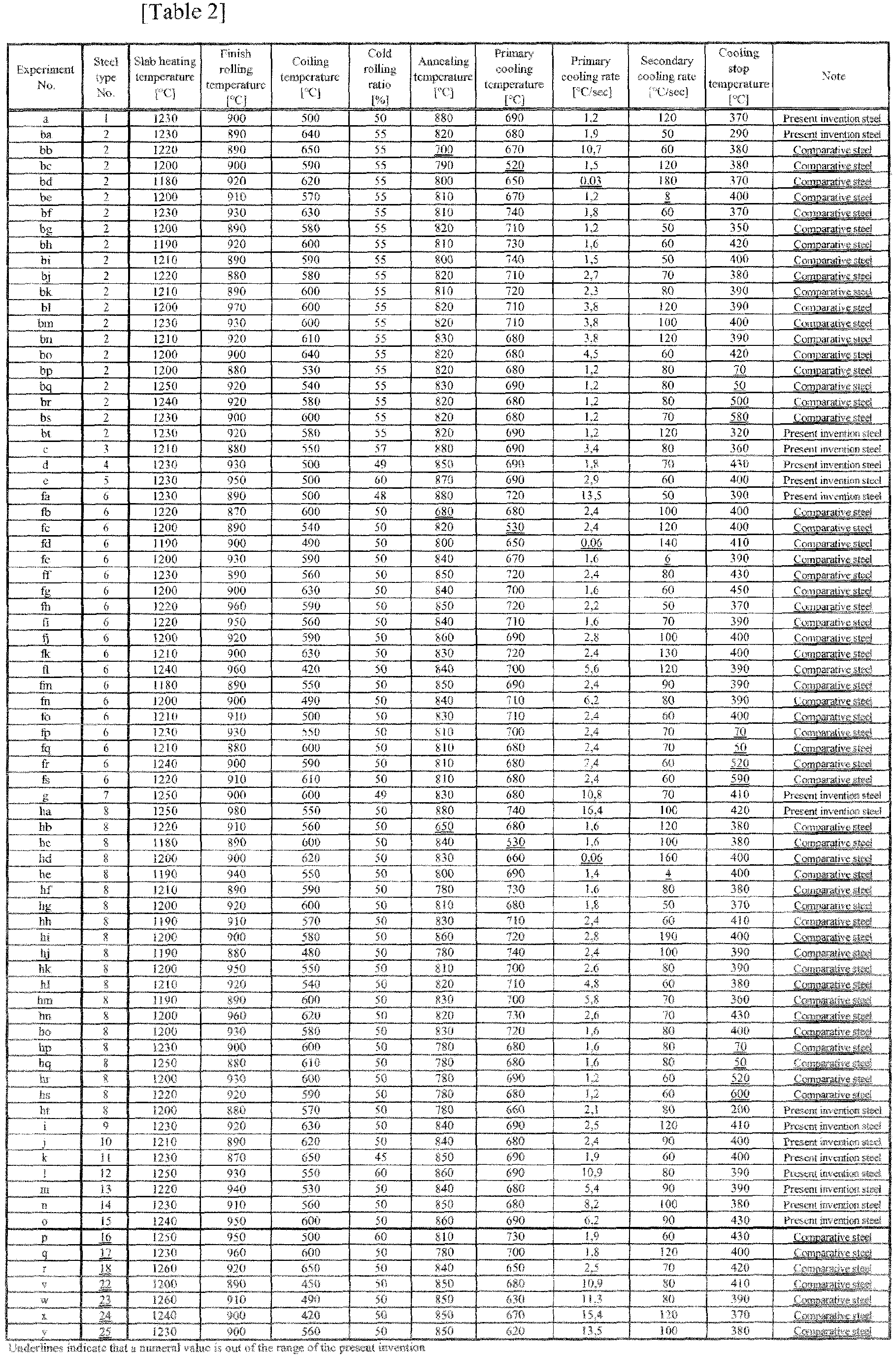


- The present invention provides the high-strength galvanized steel sheet having excellent formability with the ultimate tensile strength of 980 MPa or more, which is stuitable for the structural member, the reinforcing member, and the suspension member of automobiles. Accordingly, the present invention can be expected to greatly contribute to the lighter-weight of automobiles and is extremely high in effect in industry.
Claims (16)
- A high-strength hot-dip galvanized steel sheet having excellent plating adhesion, formability, and hole expandability with an ultimate tensile strength of 980 MPa or more, the hot-dip galvanized steel sheet comprising a hot-dip galvanized layer formed on a surface of a base steel sheet,
wherein the base steel sheet contains: by mass%,
C: 0.05% to 0.4%;
Si: 0.01% to 3.0%;
Mn: 0.1% to 3.0%;
Al: 0.01 to 2.0%; in which Si + Al > 0.5%
P: limited to 0.04% or less;
S: limited to 0.05% or less;
N: limited to 0.01 % or less; and
a balance including Fe and inevitable impurities,
a microstructure of the base steel sheet contains 40% or more by total volume fraction of martensite and bainite, 8% or more by volume fraction of residual austenite, and a balance of the microstructure being ferrite or ferrite and 10% or less by volume fraction of pearlite,
the martensite contains 10% or more by total volume fraction of two or more kinds of three kinds of martensites (1), (2), and (3) below, and
the hot-dip galvanized layer contains less than 7 mass% of Fe,
the martensite (1): C concentration (when there is a cementite precipitation, also including C in cementite); CM1 is less than 0.8 mass%, and nano-indentation test hardness Hit1 satisfies Expression 1.
the martensite (2): C concentration (when there is a cementite precipitation, also including C in cementite); CM2 is 0.8 mass% or more, and nano-indentation test hardness Hit2 satisfies Expression 2.
the martensite (3): C concentration (when there is a cementite precipitation, also including C in cementite); CM3 is 0.8 mass% or more, and nano-indentation test hardness Hit3 satisfies Expression 3.
- The high-strength hot-dip galvanized steel sheet having the excellent plating adhesion, formability, and hole expandability with the ultimate tensile strength of 980 MPa or more according to claim 1, wherein the base steel sheet further contains one or two or more of: by mass%,
Cr: 0.05 to 1.0%;
Mo: 0.05 to 1.0%;
Ni : 0.05 to 1.0%; and
Cu: 0.05 to 1.0%. - The high-strength hot-dip galvanized steel sheet having the excellent plating adhesion, formability, and hole expandability with the ultimate tensile strength of 980 MPa or more according to claim 1, wherein the base steel sheet further contains one or two or more of: by mass%,
Nb: 0.005 to 0.3%;
Ti: 0.005 to 0.3%; and
V: 0.01 to 0.5%. - The high-strength hot-dip galvanized steel sheet having the excellent plating adhesion, formability, and hole expandability with the ultimate tensile strength of 980 MPa or more according to claim 1, wherein the base steel sheet further contains B: 0.0001 to 0.1% by mass%.
- The high-strength hot-dip galvanized steel sheet having the excellent plating adhesion, formability, and hole expandability with the ultimate tensile strength of 980 MPa or more according to claim 1, wherein the base steel sheet further contains one or two or more of: by mass%,
Ca: 0.0005 to 0.01%;
Mg: 0.0005 to 0.01%; and
REM: 0.0005 to 0.01%. - A high-strength alloyed hot-dip galvanized steel sheet having excellent plating adhesion, formability, and hole expandability with an ultimate tensile strength of 980 MPa or more, the alloyed hot-dip galvanized steel sheet comprising an alloyed hot-dip galvanized layer formed on a surface of a base steel sheet,
wherein the base steel sheet contains: by mass%,
C: 0.05% to 0.4%;
Si: 0.01% to 3.0%;
Mn: 0.1% to 3.0%;
Al: 0.01 to 2.0%; in which Si + Al > 0.5%
P: limited to 0.04% or less;
S: limited to 0.05% or less;
N: limited to 0.01% or less; and
a balance including Fe and inevitable impurities,
a microstructure of the base steel sheet contains 40% or more by total volume fraction of martensite and bainite, 8% or more by volume fraction of residual austenite, and a balance of the microstructure being ferrite or ferrite and 10% or less by volume fraction of pearlite,
the martensite contains 10% or more by total volume fraction of two or more kinds of three kinds of martensites (1), (2), and (3) below, and
the alloyed hot-dip galvanized layer contains 7 to 15 mass% of Fe,
the martensite (1): C concentration (when there is a cementite precipitation, also including C in cementite); CM1 is less than 0.8 mass%, and nano-indentation test hardness Hit1 satisfies Expression 1.
the martensite (2): C concentration (when there is a cementite precipitation, also including C in cementite); CM2 is 0.8 mass% or more, and nano-indentation test hardness Hit2 satisfies Expression 2.
the martensite (3): C concentration (when there is a cementite precipitation, also including C in cementite); CM3 is 0.8 mass% or more, and nano-indentation test hardness Hit3 satisfies Expression 3.
- The high-strength alloyed hot-dip galvanized steel sheet having the excellent plating adhesion, formability, and hole expandability with the ultimate tensile strength of 980 MPa or more according to claim 6, wherein the base steel sheet further contains one or two or more of: by mass%,
Cr: 0.05 to 1.0%;
Mo: 0.05 to 1.0%;
Ni : 0.05 to 1.0%; and
Cu: 0.05 to 1.0%. - The high-strength alloyed hot-dip galvanized steel sheet having the excellent plating adhesion, formability, and hole expandability with the ultimate tensile strength of 980 MPa or more according to claim 6, wherein the base steel sheet further contains one or two or more of: by mass%,
Nb: 0.005 to 0.3%;
Ti: 0.005 to 0.3%; and
V: 0.01 to 0.5%. - The high-strength alloyed hot-dip galvanized steel sheet having the excellent plating adhesion, formability, and hole expandability with the ultimate tensile strength of 980 MPa or more according to claim 6, wherein the base steel sheet further contains B: 0.0001 to 0.1% by mass%.
- The high-strength alloyed hot-dip galvanized steel sheet having the excellent plating adhesion, formability, and hole expandability with the ultimate tensile strength of 980 MPa or more according to claim 6, wherein the base steel sheet further contains one or two or more of: by mass%,
Ca: 0.0005 to 0.01%;
Mg: 0.0005 to 0.01%; and
REM: 0.0005 to 0.01 %. - A manufacturing method of a high-strength hot-dip galvanized steel sheet having excellent plating adhesion, formability, and hole expandability with an ultimate tensile strength of 980 MPa or more, the manufacturing method comprising:with respect to a steel billet containing: by mass%,C: 0.05% to 0.4%;Si: 0.01 % to 3.0%;Mn: 0.1 % to 3.0%;Al: 0.01 to 2.0%; in which Si + Al > 0.5%P: limited to 0.04% or less;S: limited to 0.05% or less;N: limited to 0.01% or less; anda balance including Fe and inevitable impurities,heating to 1200°C or higher and performing hot rolling at an Ar3 transformation temperature or higher;performing cold rolling on a base steel sheet after the hot rolling at a reduction ratio of 40 to 70%;annealing the base steel sheet after the cold rolling at 730 to 900°C;cooling the base steel sheet after the annealing to a temperature of 650 to 750°C at an average cooling rate of 0.1 to 200°C/second, and cooling the base steel sheet to 450°C or lower from the temperature of 650 to 750°C at an average cooling rate of 20°C/second or faster;holding the base steel sheet cooled to the 450°C or lower in a range of 350 to 450°C for 120 seconds or longer;cooling the base steel sheet held in the range of 350 to 450°C to 70°C or lower at an average cooling rate of 5°C/second or faster;rolling the base steel sheet cooled to the room temperature at an elongation percentage of 0.2 to 2%;heating the rolled base steel sheet to "temperature of hot-dip galvanizing bath-40"°C to "temperature of hot-dip galvanizing bath + 50"°C at an average temperature rising rate of 10°C/second or faster;dipping and hot-dip galvanizing the base steel sheet heated to the "temperature of hot-dip galvanizing bath - 40"°C to "temperature of hot-dip galvanizing bath + 50"°C into a hot-dip galvanizing bath; andcooling the hot-dip galvanized steel sheet, which is hot-dip galvanized, to 70°C or lower at an average cooling rate of 5°C/second or faster.
- The manufacturing method of the high-strength hot-dip galvanized steel sheet having the excellent plating adhesion, formability, and hole expandability with the ultimate tensile strength of 980 MPa or more according to claim 11, wherein a hot-dip galvanizing bath flows at a flow rate of 10 m/min or more and 50 m/min or less at the time of the hot-dip galvanizing.
- The manufacturing method of the high-strength hot-dip galvanized steel sheet having the excellent plating adhesion, formability, and hole expandability with the ultimate tensile strength of 980 MPa or more according to claim 11, wherein before being heated to the "temperature of hot-dip galvanizing bath - 40"°C to "temperature of hot-dip galvanizing bath + 50"°C, the base steel sheet is subjected to pickling, and then a surface of the base steel sheet is polished and removed to a depth of 0.1 µm or more and is pre-plated with 0.2 to 2g/m2 of Ni.
- A manufacturing method of a high-strength alloyed hot-dip galvanized steel sheet having excellent plating adhesion, formability, and hole expandability with an ultimate tensile strength of 980 MPa or more, the manufacturing method comprising:with respect to a steel billet containing: by mass%,C: 0.05% to 0.4%;Si: 0.01 % to 3.0%;Mn: 0.1% to 3.0%;Al: 0.01 to 2.0%; in which Si + Al > 0.5%P: limited to 0.04% or less;S: limited to 0.05% or less;N: limited to 0.01 % or less; anda balance including Fe and inevitable impurities,heating to 1200°C or higher and performing hot rolling at an Ar3 transformation temperature or higher;performing cold rolling on a base steel sheet after the hot rolling at a reduction ratio of 40 to 70%;annealing the base steel sheet after the cold rolling at 730 to 900°C;cooling the base steel sheet after the amealing to a temperature of 650 to 750°C at an average cooling rate of 0.1 to 200°C/second, and cooling the base steel sheet to 450°C or lower from the temperature of 650 to 750°C at an average cooling rate of 20°C/second or faster;holding the base steel sheet cooled to the 450°C or lower in a range of 350 to 450°C for 120 seconds or longer;cooling the base steel sheet held in the range of 350 to 450°C to 70°C or lower at an average cooling rate of 5°C/second or faster;rolling the base steel sheet cooled to the room temperature at an elongation percentage of 0.2 to 2%;heating the rolled base steel sheet to "temperature of hot-dip galvanizing bath-40"°C to "temperature of hot-dip galvanizing bath + 50"°C at an average temperature rising rate of 10°C/second or faster;dipping and hot-dip galvanizing the base steel sheet heated to the "temperature of hot-dip galvanizing bath - 40"°C to "temperature of hot-dip galvanizing bath + 50"°C into a hot-dip galvanizing bath and performing alloying-beating treatment at "temperature of hot-dip galvanizing bath - 40"°C or higher and 560°C or lower within 40 seconds; andcooling the alloyed hot-dip galvanized steel sheet, which is subjected to the alloying-heating treatment, to 70°C or lower at an average cooling rate of 5°C/second or faster.
- The manufacturing method of the high-strength alloyed hot-dip galvanized steel sheet having the excellent plating adhesion, formability, and hole expandability with the ultimate tensile strength of 980 MPa or more according to claim 14, wherein a hot-dip galvanizing bath flows at a flow rate of 10 m/min or more and 50 m/min or less at the time of the hot-dip galvanizing.
- The manufacturing method of the high-strength alloyed hot-dip galvanized steel sheet having the excellent plating adhesion, formability, and hole expandability with the ultimate tensile strength of 980 MPa or more according to claim 14, wherein before being heated to the "temperature of hot-dip galvanizing bath - 40"°C to "temperature of hot-dip galvanizing bath + 50"°C, the base steel sheet is subjected to pickling, and then a surface of the base steel sheet is polished and removed to a depth of 0.1 µm or more and is pre-plated with 0.2 to 2g/m2 of Ni.
Priority Applications (1)
| Application Number | Priority Date | Filing Date | Title |
|---|---|---|---|
| PL12837548T PL2762592T3 (en) | 2011-09-30 | 2012-09-28 | High-strength hot-dipped galvanized steel sheet and high-strength alloyed hot-dipped galvanized steel sheet, each having tensile strength of 980 mpa or more, excellent plating adhesion, excellent formability and excellent bore expanding properties, and method for producing same |
Applications Claiming Priority (2)
| Application Number | Priority Date | Filing Date | Title |
|---|---|---|---|
| JP2011216967 | 2011-09-30 | ||
| PCT/JP2012/075230 WO2013047830A1 (en) | 2011-09-30 | 2012-09-28 | High-strength hot-dipped galvanized steel sheet and high-strength alloyed hot-dipped galvanized steel sheet, each having tensile strength of 980 mpa or more, excellent plating adhesion, excellent formability and excellent bore expanding properties, and method for producing same |
Publications (3)
| Publication Number | Publication Date |
|---|---|
| EP2762592A1 true EP2762592A1 (en) | 2014-08-06 |
| EP2762592A4 EP2762592A4 (en) | 2015-07-08 |
| EP2762592B1 EP2762592B1 (en) | 2018-04-25 |
Family
ID=47995853
Family Applications (1)
| Application Number | Title | Priority Date | Filing Date |
|---|---|---|---|
| EP12837548.2A Active EP2762592B1 (en) | 2011-09-30 | 2012-09-28 | High-strength hot-dipped galvanized steel sheet and high-strength alloyed hot-dipped galvanized steel sheet, each having tensile strength of 980 mpa or more, excellent plating adhesion, excellent formability and excellent bore expanding properties, and method for producing same |
Country Status (15)
| Country | Link |
|---|---|
| US (2) | US9783878B2 (en) |
| EP (1) | EP2762592B1 (en) |
| JP (1) | JP5403185B2 (en) |
| KR (1) | KR101607786B1 (en) |
| CN (1) | CN103827336B (en) |
| BR (1) | BR112014007496B1 (en) |
| CA (1) | CA2850101C (en) |
| ES (1) | ES2670893T3 (en) |
| IN (1) | IN2014DN03212A (en) |
| MX (1) | MX373588B (en) |
| PL (1) | PL2762592T3 (en) |
| RU (1) | RU2586386C2 (en) |
| TW (1) | TWI523975B (en) |
| WO (1) | WO2013047830A1 (en) |
| ZA (1) | ZA201402970B (en) |
Cited By (6)
| Publication number | Priority date | Publication date | Assignee | Title |
|---|---|---|---|---|
| WO2017115107A1 (en) * | 2015-12-29 | 2017-07-06 | Arcelormittal | Method for producing a ultra high strength galvannealed steel sheet and obtained galvannealed steel sheet |
| EP3214199A4 (en) * | 2014-10-30 | 2017-12-06 | JFE Steel Corporation | High-strength steel sheet, high-strength hot-dip galvanized steel sheet, high-strength hot-dip aluminum-coated steel sheet, and high-strength electrogalvanized steel sheet, and methods for manufacturing same |
| WO2018203126A1 (en) * | 2017-05-05 | 2018-11-08 | Arcelormittal | A method for the manufacturing of liquid metal embrittlement resistant galvannealed steel sheet |
| EP3309273A4 (en) * | 2015-06-11 | 2018-12-26 | Nippon Steel & Sumitomo Metal Corporation | Galvannealed steel sheet and method for manufacturing same |
| US10378077B2 (en) | 2014-07-03 | 2019-08-13 | Arcelormittal | Method for producing an ultra high strength coated or not coated steel sheet and obtained sheet |
| EP3604582A4 (en) * | 2017-03-31 | 2020-09-02 | Nippon Steel Corporation | COLD ROLLED STEEL SHEET AND HOT GALVANIZED COLD ROLLED STEEL SHEET |
Families Citing this family (53)
| Publication number | Priority date | Publication date | Assignee | Title |
|---|---|---|---|---|
| JP5953693B2 (en) * | 2011-09-30 | 2016-07-20 | 新日鐵住金株式会社 | High-strength hot-dip galvanized steel sheet with excellent plating adhesion and formability and its manufacturing method |
| TWI523975B (en) * | 2011-09-30 | 2016-03-01 | Nippon Steel & Sumitomo Metal Corp | A galvanized steel sheet excellent in formability and an alloyed hot-dip galvanized steel sheet and a method for producing the same |
| BR112015027009A2 (en) * | 2013-05-01 | 2017-07-25 | Nippon Steel & Sumitomo Metal Corp | galvanized steel sheet and method to produce the same |
| JP6206489B2 (en) | 2013-05-01 | 2017-10-04 | 新日鐵住金株式会社 | High strength low specific gravity steel plate with excellent spot weldability |
| JP6007881B2 (en) * | 2013-10-15 | 2016-10-12 | 新日鐵住金株式会社 | High-strength steel sheet, high-strength hot-dip galvanized steel sheet, and high-strength alloyed hot-dip galvanized steel sheet excellent in impact characteristics having a maximum tensile strength of 780 MPa or more |
| JP6007882B2 (en) * | 2013-10-15 | 2016-10-19 | 新日鐵住金株式会社 | High-strength steel sheet, high-strength hot-dip galvanized steel sheet, and high-strength alloyed hot-dip galvanized steel sheet having a maximum tensile strength of 780 MPa and excellent impact characteristics |
| JP6341214B2 (en) * | 2013-11-29 | 2018-06-13 | 新日鐵住金株式会社 | Hot-formed steel plate member, method for producing the same, and hot-formed steel plate |
| JP6314520B2 (en) * | 2014-02-13 | 2018-04-25 | 新日鐵住金株式会社 | High-strength steel sheet having a maximum tensile strength of 1300 MPa or more, excellent formability, high-strength hot-dip galvanized steel sheet, high-strength galvannealed steel sheet, and methods for producing them |
| CN104213040B (en) * | 2014-08-27 | 2016-02-17 | 南京创贝高速传动机械有限公司 | A special steel for high-strength bearings and its processing technology |
| JP6471800B2 (en) * | 2015-05-07 | 2019-02-20 | 新日鐵住金株式会社 | High strength steel plate and manufacturing method thereof |
| CN108026600A (en) * | 2015-07-15 | 2018-05-11 | Ak钢铁产权公司 | High formability dual phase steel |
| US10815553B2 (en) * | 2015-08-24 | 2020-10-27 | Nippon Steel Corporation | Galvannealed steel sheet and production method thereof |
| CN105112914A (en) * | 2015-08-31 | 2015-12-02 | 中国钢研科技集团有限公司 | Continuous hot-dip galvanizing device and continuous hot-dip galvanizing method |
| CN108026601A (en) * | 2015-09-22 | 2018-05-11 | 现代制铁株式会社 | Coated steel plate and its manufacture method |
| KR20180095536A (en) | 2015-12-15 | 2018-08-27 | 타타 스틸 이즈무이덴 베.뷔. | High Strength Galvanized Steel Strip |
| WO2017109540A1 (en) * | 2015-12-21 | 2017-06-29 | Arcelormittal | Method for producing a high strength steel sheet having improved ductility and formability, and obtained steel sheet |
| WO2017109538A1 (en) * | 2015-12-21 | 2017-06-29 | Arcelormittal | Method for producing a steel sheet having improved strength, ductility and formability |
| EP3415656B1 (en) * | 2016-02-10 | 2020-12-23 | JFE Steel Corporation | High-strength steel sheet and method for manufacturing same |
| RU2749413C2 (en) | 2016-05-10 | 2021-06-09 | Юнайтид Стейтс Стил Корпорэйшн | High-strength steel products and their manufacturing methods |
| US11993823B2 (en) | 2016-05-10 | 2024-05-28 | United States Steel Corporation | High strength annealed steel products and annealing processes for making the same |
| US11560606B2 (en) | 2016-05-10 | 2023-01-24 | United States Steel Corporation | Methods of producing continuously cast hot rolled high strength steel sheet products |
| TWI618799B (en) * | 2016-09-21 | 2018-03-21 | 新日鐵住金股份有限公司 | Steel sheet |
| WO2018055425A1 (en) | 2016-09-22 | 2018-03-29 | Arcelormittal | High strength and high formability steel sheet and manufacturing method |
| TWI602956B (en) * | 2016-10-04 | 2017-10-21 | 中國鋼鐵股份有限公司 | Method of analyzing steel microstructures with improved phase identification capability |
| US11021776B2 (en) | 2016-11-04 | 2021-06-01 | Nucor Corporation | Method of manufacture of multiphase, hot-rolled ultra-high strength steel |
| JP2019537666A (en) | 2016-11-04 | 2019-12-26 | ニューコア・コーポレーション | Multi-phase cold-rolled ultra-high strength steel |
| CN110121568B (en) | 2016-12-27 | 2021-02-19 | 杰富意钢铁株式会社 | High-strength galvanized steel sheet and method for producing same |
| KR20190131086A (en) * | 2017-03-31 | 2019-11-25 | 닛폰세이테츠 가부시키가이샤 | Hot rolled steel sheet and forged steel parts, and their manufacturing method |
| US20200071789A1 (en) * | 2017-04-20 | 2020-03-05 | Tata Steel Nederland Technology B.V. | High strength steel sheet having excellent ductility and stretch flangeability |
| WO2019092483A1 (en) * | 2017-11-10 | 2019-05-16 | Arcelormittal | Cold rolled and heat treated steel sheet and a method of manufacturing thereof |
| KR102020411B1 (en) | 2017-12-22 | 2019-09-10 | 주식회사 포스코 | High-strength steel sheet having excellent workablity and method for manufacturing thereof |
| KR102075216B1 (en) * | 2017-12-24 | 2020-02-07 | 주식회사 포스코 | High strength steel sheet having high yield ratio and method for manufacturing the same |
| TWI650435B (en) * | 2018-03-30 | 2019-02-11 | 日商新日鐵住金股份有限公司 | Steel sheet and manufacturing method thereof |
| KR102109261B1 (en) | 2018-08-07 | 2020-05-11 | 주식회사 포스코 | Low density steel clad sheet having excellent strength and galvanizability, and method for manufacturing the same |
| KR102285523B1 (en) * | 2019-11-20 | 2021-08-03 | 현대제철 주식회사 | Steel sheet having high strength and high formability and method for manufacturing the same |
| KR102250333B1 (en) | 2019-12-09 | 2021-05-10 | 현대제철 주식회사 | Ultra high strength cold rolled steel sheet and manufacturing method thereof |
| CN111334720B (en) * | 2020-03-30 | 2022-03-25 | 邯郸钢铁集团有限责任公司 | High Al wear-resistant steel strip with good cold formability and production method thereof |
| KR102504647B1 (en) * | 2020-09-16 | 2023-03-03 | 현대제철 주식회사 | Ultra high strength cold rolled steel sheet and method of manufacturing the same |
| KR102496311B1 (en) * | 2020-09-25 | 2023-02-07 | 현대제철 주식회사 | Steel sheet having high strength and high formability and method for manufacturing the same |
| KR102497567B1 (en) * | 2020-12-08 | 2023-02-10 | 현대제철 주식회사 | Steel sheet having high strength and high formability and method for manufacturing the same |
| CN114807737B (en) * | 2021-01-21 | 2023-06-13 | 宝山钢铁股份有限公司 | Hot dip galvanized steel and manufacturing method thereof |
| KR102459164B1 (en) | 2021-06-23 | 2022-10-25 | 울산과학기술원 | Method of evaluation stretch flangeability for steel |
| KR102504097B1 (en) * | 2021-06-29 | 2023-02-28 | 현대제철 주식회사 | Plated steel sheet and method of manufacturing the same |
| CN113817961B (en) * | 2021-08-26 | 2022-06-21 | 马鞍山钢铁股份有限公司 | Hot-dip galvanized steel sheet for color-coated base material and method for manufacturing same |
| AU2023226269B9 (en) * | 2022-02-24 | 2025-10-16 | Jfe Steel Corporation | Steel plate and method of producing same |
| CN114737037B (en) * | 2022-03-30 | 2023-06-27 | 马鞍山钢铁股份有限公司 | 550 MPa-grade high-plastic-toughness hot-dip galvanized steel plate based on CSP process and production method thereof |
| KR102845288B1 (en) * | 2022-09-30 | 2025-08-13 | 현대제철 주식회사 | Ultra high-strength steel sheet and method of manufacturing the same |
| KR102904561B1 (en) * | 2022-12-28 | 2025-12-26 | 현대제철 주식회사 | High Strength cold rolled steel sheet and method of manufacturing the same |
| KR102845301B1 (en) * | 2022-12-29 | 2025-08-14 | 현대제철 주식회사 | High strength cold rolled steel sheet and method of manufacturing the same |
| KR102845291B1 (en) * | 2022-12-29 | 2025-08-13 | 현대제철 주식회사 | High strength cold rolled steel sheet and method of manufacturing the same |
| CN116043118B (en) * | 2023-01-19 | 2023-10-27 | 鞍钢股份有限公司 | Ultra-high reaming performance 980 MPa-grade hot dip galvanized complex phase steel and preparation method thereof |
| DE102023116669A1 (en) | 2023-06-26 | 2025-01-02 | Thyssenkrupp Steel Europe Ag | Side impact beams for reinforcing a vehicle door |
| KR102969355B1 (en) * | 2024-11-19 | 2026-05-29 | 현대제철 주식회사 | Galvannealed steel sheet, method for manufacturing the same and manufacturing system for using the method |
Family Cites Families (24)
| Publication number | Priority date | Publication date | Assignee | Title |
|---|---|---|---|---|
| JPS59219473A (en) | 1983-05-26 | 1984-12-10 | Nippon Steel Corp | Color etching solution and etching method |
| JPS61217529A (en) | 1985-03-22 | 1986-09-27 | Nippon Steel Corp | Manufacture of high strength steel sheet superior in ductility |
| JP2526320B2 (en) | 1991-05-07 | 1996-08-21 | 新日本製鐵株式会社 | Method for producing high-strength galvannealed steel sheet |
| JP2526322B2 (en) | 1991-05-23 | 1996-08-21 | 新日本製鐵株式会社 | Method for producing high-strength hot-dip galvanized steel sheet and alloyed hot-dip galvanized steel sheet |
| JP2601581B2 (en) | 1991-09-03 | 1997-04-16 | 新日本製鐵株式会社 | Manufacturing method of high strength composite structure cold rolled steel sheet with excellent workability |
| US20030015263A1 (en) * | 2000-05-26 | 2003-01-23 | Chikara Kami | Cold rolled steel sheet and galvanized steel sheet having strain aging hardening property and method for producing the same |
| JP3631710B2 (en) * | 2001-10-01 | 2005-03-23 | 新日本製鐵株式会社 | Si-containing high-strength hot-dip galvanized steel sheet with excellent corrosion resistance and ductility and method for producing the same |
| EP1634975B9 (en) * | 2003-03-31 | 2011-01-19 | Nippon Steel Corporation | Hot dip alloyed zinc coated steel sheet and method for production thereof |
| JP4192051B2 (en) * | 2003-08-19 | 2008-12-03 | 新日本製鐵株式会社 | Manufacturing method and equipment for high-strength galvannealed steel sheet |
| JP4486336B2 (en) | 2003-09-30 | 2010-06-23 | 新日本製鐵株式会社 | High yield ratio high strength cold-rolled steel sheet and high yield ratio high strength hot-dip galvanized steel sheet excellent in weldability and ductility, high yield ratio high-strength galvannealed steel sheet, and manufacturing method thereof |
| CN102011053B (en) * | 2003-09-30 | 2013-07-24 | 新日铁住金株式会社 | High-yield-ratio high-strength thin steel sheet excelling in weldability and ductility and manufacturing method thereof |
| JP4445365B2 (en) * | 2004-10-06 | 2010-04-07 | 新日本製鐵株式会社 | Manufacturing method of high-strength thin steel sheet with excellent elongation and hole expandability |
| JP4528184B2 (en) | 2005-03-31 | 2010-08-18 | 新日本製鐵株式会社 | Method for producing alloyed hot-dip galvanized high-strength steel sheet with good workability |
| JP2007270176A (en) | 2006-03-30 | 2007-10-18 | Nippon Steel Corp | Alloyed hot-dip galvanized steel sheet with excellent surface appearance and plating adhesion |
| JP5194811B2 (en) * | 2007-03-30 | 2013-05-08 | Jfeスチール株式会社 | High strength hot dip galvanized steel sheet |
| JP5251208B2 (en) * | 2008-03-28 | 2013-07-31 | Jfeスチール株式会社 | High-strength steel sheet and its manufacturing method |
| JP2010065272A (en) * | 2008-09-10 | 2010-03-25 | Jfe Steel Corp | High-strength steel sheet and method for manufacturing the same |
| CN101348885B (en) * | 2008-09-11 | 2010-06-02 | 北京科技大学 | A kind of 1000MPa grade cold-rolled hot-dip galvanized dual-phase steel and its manufacturing method |
| JP5709151B2 (en) * | 2009-03-10 | 2015-04-30 | Jfeスチール株式会社 | High-strength hot-dip galvanized steel sheet with excellent formability and method for producing the same |
| JP5374193B2 (en) | 2009-03-11 | 2013-12-25 | 株式会社神戸製鋼所 | Hot-dip galvanized steel sheet or alloyed hot-dip galvanized steel sheet with excellent bending workability and fatigue strength |
| JP5499663B2 (en) * | 2009-11-30 | 2014-05-21 | 新日鐵住金株式会社 | High-strength cold-rolled steel sheet having a maximum tensile strength of 900 MPa or more excellent in mechanical cutting characteristics and its manufacturing method, and high-strength galvanized steel sheet and its manufacturing method |
| ES2758553T3 (en) | 2009-11-30 | 2020-05-05 | Nippon Steel Corp | High strength steel sheet with excellent resistance to hydrogen brittleness and a maximum tensile strength of 900 MPa or more, and method for its production |
| JP5651964B2 (en) | 2010-02-16 | 2015-01-14 | 新日鐵住金株式会社 | Alloyed hot-dip galvanized steel sheet excellent in ductility, hole expansibility and corrosion resistance, and method for producing the same |
| TWI523975B (en) * | 2011-09-30 | 2016-03-01 | Nippon Steel & Sumitomo Metal Corp | A galvanized steel sheet excellent in formability and an alloyed hot-dip galvanized steel sheet and a method for producing the same |
-
2012
- 2012-09-28 TW TW101135885A patent/TWI523975B/en not_active IP Right Cessation
- 2012-09-28 KR KR1020147010908A patent/KR101607786B1/en active Active
- 2012-09-28 CN CN201280047397.9A patent/CN103827336B/en active Active
- 2012-09-28 WO PCT/JP2012/075230 patent/WO2013047830A1/en not_active Ceased
- 2012-09-28 US US14/347,289 patent/US9783878B2/en active Active
- 2012-09-28 BR BR112014007496-8A patent/BR112014007496B1/en not_active IP Right Cessation
- 2012-09-28 ES ES12837548.2T patent/ES2670893T3/en active Active
- 2012-09-28 PL PL12837548T patent/PL2762592T3/en unknown
- 2012-09-28 RU RU2014116634/02A patent/RU2586386C2/en not_active IP Right Cessation
- 2012-09-28 EP EP12837548.2A patent/EP2762592B1/en active Active
- 2012-09-28 IN IN3212DEN2014 patent/IN2014DN03212A/en unknown
- 2012-09-28 JP JP2013513313A patent/JP5403185B2/en active Active
- 2012-09-28 MX MX2014003712A patent/MX373588B/en active IP Right Grant
- 2012-09-28 CA CA2850101A patent/CA2850101C/en not_active Expired - Fee Related
-
2014
- 2014-04-23 ZA ZA2014/02970A patent/ZA201402970B/en unknown
-
2017
- 2017-09-06 US US15/696,650 patent/US10465272B2/en active Active
Cited By (17)
| Publication number | Priority date | Publication date | Assignee | Title |
|---|---|---|---|---|
| US10378077B2 (en) | 2014-07-03 | 2019-08-13 | Arcelormittal | Method for producing an ultra high strength coated or not coated steel sheet and obtained sheet |
| US12157922B2 (en) | 2014-07-03 | 2024-12-03 | Arcelormittal | Method for producing a ultra high strength coated or not coated steel sheet and obtained sheet |
| US11131003B2 (en) | 2014-07-03 | 2021-09-28 | Arcelormittal | Method for producing an ultra high strength coated or not coated steel sheet and obtained sheet |
| US11124853B2 (en) | 2014-07-03 | 2021-09-21 | Arcelormittal | Method for producing a ultra high strength coated or not coated steel sheet and obtained sheet |
| US11001904B2 (en) | 2014-07-03 | 2021-05-11 | Arcelormittal | Method for producing an ultra high strength coated or not coated steel sheet and obtained sheet |
| EP3214199A4 (en) * | 2014-10-30 | 2017-12-06 | JFE Steel Corporation | High-strength steel sheet, high-strength hot-dip galvanized steel sheet, high-strength hot-dip aluminum-coated steel sheet, and high-strength electrogalvanized steel sheet, and methods for manufacturing same |
| EP3309273A4 (en) * | 2015-06-11 | 2018-12-26 | Nippon Steel & Sumitomo Metal Corporation | Galvannealed steel sheet and method for manufacturing same |
| US10745775B2 (en) | 2015-06-11 | 2020-08-18 | Nippon Steel Corporation | Galvannealed steel sheet and method for producing the same |
| RU2695844C1 (en) * | 2015-12-29 | 2019-07-29 | Арселормиттал | Method of producing ultra-high-strength sheet steel subjected to zinc-plating with annealing, and obtained sheet steel subjected to zinc-plating with annealing |
| US11035020B2 (en) | 2015-12-29 | 2021-06-15 | Arcelormittal | Galvannealed steel sheet |
| WO2017115107A1 (en) * | 2015-12-29 | 2017-07-06 | Arcelormittal | Method for producing a ultra high strength galvannealed steel sheet and obtained galvannealed steel sheet |
| US11512362B2 (en) | 2015-12-29 | 2022-11-29 | Arcelormittal | Method for producing an ultra high strength galvannealed steel sheet and obtained galvannealed steel sheet |
| EP3604582A4 (en) * | 2017-03-31 | 2020-09-02 | Nippon Steel Corporation | COLD ROLLED STEEL SHEET AND HOT GALVANIZED COLD ROLLED STEEL SHEET |
| WO2018203097A1 (en) * | 2017-05-05 | 2018-11-08 | Arcelormittal | A method for the manufacturing of liquid metal embrittlement resistant galvannealed steel sheet |
| US11654653B2 (en) | 2017-05-05 | 2023-05-23 | Arcelormittal | Method for the manufacturing of liquid metal embrittlement resistant galvannealed steel sheet |
| US12134245B2 (en) | 2017-05-05 | 2024-11-05 | Arcelormittal | Method for the manufacturing of liquid metal embrittlement resistant galvannealed steel sheet |
| WO2018203126A1 (en) * | 2017-05-05 | 2018-11-08 | Arcelormittal | A method for the manufacturing of liquid metal embrittlement resistant galvannealed steel sheet |
Also Published As
| Publication number | Publication date |
|---|---|
| CN103827336B (en) | 2016-01-06 |
| CN103827336A (en) | 2014-05-28 |
| WO2013047830A1 (en) | 2013-04-04 |
| EP2762592A4 (en) | 2015-07-08 |
| BR112014007496B1 (en) | 2019-02-12 |
| IN2014DN03212A (en) | 2015-05-22 |
| PL2762592T3 (en) | 2018-08-31 |
| US20170369979A1 (en) | 2017-12-28 |
| US9783878B2 (en) | 2017-10-10 |
| RU2014116634A (en) | 2015-11-10 |
| CA2850101A1 (en) | 2013-04-04 |
| ES2670893T3 (en) | 2018-06-01 |
| RU2586386C2 (en) | 2016-06-10 |
| JPWO2013047830A1 (en) | 2015-03-30 |
| US10465272B2 (en) | 2019-11-05 |
| MX373588B (en) | 2020-05-15 |
| BR112014007496A2 (en) | 2017-04-04 |
| MX2014003712A (en) | 2014-07-09 |
| JP5403185B2 (en) | 2014-01-29 |
| US20140342183A1 (en) | 2014-11-20 |
| KR20140068222A (en) | 2014-06-05 |
| TW201323655A (en) | 2013-06-16 |
| TWI523975B (en) | 2016-03-01 |
| ZA201402970B (en) | 2015-04-29 |
| KR101607786B1 (en) | 2016-03-30 |
| CA2850101C (en) | 2017-01-17 |
| EP2762592B1 (en) | 2018-04-25 |
Similar Documents
| Publication | Publication Date | Title |
|---|---|---|
| US10465272B2 (en) | High-strength hot-dip galvanized steel sheet and high-strength alloyed hot-dip galvanized steel sheet having excellent plating adhesion, formability, and hole expandability with tensile strength of 980 MPa or more and manufacturing method therefor | |
| CN110312813B (en) | High-strength steel sheet and method for producing the same | |
| CN108474069B (en) | High-strength steel sheet, high-strength galvanized steel sheet, and method for producing same | |
| KR101854060B1 (en) | High-strength steel sheet and process for producing same | |
| KR101479391B1 (en) | Cold rolled steel sheet having excellent shape fixability and method for manufacturing the same | |
| US20090202382A1 (en) | High manganese steel strips with excellent coatability and superior surface property, coated steel strips using steel strips and method for manufacturing the steel strips | |
| JP7440799B2 (en) | Steel plate and its manufacturing method | |
| CN114645219A (en) | High-strength galvanized steel sheet and method for producing same | |
| CN114990431A (en) | Alloyed hot-dip galvanized steel sheet and method for producing same | |
| CN101932742A (en) | High-strength hot-dip galvanized steel sheet excellent in formability and manufacturing method thereof | |
| EP3498876B1 (en) | Cold-rolled high-strength steel sheet, and production method therefor | |
| EP3521474B1 (en) | High-strength coated steel sheet and method for manufacturing the same | |
| CN120584208A (en) | Steel plates and parts and methods of manufacturing the same | |
| KR101657931B1 (en) | Hot-dip galvanized steel sheet for stamping having excellent cold workability, die hardenability, and surface quality, and producing method thereof | |
| EP2740813A1 (en) | Hot-dip galvanized steel sheet and production method therefor | |
| JP2018003114A (en) | High strength steel sheet and manufacturing method therefor | |
| CN112714800A (en) | Steel plate | |
| JP7801609B2 (en) | Galvannealed steel sheet | |
| KR20250142411A (en) | steel members and steel plates |
Legal Events
| Date | Code | Title | Description |
|---|---|---|---|
| PUAI | Public reference made under article 153(3) epc to a published international application that has entered the european phase |
Free format text: ORIGINAL CODE: 0009012 |
|
| 17P | Request for examination filed |
Effective date: 20140424 |
|
| AK | Designated contracting states |
Kind code of ref document: A1 Designated state(s): AL AT BE BG CH CY CZ DE DK EE ES FI FR GB GR HR HU IE IS IT LI LT LU LV MC MK MT NL NO PL PT RO RS SE SI SK SM TR |
|
| DAX | Request for extension of the european patent (deleted) | ||
| RA4 | Supplementary search report drawn up and despatched (corrected) |
Effective date: 20150605 |
|
| RIC1 | Information provided on ipc code assigned before grant |
Ipc: C21D 9/46 20060101ALI20150529BHEP Ipc: C23C 2/02 20060101ALI20150529BHEP Ipc: C22C 38/00 20060101AFI20150529BHEP Ipc: C23C 2/06 20060101ALI20150529BHEP Ipc: C22C 18/00 20060101ALI20150529BHEP Ipc: C23C 2/28 20060101ALI20150529BHEP Ipc: C22C 38/60 20060101ALI20150529BHEP |
|
| 17Q | First examination report despatched |
Effective date: 20160718 |
|
| GRAP | Despatch of communication of intention to grant a patent |
Free format text: ORIGINAL CODE: EPIDOSNIGR1 |
|
| INTG | Intention to grant announced |
Effective date: 20170622 |
|
| GRAS | Grant fee paid |
Free format text: ORIGINAL CODE: EPIDOSNIGR3 |
|
| GRAJ | Information related to disapproval of communication of intention to grant by the applicant or resumption of examination proceedings by the epo deleted |
Free format text: ORIGINAL CODE: EPIDOSDIGR1 |
|
| GRAL | Information related to payment of fee for publishing/printing deleted |
Free format text: ORIGINAL CODE: EPIDOSDIGR3 |
|
| GRAP | Despatch of communication of intention to grant a patent |
Free format text: ORIGINAL CODE: EPIDOSNIGR1 |
|
| INTC | Intention to grant announced (deleted) | ||
| INTG | Intention to grant announced |
Effective date: 20171205 |
|
| GRAA | (expected) grant |
Free format text: ORIGINAL CODE: 0009210 |
|
| AK | Designated contracting states |
Kind code of ref document: B1 Designated state(s): AL AT BE BG CH CY CZ DE DK EE ES FI FR GB GR HR HU IE IS IT LI LT LU LV MC MK MT NL NO PL PT RO RS SE SI SK SM TR |
|
| REG | Reference to a national code |
Ref country code: GB Ref legal event code: FG4D |
|
| REG | Reference to a national code |
Ref country code: CH Ref legal event code: EP |
|
| REG | Reference to a national code |
Ref country code: AT Ref legal event code: REF Ref document number: 993003 Country of ref document: AT Kind code of ref document: T Effective date: 20180515 |
|
| REG | Reference to a national code |
Ref country code: IE Ref legal event code: FG4D |
|
| REG | Reference to a national code |
Ref country code: DE Ref legal event code: R096 Ref document number: 602012045737 Country of ref document: DE |
|
| REG | Reference to a national code |
Ref country code: ES Ref legal event code: FG2A Ref document number: 2670893 Country of ref document: ES Kind code of ref document: T3 Effective date: 20180601 |
|
| REG | Reference to a national code |
Ref country code: SE Ref legal event code: TRGR |
|
| REG | Reference to a national code |
Ref country code: NL Ref legal event code: MP Effective date: 20180425 |
|
| REG | Reference to a national code |
Ref country code: FR Ref legal event code: PLFP Year of fee payment: 7 |
|
| REG | Reference to a national code |
Ref country code: LT Ref legal event code: MG4D |
|
| PG25 | Lapsed in a contracting state [announced via postgrant information from national office to epo] |
Ref country code: NL Free format text: LAPSE BECAUSE OF FAILURE TO SUBMIT A TRANSLATION OF THE DESCRIPTION OR TO PAY THE FEE WITHIN THE PRESCRIBED TIME-LIMIT Effective date: 20180425 |
|
| PG25 | Lapsed in a contracting state [announced via postgrant information from national office to epo] |
Ref country code: BG Free format text: LAPSE BECAUSE OF FAILURE TO SUBMIT A TRANSLATION OF THE DESCRIPTION OR TO PAY THE FEE WITHIN THE PRESCRIBED TIME-LIMIT Effective date: 20180725 Ref country code: FI Free format text: LAPSE BECAUSE OF FAILURE TO SUBMIT A TRANSLATION OF THE DESCRIPTION OR TO PAY THE FEE WITHIN THE PRESCRIBED TIME-LIMIT Effective date: 20180425 Ref country code: NO Free format text: LAPSE BECAUSE OF FAILURE TO SUBMIT A TRANSLATION OF THE DESCRIPTION OR TO PAY THE FEE WITHIN THE PRESCRIBED TIME-LIMIT Effective date: 20180725 Ref country code: LT Free format text: LAPSE BECAUSE OF FAILURE TO SUBMIT A TRANSLATION OF THE DESCRIPTION OR TO PAY THE FEE WITHIN THE PRESCRIBED TIME-LIMIT Effective date: 20180425 |
|
| PG25 | Lapsed in a contracting state [announced via postgrant information from national office to epo] |
Ref country code: LV Free format text: LAPSE BECAUSE OF FAILURE TO SUBMIT A TRANSLATION OF THE DESCRIPTION OR TO PAY THE FEE WITHIN THE PRESCRIBED TIME-LIMIT Effective date: 20180425 Ref country code: HR Free format text: LAPSE BECAUSE OF FAILURE TO SUBMIT A TRANSLATION OF THE DESCRIPTION OR TO PAY THE FEE WITHIN THE PRESCRIBED TIME-LIMIT Effective date: 20180425 Ref country code: RS Free format text: LAPSE BECAUSE OF FAILURE TO SUBMIT A TRANSLATION OF THE DESCRIPTION OR TO PAY THE FEE WITHIN THE PRESCRIBED TIME-LIMIT Effective date: 20180425 Ref country code: GR Free format text: LAPSE BECAUSE OF FAILURE TO SUBMIT A TRANSLATION OF THE DESCRIPTION OR TO PAY THE FEE WITHIN THE PRESCRIBED TIME-LIMIT Effective date: 20180726 |
|
| REG | Reference to a national code |
Ref country code: AT Ref legal event code: MK05 Ref document number: 993003 Country of ref document: AT Kind code of ref document: T Effective date: 20180425 |
|
| PG25 | Lapsed in a contracting state [announced via postgrant information from national office to epo] |
Ref country code: PT Free format text: LAPSE BECAUSE OF FAILURE TO SUBMIT A TRANSLATION OF THE DESCRIPTION OR TO PAY THE FEE WITHIN THE PRESCRIBED TIME-LIMIT Effective date: 20180827 |
|
| REG | Reference to a national code |
Ref country code: DE Ref legal event code: R097 Ref document number: 602012045737 Country of ref document: DE |
|
| PG25 | Lapsed in a contracting state [announced via postgrant information from national office to epo] |
Ref country code: EE Free format text: LAPSE BECAUSE OF FAILURE TO SUBMIT A TRANSLATION OF THE DESCRIPTION OR TO PAY THE FEE WITHIN THE PRESCRIBED TIME-LIMIT Effective date: 20180425 Ref country code: DK Free format text: LAPSE BECAUSE OF FAILURE TO SUBMIT A TRANSLATION OF THE DESCRIPTION OR TO PAY THE FEE WITHIN THE PRESCRIBED TIME-LIMIT Effective date: 20180425 Ref country code: AT Free format text: LAPSE BECAUSE OF FAILURE TO SUBMIT A TRANSLATION OF THE DESCRIPTION OR TO PAY THE FEE WITHIN THE PRESCRIBED TIME-LIMIT Effective date: 20180425 Ref country code: CZ Free format text: LAPSE BECAUSE OF FAILURE TO SUBMIT A TRANSLATION OF THE DESCRIPTION OR TO PAY THE FEE WITHIN THE PRESCRIBED TIME-LIMIT Effective date: 20180425 Ref country code: RO Free format text: LAPSE BECAUSE OF FAILURE TO SUBMIT A TRANSLATION OF THE DESCRIPTION OR TO PAY THE FEE WITHIN THE PRESCRIBED TIME-LIMIT Effective date: 20180425 Ref country code: SK Free format text: LAPSE BECAUSE OF FAILURE TO SUBMIT A TRANSLATION OF THE DESCRIPTION OR TO PAY THE FEE WITHIN THE PRESCRIBED TIME-LIMIT Effective date: 20180425 |
|
| PG25 | Lapsed in a contracting state [announced via postgrant information from national office to epo] |
Ref country code: SM Free format text: LAPSE BECAUSE OF FAILURE TO SUBMIT A TRANSLATION OF THE DESCRIPTION OR TO PAY THE FEE WITHIN THE PRESCRIBED TIME-LIMIT Effective date: 20180425 |
|
| PLBE | No opposition filed within time limit |
Free format text: ORIGINAL CODE: 0009261 |
|
| STAA | Information on the status of an ep patent application or granted ep patent |
Free format text: STATUS: NO OPPOSITION FILED WITHIN TIME LIMIT |
|
| 26N | No opposition filed |
Effective date: 20190128 |
|
| PG25 | Lapsed in a contracting state [announced via postgrant information from national office to epo] |
Ref country code: MC Free format text: LAPSE BECAUSE OF FAILURE TO SUBMIT A TRANSLATION OF THE DESCRIPTION OR TO PAY THE FEE WITHIN THE PRESCRIBED TIME-LIMIT Effective date: 20180425 |
|
| REG | Reference to a national code |
Ref country code: CH Ref legal event code: PL |
|
| PG25 | Lapsed in a contracting state [announced via postgrant information from national office to epo] |
Ref country code: SI Free format text: LAPSE BECAUSE OF FAILURE TO SUBMIT A TRANSLATION OF THE DESCRIPTION OR TO PAY THE FEE WITHIN THE PRESCRIBED TIME-LIMIT Effective date: 20180425 |
|
| REG | Reference to a national code |
Ref country code: DE Ref legal event code: R082 Ref document number: 602012045737 Country of ref document: DE Representative=s name: VOSSIUS & PARTNER PATENTANWAELTE RECHTSANWAELT, DE Ref country code: DE Ref legal event code: R081 Ref document number: 602012045737 Country of ref document: DE Owner name: NIPPON STEEL CORPORATION, JP Free format text: FORMER OWNER: NIPPON STEEL & SUMITOMO METAL CORPORATION, TOKYO, JP |
|
| REG | Reference to a national code |
Ref country code: IE Ref legal event code: MM4A |
|
| PG25 | Lapsed in a contracting state [announced via postgrant information from national office to epo] |
Ref country code: LU Free format text: LAPSE BECAUSE OF NON-PAYMENT OF DUE FEES Effective date: 20180928 |
|
| PG25 | Lapsed in a contracting state [announced via postgrant information from national office to epo] |
Ref country code: IE Free format text: LAPSE BECAUSE OF NON-PAYMENT OF DUE FEES Effective date: 20180928 |
|
| PG25 | Lapsed in a contracting state [announced via postgrant information from national office to epo] |
Ref country code: CH Free format text: LAPSE BECAUSE OF NON-PAYMENT OF DUE FEES Effective date: 20180930 Ref country code: LI Free format text: LAPSE BECAUSE OF NON-PAYMENT OF DUE FEES Effective date: 20180930 |
|
| PGFP | Annual fee paid to national office [announced via postgrant information from national office to epo] |
Ref country code: SE Payment date: 20190910 Year of fee payment: 8 |
|
| PG25 | Lapsed in a contracting state [announced via postgrant information from national office to epo] |
Ref country code: AL Free format text: LAPSE BECAUSE OF FAILURE TO SUBMIT A TRANSLATION OF THE DESCRIPTION OR TO PAY THE FEE WITHIN THE PRESCRIBED TIME-LIMIT Effective date: 20180425 |
|
| PGFP | Annual fee paid to national office [announced via postgrant information from national office to epo] |
Ref country code: GB Payment date: 20190926 Year of fee payment: 8 |
|
| PG25 | Lapsed in a contracting state [announced via postgrant information from national office to epo] |
Ref country code: MT Free format text: LAPSE BECAUSE OF NON-PAYMENT OF DUE FEES Effective date: 20180928 |
|
| PGFP | Annual fee paid to national office [announced via postgrant information from national office to epo] |
Ref country code: ES Payment date: 20191002 Year of fee payment: 8 |
|
| PG25 | Lapsed in a contracting state [announced via postgrant information from national office to epo] |
Ref country code: TR Free format text: LAPSE BECAUSE OF FAILURE TO SUBMIT A TRANSLATION OF THE DESCRIPTION OR TO PAY THE FEE WITHIN THE PRESCRIBED TIME-LIMIT Effective date: 20180425 |
|
| PG25 | Lapsed in a contracting state [announced via postgrant information from national office to epo] |
Ref country code: HU Free format text: LAPSE BECAUSE OF FAILURE TO SUBMIT A TRANSLATION OF THE DESCRIPTION OR TO PAY THE FEE WITHIN THE PRESCRIBED TIME-LIMIT; INVALID AB INITIO Effective date: 20120928 |
|
| PG25 | Lapsed in a contracting state [announced via postgrant information from national office to epo] |
Ref country code: MK Free format text: LAPSE BECAUSE OF NON-PAYMENT OF DUE FEES Effective date: 20180425 Ref country code: CY Free format text: LAPSE BECAUSE OF FAILURE TO SUBMIT A TRANSLATION OF THE DESCRIPTION OR TO PAY THE FEE WITHIN THE PRESCRIBED TIME-LIMIT Effective date: 20180425 |
|
| PG25 | Lapsed in a contracting state [announced via postgrant information from national office to epo] |
Ref country code: IS Free format text: LAPSE BECAUSE OF FAILURE TO SUBMIT A TRANSLATION OF THE DESCRIPTION OR TO PAY THE FEE WITHIN THE PRESCRIBED TIME-LIMIT Effective date: 20180825 |
|
| PGFP | Annual fee paid to national office [announced via postgrant information from national office to epo] |
Ref country code: BE Payment date: 20200817 Year of fee payment: 9 Ref country code: PL Payment date: 20200728 Year of fee payment: 9 Ref country code: IT Payment date: 20200812 Year of fee payment: 9 |
|
| GBPC | Gb: european patent ceased through non-payment of renewal fee |
Effective date: 20200928 |
|
| PG25 | Lapsed in a contracting state [announced via postgrant information from national office to epo] |
Ref country code: SE Free format text: LAPSE BECAUSE OF NON-PAYMENT OF DUE FEES Effective date: 20200929 Ref country code: GB Free format text: LAPSE BECAUSE OF NON-PAYMENT OF DUE FEES Effective date: 20200928 |
|
| REG | Reference to a national code |
Ref country code: SE Ref legal event code: EUG |
|
| REG | Reference to a national code |
Ref country code: ES Ref legal event code: FD2A Effective date: 20220119 |
|
| REG | Reference to a national code |
Ref country code: BE Ref legal event code: MM Effective date: 20210930 |
|
| PG25 | Lapsed in a contracting state [announced via postgrant information from national office to epo] |
Ref country code: ES Free format text: LAPSE BECAUSE OF NON-PAYMENT OF DUE FEES Effective date: 20200929 |
|
| PG25 | Lapsed in a contracting state [announced via postgrant information from national office to epo] |
Ref country code: BE Free format text: LAPSE BECAUSE OF NON-PAYMENT OF DUE FEES Effective date: 20210930 |
|
| PG25 | Lapsed in a contracting state [announced via postgrant information from national office to epo] |
Ref country code: IT Free format text: LAPSE BECAUSE OF NON-PAYMENT OF DUE FEES Effective date: 20210928 |
|
| PG25 | Lapsed in a contracting state [announced via postgrant information from national office to epo] |
Ref country code: PL Free format text: LAPSE BECAUSE OF NON-PAYMENT OF DUE FEES Effective date: 20210928 |
|
| PGFP | Annual fee paid to national office [announced via postgrant information from national office to epo] |
Ref country code: DE Payment date: 20250805 Year of fee payment: 14 |
|
| PGFP | Annual fee paid to national office [announced via postgrant information from national office to epo] |
Ref country code: FR Payment date: 20250808 Year of fee payment: 14 |