EP2762516A1 - Polycarbonate and method for preparing same - Google Patents
Polycarbonate and method for preparing same Download PDFInfo
- Publication number
- EP2762516A1 EP2762516A1 EP20110873052 EP11873052A EP2762516A1 EP 2762516 A1 EP2762516 A1 EP 2762516A1 EP 20110873052 EP20110873052 EP 20110873052 EP 11873052 A EP11873052 A EP 11873052A EP 2762516 A1 EP2762516 A1 EP 2762516A1
- Authority
- EP
- European Patent Office
- Prior art keywords
- formula
- polycarbonate
- unsubstituted
- substituted
- mol
- Prior art date
- Legal status (The legal status is an assumption and is not a legal conclusion. Google has not performed a legal analysis and makes no representation as to the accuracy of the status listed.)
- Granted
Links
Classifications
-
- C—CHEMISTRY; METALLURGY
- C08—ORGANIC MACROMOLECULAR COMPOUNDS; THEIR PREPARATION OR CHEMICAL WORKING-UP; COMPOSITIONS BASED THEREON
- C08K—Use of inorganic or non-macromolecular organic substances as compounding ingredients
- C08K5/00—Use of organic ingredients
- C08K5/36—Sulfur-, selenium-, or tellurium-containing compounds
- C08K5/41—Compounds containing sulfur bound to oxygen
- C08K5/42—Sulfonic acids; Derivatives thereof
-
- C—CHEMISTRY; METALLURGY
- C08—ORGANIC MACROMOLECULAR COMPOUNDS; THEIR PREPARATION OR CHEMICAL WORKING-UP; COMPOSITIONS BASED THEREON
- C08G—MACROMOLECULAR COMPOUNDS OBTAINED OTHERWISE THAN BY REACTIONS ONLY INVOLVING UNSATURATED CARBON-TO-CARBON BONDS
- C08G64/00—Macromolecular compounds obtained by reactions forming a carbonic ester link in the main chain of the macromolecule
-
- C—CHEMISTRY; METALLURGY
- C08—ORGANIC MACROMOLECULAR COMPOUNDS; THEIR PREPARATION OR CHEMICAL WORKING-UP; COMPOSITIONS BASED THEREON
- C08G—MACROMOLECULAR COMPOUNDS OBTAINED OTHERWISE THAN BY REACTIONS ONLY INVOLVING UNSATURATED CARBON-TO-CARBON BONDS
- C08G64/00—Macromolecular compounds obtained by reactions forming a carbonic ester link in the main chain of the macromolecule
- C08G64/04—Aromatic polycarbonates
-
- C—CHEMISTRY; METALLURGY
- C08—ORGANIC MACROMOLECULAR COMPOUNDS; THEIR PREPARATION OR CHEMICAL WORKING-UP; COMPOSITIONS BASED THEREON
- C08G—MACROMOLECULAR COMPOUNDS OBTAINED OTHERWISE THAN BY REACTIONS ONLY INVOLVING UNSATURATED CARBON-TO-CARBON BONDS
- C08G64/00—Macromolecular compounds obtained by reactions forming a carbonic ester link in the main chain of the macromolecule
- C08G64/16—Aliphatic-aromatic or araliphatic polycarbonates
- C08G64/1608—Aliphatic-aromatic or araliphatic polycarbonates saturated
-
- C—CHEMISTRY; METALLURGY
- C08—ORGANIC MACROMOLECULAR COMPOUNDS; THEIR PREPARATION OR CHEMICAL WORKING-UP; COMPOSITIONS BASED THEREON
- C08G—MACROMOLECULAR COMPOUNDS OBTAINED OTHERWISE THAN BY REACTIONS ONLY INVOLVING UNSATURATED CARBON-TO-CARBON BONDS
- C08G64/00—Macromolecular compounds obtained by reactions forming a carbonic ester link in the main chain of the macromolecule
- C08G64/20—General preparatory processes
- C08G64/30—General preparatory processes using carbonates
-
- C—CHEMISTRY; METALLURGY
- C08—ORGANIC MACROMOLECULAR COMPOUNDS; THEIR PREPARATION OR CHEMICAL WORKING-UP; COMPOSITIONS BASED THEREON
- C08L—COMPOSITIONS OF MACROMOLECULAR COMPOUNDS
- C08L69/00—Compositions of polycarbonates; Compositions of derivatives of polycarbonates
Definitions
- the present invention relates to polycarbonate and a method of preparing the same. More specifically, the present invention relates to polycarbonate having excellent chemical resistance and impact resistance, and a method of preparing the same.
- Polycarbonate is a thermoplastic material that has a heat deflection temperature of about 135°C or higher and can exhibit superior mechanical properties including impact resistance and excellent self-extinguishing properties, dimensional stability, heat resistance and transparency.
- Polycarbonate resins are widely used in various applications, such as exterior materials of electronic and electric products, automobile components, and the like.
- polycarbonate has limitations in use for exterior materials.
- a plastic material is used as an exterior material, the product is often coated to enhance the aesthetics thereof.
- a dye diluted with various organic solvents can be applied to the surface of a molded resin article and dried.
- the organic solvents used as diluents can penetrate into the polycarbonate, which can decrease transparency and mechanical strength.
- Various methods are suggested to improve chemical resistance of polycarbonate resins.
- KR Patent Publication No. 2007-0071446 , KR Patent Publication No. 2009-0026359 and KR Patent Publication No. 2010-0022376 disclose methods of improving chemical resistance of polycarbonate resins by blending with other resins having chemical resistance. However, while these methods can slightly improve chemical resistance, they can decrease impact resistance. In order to improve impact resistance reduced due to blending, an impact modifier can be used. The impact modifier, however, can significantly decrease transparency of the resin.
- JP 05-339390 and US Patent No. 5,401,826 disclose methods of improving chemical resistance by preparing copolymerized polycarbonate in which a material having chemical resistance is introduced into a conventional polycarbonate resin.
- copolymerized material is 4,4'-biphenol, which is copolymerized with a polycarbonate resin to improve chemical resistance.
- 4,4'-biphenol can improve chemical resistance, it also can reduce impact resistance, thereby deteriorating advantages of the polycarbonate.
- fluidity drastically decreases, causing deterioration in moldability.
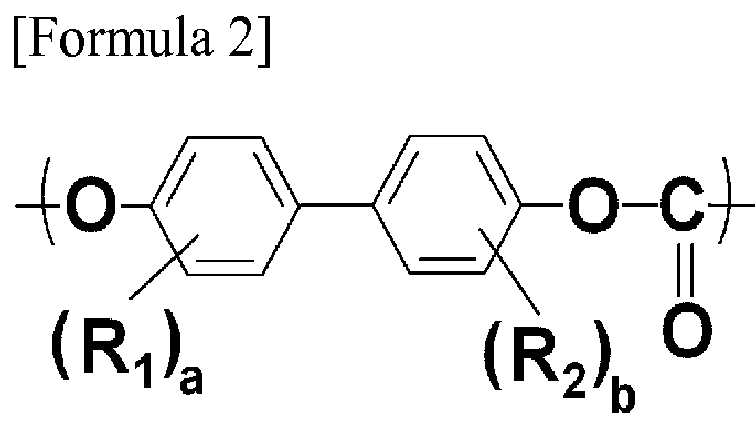
- the polycarbonate includes repeat units represented by Formula 1, Formula 2, and Formula 3, respectively: (wherein, R 1 and R 2 are each independently substituted or unsubstituted C1 to C6 alkyl, substituted or unsubstituted C3 to C6 cycloalkyl, substituted or unsubstituted C6 to C12 aryl or halogen, and a and b are each independently an integer from 0 to 4); (wherein, R 1 and R 2 are each independently substituted or unsubstituted C1 to C6 alkyl, substituted or unsubstituted C3 to C6 cycloalkyl, substituted or unsubstituted C6 to C12 aryl or halogen, and a and b are each independently an integer from 0 to 4); and (wherein, Q is substituted or unsubstituted C5 to C10 cycloalkyl, and a and b are each independently an integer from 0
- the polycarbonate may have a mole ratio of Formula 1 (M1), Formula 2 (M2) and Formula 3 (M3) of about 30 to 90 mol%: 5 to 30 mol%: 5 to 40 mol%.
- the polycarbonate may have a mole ratio of Formula 1 (M1), Formula 2 (M2) and Formula 3 (M3) of about 75 to 90 mol%: 5 to 15 mol%: 5 to 15 mol%.
- the polycarbonate may have a mole ratio of Formula 1 (M1), Formula 2 (M2) and Formula 3 (M3) of about 30 to 80 mol%: 10 to 30 mol%: 10 to 40 mol%.
- the polycarbonate may have a mole ratio of Formula 1 (M1), Formula 2 (M2) and Formula 3 (M3) which satisfies the following conditions:
- the polycarbonate may have a glass transition temperature of about 135 to about 160°C, an index of refraction of about 1.58 to about 1.59 and a notched IZOD impact strength of about 65 to about 95 kg ⁇ cm/cm, as measured on a 1/8" thick specimen at room temperature according to ASTM D256.
- the polycarbonate may have a notched IZOD impact strength of about 55 to about 85 kg ⁇ cm/cm, as measured on a 1/8" thick specimen at -30°C according to ASTM D542.
- the polycarbonate may include a sulfonic acid compound represented by Formula 4: (wherein, R9 is substituted or unsubstituted C1 to C20 alkyl, R10 is substituted or unsubstituted C11 to C20 alkylene, and n is an integer from 0 to 5).
- Another aspect of the present invention relates to a method of preparing polycarbonate.
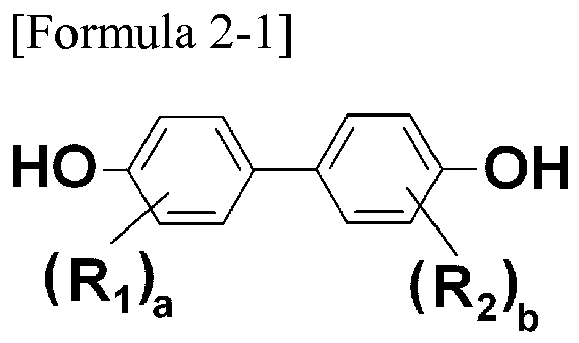
- the method includes transesterification of diols represented by Formula 1-1, Formula 2-1 and Formula 3-1 with diaryl carbonate: (wherein, R 1 and R 2 are each independently substituted or unsubstituted C1 to C6 alkyl, substituted or unsubstituted C3 to C6 cycloalkyl, substituted or unsubstituted C6 to C12 aryl or halogen, and a and b are each independently an integer from 0 to 4); (wherein, R1 and R 2 are each independently substituted or unsubstituted C1 to C6 alkyl, substituted or unsubstituted C3 to C6 cycloalkyl, substituted or unsubstituted C6 to C12 aryl or halogen, and a and b are each independently an integer from 0 to 4); and (wherein, Q is substituted or unsubstituted C5 to C10
- a mole ratio of Formula 1-1, Formula 2-1 and Formula 3-1 may be about 30 to 90 mol%: 5 to 30 mol%: 5 to 40 mol%.
- the present invention provides a polycarbonate having excellent chemical resistance, fluidity, transparency, room-temperature/low-temperature impact strength and heat resistance without deterioration in impact resistance, and a method of preparing the same.
- Polycarbonate according to exemplary embodiments of the invention can be prepared by transesterification of diols represented by Formula 1-1, Formula 2-1 and Formula 3-1 with diaryl carbonate.
- R 1 and R 2 are each independently substituted or unsubstituted C1 to C6 alkyl, substituted or unsubstituted C3 to C6 cycloalkyl, substituted or unsubstituted C6 to C12 aryl or halogen atom, and a and b are each independently an integer from 0 to 4).
- R 1 and R 2 are each independently substituted or unsubstituted C1 to C6 alkyl, substituted or unsubstituted C3 to C6 cycloalkyl, substituted or unsubstituted C6 to C12 aryl or halogen, and a and b are each independently an integer from 0 to 4).
- Q is substituted or unsubstituted C5 to C10 cycloalkyl, and a and b are each independently an integer from 0 to 4).
- Examples of Formula 1-1 may include 2,2-bis-(4-hydroxyphenyl)-propane, 2,2-bis-(3,5-dimethyl-4-hydroxyphenyl)-propane, 2,2-bis-(3,5-diisopropyl-4-hydroxyphenyl)-propane and the like.
- 2,2-bis-(4-hydroxyphenyl)-propane also referred to as bisphenol A, may be used.
- Examples of Formula 2-1 may include 4,4'-biphenol, 2,2'-dimethyl-4,4'-biphenyldiol, 3,3-dimethyl-4,4-dihydroxybiphenyl, 2,2',6,6'-tetramethyl-4,4'-biphenol and the like. Specifically, 4,4'-biphenol may be used.
- Examples of Formula 3-1 may include 1,2-cyclopentanediol, 1,3-cyclopentanediol, 1,2-cyclohexanediol, 1,3-cyclohexanediol, 1,4-cyclohexanediol, 1,2-cyclohexanedimethanol, 1,3-cyclohexanedimethanol, 1,4-cyclohexanedimethanol, 1,2-cycloheptanediol, 1,3-cycloheptanediol, 1,4-cycloheptanediol, 1,2-cyclooctanediol, 1,3-cyclooctanediol, 1,4-cyclooctanediol and the like. Specifically, 1,4-cyclohexanedimethanol may be used.
- a mole ratio of Formula 1-1, Formula 2-1 and Formula 3-1 may be about 30 to 90 mol%: 5 to 30 mol%: 5 to 40 mol%.
- the polycarbonate may have a balance of physical properties including impact strength, chemical resistance and fluidity.
- diaryl carbonate may include diphenyl carbonate, ditolyl carbonate, bis(chlorophenyl) carbonate, m-cresyl carbonate, dinaphthyl carbonate, bis(diphenyl) carbonate, diethyl carbonate, dimethyl carbonate, dibutyl carbonate, dicyclohexyl carbonate and the like, without being limited thereto.
- diaryl carbonates may be used alone or as mixtures. Among these, diphenyl carbonate is preferable.
- the diols in Formula 1-1, Formula 2-1 and Formula 3-1 may be added in a mole ratio of about 0.6 to about 1.0, preferably about 0.7 to about 0.9 to the diaryl carbonate.
- the diols of Formula 1-1, Formula 2-1 and Formula 3-1 are added in a mole ratio within this range, excellent mechanical strength can be obtained.
- transesterification may be performed at about 150 to about 300°C, preferably about 160 to about 280°C, and more preferably about 190 to about 260°C under reduced pressure conditions.
- reaction rate can be appropriate and side reactions can decrease.
- transesterification may be performed under reduced pressure conditions at about 100 Torr or less, for example about 75 Torr or less, preferably about 30 Torr or less, and more preferably about 1 Torr or less for at least about 10 minutes or more, preferably about 15 minutes to about 24 hours, and more preferably about 15 minutes to about 12 hours.
- the reaction rate can be appropriate and side reactions can decrease.
- the reaction can be performed at a temperature of about 160 to about 260°C for about 2 to about 9 hours, to prepare a polycarbonate resin.
- Transesterification may be performed in the presence of alkali and alkaline earth metals as a catalyst.
- the alkali and alkaline earth metals may include LiOH, NaOH and KOH, without being limited thereto. These metals may be used alone or as mixtures.
- the amount of the catalyst may be determined based on the amount of the aromatic dihydroxy compound. In one embodiment, the catalyst may be present in an amount of about 1 ⁇ 10 -8 mol to about 1 ⁇ 10 -3 mol based on 1 mol of the aromatic dihydroxy compound. When the catalyst is used in an amount within this range, sufficient reactivity can be obtained and generation of byproducts due to side reactions can be minimized, which can improve heat stability and color stability.
- a sulfonic acid ester compound represented by Formula 4 or a mixture therewith may be added to the polycarbonate produced by the above reaction, which can remove remaining activity of the catalyst.
- R9 is substituted or unsubstituted C1 to C20 alkyl
- R10 is substituted or unsubstituted C11 to C20 alkylene
- n is an integer from 0 to 5).
- Examples of the sulfonic acid ester compound of Formula 4 may include dodecyl p-toluenesulfonate, octadecyl p-toluenesulfonate, dodecyl dodecylbenzenesulfonate, octadecyl octadecylbenzenesulfonate and the like.
- the sulfonic acid ester compound may be present in an amount of about 0.0001 to about 0.001 parts by weight, preferably about 0.0003 to about 0.0008 parts by weight based on 100 parts by weight of the monomer.
- the sulfonic acid ester compound is present in an amount within this range, excellent heat stability and hydrolysis resistance can be obtained.
- a final polycarbonate may be prepared by in-situ reaction wherein the sulfonic acid ester compound is directly added to the polycarbonate obtained from the reaction.
- the polycarbonate obtained from transesterification and the sulfonic acid ester compound may be mixed in an extrusion process.
- the polycarbonate produced by the reaction can be transferred to an extruder and the sulfonic acid ester compound can be added to the extruder, followed by extruding the mixture into pellets.
- additives When adding the sulfonic acid ester compound, general additives may be added together and extruded.
- the additives may include flame retardants, antimicrobial agents, release agents, heat stabilizers, antioxidants, light stabilizers, compatibilizers, dyes, inorganic additives, fillers, plasticizers, impact modifiers, admixtures, coloring agents, stabilizers, lubricants, antistatic agents, pigments, weatherproofing agents, and UV blocks, without being limited thereto. These additives may be used alone or in combination of two or more thereof.
- the polycarbonate thus prepared can include repeat units represented by Formula 1, Formula 2 and Formula 3, respectively: (wherein, R 1 and R 2 are each independently substituted or unsubstituted C1 to C6 alkyl, substituted or unsubstituted C3 to C6 cycloalkyl, substituted or unsubstituted C6 to C12 aryl or halogen, and a and b are each independently an integer from 0 to 4).
- R 1 and R 2 are each independently substituted or unsubstituted C1 to C6 alkyl, substituted or unsubstituted C3 to C6 cycloalkyl, substituted or unsubstituted C6 to C12 aryl or halogen, and a and b are each independently an integer from 0 to 4).
- Q is substituted or unsubstituted C5 to C10 cycloalkyl, and a and b are each independently an integer from 0 to 4).
- the polycarbonate includes a mole ratio of the units of Formula 1 (M1), Formula 2 (M2) and Formula 3 (M3) within this range, the polycarbonate can exhibit excellent fluidity, impact strength and chemical resistance, and particularly can obtain superior heat resistance and impact strength at room temperature. Further, the polycarbonate may secure a low index of refraction, thereby obtaining excellent compatibility with other resins when mixed therewith.
- the polycarbonate may have a glass transition temperature of 135 to 160°C, an index of refraction of about 1.58 to about 1.59 and a notched IZOD impact strength of about 65 to about 95 kg ⁇ cm/cm, as measured on a 1/8" thick specimen at room temperature according to ASTM D256.
- the polycarbonate includes a mole ratio of the units of Formula 1 (M1), Formula 2 (M2) and Formula 3 (M3) within this range, the polycarbonate can exhibit excellent fluidity, impact strength and chemical resistance, and particularly can obtain superior practical fluidity, impact strength at low temperature and chemical resistance.
- the polycarbonate may have a notched IZOD impact strength of about 55 to about 85 kg ⁇ cm/cm, as measured on a 1/8" thick specimen at -30°C according to ASTM D542.
- the polycarbonate may have a mole ratio of Formula 1 (M1), Formula 2 (M2) and Formula 3 (M3) which satisfies the following conditions:
- M1 > M2 is preferable, and M1 > M2 + M3 is more preferable. In this case, heat resistance and impact strength at room temperature can be particularly excellent.
- the mole ratio of M2 to M3 may be about 1:1 to 1:2. When the mole ratio of M2 to M3 is within this range, excellent chemical resistance can be obtained.
- the polycarbonate resin prepared according to the present invention can have excellent chemical resistance, fluidity and impact strength, and thus may be used in various products.
- the polycarbonate resin may be used for automobiles, machine parts, electric and electronic components, office machines including a computer or miscellaneous goods.
- the polycarbonate resin may be employed not only for housings of electric and electronic products, such as TVs, computers, printers, washing machines, cassette players, stereos, cellular phones, game consoles and toys, but for humidifiers, steam vacuum cleaners, steam irons, and the like.
- the polycarbonate resin may be formed into a product using suitable molding techniques, for example, extrusion molding, injection molding, vacuum molding, casting molding, blow molding and calendar molding. These methods are generally known to a person having ordinary knowledge in the art.
- the reactor is heated to 260°C and maintained at 20 Torr for 1 hour, and then is decompressed to 0.5 Torr and maintained for 1 hour. Then, 0.0005 phr of dodecyl p-toluene sulfonate, 0.03 phr of octadecyl 3-(3,5-di-tert-4-hydroxyphenyl)propionate and 0.05 phr of tris(2,4-di-tert-butylphenyl)phosphate are added to the melt polymer and mixed to form uniform mixture for about 10 minutes.
- Melt index is measured at 250°C and a load of 10 kg using a flow index tester (Model No: F-WO1, manufactured by Toyoseiki).
- Glass transition temperature is measured at a temperature increase rate of 10°C per minute using DSC (Model No.: Q100, TA Instruments)
- An index of refraction is measured according to ASTM D257.
- a practically flowing distance (cm) of the pellets in a 2 mm-thick spiral mold at 290°C and a mold temperature of 80°C is measured using an injection machine (DHC 120WD, 120 ton, Dongshin en-Tech Co., Ltd.).
- the prepared pellets are formed into a 1/8" IZOD specimen at a molding temperature of 270°C and a mold temperature of 70°C using an injection machine (DHC 120WD, 120 ton, Dongshin en-Tech Co., Ltd.), followed by evaluation according to ASTM D256 (1/8", notched).
- Impact strength at low temperature is measured on a 1/8" IZOD specimen at - 30°C according to ASTM D542.
- a tensile specimen in accordance with ASTM D638 is prepared via injection molding, after which a 2.1 % strain is applied to the specimen according to ASTM D543 for evaluating Environmental Stress Crack Resistance and methanol and isopropyl alcohol are dropped thereto. After 10 minutes, cracks generated on a curved part were observed. (O: No Crack, ⁇ : Fine cracks, ⁇ : Many cracks, X: Haze of cracks)
- the melt indices (MI) of the polycarbonates according to Examples 1 to 6 and Comparative Examples 1 to 3 are adjusted to 30 g/10 min.
- the polycarbonates according to Comparative Examples 4 and 5 have unmeasurably high MIs at 250°C and a load of 10 kg.
- the polycarbonates according to Examples 1 to 6 have excellent fluidity, impact strength at room temperature and low temperature, chemical resistance and transmittance.
- the polycarbonate using BPA only according to Comparative Example 1 exhibits significantly reduced chemical resistance, and the polycarbonates not employing an alicyclic diol according to Comparative Examples 2 and 3 have lowered impact strength at room temperature and practical fluidity.
- the polycarbonates not using BP according to Comparative Examples 4 and 5 have excellent practical fluidity but exhibit reduced impact strength at room temperature and low temperature.
- the polycarbonate according to Comparative Example 4 has deteriorated chemical resistance as well.
Landscapes
- Chemical & Material Sciences (AREA)
- Health & Medical Sciences (AREA)
- Chemical Kinetics & Catalysis (AREA)
- Medicinal Chemistry (AREA)
- Polymers & Plastics (AREA)
- Organic Chemistry (AREA)
- Polyesters Or Polycarbonates (AREA)
Abstract


Description
- The present invention relates to polycarbonate and a method of preparing the same. More specifically, the present invention relates to polycarbonate having excellent chemical resistance and impact resistance, and a method of preparing the same.
- Polycarbonate is a thermoplastic material that has a heat deflection temperature of about 135°C or higher and can exhibit superior mechanical properties including impact resistance and excellent self-extinguishing properties, dimensional stability, heat resistance and transparency. Polycarbonate resins are widely used in various applications, such as exterior materials of electronic and electric products, automobile components, and the like.
- However, despite excellent transparency and mechanical properties, polycarbonate has limitations in use for exterior materials. When a plastic material is used as an exterior material, the product is often coated to enhance the aesthetics thereof. In this case, a dye diluted with various organic solvents can be applied to the surface of a molded resin article and dried. The organic solvents used as diluents can penetrate into the polycarbonate, which can decrease transparency and mechanical strength. Thus, in order to use polycarbonate in products frequently exposed to various organic solvents in the course of use, it is important for the polycarbonate to have resistance against these organic solvents. Various methods are suggested to improve chemical resistance of polycarbonate resins.
-
KR Patent Publication No. 2007-0071446 KR Patent Publication No. 2009-0026359 KR Patent Publication No. 2010-0022376 -
JP 05-339390 US Patent No. 5,401,826 disclose methods of improving chemical resistance by preparing copolymerized polycarbonate in which a material having chemical resistance is introduced into a conventional polycarbonate resin. - An example of the copolymerized material is 4,4'-biphenol, which is copolymerized with a polycarbonate resin to improve chemical resistance. However, although 4,4'-biphenol can improve chemical resistance, it also can reduce impact resistance, thereby deteriorating advantages of the polycarbonate. In particular, as the amount of 4,4'-biphenol used increases, fluidity drastically decreases, causing deterioration in moldability.
- It is an aspect of the present invention to provide a polycarbonate having excellent chemical resistance and fluidity without deterioration in impact resistance, and a method of preparing the same.
- It is another aspect of the present invention to provide a polycarbonate having excellent chemical resistance, fluidity, room-temperature/low-temperature impact strength and heat resistance while retaining transparency, and a method of preparing the same.
- The above-mentioned aspects and other aspects may be accomplished by the present invention as explained below.
- One aspect of the present invention relates to a polycarbonate. The polycarbonate includes repeat units represented by Formula 1, Formula 2, and Formula 3, respectively:


- In one embodiment, the polycarbonate may have a mole ratio of Formula 1 (M1), Formula 2 (M2) and Formula 3 (M3) of about 30 to 90 mol%: 5 to 30 mol%: 5 to 40 mol%.
- In another embodiment, the polycarbonate may have a mole ratio of Formula 1 (M1), Formula 2 (M2) and Formula 3 (M3) of about 75 to 90 mol%: 5 to 15 mol%: 5 to 15 mol%.
- In a further embodiment, the polycarbonate may have a mole ratio of Formula 1 (M1), Formula 2 (M2) and Formula 3 (M3) of about 30 to 80 mol%: 10 to 30 mol%: 10 to 40 mol%.
- In one embodiment, the polycarbonate may have a mole ratio of Formula 1 (M1), Formula 2 (M2) and Formula 3 (M3) which satisfies the following conditions:
- M1 > M2 + M3
- M2 ≤ M3
- In one embodiment, the polycarbonate may have a glass transition temperature of about 135 to about 160°C, an index of refraction of about 1.58 to about 1.59 and a notched IZOD impact strength of about 65 to about 95 kg·cm/cm, as measured on a 1/8" thick specimen at room temperature according to ASTM D256.
- In another embodiment, the polycarbonate may have a notched IZOD impact strength of about 55 to about 85 kg·cm/cm, as measured on a 1/8" thick specimen at -30°C according to ASTM D542.
- The polycarbonate may include a sulfonic acid compound represented by Formula 4:

- Another aspect of the present invention relates to a method of preparing polycarbonate. The method includes transesterification of diols represented by Formula 1-1, Formula 2-1 and Formula 3-1 with diaryl carbonate:


- In one embodiment, a mole ratio of Formula 1-1, Formula 2-1 and Formula 3-1 may be about 30 to 90 mol%: 5 to 30 mol%: 5 to 40 mol%.
- The present invention provides a polycarbonate having excellent chemical resistance, fluidity, transparency, room-temperature/low-temperature impact strength and heat resistance without deterioration in impact resistance, and a method of preparing the same.
- Polycarbonate according to exemplary embodiments of the invention can be prepared by transesterification of diols represented by Formula 1-1, Formula 2-1 and Formula 3-1 with diaryl carbonate.


- Examples of Formula 1-1 may include 2,2-bis-(4-hydroxyphenyl)-propane, 2,2-bis-(3,5-dimethyl-4-hydroxyphenyl)-propane, 2,2-bis-(3,5-diisopropyl-4-hydroxyphenyl)-propane and the like. Specifically, 2,2-bis-(4-hydroxyphenyl)-propane, also referred to as bisphenol A, may be used.
- Examples of Formula 2-1 may include 4,4'-biphenol, 2,2'-dimethyl-4,4'-biphenyldiol, 3,3-dimethyl-4,4-dihydroxybiphenyl, 2,2',6,6'-tetramethyl-4,4'-biphenol and the like. Specifically, 4,4'-biphenol may be used.
- Examples of Formula 3-1 may include 1,2-cyclopentanediol, 1,3-cyclopentanediol, 1,2-cyclohexanediol, 1,3-cyclohexanediol, 1,4-cyclohexanediol, 1,2-cyclohexanedimethanol, 1,3-cyclohexanedimethanol, 1,4-cyclohexanedimethanol, 1,2-cycloheptanediol, 1,3-cycloheptanediol, 1,4-cycloheptanediol, 1,2-cyclooctanediol, 1,3-cyclooctanediol, 1,4-cyclooctanediol and the like. Specifically, 1,4-cyclohexanedimethanol may be used.
- In one embodiment, a mole ratio of Formula 1-1, Formula 2-1 and Formula 3-1 may be about 30 to 90 mol%: 5 to 30 mol%: 5 to 40 mol%. When the mole ratio of the diols of Formula 1-1, Formula 2-1 and Formula 3-1 is within this range, the polycarbonate may have a balance of physical properties including impact strength, chemical resistance and fluidity.
- Examples of the diaryl carbonate may include diphenyl carbonate, ditolyl carbonate, bis(chlorophenyl) carbonate, m-cresyl carbonate, dinaphthyl carbonate, bis(diphenyl) carbonate, diethyl carbonate, dimethyl carbonate, dibutyl carbonate, dicyclohexyl carbonate and the like, without being limited thereto. These diaryl carbonates may be used alone or as mixtures. Among these, diphenyl carbonate is preferable.
- In one embodiment, the diols in Formula 1-1, Formula 2-1 and Formula 3-1 may be added in a mole ratio of about 0.6 to about 1.0, preferably about 0.7 to about 0.9 to the diaryl carbonate. When the diols of Formula 1-1, Formula 2-1 and Formula 3-1 are added in a mole ratio within this range, excellent mechanical strength can be obtained.
- In one embodiment, transesterification may be performed at about 150 to about 300°C, preferably about 160 to about 280°C, and more preferably about 190 to about 260°C under reduced pressure conditions. When the temperature is within this range, reaction rate can be appropriate and side reactions can decrease.
- Further, transesterification may be performed under reduced pressure conditions at about 100 Torr or less, for example about 75 Torr or less, preferably about 30 Torr or less, and more preferably about 1 Torr or less for at least about 10 minutes or more, preferably about 15 minutes to about 24 hours, and more preferably about 15 minutes to about 12 hours. When the pressure and time are within these ranges, the reaction rate can be appropriate and side reactions can decrease.
- In one embodiment, the reaction can be performed at a temperature of about 160 to about 260°C for about 2 to about 9 hours, to prepare a polycarbonate resin.
- Transesterification may be performed in the presence of alkali and alkaline earth metals as a catalyst. Examples of the alkali and alkaline earth metals may include LiOH, NaOH and KOH, without being limited thereto. These metals may be used alone or as mixtures. The amount of the catalyst may be determined based on the amount of the aromatic dihydroxy compound. In one embodiment, the catalyst may be present in an amount of about 1 × 10⁻⁸ mol to about 1 × 10⁻³ mol based on 1 mol of the aromatic dihydroxy compound. When the catalyst is used in an amount within this range, sufficient reactivity can be obtained and generation of byproducts due to side reactions can be minimized, which can improve heat stability and color stability.
- A sulfonic acid ester compound represented by Formula 4 or a mixture therewith may be added to the polycarbonate produced by the above reaction, which can remove remaining activity of the catalyst.

- Examples of the sulfonic acid ester compound of Formula 4 may include dodecyl p-toluenesulfonate, octadecyl p-toluenesulfonate, dodecyl dodecylbenzenesulfonate, octadecyl octadecylbenzenesulfonate and the like.
- In one embodiment, the sulfonic acid ester compound may be present in an amount of about 0.0001 to about 0.001 parts by weight, preferably about 0.0003 to about 0.0008 parts by weight based on 100 parts by weight of the monomer. When the sulfonic acid ester compound is present in an amount within this range, excellent heat stability and hydrolysis resistance can be obtained.
- In one embodiment, a final polycarbonate may be prepared by in-situ reaction wherein the sulfonic acid ester compound is directly added to the polycarbonate obtained from the reaction. Alternatively, the polycarbonate obtained from transesterification and the sulfonic acid ester compound may be mixed in an extrusion process. In this embodiment, the polycarbonate produced by the reaction can be transferred to an extruder and the sulfonic acid ester compound can be added to the extruder, followed by extruding the mixture into pellets.
- When adding the sulfonic acid ester compound, general additives may be added together and extruded. The additives may include flame retardants, antimicrobial agents, release agents, heat stabilizers, antioxidants, light stabilizers, compatibilizers, dyes, inorganic additives, fillers, plasticizers, impact modifiers, admixtures, coloring agents, stabilizers, lubricants, antistatic agents, pigments, weatherproofing agents, and UV blocks, without being limited thereto. These additives may be used alone or in combination of two or more thereof.
- The polycarbonate thus prepared can include repeat units represented by Formula 1, Formula 2 and Formula 3, respectively:


- In one embodiment, the polycarbonate may have a mole ratio of Formula 1 (M1), Formula 2 (M2) and Formula 3 (M3) of M1: M2: M3 = about 30 to 90 mol%: 5 to 30 mol%: 5 to 40 mol%.
- In another embodiment, the polycarbonate may have a mole ratio of Formula 1 (M1), Formula 2 (M2) and Formula 3 (M3) of M1: M2: M3 = about 75 to 90 mol%: 5 to 15 mol%: 5 to 15 mol%. When the polycarbonate includes a mole ratio of the units of Formula 1 (M1), Formula 2 (M2) and Formula 3 (M3) within this range, the polycarbonate can exhibit excellent fluidity, impact strength and chemical resistance, and particularly can obtain superior heat resistance and impact strength at room temperature. Further, the polycarbonate may secure a low index of refraction, thereby obtaining excellent compatibility with other resins when mixed therewith. In exemplary embodiments, the polycarbonate may have a glass transition temperature of 135 to 160°C, an index of refraction of about 1.58 to about 1.59 and a notched IZOD impact strength of about 65 to about 95 kg·cm/cm, as measured on a 1/8" thick specimen at room temperature according to ASTM D256.
- In a further embodiment, the polycarbonate may have a mole ratio of Formula 1 (M1), Formula 2 (M2) and Formula 3 (M3) of M1: M2: M3 = about 30 to 80 mol%: 10 to 30 mol%: 10 to 40 mol%. When the polycarbonate includes a mole ratio of the units of Formula 1 (M1), Formula 2 (M2) and Formula 3 (M3) within this range, the polycarbonate can exhibit excellent fluidity, impact strength and chemical resistance, and particularly can obtain superior practical fluidity, impact strength at low temperature and chemical resistance. In exemplary embodiments, the polycarbonate may have a notched IZOD impact strength of about 55 to about 85 kg·cm/cm, as measured on a 1/8" thick specimen at -30°C according to ASTM D542.
- In one embodiment, the polycarbonate may have a mole ratio of Formula 1 (M1), Formula 2 (M2) and Formula 3 (M3) which satisfies the following conditions:
- M1 ≥ M2
- M2 ≤ M3
- M1 > M2 is preferable, and M1 > M2 + M3 is more preferable. In this case, heat resistance and impact strength at room temperature can be particularly excellent.
- The mole ratio of M2 to M3 may be about 1:1 to 1:2. When the mole ratio of M2 to M3 is within this range, excellent chemical resistance can be obtained.
- The polycarbonate resin prepared according to the present invention can have excellent chemical resistance, fluidity and impact strength, and thus may be used in various products. For example, the polycarbonate resin may be used for automobiles, machine parts, electric and electronic components, office machines including a computer or miscellaneous goods. In particular, the polycarbonate resin may be employed not only for housings of electric and electronic products, such as TVs, computers, printers, washing machines, cassette players, stereos, cellular phones, game consoles and toys, but for humidifiers, steam vacuum cleaners, steam irons, and the like.
- The polycarbonate resin may be formed into a product using suitable molding techniques, for example, extrusion molding, injection molding, vacuum molding, casting molding, blow molding and calendar molding. These methods are generally known to a person having ordinary knowledge in the art.
- The present invention will be explained in more detail with reference to the following examples. These examples are provided for illustrative purposes only and are not to be in any way construed as limiting the present invention.
- 4.05 kg of 2,2-bis(4-hydroxyphenyl)propane (bisphenol A or BPA), 0.19 kg of 4,4'-biphenyl (BP), 0.14 kg of 1,4-cyclohexanedimethanol (CHDM), 4.35 kg of diphenyl carbonate and 150 ppb of KOH (based on 1 mol of bisphenol A) are sequentially added to a reactor, and oxygen in the reactor is removed using nitrogen. The reactor is heated to 160°C and then to 190°C, at which temperature the reaction is performed for 6 hours. After 6 hours, the reactor is heated to 210°C and maintained at 100 Torr for 1 hour. The reactor is heated to 260°C and maintained at 20 Torr for 1 hour, and then is decompressed to 0.5 Torr and maintained for 1 hour. Then, 0.0005 phr of dodecyl p-toluene sulfonate, 0.03 phr of octadecyl 3-(3,5-di-tert-4-hydroxyphenyl)propionate and 0.05 phr of tris(2,4-di-tert-butylphenyl)phosphate are added to the melt polymer and mixed to form uniform mixture for about 10 minutes.
- 3.83 kg of 2,2-bis(4-hydroxyphenyl)propane (bisphenol A), 0.19 kg of 4,4'-biphenyl, 0.28 kg of 1,4-cyclohexanedimethanol, 4.35 kg of diphenyl carbonate and 150 ppb of KOH (based on 1 mol of bisphenol A) are sequentially added to a reactor, and oxygen in the reactor is removed using nitrogen. Then, polymerization is performed in the same manner as in Example 1.
- 3.60 kg of 2,2-bis(4-hydroxyphenyl)propane (bisphenol A), 0.37 kg of 4,4'-biphenyl, 0.28 kg of 1,4-cyclohexanedimethanol, 4.35 kg of diphenyl carbonate and 150 ppb of KOH (based on 1 mol of bisphenol A) are sequentially added to a reactor, and oxygen in the reactor is removed using nitrogen. Then, polymerization is performed in the same manner as in Example 1.
- 3.15 kg of 2,2-bis(4-hydroxyphenyl)propane (bisphenol A), 0.37 kg of 4,4'-biphenyl, 0.57 kg of 1,4-cyclohexanedimethanol, 4.35 kg of diphenyl carbonate and 150 ppb of KOH (based on 1 mol of bisphenol A) are sequentially added to a reactor, and oxygen in the reactor is removed using nitrogen. Then, polymerization is performed in the same manner as in Example 1.
- 2.25 kg of 2,2-bis(4-hydroxyphenyl)propane (bisphenol A), 0.74 kg of 4,4'-biphenyl, 0.85 kg of 1,4-cyclohexanedimethanol, 4.35 kg of diphenyl carbonate and 150 ppb of KOH (based on 1 mol of bisphenol A) are sequentially added to a reactor, and oxygen in the reactor is removed using nitrogen. Then, polymerization is performed in the same manner as in Example 1.
- 1.35 kg of 2,2-bis(4-hydroxyphenyl)propane (bisphenol A), 1.11 kg of 4,4'-biphenyl, 0.85 kg of 1,4-cyclohexanedimethanol, 1.13 kg of diphenyl carbonate and 150 ppb of KOH (based on 1 mol of bisphenol A) are sequentially added to a reactor, and oxygen in the reactor is removed using nitrogen. Then, polymerization is performed in the same manner as in Example 1.
- 4.5 kg of 2,2-bis(4-hydroxyphenyl)propane (bisphenol A), 4.35 kg of diphenyl carbonate and 100 ppb of KOH (based on 1 mol of bisphenol A) are sequentially added to a reactor, and oxygen in the reactor is removed using nitrogen. The reactor is heated to 160°C and then to 190°C, at which temperature the reaction is performed for 6 hours. After 6 hours, the reactor is heated to 220°C and maintained at 70 Torr for 1 hour. The reactor is heated to 260°C and maintained at 20 Torr for 1 hour, and then is decompressed to 0.5 Torr and maintained for 1 hour. Then, 0.0005 phr of dodecyl p-toluene sulfonate, 0.03 phr of octadecyl 3-(3,5-di-tert-4-hydroxyphenyl)propionate and 0.05 phr of tris(2,4-di-tert-butylphenyl)phosphate are added to the melt polymer and mixed to form a uniform mixture for about 10 minutes.
- 3.83 kg of 2,2-bis(4-hydroxyphenyl)propane (bisphenol A), 0.56 kg of 4,4'-biphenyl, 4.35 kg of diphenyl carbonate and 100 ppb of KOH (based on 1 mol of bisphenol A) are sequentially added to a reactor, and oxygen in the reactor is removed using nitrogen. Then, polymerization is performed in the same manner as in Comparative Example 1.
- 3.15 kg of 2,2-bis(4-hydroxyphenyl)propane (bisphenol A), 1.11 kg of 4,4'-biphenyl, 4.35 kg of diphenyl carbonate and 150 ppb of KOH (based on 1 mol of bisphenol A) are sequentially added to a reactor, and oxygen in the reactor is removed using nitrogen. Then, polymerization is performed in the same manner as in Comparative Example 1.
- 4.05 kg of 2,2-bis(4-hydroxyphenyl)propane (bisphenol A), 0.28 kg of 4,4'-biphenyl, 4.35 kg of diphenyl carbonate and 150 ppb of KOH (based on 1 mol of bisphenol A) are sequentially added to a reactor, and oxygen in the reactor is removed using nitrogen. Then, polymerization is performed in the same manner as in Example 1.
- 3.15 kg of 2,2-bis(4-hydroxyphenyl)propane (bisphenol A), 0.85 kg of 1,4-cyclohexanedimethanol, 4.35 kg of diphenyl carbonate and 150 ppb of KOH (based on 1 mol of bisphenol A) are sequentially added to a reactor, and oxygen in the reactor is removed using nitrogen. Then, polymerization is performed in the same manner as in Example 1.
Table 1 Examples Comparative Examples 1 2 3 4 5 6 1 2 3 4 5 BPA (mol%) 90 85 80 70 50 30 100 85 70 90 70 BP (mol%) 5 5 10 10 20 30 - 15 30 - - CHDM (mol%) 5 10 10 20 30 40 - - - 10 30 Antioxidant (phr) 0.03 0.03 0.03 0.03 0.03 0.03 0.03 0.03 0.03 0.03 0.03 Phosphorus heat stabilizer (phr) 0.05 0.05 0.05 0.05 0.05 0.05 0.05 0.05 0.05 0.05 0.05 - The polycarbonate resins prepared in the Examples and Comparative Examples are extruded using a biaxial extruder (L/D = 36, φ = 32) at 270°C and formed into pellets using a pelletizer. Physical properties of the prepared pellets are evaluated as follows and results are shown in Table 2.
- Melt index is measured at 250°C and a load of 10 kg using a flow index tester (Model No: F-WO1, manufactured by Toyoseiki).
- Glass transition temperature is measured at a temperature increase rate of 10°C per minute using DSC (Model No.: Q100, TA Instruments)
- An index of refraction is measured according to ASTM D257.
- A practically flowing distance (cm) of the pellets in a 2 mm-thick spiral mold at 290°C and a mold temperature of 80°C is measured using an injection machine (DHC 120WD, 120 ton, Dongshin en-Tech Co., Ltd.).
- The prepared pellets are formed into a 1/8" IZOD specimen at a molding temperature of 270°C and a mold temperature of 70°C using an injection machine (DHC 120WD, 120 ton, Dongshin en-Tech Co., Ltd.), followed by evaluation according to ASTM D256 (1/8", notched).
- Impact strength at low temperature is measured on a 1/8" IZOD specimen at - 30°C according to ASTM D542.
- * Chemical resistance to alcohols: A tensile specimen in accordance with ASTM D638 is prepared via injection molding, after which a 2.1 % strain is applied to the specimen according to ASTM D543 for evaluating Environmental Stress Crack Resistance and methanol and isopropyl alcohol are dropped thereto. After 10 minutes, cracks generated on a curved part were observed. (Ⓞ: No Crack, ○: Fine cracks, Δ: Many cracks, X: Haze of cracks)
- * Transmittance after depositing in coating solution: A 2.5 mm flat specimen is deposited in a coating thinner (main ingredients: methyl isobutyl ketone, cyclohexanone, 2-ethoxyethanol) for a polycarbonate resin for 2 minutes and dried at 80°C for 30 minutes, followed by measurement of visible transmittance (%) using a hazemeter (Gmbh 4725, BYK-Gardner)
Table 2 Examples Comparative Examples 1 2 3 4 5 6 1 2 3 4 5 MI 30 30 30 30 30 30 30 30 30 Unmeas urable Unmeas urable Tg(°C) 148 140 142 125 120 112 148 152 155 137 119 Index of refraction 1.585 1.586 1.588 1.588 1.592 1.596 1.584 1.590 1.595 1.582 1.578 Practical fluidity (cm) 28.7 30.5 29.5 36.5 39.0 41.2 28.5 25 22 30.5 35.0 Impact strength at room temperature (1/8") 69 70 72 68 66 63 73 52 41 50 7 Impact strength at room temperature (-30°) (1/8") 14 36 65 63 64 61 13 42 39 12 6 Chemical resistance Alcohols ○ Ⓞ Ⓞ Ⓞ Ⓞ Ⓞ X Ⓞ Ⓞ Δ ○ Transmittan ce after depositing in coating solution (%) 80 88 88 88 88 88 <30 88 88 70 85 - During testing, the melt indices (MI) of the polycarbonates according to Examples 1 to 6 and Comparative Examples 1 to 3 are adjusted to 30 g/10 min. The polycarbonates according to Comparative Examples 4 and 5 have unmeasurably high MIs at 250°C and a load of 10 kg. The polycarbonates according to Examples 1 to 6 have excellent fluidity, impact strength at room temperature and low temperature, chemical resistance and transmittance. However, the polycarbonate using BPA only according to Comparative Example 1 exhibits significantly reduced chemical resistance, and the polycarbonates not employing an alicyclic diol according to Comparative Examples 2 and 3 have lowered impact strength at room temperature and practical fluidity. The polycarbonates not using BP according to Comparative Examples 4 and 5 have excellent practical fluidity but exhibit reduced impact strength at room temperature and low temperature. In particular, the polycarbonate according to Comparative Example 4 has deteriorated chemical resistance as well.
- Although some embodiments have been disclosed herein, it should be understood that these embodiments are provided by way of illustration only, and that various modifications, changes, and alterations can be made without departing from the spirit and scope of the invention. Therefore, the scope of the invention should be limited only by the accompanying claims and equivalents thereof.
Claims (10)
- Polycarbonate comprising repeat units represented by Formula 1, Formula 2 and Formula 3, respectively:


- The polycarbonate of claim 1, wherein the polycarbonate has a mole ratio of Formula 1 (M1), Formula 2 (M2) and Formula 3 (M3) of about 30 to 90 mol%: 5 to 30 mol%: 5 to 40 mol%.
- The polycarbonate of claim 1, wherein the polycarbonate has a mole ratio of Formula 1 (M1), Formula 2 (M2) and Formula 3 (M3) of about 75 to 90 mol%: 5 to 15 mol%: 5 to 15 mol%.
- The polycarbonate of claim 1, wherein the polycarbonate has a mole ratio of Formula 1 (M1), Formula 2 (M2) and Formula 3 (M3) of about 30 to 80 mol%: 10 to 30 mol%: 10 to 40 mol%.
- The polycarbonate of claim 1, wherein the polycarbonate has a mole ratio of Formula 1 (M1), Formula 2 (M2) and Formula 3 (M3) which satisfies conditions as follows:M1 > M2 + M3M2 ≤ M3(wherein, M1 is a mole ratio of Formula 1, M2 is a mole ratio of Formula 2 and M3 is a mole ratio of Formula 3).
- The polycarbonate of claim 3, wherein the polycarbonate has a glass transition temperature of about 135 to about 160°C, an index of refraction of about 1.58 to about 1.59 and a notched IZOD impact strength of about 65 to about 95 kg·cm/cm, as measured on a 1/8" thick specimen at room temperature according to ASTM D256.
- The polycarbonate of claim 4, wherein the polycarbonate has a notched IZOD impact strength of about 55 to about 85 kg·cm/cm, as measured on a 1/8" thick specimen at -30°C according to ASTM D542.
- The polycarbonate of claim 1, wherein the polycarbonate comprises a sulfonic acid compound represented by Formula 4:

- A method of preparing polycarbonate comprising transesterification of diols represented by Formula 1-1, Formula 2-1 and Formula 3-1 with diaryl carbonate:



- The method of claim 9, wherein a mole ratio of Formula 1-1, Formula 2-1 and Formula 3-1 is about 30 to 90 mol%: 5 to 30 mol%: 5 to 40 mol%.
Applications Claiming Priority (2)
| Application Number | Priority Date | Filing Date | Title |
|---|---|---|---|
| KR20110099850A KR101489952B1 (en) | 2011-09-30 | 2011-09-30 | Polycarbonate and Method for Preparing the Same |
| PCT/KR2011/009684 WO2013047955A1 (en) | 2011-09-30 | 2011-12-15 | Polycarbonate and method for preparing same |
Publications (3)
| Publication Number | Publication Date |
|---|---|
| EP2762516A1 true EP2762516A1 (en) | 2014-08-06 |
| EP2762516A4 EP2762516A4 (en) | 2015-05-27 |
| EP2762516B1 EP2762516B1 (en) | 2016-10-12 |
Family
ID=47989771
Family Applications (1)
| Application Number | Title | Priority Date | Filing Date |
|---|---|---|---|
| EP11873052.2A Active EP2762516B1 (en) | 2011-09-30 | 2011-12-15 | Polycarbonate and method for preparing same |
Country Status (5)
| Country | Link |
|---|---|
| US (1) | US8410240B1 (en) |
| EP (1) | EP2762516B1 (en) |
| KR (1) | KR101489952B1 (en) |
| CN (1) | CN103842405B (en) |
| WO (1) | WO2013047955A1 (en) |
Families Citing this family (8)
| Publication number | Priority date | Publication date | Assignee | Title |
|---|---|---|---|---|
| KR101437140B1 (en) * | 2011-09-21 | 2014-09-02 | 제일모직주식회사 | Polycarbonate and Method for Preparing the Same |
| KR101685245B1 (en) * | 2013-12-30 | 2016-12-09 | 롯데첨단소재(주) | Copolymerized polycarbonate resin, method for preparing the same and article comprising the same |
| KR101714834B1 (en) * | 2014-04-30 | 2017-03-10 | 롯데첨단소재(주) | Polycarbonate resin, method for preparing the same, and article comprising the same |
| KR102036891B1 (en) * | 2014-05-26 | 2019-10-25 | 삼성전자주식회사 | Polymer compositions and formed article and manufacturing method of the same |
| JP6976715B2 (en) * | 2017-05-23 | 2021-12-08 | 本州化学工業株式会社 | Aromatic polycarbonate oligomer solid |
| CN109825055B (en) * | 2019-01-15 | 2021-06-11 | 金发科技股份有限公司 | Polycarbonate composition and preparation method thereof |
| KR20210000860A (en) | 2019-06-26 | 2021-01-06 | 김경호 | Green tea |
| KR102517577B1 (en) * | 2020-10-16 | 2023-04-04 | 주식회사 엘지화학 | Polycarbonate and method for preparing same |
Family Cites Families (18)
| Publication number | Priority date | Publication date | Assignee | Title |
|---|---|---|---|---|
| DE2827325A1 (en) * | 1978-06-22 | 1980-01-10 | Bayer Ag | METHOD FOR THE PRODUCTION OF ALIPHATIC-AROMATIC POLYCARBONATES WITH DIPHENOL CARBONATE END GROUPS AND THE USE THEREOF FOR THE PRODUCTION OF THERMOPLASTICALLY PROCESSABLE, HIGHLY MOLECULAR, SEGMENTED, ALIPHATIC-AROMATIC-AROMATIC-AROMATIC-AROMATIC-AROMATIC-AROMATIC |
| JP2536196B2 (en) * | 1989-11-08 | 1996-09-18 | 富士ゼロックス株式会社 | Electrophotographic photoreceptor |
| JPH05117382A (en) | 1991-10-29 | 1993-05-14 | Nippon G Ii Plast Kk | Copolymerized polycarbonate, its production and composition composed thereof |
| JP3131031B2 (en) | 1992-06-05 | 2001-01-31 | 出光興産株式会社 | Polycarbonate film |
| JPH07199488A (en) * | 1994-01-10 | 1995-08-04 | Konica Corp | Electrophotographic photoreceptor |
| JP3959572B2 (en) * | 1998-06-10 | 2007-08-15 | 三菱瓦斯化学株式会社 | Aromatic-aliphatic copolymer polycarbonate resin |
| JP3763310B2 (en) * | 1998-06-25 | 2006-04-05 | 富士ゼロックス株式会社 | High molecular weight polycarbonate and method for producing the same |
| DE60135554D1 (en) * | 2000-07-11 | 2008-10-09 | Teijin Chemicals Ltd | PLASTIC LENS |
| JP4865950B2 (en) * | 2001-02-05 | 2012-02-01 | 帝人化成株式会社 | Polycarbonate resin copolymer and plastic lens |
| JP4568462B2 (en) * | 2001-07-09 | 2010-10-27 | 帝人化成株式会社 | Plastic lens |
| JP2003055543A (en) * | 2001-08-16 | 2003-02-26 | Mitsubishi Gas Chem Co Inc | Aromatic-aliphatic copolymerized polycarbonate resin composition |
| KR100840105B1 (en) | 2005-12-30 | 2008-06-20 | 제일모직주식회사 | Polycarbonate resin composition excellent in chemical resistance |
| US20080015289A1 (en) | 2006-07-12 | 2008-01-17 | General Electric Company | Flame retardant and chemical resistant thermoplastic polycarbonate compositions |
| JP2008216999A (en) * | 2007-02-07 | 2008-09-18 | Mitsubishi Chemicals Corp | Electrophotographic photosensitive member coating solution, electrophotographic photosensitive member, and electrophotographic photosensitive member cartridge |
| DE102007015948A1 (en) * | 2007-04-03 | 2008-10-09 | Bayer Materialscience Ag | Modified polycarbonates, polyester carbonates and polyesters with improved extensibility and flame retardancy |
| KR100981929B1 (en) | 2008-08-19 | 2010-09-13 | 제일모직주식회사 | Thermoplastic resin composition and plastic molded article excellent in electrical conductivity, mechanical strength and chemical resistance |
| US7848025B2 (en) * | 2008-12-31 | 2010-12-07 | Sabic Innovative Plastics Ip B.V. | Transparent articles prepared from thermoplastic compositions having high flow and ductility, and method of preparing articles |
| KR101282709B1 (en) * | 2009-12-21 | 2013-07-05 | 제일모직주식회사 | Flame-retardant polycarbonate resin composition having improved heat stability and method for preparing the same |
-
2011
- 2011-09-30 KR KR20110099850A patent/KR101489952B1/en active Active
- 2011-12-15 CN CN201180073855.1A patent/CN103842405B/en active Active
- 2011-12-15 EP EP11873052.2A patent/EP2762516B1/en active Active
- 2011-12-15 WO PCT/KR2011/009684 patent/WO2013047955A1/en not_active Ceased
- 2011-12-16 US US13/328,138 patent/US8410240B1/en active Active
Also Published As
| Publication number | Publication date |
|---|---|
| WO2013047955A1 (en) | 2013-04-04 |
| CN103842405B (en) | 2016-04-13 |
| EP2762516A4 (en) | 2015-05-27 |
| US20130085252A1 (en) | 2013-04-04 |
| EP2762516B1 (en) | 2016-10-12 |
| CN103842405A (en) | 2014-06-04 |
| KR101489952B1 (en) | 2015-02-04 |
| US8410240B1 (en) | 2013-04-02 |
| KR20130035515A (en) | 2013-04-09 |
Similar Documents
| Publication | Publication Date | Title |
|---|---|---|
| EP2762516B1 (en) | Polycarbonate and method for preparing same | |
| JP5332696B2 (en) | Polycarbonate resin composition and method for producing the same | |
| JP2004359900A (en) | Polycarbonate resin composition | |
| JP6085819B2 (en) | Hydroxy capping monomer, its polycarbonate and articles containing it | |
| JP2010132782A (en) | Polycarbonate copolymer, method for producing the same and use thereof | |
| EP3628699B1 (en) | Copolycarbonate and preparation method therefor | |
| KR20140075520A (en) | Polycarbonate resin, method for preparing the same, and article comprising the same | |
| US9163115B2 (en) | Polycarbonate, production method for same and optical film comprising same | |
| KR101685245B1 (en) | Copolymerized polycarbonate resin, method for preparing the same and article comprising the same | |
| US9765184B2 (en) | Polycarbonate and method of preparing the same | |
| TWI462967B (en) | Polycarbonate resin composition | |
| CN103897165B (en) | Copolymerized panlite, prepare its method and comprise its goods | |
| KR101704896B1 (en) | Polyester carbonate resin, method for preparing the same and article comprising the same | |
| JP4577814B2 (en) | Anti-glare product | |
| WO2018180366A1 (en) | Method for producing thermoplastic resin | |
| JP5287704B2 (en) | Polycarbonate resin composition | |
| KR101301605B1 (en) | Polycarbonate Resin Having Excellent Heat Resistance, Hydrolysis resistance, Color, and Electrostatic Property and Method of Preparing the Same | |
| KR102954973B1 (en) | Polycarbonate compound composition and method for preparing the same | |
| KR101714834B1 (en) | Polycarbonate resin, method for preparing the same, and article comprising the same | |
| KR101752093B1 (en) | Copolymerized polycarbonate resin, method for preparing the same, and article comprising the same | |
| JP2005025149A (en) | Polarizer | |
| KR20220166115A (en) | Polycarbonate copolymer and method for preparing the same |
Legal Events
| Date | Code | Title | Description |
|---|---|---|---|
| PUAI | Public reference made under article 153(3) epc to a published international application that has entered the european phase |
Free format text: ORIGINAL CODE: 0009012 |
|
| 17P | Request for examination filed |
Effective date: 20140328 |
|
| AK | Designated contracting states |
Kind code of ref document: A1 Designated state(s): AL AT BE BG CH CY CZ DE DK EE ES FI FR GB GR HR HU IE IS IT LI LT LU LV MC MK MT NL NO PL PT RO RS SE SI SK SM TR |
|
| DAX | Request for extension of the european patent (deleted) | ||
| RA4 | Supplementary search report drawn up and despatched (corrected) |
Effective date: 20150428 |
|
| GRAP | Despatch of communication of intention to grant a patent |
Free format text: ORIGINAL CODE: EPIDOSNIGR1 |
|
| RIC1 | Information provided on ipc code assigned before grant |
Ipc: C08G 64/30 20060101ALI20160323BHEP Ipc: C08L 69/00 20060101ALI20160323BHEP Ipc: C08G 64/00 20060101AFI20160323BHEP Ipc: C08G 64/04 20060101ALI20160323BHEP |
|
| INTG | Intention to grant announced |
Effective date: 20160422 |
|
| GRAS | Grant fee paid |
Free format text: ORIGINAL CODE: EPIDOSNIGR3 |
|
| GRAA | (expected) grant |
Free format text: ORIGINAL CODE: 0009210 |
|
| AK | Designated contracting states |
Kind code of ref document: B1 Designated state(s): AL AT BE BG CH CY CZ DE DK EE ES FI FR GB GR HR HU IE IS IT LI LT LU LV MC MK MT NL NO PL PT RO RS SE SI SK SM TR |
|
| REG | Reference to a national code |
Ref country code: GB Ref legal event code: FG4D |
|
| REG | Reference to a national code |
Ref country code: CH Ref legal event code: EP |
|
| REG | Reference to a national code |
Ref country code: AT Ref legal event code: REF Ref document number: 836459 Country of ref document: AT Kind code of ref document: T Effective date: 20161015 |
|
| REG | Reference to a national code |
Ref country code: IE Ref legal event code: FG4D |
|
| REG | Reference to a national code |
Ref country code: DE Ref legal event code: R096 Ref document number: 602011031344 Country of ref document: DE |
|
| REG | Reference to a national code |
Ref country code: NL Ref legal event code: FP |
|
| REG | Reference to a national code |
Ref country code: LT Ref legal event code: MG4D |
|
| PG25 | Lapsed in a contracting state [announced via postgrant information from national office to epo] |
Ref country code: LV Free format text: LAPSE BECAUSE OF FAILURE TO SUBMIT A TRANSLATION OF THE DESCRIPTION OR TO PAY THE FEE WITHIN THE PRESCRIBED TIME-LIMIT Effective date: 20161012 |
|
| REG | Reference to a national code |
Ref country code: AT Ref legal event code: MK05 Ref document number: 836459 Country of ref document: AT Kind code of ref document: T Effective date: 20161012 |
|
| RAP2 | Party data changed (patent owner data changed or rights of a patent transferred) |
Owner name: SAMSUNG SDI CO., LTD. |
|
| PG25 | Lapsed in a contracting state [announced via postgrant information from national office to epo] |
Ref country code: GR Free format text: LAPSE BECAUSE OF FAILURE TO SUBMIT A TRANSLATION OF THE DESCRIPTION OR TO PAY THE FEE WITHIN THE PRESCRIBED TIME-LIMIT Effective date: 20170113 Ref country code: LT Free format text: LAPSE BECAUSE OF FAILURE TO SUBMIT A TRANSLATION OF THE DESCRIPTION OR TO PAY THE FEE WITHIN THE PRESCRIBED TIME-LIMIT Effective date: 20161012 Ref country code: NO Free format text: LAPSE BECAUSE OF FAILURE TO SUBMIT A TRANSLATION OF THE DESCRIPTION OR TO PAY THE FEE WITHIN THE PRESCRIBED TIME-LIMIT Effective date: 20170112 Ref country code: SE Free format text: LAPSE BECAUSE OF FAILURE TO SUBMIT A TRANSLATION OF THE DESCRIPTION OR TO PAY THE FEE WITHIN THE PRESCRIBED TIME-LIMIT Effective date: 20161012 |
|
| RAP2 | Party data changed (patent owner data changed or rights of a patent transferred) |
Owner name: LOTTE ADVANCED MATERIALS CO., LTD. |
|
| PG25 | Lapsed in a contracting state [announced via postgrant information from national office to epo] |
Ref country code: PT Free format text: LAPSE BECAUSE OF FAILURE TO SUBMIT A TRANSLATION OF THE DESCRIPTION OR TO PAY THE FEE WITHIN THE PRESCRIBED TIME-LIMIT Effective date: 20170213 Ref country code: BE Free format text: LAPSE BECAUSE OF FAILURE TO SUBMIT A TRANSLATION OF THE DESCRIPTION OR TO PAY THE FEE WITHIN THE PRESCRIBED TIME-LIMIT Effective date: 20161012 Ref country code: AT Free format text: LAPSE BECAUSE OF FAILURE TO SUBMIT A TRANSLATION OF THE DESCRIPTION OR TO PAY THE FEE WITHIN THE PRESCRIBED TIME-LIMIT Effective date: 20161012 Ref country code: HR Free format text: LAPSE BECAUSE OF FAILURE TO SUBMIT A TRANSLATION OF THE DESCRIPTION OR TO PAY THE FEE WITHIN THE PRESCRIBED TIME-LIMIT Effective date: 20161012 Ref country code: ES Free format text: LAPSE BECAUSE OF FAILURE TO SUBMIT A TRANSLATION OF THE DESCRIPTION OR TO PAY THE FEE WITHIN THE PRESCRIBED TIME-LIMIT Effective date: 20161012 Ref country code: PL Free format text: LAPSE BECAUSE OF FAILURE TO SUBMIT A TRANSLATION OF THE DESCRIPTION OR TO PAY THE FEE WITHIN THE PRESCRIBED TIME-LIMIT Effective date: 20161012 Ref country code: IS Free format text: LAPSE BECAUSE OF FAILURE TO SUBMIT A TRANSLATION OF THE DESCRIPTION OR TO PAY THE FEE WITHIN THE PRESCRIBED TIME-LIMIT Effective date: 20170212 Ref country code: FI Free format text: LAPSE BECAUSE OF FAILURE TO SUBMIT A TRANSLATION OF THE DESCRIPTION OR TO PAY THE FEE WITHIN THE PRESCRIBED TIME-LIMIT Effective date: 20161012 Ref country code: RS Free format text: LAPSE BECAUSE OF FAILURE TO SUBMIT A TRANSLATION OF THE DESCRIPTION OR TO PAY THE FEE WITHIN THE PRESCRIBED TIME-LIMIT Effective date: 20161012 |
|
| REG | Reference to a national code |
Ref country code: DE Ref legal event code: R082 Ref document number: 602011031344 Country of ref document: DE Representative=s name: BARDEHLE PAGENBERG PARTNERSCHAFT MBB PATENTANW, DE Ref country code: DE Ref legal event code: R081 Ref document number: 602011031344 Country of ref document: DE Owner name: LOTTE ADVANCED MATERIALS CO., LTD., YEOSU-SI, KR Free format text: FORMER OWNER: CHEIL INDUSTRIES INC., GUMI-SI, GYEONGSANGBUK-DO, KR |
|
| REG | Reference to a national code |
Ref country code: DE Ref legal event code: R097 Ref document number: 602011031344 Country of ref document: DE |
|
| PG25 | Lapsed in a contracting state [announced via postgrant information from national office to epo] |
Ref country code: DK Free format text: LAPSE BECAUSE OF FAILURE TO SUBMIT A TRANSLATION OF THE DESCRIPTION OR TO PAY THE FEE WITHIN THE PRESCRIBED TIME-LIMIT Effective date: 20161012 Ref country code: EE Free format text: LAPSE BECAUSE OF FAILURE TO SUBMIT A TRANSLATION OF THE DESCRIPTION OR TO PAY THE FEE WITHIN THE PRESCRIBED TIME-LIMIT Effective date: 20161012 Ref country code: RO Free format text: LAPSE BECAUSE OF FAILURE TO SUBMIT A TRANSLATION OF THE DESCRIPTION OR TO PAY THE FEE WITHIN THE PRESCRIBED TIME-LIMIT Effective date: 20161012 Ref country code: CZ Free format text: LAPSE BECAUSE OF FAILURE TO SUBMIT A TRANSLATION OF THE DESCRIPTION OR TO PAY THE FEE WITHIN THE PRESCRIBED TIME-LIMIT Effective date: 20161012 Ref country code: SK Free format text: LAPSE BECAUSE OF FAILURE TO SUBMIT A TRANSLATION OF THE DESCRIPTION OR TO PAY THE FEE WITHIN THE PRESCRIBED TIME-LIMIT Effective date: 20161012 |
|
| REG | Reference to a national code |
Ref country code: CH Ref legal event code: PL |
|
| PLBE | No opposition filed within time limit |
Free format text: ORIGINAL CODE: 0009261 |
|
| STAA | Information on the status of an ep patent application or granted ep patent |
Free format text: STATUS: NO OPPOSITION FILED WITHIN TIME LIMIT |
|
| REG | Reference to a national code |
Ref country code: NL Ref legal event code: PD Owner name: LOTTE ADVANCED MATERIALS CO., LTD.; KR Free format text: DETAILS ASSIGNMENT: CHANGE OF OWNER(S), ASSIGNMENT; FORMER OWNER NAME: CHEIL INDUSTRIES INC. Effective date: 20170602 |
|
| PG25 | Lapsed in a contracting state [announced via postgrant information from national office to epo] |
Ref country code: BG Free format text: LAPSE BECAUSE OF FAILURE TO SUBMIT A TRANSLATION OF THE DESCRIPTION OR TO PAY THE FEE WITHIN THE PRESCRIBED TIME-LIMIT Effective date: 20170112 Ref country code: IT Free format text: LAPSE BECAUSE OF FAILURE TO SUBMIT A TRANSLATION OF THE DESCRIPTION OR TO PAY THE FEE WITHIN THE PRESCRIBED TIME-LIMIT Effective date: 20161012 Ref country code: SM Free format text: LAPSE BECAUSE OF FAILURE TO SUBMIT A TRANSLATION OF THE DESCRIPTION OR TO PAY THE FEE WITHIN THE PRESCRIBED TIME-LIMIT Effective date: 20161012 |
|
| 26N | No opposition filed |
Effective date: 20170713 |
|
| GBPC | Gb: european patent ceased through non-payment of renewal fee |
Effective date: 20170112 |
|
| PG25 | Lapsed in a contracting state [announced via postgrant information from national office to epo] |
Ref country code: MC Free format text: LAPSE BECAUSE OF FAILURE TO SUBMIT A TRANSLATION OF THE DESCRIPTION OR TO PAY THE FEE WITHIN THE PRESCRIBED TIME-LIMIT Effective date: 20161012 |
|
| REG | Reference to a national code |
Ref country code: FR Ref legal event code: ST Effective date: 20170831 |
|
| REG | Reference to a national code |
Ref country code: IE Ref legal event code: MM4A |
|
| PG25 | Lapsed in a contracting state [announced via postgrant information from national office to epo] |
Ref country code: CH Free format text: LAPSE BECAUSE OF NON-PAYMENT OF DUE FEES Effective date: 20161231 Ref country code: LU Free format text: LAPSE BECAUSE OF NON-PAYMENT OF DUE FEES Effective date: 20161215 Ref country code: FR Free format text: LAPSE BECAUSE OF NON-PAYMENT OF DUE FEES Effective date: 20170102 Ref country code: LI Free format text: LAPSE BECAUSE OF NON-PAYMENT OF DUE FEES Effective date: 20161231 |
|
| PG25 | Lapsed in a contracting state [announced via postgrant information from national office to epo] |
Ref country code: GB Free format text: LAPSE BECAUSE OF NON-PAYMENT OF DUE FEES Effective date: 20170112 Ref country code: IE Free format text: LAPSE BECAUSE OF NON-PAYMENT OF DUE FEES Effective date: 20161215 Ref country code: SI Free format text: LAPSE BECAUSE OF FAILURE TO SUBMIT A TRANSLATION OF THE DESCRIPTION OR TO PAY THE FEE WITHIN THE PRESCRIBED TIME-LIMIT Effective date: 20161012 |
|
| PG25 | Lapsed in a contracting state [announced via postgrant information from national office to epo] |
Ref country code: HU Free format text: LAPSE BECAUSE OF FAILURE TO SUBMIT A TRANSLATION OF THE DESCRIPTION OR TO PAY THE FEE WITHIN THE PRESCRIBED TIME-LIMIT; INVALID AB INITIO Effective date: 20111215 |
|
| PG25 | Lapsed in a contracting state [announced via postgrant information from national office to epo] |
Ref country code: CY Free format text: LAPSE BECAUSE OF FAILURE TO SUBMIT A TRANSLATION OF THE DESCRIPTION OR TO PAY THE FEE WITHIN THE PRESCRIBED TIME-LIMIT Effective date: 20161012 Ref country code: MK Free format text: LAPSE BECAUSE OF FAILURE TO SUBMIT A TRANSLATION OF THE DESCRIPTION OR TO PAY THE FEE WITHIN THE PRESCRIBED TIME-LIMIT Effective date: 20161012 |
|
| PG25 | Lapsed in a contracting state [announced via postgrant information from national office to epo] |
Ref country code: MT Free format text: LAPSE BECAUSE OF NON-PAYMENT OF DUE FEES Effective date: 20161215 |
|
| PG25 | Lapsed in a contracting state [announced via postgrant information from national office to epo] |
Ref country code: TR Free format text: LAPSE BECAUSE OF FAILURE TO SUBMIT A TRANSLATION OF THE DESCRIPTION OR TO PAY THE FEE WITHIN THE PRESCRIBED TIME-LIMIT Effective date: 20161012 |
|
| PG25 | Lapsed in a contracting state [announced via postgrant information from national office to epo] |
Ref country code: AL Free format text: LAPSE BECAUSE OF FAILURE TO SUBMIT A TRANSLATION OF THE DESCRIPTION OR TO PAY THE FEE WITHIN THE PRESCRIBED TIME-LIMIT Effective date: 20161012 |
|
| P01 | Opt-out of the competence of the unified patent court (upc) registered |
Effective date: 20230528 |
|
| PGFP | Annual fee paid to national office [announced via postgrant information from national office to epo] |
Ref country code: NL Payment date: 20251112 Year of fee payment: 15 |
|
| PGFP | Annual fee paid to national office [announced via postgrant information from national office to epo] |
Ref country code: DE Payment date: 20251104 Year of fee payment: 15 |