EP2754748A1 - High wet fast disperse dye mixtures - Google Patents
High wet fast disperse dye mixtures Download PDFInfo
- Publication number
- EP2754748A1 EP2754748A1 EP13000169.6A EP13000169A EP2754748A1 EP 2754748 A1 EP2754748 A1 EP 2754748A1 EP 13000169 A EP13000169 A EP 13000169A EP 2754748 A1 EP2754748 A1 EP 2754748A1
- Authority
- EP
- European Patent Office
- Prior art keywords
- alkyl
- hydrogen
- fibres
- phenyl
- dye
- Prior art date
- Legal status (The legal status is an assumption and is not a legal conclusion. Google has not performed a legal analysis and makes no representation as to the accuracy of the status listed.)
- Withdrawn
Links
- 0 CC(C(C(N(*)C1=O)=O)=NNc(cc2)c(*)cc2O*)=C1C#N Chemical compound CC(C(C(N(*)C1=O)=O)=NNc(cc2)c(*)cc2O*)=C1C#N 0.000 description 7
Classifications
-
- D—TEXTILES; PAPER
- D06—TREATMENT OF TEXTILES OR THE LIKE; LAUNDERING; FLEXIBLE MATERIALS NOT OTHERWISE PROVIDED FOR
- D06P—DYEING OR PRINTING TEXTILES; DYEING LEATHER, FURS OR SOLID MACROMOLECULAR SUBSTANCES IN ANY FORM
- D06P1/00—General processes of dyeing or printing textiles, or general processes of dyeing leather, furs, or solid macromolecular substances in any form, classified according to the dyes, pigments, or auxiliary substances employed
- D06P1/38—General processes of dyeing or printing textiles, or general processes of dyeing leather, furs, or solid macromolecular substances in any form, classified according to the dyes, pigments, or auxiliary substances employed using reactive dyes
-
- C—CHEMISTRY; METALLURGY
- C09—DYES; PAINTS; POLISHES; NATURAL RESINS; ADHESIVES; COMPOSITIONS NOT OTHERWISE PROVIDED FOR; APPLICATIONS OF MATERIALS NOT OTHERWISE PROVIDED FOR
- C09B—ORGANIC DYES OR CLOSELY-RELATED COMPOUNDS FOR PRODUCING DYES, e.g. PIGMENTS; MORDANTS; LAKES
- C09B67/00—Influencing the physical, e.g. the dyeing or printing properties of dyestuffs without chemical reactions, e.g. by treating with solvents grinding or grinding assistants, coating of pigments or dyes; Process features in the making of dyestuff preparations; Dyestuff preparations of a special physical nature, e.g. tablets, films
- C09B67/0033—Blends of pigments; Mixtured crystals; Solid solutions
- C09B67/0046—Mixtures of two or more azo dyes
- C09B67/0051—Mixtures of two or more azo dyes mixture of two or more monoazo dyes
-
- D—TEXTILES; PAPER
- D06—TREATMENT OF TEXTILES OR THE LIKE; LAUNDERING; FLEXIBLE MATERIALS NOT OTHERWISE PROVIDED FOR
- D06P—DYEING OR PRINTING TEXTILES; DYEING LEATHER, FURS OR SOLID MACROMOLECULAR SUBSTANCES IN ANY FORM
- D06P1/00—General processes of dyeing or printing textiles, or general processes of dyeing leather, furs, or solid macromolecular substances in any form, classified according to the dyes, pigments, or auxiliary substances employed
- D06P1/02—General processes of dyeing or printing textiles, or general processes of dyeing leather, furs, or solid macromolecular substances in any form, classified according to the dyes, pigments, or auxiliary substances employed using azo dyes
-
- D—TEXTILES; PAPER
- D06—TREATMENT OF TEXTILES OR THE LIKE; LAUNDERING; FLEXIBLE MATERIALS NOT OTHERWISE PROVIDED FOR
- D06P—DYEING OR PRINTING TEXTILES; DYEING LEATHER, FURS OR SOLID MACROMOLECULAR SUBSTANCES IN ANY FORM
- D06P1/00—General processes of dyeing or printing textiles, or general processes of dyeing leather, furs, or solid macromolecular substances in any form, classified according to the dyes, pigments, or auxiliary substances employed
- D06P1/16—General processes of dyeing or printing textiles, or general processes of dyeing leather, furs, or solid macromolecular substances in any form, classified according to the dyes, pigments, or auxiliary substances employed using dispersed, e.g. acetate, dyestuffs
- D06P1/18—Azo dyes
-
- D—TEXTILES; PAPER
- D06—TREATMENT OF TEXTILES OR THE LIKE; LAUNDERING; FLEXIBLE MATERIALS NOT OTHERWISE PROVIDED FOR
- D06P—DYEING OR PRINTING TEXTILES; DYEING LEATHER, FURS OR SOLID MACROMOLECULAR SUBSTANCES IN ANY FORM
- D06P3/00—Special processes of dyeing or printing textiles, or dyeing leather, furs, or solid macromolecular substances in any form, classified according to the material treated
- D06P3/34—Material containing ester groups
- D06P3/52—Polyesters
- D06P3/56—Preparing azo dyes on the material
Definitions
- This invention relates to high wet fast disperse azo dye mixtures.
- Disperse azo dyes in which the chromophoric system is linked with 2-oxoalkylketo groups are described e.g. in WO 2009 / 037215 , WO 2008 / 090042 , WO 2008 /049758 , WO 2005 / 056690 as well as in GB 909 843 and DE 26 12 742 .
- Dye mixtures in Black, Navy and Brown are also well known for example from WO 1997 /04031 , EP 0 667 376 and JP 11158402 but all have in common unsatisfactory wash-and contact-fastness properties.
- the present invention thus is directed to a dye mixture comprising at least one dye of formula (1) and at least one dye of formula (2) and optionally one or more dyes selected from the group consisting of dyes of formulae (3), (4), (5a) and (5b) and wherein independent from each other R 1 is hydrogen, (C 1 -C 4 )-alkyl or halogen, R 2 is hydrogen or (C 1 -C 4 )-alkyl, R 3 to R 6 is (C 1 -C 4 )-alkyl, (CH 2 ) n -O- (C 1 -C 4 )-alkyl, (CH 2 ) n -O-CO-(C 1 -C 4 )-alkyl, (CH 2 ) n -COO-(C 1 -C 4 )-alkyl, (CH 2 ) n -phenyl or (CH 2 ) n -COO(CH 2 ) m -CO-(C 1 -C 4 )-alky
- R 1 is hydrogen or (C 1 -C 2 )-alkyl
- R 2 is (C 1 -C 2 )-alkyl
- R 3 to R 6 is (C 1 -C 2 )-alkyl, (CH 2 ) n -phenyl, (CH 2 ) n -COO-(C 1 -C 2 )-alkyl or (CH 2 ) n -COO(CH 2 ) m -CO-(C 1 -C 2 )-alkyl
- X 1 and X 2 are hydrogen, bromo, chloro, nitro or cyano
- X 3 and X 7 are nitro or cyano
- X 4 is hydrogen, nitro or cyano
- X 6 and X 6 are hydrogen, bromo, chloro, nitro or cyano
- X 8 is hydrogen, nitro or cyano
- Y 1 is (C 1 -C 4
- R 1 is hydrogen or methyl
- R 2 is methyl or ethyl
- R 3 to R 6 is (C 1 -C 2 )-alkyl, (CH 2 ) n -phenyl, (CH 2 ) n -COO-(C 1 -C 2 )-alkyl or (CH 2 ) n -COO(CH 2 ) m -CO-(C 1 -C 2 )-alkyl
- X 1 and X 2 are hydrogen, bromo, chloro, nitro or cyano
- X 3 , X 4 and X 7 are nitro
- X 5 and X 6 are hydrogen, bromo, chloro, nitro or cyano
- X 8 is hydrogen, Y 1 and Y 2 are (CH 2 ) m -phenyl, Y 3 is hydrogen or methyl, Y 4 is (C 1 -C 8 )-alkyl or (CH 2
- R 1 is hydrogen
- R 2 is methyl or ethyl
- R 3 to R 6 is (C 1 -C 2 )-alkyl, (CH 2 ) n -phenyl, (CH 2 ) n -COO-(C 1 -C 2 )-alkyl or (CH 2 ) n -COO(CH 2 ) m -CO-(C 1 -C 2 )-alkyl
- X 1 and X 2 are hydrogen, bromo, chloro, nitro or cyano
- X 3 , X 4 and X 7 are nitro
- X 5 and X 6 are hydrogen, bromo, chloro, nitro or cyano
- X 8 is hydrogen
- Y 1 and Y 2 are (CH 2 ) m -phenyl
- Y 3 is hydrogen
- Y 4 is (C 1 -C 4 )-alkyl
- Y 5 is hydrogen or O-
- Preferred is e.g. a dye mixture as described above, comprising at least one dye selected from the group consisting of dyes of formulae (3), (4), (5a) and (5b).
- a dye mixture as described above comprising at least two dyes of formula (3) and at least one dye selected from the group consisting of dyes of formulae (4), (5a) and (5b) is preferred.
- dye mixtures may be used as such, i.e. may consist of the dyes mentioned above or may also comprise other dyes as shading components.
- the dyes of formula (1) to (5) are known and can be prepared according to known procedures, for example from the documents:
- Ranges of weight% of the components of the inventive dye mixtures for preferred colors are e.g.: Black/Navy Brown 1: 5-60 20-80 2: 5-60 20-80 3: 0-85 -- 4: 0-80 - 5a and/or 5b: 0-20 0-50
- the components 1 to 5b add up to 100 % in case the dye mixture consists of the dyes mentioned above or to less than 100 % in case additional dyes are added e.g. as shading components, In such a case the amount of shading components preferably is less than 10, more preferred less than 5 and most preferred less than 2 weight % based on the weight of all dyes of the dye mixture.
- the dye mixture of the present invention When the dye mixture of the present invention is used in dyeing, the dye mixture is dispersed in an aqueous medium by means of a dispersing agent and wetting agent in the usual way to prepare a dye bath for dyeing or a printing paste for textile printing.
- a dispersing agent and wetting agent in the usual way to prepare a dye bath for dyeing or a printing paste for textile printing.
- an aqueous solution for dying comprising a dye mixture as described above forms an aspect of the present invention.
- a dye mixture as described above and/or an aqueous solution as described above for dying fibers as well as blends of such fibres selected from the group consisting of: synthetic fibers: nylon, nylon-6, nylon-6.6 and aramid fibres, vegetable fibres, seed fibres, cotton, organic cotton, kapok, coir from coconut husk; bast fibers, flax, hemp, jute, kenaf, ramie, rattan; leaf fibres, sisal, henequen, banana; stalk fibres, bamboo; fibres from animals, wool, organic wool, silk, cashmere wool, alpaca fiber, mohair, Angora fibre as well as fur and leather materials; manufactured, regenerated and recycled fibres, cellulosic fibres; paper fibres, cellulosic regenerated fibres, viscose rayon fibres, acetate and triacetate fibers and Lyocell fibers forms an aspect of the invention.
- synthetic fibers nylon, nylon-6, nylon-6.6 and aramid
- dispersing agent examples include lignosulphonates, naphthalene sulphonic acid/formaldehyde condensates and phenol/cresol/sulphanilic acid/formaldehyde condensates
- wetting agent alkyl aryl ethoxylates which may be sulphonated or phosphated
- typical example of other ingredients which may be present are inorganic salts
- de-dusting agents such as mineral oil or nonanol, organic liquids and buffers.
- Dispersing agents may be present at from 30 to 500 % based on the weight of the dye mixture.
- Dedusting agents may be used at from 0 to 5 % based on the weight of the dye mixture.
- a process for dyeing or printing carboxamido- and/or hydroxyl-containing material comprising contacting the carboxamido- and/or hydroxyl-containing material with a dye mixture as described above and/or an aquous solution as described above forms yet another aspect of the present invention.
- polyester fibres and fibre mixture products such as blended yarn fabrics of union cloth product comprising polyester fibres can be dyed with good colour fastness by common dyeing methods, such as a high temperature dyeing method, a carrier dyeing method and a thermosol dyeing method.
- common dyeing methods such as a high temperature dyeing method, a carrier dyeing method and a thermosol dyeing method.
- the addition of an acid substance to the dye bath may result in even more successful dyeing.
- Suitable process conditions may be selected from the following:
- the dye mixture is applied as a dispersion comprising from 0.001 to 20 wt.%, preferably from 0.005 to 16 wt.%, of the inventive dye mixture in an aqueous medium.
- the dye mixture may be applied to synthetic textile materials and fibre blends by ink-jet printing, the substrates optionally having been pre-treated to aid printing.
- An ink for digital textile printing, comprising a dye mixture as described above is another aspect of the present invention.
- the application medium may comprise water and a water-soluble organic solvent, preferably in a weight ratio of 1:99 to 98:1, more preferably 1:95 to 50:50 and especially in the range 10:90 to 40:60.
- the water-soluble organic solvent preferably comprises a C 1 -C 4 -alkanol, especially methanol or ethanol, a ketone, especially acetone or methyl ethyl ketone, 2-pyrrolidone or N-methylpyrrolidone, a glycol, especially ethylene glycol, propylene glycol, trimethylene glycol, butane-2,3-diol, thiodiglycol or diethylene glycol, a glycol ether, especially ethylene glycol monomethyl ether, propylene glycol monomethyl ether or diethylene glycol monomethyl ether, urea, a sulphone, especially bis-(2-hydroxyethyl) sulphone or mixtures thereof.
- the dyestuff may also be applied to textile materials using supercritical carbon dioxide, in which case the dye formulating agents may optionally be omitted.
- the synthetic textile material may preferably be selected from aromatic polyester, especially polyethylene terephthalate, polyamide, especially polyhexamethylene adipamide, secondary cellulose acetate, cellulose triacetate, and natural textile materials, especially cellulosic materials and wool.
- An especially preferred textile material is an aromatic polyester or fibre blend thereof with fibres of any of the above mentioned textile materials.
- Especially preferred fibre blends include those of polyester-cellulose, such as polyester- cotton, and polyester-wool.
- the textile materials or blends thereof may be in the form of filaments, loose fibres, yarn or woven or knitted fabrics.
- polyester fibres not only ordinary polyester fibres (regular denier fibres) but also microfibres (fine denier fibres, which are less than 0.6 denier) may be used as fibres which can successfully be dyed with the dye mixture of the present invention.
- fibers can be dyed and therefore fiber and blends containing such fiber selected from the group consisting of: synthetic fiber materials, nylon materials, nylon-6, nylon-6.6 and aramid fibres, vegetable fibres, seed fibres, cotton, organic cotton, kapok, coir from coconut husk; bast fibers, flax, hemp, jute, kenaf, ramie, rattan; leaf fibres, sisal, henequen, banana; stalk fibres, bamboo; fibres from animals, wool, organic wool, silk, cashmere wool, alpaca fiber, mohair, Angora fibre as well as fur and leather materials; manufactured, regenerated and recycled fibres, cellulosic fibres; paper fibres, cellulosic regenerated fibres, viscose rayon fibres, acetate and triacetate fibers, and Lyocell fibers comprising a dye mixture as described above either in chemically and/or physically bound form forms/form another aspect of the present invention.
- the resulting dye mixture of the invention was formulated using dispersing agent and dried via spray drying and gives deep black dyeings and prints, on polyester or polyester blends using dyeing conditions typical for disperse dyes.
- the resulting inventive dye mixture was formulated using dispersing agent and dried via spray drying and gives deep black dyeings and prints e.g. on polyester or polyester blends when used under the dyeing conditions typical for disperse dyes.
- the resulting dye mixture of the invention was formulated using dispersing agent and dried via spray drying and gives deep black dyeings or prints, on polyester or polyester blends for example when applying the dyeing conditions typical for disperse dyes.
- the resulting inventive dye mixture was formulated using dispersing agent and dried via spray drying and gives deep black dyeings and prints e,g. on polyester or polyester blends under the dyeing conditions typical for disperse dyes.
- the resulting dye mixture of the invention was formulated using dispersing agent and dried via spray drying and gives deep black dyeings and prints, on polyester or polyester blends for example, under the dyeing conditions typical for disperse dyes.
- the resulting inventive dye mixture was formulated using dispersing agent and dried via spray drying and gives deep black dyeings or prints both on polyester or polyester blends for example using the dyeing conditions typical for disperse dyes.
- the resulting dye mixture of the invention was formulated using dispersing agent and dried via spray drying and gives deep brown dyeings or prints, on polyester or polyester blends for example, under the dyeing conditions typical for disperse dyes.
- the resulting dye mixture of the invention was formulated using dispersing agent and dried via spray drying and gives deep brown dyeings or prints, on polyester or polyester blends both e.g. under the dyeing conditions typical for disperse dyes.
Landscapes
- Engineering & Computer Science (AREA)
- Textile Engineering (AREA)
- Chemical & Material Sciences (AREA)
- Dispersion Chemistry (AREA)
- Chemical Kinetics & Catalysis (AREA)
- Organic Chemistry (AREA)
- Coloring (AREA)
Abstract

at least one dye of formula (2)
Description
- This invention relates to high wet fast disperse azo dye mixtures.
- Disperse azo dyes in which the chromophoric system is linked with 2-oxoalkylketo groups are described e.g. in
WO 2009 / 037215 ,WO 2008 / 090042 ,WO 2008 /049758 ,WO 2005 / 056690 as well as inGB 909 843 DE 26 12 742 . Dye mixtures in Black, Navy and Brown are also well known for example fromWO 1997 /04031 EP 0 667 376 andJP 11158402 - Surprisingly it has now been found that mixtures of dyes with 2-oxo-alkylketo groups having orange / brown- to red / rubine-shades and selected other azo disperse dyes give improved wash- and contact-fastness properties on polyester and polyester blends especially on polyester-elastane/polyester-spandex,
- The present invention thus is directed to a dye mixture comprising
at least one dye of formula (1)
at least one dye of formula (2)
one or more dyes selected from the group consisting of dyes of formulae (3), (4), (5a) and (5b)


R1 is hydrogen, (C1-C4)-alkyl or halogen,
R2 is hydrogen or (C1-C4)-alkyl,
R3 to R6 is (C1-C4)-alkyl, (CH2)n-O- (C1-C4)-alkyl, (CH2)n-O-CO-(C1-C4)-alkyl, (CH2)n-COO-(C1-C4)-alkyl, (CH2)n-phenyl or (CH2)n-COO(CH2)m-CO-(C1-C4)-alkyl,
X1 to X8 is hydrogen, halogen, nitro, cyano, SCN, carboxy or CO-NR2R3,
Y1 is hydrogen, (C1-C4)-alkyl, substituted (C1-C4)-alkyl, (C2-C4)-alkenyl or (CH2)m-phenyl,
Y2 is phenyl or (CH2)m-phenyl, both substituted by Y6,
Y3 is hydrogen or (C1-C4)-alkyl,
Y4 is (C1-C8)-alkyl or (CH2)m-phenyl,
Y5 is hydrogen, (C1-C4)-alkyl or (C1-C4)-alkoxy,
Y6 is hydrogen, nitro, cyano, carboxy, (C1-C4)-alkyl or (C1-C4)-alkoxy,
n and m are 1, 2, 3 or 4. - There also exist preferred dye mixtures and thus a dye mixture as described above, wherein independent from each other
R1 is hydrogen or (C1-C2)-alkyl,
R2 is (C1-C2)-alkyl,
R3 to R6 is (C1-C2)-alkyl, (CH2)n-phenyl, (CH2)n-COO-(C1-C2)-alkyl or
(CH2)n-COO(CH2)m-CO-(C1-C2)-alkyl,
X1 and X2 are hydrogen, bromo, chloro, nitro or cyano,
X3 and X7 are nitro or cyano,
X4 is hydrogen, nitro or cyano,
X6 and X6 are hydrogen, bromo, chloro, nitro or cyano,
X8 is hydrogen, nitro or cyano,
Y1 is (C1-C4)-alkyl or (CH2)m-phenyl,
Y2 is phenyl or (CH2)m-phenyl,
Y3 is hydrogen, or (C1-C2)-alkyl,
Y4 is (C1-C8)-alkyl or (CH2)m-phenyl,
Y5 is hydrogen, (C1-C2)-alkyl or (C1-C2)-alkoxy,
n and m are 1 or 2
is preferred. - Even more preferred is a dye mixture as described above, wherein independent from each other
R1 is hydrogen or methyl,
R2 is methyl or ethyl,
R3 to R6 is (C1-C2)-alkyl, (CH2)n-phenyl, (CH2)n-COO-(C1-C2)-alkyl or
(CH2)n-COO(CH2)m-CO-(C1-C2)-alkyl,
X1 and X2 are hydrogen, bromo, chloro, nitro or cyano,
X3, X4 and X7 are nitro,
X5 and X6 are hydrogen, bromo, chloro, nitro or cyano,
X8 is hydrogen,
Y1 and Y2 are (CH2)m-phenyl,
Y3 is hydrogen or methyl,
Y4 is (C1-C8)-alkyl or (CH2)m-phenyl,
Y5 is hydrogen, O-methyl or O-ethyl,
n and m are 1 or 2. - Most preferred, however, is a dye mixture as described above, wherein independent from each other
R1 is hydrogen,
R2 is methyl or ethyl,
R3 to R6 is (C1-C2)-alkyl, (CH2)n-phenyl, (CH2)n-COO-(C1-C2)-alkyl or (CH2)n-COO(CH2)m-CO-(C1-C2)-alkyl,
X1 and X2 are hydrogen, bromo, chloro, nitro or cyano,
X3, X4 and X7 are nitro,
X5 and X6 are hydrogen, bromo, chloro, nitro or cyano,
X8 is hydrogen,
Y1 and Y2 are (CH2)m-phenyl,
Y3 is hydrogen,
Y4 is (C1-C4)-alkyl,
Y5 is hydrogen or O-methyl,
n and m are 1 or 2. - Besides from dye mixtures consisting of dyes of formula (1) and (2) and mixtures comprising dyes of formula (1) and (2) and additional dyes not mentioned above as shading components there exist a couple of inventive dye mixtures having specific combinations of dyes - all of which form aspects of the present invention.
- Preferred is e.g. a dye mixture as described above, comprising at least one dye selected from the group consisting of dyes of formulae (3), (4), (5a) and (5b).
- Also preferred is a dye mixture as described above, comprising at least two dyes of formula (3).
- And also a dye mixture as described above, comprising at least two dyes of formula (3) and at least one dye selected from the group consisting of dyes of formulae (4), (5a) and (5b) is preferred.
- As already mentioned all these dye mixtures may be used as such, i.e. may consist of the dyes mentioned above or may also comprise other dyes as shading components.
- The dyes of formula (1) to (5) are known and can be prepared according to known procedures, for example from the documents:
-
EP 0 167 913 ,DE 27 15 34 ,DE 26 10 675 ,WO 2007 / 053474 ,DE 29 36 489 ,EP 0 161 665 ,JP 11958403 DE 19 646 429 andEP 0 440 072 . - A process for the production of a dye mixture as described above, comprising
- a) mixing the components (1), (2) and optionally (3) to (5b),
- b) homegenizing the mixture obtained in step a)
- Ranges of weight% of the components of the inventive dye mixtures for preferred colors are e.g.:
Black/Navy Brown 1: 5-60 20-80 2: 5-60 20-80 3: 0-85 -- 4: 0-80 - 5a and/or 5b: 0-20 0-50 - In each dye mixture the components 1 to 5b add up to 100 % in case the dye mixture consists of the dyes mentioned above or to less than 100 % in case additional dyes are added e.g. as shading components, In such a case the amount of shading components preferably is less than 10, more preferred less than 5 and most preferred less than 2 weight % based on the weight of all dyes of the dye mixture.
- When the dye mixture of the present invention is used in dyeing, the dye mixture is dispersed in an aqueous medium by means of a dispersing agent and wetting agent in the usual way to prepare a dye bath for dyeing or a printing paste for textile printing. Thus also an aqueous solution for dying comprising a dye mixture as described above forms an aspect of the present invention. And also the use of a dye mixture as described above and/or an aqueous solution as described above for dying fibers, as well as blends of such fibres selected from the group consisting of: synthetic fibers: nylon, nylon-6, nylon-6.6 and aramid fibres, vegetable fibres, seed fibres, cotton, organic cotton, kapok, coir from coconut husk; bast fibers, flax, hemp, jute, kenaf, ramie, rattan; leaf fibres, sisal, henequen, banana; stalk fibres, bamboo; fibres from animals, wool, organic wool, silk, cashmere wool, alpaca fiber, mohair, Angora fibre as well as fur and leather materials; manufactured, regenerated and recycled fibres, cellulosic fibres; paper fibres, cellulosic regenerated fibres, viscose rayon fibres, acetate and triacetate fibers and Lyocell fibers forms an aspect of the invention.
- Typical examples of dispersing agent are lignosulphonates, naphthalene sulphonic acid/formaldehyde condensates and phenol/cresol/sulphanilic acid/formaldehyde condensates, typical examples of wetting agent are alkyl aryl ethoxylates which may be sulphonated or phosphated and typical example of other ingredients which may be present are inorganic salts, de-dusting agents such as mineral oil or nonanol, organic liquids and buffers. Dispersing agents may be present at from 30 to 500 % based on the weight of the dye mixture. Dedusting agents may be used at from 0 to 5 % based on the weight of the dye mixture.
- A process for dyeing or printing carboxamido- and/or hydroxyl-containing material, comprising contacting the carboxamido- and/or hydroxyl-containing material with a dye mixture as described above and/or an aquous solution as described above forms yet another aspect of the present invention.
- For example, in the case of dyeing polyester fibres and fibre mixture products such as blended yarn fabrics of union cloth product comprising polyester fibres can be dyed with good colour fastness by common dyeing methods, such as a high temperature dyeing method, a carrier dyeing method and a thermosol dyeing method. In some cases, the addition of an acid substance to the dye bath may result in even more successful dyeing.
- Suitable process conditions may be selected from the following:
- (i) exhaust dyeing at a pH of from 4 to 8.5, at a temperature of from 125 to 140 °C for from 10 to 120 minutes and under a pressure of from 1 to 2 bar, a sequestrant optionally being added;
- (ii) continuous dyeing at a pH of from 4 to 8.5, at a temperature of from 190 to 225 °C for from 15 seconds to 5 minutes, a migration inhibitor optionally being added;
- (iii) direct printing at a pH of from 4 to 6.5, at a temperature of from 160 to 185 °C for from 4 to 15 minutes for high temperature steaming, or at a temperature of from 190 to 225 °C for from 15 seconds to 5 minutes for bake fixation with dry heat or at a temperature of from 120 to 140 °C and 1 to 2 bar for from 10 to 45 minutes for pressure steaming, wetting agents and thickeners (such as alginates) of from 5 to 100 % by weight of the dye optionally being added;
- (iv) discharge printing (by padding the dye on to the textile material, drying and overprinting) at a pH of from 4 to 6.5, migration inhibitors and thickeners optionally being added;
- (v) carrier dyeing at a pH of from 4 to 7.5, at a temperature of from 95 to 100 °C using a carrier such as methylnaphthalene, diphenylamine or 2-phenylphenol, sequestrants optionally being added; and
- (vi) atmospheric dyeing of acetate, triacetate and nylon at a pH of from 4 to 7.5, at a temperature of about 85 °C for acetate or at a temperature of about 90 °C for triacetate and nylon for from 15 to 90 minutes, sequestrants optionally being added.
- In all the above processes, the dye mixture is applied as a dispersion comprising from 0.001 to 20 wt.%, preferably from 0.005 to 16 wt.%, of the inventive dye mixture in an aqueous medium.
- In addition to the above-mentioned application processes, the dye mixture may be applied to synthetic textile materials and fibre blends by ink-jet printing, the substrates optionally having been pre-treated to aid printing.
An ink for digital textile printing, comprising a dye mixture as described above is another aspect of the present invention.
For ink-jet applications, the application medium may comprise water and a water-soluble organic solvent, preferably in a weight ratio of 1:99 to 98:1, more preferably 1:95 to 50:50 and especially in the range 10:90 to 40:60. The water-soluble organic solvent preferably comprises a C1-C4-alkanol, especially methanol or ethanol, a ketone, especially acetone or methyl ethyl ketone, 2-pyrrolidone or N-methylpyrrolidone, a glycol, especially ethylene glycol, propylene glycol, trimethylene glycol, butane-2,3-diol, thiodiglycol or diethylene glycol, a glycol ether, especially ethylene glycol monomethyl ether, propylene glycol monomethyl ether or diethylene glycol monomethyl ether, urea, a sulphone, especially bis-(2-hydroxyethyl) sulphone or mixtures thereof.
The dyestuff may also be applied to textile materials using supercritical carbon dioxide, in which case the dye formulating agents may optionally be omitted. - The synthetic textile material may preferably be selected from aromatic polyester, especially polyethylene terephthalate, polyamide, especially polyhexamethylene adipamide, secondary cellulose acetate, cellulose triacetate, and natural textile materials, especially cellulosic materials and wool. An especially preferred textile material is an aromatic polyester or fibre blend thereof with fibres of any of the above mentioned textile materials. Especially preferred fibre blends include those of polyester-cellulose, such as polyester- cotton, and polyester-wool. The textile materials or blends thereof may be in the form of filaments, loose fibres, yarn or woven or knitted fabrics.
Particularly, among polyester fibres, not only ordinary polyester fibres (regular denier fibres) but also microfibres (fine denier fibres, which are less than 0.6 denier) may be used as fibres which can successfully be dyed with the dye mixture of the present invention.
In general all kinds of fibers can be dyed and therefore fiber and blends containing such fiber selected from the group consisting of: synthetic fiber materials, nylon materials, nylon-6, nylon-6.6 and aramid fibres, vegetable fibres, seed fibres, cotton, organic cotton, kapok, coir from coconut husk; bast fibers, flax, hemp, jute, kenaf, ramie, rattan; leaf fibres, sisal, henequen, banana; stalk fibres, bamboo; fibres from animals, wool, organic wool, silk, cashmere wool, alpaca fiber, mohair, Angora fibre as well as fur and leather materials; manufactured, regenerated and recycled fibres, cellulosic fibres; paper fibres, cellulosic regenerated fibres, viscose rayon fibres, acetate and triacetate fibers, and Lyocell fibers comprising a dye mixture as described above either in chemically and/or physically bound form forms/form another aspect of the present invention. - The examples which follow serve to illustrate the invention. Parts and percentages are by weight unless noted otherwise. The relationship of parts by weight to parts by volume is that of the kilogram to the liter.
- 15 parts dye of the formula (1-1)


- The resulting dye mixture of the invention was formulated using dispersing agent and dried via spray drying and gives deep black dyeings and prints, on polyester or polyester blends using dyeing conditions typical for disperse dyes.
- 20 parts dye of the formula (1-2)


- The resulting inventive dye mixture was formulated using dispersing agent and dried via spray drying and gives deep black dyeings and prints e.g. on polyester or polyester blends when used under the dyeing conditions typical for disperse dyes.
- 20 parts dye of the formula (1-3)


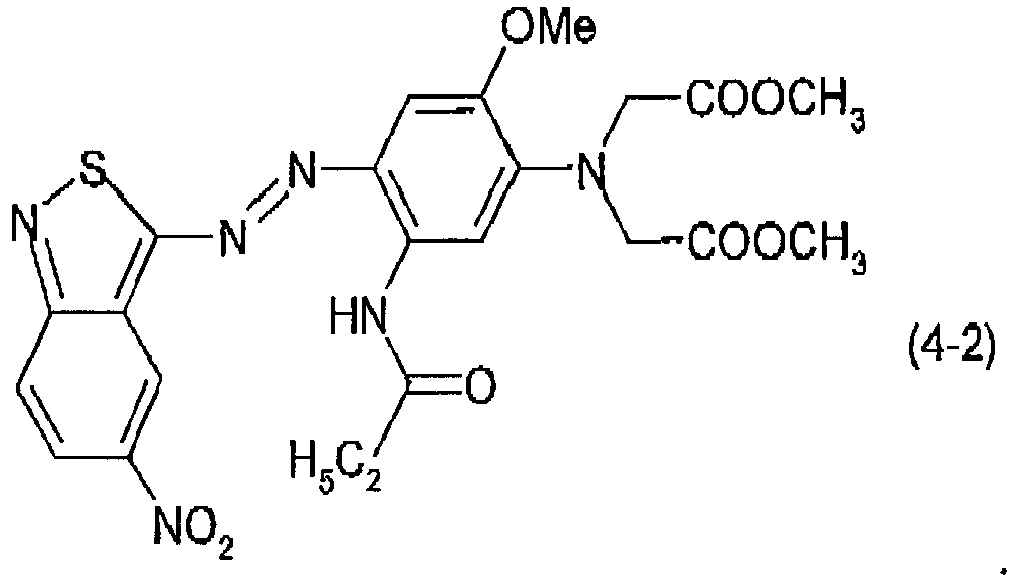
- The resulting dye mixture of the invention was formulated using dispersing agent and dried via spray drying and gives deep black dyeings or prints, on polyester or polyester blends for example when applying the dyeing conditions typical for disperse dyes.
- 18 parts dye of the formula (1-4)


- The resulting inventive dye mixture was formulated using dispersing agent and dried via spray drying and gives deep black dyeings and prints e,g. on polyester or polyester blends under the dyeing conditions typical for disperse dyes.
- 25 parts dye of the formula (1-4)


- The resulting dye mixture of the invention was formulated using dispersing agent and dried via spray drying and gives deep black dyeings and prints, on polyester or polyester blends for example, under the dyeing conditions typical for disperse dyes.
- 18 parts dye of the formula (1-4)


- The resulting inventive dye mixture was formulated using dispersing agent and dried via spray drying and gives deep black dyeings or prints both on polyester or polyester blends for example using the dyeing conditions typical for disperse dyes.
- 29 parts dye of the formula (1-4)


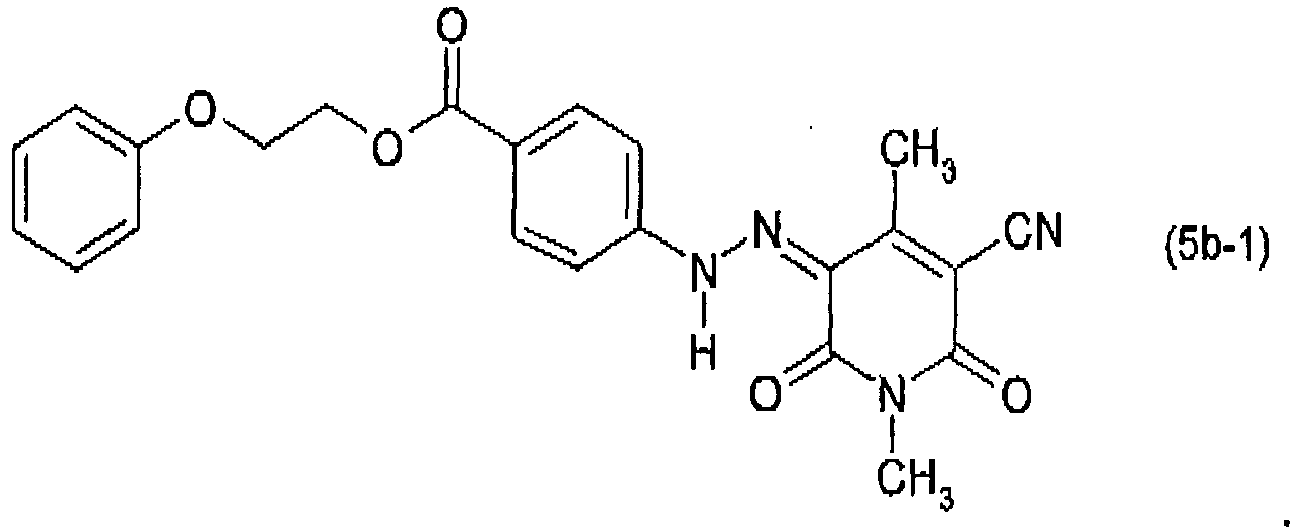
- The resulting dye mixture of the invention was formulated using dispersing agent and dried via spray drying and gives deep brown dyeings or prints, on polyester or polyester blends for example, under the dyeing conditions typical for disperse dyes.
- 21 parts dye of the formula (1-6)


- The resulting dye mixture of the invention was formulated using dispersing agent and dried via spray drying and gives deep brown dyeings or prints, on polyester or polyester blends both e.g. under the dyeing conditions typical for disperse dyes.
- All examples of the following table are prepared as formulations as explained above.
Example Dye of formula (1) Dye of formula (2) 1stDye of formula (3) 2nd Dye of formula (3) Dye of formula (4) Dye of formula (5) Ratio (1):(2):(3):(3):(4)(5) Shade on Polyester 9 X1=CN, X2=H X4NO2 X5=Cl 16: 7: 77: -- : -- : -- Navy x3= NO2 Y2=CH2-(p-Toloudin) X6=NO2 - - - R1=CH3 Y4= CH3 R2= C2H5 R2=C2H5 Y5=OCH3 Y1=C2H5 R3=C2H4-COOCH3 Y3=H R4= C2H5 n= 2, m=1 10 X1=NO2, X2=H X4=NO2 X'=NO2 10: 10:-:-: 80:- Navy X3= NO2 Y2= CH2-(p-Chloro-phenyl) - R2= C2H5 - R1=H R2= C2H5 Y4= C2H5 Y5=OCH3 Y1= C2H5 R5=C2H4-COOCH3 Y3=H R6=C2H4-COOCH3 n= 2, m=1 11 X1=CN, X2= H X4=NO2 X5=Cl X7=NO2 15: 8: 45:-: 32: - Navy X3= NO2 Y2= CH2-(p-methoxy-phenyl) XB=NO2 - R2=C2H5 - R1=H R2=CH3 Y4= CH3 R2= CH3 Y5=OCH3 Y1= C2H5 Y5=OCH3 R5=CH2-COOCH3 Y3=H R3=CH2-COOCH3 R6=CH2-COOCH3 n=2, m=1 R4=CH2-COOCH3 12 X1=CN, X2 = H X4=NO2 X5=CN X5=CN (5a) 10: 8 :40: 39:-: 3 Navy X3= NO2 Y2= CH2-phenyl X6=NO2 X6=NO2 - XB=H R1=H Y4= CH3 R2= CH3 R2= CH3 R2=CH3 R2= CH3 Y5=OCH3 Y5=H Y6=H Y1= CH2-phenyl R3 CH2-COOCH3 R3=CH2- Y3=H R4= C2H5 COOCH3 n= 2, m=1 R4= C2H5 13 X1=CN, X2= H X4=NO2 X7=NO2 (5b) 10: 12:--:--: 72: 6 Navy X3= NO2 Y2= CH2-phenyl - - R2=CH3 X8=H R1=H Y4= C2H5 Y5=OCH3 R2C2H5 R2= C2H5 R5=CH2-COOCH3 Y6=H Y1= CH2-phenyl R6=CH2-COOCH3 Y3=H n= 2, m=1 14 X1-CN, X2 = H X4=NO2 X5=H X7=NO2 (5a) 10: 10 :51:-: 25: 4 Navy X3= NO2 Y2= CH2-phenyl X6=NO2 - R2CH3 X8=H R1= CH3 Y4= CH3 R2=CH3 Y5=OCH3 R2= C2H5 R2= CH3 Y5=OCH3 R5=CH2-COOCH3 Y6=H Y1= CH2- phenyl R3=CH2-COOCH3 R6= C2H5 Y3= CH3 R4= C2H5 n= 2, m=1 15 X1= NO2, X2= H X4=NO2 - - - - 42: 58 :-:-:-:- Brown X3= NO2 Y2= CH2-phenyl R1=H Y4= C2H5 R2= CH3 Y1= CH2- phenyl Y3=H n= 2, m=1 16 X1=CN, X2 = H X4=NO2 - - - (5b) 35: 40 :--:-:-: 25 Brown X3= NO2 Y2= CH2-phenyl X6=H R1=H Y4= CH3 R2=CH3 R2= CH3 Y6=H Y1= CH2- phenyl Y3=H n= 2, m=1 17 X1=Br, X2= Cl X4=NO2 - - - 65: 35 :-:-: --: - Brown X3= NO2 Y2= CH2-phenyl - R1=H Y4= C2H5 R2= CH3 Y1= CH2- phenyl Y3=H n= 2, m=1 18 X1=Cl, X2=Cl X4=NO2 - - -- (5a) 65: 25 :-:-:-:10 Brown X3= NO2 Y2= CH2-phenyl X8=H R1=H Y4= CH3 R2CH3 R2= CH3 Y6=H Y1= CH2- phenyl Y3=H n=2, m=1 19 X1=Br, x2 =Br X4= CN X5=Br - - - 32:8:60:-:-:- Black X3 = NO2 Y2= CH2-phenyl X6NO2 R1=CH3 Y4= C2H5 R2=CH3 R2 C2H5 Y5=OCH3 Y1= CH2- phenyl R3= CH2-COOCH3 Y3=CH3 R4= CH2-phenyl n= 2, m=1 20 X1=Cl, X2=Cl X4=NO2 X5=CN - X7=NO2 - 32:6:42:-:20:- Black X3= NO2 Y2= CH2-phenyl X6=NO2 R2=CH3 R1=H Y4= CH3 R2= CH3 Y5=OCH3 R2= CH3 Y5=H R5=CH2-COOCH3 Y1= CH2- phenyl R3= C2H4- R6= C2H5 Y3=H COOCH2-COCH3 n= 2, m=1 R4= C2H5 21 X1=Cl, X2=Cl X4=NO2 - - X7=NO2 - 40:5:-:-:55:- Black X3= NO2 Y2= CH2-phenyl R2=CH3 R1=H Y4= C3H7 Y5=OCH3 R2=CH3 R5=CH2-OOCH3 Y1= CH2- phenyl R6=CH2COOCH3 Y3=H n= 2, m=1 22 X1=Cl, X2=Cl X4=NO2 X5=Cl - (5a) 30:9:55:-:-:6 Black X3= NO2 Y2= CH2-phenyl x6=NO2 X8=H R1=H Y4= CH3 R2=CH3 R2=C3H7 R2= CH3 Y5=OCH3 Y6=H Y1= CH2- phenyl R3=CH2-COOCH3 Y3=H R4=C2H5 n= 2, m=1 23 X1=Cl, X2=Br X4=NO2 X5=Br - X7=NO2 (5a) 32:6:32:-:23:7 Black X3= NO2 Y2=CH2-phenyl X6=NO2 R2=CH3 X4=H R1=H Y4= CH3 R2= CH3 Y5=OCH3 R3=CH3 R2= CH3 Y5=OCH3 R5=CH2-COOCH3 Y6=H Y1= CH2- phenyl R3= CH2-COOCH3 R6= CH2-phenyl Y3=H R4= CH2-phenyl n=2, m=1 24 X1=Br, X2 =Br X4=NO2 X5=Cl - - - 18:5:77:-:-:-- Navy X3 = NO2 Y2= CH2-phenyl X6=NO2 R1=H Y4= C2H5 R2= CH3 R2= CH3 Y5=OCH3 Y1= CH2- phenyl R3= CH2-COCH3 Y3=H R4= CH3 n= 2, m=1 25 X1=Cl, X2 = Cl X4=NO2 X5=CN - X7=NO2 - 15:6:60:-:19:- Navy X3 = NO2 Y2= CH2-phenyl X6=NO2 R2=CH3 R1=H Y4= CH3 R2= CH3 Y5=OCH3 R2= CH3 y5=OCH3 R5=CH2-COOCH3 Y1= CH2- phenyl R3= CH2-COOCH3 R6= C2H5 Y3=H R4= C2H5 n= 2, m=1 26 X1=Cl, X2 =Cl X4=NO2 - - X7=NO2 - 13:5:-:-:82:-- Navy X3 = NO2 Y2= CH2-phenyl R2=CH3 R1=H Y4= CH3 Y5=OCH3 R2= CH3 R5=CH2-COOCH3 Y1= CH2- phenyl R6= CH2-phenyl Y3=H n= 2, m=1 27 X1=Cl, X2 =Cl X4=NO2 X5=Br - - 11:6:75:-:-:8 Navy X3 = NO2 Y2= CH2-phenyl X6=NO2 (5a) X8=H R1=H Y4= CH3 R2= CH3 R2=H3 R2= C2H3 Y5=OCH3 Y6=H Y1= CH2- phenyl R3= CH2-COOCH3 Y3=H R4= C2H5 n= 2, m=1 28 X1=Cl, X2 =Cl X4=NO2 X5=Br - X7=NO2 (5a) 11:7:65:-:12:5 Navy X3 = NO2 Y2= CH2-phenyl X6=NO2 R2=CH3 X4=H R'=H Y4= CH3 R2= CH3 Y5=OCH3 R3= C2H5 R2= CH3 Y5=OCH3 R5=CH2-COOCH3 Y8=H Y1= CH2- phenyl R3= CH2-COOCH3 R6= C2H5 Y3=H R4= C2H5 n= 2, m=1 29 X1=CN, X2 = H X4=NO2 X5=Cl X5=CN - (5b) 18:17:32:25:-: 8 Black X3 = NO2 Y2= CH2-phenyl X6=NO2 X6=NO2 X8=H R'=H Y4= CH3 R2= CH3 R2=CH3 R2=CH3 R2= CH3 Y5=OCH3 Y5=H Y6=H Y2= CH2- phenyl R3= CH2-COOCH3 R3=CH2-COOCH3 Y3=H R4= CH2-COOCH3 R4= C2H5 n= 2, m=1 3D X1=Cl, X2 = Cl X4=NO2 X5=Cl X5=CN - (5b) 25: 10 :29: 28:- :8 Black X3 = NO2 Y2= CH2-phenyl X6=NO2 X6=NO2 X8=H R1=H Y4= CH3 R2=CH3 R2= CH3 R2=CH3 Rz= CH3 Y5=OCH3 Y5=H Y6=H Y1= CH2- phenyl R3= CH2-COOCH3 R3=CH2-COOCH3 Y3=H R4= CH2-COOCH3 n= 2, m=1 R4=C2H5
Claims (13)
- Dye mixture comprising
at least one dye of formula (1)
at least one dye of formula (2)
one or more dyes selected from the group consisting of dyes of formulae (3), (4), (5a) and (5b)


R1 is hydrogen, (C1-C4)-alkyl or halogen,
R2 is hydrogen or (C1-C4)-alkyl,
R3 to R6 is (C1-C4)-alkyl, (CH2)n-O-(C1-C4)-alkyl, (CH2)n-O-CO-(C1-C4)-alkyl, (CH2)n-COO-(C1-C4)-alkyl, (CH2)n-phenyl or (CH2)n-COO(CH2)m-CO-(C1-C4)-alkyl,
X1 to X8 is hydrogen, halogen, nitro, cyano, SCN, carboxy or CO-NR2R3,
Y1 is hydrogen, (C1-C4)-alkyl, substituted (C1-C4)-alkyl, (C2-C4)-alkenyl or
(CH2)m-phenyl,
Y2 is phenyl or (CH2)m-phenyl, both substituted by Y8,
Y3 is hydrogen or (C1-C4)-alkyl,
Y4 is (C1-C8)-alkyl or (CH2)m-phenyl,
Y5 is hydrogen, (C1-C4)-alkyl or (C1-C4)-alkoxy,
Y8 is hydrogen, nitro, cyano, carboxy, (C1-C4)-alkyl or (C1-C4)-alkoxy, n and m are 1, 2, 3 or 4 - Dye mixture according to claim 1, wherein independent from each other
R1 is hydrogen or (C1-C2)-alkyl,
R2 is (C1-C2)-alkyl,
R3 to R6 is (C1-C2)-alkyl, (CH2)n-phenyl, (CH2)n-COO-(C1-C2)-alkyl or (CH2)n-COO(CH2)m-CO-(C1-C2)-alkyl,
X1 and X2 are hydrogen, bromo, chloro, nitro or cyano,
X3 and X7 are nitro or cyano,
X4 is hydrogen, nitro or cyano,
X5 and X6 are hydrogen, bromo, chloro, nitro or cyano,
X8 is hydrogen, nitro or cyano,
Y1 is (C1-C4)-alkyl or (CH2)m-phenyl,
Y2 is phenyl or (CH2)m-phenyl,
Y3 is hydrogen, or (C1-C2)-alkyl
Y4 is (C1-C8)-alkyl or (CH2)m-pheny),
Y5 is hydrogen, (C1-C2)-alkyl or (C1-C2)-alkoxy,
n and m are 1 or 2. - Dye mixture according to claim 1 or 2, wherein independent from each other
R1 is hydrogen or methyl,
R2 is methyl or ethyl,
R3 to R8 is (C1-C2)-alkyl, (CH2)n-pheny), (CH2)n-COO-(C1-C2)-alkyl or (CH2)n-COO(CH2)m-CO-(C1-C2)-alkyl,
X1 and X2 are hydrogen, bromo, chloro, nitro or cyano,
X3 , X4 and X7 are nitro,
X5 and X6 are hydrogen, bromo, chloro, nitro or cyano,
X8 is hydrogen,
Y1 and Y2 are (CH2)m-phenyl,
Y3 is hydrogen or methyl,
Y4 is (C1-C8)-alkyl or (CH2)m-phenyl,
Y5 is hydrogen, O-methyl or O-ethyl,
n and m are 1 or 2. - Dye mixture according to any one of claims 1 to 3, wherein independent from each other
R1 is hydrogen,
R2 is methyl or ethyl,
R3 to R6 is (C1-C2)-alkyl, (CH2)n-phenyl, (CH2)n-COO-(C1-C2)-alkyl or (CH2)n-COO(CH2)m-CO-(C1-C2)-alkyl,
X1 and X2 are hydrogen, bromo, chloro, nitro or cyano, X3, X4 and X7 are nitro,
X5 and X6 are hydrogen, bromo, chloro, nitro or cyano,
X8 is hydrogen,
Y1 and Y2 are (CH2)m-phenyl,
Y3 is hydrogen,
Y 4 is (C1-C4)-alkyl,
Y5 is hydrogen or 0-methyl,
n and m are 1 or 2. - Dye mixture according to any one of claims 1 to 4, comprising at least one dye selected from the group consisting of dyes of formulae (3), (4), (5a) and (5b).
- Dye mixture according to any one of claims 1 to 5, comprising at least two dyes of formula (3).
- Dye mixture according to any one of claims 1 to 6, comprising at least two dyes of formula (3) and at least one dye selected from the group consisting of dyes of formulae (4), (5a) and (5b).
- Aqueous solution for dying comprising a dye mixture according to any one of claim 1 to 7.
- Process for the production of a dye mixture according to any one of claims 1 to 7, comprisinga) mixing the components (1), (2) and optionally (3) to (5b),b) homegenizing the mixture obtained in step a)
- Process for dyeing or printing carboxamido- and/or hydroxyl-containing material, comprising contacting the carboxamido- and/or hydroxyl-containing material with a dye mixture according to any one of claims 1 to 7 and/or an aquous solution according to claim 8.
- Ink for digital textile printing, comprising a dye mixture according to any one of claims 1 to 7.
- Use of a dye mixture according to any one of claims 1 to 7 and/or an aqueous solution according to claim 8 for dying fibers, as well as blends of such fibres selected from the group consisting of: synthetic fibers: nylon, nylon-6, nylon-6.6 and aramid fibres, vegetable fibres, seed fibres, cotton, organic cotton, kapok, coir from coconut husk; bast fibers, flax, hemp, jute, kenaf, ramie, rattan; leaf fibres, sisal, henequen, banana; stalk fibres, bamboo; fibres from animals, wool, organic wool, silk, cashmere wool, alpaca fiber, mohair, Angora fibre as well as fur and leather materials; manufactured, regenerated and recycled fibres, cellulosic fibres; paper fibres, cellulosic regenerated fibres, viscose rayon fibres, acetate and triacetate fibers and Lyocell fibers.
- Fiber and blends containing such fiber selected from the group consisting of: synthetic fiber materials, nylon materials, nylon-6, nylon-6.6 and aramid fibres, vegetable fibres, seed fibres, cotton, organic cotton, kapok, coir from coconut husk; bast fibers, flax, hemp, jute, kenaf, ramie, rattan; leaf fibres, sisal, henequen, banana; stalk fibres, bamboo; fibres from animals, wool, organic wool, silk, cashmere wool, alpaca fiber, mohair, Angora fibre as well as fur and leather materials; manufactured, regenerated and recycled fibres, cellulosic fibres; paper fibres, cellulosic regenerated fibres, viscose rayon fibres, acetate and triacetate fibers, and Lyocell fibers comprising a dye mixture according to any one of claims 1 to 7 either in chemically and/or physically bound form.
Priority Applications (31)
| Application Number | Priority Date | Filing Date | Title |
|---|---|---|---|
| EP13000169.6A EP2754748A1 (en) | 2013-01-14 | 2013-01-14 | High wet fast disperse dye mixtures |
| US14/760,877 US9493657B2 (en) | 2013-01-14 | 2014-01-06 | AOX-free navy and black disperse dyes |
| CN201911351817.2A CN111423743A (en) | 2013-01-14 | 2014-01-06 | AOX-free navy blue and black disperse dyes |
| CN201480004832.9A CN104919006A (en) | 2013-01-14 | 2014-01-06 | AOX free navy blue and black disperse dyes |
| KR1020207022350A KR102287706B1 (en) | 2013-01-14 | 2014-01-06 | High wet fast disperse dye mixtures |
| JP2015552034A JP6251290B2 (en) | 2013-01-14 | 2014-01-06 | Highly wet fast disperse dye mixture |
| BR112015016526-5A BR112015016526B1 (en) | 2013-01-14 | 2014-01-06 | DYE MIXTURES, THEIR PRODUCTION PROCESSES, AQUEOUS DYEING SOLUTION, PROCESSES FOR DYEING OR PRINTING MATERIAL, DIGITAL TEXTILE PRINTING INK, AND FIBERS AND COMBINATIONS CONTAINING SUCH FIBERS |
| CN202111053058.9A CN113755026A (en) | 2013-01-14 | 2014-01-06 | High wet fastness fast disperse dye mixtures |
| PCT/EP2014/050067 WO2014108357A1 (en) | 2013-01-14 | 2014-01-06 | High wet-fast disperse dye mixtures |
| ES14700065T ES2710999T3 (en) | 2013-01-14 | 2014-01-06 | Mixtures of fast dispersion and high humidity dyes |
| JP2015552035A JP6293790B2 (en) | 2013-01-14 | 2014-01-06 | Highly wet fast disperse dye mixture |
| CN201480004824.4A CN105102547A (en) | 2013-01-14 | 2014-01-06 | High wet fastness fast disperse dye mixture |
| MX2015009028A MX360539B (en) | 2013-01-14 | 2014-01-06 | High wet-fast disperse dye mixtures. |
| EP18182661.1A EP3421550B1 (en) | 2013-01-14 | 2014-01-06 | High wet fast disperse dye mixtures |
| PCT/EP2014/050069 WO2014108358A1 (en) | 2013-01-14 | 2014-01-06 | High wet fast disperse dye mixtures |
| PT147002182T PT2943538T (en) | 2013-01-14 | 2014-01-06 | High wet-fast disperse dye mixtures |
| MX2015009029A MX373638B (en) | 2013-01-14 | 2014-01-06 | DISPERSE DYE MIXTURES WITH HIGH WET FASTNESS. |
| BR112015016119A BR112015016119A8 (en) | 2013-01-14 | 2014-01-06 | dye mixtures, their use and production process, aqueous dyeing solution, dyeing or material printing process, and digital textile printing ink |
| PT14700065T PT2943537T (en) | 2013-01-14 | 2014-01-06 | High wet fast disperse dye mixtures |
| ES14700218.2T ES2669613T3 (en) | 2013-01-14 | 2014-01-06 | Disperse dye mixtures with high moisture resistance |
| EP25202189.4A EP4700174A3 (en) | 2013-01-14 | 2014-01-06 | High wet fast disperse dye mixtures |
| EP14700218.2A EP2943538B1 (en) | 2013-01-14 | 2014-01-06 | High wet-fast disperse dye mixtures |
| EP14700065.7A EP2943537B1 (en) | 2013-01-14 | 2014-01-06 | High wet fast disperse dye mixtures |
| KR1020157021682A KR20150107807A (en) | 2013-01-14 | 2014-01-06 | High wet-fast disperse dye mixtures |
| US14/760,832 US9534118B2 (en) | 2013-01-14 | 2014-01-06 | High wet fast disperse dye mixtures |
| KR1020207022349A KR102287714B1 (en) | 2013-01-14 | 2014-01-06 | High wet fast disperse dye mixtures |
| KR1020157021683A KR102143259B1 (en) | 2013-01-14 | 2014-01-06 | High wet fast disperse dye mixtures |
| TW102145851A TWI604019B (en) | 2013-01-14 | 2014-01-07 | Naxy blue or black disperse dye without AOX |
| TW103100535A TWI620799B (en) | 2013-01-14 | 2014-01-07 | High wet fastness disperse dye mixture |
| JP2017229141A JP6469823B2 (en) | 2013-01-14 | 2017-11-29 | Highly wet fast disperse dye mixture |
| JP2017229136A JP6469822B2 (en) | 2013-01-14 | 2017-11-29 | Highly wet fast disperse dye mixture |
Applications Claiming Priority (1)
| Application Number | Priority Date | Filing Date | Title |
|---|---|---|---|
| EP13000169.6A EP2754748A1 (en) | 2013-01-14 | 2013-01-14 | High wet fast disperse dye mixtures |
Publications (1)
| Publication Number | Publication Date |
|---|---|
| EP2754748A1 true EP2754748A1 (en) | 2014-07-16 |
Family
ID=47561318
Family Applications (1)
| Application Number | Title | Priority Date | Filing Date |
|---|---|---|---|
| EP13000169.6A Withdrawn EP2754748A1 (en) | 2013-01-14 | 2013-01-14 | High wet fast disperse dye mixtures |
Country Status (1)
| Country | Link |
|---|---|
| EP (1) | EP2754748A1 (en) |
Citations (3)
| Publication number | Priority date | Publication date | Assignee | Title |
|---|---|---|---|---|
| US4548613A (en) * | 1984-05-18 | 1985-10-22 | American Hoechst Corporation | Yellow disperse dyestuff mixtures and dyeing process |
| DE19646429A1 (en) * | 1995-11-22 | 1997-05-28 | Ciba Geigy Ag | Mixtures of monoazopyridone dyes |
| WO2012095284A1 (en) * | 2011-01-15 | 2012-07-19 | Dystar Colours Distribution Gmbh | Disperse dye mixtures, their preparation and use |
-
2013
- 2013-01-14 EP EP13000169.6A patent/EP2754748A1/en not_active Withdrawn
Patent Citations (3)
| Publication number | Priority date | Publication date | Assignee | Title |
|---|---|---|---|---|
| US4548613A (en) * | 1984-05-18 | 1985-10-22 | American Hoechst Corporation | Yellow disperse dyestuff mixtures and dyeing process |
| DE19646429A1 (en) * | 1995-11-22 | 1997-05-28 | Ciba Geigy Ag | Mixtures of monoazopyridone dyes |
| WO2012095284A1 (en) * | 2011-01-15 | 2012-07-19 | Dystar Colours Distribution Gmbh | Disperse dye mixtures, their preparation and use |
Similar Documents
| Publication | Publication Date | Title |
|---|---|---|
| EP3421550B1 (en) | High wet fast disperse dye mixtures | |
| EP3692102B1 (en) | High wet fast disperse dye mixtures | |
| EP3387072B1 (en) | High wet fast brilliant blue disperse dye mixtures | |
| EP2754698A1 (en) | High wet-fast disperse dye mixtures | |
| EP3973022B1 (en) | High wet fast disperse dye mixtures of n-[4-(5-fluoro-2,4-dinitro-phenylazo)-phenyl]-amine derivatives and n-[4-(4-nitro-phenylazo)-phenyl]-amine derivatives | |
| EP2754748A1 (en) | High wet fast disperse dye mixtures | |
| EP3969518B1 (en) | High wet fast disperse dye mixtures of n-[4-(5-thiocyanato-2,4-dinitro-phenylazo)-phenyl]-amine derivatives and n-[4-(4-nitro-phenylazo)-phenyl]-amine derivatives | |
| EP2754697A1 (en) | High wet-fast disperse dye mixtures | |
| EP2754696A1 (en) | AOX-free navy and black disperse dye mixtures |
Legal Events
| Date | Code | Title | Description |
|---|---|---|---|
| PUAI | Public reference made under article 153(3) epc to a published international application that has entered the european phase |
Free format text: ORIGINAL CODE: 0009012 |
|
| 17P | Request for examination filed |
Effective date: 20130114 |
|
| AK | Designated contracting states |
Kind code of ref document: A1 Designated state(s): AL AT BE BG CH CY CZ DE DK EE ES FI FR GB GR HR HU IE IS IT LI LT LU LV MC MK MT NL NO PL PT RO RS SE SI SK SM TR |
|
| AX | Request for extension of the european patent |
Extension state: BA ME |
|
| RIN1 | Information on inventor provided before grant (corrected) |
Inventor name: MURGATROYD, ADRIAN Inventor name: VERMANDEL, FANNY Inventor name: GRUND, CLEMENS Inventor name: WEINGARTEN, ULRICH Inventor name: HOPPE, MANFRED |
|
| STAA | Information on the status of an ep patent application or granted ep patent |
Free format text: STATUS: THE APPLICATION IS DEEMED TO BE WITHDRAWN |
|
| 18D | Application deemed to be withdrawn |
Effective date: 20150117 |
|
| RIN1 | Information on inventor provided before grant (corrected) |
Inventor name: GRUND, CLEMENS Inventor name: HOPPE, MANFRED Inventor name: VERMANDEL, FANNY Inventor name: MURGATROYD, ADRIAN Inventor name: WEINGARTEN, ULRICH |