EP2754679A1 - Copolymer, aqueous ink, and ink cartridge - Google Patents
Copolymer, aqueous ink, and ink cartridge Download PDFInfo
- Publication number
- EP2754679A1 EP2754679A1 EP14150281.5A EP14150281A EP2754679A1 EP 2754679 A1 EP2754679 A1 EP 2754679A1 EP 14150281 A EP14150281 A EP 14150281A EP 2754679 A1 EP2754679 A1 EP 2754679A1
- Authority
- EP
- European Patent Office
- Prior art keywords
- copolymer
- pigment
- ink
- group
- pigment dispersion
- Prior art date
- Legal status (The legal status is an assumption and is not a legal conclusion. Google has not performed a legal analysis and makes no representation as to the accuracy of the status listed.)
- Granted
Links
- 229920001577 copolymer Polymers 0.000 title claims abstract description 148
- 239000000126 substance Substances 0.000 claims abstract description 34
- 125000001033 ether group Chemical group 0.000 claims abstract description 11
- 125000004432 carbon atom Chemical group C* 0.000 claims abstract description 9
- 125000001624 naphthyl group Chemical group 0.000 claims abstract description 9
- 125000006267 biphenyl group Chemical group 0.000 claims abstract description 7
- 150000001768 cations Chemical group 0.000 claims abstract description 7
- 125000004435 hydrogen atom Chemical group [H]* 0.000 claims abstract description 6
- 125000002947 alkylene group Chemical group 0.000 claims abstract description 4
- 125000005708 carbonyloxy group Chemical group [*:2]OC([*:1])=O 0.000 claims abstract description 4
- 125000005740 oxycarbonyl group Chemical group [*:1]OC([*:2])=O 0.000 claims abstract description 4
- 239000000049 pigment Substances 0.000 claims description 263
- XLYOFNOQVPJJNP-UHFFFAOYSA-N water Substances O XLYOFNOQVPJJNP-UHFFFAOYSA-N 0.000 claims description 44
- 239000004094 surface-active agent Substances 0.000 claims description 37
- 239000003086 colorant Substances 0.000 claims description 12
- 239000003960 organic solvent Substances 0.000 claims description 10
- 125000000217 alkyl group Chemical group 0.000 claims description 5
- 125000002496 methyl group Chemical group [H]C([H])([H])* 0.000 claims description 3
- 239000000976 ink Substances 0.000 description 123
- 239000006185 dispersion Substances 0.000 description 115
- -1 tetrapropylammonium ion Chemical class 0.000 description 81
- 230000000052 comparative effect Effects 0.000 description 52
- 239000000243 solution Substances 0.000 description 43
- 238000002360 preparation method Methods 0.000 description 37
- YXFVVABEGXRONW-UHFFFAOYSA-N Toluene Chemical compound CC1=CC=CC=C1 YXFVVABEGXRONW-UHFFFAOYSA-N 0.000 description 30
- 238000000034 method Methods 0.000 description 30
- 238000007639 printing Methods 0.000 description 25
- YMWUJEATGCHHMB-UHFFFAOYSA-N Dichloromethane Chemical compound ClCCl YMWUJEATGCHHMB-UHFFFAOYSA-N 0.000 description 24
- 238000000862 absorption spectrum Methods 0.000 description 24
- 235000019241 carbon black Nutrition 0.000 description 24
- 239000006229 carbon black Substances 0.000 description 24
- 229940105289 carbon black Drugs 0.000 description 23
- 239000008367 deionised water Substances 0.000 description 22
- 229910021641 deionized water Inorganic materials 0.000 description 22
- 239000000178 monomer Substances 0.000 description 19
- 239000007787 solid Substances 0.000 description 19
- 239000002904 solvent Substances 0.000 description 19
- NIXOWILDQLNWCW-UHFFFAOYSA-M Acrylate Chemical compound [O-]C(=O)C=C NIXOWILDQLNWCW-UHFFFAOYSA-M 0.000 description 18
- WYURNTSHIVDZCO-UHFFFAOYSA-N Tetrahydrofuran Chemical compound C1CCOC1 WYURNTSHIVDZCO-UHFFFAOYSA-N 0.000 description 18
- YCKRFDGAMUMZLT-UHFFFAOYSA-N Fluorine atom Chemical compound [F] YCKRFDGAMUMZLT-UHFFFAOYSA-N 0.000 description 17
- 239000011737 fluorine Substances 0.000 description 17
- 229910052731 fluorine Inorganic materials 0.000 description 17
- RTZKZFJDLAIYFH-UHFFFAOYSA-N Diethyl ether Chemical compound CCOCC RTZKZFJDLAIYFH-UHFFFAOYSA-N 0.000 description 16
- LYCAIKOWRPUZTN-UHFFFAOYSA-N Ethylene glycol Chemical compound OCCO LYCAIKOWRPUZTN-UHFFFAOYSA-N 0.000 description 15
- OKKJLVBELUTLKV-UHFFFAOYSA-N Methanol Chemical compound OC OKKJLVBELUTLKV-UHFFFAOYSA-N 0.000 description 15
- 239000007864 aqueous solution Substances 0.000 description 14
- 229920000642 polymer Polymers 0.000 description 14
- 229920005989 resin Polymers 0.000 description 13
- 239000011347 resin Substances 0.000 description 13
- PEDCQBHIVMGVHV-UHFFFAOYSA-N Glycerine Chemical compound OCC(O)CO PEDCQBHIVMGVHV-UHFFFAOYSA-N 0.000 description 12
- 239000000975 dye Substances 0.000 description 12
- 239000008188 pellet Substances 0.000 description 12
- 125000005010 perfluoroalkyl group Chemical group 0.000 description 12
- JUJWROOIHBZHMG-UHFFFAOYSA-N Pyridine Chemical compound C1=CC=NC=C1 JUJWROOIHBZHMG-UHFFFAOYSA-N 0.000 description 10
- 125000000129 anionic group Chemical group 0.000 description 10
- 239000000839 emulsion Substances 0.000 description 10
- 238000006116 polymerization reaction Methods 0.000 description 10
- ZWEHNKRNPOVVGH-UHFFFAOYSA-N 2-Butanone Chemical compound CCC(C)=O ZWEHNKRNPOVVGH-UHFFFAOYSA-N 0.000 description 9
- OKTJSMMVPCPJKN-UHFFFAOYSA-N Carbon Chemical compound [C] OKTJSMMVPCPJKN-UHFFFAOYSA-N 0.000 description 9
- ZMXDDKWLCZADIW-UHFFFAOYSA-N N,N-Dimethylformamide Chemical compound CN(C)C=O ZMXDDKWLCZADIW-UHFFFAOYSA-N 0.000 description 9
- PPBRXRYQALVLMV-UHFFFAOYSA-N Styrene Chemical compound C=CC1=CC=CC=C1 PPBRXRYQALVLMV-UHFFFAOYSA-N 0.000 description 9
- 150000001875 compounds Chemical class 0.000 description 9
- MTHSVFCYNBDYFN-UHFFFAOYSA-N diethylene glycol Chemical compound OCCOCCO MTHSVFCYNBDYFN-UHFFFAOYSA-N 0.000 description 9
- 150000002500 ions Chemical class 0.000 description 9
- 239000012528 membrane Substances 0.000 description 9
- 239000011148 porous material Substances 0.000 description 9
- 150000003839 salts Chemical class 0.000 description 9
- 239000011877 solvent mixture Substances 0.000 description 9
- 238000003860 storage Methods 0.000 description 9
- PYSRRFNXTXNWCD-UHFFFAOYSA-N 3-(2-phenylethenyl)furan-2,5-dione Chemical compound O=C1OC(=O)C(C=CC=2C=CC=CC=2)=C1 PYSRRFNXTXNWCD-UHFFFAOYSA-N 0.000 description 8
- 229920000147 Styrene maleic anhydride Polymers 0.000 description 8
- 230000008859 change Effects 0.000 description 8
- 238000006243 chemical reaction Methods 0.000 description 8
- 239000000203 mixture Substances 0.000 description 8
- YLQBMQCUIZJEEH-UHFFFAOYSA-N tetrahydrofuran Natural products C=1C=COC=1 YLQBMQCUIZJEEH-UHFFFAOYSA-N 0.000 description 8
- 229920003171 Poly (ethylene oxide) Polymers 0.000 description 7
- 239000006096 absorbing agent Substances 0.000 description 7
- 239000003963 antioxidant agent Substances 0.000 description 7
- 238000011156 evaluation Methods 0.000 description 7
- 125000000524 functional group Chemical group 0.000 description 7
- 229920001296 polysiloxane Polymers 0.000 description 7
- PUPZLCDOIYMWBV-UHFFFAOYSA-N (+/-)-1,3-Butanediol Chemical compound CC(O)CCO PUPZLCDOIYMWBV-UHFFFAOYSA-N 0.000 description 6
- HVBSAKJJOYLTQU-UHFFFAOYSA-N 4-aminobenzenesulfonic acid Chemical compound NC1=CC=C(S(O)(=O)=O)C=C1 HVBSAKJJOYLTQU-UHFFFAOYSA-N 0.000 description 6
- XEKOWRVHYACXOJ-UHFFFAOYSA-N Ethyl acetate Chemical compound CCOC(C)=O XEKOWRVHYACXOJ-UHFFFAOYSA-N 0.000 description 6
- MZZSDCJQCLYLLL-UHFFFAOYSA-N Secalonsaeure A Natural products COC(=O)C12OC3C(CC1=C(O)CC(C)C2O)C(=CC=C3c4ccc(O)c5C(=O)C6=C(O)CC(C)C(O)C6(Oc45)C(=O)OC)O MZZSDCJQCLYLLL-UHFFFAOYSA-N 0.000 description 6
- HEMHJVSKTPXQMS-UHFFFAOYSA-M Sodium hydroxide Chemical compound [OH-].[Na+] HEMHJVSKTPXQMS-UHFFFAOYSA-M 0.000 description 6
- 239000011575 calcium Substances 0.000 description 6
- XCJYREBRNVKWGJ-UHFFFAOYSA-N copper(II) phthalocyanine Chemical compound [Cu+2].C12=CC=CC=C2C(N=C2[N-]C(C3=CC=CC=C32)=N2)=NC1=NC([C]1C=CC=CC1=1)=NC=1N=C1[C]3C=CC=CC3=C2[N-]1 XCJYREBRNVKWGJ-UHFFFAOYSA-N 0.000 description 6
- 239000003480 eluent Substances 0.000 description 6
- 238000002156 mixing Methods 0.000 description 6
- 230000008569 process Effects 0.000 description 6
- 239000007870 radical polymerization initiator Substances 0.000 description 6
- 238000010898 silica gel chromatography Methods 0.000 description 6
- LPXPTNMVRIOKMN-UHFFFAOYSA-M sodium nitrite Chemical compound [Na+].[O-]N=O LPXPTNMVRIOKMN-UHFFFAOYSA-M 0.000 description 6
- 238000001308 synthesis method Methods 0.000 description 6
- 239000003945 anionic surfactant Substances 0.000 description 5
- 230000000694 effects Effects 0.000 description 5
- 235000011187 glycerol Nutrition 0.000 description 5
- 238000004128 high performance liquid chromatography Methods 0.000 description 5
- 230000002209 hydrophobic effect Effects 0.000 description 5
- 239000002736 nonionic surfactant Substances 0.000 description 5
- UMJSCPRVCHMLSP-UHFFFAOYSA-N pyridine Natural products COC1=CC=CN=C1 UMJSCPRVCHMLSP-UHFFFAOYSA-N 0.000 description 5
- 238000004064 recycling Methods 0.000 description 5
- 238000003756 stirring Methods 0.000 description 5
- LVYXPOCADCXMLP-UHFFFAOYSA-N 3-butoxy-n,n-dimethylpropanamide Chemical compound CCCCOCCC(=O)N(C)C LVYXPOCADCXMLP-UHFFFAOYSA-N 0.000 description 4
- XKRFYHLGVUSROY-UHFFFAOYSA-N Argon Chemical compound [Ar] XKRFYHLGVUSROY-UHFFFAOYSA-N 0.000 description 4
- CSNNHWWHGAXBCP-UHFFFAOYSA-L Magnesium sulfate Chemical compound [Mg+2].[O-][S+2]([O-])([O-])[O-] CSNNHWWHGAXBCP-UHFFFAOYSA-L 0.000 description 4
- UFWIBTONFRDIAS-UHFFFAOYSA-N Naphthalene Chemical compound C1=CC=CC2=CC=CC=C21 UFWIBTONFRDIAS-UHFFFAOYSA-N 0.000 description 4
- IDRRDYDRWIITCH-UHFFFAOYSA-N OCCCCCCOC(=O)c1ccc2ccccc2c1 Chemical compound OCCCCCCOC(=O)c1ccc2ccccc2c1 IDRRDYDRWIITCH-UHFFFAOYSA-N 0.000 description 4
- 229910052783 alkali metal Inorganic materials 0.000 description 4
- ROOXNKNUYICQNP-UHFFFAOYSA-N ammonium persulfate Chemical compound [NH4+].[NH4+].[O-]S(=O)(=O)OOS([O-])(=O)=O ROOXNKNUYICQNP-UHFFFAOYSA-N 0.000 description 4
- 239000000981 basic dye Substances 0.000 description 4
- 239000011230 binding agent Substances 0.000 description 4
- 125000003178 carboxy group Chemical group [H]OC(*)=O 0.000 description 4
- ZBCBWPMODOFKDW-UHFFFAOYSA-N diethanolamine Chemical compound OCCNCCO ZBCBWPMODOFKDW-UHFFFAOYSA-N 0.000 description 4
- 235000013870 dimethyl polysiloxane Nutrition 0.000 description 4
- ZSIAUFGUXNUGDI-UHFFFAOYSA-N hexan-1-ol Chemical compound CCCCCCO ZSIAUFGUXNUGDI-UHFFFAOYSA-N 0.000 description 4
- 150000004679 hydroxides Chemical class 0.000 description 4
- FPYJFEHAWHCUMM-UHFFFAOYSA-N maleic anhydride Chemical compound O=C1OC(=O)C=C1 FPYJFEHAWHCUMM-UHFFFAOYSA-N 0.000 description 4
- 239000002609 medium Substances 0.000 description 4
- 229920000435 poly(dimethylsiloxane) Polymers 0.000 description 4
- BWHMMNNQKKPAPP-UHFFFAOYSA-L potassium carbonate Chemical compound [K+].[K+].[O-]C([O-])=O BWHMMNNQKKPAPP-UHFFFAOYSA-L 0.000 description 4
- 239000011541 reaction mixture Substances 0.000 description 4
- 150000005846 sugar alcohols Polymers 0.000 description 4
- VZCYOOQTPOCHFL-UHFFFAOYSA-N trans-butenedioic acid Natural products OC(=O)C=CC(O)=O VZCYOOQTPOCHFL-UHFFFAOYSA-N 0.000 description 4
- 239000001052 yellow pigment Substances 0.000 description 4
- RWLALWYNXFYRGW-UHFFFAOYSA-N 2-Ethyl-1,3-hexanediol Chemical compound CCCC(O)C(CC)CO RWLALWYNXFYRGW-UHFFFAOYSA-N 0.000 description 3
- LTHCQJZAUWAZAM-UHFFFAOYSA-N 2-hydroxyethyl naphthalene-2-carboxylate Chemical compound C1=CC=CC2=CC(C(=O)OCCO)=CC=C21 LTHCQJZAUWAZAM-UHFFFAOYSA-N 0.000 description 3
- LBVMWHCOFMFPEG-UHFFFAOYSA-N 3-methoxy-n,n-dimethylpropanamide Chemical compound COCCC(=O)N(C)C LBVMWHCOFMFPEG-UHFFFAOYSA-N 0.000 description 3
- ALYNCZNDIQEVRV-UHFFFAOYSA-M 4-aminobenzoate Chemical compound NC1=CC=C(C([O-])=O)C=C1 ALYNCZNDIQEVRV-UHFFFAOYSA-M 0.000 description 3
- HRPVXLWXLXDGHG-UHFFFAOYSA-N Acrylamide Chemical compound NC(=O)C=C HRPVXLWXLXDGHG-UHFFFAOYSA-N 0.000 description 3
- QGZKDVFQNNGYKY-UHFFFAOYSA-N Ammonia Chemical compound N QGZKDVFQNNGYKY-UHFFFAOYSA-N 0.000 description 3
- QGZKDVFQNNGYKY-UHFFFAOYSA-O Ammonium Chemical compound [NH4+] QGZKDVFQNNGYKY-UHFFFAOYSA-O 0.000 description 3
- VHUUQVKOLVNVRT-UHFFFAOYSA-N Ammonium hydroxide Chemical compound [NH4+].[OH-] VHUUQVKOLVNVRT-UHFFFAOYSA-N 0.000 description 3
- MHAJPDPJQMAIIY-UHFFFAOYSA-N Hydrogen peroxide Chemical compound OO MHAJPDPJQMAIIY-UHFFFAOYSA-N 0.000 description 3
- WMFOQBRAJBCJND-UHFFFAOYSA-M Lithium hydroxide Chemical compound [Li+].[OH-] WMFOQBRAJBCJND-UHFFFAOYSA-M 0.000 description 3
- FXHOOIRPVKKKFG-UHFFFAOYSA-N N,N-Dimethylacetamide Chemical compound CN(C)C(C)=O FXHOOIRPVKKKFG-UHFFFAOYSA-N 0.000 description 3
- OAICVXFJPJFONN-UHFFFAOYSA-N Phosphorus Chemical compound [P] OAICVXFJPJFONN-UHFFFAOYSA-N 0.000 description 3
- KWYUFKZDYYNOTN-UHFFFAOYSA-M Potassium hydroxide Chemical compound [OH-].[K+] KWYUFKZDYYNOTN-UHFFFAOYSA-M 0.000 description 3
- OFOBLEOULBTSOW-UHFFFAOYSA-N Propanedioic acid Natural products OC(=O)CC(O)=O OFOBLEOULBTSOW-UHFFFAOYSA-N 0.000 description 3
- DNIAPMSPPWPWGF-UHFFFAOYSA-N Propylene glycol Chemical compound CC(O)CO DNIAPMSPPWPWGF-UHFFFAOYSA-N 0.000 description 3
- ZMANZCXQSJIPKH-UHFFFAOYSA-N Triethylamine Chemical compound CCN(CC)CC ZMANZCXQSJIPKH-UHFFFAOYSA-N 0.000 description 3
- 239000002253 acid Substances 0.000 description 3
- 150000005215 alkyl ethers Chemical class 0.000 description 3
- UVCQMCCIAHQDAF-GYOQZRFSSA-N alpha-Bacterioruberin Natural products CC(=C/C=C/C=C(C)/C=C/C=C(C)/C=C/C=C(C)/C=C/C(CCC(C)(C)O)C(C)(C)O)C=CC=C(/C)C=CC=C(/C)C=CC(CCC(C)(C)O)C(C)(C)O UVCQMCCIAHQDAF-GYOQZRFSSA-N 0.000 description 3
- 150000001412 amines Chemical class 0.000 description 3
- BFNBIHQBYMNNAN-UHFFFAOYSA-N ammonium sulfate Chemical group N.N.OS(O)(=O)=O BFNBIHQBYMNNAN-UHFFFAOYSA-N 0.000 description 3
- 239000011362 coarse particle Substances 0.000 description 3
- 230000003247 decreasing effect Effects 0.000 description 3
- 125000001495 ethyl group Chemical group [H]C([H])([H])C([H])([H])* 0.000 description 3
- 125000000816 ethylene group Chemical group [H]C([H])([*:1])C([H])([H])[*:2] 0.000 description 3
- 238000001879 gelation Methods 0.000 description 3
- 238000010438 heat treatment Methods 0.000 description 3
- 150000002430 hydrocarbons Chemical class 0.000 description 3
- COHYTHOBJLSHDF-UHFFFAOYSA-N indigo powder Natural products N1C2=CC=CC=C2C(=O)C1=C1C(=O)C2=CC=CC=C2N1 COHYTHOBJLSHDF-UHFFFAOYSA-N 0.000 description 3
- VZCYOOQTPOCHFL-UPHRSURJSA-N maleic acid Chemical compound OC(=O)\C=C/C(O)=O VZCYOOQTPOCHFL-UPHRSURJSA-N 0.000 description 3
- 239000011976 maleic acid Substances 0.000 description 3
- 239000000463 material Substances 0.000 description 3
- 238000012986 modification Methods 0.000 description 3
- 239000012860 organic pigment Substances 0.000 description 3
- 239000003002 pH adjusting agent Substances 0.000 description 3
- DJFBJKSMACBYBD-UHFFFAOYSA-N phosphane;hydrate Chemical class O.P DJFBJKSMACBYBD-UHFFFAOYSA-N 0.000 description 3
- 229910052698 phosphorus Inorganic materials 0.000 description 3
- 239000011574 phosphorus Substances 0.000 description 3
- IEQIEDJGQAUEQZ-UHFFFAOYSA-N phthalocyanine Chemical compound N1C(N=C2C3=CC=CC=C3C(N=C3C4=CC=CC=C4C(=N4)N3)=N2)=C(C=CC=C2)C2=C1N=C1C2=CC=CC=C2C4=N1 IEQIEDJGQAUEQZ-UHFFFAOYSA-N 0.000 description 3
- 229920001223 polyethylene glycol Polymers 0.000 description 3
- 238000010992 reflux Methods 0.000 description 3
- 235000010288 sodium nitrite Nutrition 0.000 description 3
- 229950000244 sulfanilic acid Drugs 0.000 description 3
- QAOWNCQODCNURD-UHFFFAOYSA-L sulfate group Chemical group S(=O)(=O)([O-])[O-] QAOWNCQODCNURD-UHFFFAOYSA-L 0.000 description 3
- RMVRSNDYEFQCLF-UHFFFAOYSA-N thiophenol Chemical compound SC1=CC=CC=C1 RMVRSNDYEFQCLF-UHFFFAOYSA-N 0.000 description 3
- ZIBGPFATKBEMQZ-UHFFFAOYSA-N triethylene glycol Chemical compound OCCOCCOCCO ZIBGPFATKBEMQZ-UHFFFAOYSA-N 0.000 description 3
- UNMJLQGKEDTEKJ-UHFFFAOYSA-N (3-ethyloxetan-3-yl)methanol Chemical compound CCC1(CO)COC1 UNMJLQGKEDTEKJ-UHFFFAOYSA-N 0.000 description 2
- ARXKVVRQIIOZGF-UHFFFAOYSA-N 1,2,4-butanetriol Chemical compound OCCC(O)CO ARXKVVRQIIOZGF-UHFFFAOYSA-N 0.000 description 2
- ZGEGCLOFRBLKSE-UHFFFAOYSA-N 1-Heptene Chemical group CCCCCC=C ZGEGCLOFRBLKSE-UHFFFAOYSA-N 0.000 description 2
- VQOXUMQBYILCKR-UHFFFAOYSA-N 1-Tridecene Chemical compound CCCCCCCCCCCC=C VQOXUMQBYILCKR-UHFFFAOYSA-N 0.000 description 2
- AFFLGGQVNFXPEV-UHFFFAOYSA-N 1-decene Chemical compound CCCCCCCCC=C AFFLGGQVNFXPEV-UHFFFAOYSA-N 0.000 description 2
- SPURMHFLEKVAAS-UHFFFAOYSA-N 1-docosene Chemical compound CCCCCCCCCCCCCCCCCCCCC=C SPURMHFLEKVAAS-UHFFFAOYSA-N 0.000 description 2
- CRSBERNSMYQZNG-UHFFFAOYSA-N 1-dodecene Chemical compound CCCCCCCCCCC=C CRSBERNSMYQZNG-UHFFFAOYSA-N 0.000 description 2
- ADOBXTDBFNCOBN-UHFFFAOYSA-N 1-heptadecene Chemical compound CCCCCCCCCCCCCCCC=C ADOBXTDBFNCOBN-UHFFFAOYSA-N 0.000 description 2
- GQEZCXVZFLOKMC-UHFFFAOYSA-N 1-hexadecene Chemical compound CCCCCCCCCCCCCCC=C GQEZCXVZFLOKMC-UHFFFAOYSA-N 0.000 description 2
- JRZJOMJEPLMPRA-UHFFFAOYSA-N 1-nonene Chemical compound CCCCCCCC=C JRZJOMJEPLMPRA-UHFFFAOYSA-N 0.000 description 2
- KWKAKUADMBZCLK-UHFFFAOYSA-N 1-octene Chemical compound CCCCCCC=C KWKAKUADMBZCLK-UHFFFAOYSA-N 0.000 description 2
- PJLHTVIBELQURV-UHFFFAOYSA-N 1-pentadecene Chemical compound CCCCCCCCCCCCCC=C PJLHTVIBELQURV-UHFFFAOYSA-N 0.000 description 2
- 125000006017 1-propenyl group Chemical group 0.000 description 2
- HFDVRLIODXPAHB-UHFFFAOYSA-N 1-tetradecene Chemical compound CCCCCCCCCCCCC=C HFDVRLIODXPAHB-UHFFFAOYSA-N 0.000 description 2
- DCTOHCCUXLBQMS-UHFFFAOYSA-N 1-undecene Chemical compound CCCCCCCCCC=C DCTOHCCUXLBQMS-UHFFFAOYSA-N 0.000 description 2
- JCTXKRPTIMZBJT-UHFFFAOYSA-N 2,2,4-trimethylpentane-1,3-diol Chemical compound CC(C)C(O)C(C)(C)CO JCTXKRPTIMZBJT-UHFFFAOYSA-N 0.000 description 2
- BTRWELPXUDWAGW-UHFFFAOYSA-N 2,4,7,9-tetramethyldecane-4,7-diol Chemical compound CC(C)CC(C)(O)CCC(C)(O)CC(C)C BTRWELPXUDWAGW-UHFFFAOYSA-N 0.000 description 2
- OZAIFHULBGXAKX-UHFFFAOYSA-N 2-(2-cyanopropan-2-yldiazenyl)-2-methylpropanenitrile Chemical compound N#CC(C)(C)N=NC(C)(C)C#N OZAIFHULBGXAKX-UHFFFAOYSA-N 0.000 description 2
- FWLHAQYOFMQTHQ-UHFFFAOYSA-N 2-N-[8-[[8-(4-aminoanilino)-10-phenylphenazin-10-ium-2-yl]amino]-10-phenylphenazin-10-ium-2-yl]-8-N,10-diphenylphenazin-10-ium-2,8-diamine hydroxy-oxido-dioxochromium Chemical compound O[Cr]([O-])(=O)=O.O[Cr]([O-])(=O)=O.O[Cr]([O-])(=O)=O.Nc1ccc(Nc2ccc3nc4ccc(Nc5ccc6nc7ccc(Nc8ccc9nc%10ccc(Nc%11ccccc%11)cc%10[n+](-c%10ccccc%10)c9c8)cc7[n+](-c7ccccc7)c6c5)cc4[n+](-c4ccccc4)c3c2)cc1 FWLHAQYOFMQTHQ-UHFFFAOYSA-N 0.000 description 2
- SVTBMSDMJJWYQN-UHFFFAOYSA-N 2-methylpentane-2,4-diol Chemical compound CC(O)CC(C)(C)O SVTBMSDMJJWYQN-UHFFFAOYSA-N 0.000 description 2
- QCDWFXQBSFUVSP-UHFFFAOYSA-N 2-phenoxyethanol Chemical compound OCCOC1=CC=CC=C1 QCDWFXQBSFUVSP-UHFFFAOYSA-N 0.000 description 2
- 125000003903 2-propenyl group Chemical group [H]C([*])([H])C([H])=C([H])[H] 0.000 description 2
- YEJRWHAVMIAJKC-UHFFFAOYSA-N 4-Butyrolactone Chemical compound O=C1CCCO1 YEJRWHAVMIAJKC-UHFFFAOYSA-N 0.000 description 2
- VTDOEFXTVHCAAM-UHFFFAOYSA-N 4-methylpent-3-ene-1,2,3-triol Chemical compound CC(C)=C(O)C(O)CO VTDOEFXTVHCAAM-UHFFFAOYSA-N 0.000 description 2
- JEEKYDUFGJQLHJ-UHFFFAOYSA-N 6-(4-phenylphenoxy)hexan-1-ol Chemical compound C1=CC(OCCCCCCO)=CC=C1C1=CC=CC=C1 JEEKYDUFGJQLHJ-UHFFFAOYSA-N 0.000 description 2
- SUTWPJHCRAITLU-UHFFFAOYSA-N 6-aminohexan-1-ol Chemical compound NCCCCCCO SUTWPJHCRAITLU-UHFFFAOYSA-N 0.000 description 2
- VTYYLEPIZMXCLO-UHFFFAOYSA-L Calcium carbonate Chemical compound [Ca+2].[O-]C([O-])=O VTYYLEPIZMXCLO-UHFFFAOYSA-L 0.000 description 2
- RYGMFSIKBFXOCR-UHFFFAOYSA-N Copper Chemical compound [Cu] RYGMFSIKBFXOCR-UHFFFAOYSA-N 0.000 description 2
- IAZDPXIOMUYVGZ-UHFFFAOYSA-N Dimethylsulphoxide Chemical compound CS(C)=O IAZDPXIOMUYVGZ-UHFFFAOYSA-N 0.000 description 2
- LFQSCWFLJHTTHZ-UHFFFAOYSA-N Ethanol Chemical compound CCO LFQSCWFLJHTTHZ-UHFFFAOYSA-N 0.000 description 2
- QUSNBJAOOMFDIB-UHFFFAOYSA-N Ethylamine Chemical compound CCN QUSNBJAOOMFDIB-UHFFFAOYSA-N 0.000 description 2
- ZHNUHDYFZUAESO-UHFFFAOYSA-N Formamide Chemical compound NC=O ZHNUHDYFZUAESO-UHFFFAOYSA-N 0.000 description 2
- VZCYOOQTPOCHFL-OWOJBTEDSA-N Fumaric acid Chemical compound OC(=O)\C=C\C(O)=O VZCYOOQTPOCHFL-OWOJBTEDSA-N 0.000 description 2
- 235000000177 Indigofera tinctoria Nutrition 0.000 description 2
- XEEYBQQBJWHFJM-UHFFFAOYSA-N Iron Chemical compound [Fe] XEEYBQQBJWHFJM-UHFFFAOYSA-N 0.000 description 2
- UQSXHKLRYXJYBZ-UHFFFAOYSA-N Iron oxide Chemical compound [Fe]=O UQSXHKLRYXJYBZ-UHFFFAOYSA-N 0.000 description 2
- VVQNEPGJFQJSBK-UHFFFAOYSA-N Methyl methacrylate Chemical compound COC(=O)C(C)=C VVQNEPGJFQJSBK-UHFFFAOYSA-N 0.000 description 2
- SECXISVLQFMRJM-UHFFFAOYSA-N N-Methylpyrrolidone Chemical compound CN1CCCC1=O SECXISVLQFMRJM-UHFFFAOYSA-N 0.000 description 2
- MKWKNSIESPFAQN-UHFFFAOYSA-N N-cyclohexyl-2-aminoethanesulfonic acid Chemical compound OS(=O)(=O)CCNC1CCCCC1 MKWKNSIESPFAQN-UHFFFAOYSA-N 0.000 description 2
- ATHHXGZTWNVVOU-UHFFFAOYSA-N N-methylformamide Chemical compound CNC=O ATHHXGZTWNVVOU-UHFFFAOYSA-N 0.000 description 2
- SJEYSFABYSGQBG-UHFFFAOYSA-M Patent blue Chemical compound [Na+].C1=CC(N(CC)CC)=CC=C1C(C=1C(=CC(=CC=1)S([O-])(=O)=O)S([O-])(=O)=O)=C1C=CC(=[N+](CC)CC)C=C1 SJEYSFABYSGQBG-UHFFFAOYSA-M 0.000 description 2
- ISWSIDIOOBJBQZ-UHFFFAOYSA-N Phenol Chemical compound OC1=CC=CC=C1 ISWSIDIOOBJBQZ-UHFFFAOYSA-N 0.000 description 2
- 239000002202 Polyethylene glycol Substances 0.000 description 2
- 239000004793 Polystyrene Substances 0.000 description 2
- NRCMAYZCPIVABH-UHFFFAOYSA-N Quinacridone Chemical compound N1C2=CC=CC=C2C(=O)C2=C1C=C1C(=O)C3=CC=CC=C3NC1=C2 NRCMAYZCPIVABH-UHFFFAOYSA-N 0.000 description 2
- CDBYLPFSWZWCQE-UHFFFAOYSA-L Sodium Carbonate Chemical compound [Na+].[Na+].[O-]C([O-])=O CDBYLPFSWZWCQE-UHFFFAOYSA-L 0.000 description 2
- NINIDFKCEFEMDL-UHFFFAOYSA-N Sulfur Chemical compound [S] NINIDFKCEFEMDL-UHFFFAOYSA-N 0.000 description 2
- GWEVSGVZZGPLCZ-UHFFFAOYSA-N Titan oxide Chemical compound O=[Ti]=O GWEVSGVZZGPLCZ-UHFFFAOYSA-N 0.000 description 2
- GSEJCLTVZPLZKY-UHFFFAOYSA-N Triethanolamine Chemical compound OCCN(CCO)CCO GSEJCLTVZPLZKY-UHFFFAOYSA-N 0.000 description 2
- GLLRIXZGBQOFLM-UHFFFAOYSA-N Xanthorin Natural products C1=C(C)C=C2C(=O)C3=C(O)C(OC)=CC(O)=C3C(=O)C2=C1O GLLRIXZGBQOFLM-UHFFFAOYSA-N 0.000 description 2
- MCMNRKCIXSYSNV-UHFFFAOYSA-N Zirconium dioxide Chemical compound O=[Zr]=O MCMNRKCIXSYSNV-UHFFFAOYSA-N 0.000 description 2
- 239000000980 acid dye Substances 0.000 description 2
- 230000002378 acidificating effect Effects 0.000 description 2
- 230000002776 aggregation Effects 0.000 description 2
- 238000004220 aggregation Methods 0.000 description 2
- 150000001340 alkali metals Chemical class 0.000 description 2
- 229910052782 aluminium Inorganic materials 0.000 description 2
- XAGFODPZIPBFFR-UHFFFAOYSA-N aluminium Chemical compound [Al] XAGFODPZIPBFFR-UHFFFAOYSA-N 0.000 description 2
- 239000000908 ammonium hydroxide Substances 0.000 description 2
- 229910001870 ammonium persulfate Inorganic materials 0.000 description 2
- PYKYMHQGRFAEBM-UHFFFAOYSA-N anthraquinone Natural products CCC(=O)c1c(O)c2C(=O)C3C(C=CC=C3O)C(=O)c2cc1CC(=O)OC PYKYMHQGRFAEBM-UHFFFAOYSA-N 0.000 description 2
- 150000004056 anthraquinones Chemical class 0.000 description 2
- 230000002421 anti-septic effect Effects 0.000 description 2
- 230000003078 antioxidant effect Effects 0.000 description 2
- 229910052786 argon Inorganic materials 0.000 description 2
- 150000004945 aromatic hydrocarbons Chemical class 0.000 description 2
- 150000008378 aryl ethers Chemical class 0.000 description 2
- QVGXLLKOCUKJST-UHFFFAOYSA-N atomic oxygen Chemical compound [O] QVGXLLKOCUKJST-UHFFFAOYSA-N 0.000 description 2
- TZCXTZWJZNENPQ-UHFFFAOYSA-L barium sulfate Chemical compound [Ba+2].[O-]S([O-])(=O)=O TZCXTZWJZNENPQ-UHFFFAOYSA-L 0.000 description 2
- YXVFYQXJAXKLAK-UHFFFAOYSA-N biphenyl-4-ol Chemical group C1=CC(O)=CC=C1C1=CC=CC=C1 YXVFYQXJAXKLAK-UHFFFAOYSA-N 0.000 description 2
- WERYXYBDKMZEQL-UHFFFAOYSA-N butane-1,4-diol Chemical compound OCCCCO WERYXYBDKMZEQL-UHFFFAOYSA-N 0.000 description 2
- 150000004649 carbonic acid derivatives Chemical class 0.000 description 2
- 239000012986 chain transfer agent Substances 0.000 description 2
- 239000013522 chelant Substances 0.000 description 2
- 239000003795 chemical substances by application Substances 0.000 description 2
- 238000009833 condensation Methods 0.000 description 2
- 230000005494 condensation Effects 0.000 description 2
- 229910052802 copper Inorganic materials 0.000 description 2
- 239000010949 copper Substances 0.000 description 2
- 125000004093 cyano group Chemical group *C#N 0.000 description 2
- 238000011161 development Methods 0.000 description 2
- 229940028356 diethylene glycol monobutyl ether Drugs 0.000 description 2
- PPSZHCXTGRHULJ-UHFFFAOYSA-N dioxazine Chemical compound O1ON=CC=C1 PPSZHCXTGRHULJ-UHFFFAOYSA-N 0.000 description 2
- ZUOUZKKEUPVFJK-UHFFFAOYSA-N diphenyl Chemical compound C1=CC=CC=C1C1=CC=CC=C1 ZUOUZKKEUPVFJK-UHFFFAOYSA-N 0.000 description 2
- 239000000982 direct dye Substances 0.000 description 2
- GHLKSLMMWAKNBM-UHFFFAOYSA-N dodecane-1,12-diol Chemical compound OCCCCCCCCCCCCO GHLKSLMMWAKNBM-UHFFFAOYSA-N 0.000 description 2
- WNAHIZMDSQCWRP-UHFFFAOYSA-N dodecane-1-thiol Chemical compound CCCCCCCCCCCCS WNAHIZMDSQCWRP-UHFFFAOYSA-N 0.000 description 2
- 238000001035 drying Methods 0.000 description 2
- JBKVHLHDHHXQEQ-UHFFFAOYSA-N epsilon-caprolactam Chemical compound O=C1CCCCCN1 JBKVHLHDHHXQEQ-UHFFFAOYSA-N 0.000 description 2
- 239000000989 food dye Substances 0.000 description 2
- 230000000855 fungicidal effect Effects 0.000 description 2
- 239000000417 fungicide Substances 0.000 description 2
- 238000005227 gel permeation chromatography Methods 0.000 description 2
- KWIUHFFTVRNATP-UHFFFAOYSA-N glycine betaine Chemical compound C[N+](C)(C)CC([O-])=O KWIUHFFTVRNATP-UHFFFAOYSA-N 0.000 description 2
- GJBXIPOYHVMPQJ-UHFFFAOYSA-N hexadecane-1,16-diol Chemical compound OCCCCCCCCCCCCCCCCO GJBXIPOYHVMPQJ-UHFFFAOYSA-N 0.000 description 2
- XXMIOPMDWAUFGU-UHFFFAOYSA-N hexane-1,6-diol Chemical compound OCCCCCCO XXMIOPMDWAUFGU-UHFFFAOYSA-N 0.000 description 2
- WQYVRQLZKVEZGA-UHFFFAOYSA-N hypochlorite Chemical compound Cl[O-] WQYVRQLZKVEZGA-UHFFFAOYSA-N 0.000 description 2
- 235000019239 indanthrene blue RS Nutrition 0.000 description 2
- 229940097275 indigo Drugs 0.000 description 2
- 239000003999 initiator Substances 0.000 description 2
- 239000001023 inorganic pigment Substances 0.000 description 2
- PXZQEOJJUGGUIB-UHFFFAOYSA-N isoindolin-1-one Chemical compound C1=CC=C2C(=O)NCC2=C1 PXZQEOJJUGGUIB-UHFFFAOYSA-N 0.000 description 2
- 239000005001 laminate film Substances 0.000 description 2
- 235000010187 litholrubine BK Nutrition 0.000 description 2
- 229910052943 magnesium sulfate Inorganic materials 0.000 description 2
- 235000019341 magnesium sulphate Nutrition 0.000 description 2
- 238000004519 manufacturing process Methods 0.000 description 2
- 230000004048 modification Effects 0.000 description 2
- VAMFXQBUQXONLZ-UHFFFAOYSA-N n-alpha-eicosene Natural products CCCCCCCCCCCCCCCCCCC=C VAMFXQBUQXONLZ-UHFFFAOYSA-N 0.000 description 2
- NSNPSJGHTQIXDO-UHFFFAOYSA-N naphthalene-1-carbonyl chloride Chemical compound C1=CC=C2C(C(=O)Cl)=CC=CC2=C1 NSNPSJGHTQIXDO-UHFFFAOYSA-N 0.000 description 2
- XNLBCXGRQWUJLU-UHFFFAOYSA-N naphthalene-2-carbonyl chloride Chemical compound C1=CC=CC2=CC(C(=O)Cl)=CC=C21 XNLBCXGRQWUJLU-UHFFFAOYSA-N 0.000 description 2
- NHLUYCJZUXOUBX-UHFFFAOYSA-N nonadec-1-ene Chemical compound CCCCCCCCCCCCCCCCCC=C NHLUYCJZUXOUBX-UHFFFAOYSA-N 0.000 description 2
- CCCMONHAUSKTEQ-UHFFFAOYSA-N octadec-1-ene Chemical compound CCCCCCCCCCCCCCCCC=C CCCMONHAUSKTEQ-UHFFFAOYSA-N 0.000 description 2
- 239000012074 organic phase Substances 0.000 description 2
- 238000007254 oxidation reaction Methods 0.000 description 2
- JCGNDDUYTRNOFT-UHFFFAOYSA-N oxolane-2,4-dione Chemical compound O=C1COC(=O)C1 JCGNDDUYTRNOFT-UHFFFAOYSA-N 0.000 description 2
- 239000001301 oxygen Substances 0.000 description 2
- 229910052760 oxygen Inorganic materials 0.000 description 2
- DGBWPZSGHAXYGK-UHFFFAOYSA-N perinone Chemical compound C12=NC3=CC=CC=C3N2C(=O)C2=CC=C3C4=C2C1=CC=C4C(=O)N1C2=CC=CC=C2N=C13 DGBWPZSGHAXYGK-UHFFFAOYSA-N 0.000 description 2
- 239000012466 permeate Substances 0.000 description 2
- 125000002080 perylenyl group Chemical group C1(=CC=C2C=CC=C3C4=CC=CC5=CC=CC(C1=C23)=C45)* 0.000 description 2
- CSHWQDPOILHKBI-UHFFFAOYSA-N peryrene Natural products C1=CC(C2=CC=CC=3C2=C2C=CC=3)=C3C2=CC=CC3=C1 CSHWQDPOILHKBI-UHFFFAOYSA-N 0.000 description 2
- 229960005323 phenoxyethanol Drugs 0.000 description 2
- 229940099800 pigment red 48 Drugs 0.000 description 2
- 229920000767 polyaniline Polymers 0.000 description 2
- 125000003367 polycyclic group Chemical group 0.000 description 2
- 229920001451 polypropylene glycol Polymers 0.000 description 2
- 229920002223 polystyrene Polymers 0.000 description 2
- 229910000027 potassium carbonate Inorganic materials 0.000 description 2
- KJRCEJOSASVSRA-UHFFFAOYSA-N propane-2-thiol Chemical compound CC(C)S KJRCEJOSASVSRA-UHFFFAOYSA-N 0.000 description 2
- IZMJMCDDWKSTTK-UHFFFAOYSA-N quinoline yellow Chemical compound C1=CC=CC2=NC(C3C(C4=CC=CC=C4C3=O)=O)=CC=C21 IZMJMCDDWKSTTK-UHFFFAOYSA-N 0.000 description 2
- 239000000985 reactive dye Substances 0.000 description 2
- 230000035440 response to pH Effects 0.000 description 2
- 238000001179 sorption measurement Methods 0.000 description 2
- 230000006641 stabilisation Effects 0.000 description 2
- 238000011105 stabilization Methods 0.000 description 2
- 229910052717 sulfur Inorganic materials 0.000 description 2
- 239000011593 sulfur Substances 0.000 description 2
- 230000001629 suppression Effects 0.000 description 2
- CBXCPBUEXACCNR-UHFFFAOYSA-N tetraethylammonium Chemical compound CC[N+](CC)(CC)CC CBXCPBUEXACCNR-UHFFFAOYSA-N 0.000 description 2
- UWHCKJMYHZGTIT-UHFFFAOYSA-N tetraethylene glycol Chemical compound OCCOCCOCCOCCO UWHCKJMYHZGTIT-UHFFFAOYSA-N 0.000 description 2
- CWERGRDVMFNCDR-UHFFFAOYSA-N thioglycolic acid Chemical compound OC(=O)CS CWERGRDVMFNCDR-UHFFFAOYSA-N 0.000 description 2
- JOUDBUYBGJYFFP-FOCLMDBBSA-N thioindigo Chemical compound S\1C2=CC=CC=C2C(=O)C/1=C1/C(=O)C2=CC=CC=C2S1 JOUDBUYBGJYFFP-FOCLMDBBSA-N 0.000 description 2
- OGIDPMRJRNCKJF-UHFFFAOYSA-N titanium oxide Inorganic materials [Ti]=O OGIDPMRJRNCKJF-UHFFFAOYSA-N 0.000 description 2
- 239000011882 ultra-fine particle Substances 0.000 description 2
- 238000005406 washing Methods 0.000 description 2
- DGVVWUTYPXICAM-UHFFFAOYSA-N β‐Mercaptoethanol Chemical compound OCCS DGVVWUTYPXICAM-UHFFFAOYSA-N 0.000 description 2
- BEQKKZICTDFVMG-UHFFFAOYSA-N 1,2,3,4,6-pentaoxepane-5,7-dione Chemical compound O=C1OOOOC(=O)O1 BEQKKZICTDFVMG-UHFFFAOYSA-N 0.000 description 1
- YAXKTBLXMTYWDQ-UHFFFAOYSA-N 1,2,3-butanetriol Chemical compound CC(O)C(O)CO YAXKTBLXMTYWDQ-UHFFFAOYSA-N 0.000 description 1
- ZWVMLYRJXORSEP-UHFFFAOYSA-N 1,2,6-Hexanetriol Chemical compound OCCCCC(O)CO ZWVMLYRJXORSEP-UHFFFAOYSA-N 0.000 description 1
- CYSGHNMQYZDMIA-UHFFFAOYSA-N 1,3-Dimethyl-2-imidazolidinon Chemical compound CN1CCN(C)C1=O CYSGHNMQYZDMIA-UHFFFAOYSA-N 0.000 description 1
- KZEVSDGEBAJOTK-UHFFFAOYSA-N 1-(2,4,6,7-tetrahydrotriazolo[4,5-c]pyridin-5-yl)-2-[5-[2-[[3-(trifluoromethoxy)phenyl]methylamino]pyrimidin-5-yl]-1,3,4-oxadiazol-2-yl]ethanone Chemical compound N1N=NC=2CN(CCC=21)C(CC=1OC(=NN=1)C=1C=NC(=NC=1)NCC1=CC(=CC=C1)OC(F)(F)F)=O KZEVSDGEBAJOTK-UHFFFAOYSA-N 0.000 description 1
- WDQFELCEOPFLCZ-UHFFFAOYSA-N 1-(2-hydroxyethyl)pyrrolidin-2-one Chemical compound OCCN1CCCC1=O WDQFELCEOPFLCZ-UHFFFAOYSA-N 0.000 description 1
- DZSVIVLGBJKQAP-UHFFFAOYSA-N 1-(2-methyl-5-propan-2-ylcyclohex-2-en-1-yl)propan-1-one Chemical compound CCC(=O)C1CC(C(C)C)CC=C1C DZSVIVLGBJKQAP-UHFFFAOYSA-N 0.000 description 1
- ZRZHXNCATOYMJH-UHFFFAOYSA-N 1-(chloromethyl)-4-ethenylbenzene Chemical group ClCC1=CC=C(C=C)C=C1 ZRZHXNCATOYMJH-UHFFFAOYSA-N 0.000 description 1
- HMUNWXXNJPVALC-UHFFFAOYSA-N 1-[4-[2-(2,3-dihydro-1H-inden-2-ylamino)pyrimidin-5-yl]piperazin-1-yl]-2-(2,4,6,7-tetrahydrotriazolo[4,5-c]pyridin-5-yl)ethanone Chemical compound C1C(CC2=CC=CC=C12)NC1=NC=C(C=N1)N1CCN(CC1)C(CN1CC2=C(CC1)NN=N2)=O HMUNWXXNJPVALC-UHFFFAOYSA-N 0.000 description 1
- RWNUSVWFHDHRCJ-UHFFFAOYSA-N 1-butoxypropan-2-ol Chemical compound CCCCOCC(C)O RWNUSVWFHDHRCJ-UHFFFAOYSA-N 0.000 description 1
- 229940106006 1-eicosene Drugs 0.000 description 1
- FIKTURVKRGQNQD-UHFFFAOYSA-N 1-eicosene Natural products CCCCCCCCCCCCCCCCCC=CC(O)=O FIKTURVKRGQNQD-UHFFFAOYSA-N 0.000 description 1
- JOLQKTGDSGKSKJ-UHFFFAOYSA-N 1-ethoxypropan-2-ol Chemical compound CCOCC(C)O JOLQKTGDSGKSKJ-UHFFFAOYSA-N 0.000 description 1
- QEDJMOONZLUIMC-UHFFFAOYSA-N 1-tert-butyl-4-ethenylbenzene Chemical group CC(C)(C)C1=CC=C(C=C)C=C1 QEDJMOONZLUIMC-UHFFFAOYSA-N 0.000 description 1
- GZEPFYFFZBFIBP-UHFFFAOYSA-N 12-hydroxydodecyl naphthalene-2-carboxylate Chemical compound OCCCCCCCCCCCCOC(=O)C1=CC2=CC=CC=C2C=C1 GZEPFYFFZBFIBP-UHFFFAOYSA-N 0.000 description 1
- DBTGFWMBFZBBEF-UHFFFAOYSA-N 2,4-dimethylpentane-2,4-diol Chemical compound CC(C)(O)CC(C)(C)O DBTGFWMBFZBBEF-UHFFFAOYSA-N 0.000 description 1
- ZWNMRZQYWRLGMM-UHFFFAOYSA-N 2,5-dimethylhexane-2,5-diol Chemical compound CC(C)(O)CCC(C)(C)O ZWNMRZQYWRLGMM-UHFFFAOYSA-N 0.000 description 1
- VZSRBBMJRBPUNF-UHFFFAOYSA-N 2-(2,3-dihydro-1H-inden-2-ylamino)-N-[3-oxo-3-(2,4,6,7-tetrahydrotriazolo[4,5-c]pyridin-5-yl)propyl]pyrimidine-5-carboxamide Chemical compound C1C(CC2=CC=CC=C12)NC1=NC=C(C=N1)C(=O)NCCC(N1CC2=C(CC1)NN=N2)=O VZSRBBMJRBPUNF-UHFFFAOYSA-N 0.000 description 1
- SBASXUCJHJRPEV-UHFFFAOYSA-N 2-(2-methoxyethoxy)ethanol Chemical compound COCCOCCO SBASXUCJHJRPEV-UHFFFAOYSA-N 0.000 description 1
- ZUAURMBNZUCEAF-UHFFFAOYSA-N 2-(2-phenoxyethoxy)ethanol Chemical compound OCCOCCOC1=CC=CC=C1 ZUAURMBNZUCEAF-UHFFFAOYSA-N 0.000 description 1
- JAHNSTQSQJOJLO-UHFFFAOYSA-N 2-(3-fluorophenyl)-1h-imidazole Chemical compound FC1=CC=CC(C=2NC=CN=2)=C1 JAHNSTQSQJOJLO-UHFFFAOYSA-N 0.000 description 1
- HZAXFHJVJLSVMW-UHFFFAOYSA-N 2-Aminoethan-1-ol Chemical compound NCCO HZAXFHJVJLSVMW-UHFFFAOYSA-N 0.000 description 1
- LCZVSXRMYJUNFX-UHFFFAOYSA-N 2-[2-(2-hydroxypropoxy)propoxy]propan-1-ol Chemical compound CC(O)COC(C)COC(C)CO LCZVSXRMYJUNFX-UHFFFAOYSA-N 0.000 description 1
- FDPCSMMQUJMVGF-UHFFFAOYSA-N 2-[2-[2-[2-(2-chlorophenoxy)ethoxy]ethoxy]ethoxy]ethanol Chemical compound OCCOCCOCCOCCOC1=CC=CC=C1Cl FDPCSMMQUJMVGF-UHFFFAOYSA-N 0.000 description 1
- WZFUQSJFWNHZHM-UHFFFAOYSA-N 2-[4-[2-(2,3-dihydro-1H-inden-2-ylamino)pyrimidin-5-yl]piperazin-1-yl]-1-(2,4,6,7-tetrahydrotriazolo[4,5-c]pyridin-5-yl)ethanone Chemical compound C1C(CC2=CC=CC=C12)NC1=NC=C(C=N1)N1CCN(CC1)CC(=O)N1CC2=C(CC1)NN=N2 WZFUQSJFWNHZHM-UHFFFAOYSA-N 0.000 description 1
- IOAOAKDONABGPZ-UHFFFAOYSA-N 2-amino-2-ethylpropane-1,3-diol Chemical compound CCC(N)(CO)CO IOAOAKDONABGPZ-UHFFFAOYSA-N 0.000 description 1
- POAOYUHQDCAZBD-UHFFFAOYSA-N 2-butoxyethanol Chemical compound CCCCOCCO POAOYUHQDCAZBD-UHFFFAOYSA-N 0.000 description 1
- ZNQVEEAIQZEUHB-UHFFFAOYSA-N 2-ethoxyethanol Chemical compound CCOCCO ZNQVEEAIQZEUHB-UHFFFAOYSA-N 0.000 description 1
- VNAWKNVDKFZFSU-UHFFFAOYSA-N 2-ethyl-2-methylpropane-1,3-diol Chemical compound CCC(C)(CO)CO VNAWKNVDKFZFSU-UHFFFAOYSA-N 0.000 description 1
- 125000000954 2-hydroxyethyl group Chemical group [H]C([*])([H])C([H])([H])O[H] 0.000 description 1
- JVZZUPJFERSVRN-UHFFFAOYSA-N 2-methyl-2-propylpropane-1,3-diol Chemical compound CCCC(C)(CO)CO JVZZUPJFERSVRN-UHFFFAOYSA-N 0.000 description 1
- RCEJCSULJQNRQQ-UHFFFAOYSA-N 2-methylbutanenitrile Chemical compound CCC(C)C#N RCEJCSULJQNRQQ-UHFFFAOYSA-N 0.000 description 1
- CUZKCNWZBXLAJX-UHFFFAOYSA-N 2-phenylmethoxyethanol Chemical compound OCCOCC1=CC=CC=C1 CUZKCNWZBXLAJX-UHFFFAOYSA-N 0.000 description 1
- GCYHRYNSUGLLMA-UHFFFAOYSA-N 2-prop-2-enoxyethanol Chemical compound OCCOCC=C GCYHRYNSUGLLMA-UHFFFAOYSA-N 0.000 description 1
- OALHHIHQOFIMEF-UHFFFAOYSA-N 3',6'-dihydroxy-2',4',5',7'-tetraiodo-3h-spiro[2-benzofuran-1,9'-xanthene]-3-one Chemical compound O1C(=O)C2=CC=CC=C2C21C1=CC(I)=C(O)C(I)=C1OC1=C(I)C(O)=C(I)C=C21 OALHHIHQOFIMEF-UHFFFAOYSA-N 0.000 description 1
- YVHAOWGRHCPODY-UHFFFAOYSA-N 3,3-dimethylbutane-1,2-diol Chemical compound CC(C)(C)C(O)CO YVHAOWGRHCPODY-UHFFFAOYSA-N 0.000 description 1
- RXYYKIMRVXDSFR-UHFFFAOYSA-N 3,3-dimethylhex-1-ene Chemical compound CCCC(C)(C)C=C RXYYKIMRVXDSFR-UHFFFAOYSA-N 0.000 description 1
- TXBZITDWMURSEF-UHFFFAOYSA-N 3,3-dimethylpent-1-ene Chemical compound CCC(C)(C)C=C TXBZITDWMURSEF-UHFFFAOYSA-N 0.000 description 1
- OWWRMMIWAOBBFK-UHFFFAOYSA-N 3,4-dimethylhex-1-ene Chemical compound CCC(C)C(C)C=C OWWRMMIWAOBBFK-UHFFFAOYSA-N 0.000 description 1
- JTXUVHFRSRTSAT-UHFFFAOYSA-N 3,5,5-trimethylhex-1-ene Chemical compound C=CC(C)CC(C)(C)C JTXUVHFRSRTSAT-UHFFFAOYSA-N 0.000 description 1
- DKIDEFUBRARXTE-UHFFFAOYSA-N 3-mercaptopropanoic acid Chemical compound OC(=O)CCS DKIDEFUBRARXTE-UHFFFAOYSA-N 0.000 description 1
- XPFCZYUVICHKDS-UHFFFAOYSA-N 3-methylbutane-1,3-diol Chemical compound CC(C)(O)CCO XPFCZYUVICHKDS-UHFFFAOYSA-N 0.000 description 1
- RITONZMLZWYPHW-UHFFFAOYSA-N 3-methylhex-1-ene Chemical compound CCCC(C)C=C RITONZMLZWYPHW-UHFFFAOYSA-N 0.000 description 1
- SUJVAMIXNUAJEY-UHFFFAOYSA-N 4,4-dimethylhex-1-ene Chemical compound CCC(C)(C)CC=C SUJVAMIXNUAJEY-UHFFFAOYSA-N 0.000 description 1
- KLCNJIQZXOQYTE-UHFFFAOYSA-N 4,4-dimethylpent-1-ene Chemical compound CC(C)(C)CC=C KLCNJIQZXOQYTE-UHFFFAOYSA-N 0.000 description 1
- QFVHZQCOUORWEI-UHFFFAOYSA-N 4-[(4-anilino-5-sulfonaphthalen-1-yl)diazenyl]-5-hydroxynaphthalene-2,7-disulfonic acid Chemical compound C=12C(O)=CC(S(O)(=O)=O)=CC2=CC(S(O)(=O)=O)=CC=1N=NC(C1=CC=CC(=C11)S(O)(=O)=O)=CC=C1NC1=CC=CC=C1 QFVHZQCOUORWEI-UHFFFAOYSA-N 0.000 description 1
- MAGFQRLKWCCTQJ-UHFFFAOYSA-N 4-ethenylbenzenesulfonic acid Chemical compound OS(=O)(=O)C1=CC=C(C=C)C=C1 MAGFQRLKWCCTQJ-UHFFFAOYSA-N 0.000 description 1
- OIYTYGOUZOARSH-UHFFFAOYSA-N 4-methoxy-2-methylidene-4-oxobutanoic acid Chemical compound COC(=O)CC(=C)C(O)=O OIYTYGOUZOARSH-UHFFFAOYSA-N 0.000 description 1
- SUWJESCICIOQHO-UHFFFAOYSA-N 4-methylhex-1-ene Chemical compound CCC(C)CC=C SUWJESCICIOQHO-UHFFFAOYSA-N 0.000 description 1
- JIUFYGIESXPUPL-UHFFFAOYSA-N 5-methylhex-1-ene Chemical compound CC(C)CCC=C JIUFYGIESXPUPL-UHFFFAOYSA-N 0.000 description 1
- CONKBQPVFMXDOV-QHCPKHFHSA-N 6-[(5S)-5-[[4-[2-(2,3-dihydro-1H-inden-2-ylamino)pyrimidin-5-yl]piperazin-1-yl]methyl]-2-oxo-1,3-oxazolidin-3-yl]-3H-1,3-benzoxazol-2-one Chemical compound C1C(CC2=CC=CC=C12)NC1=NC=C(C=N1)N1CCN(CC1)C[C@H]1CN(C(O1)=O)C1=CC2=C(NC(O2)=O)C=C1 CONKBQPVFMXDOV-QHCPKHFHSA-N 0.000 description 1
- FCMCSZXRVWDVAW-UHFFFAOYSA-N 6-bromo-1-hexanol Chemical compound OCCCCCCBr FCMCSZXRVWDVAW-UHFFFAOYSA-N 0.000 description 1
- 239000004925 Acrylic resin Substances 0.000 description 1
- 229920000178 Acrylic resin Polymers 0.000 description 1
- WLDHEUZGFKACJH-ZRUFZDNISA-K Amaranth Chemical compound [Na+].[Na+].[Na+].C12=CC=C(S([O-])(=O)=O)C=C2C=C(S([O-])(=O)=O)C(O)=C1\N=N\C1=CC=C(S([O-])(=O)=O)C2=CC=CC=C12 WLDHEUZGFKACJH-ZRUFZDNISA-K 0.000 description 1
- AOMZHDJXSYHPKS-DROYEMJCSA-L Amido Black 10B Chemical compound [Na+].[Na+].[O-]S(=O)(=O)C1=CC2=CC(S([O-])(=O)=O)=C(\N=N\C=3C=CC=CC=3)C(O)=C2C(N)=C1\N=N\C1=CC=C(N(=O)=O)C=C1 AOMZHDJXSYHPKS-DROYEMJCSA-L 0.000 description 1
- 229920002799 BoPET Polymers 0.000 description 1
- OYPRJOBELJOOCE-UHFFFAOYSA-N Calcium Chemical compound [Ca] OYPRJOBELJOOCE-UHFFFAOYSA-N 0.000 description 1
- VYZAMTAEIAYCRO-UHFFFAOYSA-N Chromium Chemical compound [Cr] VYZAMTAEIAYCRO-UHFFFAOYSA-N 0.000 description 1
- 229920001651 Cyanoacrylate Polymers 0.000 description 1
- HMEKVHWROSNWPD-UHFFFAOYSA-N Erioglaucine A Chemical compound [NH4+].[NH4+].C=1C=C(C(=C2C=CC(C=C2)=[N+](CC)CC=2C=C(C=CC=2)S([O-])(=O)=O)C=2C(=CC=CC=2)S([O-])(=O)=O)C=CC=1N(CC)CC1=CC=CC(S([O-])(=O)=O)=C1 HMEKVHWROSNWPD-UHFFFAOYSA-N 0.000 description 1
- KMTRUDSVKNLOMY-UHFFFAOYSA-N Ethylene carbonate Chemical compound O=C1OCCO1 KMTRUDSVKNLOMY-UHFFFAOYSA-N 0.000 description 1
- HBBGRARXTFLTSG-UHFFFAOYSA-N Lithium ion Chemical compound [Li+] HBBGRARXTFLTSG-UHFFFAOYSA-N 0.000 description 1
- CERQOIWHTDAKMF-UHFFFAOYSA-N Methacrylic acid Chemical compound CC(=C)C(O)=O CERQOIWHTDAKMF-UHFFFAOYSA-N 0.000 description 1
- MWCLLHOVUTZFKS-UHFFFAOYSA-N Methyl cyanoacrylate Chemical compound COC(=O)C(=C)C#N MWCLLHOVUTZFKS-UHFFFAOYSA-N 0.000 description 1
- WHNWPMSKXPGLAX-UHFFFAOYSA-N N-Vinyl-2-pyrrolidone Chemical compound C=CN1CCCC1=O WHNWPMSKXPGLAX-UHFFFAOYSA-N 0.000 description 1
- 229910003202 NH4 Inorganic materials 0.000 description 1
- GRSMWKLPSNHDHA-UHFFFAOYSA-N Naphthalic anhydride Chemical compound C1=CC(C(=O)OC2=O)=C3C2=CC=CC3=C1 GRSMWKLPSNHDHA-UHFFFAOYSA-N 0.000 description 1
- GRYLNZFGIOXLOG-UHFFFAOYSA-N Nitric acid Chemical compound O[N+]([O-])=O GRYLNZFGIOXLOG-UHFFFAOYSA-N 0.000 description 1
- WKUFMHOFQPMCBX-ZICDFAOJSA-N OC(/C=C\C(OCC/C=C/CCOC(c1cc(cccc2)c2cc1)=O)=[U])=O Chemical compound OC(/C=C\C(OCC/C=C/CCOC(c1cc(cccc2)c2cc1)=O)=[U])=O WKUFMHOFQPMCBX-ZICDFAOJSA-N 0.000 description 1
- ZCWBFURXSMDLRF-UHFFFAOYSA-N OCCCCOC(=O)C1=CC2=CC=CC=C2C=C1 Chemical compound OCCCCOC(=O)C1=CC2=CC=CC=C2C=C1 ZCWBFURXSMDLRF-UHFFFAOYSA-N 0.000 description 1
- CBENFWSGALASAD-UHFFFAOYSA-N Ozone Chemical compound [O-][O+]=O CBENFWSGALASAD-UHFFFAOYSA-N 0.000 description 1
- 229910019142 PO4 Inorganic materials 0.000 description 1
- TZRXHJWUDPFEEY-UHFFFAOYSA-N Pentaerythritol Tetranitrate Chemical compound [O-][N+](=O)OCC(CO[N+]([O-])=O)(CO[N+]([O-])=O)CO[N+]([O-])=O TZRXHJWUDPFEEY-UHFFFAOYSA-N 0.000 description 1
- 239000000026 Pentaerythritol tetranitrate Substances 0.000 description 1
- ALQSHHUCVQOPAS-UHFFFAOYSA-N Pentane-1,5-diol Chemical compound OCCCCCO ALQSHHUCVQOPAS-UHFFFAOYSA-N 0.000 description 1
- 229920001214 Polysorbate 60 Polymers 0.000 description 1
- NPYPAHLBTDXSSS-UHFFFAOYSA-N Potassium ion Chemical compound [K+] NPYPAHLBTDXSSS-UHFFFAOYSA-N 0.000 description 1
- VYPSYNLAJGMNEJ-UHFFFAOYSA-N Silicium dioxide Chemical compound O=[Si]=O VYPSYNLAJGMNEJ-UHFFFAOYSA-N 0.000 description 1
- FKNQFGJONOIPTF-UHFFFAOYSA-N Sodium cation Chemical compound [Na+] FKNQFGJONOIPTF-UHFFFAOYSA-N 0.000 description 1
- 239000004288 Sodium dehydroacetate Substances 0.000 description 1
- 239000004283 Sodium sorbate Substances 0.000 description 1
- LSNNMFCWUKXFEE-UHFFFAOYSA-N Sulfurous acid Chemical compound OS(O)=O LSNNMFCWUKXFEE-UHFFFAOYSA-N 0.000 description 1
- ZJCCRDAZUWHFQH-UHFFFAOYSA-N Trimethylolpropane Chemical compound CCC(CO)(CO)CO ZJCCRDAZUWHFQH-UHFFFAOYSA-N 0.000 description 1
- XSQUKJJJFZCRTK-UHFFFAOYSA-N Urea Chemical compound NC(N)=O XSQUKJJJFZCRTK-UHFFFAOYSA-N 0.000 description 1
- SFXDMTMWFWHSJK-UHFFFAOYSA-N [1-hydroxy-4-(2-methylprop-2-enoylamino)-1-phosphonobutyl]phosphonic acid Chemical group CC(=C)C(=O)NCCCC(O)(P(O)(O)=O)P(O)(O)=O SFXDMTMWFWHSJK-UHFFFAOYSA-N 0.000 description 1
- GRPFBMKYXAYEJM-UHFFFAOYSA-M [4-[(2-chlorophenyl)-[4-(dimethylamino)phenyl]methylidene]cyclohexa-2,5-dien-1-ylidene]-dimethylazanium;chloride Chemical compound [Cl-].C1=CC(N(C)C)=CC=C1C(C=1C(=CC=CC=1)Cl)=C1C=CC(=[N+](C)C)C=C1 GRPFBMKYXAYEJM-UHFFFAOYSA-M 0.000 description 1
- KXXFHLLUPUAVRY-UHFFFAOYSA-J [Na+].[Na+].[Na+].[Cu++].[O-]C(=O)C1=CC=C(C=C1N=N[C-](N=NC1=C([O-])C(NC2=NC(F)=NC(NCCOCCS(=O)(=O)C=C)=N2)=CC(=C1)S([O-])(=O)=O)C1=CC=CC=C1)S([O-])(=O)=O Chemical compound [Na+].[Na+].[Na+].[Cu++].[O-]C(=O)C1=CC=C(C=C1N=N[C-](N=NC1=C([O-])C(NC2=NC(F)=NC(NCCOCCS(=O)(=O)C=C)=N2)=CC(=C1)S([O-])(=O)=O)C1=CC=CC=C1)S([O-])(=O)=O KXXFHLLUPUAVRY-UHFFFAOYSA-J 0.000 description 1
- XDILZEPJCPEDLT-UHFFFAOYSA-N [Na].[O-][N+]1=CC=CC=C1S Chemical compound [Na].[O-][N+]1=CC=CC=C1S XDILZEPJCPEDLT-UHFFFAOYSA-N 0.000 description 1
- 239000002250 absorbent Substances 0.000 description 1
- 230000002745 absorbent Effects 0.000 description 1
- 238000010521 absorption reaction Methods 0.000 description 1
- 239000006230 acetylene black Substances 0.000 description 1
- 150000001252 acrylic acid derivatives Chemical class 0.000 description 1
- 238000007259 addition reaction Methods 0.000 description 1
- 230000002411 adverse Effects 0.000 description 1
- 150000001298 alcohols Chemical class 0.000 description 1
- 150000003973 alkyl amines Chemical class 0.000 description 1
- 125000005907 alkyl ester group Chemical group 0.000 description 1
- 125000005037 alkyl phenyl group Chemical group 0.000 description 1
- XYLMUPLGERFSHI-UHFFFAOYSA-N alpha-Methylstyrene Chemical group CC(=C)C1=CC=CC=C1 XYLMUPLGERFSHI-UHFFFAOYSA-N 0.000 description 1
- WNROFYMDJYEPJX-UHFFFAOYSA-K aluminium hydroxide Chemical compound [OH-].[OH-].[OH-].[Al+3] WNROFYMDJYEPJX-UHFFFAOYSA-K 0.000 description 1
- 150000001408 amides Chemical class 0.000 description 1
- 239000012736 aqueous medium Substances 0.000 description 1
- 125000001204 arachidyl group Chemical group [H]C([*])([H])C([H])([H])C([H])([H])C([H])([H])C([H])([H])C([H])([H])C([H])([H])C([H])([H])C([H])([H])C([H])([H])C([H])([H])C([H])([H])C([H])([H])C([H])([H])C([H])([H])C([H])([H])C([H])([H])C([H])([H])C([H])([H])C([H])([H])[H] 0.000 description 1
- 125000003118 aryl group Chemical group 0.000 description 1
- WXLFIFHRGFOVCD-UHFFFAOYSA-L azophloxine Chemical compound [Na+].[Na+].OC1=C2C(NC(=O)C)=CC(S([O-])(=O)=O)=CC2=CC(S([O-])(=O)=O)=C1N=NC1=CC=CC=C1 WXLFIFHRGFOVCD-UHFFFAOYSA-L 0.000 description 1
- 229910052788 barium Inorganic materials 0.000 description 1
- DSAJWYNOEDNPEQ-UHFFFAOYSA-N barium atom Chemical compound [Ba] DSAJWYNOEDNPEQ-UHFFFAOYSA-N 0.000 description 1
- LFZDEAVRTJKYAF-UHFFFAOYSA-L barium(2+) 2-[(2-hydroxynaphthalen-1-yl)diazenyl]naphthalene-1-sulfonate Chemical compound [Ba+2].C1=CC=CC2=C(S([O-])(=O)=O)C(N=NC3=C4C=CC=CC4=CC=C3O)=CC=C21.C1=CC=CC2=C(S([O-])(=O)=O)C(N=NC3=C4C=CC=CC4=CC=C3O)=CC=C21 LFZDEAVRTJKYAF-UHFFFAOYSA-L 0.000 description 1
- VJDDAARZIFHSQY-UHFFFAOYSA-N basic black 2 Chemical compound [Cl-].C=1C2=[N+](C=3C=CC=CC=3)C3=CC(N(CC)CC)=CC=C3N=C2C=CC=1NN=C1C=CC(=O)C=C1 VJDDAARZIFHSQY-UHFFFAOYSA-N 0.000 description 1
- 239000011324 bead Substances 0.000 description 1
- 125000002511 behenyl group Chemical group [H]C([*])([H])C([H])([H])C([H])([H])C([H])([H])C([H])([H])C([H])([H])C([H])([H])C([H])([H])C([H])([H])C([H])([H])C([H])([H])C([H])([H])C([H])([H])C([H])([H])C([H])([H])C([H])([H])C([H])([H])C([H])([H])C([H])([H])C([H])([H])C([H])([H])C([H])([H])[H] 0.000 description 1
- 230000008901 benefit Effects 0.000 description 1
- IZJDCINIYIMFGX-UHFFFAOYSA-N benzo[f][2]benzofuran-1,3-dione Chemical compound C1=CC=C2C=C3C(=O)OC(=O)C3=CC2=C1 IZJDCINIYIMFGX-UHFFFAOYSA-N 0.000 description 1
- RWCCWEUUXYIKHB-UHFFFAOYSA-N benzophenone Chemical compound C=1C=CC=CC=1C(=O)C1=CC=CC=C1 RWCCWEUUXYIKHB-UHFFFAOYSA-N 0.000 description 1
- 239000012965 benzophenone Substances 0.000 description 1
- QRUDEWIWKLJBPS-UHFFFAOYSA-N benzotriazole Chemical compound C1=CC=C2N[N][N]C2=C1 QRUDEWIWKLJBPS-UHFFFAOYSA-N 0.000 description 1
- 239000012964 benzotriazole Substances 0.000 description 1
- 229960003237 betaine Drugs 0.000 description 1
- 230000015572 biosynthetic process Effects 0.000 description 1
- 239000004305 biphenyl Substances 0.000 description 1
- 235000010290 biphenyl Nutrition 0.000 description 1
- ZBCBWPMODOFKDW-UHFFFAOYSA-O bis(2-hydroxyethyl)azanium Chemical compound OCC[NH2+]CCO ZBCBWPMODOFKDW-UHFFFAOYSA-O 0.000 description 1
- 235000012709 brilliant black BN Nutrition 0.000 description 1
- 235000012745 brilliant blue FCF Nutrition 0.000 description 1
- CQEYYJKEWSMYFG-UHFFFAOYSA-N butyl acrylate Chemical compound CCCCOC(=O)C=C CQEYYJKEWSMYFG-UHFFFAOYSA-N 0.000 description 1
- 125000000484 butyl group Chemical group [H]C([*])([H])C([H])([H])C([H])([H])C([H])([H])[H] 0.000 description 1
- 229910052793 cadmium Inorganic materials 0.000 description 1
- BDOSMKKIYDKNTQ-UHFFFAOYSA-N cadmium atom Chemical compound [Cd] BDOSMKKIYDKNTQ-UHFFFAOYSA-N 0.000 description 1
- 229910052791 calcium Inorganic materials 0.000 description 1
- 229910000019 calcium carbonate Inorganic materials 0.000 description 1
- 238000011088 calibration curve Methods 0.000 description 1
- 239000004202 carbamide Substances 0.000 description 1
- RLGQACBPNDBWTB-UHFFFAOYSA-N cetyltrimethylammonium ion Chemical compound CCCCCCCCCCCCCCCC[N+](C)(C)C RLGQACBPNDBWTB-UHFFFAOYSA-N 0.000 description 1
- 239000006231 channel black Substances 0.000 description 1
- XKNUVBQTZXGYHL-UHFFFAOYSA-N chembl1092449 Chemical compound OS(=O)(=O)C1=CC2=CC(NC(=O)NC=3C=C4C=C(C(N=NC=5C=CC=CC=5)=C(O)C4=CC=3)S(O)(=O)=O)=CC=C2C(O)=C1N=NC1=CC=CC=C1 XKNUVBQTZXGYHL-UHFFFAOYSA-N 0.000 description 1
- OIQPTROHQCGFEF-UHFFFAOYSA-L chembl1371409 Chemical compound [Na+].[Na+].OC1=CC=C2C=C(S([O-])(=O)=O)C=CC2=C1N=NC1=CC=C(S([O-])(=O)=O)C=C1 OIQPTROHQCGFEF-UHFFFAOYSA-L 0.000 description 1
- AZOPGDOIOXKJRA-UHFFFAOYSA-L chembl1817788 Chemical compound [Na+].[Na+].C1=C(C([O-])=O)C(O)=CC=C1N=NC1=CC=C(C=2C=CC(=CC=2)N=NC=2C=C(C(O)=CC=2)C([O-])=O)C=C1 AZOPGDOIOXKJRA-UHFFFAOYSA-L 0.000 description 1
- JZGWEIPJUAIDHM-UHFFFAOYSA-N chembl2007771 Chemical compound C1=CC=C2C(N=NC3=C4C(=CC(=CC4=CC=C3O)S(O)(=O)=O)S(O)(=O)=O)=CC=C(S(O)(=O)=O)C2=C1 JZGWEIPJUAIDHM-UHFFFAOYSA-N 0.000 description 1
- PZTQVMXMKVTIRC-UHFFFAOYSA-L chembl2028348 Chemical compound [Ca+2].[O-]S(=O)(=O)C1=CC(C)=CC=C1N=NC1=C(O)C(C([O-])=O)=CC2=CC=CC=C12 PZTQVMXMKVTIRC-UHFFFAOYSA-L 0.000 description 1
- BPHHNXJPFPEJOF-UHFFFAOYSA-J chembl296966 Chemical compound [Na+].[Na+].[Na+].[Na+].[O-]S(=O)(=O)C1=CC(S([O-])(=O)=O)=C(N)C2=C(O)C(N=NC3=CC=C(C=C3OC)C=3C=C(C(=CC=3)N=NC=3C(=C4C(N)=C(C=C(C4=CC=3)S([O-])(=O)=O)S([O-])(=O)=O)O)OC)=CC=C21 BPHHNXJPFPEJOF-UHFFFAOYSA-J 0.000 description 1
- 229910001919 chlorite Inorganic materials 0.000 description 1
- 229910052619 chlorite group Inorganic materials 0.000 description 1
- QBWCMBCROVPCKQ-UHFFFAOYSA-N chlorous acid Chemical compound OCl=O QBWCMBCROVPCKQ-UHFFFAOYSA-N 0.000 description 1
- 229910052804 chromium Inorganic materials 0.000 description 1
- 239000011651 chromium Substances 0.000 description 1
- 238000004737 colorimetric analysis Methods 0.000 description 1
- 238000006482 condensation reaction Methods 0.000 description 1
- 238000012937 correction Methods 0.000 description 1
- 238000000354 decomposition reaction Methods 0.000 description 1
- RKMJXTWHATWGNX-UHFFFAOYSA-N decyltrimethylammonium ion Chemical compound CCCCCCCCCC[N+](C)(C)C RKMJXTWHATWGNX-UHFFFAOYSA-N 0.000 description 1
- 238000007872 degassing Methods 0.000 description 1
- 239000012933 diacyl peroxide Substances 0.000 description 1
- 238000010586 diagram Methods 0.000 description 1
- FBXLWLWOWVAPGD-UHFFFAOYSA-N diazanium;2-(2-oxido-2-sulfanylideneethoxy)acetate Chemical compound [NH4+].[NH4+].[O-]C(=O)COCC([O-])=S FBXLWLWOWVAPGD-UHFFFAOYSA-N 0.000 description 1
- 239000012954 diazonium Substances 0.000 description 1
- 150000001989 diazonium salts Chemical class 0.000 description 1
- ZFAKTZXUUNBLEB-UHFFFAOYSA-N dicyclohexylazanium;nitrite Chemical compound [O-]N=O.C1CCCCC1[NH2+]C1CCCCC1 ZFAKTZXUUNBLEB-UHFFFAOYSA-N 0.000 description 1
- 235000014113 dietary fatty acids Nutrition 0.000 description 1
- HPNMFZURTQLUMO-UHFFFAOYSA-N diethylamine Chemical compound CCNCC HPNMFZURTQLUMO-UHFFFAOYSA-N 0.000 description 1
- XXJWXESWEXIICW-UHFFFAOYSA-N diethylene glycol monoethyl ether Chemical compound CCOCCOCCO XXJWXESWEXIICW-UHFFFAOYSA-N 0.000 description 1
- 229940075557 diethylene glycol monoethyl ether Drugs 0.000 description 1
- SWSFKKWJEHRFFP-UHFFFAOYSA-N dihexadecyl(dimethyl)azanium Chemical compound CCCCCCCCCCCCCCCC[N+](C)(C)CCCCCCCCCCCCCCCC SWSFKKWJEHRFFP-UHFFFAOYSA-N 0.000 description 1
- ZWWQRMFIZFPUAA-UHFFFAOYSA-N dimethyl 2-methylidenebutanedioate Chemical compound COC(=O)CC(=C)C(=O)OC ZWWQRMFIZFPUAA-UHFFFAOYSA-N 0.000 description 1
- LDCRTTXIJACKKU-ONEGZZNKSA-N dimethyl fumarate Chemical compound COC(=O)\C=C\C(=O)OC LDCRTTXIJACKKU-ONEGZZNKSA-N 0.000 description 1
- 229960004419 dimethyl fumarate Drugs 0.000 description 1
- LDCRTTXIJACKKU-ARJAWSKDSA-N dimethyl maleate Chemical compound COC(=O)\C=C/C(=O)OC LDCRTTXIJACKKU-ARJAWSKDSA-N 0.000 description 1
- OGQYPPBGSLZBEG-UHFFFAOYSA-N dimethyl(dioctadecyl)azanium Chemical compound CCCCCCCCCCCCCCCCCC[N+](C)(C)CCCCCCCCCCCCCCCCCC OGQYPPBGSLZBEG-UHFFFAOYSA-N 0.000 description 1
- XQRLCLUYWUNEEH-UHFFFAOYSA-N diphosphonic acid Chemical group OP(=O)OP(O)=O XQRLCLUYWUNEEH-UHFFFAOYSA-N 0.000 description 1
- SZXQTJUDPRGNJN-UHFFFAOYSA-N dipropylene glycol Chemical compound OCCCOCCCO SZXQTJUDPRGNJN-UHFFFAOYSA-N 0.000 description 1
- VPWFPZBFBFHIIL-UHFFFAOYSA-L disodium 4-[(4-methyl-2-sulfophenyl)diazenyl]-3-oxidonaphthalene-2-carboxylate Chemical compound [Na+].[Na+].[O-]S(=O)(=O)C1=CC(C)=CC=C1N=NC1=C(O)C(C([O-])=O)=CC2=CC=CC=C12 VPWFPZBFBFHIIL-UHFFFAOYSA-L 0.000 description 1
- QCWPZYSLMIXIHM-UHFFFAOYSA-L disodium 4-amino-5-hydroxy-3-[(3-nitrophenyl)diazenyl]-6-phenyldiazenylnaphthalene-2,7-disulfonate Chemical compound [Na+].[Na+].Nc1c(N=Nc2cccc(c2)[N+]([O-])=O)c(cc2cc(c(N=Nc3ccccc3)c(O)c12)S([O-])(=O)=O)S([O-])(=O)=O QCWPZYSLMIXIHM-UHFFFAOYSA-L 0.000 description 1
- YCMOBGSVZYLYBZ-UHFFFAOYSA-L disodium 5-[[4-[4-[(2-amino-8-hydroxy-6-sulfonatonaphthalen-1-yl)diazenyl]phenyl]phenyl]diazenyl]-2-hydroxybenzoate Chemical compound NC1=CC=C2C=C(C=C(O)C2=C1N=NC1=CC=C(C=C1)C1=CC=C(C=C1)N=NC1=CC=C(O)C(=C1)C(=O)O[Na])S(=O)(=O)O[Na] YCMOBGSVZYLYBZ-UHFFFAOYSA-L 0.000 description 1
- FTZLWXQKVFFWLY-UHFFFAOYSA-L disodium;2,5-dichloro-4-[3-methyl-5-oxo-4-[(4-sulfonatophenyl)diazenyl]-4h-pyrazol-1-yl]benzenesulfonate Chemical compound [Na+].[Na+].CC1=NN(C=2C(=CC(=C(Cl)C=2)S([O-])(=O)=O)Cl)C(=O)C1N=NC1=CC=C(S([O-])(=O)=O)C=C1 FTZLWXQKVFFWLY-UHFFFAOYSA-L 0.000 description 1
- JNRGKDIQDBVGRD-UHFFFAOYSA-L disodium;2,5-dichloro-4-[4-[[5-[(4,6-dichloro-1,3,5-triazin-2-yl)amino]-2-sulfonatophenyl]diazenyl]-3-methyl-5-oxo-4h-pyrazol-1-yl]benzenesulfonate Chemical compound [Na+].[Na+].CC1=NN(C=2C(=CC(=C(Cl)C=2)S([O-])(=O)=O)Cl)C(=O)C1N=NC(C(=CC=1)S([O-])(=O)=O)=CC=1NC1=NC(Cl)=NC(Cl)=N1 JNRGKDIQDBVGRD-UHFFFAOYSA-L 0.000 description 1
- WSALIDVQXCHFEG-UHFFFAOYSA-L disodium;4,8-diamino-1,5-dihydroxy-9,10-dioxoanthracene-2,6-disulfonate Chemical compound [Na+].[Na+].O=C1C2=C(N)C=C(S([O-])(=O)=O)C(O)=C2C(=O)C2=C1C(O)=C(S([O-])(=O)=O)C=C2N WSALIDVQXCHFEG-UHFFFAOYSA-L 0.000 description 1
- POULHZVOKOAJMA-UHFFFAOYSA-N dodecanoic acid Chemical class CCCCCCCCCCCC(O)=O POULHZVOKOAJMA-UHFFFAOYSA-N 0.000 description 1
- 229940069096 dodecene Drugs 0.000 description 1
- YRIUSKIDOIARQF-UHFFFAOYSA-N dodecyl benzenesulfonate Chemical class CCCCCCCCCCCCOS(=O)(=O)C1=CC=CC=C1 YRIUSKIDOIARQF-UHFFFAOYSA-N 0.000 description 1
- 125000003438 dodecyl group Chemical group [H]C([H])([H])C([H])([H])C([H])([H])C([H])([H])C([H])([H])C([H])([H])C([H])([H])C([H])([H])C([H])([H])C([H])([H])C([H])([H])C([H])([H])* 0.000 description 1
- VICYBMUVWHJEFT-UHFFFAOYSA-N dodecyltrimethylammonium ion Chemical compound CCCCCCCCCCCC[N+](C)(C)C VICYBMUVWHJEFT-UHFFFAOYSA-N 0.000 description 1
- 238000004043 dyeing Methods 0.000 description 1
- 229920001971 elastomer Polymers 0.000 description 1
- 150000002148 esters Chemical class 0.000 description 1
- TUEYHEWXYWCDHA-UHFFFAOYSA-N ethyl 5-methylthiadiazole-4-carboxylate Chemical compound CCOC(=O)C=1N=NSC=1C TUEYHEWXYWCDHA-UHFFFAOYSA-N 0.000 description 1
- 238000001704 evaporation Methods 0.000 description 1
- 230000008020 evaporation Effects 0.000 description 1
- 230000001747 exhibiting effect Effects 0.000 description 1
- FPVGTPBMTFTMRT-NSKUCRDLSA-L fast yellow Chemical compound [Na+].[Na+].C1=C(S([O-])(=O)=O)C(N)=CC=C1\N=N\C1=CC=C(S([O-])(=O)=O)C=C1 FPVGTPBMTFTMRT-NSKUCRDLSA-L 0.000 description 1
- 235000019233 fast yellow AB Nutrition 0.000 description 1
- 239000000194 fatty acid Substances 0.000 description 1
- 229930195729 fatty acid Natural products 0.000 description 1
- 238000001914 filtration Methods 0.000 description 1
- 125000001153 fluoro group Chemical group F* 0.000 description 1
- 239000001530 fumaric acid Substances 0.000 description 1
- NKHAVTQWNUWKEO-UHFFFAOYSA-N fumaric acid monomethyl ester Natural products COC(=O)C=CC(O)=O NKHAVTQWNUWKEO-UHFFFAOYSA-N 0.000 description 1
- 239000006232 furnace black Substances 0.000 description 1
- 230000004927 fusion Effects 0.000 description 1
- 239000007789 gas Substances 0.000 description 1
- 230000009477 glass transition Effects 0.000 description 1
- 125000000755 henicosyl group Chemical group [H]C([*])([H])C([H])([H])C([H])([H])C([H])([H])C([H])([H])C([H])([H])C([H])([H])C([H])([H])C([H])([H])C([H])([H])C([H])([H])C([H])([H])C([H])([H])C([H])([H])C([H])([H])C([H])([H])C([H])([H])C([H])([H])C([H])([H])C([H])([H])C([H])([H])[H] 0.000 description 1
- WGTGQGJDNAGBCC-UHFFFAOYSA-N hex-5-ene-1,2-diol Chemical compound OCC(O)CCC=C WGTGQGJDNAGBCC-UHFFFAOYSA-N 0.000 description 1
- 229940051250 hexylene glycol Drugs 0.000 description 1
- 239000001257 hydrogen Substances 0.000 description 1
- 229910052739 hydrogen Inorganic materials 0.000 description 1
- 239000005457 ice water Substances 0.000 description 1
- 230000006872 improvement Effects 0.000 description 1
- UHOKSCJSTAHBSO-UHFFFAOYSA-N indanthrone blue Chemical compound C1=CC=C2C(=O)C3=CC=C4NC5=C6C(=O)C7=CC=CC=C7C(=O)C6=CC=C5NC4=C3C(=O)C2=C1 UHOKSCJSTAHBSO-UHFFFAOYSA-N 0.000 description 1
- 238000007641 inkjet printing Methods 0.000 description 1
- 229910052742 iron Inorganic materials 0.000 description 1
- 239000006233 lamp black Substances 0.000 description 1
- 239000004816 latex Substances 0.000 description 1
- 229920000126 latex Polymers 0.000 description 1
- 239000004611 light stabiliser Substances 0.000 description 1
- 125000005647 linker group Chemical group 0.000 description 1
- 239000007788 liquid Substances 0.000 description 1
- 229910052744 lithium Inorganic materials 0.000 description 1
- XGZVUEUWXADBQD-UHFFFAOYSA-L lithium carbonate Chemical compound [Li+].[Li+].[O-]C([O-])=O XGZVUEUWXADBQD-UHFFFAOYSA-L 0.000 description 1
- 229910052808 lithium carbonate Inorganic materials 0.000 description 1
- 229910001416 lithium ion Inorganic materials 0.000 description 1
- 125000002960 margaryl group Chemical group [H]C([*])([H])C([H])([H])C([H])([H])C([H])([H])C([H])([H])C([H])([H])C([H])([H])C([H])([H])C([H])([H])C([H])([H])C([H])([H])C([H])([H])C([H])([H])C([H])([H])C([H])([H])C([H])([H])C([H])([H])[H] 0.000 description 1
- 238000005259 measurement Methods 0.000 description 1
- 229910052751 metal Inorganic materials 0.000 description 1
- 239000002184 metal Substances 0.000 description 1
- 229910044991 metal oxide Inorganic materials 0.000 description 1
- 150000004706 metal oxides Chemical class 0.000 description 1
- 150000002739 metals Chemical class 0.000 description 1
- 125000005395 methacrylic acid group Chemical group 0.000 description 1
- ZQMHJBXHRFJKOT-UHFFFAOYSA-N methyl 2-[(1-methoxy-2-methyl-1-oxopropan-2-yl)diazenyl]-2-methylpropanoate Chemical group COC(=O)C(C)(C)N=NC(C)(C)C(=O)OC ZQMHJBXHRFJKOT-UHFFFAOYSA-N 0.000 description 1
- NKHAVTQWNUWKEO-IHWYPQMZSA-N methyl hydrogen fumarate Chemical compound COC(=O)\C=C/C(O)=O NKHAVTQWNUWKEO-IHWYPQMZSA-N 0.000 description 1
- LVHBHZANLOWSRM-UHFFFAOYSA-N methylenebutanedioic acid Natural products OC(=O)CC(=C)C(O)=O LVHBHZANLOWSRM-UHFFFAOYSA-N 0.000 description 1
- PJUIMOJAAPLTRJ-UHFFFAOYSA-N monothioglycerol Chemical compound OCC(O)CS PJUIMOJAAPLTRJ-UHFFFAOYSA-N 0.000 description 1
- 125000001421 myristyl group Chemical group [H]C([*])([H])C([H])([H])C([H])([H])C([H])([H])C([H])([H])C([H])([H])C([H])([H])C([H])([H])C([H])([H])C([H])([H])C([H])([H])C([H])([H])C([H])([H])C([H])([H])[H] 0.000 description 1
- 229940088644 n,n-dimethylacrylamide Drugs 0.000 description 1
- YLGYACDQVQQZSW-UHFFFAOYSA-N n,n-dimethylprop-2-enamide Chemical compound CN(C)C(=O)C=C YLGYACDQVQQZSW-UHFFFAOYSA-N 0.000 description 1
- YRDNVESFWXDNSI-UHFFFAOYSA-N n-(2,4,4-trimethylpentan-2-yl)prop-2-enamide Chemical compound CC(C)(C)CC(C)(C)NC(=O)C=C YRDNVESFWXDNSI-UHFFFAOYSA-N 0.000 description 1
- TVMXDCGIABBOFY-UHFFFAOYSA-N n-Octanol Natural products CCCCCCCC TVMXDCGIABBOFY-UHFFFAOYSA-N 0.000 description 1
- 125000004108 n-butyl group Chemical group [H]C([H])([H])C([H])([H])C([H])([H])C([H])([H])* 0.000 description 1
- RQAKESSLMFZVMC-UHFFFAOYSA-N n-ethenylacetamide Chemical compound CC(=O)NC=C RQAKESSLMFZVMC-UHFFFAOYSA-N 0.000 description 1
- ZQXSMRAEXCEDJD-UHFFFAOYSA-N n-ethenylformamide Chemical compound C=CNC=O ZQXSMRAEXCEDJD-UHFFFAOYSA-N 0.000 description 1
- AWGZKFQMWZYCHF-UHFFFAOYSA-N n-octylprop-2-enamide Chemical compound CCCCCCCCNC(=O)C=C AWGZKFQMWZYCHF-UHFFFAOYSA-N 0.000 description 1
- XFHJDMUEHUHAJW-UHFFFAOYSA-N n-tert-butylprop-2-enamide Chemical compound CC(C)(C)NC(=O)C=C XFHJDMUEHUHAJW-UHFFFAOYSA-N 0.000 description 1
- 238000006386 neutralization reaction Methods 0.000 description 1
- 229910017604 nitric acid Inorganic materials 0.000 description 1
- 125000000449 nitro group Chemical group [O-][N+](*)=O 0.000 description 1
- 229910000069 nitrogen hydride Inorganic materials 0.000 description 1
- 125000000018 nitroso group Chemical group N(=O)* 0.000 description 1
- PDDANVVLWYOEPS-UHFFFAOYSA-N nitrous acid;n-propan-2-ylpropan-2-amine Chemical compound [O-]N=O.CC(C)[NH2+]C(C)C PDDANVVLWYOEPS-UHFFFAOYSA-N 0.000 description 1
- 125000001196 nonadecyl group Chemical group [H]C([*])([H])C([H])([H])C([H])([H])C([H])([H])C([H])([H])C([H])([H])C([H])([H])C([H])([H])C([H])([H])C([H])([H])C([H])([H])C([H])([H])C([H])([H])C([H])([H])C([H])([H])C([H])([H])C([H])([H])C([H])([H])C([H])([H])[H] 0.000 description 1
- HTKPDYSCAPSXIR-UHFFFAOYSA-N octyltrimethylammonium ion Chemical compound CCCCCCCC[N+](C)(C)C HTKPDYSCAPSXIR-UHFFFAOYSA-N 0.000 description 1
- 230000003287 optical effect Effects 0.000 description 1
- 150000001451 organic peroxides Chemical class 0.000 description 1
- 239000003973 paint Substances 0.000 description 1
- 125000000913 palmityl group Chemical group [H]C([*])([H])C([H])([H])C([H])([H])C([H])([H])C([H])([H])C([H])([H])C([H])([H])C([H])([H])C([H])([H])C([H])([H])C([H])([H])C([H])([H])C([H])([H])C([H])([H])C([H])([H])C([H])([H])[H] 0.000 description 1
- 239000002245 particle Substances 0.000 description 1
- 230000000149 penetrating effect Effects 0.000 description 1
- 125000002958 pentadecyl group Chemical group [H]C([*])([H])C([H])([H])C([H])([H])C([H])([H])C([H])([H])C([H])([H])C([H])([H])C([H])([H])C([H])([H])C([H])([H])C([H])([H])C([H])([H])C([H])([H])C([H])([H])C([H])([H])[H] 0.000 description 1
- 229960004321 pentaerithrityl tetranitrate Drugs 0.000 description 1
- 230000002093 peripheral effect Effects 0.000 description 1
- 230000035699 permeability Effects 0.000 description 1
- 150000002978 peroxides Chemical class 0.000 description 1
- 125000000864 peroxy group Chemical group O(O*)* 0.000 description 1
- 238000005191 phase separation Methods 0.000 description 1
- NBIIXXVUZAFLBC-UHFFFAOYSA-K phosphate Chemical compound [O-]P([O-])([O-])=O NBIIXXVUZAFLBC-UHFFFAOYSA-K 0.000 description 1
- 239000010452 phosphate Substances 0.000 description 1
- 229940110337 pigment blue 1 Drugs 0.000 description 1
- 229940104573 pigment red 5 Drugs 0.000 description 1
- 229940067265 pigment yellow 138 Drugs 0.000 description 1
- 239000004033 plastic Substances 0.000 description 1
- 229920003023 plastic Polymers 0.000 description 1
- 229920002503 polyoxyethylene-polyoxypropylene Polymers 0.000 description 1
- 229910052700 potassium Inorganic materials 0.000 description 1
- 229910001414 potassium ion Inorganic materials 0.000 description 1
- OSIVISXRDMXJQR-UHFFFAOYSA-M potassium;2-[ethyl(1,1,2,2,3,3,4,4,5,5,6,6,7,7,8,8,8-heptadecafluorooctylsulfonyl)amino]acetate Chemical compound [K+].[O-]C(=O)CN(CC)S(=O)(=O)C(F)(F)C(F)(F)C(F)(F)C(F)(F)C(F)(F)C(F)(F)C(F)(F)C(F)(F)F OSIVISXRDMXJQR-UHFFFAOYSA-M 0.000 description 1
- XRVCFZPJAHWYTB-UHFFFAOYSA-N prenderol Chemical compound CCC(CC)(CO)CO XRVCFZPJAHWYTB-UHFFFAOYSA-N 0.000 description 1
- 229950006800 prenderol Drugs 0.000 description 1
- 239000011164 primary particle Substances 0.000 description 1
- RUOJZAUFBMNUDX-UHFFFAOYSA-N propylene carbonate Chemical compound CC1COC(=O)O1 RUOJZAUFBMNUDX-UHFFFAOYSA-N 0.000 description 1
- ROSDSFDQCJNGOL-UHFFFAOYSA-N protonated dimethyl amine Natural products CNC ROSDSFDQCJNGOL-UHFFFAOYSA-N 0.000 description 1
- HNJBEVLQSNELDL-UHFFFAOYSA-N pyrrolidin-2-one Chemical compound O=C1CCCN1 HNJBEVLQSNELDL-UHFFFAOYSA-N 0.000 description 1
- 125000001453 quaternary ammonium group Chemical group 0.000 description 1
- 238000001953 recrystallisation Methods 0.000 description 1
- 239000011369 resultant mixture Substances 0.000 description 1
- PYWVYCXTNDRMGF-UHFFFAOYSA-N rhodamine B Chemical compound [Cl-].C=12C=CC(=[N+](CC)CC)C=C2OC2=CC(N(CC)CC)=CC=C2C=1C1=CC=CC=C1C(O)=O PYWVYCXTNDRMGF-UHFFFAOYSA-N 0.000 description 1
- 229940043267 rhodamine b Drugs 0.000 description 1
- OARRHUQTFTUEOS-UHFFFAOYSA-N safranin Chemical compound [Cl-].C=12C=C(N)C(C)=CC2=NC2=CC(C)=C(N)C=C2[N+]=1C1=CC=CC=C1 OARRHUQTFTUEOS-UHFFFAOYSA-N 0.000 description 1
- YGSDEFSMJLZEOE-UHFFFAOYSA-M salicylate Chemical compound OC1=CC=CC=C1C([O-])=O YGSDEFSMJLZEOE-UHFFFAOYSA-M 0.000 description 1
- 229960001860 salicylate Drugs 0.000 description 1
- 239000004576 sand Substances 0.000 description 1
- 229910052708 sodium Inorganic materials 0.000 description 1
- 239000011734 sodium Substances 0.000 description 1
- MWHBBQJVIWCEFG-UHFFFAOYSA-N sodium 4-amino-3,6-bis[[4-[(2,4-diaminophenyl)diazenyl]phenyl]diazenyl]-5-hydroxynaphthalene-2,7-disulfonic acid Chemical compound C1=CC(=CC=C1N=NC2=C(C=C(C=C2)N)N)N=NC3=C(C4=C(C(=C(C=C4C=C3S(=O)(=O)O)S(=O)(=O)O)N=NC5=CC=C(C=C5)N=NC6=C(C=C(C=C6)N)N)N)O.[Na+] MWHBBQJVIWCEFG-UHFFFAOYSA-N 0.000 description 1
- WXMKPNITSTVMEF-UHFFFAOYSA-M sodium benzoate Chemical compound [Na+].[O-]C(=O)C1=CC=CC=C1 WXMKPNITSTVMEF-UHFFFAOYSA-M 0.000 description 1
- 239000004299 sodium benzoate Substances 0.000 description 1
- 235000010234 sodium benzoate Nutrition 0.000 description 1
- 229910000029 sodium carbonate Inorganic materials 0.000 description 1
- 235000019259 sodium dehydroacetate Nutrition 0.000 description 1
- 229940079839 sodium dehydroacetate Drugs 0.000 description 1
- 229910001415 sodium ion Inorganic materials 0.000 description 1
- LROWVYNUWKVTCU-STWYSWDKSA-M sodium sorbate Chemical compound [Na+].C\C=C\C=C\C([O-])=O LROWVYNUWKVTCU-STWYSWDKSA-M 0.000 description 1
- 235000019250 sodium sorbate Nutrition 0.000 description 1
- AKHNMLFCWUSKQB-UHFFFAOYSA-L sodium thiosulfate Chemical compound [Na+].[Na+].[O-]S([O-])(=O)=S AKHNMLFCWUSKQB-UHFFFAOYSA-L 0.000 description 1
- 235000019345 sodium thiosulphate Nutrition 0.000 description 1
- DSOWAKKSGYUMTF-GZOLSCHFSA-M sodium;(1e)-1-(6-methyl-2,4-dioxopyran-3-ylidene)ethanolate Chemical compound [Na+].C\C([O-])=C1/C(=O)OC(C)=CC1=O DSOWAKKSGYUMTF-GZOLSCHFSA-M 0.000 description 1
- HCJLVWUMMKIQIM-UHFFFAOYSA-M sodium;2,3,4,5,6-pentachlorophenolate Chemical compound [Na+].[O-]C1=C(Cl)C(Cl)=C(Cl)C(Cl)=C1Cl HCJLVWUMMKIQIM-UHFFFAOYSA-M 0.000 description 1
- 230000007480 spreading Effects 0.000 description 1
- 238000003892 spreading Methods 0.000 description 1
- 125000000020 sulfo group Chemical group O=S(=O)([*])O[H] 0.000 description 1
- HXJUTPCZVOIRIF-UHFFFAOYSA-N sulfolane Chemical compound O=S1(=O)CCCC1 HXJUTPCZVOIRIF-UHFFFAOYSA-N 0.000 description 1
- 150000003467 sulfuric acid derivatives Chemical class 0.000 description 1
- 238000004381 surface treatment Methods 0.000 description 1
- 230000008961 swelling Effects 0.000 description 1
- DZLFLBLQUQXARW-UHFFFAOYSA-N tetrabutylammonium Chemical compound CCCC[N+](CCCC)(CCCC)CCCC DZLFLBLQUQXARW-UHFFFAOYSA-N 0.000 description 1
- 229940073455 tetraethylammonium hydroxide Drugs 0.000 description 1
- LRGJRHZIDJQFCL-UHFFFAOYSA-M tetraethylazanium;hydroxide Chemical compound [OH-].CC[N+](CC)(CC)CC LRGJRHZIDJQFCL-UHFFFAOYSA-M 0.000 description 1
- QEMXHQIAXOOASZ-UHFFFAOYSA-N tetramethylammonium Chemical compound C[N+](C)(C)C QEMXHQIAXOOASZ-UHFFFAOYSA-N 0.000 description 1
- GJSGYPDDPQRWPK-UHFFFAOYSA-N tetrapentylammonium Chemical compound CCCCC[N+](CCCCC)(CCCCC)CCCCC GJSGYPDDPQRWPK-UHFFFAOYSA-N 0.000 description 1
- GMMAPXRGRVJYJY-UHFFFAOYSA-J tetrasodium 4-acetamido-5-hydroxy-6-[[7-sulfonato-4-[(4-sulfonatophenyl)diazenyl]naphthalen-1-yl]diazenyl]naphthalene-1,7-disulfonate Chemical compound [Na+].[Na+].[Na+].[Na+].OC1=C2C(NC(=O)C)=CC=C(S([O-])(=O)=O)C2=CC(S([O-])(=O)=O)=C1N=NC(C1=CC(=CC=C11)S([O-])(=O)=O)=CC=C1N=NC1=CC=C(S([O-])(=O)=O)C=C1 GMMAPXRGRVJYJY-UHFFFAOYSA-J 0.000 description 1
- SMBAGGHBUKLZPQ-UHFFFAOYSA-J tetrasodium 6-amino-4-hydroxy-3-[[7-sulfinato-4-[(4-sulfonatophenyl)diazenyl]naphthalen-1-yl]diazenyl]naphthalene-2,7-disulfonate Chemical compound C1=CC(=CC=C1N=NC2=C3C=CC(=CC3=C(C=C2)N=NC4=C(C5=CC(=C(C=C5C=C4S(=O)(=O)[O-])S(=O)(=O)[O-])N)O)S(=O)[O-])S(=O)(=O)[O-].[Na+].[Na+].[Na+].[Na+] SMBAGGHBUKLZPQ-UHFFFAOYSA-J 0.000 description 1
- YODZTKMDCQEPHD-UHFFFAOYSA-N thiodiglycol Chemical compound OCCSCCO YODZTKMDCQEPHD-UHFFFAOYSA-N 0.000 description 1
- JADVWWSKYZXRGX-UHFFFAOYSA-M thioflavine T Chemical compound [Cl-].C1=CC(N(C)C)=CC=C1C1=[N+](C)C2=CC=C(C)C=C2S1 JADVWWSKYZXRGX-UHFFFAOYSA-M 0.000 description 1
- 229940035024 thioglycerol Drugs 0.000 description 1
- 125000002889 tridecyl group Chemical group [H]C([*])([H])C([H])([H])C([H])([H])C([H])([H])C([H])([H])C([H])([H])C([H])([H])C([H])([H])C([H])([H])C([H])([H])C([H])([H])C([H])([H])C([H])([H])[H] 0.000 description 1
- GSEJCLTVZPLZKY-UHFFFAOYSA-O triethanolammonium Chemical compound OCC[NH+](CCO)CCO GSEJCLTVZPLZKY-UHFFFAOYSA-O 0.000 description 1
- ZMANZCXQSJIPKH-UHFFFAOYSA-O triethylammonium ion Chemical compound CC[NH+](CC)CC ZMANZCXQSJIPKH-UHFFFAOYSA-O 0.000 description 1
- QXJQHYBHAIHNGG-UHFFFAOYSA-N trimethylolethane Chemical compound OCC(C)(CO)CO QXJQHYBHAIHNGG-UHFFFAOYSA-N 0.000 description 1
- FVJLCPJDDAGIJE-UHFFFAOYSA-N tris(2-hydroxyethyl)-methylazanium Chemical compound OCC[N+](C)(CCO)CCO FVJLCPJDDAGIJE-UHFFFAOYSA-N 0.000 description 1
- YQEHHPFEQLDFCN-UHFFFAOYSA-K trisodium 5-[(4,6-dichloro-1,3,5-triazin-2-yl)amino]-4-hydroxy-3-[(2-sulfonatophenyl)diazenyl]naphthalene-2,7-disulfonate Chemical compound [Na+].[Na+].[Na+].Oc1c(N=Nc2ccccc2S([O-])(=O)=O)c(cc2cc(cc(Nc3nc(Cl)nc(Cl)n3)c12)S([O-])(=O)=O)S([O-])(=O)=O YQEHHPFEQLDFCN-UHFFFAOYSA-K 0.000 description 1
- UJMBCXLDXJUMFB-UHFFFAOYSA-K trisodium;5-oxo-1-(4-sulfonatophenyl)-4-[(4-sulfonatophenyl)diazenyl]-4h-pyrazole-3-carboxylate Chemical compound [Na+].[Na+].[Na+].[O-]C(=O)C1=NN(C=2C=CC(=CC=2)S([O-])(=O)=O)C(=O)C1N=NC1=CC=C(S([O-])(=O)=O)C=C1 UJMBCXLDXJUMFB-UHFFFAOYSA-K 0.000 description 1
- 238000001132 ultrasonic dispersion Methods 0.000 description 1
- 150000003672 ureas Chemical class 0.000 description 1
- 238000004260 weight control Methods 0.000 description 1
- 238000009736 wetting Methods 0.000 description 1
- 235000019235 yellow 2G Nutrition 0.000 description 1
Images


Classifications
-
- C—CHEMISTRY; METALLURGY
- C08—ORGANIC MACROMOLECULAR COMPOUNDS; THEIR PREPARATION OR CHEMICAL WORKING-UP; COMPOSITIONS BASED THEREON
- C08F—MACROMOLECULAR COMPOUNDS OBTAINED BY REACTIONS ONLY INVOLVING CARBON-TO-CARBON UNSATURATED BONDS
- C08F8/00—Chemical modification by after-treatment
- C08F8/14—Esterification
-
- B—PERFORMING OPERATIONS; TRANSPORTING
- B41—PRINTING; LINING MACHINES; TYPEWRITERS; STAMPS
- B41J—TYPEWRITERS; SELECTIVE PRINTING MECHANISMS, i.e. MECHANISMS PRINTING OTHERWISE THAN FROM A FORME; CORRECTION OF TYPOGRAPHICAL ERRORS
- B41J2/00—Typewriters or selective printing mechanisms characterised by the printing or marking process for which they are designed
- B41J2/005—Typewriters or selective printing mechanisms characterised by the printing or marking process for which they are designed characterised by bringing liquid or particles selectively into contact with a printing material
- B41J2/01—Ink jet
- B41J2/17—Ink jet characterised by ink handling
- B41J2/175—Ink supply systems ; Circuit parts therefor
- B41J2/17503—Ink cartridges
-
- B—PERFORMING OPERATIONS; TRANSPORTING
- B41—PRINTING; LINING MACHINES; TYPEWRITERS; STAMPS
- B41J—TYPEWRITERS; SELECTIVE PRINTING MECHANISMS, i.e. MECHANISMS PRINTING OTHERWISE THAN FROM A FORME; CORRECTION OF TYPOGRAPHICAL ERRORS
- B41J2/00—Typewriters or selective printing mechanisms characterised by the printing or marking process for which they are designed
- B41J2/005—Typewriters or selective printing mechanisms characterised by the printing or marking process for which they are designed characterised by bringing liquid or particles selectively into contact with a printing material
- B41J2/01—Ink jet
- B41J2/21—Ink jet for multi-colour printing
- B41J2/2107—Ink jet for multi-colour printing characterised by the ink properties
-
- C—CHEMISTRY; METALLURGY
- C09—DYES; PAINTS; POLISHES; NATURAL RESINS; ADHESIVES; COMPOSITIONS NOT OTHERWISE PROVIDED FOR; APPLICATIONS OF MATERIALS NOT OTHERWISE PROVIDED FOR
- C09D—COATING COMPOSITIONS, e.g. PAINTS, VARNISHES OR LACQUERS; FILLING PASTES; CHEMICAL PAINT OR INK REMOVERS; INKS; CORRECTING FLUIDS; WOODSTAINS; PASTES OR SOLIDS FOR COLOURING OR PRINTING; USE OF MATERIALS THEREFOR
- C09D11/00—Inks
- C09D11/02—Printing inks
- C09D11/10—Printing inks based on artificial resins
-
- C—CHEMISTRY; METALLURGY
- C09—DYES; PAINTS; POLISHES; NATURAL RESINS; ADHESIVES; COMPOSITIONS NOT OTHERWISE PROVIDED FOR; APPLICATIONS OF MATERIALS NOT OTHERWISE PROVIDED FOR
- C09D—COATING COMPOSITIONS, e.g. PAINTS, VARNISHES OR LACQUERS; FILLING PASTES; CHEMICAL PAINT OR INK REMOVERS; INKS; CORRECTING FLUIDS; WOODSTAINS; PASTES OR SOLIDS FOR COLOURING OR PRINTING; USE OF MATERIALS THEREFOR
- C09D11/00—Inks
- C09D11/02—Printing inks
- C09D11/10—Printing inks based on artificial resins
- C09D11/106—Printing inks based on artificial resins containing macromolecular compounds obtained by reactions only involving carbon-to-carbon unsaturated bonds
-
- C—CHEMISTRY; METALLURGY
- C09—DYES; PAINTS; POLISHES; NATURAL RESINS; ADHESIVES; COMPOSITIONS NOT OTHERWISE PROVIDED FOR; APPLICATIONS OF MATERIALS NOT OTHERWISE PROVIDED FOR
- C09D—COATING COMPOSITIONS, e.g. PAINTS, VARNISHES OR LACQUERS; FILLING PASTES; CHEMICAL PAINT OR INK REMOVERS; INKS; CORRECTING FLUIDS; WOODSTAINS; PASTES OR SOLIDS FOR COLOURING OR PRINTING; USE OF MATERIALS THEREFOR
- C09D11/00—Inks
- C09D11/30—Inkjet printing inks
-
- C—CHEMISTRY; METALLURGY
- C09—DYES; PAINTS; POLISHES; NATURAL RESINS; ADHESIVES; COMPOSITIONS NOT OTHERWISE PROVIDED FOR; APPLICATIONS OF MATERIALS NOT OTHERWISE PROVIDED FOR
- C09D—COATING COMPOSITIONS, e.g. PAINTS, VARNISHES OR LACQUERS; FILLING PASTES; CHEMICAL PAINT OR INK REMOVERS; INKS; CORRECTING FLUIDS; WOODSTAINS; PASTES OR SOLIDS FOR COLOURING OR PRINTING; USE OF MATERIALS THEREFOR
- C09D11/00—Inks
- C09D11/30—Inkjet printing inks
- C09D11/32—Inkjet printing inks characterised by colouring agents
- C09D11/324—Inkjet printing inks characterised by colouring agents containing carbon black
- C09D11/326—Inkjet printing inks characterised by colouring agents containing carbon black characterised by the pigment dispersant
Definitions
- the present invention relates to a novel copolymer that is useful as a binder resin or a pigment dispersion resin of an aqueous ink; and an aqueous ink and an ink cartridge that include the copolymer.
- the inkjet recording system is advantageous in that, compared with other recording systems, the process is simple, full-color printing is easily achieved, and high-resolution images can be obtained even with an apparatus having a simple configuration. For this reason, the inkjet recording system is becoming common and spreading from personal use to office use and fields of commercial printing and industrial printing.
- aqueous ink compositions containing water-soluble dyes as colorants are mainly used.
- the water-soluble dyes have drawbacks of having insufficient water resistance and light resistance. Accordingly, pigment inks that contain water-insoluble pigments instead of water-soluble dyes are being studied.
- a method of adding a penetrating agent to the ink may be effective to allow quick permeation of water into paper sheets; however, the ink becomes hydrophobic and hence it becomes difficult to ensure the storage stability of the ink; in addition, the permeability of the pigment into the recording media is also increased and the image density is further decreased.
- JP-2009-513802-A proposes an inkjet ink that contains a liquid vehicle, a colorant, and a polymer having at least one functional group having a specific calcium index.
- a monomer forming the polymer is 4-methacrylamido-1-hydroxybutane-1,1-diphosphonic acid; when the colorant is brought into contact with a paper sheet, the colorant is destabilized by the diphosphonic acid group of the polymer and Ca salts in the paper sheet to thereby improve images.
- the ink has a problem of having low storage stability.
- JP-2012-0513 67-A proposes an inkjet recording method of making a receiving solution containing a Ca salt adhere to paper sheets and performing printing with an ink containing a pigment to which a phosphorus-containing group is bonded, a resin emulsion, and a surfactant.
- This proposal states that the Ca salt of the receiving solution reacts with the phosphorus-containing group to thereby achieve improvements in terms of feathering and fixability.
- the effect of increasing the image density is not sufficiently provided.
- Recording media used are, for example, conventional paper sheets, coated paper sheets, art paper sheets, and impermeable films such as PET films. Accordingly, there is a demand for ink having high versatility for such recording media.
- JP-H3-160068-A proposes an ink that has a minimum film forming temperature of 40°C or more and at least contains, as fixing agents, wax emulsion, resin emulsion, latex, organic ultrafine particles, and inorganic ultrafine particles.
- JP-2006-188624-A proposes an inkjet ink at least containing water, an organic solvent, and a polymer, wherein the polymer contained in the ink or in the ink from which a portion of water has been evaporated exhibits UCST-type phase separation in the range of 0°C to 100°C.
- JP-2008-536963-A proposes an ink containing a jettable vehicle; a plurality of pigment solids self-dispersed in the vehicle; and a half-ester of styrene maleic anhydride (SMA) dispersed in the vehicle.
- SMA styrene maleic anhydride
- JP-2012-52027-A proposes a method of changing rheological behavior of ink in response to pH change by using a pH-responsive polymer including plural hydrophilic segments in side chains and plural pH-responsive segments that become hydrophilic or hydrophobic in response to pH values.
- aqueous pigment inks containing pigments as colorants in writing implements such as marking pens, ballpoint pens, and plotter pens have a problem of exhibiting low color density on conventional paper sheets, in particular, on white conventional paper sheets, compared with dye inks.
- JP-2005-298802-A proposes an aqueous pigment ink containing O/W emulsion of water-insoluble (meth)acrylic resin and/or styrene-(meth)acrylic acid having an average particle size of 50 to 200 nm and a minimum film forming temperature of 50°C or more, urea or a urea derivative, water, pigment, an aqueous resin, and a phosphate surfactant.
- the effect of increasing the color density is not sufficiently provided.
- the present invention provides a copolymer containing repeating units represented by the following chemical formulae 1 and 2: where R represents a hydrogen atom or a cation; X represents an alkylene group having 2 to 18 carbon atoms; Y represents a single bond, an oxycarbonyl group [(X)-O-CO-(Z)], a carbonyloxy group [(X)-CO-O-(Z)], an ether group (-O-), or an imido group [(X)-N-CO-(-CO-)(Z)]; and Z represents a biphenyl group or a naphthyl group).
- the present invention is to provide a copolymer that is useful as a binder resin or a pigment dispersion resin of an aqueous ink
- the copolymer includes repeating units represented by the above-described chemical formulae 1 and 2.
- R represents a hydrogen atom or a cation.
- the oxygen next to the cation is present as O - .
- Examples of the cation include sodium ion, potassium ion, lithium ion, tetramethylammonium ion, tetraethylammonium ion, tetrapropylammonium ion, tetrabutylammonium ion, tetrapentylammonium ion, tetrahexylammonium ion, triethylmethylammonium ion, tributylmethylammonium ion, trioctylmethylammonium ion, 2-hydroxyethyltrimethylammonium ion, tris(2-hydroxyethyl)methylammonium ion, propyltrimethylammonium ion, hexyltrimethylammonium ion, octyltrimethylammonium ion, nonyltrimethylammonium ion, decyltrimethylammonium ion, dodecyltrimethylammonium
- X represents an alkylene group having 2 to 18 carbon atoms
- Y represents a single bond, an oxycarbonyl group [(X)-O-CO-(Z)], a carbonyloxy group [(X)-CO-O-(Z)], an ether group (-O-), or an imido group [(X)-N-CO-(-CO-)(Z)]
- Z represents a biphenyl group or a naphthyl group.
- the end group Z that is a biphenyl group or a naphthyl group is bonded through Y and X serving as bonding groups to the carboxyl group.
- a biphenyl group or a naphthyl group present at the end has high pigment adsorption capability due to ⁇ - ⁇ stacking with pigment serving as a colorant in the aqueous ink (hereafter, sometimes referred to as ink). Accordingly, by contacting such a group with pigment on a printing medium during printing, pigment aggregation rapidly occurs on the surface of the printing medium to thereby suppress beading (unevenness).
- Z in the chemical formula 2 preferably represents a naphthyl group from the viewpoint of the capability of adsorbing pigment.
- a copolymer according to the present invention which includes repeating units represented by the above-described chemical formulae 1 and 2, may further include a repeating unit represented by the above-described chemical formula 3.
- R1 represents a hydrogen atom or a methyl group
- R2 represents an alkyl group having 2 to 23 carbon atoms, preferably a butyl group.
- the copolymer When a pigment dispersion containing pigment dispersed in water is prepared with a copolymer according to the present invention, the copolymer has a biphenyl group or a naphthyl group at the end of a side chain and hence tends to adsorb on pigment surface to thereby provide a dispersion that is stable and has high dispersibility.
- a copolymer according to the present invention preferably has a number-average molecular weight of 500 to 10,000 and a weight-average molecular weight of 1500 to 30000 in terms of polystyrene.
- a copolymer according to the present invention may include, in addition to the repeating units represented by the chemical formulae 1 to 3, a repeating unit derived from another polymerizable monomer.
- Such another polymerizable monomer is not particularly limited and may be appropriately selected in accordance with the purpose: for example, a polymerizable hydrophobic monomer, a polymerizable hydrophilic monomer, or a polymerizable surfactant.
- polymerizable hydrophobic monomer examples include unsaturated ethylene monomers having aromatic rings such as ⁇ -methyl styrene, 4-t-butyl styrene, and 4-chloromethyl styrene; alkyl (meth)acrylates such as methyl (meth)acrylate, ethyl (meth)acrylate, n-butyl (meth)acrylate, dimethyl maleate, dimethyl itaconate, dimethyl fumarate, lauryl (meth)acrylate (C12), tridecyl (meth)acrylate (C13), tetradecyl (meth)acrylate (C14), pentadecyl (meth)acrylate (C15), hexadecyl (meth)acrylate (C16), heptadecyl (meth)acrylate (C17), nonadecyl (meth)acrylate (C19), eicosyl (meth)acrylate (C20),
- polymerizable hydrophilic monomer examples include anionic unsaturated ethylene monomers such as (meth)acrylic acid or salts thereof, maleic acid or salts thereof, monomethyl maleate, itaconic acid, monomethyl itaconate, fumaric acid, 4-styrenesulfonic acid, and 2-acrylamide-2-methylpropanesulfonic acid; and nonionic unsaturated ethylene monomers such as 2-hydroxyethyl (meth)acrylate, diethylene glycol mono(meth)acrylate, triethylene glycol mono(meth)acrylate, tetraethylene glycol mono(meth)acrylate, polyethylene glycol mono(meth)acrylate, (meth)acrylamide, N-methylol(meth)acrylamide, N-vinylformamide, N-vinylacetamide, N-vinylpyrrolidone, acrylamide, N,N-dimethylacrylamide, N-t-butylacrylamide, N-octylacrylamide, and N-t-t
- One or more selected from such polymerizable hydrophobic monomers and polymerizable hydrophilic monomers may be used in an amount of 5% to 100% by weight relative to the total amount of the monomers forming the repeating units represented by the chemical formulae 1 to 3.
- the polymerizable surfactant is an anionic or nonionic surfactant intramolecularly having at least one radical-polymerizable unsaturated-double-bond group.
- anionic surfactant examples include ELEMINOL JS-20 and RS-300 (manufactured by Sanyo Chemical Industries, Ltd.); and AQUALON KH-10, AQUALON KH-1025, AQUALON KH-05, AQUALON HS-10, AQUALON HS-1025, AQUALON BC-0515, AQUALON BC-10, AQUALON BC-1025, AQUALON BC-20, and AQUALON BC-2020 (manufactured by DAI-ICHI KOGYO SEIYAKU CO., LTD.).
- Specific examples of the nonionic surfactant include AQUALON RN-20, AQUALON RN-2025, AQUALON RN-30, and AQUALON RN-50 (manufactured by DAIICHI KOGYO SEIYAKU CO., LTD.); and LATEMUL PD-104, LATEMUL PD-420, LATEMUL PD-430, and LATEMUL PD-450 (manufactured by Kao Corporation).
- One or more of such polymerizable surfactants may be used in an amount of 0.1% to 10% by weight relative to the monomers forming the repeating units represented by the chemical formulae 1 to 3.
- a copolymer according to the present invention can be synthesized by, for example, a synthesis method 1 or a synthesis method 2 below.
- naphthalenecarbonyl chloride (A-1) and an excess of a diol compound are subjected to a condensation reaction in the presence of an acid receiver such as an amine or pyridine to provide a hydroxyalkyl naphthalenecarboxylate (A-2).
- a styrene-maleic anhydride copolymer (A-3) and an excess of (A-2) above are then subjected to an addition reaction to provide a copolymer (A-4) according to the present disclosure.
- the maleic acid half-ester monomer (A-6) is synthesized. As illustrated with the following formula, this (A-6), styrene (A-7), and methyl methacrylate (A-8) are copolymerized in the presence of a radical polymerization initiator to provide a copolymer (A-9) according to the present disclosure.
- radical polymerization initiator is not particularly limited and can be appropriately selected in accordance with the purpose.
- examples of the radical polymerization initiator include peroxy ketal, hydroperoxide, dialkyl peroxide, diacyl peroxide, peroxydicarbonate, peroxy ester, cyano initiators that are azobisisobutyronitrile, azobis(2-methylbutyronitrile), and azobis(2,2'-isovaleronitrile), and a non-cyano initiator that is dimethyl-2,2'-azobisisobutyrate.
- organic peroxides and azo compounds are preferred; and, in particular, azo compounds are preferred.
- the content of the radical polymerization initiator is not particularly limited and can be appropriately selected in accordance with the purpose.
- the content of the radical polymerization initiator is preferably 1% to 10% by mass relative to the total amount of the polymerizable monomers.
- a chain transfer agent may be added in an appropriate amount.
- chain transfer agent examples include mercaptoacetic acid, mercaptopropionic acid, 2-propanethiol, 2-mercaptoethanol, thiophenol, dodecylmercaptan, 1-dodecanethiol, and thioglycerol.
- the polymerization temperature is not particularly limited and can be appropriately selected in accordance with the purpose.
- the polymerization temperature is preferably 50°C to 150°C, more preferably 60°C to 100°C.
- the polymerization time is also not particularly limited and can be appropriately selected in accordance with the purpose.
- the polymerization time is preferably 3 to 48 hours.
- Non-limiting specific examples of a copolymer according to the present disclosure include the following compounds.
- n represents an integer of 2 to 18;
- m represents 0 or 1; and
- k represents 1 to 22.
- a colorant of an aqueous ink according to the present disclosure may be pigment or dye.
- the above-described copolymer has a higher capability of colorant adsorption to pigment than to dye; and, from the viewpoint of water resistance and light resistance, pigment is preferred.
- the pigment is not particularly limited and can be appropriately selected in accordance with the purpose.
- examples of the pigment include inorganic and organic pigments for black color and other colors. These pigments may be used alone or in combination of two or more thereof.
- examples of the inorganic pigments include titanium oxide, iron oxide, calcium carbonate, barium sulfate, aluminum hydroxide, barium yellow, cadmium red, chromium yellow, and carbon black produced by a publicly known method such as a contact process, a furnace process, or a thermal process.
- pigment for black color examples include carbon blacks (C.I. Pigment Black 7) such as furnace black, lamp black, acetylene black, and channel black; metals such as copper and iron (C.I. Pigment Black 11); metal oxides such as titanium oxide; and organic pigments such as aniline black (C.I. Pigment Black 1).
- carbon blacks C.I. Pigment Black 7
- metals such as copper and iron (C.I. Pigment Black 11)
- metal oxides such as titanium oxide
- organic pigments such as aniline black (C.I. Pigment Black 1).
- the above-described carbon black is preferably a carbon black that is produced by a furnace process or a channel process, has a primary particle size of 15 to 40 nm, a BET specific surface area of 50 to 300 m 2 /g, a DBP oil absorption number of 40 to 150 mL/100 g, a volatile content of 0.5% to 10%, and a pH of 2 to 9.
- organic pigments examples include azo pigments (including, for example, azo lake, insoluble azo pigments, condensation azo pigments, and chelate azo pigments), polycyclic pigments (for example, phthalocyanine pigments, perylene pigments, perinone pigments, anthraquinone pigments, quinacridone pigments, dioxazine pigments, indigo pigments, thioindigo pigments, isoindolinone pigments, and quinophthalone pigments), dye chelates (for example, basic dye chelates and acidic dye chelates), nitro pigments, nitroso pigments, and aniline black.
- azo pigments including, for example, azo lake, insoluble azo pigments, condensation azo pigments, and chelate azo pigments
- polycyclic pigments for example, phthalocyanine pigments, perylene pigments, perinone pigments, anthraquinone pigments, quinacridone pigments, dioxazine
- pigments having a high affinity for water are preferably used.
- Such azo pigments include, for example, azo lake, insoluble azo pigments, condensation azo pigments, and chelate azo pigments.
- Such polycyclic pigments include, for example, phthalocyanine pigments, perylene pigments, perinone pigments, anthraquinone pigments, quinacridone pigments, dioxazine pigments, indigo pigments, thioindigo pigments, isoindolinone pigments, quinophthalone pigments, and rhodamine B lake pigments.
- Such dye chelates include, for example, basic dye chelates and acidic dye chelates.
- the pigment for yellow is not particularly limited and can be appropriately selected in accordance with the purpose. Examples of the pigment include C.I. Pigment Yellow 1, C.I. Pigment Yellow 2, C.I. Pigment Yellow 3, C.I. Pigment Yellow 12, C.I. Pigment Yellow 13, C.I. Pigment Yellow 14, C.I. Pigment Yellow 16, C.I. Pigment Yellow 17, C.I. Pigment Yellow 73, C.I. Pigment Yellow 74, C.I. Pigment Yellow 75, C.I. Pigment Yellow 83, C.I. Pigment Yellow 93, C.I. Pigment Yellow 95, C.I. Pigment Yellow 97, C.I.
- Pigment Yellow 98 C.I. Pigment Yellow 114, C.I. Pigment Yellow 120, C.I. Pigment Yellow 128, C.I. Pigment Yellow 129, C.I. Pigment Yellow 138, C.I. Pigment Yellow 150, C.I. Pigment Yellow 151, C.I. Pigment Yellow 154, C.I. Pigment Yellow 155, C.I. Pigment Yellow 174, and C.I. Pigment Yellow 180.
- the pigment for magenta is not particularly limited and can be appropriately selected in accordance with the purpose.
- the pigment include C.I. Pigment Red 5, C.I. Pigment Red 7, C.I. Pigment Red 12, C.I. Pigment Red 48 (Ca), C.I. Pigment Red 48 (Mn), C.I. Pigment Red 57 (Ca), C.I. Pigment Red 57:1, C.I. Pigment Red 112, C.I. Pigment Red 122, C.I. Pigment Red 123, C.I, Pigment Red 146, C.I. Pigment Red 168, C.I. Pigment Red 176, C.I. Pigment Red 184, C.I. Pigment Red 185, C.I. Pigment Red 202, and Pigment Violet 19.
- the pigment for cyan is not particularly limited and can be appropriately selected in accordance with the purpose.
- the pigment include C.I. Pigment Blue 1, C.I. Pigment Blue 2, C.I. Pigment Blue 3, C.I. Pigment Blue 15, C.I. Pigment Blue 15:3, C.I. Pigment Blue 15:4, C.I. Pigment Blue 15:34, C.I. Pigment Blue 16, C.I. Pigment Blue 22, C.I. Pigment Blue 60, C.I. Pigment Blue 63, C.I. Pigment Blue 66; C.I. Vat Blue 4, and C.I. Vat Blue 60.
- C.I. Pigment Yellow 74 as a yellow pigment
- C.I. Pigment Red 122 and C.I. Pigment Violet 19 as magenta pigments
- C.I. Pigment Blue 15:3 as a cyan pigment
- An ink according to the present disclosure may include a pigment that is newly produced for the present disclosure.
- a self-dispersible pigment may be used and an anionic self-dispersible pigment is preferably used.
- the anionic self-dispersible pigment denotes a pigment in which an anionic functional group is introduced to the pigment surface directly or via another atomic group so that dispersion stabilization is achieved.
- Examples of such a pigment to be treated for dispersion stabilization include various publicly known pigments as listed in WO 2009/014242 .
- the anionic functional group denotes a functional group in which half or more of hydrogen ions dissociate at a pH of 7.0.
- Specific examples of the anionic functional group include a carboxyl group, a sulfo group, and a phosphonic group. Of these, from the viewpoint of increasing the optical density of images to be provided, a carboxyl group or a phosphonic group is preferred.
- the method of introducing an anionic functional group to pigment surface is, for example, a method of subjecting carbon black to an oxidization treatment.
- oxidization treatment method examples include treatment methods with a hypochlorite, ozone water, hydrogen peroxide, a chlorite, nitric acid, or the like; and surface treatment methods using diazonium salts described in JP-3808504-B1 ( JP-H10-510861-A ), JP-2009-515007-A , and JP-2009-506196-A .
- Examples of commercially available pigments having a surface hydrophilic functional group include CW-1, CW-2, and CW-3 (these are manufactured by ORIENT CHEMICAL INDUSTRIES CO., LTD.); and CAB-O-JET200, CAB-O-JET300, and CAB-O-JET400 (manufactured by Cabot Corporation).
- the pigment content in the aqueous ink is not particularly limited and can be appropriately selected in accordance with the purpose.
- the pigment content is preferably 0.5% to 20% by mass, more preferably 1% to 10% by mass.
- the above-described dye can be selected from dyes classified as acid dyes, direct dyes, basic dyes, reactive dyes, and food dyes in the Colour Index.
- the acid dyes and food dyes include C.I. Acid Black 1, 2, 7, 24, 26, and 94, C.I. Acid Yellow 17, 23, 42, 44, 79, and 142, C.I. Acid Blue 9, 29, 45, 92, and 249, C.I. Acid Red 1, 8, 13, 14, 18, 26, 27, 35, 37, 42, 52, 82, 87, 89, 92, 97, 106, 111, 114, 115, 134, 186, 249, 254, and 289, C.I. Food Black 1 and 2, C.I. Food Yellow 3 and 4, and C.I. Food Red 7, 9, and 14; the direct dyes include C.I.
- Basic Yellow 1 2, 11, 13, 14, 15, 19, 21, 23, 24, 25, 28, 29, 32, 36, 40, 41, 45, 49, 51, 53, 63, 64, 65, 67, 70, 73, 77, 87, and 91, C.I.
- Basic Blue 1 3, 5, 7, 9, 21, 22, 26, 35, 41, 45, 47, 54, 62, 65, 66, 67, 69, 75, 77, 78, 89, 92, 93, 105, 117, 120, 122, 124, 129, 137, 141, 147, and 155, and C.I.
- An aqueous ink according to the present disclosure preferably includes a water-soluble organic solvent so that the penetrability of the aqueous ink into conventional paper sheets, coated paper sheets, and the like is enhanced to further suppress the occurrence of beading, and the wetting effect is utilized to prevent the ink from drying.
- the water-soluble organic solvent is not particularly limited.
- the water-soluble organic solvent include polyhydric alcohols such as ethylene glycol, diethylene glycol, triethylene glycol, tetraethylene glycol, polyethylene glycol, propylene glycol, dipropylene glycol, tripropylene glycol, polypropylene glycol, 1,3-butanediol, 3-methyl-1,3-butanediol, trimethylolethane, trimethylolpropane, 1,5-pentanediol, 1,6-hexanediol, hexylene glycol, glycerin, 1,2,3-butanetriol, 1,2,4-butanetriol, 1,2,6-hexanetriol, isopropylidene glycerol, and petriol; polyhydric alcohol alkyl ethers such as ethylene glycol monoethyl ether, ethylene glycol monobutyl ether, diethylene glycol monomethyl ether, diethylene glycol monoe
- 3-ethyl-3-hydroxymethyloxetane isopropylidene glycerol, N,N-dimethyl- ⁇ -methoxypropionamide, and N,N-dimethyl- ⁇ -butoxypropionamide.
- Diethylene glycol, triethylene glycol, 1,3-butanediol, 2,2,4-trimethyl-1,3-pentanediol, and glycerin are excellent in terms of suppression of discharge failure caused by evaporation of water.
- Examples of a water-soluble organic solvent that has relatively low wettability and has penetrability include 2-ethyl-1,3-hexanediol [solubility: 4.2% (25°C)] and 2,2,4-trimethyl-1,3-pentanediol [solubility: 2.0% (25°C)].
- water-soluble organic solvent examples include aliphatic diols such as 2-ethyl-2-methyl-1,3-propanediol, 2,2-diethyl-1,3-propanediol, 2-methyl-2-propyl-1,3-propanediol, 3,3-dimethyl-1,2-butanediol, 2,4-dimethyl-2,4-pentanediol, 2,5-dimethyl-2,5-hexanediol, and 5-hexene-1,2-diol.
- aliphatic diols such as 2-ethyl-2-methyl-1,3-propanediol, 2,2-diethyl-1,3-propanediol, 2-methyl-2-propyl-1,3-propanediol, 3,3-dimethyl-1,2-butanediol, 2,4-dimethyl-2,4-pentanediol, 2,5-dimethyl
- Another water-soluble organic solvent that can be used in combination with the above-described water-soluble organic solvent can be appropriately selected in accordance with the purpose from alkyl or aryl ethers of polyhydric alcohols such as diethylene glycol monobutyl ether, propylene glycol monobutyl ether, ethylene glycol monophenyl ether, diethylene glycol monophenyl ether, ethylene glycol monoallyl ether, and tetraethylene glycol chlorophenyl ether; and lower alcohols such as ethanol.
- alkyl or aryl ethers of polyhydric alcohols such as diethylene glycol monobutyl ether, propylene glycol monobutyl ether, ethylene glycol monophenyl ether, diethylene glycol monophenyl ether, ethylene glycol monoallyl ether, and tetraethylene glycol chlorophenyl ether
- lower alcohols such as ethanol.
- An aqueous ink according to the present disclosure preferably includes a surfactant so that the penetrability and wettability of the aqueous ink to conventional paper sheets, coated paper sheets, and the like are enhanced and the occurrence of beading is suppressed.
- surfactant examples include fluorine-based surfactants, silicone-based surfactants, anionic surfactants, nonionic surfactants, and betaine-based surfactants. These surfactants may be used alone or as a mixture of two or more thereof. Of these, fluorine-based surfactants and silicone-based surfactants are preferred because the surface tension can be decreased to 30 mN/m or less.
- fluorine-based surfactants examples include nonionic fluorine-based surfactants, anionic fluorine-based surfactants, amphoteric fluorine-based surfactants, and oligomer fluorine-based surfactants.
- the number of carbon atoms replaced by fluorine atoms is preferably 2 to 16, more preferably 4 to 16. When this number of carbon atoms is less than 2, the specific effect of fluorine-based surfactants is not provided in some cases; and when this number of carbon atoms is more than 16, problems in terms of storability and the like may be caused.
- nonionic fluorine-based surfactants examples include perfluoroalkyl phosphoric ester compounds, perfluoroalkyl ethylene oxide adducts, and polyoxyalkylene ether polymer compounds having perfluoroalkyl ether groups as side chains. Of these, preferred are polyoxyalkylene ether polymer compounds having perfluoroalkyl ether groups as side chains because of low foamability; and more preferred are fluorine-based surfactants represented by the following chemical formula ( ⁇ ). CF 3 CF 2 (CF 2 CF 2 )m-CF 2 CF 2 (CF 2 CF 2 )nH ( ⁇ ) (where m represents 0 to 10 and n represents 0 to 40)
- anionic fluorine-based surfactants include perfluoroalkyl sulfonic acid compounds, perfluoroalkyl carboxylic acid compounds, perfluoroalkyl phosphoric ester compounds, and polyoxyalkylene ether polymer compounds having perfluoroalkyl ether groups as side chains.
- perfluoroalkyl sulfonic acid compounds examples include perfluoroalkyl sulfonic acids and perfluoroalkyl sulfonic acid salts.
- perfluoroalkyl carboxylic acid compounds examples include perfluoroalkyl carboxylic acids and perfluoroalkyl carboxylic acid salts.
- perfluoroalkyl phosphoric ester compounds examples include perfluoroalkyl phosphoric esters and perfluoroalkyl phosphoric ester salts.
- polyoxyalkylene ether polymer compounds having perfluoroalkyl ether groups as side chains include polyoxyalkylene ether polymers having perfluoroalkyl ether groups as side chains, sulfates of polyoxyalkylene ether polymers having perfluoroalkyl ether groups as side chains, and salts of polyoxyalkylene ether polymers having perfluoroalkyl ether groups as side chains.
- Examples of counter ions of salts in such fluorine-based surfactants include Li, Na, K, NH 4 , NH 3 CH 2 CH 2 OH, NH 2 (CH 2 CH 2 OH) 2 , and NH(CH 2 CH 2 OH) 3 .
- fluorine-based surfactants examples include SURFLON S-111, S-112, S-113, S-121, S-131, S-132, S-141, and S-145 (these are manufactured by Asahi Glass Co., Ltd.); Fluorad FC-93, FC-95, FC-98, FC-129, FC-135, FC-170C, FC-430, and FC-431 (these are manufactured by Sumitomo 3M Limited); MEGAFACE F-470, F-1405, and F-474 (these are manufactured by Dainippon Ink and Chemicals); Zonyl TBS, FSP, FSA, FSN-100, FSN, FSO-100, FSO, FS-300, and UR (these are manufactured by E. I.
- FTERGENT FT-110, FT-250, FT-251, FT-400S, FT-150, and FT-400SW (these are manufactured by NEOS COMPANY LIMITED)
- PolyFox PF-136A, PF-156A, PF-151N, PF-154, and PF-159 (these are manufactured by OMNOVA Solutions Inc.).
- FS-300 manufactured by E. I. du Pont de Nemours and Company
- FT-110, FT-250, FT-251, FT-400S, FT-150, and FT-400SW manufactured by NEOS COMPANY LIMITED
- PolyFox PF-151N manufactured by OMNOVA Solutions Inc.
- the silicone-based surfactants are not particularly limited and can be appropriately selected in accordance with the purpose.
- examples of the silicone-based surfactants include side-chain-modified polydimethylsiloxanes, both-end-modified polydimethylsiloxanes, single-end-modified polydimethylsiloxanes, and side-chain- and both-end-modified polydimethylsiloxanes.
- preferred are polyether-modification silicone-based surfactants having a polyoxyethylene group or a polyoxyethylene-polyoxypropylene group as a modification group because the surfactants exhibit good properties as aqueous surfactants.
- silicone-based surfactants are easily available from, for example, BYK Japan KK, Shin-Etsu Chemical Co., Ltd., Dow Corning Toray Silicone Co., Ltd., NIHON EMULSION Co., Ltd., or Kyoeisha Chemical Co., Ltd.
- anionic surfactants examples include polyoxyethylene alkyl ether acetates, dodecylbenzenesulfonates, laurates, and polyoxyethylene alkyl ether sulfate salts.
- nonionic surfactants examples include polyoxyethylene alkyl ethers, polyoxypropylene alkyl ethers, polyoxyethylene alkyl esters, polyoxyethylene sorbitan fatty acid esters, polyoxyethylene alkyl phenyl ethers, polyoxyethylene alkyl amines, and polyoxyethylene alkyl amides.
- an aqueous ink according to the present disclosure may appropriately include another component such as a pH adjusting agent, an antiseptic fungicide, an anticorrosive, an antioxidant, an UV absorber, an oxygen absorbent, or a light stabilizer.
- the pH adjusting agent is not particularly limited and can be appropriately selected in accordance with the purpose as long as it allows adjustment of pH to 8.5 to 11 without adversely affecting the prepared ink.
- Examples of the pH adjusting agent include alcohol amines, hydroxides of alkali metal elements, hydroxides of ammonium, phosphonium hydroxides, and carbonates of alkali metals.
- Examples of the alcohol amines include diethanolamine, triethanolamine, and 2-amino-2-ethyl-1,3-propanediol.
- Examples of the hydroxides of alkali metal elements include lithium hydroxide, sodium hydroxide, and potassium hydroxide.
- Examples of the hydroxides of ammonium include ammonium hydroxide and quaternary ammonium hydroxide.
- Examples of the phosphonium hydroxides include quaternary phosphonium hydroxide.
- Examples of the carbonates of alkali metals include lithium carbonate, sodium carbonate, and potassium carbonate.
- antiseptic fungicide examples include sodium dehydroacetate, sodium sorbate, 2-pyridinethiol-1-oxide sodium, sodium benzoate, and pentachlorophenol sodium.
- anticorrosive examples include acid sulfite, sodium thiosulfate, ammonium thiodiglycolate, diisopropylammonium nitrite, pentaerythritol tetranitrate, and dicyclohexylammonium nitrite.
- antioxidants examples include phenol-based antioxidants (including hindered phenol-based antioxidants), amine-based antioxidants, sulfur-based antioxidants, and phosphorus-based antioxidants.
- UV absorber examples include benzophenone-based UV absorbers, benzotriazole-based UV absorbers, salicylate-based UV absorbers, cyanoacrylate UV absorbers, and nickel-complex-salt-based UV absorbers.
- An aqueous ink according to the present disclosure can be produced by, for example, dispersing or dissolving, in an aqueous medium, water, a water-soluble organic solvent, a pigment, the above-described copolymer, and optionally another component and by stirring and mixing the solution.
- the copolymer may be used as a pigment dispersion resin during preparation of a pigment dispersion.
- the dispersing can be performed with, for example, a sand mill, a homogenizer, a ball mill, a paint shaker, or an ultrasonic dispersion apparatus.
- the stirring and mixing can be performed with, for example, a stirrer having a normal impeller, a magnetic stirrer, or a high-speed dispersion apparatus.
- coarse particles are optionally filtered off with a filter, a centrifuge, or the like and degassing is preferably performed,
- Properties of an aqueous ink according to the present disclosure are not particularly limited and can be appropriately selected in accordance with the purpose.
- the viscosity and the surface tension of the aqueous ink are preferably within the following ranges.
- the viscosity of the aqueous ink at 25°C is preferably 3 to 20 mPa ⁇ s.
- the viscosity is 3 mPa ⁇ s or more, the effects of increasing the printing density and improving character quality are provided.
- the viscosity is 20 mPa ⁇ s or less, ink dischargeability can be ensured.
- the viscosity can be measured with, for example, a viscometer (RL-550, manufactured by Toki Sangyo Co., Ltd.) at 25°C.
- the surface tension of the aqueous ink at 25°C is preferably 40 mN/m or less.
- An ink cartridge according to the present disclosure contains the above-described aqueous ink in a container and optionally includes another member that is appropriately selected.
- the container is not particularly limited.
- the shape, structure, size, or material of the container can be appropriately selected in accordance with the purpose.
- the container preferably includes at least an ink bag formed of an aluminum laminate film, a resin film, or the like.
- FIG. 13 illustrates an example of the ink cartridge.
- FIG. 14 illustrates the ink cartridge in FIG. 13 and its case (casing).
- ink is charged through an ink inlet 242 into an ink bag 241; the gas is vented from the ink bag 241; and the ink inlet 242 is then sealed by fusion.
- a needle in the apparatus body is inserted through an ink outlet 243 formed of a rubber member to allow supply to the apparatus.
- the ink bag 241 is formed of a package member such as a gas-impermeable aluminum laminate film. As illustrated in FIG. 14 , in general, this ink bag 241 is contained in a cartridge case 244 formed of plastic and is used in the state of being detachably attached to various inkjet recording apparatuses.
- the molecular weight was measured by a gel permeation chromatography (GPC) under the following condition:
- Ethylene glycol (15.6 g, 252 mmol) was dissolved in 100 mL of methylene chloride. To this solution, 3.49 g (44 mmol) of pyridine was added and the solution was cooled with ice water. To this solution being stirred, a solution containing 8.00 g (42 mmol) of 2-naphthalenecarbonyl chloride dissolved in 80 mL of methylene chloride was dropped over an hour. This solution was stirred for 2 hours and subsequently further stirred at room temperature for 6 hours. The resultant reaction solution was rinsed with water; the organic phase was then separated and dried over magnesium sulfate, and the solvent was distilled off.
- the residue was purified with a recycling HPLC (LC-9201, manufactured by Japan Analytical Industry Co., Ltd., developing solvent: tetrahydrofuran, flow rate: 3.5 mL/min) to provide 0.17 g of Copolymer 1 having a weight molecular weight (Mw) of 5,700 and a number of molecular weight (Mn) of 2,200.
- LC-9201 manufactured by Japan Analytical Industry Co., Ltd., developing solvent: tetrahydrofuran, flow rate: 3.5 mL/min
- Copolymer 2 having a weight molecular weight (Mw) of 5,700 and a number of molecular weight (Mn) of 2,200. was obtained.
- Copolymer 3 having a weight molecular weight (Mw) of 5,800 and a number of molecular weight (Mn) of 2,300. was obtained.
- Copolymer 4 having a weight molecular weight (Mw) of 5,800 and a number of molecular weight (Mn) of 2,300. was obtained.
- this imide compound and the above-described SMA1000P were used to provide Copolymer 5 having a weight molecular weight (Mw) of 5,700 and a number of molecular weight (Mn) of 2,200..
- the residue was purified with a recycling HPLC (LC-9201, manufactured by Japan Analytical Industry Co., Ltd., developing solvent: tetrahydrofuran, flow rate: 3.5 mL/min) to provide 1.16 g of Copolymer 8 having a weight molecular weight (Mw) of 24,300 and a number of molecular weight (Mn) of 10,000..
- HPLC LC-9201, manufactured by Japan Analytical Industry Co., Ltd., developing solvent: tetrahydrofuran, flow rate: 3.5 mL/min
- the residue was purified with a recycling HPLC (LC-9201, manufactured by Japan Analytical Industry Co., Ltd., developing solvent: tetrahydrofuran, flow rate: 3.5 mL/min) to provide 0.47 g of Copolymer 10 having a weight molecular weight (Mw) of 24,400 and a number of molecular weight (Mn) of 10,000..
- HPLC LC-9201, manufactured by Japan Analytical Industry Co., Ltd., developing solvent: tetrahydrofuran, flow rate: 3.5 mL/min
- Copolymer 7 (1.37 g) obtained in Example 7 was dissolved in 3 mL of Equamide M100 (manufactured by Idemitsu Kosan Co., Ltd.). Tetraethylammonium hydroxide (0.294 g) was dissolved in 12 mL of deionized water. To the resultant aqueous solution under vigorous stirring, the Equamide M100 solution of the copolymer was dropped. After the dropping was completed, the solution was stirred for about an hour and the solvent was distilled off.
- Equamide M100 manufactured by Idemitsu Kosan Co., Ltd.
- Copolymer 11 copolymer in which carboxyl groups of Copolymer 7 were changed to tetraethylammonium carboxylate
- Mw weight molecular weight
- Mn number of molecular weight
- Copolymer 12 having a solid content concentration of 30% with a weight molecular weight (Mw) of 17,000 and a number of molecular weight (Mn) of 9,000.
- Copolymer 12 After water was distilled off from the emulsion-state Copolymer 12 under a stream of hot air, drying under a reduced pressure was performed to provide Copolymer 12. The infrared absorption spectrum of Copolymer 12 is illustrated in FIG 11 .
- Copolymer 13 having a solid content concentration of 30% with a weight molecular weight (Mw) of 2,800 and a number of molecular weight (Mn) of 10,000.
- a styrene-maleic anhydride copolymer [0.2 g, SMA1000P, manufactured by KAWAHARA PETROCHEMICAL CO., LTD., weight-average molecular weight (Mw): 5500, number-average molecular weight (Mn): 2000] and 0.30 g (3 mmol) of 1-hexanol were dissolved in 8 mL of dried dimethylformamide and stirred to react at 120°C for 12 hours. The resultant reaction solution was diluted with toluene and the solvent was distilled off.
- the residue was purified with a recycling HPLC (LC-9201, manufactured by Japan Analytical Industry Co., Ltd., developing solvent: tetrahydrofuran, flow rate: 3.5 mL/min) to provide 0.21 g of Comparative copolymer 1 having a weight molecular weight (Mw) of 5,600 and a number of molecular weight (Mn) of 2,100..
- LC-9201 manufactured by Japan Analytical Industry Co., Ltd., developing solvent: tetrahydrofuran, flow rate: 3.5 mL/min
- Comparative copolymer 2 having a solid content concentration of 30% with a weight molecular weight (Mw) of 17,000 and a number of molecular weight (Mn) of 7,000.was obtained as in Example 12 except that Maleic derivative 1 was replaced by Maleic derivative 2.
- Copolymer 1 (5.0 parts) was dissolved in 8.0 parts of tetrahydrofuran. To this solution, 70.0 parts of deionized water and a neutralizer (sodium hydroxide solution) in an amount corresponding to 100% of the acid value of the copolymer were added to achieve neutralization. After that, 20.0 parts of carbon black (NIPEX150, manufactured by Degussa) was added and stirred. The resultant mixture was subjected to circulation dispersion with a disk-type bead mill (manufactured by SHINMARU ENTERPRISES CORPORATION, KDL-type, media: zirconia balls having a diameter of 0.1 mm) at a peripheral speed of 10 m/s for an hour.
- a disk-type bead mill manufactured by SHINMARU ENTERPRISES CORPORATION, KDL-type, media: zirconia balls having a diameter of 0.1 mm
- Pigment dispersion 31 (40.0 parts), 20.0 parts of 1,3-butanediol, 10.0 parts of glycerin, 1.0 part of 2,2,4-trimethyl-1,3-pentadiol, 2.0 parts of Zonyl FS-300 (manufactured by E. I. du Pont de Nemours and Company, fluorine-based surfactant, solid content: 40% by mass), and 26.0 parts of deionized water were mixed, stirred for an hour, and then filtered with a membrane filter having a pore size of 1.2 ⁇ m to provide Aqueous ink 31 according to the present disclosure.
- Pigment dispersion 32 was obtained as in Example 31 except that Copolymer 1 used in Preparation of pigment dispersion was replaced by Copolymer 2.
- Aqueous ink 32 according to the present disclosure was obtained as in Example 31 except that Pigment dispersion 31 used in Preparation of ink was replaced by Pigment dispersion 32.
- Pigment dispersion 33 was obtained as in Example 31 except that Copolymer 1 used in Preparation of pigment dispersion was replaced by Copolymer 3.
- Aqueous ink 33 according to the present disclosure was obtained as in Example 31 except that Pigment dispersion 1 used in Preparation of ink was replaced by Pigment dispersion 33.
- Pigment dispersion 34 was obtained as in Example 33 except that carbon black (NIPEX150, manufactured by Degussa) used in Preparation of pigment dispersion was replaced by Pigment Blue 15:3 (manufactured by Dainichiseika Color & Chemicals Mfg. Co., Ltd., CHROMOFINE BLUE, cyan pigment).
- carbon black NIPEX150, manufactured by Degussa
- Pigment Blue 15:3 manufactured by Dainichiseika Color & Chemicals Mfg. Co., Ltd., CHROMOFINE BLUE, cyan pigment
- Aqueous ink 34 according to the present disclosure was obtained as in Example 33 except that Pigment dispersion 33 used in Preparation of ink was replaced by Pigment dispersion 34.
- Pigment dispersion 35 was obtained as in Example 33 except that carbon black (NIPEX150, manufactured by Degussa) used in Preparation of pigment dispersion was replaced by Pigment Red 122 (manufactured by Clariant, Toner magenta EO02, magenta pigment).
- carbon black NIPEX150, manufactured by Degussa
- Pigment Red 122 manufactured by Clariant, Toner magenta EO02, magenta pigment
- Aqueous ink 35 according to the present disclosure was obtained as in Example 33 except that Pigment dispersion 33 used in Preparation of ink was replaced by Pigment dispersion 35.
- Pigment dispersion 36 was obtained as in Example 33 except that carbon black (NIPEX150, manufactured by Degussa) used in Preparation of pigment dispersion was replaced by Pigment Yellow (manufactured by Dainichiseika Color & Chemicals Mfg. Co., Ltd., FAST YELLOW 531, yellow pigment).
- carbon black NIPEX150, manufactured by Degussa
- Pigment Yellow manufactured by Dainichiseika Color & Chemicals Mfg. Co., Ltd., FAST YELLOW 531, yellow pigment
- Aqueous ink 36 according to the present disclosure was obtained as in Example 33 except that Pigment dispersion 33 used in Preparation of ink was replaced by Pigment dispersion 36.
- Pigment dispersion 37 was obtained as in Example 31 except that Copolymer 1 used in Preparation of pigment dispersion was replaced by Copolymer 4.
- Aqueous ink 37 according to the present disclosure was obtained as in Example 31 except that Pigment dispersion 31 used in Preparation of ink was replaced by Pigment dispersion 37.
- Pigment dispersion 38 was obtained as in Example 31 except that Copolymer 1 used in Preparation of pigment dispersion was replaced by Copolymer 5.
- Aqueous ink 38 according to the present disclosure was obtained as in Example 31 except that Pigment dispersion 31 used in Preparation of ink was replaced by Pigment dispersion 38.
- Pigment dispersion 39 was obtained as in Example 31 except that Copolymer 1 used in Preparation of pigment dispersion was replaced by Copolymer 6.
- Aqueous ink 39 according to the present disclosure was obtained as in Example 31 except that Pigment dispersion 31 used in Preparation of ink was replaced by Pigment dispersion 39.
- Pigment dispersion 40 was obtained as in Example 31 except that Copolymer 1 used in Preparation of pigment dispersion was replaced by Copolymer 7.
- Aqueous ink 40 according to the present disclosure was obtained as in Example 31 except that Pigment dispersion 31 used in Preparation of ink was replaced by Pigment dispersion 40.
- Pigment dispersion 41 was obtained as in Example 31 except that Copolymer 1 used in Preparation of pigment dispersion was replaced by Copolymer 8.
- Aqueous ink 41 according to the present disclosure was obtained as in Example 31 except that Pigment dispersion 31 used in Preparation of ink was replaced by Pigment dispersion 41.
- Pigment dispersion 42 was obtained as in Example 31 except that Copolymer 1 used in Preparation of pigment dispersion was replaced by Copolymer 9.
- Aqueous ink 42 according to the present disclosure was obtained as in Example 31 except that Pigment dispersion 31 used in Preparation of ink was replaced by Pigment dispersion 42.
- Pigment dispersion 43 was obtained as in Example 31 except that Copolymer 1 used in Preparation of pigment dispersion was replaced by Copolymer 10.
- Aqueous ink 43 according to the present disclosure was obtained as in Example 31 except that Pigment dispersion 31 used in Preparation of ink was replaced by Pigment dispersion 43.
- Pigment dispersion 44 was obtained as in Example 31 except that Copolymer 1 used in Preparation of pigment dispersion was replaced by Copolymer 11.
- Aqueous ink 44 according to the present disclosure was obtained as in Example 31 except that Pigment dispersion 31 used in Preparation of ink was replaced by Pigment dispersion 44.
- Aqueous solution 1 37.50 parts of Pigment dispersion 45 was added and stirred for 30 minutes; and 6.67 parts of Copolymer 12 (solid content concentration: 30%) was further added and stirred for 30 minutes.
- This solution was filtered with a membrane filter having a pore size of 1.2 ⁇ m to provide Aqueous ink 45 according to the present disclosure.
- sulfanilic acid was added to 150 g of deionized water heated to 60 °C followed by stirring for 10 minutes at 8,000 rpm. Thereafter, a solution in which 1.80 g of sodium nitrite was dissolved in 15 g of deionized water was added to this mixture. Immediately thereafter, 20 g of magenta pigment PR 122 (manufactured by Sun Chemical Corporation) was added thereto followed by a one hour mixing at 8,500 rpm. Furthermore, 4.5 g of sulfanilic acid was dissolved in 15 g of deionized water was added to this mixture followed by a three hour mixing at 8,500 rpm at 65 °C.
- Aqueous solution 2 was prepared. To Aqueous solution 2,37.50 parts of Pigment dispersion 34 (cyan pigment, solid content: 20.0%) prepared in Example 34 was added and stirred for 30 minutes; and 6.67 parts of Copolymer 13 (solid content concentration: 30%) was then added and stirred for 30 minutes. This solution was then filtered with a membrane filter having a pore size of 1.2 ⁇ m to provide Aqueous ink 48 according to the present disclosure.
- Comparative pigment dispersion 21 was obtained as in Example 31 except that Copolymer 1 used in Preparation of pigment dispersion was replaced by Comparative copolymer 1.
- Comparative aqueous ink 21 was obtained as in Example 31 except that Pigment dispersion 31 used in Preparation of ink was replaced by Comparative pigment dispersion 21.
- Comparative pigment dispersion 22 was obtained as in Example 34 except that Copolymer 3 used in Preparation of pigment dispersion was replaced by Comparative copolymer 1.
- Comparative aqueous ink 22 was obtained as in Example 34 except that Pigment dispersion 34 used in Preparation of ink was replaced by Comparative pigment dispersion 22.
- Comparative pigment dispersion 23 was obtained as in Example 35 except that Copolymer 3 used in Preparation of pigment dispersion was replaced by Comparative copolymer 1.
- Comparative aqueous ink 23 was obtained as in Example 35 except that Pigment dispersion 35 used in Preparation of ink was replaced by Comparative pigment dispersion 23.
- Comparative pigment dispersion 24 was obtained as in Example 36 except that Copolymer 3 used in Preparation of pigment dispersion was replaced by Comparative copolymer 1.
- Comparative aqueous ink 24 was obtained as in Example 36 except that Pigment dispersion 36 used in Preparation of ink was replaced by Comparative pigment dispersion 24.
- Aqueous solution 2 was prepared. To Aqueous solution 2, 22.50 parts of Pigment dispersion 46 (cyan pigment, solid content: 20.0%) prepared in Example 46 was added and stirred for 30 minutes; and 6.67 parts of Comparative copolymer 2 (solid content concentration: 30%) was then added and stirred for 30 minutes. This solution was then filtered with a membrane filter having a pore size of 1.2 ⁇ m to provide Comparative aqueous ink 25.
- Aqueous solution 1 was prepared. To Aqueous solution 1, 37.50 parts of Pigment dispersion 47 (magenta pigment, solid content: 20.0%) prepared in Example 47 was added and stirred for 30 minutes; and 6.67 parts of Comparative copolymer 2 (solid content concentration: 30%) was then added and stirred for 30 minutes. This solution was then filtered with a membrane filter having a pore size of 1.2 ⁇ m to provide Comparative aqueous ink 26.
- Comparative pigment dispersion 22 was prepared. To Comparative pigment dispersion 22, 6.67 parts of Comparative copolymer 2 (solid content concentration: 30%) was added and stirred for 30 minutes. This solution was then filtered with a membrane filter having a pore size of 1.2 ⁇ m to provide Comparative aqueous ink 27.
- each ink was charged into an inkjet printer (manufactured by Ricoh Company, Ltd., IPSiO GX5000); a chart of the general symbol (64 points) of JIS X 0208(1997), 2223 formed with Microsoft Word 2000 (manufactured by Microsoft Corporation) was printed on Normal paper sheet 1 (XEROX4200, manufactured by Xerox Corporation) and Normal paper sheet 2 (MyPaper, manufactured by Ricoh Company, Ltd.); the symbol regions in the printing surfaces were measured by colorimetry with X-Rite938 (manufactured by X-Rite, Incorporated) and evaluated using grades described below.
- the printing mode used was "Normal paper--Standard Quick” mode that was modified to "Without color correction” in Normal paper user setting with the driver attached to the printer.
- JIS X 0208(1997), 2223 described above represents a symbol having a square shape entirely filled with ink.
- a viscometer (RE80L, manufactured by Toki Sangyo Co., Ltd.) was used and a viscosity at 25°C was measured at 50 revolutions.
- JIS X 0208(1997), 2223 was printed as in the image density evaluation except that Printing paper sheet LumiArt Gloss 90GSM (registered trademark) (manufactured by Stora Enso) was used as a recording medium and the printing mode was "Glossy paper--Quick" mode, and evaluated using grades described below.
- Printing status images corresponding to evaluation grades A to E are provided in FIG. 15 . In the images of A to E, between print regions represented by square dots, missing-dot regions are observed and the number of missing-dot regions gradually increases from A to E.
- the present disclosure can provide a novel copolymer that is useful as a binder resin or a pigment dispersion resin of an aqueous ink.
- a copolymer according to the present disclosure as a binder resin of an aqueous ink, images having high resolution and definition on various printing media can be obtained at a high speed.
- a pigment dispersion resin for a pigment By using a copolymer according to the present disclosure as a dispersion resin for a pigment, a pigment dispersion that is stable and has high dispersibility can be obtained.
- an aqueous ink containing a copolymer according to the present disclosure allows high image density even in recording on conventional paper sheets.
- the aqueous ink has high storage stability and does not cause beading (unevenness) even in high-speed printing.
Landscapes
- Chemical & Material Sciences (AREA)
- Organic Chemistry (AREA)
- Materials Engineering (AREA)
- Life Sciences & Earth Sciences (AREA)
- Engineering & Computer Science (AREA)
- Wood Science & Technology (AREA)
- Chemical Kinetics & Catalysis (AREA)
- Medicinal Chemistry (AREA)
- Polymers & Plastics (AREA)
- Health & Medical Sciences (AREA)
- General Chemical & Material Sciences (AREA)
- Inks, Pencil-Leads, Or Crayons (AREA)
- Ink Jet Recording Methods And Recording Media Thereof (AREA)
- Ink Jet (AREA)
- Addition Polymer Or Copolymer, Post-Treatments, Or Chemical Modifications (AREA)
Abstract

Description
- The present invention relates to a novel copolymer that is useful as a binder resin or a pigment dispersion resin of an aqueous ink; and an aqueous ink and an ink cartridge that include the copolymer.
- The inkjet recording system is advantageous in that, compared with other recording systems, the process is simple, full-color printing is easily achieved, and high-resolution images can be obtained even with an apparatus having a simple configuration. For this reason, the inkjet recording system is becoming common and spreading from personal use to office use and fields of commercial printing and industrial printing. In such an inkjet recording system, aqueous ink compositions containing water-soluble dyes as colorants are mainly used. However, the water-soluble dyes have drawbacks of having insufficient water resistance and light resistance. Accordingly, pigment inks that contain water-insoluble pigments instead of water-soluble dyes are being studied.
- In inkjet printing for office use, conventional paper sheets are mainly used as recording media and high image density is required. In general, when printing is performed to apply pigment ink onto a conventional paper sheet, the pigment does not stay on the surface of the paper sheet and permeates into the paper sheet; and, as a result, the pigment density on the surface of the paper sheet becomes low and the image density becomes low. By increasing the pigment concentration of the ink, the image density can be increased. However, the viscosity of the ink is increased and discharge stability is degraded.
- Immediately after pigment ink is discharged onto a conventional paper sheet, water in the ink causes swelling of the surface of the paper sheet and the difference in extension ratios of the front and back surfaces of the paper sheet becomes large, resulting in a problem of curling of the paper sheet. This phenomenon disappears as the paper sheet dries. Accordingly, the phenomenon has not been regarded as a problem in low-speed printing. However, with the increase in the printing speed, recording media that remain in a curled state due to printing need to be transported. As a result, a problem of a paper jam may be caused. In order to prevent this, a method of adding a penetrating agent to the ink may be effective to allow quick permeation of water into paper sheets; however, the ink becomes hydrophobic and hence it becomes difficult to ensure the storage stability of the ink; in addition, the permeability of the pigment into the recording media is also increased and the image density is further decreased.
- In order to address such problems, various techniques for making pigment stay on the surfaces of paper sheets have been proposed. For example,
JP-2009-513802-A -
JP-2012-0513 67-A - In the fields of commercial printing and industrial printing, there is a demand for techniques that allow stable formation of images having higher resolution and definition at a higher speed. Recording media used are, for example, conventional paper sheets, coated paper sheets, art paper sheets, and impermeable films such as PET films. Accordingly, there is a demand for ink having high versatility for such recording media.
- When images having high resolution and definition are formed at a high speed on various recording media, in particular, slightly permeable media such as coated paper sheets and art paper sheets or impermeable films, beading (unevenness) tends to be caused. To address this,
JP-H3-160068-A -
JP-2006-188624-A -
JP-2008-536963-A - In addition,
JP-2012-52027-A - However, when the existing inks described above are used, it is difficult to form images on various recording media at a high speed without causing beading (unevenness).
- As in the inkjet recording system described above, aqueous pigment inks containing pigments as colorants in writing implements such as marking pens, ballpoint pens, and plotter pens have a problem of exhibiting low color density on conventional paper sheets, in particular, on white conventional paper sheets, compared with dye inks. In order to address this problem,
JP-2005-298802-A - The present invention provides a copolymer containing repeating units represented by the following chemical formulae 1 and 2:

- Various other objects, features and attendant advantages of the present invention will be more fully appreciated as the same becomes better understood from the detailed description when considered in connection with the accompanying drawings in which like reference characters designate like corresponding parts throughout and wherein:
-
FIG. 1 is a graph illustrating the infrared absorption spectrum (KBr pellet method) of Copolymer 1 according to an embodiment of the present invention; -
FIG 2 is a graph illustrating the infrared absorption spectrum of Copolymer 2 according to an embodiment of the present invention; -
FIG. 3 is a graph illustrating the infrared absorption spectrum of Copolymer 3 according to an embodiment of the present invention; -
FIG. 4 is a graph illustrating the infrared absorption spectrum of Copolymer 4 according to an embodiment of the present invention; -
FIG. 5 is a graph illustrating the infrared absorption spectrum of Copolymer 5 according to an embodiment of the present invention; -
FIG. 6 is a graph illustrating the infrared absorption spectrum of Copolymer 6 according to an embodiment of the present invention; -
FIG. 7 is a graph illustrating the infrared absorption spectrum of Copolymer 7 according to an embodiment of the present invention; -
FIG 8 is a graph illustrating the infrared absorption spectrum of Copolymer 8 according to an embodiment of the present invention; -
FIG. 9 is a graph illustrating the infrared absorption spectrum of Copolymer 9 according to an embodiment of the present invention; -
FIG. 10 is a graph illustrating the infrared absorption spectrum ofCopolymer 10 according to the present invention; -
FIG. 11 is a graph illustrating the infrared absorption spectrum of Copolymer 12 according to an embodiment of the present invention; -
FIG. 12 is a graph illustrating the infrared absorption spectrum of Copolymer 13 according to an embodiment of the present invention; -
FIG. 13 is a schematic view illustrating an example of the ink cartridge according to an embodiment of the present invention; -
FIG. 14 is a schematic view illustrating an example of the in k cartridge ofFIG. 13 and its housing; and -
FIG. 15 is diagrams illustrating evaluation grades A to E in Beading. - The present invention is to provide a copolymer that is useful as a binder resin or a pigment dispersion resin of an aqueous ink
- The copolymer includes repeating units represented by the above-described chemical formulae 1 and 2. In the chemical formula 2, R represents a hydrogen atom or a cation. When R represents a cation, the oxygen next to the cation is present as O-. Examples of the cation include sodium ion, potassium ion, lithium ion, tetramethylammonium ion, tetraethylammonium ion, tetrapropylammonium ion, tetrabutylammonium ion, tetrapentylammonium ion, tetrahexylammonium ion, triethylmethylammonium ion, tributylmethylammonium ion, trioctylmethylammonium ion, 2-hydroxyethyltrimethylammonium ion, tris(2-hydroxyethyl)methylammonium ion, propyltrimethylammonium ion, hexyltrimethylammonium ion, octyltrimethylammonium ion, nonyltrimethylammonium ion, decyltrimethylammonium ion, dodecyltrimethylammonium ion, tetradecyltrimethylammonium ion, hexadecyltrimethylammonium ion, octadecyltrimethylammonium ion, didodecyldimethylammonium ion, ditetradecyldimethylammonium ion, dihexadecyldimethylammonium ion, dioctadecyldimethylammonium ion, ethylhexadecyldimethylammonium ion, ammonium ion, dimethylammonium ion, trimethylammonium ion, monoethylammonium ion, diethylammonium ion, triethylammonium ion, monoethanolammonium ion, diethanolammonium ion, triethanolammonium ion, methylethanolammonium ion, methyldiethanolammonium ion, dimethylethanolammonium ion, monopropanolammonium ion, dipropanolanamonium ion, tripropanolammonium ion, isopropanolammonium ion, morpholinium ion, N-methylmorpholinium ion, N-methyl-2-pyrrolidonium ion, and 2-pyrrolidonium ion.
- X represents an alkylene group having 2 to 18 carbon atoms; Y represents a single bond, an oxycarbonyl group [(X)-O-CO-(Z)], a carbonyloxy group [(X)-CO-O-(Z)], an ether group (-O-), or an imido group [(X)-N-CO-(-CO-)(Z)]; and Z represents a biphenyl group or a naphthyl group.
- Specifically, in the chemical formula 2, the end group Z that is a biphenyl group or a naphthyl group is bonded through Y and X serving as bonding groups to the carboxyl group. Such a biphenyl group or a naphthyl group present at the end has high pigment adsorption capability due to π-π stacking with pigment serving as a colorant in the aqueous ink (hereafter, sometimes referred to as ink). Accordingly, by contacting such a group with pigment on a printing medium during printing, pigment aggregation rapidly occurs on the surface of the printing medium to thereby suppress beading (unevenness). In particular, Z in the chemical formula 2 preferably represents a naphthyl group from the viewpoint of the capability of adsorbing pigment.
- A copolymer according to the present invention, which includes repeating units represented by the above-described chemical formulae 1 and 2, may further include a repeating unit represented by the above-described chemical formula 3.
- By adding a repeating unit represented by the chemical formula 3, the glass transition temperature of the copolymer is decreased; after an ink droplet containing this copolymer is discharged onto a recording medium, while the ink permeates the paper sheet and water evaporates, pigment aggregation more rapidly occurs to thereby provide images having high resolution and definition without the occurrence of beading (unevenness) in high-speed printing. In the chemical formula 3, R1 represents a hydrogen atom or a methyl group and R2 represents an alkyl group having 2 to 23 carbon atoms, preferably a butyl group.
- When a pigment dispersion containing pigment dispersed in water is prepared with a copolymer according to the present invention, the copolymer has a biphenyl group or a naphthyl group at the end of a side chain and hence tends to adsorb on pigment surface to thereby provide a dispersion that is stable and has high dispersibility.
- The composition ratio of the repeating units represented by the chemical formulae 1 and 2 that make up a copolymer according to the present invention preferably satisfies, from the viewpoint of the capability of adsorbing pigment, chemical formulae 1:2 = 1:1 to 10:1, more preferably 1:1 to 5:1, still more preferably 1:1 to 3:1.
- The composition ratio of the repeating units represented by the chemical formulae 1 to 3 that make up a copolymer according to the present invention preferably satisfies, from the viewpoint of the capability of adsorbing pigment, in the case of chemical formulae 1:2 = 1:1 1 to 10:1, chemical formulae 1 and 2 (total amount):chemical formula 3 = 0.5:1 to 30:1, more preferably 1:1 to 10:1.
- A copolymer according to the present invention preferably has a number-average molecular weight of 500 to 10,000 and a weight-average molecular weight of 1500 to 30000 in terms of polystyrene.
- A copolymer according to the present invention may include, in addition to the repeating units represented by the chemical formulae 1 to 3, a repeating unit derived from another polymerizable monomer.
- Such another polymerizable monomer is not particularly limited and may be appropriately selected in accordance with the purpose: for example, a polymerizable hydrophobic monomer, a polymerizable hydrophilic monomer, or a polymerizable surfactant.
- Examples of the polymerizable hydrophobic monomer include unsaturated ethylene monomers having aromatic rings such as α-methyl styrene, 4-t-butyl styrene, and 4-chloromethyl styrene; alkyl (meth)acrylates such as methyl (meth)acrylate, ethyl (meth)acrylate, n-butyl (meth)acrylate, dimethyl maleate, dimethyl itaconate, dimethyl fumarate, lauryl (meth)acrylate (C12), tridecyl (meth)acrylate (C13), tetradecyl (meth)acrylate (C14), pentadecyl (meth)acrylate (C15), hexadecyl (meth)acrylate (C16), heptadecyl (meth)acrylate (C17), nonadecyl (meth)acrylate (C19), eicosyl (meth)acrylate (C20), henicosyl (meth)acrylate (C21), and docosyl (meth)acrylate (C22); and unsaturated ethylene monomers having alkyl groups such as 1-heptene, 3,3-dimethyl-1-pentene, 4,4-dimethyl-1-pentene, 3-methyl-1-hexene, 4-methyl-1-hexene, 5-methyl-1-hexene, 1-octene, 3,3-dimethyl-1-hexene, 3,4-dimethyl-1-hexene, 4,4-dimethyl-1-hexene, 1-nonene, 3,5,5-trimethyl-1-hexene, 1-decene, 1-undecene, 1-dodecene, 1-tridecene, 1-tetradecene, 1-pentadecene, 1-hexadecene, 1-heptadecene, 1-octadecene, 1-nonadecene, 1-eicosene, and 1-docosene. These monomers may be used alone or in combination of two or more thereof.
- Examples of the polymerizable hydrophilic monomer include anionic unsaturated ethylene monomers such as (meth)acrylic acid or salts thereof, maleic acid or salts thereof, monomethyl maleate, itaconic acid, monomethyl itaconate, fumaric acid, 4-styrenesulfonic acid, and 2-acrylamide-2-methylpropanesulfonic acid; and nonionic unsaturated ethylene monomers such as 2-hydroxyethyl (meth)acrylate, diethylene glycol mono(meth)acrylate, triethylene glycol mono(meth)acrylate, tetraethylene glycol mono(meth)acrylate, polyethylene glycol mono(meth)acrylate, (meth)acrylamide, N-methylol(meth)acrylamide, N-vinylformamide, N-vinylacetamide, N-vinylpyrrolidone, acrylamide, N,N-dimethylacrylamide, N-t-butylacrylamide, N-octylacrylamide, and N-t-octylacrylamide.
- One or more selected from such polymerizable hydrophobic monomers and polymerizable hydrophilic monomers may be used in an amount of 5% to 100% by weight relative to the total amount of the monomers forming the repeating units represented by the chemical formulae 1 to 3.
- The polymerizable surfactant is an anionic or nonionic surfactant intramolecularly having at least one radical-polymerizable unsaturated-double-bond group.
- Examples of the anionic surfactant include a hydrocarbon compound having a sulfate group such as an ammonium sulfate group (-SO3 -NH4 +) and an allyl group (-CH2-CH=CH2); a hydrocarbon compound having a sulfate group such as an ammonium sulfate group (-SO3 - NH4 +) and a methacrylic group [-CO-C(CH3)=CH2]; and an aromatic hydrocarbon compound having a sulfate group such as an ammonium sulfate group (-SO3 -NH4 +) and a 1-propenyl group (-CH=CH2CH3). Specific examples of the anionic surfactant include ELEMINOL JS-20 and RS-300 (manufactured by Sanyo Chemical Industries, Ltd.); and AQUALON KH-10, AQUALON KH-1025, AQUALON KH-05, AQUALON HS-10, AQUALON HS-1025, AQUALON BC-0515, AQUALON BC-10, AQUALON BC-1025, AQUALON BC-20, and AQUALON BC-2020 (manufactured by DAI-ICHI KOGYO SEIYAKU CO., LTD.).
- The nonionic surfactant may be a hydrocarbon compound or aromatic hydrocarbon compound having a 1-propenyl group (-CH=CH2CH3) and a polyoxyethylene group [-(C2H4O)n-H]. Specific examples of the nonionic surfactant include AQUALON RN-20, AQUALON RN-2025, AQUALON RN-30, and AQUALON RN-50 (manufactured by DAIICHI KOGYO SEIYAKU CO., LTD.); and LATEMUL PD-104, LATEMUL PD-420, LATEMUL PD-430, and LATEMUL PD-450 (manufactured by Kao Corporation).
- One or more of such polymerizable surfactants may be used in an amount of 0.1% to 10% by weight relative to the monomers forming the repeating units represented by the chemical formulae 1 to 3.
- A copolymer according to the present invention can be synthesized by, for example, a synthesis method 1 or a synthesis method 2 below.
- As illustrated with the following formulae, naphthalenecarbonyl chloride (A-1) and an excess of a diol compound are subjected to a condensation reaction in the presence of an acid receiver such as an amine or pyridine to provide a hydroxyalkyl naphthalenecarboxylate (A-2). A styrene-maleic anhydride copolymer (A-3) and an excess of (A-2) above are then subjected to an addition reaction to provide a copolymer (A-4) according to the present disclosure.

- As illustrated with the following formulae, a reaction between maleic anhydride (A-5) and a hydroxyalkyl naphthalenecarboxylate (A-2) is caused to provide a maleic acid half-ester monomer (A-6). This (A-6) and styrene (A-7) are subsequently copolymerized in the presence of a radical polymerization initiator to provide a copolymer (A-4) according to the present disclosure.
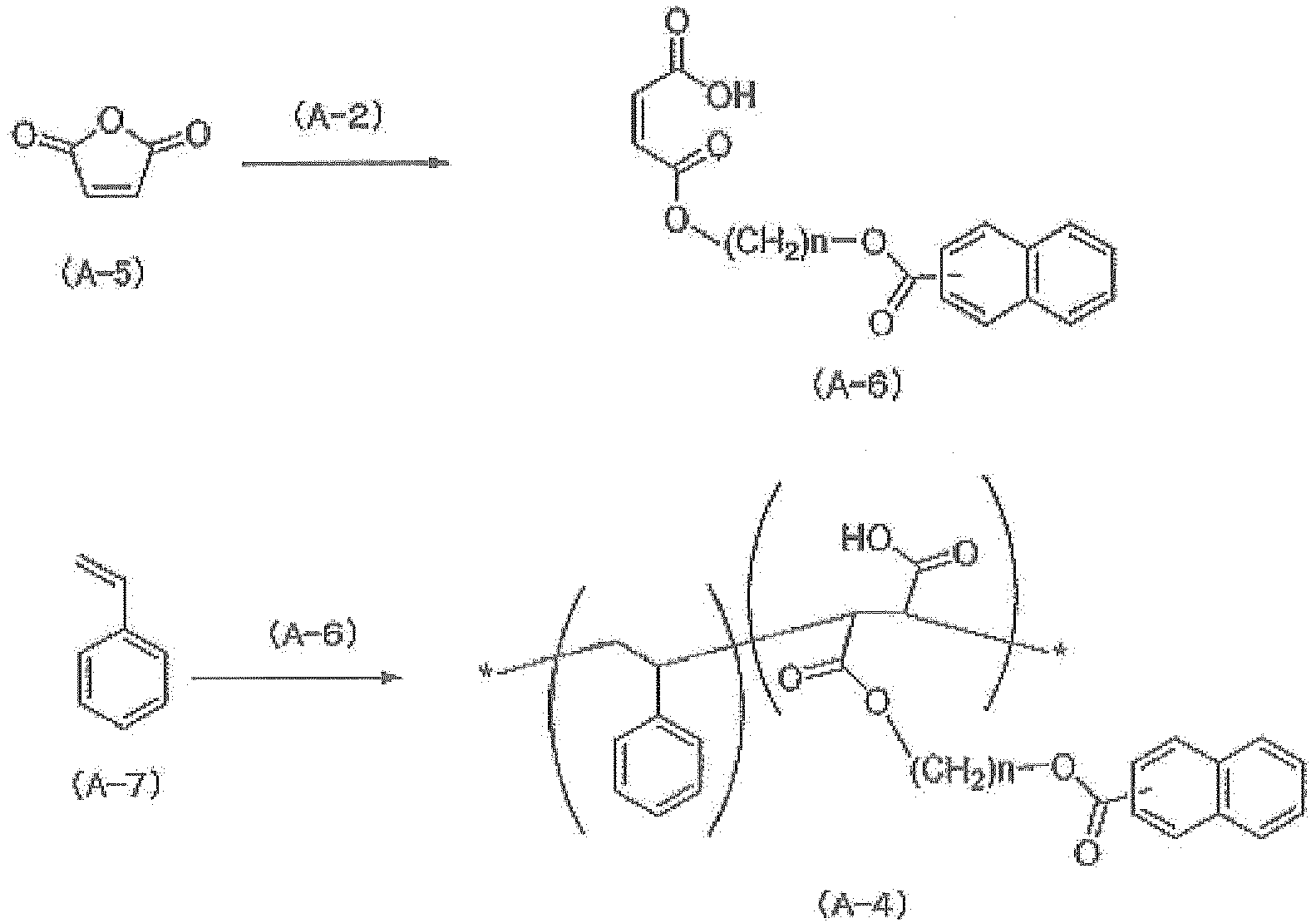
- As in the synthesis method 2, the maleic acid half-ester monomer (A-6) is synthesized. As illustrated with the following formula, this (A-6), styrene (A-7), and methyl methacrylate (A-8) are copolymerized in the presence of a radical polymerization initiator to provide a copolymer (A-9) according to the present disclosure.
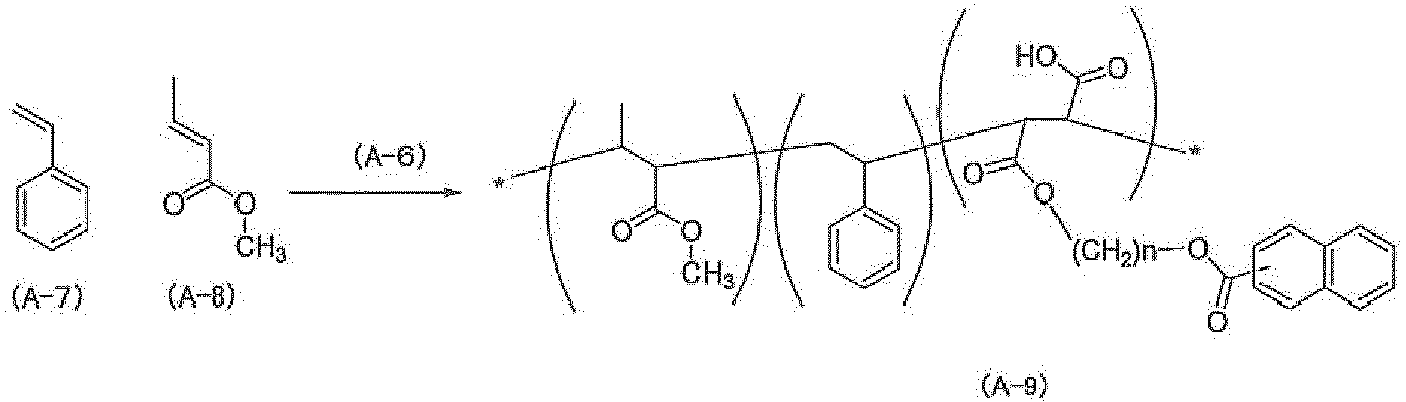
- The above-described radical polymerization initiator is not particularly limited and can be appropriately selected in accordance with the purpose. Examples of the radical polymerization initiator include peroxy ketal, hydroperoxide, dialkyl peroxide, diacyl peroxide, peroxydicarbonate, peroxy ester, cyano initiators that are azobisisobutyronitrile, azobis(2-methylbutyronitrile), and azobis(2,2'-isovaleronitrile), and a non-cyano initiator that is dimethyl-2,2'-azobisisobutyrate. Of these, because molecular-weight control is easily achieved and the decomposition temperature is low, organic peroxides and azo compounds are preferred; and, in particular, azo compounds are preferred.
- The content of the radical polymerization initiator is not particularly limited and can be appropriately selected in accordance with the purpose. The content of the radical polymerization initiator is preferably 1% to 10% by mass relative to the total amount of the polymerizable monomers.
- For the purpose of adjusting the molecular weight of the polymer, a chain transfer agent may be added in an appropriate amount.
- Examples of the chain transfer agent include mercaptoacetic acid, mercaptopropionic acid, 2-propanethiol, 2-mercaptoethanol, thiophenol, dodecylmercaptan, 1-dodecanethiol, and thioglycerol.
- The polymerization temperature is not particularly limited and can be appropriately selected in accordance with the purpose. The polymerization temperature is preferably 50°C to 150°C, more preferably 60°C to 100°C. The polymerization time is also not particularly limited and can be appropriately selected in accordance with the purpose. The polymerization time is preferably 3 to 48 hours.
- Non-limiting specific examples of a copolymer according to the present disclosure include the following compounds. In the formulae, "n" represents an integer of 2 to 18; "m" represents 0 or 1; and "k" represents 1 to 22.


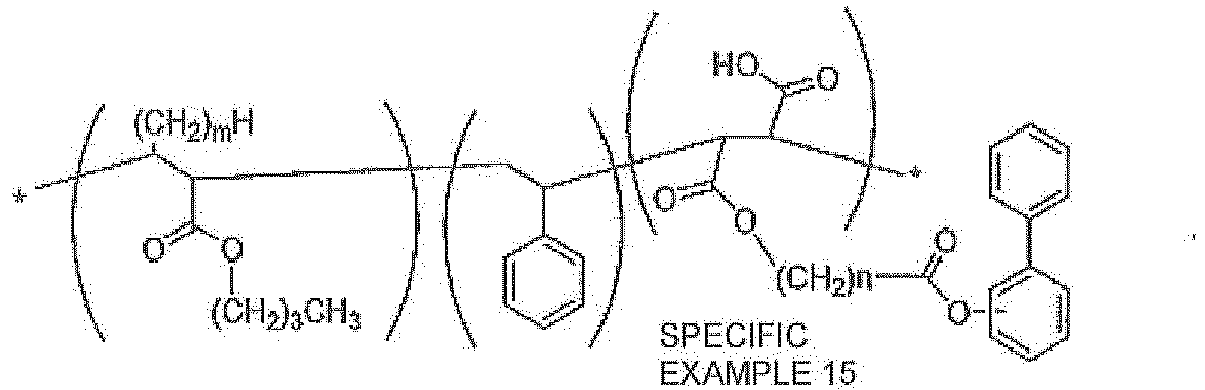


- A colorant of an aqueous ink according to the present disclosure may be pigment or dye. The above-described copolymer has a higher capability of colorant adsorption to pigment than to dye; and, from the viewpoint of water resistance and light resistance, pigment is preferred.
- The pigment is not particularly limited and can be appropriately selected in accordance with the purpose. Examples of the pigment include inorganic and organic pigments for black color and other colors. These pigments may be used alone or in combination of two or more thereof.
- Examples of the inorganic pigments include titanium oxide, iron oxide, calcium carbonate, barium sulfate, aluminum hydroxide, barium yellow, cadmium red, chromium yellow, and carbon black produced by a publicly known method such as a contact process, a furnace process, or a thermal process.
- Examples of the pigment for black color include carbon blacks (C.I. Pigment Black 7) such as furnace black, lamp black, acetylene black, and channel black; metals such as copper and iron (C.I. Pigment Black 11); metal oxides such as titanium oxide; and organic pigments such as aniline black (C.I. Pigment Black 1).
- The above-described carbon black is preferably a carbon black that is produced by a furnace process or a channel process, has a primary particle size of 15 to 40 nm, a BET specific surface area of 50 to 300 m2/g, a DBP oil absorption number of 40 to 150 mL/100 g, a volatile content of 0.5% to 10%, and a pH of 2 to 9.
- Examples of the organic pigments include azo pigments (including, for example, azo lake, insoluble azo pigments, condensation azo pigments, and chelate azo pigments), polycyclic pigments (for example, phthalocyanine pigments, perylene pigments, perinone pigments, anthraquinone pigments, quinacridone pigments, dioxazine pigments, indigo pigments, thioindigo pigments, isoindolinone pigments, and quinophthalone pigments), dye chelates (for example, basic dye chelates and acidic dye chelates), nitro pigments, nitroso pigments, and aniline black.
- Of these pigments, in particular, pigments having a high affinity for water are preferably used.
- Such azo pigments include, for example, azo lake, insoluble azo pigments, condensation azo pigments, and chelate azo pigments.
- Such polycyclic pigments include, for example, phthalocyanine pigments, perylene pigments, perinone pigments, anthraquinone pigments, quinacridone pigments, dioxazine pigments, indigo pigments, thioindigo pigments, isoindolinone pigments, quinophthalone pigments, and rhodamine B lake pigments.
- Such dye chelates include, for example, basic dye chelates and acidic dye chelates. The pigment for yellow is not particularly limited and can be appropriately selected in accordance with the purpose. Examples of the pigment include C.I. Pigment Yellow 1, C.I. Pigment Yellow 2, C.I. Pigment Yellow 3, C.I. Pigment Yellow 12, C.I. Pigment Yellow 13, C.I. Pigment Yellow 14, C.I. Pigment Yellow 16, C.I. Pigment Yellow 17, C.I. Pigment Yellow 73, C.I. Pigment Yellow 74, C.I. Pigment Yellow 75, C.I. Pigment Yellow 83, C.I. Pigment Yellow 93, C.I. Pigment Yellow 95, C.I. Pigment Yellow 97, C.I. Pigment Yellow 98, C.I. Pigment Yellow 114, C.I. Pigment Yellow 120, C.I. Pigment Yellow 128, C.I. Pigment Yellow 129, C.I. Pigment Yellow 138, C.I. Pigment Yellow 150, C.I. Pigment Yellow 151, C.I. Pigment Yellow 154, C.I. Pigment Yellow 155, C.I. Pigment Yellow 174, and C.I. Pigment Yellow 180.
- The pigment for magenta is not particularly limited and can be appropriately selected in accordance with the purpose. Examples of the pigment include C.I. Pigment Red 5, C.I. Pigment Red 7, C.I. Pigment Red 12, C.I. Pigment Red 48 (Ca), C.I. Pigment Red 48 (Mn), C.I. Pigment Red 57 (Ca), C.I. Pigment Red 57:1, C.I. Pigment Red 112, C.I. Pigment Red 122, C.I. Pigment Red 123, C.I, Pigment Red 146, C.I. Pigment Red 168, C.I. Pigment Red 176, C.I. Pigment Red 184, C.I. Pigment Red 185, C.I. Pigment Red 202, and Pigment Violet 19.
- The pigment for cyan is not particularly limited and can be appropriately selected in accordance with the purpose. Examples of the pigment include C.I. Pigment Blue 1, C.I. Pigment Blue 2, C.I. Pigment Blue 3, C.I. Pigment Blue 15, C.I. Pigment Blue 15:3, C.I. Pigment Blue 15:4, C.I. Pigment Blue 15:34, C.I. Pigment Blue 16, C.I. Pigment Blue 22, C.I.
Pigment Blue 60, C.I. Pigment Blue 63, C.I. Pigment Blue 66; C.I. Vat Blue 4, and C.I.Vat Blue 60. - Use of C.I. Pigment Yellow 74 as a yellow pigment, C.I. Pigment Red 122 and C.I. Pigment Violet 19 as magenta pigments, and C.I. Pigment Blue 15:3 as a cyan pigment can provide well-balanced inks excellent in terms of tone and light resistance.
- An ink according to the present disclosure may include a pigment that is newly produced for the present disclosure.
- From the viewpoint of color development of images to be provided, a self-dispersible pigment may be used and an anionic self-dispersible pigment is preferably used. The anionic self-dispersible pigment denotes a pigment in which an anionic functional group is introduced to the pigment surface directly or via another atomic group so that dispersion stabilization is achieved.
- Examples of such a pigment to be treated for dispersion stabilization include various publicly known pigments as listed in
WO 2009/014242 . - The anionic functional group denotes a functional group in which half or more of hydrogen ions dissociate at a pH of 7.0. Specific examples of the anionic functional group include a carboxyl group, a sulfo group, and a phosphonic group. Of these, from the viewpoint of increasing the optical density of images to be provided, a carboxyl group or a phosphonic group is preferred.
- The method of introducing an anionic functional group to pigment surface is, for example, a method of subjecting carbon black to an oxidization treatment.
- Specific examples of the oxidization treatment method include treatment methods with a hypochlorite, ozone water, hydrogen peroxide, a chlorite, nitric acid, or the like; and surface treatment methods using diazonium salts described in
JP-3808504-B1 JP-H10-510861-A JP-2009-515007-A JP-2009-506196-A - Examples of commercially available pigments having a surface hydrophilic functional group include CW-1, CW-2, and CW-3 (these are manufactured by ORIENT CHEMICAL INDUSTRIES CO., LTD.); and CAB-O-JET200, CAB-O-JET300, and CAB-O-JET400 (manufactured by Cabot Corporation).
- The pigment content in the aqueous ink is not particularly limited and can be appropriately selected in accordance with the purpose. The pigment content is preferably 0.5% to 20% by mass, more preferably 1% to 10% by mass.
- The above-described dye can be selected from dyes classified as acid dyes, direct dyes, basic dyes, reactive dyes, and food dyes in the Colour Index.
- Specifically, for example, the acid dyes and food dyes include C.I. Acid Black 1, 2, 7, 24, 26, and 94, C.I. Acid Yellow 17, 23, 42, 44, 79, and 142, C.I. Acid Blue 9, 29, 45, 92, and 249, C.I. Acid Red 1, 8, 13, 14, 18, 26, 27, 35, 37, 42, 52, 82, 87, 89, 92, 97, 106, 111, 114, 115, 134, 186, 249, 254, and 289, C.I. Food Black 1 and 2, C.I. Food Yellow 3 and 4, and C.I. Food Red 7, 9, and 14; the direct dyes include C.I. Direct Black 19, 22, 32, 38, 51, 56, 71, 74, 75, 77, 154, (168), and 171, C.I.
Direct Yellow 1, 12, 24, 26, 33, 44, 50, 86, 120, 132, 142, and 144, C.I.Direct Blue 1, 2, 6, 15, 22, 25, 71, 76, 79, 86, 87, 90, 98, 163, 165, 199, and 202, C.I.Direct Red Basic Yellow Basic Red 2, 12, 13, 14, 15, 18, 22, 23, 24, 27, 29, 35, 36, 38, 39, 46, 49, 51, 52, 54, 59, 68, 69, 70, 73, 78, 82, 102, 104, 109, and 112; and the reactive dyes include C.I. Reactive Black 3, 4, 7, 11, 12, and 17, C.I. Reactive Yellow 1, 5, 11, 13, 14, 20, 21, 22, 25, 40, 47, 51, 55, 65, and 67, C.I.Reactive Blue 1, 2, 7, 14, 15, 23, 32, 35, 38, 41, 63, 80, and 95, and C.I.Reactive Red 1, 14, 17, 25, 26, 32, 37, 44, 46, 55, 60, 66, 74, 79, 96, and 97. - An aqueous ink according to the present disclosure preferably includes a water-soluble organic solvent so that the penetrability of the aqueous ink into conventional paper sheets, coated paper sheets, and the like is enhanced to further suppress the occurrence of beading, and the wetting effect is utilized to prevent the ink from drying.
- The water-soluble organic solvent is not particularly limited. Examples of the water-soluble organic solvent include polyhydric alcohols such as ethylene glycol, diethylene glycol, triethylene glycol, tetraethylene glycol, polyethylene glycol, propylene glycol, dipropylene glycol, tripropylene glycol, polypropylene glycol, 1,3-butanediol, 3-methyl-1,3-butanediol, trimethylolethane, trimethylolpropane, 1,5-pentanediol, 1,6-hexanediol, hexylene glycol, glycerin, 1,2,3-butanetriol, 1,2,4-butanetriol, 1,2,6-hexanetriol, isopropylidene glycerol, and petriol; polyhydric alcohol alkyl ethers such as ethylene glycol monoethyl ether, ethylene glycol monobutyl ether, diethylene glycol monomethyl ether, diethylene glycol monoethyl ether, diethylene glycol monobutyl ether, tetraethylene glycol monomethyl ether, and propylene glycol monoethyl ether; polyhydric alcohol aryl ethers such as ethylene glycol monophenyl ether and ethylene glycol monobenzyl ether; nitrogen-containing heterocyclic compounds such as 2-pyrrolidone, N-methyl-2-pyrrolidone, N-hydroxyethyl-2-pyrrolidone, 1,3-dimethylimidazolidinone, ε-caprolactam, and γ-butyrolactone; amides such as formamide, N-methylformamide, N,N-dimethylformamide, N,N-dimethyl-β-methoxypropionamide, and N,N-dimethyl-β-butoxypropionamide; amines such as monoethanolamine, diethanolamine, triethanolamine, monoethylamine, diethylamine, and triethylamine; sulfur-containing compounds such as dimethyl sulfoxide, sulfolane, and thiodiethanol; 3-ethyl-3-hydroxymethyloxetane, propylene carbonate, and ethylene carbonate. These solvents may be used alone or in combination of two or more thereof.
- Of these, from the viewpoint of suppression of curling of conventional paper sheets, preferred are 3-ethyl-3-hydroxymethyloxetane, isopropylidene glycerol, N,N-dimethyl-β-methoxypropionamide, and N,N-dimethyl-β-butoxypropionamide.
- Diethylene glycol, triethylene glycol, 1,3-butanediol, 2,2,4-trimethyl-1,3-pentanediol, and glycerin are excellent in terms of suppression of discharge failure caused by evaporation of water.
- Examples of a water-soluble organic solvent that has relatively low wettability and has penetrability include 2-ethyl-1,3-hexanediol [solubility: 4.2% (25°C)] and 2,2,4-trimethyl-1,3-pentanediol [solubility: 2.0% (25°C)].
- Other examples of the water-soluble organic solvent include aliphatic diols such as 2-ethyl-2-methyl-1,3-propanediol, 2,2-diethyl-1,3-propanediol, 2-methyl-2-propyl-1,3-propanediol, 3,3-dimethyl-1,2-butanediol, 2,4-dimethyl-2,4-pentanediol, 2,5-dimethyl-2,5-hexanediol, and 5-hexene-1,2-diol.
- Another water-soluble organic solvent that can be used in combination with the above-described water-soluble organic solvent can be appropriately selected in accordance with the purpose from alkyl or aryl ethers of polyhydric alcohols such as diethylene glycol monobutyl ether, propylene glycol monobutyl ether, ethylene glycol monophenyl ether, diethylene glycol monophenyl ether, ethylene glycol monoallyl ether, and tetraethylene glycol chlorophenyl ether; and lower alcohols such as ethanol.
- An aqueous ink according to the present disclosure preferably includes a surfactant so that the penetrability and wettability of the aqueous ink to conventional paper sheets, coated paper sheets, and the like are enhanced and the occurrence of beading is suppressed.
- Examples of the surfactant include fluorine-based surfactants, silicone-based surfactants, anionic surfactants, nonionic surfactants, and betaine-based surfactants. These surfactants may be used alone or as a mixture of two or more thereof. Of these, fluorine-based surfactants and silicone-based surfactants are preferred because the surface tension can be decreased to 30 mN/m or less.
- Examples of the fluorine-based surfactants include nonionic fluorine-based surfactants, anionic fluorine-based surfactants, amphoteric fluorine-based surfactants, and oligomer fluorine-based surfactants. In such a fluorine-based surfactant, the number of carbon atoms replaced by fluorine atoms is preferably 2 to 16, more preferably 4 to 16. When this number of carbon atoms is less than 2, the specific effect of fluorine-based surfactants is not provided in some cases; and when this number of carbon atoms is more than 16, problems in terms of storability and the like may be caused.
- Examples of the nonionic fluorine-based surfactants include perfluoroalkyl phosphoric ester compounds, perfluoroalkyl ethylene oxide adducts, and polyoxyalkylene ether polymer compounds having perfluoroalkyl ether groups as side chains. Of these, preferred are polyoxyalkylene ether polymer compounds having perfluoroalkyl ether groups as side chains because of low foamability; and more preferred are fluorine-based surfactants represented by the following chemical formula (α).
CF3CF2(CF2CF2)m-CF2CF2(CF2CF2)nH (α)
(where m represents 0 to 10 and n represents 0 to 40) - Examples of the anionic fluorine-based surfactants include perfluoroalkyl sulfonic acid compounds, perfluoroalkyl carboxylic acid compounds, perfluoroalkyl phosphoric ester compounds, and polyoxyalkylene ether polymer compounds having perfluoroalkyl ether groups as side chains.
- Examples of the perfluoroalkyl sulfonic acid compounds include perfluoroalkyl sulfonic acids and perfluoroalkyl sulfonic acid salts.
- Examples of the perfluoroalkyl carboxylic acid compounds include perfluoroalkyl carboxylic acids and perfluoroalkyl carboxylic acid salts.
- Examples of the perfluoroalkyl phosphoric ester compounds include perfluoroalkyl phosphoric esters and perfluoroalkyl phosphoric ester salts.
- Examples of the polyoxyalkylene ether polymer compounds having perfluoroalkyl ether groups as side chains include polyoxyalkylene ether polymers having perfluoroalkyl ether groups as side chains, sulfates of polyoxyalkylene ether polymers having perfluoroalkyl ether groups as side chains, and salts of polyoxyalkylene ether polymers having perfluoroalkyl ether groups as side chains.
- Examples of counter ions of salts in such fluorine-based surfactants include Li, Na, K, NH4, NH3CH2CH2OH, NH2(CH2CH2OH)2, and NH(CH2CH2OH)3.
- Examples of commercially available fluorine-based surfactants include SURFLON S-111, S-112, S-113, S-121, S-131, S-132, S-141, and S-145 (these are manufactured by Asahi Glass Co., Ltd.); Fluorad FC-93, FC-95, FC-98, FC-129, FC-135, FC-170C, FC-430, and FC-431 (these are manufactured by Sumitomo 3M Limited); MEGAFACE F-470, F-1405, and F-474 (these are manufactured by Dainippon Ink and Chemicals); Zonyl TBS, FSP, FSA, FSN-100, FSN, FSO-100, FSO, FS-300, and UR (these are manufactured by E. I. du Pont de Nemours and Company); FTERGENT FT-110, FT-250, FT-251, FT-400S, FT-150, and FT-400SW (these are manufactured by NEOS COMPANY LIMITED), and PolyFox PF-136A, PF-156A, PF-151N, PF-154, and PF-159 (these are manufactured by OMNOVA Solutions Inc.).
- Of these, in particular, preferred are FS-300 (manufactured by E. I. du Pont de Nemours and Company), FT-110, FT-250, FT-251, FT-400S, FT-150, and FT-400SW (manufactured by NEOS COMPANY LIMITED), and PolyFox PF-151N (manufactured by OMNOVA Solutions Inc.) because good printing quality is achieved and, in particular, color development and level dyeing capability for paper sheets are considerably enhanced.
- The silicone-based surfactants are not particularly limited and can be appropriately selected in accordance with the purpose. Examples of the silicone-based surfactants include side-chain-modified polydimethylsiloxanes, both-end-modified polydimethylsiloxanes, single-end-modified polydimethylsiloxanes, and side-chain- and both-end-modified polydimethylsiloxanes. In particular, preferred are polyether-modification silicone-based surfactants having a polyoxyethylene group or a polyoxyethylene-polyoxypropylene group as a modification group because the surfactants exhibit good properties as aqueous surfactants.
- Commercial silicone-based surfactants are easily available from, for example, BYK Japan KK, Shin-Etsu Chemical Co., Ltd., Dow Corning Toray Silicone Co., Ltd., NIHON EMULSION Co., Ltd., or Kyoeisha Chemical Co., Ltd.
- Examples of the anionic surfactants include polyoxyethylene alkyl ether acetates, dodecylbenzenesulfonates, laurates, and polyoxyethylene alkyl ether sulfate salts.
- Examples of the nonionic surfactants include polyoxyethylene alkyl ethers, polyoxypropylene alkyl ethers, polyoxyethylene alkyl esters, polyoxyethylene sorbitan fatty acid esters, polyoxyethylene alkyl phenyl ethers, polyoxyethylene alkyl amines, and polyoxyethylene alkyl amides.
- If necessary, an aqueous ink according to the present disclosure may appropriately include another component such as a pH adjusting agent, an antiseptic fungicide, an anticorrosive, an antioxidant, an UV absorber, an oxygen absorbent, or a light stabilizer.
- The pH adjusting agent is not particularly limited and can be appropriately selected in accordance with the purpose as long as it allows adjustment of pH to 8.5 to 11 without adversely affecting the prepared ink. Examples of the pH adjusting agent include alcohol amines, hydroxides of alkali metal elements, hydroxides of ammonium, phosphonium hydroxides, and carbonates of alkali metals. Examples of the alcohol amines include diethanolamine, triethanolamine, and 2-amino-2-ethyl-1,3-propanediol. Examples of the hydroxides of alkali metal elements include lithium hydroxide, sodium hydroxide, and potassium hydroxide. Examples of the hydroxides of ammonium include ammonium hydroxide and quaternary ammonium hydroxide. Examples of the phosphonium hydroxides include quaternary phosphonium hydroxide. Examples of the carbonates of alkali metals include lithium carbonate, sodium carbonate, and potassium carbonate.
- Examples of the antiseptic fungicide include sodium dehydroacetate, sodium sorbate, 2-pyridinethiol-1-oxide sodium, sodium benzoate, and pentachlorophenol sodium.
- Examples of the anticorrosive include acid sulfite, sodium thiosulfate, ammonium thiodiglycolate, diisopropylammonium nitrite, pentaerythritol tetranitrate, and dicyclohexylammonium nitrite.
- Examples of the antioxidant include phenol-based antioxidants (including hindered phenol-based antioxidants), amine-based antioxidants, sulfur-based antioxidants, and phosphorus-based antioxidants.
- Examples of the UV absorber include benzophenone-based UV absorbers, benzotriazole-based UV absorbers, salicylate-based UV absorbers, cyanoacrylate UV absorbers, and nickel-complex-salt-based UV absorbers.
- An aqueous ink according to the present disclosure can be produced by, for example, dispersing or dissolving, in an aqueous medium, water, a water-soluble organic solvent, a pigment, the above-described copolymer, and optionally another component and by stirring and mixing the solution. The copolymer may be used as a pigment dispersion resin during preparation of a pigment dispersion.
- The dispersing can be performed with, for example, a sand mill, a homogenizer, a ball mill, a paint shaker, or an ultrasonic dispersion apparatus. The stirring and mixing can be performed with, for example, a stirrer having a normal impeller, a magnetic stirrer, or a high-speed dispersion apparatus.
- During the production, coarse particles are optionally filtered off with a filter, a centrifuge, or the like and degassing is preferably performed,
- Properties of an aqueous ink according to the present disclosure are not particularly limited and can be appropriately selected in accordance with the purpose. For example, the viscosity and the surface tension of the aqueous ink are preferably within the following ranges.
- The viscosity of the aqueous ink at 25°C is preferably 3 to 20 mPa·s. When the viscosity is 3 mPa·s or more, the effects of increasing the printing density and improving character quality are provided. When the viscosity is 20 mPa·s or less, ink dischargeability can be ensured.
- The viscosity can be measured with, for example, a viscometer (RL-550, manufactured by Toki Sangyo Co., Ltd.) at 25°C.
- The surface tension of the aqueous ink at 25°C is preferably 40 mN/m or less.
- An ink cartridge according to the present disclosure contains the above-described aqueous ink in a container and optionally includes another member that is appropriately selected.
- The container is not particularly limited. For example, the shape, structure, size, or material of the container can be appropriately selected in accordance with the purpose. For example, the container preferably includes at least an ink bag formed of an aluminum laminate film, a resin film, or the like.
- The ink cartridge will be described with reference to
FIGs. 13 and 14. FIG. 13 illustrates an example of the ink cartridge.FIG. 14 illustrates the ink cartridge inFIG. 13 and its case (casing). In anink cartridge 200, ink is charged through anink inlet 242 into anink bag 241; the gas is vented from theink bag 241; and theink inlet 242 is then sealed by fusion. At the time of use, a needle in the apparatus body is inserted through anink outlet 243 formed of a rubber member to allow supply to the apparatus. Theink bag 241 is formed of a package member such as a gas-impermeable aluminum laminate film. As illustrated inFIG. 14 , in general, thisink bag 241 is contained in acartridge case 244 formed of plastic and is used in the state of being detachably attached to various inkjet recording apparatuses. - Hereinafter, the present disclosure will be specifically described further with reference to Examples. However, the present disclosure is not limited to these Examples. In the Examples, "parts" and "%" denote "parts by weight" and "% by weight" unless otherwise specified.
- The molecular weight of the copolymers obtained in Examples and Comparative Examples were obtained as follows:
- The molecular weight was measured by a gel permeation chromatography (GPC) under the following condition:
- · Measuring instrument: GPC-8020 (manufactured by Tosoh Corporation)
- · Column: TSK G2000 HXL and G4000 HXL (manufactured by Tosoh Corporation) Temperature: 40 °C
- · Solvent: tetrahydrofuram (THF)
- · Flow speed: 1.0 mL/minute
- 1 mL of a copolymer having a concentration of 0.5 % by weight was poured to the column and the number average molecular weight Mn and the weight average molecular weight Mw of the measured copolymer were calculated using the molecular weight calibration curve prepared by a simple dispersion polystyrene sample.
- Ethylene glycol (15.6 g, 252 mmol) was dissolved in 100 mL of methylene chloride. To this solution, 3.49 g (44 mmol) of pyridine was added and the solution was cooled with ice water. To this solution being stirred, a solution containing 8.00 g (42 mmol) of 2-naphthalenecarbonyl chloride dissolved in 80 mL of methylene chloride was dropped over an hour. This solution was stirred for 2 hours and subsequently further stirred at room temperature for 6 hours. The resultant reaction solution was rinsed with water; the organic phase was then separated and dried over magnesium sulfate, and the solvent was distilled off. The residue was purified by silica gel column chromatography with a methylene chloride/methanol (97/3) solvent mixture serving as an eluent to provide 6.88 g of 2-naphthoic acid 2-hydroxyethyl ester.
- Subsequently, 0.2 g of a styrene-maleic anhydride copolymer [SMA1000P, manufactured by KAWAHARA PETROCHEMICAL CO., LTD., weight-average molecular weight (Mw): 5500, number-average molecular weight (Mn): 2000] and 0.64 g (3 mmol) of 2-naphthoic acid 2-hydroxyethyl ester were dissolved in 8 mL of dried dimethylformamide and stirred at 120°C for 12 hours. The resultant reaction solution was diluted with toluene and the solvent was distilled off. The residue was purified with a recycling HPLC (LC-9201, manufactured by Japan Analytical Industry Co., Ltd., developing solvent: tetrahydrofuran, flow rate: 3.5 mL/min) to provide 0.17 g of Copolymer 1 having a weight molecular weight (Mw) of 5,700 and a number of molecular weight (Mn) of 2,200.
- The infrared absorption spectrum (KBr pellet method) of Copolymer 1 is illustrated in
FIG. 1 . - As in Example 1, 2-naphthoic acid 4-hydroxybutyl ester was obtained except that ethylene glycol was replaced by 1,4-butanediol.
- Subsequently, in the same manner as in Example 1, Copolymer 2 having a weight molecular weight (Mw) of 5,700 and a number of molecular weight (Mn) of 2,200. was obtained.
- The infrared absorption spectrum (KBr pellet method) of Copolymer 2 is illustrated in
FIG. 2 . - As in Example 1, 2-naphthoic acid 6-hydroxyhexyl ester was obtained except that ethylene glycol was replaced by 1,6-hexanediol.
- Subsequently, in the same manner as in Example 1, Copolymer 3 having a weight molecular weight (Mw) of 5,800 and a number of molecular weight (Mn) of 2,300. was obtained.
- The infrared absorption spectrum (KBr pellet method) of Copolymer 3 is illustrated in
FIG. 3 . - As in Example 1, 2-naphthoic acid 12-hydroxydodecyl ester was obtained except that ethylene glycol was replaced by 1,12-dodecanediol.
- Subsequently, in the same manner as in Example 1, Copolymer 4 having a weight molecular weight (Mw) of 5,800 and a number of molecular weight (Mn) of 2,300. was obtained.
- The infrared absorption spectrum (KBr pellet method) of Copolymer 4 is illustrated in
FIG. 4 . - To a solvent mixture of 80 mL of dried toluene and 15 mL of dried pyridine, 5,59 g (30 mmol) of 1,8-naphthalenedicarboxylic anhydride and 3.52 g (30 mmol) of 6-amino-1-hexanol were added. This solution was refluxed for 16 hours and then cooled to room temperature. Subsequently, the solvent was distilled off and the residue was purified by silica gel column chromatography with a toluene/ethyl acetate (7/3 to 5/5) solvent mixture serving as an eluent to provide 7.67 g of an imide compound. Subsequently, as in Example 1, this imide compound and the above-described SMA1000P were used to provide Copolymer 5 having a weight molecular weight (Mw) of 5,700 and a number of molecular weight (Mn) of 2,200..
- The infrared absorption spectrum (KBr pellet method) of Copolymer 5 is illustrated in
FIG. 5 . - In the same manner as in Example 1, 2-naphthoic acid 6-hydroxyhexyl ester obtained in Example 3 and a styrene-maleic anhydride copolymer [SMA2000P, manufactured by KAWAHARA PETROCHEMICAL CO., LTD., weight-average molecular weight (Mw): 7500, number-average molecular weight (Mn): 3000] were used to provide Copolymer 6 having a weight molecular weight (Mw) of 7,700 and a number of molecular weight (Mn) of 3,200..
- The infrared absorption spectrum (KBr pellet method) of Copolymer 6 is illustrated in
FIG. 6 . - In the same manner as in Example 1, 2-naphthoic acid 6-hydroxyhexyl ester obtained in Example 3 and a styrene-maleic anhydride copolymer [SMA3000P, manufactured by KAWAHARA PETROCHEMICAL CO., LTD., weight-average molecular weight (Mw): 9500, number-average molecular weight (Mn): 3800] were used to provide Copolymer 7 having a weight molecular weight (Mw) of 9,900 and a number of molecular weight (Mn) of 4,100..
- The infrared absorption spectrum (KBr pellet method) of Copolymer 7 is illustrated in
FIG. 7 . - To 80 mL of methyl ethyl ketone, 9.05 g (50 mmol) of 4-hydroxybiphenyl, 10.20 g (60 mmol) of 6-bromo-1-hexanol, and 20.7 g (150 mmol) of potassium carbonate were added. This solution was refluxed for 24 hours and then cooled to room temperature. This solution was diluted with 200 mL of methylene chloride and rinsed with water three times. The organic phase was then separated and dried over magnesium sulfate, and the solvent was distilled off. The residue was dissolved in toluene and purified by recrystallization to provide 10.25 g of 6-(4-phenylphenoxy)hexane-1-ol.
- Subsequently, 0.72 g (2.7 mmol) of 6-(4-phenylphenoxy)hexane-1-ol and 1.0 g of a styrene-maleic anhydride copolymer [SMA3024, manufactured by KAWAHARA PETROCHEMICAL CO., LTD., weight-average molecular weight (Mw): 24000] were dissolved in 1 mL of dried dimethylacetamide and stirred under reflux for 2 hours. The resultant reaction solution was diluted with toluene and the solvent was distilled off. The residue was purified with a recycling HPLC (LC-9201, manufactured by Japan Analytical Industry Co., Ltd., developing solvent: tetrahydrofuran, flow rate: 3.5 mL/min) to provide 1.16 g of Copolymer 8 having a weight molecular weight (Mw) of 24,300 and a number of molecular weight (Mn) of 10,000..
- The infrared absorption spectrum (KBr pellet method) of Copolymer 8 is illustrated in
FIG. 8 . - To a solvent mixture of 130 mL of dried toluene and 30 mL of dried pyridine, 9.91 g (50 mmol) of 2,3-naphthalenedicarboxylic anhydride and 5.86 g (50 mmol) of 6-amino-1-hexanol were added. This solution was refluxed for 12 hours and then cooled to room temperature. Subsequently, the solvent was distilled off and the residue was purified by silica gel column chromatography with a toluene/ethyl acetate (7/3 to 5/5) solvent mixture serving as an eluent to provide 11.34 g of an imide compound.
- Subsequently, 0.80 g (2.7 mmol) of the imide compound and 1.0 g of the above-described SMA3024 were dissolved in 1 mL of dried dimethylacetamide and stirred under reflux for 3 hours. The resultant reaction solution was diluted with toluene and the solvent was distilled off. The residue was purified with a recycling HPLC (LC-9201, manufactured by Japan Analytical Industry Co., Ltd., developing solvent: tetrahydrofuran, flow rate: 3.5 mL/min) to provide 1.21 g of Copolymer 9 having a weight molecular weight (Mw) of 24,200 and a number of molecular weight (Mn) of 10,000..
- The infrared absorption spectrum (KBr pellet method) of Copolymer 9 is illustrated in
FIG. 9 . - In a solvent mixture of 150 mL of tetrahydrofuran and 30 mL of methylene chloride, 10.0 g (19.4 mmol) of 1,16-hexadecanediol was dissolved and 1.54 g (19.4 mmol) of pyridine was added. To this solution being stirred, a solution containing 3.70 g (38,8 mmol) of 2-naphthalenecarbonyl chloride dissolved in 50 mL 150 mL of tetrahydrofuran was dropped over 2 hours. This solution was then further stirred for an hour. The solvent was distilled off from the resultant reaction solution. The residue was rinsed with methanol, then rinsed with water, and dried; and this residue was purified by silica gel column chromatography with a methylene chloride/methanol (95/5) solvent mixture serving as an eluent to provide 2.06 g of 2-naphthoic acid 16-hydroxyhexadecane ester.
- Subsequently, 0.32 g (0.78 mmol) of 2-naphthoic acid 16-hydroxyhexadecane ester and 0.30 g of the above-described SMA3024 were dissolved in 1 mL of dried dimethylacetamide and stirred under reflux for 2 hours. The resultant reaction solution was diluted with toluene and the solvent was distilled off. The residue was purified with a recycling HPLC (LC-9201, manufactured by Japan Analytical Industry Co., Ltd., developing solvent: tetrahydrofuran, flow rate: 3.5 mL/min) to provide 0.47 g of
Copolymer 10 having a weight molecular weight (Mw) of 24,400 and a number of molecular weight (Mn) of 10,000.. - The infrared absorption spectrum (KBr pellet method) of
Copolymer 10 is illustrated inFIG. 10 . - Copolymer 7 (1.37 g) obtained in Example 7 was dissolved in 3 mL of Equamide M100 (manufactured by Idemitsu Kosan Co., Ltd.). Tetraethylammonium hydroxide (0.294 g) was dissolved in 12 mL of deionized water. To the resultant aqueous solution under vigorous stirring, the Equamide M100 solution of the copolymer was dropped. After the dropping was completed, the solution was stirred for about an hour and the solvent was distilled off. The residue was rinsed with deionized water and dried under a reduced pressure to provide Copolymer 11 (copolymer in which carboxyl groups of Copolymer 7 were changed to tetraethylammonium carboxylate) having a weight molecular weight (Mw) of 9,900 and a number of molecular weight (Mn) of 4,100..
- As in Example 1, 2-naphthoic acid 2-hydroxyethyl ester was obtained. After that, 10.3 g (25 mmol) of maleic anhydride and 6.81 g (25 mmol) of 2-naphthoic acid 6-hydroxyhexyl ester were dissolved in 50 mL of methyl ethyl ketone and refluxed under heating for 6 hours. The resultant reaction mixture was concentrated. The residue was purified by silica gel column chromatography with a methylene chloride/methanol (volume ratio: 9/1) solvent mixture serving as an eluent to provide 8.1 g of a compound having a structure represented by the following formula [hereafter referred to as Maleic derivative 1].

- Subsequently, 3.20 g (8.6 mmol) of Maleic derivative 1 was dissolved in 1.80 g (17.3 mmol) of styrene. To this solution, 5.0 g of deionized water, 0.15 g of AQUALON KH-10 (anionic radical reactive surfactant manufactured by DAI-ICHI KOGYO SEIYAKU CO., LTD.), and 0.05 g of ammonium persulfate were added and treated with a homomixer to provide pre-emulsion. Subsequently, 0.1 g of AQUALON KH-1 0 was added to 5.0 g of deionized water and heated to 80°C under a stream of argon. To this solution, 10% of the pre-emulsion was added and subjected to initial polymerization for 30 minutes. Subsequently, the remainder of the pre-emulsion was dropped over 2 hours to cause polymerization. After that, polymerization was further caused at 80°C for 2 hours. This solution was cooled, then filtered, and neutralized with aqueous ammonia to provide Copolymer 12 having a solid content concentration of 30% with a weight molecular weight (Mw) of 17,000 and a number of molecular weight (Mn) of 9,000..
- After water was distilled off from the emulsion-state Copolymer 12 under a stream of hot air, drying under a reduced pressure was performed to provide Copolymer 12. The infrared absorption spectrum of Copolymer 12 is illustrated in
FIG 11 . - Maleic derivative 1 (3.08 g (8.32 mmol)) and 0.64 g (4.99 mmol) of butyl acrylate were dissolved in 1.73 g (16.6 mmol) of styrene. To this solution, 5.0 g of deionized water, 0.15 g of AQUALON KH-10 (anionic reactive surfactant manufactured by DAI-ICHI KOGYO SEIYAKU CO., LTD.), and 0.05 g of ammonium persulfate were added and treated with a homomixer to provide pre-emulsion. Subsequently, 0.1 g of AQUALON KH-10 was added to 5.0 g of deionized water and heated to 80°C under a stream of argon. To this solution, 10% of the pre-emulsion was added and subjected to initial polymerization for 30 minutes. Subsequently, the remainder of the pre-emulsion was dropped over 2 hours to cause polymerization. After that, polymerization was further caused at 80°C for 2 hours. This solution was cooled, then filtered, and neutralized with aqueous ammonia to provide Copolymer 13 having a solid content concentration of 30% with a weight molecular weight (Mw) of 2,800 and a number of molecular weight (Mn) of 10,000.
- The infrared absorption spectrum (KBr pellet method) of Copolymer 13 is illustrated in
FIG. 12 . - The structures of Copolymers in Examples 1 to 13 above are summarized in Table 1.
Table 1 1:2 n Y Z R Structural formula Example 1 1:1 2 oxycarbonyl naphthalene H Specific example 1 Example 2 1:1 4 oxycarbonyl naphthalene H Specific example 1 Example 3 1:1 6 oxycarbonyl naphthalene H Specific example 1 Example 4 1:1 12 oxycarbonyl naphthalene H Specific example 1 Example 5 1:1 6 imido naphthalene H Specific example 9 Example 6 2:1 6 oxycarbonyl naphthalene H Specific example 1 Example 7 3:1 6 oxycarbonyl naphthalene H Specific example 1 Example 8 3:1 6 ether biphenyl H Specific example 6 Example 9 3:1 6 imido naphthalene H Specific example 10 Example 10 3:1 16 oxycarbonyl naphthalene H Specific example 1 Example 11 3:1 6 oxycarbonyl naphthalene * Salt of Specific example 1 Example 12 2:1 6 oxycarbonyl naphthalene H Specific example 1 Example 13 2:1 6 oxycarbonyl naphthalene H Specific example 12 In Example 11, in the salt of Specific example 1, "*" for R denotes a tetraethylammonium salt.
In Example 13, in Specific example 12, m represents 0 and n represents 6. - A styrene-maleic anhydride copolymer [0.2 g, SMA1000P, manufactured by KAWAHARA PETROCHEMICAL CO., LTD., weight-average molecular weight (Mw): 5500, number-average molecular weight (Mn): 2000] and 0.30 g (3 mmol) of 1-hexanol were dissolved in 8 mL of dried dimethylformamide and stirred to react at 120°C for 12 hours. The resultant reaction solution was diluted with toluene and the solvent was distilled off. The residue was purified with a recycling HPLC (LC-9201, manufactured by Japan Analytical Industry Co., Ltd., developing solvent: tetrahydrofuran, flow rate: 3.5 mL/min) to provide 0.21 g of Comparative copolymer 1 having a weight molecular weight (Mw) of 5,600 and a number of molecular weight (Mn) of 2,100..
- Maleic anhydride (10.3 g (25 mmol)) and 2.55 g (25 mmol) of 1-hexanol were dissolved in 50 mL of methyl ethyl ketone and refluxed under heating to react for 6 hours. The resultant reaction mixture was concentrated. The residue was purified by silica gel column chromatography with a methylene chloride/methanol (volume ratio: 9/1) solvent mixture serving as an eluent to provide 8.7 g of a compound having a structure represented by the following formula [hereafter referred to as Maleic derivative 2].

- Comparative copolymer 2 having a solid content concentration of 30% with a weight molecular weight (Mw) of 17,000 and a number of molecular weight (Mn) of 7,000.was obtained as in Example 12 except that Maleic derivative 1 was replaced by Maleic derivative 2.
- Copolymer 1 (5.0 parts) was dissolved in 8.0 parts of tetrahydrofuran. To this solution, 70.0 parts of deionized water and a neutralizer (sodium hydroxide solution) in an amount corresponding to 100% of the acid value of the copolymer were added to achieve neutralization. After that, 20.0 parts of carbon black (NIPEX150, manufactured by Degussa) was added and stirred. The resultant mixture was subjected to circulation dispersion with a disk-type bead mill (manufactured by SHINMARU ENTERPRISES CORPORATION, KDL-type, media: zirconia balls having a diameter of 0.1 mm) at a peripheral speed of 10 m/s for an hour. Subsequently, the solvent was distilled off with an evaporator under a reduced pressure. The residue was filtered with a membrane filter having a pore size of 1.2 µm and mixed with an adjustment amount of deionized water to provide 95.0 parts of Pigment dispersion 31 (pigment solid content concentration: 20%).
- Pigment dispersion 31 (40.0 parts), 20.0 parts of 1,3-butanediol, 10.0 parts of glycerin, 1.0 part of 2,2,4-trimethyl-1,3-pentadiol, 2.0 parts of Zonyl FS-300 (manufactured by E. I. du Pont de Nemours and Company, fluorine-based surfactant, solid content: 40% by mass), and 26.0 parts of deionized water were mixed, stirred for an hour, and then filtered with a membrane filter having a pore size of 1.2 µm to provide Aqueous ink 31 according to the present disclosure.
- Pigment dispersion 32 was obtained as in Example 31 except that Copolymer 1 used in Preparation of pigment dispersion was replaced by Copolymer 2.
- Subsequently, Aqueous ink 32 according to the present disclosure was obtained as in Example 31 except that Pigment dispersion 31 used in Preparation of ink was replaced by Pigment dispersion 32.
- Pigment dispersion 33 was obtained as in Example 31 except that Copolymer 1 used in Preparation of pigment dispersion was replaced by Copolymer 3.
- Subsequently, Aqueous ink 33 according to the present disclosure was obtained as in Example 31 except that Pigment dispersion 1 used in Preparation of ink was replaced by Pigment dispersion 33.
- Pigment dispersion 34 was obtained as in Example 33 except that carbon black (NIPEX150, manufactured by Degussa) used in Preparation of pigment dispersion was replaced by Pigment Blue 15:3 (manufactured by Dainichiseika Color & Chemicals Mfg. Co., Ltd., CHROMOFINE BLUE, cyan pigment).
- Subsequently, Aqueous ink 34 according to the present disclosure was obtained as in Example 33 except that Pigment dispersion 33 used in Preparation of ink was replaced by Pigment dispersion 34.
- Pigment dispersion 35 was obtained as in Example 33 except that carbon black (NIPEX150, manufactured by Degussa) used in Preparation of pigment dispersion was replaced by Pigment Red 122 (manufactured by Clariant, Toner magenta EO02, magenta pigment).
- Subsequently, Aqueous ink 35 according to the present disclosure was obtained as in Example 33 except that Pigment dispersion 33 used in Preparation of ink was replaced by Pigment dispersion 35.
- Pigment dispersion 36 was obtained as in Example 33 except that carbon black (NIPEX150, manufactured by Degussa) used in Preparation of pigment dispersion was replaced by Pigment Yellow (manufactured by Dainichiseika Color & Chemicals Mfg. Co., Ltd., FAST YELLOW 531, yellow pigment).
- Subsequently, Aqueous ink 36 according to the present disclosure was obtained as in Example 33 except that Pigment dispersion 33 used in Preparation of ink was replaced by Pigment dispersion 36.
- Pigment dispersion 37 was obtained as in Example 31 except that Copolymer 1 used in Preparation of pigment dispersion was replaced by Copolymer 4.
- Subsequently, Aqueous ink 37 according to the present disclosure was obtained as in Example 31 except that Pigment dispersion 31 used in Preparation of ink was replaced by Pigment dispersion 37.
- Pigment dispersion 38 was obtained as in Example 31 except that Copolymer 1 used in Preparation of pigment dispersion was replaced by Copolymer 5.
- Subsequently, Aqueous ink 38 according to the present disclosure was obtained as in Example 31 except that Pigment dispersion 31 used in Preparation of ink was replaced by Pigment dispersion 38.
- Pigment dispersion 39 was obtained as in Example 31 except that Copolymer 1 used in Preparation of pigment dispersion was replaced by Copolymer 6.
- Subsequently, Aqueous ink 39 according to the present disclosure was obtained as in Example 31 except that Pigment dispersion 31 used in Preparation of ink was replaced by Pigment dispersion 39.
-
Pigment dispersion 40 was obtained as in Example 31 except that Copolymer 1 used in Preparation of pigment dispersion was replaced by Copolymer 7. - Subsequently,
Aqueous ink 40 according to the present disclosure was obtained as in Example 31 except that Pigment dispersion 31 used in Preparation of ink was replaced byPigment dispersion 40. - Pigment dispersion 41 was obtained as in Example 31 except that Copolymer 1 used in Preparation of pigment dispersion was replaced by Copolymer 8.
- Subsequently, Aqueous ink 41 according to the present disclosure was obtained as in Example 31 except that Pigment dispersion 31 used in Preparation of ink was replaced by Pigment dispersion 41.
- Pigment dispersion 42 was obtained as in Example 31 except that Copolymer 1 used in Preparation of pigment dispersion was replaced by Copolymer 9.
- Subsequently, Aqueous ink 42 according to the present disclosure was obtained as in Example 31 except that Pigment dispersion 31 used in Preparation of ink was replaced by Pigment dispersion 42.
- Pigment dispersion 43 was obtained as in Example 31 except that Copolymer 1 used in Preparation of pigment dispersion was replaced by
Copolymer 10. - Subsequently, Aqueous ink 43 according to the present disclosure was obtained as in Example 31 except that Pigment dispersion 31 used in Preparation of ink was replaced by Pigment dispersion 43.
- Pigment dispersion 44 was obtained as in Example 31 except that Copolymer 1 used in Preparation of pigment dispersion was replaced by Copolymer 11.
- Subsequently, Aqueous ink 44 according to the present disclosure was obtained as in Example 31 except that Pigment dispersion 31 used in Preparation of ink was replaced by Pigment dispersion 44.
- The following materials were mixed and stirred for 30 minutes to prepare Aqueous solution 1.
2-ethyl-1,3-hexanediol 2.00 parts glycerol 10.00 parts 3-methoxy-N,N-diznethylpropaneamide 15.00 parts 3-butoxy-N,N-dimethylpropaneamide 15.00 parts 2-(cyclohexylamino)ethanesulfonic acid 0.05 parts 2,4,7,9-tetramethyl-4,7-decanediol 0.50 parts Zonyl FS-300 (fluorine-based surfactant, manufactured by E. I. du Pont de Nemours and Company) 0.25 parts diethanolamine 0.01 parts deionized water 12.93 parts - Subsequently, 50 g of dried carbonblack, 100 mL of deionized water, and 15.5 g (50 mmol) of the compound represented by the following chemical formula were mixed followed by heating to 60 °C while being stirred at 300 rpm. 50 mmol 1 of 20 % sodium nitrite aqueous solution was added in 15 minutes. Thereafter, the resultant was stirred at 60 ° for three hours. The content was diluted with 75 mL of deionized water followed by filtration. Deionized water was added in such a manner that the concentration of the solid portion was 20.0 % to prepare Pigment dispersion 45 of carbon black.

- Subsequently, to Aqueous solution 1, 37.50 parts of Pigment dispersion 45 was added and stirred for 30 minutes; and 6.67 parts of Copolymer 12 (solid content concentration: 30%) was further added and stirred for 30 minutes. This solution was filtered with a membrane filter having a pore size of 1.2 µm to provide Aqueous ink 45 according to the present disclosure.
- The following materials were mixed and stirred for 30 minutes to prepare Aqueous solution 2.
2-ethyl-1,3-hexanediol 2.00 parts glycerol 10.00 parts 3-methoxy-N,N-dimethylpropaneamide 20.00 parts 3-butoxy-N,N-dimethylpropaneamide 20.00 parts 2-(cyclohexylamino)ethanesulfonic acid 0.05 parts 2,4,7,9-tetramethyl-4,7-decanediol 0.50 parts Zonyl FS-300 (fluorine-based surfactant, manufactured by E. I. du Pont de Nemours and Company) 0.25 parts diethanolamine 0.01 parts deionized water 17.93 parts - Subsequently, 4.50 g of p-aminobenzoate was added to 150 g of deionized water heated to 60 °C followed by stirring for 10 minutes at 8,000 rpm. Thereafter, a solution in which 1.80 g of sodium nitrite was dissolved in 15 g of deionized water was added to this mixture. Immediately thereafter, 20 g of copper phthanlocyanine pigment PB 15:4 (manufactured by Sun Chemical Corporation) was added thereto followed by a one hour mixing at 8,500 rpm. Furthermore, 4.5 g of p-aminobenzoate was dissolved in 15 g of deionized water was added to this mixture followed by a three hour mixing at 8,500 rpm at 65 °C. Thus-obtained reaction mixture was filtered with a mash of 200 nm. Subsequent to washing with water, the thus-obtained cyan pigment was dispersed in water. Coarse particles were removed by a centrifugal and deionized water was added in such a manner that the concentration of the solid portion was 20.0 % to obtain Pigment dispersion 46 of cyan pigment which was surface-treated with p-aminobenzoate.
- Subsequently, to Aqueous solution 2, 22.50 parts of Pigment dispersion 46 was added and stirred for 30 minutes; and 6.67 parts of Copolymer 13 (solid content concentration: 30%) was further added and stirred for 30 minutes, This solution was then filtered with a membrane filter having a pore size of 1.2 µm to provide Aqueous ink 46 according to the present disclosure.
- As in Example 45, Aqueous solution 1 was prepared.
- Subsequently, 4.50 g of sulfanilic acid was added to 150 g of deionized water heated to 60 °C followed by stirring for 10 minutes at 8,000 rpm. Thereafter, a solution in which 1.80 g of sodium nitrite was dissolved in 15 g of deionized water was added to this mixture. Immediately thereafter, 20 g of magenta pigment PR 122 (manufactured by Sun Chemical Corporation) was added thereto followed by a one hour mixing at 8,500 rpm. Furthermore, 4.5 g of sulfanilic acid was dissolved in 15 g of deionized water was added to this mixture followed by a three hour mixing at 8,500 rpm at 65 °C. Thus-obtained reaction mixture was filtered with a mash of 200 nm. Subsequent to washing with water, the thus-obtained cyan pigment was dispersed in water. Coarse particles were removed by a centrifugal and deionized water was added in such a manner that the concentration of the solid portion was 20.0 % to obtain Pigment dispersion 47 of magenta pigment which was surface-treated with sulfanilic acid
- Subsequently, to Aqueous solution 1, 22.50 parts of Pigment dispersion 47 was added and stirred for 30 minutes; and 6.67 parts of Copolymer 13 (solid content concentration: 30%) was further added and stirred for 30 minutes. This solution was then filtered with a membrane filter having a pore size of 1.2 µm to provide Aqueous ink 47 according to the present disclosure.
- As in Example 46, Aqueous solution 2 was prepared. To Aqueous solution 2,37.50 parts of Pigment dispersion 34 (cyan pigment, solid content: 20.0%) prepared in Example 34 was added and stirred for 30 minutes; and 6.67 parts of Copolymer 13 (solid content concentration: 30%) was then added and stirred for 30 minutes. This solution was then filtered with a membrane filter having a pore size of 1.2 µm to provide Aqueous ink 48 according to the present disclosure.
- Comparative pigment dispersion 21 was obtained as in Example 31 except that Copolymer 1 used in Preparation of pigment dispersion was replaced by Comparative copolymer 1.
- Subsequently, Comparative aqueous ink 21 was obtained as in Example 31 except that Pigment dispersion 31 used in Preparation of ink was replaced by Comparative pigment dispersion 21.
- Comparative pigment dispersion 22 was obtained as in Example 34 except that Copolymer 3 used in Preparation of pigment dispersion was replaced by Comparative copolymer 1.
- Subsequently, Comparative aqueous ink 22 was obtained as in Example 34 except that Pigment dispersion 34 used in Preparation of ink was replaced by Comparative pigment dispersion 22.
- Comparative pigment dispersion 23 was obtained as in Example 35 except that Copolymer 3 used in Preparation of pigment dispersion was replaced by Comparative copolymer 1.
- Subsequently, Comparative aqueous ink 23 was obtained as in Example 35 except that Pigment dispersion 35 used in Preparation of ink was replaced by Comparative pigment dispersion 23.
- Comparative pigment dispersion 24 was obtained as in Example 36 except that Copolymer 3 used in Preparation of pigment dispersion was replaced by Comparative copolymer 1.
- Subsequently, Comparative aqueous ink 24 was obtained as in Example 36 except that Pigment dispersion 36 used in Preparation of ink was replaced by Comparative pigment dispersion 24.
- As in Example 46, Aqueous solution 2 was prepared. To Aqueous solution 2, 22.50 parts of Pigment dispersion 46 (cyan pigment, solid content: 20.0%) prepared in Example 46 was added and stirred for 30 minutes; and 6.67 parts of Comparative copolymer 2 (solid content concentration: 30%) was then added and stirred for 30 minutes. This solution was then filtered with a membrane filter having a pore size of 1.2 µm to provide Comparative aqueous ink 25.
- As in Example 47, Aqueous solution 1 was prepared. To Aqueous solution 1, 37.50 parts of Pigment dispersion 47 (magenta pigment, solid content: 20.0%) prepared in Example 47 was added and stirred for 30 minutes; and 6.67 parts of Comparative copolymer 2 (solid content concentration: 30%) was then added and stirred for 30 minutes. This solution was then filtered with a membrane filter having a pore size of 1.2 µm to provide Comparative aqueous ink 26.
- As in Comparative example 22, Comparative pigment dispersion 22 was prepared. To Comparative pigment dispersion 22, 6.67 parts of Comparative copolymer 2 (solid content concentration: 30%) was added and stirred for 30 minutes. This solution was then filtered with a membrane filter having a pore size of 1.2 µm to provide Comparative aqueous ink 27.
- Characteristics of Aqueous inks prepared in Examples and Comparative examples were evaluated by methods described below. The results are summarized in Table 2.
- In an environment at 23°C and 50% RH, each ink was charged into an inkjet printer (manufactured by Ricoh Company, Ltd., IPSiO GX5000); a chart of the general symbol (64 points) of JIS X 0208(1997), 2223 formed with Microsoft Word 2000 (manufactured by Microsoft Corporation) was printed on Normal paper sheet 1 (XEROX4200, manufactured by Xerox Corporation) and Normal paper sheet 2 (MyPaper, manufactured by Ricoh Company, Ltd.); the symbol regions in the printing surfaces were measured by colorimetry with X-Rite938 (manufactured by X-Rite, Incorporated) and evaluated using grades described below.
- The printing mode used was "Normal paper--Standard Quick" mode that was modified to "Without color correction" in Normal paper user setting with the driver attached to the printer.
- JIS X 0208(1997), 2223 described above represents a symbol having a square shape entirely filled with ink.
-
- A: 1.25 or more
- B: 1.20 or more and less than 1.25
- C: 1.10 or more and less than 1.20
- D: less than 1.10
- E: pigment is not dispersed in ink due to gelation and printing is not achieved
- Each ink was charged into an ink cartridge and stored at 60°C for a week. The change ratio of a viscosity after storage to a viscosity before storage was determined with the following formula and evaluated using grades described below.
- Change ratio of viscosity (%) = (Ink viscosity after storage/Ink viscosity before storage) x 100
- In the viscosity measurement, a viscometer (RE80L, manufactured by Toki Sangyo Co., Ltd.) was used and a viscosity at 25°C was measured at 50 revolutions.
-
- A: viscosity change ratio is within ±5%
- B: viscosity change ratio is beyond ±5% and within ±8%
- C: viscosity change ratio is beyond ±8% and within ±10%
- D: viscosity change ratio is beyond ±10% and within ±30%
- E: viscosity change ratio is beyond ±30% (evaluation is not achieved due to gelation)
- The general symbol of JIS X 0208(1997), 2223 was printed as in the image density evaluation except that Printing paper sheet LumiArt Gloss 90GSM (registered trademark) (manufactured by Stora Enso) was used as a recording medium and the printing mode was "Glossy paper--Quick" mode, and evaluated using grades described below. Printing status images corresponding to evaluation grades A to E are provided in
FIG. 15 . In the images of A to E, between print regions represented by square dots, missing-dot regions are observed and the number of missing-dot regions gradually increases from A to E. -
- A: Beading observed in 0 % to less than 10 % of entire image
- B: Beading observed in 10 % to less than 20 % of entire image
- C: Beading observed in 20 % to less than 40 % of entire image
- D: Beading observed in 40 % to less than 90 % of entire image
- E: Beading observed in 90 % or more of entire image
- F: Pigment was not dispersed in ink due to gelation and printing was not achieved.
- As described above, the present disclosure can provide a novel copolymer that is useful as a binder resin or a pigment dispersion resin of an aqueous ink.
- That is, by using a copolymer according to the present disclosure as a binder resin of an aqueous ink, images having high resolution and definition on various printing media can be obtained at a high speed.
- By using a copolymer according to the present disclosure as a dispersion resin for a pigment, a pigment dispersion that is stable and has high dispersibility can be obtained.
- Use of an aqueous ink containing a copolymer according to the present disclosure allows high image density even in recording on conventional paper sheets. The aqueous ink has high storage stability and does not cause beading (unevenness) even in high-speed printing.
- Having now fully described embodiments of the present invention, it will be apparent to one of ordinary skill in the art that many changes and modifications can be made thereto without departing from the spirit and scope of embodiments of the invention as set forth herein.
| Copolymer | Colorant | Image density | Storage stability | Beading | |||
| Type | Method of usage | Normal paper sheet 1 | Normal paper sheet 2 | ||||
| Example 31 | Copolymer 1 | Pigment dispersion | Carbon black | B | C | B | B |
| Example 32 | Copolymer 2 | Pigment dispersion | Carbon black | B | B | A | B |
| Example 33 | Copolymer 3 | Pigment dispersion | Carbon black | A | A | A | B |
| Example 34 | Copolymer 3 | Pigment dispersion | Cyan pigment | A | A | A | C |
| Example 35 | Copolymer 3 | Pigment dispersion | Magenta pigment | A | A | A | C |
| Example 36 | Copolymer 3 | Pigment dispersion | Yellow pigment | A | A | A | B |
| Example 37 | Copolymer 4 | Pigment dispersion | Carbon black | A | B | A | B |
| Example 38 | Copolymer 5 | Pigment dispersion | Carbon black | A | A | B | B |
| Example 39 | Copolymer 6 | Pigment dispersion | Carbon black | A | A | A | B |
| Example 40 | Copolymer 7 | Pigment dispersion | Carbon black | A | B | A | B |
| Example 41 | Copolymer 8 | Pigment dispersion | Carbon black | A | B | A | B |
| Example 42 | Copolymer 9 | Pigment dispersion | Carbon black | A | B | C | B |
| Example 43 | Copolymer 10 | Pigment dispersion | Carbon black | B | B | A | B |
| Example 44 | Copolymer 11 | Pigment dispersion | Carbon black | B | B | B | B |
| Example 45 | Copolymer 12 | Addition | Carbon black | A | A | A | A |
| Example 46 | Copolymer 13 | Addition | Cyan pigment | A | A | A | A |
| Example 47 | Copolymer 13 | Addition | Magenta pigment | A | A | C | A |
| Example 48 | Copolymers 3, 13 | Pigment dispersion, addition | Cyan pigment | A | A | A | A |
| Comparative example 21 | Comparative copolymer 1 | Pigment dispersion | Carbon black | C | D | D | B |
| Comparative example 22 | Comparative copolymer 1 | Pigment dispersion | Cyan pigment | D | D | D | D |
| Comparative example 23 | Comparative copolymer 1 | Pigment dispersion | Magenta pigment | D | D | D | D |
| Comparative example 24 | Comparative copolymer 1 | Pigment dispersion | Yellow pigment | D | D | D | D |
| Comparative example 25 | Comparative copolymer 2 | Addition | Cyan pigment | C | D | D | C |
| Comparative example 26 | Comparative copolymer 2 | Addition | Magenta pigment | C | C | E | C |
| Comparative example 27 | Comparative copolymers 1, 2 | Pigment dispersion, addition | Cyan pigment | E | E | E | F |
Claims (8)
- A copolymer comprising:repeating units represented by the following chemical formulae 1 and 2:
 characterized in that R represents a hydrogen atom or a cation; X represents an alkylene group having 2 to 18 carbon atoms; Y represents a single bond, an oxycarbonyl group [(X)-O-CO-(Z)], a carbonyloxy group [(X)-CO-O-(Z)], an ether group (-O-), or an imido group [(X)-N-CO-(-CO-)(Z)]; and Z represents a biphenyl group or a naphthyl group).
 - The copolymer according to Claim 1, characterized in that a ratio of the repeating units represented by the chemical formulae 1 and 2 satisfies chemical formulae 1:2 = 1:1 to 3:1.
- The copolymer according to Claim 1 or 2, characterized in that Z in the chemical formula 2 represents a naphthyl group.
- The copolymer according to any one of Claims 1 to 3, further comprising a repeating unit represented by the following chemical formula 3.
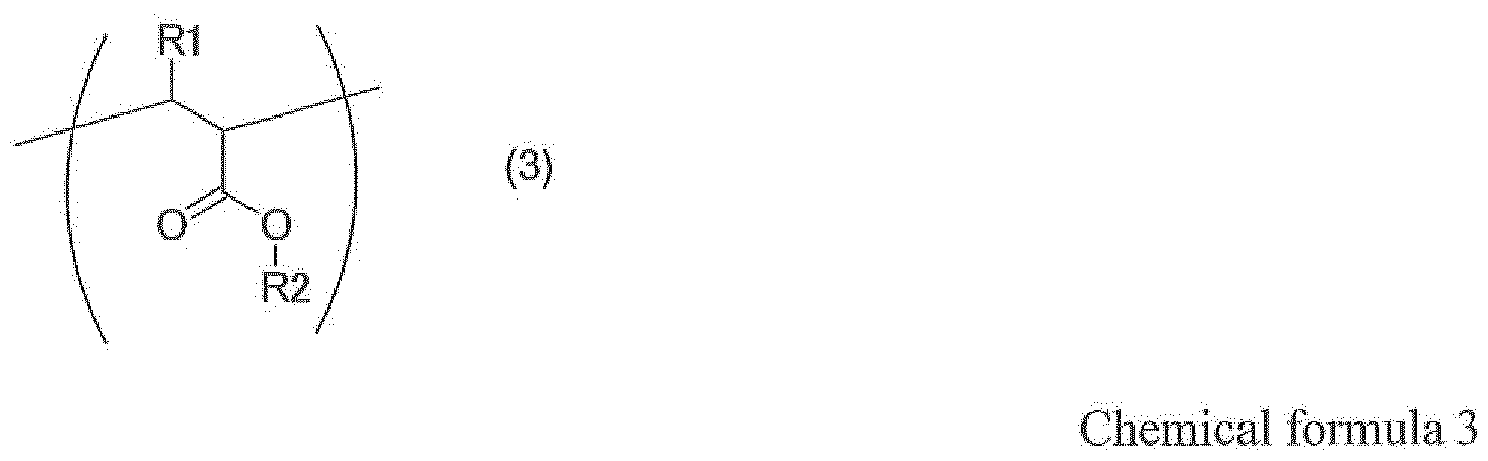
- An aqueous ink comprising:water,a colorant, anda copolymer,characterized in that the copolymer is the copolymer of any one of Claims 1 to 4.
- The aqueous ink according to Claim 5, characterized in that the colorant is a pigment.
- The aqueous ink according to Claim 5 or 6, further comprising at least a water-soluble organic solvent or a surfactant.
- An ink cartridge comprising:an ink container; andan ink accommodated in the ink container,characterized in that the ink is the aqueous ink of any one of Claims 5 to 7.
Applications Claiming Priority (4)
| Application Number | Priority Date | Filing Date | Title |
|---|---|---|---|
| JP2013004959 | 2013-01-15 | ||
| JP2013130578 | 2013-06-21 | ||
| JP2013181632 | 2013-09-02 | ||
| JP2013236884 | 2013-11-15 |
Publications (2)
| Publication Number | Publication Date |
|---|---|
| EP2754679A1 true EP2754679A1 (en) | 2014-07-16 |
| EP2754679B1 EP2754679B1 (en) | 2015-06-17 |
Family
ID=49883033
Family Applications (1)
| Application Number | Title | Priority Date | Filing Date |
|---|---|---|---|
| EP14150281.5A Not-in-force EP2754679B1 (en) | 2013-01-15 | 2014-01-07 | Copolymer, aqueous ink, and ink cartridge |
Country Status (4)
| Country | Link |
|---|---|
| US (1) | US8998400B2 (en) |
| EP (1) | EP2754679B1 (en) |
| JP (1) | JP6244907B2 (en) |
| BR (1) | BR102014000803B1 (en) |
Cited By (6)
| Publication number | Priority date | Publication date | Assignee | Title |
|---|---|---|---|---|
| EP2975093A1 (en) * | 2014-07-16 | 2016-01-20 | Ricoh Company, Ltd. | Copolymer, aqueous ink, and ink cartridge |
| EP3006517A1 (en) * | 2014-10-10 | 2016-04-13 | Ricoh Company, Ltd. | Copolymer, aqueous ink, and ink cartridge |
| WO2016125473A1 (en) * | 2015-02-02 | 2016-08-11 | Ricoh Company, Ltd. | Novel copolymer, aqueous ink, and ink cartridge |
| CN107250182A (en) * | 2015-02-02 | 2017-10-13 | 株式会社理光 | New copolymer, water-based ink and ink cartridge |
| EP3272776A4 (en) * | 2015-03-19 | 2018-01-31 | Ricoh Company, Ltd. | Copolymer, ink containing same, and ink container |
| WO2018081780A3 (en) * | 2016-10-31 | 2018-08-02 | Cabot Corporation | Polymers for inkjet ink compositions |
Families Citing this family (32)
| Publication number | Priority date | Publication date | Assignee | Title |
|---|---|---|---|---|
| JP6183051B2 (en) * | 2013-08-21 | 2017-08-23 | 株式会社リコー | Copolymer |
| JP2016020469A (en) | 2013-09-13 | 2016-02-04 | 株式会社リコー | Ink jet ink, ink set, ink cartridge, ink jet recording apparatus, ink jet recording method, and ink recorded matter |
| JP2015214674A (en) | 2014-04-15 | 2015-12-03 | 株式会社リコー | Ink jet recording ink, ink container, ink jet recording apparatus, recorded matter |
| JP6344123B2 (en) | 2014-07-31 | 2018-06-20 | 株式会社リコー | Novel copolymer, water-based ink, and ink cartridge |
| JP6344172B2 (en) | 2014-09-16 | 2018-06-20 | 株式会社リコー | Novel copolymer, water-based ink, and ink cartridge |
| JP2016094498A (en) | 2014-11-12 | 2016-05-26 | 株式会社リコー | Ink, ink cartridge, ink jet recording apparatus and copolymer |
| US9777091B2 (en) | 2014-12-12 | 2017-10-03 | Ricoh Company, Ltd. | Copolymer, ink, and ink container |
| JP6555586B2 (en) * | 2014-12-12 | 2019-08-07 | 株式会社リコー | Copolymer, ink and ink container |
| US10280321B2 (en) | 2015-01-29 | 2019-05-07 | Ricoh Company, Ltd. | Ink, ink container, inkjet recording device, and recorded matter |
| US10689536B2 (en) | 2015-03-13 | 2020-06-23 | Ricoh Company, Ltd. | Ink, image forming method, image forming apparatus, and image formed product |
| US10190007B2 (en) | 2015-05-14 | 2019-01-29 | Ricoh Company, Ltd. | Ink, ink container, image forming method, image forming apparatus, and image formed matter |
| JP6596955B2 (en) | 2015-06-12 | 2019-10-30 | 株式会社リコー | Ink, ink cartridge, ink jet recording apparatus, and recorded matter |
| US10131805B2 (en) | 2015-06-23 | 2018-11-20 | Ricoh Company, Ltd. | Ink, ink stored container, inkjet recording apparatus, and printed matter |
| US9873809B2 (en) | 2015-07-07 | 2018-01-23 | Ricoh Company, Ltd. | Ink, image forming method, image forming apparatus, and recorded matter |
| JP6741230B2 (en) | 2015-07-27 | 2020-08-19 | 株式会社リコー | Ink, ink container, and inkjet recording device |
| JP6569411B2 (en) | 2015-09-11 | 2019-09-04 | 株式会社リコー | Ink, ink container, ink jet recording method and ink jet recording apparatus |
| JP6693083B2 (en) | 2015-10-28 | 2020-05-13 | 株式会社リコー | Ink, method for producing ink, ink cartridge, copolymer, method for producing copolymer |
| JP6645148B2 (en) * | 2015-12-02 | 2020-02-12 | 株式会社リコー | Copolymer, colorant dispersion, ink, and ink container |
| JP6662014B2 (en) * | 2015-12-11 | 2020-03-11 | 株式会社リコー | Ink, container and method for producing ink |
| US10000656B2 (en) | 2015-12-16 | 2018-06-19 | Ricoh Company, Ltd. | Ink, recorded matter, ink container, recording device, and recording method |
| US9873252B2 (en) | 2015-12-25 | 2018-01-23 | Ricoh Company, Ltd. | Printing device and printing method |
| US10233345B2 (en) | 2016-03-17 | 2019-03-19 | Ricoh Company, Ltd. | Ink set, recording device, and method of recording |
| JP6642156B2 (en) * | 2016-03-17 | 2020-02-05 | 株式会社リコー | Ink and manufacturing method thereof, ink container, recording method, and recording apparatus |
| JP2017190424A (en) * | 2016-04-15 | 2017-10-19 | 竹本油脂株式会社 | Vinyl copolymer |
| JP6701572B2 (en) * | 2016-07-05 | 2020-05-27 | 株式会社リコー | Ink, container, image forming method, and image forming apparatus |
| JP6683053B2 (en) * | 2016-07-26 | 2020-04-15 | 株式会社リコー | Ink and manufacturing method thereof, ink container, image forming method, image forming apparatus, and image formed article |
| JP6988567B2 (en) * | 2017-06-20 | 2022-01-05 | 株式会社リコー | Ink, ink container, image forming method, and image forming device |
| EP3647380B1 (en) | 2017-06-30 | 2023-01-25 | Toyo Ink SC Holdings Co., Ltd. | Water-based inkjet ink and production method for printed matter |
| CN110194912B (en) * | 2018-02-27 | 2022-03-29 | 株式会社理光 | Ink, ink container, image forming method, and image forming apparatus |
| US10807377B2 (en) | 2018-03-07 | 2020-10-20 | Ricoh Company, Ltd. | Ink, ink cartridge, image forming method, and printed matter |
| JP7300081B2 (en) | 2019-02-14 | 2023-06-29 | 株式会社リコー | Ink, ink container, recording method, recording apparatus, and ink manufacturing method |
| US20240100871A1 (en) * | 2022-09-14 | 2024-03-28 | Eastman Kodak Company | Method of inkjet printing fluorescent ink |
Citations (11)
| Publication number | Priority date | Publication date | Assignee | Title |
|---|---|---|---|---|
| JPH03160068A (en) | 1989-11-17 | 1991-07-10 | Seiko Epson Corp | Image recording ink |
| JPH10510861A (en) | 1994-12-15 | 1998-10-20 | キャボット コーポレイション | Carbon black and products reacted with diazonium salts |
| EP0889102A2 (en) * | 1997-06-30 | 1999-01-07 | Elf Atochem North America, Inc. | Pigment dispersion for the preparation of aqueous inks |
| US20050206703A1 (en) * | 2004-03-22 | 2005-09-22 | Guo Dennis Z | Ink system containing polymer binders |
| JP2005298802A (en) | 2003-12-03 | 2005-10-27 | Sakura Color Prod Corp | Water-based pigment ink composition |
| JP2006188624A (en) | 2005-01-07 | 2006-07-20 | Konica Minolta Holdings Inc | Inkjet ink and method for inkjet recording |
| WO2009014242A1 (en) | 2007-07-23 | 2009-01-29 | Canon Kabushiki Kaisha | Ink jet recording ink, ink jet image-forming method and ink jet recording apparatus |
| JP2009506196A (en) | 2005-08-31 | 2009-02-12 | キャボット コーポレイション | Method for preparing modified pigment |
| JP2009513802A (en) | 2005-10-31 | 2009-04-02 | キャボット コーポレイション | Modified colorant and inkjet ink composition containing the modified colorant |
| JP2012051367A (en) | 2010-08-02 | 2012-03-15 | Mitsubishi Plastics Inc | Polyester film for supporting interlayer insulating material |
| JP2012052027A (en) | 2010-09-01 | 2012-03-15 | Ricoh Co Ltd | Aqueous inkjet ink composition and inkjet image forming device |
Family Cites Families (13)
| Publication number | Priority date | Publication date | Assignee | Title |
|---|---|---|---|---|
| CN1150219C (en) * | 1996-09-18 | 2004-05-19 | 克拉瑞特金融(Bvi)有限公司 | Radiation absorbing polymer, film forming composition and anti-reflective coating containing the same |
| JP4714363B2 (en) | 2001-03-29 | 2011-06-29 | 東洋インキScホールディングス株式会社 | Recording liquid and method for producing the same |
| JP4119166B2 (en) | 2002-05-28 | 2008-07-16 | 三井化学株式会社 | Thermosetting powder coating composition |
| JP4133090B2 (en) | 2002-08-02 | 2008-08-13 | 日信化学工業株式会社 | Dispersant composition |
| JP4577630B2 (en) | 2004-08-09 | 2010-11-10 | 日東工業株式会社 | Feeder chip high-speed transfer and surface improvement rate improvement means by the continuous supply method |
| US7172276B2 (en) * | 2004-12-10 | 2007-02-06 | Xerox Corporation | Heterogeneous low energy gel ink composition |
| US7202883B2 (en) * | 2004-12-10 | 2007-04-10 | Xerox Corporation | Heterogeneous reactive ink composition |
| WO2009054514A1 (en) * | 2007-10-25 | 2009-04-30 | Fujifilm Corporation | Organic pigment microparticle, process for production of the organic pigment microparticle, pigment-dispersed composition, photocurable composition or ink-jet ink comprising the organic pigment microparticle, color filter comprising the pigment-dispersed composition, the photocurable composition or the ink-jet ink, and process for production of the color filter |
| JP4642892B2 (en) * | 2007-11-09 | 2011-03-02 | 富士フイルム株式会社 | Pigment composition, aqueous pigment dispersion, method for producing aqueous pigment dispersion, water-based ink for inkjet recording |
| JP2012036287A (en) | 2010-08-06 | 2012-02-23 | Ricoh Co Ltd | Inkjet recording ink, ink cartridge, and image forming apparatus |
| JP2012149108A (en) | 2011-01-17 | 2012-08-09 | Panasonic Corp | Method of producing polybasic acid vinyl monomer copolymer |
| JP5435054B2 (en) | 2012-02-09 | 2014-03-05 | Jnc株式会社 | Ink jet ink and cured film forming method obtained from the ink |
| JP6183051B2 (en) * | 2013-08-21 | 2017-08-23 | 株式会社リコー | Copolymer |
-
2013
- 2013-12-27 JP JP2013272604A patent/JP6244907B2/en active Active
-
2014
- 2014-01-07 EP EP14150281.5A patent/EP2754679B1/en not_active Not-in-force
- 2014-01-13 BR BR102014000803-9A patent/BR102014000803B1/en not_active IP Right Cessation
- 2014-01-14 US US14/154,595 patent/US8998400B2/en not_active Expired - Fee Related
Patent Citations (14)
| Publication number | Priority date | Publication date | Assignee | Title |
|---|---|---|---|---|
| JPH03160068A (en) | 1989-11-17 | 1991-07-10 | Seiko Epson Corp | Image recording ink |
| JP3808504B2 (en) | 1994-12-15 | 2006-08-16 | キャボット コーポレイション | Carbon black and products reacted with diazonium salts |
| JPH10510861A (en) | 1994-12-15 | 1998-10-20 | キャボット コーポレイション | Carbon black and products reacted with diazonium salts |
| EP0889102A2 (en) * | 1997-06-30 | 1999-01-07 | Elf Atochem North America, Inc. | Pigment dispersion for the preparation of aqueous inks |
| JP2005298802A (en) | 2003-12-03 | 2005-10-27 | Sakura Color Prod Corp | Water-based pigment ink composition |
| US20050206703A1 (en) * | 2004-03-22 | 2005-09-22 | Guo Dennis Z | Ink system containing polymer binders |
| JP2006188624A (en) | 2005-01-07 | 2006-07-20 | Konica Minolta Holdings Inc | Inkjet ink and method for inkjet recording |
| JP2008536963A (en) | 2005-03-14 | 2008-09-11 | ヒューレット−パッカード デベロップメント カンパニー エル.ピー. | Ink system containing a polymeric binder |
| JP2009506196A (en) | 2005-08-31 | 2009-02-12 | キャボット コーポレイション | Method for preparing modified pigment |
| JP2009513802A (en) | 2005-10-31 | 2009-04-02 | キャボット コーポレイション | Modified colorant and inkjet ink composition containing the modified colorant |
| JP2009515007A (en) | 2005-10-31 | 2009-04-09 | キャボット コーポレイション | Modified colorant and inkjet ink composition containing modified colorant |
| WO2009014242A1 (en) | 2007-07-23 | 2009-01-29 | Canon Kabushiki Kaisha | Ink jet recording ink, ink jet image-forming method and ink jet recording apparatus |
| JP2012051367A (en) | 2010-08-02 | 2012-03-15 | Mitsubishi Plastics Inc | Polyester film for supporting interlayer insulating material |
| JP2012052027A (en) | 2010-09-01 | 2012-03-15 | Ricoh Co Ltd | Aqueous inkjet ink composition and inkjet image forming device |
Cited By (15)
| Publication number | Priority date | Publication date | Assignee | Title |
|---|---|---|---|---|
| US9850335B2 (en) | 2014-07-16 | 2017-12-26 | Ricoh Company, Ltd. | Copolymer, aqueous ink, and ink cartridge |
| EP2975093A1 (en) * | 2014-07-16 | 2016-01-20 | Ricoh Company, Ltd. | Copolymer, aqueous ink, and ink cartridge |
| EP3006517A1 (en) * | 2014-10-10 | 2016-04-13 | Ricoh Company, Ltd. | Copolymer, aqueous ink, and ink cartridge |
| US9365670B2 (en) | 2014-10-10 | 2016-06-14 | Ricoh Company, Ltd. | Copolymer, aqueous ink, and ink cartridge |
| WO2016125473A1 (en) * | 2015-02-02 | 2016-08-11 | Ricoh Company, Ltd. | Novel copolymer, aqueous ink, and ink cartridge |
| EP3253808A4 (en) * | 2015-02-02 | 2017-12-20 | Ricoh Company, Ltd. | Novel copolymer, aqueous ink, and ink cartridge |
| CN107250182A (en) * | 2015-02-02 | 2017-10-13 | 株式会社理光 | New copolymer, water-based ink and ink cartridge |
| US10035869B2 (en) | 2015-02-02 | 2018-07-31 | Ricoh Company, Ltd. | Copolymer, aqueous ink, and ink cartridge |
| CN107250182B (en) * | 2015-02-02 | 2019-05-17 | 株式会社理光 | Copolymers, water-based inks and ink cartridges |
| EP3272776A4 (en) * | 2015-03-19 | 2018-01-31 | Ricoh Company, Ltd. | Copolymer, ink containing same, and ink container |
| US10370548B2 (en) | 2015-03-19 | 2019-08-06 | Ricoh Company, Ltd. | Copolymer, ink including copolymer, and ink-stored container |
| WO2018081780A3 (en) * | 2016-10-31 | 2018-08-02 | Cabot Corporation | Polymers for inkjet ink compositions |
| US10233342B2 (en) | 2016-10-31 | 2019-03-19 | Cabot Corporation | Polymers for inkjet ink compositions |
| GB2570612A (en) * | 2016-10-31 | 2019-07-31 | Cabot Corp | Polymers for inkjet ink compositions |
| GB2570612B (en) * | 2016-10-31 | 2022-06-15 | Cabot Corp | Polymers for inkjet ink compositions |
Also Published As
| Publication number | Publication date |
|---|---|
| US8998400B2 (en) | 2015-04-07 |
| US20140198160A1 (en) | 2014-07-17 |
| EP2754679B1 (en) | 2015-06-17 |
| JP2015117354A (en) | 2015-06-25 |
| JP6244907B2 (en) | 2017-12-13 |
| BR102014000803A2 (en) | 2014-11-25 |
| BR102014000803B1 (en) | 2020-09-24 |
Similar Documents
| Publication | Publication Date | Title |
|---|---|---|
| US8998400B2 (en) | Copolymer, aqueous ink, and ink cartridge | |
| JP6680381B2 (en) | Inkjet recording device and ink cartridge | |
| JP6344123B2 (en) | Novel copolymer, water-based ink, and ink cartridge | |
| JP6344172B2 (en) | Novel copolymer, water-based ink, and ink cartridge | |
| JP2016094498A (en) | Ink, ink cartridge, ink jet recording apparatus and copolymer | |
| JP6693083B2 (en) | Ink, method for producing ink, ink cartridge, copolymer, method for producing copolymer | |
| EP3006517B1 (en) | Copolymer, aqueous ink, and ink cartridge | |
| US10370548B2 (en) | Copolymer, ink including copolymer, and ink-stored container | |
| JP6838266B2 (en) | New copolymers, water-based inks, and ink cartridges | |
| JP2017082085A5 (en) | ||
| US9896530B2 (en) | Copolymer, coloring material dispersion, ink, and ink store container | |
| JP6835156B2 (en) | Method for producing polymer | |
| JP6701572B2 (en) | Ink, container, image forming method, and image forming apparatus | |
| JP2020139090A (en) | Ink, ink container, recording device, recording method, and recorded material | |
| JP2017105960A (en) | Ink, storage container and method for producing ink | |
| JP2017082106A (en) | Ink, method for producing the same, and ink container | |
| WO2016125473A1 (en) | Novel copolymer, aqueous ink, and ink cartridge |
Legal Events
| Date | Code | Title | Description |
|---|---|---|---|
| PUAI | Public reference made under article 153(3) epc to a published international application that has entered the european phase |
Free format text: ORIGINAL CODE: 0009012 |
|
| 17P | Request for examination filed |
Effective date: 20140107 |
|
| AK | Designated contracting states |
Kind code of ref document: A1 Designated state(s): AL AT BE BG CH CY CZ DE DK EE ES FI FR GB GR HR HU IE IS IT LI LT LU LV MC MK MT NL NO PL PT RO RS SE SI SK SM TR |
|
| AX | Request for extension of the european patent |
Extension state: BA ME |
|
| GRAP | Despatch of communication of intention to grant a patent |
Free format text: ORIGINAL CODE: EPIDOSNIGR1 |
|
| INTG | Intention to grant announced |
Effective date: 20150106 |
|
| GRAS | Grant fee paid |
Free format text: ORIGINAL CODE: EPIDOSNIGR3 |
|
| GRAA | (expected) grant |
Free format text: ORIGINAL CODE: 0009210 |
|
| AK | Designated contracting states |
Kind code of ref document: B1 Designated state(s): AL AT BE BG CH CY CZ DE DK EE ES FI FR GB GR HR HU IE IS IT LI LT LU LV MC MK MT NL NO PL PT RO RS SE SI SK SM TR |
|
| REG | Reference to a national code |
Ref country code: GB Ref legal event code: FG4D |
|
| REG | Reference to a national code |
Ref country code: CH Ref legal event code: EP |
|
| REG | Reference to a national code |
Ref country code: AT Ref legal event code: REF Ref document number: 731899 Country of ref document: AT Kind code of ref document: T Effective date: 20150715 |
|
| REG | Reference to a national code |
Ref country code: IE Ref legal event code: FG4D |
|
| REG | Reference to a national code |
Ref country code: DE Ref legal event code: R096 Ref document number: 602014000042 Country of ref document: DE |
|
| PG25 | Lapsed in a contracting state [announced via postgrant information from national office to epo] |
Ref country code: LT Free format text: LAPSE BECAUSE OF FAILURE TO SUBMIT A TRANSLATION OF THE DESCRIPTION OR TO PAY THE FEE WITHIN THE PRESCRIBED TIME-LIMIT Effective date: 20150617 Ref country code: FI Free format text: LAPSE BECAUSE OF FAILURE TO SUBMIT A TRANSLATION OF THE DESCRIPTION OR TO PAY THE FEE WITHIN THE PRESCRIBED TIME-LIMIT Effective date: 20150617 Ref country code: HR Free format text: LAPSE BECAUSE OF FAILURE TO SUBMIT A TRANSLATION OF THE DESCRIPTION OR TO PAY THE FEE WITHIN THE PRESCRIBED TIME-LIMIT Effective date: 20150617 Ref country code: NO Free format text: LAPSE BECAUSE OF FAILURE TO SUBMIT A TRANSLATION OF THE DESCRIPTION OR TO PAY THE FEE WITHIN THE PRESCRIBED TIME-LIMIT Effective date: 20150917 |
|
| REG | Reference to a national code |
Ref country code: AT Ref legal event code: MK05 Ref document number: 731899 Country of ref document: AT Kind code of ref document: T Effective date: 20150617 |
|
| REG | Reference to a national code |
Ref country code: LT Ref legal event code: MG4D Ref country code: NL Ref legal event code: MP Effective date: 20150617 |
|
| PG25 | Lapsed in a contracting state [announced via postgrant information from national office to epo] |
Ref country code: GR Free format text: LAPSE BECAUSE OF FAILURE TO SUBMIT A TRANSLATION OF THE DESCRIPTION OR TO PAY THE FEE WITHIN THE PRESCRIBED TIME-LIMIT Effective date: 20150918 Ref country code: LV Free format text: LAPSE BECAUSE OF FAILURE TO SUBMIT A TRANSLATION OF THE DESCRIPTION OR TO PAY THE FEE WITHIN THE PRESCRIBED TIME-LIMIT Effective date: 20150617 Ref country code: BG Free format text: LAPSE BECAUSE OF FAILURE TO SUBMIT A TRANSLATION OF THE DESCRIPTION OR TO PAY THE FEE WITHIN THE PRESCRIBED TIME-LIMIT Effective date: 20150917 Ref country code: RS Free format text: LAPSE BECAUSE OF FAILURE TO SUBMIT A TRANSLATION OF THE DESCRIPTION OR TO PAY THE FEE WITHIN THE PRESCRIBED TIME-LIMIT Effective date: 20150617 |
|
| REG | Reference to a national code |
Ref country code: FR Ref legal event code: PLFP Year of fee payment: 3 |
|
| PG25 | Lapsed in a contracting state [announced via postgrant information from national office to epo] |
Ref country code: EE Free format text: LAPSE BECAUSE OF FAILURE TO SUBMIT A TRANSLATION OF THE DESCRIPTION OR TO PAY THE FEE WITHIN THE PRESCRIBED TIME-LIMIT Effective date: 20150617 |
|
| PG25 | Lapsed in a contracting state [announced via postgrant information from national office to epo] |
Ref country code: IS Free format text: LAPSE BECAUSE OF FAILURE TO SUBMIT A TRANSLATION OF THE DESCRIPTION OR TO PAY THE FEE WITHIN THE PRESCRIBED TIME-LIMIT Effective date: 20151017 Ref country code: PT Free format text: LAPSE BECAUSE OF FAILURE TO SUBMIT A TRANSLATION OF THE DESCRIPTION OR TO PAY THE FEE WITHIN THE PRESCRIBED TIME-LIMIT Effective date: 20151019 Ref country code: PL Free format text: LAPSE BECAUSE OF FAILURE TO SUBMIT A TRANSLATION OF THE DESCRIPTION OR TO PAY THE FEE WITHIN THE PRESCRIBED TIME-LIMIT Effective date: 20150617 Ref country code: AT Free format text: LAPSE BECAUSE OF FAILURE TO SUBMIT A TRANSLATION OF THE DESCRIPTION OR TO PAY THE FEE WITHIN THE PRESCRIBED TIME-LIMIT Effective date: 20150617 Ref country code: ES Free format text: LAPSE BECAUSE OF FAILURE TO SUBMIT A TRANSLATION OF THE DESCRIPTION OR TO PAY THE FEE WITHIN THE PRESCRIBED TIME-LIMIT Effective date: 20150617 Ref country code: CZ Free format text: LAPSE BECAUSE OF FAILURE TO SUBMIT A TRANSLATION OF THE DESCRIPTION OR TO PAY THE FEE WITHIN THE PRESCRIBED TIME-LIMIT Effective date: 20150617 Ref country code: RO Free format text: LAPSE BECAUSE OF NON-PAYMENT OF DUE FEES Effective date: 20150617 Ref country code: SK Free format text: LAPSE BECAUSE OF FAILURE TO SUBMIT A TRANSLATION OF THE DESCRIPTION OR TO PAY THE FEE WITHIN THE PRESCRIBED TIME-LIMIT Effective date: 20150617 |
|
| REG | Reference to a national code |
Ref country code: DE Ref legal event code: R097 Ref document number: 602014000042 Country of ref document: DE |
|
| PLBE | No opposition filed within time limit |
Free format text: ORIGINAL CODE: 0009261 |
|
| STAA | Information on the status of an ep patent application or granted ep patent |
Free format text: STATUS: NO OPPOSITION FILED WITHIN TIME LIMIT |
|
| PG25 | Lapsed in a contracting state [announced via postgrant information from national office to epo] |
Ref country code: DK Free format text: LAPSE BECAUSE OF FAILURE TO SUBMIT A TRANSLATION OF THE DESCRIPTION OR TO PAY THE FEE WITHIN THE PRESCRIBED TIME-LIMIT Effective date: 20150617 Ref country code: IT Free format text: LAPSE BECAUSE OF FAILURE TO SUBMIT A TRANSLATION OF THE DESCRIPTION OR TO PAY THE FEE WITHIN THE PRESCRIBED TIME-LIMIT Effective date: 20150617 |
|
| 26N | No opposition filed |
Effective date: 20160318 |
|
| PG25 | Lapsed in a contracting state [announced via postgrant information from national office to epo] |
Ref country code: BE Free format text: LAPSE BECAUSE OF NON-PAYMENT OF DUE FEES Effective date: 20160131 |
|
| PG25 | Lapsed in a contracting state [announced via postgrant information from national office to epo] |
Ref country code: SI Free format text: LAPSE BECAUSE OF FAILURE TO SUBMIT A TRANSLATION OF THE DESCRIPTION OR TO PAY THE FEE WITHIN THE PRESCRIBED TIME-LIMIT Effective date: 20150617 Ref country code: LU Free format text: LAPSE BECAUSE OF FAILURE TO SUBMIT A TRANSLATION OF THE DESCRIPTION OR TO PAY THE FEE WITHIN THE PRESCRIBED TIME-LIMIT Effective date: 20160107 |
|
| PG25 | Lapsed in a contracting state [announced via postgrant information from national office to epo] |
Ref country code: MC Free format text: LAPSE BECAUSE OF FAILURE TO SUBMIT A TRANSLATION OF THE DESCRIPTION OR TO PAY THE FEE WITHIN THE PRESCRIBED TIME-LIMIT Effective date: 20150617 |
|
| REG | Reference to a national code |
Ref country code: IE Ref legal event code: MM4A |
|
| PG25 | Lapsed in a contracting state [announced via postgrant information from national office to epo] |
Ref country code: BE Free format text: LAPSE BECAUSE OF FAILURE TO SUBMIT A TRANSLATION OF THE DESCRIPTION OR TO PAY THE FEE WITHIN THE PRESCRIBED TIME-LIMIT Effective date: 20150617 |
|
| REG | Reference to a national code |
Ref country code: FR Ref legal event code: PLFP Year of fee payment: 4 |
|
| PG25 | Lapsed in a contracting state [announced via postgrant information from national office to epo] |
Ref country code: IE Free format text: LAPSE BECAUSE OF NON-PAYMENT OF DUE FEES Effective date: 20160107 |
|
| PG25 | Lapsed in a contracting state [announced via postgrant information from national office to epo] |
Ref country code: NL Free format text: LAPSE BECAUSE OF FAILURE TO SUBMIT A TRANSLATION OF THE DESCRIPTION OR TO PAY THE FEE WITHIN THE PRESCRIBED TIME-LIMIT Effective date: 20150617 Ref country code: SE Free format text: LAPSE BECAUSE OF FAILURE TO SUBMIT A TRANSLATION OF THE DESCRIPTION OR TO PAY THE FEE WITHIN THE PRESCRIBED TIME-LIMIT Effective date: 20150617 |
|
| PG25 | Lapsed in a contracting state [announced via postgrant information from national office to epo] |
Ref country code: MT Free format text: LAPSE BECAUSE OF FAILURE TO SUBMIT A TRANSLATION OF THE DESCRIPTION OR TO PAY THE FEE WITHIN THE PRESCRIBED TIME-LIMIT Effective date: 20150617 |
|
| REG | Reference to a national code |
Ref country code: CH Ref legal event code: PL |
|
| PG25 | Lapsed in a contracting state [announced via postgrant information from national office to epo] |
Ref country code: LI Free format text: LAPSE BECAUSE OF NON-PAYMENT OF DUE FEES Effective date: 20170131 Ref country code: CH Free format text: LAPSE BECAUSE OF NON-PAYMENT OF DUE FEES Effective date: 20170131 |
|
| REG | Reference to a national code |
Ref country code: FR Ref legal event code: PLFP Year of fee payment: 5 |
|
| PG25 | Lapsed in a contracting state [announced via postgrant information from national office to epo] |
Ref country code: HU Free format text: LAPSE BECAUSE OF FAILURE TO SUBMIT A TRANSLATION OF THE DESCRIPTION OR TO PAY THE FEE WITHIN THE PRESCRIBED TIME-LIMIT; INVALID AB INITIO Effective date: 20140107 Ref country code: CY Free format text: LAPSE BECAUSE OF FAILURE TO SUBMIT A TRANSLATION OF THE DESCRIPTION OR TO PAY THE FEE WITHIN THE PRESCRIBED TIME-LIMIT Effective date: 20150617 Ref country code: SM Free format text: LAPSE BECAUSE OF FAILURE TO SUBMIT A TRANSLATION OF THE DESCRIPTION OR TO PAY THE FEE WITHIN THE PRESCRIBED TIME-LIMIT Effective date: 20150617 |
|
| PG25 | Lapsed in a contracting state [announced via postgrant information from national office to epo] |
Ref country code: TR Free format text: LAPSE BECAUSE OF FAILURE TO SUBMIT A TRANSLATION OF THE DESCRIPTION OR TO PAY THE FEE WITHIN THE PRESCRIBED TIME-LIMIT Effective date: 20150617 Ref country code: MK Free format text: LAPSE BECAUSE OF FAILURE TO SUBMIT A TRANSLATION OF THE DESCRIPTION OR TO PAY THE FEE WITHIN THE PRESCRIBED TIME-LIMIT Effective date: 20150617 Ref country code: MT Free format text: LAPSE BECAUSE OF FAILURE TO SUBMIT A TRANSLATION OF THE DESCRIPTION OR TO PAY THE FEE WITHIN THE PRESCRIBED TIME-LIMIT Effective date: 20160131 |
|
| PG25 | Lapsed in a contracting state [announced via postgrant information from national office to epo] |
Ref country code: AL Free format text: LAPSE BECAUSE OF FAILURE TO SUBMIT A TRANSLATION OF THE DESCRIPTION OR TO PAY THE FEE WITHIN THE PRESCRIBED TIME-LIMIT Effective date: 20150617 |
|
| PGFP | Annual fee paid to national office [announced via postgrant information from national office to epo] |
Ref country code: FR Payment date: 20230124 Year of fee payment: 10 |
|
| PGFP | Annual fee paid to national office [announced via postgrant information from national office to epo] |
Ref country code: GB Payment date: 20230119 Year of fee payment: 10 Ref country code: DE Payment date: 20220620 Year of fee payment: 10 |
|
| P01 | Opt-out of the competence of the unified patent court (upc) registered |
Effective date: 20230522 |
|
| REG | Reference to a national code |
Ref country code: DE Ref legal event code: R119 Ref document number: 602014000042 Country of ref document: DE |
|
| GBPC | Gb: european patent ceased through non-payment of renewal fee |
Effective date: 20240107 |
|
| PG25 | Lapsed in a contracting state [announced via postgrant information from national office to epo] |
Ref country code: DE Free format text: LAPSE BECAUSE OF NON-PAYMENT OF DUE FEES Effective date: 20240801 |
|
| PG25 | Lapsed in a contracting state [announced via postgrant information from national office to epo] |
Ref country code: GB Free format text: LAPSE BECAUSE OF NON-PAYMENT OF DUE FEES Effective date: 20240107 |
|
| PG25 | Lapsed in a contracting state [announced via postgrant information from national office to epo] |
Ref country code: FR Free format text: LAPSE BECAUSE OF NON-PAYMENT OF DUE FEES Effective date: 20240131 |
|
| PG25 | Lapsed in a contracting state [announced via postgrant information from national office to epo] |
Ref country code: GB Free format text: LAPSE BECAUSE OF NON-PAYMENT OF DUE FEES Effective date: 20240107 Ref country code: FR Free format text: LAPSE BECAUSE OF NON-PAYMENT OF DUE FEES Effective date: 20240131 Ref country code: DE Free format text: LAPSE BECAUSE OF NON-PAYMENT OF DUE FEES Effective date: 20240801 |