EP2752472A2 - Aqueous adhesive composition that changes little over time - Google Patents
Aqueous adhesive composition that changes little over time Download PDFInfo
- Publication number
- EP2752472A2 EP2752472A2 EP12838019.3A EP12838019A EP2752472A2 EP 2752472 A2 EP2752472 A2 EP 2752472A2 EP 12838019 A EP12838019 A EP 12838019A EP 2752472 A2 EP2752472 A2 EP 2752472A2
- Authority
- EP
- European Patent Office
- Prior art keywords
- adhesive composition
- aqueous adhesive
- acrylate
- composition according
- methacrylate
- Prior art date
- Legal status (The legal status is an assumption and is not a legal conclusion. Google has not performed a legal analysis and makes no representation as to the accuracy of the status listed.)
- Granted
Links
Images
Classifications
-
- C—CHEMISTRY; METALLURGY
- C09—DYES; PAINTS; POLISHES; NATURAL RESINS; ADHESIVES; COMPOSITIONS NOT OTHERWISE PROVIDED FOR; APPLICATIONS OF MATERIALS NOT OTHERWISE PROVIDED FOR
- C09J—ADHESIVES; NON-MECHANICAL ASPECTS OF ADHESIVE PROCESSES IN GENERAL; ADHESIVE PROCESSES NOT PROVIDED FOR ELSEWHERE; USE OF MATERIALS AS ADHESIVES
- C09J4/00—Adhesives based on organic non-macromolecular compounds having at least one polymerisable carbon-to-carbon unsaturated bond ; adhesives, based on monomers of macromolecular compounds of groups C09J183/00 - C09J183/16
-
- C—CHEMISTRY; METALLURGY
- C09—DYES; PAINTS; POLISHES; NATURAL RESINS; ADHESIVES; COMPOSITIONS NOT OTHERWISE PROVIDED FOR; APPLICATIONS OF MATERIALS NOT OTHERWISE PROVIDED FOR
- C09J—ADHESIVES; NON-MECHANICAL ASPECTS OF ADHESIVE PROCESSES IN GENERAL; ADHESIVE PROCESSES NOT PROVIDED FOR ELSEWHERE; USE OF MATERIALS AS ADHESIVES
- C09J7/00—Adhesives in the form of films or foils
- C09J7/20—Adhesives in the form of films or foils characterised by their carriers
-
- C—CHEMISTRY; METALLURGY
- C08—ORGANIC MACROMOLECULAR COMPOUNDS; THEIR PREPARATION OR CHEMICAL WORKING-UP; COMPOSITIONS BASED THEREON
- C08F—MACROMOLECULAR COMPOUNDS OBTAINED BY REACTIONS ONLY INVOLVING CARBON-TO-CARBON UNSATURATED BONDS
- C08F220/00—Copolymers of compounds having one or more unsaturated aliphatic radicals, each having only one carbon-to-carbon double bond, and only one being terminated by only one carboxyl radical or a salt, anhydride ester, amide, imide or nitrile thereof
- C08F220/02—Monocarboxylic acids having less than ten carbon atoms; Derivatives thereof
- C08F220/10—Esters
- C08F220/12—Esters of monohydric alcohols or phenols
- C08F220/16—Esters of monohydric alcohols or phenols of phenols or of alcohols containing two or more carbon atoms
- C08F220/18—Esters of monohydric alcohols or phenols of phenols or of alcohols containing two or more carbon atoms with acrylic or methacrylic acids
- C08F220/1804—C4-(meth)acrylate, e.g. butyl (meth)acrylate, isobutyl (meth)acrylate or tert-butyl (meth)acrylate
-
- C—CHEMISTRY; METALLURGY
- C09—DYES; PAINTS; POLISHES; NATURAL RESINS; ADHESIVES; COMPOSITIONS NOT OTHERWISE PROVIDED FOR; APPLICATIONS OF MATERIALS NOT OTHERWISE PROVIDED FOR
- C09J—ADHESIVES; NON-MECHANICAL ASPECTS OF ADHESIVE PROCESSES IN GENERAL; ADHESIVE PROCESSES NOT PROVIDED FOR ELSEWHERE; USE OF MATERIALS AS ADHESIVES
- C09J133/00—Adhesives based on homopolymers or copolymers of compounds having one or more unsaturated aliphatic radicals, each having only one carbon-to-carbon double bond, and at least one being terminated by only one carboxyl radical, or of salts, anhydrides, esters, amides, imides, or nitriles thereof; Adhesives based on derivatives of such polymers
- C09J133/04—Homopolymers or copolymers of esters
- C09J133/06—Homopolymers or copolymers of esters of esters containing only carbon, hydrogen and oxygen, the oxygen atom being present only as part of the carboxyl radical
- C09J133/062—Copolymers with monomers not covered by C09J133/06
- C09J133/066—Copolymers with monomers not covered by C09J133/06 containing -OH groups
-
- C—CHEMISTRY; METALLURGY
- C09—DYES; PAINTS; POLISHES; NATURAL RESINS; ADHESIVES; COMPOSITIONS NOT OTHERWISE PROVIDED FOR; APPLICATIONS OF MATERIALS NOT OTHERWISE PROVIDED FOR
- C09J—ADHESIVES; NON-MECHANICAL ASPECTS OF ADHESIVE PROCESSES IN GENERAL; ADHESIVE PROCESSES NOT PROVIDED FOR ELSEWHERE; USE OF MATERIALS AS ADHESIVES
- C09J133/00—Adhesives based on homopolymers or copolymers of compounds having one or more unsaturated aliphatic radicals, each having only one carbon-to-carbon double bond, and at least one being terminated by only one carboxyl radical, or of salts, anhydrides, esters, amides, imides, or nitriles thereof; Adhesives based on derivatives of such polymers
- C09J133/04—Homopolymers or copolymers of esters
- C09J133/06—Homopolymers or copolymers of esters of esters containing only carbon, hydrogen and oxygen, the oxygen atom being present only as part of the carboxyl radical
- C09J133/08—Homopolymers or copolymers of acrylic acid esters
-
- C—CHEMISTRY; METALLURGY
- C09—DYES; PAINTS; POLISHES; NATURAL RESINS; ADHESIVES; COMPOSITIONS NOT OTHERWISE PROVIDED FOR; APPLICATIONS OF MATERIALS NOT OTHERWISE PROVIDED FOR
- C09J—ADHESIVES; NON-MECHANICAL ASPECTS OF ADHESIVE PROCESSES IN GENERAL; ADHESIVE PROCESSES NOT PROVIDED FOR ELSEWHERE; USE OF MATERIALS AS ADHESIVES
- C09J4/00—Adhesives based on organic non-macromolecular compounds having at least one polymerisable carbon-to-carbon unsaturated bond ; adhesives, based on monomers of macromolecular compounds of groups C09J183/00 - C09J183/16
- C09J4/06—Organic non-macromolecular compounds having at least one polymerisable carbon-to-carbon unsaturated bond in combination with a macromolecular compound other than an unsaturated polymer of groups C09J159/00 - C09J187/00
-
- C—CHEMISTRY; METALLURGY
- C09—DYES; PAINTS; POLISHES; NATURAL RESINS; ADHESIVES; COMPOSITIONS NOT OTHERWISE PROVIDED FOR; APPLICATIONS OF MATERIALS NOT OTHERWISE PROVIDED FOR
- C09J—ADHESIVES; NON-MECHANICAL ASPECTS OF ADHESIVE PROCESSES IN GENERAL; ADHESIVE PROCESSES NOT PROVIDED FOR ELSEWHERE; USE OF MATERIALS AS ADHESIVES
- C09J7/00—Adhesives in the form of films or foils
-
- C—CHEMISTRY; METALLURGY
- C09—DYES; PAINTS; POLISHES; NATURAL RESINS; ADHESIVES; COMPOSITIONS NOT OTHERWISE PROVIDED FOR; APPLICATIONS OF MATERIALS NOT OTHERWISE PROVIDED FOR
- C09J—ADHESIVES; NON-MECHANICAL ASPECTS OF ADHESIVE PROCESSES IN GENERAL; ADHESIVE PROCESSES NOT PROVIDED FOR ELSEWHERE; USE OF MATERIALS AS ADHESIVES
- C09J7/00—Adhesives in the form of films or foils
- C09J7/20—Adhesives in the form of films or foils characterised by their carriers
- C09J7/22—Plastics; Metallised plastics
-
- C—CHEMISTRY; METALLURGY
- C09—DYES; PAINTS; POLISHES; NATURAL RESINS; ADHESIVES; COMPOSITIONS NOT OTHERWISE PROVIDED FOR; APPLICATIONS OF MATERIALS NOT OTHERWISE PROVIDED FOR
- C09J—ADHESIVES; NON-MECHANICAL ASPECTS OF ADHESIVE PROCESSES IN GENERAL; ADHESIVE PROCESSES NOT PROVIDED FOR ELSEWHERE; USE OF MATERIALS AS ADHESIVES
- C09J7/00—Adhesives in the form of films or foils
- C09J7/30—Adhesives in the form of films or foils characterised by the adhesive composition
-
- C—CHEMISTRY; METALLURGY
- C09—DYES; PAINTS; POLISHES; NATURAL RESINS; ADHESIVES; COMPOSITIONS NOT OTHERWISE PROVIDED FOR; APPLICATIONS OF MATERIALS NOT OTHERWISE PROVIDED FOR
- C09J—ADHESIVES; NON-MECHANICAL ASPECTS OF ADHESIVE PROCESSES IN GENERAL; ADHESIVE PROCESSES NOT PROVIDED FOR ELSEWHERE; USE OF MATERIALS AS ADHESIVES
- C09J7/00—Adhesives in the form of films or foils
- C09J7/30—Adhesives in the form of films or foils characterised by the adhesive composition
- C09J7/38—Pressure-sensitive adhesives [PSA]
-
- C—CHEMISTRY; METALLURGY
- C09—DYES; PAINTS; POLISHES; NATURAL RESINS; ADHESIVES; COMPOSITIONS NOT OTHERWISE PROVIDED FOR; APPLICATIONS OF MATERIALS NOT OTHERWISE PROVIDED FOR
- C09J—ADHESIVES; NON-MECHANICAL ASPECTS OF ADHESIVE PROCESSES IN GENERAL; ADHESIVE PROCESSES NOT PROVIDED FOR ELSEWHERE; USE OF MATERIALS AS ADHESIVES
- C09J7/00—Adhesives in the form of films or foils
- C09J7/30—Adhesives in the form of films or foils characterised by the adhesive composition
- C09J7/38—Pressure-sensitive adhesives [PSA]
- C09J7/381—Pressure-sensitive adhesives [PSA] based on macromolecular compounds obtained by reactions involving only carbon-to-carbon unsaturated bonds
- C09J7/385—Acrylic polymers
-
- C—CHEMISTRY; METALLURGY
- C08—ORGANIC MACROMOLECULAR COMPOUNDS; THEIR PREPARATION OR CHEMICAL WORKING-UP; COMPOSITIONS BASED THEREON
- C08F—MACROMOLECULAR COMPOUNDS OBTAINED BY REACTIONS ONLY INVOLVING CARBON-TO-CARBON UNSATURATED BONDS
- C08F220/00—Copolymers of compounds having one or more unsaturated aliphatic radicals, each having only one carbon-to-carbon double bond, and only one being terminated by only one carboxyl radical or a salt, anhydride ester, amide, imide or nitrile thereof
- C08F220/02—Monocarboxylic acids having less than ten carbon atoms; Derivatives thereof
- C08F220/10—Esters
- C08F220/20—Esters of polyhydric alcohols or phenols, e.g. 2-hydroxyethyl (meth)acrylate or glycerol mono-(meth)acrylate
-
- C—CHEMISTRY; METALLURGY
- C09—DYES; PAINTS; POLISHES; NATURAL RESINS; ADHESIVES; COMPOSITIONS NOT OTHERWISE PROVIDED FOR; APPLICATIONS OF MATERIALS NOT OTHERWISE PROVIDED FOR
- C09J—ADHESIVES; NON-MECHANICAL ASPECTS OF ADHESIVE PROCESSES IN GENERAL; ADHESIVE PROCESSES NOT PROVIDED FOR ELSEWHERE; USE OF MATERIALS AS ADHESIVES
- C09J2203/00—Applications of adhesives in processes or use of adhesives in the form of films or foils
-
- C—CHEMISTRY; METALLURGY
- C09—DYES; PAINTS; POLISHES; NATURAL RESINS; ADHESIVES; COMPOSITIONS NOT OTHERWISE PROVIDED FOR; APPLICATIONS OF MATERIALS NOT OTHERWISE PROVIDED FOR
- C09J—ADHESIVES; NON-MECHANICAL ASPECTS OF ADHESIVE PROCESSES IN GENERAL; ADHESIVE PROCESSES NOT PROVIDED FOR ELSEWHERE; USE OF MATERIALS AS ADHESIVES
- C09J2203/00—Applications of adhesives in processes or use of adhesives in the form of films or foils
- C09J2203/334—Applications of adhesives in processes or use of adhesives in the form of films or foils as a label
-
- C—CHEMISTRY; METALLURGY
- C09—DYES; PAINTS; POLISHES; NATURAL RESINS; ADHESIVES; COMPOSITIONS NOT OTHERWISE PROVIDED FOR; APPLICATIONS OF MATERIALS NOT OTHERWISE PROVIDED FOR
- C09J—ADHESIVES; NON-MECHANICAL ASPECTS OF ADHESIVE PROCESSES IN GENERAL; ADHESIVE PROCESSES NOT PROVIDED FOR ELSEWHERE; USE OF MATERIALS AS ADHESIVES
- C09J2301/00—Additional features of adhesives in the form of films or foils
- C09J2301/30—Additional features of adhesives in the form of films or foils characterized by the chemical, physicochemical or physical properties of the adhesive or the carrier
- C09J2301/302—Additional features of adhesives in the form of films or foils characterized by the chemical, physicochemical or physical properties of the adhesive or the carrier the adhesive being pressure-sensitive, i.e. tacky at temperatures inferior to 30°C
-
- C—CHEMISTRY; METALLURGY
- C09—DYES; PAINTS; POLISHES; NATURAL RESINS; ADHESIVES; COMPOSITIONS NOT OTHERWISE PROVIDED FOR; APPLICATIONS OF MATERIALS NOT OTHERWISE PROVIDED FOR
- C09J—ADHESIVES; NON-MECHANICAL ASPECTS OF ADHESIVE PROCESSES IN GENERAL; ADHESIVE PROCESSES NOT PROVIDED FOR ELSEWHERE; USE OF MATERIALS AS ADHESIVES
- C09J2301/00—Additional features of adhesives in the form of films or foils
- C09J2301/40—Additional features of adhesives in the form of films or foils characterized by the presence of essential components
- C09J2301/408—Additional features of adhesives in the form of films or foils characterized by the presence of essential components additives as essential feature of the adhesive layer
Definitions
- the present invention relates to an aqueous adhesive composition, and more particularly, to an aqueous adhesive composition which exhibits substantially no reduction in adhesion due to increase in gel content of an adhesive.
- An aqueous adhesive prepared through emulsion polymerization in the art typically uses acrylic acid as a functional monomer in order to impart high peel strength and cohesion.
- acrylic acid in the aqueous adhesive composition enables impartment of high adhesion regardless of types of adherends.
- acrylic acid reacts with ionic impurities included in initiators, emulsifiers, neutralizers and thickeners to form a chelate after polymerization.
- Such a chelate increases gel content, causing increase in hardness and reduction in adhesion of adhesives.
- low-ionic emulsion polymerization may be performed.
- emulsion polymerization using a minimum amount of nonionic chemicals has a problem of deterioration in productivity due to deterioration in polymerization stability and generation of agglomerates.
- defects are generated in a finally prepared adhesive coating layer.
- the present invention has been conceived to solve such problems in the art, and it is an aspect of the present invention to provide an aqueous adhesive composition which suppresses formation of a chelate caused by acrylic acid and ionic impurities and thus minimizes change of properties, such as peel strength and the like, over time.
- an aqueous adhesive composition includes a hydroxyl group-containing monomer and does not form a chelate after polymerization.
- the aqueous adhesive composition since the aqueous adhesive composition includes a hydroxyl group-containing monomer and does not use acrylic acid substances, the aqueous adhesive composition does not form a chelate after polymerization.
- an adhesive sheet produced from the aqueous adhesive composition according to the invention suffers from substantially no reduction of adhesion due to increase in gel content.
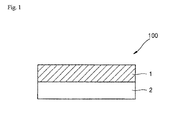
- Fig. 1 is a sectional view of an adhesive sheet according to one embodiment of the present invention.
- Fig. 1 shows an adhesive sheet according to one embodiment of the present invention. First, the aqueous adhesive composition according to the invention will be described in detail.
- an aqueous adhesive composition includes a hydroxyl group-containing monomer and does not form a chelate after polymerization.
- the aqueous adhesive composition uses a hydroxyl group-containing monomer as a polymerization monomer instead of acrylic acid, the aqueous adhesive composition does not form a chelate after emulsion polymerization.
- the aqueous adhesive composition can minimize problems due to deterioration in adhesion caused by the chelate.
- the hydroxyl group-containing monomer included in the aqueous adhesive composition may be any monomer without limitation so long as the monomer does not form a chelate in conjunction with ionic impurities generated after polymerization of the aqueous adhesive composition and includes a hydroxyl group as a functional group.
- the hydroxyl group-containing monomer may include at least one selected from the group consisting of hydroxyethyl acrylate, hydroxyethyl methacrylate, hydroxypropyl acrylate, and hydroxybutyl acrylate.
- the aqueous adhesive composition may further include a soft monomer and a hard monomer.
- the soft monomer may be used to impart initial adhesion of the aqueous adhesive composition.
- the soft monomer may include at least one selected from the group consisting of butyl acrylate, ethyl acrylate, 2-hydroxyethyl acrylate, isobutyl acrylate, 2-ethylbutyl acrylate, hexyl acrylate, heptyl acrylate, lauryl methacrylate, n-pentyl acrylate, and 2-ethylhexyl acrylate.
- the hard monomer may be used for cohesion and adhesion of the aqueous adhesive composition.
- the hard monomer may include at least one selected from the group consisting of methyl acrylate, methyl methacrylate, ethyl methacrylate, n-butyl methacrylate, isobutyl methacrylate, t-butyl acrylate, and 2-ethylhexyl methacrylate.
- the aqueous adhesive composition may further include an initiator, an emulsifier, and a thickener.
- the initiator is used to initiate polymerization of the aqueous adhesive composition without limitation.
- the initiator may include at least one selected from the group consisting of potassium persulfate (KPS), ammonium persulfate (APS), sodium persulfate (SPS), azoisobutyronitrile (AIBN), and benzoyl peroxide (BPO).
- KPS potassium persulfate
- APS ammonium persulfate
- SPS sodium persulfate
- AIBN azoisobutyronitrile
- BPO benzoyl peroxide
- the emulsifier may be any emulsifier so long as the emulsifier is used for emulsion polymerization and known in the art.
- the emulsifier may include at least one of anionic surfactants such as sodium dodecyl sulfate and sodium dodecyl benzene sulfonate, nonionic surfactants such as polyoxyethylene nonylphenyl ether, reactive nonionic surfactants such as 2-POE-3-alkoxy-1-propyl allyl ether, reactive anionic surfactants known in the art, and the like.
- the thickener imparts adhesion to a reactant forming the aqueous adhesive composition, and may be any thickener known in the art.
- the thickener may be a nonionic urethane thickener.
- nonionic urethane thickener may include UH-420 (Adeka Co., Ltd.).
- an adhesive sheet 100 includes a coating layer 1 including the aqueous composition, and a release film 2.
- the coating layer 1 is formed by coating the aqueous composition according to the invention onto one or both surfaces of the release film 2. Specifically, the aqueous composition is coated onto the surface of the release film 2, followed by drying, thereby preparing the adhesive sheet 100 including the coating layer 1.
- the coating layer 1 is formed of the aqueous composition according to the invention, and details there are the same as described above.
- the coating layer 1 may be formed on an upper surface of the release film 2.
- the release film 2 may be any film without limitation so long as the film allows the coating layer 1 to be easily peeled off without residual adhesive materials when the coating layer 1 including the aqueous composition according to the invention is peeled off.
- the release film 2 may be a polyethylene terephthalate film coated with a silicone release agent.
- butyl acrylate (BA) 55 parts by weight of butyl acrylate (BA), 25 parts by weight of methyl acrylate (MA), 20 parts by weight of 2-hydroxyethyl acrylate (HEA), 0.12 parts by weight of n-dodecyl mercaptan (n-DDM), and 0.3 parts by weight of ethylene glycol dimethacrylate (EGDMA) were placed based on 100 parts by weight of total monomers, and about 28 parts by weight of ultrapure water, about 0.5 parts by weight of ammonium persulfate, an appropriate amount of a thickener UH-420 (Adeka Co., Ltd.), and 0.5 parts by weight of a mixture prepared as an emulsifier by mixing an anionic emulsifier sodium dodecyl sulfate (SDS) and a nonionic emulsifier ER-10 (Adeka Co., Ltd, Japan) in a ratio of 7:3 were placed based on 100 parts by weight of the total
- a predetermined amount of the pre-emulsion was added to the reactor using the dropping funnel, followed by dropwise addition at the same rate for about 3 hours while maintaining a stirring speed. After completion of dropwise addition, the mixture was subjected to aging for 2 hours, followed by additionally introducing predetermined amounts of t-butyl hydroperoxide and rongalite (sodium formaldehyde sulfoxylate) which are oxidoreductive catalysts into the reactor, thereby performing reaction for 1 hour. After completion of reaction, the resulting material was cooled to room temperature. Next, the resulting material was neutralized with an ammonia aqueous solution of a concentration of 28%, thereby adjusting a pH of the resulting material to 7 to 8.
- Example 1 An aqueous adhesive composition of Example 1 was prepared.
- An aqueous adhesive composition of Comparative Example 1 was prepared in the same manner as in Example 1 except that 55 parts by weight of butyl acrylate (BA), 35 parts by weight of methyl acrylate (MA), and 10 parts by weight of acrylic acid (AA) were used, a mixture prepared by mixing the anionic emulsifier sodium dodecyl sulfate (SDS) and the nonionic emulsifier ER-10 in a ratio of 6:4 was used as the emulsifier, and the thickener was not used.
- BA butyl acrylate
- MA methyl acrylate
- AA acrylic acid
- An aqueous adhesive composition of Comparative Example 2 was prepared in the same manner as in Comparative Example 1 except that a mixture prepared by mixing the anionic emulsifier sodium dodecyl sulfate (SDS) and the nonionic emulsifier ER-10 in a ratio of 2:8 was used as the emulsifier.
- SDS anionic emulsifier sodium dodecyl sulfate
- aqueous adhesive compositions prepared in Example and Comparative Examples were coated onto a PET release film to a thickness of 30 ⁇ m.
- the prepared adhesive sheet was attached to a SUS substrate. After 30 minutes, peel strength was measured at a speed of 300 mm/min.
- the prepared sample was left in an oven at 50°C for 3 days, and then attached to the SUS substrate as in the above, followed by measuring peel strength at a speed of 300 mm/min.
- each of the aqueous adhesive compositions according to Example and Comparative Examples was coated onto a PET release film, followed by separating only the adhesive coating layer, thereby measuring gel content.
- gel content was also measured on the adhesive coating layer after the sample was left in an oven at 50°C for 3 days.
- the aqueous adhesive composition according to the invention since the aqueous adhesive composition according to the invention includes a hydroxyl group-containing monomer instead of acrylic acid and thus does not form a chelate after polymerization, the aqueous adhesive composition exhibits small property change over time, such as deterioration in peeling strength.
Landscapes
- Chemical & Material Sciences (AREA)
- Organic Chemistry (AREA)
- Chemical Kinetics & Catalysis (AREA)
- Health & Medical Sciences (AREA)
- Medicinal Chemistry (AREA)
- Polymers & Plastics (AREA)
- Adhesives Or Adhesive Processes (AREA)
- Adhesive Tapes (AREA)
Abstract
Description
- The present invention relates to an aqueous adhesive composition, and more particularly, to an aqueous adhesive composition which exhibits substantially no reduction in adhesion due to increase in gel content of an adhesive.
- Currently, most adhesives generally used in adhesive tapes, labels and the like are solvent type adhesives and discharge volatile organic compounds (VOCs). Thus, recently, development from solvent type adhesives to aqueous adhesives has been made to satisfy tightened environmental regulations.
- Techniques related to an aqueous adhesive composition are disclosed in documents, such as Korean Patent Publication No.
10-017741 - As described above, to prevent formation of the chelate due to the acrylic acid and ionic impurities, low-ionic emulsion polymerization may be performed. However, emulsion polymerization using a minimum amount of nonionic chemicals has a problem of deterioration in productivity due to deterioration in polymerization stability and generation of agglomerates. In addition, there is a problem in that defects are generated in a finally prepared adhesive coating layer.
- To solve such problems, there is a need for an aqueous adhesive composition which is not affected by ionic impurities used in emulsion polymerization.
- The present invention has been conceived to solve such problems in the art, and it is an aspect of the present invention to provide an aqueous adhesive composition which suppresses formation of a chelate caused by acrylic acid and ionic impurities and thus minimizes change of properties, such as peel strength and the like, over time.
- In accordance with an aspect of the present invention, an aqueous adhesive composition includes a hydroxyl group-containing monomer and does not form a chelate after polymerization.
- According to the invention, since the aqueous adhesive composition includes a hydroxyl group-containing monomer and does not use acrylic acid substances, the aqueous adhesive composition does not form a chelate after polymerization. Thus, an adhesive sheet produced from the aqueous adhesive composition according to the invention suffers from substantially no reduction of adhesion due to increase in gel content.
-
Fig. 1 is a sectional view of an adhesive sheet according to one embodiment of the present invention. - The above and other aspects, features, and advantages of the present invention will become apparent from the detailed description of the following embodiments in conjunction with the accompanying drawings. It should be understood that the present invention is not limited to the following embodiments and may be embodied in different ways, and that the embodiments are provided for complete disclosure and a thorough understanding of the present invention by those skilled in the art. The scope of the present invention is defined only by the claims. Like components will be denoted by like reference numerals throughout the specification.
- Hereinafter, an aqueous adhesive composition according to embodiments of the invention will be described in detail with reference to the accompanying drawings.
-
Fig. 1 shows an adhesive sheet according to one embodiment of the present invention. First, the aqueous adhesive composition according to the invention will be described in detail. - According to the invention, an aqueous adhesive composition includes a hydroxyl group-containing monomer and does not form a chelate after polymerization.
- Since the aqueous adhesive composition uses a hydroxyl group-containing monomer as a polymerization monomer instead of acrylic acid, the aqueous adhesive composition does not form a chelate after emulsion polymerization.
- Thus, the aqueous adhesive composition can minimize problems due to deterioration in adhesion caused by the chelate.
- The hydroxyl group-containing monomer included in the aqueous adhesive composition may be any monomer without limitation so long as the monomer does not form a chelate in conjunction with ionic impurities generated after polymerization of the aqueous adhesive composition and includes a hydroxyl group as a functional group. For example, the hydroxyl group-containing monomer may include at least one selected from the group consisting of hydroxyethyl acrylate, hydroxyethyl methacrylate, hydroxypropyl acrylate, and hydroxybutyl acrylate.
- In addition, the aqueous adhesive composition may further include a soft monomer and a hard monomer.
- The soft monomer may be used to impart initial adhesion of the aqueous adhesive composition. The soft monomer may include at least one selected from the group consisting of butyl acrylate, ethyl acrylate, 2-hydroxyethyl acrylate, isobutyl acrylate, 2-ethylbutyl acrylate, hexyl acrylate, heptyl acrylate, lauryl methacrylate, n-pentyl acrylate, and 2-ethylhexyl acrylate.
- The hard monomer may be used for cohesion and adhesion of the aqueous adhesive composition. The hard monomer may include at least one selected from the group consisting of methyl acrylate, methyl methacrylate, ethyl methacrylate, n-butyl methacrylate, isobutyl methacrylate, t-butyl acrylate, and 2-ethylhexyl methacrylate.
- The aqueous adhesive composition may further include an initiator, an emulsifier, and a thickener.
- The initiator is used to initiate polymerization of the aqueous adhesive composition without limitation. For example, the initiator may include at least one selected from the group consisting of potassium persulfate (KPS), ammonium persulfate (APS), sodium persulfate (SPS), azoisobutyronitrile (AIBN), and benzoyl peroxide (BPO).
- The emulsifier may be any emulsifier so long as the emulsifier is used for emulsion polymerization and known in the art. For example, the emulsifier may include at least one of anionic surfactants such as sodium dodecyl sulfate and sodium dodecyl benzene sulfonate, nonionic surfactants such as polyoxyethylene nonylphenyl ether, reactive nonionic surfactants such as 2-POE-3-alkoxy-1-propyl allyl ether, reactive anionic surfactants known in the art, and the like.
- The thickener imparts adhesion to a reactant forming the aqueous adhesive composition, and may be any thickener known in the art. For example, the thickener may be a nonionic urethane thickener.
- A commercially available example of the nonionic urethane thickener may include UH-420 (Adeka Co., Ltd.).
- Referring to
Fig. 1 , anadhesive sheet 100 according to the invention includes acoating layer 1 including the aqueous composition, and arelease film 2. - In the
adhesive sheet 100, thecoating layer 1 is formed by coating the aqueous composition according to the invention onto one or both surfaces of therelease film 2. Specifically, the aqueous composition is coated onto the surface of therelease film 2, followed by drying, thereby preparing theadhesive sheet 100 including thecoating layer 1. - The
coating layer 1 is formed of the aqueous composition according to the invention, and details there are the same as described above. - The
coating layer 1 may be formed on an upper surface of therelease film 2. Therelease film 2 may be any film without limitation so long as the film allows thecoating layer 1 to be easily peeled off without residual adhesive materials when thecoating layer 1 including the aqueous composition according to the invention is peeled off. - For example, the
release film 2 may be a polyethylene terephthalate film coated with a silicone release agent. - Hereinafter, the present invention will be explained in more detail with reference to some examples. It should be understood that these examples are not to be in any way construed as limiting the present invention.
- In a 1 L glass reactor provided with a thermometer, a stirrer, a dropping funnel, a nitrogen introducing tube and a reflux condenser, about 18 parts by weight of ultrapure water, and about 0.10 parts by weight of ammonium persulfate were placed based on 100 parts by weight of total reactants, and the reactor was maintained at 80°C. In a separate container, 55 parts by weight of butyl acrylate (BA), 25 parts by weight of methyl acrylate (MA), 20 parts by weight of 2-hydroxyethyl acrylate (HEA), 0.12 parts by weight of n-dodecyl mercaptan (n-DDM), and 0.3 parts by weight of ethylene glycol dimethacrylate (EGDMA) were placed based on 100 parts by weight of total monomers, and about 28 parts by weight of ultrapure water, about 0.5 parts by weight of ammonium persulfate, an appropriate amount of a thickener UH-420 (Adeka Co., Ltd.), and 0.5 parts by weight of a mixture prepared as an emulsifier by mixing an anionic emulsifier sodium dodecyl sulfate (SDS) and a nonionic emulsifier ER-10 (Adeka Co., Ltd, Japan) in a ratio of 7:3 were placed based on 100 parts by weight of the total reactants, followed by polymerization, thereby preparing pre-emulsion.
- A predetermined amount of the pre-emulsion was added to the reactor using the dropping funnel, followed by dropwise addition at the same rate for about 3 hours while maintaining a stirring speed. After completion of dropwise addition, the mixture was subjected to aging for 2 hours, followed by additionally introducing predetermined amounts of t-butyl hydroperoxide and rongalite (sodium formaldehyde sulfoxylate) which are oxidoreductive catalysts into the reactor, thereby performing reaction for 1 hour. After completion of reaction, the resulting material was cooled to room temperature. Next, the resulting material was neutralized with an ammonia aqueous solution of a concentration of 28%, thereby adjusting a pH of the resulting material to 7 to 8.
- Through the above processes, an aqueous adhesive composition of Example 1 was prepared.
- An aqueous adhesive composition of Comparative Example 1 was prepared in the same manner as in Example 1 except that 55 parts by weight of butyl acrylate (BA), 35 parts by weight of methyl acrylate (MA), and 10 parts by weight of acrylic acid (AA) were used, a mixture prepared by mixing the anionic emulsifier sodium dodecyl sulfate (SDS) and the nonionic emulsifier ER-10 in a ratio of 6:4 was used as the emulsifier, and the thickener was not used.
- An aqueous adhesive composition of Comparative Example 2 was prepared in the same manner as in Comparative Example 1 except that a mixture prepared by mixing the anionic emulsifier sodium dodecyl sulfate (SDS) and the nonionic emulsifier ER-10 in a ratio of 2:8 was used as the emulsifier.
- Each of the aqueous adhesive compositions prepared in Example and Comparative Examples was coated onto a PET release film to a thickness of 30 µm. The prepared adhesive sheet was attached to a SUS substrate. After 30 minutes, peel strength was measured at a speed of 300 mm/min.
- In addition, the prepared sample was left in an oven at 50°C for 3 days, and then attached to the SUS substrate as in the above, followed by measuring peel strength at a speed of 300 mm/min.
- To observe increase in gel content of an adhesive itself, each of the aqueous adhesive compositions according to Example and Comparative Examples was coated onto a PET release film, followed by separating only the adhesive coating layer, thereby measuring gel content. In addition, gel content was also measured on the adhesive coating layer after the sample was left in an oven at 50°C for 3 days.
- A sample of each of the aqueous adhesive compositions according to Example and Comparative Examples were taken, followed by drying. Then, ion content of the sample was measured using ICP.
- In this experimental example, initial peel strength and gel content were measured on each of the aqueous adhesive compositions according to Example and Comparative Examples, followed by measuring peel strength and gel content after the sample was left at 50°C for 3 days, thereby observing whether property change of the aqueous adhesive occurred over time.
- Experimental results of peel strength, gel content and ion content of the aqueous adhesive compositions according to Example and Comparative Examples are shown in Table 1.
[Table 1] Ion content (ppm) Peel strength (g/in) Gel content (%) Initial peel strength Peel strength after being left in oven at 50°C for 3 days Initial gel content Gel content after being left in oven at 50°C for 3 days Example 1 1500 1800 1850 0 0 Comparative 1000 2500 1250 45 64 Comparative Example 2 100 2200 1450 25 41 - As shown in Table 1, it could be seen that the aqueous adhesive compositions of Comparative Examples 1 and 2 using acrylic acid exhibited deterioration in peel strength due to increase in gel content of the adhesive sheet itself after the adhesive sheet was left at high temperature despite low ion content in the aqueous adhesive.
- Conversely, in the case of the aqueous adhesive composition of Example 1 not using acrylic acid, it could be seen that there was no increase in gel content of the adhesive sheet even after the adhesive sheet was left at high temperature, and that the aqueous adhesive composition of Example 1 did not suffer from deterioration in peel strength.
- That is, since the aqueous adhesive composition according to the invention includes a hydroxyl group-containing monomer instead of acrylic acid and thus does not form a chelate after polymerization, the aqueous adhesive composition exhibits small property change over time, such as deterioration in peeling strength.
- Although the present invention has been described with reference to some embodiments in conjunction with the accompanying drawings, it should be understood that various modifications, changes, alterations, and equivalent embodiments can be made by those skilled in the art without departing from the spirit and scope of the invention. Therefore, the scope and sprit of the present invention should be defined only by the accompanying claims and equivalents thereof.
Claims (10)
- An aqueous adhesive composition comprising: a hydroxyl group-containing monomer, wherein the aqueous adhesive composition does not form a chelate after polymerization.
- The aqueous adhesive composition according to claim 1, wherein the hydroxyl group-containing monomer comprises at least one selected from the group consisting of hydroxyethyl acrylate, hydroxyethyl methacrylate, hydroxypropyl acrylate, and hydroxybutyl acrylate.
- The aqueous adhesive composition according to claim 1, further comprising: a soft monomer and a hard monomer.
- The aqueous adhesive composition according to claim 3, wherein the soft monomer comprises at least one selected from the group consisting of butyl acrylate, ethyl acrylate, 2-hydroxyethyl acrylate, isobutyl acrylate, 2-ethylbutyl acrylate, hexyl acrylate, heptyl acrylate, lauryl methacrylate, n-pentyl acrylate, and 2-ethylhexyl acrylate.
- The aqueous adhesive composition according to claim 3, wherein the hard monomer comprises at least one selected from the group consisting of methyl acrylate, methyl methacrylate, ethyl methacrylate, n-butyl methacrylate, isobutyl methacrylate, t-butyl acrylate, and 2-ethylhexyl methacrylate.
- The aqueous adhesive composition according to claim 1, further comprising: an initiator, an emulsifier, and a thickener.
- The aqueous adhesive composition according to claim 6, wherein the initiator comprises at least one selected from the group consisting of potassium persulfate (KPS), ammonium persulfate (APS), sodium persulfate (SPS), azoisobutyronitrile (AIBN), and benzoyl peroxide (BPO).
- The aqueous adhesive composition according to claim 6, wherein the emulsifier comprises at least one selected from the group consisting of anionic surfactants, nonionic surfactants, reactive anionic surfactants, and reactive nonionic surfactants.
- The aqueous adhesive composition according to claim 6, wherein the thickener is a nonionic urethane thickener.
- An adhesive sheet comprising an adhesive layer formed using the aqueous adhesive composition according to any one of claims 1 to 9.
Applications Claiming Priority (2)
| Application Number | Priority Date | Filing Date | Title |
|---|---|---|---|
| KR1020110101212A KR101400661B1 (en) | 2011-10-05 | 2011-10-05 | Aqueous emulsion pressure sensitive adhesive composition with low change on standing |
| PCT/KR2012/008064 WO2013051876A2 (en) | 2011-10-05 | 2012-10-05 | Aqueous adhesive composition that changes little over time |
Publications (3)
| Publication Number | Publication Date |
|---|---|
| EP2752472A2 true EP2752472A2 (en) | 2014-07-09 |
| EP2752472A4 EP2752472A4 (en) | 2015-03-25 |
| EP2752472B1 EP2752472B1 (en) | 2019-12-25 |
Family
ID=48044305
Family Applications (1)
| Application Number | Title | Priority Date | Filing Date |
|---|---|---|---|
| EP12838019.3A Active EP2752472B1 (en) | 2011-10-05 | 2012-10-05 | Aqueous adhesive composition that changes little over time |
Country Status (5)
| Country | Link |
|---|---|
| US (1) | US9187677B2 (en) |
| EP (1) | EP2752472B1 (en) |
| KR (1) | KR101400661B1 (en) |
| CN (1) | CN103842458B (en) |
| WO (1) | WO2013051876A2 (en) |
Families Citing this family (2)
| Publication number | Priority date | Publication date | Assignee | Title |
|---|---|---|---|---|
| KR102687992B1 (en) * | 2022-08-24 | 2024-07-25 | 조광페인트주식회사 | Aqueous pressure sensitive adhesive composition with a low rate of temperature change in its properties and method for manufacturing the same |
| KR102725588B1 (en) | 2022-11-11 | 2024-11-05 | 주식회사 디에프씨 | Aqueous acrylic adhesive composition with little change over time |
Family Cites Families (13)
| Publication number | Priority date | Publication date | Assignee | Title |
|---|---|---|---|---|
| KR0177541B1 (en) | 1995-12-28 | 1999-04-01 | 다카하시 미치나오 | Aqueous adhesive composition |
| US5817426A (en) * | 1996-12-04 | 1998-10-06 | Avery Dennison Corporation | Acrylic pressure-sensitive adhesives for low-energy surfaces and corrugated board |
| US6653427B2 (en) * | 2000-03-31 | 2003-11-25 | Avery Dennison Corporation | Hydrophilic polymers, pressure sensitive adhesives and coatings |
| JP4716604B2 (en) | 2001-05-30 | 2011-07-06 | 日東電工株式会社 | Strong adhesive pressure-sensitive adhesive composition and strong adhesive sheet |
| JP4134350B2 (en) | 2002-08-29 | 2008-08-20 | 綜研化学株式会社 | Optical member pressure-sensitive adhesive and optical member using the pressure-sensitive adhesive |
| JP4204838B2 (en) * | 2002-10-04 | 2009-01-07 | リンテック株式会社 | Overlamination adhesive film |
| KR100525505B1 (en) * | 2002-11-05 | 2005-11-02 | (주)거명 | medical pressure senstive adhesive using reactive anionic surfactant |
| JP4587459B2 (en) | 2004-12-17 | 2010-11-24 | 日東電工株式会社 | Pressure-sensitive adhesive composition for optical member and method for producing pressure-sensitive adhesive layer for optical member |
| GB2417248A (en) | 2004-08-19 | 2006-02-22 | Avanticare Ltd | Photopolymerisable composition |
| US7741401B2 (en) * | 2007-03-21 | 2010-06-22 | Rohm And Haas Company | Thickener blend composition and method for thickening aqueous systems |
| WO2011009800A1 (en) | 2009-07-21 | 2011-01-27 | Basf Se | Film-to-film laminate, made by using an aqueous polymer dispersion as adhesive agent |
| CN102060954B (en) | 2010-11-23 | 2013-04-03 | 广州慧谷化学有限公司 | Acrylic emulsion as well as preparation method and application thereof |
| US9051496B2 (en) | 2011-02-23 | 2015-06-09 | University Of Ottawa | Methods for making adhesives |
-
2011
- 2011-10-05 KR KR1020110101212A patent/KR101400661B1/en active Active
-
2012
- 2012-10-05 EP EP12838019.3A patent/EP2752472B1/en active Active
- 2012-10-05 CN CN201280048939.4A patent/CN103842458B/en active Active
- 2012-10-05 US US14/345,181 patent/US9187677B2/en active Active
- 2012-10-05 WO PCT/KR2012/008064 patent/WO2013051876A2/en not_active Ceased
Also Published As
| Publication number | Publication date |
|---|---|
| CN103842458B (en) | 2016-08-17 |
| KR20130036951A (en) | 2013-04-15 |
| WO2013051876A2 (en) | 2013-04-11 |
| EP2752472A4 (en) | 2015-03-25 |
| EP2752472B1 (en) | 2019-12-25 |
| WO2013051876A3 (en) | 2013-07-04 |
| KR101400661B1 (en) | 2014-06-27 |
| US20140350165A1 (en) | 2014-11-27 |
| US9187677B2 (en) | 2015-11-17 |
| CN103842458A (en) | 2014-06-04 |
Similar Documents
| Publication | Publication Date | Title |
|---|---|---|
| TWI495698B (en) | Adhesive composition and surface protective film | |
| KR101206591B1 (en) | Aqueous pressure-sensitive adhesive composition, preparation method thereof and pressure-sensitive adhesive film | |
| EP3650513B1 (en) | Water-based acrylic pressure-sensitive adhesive for clothing, and preparation method thereof | |
| TW201141973A (en) | Water-dispersing acrylic adhesive composition and adhesive sheet | |
| WO2015080120A1 (en) | Photocurable adhesive composition, adhesive sheet and laminate | |
| JPWO2008029766A1 (en) | Pressure sensitive adhesive and pressure sensitive adhesive film | |
| WO2021024863A1 (en) | Adhesive sheet and use thereof | |
| JP6855655B2 (en) | Acrylic polymer and antistatic agent containing it, antistatic resin composition | |
| JP5737690B2 (en) | Antistatic pressure-sensitive adhesive composition, antistatic pressure-sensitive adhesive obtained using the same, and antistatic pressure-sensitive adhesive sheet | |
| WO2013058208A1 (en) | Removable water-dispersible acrylic-based adhesive composition and adhesive sheet | |
| WO2019194047A1 (en) | Copolymerization polymer, adhesive agent composition, and optical member containing same | |
| TW202113008A (en) | Pressure-sensitive adhesive sheet | |
| KR20180114505A (en) | Adhesive composition, and adhesive sheet | |
| WO2014058013A1 (en) | Water-based primer composition | |
| KR102600008B1 (en) | Aqueous acrylic adhesive for pet film and method for preparing the same | |
| EP3722387B1 (en) | Acrylic emulsion pressure-sensitive adhesive composition | |
| EP2752472B1 (en) | Aqueous adhesive composition that changes little over time | |
| EP3763794A1 (en) | Method for manufacturing aqueous adhesive for clothing | |
| JPH11116927A (en) | Acrylic pressure-sensitive adhesive composition, pressure-sensitive adhesive tape, and method for forming pressure-sensitive adhesive layer | |
| EP3910037A1 (en) | Acrylic emulsion adhesive composition | |
| JPH0734052A (en) | Pressure sensitive adhesives and their adhesive sheets | |
| US20180244811A1 (en) | Polyfunctional polymer and method for producing same | |
| TW201500497A (en) | Solvent-free optical adhesive composition and method for producing the same, optical sticking sheet, image display device, input-output device and method for producing adhesive layer | |
| JP2011053544A (en) | Adhesive for optical member, optical member with adhesive, method for manufacturing optical member with adhesive, and image display device | |
| KR20210025163A (en) | Aqueous acrylic adhesive composition |
Legal Events
| Date | Code | Title | Description |
|---|---|---|---|
| PUAI | Public reference made under article 153(3) epc to a published international application that has entered the european phase |
Free format text: ORIGINAL CODE: 0009012 |
|
| 17P | Request for examination filed |
Effective date: 20140331 |
|
| AK | Designated contracting states |
Kind code of ref document: A2 Designated state(s): AL AT BE BG CH CY CZ DE DK EE ES FI FR GB GR HR HU IE IS IT LI LT LU LV MC MK MT NL NO PL PT RO RS SE SI SK SM TR |
|
| DAX | Request for extension of the european patent (deleted) | ||
| A4 | Supplementary search report drawn up and despatched |
Effective date: 20150223 |
|
| RIC1 | Information provided on ipc code assigned before grant |
Ipc: C08F 220/18 20060101ALI20150217BHEP Ipc: C09J 7/02 20060101ALI20150217BHEP Ipc: C09J 133/06 20060101ALI20150217BHEP Ipc: C09J 4/00 20060101AFI20150217BHEP |
|
| STAA | Information on the status of an ep patent application or granted ep patent |
Free format text: STATUS: EXAMINATION IS IN PROGRESS |
|
| 17Q | First examination report despatched |
Effective date: 20181019 |
|
| REG | Reference to a national code |
Ref country code: DE Ref legal event code: R079 Ref document number: 602012066766 Country of ref document: DE Free format text: PREVIOUS MAIN CLASS: C09J0004020000 Ipc: C09J0007000000 |
|
| RIC1 | Information provided on ipc code assigned before grant |
Ipc: C09J 7/00 20180101AFI20190625BHEP |
|
| GRAP | Despatch of communication of intention to grant a patent |
Free format text: ORIGINAL CODE: EPIDOSNIGR1 |
|
| STAA | Information on the status of an ep patent application or granted ep patent |
Free format text: STATUS: GRANT OF PATENT IS INTENDED |
|
| INTG | Intention to grant announced |
Effective date: 20190902 |
|
| GRAS | Grant fee paid |
Free format text: ORIGINAL CODE: EPIDOSNIGR3 |
|
| GRAA | (expected) grant |
Free format text: ORIGINAL CODE: 0009210 |
|
| STAA | Information on the status of an ep patent application or granted ep patent |
Free format text: STATUS: THE PATENT HAS BEEN GRANTED |
|
| AK | Designated contracting states |
Kind code of ref document: B1 Designated state(s): AL AT BE BG CH CY CZ DE DK EE ES FI FR GB GR HR HU IE IS IT LI LT LU LV MC MK MT NL NO PL PT RO RS SE SI SK SM TR |
|
| REG | Reference to a national code |
Ref country code: GB Ref legal event code: FG4D |
|
| REG | Reference to a national code |
Ref country code: CH Ref legal event code: EP |
|
| REG | Reference to a national code |
Ref country code: DE Ref legal event code: R096 Ref document number: 602012066766 Country of ref document: DE |
|
| REG | Reference to a national code |
Ref country code: AT Ref legal event code: REF Ref document number: 1217103 Country of ref document: AT Kind code of ref document: T Effective date: 20200115 |
|
| REG | Reference to a national code |
Ref country code: IE Ref legal event code: FG4D |
|
| REG | Reference to a national code |
Ref country code: NL Ref legal event code: MP Effective date: 20191225 |
|
| PG25 | Lapsed in a contracting state [announced via postgrant information from national office to epo] |
Ref country code: GR Free format text: LAPSE BECAUSE OF FAILURE TO SUBMIT A TRANSLATION OF THE DESCRIPTION OR TO PAY THE FEE WITHIN THE PRESCRIBED TIME-LIMIT Effective date: 20200326 Ref country code: NO Free format text: LAPSE BECAUSE OF FAILURE TO SUBMIT A TRANSLATION OF THE DESCRIPTION OR TO PAY THE FEE WITHIN THE PRESCRIBED TIME-LIMIT Effective date: 20200325 Ref country code: BG Free format text: LAPSE BECAUSE OF FAILURE TO SUBMIT A TRANSLATION OF THE DESCRIPTION OR TO PAY THE FEE WITHIN THE PRESCRIBED TIME-LIMIT Effective date: 20200325 Ref country code: LT Free format text: LAPSE BECAUSE OF FAILURE TO SUBMIT A TRANSLATION OF THE DESCRIPTION OR TO PAY THE FEE WITHIN THE PRESCRIBED TIME-LIMIT Effective date: 20191225 Ref country code: SE Free format text: LAPSE BECAUSE OF FAILURE TO SUBMIT A TRANSLATION OF THE DESCRIPTION OR TO PAY THE FEE WITHIN THE PRESCRIBED TIME-LIMIT Effective date: 20191225 Ref country code: LV Free format text: LAPSE BECAUSE OF FAILURE TO SUBMIT A TRANSLATION OF THE DESCRIPTION OR TO PAY THE FEE WITHIN THE PRESCRIBED TIME-LIMIT Effective date: 20191225 Ref country code: FI Free format text: LAPSE BECAUSE OF FAILURE TO SUBMIT A TRANSLATION OF THE DESCRIPTION OR TO PAY THE FEE WITHIN THE PRESCRIBED TIME-LIMIT Effective date: 20191225 |
|
| REG | Reference to a national code |
Ref country code: LT Ref legal event code: MG4D |
|
| PG25 | Lapsed in a contracting state [announced via postgrant information from national office to epo] |
Ref country code: RS Free format text: LAPSE BECAUSE OF FAILURE TO SUBMIT A TRANSLATION OF THE DESCRIPTION OR TO PAY THE FEE WITHIN THE PRESCRIBED TIME-LIMIT Effective date: 20191225 Ref country code: HR Free format text: LAPSE BECAUSE OF FAILURE TO SUBMIT A TRANSLATION OF THE DESCRIPTION OR TO PAY THE FEE WITHIN THE PRESCRIBED TIME-LIMIT Effective date: 20191225 |
|
| PG25 | Lapsed in a contracting state [announced via postgrant information from national office to epo] |
Ref country code: AL Free format text: LAPSE BECAUSE OF FAILURE TO SUBMIT A TRANSLATION OF THE DESCRIPTION OR TO PAY THE FEE WITHIN THE PRESCRIBED TIME-LIMIT Effective date: 20191225 |
|
| PG25 | Lapsed in a contracting state [announced via postgrant information from national office to epo] |
Ref country code: PT Free format text: LAPSE BECAUSE OF FAILURE TO SUBMIT A TRANSLATION OF THE DESCRIPTION OR TO PAY THE FEE WITHIN THE PRESCRIBED TIME-LIMIT Effective date: 20200520 Ref country code: NL Free format text: LAPSE BECAUSE OF FAILURE TO SUBMIT A TRANSLATION OF THE DESCRIPTION OR TO PAY THE FEE WITHIN THE PRESCRIBED TIME-LIMIT Effective date: 20191225 Ref country code: CZ Free format text: LAPSE BECAUSE OF FAILURE TO SUBMIT A TRANSLATION OF THE DESCRIPTION OR TO PAY THE FEE WITHIN THE PRESCRIBED TIME-LIMIT Effective date: 20191225 Ref country code: RO Free format text: LAPSE BECAUSE OF FAILURE TO SUBMIT A TRANSLATION OF THE DESCRIPTION OR TO PAY THE FEE WITHIN THE PRESCRIBED TIME-LIMIT Effective date: 20191225 Ref country code: EE Free format text: LAPSE BECAUSE OF FAILURE TO SUBMIT A TRANSLATION OF THE DESCRIPTION OR TO PAY THE FEE WITHIN THE PRESCRIBED TIME-LIMIT Effective date: 20191225 |
|
| PG25 | Lapsed in a contracting state [announced via postgrant information from national office to epo] |
Ref country code: SM Free format text: LAPSE BECAUSE OF FAILURE TO SUBMIT A TRANSLATION OF THE DESCRIPTION OR TO PAY THE FEE WITHIN THE PRESCRIBED TIME-LIMIT Effective date: 20191225 Ref country code: SK Free format text: LAPSE BECAUSE OF FAILURE TO SUBMIT A TRANSLATION OF THE DESCRIPTION OR TO PAY THE FEE WITHIN THE PRESCRIBED TIME-LIMIT Effective date: 20191225 Ref country code: IS Free format text: LAPSE BECAUSE OF FAILURE TO SUBMIT A TRANSLATION OF THE DESCRIPTION OR TO PAY THE FEE WITHIN THE PRESCRIBED TIME-LIMIT Effective date: 20200425 |
|
| REG | Reference to a national code |
Ref country code: DE Ref legal event code: R097 Ref document number: 602012066766 Country of ref document: DE |
|
| PG25 | Lapsed in a contracting state [announced via postgrant information from national office to epo] |
Ref country code: ES Free format text: LAPSE BECAUSE OF FAILURE TO SUBMIT A TRANSLATION OF THE DESCRIPTION OR TO PAY THE FEE WITHIN THE PRESCRIBED TIME-LIMIT Effective date: 20191225 Ref country code: DK Free format text: LAPSE BECAUSE OF FAILURE TO SUBMIT A TRANSLATION OF THE DESCRIPTION OR TO PAY THE FEE WITHIN THE PRESCRIBED TIME-LIMIT Effective date: 20191225 |
|
| PLBE | No opposition filed within time limit |
Free format text: ORIGINAL CODE: 0009261 |
|
| STAA | Information on the status of an ep patent application or granted ep patent |
Free format text: STATUS: NO OPPOSITION FILED WITHIN TIME LIMIT |
|
| REG | Reference to a national code |
Ref country code: AT Ref legal event code: MK05 Ref document number: 1217103 Country of ref document: AT Kind code of ref document: T Effective date: 20191225 |
|
| PG25 | Lapsed in a contracting state [announced via postgrant information from national office to epo] |
Ref country code: SI Free format text: LAPSE BECAUSE OF FAILURE TO SUBMIT A TRANSLATION OF THE DESCRIPTION OR TO PAY THE FEE WITHIN THE PRESCRIBED TIME-LIMIT Effective date: 20191225 |
|
| 26N | No opposition filed |
Effective date: 20200928 |
|
| PG25 | Lapsed in a contracting state [announced via postgrant information from national office to epo] |
Ref country code: AT Free format text: LAPSE BECAUSE OF FAILURE TO SUBMIT A TRANSLATION OF THE DESCRIPTION OR TO PAY THE FEE WITHIN THE PRESCRIBED TIME-LIMIT Effective date: 20191225 Ref country code: IT Free format text: LAPSE BECAUSE OF FAILURE TO SUBMIT A TRANSLATION OF THE DESCRIPTION OR TO PAY THE FEE WITHIN THE PRESCRIBED TIME-LIMIT Effective date: 20191225 |
|
| PG25 | Lapsed in a contracting state [announced via postgrant information from national office to epo] |
Ref country code: PL Free format text: LAPSE BECAUSE OF FAILURE TO SUBMIT A TRANSLATION OF THE DESCRIPTION OR TO PAY THE FEE WITHIN THE PRESCRIBED TIME-LIMIT Effective date: 20191225 |
|
| REG | Reference to a national code |
Ref country code: CH Ref legal event code: PL |
|
| GBPC | Gb: european patent ceased through non-payment of renewal fee |
Effective date: 20201005 |
|
| PG25 | Lapsed in a contracting state [announced via postgrant information from national office to epo] |
Ref country code: MC Free format text: LAPSE BECAUSE OF FAILURE TO SUBMIT A TRANSLATION OF THE DESCRIPTION OR TO PAY THE FEE WITHIN THE PRESCRIBED TIME-LIMIT Effective date: 20191225 Ref country code: LU Free format text: LAPSE BECAUSE OF NON-PAYMENT OF DUE FEES Effective date: 20201005 |
|
| REG | Reference to a national code |
Ref country code: BE Ref legal event code: MM Effective date: 20201031 |
|
| PG25 | Lapsed in a contracting state [announced via postgrant information from national office to epo] |
Ref country code: FR Free format text: LAPSE BECAUSE OF NON-PAYMENT OF DUE FEES Effective date: 20201031 |
|
| PG25 | Lapsed in a contracting state [announced via postgrant information from national office to epo] |
Ref country code: BE Free format text: LAPSE BECAUSE OF NON-PAYMENT OF DUE FEES Effective date: 20201031 Ref country code: CH Free format text: LAPSE BECAUSE OF NON-PAYMENT OF DUE FEES Effective date: 20201031 Ref country code: GB Free format text: LAPSE BECAUSE OF NON-PAYMENT OF DUE FEES Effective date: 20201005 Ref country code: LI Free format text: LAPSE BECAUSE OF NON-PAYMENT OF DUE FEES Effective date: 20201031 |
|
| PG25 | Lapsed in a contracting state [announced via postgrant information from national office to epo] |
Ref country code: IE Free format text: LAPSE BECAUSE OF NON-PAYMENT OF DUE FEES Effective date: 20201005 |
|
| PG25 | Lapsed in a contracting state [announced via postgrant information from national office to epo] |
Ref country code: TR Free format text: LAPSE BECAUSE OF FAILURE TO SUBMIT A TRANSLATION OF THE DESCRIPTION OR TO PAY THE FEE WITHIN THE PRESCRIBED TIME-LIMIT Effective date: 20191225 Ref country code: MT Free format text: LAPSE BECAUSE OF FAILURE TO SUBMIT A TRANSLATION OF THE DESCRIPTION OR TO PAY THE FEE WITHIN THE PRESCRIBED TIME-LIMIT Effective date: 20191225 Ref country code: CY Free format text: LAPSE BECAUSE OF FAILURE TO SUBMIT A TRANSLATION OF THE DESCRIPTION OR TO PAY THE FEE WITHIN THE PRESCRIBED TIME-LIMIT Effective date: 20191225 |
|
| PG25 | Lapsed in a contracting state [announced via postgrant information from national office to epo] |
Ref country code: MK Free format text: LAPSE BECAUSE OF FAILURE TO SUBMIT A TRANSLATION OF THE DESCRIPTION OR TO PAY THE FEE WITHIN THE PRESCRIBED TIME-LIMIT Effective date: 20191225 |
|
| PGFP | Annual fee paid to national office [announced via postgrant information from national office to epo] |
Ref country code: DE Payment date: 20230905 Year of fee payment: 12 |
|
| REG | Reference to a national code |
Ref country code: DE Ref legal event code: R119 Ref document number: 602012066766 Country of ref document: DE |
|
| PG25 | Lapsed in a contracting state [announced via postgrant information from national office to epo] |
Ref country code: DE Free format text: LAPSE BECAUSE OF NON-PAYMENT OF DUE FEES Effective date: 20250501 |