EP2729549B1 - Bimesogenic compounds - Google Patents
Bimesogenic compounds Download PDFInfo
- Publication number
- EP2729549B1 EP2729549B1 EP12728990.8A EP12728990A EP2729549B1 EP 2729549 B1 EP2729549 B1 EP 2729549B1 EP 12728990 A EP12728990 A EP 12728990A EP 2729549 B1 EP2729549 B1 EP 2729549B1
- Authority
- EP
- European Patent Office
- Prior art keywords
- compounds
- independently
- groups
- liquid crystal
- atoms
- Prior art date
- Legal status (The legal status is an assumption and is not a legal conclusion. Google has not performed a legal analysis and makes no representation as to the accuracy of the status listed.)
- Not-in-force
Links
- 150000001875 compounds Chemical class 0.000 title claims description 140
- 239000004973 liquid crystal related substance Substances 0.000 claims description 56
- 229910052731 fluorine Inorganic materials 0.000 claims description 54
- 229910052801 chlorine Inorganic materials 0.000 claims description 50
- -1 piperidine-1,4-diyl Chemical group 0.000 claims description 43
- 125000004432 carbon atom Chemical group C* 0.000 claims description 38
- 125000000956 methoxy group Chemical group [H]C([H])([H])O* 0.000 claims description 34
- 125000000217 alkyl group Chemical group 0.000 claims description 32
- 125000000876 trifluoromethoxy group Chemical group FC(F)(F)O* 0.000 claims description 26
- 239000007788 liquid Substances 0.000 claims description 22
- 125000003545 alkoxy group Chemical group 0.000 claims description 20
- 125000004786 difluoromethoxy group Chemical group [H]C(F)(F)O* 0.000 claims description 13
- 125000002023 trifluoromethyl group Chemical group FC(F)(F)* 0.000 claims description 13
- 229910052739 hydrogen Inorganic materials 0.000 claims description 12
- 229910052736 halogen Inorganic materials 0.000 claims description 11
- 125000006850 spacer group Chemical group 0.000 claims description 11
- 125000002252 acyl group Chemical group 0.000 claims description 10
- 229910052757 nitrogen Inorganic materials 0.000 claims description 9
- 125000004430 oxygen atom Chemical group O* 0.000 claims description 4
- 125000005004 perfluoroethyl group Chemical group FC(F)(F)C(F)(F)* 0.000 claims description 4
- 125000005407 trans-1,4-cyclohexylene group Chemical group [H]C1([H])C([H])([H])[C@]([H])([*:2])C([H])([H])C([H])([H])[C@@]1([H])[*:1] 0.000 claims description 3
- 125000004453 alkoxycarbonyl group Chemical group 0.000 claims description 2
- 125000004448 alkyl carbonyl group Chemical group 0.000 claims description 2
- 125000004435 hydrogen atom Chemical group [H]* 0.000 claims description 2
- 229910052760 oxygen Inorganic materials 0.000 claims description 2
- 125000005843 halogen group Chemical group 0.000 claims 2
- 239000000203 mixture Substances 0.000 description 98
- 239000000463 material Substances 0.000 description 39
- YMWUJEATGCHHMB-UHFFFAOYSA-N Dichloromethane Chemical compound ClCCl YMWUJEATGCHHMB-UHFFFAOYSA-N 0.000 description 34
- WYURNTSHIVDZCO-UHFFFAOYSA-N Tetrahydrofuran Chemical compound C1CCOC1 WYURNTSHIVDZCO-UHFFFAOYSA-N 0.000 description 28
- 239000000758 substrate Substances 0.000 description 28
- 125000002496 methyl group Chemical group [H]C([H])([H])* 0.000 description 27
- 210000004027 cell Anatomy 0.000 description 21
- 230000005684 electric field Effects 0.000 description 18
- 239000010410 layer Substances 0.000 description 18
- 230000003287 optical effect Effects 0.000 description 18
- XLYOFNOQVPJJNP-UHFFFAOYSA-N water Chemical compound O XLYOFNOQVPJJNP-UHFFFAOYSA-N 0.000 description 18
- QUPDWYMUPZLYJZ-UHFFFAOYSA-N ethyl Chemical compound C[CH2] QUPDWYMUPZLYJZ-UHFFFAOYSA-N 0.000 description 16
- 239000000047 product Substances 0.000 description 16
- 0 CC1=CC=C(C)**1 Chemical compound CC1=CC=C(C)**1 0.000 description 15
- 230000015572 biosynthetic process Effects 0.000 description 15
- 238000006243 chemical reaction Methods 0.000 description 15
- 238000003786 synthesis reaction Methods 0.000 description 15
- VYPSYNLAJGMNEJ-UHFFFAOYSA-N Silicium dioxide Chemical compound O=[Si]=O VYPSYNLAJGMNEJ-UHFFFAOYSA-N 0.000 description 13
- CSCPPACGZOOCGX-UHFFFAOYSA-N Acetone Chemical compound CC(C)=O CSCPPACGZOOCGX-UHFFFAOYSA-N 0.000 description 12
- 230000003098 cholesteric effect Effects 0.000 description 12
- 239000007787 solid Substances 0.000 description 12
- IJGRMHOSHXDMSA-UHFFFAOYSA-N Atomic nitrogen Chemical compound N#N IJGRMHOSHXDMSA-UHFFFAOYSA-N 0.000 description 10
- JCXJVPUVTGWSNB-UHFFFAOYSA-N Nitrogen dioxide Chemical compound O=[N]=O JCXJVPUVTGWSNB-UHFFFAOYSA-N 0.000 description 10
- WEVYAHXRMPXWCK-UHFFFAOYSA-N Acetonitrile Chemical compound CC#N WEVYAHXRMPXWCK-UHFFFAOYSA-N 0.000 description 9
- RTZKZFJDLAIYFH-UHFFFAOYSA-N Diethyl ether Chemical compound CCOCC RTZKZFJDLAIYFH-UHFFFAOYSA-N 0.000 description 9
- XEKOWRVHYACXOJ-UHFFFAOYSA-N Ethyl acetate Chemical compound CCOC(C)=O XEKOWRVHYACXOJ-UHFFFAOYSA-N 0.000 description 9
- 125000002947 alkylene group Chemical group 0.000 description 8
- YNHIGQDRGKUECZ-UHFFFAOYSA-L bis(triphenylphosphine)palladium(ii) dichloride Chemical compound [Cl-].[Cl-].[Pd+2].C1=CC=CC=C1P(C=1C=CC=CC=1)C1=CC=CC=C1.C1=CC=CC=C1P(C=1C=CC=CC=1)C1=CC=CC=C1 YNHIGQDRGKUECZ-UHFFFAOYSA-L 0.000 description 8
- YLQBMQCUIZJEEH-UHFFFAOYSA-N tetrahydrofuran Natural products C=1C=COC=1 YLQBMQCUIZJEEH-UHFFFAOYSA-N 0.000 description 8
- 239000004986 Cholesteric liquid crystals (ChLC) Substances 0.000 description 7
- 239000000654 additive Substances 0.000 description 7
- KDLHZDBZIXYQEI-UHFFFAOYSA-N palladium Substances [Pd] KDLHZDBZIXYQEI-UHFFFAOYSA-N 0.000 description 7
- 239000002019 doping agent Substances 0.000 description 6
- 150000002367 halogens Chemical group 0.000 description 6
- 238000000034 method Methods 0.000 description 6
- 230000004044 response Effects 0.000 description 6
- 239000000243 solution Substances 0.000 description 6
- 230000007704 transition Effects 0.000 description 6
- ZMANZCXQSJIPKH-UHFFFAOYSA-N Triethylamine Chemical compound CCN(CC)CC ZMANZCXQSJIPKH-UHFFFAOYSA-N 0.000 description 5
- 239000003054 catalyst Substances 0.000 description 5
- 210000002421 cell wall Anatomy 0.000 description 5
- 238000001816 cooling Methods 0.000 description 5
- 239000004744 fabric Substances 0.000 description 5
- 239000011521 glass Substances 0.000 description 5
- 239000000377 silicon dioxide Substances 0.000 description 5
- 125000001140 1,4-phenylene group Chemical group [H]C1=C([H])C([*:2])=C([H])C([H])=C1[*:1] 0.000 description 4
- VEXZGXHMUGYJMC-UHFFFAOYSA-N Hydrochloric acid Chemical compound Cl VEXZGXHMUGYJMC-UHFFFAOYSA-N 0.000 description 4
- 239000004642 Polyimide Substances 0.000 description 4
- 239000004990 Smectic liquid crystal Substances 0.000 description 4
- CDBYLPFSWZWCQE-UHFFFAOYSA-L Sodium Carbonate Chemical compound [Na+].[Na+].[O-]C([O-])=O CDBYLPFSWZWCQE-UHFFFAOYSA-L 0.000 description 4
- 238000004440 column chromatography Methods 0.000 description 4
- 230000000694 effects Effects 0.000 description 4
- 229920001721 polyimide Polymers 0.000 description 4
- BWHMMNNQKKPAPP-UHFFFAOYSA-L potassium carbonate Chemical compound [K+].[K+].[O-]C([O-])=O BWHMMNNQKKPAPP-UHFFFAOYSA-L 0.000 description 4
- LWIHDJKSTIGBAC-UHFFFAOYSA-K tripotassium phosphate Chemical compound [K+].[K+].[K+].[O-]P([O-])([O-])=O LWIHDJKSTIGBAC-UHFFFAOYSA-K 0.000 description 4
- RYHBNJHYFVUHQT-UHFFFAOYSA-N 1,4-Dioxane Chemical compound C1COCCO1 RYHBNJHYFVUHQT-UHFFFAOYSA-N 0.000 description 3
- 229910021595 Copper(I) iodide Inorganic materials 0.000 description 3
- OKKJLVBELUTLKV-UHFFFAOYSA-N Methanol Chemical compound OC OKKJLVBELUTLKV-UHFFFAOYSA-N 0.000 description 3
- 239000004988 Nematic liquid crystal Substances 0.000 description 3
- 230000005540 biological transmission Effects 0.000 description 3
- 230000008859 change Effects 0.000 description 3
- 230000003247 decreasing effect Effects 0.000 description 3
- UAOMVDZJSHZZME-UHFFFAOYSA-N diisopropylamine Chemical compound CC(C)NC(C)C UAOMVDZJSHZZME-UHFFFAOYSA-N 0.000 description 3
- 230000001965 increasing effect Effects 0.000 description 3
- 229910052740 iodine Inorganic materials 0.000 description 3
- MZRVEZGGRBJDDB-UHFFFAOYSA-N n-Butyllithium Substances [Li]CCCC MZRVEZGGRBJDDB-UHFFFAOYSA-N 0.000 description 3
- 239000012044 organic layer Substances 0.000 description 3
- 239000011368 organic material Substances 0.000 description 3
- 238000000819 phase cycle Methods 0.000 description 3
- 238000001953 recrystallisation Methods 0.000 description 3
- 238000010008 shearing Methods 0.000 description 3
- 239000000126 substance Substances 0.000 description 3
- CYPYTURSJDMMMP-WVCUSYJESA-N (1e,4e)-1,5-diphenylpenta-1,4-dien-3-one;palladium Chemical compound [Pd].[Pd].C=1C=CC=CC=1\C=C\C(=O)\C=C\C1=CC=CC=C1.C=1C=CC=CC=1\C=C\C(=O)\C=C\C1=CC=CC=C1.C=1C=CC=CC=1\C=C\C(=O)\C=C\C1=CC=CC=C1 CYPYTURSJDMMMP-WVCUSYJESA-N 0.000 description 2
- KZPYGQFFRCFCPP-UHFFFAOYSA-N 1,1'-bis(diphenylphosphino)ferrocene Chemical compound [Fe+2].C1=CC=C[C-]1P(C=1C=CC=CC=1)C1=CC=CC=C1.C1=CC=C[C-]1P(C=1C=CC=CC=1)C1=CC=CC=C1 KZPYGQFFRCFCPP-UHFFFAOYSA-N 0.000 description 2
- FXEGEEUPPGLIIC-UHFFFAOYSA-N 1-bromo-3-fluoro-2-iodobenzene Chemical compound FC1=CC=CC(Br)=C1I FXEGEEUPPGLIIC-UHFFFAOYSA-N 0.000 description 2
- 125000004200 2-methoxyethyl group Chemical group [H]C([H])([H])OC([H])([H])C([H])([H])* 0.000 description 2
- CURLTUGMZLYLDI-UHFFFAOYSA-N Carbon dioxide Chemical compound O=C=O CURLTUGMZLYLDI-UHFFFAOYSA-N 0.000 description 2
- SNRUBQQJIBEYMU-UHFFFAOYSA-N Dodecane Natural products CCCCCCCCCCCC SNRUBQQJIBEYMU-UHFFFAOYSA-N 0.000 description 2
- SQYQZZYMTVDAOL-UHFFFAOYSA-N N#Cc(c(F)c1)ccc1-c(ccc(Cc1ccc(-c(cc2)cc(F)c2C#N)c(F)c1)c1)c1F Chemical compound N#Cc(c(F)c1)ccc1-c(ccc(Cc1ccc(-c(cc2)cc(F)c2C#N)c(F)c1)c1)c1F SQYQZZYMTVDAOL-UHFFFAOYSA-N 0.000 description 2
- 238000010521 absorption reaction Methods 0.000 description 2
- 125000000484 butyl group Chemical group [H]C([*])([H])C([H])([H])C([H])([H])C([H])([H])[H] 0.000 description 2
- 235000011089 carbon dioxide Nutrition 0.000 description 2
- 239000003795 chemical substances by application Substances 0.000 description 2
- 239000000470 constituent Substances 0.000 description 2
- LSXDOTMGLUJQCM-UHFFFAOYSA-M copper(i) iodide Chemical compound I[Cu] LSXDOTMGLUJQCM-UHFFFAOYSA-M 0.000 description 2
- 239000012043 crude product Substances 0.000 description 2
- 210000002858 crystal cell Anatomy 0.000 description 2
- 125000001651 cyanato group Chemical group [*]OC#N 0.000 description 2
- JHAYEQICABJSTP-UHFFFAOYSA-N decoquinate Chemical group N1C=C(C(=O)OCC)C(=O)C2=C1C=C(OCC)C(OCCCCCCCCCC)=C2 JHAYEQICABJSTP-UHFFFAOYSA-N 0.000 description 2
- 125000002704 decyl group Chemical group [H]C([H])([H])C([H])([H])C([H])([H])C([H])([H])C([H])([H])C([H])([H])C([H])([H])C([H])([H])C([H])([H])C([H])([H])* 0.000 description 2
- 125000003438 dodecyl group Chemical group [H]C([H])([H])C([H])([H])C([H])([H])C([H])([H])C([H])([H])C([H])([H])C([H])([H])C([H])([H])C([H])([H])C([H])([H])C([H])([H])C([H])([H])* 0.000 description 2
- 125000005745 ethoxymethyl group Chemical group [H]C([H])([H])C([H])([H])OC([H])([H])* 0.000 description 2
- 125000001495 ethyl group Chemical group [H]C([H])([H])C([H])([H])* 0.000 description 2
- 239000005262 ferroelectric liquid crystals (FLCs) Substances 0.000 description 2
- 239000000706 filtrate Substances 0.000 description 2
- 238000010438 heat treatment Methods 0.000 description 2
- 125000003187 heptyl group Chemical group [H]C([*])([H])C([H])([H])C([H])([H])C([H])([H])C([H])([H])C([H])([H])C([H])([H])[H] 0.000 description 2
- 125000004051 hexyl group Chemical group [H]C([H])([H])C([H])([H])C([H])([H])C([H])([H])C([H])([H])C([H])([H])* 0.000 description 2
- 125000001972 isopentyl group Chemical group [H]C([H])([H])C([H])(C([H])([H])[H])C([H])([H])C([H])([H])* 0.000 description 2
- 125000005647 linker group Chemical group 0.000 description 2
- 230000008018 melting Effects 0.000 description 2
- 238000002844 melting Methods 0.000 description 2
- 125000004184 methoxymethyl group Chemical group [H]C([H])([H])OC([H])([H])* 0.000 description 2
- 230000004048 modification Effects 0.000 description 2
- 238000012986 modification Methods 0.000 description 2
- 125000001421 myristyl group Chemical group [H]C([*])([H])C([H])([H])C([H])([H])C([H])([H])C([H])([H])C([H])([H])C([H])([H])C([H])([H])C([H])([H])C([H])([H])C([H])([H])C([H])([H])C([H])([H])C([H])([H])[H] 0.000 description 2
- VLKZOEOYAKHREP-UHFFFAOYSA-N n-Hexane Chemical class CCCCCC VLKZOEOYAKHREP-UHFFFAOYSA-N 0.000 description 2
- 239000012299 nitrogen atmosphere Substances 0.000 description 2
- QJGQUHMNIGDVPM-UHFFFAOYSA-N nitrogen group Chemical group [N] QJGQUHMNIGDVPM-UHFFFAOYSA-N 0.000 description 2
- DMOVPHYFYSASTC-UHFFFAOYSA-N nona-1,8-diyne Chemical compound C#CCCCCCC#C DMOVPHYFYSASTC-UHFFFAOYSA-N 0.000 description 2
- 125000001400 nonyl group Chemical group [H]C([*])([H])C([H])([H])C([H])([H])C([H])([H])C([H])([H])C([H])([H])C([H])([H])C([H])([H])C([H])([H])[H] 0.000 description 2
- 125000002347 octyl group Chemical group [H]C([*])([H])C([H])([H])C([H])([H])C([H])([H])C([H])([H])C([H])([H])C([H])([H])C([H])([H])[H] 0.000 description 2
- 125000002958 pentadecyl group Chemical group [H]C([*])([H])C([H])([H])C([H])([H])C([H])([H])C([H])([H])C([H])([H])C([H])([H])C([H])([H])C([H])([H])C([H])([H])C([H])([H])C([H])([H])C([H])([H])C([H])([H])C([H])([H])[H] 0.000 description 2
- 125000001147 pentyl group Chemical group C(CCCC)* 0.000 description 2
- 239000004033 plastic Substances 0.000 description 2
- 239000002985 plastic film Substances 0.000 description 2
- 229920006255 plastic film Polymers 0.000 description 2
- 229920000642 polymer Polymers 0.000 description 2
- SCVFZCLFOSHCOH-UHFFFAOYSA-M potassium acetate Chemical compound [K+].CC([O-])=O SCVFZCLFOSHCOH-UHFFFAOYSA-M 0.000 description 2
- 229910000027 potassium carbonate Inorganic materials 0.000 description 2
- 229910000160 potassium phosphate Inorganic materials 0.000 description 2
- 235000011009 potassium phosphates Nutrition 0.000 description 2
- 239000002244 precipitate Substances 0.000 description 2
- 230000008569 process Effects 0.000 description 2
- 125000001436 propyl group Chemical group [H]C([*])([H])C([H])([H])C([H])([H])[H] 0.000 description 2
- 239000011541 reaction mixture Substances 0.000 description 2
- 230000009467 reduction Effects 0.000 description 2
- 229910002027 silica gel Inorganic materials 0.000 description 2
- 239000000741 silica gel Substances 0.000 description 2
- 229910000029 sodium carbonate Inorganic materials 0.000 description 2
- 239000002904 solvent Substances 0.000 description 2
- 238000004381 surface treatment Methods 0.000 description 2
- ZMZDMBWJUHKJPS-UHFFFAOYSA-N thiocyanic acid Chemical compound SC#N ZMZDMBWJUHKJPS-UHFFFAOYSA-N 0.000 description 2
- 125000002889 tridecyl group Chemical group [H]C([*])([H])C([H])([H])C([H])([H])C([H])([H])C([H])([H])C([H])([H])C([H])([H])C([H])([H])C([H])([H])C([H])([H])C([H])([H])C([H])([H])C([H])([H])[H] 0.000 description 2
- 238000002604 ultrasonography Methods 0.000 description 2
- 125000002948 undecyl group Chemical group [H]C([*])([H])C([H])([H])C([H])([H])C([H])([H])C([H])([H])C([H])([H])C([H])([H])C([H])([H])C([H])([H])C([H])([H])C([H])([H])[H] 0.000 description 2
- RMGYQBHKEWWTOY-UHFFFAOYSA-N (3,4-difluorophenyl)boronic acid Chemical compound OB(O)C1=CC=C(F)C(F)=C1 RMGYQBHKEWWTOY-UHFFFAOYSA-N 0.000 description 1
- QWQBQRYFWNIDOC-UHFFFAOYSA-N (3,5-difluorophenyl)boronic acid Chemical compound OB(O)C1=CC(F)=CC(F)=C1 QWQBQRYFWNIDOC-UHFFFAOYSA-N 0.000 description 1
- CEBAHYWORUOILU-UHFFFAOYSA-N (4-cyanophenyl)boronic acid Chemical compound OB(O)C1=CC=C(C#N)C=C1 CEBAHYWORUOILU-UHFFFAOYSA-N 0.000 description 1
- 125000004955 1,4-cyclohexylene group Chemical group [H]C1([H])C([H])([H])C([H])([*:1])C([H])([H])C([H])([H])C1([H])[*:2] 0.000 description 1
- 125000001331 3-methylbutoxy group Chemical group [H]C([H])([H])C([H])(C([H])([H])[H])C([H])([H])C([H])([H])O* 0.000 description 1
- HGXWRDPQFZKOLZ-UHFFFAOYSA-N 4-bromo-2-fluorobenzonitrile Chemical compound FC1=CC(Br)=CC=C1C#N HGXWRDPQFZKOLZ-UHFFFAOYSA-N 0.000 description 1
- ZCYVEMRRCGMTRW-UHFFFAOYSA-N 7553-56-2 Chemical compound [I] ZCYVEMRRCGMTRW-UHFFFAOYSA-N 0.000 description 1
- LMVKIFFHDPLMJN-UHFFFAOYSA-N CC(c(cc1)ccc1-c1cc(F)c(-c(cc2)cc(F)c2C#N)c(F)c1)(c(cc1)ccc1-c1cc(F)c(-c(cc2F)ccc2C#N)c(F)c1)O Chemical compound CC(c(cc1)ccc1-c1cc(F)c(-c(cc2)cc(F)c2C#N)c(F)c1)(c(cc1)ccc1-c1cc(F)c(-c(cc2F)ccc2C#N)c(F)c1)O LMVKIFFHDPLMJN-UHFFFAOYSA-N 0.000 description 1
- JUSBMVXKIFEMEN-UHFFFAOYSA-N CC(c(cc1C)cc(I)c1-c(cc1)cc(I)c1C#N)c1cc(I)c(-c(cc2I)ccc2C#N)c(I)c1 Chemical compound CC(c(cc1C)cc(I)c1-c(cc1)cc(I)c1C#N)c1cc(I)c(-c(cc2I)ccc2C#N)c(I)c1 JUSBMVXKIFEMEN-UHFFFAOYSA-N 0.000 description 1
- JWQADTIMCDUBRY-UHFFFAOYSA-N Cc(cc1)cc(F)c1-c(cc1)ccc1F Chemical compound Cc(cc1)cc(F)c1-c(cc1)ccc1F JWQADTIMCDUBRY-UHFFFAOYSA-N 0.000 description 1
- JVHCKILIUVTLDV-UHFFFAOYSA-N Cc(cc1)ccc1-c(ccc(OC(F)(F)F)c1)c1I Chemical compound Cc(cc1)ccc1-c(ccc(OC(F)(F)F)c1)c1I JVHCKILIUVTLDV-UHFFFAOYSA-N 0.000 description 1
- NQQORSYBINWZCG-UHFFFAOYSA-N Cc(cc1)ccc1-c1cc(C)c(-c(cc2)ccc2C#N)c(I)c1 Chemical compound Cc(cc1)ccc1-c1cc(C)c(-c(cc2)ccc2C#N)c(I)c1 NQQORSYBINWZCG-UHFFFAOYSA-N 0.000 description 1
- WNQQYDVWIURCMA-UHFFFAOYSA-N Cc(ccc(c1c2F)cc(C)c2F)c1F Chemical compound Cc(ccc(c1c2F)cc(C)c2F)c1F WNQQYDVWIURCMA-UHFFFAOYSA-N 0.000 description 1
- VMQMZMRVKUZKQL-UHFFFAOYSA-N Cu+ Chemical compound [Cu+] VMQMZMRVKUZKQL-UHFFFAOYSA-N 0.000 description 1
- DEGYGDAUEKAYRG-UHFFFAOYSA-N Fc(cc1)ccc1-c(c(I)cc(Cc1cc(I)c(-c(cc2)ccc2F)c(I)c1)c1)c1I Chemical compound Fc(cc1)ccc1-c(c(I)cc(Cc1cc(I)c(-c(cc2)ccc2F)c(I)c1)c1)c1I DEGYGDAUEKAYRG-UHFFFAOYSA-N 0.000 description 1
- AIXPCUGIVGHZIJ-UHFFFAOYSA-N N#Cc(cc1)ccc1-c(ccc(Cc1ccc(-c(cc2)ccc2C#N)c(F)c1)c1)c1F Chemical compound N#Cc(cc1)ccc1-c(ccc(Cc1ccc(-c(cc2)ccc2C#N)c(F)c1)c1)c1F AIXPCUGIVGHZIJ-UHFFFAOYSA-N 0.000 description 1
- SUWSYIXLNAMICK-UHFFFAOYSA-N Nc(cc1)ccc1-c(cc1)cc(N)c1OCNNOc(c(N)c1)ccc1-c(cc1)ccc1N Chemical compound Nc(cc1)ccc1-c(cc1)cc(N)c1OCNNOc(c(N)c1)ccc1-c(cc1)ccc1N SUWSYIXLNAMICK-UHFFFAOYSA-N 0.000 description 1
- AVQWAZPZCGGLAO-UHFFFAOYSA-N Nc1cc(NN)cc(N)c1-c(cc1)ccc1[Zn] Chemical compound Nc1cc(NN)cc(N)c1-c(cc1)ccc1[Zn] AVQWAZPZCGGLAO-UHFFFAOYSA-N 0.000 description 1
- 239000004133 Sodium thiosulphate Substances 0.000 description 1
- 230000000996 additive effect Effects 0.000 description 1
- 239000000853 adhesive Substances 0.000 description 1
- 230000001070 adhesive effect Effects 0.000 description 1
- 125000003342 alkenyl group Chemical group 0.000 description 1
- 125000003302 alkenyloxy group Chemical group 0.000 description 1
- 125000005672 alkyl ethenyl alkyl group Chemical group 0.000 description 1
- 125000005742 alkyl ethenyl group Chemical group 0.000 description 1
- IPWKHHSGDUIRAH-UHFFFAOYSA-N bis(pinacolato)diboron Chemical compound O1C(C)(C)C(C)(C)OB1B1OC(C)(C)C(C)(C)O1 IPWKHHSGDUIRAH-UHFFFAOYSA-N 0.000 description 1
- 239000012267 brine Substances 0.000 description 1
- 230000001680 brushing effect Effects 0.000 description 1
- 239000011248 coating agent Substances 0.000 description 1
- 238000000576 coating method Methods 0.000 description 1
- 239000002537 cosmetic Substances 0.000 description 1
- 238000002425 crystallisation Methods 0.000 description 1
- 230000008025 crystallization Effects 0.000 description 1
- 230000007547 defect Effects 0.000 description 1
- 125000001028 difluoromethyl group Chemical group [H]C(F)(F)* 0.000 description 1
- 229940043279 diisopropylamine Drugs 0.000 description 1
- 239000000539 dimer Substances 0.000 description 1
- 238000004090 dissolution Methods 0.000 description 1
- 239000000975 dye Substances 0.000 description 1
- 150000002159 estradiols Chemical class 0.000 description 1
- 125000005670 ethenylalkyl group Chemical group 0.000 description 1
- 125000005678 ethenylene group Chemical group [H]C([*:1])=C([H])[*:2] 0.000 description 1
- DQYBDCGIPTYXML-UHFFFAOYSA-N ethoxyethane;hydrate Chemical compound O.CCOCC DQYBDCGIPTYXML-UHFFFAOYSA-N 0.000 description 1
- 125000002534 ethynyl group Chemical group [H]C#C* 0.000 description 1
- 239000000374 eutectic mixture Substances 0.000 description 1
- 230000001747 exhibiting effect Effects 0.000 description 1
- 125000004785 fluoromethoxy group Chemical group [H]C([H])(F)O* 0.000 description 1
- 125000004216 fluoromethyl group Chemical group [H]C([H])(F)* 0.000 description 1
- 230000009477 glass transition Effects 0.000 description 1
- AMGQUBHHOARCQH-UHFFFAOYSA-N indium;oxotin Chemical compound [In].[Sn]=O AMGQUBHHOARCQH-UHFFFAOYSA-N 0.000 description 1
- 230000001939 inductive effect Effects 0.000 description 1
- 239000011630 iodine Substances 0.000 description 1
- 230000002427 irreversible effect Effects 0.000 description 1
- 125000000959 isobutyl group Chemical group [H]C([H])([H])C([H])(C([H])([H])[H])C([H])([H])* 0.000 description 1
- 125000001449 isopropyl group Chemical group [H]C([H])([H])C([H])(*)C([H])([H])[H] 0.000 description 1
- DLEDOFVPSDKWEF-UHFFFAOYSA-N lithium butane Chemical compound [Li+].CCC[CH2-] DLEDOFVPSDKWEF-UHFFFAOYSA-N 0.000 description 1
- 230000007935 neutral effect Effects 0.000 description 1
- 230000006911 nucleation Effects 0.000 description 1
- 238000010899 nucleation Methods 0.000 description 1
- 230000005693 optoelectronics Effects 0.000 description 1
- 239000003208 petroleum Substances 0.000 description 1
- 239000000049 pigment Substances 0.000 description 1
- 230000010287 polarization Effects 0.000 description 1
- 235000011056 potassium acetate Nutrition 0.000 description 1
- 238000002360 preparation method Methods 0.000 description 1
- 239000012264 purified product Substances 0.000 description 1
- 238000010992 reflux Methods 0.000 description 1
- 230000035945 sensitivity Effects 0.000 description 1
- 229910052814 silicon oxide Inorganic materials 0.000 description 1
- AKHNMLFCWUSKQB-UHFFFAOYSA-L sodium thiosulfate Chemical compound [Na+].[Na+].[O-]S([O-])(=O)=S AKHNMLFCWUSKQB-UHFFFAOYSA-L 0.000 description 1
- 235000019345 sodium thiosulphate Nutrition 0.000 description 1
- HPALAKNZSZLMCH-UHFFFAOYSA-M sodium;chloride;hydrate Chemical compound O.[Na+].[Cl-] HPALAKNZSZLMCH-UHFFFAOYSA-M 0.000 description 1
- 238000009987 spinning Methods 0.000 description 1
- 235000015096 spirit Nutrition 0.000 description 1
- 239000013589 supplement Substances 0.000 description 1
- 229920003002 synthetic resin Polymers 0.000 description 1
- 239000000057 synthetic resin Substances 0.000 description 1
- 230000009466 transformation Effects 0.000 description 1
- 230000001131 transforming effect Effects 0.000 description 1
- WLPUWLXVBWGYMZ-UHFFFAOYSA-N tricyclohexylphosphine Chemical compound C1CCCCC1P(C1CCCCC1)C1CCCCC1 WLPUWLXVBWGYMZ-UHFFFAOYSA-N 0.000 description 1
- 125000000391 vinyl group Chemical group [H]C([*])=C([H])[H] 0.000 description 1
Classifications
-
- C—CHEMISTRY; METALLURGY
- C09—DYES; PAINTS; POLISHES; NATURAL RESINS; ADHESIVES; COMPOSITIONS NOT OTHERWISE PROVIDED FOR; APPLICATIONS OF MATERIALS NOT OTHERWISE PROVIDED FOR
- C09K—MATERIALS FOR MISCELLANEOUS APPLICATIONS, NOT PROVIDED FOR ELSEWHERE
- C09K19/00—Liquid crystal materials
- C09K19/02—Liquid crystal materials characterised by optical, electrical or physical properties of the components, in general
- C09K19/0258—Flexoelectric
-
- C—CHEMISTRY; METALLURGY
- C09—DYES; PAINTS; POLISHES; NATURAL RESINS; ADHESIVES; COMPOSITIONS NOT OTHERWISE PROVIDED FOR; APPLICATIONS OF MATERIALS NOT OTHERWISE PROVIDED FOR
- C09K—MATERIALS FOR MISCELLANEOUS APPLICATIONS, NOT PROVIDED FOR ELSEWHERE
- C09K19/00—Liquid crystal materials
- C09K19/52—Liquid crystal materials characterised by components which are not liquid crystals, e.g. additives with special physical aspect: solvents, solid particles
- C09K19/54—Additives having no specific mesophase characterised by their chemical composition
-
- C—CHEMISTRY; METALLURGY
- C09—DYES; PAINTS; POLISHES; NATURAL RESINS; ADHESIVES; COMPOSITIONS NOT OTHERWISE PROVIDED FOR; APPLICATIONS OF MATERIALS NOT OTHERWISE PROVIDED FOR
- C09K—MATERIALS FOR MISCELLANEOUS APPLICATIONS, NOT PROVIDED FOR ELSEWHERE
- C09K19/00—Liquid crystal materials
- C09K19/04—Liquid crystal materials characterised by the chemical structure of the liquid crystal components, e.g. by a specific unit
- C09K19/06—Non-steroidal liquid crystal compounds
- C09K19/08—Non-steroidal liquid crystal compounds containing at least two non-condensed rings
- C09K19/10—Non-steroidal liquid crystal compounds containing at least two non-condensed rings containing at least two benzene rings
- C09K19/14—Non-steroidal liquid crystal compounds containing at least two non-condensed rings containing at least two benzene rings linked by a carbon chain
-
- C—CHEMISTRY; METALLURGY
- C09—DYES; PAINTS; POLISHES; NATURAL RESINS; ADHESIVES; COMPOSITIONS NOT OTHERWISE PROVIDED FOR; APPLICATIONS OF MATERIALS NOT OTHERWISE PROVIDED FOR
- C09K—MATERIALS FOR MISCELLANEOUS APPLICATIONS, NOT PROVIDED FOR ELSEWHERE
- C09K19/00—Liquid crystal materials
- C09K19/04—Liquid crystal materials characterised by the chemical structure of the liquid crystal components, e.g. by a specific unit
- C09K19/06—Non-steroidal liquid crystal compounds
- C09K19/08—Non-steroidal liquid crystal compounds containing at least two non-condensed rings
- C09K19/10—Non-steroidal liquid crystal compounds containing at least two non-condensed rings containing at least two benzene rings
- C09K19/20—Non-steroidal liquid crystal compounds containing at least two non-condensed rings containing at least two benzene rings linked by a chain containing carbon and oxygen atoms as chain links, e.g. esters or ethers
-
- C—CHEMISTRY; METALLURGY
- C09—DYES; PAINTS; POLISHES; NATURAL RESINS; ADHESIVES; COMPOSITIONS NOT OTHERWISE PROVIDED FOR; APPLICATIONS OF MATERIALS NOT OTHERWISE PROVIDED FOR
- C09K—MATERIALS FOR MISCELLANEOUS APPLICATIONS, NOT PROVIDED FOR ELSEWHERE
- C09K19/00—Liquid crystal materials
- C09K19/04—Liquid crystal materials characterised by the chemical structure of the liquid crystal components, e.g. by a specific unit
- C09K19/06—Non-steroidal liquid crystal compounds
- C09K19/08—Non-steroidal liquid crystal compounds containing at least two non-condensed rings
- C09K19/10—Non-steroidal liquid crystal compounds containing at least two non-condensed rings containing at least two benzene rings
- C09K19/20—Non-steroidal liquid crystal compounds containing at least two non-condensed rings containing at least two benzene rings linked by a chain containing carbon and oxygen atoms as chain links, e.g. esters or ethers
- C09K19/2007—Non-steroidal liquid crystal compounds containing at least two non-condensed rings containing at least two benzene rings linked by a chain containing carbon and oxygen atoms as chain links, e.g. esters or ethers the chain containing -COO- or -OCO- groups
- C09K19/2021—Compounds containing at least one asymmetric carbon atom
- C09K19/2028—Compounds containing at least one asymmetric carbon atom containing additionally a linking group other than -COO- or -OCO-, e.g. -CH2-CH2-, -CH=CH-, -C=C-; containing at least one additional carbon atom in the chain containing -COO- or -OCO- groups, e.g. -COO-CH*-CH3
-
- C—CHEMISTRY; METALLURGY
- C09—DYES; PAINTS; POLISHES; NATURAL RESINS; ADHESIVES; COMPOSITIONS NOT OTHERWISE PROVIDED FOR; APPLICATIONS OF MATERIALS NOT OTHERWISE PROVIDED FOR
- C09K—MATERIALS FOR MISCELLANEOUS APPLICATIONS, NOT PROVIDED FOR ELSEWHERE
- C09K19/00—Liquid crystal materials
- C09K19/04—Liquid crystal materials characterised by the chemical structure of the liquid crystal components, e.g. by a specific unit
- C09K2019/0444—Liquid crystal materials characterised by the chemical structure of the liquid crystal components, e.g. by a specific unit characterized by a linking chain between rings or ring systems, a bridging chain between extensive mesogenic moieties or an end chain group
Definitions
- the invention relates to bimesogenic compounds of formula I R 1 -MG 1 -Sp-MG 2 -R 2 I wherein R 1 , R 2 , MG 1 , MG 2 and Sp have the meaning given in claim 1, to the use of bimesogenic compounds of formula I in liquid crystal media and particular to flexoelectric liquid crystal devices comprising a liquid crystal medium according to the present invention.
- the invention relates to bimesogenic compounds of formula I inducing a second nematic phase in nematic mixtures that do not show this additional phase without compounds of formula I.
- LCDs Liquid Crystal Displays
- LCDs are widely used to display information. LCDs are used for direct view displays, as well as for projection type displays.
- the electro-optical mode which is employed for most displays still is the twisted nematic (TN)-mode with its various modifications. Besides this mode, the super twisted nematic (STN)-mode and more recently the optically compensated bend (OCB)-mode and the electrically controlled birefringence (ECB)-mode with their various modifications, as e. g.
- TN twisted nematic
- STN super twisted nematic
- OCB optically compensated bend
- ECB electrically controlled birefringence
- VAN vertically aligned nematic
- PVA patterned ITO vertically aligned nematic
- PSVA polymer stabilized vertically aligned nematic
- MVA multi domain vertically aligned nematic
- electro-optical modes employing an electrical field substantially parallel to the substrates, respectively the liquid crystal layer, like e.g. the In Plane Switching (short IPS) mode (as disclosed e.g.
- liquid crystal means a compound that under suitable conditions of temperature, pressure and concentration can exist as a mesophase (nematic, smectic, etc.) or in particular as a LC phase.
- mesophase nematic, smectic, etc.
- Non-amphiphilic mesogenic compounds comprise for example one or more calamitic, banana-shaped or discotic mesogenic groups.
- the cholesteric liquid crystals are oriented in the "uniformly lying helix" arrangement (ULH), which also give this display mode its name.
- UH "uniformly lying helix” arrangement
- a chiral substance which is mixed with a nematic material induces a helical twist transforming the material into a chiral nematic material, which is equivalent to a cholesteric material.
- the term "chiral” in general is used to describe an object that is non-superimposable on its mirror image.
- “Achiral" (non- chiral) objects are objects that are identical to their mirror image.
- the terms chiral nematic and cholesteric are used synonymously in this application, unless explicitly stated otherwise.
- the pitch induced by the chiral substance (P 0 ) is in a first approximation inversely proportional to the concentration (c) of the chiral material used.
- the uniform lying helix texture is realized using a chiral nematic liquid crystal with a short pitch, typically in the range from 0.2 ⁇ m to 1 ⁇ m, preferably of 1.0 ⁇ m or less, in particular of 0.5 ⁇ m or less, which is unidirectional aligned with its helical axis parallel to the substrates, e. g. glass plates, of a liquid crystal cell.
- the helical axis of the chiral nematic liquid crystal is equivalent to the optical axis of a birefringent plate.
- the optical axis is rotated in the plane of the cell, similar as the director of a ferroelectric liquid crystal rotate as in a surface stabilized ferroelectric liquid crystal display.
- the flexoelectric effect is characterized by fast response times typically ranging from 6 ⁇ s to 100 ⁇ s. It further features excellent grey scale capability.
- the field induces a splay bend structure in the director which is accommodated by a tilt in the optical axis.
- the angle of the rotation of the axis is in first approximation directly and linearly proportional to the strength of the electrical field.
- the optical effect is best seen when the liquid crystal cell is placed between crossed polarizers with the optical axis in the unpowered state at an angle of 22.5° to the absorption axis of one of the polarizers.
- This angle of 22.5° is also the ideal angle of rotation of the electric field, as thus, by the inversion the electrical field, the optical axis is rotated by 45° and by appropriate selection of the relative orientations of the preferred direction of the axis of the helix, the absorption axis of the polarizer and the direction of the electric field, the optical axis can be switched from parallel to one polarizer to the center angle between both polarizers. The optimum contrast is then achieved when the total angle of the switching of the optical axis is 45°. In that case the arrangement can be used as a switchable quarter wave plate, provided the optical retardation, i. e. the product of the effective birefringence of the liquid crystal and the cell gap, is selected to be the quarter of the wave length.
- the wavelength referred to is 550 nm, the wavelength for which the sensitivity of the human eye is highest, unless explicitly stated otherwise.
- This angle of rotation is half the switching angle in a flexoelectric switching element.
- a relatively new display mode may be considered as an alternative mode to succeed the IPS, as it can show improved black levels, even compared to other display mode providing wide viewing angles (e.g. IPS, VA etc.).
- USH uniformly standing helix
- bimesogenic liquid crystal materials like for the ULH mode, flexoelectric switching has been proposed, using bimesogenic liquid crystal materials.
- Bimesogenic compounds are known in general from prior art, such as, for example described in US 2010/296038 A1 , EP 1 477 547 A1 , EP 1408 098 A1 , GB 2 387 603 A , DE 60 2004 001166 T2 , US 2005/041197 A1 , US 7,623,214 B2 , US 2009/041065 A1 , Blatch, A.E., Jour. Of Mat. Chem 1997, 7, 1, 9-17 , US 7,544,400 B2 and Hori, K., limuro, M., Nakao, A., Toriumi, H., J. Mol.
- nematic compound relates to compounds comprising two mesogenic groups in the molecule. Just like normal mesogens they can form many mesophases, depending on their structure. In particular compounds of formula I induce a second nematic phase, when added to a nematic liquid crystal medium.
- mesogenic group means in this context, a group with the ability to induce liquid crystal (LC) phase behaviour.
- the compounds comprising mesogenic groups do not necessarily have to exhibit an LC phase themselves. It is also possible that they show LC phase behaviour only in mixtures with other compounds.
- liquid crystal is used hereinafter for both mesogenic and LC materials.
- ⁇ n n e ⁇ n o
- n e the extraordinary refractive index
- n o the ordinary refractive index
- n av. the average refractive index n av.
- the extraordinary refractive index n e and the ordinary refractive index n o can be measured using an Abbe refractometer. ⁇ n can then be calculated from equation (5).
- the wave length of light generally referred to in this application is 550 nm, unless explicitly specified otherwise.
- the cell gap of the cells preferably is in the range from 1 ⁇ m to 20 ⁇ m, in particular within the range from 2.0 ⁇ m to 10 ⁇ m.
- the dielectric anisotropy ( ⁇ ) should be as small as possible, to prevent unwinding of the helix upon application of the addressing voltage.
- ⁇ should be slightly higher than 0 and very preferably be 0.1 or more, but preferably 10 or less, more preferably 7 or less and most preferably 5 or less.
- dielectrically positive is used for compounds or components with ⁇ > 3.0, "dielectrically neutral” with -1.5 ⁇ ⁇ ⁇ 3.0 and "dielectrically negative" with ⁇ ⁇ -1.5.
- ⁇ is determined at a frequency of 1 kHz and at 20 °C.
- the dielectric anisotropy of the respective compound is determined from the results of a solution of 10 % of the respective individual compound in a nematic host mixture.
- concentration is kept at least at 5 %, however, in order to keep the significance of the results a high as possible.
- the capacitance of the test mixtures are determined both in a cell with homeotropic and with homogeneous alignment.
- the cell gap of both types of cells is approximately 20 ⁇ m.
- the voltage applied is a rectangular wave with a frequency of 1 kHz and a root mean square value typically of 0.5 V to 1.0 V, however, it is always selected to be below the capacitive threshold of the respective test mixture.
- ⁇ is defined as ( ⁇ - ⁇ ⁇ ), whereas ⁇ av . is ( ⁇ + 2 ⁇ ⁇ ) / 3.
- the dielectric permittivity of the compounds is determined from the change of the respective values of a host medium upon addition of the compounds of interest. The values are extrapolated to a concentration of the compounds of interest of 100 %.
- the host mixture is disclosed in H.J. Coles et al., J. Appl. Phys. 2006, 99, 034104 and has the composition given in the table 1.
- Table 1 Host mixture composition Compound Concentration F-PGI-ZI-9-ZGP-F 25 % F-PGI-ZI-11-ZGP-F 25 % FPGI-O-5-O-PP-N 9.5 % FPGI-O-7-O-PP-N 39 % CD-1 1.5 %
- the media have to exhibit a suitably wide range of the nematic phase, a rather small rotational viscosity and an at least moderately high specific resistivity.
- One aim of the invention was to provide improved flexoelectric devices that exhibit high switching angles and fast response times.
- Another aim was to provide liquid crystal materials with advantageous properties, in particular for use in flexoelectric displays that enable good uniform alignment over the entire area of the display cell without the use of a mechanical shearing process, good contrast, high switching angles and fast response times also at low temperatures.
- the liquid crystal materials should exhibit low melting points, broad chiral nematic phase ranges, short temperature independent pitch lengths and high flexoelectric coefficients.
- Other aims of the present invention are immediately evident to the person skilled in the art from the following detailed description.
- the inventors have found out that the above aims can be surprisingly achieved by providing bimesogenic compounds according to the present invention. These compounds, when used in chiral nematic liquid crystal mixtures, lead to low melting points, broad chiral nematic phases. In particular, they exhibit relatively high values of the elastic constant k 11 , low values of the bend elastic constant k 33 and the flexoelectric coefficient.
- the present invention relates to bimesogenic compounds of formula I R 1 -MG 1 -Sp-MG 2 -R 2 I wherein
- the mesogenic groups MG 1 and MG 2 are preferably independently of each other selected of formula II -A 1 -(Z 1 -A 2 ) m - II wherein
- mesogenic groups MG 1 and MG 2 at each occurrence independently from each other comprise one, two or three six-membered rings, preferably two or three six-membered rings.
- Phe in these groups is 1,4-phenylene
- PheL is a 1,4-phenylene group which is substituted by 1 to 4 groups L, with L being preferably F, Cl, CN, OH, NO 2 or an optionally fluorinated alkyl, alkoxy or alkanoyl group with 1 to 7 C atoms, very preferably F, Cl, CN, OH, NO 2 , CH 3 , C 2 H 5 , OCH 3 , OC 2 H 5 , COCH 3 , COC 2 H 5 , COOCH 3 , COOC 2 H 5 , CF 3 , OCF 3 , OCHF 2 , OC 2 F 5 , in particular F, Cl, CN, CH 3 , C 2 H 5 , OCH 3 , COCH 3 and OCF 3 , most preferably F, Cl, CH 3 , OCH 3 and COCH 3 and Cyc is 1,4-cyclohex
- Z in each case independently has one of the meanings of Z 1 as given in formula II.
- the mesogenic groups MG 1 and MG 2 are each and independently selected from the following formulae and their mirror images wherein L is in each occurrence independently of each other preferably F, Cl, CN, OH, NO 2 or an optionally fluorinated alkyl, alkoxy or alkanoyl group with 1 to 7 C atoms, very preferably F, Cl, CN, OH, NO 2 , CH 3 , C 2 H 5 , OCH 3 , OC 2 H 5 , COCH 3 , COC 2 H 5 , COOCH 3 , COOC 2 H 5 , CF 3 , OCF 3 , OCHF 2 , OC 2 F 5 , in particular F, Cl, CN, CH 3 , C 2 H 5 , OCH 3 , COCH 3 and OCF 3 , most preferably F, Cl, CH 3 , OCH 3 and COCH 3 and r is in each occurrence independently of each other 0, 1, 2, 3 or 4, preferably 0,1 or 2.
- L is in each occurrence independently of each other preferably F, Cl, CN, OH, NO 2 or an optionally fluorinated alkyl, alkoxy or alkanoyl group with 1 to 7 C atoms, very preferably F, Cl, CN, OH, NO 2 , CH 3 , C 2 H 5 , OCH 3 , OC 2 H 5 , COCH 3 , COC 2 H 5 , COOCH 3 , COOC 2 H 5 , CF 3 , OCF 3 , OCHF 2 , OC 2 F 5 , in particular F, Cl, CN, CH 3 , C 2 H 5 , OCH 3 , COCH 3 and OCF 3 , most preferably F, Cl, CH 3 , OCH 3 and COCH 3 .
- subformulae IIa, IId, IIg, IIh, IIi, Ilk and IIo are particularly preferred.
- R 1 and R 2 are preferably alkyl with up to 15 C atoms or alkoxy with 2 to 15 C atoms.
- R 1 or R 2 is an alkyl or alkoxy radical, i.e. where the terminal CH 2 group is replaced by -O-, this may be straight-chain or branched. It is preferably straight-chain, has 2, 3, 4, 5, 6, 7 or 8 carbon atoms and accordingly is preferably ethyl, propyl, butyl, pentyl, hexyl, heptyl, octyl, ethoxy, propoxy, butoxy, pentoxy, hexoxy, heptoxy, or octoxy, furthermore methyl, nonyl, decyl, undecyl, dodecyl, tridecyl, tetradecyl, pentadecyl, nonoxy, decoxy, undecoxy, dodecoxy, tridecoxy or tetradecoxy, for example.
- R 1 and R 2 are selected from CN, NO 2 , halogen, OCH 3 , OCN, SCN, COR x , COOR x or a mono- oligo- or polyfluorinated alkyl or alkoxy group with 1 to 4 C atoms.
- R x is optionally fluorinated alkyl with 1 to 4, preferably 1 to 3 C atoms.
- Halogen is preferably F or Cl.
- R 1 and R 2 in formula I are selected of H, F, Cl, CN, NO 2 , OCH 3 , COCH 3 , COC 2 H 5 , COOCH 3 , COOC 2 H 5 , CF 3 , C 2 F 5 , OCF 3 , OCHF 2 , and OC 2 F 5 , in particular of H, F, Cl, CN, OCH 3 and OCF 3 , especially of H, F, CN and OCF 3 .
- Branched groups of this type generally do not contain more than one chain branch.
- Preferred spacer groups are pentylene, hexylene, heptylene, octylene, nonylene, decylene, undecylene, dodecylene, for example.
- the spacer groups preferably with odd numbers of a straight-chain alkylene having 5, 7, 9, 11, 13 and 15 C atoms.
- Very preferred are straight-chain alkylene spacers having 7, 9, and 11 C atoms.
- Very preferred are deuterated straight-chain alkylene groups.
- Most preferred are partially deuterated straight-chain Alkylene groups.
- R 1 and R 2 , Z 1 , o and r are at each occurrence independently from each other as defined above, including the preferred meanings of these groups and wherein L is in each occurrence independently of each other preferably F, Cl, CN, OH, NO 2 or an optionally fluorinated alkyl, alkoxy or alkanoyl group with 1 to 7 C atoms, very preferably F, Cl, CN, OH, NO 2 , CH 3 , C 2 H 5 , OCH 3 , OC 2 H 5 , COCH 3 , COC 2 H 5 , COOCH 3 , COOC 2 H 5 , CF 3 , OCF 3 , OCHF 2 , OC 2 F 5 , in particular F, Cl, CN, CH 3 , C 2 H 5 , OCH 3 , COCH 3 and OCF 3 , most preferably F, Cl, CH 3 , OCH 3 and COCH 3 .
- R 1 and R 2 and o are at each occurrence independently from each other as defined above, including the preferred meanings of these groups and wherein L is in each occurrence independently of each other preferably F, Cl, CN, OH, NO 2 or an optionally fluorinated alkyl, alkoxy or alkanoyl group with 1 to 7 C atoms, very preferably F, Cl, CN, OH, NO 2 , CH 3 , C 2 H 5 , OCH 3 , OC 2 H 5 , COCH 3 , COC 2 H 5 , COOCH 3 , COOC 2 H 5 , CF 3 , OCF 3 , OCHF 2 , OC 2 F 5 , in particular F, Cl, CN, CH 3 , C 2 H 5 , OCH 3 , COCH 3 and OCF 3 , most preferably F, Cl, CH 3 , OCH 3 and COCH 3 .
- L is in each occurrence independently of each other preferably F, Cl, CN, OH, NO 2 or an optionally fluorinated alkyl, alkoxy or alkanoyl group with 1 to 7 C atoms, very preferably F, Cl, CN, OH, NO 2 , CH 3 , C 2 H 5 , OCH 3 , OC 2 H 5 , COCH 3 , COC 2 H 5 , COOCH 3 , COOC 2 H 5 , CF 3 , OCF 3 , OCHF 2 , OC 2 F 5 , in particular F, Cl, CN, CH 3 , C 2 H 5 , OCH 3 , COCH 3 and OCF 3 , most preferably F, Cl, CH 3 , OCH 3 and COCH 3 .
- the compounds of formula I can be synthesized according to or in analogy to methods which are known per se and which are described in standard works of organic chemistry such as, for example, Houben-Weyl, Methoden der organischen Chemie, Thieme-Verlag, Stuttgart. A preferred method of preparation can be taken from the following synthesis scheme.
- Another object of the invention is the use of bimesogenic compounds of formula I in liquid crystalline media.
- liquid crystal mixtures comprising the new and inventive bimesogenic compounds of formula I show also a novel mesophase that is being assigned as a second nematic phase.
- This mesophase exists at a lower temperature than the original nematic liquid crystalline phase and has been observed in the unique mixture concepts presented by this application.
- the bimesogenic compounds of formula I according to the present invention allow the second nematic phase to be induced in nematic mixtures that do not have this phase normally. Furthermore, varying the amounts of compounds of formula I allow the phase behaviour of the second nematic to be tailored to the required temperature.
- the invention thus relates to a liquid-crystalline medium which comprises at least one compound of the formula I.
- subformulae IIa, IId, IIg, IIh, IIi, Ilk and IIo in particular the subformulae IIa and IIg, wherein L is in each occurrence independently of each other preferably F, Cl, CN, OH, NO 2 or an optionally fluorinated alkyl, alkoxy or alkanoyl group with 1 to 7 C atoms, very preferably F, Cl, CN, OH, NO 2 , CH 3 , C 2 H 5 , OCH 3 , OC 2 H 5 , COCH 3 , COC 2 H 5 , COOCH 3 , COOC 2 H 5 , CF 3 , OCF 3 , OCHF 2 , OC 2 F 5 , in particular F, Cl, CN, CH 3 , C 2 H 5 , OCH 3 , COCH 3 and OCF 3 , most preferably F, Cl, CH 3 , OCH 3 and COCH 3 .
- R 1 and R 2 in formula I are selected of H, F, Cl, CN, NO 2 , OCH 3 , COCH 3 , COC 2 H 5 , COOCH 3 , COOC 2 H 5 , CF 3 , C 2 F 5 , OCF 3 , OCHF 2 , and OC 2 F 5 , in particular of H, F, Cl, CN, OCH 3 and OCF 3 , especially of H, F, CN and OCF 3 .
- Typical spacer groups are for example -(CH 2 ) o -, -(CH 2 CH 2 O) p -CH 2 CH 2 -, with o being an integer from 5 to 40, in particular from 5 to 25, very preferably from 5 to 15, and p being an integer from 1 to 8, in particular 1, 2, 3 or 4.
- Preferred are compounds of formula I wherein R 1 -MG 1 - and R 2 -MG 2 - in formula I are identical. Particularly preferred are the compounds selected from formulae la and Ib.
- the media according to the invention preferably comprise one, two, three, four or more, preferably one, two or three, compounds of the formula I.
- the amount of compounds of formula I in the liquid crystalline medium is preferably from 1 to 50 %, in particular from 5 to 40 %, very preferably 10 to 30 % by weight of the total mixture.
- liquid crystalline medium according to the present invention comprises additionally one or more compounds of formula III known from GB 2 356 629 .
- the mesogenic groups MG 3 and MG 4 are preferably selected of formula II.
- R 3 -MG 3 -X 3 - and R 4 -MG 4 -X 4 - are identical.
- Another preferred embodiment of the present invention relates to compounds of formula III wherein R 3 -MG 3 -X 3 - and R 4 -MG 4 -X 4 - are different.
- mesogenic groups MG 3 and MG 4 comprise one, two or three six-membered rings very preferably are the mesogenic groups selected from formula II as listed below.
- MG 3 and MG 4 in formula III are particularly preferred are the subformulae II-1, II-4, II-6, II-7, II-13, II-14, II-15, II-16, II-17 and II-18.
- Z in each case independently has one of the meanings of Z 1 as given in formula II.
- the mesogenic groups MG 3 and MG 4 are selected from the formulae IIa to IIo and their mirror images.
- MG 3 and MG 4 are the subformulae IId, IIg, IIh, IIi, Ilk and IIo, in particular the subformulae IId and Ilk.
- R 3 and R 4 are preferably alkyl with up to 15 C atoms or alkoxy with 2 to 15 C atoms. If R 3 or R 4 is an alkyl or alkoxy radical, i.e. where the terminal CH 2 group is replaced by -O-, this may be straight-chain or branched.
- It is preferably straight-chain, has 2, 3, 4, 5, 6, 7 or 8 carbon atoms and accordingly is preferably ethyl, propyl, butyl, pentyl, hexyl, heptyl, octyl, ethoxy, propoxy, butoxy, pentoxy, hexoxy, heptoxy, or octoxy, furthermore methyl, nonyl, decyl, undecyl, dodecyl, tridecyl, tetradecyl, pentadecyl, nonoxy, decoxy, undecoxy, dodecoxy, tridecoxy or tetradecoxy, for example.
- R 3 and R 4 are selected from CN, NO 2 , halogen, OCH 3 , OCN, SCN, COR x , COOR x or a mono- oligo- or polyfluorinated alkyl or alkoxy group with 1 to 4 C atoms.
- R x is optionally fluorinated alkyl with 1 to 4, preferably 1 to 3 C atoms.
- Halogen is preferably F or Cl.
- R 3 and R 4 in formula III are selected of F, Cl, CN, NO 2 , OCH 3 , COCH 3 , COC 2 H 5 , COOCH 3 , COOC 2 H 5 , CF 3 , C 2 F 5 , OCF 3 , OCHF 2 , and OC 2 F 5 , in particular of F, Cl, CN, OCH 3 and OCF 3 .
- the spacer group Sp 1 in formula III all groups can be used that are known for this purpose to the skilled in the art.
- Typical spacer groups are for example -(CH 2 ) o -, -(CH 2 CH 2 O) p -CH 2 CH 2 -, -CH 2 CH 2 -S-CH 2 CH 2 - or -CH 2 CH 2 -NH-CH 2 CH 2 -, with o being an integer from 5 to 40, in particular from 5 to 25, very preferably from 5 to 15, and p being an integer from 1 to 8, in particular 1, 2, 3 or 4.
- Preferred spacer groups are pentylene, hexylene, heptylene, octylene, nonylene, decylene, undecylene, dodecylene, octadecylene, diethyleneoxyethylene, dimethyleneoxybutylene, pentenylene, heptenylene, nonenylene and undecenylene, for example.
- inventive compounds of formula III wherein Sp 1 is denoting alkylene with 5 to 15 C atoms.
- Straight-chain alkylene groups are especially preferred.
- the chiral compounds of formula III comprise at least one spacer group Sp 1 that is a chiral group of the formula IV.
- X 3 and X 4 in formula III denote preferably -O-, -CO-, -COO-, -OCO-, -O-CO-O- or a single bond.
- Particularly preferred are the following compounds selected from formulae III-1 to III-4: wherein R 3 and R 4 are defined in formula III, Z 1 is defined in formula II and o and r are independently at each occurrence as defined above, including the preferred meanings of these groups and wherein L is in each occurrence independently of each other preferably F, Cl, CN, OH, NO 2 or an optionally fluorinated alkyl, alkoxy or alkanoyl group with 1 to 7 C atoms, very preferably F, Cl, CN, OH, NO 2 , CH 3 , C 2 H 5 , OCH 3 , OC 2 H 5 , COCH 3 , COC 2 H 5 , COOCH 3 , COOC 2 H 5 , CF 3 , OCF 3 , OCHF 2 , OC 2
- Particularly preferred mixtures according to the invention comprise one or more compounds of the formulae III-1a to III-1e and III-3a to III-3b.
- liquid crystalline medium is consisting of 2 to 25, preferably 3 to 15 compounds of formula III.
- the amount of compounds of formula III in the liquid crystalline medium is preferably from 10 to 95 %, in particular from 15 to 90 %, very preferably 20 to 85 % by weight of the total mixture.
- the proportion of compounds of the formulae III-1a and/or III-1 b and/or III-1c and/or III-1e and or III-3a and/or III-3b in the medium as a whole is preferably at least 70 % by weight.
- Particularly preferred media according to the invention comprise at least one or more chiral dopants which themselves do not necessarily have to show a liquid crystalline phase and give good uniform alignment themselves.
- chiral dopants selected from formula IV and formula V including the respective (S,S) enantiomer, wherein E and F are each independently 1,4-phenylene or trans-1,4-cyclohexylene, v is 0 or 1, Z 0 is -COO-, -OCO-, -CH 2 CH 2 - or a single bond, and R is alkyl, alkoxy or alkanoyl with 1 to 12 C atoms.
- the compounds of formula IV and their synthesis are described in WO 98/00428 . Especially preferred is the compound CD-1, as shown in table D below.
- the compounds of formula V and their synthesis are described in GB 2,328,207 .
- chiral dopants with a high helical twisting power in particular those disclosed in WO 98/00428 .
- chiral dopants are e.g. the commercially available R/S-5011, CD-1, R/S-811 and CB-15 (from Merck KGaA, Darmstadt, Germany).
- the liquid crystalline medium preferably comprises preferably 1 to 5, in particular 1 to 3, very preferably 1 or 2 chiral dopants, preferably selected from the above formula IV, in particular CD-1, and/or formula V and/or R-5011 or S-5011, very preferably the chiral compound is R-5011, S-5011 or CD-1.
- the amount of chiral compounds in the liquid crystalline medium is preferably from 1 to 20 %, in particular from 1 to 15 %, very preferably 1 to 10 % by weight of the total mixture.
- liquid crystalline media comprising one or more additives selected from the following formula VI wherein
- Particularly preferred compounds of formula VI are selected from the following formulae wherein, R has one of the meanings of R 5 above and L 1 , L 2 and L 3 have the above meanings.
- the liquid crystalline medium preferably comprises preferably 1 to 5, in particular 1 to 3, very preferably 1 or 2, preferably selected from the above formulae VIa to VIf, very preferably from formulae Vlf.
- the amount of suitable additives of formula VI in the liquid crystalline medium is preferably from 1 to 20 %, in particular from 1 to 15 %, very preferably 1 to 10 % by weight of the total mixture.
- the liquid crystal media according to the present invention may contain further additives in usual concentrations.
- the total concentration of these further constituents is in the range of 0.1 % to 10 %, preferably 0.1 % to 6 %, based on the total mixture.
- the concentrations of the individual compounds used each are preferably in the range of 0.1 % to 3 %.
- the concentration of these and of similar additives is not taken into consideration for the values and ranges of the concentrations of the liquid crystal components and compounds of the liquid crystal media in this application. This also holds for the concentration of the dichroic dyes used in the mixtures, which are not counted when the concentrations of the compounds respectively the components of the host medium are specified.
- the concentration of the respective additives is always given relative to the final doped mixture.
- the liquid crystal media according to the present invention consists of several compounds, preferably of 3 to 30, more preferably of 4 to 20 and most preferably of 4 to 16 compounds. These compounds are mixed in conventional way. As a rule, the required amount of the compound used in the smaller amount is dissolved in the compound used in the greater amount. In case the temperature is above the clearing point of the compound used in the higher concentration, it is particularly easy to observe completion of the process of dissolution. It is, however, also possible to prepare the media by other conventional ways, e.g. using so called pre-mixtures, which can be e.g. homologous or eutectic mixtures of compounds or using so called multi-bottle-systems, the constituents of which are ready to use mixtures themselves.
- pre-mixtures which can be e.g. homologous or eutectic mixtures of compounds or using so called multi-bottle-systems, the constituents of which are ready to use mixtures themselves.
- mixtures according to the invention preferably comprise
- the bimesogenic compounds of formula I and the liquid crystalline media comprising them can be used in liquid crystal displays, such as STN, TN, AMD-TN, temperature compensation, guest-host, phase change or surface stabilized or polymer stabilized cholesteric texture (SSCT, PSCT) displays, in particular in flexoelectric devices, in active and passive optical elements like polarizers, compensators, reflectors, alignment layers, color filters or holographic elements, in adhesives, synthetic resins with anisotropic mechanical properties, cosmetics, diagnostics, liquid crystal pigments, for decorative and security applications, in nonlinear optics, optical information storage or as chiral dopants.
- liquid crystal displays such as STN, TN, AMD-TN, temperature compensation, guest-host, phase change or surface stabilized or polymer stabilized cholesteric texture (SSCT, PSCT) displays, in particular in flexoelectric devices, in active and passive optical elements like polarizers, compensators, reflectors, alignment layers, color filters or holographic elements, in adhesives, synthetic resins
- Another object of the present invention is a flexoelectric display comprising one or more compounds of formula I, or comprising a liquid crystal medium comprising one or more compounds of formula I.
- inventive bimesogenic compounds of formula I and the mixtures thereof can be aligned in their cholesteric phase into different states of orientation by methods that are known to the expert, such as surface treatment or electric fields. For example, they can be aligned into the planar (Grandjean) state, into the focal conic state or into the homeotropic state.
- Inventive compounds of formula I comprising polar groups with a strong dipole moment can further be subjected to flexoelectric switching, and can thus be used in electrooptical switches or liquid crystal displays.
- the sample is placed into a cell comprising two plane-parallel glass plates coated with electrode layers, e.g. ITO layers, and aligned in its cholesteric phase into a planar state wherein the axis of the cholesteric helix is oriented normal to the cell walls.
- This state is also known as Grandjean state, and the texture of the sample, which is observable e.g. in a polarization microscope, as Grandjean texture.
- Planar alignment can be achieved e.g. by surface treatment of the cell walls, for example by rubbing and/or coating with an alignment layer such as polyimide.
- a Grandjean state with a high quality of alignment and only few defects can further be achieved by heating the sample to the isotropic phase, subsequently cooling to the chiral nematic phase at a temperature close to the chiral nematic-isotropic phase transition, and rubbing the cell.
- the sample shows selective reflection of incident light, with the central wavelength of reflection depending on the helical pitch and the mean refractive index of the material.
- the sample When an electric field is applied to the electrodes, for example with a frequency from 10 Hz to 1 kHz, and an amplitude of up to 12 V rms / ⁇ m, the sample is being switched into a homeotropic state where the helix is unwound and the molecules are oriented parallel to the field, i.e. normal to the plane of the electrodes. In the homeotropic state, the sample is transmissive when viewed in normal daylight, and appears black when being put between crossed polarizers.
- the sample Upon reduction or removal of the electric field in the homeotropic state, the sample adopts a focal conic texture, where the molecules exhibit a helically twisted structure with the helical axis being oriented perpendicular to the field, i.e. parallel to the plane of the electrodes.
- a focal conic state can also be achieved by applying only a weak electric field to a sample in its planar state. In the focal conic state the sample is scattering when viewed in normal daylight and appears bright between crossed polarizers.
- a sample of an inventive compound in the different states of orientation exhibits different transmission of light. Therefore, the respective state of orientation, as well as its quality of alignment, can be controlled by measuring the light transmission of the sample depending on the strength of the applied electric field. Thereby it is also possible to determine the electric field strength required to achieve specific states of orientation and transitions between these different states.
- the above described focal conic state consists of many disordered birefringent small domains.
- an electric field greater than the field for nucleation of the focal conic texture preferably with additional shearing of the cell, a uniformly aligned texture is achieved where the helical axis is parallel to the plane of the electrodes in large, well-aligned areas.
- this texture is also called uniformly-lying helix (ULH) texture. This texture is required to characterize the flexoelectric properties of the inventive compound.
- the inventive flexoelectric compounds and mixtures can be subjected to flexoelectric switching by application of an electric field. This causes rotation of the optic axis of the material in the plane of the cell substrates, which leads to a change in transmission when placing the material between crossed polarizers.
- the flexoelectric switching of inventive materials is further described in detail in the introduction above and in the examples.
- the ULH texture starting from the focal conic texture, by applying an electric field with a high frequency, of for example 10 kHz, to the sample whilst cooling slowly from the isotropic phase into the cholesteric phase and shearing the cell.
- the field frequency may differ for different compounds.
- the bimesogenic compounds of formula I are particularly useful in flexoelectric liquid crystal displays as they can easily be aligned into macroscopically uniform orientation, and lead to high values of the elastic constant k 11 and a high flexoelectric coefficient e in the liquid crystal medium.
- the liquid crystal medium preferably exhibits a k 11 > 1x10 -10 N and a flexoelectric coefficient e > 1x10 -10 C/m.
- the inventive bimesogenic compounds as well as mixtures thereof are also suitable for other types of displays and other optical and electrooptical applications, such as optical compensation or polarizing films, color filters, reflective cholesterics, optical rotatory power and optical information storage.
- a further aspect of the present invention relates to a display cell wherein the cell walls exhibit hybrid alignment conditions.
- hybrid alignment or orientation of a liquid crystal or mesogenic material in a display cell or between two substrates means that the mesogenic groups adjacent to the first cell wall or on the first substrate exhibit homeotropic orientation and the mesogenic groups adjacent to the second cell wall or on the second substrate exhibit planar orientation.
- the term "homeotropic alignment" or orientation of a liquid crystal or mesogenic material in a display cell or on a substrate means that the mesogenic groups in the liquid crystal or mesogenic material are oriented substantially perpendicular to the plane of the cell or substrate, respectively.
- planar alignment or orientation of a liquid crystal or mesogenic material in a display cell or on a substrate means that the mesogenic groups in the liquid crystal or mesogenic material are oriented substantially parallel to the plane of the cell or substrate, respectively.
- a flexoelectric display comprises two plane parallel substrates, preferably glass plates covered with a transparent conductive layer such as indium tin oxide (ITO) on their inner surfaces, and a flexoelectric liquid crystalline medium provided between the substrates, characterized in that one of the inner substrate surfaces exhibits homeotropic alignment conditions and the opposite inner substrate surface exhibits planar alignment conditions for the liquid crystalline medium.
- ITO indium tin oxide
- Planar alignment can be achieved e.g. by means of an alignment layer, for example a layer of rubbed polyimide or sputtered SiO x , that is applied on top of the substrate.
- an alignment layer for example a layer of rubbed polyimide or sputtered SiO x , that is applied on top of the substrate.
- rubbing can be achieved by means of a rubbing cloth, such as a velvet cloth, or with a flat bar coated with a rubbing cloth.
- rubbing is achieved by means of a at least one rubbing roller, like e.g. a fast spinning roller that is brushing across the substrate, or by putting the substrate between at least two rollers, wherein in each case at least one of the rollers is optionally covered with a rubbing cloth.
- rubbing is achieved by wrapping the substrate at least partially at a defined angle around a roller that is preferably coated with a rubbing cloth.
- Homeotropic alignment can be achieved e.g. by means of an alignment layer coated on top of the substrate.
- Suitable aligning agents used on glass substrates are for example alkyltrichlorosilane or lecithine, whereas for plastic substrate thin layers of lecithine, silica or high tilt polyimide orientation films as aligning agents may be used.
- silica coated plastic film is used as a substrate.
- the flexoelectric display according to present invention may also comprise plastic substrates instead of glass substrates.
- Plastic film substrates are particularly suitable for rubbing treatment by rubbing rollers as described above.
- Another object of the present invention is that compounds of formula I, when added to a nematic liquid crystalline mixture, produce a phase below the nematic.
- the bimesogenic compounds of formula I according to the present invention allow the second nematic phase to be induced in nematic mixtures that do not show evidence of this phase normally. Furthermore, varying the amounts of compounds of formula I allow the phase behaviour of the second nematic to be tailored to the required temperature.
- liquid crystal media comprising one or more compounds of formula I exhibiting a second nematic phase.
- K crystalline
- N nematic
- N2 second nematic
- S smectic
- Ch cholesteric
- I isotropic
- Tg glass transition.
- the numbers between the symbols indicate the phase transition temperatures in °C.
- the structures of the liquid crystal compounds are represented by abbreviations, which are also called “acronyms".
- abbreviations which are also called "acronyms”.
- the transformation of the abbreviations into the corresponding structures is straight forward according to the following three tables A to C.
- Table A lists the symbols used for the ring elements, table B those for the linking groups and table C those for the symbols for the left hand and the right hand end groups of the molecules.
- Table D lists exemplary molecular structures together with their respective codes.
- liquid crystalline media according to the present invention comprise, besides the compound(s) of formula I one or more compounds selected from the group of compounds of the formulae of the following table.
- Table D F-PGI-O-n-O-GP-F F-PG-O-n-O-GIP-F N-PP-O-n-O-GU-F N-PP-O-n-O-PG-OT F-PGI-O-n-O-PP-N R-5011 respectively S-5011 CD-1 K3n F-UIGI-ZI-n-Z-GU-F N-PGI-ZI-n-Z-GP-N F-PGI-ZI-n-Z-GP-F N-GIGIGI-n-GGG-N N-PGIUI-n-UGP-N N-GIUIGI-n-GUG-N N-GIUIP-n-PUG-N N-PGI-n-GP-N N-PUI-n-UP-N N-UIUI-n-UU-N N-GIGI-
- Example 1 General synthesis for compounds of formula I wherein R 1 -MG 1 - and R 2 -MG 2 - in formula I are identical
- the crude solid is dissolved in Dichloromethane and adsorbed onto silica gel (100 g) by concentration.
- the material is purified by column chromatography, eluting with a mixture of petroleum spirit (40-60°C) and dichloromethane to obtain a purified product as a yellow solid.
- 2,-3'-5'-trifluoro-4-bromobiphenyl (26.1 g, 0.091 mol) is added to a round bottomed flask.
- Triethylamine (25.0 ml) and tetrahydrofuran (50.0 ml) is added and the whole evacuated and replaced with nitrogen.
- Copper(I)iodide (0.404 g, 2.12 mmol) and bis(triphenylphosphine)palladium(II) dichloride (0.71 g, 1.01 mmol) are added, the reaction is evacuated and replaced with nitrogen.
- the reaction mixture is heated to 40°C and 1,8-nonadiyne (5.25 g, 0.044 mol) is slowly added over 30 minutes. The mixture is heated for a further 24 hours at 40°C followed by 48 hours at 80°C.
- the reaction is cooled and filtered under vacuum to remove precipitates.
- the filtrate is acidified with dilute Hydrochloric acid and extracted with diethyl ether.
- the organic material is washed with water before concentrating to afford the product as a black solid (26.0 g).
- the crude solid is dissolved in dichloromethane and adsorbed onto 50.0 g silica gel.
- the material is purified by column chromatography, eluting the product using a mixture of dichloromethane in petrol.
- the material (2) (21.5 g, 0.040 mol) is dissolved in Tetrahydrofuran (600 ml) and passed through a Thalesnano hydrogenator.
- the material required conditions of 70 bar pressure and 60°C to produce the product as pale colored solid.
- the reaction is quenched by slowly adding wet THF before water and then ethyl acetate is added.
- the layers are separated and the aqueous extracted three times with ethyl acetate.
- the organics are washed twice with sodium thiosulphate solution (100 ml, 2 M in water) then washed with water. Concentration afforded a brown solid.
- the material is purified by sequential recrystallisations from Industrial methylated spirits, acetone and acetonitrile/acetone.
- the material is purified by column chromatography, eluting the product with 40% ethyl acetate in petrol.
- the product is further purified by recrystallisation from, first, acetone/methanol, then acetone and finally IPA/petrol.
- 1-bromo-3-fluoroiodobenzene (27.5 g, 92 mmol) is added to a round bottom flask with tetrahydrofuran (30 ml) and the mixture is stirred under nitrogen until dissolved. Diisopropylamine (30 ml) is added and the reaction placed in an ultrasonic bath for 10 minutes. Catalysts, bis(triphenyl-phosphine)palladium(II) dichloride (0.9g, 1.28mmol) and copper(I)iodide (0.2 g, 1.05 mmol) are added and the reaction is cooled in a water bath to 20°C.
- 1,8-nonadiyne (5.0 g, 41 mmol) is slowly added to the reaction and stirred for a further 20 hours.
- the reaction is cooled and filtered under vacuum to remove precipitates.
- the filtrate is acidified with diluted hydrochloric acid and extracted with diethyl ether.
- the organic material is washed with water before concentrating to afford the product as a black solid (19 g).
- the material is purified by column chromatography, eluting the product using a mixture of dichloromethane in petrol. This produced 14 g (72%) of the desired product.
- the host mixture (entry 1 to 8), shows a nematic phase range from room temperature up to 68.5°C. After adding 15 % of N-PGI-9-GP-N, the resulting mixture A exhibits an increased phase range of the second nematic phase.
- This mixture has the following properties:
- This mixture is a host mixture and does not display the second nematic phase.
- the second nematic phase is induced in a mixture that does not otherwise demonstrate this phase, and secondly, the elastic bend constant k 33 is decreased.
- mixture B-2 To mixture B is added 20 % of N-PGI-9-GP-N resulting in mixture B-2 with the following thermal properties:
- the temperature of the transition from the nematic phase to the second bend twist nematic phase occurs at higher temperatures as the concentration of N-PGI-9-GP-N is increased
- Mixture B-2 displays the second nematic phase on cooling from the nematic phase (i.e. below 35.4°C)
- the transition from the nematic to the second nematic phase seems to be second order, and does not appear to be a sharp transition.
- amount increases to 20 % k 11 remains in comparison to mixture B-1 largely unchanged, but k 33 is significantly decreased.
- a composition with higher concentrations > 34 % of N-PGI-9-GP-N in the mixture might have negative k 33 . Extrapolating the k 33 against the composition, then the value for k 33 for 100 % N-PGI-9-GP-N is significantly negative at -9.8 pN.
- Table 2 summarizes the results of the Examples 5, 6 and 7.
- Table 2 Mixture B B-1 B-2 Extrapolated values k 11 (pN) 13.49 14.51 13.84 15.53 k 33 (pN) 4.97 3.42 2.02 -9.79 (k 11 + k 33 )/2 (pN) 9.23 8.97 7.93 2.87
- Composition Compound No. Abbreviation Conc. /% 1 F-PGI-O-7-O-GP-F 3.2 2 F-PGI-O-9-O-GP-F 11.5 3 N-PP-O-9-O-GU-F 5.0 4 N-PP-O-7-O-PG-OT 13.1 5 F-PGI-O-9-O-PP-N 3.5 6 N-GIGIGI-9-GGG-N 20.0 7 K15 6.0 8 R-5011 4.0 9 F-UIGI-ZI-9-Z-GU-F 17.6 10 N-PGI-ZI-9-Z-GP-N 5.5 11 N-PGI-ZI-7-Z-GP-N 10.6 ⁇ 100.0
- Composition Compound No. Abbreviation Conc. /% 1 F-PGI-O-7-O-GP-F 5.6 2 F-PGI-O-9-O-GP-F 11.5 3 N-PP-O-9-O-GU-F 5.0 4 N-PP-O-7-O-PG-OT 13.1 5 F-PGI-O-9-O-PP-N 3.5 6 N-GIGIGI-9-GGG-N 20.0 7 K15 6.0 8 R-5011 1.6 9 F-UIGI-ZI-9-Z-GU-F 17.6 10 N-PGI-ZI-9-Z-GP-N 5.5 11 N-PGI-ZI-7-Z-GP-N 10.6 ⁇ 100.0
- Composition Compound No. Abbreviation Conc. /% 1 F-PGI-O-7-O-GP-F 8.0 2 F-PG-O-7-O-GIP-F 32.0 3 N-PP-O-9-O-GU-F 16.0 4 N-PP-O-7-O-PGIOT 8.0 5 F-PGI-O-9-O-PP-N 16.0 6 N-PGI-9-GP-N 20.0 ⁇ 100.0
Landscapes
- Chemical & Material Sciences (AREA)
- Crystallography & Structural Chemistry (AREA)
- Engineering & Computer Science (AREA)
- Materials Engineering (AREA)
- Organic Chemistry (AREA)
- Organic Low-Molecular-Weight Compounds And Preparation Thereof (AREA)
- Liquid Crystal Substances (AREA)
Description
- The invention relates to bimesogenic compounds of formula I
R1-MG1-Sp-MG2-R2 I
wherein R1, R2, MG1, MG2 and Sp have the meaning given in claim 1, to the use of bimesogenic compounds of formula I in liquid crystal media and particular to flexoelectric liquid crystal devices comprising a liquid crystal medium according to the present invention. - Furthermore the invention relates to bimesogenic compounds of formula I inducing a second nematic phase in nematic mixtures that do not show this additional phase without compounds of formula I.
- Liquid Crystal Displays (LCDs) are widely used to display information. LCDs are used for direct view displays, as well as for projection type displays. The electro-optical mode which is employed for most displays still is the twisted nematic (TN)-mode with its various modifications. Besides this mode, the super twisted nematic (STN)-mode and more recently the optically compensated bend (OCB)-mode and the electrically controlled birefringence (ECB)-mode with their various modifications, as e. g. the vertically aligned nematic (VAN), the patterned ITO vertically aligned nematic (PVA)-, the polymer stabilized vertically aligned nematic (PSVA)-mode and the multi domain vertically aligned nematic (MVA)-mode, as well as others, have been increasingly used. All these modes use an electrical field, which is substantially perpendicular to the substrates, respectively to the liquid crystal layer. Besides these modes there are also electro-optical modes employing an electrical field substantially parallel to the substrates, respectively the liquid crystal layer, like e.g. the In Plane Switching (short IPS) mode (as disclosed e.g. in
DE 40 00 451 andEP 0 588 568 ) and the Fringe Field Switching (FFS) mode. Especially the latter mentioned electro-optical modes, which have good viewing angle properties and improved response times, are increasingly used for LCDs for modern desktop monitors and even for displays for TV and for multimedia applications and thus are competing with the TN-LCDs. - Further to these displays, new display modes using cholesteric liquid crystals having a relatively short cholesteric pitch have been proposed for use in displays exploiting the so called "flexo-electric" effect. The term "liquid crystal", "mesomorphic compound", or "mesogenic compound" (also shortly referred to as "mesogen") means a compound that under suitable conditions of temperature, pressure and concentration can exist as a mesophase (nematic, smectic, etc.) or in particular as a LC phase. Non-amphiphilic mesogenic compounds comprise for example one or more calamitic, banana-shaped or discotic mesogenic groups.
- Flexoelectric liquid crystal materials are known in prior art. The flexoelectric effect is described inter alia by Chandrasekhar, "Liquid Crystals", 2nd edition, Cambridge University Press (1992) and P.G. de Gennes et al., "The Physics of Liquid Crystals", 2nd edition, Oxford Science Publications (1995).
- In these displays the cholesteric liquid crystals are oriented in the "uniformly lying helix" arrangement (ULH), which also give this display mode its name. For this purpose, a chiral substance which is mixed with a nematic material induces a helical twist transforming the material into a chiral nematic material, which is equivalent to a cholesteric material. The term "chiral" in general is used to describe an object that is non-superimposable on its mirror image. "Achiral" (non- chiral) objects are objects that are identical to their mirror image. The terms chiral nematic and cholesteric are used synonymously in this application, unless explicitly stated otherwise. The pitch induced by the chiral substance (P0) is in a first approximation inversely proportional to the concentration (c) of the chiral material used. The constant of proportionality of this relation is called the helical twisting power (HTP) of the chiral substance and defined by equation (1)

c is concentration of the chiral compound. - The uniform lying helix texture is realized using a chiral nematic liquid crystal with a short pitch, typically in the range from 0.2 µm to 1 µm, preferably of 1.0 µm or less, in particular of 0.5 µm or less, which is unidirectional aligned with its helical axis parallel to the substrates, e. g. glass plates, of a liquid crystal cell. In this configuration the helical axis of the chiral nematic liquid crystal is equivalent to the optical axis of a birefringent plate.
- If an electrical field is applied to this configuration normal to the helical axis the optical axis is rotated in the plane of the cell, similar as the director of a ferroelectric liquid crystal rotate as in a surface stabilized ferroelectric liquid crystal display. The flexoelectric effect is characterized by fast response times typically ranging from 6 µs to 100 µs. It further features excellent grey scale capability.
- The field induces a splay bend structure in the director which is accommodated by a tilt in the optical axis. The angle of the rotation of the axis is in first approximation directly and linearly proportional to the strength of the electrical field. The optical effect is best seen when the liquid crystal cell is placed between crossed polarizers with the optical axis in the unpowered state at an angle of 22.5° to the absorption axis of one of the polarizers. This angle of 22.5° is also the ideal angle of rotation of the electric field, as thus, by the inversion the electrical field, the optical axis is rotated by 45° and by appropriate selection of the relative orientations of the preferred direction of the axis of the helix, the absorption axis of the polarizer and the direction of the electric field, the optical axis can be switched from parallel to one polarizer to the center angle between both polarizers. The optimum contrast is then achieved when the total angle of the switching of the optical axis is 45°. In that case the arrangement can be used as a switchable quarter wave plate, provided the optical retardation, i. e. the product of the effective birefringence of the liquid crystal and the cell gap, is selected to be the quarter of the wave length. In this context the wavelength referred to is 550 nm, the wavelength for which the sensitivity of the human eye is highest, unless explicitly stated otherwise.
- The angle of rotation of the optical axis (φ) is given in good approximation by formula (2)

- P0 is the undisturbed pitch of the cholesteric liquid crystal,
- e is the average [e = ½ (esplay + ebend)] of the splay flexoelectric coefficient (esplay) and the bend flexoelectric coefficient (ebend),
- E is the electrical field strength and
- K is the average [K = ½ (k11 + k33)] of the splay elastic constant (k11) and the bend elastic constant (K33)
and wherein - e / K is called the flexo-elastic ratio.
- This angle of rotation is half the switching angle in a flexoelectric switching element.
- The response time (τ) of this electro-optical effect is given in good approximation by formula (3)

γ is the effective viscosity coefficient associated with the distortion of the helix. - There is a critical field (Ec) to unwind the helix, which can be obtained from equation (4)

- k22 is the twist elastic constant,
- ε0 is the permittivity of vacuum and
- Δε is the dielectric anisotropy of the liquid crystal.
- In this mode, however several problems still have to be resolved, which are, amongst others, difficulties in obtaining the required uniform orientation, an unfavorably high voltage required for addressing, which is incompatible with common driving electronics, a not really dark "off state", which deteriorates the contrast, and, last not least, a pronounced hysteresis in the electro-optical characteristics.
- A relatively new display mode, the so-called uniformly standing helix (USH) mode, may be considered as an alternative mode to succeed the IPS, as it can show improved black levels, even compared to other display mode providing wide viewing angles (e.g. IPS, VA etc.).
- For the USH mode, like for the ULH mode, flexoelectric switching has been proposed, using bimesogenic liquid crystal materials. Bimesogenic compounds are known in general from prior art, such as, for example described in
US 2010/296038 A1 ,EP 1 477 547 A1 ,EP 1408 098 A1 ,GB 2 387 603 A DE 60 2004 001166 T2 ,US 2005/041197 A1 ,US 7,623,214 B2 ,US 2009/041065 A1 , Blatch, A.E., Jour. Of Mat. Chem 1997, 7, 1, 9-17,US 7,544,400 B2 and Hori, K., limuro, M., Nakao, A., Toriumi, H., J. Mol. Struc. 2004, 699, 23-29. The term "bimesogenic compound" relates to compounds comprising two mesogenic groups in the molecule. Just like normal mesogens they can form many mesophases, depending on their structure. In particular compounds of formula I induce a second nematic phase, when added to a nematic liquid crystal medium. - The term "mesogenic group" means in this context, a group with the ability to induce liquid crystal (LC) phase behaviour. The compounds comprising mesogenic groups do not necessarily have to exhibit an LC phase themselves. It is also possible that they show LC phase behaviour only in mixtures with other compounds. For the sake of simplicity, the term "liquid crystal" is used hereinafter for both mesogenic and LC materials.
- However, due to the unfavorably high driving voltage required, to the relatively narrow phase range of the chiral nematic materials and to their irreversible switching properties, materials from prior art are not compatible for the use with current LCD driving schemes.
- For displays of the USH and ULH mode, new liquid crystalline media with improved properties are required. Especially the birefringence (Δn) should be optimized for the optical mode. The birefringence Δn herein is defined in equation (5)


- The extraordinary refractive index ne and the ordinary refractive index no can be measured using an Abbe refractometer. Δn can then be calculated from equation (5).
- Furthermore, for displays utilizing the USH or ULH mode the optical retardation d*Δn (effective) of the liquid crystal media should preferably be such that the equation (7)

- d is the cell gap and
- λ is the wave length of light
- is satisfied. The allowance of deviation for the right hand side of equation (7) is +/- 3 %.
- The wave length of light generally referred to in this application is 550 nm, unless explicitly specified otherwise.
- The cell gap of the cells preferably is in the range from 1 µm to 20 µm, in particular within the range from 2.0 µm to 10 µm.
- For the ULH/USH mode, the dielectric anisotropy (Δε) should be as small as possible, to prevent unwinding of the helix upon application of the addressing voltage. Preferably Δε should be slightly higher than 0 and very preferably be 0.1 or more, but preferably 10 or less, more preferably 7 or less and most preferably 5 or less. In the present application the term "dielectrically positive" is used for compounds or components with Δε > 3.0, "dielectrically neutral" with -1.5 ≤ Δε ≤ 3.0 and "dielectrically negative" with Δε < -1.5. Δε is determined at a frequency of 1 kHz and at 20 °C. The dielectric anisotropy of the respective compound is determined from the results of a solution of 10 % of the respective individual compound in a nematic host mixture. In case the solubility of the respective compound in the host medium is less than 10 % its concentration is reduced by a factor of 2 until the resultant medium is stable enough at least to allow the determination of its properties. Preferably the concentration is kept at least at 5 %, however, in order to keep the significance of the results a high as possible. The capacitance of the test mixtures are determined both in a cell with homeotropic and with homogeneous alignment. The cell gap of both types of cells is approximately 20 µm. The voltage applied is a rectangular wave with a frequency of 1 kHz and a root mean square value typically of 0.5 V to 1.0 V, however, it is always selected to be below the capacitive threshold of the respective test mixture.
- Δε is defined as (ε∥ - ε⊥), whereas εav. is (ε∥ + 2 ε⊥) / 3. The dielectric permittivity of the compounds is determined from the change of the respective values of a host medium upon addition of the compounds of interest. The values are extrapolated to a concentration of the compounds of interest of 100 %. The host mixture is disclosed in H.J. Coles et al., J. Appl. Phys. 2006, 99, 034104 and has the composition given in the table 1.
Table 1: Host mixture composition Compound Concentration F-PGI-ZI-9-ZGP-F 25 % F-PGI-ZI-11-ZGP-F 25 % FPGI-O-5-O-PP-N 9.5 % FPGI-O-7-O-PP-N 39 % CD-1 1.5 % - Besides the above mentioned parameters, the media have to exhibit a suitably wide range of the nematic phase, a rather small rotational viscosity and an at least moderately high specific resistivity.
- Similar liquid crystal compositions with short cholesteric pitch for flexoelectric devices are known from
EP 0 971 016 ,GB 2 356 629 EP 0 971 016 reports on mesogenic estradiols, which, as such, have a high flexoelectric coefficient.GB 2 356 629 - One aim of the invention was to provide improved flexoelectric devices that exhibit high switching angles and fast response times. Another aim was to provide liquid crystal materials with advantageous properties, in particular for use in flexoelectric displays that enable good uniform alignment over the entire area of the display cell without the use of a mechanical shearing process, good contrast, high switching angles and fast response times also at low temperatures. The liquid crystal materials should exhibit low melting points, broad chiral nematic phase ranges, short temperature independent pitch lengths and high flexoelectric coefficients. Other aims of the present invention are immediately evident to the person skilled in the art from the following detailed description.
- The inventors have found out that the above aims can be surprisingly achieved by providing bimesogenic compounds according to the present invention. These compounds, when used in chiral nematic liquid crystal mixtures, lead to low melting points, broad chiral nematic phases. In particular, they exhibit relatively high values of the elastic constant k11, low values of the bend elastic constant k33 and the flexoelectric coefficient.
- Thus, the present invention relates to bimesogenic compounds of formula I
R1-MG1-Sp-MG2-R2 I
wherein - R1 and R2 are each independently H, F, Cl, CN, NCS or a straight-chain or branched alkyl group with 1 to 25 C atoms which may be unsubstituted, mono- or polysubstituted by halogen or CN, it being also possible for one or more non-adjacent CH2 groups to be replaced, in each occurrence independently from one another, by -O-, -S-, -NH-, -N(CH3)-, -CO-, -COO-, -OCO-, -O-CO-O-, -S-CO-, -CO-S-, -CH=CH-, -CH=CF-, -CF=CF- or -C=C- in such a manner that oxygen atoms are not linked directly to one another,
- MG1 and MG2 are each independently a mesogenic group,
- Sp is -(CH2)o-, and
- o is an integer from 5 to 15,
- Preferred are compounds of formula I, in which
R1 and R2 both are -CN and
MG1 and MG2 both are not
- Further preferred are compounds of formula I, in which MG1 and MG2 are both are

R1 and R2 both are different from a straight-chain alkyl group. - The mesogenic groups MG1 and MG2 are preferably independently of each other selected of formula II
-A1-(Z1-A2)m- II
wherein - Z1
- is -COO-, -OCO-, -O-CO-O-, -OCH2-, -CH2O-, -CH2CH2-, -(CH2)4-, -CF2CF2-, -CH=CH-,-CF=CF-, -CH=CH-COO-, -OCO-CH=CH-, -C=C- or a single bond,
- A1 and A2
- are each independently in each occurrence 1,4-phenylene, wherein in addition one or more CH groups may be replaced by N, trans-1,4-cyclo-hexylene in which, in addition, one or two non-adjacent CH2 groups may be replaced by O and/or S, 1,4-cyclohexenylene, 1,4-bicyclo-(2,2,2)-octylene, piperidine-1,4-diyl, naphthalene-2,6-diyl, decahydro-naphthalene-2,6-diyl, 1,2,3,4-tetrahydro-naphthalene-2,6-diyl, cyclobutane-1,3-diyl, spiro[3.3]heptane-2,6-diyl or dispiro[3.1.3.1] decane-2,8-diyl, it being possible for all these groups to be unsubstituted, mono-, di-, tri- or tetrasubstituted with F, Cl, CN or alkyl, alkoxy, alkylcarbonyl or alkoxycarbonyl groups with 1 to 7 C atoms, wherein one or more H atoms may be substituted by F or Cl,
- m
- is 0, 1, 2 or 3.
- Especially preferred are compounds of formula I wherein the mesogenic groups MG1 and MG2 at each occurrence independently from each other comprise one, two or three six-membered rings, preferably two or three six-membered rings.
- A smaller group of preferred mesogenic groups of formula II is listed below. For reasons of simplicity, Phe in these groups is 1,4-phenylene, PheL is a 1,4-phenylene group which is substituted by 1 to 4 groups L, with L being preferably F, Cl, CN, OH, NO2 or an optionally fluorinated alkyl, alkoxy or alkanoyl group with 1 to 7 C atoms, very preferably F, Cl, CN, OH, NO2, CH3, C2H5, OCH3, OC2H5, COCH3, COC2H5, COOCH3, COOC2H5, CF3, OCF3, OCHF2, OC2F5, in particular F, Cl, CN, CH3, C2H5, OCH3, COCH3 and OCF3, most preferably F, Cl, CH3, OCH3 and COCH3 and Cyc is 1,4-cyclohexylene. This list comprises the subformulae shown below as well as their mirror images
-Phe-Z-Phe- II-1
-Phe-Z-Cyc- II-2
-Cyc-Z-Cyc- II-3
-PheL-Z-Phe- II-4
-PheL-Z-Cyc- II-5
-PheL-Z-PheL- II-6
-Phe-Z-Phe-Z-Phe- II-7
-Phe-Z-Phe-Z-Cyc- II-8
-Phe-Z-Cyc-Z-Phe- II-9
-Cyc-Z-Phe-Z-Cyc- II-10
-Phe-Z-Cyc-Z-Cyc- II-11
-Cyc-Z-Cyc-Z-Cyc- II-12
-Phe-Z-Phe-Z-PheL- II-13
-Phe-Z-PheL-Z-Phe- II-14
-PheL-Z-Phe-Z-Phe- II-15
-PheL-Z-Phe-Z-PheL- II-16
-PheL-Z-PheL-Z-Phe- II-17
-PheL-Z-PheL-Z-PheL- II-18
-Phe-Z-PheL-Z-Cyc- II-19
-Phe-Z-Cyc-Z-PheL- II-20
-Cyc-Z-Phe-Z-PheL- II-21
-PheL-Z-Cyc-Z-PheL- II-22
-PheL-Z-PheL-Z-Cyc- II-23
-PheL-Z-Cyc-Z-Cyc- II-24
-Cyc-Z-PheL-Z-Cyc- II-25
- Particularly preferred are the subformulae II-1, II-4, II-6, II-7, II-13, II-14, II-15, II-16, II-17 and II-18.
- In these preferred groups Z in each case independently has one of the meanings of Z1 as given in formula II. Preferably Z is -COO-, -OCO-, -CH2CH2-, -C=C- or a single bond, especially preferred is a single bond.
- Very preferably the mesogenic groups MG1 and MG2 are each and independently selected from the following formulae and their mirror images


- The group


- L is in each occurrence independently of each other preferably F, Cl, CN, OH, NO2 or an optionally fluorinated alkyl, alkoxy or alkanoyl group with 1 to 7 C atoms, very preferably F, Cl, CN, OH, NO2, CH3, C2H5, OCH3, OC2H5, COCH3, COC2H5, COOCH3, COOC2H5, CF3, OCF3, OCHF2, OC2F5, in particular F, Cl, CN, CH3, C2H5, OCH3, COCH3 and OCF3, most preferably F, Cl, CH3, OCH3 and COCH3.
- Particularly preferred are the subformulae IIa, IId, IIg, IIh, IIi, Ilk and IIo, in particular the subformulae IIa and IIg.
- In case of compounds with an unpolar polar group, R1 and R2 are preferably alkyl with up to 15 C atoms or alkoxy with 2 to 15 C atoms.
- If R1 or R2 is an alkyl or alkoxy radical, i.e. where the terminal CH2 group is replaced by -O-, this may be straight-chain or branched. It is preferably straight-chain, has 2, 3, 4, 5, 6, 7 or 8 carbon atoms and accordingly is preferably ethyl, propyl, butyl, pentyl, hexyl, heptyl, octyl, ethoxy, propoxy, butoxy, pentoxy, hexoxy, heptoxy, or octoxy, furthermore methyl, nonyl, decyl, undecyl, dodecyl, tridecyl, tetradecyl, pentadecyl, nonoxy, decoxy, undecoxy, dodecoxy, tridecoxy or tetradecoxy, for example.
- Oxaalkyl, i.e. where one CH2 group is replaced by -O-, is preferably straight-chain 2-oxapropyl (=methoxymethyl), 2- (=ethoxymethyl) or 3-oxabutyl (=2-methoxyethyl), 2-, 3-, or 4-oxapentyl, 2-, 3-, 4-, or 5-oxahexyl, 2-, 3-, 4-, 5-, or 6-oxaheptyl, 2-, 3-, 4-, 5-, 6- or 7-oxaoctyl, 2-, 3-, 4-, 5-, 6-, 7- or 8-oxanonyl or 2-, 3-, 4-, 5-, 6-,7-, 8- or 9-oxadecyl, for example.
- In case of a compounds with a terminal polar group, R1 and R2 are selected from CN, NO2, halogen, OCH3, OCN, SCN, CORx, COORx or a mono- oligo- or polyfluorinated alkyl or alkoxy group with 1 to 4 C atoms. Rx is optionally fluorinated alkyl with 1 to 4, preferably 1 to 3 C atoms. Halogen is preferably F or Cl.
- Especially preferably R1 and R2 in formula I are selected of H, F, Cl, CN, NO2, OCH3, COCH3, COC2H5, COOCH3, COOC2H5, CF3, C2F5, OCF3, OCHF2, and OC2F5, in particular of H, F, Cl, CN, OCH3 and OCF3, especially of H, F, CN and OCF3.
- In addition, compounds of formula I containing an achiral branched group R1 and/or R2 may occasionally be of importance, for example, due to a reduction in the tendency towards crystallization. Branched groups of this type generally do not contain more than one chain branch. Preferred achiral branched groups are isopropyl, isobutyl (=methylpropyl), isopentyl (=3-methylbutyl), isopropoxy, 2-methyl-propoxy and 3-methylbutoxy.
- Preferred spacer groups are pentylene, hexylene, heptylene, octylene, nonylene, decylene, undecylene, dodecylene, for example.
- Preferred are spacer groups with even numbers of a straight-chain alkylene having 6, 8, 10, 12 and 14 C atoms.
- In another embodiment of the present invention are the spacer groups preferably with odd numbers of a straight-chain alkylene having 5, 7, 9, 11, 13 and 15 C atoms. Very preferred are straight-chain alkylene spacers having 7, 9, and 11 C atoms.
- Especially preferred are inventive compounds of formula I wherein Sp is denoting complete deuterated alkylene with 5 to 15 C atoms. Very preferred are deuterated straight-chain alkylene groups. Most preferred are partially deuterated straight-chain Alkylene groups.
- Preferred are compounds of formula I wherein the mesogenic groups R1-MG1- and R2-MG2- are different. Especially preferred are compounds of formula I wherein R1-MG1- and R2-MG2- in formula I are identical.
- Particularly preferred are the following compounds selected from formulae Ia and Ib:






























- Especially preferred are the compounds of the formulae Ia-1, la-2, la-3, la-6, la-8, la-12, la-17, la-23, Ib-61 and Ib-63.
- Very preferred compounds of the formulae la-1 to la-26 and Ib-1 to Ib-56 are indicated below:

















































































































































- Especially preferred are the compounds of the formulae Ia-1a, la-2a, la-2b, la-17c, Ia-8e, la-3f, la-5f, la-6f, la-12f, la-23f, Ib-27f, Ib-61f and Ib-63f wherein L is in each occurrence independently of each other preferably F, Cl, CH3, OCH3 and COCH3.
- Very preferred compounds of the formulae la-1 a-h to la-26a-h and Ib-1a-h to Ib-56a-h are indicated below:





- The compounds of formula I can be synthesized according to or in analogy to methods which are known per se and which are described in standard works of organic chemistry such as, for example, Houben-Weyl, Methoden der organischen Chemie, Thieme-Verlag, Stuttgart. A preferred method of preparation can be taken from the following synthesis scheme.

- a) K2CO3, THF, H2O, Pd catalyst, 80°C, 24 hours
- b) THF, Et3N, CuI, Pd catalyst, 40°C, 24 hours
- c) THF, Pd/C, H2, 60°C, 95 bar
- d) n-BuLi, THF, I2. -70°C
- e) Na2CO3, THF, H2O, Pd catalyst, 80°C, 24 hours
- Another object of the invention is the use of bimesogenic compounds of formula I in liquid crystalline media.
- Compounds of formula I, when added to a nematic liquid crystalline mixture, producing a phase below the nematic. In this context, a first indication of the influence of bimesogenic compounds on nematic liquid crystal mixtures was reported by Barnes, P.J., Douglas, A.G., Heeks, S.K., Luckhurst, G.R.,Liquid crystals , 1993, Vol.13, No.4, 603- 613. This reference exemplifies highly polar alkyl spacered dimers and perceives a phase below the nematic, concluding it is a type of smectic.
- A photo evidence of an existing mesophase below the nematic phase was published by Henderson, P.A., Niemeyer, O., Imrie, C.T. in Liquid crystals, 2001, Vol. 28, No.3, 463-472, which was not further investigated.
- In Liquid crystals, 2005, Vol. 32, No. 11-12, 1499-1513 Henderson, P.A., Seddon, J.M. and Imrie, C.T. reported, that the new phase below the nematic belonged in some special examples to a smectic C phase. A additional nematic phase below the first nematic was reported by Panov, V.P., Ngaraj, M., Vij, J.K., Panarin, Y.P., Kohlmeier, A., Tamba, M.G., Lewis, R.A. and Mehl, G.H. in Phys.Rev.Lett. 2010, 105, 1678011 - 1678014.
- In this context, liquid crystal mixtures comprising the new and inventive bimesogenic compounds of formula I show also a novel mesophase that is being assigned as a second nematic phase.This mesophase exists at a lower temperature than the original nematic liquid crystalline phase and has been observed in the unique mixture concepts presented by this application.
- Accordingly, the bimesogenic compounds of formula I according to the present invention allow the second nematic phase to be induced in nematic mixtures that do not have this phase normally. Furthermore, varying the amounts of compounds of formula I allow the phase behaviour of the second nematic to be tailored to the required temperature.
- The invention thus relates to a liquid-crystalline medium which comprises at least one compound of the formula I.
- Some preferred embodiments of the mixtures according to the invention are indicated below.
- Preferred are compounds of formula I wherein the mesogenic groups MG1 and MG2 at each occurrence independently from each other comprise one, two or three six-membered rings, preferably two or three six-membered rings.
- Particularly preferred are the subformulae II-1, II-4, II-6, II-7, II-13, II-14, II-15, II-16, II-17 and 11-18.
- Especially preferred are the subformulae IIa, IId, IIg, IIh, IIi, Ilk and IIo, in particular the subformulae IIa and IIg, wherein L is in each occurrence independently of each other preferably F, Cl, CN, OH, NO2 or an optionally fluorinated alkyl, alkoxy or alkanoyl group with 1 to 7 C atoms, very preferably F, Cl, CN, OH, NO2, CH3, C2H5, OCH3, OC2H5, COCH3, COC2H5, COOCH3, COOC2H5, CF3, OCF3, OCHF2, OC2F5, in particular F, Cl, CN, CH3, C2H5, OCH3, COCH3 and OCF3, most preferably F, Cl, CH3, OCH3 and COCH3.
- Preferably R1 and R2 in formula I are selected of H, F, Cl, CN, NO2, OCH3, COCH3, COC2H5, COOCH3, COOC2H5, CF3, C2F5, OCF3, OCHF2, and OC2F5, in particular of H, F, Cl, CN, OCH3 and OCF3, especially of H, F, CN and OCF3.
- Typical spacer groups (Sp) are for example -(CH2)o-, -(CH2CH2O)p-CH2CH2-, with o being an integer from 5 to 40, in particular from 5 to 25, very preferably from 5 to 15, and p being an integer from 1 to 8, in particular 1, 2, 3 or 4. Preferred are compounds of formula I wherein R1-MG1- and R2-MG2- in formula I are identical. Particularly preferred are the compounds selected from formulae la and Ib. Especially preferred are compounds selected from subformulae Ia-1 to la-26 and Ib-1 to Ib-56, very especially preferred selected from subformulae Ia-1a-h to Ia-26a-h and/or Ib-1a-h to Ib-56a-h.
- The media according to the invention preferably comprise one, two, three, four or more, preferably one, two or three, compounds of the formula I.
- The amount of compounds of formula I in the liquid crystalline medium is preferably from 1 to 50 %, in particular from 5 to 40 %, very preferably 10 to 30 % by weight of the total mixture.
- In a preferred embodiment the liquid crystalline medium according to the present invention comprises additionally one or more compounds of formula III known from
GB 2 356 629
R3-MG3-X3-Sp1-X4-MG4-R4 III
wherein - R3 and R4 are each independently H, F, Cl, CN, NCS or a straight-chain or branched alkyl group with 1 to 25 C atoms which may be unsubstituted, mono- or polysubstituted by halogen or CN, it being also possible for one or more non-adjacent CH2 groups to be replaced, in each case independently from one another, by -O-, -S-, -NH-, -N(CH3)-, -CO-, -COO-, -OCO-, -O-CO-O-, -S-CO-, -CO-S-, -CH=CH-, -CH=CF-, -CF=CF- or -C≡C- in such a manner that oxygen atoms are not linked directly to one another,
- MG3 and MG4 are each independently a mesogenic group,
- Sp1 is a spacer group comprising 5 to 40 C atoms, wherein one or more non-adjacent CH2 groups may also be replaced by -O-, -S-, -NH-, -N(CH3)-, -CO-, -O-CO-, -S-CO-, -O-COO-, -CO-S-, -CO-O-, -CH(halogen)-, -CH(CN)-, -CH=CH- or -C≡C-, and
- X3 and X4 are each independently -O-, -S-, -CO-, -COO-, -OCO-, -O-CO-O-, -CO-NH-, -NH-CO-, -CH2CH2-, -OCH2-,-CH2O-, -SCH2-, -CH2S-, -CH=CH-, -CH=CH-COO-, -OCO-CH=CH-, -C≡C-.
- The mesogenic groups MG3 and MG4 are preferably selected of formula II.
- Especially preferred are compounds of formula III wherein R3-MG3-X3- and R4-MG4-X4- are identical.
- Another preferred embodiment of the present invention relates to compounds of formula III wherein R3-MG3-X3- and R4-MG4-X4- are different.
- Especially preferred are compounds of formula III wherein the mesogenic groups MG3 and MG4 comprise one, two or three six-membered rings very preferably are the mesogenic groups selected from formula II as listed below.
- For MG3 and MG4 in formula III are particularly preferred are the subformulae II-1, II-4, II-6, II-7, II-13, II-14, II-15, II-16, II-17 and II-18. In these preferred groups Z in each case independently has one of the meanings of Z1 as given in formula II. Preferably Z is -COO-, -OCO-, -CH2CH2-, -C=C- or a single bond.
- Very preferably the mesogenic groups MG3 and MG4 are selected from the formulae IIa to IIo and their mirror images.
- Particularly preferred for MG3 and MG4 are the subformulae IId, IIg, IIh, IIi, Ilk and IIo, in particular the subformulae IId and Ilk.
- In case of compounds with an unpolar polar group, R3 and R4 are preferably alkyl with up to 15 C atoms or alkoxy with 2 to 15 C atoms. If R3 or R4 is an alkyl or alkoxy radical, i.e. where the terminal CH2 group is replaced by -O-, this may be straight-chain or branched. It is preferably straight-chain, has 2, 3, 4, 5, 6, 7 or 8 carbon atoms and accordingly is preferably ethyl, propyl, butyl, pentyl, hexyl, heptyl, octyl, ethoxy, propoxy, butoxy, pentoxy, hexoxy, heptoxy, or octoxy, furthermore methyl, nonyl, decyl, undecyl, dodecyl, tridecyl, tetradecyl, pentadecyl, nonoxy, decoxy, undecoxy, dodecoxy, tridecoxy or tetradecoxy, for example.
- Oxaalkyl, i.e. where one CH2 group is replaced by -O-, is preferably straight-chain 2-oxapropyl (=methoxymethyl), 2- (=ethoxymethyl) or 3-oxabutyl (=2-methoxyethyl), 2-, 3-, or 4-oxapentyl, 2-, 3-, 4-, or 5-oxahexyl, 2-, 3-, 4-, 5-, or 6-oxaheptyl, 2-, 3-, 4-, 5-, 6- or 7-oxaoctyl, 2-, 3-, 4-, 5-, 6-, 7- or 8-oxanonyl or 2-, 3-, 4-, 5-, 6-,7-, 8- or 9-oxadecyl, for example.
- In case of a compounds with a terminal polar group, R3 and R4 are selected from CN, NO2, halogen, OCH3, OCN, SCN, CORx, COORx or a mono- oligo- or polyfluorinated alkyl or alkoxy group with 1 to 4 C atoms. Rx is optionally fluorinated alkyl with 1 to 4, preferably 1 to 3 C atoms. Halogen is preferably F or Cl.
- Especially preferably R3 and R4 in formula III are selected of F, Cl, CN, NO2, OCH3, COCH3, COC2H5, COOCH3, COOC2H5, CF3, C2F5, OCF3, OCHF2, and OC2F5, in particular of F, Cl, CN, OCH3 and OCF3.
- As for the spacer group Sp1 in formula III all groups can be used that are known for this purpose to the skilled in the art. The spacer group Sp is preferably a linear or branched alkylene group having 5 to 40 C atoms, in particular 5 to 25 C atoms, very preferably 5 to 15 C atoms, in which, in addition, one or more non-adjacent CH2 groups may be replaced by -O-, -S-, -NH-, -N(CH3)-, -CO-, -O-CO-, -S-CO-, -O-COO-, -CO-S-, -CO-O-, -CH(halogen)-, -CH(CN)-, -CH=CH- or -C≡C-.
- Typical spacer groups are for example -(CH2)o-, -(CH2CH2O)p-CH2CH2-, -CH2CH2-S-CH2CH2- or -CH2CH2-NH-CH2CH2-, with o being an integer from 5 to 40, in particular from 5 to 25, very preferably from 5 to 15, and p being an integer from 1 to 8, in particular 1, 2, 3 or 4.
- Preferred spacer groups are pentylene, hexylene, heptylene, octylene, nonylene, decylene, undecylene, dodecylene, octadecylene, diethyleneoxyethylene, dimethyleneoxybutylene, pentenylene, heptenylene, nonenylene and undecenylene, for example.
- Especially preferred are inventive compounds of formula III wherein Sp1 is denoting alkylene with 5 to 15 C atoms. Straight-chain alkylene groups are especially preferred.
- In another preferred embodiment of the invention the chiral compounds of formula III comprise at least one spacer group Sp1 that is a chiral group of the formula IV.
- X3 and X4 in formula III denote preferably -O-, -CO-, -COO-, -OCO-, -O-CO-O- or a single bond. Particularly preferred are the following compounds selected from formulae III-1 to III-4:




- Particularly preferred mixtures according to the invention comprise one or more compounds of the formulae III-1a to III-1e and III-3a to III-3b.





- In a preferred embodiment of the invention the liquid crystalline medium is consisting of 2 to 25, preferably 3 to 15 compounds of formula III.
- The amount of compounds of formula III in the liquid crystalline medium is preferably from 10 to 95 %, in particular from 15 to 90 %, very preferably 20 to 85 % by weight of the total mixture.
- Preferably, the proportion of compounds of the formulae III-1a and/or III-1 b and/or III-1c and/or III-1e and or III-3a and/or III-3b in the medium as a whole is preferably at least 70 % by weight.
- Particularly preferred media according to the invention comprise at least one or more chiral dopants which themselves do not necessarily have to show a liquid crystalline phase and give good uniform alignment themselves.
- Especially preferred are chiral dopants selected from formula IV


wherein E and F are each independently 1,4-phenylene or trans-1,4-cyclohexylene, v is 0 or 1, Z0 is -COO-, -OCO-, -CH2CH2- or a single bond, and R is alkyl, alkoxy or alkanoyl with 1 to 12 C atoms. - The compounds of formula IV and their synthesis are described in
WO 98/00428 GB 2,328,207 - Especially preferred are chiral dopants with a high helical twisting power (HTP), in particular those disclosed in
WO 98/00428 - Further typically used chiral dopants are e.g. the commercially available R/S-5011, CD-1, R/S-811 and CB-15 (from Merck KGaA, Darmstadt, Germany).
- The above mentioned chiral compounds R/S-5011 and CD-1 and the compounds of formula IV and V exhibit a very high helical twisting power (HTP), and are therefore particularly useful for the purpose of the present invention.
- The liquid crystalline medium preferably comprises preferably 1 to 5, in particular 1 to 3, very preferably 1 or 2 chiral dopants, preferably selected from the above formula IV, in particular CD-1, and/or formula V and/or R-5011 or S-5011, very preferably the chiral compound is R-5011, S-5011 or CD-1.
- The amount of chiral compounds in the liquid crystalline medium is preferably from 1 to 20 %, in particular from 1 to 15 %, very preferably 1 to 10 % by weight of the total mixture.
- Further preferred are liquid crystalline media comprising one or more additives selected from the following formula VI

- R5 is alkyl, alkoxy, alkenyl or alkenyloxy with up to 12 C atoms,


- L1 through L4 are each independently H or F,
- Z2 is -COO-, -CH2CH2- or a single bond,
- m is 1 or 2
- Particularly preferred compounds of formula VI are selected from the following formulae


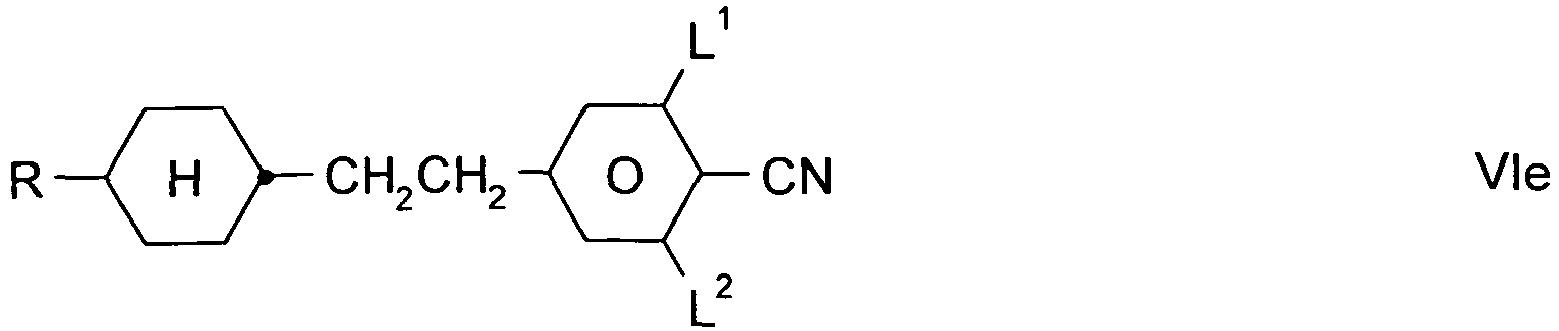

- The liquid crystalline medium preferably comprises preferably 1 to 5, in particular 1 to 3, very preferably 1 or 2, preferably selected from the above formulae VIa to VIf, very preferably from formulae Vlf.
- The amount of suitable additives of formula VI in the liquid crystalline medium is preferably from 1 to 20 %, in particular from 1 to 15 %, very preferably 1 to 10 % by weight of the total mixture.
- The liquid crystal media according to the present invention may contain further additives in usual concentrations. The total concentration of these further constituents is in the range of 0.1 % to 10 %, preferably 0.1 % to 6 %, based on the total mixture. The concentrations of the individual compounds used each are preferably in the range of 0.1 % to 3 %. The concentration of these and of similar additives is not taken into consideration for the values and ranges of the concentrations of the liquid crystal components and compounds of the liquid crystal media in this application. This also holds for the concentration of the dichroic dyes used in the mixtures, which are not counted when the concentrations of the compounds respectively the components of the host medium are specified. The concentration of the respective additives is always given relative to the final doped mixture.
- The liquid crystal media according to the present invention consists of several compounds, preferably of 3 to 30, more preferably of 4 to 20 and most preferably of 4 to 16 compounds. These compounds are mixed in conventional way. As a rule, the required amount of the compound used in the smaller amount is dissolved in the compound used in the greater amount. In case the temperature is above the clearing point of the compound used in the higher concentration, it is particularly easy to observe completion of the process of dissolution. It is, however, also possible to prepare the media by other conventional ways, e.g. using so called pre-mixtures, which can be e.g. homologous or eutectic mixtures of compounds or using so called multi-bottle-systems, the constituents of which are ready to use mixtures themselves.
- Particularly preferred mixture concepts are indicated below: (the acronyms used are explained in Table A).
- The mixtures according to the invention preferably comprise
- one or more compounds of formula I in a total concentration in the range from 1 to 50 %, in particular from 5 to 40 %, very preferably 10 to 30 % by weight of the total mixture, preferably these compounds are selected from the group of the formulae Ia-1a, la-2a, la-2b, la-17c, la-8e, la-3f, la-5f, la-6f, Ia-12f, la-23f, Ib-27f, Ib-61f and Ib-63f, especially preferred they comprise
- N-GIGIGI-n-GGG-N, in particular N-GIGIGI-9-GGG-N, preferably in concentration > 5 %, in particular 10-30 %, based on the mixture as a whole,
and/or - N-PGI-n-GP-N, preferably N-PGI-9-GP-N, preferably in concentrations > 5 %, in particular 15-50 %, based on the mixture as a whole,
and/or
- N-GIGIGI-n-GGG-N, in particular N-GIGIGI-9-GGG-N, preferably in concentration > 5 %, in particular 10-30 %, based on the mixture as a whole,
- one or more compounds of formula III in a total concentration in the range from 10 to 95 %, in particular from 15 to 90 %, very preferably 20 to 85 % by weight of the total mixture, preferably these compounds are selected from formulae III-1a to III-1e and III-3a to III-3b especially preferred they comprise
- N-PGI-ZI-n-Z-GP-N, preferably N-PGI-ZI-7-Z-GP-N and/or N-PGI-ZI-9-Z-GP-N preferably in concentrations > 5 %, in particular 10-30 %, based on the mixture as a whole,
and/or - F-UIGI-ZI-n-Z-GU-F, preferably F-UIGI-ZI-9-Z-GU-F, preferably in concentrations > 5 %, in particular 10-30 %, based on the mixture as a whole,
and/or - F-PGI-O-n-O-PP-N, preferably F-PGI-O-9-O-PP-, preferably in concentrations of > 1 %, in particular 1-20 %, based on the mixture as a whole,
and/or - N-PP-O-n-O-PG-OT, preferably N-PP-O-7-O-PG-OT, preferably in concentrations of > 5 %, in particular 5-30 %, based on the mixture as a whole,
and/or - N-PP-O-n-O-GU-F, preferably N-PP-O-9-O-GU-F, preferably in concentrations of > 1 %, in particular 1-20 %, based on the mixture as a whole,
and/or - F-PGI-O-n-O-GP-F, preferably F-PGI-O-7-O-GP-F and/or F-PGI-O-9-O-GP-F preferably in concentrations of > 1 %, in particular 1-20 %, based on the mixture as a whole,
and/or - one or more suitable additives of formula VI in a total concentration in the range from 1 to 20 %, in particular from 1 to 15 %, very preferably 1 to 10 % by weight of the total mixture, preferably are these compounds selected from formula VI-1 to VI-f, especially preferred they comprise
- K15, preferably in concentrations of > 1 %, in particular 1-20 %, based on the mixture as a whole,
and/or
- K15, preferably in concentrations of > 1 %, in particular 1-20 %, based on the mixture as a whole,
- one or more chiral compounds preferably in a total concentration in the range from 1 to 20 %, in particular from 1 to 15 %, very preferably 1 to 10 % by weight of the total mixture, preferably these compounds are selected from formula IV, V, and R-5011 or S-5011, especially preferred they comprise
- R-5011, S-5011 or Cd-1, preferably in a concentration of > 1 %, in particular 1-20 %, based on the mixture as a whole.
- The bimesogenic compounds of formula I and the liquid crystalline media comprising them can be used in liquid crystal displays, such as STN, TN, AMD-TN, temperature compensation, guest-host, phase change or surface stabilized or polymer stabilized cholesteric texture (SSCT, PSCT) displays, in particular in flexoelectric devices, in active and passive optical elements like polarizers, compensators, reflectors, alignment layers, color filters or holographic elements, in adhesives, synthetic resins with anisotropic mechanical properties, cosmetics, diagnostics, liquid crystal pigments, for decorative and security applications, in nonlinear optics, optical information storage or as chiral dopants.
- The compounds of formula I and the mixtures obtainable thereof are particularly useful for flexoelectric liquid crystal display. Thus, another object of the present invention is a flexoelectric display comprising one or more compounds of formula I, or comprising a liquid crystal medium comprising one or more compounds of formula I.
- The inventive bimesogenic compounds of formula I and the mixtures thereof can be aligned in their cholesteric phase into different states of orientation by methods that are known to the expert, such as surface treatment or electric fields. For example, they can be aligned into the planar (Grandjean) state, into the focal conic state or into the homeotropic state. Inventive compounds of formula I comprising polar groups with a strong dipole moment can further be subjected to flexoelectric switching, and can thus be used in electrooptical switches or liquid crystal displays.
- The switching between different states of orientation according to a preferred embodiment of the present invention is exemplarily described below in detail for a sample of an inventive compound of formula I.
- According to this preferred embodiment, the sample is placed into a cell comprising two plane-parallel glass plates coated with electrode layers, e.g. ITO layers, and aligned in its cholesteric phase into a planar state wherein the axis of the cholesteric helix is oriented normal to the cell walls. This state is also known as Grandjean state, and the texture of the sample, which is observable e.g. in a polarization microscope, as Grandjean texture. Planar alignment can be achieved e.g. by surface treatment of the cell walls, for example by rubbing and/or coating with an alignment layer such as polyimide.
- A Grandjean state with a high quality of alignment and only few defects can further be achieved by heating the sample to the isotropic phase, subsequently cooling to the chiral nematic phase at a temperature close to the chiral nematic-isotropic phase transition, and rubbing the cell.
- In the planar state, the sample shows selective reflection of incident light, with the central wavelength of reflection depending on the helical pitch and the mean refractive index of the material.
- When an electric field is applied to the electrodes, for example with a frequency from 10 Hz to 1 kHz, and an amplitude of up to 12 Vrms / □m, the sample is being switched into a homeotropic state where the helix is unwound and the molecules are oriented parallel to the field, i.e. normal to the plane of the electrodes. In the homeotropic state, the sample is transmissive when viewed in normal daylight, and appears black when being put between crossed polarizers.
- Upon reduction or removal of the electric field in the homeotropic state, the sample adopts a focal conic texture, where the molecules exhibit a helically twisted structure with the helical axis being oriented perpendicular to the field, i.e. parallel to the plane of the electrodes. A focal conic state can also be achieved by applying only a weak electric field to a sample in its planar state. In the focal conic state the sample is scattering when viewed in normal daylight and appears bright between crossed polarizers.
- A sample of an inventive compound in the different states of orientation exhibits different transmission of light. Therefore, the respective state of orientation, as well as its quality of alignment, can be controlled by measuring the light transmission of the sample depending on the strength of the applied electric field. Thereby it is also possible to determine the electric field strength required to achieve specific states of orientation and transitions between these different states.
- In a sample of an inventive compound of formula I, the above described focal conic state consists of many disordered birefringent small domains. By applying an electric field greater than the field for nucleation of the focal conic texture, preferably with additional shearing of the cell, a uniformly aligned texture is achieved where the helical axis is parallel to the plane of the electrodes in large, well-aligned areas. In accordance with the literature on state of the art chiral nematic materials, such as P. Rudquist et al., Liq. Cryst. 23 (4), 503 (1997), this texture is also called uniformly-lying helix (ULH) texture. This texture is required to characterize the flexoelectric properties of the inventive compound.
- The sequence of textures typically observed in a sample of an inventive compound of formula I on a rubbed polyimide substrate upon increasing or decreasing electric field is given below:

- Starting from the ULH texture, the inventive flexoelectric compounds and mixtures can be subjected to flexoelectric switching by application of an electric field. This causes rotation of the optic axis of the material in the plane of the cell substrates, which leads to a change in transmission when placing the material between crossed polarizers. The flexoelectric switching of inventive materials is further described in detail in the introduction above and in the examples.
- It is also possible to obtain the ULH texture, starting from the focal conic texture, by applying an electric field with a high frequency, of for example 10 kHz, to the sample whilst cooling slowly from the isotropic phase into the cholesteric phase and shearing the cell. The field frequency may differ for different compounds.
- The bimesogenic compounds of formula I are particularly useful in flexoelectric liquid crystal displays as they can easily be aligned into macroscopically uniform orientation, and lead to high values of the elastic constant k11 and a high flexoelectric coefficient e in the liquid crystal medium.
- The liquid crystal medium preferably exhibits a
k11 > 1x10⁻¹⁰ N and a flexoelectric coefficient
e > 1x10⁻¹⁰ C/m. - Apart from the use in flexoelectric devices, the inventive bimesogenic compounds as well as mixtures thereof are also suitable for other types of displays and other optical and electrooptical applications, such as optical compensation or polarizing films, color filters, reflective cholesterics, optical rotatory power and optical information storage.
- A further aspect of the present invention relates to a display cell wherein the cell walls exhibit hybrid alignment conditions. The term "hybrid alignment" or orientation of a liquid crystal or mesogenic material in a display cell or between two substrates means that the mesogenic groups adjacent to the first cell wall or on the first substrate exhibit homeotropic orientation and the mesogenic groups adjacent to the second cell wall or on the second substrate exhibit planar orientation.
- The term "homeotropic alignment" or orientation of a liquid crystal or mesogenic material in a display cell or on a substrate means that the mesogenic groups in the liquid crystal or mesogenic material are oriented substantially perpendicular to the plane of the cell or substrate, respectively.
- The term "planar alignment" or orientation of a liquid crystal or mesogenic material in a display cell or on a substrate means that the mesogenic groups in the liquid crystal or mesogenic material are oriented substantially parallel to the plane of the cell or substrate, respectively.
- A flexoelectric display according to a preferred embodiment of the present invention comprises two plane parallel substrates, preferably glass plates covered with a transparent conductive layer such as indium tin oxide (ITO) on their inner surfaces, and a flexoelectric liquid crystalline medium provided between the substrates, characterized in that one of the inner substrate surfaces exhibits homeotropic alignment conditions and the opposite inner substrate surface exhibits planar alignment conditions for the liquid crystalline medium.
- Planar alignment can be achieved e.g. by means of an alignment layer, for example a layer of rubbed polyimide or sputtered SiOx, that is applied on top of the substrate.
- Alternatively it is possible to directly rub the substrate, i.e. without applying an additional alignment layer. For example, rubbing can be achieved by means of a rubbing cloth, such as a velvet cloth, or with a flat bar coated with a rubbing cloth. In a preferred embodiment of the present invention rubbing is achieved by means of a at least one rubbing roller, like e.g. a fast spinning roller that is brushing across the substrate, or by putting the substrate between at least two rollers, wherein in each case at least one of the rollers is optionally covered with a rubbing cloth. In another preferred embodiment of the present invention rubbing is achieved by wrapping the substrate at least partially at a defined angle around a roller that is preferably coated with a rubbing cloth.
- Homeotropic alignment can be achieved e.g. by means of an alignment layer coated on top of the substrate. Suitable aligning agents used on glass substrates are for example alkyltrichlorosilane or lecithine, whereas for plastic substrate thin layers of lecithine, silica or high tilt polyimide orientation films as aligning agents may be used. In a preferred embodiment of the invention silica coated plastic film is used as a substrate.
- Further suitable methods to achieve planar or homeotropic alignment are described for example in J. Cognard, Mol.Cryst.Liq.Cryst. 78, Supplement 1, 1-77 (1981).
By using a display cell with hybrid alignment conditions, a very high switching angle of flexoelectric switching, fast response times and a good contrast can be achieved. - The flexoelectric display according to present invention may also comprise plastic substrates instead of glass substrates. Plastic film substrates are particularly suitable for rubbing treatment by rubbing rollers as described above.
- Another object of the present invention is that compounds of formula I, when added to a nematic liquid crystalline mixture, produce a phase below the nematic.
- Accordingly, the bimesogenic compounds of formula I according to the present invention allow the second nematic phase to be induced in nematic mixtures that do not show evidence of this phase normally. Furthermore, varying the amounts of compounds of formula I allow the phase behaviour of the second nematic to be tailored to the required temperature.
- Examples for this are given and the mixtures obtainable thereof are particularly useful for flexoelectric liquid crystal display. Thus, another object of the present invention is liquid crystal media comprising one or more compounds of formula I exhibiting a second nematic phase.
- Without further elaboration, it is believed that one skilled in the art can, using the preceding description, utilize the present invention to its fullest extent. The following examples are, therefore, to be construed as merely illustrative and not limitative of the remainder of the disclosure in any way whatsoever.
- Unless the context clearly indicates otherwise, as used herein plural forms of the terms herein are to be construed as including the singular form and vice versa.
- Throughout the description and claims of this specification, the words "comprise" and "contain" and variations of the words, for example "comprising" and "comprises", mean "including but not limited to", and are not intended to (and do not) exclude other components.
- It will be appreciated that variations to the foregoing embodiments of the invention can be made while still falling within the scope of the invention. Each feature disclosed in this specification, unless stated otherwise, may be replaced by alternative features serving the same, equivalent or similar purpose. Thus, unless stated otherwise, each feature disclosed is one example only of a generic series of equivalent or similar features.
- All of the features disclosed in this specification may be combined in any combination, except combinations where at least some of such features and/or steps are mutually exclusive. In particular, the preferred features of the invention are applicable to all aspects of the invention and may be used in any combination. Likewise, features described in non-essential combinations may be used separately (not in combination).
- In the foregoing and in the following examples, unless otherwise indicated, all temperatures are set forth uncorrected in degrees Celsius and all parts and percentages are by weight.
- The following abbreviations are used to illustrate the liquid crystalline phase behavior of the compounds: K = crystalline; N = nematic; N2 = second nematic; S = smectic; Ch = cholesteric; I = isotropic; Tg = glass transition. The numbers between the symbols indicate the phase transition temperatures in °C.
- In the present application and especially in the following examples, the structures of the liquid crystal compounds are represented by abbreviations, which are also called "acronyms". The transformation of the abbreviations into the corresponding structures is straight forward according to the following three tables A to C.
- All groups CnH2n+1, CmH2m+1, and ClH2l+1 are preferably straight chain alkyl groups with n, m and I C-atoms, respectively, all groups CnH2n, CmH2m and ClH2l, are preferably (CH2)n, (CH2)m and (CH2)l, respectively and -CH=CH- preferably is trans- respectively E vinylene.
- Table A lists the symbols used for the ring elements, table B those for the linking groups and table C those for the symbols for the left hand and the right hand end groups of the molecules.
- Table D lists exemplary molecular structures together with their respective codes.
Table A: Ring Elements C 
P 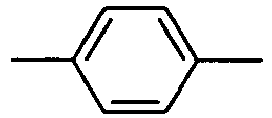
D 
DI 
A 
AI 
G 
GI 
G(Cl) 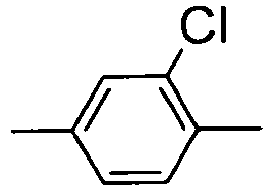
GI(CI) 
G(Me) 
GI(Me) 
U 
UI 
Y 
M 
MI 
N 
NI 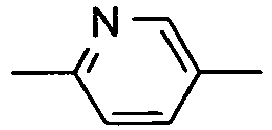
np 
n3f 
n3fl 
th 
thl 
th2f 
th2fl 
o2f 
o2fl 
dh 
K 
KI 
L 
LI 
F 
FI 
Table B: Linking Groups E -CH2-CH2- V -CH=CH- T -C=C- W -CF2-CF2- B -CF=CF- Z -CO-O- ZI -O-CO- X -CF=CH- XI -CH=CF- O -CH2-O- OI -O-CH2- Q -CF2-O- QI -O-CF2- Table C: End Groups Left hand side, used alone or in combination with others Right hand side, used alone or in combination with others -n- CnH2n+1- -n -CnH2n+1 -nO- CnH2n+1-O- -nO -O-CnH2n+1 -V- CH2=CH- -V -CH=CH2 -nV- CnH2n+1-CH=CH- -nV -CnH2n-CH=CH2 -Vn- CH2=CH-CnH2n- -Vn -CH=CH-CnH2n+1 -nVm- CnH2n+1-CH=CH-Cm,H2m- -nVm -CnH2n-CH=CH-CmH2m+1 -N- N=C- -N -C=N -S- S=C=N- -S -N=C=S -F- F- -F -l- -CL- Cl- -CL -Cl -M- CFH2- -M -CFH2 -D- CF2H- -D -CF2H -T- CF3- -T -CF3 -MO- CFH2O- -OM -OCFH2 -DO- CF2HO- -OD -OCF2H -TO- CF3O- -OT -OCF3 -A- H-C=C- -A -C≡C-H -nA- CnH2n+1-C=C- -An -C≡C-CnH2n+1 -NA- N=C-C=C- -AN -C≡C-C≡N Left hand side, used in combination with others only Right hand side, used in combination with others only -...n...- -CnH2n- -...n... -CnH2n- -...M...- -CFH- -...M... -CFH- -...D...- -CFH2- -...D... -CF2- -...V...- -CH=CH- -...V... -CH=CH- -...Z...- -CO-O- -...Z... -CO-O- -...Zl...- -O-CO- -...ZI... -O-CO- -...K...- -CO- -...K... -CO- -...W...- -CF=CF- -...W... -CF=CF- wherein n und m each are integers and three points "..." indicate a space for other symbols of this table. - Preferably the liquid crystalline media according to the present invention comprise, besides the compound(s) of formula I one or more compounds selected from the group of compounds of the formulae of the following table.
Table D 
F-PGI-O-n-O-GP-F 
F-PG-O-n-O-GIP-F 
N-PP-O-n-O-GU-F 
N-PP-O-n-O-PG-OT 
F-PGI-O-n-O-PP-N 
R-5011 respectively S-5011 
CD-1 
K3n 
F-UIGI-ZI-n-Z-GU-F 
N-PGI-ZI-n-Z-GP-N 
F-PGI-ZI-n-Z-GP-F 
N-GIGIGI-n-GGG-N 
N-PGIUI-n-UGP-N 
N-GIUIGI-n-GUG-N 
N-GIUIP-n-PUG-N 
N-PGI-n-GP-N 
N-PUI-n-UP-N 
N-UIUI-n-UU-N 
N-GIGI-n-GG-N 
N-PGI(Me)-n-G(Me)P-N 
F-UIGI-n-GU-F 
UIP-n-PU 
N-PGI-n-GP-N 
N-PG(Me)-n-GI(Me)P-N -

- 1-bromo-3-fluoroiodobenzene (53.3 g, 0.177 mol) is added to a round bottom flask with 3,5-difluorobenzenboronic acid (29.0 g, 0.184 mol). Tetrahydrofuran (500 ml) is added and the mixture is stirred under nitrogen until dissolved. A solution of potassium carbonate (36.7 g, 0.265 mol) in water (100 ml) is added to the reaction. A catalyst, bis(triphenylphosphine)-palladium(II) dichloride (1.98 g, 2.83 mmol) is added and the reaction is heated to reflux for 18 hours. The reaction is cooled and diluted with water before being acidified with dilute Hydrochloric acid. The layers are separated and the organics are washed with water before being concentrated to obtain the product as a brown solid.
- The crude solid is dissolved in Dichloromethane and adsorbed onto silica gel (100 g) by concentration. The material is purified by column chromatography, eluting with a mixture of petroleum spirit (40-60°C) and dichloromethane to obtain a purified product as a yellow solid.
- 2,-3'-5'-trifluoro-4-bromobiphenyl (26.1 g, 0.091 mol) is added to a round bottomed flask. Triethylamine (25.0 ml) and tetrahydrofuran (50.0 ml) is added and the whole evacuated and replaced with nitrogen. Copper(I)iodide (0.404 g, 2.12 mmol) and bis(triphenylphosphine)palladium(II) dichloride (0.71 g, 1.01 mmol) are added, the reaction is evacuated and replaced with nitrogen. The reaction mixture is heated to 40°C and 1,8-nonadiyne (5.25 g, 0.044 mol) is slowly added over 30 minutes. The mixture is heated for a further 24 hours at 40°C followed by 48 hours at 80°C.
- The reaction is cooled and filtered under vacuum to remove precipitates. The filtrate is acidified with dilute Hydrochloric acid and extracted with diethyl ether. The organic material is washed with water before concentrating to afford the product as a black solid (26.0 g). The crude solid is dissolved in dichloromethane and adsorbed onto 50.0 g silica gel. The material is purified by column chromatography, eluting the product using a mixture of dichloromethane in petrol.
- The material (2) (21.5 g, 0.040 mol) is dissolved in Tetrahydrofuran (600 ml) and passed through a Thalesnano hydrogenator. The material required conditions of 70 bar pressure and 60°C to produce the product as pale colored solid.
- Material (3) (21.5 g, 0.04 mol) is added to a round bottom flask with Tetrahydrofuran (150 ml). The reaction is stirred under nitrogen and cooled to -70°C. n-Butyl Lithium solution(1.6 M in hexanes, 55.0 ml, 0.087 mol) is slowly added over 45 minutes, and the reaction stirred for a further hour at -70°C. A solution of Iodine (45.8 g, 00.179 mol) in tetrahydrofuran (125 ml) is slowly added keeping the temperature between -60 and -70°C. The reaction is stirred overnight and allowed to warm to room temperature. The reaction is quenched by slowly adding wet THF before water and then ethyl acetate is added. The layers are separated and the aqueous extracted three times with ethyl acetate. The organics are washed twice with sodium thiosulphate solution (100 ml, 2 M in water) then washed with water. Concentration afforded a brown solid. The material is purified by sequential recrystallisations from Industrial methylated spirits, acetone and acetonitrile/acetone.
- 4-bromo-2-fluorobenzonitrile (42.4 g, 212 mmol) is added to a round bottom flask along with bis(pinacolato)diborane (59.8 g, 235 mmol). Potassium acetate (31.1 g, 317 mmol), tricyclohexylphosphine (3.57 g, 12.7 mmol), Tris(dibenzylideneacetone)dipalladium(0) (3.66 g, 6.36 mmol) and 1,4-dioxane (600 ml) are all added to the reaction flask and the mixture stirred under nitrogen at 80°C for 72 hours. After cooling the reaction mixture, water and diethyl ether are added and the layers separated. The organic material is washed with brine and water before concentrating to a brown solid. The product is purified by recrystallisation from petrol/dichloromethane to obtain a brown crystalline solid.
- Material (4) (10.17 g, 12.8 mmol) and material (5) (7.70 g, 31.2 mmol) are added to a round bottom flask and dissolved in Tetrahydrofuran (250 ml). Bis(triphenylphosphine)-palladium(II) dichloride (450.6 mg,0.642 mmol) is added along with a solution of sodium carbonate (1 M in water, 77.0 ml, 77.0 mmol). The reaction is heated to 85°C for 24 hours, after which it is cooled and diluted with water before being acidified with dilute Hydrochloric acid. The layers are separated and the organic layer is washed with water before being concentrated to yield the product as a brown solid. The material is purified by column chromatography, eluting the product with 40% ethyl acetate in petrol. The product is further purified by recrystallisation from, first, acetone/methanol, then acetone and finally IPA/petrol.
-

-

-

-

-

-

-

-

-

-

-

-

-

-

-

-

-

-

-

- 1-bromo-3-fluoroiodobenzene (27.5 g, 92 mmol) is added to a round bottom flask with tetrahydrofuran (30 ml) and the mixture is stirred under nitrogen until dissolved. Diisopropylamine (30 ml) is added and the reaction placed in an ultrasonic bath for 10 minutes. Catalysts, bis(triphenyl-phosphine)palladium(II) dichloride (0.9g, 1.28mmol) and copper(I)iodide (0.2 g, 1.05 mmol) are added and the reaction is cooled in a water bath to 20°C. 1,8-nonadiyne (5.0 g, 41 mmol) is slowly added to the reaction and stirred for a further 20 hours. The reaction is cooled and filtered under vacuum to remove precipitates. The filtrate is acidified with diluted hydrochloric acid and extracted with diethyl ether. The organic material is washed with water before concentrating to afford the product as a black solid (19 g). The material is purified by column chromatography, eluting the product using a mixture of dichloromethane in petrol. This produced 14 g (72%) of the desired product.
- Material (1) (21.5 g, 40 mmol) is dissolved in tetrahydrofuran (600 ml) and passed through a Thalesnano hydrogenator. The material required conditions of 70 bar pressure and 60°C to produce the product as pale coloured solid (21.5 g, 99%)
- Material (2) (14.35 g, 30.3 mmol), 4-cyanophenylboronic acid (4.45 g, 30.3 mmol), potassium phosphate (25.4 g, 120 mmol), dioxane (57.4ml) and water (28.7 ml) are sonicated in an ultrasound bath for 30 minutes under a nitrogen atmosphere. The mixture is stirred at room temperature and Pd(DPPF)Cl2 - DCM complex (215 mg) are added. The mixture is heated to 90°C for 2 hours. The mixture is cooled. The two layers are separated and the solvent from the organic layer removed in vacuo to give a black oil. This is dissolved in a minimum of DCM and applied to a column of silica eluting with petrol: DCM, 1:1 to give the desired product (3.5 g, 23.3%).
- Material (3) (3.5 g, 7.05 mmol), 3,4-difluorobenzeneboronic acid (1.7 g, 8 mmol) potassium phosphate (1.7 g, 8 mmol), dioxane (10.6 ml) and water (5.3 ml) are sonicated in an ultrasound bath for 30 minutes under a nitrogen atmosphere. The mixture is stirred at room temperature and Pd(DPPF)Cl2- DCM complex (59mg) are added. The mixture is heated to 90°C for 5 hours. The two layers are separated and the solvent from the organic layer removed in vacuo. This is dissolved in a minimum of DCM and applied to a column of silica, eluting with petrol: DCM, 2:1. The crude product is crystallised twice from DCM/acetonitrile (cooled with dry ice/acetone bath) and the product is dissolved in a minimum of DCM and applied to a column of silica eluting with petrol : DCM, 2:1. The crude product is crystallised from acetonitrile (cooled with dry ice/acetone bath) to give the desired product (2.43 g, 65%).
Example 4: Mixture A Composition Compound No. Abbreviation Conc. /% 1 R-5011 1.6 2 F-PGI-O-7-O-GP-F 4.0 3 F-PGI-O-9-O-GP-F 16.2 4 N-PP-O-9-O-GU-F 7.0 5 N-PP-O-7-O-PG-OT 18.5 6 F-PGI-O-9-O-PP-N 5.0 7 F-UIGI-ZI-9-Z-GU-F 25.0 8 N-PGI-ZI-9-Z-GP-N 7.7 9 N-PGI-9-GP-N 15.0 ∑ 100.0 - The host mixture (entry 1 to 8), shows a nematic phase range from room temperature up to 68.5°C. After adding 15 % of
N-PGI-9-GP-N, the resulting mixture A exhibits an increased phase range of the second nematic phase. - The following mixture is prepared (Mixture B)
Composition Compound No. Abbreviation Conc. /% 1 F-PGI-O-7-O-GP-F 10.0 2 F-PGI-O-9-O-GP-F 40.0 3 N-PP-O-9-O-GU-F 10.0 4 N-PP-O-7-O-PGIOT 20.0 5 F-PGI-O-9-O-PP-N 20.0 ∑ 100.0 - This mixture has the following properties:
- clearing point: 75.2
- phase sequence: K 44 N 75 I, Tg -17.
- This mixture is a host mixture and does not display the second nematic phase.
- To mixture B is added 10 % of N-PGI-9-GP-N resulting in mixture B-1 with the following thermal properties:
- phase sequence: I 75-73 N 30 N2
- As the amount of N-PGI-9-GP-N in the mixture increases to 10 %, several things occur. Firstly, the second nematic phase is induced in a mixture that does not otherwise demonstrate this phase, and secondly, the elastic bend constant k33 is decreased.
- To mixture B is added 20 % of N-PGI-9-GP-N resulting in mixture B-2 with the following thermal properties:
- phase sequence for heating: K 37.9 N 73.6-74.2 I,
- for cooling I 74 N 35.4-34.8 N2
- The temperature of the transition from the nematic phase to the second bend twist nematic phase occurs at higher temperatures as the concentration of N-PGI-9-GP-N is increased
- Mixture B-2 displays the second nematic phase on cooling from the nematic phase (i.e. below 35.4°C) The transition from the nematic to the second nematic phase seems to be second order, and does not appear to be a sharp transition. As amount increases to 20 %, k11 remains in comparison to mixture B-1 largely unchanged, but k33 is significantly decreased.
- Furthermore, it can be postulated that a composition with higher concentrations > 34 % of N-PGI-9-GP-N in the mixture might have negative k33. Extrapolating the k33 against the composition, then the value for k33 for 100 % N-PGI-9-GP-N is significantly negative at -9.8 pN.
- Table 2 summarizes the results of the Examples 5, 6 and 7.
Table 2: Mixture B B-1 B-2 Extrapolated values k11 (pN) 13.49 14.51 13.84 15.53 k33 (pN) 4.97 3.42 2.02 -9.79 (k11 + k33)/2 (pN) 9.23 8.97 7.93 2.87 -
Composition Compound No. Abbreviation Conc. /% 1 F-PGI-O-7-O-GP-F 3.2 2 F-PGI-O-9-O-GP-F 11.5 3 N-PP-O-9-O-GU-F 5.0 4 N-PP-O-7-O-PG-OT 13.1 5 F-PGI-O-9-O-PP-N 3.5 6 N-GIGIGI-9-GGG-N 20.0 7 K15 6.0 8 R-5011 4.0 9 F-UIGI-ZI-9-Z-GU-F 17.6 10 N-PGI-ZI-9-Z-GP-N 5.5 11 N-PGI-ZI-7-Z-GP-N 10.6 ∑ 100.0 -
Composition Compound No. Abbreviation Conc. /% 1 F-PGI-O-7-O-GP-F 5.6 2 F-PGI-O-9-O-GP-F 11.5 3 N-PP-O-9-O-GU-F 5.0 4 N-PP-O-7-O-PG-OT 13.1 5 F-PGI-O-9-O-PP-N 3.5 6 N-GIGIGI-9-GGG-N 20.0 7 K15 6.0 8 R-5011 1.6 9 F-UIGI-ZI-9-Z-GU-F 17.6 10 N-PGI-ZI-9-Z-GP-N 5.5 11 N-PGI-ZI-7-Z-GP-N 10.6 ∑ 100.0 -
Composition Compound No. Abbreviation Conc. /% 1 F-PGI-O-7-O-GP-F 8.0 2 F-PG-O-7-O-GIP-F 32.0 3 N-PP-O-9-O-GU-F 16.0 4 N-PP-O-7-O-PGIOT 8.0 5 F-PGI-O-9-O-PP-N 16.0 6 N-PGI-9-GP-N 20.0 ∑ 100.0 - This mixture is suitable for the USH-mode.
MG1 and MG2 are not both


Claims (13)
- Bimesogenic compounds of formula I
R1-MG1-Sp-MG2-R2 I
whereinR1 and R2 are each independently H, F, CI, CN, NCS or a straight-chain or branched alkyl group with 1 to 25 C atoms which may be unsubstituted, mono- or polysubstituted by halogen or CN, it being also possible for one or more non-adjacent CH2 groups to be replaced, in each case independently from one another, by -O-, -S-, -NH-, -N(CH3)-, -CO-, -COO-, -OCO-, -O-CO-O-, -S-CO-, -CO-S-, -CH=CH-, -CH=CF-, -CF=CF- or -C≡C- in such a manner that oxygen atoms are not linked directly to one another,MG1 and MG2 are each independently a mesogenic group,Sp is -(CH2)o-, and∘ is an integer from 5 to 15,with the proviso if R1 and R2 both are -CN,MG1 and MG2 are not both and if MG1 and MG2 both are
 R1 and R2 are not both a straight-chain alkyl group.
 - Bimesogenic compounds according to claim 1, characterized in that MG1 and MG2 are independently of each other selected of formula II
-A1-(Z1-A2)m- II
whereinZ1 is -COO-, -OCO-,-O-CO-O-, -OCH2-, -CH2O-, -CH2CH2-, -(CH2)4-, -CF2CF2-, -CH=CH-, -CF=CF-, -CH=CH-COO-, -OCO-CH=CH-, -C≡C- or a single bond,A1 and A2 are each independently in each occurrance1,4-phenylene, wherein in addition one or more CH groups may be replaced by N, trans-1,4-cyclohexylene in which, in addition, one or two non-adjacent CH2 groups may be replaced by O and/or S, 1,4-cyclohexenylene, 1,4-bicyclo-(2,2,2)-octylene, piperidine-1,4-diyl, naphthalene-2,6-diyl, decahydro-naphthalene-2,6-diyl, 1,2,3,4-tetrahydro-naphthalene-2,6-diyl, cyclobutane-1,3-diyl, spiro[3.3]heptane-2,6-diyl or dispiro[3.1.3.1] decane-2,8-diyl, it being possible for all these groups to be unsubstituted, mono-, di-, tri- or tetrasubstituted with F, Cl, CN or alkyl, alkoxy, alkylcarbonyl or alkoxycarbonyl groups with 1 to 7 C atoms, wherein one or more H atoms may be substituted by F or Cl,m is 0, 1, 2 or 3. - Bimesogenic compounds according to claim 1 or 2, characterized in that MG1 and MG2 are each and independently selected of the following formulae and their mirror images





- Bimesogenic compounds according to at least one of claims 1 to 3, characterized in that R1 and R2 are selected from H, F, Cl, CN, NO2, OCH3, COCH3, COC2H5, COOCH3, COOC2H5, CF3, C2F5, OCF3, OCHF2, and OC2F5.
- Bimesogenic compounds according to at least one of claims 1 to 4, characterized in that o is 5, 7, 9, 11, 13 or 15.
- Use of bimesogenic compounds according to at least one of claims 1 to 5 in liquid crystalline media.
- Liquid-crystalline medium, characterised in that it comprises one or more bimesogenic compounds according to at least one or more of claims 1 to 5.
- Liquid-crystalline medium according to Claim 7, characterised in that it additionally comprises one or more compounds selected from the group of the compounds of the formulae III
R3-MG3-X3-Sp1-X4-MG4-R4 III
whereinR3 and R4 are each independently H, F, Cl, CN, NCS or a straight-chain or branched alkyl group with 1 to 25 C atoms which may be unsubstituted, mono- or polysubstituted by halogen or CN, it being also possible for one or more non-adjacent CH2 groups to be replaced, in each case independently from one another, by -O-, -S-, -NH-, -N(CH3)-, -CO-, -COO-, -OCO-, -O-CO-O-, -S-CO-, -CO-S-, -CH=CH-, -CH=CF-, -CF=CF- or -C≡C- in such a manner that oxygen atoms are not linked directly to one another,MG3 and MG4 are each independently a mesogenic group,Sp1 is a spacer group comprising 5 to 40 C atoms, wherein one or more non-adjacent CH2 groups may also be replaced by -O-, -S-, -NH-, -N(CH3)-, -CO-, -O-CO-, -S-CO-, -O-COO-, -CO-S-, -CO-O-, -CH(halogen)-, -CH(CN)-, -CH=CH- or -C≡C-, andX3 and X4 are each independently -O-, -S-, -CO-, -COO-, -OCO-, -O-CO-O-, -CO-NH-, -NH-CO-, -CH2CH2-, -OCH2-, -CH2O-, -SCH2-, -CH2S-, -CH=CH-, -CH=CH-COO-, -OCO-CH=CH-, -C≡C-. - Liquid crystal medium according to claim 7 or 8, characterized in that it exhibits a second nematic phase.
- Use of a liquid crystal medium according to at least one of claims 7 to 9, in a liquid crystal device.
- Liquid crystal device comprising a liquid crystalline medium comprising two or more components, one or more of which is a bimesogenic compound according at least one of claims 1 to 5.
- Liquid crystal device according to claim 11, characterized in that it is a flexoelectric device.
- Liquid crystal device according to claim 11 or 12, characterized in that it comprises two plane parallel electrodes the inner surfaces of which exhibit hybrid alignment conditions.
Priority Applications (1)
| Application Number | Priority Date | Filing Date | Title |
|---|---|---|---|
| EP12728990.8A EP2729549B1 (en) | 2011-07-05 | 2012-06-12 | Bimesogenic compounds |
Applications Claiming Priority (3)
| Application Number | Priority Date | Filing Date | Title |
|---|---|---|---|
| EP11005489 | 2011-07-05 | ||
| PCT/EP2012/002480 WO2013004333A1 (en) | 2011-07-05 | 2012-06-12 | Bimesogenic compounds |
| EP12728990.8A EP2729549B1 (en) | 2011-07-05 | 2012-06-12 | Bimesogenic compounds |
Publications (2)
| Publication Number | Publication Date |
|---|---|
| EP2729549A1 EP2729549A1 (en) | 2014-05-14 |
| EP2729549B1 true EP2729549B1 (en) | 2016-12-07 |
Family
ID=46331205
Family Applications (1)
| Application Number | Title | Priority Date | Filing Date |
|---|---|---|---|
| EP12728990.8A Not-in-force EP2729549B1 (en) | 2011-07-05 | 2012-06-12 | Bimesogenic compounds |
Country Status (7)
| Country | Link |
|---|---|
| US (1) | US20140232977A1 (en) |
| EP (1) | EP2729549B1 (en) |
| JP (2) | JP6134314B2 (en) |
| KR (1) | KR102014557B1 (en) |
| CN (1) | CN103619992B (en) |
| TW (1) | TWI572700B (en) |
| WO (1) | WO2013004333A1 (en) |
Families Citing this family (44)
| Publication number | Priority date | Publication date | Assignee | Title |
|---|---|---|---|---|
| US20140232977A1 (en) * | 2011-07-05 | 2014-08-21 | Merck Patent Gmbh | Bimesogenic compounds |
| EP2855631B1 (en) | 2012-05-25 | 2017-09-20 | Merck Patent GmbH | Mesogenic media and liquid crystal display |
| KR20150036406A (en) * | 2012-07-06 | 2015-04-07 | 메르크 파텐트 게엠베하 | Bimesogenic compounds and mesogenic media |
| WO2014005671A1 (en) * | 2012-07-06 | 2014-01-09 | Merck Patent Gmbh | Bimesogenic compounds and mesogenic media |
| KR20150036405A (en) * | 2012-07-06 | 2015-04-07 | 메르크 파텐트 게엠베하 | Bimesogenic compounds and mesogenic media |
| WO2014032772A1 (en) * | 2012-08-29 | 2014-03-06 | Merck Patent Gmbh | Bimesogenic compounds and mesogenic media |
| US20160222293A1 (en) * | 2013-09-12 | 2016-08-04 | Merck Patent Gmbh | Mesogenic compounds and mesogenic media |
| SG11201603249UA (en) | 2013-10-30 | 2016-05-30 | Dow Global Technologies Llc | Syntactic polyurethane elastomer based on soft segment prepolymer and non-mercury catalyst for use in subsea pipeline insulation |
| CA2928584C (en) | 2013-10-30 | 2021-11-09 | Dow Global Technologies Llc | Syntactic polyurethane elastomers for use in subsea pipeline insulation |
| DK3063198T3 (en) | 2013-10-30 | 2019-11-11 | Dow Global Technologies Llc | Syntactic polyurethane elastomers based on low unsaturation polyols for use in insulation of underwater pipes |
| EP3071668B1 (en) * | 2013-11-22 | 2018-07-18 | Merck Patent GmbH | Bimesogenic compounds and mesogenic media |
| CN105849229B (en) * | 2013-12-23 | 2019-01-04 | 默克专利股份有限公司 | Double mesogenic compounds and mesogenic media |
| JP2017521529A (en) * | 2014-07-11 | 2017-08-03 | メルク パテント ゲゼルシャフト ミット ベシュレンクテル ハフツングMerck Patent Gesellschaft mit beschraenkter Haftung | Mesogenic media and liquid crystal display |
| US10450508B2 (en) | 2014-07-17 | 2019-10-22 | Merck Patent Gmbh | Bimesogenic compounds and mesogenic media |
| EP3218446B1 (en) * | 2014-11-11 | 2018-07-04 | Merck Patent GmbH | Bimesogenic compounds and mesogenic media |
| US20180022996A1 (en) * | 2014-12-17 | 2018-01-25 | Merck Patent Gmbh | Bimesogenic compounds and mesogenic media |
| CN107109221B (en) * | 2014-12-19 | 2021-03-12 | 默克专利股份有限公司 | Bimesogenic compounds and mesogenic media |
| JP6841759B2 (en) * | 2014-12-19 | 2021-03-10 | メルク パテント ゲゼルシャフト ミット ベシュレンクテル ハフツングMerck Patent Gesellschaft mit beschraenkter Haftung | Bimesogen compounds and mesogenic media |
| EP3048159B1 (en) * | 2015-01-22 | 2019-08-07 | Merck Patent GmbH | Liquid crystal medium |
| KR102539268B1 (en) * | 2015-02-10 | 2023-06-07 | 메르크 파텐트 게엠베하 | Liquid crystal medium |
| CN107428651B (en) * | 2015-03-12 | 2021-06-22 | 捷恩智株式会社 | Liquid crystalline compound, liquid crystal composition, liquid crystal-encapsulated composite fiber, fiber aggregate, fiber composite, and liquid crystal display element |
| KR102587314B1 (en) * | 2015-03-13 | 2023-10-12 | 메르크 파텐트 게엠베하 | Liquid crystal medium |
| CN106281355B (en) * | 2015-06-04 | 2019-02-15 | 江苏和成显示科技有限公司 | Liquid crystal media and its application |
| CN106281360B (en) * | 2015-06-04 | 2019-02-15 | 江苏和成显示科技有限公司 | Liquid-crystal composition and its application |
| CN106281359B (en) * | 2015-06-04 | 2019-02-15 | 江苏和成显示科技有限公司 | Liquid-crystal composition and its display device |
| CN106608842A (en) * | 2015-10-23 | 2017-05-03 | 江苏和成显示科技股份有限公司 | Method for preparing dimer containing benzonitrile terminal |
| EP3365411B1 (en) * | 2015-10-23 | 2020-05-13 | Merck Patent GmbH | Light modulation element |
| EP3383970B1 (en) * | 2015-12-02 | 2021-03-31 | Merck Patent GmbH | Liquid crystal medium and liquid crystal device |
| WO2017110976A1 (en) * | 2015-12-25 | 2017-06-29 | 日産化学工業株式会社 | Liquid crystal display element, liquid crystal optical element, and composition for liquid crystal structure stabilization film |
| CN105549290B (en) * | 2016-02-01 | 2019-07-23 | 京东方科技集团股份有限公司 | Display panels and display devices |
| WO2017194665A1 (en) * | 2016-05-12 | 2017-11-16 | Merck Patent Gmbh | Bimesogenic compounds and mesogenic media |
| JP2019533037A (en) | 2016-09-14 | 2019-11-14 | メルク パテント ゲゼルシャフト ミット ベシュレンクテル ハフツングMerck Patent Gesellschaft mit beschraenkter Haftung | Liquid crystal medium and liquid crystal device |
| WO2018104279A1 (en) | 2016-12-08 | 2018-06-14 | Merck Patent Gmbh | Liquid crystal medium and liquid crystal device |
| WO2019030153A1 (en) | 2017-08-08 | 2019-02-14 | Merck Patent Gmbh | Liquid crystal medium and liquid crystal device |
| CN111032825A (en) | 2017-08-08 | 2020-04-17 | 默克专利股份有限公司 | Liquid crystal medium and liquid crystal device |
| CN111263799A (en) * | 2017-10-25 | 2020-06-09 | 默克专利股份有限公司 | Liquid crystal medium and liquid crystal device |
| WO2019081389A1 (en) | 2017-10-25 | 2019-05-02 | Merck Patent Gmbh | Liquid crystal medium and liquid crystal device |
| CN109825309B (en) * | 2017-11-23 | 2022-03-11 | 江苏集萃智能液晶科技有限公司 | Liquid crystal composition and light modulation device thereof |
| GB2583649A (en) | 2017-12-18 | 2020-11-04 | Merck Patent Gmbh | Liquid crystal compound and liquid crystal medium |
| CN110208990A (en) * | 2018-02-28 | 2019-09-06 | 江苏集萃智能液晶科技有限公司 | A kind of preparation method and bistable state light modulation device of bistable state light modulation device |
| WO2019179962A1 (en) | 2018-03-22 | 2019-09-26 | Merck Patent Gmbh | Liquid-crystalline medium |
| CN110467926B (en) * | 2018-05-10 | 2023-10-31 | 江苏集萃智能液晶科技有限公司 | Liquid crystal composition and liquid crystal display thereof |
| KR102182135B1 (en) * | 2019-03-27 | 2020-11-23 | 전북대학교산학협력단 | Bending and Pressure Sensor Using Nematic Transition Effect Through Bimesogenic Liquid Crystal Doping |
| CN112442380B (en) | 2019-09-04 | 2022-04-01 | 江苏集萃智能液晶科技有限公司 | Liquid crystal composition and light modulation device thereof |
Family Cites Families (32)
| Publication number | Priority date | Publication date | Assignee | Title |
|---|---|---|---|---|
| DE3225290A1 (en) * | 1982-07-07 | 1984-01-12 | Merck Patent Gmbh | RING CONNECTIONS |
| JPS59155337A (en) * | 1983-02-22 | 1984-09-04 | Chisso Corp | Cholesteric liquid crystal compound |
| DE4000451B4 (en) | 1990-01-09 | 2004-12-09 | Merck Patent Gmbh | Electro-optical liquid crystal switching element |
| EP0588568B1 (en) | 1992-09-18 | 2002-12-18 | Hitachi, Ltd. | A liquid crystal display device |
| JP3658798B2 (en) * | 1995-05-25 | 2005-06-08 | チッソ株式会社 | Diamino compound and method for producing the same |
| JP3579756B2 (en) * | 1996-06-04 | 2004-10-20 | チッソ株式会社 | Liquid crystal compound having unsaturated bond in bonding group, liquid crystal composition and liquid crystal display device |
| WO1998000428A1 (en) | 1996-07-01 | 1998-01-08 | Merck Patent Gmbh | Chiral dopants |
| JPH10292174A (en) * | 1997-04-21 | 1998-11-04 | Seiko Epson Corp | Biphenyl derivative and polymer dispersed liquid crystal display device |
| DE19834162A1 (en) | 1997-08-13 | 1999-02-18 | Merck Patent Gmbh | Chiral connections |
| EP0971016B1 (en) | 1998-07-08 | 2003-05-21 | MERCK PATENT GmbH | Mesogenic estradiols |
| DE19855757A1 (en) * | 1998-12-03 | 2000-06-21 | Merck Patent Gmbh | Cross-bridged cyclohexane derivatives and liquid-crystalline medium |
| GB9908934D0 (en) * | 1999-04-19 | 1999-06-16 | Rolic Ag | Liquid crystalline compounds |
| GB2356629B (en) | 1999-10-04 | 2004-09-22 | Merck Patent Gmbh | Bimesogenic Compounds and Flexoelectric Devices |
| GB0225662D0 (en) * | 2001-11-16 | 2002-12-11 | Merck Patent Gmbh | Liquid crystalline medium and liquid crystal display |
| ATE314446T1 (en) * | 2002-10-08 | 2006-01-15 | Merck Patent Gmbh | LIQUID CRYSTAL MEDIUM AND LIQUID CRYSTAL DISPLAY |
| EP1408098B1 (en) * | 2002-10-08 | 2005-12-28 | MERCK PATENT GmbH | Liquid crystalline medium and liquid crystal display |
| DE602004001166T2 (en) * | 2003-05-09 | 2007-06-06 | Merck Patent Gmbh | Liquid-crystalline medium and liquid-crystal display |
| EP1477547B1 (en) * | 2003-05-09 | 2006-06-14 | MERCK PATENT GmbH | Liquid crystalline medium and liquid crystal display |
| JP4665487B2 (en) * | 2003-11-05 | 2011-04-06 | チッソ株式会社 | New diamine and polymer made from it |
| GB0402006D0 (en) * | 2004-01-30 | 2004-03-03 | Dow Corning Ltd | Liquid crystal materials |
| GB0414888D0 (en) * | 2004-07-02 | 2004-08-04 | Univ Cambridge Tech | Liquid crystal device |
| JP2008525331A (en) * | 2004-12-23 | 2008-07-17 | メルク パテント ゲゼルシャフト ミット ベシュレンクテル ハフトング | Bimesogenic compounds and flexoelectric devices |
| JP5496660B2 (en) * | 2006-06-09 | 2014-05-21 | メルク パテント ゲゼルシャフト ミット ベシュレンクテル ハフツング | Liquid crystal medium and liquid crystal display |
| JP5625384B2 (en) * | 2010-02-25 | 2014-11-19 | Jnc株式会社 | Liquid crystal alignment agent, liquid crystal alignment film, and liquid crystal display element |
| JP5569095B2 (en) * | 2010-03-29 | 2014-08-13 | Jnc株式会社 | Diamine having diphenylamine structure at two positions in the molecule, polymer obtained by reacting this diamine, liquid crystal aligning agent containing this polymer, liquid crystal aligning film formed using this liquid crystal aligning agent, and this liquid crystal aligning film Liquid crystal display device having |
| JP2011209505A (en) * | 2010-03-30 | 2011-10-20 | Jnc Corp | Liquid crystal aligning agent, liquid crystal alignment layer, and liquid crystal display element |
| WO2011137986A1 (en) * | 2010-05-06 | 2011-11-10 | Merck Patent Gmbh | Liquid crystalline medium and liquid crystal display |
| JP2012155311A (en) * | 2011-01-05 | 2012-08-16 | Jnc Corp | Liquid crystal aligning agent for forming photo-aligning liquid crystal alignment layer, liquid crystal alignment layer and liquid crystal display element using the same |
| US20140232977A1 (en) * | 2011-07-05 | 2014-08-21 | Merck Patent Gmbh | Bimesogenic compounds |
| EP2855631B1 (en) * | 2012-05-25 | 2017-09-20 | Merck Patent GmbH | Mesogenic media and liquid crystal display |
| KR20160088425A (en) * | 2013-11-22 | 2016-07-25 | 메르크 파텐트 게엠베하 | Mesogenic media and liquid crystal display |
| JP2017521529A (en) * | 2014-07-11 | 2017-08-03 | メルク パテント ゲゼルシャフト ミット ベシュレンクテル ハフツングMerck Patent Gesellschaft mit beschraenkter Haftung | Mesogenic media and liquid crystal display |
-
2012
- 2012-06-12 US US14/131,039 patent/US20140232977A1/en not_active Abandoned
- 2012-06-12 JP JP2014517493A patent/JP6134314B2/en not_active Expired - Fee Related
- 2012-06-12 CN CN201280032364.7A patent/CN103619992B/en active Active
- 2012-06-12 WO PCT/EP2012/002480 patent/WO2013004333A1/en not_active Ceased
- 2012-06-12 EP EP12728990.8A patent/EP2729549B1/en not_active Not-in-force
- 2012-06-12 KR KR1020147002972A patent/KR102014557B1/en not_active Expired - Fee Related
- 2012-07-04 TW TW101124102A patent/TWI572700B/en not_active IP Right Cessation
-
2016
- 2016-12-22 JP JP2016249346A patent/JP2017101034A/en not_active Withdrawn
Also Published As
| Publication number | Publication date |
|---|---|
| KR102014557B1 (en) | 2019-08-26 |
| TWI572700B (en) | 2017-03-01 |
| JP2014524912A (en) | 2014-09-25 |
| US20140232977A1 (en) | 2014-08-21 |
| KR20140045530A (en) | 2014-04-16 |
| EP2729549A1 (en) | 2014-05-14 |
| TW201307538A (en) | 2013-02-16 |
| CN103619992A (en) | 2014-03-05 |
| WO2013004333A1 (en) | 2013-01-10 |
| JP2017101034A (en) | 2017-06-08 |
| JP6134314B2 (en) | 2017-05-24 |
| CN103619992B (en) | 2016-03-30 |
Similar Documents
| Publication | Publication Date | Title |
|---|---|---|
| EP2855627B1 (en) | Bimesogenic compounds and mesogenic media | |
| US10087370B2 (en) | Mesogenic media and liquid crystal display | |
| EP2870217B1 (en) | Bimesogenic compounds and mesogenic media | |
| KR102014557B1 (en) | Bimesogenic compounds | |
| EP2870219B1 (en) | Bimesogenic compounds and mesogenic media | |
| EP2890762B1 (en) | Bimesogenic compounds and mesogenic media | |
| EP3218446B1 (en) | Bimesogenic compounds and mesogenic media | |
| EP2870218B1 (en) | Bimesogenic compounds and mesogenic media | |
| EP3044288B1 (en) | Mesogenic compounds and mesogenic media | |
| EP2928985B1 (en) | Bimesogenic compounds and mesogenic media | |
| EP3240859B1 (en) | Bimesogenic compounds and mesogenic media | |
| EP3169749B1 (en) | Bimesogenic compounds and mesogenic media | |
| EP3071668B1 (en) | Bimesogenic compounds and mesogenic media | |
| EP3234064B1 (en) | Bimesogenic compounds and mesogenic media | |
| EP3087157B1 (en) | Bimesogenic compounds and mesogenic media | |
| EP3234067B1 (en) | Bimesogenic compounds and mesogenic media | |
| US10343982B2 (en) | Compounds and mesogenic media |
Legal Events
| Date | Code | Title | Description |
|---|---|---|---|
| PUAI | Public reference made under article 153(3) epc to a published international application that has entered the european phase |
Free format text: ORIGINAL CODE: 0009012 |
|
| 17P | Request for examination filed |
Effective date: 20131108 |
|
| AK | Designated contracting states |
Kind code of ref document: A1 Designated state(s): AL AT BE BG CH CY CZ DE DK EE ES FI FR GB GR HR HU IE IS IT LI LT LU LV MC MK MT NL NO PL PT RO RS SE SI SK SM TR |
|
| DAX | Request for extension of the european patent (deleted) | ||
| 17Q | First examination report despatched |
Effective date: 20150506 |
|
| RIC1 | Information provided on ipc code assigned before grant |
Ipc: C09K 19/54 20060101ALI20160601BHEP Ipc: C09K 19/14 20060101AFI20160601BHEP Ipc: C09K 19/20 20060101ALI20160601BHEP Ipc: C09K 19/02 20060101ALI20160601BHEP Ipc: C09K 19/04 20060101ALI20160601BHEP |
|
| GRAP | Despatch of communication of intention to grant a patent |
Free format text: ORIGINAL CODE: EPIDOSNIGR1 |
|
| INTG | Intention to grant announced |
Effective date: 20160722 |
|
| GRAS | Grant fee paid |
Free format text: ORIGINAL CODE: EPIDOSNIGR3 |
|
| GRAA | (expected) grant |
Free format text: ORIGINAL CODE: 0009210 |
|
| AK | Designated contracting states |
Kind code of ref document: B1 Designated state(s): AL AT BE BG CH CY CZ DE DK EE ES FI FR GB GR HR HU IE IS IT LI LT LU LV MC MK MT NL NO PL PT RO RS SE SI SK SM TR |
|
| REG | Reference to a national code |
Ref country code: GB Ref legal event code: FG4D |
|
| REG | Reference to a national code |
Ref country code: CH Ref legal event code: EP Ref country code: AT Ref legal event code: REF Ref document number: 851720 Country of ref document: AT Kind code of ref document: T Effective date: 20161215 |
|
| REG | Reference to a national code |
Ref country code: IE Ref legal event code: FG4D |
|
| REG | Reference to a national code |
Ref country code: DE Ref legal event code: R096 Ref document number: 602012026281 Country of ref document: DE |
|
| PG25 | Lapsed in a contracting state [announced via postgrant information from national office to epo] |
Ref country code: LV Free format text: LAPSE BECAUSE OF FAILURE TO SUBMIT A TRANSLATION OF THE DESCRIPTION OR TO PAY THE FEE WITHIN THE PRESCRIBED TIME-LIMIT Effective date: 20161207 |
|
| REG | Reference to a national code |
Ref country code: LT Ref legal event code: MG4D |
|
| REG | Reference to a national code |
Ref country code: NL Ref legal event code: MP Effective date: 20161207 |
|
| PG25 | Lapsed in a contracting state [announced via postgrant information from national office to epo] |
Ref country code: LT Free format text: LAPSE BECAUSE OF FAILURE TO SUBMIT A TRANSLATION OF THE DESCRIPTION OR TO PAY THE FEE WITHIN THE PRESCRIBED TIME-LIMIT Effective date: 20161207 Ref country code: GR Free format text: LAPSE BECAUSE OF FAILURE TO SUBMIT A TRANSLATION OF THE DESCRIPTION OR TO PAY THE FEE WITHIN THE PRESCRIBED TIME-LIMIT Effective date: 20170308 Ref country code: NO Free format text: LAPSE BECAUSE OF FAILURE TO SUBMIT A TRANSLATION OF THE DESCRIPTION OR TO PAY THE FEE WITHIN THE PRESCRIBED TIME-LIMIT Effective date: 20170307 Ref country code: SE Free format text: LAPSE BECAUSE OF FAILURE TO SUBMIT A TRANSLATION OF THE DESCRIPTION OR TO PAY THE FEE WITHIN THE PRESCRIBED TIME-LIMIT Effective date: 20161207 |
|
| REG | Reference to a national code |
Ref country code: AT Ref legal event code: MK05 Ref document number: 851720 Country of ref document: AT Kind code of ref document: T Effective date: 20161207 |
|
| PG25 | Lapsed in a contracting state [announced via postgrant information from national office to epo] |
Ref country code: HR Free format text: LAPSE BECAUSE OF FAILURE TO SUBMIT A TRANSLATION OF THE DESCRIPTION OR TO PAY THE FEE WITHIN THE PRESCRIBED TIME-LIMIT Effective date: 20161207 Ref country code: FI Free format text: LAPSE BECAUSE OF FAILURE TO SUBMIT A TRANSLATION OF THE DESCRIPTION OR TO PAY THE FEE WITHIN THE PRESCRIBED TIME-LIMIT Effective date: 20161207 Ref country code: RS Free format text: LAPSE BECAUSE OF FAILURE TO SUBMIT A TRANSLATION OF THE DESCRIPTION OR TO PAY THE FEE WITHIN THE PRESCRIBED TIME-LIMIT Effective date: 20161207 Ref country code: ES Free format text: LAPSE BECAUSE OF FAILURE TO SUBMIT A TRANSLATION OF THE DESCRIPTION OR TO PAY THE FEE WITHIN THE PRESCRIBED TIME-LIMIT Effective date: 20161207 |
|
| PG25 | Lapsed in a contracting state [announced via postgrant information from national office to epo] |
Ref country code: NL Free format text: LAPSE BECAUSE OF FAILURE TO SUBMIT A TRANSLATION OF THE DESCRIPTION OR TO PAY THE FEE WITHIN THE PRESCRIBED TIME-LIMIT Effective date: 20161207 |
|
| PG25 | Lapsed in a contracting state [announced via postgrant information from national office to epo] |
Ref country code: EE Free format text: LAPSE BECAUSE OF FAILURE TO SUBMIT A TRANSLATION OF THE DESCRIPTION OR TO PAY THE FEE WITHIN THE PRESCRIBED TIME-LIMIT Effective date: 20161207 Ref country code: SK Free format text: LAPSE BECAUSE OF FAILURE TO SUBMIT A TRANSLATION OF THE DESCRIPTION OR TO PAY THE FEE WITHIN THE PRESCRIBED TIME-LIMIT Effective date: 20161207 Ref country code: IS Free format text: LAPSE BECAUSE OF FAILURE TO SUBMIT A TRANSLATION OF THE DESCRIPTION OR TO PAY THE FEE WITHIN THE PRESCRIBED TIME-LIMIT Effective date: 20170407 Ref country code: RO Free format text: LAPSE BECAUSE OF FAILURE TO SUBMIT A TRANSLATION OF THE DESCRIPTION OR TO PAY THE FEE WITHIN THE PRESCRIBED TIME-LIMIT Effective date: 20161207 Ref country code: CZ Free format text: LAPSE BECAUSE OF FAILURE TO SUBMIT A TRANSLATION OF THE DESCRIPTION OR TO PAY THE FEE WITHIN THE PRESCRIBED TIME-LIMIT Effective date: 20161207 |
|
| PG25 | Lapsed in a contracting state [announced via postgrant information from national office to epo] |
Ref country code: SM Free format text: LAPSE BECAUSE OF FAILURE TO SUBMIT A TRANSLATION OF THE DESCRIPTION OR TO PAY THE FEE WITHIN THE PRESCRIBED TIME-LIMIT Effective date: 20161207 Ref country code: PT Free format text: LAPSE BECAUSE OF FAILURE TO SUBMIT A TRANSLATION OF THE DESCRIPTION OR TO PAY THE FEE WITHIN THE PRESCRIBED TIME-LIMIT Effective date: 20170407 Ref country code: IT Free format text: LAPSE BECAUSE OF FAILURE TO SUBMIT A TRANSLATION OF THE DESCRIPTION OR TO PAY THE FEE WITHIN THE PRESCRIBED TIME-LIMIT Effective date: 20161207 Ref country code: BE Free format text: LAPSE BECAUSE OF FAILURE TO SUBMIT A TRANSLATION OF THE DESCRIPTION OR TO PAY THE FEE WITHIN THE PRESCRIBED TIME-LIMIT Effective date: 20161207 Ref country code: BG Free format text: LAPSE BECAUSE OF FAILURE TO SUBMIT A TRANSLATION OF THE DESCRIPTION OR TO PAY THE FEE WITHIN THE PRESCRIBED TIME-LIMIT Effective date: 20170307 Ref country code: PL Free format text: LAPSE BECAUSE OF FAILURE TO SUBMIT A TRANSLATION OF THE DESCRIPTION OR TO PAY THE FEE WITHIN THE PRESCRIBED TIME-LIMIT Effective date: 20161207 Ref country code: AT Free format text: LAPSE BECAUSE OF FAILURE TO SUBMIT A TRANSLATION OF THE DESCRIPTION OR TO PAY THE FEE WITHIN THE PRESCRIBED TIME-LIMIT Effective date: 20161207 |
|
| REG | Reference to a national code |
Ref country code: DE Ref legal event code: R097 Ref document number: 602012026281 Country of ref document: DE |
|
| PLBE | No opposition filed within time limit |
Free format text: ORIGINAL CODE: 0009261 |
|
| STAA | Information on the status of an ep patent application or granted ep patent |
Free format text: STATUS: NO OPPOSITION FILED WITHIN TIME LIMIT |
|
| 26N | No opposition filed |
Effective date: 20170908 |
|
| PG25 | Lapsed in a contracting state [announced via postgrant information from national office to epo] |
Ref country code: SI Free format text: LAPSE BECAUSE OF FAILURE TO SUBMIT A TRANSLATION OF THE DESCRIPTION OR TO PAY THE FEE WITHIN THE PRESCRIBED TIME-LIMIT Effective date: 20161207 Ref country code: DK Free format text: LAPSE BECAUSE OF FAILURE TO SUBMIT A TRANSLATION OF THE DESCRIPTION OR TO PAY THE FEE WITHIN THE PRESCRIBED TIME-LIMIT Effective date: 20161207 |
|
| PG25 | Lapsed in a contracting state [announced via postgrant information from national office to epo] |
Ref country code: MC Free format text: LAPSE BECAUSE OF FAILURE TO SUBMIT A TRANSLATION OF THE DESCRIPTION OR TO PAY THE FEE WITHIN THE PRESCRIBED TIME-LIMIT Effective date: 20161207 |
|
| REG | Reference to a national code |
Ref country code: CH Ref legal event code: PL |
|
| REG | Reference to a national code |
Ref country code: IE Ref legal event code: MM4A |
|
| REG | Reference to a national code |
Ref country code: FR Ref legal event code: ST Effective date: 20180228 |
|
| PG25 | Lapsed in a contracting state [announced via postgrant information from national office to epo] |
Ref country code: LI Free format text: LAPSE BECAUSE OF NON-PAYMENT OF DUE FEES Effective date: 20170630 Ref country code: IE Free format text: LAPSE BECAUSE OF NON-PAYMENT OF DUE FEES Effective date: 20170612 Ref country code: CH Free format text: LAPSE BECAUSE OF NON-PAYMENT OF DUE FEES Effective date: 20170630 Ref country code: LU Free format text: LAPSE BECAUSE OF NON-PAYMENT OF DUE FEES Effective date: 20170612 |
|
| PG25 | Lapsed in a contracting state [announced via postgrant information from national office to epo] |
Ref country code: FR Free format text: LAPSE BECAUSE OF NON-PAYMENT OF DUE FEES Effective date: 20170630 |
|
| PG25 | Lapsed in a contracting state [announced via postgrant information from national office to epo] |
Ref country code: MT Free format text: LAPSE BECAUSE OF NON-PAYMENT OF DUE FEES Effective date: 20170612 |
|
| PG25 | Lapsed in a contracting state [announced via postgrant information from national office to epo] |
Ref country code: HU Free format text: LAPSE BECAUSE OF FAILURE TO SUBMIT A TRANSLATION OF THE DESCRIPTION OR TO PAY THE FEE WITHIN THE PRESCRIBED TIME-LIMIT; INVALID AB INITIO Effective date: 20120612 |
|
| PG25 | Lapsed in a contracting state [announced via postgrant information from national office to epo] |
Ref country code: CY Free format text: LAPSE BECAUSE OF NON-PAYMENT OF DUE FEES Effective date: 20161207 |
|
| PGFP | Annual fee paid to national office [announced via postgrant information from national office to epo] |
Ref country code: GB Payment date: 20190612 Year of fee payment: 8 |
|
| PG25 | Lapsed in a contracting state [announced via postgrant information from national office to epo] |
Ref country code: MK Free format text: LAPSE BECAUSE OF FAILURE TO SUBMIT A TRANSLATION OF THE DESCRIPTION OR TO PAY THE FEE WITHIN THE PRESCRIBED TIME-LIMIT Effective date: 20161207 |
|
| PG25 | Lapsed in a contracting state [announced via postgrant information from national office to epo] |
Ref country code: TR Free format text: LAPSE BECAUSE OF FAILURE TO SUBMIT A TRANSLATION OF THE DESCRIPTION OR TO PAY THE FEE WITHIN THE PRESCRIBED TIME-LIMIT Effective date: 20161207 |
|
| PG25 | Lapsed in a contracting state [announced via postgrant information from national office to epo] |
Ref country code: AL Free format text: LAPSE BECAUSE OF FAILURE TO SUBMIT A TRANSLATION OF THE DESCRIPTION OR TO PAY THE FEE WITHIN THE PRESCRIBED TIME-LIMIT Effective date: 20161207 |
|
| GBPC | Gb: european patent ceased through non-payment of renewal fee |
Effective date: 20200612 |
|
| PG25 | Lapsed in a contracting state [announced via postgrant information from national office to epo] |
Ref country code: GB Free format text: LAPSE BECAUSE OF NON-PAYMENT OF DUE FEES Effective date: 20200612 |
|
| PGFP | Annual fee paid to national office [announced via postgrant information from national office to epo] |
Ref country code: DE Payment date: 20220420 Year of fee payment: 11 |
|
| REG | Reference to a national code |
Ref country code: DE Ref legal event code: R119 Ref document number: 602012026281 Country of ref document: DE |
|
| PG25 | Lapsed in a contracting state [announced via postgrant information from national office to epo] |
Ref country code: DE Free format text: LAPSE BECAUSE OF NON-PAYMENT OF DUE FEES Effective date: 20240103 |