EP2728107B1 - Aktiver Außengehäusepacker (ECP) für Frac-Operationen in Öl- und Gasbohrlöchern - Google Patents
Aktiver Außengehäusepacker (ECP) für Frac-Operationen in Öl- und Gasbohrlöchern Download PDFInfo
- Publication number
- EP2728107B1 EP2728107B1 EP13194091.8A EP13194091A EP2728107B1 EP 2728107 B1 EP2728107 B1 EP 2728107B1 EP 13194091 A EP13194091 A EP 13194091A EP 2728107 B1 EP2728107 B1 EP 2728107B1
- Authority
- EP
- European Patent Office
- Prior art keywords
- casing
- sleeve
- liner
- frac
- fluid
- Prior art date
- Legal status (The legal status is an assumption and is not a legal conclusion. Google has not performed a legal analysis and makes no representation as to the accuracy of the status listed.)
- Not-in-force
Links
- 239000012530 fluid Substances 0.000 claims description 98
- 238000002955 isolation Methods 0.000 claims description 32
- 238000000034 method Methods 0.000 claims description 32
- 230000015572 biosynthetic process Effects 0.000 claims description 11
- 238000004891 communication Methods 0.000 claims description 8
- 239000004033 plastic Substances 0.000 claims description 7
- 239000002184 metal Substances 0.000 claims description 6
- 229910052751 metal Inorganic materials 0.000 claims description 6
- 229910000975 Carbon steel Inorganic materials 0.000 claims description 2
- RTAQQCXQSZGOHL-UHFFFAOYSA-N Titanium Chemical compound [Ti] RTAQQCXQSZGOHL-UHFFFAOYSA-N 0.000 claims description 2
- 239000004411 aluminium Substances 0.000 claims description 2
- 229910052782 aluminium Inorganic materials 0.000 claims description 2
- XAGFODPZIPBFFR-UHFFFAOYSA-N aluminium Chemical compound [Al] XAGFODPZIPBFFR-UHFFFAOYSA-N 0.000 claims description 2
- 230000008878 coupling Effects 0.000 claims description 2
- 238000010168 coupling process Methods 0.000 claims description 2
- 238000005859 coupling reaction Methods 0.000 claims description 2
- 239000011152 fibreglass Substances 0.000 claims description 2
- 239000010935 stainless steel Substances 0.000 claims description 2
- 229910001220 stainless steel Inorganic materials 0.000 claims description 2
- 239000010936 titanium Substances 0.000 claims description 2
- 229910052719 titanium Inorganic materials 0.000 claims description 2
- 238000005553 drilling Methods 0.000 claims 2
- GNFTZDOKVXKIBK-UHFFFAOYSA-N 3-(2-methoxyethoxy)benzohydrazide Chemical compound COCCOC1=CC=CC(C(=O)NN)=C1 GNFTZDOKVXKIBK-UHFFFAOYSA-N 0.000 claims 1
- 230000004888 barrier function Effects 0.000 description 13
- 229920001971 elastomer Polymers 0.000 description 11
- 239000000806 elastomer Substances 0.000 description 11
- 238000005755 formation reaction Methods 0.000 description 10
- 239000000463 material Substances 0.000 description 10
- 230000008901 benefit Effects 0.000 description 8
- 238000002347 injection Methods 0.000 description 7
- 239000007924 injection Substances 0.000 description 7
- 229910000831 Steel Inorganic materials 0.000 description 6
- 239000011248 coating agent Substances 0.000 description 6
- 238000000576 coating method Methods 0.000 description 6
- 230000000694 effects Effects 0.000 description 6
- 239000010959 steel Substances 0.000 description 6
- 238000003466 welding Methods 0.000 description 6
- 238000004519 manufacturing process Methods 0.000 description 5
- 238000007789 sealing Methods 0.000 description 5
- 239000000126 substance Substances 0.000 description 5
- XLYOFNOQVPJJNP-UHFFFAOYSA-N water Substances O XLYOFNOQVPJJNP-UHFFFAOYSA-N 0.000 description 4
- 230000000638 stimulation Effects 0.000 description 3
- 239000004568 cement Substances 0.000 description 2
- 238000013461 design Methods 0.000 description 2
- 230000006870 function Effects 0.000 description 2
- 235000019589 hardness Nutrition 0.000 description 2
- 238000003780 insertion Methods 0.000 description 2
- 230000037431 insertion Effects 0.000 description 2
- 239000007788 liquid Substances 0.000 description 2
- 238000003754 machining Methods 0.000 description 2
- 239000007769 metal material Substances 0.000 description 2
- 239000004215 Carbon black (E152) Substances 0.000 description 1
- 229920000459 Nitrile rubber Polymers 0.000 description 1
- 239000002253 acid Substances 0.000 description 1
- 230000003213 activating effect Effects 0.000 description 1
- 230000004913 activation Effects 0.000 description 1
- 239000008186 active pharmaceutical agent Substances 0.000 description 1
- 239000000654 additive Substances 0.000 description 1
- 229910045601 alloy Inorganic materials 0.000 description 1
- 239000000956 alloy Substances 0.000 description 1
- 230000003466 anti-cipated effect Effects 0.000 description 1
- 230000000712 assembly Effects 0.000 description 1
- 238000000429 assembly Methods 0.000 description 1
- 230000004323 axial length Effects 0.000 description 1
- 238000005452 bending Methods 0.000 description 1
- 230000009286 beneficial effect Effects 0.000 description 1
- 230000009977 dual effect Effects 0.000 description 1
- 229930195733 hydrocarbon Natural products 0.000 description 1
- 150000002430 hydrocarbons Chemical class 0.000 description 1
- 230000006872 improvement Effects 0.000 description 1
- 150000002739 metals Chemical class 0.000 description 1
- 238000012986 modification Methods 0.000 description 1
- 230000004048 modification Effects 0.000 description 1
- 238000005086 pumping Methods 0.000 description 1
- 230000000717 retained effect Effects 0.000 description 1
- 239000011435 rock Substances 0.000 description 1
- 238000011144 upstream manufacturing Methods 0.000 description 1
Images





Classifications
-
- E—FIXED CONSTRUCTIONS
- E21—EARTH OR ROCK DRILLING; MINING
- E21B—EARTH OR ROCK DRILLING; OBTAINING OIL, GAS, WATER, SOLUBLE OR MELTABLE MATERIALS OR A SLURRY OF MINERALS FROM WELLS
- E21B43/00—Methods or apparatus for obtaining oil, gas, water, soluble or meltable materials or a slurry of minerals from wells
- E21B43/25—Methods for stimulating production
- E21B43/26—Methods for stimulating production by forming crevices or fractures
- E21B43/267—Methods for stimulating production by forming crevices or fractures reinforcing fractures by propping
-
- E—FIXED CONSTRUCTIONS
- E21—EARTH OR ROCK DRILLING; MINING
- E21B—EARTH OR ROCK DRILLING; OBTAINING OIL, GAS, WATER, SOLUBLE OR MELTABLE MATERIALS OR A SLURRY OF MINERALS FROM WELLS
- E21B17/00—Drilling rods or pipes; Flexible drill strings; Kellies; Drill collars; Sucker rods; Cables; Casings; Tubings
- E21B17/02—Couplings; joints
- E21B17/04—Couplings; joints between rod or the like and bit or between rod and rod or the like
- E21B17/042—Threaded
-
- E—FIXED CONSTRUCTIONS
- E21—EARTH OR ROCK DRILLING; MINING
- E21B—EARTH OR ROCK DRILLING; OBTAINING OIL, GAS, WATER, SOLUBLE OR MELTABLE MATERIALS OR A SLURRY OF MINERALS FROM WELLS
- E21B33/00—Sealing or packing boreholes or wells
- E21B33/10—Sealing or packing boreholes or wells in the borehole
- E21B33/12—Packers; Plugs
- E21B33/1208—Packers; Plugs characterised by the construction of the sealing or packing means
- E21B33/1212—Packers; Plugs characterised by the construction of the sealing or packing means including a metal-to-metal seal element
-
- E—FIXED CONSTRUCTIONS
- E21—EARTH OR ROCK DRILLING; MINING
- E21B—EARTH OR ROCK DRILLING; OBTAINING OIL, GAS, WATER, SOLUBLE OR MELTABLE MATERIALS OR A SLURRY OF MINERALS FROM WELLS
- E21B33/00—Sealing or packing boreholes or wells
- E21B33/10—Sealing or packing boreholes or wells in the borehole
- E21B33/12—Packers; Plugs
- E21B33/124—Units with longitudinally-spaced plugs for isolating the intermediate space
- E21B33/1243—Units with longitudinally-spaced plugs for isolating the intermediate space with inflatable sleeves
- E21B33/1246—Units with longitudinally-spaced plugs for isolating the intermediate space with inflatable sleeves inflated by down-hole pumping means operated by a pipe string
-
- E—FIXED CONSTRUCTIONS
- E21—EARTH OR ROCK DRILLING; MINING
- E21B—EARTH OR ROCK DRILLING; OBTAINING OIL, GAS, WATER, SOLUBLE OR MELTABLE MATERIALS OR A SLURRY OF MINERALS FROM WELLS
- E21B33/00—Sealing or packing boreholes or wells
- E21B33/10—Sealing or packing boreholes or wells in the borehole
- E21B33/12—Packers; Plugs
- E21B33/126—Packers; Plugs with fluid-pressure-operated elastic cup or skirt
-
- E—FIXED CONSTRUCTIONS
- E21—EARTH OR ROCK DRILLING; MINING
- E21B—EARTH OR ROCK DRILLING; OBTAINING OIL, GAS, WATER, SOLUBLE OR MELTABLE MATERIALS OR A SLURRY OF MINERALS FROM WELLS
- E21B34/00—Valve arrangements for boreholes or wells
- E21B34/06—Valve arrangements for boreholes or wells in wells
-
- E—FIXED CONSTRUCTIONS
- E21—EARTH OR ROCK DRILLING; MINING
- E21B—EARTH OR ROCK DRILLING; OBTAINING OIL, GAS, WATER, SOLUBLE OR MELTABLE MATERIALS OR A SLURRY OF MINERALS FROM WELLS
- E21B43/00—Methods or apparatus for obtaining oil, gas, water, soluble or meltable materials or a slurry of minerals from wells
- E21B43/11—Perforators; Permeators
-
- E—FIXED CONSTRUCTIONS
- E21—EARTH OR ROCK DRILLING; MINING
- E21B—EARTH OR ROCK DRILLING; OBTAINING OIL, GAS, WATER, SOLUBLE OR MELTABLE MATERIALS OR A SLURRY OF MINERALS FROM WELLS
- E21B43/00—Methods or apparatus for obtaining oil, gas, water, soluble or meltable materials or a slurry of minerals from wells
- E21B43/14—Obtaining from a multiple-zone well
-
- E—FIXED CONSTRUCTIONS
- E21—EARTH OR ROCK DRILLING; MINING
- E21B—EARTH OR ROCK DRILLING; OBTAINING OIL, GAS, WATER, SOLUBLE OR MELTABLE MATERIALS OR A SLURRY OF MINERALS FROM WELLS
- E21B43/00—Methods or apparatus for obtaining oil, gas, water, soluble or meltable materials or a slurry of minerals from wells
- E21B43/25—Methods for stimulating production
- E21B43/26—Methods for stimulating production by forming crevices or fractures
-
- E—FIXED CONSTRUCTIONS
- E21—EARTH OR ROCK DRILLING; MINING
- E21B—EARTH OR ROCK DRILLING; OBTAINING OIL, GAS, WATER, SOLUBLE OR MELTABLE MATERIALS OR A SLURRY OF MINERALS FROM WELLS
- E21B2200/00—Special features related to earth drilling for obtaining oil, gas or water
- E21B2200/06—Sleeve valves
Definitions
- the present invention relates to apparatus and methods for isolating an annulus in a downhole wellbore by securing a tubular within the wellbore.
- the invention has application for centralising and/or securing a casing tubular or liner tubular within an open borehole in an oil, gas or water wellbore and for isolating a portion of the borehole located below the apparatus from a portion of the borehole located above the apparatus.
- the invention is well suited to well frac operations that require isolation of the reservoirs; the pressure used in the frac operation increases the ability of the invention to isolate zones from unwanted fluid movement and pressure.
- Oil, gas or water wells are conventionally drilled with a drill string, which comprises drill pipe, drill collars and drill bit(s).
- the drilled open hole is hereinafter referred to as a "borehole".
- the drillstring is pulled out of hole (POOH) and at least the upper section of the borehole is typically provided with casing sections, liners and/or production tubing in a stage referred to as "completing" the borehole.
- the casing is usually cemented in place to prevent at least the upper section of the borehole from collapse and also provides a pressure barrier in the annulus between the outer surface of the casing and inner surface of the bore hole and also fixes the casing to the borehole to prevent axial movement when the casing is under load.
- the casing is usually in the form of at least one large diameter pipe.
- frac reservoir fracture operation
- certain fluids are pumped at relatively high pressure and volume into particular zones of the reservoir in order to create or open up a fracture in the rock that will assist the flow of oil or gas into the well.
- the fluid type, pressure and volume pumped will be tuned to one particular zone, hence it is often necessary to isolate the targeted zone from all the other zones at this stage of the operation.
- US 2005/0061508 discloses a method of treating and completing a well.
- apparatus comprising:-
- the pressure control means may be provided by pressuring the entire length of the tubular section or any part of it that contains the sleeve member. Pressure can be provided from surface or may be generated down hole.
- the sleeve member may be located on the exterior of a custom made mandrel or sleeve carrier.
- a mandrel or sleeve carrier is connected to the tubular section by way of threads or other suitable connection means at each end of the mandrel or sleeve carrier.
- the large diameter structure may be an open hole borehole, where the open borehole may be located below a borehole section lined with a casing or liner string which may be cemented in place downhole.
- the tubular section is preferably located coaxially within the sleeve. Therefore the present invention allows a casing section or liner to be centralised within a borehole by provision of an expandable sleeve member positioned around the tubular section.
- the tubular section can be used within a wellbore, run into an open or cased oil, gas or water well.
- the tubular section may be a part of a liner or casing string.
- liner refers to sections of casing string that do not extend to the top of the wellbore, but are anchored or suspended from the base region of a previous casing string. Sections of liner are typically used to extend further into a wellbore, reduce cost and allow flexibility in the design of the wellbore.
- casing sections are often cemented in place following their insertion into the borehole.
- Extension of the wellbore can be achieved by attaching a liner to the interior of a base portion of a casing section.
- the liner should be secured in position and this is conventionally achieved by cementing operations.
- cementing sections of liner in place is time consuming and expensive and in horizontal or highly deviated wells is often not successful or effective.
- the present invention can be used as a means to centralise and secure such a liner section within an open borehole, thus removing the need for cementing.
- Downhole embodiments of the apparatus which are not claimed can be used to isolate one section of the downhole annulus from another section of the downhole annulus and thus can also be used to isolate one or more sections of downhole annulus from the production conduit.
- the apparatus preferably comprises a means of securing the sleeve member against the exterior of the tubular member which may be a casing section or liner wall and preferably, the sleeve member provides a means of creating a reliable hydraulic seal to isolate the annulus, typically by means of an expandable metal element.
- the sleeve member can be coupled to the casing section, liner or mandrel by means of welding, clamping, threading or other suitable means.
- the apparatus is also provided with seal means.
- the function of the seal means is to provide a pressure tight seal between the exterior of the tubular section and the sleeve member, which may be the interior or one or both ends of the sleeve member.
- the seal means can be mounted on the tubular section to seal the sleeve member against the exterior of the tubular section.
- a chamber is created, which chamber is defined by the outer surface of the tubular section, the inner surface of the sleeve member and an inner face of the seal means.
- the seal means may be annular seals which may be formed of an elastomer or any other suitable material.
- the sleeve member is secured to an end member at each end thereof, wherein the end member is preferably provided with the seals means to seal against the exterior of the tubular section. More preferably, the sleeve member is secured to the end members by welding and more preferably, an annular shroud member is provided around the welding in a close fit thereto to retard expansion thereof.
- the sleeve may be manufactured from metal which undergoes elastic and plastic deformation.
- the sleeve member is preferably formed from a softer and/or more ductile material than that used for the casing section or liner. Suitable metals for manufacture of the sleeve member include certain types of steel.
- the sleeve member may be provided with a deformable coating such as an elastomeric coating which may be configured as a single coating or multiple discreet bands. The elastomer bands are spaced such that when the sleeve is expanded the bands will contact the inside surface of the open borehole first.
- the sleeve member will continue to expand outwards into the spaces between the bands, thereby causing a corrugated effect on the sleeve member.
- These corrugations provide a great advantage in that they increase the stiffness of the sleeve member and increase its resistance to collapse forces.
- the at least two deformable band members comprise annular rings comprising a width W and a height H, wherein they are spaced apart along the length of sleeve member by a distance S.
- the width W may be a greater distance than the distance S although this need not be the case.
- the sleeve member comprises a substantially constant outer diameter such that the at least two deformable bands project radially outwardly from the sleeve member by their height H such that when the sleeve member is expanded, the at least two deformable bands contact the inside surface of the outer larger diameter structure first.
- the sleeve member may be provided with a non-uniform outer surface such as ribbed, grooved or other keyed surface in order to increase the effectiveness of the seal created by the sleeve member when secured within another casing section or borehole.
- the pressure control means comprise a hydraulic tool equipped with at least one aperture.
- the tubular section preferably comprises at least one port to permit the flow of fluid into and out of the chamber created by the sleeve member.
- the hydraulic tool is capable of delivering fluid through the aperture of the hydraulic tool under pressure and through the at least one port in the tubular member into the chamber.
- the hydraulic tool may contain hydraulic or electrical systems to control the flow and/or pressure of said fluid.
- the pressure control means may also be operable to monitor and control the pressure within the casing section.
- the pressure in the sleeve member is preferably increased between seal means and may be achieved by introduction of pressurised fluid.
- Pressure within the sleeve member is preferably increased so that the sleeve member expands and contacts the outer casing or borehole wall, until sufficient contact pressure is achieved resulting in a pressure seal between the exterior of the sleeve member and the inner surface of the casing or borehole wall against which the sleeve member can bear.
- this pressure seal should be sufficient to prevent or reduce flow of fluids from one side of the sleeve member to the other and/or provide a considerable centralisation force.
- the pressure seal achieved by the contact of the sleeve member with the casing or borehole can be improved if the inside surface of the sleeve member remains at a pressure similar to that which the device is trying to seal against; the internal pressure increases the squeeze on the elastomer material on the outside of the sleeve and also reduces or prevents any external pressure on the sleeve from collapsing the sleeve, which could result in a loss of seal.
- the relatively high internal pressure can be achieved during a frac operation or by the use of check valves to lock in the expansion pressure.
- the initial outside diameter of the sleeve member and elastomer coating can increase on expansion of the sleeve member to seal against the interior of the wellbore or other casing section.
- the sleeve can be expanded by various means.
- the tubular section is provided with at least one port formed through its sidewall and positioned between the seals of the sleeve member to allow fluid under pressure to travel there through from a throughbore of the tubular section into the chamber.
- the port(s) may be provided with check valves, isolation valves or another form of one way valve which, on hydraulic expansion of the sleeve into its desired position, act to prevent flow of fluid from the chamber to the throughbore of the tubular section to preferably maintain the sleeve in its expanded configuration once the hydraulic tool is withdrawn.
- check valve or isolation valve is intended to refer to any valve which permits flow in only one direction.
- the check valve design can be tailored to specific fluid types and operating conditions.
- the port in the tubular section may have a one way valve installed therein such that pressure applied through the port to the sleeve member is contained within the chamber once the applied pressure has been reduced.
- a second valve preferably in the form of a pressure relief valve, may be placed in one or more ports and is preferably configured to allow some pressure (say anything above a certain psi for example) to escape back into the liner bore once the hydraulic expansion pressure has been removed. This allows the pressure that remains trapped within the chamber to be selected to best meet the needs of the application.
- a further port may be provided in the tubular section and has a one way valve that would permit some fluid movement in the other direction i.e. from the chamber back into the inner throughbore; such a valve would be set at a lower pressure than the applied pressure so that the pressure retained within the chamber is at a lower pressure than the applied pressure.
- a ruptureable barrier device such as a burst disk device or the like, may be formed in the sidewall of the sleeve member, where the burst disk device prevents fluid flow through itself until an operator intentionally ruptures the burst disk by, for example, applying hydraulic fluid pressure to the tubing side of the burst disk (and therefore the chamber) until the pressure is greater than the rated strength of the burst disk.
- the port(s) may be provided with a ruptureable barrier device, such as a burst disk device or the like, which prevents fluid flow from the throughbore of the casing/liner string through the port(s) until an operator intentionally ruptures the barrier device by, for example, applying hydraulic fluid pressure to the throughbore of the tubing side of the barrier device until the pressure is greater than the rated strength of the barrier device.
- a ruptureable barrier device such as a burst disk device or the like
- Another method of effecting expansion of the sleeve member involves insertion of a chemical fluid which can set to hold the sleeve member in place.
- a chemical fluid which can set to hold the sleeve member in place.
- An example of such fluid is cement.
- sliding seals between the interior of the sleeve member and exterior of the tubular casing may be provided.
- a sliding seal allows movement in a longitudinal direction to shorten the distance between the ends of the sleeve member such that outward movement of the sleeve does not cause excessive thinning of the sleeve member.
- the ends of the sleeve member may be fixed to the liner at both ends.
- Expansion of the sleeve can be facilitated by provision of a sliding seal and/or through elastic and/or plastic deformation when the sleeve member yields.
- the sleeve member should preferably expand such that contact is effected between the exterior of the sleeve member and another pipe or borehole wall.
- the at least one outer sleeve can be used to support or centralise the tubular member within an outer tubular member or borehole.
- the apparatus can also be used to isolate one part of annular space from another section of annular space.
- the outer sleeve members can be utilised to centralise one casing section within another or within an open hole well section.
- the plurality of sleeve members can be expanded individually, in groups or simultaneously. In a situation when it is desired that all sleeve members are expanded simultaneously, this can be achieved by increasing the pressure within the entire casing section. Expansion of individual sleeve members or groups of sleeve members can be achieved by plugging or sealing internally above and below the ports which communicate with the respective sleeve members to be expanded and the pressure between these seals can be increased to the desired level.
- the upper plug may be at surface such that the whole well is pressurised.
- An alternative pressure control means and another method of expanding the sleeve member(s) is to connect each of the apparatus with a hydraulic line such as a control line.
- the hydraulic line is run on the outside surface of the tubular section (typically a liner or casing) and would connect into the internal chamber of each sleeve member.
- a port through the wall of the tubular section would not typically be required at each sleeve member; instead, the hydraulic line would typically be terminated at a position on the liner higher up in the well bore.
- a single hydraulic port in the liner would preferably allow communication to the hydraulic line.
- pressure applied to the inside of the liner in the area of this port would allow the sleeves to be expanded.
- the control line may extend all the way to surface.
- apparatus comprising:-
- the hydraulic conduit comprises a hydraulic line.
- the hydraulic line is run on the outside surface of the tubular section (typically a liner or casing) and would connect into the internal chamber of each sleeve member.
- a port through the wall of the tubular section would not typically be required at each sleeve member; instead, the hydraulic line would typically be terminated at a position on the liner higher up in the well bore.
- a single hydraulic port in the liner would preferably allow communication to the hydraulic line.
- pressure applied to the inside of the liner in the area of this port would allow the sleeves to be expanded.
- the control line may extend all the way to surface.
- the open borehole is a generally cylindrical structure having a larger diameter than the tubular section to be run into the open borehole and an inner surface defining a throughbore.
- the apparatus has a dual function since it can be utilised with concentric tubulars such as pipelines to support or centralise the inner member inside an outer member and to isolate one part of annular space from another.
- a casing section is provided with perforations.
- sleeve members may be located either side of a perforation in the casing section allowing fluid from the well to enter the casing through the perforation, with the expandable sleeve members acting as an impediment to prevent fluid from entering different annular zones.
- the casing section or liner should be designed to withstand a variety of forces, such as collapse, burst, and tensile failure, as well as chemically aggressive brines.
- Casing sections may be fabricated with male threads at each end, and short-length couplings with female threads may be used to join the individual joints of casing together.
- joints of casing may be fabricated with male threads on one end and female threads on the other.
- the casing section or liner is usually manufactured from plain carbon steel that is heat-treated to varying strengths, but other suitable materials include stainless steel, aluminium, titanium and fibreglass.
- the at least one deformable band member is secured around the outer circumference of the sleeve member and is preferably an elastomer band member. More preferably, there are at least two deformable band members longitudinally spaced apart along the length of the sleeve member, with a gap therebetween, such that upon expansion, the sleeve members expands further into the gap thereby providing a nonuniformity to the structure of the sleeve member.
- the pressure control means may be provided by pressuring the entire length of the tubular section or any part of it that contains the sleeve member. Pressure can be provided from surface or may be generated down hole.
- the method is useful for centralising one pipe within an open hole well section. More preferably, the apparatus and method are useful in isolating a section of borehole located below the expandable sleeve member from a section of borehole located above the expandable sleeve member.
- the method and apparatus are particularly suited to and effective when used to isolate zones during a frac operation.
- the above-described method comprises inserting the casing section into another section and/or borehole to the required depth. This may be by way of incorporating the casing section into a casing or liner string and running the casing/liner string into the other section or borehole.
- Pressure, volume, depth and diameter of the sleeve member at a given time during expansion thereof can be recorded and monitored by either downhole instrumentation or surface instrumentation.
- wellbore refers to a wellbore or borehole being provided or drilled in a manner known to those skilled in the art. Reference to up or down will be made for purposes of description with the terms “above”, “up”, “upward”, “upper”, or “upstream” meaning away from the bottom of the wellbore or borehole along the longitudinal axis thereof and “below”, “down”, “downward”, “lower”, or “downstream” meaning toward the bottom of the wellbore along the longitudinal axis thereof.
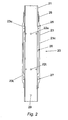
- FIG. 1 shows an apparatus 10 for use in the methods .
- a tubing is generally designated at 1 and provided with two sets of circumferential equi-spaced holes through its sidewall; upper ports 2u and lower ports 2L. It should be noted that the tubing 1 can be casing, liner or indeed production tubing that is intended to be permanently set or completed in an open borehole.
- tubing 1 will be referred to as casing 1.
- the casing 1, as shown in Fig. 1 could be a standard length of casing manufactured in accordance with API standards. Alternatively the casing 1 shown in Fig. 1 may be replaced by a custom made mandrel. However, it should be noted that casing 1 could be modified by only providing one set of ports 2 which could be located at the middle of the length of the casing 1, and furthermore could be modified by only providing one such port 2.
- Casing 1 is located coaxially within sleeve 3.
- the casing 1 may be either especially manufactured or alternatively is preferably conventional steel casing with ports 2 formed therein.
- the sleeve 3 is typically 316L or Alloy 28 grade steel but could be any other suitable grade of steel or any other metal material or any other suitable material. As shown in Fig.
- an elastomer 201 or other deformable material is bonded to the outside of the sleeve 3; this may be as a single coating but is preferably a multiple of bands 201 with gaps therebetween.
- the bands 201 or coating may have a profile or profiles machined into them.
- the apparatus 10 comprises a sleeve 3 which is a steel cylinder with tapered upper and lower ends 3u and 3L and an outwardly waisted central section 3c having a relatively thin sidewall thickness.
- Sleeve 3 circumferentially surrounds casing 1 and is attached thereto at its upper end 3u and lower end 3L, via pressure-tight welded connections 4.
- Upper O-ring seals 5u are also provided towards the upper end of sleeve 3u but interior of the upper welded connection 4.
- lower seals 5L are positioned towards the lower end of sleeve 3L but are also positioned interior of the lower welded connections. Seals 5u and 5L are in direct contact with the exterior of the casing and the ends of the sleeve, 3u and 3L thereby providing a pressure tight connection between the interior of sleeve 3 and the exterior of casing 1 and thus act as a secondary seal or backup to the seal provided by the welded connections 4.
- Ports 2u and 2L permit fluid communication between the interior or throughbore of casing 1 and chamber 6.
- FIG. 2 A second aspect of an apparatus 20 is shown in Fig. 2 and comprises a sleeve 23 which is substantially cylindrical in shape with upper and lower ends 23u, 23L and an outwardly waisted central section and is arranged co-axially around casing 21 which is similar to casing 1 of Fig. 1 .
- Sleeve 23 is secured at its upper end 23u to the casing 21 by means of a mechanical clamp 28.
- a pair of seal members 25 are also provided in the form of O-rings to provide a pressure tight connection between the upper end of the sleeve 23u and the exterior of the casing 21.
- Sleeve 23 has a lower end 23L which is provided with a pair of sliding O-ring seals 27.
- the exterior of the casing 21 in the region of the seals 25, 27 is preferably prepared by machining to improve the surface condition thereby achieving a more reliable connection between the seals 25, 27 and the exterior of the casing 21.
- Chamber 26 can be filled with pressurised fluid such as hydraulic fluid to cause expansion of the waisted central section of the sleeve member 23c in the radially outward direction, which causes simultaneous upwards movement of the sliding seals 27, which has the advantage over the first aspect of the sleeve 3 that the thickness of the sidewall of the outwardly waisted central section 23c is not further thinned by the radially outwards expansion.
- pressurised fluid such as hydraulic fluid to cause expansion of the waisted central section of the sleeve member 23c in the radially outward direction, which causes simultaneous upwards movement of the sliding seals 27, which has the advantage over the first aspect of the sleeve 3 that the thickness of the sidewall of the outwardly waisted central section 23c is not further thinned by the radially outwards expansion.
- any such upwards movement should be restricted such that the ports 22L, 22u in the sidewall of casing 21 remain within chamber 26.
- FIG. 3 A further aspect of apparatus 30 is shown in Fig. 3 , where the apparatus 30 is arranged in a similar manner to the apparatus 10, 20 of Figs. 1 and 2 .
- sleeve 33 of Fig. 3 is attached to casing 31 at both the upper end 33u and lower end 33L by clamps 39.
- Clamps 39 are provided to hold the ends of sleeve 33 in position to prevent the sleeve 33 becoming dislodged when the casing 31 is run into the wellbore.
- Clamp 39 at the upper end 33u of the sleeve will allow sleeve 33 to move in a downward direction enabling expansion thereof.
- upwards movement of the upper end 33u is prevented by clamp 39 which acts as an impediment.
- clamp 39 at the lower sleeve end 33L prevents downward movement, but will permit the lower sleeve end 33L to move upwardly.
- the clamps 39 also ensure that the sleeve 33 maintains the correct position in relation to the ports 32. Additionally, the clamps 39 maintain the sleeve in position over a section of casing 31 with prepared external surfaces. The surfaces can be prepared by machining and optimise the effectiveness of the two pairs of seals 35.
- Isolation barrier apparatus 10, 20, or 30 is conveyed into the borehole by any suitable means, such as incorporating the apparatus into a casing or liner string and running the string into the wellbore until it reaches the location within the open borehole at which operation of the apparatus 10, 20, 30 is intended.
- This location is normally within the borehole at a position where the sleeve 3, 23, 33 is to be expanded in order to, for example, isolate the section of borehole 180a located above the sleeve 3, 23, 33 from that below 180b in order to provide zonal isolation in order that a frac'ing or stimulation operation can be performed on the formation 180b located in between the two sleeves 43a, 43b as will be described subsequently.
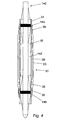
- Expansion of the sleeve member 3, 23, 33 can be effected by a hydraulic expansion tool such as that shown in Fig. 4.
- Fig. 4 shows tool 140 inserted into the casing section 31 shown in Fig. 3 .
- tool 140 can be run into the casing string from surface by means of a drillpipe string or other suitable method.
- the tool 140 is provided with upper and lower seal means 145, which are operable to radially expand to seal against the inner surface of the casing section 31 at a pair of spaced apart locations in order to isolate an internal portion of casing 31 located between the seals 145; it should be noted that said isolated portion includes the fluid ports 32.
- Tool 140 is also provided with an aperture 142 in fluid communication with the interior of the casing 31.
- seal means 145 are actuated from the surface (in a situation where drillpipe or coiled tubing is used) to isolate the portion of casing. Fluid, which may be hydraulic fluid, is then pumped under pressure through the coiled tubing or drillpipe such that the pressurised fluid flows through tool aperture 142 and then via ports 32 into chamber 36.
- Tool 140 would operate in a similar manner when inserted into casing 1, 21 of Figs. 1 and 2 .
- a pump motor is operated to pump fluid from a hydraulic fluid reservoir possibly through a pressure intensifier (depending upon final expansion pressure required) into chambers 6, 26, 36 through aperture 142 via ports 2, 22, 32.
- the increase in pressure of hydraulic fluid directly then causes the sleeve 3, 23, 33 to move radially outwardly and seal against a portion of the inner circumference of the borehole 153.
- the pressure within the chambers 6, 26, 36 continues to increase such that the sleeve 3, 23, 33 initially experience elastic expansion followed by plastic deformation.
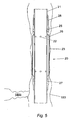
- the sleeve 3, 23, 33 expands radially outwardly beyond its yield point, undergoing plastic deformation until the sleeve 3, 23, 33 bears against the inner surface of the borehole 153 as shown in Fig. 5 .
- the pressurised fluid within the chambers 6, 26, 36 can be bled off following plastic deformation of the sleeve 3, 23, 33. Accordingly, the sleeve 3, 23, 33 has been plastically expanded by hydraulic fluid pressure and without any mechanical expansion means being required
- Fig. 5 shows the casing 21 of Fig. 2 with sleeve 22 in its expanded configuration, bearing against the borehole wall 153.
- Chamber 26 is filled with pressurised fluid which is prevented from exiting the chamber 26 by means of optional check valves (not shown in Fig. 5 but shown in Fig. 14 and described subsequently) attached to ports 22 to maintain the sleeve 23 in an expanded condition; the check valves permit the flow of pressurised fluid from the throughbore 17, 29 into the chamber 6, 26 but prevent the flow of fluid in the reverse direction.
- a burst disk (not shown in Fig. 5 but shown in Figs. 13 and 14 and described subsequently) will preferably also be provided in the side wall of the sleeve 23.
- pressurised chemical fluid can be pumped into chamber 26 to expand sleeve 22, as hereinbefore described. Once expanded the sleeve 22 may be maintained in position by check valves or the chemical fluid can be selected such that it sets in place after a certain period of time.
- a chemical fluid could be cement but it should be noted that such chemical fluids need not be employed because the sleeve 22 will retain its expanded shape once the expansion fluid pressure is removed.
- the ports 22 may be provided with a burst disk (not shown) therein, which will prevent fluid flow through the ports 22 until an operator intentionally ruptures the disks by applying hydraulic fluid pressure from the throughbore 17, 29 to the inner face of the disk until the pressure is greater than the rated strength of the disk.
- a burst disk (not shown) therein, which will prevent fluid flow through the ports 22 until an operator intentionally ruptures the disks by applying hydraulic fluid pressure from the throughbore 17, 29 to the inner face of the disk until the pressure is greater than the rated strength of the disk.
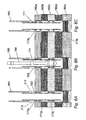
- Fig. 6 shows a sequence for expanding two sleeve members. Different formations are indicated by reference numerals 180 a-e.
- Fig. 6a shows the aspect where a perforated liner/casing 171 is attached at its upper end by any suitable means such as a liner hanger to the lower end of a cemented casing 160.
- Liner 171 is provided with two sleeves 173u, 173L sealed thereto and similar to those previously described.
- the liner 171 is perforated at location 171 p, where perforation location 171 p is chosen such that it is substantially aligned with formation 180b that requires to be frac'd.
- Fig. 6b shows the perforated liner 171 of Fig. 6a in a borehole 163 with a hydraulic expansion tool 190 inserted therein.
- the sleeves 173u, 173L isolate formation 180b (which may be a hydrocarbon producing zone which requires to be frac'd) from the zones above and below 180a, 180c to 180e (which may be, for example water producing zones) and thus provide a means of achieving zonal isolation.
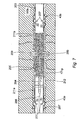
- Fig 7 shows a cross sectional view of a perforated liner 205 and two sleeves 43a, 43b which have been expanded by the hydraulic expansion tool 140 or 190.
- the liner 203 comprises a perforated liner section 205 located in between the pair of sleeves 43a, 43b and the perforated liner section 205 is shown as being aligned with a section of the formation 180b that requires to be frac'd.
- Fig. 7 shows the borehole after the hydraulic expansion tool 140 or 190 has been withdrawn from the well and the inner bore of the liner string 203 has been closed at some point vertically below the lower most sleeve member 43b by any conventional means such as for instance dropping a ball (not shown) from the surface such that it lands on a seat (not shown) that is located in the throughbore of the liner 203 at the location to be closed (i.e. below the perforations) or more preferably setting a plug (not shown) below the perforations.
- frac fluid can be pumped down the liner string 203 either all the way from the surface or through a frac fluid supply conduit 208 that is run into the liner string 203 and into the vicinity of the perforated liner section 205.
- the supply of frac fluid in this way means that frac fluid pressure 204 is applied to the inside of the sleeves 43a, 43b in the direction of arrows 207, perforated liner 205 in the direction of arrows 209 and to the outside of one side of each sleeve 43a, 43b in the direction of arrows 211a, 211b.
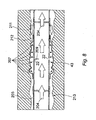
- Fig. 8 is a close up view of one of the sleeves 43 shown in Fig. 7 ; the sleeve 43 has already been expanded and is therefore in contact with the borehole 213 and shows the sleeve 43 operating as a barrier to the frac pressure 211 travelling further along the annulus 212 of the borehole 213 in the direction of arrow 211.
- the performance of the isolation is improved by the frac pressure also acting on the inside of the sleeve 43 in the direction of arrow 207 thereby pushing it into closer contact with the borehole 213.
- Fig. 9 is an embodiment of the invention whereby elastomer bands 201 are bonded to the outside surface of the sleeve 43.
- the elastomer bands 201 are annular ring shaped and are spaced apart along the longitudinal axis of the sleeve 43 such that when the sleeve 43 is expanded, the bands 201 will contact the inside surface of the outer structure or borehole 213 first and therefore the portion 43b of the sleeve 43 immediately behind the band 201 will tend to be prevented from any further expansion.
- the rest of the sleeve 43 i.e.
- corrugations 216 have the great advantage that they increase the stiffness of the sleeve 43 and increase its resistance to collapse forces, as will be described subsequently in greater detail in relation to Figs. 11 to 13 and particularly as shown in Fig. 11 (d) .
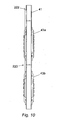
- Fig. 10 shows two of the sleeves 43a, 43b connected with a hydraulic control line 220.
- the hydraulic control line 220 is terminated at each sleeve 43a, 43b and at a port 222 in the liner 203 some point higher up in the well; indeed, this control line 220 may extend all the way to surface.
- Fig. 11 a shows a preferred aspect of an apparatus 300 which comprises a number of spaced apart elastomeric bands 201 which comprise a width W and which are spaced apart from each by gaps 202 which consist of distance S, where the elastomeric bands 201 also comprise a radial height H.
- the elastomeric bands 201 are preferably arranged substantially equi-spaced along the length of the outer surface of the sleeve 43 in between the two ends 303U and 303L.
- the width W of the bands 201 is preferably greater than the gap distance S.
- the ends 303U, 303L are preferably arranged to be as wide in diameter as possible and more preferably the outer diameter of each of the concentric annular elastomeric rings 201 also have an outer diameter as great as possible but no greater than the outer diameter of the ends 303U, 303L such that the elastomeric rings 201 will to some extent be protected when running into the hole 213.
- each of the ends 303U, 303L comprises an end nut 305 which is secured to the casing 41 by suitable means such as being locked thereto, etc..
- a seal section housing 307 which is screwed fast to the end nut 305 and which surrounds a suitable arrangement of seals 309 which in use will prevent any fluid from exiting the chamber 26 created when the sleeve 43 is expanded.
- the inner most ends of the respective seal section housings 307 are secured to the respective ends of the sleeve 43 by welding 308.
- a weld shroud 310 is provided co-axially about the outer surface of the welding 308 and the respective end of the sleeve 43 and the inner most end of the sealed section housing 307, where the weld shroud 310 is secured to the inner most end of the sealed section housing 307 via suitable screw threaded connection 311 but alternatively could be secured via welding (not shown).
- the weld shroud 310 is formed from a very strong metal relative to the strength of the metal that forms the sleeve 43 and this provides the advantage that, when the sleeve 43 is expanded by for instance the expander tool 140 or 190, the weld shroud 310 prevents the outer ends of the sleeve 43 and therefore the weld 308 from expanding, at least to a certain extent, such that there is a much lower risk of the weld 308 expanding when compared to the sleeve 43 and therefore the weld 308 is protected by the weld shroud 310.
- the weld shroud 310 could be made from the same material as the sleeve 43 and the weld shroud 310 protects the weld 308 simply
- Fig. 12 shows a further aspect of apparatus 400, where the apparatus 400 is arranged in a similar manner to the apparatus 300 of Fig. 11A .
- the sleeve 43 of the apparatus 400 is provided with many more elastomeric bands 401 than the apparatus 300.
- elastomeric bands 403 that are more narrow than the rest of the elastomeric bands 401 including a narrower elastomeric band 403c positioned at the very centre point of the apparatus 400 and such narrower bands 403 have the advantage that they provide relatively higher contact pressure and therefore better seating capabilities, as will be discussed in more detail subsequently.
- Fig. 13 shows a further aspect of apparatus 500, where the apparatus 500 is arranged in a similar manner to the apparatus 300 of Fig. 11 a and 400 of Fig. 12 .
- the apparatus 500 comprises a much fewer number of elastomeric bands 501.
- different apparatus 300, 400 and 500 can be chosen by the operator depending on the type of formation 180b that is to be isolated from the rest of the formation 180a, 180c.
- the elastomeric bands 201, 401 and 501 are applied to the outer surface of the constant outer diameter sleeve 43 such that the elastomeric bands 201, 401 and 501 stand proud of the gaps 202, 402, 502.
- the elastomeric bands 201, 401, 501 are bonded directly to the expandable sleeve 43 and are preferably formed from HNBR (hydrogenated nitrile rubber) with a suitable hardness such as in the region of 75 although other materials and hardnesses may be suitable depending on the application and the formation 180.
- HNBR hydrogenated nitrile rubber
- the outer surface of the elastomeric bands 201, 401, 501 may be smooth but it may be possible to provide detail machined onto the outer surface (such as a roughness) as this may provide additional sealing qualities.
- the distance S of spacing 202, 402, 502 can be configured to allow or permit the maximum expansion 43g of the sleeve 43 between each band 201, 401, 501 into the inner surface of the borehole 213, such that a corrugation effect 216 such as that shown in Fig. 11 (d) will be experienced by the metal material of the sleeve 43.
- This corrugation effect 216 provides an improvement to the collapse resistance of the sleeve 43 and increases the effectiveness of each elastomeric band 201, 401, 501 as a seal in that the bending of the steel of the sleeve 43 at location 43g will tend to pinch the edge 201 e of each elastomeric band 201, 401, 501, thus causing a higher contact pressure between the elastomeric band 201, 401, 501 and the inner surface of the borehole 213 and the outer surface 43b of the sleeve 43 with which it is in contact with.
- each elastomeric band 201, 401, 501 is important to its sealing capabilities in that shorter or narrower elastomeric bands 201, 401, 501 tend to provide higher contact pressure, although the optimum width W depends on whether the sealing capability, the axial load capacity or a combination of both are important.
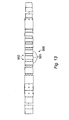
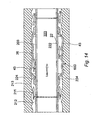
- Fig. 14 shows a further alternative but preferred aspect of apparatus 600 and which is very similar to the apparatus 500 shown in Fig. 13 (although the elastomeric bands 501 are not shown in Fig. 14 ).
- the apparatus 600 has the further features of having a one way fluid flow check valve 222 provided through the side wall of the casing 203 within port 22.
- the check valve 222 is arranged such that it permits fluid flow from the throughbore 223 of the casing 203 into the chamber 26 and prevents fluid from passing in the reverse direction from the chamber 26 into the throughbore 223. Accordingly, when the sleeve 43 is expanded by pumping highly pressurised fluid into the chamber 26, that fluid will remain in the chamber 26, even if the fluid pressure in the throughbore 223 is bled off.
- At least one burst disk 224 is also provided in a port formed all the way through the side wall of the sleeve 43 or through the sidewall of the seal carrier 307, but is importantly only provided at the end of the sleeve 43 that will be closest to the perforated section of the casing 203 and therefore, will be closest to the end of the sleeve 43 that will see the high pressure of the frac fluid when it is pumped.
- the burst disk 224 will be arranged to burst and therefore let fluid within the chamber 26 to flow into the annulus 212 in the location of the formation 180b to be frac'd in order to protect the rest of the sleeve 43, in situations where there is a pre-determined pressure differential across it.
- the burst disk 224 can be intentionally sacrificed in order to protect the rest of the sleeve 43 when a certain pressure differential is experienced - say 5,000 psi.
- the burst disk 224 can be intentionally burst to allow the high pressure fluid from the high pressure zone of the annulus 212 into chamber 26 to reinforce the sleeve 26.
- the apparatus 600 will be inflated by for instance an expansion tool 140 or 190 as hereinbefore described such that fluid is pumped through the check valve 222 to inflate the sleeve 43.
- the rupture disk 224 is arranged to burst such that fluid can then communicated between the high pressure zone 211 of the annulus 212 and the chamber 26.
- a pressure relief valve (not shown) can also be provided within another port 22 formed through the sidewall of the casing or liner 203 where the pressure relief valve allows fluid to pass from the chamber 26 back into the throughbore 17, 29, 223 of the liner 203 if it exceeds a predetermined pressure differential.
- This could be particularly important in situations where it is anticipated that the pressure in the chamber 26 may increase significantly such as due to a temperature increase in the fluid trapped therein when production of the well is started. If such a pressure relief valve were not provided then there may be a possibility that the tubing 203 or the sleeve 43 could collapse or burst due to such a pressure increase. Accordingly, the presence of such a pressure relief valve will permit some of the trapped and over pressurised fluid to escape the chamber 26 back into the throughbore 223.
- another port 22 may also be provided with a burst disk (not shown) therein, which will prevent fluid flow through the ports 22 from the throughbore 17, 29, 223 into the chamber 6, 26, 36 until an operator intentionally ruptures said burst disk by applying hydraulic fluid pressure in the throughbore 17, 29, 223 which acts on the inner face of said burst disk until the pressure is greater than the rated strength of the disk.
- a burst disk in another port 22 provides the advantage that the operator can choose when to allow hydraulic fluid into the chamber 6, 26, 36 and therefore when to begin expansion of the sleeve 3, 23, 33, 43.
- the frac fluid hereinbefore described could be conventional frac fluid (i.e. incorporating relatively small rigid spheres which act to keep the fractures in the reservoir from reclosing after the frac fluid pressure is removed) or could be e.g. acid, steam, CO 2 or any other suitable gas or liquid used in a stimulation or injection or reinjection operation.
Landscapes
- Engineering & Computer Science (AREA)
- Life Sciences & Earth Sciences (AREA)
- Geology (AREA)
- Mining & Mineral Resources (AREA)
- Physics & Mathematics (AREA)
- Environmental & Geological Engineering (AREA)
- Fluid Mechanics (AREA)
- General Life Sciences & Earth Sciences (AREA)
- Geochemistry & Mineralogy (AREA)
- Mechanical Engineering (AREA)
- Earth Drilling (AREA)
- Investigation Of Foundation Soil And Reinforcement Of Foundation Soil By Compacting Or Drainage (AREA)
Claims (14)
- Verfahren zum Durchführen einer Zonenisolation während einem Fracverfahren mit einem Casing-/Liner-Strang (171, 203, 205), der vorperforiert ist, wobei das Verfahren die folgenden Schritte umfasst:a) Bohren des Bohrlochs (163, 213);b) Einführen der Completion-Ausrüstung, die in Form eines Casing-/Liner-Strangs gegeben sein kann und die vorgesehen ist, dauerhaft in dem offenen Bohrloch installiert zu bleiben, wobei wenigstens eine Zonenisolationsvorrichtung an dem Casing-/Liner-Strang vorgesehen ist oder diesem zugeordnet ist, wobei die Zonenisolationsvorrichtung ein Hülsenelement (43a, 43b, 173) umfasst, das eine Kammer definiert, in die Druckfluid durch eine Öffnung (22) in dem Casing-/Liner-Strang eingeführt werden kann, die von dem Hülsenelement umgeben ist, um das Hülsenelement dauerhaft nach außen in Richtung des offenen Bohrlochs auszudehnen;c) Einführen eines Werkzeugs (140, 190) in die Durchgangsbohrung (17, 29, 223) des Casing-/Liner-Strangs in die Umgebung des vorperforierten Liners, und Betreiben des Werkzeugs, um Druckfluid in die Durchgangsbohrung des Casing-/Liner-Strangabschnitts einzuführen, um die Zonenisolationsvorrichtung(en) auszudehnen und dadurch zu aktivieren, so dass die wenigstens eine Zonenisolationsvorrichtung eine Abdichtung an dem offenen Loch vorsieht; und Wiederholen von Schritt c) für jede bzw. alle weitere(n) erforderliche(n) Zonenisolationsvorrichtung(en), und sobald Schritt c) abgeschlossen ist, Entfernen des Werkzeugs aus Schritt c) aus dem Bohrloch;d) Verschließen der inneren Bohrung des Casing-/Liner-Strangs an einem bestimmten Punkt vertikal unter der untersten Zonenisolationsvorrichtung;e) Zuführen von Frac-Fluid (204) durch die Perforationen in dem Casing-/Liner-Strang an die Zone (180b), die zur Durchführung des Fracverfahrens einer Fracbehandlung unterzogen werden muss; undf) Wiederholen der Schritte c), d) und e) wie dies für jede zusätzliche Zone erforderlich ist, bei der eine Fracbehandlung vorgenommen werden soll;
wobei der Druck des in Schritt e) zugeführten Frac-Fluids nicht nur auf die Außenseite der Zonenisolationsvorrichtung wirkt, sondern auch auf das Innere der Zonenisolationsvorrichtung, direkt aus der Durchgangsbohrung des Casing-/Liner-Strangs über die gleiche Öffnung, um die dadurch vorgesehene Abdichtung zu verbessern. - Verfahren zum Durchführen einer Zonenisolation während einem Fracverfahren mit einem Casing-/Liner-Strang (1), der nicht vorperforiert ist, wobei das Verfahren die folgenden Schritte umfasst:a) Bohren des Bohrlochs (163, 213);b) Einführen der Completion-Ausrüstung, die in Form eines Casing-/Liner-Strangs gegeben sein kann und die vorgesehen ist, dauerhaft in dem offenen Bohrloch installiert zu bleiben, wobei wenigstens eine Zonenisolationsvorrichtung an dem Casing-/Liner-Strang vorgesehen ist oder diesem zugeordnet ist, wobei die Zonenisolationsvorrichtung ein Hülsenelement (43a, 43b, 173) umfasst, das eine Kammer (26) definiert, in die Druckfluid durch eine Öffnung (22) in dem Casing-/Liner-Strang eingeführt werden kann, die von dem Hülsenelement umgeben ist, um das Hülsenelement dauerhaft nach außen in Richtung des offenen Bohrlochs auszudehnen;c) unter Druck setzen der Durchgangsbohrung (17, 29, 223) des Casing-/Liner-Strangabschnitts, um die Zonenisolationsvorrichtung(en) zu aktivieren und dadurch auszudehnen, indem Druckfluid von der Durchgangsbohrung und durch die Öffnung in dem Casing-/Liner-Strang fließt, umgeben von dem Hülsenelement der entsprechenden Zonenisolationsvorrichtung;d) Öffnen wenigstens eines Fluidkommunikationskanals von dem Liner zu der Frac-Zone;e) Zuführen von Frac-Fluid in die Durchgangsbohrung des Casing-/Liner-Strangs;f) Ermöglichen, dass das Frac-Fluid von der Durchgangsbohrung durch den wenigstens einen Kommunikationskanal und in die Zone (180b) fließt, die einer Fracbehandlung unterzogen werden muss, um das Fracverfahren auszuführen;g) Wiederholen von Schritt d) für jede zusätzliche einer Fracbehandlung zu unterziehende Zone;
wodurch der Frac-Druck nicht nur auf die Außenseite der Zonenisolationsvorrichtung wirkt, sondern auch auf das Innere der Zonenisolationsvorrichtung, direkt von der Durchgangsbohrung des Casing-/Liner-Strangs über die gleiche Öffnung, um die dadurch vorgesehene Abdichtung zu verbessern. - Verfahren nach Anspruch 2, wobei Schritt d) durch Perforieren des Casing-/Liner-Strangs ausgeführt wird.
- Verfahren nach Anspruch 2, wobei Schritt d) durch Öffnen einer Schiebehülse ausgeführt wird, um Öffnungen in dem Liner freizulegen, und wobei Schritt g) das Verschließen der Schiebehülse nach Bedarf aufweist.
- Verfahren nach einem der vorstehenden Ansprüche, wobei Hochdruckfluid in das Bohrloch gepumpt und auf eine bestimmte Zone gerichtet wird.
- Verfahren nach einem der vorstehenden Ansprüche, wobei der Casing-Abschnitt oder der Liner so gestaltet ist, dass er einer Reihe von Kräften widersteht, wie etwa Zusammenfallen, Bersten und Zugspannungsbruch sowie chemisch aggressiven Fluids.
- Verfahren nach einem der vorstehenden Ansprüche, wobei die Casing-Abschnitte mit Außengewinden an jedem Ende gefertigt sind und über kurze Kopplungen mit Innengewinden verbunden werden.
- Verfahren nach einem der Ansprüche 1 bis 6, wobei die Verbindungen des Casings an einem Ende mit Außengewinden und an dem anderen Ende mit Innengewinden gefertigt sind.
- Verfahren nach einem der vorstehenden Ansprüche, wobei der Casing-Abschnitt oder Liner aus unlegiertem Kohlenstoffstahl, Aluminium, Titan oder Fiberglas gefertigt ist.
- Verfahren nach einem der vorstehenden Ansprüche, wobei das Hülsenelement Metall umfasst, dass, wenn es sich ausdehnt, eine elastische und plastische Verformung erfährt.
- Verfahren nach einem der vorstehenden Ansprüche, wobei ein Rückschlagventil (222) in der Öffnung (22) vorgesehen ist, wobei ferner auch wenigstens eine Berstscheibe (224) in einer Öffnung vorgesehen ist, die ganz durch eine Seitenwand des Hülsenelements (43) an einem Ende der Hülse (43) ausgebildet ist, das am nächsten an dem perforierten Abschnitt des Casings (203) liegt und somit am nächsten an dem Ende der Hülse, welche den hohen Druck des Frac-Fluids erfährt, wenn dieses gepumpt wird, und wobei die Berstscheibe so angeordnet ist, dass sie zerberstet und Fluid in die Kammer (26) lässt, so dass dieses in den Ring (212) an der Position der einer Fracbehandlung zu unterziehenden Formation (180b) fließt, um den Rest der Hülse in Situationen zu schützen, in denen daran ein vorbestimmter Druckunterschied existiert.
- Verfahren nach Anspruch 11, wobei die Berstscheibe (224) vorsätzlich zum Zerbersten gebracht wird, damit das Hochdruckfluid aus der Hochdruckzone des Rings in die Kammer eindringen kann, um die Hülse zu verstärken.
- Verfahren nach Anspruch 11 oder 12, wobei ein Druckentlastungsventil in einer anderen durch die Seitenwand des Casings oder Liners (203) ausgebildeten Öffnung (22) vorgesehen ist, wobei das Druckentlastungsventil es ermöglicht, dass Fluid von der Kammer (26) zurück in die Durchgangsbohrung (17, 29, 223) des Liners (203) verlaufen kann, wenn ein vorbestimmter Druckunterschied überschritten wird.
- Verfahren nach einem der vorstehenden Ansprüche, wobei die Öffnung (22) darin mit einer Berstscheibe versehen ist, die es verhindert, dass Fluid durch die Öffnung von der Durchgangsbohrung (17, 29, 223) in die Kammer (26) fließt, bis eine Bedienungsperson vorsätzlich die Berstscheibe zum Zerbersten bringt, indem ein Hydraulikfluiddruck in der Durchgangsbohrung ausgeübt wird, der auf die Innenseite der Berstscheibe wirkt, bis der Druck höher ist als die Nennstärke der Scheibe.
Priority Applications (1)
| Application Number | Priority Date | Filing Date | Title |
|---|---|---|---|
| PL13194091T PL2728107T3 (pl) | 2009-05-27 | 2010-05-27 | Pakowarka aktywnej zewnętrznej obudowy (ECP) do operacji szczelinowania prowadzonych w szybach naftowych i gazowych |
Applications Claiming Priority (2)
| Application Number | Priority Date | Filing Date | Title |
|---|---|---|---|
| GBGB0909086.1A GB0909086D0 (en) | 2009-05-27 | 2009-05-27 | An active external casing packer (ecp) for frac operations in oil and gas wells |
| EP10735311.2A EP2435656B1 (de) | 2009-05-27 | 2010-05-27 | Aktiver verrohrungsaussenpacker (ecp) für spaltenbildungsvorgänge in öl- und gasbohrlöchern |
Related Parent Applications (1)
| Application Number | Title | Priority Date | Filing Date |
|---|---|---|---|
| EP10735311.2A Division EP2435656B1 (de) | 2009-05-27 | 2010-05-27 | Aktiver verrohrungsaussenpacker (ecp) für spaltenbildungsvorgänge in öl- und gasbohrlöchern |
Publications (2)
| Publication Number | Publication Date |
|---|---|
| EP2728107A1 EP2728107A1 (de) | 2014-05-07 |
| EP2728107B1 true EP2728107B1 (de) | 2015-10-07 |
Family
ID=40863028
Family Applications (5)
| Application Number | Title | Priority Date | Filing Date |
|---|---|---|---|
| EP13194022.3A Active EP2711498B1 (de) | 2009-05-27 | 2010-05-27 | Aktiver externer Gehäusepacker (ECP) für Frac-Operationen in Öl- und Gasbohrlöchern |
| EP10735311.2A Active EP2435656B1 (de) | 2009-05-27 | 2010-05-27 | Aktiver verrohrungsaussenpacker (ecp) für spaltenbildungsvorgänge in öl- und gasbohrlöchern |
| EP13194080.1A Withdrawn EP2728106A1 (de) | 2009-05-27 | 2010-05-27 | Aktiver Außengehäusepacker (ECP) für Frac-Operationen in Öl- und Gasbohrlöchern |
| EP13194091.8A Not-in-force EP2728107B1 (de) | 2009-05-27 | 2010-05-27 | Aktiver Außengehäusepacker (ECP) für Frac-Operationen in Öl- und Gasbohrlöchern |
| EP13194070.2A Active EP2728105B1 (de) | 2009-05-27 | 2010-05-27 | Aktiver Außengehäusepacker (ECP) für Frac-Operationen in Öl- und Gasbohrlöchern |
Family Applications Before (3)
| Application Number | Title | Priority Date | Filing Date |
|---|---|---|---|
| EP13194022.3A Active EP2711498B1 (de) | 2009-05-27 | 2010-05-27 | Aktiver externer Gehäusepacker (ECP) für Frac-Operationen in Öl- und Gasbohrlöchern |
| EP10735311.2A Active EP2435656B1 (de) | 2009-05-27 | 2010-05-27 | Aktiver verrohrungsaussenpacker (ecp) für spaltenbildungsvorgänge in öl- und gasbohrlöchern |
| EP13194080.1A Withdrawn EP2728106A1 (de) | 2009-05-27 | 2010-05-27 | Aktiver Außengehäusepacker (ECP) für Frac-Operationen in Öl- und Gasbohrlöchern |
Family Applications After (1)
| Application Number | Title | Priority Date | Filing Date |
|---|---|---|---|
| EP13194070.2A Active EP2728105B1 (de) | 2009-05-27 | 2010-05-27 | Aktiver Außengehäusepacker (ECP) für Frac-Operationen in Öl- und Gasbohrlöchern |
Country Status (10)
| Country | Link |
|---|---|
| US (2) | US9217308B2 (de) |
| EP (5) | EP2711498B1 (de) |
| CN (1) | CN102459806B (de) |
| BR (1) | BRPI1012915A2 (de) |
| DK (2) | DK2435656T3 (de) |
| GB (1) | GB0909086D0 (de) |
| HU (1) | HUE026584T2 (de) |
| MY (1) | MY163721A (de) |
| PL (2) | PL2728107T3 (de) |
| WO (1) | WO2010136806A2 (de) |
Families Citing this family (65)
| Publication number | Priority date | Publication date | Assignee | Title |
|---|---|---|---|---|
| US9551201B2 (en) | 2008-02-19 | 2017-01-24 | Weatherford Technology Holdings, Llc | Apparatus and method of zonal isolation |
| CA2749636C (en) | 2010-02-18 | 2014-05-06 | Ncs Oilfield Services Canada Inc. | Downhole tool assembly with debris relief, and method for using same |
| DK2466065T3 (da) | 2010-12-17 | 2013-05-27 | Welltec As | Brøndkomplettering |
| EP2659090B1 (de) * | 2010-12-27 | 2017-08-23 | Seven Generations Energy Ltd. | Verfahren zum bohren und stimulieren unterirdischer formationen zur rückgewinnung von kohlenwasserstoff- und erdgasressourcen |
| US20120193088A1 (en) * | 2011-01-31 | 2012-08-02 | Mohawk Energy Ltd. | Expandable Compliant Anchor/Seal |
| EP2599956A1 (de) | 2011-11-30 | 2013-06-05 | Welltec A/S | Ringförmiges Barrieresystem mit Flusslinien |
| GB201202640D0 (en) | 2012-02-16 | 2012-04-04 | Simpson Neil A A | Swaged friction reducing collar |
| CA2798343C (en) | 2012-03-23 | 2017-02-28 | Ncs Oilfield Services Canada Inc. | Downhole isolation and depressurization tool |
| US9260930B2 (en) * | 2012-08-30 | 2016-02-16 | Halliburton Energy Services, Inc. | Pressure testing valve and method of using the same |
| FR2996247B1 (fr) * | 2012-10-03 | 2015-03-13 | Saltel Ind | Procede de fracturation hydraulique et materiel correspondant |
| CN103015942B (zh) * | 2012-12-28 | 2016-01-20 | 中国石油集团川庆钻探工程有限公司 | 一种欠平衡套管封隔完井工艺方法 |
| GB2511503B (en) * | 2013-03-04 | 2019-10-16 | Morphpackers Ltd | Expandable sleeve with pressure balancing and check valve |
| US20140345869A1 (en) * | 2013-05-21 | 2014-11-27 | Matthew C. Manulik | Moving liner fracturing method |
| GB2517207A (en) * | 2013-08-16 | 2015-02-18 | Meta Downhole Ltd | Improved isolation barrier |
| WO2015039097A2 (en) * | 2013-09-16 | 2015-03-19 | Target Completions, LLC | Mandrel-less launch toe initiation sleeve (tis) |
| FR3016389B1 (fr) | 2014-01-10 | 2016-01-08 | Saltel Ind | Dispositif d'isolation pour puits |
| GB2522205A (en) * | 2014-01-15 | 2015-07-22 | Meta Downhole Ltd | Improved isolation barrier |
| EP2947259A1 (de) * | 2014-05-19 | 2015-11-25 | Welltec A/S | Bohrlochstrang zum Bohren durch eine Unterdruckzone |
| GB2526355A (en) * | 2014-05-22 | 2015-11-25 | Meta Downhole Ltd | Improved isolation barrier |
| GB2526354A (en) * | 2014-05-22 | 2015-11-25 | Meta Downhole Ltd | Improved isolation barrier |
| GB2526596B (en) | 2014-05-29 | 2020-10-07 | Schlumberger B V | Morphable apparatus |
| US20160024894A1 (en) | 2014-07-23 | 2016-01-28 | Meta Downhole Limited | Completion System |
| GB201417671D0 (en) | 2014-10-07 | 2014-11-19 | Meta Downhole Ltd | Improved isolation barrier |
| GB201417841D0 (en) | 2014-10-08 | 2014-11-19 | Meta Downhole Ltd | Morphable Packer |
| CN105569603A (zh) * | 2014-10-14 | 2016-05-11 | 中国石油天然气股份有限公司 | 一种用于高温完井的密封装置 |
| WO2016063048A1 (en) | 2014-10-25 | 2016-04-28 | Meta Downhole Limited | Improved isolation barrier |
| FR3028879B1 (fr) * | 2014-11-20 | 2018-01-05 | Saltel Industries | Procede de stimulation hydraulique et dispositif de stimulation hydraulique correspondant |
| WO2017007475A1 (en) * | 2015-07-09 | 2017-01-12 | Halliburton Energy Services, Inc. | Wellbore plug sealing assembly |
| CN106194099A (zh) * | 2016-07-17 | 2016-12-07 | 李梦瑶 | 气控井下封隔器 |
| KR101653609B1 (ko) * | 2016-08-04 | 2016-09-02 | 주식회사 성지엔지니어링 | 심정 대수층 지하수 조사장치 |
| EP3309351A1 (de) * | 2016-10-12 | 2018-04-18 | Welltec A/S | Expansionsanordnung |
| DK3526440T3 (da) * | 2016-10-12 | 2024-02-12 | Welltec Oilfield Solutions Ag | Ekspansionssamling |
| CN106593315B (zh) * | 2016-12-28 | 2019-02-15 | 中国石油天然气集团公司 | 防止套管变形的组合套管 |
| WO2018178053A1 (en) * | 2017-03-27 | 2018-10-04 | Saltel Industries | Expandable metal packer system and methodology with annulus pressure compensation |
| GB2572449B (en) | 2018-03-30 | 2020-09-16 | Morphpackers Ltd | Improved isolation barrier |
| GB2577341B (en) | 2018-09-18 | 2021-01-27 | Morphpackers Ltd | Method of manufacturing an assembly for use as an isolation barrier |
| CN111119784B (zh) * | 2018-10-30 | 2023-12-01 | 中国石油化工股份有限公司 | 裸眼井用悬挂封堵装置及使用方法 |
| US11280155B2 (en) * | 2019-03-13 | 2022-03-22 | Halliburton Energy Services, Inc. | Single trip wellbore cleaning and sealing system and method |
| US11944314B2 (en) | 2019-07-17 | 2024-04-02 | Boston Scientific Scimed, Inc. | Left atrial appendage implant with continuous covering |
| CN114340516B (zh) | 2019-08-30 | 2025-03-14 | 波士顿科学医学有限公司 | 带密封盘的左心房附件植入物 |
| US10662734B1 (en) * | 2019-09-14 | 2020-05-26 | Vertice Oil Tools | Methods and systems for preventing hydrostatic head within a well |
| US11903589B2 (en) | 2020-03-24 | 2024-02-20 | Boston Scientific Scimed, Inc. | Medical system for treating a left atrial appendage |
| CN111561292B (zh) * | 2020-06-23 | 2024-08-09 | 辽宁孚泰化工机械有限公司 | 一种海上用补偿式被动封隔器 |
| CA3183329A1 (en) | 2020-06-29 | 2022-01-06 | Andreas Peter | Tagging assembly including a sacrificial stop component |
| EP4251065A1 (de) | 2020-11-30 | 2023-10-04 | Boston Scientific Scimed Inc. | Implantierbarer passiver mitteldruck-sensor |
| CN112780193A (zh) * | 2020-12-30 | 2021-05-11 | 大庆石油管理局有限公司 | 一种防套损的复合双层套管 |
| WO2022155344A1 (en) | 2021-01-14 | 2022-07-21 | Boston Scientific Scimed, Inc. | Medical system for treating a left atrial appendage |
| US12383201B2 (en) | 2021-02-03 | 2025-08-12 | Boston Scientific Scimed, Inc. | Medical system for treating a left atrial appendage |
| CN112881178B (zh) * | 2021-03-23 | 2025-03-21 | 扬州华宝石油仪器有限公司 | 信号传输装置、岩石测试系统、信号线密封装置及方法 |
| US12163400B2 (en) * | 2021-03-29 | 2024-12-10 | Conocophillips Company | Plug and abandon operation in a hydrocarbon well by cementing the annulus through apertures in the casing |
| US12188333B2 (en) * | 2021-06-07 | 2025-01-07 | Halliburton Energy Services, Inc. | Spacer window sleeve |
| US12318092B2 (en) | 2021-06-22 | 2025-06-03 | Boston Scientific Scimed, Inc. | Left atrial appendage implant |
| CN117615720A (zh) | 2021-07-08 | 2024-02-27 | 波士顿科学医学有限公司 | 左心耳闭合装置 |
| WO2023009471A1 (en) * | 2021-07-29 | 2023-02-02 | Schlumberger Technology Corporation | System and methodology for utilizing anchoring element with expandable tubular |
| US12349918B2 (en) | 2021-09-08 | 2025-07-08 | Boston Scientific Scimed, Inc. | Multi-sharpness split top soft tissue anchors |
| US20230212921A1 (en) * | 2022-01-03 | 2023-07-06 | Timesaver Downhole Products, LLC | Time-Controlled-PRV Cable-Head Cutter For Line Conveyed Tools |
| GB2629323A (en) * | 2022-01-24 | 2024-10-23 | Schlumberger Technology Bv | Multiple expandable metal packers with hydrolock prevention |
| SE544937C2 (en) * | 2022-02-14 | 2023-01-10 | H2Hive AB | Method of preparing a fluid-tight subterranean fluid storage |
| US11680459B1 (en) * | 2022-02-24 | 2023-06-20 | Saudi Arabian Oil Company | Liner system with integrated cement retainer |
| CN115045330A (zh) * | 2022-05-11 | 2022-09-13 | 西安向阳航天材料股份有限公司 | 气胀式主动封隔器 |
| EP4572684A1 (de) | 2022-08-16 | 2025-06-25 | Boston Scientific Scimed, Inc. | Medizinische vorrichtung zum verschliessen des linken herzohrs |
| US12209470B2 (en) | 2022-11-17 | 2025-01-28 | Wireless Instrumentation Systems AS | Woven sleeves and related methods of constraining a well tool |
| US12221856B2 (en) * | 2023-05-08 | 2025-02-11 | Halliburton Energy Services, Inc. | Pressure regulation mechanism for downhole well tools |
| CN118498932B (zh) * | 2024-06-12 | 2024-12-03 | 西南石油大学 | 一种跨隔封堵上部压裂滑套改造下部地层的装置及方法 |
| CN120251103B (zh) * | 2025-04-09 | 2025-11-21 | 江苏亿德隆石油机械有限公司 | 一种可快速对接的高压压裂管汇 |
Family Cites Families (28)
| Publication number | Priority date | Publication date | Assignee | Title |
|---|---|---|---|---|
| US4258788A (en) * | 1978-07-21 | 1981-03-31 | Westbay Instruments Ltd. | CPI Casing |
| US4421165A (en) | 1980-07-15 | 1983-12-20 | Halliburton Company | Multiple stage cementer and casing inflation packer |
| US4353249A (en) | 1980-10-30 | 1982-10-12 | Systems, Science And Software | Method and apparatus for in situ determination of permeability and porosity |
| GB9114972D0 (en) | 1991-07-11 | 1991-08-28 | Schlumberger Ltd | Fracturing method and apparatus |
| US5363542A (en) * | 1992-12-11 | 1994-11-15 | Dowell Schlumberger Incorporated | Method of assembly for inflatable packer |
| US5400855A (en) * | 1993-01-27 | 1995-03-28 | Halliburton Company | Casing inflation packer |
| US6135208A (en) * | 1998-05-28 | 2000-10-24 | Halliburton Energy Services, Inc. | Expandable wellbore junction |
| FR2791732B1 (fr) * | 1999-03-29 | 2001-08-10 | Cooperation Miniere Et Ind Soc | Dispositif d'obturation d'un puits de forage |
| CA2392277C (en) * | 2001-06-29 | 2008-02-12 | Bj Services Company Canada | Bottom hole assembly |
| CA2412072C (en) * | 2001-11-19 | 2012-06-19 | Packers Plus Energy Services Inc. | Method and apparatus for wellbore fluid treatment |
| US20050217869A1 (en) * | 2002-04-05 | 2005-10-06 | Baker Hughes Incorporated | High pressure expandable packer |
| US6769490B2 (en) | 2002-07-01 | 2004-08-03 | Allamon Interests | Downhole surge reduction method and apparatus |
| US6854522B2 (en) * | 2002-09-23 | 2005-02-15 | Halliburton Energy Services, Inc. | Annular isolators for expandable tubulars in wellbores |
| US6938698B2 (en) | 2002-11-18 | 2005-09-06 | Baker Hughes Incorporated | Shear activated inflation fluid system for inflatable packers |
| GB0303422D0 (en) | 2003-02-13 | 2003-03-19 | Read Well Services Ltd | Apparatus and method |
| US20040173363A1 (en) * | 2003-03-04 | 2004-09-09 | Juan Navarro-Sorroche | Packer with integrated sensors |
| US7066265B2 (en) * | 2003-09-24 | 2006-06-27 | Halliburton Energy Services, Inc. | System and method of production enhancement and completion of a well |
| CN2707948Y (zh) * | 2004-06-10 | 2005-07-06 | 潘昌德 | 液压气动封隔器 |
| US7409999B2 (en) | 2004-07-30 | 2008-08-12 | Baker Hughes Incorporated | Downhole inflow control device with shut-off feature |
| GB0417328D0 (en) * | 2004-08-04 | 2004-09-08 | Read Well Services Ltd | Apparatus and method |
| US20060042801A1 (en) * | 2004-08-24 | 2006-03-02 | Hackworth Matthew R | Isolation device and method |
| US7387165B2 (en) | 2004-12-14 | 2008-06-17 | Schlumberger Technology Corporation | System for completing multiple well intervals |
| US7387157B2 (en) * | 2005-09-14 | 2008-06-17 | Schlumberger Technology Corporation | Dynamic inflatable sealing device |
| WO2007031723A2 (en) | 2005-09-14 | 2007-03-22 | Petrowell Limited | Packer |
| WO2009103036A1 (en) | 2008-02-14 | 2009-08-20 | Schlumberger Canada Limiteds | Valve apparatus for inflow control |
| US8960292B2 (en) * | 2008-08-22 | 2015-02-24 | Halliburton Energy Services, Inc. | High rate stimulation method for deep, large bore completions |
| US7987909B2 (en) | 2008-10-06 | 2011-08-02 | Superior Engery Services, L.L.C. | Apparatus and methods for allowing fluid flow inside at least one screen and outside a pipe disposed in a well bore |
| ES2464457T3 (es) * | 2009-01-12 | 2014-06-02 | Welltec A/S | Barrera anular y sistema de barrera anular |
-
2009
- 2009-05-27 GB GBGB0909086.1A patent/GB0909086D0/en not_active Ceased
-
2010
- 2010-05-27 DK DK10735311.2T patent/DK2435656T3/da active
- 2010-05-27 EP EP13194022.3A patent/EP2711498B1/de active Active
- 2010-05-27 DK DK13194091.8T patent/DK2728107T3/en active
- 2010-05-27 BR BRPI1012915A patent/BRPI1012915A2/pt not_active IP Right Cessation
- 2010-05-27 MY MYPI2011005766A patent/MY163721A/en unknown
- 2010-05-27 US US13/322,763 patent/US9217308B2/en active Active
- 2010-05-27 EP EP10735311.2A patent/EP2435656B1/de active Active
- 2010-05-27 CN CN201080032438.8A patent/CN102459806B/zh not_active Expired - Fee Related
- 2010-05-27 PL PL13194091T patent/PL2728107T3/pl unknown
- 2010-05-27 PL PL10735311T patent/PL2435656T3/pl unknown
- 2010-05-27 WO PCT/GB2010/050885 patent/WO2010136806A2/en not_active Ceased
- 2010-05-27 EP EP13194080.1A patent/EP2728106A1/de not_active Withdrawn
- 2010-05-27 EP EP13194091.8A patent/EP2728107B1/de not_active Not-in-force
- 2010-05-27 EP EP13194070.2A patent/EP2728105B1/de active Active
- 2010-05-27 HU HUE13194091A patent/HUE026584T2/hu unknown
-
2015
- 2015-12-18 US US14/974,539 patent/US10494910B2/en active Active
Also Published As
| Publication number | Publication date |
|---|---|
| HUE026584T2 (hu) | 2016-06-28 |
| WO2010136806A3 (en) | 2011-06-30 |
| US9217308B2 (en) | 2015-12-22 |
| PL2435656T3 (pl) | 2014-06-30 |
| EP2435656A2 (de) | 2012-04-04 |
| PL2728107T3 (pl) | 2016-03-31 |
| US10494910B2 (en) | 2019-12-03 |
| DK2728107T3 (en) | 2016-01-18 |
| GB0909086D0 (en) | 2009-07-01 |
| BRPI1012915A2 (pt) | 2018-02-06 |
| DK2435656T3 (da) | 2014-04-07 |
| US20160168971A1 (en) | 2016-06-16 |
| EP2728106A1 (de) | 2014-05-07 |
| EP2728105A1 (de) | 2014-05-07 |
| EP2435656B1 (de) | 2014-01-08 |
| MY163721A (en) | 2017-10-13 |
| EP2728107A1 (de) | 2014-05-07 |
| EP2711498A1 (de) | 2014-03-26 |
| WO2010136806A2 (en) | 2010-12-02 |
| EP2728105B1 (de) | 2019-02-20 |
| US20120125619A1 (en) | 2012-05-24 |
| CN102459806A (zh) | 2012-05-16 |
| CN102459806B (zh) | 2015-07-29 |
| EP2711498B1 (de) | 2019-04-03 |
Similar Documents
| Publication | Publication Date | Title |
|---|---|---|
| EP2728107B1 (de) | Aktiver Außengehäusepacker (ECP) für Frac-Operationen in Öl- und Gasbohrlöchern | |
| US7306033B2 (en) | Apparatus for isolating zones in a well | |
| AU2013296654B2 (en) | Expandable liner | |
| GB2496071A (en) | System and method to expand tubulars below restrictions | |
| AU2015334667B2 (en) | Improved isolation barrier | |
| US20160097254A1 (en) | Isolation Barrier | |
| US9708879B2 (en) | Isolation barrier | |
| EP3033478B1 (de) | Verbesserter füllmechanismus für eine verformbare hülse | |
| US20150337616A1 (en) | Isolation Barrier | |
| WO2015177546A1 (en) | Improved isolation barrier | |
| EP2964876A2 (de) | Verbesserte isolationsbarriere |
Legal Events
| Date | Code | Title | Description |
|---|---|---|---|
| PUAI | Public reference made under article 153(3) epc to a published international application that has entered the european phase |
Free format text: ORIGINAL CODE: 0009012 |
|
| 17P | Request for examination filed |
Effective date: 20131122 |
|
| AC | Divisional application: reference to earlier application |
Ref document number: 2435656 Country of ref document: EP Kind code of ref document: P |
|
| AK | Designated contracting states |
Kind code of ref document: A1 Designated state(s): AL AT BE BG CH CY CZ DE DK EE ES FI FR GB GR HR HU IE IS IT LI LT LU LV MC MK MT NL NO PL PT RO SE SI SK SM TR |
|
| 17P | Request for examination filed |
Effective date: 20141103 |
|
| RBV | Designated contracting states (corrected) |
Designated state(s): AL AT BE BG CH CY CZ DE DK EE ES FI FR GB GR HR HU IE IS IT LI LT LU LV MC MK MT NL NO PL PT RO SE SI SK SM TR |
|
| GRAP | Despatch of communication of intention to grant a patent |
Free format text: ORIGINAL CODE: EPIDOSNIGR1 |
|
| INTG | Intention to grant announced |
Effective date: 20150529 |
|
| GRAS | Grant fee paid |
Free format text: ORIGINAL CODE: EPIDOSNIGR3 |
|
| GRAA | (expected) grant |
Free format text: ORIGINAL CODE: 0009210 |
|
| AC | Divisional application: reference to earlier application |
Ref document number: 2435656 Country of ref document: EP Kind code of ref document: P |
|
| AK | Designated contracting states |
Kind code of ref document: B1 Designated state(s): AL AT BE BG CH CY CZ DE DK EE ES FI FR GB GR HR HU IE IS IT LI LT LU LV MC MK MT NL NO PL PT RO SE SI SK SM TR |
|
| REG | Reference to a national code |
Ref country code: GB Ref legal event code: FG4D |
|
| REG | Reference to a national code |
Ref country code: AT Ref legal event code: REF Ref document number: 753882 Country of ref document: AT Kind code of ref document: T Effective date: 20151015 Ref country code: CH Ref legal event code: EP |
|
| REG | Reference to a national code |
Ref country code: IE Ref legal event code: FG4D |
|
| REG | Reference to a national code |
Ref country code: DE Ref legal event code: R096 Ref document number: 602010028158 Country of ref document: DE |
|
| REG | Reference to a national code |
Ref country code: RO Ref legal event code: EPE |
|
| REG | Reference to a national code |
Ref country code: DK Ref legal event code: T3 Effective date: 20160114 |
|
| REG | Reference to a national code |
Ref country code: NL Ref legal event code: MP Effective date: 20151007 |
|
| REG | Reference to a national code |
Ref country code: AT Ref legal event code: MK05 Ref document number: 753882 Country of ref document: AT Kind code of ref document: T Effective date: 20151007 |
|
| REG | Reference to a national code |
Ref country code: NO Ref legal event code: T2 Effective date: 20151007 |
|
| REG | Reference to a national code |
Ref country code: LT Ref legal event code: MG4D |
|
| PG25 | Lapsed in a contracting state [announced via postgrant information from national office to epo] |
Ref country code: HR Free format text: LAPSE BECAUSE OF FAILURE TO SUBMIT A TRANSLATION OF THE DESCRIPTION OR TO PAY THE FEE WITHIN THE PRESCRIBED TIME-LIMIT Effective date: 20151007 Ref country code: IS Free format text: LAPSE BECAUSE OF FAILURE TO SUBMIT A TRANSLATION OF THE DESCRIPTION OR TO PAY THE FEE WITHIN THE PRESCRIBED TIME-LIMIT Effective date: 20160207 Ref country code: ES Free format text: LAPSE BECAUSE OF FAILURE TO SUBMIT A TRANSLATION OF THE DESCRIPTION OR TO PAY THE FEE WITHIN THE PRESCRIBED TIME-LIMIT Effective date: 20151007 Ref country code: NL Free format text: LAPSE BECAUSE OF FAILURE TO SUBMIT A TRANSLATION OF THE DESCRIPTION OR TO PAY THE FEE WITHIN THE PRESCRIBED TIME-LIMIT Effective date: 20151007 Ref country code: LT Free format text: LAPSE BECAUSE OF FAILURE TO SUBMIT A TRANSLATION OF THE DESCRIPTION OR TO PAY THE FEE WITHIN THE PRESCRIBED TIME-LIMIT Effective date: 20151007 Ref country code: IT Free format text: LAPSE BECAUSE OF FAILURE TO SUBMIT A TRANSLATION OF THE DESCRIPTION OR TO PAY THE FEE WITHIN THE PRESCRIBED TIME-LIMIT Effective date: 20151007 |
|
| REG | Reference to a national code |
Ref country code: FR Ref legal event code: PLFP Year of fee payment: 7 |
|
| PG25 | Lapsed in a contracting state [announced via postgrant information from national office to epo] |
Ref country code: PT Free format text: LAPSE BECAUSE OF FAILURE TO SUBMIT A TRANSLATION OF THE DESCRIPTION OR TO PAY THE FEE WITHIN THE PRESCRIBED TIME-LIMIT Effective date: 20160208 Ref country code: AT Free format text: LAPSE BECAUSE OF FAILURE TO SUBMIT A TRANSLATION OF THE DESCRIPTION OR TO PAY THE FEE WITHIN THE PRESCRIBED TIME-LIMIT Effective date: 20151007 Ref country code: GR Free format text: LAPSE BECAUSE OF FAILURE TO SUBMIT A TRANSLATION OF THE DESCRIPTION OR TO PAY THE FEE WITHIN THE PRESCRIBED TIME-LIMIT Effective date: 20160108 Ref country code: SE Free format text: LAPSE BECAUSE OF FAILURE TO SUBMIT A TRANSLATION OF THE DESCRIPTION OR TO PAY THE FEE WITHIN THE PRESCRIBED TIME-LIMIT Effective date: 20151007 Ref country code: LV Free format text: LAPSE BECAUSE OF FAILURE TO SUBMIT A TRANSLATION OF THE DESCRIPTION OR TO PAY THE FEE WITHIN THE PRESCRIBED TIME-LIMIT Effective date: 20151007 Ref country code: FI Free format text: LAPSE BECAUSE OF FAILURE TO SUBMIT A TRANSLATION OF THE DESCRIPTION OR TO PAY THE FEE WITHIN THE PRESCRIBED TIME-LIMIT Effective date: 20151007 |
|
| REG | Reference to a national code |
Ref country code: HU Ref legal event code: AG4A Ref document number: E026584 Country of ref document: HU |
|
| REG | Reference to a national code |
Ref country code: DE Ref legal event code: R097 Ref document number: 602010028158 Country of ref document: DE |
|
| PG25 | Lapsed in a contracting state [announced via postgrant information from national office to epo] |
Ref country code: CZ Free format text: LAPSE BECAUSE OF FAILURE TO SUBMIT A TRANSLATION OF THE DESCRIPTION OR TO PAY THE FEE WITHIN THE PRESCRIBED TIME-LIMIT Effective date: 20151007 |
|
| PLBE | No opposition filed within time limit |
Free format text: ORIGINAL CODE: 0009261 |
|
| STAA | Information on the status of an ep patent application or granted ep patent |
Free format text: STATUS: NO OPPOSITION FILED WITHIN TIME LIMIT |
|
| PG25 | Lapsed in a contracting state [announced via postgrant information from national office to epo] |
Ref country code: SK Free format text: LAPSE BECAUSE OF FAILURE TO SUBMIT A TRANSLATION OF THE DESCRIPTION OR TO PAY THE FEE WITHIN THE PRESCRIBED TIME-LIMIT Effective date: 20151007 Ref country code: BE Free format text: LAPSE BECAUSE OF NON-PAYMENT OF DUE FEES Effective date: 20160531 Ref country code: EE Free format text: LAPSE BECAUSE OF FAILURE TO SUBMIT A TRANSLATION OF THE DESCRIPTION OR TO PAY THE FEE WITHIN THE PRESCRIBED TIME-LIMIT Effective date: 20151007 Ref country code: SM Free format text: LAPSE BECAUSE OF FAILURE TO SUBMIT A TRANSLATION OF THE DESCRIPTION OR TO PAY THE FEE WITHIN THE PRESCRIBED TIME-LIMIT Effective date: 20151007 |
|
| 26N | No opposition filed |
Effective date: 20160708 |
|
| PG25 | Lapsed in a contracting state [announced via postgrant information from national office to epo] |
Ref country code: SI Free format text: LAPSE BECAUSE OF FAILURE TO SUBMIT A TRANSLATION OF THE DESCRIPTION OR TO PAY THE FEE WITHIN THE PRESCRIBED TIME-LIMIT Effective date: 20151007 |
|
| REG | Reference to a national code |
Ref country code: GB Ref legal event code: 732E Free format text: REGISTERED BETWEEN 20161110 AND 20161116 |
|
| PG25 | Lapsed in a contracting state [announced via postgrant information from national office to epo] |
Ref country code: BE Free format text: LAPSE BECAUSE OF FAILURE TO SUBMIT A TRANSLATION OF THE DESCRIPTION OR TO PAY THE FEE WITHIN THE PRESCRIBED TIME-LIMIT Effective date: 20151007 Ref country code: LU Free format text: LAPSE BECAUSE OF FAILURE TO SUBMIT A TRANSLATION OF THE DESCRIPTION OR TO PAY THE FEE WITHIN THE PRESCRIBED TIME-LIMIT Effective date: 20160527 |
|
| REG | Reference to a national code |
Ref country code: CH Ref legal event code: PL |
|
| PG25 | Lapsed in a contracting state [announced via postgrant information from national office to epo] |
Ref country code: RO Free format text: LAPSE BECAUSE OF NON-PAYMENT OF DUE FEES Effective date: 20151007 Ref country code: LI Free format text: LAPSE BECAUSE OF NON-PAYMENT OF DUE FEES Effective date: 20160531 Ref country code: CH Free format text: LAPSE BECAUSE OF NON-PAYMENT OF DUE FEES Effective date: 20160531 |
|
| REG | Reference to a national code |
Ref country code: IE Ref legal event code: MM4A |
|
| PG25 | Lapsed in a contracting state [announced via postgrant information from national office to epo] |
Ref country code: HU Free format text: LAPSE BECAUSE OF NON-PAYMENT OF DUE FEES Effective date: 20160528 |
|
| REG | Reference to a national code |
Ref country code: FR Ref legal event code: PLFP Year of fee payment: 8 |
|
| PG25 | Lapsed in a contracting state [announced via postgrant information from national office to epo] |
Ref country code: IE Free format text: LAPSE BECAUSE OF NON-PAYMENT OF DUE FEES Effective date: 20160527 |
|
| PG25 | Lapsed in a contracting state [announced via postgrant information from national office to epo] |
Ref country code: PL Free format text: LAPSE BECAUSE OF NON-PAYMENT OF DUE FEES Effective date: 20160527 |
|
| REG | Reference to a national code |
Ref country code: FR Ref legal event code: PLFP Year of fee payment: 9 |
|
| PG25 | Lapsed in a contracting state [announced via postgrant information from national office to epo] |
Ref country code: CY Free format text: LAPSE BECAUSE OF FAILURE TO SUBMIT A TRANSLATION OF THE DESCRIPTION OR TO PAY THE FEE WITHIN THE PRESCRIBED TIME-LIMIT Effective date: 20151007 Ref country code: MT Free format text: LAPSE BECAUSE OF NON-PAYMENT OF DUE FEES Effective date: 20160531 Ref country code: MC Free format text: LAPSE BECAUSE OF FAILURE TO SUBMIT A TRANSLATION OF THE DESCRIPTION OR TO PAY THE FEE WITHIN THE PRESCRIBED TIME-LIMIT Effective date: 20151007 Ref country code: MK Free format text: LAPSE BECAUSE OF FAILURE TO SUBMIT A TRANSLATION OF THE DESCRIPTION OR TO PAY THE FEE WITHIN THE PRESCRIBED TIME-LIMIT Effective date: 20151007 |
|
| PG25 | Lapsed in a contracting state [announced via postgrant information from national office to epo] |
Ref country code: BG Free format text: LAPSE BECAUSE OF FAILURE TO SUBMIT A TRANSLATION OF THE DESCRIPTION OR TO PAY THE FEE WITHIN THE PRESCRIBED TIME-LIMIT Effective date: 20151007 |
|
| PGFP | Annual fee paid to national office [announced via postgrant information from national office to epo] |
Ref country code: DE Payment date: 20180515 Year of fee payment: 9 Ref country code: DK Payment date: 20180530 Year of fee payment: 9 |
|
| PGFP | Annual fee paid to national office [announced via postgrant information from national office to epo] |
Ref country code: FR Payment date: 20180518 Year of fee payment: 9 |
|
| PG25 | Lapsed in a contracting state [announced via postgrant information from national office to epo] |
Ref country code: AL Free format text: LAPSE BECAUSE OF FAILURE TO SUBMIT A TRANSLATION OF THE DESCRIPTION OR TO PAY THE FEE WITHIN THE PRESCRIBED TIME-LIMIT Effective date: 20151007 Ref country code: TR Free format text: LAPSE BECAUSE OF FAILURE TO SUBMIT A TRANSLATION OF THE DESCRIPTION OR TO PAY THE FEE WITHIN THE PRESCRIBED TIME-LIMIT Effective date: 20151007 |
|
| REG | Reference to a national code |
Ref country code: DE Ref legal event code: R119 Ref document number: 602010028158 Country of ref document: DE |
|
| REG | Reference to a national code |
Ref country code: DK Ref legal event code: EBP Effective date: 20190531 |
|
| PG25 | Lapsed in a contracting state [announced via postgrant information from national office to epo] |
Ref country code: DK Free format text: LAPSE BECAUSE OF NON-PAYMENT OF DUE FEES Effective date: 20190531 Ref country code: DE Free format text: LAPSE BECAUSE OF NON-PAYMENT OF DUE FEES Effective date: 20191203 |
|
| PG25 | Lapsed in a contracting state [announced via postgrant information from national office to epo] |
Ref country code: FR Free format text: LAPSE BECAUSE OF NON-PAYMENT OF DUE FEES Effective date: 20190531 |
|
| PGFP | Annual fee paid to national office [announced via postgrant information from national office to epo] |
Ref country code: NO Payment date: 20200513 Year of fee payment: 11 |
|
| REG | Reference to a national code |
Ref country code: NO Ref legal event code: MMEP |
|
| PG25 | Lapsed in a contracting state [announced via postgrant information from national office to epo] |
Ref country code: NO Free format text: LAPSE BECAUSE OF NON-PAYMENT OF DUE FEES Effective date: 20210531 |
|
| PGFP | Annual fee paid to national office [announced via postgrant information from national office to epo] |
Ref country code: GB Payment date: 20220523 Year of fee payment: 13 |
|
| REG | Reference to a national code |
Ref country code: GB Ref legal event code: 732E Free format text: REGISTERED BETWEEN 20221222 AND 20221228 |
|
| GBPC | Gb: european patent ceased through non-payment of renewal fee |
Effective date: 20230527 |
|
| PG25 | Lapsed in a contracting state [announced via postgrant information from national office to epo] |
Ref country code: GB Free format text: LAPSE BECAUSE OF NON-PAYMENT OF DUE FEES Effective date: 20230527 |