EP2724467B1 - Verfahren zur datenkodierung in bursts - Google Patents
Verfahren zur datenkodierung in bursts Download PDFInfo
- Publication number
- EP2724467B1 EP2724467B1 EP12735225.0A EP12735225A EP2724467B1 EP 2724467 B1 EP2724467 B1 EP 2724467B1 EP 12735225 A EP12735225 A EP 12735225A EP 2724467 B1 EP2724467 B1 EP 2724467B1
- Authority
- EP
- European Patent Office
- Prior art keywords
- block
- symbols
- bursts
- coding
- series
- Prior art date
- Legal status (The legal status is an assumption and is not a legal conclusion. Google has not performed a legal analysis and makes no representation as to the accuracy of the status listed.)
- Not-in-force
Links
Images


Classifications
-
- H—ELECTRICITY
- H03—ELECTRONIC CIRCUITRY
- H03M—CODING; DECODING; CODE CONVERSION IN GENERAL
- H03M13/00—Coding, decoding or code conversion, for error detection or error correction; Coding theory basic assumptions; Coding bounds; Error probability evaluation methods; Channel models; Simulation or testing of codes
- H03M13/03—Error detection or forward error correction by redundancy in data representation, i.e. code words containing more digits than the source words
- H03M13/05—Error detection or forward error correction by redundancy in data representation, i.e. code words containing more digits than the source words using block codes, i.e. a predetermined number of check bits joined to a predetermined number of information bits
-
- H—ELECTRICITY
- H03—ELECTRONIC CIRCUITRY
- H03M—CODING; DECODING; CODE CONVERSION IN GENERAL
- H03M13/00—Coding, decoding or code conversion, for error detection or error correction; Coding theory basic assumptions; Coding bounds; Error probability evaluation methods; Channel models; Simulation or testing of codes
- H03M13/65—Purpose and implementation aspects
- H03M13/6522—Intended application, e.g. transmission or communication standard
- H03M13/6541—DVB-H and DVB-M
-
- H—ELECTRICITY
- H03—ELECTRONIC CIRCUITRY
- H03M—CODING; DECODING; CODE CONVERSION IN GENERAL
- H03M13/00—Coding, decoding or code conversion, for error detection or error correction; Coding theory basic assumptions; Coding bounds; Error probability evaluation methods; Channel models; Simulation or testing of codes
- H03M13/03—Error detection or forward error correction by redundancy in data representation, i.e. code words containing more digits than the source words
- H03M13/05—Error detection or forward error correction by redundancy in data representation, i.e. code words containing more digits than the source words using block codes, i.e. a predetermined number of check bits joined to a predetermined number of information bits
- H03M13/11—Error detection or forward error correction by redundancy in data representation, i.e. code words containing more digits than the source words using block codes, i.e. a predetermined number of check bits joined to a predetermined number of information bits using multiple parity bits
- H03M13/1102—Codes on graphs and decoding on graphs, e.g. low-density parity check [LDPC] codes
- H03M13/1148—Structural properties of the code parity-check or generator matrix
- H03M13/1174—Parity-check or generator matrices built from sub-matrices representing known block codes such as, e.g. Hamming codes, e.g. generalized LDPC codes
-
- H—ELECTRICITY
- H03—ELECTRONIC CIRCUITRY
- H03M—CODING; DECODING; CODE CONVERSION IN GENERAL
- H03M13/00—Coding, decoding or code conversion, for error detection or error correction; Coding theory basic assumptions; Coding bounds; Error probability evaluation methods; Channel models; Simulation or testing of codes
- H03M13/03—Error detection or forward error correction by redundancy in data representation, i.e. code words containing more digits than the source words
- H03M13/05—Error detection or forward error correction by redundancy in data representation, i.e. code words containing more digits than the source words using block codes, i.e. a predetermined number of check bits joined to a predetermined number of information bits
- H03M13/13—Linear codes
- H03M13/17—Burst error correction, e.g. error trapping, Fire codes
-
- H—ELECTRICITY
- H03—ELECTRONIC CIRCUITRY
- H03M—CODING; DECODING; CODE CONVERSION IN GENERAL
- H03M13/00—Coding, decoding or code conversion, for error detection or error correction; Coding theory basic assumptions; Coding bounds; Error probability evaluation methods; Channel models; Simulation or testing of codes
- H03M13/27—Coding, decoding or code conversion, for error detection or error correction; Coding theory basic assumptions; Coding bounds; Error probability evaluation methods; Channel models; Simulation or testing of codes using interleaving techniques
-
- H—ELECTRICITY
- H03—ELECTRONIC CIRCUITRY
- H03M—CODING; DECODING; CODE CONVERSION IN GENERAL
- H03M13/00—Coding, decoding or code conversion, for error detection or error correction; Coding theory basic assumptions; Coding bounds; Error probability evaluation methods; Channel models; Simulation or testing of codes
- H03M13/27—Coding, decoding or code conversion, for error detection or error correction; Coding theory basic assumptions; Coding bounds; Error probability evaluation methods; Channel models; Simulation or testing of codes using interleaving techniques
- H03M13/2732—Convolutional interleaver; Interleavers using shift-registers or delay lines like, e.g. Ramsey type interleaver
-
- H—ELECTRICITY
- H03—ELECTRONIC CIRCUITRY
- H03M—CODING; DECODING; CODE CONVERSION IN GENERAL
- H03M13/00—Coding, decoding or code conversion, for error detection or error correction; Coding theory basic assumptions; Coding bounds; Error probability evaluation methods; Channel models; Simulation or testing of codes
- H03M13/61—Aspects and characteristics of methods and arrangements for error correction or error detection, not provided for otherwise
- H03M13/615—Use of computational or mathematical techniques
- H03M13/616—Matrix operations, especially for generator matrices or check matrices, e.g. column or row permutations
-
- H—ELECTRICITY
- H04—ELECTRIC COMMUNICATION TECHNIQUE
- H04L—TRANSMISSION OF DIGITAL INFORMATION, e.g. TELEGRAPHIC COMMUNICATION
- H04L1/00—Arrangements for detecting or preventing errors in the information received
- H04L1/004—Arrangements for detecting or preventing errors in the information received by using forward error control
- H04L1/0056—Systems characterized by the type of code used
- H04L1/0057—Block codes
-
- H—ELECTRICITY
- H04—ELECTRIC COMMUNICATION TECHNIQUE
- H04L—TRANSMISSION OF DIGITAL INFORMATION, e.g. TELEGRAPHIC COMMUNICATION
- H04L1/00—Arrangements for detecting or preventing errors in the information received
- H04L1/0078—Avoidance of errors by organising the transmitted data in a format specifically designed to deal with errors, e.g. location
- H04L1/0083—Formatting with frames or packets; Protocol or part of protocol for error control
-
- H—ELECTRICITY
- H03—ELECTRONIC CIRCUITRY
- H03M—CODING; DECODING; CODE CONVERSION IN GENERAL
- H03M13/00—Coding, decoding or code conversion, for error detection or error correction; Coding theory basic assumptions; Coding bounds; Error probability evaluation methods; Channel models; Simulation or testing of codes
- H03M13/03—Error detection or forward error correction by redundancy in data representation, i.e. code words containing more digits than the source words
- H03M13/05—Error detection or forward error correction by redundancy in data representation, i.e. code words containing more digits than the source words using block codes, i.e. a predetermined number of check bits joined to a predetermined number of information bits
- H03M13/11—Error detection or forward error correction by redundancy in data representation, i.e. code words containing more digits than the source words using block codes, i.e. a predetermined number of check bits joined to a predetermined number of information bits using multiple parity bits
- H03M13/1102—Codes on graphs and decoding on graphs, e.g. low-density parity check [LDPC] codes
-
- H—ELECTRICITY
- H03—ELECTRONIC CIRCUITRY
- H03M—CODING; DECODING; CODE CONVERSION IN GENERAL
- H03M13/00—Coding, decoding or code conversion, for error detection or error correction; Coding theory basic assumptions; Coding bounds; Error probability evaluation methods; Channel models; Simulation or testing of codes
- H03M13/03—Error detection or forward error correction by redundancy in data representation, i.e. code words containing more digits than the source words
- H03M13/05—Error detection or forward error correction by redundancy in data representation, i.e. code words containing more digits than the source words using block codes, i.e. a predetermined number of check bits joined to a predetermined number of information bits
- H03M13/13—Linear codes
- H03M13/136—Reed-Muller [RM] codes
-
- H—ELECTRICITY
- H03—ELECTRONIC CIRCUITRY
- H03M—CODING; DECODING; CODE CONVERSION IN GENERAL
- H03M13/00—Coding, decoding or code conversion, for error detection or error correction; Coding theory basic assumptions; Coding bounds; Error probability evaluation methods; Channel models; Simulation or testing of codes
- H03M13/03—Error detection or forward error correction by redundancy in data representation, i.e. code words containing more digits than the source words
- H03M13/05—Error detection or forward error correction by redundancy in data representation, i.e. code words containing more digits than the source words using block codes, i.e. a predetermined number of check bits joined to a predetermined number of information bits
- H03M13/13—Linear codes
- H03M13/15—Cyclic codes, i.e. cyclic shifts of codewords produce other codewords, e.g. codes defined by a generator polynomial, Bose-Chaudhuri-Hocquenghem [BCH] codes
- H03M13/151—Cyclic codes, i.e. cyclic shifts of codewords produce other codewords, e.g. codes defined by a generator polynomial, Bose-Chaudhuri-Hocquenghem [BCH] codes using error location or error correction polynomials
- H03M13/1515—Reed-Solomon codes
-
- H—ELECTRICITY
- H03—ELECTRONIC CIRCUITRY
- H03M—CODING; DECODING; CODE CONVERSION IN GENERAL
- H03M13/00—Coding, decoding or code conversion, for error detection or error correction; Coding theory basic assumptions; Coding bounds; Error probability evaluation methods; Channel models; Simulation or testing of codes
- H03M13/03—Error detection or forward error correction by redundancy in data representation, i.e. code words containing more digits than the source words
- H03M13/05—Error detection or forward error correction by redundancy in data representation, i.e. code words containing more digits than the source words using block codes, i.e. a predetermined number of check bits joined to a predetermined number of information bits
- H03M13/13—Linear codes
- H03M13/15—Cyclic codes, i.e. cyclic shifts of codewords produce other codewords, e.g. codes defined by a generator polynomial, Bose-Chaudhuri-Hocquenghem [BCH] codes
- H03M13/151—Cyclic codes, i.e. cyclic shifts of codewords produce other codewords, e.g. codes defined by a generator polynomial, Bose-Chaudhuri-Hocquenghem [BCH] codes using error location or error correction polynomials
- H03M13/152—Bose-Chaudhuri-Hocquenghem [BCH] codes
-
- H—ELECTRICITY
- H03—ELECTRONIC CIRCUITRY
- H03M—CODING; DECODING; CODE CONVERSION IN GENERAL
- H03M13/00—Coding, decoding or code conversion, for error detection or error correction; Coding theory basic assumptions; Coding bounds; Error probability evaluation methods; Channel models; Simulation or testing of codes
- H03M13/29—Coding, decoding or code conversion, for error detection or error correction; Coding theory basic assumptions; Coding bounds; Error probability evaluation methods; Channel models; Simulation or testing of codes combining two or more codes or code structures, e.g. product codes, generalised product codes, concatenated codes, inner and outer codes
- H03M13/2957—Turbo codes and decoding
Definitions
- the present invention relates to the technological field of data transmission by bursts (also called “bursts” or “bursts”), and more particularly the protection of the data to be transmitted against transmission errors, in particular the loss of whole bursts.
- bursts are sets of symbols representing data to be transmitted. Each burst is transmitted during a period of time that is typically short compared to the latency time between the transmission of two successive bursts of the same service.
- the bursts of several services can be interlaced, but this will be irrelevant in the following.
- Each burst includes a data section (comprising one or more blocks of information symbols) and an error protection section (including one or more blocks of redundancy symbols).
- an error protection section including one or more blocks of redundancy symbols.
- the redundancy symbol blocks constitute a code for protection against errors.
- the transmission of data by bursts is done, for example, within the framework of a DVB system (of English: digital video broadcasting, digital video broadcasting).
- a conventional solution for generating a block of redundancy symbols of a burst is to apply a coding function on the block of information symbols of the same burst.
- This is an intra-burst error protection, which allows the receiver to correct transmission errors within the information symbol block of a received burst.
- the burst to be corrected must arrive at its destination.
- Intra-burst protection is used, in particular in digital video broadcasting, for example according to DVB-H (digital video broadcasting - handheld).
- Intra-burst protection is not suitable for whole bursts sequence of bursts received. However, such situations are quite common for certain communication links, for example between a satellite and a mobile terminal.
- the document US 2009/0006927 offers "inter-bursts" protection, which makes it possible to remedy the loss of whole bursts.
- the data packets are grouped according to priority levels.
- Group-specific error correction code words are generated on the data packets belonging to the group of at least two bursts of a first set of bursts.
- the correction codes thus obtained are transmitted in the error correction section of at least one burst of a second set of bursts.
- the document US 2010/0031121 also discloses an "inter-bursts" protection method, wherein an error correction code word is computed on the basis of interleaved data from a plurality of bursts of an elementary data stream.
- the document US 5,870,412 discloses an "inter-packet” protection method, in which each packet is assigned an error correction code which consists of the exclusive logical XOR ("OR") sum of a predetermined number (> 1) of packets previous payloads.
- each transmitted burst contains an error correction section calculated on the basis of interleaved data of several previous bursts.
- Each burst of datagrams is spread over B encoding matrices.
- An error correction code word is calculated for each encoding matrix and attached to a datagram burst, possibly after interleaving with one or more other error correction code words.
- Each piece of data is protected only once, i.e.
- An object of the present invention is to achieve better data protection in a bursts communication system.
- the present invention relates to a method of encoding information data in a sequence of bursts declined according to several aspects and variants, as taken from independent claims 1, 3, 4 and 6.
- the method implements "inter-bursts" protection because the block of redundancy symbols of the current burst of the sequence is generated from information symbols of the information symbol blocks of several bursts of the sequence.
- the generation of the redundancy symbol block of the current burst comprises the calculation of a sum (vector, ie coordinate by coordinate in the case of a coordinate representation) of a series encoding values relating to a series of bursts, each coding value of the series of coding values being obtained by a respective coding function, applied to the information symbol block of the corresponding burst of the series of bursts.
- a first coding value is calculated on the information symbol block of the burst immediately preceding the current burst and a second coding value is calculated on the burst information symbol block that is in the two-position bursts sequence in front of the current burst.
- the block of redundancy symbols of the current burst is obtained, in this example, by vectorial addition of the first and second coding values.
- coding or "code” refers only to the concept of corrective coding.
- a function of coding is therefore a function which, applied to a block of symbols, gives the redundancy symbols of a correction code (for example of the Reed-Solomon type, turbo-code, LDCP, BCH, Reed-Muller, Raptor, RaptorQ etc.). ) relating thereto.
- a correction code for example of the Reed-Solomon type, turbo-code, LDCP, BCH, Reed-Muller, Raptor, RaptorQ etc.
- the coding function may correspond to the multiplication by a generator matrix of a correction code (for example of the Reed-Solomon type, turbo-code, LDCP, BCH, Reed-Muller, Raptor, RaptorQ, etc.).
- the coding function corresponds to the multiplication by a sub-matrix of such a generator matrix.
- the term "information" is used in this context to distinguish redundant symbols from the data or symbols to be protected (ie data blocks or redundancy symbols).
- information does not necessarily imply that symbols, blocks, etc. thus qualified vehicles actually convey information (although this is normally the case), or even only information. For example, some of the information symbols could be padding symbols added to reach a predefined block size.
- the series of bursts can be a series of preceding bursts, eg. ex. immediately, the current burst. In practice, however, it will be preferred that the series of bursts be a series of bursts following (eg immediately) the current burst. The series of bursts could also extend before and after the current burst (it can be part of the series or not).
- each burst comprises an ordered structure of information symbol blocks and an ordered structure of blocks of redundancy symbols, the number (called "coding depth" of the coding) of blocks. of information symbols in the ordered structure of information symbol blocks being equal to the number of redundancy symbol blocks in the ordered structure of symbol blocks redundancy.
- Generating a block at a certain position of the ordered redundancy symbol block structure of the current burst then comprises computing a sum of a series of coding values relating to the blocks at the corresponding position. in the ordered structure of information symbol blocks of the bursts of the bursts series.
- Each coding value of the series of coding values is in this case obtained by a respective coding function, applied to the block of information symbols at the corresponding position in the ordered structure of burst information symbol blocks. correspondent of the series of bursts. It should be noted that information symbol blocks are not necessarily all the same size. It is the same for the blocks of redundancy symbols.
- each burst contains a sequence of information symbol blocks and a sequence of redundancy symbol blocks
- the first coding value is calculated for each of the information symbol blocks of the immediately preceding burst to the current burst and the second coding value is calculated for each of the information symbol blocks of the burst that is in the two-position bursts sequence in front of the current burst.
- the block of redundancy symbols of the current burst at a position "i" in the following is obtained by adding the first and second coding values calculated on the blocks of information symbols to the position "i" in the previous bursts .
- the main advantage of the method according to the invention is that all the information symbols of the same burst are protected by the same data of redundancy, whereas in a conventional inter-burst protection (see the document ETSI TS 102 584 V1. 1.1), these symbols are embedded in different code words, which generates correction differences.
- the first and second sub-blocks of the block of redundancy symbols are therefore calculated from different sets of burst prior to the current burst.
- the first and second series of bursts may be burst series preceding, eg immediately, the current burst (but of different length). They can also be following series, eg immediately, the current burst in the sequence.
- One and / or the other series could also extend on both sides of the current burst.
- the advantage of this variant is that it offers a good compromise between the system's correction capacity, which is better when the series of bursts is long, and the decoding delay, which is better when the series of bursts is short. This compromise makes it possible to simultaneously satisfy several receivers observing different noise levels.
- step of generating the redundancy symbol block can be repeated for one or more subsequent bursts which in turn become the current burst.
- the coding functions remain unchanged during the repetition of the step of generating the block of redundancy symbols for the following bursts.
- the coding functions are changed cyclically during the repetition of the generation step of the redundancy symbol block for the following bursts.
- the number of information symbol blocks in the ordered structure of information symbol blocks is advantageously in the range of 1 to 1000.
- the information symbols and the redundancy symbols are typically elements of a finite field F , such as, for example, F 2 or F 256 .
- the figure 1 shows a sequence of bursts B i-2 , B i-1 , B i , B i + 1 , each burst of which has a section of data D i-2 , D i-1 , D i and D i + 1 and an error protection section R i-2 , R i-1 , R i , respectively R i + 1 .
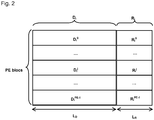
- the internal structure of a burst is shown in more detail in the figure 2 .
- the data section D i of the burst B i comprises PE blocks of information symbols D i, 0 , D i 1 , D i 2 ,..., D i j ,..., D i PE-1 .
- the error protection section R i comprises PE blocks of redundancy symbols R i 0 , R i 1 , R i 2 ,..., R i j , ..., R i PE-1 .
- the redundancy block R i B i of the burst from the blocks of information symbols is D, ..., D is + (t-1) a series of t bursts preceding the current burst B i in the sequence.
- the number s is an integer indicating the beginning of the series of t bursts, with s ⁇ t.
- a first way to obtain the coefficients of the generating matrices A w , w is, ..., i-s + (t-1), is to perform a random draw.
- M _ _ M _ _ 0.0 M _ _ 0.1 ⁇ M _ _ 0 t - 1
- x represents "x modulo t”.
- R 2 D 0 M 0 , 0 + D 1 M 1.0
- R 3 D 1 M 1,1 + D 2 M 0 , 1
- R 4 D 2 M 0.0 + D 3 M 1.0
- R 5 D 3 M 1.1 + D 4 M 0.1 ; ..., which can be viewed using the following table:
- the redundancy symbol block of a column x of the table is obtained by calculating the sum of the matrix products of the information symbol blocks of the first column of the table with the respective matrices of the column x.
- the figure 4 is a schematic illustration of a second preferred embodiment of the invention.
- the length of each sub-block R i, z is denoted L z .
- the redundancy sub-blocks R i, z of the burst B i in each case in a similar manner to the first embodiment of the invention, ie. from the blocks of information symbols D is (z) , ..., D iS (z) + (t (z) -1) of a series of t (z) bursts preceding the current burst B i in the sequence.
- the generating matrices A w, z can be constructed individually for each z ⁇ ⁇ 0, ..., Z ⁇ in a similar way to matrices A w discussed above, with substitution of t (z) instead of t. This gives Z independent coding systems. We could even implement them on different finite fields.
- M z _ _ M z _ _ 0.0 M z _ _ 0.1 ⁇ M z _ _ 0 t z - 1 M z _ _ 1.0 M z _ _ 1.1 ⁇ ⁇ ⁇ ⁇ M z _ _ t z - 1.0 ⁇ ⁇ M z _ _ t z - 1 t z - 1
- the coding functions change cyclically, with a period t (0), respectively t (1).
- the zapping time is reduced thanks to the redundancy block based on the short series S 0 and high reliability is achieved thanks to the redundancy block based on the longer series S 1 .
- M ' _ _ M ' _ _ 0.0 M ' _ _ 0.1 ⁇ M ' _ _ 0 Z ⁇ t max - 1 M ' _ _ 1.0 M ' _ _ 1.1 ⁇ ⁇ ⁇ ⁇ M ' _ _ Z ⁇ t max - 1.0 ⁇ ⁇ M ' _ _ Z ⁇ t max - 1 Z ⁇ t max - 1
- the matrix M ' is composed of 8 x 8 sub-blocks and the system of coding is summarized using the following table: R 4.0 R 4.1 R 5.0 R 5.1 R 6.0 R 6.1 R 7.0 ...
- the matrices A w j or A w, z j can be chosen individually for each j. Preferably, however, the same matrices A w or A w, z are used for all the indices j.
- the receiver When a burst is not correctly received, the receiver solves a system of equations to reconstruct the lost information data.
- Proper reconstruction algorithms are within reach those skilled in the art on the basis of the description of the encoding method according to the invention. If series of different length bursts are used to obtain multiple redundancy sub-block systems, the reconstruction of lost data may be based on redundancy blocks of one or more series as needed. If the lost data can be reconstructed on the basis of the shorter series, there will be a very short latency. If the loss is larger (eg over several consecutive bursts), the redundancy of the shorter series may not be sufficient for reconstruction and the longer series or series will have to be taken into account. reconstruction. The longer series or series thus guarantee a high overall reliability of the system.
Landscapes
- Engineering & Computer Science (AREA)
- Physics & Mathematics (AREA)
- Probability & Statistics with Applications (AREA)
- Theoretical Computer Science (AREA)
- Computer Networks & Wireless Communication (AREA)
- Signal Processing (AREA)
- Mathematical Physics (AREA)
- Mathematical Analysis (AREA)
- General Physics & Mathematics (AREA)
- Mathematical Optimization (AREA)
- Computational Mathematics (AREA)
- Pure & Applied Mathematics (AREA)
- Algebra (AREA)
- Computing Systems (AREA)
- Error Detection And Correction (AREA)
- Detection And Prevention Of Errors In Transmission (AREA)
Claims (11)
- Verfahren zur Kodierung von Informationsdaten in einer Burstsequenz (..., Bi-2, Bi-1, Bi, Bi+1, ...), wobei jeder Burst einen Informationssymbolblock (Di-2, Di-1, Di, Di+1) und einen Redundanzsymbolblock (Ri-2, Ri-1, Ri, Ri+1) umfasst, wobei das Verfahren umfasst
Generieren des Redundanzsymbolblocks (Ri) eines aktuellen Bursts (Bi) der Sequenz auf der Basis von Informationssymbolen der Informationssymbolblöcke mehrerer Bursts der Sequenz;
Generieren des Redundanzsymbolblocks (Ri) des aktuellen Bursts (Bi), umfassend das Berechnen einer Summe einer Kodierwertreihe relativ zu einer Reihe von Bursts (Bi-2, Bi-1), wobei jeder Kodierwert der Kodierwertreihe als Ergebnis einer jeweiligen Kodierfunktion, angewendet auf den Informationssymbolblock (Di-2 beziehungsweise Di-1) des entsprechenden Bursts der Reihe von Bursts (Bi-2, Bi-1), erhalten wird,
dadurch gekennzeichnet, dass jede Kodierfunktion eine Funktion ist, die, angewendet auf einen Symbolblock, als Kodierwert die Redundanzsymbole eines Korrekturcodes ergibt und welche die Eigenschaft hat, alle Symbole des Blocks zu verwenden, auf den sie angewendet wird, derart, dass, wenn der Wert eines einzigen beliebigen Symbols des Blocks geändert wird, sich der erhaltene Kodierwert auch ändert;
wobei jede jeweilige Kodierfunktion der Kodierwerte der Kodierwertreihe eine unterschiedliche Untermatrix ist, hervorgegangen aus einer einen Korrekturcode generierenden Matrix. - Verfahren nach Anspruch 1, wobei die Reihe von Bursts (Bi-2, Bi-1) eine Reihe von Bursts vor dem aktuellen Burst (Bi) und vorzugsweise eine Reihe von Bursts unmittelbar vor dem aktuellen Burst (Bi) ist.
- Verfahren zur Kodierung von Informationsdaten in einer Burstsequenz (..., Bi-2, Bi-1, Bi, Bi+1, ...), wobei jeder Burst eine geordnete Struktur von Informationssymbolblöcken (Di 0, ..., Di j, ..., Di PE-1) und eine geordnete Struktur von Redundanzsymbolblöcken (Ri 0, ..., Ri j, ..., Ri PE-1) umfasst, wobei die Anzahl von Informationssymbolblöcken in der geordneten Struktur von Informationssymbolblöcken gleich der Anzahl von Redundanzsymbolblöcken in der geordneten Struktur von Redundanzsymbolblöcken ist, wobei das Verfahren umfasst
Generieren des Redundanzsymbolblocks (Ri j) eines aktuellen Bursts (Bi) der Sequenz auf der Basis von Informationssymbolen der Informationssymbolblöcke einer Reihe von Bursts (Bi-2, Bi-1);
wobei das Generieren jedes Blocks der geordneten Struktur von Redundanzsymbolblöcken des aktuellen Bursts das Berechnen einer Summe einer Kodierwertreihe relativ zu den Blöcken (Di j) umfasst, die sich an der entsprechenden Position (j) in der geordneten Struktur von Informationssymbolblöcke der Bursts der Reihe von Bursts (Bi-2, Bi-1) befindet,
wobei jeder Kodierwert der Kodierwertreihe durch eine jeweilige Kodierfunktion erhalten wird, angewendet auf den Informationssymbolblock, der sich an der entsprechenden Position (j) in der geordneten Struktur von Informationssymbolblöcken des entsprechenden Bursts der Reihe von Bursts (Bi-2, Bi-1) befindet,
dadurch gekennzeichnet, dass jede Kodierfunktion eine Funktion ist, die, angewendet auf einen Symbolblock, als Kodierwert die Redundanzsymbole eines Korrekturcodes ergibt und welche die Eigenschaft hat, alle Symbole des Blocks zu verwenden, auf den sie angewendet wird, derart, dass, wenn der Wert eines einzigen beliebigen Symbols des Blocks geändert wird, sich der erhaltene Kodierwert auch ändert;
wobei jede jeweilige Kodierfunktion der Kodierwerte der Kodierwertreihe eine unterschiedliche Untermatrix ist, hervorgegangen aus einer einen Korrekturcode generierenden Matrix. - Verfahren zur Kodierung von Informationsdaten in einer Burstsequenz (..., Bi-2, Bi-1, Bi, Bi+1, ...), wobei jeder Burst einen Informationssymbolblock (Di) und einen Redundanzsymbolblock (Ri) umfasst, wobei das Verfahren umfasst
Generieren des Redundanzsymbolblocks (Ri) eines aktuellen Bursts (Bi) der Sequenz auf der Basis von Informationssymbolen der Informationssymbolblöcke mehrerer Bursts der Sequenz;
Generieren des Redundanzsymbolblocks (Ri) des aktuellen Bursts, umfassend
Generieren eines ersten Unterblocks (Ri,0) des Redundanzsymbolblocks (Ri) des aktuellen Bursts (Bi), was einschließt
Berechnen eines Kodierwerts durch eine Kodierfunktion, angewendet auf den Informationssymbolblock eines anderen Bursts der Sequenz als den aktuellen Burst, oder
Berechnen einer Summe einer ersten Reihe von Kodierwerten relativ zu einer ersten Reihe (S0) von Bursts (Bi-2, Bi-1), wobei jeder Kodierwert der ersten Reihe von Kodierwerten durch eine jeweilige Kodierfunktion erhalten wird, angewendet auf den Informationssymbolblock des entsprechenden Bursts der ersten Reihe (S0) von Bursts;
und Generieren eines zweiten Unterblocks (Ri,1) des Redundanzsymbolblocks (Ri) des aktuellen Bursts (Bi), was das Berechnen einer Summe einer zweiten Reihe von Kodierwerten relativ zu einer zweiten Reihe (S1) von Bursts (Bi-4, Bi-3, Bi-2, Bi-1) einschließt, wobei jeder Kodierwert der zweiten Reihe von Kodierwerten durch eine jeweilige Kodierfunktion erhalten wird, angewendet auf den Informationssymbolblock des entsprechenden Bursts der zweiten Reihe (S1) von Bursts,
wobei die erste (S0) und zweite (S1) Reihe von Bursts unterschiedlich lang sind, und
dadurch gekennzeichnet, dass jede Kodierfunktion eine Funktion ist, die, angewendet auf einen Symbolblock, als Kodierwert die Redundanzsymbole eines Korrekturcodes ergibt und welche die Eigenschaft hat, alle Symbole des Blocks zu verwenden, auf den sie angewendet wird, derart, dass, wenn der Wert eines einzigen beliebigen Symbols des Blocks geändert wird, sich der erhaltene Kodierwert auch ändert;
wobei jede jeweilige Kodierfunktion der Kodierwerte der Kodierwertreihe eine unterschiedliche Untermatrix ist, hervorgegangen aus einer einen Korrekturcode generierenden Matrix. - Verfahren nach Anspruch 4, wobei die erste (S0) und zweite (S1) Reihe von Bursts Reihen von Bursts vor, vorzugsweise unmittelbar, dem aktuellen Burst (Bi) sind.
- Verfahren zur Kodierung von Informationsdaten in einer Burstsequenz (..., Bi-2, Bi-1, Bi, Bi+1, ...), wobei jeder Burst eine geordnete Struktur von Informationssymbolblöcken (Di 0, ..., Di j, ..., Di PE-1) und eine geordnete Struktur von Redundanzsymbolblöcken (Ri 0, ..., Ri j, ..., Ri PE-1) umfasst, wobei die Anzahl von Informationssymbolblöcken in der geordneten Struktur von Informationssymbolblöcken gleich der Anzahl von Redundanzsymbolblöcken in der geordneten Struktur von Redundanzsymbolblöcken ist, wobei das Verfahren umfasst:das Generieren jedes Blocks der geordneten Struktur von Redundanzsymbolblöcken des aktuellen Bursts (Bi) umfasst das Generieren eines ersten Unterblocks und eines zweiten Unterblocks;wobei das Generieren des ersten Unterblocks einschließtBerechnen eines Kodierwerts durch eine Kodierfunktion, angewendet auf den Informationssymbolblock, der sich an der entsprechenden Position (j) in der geordneten Struktur eines anderen Bursts als der aktuelle Burst befindet, oderBerechnen einer Summe einer ersten Reihe von Kodierwerten relativ zu den Blöcken, die sich an der entsprechenden Position in der geordneten Struktur von Informationssymbolblöcken der Bursts einer ersten Reihe (S0) von Bursts befinden, wobei jeder Kodierwert der ersten Reihe von Kodierwerten durch eine jeweilige Kodierfunktion erhalten wird, angewendet auf den Informationssymbolblock an der entsprechenden Position (j) in der geordneten Struktur von Informationssymbolblöcken des entsprechenden Bursts der ersten Reihe (S0) von Bursts;und Generieren des zweiten Unterblocks, einschließend das Berechnen einer Summe einer zweiten Reihe von Kodierwerten relativ zu den Blöcken, die sich an der entsprechenden Position (j) in der geordneten Struktur von Informationssymbolblöcken der Bursts einer zweiten Reihe (S1) von Bursts befinden,wobei jeder Kodierwert der zweiten Reihe von Kodierwerten durch eine jeweilige Kodierfunktion erhalten wird, angewendet auf den Informationssymbolblock, der sich an der entsprechenden Position (j) in der geordneten Struktur von Informationssymbolblöcke des entsprechenden Bursts der zweiten Reihe (S1) von Bursts befindet,wobei die erste (S0) und zweite (S1) Reihe von Bursts unterschiedlich lang sind, unddadurch gekennzeichnet, dass jede Kodierfunktion eine Funktion ist, die, angewendet auf einen Symbolblock, als Kodierwert die Redundanzsymbole eines Korrekturcodes ergibt und welche die Eigenschaft hat, alle Symbole des Blocks zu verwenden, auf den sie angewendet wird, derart, dass, wenn der Wert eines einzigen beliebigen Symbols des Blocks geändert wird, sich der erhaltene Kodierwert auch ändert;wobei jede jeweilige Kodierfunktion der Kodierwerte der Kodierwertreihe eine unterschiedliche Untermatrix ist, hervorgegangen aus einer einen Korrekturcode generierenden Matrix.
- Verfahren nach einem der Ansprüche 1 bis 6, umfassend die Wiederholung des Schritts des Generierens des Redundanzsymbolblocks für ein oder mehrere nächste Bursts (Bi+1, ...), die nacheinander zum aktuellen Burst werden.
- Verfahren nach Anspruch 7, wobei die Kodierfunktionen bei der Wiederholung des Schritts des Generierens des Redundanzsymbolblocks für die nächsten Bursts (Bi+1, ...) unverändert bleiben.
- Verfahren nach Anspruch 7, wobei die Kodierfunktionen bei der Wiederholung des Schritts des Generierens des Redundanzsymbolblocks für die nächsten Bursts (Bi+1, ...) zyklisch geändert werden.
- Verfahren nach Anspruch 3 oder 6, wobei die Anzahl von Informationssymbolblöcke in der geordneten Struktur von Informationssymbolblöcken im Bereich von 1 bis 1000 liegt.
- Verfahren nach einem der Ansprüche 1 bis 10, wobei die Informationssymbole und die Redundanzsymbole Elemente eines finiten Körpers sind.
Applications Claiming Priority (2)
| Application Number | Priority Date | Filing Date | Title |
|---|---|---|---|
| FR1155444A FR2977100B1 (fr) | 2011-06-21 | 2011-06-21 | Procede d'encodage de donnees d'information en bursts |
| PCT/EP2012/061923 WO2012175589A1 (fr) | 2011-06-21 | 2012-06-21 | Procédé d'encodage de données d'information en bursts |
Publications (2)
| Publication Number | Publication Date |
|---|---|
| EP2724467A1 EP2724467A1 (de) | 2014-04-30 |
| EP2724467B1 true EP2724467B1 (de) | 2018-12-19 |
Family
ID=46513709
Family Applications (1)
| Application Number | Title | Priority Date | Filing Date |
|---|---|---|---|
| EP12735225.0A Not-in-force EP2724467B1 (de) | 2011-06-21 | 2012-06-21 | Verfahren zur datenkodierung in bursts |
Country Status (4)
| Country | Link |
|---|---|
| US (1) | US9281848B2 (de) |
| EP (1) | EP2724467B1 (de) |
| FR (1) | FR2977100B1 (de) |
| WO (1) | WO2012175589A1 (de) |
Families Citing this family (5)
| Publication number | Priority date | Publication date | Assignee | Title |
|---|---|---|---|---|
| US9460781B1 (en) * | 2015-03-10 | 2016-10-04 | Kabushiki Kaisha Toshiba | Memory system and memory control method |
| US9843413B2 (en) | 2016-03-25 | 2017-12-12 | Cisco Technology, Inc. | Forward error correction for low-delay recovery from packet loss |
| CN108631793B (zh) * | 2017-03-24 | 2022-04-22 | 华为技术有限公司 | 一种构造编码序列的方法,装置 |
| US10756844B2 (en) * | 2017-06-16 | 2020-08-25 | Mediatek Inc. | Devices and method for wirelessly broadcasting media packets |
| US20250358812A1 (en) * | 2024-05-14 | 2025-11-20 | Qualcomm Incorporated | Outer coding for hybrid automatic repeat/request-less configured grants |
Family Cites Families (8)
| Publication number | Priority date | Publication date | Assignee | Title |
|---|---|---|---|---|
| US5870412A (en) * | 1997-12-12 | 1999-02-09 | 3Com Corporation | Forward error correction system for packet based real time media |
| US7178080B2 (en) * | 2002-08-15 | 2007-02-13 | Texas Instruments Incorporated | Hardware-efficient low density parity check code for digital communications |
| US7236748B2 (en) * | 2004-09-30 | 2007-06-26 | Intel Corporation | Closed loop feedback in MIMO systems |
| US7831895B2 (en) * | 2006-07-25 | 2010-11-09 | Communications Coding Corporation | Universal error control coding system for digital communication and data storage systems |
| JP4856605B2 (ja) * | 2006-08-31 | 2012-01-18 | パナソニック株式会社 | 符号化方法、符号化装置、及び送信装置 |
| FR2911741A1 (fr) | 2007-01-23 | 2008-07-25 | Udcast Sa | Procede et dispositif contre la perte de salves dans un systeme de transmission dvb-h. |
| EP2009828B1 (de) | 2007-06-28 | 2016-01-27 | Alcatel Lucent | Verfahren zur Bereitstellung ungleichen Fehlerschutzes für Datenpakete in einem Burst-Übertragungssystem |
| CN101459430B (zh) * | 2007-12-14 | 2010-12-08 | 中兴通讯股份有限公司 | 低密度生成矩阵码的编码方法及装置 |
-
2011
- 2011-06-21 FR FR1155444A patent/FR2977100B1/fr not_active Expired - Fee Related
-
2012
- 2012-06-21 EP EP12735225.0A patent/EP2724467B1/de not_active Not-in-force
- 2012-06-21 US US14/127,721 patent/US9281848B2/en active Active
- 2012-06-21 WO PCT/EP2012/061923 patent/WO2012175589A1/fr not_active Ceased
Non-Patent Citations (1)
| Title |
|---|
| None * |
Also Published As
| Publication number | Publication date |
|---|---|
| US20140136923A1 (en) | 2014-05-15 |
| EP2724467A1 (de) | 2014-04-30 |
| WO2012175589A1 (fr) | 2012-12-27 |
| US9281848B2 (en) | 2016-03-08 |
| FR2977100A1 (fr) | 2012-12-28 |
| FR2977100B1 (fr) | 2013-12-27 |
Similar Documents
| Publication | Publication Date | Title |
|---|---|---|
| US7246294B2 (en) | Method for iterative hard-decision forward error correction decoding | |
| US6490243B1 (en) | Information data multiplex transmission system, its multiplexer and demultiplexer and error correction encoder and decoder | |
| US8650466B2 (en) | Incremental generation of polynomials for decoding reed-solomon codes | |
| KR102554694B1 (ko) | 길이가 64800이며, 부호율이 2/15인 ldpc 부호어 및 1024-심볼 맵핑에 상응하는 bicm 수신 장치 및 방법 | |
| US8959418B1 (en) | Forward error correction | |
| JP2010508742A (ja) | 64b/66bスクランブル処理と適合する多重リンク送信のための前方誤り訂正符号化 | |
| WO2012175589A1 (fr) | Procédé d'encodage de données d'information en bursts | |
| US9432057B1 (en) | Forward error correcting code encoder and decoder method and apparatus | |
| EP1841078B1 (de) | Zweikanal Empfangsschaltkreis | |
| KR102546120B1 (ko) | 길이가 64800이며, 부호율이 2/15인 ldpc 부호어 및 4096-심볼 맵핑에 상응하는 bicm 수신 장치 및 방법 | |
| US7096403B2 (en) | Iterative concatenated code decoding circuit and encoding/decoding system using the same | |
| KR102546119B1 (ko) | 길이가 64800이며, 부호율이 3/15인 ldpc 부호어 및 256-심볼 맵핑에 상응하는 bicm 수신 장치 및 방법 | |
| EP1974472B1 (de) | Schnelle codierungs- und decodierungsverfahren und zugehörige vorrichtungen | |
| JP5699737B2 (ja) | 誤り訂正装置及び誤り訂正方法 | |
| US6832042B1 (en) | Encoding and decoding system in an optical disk storage device | |
| US7231575B2 (en) | Apparatus for iterative hard-decision forward error correction decoding | |
| US20050149820A1 (en) | Optimized interleaving of digital signals | |
| KR20080076613A (ko) | 연접코드를 이용한 인코더/디코더 및 그의 인코딩/디코딩방법 | |
| US7810015B2 (en) | Decoding with a concatenated error correcting code | |
| KR102538291B1 (ko) | 길이가 64800이며, 부호율이 5/15인 ldpc 부호어 및 64-심볼 맵핑을 위한 bicm 수신 장치 및 이를 이용한 방법 | |
| US8850294B1 (en) | Decoding apparatus for digital communications and method for using the same | |
| US20170201271A9 (en) | Method for encoding data in bursts | |
| EP1569348A1 (de) | Multidimensionale iterative Dekodierung | |
| FR2997249A1 (fr) | Methode de codage pour canal a evanouissement quasi-periodique | |
| US20130051479A1 (en) | Method for payload formatting and deformatting for burst loss recovery |
Legal Events
| Date | Code | Title | Description |
|---|---|---|---|
| PUAI | Public reference made under article 153(3) epc to a published international application that has entered the european phase |
Free format text: ORIGINAL CODE: 0009012 |
|
| 17P | Request for examination filed |
Effective date: 20131212 |
|
| AK | Designated contracting states |
Kind code of ref document: A1 Designated state(s): AL AT BE BG CH CY CZ DE DK EE ES FI FR GB GR HR HU IE IS IT LI LT LU LV MC MK MT NL NO PL PT RO RS SE SI SK SM TR |
|
| RIN1 | Information on inventor provided before grant (corrected) |
Inventor name: SMITH, GUILLAUME Inventor name: CLARAC, LAURENCE Inventor name: LACAN, JEROME |
|
| DAX | Request for extension of the european patent (deleted) | ||
| 17Q | First examination report despatched |
Effective date: 20140926 |
|
| STAA | Information on the status of an ep patent application or granted ep patent |
Free format text: STATUS: EXAMINATION IS IN PROGRESS |
|
| REG | Reference to a national code |
Ref country code: DE Ref legal event code: R079 Ref document number: 602012054856 Country of ref document: DE Free format text: PREVIOUS MAIN CLASS: H03M0013050000 Ipc: H03M0013110000 |
|
| RIC1 | Information provided on ipc code assigned before grant |
Ipc: H03M 13/27 20060101ALI20180711BHEP Ipc: H03M 13/13 20060101ALI20180711BHEP Ipc: H03M 13/29 20060101ALI20180711BHEP Ipc: H03M 13/15 20060101ALI20180711BHEP Ipc: H03M 13/11 20060101AFI20180711BHEP Ipc: H03M 13/17 20060101ALI20180711BHEP Ipc: H04L 1/00 20060101ALI20180711BHEP Ipc: H03M 13/05 20060101ALI20180711BHEP Ipc: H03M 13/00 20060101ALI20180711BHEP |
|
| GRAP | Despatch of communication of intention to grant a patent |
Free format text: ORIGINAL CODE: EPIDOSNIGR1 |
|
| STAA | Information on the status of an ep patent application or granted ep patent |
Free format text: STATUS: GRANT OF PATENT IS INTENDED |
|
| INTG | Intention to grant announced |
Effective date: 20180817 |
|
| GRAS | Grant fee paid |
Free format text: ORIGINAL CODE: EPIDOSNIGR3 |
|
| GRAA | (expected) grant |
Free format text: ORIGINAL CODE: 0009210 |
|
| STAA | Information on the status of an ep patent application or granted ep patent |
Free format text: STATUS: THE PATENT HAS BEEN GRANTED |
|
| AK | Designated contracting states |
Kind code of ref document: B1 Designated state(s): AL AT BE BG CH CY CZ DE DK EE ES FI FR GB GR HR HU IE IS IT LI LT LU LV MC MK MT NL NO PL PT RO RS SE SI SK SM TR |
|
| REG | Reference to a national code |
Ref country code: GB Ref legal event code: FG4D Free format text: NOT ENGLISH |
|
| REG | Reference to a national code |
Ref country code: CH Ref legal event code: EP |
|
| REG | Reference to a national code |
Ref country code: IE Ref legal event code: FG4D Free format text: LANGUAGE OF EP DOCUMENT: FRENCH |
|
| REG | Reference to a national code |
Ref country code: DE Ref legal event code: R096 Ref document number: 602012054856 Country of ref document: DE |
|
| REG | Reference to a national code |
Ref country code: AT Ref legal event code: REF Ref document number: 1079786 Country of ref document: AT Kind code of ref document: T Effective date: 20190115 |
|
| REG | Reference to a national code |
Ref country code: NL Ref legal event code: MP Effective date: 20181219 |
|
| PG25 | Lapsed in a contracting state [announced via postgrant information from national office to epo] |
Ref country code: LV Free format text: LAPSE BECAUSE OF FAILURE TO SUBMIT A TRANSLATION OF THE DESCRIPTION OR TO PAY THE FEE WITHIN THE PRESCRIBED TIME-LIMIT Effective date: 20181219 Ref country code: FI Free format text: LAPSE BECAUSE OF FAILURE TO SUBMIT A TRANSLATION OF THE DESCRIPTION OR TO PAY THE FEE WITHIN THE PRESCRIBED TIME-LIMIT Effective date: 20181219 Ref country code: NO Free format text: LAPSE BECAUSE OF FAILURE TO SUBMIT A TRANSLATION OF THE DESCRIPTION OR TO PAY THE FEE WITHIN THE PRESCRIBED TIME-LIMIT Effective date: 20190319 Ref country code: HR Free format text: LAPSE BECAUSE OF FAILURE TO SUBMIT A TRANSLATION OF THE DESCRIPTION OR TO PAY THE FEE WITHIN THE PRESCRIBED TIME-LIMIT Effective date: 20181219 Ref country code: LT Free format text: LAPSE BECAUSE OF FAILURE TO SUBMIT A TRANSLATION OF THE DESCRIPTION OR TO PAY THE FEE WITHIN THE PRESCRIBED TIME-LIMIT Effective date: 20181219 Ref country code: BG Free format text: LAPSE BECAUSE OF FAILURE TO SUBMIT A TRANSLATION OF THE DESCRIPTION OR TO PAY THE FEE WITHIN THE PRESCRIBED TIME-LIMIT Effective date: 20190319 |
|
| REG | Reference to a national code |
Ref country code: LT Ref legal event code: MG4D |
|
| REG | Reference to a national code |
Ref country code: AT Ref legal event code: MK05 Ref document number: 1079786 Country of ref document: AT Kind code of ref document: T Effective date: 20181219 |
|
| PG25 | Lapsed in a contracting state [announced via postgrant information from national office to epo] |
Ref country code: RS Free format text: LAPSE BECAUSE OF FAILURE TO SUBMIT A TRANSLATION OF THE DESCRIPTION OR TO PAY THE FEE WITHIN THE PRESCRIBED TIME-LIMIT Effective date: 20181219 Ref country code: SE Free format text: LAPSE BECAUSE OF FAILURE TO SUBMIT A TRANSLATION OF THE DESCRIPTION OR TO PAY THE FEE WITHIN THE PRESCRIBED TIME-LIMIT Effective date: 20181219 Ref country code: GR Free format text: LAPSE BECAUSE OF FAILURE TO SUBMIT A TRANSLATION OF THE DESCRIPTION OR TO PAY THE FEE WITHIN THE PRESCRIBED TIME-LIMIT Effective date: 20190320 Ref country code: AL Free format text: LAPSE BECAUSE OF FAILURE TO SUBMIT A TRANSLATION OF THE DESCRIPTION OR TO PAY THE FEE WITHIN THE PRESCRIBED TIME-LIMIT Effective date: 20181219 |
|
| PG25 | Lapsed in a contracting state [announced via postgrant information from national office to epo] |
Ref country code: NL Free format text: LAPSE BECAUSE OF FAILURE TO SUBMIT A TRANSLATION OF THE DESCRIPTION OR TO PAY THE FEE WITHIN THE PRESCRIBED TIME-LIMIT Effective date: 20181219 |
|
| PG25 | Lapsed in a contracting state [announced via postgrant information from national office to epo] |
Ref country code: ES Free format text: LAPSE BECAUSE OF FAILURE TO SUBMIT A TRANSLATION OF THE DESCRIPTION OR TO PAY THE FEE WITHIN THE PRESCRIBED TIME-LIMIT Effective date: 20181219 Ref country code: PT Free format text: LAPSE BECAUSE OF FAILURE TO SUBMIT A TRANSLATION OF THE DESCRIPTION OR TO PAY THE FEE WITHIN THE PRESCRIBED TIME-LIMIT Effective date: 20190419 Ref country code: PL Free format text: LAPSE BECAUSE OF FAILURE TO SUBMIT A TRANSLATION OF THE DESCRIPTION OR TO PAY THE FEE WITHIN THE PRESCRIBED TIME-LIMIT Effective date: 20181219 Ref country code: CZ Free format text: LAPSE BECAUSE OF FAILURE TO SUBMIT A TRANSLATION OF THE DESCRIPTION OR TO PAY THE FEE WITHIN THE PRESCRIBED TIME-LIMIT Effective date: 20181219 Ref country code: IT Free format text: LAPSE BECAUSE OF FAILURE TO SUBMIT A TRANSLATION OF THE DESCRIPTION OR TO PAY THE FEE WITHIN THE PRESCRIBED TIME-LIMIT Effective date: 20181219 |
|
| PG25 | Lapsed in a contracting state [announced via postgrant information from national office to epo] |
Ref country code: RO Free format text: LAPSE BECAUSE OF FAILURE TO SUBMIT A TRANSLATION OF THE DESCRIPTION OR TO PAY THE FEE WITHIN THE PRESCRIBED TIME-LIMIT Effective date: 20181219 Ref country code: SK Free format text: LAPSE BECAUSE OF FAILURE TO SUBMIT A TRANSLATION OF THE DESCRIPTION OR TO PAY THE FEE WITHIN THE PRESCRIBED TIME-LIMIT Effective date: 20181219 Ref country code: IS Free format text: LAPSE BECAUSE OF FAILURE TO SUBMIT A TRANSLATION OF THE DESCRIPTION OR TO PAY THE FEE WITHIN THE PRESCRIBED TIME-LIMIT Effective date: 20190419 Ref country code: EE Free format text: LAPSE BECAUSE OF FAILURE TO SUBMIT A TRANSLATION OF THE DESCRIPTION OR TO PAY THE FEE WITHIN THE PRESCRIBED TIME-LIMIT Effective date: 20181219 Ref country code: SM Free format text: LAPSE BECAUSE OF FAILURE TO SUBMIT A TRANSLATION OF THE DESCRIPTION OR TO PAY THE FEE WITHIN THE PRESCRIBED TIME-LIMIT Effective date: 20181219 |
|
| REG | Reference to a national code |
Ref country code: DE Ref legal event code: R097 Ref document number: 602012054856 Country of ref document: DE |
|
| PLBE | No opposition filed within time limit |
Free format text: ORIGINAL CODE: 0009261 |
|
| STAA | Information on the status of an ep patent application or granted ep patent |
Free format text: STATUS: NO OPPOSITION FILED WITHIN TIME LIMIT |
|
| PG25 | Lapsed in a contracting state [announced via postgrant information from national office to epo] |
Ref country code: DK Free format text: LAPSE BECAUSE OF FAILURE TO SUBMIT A TRANSLATION OF THE DESCRIPTION OR TO PAY THE FEE WITHIN THE PRESCRIBED TIME-LIMIT Effective date: 20181219 Ref country code: AT Free format text: LAPSE BECAUSE OF FAILURE TO SUBMIT A TRANSLATION OF THE DESCRIPTION OR TO PAY THE FEE WITHIN THE PRESCRIBED TIME-LIMIT Effective date: 20181219 |
|
| 26N | No opposition filed |
Effective date: 20190920 |
|
| PG25 | Lapsed in a contracting state [announced via postgrant information from national office to epo] |
Ref country code: MC Free format text: LAPSE BECAUSE OF FAILURE TO SUBMIT A TRANSLATION OF THE DESCRIPTION OR TO PAY THE FEE WITHIN THE PRESCRIBED TIME-LIMIT Effective date: 20181219 |
|
| REG | Reference to a national code |
Ref country code: CH Ref legal event code: PL |
|
| PG25 | Lapsed in a contracting state [announced via postgrant information from national office to epo] |
Ref country code: SI Free format text: LAPSE BECAUSE OF FAILURE TO SUBMIT A TRANSLATION OF THE DESCRIPTION OR TO PAY THE FEE WITHIN THE PRESCRIBED TIME-LIMIT Effective date: 20181219 |
|
| REG | Reference to a national code |
Ref country code: BE Ref legal event code: MM Effective date: 20190630 |
|
| PG25 | Lapsed in a contracting state [announced via postgrant information from national office to epo] |
Ref country code: TR Free format text: LAPSE BECAUSE OF FAILURE TO SUBMIT A TRANSLATION OF THE DESCRIPTION OR TO PAY THE FEE WITHIN THE PRESCRIBED TIME-LIMIT Effective date: 20181219 |
|
| PG25 | Lapsed in a contracting state [announced via postgrant information from national office to epo] |
Ref country code: IE Free format text: LAPSE BECAUSE OF NON-PAYMENT OF DUE FEES Effective date: 20190621 |
|
| PG25 | Lapsed in a contracting state [announced via postgrant information from national office to epo] |
Ref country code: LI Free format text: LAPSE BECAUSE OF NON-PAYMENT OF DUE FEES Effective date: 20190630 Ref country code: CH Free format text: LAPSE BECAUSE OF NON-PAYMENT OF DUE FEES Effective date: 20190630 Ref country code: BE Free format text: LAPSE BECAUSE OF NON-PAYMENT OF DUE FEES Effective date: 20190630 Ref country code: LU Free format text: LAPSE BECAUSE OF NON-PAYMENT OF DUE FEES Effective date: 20190621 |
|
| PG25 | Lapsed in a contracting state [announced via postgrant information from national office to epo] |
Ref country code: CY Free format text: LAPSE BECAUSE OF FAILURE TO SUBMIT A TRANSLATION OF THE DESCRIPTION OR TO PAY THE FEE WITHIN THE PRESCRIBED TIME-LIMIT Effective date: 20181219 |
|
| PG25 | Lapsed in a contracting state [announced via postgrant information from national office to epo] |
Ref country code: HU Free format text: LAPSE BECAUSE OF FAILURE TO SUBMIT A TRANSLATION OF THE DESCRIPTION OR TO PAY THE FEE WITHIN THE PRESCRIBED TIME-LIMIT; INVALID AB INITIO Effective date: 20120621 Ref country code: MT Free format text: LAPSE BECAUSE OF FAILURE TO SUBMIT A TRANSLATION OF THE DESCRIPTION OR TO PAY THE FEE WITHIN THE PRESCRIBED TIME-LIMIT Effective date: 20181219 |
|
| PG25 | Lapsed in a contracting state [announced via postgrant information from national office to epo] |
Ref country code: MK Free format text: LAPSE BECAUSE OF FAILURE TO SUBMIT A TRANSLATION OF THE DESCRIPTION OR TO PAY THE FEE WITHIN THE PRESCRIBED TIME-LIMIT Effective date: 20181219 |
|
| PGFP | Annual fee paid to national office [announced via postgrant information from national office to epo] |
Ref country code: GB Payment date: 20240514 Year of fee payment: 13 |
|
| PGFP | Annual fee paid to national office [announced via postgrant information from national office to epo] |
Ref country code: DE Payment date: 20240520 Year of fee payment: 13 |
|
| PGFP | Annual fee paid to national office [announced via postgrant information from national office to epo] |
Ref country code: FR Payment date: 20240517 Year of fee payment: 13 |
|
| REG | Reference to a national code |
Ref country code: DE Ref legal event code: R119 Ref document number: 602012054856 Country of ref document: DE |
|
| GBPC | Gb: european patent ceased through non-payment of renewal fee |
Effective date: 20250621 |
|
| PG25 | Lapsed in a contracting state [announced via postgrant information from national office to epo] |
Ref country code: GB Free format text: LAPSE BECAUSE OF NON-PAYMENT OF DUE FEES Effective date: 20250621 |
|
| PG25 | Lapsed in a contracting state [announced via postgrant information from national office to epo] |
Ref country code: DE Free format text: LAPSE BECAUSE OF NON-PAYMENT OF DUE FEES Effective date: 20260101 |
|
| PG25 | Lapsed in a contracting state [announced via postgrant information from national office to epo] |
Ref country code: FR Free format text: LAPSE BECAUSE OF NON-PAYMENT OF DUE FEES Effective date: 20250630 |