EP2721118B1 - Method of inhibiting or controlling release of well treatment agent - Google Patents
Method of inhibiting or controlling release of well treatment agent Download PDFInfo
- Publication number
- EP2721118B1 EP2721118B1 EP12724025.7A EP12724025A EP2721118B1 EP 2721118 B1 EP2721118 B1 EP 2721118B1 EP 12724025 A EP12724025 A EP 12724025A EP 2721118 B1 EP2721118 B1 EP 2721118B1
- Authority
- EP
- European Patent Office
- Prior art keywords
- microemulsion
- well
- treatment agent
- well treatment
- fluid
- Prior art date
- Legal status (The legal status is an assumption and is not a legal conclusion. Google has not performed a legal analysis and makes no representation as to the accuracy of the status listed.)
- Active
Links
Images



Classifications
-
- C—CHEMISTRY; METALLURGY
- C09—DYES; PAINTS; POLISHES; NATURAL RESINS; ADHESIVES; COMPOSITIONS NOT OTHERWISE PROVIDED FOR; APPLICATIONS OF MATERIALS NOT OTHERWISE PROVIDED FOR
- C09K—MATERIALS FOR MISCELLANEOUS APPLICATIONS, NOT PROVIDED FOR ELSEWHERE
- C09K8/00—Compositions for drilling of boreholes or wells; Compositions for treating boreholes or wells, e.g. for completion or for remedial operations
- C09K8/02—Well-drilling compositions
- C09K8/03—Specific additives for general use in well-drilling compositions
- C09K8/035—Organic additives
-
- C—CHEMISTRY; METALLURGY
- C09—DYES; PAINTS; POLISHES; NATURAL RESINS; ADHESIVES; COMPOSITIONS NOT OTHERWISE PROVIDED FOR; APPLICATIONS OF MATERIALS NOT OTHERWISE PROVIDED FOR
- C09K—MATERIALS FOR MISCELLANEOUS APPLICATIONS, NOT PROVIDED FOR ELSEWHERE
- C09K8/00—Compositions for drilling of boreholes or wells; Compositions for treating boreholes or wells, e.g. for completion or for remedial operations
- C09K8/02—Well-drilling compositions
- C09K8/04—Aqueous well-drilling compositions
- C09K8/26—Oil-in-water emulsions
- C09K8/28—Oil-in-water emulsions containing organic additives
-
- C—CHEMISTRY; METALLURGY
- C09—DYES; PAINTS; POLISHES; NATURAL RESINS; ADHESIVES; COMPOSITIONS NOT OTHERWISE PROVIDED FOR; APPLICATIONS OF MATERIALS NOT OTHERWISE PROVIDED FOR
- C09K—MATERIALS FOR MISCELLANEOUS APPLICATIONS, NOT PROVIDED FOR ELSEWHERE
- C09K8/00—Compositions for drilling of boreholes or wells; Compositions for treating boreholes or wells, e.g. for completion or for remedial operations
- C09K8/02—Well-drilling compositions
- C09K8/32—Non-aqueous well-drilling compositions, e.g. oil-based
- C09K8/36—Water-in-oil emulsions
-
- C—CHEMISTRY; METALLURGY
- C09—DYES; PAINTS; POLISHES; NATURAL RESINS; ADHESIVES; COMPOSITIONS NOT OTHERWISE PROVIDED FOR; APPLICATIONS OF MATERIALS NOT OTHERWISE PROVIDED FOR
- C09K—MATERIALS FOR MISCELLANEOUS APPLICATIONS, NOT PROVIDED FOR ELSEWHERE
- C09K8/00—Compositions for drilling of boreholes or wells; Compositions for treating boreholes or wells, e.g. for completion or for remedial operations
- C09K8/52—Compositions for preventing, limiting or eliminating depositions, e.g. for cleaning
-
- C—CHEMISTRY; METALLURGY
- C09—DYES; PAINTS; POLISHES; NATURAL RESINS; ADHESIVES; COMPOSITIONS NOT OTHERWISE PROVIDED FOR; APPLICATIONS OF MATERIALS NOT OTHERWISE PROVIDED FOR
- C09K—MATERIALS FOR MISCELLANEOUS APPLICATIONS, NOT PROVIDED FOR ELSEWHERE
- C09K8/00—Compositions for drilling of boreholes or wells; Compositions for treating boreholes or wells, e.g. for completion or for remedial operations
- C09K8/60—Compositions for stimulating production by acting on the underground formation
- C09K8/602—Compositions for stimulating production by acting on the underground formation containing surfactants
-
- C—CHEMISTRY; METALLURGY
- C09—DYES; PAINTS; POLISHES; NATURAL RESINS; ADHESIVES; COMPOSITIONS NOT OTHERWISE PROVIDED FOR; APPLICATIONS OF MATERIALS NOT OTHERWISE PROVIDED FOR
- C09K—MATERIALS FOR MISCELLANEOUS APPLICATIONS, NOT PROVIDED FOR ELSEWHERE
- C09K2208/00—Aspects relating to compositions of drilling or well treatment fluids
- C09K2208/24—Bacteria or enzyme containing gel breakers
Definitions
- the invention relates to a method of inhibiting or controlling the rate of release of a well treatment agent in a subterranean formation, an oil well, a gas well, a geothermal well, a flow conduit or vessel by introducing into the formation, well, flow conduit or vessel a microemulsion containing the well treatment agent.
- Well fluids are generally complex mixtures of aliphatic hydrocarbons, aromatics, hetero-atomic molecules, anionic and cationic salts, acids, sands, silts, clays and a vast array of other components.
- the nature of these fluids combined with the severe conditions of heat, pressure, and turbulence to which they are often subjected, are contributory factors to the formation and deposition of contaminants, such as scales, salts, paraffins, corrosion, bacteria and asphaltenes in production wells.
- a common site for the formation and deposition of such contaminants in oil or gas wells is the annular space between the production tubing and casing.
- the annulus may be a static area or may produce gas or liquid.
- the formation and deposition of such contaminants may reduce well productivity. Further, the presence of contaminants, such as scales, in the annulus may make it difficult or impossible to remove the tubing for servicing.
- Well treatment agents are known in the art for inhibiting or controlling such unwanted contaminants.
- well treatment agents which inhibit the formation or deposition of contaminants such as scales, salts, paraffins, corrosion, bacteria and asphaltenes be slowly released in production wells, subterranean formations, equipment and flow conduits used in gas production and oil production.
- the formation and deposition of such unwanted contaminants decrease permeability of the formation and reduce well productivity and can completely block the well tubular in severe cases.
- U.S. Patent No. 7,491,682 and U.S. Patent No. 7,493,955 disclose the use of composites for the slow release of well treatment agents.
- U.S. Patent No. 7,475,730 and U.S. Patent Publication No. 20090114247 further disclose a method of inhibiting and/or removing unwanted contaminants from wells, flow conduits and vessels with a foamed treatment composition.
- WO01/42387 discloses acid based micro-emulsions comprising water, an acid blend, an anionic surfactant, a non-ionic surfactant, a co-solvent, a solvent and an oxidiser.
- micro-emulsions have particular utility in cleaning oil sludges and drilling residues from well cuttings, well formations and down hole and surface oil well drilling and production equipment.
- US6,613,720 discloses delaying the release of chemical or biological agents in well treatment fluids by sequestering the agents in the discontinuous phase of an emulsion before destabilising the emulsion to release the agent into the continuous phase of the fluid composition.
- US2009/0137432 discloses an oil field treatment fluid in the form of an emulsion wherein the emulsion contains at least one treatment agent sequestered within a phase of the emulsion.
- the emulsion is stable and the pH is maintained within a predetermined range, and breaks to release the treatment agent when the pH is changed to a release pH value outside the predetermined stable pH range.
- US2002/0055439 discloses a method for treating a wellbore or well casing to remove scale in the context of hydrocarbon recovery. The method includes contacting the scale with a fluid comprised of an ionic liquid or liquids.
- WO2008/080093 discloses polypeptides having amylase and/or glucoamylase activity. The enzymes may be used in a method of inhibiting or controlling the rate of release of a well treatment agent in a micro-emulsion.
- US2003/0166472 discloses a well treatment micro-emulsion that is formed by combining a solvent-surfactant blend with a carrier fluid.
- the activity of the well treatment agent be delayed for some time after being introduced into the well and/or subterranean producing formation.
- the viscosity of the fracturing fluid is typically decreased after placement of proppant into the fracture in order that the fluid may flow naturally from the formation.
- breakers are typically incorporated into the fracturing fluid, their activity is most desirably delayed until after the proppant is placed into the fracture.
- crosslinking in a fracturing fluid until after the fluid has traveled to a designated distance into the wellbore and/or through the formation. At that point, gelling of the fluid is desired.
- Breakers are also used to break down filter cakes which are formed during wellbore operations. For instance, breakers are often included in the drilling fluid to break down filter cakes. It is desirable, however, that the breaker not be functional until break down of the filter cake is needed.
- a microemulsion having an incorporated well treatment agent provides for the slow and controlled release of the well treatment agent in a well, subterranean formation penetrated by a well, flow conduit, or vessel. Release of the well treatment agent into the well, formation, flow conduit, or vessel may be delayed until the time that the effect imparted by the well treatment agent is needed.
- the invention provides a method of inhibiting or controlling the rate of release of a well treatment agent in a well, a subterranean formation, a flow conduit or a vessel, the method comprising:
- Exemplary solvents include terpenes
- exemplary surfactants include those having a hydrophilic-lipophilic balance (HLB) between from 3 to 8
- exemplary diluents include water as well as mixtures of water and triethylene glycol.
- the oil phase of the microemulsion may be diesel, kerosene, crude oil, a linear- ⁇ -olefin, poly- ⁇ -olefin, or other synthetic oils.
- the well treatment agent may include enzyme breakers, oxidative breakers, breaker catalysts, crosslinkers, buffers, paraffin inhibitors, asphaltene inhibitors, scale inhibitors, pH adjustment agents, oxidizers, crosslinking agents, crosslinking delaying agents, demulsifying agents, acids, and esters.
- a well treatment agent may remain inactive in a well, subterranean formation penetrated by a well, as well as flow conduits and vessels used in the production of oil and/or gas as well as refineries by incorporating the well treatment agent into a microemulsion.
- the delayed release of the well treatment agent from the microemulsion at a generally constant rate extends over a period of time, in some cases exceeding three years.
- the well treatment agent is released from the microemulsion by increased temperatures and solubility changes of the well treatment agent over time.
- the well treatment microemulsions are thermally stable and may be formed by the combination of solvent-surfactant blends with an oil-based fluid.
- the oil phase forms the continuous or discontinuous phase of the microemulsion.
- the microemulsion may be considered as small-scale versions of emulsions, i.e., droplet type dispersions either of oil-in-water or water-in-oil with an average particulate size ranges in the order of about 5 to about 50 nm in drop radius. In emulsions, the average drop size grows continuously with time so that phase separation ultimately occurs.
- the drops of the emulsion are generally large (> 0.1 microns) and often exhibit a milky or cloudy, rather than a translucent, appearance as seen in microemulsions.
- Exemplary microemulsions include those set forth in U.S. Patent No. 5,603,942 and U.S. Patent Publication No. 20080287324 .
- the particle size of the well treatment agent in the microemulsion is normally between from about 0.001 ⁇ m to about 100 ⁇ m. In some instances, the particle size of the well treatment is less than or equal to 0.05 ⁇ m.
- the water-in-oil microemulsion comprises a solvent-surfactant blend added to an aqueous diluent.
- the solvent-surfactant blend may, optionally, contain an alcohol.
- the solvent-surfactant blend includes from 35 to 80% by volume of surfactant, from 14% to 54% by volume solvent and from 0 to 20% by volume alcohol.
- the amount of water in the water-in-oil microemulsion is typically no greater than 50 volume percent, preferably no greater than 30 volume percent.
- the amount of hydrocarbon in the oil-in-water microemulsion is typically no greater than 50 volume percent, preferably no greater than 30 volume percent.
- the solvent is selected from the group of unsaturated aliphatic cyclic hydrocarbons known as terpenes, including monoterpenes and diterpenes.
- the solvent is the monoterpene d-limonene (C 10 H 16 ).
- the terpene-based solvent may further be partially or completely replaced with alkyl, cyclic or aryl acid esters of short chain alcohols, such as ethyl lactate.
- the surfactant of the solvent-surfactant blend is one which is capable of creating a water-in-oil microemulsion upon combination with oil.
- the surfactant may be cationic, anionic, zwitterionic or nonionic.
- Preferred surfactants are biodegradable and have an HLB value of between 3-8.
- Exemplary water-in-oil surfactants include Span® 40 (sorbitan monopalmitate), Span® 60 (sorbitan monostearate), Span® 80 (sorbitan monooleate), linear alcohol alkoxylates, ethoxylated castor oil, and polyethylene glycol.
- a preferred water-in-oil surfactant mixture includes sorbitan monopalmitate, ethoxylated castor oil and polyethylene glycol.
- the alcohol component of the solvent-surfactant blend when present, may serve as a coupling agent between the solvent and the surfactant and may assist in stabilization of the microemulsion as well as lowering of the freezing point of the microemulsion.
- isopropanol is presently preferred
- alternative suitable alcohols include mid-range primary, secondary and tertiary alcohols with between 1 and 20 carbon atoms, such as t-butanol, n-butanol, n-pentanol, n-hexanol and 2-ethyl-hexanol.
- freeze prevention additives can additionally or alternatively be added, such as detergent range alcohol ethoxylates, ethylene glycols (EG), polyethylene glycols (PEG), propylene glycols (PG) and triethylene glycols (TEG).
- EG ethylene glycols
- PEG polyethylene glycols
- PG propylene glycols
- TOG triethylene glycols
- the solvent-surfactant blend may also optionally include a salt for stability and co-solvent substitution. Suitable are K, Na, Mg, Zn, Br, Sr, Cs, Li, and Ca salts such as, for example, NaCl, KCl, CaCl 2 , and MgCl 2 are presently preferred.
- a diluent is further added to the blend containing the solvent, surfactant and alcohol prior to addition of the oil.
- exemplary diluents include water and water and triethylene glycol (TEG) mixtures such as one containing about 90% by volume water and 10% by volume triethylene glycol.
- TOG triethylene glycol
- the solvent-surfactant blend may partially or completely emulsify.
- Exemplary solvent-surfactant blends are those containing about 56% by volume of a surfactant mixture of sorbitan monopalmitate, ethoxylated castor oil and polyethylene glycol, about 34% by volume d-limonene and/or ethyl lactate, and about 10% by volume isopropanol.
- the oil phase of the microemulsion is preferably diesel, kerosene, crude oil, condensate, an ester, linear- ⁇ -olefin, poly- ⁇ -olefin, internal olefin, paraffin, linear alkyl benzene, esther, acetal, or other synthetic oils.
- diesel or condensate is used as a diluent.
- the well treatment microemulsion typically includes from about 0.5% to about 98% of the solvent-surfactant blend.
- a water-based well treatment chemical is added with minimal mixing when the well treatment chemical preferentially gets into the water phase of the microemulsion.
- a hydrocarbon based well treatment chemical can be added with minimal mixing, when the well treatment chemical gets into the hydrocarbon phase of the microemulsion.
- the well treatment agent is added to the microemulsion prior to its introduction into the well.
- the amount of well treatment agent in the microemulsion is normally from 2 to 20 weight percent, preferably from 3 to 12 weight percent, more preferably from 4 to 8 weight percent.
- the well treatment agent may include enzyme breakers (including encapsulated enzyme breakers), oxidative breakers (including encapsulated oxidative breakers), breaker catalysts, crosslinking agents, demulsifying agents, crosslinking delay agents, paraffin inhibitors, asphaltene inhibitors, scale inhibitors, corrosion inhibitors, scale inhibitors, gas hydrate inhibitors, pH adjustment agents, oxidizers, foaming agents, oxygen scavengers, biocides, emulsifiers (both water-in-oil and oil-in-water), and surfactants as well as other agents wherein slow release into the well, subterranean formation, flow conduits or vessel is desired.
- enzyme breakers including encapsulated enzyme breakers
- oxidative breakers including encapsulated oxidative breakers
- breaker catalysts including enzyme breakers (including encapsulated enzyme breakers), oxidative breakers (including encapsulated oxidative breakers), breaker catalysts, crosslinking agents, demulsifying agents, crosslinking delay agents,
- the well treatment agent is preferably at least one member selected from the group consisting of demulsifying agents (both water-in-oil and oil-in-water), corrosion inhibitors, scale inhibitors, paraffin inhibitors, gas hydrate inhibitors, salt formation inhibitors and asphaltene dispersants.
- aqueous phase containing the well treatment agent is emulsified in the oil phase of the microemulsion and since the microemulsion is thermally stable, only a small amount of well treatment agent is released into the desired area or surface.
- the well treatment agent is preferably a liquid material. If the well treatment agent is a solid, it can be dissolved in a suitable solvent, thus making it a liquid.
- microemulsions may be introduced into the wellbore, flow conduits, vessels or surface equipment as a component of a treatment or carrier fluid in order to facilitate placement of the microemulsion to a desired location within the formation.
- any well treatment fluid suitable for transporting the microemulsion may be used.
- the microemulsion containing the well treatment agent is introduced to the carrier fluid on-the-fly and injected downhole.
- Well treatment fluids containing the microemulsion may be gelled or non-gelled.
- the microemulsion may be introduced or pumped into a well as neutrally buoyant particles in, for example, a saturated sodium chloride solution fluid or a fluid that is any other completion or workover brine known in the art.
- the well treatment fluid may be a brine (such as a saturated potassium chloride or sodium chloride solution), salt water, fresh water, a liquid hydrocarbon, or a gas such as nitrogen or carbon dioxide.
- a brine such as a saturated potassium chloride or sodium chloride solution
- salt water such as a saturated potassium chloride or sodium chloride solution
- fresh water such as a water, fresh water, a liquid hydrocarbon, or a gas such as nitrogen or carbon dioxide.
- a gas such as nitrogen or carbon dioxide.
- the amount of microemulsion in the treatment fluid is typically between from 15 ppm to 100,000 ppm.
- the microemulsion may be used to remove deposited contaminants which forms on flow conduits or vessels. For instance, during the production of oil and gas from wells, it is not uncommon for scales, rust, salts, paraffins and asphaltenes to be deposited onto surfaces of flow conduits or vessels.
- the treatment agent in the microemulsion may be used to inhibit the deposition of such materials and/or remove such deposits upon their formation.
- the microemulsion further has applicability in the inhibition and/or removal of contaminants from flow conduits and vessels used in refineries and fluid processing facilities.
- the microemulsion finds applicability in refining and chemical industries.
- microemulsion therefore has applicability in the treatment of flow conduits including pipelines and flow lines as well as transmission and process piping including the piping used to connect vessels in chemical treatment plants as well as refineries.
- a fluid containing the microemulsion may also be introduced into the wellbore to inhibit or control the formation of undesired contaminants onto tubular surface equipment within the wellbore as well as equipment in a refinery or chemical processing site.
- the microemulsions may be effective in the removal of contaminants on metallic as well as non-metallic surfaces.
- the treated compositions are used to remove contaminants on metallic surfaces, such as high alloy steels, including chrome steels, duplex steels, stainless steels, martensitic alloy steels, ferritic alloy steels, austenitic stainless steels, precipitation-hardened stainless steels and high nickel content steels.
- microemulsions may be used in well treatment fluids such as fracturing fluids, completion fluids, acidizing fluids, drilling fluids, etc.
- well treatment fluids such as fracturing fluids, completion fluids, acidizing fluids, drilling fluids, etc.
- the microemulsion when used to inhibit or control the formation of undesired contaminants or when used to retard the release of contaminants in the well, the microemulsion may be introduced into the wellbore as a component of a completion fluid.
- the water-in-oil microemulsions effectively inhibits, controls, removes or prevents the formation of inorganic scale formations being deposited in oil wells, gas wells, water wells, geothermal wells and subterranean formations penetrated by a well.
- the water-in-oil microemulsions are particularly efficacious in the treatment of scales of calcium, barium, magnesium salts and the like, including barium sulfate, calcium sulfate, and calcium carbonate scales.
- the water-in-oil microemulsions may further have applicability in the treatment of other inorganic scales, such as zinc sulfide, iron sulfide, etc.
- Suitable scale inhibitors are anionic scale inhibitors.
- Preferred scale inhibitors include strong acidic materials such as a phosphonic acid, a phosphoric acid or a phosphorous acid, phosphate esters, phosphonate/phosphonic acids, the various aminopoly carboxylic acids, chelating agents, and polymeric inhibitors and salts thereof. Included are organo phosphonates, organo phosphates and phosphate esters as well as the corresponding acids and salts thereof. Phosphonate/phosphonic acid type scale inhibitors are often preferred in light of their effectiveness to control scales at relatively low concentration.
- Polymeric scale inhibitors such as polyacrylamides, salts of acrylamidomethyl propane sulfonate/acrylic acid copolymer (AMPS/AA), phosphinated maleic copolymer (PHOS/MA) or sodium salt of polymaleic acid/acrylic acid/acrylamidomethyl propane sulfonate terpolymers (PMA/AMPS), are also effective scale inhibitors.
- AMPS/AA acrylamidomethyl propane sulfonate/acrylic acid copolymer
- PHOS/MA phosphinated maleic copolymer
- PMA/AMPS sodium salt of polymaleic acid/acrylic acid/acrylamidomethyl propane sulfonate terpolymers
- chelating agents including diethylenetriaminepentamethylene phosphonic acid and ethylenediaminetetra acetic acid.
- the well treatment agent may further be any of the fructans or fructan derivatives, such as inulin and inulin derivatives, as disclosed in U.S. Patent Publication No. 2009/0325825 .
- demulsifying agents that are useful include, but are not limited to, condensation polymers of alkylene oxides and glycols, such as ethylene oxide and propylene oxide condensation polymers of di-propylene glycol as well as trimethylol propane; and alkyl substituted phenol formaldehyde resins, bis-phenyl diepoxides, and esters and diesters of the such di-functional products.
- non-ionic demulsifiers are oxyalkylated phenol formaldehyde resins, oxyalkylated amines and polyamines, di-epoxidized oxyalkylated polyethers, etc.
- Suitable oil-in-water demulsifiers include poly triethanolamine methyl chloride quaternary, melamine acid colloid, aminomethylated polyacrylamide etc.
- Hydrocarbon soluble paraffin inhibitors may include ethylene/vinyl acetate copolymers, acrylates (such as polyacrylate esters and methacrylate esters of fatty alcohols), and olefin/maleic esters.
- Exemplary corrosion inhibitors include fatty imidazolines, alkyl pyridines, alkyl pyridine quaternaries, fatty amine quaternaries and phosphate salts of fatty imidazolines.
- Gas hydrate treating chemicals or inhibitors may include polymers and homopolymers and copolymers of vinyl pyrrolidone, vinyl caprolactam and amine based hydrate inhibitors such as those disclosed in U.S. Patent Publication Nos. 2006/0223713 and 2009/0325823 .
- Exemplary asphaltene treating chemicals include fatty ester homopolymers and copolymers (such as fatty esters of acrylic and methacrylic acid polymers and copolymers) and sorbitan monooleate.
- Suitable foaming agents include oxyalkylated sulfates or ethoxylated alcohol sulfates, or mixtures thereof.
- Exemplary surfactants include cationic, amphoteric, anionic and nonionic surfactants. Included as cationic surfactants are those containing a quaternary ammonium moiety (such as a linear quaternary amine, a benzyl quaternary amine or a quaternary ammonium halide), a quaternary sulfonium moiety or a quaternary phosphonium moiety or mixtures thereof. Suitable surfactants containing a quaternary group include quaternary ammonium halide or quaternary amine, such as quaternary ammonium chloride or a quaternary ammonium bromide.
- amphoteric surfactants are glycinates, amphoacetates, propionates, betaines and mixtures thereof.
- the cationic or amphoteric surfactant may have a hydrophobic tail (which may be saturated or unsaturated) such as a C 12 -C 18 carbon chain length. Further, the hydrophobic tail may be obtained from a natural oil from plants such as one or more of coconut oil, rapeseed oil and palm oil.
- Preferred surfactants include N,N,N trimethyl-1-octadecammonium chloride: N,N,N trimethyl-1-hexadecammonium chloride; and N,N,N trimethyl-1-soyaammonium chloride, and mixtures thereof.
- Suitable anionic surfactants are sulfonates (like sodium xylene sulfonate and sodium naphthalene sulfonate), phosphonates, ethoxysulfates and mixtures thereof.
- oxygen scavengers include triazines, maleimides, formaldehydes, amines, carboxamides, alkylcarboxyl-azo compounds cumine-peroxide compounds morpholino and amino derivatives morpholine and piperazine derivatives, amine oxides, alkanolamines, aliphatic and aromatic polyamines.
- the microemulsions of the invention do not require excessive amounts of well treatment agents.
- the amount of well treatment agent in the microemulsions may be as low as 1 ppm.
- the amount of well treatment agent in the microemulsion is from 0.05 to 5 (preferably from 0.1 to 2) weight percent based upon the total weight of the microemulsion.
- the well treatment agent When placed into a well, the well treatment agent slowly demulsifies from the microemulsion at a generally constant rate over an extended period of time into the water or hydrocarbons which are contained in the formation, well, conduit or vessel.
- the microemulsion therefore permits a continuous supply of the well treatment agent into the targeted area.
- the lifetime of a single treatment using the microemulsion having an incorporated well treatment agent for the removal of unwanted contaminants is between six and twelve months and may be in excess of 3 years.
- the selected well treatment microemulsion is preferably injected directly into the wellbore through the production tubing or through the use of coiled tubing or similar delivery mechanisms.
- the well treatment microemulsion remedies drilling damage, fracturing fluid damage, water blocks and removes fines, asphaltenes and paraffins from the formation and wellbore.
- the well treatment microemulsion also serves to thin heavy hydrocarbons, alleviate water blocks and lower pore pressure in the formation.
- Additional amount of fluid containing the well treatment agent may be introduced into the wellbore or formation anytime after the initial charge of well treatment agent in the microemulsion has been at least partially depleted.
- the additional well treatment agent is introduced when the well treatment agent has been substantially depleted and the performance level of the well treatment agent in the microemulsion has become unacceptable.
- the microemulsion may also be used in stimulation fluids including acidizing fluids, fracturing fluids and fluids used in sand control.
- the well treatment agent of the microemulsion may be a crosslinking agent, crosslinking delaying agent or pH control additive which may be released when its activity is desired downhole.
- the crosslinking agent or crosslinking delaying agent
- Suitable crosslinking agents include a borate ion releasing compound, an organometallic or organic complexed metal ion comprising at least one transition metal or alkaline earth metal ion as well as mixtures thereof.
- Specific crosslinking agents include borate ion releasing compounds, for example, boric acid, alkali metal borates such as sodium diborate, potassium tetraborate, sodium tetraborate (borax), pentaborates and the like and alkaline and zinc metal borates, organometallic and organic complexed metal compounds, such as those containing zirconium IV ions such as, for example, zirconium lactate, zirconium lactate triethanolamine, zirconium carbonate, zirconium acetylacetonate and zirconium diisopropylamine lactate; titanium IV ions such as, for example, titanium ammonium lactate, titanium triethanolamine, and titanium acetylacetonate.
- Suitable crosslinking delay agents may include organic polyols, such as sodium gluconate; sodium glucoheptonate, sorbitol, mannitol, phosphonates, bicarbonate salt, salts, various inorganic and weak organic acids including aminocarboxylic acids and their salts (EDTA, DTPA, etc.) and citric acid and mixtures thereof.
- organic polyols such as sodium gluconate; sodium glucoheptonate, sorbitol, mannitol, phosphonates, bicarbonate salt, salts, various inorganic and weak organic acids including aminocarboxylic acids and their salts (EDTA, DTPA, etc.) and citric acid and mixtures thereof.
- the well treatment agent is a breaker which is capable of reducing the viscosity of a gelled fluid.
- a breaker which is capable of reducing the viscosity of a gelled fluid.
- a water-in-oil microemulsion containing a breaker as well treatment agent is useful for the slow release of the breaker upon the completion of stimulation.
- an oil-in water microemulsion containing a hydrocarbon based breaker as well treatment agent is useful for slow release of the breaker for viscoelastic surfactant based fluid upon the completion of stimulation. Timing of the release of the well treatment agent is important since if the chemical activity of the breaker is released too quickly, the viscous fluid will break and not perform the needed function. If the chemical activity is released too slowly or not totally the fluid will be too viscous and flow of oil or gas will be reduced from the formation.
- the breaker is an oxidative breaker or enzymatic breaker including encapsulated oxidative breakers and encapsulated enzymatic breakers.
- oxidative breakers include persulfates (such as alkaline earth metal and ammonium persulfates), percarbonates (such as alkaline earth metal percarbonates), perborates (such as alkaline earth metal perborates), peroxides (such as alkaline earth metal peroxides and zinc salts of peroxides), perphosphates, permanganates, etc.
- persulfates such as alkaline earth metal and ammonium persulfates
- percarbonates such as alkaline earth metal percarbonates
- perborates such as alkaline earth metal perborates
- peroxides such as alkaline earth metal peroxides and zinc salts of peroxides
- perphosphates permanganates, etc.
- esters which are capable of assisting the breaker in degrading the viscous fluid, may also be used in the microemulsion.
- Suitable esters include phenyl esters, alkylphenyl esters, C 1 -C 11 alkyl esters, C 1 -C 11 substituted alkyl esters, substituted phenyl esters and further include diesters, triesters, etc.
- enzymatic breakers examples include guar specific enzymes, alpha and beta amylases, amyloglucosidase, oligoglucosidase, invertase, maltase, cellulase, and hemi-cellulase as well mannanohydrolase enzymes including those disclosed in U.S. Pat. Nos. 5,806,597 and 5,067,566 .
- the microemulsions When used in stimulation, the microemulsions may be present in the fluid containing viscosifying agent, proppant, water, salt brine, and slickwater, foam, and liquid gas as well any other additive conventionally employed in stimulation fluids.
- the amount of well treatment agent in the microemulsions is typically between from 0.05 to 5 (preferably from 0.1 to 2) weight percent based upon the total weight of the microemulsion.
- the microemulsions may further be used for breaking filter cakes deposited by a drilling fluid, drill-in fluid, fluid loss control pill, etc.
- the microemulsion containing the well treatment agent may be injected into the wellbore through the drill string.
- the microemulsion is a component of the drilling fluid; the activity of the well treatment agent being delayed until it is desirable to degrade the filter cake.
- the microemulsion may be useful in controlling the release of well treatment agents which present compatibility issues to fluids being introduced into the wellbore and/or subterranean formation.
- the well treatment agent may adversely affect the activity imparted by a fluid component which is needed for an operation prior to the activity offered by the well treatment agent
- the breaker may be beneficial to include the breaker in the microemulsion to decrease the possibility of adverse affects imparted by the breaker and to maximize the affect of the breaker when the breaker is needed.
- the microemulsion further prevents destabilization or other changes to the treatment fluid until the desired effect imparted by the well treatment agent is to occur.
- Example 1 The release rate of water-in-oil microemulsions containing a beta-mannanase enzyme, commercially available as GBW-12CD from Baker Hughes Incorporated; Enzyme G, a breaker for guar based fluids, commercially available from Baker Hughes Incorporated and a hemicellulase, commercially available as Enzyme GBW-15C from Baker Hughes Incorporated were compared to aqueous fluids containing the same enzymes. The tests were conducted using the same concentrations at the same temperatures in order to demonstrate the effect of the well treatment agent in the water-in-oil microemulsion compared to the well treatment agent in an aqueous fluid.
- a beta-mannanase enzyme commercially available as GBW-12CD from Baker Hughes Incorporated
- Enzyme G a breaker for guar based fluids
- a hemicellulase commercially available as Enzyme GBW-15C from Baker Hughes Incorporated
- the oil phase of the microemulsion consisted of about 56% by volume of a surfactant mixture of polyoxyethylene sorbitan monopalmitate and ethoxylated castor oil and about 34% by volume d-limonene.
- the microemulsions contained 6% Enzyme G, 8% Enzyme GBW-15C. Water solutions containing 6% Enzyme G and 8% Enzyme GBW-15C were also prepared.
- the linear gel was prepared from aqueous slurry containing 4 lbs guar polymer, oleophilic clay and a surfactant.
- One liter of the slurry was hydrated for 30 minutes using a standard Servodyne mixer with a high-efficiency paddle at 1500 rpm to render a 40 lb. (18 kg) linear gel.
- Base gel viscosity was measured on an OFITE M900, available from the OFI Testing Equipment, Inc., using a R1B1 rotor-bob configuration @ 511 s-1.
- the fluid was initially sheared at 60 sec -1 followed by a shear rate sweep of 60, 100, and 300 s -1 to calculate the power law indices n' and K'.
- the fluid was sheared at 60 s -1 in between shear rate sweeps, and the shear rate sweep was repeated every 5 minutes for 3 hours.
- a R1B1 rotor-bob configuration was used.
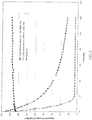
- FIG. 1 Results of OFITE rheology testing for the 40 lb. (18 kg) GLFC-5D linear gel with microemulsion/Enzyme G fluid and water/Enzyme G fluid at 75°F (24°C) are shown in FIG. 1 .
- the baseline in the figures represents the fluid without the enzyme breaker.
- All linear gels containing the enzymes showed a decrease in viscosity over time.
- the fluid containing 1.0 gpt of microemulsion/6% Enzyme G fluid showed a smaller rate of decrease in the viscosity than with the fluid containing the 1.0 gpt of water/6% Enzyme G fluid. This indicates that the microemulsion product is delaying the enzyme release.
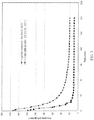
- Results of OFITE rheology testing for the 40 lb. (18 kg) GLFC-5D linear gel with microemulsion/8%Enzyme GBW-15C fluid and water/8% Enzyme GBW-15C fluid at 125°F (52°C) are shown in FIG. 3 .
- Results of OFITE rheology testing for the 40 lb. (18 kg) GLFC-5D linear gel with microemulsion/8%Enzyme GBW-15C fluid and water/8% Enzyme GBW-15C fluid at 125°F (52°C) are shown in FIG. 4 .
- the fluid containing 1.0 gpt of microemulsion/Enzyme fluid showed a smaller rate of decrease in the viscosity than with the fluid containing the 1.0 gpt of water/Enzyme fluid. This indicates that the microemulsion product is delaying the enzyme release.
- FIGs. 5 and 6 show the test results at 150°F (66°C). Again the fluid containing 1.0 gpt of microemulsion/Enzyme fluid showed a smaller rate of decrease in the viscosity than with the fluid containing the 1.0 gpt of water/Enzyme fluid. This indicates that the microemulsion product is delaying the enzyme release.
- the data shows the delay of the activity on two different enzymes by incorporating the enzyme or diluted enzyme in water into the internal phase of the microemulsion.
- Results show that at 75°F (24°C), 125°F (52°C) and 150°F (66°C) the enzyme microemulsion has slower release than the same concentration of enzyme in an aqueous solution.
- the Examples illustrate that incorporation of the enzyme/dilute enzyme in a water-in-oil microemulsion delays the release of the enzyme in a fracturing fluid.
- the data demonstrates that at 75°F (24°C), 125°F (52°C) and 150°F (66°C) the fluid containing 1.0 gpt of microemulsion/6% Enzyme G fluid showed a smaller rate of decrease in the viscosity than with the fluid containing the 1.0 gpt of water/6%Enzyme G fluid.
- microemulsion product delayed enzyme release and that fluid containing 1.0 gpt of microemulsion/8% Enzyme GBW-15C fluid showed a smaller rate of decrease in the viscosity than with the fluid containing the 1.0 gpt of water/8%Enzyme GBW-15C fluid. This indicates that the microemulsion product delayed enzyme release.
Landscapes
- Chemical & Material Sciences (AREA)
- Life Sciences & Earth Sciences (AREA)
- General Life Sciences & Earth Sciences (AREA)
- Engineering & Computer Science (AREA)
- Materials Engineering (AREA)
- Organic Chemistry (AREA)
- Oil, Petroleum & Natural Gas (AREA)
- Colloid Chemistry (AREA)
- Lubricants (AREA)
- Medicines Containing Material From Animals Or Micro-Organisms (AREA)
- Agricultural Chemicals And Associated Chemicals (AREA)
Priority Applications (1)
| Application Number | Priority Date | Filing Date | Title |
|---|---|---|---|
| PL12724025T PL2721118T3 (pl) | 2011-06-16 | 2012-05-16 | Sposób hamowania lub kontrolowania uwalniania środka do obróbki odwiertu |
Applications Claiming Priority (2)
| Application Number | Priority Date | Filing Date | Title |
|---|---|---|---|
| US13/162,461 US9102860B2 (en) | 2011-06-16 | 2011-06-16 | Method of inhibiting or controlling release of well treatment agent |
| PCT/US2012/038048 WO2012173728A1 (en) | 2011-06-16 | 2012-05-16 | Method of inhibiting or controlling release of well treatment agent |
Publications (2)
| Publication Number | Publication Date |
|---|---|
| EP2721118A1 EP2721118A1 (en) | 2014-04-23 |
| EP2721118B1 true EP2721118B1 (en) | 2021-08-11 |
Family
ID=46172929
Family Applications (1)
| Application Number | Title | Priority Date | Filing Date |
|---|---|---|---|
| EP12724025.7A Active EP2721118B1 (en) | 2011-06-16 | 2012-05-16 | Method of inhibiting or controlling release of well treatment agent |
Country Status (12)
| Country | Link |
|---|---|
| US (1) | US9102860B2 (pl) |
| EP (1) | EP2721118B1 (pl) |
| CN (1) | CN103619984A (pl) |
| AR (1) | AR086966A1 (pl) |
| AU (1) | AU2012271174B2 (pl) |
| BR (1) | BR112013031449B1 (pl) |
| CA (1) | CA2835041C (pl) |
| CO (1) | CO6801706A2 (pl) |
| HU (1) | HUE056193T2 (pl) |
| MX (1) | MX351409B (pl) |
| PL (1) | PL2721118T3 (pl) |
| WO (1) | WO2012173728A1 (pl) |
Families Citing this family (74)
| Publication number | Priority date | Publication date | Assignee | Title |
|---|---|---|---|---|
| US9222013B1 (en) | 2008-11-13 | 2015-12-29 | Cesi Chemical, Inc. | Water-in-oil microemulsions for oilfield applications |
| US8980798B2 (en) * | 2010-03-31 | 2015-03-17 | Baker Hughes Incorporated | Precipitation prevention in produced water containing hydrate inhibitors injected downhole |
| US10822536B2 (en) | 2010-07-19 | 2020-11-03 | Baker Hughes, A Ge Company, Llc | Method of using a screen containing a composite for release of well treatment agent into a well |
| US9029300B2 (en) | 2011-04-26 | 2015-05-12 | Baker Hughes Incorporated | Composites for controlled release of well treatment agents |
| US9976070B2 (en) | 2010-07-19 | 2018-05-22 | Baker Hughes, A Ge Company, Llc | Method of using shaped compressed pellets in well treatment operations |
| US9074121B2 (en) * | 2011-03-15 | 2015-07-07 | Richard J. Dyer | Oil well cleaning compositions |
| US9580642B2 (en) | 2011-11-22 | 2017-02-28 | Baker Hughes Incorporated | Method for improving isolation of flow to completed perforated intervals |
| CA2852295C (en) | 2011-11-22 | 2017-03-21 | Baker Hughes Incorporated | Method of using controlled release tracers |
| EP2838970B1 (en) | 2012-04-15 | 2016-12-28 | Flotek Chemistry, LLC | Surfactant formulations for foam flooding |
| US9200192B2 (en) | 2012-05-08 | 2015-12-01 | Cesi Chemical, Inc. | Compositions and methods for enhancement of production of liquid and gaseous hydrocarbons |
| US11407930B2 (en) | 2012-05-08 | 2022-08-09 | Flotek Chemistry, Llc | Compositions and methods for enhancement of production of liquid and gaseous hydrocarbons |
| US9868893B2 (en) * | 2013-03-14 | 2018-01-16 | Flotek Chemistry, Llc | Methods and compositions for use in oil and/or gas wells |
| US9884988B2 (en) | 2013-03-14 | 2018-02-06 | Flotek Chemistry, Llc | Methods and compositions for use in oil and/or gas wells |
| US9464223B2 (en) | 2013-03-14 | 2016-10-11 | Flotek Chemistry, Llc | Methods and compositions for use in oil and/or gas wells |
| US9321955B2 (en) | 2013-06-14 | 2016-04-26 | Flotek Chemistry, Llc | Methods and compositions for stimulating the production of hydrocarbons from subterranean formations |
| US20140371115A1 (en) * | 2013-06-14 | 2014-12-18 | CESI Chemical | Methods and compositions for stimulating the production of hydrocarbons from subterranean formations |
| US10717919B2 (en) | 2013-03-14 | 2020-07-21 | Flotek Chemistry, Llc | Methods and compositions for use in oil and/or gas wells |
| US10941106B2 (en) | 2013-03-14 | 2021-03-09 | Flotek Chemistry, Llc | Methods and compositions incorporating alkyl polyglycoside surfactant for use in oil and/or gas wells |
| US10053619B2 (en) | 2013-03-14 | 2018-08-21 | Flotek Chemistry, Llc | Siloxane surfactant additives for oil and gas applications |
| US9068108B2 (en) | 2013-03-14 | 2015-06-30 | Cesi Chemical, Inc. | Methods and compositions for stimulating the production of hydrocarbons from subterranean formations |
| CA2906047C (en) * | 2013-03-14 | 2019-11-12 | Cesi Chemical, Inc. | Methods and compositions for stimulating the production of hydrocarbons from subterranean formations |
| US10590332B2 (en) | 2013-03-14 | 2020-03-17 | Flotek Chemistry, Llc | Siloxane surfactant additives for oil and gas applications |
| US11254856B2 (en) | 2013-03-14 | 2022-02-22 | Flotek Chemistry, Llc | Methods and compositions for use in oil and/or gas wells |
| US10287483B2 (en) | 2013-03-14 | 2019-05-14 | Flotek Chemistry, Llc | Methods and compositions for use in oil and/or gas wells comprising a terpene alcohol |
| US10000693B2 (en) | 2013-03-14 | 2018-06-19 | Flotek Chemistry, Llc | Methods and compositions for use in oil and/or gas wells |
| US11180690B2 (en) | 2013-03-14 | 2021-11-23 | Flotek Chemistry, Llc | Diluted microemulsions with low surface tensions |
| US10421707B2 (en) | 2013-03-14 | 2019-09-24 | Flotek Chemistry, Llc | Methods and compositions incorporating alkyl polyglycoside surfactant for use in oil and/or gas wells |
| US10577531B2 (en) | 2013-03-14 | 2020-03-03 | Flotek Chemistry, Llc | Polymers and emulsions for use in oil and/or gas wells |
| US9428683B2 (en) | 2013-03-14 | 2016-08-30 | Flotek Chemistry, Llc | Methods and compositions for stimulating the production of hydrocarbons from subterranean formations |
| WO2014201367A1 (en) * | 2013-06-14 | 2014-12-18 | Cesi Chemical, Inc. | Methods and compositions for stimulating the production of hydrocarbons from subterranean formations |
| US10392553B2 (en) | 2013-08-30 | 2019-08-27 | Baker Hughes, A Ge Company, Llc | Method for enhancing productivity of hydrocarbon formations using fluid containing organometallic crosslinking agent and scale inhibitor |
| US10844270B2 (en) | 2013-09-17 | 2020-11-24 | Baker Hughes, A Ge Company, Llc | Method of enhancing stability of cement slurries in well cementing operations |
| US10822917B2 (en) | 2013-09-17 | 2020-11-03 | Baker Hughes, A Ge Company, Llc | Method of cementing a well using delayed hydratable polymeric viscosifying agents |
| BR112016005454B1 (pt) | 2013-09-20 | 2022-02-08 | Baker Hughes Incorporated | Método para tratar um poço que penetra em uma formação subterrânea |
| US9822621B2 (en) | 2013-09-20 | 2017-11-21 | Baker Hughes, A Ge Company, Llc | Method of using surface modifying treatment agents to treat subterranean formations |
| RU2670804C9 (ru) | 2013-09-20 | 2018-11-28 | Бейкер Хьюз Инкорпорейтед | Способ применения содержащих металл агентов для модификации поверхности при обработке подземных пластов |
| CA2923221C (en) | 2013-09-20 | 2020-04-28 | Baker Hughes Incorporated | Method of inhibiting fouling on a metallic surface using a surface modifying treatment agent comprising an anchor and a hydrophobic tail |
| MX381754B (es) | 2013-09-20 | 2025-03-13 | Baker Hughes Inc | Materiales compuestos para uso en operaciones de estimulación y control de arena. |
| US9701892B2 (en) | 2014-04-17 | 2017-07-11 | Baker Hughes Incorporated | Method of pumping aqueous fluid containing surface modifying treatment agent into a well |
| US9890624B2 (en) | 2014-02-28 | 2018-02-13 | Eclipse Ior Services, Llc | Systems and methods for the treatment of oil and/or gas wells with a polymeric material |
| US9890625B2 (en) | 2014-02-28 | 2018-02-13 | Eclipse Ior Services, Llc | Systems and methods for the treatment of oil and/or gas wells with an obstruction material |
| CA2891278C (en) | 2014-05-14 | 2018-11-06 | Cesi Chemical, Inc. | Methods and compositions for use in oil and / or gas wells |
| CA2955926C (en) | 2014-07-23 | 2018-11-20 | Baker Hughes Incorporated | Composite comprising well treatment agent and/or a tracer adhered onto a calcined substrate of a metal oxide coated core and a method of using the same |
| US10294757B2 (en) | 2014-07-28 | 2019-05-21 | Flotek Chemistry, Llc | Methods and compositions related to gelled layers in oil and/or gas wells |
| US9656237B2 (en) | 2014-07-31 | 2017-05-23 | Baker Hughes Incorporated | Method of scavenging hydrogen sulfide and mercaptans using well treatment composites |
| US10294414B2 (en) * | 2014-09-19 | 2019-05-21 | Arkema Inc. | Compositions and methods for breaking hydraulic fracturing fluids |
| US10280737B2 (en) | 2015-06-15 | 2019-05-07 | Baker Hughes, A Ge Company, Llc | Methods of using carbon quantum dots to enhance productivity of fluids from wells |
| MX380821B (es) * | 2015-09-18 | 2025-03-12 | Indorama Ventures Oxides Llc | Inhibidor cinético de hidrato de gas con poli (vinilcaprolactama) mejorada y método para preparar el mismo. |
| CN105368435B (zh) * | 2015-10-29 | 2019-01-08 | 中国石油集团渤海钻探工程有限公司 | 一种超低浓度胍胶用高效交联剂及其制备方法 |
| CN106928952B (zh) * | 2015-12-29 | 2020-02-21 | 核工业北京化工冶金研究院 | 一种延缓交联聚合物体系 |
| CN105694827A (zh) * | 2016-03-14 | 2016-06-22 | 中国石油集团渤海钻探工程有限公司 | 一种适用于有机盐钻井液的润滑剂及其制备方法 |
| CN106089126B (zh) * | 2016-05-31 | 2018-07-17 | 徐州市苏文机械设备制造有限公司 | 一种送钻工具 |
| US10641083B2 (en) | 2016-06-02 | 2020-05-05 | Baker Hughes, A Ge Company, Llc | Method of monitoring fluid flow from a reservoir using well treatment agents |
| US10413966B2 (en) | 2016-06-20 | 2019-09-17 | Baker Hughes, A Ge Company, Llc | Nanoparticles having magnetic core encapsulated by carbon shell and composites of the same |
| WO2018064270A1 (en) | 2016-09-29 | 2018-04-05 | Ecolab USA, Inc. | Paraffin inhibitors, and paraffin suppressant compositions and methods |
| RU2752630C2 (ru) | 2016-09-29 | 2021-07-29 | ЭКОЛАБ ЮЭсЭй, ИНК. | Композиции парафинового супрессанта и способы |
| CA3058378A1 (en) * | 2017-03-27 | 2018-10-04 | Signa Chemistry, Inc. | Methods for delivering water reactive chemicals to subterranean reservoirs for enhanced crude oil recovery |
| US11254861B2 (en) | 2017-07-13 | 2022-02-22 | Baker Hughes Holdings Llc | Delivery system for oil-soluble well treatment agents and methods of using the same |
| US12060523B2 (en) | 2017-07-13 | 2024-08-13 | Baker Hughes Holdings Llc | Method of introducing oil-soluble well treatment agent into a well or subterranean formation |
| US10934472B2 (en) | 2017-08-18 | 2021-03-02 | Flotek Chemistry, Llc | Compositions comprising non-halogenated solvents for use in oil and/or gas wells and related methods |
| US20190100687A1 (en) * | 2017-10-02 | 2019-04-04 | Ethical Solutions, Llc | Methods and compositions for filter cake removal |
| US11254850B2 (en) | 2017-11-03 | 2022-02-22 | Baker Hughes Holdings Llc | Treatment methods using aqueous fluids containing oil-soluble treatment agents |
| US11053433B2 (en) | 2017-12-01 | 2021-07-06 | Flotek Chemistry, Llc | Methods and compositions for stimulating the production of hydrocarbons from subterranean formations |
| CN108822820B (zh) * | 2018-05-22 | 2020-11-03 | 东莞理工学院 | 一种隔离型水合物动力学抑制胶囊及其制备方法与应用 |
| US11541105B2 (en) | 2018-06-01 | 2023-01-03 | The Research Foundation For The State University Of New York | Compositions and methods for disrupting biofilm formation and maintenance |
| JP2020019905A (ja) * | 2018-08-01 | 2020-02-06 | トヨタ自動車株式会社 | 冷却液組成物 |
| US11028309B2 (en) | 2019-02-08 | 2021-06-08 | Baker Hughes Oilfield Operations Llc | Method of using resin coated sized particulates as spacer fluid |
| CA3049343A1 (en) * | 2019-07-11 | 2021-01-11 | Fluid Energy Group Ltd. | Composition useful in sulfate scale removal |
| US11104843B2 (en) | 2019-10-10 | 2021-08-31 | Flotek Chemistry, Llc | Well treatment compositions and methods comprising certain microemulsions and certain clay control additives exhibiting synergistic effect of enhancing clay swelling protection and persistency |
| US10961444B1 (en) | 2019-11-01 | 2021-03-30 | Baker Hughes Oilfield Operations Llc | Method of using coated composites containing delayed release agent in a well treatment operation |
| US11512243B2 (en) | 2020-10-23 | 2022-11-29 | Flotek Chemistry, Llc | Microemulsions comprising an alkyl propoxylated sulfate surfactant, and related methods |
| MX2021003595A (es) * | 2021-03-26 | 2021-09-30 | Chemiservis S A De C V | Formulacion a base de surfactantes y su uso como agente disolvente de polimeros y material organico derivados de la perforacion en yacimientos de petroleo. |
| US11377584B1 (en) | 2021-04-23 | 2022-07-05 | Halliburton Energy Services, Inc. | Nanodissolver for iron sulfide scale removal |
| CN115386353B (zh) * | 2021-05-25 | 2024-01-23 | 中国石油天然气集团有限公司 | 一种低渗油田调剖升压水井降压增注工作液及制备方法 |
Family Cites Families (39)
| Publication number | Priority date | Publication date | Assignee | Title |
|---|---|---|---|---|
| US4824890A (en) | 1988-02-02 | 1989-04-25 | Dow Corning Corporation | Film forming silicone microemulsions |
| US5067566A (en) | 1991-01-14 | 1991-11-26 | Bj Services Company | Low temperature degradation of galactomannans |
| US5591700A (en) * | 1994-12-22 | 1997-01-07 | Halliburton Company | Fracturing fluid with encapsulated breaker |
| US5603942A (en) | 1995-05-19 | 1997-02-18 | Isp Investments Inc. | Stable, single phase w/o microemulsion matrix formulation for forming sprayable, aerosol agriculturally active compositions |
| US5806597A (en) | 1996-05-01 | 1998-09-15 | Bj Services Company | Stable breaker-crosslinker-polymer complex and method of use in completion and stimulation |
| US6090399A (en) * | 1997-12-11 | 2000-07-18 | Rohm And Haas Company | Controlled release composition incorporating metal oxide glass comprising biologically active compound |
| US5996692A (en) * | 1998-02-13 | 1999-12-07 | Atlantic Richfield Company | Surfactant composition and method for cleaning wellbore and oil field surfaces using the surfactant composition |
| GB9915214D0 (en) * | 1999-06-29 | 1999-09-01 | Bp Exploration Operating | Microemulsions |
| US6593279B2 (en) * | 1999-12-10 | 2003-07-15 | Integrity Industries, Inc. | Acid based micro-emulsions |
| EP1278937A1 (en) | 2000-04-07 | 2003-01-29 | Sofitech N.V. | Scale removal |
| US6613720B1 (en) * | 2000-10-13 | 2003-09-02 | Schlumberger Technology Corporation | Delayed blending of additives in well treatment fluids |
| US6938693B2 (en) * | 2001-10-31 | 2005-09-06 | Schlumberger Technology Corporation | Methods for controlling screenouts |
| US20080287324A1 (en) * | 2002-03-01 | 2008-11-20 | Cesi Chemical, Inc., A Flotek Company | Process for well cleaning |
| AU2003219942A1 (en) * | 2002-03-01 | 2003-09-16 | Cesi Chemical, A Flotek Company | Composition and process for well cleaning |
| CA2455249A1 (en) | 2003-01-17 | 2004-07-17 | Bj Services Company | Crosslinking delaying agents for acid fluids |
| US7392845B2 (en) | 2006-03-23 | 2008-07-01 | Bj Services Company | Method of treating oil or gas well with biodegradable emulsion |
| US7481273B2 (en) * | 2004-09-02 | 2009-01-27 | Bj Services Company | Method of using water-in-oil emulsion to remove oil base or synthetic oil base filter cake |
| US7188676B2 (en) * | 2004-09-02 | 2007-03-13 | Bj Services Company | Method for displacing oil base drilling muds and/or residues from oil base drilling mud using water-in-oil emulsion |
| US7231976B2 (en) | 2004-11-10 | 2007-06-19 | Bj Services Company | Method of treating an oil or gas well with biodegradable low toxicity fluid system |
| US7392844B2 (en) | 2004-11-10 | 2008-07-01 | Bj Services Company | Method of treating an oil or gas well with biodegradable low toxicity fluid system |
| US7491682B2 (en) | 2004-12-15 | 2009-02-17 | Bj Services Company | Method of inhibiting or controlling formation of inorganic scales |
| US7615516B2 (en) * | 2005-01-21 | 2009-11-10 | Baker Hughes Incorporated | Microemulsion containing oil field chemicals useful for oil and gas field applications |
| US20060223713A1 (en) | 2005-04-05 | 2006-10-05 | Bj Services Company | Method of completing a well with hydrate inhibitors |
| CN101360481A (zh) * | 2005-11-22 | 2009-02-04 | 雀巢技术公司 | 水包油乳液及其用于功能性输送的用途 |
| PL2069490T5 (pl) | 2006-12-21 | 2018-09-28 | Basf Enzymes Llc | Amylazy i glukoamylazy, kwasy nukleinowe kodujące te związki oraz sposoby wytwarzania tych związków oraz stosowania ich |
| US7918281B2 (en) | 2007-03-06 | 2011-04-05 | Baker Hughes Incorporated | Method of treating flow conduits and vessels with foamed composition |
| US7475730B2 (en) | 2007-03-06 | 2009-01-13 | Bj Services Company | Method of treating well with foamed composition |
| US20080217012A1 (en) | 2007-03-08 | 2008-09-11 | Bj Services Company | Gelled emulsions and methods of using the same |
| US7708968B2 (en) * | 2007-03-26 | 2010-05-04 | General Electric Company | Nano-scale metal oxide, oxyhalide and oxysulfide scintillation materials and methods for making same |
| GB0713180D0 (en) * | 2007-07-06 | 2007-08-15 | Cleansorb Ltd | Method for treatment of underground reservoirs |
| US7552771B2 (en) * | 2007-11-14 | 2009-06-30 | Halliburton Energy Services, Inc. | Methods to enhance gas production following a relative-permeability-modifier treatment |
| MX2008014639A (es) * | 2007-11-16 | 2009-05-20 | Bj Services Co | Metodo de tratar formaciones subterraneas por medio de hidrolisis in situ de esteres de acidos organicos. |
| US20090137432A1 (en) * | 2007-11-28 | 2009-05-28 | Sullivan Philp F | pH Sensitive Emulsion System |
| US7989404B2 (en) * | 2008-02-11 | 2011-08-02 | Clearwater International, Llc | Compositions and methods for gas well treatment |
| US7906464B2 (en) * | 2008-05-13 | 2011-03-15 | Halliburton Energy Services, Inc. | Compositions and methods for the removal of oil-based filtercakes |
| US7968500B2 (en) | 2008-06-25 | 2011-06-28 | Baker Hughes Incorporated | Gas hydrate protection with heat producing two-component gas hydrate inhibitors |
| US7977283B2 (en) | 2008-06-27 | 2011-07-12 | Baker Hughes Incorporated | Method of minimizing or reducing salt deposits by use of a fluid containing a fructan and derivatives thereof |
| US7833943B2 (en) * | 2008-09-26 | 2010-11-16 | Halliburton Energy Services Inc. | Microemulsifiers and methods of making and using same |
| US20130244913A1 (en) * | 2012-03-13 | 2013-09-19 | L. Jack Maberry | Composition and method of converting a fluid from oil external to water external for cleaning a wellbore |
-
2011
- 2011-06-16 US US13/162,461 patent/US9102860B2/en active Active
-
2012
- 2012-05-16 BR BR112013031449-4A patent/BR112013031449B1/pt not_active IP Right Cessation
- 2012-05-16 CA CA2835041A patent/CA2835041C/en active Active
- 2012-05-16 AU AU2012271174A patent/AU2012271174B2/en not_active Ceased
- 2012-05-16 CN CN201280029050.1A patent/CN103619984A/zh active Pending
- 2012-05-16 MX MX2013014845A patent/MX351409B/es active IP Right Grant
- 2012-05-16 PL PL12724025T patent/PL2721118T3/pl unknown
- 2012-05-16 WO PCT/US2012/038048 patent/WO2012173728A1/en not_active Ceased
- 2012-05-16 HU HUE12724025A patent/HUE056193T2/hu unknown
- 2012-05-16 EP EP12724025.7A patent/EP2721118B1/en active Active
- 2012-06-15 AR ARP120102151 patent/AR086966A1/es active IP Right Grant
-
2013
- 2013-11-01 CO CO13259698A patent/CO6801706A2/es not_active Application Discontinuation
Non-Patent Citations (1)
| Title |
|---|
| None * |
Also Published As
| Publication number | Publication date |
|---|---|
| AU2012271174B2 (en) | 2016-02-18 |
| AU2012271174A1 (en) | 2013-11-14 |
| HUE056193T2 (hu) | 2022-01-28 |
| CN103619984A (zh) | 2014-03-05 |
| US20120318515A1 (en) | 2012-12-20 |
| CO6801706A2 (es) | 2013-11-29 |
| BR112013031449B1 (pt) | 2021-05-04 |
| CA2835041C (en) | 2016-06-28 |
| PL2721118T3 (pl) | 2021-12-20 |
| AR086966A1 (es) | 2014-02-05 |
| WO2012173728A1 (en) | 2012-12-20 |
| BR112013031449A2 (pt) | 2016-12-06 |
| EP2721118A1 (en) | 2014-04-23 |
| MX351409B (es) | 2017-10-13 |
| CA2835041A1 (en) | 2012-12-20 |
| US9102860B2 (en) | 2015-08-11 |
| MX2013014845A (es) | 2014-03-31 |
Similar Documents
| Publication | Publication Date | Title |
|---|---|---|
| EP2721118B1 (en) | Method of inhibiting or controlling release of well treatment agent | |
| US8778850B2 (en) | Biodegradable non-reactive oil-well stimulation fluid and method of use | |
| AU2008273916B2 (en) | Method for treatment of underground reservoirs | |
| EP2861692B1 (en) | Process to produce oil or gas from a subterranean formation using a chelating agent | |
| EP1874890B1 (en) | Microemulsion containing corrosion inhibitors useful for oil and gas field applications | |
| US20150141302A1 (en) | Composition Containing An Emulsified Chelating Agent And Process To Treat A Subterreanean Formation | |
| CA2911194C (en) | Process to treat subterranean formations including a soaking step and using a chelating agent | |
| WO2014039168A1 (en) | Electron-poor orthoester for generating acid in a well fluid |
Legal Events
| Date | Code | Title | Description |
|---|---|---|---|
| PUAI | Public reference made under article 153(3) epc to a published international application that has entered the european phase |
Free format text: ORIGINAL CODE: 0009012 |
|
| 17P | Request for examination filed |
Effective date: 20131114 |
|
| AK | Designated contracting states |
Kind code of ref document: A1 Designated state(s): AL AT BE BG CH CY CZ DE DK EE ES FI FR GB GR HR HU IE IS IT LI LT LU LV MC MK MT NL NO PL PT RO RS SE SI SK SM TR |
|
| DAX | Request for extension of the european patent (deleted) | ||
| STAA | Information on the status of an ep patent application or granted ep patent |
Free format text: STATUS: EXAMINATION IS IN PROGRESS |
|
| 17Q | First examination report despatched |
Effective date: 20170816 |
|
| GRAP | Despatch of communication of intention to grant a patent |
Free format text: ORIGINAL CODE: EPIDOSNIGR1 |
|
| STAA | Information on the status of an ep patent application or granted ep patent |
Free format text: STATUS: GRANT OF PATENT IS INTENDED |
|
| INTG | Intention to grant announced |
Effective date: 20210304 |
|
| RAP3 | Party data changed (applicant data changed or rights of an application transferred) |
Owner name: BAKER HUGHES HOLDINGS LLC |
|
| GRAS | Grant fee paid |
Free format text: ORIGINAL CODE: EPIDOSNIGR3 |
|
| GRAA | (expected) grant |
Free format text: ORIGINAL CODE: 0009210 |
|
| STAA | Information on the status of an ep patent application or granted ep patent |
Free format text: STATUS: THE PATENT HAS BEEN GRANTED |
|
| AK | Designated contracting states |
Kind code of ref document: B1 Designated state(s): AL AT BE BG CH CY CZ DE DK EE ES FI FR GB GR HR HU IE IS IT LI LT LU LV MC MK MT NL NO PL PT RO RS SE SI SK SM TR |
|
| REG | Reference to a national code |
Ref country code: GB Ref legal event code: FG4D |
|
| REG | Reference to a national code |
Ref country code: CH Ref legal event code: EP |
|
| REG | Reference to a national code |
Ref country code: DE Ref legal event code: R096 Ref document number: 602012076366 Country of ref document: DE |
|
| REG | Reference to a national code |
Ref country code: IE Ref legal event code: FG4D Ref country code: AT Ref legal event code: REF Ref document number: 1419380 Country of ref document: AT Kind code of ref document: T Effective date: 20210915 |
|
| REG | Reference to a national code |
Ref country code: NL Ref legal event code: FP |
|
| REG | Reference to a national code |
Ref country code: LT Ref legal event code: MG9D |
|
| REG | Reference to a national code |
Ref country code: AT Ref legal event code: MK05 Ref document number: 1419380 Country of ref document: AT Kind code of ref document: T Effective date: 20210811 |
|
| REG | Reference to a national code |
Ref country code: HU Ref legal event code: AG4A Ref document number: E056193 Country of ref document: HU |
|
| PG25 | Lapsed in a contracting state [announced via postgrant information from national office to epo] |
Ref country code: ES Free format text: LAPSE BECAUSE OF FAILURE TO SUBMIT A TRANSLATION OF THE DESCRIPTION OR TO PAY THE FEE WITHIN THE PRESCRIBED TIME-LIMIT Effective date: 20210811 Ref country code: FI Free format text: LAPSE BECAUSE OF FAILURE TO SUBMIT A TRANSLATION OF THE DESCRIPTION OR TO PAY THE FEE WITHIN THE PRESCRIBED TIME-LIMIT Effective date: 20210811 Ref country code: PT Free format text: LAPSE BECAUSE OF FAILURE TO SUBMIT A TRANSLATION OF THE DESCRIPTION OR TO PAY THE FEE WITHIN THE PRESCRIBED TIME-LIMIT Effective date: 20211213 Ref country code: NO Free format text: LAPSE BECAUSE OF FAILURE TO SUBMIT A TRANSLATION OF THE DESCRIPTION OR TO PAY THE FEE WITHIN THE PRESCRIBED TIME-LIMIT Effective date: 20211111 Ref country code: RS Free format text: LAPSE BECAUSE OF FAILURE TO SUBMIT A TRANSLATION OF THE DESCRIPTION OR TO PAY THE FEE WITHIN THE PRESCRIBED TIME-LIMIT Effective date: 20210811 Ref country code: BG Free format text: LAPSE BECAUSE OF FAILURE TO SUBMIT A TRANSLATION OF THE DESCRIPTION OR TO PAY THE FEE WITHIN THE PRESCRIBED TIME-LIMIT Effective date: 20211111 Ref country code: AT Free format text: LAPSE BECAUSE OF FAILURE TO SUBMIT A TRANSLATION OF THE DESCRIPTION OR TO PAY THE FEE WITHIN THE PRESCRIBED TIME-LIMIT Effective date: 20210811 Ref country code: LT Free format text: LAPSE BECAUSE OF FAILURE TO SUBMIT A TRANSLATION OF THE DESCRIPTION OR TO PAY THE FEE WITHIN THE PRESCRIBED TIME-LIMIT Effective date: 20210811 Ref country code: HR Free format text: LAPSE BECAUSE OF FAILURE TO SUBMIT A TRANSLATION OF THE DESCRIPTION OR TO PAY THE FEE WITHIN THE PRESCRIBED TIME-LIMIT Effective date: 20210811 Ref country code: SE Free format text: LAPSE BECAUSE OF FAILURE TO SUBMIT A TRANSLATION OF THE DESCRIPTION OR TO PAY THE FEE WITHIN THE PRESCRIBED TIME-LIMIT Effective date: 20210811 |
|
| PG25 | Lapsed in a contracting state [announced via postgrant information from national office to epo] |
Ref country code: LV Free format text: LAPSE BECAUSE OF FAILURE TO SUBMIT A TRANSLATION OF THE DESCRIPTION OR TO PAY THE FEE WITHIN THE PRESCRIBED TIME-LIMIT Effective date: 20210811 Ref country code: GR Free format text: LAPSE BECAUSE OF FAILURE TO SUBMIT A TRANSLATION OF THE DESCRIPTION OR TO PAY THE FEE WITHIN THE PRESCRIBED TIME-LIMIT Effective date: 20211112 |
|
| PG25 | Lapsed in a contracting state [announced via postgrant information from national office to epo] |
Ref country code: DK Free format text: LAPSE BECAUSE OF FAILURE TO SUBMIT A TRANSLATION OF THE DESCRIPTION OR TO PAY THE FEE WITHIN THE PRESCRIBED TIME-LIMIT Effective date: 20210811 |
|
| REG | Reference to a national code |
Ref country code: DE Ref legal event code: R097 Ref document number: 602012076366 Country of ref document: DE |
|
| PG25 | Lapsed in a contracting state [announced via postgrant information from national office to epo] |
Ref country code: SM Free format text: LAPSE BECAUSE OF FAILURE TO SUBMIT A TRANSLATION OF THE DESCRIPTION OR TO PAY THE FEE WITHIN THE PRESCRIBED TIME-LIMIT Effective date: 20210811 Ref country code: SK Free format text: LAPSE BECAUSE OF FAILURE TO SUBMIT A TRANSLATION OF THE DESCRIPTION OR TO PAY THE FEE WITHIN THE PRESCRIBED TIME-LIMIT Effective date: 20210811 Ref country code: EE Free format text: LAPSE BECAUSE OF FAILURE TO SUBMIT A TRANSLATION OF THE DESCRIPTION OR TO PAY THE FEE WITHIN THE PRESCRIBED TIME-LIMIT Effective date: 20210811 Ref country code: CZ Free format text: LAPSE BECAUSE OF FAILURE TO SUBMIT A TRANSLATION OF THE DESCRIPTION OR TO PAY THE FEE WITHIN THE PRESCRIBED TIME-LIMIT Effective date: 20210811 Ref country code: AL Free format text: LAPSE BECAUSE OF FAILURE TO SUBMIT A TRANSLATION OF THE DESCRIPTION OR TO PAY THE FEE WITHIN THE PRESCRIBED TIME-LIMIT Effective date: 20210811 |
|
| PLBE | No opposition filed within time limit |
Free format text: ORIGINAL CODE: 0009261 |
|
| STAA | Information on the status of an ep patent application or granted ep patent |
Free format text: STATUS: NO OPPOSITION FILED WITHIN TIME LIMIT |
|
| PGFP | Annual fee paid to national office [announced via postgrant information from national office to epo] |
Ref country code: NL Payment date: 20220420 Year of fee payment: 11 |
|
| 26N | No opposition filed |
Effective date: 20220512 |
|
| PGFP | Annual fee paid to national office [announced via postgrant information from national office to epo] |
Ref country code: RO Payment date: 20220516 Year of fee payment: 11 Ref country code: IT Payment date: 20220421 Year of fee payment: 11 Ref country code: HU Payment date: 20220426 Year of fee payment: 11 Ref country code: GB Payment date: 20220426 Year of fee payment: 11 Ref country code: FR Payment date: 20220421 Year of fee payment: 11 Ref country code: DE Payment date: 20220420 Year of fee payment: 11 |
|
| PG25 | Lapsed in a contracting state [announced via postgrant information from national office to epo] |
Ref country code: SI Free format text: LAPSE BECAUSE OF FAILURE TO SUBMIT A TRANSLATION OF THE DESCRIPTION OR TO PAY THE FEE WITHIN THE PRESCRIBED TIME-LIMIT Effective date: 20210811 |
|
| PGFP | Annual fee paid to national office [announced via postgrant information from national office to epo] |
Ref country code: PL Payment date: 20220420 Year of fee payment: 11 |
|
| REG | Reference to a national code |
Ref country code: CH Ref legal event code: PL |
|
| REG | Reference to a national code |
Ref country code: BE Ref legal event code: MM Effective date: 20220531 |
|
| PG25 | Lapsed in a contracting state [announced via postgrant information from national office to epo] |
Ref country code: MC Free format text: LAPSE BECAUSE OF FAILURE TO SUBMIT A TRANSLATION OF THE DESCRIPTION OR TO PAY THE FEE WITHIN THE PRESCRIBED TIME-LIMIT Effective date: 20210811 Ref country code: LU Free format text: LAPSE BECAUSE OF NON-PAYMENT OF DUE FEES Effective date: 20220516 Ref country code: LI Free format text: LAPSE BECAUSE OF NON-PAYMENT OF DUE FEES Effective date: 20220531 Ref country code: CH Free format text: LAPSE BECAUSE OF NON-PAYMENT OF DUE FEES Effective date: 20220531 |
|
| PG25 | Lapsed in a contracting state [announced via postgrant information from national office to epo] |
Ref country code: IE Free format text: LAPSE BECAUSE OF NON-PAYMENT OF DUE FEES Effective date: 20220516 |
|
| PG25 | Lapsed in a contracting state [announced via postgrant information from national office to epo] |
Ref country code: BE Free format text: LAPSE BECAUSE OF NON-PAYMENT OF DUE FEES Effective date: 20220531 |
|
| REG | Reference to a national code |
Ref country code: DE Ref legal event code: R119 Ref document number: 602012076366 Country of ref document: DE |
|
| REG | Reference to a national code |
Ref country code: NL Ref legal event code: MM Effective date: 20230601 |
|
| GBPC | Gb: european patent ceased through non-payment of renewal fee |
Effective date: 20230516 |
|
| PG25 | Lapsed in a contracting state [announced via postgrant information from national office to epo] |
Ref country code: RO Free format text: LAPSE BECAUSE OF NON-PAYMENT OF DUE FEES Effective date: 20230516 Ref country code: HU Free format text: LAPSE BECAUSE OF NON-PAYMENT OF DUE FEES Effective date: 20230517 |
|
| PG25 | Lapsed in a contracting state [announced via postgrant information from national office to epo] |
Ref country code: NL Free format text: LAPSE BECAUSE OF NON-PAYMENT OF DUE FEES Effective date: 20230601 |
|
| PG25 | Lapsed in a contracting state [announced via postgrant information from national office to epo] |
Ref country code: MK Free format text: LAPSE BECAUSE OF FAILURE TO SUBMIT A TRANSLATION OF THE DESCRIPTION OR TO PAY THE FEE WITHIN THE PRESCRIBED TIME-LIMIT Effective date: 20210811 Ref country code: IT Free format text: LAPSE BECAUSE OF NON-PAYMENT OF DUE FEES Effective date: 20230516 Ref country code: DE Free format text: LAPSE BECAUSE OF NON-PAYMENT OF DUE FEES Effective date: 20231201 Ref country code: CY Free format text: LAPSE BECAUSE OF FAILURE TO SUBMIT A TRANSLATION OF THE DESCRIPTION OR TO PAY THE FEE WITHIN THE PRESCRIBED TIME-LIMIT Effective date: 20210811 Ref country code: GB Free format text: LAPSE BECAUSE OF NON-PAYMENT OF DUE FEES Effective date: 20230516 |
|
| PG25 | Lapsed in a contracting state [announced via postgrant information from national office to epo] |
Ref country code: FR Free format text: LAPSE BECAUSE OF NON-PAYMENT OF DUE FEES Effective date: 20230531 |
|
| PG25 | Lapsed in a contracting state [announced via postgrant information from national office to epo] |
Ref country code: TR Free format text: LAPSE BECAUSE OF FAILURE TO SUBMIT A TRANSLATION OF THE DESCRIPTION OR TO PAY THE FEE WITHIN THE PRESCRIBED TIME-LIMIT Effective date: 20210811 |
|
| PG25 | Lapsed in a contracting state [announced via postgrant information from national office to epo] |
Ref country code: MT Free format text: LAPSE BECAUSE OF FAILURE TO SUBMIT A TRANSLATION OF THE DESCRIPTION OR TO PAY THE FEE WITHIN THE PRESCRIBED TIME-LIMIT Effective date: 20210811 |
|
| PG25 | Lapsed in a contracting state [announced via postgrant information from national office to epo] |
Ref country code: PL Free format text: LAPSE BECAUSE OF NON-PAYMENT OF DUE FEES Effective date: 20230516 |
|
| PG25 | Lapsed in a contracting state [announced via postgrant information from national office to epo] |
Ref country code: PL Free format text: LAPSE BECAUSE OF NON-PAYMENT OF DUE FEES Effective date: 20230516 |