EP2717076A1 - Dye-based polarizing element and polarizing plate - Google Patents
Dye-based polarizing element and polarizing plate Download PDFInfo
- Publication number
- EP2717076A1 EP2717076A1 EP12793781.1A EP12793781A EP2717076A1 EP 2717076 A1 EP2717076 A1 EP 2717076A1 EP 12793781 A EP12793781 A EP 12793781A EP 2717076 A1 EP2717076 A1 EP 2717076A1
- Authority
- EP
- European Patent Office
- Prior art keywords
- group
- sulfo
- polarizing element
- polarizing
- film
- Prior art date
- Legal status (The legal status is an assumption and is not a legal conclusion. Google has not performed a legal analysis and makes no representation as to the accuracy of the status listed.)
- Granted
Links
- 229920005989 resin Polymers 0.000 claims abstract description 51
- 239000011347 resin Substances 0.000 claims abstract description 51
- 239000000049 pigment Substances 0.000 claims abstract description 43
- 229920002451 polyvinyl alcohol Polymers 0.000 claims abstract description 43
- 239000004372 Polyvinyl alcohol Substances 0.000 claims abstract description 42
- 125000003545 alkoxy group Chemical group 0.000 claims abstract description 36
- 125000000020 sulfo group Chemical group O=S(=O)([*])O[H] 0.000 claims abstract description 34
- -1 azo compound Chemical class 0.000 claims abstract description 20
- 125000000217 alkyl group Chemical group 0.000 claims abstract description 18
- 125000003277 amino group Chemical group 0.000 claims abstract description 18
- 150000003839 salts Chemical class 0.000 claims abstract description 16
- 125000003178 carboxy group Chemical group [H]OC(*)=O 0.000 claims abstract description 9
- 125000000449 nitro group Chemical group [O-][N+](*)=O 0.000 claims abstract description 9
- 125000001424 substituent group Chemical group 0.000 claims abstract description 9
- 125000001624 naphthyl group Chemical group 0.000 claims abstract description 8
- 125000001997 phenyl group Chemical group [H]C1=C([H])C([H])=C(*)C([H])=C1[H] 0.000 claims abstract description 8
- 125000004435 hydrogen atom Chemical group [H]* 0.000 claims abstract description 7
- 150000001875 compounds Chemical class 0.000 claims description 17
- JRBJSXQPQWSCCF-UHFFFAOYSA-N 3,3'-Dimethoxybenzidine Chemical compound C1=C(N)C(OC)=CC(C=2C=C(OC)C(N)=CC=2)=C1 JRBJSXQPQWSCCF-UHFFFAOYSA-N 0.000 abstract description 16
- 239000000126 substance Substances 0.000 abstract description 15
- 239000002994 raw material Substances 0.000 abstract description 8
- 238000000034 method Methods 0.000 description 53
- 239000000975 dye Substances 0.000 description 32
- 230000008569 process Effects 0.000 description 30
- XLYOFNOQVPJJNP-UHFFFAOYSA-N water Substances O XLYOFNOQVPJJNP-UHFFFAOYSA-N 0.000 description 29
- 239000000243 solution Substances 0.000 description 24
- 238000005406 washing Methods 0.000 description 23
- 239000010410 layer Substances 0.000 description 20
- 239000003431 cross linking reagent Substances 0.000 description 18
- 239000000654 additive Substances 0.000 description 17
- 230000000996 additive effect Effects 0.000 description 17
- 230000010287 polarization Effects 0.000 description 17
- 235000002639 sodium chloride Nutrition 0.000 description 17
- 239000000853 adhesive Substances 0.000 description 15
- 230000001070 adhesive effect Effects 0.000 description 15
- 238000004043 dyeing Methods 0.000 description 15
- 230000008859 change Effects 0.000 description 14
- 239000004327 boric acid Substances 0.000 description 10
- 230000000052 comparative effect Effects 0.000 description 10
- 239000002904 solvent Substances 0.000 description 10
- KGBXLFKZBHKPEV-UHFFFAOYSA-N boric acid Chemical compound OB(O)O KGBXLFKZBHKPEV-UHFFFAOYSA-N 0.000 description 9
- 238000007598 dipping method Methods 0.000 description 9
- 239000001045 blue dye Substances 0.000 description 8
- 229940125782 compound 2 Drugs 0.000 description 8
- 238000011156 evaluation Methods 0.000 description 8
- 239000004973 liquid crystal related substance Substances 0.000 description 8
- FFBHFFJDDLITSX-UHFFFAOYSA-N benzyl N-[2-hydroxy-4-(3-oxomorpholin-4-yl)phenyl]carbamate Chemical compound OC1=C(NC(=O)OCC2=CC=CC=C2)C=CC(=C1)N1CCOCC1=O FFBHFFJDDLITSX-UHFFFAOYSA-N 0.000 description 7
- 238000013112 stability test Methods 0.000 description 7
- LYCAIKOWRPUZTN-UHFFFAOYSA-N Ethylene glycol Chemical compound OCCO LYCAIKOWRPUZTN-UHFFFAOYSA-N 0.000 description 6
- VEXZGXHMUGYJMC-UHFFFAOYSA-N Hydrochloric acid Chemical compound Cl VEXZGXHMUGYJMC-UHFFFAOYSA-N 0.000 description 6
- DNIAPMSPPWPWGF-UHFFFAOYSA-N Propylene glycol Chemical compound CC(O)CO DNIAPMSPPWPWGF-UHFFFAOYSA-N 0.000 description 6
- 206010042674 Swelling Diseases 0.000 description 6
- 239000007864 aqueous solution Substances 0.000 description 6
- 230000008878 coupling Effects 0.000 description 6
- 238000010168 coupling process Methods 0.000 description 6
- 238000005859 coupling reaction Methods 0.000 description 6
- 238000004519 manufacturing process Methods 0.000 description 6
- 230000008961 swelling Effects 0.000 description 6
- 150000001412 amines Chemical class 0.000 description 5
- 238000010438 heat treatment Methods 0.000 description 5
- 230000000007 visual effect Effects 0.000 description 5
- NLXLAEXVIDQMFP-UHFFFAOYSA-N Ammonia chloride Chemical compound [NH4+].[Cl-] NLXLAEXVIDQMFP-UHFFFAOYSA-N 0.000 description 4
- PAYRUJLWNCNPSJ-UHFFFAOYSA-N Aniline Chemical compound NC1=CC=CC=C1 PAYRUJLWNCNPSJ-UHFFFAOYSA-N 0.000 description 4
- PEDCQBHIVMGVHV-UHFFFAOYSA-N Glycerine Chemical compound OCC(O)CO PEDCQBHIVMGVHV-UHFFFAOYSA-N 0.000 description 4
- TWRXJAOTZQYOKJ-UHFFFAOYSA-L Magnesium chloride Chemical compound [Mg+2].[Cl-].[Cl-] TWRXJAOTZQYOKJ-UHFFFAOYSA-L 0.000 description 4
- CDBYLPFSWZWCQE-UHFFFAOYSA-L Sodium Carbonate Chemical compound [Na+].[Na+].[O-]C([O-])=O CDBYLPFSWZWCQE-UHFFFAOYSA-L 0.000 description 4
- XTXRWKRVRITETP-UHFFFAOYSA-N Vinyl acetate Chemical compound CC(=O)OC=C XTXRWKRVRITETP-UHFFFAOYSA-N 0.000 description 4
- 238000010521 absorption reaction Methods 0.000 description 4
- 239000012790 adhesive layer Substances 0.000 description 4
- LEQAOMBKQFMDFZ-UHFFFAOYSA-N alpha-ketodiacetal Natural products O=CC=O LEQAOMBKQFMDFZ-UHFFFAOYSA-N 0.000 description 4
- ROOXNKNUYICQNP-UHFFFAOYSA-N ammonium persulfate Chemical compound [NH4+].[NH4+].[O-]S(=O)(=O)OOS([O-])(=O)=O ROOXNKNUYICQNP-UHFFFAOYSA-N 0.000 description 4
- 229920001577 copolymer Polymers 0.000 description 4
- 239000011521 glass Substances 0.000 description 4
- 230000006872 improvement Effects 0.000 description 4
- 229920000642 polymer Polymers 0.000 description 4
- LPXPTNMVRIOKMN-UHFFFAOYSA-M sodium nitrite Chemical compound [Na+].[O-]N=O LPXPTNMVRIOKMN-UHFFFAOYSA-M 0.000 description 4
- 238000012360 testing method Methods 0.000 description 4
- ZCYVEMRRCGMTRW-UHFFFAOYSA-N 7553-56-2 Chemical compound [I] ZCYVEMRRCGMTRW-UHFFFAOYSA-N 0.000 description 3
- 229920002284 Cellulose triacetate Polymers 0.000 description 3
- 239000004593 Epoxy Substances 0.000 description 3
- LFQSCWFLJHTTHZ-UHFFFAOYSA-N Ethanol Chemical compound CCO LFQSCWFLJHTTHZ-UHFFFAOYSA-N 0.000 description 3
- KFZMGEQAYNKOFK-UHFFFAOYSA-N Isopropanol Chemical compound CC(C)O KFZMGEQAYNKOFK-UHFFFAOYSA-N 0.000 description 3
- OKKJLVBELUTLKV-UHFFFAOYSA-N Methanol Chemical compound OC OKKJLVBELUTLKV-UHFFFAOYSA-N 0.000 description 3
- NNLVGZFZQQXQNW-ADJNRHBOSA-N [(2r,3r,4s,5r,6s)-4,5-diacetyloxy-3-[(2s,3r,4s,5r,6r)-3,4,5-triacetyloxy-6-(acetyloxymethyl)oxan-2-yl]oxy-6-[(2r,3r,4s,5r,6s)-4,5,6-triacetyloxy-2-(acetyloxymethyl)oxan-3-yl]oxyoxan-2-yl]methyl acetate Chemical compound O([C@@H]1O[C@@H]([C@H]([C@H](OC(C)=O)[C@H]1OC(C)=O)O[C@H]1[C@@H]([C@@H](OC(C)=O)[C@H](OC(C)=O)[C@@H](COC(C)=O)O1)OC(C)=O)COC(=O)C)[C@@H]1[C@@H](COC(C)=O)O[C@@H](OC(C)=O)[C@H](OC(C)=O)[C@H]1OC(C)=O NNLVGZFZQQXQNW-ADJNRHBOSA-N 0.000 description 3
- 150000001299 aldehydes Chemical group 0.000 description 3
- 229940125904 compound 1 Drugs 0.000 description 3
- 238000011161 development Methods 0.000 description 3
- MTHSVFCYNBDYFN-UHFFFAOYSA-N diethylene glycol Chemical compound OCCOCCO MTHSVFCYNBDYFN-UHFFFAOYSA-N 0.000 description 3
- 238000001035 drying Methods 0.000 description 3
- 238000005470 impregnation Methods 0.000 description 3
- 229910052740 iodine Inorganic materials 0.000 description 3
- 239000011630 iodine Substances 0.000 description 3
- 239000002346 layers by function Substances 0.000 description 3
- 239000000178 monomer Substances 0.000 description 3
- 229920002689 polyvinyl acetate Polymers 0.000 description 3
- 239000011118 polyvinyl acetate Substances 0.000 description 3
- 230000003595 spectral effect Effects 0.000 description 3
- 229920002554 vinyl polymer Polymers 0.000 description 3
- UWFRVQVNYNPBEF-UHFFFAOYSA-N 1-(2,4-dimethylphenyl)propan-1-one Chemical compound CCC(=O)C1=CC=C(C)C=C1C UWFRVQVNYNPBEF-UHFFFAOYSA-N 0.000 description 2
- IVIDDMGBRCPGLJ-UHFFFAOYSA-N 2,3-bis(oxiran-2-ylmethoxy)propan-1-ol Chemical compound C1OC1COC(CO)COCC1CO1 IVIDDMGBRCPGLJ-UHFFFAOYSA-N 0.000 description 2
- CUGZWHZWSVUSBE-UHFFFAOYSA-N 2-(oxiran-2-ylmethoxy)ethanol Chemical compound OCCOCC1CO1 CUGZWHZWSVUSBE-UHFFFAOYSA-N 0.000 description 2
- KMNCBSZOIQAUFX-UHFFFAOYSA-N 2-ethoxy-1,2-diphenylethanone Chemical compound C=1C=CC=CC=1C(OCC)C(=O)C1=CC=CC=C1 KMNCBSZOIQAUFX-UHFFFAOYSA-N 0.000 description 2
- MTJGVAJYTOXFJH-UHFFFAOYSA-N 3-aminonaphthalene-1,5-disulfonic acid Chemical compound C1=CC=C(S(O)(=O)=O)C2=CC(N)=CC(S(O)(=O)=O)=C21 MTJGVAJYTOXFJH-UHFFFAOYSA-N 0.000 description 2
- MKTOIPPVFPJEQO-UHFFFAOYSA-N 4-(3-carboxypropanoylperoxy)-4-oxobutanoic acid Chemical compound OC(=O)CCC(=O)OOC(=O)CCC(O)=O MKTOIPPVFPJEQO-UHFFFAOYSA-N 0.000 description 2
- OYPRJOBELJOOCE-UHFFFAOYSA-N Calcium Chemical compound [Ca] OYPRJOBELJOOCE-UHFFFAOYSA-N 0.000 description 2
- IAZDPXIOMUYVGZ-UHFFFAOYSA-N Dimethylsulphoxide Chemical compound CS(C)=O IAZDPXIOMUYVGZ-UHFFFAOYSA-N 0.000 description 2
- BRLQWZUYTZBJKN-UHFFFAOYSA-N Epichlorohydrin Chemical compound ClCC1CO1 BRLQWZUYTZBJKN-UHFFFAOYSA-N 0.000 description 2
- SXRSQZLOMIGNAQ-UHFFFAOYSA-N Glutaraldehyde Chemical compound O=CCCCC=O SXRSQZLOMIGNAQ-UHFFFAOYSA-N 0.000 description 2
- 239000004952 Polyamide Substances 0.000 description 2
- FAPWRFPIFSIZLT-UHFFFAOYSA-M Sodium chloride Chemical compound [Na+].[Cl-] FAPWRFPIFSIZLT-UHFFFAOYSA-M 0.000 description 2
- RTAQQCXQSZGOHL-UHFFFAOYSA-N Titanium Chemical compound [Ti] RTAQQCXQSZGOHL-UHFFFAOYSA-N 0.000 description 2
- 239000002253 acid Substances 0.000 description 2
- 239000003513 alkali Substances 0.000 description 2
- 235000019270 ammonium chloride Nutrition 0.000 description 2
- 229910001870 ammonium persulfate Inorganic materials 0.000 description 2
- 150000003863 ammonium salts Chemical class 0.000 description 2
- OHJMTUPIZMNBFR-UHFFFAOYSA-N biuret Chemical compound NC(=O)NC(N)=O OHJMTUPIZMNBFR-UHFFFAOYSA-N 0.000 description 2
- 229910021538 borax Inorganic materials 0.000 description 2
- 150000001639 boron compounds Chemical class 0.000 description 2
- 239000011575 calcium Substances 0.000 description 2
- 229910052791 calcium Inorganic materials 0.000 description 2
- 229920002678 cellulose Polymers 0.000 description 2
- 239000001913 cellulose Substances 0.000 description 2
- 238000006243 chemical reaction Methods 0.000 description 2
- 231100000481 chemical toxicant Toxicity 0.000 description 2
- 238000000576 coating method Methods 0.000 description 2
- 229910000365 copper sulfate Inorganic materials 0.000 description 2
- ARUVKPQLZAKDPS-UHFFFAOYSA-L copper(II) sulfate Chemical compound [Cu+2].[O-][S+2]([O-])([O-])[O-] ARUVKPQLZAKDPS-UHFFFAOYSA-L 0.000 description 2
- 238000006193 diazotization reaction Methods 0.000 description 2
- 230000002349 favourable effect Effects 0.000 description 2
- 235000011187 glycerol Nutrition 0.000 description 2
- 229940015043 glyoxal Drugs 0.000 description 2
- 230000036541 health Effects 0.000 description 2
- VKYKSIONXSXAKP-UHFFFAOYSA-N hexamethylenetetramine Chemical compound C1N(C2)CN3CN1CN2C3 VKYKSIONXSXAKP-UHFFFAOYSA-N 0.000 description 2
- 229920001477 hydrophilic polymer Polymers 0.000 description 2
- 239000012948 isocyanate Substances 0.000 description 2
- 150000002513 isocyanates Chemical class 0.000 description 2
- ZFSLODLOARCGLH-UHFFFAOYSA-N isocyanuric acid Chemical compound OC1=NC(O)=NC(O)=N1 ZFSLODLOARCGLH-UHFFFAOYSA-N 0.000 description 2
- 229910001629 magnesium chloride Inorganic materials 0.000 description 2
- 125000000956 methoxy group Chemical group [H]C([H])([H])O* 0.000 description 2
- 239000000203 mixture Substances 0.000 description 2
- 230000007935 neutral effect Effects 0.000 description 2
- 239000012860 organic pigment Substances 0.000 description 2
- WXWCDTXEKCVRRO-UHFFFAOYSA-N para-Cresidine Chemical compound COC1=CC=C(C)C=C1N WXWCDTXEKCVRRO-UHFFFAOYSA-N 0.000 description 2
- 239000004014 plasticizer Substances 0.000 description 2
- 229920002647 polyamide Polymers 0.000 description 2
- 229920001223 polyethylene glycol Polymers 0.000 description 2
- 230000001105 regulatory effect Effects 0.000 description 2
- 238000007127 saponification reaction Methods 0.000 description 2
- 235000017550 sodium carbonate Nutrition 0.000 description 2
- 229910000029 sodium carbonate Inorganic materials 0.000 description 2
- 235000010288 sodium nitrite Nutrition 0.000 description 2
- 229910052938 sodium sulfate Inorganic materials 0.000 description 2
- 235000011152 sodium sulphate Nutrition 0.000 description 2
- 239000004328 sodium tetraborate Substances 0.000 description 2
- 235000010339 sodium tetraborate Nutrition 0.000 description 2
- 235000019832 sodium triphosphate Nutrition 0.000 description 2
- 239000010936 titanium Substances 0.000 description 2
- 229910052719 titanium Inorganic materials 0.000 description 2
- 239000003440 toxic substance Substances 0.000 description 2
- WYXIGTJNYDDFFH-UHFFFAOYSA-Q triazanium;borate Chemical compound [NH4+].[NH4+].[NH4+].[O-]B([O-])[O-] WYXIGTJNYDDFFH-UHFFFAOYSA-Q 0.000 description 2
- NAZDVUBIEPVUKE-UHFFFAOYSA-N 2,5-dimethoxyaniline Chemical compound COC1=CC=C(OC)C(N)=C1 NAZDVUBIEPVUKE-UHFFFAOYSA-N 0.000 description 1
- HZAXFHJVJLSVMW-UHFFFAOYSA-N 2-Aminoethan-1-ol Chemical compound NCCO HZAXFHJVJLSVMW-UHFFFAOYSA-N 0.000 description 1
- 239000004925 Acrylic resin Substances 0.000 description 1
- 229920000178 Acrylic resin Polymers 0.000 description 1
- VHUUQVKOLVNVRT-UHFFFAOYSA-N Ammonium hydroxide Chemical compound [NH4+].[OH-] VHUUQVKOLVNVRT-UHFFFAOYSA-N 0.000 description 1
- 229920000856 Amylose Polymers 0.000 description 1
- VEXZGXHMUGYJMC-UHFFFAOYSA-M Chloride anion Chemical compound [Cl-] VEXZGXHMUGYJMC-UHFFFAOYSA-M 0.000 description 1
- RPNUMPOLZDHAAY-UHFFFAOYSA-N Diethylenetriamine Chemical compound NCCNCCN RPNUMPOLZDHAAY-UHFFFAOYSA-N 0.000 description 1
- PTIWCWYYGIRDIZ-UHFFFAOYSA-K Durazol blue 4R Chemical compound [Na+].[Na+].[Na+].COc1cc(N=Nc2cc(cc3cc(cc(O)c23)S([O-])(=O)=O)S([O-])(=O)=O)c(C)cc1N=Nc1c(O)c2ccc(Nc3ccccc3)cc2cc1S([O-])(=O)=O PTIWCWYYGIRDIZ-UHFFFAOYSA-K 0.000 description 1
- IMROMDMJAWUWLK-UHFFFAOYSA-N Ethenol Chemical compound OC=C IMROMDMJAWUWLK-UHFFFAOYSA-N 0.000 description 1
- JOYRKODLDBILNP-UHFFFAOYSA-N Ethyl urethane Chemical compound CCOC(N)=O JOYRKODLDBILNP-UHFFFAOYSA-N 0.000 description 1
- PIICEJLVQHRZGT-UHFFFAOYSA-N Ethylenediamine Chemical compound NCCN PIICEJLVQHRZGT-UHFFFAOYSA-N 0.000 description 1
- SECXISVLQFMRJM-UHFFFAOYSA-N N-Methylpyrrolidone Chemical compound CN1CCCC1=O SECXISVLQFMRJM-UHFFFAOYSA-N 0.000 description 1
- 239000004677 Nylon Substances 0.000 description 1
- ISWSIDIOOBJBQZ-UHFFFAOYSA-N Phenol Chemical compound OC1=CC=CC=C1 ISWSIDIOOBJBQZ-UHFFFAOYSA-N 0.000 description 1
- 239000004698 Polyethylene Substances 0.000 description 1
- 239000002202 Polyethylene glycol Substances 0.000 description 1
- 239000004743 Polypropylene Substances 0.000 description 1
- PMZURENOXWZQFD-UHFFFAOYSA-L Sodium Sulfate Chemical compound [Na+].[Na+].[O-]S([O-])(=O)=O PMZURENOXWZQFD-UHFFFAOYSA-L 0.000 description 1
- VMHLLURERBWHNL-UHFFFAOYSA-M Sodium acetate Chemical compound [Na+].CC([O-])=O VMHLLURERBWHNL-UHFFFAOYSA-M 0.000 description 1
- 229920002125 Sokalan® Polymers 0.000 description 1
- 229920002472 Starch Polymers 0.000 description 1
- ZJCCRDAZUWHFQH-UHFFFAOYSA-N Trimethylolpropane Chemical compound CCC(CO)(CO)CO ZJCCRDAZUWHFQH-UHFFFAOYSA-N 0.000 description 1
- QYKIQEUNHZKYBP-UHFFFAOYSA-N Vinyl ether Chemical class C=COC=C QYKIQEUNHZKYBP-UHFFFAOYSA-N 0.000 description 1
- DHKHKXVYLBGOIT-UHFFFAOYSA-N acetaldehyde Diethyl Acetal Natural products CCOC(C)OCC DHKHKXVYLBGOIT-UHFFFAOYSA-N 0.000 description 1
- 150000001241 acetals Chemical class 0.000 description 1
- 238000010306 acid treatment Methods 0.000 description 1
- 150000007513 acids Chemical class 0.000 description 1
- NIXOWILDQLNWCW-UHFFFAOYSA-N acrylic acid group Chemical group C(C=C)(=O)O NIXOWILDQLNWCW-UHFFFAOYSA-N 0.000 description 1
- 150000001298 alcohols Chemical class 0.000 description 1
- 229910052783 alkali metal Inorganic materials 0.000 description 1
- 150000001336 alkenes Chemical class 0.000 description 1
- 150000001408 amides Chemical class 0.000 description 1
- 150000001414 amino alcohols Chemical class 0.000 description 1
- 235000011114 ammonium hydroxide Nutrition 0.000 description 1
- 150000001448 anilines Chemical class 0.000 description 1
- PYKYMHQGRFAEBM-UHFFFAOYSA-N anthraquinone Natural products CCC(=O)c1c(O)c2C(=O)C3C(C=CC=C3O)C(=O)c2cc1CC(=O)OC PYKYMHQGRFAEBM-UHFFFAOYSA-N 0.000 description 1
- 150000004056 anthraquinones Chemical class 0.000 description 1
- 230000003667 anti-reflective effect Effects 0.000 description 1
- 239000012298 atmosphere Substances 0.000 description 1
- 239000000987 azo dye Substances 0.000 description 1
- 230000015572 biosynthetic process Effects 0.000 description 1
- 239000007767 bonding agent Substances 0.000 description 1
- 125000005619 boric acid group Chemical group 0.000 description 1
- 125000004432 carbon atom Chemical group C* 0.000 description 1
- 150000001735 carboxylic acids Chemical class 0.000 description 1
- 229920002301 cellulose acetate Polymers 0.000 description 1
- 239000011248 coating agent Substances 0.000 description 1
- 239000011247 coating layer Substances 0.000 description 1
- 239000003086 colorant Substances 0.000 description 1
- 238000004040 coloring Methods 0.000 description 1
- 230000006835 compression Effects 0.000 description 1
- 238000007906 compression Methods 0.000 description 1
- 230000001276 controlling effect Effects 0.000 description 1
- 238000012937 correction Methods 0.000 description 1
- 238000004132 cross linking Methods 0.000 description 1
- 125000004122 cyclic group Chemical group 0.000 description 1
- 230000007547 defect Effects 0.000 description 1
- 229920005994 diacetyl cellulose Polymers 0.000 description 1
- 238000002845 discoloration Methods 0.000 description 1
- 238000009826 distribution Methods 0.000 description 1
- 230000000694 effects Effects 0.000 description 1
- 238000005401 electroluminescence Methods 0.000 description 1
- 239000000835 fiber Substances 0.000 description 1
- 239000010408 film Substances 0.000 description 1
- 239000007789 gas Substances 0.000 description 1
- 239000004312 hexamethylene tetramine Substances 0.000 description 1
- 235000010299 hexamethylene tetramine Nutrition 0.000 description 1
- 229920001519 homopolymer Polymers 0.000 description 1
- XMBWDFGMSWQBCA-UHFFFAOYSA-N hydrogen iodide Chemical compound I XMBWDFGMSWQBCA-UHFFFAOYSA-N 0.000 description 1
- 150000003949 imides Chemical class 0.000 description 1
- 230000000977 initiatory effect Effects 0.000 description 1
- PNDPGZBMCMUPRI-UHFFFAOYSA-N iodine Chemical compound II PNDPGZBMCMUPRI-UHFFFAOYSA-N 0.000 description 1
- 239000007788 liquid Substances 0.000 description 1
- 229910003002 lithium salt Inorganic materials 0.000 description 1
- 159000000002 lithium salts Chemical class 0.000 description 1
- 239000000463 material Substances 0.000 description 1
- 229960004011 methenamine Drugs 0.000 description 1
- 230000005012 migration Effects 0.000 description 1
- 238000013508 migration Methods 0.000 description 1
- 239000011259 mixed solution Substances 0.000 description 1
- 230000004048 modification Effects 0.000 description 1
- 238000012986 modification Methods 0.000 description 1
- 238000000465 moulding Methods 0.000 description 1
- JFNLZVQOOSMTJK-KNVOCYPGSA-N norbornene Chemical compound C1[C@@H]2CC[C@H]1C=C2 JFNLZVQOOSMTJK-KNVOCYPGSA-N 0.000 description 1
- 125000003518 norbornenyl group Chemical group C12(C=CC(CC1)C2)* 0.000 description 1
- 229920001778 nylon Polymers 0.000 description 1
- JRZJOMJEPLMPRA-UHFFFAOYSA-N olefin Natural products CCCCCCCC=C JRZJOMJEPLMPRA-UHFFFAOYSA-N 0.000 description 1
- 230000003287 optical effect Effects 0.000 description 1
- 239000003960 organic solvent Substances 0.000 description 1
- DCKVFVYPWDKYDN-UHFFFAOYSA-L oxygen(2-);titanium(4+);sulfate Chemical compound [O-2].[Ti+4].[O-]S([O-])(=O)=O DCKVFVYPWDKYDN-UHFFFAOYSA-L 0.000 description 1
- 239000004584 polyacrylic acid Substances 0.000 description 1
- 229920001230 polyarylate Polymers 0.000 description 1
- 229920006267 polyester film Polymers 0.000 description 1
- 229920001225 polyester resin Polymers 0.000 description 1
- 239000004645 polyester resin Substances 0.000 description 1
- 229920000573 polyethylene Polymers 0.000 description 1
- 238000006116 polymerization reaction Methods 0.000 description 1
- 229920000098 polyolefin Polymers 0.000 description 1
- 229920005672 polyolefin resin Polymers 0.000 description 1
- 229920001155 polypropylene Polymers 0.000 description 1
- 229920000915 polyvinyl chloride Polymers 0.000 description 1
- 239000004800 polyvinyl chloride Substances 0.000 description 1
- XAEFZNCEHLXOMS-UHFFFAOYSA-M potassium benzoate Chemical compound [K+].[O-]C(=O)C1=CC=CC=C1 XAEFZNCEHLXOMS-UHFFFAOYSA-M 0.000 description 1
- 239000002244 precipitate Substances 0.000 description 1
- BDERNNFJNOPAEC-UHFFFAOYSA-N propan-1-ol Chemical compound CCCO BDERNNFJNOPAEC-UHFFFAOYSA-N 0.000 description 1
- IZMJMCDDWKSTTK-UHFFFAOYSA-N quinoline yellow Chemical compound C1=CC=CC2=NC(C3C(C4=CC=CC=C4C3=O)=O)=CC=C21 IZMJMCDDWKSTTK-UHFFFAOYSA-N 0.000 description 1
- WPPDXAHGCGPUPK-UHFFFAOYSA-N red 2 Chemical compound C1=CC=CC=C1C(C1=CC=CC=C11)=C(C=2C=3C4=CC=C5C6=CC=C7C8=C(C=9C=CC=CC=9)C9=CC=CC=C9C(C=9C=CC=CC=9)=C8C8=CC=C(C6=C87)C(C=35)=CC=2)C4=C1C1=CC=CC=C1 WPPDXAHGCGPUPK-UHFFFAOYSA-N 0.000 description 1
- 239000001632 sodium acetate Substances 0.000 description 1
- 235000017281 sodium acetate Nutrition 0.000 description 1
- 239000011780 sodium chloride Substances 0.000 description 1
- 159000000000 sodium salts Chemical class 0.000 description 1
- RPACBEVZENYWOL-XFULWGLBSA-M sodium;(2r)-2-[6-(4-chlorophenoxy)hexyl]oxirane-2-carboxylate Chemical compound [Na+].C=1C=C(Cl)C=CC=1OCCCCCC[C@]1(C(=O)[O-])CO1 RPACBEVZENYWOL-XFULWGLBSA-M 0.000 description 1
- 238000001179 sorption measurement Methods 0.000 description 1
- 239000008107 starch Substances 0.000 description 1
- 235000019698 starch Nutrition 0.000 description 1
- 150000003460 sulfonic acids Chemical class 0.000 description 1
- 238000003786 synthesis reaction Methods 0.000 description 1
- UWHCKJMYHZGTIT-UHFFFAOYSA-N tetraethylene glycol Chemical compound OCCOCCOCCOCCO UWHCKJMYHZGTIT-UHFFFAOYSA-N 0.000 description 1
- 238000004809 thin layer chromatography Methods 0.000 description 1
- 150000003609 titanium compounds Chemical class 0.000 description 1
- 229910000349 titanium oxysulfate Inorganic materials 0.000 description 1
- ZIBGPFATKBEMQZ-UHFFFAOYSA-N triethylene glycol Chemical compound OCCOCCOCCO ZIBGPFATKBEMQZ-UHFFFAOYSA-N 0.000 description 1
- CENHPXAQKISCGD-UHFFFAOYSA-N trioxathietane 4,4-dioxide Chemical compound O=S1(=O)OOO1 CENHPXAQKISCGD-UHFFFAOYSA-N 0.000 description 1
- 238000009423 ventilation Methods 0.000 description 1
- 229910052724 xenon Inorganic materials 0.000 description 1
- FHNFHKCVQCLJFQ-UHFFFAOYSA-N xenon atom Chemical compound [Xe] FHNFHKCVQCLJFQ-UHFFFAOYSA-N 0.000 description 1
- 150000003752 zinc compounds Chemical class 0.000 description 1
Classifications
-
- G—PHYSICS
- G02—OPTICS
- G02B—OPTICAL ELEMENTS, SYSTEMS OR APPARATUS
- G02B5/00—Optical elements other than lenses
- G02B5/30—Polarising elements
-
- G—PHYSICS
- G02—OPTICS
- G02B—OPTICAL ELEMENTS, SYSTEMS OR APPARATUS
- G02B5/00—Optical elements other than lenses
- G02B5/30—Polarising elements
- G02B5/3025—Polarisers, i.e. arrangements capable of producing a definite output polarisation state from an unpolarised input state
- G02B5/3033—Polarisers, i.e. arrangements capable of producing a definite output polarisation state from an unpolarised input state in the form of a thin sheet or foil, e.g. Polaroid
-
- C—CHEMISTRY; METALLURGY
- C09—DYES; PAINTS; POLISHES; NATURAL RESINS; ADHESIVES; COMPOSITIONS NOT OTHERWISE PROVIDED FOR; APPLICATIONS OF MATERIALS NOT OTHERWISE PROVIDED FOR
- C09B—ORGANIC DYES OR CLOSELY-RELATED COMPOUNDS FOR PRODUCING DYES, e.g. PIGMENTS; MORDANTS; LAKES
- C09B33/00—Disazo and polyazo dyes of the types A->K<-B, A->B->K<-C, or the like, prepared by diazotising and coupling
- C09B33/18—Trisazo or higher polyazo dyes
- C09B33/28—Tetrazo dyes of the type A->B->K<-C<-D
-
- C—CHEMISTRY; METALLURGY
- C09—DYES; PAINTS; POLISHES; NATURAL RESINS; ADHESIVES; COMPOSITIONS NOT OTHERWISE PROVIDED FOR; APPLICATIONS OF MATERIALS NOT OTHERWISE PROVIDED FOR
- C09B—ORGANIC DYES OR CLOSELY-RELATED COMPOUNDS FOR PRODUCING DYES, e.g. PIGMENTS; MORDANTS; LAKES
- C09B45/00—Complex metal compounds of azo dyes
- C09B45/02—Preparation from dyes containing in o-position a hydroxy group and in o'-position hydroxy, alkoxy, carboxyl, amino or keto groups
- C09B45/24—Disazo or polyazo compounds
- C09B45/28—Disazo or polyazo compounds containing copper
-
- G—PHYSICS
- G02—OPTICS
- G02F—OPTICAL DEVICES OR ARRANGEMENTS FOR THE CONTROL OF LIGHT BY MODIFICATION OF THE OPTICAL PROPERTIES OF THE MEDIA OF THE ELEMENTS INVOLVED THEREIN; NON-LINEAR OPTICS; FREQUENCY-CHANGING OF LIGHT; OPTICAL LOGIC ELEMENTS; OPTICAL ANALOGUE/DIGITAL CONVERTERS
- G02F1/00—Devices or arrangements for the control of the intensity, colour, phase, polarisation or direction of light arriving from an independent light source, e.g. switching, gating or modulating; Non-linear optics
- G02F1/01—Devices or arrangements for the control of the intensity, colour, phase, polarisation or direction of light arriving from an independent light source, e.g. switching, gating or modulating; Non-linear optics for the control of the intensity, phase, polarisation or colour
- G02F1/13—Devices or arrangements for the control of the intensity, colour, phase, polarisation or direction of light arriving from an independent light source, e.g. switching, gating or modulating; Non-linear optics for the control of the intensity, phase, polarisation or colour based on liquid crystals, e.g. single liquid crystal display cells
- G02F1/133—Constructional arrangements; Operation of liquid crystal cells; Circuit arrangements
- G02F1/1333—Constructional arrangements; Manufacturing methods
- G02F1/1335—Structural association of cells with optical devices, e.g. polarisers or reflectors
-
- G—PHYSICS
- G02—OPTICS
- G02F—OPTICAL DEVICES OR ARRANGEMENTS FOR THE CONTROL OF LIGHT BY MODIFICATION OF THE OPTICAL PROPERTIES OF THE MEDIA OF THE ELEMENTS INVOLVED THEREIN; NON-LINEAR OPTICS; FREQUENCY-CHANGING OF LIGHT; OPTICAL LOGIC ELEMENTS; OPTICAL ANALOGUE/DIGITAL CONVERTERS
- G02F1/00—Devices or arrangements for the control of the intensity, colour, phase, polarisation or direction of light arriving from an independent light source, e.g. switching, gating or modulating; Non-linear optics
- G02F1/01—Devices or arrangements for the control of the intensity, colour, phase, polarisation or direction of light arriving from an independent light source, e.g. switching, gating or modulating; Non-linear optics for the control of the intensity, phase, polarisation or colour
- G02F1/13—Devices or arrangements for the control of the intensity, colour, phase, polarisation or direction of light arriving from an independent light source, e.g. switching, gating or modulating; Non-linear optics for the control of the intensity, phase, polarisation or colour based on liquid crystals, e.g. single liquid crystal display cells
- G02F1/133—Constructional arrangements; Operation of liquid crystal cells; Circuit arrangements
- G02F1/1333—Constructional arrangements; Manufacturing methods
- G02F1/1335—Structural association of cells with optical devices, e.g. polarisers or reflectors
- G02F1/133528—Polarisers
Definitions
- the present invention relates to a dye-based polarizing element and a polarizing plate using the same.
- a polarizing element is generally produced by adsorbing and orienting iodine, which is a dichromatic pigment, or a dichromatic dye onto a polyvinyl alcohol-based resin film. Onto at least one side of this polarizing element, a protection film comprising triacetyl cellulose and the like is bonded through an adhesive layer to produce a polarizing plate, which is used in a liquid crystal display and the like.
- a polarizing plate using iodine as the dichromatic pigment is called an iodine-based polarizing plate, and on the other hand, a polarizing plate using the dichromatic dye as a dichromatic pigment is called the dye-based polarizing plate.
- the dye-based polarizing plate is characterized by having a high heat resistance, a high moist heat durability and a high stability, and having a high selectivity of the color by combination due to development of pigments having various colors although it has problems of low transmissivity, namely, low contrast to a polarizing plate having the same the polarization degree in comparison to the iodine-based polarizing plate.
- C. I. Blue 15 200, 202, 203 and the like are known, which are frequently used in the papermaking industry and the dye industry.
- common defects of these dyes when used as raw materials are that dianisidine used as a main raw material is a toxic chemical substance corresponding to a specified chemical substance Class I, and that the pigment itself is also a dianisidine-based pigment, and thus it is essential to comply Industrial Safety and Health Law in use of dianisidine, and necessary to work under very strict protection equipment, which is a great constraint with respect to management of the safety and health, and improvement of the productivity.
- blue dyes there are, for example, C. I. Direct Blue 67, 78, 106, 108 and the like.
- any of them obviously has a poor dyeing affinity in comparison to the dianisidine-based blue dye. Namely, it is difficult to easily obtain a blue dye that is colorfast and has good dyeing affinity without use of dianisidine, and which have leaded to the situations that a blue dye using dianisidine is widely produced and used despite the facts that dianisidine is a toxic chemical substance corresponding to the specified chemical substance Class I, and protection equipment for a worker to avoid the exposure requires a great expense.
- Non-Patent Literature 1 Dye chemistry; Written by Hosoda Yutaka
- Patent Literatures 1 and 2 disclose an usable blue dye without use of a raw material belonging to the specified chemical substance such as dianisidine.
- Patent Literature 3 discloses a polarizing plate obtained by incorporating the patent disclosed in Patent Literature 1 into a polyvinyl alcohol film and stretching the film.
- the pigments of Patent Documents 1 to 3 are low in the light stability as described in Example 25 of Patent Document 2, and a polarizing element obtained by incorporating the pigments into a polyvinyl alcohol-based film and stretching the film is also low in the light stability in a similar manner.
- a polarizing element having a good polarizing property, and having a high durability without use of a raw material corresponding to a specified chemical substance such as dianisidine.
- the inventors investigated earnestly to solve the problems, and as a result, newly found a polarizing element using a pigment having a specific structure.
- the invention relates to the followings:
- the polarizing element or the polarizing plate of the invention has a good polarizing property by using a blue dye that is colorfast and has a good dyeing affinity without use of a raw material corresponding to a specified chemical substance such as dianisidine.
- the invention is a polarizing element that comprises a stretched film of a polyvinyl alcohol resin or a derivative thereof containing dichromatic pigments, in which at least one of the dichromatic pigments is an azo compound represented by Formula (1) or a salt thereof.
- A represents a naphtyl group or a benzene ring that is unsubstituted or has one or more of substituents selected from a group consisting of a sulfo group, an alkyl group, an alkoxy group, an alkoxy group having a sulfo group, a carboxy group, a nitro group, an amino group, and a substituted amino group; and, R1, R2, R3 and R4 each independently represent a hydrogen atom, an alkyl group, an alkoxy group, a sulfo group, or an alkoxy group having a sulfo group.
- the alkyl group, the alkoxy group, or the alkoxy group having a sulfo group may be a lower group, preferably a group comprising 1 to 3 carbon atoms (C 1-3 group).
- the dichromatic pigment is a compound represented by Formula (2), or a salt thereof, whereby to have a more favorable polarizing property, and also have high durability.
- A represents a naphtyl group or a benzene ring that is unsubstituted, or has one or more of substituents selected from a group consisting of a sulfo group, an alkyl group, an alkoxy group, an alkoxy group having a sulfo group, a carboxy group, a nitro group, an amino group, and a substituted amino group; and, R1 and R2 each independently represent a hydrogen atom, an alkyl group, an alkoxy group, a sulfo group, or an alkoxy group having a sulfo group.
- the alkyl group, the alkoxy group, or the alkoxy group having a sulfo group may be a lower group, preferably a C 1-3 group.
- the azo compound represented by Formula (1) or a salt thereof is referred to as the "pigment of Formula (1)", and the compound represented by (2), or a salt thereof is referred to as the "pigment of Formula (2)".
- the pigment of Formula (2) may be preferably the compound represented by the compound 1, or the compound 2, or a salt thereof, and most preferably the compound 2.
- the azo compound represented by Formula (1) or a salt thereof can be easily produced by performing a known diazotization and coupling in accordance with an ordinary method of producing an azo dye as described in Non-Patent Literature 1.
- a in Formula (1) is a naphtyl group that is unsubstituted, or has one or more of substituents selected from a group consisting of a sulfo group, an alkyl group, an alkoxy group, an alkoxy group having a sulfo group, a carboxy group, a nitro group, an amino group, and a substituted amino group, naphtyl amine sulfonic acids, or aminonaphtholsulfonic acids are sulfo-alkylated by the production method represented by pp35 in Patent Document 4, and the obtained sulfo alkoxy naphtyl amine sulfonic acids are diazotized, and subjected to first coupling with the aniline of Formula
- a in Formula (1) is a benzene ring that is unsubstituted, or has one or more of substituents selected from a group consisting of a sulfo group, an alkyl group, an alkoxy group, an alkoxy group having a sulfo group, a carboxy group, a nitro group, an amino group, and a substituted amino group, the anilines of Formula (3), or phenol is sulfo-alkylated by the production method represented by pp35 in Patent Literature 4, and the obtained sulfo alkoxy aniline acids are diazotized, and subjected to first coupling with the aniline of Formula (3), to obtain a mono-azo-amino compound represented by Formula (4).
- the amine represented by Formula (4) at this time is preferably, for example, p-cresidine, 2,5-dimethoxy aniline and the like.
- Ry and Rz represent the same meanings as R1 to R4 in Formula (1).
- Ry and Rz represent the same meanings as R1 to R4 in Formula (1).
- A represents the same meaning as that in Formula (1).
- An aminoazo compound represented by Formula (4) is diazotized with a known method, and subjected to alkali coupling with N,N-bis(l-hydroxy-3-sulfo-6-naphtyl) amine (conventional name: di-J acid) at 10 to 20°C to obtain the compound of Formula (1).
- the compound of Formula (2) can be obtained.
- at least one of R1 or R2, and at least one of R3 or R4 are methoxy groups, for example, copper sulfate, ammonia water, amino alcohol and hexamethylene tetramine are added, and copperization reaction is performed at 85 to 95°C, to obtain a solution containing the compound of Formula (2).
- this solution is evaporated to dryness, or salted out, filtered and dried, and crushed to obtain pulverized compound represented by Formula (1) or (2) of the present application.
- the compound obtained in this manner is represented by Formula (1) or (2) and is generally used as a sodium salt, but may be also used as a lithium salt, a potassium salt, an ammonium salt, an alkyl amine salt, or the like.
- the pigments represented by Formulae (1) and (2) may be used in combination with other organic pigments such that hue correction and polarizing performance can be improved.
- the organic pigment used in this case may be any pigment having an absorption property in a different wavelength region from the absorption wavelength region of the pigment used in the invention, and having the high polarizing property.
- Such a pigment is not particularly limted to dichromatic dye, and may be those dyeing a hydrophilic polymer.
- Examples of the dichromatic dye include azo-based, anthraquinone-based, and quinophthalone-based dichromatic dyes, and also include pigments described in a color index. Examples of the dichromatic dye include C. I. Direct. Yellow 12, C. I. Direct. Yellow 28, C. I. Direct. Yellow 44, C.
- Such organic dyes may be used as a free acid, and in addition, may be used as an alkali metal salt (for example, Na salt, K salt, Li salt), an ammonium salt, or a salt of amines.
- the dichromatic dye is not limited to these, and a known dichromatic compound may be used, which is preferably an azo-based dye.
- other organic dyes may be used in combination as necessary.
- the kind of the organic dye combined varies depending on the intended polarizing element, which may be a polarizing element of neutral color, a color polarizing element for a liquid crystal projector, or another color polarizing element, respectively.
- the combination ratio is not particularly limited, and the combination amount may be arbitrarily set according to a light source, a durability, required hue, and the like.
- the pigments represented by Formulae (1) and (2) are impregnated into a polyvinyl alcohol resin or a derivative thereof.
- a method of producing the polyvinyl alcohol resin constituting the polarizing element is not particularly limited, but, for example, a polyvinyl acetate resin may be saponified.
- the polyvinyl acetate resin include polyvinyl acetate, which is a homopolymer of vinyl acetate, and in addition, a copolymer of vinyl acetate and another monomer copolymerizable with vinyl acetate, and the like.
- Examples of the another monomer copolymerizable with vinyl acetate include, for example, unsaturated carboxylic acids, olefins, vinyl ethers, unsaturated sulfonic acids, or the like.
- the saponification degree of the polyvinyl alcohol resin is ordinarily, preferably 85 to 100 mole%, and more preferably 95 mole% or more.
- This polyvinyl alcohol resin may be further modified.
- polyvinyl formal, polyvinyl acetal, and the like modified with aldehydes may be also used.
- the polymerization degree of the polyvinyl alcohol resin is ordinarily, preferably 1,000 to 10,000, and more preferably 1,500 to 6,000.
- Examples of the derivative of the polyvinyl alcohol resin that can be used in the invention include resins that have been subjected to the modification treatment, and the like.
- a film produced from such a polyvinyl alcohol resin or a derivative thereof (hereinafter, referred to as the polyvinyl alcohol-based resin for both of them) is used as a raw film.
- a method of producing a film from the polyvinyl alcohol resin is not particularly limited, but the film may be produced with a known method.
- the polyvinyl alcohol-based resin film can contain glycerin, ethylene glycol, propylene glycol or low molecular polyethylene glycol and the like as a plasticizer.
- the amount of the plasticizer is preferably 5 to 20 weight%, and more preferably 8 to 15 weight%.
- the thickness of the raw film that comprising the polyvinyl-based alcohol resin is not particularly limited, but is preferably, for example, 5 to 150 ⁇ m, and more preferably 10 to 100 ⁇ m.
- the polyvinyl alcohol-based resin film is first performed with a swelling process.
- the swelling process is performed by dipping the polyvinyl alcohol-based resin film into a 20 to 50°C solution for 30 seconds to 10 minutes.
- the solution is preferably water.
- the swelling process may be skipped if it is desired to shorten the time to produce the polarizing element, as the polyvinyl alcohol-based resin film swells up also at the time of dye treatment of the pigments.
- a dyeing process is performed after the swelling process.
- the dyeing process is a process in which impregnation is performed by dipping the polyvinyl alcohol-based resin film into a solution containing the dichromatic dye.
- the temperature of the solution in this process is preferably 5 to 60°C, more preferably 20 to 50°C, and particularly preferably 35 to 50°C.
- the dipping time to the solution may be suitably regulated, but is preferably regulated to 30 seconds to 20 minutes, and more preferably to 1 to 10 minutes.
- a method for the dyeing is preferably performed by dipping in the solution, the method for the dyeing may be also performed by applying the solution onto the polyvinyl alcohol-based resin film.
- the solution containing the dichromatic dye may contain sodium chloride, sodium sulfate, sodium sulfate anhydride, sodium tripolyphosphate, and the like as a dyeing assistant.
- the content of the dyeing assistant may be adjusted to any concentration by the time or the temperature depending on the dye-affinity of the dye, but is preferably 0 to 5 weight%, and more preferably 0.1 to 2 weight%.
- the pigment impregnation may be performed by dipping the polyvinyl alcohol-based resin film into a solution containing the dichromatic dyes.
- the method may be a method in which the pigments are contained in a step of molding the raw film of the polyvinyl alcohol-based resin.
- the washing process 1 is a process of washing a dye solvent adhering to the surface of the polyvinyl alcohol-based resin film in the dyeing process. By performing the washing process 1, it is possible to suppress the dye from migration into the liquid to be treated in the following process.
- Water is generally used in the washing process 1.
- a washing method is preferably performed by dipping the polyvinyl alcohol-based resin film into the solution, but may be also performed by applying the solution onto the polyvinyl alcohol-based resin film.
- the washing time is not particularly limited, but preferably 1 to 300 seconds, and more preferably 1 to 60 seconds.
- the temperature of the solvent in the washing process 1 is necessarily a temperature where a hydrophilic polymer is not dissolved.
- the washing treatment is generally performed at 5 to 40°C.
- a process of incorporating a crosslinking agent and/or a water-resistant additive may be performed.
- a crosslinking agent for example, a boron compound such as boric acid, borax or ammonium borate; a multivalent aldehyde such as glyoxal or glutaraldehyde; a multivalent isocyanate-based compound such as a biuret type, an isocyanurate type or a block type; a titanium compound such as titanium-based oxysulfate; or the like may be used, but ethylene glycol glycidyl ether, polyamide epichlorohydrin, or the like may be used in addition.
- water-resistant additive examples include succinic acid peroxide, ammonium persulfate, calcium perclorate, benzoin ethyl ether, ethylene glycol diglycidyl ether, glycerin diglycidyl ether, ammonium chloride or magnesium chloride and the like, but boric acid is preferably used.
- a process of incorporating the crosslinking agent and/or the water-resistant additive is performed.
- the solvent at this time is preferably water, but is not limited thereto.
- the content concentration of the crosslinking agent and/or the water-resistant additive in the solvent in the process of incorporating the crosslinking agent and/or the water-resistant additive is preferably, for example, 0.1 to 6.0 weight%, and more preferably 1.0 to 4.0 weight% of the concentration with respect to the solvent for boric acid.
- the temperature of the solvent in this process is preferably 5 to 70°C, and more preferably 5 to 50°C.
- a method of incorporating the crosslinking agent and/or the water-resistant additive into the polyvinyl alcohol-based resin film is preferably dipping the polyvinyl alcohol-based resin film into the solution, but the solution may be also applied or coated onto the polyvinyl alcohol-based resin film.
- the treatment time in this process is preferably 30 seconds to 6 minutes, and more preferably 1 to 5 minutes.
- the crosslinking agent and/or the water-resistant additive are not necessarily incorporated, and this treatment process may be skipped when it is desired to shorten the time, or when cross-linking treatment or water-resistant treatment is unnecessary.
- a stretch process is performed after performing the dyeing process, the washing process 1, or the process of incorporating the crosslinking agent and/or the water-resistant additive.
- the stretch process is a process of stretching the polyvinyl alcohol-based film monoaxially.
- the stretch method may be a wet stretch method or a dry stretch method.
- the stretch method is the dry stretch method
- the medium for stretch and heating is air medium
- the temperature of the air medium is preferably normal temperature to 180°C.
- the humidity is processed preferably within 20% to 95% RH of the atmosphere.
- the heating method include inter-roll zone stretch, roll heating stretch, pressure stretch, infrared heating stretch and the like, but the stretch method is not limited.
- the stretch process may be performed by stretching in one stage, or may be performed by stretch in multi-stages of two or more stages.
- the stretch method is the wet stretch
- the stretch is performed in water, a water-soluble organic solvent, or a mixed solution thereof.
- the stretch treatment is preferably performed while dipping the polyvinyl alcohol-based resin film in the solution containing the crosslinking agent and/or the water-resistant additive.
- the crosslinking agent for example, a boron compound such as boric acid, borax or ammonium borate; a multivalent aldehyde such as glyoxal or glutaraldehyde; a multivalent isocyanate-based compound such as a biuret type, an isocyanurate type, or a block type; a titanium-based compound such as titanium oxysulfate; or the like may be used.
- ethylene glycol glycidyl ether, polyamide epichlorohydrin, or the like may be used.
- the water-resistant additive include succinic acid peroxide, ammonium persulfate, calcium perclorate, benzoin ethyl ether, ethylene glycol diglycidyl ether, glycerin diglycidyl ether, ammonium chloride, magnesium chloride, or the like.
- the stretch is performed in a solution containing at least one or more kinds of the crosslinking agent and/or the water-resistant additive described above.
- the crosslinking agent is preferably boric acid.
- the concentration of the crosslinking agent and/or the water-resistant additive in the stretch process is preferably, for example, 0.
- the stretch ratio is preferably 2 to 8 times, and more preferably 5 to 7 times.
- the stretch temperature is preferably 40 to 60°C, and more preferably 45 to 58°C.
- the stretch time is ordinarily 30 seconds to 20 minutes, and more preferably 2 to 5 minutes.
- the wet stretch process may be performed by stretch in one stage, but may be also performed by stretch in multi-stages of two or more stages.
- a washing process of washing the film surface may be performed after performing the stretch process, as a precipitate of the crosslinking agent and/or the water-resistant additive, or a foreign substance may adhere to the film surface.
- the washing time is preferably 1 second to 5 minutes.
- the washing method is preferably performed by dipping in a washing solution, but may be performed by applying or coating the solution onto the polyvinyl alcohol-based resin film.
- the washing treatment may be performed in one stage, or may be performed in multi-stages of two or more stages.
- the solution temperature of the washing process is not particularly limited, but ordinarily 5 to 50°C, and preferably 10 to 40°C.
- solvents such as water, dimethyl sulfoxide, N-methyl pyrrolidone, alcohols such as methanol, ethanol, propanol, isopropyl alcohol, glycerin, ethylene glycol, propylene glycol, diethylene glycol, triethylene glycol, tetraethylene glycol or trimethylol propane, and amines such as ethylene diamine or diethylene triamine, but are not limited thereto.
- solvents such as water, dimethyl sulfoxide, N-methyl pyrrolidone
- alcohols such as methanol, ethanol, propanol, isopropyl alcohol, glycerin, ethylene glycol, propylene glycol, diethylene glycol, triethylene glycol, tetraethylene glycol or trimethylol propane, and amines such as ethylene diamine or diethylene triamine, but are not limited thereto.
- amines such as ethylene diamine or diethylene triamine, but are not limited thereto.
- the solvent is
- a dry process of the film is performed after the stretch process or the washing process 2.
- the dry treatment may be performed by natural drying, or removal of moisture on the surface by compression by a roll or an air knife, a water-absorbing roll, or the like may be performed in order to enhance the dry efficiency, and/or ventilation drying may be performed.
- the temperature for the dry treatment is preferably 20 to 100°C, and more preferably 60 to 100°C.
- the time for the dry treatment may be 30 seconds to 20 minutes, but is preferably 5 to 10 minutes.
- a similar polarizing element may be produced by incorporating the dichromatic dye into a film obtained from an amylose-based resin, a starch-based resin, a cellulose-based resin, a polyacrylic acid salt-based resin and the like, and stretching and orientating the hydrophilic resin in the share orientation and the like, although the film onto which the dichromatic dye is adsorbed in the polarizing element, is not a polyvinyl alcohol-based resin.
- the polarizing element film that comprising the polyvinyl alcohol-based resin film is most suitable.
- the obtained polarizing element is disposed with a transparent protection layer on one side, or both sides thereof, whereby to produce a polarizing plate.
- the transparent protection layer may be disposed as a coating layer of a polymer, or a laminate layer of the film.
- the transparent polymer or the film forming the transparent protection layer is preferably a transparent polymer or film having a high mechanical intensity and good heat stability.
- Examples of the substance used as a transparent protection layer include cellulose acetate resins or films thereof such as triacetyl cellulose and diacetyl cellulose, acrylic resins or films thereof, polyvinyl chloride resins or films thereof, Nylon resins or films thereof, polyester resins or films thereof, polyarylate resins or films thereof, cyclic polyolefin resins or films thereof of having a cyclic olefin such as norbornene as a monomer, polyolefins or copolymers having polyethylene, polypropylene, or a cyclo-based or norbornene skeleton, resins or polymer or films having imide and/or amide as the main chain or the side chain, and the like.
- cellulose acetate resins or films thereof such as triacetyl cellulose and diacetyl cellulose
- acrylic resins or films thereof polyvinyl chloride resins or films thereof, Nylon resins or films thereof, polyester resins or films thereof, polyarylate resins
- resins or films thereof having mesomorphism may be disposed as a transparent protection layer.
- the thickness of the protection film is, for example, about 0.5 to 200 ⁇ m.
- the same kind or different kind of the resins or films thereof described above may be disposed on one side, or both sides in one or more layers, whereby to produce the polarizing plate.
- the adhesive is not particularly limited, but is preferably a polyvinyl alcohol-based adhesive.
- the polyvinyl alcohol-based adhesive include Gohsenol PH-26 (manufactured by The Nippon Synthetic chemical Industry Co., Ltd.), Exceval RS-2117 (manufactured by KURARAY CO., LTD.) and the like, but are not limited thereto.
- the adhesive may be added with the crosslinking agent and/or the water-resistant additive.
- a maleic anhydride-isobutylene copolymer is used, and an adhesive mixed with a crosslinking agent may be used as necessary.
- maleic anhydride-isobutylene copolymer examples include ISOBAM #18 (manufactured by KURARAY CO., LTD.), ISOBAM #04 (manufactured by KURARAY CO., LTD.), ammonia-modified ISOBAM #104 (manufactured by KURARAY CO., LTD.), ammonia-modified ISOBAM #110 (manufactured by KURARAY CO., LTD.), imidized ISOBAM #304 (manufactured by KURARAY CO., LTD.), imidized ISOBAM #310 (manufactured by KURARAY CO., LTD.) and the like.
- a water-soluble multivalent epoxy compound may be used as the crosslinking agent.
- the water-soluble multivalent epoxy compound include DENACOL EX-521 (manufactured by Nagase Chemtex Corporation), TETRAD-C (manufactured by Mitsubishi Gas chemical Company, Inc.) and the like.
- the other adhesive other than the polyvinyl alcohol-based resin a known adhesive such as urethane-based, acrylic-based, or epoxy-based may be also used.
- an additive such as a zinc compound, a chloride, and an iodide may be incorporated at the same time in about 0.1 to 10 weight% of the concentration. The additive is not limited. After bonding the transparent protection layer with the adhesive, dry or heat treatment is performed at a suitable temperature to obtain a polarizing plate.
- the obtained polarizing plate may be disposed with various functional layers for improvement of the view angle and/or improvement of the contrast, or a layer or film having improved brightness on the surface of the protection layer or the film that becomes a non-exposed surface later, especially when the polarizing plate is bonded to a display device of liquid crystal, organic electroluminescence, or the like.
- an adhesive is preferably used.
- This polarizing plate may have well-known various functional layers such as an anti-reflective layer, an anti-glare layer, a hard coat layer on the other surface, namely, the exposed surface of the protection layer or the film.
- a coating method is preferred in a production of this layer having various functions, but the film having the function may be also bonded through an adhesive or a bonding agent.
- the various functional layers may be a layer or film controlling the phase difference.
- a display using the polarizing element or the polarizing plate of the invention is a display having high reliability, having high contrast over a long time, and having high color reproducibility.
- the thus-obtained polarizing element of the invention is disposed with a protection layer, or a function layer and a support, or the like as necessary, and is used in a liquid crystal projector, a calculator, a clock, a notebook computer, a word processor, a liquid crystal television, a polarizing lens, polarizing glasses, a car navigation and an indoor-outdoor measuring instrument, a display device, or the like as a polarizing plate bonded with a protection film.
- a transmissivity T was calculated from the calculation formula described below in which a spectral transmissivity ⁇ was obtained for every prescribed wavelength interval d ⁇ (herein, 5 nm) in a wavelength region of 400 to 700 nm.
- P ⁇ represents spectral distribution of standard light (light source C)
- y ⁇ represents 2-degree visual field color matching function.
- T ⁇ 400 700 P ⁇ ⁇ ⁇ y ⁇ ⁇ ⁇ ⁇ ⁇ ⁇ ⁇ ⁇ d ⁇ ⁇ ⁇ 400 700 P ⁇ ⁇ ⁇ y ⁇ ⁇ ⁇ d ⁇ ⁇
- the spectral transmissivity ⁇ was measured using a spectrophotometer ["U-4100" manufactured by Hitachi, Ltd.].
- a* and b* of the orthogonal hue were measured with the color system represented by JIS Z8729 (Color specification L*, a* and b* display systems and L*, u* and v* color spaces) with respect to the hue of the polarizing plate.
- the orthogonal hue means the hue measured in a state where two polarizing plate are superimposed such that the absorption axes orthogonally intersect, respectively.
- the hue shows neutral color.
- a polyvinyl alcohol-based resin film having a saponification degree of 99% or more and a thickness of 75 ⁇ m was dipped into 40°C warm water for 2 minutes to perform a swelling treatment.
- the swelling-treated film was dipped into a 45°C aqueous solution containing 0.05 weight% of pigment represented by compound 2 and 0.1 weight% of sodium tripolyphosphate, to perform adsorption of the dyes.
- the film adsorbed with the dyes was washed with water, and after the washing, boric acid treatment was performed with a 40°C aqueous solution containing 2 weight% of boric acid for 1 minute.
- the obtained boric acid-treated film was treated in a 55°C aqueous solution containing 3.0 weight% of boric acid for 5 minutes while being stretched to 5.0 times. Washing was performed for 15 seconds with 30°C water with keeping the tension state of the obtained, boric acid-treated film. The dry treatment was immediately performed for the obtained treated film at 70°C for 9 minutes to obtain a polarizing element of 28 ⁇ m thickness.
- the obtained polarizing element and an alkali-treated triacetyl cellulose film having a thickness of 80 ⁇ m were laminated using a polyvinyl alcohol-based adhesive in the constitution of the polarizing element/adhesive layer/TAC, to obtain a polarizing plate as a laminate.
- the obtained polarizing plate was cut to 40 mm ⁇ 40 mm, and bonded to a 1 mm transparent glass plate through an adhesive PTR-3000 (manufactured by NIPPON KAYAKU Co., Ltd) in the constitution of the polarizing element/adhesive layer/TAC/adhesive layer/transparent glass plate to obtain an evaluation sample.
- the initial polarization property, the wavelength having the maximum polarization degree, and the color of the evaluation material were verified. Further, light irradiation test was performed with a xenon arc tester (SX-75 manufactured by Suga Test Instruments Co., Ltd.) at 100W and 70°C for 170 hours from the side of the polarizing element, and the change of the transmissivity before and after the light irradiation, and visual color change were verified.
- a xenon arc tester SX-75 manufactured by Suga Test Instruments Co., Ltd.
- the evaluation sample was produced in a similar manner except that the pigment represented by the compound 2 used in Example 1 was changed to the pigment represented in Example 1 (the comparative compound 1) of JP 64-5623 B , and the initial polarization property, the wavelength having the maximum polarization degree, the color, and the transmissivity change before and after the light stability test, and visual color change were verified.
- the evaluation sample was produced in a similar manner as in Example 1 except that the pigment represented by the compound 2 used in Example 1 was changed to the comparative compound 2 (Kayarus Supra Blue Bowl143 manufactured by NIPPON KAYAKU Co., Ltd.), which is a dianisidine-based pigment, and the initial polarization property, the wavelength having the maximum polarization degree, the color, and the transmissivity change before and after the light stability test, and the visual color change were verified.
- the comparative compound 2 Korean Supra Blue Bowl143 manufactured by NIPPON KAYAKU Co., Ltd.
- Table 1 shows the results of the initial polarization property, the wavelength having the maximum polarization degree, the color, and the transmissivity change before and after the light stability test, and the visual color change of the evaluation samples obtained in Example 1 and Comparative Examples 1 and 2.
- the polarization property the case where the polarization degree of the obtained evaluation sample was visually high, was evaluated as Good, and the case where the polarization degree was visually low, was evaluated as NG.
- the transmissivity change after the light stability test was also visually verified, and the case where great color change was not recognized, was evaluated as Good, and the case where great color change was recognized, was evaluated as NG.
- the pigment of the invention was particularly favorable with respect to the initial polarization and the color, and a polarizing element having blue dye similar to a dianisidine-based pigment which has been conventionally used, was obtained.
- Example 1 showed nearly no change of the transmissivity, whereas Comparative Examples had greatly deteriorated transmissivity and great color change.
- the polarizing element or the polarizing plate of the invention makes it possible to obtain a liquid crystal display equipment, a lens, and the like having high contrast and high stability by being used in a liquid crystal projector, a calculator, a clock, a notebook computer, a word processor, a liquid crystal television, a polarizing lens, polarizing glasses, a car navigation and an indoor-outdoor measuring instrument, a display device and the like without use of a pigment corresponding to the specified chemical substance such as dianisidine.
Landscapes
- Physics & Mathematics (AREA)
- Chemical & Material Sciences (AREA)
- Organic Chemistry (AREA)
- General Physics & Mathematics (AREA)
- Optics & Photonics (AREA)
- Nonlinear Science (AREA)
- Mathematical Physics (AREA)
- Crystallography & Structural Chemistry (AREA)
- Polarising Elements (AREA)
Abstract
Description
- The present invention relates to a dye-based polarizing element and a polarizing plate using the same.
- A polarizing element is generally produced by adsorbing and orienting iodine, which is a dichromatic pigment, or a dichromatic dye onto a polyvinyl alcohol-based resin film. Onto at least one side of this polarizing element, a protection film comprising triacetyl cellulose and the like is bonded through an adhesive layer to produce a polarizing plate, which is used in a liquid crystal display and the like. A polarizing plate using iodine as the dichromatic pigment is called an iodine-based polarizing plate, and on the other hand, a polarizing plate using the dichromatic dye as a dichromatic pigment is called the dye-based polarizing plate. Among them, the dye-based polarizing plate is characterized by having a high heat resistance, a high moist heat durability and a high stability, and having a high selectivity of the color by combination due to development of pigments having various colors although it has problems of low transmissivity, namely, low contrast to a polarizing plate having the same the polarization degree in comparison to the iodine-based polarizing plate.
- Up to now, as a dye coloring a papermaking raw material and a cellulose-based fiber to colorfast blue, C. I. Blue 15, 200, 202, 203 and the like are known, which are frequently used in the papermaking industry and the dye industry. However, common defects of these dyes when used as raw materials, are that dianisidine used as a main raw material is a toxic chemical substance corresponding to a specified chemical substance Class I, and that the pigment itself is also a dianisidine-based pigment, and thus it is essential to comply Industrial Safety and Health Law in use of dianisidine, and necessary to work under very strict protection equipment, which is a great constraint with respect to management of the safety and health, and improvement of the productivity.
- On the other hand, as other blue dyes than dianisidine, there are, for example, C. I. Direct Blue 67, 78, 106, 108 and the like. However, any of them obviously has a poor dyeing affinity in comparison to the dianisidine-based blue dye. Namely, it is difficult to easily obtain a blue dye that is colorfast and has good dyeing affinity without use of dianisidine, and which have leaded to the situations that a blue dye using dianisidine is widely produced and used despite the facts that dianisidine is a toxic chemical substance corresponding to the specified chemical substance Class I, and protection equipment for a worker to avoid the exposure requires a great expense. Accordingly, it has been strongly desired for a long time to obtain a blue dye that is colorfast and has a good dyeing affinity without use of a raw material corresponding to the specified chemical substance such as dianisidine not only in the dye industry and the papermaking industry, but also in the development of a polarizing plate. Particularly, in the development of a polarizing element, it is very difficult for a polarizing plate to have a high polarizing property as a premise, and in addition, have a polarizing function, color and durability in combination.
- In addition, in recent years, as the intensity of a light source for optical use increases, such intense light, and heat generated therefrom have leaded to a problem of discoloration of a polarizing plate, and thus, demand for improvement thereof is high.
-
- Patent Literature 1:
JP 64-5623 B - Patent Literature 2:
JP 7-18192 A - Patent Literature 3:
JP 2985408 B1 - Patent Literature 4:
JP 2004-075719 A - Non-Patent Literature 1: Dye chemistry; Written by Hosoda Yutaka
- Patent Literatures 1 and 2 disclose an usable blue dye without use of a raw material belonging to the specified chemical substance such as dianisidine. In addition, Patent Literature 3 discloses a polarizing plate obtained by incorporating the patent disclosed in Patent Literature 1 into a polyvinyl alcohol film and stretching the film.
- However, it is understood that the pigments of Patent Documents 1 to 3 are low in the light stability as described in Example 25 of Patent Document 2, and a polarizing element obtained by incorporating the pigments into a polyvinyl alcohol-based film and stretching the film is also low in the light stability in a similar manner. For such reasons, it is demanded to develop a polarizing element having a good polarizing property, and having a high durability without use of a raw material corresponding to a specified chemical substance such as dianisidine.
- The inventors investigated earnestly to solve the problems, and as a result, newly found a polarizing element using a pigment having a specific structure.
- Namely, the invention relates to the followings:
- (1) A polarizing element that comprises a stretched film of a polyvinyl alcohol resin or a derivative thereof containing dichromatic pigments, in which at least one of the dichromatic pigments is an azo compound represented by Formula (1) or a salt thereof:

- (2) The polarizing element according to (1), in which the dichromatic pigment is a compound represented by Formula (2), or a salt thereof:


- (3) A polarizing plate in which a protection layer is disposed on one side, or both sides of the polarizing element according to (1) or (2).
- The polarizing element or the polarizing plate of the invention has a good polarizing property by using a blue dye that is colorfast and has a good dyeing affinity without use of a raw material corresponding to a specified chemical substance such as dianisidine.
- Hereinafter, the invention is described in detail.
- The invention is a polarizing element that comprises a stretched film of a polyvinyl alcohol resin or a derivative thereof containing dichromatic pigments, in which at least one of the dichromatic pigments is an azo compound represented by Formula (1) or a salt thereof.

- In addition, the dichromatic pigment is a compound represented by Formula (2), or a salt thereof, whereby to have a more favorable polarizing property, and also have high durability.

- Hereinafter, the azo compound represented by Formula (1) or a salt thereof is referred to as the "pigment of Formula (1)", and the compound represented by (2), or a salt thereof is referred to as the "pigment of Formula (2)".
- The pigment of Formula (2) may be preferably the compound represented by the compound 1, or the compound 2, or a salt thereof, and most preferably the compound 2.


- The azo compound represented by Formula (1) or a salt thereof can be easily produced by performing a known diazotization and coupling in accordance with an ordinary method of producing an azo dye as described in Non-Patent Literature 1. As a specific production method, when A in Formula (1) is a naphtyl group that is unsubstituted, or has one or more of substituents selected from a group consisting of a sulfo group, an alkyl group, an alkoxy group, an alkoxy group having a sulfo group, a carboxy group, a nitro group, an amino group, and a substituted amino group, naphtyl amine sulfonic acids, or aminonaphtholsulfonic acids are sulfo-alkylated by the production method represented by pp35 in Patent Document 4, and the obtained sulfo alkoxy naphtyl amine sulfonic acids are diazotized, and subjected to first coupling with the aniline of Formula (3), to obtain a mono-azo-amino compound represented by Formula (4). When A in Formula (1) is a benzene ring that is unsubstituted, or has one or more of substituents selected from a group consisting of a sulfo group, an alkyl group, an alkoxy group, an alkoxy group having a sulfo group, a carboxy group, a nitro group, an amino group, and a substituted amino group, the anilines of Formula (3), or phenol is sulfo-alkylated by the production method represented by pp35 in Patent Literature 4, and the obtained sulfo alkoxy aniline acids are diazotized, and subjected to first coupling with the aniline of Formula (3), to obtain a mono-azo-amino compound represented by Formula (4). The amine represented by Formula (4) at this time is preferably, for example, p-cresidine, 2,5-dimethoxy aniline and the like.


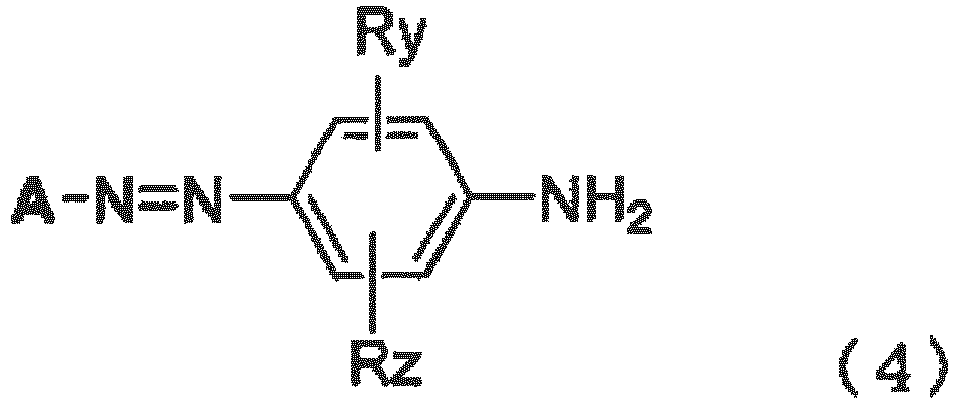
- An aminoazo compound represented by Formula (4) is diazotized with a known method, and subjected to alkali coupling with N,N-bis(l-hydroxy-3-sulfo-6-naphtyl) amine (conventional name: di-J acid) at 10 to 20°C to obtain the compound of Formula (1).
- When at least one of R1 or R2, and at least one of R3 or R4 are methoxy groups in the compound of Formula (1), the compound of Formula (2) can be obtained. When at least one of R1 or R2, and at least one of R3 or R4 are methoxy groups, for example, copper sulfate, ammonia water, amino alcohol and hexamethylene tetramine are added, and copperization reaction is performed at 85 to 95°C, to obtain a solution containing the compound of Formula (2).
- Then, this solution is evaporated to dryness, or salted out, filtered and dried, and crushed to obtain pulverized compound represented by Formula (1) or (2) of the present application. The compound obtained in this manner is represented by Formula (1) or (2) and is generally used as a sodium salt, but may be also used as a lithium salt, a potassium salt, an ammonium salt, an alkyl amine salt, or the like.
- The pigments represented by Formulae (1) and (2) may be used in combination with other organic pigments such that hue correction and polarizing performance can be improved. The organic pigment used in this case may be any pigment having an absorption property in a different wavelength region from the absorption wavelength region of the pigment used in the invention, and having the high polarizing property. Such a pigment is not particularly limted to dichromatic dye, and may be those dyeing a hydrophilic polymer. Examples of the dichromatic dye include azo-based, anthraquinone-based, and quinophthalone-based dichromatic dyes, and also include pigments described in a color index. Examples of the dichromatic dye include C. I. Direct. Yellow 12, C. I. Direct. Yellow 28, C. I. Direct. Yellow 44, C. I. Direct. Orange 26, C. I. Direct. Orange 39, C. I. Direct. Orange 107, C. I. Direct. Red 2, C. I. Direct. Red 31, C. I. Direct. Red 79, C. I. Direct. Red 81, C. I. Direct. Red 247, C. I. Direct. Green 80, C. I. Direct. Green 59, and the organic dyes described in
JP 2001-33627 A JP 2002-296417 A JP 2003-215338 A WO 2004/092282 ,JP 2001-0564112 A JP 2001-027708 A JP 11-218611 A JP 11-218610 A JP 60-156759 A - The kind of the organic dye combined varies depending on the intended polarizing element, which may be a polarizing element of neutral color, a color polarizing element for a liquid crystal projector, or another color polarizing element, respectively. The combination ratio is not particularly limited, and the combination amount may be arbitrarily set according to a light source, a durability, required hue, and the like.
- The pigments represented by Formulae (1) and (2) are impregnated into a polyvinyl alcohol resin or a derivative thereof. A method of producing the polyvinyl alcohol resin constituting the polarizing element is not particularly limited, but, for example, a polyvinyl acetate resin may be saponified. Examples of the polyvinyl acetate resin include polyvinyl acetate, which is a homopolymer of vinyl acetate, and in addition, a copolymer of vinyl acetate and another monomer copolymerizable with vinyl acetate, and the like. Examples of the another monomer copolymerizable with vinyl acetate include, for example, unsaturated carboxylic acids, olefins, vinyl ethers, unsaturated sulfonic acids, or the like. The saponification degree of the polyvinyl alcohol resin is ordinarily, preferably 85 to 100 mole%, and more preferably 95 mole% or more. This polyvinyl alcohol resin may be further modified. For example, polyvinyl formal, polyvinyl acetal, and the like modified with aldehydes may be also used. In addition, the polymerization degree of the polyvinyl alcohol resin is ordinarily, preferably 1,000 to 10,000, and more preferably 1,500 to 6,000.
- Examples of the derivative of the polyvinyl alcohol resin that can be used in the invention include resins that have been subjected to the modification treatment, and the like.
- A film produced from such a polyvinyl alcohol resin or a derivative thereof (hereinafter, referred to as the polyvinyl alcohol-based resin for both of them) is used as a raw film. A method of producing a film from the polyvinyl alcohol resin is not particularly limited, but the film may be produced with a known method. The polyvinyl alcohol-based resin film can contain glycerin, ethylene glycol, propylene glycol or low molecular polyethylene glycol and the like as a plasticizer. The amount of the plasticizer is preferably 5 to 20 weight%, and more preferably 8 to 15 weight%. The thickness of the raw film that comprising the polyvinyl-based alcohol resin is not particularly limited, but is preferably, for example, 5 to 150 µm, and more preferably 10 to 100 µm.
- The polyvinyl alcohol-based resin film is first performed with a swelling process. The swelling process is performed by dipping the polyvinyl alcohol-based resin film into a 20 to 50°C solution for 30 seconds to 10 minutes. The solution is preferably water. The swelling process may be skipped if it is desired to shorten the time to produce the polarizing element, as the polyvinyl alcohol-based resin film swells up also at the time of dye treatment of the pigments.
- A dyeing process is performed after the swelling process. The dyeing process is a process in which impregnation is performed by dipping the polyvinyl alcohol-based resin film into a solution containing the dichromatic dye. The temperature of the solution in this process is preferably 5 to 60°C, more preferably 20 to 50°C, and particularly preferably 35 to 50°C. The dipping time to the solution may be suitably regulated, but is preferably regulated to 30 seconds to 20 minutes, and more preferably to 1 to 10 minutes. Although a method for the dyeing is preferably performed by dipping in the solution, the method for the dyeing may be also performed by applying the solution onto the polyvinyl alcohol-based resin film.
- The solution containing the dichromatic dye may contain sodium chloride, sodium sulfate, sodium sulfate anhydride, sodium tripolyphosphate, and the like as a dyeing assistant. The content of the dyeing assistant may be adjusted to any concentration by the time or the temperature depending on the dye-affinity of the dye, but is preferably 0 to 5 weight%, and more preferably 0.1 to 2 weight%.
- As a method for the pigment impregnation, the pigment impregnation may be performed by dipping the polyvinyl alcohol-based resin film into a solution containing the dichromatic dyes. Alternatively, the method may be a method in which the pigments are contained in a step of molding the raw film of the polyvinyl alcohol-based resin.
- After the dyeing process, a washing process (hereinafter, referred to as a washing process 1) can be performed before proceeds to the next. The washing process 1 is a process of washing a dye solvent adhering to the surface of the polyvinyl alcohol-based resin film in the dyeing process. By performing the washing process 1, it is possible to suppress the dye from migration into the liquid to be treated in the following process. Water is generally used in the washing process 1. A washing method is preferably performed by dipping the polyvinyl alcohol-based resin film into the solution, but may be also performed by applying the solution onto the polyvinyl alcohol-based resin film. The washing time is not particularly limited, but preferably 1 to 300 seconds, and more preferably 1 to 60 seconds. The temperature of the solvent in the washing process 1 is necessarily a temperature where a hydrophilic polymer is not dissolved. The washing treatment is generally performed at 5 to 40°C.
- After the dyeing process or the washing process 1, a process of incorporating a crosslinking agent and/or a water-resistant additive may be performed. As the crosslinking agent, for example, a boron compound such as boric acid, borax or ammonium borate; a multivalent aldehyde such as glyoxal or glutaraldehyde; a multivalent isocyanate-based compound such as a biuret type, an isocyanurate type or a block type; a titanium compound such as titanium-based oxysulfate; or the like may be used, but ethylene glycol glycidyl ether, polyamide epichlorohydrin, or the like may be used in addition. Examples of the water-resistant additive include succinic acid peroxide, ammonium persulfate, calcium perclorate, benzoin ethyl ether, ethylene glycol diglycidyl ether, glycerin diglycidyl ether, ammonium chloride or magnesium chloride and the like, but boric acid is preferably used. Using at least one or more kinds of the crosslinking agent and/or the water-resistant additive described above, a process of incorporating the crosslinking agent and/or the water-resistant additive is performed. The solvent at this time is preferably water, but is not limited thereto. The content concentration of the crosslinking agent and/or the water-resistant additive in the solvent in the process of incorporating the crosslinking agent and/or the water-resistant additive is preferably, for example, 0.1 to 6.0 weight%, and more preferably 1.0 to 4.0 weight% of the concentration with respect to the solvent for boric acid. The temperature of the solvent in this process is preferably 5 to 70°C, and more preferably 5 to 50°C. A method of incorporating the crosslinking agent and/or the water-resistant additive into the polyvinyl alcohol-based resin film is preferably dipping the polyvinyl alcohol-based resin film into the solution, but the solution may be also applied or coated onto the polyvinyl alcohol-based resin film. The treatment time in this process is preferably 30 seconds to 6 minutes, and more preferably 1 to 5 minutes. However, the crosslinking agent and/or the water-resistant additive are not necessarily incorporated, and this treatment process may be skipped when it is desired to shorten the time, or when cross-linking treatment or water-resistant treatment is unnecessary.
- A stretch process is performed after performing the dyeing process, the washing process 1, or the process of incorporating the crosslinking agent and/or the water-resistant additive. The stretch process is a process of stretching the polyvinyl alcohol-based film monoaxially. The stretch method may be a wet stretch method or a dry stretch method.
- When the stretch method is the dry stretch method, and the medium for stretch and heating is air medium, the temperature of the air medium is preferably normal temperature to 180°C. In addition, the humidity is processed preferably within 20% to 95% RH of the atmosphere. Examples of the heating method include inter-roll zone stretch, roll heating stretch, pressure stretch, infrared heating stretch and the like, but the stretch method is not limited. The stretch process may be performed by stretching in one stage, or may be performed by stretch in multi-stages of two or more stages.
- When the stretch method is the wet stretch, the stretch is performed in water, a water-soluble organic solvent, or a mixed solution thereof. The stretch treatment is preferably performed while dipping the polyvinyl alcohol-based resin film in the solution containing the crosslinking agent and/or the water-resistant additive. As the crosslinking agent, for example, a boron compound such as boric acid, borax or ammonium borate; a multivalent aldehyde such as glyoxal or glutaraldehyde; a multivalent isocyanate-based compound such as a biuret type, an isocyanurate type, or a block type; a titanium-based compound such as titanium oxysulfate; or the like may be used. In addition, ethylene glycol glycidyl ether, polyamide epichlorohydrin, or the like may be used. Examples of the water-resistant additive include succinic acid peroxide, ammonium persulfate, calcium perclorate, benzoin ethyl ether, ethylene glycol diglycidyl ether, glycerin diglycidyl ether, ammonium chloride, magnesium chloride, or the like. The stretch is performed in a solution containing at least one or more kinds of the crosslinking agent and/or the water-resistant additive described above. The crosslinking agent is preferably boric acid. The concentration of the crosslinking agent and/or the water-resistant additive in the stretch process is preferably, for example, 0. 5 to 15 weight%, and more preferably 2.0 to 8.0 weight%. The stretch ratio is preferably 2 to 8 times, and more preferably 5 to 7 times. The stretch temperature is preferably 40 to 60°C, and more preferably 45 to 58°C. The stretch time is ordinarily 30 seconds to 20 minutes, and more preferably 2 to 5 minutes. The wet stretch process may be performed by stretch in one stage, but may be also performed by stretch in multi-stages of two or more stages.
- A washing process of washing the film surface (hereinafter, referred to as the washing process 2) may be performed after performing the stretch process, as a precipitate of the crosslinking agent and/or the water-resistant additive, or a foreign substance may adhere to the film surface. The washing time is preferably 1 second to 5 minutes. The washing method is preferably performed by dipping in a washing solution, but may be performed by applying or coating the solution onto the polyvinyl alcohol-based resin film. The washing treatment may be performed in one stage, or may be performed in multi-stages of two or more stages. The solution temperature of the washing process is not particularly limited, but ordinarily 5 to 50°C, and preferably 10 to 40°C.
- Examples of the solvent used in the treatment processes hereto include, for example, solvents such as water, dimethyl sulfoxide, N-methyl pyrrolidone, alcohols such as methanol, ethanol, propanol, isopropyl alcohol, glycerin, ethylene glycol, propylene glycol, diethylene glycol, triethylene glycol, tetraethylene glycol or trimethylol propane, and amines such as ethylene diamine or diethylene triamine, but are not limited thereto. In addition, a mixture of one or more kinds of these solvents may be used. The solvent is most preferably water.
- A dry process of the film is performed after the stretch process or the washing process 2. The dry treatment may be performed by natural drying, or removal of moisture on the surface by compression by a roll or an air knife, a water-absorbing roll, or the like may be performed in order to enhance the dry efficiency, and/or ventilation drying may be performed. The temperature for the dry treatment is preferably 20 to 100°C, and more preferably 60 to 100°C. The time for the dry treatment may be 30 seconds to 20 minutes, but is preferably 5 to 10 minutes.
- By the method described above, it is possible to obtain the polyvinyl alcohol-based resin film polarizing element of the invention that is improved in the durability. A similar polarizing element may be produced by incorporating the dichromatic dye into a film obtained from an amylose-based resin, a starch-based resin, a cellulose-based resin, a polyacrylic acid salt-based resin and the like, and stretching and orientating the hydrophilic resin in the share orientation and the like, although the film onto which the dichromatic dye is adsorbed in the polarizing element, is not a polyvinyl alcohol-based resin. However, the polarizing element film that comprising the polyvinyl alcohol-based resin film is most suitable.
- The obtained polarizing element is disposed with a transparent protection layer on one side, or both sides thereof, whereby to produce a polarizing plate. The transparent protection layer may be disposed as a coating layer of a polymer, or a laminate layer of the film. The transparent polymer or the film forming the transparent protection layer is preferably a transparent polymer or film having a high mechanical intensity and good heat stability. Examples of the substance used as a transparent protection layer include cellulose acetate resins or films thereof such as triacetyl cellulose and diacetyl cellulose, acrylic resins or films thereof, polyvinyl chloride resins or films thereof, Nylon resins or films thereof, polyester resins or films thereof, polyarylate resins or films thereof, cyclic polyolefin resins or films thereof of having a cyclic olefin such as norbornene as a monomer, polyolefins or copolymers having polyethylene, polypropylene, or a cyclo-based or norbornene skeleton, resins or polymer or films having imide and/or amide as the main chain or the side chain, and the like. In addition, resins or films thereof having mesomorphism may be disposed as a transparent protection layer. The thickness of the protection film is, for example, about 0.5 to 200 µm. The same kind or different kind of the resins or films thereof described above may be disposed on one side, or both sides in one or more layers, whereby to produce the polarizing plate.
- In order to bond the transparent protection layer to the polarizing element, an adhesive is necessary. The adhesive is not particularly limited, but is preferably a polyvinyl alcohol-based adhesive. Examples of the polyvinyl alcohol-based adhesive include Gohsenol PH-26 (manufactured by The Nippon Synthetic chemical Industry Co., Ltd.), Exceval RS-2117 (manufactured by KURARAY CO., LTD.) and the like, but are not limited thereto. The adhesive may be added with the crosslinking agent and/or the water-resistant additive. As the polyvinyl alcohol-based adhesive, a maleic anhydride-isobutylene copolymer is used, and an adhesive mixed with a crosslinking agent may be used as necessary. Examples of the maleic anhydride-isobutylene copolymer include ISOBAM #18 (manufactured by KURARAY CO., LTD.), ISOBAM #04 (manufactured by KURARAY CO., LTD.), ammonia-modified ISOBAM #104 (manufactured by KURARAY CO., LTD.), ammonia-modified ISOBAM #110 (manufactured by KURARAY CO., LTD.), imidized ISOBAM #304 (manufactured by KURARAY CO., LTD.), imidized ISOBAM #310 (manufactured by KURARAY CO., LTD.) and the like. At this time, as the crosslinking agent, a water-soluble multivalent epoxy compound may be used. Examples of the water-soluble multivalent epoxy compound include DENACOL EX-521 (manufactured by Nagase Chemtex Corporation), TETRAD-C (manufactured by Mitsubishi Gas chemical Company, Inc.) and the like. In addition, as the other adhesive other than the polyvinyl alcohol-based resin, a known adhesive such as urethane-based, acrylic-based, or epoxy-based may be also used. In addition, for the purpose of improving the adhesion force of the adhesive or improving the water resistance, an additive such as a zinc compound, a chloride, and an iodide may be incorporated at the same time in about 0.1 to 10 weight% of the concentration. The additive is not limited. After bonding the transparent protection layer with the adhesive, dry or heat treatment is performed at a suitable temperature to obtain a polarizing plate.
- The obtained polarizing plate may be disposed with various functional layers for improvement of the view angle and/or improvement of the contrast, or a layer or film having improved brightness on the surface of the protection layer or the film that becomes a non-exposed surface later, especially when the polarizing plate is bonded to a display device of liquid crystal, organic electroluminescence, or the like. In bonding the polarizing plate to the film or the display device, an adhesive is preferably used.
- This polarizing plate may have well-known various functional layers such as an anti-reflective layer, an anti-glare layer, a hard coat layer on the other surface, namely, the exposed surface of the protection layer or the film. A coating method is preferred in a production of this layer having various functions, but the film having the function may be also bonded through an adhesive or a bonding agent. In addition, the various functional layers may be a layer or film controlling the phase difference.
- With the method described above, it is possible to obtain a polarizing element and a polarizing plate of the invention. A display using the polarizing element or the polarizing plate of the invention is a display having high reliability, having high contrast over a long time, and having high color reproducibility.
- The thus-obtained polarizing element of the invention is disposed with a protection layer, or a function layer and a support, or the like as necessary, and is used in a liquid crystal projector, a calculator, a clock, a notebook computer, a word processor, a liquid crystal television, a polarizing lens, polarizing glasses, a car navigation and an indoor-outdoor measuring instrument, a display device, or the like as a polarizing plate bonded with a protection film.
- Hereinafter, the invention is further described in detail with Examples. However, the invention is not limited thereto. Meanwhile, evaluations for the transmissivity and the polarization degree shown in Examples were performed as described below. In addition, "parts" below means "parts by weight".
- The transmissivity when two pieces of polarizing plates obtained by bonding a protection film onto both sides of a polarizing element are superimposed such that the absorption-axis directions are identical, was assumed to be the parallel position transmissivity Tp, whereas the transmissivity when two pieces of the polarizing plate are superimposed such that the absorption axis directions orthogonally intersect, was assumed to be the orthogonal position transmissivity Tc.
- A transmissivity T was calculated from the calculation formula described below in which a spectral transmissivity τλ was obtained for every prescribed wavelength interval dλ (herein, 5 nm) in a wavelength region of 400 to 700 nm. In the formula, Pλ represents spectral distribution of standard light (light source C), and yλ, represents 2-degree visual field color matching function.

- The spectral transmissivity τλ was measured using a spectrophotometer ["U-4100" manufactured by Hitachi, Ltd.].
- The polarization degree Py was obtained with the calculation formula below from the parallel position transmissivity Tp and the orthogonal position transmissivity Tc.

- Further, a* and b* of the orthogonal hue were measured with the color system represented by JIS Z8729 (Color specification L*, a* and b* display systems and L*, u* and v* color spaces) with respect to the hue of the polarizing plate. Herein, the orthogonal hue means the hue measured in a state where two polarizing plate are superimposed such that the absorption axes orthogonally intersect, respectively. In the color spaces of L*, a* and b*, as much as each of a* and b* is close to zero, it represents that the hue shows neutral color.
- Each of the transmissivities was measured using a spectrophotometer ["U-4100" manufactured by Hitachi, Ltd.].
- 32.5 Parts of 2-aminonaphthalen-4,8-disulfonic acid (conventional name: C acid) were dissolved in 145 parts of water, and added to 140 parts of water containing 26 parts of 35% hydrochloric acid, and were added to 6. 9 parts of sodium nitrite at 15 to 20°C, and the mixture was diazotized over one hour. Then, an aqueous solution containing 13.7 parts of para-cresidine and 17.5 parts of 35% hydrochloric acid was added, and coupling was performed at 20°C over 4 hours while keeping pH to 3.0 to 3.5 with sodium acetate, until para-cresidine was not recognized with the spot test. Then, to the obtained aminoazo compound, 21.4 parts of 35% hydrochloric acid were added, and 6.9 parts of sodium nitrite were added at 10°C, and second diazotization was performed at 15 to 20°C over 2 to 3 hours. Then, this was added to an aqueous solution having 31.5 parts of N,N-bis(1-hydroxy-3-sulfo-6-naphtyl) amine (conventional name: di-J acid), 125 parts of water and 11 parts of soda ash, and further a solution of soda ash was poured to keep pH to 8.5 to 9.5, and second coupling was performed at 20°C over 3 hours until a disazo compound was not recognized with the spot test, to obtain a tetrakis compound. Then, to an aqueous solution of 25 parts of copper sulfate, 30.5 parts of monoethanol amine were added and the produced copper complex salt was added and copperization reaction was performed at 95°C over 10 hours until an unreacted substance was not recognized on a thin layer chromatography. The obtained solution was added with Sanuki salt in 25 weight% with respect to the residual quantity, salted out and filtered, and evaporated to dryness at 60°C, to produce the pigment represented by the compound 2 of the present application.
- A polyvinyl alcohol-based resin film having a saponification degree of 99% or more and a thickness of 75 µm (VF series manufactured by KURARAY CO., LTD.) was dipped into 40°C warm water for 2 minutes to perform a swelling treatment. The swelling-treated film was dipped into a 45°C aqueous solution containing 0.05 weight% of pigment represented by compound 2 and 0.1 weight% of sodium tripolyphosphate, to perform adsorption of the dyes. The film adsorbed with the dyes was washed with water, and after the washing, boric acid treatment was performed with a 40°C aqueous solution containing 2 weight% of boric acid for 1 minute. The obtained boric acid-treated film was treated in a 55°C aqueous solution containing 3.0 weight% of boric acid for 5 minutes while being stretched to 5.0 times. Washing was performed for 15 seconds with 30°C water with keeping the tension state of the obtained, boric acid-treated film. The dry treatment was immediately performed for the obtained treated film at 70°C for 9 minutes to obtain a polarizing element of 28 µm thickness. The obtained polarizing element and an alkali-treated triacetyl cellulose film having a thickness of 80 µm (TD-80U manufactured by FUJIFILM Corporation, abbreviated as TAC below) were laminated using a polyvinyl alcohol-based adhesive in the constitution of the polarizing element/adhesive layer/TAC, to obtain a polarizing plate as a laminate.
- The obtained polarizing plate was cut to 40 mm × 40 mm, and bonded to a 1 mm transparent glass plate through an adhesive PTR-3000 (manufactured by NIPPON KAYAKU Co., Ltd) in the constitution of the polarizing element/adhesive layer/TAC/adhesive layer/transparent glass plate to obtain an evaluation sample.
- Using the produced evaluation sample, the initial polarization property, the wavelength having the maximum polarization degree, and the color of the evaluation material were verified. Further, light irradiation test was performed with a xenon arc tester (SX-75 manufactured by Suga Test Instruments Co., Ltd.) at 100W and 70°C for 170 hours from the side of the polarizing element, and the change of the transmissivity before and after the light irradiation, and visual color change were verified.
- The evaluation sample was produced in a similar manner except that the pigment represented by the compound 2 used in Example 1 was changed to the pigment represented in Example 1 (the comparative compound 1) of
JP 64-5623 B 
- The evaluation sample was produced in a similar manner as in Example 1 except that the pigment represented by the compound 2 used in Example 1 was changed to the comparative compound 2 (Kayarus Supra Blue Bowl143 manufactured by NIPPON KAYAKU Co., Ltd.), which is a dianisidine-based pigment, and the initial polarization property, the wavelength having the maximum polarization degree, the color, and the transmissivity change before and after the light stability test, and the visual color change were verified.

- Table 1 shows the results of the initial polarization property, the wavelength having the maximum polarization degree, the color, and the transmissivity change before and after the light stability test, and the visual color change of the evaluation samples obtained in Example 1 and Comparative Examples 1 and 2. For the polarization property, the case where the polarization degree of the obtained evaluation sample was visually high, was evaluated as Good, and the case where the polarization degree was visually low, was evaluated as NG. The transmissivity change after the light stability test was also visually verified, and the case where great color change was not recognized, was evaluated as Good, and the case where great color change was recognized, was evaluated as NG.
[Table 1] Initial property Light stability test Polarization property Wavelength having maximum polarization degree (nm) Color Initial transmissivity Transmissivity light stability test Color change Example 1 Good 640 blue 42.30 42.33 Good Comparative Example 1 Good 610 blue 42.66 41.50 NG Comparative Example 2 Good 620 blue 42.70 41.69 NG - As shown in Table 1, the pigment of the invention was particularly favorable with respect to the initial polarization and the color, and a polarizing element having blue dye similar to a dianisidine-based pigment which has been conventionally used, was obtained. With regard to the light stability test, Example 1 showed nearly no change of the transmissivity, whereas Comparative Examples had greatly deteriorated transmissivity and great color change. These results show that the polarizing plate of Example 1 had high polarizing degree, and was also excellent in the light stability of high temperature and long-time exposure. The polarizing element or the polarizing plate of the invention makes it possible to obtain a liquid crystal display equipment, a lens, and the like having high contrast and high stability by being used in a liquid crystal projector, a calculator, a clock, a notebook computer, a word processor, a liquid crystal television, a polarizing lens, polarizing glasses, a car navigation and an indoor-outdoor measuring instrument, a display device and the like without use of a pigment corresponding to the specified chemical substance such as dianisidine.
Claims (3)
- A polarizing element comprising a stretched film of a polyvinyl alcohol resin or a derivative thereof containing dichromatic pigments,
wherein at least one of the dichromatic pigments is an azo compound represented by Formula (1) or a salt thereof.
R1, R2, R3 and R4 each independently represent a hydrogen atom, an alkyl group, an alkoxy group, a sulfo group, or an alkoxy group having a sulfo group.) - The polarizing element according to claim 1, wherein the dichromatic pigment is an compound represented by Formula (2), or a salt thereof.


R1 and R2 each independently represent a hydrogen atom, an alkyl group, an alkoxy group, a sulfo group, or an alkoxy group having a sulfo group.) - A polarizing plate in which a protection layer is disposed on one side or both sides of the polarizing element according to claim 1 or 2.
Applications Claiming Priority (2)
| Application Number | Priority Date | Filing Date | Title |
|---|---|---|---|
| JP2011120722 | 2011-05-30 | ||
| PCT/JP2012/063048 WO2012165223A1 (en) | 2011-05-30 | 2012-05-22 | Dye-based polarizing element and polarizing plate |
Publications (3)
| Publication Number | Publication Date |
|---|---|
| EP2717076A1 true EP2717076A1 (en) | 2014-04-09 |
| EP2717076A4 EP2717076A4 (en) | 2014-12-17 |
| EP2717076B1 EP2717076B1 (en) | 2015-10-28 |
Family
ID=47259084
Family Applications (1)
| Application Number | Title | Priority Date | Filing Date |
|---|---|---|---|
| EP12793781.1A Not-in-force EP2717076B1 (en) | 2011-05-30 | 2012-05-22 | Dye-based polarizing element and polarizing plate |
Country Status (8)
| Country | Link |
|---|---|
| US (1) | US20140085721A1 (en) |
| EP (1) | EP2717076B1 (en) |
| JP (1) | JP5918759B2 (en) |
| KR (1) | KR101855143B1 (en) |
| CN (1) | CN103547949B (en) |
| CA (1) | CA2837278A1 (en) |
| TW (1) | TWI518139B (en) |
| WO (1) | WO2012165223A1 (en) |
Cited By (5)
| Publication number | Priority date | Publication date | Assignee | Title |
|---|---|---|---|---|
| EP2983019A4 (en) * | 2013-04-03 | 2016-11-02 | Nippon Kayaku Kk | Achromatic polarization element, and polarization plate |
| EP2990842A4 (en) * | 2013-04-03 | 2016-11-23 | Nippon Kayaku Kk | Achromatic dye-based polarization element, and polarization plate |
| EP2983020A4 (en) * | 2013-04-03 | 2016-11-30 | Nippon Kayaku Kk | Achromatic dye-based highly-transmissive polarization element, and polarization plate |
| EP3153896A4 (en) * | 2014-06-03 | 2017-11-29 | Nipponkayaku Kabushikikaisha | Achromatic polarizing plate with high-transmissivity and high-degree of polarization |
| CN111448494A (en) * | 2017-12-13 | 2020-07-24 | 日本化药株式会社 | Polarizing element and polarizing plate for visible light region and infrared region |
Families Citing this family (7)
| Publication number | Priority date | Publication date | Assignee | Title |
|---|---|---|---|---|
| JP6609259B2 (en) * | 2014-09-03 | 2019-11-20 | 日本化薬株式会社 | Polarizing element, polarizing plate having the polarizing element, and liquid crystal display device having the polarizing element or the polarizing plate |
| TW201621357A (en) * | 2014-09-03 | 2016-06-16 | Nippon Kayaku Kk | Polarizing element, polarizing plate having said polarizing element, and liquid crystal display device having said polarizing element or said polarizing plate |
| KR20170131340A (en) * | 2015-03-26 | 2017-11-29 | 니폰 가야꾸 가부시끼가이샤 | Polarizing element and polarizing plate |
| JP6662739B2 (en) * | 2015-10-06 | 2020-03-11 | 日本化薬株式会社 | Achromatic polarizing element, achromatic polarizing plate and liquid crystal display using the same |
| JP6788461B2 (en) * | 2016-09-29 | 2020-11-25 | 日本化薬株式会社 | Polarizing element, polarizing plate and liquid crystal display device |
| KR20190103181A (en) * | 2017-01-20 | 2019-09-04 | 닛뽄 가야쿠 가부시키가이샤 | Azo compound or its salt, and dye type polarizing film and dye type polarizing plate containing this |
| JP6951366B2 (en) * | 2017-01-20 | 2021-10-20 | 日本化薬株式会社 | Azo compounds or salts thereof, and dye-based polarizing films and dye-based polarizing plates containing them. |
Family Cites Families (19)
| Publication number | Priority date | Publication date | Assignee | Title |
|---|---|---|---|---|
| JPS57145155A (en) * | 1981-03-04 | 1982-09-08 | Nippon Kayaku Co Ltd | Copper-containing azo compound and dyeing method using the same |
| JPS60156759A (en) | 1984-01-25 | 1985-08-16 | Nippon Kayaku Co Ltd | Water-soluble disazo compound |
| JPH0813932B2 (en) * | 1988-06-14 | 1996-02-14 | 日本化薬株式会社 | Water-soluble azo dye and polarizing film containing the same |
| JP2534908B2 (en) * | 1989-05-29 | 1996-09-18 | 日本化薬株式会社 | Azo compound and dyeing method using the same |
| CA2076560A1 (en) * | 1991-08-29 | 1993-03-01 | Kazuya Ogino | Dye-containing polarizing film |
| JP2985408B2 (en) * | 1991-08-29 | 1999-11-29 | 住友化学工業株式会社 | Dye-based polarizing film |
| JPH0718192A (en) | 1993-07-02 | 1995-01-20 | Nippon Kayaku Co Ltd | Copper-containing azo compound and method for dyeing using the same |
| FR2726831B1 (en) * | 1994-11-10 | 1997-09-12 | Sandoz Sa | NOVEL DYE MIXTURES, THEIR PREPARATION AND THEIR USE |
| JPH11218611A (en) | 1998-01-30 | 1999-08-10 | Nippon Kayaku Co Ltd | Dye system polarizing film |
| JP4049229B2 (en) | 1998-01-30 | 2008-02-20 | 日本化薬株式会社 | New polarizing film |
| JP2001027708A (en) | 1999-07-14 | 2001-01-30 | Nippon Kayaku Co Ltd | Polarizing plate for liquid crystal projector and color liquid crystal projector |
| JP4162334B2 (en) | 1999-07-26 | 2008-10-08 | 日本化薬株式会社 | Dye-type polarizing film |
| JP4162336B2 (en) | 1999-08-20 | 2008-10-08 | 日本化薬株式会社 | Dye-type polarizing film |
| JP4371345B2 (en) | 2001-03-30 | 2009-11-25 | 日本化薬株式会社 | Dye-type polarizing film |
| JP4033443B2 (en) | 2002-01-22 | 2008-01-16 | 日本化薬株式会社 | Dye-type polarizing film and polarizing plate |
| KR100926024B1 (en) * | 2002-03-26 | 2009-11-11 | 후지필름 가부시키가이샤 | Polarizer and liquid crystal display |
| JP4270486B2 (en) | 2002-08-09 | 2009-06-03 | 日本化薬株式会社 | Trisazo compound, water-based ink composition, and colored body |
| JP2004067797A (en) * | 2002-08-05 | 2004-03-04 | Nippon Kayaku Co Ltd | Trisazo compound, water-base ink composition, and colored object |
| US7304147B2 (en) | 2003-04-16 | 2007-12-04 | Nippon Kayaku Kabushiki Kaisha | Azo compound and salt thereof |
-
2012
- 2012-05-22 EP EP12793781.1A patent/EP2717076B1/en not_active Not-in-force
- 2012-05-22 JP JP2013517983A patent/JP5918759B2/en active Active
- 2012-05-22 WO PCT/JP2012/063048 patent/WO2012165223A1/en not_active Ceased
- 2012-05-22 CN CN201280024360.4A patent/CN103547949B/en active Active
- 2012-05-22 US US14/122,029 patent/US20140085721A1/en not_active Abandoned
- 2012-05-22 CA CA2837278A patent/CA2837278A1/en not_active Abandoned
- 2012-05-22 KR KR1020137025368A patent/KR101855143B1/en not_active Expired - Fee Related
- 2012-05-29 TW TW101119187A patent/TWI518139B/en active
Non-Patent Citations (2)
| Title |
|---|
| No further relevant documents disclosed * |
| See also references of WO2012165223A1 * |
Cited By (6)
| Publication number | Priority date | Publication date | Assignee | Title |
|---|---|---|---|---|
| EP2983019A4 (en) * | 2013-04-03 | 2016-11-02 | Nippon Kayaku Kk | Achromatic polarization element, and polarization plate |
| EP2990842A4 (en) * | 2013-04-03 | 2016-11-23 | Nippon Kayaku Kk | Achromatic dye-based polarization element, and polarization plate |
| EP2983020A4 (en) * | 2013-04-03 | 2016-11-30 | Nippon Kayaku Kk | Achromatic dye-based highly-transmissive polarization element, and polarization plate |
| EP3153896A4 (en) * | 2014-06-03 | 2017-11-29 | Nipponkayaku Kabushikikaisha | Achromatic polarizing plate with high-transmissivity and high-degree of polarization |
| US10126468B2 (en) | 2014-06-03 | 2018-11-13 | Nippon Kayaku Kabushiki Kaisha | Achromatic polarizing plate with high-transmissivity and high-degree of polarization |
| CN111448494A (en) * | 2017-12-13 | 2020-07-24 | 日本化药株式会社 | Polarizing element and polarizing plate for visible light region and infrared region |
Also Published As
| Publication number | Publication date |
|---|---|
| EP2717076A4 (en) | 2014-12-17 |
| TWI518139B (en) | 2016-01-21 |
| KR20140031862A (en) | 2014-03-13 |
| CN103547949B (en) | 2017-07-21 |
| EP2717076B1 (en) | 2015-10-28 |
| JP5918759B2 (en) | 2016-05-18 |
| JPWO2012165223A1 (en) | 2015-02-23 |
| CA2837278A1 (en) | 2012-12-06 |
| KR101855143B1 (en) | 2018-05-08 |
| WO2012165223A1 (en) | 2012-12-06 |
| CN103547949A (en) | 2014-01-29 |
| TW201307487A (en) | 2013-02-16 |
| US20140085721A1 (en) | 2014-03-27 |
Similar Documents
| Publication | Publication Date | Title |
|---|---|---|
| EP2717076B1 (en) | Dye-based polarizing element and polarizing plate | |
| TWI643908B (en) | Achromatic dye-based polarizer and polarizing plate having high transmission | |
| CN104115042B (en) | Dye-Based Polarizers and Polarizers | |
| EP2717074B1 (en) | Dye-based polarizing element and polarizing plate | |
| EP2717075A1 (en) | Dye-based polarizing element and polarizing plate | |
| KR101891523B1 (en) | Dye-based polarizing element, and polarizing plate | |
| KR101949190B1 (en) | Dye-based polarizing element, and polarizing plate | |
| TW201621356A (en) | Polarization element, polarization plate having said polarization element, and liquid crystal display device having said polarization element or said polarization plate | |
| HK1194825A (en) | Dye-based polarizing element and polarizing plate | |
| HK1194474B (en) | Dye-based polarizing element and polarizing plate | |
| HK1194474A (en) | Dye-based polarizing element and polarizing plate | |
| HK1192778B (en) | Dye-based polarizing element and polarizing plate | |
| HK1202930B (en) | Dye-based polarizing element, and polarizing plate |
Legal Events
| Date | Code | Title | Description |
|---|---|---|---|
| PUAI | Public reference made under article 153(3) epc to a published international application that has entered the european phase |
Free format text: ORIGINAL CODE: 0009012 |
|
| 17P | Request for examination filed |
Effective date: 20131125 |
|
| AK | Designated contracting states |
Kind code of ref document: A1 Designated state(s): AL AT BE BG CH CY CZ DE DK EE ES FI FR GB GR HR HU IE IS IT LI LT LU LV MC MK MT NL NO PL PT RO RS SE SI SK SM TR |
|
| DAX | Request for extension of the european patent (deleted) | ||
| A4 | Supplementary search report drawn up and despatched |
Effective date: 20141118 |
|
| RIC1 | Information provided on ipc code assigned before grant |
Ipc: C09B 33/28 20060101ALI20141112BHEP Ipc: G02F 1/1335 20060101ALI20141112BHEP Ipc: C09B 45/28 20060101ALI20141112BHEP Ipc: G02B 5/30 20060101AFI20141112BHEP |
|
| GRAP | Despatch of communication of intention to grant a patent |
Free format text: ORIGINAL CODE: EPIDOSNIGR1 |
|
| INTG | Intention to grant announced |
Effective date: 20150618 |
|
| GRAS | Grant fee paid |
Free format text: ORIGINAL CODE: EPIDOSNIGR3 |
|
| GRAA | (expected) grant |
Free format text: ORIGINAL CODE: 0009210 |
|
| AK | Designated contracting states |
Kind code of ref document: B1 Designated state(s): AL AT BE BG CH CY CZ DE DK EE ES FI FR GB GR HR HU IE IS IT LI LT LU LV MC MK MT NL NO PL PT RO RS SE SI SK SM TR |
|
| REG | Reference to a national code |
Ref country code: GB Ref legal event code: FG4D |
|
| REG | Reference to a national code |
Ref country code: CH Ref legal event code: EP |
|
| REG | Reference to a national code |
Ref country code: AT Ref legal event code: REF Ref document number: 758237 Country of ref document: AT Kind code of ref document: T Effective date: 20151115 |
|
| REG | Reference to a national code |
Ref country code: IE Ref legal event code: FG4D |
|
| REG | Reference to a national code |
Ref country code: DE Ref legal event code: R096 Ref document number: 602012012029 Country of ref document: DE |
|
| REG | Reference to a national code |
Ref country code: LT Ref legal event code: MG4D |
|
| REG | Reference to a national code |
Ref country code: NL Ref legal event code: MP Effective date: 20151028 |
|
| REG | Reference to a national code |
Ref country code: AT Ref legal event code: MK05 Ref document number: 758237 Country of ref document: AT Kind code of ref document: T Effective date: 20151028 |
|
| REG | Reference to a national code |
Ref country code: FR Ref legal event code: PLFP Year of fee payment: 5 |
|
| PG25 | Lapsed in a contracting state [announced via postgrant information from national office to epo] |
Ref country code: NL Free format text: LAPSE BECAUSE OF FAILURE TO SUBMIT A TRANSLATION OF THE DESCRIPTION OR TO PAY THE FEE WITHIN THE PRESCRIBED TIME-LIMIT Effective date: 20151028 Ref country code: NO Free format text: LAPSE BECAUSE OF FAILURE TO SUBMIT A TRANSLATION OF THE DESCRIPTION OR TO PAY THE FEE WITHIN THE PRESCRIBED TIME-LIMIT Effective date: 20160128 Ref country code: IS Free format text: LAPSE BECAUSE OF FAILURE TO SUBMIT A TRANSLATION OF THE DESCRIPTION OR TO PAY THE FEE WITHIN THE PRESCRIBED TIME-LIMIT Effective date: 20160228 Ref country code: ES Free format text: LAPSE BECAUSE OF FAILURE TO SUBMIT A TRANSLATION OF THE DESCRIPTION OR TO PAY THE FEE WITHIN THE PRESCRIBED TIME-LIMIT Effective date: 20151028 Ref country code: LT Free format text: LAPSE BECAUSE OF FAILURE TO SUBMIT A TRANSLATION OF THE DESCRIPTION OR TO PAY THE FEE WITHIN THE PRESCRIBED TIME-LIMIT Effective date: 20151028 Ref country code: HR Free format text: LAPSE BECAUSE OF FAILURE TO SUBMIT A TRANSLATION OF THE DESCRIPTION OR TO PAY THE FEE WITHIN THE PRESCRIBED TIME-LIMIT Effective date: 20151028 Ref country code: IT Free format text: LAPSE BECAUSE OF FAILURE TO SUBMIT A TRANSLATION OF THE DESCRIPTION OR TO PAY THE FEE WITHIN THE PRESCRIBED TIME-LIMIT Effective date: 20151028 |
|
| PG25 | Lapsed in a contracting state [announced via postgrant information from national office to epo] |
Ref country code: PL Free format text: LAPSE BECAUSE OF FAILURE TO SUBMIT A TRANSLATION OF THE DESCRIPTION OR TO PAY THE FEE WITHIN THE PRESCRIBED TIME-LIMIT Effective date: 20151028 Ref country code: AT Free format text: LAPSE BECAUSE OF FAILURE TO SUBMIT A TRANSLATION OF THE DESCRIPTION OR TO PAY THE FEE WITHIN THE PRESCRIBED TIME-LIMIT Effective date: 20151028 Ref country code: FI Free format text: LAPSE BECAUSE OF FAILURE TO SUBMIT A TRANSLATION OF THE DESCRIPTION OR TO PAY THE FEE WITHIN THE PRESCRIBED TIME-LIMIT Effective date: 20151028 Ref country code: PT Free format text: LAPSE BECAUSE OF FAILURE TO SUBMIT A TRANSLATION OF THE DESCRIPTION OR TO PAY THE FEE WITHIN THE PRESCRIBED TIME-LIMIT Effective date: 20160229 Ref country code: LV Free format text: LAPSE BECAUSE OF FAILURE TO SUBMIT A TRANSLATION OF THE DESCRIPTION OR TO PAY THE FEE WITHIN THE PRESCRIBED TIME-LIMIT Effective date: 20151028 Ref country code: GR Free format text: LAPSE BECAUSE OF FAILURE TO SUBMIT A TRANSLATION OF THE DESCRIPTION OR TO PAY THE FEE WITHIN THE PRESCRIBED TIME-LIMIT Effective date: 20160129 Ref country code: RS Free format text: LAPSE BECAUSE OF FAILURE TO SUBMIT A TRANSLATION OF THE DESCRIPTION OR TO PAY THE FEE WITHIN THE PRESCRIBED TIME-LIMIT Effective date: 20151028 Ref country code: SE Free format text: LAPSE BECAUSE OF FAILURE TO SUBMIT A TRANSLATION OF THE DESCRIPTION OR TO PAY THE FEE WITHIN THE PRESCRIBED TIME-LIMIT Effective date: 20151028 |
|
| PG25 | Lapsed in a contracting state [announced via postgrant information from national office to epo] |
Ref country code: CZ Free format text: LAPSE BECAUSE OF FAILURE TO SUBMIT A TRANSLATION OF THE DESCRIPTION OR TO PAY THE FEE WITHIN THE PRESCRIBED TIME-LIMIT Effective date: 20151028 |
|
| REG | Reference to a national code |
Ref country code: DE Ref legal event code: R097 Ref document number: 602012012029 Country of ref document: DE |
|
| PG25 | Lapsed in a contracting state [announced via postgrant information from national office to epo] |
Ref country code: RO Free format text: LAPSE BECAUSE OF FAILURE TO SUBMIT A TRANSLATION OF THE DESCRIPTION OR TO PAY THE FEE WITHIN THE PRESCRIBED TIME-LIMIT Effective date: 20151028 Ref country code: BE Free format text: LAPSE BECAUSE OF NON-PAYMENT OF DUE FEES Effective date: 20160531 Ref country code: EE Free format text: LAPSE BECAUSE OF FAILURE TO SUBMIT A TRANSLATION OF THE DESCRIPTION OR TO PAY THE FEE WITHIN THE PRESCRIBED TIME-LIMIT Effective date: 20151028 Ref country code: DK Free format text: LAPSE BECAUSE OF FAILURE TO SUBMIT A TRANSLATION OF THE DESCRIPTION OR TO PAY THE FEE WITHIN THE PRESCRIBED TIME-LIMIT Effective date: 20151028 Ref country code: SK Free format text: LAPSE BECAUSE OF FAILURE TO SUBMIT A TRANSLATION OF THE DESCRIPTION OR TO PAY THE FEE WITHIN THE PRESCRIBED TIME-LIMIT Effective date: 20151028 Ref country code: SM Free format text: LAPSE BECAUSE OF FAILURE TO SUBMIT A TRANSLATION OF THE DESCRIPTION OR TO PAY THE FEE WITHIN THE PRESCRIBED TIME-LIMIT Effective date: 20151028 |
|
| PLBE | No opposition filed within time limit |
Free format text: ORIGINAL CODE: 0009261 |
|
| STAA | Information on the status of an ep patent application or granted ep patent |
Free format text: STATUS: NO OPPOSITION FILED WITHIN TIME LIMIT |
|
| 26N | No opposition filed |
Effective date: 20160729 |
|
| PG25 | Lapsed in a contracting state [announced via postgrant information from national office to epo] |
Ref country code: SI Free format text: LAPSE BECAUSE OF FAILURE TO SUBMIT A TRANSLATION OF THE DESCRIPTION OR TO PAY THE FEE WITHIN THE PRESCRIBED TIME-LIMIT Effective date: 20151028 |
|
| PG25 | Lapsed in a contracting state [announced via postgrant information from national office to epo] |
Ref country code: BE Free format text: LAPSE BECAUSE OF FAILURE TO SUBMIT A TRANSLATION OF THE DESCRIPTION OR TO PAY THE FEE WITHIN THE PRESCRIBED TIME-LIMIT Effective date: 20151028 Ref country code: LU Free format text: LAPSE BECAUSE OF FAILURE TO SUBMIT A TRANSLATION OF THE DESCRIPTION OR TO PAY THE FEE WITHIN THE PRESCRIBED TIME-LIMIT Effective date: 20160522 |
|
| REG | Reference to a national code |
Ref country code: CH Ref legal event code: PL |
|
| GBPC | Gb: european patent ceased through non-payment of renewal fee |
Effective date: 20160522 |
|
| PG25 | Lapsed in a contracting state [announced via postgrant information from national office to epo] |
Ref country code: LI Free format text: LAPSE BECAUSE OF NON-PAYMENT OF DUE FEES Effective date: 20160531 Ref country code: CH Free format text: LAPSE BECAUSE OF NON-PAYMENT OF DUE FEES Effective date: 20160531 |
|
| REG | Reference to a national code |
Ref country code: IE Ref legal event code: MM4A |
|
| REG | Reference to a national code |
Ref country code: FR Ref legal event code: PLFP Year of fee payment: 6 |
|
| PG25 | Lapsed in a contracting state [announced via postgrant information from national office to epo] |
Ref country code: GB Free format text: LAPSE BECAUSE OF NON-PAYMENT OF DUE FEES Effective date: 20160522 Ref country code: IE Free format text: LAPSE BECAUSE OF NON-PAYMENT OF DUE FEES Effective date: 20160522 |
|
| REG | Reference to a national code |
Ref country code: FR Ref legal event code: PLFP Year of fee payment: 7 |
|
| PG25 | Lapsed in a contracting state [announced via postgrant information from national office to epo] |
Ref country code: HU Free format text: LAPSE BECAUSE OF FAILURE TO SUBMIT A TRANSLATION OF THE DESCRIPTION OR TO PAY THE FEE WITHIN THE PRESCRIBED TIME-LIMIT; INVALID AB INITIO Effective date: 20120522 Ref country code: CY Free format text: LAPSE BECAUSE OF FAILURE TO SUBMIT A TRANSLATION OF THE DESCRIPTION OR TO PAY THE FEE WITHIN THE PRESCRIBED TIME-LIMIT Effective date: 20151028 |
|
| PG25 | Lapsed in a contracting state [announced via postgrant information from national office to epo] |
Ref country code: MC Free format text: LAPSE BECAUSE OF FAILURE TO SUBMIT A TRANSLATION OF THE DESCRIPTION OR TO PAY THE FEE WITHIN THE PRESCRIBED TIME-LIMIT Effective date: 20151028 Ref country code: TR Free format text: LAPSE BECAUSE OF FAILURE TO SUBMIT A TRANSLATION OF THE DESCRIPTION OR TO PAY THE FEE WITHIN THE PRESCRIBED TIME-LIMIT Effective date: 20151028 Ref country code: MK Free format text: LAPSE BECAUSE OF FAILURE TO SUBMIT A TRANSLATION OF THE DESCRIPTION OR TO PAY THE FEE WITHIN THE PRESCRIBED TIME-LIMIT Effective date: 20151028 Ref country code: MT Free format text: LAPSE BECAUSE OF NON-PAYMENT OF DUE FEES Effective date: 20160531 |
|
| PG25 | Lapsed in a contracting state [announced via postgrant information from national office to epo] |
Ref country code: BG Free format text: LAPSE BECAUSE OF FAILURE TO SUBMIT A TRANSLATION OF THE DESCRIPTION OR TO PAY THE FEE WITHIN THE PRESCRIBED TIME-LIMIT Effective date: 20151028 |
|
| PG25 | Lapsed in a contracting state [announced via postgrant information from national office to epo] |
Ref country code: AL Free format text: LAPSE BECAUSE OF FAILURE TO SUBMIT A TRANSLATION OF THE DESCRIPTION OR TO PAY THE FEE WITHIN THE PRESCRIBED TIME-LIMIT Effective date: 20151028 |
|
| PGFP | Annual fee paid to national office [announced via postgrant information from national office to epo] |
Ref country code: DE Payment date: 20190508 Year of fee payment: 8 |
|
| PGFP | Annual fee paid to national office [announced via postgrant information from national office to epo] |
Ref country code: FR Payment date: 20190410 Year of fee payment: 8 |
|
| REG | Reference to a national code |
Ref country code: DE Ref legal event code: R119 Ref document number: 602012012029 Country of ref document: DE |
|
| PG25 | Lapsed in a contracting state [announced via postgrant information from national office to epo] |
Ref country code: FR Free format text: LAPSE BECAUSE OF NON-PAYMENT OF DUE FEES Effective date: 20200531 |
|
| PG25 | Lapsed in a contracting state [announced via postgrant information from national office to epo] |
Ref country code: DE Free format text: LAPSE BECAUSE OF NON-PAYMENT OF DUE FEES Effective date: 20201201 |