EP2716672A1 - Highly branched polymer and diepsersant for carbon nanotubes - Google Patents
Highly branched polymer and diepsersant for carbon nanotubes Download PDFInfo
- Publication number
- EP2716672A1 EP2716672A1 EP12790303.7A EP12790303A EP2716672A1 EP 2716672 A1 EP2716672 A1 EP 2716672A1 EP 12790303 A EP12790303 A EP 12790303A EP 2716672 A1 EP2716672 A1 EP 2716672A1
- Authority
- EP
- European Patent Office
- Prior art keywords
- group
- ptpa
- pba
- highly branched
- dispersion
- Prior art date
- Legal status (The legal status is an assumption and is not a legal conclusion. Google has not performed a legal analysis and makes no representation as to the accuracy of the status listed.)
- Granted
Links
- OKTJSMMVPCPJKN-UHFFFAOYSA-N Carbon Chemical compound [C] OKTJSMMVPCPJKN-UHFFFAOYSA-N 0.000 title claims abstract description 160
- 239000002041 carbon nanotube Substances 0.000 title claims abstract description 102
- 229920000642 polymer Polymers 0.000 title claims abstract description 102
- 229910021393 carbon nanotube Inorganic materials 0.000 title claims abstract description 100
- 239000002270 dispersing agent Substances 0.000 claims abstract description 94
- 239000010409 thin film Substances 0.000 claims abstract description 84
- 239000003960 organic solvent Substances 0.000 claims abstract description 32
- 125000000020 sulfo group Chemical group O=S(=O)([*])O[H] 0.000 claims abstract description 30
- 125000004435 hydrogen atom Chemical group [H]* 0.000 claims abstract description 24
- 239000002253 acid Substances 0.000 claims abstract description 7
- 239000000203 mixture Substances 0.000 claims description 86
- 239000002109 single walled nanotube Substances 0.000 claims description 83
- 239000002048 multi walled nanotube Substances 0.000 claims description 69
- 239000002131 composite material Substances 0.000 claims description 57
- 239000010408 film Substances 0.000 claims description 35
- 238000000034 method Methods 0.000 claims description 33
- 125000000217 alkyl group Chemical group 0.000 claims description 23
- 230000002378 acidificating effect Effects 0.000 claims description 19
- 150000003839 salts Chemical class 0.000 claims description 19
- NBIIXXVUZAFLBC-UHFFFAOYSA-N Phosphoric acid Chemical group OP(O)(O)=O NBIIXXVUZAFLBC-UHFFFAOYSA-N 0.000 claims description 17
- 125000003178 carboxy group Chemical group [H]OC(*)=O 0.000 claims description 15
- ABLZXFCXXLZCGV-UHFFFAOYSA-N phosphonic acid group Chemical group P(O)(O)=O ABLZXFCXXLZCGV-UHFFFAOYSA-N 0.000 claims description 15
- 238000002156 mixing Methods 0.000 claims description 14
- 239000003431 cross linking reagent Substances 0.000 claims description 13
- 238000004519 manufacturing process Methods 0.000 claims description 12
- 125000001997 phenyl group Chemical group [H]C1=C([H])C([H])=C(*)C([H])=C1[H] 0.000 claims description 12
- 125000001188 haloalkyl group Chemical group 0.000 claims description 10
- 125000005843 halogen group Chemical group 0.000 claims description 10
- 125000003118 aryl group Chemical group 0.000 claims description 8
- 125000000962 organic group Chemical group 0.000 claims description 8
- 238000005227 gel permeation chromatography Methods 0.000 claims description 7
- 125000003545 alkoxy group Chemical group 0.000 claims description 6
- 239000002079 double walled nanotube Substances 0.000 claims description 5
- 229920005992 thermoplastic resin Polymers 0.000 claims description 5
- 229910021386 carbon form Inorganic materials 0.000 claims description 2
- VNWKTOKETHGBQD-UHFFFAOYSA-N methane Chemical compound C VNWKTOKETHGBQD-UHFFFAOYSA-N 0.000 claims description 2
- 125000001544 thienyl group Chemical group 0.000 claims description 2
- 239000006185 dispersion Substances 0.000 description 136
- SECXISVLQFMRJM-UHFFFAOYSA-N N-Methylpyrrolidone Chemical compound CN1CCCC1=O SECXISVLQFMRJM-UHFFFAOYSA-N 0.000 description 90
- -1 m-phenylene vinylene Chemical group 0.000 description 62
- 230000000052 comparative effect Effects 0.000 description 59
- OKKJLVBELUTLKV-UHFFFAOYSA-N Methanol Chemical compound OC OKKJLVBELUTLKV-UHFFFAOYSA-N 0.000 description 42
- 229920000557 Nafion® Polymers 0.000 description 32
- 229920000036 polyvinylpyrrolidone Polymers 0.000 description 29
- 235000013855 polyvinylpyrrolidone Nutrition 0.000 description 29
- 239000002612 dispersion medium Substances 0.000 description 28
- 239000002904 solvent Substances 0.000 description 27
- 229910001868 water Inorganic materials 0.000 description 27
- LFQSCWFLJHTTHZ-UHFFFAOYSA-N Ethanol Chemical compound CCO LFQSCWFLJHTTHZ-UHFFFAOYSA-N 0.000 description 24
- WYURNTSHIVDZCO-UHFFFAOYSA-N Tetrahydrofuran Chemical compound C1CCOC1 WYURNTSHIVDZCO-UHFFFAOYSA-N 0.000 description 24
- ZWEHNKRNPOVVGH-UHFFFAOYSA-N 2-Butanone Chemical compound CCC(C)=O ZWEHNKRNPOVVGH-UHFFFAOYSA-N 0.000 description 21
- BDERNNFJNOPAEC-UHFFFAOYSA-N propan-1-ol Chemical compound CCCO BDERNNFJNOPAEC-UHFFFAOYSA-N 0.000 description 21
- 230000015572 biosynthetic process Effects 0.000 description 19
- 238000003786 synthesis reaction Methods 0.000 description 19
- ZMXDDKWLCZADIW-UHFFFAOYSA-N N,N-Dimethylformamide Chemical compound CN(C)C=O ZMXDDKWLCZADIW-UHFFFAOYSA-N 0.000 description 17
- 238000006243 chemical reaction Methods 0.000 description 17
- DKGAVHZHDRPRBM-UHFFFAOYSA-N tert-butyl alcohol Substances CC(C)(C)O DKGAVHZHDRPRBM-UHFFFAOYSA-N 0.000 description 17
- XLYOFNOQVPJJNP-UHFFFAOYSA-N water Substances O XLYOFNOQVPJJNP-UHFFFAOYSA-N 0.000 description 17
- 229920005989 resin Polymers 0.000 description 16
- 239000011347 resin Substances 0.000 description 16
- 238000002834 transmittance Methods 0.000 description 16
- 238000000584 ultraviolet--visible--near infrared spectrum Methods 0.000 description 16
- CSCPPACGZOOCGX-UHFFFAOYSA-N Acetone Chemical compound CC(C)=O CSCPPACGZOOCGX-UHFFFAOYSA-N 0.000 description 15
- ARXJGSRGQADJSQ-UHFFFAOYSA-N 1-methoxypropan-2-ol Chemical compound COCC(C)O ARXJGSRGQADJSQ-UHFFFAOYSA-N 0.000 description 14
- LYCAIKOWRPUZTN-UHFFFAOYSA-N Ethylene glycol Chemical compound OCCO LYCAIKOWRPUZTN-UHFFFAOYSA-N 0.000 description 12
- DNIAPMSPPWPWGF-UHFFFAOYSA-N Propylene glycol Chemical compound CC(O)CO DNIAPMSPPWPWGF-UHFFFAOYSA-N 0.000 description 12
- QAOWNCQODCNURD-UHFFFAOYSA-N Sulfuric acid Chemical compound OS(O)(=O)=O QAOWNCQODCNURD-UHFFFAOYSA-N 0.000 description 12
- 239000011248 coating agent Substances 0.000 description 12
- 238000000576 coating method Methods 0.000 description 12
- YLQBMQCUIZJEEH-UHFFFAOYSA-N tetrahydrofuran Natural products C=1C=COC=1 YLQBMQCUIZJEEH-UHFFFAOYSA-N 0.000 description 12
- 239000000654 additive Substances 0.000 description 11
- 230000000996 additive effect Effects 0.000 description 11
- 239000000463 material Substances 0.000 description 11
- 101100074988 Neurospora crassa (strain ATCC 24698 / 74-OR23-1A / CBS 708.71 / DSM 1257 / FGSC 987) nmp-1 gene Proteins 0.000 description 10
- JHIVVAPYMSGYDF-UHFFFAOYSA-N cyclohexanone Chemical compound O=C1CCCCC1 JHIVVAPYMSGYDF-UHFFFAOYSA-N 0.000 description 10
- 238000005259 measurement Methods 0.000 description 10
- XTHFKEDIFFGKHM-UHFFFAOYSA-N Dimethoxyethane Chemical compound COCCOC XTHFKEDIFFGKHM-UHFFFAOYSA-N 0.000 description 9
- FXHOOIRPVKKKFG-UHFFFAOYSA-N N,N-Dimethylacetamide Chemical compound CN(C)C(C)=O FXHOOIRPVKKKFG-UHFFFAOYSA-N 0.000 description 9
- 102100021541 Sodium/nucleoside cotransporter 2 Human genes 0.000 description 9
- 101710123669 Sodium/nucleoside cotransporter 2 Proteins 0.000 description 9
- 102100021470 Solute carrier family 28 member 3 Human genes 0.000 description 9
- 101710186856 Solute carrier family 28 member 3 Proteins 0.000 description 9
- YXFVVABEGXRONW-UHFFFAOYSA-N Toluene Chemical compound CC1=CC=CC=C1 YXFVVABEGXRONW-UHFFFAOYSA-N 0.000 description 9
- 239000000126 substance Substances 0.000 description 9
- 125000005259 triarylamine group Chemical group 0.000 description 9
- KFZMGEQAYNKOFK-UHFFFAOYSA-N Isopropanol Chemical compound CC(C)O KFZMGEQAYNKOFK-UHFFFAOYSA-N 0.000 description 8
- 239000011521 glass Substances 0.000 description 8
- 150000002576 ketones Chemical class 0.000 description 8
- 239000002244 precipitate Substances 0.000 description 8
- 239000000243 solution Substances 0.000 description 8
- IAZDPXIOMUYVGZ-WFGJKAKNSA-N Dimethyl sulfoxide Chemical compound [2H]C([2H])([2H])S(=O)C([2H])([2H])[2H] IAZDPXIOMUYVGZ-WFGJKAKNSA-N 0.000 description 7
- 239000012046 mixed solvent Substances 0.000 description 7
- 239000000758 substrate Substances 0.000 description 7
- 238000009210 therapy by ultrasound Methods 0.000 description 7
- IJGRMHOSHXDMSA-UHFFFAOYSA-N Atomic nitrogen Chemical compound N#N IJGRMHOSHXDMSA-UHFFFAOYSA-N 0.000 description 6
- UHOVQNZJYSORNB-UHFFFAOYSA-N Benzene Chemical compound C1=CC=CC=C1 UHOVQNZJYSORNB-UHFFFAOYSA-N 0.000 description 6
- HEDRZPFGACZZDS-UHFFFAOYSA-N Chloroform Chemical compound ClC(Cl)Cl HEDRZPFGACZZDS-UHFFFAOYSA-N 0.000 description 6
- YMWUJEATGCHHMB-UHFFFAOYSA-N Dichloromethane Chemical compound ClCCl YMWUJEATGCHHMB-UHFFFAOYSA-N 0.000 description 6
- LRHPLDYGYMQRHN-UHFFFAOYSA-N N-Butanol Chemical compound CCCCO LRHPLDYGYMQRHN-UHFFFAOYSA-N 0.000 description 6
- XSQUKJJJFZCRTK-UHFFFAOYSA-N Urea Natural products NC(N)=O XSQUKJJJFZCRTK-UHFFFAOYSA-N 0.000 description 6
- 239000002585 base Substances 0.000 description 6
- MTHSVFCYNBDYFN-UHFFFAOYSA-N diethylene glycol Chemical compound OCCOCCO MTHSVFCYNBDYFN-UHFFFAOYSA-N 0.000 description 6
- 238000010438 heat treatment Methods 0.000 description 6
- 239000011159 matrix material Substances 0.000 description 6
- 238000000425 proton nuclear magnetic resonance spectrum Methods 0.000 description 6
- 238000010521 absorption reaction Methods 0.000 description 5
- 239000003377 acid catalyst Substances 0.000 description 5
- 238000001914 filtration Methods 0.000 description 5
- 229920000139 polyethylene terephthalate Polymers 0.000 description 5
- 239000005020 polyethylene terephthalate Substances 0.000 description 5
- 239000011541 reaction mixture Substances 0.000 description 5
- 239000000523 sample Substances 0.000 description 5
- 238000005507 spraying Methods 0.000 description 5
- IAZDPXIOMUYVGZ-UHFFFAOYSA-N Dimethylsulphoxide Chemical compound CS(C)=O IAZDPXIOMUYVGZ-UHFFFAOYSA-N 0.000 description 4
- YNQLUTRBYVCPMQ-UHFFFAOYSA-N Ethylbenzene Chemical compound CCC1=CC=CC=C1 YNQLUTRBYVCPMQ-UHFFFAOYSA-N 0.000 description 4
- NTIZESTWPVYFNL-UHFFFAOYSA-N Methyl isobutyl ketone Chemical compound CC(C)CC(C)=O NTIZESTWPVYFNL-UHFFFAOYSA-N 0.000 description 4
- UIHCLUNTQKBZGK-UHFFFAOYSA-N Methyl isobutyl ketone Natural products CCC(C)C(C)=O UIHCLUNTQKBZGK-UHFFFAOYSA-N 0.000 description 4
- CTQNGGLPUBDAKN-UHFFFAOYSA-N O-Xylene Chemical compound CC1=CC=CC=C1C CTQNGGLPUBDAKN-UHFFFAOYSA-N 0.000 description 4
- 150000001408 amides Chemical class 0.000 description 4
- 239000003054 catalyst Substances 0.000 description 4
- 150000001875 compounds Chemical class 0.000 description 4
- 238000004132 cross linking Methods 0.000 description 4
- 238000004090 dissolution Methods 0.000 description 4
- JARKCYVAAOWBJS-UHFFFAOYSA-N hexanal Chemical compound CCCCCC=O JARKCYVAAOWBJS-UHFFFAOYSA-N 0.000 description 4
- WGCNASOHLSPBMP-UHFFFAOYSA-N hydroxyacetaldehyde Natural products OCC=O WGCNASOHLSPBMP-UHFFFAOYSA-N 0.000 description 4
- 238000002329 infrared spectrum Methods 0.000 description 4
- BDAGIHXWWSANSR-UHFFFAOYSA-N methanoic acid Natural products OC=O BDAGIHXWWSANSR-UHFFFAOYSA-N 0.000 description 4
- KJIFKLIQANRMOU-UHFFFAOYSA-N oxidanium;4-methylbenzenesulfonate Chemical compound O.CC1=CC=C(S(O)(=O)=O)C=C1 KJIFKLIQANRMOU-UHFFFAOYSA-N 0.000 description 4
- 238000000926 separation method Methods 0.000 description 4
- 239000007787 solid Substances 0.000 description 4
- JOXIMZWYDAKGHI-UHFFFAOYSA-N toluene-4-sulfonic acid Chemical compound CC1=CC=C(S(O)(=O)=O)C=C1 JOXIMZWYDAKGHI-UHFFFAOYSA-N 0.000 description 4
- RYHBNJHYFVUHQT-UHFFFAOYSA-N 1,4-Dioxane Chemical compound C1COCCO1 RYHBNJHYFVUHQT-UHFFFAOYSA-N 0.000 description 3
- POAOYUHQDCAZBD-UHFFFAOYSA-N 2-butoxyethanol Chemical compound CCCCOCCO POAOYUHQDCAZBD-UHFFFAOYSA-N 0.000 description 3
- ZNQVEEAIQZEUHB-UHFFFAOYSA-N 2-ethoxyethanol Chemical compound CCOCCO ZNQVEEAIQZEUHB-UHFFFAOYSA-N 0.000 description 3
- QPRQEDXDYOZYLA-UHFFFAOYSA-N 2-methylbutan-1-ol Chemical compound CCC(C)CO QPRQEDXDYOZYLA-UHFFFAOYSA-N 0.000 description 3
- MSXVEPNJUHWQHW-UHFFFAOYSA-N 2-methylbutan-2-ol Chemical compound CCC(C)(C)O MSXVEPNJUHWQHW-UHFFFAOYSA-N 0.000 description 3
- GZVHEAJQGPRDLQ-UHFFFAOYSA-N 6-phenyl-1,3,5-triazine-2,4-diamine Chemical class NC1=NC(N)=NC(C=2C=CC=CC=2)=N1 GZVHEAJQGPRDLQ-UHFFFAOYSA-N 0.000 description 3
- RTZKZFJDLAIYFH-UHFFFAOYSA-N Diethyl ether Chemical compound CCOCC RTZKZFJDLAIYFH-UHFFFAOYSA-N 0.000 description 3
- XEKOWRVHYACXOJ-UHFFFAOYSA-N Ethyl acetate Chemical compound CCOC(C)=O XEKOWRVHYACXOJ-UHFFFAOYSA-N 0.000 description 3
- 229920000877 Melamine resin Polymers 0.000 description 3
- IMNFDUFMRHMDMM-UHFFFAOYSA-N N-Heptane Chemical compound CCCCCCC IMNFDUFMRHMDMM-UHFFFAOYSA-N 0.000 description 3
- GRYLNZFGIOXLOG-UHFFFAOYSA-N Nitric acid Chemical compound O[N+]([O-])=O GRYLNZFGIOXLOG-UHFFFAOYSA-N 0.000 description 3
- MUBZPKHOEPUJKR-UHFFFAOYSA-N Oxalic acid Chemical compound OC(=O)C(O)=O MUBZPKHOEPUJKR-UHFFFAOYSA-N 0.000 description 3
- 239000004793 Polystyrene Substances 0.000 description 3
- ZMANZCXQSJIPKH-UHFFFAOYSA-N Triethylamine Chemical compound CCN(CC)CC ZMANZCXQSJIPKH-UHFFFAOYSA-N 0.000 description 3
- 238000013459 approach Methods 0.000 description 3
- 150000004945 aromatic hydrocarbons Chemical class 0.000 description 3
- ZTQSAGDEMFDKMZ-UHFFFAOYSA-N butyric aldehyde Natural products CCCC=O ZTQSAGDEMFDKMZ-UHFFFAOYSA-N 0.000 description 3
- 239000004202 carbamide Substances 0.000 description 3
- KRKNYBCHXYNGOX-UHFFFAOYSA-N citric acid Chemical compound OC(=O)CC(O)(C(O)=O)CC(O)=O KRKNYBCHXYNGOX-UHFFFAOYSA-N 0.000 description 3
- 238000011156 evaluation Methods 0.000 description 3
- 125000000524 functional group Chemical group 0.000 description 3
- XPFVYQJUAUNWIW-UHFFFAOYSA-N furfuryl alcohol Chemical compound OCC1=CC=CO1 XPFVYQJUAUNWIW-UHFFFAOYSA-N 0.000 description 3
- 150000002334 glycols Chemical class 0.000 description 3
- 229910021389 graphene Inorganic materials 0.000 description 3
- 239000004615 ingredient Substances 0.000 description 3
- JDSHMPZPIAZGSV-UHFFFAOYSA-N melamine Chemical compound NC1=NC(N)=NC(N)=N1 JDSHMPZPIAZGSV-UHFFFAOYSA-N 0.000 description 3
- 229910052751 metal Inorganic materials 0.000 description 3
- 239000002184 metal Substances 0.000 description 3
- 239000011259 mixed solution Substances 0.000 description 3
- 229910017604 nitric acid Inorganic materials 0.000 description 3
- 229910052757 nitrogen Inorganic materials 0.000 description 3
- 239000012299 nitrogen atmosphere Substances 0.000 description 3
- 238000012643 polycondensation polymerization Methods 0.000 description 3
- 239000000843 powder Substances 0.000 description 3
- 239000004065 semiconductor Substances 0.000 description 3
- 238000003756 stirring Methods 0.000 description 3
- 125000001424 substituent group Chemical group 0.000 description 3
- 229910052717 sulfur Inorganic materials 0.000 description 3
- 229920003002 synthetic resin Polymers 0.000 description 3
- 239000000057 synthetic resin Substances 0.000 description 3
- IMFACGCPASFAPR-UHFFFAOYSA-N tributylamine Chemical compound CCCCN(CCCC)CCCC IMFACGCPASFAPR-UHFFFAOYSA-N 0.000 description 3
- 238000002525 ultrasonication Methods 0.000 description 3
- PUPZLCDOIYMWBV-UHFFFAOYSA-N (+/-)-1,3-Butanediol Chemical compound CC(O)CCO PUPZLCDOIYMWBV-UHFFFAOYSA-N 0.000 description 2
- WSLDOOZREJYCGB-UHFFFAOYSA-N 1,2-Dichloroethane Chemical compound ClCCCl WSLDOOZREJYCGB-UHFFFAOYSA-N 0.000 description 2
- HNSDLXPSAYFUHK-UHFFFAOYSA-N 1,4-bis(2-ethylhexyl) sulfosuccinate Chemical compound CCCCC(CC)COC(=O)CC(S(O)(=O)=O)C(=O)OCC(CC)CCCC HNSDLXPSAYFUHK-UHFFFAOYSA-N 0.000 description 2
- KBPLFHHGFOOTCA-UHFFFAOYSA-N 1-Octanol Chemical compound CCCCCCCCO KBPLFHHGFOOTCA-UHFFFAOYSA-N 0.000 description 2
- QQZOPKMRPOGIEB-UHFFFAOYSA-N 2-Oxohexane Chemical compound CCCCC(C)=O QQZOPKMRPOGIEB-UHFFFAOYSA-N 0.000 description 2
- YIWUKEYIRIRTPP-UHFFFAOYSA-N 2-ethylhexan-1-ol Chemical compound CCCCC(CC)CO YIWUKEYIRIRTPP-UHFFFAOYSA-N 0.000 description 2
- PFNHSEQQEPMLNI-UHFFFAOYSA-N 2-methyl-1-pentanol Chemical compound CCCC(C)CO PFNHSEQQEPMLNI-UHFFFAOYSA-N 0.000 description 2
- BYGQBDHUGHBGMD-UHFFFAOYSA-N 2-methylbutanal Chemical compound CCC(C)C=O BYGQBDHUGHBGMD-UHFFFAOYSA-N 0.000 description 2
- SVTBMSDMJJWYQN-UHFFFAOYSA-N 2-methylpentane-2,4-diol Chemical compound CC(O)CC(C)(C)O SVTBMSDMJJWYQN-UHFFFAOYSA-N 0.000 description 2
- 125000000175 2-thienyl group Chemical group S1C([*])=C([H])C([H])=C1[H] 0.000 description 2
- SYBYTAAJFKOIEJ-UHFFFAOYSA-N 3-Methylbutan-2-one Chemical compound CC(C)C(C)=O SYBYTAAJFKOIEJ-UHFFFAOYSA-N 0.000 description 2
- YGCZTXZTJXYWCO-UHFFFAOYSA-N 3-phenylpropanal Chemical compound O=CCCC1=CC=CC=C1 YGCZTXZTJXYWCO-UHFFFAOYSA-N 0.000 description 2
- 125000001541 3-thienyl group Chemical group S1C([H])=C([*])C([H])=C1[H] 0.000 description 2
- OSWFIVFLDKOXQC-UHFFFAOYSA-N 4-(3-methoxyphenyl)aniline Chemical compound COC1=CC=CC(C=2C=CC(N)=CC=2)=C1 OSWFIVFLDKOXQC-UHFFFAOYSA-N 0.000 description 2
- YEJRWHAVMIAJKC-UHFFFAOYSA-N 4-Butyrolactone Chemical compound O=C1CCCO1 YEJRWHAVMIAJKC-UHFFFAOYSA-N 0.000 description 2
- ISDBWOPVZKNQDW-UHFFFAOYSA-N 4-phenylbenzaldehyde Chemical compound C1=CC(C=O)=CC=C1C1=CC=CC=C1 ISDBWOPVZKNQDW-UHFFFAOYSA-N 0.000 description 2
- KWOLFJPFCHCOCG-UHFFFAOYSA-N Acetophenone Chemical compound CC(=O)C1=CC=CC=C1 KWOLFJPFCHCOCG-UHFFFAOYSA-N 0.000 description 2
- HGINCPLSRVDWNT-UHFFFAOYSA-N Acrolein Chemical compound C=CC=O HGINCPLSRVDWNT-UHFFFAOYSA-N 0.000 description 2
- PAYRUJLWNCNPSJ-UHFFFAOYSA-N Aniline Chemical compound NC1=CC=CC=C1 PAYRUJLWNCNPSJ-UHFFFAOYSA-N 0.000 description 2
- WKBOTKDWSSQWDR-UHFFFAOYSA-N Bromine atom Chemical compound [Br] WKBOTKDWSSQWDR-UHFFFAOYSA-N 0.000 description 2
- ROSDSFDQCJNGOL-UHFFFAOYSA-N Dimethylamine Chemical compound CNC ROSDSFDQCJNGOL-UHFFFAOYSA-N 0.000 description 2
- XEEYBQQBJWHFJM-UHFFFAOYSA-N Iron Chemical compound [Fe] XEEYBQQBJWHFJM-UHFFFAOYSA-N 0.000 description 2
- AMIMRNSIRUDHCM-UHFFFAOYSA-N Isopropylaldehyde Chemical compound CC(C)C=O AMIMRNSIRUDHCM-UHFFFAOYSA-N 0.000 description 2
- YNAVUWVOSKDBBP-UHFFFAOYSA-N Morpholine Chemical compound C1COCCN1 YNAVUWVOSKDBBP-UHFFFAOYSA-N 0.000 description 2
- AMQJEAYHLZJPGS-UHFFFAOYSA-N N-Pentanol Chemical compound CCCCCO AMQJEAYHLZJPGS-UHFFFAOYSA-N 0.000 description 2
- PXHVJJICTQNCMI-UHFFFAOYSA-N Nickel Chemical compound [Ni] PXHVJJICTQNCMI-UHFFFAOYSA-N 0.000 description 2
- URLKBWYHVLBVBO-UHFFFAOYSA-N Para-Xylene Chemical group CC1=CC=C(C)C=C1 URLKBWYHVLBVBO-UHFFFAOYSA-N 0.000 description 2
- GLUUGHFHXGJENI-UHFFFAOYSA-N Piperazine Chemical compound C1CNCCN1 GLUUGHFHXGJENI-UHFFFAOYSA-N 0.000 description 2
- 239000004698 Polyethylene Substances 0.000 description 2
- 239000004743 Polypropylene Substances 0.000 description 2
- ZLMJMSJWJFRBEC-UHFFFAOYSA-N Potassium Chemical compound [K] ZLMJMSJWJFRBEC-UHFFFAOYSA-N 0.000 description 2
- NBBJYMSMWIIQGU-UHFFFAOYSA-N Propionic aldehyde Chemical compound CCC=O NBBJYMSMWIIQGU-UHFFFAOYSA-N 0.000 description 2
- 229910006069 SO3H Inorganic materials 0.000 description 2
- UIIMBOGNXHQVGW-UHFFFAOYSA-M Sodium bicarbonate Chemical compound [Na+].OC([O-])=O UIIMBOGNXHQVGW-UHFFFAOYSA-M 0.000 description 2
- 102100023116 Sodium/nucleoside cotransporter 1 Human genes 0.000 description 2
- 101710123675 Sodium/nucleoside cotransporter 1 Proteins 0.000 description 2
- PPBRXRYQALVLMV-UHFFFAOYSA-N Styrene Chemical compound C=CC1=CC=CC=C1 PPBRXRYQALVLMV-UHFFFAOYSA-N 0.000 description 2
- NINIDFKCEFEMDL-UHFFFAOYSA-N Sulfur Chemical compound [S] NINIDFKCEFEMDL-UHFFFAOYSA-N 0.000 description 2
- DGOBMKYRQHEFGQ-UHFFFAOYSA-L acid green 5 Chemical compound [Na+].[Na+].C=1C=C(C(=C2C=CC(C=C2)=[N+](CC)CC=2C=C(C=CC=2)S([O-])(=O)=O)C=2C=CC(=CC=2)S([O-])(=O)=O)C=CC=1N(CC)CC1=CC=CC(S([O-])(=O)=O)=C1 DGOBMKYRQHEFGQ-UHFFFAOYSA-L 0.000 description 2
- 238000010306 acid treatment Methods 0.000 description 2
- XECAHXYUAAWDEL-UHFFFAOYSA-N acrylonitrile butadiene styrene Chemical compound C=CC=C.C=CC#N.C=CC1=CC=CC=C1 XECAHXYUAAWDEL-UHFFFAOYSA-N 0.000 description 2
- 229920000122 acrylonitrile butadiene styrene Polymers 0.000 description 2
- 239000004676 acrylonitrile butadiene styrene Substances 0.000 description 2
- 238000004220 aggregation Methods 0.000 description 2
- 230000002776 aggregation Effects 0.000 description 2
- 238000007754 air knife coating Methods 0.000 description 2
- 150000001298 alcohols Chemical class 0.000 description 2
- 150000001299 aldehydes Chemical class 0.000 description 2
- XXROGKLTLUQVRX-UHFFFAOYSA-N allyl alcohol Chemical compound OCC=C XXROGKLTLUQVRX-UHFFFAOYSA-N 0.000 description 2
- 150000003934 aromatic aldehydes Chemical class 0.000 description 2
- HUMNYLRZRPPJDN-UHFFFAOYSA-N benzaldehyde Chemical compound O=CC1=CC=CC=C1 HUMNYLRZRPPJDN-UHFFFAOYSA-N 0.000 description 2
- WPYMKLBDIGXBTP-UHFFFAOYSA-N benzoic acid Chemical compound OC(=O)C1=CC=CC=C1 WPYMKLBDIGXBTP-UHFFFAOYSA-N 0.000 description 2
- GDTBXPJZTBHREO-UHFFFAOYSA-N bromine Substances BrBr GDTBXPJZTBHREO-UHFFFAOYSA-N 0.000 description 2
- 229910052794 bromium Inorganic materials 0.000 description 2
- WERYXYBDKMZEQL-UHFFFAOYSA-N butane-1,4-diol Chemical compound OCCCCO WERYXYBDKMZEQL-UHFFFAOYSA-N 0.000 description 2
- DKPFZGUDAPQIHT-UHFFFAOYSA-N butyl acetate Chemical compound CCCCOC(C)=O DKPFZGUDAPQIHT-UHFFFAOYSA-N 0.000 description 2
- 238000001460 carbon-13 nuclear magnetic resonance spectrum Methods 0.000 description 2
- 238000005229 chemical vapour deposition Methods 0.000 description 2
- MVPPADPHJFYWMZ-UHFFFAOYSA-N chlorobenzene Chemical compound ClC1=CC=CC=C1 MVPPADPHJFYWMZ-UHFFFAOYSA-N 0.000 description 2
- 238000009833 condensation Methods 0.000 description 2
- 238000006482 condensation reaction Methods 0.000 description 2
- 239000004020 conductor Substances 0.000 description 2
- 150000004292 cyclic ethers Chemical class 0.000 description 2
- 230000007423 decrease Effects 0.000 description 2
- 239000000412 dendrimer Substances 0.000 description 2
- 229920000736 dendritic polymer Polymers 0.000 description 2
- SWXVUIWOUIDPGS-UHFFFAOYSA-N diacetone alcohol Chemical compound CC(=O)CC(C)(C)O SWXVUIWOUIDPGS-UHFFFAOYSA-N 0.000 description 2
- ZBCBWPMODOFKDW-UHFFFAOYSA-N diethanolamine Chemical class OCCNCCO ZBCBWPMODOFKDW-UHFFFAOYSA-N 0.000 description 2
- DMBHHRLKUKUOEG-UHFFFAOYSA-N diphenylamine Chemical compound C=1C=CC=CC=1NC1=CC=CC=C1 DMBHHRLKUKUOEG-UHFFFAOYSA-N 0.000 description 2
- 238000007598 dipping method Methods 0.000 description 2
- 230000000694 effects Effects 0.000 description 2
- 230000002708 enhancing effect Effects 0.000 description 2
- 150000002170 ethers Chemical class 0.000 description 2
- LZCLXQDLBQLTDK-UHFFFAOYSA-N ethyl 2-hydroxypropanoate Chemical compound CCOC(=O)C(C)O LZCLXQDLBQLTDK-UHFFFAOYSA-N 0.000 description 2
- XLLIQLLCWZCATF-UHFFFAOYSA-N ethylene glycol monomethyl ether acetate Natural products COCCOC(C)=O XLLIQLLCWZCATF-UHFFFAOYSA-N 0.000 description 2
- 229920006244 ethylene-ethyl acrylate Polymers 0.000 description 2
- 239000012530 fluid Substances 0.000 description 2
- 235000019253 formic acid Nutrition 0.000 description 2
- HYBBIBNJHNGZAN-UHFFFAOYSA-N furfural Chemical compound O=CC1=CC=CO1 HYBBIBNJHNGZAN-UHFFFAOYSA-N 0.000 description 2
- 125000001046 glycoluril group Chemical class [H]C12N(*)C(=O)N(*)C1([H])N(*)C(=O)N2* 0.000 description 2
- LEQAOMBKQFMDFZ-UHFFFAOYSA-N glyoxal Chemical compound O=CC=O LEQAOMBKQFMDFZ-UHFFFAOYSA-N 0.000 description 2
- 238000007756 gravure coating Methods 0.000 description 2
- 150000008282 halocarbons Chemical class 0.000 description 2
- 229920005669 high impact polystyrene Polymers 0.000 description 2
- 239000004797 high-impact polystyrene Substances 0.000 description 2
- 239000012535 impurity Substances 0.000 description 2
- 230000001965 increasing effect Effects 0.000 description 2
- 238000007641 inkjet printing Methods 0.000 description 2
- ZXEKIIBDNHEJCQ-UHFFFAOYSA-N isobutanol Chemical compound CC(C)CO ZXEKIIBDNHEJCQ-UHFFFAOYSA-N 0.000 description 2
- 239000007788 liquid Substances 0.000 description 2
- 239000004973 liquid crystal related substance Substances 0.000 description 2
- IVSZLXZYQVIEFR-UHFFFAOYSA-N m-xylene Chemical group CC1=CC=CC(C)=C1 IVSZLXZYQVIEFR-UHFFFAOYSA-N 0.000 description 2
- 239000002609 medium Substances 0.000 description 2
- 150000007974 melamines Chemical class 0.000 description 2
- XTAZYLNFDRKIHJ-UHFFFAOYSA-N n,n-dioctyloctan-1-amine Chemical compound CCCCCCCCN(CCCCCCCC)CCCCCCCC XTAZYLNFDRKIHJ-UHFFFAOYSA-N 0.000 description 2
- VLKZOEOYAKHREP-UHFFFAOYSA-N n-Hexane Chemical compound CCCCCC VLKZOEOYAKHREP-UHFFFAOYSA-N 0.000 description 2
- 230000003287 optical effect Effects 0.000 description 2
- ZRSNZINYAWTAHE-UHFFFAOYSA-N p-methoxybenzaldehyde Chemical compound COC1=CC=C(C=O)C=C1 ZRSNZINYAWTAHE-UHFFFAOYSA-N 0.000 description 2
- FDPIMTJIUBPUKL-UHFFFAOYSA-N pentan-3-one Chemical compound CCC(=O)CC FDPIMTJIUBPUKL-UHFFFAOYSA-N 0.000 description 2
- VLTRZXGMWDSKGL-UHFFFAOYSA-N perchloric acid Chemical compound OCl(=O)(=O)=O VLTRZXGMWDSKGL-UHFFFAOYSA-N 0.000 description 2
- DTUQWGWMVIHBKE-UHFFFAOYSA-N phenylacetaldehyde Chemical compound O=CCC1=CC=CC=C1 DTUQWGWMVIHBKE-UHFFFAOYSA-N 0.000 description 2
- 229920001200 poly(ethylene-vinyl acetate) Polymers 0.000 description 2
- 229920000747 poly(lactic acid) Polymers 0.000 description 2
- 229920003229 poly(methyl methacrylate) Polymers 0.000 description 2
- 229920000573 polyethylene Polymers 0.000 description 2
- 238000006116 polymerization reaction Methods 0.000 description 2
- 239000004926 polymethyl methacrylate Substances 0.000 description 2
- 229920001955 polyphenylene ether Polymers 0.000 description 2
- 229920001155 polypropylene Polymers 0.000 description 2
- 229920002223 polystyrene Polymers 0.000 description 2
- 239000011591 potassium Substances 0.000 description 2
- 229910052700 potassium Inorganic materials 0.000 description 2
- 230000008569 process Effects 0.000 description 2
- YPFDHNVEDLHUCE-UHFFFAOYSA-N propane-1,3-diol Chemical compound OCCCO YPFDHNVEDLHUCE-UHFFFAOYSA-N 0.000 description 2
- YKYONYBAUNKHLG-UHFFFAOYSA-N propyl acetate Chemical compound CCCOC(C)=O YKYONYBAUNKHLG-UHFFFAOYSA-N 0.000 description 2
- WGYKZJWCGVVSQN-UHFFFAOYSA-N propylamine Chemical compound CCCN WGYKZJWCGVVSQN-UHFFFAOYSA-N 0.000 description 2
- 238000004445 quantitative analysis Methods 0.000 description 2
- 239000012925 reference material Substances 0.000 description 2
- 238000007761 roller coating Methods 0.000 description 2
- SMQUZDBALVYZAC-UHFFFAOYSA-N salicylaldehyde Chemical compound OC1=CC=CC=C1C=O SMQUZDBALVYZAC-UHFFFAOYSA-N 0.000 description 2
- YGSDEFSMJLZEOE-UHFFFAOYSA-N salicylic acid Chemical compound OC(=O)C1=CC=CC=C1O YGSDEFSMJLZEOE-UHFFFAOYSA-N 0.000 description 2
- 239000011734 sodium Substances 0.000 description 2
- 238000004528 spin coating Methods 0.000 description 2
- 238000003860 storage Methods 0.000 description 2
- 238000006277 sulfonation reaction Methods 0.000 description 2
- 239000011593 sulfur Substances 0.000 description 2
- 239000006228 supernatant Substances 0.000 description 2
- 230000002194 synthesizing effect Effects 0.000 description 2
- KUCOHFSKRZZVRO-UHFFFAOYSA-N terephthalaldehyde Chemical compound O=CC1=CC=C(C=O)C=C1 KUCOHFSKRZZVRO-UHFFFAOYSA-N 0.000 description 2
- FYSNRJHAOHDILO-UHFFFAOYSA-N thionyl chloride Chemical compound ClS(Cl)=O FYSNRJHAOHDILO-UHFFFAOYSA-N 0.000 description 2
- UMGDCJDMYOKAJW-UHFFFAOYSA-N thiourea Chemical compound NC(N)=S UMGDCJDMYOKAJW-UHFFFAOYSA-N 0.000 description 2
- 150000003585 thioureas Chemical class 0.000 description 2
- 238000010023 transfer printing Methods 0.000 description 2
- 125000006617 triphenylamine group Chemical group 0.000 description 2
- KMPQYAYAQWNLME-UHFFFAOYSA-N undecanal Chemical compound CCCCCCCCCCC=O KMPQYAYAQWNLME-UHFFFAOYSA-N 0.000 description 2
- 150000003672 ureas Chemical class 0.000 description 2
- HGBOYTHUEUWSSQ-UHFFFAOYSA-N valeric aldehyde Natural products CCCCC=O HGBOYTHUEUWSSQ-UHFFFAOYSA-N 0.000 description 2
- 239000008096 xylene Substances 0.000 description 2
- JWSIJFDOWHFZTK-UHFFFAOYSA-N (2-formylphenyl) acetate Chemical compound CC(=O)OC1=CC=CC=C1C=O JWSIJFDOWHFZTK-UHFFFAOYSA-N 0.000 description 1
- CKGKXGQVRVAKEA-UHFFFAOYSA-N (2-methylphenyl)-phenylmethanone Chemical compound CC1=CC=CC=C1C(=O)C1=CC=CC=C1 CKGKXGQVRVAKEA-UHFFFAOYSA-N 0.000 description 1
- MCVVDMSWCQUKEV-UHFFFAOYSA-N (2-nitrophenyl)methyl 4-methylbenzenesulfonate Chemical compound C1=CC(C)=CC=C1S(=O)(=O)OCC1=CC=CC=C1[N+]([O-])=O MCVVDMSWCQUKEV-UHFFFAOYSA-N 0.000 description 1
- DLDWUFCUUXXYTB-UHFFFAOYSA-N (2-oxo-1,2-diphenylethyl) 4-methylbenzenesulfonate Chemical compound C1=CC(C)=CC=C1S(=O)(=O)OC(C=1C=CC=CC=1)C(=O)C1=CC=CC=C1 DLDWUFCUUXXYTB-UHFFFAOYSA-N 0.000 description 1
- 239000001893 (2R)-2-methylbutanal Substances 0.000 description 1
- 125000006002 1,1-difluoroethyl group Chemical group 0.000 description 1
- CYSGHNMQYZDMIA-UHFFFAOYSA-N 1,3-Dimethyl-2-imidazolidinon Chemical compound CN1CCN(C)C1=O CYSGHNMQYZDMIA-UHFFFAOYSA-N 0.000 description 1
- QWOZZTWBWQMEPD-UHFFFAOYSA-N 1-(2-ethoxypropoxy)propan-2-ol Chemical compound CCOC(C)COCC(C)O QWOZZTWBWQMEPD-UHFFFAOYSA-N 0.000 description 1
- RWNUSVWFHDHRCJ-UHFFFAOYSA-N 1-butoxypropan-2-ol Chemical compound CCCCOCC(C)O RWNUSVWFHDHRCJ-UHFFFAOYSA-N 0.000 description 1
- RRQYJINTUHWNHW-UHFFFAOYSA-N 1-ethoxy-2-(2-ethoxyethoxy)ethane Chemical compound CCOCCOCCOCC RRQYJINTUHWNHW-UHFFFAOYSA-N 0.000 description 1
- JOLQKTGDSGKSKJ-UHFFFAOYSA-N 1-ethoxypropan-2-ol Chemical compound CCOCC(C)O JOLQKTGDSGKSKJ-UHFFFAOYSA-N 0.000 description 1
- CSZZMFWKAQEMPB-UHFFFAOYSA-N 1-methoxybutan-2-ol Chemical compound CCC(O)COC CSZZMFWKAQEMPB-UHFFFAOYSA-N 0.000 description 1
- LNETULKMXZVUST-UHFFFAOYSA-N 1-naphthoic acid Chemical compound C1=CC=C2C(C(=O)O)=CC=CC2=C1 LNETULKMXZVUST-UHFFFAOYSA-N 0.000 description 1
- 238000001644 13C nuclear magnetic resonance spectroscopy Methods 0.000 description 1
- 238000005160 1H NMR spectroscopy Methods 0.000 description 1
- 125000004206 2,2,2-trifluoroethyl group Chemical group [H]C([H])(*)C(F)(F)F 0.000 description 1
- NJQJGRGGIUNVAB-UHFFFAOYSA-N 2,4,4,6-tetrabromocyclohexa-2,5-dien-1-one Chemical compound BrC1=CC(Br)(Br)C=C(Br)C1=O NJQJGRGGIUNVAB-UHFFFAOYSA-N 0.000 description 1
- FPZWZCWUIYYYBU-UHFFFAOYSA-N 2-(2-ethoxyethoxy)ethyl acetate Chemical compound CCOCCOCCOC(C)=O FPZWZCWUIYYYBU-UHFFFAOYSA-N 0.000 description 1
- SBASXUCJHJRPEV-UHFFFAOYSA-N 2-(2-methoxyethoxy)ethanol Chemical compound COCCOCCO SBASXUCJHJRPEV-UHFFFAOYSA-N 0.000 description 1
- DGPBVJWCIDNDPN-UHFFFAOYSA-N 2-(dimethylamino)benzaldehyde Chemical compound CN(C)C1=CC=CC=C1C=O DGPBVJWCIDNDPN-UHFFFAOYSA-N 0.000 description 1
- TUSYJBWUTKJDDG-UHFFFAOYSA-N 2-(n-phenylanilino)benzaldehyde Chemical compound O=CC1=CC=CC=C1N(C=1C=CC=CC=1)C1=CC=CC=C1 TUSYJBWUTKJDDG-UHFFFAOYSA-N 0.000 description 1
- ZDVRPKUWYQVVDX-UHFFFAOYSA-N 2-(trifluoromethyl)benzaldehyde Chemical compound FC(F)(F)C1=CC=CC=C1C=O ZDVRPKUWYQVVDX-UHFFFAOYSA-N 0.000 description 1
- XNWFRZJHXBZDAG-UHFFFAOYSA-N 2-METHOXYETHANOL Chemical compound COCCO XNWFRZJHXBZDAG-UHFFFAOYSA-N 0.000 description 1
- WXHLLJAMBQLULT-UHFFFAOYSA-N 2-[[6-[4-(2-hydroxyethyl)piperazin-1-yl]-2-methylpyrimidin-4-yl]amino]-n-(2-methyl-6-sulfanylphenyl)-1,3-thiazole-5-carboxamide;hydrate Chemical compound O.C=1C(N2CCN(CCO)CC2)=NC(C)=NC=1NC(S1)=NC=C1C(=O)NC1=C(C)C=CC=C1S WXHLLJAMBQLULT-UHFFFAOYSA-N 0.000 description 1
- VDEAMZDXUCYOQJ-UHFFFAOYSA-N 2-acetylbenzaldehyde Chemical compound CC(=O)C1=CC=CC=C1C=O VDEAMZDXUCYOQJ-UHFFFAOYSA-N 0.000 description 1
- FXWFZIRWWNPPOV-UHFFFAOYSA-N 2-aminobenzaldehyde Chemical compound NC1=CC=CC=C1C=O FXWFZIRWWNPPOV-UHFFFAOYSA-N 0.000 description 1
- 125000005999 2-bromoethyl group Chemical group 0.000 description 1
- 125000001340 2-chloroethyl group Chemical group [H]C([H])(Cl)C([H])([H])* 0.000 description 1
- SVONRAPFKPVNKG-UHFFFAOYSA-N 2-ethoxyethyl acetate Chemical compound CCOCCOC(C)=O SVONRAPFKPVNKG-UHFFFAOYSA-N 0.000 description 1
- DYNFCHNNOHNJFG-UHFFFAOYSA-N 2-formylbenzoic acid Chemical compound OC(=O)C1=CC=CC=C1C=O DYNFCHNNOHNJFG-UHFFFAOYSA-N 0.000 description 1
- CSDSSGBPEUDDEE-UHFFFAOYSA-N 2-formylpyridine Chemical compound O=CC1=CC=CC=N1 CSDSSGBPEUDDEE-UHFFFAOYSA-N 0.000 description 1
- DJIHQRBJGCGSIR-UHFFFAOYSA-N 2-methylidene-1,3-dioxepane-4,7-dione Chemical compound C1(CCC(=O)OC(=C)O1)=O DJIHQRBJGCGSIR-UHFFFAOYSA-N 0.000 description 1
- LCRCBXLHWTVPEQ-UHFFFAOYSA-N 2-phenylbenzaldehyde Chemical compound O=CC1=CC=CC=C1C1=CC=CC=C1 LCRCBXLHWTVPEQ-UHFFFAOYSA-N 0.000 description 1
- HCGFUIQPSOCUHI-UHFFFAOYSA-N 2-propan-2-yloxyethanol Chemical compound CC(C)OCCO HCGFUIQPSOCUHI-UHFFFAOYSA-N 0.000 description 1
- QCAHUFWKIQLBNB-UHFFFAOYSA-N 3-(3-methoxypropoxy)propan-1-ol Chemical compound COCCCOCCCO QCAHUFWKIQLBNB-UHFFFAOYSA-N 0.000 description 1
- FJKROLUGYXJWQN-UHFFFAOYSA-M 4-hydroxybenzoate Chemical compound OC1=CC=C(C([O-])=O)C=C1 FJKROLUGYXJWQN-UHFFFAOYSA-M 0.000 description 1
- IDWULKZGRNHZNR-JTQLQIEISA-N 7-Methoxy-3,7-dimethyl-octanal Natural products COC(C)(C)CCC[C@H](C)CC=O IDWULKZGRNHZNR-JTQLQIEISA-N 0.000 description 1
- IDWULKZGRNHZNR-UHFFFAOYSA-N 7-methoxy-3,7-dimethyloctanal Chemical compound COC(C)(C)CCCC(C)CC=O IDWULKZGRNHZNR-UHFFFAOYSA-N 0.000 description 1
- ZCYVEMRRCGMTRW-UHFFFAOYSA-N 7553-56-2 Chemical group [I] ZCYVEMRRCGMTRW-UHFFFAOYSA-N 0.000 description 1
- 239000004925 Acrylic resin Substances 0.000 description 1
- 229920000178 Acrylic resin Polymers 0.000 description 1
- UMHJEEQLYBKSAN-UHFFFAOYSA-N Adipaldehyde Chemical compound O=CCCCCC=O UMHJEEQLYBKSAN-UHFFFAOYSA-N 0.000 description 1
- VHUUQVKOLVNVRT-UHFFFAOYSA-N Ammonium hydroxide Chemical compound [NH4+].[OH-] VHUUQVKOLVNVRT-UHFFFAOYSA-N 0.000 description 1
- 239000005711 Benzoic acid Substances 0.000 description 1
- LSNNMFCWUKXFEE-UHFFFAOYSA-M Bisulfite Chemical compound OS([O-])=O LSNNMFCWUKXFEE-UHFFFAOYSA-M 0.000 description 1
- XMWRBQBLMFGWIX-UHFFFAOYSA-N C60 fullerene Chemical group C12=C3C(C4=C56)=C7C8=C5C5=C9C%10=C6C6=C4C1=C1C4=C6C6=C%10C%10=C9C9=C%11C5=C8C5=C8C7=C3C3=C7C2=C1C1=C2C4=C6C4=C%10C6=C9C9=C%11C5=C5C8=C3C3=C7C1=C1C2=C4C6=C2C9=C5C3=C12 XMWRBQBLMFGWIX-UHFFFAOYSA-N 0.000 description 1
- OYPRJOBELJOOCE-UHFFFAOYSA-N Calcium Chemical compound [Ca] OYPRJOBELJOOCE-UHFFFAOYSA-N 0.000 description 1
- 229920002284 Cellulose triacetate Polymers 0.000 description 1
- 229920002101 Chitin Polymers 0.000 description 1
- 229920001661 Chitosan Polymers 0.000 description 1
- ZAMOUSCENKQFHK-UHFFFAOYSA-N Chlorine atom Chemical compound [Cl] ZAMOUSCENKQFHK-UHFFFAOYSA-N 0.000 description 1
- XDTMQSROBMDMFD-UHFFFAOYSA-N Cyclohexane Chemical compound C1CCCCC1 XDTMQSROBMDMFD-UHFFFAOYSA-N 0.000 description 1
- 229920003270 Cymel® Polymers 0.000 description 1
- GSNUFIFRDBKVIE-UHFFFAOYSA-N DMF Natural products CC1=CC=C(C)O1 GSNUFIFRDBKVIE-UHFFFAOYSA-N 0.000 description 1
- ZAFNJMIOTHYJRJ-UHFFFAOYSA-N Diisopropyl ether Chemical compound CC(C)OC(C)C ZAFNJMIOTHYJRJ-UHFFFAOYSA-N 0.000 description 1
- PIICEJLVQHRZGT-UHFFFAOYSA-N Ethylenediamine Chemical compound NCCN PIICEJLVQHRZGT-UHFFFAOYSA-N 0.000 description 1
- PXGOKWXKJXAPGV-UHFFFAOYSA-N Fluorine Chemical compound FF PXGOKWXKJXAPGV-UHFFFAOYSA-N 0.000 description 1
- SXRSQZLOMIGNAQ-UHFFFAOYSA-N Glutaraldehyde Chemical compound O=CCCCC=O SXRSQZLOMIGNAQ-UHFFFAOYSA-N 0.000 description 1
- DGAQECJNVWCQMB-PUAWFVPOSA-M Ilexoside XXIX Chemical compound C[C@@H]1CC[C@@]2(CC[C@@]3(C(=CC[C@H]4[C@]3(CC[C@@H]5[C@@]4(CC[C@@H](C5(C)C)OS(=O)(=O)[O-])C)C)[C@@H]2[C@]1(C)O)C)C(=O)O[C@H]6[C@@H]([C@H]([C@@H]([C@H](O6)CO)O)O)O.[Na+] DGAQECJNVWCQMB-PUAWFVPOSA-M 0.000 description 1
- FYYHWMGAXLPEAU-UHFFFAOYSA-N Magnesium Chemical compound [Mg] FYYHWMGAXLPEAU-UHFFFAOYSA-N 0.000 description 1
- WSMYVTOQOOLQHP-UHFFFAOYSA-N Malondialdehyde Chemical compound O=CCC=O WSMYVTOQOOLQHP-UHFFFAOYSA-N 0.000 description 1
- STNJBCKSHOAVAJ-UHFFFAOYSA-N Methacrolein Chemical compound CC(=C)C=O STNJBCKSHOAVAJ-UHFFFAOYSA-N 0.000 description 1
- 229920000881 Modified starch Polymers 0.000 description 1
- 229930040373 Paraformaldehyde Natural products 0.000 description 1
- 241000233805 Phoenix Species 0.000 description 1
- 229930182556 Polyacetal Natural products 0.000 description 1
- 229920000954 Polyglycolide Polymers 0.000 description 1
- JUJWROOIHBZHMG-UHFFFAOYSA-N Pyridine Chemical class C1=CC=NC=C1 JUJWROOIHBZHMG-UHFFFAOYSA-N 0.000 description 1
- PCSMJKASWLYICJ-UHFFFAOYSA-N Succinic aldehyde Chemical compound O=CCCC=O PCSMJKASWLYICJ-UHFFFAOYSA-N 0.000 description 1
- 229920001807 Urea-formaldehyde Polymers 0.000 description 1
- BZHJMEDXRYGGRV-UHFFFAOYSA-N Vinyl chloride Chemical compound ClC=C BZHJMEDXRYGGRV-UHFFFAOYSA-N 0.000 description 1
- 239000001089 [(2R)-oxolan-2-yl]methanol Substances 0.000 description 1
- NNLVGZFZQQXQNW-ADJNRHBOSA-N [(2r,3r,4s,5r,6s)-4,5-diacetyloxy-3-[(2s,3r,4s,5r,6r)-3,4,5-triacetyloxy-6-(acetyloxymethyl)oxan-2-yl]oxy-6-[(2r,3r,4s,5r,6s)-4,5,6-triacetyloxy-2-(acetyloxymethyl)oxan-3-yl]oxyoxan-2-yl]methyl acetate Chemical compound O([C@@H]1O[C@@H]([C@H]([C@H](OC(C)=O)[C@H]1OC(C)=O)O[C@H]1[C@@H]([C@@H](OC(C)=O)[C@H](OC(C)=O)[C@@H](COC(C)=O)O1)OC(C)=O)COC(=O)C)[C@@H]1[C@@H](COC(C)=O)O[C@@H](OC(C)=O)[C@H](OC(C)=O)[C@H]1OC(C)=O NNLVGZFZQQXQNW-ADJNRHBOSA-N 0.000 description 1
- 238000002835 absorbance Methods 0.000 description 1
- IKHGUXGNUITLKF-XPULMUKRSA-N acetaldehyde Chemical compound [14CH]([14CH3])=O IKHGUXGNUITLKF-XPULMUKRSA-N 0.000 description 1
- CXBNMPMLFONTPO-UHFFFAOYSA-N acetic benzoic anhydride Chemical compound CC(=O)OC(=O)C1=CC=CC=C1 CXBNMPMLFONTPO-UHFFFAOYSA-N 0.000 description 1
- 150000007513 acids Chemical class 0.000 description 1
- 229920001893 acrylonitrile styrene Polymers 0.000 description 1
- WNLRTRBMVRJNCN-UHFFFAOYSA-L adipate(2-) Chemical compound [O-]C(=O)CCCCC([O-])=O WNLRTRBMVRJNCN-UHFFFAOYSA-L 0.000 description 1
- 230000002411 adverse Effects 0.000 description 1
- 150000001338 aliphatic hydrocarbons Chemical class 0.000 description 1
- 229910052783 alkali metal Inorganic materials 0.000 description 1
- 229910052784 alkaline earth metal Inorganic materials 0.000 description 1
- 150000003973 alkyl amines Chemical class 0.000 description 1
- 150000004983 alkyl aryl ketones Chemical class 0.000 description 1
- 125000005907 alkyl ester group Chemical group 0.000 description 1
- 229910000147 aluminium phosphate Inorganic materials 0.000 description 1
- 235000011114 ammonium hydroxide Nutrition 0.000 description 1
- 150000003863 ammonium salts Chemical class 0.000 description 1
- 229910003481 amorphous carbon Chemical group 0.000 description 1
- XJDFBLQCLSBCGQ-UHFFFAOYSA-N anthracene-1-carbaldehyde Chemical compound C1=CC=C2C=C3C(C=O)=CC=CC3=CC2=C1 XJDFBLQCLSBCGQ-UHFFFAOYSA-N 0.000 description 1
- 239000007864 aqueous solution Substances 0.000 description 1
- 239000012298 atmosphere Substances 0.000 description 1
- 239000011324 bead Substances 0.000 description 1
- YNKMHABLMGIIFX-UHFFFAOYSA-N benzaldehyde;methane Chemical compound C.O=CC1=CC=CC=C1 YNKMHABLMGIIFX-UHFFFAOYSA-N 0.000 description 1
- 235000010233 benzoic acid Nutrition 0.000 description 1
- RWCCWEUUXYIKHB-UHFFFAOYSA-N benzophenone Chemical compound C=1C=CC=CC=1C(=O)C1=CC=CC=C1 RWCCWEUUXYIKHB-UHFFFAOYSA-N 0.000 description 1
- OWBTYPJTUOEWEK-UHFFFAOYSA-N butane-2,3-diol Chemical compound CC(O)C(C)O OWBTYPJTUOEWEK-UHFFFAOYSA-N 0.000 description 1
- 239000006227 byproduct Substances 0.000 description 1
- 239000011575 calcium Substances 0.000 description 1
- 229910052791 calcium Inorganic materials 0.000 description 1
- 238000011088 calibration curve Methods 0.000 description 1
- 229910052799 carbon Inorganic materials 0.000 description 1
- 150000001732 carboxylic acid derivatives Chemical class 0.000 description 1
- 229920002301 cellulose acetate Polymers 0.000 description 1
- 239000000919 ceramic Substances 0.000 description 1
- 230000008859 change Effects 0.000 description 1
- 239000003153 chemical reaction reagent Substances 0.000 description 1
- 239000003795 chemical substances by application Substances 0.000 description 1
- 239000000460 chlorine Substances 0.000 description 1
- 229910052801 chlorine Inorganic materials 0.000 description 1
- 239000010941 cobalt Substances 0.000 description 1
- 229910017052 cobalt Inorganic materials 0.000 description 1
- GUTLYIVDDKVIGB-UHFFFAOYSA-N cobalt atom Chemical compound [Co] GUTLYIVDDKVIGB-UHFFFAOYSA-N 0.000 description 1
- 230000005494 condensation Effects 0.000 description 1
- 229920001577 copolymer Polymers 0.000 description 1
- 239000007822 coupling agent Substances 0.000 description 1
- KVFDZFBHBWTVID-UHFFFAOYSA-N cyclohexanecarbaldehyde Chemical compound O=CC1CCCCC1 KVFDZFBHBWTVID-UHFFFAOYSA-N 0.000 description 1
- HPXRVTGHNJAIIH-UHFFFAOYSA-N cyclohexanol Chemical compound OC1CCCCC1 HPXRVTGHNJAIIH-UHFFFAOYSA-N 0.000 description 1
- 238000000151 deposition Methods 0.000 description 1
- 238000013461 design Methods 0.000 description 1
- 238000010586 diagram Methods 0.000 description 1
- 229940019778 diethylene glycol diethyl ether Drugs 0.000 description 1
- XXJWXESWEXIICW-UHFFFAOYSA-N diethylene glycol monoethyl ether Chemical compound CCOCCOCCO XXJWXESWEXIICW-UHFFFAOYSA-N 0.000 description 1
- 229940075557 diethylene glycol monoethyl ether Drugs 0.000 description 1
- 238000000113 differential scanning calorimetry Methods 0.000 description 1
- 125000001028 difluoromethyl group Chemical group [H]C(F)(F)* 0.000 description 1
- SBZXBUIDTXKZTM-UHFFFAOYSA-N diglyme Chemical compound COCCOCCOC SBZXBUIDTXKZTM-UHFFFAOYSA-N 0.000 description 1
- 238000009826 distribution Methods 0.000 description 1
- 239000002019 doping agent Substances 0.000 description 1
- 238000010891 electric arc Methods 0.000 description 1
- 238000005401 electroluminescence Methods 0.000 description 1
- 238000001962 electrophoresis Methods 0.000 description 1
- 239000003822 epoxy resin Substances 0.000 description 1
- 150000002148 esters Chemical class 0.000 description 1
- 125000001495 ethyl group Chemical group [H]C([H])([H])C([H])([H])* 0.000 description 1
- 229940116333 ethyl lactate Drugs 0.000 description 1
- 229910052731 fluorine Inorganic materials 0.000 description 1
- 239000011737 fluorine Substances 0.000 description 1
- CNUDBTRUORMMPA-UHFFFAOYSA-N formylthiophene Chemical compound O=CC1=CC=CS1 CNUDBTRUORMMPA-UHFFFAOYSA-N 0.000 description 1
- 239000000446 fuel Substances 0.000 description 1
- 229910003472 fullerene Inorganic materials 0.000 description 1
- 239000007789 gas Substances 0.000 description 1
- 230000009477 glass transition Effects 0.000 description 1
- VPVSTMAPERLKKM-UHFFFAOYSA-N glycoluril Chemical compound N1C(=O)NC2NC(=O)NC21 VPVSTMAPERLKKM-UHFFFAOYSA-N 0.000 description 1
- 229940015043 glyoxal Drugs 0.000 description 1
- 229910002804 graphite Inorganic materials 0.000 description 1
- 239000010439 graphite Chemical group 0.000 description 1
- LNEPOXFFQSENCJ-UHFFFAOYSA-N haloperidol Chemical compound C1CC(O)(C=2C=CC(Cl)=CC=2)CCN1CCCC(=O)C1=CC=C(F)C=C1 LNEPOXFFQSENCJ-UHFFFAOYSA-N 0.000 description 1
- 229940051250 hexylene glycol Drugs 0.000 description 1
- 238000000981 high-pressure carbon monoxide method Methods 0.000 description 1
- 229920000587 hyperbranched polymer Polymers 0.000 description 1
- MTNDZQHUAFNZQY-UHFFFAOYSA-N imidazoline Chemical compound C1CN=CN1 MTNDZQHUAFNZQY-UHFFFAOYSA-N 0.000 description 1
- AMGQUBHHOARCQH-UHFFFAOYSA-N indium;oxotin Chemical compound [In].[Sn]=O AMGQUBHHOARCQH-UHFFFAOYSA-N 0.000 description 1
- 239000011261 inert gas Substances 0.000 description 1
- 229910052500 inorganic mineral Inorganic materials 0.000 description 1
- 230000003993 interaction Effects 0.000 description 1
- 238000011835 investigation Methods 0.000 description 1
- 238000004255 ion exchange chromatography Methods 0.000 description 1
- SYJRVVFAAIUVDH-UHFFFAOYSA-N ipa isopropanol Chemical compound CC(C)O.CC(C)O SYJRVVFAAIUVDH-UHFFFAOYSA-N 0.000 description 1
- 229910052742 iron Inorganic materials 0.000 description 1
- GJRQTCIYDGXPES-UHFFFAOYSA-N iso-butyl acetate Natural products CC(C)COC(C)=O GJRQTCIYDGXPES-UHFFFAOYSA-N 0.000 description 1
- FGKJLKRYENPLQH-UHFFFAOYSA-M isocaproate Chemical compound CC(C)CCC([O-])=O FGKJLKRYENPLQH-UHFFFAOYSA-M 0.000 description 1
- JMMWKPVZQRWMSS-UHFFFAOYSA-N isopropanol acetate Natural products CC(C)OC(C)=O JMMWKPVZQRWMSS-UHFFFAOYSA-N 0.000 description 1
- 229940011051 isopropyl acetate Drugs 0.000 description 1
- 125000001449 isopropyl group Chemical group [H]C([H])([H])C([H])(*)C([H])([H])[H] 0.000 description 1
- GWYFCOCPABKNJV-UHFFFAOYSA-N isovaleric acid Chemical compound CC(C)CC(O)=O GWYFCOCPABKNJV-UHFFFAOYSA-N 0.000 description 1
- OQAGVSWESNCJJT-UHFFFAOYSA-N isovaleric acid methyl ester Natural products COC(=O)CC(C)C OQAGVSWESNCJJT-UHFFFAOYSA-N 0.000 description 1
- 238000000608 laser ablation Methods 0.000 description 1
- 229920005610 lignin Polymers 0.000 description 1
- 239000011777 magnesium Substances 0.000 description 1
- 229910052749 magnesium Inorganic materials 0.000 description 1
- 238000002844 melting Methods 0.000 description 1
- 230000008018 melting Effects 0.000 description 1
- 150000002739 metals Chemical class 0.000 description 1
- WSFSSNUMVMOOMR-NJFSPNSNSA-N methanone Chemical compound O=[14CH2] WSFSSNUMVMOOMR-NJFSPNSNSA-N 0.000 description 1
- 125000000956 methoxy group Chemical group [H]C([H])([H])O* 0.000 description 1
- 125000002496 methyl group Chemical group [H]C([H])([H])* 0.000 description 1
- 239000011707 mineral Substances 0.000 description 1
- 238000012986 modification Methods 0.000 description 1
- 230000004048 modification Effects 0.000 description 1
- 235000019426 modified starch Nutrition 0.000 description 1
- ZQJAONQEOXOVNR-UHFFFAOYSA-N n,n-di(nonyl)nonan-1-amine Chemical compound CCCCCCCCCN(CCCCCCCCC)CCCCCCCCC ZQJAONQEOXOVNR-UHFFFAOYSA-N 0.000 description 1
- COFKFSSWMQHKMD-UHFFFAOYSA-N n,n-didecyldecan-1-amine Chemical compound CCCCCCCCCCN(CCCCCCCCCC)CCCCCCCCCC COFKFSSWMQHKMD-UHFFFAOYSA-N 0.000 description 1
- CLZGJKHEVKJLLS-UHFFFAOYSA-N n,n-diheptylheptan-1-amine Chemical compound CCCCCCCN(CCCCCCC)CCCCCCC CLZGJKHEVKJLLS-UHFFFAOYSA-N 0.000 description 1
- DIAIBWNEUYXDNL-UHFFFAOYSA-N n,n-dihexylhexan-1-amine Chemical compound CCCCCCN(CCCCCC)CCCCCC DIAIBWNEUYXDNL-UHFFFAOYSA-N 0.000 description 1
- OOHAUGDGCWURIT-UHFFFAOYSA-N n,n-dipentylpentan-1-amine Chemical compound CCCCCN(CCCCC)CCCCC OOHAUGDGCWURIT-UHFFFAOYSA-N 0.000 description 1
- 125000004108 n-butyl group Chemical group [H]C([H])([H])C([H])([H])C([H])([H])C([H])([H])* 0.000 description 1
- PZYDAVFRVJXFHS-UHFFFAOYSA-N n-cyclohexyl-2-pyrrolidone Chemical compound O=C1CCCN1C1CCCCC1 PZYDAVFRVJXFHS-UHFFFAOYSA-N 0.000 description 1
- 125000003935 n-pentoxy group Chemical group [H]C([H])([H])C([H])([H])C([H])([H])C([H])([H])C([H])([H])O* 0.000 description 1
- 125000000740 n-pentyl group Chemical group [H]C([H])([H])C([H])([H])C([H])([H])C([H])([H])C([H])([H])* 0.000 description 1
- 125000004123 n-propyl group Chemical group [H]C([H])([H])C([H])([H])C([H])([H])* 0.000 description 1
- 150000004002 naphthaldehydes Chemical class 0.000 description 1
- CXAYOCVHDCXPAI-UHFFFAOYSA-N naphthalen-1-yl(phenyl)methanone Chemical compound C=1C=CC2=CC=CC=C2C=1C(=O)C1=CC=CC=C1 CXAYOCVHDCXPAI-UHFFFAOYSA-N 0.000 description 1
- 229910052759 nickel Inorganic materials 0.000 description 1
- 229940078552 o-xylene Drugs 0.000 description 1
- 235000006408 oxalic acid Nutrition 0.000 description 1
- FJKROLUGYXJWQN-UHFFFAOYSA-N papa-hydroxy-benzoic acid Natural products OC(=O)C1=CC=C(O)C=C1 FJKROLUGYXJWQN-UHFFFAOYSA-N 0.000 description 1
- QNGNSVIICDLXHT-UHFFFAOYSA-N para-ethylbenzaldehyde Natural products CCC1=CC=C(C=O)C=C1 QNGNSVIICDLXHT-UHFFFAOYSA-N 0.000 description 1
- 229920002866 paraformaldehyde Polymers 0.000 description 1
- 125000006340 pentafluoro ethyl group Chemical group FC(F)(F)C(F)(F)* 0.000 description 1
- 125000005008 perfluoropentyl group Chemical group FC(C(C(C(C(F)(F)F)(F)F)(F)F)(F)F)(F)* 0.000 description 1
- 229920001568 phenolic resin Polymers 0.000 description 1
- 239000005011 phenolic resin Substances 0.000 description 1
- WVDDGKGOMKODPV-ZQBYOMGUSA-N phenyl(114C)methanol Chemical compound O[14CH2]C1=CC=CC=C1 WVDDGKGOMKODPV-ZQBYOMGUSA-N 0.000 description 1
- 229940100595 phenylacetaldehyde Drugs 0.000 description 1
- 125000000843 phenylene group Chemical group C1(=C(C=CC=C1)*)* 0.000 description 1
- 229920003023 plastic Polymers 0.000 description 1
- 239000004033 plastic Substances 0.000 description 1
- 239000003495 polar organic solvent Substances 0.000 description 1
- 229920002492 poly(sulfone) Polymers 0.000 description 1
- 229920006122 polyamide resin Polymers 0.000 description 1
- 229920001707 polybutylene terephthalate Polymers 0.000 description 1
- 229920001610 polycaprolactone Polymers 0.000 description 1
- 239000004632 polycaprolactone Substances 0.000 description 1
- 229920005668 polycarbonate resin Polymers 0.000 description 1
- 239000004431 polycarbonate resin Substances 0.000 description 1
- 229920000647 polyepoxide Polymers 0.000 description 1
- 229920001225 polyester resin Polymers 0.000 description 1
- 239000004645 polyester resin Substances 0.000 description 1
- 229920001721 polyimide Polymers 0.000 description 1
- 239000009719 polyimide resin Substances 0.000 description 1
- 229920005672 polyolefin resin Polymers 0.000 description 1
- 229920006324 polyoxymethylene Polymers 0.000 description 1
- 229920000069 polyphenylene sulfide Polymers 0.000 description 1
- 229920005990 polystyrene resin Polymers 0.000 description 1
- 229920005749 polyurethane resin Polymers 0.000 description 1
- 229920002451 polyvinyl alcohol Polymers 0.000 description 1
- 229920006316 polyvinylpyrrolidine Polymers 0.000 description 1
- 238000002360 preparation method Methods 0.000 description 1
- 238000012545 processing Methods 0.000 description 1
- 230000001737 promoting effect Effects 0.000 description 1
- SCUZVMOVTVSBLE-UHFFFAOYSA-N prop-2-enenitrile;styrene Chemical compound C=CC#N.C=CC1=CC=CC=C1 SCUZVMOVTVSBLE-UHFFFAOYSA-N 0.000 description 1
- KRIOVPPHQSLHCZ-UHFFFAOYSA-N propiophenone Chemical compound CCC(=O)C1=CC=CC=C1 KRIOVPPHQSLHCZ-UHFFFAOYSA-N 0.000 description 1
- LLHKCFNBLRBOGN-UHFFFAOYSA-N propylene glycol methyl ether acetate Chemical compound COCC(C)OC(C)=O LLHKCFNBLRBOGN-UHFFFAOYSA-N 0.000 description 1
- 238000000746 purification Methods 0.000 description 1
- ZDYVRSLAEXCVBX-UHFFFAOYSA-N pyridinium p-toluenesulfonate Chemical compound C1=CC=[NH+]C=C1.CC1=CC=C(S([O-])(=O)=O)C=C1 ZDYVRSLAEXCVBX-UHFFFAOYSA-N 0.000 description 1
- 239000010453 quartz Substances 0.000 description 1
- 230000035484 reaction time Effects 0.000 description 1
- 238000001226 reprecipitation Methods 0.000 description 1
- 229960004889 salicylic acid Drugs 0.000 description 1
- 125000002914 sec-butyl group Chemical group [H]C([H])([H])C([H])([H])C([H])(*)C([H])([H])[H] 0.000 description 1
- 229910052710 silicon Inorganic materials 0.000 description 1
- 239000010703 silicon Substances 0.000 description 1
- VYPSYNLAJGMNEJ-UHFFFAOYSA-N silicon dioxide Inorganic materials O=[Si]=O VYPSYNLAJGMNEJ-UHFFFAOYSA-N 0.000 description 1
- 229910052708 sodium Inorganic materials 0.000 description 1
- 229910000030 sodium bicarbonate Inorganic materials 0.000 description 1
- 239000007858 starting material Substances 0.000 description 1
- 150000003460 sulfonic acids Chemical class 0.000 description 1
- 150000003462 sulfoxides Chemical class 0.000 description 1
- 125000004434 sulfur atom Chemical group 0.000 description 1
- 239000004094 surface-active agent Substances 0.000 description 1
- 125000000999 tert-butyl group Chemical group [H]C([H])([H])C(*)(C([H])([H])[H])C([H])([H])[H] 0.000 description 1
- BSYVTEYKTMYBMK-UHFFFAOYSA-N tetrahydrofurfuryl alcohol Chemical compound OCC1CCCO1 BSYVTEYKTMYBMK-UHFFFAOYSA-N 0.000 description 1
- CZDYPVPMEAXLPK-UHFFFAOYSA-N tetramethylsilane Chemical compound C[Si](C)(C)C CZDYPVPMEAXLPK-UHFFFAOYSA-N 0.000 description 1
- 238000007669 thermal treatment Methods 0.000 description 1
- 239000004634 thermosetting polymer Substances 0.000 description 1
- ITMCEJHCFYSIIV-UHFFFAOYSA-N triflic acid Chemical compound OS(=O)(=O)C(F)(F)F ITMCEJHCFYSIIV-UHFFFAOYSA-N 0.000 description 1
- 125000002023 trifluoromethyl group Chemical group FC(F)(F)* 0.000 description 1
- YFNKIDBQEZZDLK-UHFFFAOYSA-N triglyme Chemical compound COCCOCCOCCOC YFNKIDBQEZZDLK-UHFFFAOYSA-N 0.000 description 1
- ODHXBMXNKOYIBV-UHFFFAOYSA-N triphenylamine Chemical compound C1=CC=CC=C1N(C=1C=CC=CC=1)C1=CC=CC=C1 ODHXBMXNKOYIBV-UHFFFAOYSA-N 0.000 description 1
- YFTHZRPMJXBUME-UHFFFAOYSA-N tripropylamine Chemical compound CCCN(CCC)CCC YFTHZRPMJXBUME-UHFFFAOYSA-N 0.000 description 1
- 229920006337 unsaturated polyester resin Polymers 0.000 description 1
- 230000000007 visual effect Effects 0.000 description 1
- 230000004580 weight loss Effects 0.000 description 1
- 229910052727 yttrium Inorganic materials 0.000 description 1
- VWQVUPCCIRVNHF-UHFFFAOYSA-N yttrium atom Chemical compound [Y] VWQVUPCCIRVNHF-UHFFFAOYSA-N 0.000 description 1
- YVTHLONGBIQYBO-UHFFFAOYSA-N zinc indium(3+) oxygen(2-) Chemical compound [O--].[Zn++].[In+3] YVTHLONGBIQYBO-UHFFFAOYSA-N 0.000 description 1
Images


Classifications
-
- C—CHEMISTRY; METALLURGY
- C08—ORGANIC MACROMOLECULAR COMPOUNDS; THEIR PREPARATION OR CHEMICAL WORKING-UP; COMPOSITIONS BASED THEREON
- C08G—MACROMOLECULAR COMPOUNDS OBTAINED OTHERWISE THAN BY REACTIONS ONLY INVOLVING UNSATURATED CARBON-TO-CARBON BONDS
- C08G12/00—Condensation polymers of aldehydes or ketones with only compounds containing hydrogen attached to nitrogen
- C08G12/02—Condensation polymers of aldehydes or ketones with only compounds containing hydrogen attached to nitrogen of aldehydes
- C08G12/04—Condensation polymers of aldehydes or ketones with only compounds containing hydrogen attached to nitrogen of aldehydes with acyclic or carbocyclic compounds
- C08G12/06—Amines
- C08G12/08—Amines aromatic
-
- B—PERFORMING OPERATIONS; TRANSPORTING
- B82—NANOTECHNOLOGY
- B82Y—SPECIFIC USES OR APPLICATIONS OF NANOSTRUCTURES; MEASUREMENT OR ANALYSIS OF NANOSTRUCTURES; MANUFACTURE OR TREATMENT OF NANOSTRUCTURES
- B82Y30/00—Nanotechnology for materials or surface science, e.g. nanocomposites
-
- B—PERFORMING OPERATIONS; TRANSPORTING
- B82—NANOTECHNOLOGY
- B82Y—SPECIFIC USES OR APPLICATIONS OF NANOSTRUCTURES; MEASUREMENT OR ANALYSIS OF NANOSTRUCTURES; MANUFACTURE OR TREATMENT OF NANOSTRUCTURES
- B82Y40/00—Manufacture or treatment of nanostructures
-
- C—CHEMISTRY; METALLURGY
- C01—INORGANIC CHEMISTRY
- C01B—NON-METALLIC ELEMENTS; COMPOUNDS THEREOF; METALLOIDS OR COMPOUNDS THEREOF NOT COVERED BY SUBCLASS C01C
- C01B32/00—Carbon; Compounds thereof
- C01B32/15—Nano-sized carbon materials
- C01B32/158—Carbon nanotubes
- C01B32/168—After-treatment
- C01B32/174—Derivatisation; Solubilisation; Dispersion in solvents
-
- C—CHEMISTRY; METALLURGY
- C01—INORGANIC CHEMISTRY
- C01B—NON-METALLIC ELEMENTS; COMPOUNDS THEREOF; METALLOIDS OR COMPOUNDS THEREOF NOT COVERED BY SUBCLASS C01C
- C01B32/00—Carbon; Compounds thereof
- C01B32/15—Nano-sized carbon materials
- C01B32/158—Carbon nanotubes
- C01B32/168—After-treatment
- C01B32/176—Cutting
-
- C—CHEMISTRY; METALLURGY
- C08—ORGANIC MACROMOLECULAR COMPOUNDS; THEIR PREPARATION OR CHEMICAL WORKING-UP; COMPOSITIONS BASED THEREON
- C08G—MACROMOLECULAR COMPOUNDS OBTAINED OTHERWISE THAN BY REACTIONS ONLY INVOLVING UNSATURATED CARBON-TO-CARBON BONDS
- C08G12/00—Condensation polymers of aldehydes or ketones with only compounds containing hydrogen attached to nitrogen
- C08G12/02—Condensation polymers of aldehydes or ketones with only compounds containing hydrogen attached to nitrogen of aldehydes
- C08G12/40—Chemically modified polycondensates
-
- C—CHEMISTRY; METALLURGY
- C08—ORGANIC MACROMOLECULAR COMPOUNDS; THEIR PREPARATION OR CHEMICAL WORKING-UP; COMPOSITIONS BASED THEREON
- C08G—MACROMOLECULAR COMPOUNDS OBTAINED OTHERWISE THAN BY REACTIONS ONLY INVOLVING UNSATURATED CARBON-TO-CARBON BONDS
- C08G73/00—Macromolecular compounds obtained by reactions forming a linkage containing nitrogen with or without oxygen or carbon in the main chain of the macromolecule, not provided for in groups C08G12/00 - C08G71/00
- C08G73/02—Polyamines
- C08G73/026—Wholly aromatic polyamines
-
- C—CHEMISTRY; METALLURGY
- C08—ORGANIC MACROMOLECULAR COMPOUNDS; THEIR PREPARATION OR CHEMICAL WORKING-UP; COMPOSITIONS BASED THEREON
- C08K—Use of inorganic or non-macromolecular organic substances as compounding ingredients
- C08K3/00—Use of inorganic substances as compounding ingredients
- C08K3/02—Elements
- C08K3/04—Carbon
- C08K3/041—Carbon nanotubes
-
- C—CHEMISTRY; METALLURGY
- C08—ORGANIC MACROMOLECULAR COMPOUNDS; THEIR PREPARATION OR CHEMICAL WORKING-UP; COMPOSITIONS BASED THEREON
- C08L—COMPOSITIONS OF MACROMOLECULAR COMPOUNDS
- C08L61/00—Compositions of condensation polymers of aldehydes or ketones; Compositions of derivatives of such polymers
- C08L61/20—Condensation polymers of aldehydes or ketones with only compounds containing hydrogen attached to nitrogen
- C08L61/26—Condensation polymers of aldehydes or ketones with only compounds containing hydrogen attached to nitrogen of aldehydes with heterocyclic compounds
-
- C—CHEMISTRY; METALLURGY
- C08—ORGANIC MACROMOLECULAR COMPOUNDS; THEIR PREPARATION OR CHEMICAL WORKING-UP; COMPOSITIONS BASED THEREON
- C08L—COMPOSITIONS OF MACROMOLECULAR COMPOUNDS
- C08L61/00—Compositions of condensation polymers of aldehydes or ketones; Compositions of derivatives of such polymers
- C08L61/20—Condensation polymers of aldehydes or ketones with only compounds containing hydrogen attached to nitrogen
- C08L61/32—Modified amine-aldehyde condensates
-
- C—CHEMISTRY; METALLURGY
- C08—ORGANIC MACROMOLECULAR COMPOUNDS; THEIR PREPARATION OR CHEMICAL WORKING-UP; COMPOSITIONS BASED THEREON
- C08L—COMPOSITIONS OF MACROMOLECULAR COMPOUNDS
- C08L79/00—Compositions of macromolecular compounds obtained by reactions forming in the main chain of the macromolecule a linkage containing nitrogen with or without oxygen or carbon only, not provided for in groups C08L61/00 - C08L77/00
- C08L79/02—Polyamines
-
- H—ELECTRICITY
- H01—ELECTRIC ELEMENTS
- H01B—CABLES; CONDUCTORS; INSULATORS; SELECTION OF MATERIALS FOR THEIR CONDUCTIVE, INSULATING OR DIELECTRIC PROPERTIES
- H01B1/00—Conductors or conductive bodies characterised by the conductive materials; Selection of materials as conductors
- H01B1/20—Conductive material dispersed in non-conductive organic material
- H01B1/24—Conductive material dispersed in non-conductive organic material the conductive material comprising carbon-silicon compounds, carbon or silicon
-
- H—ELECTRICITY
- H01—ELECTRIC ELEMENTS
- H01B—CABLES; CONDUCTORS; INSULATORS; SELECTION OF MATERIALS FOR THEIR CONDUCTIVE, INSULATING OR DIELECTRIC PROPERTIES
- H01B13/00—Apparatus or processes specially adapted for manufacturing conductors or cables
-
- H—ELECTRICITY
- H01—ELECTRIC ELEMENTS
- H01B—CABLES; CONDUCTORS; INSULATORS; SELECTION OF MATERIALS FOR THEIR CONDUCTIVE, INSULATING OR DIELECTRIC PROPERTIES
- H01B5/00—Non-insulated conductors or conductive bodies characterised by their form
- H01B5/14—Non-insulated conductors or conductive bodies characterised by their form comprising conductive layers or films on insulating-supports
-
- C—CHEMISTRY; METALLURGY
- C08—ORGANIC MACROMOLECULAR COMPOUNDS; THEIR PREPARATION OR CHEMICAL WORKING-UP; COMPOSITIONS BASED THEREON
- C08K—Use of inorganic or non-macromolecular organic substances as compounding ingredients
- C08K2201/00—Specific properties of additives
- C08K2201/011—Nanostructured additives
Definitions
- the present invention relates to a dispersant for carbon nanotubes, and more particularly to a carbon nanotube dispersant composed of a highly branched polymer having a triarylamine structure as the branch points.
- the invention relates also to a carbon nanotube-containing composition which includes such a dispersant.
- Carbon nanotubes are being studied for potential use in a wide range of fields as a key nanotechnology material. Applications are broadly divided into methods which involve the use of individual CNTs themselves as transistors, microscope probes and the like, and methods which involve the collective use of a large number of CNTs in bulk, such as in electron emission electrodes, fuel cell electrodes, and electrically conductive composites in which CNTs are dispersed.
- CNTs generally are difficult to disperse. Because conventional composites are used with CNT dispersion therein incomplete, the attributes of the CNTs are probably not fully manifested.
- One such method for dispersing CNTs involves depositing poly((m-phenylene vinylene)-co-(dioctoxy-p-phenylene vinylene)) having a coil-like structure on the CNT surface (see, for example, Patent Document 1).
- Methods that have been proposed for resolving the above problem include using poly(vinyl pyrrolidone) to disperse CNTs in an amide-based polar organic solvent (see, for example, Patent Document 2), and using poly(vinyl pyrrolidone) to disperse CNTs in an alcohol-type organic solvent (see, for example, Patent Document 3).
- the polymer used as the dispersant is characterized by being a straight-chain polymer; no findings concerning highly branched polymer have been reported.
- highly branched polymer refers to a polymer having branches within the skeleton, such as star polymers, and also dendrimers and hyperbranched polymers, both of which are categorized as dendritic polymers.
- These highly branched polymers exhibit distinctive shapes which, in contrast with conventional polymers of ordinary string-like shape, exhibit distinctive shapes that have a relatively sparse interior and a particle-like on the ground that branches are deliberately introduced, and also have a large number of ends that can be modified by the introduction of various functional groups. By utilizing these characteristics, there is a possibility of dispersing CNTs to a high degree compared with straight-chain polymers.
- Patent Document 4 which uses the above-described highly branched polymer as a dispersant, in addition to mechanical treatment, thermal treatment is also required in order to maintain the individually dispersed state of the CNTs for an extended period of time. Moreover, the ability to disperse CNTs is not all that high. Also, in the art of Patent Document 4, the yield when synthesizing the dispersant is low. Because a large amount of metal catalyst must be used as a coupling agent in order to improve the yield, there is a risk of residual metal ingredients remaining within the highly branched polymer, which may limit use in applications as composites with CNTs.
- the electrical conductivity can be improved by doping the CNTs with bromine, potassium, water, nitric acid or sulfuric acid (see, for example, Non-Patent Document 1), and that the electrical characteristics and the mechanical characteristics can be improved by doping with thionyl chloride (see, for example, Non-Patent Document 2).
- Nafion ® exhibits a relatively high conductance, it does not have such a high ability to disperse CNTs.
- a further object of the invention is to provide a carbon nanotube dispersant composed of such a highly branched polymer.
- the inventors have conducted further extensive investigations, as a result of which they have found that by introducing acidic groups that become proton-donating sources into the highly branched polymer, the electrical conductivity of the thin-film can be improved while retaining the ability to disperse CNTs.
- the invention provides:
- the highly branched polymer of the invention is able to provide a film which exhibits a high refractive index, a high transparency and a high heat resistance. Moreover, because the polymer has acidic groups such as sulfo groups on the skeleton, it is able to provide a film having also an improved electrical conductivity.
- Such films can be advantageously used as components in the fabrication of electronic devices such as liquid-crystal displays, organic electroluminescent (EL) displays, optical semiconductor (LED) devices, solid-state image sensors, organic thin-film solar cells, dye-sensitized solar cells and organic thin-film transistors (TFT).
- electronic devices such as liquid-crystal displays, organic electroluminescent (EL) displays, optical semiconductor (LED) devices, solid-state image sensors, organic thin-film solar cells, dye-sensitized solar cells and organic thin-film transistors (TFT).
- such films can be advantageously used as the following solid-state image sensor components which are required to have especially high refractive indices: embedding films and planarizing films on photodiodes, planarizing films before and after color filters, microlenses, planarizing films on microlenses, and conformal films.
- the highly branched polymer of the invention because it includes triarylamine structures as branch points, has an excellent CNT dispersing ability and is able to individually disperse CNTs to an individual size without heating treatment.
- a dispersant composed of the highly branched polymer of the invention at least some of the CNTs can be separated to an individual size (diameter, 0.4 to 100 nm) and dispersed stably (that is, without allowing aggregation to take place) within an organic solvent in an individually dispersed state.
- individual dispersed refers to a state in which the individual CNTs have scattered and are dispersed throughout the medium without forming into masses, bundles or "ropes" due to cohesive forces therebetween.
- the CNTs can be dispersed by merely subjecting the solution containing CNTs and the organic solvent to mechanical treatment such as ultrasonic treatment, enabling additional operations such as heat treatment to be omitted during dispersion and also making it possible to shorten the treatment time.
- the CNT dispersant of the invention it is possible to easily obtain a CNT-containing composition in which (at least some of) the CNTs are dispersed in an individually dispersed state.
- a thin-film can be easily formed by merely applying the CNT-containing composition obtained in this invention to a substrate, and the resulting thin-film exhibits a high electrical conductivity.
- adjusting the amount of CNTs according to the intended use is easy, enabling the composition to be advantageously used in a broad range of applications as various types of semiconductor materials and conductor materials.
- the highly branched polymers shown in above formula (1) and (2) according to the invention are polymers containing triarylamine structures as the branch points. More specifically, they are polymers obtained by the condensation polymerization of triarylamines with aldehydes and/or ketones under acidic conditions.
- these highly branched polymers have a branched structure and are thus endowed with a high solubility that is not observed in straight-chain polymers, and because they also have an excellent heat stability and exhibit excellent hole transporting properties, they show promise also for use as organic EL materials.
- the average molecular weight of the highly branched polymer is not particularly limited, although the weight-average molecular weight is preferably from 1,000 to 2,000,000. If the polymer has a weight-average molecular weight below 1,000, there is a risk that its ability to disperse CNTs will markedly decrease or that such an ability may cease to be exhibited. On the other hand, at a weight-average molecular weight greater than 2,000,000, handling of the polymer in dispersion treatment may become very difficult. A polymer having a weight-average molecular weight of from 2,000 to 1,000,000 is more preferred.
- the weight-average molecular weight of the invention is a measured value (polystyrene equivalent) obtained by gel permeation chromatography.
- Ar 1 to Ar 3 are each independently a divalent organic group of any one of above formulas (3) to (7).
- a substituted or unsubstituted phenylene group of formula (3) is especially preferred.
- R 1 to R 38 are each independently a hydrogen atom, a halogen atom, an alkyl group of 1 to 5 carbons which may have a branched structure, an alkoxy group of 1 to 5 carbons which may have a branched structure, or a carboxyl group, sulfo group, phosphoric acid group, phosphonic acid group or salt of any thereof.
- examples of the halogen atom include fluorine, chlorine, bromine and iodine atoms.
- alkyl group of 1 to 5 carbons which may have a branched structure include methyl, ethyl, n-propyl, isopropyl, n-butyl, sec-butyl, tert-butyl and n-pentyl.
- alkoxy group of 1 to 5 carbons which may have a branched structure include methoxy, ethoxy, n-propoxy, isopropoxy, n-butoxy, sec-butoxy, tert-butoxy and n-pentoxy.
- Salts of carboxyl groups, sulfo groups, phosphoric acid groups and phosphonic acid groups include sodium, potassium and other alkali metal salts; magnesium, calcium and other alkaline earth metal salts; ammonium salts; propylamine, dimethylamine, tri-C 1-10 alkylamine (e.g., triethylamine, tri-n-propylamine, tri-n-butylamine, tri-n-pentylamine, tri-n-hexylamine, tri-n-heptylamine, tri-n-octylamine, tri-n-nonylamine, tri-n-decylamine), ethylenediamine and other aliphatic amine salts; imidazoline, piperazine, morpholine and other cyclic amine salts; aniline, diphenylamine and other aromatic amine salts; and pyridinium salts.
- sodium, potassium and other alkali metal salts include sodium, potassium and other alkali
- Z 1 and Z 2 are each independently a hydrogen atom, an alkyl group of 1 to 5 carbons which may have a branched structure, or a monovalent organic group of any of above formulas (8) to (11), with the proviso that Z 1 and Z 2 are not both alkyl groups. It is preferable for Z 1 and Z 2 to be each independently a hydrogen atom, a 2- or 3-thienyl group, or a group of formula (8) above.
- one of Z 1 and Z 2 is a hydrogen atom and for the other to be a hydrogen atom, a 2-or 3-thienyl group or a group of formula (8) above, with one in which R 41 is a phenyl group or one in which R 41 is a methoxy group being especially preferred.
- R 41 is a phenyl group
- the acidic groups are sometimes introduced onto the phenyl group.
- the alkyl group of 1 to 5 carbons which may have a branched structure is exemplified by the same groups as mentioned above.
- R 39 to R 62 are each independently a hydrogen atom, a halogen atom, an alkyl group of 1 to 5 carbons which may have a branched structure, a haloalkyl group of 1 to 5 carbons which may have a branched structure, a phenyl group, OR 63 , COR 63 , NR 63 R 64 , COOR 65 (R 63 and R 64 being each independently a hydrogen atom, an alkyl group of 1 to 5 carbons which may have a branched structure, a haloalkyl group of 1 to 5 carbons which may have a branched structure, or a phenyl group; and R 65 being an alkyl group of 1 to 5 carbons which may have a branched structure, a haloalkyl group of 1 to 5 carbons which may have a branched structure, or a phenyl group), or a carboxyl group, sulfo group,
- the haloalkyl group of 1 to 5 carbons which may have a branched structure is exemplified by difluoromethyl, trifluoromethyl, bromodifluoromethyl, 2-chloroethyl, 2-bromoethyl, 1,1-difluoroethyl, 2,2,2-trifluoroethyl, 1,1,2,2-tetrafluoroethyl, 2-chloro-1-1-2-trifluoroethyl, pentafluoroethyl, 3-bromopropyl, 2,2,3,3-tetrafluoropropyl, 1,1,2,3,3,3-hexafluoropropyl, 1,1,1,3,3,3-hexafluoropropan-2-yl, 3-bromo-2-methylpropyl, 4-bromobutyl and perfluoropentyl.
- halogen atom alkyl group of 1 to 5 carbons which may have a branched structure, and carboxyl group, sulfo group, phosphoric acid group, phosphonic acid group or salt of any thereof are exemplified by the same groups as mentioned for above formulas (2) to (7).
- the highly branched polymer of the invention has, in at least one aromatic ring on the repeating units of formula (1) or (2), an acidic group of at least one type selected from among carboxyl groups, sulfo groups, phosphoric acid groups, phosphonic acid groups, and salts thereof.
- the acidic group is desirable for the acidic group to take the form of a salt, preferably an aliphatic amine salt.
- Ketone compounds which may be used to produce the highly branched polymer of the invention are exemplified by alkyl aryl ketones and diaryl ketones, illustrative examples of which include acetophenone, propiophenone, diphenyl ketone, phenyl naphthyl ketone, dinaphthyl ketone, phenyl tolyl ketone and ditolyl ketone.
- the highly branched polymer used in the invention is obtained, as shown in Scheme 1 below, by the condensation polymerization of a triarylamine compound, such as one of formula (A) below that is capable of furnishing the aforementioned triarylamine skeleton, with an aldehyde compound and/or a ketone compound, such as one of formula (B), below in the presence of an acid catalyst.
- a triarylamine compound such as one of formula (A) below that is capable of furnishing the aforementioned triarylamine skeleton
- the aldehyde compound and/or the ketone compound may be used in a ratio of from 0.1 to 10 equivalents per equivalent of aryl groups on the triarylamine compound.
- the acid catalyst used may be, for example, a mineral acid such as sulfuric acid, phosphoric acid or perchloric acid; an organic sulfonic acid such as p-toluenesulfonic acid or p-toluenesulfonic acid monohydrate; or a carboxylic acid such as formic acid or oxalic acid.
- a mineral acid such as sulfuric acid, phosphoric acid or perchloric acid
- an organic sulfonic acid such as p-toluenesulfonic acid or p-toluenesulfonic acid monohydrate
- carboxylic acid such as formic acid or oxalic acid.
- the amount of acid catalyst used although variously selected according to the type thereof, is generally from 0.001 to 10,000 parts by weight, preferably from 0.01 to 1,000 parts by weight, and more preferably from 0.1 to 100 parts by weight, per 100 parts by weight of the triarylamine.
- the condensation reaction may be carried out without a solvent, although it is generally carried out using a solvent. Any solvent that does not hinder the reaction may be used for this purpose.
- Illustrative examples include cyclic ethers such as tetrahydrofuran and 1,4-dioxane; amides such as N,N-dimethylformamide (DMF), N,N-dimethylacetamide (DMAc) and N-methyl-2-pyrrolidone (NMP); ketones such as methyl isobutyl ketone and cyclohexanone; halogenated hydrocarbons such as methylene chloride, chloroform, 1,2-dichloroethane and chlorobenzene; and aromatic hydrocarbons such as benzene, toluene and xylene. These solvents may be used singly, or two or more may be used in admixture. Cyclic ethers are especially preferred.
- the acid catalyst used is a liquid compound such as formic acid
- the acid catalyst may also fulfill the role of a solvent.
- the reaction temperature during condensation is generally from 40 to 200°C.
- the reaction time may be variously selected according to the reaction temperature, but is generally from about 30 minutes to about 50 hours.
- the weight-average molecular weight Mw of the polymer obtained as described above is generally from 1,000 to 2,000,000, and preferably from 2,000 to 1,000,000.
- the acidic groups on the highly branched polymer of the invention may be introduced by a method that involves first introducing the acidic groups onto aromatic rings of the above triarylamine compound, aldehyde compound and ketone compound serving as the polymer starting materials, then using this to synthesize the highly branched polymer; or may be introduced by a method that involves treating the highly branched polymer following synthesis with a reagent that is capable of introducing acidic groups onto the aromatic rings. From the standpoint of ease and convenience of production, use of the latter approach is preferred.
- the technique used to introduce acidic groups onto the aromatic ring is not particularly limited, and may be suitably selected from among various known methods according to the type of acidic group.
- the highly branched polymer of the invention is not limited to use only as a CNT dispersant as described below; it can also be dissolved in various solvents and advantageously used as a film-forming composition.
- the solvent used for dissolving the highly branched polymer may be the same as or different from that used during polymerization.
- solvents include aromatic hydrocarbons such as toluene, p-xylene, o-xylene, m-xylene, ethylbenzene and styrene; esters such as ethyl acetate, n-propyl acetate, isopropyl acetate, n-butyl acetate, isobutyl acetate, ethyl lactate and ⁇ -butyrolactone; glycol esters such as ethylene glycol monomethyl ether acetate, ethylene glycol monoethyl ether acetate, diethylene glycol monoethyl ether acetate and propylene glycol monomethyl ether acetate; ethers such as tetrahydrofuran (THF) and 1,4-dioxane; glycol ethers such as ethylene glycol monomethyl ether, ethylene glycol monoethyl ether, ethylene glycol monobutyl ether,
- the solids concentration of the film-forming composition is not particularly limited, provided it is in a range that does not adversely affect properties such as storage stability, and may be suitably set in accordance with the target film thickness. More specifically, from the standpoint of solubility and storage stability, the solids concentration is preferably from 0.1 to 50 wt %, and more preferably from 0.1 to 20 wt %.
- the film-forming composition of the invention may include also other ingredients such as leveling agents, surfactants and crosslinking agents, provided doing so does not interfere with the advantageous effects of the invention.
- the film-forming composition of the invention can be formed into the desired film by application onto a base material, followed by heating if necessary.
- the method of applying the composition onto a base material is not particularly limited.
- a method such as spin coating, dipping, flow coating, ink-jet printing, spraying, bar coating, gravure coating, slit coating, roller coating, transfer printing, brush coating, blade coating and air knife coating.
- the base material examples include silicon, indium tin oxide (ITO)-coated glass, indium zinc oxide (IZO)-coated glass, poly(ethylene terephthalate) (PET), plastic, glass, quartz and ceramic. Use can also be made of a flexible base material having pliability.
- ITO indium tin oxide
- IZO indium zinc oxide
- PET poly(ethylene terephthalate)
- PET poly(ethylene terephthalate)
- Use can also be made of a flexible base material having pliability.
- the temperature at which baking is carried out in order to evaporate the solvent is not particularly limited.
- baking may be carried out at between 40°C and 400°C.
- temperature change may be carried out in two or more stages.
- the baking process is not particularly limited.
- baking may be carried out using a hot plate or an oven, and under a suitable atmosphere, such as in open air, in nitrogen or another inert gas, or in a vacuum.
- bake conditions which are compatible with the processing steps for the target electronic device should be selected. Bake conditions such that the physical values of the resulting film conform to the required characteristics of the electronic device should be selected.
- the film made of the inventive film-forming composition that has been obtained as described above is able to achieve a high heat resistance, high transparency, high refractive index, high solubility and low volume shrinkage, it can be advantageously used as a component in the fabrication of electronic devices such as liquid-crystal displays, organic electroluminescent (EL) displays, optical semiconductor (LED) devices, solid-state image sensors, organic thin-film solar cells, dye-sensitized solar cells and organic thin-film transistors (TFT).
- electronic devices such as liquid-crystal displays, organic electroluminescent (EL) displays, optical semiconductor (LED) devices, solid-state image sensors, organic thin-film solar cells, dye-sensitized solar cells and organic thin-film transistors (TFT).
- the CNT-containing composition according to the invention includes the above-described highly branched polymer (CNT dispersant) and CNTs.
- Carbon nanotubes are produced by, for example, an arc discharge process, chemical vapor deposition (CVD) or laser ablation.
- the CNTs used in this invention may be obtained by any of these methods.
- CNTs are categorized as single-walled CNTs composed of a single cylindrically rolled graphene sheet (abbreviated below as "SWCNTs”), double-walled CNTs composed of two concentrically rolled graphene sheets (abbreviated below as “DWCNTs”), and multi-walled CNTs composed of a plurality of concentrically rolled graphene sheets (abbreviated below as "MWCNTs”).
- SWCNTs, DWCNTs and MWCNTs may each be used alone or a plurality of these types of CNTs may be used in combination.
- the inventive composition may additionally include an organic solvent having the ability to dissolve the above dispersant (highly branched polymer).
- organic solvents include ethers such as tetrahydrofuran (THF), diethyl ether and 1,2-dimethoxyethane (DME); halogenated hydrocarbons such as methylene chloride, chloroform and 1,2-dichloroethane; amides such as N,N-dimethylformamide (DMF), N,N-dimethylacetamide (DMAc) and N-methyl-2-pyrrolidone (NMP); ketones such as acetone, methyl ethyl ketone, methyl isobutyl ketone and cyclohexanone; alcohols such as methanol, ethanol, isopropanol and n-propanol; aliphatic hydrocarbons such as n-heptane, n-hexane and cyclohexane; aromatic hydrocarbons such as benzene, toluene, xylene and ethylbenzene; glycol
- ethers such
- NMP NMP
- DMF dimethyl sulfoxide
- THF trifluoroethyl
- isopropanol NMP
- a glycol ether e.g., ethylene glycol monoethyl ether, ethylene glycol monobutyl ether, propylene glycol monomethyl ether
- ketone e.g., acetone, methyl ethyl ketone, cyclohexanone
- propylene glycol isopropanol or NMP.
- the dispersibility and film-forming properties are good even if a hydrophilic solvent such as an alcohol, a glycol or a glycol ether is used.
- any suitable method may be used to prepare the inventive composition.
- the composition may be prepared by suitably mixing the dispersant with the CNTs.
- the composition may be prepared by melting the dispersant, then mixing it with the CNTs.
- the composition may be prepared by mixing together the dispersant, the CNTs and the organic solvent in any order.
- the mixture of the dispersant, CNTs and organic solvent is preferably subjected to dispersion treatment; with such treatment, the proportion of individually dispersed CNTs can be increased.
- dispersion treatment include the following types of mechanical treatment: wet treatment using a ball mill, bead mill or jet mill, and ultrasonic treatment using a bath-type or probe-type sonicator.
- Any suitable dispersion treatment time may be used, although a time of from about 1 minute to about 10 hours is preferred, and a time of from about 5 minutes to about 5 hours is more preferred.
- the dispersant of the invention has an excellent ability to disperse CNTs, even if heat treatment is not carried out prior to dispersion treatment, it is possible to obtain a composition in which the CNTs have been individually dispersed to a high concentration. However, heat treatment may be carried out if necessary.
- the mixing ratio of dispersant and CNTs in the CNT-containing composition of the invention may be set to from about 1,000:1 to about 1:100, by weight.
- the concentration of dispersant in a composition containing an organic solvent is not particularly limited, provided it is a concentration that is able to disperse the CNTs in the organic solvent.
- the concentration of dispersant in the composition is set to preferably from about 0.001 to about 30 wt %, and more preferably from about 0.002 to about 20 wt %.
- the CNT concentration in this composition is not particularly limited, provided at least some of the CNTs are individually dispersed. However, in this invention, the CNT concentration in the composition is set to preferably from about 0.0001 to about 20 wt %, and more preferably from about 0.001 to about 10 wt %.
- a general-purpose synthetic resin that is soluble in the above organic solvent may be mixed with the other ingredients, and the resulting mixture used to form a composite.
- polystyrene resins such as polystyrene (PS), high-impact polystyrene (HIPS), acrylonitrile-styrene copolymer (AS), acrylonitrile-butadiene-styrene copolymer (ABS) and (methyl methacrylate)-styrene copolymer (MS), polycarbonate resins, vinyl chloride resins, polyamide resins, polyimide resins, (meth)acrylic resins such as poly(methyl methacrylate) (PMMA), polyester resins such as poly(ethylene terephthalate) (PET), poly(butylene terephthalate), poly(ethylene n
- the CNT-containing composition of the invention may also include a crosslinking agent that is soluble in the above-described organic solvent.
- crosslinking agents examples include melamine-based crosslinking agents, substituted urea-based crosslinking agents and crosslinking agents which are polymers thereof. These crosslinking agents may be used singly, or two or more may be used in admixture. A crosslinking agent having at least two crosslink-forming substituents is preferred.
- crosslinking agents include compounds such as CYMEL ® , methoxymethylated glycoluril, butoxymethylated glycoluril, methylolated glycoluril, methoxymethylated melamine, butoxymethylated melamine, methylolated melamine, methoxymethylated benzoguanamine, butoxymethylated benzoguanamine, methylolated benzoguanamine, methoxymethylated urea, butoxymethylate urea, methylolated urea, methoxymethylated thiourea, butoxymethylated thiourea and methylolated thiourea, as well as condensates of these compounds.
- the amount of crosslinking agent added varies according to such factors as the organic solvent used, the base material used, the required viscosity, and the required film shape.
- the amount of addition with respect to the CNT dispersant is typically from 0.001 to 80 wt %, preferably from 0.01 to 50 wt %, and more preferably from 0.05 to 40 wt %.
- these crosslinking agents do sometimes give rise to crosslinking reactions due to self-condensation, they elicit a crosslinking reaction with the highly branched polymer of the invention. In cases where crosslinkable substituents are present in the highly branched polymer, the crosslinking reaction is promoted by these crosslinkable substituents.
- an acidic compound e.g., p-toluenesulfonic acid, trifluoromethanesulfonic acid, pyridinium p-toluenesulfonic acid, salicylic acid, sulfosalicylic acid, citric acid, benzoic acid, hydroxybenzoic acid, naphthalenecarboxylic acid) and/or a thermal acid generator (e.g., 2,4,4,6-tetrabromocyclohexadienone, benzoin tosylate, 2-nitrobenzyl tosylate, alkyl esters of organic sulfonic acids) may be added as the catalyst for promoting the crosslinking reaction.
- a thermal acid generator e.g., 2,4,4,6-tetrabromocyclohexadienone, benzoin tosylate, 2-nitrobenzyl tosylate, alkyl esters of organic sulfonic acids
- the amount of catalyst addition with respect to the CNT dispersant (highly branched polymer) is typically from 0.0001 to 20 wt %, preferably from 0.0005 to 10 wt %, and more preferably from 0.001 to 3 wt %.
- the inventive composition may be formed into a composite by mixture and melt blending with a resin intended to serve as the matrix.
- the resin that becomes the matrix is preferably a thermoplastic resin, and is exemplified by the same thermoplastic resins as those mentioned above for the general-purpose synthetic resin.
- preparation of the composition typically involves melt blending the dispersant, the CNTs and the resin that becomes the matrix in a blending apparatus.
- exemplary blending apparatuses include various types of mixers, and single-screw or twin-screw extruders.
- the blending temperature and time are not particularly limited, and may be suitably selected according to the resin intended to serve as the matrix.
- the CNT concentration in the composition in which a resin that is to serve as the matrix has been used will vary depending on such factors as the mechanical, electrical and thermal properties desired of the composition, and so is not particularly limited. However, in this invention, the CNT concentration in the composition is set to preferably from about 0.0001 to about 30 wt %, and more preferably from 0.001 to 20 wt %.
- the CNT-containing composition (solution) of the invention may be applied and formed into a film on a suitable base material such as PET, glass or ITO by a suitable method, such as spin coating, dipping, flow coating, ink-jet printing, spraying, bar coating, gravure coating, slit coating, roller coating, transfer printing, brush coating, blade coating or air knife coating.
- a suitable method such as spin coating, dipping, flow coating, ink-jet printing, spraying, bar coating, gravure coating, slit coating, roller coating, transfer printing, brush coating, blade coating or air knife coating.
- the thin-film thus obtained can be advantageously used in electrically conductive materials that make use of the metallic qualities of CNTs, such as antistatic films and transparent electrodes, and in applications that make use of the semiconducting qualities of CNTs, such as photoelectric conversion elements and electroluminescence elements.
- the reaction was carried out for 6 hours, after which the reaction mixture was allowed to cool to 60°C.
- the reaction mixture was then diluted with 560 g of THF, after which 80 g of 28 wt % ammonia water was added.
- the resulting reaction solution was poured into a mixed solution of 2,000 g of acetone and 400 g of methanol, and thereby re-precipitated.
- the precipitate was collected by filtration and dried in vacuo.
- the resulting solid was re-dissolved in 640 g of THF, then poured into a mixed solution of 2,000 g of acetone and 400 g of water and thereby again re-precipitated.
- the precipitate was collected by filtration and dried in vacuo for 6 hours at 130°C, yielding 115.1 g of the highly branched polymer PTPA-PBA having repeating units of formula (A) below.
- PTPA-PBA-SO 3 H The precipitate was collected by filtration and dried in vacuo for 8 hours at 50°C, yielding 2.7 g of the highly branched polymer PTPA-PBA-SO 3 H (referred to below as simply "PTPA-PBA-SO 3 H") as a purple powder.
- FIG. 1 shows the 1 H-NMR spectrum of the resulting PTPA-PBA-SO 3 H
- FIG. 2 shows the 13 C-NMR spectrum.
- the sulfur atom content of the PTPA-PBA-SO 3 H as determined by quantitative analysis of the sulfur, was 6.4%. Based on this result, the sulfo group content of the PTPA-PBA-SO 3 H was one sulfo group per repeating unit of the highly branched polymer PTPA-PBA.
- FIG. 3 shows the 1 H-NMR spectrum of the resulting PTPA-PBA-SO 3 H-TBA.
- FIG. 4 shows the 1 H-NMR spectrum of the resulting PTPA-PBA-SO 3 H-TOA.
- the PTPA-PBA-SO 3 H obtained in Example 1 was dissolved in a NMP/CHN mixed solution (weight ratio, 1:1) so as to give a resin concentration of 10 wt %.
- the resulting solution was spin-coated (at 200 rpm for 5 seconds, then at 2,000 rpm for 30 seconds) onto a glass substrate (5x5 cm) to form a film. This applied film was heated for 2 minutes on a 100°C hot plate, thereby producing a PTPA-PBA-SO 3 H thin-film.
- Example 2 The surface resistivities and total light transmittances of the thin-films obtained in Example 2 and in Comparative Examples 1 and 2 were measured. The results are shown in Table 1. Table 1 Resin Surface resistivity ( ⁇ / ⁇ ) Total light transmittance (%) Example 2 PTPA-PBA-SO 3 H 8.7 ⁇ 10 10 96.4 Comparative Example 1 PTPA-PBA >1 ⁇ 10 13 100 Comparative Example 2 PVP >1 ⁇ 10 13 100
- the thin-film composed of a sulfo group-containing highly branched polymer (Example 2) was found to have electrical conductivity by itself.
- electrical conductivity was not observed in the thin-film composed of a highly branched polymer without sulfo groups (Comparative Example 1) and in the thin-film composed of the known dispersant PVP (Comparative Example 2).
- the highly branched polymer of the invention is advantageous for obtaining a thin-film having a high electrical conductivity.
- Example 2 0.50 g of the PTPA-PBA-SO 3 H synthesized in Example 1 was dissolved as the dispersant in 49.25 g of NMP as the dispersion medium, and 0.25 g of CNT-1 was added as the MWCNTs to the resulting solution. This mixture was subjected to 30 minutes of ultrasonic treatment at room temperature (about 25°C) using a probe-type ultrasonicator, thereby giving a black MWCNT-containing dispersion in which the MWCNTs were uniformly dispersed and which was free of precipitate.
- a MWCNT-containing dispersion and a MWCNT/PTPA-PBA-SO 3 H composite thin-film were produced in the same way as in Example 3.
- a MWCNT-containing dispersion and a MWCNT/PTPA-PBA-SO 3 H composite thin-film were produced in the same way as in Example 3.
- the dispersant of the invention is able to stably disperse CNTs not only in common organic solvents (NMP, etc.), but even in hydrophilic solvents (alcohol, alcohol/water, etc.).
- dispersions can be prepared using a wide range of solvent systems.
- the surface resistivity is about one order of magnitude lower (at the level of 10 3 ⁇ / ⁇ ), indicating that the inventive dispersants are advantageous for obtaining films having a high electrical conductivity.
- a MWCNT-containing dispersion and a MWCNT/PTPA-PBA-SO 3 H composite thin-film were produced in the same way as in Example 3.
- a MWCNT-containing dispersion and a MWCNT/PTPA-PBA-SO 3 H composite thin-film were produced in the same way as in Example 3.
- Example 3 Aside from changing the dispersant to 0.50 g of the PTPA-PBA-SO 3 H-TBA synthesized in Example 15, the dispersion medium to 49.25 g of PrOH, the MWCNTs to 0.25 g of CNT-2 and the additive to 0.50 g of PG, a MWCNT-containing dispersion and a MWCNT/PTPA-PBA-SO 3 H-TBA composite thin-film were produced in the same way as in Example 3.
- Example 3 Aside from changing the dispersant to 0.50 g of the PTPA-PBA-SO 3 H-TOA synthesized in Example 16, the dispersion medium to 49.25 g of PrOH, the MWCNTs to 0.25 g of CNT-2 and the additive to 0.50 g of PG, a MWCNT-containing dispersion and a MWCNT/PTPA-PBA-SO 3 H-TOA composite thin-film were produced in the same way as in Example 3.
- a MWCNT-containing dispersion and a MWCNT/PVP composite thin-film were produced in the same way as in Example 3.
- a MWCNT-containing dispersion and a MWCNT/Nafion composite thin-film were produced in the same way as in Example 3.
- dispersants composed of a highly branched polymer having acidic groups exhibit the same tendencies, regardless of the type of MWCNTs.
- Example 1 1.0 mg of the PTPA-PBA-SO 3 H synthesized in Example 1 was dissolved as the dispersant in a mixed solvent composed of 5.0 mL of NMP, 10 mg of PrOH and 9 mg of pure water as the dispersion medium, then 0.5 mg of CNT-3 was added as the SWCNTs to the resulting solution.
- This mixture was subjected to 60 minutes of ultrasonic treatment at room temperature (about 25°C) using an ultrasonicator.
- the mixture was then subjected to 60 minutes of centrifugal separation at 10,000g using a small, high-speed refrigerated centrifuge, thereby giving a SWCNT-containing dispersion as the supernatant.
- the UV-visible-near IR spectrum of the SWCNT-containing dispersion obtained was measured, whereupon absorption was clearly observed in the semiconducting S 11 band (1,400 to 1,000 nm) and S 22 band (1,000 to 600 nm) and in the metallic band (600 to 450 nm), thereby confirming that the SWCNTs are dispersed.
- the results are shown in FIG. 5 .
- Example 13 Aside from changing the dispersant to 1.0 mg of the PTPA-PBA-SO 3 H-TBA synthesized in Example 15, changing the dispersion medium to 5 mL of PrOH and not carrying out centrifugal separation, a SWCNT-containing dispersion and a SWCNT/PTPA-PBA-SO 3 H-TBA composite thin-film were produced in the same way as in Example 13.
- the UV-visible-near IR spectrum of the SWCNT-containing dispersion obtained was measured, whereupon absorption was clearly observed in the semiconducting S 11 and S 22 bands and in the metallic band, thereby confirming that the SWCNTs are dispersed.
- the UV-visible-near IR spectrum of the SWCNT-containing dispersion obtained also is shown in FIG. 5 .
- Example 13 Aside from changing the dispersant to 1.0 mg of the PTPA-PBA-SO 3 H-TOA synthesized in Example 15, changing the dispersion medium to 5 mL of PrOH and not carrying out centrifugal separation, a SWCNT-containing dispersion and a SWCNT/PTPA-PBA-SO 3 H-TOA composite thin-film were produced in the same way as in Example 13.
- the UV-visible-near IR spectrum of the resulting SWCNT-containing dispersion was measured, whereupon absorption was clearly observed in the semiconducting S 11 and S 22 bands and in the metallic band, thereby confirming that the SWCNTs are dispersed.
- the UV-visible-near IR spectrum of the SWCNT-containing dispersion obtained also is shown in FIG. 5 .
- a SWCNT-containing dispersion and a SWCNT/PVP composite thin-film were produced in the same way as in Example 13.
- the UV-visible-near IR spectrum of the SWCNT-containing dispersion obtained also is shown in FIG. 5 .
- Example 13 Aside from changing the dispersant to 1.0 mg of Nafion (20 mg of Nafion dispersion) and changing the dispersion medium to 5.0 mL of NMP, a SWCNT-containing dispersion and a SWCNT/Nafion composite thin-film were produced in the same way as in Example 13.
- the UV-visible-near IR spectrum of the SWCNT-containing dispersion obtained also is shown in FIG. 5 .
- the UV-visible-near IR spectrum of the resulting SWCNT-containing dispersion was measured, whereupon absorption was clearly observed in the semiconducting S 11 band (1,400 to 1,000 nm) and S 22 band (1,000 to 600 nm) and in the metallic band (600 to 450 nm), thereby confirming that the SWCNTs are dispersed.
- the results are shown in FIG. 6 .
- a SWCNT-containing dispersion and a SWCNT/PVP composite thin-film were produced in the same way as in Example 13.
- the UV-visible-near IR spectrum of the SWCNT-containing dispersion obtained also is shown in FIG. 6 .
- Example 13 Aside from changing the dispersant to 1.0 mg of Nafion (20 mg of Nafion dispersion) and changing the dispersion medium to 5.0 mL of NMP, a SWCNT-containing dispersion and a SWCNT/Nafion composite thin-film were produced in the same way as in Example 13.
- the UV-visible-near IR spectrum of the SWCNT-containing dispersion obtained also is shown in FIG. 6 .
- Example 14 The surface resistivity and total light transmittance of each of the SWCNT composite thin-films obtained in Example 14 and in Comparative Examples 16 to 18 were measured. The results are presented in Table 5. Table 5 Dispersant Surface resistivity ( ⁇ / ⁇ ) Total light transmittance (%) Example 14 PTPA-PBA-SO 3 H 2.4 ⁇ 10 5 95.3 Comparative Example 16 PTPA-PBA 1.6 ⁇ 10 6 96.2 Comparative Example 17 PVP 4.8 ⁇ 10 5 96.8 Comparative Example 18 Nafion 2.9 ⁇ 10 10 99.5
- dispersants composed of the highly branched polymer PTPA-PBA without sulfo groups As shown in Tables 4 and 5, compared with dispersants composed of the highly branched polymer PTPA-PBA without sulfo groups (Comparative Examples 13 and 16), dispersants composed of the sulfo group-containing highly branched polymer PTPA-PBA-SO 3 H or PTPA-PBA-SO 3 H-TBA (Examples 13, 14 and 19) resulted in surface resistivities about one order of magnitude lower (at the level of 10 5 / ⁇ ), indicating that the inventive dispersants are advantageous for obtaining films having a high electrical conductivity.
- the dispersant of the invention is a novel and useful dispersant which is able to disperse SWCNTs regardless of the type of SWCNTs used, and which can greatly lower the surface resistivity of composite thin-films.
- Example 2 20 mg of the PTPA-PBA-SO 3 H synthesized in Example 1 was dissolved as the dispersant in a mixed solvent composed of 25 mL of IPA and 25 mL of pure water as the dispersion medium, and 10 mg of CNT-5 was added as the SWCNTs to the resulting solution.
- a wet jet mill the resulting mixture was subjected to dispersion treatment (20 passes) at room temperature (about 25°C) and 50 MPa. The treated mixture was centrifuged for 60 minutes at 10,000g using a small high-speed refrigerator centrifuge, thereby giving a SWCNT-containing dispersion as the supernatant.
- a SWCNT-containing dispersion and a SWCNT/PTPA-PBA-SO 3 H composite thin-film were produced in the same way as in Example 21.
- the UV-visible-near IR spectrum of the SWCNT-containing dispersion obtained also is shown in FIG. 7 .
- a SWCNT-containing dispersion and a SWCNT/PTPA-PBA-SO 3 H composite thin-film were produced in the same way as in Example 21.
- the UV-visible-near IR spectrum of the SWCNT-containing dispersion obtained is shown in FIG. 8 .
- the dispersant of the invention is a novel and useful dispersant which is able to disperse SWCNTs regardless of the type of SWCNTs and the dispersion treatment method used, and which can greatly lower the surface resistivity of the composite thin-film.
Landscapes
- Chemical & Material Sciences (AREA)
- Engineering & Computer Science (AREA)
- Organic Chemistry (AREA)
- Nanotechnology (AREA)
- Materials Engineering (AREA)
- Medicinal Chemistry (AREA)
- Health & Medical Sciences (AREA)
- Polymers & Plastics (AREA)
- Chemical Kinetics & Catalysis (AREA)
- Physics & Mathematics (AREA)
- Crystallography & Structural Chemistry (AREA)
- Condensed Matter Physics & Semiconductors (AREA)
- General Physics & Mathematics (AREA)
- Inorganic Chemistry (AREA)
- Manufacturing & Machinery (AREA)
- Composite Materials (AREA)
- Spectroscopy & Molecular Physics (AREA)
- Dispersion Chemistry (AREA)
- General Chemical & Material Sciences (AREA)
- Compositions Of Macromolecular Compounds (AREA)
- Carbon And Carbon Compounds (AREA)
- Paints Or Removers (AREA)
- Phenolic Resins Or Amino Resins (AREA)
- Emulsifying, Dispersing, Foam-Producing Or Wetting Agents (AREA)
Abstract
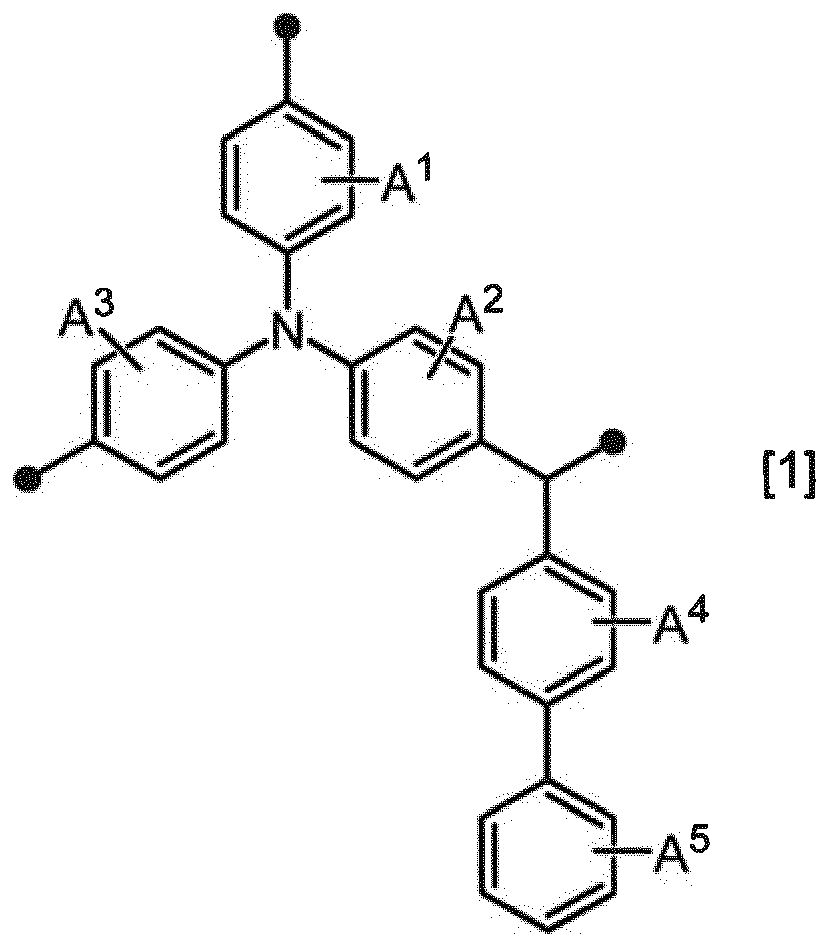
Description
- The present invention relates to a dispersant for carbon nanotubes, and more particularly to a carbon nanotube dispersant composed of a highly branched polymer having a triarylamine structure as the branch points. The invention relates also to a carbon nanotube-containing composition which includes such a dispersant.
- Carbon nanotubes (also abbreviated below as "CNTs") are being studied for potential use in a wide range of fields as a key nanotechnology material. Applications are broadly divided into methods which involve the use of individual CNTs themselves as transistors, microscope probes and the like, and methods which involve the collective use of a large number of CNTs in bulk, such as in electron emission electrodes, fuel cell electrodes, and electrically conductive composites in which CNTs are dispersed.
- In cases where individual CNTs are employed, use is made of, for example, a method in which CNTs are added to a solvent and the mixture is ultrasonically irradiated, following which only the CNTs that are individually dispersed are removed by a technique such as electrophoresis.
- On the other hand, in an electrically conductive composite which uses CNTs in bulk, it is essential for the CNTs to be properly dispersed in the polymer or the like that serves as the matrix material.
- However, CNTs generally are difficult to disperse. Because conventional composites are used with CNT dispersion therein incomplete, the attributes of the CNTs are probably not fully manifested.
- Moreover, this problem also has something to do with making various applications of CNTs difficult to achieve. Hence, various methods for enhancing dispersibility which entail, for example, the surface modification of CNTs or chemically modifying the CNT surfaces, are being investigated.
- One such method for dispersing CNTs involves depositing poly((m-phenylene vinylene)-co-(dioctoxy-p-phenylene vinylene)) having a coil-like structure on the CNT surface (see, for example, Patent Document 1).
- Although the foregoing publication shows that it is possible to individually disperse CNTs within an organic solvent and that the polymer is deposited on single CNTs, once dispersion has been carried out to a certain degree, aggregation arises and the CNTs are captured as precipitate. Hence, it has not been possible to maintain CNTs in a dispersed state for a long time.
- Methods that have been proposed for resolving the above problem include using poly(vinyl pyrrolidone) to disperse CNTs in an amide-based polar organic solvent (see, for example, Patent Document 2), and using poly(vinyl pyrrolidone) to disperse CNTs in an alcohol-type organic solvent (see, for example, Patent Document 3).
- However, in the foregoing art, the polymer used as the dispersant is characterized by being a straight-chain polymer; no findings concerning highly branched polymer have been reported.
- Methods that focus on highly branched polymers as the CNT dispersant have also been disclosed (see, for example, Patent Document 4). Here, "highly branched polymer" refers to a polymer having branches within the skeleton, such as star polymers, and also dendrimers and hyperbranched polymers, both of which are categorized as dendritic polymers.
- These highly branched polymers exhibit distinctive shapes which, in contrast with conventional polymers of ordinary string-like shape, exhibit distinctive shapes that have a relatively sparse interior and a particle-like on the ground that branches are deliberately introduced, and also have a large number of ends that can be modified by the introduction of various functional groups. By utilizing these characteristics, there is a possibility of dispersing CNTs to a high degree compared with straight-chain polymers.
- However, in the art of Patent Document 4 which uses the above-described highly branched polymer as a dispersant, in addition to mechanical treatment, thermal treatment is also required in order to maintain the individually dispersed state of the CNTs for an extended period of time. Moreover, the ability to disperse CNTs is not all that high. Also, in the art of Patent Document 4, the yield when synthesizing the dispersant is low. Because a large amount of metal catalyst must be used as a coupling agent in order to improve the yield, there is a risk of residual metal ingredients remaining within the highly branched polymer, which may limit use in applications as composites with CNTs.
- Moreover, it is known that the electrical conductivity can be improved by doping the CNTs with bromine, potassium, water, nitric acid or sulfuric acid (see, for example, Non-Patent Document 1), and that the electrical characteristics and the mechanical characteristics can be improved by doping with thionyl chloride (see, for example, Non-Patent Document 2).
- However, stably increasing the electrical conductivity has been difficult because these dopants often volatize or decompose under elevated temperature or migrate within the composition.
- One approach that has been proposed for resolving such problems involves using the ion-conductive resin Nafion® to disperse the CNTs (see, for example, Patent Document 5).
- However, although Nafion® exhibits a relatively high conductance, it does not have such a high ability to disperse CNTs.
-
- Patent Document 1:
JP-A 2000-44216 - Patent Document 2:
JP-A 2005-162877 - Patent Document 3:
JP-A 2008-24522 - Patent Document 4: International Disclosure
WO 2008/139839 - Patent Document 5:
JP-A 2010-509428 -
- Non-Patent Document 1: Lee et al., Nature 388 (6639), p. 255 (1997)
- Non-Patent Document 2: U. Dettlaff-Weglikowska et al., J. Am. Chem. Soc., Vol. 127, No. 14, p. 5125 (2005)
- It is therefore an object of the invention to provide a highly branched polymer which is able to disperse CNTs to an individual size within a medium such as an organic solvent, and which, when rendered into a thin-film, also is capable of improving the electrical conductivity of the thin-film. A further object of the invention is to provide a carbon nanotube dispersant composed of such a highly branched polymer.
- The inventors have already discovered that highly branched polymers containing triarylamine structures as branch points have an excellent ability to disperse CNTs and that when such a highly branched polymer is used as a CNT dispersant, at least some of the CNTs can be dispersed to an individual size without heating treatment (
PCT/JP2010/70973 - Based on this finding, the inventors have conducted further extensive investigations, as a result of which they have found that by introducing acidic groups that become proton-donating sources into the highly branched polymer, the electrical conductivity of the thin-film can be improved while retaining the ability to disperse CNTs.
- Accordingly, the invention provides:
- 1. A highly branched polymer characterized by having repeating units of formula (1) or formula (2) below

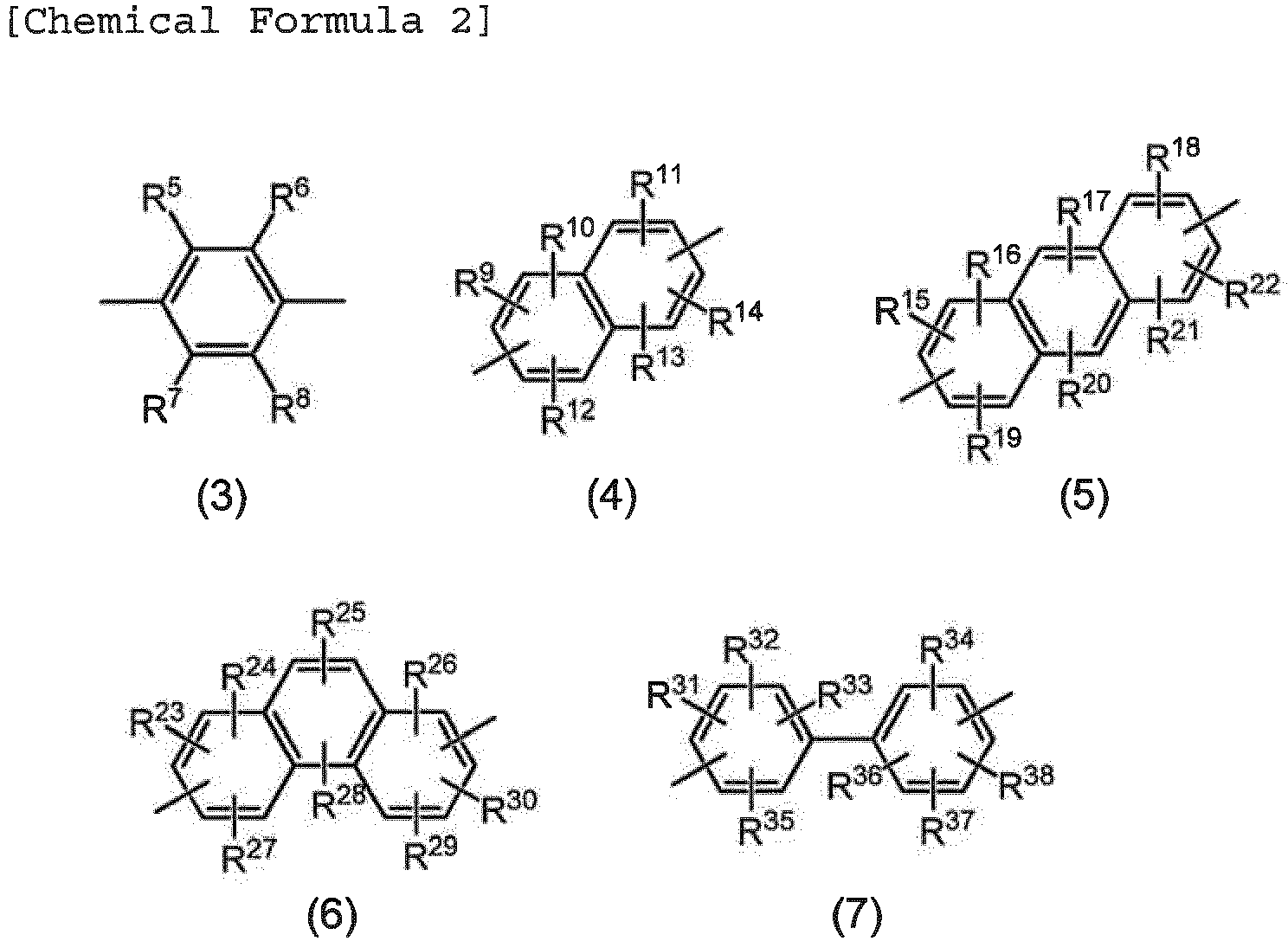

- 2. The highly branched polymer of 1 above, wherein the repeating units are of formula (12) below

- 3. The highly branched polymer of 1 or 2 above, wherein Z2 is a hydrogen atom;
- 4. The highly branched polymer of 3 above, wherein Z1 is a hydrogen atom, a thienyl group, or a monovalent organic group of formula (8);
- 5. The highly branched polymer of any one of 1 to 4 above, wherein the acidic group is a sulfo group or a salt thereof;
- 6. The highly branched polymer of any one of 1 to 5 above which has a polystyrene-equivalent weight-average molecular weight, as measured by gel permeation chromatography, of from 1,000 to 2,000,000;
- 7. A film-forming composition containing the highly branched polymer according to any one of 1 to 6 above;
- 8. A film containing the highly branched polymer according to any one of 1 to 6 above;
- 9. A carbon nanotube dispersant composed of the highly branched polymer according to any one of 1 to 6 above;
- 10. A composition which includes the carbon nanotube dispersant of 9 above and carbon nanotubes;
- 11. The composition of 10 above, wherein the carbon nanotube dispersant adheres to surfaces of the carbon nanotubes and forms composite bodies;
- 12. The composition of 10 or 11 above which further includes an organic solvent;
- 13. The composition of 12 above, wherein the carbon nanotubes are individually dispersed in the organic solvent;
- 14. The composition of 12 above, wherein the composite bodies are individually dispersed in the organic solvent;
- 15. The composition of any one of 10 to 14 above, wherein the carbon nanotubes are of at least one type selected from among single-walled carbon nanotubes, double-walled carbon nanotubes and multi-walled carbon nanotubes;
- 16. The composition of any one of 12 to 15 above which further includes a crosslinking agent that is soluble in the organic solvent;
- 17. The composition of 16 above which further includes an acid and/or an acid generator;
- 18. A thin-film obtained from the composition of any one of 10 to 17 above;
- 19. A cured film obtained by heat-treating the thin-film obtained from the composition of 16 or 17 above;
- 20. A method of producing a composition, which method includes the steps of: preparing a mixture by mixing together the carbon nanotube dispersant of 9 above, carbon nanotubes and an organic solvent; and mechanically treating the mixture;
- 21. The production method of 20 above which includes the steps of: preparing the mixture by adding the carbon nanotubes to a solution obtained by dissolving the carbon nanotube dispersant in the organic solvent; and mechanically treating the mixture; and
- 22. A method of producing a composition, the method being characterized by including the step of forming a composite by melt-blending the carbon nanotube dispersant of 9 above, carbon nanotubes and a thermoplastic resin.
- The highly branched polymer of the invention is able to provide a film which exhibits a high refractive index, a high transparency and a high heat resistance. Moreover, because the polymer has acidic groups such as sulfo groups on the skeleton, it is able to provide a film having also an improved electrical conductivity.
- Such films can be advantageously used as components in the fabrication of electronic devices such as liquid-crystal displays, organic electroluminescent (EL) displays, optical semiconductor (LED) devices, solid-state image sensors, organic thin-film solar cells, dye-sensitized solar cells and organic thin-film transistors (TFT).
- In particular, such films can be advantageously used as the following solid-state image sensor components which are required to have especially high refractive indices: embedding films and planarizing films on photodiodes, planarizing films before and after color filters, microlenses, planarizing films on microlenses, and conformal films.
- In addition, the highly branched polymer of the invention, because it includes triarylamine structures as branch points, has an excellent CNT dispersing ability and is able to individually disperse CNTs to an individual size without heating treatment.
- Therefore, by using a dispersant composed of the highly branched polymer of the invention, at least some of the CNTs can be separated to an individual size (diameter, 0.4 to 100 nm) and dispersed stably (that is, without allowing aggregation to take place) within an organic solvent in an individually dispersed state. In this invention, "individually dispersed" refers to a state in which the individual CNTs have scattered and are dispersed throughout the medium without forming into masses, bundles or "ropes" due to cohesive forces therebetween.
- Moreover, the CNTs can be dispersed by merely subjecting the solution containing CNTs and the organic solvent to mechanical treatment such as ultrasonic treatment, enabling additional operations such as heat treatment to be omitted during dispersion and also making it possible to shorten the treatment time.
- Therefore, by using the CNT dispersant of the invention, it is possible to easily obtain a CNT-containing composition in which (at least some of) the CNTs are dispersed in an individually dispersed state.
- Furthermore, a thin-film can be easily formed by merely applying the CNT-containing composition obtained in this invention to a substrate, and the resulting thin-film exhibits a high electrical conductivity. Moreover, in the above composition, adjusting the amount of CNTs according to the intended use is easy, enabling the composition to be advantageously used in a broad range of applications as various types of semiconductor materials and conductor materials.
-
- [
Fig. 1 ]
FIG. 1 is an 1H-NMR spectrum of the PTPA-PBA-SO3H obtained in Example 1. - [
Fig. 2 ]
FIG. 2 is an 13C-NMR spectrum of the PTPA-PBA-SO3H obtained in Example 1. - [
Fig. 3 ]
FIG. 3 is an 1H-NMR spectrum of the PTPA-PBA-SO3H-TBA obtained in Example 15. - [
Fig. 4 ]
FIG. 4 is an 1H-NMR spectrum of the PTPA-PBA-SO3H-TOA obtained in Example 16. - [
Fig. 5 ]
FIG. 5 shows the UV-visible-near IR spectra of the SWCNT-containing dispersions obtained in Examples 13, 19 and 20, and in Comparative Examples 13 to 15. - [
Fig. 6 ]
FIG. 6 shows the UV-visible-near IR spectra of the SWCNT-containing dispersions obtained in Example 14 and in Comparative Examples 16 to 18. - [
Fig. 7 ]
FIG. 7 shows the UV-visible-near IR spectra of the SWCNT-containing dispersions obtained in Examples 21 and 22, and in Comparative Example 19. - [
Fig. 8 ]
FIG. 8 shows the UV-visible-near IR spectra of the SWCNT-containing dispersion obtained in Example 23. - The invention is described more fully below.
- The highly branched polymers shown in above formula (1) and (2) according to the invention are polymers containing triarylamine structures as the branch points. More specifically, they are polymers obtained by the condensation polymerization of triarylamines with aldehydes and/or ketones under acidic conditions.
- These highly branched polymers, because they are thought to exhibit a high affinity to the conjugated structure of CNTs via π-π interactions originating in the aromatic rings of the triarylamine structures, are expected to have a high ability to disperse CNTs. In addition, they have such characteristics as the potential, depending on the combination of the above triarylamines with the comonomer(s) selected from among aldehydes and/or ketones and on the conditions of polymer synthesis, for the design of various skeletons, the introduction of functional groups, the control of molecular weight and distribution, and the conferring of functionality. Moreover, because these highly branched polymers have a branched structure and are thus endowed with a high solubility that is not observed in straight-chain polymers, and because they also have an excellent heat stability and exhibit excellent hole transporting properties, they show promise also for use as organic EL materials.
- The average molecular weight of the highly branched polymer is not particularly limited, although the weight-average molecular weight is preferably from 1,000 to 2,000,000. If the polymer has a weight-average molecular weight below 1,000, there is a risk that its ability to disperse CNTs will markedly decrease or that such an ability may cease to be exhibited. On the other hand, at a weight-average molecular weight greater than 2,000,000, handling of the polymer in dispersion treatment may become very difficult. A polymer having a weight-average molecular weight of from 2,000 to 1,000,000 is more preferred.
- The weight-average molecular weight of the invention is a measured value (polystyrene equivalent) obtained by gel permeation chromatography.
- In above formulas (1) and (2), Ar1 to Ar3 are each independently a divalent organic group of any one of above formulas (3) to (7). A substituted or unsubstituted phenylene group of formula (3) is especially preferred.
- In above formulas (2) to (7), R1 to R38 are each independently a hydrogen atom, a halogen atom, an alkyl group of 1 to 5 carbons which may have a branched structure, an alkoxy group of 1 to 5 carbons which may have a branched structure, or a carboxyl group, sulfo group, phosphoric acid group, phosphonic acid group or salt of any thereof.
- Here, examples of the halogen atom include fluorine, chlorine, bromine and iodine atoms.
- Examples of the alkyl group of 1 to 5 carbons which may have a branched structure include methyl, ethyl, n-propyl, isopropyl, n-butyl, sec-butyl, tert-butyl and n-pentyl.
- Examples of the alkoxy group of 1 to 5 carbons which may have a branched structure include methoxy, ethoxy, n-propoxy, isopropoxy, n-butoxy, sec-butoxy, tert-butoxy and n-pentoxy.
- Salts of carboxyl groups, sulfo groups, phosphoric acid groups and phosphonic acid groups include sodium, potassium and other alkali metal salts; magnesium, calcium and other alkaline earth metal salts; ammonium salts; propylamine, dimethylamine, tri-C1-10 alkylamine (e.g., triethylamine, tri-n-propylamine, tri-n-butylamine, tri-n-pentylamine, tri-n-hexylamine, tri-n-heptylamine, tri-n-octylamine, tri-n-nonylamine, tri-n-decylamine), ethylenediamine and other aliphatic amine salts; imidazoline, piperazine, morpholine and other cyclic amine salts; aniline, diphenylamine and other aromatic amine salts; and pyridinium salts.
- In formulas (1) and (2), Z1 and Z2 are each independently a hydrogen atom, an alkyl group of 1 to 5 carbons which may have a branched structure, or a monovalent organic group of any of above formulas (8) to (11), with the proviso that Z1 and Z2 are not both alkyl groups. It is preferable for Z1 and Z2 to be each independently a hydrogen atom, a 2- or 3-thienyl group, or a group of formula (8) above. It is more preferable for one of Z1 and Z2 to be a hydrogen atom and for the other to be a hydrogen atom, a 2-or 3-thienyl group or a group of formula (8) above, with one in which R41 is a phenyl group or one in which R41 is a methoxy group being especially preferred.
- When R41 is a phenyl group, in cases where, in the subsequently described acidic group introduction method, acidic groups are introduced onto the polymer following polymer synthesis, the acidic groups are sometimes introduced onto the phenyl group.
- The alkyl group of 1 to 5 carbons which may have a branched structure is exemplified by the same groups as mentioned above.
- In above formulas (8) to (11), R39 to R62 are each independently a hydrogen atom, a halogen atom, an alkyl group of 1 to 5 carbons which may have a branched structure, a haloalkyl group of 1 to 5 carbons which may have a branched structure, a phenyl group, OR63, COR63, NR63R64, COOR65 (R63 and R64 being each independently a hydrogen atom, an alkyl group of 1 to 5 carbons which may have a branched structure, a haloalkyl group of 1 to 5 carbons which may have a branched structure, or a phenyl group; and R65 being an alkyl group of 1 to 5 carbons which may have a branched structure, a haloalkyl group of 1 to 5 carbons which may have a branched structure, or a phenyl group), or a carboxyl group, sulfo group, phosphoric acid group, phosphonic acid group or salt of any thereof.
- Here, the haloalkyl group of 1 to 5 carbons which may have a branched structure is exemplified by difluoromethyl, trifluoromethyl, bromodifluoromethyl, 2-chloroethyl, 2-bromoethyl, 1,1-difluoroethyl, 2,2,2-trifluoroethyl, 1,1,2,2-tetrafluoroethyl, 2-chloro-1-1-2-trifluoroethyl, pentafluoroethyl, 3-bromopropyl, 2,2,3,3-tetrafluoropropyl, 1,1,2,3,3,3-hexafluoropropyl, 1,1,1,3,3,3-hexafluoropropan-2-yl, 3-bromo-2-methylpropyl, 4-bromobutyl and perfluoropentyl.
- The halogen atom, alkyl group of 1 to 5 carbons which may have a branched structure, and carboxyl group, sulfo group, phosphoric acid group, phosphonic acid group or salt of any thereof are exemplified by the same groups as mentioned for above formulas (2) to (7).
- The highly branched polymer of the invention has, in at least one aromatic ring on the repeating units of formula (1) or (2), an acidic group of at least one type selected from among carboxyl groups, sulfo groups, phosphoric acid groups, phosphonic acid groups, and salts thereof.
- Particularly in cases where one wishes to enhance the solubility in a hydrophilic solvent such as an alcohol, glycol or glycol ether, it is desirable for the acidic group to take the form of a salt, preferably an aliphatic amine salt.
- Illustrative examples of aldehyde compounds which may be used to produce the highly branched polymer of the invention include saturated aliphatic aldehydes such as formaldehyde, paraformaldehyde, acetaldehyde, propionaldehyde, butyraldehyde, isobutyraldehyde, valeraldehyde, capronaldehyde, 2-methylbutyraldehyde, hexanal, undecanal, 7-methoxy-3,7-dimethyloctanal, cyclohexanal, 3-methyl-2-butyraldehyde, glyoxal, malonaldehyde, succinaldehyde, glutaraldehyde and adipaldehyde; unsaturated aliphatic aldehydes such as acrolein and methacrolein; heterocyclic aldehydes such as furfural, pyridine aldehyde and thiophene aldehyde; and aromatic aldehydes such as benzaldehyde, tolylaldehyde, trifluoromethylbenzaldehyde, phenylbenzaldehyde, salicylaldehyde, anisaldehyde, acetoxybenzaldehyde, terephthaldehyde, acetylbenzaldehyde, formylbenzoic acid, methyl formylbenzoate, aminobenzaldehyde, N,N-dimethylaminobenzaldehyde, N,N-diphenylaminobenzaldehyde, naphthaldehyde, anthraldehyde, phenanthraldehyde, phenylacetaldehyde and 3-phenylpropionaldehyde. The use of an aromatic aldehyde is especially preferred.
- Ketone compounds which may be used to produce the highly branched polymer of the invention are exemplified by alkyl aryl ketones and diaryl ketones, illustrative examples of which include acetophenone, propiophenone, diphenyl ketone, phenyl naphthyl ketone, dinaphthyl ketone, phenyl tolyl ketone and ditolyl ketone.
- The highly branched polymer used in the invention is obtained, as shown in Scheme 1 below, by the condensation polymerization of a triarylamine compound, such as one of formula (A) below that is capable of furnishing the aforementioned triarylamine skeleton, with an aldehyde compound and/or a ketone compound, such as one of formula (B), below in the presence of an acid catalyst.
- In cases where a difunctional compound (C) such as a phthaldehyde (e.g., terephthaldehyde) is used as the aldehyde compound, not only does the reaction shown in Scheme 1 arise, the reaction shown in Scheme 2 below also arises, giving a highly branched polymer having a crosslinked structure in which the two functional groups both contribute to the condensation reaction.


- In the condensation polymerization reaction, the aldehyde compound and/or the ketone compound may be used in a ratio of from 0.1 to 10 equivalents per equivalent of aryl groups on the triarylamine compound.
- The acid catalyst used may be, for example, a mineral acid such as sulfuric acid, phosphoric acid or perchloric acid; an organic sulfonic acid such as p-toluenesulfonic acid or p-toluenesulfonic acid monohydrate; or a carboxylic acid such as formic acid or oxalic acid.
- The amount of acid catalyst used, although variously selected according to the type thereof, is generally from 0.001 to 10,000 parts by weight, preferably from 0.01 to 1,000 parts by weight, and more preferably from 0.1 to 100 parts by weight, per 100 parts by weight of the triarylamine.
- The condensation reaction may be carried out without a solvent, although it is generally carried out using a solvent. Any solvent that does not hinder the reaction may be used for this purpose. Illustrative examples include cyclic ethers such as tetrahydrofuran and 1,4-dioxane; amides such as N,N-dimethylformamide (DMF), N,N-dimethylacetamide (DMAc) and N-methyl-2-pyrrolidone (NMP); ketones such as methyl isobutyl ketone and cyclohexanone; halogenated hydrocarbons such as methylene chloride, chloroform, 1,2-dichloroethane and chlorobenzene; and aromatic hydrocarbons such as benzene, toluene and xylene. These solvents may be used singly, or two or more may be used in admixture. Cyclic ethers are especially preferred.
- If the acid catalyst used is a liquid compound such as formic acid, the acid catalyst may also fulfill the role of a solvent.
- The reaction temperature during condensation is generally from 40 to 200°C. The reaction time may be variously selected according to the reaction temperature, but is generally from about 30 minutes to about 50 hours.
- The weight-average molecular weight Mw of the polymer obtained as described above is generally from 1,000 to 2,000,000, and preferably from 2,000 to 1,000,000.
- The acidic groups on the highly branched polymer of the invention may be introduced by a method that involves first introducing the acidic groups onto aromatic rings of the above triarylamine compound, aldehyde compound and ketone compound serving as the polymer starting materials, then using this to synthesize the highly branched polymer; or may be introduced by a method that involves treating the highly branched polymer following synthesis with a reagent that is capable of introducing acidic groups onto the aromatic rings. From the standpoint of ease and convenience of production, use of the latter approach is preferred.
- In the latter approach, the technique used to introduce acidic groups onto the aromatic ring is not particularly limited, and may be suitably selected from among various known methods according to the type of acidic group.
- For example, in cases where sulfo groups are introduced, use may be made of a method that involves sulfonation using an excess amount of sulfuric acid.
- The highly branched polymer of the invention is not limited to use only as a CNT dispersant as described below; it can also be dissolved in various solvents and advantageously used as a film-forming composition.
- The solvent used for dissolving the highly branched polymer may be the same as or different from that used during polymerization.
- Illustrative examples of such solvents include aromatic hydrocarbons such as toluene, p-xylene, o-xylene, m-xylene, ethylbenzene and styrene; esters such as ethyl acetate, n-propyl acetate, isopropyl acetate, n-butyl acetate, isobutyl acetate, ethyl lactate and γ-butyrolactone; glycol esters such as ethylene glycol monomethyl ether acetate, ethylene glycol monoethyl ether acetate, diethylene glycol monoethyl ether acetate and propylene glycol monomethyl ether acetate; ethers such as tetrahydrofuran (THF) and 1,4-dioxane; glycol ethers such as ethylene glycol monomethyl ether, ethylene glycol monoethyl ether, ethylene glycol monobutyl ether, ethylene glycol monoisopropyl ether, diethylene glycol monomethyl ether, diethylene glycol monoethyl ether, propylene glycol monomethyl ether, 1-methoxy-2-propanol, propylene glycol monoethyl ether, propylene glycol monobutyl ether, dipropylene glycol monomethyl ether, dipropylene glycol monoethyl ether, 1-methoxy-2-butanol, ethylene glycol dimethyl ether, diethylene glycol dimethyl ether, diethylene glycol diethyl ether and triethylene glycol dimethyl ether; ketones such as acetone, methyl ethyl ketone (MEK), methyl isopropyl ketone, methyl isobutyl ketone (MIBK), methyl n-butyl ketone, diethyl ketone, cyclohexanone and diacetone alcohol; alcohols such as methanol, ethanol, n-propanol, isopropanol, allyl alcohol, n-butanol, isobutanol, tert-butanol, 1-pentanol, 2-methyl-1-butanol, 2-methyl-2-butanol, cyclohexanol, 2-methyl-1-pentanol, 2-ethylhexanol, 1-octanol, benzyl alcohol, furfuryl alcohol and tetrahydrofurfuryl alcohol; glycols such as ethylene glycol, diethylene glycol, trimethylene glycol, propylene glycol, 1,3-butanediol, 1,4-butanediol, 2,3-butanediol and hexylene glycol; amides such as N,N-dimethylformamide (DMF), N,N-dimethylacetamide (DMAc), N-methyl-2-pyrrolidone (NMP), N-cyclohexyl-2-pyrrolidinone, and 1,3-dimethyl-2-imidazolidinone; and sulfoxides such as dimethylsulfoxide (DMSO). These may be used singly or two or more may be used in admixture.
- The solids concentration of the film-forming composition is not particularly limited, provided it is in a range that does not adversely affect properties such as storage stability, and may be suitably set in accordance with the target film thickness. More specifically, from the standpoint of solubility and storage stability, the solids concentration is preferably from 0.1 to 50 wt %, and more preferably from 0.1 to 20 wt %.
- Aside from a highly branched polymer and a solvent, the film-forming composition of the invention may include also other ingredients such as leveling agents, surfactants and crosslinking agents, provided doing so does not interfere with the advantageous effects of the invention.
- The film-forming composition of the invention can be formed into the desired film by application onto a base material, followed by heating if necessary.
- The method of applying the composition onto a base material is not particularly limited. For example, use may be made of a method such as spin coating, dipping, flow coating, ink-jet printing, spraying, bar coating, gravure coating, slit coating, roller coating, transfer printing, brush coating, blade coating and air knife coating.
- Illustrative examples of the base material include silicon, indium tin oxide (ITO)-coated glass, indium zinc oxide (IZO)-coated glass, poly(ethylene terephthalate) (PET), plastic, glass, quartz and ceramic. Use can also be made of a flexible base material having pliability.
- The temperature at which baking is carried out in order to evaporate the solvent is not particularly limited. For example, baking may be carried out at between 40°C and 400°C. In such cases, to achieve more uniform film formability or to induce the reaction to proceed on the base material, temperature change may be carried out in two or more stages.
- The baking process is not particularly limited. For example, baking may be carried out using a hot plate or an oven, and under a suitable atmosphere, such as in open air, in nitrogen or another inert gas, or in a vacuum.
- As for the bake temperature and time, conditions which are compatible with the processing steps for the target electronic device should be selected. Bake conditions such that the physical values of the resulting film conform to the required characteristics of the electronic device should be selected.
- Because the film made of the inventive film-forming composition that has been obtained as described above is able to achieve a high heat resistance, high transparency, high refractive index, high solubility and low volume shrinkage, it can be advantageously used as a component in the fabrication of electronic devices such as liquid-crystal displays, organic electroluminescent (EL) displays, optical semiconductor (LED) devices, solid-state image sensors, organic thin-film solar cells, dye-sensitized solar cells and organic thin-film transistors (TFT).
- The CNT-containing composition according to the invention includes the above-described highly branched polymer (CNT dispersant) and CNTs.
- Carbon nanotubes (CNTs) are produced by, for example, an arc discharge process, chemical vapor deposition (CVD) or laser ablation. The CNTs used in this invention may be obtained by any of these methods. CNTs are categorized as single-walled CNTs composed of a single cylindrically rolled graphene sheet (abbreviated below as "SWCNTs"), double-walled CNTs composed of two concentrically rolled graphene sheets (abbreviated below as "DWCNTs"), and multi-walled CNTs composed of a plurality of concentrically rolled graphene sheets (abbreviated below as "MWCNTs"). In this invention, SWCNTs, DWCNTs and MWCNTs may each be used alone or a plurality of these types of CNTs may be used in combination.
- When synthesizing SWCNTs, DWCNTs and MWCNTs by the above methods, fullerene, graphite and amorphous carbon form at the same time as by-products, in addition to which catalyst metals such as nickel, iron, cobalt and yttrium remain present. The removal of these impurities and purification is thus sometimes necessary. Acid treatment with nitric acid, sulfuric acid or the like in combination with ultrasonication is effective for removing impurities. In acid treatment with nitric acid, sulfuric acid or the like, the n conjugated system making up the CNTs may be destroyed, resulting in a loss of the inherent properties of the CNTs. Hence, it is desirable to use the CNTs purified under suitable conditions.
- The inventive composition may additionally include an organic solvent having the ability to dissolve the above dispersant (highly branched polymer).
- Illustrative examples of such organic solvents include ethers such as tetrahydrofuran (THF), diethyl ether and 1,2-dimethoxyethane (DME); halogenated hydrocarbons such as methylene chloride, chloroform and 1,2-dichloroethane; amides such as N,N-dimethylformamide (DMF), N,N-dimethylacetamide (DMAc) and N-methyl-2-pyrrolidone (NMP); ketones such as acetone, methyl ethyl ketone, methyl isobutyl ketone and cyclohexanone; alcohols such as methanol, ethanol, isopropanol and n-propanol; aliphatic hydrocarbons such as n-heptane, n-hexane and cyclohexane; aromatic hydrocarbons such as benzene, toluene, xylene and ethylbenzene; glycol ethers such as ethylene glycol monoethyl ether, ethylene glycol monobutyl ether and propylene glycol monomethyl ether; and glycols such as ethylene glycol and propylene glycol. These organic solvents may be used singly or two or more may be used in combination.
- In particular, from the standpoint of being able to increase the proportion of individually dispersed CNTs, the use of NMP, DMF, THF or isopropanol is preferred. In addition, depending on the solvent used, it is desirable to include also, as an additive for enhancing the film formability of the composition, a small amount of, for example, a glycol ether (e.g., ethylene glycol monoethyl ether, ethylene glycol monobutyl ether, propylene glycol monomethyl ether), a ketone (e.g., acetone, methyl ethyl ketone, cyclohexanone), propylene glycol, isopropanol or NMP.
- When using the highly branched polymer of the invention (particularly when the acidic group is in the form of a salt), the dispersibility and film-forming properties are good even if a hydrophilic solvent such as an alcohol, a glycol or a glycol ether is used.
- Moreover, even when such a hydrophilic solvent is used as a mixed solvent with water, there is no decline in the dispersibility and film-forming properties.
- Any suitable method may be used to prepare the inventive composition. In cases where the dispersant (highly branched polymer) is a liquid, the composition may be prepared by suitably mixing the dispersant with the CNTs. In cases where the dispersant is a solid, the composition may be prepared by melting the dispersant, then mixing it with the CNTs.
- In cases where an organic solvent is used, the composition may be prepared by mixing together the dispersant, the CNTs and the organic solvent in any order.
- The mixture of the dispersant, CNTs and organic solvent is preferably subjected to dispersion treatment; with such treatment, the proportion of individually dispersed CNTs can be increased. Examples of dispersion treatment include the following types of mechanical treatment: wet treatment using a ball mill, bead mill or jet mill, and ultrasonic treatment using a bath-type or probe-type sonicator.
- Any suitable dispersion treatment time may be used, although a time of from about 1 minute to about 10 hours is preferred, and a time of from about 5 minutes to about 5 hours is more preferred.
- Because the dispersant of the invention has an excellent ability to disperse CNTs, even if heat treatment is not carried out prior to dispersion treatment, it is possible to obtain a composition in which the CNTs have been individually dispersed to a high concentration. However, heat treatment may be carried out if necessary.
- The mixing ratio of dispersant and CNTs in the CNT-containing composition of the invention may be set to from about 1,000:1 to about 1:100, by weight.
- The concentration of dispersant in a composition containing an organic solvent is not particularly limited, provided it is a concentration that is able to disperse the CNTs in the organic solvent. However, in this invention, the concentration of dispersant in the composition is set to preferably from about 0.001 to about 30 wt %, and more preferably from about 0.002 to about 20 wt %.
- In addition, the CNT concentration in this composition is not particularly limited, provided at least some of the CNTs are individually dispersed. However, in this invention, the CNT concentration in the composition is set to preferably from about 0.0001 to about 20 wt %, and more preferably from about 0.001 to about 10 wt %.
- In the inventive composition prepared as described above, it is assumed that the dispersant adheres to the surfaces of the CNTs to form a composite.
- Alternatively, in the inventive composition, a general-purpose synthetic resin that is soluble in the above organic solvent may be mixed with the other ingredients, and the resulting mixture used to form a composite.
- Illustrative examples of the general-purpose synthetic resin include the following thermoplastic resins: polyolefin resins such as polyethylene (PE), polypropylene (PP), ethylene-(vinyl acetate) copolymer (EVA) and ethylene-(ethyl acrylate) copolymer (EEA), polystyrene resins such as polystyrene (PS), high-impact polystyrene (HIPS), acrylonitrile-styrene copolymer (AS), acrylonitrile-butadiene-styrene copolymer (ABS) and (methyl methacrylate)-styrene copolymer (MS), polycarbonate resins, vinyl chloride resins, polyamide resins, polyimide resins, (meth)acrylic resins such as poly(methyl methacrylate) (PMMA), polyester resins such as poly(ethylene terephthalate) (PET), poly(butylene terephthalate), poly(ethylene naphthalate), poly(butylene naphthalate), poly(lactic acid) (PLA), poly(3-hydroxybutyric acid), polycaprolactone, poly(butylene succinate) and poly(ethylene succinate/adipate), polyphenylene ether resins, modified polyphenylene ether resins, polyacetal resins, polysulfone resins, poly(phenylene sulfide) resins, poly(vinyl alcohol) resins, poly(glycolic acid)s, modified starches, cellulose acetate and cellulose triacetate, chitin and chitosan, and lignin; and the following thermoset resins: phenolic resins, urea resins, melamine resins, unsaturated polyester resins, polyurethane resins, and epoxy resins.
- The CNT-containing composition of the invention may also include a crosslinking agent that is soluble in the above-described organic solvent.
- Examples of such crosslinking agents include melamine-based crosslinking agents, substituted urea-based crosslinking agents and crosslinking agents which are polymers thereof. These crosslinking agents may be used singly, or two or more may be used in admixture. A crosslinking agent having at least two crosslink-forming substituents is preferred. Illustrative examples of such crosslinking agents include compounds such as CYMEL®, methoxymethylated glycoluril, butoxymethylated glycoluril, methylolated glycoluril, methoxymethylated melamine, butoxymethylated melamine, methylolated melamine, methoxymethylated benzoguanamine, butoxymethylated benzoguanamine, methylolated benzoguanamine, methoxymethylated urea, butoxymethylate urea, methylolated urea, methoxymethylated thiourea, butoxymethylated thiourea and methylolated thiourea, as well as condensates of these compounds.
- The amount of crosslinking agent added varies according to such factors as the organic solvent used, the base material used, the required viscosity, and the required film shape. However, the amount of addition with respect to the CNT dispersant (highly branched polymer) is typically from 0.001 to 80 wt %, preferably from 0.01 to 50 wt %, and more preferably from 0.05 to 40 wt %. Although these crosslinking agents do sometimes give rise to crosslinking reactions due to self-condensation, they elicit a crosslinking reaction with the highly branched polymer of the invention. In cases where crosslinkable substituents are present in the highly branched polymer, the crosslinking reaction is promoted by these crosslinkable substituents.
- In this invention, an acidic compound (e.g., p-toluenesulfonic acid, trifluoromethanesulfonic acid, pyridinium p-toluenesulfonic acid, salicylic acid, sulfosalicylic acid, citric acid, benzoic acid, hydroxybenzoic acid, naphthalenecarboxylic acid) and/or a thermal acid generator (e.g., 2,4,4,6-tetrabromocyclohexadienone, benzoin tosylate, 2-nitrobenzyl tosylate, alkyl esters of organic sulfonic acids) may be added as the catalyst for promoting the crosslinking reaction.
- The amount of catalyst addition with respect to the CNT dispersant (highly branched polymer) is typically from 0.0001 to 20 wt %, preferably from 0.0005 to 10 wt %, and more preferably from 0.001 to 3 wt %.
- The inventive composition may be formed into a composite by mixture and melt blending with a resin intended to serve as the matrix.
- The resin that becomes the matrix is preferably a thermoplastic resin, and is exemplified by the same thermoplastic resins as those mentioned above for the general-purpose synthetic resin.
- In this case, preparation of the composition typically involves melt blending the dispersant, the CNTs and the resin that becomes the matrix in a blending apparatus. Exemplary blending apparatuses include various types of mixers, and single-screw or twin-screw extruders. The blending temperature and time are not particularly limited, and may be suitably selected according to the resin intended to serve as the matrix.
- The CNT concentration in the composition in which a resin that is to serve as the matrix has been used will vary depending on such factors as the mechanical, electrical and thermal properties desired of the composition, and so is not particularly limited. However, in this invention, the CNT concentration in the composition is set to preferably from about 0.0001 to about 30 wt %, and more preferably from 0.001 to 20 wt %.
- The CNT-containing composition (solution) of the invention may be applied and formed into a film on a suitable base material such as PET, glass or ITO by a suitable method, such as spin coating, dipping, flow coating, ink-jet printing, spraying, bar coating, gravure coating, slit coating, roller coating, transfer printing, brush coating, blade coating or air knife coating.
- The thin-film thus obtained can be advantageously used in electrically conductive materials that make use of the metallic qualities of CNTs, such as antistatic films and transparent electrodes, and in applications that make use of the semiconducting qualities of CNTs, such as photoelectric conversion elements and electroluminescence elements.
- The invention is illustrated more fully below by way of Working Examples and Comparative Examples, although the invention is not limited by these Examples. The equipment and conditions used for preparing samples and for analyzing the properties of the samples were as follows.
-
(1) Gel Permeation Chromatography (GPC)Instrument: HLC-8200 GPC (Tosoh Corporation) Columns: Shodex KF-804L + KF-805L Column temperature: 40°C Solvent: Tetrahydrofuran Detector: UV (254 nm) Calibration curve: polystyrene standard
(2) Thermogravimetric/Differential Thermal Analyzer (TG-DTA)Instrument: TG-8120 (Rigaku Corporation) Temperature ramp-up rate: 10°C/min Measurement temperatures: 25°C to 750°C
(3) UV/Vis Photo-Differential Scanning Calorimeter (Photo-DSC)Instrument: Photo-DSC 204 F1 Phoenix (from Netzsch) Temperature ramp-up rate: 40°C/min Measurement temperature: 25°C to 350°C
(4) 1H-NMR SpectrometerInstrument: JNM-ECA700 (from JEOL, Ltd.) Solvent used in measurement: DMSO-d6 (deuterated dimethylsulfoxide) Reference material: Tetramethylsilane (0.00 ppm)
(5) 13C-NMR Spectrometer - Instrument:
- JNM-ECA700 (from JEOL, Ltd.)
- Solvent used in measurement:
- DMSO-d6
- Reference material:
- DMSO-d6 (39.5 ppm)
- Instrument:
- ICS-1500 (Dionex)
- Columns:
- IonPac AG12A + IonPac AS12A (Dionex)
- Solvent:
- aqueous solution containing 2.7 mmol/L of NaHCO3 + 0.3 mmol/L of Na3CO3
- Detector:
- Electrical conductivity
- Apparatus:
- 1H-D7 (Mikasa KK)
- Apparatus:
- ND-2 (As One Corporation)
- Apparatus:
- UIP1000 (Hielscher Ultrasonics GmbH)
- Instrument A:
- Loresta GP (Mitsubishi Chemical Corporation)
- Probe:
- ASP serial 4-pin probe (Mitsubishi Chemical Corporation; inter-pin distance, 5 mm)
- Instrument B:
- Hiresta UP (Mitsubishi Chemical Corporation)
- Probe:
- URS ring probe (Mitsubishi Chemical Corporation)
- Instrument:
- NDH 5000 (Nippon Denshoku Industries Co., Ltd.)
- Apparatus:
- FU-6H (from TGK)
- Apparatus:
- SRX-201 (Tomy Seiko Co., Ltd.)
- Instrument:
- SHIMADZU UV-3600 (Shimadzu Corporation)
- Measurement Wavelength:
- 400 to 1650 nm
- Apparatus:
- Revolution HP-TR2 (Anest Iwata Corporation)
- Nozzle Size:
- 0.5 mm
- Bottle Capacity:
- 15 mL
- Apparatus:
- Nano Jet Pal® JN20 (Jokoh KK)
- The meanings of abbreviations used in the Examples are as follows.
- CNT-1:
- unpurified MWCNTs (C Tube 100, from CNT Co., Ltd.; outside diameter, 10 to 30 nm)
- CNT-2:
- medium-diameter MWCNTs (VGCF-X, from Showa Denko KK; outside diameter, 15 nm)
- CNT-3:
- unpurified SWCNTs (HiPco, from Carbon Nanotechnologies)
- CNT-4:
- purified SWCNTs (from Unidym)
- CNT-5:
- purified SWCNTs (ASP-100F, from Hanwha Nanotech)
- CNT-6:
- purified SWCNTs (KH SWCNT80, from KH Chemicals)
- PVP:
- polyvinylpyrrolidone (K15, from Tokyo Chemical Industry Co., Ltd.; Mw, 10,000)
- Nafion:
- Nafion® dispersion (No. 510211 from Sigma-Aldrich Co.; 5 wt% Nafion®/50 wt % lower alcohol/45 wt % water)
- BuOH:
- 1-butanol
- CHN:
- cyclohexanone
- DMAc:
- N,N-dimethylacetamide
- DME:
- 1,2-dimethoxyethane
- EtOH:
- ethanol
- IPA:
- isopropanol (2-propanol)
- IPE:
- diisopropyl ether
- MEK:
- methyl ethyl ketone
- MeOH:
- methanol
- NMP:
- N-methyl-2-pyrrolidone
- PG:
- propylene glycol
- PGME:
- propylene glycol monomethyl ether
- PrOH:
- 1-propanol
- THF:
- tetrahydrofuran
- Under a nitrogen atmosphere, a 1-liter four-neck flask was charged with 80.0 g (326 mmol) of triphenylamine (Zhenjiang Haitong Chemical Industry Co., Ltd.), 118.8 g (652 mmol; 2.0 eq. relative to the triphenylamine) of 4-phenylbenzaldehyde (Mitsubishi Gas Chemical), 12.4 g (65 mmol; 0.2 eq. relative to the triphenylamine) of p-toluenesulfonic acid monohydrate (Konan Chemical Manufacturing Co., Ltd.), and 160 g of 1,4-dioxane. The temperature of this mixture was raised to 85°C under stirring, thereby effecting dissolution and commencing polymerization. The reaction was carried out for 6 hours, after which the reaction mixture was allowed to cool to 60°C. The reaction mixture was then diluted with 560 g of THF, after which 80 g of 28 wt % ammonia water was added. The resulting reaction solution was poured into a mixed solution of 2,000 g of acetone and 400 g of methanol, and thereby re-precipitated. The precipitate was collected by filtration and dried in vacuo. The resulting solid was re-dissolved in 640 g of THF, then poured into a mixed solution of 2,000 g of acetone and 400 g of water and thereby again re-precipitated. The precipitate was collected by filtration and dried in vacuo for 6 hours at 130°C, yielding 115.1 g of the highly branched polymer PTPA-PBA having repeating units of formula (A) below.
- The polystyrene-equivalent weight-average molecular weight Mw of this PTPA-PBA, as measured by GPC, was 17,000, and the polydispersity Mw/Mn was 3.82 (here, Mn represents the number-average molecular weight measured under the same conditions). The 5% weight loss temperature, as measured with a TG-DTA, was 531°C. The glass transition temperature (Tg), as measured by differential scanning calorimetry, was 159°C.

- Under a nitrogen atmosphere, a 500 mL four-neck flask was charged with 2.0 g of the PTPA-PBA synthesized in Synthesis Example 1 and 50 g of sulfuric acid (Kanto Chemical Co., Ltd.). The temperature of this mixture was raised to 40°C under stirring, thereby effecting dissolution and commencing sulfonation. After 8 hours of reaction, the temperature of the reaction mixture was raised to 50°C and the reaction was allowed to proceed for 1 hour more. This reaction mixture was poured into 250 g of pure water, bringing about re-precipitation. The precipitate was collected by filtration, after which 250 g of pure water was added thereto and the precipitate was left at rest for 12 hours. The precipitate was collected by filtration and dried in vacuo for 8 hours at 50°C, yielding 2.7 g of the highly branched polymer PTPA-PBA-SO3H (referred to below as simply "PTPA-PBA-SO3H") as a purple powder.
-
FIG. 1 shows the 1H-NMR spectrum of the resulting PTPA-PBA-SO3H, andFIG. 2 shows the 13C-NMR spectrum. The sulfur atom content of the PTPA-PBA-SO3H, as determined by quantitative analysis of the sulfur, was 6.4%. Based on this result, the sulfo group content of the PTPA-PBA-SO3H was one sulfo group per repeating unit of the highly branched polymer PTPA-PBA. - Under a nitrogen atmosphere, a 50 mL four-neck flask was charged with 2.0 g of the PTPA-PBA-SO3H synthesized in Example 1 and 18 g of methanol. This mixture was dissolved under stirring at room temperature (about 25°C), following which 1.5 g (8.2 mmol; 2.0 eq. relative to the sulfonated polymer) of tri-n-butylamine (Kanto Chemical Co., Ltd.) was added dropwise. The reaction was allowed to proceed for 30 minutes, after which the reaction mixture was poured into 200 g of IPE and re-precipitated. The precipitate was collected by filtration and dried in vacuo for 8 hours at 60°C, yielding 2.6 g of the highly branched polymer PTPA-PBA-SO3H-TBA (referred to below as simply "PTPA-PBA-SO3H-TBA") as a light-green powder.
-
FIG. 3 shows the 1H-NMR spectrum of the resulting PTPA-PBA-SO3H-TBA. - Aside from changing the amount of methanol used to 8 g and changing the tri-n-butylamine to 2.9 g (8.2 mmol; 2.0 eq. relative to the sulfonated polymer) of tri-n-octylamine, the same procedure was carried out as in Example 15, giving 3.0 g of the highly branched polymer PTPA-PBA-SO3H-TOA (referred to below as simply "PTPA-PBA-SO3H-TOA") as a light-green powder.
-
FIG. 4 shows the 1H-NMR spectrum of the resulting PTPA-PBA-SO3H-TOA. - The PTPA-PBA-SO3H obtained in Example 1 was dissolved in a NMP/CHN mixed solution (weight ratio, 1:1) so as to give a resin concentration of 10 wt %. The resulting solution was spin-coated (at 200 rpm for 5 seconds, then at 2,000 rpm for 30 seconds) onto a glass substrate (5x5 cm) to form a film. This applied film was heated for 2 minutes on a 100°C hot plate, thereby producing a PTPA-PBA-SO3H thin-film.
- Aside from changing the PTPA-PBA-SO3H to the PTPA-PBA synthesized in Synthesis Example 1 and changing the solvent to CHN, a PTPA-PBA thin-film was produced in the same way as in Example 2.
- Aside from changing the PTPA-PBA-SO3H to PVP, a PVP thin-film was produced in the same way as in Example 2.
- The surface resistivities and total light transmittances of the thin-films obtained in Example 2 and in Comparative Examples 1 and 2 were measured. The results are shown in Table 1.
Table 1 Resin Surface resistivity (Ω/□) Total light transmittance (%) Example 2 PTPA-PBA-SO3H 8.7×10¹⁰ 96.4 Comparative Example 1 PTPA-PBA >1×10¹³ 100 Comparative Example 2 PVP >1×10¹³ 100 - As shown in Table 1, the thin-film composed of a sulfo group-containing highly branched polymer (Example 2) was found to have electrical conductivity by itself. By contrast, electrical conductivity was not observed in the thin-film composed of a highly branched polymer without sulfo groups (Comparative Example 1) and in the thin-film composed of the known dispersant PVP (Comparative Example 2). Hence, it is apparent that the highly branched polymer of the invention is advantageous for obtaining a thin-film having a high electrical conductivity.
- First, 0.50 g of the PTPA-PBA-SO3H synthesized in Example 1 was dissolved as the dispersant in 49.25 g of NMP as the dispersion medium, and 0.25 g of CNT-1 was added as the MWCNTs to the resulting solution. This mixture was subjected to 30 minutes of ultrasonic treatment at room temperature (about 25°C) using a probe-type ultrasonicator, thereby giving a black MWCNT-containing dispersion in which the MWCNTs were uniformly dispersed and which was free of precipitate.
- Next, 0.50 g of CHN was added as an additive to 2.0 g of the MWCNT-containing dispersion, thereby preparing a coating fluid for thin-film production. Using an applicator having a slit width of 25.4 µm, 50 µL of the resulting coating fluid was uniformly spread on a glass substrate and dried at 100°C for about 2 minutes, thereby producing a transparent and uniform MWCNT/PTPA-PBA-SO3H composite thin-film.
- Aside from changing the dispersant to 0.25 g of PTPA-PBA-SO3H and changing the dispersion medium to 49.50 g of NMP, a MWCNT-containing dispersion and a MWCNT/PTPA-PBA-SO3H composite thin-film were produced in the same way as in Example 3.
- Aside from changing the dispersant to 0.25 g of PTPA-PBA-SO3H and changing the dispersion medium to a mixed solvent composed of 44.75 g of NMP, 2.5 g of PrOH and 2.25 g of pure water, a MWCNT-containing dispersion and a MWCNT/PTPA-PBA-SO3H composite thin-film were produced in the same way as in Example 3.
- Aside from changing the dispersion medium to 49.25 g of MeOH and changing the additive to 0.50 g of PG, a MWCNT-containing dispersion and a MWCNT/PTPA-PBA-SO3H composite thin-film were produced in the same way as in Example 3.
- Aside from changing the dispersion medium to 49.25 g of PG and not using the additive CHN, a MWCNT-containing dispersion and a MWCNT/PTPA-PBA-SO3H composite thin-film were produced in the same way as in Example 3.
- Aside from changing the dispersion medium to a mixed solvent composed of 44.33 g of PGME and 4.93 g of pure water and not using the additive CHN, a MWCNT-containing dispersion and a MWCNT/PTPA-PBA-SO3H composite thin-film were produced in the same way as in Example 3.
- Aside from changing the dispersion medium to a mixed solvent composed of 20.00 g of MeOH and 29.25 g of pure water and changing the additive to 0.50 g of IPA, a MWCNT-containing dispersion and a MWCNT/PTPA-PBA-SO3H composite thin-film were produced in the same way as in Example 3.
- Aside from changing the dispersion medium to a mixed solvent composed of 44.33 g of IPA and 4.93 g of pure water and changing the additive to 0.50 g of NMP, a MWCNT-containing dispersion and a MWCNT/PTPA-PBA-SO3H composite thin-film were produced in the same way as in Example 3.
- Aside from changing the dispersant to 0.50 g of the PTPA-PBA synthesized in Synthesis Example 1, a MWCNT-containing dispersion and a MWCNT/PTPA-PBA composite thin-film were produced in the same way as in Example 3.
- Aside from changing the dispersant to 0.25 g of the PTPA-PBA synthesized in Synthesis Example 1 and changing the dispersion medium to 49.50 g of NMP, a MWCNT-containing dispersion and a MWCNT/PTPA-PBA composite thin-film were produced in the same way as in Example 3.
- Aside from changing the dispersant to 0.25 g of PVP and changing the dispersion medium to 49.50 g of NMP, a MWCNT-containing dispersion and a MWCNT/PVP composite thin-film were produced in the same way as in Example 3.
- Aside from changing the dispersant to 0.50 g of PVP and changing the dispersion medium to 49.25 g of PG, a MWCNT-containing dispersion and a MWCNT/PVP composite thin-film were produced in the same way as in Example 3.
- Aside from changing the dispersant to 0.25 g of Nafion (5.00 g of Nafion dispersion) and changing the dispersion medium to 44.75 g of NMP, a MWCNT-containing dispersion and a MWCNT/Nafion composite thin-film were produced in the same way as in Example 3.
- Aside from changing the dispersant to 0.50 g of Nafion (10.00 g of Nafion dispersion) and changing the dispersion medium to 39.75 g of PG, a MWCNT-containing dispersion and a MWCNT/Nafion composite thin-film were produced in the same way as in Example 3.
- The dispersion properties for each of the MWCNT-containing dispersions obtained in Examples 3 to 10 and Comparative Examples 3 to 8, and the thin-film uniformity, surface resistivity and total light transmittance of each of the composite thin-films obtained in these examples were evaluated. The dispersion properties for the dispersions and the thin-film uniformity were visually evaluated according to the criteria indicated below. The results are presented in Table 2.
- State of dispersion after 30 minutes of standing following ultrasonic treatment.
- Good:
- Uniformly dispersed, with no aggregate-like masses observable whatsoever.
- NG:
- MWCNT aggregates observable.
-
- Good:
- No aggregate-like masses or film irregularity (shading) observable whatsoever.
- Fair:
- Some MWCNT aggregates and film irregularities (shading) observable.
- NG:
- MWCNT aggregates and film irregularities (shading) observable in most places, making evaluation as a film impossible.
- As shown in Table 2, the dispersant of the invention is able to stably disperse CNTs not only in common organic solvents (NMP, etc.), but even in hydrophilic solvents (alcohol, alcohol/water, etc.). Hence, by using the dispersant of the invention, dispersions can be prepared using a wide range of solvent systems.
- Moreover, compared with PTPA-PBA (Comparative Examples 3 and 4), which lacks sulfo groups, when use is made of the sulfo group-containing dispersants of Examples 3 to 8, the surface resistivity is about one order of magnitude lower (at the level of 103 Ω/□), indicating that the inventive dispersants are advantageous for obtaining films having a high electrical conductivity.
- Also, although PVP can achieve stable dispersions in both common organic solvents and hydrophilic solvents, the resulting thin-films have a low uniformity (Comparative Examples 5 and 6). Nafion cannot disperse MWCNTs in a common organic solvent (Comparative Example 7), but can achieve a stable dispersion in a hydrophilic solvent, although the film formability is very poor (Comparative Example 8).
- Aside from changing the MWCNTs to 0.25 g of CNT-2, a MWCNT-containing dispersion and a MWCNT/PTPA-PBA-SO3H composite thin-film were produced in the same way as in Example 3.
- Aside from changing the dispersant to 0.25 g of PTPA-PBA-SO3H, the dispersion medium to 49.50 g of NMP and the MWCNTs to 0.25 g of CNT-2, a MWCNT-containing dispersion and a MWCNT/PTPA-PBA-SO3H composite thin-film were produced in the same way as in Example 3.
- Aside from changing the dispersant to 0.50 g of the PTPA-PBA-SO3H-TBA synthesized in Example 15, the dispersion medium to 49.25 g of PrOH, the MWCNTs to 0.25 g of CNT-2 and the additive to 0.50 g of PG, a MWCNT-containing dispersion and a MWCNT/PTPA-PBA-SO3H-TBA composite thin-film were produced in the same way as in Example 3.
- Aside from changing the dispersant to 0.50 g of the PTPA-PBA-SO3H-TOA synthesized in Example 16, the dispersion medium to 49.25 g of PrOH, the MWCNTs to 0.25 g of CNT-2 and the additive to 0.50 g of PG, a MWCNT-containing dispersion and a MWCNT/PTPA-PBA-SO3H-TOA composite thin-film were produced in the same way as in Example 3.
- Aside from changing the dispersant to 0.50 g of the PTPA-PBA synthesized in Synthesis Example 1 and changing the MWCNTs to 0.25 g of CNT-2, a MWCNT-containing dispersion and a MWCNT/PTPA-PBA composite thin-film were produced in the same way as in Example 3.
- Aside from changing the dispersant to 0.25 g of the PTPA-PBA synthesized in Synthesis Example 1, the dispersion medium to 49.50 g of NMP and the MWCNTs to 0.25 g of CNT-2, a MWCNT-containing dispersion and a MWCNT/PTPA-PBA composite thin-film were produced in the same way as in Example 3.
- Aside from changing the dispersant to 0.25 g of PVP, the dispersion medium to 49.50 g of NMP and the MWCNTs to 0.25 g of CNT-2, a MWCNT-containing dispersion and a MWCNT/PVP composite thin-film were produced in the same way as in Example 3.
- Aside from changing the dispersant to 0.25 g of Nafion (5.00 g of Nafion dispersion), the dispersion medium to 44.75 g of NMP and the MWCNTs to 0.25 g of CNT-2, a MWCNT-containing dispersion and a MWCNT/Nafion composite thin-film were produced in the same way as in Example 3.
- The dispersion properties of each of the MWCNT-containing dispersions obtained in Examples 11, 12, 17 and 18 and in Comparative Examples 9 to 12, and the thin-film uniformity, surface resistivity and total light transmittance of each of the composite thin-films obtained in these examples were measured. The dispersion properties of the dispersions and the thin-film uniformity were visually evaluated according to the above-described criteria. The results are presented in Table 3.
Table 3 Dispersant Dispersion medium (weight ratio) CNT/ dispersant weight ratio Dispersion properties Additive Thin-film uniformity Surface resistivity (Ω/□) Total light transmittance (%) Example 11 PTPA-PBA-SO3H NMP 1/2 good CHN good 3.3×203 52.4 Example 12 PTPA-PHA-SO3H NMP 1/1 good CHN good 2.9×10³ 51.7 Example 17 PTPA-PBA-SO3H-TBA PrOH 1/2 good PG good 5.5×10³ 61.0 Example 18 PTPA-PBA-SO3H-TOA PrOH 1/2 good PG good 8.4×10³ 63.1 Comparative Example 9 PTPA-PBA NMP 1/2 good CHN good 2.7×10⁴ 56.3 Comparative Example 10 PTPA-PBA NMP 1/1 good CHN good 6.6×10³ 55.4 Comparative Example 11 PVP NMP 1/1 good CHN fair (5.4×10³) (58.5) Comparative Example 12 Nafion NMP/alcohol/H2O (44.75/2.50/2.25) 1/1 NG CHN - - - Note: Numbers in parentheses under "Surface resistivity" are reference values; in these cases, accurate measurement was impossible due to excessive film irregularity. - As shown in Table 3, dispersants composed of a highly branched polymer having acidic groups exhibit the same tendencies, regardless of the type of MWCNTs.
- First, 1.0 mg of the PTPA-PBA-SO3H synthesized in Example 1 was dissolved as the dispersant in a mixed solvent composed of 5.0 mL of NMP, 10 mg of PrOH and 9 mg of pure water as the dispersion medium, then 0.5 mg of CNT-3 was added as the SWCNTs to the resulting solution. This mixture was subjected to 60 minutes of ultrasonic treatment at room temperature (about 25°C) using an ultrasonicator. The mixture was then subjected to 60 minutes of centrifugal separation at 10,000g using a small, high-speed refrigerated centrifuge, thereby giving a SWCNT-containing dispersion as the supernatant.
- The UV-visible-near IR spectrum of the SWCNT-containing dispersion obtained was measured, whereupon absorption was clearly observed in the semiconducting S11 band (1,400 to 1,000 nm) and S22 band (1,000 to 600 nm) and in the metallic band (600 to 450 nm), thereby confirming that the SWCNTs are dispersed. The results are shown in
FIG. 5 . - Next, 2 mL of the above SWCNT-containing dispersion was sprayed for 15 to 20 seconds over the entire top surface of a glass substrate heated on a 230°C hot plate, thereby producing a uniform SWCNT/PTPA-PBA-SO3H composite thin-film. Spraying was carried out using nitrogen at a pressure of 0.2 MPa and from about 20 cm above the substrate being sprayed.
- Aside from changing the dispersant to 1.0 mg of the PTPA-PBA-SO3H-TBA synthesized in Example 15, changing the dispersion medium to 5 mL of PrOH and not carrying out centrifugal separation, a SWCNT-containing dispersion and a SWCNT/PTPA-PBA-SO3H-TBA composite thin-film were produced in the same way as in Example 13.
- The UV-visible-near IR spectrum of the SWCNT-containing dispersion obtained was measured, whereupon absorption was clearly observed in the semiconducting S11 and S22 bands and in the metallic band, thereby confirming that the SWCNTs are dispersed. The UV-visible-near IR spectrum of the SWCNT-containing dispersion obtained also is shown in
FIG. 5 . - Aside from changing the dispersant to 1.0 mg of the PTPA-PBA-SO3H-TOA synthesized in Example 15, changing the dispersion medium to 5 mL of PrOH and not carrying out centrifugal separation, a SWCNT-containing dispersion and a SWCNT/PTPA-PBA-SO3H-TOA composite thin-film were produced in the same way as in Example 13.
- The UV-visible-near IR spectrum of the resulting SWCNT-containing dispersion was measured, whereupon absorption was clearly observed in the semiconducting S11 and S22 bands and in the metallic band, thereby confirming that the SWCNTs are dispersed. The UV-visible-near IR spectrum of the SWCNT-containing dispersion obtained also is shown in
FIG. 5 . - Aside from changing the dispersant to 1.0 mg of the PTPA-PBA synthesized in Synthesis Example 1, a SWCNT-containing dispersion and a SWCNT/PTPA-PBA composite thin-film were produced in the same way as in Example 13. The UV-visible-near IR spectrum of the SWCNT-containing dispersion obtained also is shown in
FIG. 5 . - Aside from changing the dispersant to 1.0 mg of PVP, a SWCNT-containing dispersion and a SWCNT/PVP composite thin-film were produced in the same way as in Example 13. The UV-visible-near IR spectrum of the SWCNT-containing dispersion obtained also is shown in
FIG. 5 . - Aside from changing the dispersant to 1.0 mg of Nafion (20 mg of Nafion dispersion) and changing the dispersion medium to 5.0 mL of NMP, a SWCNT-containing dispersion and a SWCNT/Nafion composite thin-film were produced in the same way as in Example 13. The UV-visible-near IR spectrum of the SWCNT-containing dispersion obtained also is shown in
FIG. 5 . - The surface resistivity and total light transmittance of each of the SWCNT composite thin-films obtained in Examples 13, 19 and 20 and in Comparative Examples 13 to 15 were measured. The results are presented in Table 4.
Table 4 Dispersant Surface resistivity (Ω/□) Total light transmittance (%) Example 13 PTPA-PBA-SO3H 5.7×10⁵ 96.4 Example 19 PTPA-PBA-SO3H-TBA 7.2×10⁵ 95.8 Example 20 PTPA-PBA-SO3H-TOA 6.9×10⁶ 97.5 Comparative Example 13 PTPA-PBA 1.9×10⁶ 94.8 Comparative Example 14 PVP >1×10¹³ 99.8 Comparative Example 15 Nafion 3.2×10⁹ 99.2 - Aside from changing the SWCNTs to CNT-4, a SWCNT-containing dispersion and a SWCNT/PTPA-PBA-SO3H composite thin-film were produced in the same way as in Example 13.
- The UV-visible-near IR spectrum of the resulting SWCNT-containing dispersion was measured, whereupon absorption was clearly observed in the semiconducting S11 band (1,400 to 1,000 nm) and S22 band (1,000 to 600 nm) and in the metallic band (600 to 450 nm), thereby confirming that the SWCNTs are dispersed. The results are shown in
FIG. 6 . - Aside from changing the dispersant to 1.0 mg of the PTPA-PBA synthesized in Synthesis Example 1 and changing the SWCNTs to CNT-4, a SWCNT-containing dispersion and a SWCNT/PTPA-PBA composite thin-film were produced in the same way as in Example 13. The UV-visible-near IR spectrum of the SWCNT-containing dispersion obtained also is shown in
FIG. 6 . - Aside from changing the dispersant to 1.0 mg of PVP and changing the SWCNTs to CNT-4, a SWCNT-containing dispersion and a SWCNT/PVP composite thin-film were produced in the same way as in Example 13. The UV-visible-near IR spectrum of the SWCNT-containing dispersion obtained also is shown in
FIG. 6 . - Aside from changing the dispersant to 1.0 mg of Nafion (20 mg of Nafion dispersion) and changing the dispersion medium to 5.0 mL of NMP, a SWCNT-containing dispersion and a SWCNT/Nafion composite thin-film were produced in the same way as in Example 13. The UV-visible-near IR spectrum of the SWCNT-containing dispersion obtained also is shown in
FIG. 6 . - The surface resistivity and total light transmittance of each of the SWCNT composite thin-films obtained in Example 14 and in Comparative Examples 16 to 18 were measured. The results are presented in Table 5.
Table 5 Dispersant Surface resistivity (Ω/□) Total light transmittance (%) Example 14 PTPA-PBA-SO3H 2.4×10⁵ 95.3 Comparative Example 16 PTPA-PBA 1.6×10⁶ 96.2 Comparative Example 17 PVP 4.8×10⁵ 96.8 Comparative Example 18 Nafion 2.9×10¹⁰ 99.5 - As shown in Tables 4 and 5, compared with dispersants composed of the highly branched polymer PTPA-PBA without sulfo groups (Comparative Examples 13 and 16), dispersants composed of the sulfo group-containing highly branched polymer PTPA-PBA-SO3H or PTPA-PBA-SO3H-TBA (Examples 13, 14 and 19) resulted in surface resistivities about one order of magnitude lower (at the level of 105/□), indicating that the inventive dispersants are advantageous for obtaining films having a high electrical conductivity.
- Also, as shown in
FIGS. 5 and6 , it is apparent that the dispersing ability of PVP varies a great deal with the type of SWCNTs, that there are limits on the SWCNTs that can be dispersed thereby (Comparative Examples 14 and 17), and that Nafion is substantially unable to disperse SWCNTs (Comparative Examples 15 and 18). - Poor dispersion properties means that there are numerous CNT aggregates. The presence of such aggregates is a cause of non-uniformity in thin-films, making such films unfit for use in electronic devices. Moreover, in an operation such as spray coating, such aggregates may also clog the nozzle.
- Hence, the dispersant of the invention is a novel and useful dispersant which is able to disperse SWCNTs regardless of the type of SWCNTs used, and which can greatly lower the surface resistivity of composite thin-films.
- (7) Produocion of SWCNT-Containing Compositions and
- First, 20 mg of the PTPA-PBA-SO3H synthesized in Example 1 was dissolved as the dispersant in a mixed solvent composed of 25 mL of IPA and 25 mL of pure water as the dispersion medium, and 10 mg of CNT-5 was added as the SWCNTs to the resulting solution. Using a wet jet mill, the resulting mixture was subjected to dispersion treatment (20 passes) at room temperature (about 25°C) and 50 MPa. The treated mixture was centrifuged for 60 minutes at 10,000g using a small high-speed refrigerator centrifuge, thereby giving a SWCNT-containing dispersion as the supernatant.
- The UV-visible-near IR spectrum of the SWCNT-containing dispersion obtained was measured, whereupon absorption was clearly observed in the semiconducting S11 and S22 bands and in the metallic band, confirming that the SWCNTs are dispersed. The results are shown in
FIG. 7 . - Next, 2 mL of the SWCNT-containing dispersion was sprayed for 15 to 20 seconds over the entire top surface of a glass substrate heated on a 230°C hot plate, thereby producing a uniform SWCNT/PTPA-PBA-SO3H composite thin-film. Spraying was carried out using nitrogen at a pressure of 0.2 MPa, and from about 20 cm above the substrate being sprayed.
- Aside from changing the dispersion treatment method to 30 minutes of ultrasonic treatment at room temperature (about 25°C) using a probe-type sonicator, a SWCNT-containing dispersion and a SWCNT/PTPA-PBA-SO3H composite thin-film were produced in the same way as in Example 21. The UV-visible-near IR spectrum of the SWCNT-containing dispersion obtained also is shown in
FIG. 7 . - Aside from changing the dispersant to 20 mg of the PTPA-PBA synthesized in Synthesis Example 1 and changing the dispersion medium to 50 mL of NMP, a SWCNT-containing dispersion and a SWCNT/PTPA-PBA composite thin-film were produced in the same way as in Example 21. The UV-visible-near IR spectrum of the SWCNT-containing dispersion obtained also is shown in
FIG. 7 . - The surface resistivity and total light transmittance of each of the SWCNT composite thin-films obtained in Examples 21 and 22 and in Comparative Example 19 were measured. The results are presented in Table 6.
Table 6 Dispersant Dispersion treatment Surface resistivity (Ω/□) Total light transmittance (%) Example 21 PTPA-PBA-SO3H jet mill 9.8×10³ 95.6 Example 22 PTPA-PBA-SO3H ultrasonication 4.0×10³ 96.8 Comparative Example 19 PTPA-PBA jet mill 4.1×10⁴ 95.2 - Aside from changing the SWCNTs to CNT-6, a SWCNT-containing dispersion and a SWCNT/PTPA-PBA-SO3H composite thin-film were produced in the same way as in Example 21. The UV-visible-near IR spectrum of the SWCNT-containing dispersion obtained is shown in
FIG. 8 . - Also, the surface resistivity and total light transmittance of the SWCNT composite thin-film obtained was evaluated. The results are presented in Table 7.
Table 7 Dispersant Dispersion treatment Surface resistivity (Ω/□) Total light transmittance (%) Example 23 PTPA-PBA-SO3H jet mill 3.7×10⁴ 96.8 - As shown in Tables 6 and 7, even with dispersion treatment other than ultrasonication, compared with a dispersant composed of the highly branched polymer PTPA-PBA without sulfo groups (Comparative Example 19), when a dispersant according to the invention was used (Example 21), the total light transmittance was about the same, whereas the surface resistivity was about one order of magnitude lower, indicating that the dispersant of the invention is advantageous for obtaining a film having a high electrical conductivity.
- In addition, it is apparent from Examples 13 and 14 and also from Examples 21 to 23 that dispersion therein is possible for all the SWCNTs (that is, CNT-3, 4, 5 and 6), and that dispersion can be achieved regardless of the type of SWCNTs.
- Hence, the dispersant of the invention is a novel and useful dispersant which is able to disperse SWCNTs regardless of the type of SWCNTs and the dispersion treatment method used, and which can greatly lower the surface resistivity of the composite thin-film.
- The solubilities of the various highly branched polymers obtained in Examples 1, 15 and 16 in the various solvents shown in Table 8 were evaluated. This entailed mixing each highly branched polymer with the respective solvents to a concentration of 1 wt % and carrying out 30 minutes of ultrasonic treatment at 25°C, followed by visual evaluation based on the following criteria. The results are shown in Table 8.
-
- Good:
- Uniformly dissolved, with no aggregate-like masses observable whatsoever.
- Fair:
- Some degree of dissolution can be confirmed, but dissolution is incomplete.
- NG:
- Polymer remains in the form of masses and substantially undissolved.
- Evaluations like that in Example 24 were carried out for the PTPA-PBA obtained in Synthesis Example 1 and for PVP. The results are shown in Table 8.
Table 8 PTPA-PBA -SO3H PTPA-PBA -SO3H-TBA PTPA-PBA -SO3H-TOA PTPA-PBA PVP MEK NG NG good NG NG CHN good fair good good NG DME NG NG fair NG NG THF NG NG good good NG MeOH good good good NG good EtOH NG good good NG good PrOH NG good good NG good BuOH NG good good NG good Chloroform NG good good good good DMAc good good good fair good NMP good good good good good
(6) Ion Chromatography (quantitative analysis of sulfur)
(7) Spin Coater
(8) Hot Plate
(9) Probe-Type Ultrasonicator (dispersion treatment)
(10) Resistivity Meters (measurement of surface resistivity)
(11) Haze Meter (measurement of total light transmittance)
(12) Ultrasonic Cleaner (dispersion treatment)
(13) Small High-Speed Refrigerated Centrifuge (centrifugal separation)
(14) UV-Visible-Near IR Spectrophotometer (measurement of light absorbance)
(15) Airbrush
(16) Wet Jet Mill (dispersion treatment)
| Dispersant | Dispersion medium (weight ratio) | CNT/ dispersant weight ratio | Dispersion properties | Additive | Thin-film uniformity | Surface resistivity (Ω/□) | Total light transmittance (%) | |
| Example 3 | PTPA-PBA-SO,H | NMP | 1/2 | good | CHN | good | 4.9×10³ | 57.0 |
| Example 4 | PTPA-PBA-SO3H | NMP | 1/1 | good | CHN | good | 4.1×10³ | 57.4 |
| Example 5 | PTPA-PBA-SO3H | NMP/PrOH/H2O (44.75/2.50/2.25) | 1/1 | good | CHN | good | 4.0×10³ | 58.2 |
| Example 6 | PTPA-PBA-SO3H | MeOH | 1/2 | good | PG | good | 4.4×10³ | 54.8 |
| Example 7 | PTPA-PBA-SO3H | PG | 1/2 | good | - | good | 5.8×10³ | 52.3 |
| Example 8 | PTPA-PBA-SO3H | PGME/H2O (44.33/4.93) | 1/2 | good | - | good | 4.1×10³ | 48.6 |
| Example 9 | PTPA-PBA-SO3H | MeOH/H2O (20.00/29.25) | 1/2 | good | IPA | good | 5.9x10' | 63.5 |
| Example 10 | PTPA-PBA-SO3H | IPA/H2O (44.33/4.93) | 1/2 | good | NMP | good | 3.5×10³ | 51.2 |
| Comparative Example 3 | PTPA-PBA | NMP | 1/2 | good | CHN | good | 4.5×10⁴ | 64.5 |
| Comparative Example 4 | PTPA-PBA | NMP | 1/1 | good | CHN | good | 1.6×10⁴ | 62.3 |
| Comparative Example 5 | PVP | NMP | 1/1 | good | CHN | fair | (1.1×10⁴) | (65.4) |
| Comparative Example 6 | PVP | PG | 1/2 | good | CHN | fair | (9.8×10³) | (55.2) |
| Comparative Example 7 | Nafion | NMP/alcohol/H2O (44.75/2.50/2.25) | 1/1 | NG | CHN | - | - | - |
| Comparative Example 8 | Nafion | PG/alcohol/H2O (39.75/5.00/4.50) | 1/2 | good | CHN | NG | - | - |
| Note: Numbers in parentheses under "Surface resistivity" are reference values; in these cases, accurate measurement was impossible due to excessive film irregularity. |
Claims (22)
- A highly branched polymer characterized by comprising repeating units of formula (1) or formula (2) below


- The highly branched polymer according to claim 1, wherein the repeating units are of formula (12) below

- The highly branched polymer according to claim 1 or 2, wherein Z2 is a hydrogen atom.
- The highly branched polymer according to claim 3, wherein Z1 is a hydrogen atom, a thienyl group, or a monovalent organic group of formula (8).
- The highly branched polymer according to any one of claims 1 to 4, wherein the acidic group is a sulfo group or a salt thereof.
- The highly branched polymer according to any one of claims 1 to 5 which has a polystyrene-equivalent weight-average molecular weight, as measured by gel permeation chromatography, of from 1,000 to 2,000,000.
- A film-forming composition containing the highly branched polymer according to any one of claims 1 to 6.
- A film containing the highly branched polymer according to any one of claims 1 to 6.
- A carbon nanotube dispersant comprising the highly branched polymer according to any one of claims 1 to 6.
- A composition comprising the carbon nanotube dispersant of claim 9 and carbon nanotubes.
- The composition according to claim 10, wherein the carbon nanotube dispersant adheres to surfaces of the carbon nanotubes and forms composite bodies.
- The composition according to claim 10 or 11 which further comprises an organic solvent.
- The composition according to claim 12, wherein the carbon nanotubes are individually dispersed in the organic solvent.
- The composition according to claim 12, wherein the composite bodies are individually dispersed in the organic solvent.
- The composition according to any one of claims 10 to 14, wherein the carbon nanotubes are of at least one type selected from among single-walled carbon nanotubes, double-walled carbon nanotubes and multi-walled carbon nanotubes.
- The composition according to any one of claims 12 to 15 which further comprises a crosslinking agent that is soluble in the organic solvent.
- The composition according to claim 16 which further comprises an acid and/or an acid generator.
- A thin-film obtained from the composition according to any one of claims 10 to 17.
- A cured film obtained by heat-treating the thin-film obtained from the composition of claim 16 or 17.
- A method of producing a composition, the method being characterized by comprising the steps of: preparing a mixture by mixing together the carbon nanotube dispersant of claim 9, carbon nanotubes and an organic solvent; and mechanically treating the mixture.
- The production method of claim 20 which is characterized by comprising the steps of: preparing the mixture by adding the carbon nanotubes to a solution obtained by dissolving the carbon nanotube dispersant in the organic solvent; and mechanically treating the mixture.
- A method of producing a composition, the method being characterized by comprising the step of forming a composite by melt-blending the carbon nanotube dispersant of claim 9, carbon nanotubes and a thermoplastic resin.
Priority Applications (1)
| Application Number | Priority Date | Filing Date | Title |
|---|---|---|---|
| PL12790303T PL2716672T3 (en) | 2011-05-25 | 2012-05-25 | Highly branched polymer and dispersant for carbon nanotubes |
Applications Claiming Priority (2)
| Application Number | Priority Date | Filing Date | Title |
|---|---|---|---|
| JP2011117258 | 2011-05-25 | ||
| PCT/JP2012/063454 WO2012161307A1 (en) | 2011-05-25 | 2012-05-25 | Highly branched polymer and diepsersant for carbon nanotubes |
Publications (3)
| Publication Number | Publication Date |
|---|---|
| EP2716672A1 true EP2716672A1 (en) | 2014-04-09 |
| EP2716672A4 EP2716672A4 (en) | 2015-09-09 |
| EP2716672B1 EP2716672B1 (en) | 2018-07-04 |
Family
ID=47217372
Family Applications (1)
| Application Number | Title | Priority Date | Filing Date |
|---|---|---|---|
| EP12790303.7A Not-in-force EP2716672B1 (en) | 2011-05-25 | 2012-05-25 | Highly branched polymer and dispersant for carbon nanotubes |
Country Status (9)
| Country | Link |
|---|---|
| US (1) | US10138323B2 (en) |
| EP (1) | EP2716672B1 (en) |
| JP (1) | JP6052170B2 (en) |
| KR (1) | KR101889094B1 (en) |
| CN (1) | CN103582660B (en) |
| ES (1) | ES2687149T3 (en) |
| PL (1) | PL2716672T3 (en) |
| TW (1) | TWI534176B (en) |
| WO (1) | WO2012161307A1 (en) |
Families Citing this family (12)
| Publication number | Priority date | Publication date | Assignee | Title |
|---|---|---|---|---|
| EP2962990A4 (en) | 2013-02-28 | 2016-09-21 | Toray Industries | Carbon nanotube aggregate, and production method therefor |
| JP5960178B2 (en) * | 2013-03-28 | 2016-08-02 | 富士フイルム株式会社 | Method for producing thermoelectric conversion element and method for producing dispersion for thermoelectric conversion layer |
| JP2020512187A (en) | 2017-03-24 | 2020-04-23 | 日東電工株式会社 | Permselective graphene oxide film |
| WO2019054301A1 (en) * | 2017-09-15 | 2019-03-21 | 日産化学株式会社 | Method for purifying sulfo group-containing hyperbranched polymer and method for producing same |
| CN109761221B (en) * | 2017-11-09 | 2020-09-29 | 北京华碳元芯电子科技有限责任公司 | Organic matter for separating and purifying semiconductor single-walled carbon nanotube, method and application |
| US20210028463A1 (en) * | 2018-03-29 | 2021-01-28 | Nissan Chemical Corporation | Undercoat layer-forming composition for energy storage device |
| JPWO2019188540A1 (en) * | 2018-03-29 | 2021-04-08 | 日産化学株式会社 | Composition for undercoat layer formation of energy storage device |
| JP7318638B2 (en) * | 2018-03-29 | 2023-08-01 | 日産化学株式会社 | Composition for forming undercoat layer of energy storage device |
| CN110436443B (en) * | 2018-05-03 | 2023-09-19 | 史增谦 | Carbon nanotube dispersant and its preparation method and application |
| JP7212605B2 (en) * | 2019-11-12 | 2023-01-25 | 大日精化工業株式会社 | Conductive polymer and conductive polymer composition |
| CN115924892A (en) * | 2022-12-12 | 2023-04-07 | 常州天奈材料科技有限公司 | A kind of aqueous carbon nanotube slurry and preparation method thereof |
| CN118930927B (en) * | 2024-10-11 | 2025-04-08 | 杭州德海艾科能源科技有限公司 | Composite proton exchange membrane for all-vanadium redox flow battery and preparation method thereof |
Family Cites Families (30)
| Publication number | Priority date | Publication date | Assignee | Title |
|---|---|---|---|---|
| US3474054A (en) | 1966-09-13 | 1969-10-21 | Permalac Corp The | Surface coating compositions containing pyridine salts or aromatic sulfonic acids |
| US4200729A (en) | 1978-05-22 | 1980-04-29 | King Industries, Inc | Curing amino resins with aromatic sulfonic acid oxa-azacyclopentane adducts |
| US4251665A (en) | 1978-05-22 | 1981-02-17 | King Industries, Inc. | Aromatic sulfonic acid oxa-azacyclopentane adducts |
| US4631323A (en) * | 1985-07-29 | 1986-12-23 | Honeywell Inc. | Method of making conducting polymer complexes of N-substituted carbazoles and substituted benzaldehydes |
| US4624999A (en) * | 1985-07-29 | 1986-11-25 | Honeywell Inc. | Electrically conducting complexes of polymers of N-substituted carbazoles and substituted benzaldehydes |
| US5187019A (en) | 1991-09-06 | 1993-02-16 | King Industries, Inc. | Latent catalysts |
| JPH10302963A (en) | 1997-04-24 | 1998-11-13 | Toppan Printing Co Ltd | Polymer charge transport material |
| EP0949199B1 (en) | 1998-04-09 | 2003-05-21 | Horcom Limited | Composition including nanotubes and an organic compound |
| JP2001255566A (en) * | 2000-03-10 | 2001-09-21 | Showa Denko Kk | Photorefractive material composition, and photorefractive device and hologram using the same |
| AU2003302411A1 (en) | 2002-11-28 | 2004-06-18 | Jsr Corporation | Photocuring resin composition, medical device using same and method for manufacturing same |
| KR100947702B1 (en) | 2003-02-26 | 2010-03-16 | 삼성전자주식회사 | Pattern thin film formation method using carbon nanotubes surface-modified with curable functional groups, and method for manufacturing polymer composite |
| US7285591B2 (en) | 2003-03-20 | 2007-10-23 | The Trustees Of The University Of Pennsylvania | Polymer-nanotube composites, fibers, and processes |
| WO2005052053A1 (en) | 2003-11-27 | 2005-06-09 | National Institute Of Advanced Industrial Science And Technology | Polar organic solvent containing dispersed carbon nanotube and process for producing the same |
| JP4182215B2 (en) | 2003-12-02 | 2008-11-19 | 独立行政法人産業技術総合研究所 | Carbon nanotube-dispersed polar organic solvent and method for producing the same |
| JP5155519B2 (en) | 2005-08-24 | 2013-03-06 | 三菱レイヨン株式会社 | Carbon nanotube-containing curable composition and composite having the cured coating film |
| JP4640070B2 (en) * | 2005-09-20 | 2011-03-02 | 富士ゼロックス株式会社 | Electrophotographic photosensitive member, process cartridge, and image forming apparatus |
| JP5011861B2 (en) | 2006-07-15 | 2012-08-29 | 東レ株式会社 | Carbon nanotube dispersion, method for producing the same, and conductive material using the same |
| JP2008116569A (en) | 2006-11-01 | 2008-05-22 | Fuji Xerox Co Ltd | Electrophotographic photoreceptor, image forming apparatus and process cartridge |
| KR100801595B1 (en) | 2006-11-09 | 2008-02-05 | 제일모직주식회사 | Carbon nanotube composite composition and transparent conductive film using same |
| EP2151415A4 (en) * | 2007-05-09 | 2014-01-22 | Univ Kyushu Nat Univ Corp | SOLUBILIZER OF CARBON NANOTUBES |
| JP2009227934A (en) | 2008-03-25 | 2009-10-08 | Fuji Xerox Co Ltd | Resin composition, resin molded product and production method thereof, belt stretching device, process cartridge and image forming device |
| JP2009242145A (en) | 2008-03-28 | 2009-10-22 | Toray Ind Inc | Production method of carbon nanotube film |
| JP5300389B2 (en) * | 2008-09-18 | 2013-09-25 | 東海旅客鉄道株式会社 | Bridge support structure and construction method |
| TWI378114B (en) * | 2008-12-17 | 2012-12-01 | Ten Chin Wen | Structure of hole-collecting layer made of sulfonated polyaniline derivative and electron-collecting layer made of titanium dioxide and manufacture method therefor |
| EP2379325B1 (en) | 2008-12-18 | 2023-07-26 | Molecular Rebar Design, LLC | Exfoliated carbon nanotubes, methods for production thereof and products obtained therefrom |
| JP2010163568A (en) | 2009-01-16 | 2010-07-29 | Toray Ind Inc | Electroconductive composition and electroconductive composite |
| JP5439823B2 (en) | 2009-01-19 | 2014-03-12 | 日産化学工業株式会社 | Carbon nanotube dispersion and solubilizer |
| SG176777A1 (en) | 2009-06-19 | 2012-01-30 | Nissan Chemical Ind Ltd | Carbazole novolak resin |
| JP5716670B2 (en) | 2009-11-25 | 2015-05-13 | 日産化学工業株式会社 | Carbon nanotube dispersant |
| AU2012240367A1 (en) | 2011-04-04 | 2013-11-07 | University Of Florida Research Foundation, Inc. | Nanotube dispersants and dispersant free nanotube films therefrom |
-
2012
- 2012-05-25 JP JP2013516454A patent/JP6052170B2/en active Active
- 2012-05-25 TW TW101118773A patent/TWI534176B/en not_active IP Right Cessation
- 2012-05-25 PL PL12790303T patent/PL2716672T3/en unknown
- 2012-05-25 CN CN201280024862.7A patent/CN103582660B/en not_active Expired - Fee Related
- 2012-05-25 EP EP12790303.7A patent/EP2716672B1/en not_active Not-in-force
- 2012-05-25 ES ES12790303.7T patent/ES2687149T3/en active Active
- 2012-05-25 KR KR1020137033872A patent/KR101889094B1/en not_active Expired - Fee Related
- 2012-05-25 US US14/119,798 patent/US10138323B2/en active Active
- 2012-05-25 WO PCT/JP2012/063454 patent/WO2012161307A1/en not_active Ceased
Also Published As
| Publication number | Publication date |
|---|---|
| US10138323B2 (en) | 2018-11-27 |
| EP2716672A4 (en) | 2015-09-09 |
| ES2687149T3 (en) | 2018-10-23 |
| KR101889094B1 (en) | 2018-08-16 |
| TWI534176B (en) | 2016-05-21 |
| JPWO2012161307A1 (en) | 2014-07-31 |
| WO2012161307A1 (en) | 2012-11-29 |
| CN103582660A (en) | 2014-02-12 |
| TW201309748A (en) | 2013-03-01 |
| PL2716672T3 (en) | 2018-11-30 |
| JP6052170B2 (en) | 2016-12-27 |
| KR20140031327A (en) | 2014-03-12 |
| CN103582660B (en) | 2015-07-22 |
| US20140080971A1 (en) | 2014-03-20 |
| EP2716672B1 (en) | 2018-07-04 |
Similar Documents
| Publication | Publication Date | Title |
|---|---|---|
| EP2716672B1 (en) | Highly branched polymer and dispersant for carbon nanotubes | |
| EP2505260B1 (en) | Carbon nano-tube composition | |
| Lee et al. | Heavily Doped poly (3, 4‐ethylenedioxythiophene) Thin Films with High Carrier Mobility Deposited Using Oxidative CVD: Conductivity Stability and Carrier Transport | |
| Kang et al. | Polymer-metal hybrid transparent electrodes for flexible electronics | |
| Reyes-Reyes et al. | Enhancement of the electrical conductivity in PEDOT: PSS films by the addition of dimethyl sulfate | |
| JP5150630B2 (en) | Method for producing transparent conductive thin film | |
| Sainz et al. | Synthesis and properties of optically active polyaniline carbon nanotube composites | |
| Kim et al. | Effects of alcoholic solvents on the conductivity of tosylate‐doped poly (3, 4‐ethylenedioxythiophene)(PEDOT‐OTs) | |
| WO2014076259A1 (en) | Film forming composition comprising graphene material and conducting polymer | |
| Abu-Abdeen et al. | Physical characterizations of semi-conducting conjugated polymer-CNTs nanocomposites | |
| Palsaniya et al. | Heterostructured layer growth of polyaniline by vacuum thermal evaporation and fabrication of thin-film capacitors | |
| WO2012161306A1 (en) | Conductive composition, and conductive complex | |
| Bellchambers et al. | Zinc grid based transparent electrodes for organic photovoltaics | |
| Lim et al. | Polypyrrole/MWCNT‐gr‐PSSA composite for flexible and highly conductive transparent film | |
| JP5957806B2 (en) | Carbon nanotube dispersant | |
| US20130092878A1 (en) | Thermoplastic based electronic conductive inks and method of making the same | |
| JP5902498B2 (en) | Method for improving conductivity of carbon nanotube dispersed material | |
| US20130147089A1 (en) | Transparent conductive material, dispersion liquid, transparent conductive film, and methods for manufacturing same | |
| Han et al. | Utilization of Multifunctional Environment‐Friendly Organic Dopants Inspired from Nature for Carbon Nanotube‐Based Planar Heterojunction Silicon Solar Cells | |
| Leonardi et al. | Sprayed Graphene-Based Coating Enabling Antifog and Smart Features | |
| JP2010285588A (en) | Method of manufacturing conductive polymer film |
Legal Events
| Date | Code | Title | Description |
|---|---|---|---|
| PUAI | Public reference made under article 153(3) epc to a published international application that has entered the european phase |
Free format text: ORIGINAL CODE: 0009012 |
|
| 17P | Request for examination filed |
Effective date: 20131212 |
|
| AK | Designated contracting states |
Kind code of ref document: A1 Designated state(s): AL AT BE BG CH CY CZ DE DK EE ES FI FR GB GR HR HU IE IS IT LI LT LU LV MC MK MT NL NO PL PT RO RS SE SI SK SM TR |
|
| DAX | Request for extension of the european patent (deleted) | ||
| RA4 | Supplementary search report drawn up and despatched (corrected) |
Effective date: 20150807 |
|
| RIC1 | Information provided on ipc code assigned before grant |
Ipc: C08L 61/00 20060101ALN20150803BHEP Ipc: H01B 1/24 20060101ALI20150803BHEP Ipc: C08G 12/00 20060101ALN20150803BHEP Ipc: B82Y 30/00 20110101ALI20150803BHEP Ipc: H01B 13/00 20060101ALI20150803BHEP Ipc: C08G 12/08 20060101AFI20150803BHEP Ipc: H01B 1/00 20060101ALN20150803BHEP Ipc: C01B 31/02 20060101ALI20150803BHEP Ipc: H01B 5/14 20060101ALI20150803BHEP |
|
| STAA | Information on the status of an ep patent application or granted ep patent |
Free format text: STATUS: EXAMINATION IS IN PROGRESS |
|
| 17Q | First examination report despatched |
Effective date: 20170808 |
|
| GRAP | Despatch of communication of intention to grant a patent |
Free format text: ORIGINAL CODE: EPIDOSNIGR1 |
|
| STAA | Information on the status of an ep patent application or granted ep patent |
Free format text: STATUS: GRANT OF PATENT IS INTENDED |
|
| RIC1 | Information provided on ipc code assigned before grant |
Ipc: H01B 5/14 20060101ALI20180108BHEP Ipc: H01B 13/00 20060101ALI20180108BHEP Ipc: C08G 12/08 20060101AFI20180108BHEP Ipc: B82Y 30/00 20110101ALI20180108BHEP Ipc: H01B 1/24 20060101ALI20180108BHEP Ipc: H01B 1/00 20060101ALN20180108BHEP Ipc: C08L 61/00 20060101ALN20180108BHEP Ipc: C01B 32/176 20170101ALI20180108BHEP Ipc: C08G 12/00 20060101ALN20180108BHEP |
|
| INTG | Intention to grant announced |
Effective date: 20180131 |
|
| GRAS | Grant fee paid |
Free format text: ORIGINAL CODE: EPIDOSNIGR3 |
|
| GRAA | (expected) grant |
Free format text: ORIGINAL CODE: 0009210 |
|
| STAA | Information on the status of an ep patent application or granted ep patent |
Free format text: STATUS: THE PATENT HAS BEEN GRANTED |
|
| RAP1 | Party data changed (applicant data changed or rights of an application transferred) |
Owner name: NISSAN CHEMICAL INDUSTRIES, LTD. |
|
| AK | Designated contracting states |
Kind code of ref document: B1 Designated state(s): AL AT BE BG CH CY CZ DE DK EE ES FI FR GB GR HR HU IE IS IT LI LT LU LV MC MK MT NL NO PL PT RO RS SE SI SK SM TR |
|
| REG | Reference to a national code |
Ref country code: GB Ref legal event code: FG4D |
|
| REG | Reference to a national code |
Ref country code: CH Ref legal event code: EP |
|
| REG | Reference to a national code |
Ref country code: AT Ref legal event code: REF Ref document number: 1014429 Country of ref document: AT Kind code of ref document: T Effective date: 20180715 |
|
| REG | Reference to a national code |
Ref country code: IE Ref legal event code: FG4D |
|
| REG | Reference to a national code |
Ref country code: DE Ref legal event code: R096 Ref document number: 602012048158 Country of ref document: DE |
|
| REG | Reference to a national code |
Ref country code: SE Ref legal event code: TRGR |
|
| RAP2 | Party data changed (patent owner data changed or rights of a patent transferred) |
Owner name: NISSAN CHEMICAL CORPORATION |
|
| REG | Reference to a national code |
Ref country code: ES Ref legal event code: FG2A Ref document number: 2687149 Country of ref document: ES Kind code of ref document: T3 Effective date: 20181023 |
|
| REG | Reference to a national code |
Ref country code: NL Ref legal event code: MP Effective date: 20180704 |
|
| REG | Reference to a national code |
Ref country code: LT Ref legal event code: MG4D |
|
| REG | Reference to a national code |
Ref country code: AT Ref legal event code: MK05 Ref document number: 1014429 Country of ref document: AT Kind code of ref document: T Effective date: 20180704 |
|
| PG25 | Lapsed in a contracting state [announced via postgrant information from national office to epo] |
Ref country code: NL Free format text: LAPSE BECAUSE OF FAILURE TO SUBMIT A TRANSLATION OF THE DESCRIPTION OR TO PAY THE FEE WITHIN THE PRESCRIBED TIME-LIMIT Effective date: 20180704 |
|
| PG25 | Lapsed in a contracting state [announced via postgrant information from national office to epo] |
Ref country code: FI Free format text: LAPSE BECAUSE OF FAILURE TO SUBMIT A TRANSLATION OF THE DESCRIPTION OR TO PAY THE FEE WITHIN THE PRESCRIBED TIME-LIMIT Effective date: 20180704 Ref country code: RS Free format text: LAPSE BECAUSE OF FAILURE TO SUBMIT A TRANSLATION OF THE DESCRIPTION OR TO PAY THE FEE WITHIN THE PRESCRIBED TIME-LIMIT Effective date: 20180704 Ref country code: LT Free format text: LAPSE BECAUSE OF FAILURE TO SUBMIT A TRANSLATION OF THE DESCRIPTION OR TO PAY THE FEE WITHIN THE PRESCRIBED TIME-LIMIT Effective date: 20180704 Ref country code: BG Free format text: LAPSE BECAUSE OF FAILURE TO SUBMIT A TRANSLATION OF THE DESCRIPTION OR TO PAY THE FEE WITHIN THE PRESCRIBED TIME-LIMIT Effective date: 20181004 Ref country code: NO Free format text: LAPSE BECAUSE OF FAILURE TO SUBMIT A TRANSLATION OF THE DESCRIPTION OR TO PAY THE FEE WITHIN THE PRESCRIBED TIME-LIMIT Effective date: 20181004 Ref country code: GR Free format text: LAPSE BECAUSE OF FAILURE TO SUBMIT A TRANSLATION OF THE DESCRIPTION OR TO PAY THE FEE WITHIN THE PRESCRIBED TIME-LIMIT Effective date: 20181005 Ref country code: IS Free format text: LAPSE BECAUSE OF FAILURE TO SUBMIT A TRANSLATION OF THE DESCRIPTION OR TO PAY THE FEE WITHIN THE PRESCRIBED TIME-LIMIT Effective date: 20181104 Ref country code: AT Free format text: LAPSE BECAUSE OF FAILURE TO SUBMIT A TRANSLATION OF THE DESCRIPTION OR TO PAY THE FEE WITHIN THE PRESCRIBED TIME-LIMIT Effective date: 20180704 |
|
| REG | Reference to a national code |
Ref country code: CH Ref legal event code: PK Free format text: BERICHTIGUNGEN |
|
| RIC2 | Information provided on ipc code assigned after grant |
Ipc: H01B 13/00 20060101ALI20180108BHEP Ipc: H01B 1/24 20060101ALI20180108BHEP Ipc: C08G 12/08 20060101AFI20180108BHEP Ipc: C08G 12/00 20060101ALN20180108BHEP Ipc: C01B 32/176 20170101ALI20180108BHEP Ipc: H01B 5/14 20060101ALI20180108BHEP Ipc: B82Y 30/00 20110101ALI20180108BHEP Ipc: C08L 61/00 20060101ALN20180108BHEP Ipc: H01B 1/00 20060101ALN20180108BHEP |
|
| PG25 | Lapsed in a contracting state [announced via postgrant information from national office to epo] |
Ref country code: AL Free format text: LAPSE BECAUSE OF FAILURE TO SUBMIT A TRANSLATION OF THE DESCRIPTION OR TO PAY THE FEE WITHIN THE PRESCRIBED TIME-LIMIT Effective date: 20180704 Ref country code: HR Free format text: LAPSE BECAUSE OF FAILURE TO SUBMIT A TRANSLATION OF THE DESCRIPTION OR TO PAY THE FEE WITHIN THE PRESCRIBED TIME-LIMIT Effective date: 20180704 Ref country code: LV Free format text: LAPSE BECAUSE OF FAILURE TO SUBMIT A TRANSLATION OF THE DESCRIPTION OR TO PAY THE FEE WITHIN THE PRESCRIBED TIME-LIMIT Effective date: 20180704 |
|
| REG | Reference to a national code |
Ref country code: DE Ref legal event code: R097 Ref document number: 602012048158 Country of ref document: DE |
|
| PG25 | Lapsed in a contracting state [announced via postgrant information from national office to epo] |
Ref country code: EE Free format text: LAPSE BECAUSE OF FAILURE TO SUBMIT A TRANSLATION OF THE DESCRIPTION OR TO PAY THE FEE WITHIN THE PRESCRIBED TIME-LIMIT Effective date: 20180704 Ref country code: RO Free format text: LAPSE BECAUSE OF FAILURE TO SUBMIT A TRANSLATION OF THE DESCRIPTION OR TO PAY THE FEE WITHIN THE PRESCRIBED TIME-LIMIT Effective date: 20180704 |
|
| PLBE | No opposition filed within time limit |
Free format text: ORIGINAL CODE: 0009261 |
|
| STAA | Information on the status of an ep patent application or granted ep patent |
Free format text: STATUS: NO OPPOSITION FILED WITHIN TIME LIMIT |
|
| PG25 | Lapsed in a contracting state [announced via postgrant information from national office to epo] |
Ref country code: SK Free format text: LAPSE BECAUSE OF FAILURE TO SUBMIT A TRANSLATION OF THE DESCRIPTION OR TO PAY THE FEE WITHIN THE PRESCRIBED TIME-LIMIT Effective date: 20180704 Ref country code: DK Free format text: LAPSE BECAUSE OF FAILURE TO SUBMIT A TRANSLATION OF THE DESCRIPTION OR TO PAY THE FEE WITHIN THE PRESCRIBED TIME-LIMIT Effective date: 20180704 Ref country code: SM Free format text: LAPSE BECAUSE OF FAILURE TO SUBMIT A TRANSLATION OF THE DESCRIPTION OR TO PAY THE FEE WITHIN THE PRESCRIBED TIME-LIMIT Effective date: 20180704 |
|
| 26N | No opposition filed |
Effective date: 20190405 |
|
| PG25 | Lapsed in a contracting state [announced via postgrant information from national office to epo] |
Ref country code: SI Free format text: LAPSE BECAUSE OF FAILURE TO SUBMIT A TRANSLATION OF THE DESCRIPTION OR TO PAY THE FEE WITHIN THE PRESCRIBED TIME-LIMIT Effective date: 20180704 |
|
| REG | Reference to a national code |
Ref country code: CH Ref legal event code: PL |
|
| PG25 | Lapsed in a contracting state [announced via postgrant information from national office to epo] |
Ref country code: MC Free format text: LAPSE BECAUSE OF FAILURE TO SUBMIT A TRANSLATION OF THE DESCRIPTION OR TO PAY THE FEE WITHIN THE PRESCRIBED TIME-LIMIT Effective date: 20180704 Ref country code: CH Free format text: LAPSE BECAUSE OF NON-PAYMENT OF DUE FEES Effective date: 20190531 Ref country code: LI Free format text: LAPSE BECAUSE OF NON-PAYMENT OF DUE FEES Effective date: 20190531 |
|
| REG | Reference to a national code |
Ref country code: BE Ref legal event code: MM Effective date: 20190531 |
|
| PG25 | Lapsed in a contracting state [announced via postgrant information from national office to epo] |
Ref country code: LU Free format text: LAPSE BECAUSE OF NON-PAYMENT OF DUE FEES Effective date: 20190525 |
|
| PG25 | Lapsed in a contracting state [announced via postgrant information from national office to epo] |
Ref country code: IE Free format text: LAPSE BECAUSE OF NON-PAYMENT OF DUE FEES Effective date: 20190525 |
|
| PG25 | Lapsed in a contracting state [announced via postgrant information from national office to epo] |
Ref country code: BE Free format text: LAPSE BECAUSE OF NON-PAYMENT OF DUE FEES Effective date: 20190531 |
|
| PG25 | Lapsed in a contracting state [announced via postgrant information from national office to epo] |
Ref country code: PT Free format text: LAPSE BECAUSE OF FAILURE TO SUBMIT A TRANSLATION OF THE DESCRIPTION OR TO PAY THE FEE WITHIN THE PRESCRIBED TIME-LIMIT Effective date: 20181105 |
|
| PG25 | Lapsed in a contracting state [announced via postgrant information from national office to epo] |
Ref country code: CY Free format text: LAPSE BECAUSE OF FAILURE TO SUBMIT A TRANSLATION OF THE DESCRIPTION OR TO PAY THE FEE WITHIN THE PRESCRIBED TIME-LIMIT Effective date: 20180704 |
|
| PG25 | Lapsed in a contracting state [announced via postgrant information from national office to epo] |
Ref country code: HU Free format text: LAPSE BECAUSE OF FAILURE TO SUBMIT A TRANSLATION OF THE DESCRIPTION OR TO PAY THE FEE WITHIN THE PRESCRIBED TIME-LIMIT; INVALID AB INITIO Effective date: 20120525 Ref country code: MT Free format text: LAPSE BECAUSE OF FAILURE TO SUBMIT A TRANSLATION OF THE DESCRIPTION OR TO PAY THE FEE WITHIN THE PRESCRIBED TIME-LIMIT Effective date: 20180704 |
|
| PGFP | Annual fee paid to national office [announced via postgrant information from national office to epo] |
Ref country code: DE Payment date: 20210427 Year of fee payment: 10 Ref country code: CZ Payment date: 20210428 Year of fee payment: 10 Ref country code: IT Payment date: 20210412 Year of fee payment: 10 Ref country code: FR Payment date: 20210412 Year of fee payment: 10 |
|
| PGFP | Annual fee paid to national office [announced via postgrant information from national office to epo] |
Ref country code: SE Payment date: 20210511 Year of fee payment: 10 Ref country code: PL Payment date: 20210414 Year of fee payment: 10 Ref country code: TR Payment date: 20210521 Year of fee payment: 10 Ref country code: ES Payment date: 20210601 Year of fee payment: 10 Ref country code: GB Payment date: 20210429 Year of fee payment: 10 |
|
| PG25 | Lapsed in a contracting state [announced via postgrant information from national office to epo] |
Ref country code: MK Free format text: LAPSE BECAUSE OF FAILURE TO SUBMIT A TRANSLATION OF THE DESCRIPTION OR TO PAY THE FEE WITHIN THE PRESCRIBED TIME-LIMIT Effective date: 20180704 |
|
| REG | Reference to a national code |
Ref country code: DE Ref legal event code: R119 Ref document number: 602012048158 Country of ref document: DE |
|
| REG | Reference to a national code |
Ref country code: SE Ref legal event code: EUG |
|
| GBPC | Gb: european patent ceased through non-payment of renewal fee |
Effective date: 20220525 |
|
| PG25 | Lapsed in a contracting state [announced via postgrant information from national office to epo] |
Ref country code: SE Free format text: LAPSE BECAUSE OF NON-PAYMENT OF DUE FEES Effective date: 20220526 Ref country code: CZ Free format text: LAPSE BECAUSE OF NON-PAYMENT OF DUE FEES Effective date: 20220525 |
|
| PG25 | Lapsed in a contracting state [announced via postgrant information from national office to epo] |
Ref country code: FR Free format text: LAPSE BECAUSE OF NON-PAYMENT OF DUE FEES Effective date: 20220531 |
|
| PG25 | Lapsed in a contracting state [announced via postgrant information from national office to epo] |
Ref country code: GB Free format text: LAPSE BECAUSE OF NON-PAYMENT OF DUE FEES Effective date: 20220525 Ref country code: DE Free format text: LAPSE BECAUSE OF NON-PAYMENT OF DUE FEES Effective date: 20221201 |
|
| REG | Reference to a national code |
Ref country code: ES Ref legal event code: FD2A Effective date: 20230728 |
|
| PG25 | Lapsed in a contracting state [announced via postgrant information from national office to epo] |
Ref country code: IT Free format text: LAPSE BECAUSE OF NON-PAYMENT OF DUE FEES Effective date: 20220525 |
|
| PG25 | Lapsed in a contracting state [announced via postgrant information from national office to epo] |
Ref country code: PL Free format text: LAPSE BECAUSE OF NON-PAYMENT OF DUE FEES Effective date: 20220525 |
|
| PG25 | Lapsed in a contracting state [announced via postgrant information from national office to epo] |
Ref country code: ES Free format text: LAPSE BECAUSE OF NON-PAYMENT OF DUE FEES Effective date: 20220526 |
|
| PG25 | Lapsed in a contracting state [announced via postgrant information from national office to epo] |
Ref country code: TR Free format text: LAPSE BECAUSE OF NON-PAYMENT OF DUE FEES Effective date: 20220525 |