EP2711938A1 - Silicone multilayer insulation for electric cable - Google Patents
Silicone multilayer insulation for electric cable Download PDFInfo
- Publication number
- EP2711938A1 EP2711938A1 EP12306160.8A EP12306160A EP2711938A1 EP 2711938 A1 EP2711938 A1 EP 2711938A1 EP 12306160 A EP12306160 A EP 12306160A EP 2711938 A1 EP2711938 A1 EP 2711938A1
- Authority
- EP
- European Patent Office
- Prior art keywords
- electric cable
- layer
- semiconducting layer
- silicone rubber
- cable according
- Prior art date
- Legal status (The legal status is an assumption and is not a legal conclusion. Google has not performed a legal analysis and makes no representation as to the accuracy of the status listed.)
- Granted
Links
Images

Classifications
-
- H—ELECTRICITY
- H01—ELECTRIC ELEMENTS
- H01B—CABLES; CONDUCTORS; INSULATORS; SELECTION OF MATERIALS FOR THEIR CONDUCTIVE, INSULATING OR DIELECTRIC PROPERTIES
- H01B9/00—Power cables
-
- H—ELECTRICITY
- H01—ELECTRIC ELEMENTS
- H01B—CABLES; CONDUCTORS; INSULATORS; SELECTION OF MATERIALS FOR THEIR CONDUCTIVE, INSULATING OR DIELECTRIC PROPERTIES
- H01B7/00—Insulated conductors or cables characterised by their form
- H01B7/02—Disposition of insulation
- H01B7/0208—Cables with several layers of insulating material
- H01B7/0225—Three or more layers
-
- H—ELECTRICITY
- H01—ELECTRIC ELEMENTS
- H01B—CABLES; CONDUCTORS; INSULATORS; SELECTION OF MATERIALS FOR THEIR CONDUCTIVE, INSULATING OR DIELECTRIC PROPERTIES
- H01B1/00—Conductors or conductive bodies characterised by the conductive materials; Selection of materials as conductors
- H01B1/20—Conductive material dispersed in non-conductive organic material
- H01B1/24—Conductive material dispersed in non-conductive organic material the conductive material comprising carbon-silicon compounds, carbon or silicon
-
- H—ELECTRICITY
- H01—ELECTRIC ELEMENTS
- H01B—CABLES; CONDUCTORS; INSULATORS; SELECTION OF MATERIALS FOR THEIR CONDUCTIVE, INSULATING OR DIELECTRIC PROPERTIES
- H01B3/00—Insulators or insulating bodies characterised by the insulating materials; Selection of materials for their insulating or dielectric properties
- H01B3/18—Insulators or insulating bodies characterised by the insulating materials; Selection of materials for their insulating or dielectric properties mainly consisting of organic substances
- H01B3/30—Insulators or insulating bodies characterised by the insulating materials; Selection of materials for their insulating or dielectric properties mainly consisting of organic substances plastics; resins; waxes
- H01B3/46—Insulators or insulating bodies characterised by the insulating materials; Selection of materials for their insulating or dielectric properties mainly consisting of organic substances plastics; resins; waxes silicones
-
- H—ELECTRICITY
- H01—ELECTRIC ELEMENTS
- H01B—CABLES; CONDUCTORS; INSULATORS; SELECTION OF MATERIALS FOR THEIR CONDUCTIVE, INSULATING OR DIELECTRIC PROPERTIES
- H01B9/00—Power cables
- H01B9/02—Power cables with screens or conductive layers, e.g. for avoiding large potential gradients
- H01B9/027—Power cables with screens or conductive layers, e.g. for avoiding large potential gradients composed of semi-conducting layers
Definitions
- the present invention relates to an electric cable including a multilayer insulation made from silicone rubber, as well as a manufacturing process of said electric cable.
- power cables such as medium voltage (especially from 5 kV to 45-60 kV) or high voltage (especially greater than 60 kV, which may be up to 800 kV) power cables, whether they are direct voltage (DC) or alternative voltage (AC) cables.
- medium voltage especially from 5 kV to 45-60 kV
- high voltage especially greater than 60 kV, which may be up to 800 kV
- DC direct voltage
- AC alternative voltage
- Medium voltage or high voltage power cables typically comprise a central electric conductor and, successively and coaxially around this electric conductor, a semiconducting inner layer, an electrically insulating (intermediate) layer and a semiconducting outer layer. These three layers can be crosslinked via techniques that are well known to those skilled in the art.
- GB 870 583 describes a 3-layer crosslinked insulation for an electric cable, comprising a semiconducting inner layer, an electrically insulating (intermediate) layer and a semiconducting outer layer. Said three layers are made from vinyl-containing silicone gum.
- the semiconducting layers of said electric cable are made from a composition comprising vinyl-containing silicone gum, an organic peroxide as crosslinker, and acetylene black as conductive filler.
- this process is not optimized to reduce significantly partial discharges between the electrical insulating layer and the semiconducting layers, when a voltage level of at least 5 kV is applied to the electric cable.
- conductive filler of carbon black type e.g. acetylene black
- Said bubbles can be formed during the fabrication of the semiconducting layer, wherein carbon black can react with the silicone gum and/or the crosslinker, in forming said bubbles.
- the multilayer insulation of the present invention allows advantageously to decrease partial discharges in the electric cable, while guaranteeing good flexibility properties.
- the first semiconducting layer can surround the elongated electric conductor, and said electrically insulating layer can surround the first semiconducting layer.
- the multilayer insulation can comprise a second semiconducting layer made from a silicone rubber based composition, to form a 3-layer insulation.
- the first semiconducting layer can be surrounded by the electrically insulating layer, and the electrically insulating layer can be surrounded by the second semiconducting layer.
- the silicone rubber based composition, used to obtain the second semiconducting layer can advantageously comprise carbon rovings as conductive filler.
- the silicone rubber based composition(s) used to obtain the first semiconducting layer, and optionally the second semiconducting layer include an amount of conductive filler, and more preferably an amount of carbon rovings, sufficient to make semiconducting the silicone rubber based composition.
- the amount of conductive filler in the silicon rubber based composition should preferably allow the composition to be extruded.
- a layer is semiconducting when its specific electric conductivity is at most of 1.10 9 ⁇ m (ohm centimeter).
- the silicone rubber based composition used to obtain a semiconducting layer may comprise at most 60% by weight of (electrically) conductive filler, preferably at most 50% by weight of conductive filler, preferably at most 40% by weight of conductive filler.
- the silicone rubber based composition used to obtain a semiconducting layer may comprise at least 0.1 % by weight of (electrically) conductive filler, preferably at least 10% by weight of conductive filler, and even more preferentially at least 20% by weight of conductive filler.
- the carbon rovings of the present invention are more particularly bundles of carbon fibers.
- the carbon rovings can include a first type of carbon rovings with a first length, and/or a second type of carbon rovings with a second length, the first length being more particularly different from the second length.
- the carbon rovings includes said first type of carbon rovings with a first length, and said second type of carbon rovings with a second length.
- the second length can be at least ten times superior to the first length.
- the carbon rovings can be cut to obtain the desired length.
- the first length of the first type of carbon rovings can go from 50 to 300 ⁇ m, and more preferably can be around 220 ⁇ m.
- the second length of the second type of carbon rovings can go from 1 to 10 m m, and m ore preferably can go from 3 to 6 mm.
- the composition can comprises at least 2% by weight of the first type of carbon rovings and/or at least 10% by weight of the second type of carbon rovings.
- the conductive filler of the present invention can only be carbon rovings, or a mixture of carbon rovings with other type(s) of conductive filler chosen preferably from carbon blacks, conductive carbon, and metal particles, or one of their mixtures.
- the conductive carbon blacks can be selected from any of the carbon blacks listed in ASTM D-1765-76, furnace black, acetylene black, thermal black, lamb black and Ketjen black, or one of their mixtures.
- the conductive carbon as distinguished from conductive carbon black, includes at least one of carbon nanotubes, fullerene, grapheme, graphites and expanded graphite platelets.
- the average particle size of such conductive carbon can typically be of nano-scale proportions.
- the conductive metal particles include granules, powder, fibers, platelets, and the like. These metal particles typically have an average particle size of 0.1 to 100, more typically 0.3 to 30, microns as measured by X-ray line broadening.
- the metal particles may have any particle shape desired although, as is known, the shape selection may depend upon the intended end use of the metal-filled product. Spherical shapes, platelets, prismatic shapes, whiskers, and the like, can be used.
- Metals that can be used as a conductive filler include, alone or in admixture with one or more other such metals, or as finely powdered alloys, aluminum, indium, tin, lead, bismuth, as well as Groups II-B through VII-B elements of the Periodic System including such as zinc, cadmium, scandium, titanium, zirconium, vanadium, chromium, molybdenum, tungsten, manganese, rhenium, iron, ruthenium, osmium, cobalt, rhodium, iridium, nickel, palladium, platinum, and the like. Particularly satisfactory for convenience and relative cheapness are aluminum, zinc, iron, nickel, tin, lead, and silver. Copper, while conductive, may in its metallic form be objectionable in some rubber compounding formulations.
- the first semiconducting layer and the electrically insulating layer are co-extruded layers.
- the coextruded multilayer insulation allows advantageously to optimize the reduction of partial discharges in the electric cable, while guaranteeing good flexibility properties.
- co-extruded layers means that the extrusion of the layers of the multilayer insulation may occur simultaneously, more particularly in using the same extrusion head (i.e. only one extruder head).
- the first semiconducting layer, the electrically insulating layer and the second semiconducting layer can be co-extruded layers.
- the silicone rubber (i.e. silicone gum) used in the present invention is an elastomer (rubber-like material) composed of silicone polymer containing silicon together with carbon, hydrogen, and oxygen.
- the silicone rubber is usually named as polysiloxane, and more particularly a polyorganosiloxane.
- the backbone of the silicone rubber comprises Si-O-Si units.
- the silicone rubber based composition may comprise more than 50.0 parts by weight of silicone rubber per 100 parts by weight of polymer(s) (i.e. polymer matrix) in the composition, preferably at least 70 parts by weight of silicone rubber per 100 parts by weight of polymer(s) in said composition, and particularly preferably at least 90 parts by weight of silicone rubber per 100 parts by weight of polymer(s) in said composition.
- the silicone rubber based composition comprises a polymer matrix that is composed solely of a silicone rubber or a mixture of silicone rubbers.
- silicone rubber matrix is composed solely of a silicone rubber or a mixture of silicone rubbers.
- the silicone rubber based composition(s) of the present invention can be crosslinkable (i.e. vulcanizable) silicone rubber based composition(s).
- At least one layer of the multilayer insulation is/are crosslinked layer(s) (i.e. vulcanized layer(s)).
- silicone rubber based composition of the invention may be crosslinked by process well-known in the art to crosslink silicone rubber, such as for example in using peroxides, sulfur systems, metallic oxides, etc
- the silicone rubber based composition can further comprise organic peroxide, and more particularly not more than 2.00 parts by weight of organic peroxide per 100 parts by weight of polymer(s) in the composition.
- additives and/or fillers that are well known to those skilled in the art may also be added to the silicone rubber based composition of the invention, such as breakdown retardants; processing aids such as lubricants or waxes; compatibilizers; couplers; UV stabilizers; and/or non-conductive fillers.
- the multilayer insulation when the multilayer insulation is the 3-layer insulation, the multilayer insulation is designed so that the electrically insulating layer is directly in physical contact with the first semiconducting layer, and the second semiconducting layer is directly in physical contact with the electrically insulating layer.
- the multilayer insulation is surrounded by a metal shield.
- Said metal shield is arranged around and along the multilayer insulation.
- This metal shield may be:
- the metal shield of the present invention allows advantageously to decrease in a more significant manner partial discharges in the electric cable.
- the metal shield may as well serve for earthing the electric cable and may thus transport fault currents, for example in the case of a short-circuit in the network concerned.
- the electric cable can be placed everywhere, for example on a metallic ground, so that it render the electric cable easy to install and to use.
- the electric cable of the invention may comprise an outer protective sheath surrounding the multilayer insulation, or alternatively more particularly surrounding said metal shield, when it exists.
- This outer protective sheath may be conventionally made from suitable thermoplastic materials such as HDPE, MDPE or LLDPE; or alternatively flame-propagation-retardant materials or fire-propagation-resistant materials. In particular, if the latter materials do not contain halogen, this sheath is referred to as being of HFFR type (Halogen Free Flame Retardant).
- the electric conductor of the cable of the invention may also comprise materials that swell in the presence of moisture to obtain a "leaktight core".
- the electric cable of the present invention can be more particularly a power cable supporting a voltage level of at least 5 kV. It can be a direct voltage (DC) or alternative voltage (AC) cable.
- DC direct voltage
- AC alternative voltage
- the electric cable can support a voltage level from 5 kV to 45-60 kV for medium voltage cable, or a voltage level greater than 60 kV, which may be up to 800 kV, for high voltage cable.
- Another object of the present invention is a process for manufacturing the electric cable as described in the present invention, characterized in that the process comprises the step of co-extruding the layers (i.e. the first semiconducting layer and the electrically insulating layer, or the first semiconducting layer, the electrically insulating layer, and the second semiconducting layer) of the multilayer insulation according to the invention.
- the layers of the multilayer insulation can be extruded simultaneously.
- the simultaneous extrusion can be done with the same extrusion head.
- compositions aiming at forming respectively the different layers of the multilayer insulation of the electric cable of the invention, said compositions are extruded in using one extruder per composition in order to flow until the same extrusion head in which said compositions are gathered to be co-extruded.
- the electric cable of the present invention can include an elongated central conducting element, especially made of copper or aluminum, surrounded by an extruded semiconducting layer, said extruded semiconducting layer being surrounded by an extruded electrically insulating layer, so that a 2-layer insulation is obtained.
- the semiconducting layer can be made from a silicone rubber composition commercialized by the company RADO under the reference Silopren 2270H, wherein carbons rovings have been mixed.
- the mixture can be done with a roll or a mixer.
- Said silicone rubber composition mixed with carbon rovings is then extruded in using an extruder, around the elongated central conducting element.
- said carbon rovings have a length 200 ⁇ m and are commercialized by the company Suter-Kunststoffe, under the reference "760.0001 SCS Carbon-Kurzites”.
- Said silicone rubber composition comprises around 10% by weight of said carbon rovings.
- said carbon rovings have a length 6 mm and are commercialized by the company Suter-Kunststoffe, under the reference "211.6100 SCS Carbon-Kurzites”.
- Said silicone rubber composition comprises around 4% by weight of said carbon rovings.
- said carbon rovings includes 50% by weight of carbon rovings of example 1, and 50% by weight of carbon rovings of example 2.
- Said silicone rubber composition comprises around 20% by weight of carbon rovings in totality (i.e. carbon rovings of example 1 and carbon rovings of example 2).
- the electrically insulating layer can be made from a silicone rubber composition commercialized by the company RADO under the reference Silopren 2270H. Said silicone rubber composition is extruded in using an extruder, around the semiconducting layer.
- compositions cf. the silicone rubber composition to get the semiconducting layer, and the silicone rubber composition to get the electrically insulating layer, according to examples 1, 2 or 3
- extruder head said two compositions go through the same extrusion head extremity.
- said two compositions are applied simultaneously around the elongated central conducting element, to form respectively the coextruded layers around said elongated central conducting element.
- figure 2 thereafter will show in details the co-extrusion process for a 3-layer insulation.
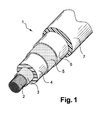
- the figure 1 illustrates a particular embodiment of the electric cable of the present invention.
- Figure 1 represents a power cable 1 comprising an elongated central conducting element 2, especially made of copper or aluminum. Successively and coaxially around this conducting element 2, the power cable 1 also comprises a first extruded semiconducting layer 3 known as the "inner semiconducting layer", an extruded electrically insulating layer 4, a second extruded semiconducting layer 5 known as the “outer semiconducting layer”, a metal shield 6, and an outer protective sheath 7.
- a first extruded semiconducting layer 3 known as the "inner semiconducting layer”
- an extruded electrically insulating layer 4 an extruded electrically insulating layer 4
- a second extruded semiconducting layer 5 known as the "outer semiconducting layer
- metal shield 6 and an outer protective sheath 7.
- the first semiconducting layer and the second semiconducting layer can be obtained from one of the silicone rubber semiconducting composition as described above (see examples 1, 2 or 3).
- the electrically insulating layer can be made from a composition commercialized by the company RADO under the reference Silopren 2270H.
- the three layers 3, 4 and 5 can be co-extruded layers according to the invention.
- the presence of the metal shield 6 is preferential.
- the presence of the protective outer sheath 7 is preferential, but not essential.
- Figure 2 shows the co-extrusion process of:
- Said three compositions 30, 40 and 50 flow respectively from three different extruders (not represented) to the inside of an extrusion head 10.
- the three different extruders may be extruders well-known in the art.
- the extruder head 10 is commercialized by the company under ITAL under the reference TECA/35, used for three-layer extrusion.
- said three compositions 30, 40 and 50 go through the same extrusion head extremity 20.
- compositions 30, 40 and 50 are applied simultaneously around the elongated central conducting element 2, to form respectively the coextruded layers 3, 4 and 5 around said elongated central conducting element.
Landscapes
- Physics & Mathematics (AREA)
- Spectroscopy & Molecular Physics (AREA)
- Chemical & Material Sciences (AREA)
- Dispersion Chemistry (AREA)
- Laminated Bodies (AREA)
- Insulated Conductors (AREA)
- Compositions Of Macromolecular Compounds (AREA)
- Organic Insulating Materials (AREA)
Abstract
- at least one elongated electric conductor (2), and
- a multilayer insulation surrounding said electric conductor, said multilayer insulation comprising a first semiconducting layer and an electrically insulating layer (4), said two layers being made from a silicone rubber based composition,
characterized in that the semiconducting silicone rubber based composition of the first semiconducting layer comprises carbon rovings as conductive filler.
Description
- The present invention relates to an electric cable including a multilayer insulation made from silicone rubber, as well as a manufacturing process of said electric cable.
- More particularly, it applies typically, but not exclusively, to the fields of power cables, such as medium voltage (especially from 5 kV to 45-60 kV) or high voltage (especially greater than 60 kV, which may be up to 800 kV) power cables, whether they are direct voltage (DC) or alternative voltage (AC) cables.
- Medium voltage or high voltage power cables typically comprise a central electric conductor and, successively and coaxially around this electric conductor, a semiconducting inner layer, an electrically insulating (intermediate) layer and a semiconducting outer layer. These three layers can be crosslinked via techniques that are well known to those skilled in the art.
-
GB 870 583 - However, this process is not optimized to reduce significantly partial discharges between the electrical insulating layer and the semiconducting layers, when a voltage level of at least 5 kV is applied to the electric cable. Indeed, the use of conductive filler of carbon black type (e.g. acetylene black) can involve the formation of gas bubbles at the interface between the semiconducting layer and the electrically insulating layer. Said bubbles can be formed during the fabrication of the semiconducting layer, wherein carbon black can react with the silicone gum and/or the crosslinker, in forming said bubbles.
- The aim of the present invention is to overcome the drawbacks of the prior art by proposing an electric cable comprising:
- at least one elongated electric conductor, and
- a multilayer insulation surrounding said electric conductor, said multilayer insulation comprising a first semiconducting layer and an electrically insulating layer, said two layers being made from a silicone rubber based composition,
- The use of carbon rovings as conductive filler in the semiconducting layer of the multilayer insulation allows advantageously to limit significantly the presence of air and/or the presence of space between the layers of the insulation.
- Hence, the multilayer insulation of the present invention allows advantageously to decrease partial discharges in the electric cable, while guaranteeing good flexibility properties.
- In a preferred embodiment, the first semiconducting layer can surround the elongated electric conductor, and said electrically insulating layer can surround the first semiconducting layer.
- In nother preferred embodiment, the multilayer insulation can comprise a second semiconducting layer made from a silicone rubber based composition, to form a 3-layer insulation.
- More particularly, the first semiconducting layer can be surrounded by the electrically insulating layer, and the electrically insulating layer can be surrounded by the second semiconducting layer.
- The silicone rubber based composition, used to obtain the second semiconducting layer, can advantageously comprise carbon rovings as conductive filler.
- The silicone rubber based composition(s) used to obtain the first semiconducting layer, and optionally the second semiconducting layer, include an amount of conductive filler, and more preferably an amount of carbon rovings, sufficient to make semiconducting the silicone rubber based composition.
- In addition, the amount of conductive filler in the silicon rubber based composition should preferably allow the composition to be extruded.
- It is more particularly considered that a layer is semiconducting when its specific electric conductivity is at most of 1.109 Ωm (ohm centimeter).
- The silicone rubber based composition used to obtain a semiconducting layer may comprise at most 60% by weight of (electrically) conductive filler, preferably at most 50% by weight of conductive filler, preferably at most 40% by weight of conductive filler.
- In another embodiment, the silicone rubber based composition used to obtain a semiconducting layer may comprise at least 0.1 % by weight of (electrically) conductive filler, preferably at least 10% by weight of conductive filler, and even more preferentially at least 20% by weight of conductive filler.
- The carbon rovings of the present invention are more particularly bundles of carbon fibers.
- In a particular embodiment, the carbon rovings can include a first type of carbon rovings with a first length, and/or a second type of carbon rovings with a second length, the first length being more particularly different from the second length.
- In a preferred embodiment, the carbon rovings includes said first type of carbon rovings with a first length, and said second type of carbon rovings with a second length. The second length can be at least ten times superior to the first length.
- The carbon rovings can be cut to obtain the desired length.
- The first length of the first type of carbon rovings can go from 50 to 300 µm, and more preferably can be around 220 µm.
- The second length of the second type of carbon rovings can go from 1 to 10 m m, and m ore preferably can go from 3 to 6 mm.
- The composition can comprises at least 2% by weight of the first type of carbon rovings and/or at least 10% by weight of the second type of carbon rovings.
- The conductive filler of the present invention can only be carbon rovings, or a mixture of carbon rovings with other type(s) of conductive filler chosen preferably from carbon blacks, conductive carbon, and metal particles, or one of their mixtures.
- The conductive carbon blacks can be selected from any of the carbon blacks listed in ASTM D-1765-76, furnace black, acetylene black, thermal black, lamb black and Ketjen black, or one of their mixtures.
- The conductive carbon, as distinguished from conductive carbon black, includes at least one of carbon nanotubes, fullerene, grapheme, graphites and expanded graphite platelets. The average particle size of such conductive carbon can typically be of nano-scale proportions.
- The conductive metal particles include granules, powder, fibers, platelets, and the like. These metal particles typically have an average particle size of 0.1 to 100, more typically 0.3 to 30, microns as measured by X-ray line broadening. The metal particles may have any particle shape desired although, as is known, the shape selection may depend upon the intended end use of the metal-filled product. Spherical shapes, platelets, prismatic shapes, whiskers, and the like, can be used.
- Metals that can be used as a conductive filler include, alone or in admixture with one or more other such metals, or as finely powdered alloys, aluminum, indium, tin, lead, bismuth, as well as Groups II-B through VII-B elements of the Periodic System including such as zinc, cadmium, scandium, titanium, zirconium, vanadium, chromium, molybdenum, tungsten, manganese, rhenium, iron, ruthenium, osmium, cobalt, rhodium, iridium, nickel, palladium, platinum, and the like. Particularly satisfactory for convenience and relative cheapness are aluminum, zinc, iron, nickel, tin, lead, and silver. Copper, while conductive, may in its metallic form be objectionable in some rubber compounding formulations.
- In a preferred embodiment, the first semiconducting layer and the electrically insulating layer are co-extruded layers.
- The coextruded multilayer insulation allows advantageously to optimize the reduction of partial discharges in the electric cable, while guaranteeing good flexibility properties.
- The term "co-extruded layers" means that the extrusion of the layers of the multilayer insulation may occur simultaneously, more particularly in using the same extrusion head (i.e. only one extruder head).
- When the cable is said 3-layer insulation, the first semiconducting layer, the electrically insulating layer and the second semiconducting layer can be co-extruded layers.
- The silicone rubber (i.e. silicone gum) used in the present invention is an elastomer (rubber-like material) composed of silicone polymer containing silicon together with carbon, hydrogen, and oxygen. The silicone rubber is usually named as polysiloxane, and more particularly a polyorganosiloxane.
- More particularly, the backbone of the silicone rubber comprises Si-O-Si units.
- The silicone rubber based composition may comprise more than 50.0 parts by weight of silicone rubber per 100 parts by weight of polymer(s) (i.e. polymer matrix) in the composition, preferably at least 70 parts by weight of silicone rubber per 100 parts by weight of polymer(s) in said composition, and particularly preferably at least 90 parts by weight of silicone rubber per 100 parts by weight of polymer(s) in said composition.
- In a particularly advantageous manner, the silicone rubber based composition comprises a polymer matrix that is composed solely of a silicone rubber or a mixture of silicone rubbers. One thus talks about silicone rubber matrix as such.
- The silicone rubber based composition(s) of the present invention can be crosslinkable (i.e. vulcanizable) silicone rubber based composition(s).
- In a particular embodiment of the invention, at least one layer of the multilayer insulation, more preferably at least two layers of the multilayer insulation, and more preferably the layers (i.e. the first semiconducting layer and the electrically insulating layer, or the first semiconducting layer, the electrically insulating layer, and the second semiconducting layer) of the multilayer insulation, is/are crosslinked layer(s) (i.e. vulcanized layer(s)).
- In this respect, the silicone rubber based composition of the invention may be crosslinked by process well-known in the art to crosslink silicone rubber, such as for example in using peroxides, sulfur systems, metallic oxides, etc
- According to peroxide crosslinking, the silicone rubber based composition can further comprise organic peroxide, and more particularly not more than 2.00 parts by weight of organic peroxide per 100 parts by weight of polymer(s) in the composition.
- Other additives and/or fillers that are well known to those skilled in the art may also be added to the silicone rubber based composition of the invention, such as breakdown retardants; processing aids such as lubricants or waxes; compatibilizers; couplers; UV stabilizers; and/or non-conductive fillers.
- In one particular embodiment, when the multilayer insulation is the 3-layer insulation, the multilayer insulation is designed so that the electrically insulating layer is directly in physical contact with the first semiconducting layer, and the second semiconducting layer is directly in physical contact with the electrically insulating layer.
- In a preferred embodiment according to the present invention, the multilayer insulation is surrounded by a metal shield.
- Said metal shield is arranged around and along the multilayer insulation.
- This metal shield may be:
- a "wire" shield, composed of an assembly of copper or aluminum conductors surrounding the second semiconducting layer,
- a "strip" shield composed of one or more conducting metal strips laid spirally around the second semiconducting layer, or
- a "leaktight" shield such as a metal tube surrounding the second semiconducting layer. This latter type of shield makes it possible especially to form a barrier to the moisture that has a tendency to penetrate the electric cable in the radial direction.
- Combining with the co-extruded multilayer insulation, the metal shield of the present invention allows advantageously to decrease in a more significant manner partial discharges in the electric cable.
- The metal shield may as well serve for earthing the electric cable and may thus transport fault currents, for example in the case of a short-circuit in the network concerned.
- Finally, thanks to the metal shield, the electric cable can be placed everywhere, for example on a metallic ground, so that it render the electric cable easy to install and to use.
- Furthermore, the electric cable of the invention may comprise an outer protective sheath surrounding the multilayer insulation, or alternatively more particularly surrounding said metal shield, when it exists. This outer protective sheath may be conventionally made from suitable thermoplastic materials such as HDPE, MDPE or LLDPE; or alternatively flame-propagation-retardant materials or fire-propagation-resistant materials. In particular, if the latter materials do not contain halogen, this sheath is referred to as being of HFFR type (Halogen Free Flame Retardant).
- Other layers, such as layers that swell in the presence of moisture, may be added between the multilayer insulation and the metal shield when it exists, and/or between the metal shield and the outer sheath when they exist, these layers providing longitudinal and/or transverse leaktightness of the electric cable to water. The electric conductor of the cable of the invention may also comprise materials that swell in the presence of moisture to obtain a "leaktight core".
- The electric cable of the present invention can be more particularly a power cable supporting a voltage level of at least 5 kV. It can be a direct voltage (DC) or alternative voltage (AC) cable.
- More preferably, the electric cable can support a voltage level from 5 kV to 45-60 kV for medium voltage cable, or a voltage level greater than 60 kV, which may be up to 800 kV, for high voltage cable.
- Another object of the present invention is a process for manufacturing the electric cable as described in the present invention, characterized in that the process comprises the step of co-extruding the layers (i.e. the first semiconducting layer and the electrically insulating layer, or the first semiconducting layer, the electrically insulating layer, and the second semiconducting layer) of the multilayer insulation according to the invention.
- More particularly, the layers of the multilayer insulation can be extruded simultaneously.
- More preferably, the simultaneous extrusion can be done with the same extrusion head.
- To co-extrude the compositions aiming at forming respectively the different layers of the multilayer insulation of the electric cable of the invention, said compositions are extruded in using one extruder per composition in order to flow until the same extrusion head in which said compositions are gathered to be co-extruded.
- Other characteristics and advantages of the present invention will emerge in the light of the description of non-limiting examples, given with reference to figures according to the invention, wherein:
-
Figure 1 shows a schematic view in perspective and in cross section of an electric cable according to the invention, and -
Figure 2 shows an extrusion head to co-extrude a multilayer insulation to form an electric cable according to the invention. - For reasons of clarity, only the elements that are essential for understanding the invention have been schematically represented, and without being drawn to scale.
- The electric cable of the present invention can include an elongated central conducting element, especially made of copper or aluminum, surrounded by an extruded semiconducting layer, said extruded semiconducting layer being surrounded by an extruded electrically insulating layer, so that a 2-layer insulation is obtained.
- The semiconducting layer can be made from a silicone rubber composition commercialized by the company RADO under the reference Silopren 2270H, wherein carbons rovings have been mixed. The mixture can be done with a roll or a mixer. Said silicone rubber composition mixed with carbon rovings is then extruded in using an extruder, around the elongated central conducting element.
- In a first example (example 1), said carbon rovings have a length 200 µm and are commercialized by the company Suter-Kunststoffe, under the reference "760.0001 SCS Carbon-Kurzschnitt". Said silicone rubber composition comprises around 10% by weight of said carbon rovings.
- In a second example (example 2), said carbon rovings have a length 6 mm and are commercialized by the company Suter-Kunststoffe, under the reference "211.6100 SCS Carbon-Kurzschnitt". Said silicone rubber composition comprises around 4% by weight of said carbon rovings.
- In a third example (example 3), said carbon rovings includes 50% by weight of carbon rovings of example 1, and 50% by weight of carbon rovings of example 2. Said silicone rubber composition comprises around 20% by weight of carbon rovings in totality (i.e. carbon rovings of example 1 and carbon rovings of example 2).
- The electrically insulating layer can be made from a silicone rubber composition commercialized by the company RADO under the reference Silopren 2270H. Said silicone rubber composition is extruded in using an extruder, around the semiconducting layer.
- These two compositions (cf. the silicone rubber composition to get the semiconducting layer, and the silicone rubber composition to get the electrically insulating layer, according to examples 1, 2 or 3) can be co-extruded in using an extruded head. In said extruder head, said two compositions go through the same extrusion head extremity.
- In said extrusion head extremity, said two compositions are applied simultaneously around the elongated central conducting element, to form respectively the coextruded layers around said elongated central conducting element.
- Hence, there is substantially no air bubble between the interface of the semiconducting layer and the electrically insulating layer, so that said 2-layer insulation allows advantageously to decrease partial discharges in the electric cable, while guaranteeing good flexibility properties.
- To better understand the co-extrusion process,
figure 2 thereafter will show in details the co-extrusion process for a 3-layer insulation. - The
figure 1 illustrates a particular embodiment of the electric cable of the present invention. -
Figure 1 represents a power cable 1 comprising an elongatedcentral conducting element 2, especially made of copper or aluminum. Successively and coaxially around this conductingelement 2, the power cable 1 also comprises a first extrudedsemiconducting layer 3 known as the "inner semiconducting layer", an extruded electrically insulatinglayer 4, a second extrudedsemiconducting layer 5 known as the "outer semiconducting layer", a metal shield 6, and an outerprotective sheath 7. - The first semiconducting layer and the second semiconducting layer can be obtained from one of the silicone rubber semiconducting composition as described above (see examples 1, 2 or 3).
- The electrically insulating layer can be made from a composition commercialized by the company RADO under the reference Silopren 2270H.
- The three
layers - The presence of the metal shield 6 is preferential.
- The presence of the protective
outer sheath 7 is preferential, but not essential. - The co-extrusion process of the
layers figure 1 is illustrated infigure 2 . -
Figure 2 shows the co-extrusion process of: - a first silicone
rubber semiconducting composition 30, which is the silicone rubber composition mixed with carbon rovings, as described previously; - a silicone rubber electrically
insulation composition 40, which is the composition as described previously (cf. the Silopren 2270H composition as such); and - a second silicone
rubber semiconducting composition 50, which is identical to the first silicone rubber semiconducting composition. - Said three
compositions extrusion head 10. - The three different extruders may be extruders well-known in the art.
- The
extruder head 10 is commercialized by the company under ITAL under the reference TECA/35, used for three-layer extrusion. - In said
extruder head 10, said threecompositions extrusion head extremity 20. - In said
extrusion head extremity 20, thecompositions central conducting element 2, to form respectively thecoextruded layers - Hence, there is substantially no air bubble between the interface of the
layers layers
Claims (14)
- Electric cable (1) comprising:- at least one elongated electric conductor (2), and- a multilayer insulation surrounding said electric conductor, said multilayer insulation comprising a first semiconducting layer and an electrically insulating layer (4), said two layers being made from a silicone rubber based composition,
characterized in that the first semiconducting layer is obtained from a silicone rubber based composition comprising carbon rovings as conductive filler. - Electric cable according to claim 1, characterized in that the first semiconducting layer surrounds the elongated electric conductor, and said electrically insulating layer surrounds the first semiconducting layer.
- Electric cable according to claim 1 or 2, characterized in that the multilayer insulation further comprises a second semiconducting layer made from a silicone rubber based composition, to form a 3-layer insulation.
- Electric cable according to claim 3, characterized in that the first semiconducting layer (3) is surrounded by the electrically insulating layer (4), and the electrically insulating layer (4) is surrounded by the second semiconducting layer (5).
- Electric cable according to any of claims 1 to 4, characterized in that the carbon rovings includes a first type of carbon rovings with a first length, and/or a second type of carbon rovings with a second.
- Electric cable according to claim 5, characterized in that the second length is at least ten times superior to the first length.
- Electric cable according to claim 5 or 6, characterized in that the first length goes from 50 to 300 µm, and more preferably around 220 µm.
- Electric cable according to any of claims 5 to 7, characterized in that the second length goes from 1 to 10 mm, and more preferably from 3 to 6 mm.
- Electric cable according to any of claims 5 to 8, characterized in that the composition comprises at least 2% by weight of the first type of carbon rovings and/or at least 10% by weight of the second type of carbon rovings.
- Electric cable according to any of claims 1 to 9, characterized in that the first semiconducting layer and the electrically insulating layer are co-extruded layers.
- Electric cable according to any of claims 3 to 10, characterized in that the first semiconducting layer (3), the electrically insulating layer (4) and the second semiconducting layer (5) are co-extruded layers.
- Electric cable according to any of claims 1 to 11, characterized in that at least one of the layers of said multilayer insulation is a crosslinked layer, and more preferably the layers of said multilayer insulation are crosslinked layers.
- Electric cable according to any of claims 1 to 12, characterized in that the multilayer insulation is surrounded by a metal shield (6).
- Electric cable according to any of claims 1 to 13, characterized in that the electric cable is a power cable supporting a voltage level of at least 5 kV.
Priority Applications (4)
| Application Number | Priority Date | Filing Date | Title |
|---|---|---|---|
| EP12306160.8A EP2711938B1 (en) | 2012-09-25 | 2012-09-25 | Silicone multilayer insulation for electric cable |
| US13/975,953 US9196394B2 (en) | 2012-09-25 | 2013-08-26 | Silicone multilayer insulation for electric cable |
| CN201310408223.7A CN103680699B (en) | 2012-09-25 | 2013-09-10 | Silicon multilevel insulator for cable |
| KR1020130113337A KR102076671B1 (en) | 2012-09-25 | 2013-09-24 | Silicone multilayer insulation for electric cable |
Applications Claiming Priority (1)
| Application Number | Priority Date | Filing Date | Title |
|---|---|---|---|
| EP12306160.8A EP2711938B1 (en) | 2012-09-25 | 2012-09-25 | Silicone multilayer insulation for electric cable |
Publications (2)
| Publication Number | Publication Date |
|---|---|
| EP2711938A1 true EP2711938A1 (en) | 2014-03-26 |
| EP2711938B1 EP2711938B1 (en) | 2014-11-26 |
Family
ID=47049106
Family Applications (1)
| Application Number | Title | Priority Date | Filing Date |
|---|---|---|---|
| EP12306160.8A Not-in-force EP2711938B1 (en) | 2012-09-25 | 2012-09-25 | Silicone multilayer insulation for electric cable |
Country Status (4)
| Country | Link |
|---|---|
| US (1) | US9196394B2 (en) |
| EP (1) | EP2711938B1 (en) |
| KR (1) | KR102076671B1 (en) |
| CN (1) | CN103680699B (en) |
Cited By (1)
| Publication number | Priority date | Publication date | Assignee | Title |
|---|---|---|---|---|
| WO2019099508A1 (en) * | 2017-11-15 | 2019-05-23 | Illinois Tool Works Inc. | Resilient air-cooled induction heating cables |
Families Citing this family (9)
| Publication number | Priority date | Publication date | Assignee | Title |
|---|---|---|---|---|
| EP2711934B1 (en) * | 2012-09-25 | 2018-07-11 | Nexans | Silicone multilayer insulation for electric cable |
| CN202855432U (en) * | 2012-10-22 | 2013-04-03 | 长飞光纤光缆有限公司 | Micro photoelectric composite cable |
| FR3006493A1 (en) * | 2013-06-04 | 2014-12-05 | Nexans | ELECTRICAL CABLE WITH MEDIUM OR HIGH VOLTAGE |
| WO2015091971A1 (en) * | 2013-12-19 | 2015-06-25 | Leoni Kabel Holding Gmbh | Cable and method for the production thereof |
| CN105940462A (en) * | 2013-12-19 | 2016-09-14 | Abb技术有限公司 | Electric HV transmission cable |
| US10147523B2 (en) * | 2014-09-09 | 2018-12-04 | Panasonic Avionics Corporation | Cable, method of manufacture, and cable assembly |
| JP2017531296A (en) * | 2014-10-17 | 2017-10-19 | スリーエム イノベイティブ プロパティズ カンパニー | Dielectric material with improved breakdown strength |
| CN105391014B (en) * | 2015-12-31 | 2017-11-28 | 北京合锐清合电气有限公司 | outlet bus device |
| DE102016111612A1 (en) * | 2016-06-24 | 2017-12-28 | Kromberg & Schubert Gmbh | Cable and method of making a cable |
Citations (3)
| Publication number | Priority date | Publication date | Assignee | Title |
|---|---|---|---|---|
| GB870583A (en) | 1958-12-01 | 1961-06-14 | Okonite Co | Method of making electric cables |
| US3258522A (en) * | 1963-10-04 | 1966-06-28 | Dow Corning | Insulating cable splices |
| US20060280938A1 (en) * | 2005-06-10 | 2006-12-14 | Atkinson Paul M | Thermoplastic long fiber composites, methods of manufacture thereof and articles derived thererom |
Family Cites Families (25)
| Publication number | Priority date | Publication date | Assignee | Title |
|---|---|---|---|---|
| US3047448A (en) * | 1957-06-07 | 1962-07-31 | Okonite Co | Method of making electric cables |
| JPS6111854Y2 (en) * | 1980-01-31 | 1986-04-14 | ||
| JPH07118225B2 (en) * | 1988-12-16 | 1995-12-18 | 北川工業株式会社 | Flat cable |
| DK0710313T3 (en) * | 1994-04-25 | 2000-09-25 | Empa | Anchoring for high performance fiber composite threads |
| US6815062B2 (en) * | 1999-06-21 | 2004-11-09 | Pirelli Cavi E Sistemi S.P.A. | Cable, in particular for electric energy transportation or distribution, and an insulating composition used therein |
| WO2002027731A1 (en) * | 2000-09-28 | 2002-04-04 | Pirelli S.P.A. | Cable with recyclable covering |
| US7179522B2 (en) * | 2002-04-23 | 2007-02-20 | Ctc Cable Corporation | Aluminum conductor composite core reinforced cable and method of manufacture |
| MXPA02007435A (en) * | 2002-08-01 | 2004-07-16 | Servicios Condumex Sa | Energy superconducting cable with improved superconducting core. |
| CN1506981A (en) * | 2002-12-09 | 2004-06-23 | 新疆特变电工股份有限公司 | Cable with processed conducting wire core specially for winding |
| US20060182961A1 (en) * | 2003-03-27 | 2006-08-17 | Person Timothy J | Power cable compositions for strippable adhesion |
| CN1542877A (en) * | 2003-04-29 | 2004-11-03 | 新疆特变电工股份有限公司 | A winding cable capable of reducing loss |
| KR100625805B1 (en) * | 2004-05-18 | 2006-09-20 | 엘에스전선 주식회사 | Insulating and semiconductive liquid silicone rubber combination with excellent adhesive properties and manufacturing method |
| NO323516B1 (en) * | 2005-08-25 | 2007-06-04 | Nexans | Underwater power cable and heating system |
| FR2899733B1 (en) * | 2006-04-05 | 2008-07-04 | Nexans Sa | CABLE ADAPTER, TUBULAR FOR JUNCTION OR TERMINATION OF MEDIUM VOLTAGE CABLE |
| US20090114440A1 (en) * | 2007-01-18 | 2009-05-07 | Kazumi Yamamoto | Conductive Magnetic Filler, Resin Composition Containing the Filler, Electromagnetic Interference Suppressing Sheet Using the Resin Composition and Applications Thereof, and Process for Producing the Electromagnetic Interference Suppressing Sheet |
| US7847191B2 (en) * | 2007-11-06 | 2010-12-07 | Xerox Corporation | Electrical component, manufacturing system and method |
| JP5306854B2 (en) * | 2009-02-26 | 2013-10-02 | 古河電気工業株式会社 | Cable connection member for cold regions |
| CN102666710B (en) * | 2009-09-22 | 2016-08-31 | 联合碳化化学及塑料技术有限责任公司 | Flexible molding or the goods of extrusion and for preparing their quasiconductor mixed thing |
| CA2779493A1 (en) * | 2009-12-01 | 2011-06-30 | Applied Nanostructured Solutions, Llc | Metal matrix composite materials containing carbon nanotube-infused fiber materials and methods for production thereof |
| JP3158927U (en) * | 2010-02-09 | 2010-04-22 | 東京製綱株式会社 | Fiber composite twisted cable |
| US20120111603A1 (en) * | 2010-11-10 | 2012-05-10 | Jorge Cofre | Power and/or telecommunication cable comprising a reinforced ground-check conductor |
| KR101863740B1 (en) * | 2011-01-17 | 2018-06-01 | 주식회사 쿠라레 | Resin composition and molded article including same |
| US8658897B2 (en) * | 2011-07-11 | 2014-02-25 | Tangitek, Llc | Energy efficient noise dampening cables |
| CN103842422B (en) * | 2011-07-21 | 2016-08-24 | 恩特格里公司 | The compositions of the carbon fiber polymer composites of nanotube and fine grinding and manufacture method thereof |
| CN103946311B (en) * | 2011-11-25 | 2016-04-06 | 东丽株式会社 | The pellet of resin combination, said composition and products formed |
-
2012
- 2012-09-25 EP EP12306160.8A patent/EP2711938B1/en not_active Not-in-force
-
2013
- 2013-08-26 US US13/975,953 patent/US9196394B2/en not_active Expired - Fee Related
- 2013-09-10 CN CN201310408223.7A patent/CN103680699B/en not_active Expired - Fee Related
- 2013-09-24 KR KR1020130113337A patent/KR102076671B1/en not_active Expired - Fee Related
Patent Citations (3)
| Publication number | Priority date | Publication date | Assignee | Title |
|---|---|---|---|---|
| GB870583A (en) | 1958-12-01 | 1961-06-14 | Okonite Co | Method of making electric cables |
| US3258522A (en) * | 1963-10-04 | 1966-06-28 | Dow Corning | Insulating cable splices |
| US20060280938A1 (en) * | 2005-06-10 | 2006-12-14 | Atkinson Paul M | Thermoplastic long fiber composites, methods of manufacture thereof and articles derived thererom |
Cited By (3)
| Publication number | Priority date | Publication date | Assignee | Title |
|---|---|---|---|---|
| WO2019099508A1 (en) * | 2017-11-15 | 2019-05-23 | Illinois Tool Works Inc. | Resilient air-cooled induction heating cables |
| US10672533B2 (en) | 2017-11-15 | 2020-06-02 | Illinois Tool Works Inc. | Resilient air-cooled induction heating cables |
| US11170912B2 (en) | 2017-11-15 | 2021-11-09 | Illinois Tool Works Inc. | Resilient air-cooled induction heating cables |
Also Published As
| Publication number | Publication date |
|---|---|
| CN103680699A (en) | 2014-03-26 |
| KR20140040052A (en) | 2014-04-02 |
| EP2711938B1 (en) | 2014-11-26 |
| US9196394B2 (en) | 2015-11-24 |
| KR102076671B1 (en) | 2020-02-12 |
| CN103680699B (en) | 2018-03-20 |
| US20140083739A1 (en) | 2014-03-27 |
Similar Documents
| Publication | Publication Date | Title |
|---|---|---|
| EP2711938B1 (en) | Silicone multilayer insulation for electric cable | |
| EP2711934B1 (en) | Silicone multilayer insulation for electric cable | |
| EP1273206B1 (en) | Electric cable having braidless polymeric ground plane providing fault detection | |
| BRPI0722294A2 (en) | ELECTRICAL ARTICLE, AND, SEMICONDUCTOR POLYMERIC COMPOSITION | |
| AU2015293679B2 (en) | Conductive polymer composite | |
| CN108369841B (en) | Fire-resistant cable | |
| RU134691U1 (en) | ELECTRIC FLEXIBLE CABLE | |
| JP5771310B1 (en) | Electromagnetic wave shielding resin composition and cable | |
| US20180158573A1 (en) | Power transmission cable | |
| CN106030723B (en) | high voltage cable | |
| CN105825950A (en) | Superhigh voltage crosslinked polyethylene insulating flexible power cable and preparation method | |
| KR101457799B1 (en) | Power cable having a semiconductive layer | |
| WO2015005857A1 (en) | Medium/high-voltage cable comprising fluoropolymer layers | |
| CA2903909A1 (en) | Power cable with a thick insulation layer and a method for its manufacture | |
| EP4723143A1 (en) | Cable | |
| CN117594282A (en) | Shielded cable, preparation method thereof and vehicle | |
| KR102354984B1 (en) | Tracking resistant insulation composition and high voltage cable comprising the same | |
| JP2016065208A (en) | Semiconductive resin composition and power cable using the same | |
| JP5923063B2 (en) | Conductive thermoplastic resin composition for cable and cable | |
| CN221378971U (en) | Shielded cable and vehicle | |
| JP5551976B2 (en) | High voltage electronics cable | |
| CN207009130U (en) | Automobile using multicore low-voltage cable | |
| JP2015000903A (en) | Conductive thermoplastic resin composition and cable | |
| JP6521362B2 (en) | Power transmission cable | |
| JP2015000904A (en) | Conductive thermoplastic resin composition and cable |
Legal Events
| Date | Code | Title | Description |
|---|---|---|---|
| PUAI | Public reference made under article 153(3) epc to a published international application that has entered the european phase |
Free format text: ORIGINAL CODE: 0009012 |
|
| 17P | Request for examination filed |
Effective date: 20130618 |
|
| AK | Designated contracting states |
Kind code of ref document: A1 Designated state(s): AL AT BE BG CH CY CZ DE DK EE ES FI FR GB GR HR HU IE IS IT LI LT LU LV MC MK MT NL NO PL PT RO RS SE SI SK SM TR |
|
| AX | Request for extension of the european patent |
Extension state: BA ME |
|
| RIC1 | Information provided on ipc code assigned before grant |
Ipc: H01B 1/24 20060101ALI20140523BHEP Ipc: H01B 9/02 20060101AFI20140523BHEP |
|
| GRAP | Despatch of communication of intention to grant a patent |
Free format text: ORIGINAL CODE: EPIDOSNIGR1 |
|
| INTG | Intention to grant announced |
Effective date: 20140707 |
|
| GRAS | Grant fee paid |
Free format text: ORIGINAL CODE: EPIDOSNIGR3 |
|
| GRAA | (expected) grant |
Free format text: ORIGINAL CODE: 0009210 |
|
| AK | Designated contracting states |
Kind code of ref document: B1 Designated state(s): AL AT BE BG CH CY CZ DE DK EE ES FI FR GB GR HR HU IE IS IT LI LT LU LV MC MK MT NL NO PL PT RO RS SE SI SK SM TR |
|
| REG | Reference to a national code |
Ref country code: GB Ref legal event code: FG4D |
|
| REG | Reference to a national code |
Ref country code: CH Ref legal event code: EP |
|
| REG | Reference to a national code |
Ref country code: AT Ref legal event code: REF Ref document number: 698596 Country of ref document: AT Kind code of ref document: T Effective date: 20141215 |
|
| REG | Reference to a national code |
Ref country code: IE Ref legal event code: FG4D |
|
| REG | Reference to a national code |
Ref country code: DE Ref legal event code: R096 Ref document number: 602012003982 Country of ref document: DE Effective date: 20150108 |
|
| REG | Reference to a national code |
Ref country code: NL Ref legal event code: VDEP Effective date: 20141126 |
|
| REG | Reference to a national code |
Ref country code: AT Ref legal event code: MK05 Ref document number: 698596 Country of ref document: AT Kind code of ref document: T Effective date: 20141126 |
|
| REG | Reference to a national code |
Ref country code: LT Ref legal event code: MG4D |
|
| PG25 | Lapsed in a contracting state [announced via postgrant information from national office to epo] |
Ref country code: LT Free format text: LAPSE BECAUSE OF FAILURE TO SUBMIT A TRANSLATION OF THE DESCRIPTION OR TO PAY THE FEE WITHIN THE PRESCRIBED TIME-LIMIT Effective date: 20141126 Ref country code: ES Free format text: LAPSE BECAUSE OF FAILURE TO SUBMIT A TRANSLATION OF THE DESCRIPTION OR TO PAY THE FEE WITHIN THE PRESCRIBED TIME-LIMIT Effective date: 20141126 Ref country code: NL Free format text: LAPSE BECAUSE OF FAILURE TO SUBMIT A TRANSLATION OF THE DESCRIPTION OR TO PAY THE FEE WITHIN THE PRESCRIBED TIME-LIMIT Effective date: 20141126 Ref country code: NO Free format text: LAPSE BECAUSE OF FAILURE TO SUBMIT A TRANSLATION OF THE DESCRIPTION OR TO PAY THE FEE WITHIN THE PRESCRIBED TIME-LIMIT Effective date: 20150226 Ref country code: FI Free format text: LAPSE BECAUSE OF FAILURE TO SUBMIT A TRANSLATION OF THE DESCRIPTION OR TO PAY THE FEE WITHIN THE PRESCRIBED TIME-LIMIT Effective date: 20141126 Ref country code: PT Free format text: LAPSE BECAUSE OF FAILURE TO SUBMIT A TRANSLATION OF THE DESCRIPTION OR TO PAY THE FEE WITHIN THE PRESCRIBED TIME-LIMIT Effective date: 20150326 Ref country code: IS Free format text: LAPSE BECAUSE OF FAILURE TO SUBMIT A TRANSLATION OF THE DESCRIPTION OR TO PAY THE FEE WITHIN THE PRESCRIBED TIME-LIMIT Effective date: 20150326 |
|
| PG25 | Lapsed in a contracting state [announced via postgrant information from national office to epo] |
Ref country code: GR Free format text: LAPSE BECAUSE OF FAILURE TO SUBMIT A TRANSLATION OF THE DESCRIPTION OR TO PAY THE FEE WITHIN THE PRESCRIBED TIME-LIMIT Effective date: 20150227 Ref country code: HR Free format text: LAPSE BECAUSE OF FAILURE TO SUBMIT A TRANSLATION OF THE DESCRIPTION OR TO PAY THE FEE WITHIN THE PRESCRIBED TIME-LIMIT Effective date: 20141126 Ref country code: SE Free format text: LAPSE BECAUSE OF FAILURE TO SUBMIT A TRANSLATION OF THE DESCRIPTION OR TO PAY THE FEE WITHIN THE PRESCRIBED TIME-LIMIT Effective date: 20141126 Ref country code: CY Free format text: LAPSE BECAUSE OF FAILURE TO SUBMIT A TRANSLATION OF THE DESCRIPTION OR TO PAY THE FEE WITHIN THE PRESCRIBED TIME-LIMIT Effective date: 20141126 Ref country code: AT Free format text: LAPSE BECAUSE OF FAILURE TO SUBMIT A TRANSLATION OF THE DESCRIPTION OR TO PAY THE FEE WITHIN THE PRESCRIBED TIME-LIMIT Effective date: 20141126 Ref country code: LV Free format text: LAPSE BECAUSE OF FAILURE TO SUBMIT A TRANSLATION OF THE DESCRIPTION OR TO PAY THE FEE WITHIN THE PRESCRIBED TIME-LIMIT Effective date: 20141126 Ref country code: RS Free format text: LAPSE BECAUSE OF FAILURE TO SUBMIT A TRANSLATION OF THE DESCRIPTION OR TO PAY THE FEE WITHIN THE PRESCRIBED TIME-LIMIT Effective date: 20141126 |
|
| PG25 | Lapsed in a contracting state [announced via postgrant information from national office to epo] |
Ref country code: EE Free format text: LAPSE BECAUSE OF FAILURE TO SUBMIT A TRANSLATION OF THE DESCRIPTION OR TO PAY THE FEE WITHIN THE PRESCRIBED TIME-LIMIT Effective date: 20141126 Ref country code: DK Free format text: LAPSE BECAUSE OF FAILURE TO SUBMIT A TRANSLATION OF THE DESCRIPTION OR TO PAY THE FEE WITHIN THE PRESCRIBED TIME-LIMIT Effective date: 20141126 Ref country code: SK Free format text: LAPSE BECAUSE OF FAILURE TO SUBMIT A TRANSLATION OF THE DESCRIPTION OR TO PAY THE FEE WITHIN THE PRESCRIBED TIME-LIMIT Effective date: 20141126 Ref country code: RO Free format text: LAPSE BECAUSE OF FAILURE TO SUBMIT A TRANSLATION OF THE DESCRIPTION OR TO PAY THE FEE WITHIN THE PRESCRIBED TIME-LIMIT Effective date: 20141126 Ref country code: CZ Free format text: LAPSE BECAUSE OF FAILURE TO SUBMIT A TRANSLATION OF THE DESCRIPTION OR TO PAY THE FEE WITHIN THE PRESCRIBED TIME-LIMIT Effective date: 20141126 |
|
| REG | Reference to a national code |
Ref country code: DE Ref legal event code: R097 Ref document number: 602012003982 Country of ref document: DE |
|
| PG25 | Lapsed in a contracting state [announced via postgrant information from national office to epo] |
Ref country code: PL Free format text: LAPSE BECAUSE OF FAILURE TO SUBMIT A TRANSLATION OF THE DESCRIPTION OR TO PAY THE FEE WITHIN THE PRESCRIBED TIME-LIMIT Effective date: 20141126 |
|
| REG | Reference to a national code |
Ref country code: FR Ref legal event code: PLFP Year of fee payment: 4 |
|
| PLBE | No opposition filed within time limit |
Free format text: ORIGINAL CODE: 0009261 |
|
| STAA | Information on the status of an ep patent application or granted ep patent |
Free format text: STATUS: NO OPPOSITION FILED WITHIN TIME LIMIT |
|
| 26N | No opposition filed |
Effective date: 20150827 |
|
| PG25 | Lapsed in a contracting state [announced via postgrant information from national office to epo] |
Ref country code: SI Free format text: LAPSE BECAUSE OF FAILURE TO SUBMIT A TRANSLATION OF THE DESCRIPTION OR TO PAY THE FEE WITHIN THE PRESCRIBED TIME-LIMIT Effective date: 20141126 |
|
| PG25 | Lapsed in a contracting state [announced via postgrant information from national office to epo] |
Ref country code: MC Free format text: LAPSE BECAUSE OF FAILURE TO SUBMIT A TRANSLATION OF THE DESCRIPTION OR TO PAY THE FEE WITHIN THE PRESCRIBED TIME-LIMIT Effective date: 20141126 Ref country code: LU Free format text: LAPSE BECAUSE OF FAILURE TO SUBMIT A TRANSLATION OF THE DESCRIPTION OR TO PAY THE FEE WITHIN THE PRESCRIBED TIME-LIMIT Effective date: 20150925 |
|
| REG | Reference to a national code |
Ref country code: IE Ref legal event code: MM4A |
|
| PG25 | Lapsed in a contracting state [announced via postgrant information from national office to epo] |
Ref country code: IE Free format text: LAPSE BECAUSE OF NON-PAYMENT OF DUE FEES Effective date: 20150925 |
|
| REG | Reference to a national code |
Ref country code: FR Ref legal event code: PLFP Year of fee payment: 5 |
|
| PG25 | Lapsed in a contracting state [announced via postgrant information from national office to epo] |
Ref country code: MT Free format text: LAPSE BECAUSE OF FAILURE TO SUBMIT A TRANSLATION OF THE DESCRIPTION OR TO PAY THE FEE WITHIN THE PRESCRIBED TIME-LIMIT Effective date: 20141126 |
|
| PG25 | Lapsed in a contracting state [announced via postgrant information from national office to epo] |
Ref country code: BG Free format text: LAPSE BECAUSE OF FAILURE TO SUBMIT A TRANSLATION OF THE DESCRIPTION OR TO PAY THE FEE WITHIN THE PRESCRIBED TIME-LIMIT Effective date: 20141126 Ref country code: SM Free format text: LAPSE BECAUSE OF FAILURE TO SUBMIT A TRANSLATION OF THE DESCRIPTION OR TO PAY THE FEE WITHIN THE PRESCRIBED TIME-LIMIT Effective date: 20141126 Ref country code: HU Free format text: LAPSE BECAUSE OF FAILURE TO SUBMIT A TRANSLATION OF THE DESCRIPTION OR TO PAY THE FEE WITHIN THE PRESCRIBED TIME-LIMIT; INVALID AB INITIO Effective date: 20120925 |
|
| REG | Reference to a national code |
Ref country code: FR Ref legal event code: PLFP Year of fee payment: 6 |
|
| PG25 | Lapsed in a contracting state [announced via postgrant information from national office to epo] |
Ref country code: BE Free format text: LAPSE BECAUSE OF FAILURE TO SUBMIT A TRANSLATION OF THE DESCRIPTION OR TO PAY THE FEE WITHIN THE PRESCRIBED TIME-LIMIT Effective date: 20141126 |
|
| PG25 | Lapsed in a contracting state [announced via postgrant information from national office to epo] |
Ref country code: TR Free format text: LAPSE BECAUSE OF FAILURE TO SUBMIT A TRANSLATION OF THE DESCRIPTION OR TO PAY THE FEE WITHIN THE PRESCRIBED TIME-LIMIT Effective date: 20141126 Ref country code: MK Free format text: LAPSE BECAUSE OF FAILURE TO SUBMIT A TRANSLATION OF THE DESCRIPTION OR TO PAY THE FEE WITHIN THE PRESCRIBED TIME-LIMIT Effective date: 20141126 |
|
| REG | Reference to a national code |
Ref country code: FR Ref legal event code: PLFP Year of fee payment: 7 |
|
| PG25 | Lapsed in a contracting state [announced via postgrant information from national office to epo] |
Ref country code: AL Free format text: LAPSE BECAUSE OF FAILURE TO SUBMIT A TRANSLATION OF THE DESCRIPTION OR TO PAY THE FEE WITHIN THE PRESCRIBED TIME-LIMIT Effective date: 20141126 |
|
| PGFP | Annual fee paid to national office [announced via postgrant information from national office to epo] |
Ref country code: GB Payment date: 20180919 Year of fee payment: 7 Ref country code: CH Payment date: 20180919 Year of fee payment: 7 |
|
| REG | Reference to a national code |
Ref country code: CH Ref legal event code: PL |
|
| PG25 | Lapsed in a contracting state [announced via postgrant information from national office to epo] |
Ref country code: CH Free format text: LAPSE BECAUSE OF NON-PAYMENT OF DUE FEES Effective date: 20190930 Ref country code: LI Free format text: LAPSE BECAUSE OF NON-PAYMENT OF DUE FEES Effective date: 20190930 |
|
| GBPC | Gb: european patent ceased through non-payment of renewal fee |
Effective date: 20190925 |
|
| PG25 | Lapsed in a contracting state [announced via postgrant information from national office to epo] |
Ref country code: GB Free format text: LAPSE BECAUSE OF NON-PAYMENT OF DUE FEES Effective date: 20190925 |
|
| PGFP | Annual fee paid to national office [announced via postgrant information from national office to epo] |
Ref country code: FR Payment date: 20230928 Year of fee payment: 12 Ref country code: DE Payment date: 20230920 Year of fee payment: 12 |
|
| PGFP | Annual fee paid to national office [announced via postgrant information from national office to epo] |
Ref country code: IT Payment date: 20230927 Year of fee payment: 12 |
|
| REG | Reference to a national code |
Ref country code: DE Ref legal event code: R119 Ref document number: 602012003982 Country of ref document: DE |
|
| PG25 | Lapsed in a contracting state [announced via postgrant information from national office to epo] |
Ref country code: DE Free format text: LAPSE BECAUSE OF NON-PAYMENT OF DUE FEES Effective date: 20250401 |
|
| PG25 | Lapsed in a contracting state [announced via postgrant information from national office to epo] |
Ref country code: IT Free format text: LAPSE BECAUSE OF NON-PAYMENT OF DUE FEES Effective date: 20240925 |
|
| PG25 | Lapsed in a contracting state [announced via postgrant information from national office to epo] |
Ref country code: FR Free format text: LAPSE BECAUSE OF NON-PAYMENT OF DUE FEES Effective date: 20240930 |