EP2703504B2 - Method for recovering valuable metal - Google Patents
Method for recovering valuable metal Download PDFInfo
- Publication number
- EP2703504B2 EP2703504B2 EP11876580.9A EP11876580A EP2703504B2 EP 2703504 B2 EP2703504 B2 EP 2703504B2 EP 11876580 A EP11876580 A EP 11876580A EP 2703504 B2 EP2703504 B2 EP 2703504B2
- Authority
- EP
- European Patent Office
- Prior art keywords
- slag
- alloy
- melting
- iron
- weight
- Prior art date
- Legal status (The legal status is an assumption and is not a legal conclusion. Google has not performed a legal analysis and makes no representation as to the accuracy of the status listed.)
- Active
Links
Images

Classifications
-
- C—CHEMISTRY; METALLURGY
- C22—METALLURGY; FERROUS OR NON-FERROUS ALLOYS; TREATMENT OF ALLOYS OR NON-FERROUS METALS
- C22B—PRODUCTION AND REFINING OF METALS; PRETREATMENT OF RAW MATERIALS
- C22B7/00—Working up raw materials other than ores, e.g. scrap, to produce non-ferrous metals and compounds thereof; Methods of a general interest or applied to the winning of more than two metals
-
- C—CHEMISTRY; METALLURGY
- C22—METALLURGY; FERROUS OR NON-FERROUS ALLOYS; TREATMENT OF ALLOYS OR NON-FERROUS METALS
- C22B—PRODUCTION AND REFINING OF METALS; PRETREATMENT OF RAW MATERIALS
- C22B7/00—Working up raw materials other than ores, e.g. scrap, to produce non-ferrous metals and compounds thereof; Methods of a general interest or applied to the winning of more than two metals
- C22B7/001—Dry processes
-
- C—CHEMISTRY; METALLURGY
- C22—METALLURGY; FERROUS OR NON-FERROUS ALLOYS; TREATMENT OF ALLOYS OR NON-FERROUS METALS
- C22B—PRODUCTION AND REFINING OF METALS; PRETREATMENT OF RAW MATERIALS
- C22B21/00—Obtaining aluminium
- C22B21/0038—Obtaining aluminium by other processes
- C22B21/0069—Obtaining aluminium by other processes from scrap, skimmings or any secondary source aluminium, e.g. recovery of alloy constituents
-
- C—CHEMISTRY; METALLURGY
- C22—METALLURGY; FERROUS OR NON-FERROUS ALLOYS; TREATMENT OF ALLOYS OR NON-FERROUS METALS
- C22B—PRODUCTION AND REFINING OF METALS; PRETREATMENT OF RAW MATERIALS
- C22B23/00—Obtaining nickel or cobalt
- C22B23/02—Obtaining nickel or cobalt by dry processes
-
- C—CHEMISTRY; METALLURGY
- C22—METALLURGY; FERROUS OR NON-FERROUS ALLOYS; TREATMENT OF ALLOYS OR NON-FERROUS METALS
- C22B—PRODUCTION AND REFINING OF METALS; PRETREATMENT OF RAW MATERIALS
- C22B4/00—Electrothermal treatment of ores or metallurgical products for obtaining metals or alloys
-
- H—ELECTRICITY
- H01—ELECTRIC ELEMENTS
- H01M—PROCESSES OR MEANS, e.g. BATTERIES, FOR THE DIRECT CONVERSION OF CHEMICAL ENERGY INTO ELECTRICAL ENERGY
- H01M10/00—Secondary cells; Manufacture thereof
- H01M10/54—Reclaiming serviceable parts of waste accumulators
-
- H—ELECTRICITY
- H01—ELECTRIC ELEMENTS
- H01M—PROCESSES OR MEANS, e.g. BATTERIES, FOR THE DIRECT CONVERSION OF CHEMICAL ENERGY INTO ELECTRICAL ENERGY
- H01M10/00—Secondary cells; Manufacture thereof
- H01M10/05—Accumulators with non-aqueous electrolyte
- H01M10/052—Li-accumulators
- H01M10/0525—Rocking-chair batteries, i.e. batteries with lithium insertion or intercalation in both electrodes; Lithium-ion batteries
-
- Y—GENERAL TAGGING OF NEW TECHNOLOGICAL DEVELOPMENTS; GENERAL TAGGING OF CROSS-SECTIONAL TECHNOLOGIES SPANNING OVER SEVERAL SECTIONS OF THE IPC; TECHNICAL SUBJECTS COVERED BY FORMER USPC CROSS-REFERENCE ART COLLECTIONS [XRACs] AND DIGESTS
- Y02—TECHNOLOGIES OR APPLICATIONS FOR MITIGATION OR ADAPTATION AGAINST CLIMATE CHANGE
- Y02E—REDUCTION OF GREENHOUSE GAS [GHG] EMISSIONS, RELATED TO ENERGY GENERATION, TRANSMISSION OR DISTRIBUTION
- Y02E60/00—Enabling technologies; Technologies with a potential or indirect contribution to GHG emissions mitigation
- Y02E60/10—Energy storage using batteries
-
- Y—GENERAL TAGGING OF NEW TECHNOLOGICAL DEVELOPMENTS; GENERAL TAGGING OF CROSS-SECTIONAL TECHNOLOGIES SPANNING OVER SEVERAL SECTIONS OF THE IPC; TECHNICAL SUBJECTS COVERED BY FORMER USPC CROSS-REFERENCE ART COLLECTIONS [XRACs] AND DIGESTS
- Y02—TECHNOLOGIES OR APPLICATIONS FOR MITIGATION OR ADAPTATION AGAINST CLIMATE CHANGE
- Y02P—CLIMATE CHANGE MITIGATION TECHNOLOGIES IN THE PRODUCTION OR PROCESSING OF GOODS
- Y02P10/00—Technologies related to metal processing
- Y02P10/20—Recycling
-
- Y—GENERAL TAGGING OF NEW TECHNOLOGICAL DEVELOPMENTS; GENERAL TAGGING OF CROSS-SECTIONAL TECHNOLOGIES SPANNING OVER SEVERAL SECTIONS OF THE IPC; TECHNICAL SUBJECTS COVERED BY FORMER USPC CROSS-REFERENCE ART COLLECTIONS [XRACs] AND DIGESTS
- Y02—TECHNOLOGIES OR APPLICATIONS FOR MITIGATION OR ADAPTATION AGAINST CLIMATE CHANGE
- Y02W—CLIMATE CHANGE MITIGATION TECHNOLOGIES RELATED TO WASTEWATER TREATMENT OR WASTE MANAGEMENT
- Y02W30/00—Technologies for solid waste management
- Y02W30/50—Reuse, recycling or recovery technologies
- Y02W30/84—Recycling of batteries or fuel cells
Definitions
- the invention relates to a method for efficiently recovering valuable metals from waste batteries, such as lithium-ion batteries.
- waste batteries such as waste lithium-ion batteries
- recovering their valuable metals are broadly divided into dry and wet processes.
- a dry process includes melting crushed waste batteries, separating valuable metals, which are to be recovered, from other less valuable metals and materials by harnessing the difference in oxygen affinity between them, and recovering the valuable metals.
- a dry process includes oxidizing less valuable elements, such as iron, as much as possible to form slag and suppressing the oxidation of valuable materials, such as cobalt, as much as possible to recover the valuable materials in the form of an alloy.
- Patent Document 1 discloses adding a SiO 2 /CaO-based flux to waste batteries and recovering, from the mixture, valuable metals such as nickel and cobalt in the form of an alloy using a high-temperature heating furnace, wherein the resulting slag has a composition containing at least 20% iron, calculated as metallic iron, and at most 20% of each of nickel and cobalt, and having an SiO 2 to CaO ratio of at least 1. It discloses an example where the melting temperature is 1,450°C.
- Patent Document 1 U. S. Patent Application, Publication No.7169206
- Foliated aluminium is used in the cathodes of waste batteries, such as lithium-ion batteries.
- Metallic aluminium which tends to be oxidized very easily, is converted into an oxide, alumina (Al 2 O 3 ), when subjected to a melting process.
- the alumina which is distributed in the slag, is known to increase the melting point and the viscosity of slag. In this case, a problem occurs in which if the melting temperature is low, the slag will not melt or will have higher viscosity, so that an alloy containing valuable metals to be recovered will be poorly separated from the slag and the recovery rate will be reduced.
- the melting temperature is preferably as low as possible.
- Patent Document 1 does not disclose that the amount of alumina or iron should be taken into account when the melting temperature is determined.
- the invention has been made to solve the above problems, and an object of the invention is to provide a method for efficiently recovering valuable metals, which can reduce the viscosity of slag to make a lower-temperature process possible and also ensure reliable separation of slag and alloy, when waste batteries, such as lithium-ion batteries, are treated by a dry process.
- the inventors have drawn up the invention based on the finding that when slag has a composition containing a specific amount of alumina, not only the addition of a SiO 2 /CaO-based flux but also the co-presence of iron oxide are effective in further lowering the melting point of the whole of slag. More specifically, the invention provides the following.
- the invention makes it possible to conduct a lower-temperature process by reducing the viscosity of slag and also makes it possible to efficiently recover valuable metals through reliable separation of slag and alloy.
- Fig. 1 is a flow chart showing an example of a method for recovering valuable metals from waste batteries. First, the whole process of the valuable metal recovery method will be described, and then the slag composition characteristic of the invention and means for obtaining it will be described. Although this embodiment will be described for a case where the waste batteries are lithium-ion batteries, the invention is applicable to any waste batteries containing aluminium and iron, and is not restricted to this embodiment.
- this valuable metal recovery method includes a waste battery pretreatment step ST10, a dry step S20, and a wet step S30.
- the valuable metal recovery method according to this embodiment is a total process including obtaining an alloy in the dry step S20 and then separating and recovering valuable metal elements using the wet step S30.
- the term "waste battery” is intended to include not only a used battery but also others such as in-process defect batteries. We also do not intend to exclude adding metal, resin, or any other material apart from waste batteries, as needed, as long as the object to be processed contains a waste battery. In such a case, metal, resin, or any other material is encompassed by the term "waste battery" in the invention.
- Waste battery pretreatment step ST10 is performed to prevent waste batteries from exploding.
- Waste batteries are closed systems and contain, for example, an electrolytic solution inside them. Thus, subjecting them to a dry melting process as they are involves a risk of explosion and is dangerous. Therefore, gas-venting holes need to be formed in some way.
- the waste battery pretreatment step ST10 may be performed using any specific method. For example, holes may be mechanically formed in waste batteries using a needle-shaped cutting edge. In the invention, it is not necessary to separate or process individual parts because a melting step is performed in the later dry process.
- the dry step S20 includes performing a melting step ST21 including melting the pre-treated waste batteries, which are obtained in the waste battery pretreatment step ST10, at a predetermined temperature to form a melt.
- the melting step ST21 is performed in a conventionally known electric furnace.
- an oxidizing agent such as air is blown in to control the degree of oxidation and to increase the recovery of nickel, cobalt, and copper.
- foliated aluminium is used in the cathode materials of lithium-ion batteries.
- Carbon is also used in the anode materials of lithium-ion batteries.
- Batteries also have outer shells made of iron or aluminium, and plastics are used in the outer packages of battery pack. These materials are basically reducing agents and thus oxidized when melted, so that the total reaction to produce gas and slag will be an oxidation reaction. Therefore, it is necessary to introduce oxygen into the system. Because of this, air is introduced in the melting step ST21.
- the oxidizing agent is not restricted, pure oxygen, oxygen-rich gas, air, or any other oxygen-containing gas is preferably used because it is easy to handle.
- the gas is directly supplied into the electric furnace. Dust, exhaust gas, and other exhaust products in the melting step ST21 are processed to be harmless in a conventionally known exhaust gas treatment ST24.
- SiO 2 and CaO or other materials are added as fluxes to lower the melting point of the slag to be separated in the slag separation ST22 described below. This is a feature of the invention and will be described in detail below.
- the melting step ST21 produces an alloy of valuable metals, such as nickel, cobalt, and copper, and also produces slag, which is an oxide of, for example, iron and aluminium. Both products, which have different specific gravities, are recovered in slag separation ST22 and alloy separation ST23, respectively.
- the resulting alloy is further subjected to a dephosphorylation step ST25.
- ethylene carbonate, diethyl carbonate, or other organic solvents are used, and LiPF 6 (lithium hexafluorophosphate) or other electrolytes are used.
- LiPF 6 lithium hexafluorophosphate
- the phosphorus in LiPF 6 tends to be relatively easily oxidized, but also tends to have a relatively high affinity for iron group elements such as iron, cobalt, and nickel.
- Phosphorus in the alloy is difficult to remove by the wet step, which is a later step for recovering each element in the form of metal from the alloy obtained in the dry process, and phosphorus is also accumulated as an impurity in the treatment system, which makes it difficult to continue the process.
- phosphorus is removed in the dephosphorylation step ST25.
- lime or other materials capable of reacting to produce CaO are added, and oxygen-containing gas such as air is blown in so that phosphorus in the alloy can be oxidized and absorbed into the CaO.
- the alloy obtained in this manner contains, for example, as main components, cobalt or nickel derived from the cathode materials, lithium derived from electrolytes, and copper derived from the anode materials.
- the alloy is cooled and obtained in the form of grains (also referred to as “shot-shaped alloy” or simply “shots”) at the end of the dry step S20.
- shots also referred to as "shot-shaped alloy” or simply “shots”.
- the dry step when the dry step is performed as a pretreatment in a wide sense, an alloy with fewer impurities can be obtained, and the amount of the material to be introduced into and treated in the wet step can be significantly reduced, so that a combination of the dry step and the wet step can work effectively.
- the wet step is a complicated process and basically unsuitable for high-throughput procedures.
- the processing time of the wet step needs to be short, and in particular, the dissolution step ST31 needs to be performed in a short period of time. This problem can be solved by forming the alloy into grains so that the dissolution time can be reduced.
- the grain preferably has an average surface area in the range of 1 mm 2 to 300 mm 2 and an average weight in the range of 0.4 mg to 2.2 g. If the surface area or the weight is less than the lower limit of the range, a problem may occur in which the particles are too small and thus difficult to handle and a reaction occurs too rapidly so that it will be difficult to dissolve the particles at a time due to too much heat generation, which is not preferred. If the surface area or the weight is more than the upper limit of the range, the rate of dissolution in the later wet step can undesirably decrease.
- the alloy can be made in the form of shots or formed into grains using a conventionally known method of pouring the molten metal into running water to rapidly cool it.
- the alloy recovered as described in Patent Document 1 is not valuable, and thus valuable metal elements must be recovered.
- the later wet step can be simplified. In this case, the throughput of the wet step can be reduced to about 1/4 to 1/3 (weight ratio) of the amount of the input waste batteries. This also makes the use of the wet step in combination advantageous.
- the dry step as a pretreatment in a wide sense as described above makes it possible to obtain an alloy with fewer impurities and to significantly reduce the throughput.
- the invention makes possible a combination of the dry step and the wet step on an industrial scale.
- the wet step is not restricted and may be performed using a conventionally known method.
- An example of the wet step is as follows.
- the waste batteries are lithium-ion batteries and specifically when an alloy of cobalt, nickel, copper, and iron is produced, the alloy is subjected to dissolution with acid (the dissolution step ST31), and then an element separation step ST32 is performed, in which deironization, separation and recovery of copper, nickel/cobalt separation, recovery of nickel, and recovery of cobalt are conducted in this order, so that valuable metal elements are successfully recovered.
- oxidation in the dry step is performed when waste batteries are in a molten state.
- the melting step in the dry step of the conventional process must be a batch process, so that a new step must be performed from the beginning after the oxidation of all waste batteries, which are processed at the same time in a melting furnace, is completed.
- the valuable metal recovery method of the invention enables a higher throughput than conventional techniques because in the method of the invention, waste batteries having previously undergone oxidation in the preoxidation step can be continuously introduced into the melting furnace so that they can be continuously processed in the dry step.
- the invention is suitable for use in cases where the throughput is at least 1 t per day, preferably at least 10 t per day.
- the waste batteries may be of any type.
- Preferred examples of the object to be processed according the invention are lithium-ion batteries, from which rare metals such as cobalt and nickel can be recovered, and whose applications expand to include automobile batteries and others, so that large-scale recovery processes will be necessary for them.
- aluminium is the most vulnerable to oxidation, while copper is the most resistant to oxidation. Therefore, if the slag contains aluminium vulnerable to oxidation, aluminium oxide (alumina) will be formed as high-melting-point and high-viscosity slag.
- the alumina itself has a melting point of around 2,000°C.
- the presence of such a component alone is not preferred because it can increase, for example, the energy cost or the rate of melting-induced damage to refractory materials, so that the operating cost may significantly increase.
- the melting point exceeds 1,650°C, operation using a common electric furnace may be difficult to realize, and the parallel use of a plasma treatment as described in Patent Document 1 may also be necessary, in this way the durability of refractory materials decreases and the thermocouple for measuring the internal temperature of the furnace may also be damaged.
- the slag has a melting point of 1,500°C to 1,650°C.
- the melting step ST21 is performed at a temperature between 1,500°C and 1,650°C, and thus a conventionally known electric furnace can be used, which will increase productivity and enable the alloy and the slag to be separated from each other sufficiently, so that the rate of recovery of valuable metals in the alloy also increases.
- the melting step ST21 includes adding SiO 2 and CaO to lower the melting point of the slag (see Fig. 1 ). This enables the slag to have a lower melting point and thus to have lower viscosity.
- SiO 2 (silicon dioxide) and CaO (lime) are added.
- the ratio of the addition of them is preferably such that the weight ratio of silicon dioxide to calcium oxide in the slag is in the range of 0.5 to 2, more preferably in the range of 0.8 to 1.4. If the weight ratio is less than 0.5, the slag may have an undesirably high melting point. If the weight ratio is more than 2, the viscosity of the slag may be so high as to make it difficult to separate the alloy from the slag, which is not preferred.
- the amounts of alumina and iron in the slag are also important.
- the slag has an alumina content of 25% by weight to 75% by weight, preferably 25% by weight to 40% by weight, and an iron content of 5% by weight to 40% by weight, calculated as metallic iron.
- the slag also contains iron, not only the amount of alumina can be relatively reduced, but also iron ions can function as cations to break the alumina network in the slag, so that the iron can assist the improvement of the fluidization of the slag and reduce the melting point of the slag.
- the separation performance of the alloy can be increased, and thus the valuable metal recovery rate can be increased.
- a novel feature of the invention is based on the finding of a low-viscosity region of the slag composition which is practically available for actual operation.
- the slag with an alumina content of 20% by weight has a melting point of about 1,500°C. If the alumina content exceeds 75% by weight, it will be difficult to control the melting point of the slag in the range of 1,500°C to 1,650°C even by controlling the flux and iron.
- the slag with an alumina content of 75% by weight has a melting point of about 1,650°C.
- the iron content calculated as metallic iron
- the melting point of the slag will be insufficiently lowered, so that it will be difficult to control the melting point of the slag in the range of 1,500°C to 1,650°C. If the iron content exceeds 75% by weight, iron must be supplied from an additional iron source other than the waste batteries, which is not preferred.
- the slag obtained in the slag separation step ST22 has a melting point of 1,500°C to 1,650°C.
- the melting step ST21 is performed at 1,500°C to 1,650°C, the viscosity of the slag can be sufficiently lowered, so that the alloy can be easily separated and the rate of recovery in the alloy separation step ST23 can be increased.
- Table 1 and Fig. 2 show that when the amounts of aluminium oxide and iron in the slag each fall within the range according to the invention, the viscosity of the slag can be reduced, and the metal and the slag can be well separated, so that the alloy and the slag can be successfully separated and recovered using a melting temperature of 1,500°C to 1,650°C. Fig.
Landscapes
- Engineering & Computer Science (AREA)
- Chemical & Material Sciences (AREA)
- Manufacturing & Machinery (AREA)
- Materials Engineering (AREA)
- Mechanical Engineering (AREA)
- Metallurgy (AREA)
- Organic Chemistry (AREA)
- Geology (AREA)
- General Life Sciences & Earth Sciences (AREA)
- Environmental & Geological Engineering (AREA)
- Life Sciences & Earth Sciences (AREA)
- Chemical Kinetics & Catalysis (AREA)
- Electrochemistry (AREA)
- General Chemical & Material Sciences (AREA)
- Geochemistry & Mineralogy (AREA)
- Manufacture And Refinement Of Metals (AREA)
- Processing Of Solid Wastes (AREA)
- Secondary Cells (AREA)
Description
- The invention relates to a method for efficiently recovering valuable metals from waste batteries, such as lithium-ion batteries.
- Processes for recycling used or in-process defective batteries (hereinafter referred to as "waste batteries"), such as waste lithium-ion batteries, and recovering their valuable metals are broadly divided into dry and wet processes.
- A dry process includes melting crushed waste batteries, separating valuable metals, which are to be recovered, from other less valuable metals and materials by harnessing the difference in oxygen affinity between them, and recovering the valuable metals. Specifically, such a dry process includes oxidizing less valuable elements, such as iron, as much as possible to form slag and suppressing the oxidation of valuable materials, such as cobalt, as much as possible to recover the valuable materials in the form of an alloy.
- For example,
Patent Document 1 discloses adding a SiO2/CaO-based flux to waste batteries and recovering, from the mixture, valuable metals such as nickel and cobalt in the form of an alloy using a high-temperature heating furnace, wherein the resulting slag has a composition containing at least 20% iron, calculated as metallic iron, and at most 20% of each of nickel and cobalt, and having an SiO2 to CaO ratio of at least 1. It discloses an example where the melting temperature is 1,450°C. - Patent Document 1:
U. S. Patent Application, Publication No.7169206 - Problems to be Solved by the Invention
- Foliated aluminium is used in the cathodes of waste batteries, such as lithium-ion batteries. Metallic aluminium, which tends to be oxidized very easily, is converted into an oxide, alumina (Al2O3), when subjected to a melting process. The alumina, which is distributed in the slag, is known to increase the melting point and the viscosity of slag. In this case, a problem occurs in which if the melting temperature is low, the slag will not melt or will have higher viscosity, so that an alloy containing valuable metals to be recovered will be poorly separated from the slag and the recovery rate will be reduced. On the other hand, in view of operational efficiency, the melting temperature is preferably as low as possible.
- Therefore, when a dry process is used to separate slag and alloy from each other, it is desired that the slag should be controlled to have a lower melting point during the separation. Unfortunately, no study has been made of what component or what melting point is preferable for slag and suitable for practical production in a multi-component system, such as a waste battery treatment system, where various oxides such as oxides of iron and aluminium are incorporated into slag. Notably,
Patent Document 1 does not disclose that the amount of alumina or iron should be taken into account when the melting temperature is determined. - The invention has been made to solve the above problems, and an object of the invention is to provide a method for efficiently recovering valuable metals, which can reduce the viscosity of slag to make a lower-temperature process possible and also ensure reliable separation of slag and alloy, when waste batteries, such as lithium-ion batteries, are treated by a dry process.
- The inventors have drawn up the invention based on the finding that when slag has a composition
containing a specific amount of alumina, not only the addition of a SiO2/CaO-based flux but also the co-presence of iron oxide are effective in further lowering the melting point of the whole of slag. More specifically, the invention provides the following. - (1) A method for recovering a valuable metal from a waste battery containing aluminium and iron, which includes a melting step including melting the waste battery to form a melt; a slag separation step including separating slag from
the melt; and an alloy separation step including separating an alloy of a valuable metal from the melt, wherein silicon dioxide and calcium oxide are added as fluxes in the melting step, the slag has an aluminium oxide content of 25% by weight to 75% by weight and an iron content of 5% by weight to 40% by weight, calculated as metallic iron, and the melting step is performed at at least 1,500°C and at most 1,650°C, and wherein the melting step is performed in an electric furnace. - (2) The valuable metal recovery method according to item (1), wherein the slag has a silicon dioxide to calcium oxide weight ratio in the range of 0.5 to 2.
- (3) The valuable metal recovery method according to item (1) or item (2), wherein the waste battery is a lithium-ion battery.
- When waste batteries, such as lithium-ion batteries, are treated by a dry process, the invention makes it possible to conduct a lower-temperature process by reducing the viscosity of slag and also makes it possible to efficiently recover valuable metals through reliable separation of slag and alloy.
-
-
Fig. 1 is a flow chart showing an example of the invention, specifically, a method for recovering valuable metals from waste batteries. -
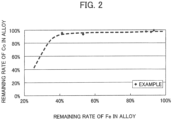
Fig. 2 is a graph showing the distribution ratios of metallic iron and metallic cobalt in an alloy in examples. -
- ST10
- Waste battery pretreatment step
- S20
- Dry step
- ST21
- Melting step
- ST22
- Slag separation
- ST23
- Alloy separation
- ST24
- Exhaust gas treatment
- ST25
- Dephosphorylation step
- ST26
- Alloy shot-forming step
- S30
- Wet step
- ST31
- Dissolution step
- ST32
- Element separation step
- Hereinafter, an embodiment of the invention will be described with reference to the drawings.
Fig. 1 is a flow chart showing an example of a method for recovering valuable metals from waste batteries. First, the whole process of the valuable metal recovery method will be described, and then the slag composition characteristic of the invention and means for obtaining it will be described. Although this embodiment will be described for a case where the waste batteries are lithium-ion batteries, the invention is applicable to any waste batteries containing aluminium and iron, and is not restricted to this embodiment. - As shown in
Fig. 1 , this valuable metal recovery method includes a waste battery pretreatment step ST10, a dry step S20, and a wet step S30. Thus, the valuable metal recovery method according to this embodiment is a total process including obtaining an alloy in the dry step S20 and then separating and recovering valuable metal elements using the wet step S30. As used herein, the term "waste battery" is intended to include not only a used battery but also others such as in-process defect batteries. We also do not intend to exclude adding metal, resin, or any other material apart from waste batteries, as needed, as long as the object to be processed contains a waste battery. In such a case, metal, resin, or any other material is encompassed by the term "waste battery" in the invention. - The waste battery pretreatment step ST10 is performed to prevent waste batteries from exploding. Waste batteries are closed systems and contain, for example, an electrolytic solution inside them. Thus, subjecting them to a dry melting process as they are involves a risk of explosion and is dangerous. Therefore, gas-venting holes need to be formed in some way.
- The waste battery pretreatment step ST10 may be performed using any specific method. For example, holes may be mechanically formed in waste batteries using a needle-shaped cutting edge. In the invention, it is not necessary to separate or process individual parts because a melting step is performed in the later dry process.
- The dry step S20 includes performing a melting step ST21 including melting the pre-treated waste batteries, which are obtained in the waste battery pretreatment step ST10, at a predetermined temperature to form a melt. The melting step ST21 is performed in a conventionally known electric furnace.
- In this step, an oxidizing agent such as air is blown in to control the degree of oxidation and to increase the recovery of nickel, cobalt, and copper. For example, foliated aluminium is used in the cathode materials of lithium-ion batteries. Carbon is also used in the anode materials of lithium-ion batteries. Batteries also have outer shells made of iron or aluminium, and plastics are used in the outer packages of battery pack. These materials are basically reducing agents and thus oxidized when melted, so that the total reaction to produce gas and slag will be an oxidation reaction. Therefore, it is necessary to introduce oxygen into the system. Because of this, air is introduced in the melting step ST21.
- Although the oxidizing agent is not restricted, pure oxygen, oxygen-rich gas, air, or any other oxygen-containing gas is preferably used because it is easy to handle. In the melting step ST21, the gas is directly supplied into the electric furnace. Dust, exhaust gas, and other exhaust products in the melting step ST21 are processed to be harmless in a conventionally known exhaust gas treatment ST24.
- Additionally, in the melting step ST21, SiO2 and CaO or other materials are added as fluxes to lower the melting point of the slag to be separated in the slag separation ST22 described below. This is a feature of the invention and will be described in detail below.
- The melting step ST21 produces an alloy of valuable metals, such as nickel, cobalt, and copper, and also produces slag, which is an oxide of, for example, iron and aluminium. Both products, which have different specific gravities, are recovered in slag separation ST22 and alloy separation ST23, respectively.
- After alloy separation ST23 is performed, the resulting alloy is further subjected to a dephosphorylation step ST25. In lithium-ion batteries, ethylene carbonate, diethyl carbonate, or other organic solvents are used, and LiPF6 (lithium hexafluorophosphate) or other electrolytes are used. The phosphorus in LiPF6 tends to be relatively easily oxidized, but also tends to have a relatively high affinity for iron group elements such as iron, cobalt, and nickel. Phosphorus in the alloy is difficult to remove by the wet step, which is a later step for recovering each element in the form of metal from the alloy obtained in the dry process, and phosphorus is also accumulated as an impurity in the treatment system, which makes it difficult to continue the process. Thus, phosphorus is removed in the dephosphorylation step ST25.
- More specifically, lime or other materials capable of reacting to produce CaO are added, and oxygen-containing gas such as air is blown in so that phosphorus in the alloy can be oxidized and absorbed into the CaO.
- When the waste batteries are lithium-ion batteries, the alloy obtained in this manner contains, for example, as main components, cobalt or nickel derived from the cathode materials, lithium derived from electrolytes, and copper derived from the anode materials.
- In this embodiment, the alloy is cooled and obtained in the form of grains (also referred to as "shot-shaped alloy" or simply "shots") at the end of the dry step S20. This makes it possible to perform a dissolution step ST31 in a short period of time in the later wet step S30.
- As described below, when the dry step is performed as a pretreatment in a wide sense, an alloy with fewer impurities can be obtained, and the amount of the material to be introduced into and treated in the wet step can be significantly reduced, so that a combination of the dry step and the wet step can work effectively. However, the wet step is a complicated process and basically unsuitable for high-throughput procedures. Thus, to use the wet step in combination with the dry step, the processing time of the wet step needs to be short, and in particular, the dissolution step ST31 needs to be performed in a short period of time. This problem can be solved by forming the alloy into grains so that the dissolution time can be reduced.
- In this step, the grain preferably has an average surface area in the range of 1 mm2 to 300 mm2 and an average weight in the range of 0.4 mg to 2.2 g. If the surface area or the weight is less than the lower limit of the range, a problem may occur in which the particles are too small and thus difficult to handle and a reaction occurs too rapidly so that it will be difficult to dissolve the particles at a time due to too much heat generation, which is not preferred. If the surface area or the weight is more than the upper limit of the range, the rate of dissolution in the later wet step can undesirably decrease. The alloy can be made in the form of shots or formed into grains using a conventionally known method of pouring the molten metal into running water to rapidly cool it.
- In a process of recovering valuable metals from waste batteries, the alloy recovered as described in
Patent Document 1 is not valuable, and thus valuable metal elements must be recovered. When waste batteries are pretreated by the dry step so that an alloy of only valuable metals is obtained as described above, the later wet step can be simplified. In this case, the throughput of the wet step can be reduced to about 1/4 to 1/3 (weight ratio) of the amount of the input waste batteries. This also makes the use of the wet step in combination advantageous. - Using the dry step as a pretreatment in a wide sense as described above makes it possible to obtain an alloy with fewer impurities and to significantly reduce the throughput. Thus, the invention makes possible a combination of the dry step and the wet step on an industrial scale.
- The wet step is not restricted and may be performed using a conventionally known method. An example of the wet step is as follows. When the waste batteries are lithium-ion batteries and specifically when an alloy of cobalt, nickel, copper, and iron is produced, the alloy is subjected to dissolution with acid (the dissolution step ST31), and then an element separation step ST32 is performed, in which deironization, separation and recovery of copper, nickel/cobalt separation, recovery of nickel, and recovery of cobalt are conducted in this order, so that valuable metal elements are successfully recovered.
- In a conventional total process including a combination of a dry step and a wet step, oxidation in the dry step is performed when waste batteries are in a molten state. To control the degree of oxidation properly in the oxidation process, the melting step in the dry step of the conventional process must be a batch process, so that a new step must be performed from the beginning after the oxidation of all waste batteries, which are processed at the same time in a melting furnace, is completed. The valuable metal recovery method of the invention enables a higher throughput than conventional techniques because in the method of the invention, waste batteries having previously undergone oxidation in the preoxidation step can be continuously introduced into the melting furnace so that they can be continuously processed in the dry step. The invention is suitable for use in cases where the throughput is at least 1 t per day, preferably at least 10 t per day.
- The waste batteries may be of any type. Preferred examples of the object to be processed according the invention are lithium-ion batteries, from which rare metals such as cobalt and nickel can be recovered, and whose applications expand to include automobile batteries and others, so that large-scale recovery processes will be necessary for them.
- Next, the formation of slag, which is a feature of the invention, in the melting step ST21 will be described. When waste batteries containing aluminium, lithium, iron, and manganese are processed, manganese becomes a main component of the slag in the process of melting the pretreated waste batteries placed in the furnace.
- The oxidation of the main elements constituting the melt depends on the difference in affinity for oxygen, which generally follows the order: aluminium > lithium > carbon > manganese > phosphorus > iron > cobalt > nickel > copper. In other words, aluminium is the most vulnerable to oxidation, while copper is the most resistant to oxidation. Therefore, if the slag contains aluminium vulnerable to oxidation, aluminium oxide (alumina) will be formed as high-melting-point and high-viscosity slag.
- The alumina itself has a melting point of around 2,000°C. The presence of such a component alone is not preferred because it can increase, for example, the energy cost or the rate of melting-induced damage to refractory materials, so that the operating cost may significantly increase. In particular, if the melting point exceeds 1,650°C, operation using a common electric furnace may be difficult to realize, and the parallel use of a plasma treatment as described in
Patent Document 1 may also be necessary, in this way the durability of refractory materials decreases and the thermocouple for measuring the internal temperature of the furnace may also be damaged. Thus, also in order to perform the melting step ST21 in a conventionally known electric furnace, the slag has a melting point of 1,500°C to 1,650°C. In this range, the melting step ST21 is performed at a temperature between 1,500°C and 1,650°C, and thus a conventionally known electric furnace can be used, which will increase productivity and enable the alloy and the slag to be separated from each other sufficiently, so that the rate of recovery of valuable metals in the alloy also increases. - In the invention, the melting step ST21 includes adding SiO2 and CaO to lower the melting point of the slag (see
Fig. 1 ). This enables the slag to have a lower melting point and thus to have lower viscosity. SiO2 (silicon dioxide) and CaO (lime) are added. The ratio of the addition of them is preferably such that the weight ratio of silicon dioxide to calcium oxide in the slag is in the range of 0.5 to 2, more preferably in the range of 0.8 to 1.4. If the weight ratio is less than 0.5, the slag may have an undesirably high melting point. If the weight ratio is more than 2, the viscosity of the slag may be so high as to make it difficult to separate the alloy from the slag, which is not preferred. - In the invention, the amounts of alumina and iron in the slag are also important. Specifically, the slag has an alumina content of 25% by weight to 75% by weight, preferably 25% by weight to 40% by weight, and an iron content of 5% by weight to 40% by weight, calculated as metallic iron. When the slag also contains iron, not only the amount of alumina can be relatively reduced, but also iron ions can function as cations to break the alumina network in the slag, so that the iron can assist the improvement of the fluidization of the slag and reduce the melting point of the slag. As a result, the separation performance of the alloy can be increased, and thus the valuable metal recovery rate can be increased. As described above, the reduction in the melting point of the slag has been comprehensively studied taking into account not only the addition of a flux but also the amounts of aluminium and iron expected in waste battery treatment. Thus, a novel feature of the invention is based on the finding of a low-viscosity region of the slag composition which is practically available for actual operation.
- First of all, if the alumina content is less than 20% by weight, the problem of the high melting point of the slag will hardly occur. The slag with an alumina content of 20% by weight has a melting point of about 1,500°C. If the alumina content exceeds 75% by weight, it will be difficult to control the melting point of the slag in the range of 1,500°C to 1,650°C even by controlling the flux and iron. The slag with an alumina content of 75% by weight has a melting point of about 1,650°C. On the other hand, if the iron content, calculated as metallic iron, is less than 5% by weight, the melting point of the slag will be insufficiently lowered, so that it will be difficult to control the melting point of the slag in the range of 1,500°C to 1,650°C. If the iron content exceeds 75% by weight, iron must be supplied from an additional iron source other than the waste batteries, which is not preferred.
- Thus, the slag obtained in the slag separation step ST22 has a melting point of 1,500°C to 1,650°C. When the melting step ST21 is performed at 1,500°C to 1,650°C, the viscosity of the slag can be sufficiently lowered, so that the alloy can be easily separated and the rate of recovery in the alloy separation step ST23 can be increased.
- Hereinafter, the invention will be more specifically described with reference to the examples below, which however are not intended to limit the invention.
- In an alumina crucible placed in an electric furnace with a nitrogen atmosphere, about 23 g of a waste lithium-ion battery and 7.3 g of a flux mixture with the SiO2/CaO ratio shown in Table 1 were held at temperatures ranging from 1,505°C to 1,540°C for 30 minutes. After holding the temperature in this range, a predetermined amount of oxygen was blown through an alumina tube to oxidize the sample. After the oxidation, the sample was held for 30 minutes in the furnace and cooled. After the cooling, the resulting slag and alloy were separated, recovered, and each subjected to analysis using the ICP method. For each of the slag and the alloy, the distribution ratios of metallic iron and metallic cobalt in the alloy and the distribution ratios of metallic iron and alumina in the slag were determined from their weights and the iron and cobalt analysis values. Table 1 shows the results.
Fig. 2 shows the distribution ratios of metallic iron and metallic cobalt in the alloy.[Table 1] Element name Rate of distribution in alloy Example Comparative Example Fe 32% 41% 53% 89% 92% 93% Co 73% 96% 94% 97% 97% 99% Concentration (wt%) in slag Fe 32.2 20.2 17.7 5.9 5.6 5.2 Al2O3 37.5 37.3 27.6 22.1 23.6 20.2 SiO2/ CaO ratio 1 1 1 2 1 0.5 - Table 1 and
Fig. 2 show that when the amounts of aluminium oxide and iron in the slag each fall within the range according to the invention, the viscosity of the slag can be reduced, and the metal and the slag can be well separated, so that the alloy and the slag can be successfully separated and recovered using a melting temperature of 1,500°C to 1,650°C.Fig. 2 also shows that in this case, when the distribution ratio of iron in the alloy, namely, the ratio of the weight of metallic iron in the alloy to the total weight of iron (calculated as metallic iron) was at least 32%, the metallic cobalt recovery rate reached at least 73%, and when the ratio of the weight of metallic iron was at least 35%, preferably at least 40%, the metallic cobalt recovery rate reached at least 90%.
Claims (3)
- A method for recovering a valuable metal from a waste battery containing aluminium and iron, comprising:a melting step comprising melting the waste battery to form a melt;a slag separation step comprising separating slag from the melt; andan alloy separation step comprising separating an alloy of a valuable metal from the melt, whereinsilicon dioxide and calcium oxide are added as fluxes in the melting step,the slag has an aluminium oxide content of 25% by weight to 75% by weight and an iron content of 5% by weight to 40% by weight, calculated as metallic iron, andthe melting step is performed at at least 1,500°C and at most 1,650°C, and wherein the melting step is performed in an electric furnace.
- The valuable metal recovery method according to claim 1, wherein the slag has a weight ratio of silicon dioxide to calcium oxide in the range of 0.5 to 2.
- The valuable metal recovery method according to claim 1 or 2, wherein the waste battery is a lithium-ion battery.
Applications Claiming Priority (1)
| Application Number | Priority Date | Filing Date | Title |
|---|---|---|---|
| PCT/JP2011/077315 WO2013080266A1 (en) | 2011-11-28 | 2011-11-28 | Method for recovering valuable metal |
Publications (4)
| Publication Number | Publication Date |
|---|---|
| EP2703504A1 EP2703504A1 (en) | 2014-03-05 |
| EP2703504A4 EP2703504A4 (en) | 2015-09-16 |
| EP2703504B1 EP2703504B1 (en) | 2019-01-23 |
| EP2703504B2 true EP2703504B2 (en) | 2024-12-25 |
Family
ID=48534797
Family Applications (1)
| Application Number | Title | Priority Date | Filing Date |
|---|---|---|---|
| EP11876580.9A Active EP2703504B2 (en) | 2011-11-28 | 2011-11-28 | Method for recovering valuable metal |
Country Status (5)
| Country | Link |
|---|---|
| US (1) | US10294546B2 (en) |
| EP (1) | EP2703504B2 (en) |
| KR (2) | KR20130114722A (en) |
| CN (1) | CN103370427B (en) |
| WO (1) | WO2013080266A1 (en) |
Families Citing this family (27)
| Publication number | Priority date | Publication date | Assignee | Title |
|---|---|---|---|---|
| JP6615762B2 (en) * | 2013-12-23 | 2019-12-04 | ユミコア | Lithium-ion battery recycling process |
| US9528475B2 (en) | 2014-11-11 | 2016-12-27 | Ford Global Technologies, Llc | Method and system for EGR control |
| CN105990617A (en) * | 2015-02-28 | 2016-10-05 | 微宏动力系统(湖州)有限公司 | Method for recycling and regenerating waste lithium ion battery electrode materials |
| EP3269832B2 (en) * | 2015-03-11 | 2022-10-19 | Changsha Research Institute Of Mining And Metallurgy Co., Ltd. | Method of recycling and processing waste battery |
| JP6708468B2 (en) * | 2015-04-17 | 2020-06-10 | Jx金属株式会社 | Lithium-ion battery treatment method |
| JP7058472B2 (en) * | 2017-04-28 | 2022-04-22 | Jfe条鋼株式会社 | Slag modification method and roadbed material manufacturing method |
| CN111373062B (en) * | 2017-11-24 | 2021-12-10 | 住友金属矿山株式会社 | Method for treating waste lithium ion battery |
| KR102575339B1 (en) * | 2018-07-12 | 2023-09-06 | 스미토모 긴조쿠 고잔 가부시키가이샤 | Method for recovering valuable metals from waste lithium ion batteries |
| WO2020013293A1 (en) * | 2018-07-12 | 2020-01-16 | 住友金属鉱山株式会社 | Alloy powder and method for producing same |
| CN111663042A (en) * | 2019-03-06 | 2020-09-15 | 多氟多化工股份有限公司 | Method for recovering valuable metals in waste lithium ion batteries |
| CN113302005B (en) * | 2019-04-03 | 2022-09-13 | 株式会社神户制钢所 | Method for recovering valuable metals |
| JP7103293B2 (en) * | 2019-04-03 | 2022-07-20 | 株式会社神戸製鋼所 | How to recover valuable metals |
| CN113728118A (en) * | 2019-04-19 | 2021-11-30 | 尤米科尔公司 | Method for preparing precursor compound of lithium battery cathode |
| JP7399586B2 (en) * | 2019-12-13 | 2023-12-18 | 株式会社神戸製鋼所 | Method of recovering valuable elements |
| KR20220127893A (en) * | 2020-02-21 | 2022-09-20 | 스미토모 긴조쿠 고잔 가부시키가이샤 | How to deal with alloys |
| CN115867682A (en) * | 2020-07-09 | 2023-03-28 | 住友金属矿山株式会社 | Methods of recovering valuable metals |
| CN116323998A (en) * | 2020-10-19 | 2023-06-23 | 关东电化工业株式会社 | Lithium recovery method and lithium carbonate production method |
| JP7276361B2 (en) * | 2021-01-27 | 2023-05-18 | 住友金属鉱山株式会社 | Methods of recovering valuable metals |
| JP7124923B1 (en) * | 2021-04-23 | 2022-08-24 | 住友金属鉱山株式会社 | Valuable metal manufacturing method |
| JP7215517B2 (en) * | 2021-05-12 | 2023-01-31 | 住友金属鉱山株式会社 | Valuable metal manufacturing method |
| HUE069806T2 (en) | 2021-05-26 | 2025-04-28 | Umicore Nv | Recovery of nickel and cobalt from li-ion batteries or their waste |
| JP7311054B2 (en) | 2021-07-20 | 2023-07-19 | 住友金属鉱山株式会社 | Alloy treatment method |
| CN114214518A (en) * | 2021-11-25 | 2022-03-22 | 金川集团股份有限公司 | A kind of recovery method of valuable metal in waste nickel-hydrogen battery |
| US12438209B2 (en) | 2022-05-13 | 2025-10-07 | Umicore | Recovery of nickel and cobalt from black mass |
| JP7753571B2 (en) | 2022-05-13 | 2025-10-14 | ユミコア | Recovery of nickel and cobalt from black mass. |
| US12562367B2 (en) * | 2023-01-24 | 2026-02-24 | Nissan North America, Inc. | Direct recycling method for lithium-ion batteries |
| KR20240173810A (en) | 2023-06-07 | 2024-12-16 | 주식회사 영풍 | A method for recovering valuable metals in a matte state manufactured from waste lithium batteries |
Citations (1)
| Publication number | Priority date | Publication date | Assignee | Title |
|---|---|---|---|---|
| US7169206B2 (en) † | 2004-04-19 | 2007-01-30 | Umicore | Battery recycling |
Family Cites Families (23)
| Publication number | Priority date | Publication date | Assignee | Title |
|---|---|---|---|---|
| US4657585A (en) | 1984-11-29 | 1987-04-14 | Ishikawajima-Harima Jukogyo Kabushi Kaisha | Method for separating cobalt, nickel and the like from alloys |
| US5179997A (en) * | 1991-09-12 | 1993-01-19 | Atlantic Metals Corporation | Process for insulating molten steel during continuous casting |
| JPH09291317A (en) | 1996-04-25 | 1997-11-11 | Mitsubishi Materials Corp | Treatment method of iron-containing nickel waste material |
| JP3111348B2 (en) | 1996-05-29 | 2000-11-20 | 東邦亜鉛株式会社 | Metal recovery from waste nickel-cadmium secondary battery |
| JPH10153730A (en) * | 1996-11-22 | 1998-06-09 | Fuji Photo Optical Co Ltd | Lens barrel |
| JPH10152730A (en) * | 1996-11-26 | 1998-06-09 | Mitsubishi Materials Corp | How to remove positive metals from base metals |
| JP3563897B2 (en) | 1996-11-27 | 2004-09-08 | 住友金属鉱山株式会社 | Method for recovering nickel and cobalt from used lithium secondary battery |
| JP3079287B2 (en) | 1997-12-25 | 2000-08-21 | 日鉱金属株式会社 | How to recover valuable resources from used lithium batteries |
| JP2000054039A (en) * | 1998-07-31 | 2000-02-22 | Kamioka Kogyo Kk | Method for recovering metallic lead from lead-containing materials |
| JP2000067935A (en) | 1998-08-25 | 2000-03-03 | Mitsui Mining & Smelting Co Ltd | How to recover valuable resources from waste nickel-hydrogen secondary batteries |
| JP3057321B1 (en) | 1999-02-02 | 2000-06-26 | 日本磁力選鉱株式会社 | Method for recovering valuable metals from metal oxides containing alkali metals |
| KR100438473B1 (en) | 2000-03-24 | 2004-07-03 | 미쓰이 긴조꾸 고교 가부시키가이샤 | Process of recovering valuable metal |
| JP4418129B2 (en) | 2001-03-02 | 2010-02-17 | 三井金属鉱業株式会社 | Collection method of valuable metals |
| JP4157304B2 (en) | 2002-02-05 | 2008-10-01 | 日本碍子株式会社 | Honeycomb structure |
| JP4015068B2 (en) * | 2003-06-17 | 2007-11-28 | 株式会社東芝 | Manufacturing method of semiconductor device |
| JP2005042189A (en) | 2003-07-25 | 2005-02-17 | Ise Chemicals Corp | Cobalt recovery method |
| PL1589121T3 (en) | 2004-04-19 | 2009-06-30 | Umicore Nv | Battery recycling |
| CN101622739B (en) * | 2007-09-19 | 2012-03-07 | 松下电器产业株式会社 | Negative electrode active material for nickel-hydrogen battery, nickel-hydrogen battery using same, and method for treating negative electrode active material for nickel-hydrogen battery |
| US8840702B2 (en) | 2009-09-25 | 2014-09-23 | Umlcore | Process for the valorization of metals from Li-ion batteries |
| KR101086769B1 (en) | 2009-12-03 | 2011-11-25 | 장봉영 | How to recover valuable metals from secondary battery and scrap |
| JP5621437B2 (en) | 2010-09-13 | 2014-11-12 | 住友金属鉱山株式会社 | Cobalt recovery method |
| WO2012111693A1 (en) * | 2011-02-18 | 2012-08-23 | 住友金属鉱山株式会社 | Valuable metal recovery method |
| JP5434934B2 (en) | 2011-02-18 | 2014-03-05 | 住友金属鉱山株式会社 | Valuable metal recovery method |
-
2011
- 2011-11-28 US US14/004,101 patent/US10294546B2/en active Active
- 2011-11-28 KR KR1020137021190A patent/KR20130114722A/en not_active Ceased
- 2011-11-28 KR KR1020167004260A patent/KR101694111B1/en active Active
- 2011-11-28 CN CN201180067560.3A patent/CN103370427B/en active Active
- 2011-11-28 EP EP11876580.9A patent/EP2703504B2/en active Active
- 2011-11-28 WO PCT/JP2011/077315 patent/WO2013080266A1/en not_active Ceased
Patent Citations (1)
| Publication number | Priority date | Publication date | Assignee | Title |
|---|---|---|---|---|
| US7169206B2 (en) † | 2004-04-19 | 2007-01-30 | Umicore | Battery recycling |
Non-Patent Citations (2)
| Title |
|---|
| "Extractive Metallurgy of Nickel, Cobalt and Platinum-Group Metals, 1st edition", 5 August 2011, ELSEVIER, pages: 67 - 83 † |
| RT JONES ET AL.: "Recovery of cobalt from slag in a DC arc furnace at Chambishi, Zambia", COPPER COBALT NICKEL AND ZINC RECOVERY CONFERENCE, 16 July 2001 (2001-07-16) † |
Also Published As
| Publication number | Publication date |
|---|---|
| EP2703504A4 (en) | 2015-09-16 |
| KR20160021914A (en) | 2016-02-26 |
| EP2703504A1 (en) | 2014-03-05 |
| US10294546B2 (en) | 2019-05-21 |
| CN103370427A (en) | 2013-10-23 |
| CN103370427B (en) | 2015-07-01 |
| EP2703504B1 (en) | 2019-01-23 |
| WO2013080266A1 (en) | 2013-06-06 |
| KR101694111B1 (en) | 2017-01-06 |
| US20140318313A1 (en) | 2014-10-30 |
| KR20130114722A (en) | 2013-10-17 |
Similar Documents
| Publication | Publication Date | Title |
|---|---|---|
| EP2703504B1 (en) | Method for recovering valuable metal | |
| EP2687613B1 (en) | Method for recovering valuable metals | |
| EP2677044B1 (en) | Valuable metal recovery method | |
| EP2677048B1 (en) | Valuable metal recovery method | |
| US8992662B2 (en) | Method for recovering valuable metals | |
| JP5625767B2 (en) | Valuable metal recovery method | |
| JP5569457B2 (en) | Valuable metal recovery method | |
| EP4230753A1 (en) | Method for recovering lithium and method for producing lithium carbonate | |
| EP4397777A1 (en) | Method for producing valuable metal | |
| EP4484593A1 (en) | Production method for valuable metals | |
| EP4484591A1 (en) | Production method for valuable metals | |
| EP4534708A1 (en) | Lithium-containing slag, and method for producing valuable metal |
Legal Events
| Date | Code | Title | Description |
|---|---|---|---|
| PUAI | Public reference made under article 153(3) epc to a published international application that has entered the european phase |
Free format text: ORIGINAL CODE: 0009012 |
|
| 17P | Request for examination filed |
Effective date: 20130823 |
|
| AK | Designated contracting states |
Kind code of ref document: A1 Designated state(s): AL AT BE BG CH CY CZ DE DK EE ES FI FR GB GR HR HU IE IS IT LI LT LU LV MC MK MT NL NO PL PT RO RS SE SI SK SM TR |
|
| DAX | Request for extension of the european patent (deleted) | ||
| RA4 | Supplementary search report drawn up and despatched (corrected) |
Effective date: 20150814 |
|
| RIC1 | Information provided on ipc code assigned before grant |
Ipc: C22B 7/00 20060101AFI20150810BHEP Ipc: C22B 23/02 20060101ALI20150810BHEP Ipc: H01M 10/54 20060101ALI20150810BHEP |
|
| 17Q | First examination report despatched |
Effective date: 20160517 |
|
| STAA | Information on the status of an ep patent application or granted ep patent |
Free format text: STATUS: EXAMINATION IS IN PROGRESS |
|
| GRAP | Despatch of communication of intention to grant a patent |
Free format text: ORIGINAL CODE: EPIDOSNIGR1 |
|
| STAA | Information on the status of an ep patent application or granted ep patent |
Free format text: STATUS: GRANT OF PATENT IS INTENDED |
|
| INTG | Intention to grant announced |
Effective date: 20180824 |
|
| GRAS | Grant fee paid |
Free format text: ORIGINAL CODE: EPIDOSNIGR3 |
|
| GRAA | (expected) grant |
Free format text: ORIGINAL CODE: 0009210 |
|
| STAA | Information on the status of an ep patent application or granted ep patent |
Free format text: STATUS: THE PATENT HAS BEEN GRANTED |
|
| AK | Designated contracting states |
Kind code of ref document: B1 Designated state(s): AL AT BE BG CH CY CZ DE DK EE ES FI FR GB GR HR HU IE IS IT LI LT LU LV MC MK MT NL NO PL PT RO RS SE SI SK SM TR |
|
| REG | Reference to a national code |
Ref country code: GB Ref legal event code: FG4D |
|
| REG | Reference to a national code |
Ref country code: CH Ref legal event code: EP |
|
| REG | Reference to a national code |
Ref country code: AT Ref legal event code: REF Ref document number: 1091509 Country of ref document: AT Kind code of ref document: T Effective date: 20190215 |
|
| REG | Reference to a national code |
Ref country code: IE Ref legal event code: FG4D |
|
| REG | Reference to a national code |
Ref country code: DE Ref legal event code: R096 Ref document number: 602011056039 Country of ref document: DE |
|
| REG | Reference to a national code |
Ref country code: NL Ref legal event code: MP Effective date: 20190123 |
|
| PG25 | Lapsed in a contracting state [announced via postgrant information from national office to epo] |
Ref country code: NL Free format text: LAPSE BECAUSE OF FAILURE TO SUBMIT A TRANSLATION OF THE DESCRIPTION OR TO PAY THE FEE WITHIN THE PRESCRIBED TIME-LIMIT Effective date: 20190123 |
|
| PG25 | Lapsed in a contracting state [announced via postgrant information from national office to epo] |
Ref country code: LT Free format text: LAPSE BECAUSE OF FAILURE TO SUBMIT A TRANSLATION OF THE DESCRIPTION OR TO PAY THE FEE WITHIN THE PRESCRIBED TIME-LIMIT Effective date: 20190123 Ref country code: PL Free format text: LAPSE BECAUSE OF FAILURE TO SUBMIT A TRANSLATION OF THE DESCRIPTION OR TO PAY THE FEE WITHIN THE PRESCRIBED TIME-LIMIT Effective date: 20190123 Ref country code: NO Free format text: LAPSE BECAUSE OF FAILURE TO SUBMIT A TRANSLATION OF THE DESCRIPTION OR TO PAY THE FEE WITHIN THE PRESCRIBED TIME-LIMIT Effective date: 20190423 Ref country code: PT Free format text: LAPSE BECAUSE OF FAILURE TO SUBMIT A TRANSLATION OF THE DESCRIPTION OR TO PAY THE FEE WITHIN THE PRESCRIBED TIME-LIMIT Effective date: 20190523 Ref country code: FI Free format text: LAPSE BECAUSE OF FAILURE TO SUBMIT A TRANSLATION OF THE DESCRIPTION OR TO PAY THE FEE WITHIN THE PRESCRIBED TIME-LIMIT Effective date: 20190123 Ref country code: SE Free format text: LAPSE BECAUSE OF FAILURE TO SUBMIT A TRANSLATION OF THE DESCRIPTION OR TO PAY THE FEE WITHIN THE PRESCRIBED TIME-LIMIT Effective date: 20190123 Ref country code: ES Free format text: LAPSE BECAUSE OF FAILURE TO SUBMIT A TRANSLATION OF THE DESCRIPTION OR TO PAY THE FEE WITHIN THE PRESCRIBED TIME-LIMIT Effective date: 20190123 |
|
| REG | Reference to a national code |
Ref country code: AT Ref legal event code: MK05 Ref document number: 1091509 Country of ref document: AT Kind code of ref document: T Effective date: 20190123 |
|
| PG25 | Lapsed in a contracting state [announced via postgrant information from national office to epo] |
Ref country code: HR Free format text: LAPSE BECAUSE OF FAILURE TO SUBMIT A TRANSLATION OF THE DESCRIPTION OR TO PAY THE FEE WITHIN THE PRESCRIBED TIME-LIMIT Effective date: 20190123 Ref country code: RS Free format text: LAPSE BECAUSE OF FAILURE TO SUBMIT A TRANSLATION OF THE DESCRIPTION OR TO PAY THE FEE WITHIN THE PRESCRIBED TIME-LIMIT Effective date: 20190123 Ref country code: BG Free format text: LAPSE BECAUSE OF FAILURE TO SUBMIT A TRANSLATION OF THE DESCRIPTION OR TO PAY THE FEE WITHIN THE PRESCRIBED TIME-LIMIT Effective date: 20190423 Ref country code: GR Free format text: LAPSE BECAUSE OF FAILURE TO SUBMIT A TRANSLATION OF THE DESCRIPTION OR TO PAY THE FEE WITHIN THE PRESCRIBED TIME-LIMIT Effective date: 20190424 Ref country code: IS Free format text: LAPSE BECAUSE OF FAILURE TO SUBMIT A TRANSLATION OF THE DESCRIPTION OR TO PAY THE FEE WITHIN THE PRESCRIBED TIME-LIMIT Effective date: 20190523 Ref country code: LV Free format text: LAPSE BECAUSE OF FAILURE TO SUBMIT A TRANSLATION OF THE DESCRIPTION OR TO PAY THE FEE WITHIN THE PRESCRIBED TIME-LIMIT Effective date: 20190123 |
|
| REG | Reference to a national code |
Ref country code: DE Ref legal event code: R026 Ref document number: 602011056039 Country of ref document: DE |
|
| PLBI | Opposition filed |
Free format text: ORIGINAL CODE: 0009260 |
|
| PG25 | Lapsed in a contracting state [announced via postgrant information from national office to epo] |
Ref country code: AL Free format text: LAPSE BECAUSE OF FAILURE TO SUBMIT A TRANSLATION OF THE DESCRIPTION OR TO PAY THE FEE WITHIN THE PRESCRIBED TIME-LIMIT Effective date: 20190123 Ref country code: IT Free format text: LAPSE BECAUSE OF FAILURE TO SUBMIT A TRANSLATION OF THE DESCRIPTION OR TO PAY THE FEE WITHIN THE PRESCRIBED TIME-LIMIT Effective date: 20190123 Ref country code: DK Free format text: LAPSE BECAUSE OF FAILURE TO SUBMIT A TRANSLATION OF THE DESCRIPTION OR TO PAY THE FEE WITHIN THE PRESCRIBED TIME-LIMIT Effective date: 20190123 Ref country code: EE Free format text: LAPSE BECAUSE OF FAILURE TO SUBMIT A TRANSLATION OF THE DESCRIPTION OR TO PAY THE FEE WITHIN THE PRESCRIBED TIME-LIMIT Effective date: 20190123 Ref country code: SK Free format text: LAPSE BECAUSE OF FAILURE TO SUBMIT A TRANSLATION OF THE DESCRIPTION OR TO PAY THE FEE WITHIN THE PRESCRIBED TIME-LIMIT Effective date: 20190123 Ref country code: RO Free format text: LAPSE BECAUSE OF FAILURE TO SUBMIT A TRANSLATION OF THE DESCRIPTION OR TO PAY THE FEE WITHIN THE PRESCRIBED TIME-LIMIT Effective date: 20190123 Ref country code: CZ Free format text: LAPSE BECAUSE OF FAILURE TO SUBMIT A TRANSLATION OF THE DESCRIPTION OR TO PAY THE FEE WITHIN THE PRESCRIBED TIME-LIMIT Effective date: 20190123 |
|
| PLAX | Notice of opposition and request to file observation + time limit sent |
Free format text: ORIGINAL CODE: EPIDOSNOBS2 |
|
| 26 | Opposition filed |
Opponent name: BERTON, ANTHONY CHRISTIAN JACQUES Effective date: 20191022 |
|
| PG25 | Lapsed in a contracting state [announced via postgrant information from national office to epo] |
Ref country code: SM Free format text: LAPSE BECAUSE OF FAILURE TO SUBMIT A TRANSLATION OF THE DESCRIPTION OR TO PAY THE FEE WITHIN THE PRESCRIBED TIME-LIMIT Effective date: 20190123 |
|
| PG25 | Lapsed in a contracting state [announced via postgrant information from national office to epo] |
Ref country code: AT Free format text: LAPSE BECAUSE OF FAILURE TO SUBMIT A TRANSLATION OF THE DESCRIPTION OR TO PAY THE FEE WITHIN THE PRESCRIBED TIME-LIMIT Effective date: 20190123 |
|
| PLBB | Reply of patent proprietor to notice(s) of opposition received |
Free format text: ORIGINAL CODE: EPIDOSNOBS3 |
|
| PG25 | Lapsed in a contracting state [announced via postgrant information from national office to epo] |
Ref country code: SI Free format text: LAPSE BECAUSE OF FAILURE TO SUBMIT A TRANSLATION OF THE DESCRIPTION OR TO PAY THE FEE WITHIN THE PRESCRIBED TIME-LIMIT Effective date: 20190123 |
|
| PG25 | Lapsed in a contracting state [announced via postgrant information from national office to epo] |
Ref country code: TR Free format text: LAPSE BECAUSE OF FAILURE TO SUBMIT A TRANSLATION OF THE DESCRIPTION OR TO PAY THE FEE WITHIN THE PRESCRIBED TIME-LIMIT Effective date: 20190123 |
|
| REG | Reference to a national code |
Ref country code: DE Ref legal event code: R119 Ref document number: 602011056039 Country of ref document: DE |
|
| REG | Reference to a national code |
Ref country code: CH Ref legal event code: PL |
|
| PG25 | Lapsed in a contracting state [announced via postgrant information from national office to epo] |
Ref country code: LU Free format text: LAPSE BECAUSE OF NON-PAYMENT OF DUE FEES Effective date: 20191128 Ref country code: CH Free format text: LAPSE BECAUSE OF NON-PAYMENT OF DUE FEES Effective date: 20191130 Ref country code: MC Free format text: LAPSE BECAUSE OF FAILURE TO SUBMIT A TRANSLATION OF THE DESCRIPTION OR TO PAY THE FEE WITHIN THE PRESCRIBED TIME-LIMIT Effective date: 20190123 Ref country code: LI Free format text: LAPSE BECAUSE OF NON-PAYMENT OF DUE FEES Effective date: 20191130 |
|
| GBPC | Gb: european patent ceased through non-payment of renewal fee |
Effective date: 20191128 |
|
| PG25 | Lapsed in a contracting state [announced via postgrant information from national office to epo] |
Ref country code: GB Free format text: LAPSE BECAUSE OF NON-PAYMENT OF DUE FEES Effective date: 20191128 Ref country code: IE Free format text: LAPSE BECAUSE OF NON-PAYMENT OF DUE FEES Effective date: 20191128 Ref country code: DE Free format text: LAPSE BECAUSE OF NON-PAYMENT OF DUE FEES Effective date: 20200603 Ref country code: FR Free format text: LAPSE BECAUSE OF NON-PAYMENT OF DUE FEES Effective date: 20191130 |
|
| PLCK | Communication despatched that opposition was rejected |
Free format text: ORIGINAL CODE: EPIDOSNREJ1 |
|
| APBM | Appeal reference recorded |
Free format text: ORIGINAL CODE: EPIDOSNREFNO |
|
| APBP | Date of receipt of notice of appeal recorded |
Free format text: ORIGINAL CODE: EPIDOSNNOA2O |
|
| APAH | Appeal reference modified |
Free format text: ORIGINAL CODE: EPIDOSCREFNO |
|
| PG25 | Lapsed in a contracting state [announced via postgrant information from national office to epo] |
Ref country code: CY Free format text: LAPSE BECAUSE OF FAILURE TO SUBMIT A TRANSLATION OF THE DESCRIPTION OR TO PAY THE FEE WITHIN THE PRESCRIBED TIME-LIMIT Effective date: 20190123 |
|
| PLAB | Opposition data, opponent's data or that of the opponent's representative modified |
Free format text: ORIGINAL CODE: 0009299OPPO |
|
| APBQ | Date of receipt of statement of grounds of appeal recorded |
Free format text: ORIGINAL CODE: EPIDOSNNOA3O |
|
| R26 | Opposition filed (corrected) |
Opponent name: BERTON, ANTHONY CHRISTIAN JACQUES Effective date: 20191022 |
|
| PG25 | Lapsed in a contracting state [announced via postgrant information from national office to epo] |
Ref country code: HU Free format text: LAPSE BECAUSE OF FAILURE TO SUBMIT A TRANSLATION OF THE DESCRIPTION OR TO PAY THE FEE WITHIN THE PRESCRIBED TIME-LIMIT; INVALID AB INITIO Effective date: 20111128 Ref country code: MT Free format text: LAPSE BECAUSE OF FAILURE TO SUBMIT A TRANSLATION OF THE DESCRIPTION OR TO PAY THE FEE WITHIN THE PRESCRIBED TIME-LIMIT Effective date: 20190123 |
|
| PG25 | Lapsed in a contracting state [announced via postgrant information from national office to epo] |
Ref country code: MK Free format text: LAPSE BECAUSE OF FAILURE TO SUBMIT A TRANSLATION OF THE DESCRIPTION OR TO PAY THE FEE WITHIN THE PRESCRIBED TIME-LIMIT Effective date: 20190123 |
|
| APBU | Appeal procedure closed |
Free format text: ORIGINAL CODE: EPIDOSNNOA9O |
|
| P01 | Opt-out of the competence of the unified patent court (upc) registered |
Effective date: 20230512 |
|
| PLAY | Examination report in opposition despatched + time limit |
Free format text: ORIGINAL CODE: EPIDOSNORE2 |
|
| PLBC | Reply to examination report in opposition received |
Free format text: ORIGINAL CODE: EPIDOSNORE3 |
|
| PLAY | Examination report in opposition despatched + time limit |
Free format text: ORIGINAL CODE: EPIDOSNORE2 |
|
| PLBC | Reply to examination report in opposition received |
Free format text: ORIGINAL CODE: EPIDOSNORE3 |
|
| REG | Reference to a national code |
Ref country code: CH Ref legal event code: PK Free format text: BERICHTIGUNGEN |
|
| RIC2 | Information provided on ipc code assigned after grant |
Ipc: H01M 10/0525 20100101ALN20240325BHEP Ipc: C22B 21/00 20060101ALI20240325BHEP Ipc: H01M 10/54 20060101ALI20240325BHEP Ipc: C22B 7/00 20060101AFI20240325BHEP |
|
| PUAH | Patent maintained in amended form |
Free format text: ORIGINAL CODE: 0009272 |
|
| STAA | Information on the status of an ep patent application or granted ep patent |
Free format text: STATUS: PATENT MAINTAINED AS AMENDED |
|
| 27A | Patent maintained in amended form |
Effective date: 20241225 |
|
| AK | Designated contracting states |
Kind code of ref document: B2 Designated state(s): AL AT BE BG CH CY CZ DE DK EE ES FI FR GB GR HR HU IE IS IT LI LT LU LV MC MK MT NL NO PL PT RO RS SE SI SK SM TR |
|
| REG | Reference to a national code |
Ref country code: DE Ref legal event code: R102 Ref document number: 602011056039 Country of ref document: DE |
|
| PGFP | Annual fee paid to national office [announced via postgrant information from national office to epo] |
Ref country code: BE Payment date: 20251006 Year of fee payment: 15 |