EP2703406A1 - Novel cephem compound having catechol or pseudo-catechol structure - Google Patents
Novel cephem compound having catechol or pseudo-catechol structure Download PDFInfo
- Publication number
- EP2703406A1 EP2703406A1 EP20120777752 EP12777752A EP2703406A1 EP 2703406 A1 EP2703406 A1 EP 2703406A1 EP 20120777752 EP20120777752 EP 20120777752 EP 12777752 A EP12777752 A EP 12777752A EP 2703406 A1 EP2703406 A1 EP 2703406A1
- Authority
- EP
- European Patent Office
- Prior art keywords
- group
- compound
- substituted
- amino
- unsubstituted
- Prior art date
- Legal status (The legal status is an assumption and is not a legal conclusion. Google has not performed a legal analysis and makes no representation as to the accuracy of the status listed.)
- Withdrawn
Links
- -1 cephem compound Chemical class 0.000 title claims description 215
- YCIMNLLNPGFGHC-UHFFFAOYSA-N catechol Chemical compound OC1=CC=CC=C1O YCIMNLLNPGFGHC-UHFFFAOYSA-N 0.000 title description 14
- 150000001875 compounds Chemical class 0.000 claims abstract description 831
- 125000003277 amino group Chemical group 0.000 claims abstract description 91
- 150000003839 salts Chemical class 0.000 claims abstract description 86
- 230000000845 anti-microbial effect Effects 0.000 claims abstract description 27
- 239000008194 pharmaceutical composition Substances 0.000 claims abstract description 6
- 125000004435 hydrogen atom Chemical group [H]* 0.000 claims description 65
- 125000000217 alkyl group Chemical group 0.000 claims description 62
- 125000000623 heterocyclic group Chemical group 0.000 claims description 40
- 125000002887 hydroxy group Chemical group [H]O* 0.000 claims description 38
- 125000002837 carbocyclic group Chemical group 0.000 claims description 36
- 229910052757 nitrogen Inorganic materials 0.000 claims description 33
- 125000003118 aryl group Chemical group 0.000 claims description 29
- 229910052736 halogen Inorganic materials 0.000 claims description 25
- 150000002367 halogens Chemical group 0.000 claims description 25
- 125000003178 carboxy group Chemical group [H]OC(*)=O 0.000 claims description 24
- 125000004433 nitrogen atom Chemical group N* 0.000 claims description 23
- 125000006239 protecting group Chemical group 0.000 claims description 22
- 125000003342 alkenyl group Chemical group 0.000 claims description 20
- 125000006615 aromatic heterocyclic group Chemical group 0.000 claims description 20
- 125000004397 aminosulfonyl group Chemical group NS(=O)(=O)* 0.000 claims description 19
- 125000001997 phenyl group Chemical group [H]C1=C([H])C([H])=C(*)C([H])=C1[H] 0.000 claims description 19
- 229920006395 saturated elastomer Polymers 0.000 claims description 19
- 125000003917 carbamoyl group Chemical group [H]N([H])C(*)=O 0.000 claims description 18
- 229910052799 carbon Inorganic materials 0.000 claims description 16
- 125000003545 alkoxy group Chemical group 0.000 claims description 13
- 125000004429 atom Chemical group 0.000 claims description 12
- 125000001449 isopropyl group Chemical group [H]C([H])([H])C([H])(*)C([H])([H])[H] 0.000 claims description 12
- 125000001309 chloro group Chemical group Cl* 0.000 claims description 11
- 125000001453 quaternary ammonium group Chemical group 0.000 claims description 11
- 125000005708 carbonyloxy group Chemical group [*:2]OC([*:1])=O 0.000 claims description 10
- 125000000304 alkynyl group Chemical group 0.000 claims description 9
- 229910052739 hydrogen Inorganic materials 0.000 claims description 9
- 239000001257 hydrogen Substances 0.000 claims description 9
- 229910006069 SO3H Inorganic materials 0.000 claims description 8
- 125000002947 alkylene group Chemical group 0.000 claims description 8
- 125000004184 methoxymethyl group Chemical group [H]C([H])([H])OC([H])([H])* 0.000 claims description 8
- 125000002252 acyl group Chemical group 0.000 claims description 7
- 125000004093 cyano group Chemical group *C#N 0.000 claims description 7
- 125000002221 trityl group Chemical group [H]C1=C([H])C([H])=C([H])C([H])=C1C([*])(C1=C(C(=C(C(=C1[H])[H])[H])[H])[H])C1=C([H])C([H])=C([H])C([H])=C1[H] 0.000 claims description 6
- 125000003821 2-(trimethylsilyl)ethoxymethyl group Chemical group [H]C([H])([H])[Si](C([H])([H])[H])(C([H])([H])[H])C([H])([H])C(OC([H])([H])[*])([H])[H] 0.000 claims description 5
- 125000004450 alkenylene group Chemical group 0.000 claims description 5
- 125000004419 alkynylene group Chemical group 0.000 claims description 5
- 125000004122 cyclic group Chemical group 0.000 claims description 5
- 125000000956 methoxy group Chemical group [H]C([H])([H])O* 0.000 claims description 5
- 125000000325 methylidene group Chemical group [H]C([H])=* 0.000 claims description 5
- 125000002950 monocyclic group Chemical group 0.000 claims description 5
- 125000004149 thio group Chemical group *S* 0.000 claims description 5
- 125000004104 aryloxy group Chemical group 0.000 claims description 4
- 125000006575 electron-withdrawing group Chemical group 0.000 claims description 4
- 125000005843 halogen group Chemical group 0.000 claims description 4
- 125000001820 oxy group Chemical group [*:1]O[*:2] 0.000 claims description 4
- RAHZWNYVWXNFOC-UHFFFAOYSA-N Sulphur dioxide Chemical group O=S=O RAHZWNYVWXNFOC-UHFFFAOYSA-N 0.000 claims description 3
- 125000005740 oxycarbonyl group Chemical group [*:1]OC([*:2])=O 0.000 claims description 3
- 125000002373 5 membered heterocyclic group Chemical group 0.000 claims description 2
- 125000004070 6 membered heterocyclic group Chemical group 0.000 claims description 2
- 241000894006 Bacteria Species 0.000 abstract description 36
- 102000006635 beta-lactamase Human genes 0.000 abstract description 13
- 108090000204 Dipeptidase 1 Proteins 0.000 abstract description 12
- 238000001228 spectrum Methods 0.000 abstract description 12
- 230000003389 potentiating effect Effects 0.000 abstract description 11
- YMWUJEATGCHHMB-UHFFFAOYSA-N Dichloromethane Chemical compound ClCCl YMWUJEATGCHHMB-UHFFFAOYSA-N 0.000 description 333
- 239000000243 solution Substances 0.000 description 325
- 238000005160 1H NMR spectroscopy Methods 0.000 description 203
- XEKOWRVHYACXOJ-UHFFFAOYSA-N Ethyl acetate Chemical compound CCOC(C)=O XEKOWRVHYACXOJ-UHFFFAOYSA-N 0.000 description 196
- XLYOFNOQVPJJNP-UHFFFAOYSA-N water Substances O XLYOFNOQVPJJNP-UHFFFAOYSA-N 0.000 description 155
- CSNNHWWHGAXBCP-UHFFFAOYSA-L Magnesium sulfate Chemical compound [Mg+2].[O-][S+2]([O-])([O-])[O-] CSNNHWWHGAXBCP-UHFFFAOYSA-L 0.000 description 132
- WEVYAHXRMPXWCK-UHFFFAOYSA-N Acetonitrile Chemical compound CC#N WEVYAHXRMPXWCK-UHFFFAOYSA-N 0.000 description 122
- ZMXDDKWLCZADIW-UHFFFAOYSA-N N,N-Dimethylformamide Chemical compound CN(C)C=O ZMXDDKWLCZADIW-UHFFFAOYSA-N 0.000 description 112
- XLYOFNOQVPJJNP-ZSJDYOACSA-N heavy water Substances [2H]O[2H] XLYOFNOQVPJJNP-ZSJDYOACSA-N 0.000 description 110
- 238000006243 chemical reaction Methods 0.000 description 103
- IAZDPXIOMUYVGZ-WFGJKAKNSA-N Dimethyl sulfoxide Chemical compound [2H]C([2H])([2H])S(=O)C([2H])([2H])[2H] IAZDPXIOMUYVGZ-WFGJKAKNSA-N 0.000 description 86
- 230000015572 biosynthetic process Effects 0.000 description 81
- 238000003786 synthesis reaction Methods 0.000 description 81
- VEXZGXHMUGYJMC-UHFFFAOYSA-N Hydrochloric acid Chemical compound Cl VEXZGXHMUGYJMC-UHFFFAOYSA-N 0.000 description 80
- HEDRZPFGACZZDS-MICDWDOJSA-N Trichloro(2H)methane Chemical compound [2H]C(Cl)(Cl)Cl HEDRZPFGACZZDS-MICDWDOJSA-N 0.000 description 80
- 239000002904 solvent Substances 0.000 description 64
- 239000000203 mixture Substances 0.000 description 62
- 230000002829 reductive effect Effects 0.000 description 61
- 239000012267 brine Substances 0.000 description 60
- HPALAKNZSZLMCH-UHFFFAOYSA-M sodium;chloride;hydrate Chemical compound O.[Na+].[Cl-] HPALAKNZSZLMCH-UHFFFAOYSA-M 0.000 description 60
- 239000011734 sodium Substances 0.000 description 59
- 239000012044 organic layer Substances 0.000 description 57
- 239000000460 chlorine Substances 0.000 description 55
- RDOXTESZEPMUJZ-UHFFFAOYSA-N anisole Chemical compound COC1=CC=CC=C1 RDOXTESZEPMUJZ-UHFFFAOYSA-N 0.000 description 52
- UIIMBOGNXHQVGW-UHFFFAOYSA-M Sodium bicarbonate Chemical compound [Na+].OC([O-])=O UIIMBOGNXHQVGW-UHFFFAOYSA-M 0.000 description 51
- 229910052943 magnesium sulfate Inorganic materials 0.000 description 47
- 235000019341 magnesium sulphate Nutrition 0.000 description 47
- ZAFNJMIOTHYJRJ-UHFFFAOYSA-N Diisopropyl ether Chemical compound CC(C)OC(C)C ZAFNJMIOTHYJRJ-UHFFFAOYSA-N 0.000 description 46
- WYURNTSHIVDZCO-UHFFFAOYSA-N Tetrahydrofuran Chemical compound C1CCOC1 WYURNTSHIVDZCO-UHFFFAOYSA-N 0.000 description 46
- YXFVVABEGXRONW-UHFFFAOYSA-N Toluene Chemical compound CC1=CC=CC=C1 YXFVVABEGXRONW-UHFFFAOYSA-N 0.000 description 46
- VLKZOEOYAKHREP-UHFFFAOYSA-N n-Hexane Chemical compound CCCCCC VLKZOEOYAKHREP-UHFFFAOYSA-N 0.000 description 46
- 238000000034 method Methods 0.000 description 45
- JUJWROOIHBZHMG-UHFFFAOYSA-N Pyridine Chemical group C1=CC=NC=C1 JUJWROOIHBZHMG-UHFFFAOYSA-N 0.000 description 41
- 239000010410 layer Substances 0.000 description 41
- 238000001816 cooling Methods 0.000 description 40
- 125000001424 substituent group Chemical group 0.000 description 40
- CSCPPACGZOOCGX-UHFFFAOYSA-N Acetone Chemical compound CC(C)=O CSCPPACGZOOCGX-UHFFFAOYSA-N 0.000 description 39
- OKKJLVBELUTLKV-UHFFFAOYSA-N Methanol Chemical compound OC OKKJLVBELUTLKV-UHFFFAOYSA-N 0.000 description 39
- RTZKZFJDLAIYFH-UHFFFAOYSA-N Diethyl ether Chemical compound CCOCC RTZKZFJDLAIYFH-UHFFFAOYSA-N 0.000 description 38
- HEMHJVSKTPXQMS-UHFFFAOYSA-M Sodium hydroxide Chemical compound [OH-].[Na+] HEMHJVSKTPXQMS-UHFFFAOYSA-M 0.000 description 36
- 239000008213 purified water Substances 0.000 description 35
- 239000007787 solid Substances 0.000 description 35
- 238000000921 elemental analysis Methods 0.000 description 34
- UHOVQNZJYSORNB-UHFFFAOYSA-N Benzene Chemical compound C1=CC=CC=C1 UHOVQNZJYSORNB-UHFFFAOYSA-N 0.000 description 33
- 235000011167 hydrochloric acid Nutrition 0.000 description 33
- 238000010898 silica gel chromatography Methods 0.000 description 33
- FVAUCKIRQBBSSJ-UHFFFAOYSA-M sodium iodide Chemical compound [Na+].[I-] FVAUCKIRQBBSSJ-UHFFFAOYSA-M 0.000 description 33
- 0 **IC(*[U]C1C2(*)NC(C(*)(*)*)=O)=C(*)N1C2=O Chemical compound **IC(*[U]C1C2(*)NC(C(*)(*)*)=O)=C(*)N1C2=O 0.000 description 30
- ZWEHNKRNPOVVGH-UHFFFAOYSA-N 2-Butanone Chemical compound CCC(C)=O ZWEHNKRNPOVVGH-UHFFFAOYSA-N 0.000 description 30
- 238000001914 filtration Methods 0.000 description 28
- 239000000725 suspension Substances 0.000 description 28
- 229910000030 sodium bicarbonate Inorganic materials 0.000 description 27
- HEDRZPFGACZZDS-UHFFFAOYSA-N Chloroform Chemical compound ClC(Cl)Cl HEDRZPFGACZZDS-UHFFFAOYSA-N 0.000 description 26
- UZKWTJUDCOPSNM-UHFFFAOYSA-N methoxybenzene Substances CCCCOC=C UZKWTJUDCOPSNM-UHFFFAOYSA-N 0.000 description 26
- YLQBMQCUIZJEEH-UHFFFAOYSA-N Furan Chemical compound C=1C=COC=1 YLQBMQCUIZJEEH-UHFFFAOYSA-N 0.000 description 25
- VSCWAEJMTAWNJL-UHFFFAOYSA-K aluminium trichloride Chemical compound Cl[Al](Cl)Cl VSCWAEJMTAWNJL-UHFFFAOYSA-K 0.000 description 25
- 239000011541 reaction mixture Substances 0.000 description 23
- 235000017557 sodium bicarbonate Nutrition 0.000 description 23
- IAZDPXIOMUYVGZ-UHFFFAOYSA-N Dimethylsulphoxide Chemical compound CS(C)=O IAZDPXIOMUYVGZ-UHFFFAOYSA-N 0.000 description 22
- ZHNUHDYFZUAESO-UHFFFAOYSA-N Formamide Chemical group NC=O ZHNUHDYFZUAESO-UHFFFAOYSA-N 0.000 description 21
- 150000002148 esters Chemical class 0.000 description 20
- UMJSCPRVCHMLSP-UHFFFAOYSA-N pyridine Natural products COC1=CC=CN=C1 UMJSCPRVCHMLSP-UHFFFAOYSA-N 0.000 description 20
- RYHBNJHYFVUHQT-UHFFFAOYSA-N 1,4-Dioxane Chemical compound C1COCCO1 RYHBNJHYFVUHQT-UHFFFAOYSA-N 0.000 description 19
- LFQSCWFLJHTTHZ-UHFFFAOYSA-N Ethanol Chemical compound CCO LFQSCWFLJHTTHZ-UHFFFAOYSA-N 0.000 description 18
- LYGJENNIWJXYER-UHFFFAOYSA-N nitromethane Chemical compound C[N+]([O-])=O LYGJENNIWJXYER-UHFFFAOYSA-N 0.000 description 18
- 238000004440 column chromatography Methods 0.000 description 17
- GNPHAOQLHRZODS-ZQWQDMLBSA-N (1s,2s,3s,4s)-3,4-bis[butyl-[(4-phenoxyphenyl)methyl]carbamoyl]cyclobutane-1,2-dicarboxylic acid Chemical compound O=C([C@H]1[C@@H]([C@@H]([C@H]1C(O)=O)C(O)=O)C(=O)N(CCCC)CC=1C=CC(OC=2C=CC=CC=2)=CC=1)N(CCCC)CC(C=C1)=CC=C1OC1=CC=CC=C1 GNPHAOQLHRZODS-ZQWQDMLBSA-N 0.000 description 16
- DTQVDTLACAAQTR-UHFFFAOYSA-N Trifluoroacetic acid Chemical compound OC(=O)C(F)(F)F DTQVDTLACAAQTR-UHFFFAOYSA-N 0.000 description 16
- 239000003814 drug Substances 0.000 description 16
- 229940079593 drug Drugs 0.000 description 16
- 239000000843 powder Substances 0.000 description 16
- QTBSBXVTEAMEQO-UHFFFAOYSA-N Acetic acid Chemical compound CC(O)=O QTBSBXVTEAMEQO-UHFFFAOYSA-N 0.000 description 15
- DKPFZGUDAPQIHT-UHFFFAOYSA-N butyl acetate Chemical compound CCCCOC(C)=O DKPFZGUDAPQIHT-UHFFFAOYSA-N 0.000 description 15
- 239000003795 chemical substances by application Substances 0.000 description 15
- 229910052801 chlorine Inorganic materials 0.000 description 15
- 239000000706 filtrate Substances 0.000 description 14
- 229910052731 fluorine Inorganic materials 0.000 description 14
- LQNUZADURLCDLV-UHFFFAOYSA-N nitrobenzene Chemical compound [O-][N+](=O)C1=CC=CC=C1 LQNUZADURLCDLV-UHFFFAOYSA-N 0.000 description 14
- OKTJSMMVPCPJKN-UHFFFAOYSA-N Carbon Chemical compound [C] OKTJSMMVPCPJKN-UHFFFAOYSA-N 0.000 description 13
- FXHOOIRPVKKKFG-UHFFFAOYSA-N N,N-Dimethylacetamide Chemical compound CN(C)C(C)=O FXHOOIRPVKKKFG-UHFFFAOYSA-N 0.000 description 13
- 238000000746 purification Methods 0.000 description 13
- 241000588724 Escherichia coli Species 0.000 description 12
- SJRJJKPEHAURKC-UHFFFAOYSA-N N-Methylmorpholine Chemical compound CN1CCOCC1 SJRJJKPEHAURKC-UHFFFAOYSA-N 0.000 description 12
- 239000003153 chemical reaction reagent Substances 0.000 description 12
- 239000007810 chemical reaction solvent Substances 0.000 description 12
- 239000013078 crystal Substances 0.000 description 12
- 125000002496 methyl group Chemical group [H]C([H])([H])* 0.000 description 12
- 230000035484 reaction time Effects 0.000 description 12
- JHJLBTNAGRQEKS-UHFFFAOYSA-M sodium bromide Chemical compound [Na+].[Br-] JHJLBTNAGRQEKS-UHFFFAOYSA-M 0.000 description 12
- 125000003831 tetrazolyl group Chemical group 0.000 description 12
- 125000004453 alkoxycarbonyl group Chemical group 0.000 description 11
- 150000001408 amides Chemical class 0.000 description 11
- 150000001782 cephems Chemical class 0.000 description 11
- 125000001495 ethyl group Chemical group [H]C([H])([H])C([H])([H])* 0.000 description 11
- 239000007788 liquid Substances 0.000 description 11
- 239000012046 mixed solvent Substances 0.000 description 11
- 239000011347 resin Substances 0.000 description 11
- 229920005989 resin Polymers 0.000 description 11
- 235000009518 sodium iodide Nutrition 0.000 description 11
- 239000000126 substance Substances 0.000 description 11
- BZLVMXJERCGZMT-UHFFFAOYSA-N Methyl tert-butyl ether Chemical compound COC(C)(C)C BZLVMXJERCGZMT-UHFFFAOYSA-N 0.000 description 10
- SECXISVLQFMRJM-UHFFFAOYSA-N N-Methylpyrrolidone Chemical compound CN1CCCC1=O SECXISVLQFMRJM-UHFFFAOYSA-N 0.000 description 10
- XBDQKXXYIPTUBI-UHFFFAOYSA-M Propionate Chemical compound CCC([O-])=O XBDQKXXYIPTUBI-UHFFFAOYSA-M 0.000 description 10
- 239000002274 desiccant Substances 0.000 description 10
- 150000002170 ethers Chemical class 0.000 description 10
- WBJINCZRORDGAQ-UHFFFAOYSA-N formic acid ethyl ester Natural products CCOC=O WBJINCZRORDGAQ-UHFFFAOYSA-N 0.000 description 10
- 150000008282 halocarbons Chemical class 0.000 description 10
- 229930195733 hydrocarbon Natural products 0.000 description 10
- 150000002430 hydrocarbons Chemical class 0.000 description 10
- JMMWKPVZQRWMSS-UHFFFAOYSA-N isopropanol acetate Natural products CC(C)OC(C)=O JMMWKPVZQRWMSS-UHFFFAOYSA-N 0.000 description 10
- 229940011051 isopropyl acetate Drugs 0.000 description 10
- GWYFCOCPABKNJV-UHFFFAOYSA-N isovaleric acid Chemical compound CC(C)CC(O)=O GWYFCOCPABKNJV-UHFFFAOYSA-N 0.000 description 10
- 150000002576 ketones Chemical class 0.000 description 10
- 150000002825 nitriles Chemical class 0.000 description 10
- FVSKHRXBFJPNKK-UHFFFAOYSA-N propionitrile Chemical compound CCC#N FVSKHRXBFJPNKK-UHFFFAOYSA-N 0.000 description 10
- SEDZOYHHAIAQIW-UHFFFAOYSA-N trimethylsilyl azide Chemical compound C[Si](C)(C)N=[N+]=[N-] SEDZOYHHAIAQIW-UHFFFAOYSA-N 0.000 description 10
- ZMANZCXQSJIPKH-UHFFFAOYSA-N Triethylamine Chemical compound CCN(CC)CC ZMANZCXQSJIPKH-UHFFFAOYSA-N 0.000 description 9
- 125000000999 tert-butyl group Chemical group [H]C([H])([H])C(*)(C([H])([H])[H])C([H])([H])[H] 0.000 description 9
- BSIMZHVOQZIAOY-SCSAIBSYSA-N 1-carbapenem-3-carboxylic acid Chemical compound OC(=O)C1=CC[C@@H]2CC(=O)N12 BSIMZHVOQZIAOY-SCSAIBSYSA-N 0.000 description 8
- 241000588626 Acinetobacter baumannii Species 0.000 description 8
- PHSPJQZRQAJPPF-UHFFFAOYSA-N N-alpha-Methylhistamine Chemical compound CNCCC1=CN=CN1 PHSPJQZRQAJPPF-UHFFFAOYSA-N 0.000 description 8
- FAPWRFPIFSIZLT-UHFFFAOYSA-M Sodium chloride Chemical compound [Na+].[Cl-] FAPWRFPIFSIZLT-UHFFFAOYSA-M 0.000 description 8
- 239000000543 intermediate Substances 0.000 description 8
- JFOZKMSJYSPYLN-QHCPKHFHSA-N lifitegrast Chemical compound CS(=O)(=O)C1=CC=CC(C[C@H](NC(=O)C=2C(=C3CCN(CC3=CC=2Cl)C(=O)C=2C=C3OC=CC3=CC=2)Cl)C(O)=O)=C1 JFOZKMSJYSPYLN-QHCPKHFHSA-N 0.000 description 8
- 102000020235 metallo-beta-lactamase Human genes 0.000 description 8
- 108060004734 metallo-beta-lactamase Proteins 0.000 description 8
- JBLLRCOZJMVOAE-HSQYWUDLSA-N n-[(2s)-1-[[(2s)-1-(1,3-benzothiazol-2-yl)-1-oxo-3-[(3s)-2-oxopyrrolidin-3-yl]propan-2-yl]amino]-4-methyl-1-oxopentan-2-yl]-4-methoxy-1h-indole-2-carboxamide Chemical compound C([C@H](NC(=O)[C@H](CC(C)C)NC(=O)C=1NC=2C=CC=C(C=2C=1)OC)C(=O)C=1SC2=CC=CC=C2N=1)[C@@H]1CCNC1=O JBLLRCOZJMVOAE-HSQYWUDLSA-N 0.000 description 8
- 125000000449 nitro group Chemical group [O-][N+](*)=O 0.000 description 8
- 239000000651 prodrug Substances 0.000 description 8
- 229940002612 prodrug Drugs 0.000 description 8
- AKHNMLFCWUSKQB-UHFFFAOYSA-L sodium thiosulfate Chemical compound [Na+].[Na+].[O-]S([O-])(=O)=S AKHNMLFCWUSKQB-UHFFFAOYSA-L 0.000 description 8
- 235000019345 sodium thiosulphate Nutrition 0.000 description 8
- DYHSDKLCOJIUFX-UHFFFAOYSA-N tert-butoxycarbonyl anhydride Chemical compound CC(C)(C)OC(=O)OC(=O)OC(C)(C)C DYHSDKLCOJIUFX-UHFFFAOYSA-N 0.000 description 8
- 150000003952 β-lactams Chemical class 0.000 description 8
- QAOWNCQODCNURD-UHFFFAOYSA-N Sulfuric acid Chemical compound OS(O)(=O)=O QAOWNCQODCNURD-UHFFFAOYSA-N 0.000 description 7
- PBCJIPOGFJYBJE-UHFFFAOYSA-N acetonitrile;hydrate Chemical compound O.CC#N PBCJIPOGFJYBJE-UHFFFAOYSA-N 0.000 description 7
- 229910052794 bromium Inorganic materials 0.000 description 7
- 125000004432 carbon atom Chemical group C* 0.000 description 7
- 125000000753 cycloalkyl group Chemical group 0.000 description 7
- 125000001559 cyclopropyl group Chemical group [H]C1([H])C([H])([H])C1([H])* 0.000 description 7
- 230000000694 effects Effects 0.000 description 7
- 229910052740 iodine Inorganic materials 0.000 description 7
- 239000012299 nitrogen atmosphere Substances 0.000 description 7
- 238000002360 preparation method Methods 0.000 description 7
- 125000002924 primary amino group Chemical group [H]N([H])* 0.000 description 7
- 125000004076 pyridyl group Chemical group 0.000 description 7
- 229910052717 sulfur Inorganic materials 0.000 description 7
- 125000002023 trifluoromethyl group Chemical group FC(F)(F)* 0.000 description 7
- LMDZBCPBFSXMTL-UHFFFAOYSA-N 1-Ethyl-3-(3-dimethylaminopropyl)carbodiimide Substances CCN=C=NCCCN(C)C LMDZBCPBFSXMTL-UHFFFAOYSA-N 0.000 description 6
- OISVCGZHLKNMSJ-UHFFFAOYSA-N 2,6-dimethylpyridine Chemical compound CC1=CC=CC(C)=N1 OISVCGZHLKNMSJ-UHFFFAOYSA-N 0.000 description 6
- JGMXNNSYEFOBHQ-OWOJBTEDSA-N 2-[(e)-4-morpholin-4-ylbut-2-enyl]-1,1-dioxothieno[3,2-e]thiazine-6-sulfonamide Chemical compound O=S1(=O)C=2SC(S(=O)(=O)N)=CC=2C=CN1C\C=C\CN1CCOCC1 JGMXNNSYEFOBHQ-OWOJBTEDSA-N 0.000 description 6
- WKBOTKDWSSQWDR-UHFFFAOYSA-N Bromine atom Chemical compound [Br] WKBOTKDWSSQWDR-UHFFFAOYSA-N 0.000 description 6
- DGJMHKMYSDYOFP-MRXNPFEDSA-N C=CC(N(CCC1)C[C@@H]1N1N=C(C2=CN(CC(C3=CC=CC=C3)(F)F)N=N2)C2=C(N)N=CN=C12)=O Chemical compound C=CC(N(CCC1)C[C@@H]1N1N=C(C2=CN(CC(C3=CC=CC=C3)(F)F)N=N2)C2=C(N)N=CN=C12)=O DGJMHKMYSDYOFP-MRXNPFEDSA-N 0.000 description 6
- KDLHZDBZIXYQEI-UHFFFAOYSA-N Palladium Chemical compound [Pd] KDLHZDBZIXYQEI-UHFFFAOYSA-N 0.000 description 6
- NELWQUQCCZMRPB-UBPLGANQSA-N [(2r,3r,4r,5r)-4-acetyloxy-5-(4-amino-5-ethenyl-2-oxopyrimidin-1-yl)-2-methyloxolan-3-yl] acetate Chemical compound CC(=O)O[C@@H]1[C@H](OC(C)=O)[C@@H](C)O[C@H]1N1C(=O)N=C(N)C(C=C)=C1 NELWQUQCCZMRPB-UBPLGANQSA-N 0.000 description 6
- 125000001797 benzyl group Chemical group [H]C1=C([H])C([H])=C(C([H])=C1[H])C([H])([H])* 0.000 description 6
- OSVHLUXLWQLPIY-KBAYOESNSA-N butyl 2-[(6aR,9R,10aR)-1-hydroxy-9-(hydroxymethyl)-6,6-dimethyl-6a,7,8,9,10,10a-hexahydrobenzo[c]chromen-3-yl]-2-methylpropanoate Chemical compound C(CCC)OC(C(C)(C)C1=CC(=C2[C@H]3[C@H](C(OC2=C1)(C)C)CC[C@H](C3)CO)O)=O OSVHLUXLWQLPIY-KBAYOESNSA-N 0.000 description 6
- 238000004587 chromatography analysis Methods 0.000 description 6
- 230000000052 comparative effect Effects 0.000 description 6
- 239000012043 crude product Substances 0.000 description 6
- 125000001995 cyclobutyl group Chemical group [H]C1([H])C([H])([H])C([H])(*)C1([H])[H] 0.000 description 6
- 125000000113 cyclohexyl group Chemical group [H]C1([H])C([H])([H])C([H])([H])C([H])(*)C([H])([H])C1([H])[H] 0.000 description 6
- ZZVUWRFHKOJYTH-UHFFFAOYSA-N diphenhydramine Chemical group C=1C=CC=CC=1C(OCCN(C)C)C1=CC=CC=C1 ZZVUWRFHKOJYTH-UHFFFAOYSA-N 0.000 description 6
- UHZYTMXLRWXGPK-UHFFFAOYSA-N phosphorus pentachloride Chemical compound ClP(Cl)(Cl)(Cl)Cl UHZYTMXLRWXGPK-UHFFFAOYSA-N 0.000 description 6
- 239000012453 solvate Substances 0.000 description 6
- 238000012360 testing method Methods 0.000 description 6
- JNPGUXGVLNJQSQ-BGGMYYEUSA-M (e,3r,5s)-7-[4-(4-fluorophenyl)-1,2-di(propan-2-yl)pyrrol-3-yl]-3,5-dihydroxyhept-6-enoate Chemical compound CC(C)N1C(C(C)C)=C(\C=C\[C@@H](O)C[C@@H](O)CC([O-])=O)C(C=2C=CC(F)=CC=2)=C1 JNPGUXGVLNJQSQ-BGGMYYEUSA-M 0.000 description 5
- WSLDOOZREJYCGB-UHFFFAOYSA-N 1,2-Dichloroethane Chemical compound ClCCCl WSLDOOZREJYCGB-UHFFFAOYSA-N 0.000 description 5
- GQIRIWDEZSKOCN-UHFFFAOYSA-N 1-chloro-n,n,2-trimethylprop-1-en-1-amine Chemical compound CN(C)C(Cl)=C(C)C GQIRIWDEZSKOCN-UHFFFAOYSA-N 0.000 description 5
- CURLTUGMZLYLDI-UHFFFAOYSA-N Carbon dioxide Chemical compound O=C=O CURLTUGMZLYLDI-UHFFFAOYSA-N 0.000 description 5
- 208000035473 Communicable disease Diseases 0.000 description 5
- YZCKVEUIGOORGS-NJFSPNSNSA-N Tritium Chemical compound [3H] YZCKVEUIGOORGS-NJFSPNSNSA-N 0.000 description 5
- 235000011054 acetic acid Nutrition 0.000 description 5
- 239000003242 anti bacterial agent Substances 0.000 description 5
- 229940088710 antibiotic agent Drugs 0.000 description 5
- 239000007864 aqueous solution Substances 0.000 description 5
- 235000011089 carbon dioxide Nutrition 0.000 description 5
- 125000000392 cycloalkenyl group Chemical group 0.000 description 5
- 125000001153 fluoro group Chemical group F* 0.000 description 5
- 238000001556 precipitation Methods 0.000 description 5
- 238000003756 stirring Methods 0.000 description 5
- 125000005951 trifluoromethanesulfonyloxy group Chemical group 0.000 description 5
- UCPYLLCMEDAXFR-UHFFFAOYSA-N triphosgene Chemical compound ClC(Cl)(Cl)OC(=O)OC(Cl)(Cl)Cl UCPYLLCMEDAXFR-UHFFFAOYSA-N 0.000 description 5
- 229910052722 tritium Inorganic materials 0.000 description 5
- HBENZIXOGRCSQN-VQWWACLZSA-N (1S,2S,6R,14R,15R,16R)-5-(cyclopropylmethyl)-16-[(2S)-2-hydroxy-3,3-dimethylpentan-2-yl]-15-methoxy-13-oxa-5-azahexacyclo[13.2.2.12,8.01,6.02,14.012,20]icosa-8(20),9,11-trien-11-ol Chemical compound N1([C@@H]2CC=3C4=C(C(=CC=3)O)O[C@H]3[C@@]5(OC)CC[C@@]2([C@@]43CC1)C[C@@H]5[C@](C)(O)C(C)(C)CC)CC1CC1 HBENZIXOGRCSQN-VQWWACLZSA-N 0.000 description 4
- PHDIJLFSKNMCMI-ITGJKDDRSA-N (3R,4S,5R,6R)-6-(hydroxymethyl)-4-(8-quinolin-6-yloxyoctoxy)oxane-2,3,5-triol Chemical compound OC[C@@H]1[C@H]([C@@H]([C@H](C(O1)O)O)OCCCCCCCCOC=1C=C2C=CC=NC2=CC=1)O PHDIJLFSKNMCMI-ITGJKDDRSA-N 0.000 description 4
- DQXKOHDUMJLXKH-PHEQNACWSA-N (e)-n-[2-[2-[[(e)-oct-2-enoyl]amino]ethyldisulfanyl]ethyl]oct-2-enamide Chemical compound CCCCC\C=C\C(=O)NCCSSCCNC(=O)\C=C\CCCCC DQXKOHDUMJLXKH-PHEQNACWSA-N 0.000 description 4
- VAVHMEQFYYBAPR-ITWZMISCSA-N (e,3r,5s)-7-[4-(4-fluorophenyl)-1-phenyl-2-propan-2-ylpyrrol-3-yl]-3,5-dihydroxyhept-6-enoic acid Chemical compound CC(C)C1=C(\C=C\[C@@H](O)C[C@@H](O)CC(O)=O)C(C=2C=CC(F)=CC=2)=CN1C1=CC=CC=C1 VAVHMEQFYYBAPR-ITWZMISCSA-N 0.000 description 4
- CODBZFJPKJDNDT-UHFFFAOYSA-N 2-[[5-[3-(dimethylamino)propyl]-2-methylpyridin-3-yl]amino]-9-(trifluoromethyl)-5,7-dihydropyrimido[5,4-d][1]benzazepine-6-thione Chemical compound CN(C)CCCC1=CN=C(C)C(NC=2N=C3C4=CC=C(C=C4NC(=S)CC3=CN=2)C(F)(F)F)=C1 CODBZFJPKJDNDT-UHFFFAOYSA-N 0.000 description 4
- XDCOYBQVEVSNNB-UHFFFAOYSA-N 4-[(7-naphthalen-2-yl-1-benzothiophen-2-yl)methylamino]butanoic acid Chemical compound OC(=O)CCCNCc1cc2cccc(-c3ccc4ccccc4c3)c2s1 XDCOYBQVEVSNNB-UHFFFAOYSA-N 0.000 description 4
- KUZSBKJSGSKPJH-VXGBXAGGSA-N 5-[(9R)-6-[(3R)-3-methylmorpholin-4-yl]-11-oxa-1,3,5-triazatricyclo[7.4.0.02,7]trideca-2,4,6-trien-4-yl]pyrazin-2-amine Chemical compound C[C@@H]1COCCN1c1nc(nc2N3CCOC[C@H]3Cc12)-c1cnc(N)cn1 KUZSBKJSGSKPJH-VXGBXAGGSA-N 0.000 description 4
- HIHOEGPXVVKJPP-JTQLQIEISA-N 5-fluoro-2-[[(1s)-1-(5-fluoropyridin-2-yl)ethyl]amino]-6-[(5-methyl-1h-pyrazol-3-yl)amino]pyridine-3-carbonitrile Chemical compound N([C@@H](C)C=1N=CC(F)=CC=1)C(C(=CC=1F)C#N)=NC=1NC=1C=C(C)NN=1 HIHOEGPXVVKJPP-JTQLQIEISA-N 0.000 description 4
- UFMQJYHLIUACCG-UHFFFAOYSA-N 8-nitroindolo[2,1-b]quinazoline-6,12-dione Chemical compound C1=CC=C2C(=O)N3C4=CC=C([N+](=O)[O-])C=C4C(=O)C3=NC2=C1 UFMQJYHLIUACCG-UHFFFAOYSA-N 0.000 description 4
- IJGRMHOSHXDMSA-UHFFFAOYSA-N Atomic nitrogen Chemical compound N#N IJGRMHOSHXDMSA-UHFFFAOYSA-N 0.000 description 4
- 241000588697 Enterobacter cloacae Species 0.000 description 4
- 241000192125 Firmicutes Species 0.000 description 4
- PXGOKWXKJXAPGV-UHFFFAOYSA-N Fluorine Chemical compound FF PXGOKWXKJXAPGV-UHFFFAOYSA-N 0.000 description 4
- TZYWCYJVHRLUCT-VABKMULXSA-N N-benzyloxycarbonyl-L-leucyl-L-leucyl-L-leucinal Chemical compound CC(C)C[C@@H](C=O)NC(=O)[C@H](CC(C)C)NC(=O)[C@H](CC(C)C)NC(=O)OCC1=CC=CC=C1 TZYWCYJVHRLUCT-VABKMULXSA-N 0.000 description 4
- TZCCKCLHNUSAMQ-DUGSHLAESA-N NC(=O)C[C@H](NC(=O)[C@H](CCCNC(=N)N)NC(=O)[C@@H]1CCCN1C(=O)[C@H](CCCNC(=N)N)NC(=O)[C@H](Cc2ccc(F)cc2)NC(=O)[C@H](Cc3c[nH]c4ccccc34)NC(=O)Cc5cccs5)C(=O)N Chemical compound NC(=O)C[C@H](NC(=O)[C@H](CCCNC(=N)N)NC(=O)[C@@H]1CCCN1C(=O)[C@H](CCCNC(=N)N)NC(=O)[C@H](Cc2ccc(F)cc2)NC(=O)[C@H](Cc3c[nH]c4ccccc34)NC(=O)Cc5cccs5)C(=O)N TZCCKCLHNUSAMQ-DUGSHLAESA-N 0.000 description 4
- NBIIXXVUZAFLBC-UHFFFAOYSA-N Phosphoric acid Chemical compound OP(O)(O)=O NBIIXXVUZAFLBC-UHFFFAOYSA-N 0.000 description 4
- PXIPVTKHYLBLMZ-UHFFFAOYSA-N Sodium azide Chemical compound [Na+].[N-]=[N+]=[N-] PXIPVTKHYLBLMZ-UHFFFAOYSA-N 0.000 description 4
- UIIMBOGNXHQVGW-DEQYMQKBSA-M Sodium bicarbonate-14C Chemical compound [Na+].O[14C]([O-])=O UIIMBOGNXHQVGW-DEQYMQKBSA-M 0.000 description 4
- DWAQJAXMDSEUJJ-UHFFFAOYSA-M Sodium bisulfite Chemical compound [Na+].OS([O-])=O DWAQJAXMDSEUJJ-UHFFFAOYSA-M 0.000 description 4
- ITLHXEGAYQFOHJ-UHFFFAOYSA-N [diazo(phenyl)methyl]benzene Chemical compound C=1C=CC=CC=1C(=[N+]=[N-])C1=CC=CC=C1 ITLHXEGAYQFOHJ-UHFFFAOYSA-N 0.000 description 4
- 125000005115 alkyl carbamoyl group Chemical group 0.000 description 4
- 125000002619 bicyclic group Chemical group 0.000 description 4
- ILAHWRKJUDSMFH-UHFFFAOYSA-N boron tribromide Chemical compound BrB(Br)Br ILAHWRKJUDSMFH-UHFFFAOYSA-N 0.000 description 4
- 125000002057 carboxymethyl group Chemical group [H]OC(=O)C([H])([H])[*] 0.000 description 4
- 229940126136 compound 5i Drugs 0.000 description 4
- 238000010511 deprotection reaction Methods 0.000 description 4
- 239000011737 fluorine Substances 0.000 description 4
- 238000009472 formulation Methods 0.000 description 4
- 238000006460 hydrolysis reaction Methods 0.000 description 4
- 230000002401 inhibitory effect Effects 0.000 description 4
- 238000004519 manufacturing process Methods 0.000 description 4
- 239000000463 material Substances 0.000 description 4
- 125000002757 morpholinyl group Chemical group 0.000 description 4
- CTSLXHKWHWQRSH-UHFFFAOYSA-N oxalyl chloride Chemical compound ClC(=O)C(Cl)=O CTSLXHKWHWQRSH-UHFFFAOYSA-N 0.000 description 4
- 230000009467 reduction Effects 0.000 description 4
- TZSZZENYCISATO-WIOPSUGQSA-N rodatristat Chemical compound CCOC(=O)[C@@H]1CC2(CN1)CCN(CC2)c1cc(O[C@H](c2ccc(Cl)cc2-c2ccccc2)C(F)(F)F)nc(N)n1 TZSZZENYCISATO-WIOPSUGQSA-N 0.000 description 4
- 239000011780 sodium chloride Substances 0.000 description 4
- 235000010267 sodium hydrogen sulphite Nutrition 0.000 description 4
- 238000006467 substitution reaction Methods 0.000 description 4
- 125000006570 (C5-C6) heteroaryl group Chemical group 0.000 description 3
- MXPCZHSTOIKVST-UHFFFAOYSA-N 1-[3-amino-2,6-di(propan-2-yl)phenyl]-3-[1-butyl-4-[3-(2-hydroxyethoxy)phenyl]-2-oxo-1,8-naphthyridin-3-yl]urea;hydrochloride Chemical compound Cl.CC(C)C=1C=CC(N)=C(C(C)C)C=1NC(=O)NC=1C(=O)N(CCCC)C2=NC=CC=C2C=1C1=CC=CC(OCCO)=C1 MXPCZHSTOIKVST-UHFFFAOYSA-N 0.000 description 3
- AXHVEQQLKVIZLO-UHFFFAOYSA-N 2-[4-[2-[5-(2,2-dimethylbutyl)-1h-imidazol-2-yl]ethyl]phenyl]benzoic acid Chemical compound CCC(C)(C)CC1=CNC(CCC=2C=CC(=CC=2)C=2C(=CC=CC=2)C(O)=O)=N1 AXHVEQQLKVIZLO-UHFFFAOYSA-N 0.000 description 3
- NHQDETIJWKXCTC-UHFFFAOYSA-N 3-chloroperbenzoic acid Chemical compound OOC(=O)C1=CC=CC(Cl)=C1 NHQDETIJWKXCTC-UHFFFAOYSA-N 0.000 description 3
- MCFBUIIRFZBRCU-UHFFFAOYSA-N 4-[1-[5-[6-(trifluoromethyl)-1h-benzimidazol-2-yl]pyridin-2-yl]piperidin-4-yl]oxycyclohexane-1-carboxylic acid Chemical compound C1CC(C(=O)O)CCC1OC1CCN(C=2N=CC(=CC=2)C=2NC3=CC(=CC=C3N=2)C(F)(F)F)CC1 MCFBUIIRFZBRCU-UHFFFAOYSA-N 0.000 description 3
- GAWIXWVDTYZWAW-UHFFFAOYSA-N C[CH]O Chemical group C[CH]O GAWIXWVDTYZWAW-UHFFFAOYSA-N 0.000 description 3
- ZAMOUSCENKQFHK-UHFFFAOYSA-N Chlorine atom Chemical compound [Cl] ZAMOUSCENKQFHK-UHFFFAOYSA-N 0.000 description 3
- XEEYBQQBJWHFJM-UHFFFAOYSA-N Iron Chemical compound [Fe] XEEYBQQBJWHFJM-UHFFFAOYSA-N 0.000 description 3
- CZAFIFBJBFDMTP-UHFFFAOYSA-N N-[(4-bromophenyl)methyl]-2-[4-(2-phenylethylsulfamoyl)phenoxy]acetamide Chemical compound Brc1ccc(CNC(=O)COc2ccc(cc2)S(=O)(=O)NCCc2ccccc2)cc1 CZAFIFBJBFDMTP-UHFFFAOYSA-N 0.000 description 3
- ZNSPHKJFQDEABI-NZQKXSOJSA-N Nc1nc(O[C@H](c2ccc(Cl)cc2-c2ccccc2)C(F)(F)F)cc(n1)N1CCC2(CN[C@@H](C2)C(O)=O)CC1 Chemical compound Nc1nc(O[C@H](c2ccc(Cl)cc2-c2ccccc2)C(F)(F)F)cc(n1)N1CCC2(CN[C@@H](C2)C(O)=O)CC1 ZNSPHKJFQDEABI-NZQKXSOJSA-N 0.000 description 3
- MUBZPKHOEPUJKR-UHFFFAOYSA-N Oxalic acid Chemical compound OC(=O)C(O)=O MUBZPKHOEPUJKR-UHFFFAOYSA-N 0.000 description 3
- VYPSYNLAJGMNEJ-UHFFFAOYSA-N Silicium dioxide Chemical compound O=[Si]=O VYPSYNLAJGMNEJ-UHFFFAOYSA-N 0.000 description 3
- OJFKUJDRGJSAQB-UHFFFAOYSA-N TAK-632 Chemical compound C1=C(NC(=O)CC=2C=C(C=CC=2)C(F)(F)F)C(F)=CC=C1OC(C(=C1S2)C#N)=CC=C1N=C2NC(=O)C1CC1 OJFKUJDRGJSAQB-UHFFFAOYSA-N 0.000 description 3
- YTPLMLYBLZKORZ-UHFFFAOYSA-N Thiophene Chemical compound C=1C=CSC=1 YTPLMLYBLZKORZ-UHFFFAOYSA-N 0.000 description 3
- 239000002253 acid Substances 0.000 description 3
- 230000002378 acidificating effect Effects 0.000 description 3
- 125000004448 alkyl carbonyl group Chemical group 0.000 description 3
- 125000005153 alkyl sulfamoyl group Chemical group 0.000 description 3
- 238000005576 amination reaction Methods 0.000 description 3
- 125000003710 aryl alkyl group Chemical group 0.000 description 3
- 125000001584 benzyloxycarbonyl group Chemical group C(=O)(OCC1=CC=CC=C1)* 0.000 description 3
- 239000002775 capsule Substances 0.000 description 3
- 108010068385 carbapenemase Proteins 0.000 description 3
- 150000001721 carbon Chemical group 0.000 description 3
- KRKNYBCHXYNGOX-UHFFFAOYSA-N citric acid Chemical compound OC(=O)CC(O)(C(O)=O)CC(O)=O KRKNYBCHXYNGOX-UHFFFAOYSA-N 0.000 description 3
- 229940125876 compound 15a Drugs 0.000 description 3
- JNGZXGGOCLZBFB-IVCQMTBJSA-N compound E Chemical compound N([C@@H](C)C(=O)N[C@@H]1C(N(C)C2=CC=CC=C2C(C=2C=CC=CC=2)=N1)=O)C(=O)CC1=CC(F)=CC(F)=C1 JNGZXGGOCLZBFB-IVCQMTBJSA-N 0.000 description 3
- 125000001511 cyclopentyl group Chemical group [H]C1([H])C([H])([H])C([H])([H])C([H])(*)C1([H])[H] 0.000 description 3
- BADXJIPKFRBFOT-UHFFFAOYSA-N dimedone Chemical compound CC1(C)CC(=O)CC(=O)C1 BADXJIPKFRBFOT-UHFFFAOYSA-N 0.000 description 3
- 125000005448 ethoxyethyl group Chemical group [H]C([H])([H])C([H])([H])OC([H])([H])C([H])([H])* 0.000 description 3
- 125000005745 ethoxymethyl group Chemical group [H]C([H])([H])C([H])([H])OC([H])([H])* 0.000 description 3
- MVEAAGBEUOMFRX-UHFFFAOYSA-N ethyl acetate;hydrochloride Chemical compound Cl.CCOC(C)=O MVEAAGBEUOMFRX-UHFFFAOYSA-N 0.000 description 3
- 238000002474 experimental method Methods 0.000 description 3
- 125000002485 formyl group Chemical group [H]C(*)=O 0.000 description 3
- 125000002541 furyl group Chemical group 0.000 description 3
- 239000008187 granular material Substances 0.000 description 3
- LFUPTQIEOBBAJE-VIFPVBQESA-N gtpl6338 Chemical compound C([C@@H](O1)C)NC(C2=3)=C1C=NC=3SC(C1=O)=C2N=CN1C1=CC=C(Cl)C=C1 LFUPTQIEOBBAJE-VIFPVBQESA-N 0.000 description 3
- KUCDOJMOTMEEOF-UHFFFAOYSA-N gtpl6345 Chemical compound C1=CC(OC)=CC=C1N1C(=O)C(SC=2C3=C4NCCOC4=CN=2)=C3N=C1 KUCDOJMOTMEEOF-UHFFFAOYSA-N 0.000 description 3
- FODONWGPMXPGNC-UHFFFAOYSA-N gtpl6346 Chemical compound C1=CC(Cl)=CC=C1N1C(=O)C(SC=2C3=C4NCCOC4=CN=2)=C3N=C1 FODONWGPMXPGNC-UHFFFAOYSA-N 0.000 description 3
- 230000007062 hydrolysis Effects 0.000 description 3
- 125000002883 imidazolyl group Chemical group 0.000 description 3
- 125000001786 isothiazolyl group Chemical group 0.000 description 3
- 125000000842 isoxazolyl group Chemical group 0.000 description 3
- LULAYUGMBFYYEX-UHFFFAOYSA-N metachloroperbenzoic acid Natural products OC(=O)C1=CC=CC(Cl)=C1 LULAYUGMBFYYEX-UHFFFAOYSA-N 0.000 description 3
- BDAGIHXWWSANSR-UHFFFAOYSA-N methanoic acid Natural products OC=O BDAGIHXWWSANSR-UHFFFAOYSA-N 0.000 description 3
- 125000004092 methylthiomethyl group Chemical group [H]C([H])([H])SC([H])([H])* 0.000 description 3
- YRMHIELITJAHGD-UHFFFAOYSA-K nitromethane;trichloroalumane Chemical compound [Al+3].[Cl-].[Cl-].[Cl-].C[N+]([O-])=O YRMHIELITJAHGD-UHFFFAOYSA-K 0.000 description 3
- 125000001715 oxadiazolyl group Chemical group 0.000 description 3
- 125000002971 oxazolyl group Chemical group 0.000 description 3
- 238000007254 oxidation reaction Methods 0.000 description 3
- 229910052760 oxygen Inorganic materials 0.000 description 3
- UYWQUFXKFGHYNT-UHFFFAOYSA-N phenylmethyl ester of formic acid Natural products O=COCC1=CC=CC=C1 UYWQUFXKFGHYNT-UHFFFAOYSA-N 0.000 description 3
- NLKNQRATVPKPDG-UHFFFAOYSA-M potassium iodide Chemical compound [K+].[I-] NLKNQRATVPKPDG-UHFFFAOYSA-M 0.000 description 3
- 125000003373 pyrazinyl group Chemical group 0.000 description 3
- 125000003226 pyrazolyl group Chemical group 0.000 description 3
- 125000002098 pyridazinyl group Chemical group 0.000 description 3
- 125000000714 pyrimidinyl group Chemical group 0.000 description 3
- 125000000168 pyrrolyl group Chemical group 0.000 description 3
- 238000010992 reflux Methods 0.000 description 3
- 229940079827 sodium hydrogen sulfite Drugs 0.000 description 3
- 159000000000 sodium salts Chemical class 0.000 description 3
- XHFLOLLMZOTPSM-UHFFFAOYSA-M sodium;hydrogen carbonate;hydrate Chemical compound [OH-].[Na+].OC(O)=O XHFLOLLMZOTPSM-UHFFFAOYSA-M 0.000 description 3
- 125000004434 sulfur atom Chemical group 0.000 description 3
- 238000001308 synthesis method Methods 0.000 description 3
- 239000003826 tablet Substances 0.000 description 3
- 125000001113 thiadiazolyl group Chemical group 0.000 description 3
- 125000000335 thiazolyl group Chemical group 0.000 description 3
- 125000001544 thienyl group Chemical group 0.000 description 3
- 125000004306 triazinyl group Chemical group 0.000 description 3
- 125000001425 triazolyl group Chemical group 0.000 description 3
- 125000003866 trichloromethyl group Chemical group ClC(Cl)(Cl)* 0.000 description 3
- RIOQSEWOXXDEQQ-UHFFFAOYSA-N triphenylphosphine Chemical compound C1=CC=CC=C1P(C=1C=CC=CC=1)C1=CC=CC=C1 RIOQSEWOXXDEQQ-UHFFFAOYSA-N 0.000 description 3
- LQUPKVMEAATBSL-UHFFFAOYSA-L zinc;2,3,4-trichlorophenolate Chemical compound [Zn+2].[O-]C1=CC=C(Cl)C(Cl)=C1Cl.[O-]C1=CC=C(Cl)C(Cl)=C1Cl LQUPKVMEAATBSL-UHFFFAOYSA-L 0.000 description 3
- FANCTJAFZSYTIS-IQUVVAJASA-N (1r,3s,5z)-5-[(2e)-2-[(1r,3as,7ar)-7a-methyl-1-[(2r)-4-(phenylsulfonimidoyl)butan-2-yl]-2,3,3a,5,6,7-hexahydro-1h-inden-4-ylidene]ethylidene]-4-methylidenecyclohexane-1,3-diol Chemical compound C([C@@H](C)[C@@H]1[C@]2(CCCC(/[C@@H]2CC1)=C\C=C\1C([C@@H](O)C[C@H](O)C/1)=C)C)CS(=N)(=O)C1=CC=CC=C1 FANCTJAFZSYTIS-IQUVVAJASA-N 0.000 description 2
- QBALDQHTPWRRLH-UHFFFAOYSA-N (2,3-dichlorophenyl) dihydrogen phosphate Chemical compound OP(O)(=O)OC1=CC=CC(Cl)=C1Cl QBALDQHTPWRRLH-UHFFFAOYSA-N 0.000 description 2
- SHAHPWSYJFYMRX-GDLCADMTSA-N (2S)-2-(4-{[(1R,2S)-2-hydroxycyclopentyl]methyl}phenyl)propanoic acid Chemical compound C1=CC([C@@H](C(O)=O)C)=CC=C1C[C@@H]1[C@@H](O)CCC1 SHAHPWSYJFYMRX-GDLCADMTSA-N 0.000 description 2
- VIJSPAIQWVPKQZ-BLECARSGSA-N (2s)-2-[[(2s)-2-[[(2s)-2-[[(2s)-2-[[(2s)-2-[[(2s)-2-acetamido-5-(diaminomethylideneamino)pentanoyl]amino]-4-methylpentanoyl]amino]-4,4-dimethylpentanoyl]amino]-4-methylpentanoyl]amino]propanoyl]amino]-5-(diaminomethylideneamino)pentanoic acid Chemical compound NC(=N)NCCC[C@@H](C(O)=O)NC(=O)[C@H](C)NC(=O)[C@H](CC(C)C)NC(=O)[C@H](CC(C)(C)C)NC(=O)[C@H](CC(C)C)NC(=O)[C@H](CCCNC(N)=N)NC(C)=O VIJSPAIQWVPKQZ-BLECARSGSA-N 0.000 description 2
- TWYYFYNJOJGNFP-CUXYNZQBSA-N (2s,4r,5s,6s)-2-[(4s,5r)-4-acetyloxy-5-methyl-3-methylidene-6-phenylhexyl]-2-carbamoyl-4-[[(e,4s,6s)-4,6-dimethyloct-2-enoyl]oxymethyl]-5-hydroxy-1,3-dioxane-4,5,6-tricarboxylic acid Chemical compound O1[C@H](C(O)=O)[C@](C(O)=O)(O)[C@](COC(=O)/C=C/[C@@H](C)C[C@@H](C)CC)(C(O)=O)O[C@]1(C(N)=O)CCC(=C)[C@@H](OC(C)=O)[C@H](C)CC1=CC=CC=C1 TWYYFYNJOJGNFP-CUXYNZQBSA-N 0.000 description 2
- VUDZSIYXZUYWSC-DBRKOABJSA-N (4r)-1-[(2r,4r,5r)-3,3-difluoro-4-hydroxy-5-(hydroxymethyl)oxolan-2-yl]-4-hydroxy-1,3-diazinan-2-one Chemical compound FC1(F)[C@H](O)[C@@H](CO)O[C@H]1N1C(=O)N[C@H](O)CC1 VUDZSIYXZUYWSC-DBRKOABJSA-N 0.000 description 2
- VIMMECPCYZXUCI-MIMFYIINSA-N (4s,6r)-6-[(1e)-4,4-bis(4-fluorophenyl)-3-(1-methyltetrazol-5-yl)buta-1,3-dienyl]-4-hydroxyoxan-2-one Chemical compound CN1N=NN=C1C(\C=C\[C@@H]1OC(=O)C[C@@H](O)C1)=C(C=1C=CC(F)=CC=1)C1=CC=C(F)C=C1 VIMMECPCYZXUCI-MIMFYIINSA-N 0.000 description 2
- 125000000229 (C1-C4)alkoxy group Chemical group 0.000 description 2
- ZMMRLWFGWQVVJD-UHFFFAOYSA-O (n,n-dimethylcarbamimidoyl)-dimethylazanium;azide Chemical compound [N-]=[N+]=[N-].CN(C)C(N)=[N+](C)C ZMMRLWFGWQVVJD-UHFFFAOYSA-O 0.000 description 2
- QUKGLNCXGVWCJX-UHFFFAOYSA-N 1,3,4-thiadiazol-2-amine Chemical compound NC1=NN=CS1 QUKGLNCXGVWCJX-UHFFFAOYSA-N 0.000 description 2
- RAIPHJJURHTUIC-UHFFFAOYSA-N 1,3-thiazol-2-amine Chemical compound NC1=NC=CS1 RAIPHJJURHTUIC-UHFFFAOYSA-N 0.000 description 2
- WORJRXHJTUTINR-UHFFFAOYSA-N 1,4-dioxane;hydron;chloride Chemical compound Cl.C1COCCO1 WORJRXHJTUTINR-UHFFFAOYSA-N 0.000 description 2
- IDPURXSQCKYKIJ-UHFFFAOYSA-N 1-(4-methoxyphenyl)methanamine Chemical compound COC1=CC=C(CN)C=C1 IDPURXSQCKYKIJ-UHFFFAOYSA-N 0.000 description 2
- YQTCQNIPQMJNTI-UHFFFAOYSA-N 2,2-dimethylpropan-1-one Chemical group CC(C)(C)[C]=O YQTCQNIPQMJNTI-UHFFFAOYSA-N 0.000 description 2
- HZAXFHJVJLSVMW-UHFFFAOYSA-N 2-Aminoethan-1-ol Chemical compound NCCO HZAXFHJVJLSVMW-UHFFFAOYSA-N 0.000 description 2
- WGABOZPQOOZAOI-UHFFFAOYSA-N 2-[4-[[(3,5-dimethoxy-4-methylbenzoyl)-(3-phenylpropyl)amino]methyl]phenyl]acetic acid Chemical compound COC1=C(C)C(OC)=CC(C(=O)N(CCCC=2C=CC=CC=2)CC=2C=CC(CC(O)=O)=CC=2)=C1 WGABOZPQOOZAOI-UHFFFAOYSA-N 0.000 description 2
- XWKFPIODWVPXLX-UHFFFAOYSA-N 2-methyl-5-methylpyridine Natural products CC1=CC=C(C)N=C1 XWKFPIODWVPXLX-UHFFFAOYSA-N 0.000 description 2
- 125000000094 2-phenylethyl group Chemical group [H]C1=C([H])C([H])=C(C([H])=C1[H])C([H])([H])C([H])([H])* 0.000 description 2
- 125000003143 4-hydroxybenzyl group Chemical group [H]C([*])([H])C1=C([H])C([H])=C(O[H])C([H])=C1[H] 0.000 description 2
- 125000004217 4-methoxybenzyl group Chemical group [H]C1=C([H])C(=C([H])C([H])=C1OC([H])([H])[H])C([H])([H])* 0.000 description 2
- YYROPELSRYBVMQ-UHFFFAOYSA-N 4-toluenesulfonyl chloride Chemical compound CC1=CC=C(S(Cl)(=O)=O)C=C1 YYROPELSRYBVMQ-UHFFFAOYSA-N 0.000 description 2
- YQXNCQIIKGZOMK-UHFFFAOYSA-N 6-[4-[7-tert-butyl-5-(4-chloro-3-fluorophenyl)furo[3,2-b]pyridine-2-carbonyl]-3,3-dimethylpiperazin-1-yl]-2,4-dimethylpyridine-3-carboxylic acid Chemical compound C(C)(C)(C)C1=C2C(=NC(=C1)C1=CC(=C(C=C1)Cl)F)C=C(O2)C(=O)N1C(CN(CC1)C1=CC(=C(C(=N1)C)C(=O)O)C)(C)C YQXNCQIIKGZOMK-UHFFFAOYSA-N 0.000 description 2
- ZCYVEMRRCGMTRW-UHFFFAOYSA-N 7553-56-2 Chemical compound [I] ZCYVEMRRCGMTRW-UHFFFAOYSA-N 0.000 description 2
- MITGKKFYIJJQGL-UHFFFAOYSA-N 9-(4-chlorobenzoyl)-6-methylsulfonyl-2,3-dihydro-1H-carbazol-4-one Chemical compound ClC1=CC=C(C(=O)N2C3=CC=C(C=C3C=3C(CCCC2=3)=O)S(=O)(=O)C)C=C1 MITGKKFYIJJQGL-UHFFFAOYSA-N 0.000 description 2
- QGZKDVFQNNGYKY-UHFFFAOYSA-N Ammonia Chemical compound N QGZKDVFQNNGYKY-UHFFFAOYSA-N 0.000 description 2
- ATRRKUHOCOJYRX-UHFFFAOYSA-N Ammonium bicarbonate Chemical compound [NH4+].OC([O-])=O ATRRKUHOCOJYRX-UHFFFAOYSA-N 0.000 description 2
- NZSQBRZWARZNQH-ZWOACCQCSA-N C1(CC1)NC(=O)O[C@H]1C(C2CC[C@]3([C@@]4(CC[C@@]5(C(C4CCC3[C@]2(CC1)C)[C@@H](CC5)[C@H](C)O)C(=O)O)C)C)(C)C Chemical compound C1(CC1)NC(=O)O[C@H]1C(C2CC[C@]3([C@@]4(CC[C@@]5(C(C4CCC3[C@]2(CC1)C)[C@@H](CC5)[C@H](C)O)C(=O)O)C)C)(C)C NZSQBRZWARZNQH-ZWOACCQCSA-N 0.000 description 2
- VTYYLEPIZMXCLO-UHFFFAOYSA-L Calcium carbonate Chemical compound [Ca+2].[O-]C([O-])=O VTYYLEPIZMXCLO-UHFFFAOYSA-L 0.000 description 2
- FEWJPZIEWOKRBE-JCYAYHJZSA-N Dextrotartaric acid Chemical compound OC(=O)[C@H](O)[C@@H](O)C(O)=O FEWJPZIEWOKRBE-JCYAYHJZSA-N 0.000 description 2
- 102000004190 Enzymes Human genes 0.000 description 2
- 108090000790 Enzymes Proteins 0.000 description 2
- VZCYOOQTPOCHFL-OWOJBTEDSA-N Fumaric acid Chemical compound OC(=O)\C=C\C(O)=O VZCYOOQTPOCHFL-OWOJBTEDSA-N 0.000 description 2
- AFVFQIVMOAPDHO-UHFFFAOYSA-N Methanesulfonic acid Chemical compound CS(O)(=O)=O AFVFQIVMOAPDHO-UHFFFAOYSA-N 0.000 description 2
- 239000012359 Methanesulfonyl chloride Substances 0.000 description 2
- IMNFDUFMRHMDMM-UHFFFAOYSA-N N-Heptane Chemical compound CCCCCCC IMNFDUFMRHMDMM-UHFFFAOYSA-N 0.000 description 2
- HPKJGHVHQWJOOT-ZJOUEHCJSA-N N-[(2S)-3-cyclohexyl-1-oxo-1-({(2S)-1-oxo-3-[(3S)-2-oxopyrrolidin-3-yl]propan-2-yl}amino)propan-2-yl]-1H-indole-2-carboxamide Chemical compound C1C(CCCC1)C[C@H](NC(=O)C=1NC2=CC=CC=C2C=1)C(=O)N[C@@H](C[C@H]1C(=O)NCC1)C=O HPKJGHVHQWJOOT-ZJOUEHCJSA-N 0.000 description 2
- 229930182555 Penicillin Natural products 0.000 description 2
- JGSARLDLIJGVTE-MBNYWOFBSA-N Penicillin G Chemical group N([C@H]1[C@H]2SC([C@@H](N2C1=O)C(O)=O)(C)C)C(=O)CC1=CC=CC=C1 JGSARLDLIJGVTE-MBNYWOFBSA-N 0.000 description 2
- OFBQJSOFQDEBGM-UHFFFAOYSA-N Pentane Chemical compound CCCCC OFBQJSOFQDEBGM-UHFFFAOYSA-N 0.000 description 2
- KYQCOXFCLRTKLS-UHFFFAOYSA-N Pyrazine Chemical compound C1=CN=CC=N1 KYQCOXFCLRTKLS-UHFFFAOYSA-N 0.000 description 2
- 206010037660 Pyrexia Diseases 0.000 description 2
- SMWDFEZZVXVKRB-UHFFFAOYSA-N Quinoline Chemical compound N1=CC=CC2=CC=CC=C21 SMWDFEZZVXVKRB-UHFFFAOYSA-N 0.000 description 2
- WQDUMFSSJAZKTM-UHFFFAOYSA-N Sodium methoxide Chemical compound [Na+].[O-]C WQDUMFSSJAZKTM-UHFFFAOYSA-N 0.000 description 2
- 229920002472 Starch Polymers 0.000 description 2
- FEWJPZIEWOKRBE-UHFFFAOYSA-N Tartaric acid Natural products [H+].[H+].[O-]C(=O)C(O)C(O)C([O-])=O FEWJPZIEWOKRBE-UHFFFAOYSA-N 0.000 description 2
- 229910052770 Uranium Inorganic materials 0.000 description 2
- 125000002777 acetyl group Chemical group [H]C([H])([H])C(*)=O 0.000 description 2
- 150000001298 alcohols Chemical class 0.000 description 2
- 229910052783 alkali metal Inorganic materials 0.000 description 2
- 125000005103 alkyl silyl group Chemical group 0.000 description 2
- SRVFFFJZQVENJC-IHRRRGAJSA-N aloxistatin Chemical compound CCOC(=O)[C@H]1O[C@@H]1C(=O)N[C@@H](CC(C)C)C(=O)NCCC(C)C SRVFFFJZQVENJC-IHRRRGAJSA-N 0.000 description 2
- 229910000147 aluminium phosphate Inorganic materials 0.000 description 2
- 229950003476 aminothiazole Drugs 0.000 description 2
- 239000001099 ammonium carbonate Substances 0.000 description 2
- 235000012501 ammonium carbonate Nutrition 0.000 description 2
- 150000008064 anhydrides Chemical class 0.000 description 2
- 239000004599 antimicrobial Substances 0.000 description 2
- 108010054176 apotransferrin Proteins 0.000 description 2
- 230000001580 bacterial effect Effects 0.000 description 2
- 239000002585 base Substances 0.000 description 2
- WPYMKLBDIGXBTP-UHFFFAOYSA-N benzoic acid Chemical compound OC(=O)C1=CC=CC=C1 WPYMKLBDIGXBTP-UHFFFAOYSA-N 0.000 description 2
- IOJUPLGTWVMSFF-UHFFFAOYSA-N benzothiazole Chemical compound C1=CC=C2SC=NC2=C1 IOJUPLGTWVMSFF-UHFFFAOYSA-N 0.000 description 2
- 125000003354 benzotriazolyl group Chemical group N1N=NC2=C1C=CC=C2* 0.000 description 2
- 125000003236 benzoyl group Chemical group [H]C1=C([H])C([H])=C(C([H])=C1[H])C(*)=O 0.000 description 2
- 239000011230 binding agent Substances 0.000 description 2
- 230000004071 biological effect Effects 0.000 description 2
- GDTBXPJZTBHREO-UHFFFAOYSA-N bromine Substances BrBr GDTBXPJZTBHREO-UHFFFAOYSA-N 0.000 description 2
- 238000002815 broth microdilution Methods 0.000 description 2
- PFKFTWBEEFSNDU-UHFFFAOYSA-N carbonyldiimidazole Chemical compound C1=CN=CN1C(=O)N1C=CN=C1 PFKFTWBEEFSNDU-UHFFFAOYSA-N 0.000 description 2
- 239000000969 carrier Substances 0.000 description 2
- AEULIVPVIDOLIN-UHFFFAOYSA-N cep-11981 Chemical compound C1=C2C3=C4CNC(=O)C4=C4C5=CN(C)N=C5CCC4=C3N(CC(C)C)C2=CC=C1NC1=NC=CC=N1 AEULIVPVIDOLIN-UHFFFAOYSA-N 0.000 description 2
- 125000002668 chloroacetyl group Chemical group ClCC(=O)* 0.000 description 2
- 229940125904 compound 1 Drugs 0.000 description 2
- 229940126212 compound 17a Drugs 0.000 description 2
- 229940125782 compound 2 Drugs 0.000 description 2
- 238000006482 condensation reaction Methods 0.000 description 2
- 125000001047 cyclobutenyl group Chemical group C1(=CCC1)* 0.000 description 2
- 125000000582 cycloheptyl group Chemical group [H]C1([H])C([H])([H])C([H])([H])C([H])([H])C([H])(*)C([H])([H])C1([H])[H] 0.000 description 2
- 125000003678 cyclohexadienyl group Chemical group C1(=CC=CCC1)* 0.000 description 2
- 125000000596 cyclohexenyl group Chemical group C1(=CCCCC1)* 0.000 description 2
- 125000006547 cyclononyl group Chemical group [H]C1([H])C([H])([H])C([H])([H])C([H])([H])C([H])([H])C([H])(*)C([H])([H])C([H])([H])C1([H])[H] 0.000 description 2
- 125000000640 cyclooctyl group Chemical group [H]C1([H])C([H])([H])C([H])([H])C([H])([H])C([H])(*)C([H])([H])C([H])([H])C1([H])[H] 0.000 description 2
- 125000002433 cyclopentenyl group Chemical group C1(=CCCC1)* 0.000 description 2
- 125000000298 cyclopropenyl group Chemical group [H]C1=C([H])C1([H])* 0.000 description 2
- NKLCNNUWBJBICK-UHFFFAOYSA-N dess–martin periodinane Chemical compound C1=CC=C2I(OC(=O)C)(OC(C)=O)(OC(C)=O)OC(=O)C2=C1 NKLCNNUWBJBICK-UHFFFAOYSA-N 0.000 description 2
- 125000004772 dichloromethyl group Chemical group [H]C(Cl)(Cl)* 0.000 description 2
- ZBCBWPMODOFKDW-UHFFFAOYSA-N diethanolamine Chemical compound OCCNCCO ZBCBWPMODOFKDW-UHFFFAOYSA-N 0.000 description 2
- 125000001028 difluoromethyl group Chemical group [H]C(F)(F)* 0.000 description 2
- XBDQKXXYIPTUBI-UHFFFAOYSA-N dimethylselenoniopropionate Natural products CCC(O)=O XBDQKXXYIPTUBI-UHFFFAOYSA-N 0.000 description 2
- 125000005982 diphenylmethyl group Chemical group [H]C1=C([H])C([H])=C(C([H])=C1[H])C([H])(*)C1=C([H])C([H])=C([H])C([H])=C1[H] 0.000 description 2
- OAYLNYINCPYISS-UHFFFAOYSA-N ethyl acetate;hexane Chemical compound CCCCCC.CCOC(C)=O OAYLNYINCPYISS-UHFFFAOYSA-N 0.000 description 2
- 125000006351 ethylthiomethyl group Chemical group [H]C([H])([H])C([H])([H])SC([H])([H])* 0.000 description 2
- 239000006260 foam Substances 0.000 description 2
- 235000019253 formic acid Nutrition 0.000 description 2
- 230000002140 halogenating effect Effects 0.000 description 2
- 125000005842 heteroatom Chemical group 0.000 description 2
- JUINSXZKUKVTMD-UHFFFAOYSA-N hydrogen azide Chemical compound N=[N+]=[N-] JUINSXZKUKVTMD-UHFFFAOYSA-N 0.000 description 2
- 125000004029 hydroxymethyl group Chemical group [H]OC([H])([H])* 0.000 description 2
- 125000001841 imino group Chemical group [H]N=* 0.000 description 2
- 238000000338 in vitro Methods 0.000 description 2
- 238000001727 in vivo Methods 0.000 description 2
- 208000015181 infectious disease Diseases 0.000 description 2
- 238000011081 inoculation Methods 0.000 description 2
- 239000002198 insoluble material Substances 0.000 description 2
- 239000011630 iodine Substances 0.000 description 2
- 125000005956 isoquinolyl group Chemical group 0.000 description 2
- 235000015110 jellies Nutrition 0.000 description 2
- 239000008274 jelly Substances 0.000 description 2
- JVTAAEKCZFNVCJ-UHFFFAOYSA-N lactic acid Chemical compound CC(O)C(O)=O JVTAAEKCZFNVCJ-UHFFFAOYSA-N 0.000 description 2
- 239000000314 lubricant Substances 0.000 description 2
- HQKMJHAJHXVSDF-UHFFFAOYSA-L magnesium stearate Chemical compound [Mg+2].CCCCCCCCCCCCCCCCCC([O-])=O.CCCCCCCCCCCCCCCCCC([O-])=O HQKMJHAJHXVSDF-UHFFFAOYSA-L 0.000 description 2
- 238000005259 measurement Methods 0.000 description 2
- 239000012528 membrane Substances 0.000 description 2
- QARBMVPHQWIHKH-UHFFFAOYSA-N methanesulfonyl chloride Chemical compound CS(Cl)(=O)=O QARBMVPHQWIHKH-UHFFFAOYSA-N 0.000 description 2
- 150000007522 mineralic acids Chemical class 0.000 description 2
- QAPTWHXHEYAIKG-RCOXNQKVSA-N n-[(1r,2s,5r)-5-(tert-butylamino)-2-[(3s)-2-oxo-3-[[6-(trifluoromethyl)quinazolin-4-yl]amino]pyrrolidin-1-yl]cyclohexyl]acetamide Chemical compound CC(=O)N[C@@H]1C[C@H](NC(C)(C)C)CC[C@@H]1N1C(=O)[C@@H](NC=2C3=CC(=CC=C3N=CN=2)C(F)(F)F)CC1 QAPTWHXHEYAIKG-RCOXNQKVSA-N 0.000 description 2
- GVOISEJVFFIGQE-YCZSINBZSA-N n-[(1r,2s,5r)-5-[methyl(propan-2-yl)amino]-2-[(3s)-2-oxo-3-[[6-(trifluoromethyl)quinazolin-4-yl]amino]pyrrolidin-1-yl]cyclohexyl]acetamide Chemical compound CC(=O)N[C@@H]1C[C@H](N(C)C(C)C)CC[C@@H]1N1C(=O)[C@@H](NC=2C3=CC(=CC=C3N=CN=2)C(F)(F)F)CC1 GVOISEJVFFIGQE-YCZSINBZSA-N 0.000 description 2
- 125000001624 naphthyl group Chemical group 0.000 description 2
- 125000004593 naphthyridinyl group Chemical group N1=C(C=CC2=CC=CN=C12)* 0.000 description 2
- 150000007524 organic acids Chemical class 0.000 description 2
- 125000003232 p-nitrobenzoyl group Chemical group [N+](=O)([O-])C1=CC=C(C(=O)*)C=C1 0.000 description 2
- 229910052763 palladium Inorganic materials 0.000 description 2
- NFHFRUOZVGFOOS-UHFFFAOYSA-N palladium;triphenylphosphane Chemical compound [Pd].C1=CC=CC=C1P(C=1C=CC=CC=1)C1=CC=CC=C1.C1=CC=CC=C1P(C=1C=CC=CC=1)C1=CC=CC=C1.C1=CC=CC=C1P(C=1C=CC=CC=1)C1=CC=CC=C1.C1=CC=CC=C1P(C=1C=CC=CC=1)C1=CC=CC=C1 NFHFRUOZVGFOOS-UHFFFAOYSA-N 0.000 description 2
- 229940049954 penicillin Drugs 0.000 description 2
- 239000000546 pharmaceutical excipient Substances 0.000 description 2
- 239000000825 pharmaceutical preparation Substances 0.000 description 2
- 229940127557 pharmaceutical product Drugs 0.000 description 2
- 235000011007 phosphoric acid Nutrition 0.000 description 2
- 229910052698 phosphorus Inorganic materials 0.000 description 2
- FAIAAWCVCHQXDN-UHFFFAOYSA-N phosphorus trichloride Chemical compound ClP(Cl)Cl FAIAAWCVCHQXDN-UHFFFAOYSA-N 0.000 description 2
- XNGIFLGASWRNHJ-UHFFFAOYSA-N phthalic acid Chemical compound OC(=O)C1=CC=CC=C1C(O)=O XNGIFLGASWRNHJ-UHFFFAOYSA-N 0.000 description 2
- 230000004962 physiological condition Effects 0.000 description 2
- 125000004193 piperazinyl group Chemical group 0.000 description 2
- CAEWJEXPFKNBQL-UHFFFAOYSA-N prop-2-enyl carbonochloridate Chemical compound ClC(=O)OCC=C CAEWJEXPFKNBQL-UHFFFAOYSA-N 0.000 description 2
- PBMFSQRYOILNGV-UHFFFAOYSA-N pyridazine Chemical compound C1=CC=NN=C1 PBMFSQRYOILNGV-UHFFFAOYSA-N 0.000 description 2
- 125000002294 quinazolinyl group Chemical group N1=C(N=CC2=CC=CC=C12)* 0.000 description 2
- 125000005493 quinolyl group Chemical group 0.000 description 2
- 238000001953 recrystallisation Methods 0.000 description 2
- 238000011160 research Methods 0.000 description 2
- 210000002345 respiratory system Anatomy 0.000 description 2
- 230000002441 reversible effect Effects 0.000 description 2
- 239000000741 silica gel Substances 0.000 description 2
- 229910002027 silica gel Inorganic materials 0.000 description 2
- DVWOYOSIEJRHKW-UIRZNSHLSA-M sodium (2S)-2-[[(2S)-2-[[(4,4-difluorocyclohexyl)-phenylmethoxy]carbonylamino]-4-methylpentanoyl]amino]-1-hydroxy-3-[(3S)-2-oxopyrrolidin-3-yl]propane-1-sulfonate Chemical compound FC1(CCC(CC1)C(OC(=O)N[C@H](C(=O)N[C@H](C(S(=O)(=O)[O-])O)C[C@H]1C(NCC1)=O)CC(C)C)C1=CC=CC=C1)F.[Na+] DVWOYOSIEJRHKW-UIRZNSHLSA-M 0.000 description 2
- 241000894007 species Species 0.000 description 2
- 239000008107 starch Substances 0.000 description 2
- 235000019698 starch Nutrition 0.000 description 2
- 239000000758 substrate Substances 0.000 description 2
- 125000000475 sulfinyl group Chemical group [*:2]S([*:1])=O 0.000 description 2
- 125000000472 sulfonyl group Chemical group *S(*)(=O)=O 0.000 description 2
- 239000001117 sulphuric acid Substances 0.000 description 2
- 235000011149 sulphuric acid Nutrition 0.000 description 2
- 239000011975 tartaric acid Substances 0.000 description 2
- 235000002906 tartaric acid Nutrition 0.000 description 2
- ILMRJRBKQSSXGY-UHFFFAOYSA-N tert-butyl(dimethyl)silicon Chemical group C[Si](C)C(C)(C)C ILMRJRBKQSSXGY-UHFFFAOYSA-N 0.000 description 2
- FPGGTKZVZWFYPV-UHFFFAOYSA-M tetrabutylammonium fluoride Chemical compound [F-].CCCC[N+](CCCC)(CCCC)CCCC FPGGTKZVZWFYPV-UHFFFAOYSA-M 0.000 description 2
- GMRIOAVKKGNMMV-UHFFFAOYSA-N tetrabutylazanium;azide Chemical compound [N-]=[N+]=[N-].CCCC[N+](CCCC)(CCCC)CCCC GMRIOAVKKGNMMV-UHFFFAOYSA-N 0.000 description 2
- 125000001412 tetrahydropyranyl group Chemical group 0.000 description 2
- XJDNKRIXUMDJCW-UHFFFAOYSA-J titanium tetrachloride Chemical compound Cl[Ti](Cl)(Cl)Cl XJDNKRIXUMDJCW-UHFFFAOYSA-J 0.000 description 2
- JOXIMZWYDAKGHI-UHFFFAOYSA-N toluene-4-sulfonic acid Chemical compound CC1=CC=C(S(O)(=O)=O)C=C1 JOXIMZWYDAKGHI-UHFFFAOYSA-N 0.000 description 2
- VZCYOOQTPOCHFL-UHFFFAOYSA-N trans-butenedioic acid Natural products OC(=O)C=CC(O)=O VZCYOOQTPOCHFL-UHFFFAOYSA-N 0.000 description 2
- GETQZCLCWQTVFV-UHFFFAOYSA-N trimethylamine Chemical compound CN(C)C GETQZCLCWQTVFV-UHFFFAOYSA-N 0.000 description 2
- 229910052721 tungsten Inorganic materials 0.000 description 2
- 238000005406 washing Methods 0.000 description 2
- VCGRFBXVSFAGGA-UHFFFAOYSA-N (1,1-dioxo-1,4-thiazinan-4-yl)-[6-[[3-(4-fluorophenyl)-5-methyl-1,2-oxazol-4-yl]methoxy]pyridin-3-yl]methanone Chemical compound CC=1ON=C(C=2C=CC(F)=CC=2)C=1COC(N=C1)=CC=C1C(=O)N1CCS(=O)(=O)CC1 VCGRFBXVSFAGGA-UHFFFAOYSA-N 0.000 description 1
- QBYIENPQHBMVBV-HFEGYEGKSA-N (2R)-2-hydroxy-2-phenylacetic acid Chemical compound O[C@@H](C(O)=O)c1ccccc1.O[C@@H](C(O)=O)c1ccccc1 QBYIENPQHBMVBV-HFEGYEGKSA-N 0.000 description 1
- NWZSZGALRFJKBT-KNIFDHDWSA-N (2s)-2,6-diaminohexanoic acid;(2s)-2-hydroxybutanedioic acid Chemical compound OC(=O)[C@@H](O)CC(O)=O.NCCCC[C@H](N)C(O)=O NWZSZGALRFJKBT-KNIFDHDWSA-N 0.000 description 1
- KAFZOLYKKCWUBI-HPMAGDRPSA-N (2s)-2-[[(2s)-2-[[(2s)-1-[(2s)-3-amino-2-[[(2s)-2-[[(2s)-2-(3-cyclohexylpropanoylamino)-4-methylpentanoyl]amino]-5-methylhexanoyl]amino]propanoyl]pyrrolidine-2-carbonyl]amino]-5-(diaminomethylideneamino)pentanoyl]amino]butanediamide Chemical compound N([C@@H](CC(C)C)C(=O)N[C@@H](CCC(C)C)C(=O)N[C@@H](CN)C(=O)N1[C@@H](CCC1)C(=O)N[C@@H](CCCN=C(N)N)C(=O)N[C@@H](CC(N)=O)C(N)=O)C(=O)CCC1CCCCC1 KAFZOLYKKCWUBI-HPMAGDRPSA-N 0.000 description 1
- LJIOTBMDLVHTBO-CUYJMHBOSA-N (2s)-2-amino-n-[(1r,2r)-1-cyano-2-[4-[4-(4-methylpiperazin-1-yl)sulfonylphenyl]phenyl]cyclopropyl]butanamide Chemical compound CC[C@H](N)C(=O)N[C@]1(C#N)C[C@@H]1C1=CC=C(C=2C=CC(=CC=2)S(=O)(=O)N2CCN(C)CC2)C=C1 LJIOTBMDLVHTBO-CUYJMHBOSA-N 0.000 description 1
- ORFOPKXBNMVMKC-CEZXYXJGSA-N (6S,7S)-7-[[(2Z)-2-(2-amino-1,3-thiazol-4-yl)-2-(2-carboxypropan-2-yloxyimino)acetyl]amino]-8-oxo-3-(pyridin-1-ium-1-ylmethyl)-5-thia-1-azabicyclo[4.2.0]oct-2-ene-2-carboxylate Chemical compound CC(C)(O\N=C(/C(=O)N[C@@H]1[C@@H]2SCC(C[n+]3ccccc3)=C(N2C1=O)C([O-])=O)c1csc(N)n1)C(O)=O ORFOPKXBNMVMKC-CEZXYXJGSA-N 0.000 description 1
- BJEPYKJPYRNKOW-REOHCLBHSA-N (S)-malic acid Chemical compound OC(=O)[C@@H](O)CC(O)=O BJEPYKJPYRNKOW-REOHCLBHSA-N 0.000 description 1
- IGVKWAAPMVVTFX-BUHFOSPRSA-N (e)-octadec-5-en-7,9-diynoic acid Chemical compound CCCCCCCCC#CC#C\C=C\CCCC(O)=O IGVKWAAPMVVTFX-BUHFOSPRSA-N 0.000 description 1
- MOWXJLUYGFNTAL-DEOSSOPVSA-N (s)-[2-chloro-4-fluoro-5-(7-morpholin-4-ylquinazolin-4-yl)phenyl]-(6-methoxypyridazin-3-yl)methanol Chemical compound N1=NC(OC)=CC=C1[C@@H](O)C1=CC(C=2C3=CC=C(C=C3N=CN=2)N2CCOCC2)=C(F)C=C1Cl MOWXJLUYGFNTAL-DEOSSOPVSA-N 0.000 description 1
- JYEUMXHLPRZUAT-UHFFFAOYSA-N 1,2,3-triazine Chemical compound C1=CN=NN=C1 JYEUMXHLPRZUAT-UHFFFAOYSA-N 0.000 description 1
- VJHTZTZXOKVQRN-UHFFFAOYSA-N 1,2,4-thiadiazol-5-amine Chemical compound NC1=NC=NS1 VJHTZTZXOKVQRN-UHFFFAOYSA-N 0.000 description 1
- FYADHXFMURLYQI-UHFFFAOYSA-N 1,2,4-triazine Chemical compound C1=CN=NC=N1 FYADHXFMURLYQI-UHFFFAOYSA-N 0.000 description 1
- JIHQDMXYYFUGFV-UHFFFAOYSA-N 1,3,5-triazine Chemical compound C1=NC=NC=N1 JIHQDMXYYFUGFV-UHFFFAOYSA-N 0.000 description 1
- OGYGFUAIIOPWQD-UHFFFAOYSA-N 1,3-thiazolidine Chemical group C1CSCN1 OGYGFUAIIOPWQD-UHFFFAOYSA-N 0.000 description 1
- VXNZUUAINFGPBY-UHFFFAOYSA-N 1-Butene Chemical group CCC=C VXNZUUAINFGPBY-UHFFFAOYSA-N 0.000 description 1
- ASOKPJOREAFHNY-UHFFFAOYSA-N 1-Hydroxybenzotriazole Chemical compound C1=CC=C2N(O)N=NC2=C1 ASOKPJOREAFHNY-UHFFFAOYSA-N 0.000 description 1
- ABDDQTDRAHXHOC-QMMMGPOBSA-N 1-[(7s)-5,7-dihydro-4h-thieno[2,3-c]pyran-7-yl]-n-methylmethanamine Chemical compound CNC[C@@H]1OCCC2=C1SC=C2 ABDDQTDRAHXHOC-QMMMGPOBSA-N 0.000 description 1
- SZCBDIVMCGFVPW-UHFFFAOYSA-N 1-[4-(aminomethyl)-2,6-di(propan-2-yl)phenyl]-3-[1-butyl-4-(3-methoxyphenyl)-2-oxo-1,8-naphthyridin-3-yl]urea;hydrochloride Chemical compound Cl.CC(C)C=1C=C(CN)C=C(C(C)C)C=1NC(=O)NC=1C(=O)N(CCCC)C2=NC=CC=C2C=1C1=CC=CC(OC)=C1 SZCBDIVMCGFVPW-UHFFFAOYSA-N 0.000 description 1
- 125000004973 1-butenyl group Chemical group C(=CCC)* 0.000 description 1
- UUFQTNFCRMXOAE-UHFFFAOYSA-N 1-methylmethylene Chemical compound C[CH] UUFQTNFCRMXOAE-UHFFFAOYSA-N 0.000 description 1
- AVFZOVWCLRSYKC-UHFFFAOYSA-N 1-methylpyrrolidine Chemical compound CN1CCCC1 AVFZOVWCLRSYKC-UHFFFAOYSA-N 0.000 description 1
- RTBFRGCFXZNCOE-UHFFFAOYSA-N 1-methylsulfonylpiperidin-4-one Chemical compound CS(=O)(=O)N1CCC(=O)CC1 RTBFRGCFXZNCOE-UHFFFAOYSA-N 0.000 description 1
- 125000006017 1-propenyl group Chemical group 0.000 description 1
- YBYIRNPNPLQARY-UHFFFAOYSA-N 1H-indene Natural products C1=CC=C2CC=CC2=C1 YBYIRNPNPLQARY-UHFFFAOYSA-N 0.000 description 1
- AMFYRKOUWBAGHV-UHFFFAOYSA-N 1h-pyrazolo[4,3-b]pyridine Chemical group C1=CN=C2C=NNC2=C1 AMFYRKOUWBAGHV-UHFFFAOYSA-N 0.000 description 1
- QKWWDTYDYOFRJL-UHFFFAOYSA-N 2,2-dimethoxyethanamine Chemical compound COC(CN)OC QKWWDTYDYOFRJL-UHFFFAOYSA-N 0.000 description 1
- KEICUBJHMOUMBG-UHFFFAOYSA-N 2-(2-decyl-2-oxo-1,3,6,2$l^{5}-dioxazaphosphocan-6-yl)ethanol Chemical compound CCCCCCCCCCP1(=O)OCCN(CCO)CCO1 KEICUBJHMOUMBG-UHFFFAOYSA-N 0.000 description 1
- RYWCQJDEHXJHRI-XJMXIVSISA-N 2-[3-[5-[6-[3-[3-(carboxymethyl)phenyl]-4-[(2r,3s,4s,5s,6r)-3,4,5-trihydroxy-6-(hydroxymethyl)oxan-2-yl]oxyphenyl]hexyl]-2-[(2r,3s,4s,5s,6r)-3,4,5-trihydroxy-6-(hydroxymethyl)oxan-2-yl]oxyphenyl]phenyl]acetic acid Chemical compound O[C@H]1[C@@H](O)[C@H](O)[C@@H](CO)O[C@@H]1OC(C(=C1)C=2C=C(CC(O)=O)C=CC=2)=CC=C1CCCCCCC(C=C1C=2C=C(CC(O)=O)C=CC=2)=CC=C1O[C@@H]1[C@@H](O)[C@@H](O)[C@H](O)[C@@H](CO)O1 RYWCQJDEHXJHRI-XJMXIVSISA-N 0.000 description 1
- ORQHHLPTMSGMQT-UHFFFAOYSA-N 2-[4-(5-fluoropyridin-2-yl)piperazin-1-yl]-n-(4,5,6,7-tetrahydro-1,3-benzothiazol-2-yl)acetamide Chemical compound N1=CC(F)=CC=C1N1CCN(CC(=O)NC=2SC=3CCCCC=3N=2)CC1 ORQHHLPTMSGMQT-UHFFFAOYSA-N 0.000 description 1
- SKVBXXZAQNRXQL-UHFFFAOYSA-N 2-[ethyl(methyl)amino]acetamide Chemical compound CCN(C)CC(N)=O SKVBXXZAQNRXQL-UHFFFAOYSA-N 0.000 description 1
- 125000004974 2-butenyl group Chemical group C(C=CC)* 0.000 description 1
- PDCDXEKFBQXOJZ-UHFFFAOYSA-N 2-fluorooxy-2-hydroxyacetic acid Chemical group FOC(O)C(O)=O PDCDXEKFBQXOJZ-UHFFFAOYSA-N 0.000 description 1
- 125000003229 2-methylhexyl group Chemical group [H]C([H])([H])C([H])([H])C([H])([H])C([H])([H])C([H])(C([H])([H])[H])C([H])([H])* 0.000 description 1
- BSKHPKMHTQYZBB-UHFFFAOYSA-N 2-methylpyridine Chemical compound CC1=CC=CC=N1 BSKHPKMHTQYZBB-UHFFFAOYSA-N 0.000 description 1
- 125000003903 2-propenyl group Chemical group [H]C([*])([H])C([H])=C([H])[H] 0.000 description 1
- WRXNJTBODVGDRY-UHFFFAOYSA-N 2-pyrrolidin-1-ylethanamine Chemical compound NCCN1CCCC1 WRXNJTBODVGDRY-UHFFFAOYSA-N 0.000 description 1
- IIHUVGBJQARHRD-UHFFFAOYSA-N 2-tert-butylsilyloxyacetaldehyde Chemical compound CC(C)(C)[SiH2]OCC=O IIHUVGBJQARHRD-UHFFFAOYSA-N 0.000 description 1
- BGDOLELXXPTPFX-UHFFFAOYSA-N 3,4-dihydro-2h-1,2-benzoxazine Chemical group C1=CC=C2ONCCC2=C1 BGDOLELXXPTPFX-UHFFFAOYSA-N 0.000 description 1
- HCDMJFOHIXMBOV-UHFFFAOYSA-N 3-(2,6-difluoro-3,5-dimethoxyphenyl)-1-ethyl-8-(morpholin-4-ylmethyl)-4,7-dihydropyrrolo[4,5]pyrido[1,2-d]pyrimidin-2-one Chemical compound C=1C2=C3N(CC)C(=O)N(C=4C(=C(OC)C=C(OC)C=4F)F)CC3=CN=C2NC=1CN1CCOCC1 HCDMJFOHIXMBOV-UHFFFAOYSA-N 0.000 description 1
- WNEODWDFDXWOLU-QHCPKHFHSA-N 3-[3-(hydroxymethyl)-4-[1-methyl-5-[[5-[(2s)-2-methyl-4-(oxetan-3-yl)piperazin-1-yl]pyridin-2-yl]amino]-6-oxopyridin-3-yl]pyridin-2-yl]-7,7-dimethyl-1,2,6,8-tetrahydrocyclopenta[3,4]pyrrolo[3,5-b]pyrazin-4-one Chemical compound C([C@@H](N(CC1)C=2C=NC(NC=3C(N(C)C=C(C=3)C=3C(=C(N4C(C5=CC=6CC(C)(C)CC=6N5CC4)=O)N=CC=3)CO)=O)=CC=2)C)N1C1COC1 WNEODWDFDXWOLU-QHCPKHFHSA-N 0.000 description 1
- BMYNFMYTOJXKLE-UHFFFAOYSA-N 3-azaniumyl-2-hydroxypropanoate Chemical compound NCC(O)C(O)=O BMYNFMYTOJXKLE-UHFFFAOYSA-N 0.000 description 1
- 125000004975 3-butenyl group Chemical group C(CC=C)* 0.000 description 1
- OSWFIVFLDKOXQC-UHFFFAOYSA-N 4-(3-methoxyphenyl)aniline Chemical compound COC1=CC=CC(C=2C=CC(N)=CC=2)=C1 OSWFIVFLDKOXQC-UHFFFAOYSA-N 0.000 description 1
- WCDLCPLAAKUJNY-UHFFFAOYSA-N 4-[4-[3-(1h-pyrazol-4-yl)pyrazolo[1,5-a]pyrimidin-6-yl]phenyl]morpholine Chemical compound C1COCCN1C1=CC=C(C2=CN3N=CC(=C3N=C2)C2=CNN=C2)C=C1 WCDLCPLAAKUJNY-UHFFFAOYSA-N 0.000 description 1
- QCQCHGYLTSGIGX-GHXANHINSA-N 4-[[(3ar,5ar,5br,7ar,9s,11ar,11br,13as)-5a,5b,8,8,11a-pentamethyl-3a-[(5-methylpyridine-3-carbonyl)amino]-2-oxo-1-propan-2-yl-4,5,6,7,7a,9,10,11,11b,12,13,13a-dodecahydro-3h-cyclopenta[a]chrysen-9-yl]oxy]-2,2-dimethyl-4-oxobutanoic acid Chemical compound N([C@@]12CC[C@@]3(C)[C@]4(C)CC[C@H]5C(C)(C)[C@@H](OC(=O)CC(C)(C)C(O)=O)CC[C@]5(C)[C@H]4CC[C@@H]3C1=C(C(C2)=O)C(C)C)C(=O)C1=CN=CC(C)=C1 QCQCHGYLTSGIGX-GHXANHINSA-N 0.000 description 1
- KVCQTKNUUQOELD-UHFFFAOYSA-N 4-amino-n-[1-(3-chloro-2-fluoroanilino)-6-methylisoquinolin-5-yl]thieno[3,2-d]pyrimidine-7-carboxamide Chemical compound N=1C=CC2=C(NC(=O)C=3C4=NC=NC(N)=C4SC=3)C(C)=CC=C2C=1NC1=CC=CC(Cl)=C1F KVCQTKNUUQOELD-UHFFFAOYSA-N 0.000 description 1
- NUKYPUAOHBNCPY-UHFFFAOYSA-N 4-aminopyridine Chemical compound NC1=CC=NC=C1 NUKYPUAOHBNCPY-UHFFFAOYSA-N 0.000 description 1
- 125000004176 4-fluorobenzyl group Chemical group [H]C1=C([H])C(=C([H])C([H])=C1F)C([H])([H])* 0.000 description 1
- 125000004203 4-hydroxyphenyl group Chemical group [H]OC1=C([H])C([H])=C(*)C([H])=C1[H] 0.000 description 1
- RXCVUHMIWHRLDF-HXUWFJFHSA-N 5,8-dichloro-2-[(4-methoxy-6-methyl-2-oxo-1H-pyridin-3-yl)methyl]-7-[(R)-methoxy(oxetan-3-yl)methyl]-3,4-dihydroisoquinolin-1-one Chemical compound ClC1=C2CCN(C(C2=C(C(=C1)[C@@H](C1COC1)OC)Cl)=O)CC=1C(NC(=CC=1OC)C)=O RXCVUHMIWHRLDF-HXUWFJFHSA-N 0.000 description 1
- CYJRNFFLTBEQSQ-UHFFFAOYSA-N 8-(3-methyl-1-benzothiophen-5-yl)-N-(4-methylsulfonylpyridin-3-yl)quinoxalin-6-amine Chemical compound CS(=O)(=O)C1=C(C=NC=C1)NC=1C=C2N=CC=NC2=C(C=1)C=1C=CC2=C(C(=CS2)C)C=1 CYJRNFFLTBEQSQ-UHFFFAOYSA-N 0.000 description 1
- NRLQBVLOUUPAMI-UHFFFAOYSA-N 8-[3-[4-(aminomethyl)-6-(trifluoromethyl)pyridin-2-yl]oxybenzoyl]-1-oxa-3,8-diazaspiro[4.5]decan-2-one Chemical compound NCC1=CC(=NC(=C1)C(F)(F)F)OC=1C=C(C(=O)N2CCC3(CNC(O3)=O)CC2)C=CC=1 NRLQBVLOUUPAMI-UHFFFAOYSA-N 0.000 description 1
- 241000589291 Acinetobacter Species 0.000 description 1
- GUBGYTABKSRVRQ-XLOQQCSPSA-N Alpha-Lactose Chemical compound O[C@@H]1[C@@H](O)[C@@H](O)[C@@H](CO)O[C@H]1O[C@@H]1[C@@H](CO)O[C@H](O)[C@H](O)[C@H]1O GUBGYTABKSRVRQ-XLOQQCSPSA-N 0.000 description 1
- VHUUQVKOLVNVRT-UHFFFAOYSA-N Ammonium hydroxide Chemical compound [NH4+].[OH-] VHUUQVKOLVNVRT-UHFFFAOYSA-N 0.000 description 1
- CIWBSHSKHKDKBQ-JLAZNSOCSA-N Ascorbic acid Natural products OC[C@H](O)[C@H]1OC(=O)C(O)=C1O CIWBSHSKHKDKBQ-JLAZNSOCSA-N 0.000 description 1
- 239000005711 Benzoic acid Substances 0.000 description 1
- 108020004256 Beta-lactamase Proteins 0.000 description 1
- YCQWLRHTOPGFHF-UHFFFAOYSA-N Br.Br.Br.P(=O)(O)(O)O Chemical compound Br.Br.Br.P(=O)(O)(O)O YCQWLRHTOPGFHF-UHFFFAOYSA-N 0.000 description 1
- 241001453380 Burkholderia Species 0.000 description 1
- WQHPRJJTWGCFDJ-UHFFFAOYSA-N CC(C)NC(C(CC(NC)=O)N)=O Chemical compound CC(C)NC(C(CC(NC)=O)N)=O WQHPRJJTWGCFDJ-UHFFFAOYSA-N 0.000 description 1
- ALNBZOBVQGEVLG-UHFFFAOYSA-O CC(C)[n+](ccc1c2)cc1c(C)c(O)c2O Chemical compound CC(C)[n+](ccc1c2)cc1c(C)c(O)c2O ALNBZOBVQGEVLG-UHFFFAOYSA-O 0.000 description 1
- QYWSCHJVAPRFCT-UHFFFAOYSA-O CC[n+](cc1)cc(cc2O)c1cc2O Chemical compound CC[n+](cc1)cc(cc2O)c1cc2O QYWSCHJVAPRFCT-UHFFFAOYSA-O 0.000 description 1
- KPAUHNCFQMCCCQ-UHFFFAOYSA-O C[N+](C)(C1)Cc(cc2O)c1cc2O Chemical compound C[N+](C)(C1)Cc(cc2O)c1cc2O KPAUHNCFQMCCCQ-UHFFFAOYSA-O 0.000 description 1
- 101100026178 Caenorhabditis elegans egl-3 gene Proteins 0.000 description 1
- OYPRJOBELJOOCE-UHFFFAOYSA-N Calcium Chemical compound [Ca] OYPRJOBELJOOCE-UHFFFAOYSA-N 0.000 description 1
- 229920002134 Carboxymethyl cellulose Polymers 0.000 description 1
- WUTUCTHNAXSTGJ-UHFFFAOYSA-N Cc(nc(N)[s]1)c1Cl Chemical compound Cc(nc(N)[s]1)c1Cl WUTUCTHNAXSTGJ-UHFFFAOYSA-N 0.000 description 1
- OUQMXTJYCAJLGO-UHFFFAOYSA-N Cc1c[s]c(N)n1 Chemical compound Cc1c[s]c(N)n1 OUQMXTJYCAJLGO-UHFFFAOYSA-N 0.000 description 1
- RYTIUEPDULDCAT-UHFFFAOYSA-O Cc1cc(cc(c(O)c2)O)c2c[n+]1C Chemical compound Cc1cc(cc(c(O)c2)O)c2c[n+]1C RYTIUEPDULDCAT-UHFFFAOYSA-O 0.000 description 1
- DJKUIGPCSNRFRK-UHFFFAOYSA-N Cc1n[s]c(N)n1 Chemical compound Cc1n[s]c(N)n1 DJKUIGPCSNRFRK-UHFFFAOYSA-N 0.000 description 1
- 241000588923 Citrobacter Species 0.000 description 1
- XDTMQSROBMDMFD-UHFFFAOYSA-N Cyclohexane Chemical compound C1CCCCC1 XDTMQSROBMDMFD-UHFFFAOYSA-N 0.000 description 1
- XBPCUCUWBYBCDP-UHFFFAOYSA-N Dicyclohexylamine Chemical compound C1CCCCC1NC1CCCCC1 XBPCUCUWBYBCDP-UHFFFAOYSA-N 0.000 description 1
- 206010014568 Empyema Diseases 0.000 description 1
- 208000004232 Enteritis Diseases 0.000 description 1
- 241000588914 Enterobacter Species 0.000 description 1
- 241000305071 Enterobacterales Species 0.000 description 1
- 101000740462 Escherichia coli Beta-lactamase TEM Proteins 0.000 description 1
- VGGSQFUCUMXWEO-UHFFFAOYSA-N Ethene Chemical compound C=C VGGSQFUCUMXWEO-UHFFFAOYSA-N 0.000 description 1
- 239000005977 Ethylene Substances 0.000 description 1
- PIICEJLVQHRZGT-UHFFFAOYSA-N Ethylenediamine Chemical compound NCCN PIICEJLVQHRZGT-UHFFFAOYSA-N 0.000 description 1
- WQZGKKKJIJFFOK-GASJEMHNSA-N Glucose Natural products OC[C@H]1OC(O)[C@H](O)[C@@H](O)[C@@H]1O WQZGKKKJIJFFOK-GASJEMHNSA-N 0.000 description 1
- 229920000084 Gum arabic Polymers 0.000 description 1
- 241000606790 Haemophilus Species 0.000 description 1
- 241000282412 Homo Species 0.000 description 1
- CPELXLSAUQHCOX-UHFFFAOYSA-N Hydrogen bromide Chemical compound Br CPELXLSAUQHCOX-UHFFFAOYSA-N 0.000 description 1
- 229920002153 Hydroxypropyl cellulose Polymers 0.000 description 1
- DGAQECJNVWCQMB-PUAWFVPOSA-M Ilexoside XXIX Chemical compound C[C@@H]1CC[C@@]2(CC[C@@]3(C(=CC[C@H]4[C@]3(CC[C@@H]5[C@@]4(CC[C@@H](C5(C)C)OS(=O)(=O)[O-])C)C)[C@@H]2[C@]1(C)O)C)C(=O)O[C@H]6[C@@H]([C@H]([C@@H]([C@H](O6)CO)O)O)O.[Na+] DGAQECJNVWCQMB-PUAWFVPOSA-M 0.000 description 1
- 101710150697 Inositol monophosphatase 1 Proteins 0.000 description 1
- 101710126181 Insulin-like growth factor 2 mRNA-binding protein 1 Proteins 0.000 description 1
- 241000588748 Klebsiella Species 0.000 description 1
- 241000234221 Klebsiella pneumoniae ATCC BAA-1705 Species 0.000 description 1
- GUBGYTABKSRVRQ-QKKXKWKRSA-N Lactose Natural products OC[C@H]1O[C@@H](O[C@H]2[C@H](O)[C@@H](O)C(O)O[C@@H]2CO)[C@H](O)[C@@H](O)[C@H]1O GUBGYTABKSRVRQ-QKKXKWKRSA-N 0.000 description 1
- 239000002841 Lewis acid Substances 0.000 description 1
- WHXSMMKQMYFTQS-UHFFFAOYSA-N Lithium Chemical compound [Li] WHXSMMKQMYFTQS-UHFFFAOYSA-N 0.000 description 1
- FYYHWMGAXLPEAU-UHFFFAOYSA-N Magnesium Chemical compound [Mg] FYYHWMGAXLPEAU-UHFFFAOYSA-N 0.000 description 1
- 241000124008 Mammalia Species 0.000 description 1
- 241001465754 Metazoa Species 0.000 description 1
- RJQXTJLFIWVMTO-TYNCELHUSA-N Methicillin Chemical compound COC1=CC=CC(OC)=C1C(=O)N[C@@H]1C(=O)N2[C@@H](C(O)=O)C(C)(C)S[C@@H]21 RJQXTJLFIWVMTO-TYNCELHUSA-N 0.000 description 1
- 102100029083 Minor histocompatibility antigen H13 Human genes 0.000 description 1
- 241000588621 Moraxella Species 0.000 description 1
- 208000003926 Myelitis Diseases 0.000 description 1
- AYCPARAPKDAOEN-LJQANCHMSA-N N-[(1S)-2-(dimethylamino)-1-phenylethyl]-6,6-dimethyl-3-[(2-methyl-4-thieno[3,2-d]pyrimidinyl)amino]-1,4-dihydropyrrolo[3,4-c]pyrazole-5-carboxamide Chemical compound C1([C@H](NC(=O)N2C(C=3NN=C(NC=4C=5SC=CC=5N=C(C)N=4)C=3C2)(C)C)CN(C)C)=CC=CC=C1 AYCPARAPKDAOEN-LJQANCHMSA-N 0.000 description 1
- AHVYPIQETPWLSZ-UHFFFAOYSA-N N-methyl-pyrrolidine Natural products CN1CC=CC1 AHVYPIQETPWLSZ-UHFFFAOYSA-N 0.000 description 1
- MBBZMMPHUWSWHV-BDVNFPICSA-N N-methylglucamine Chemical compound CNC[C@H](O)[C@@H](O)[C@H](O)[C@H](O)CO MBBZMMPHUWSWHV-BDVNFPICSA-N 0.000 description 1
- JOIXMVMSQWMOMQ-MOPGHZANSA-M Nc([s]1)nc(/C(/C(N[C@H](C2)C2(C2(CC2)N2/C(/c3nnn[n-]3)=C(/C[N+]3(CC4)CCC4(CNC(c(c(Cl)c4O)ccc4O)=O)CC3)\CS)C2=[O-])=O)=N/OC(C([O-])=O)C#CC(O)=O)c1Cl Chemical compound Nc([s]1)nc(/C(/C(N[C@H](C2)C2(C2(CC2)N2/C(/c3nnn[n-]3)=C(/C[N+]3(CC4)CCC4(CNC(c(c(Cl)c4O)ccc4O)=O)CC3)\CS)C2=[O-])=O)=N/OC(C([O-])=O)C#CC(O)=O)c1Cl JOIXMVMSQWMOMQ-MOPGHZANSA-M 0.000 description 1
- GRYLNZFGIOXLOG-UHFFFAOYSA-N Nitric acid Chemical compound O[N+]([O-])=O GRYLNZFGIOXLOG-UHFFFAOYSA-N 0.000 description 1
- CTQNGGLPUBDAKN-UHFFFAOYSA-N O-Xylene Chemical compound CC1=CC=CC=C1C CTQNGGLPUBDAKN-UHFFFAOYSA-N 0.000 description 1
- 208000001388 Opportunistic Infections Diseases 0.000 description 1
- 235000019502 Orange oil Nutrition 0.000 description 1
- 206010033078 Otitis media Diseases 0.000 description 1
- 206010034133 Pathogen resistance Diseases 0.000 description 1
- PCNDJXKNXGMECE-UHFFFAOYSA-N Phenazine Natural products C1=CC=CC2=NC3=CC=CC=C3N=C21 PCNDJXKNXGMECE-UHFFFAOYSA-N 0.000 description 1
- YGYAWVDWMABLBF-UHFFFAOYSA-N Phosgene Chemical compound ClC(Cl)=O YGYAWVDWMABLBF-UHFFFAOYSA-N 0.000 description 1
- 206010035664 Pneumonia Diseases 0.000 description 1
- ZLMJMSJWJFRBEC-UHFFFAOYSA-N Potassium Chemical compound [K] ZLMJMSJWJFRBEC-UHFFFAOYSA-N 0.000 description 1
- OFOBLEOULBTSOW-UHFFFAOYSA-N Propanedioic acid Natural products OC(=O)CC(O)=O OFOBLEOULBTSOW-UHFFFAOYSA-N 0.000 description 1
- 241000588769 Proteus <enterobacteria> Species 0.000 description 1
- 241000589516 Pseudomonas Species 0.000 description 1
- 241000589517 Pseudomonas aeruginosa Species 0.000 description 1
- CZPWVGJYEJSRLH-UHFFFAOYSA-N Pyrimidine Chemical compound C1=CN=CN=C1 CZPWVGJYEJSRLH-UHFFFAOYSA-N 0.000 description 1
- IWYDHOAUDWTVEP-UHFFFAOYSA-N R-2-phenyl-2-hydroxyacetic acid Natural products OC(=O)C(O)C1=CC=CC=C1 IWYDHOAUDWTVEP-UHFFFAOYSA-N 0.000 description 1
- 229910006074 SO2NH2 Inorganic materials 0.000 description 1
- 206010040047 Sepsis Diseases 0.000 description 1
- 241000607720 Serratia Species 0.000 description 1
- 241000191967 Staphylococcus aureus Species 0.000 description 1
- 241000122971 Stenotrophomonas Species 0.000 description 1
- 241000193998 Streptococcus pneumoniae Species 0.000 description 1
- CZMRCDWAGMRECN-UGDNZRGBSA-N Sucrose Chemical compound O[C@H]1[C@H](O)[C@@H](CO)O[C@@]1(CO)O[C@@H]1[C@H](O)[C@@H](O)[C@H](O)[C@@H](CO)O1 CZMRCDWAGMRECN-UGDNZRGBSA-N 0.000 description 1
- 229930006000 Sucrose Natural products 0.000 description 1
- NINIDFKCEFEMDL-UHFFFAOYSA-N Sulfur Chemical compound [S] NINIDFKCEFEMDL-UHFFFAOYSA-N 0.000 description 1
- FZWLAAWBMGSTSO-UHFFFAOYSA-N Thiazole Chemical group C1=CSC=N1 FZWLAAWBMGSTSO-UHFFFAOYSA-N 0.000 description 1
- 229910003074 TiCl4 Inorganic materials 0.000 description 1
- 229910021627 Tin(IV) chloride Inorganic materials 0.000 description 1
- GSEJCLTVZPLZKY-UHFFFAOYSA-N Triethanolamine Chemical compound OCCN(CCO)CCO GSEJCLTVZPLZKY-UHFFFAOYSA-N 0.000 description 1
- 239000007983 Tris buffer Substances 0.000 description 1
- 206010052428 Wound Diseases 0.000 description 1
- 208000027418 Wounds and injury Diseases 0.000 description 1
- HCHKCACWOHOZIP-UHFFFAOYSA-N Zinc Chemical compound [Zn] HCHKCACWOHOZIP-UHFFFAOYSA-N 0.000 description 1
- LXRZVMYMQHNYJB-UNXOBOICSA-N [(1R,2S,4R)-4-[[5-[4-[(1R)-7-chloro-1,2,3,4-tetrahydroisoquinolin-1-yl]-5-methylthiophene-2-carbonyl]pyrimidin-4-yl]amino]-2-hydroxycyclopentyl]methyl sulfamate Chemical compound CC1=C(C=C(S1)C(=O)C1=C(N[C@H]2C[C@H](O)[C@@H](COS(N)(=O)=O)C2)N=CN=C1)[C@@H]1NCCC2=C1C=C(Cl)C=C2 LXRZVMYMQHNYJB-UNXOBOICSA-N 0.000 description 1
- NPUXORBZRBIOMQ-RUZDIDTESA-N [(2R)-1-[[4-[[3-(benzenesulfonylmethyl)-5-methylphenoxy]methyl]phenyl]methyl]-2-pyrrolidinyl]methanol Chemical compound C=1C(OCC=2C=CC(CN3[C@H](CCC3)CO)=CC=2)=CC(C)=CC=1CS(=O)(=O)C1=CC=CC=C1 NPUXORBZRBIOMQ-RUZDIDTESA-N 0.000 description 1
- YKKPYMXANSSQCA-UHFFFAOYSA-N [3-[4-(aminomethyl)-6-(trifluoromethyl)pyridin-2-yl]oxyphenyl]-(3-pyrazol-1-ylazetidin-1-yl)methanone Chemical compound N1(N=CC=C1)C1CN(C1)C(=O)C1=CC(=CC=C1)OC1=NC(=CC(=C1)CN)C(F)(F)F YKKPYMXANSSQCA-UHFFFAOYSA-N 0.000 description 1
- LJHFUFVRZNYVMK-CYBMUJFWSA-N [3-[4-(aminomethyl)-6-(trifluoromethyl)pyridin-2-yl]oxyphenyl]-[(3R)-3-hydroxypyrrolidin-1-yl]methanone Chemical compound NCC1=CC(=NC(=C1)C(F)(F)F)OC=1C=C(C=CC=1)C(=O)N1C[C@@H](CC1)O LJHFUFVRZNYVMK-CYBMUJFWSA-N 0.000 description 1
- YLEIFZAVNWDOBM-ZTNXSLBXSA-N ac1l9hc7 Chemical compound C([C@H]12)C[C@@H](C([C@@H](O)CC3)(C)C)[C@@]43C[C@@]14CC[C@@]1(C)[C@@]2(C)C[C@@H]2O[C@]3(O)[C@H](O)C(C)(C)O[C@@H]3[C@@H](C)[C@H]12 YLEIFZAVNWDOBM-ZTNXSLBXSA-N 0.000 description 1
- 239000000205 acacia gum Substances 0.000 description 1
- 235000010489 acacia gum Nutrition 0.000 description 1
- JXYRIQRQKAUQIY-UHFFFAOYSA-N acetic acid;oxolane Chemical compound CC(O)=O.C1CCOC1 JXYRIQRQKAUQIY-UHFFFAOYSA-N 0.000 description 1
- WETWJCDKMRHUPV-UHFFFAOYSA-N acetyl chloride Chemical compound CC(Cl)=O WETWJCDKMRHUPV-UHFFFAOYSA-N 0.000 description 1
- 239000012346 acetyl chloride Substances 0.000 description 1
- 125000000641 acridinyl group Chemical group C1(=CC=CC2=NC3=CC=CC=C3C=C12)* 0.000 description 1
- 230000009471 action Effects 0.000 description 1
- 150000001266 acyl halides Chemical class 0.000 description 1
- 125000004442 acylamino group Chemical group 0.000 description 1
- 125000004423 acyloxy group Chemical class 0.000 description 1
- 150000001340 alkali metals Chemical class 0.000 description 1
- 229910052784 alkaline earth metal Inorganic materials 0.000 description 1
- 150000001342 alkaline earth metals Chemical class 0.000 description 1
- 125000005092 alkenyloxycarbonyl group Chemical group 0.000 description 1
- 125000004849 alkoxymethyl group Chemical group 0.000 description 1
- 125000004457 alkyl amino carbonyl group Chemical group 0.000 description 1
- 125000003282 alkyl amino group Chemical group 0.000 description 1
- 125000004471 alkyl aminosulfonyl group Chemical group 0.000 description 1
- 125000003806 alkyl carbonyl amino group Chemical group 0.000 description 1
- 125000004390 alkyl sulfonyl group Chemical group 0.000 description 1
- IYABWNGZIDDRAK-UHFFFAOYSA-N allene Chemical group C=C=C IYABWNGZIDDRAK-UHFFFAOYSA-N 0.000 description 1
- BJEPYKJPYRNKOW-UHFFFAOYSA-N alpha-hydroxysuccinic acid Natural products OC(=O)C(O)CC(O)=O BJEPYKJPYRNKOW-UHFFFAOYSA-N 0.000 description 1
- 150000001413 amino acids Chemical class 0.000 description 1
- 150000003927 aminopyridines Chemical class 0.000 description 1
- 229910021529 ammonia Inorganic materials 0.000 description 1
- 235000011114 ammonium hydroxide Nutrition 0.000 description 1
- JFCQEDHGNNZCLN-UHFFFAOYSA-N anhydrous glutaric acid Natural products OC(=O)CCCC(O)=O JFCQEDHGNNZCLN-UHFFFAOYSA-N 0.000 description 1
- 150000001450 anions Chemical class 0.000 description 1
- 125000005428 anthryl group Chemical group [H]C1=C([H])C([H])=C2C([H])=C3C(*)=C([H])C([H])=C([H])C3=C([H])C2=C1[H] 0.000 description 1
- 230000000844 anti-bacterial effect Effects 0.000 description 1
- 239000003125 aqueous solvent Substances 0.000 description 1
- 125000005129 aryl carbonyl group Chemical group 0.000 description 1
- 125000004391 aryl sulfonyl group Chemical group 0.000 description 1
- 235000010323 ascorbic acid Nutrition 0.000 description 1
- 239000011668 ascorbic acid Substances 0.000 description 1
- 229960005070 ascorbic acid Drugs 0.000 description 1
- 239000012298 atmosphere Substances 0.000 description 1
- QVGXLLKOCUKJST-UHFFFAOYSA-N atomic oxygen Chemical compound [O] QVGXLLKOCUKJST-UHFFFAOYSA-N 0.000 description 1
- 125000002393 azetidinyl group Chemical group 0.000 description 1
- 229910052788 barium Inorganic materials 0.000 description 1
- DSAJWYNOEDNPEQ-UHFFFAOYSA-N barium atom Chemical compound [Ba] DSAJWYNOEDNPEQ-UHFFFAOYSA-N 0.000 description 1
- SRSXLGNVWSONIS-UHFFFAOYSA-N benzenesulfonic acid Chemical compound OS(=O)(=O)C1=CC=CC=C1 SRSXLGNVWSONIS-UHFFFAOYSA-N 0.000 description 1
- 125000003785 benzimidazolyl group Chemical group N1=C(NC2=C1C=CC=C2)* 0.000 description 1
- 125000004604 benzisothiazolyl group Chemical group S1N=C(C2=C1C=CC=C2)* 0.000 description 1
- 125000004603 benzisoxazolyl group Chemical group O1N=C(C2=C1C=CC=C2)* 0.000 description 1
- 125000004618 benzofuryl group Chemical group O1C(=CC2=C1C=CC=C2)* 0.000 description 1
- 235000010233 benzoic acid Nutrition 0.000 description 1
- 125000004619 benzopyranyl group Chemical group O1C(C=CC2=C1C=CC=C2)* 0.000 description 1
- 125000005874 benzothiadiazolyl group Chemical group 0.000 description 1
- 125000001164 benzothiazolyl group Chemical group S1C(=NC2=C1C=CC=C2)* 0.000 description 1
- 125000004196 benzothienyl group Chemical group S1C(=CC2=C1C=CC=C2)* 0.000 description 1
- 125000004541 benzoxazolyl group Chemical group O1C(=NC2=C1C=CC=C2)* 0.000 description 1
- 239000008280 blood Substances 0.000 description 1
- 210000004369 blood Anatomy 0.000 description 1
- 230000037396 body weight Effects 0.000 description 1
- 210000001185 bone marrow Anatomy 0.000 description 1
- MOOAHMCRPCTRLV-UHFFFAOYSA-N boron sodium Chemical compound [B].[Na] MOOAHMCRPCTRLV-UHFFFAOYSA-N 0.000 description 1
- FJDQFPXHSGXQBY-UHFFFAOYSA-L caesium carbonate Chemical compound [Cs+].[Cs+].[O-]C([O-])=O FJDQFPXHSGXQBY-UHFFFAOYSA-L 0.000 description 1
- 229910000024 caesium carbonate Inorganic materials 0.000 description 1
- 239000011575 calcium Substances 0.000 description 1
- 229910052791 calcium Inorganic materials 0.000 description 1
- 229910000019 calcium carbonate Inorganic materials 0.000 description 1
- 239000001506 calcium phosphate Substances 0.000 description 1
- 229910000389 calcium phosphate Inorganic materials 0.000 description 1
- 235000011010 calcium phosphates Nutrition 0.000 description 1
- 125000005242 carbamoyl alkyl group Chemical group 0.000 description 1
- 229940041011 carbapenems Drugs 0.000 description 1
- 125000000609 carbazolyl group Chemical group C1(=CC=CC=2C3=CC=CC=C3NC12)* 0.000 description 1
- BVKZGUZCCUSVTD-UHFFFAOYSA-N carbonic acid Chemical compound OC(O)=O BVKZGUZCCUSVTD-UHFFFAOYSA-N 0.000 description 1
- 150000004653 carbonic acids Chemical class 0.000 description 1
- 125000002915 carbonyl group Chemical group [*:2]C([*:1])=O 0.000 description 1
- 239000001768 carboxy methyl cellulose Substances 0.000 description 1
- 235000010948 carboxy methyl cellulose Nutrition 0.000 description 1
- 150000001735 carboxylic acids Chemical class 0.000 description 1
- 239000008112 carboxymethyl-cellulose Substances 0.000 description 1
- 239000003054 catalyst Substances 0.000 description 1
- 230000003197 catalytic effect Effects 0.000 description 1
- 229960000484 ceftazidime Drugs 0.000 description 1
- 230000001413 cellular effect Effects 0.000 description 1
- 239000001913 cellulose Substances 0.000 description 1
- 229920002678 cellulose Polymers 0.000 description 1
- 239000013522 chelant Substances 0.000 description 1
- 125000004775 chlorodifluoromethyl group Chemical group FC(F)(Cl)* 0.000 description 1
- 201000001352 cholecystitis Diseases 0.000 description 1
- 125000000259 cinnolinyl group Chemical group N1=NC(=CC2=CC=CC=C12)* 0.000 description 1
- 235000015165 citric acid Nutrition 0.000 description 1
- 238000007796 conventional method Methods 0.000 description 1
- 239000007822 coupling agent Substances 0.000 description 1
- 150000001924 cycloalkanes Chemical class 0.000 description 1
- 150000001925 cycloalkenes Chemical class 0.000 description 1
- 125000006254 cycloalkyl carbonyl group Chemical group 0.000 description 1
- 125000006639 cyclohexyl carbonyl group Chemical group 0.000 description 1
- 125000006255 cyclopropyl carbonyl group Chemical group [H]C1([H])C([H])([H])C1([H])C(*)=O 0.000 description 1
- 238000010908 decantation Methods 0.000 description 1
- 238000005695 dehalogenation reaction Methods 0.000 description 1
- 238000006297 dehydration reaction Methods 0.000 description 1
- 230000001419 dependent effect Effects 0.000 description 1
- 238000013461 design Methods 0.000 description 1
- 238000011161 development Methods 0.000 description 1
- 125000004987 dibenzofuryl group Chemical group C1(=CC=CC=2OC3=C(C21)C=CC=C3)* 0.000 description 1
- WMKGGPCROCCUDY-PHEQNACWSA-N dibenzylideneacetone Chemical compound C=1C=CC=CC=1\C=C\C(=O)\C=C\C1=CC=CC=C1 WMKGGPCROCCUDY-PHEQNACWSA-N 0.000 description 1
- JGFBRKRYDCGYKD-UHFFFAOYSA-N dibutyl(oxo)tin Chemical compound CCCC[Sn](=O)CCCC JGFBRKRYDCGYKD-UHFFFAOYSA-N 0.000 description 1
- TXFOLHZMICYNRM-UHFFFAOYSA-N dichlorophosphoryloxybenzene Chemical compound ClP(Cl)(=O)OC1=CC=CC=C1 TXFOLHZMICYNRM-UHFFFAOYSA-N 0.000 description 1
- 125000004598 dihydrobenzofuryl group Chemical group O1C(CC2=C1C=CC=C2)* 0.000 description 1
- 125000004925 dihydropyridyl group Chemical group N1(CC=CC=C1)* 0.000 description 1
- 239000003085 diluting agent Substances 0.000 description 1
- 125000006263 dimethyl aminosulfonyl group Chemical group [H]C([H])([H])N(C([H])([H])[H])S(*)(=O)=O 0.000 description 1
- 125000002147 dimethylamino group Chemical group [H]C([H])([H])N(*)C([H])([H])[H] 0.000 description 1
- 125000000532 dioxanyl group Chemical group 0.000 description 1
- 201000010099 disease Diseases 0.000 description 1
- 208000037265 diseases, disorders, signs and symptoms Diseases 0.000 description 1
- 239000012153 distilled water Substances 0.000 description 1
- 239000002552 dosage form Substances 0.000 description 1
- 239000006196 drop Substances 0.000 description 1
- 239000003937 drug carrier Substances 0.000 description 1
- 238000001035 drying Methods 0.000 description 1
- 239000003995 emulsifying agent Substances 0.000 description 1
- 206010014665 endocarditis Diseases 0.000 description 1
- CCIVGXIOQKPBKL-UHFFFAOYSA-N ethanesulfonic acid Chemical compound CCS(O)(=O)=O CCIVGXIOQKPBKL-UHFFFAOYSA-N 0.000 description 1
- 125000005678 ethenylene group Chemical group [H]C([*:1])=C([H])[*:2] 0.000 description 1
- 125000005677 ethinylene group Chemical group [*:2]C#C[*:1] 0.000 description 1
- 125000003754 ethoxycarbonyl group Chemical group C(=O)(OCC)* 0.000 description 1
- 238000000605 extraction Methods 0.000 description 1
- 229960004979 fampridine Drugs 0.000 description 1
- 238000000855 fermentation Methods 0.000 description 1
- 230000004151 fermentation Effects 0.000 description 1
- 125000003983 fluorenyl group Chemical group C1(=CC=CC=2C3=CC=CC=C3CC12)* 0.000 description 1
- 125000004005 formimidoyl group Chemical group [H]\N=C(/[H])* 0.000 description 1
- 239000001530 fumaric acid Substances 0.000 description 1
- 125000000524 functional group Chemical group 0.000 description 1
- 239000007789 gas Substances 0.000 description 1
- 210000004211 gastric acid Anatomy 0.000 description 1
- 239000008103 glucose Substances 0.000 description 1
- 125000004634 hexahydroazepinyl group Chemical group N1(CCCCCC1)* 0.000 description 1
- FUZZWVXGSFPDMH-UHFFFAOYSA-N hexanoic acid Chemical compound CCCCCC(O)=O FUZZWVXGSFPDMH-UHFFFAOYSA-N 0.000 description 1
- 125000003104 hexanoyl group Chemical group O=C([*])C([H])([H])C([H])([H])C([H])([H])C([H])([H])C([H])([H])[H] 0.000 description 1
- 125000004051 hexyl group Chemical group [H]C([H])([H])C([H])([H])C([H])([H])C([H])([H])C([H])([H])C([H])([H])* 0.000 description 1
- IKDUDTNKRLTJSI-UHFFFAOYSA-N hydrazine monohydrate Substances O.NN IKDUDTNKRLTJSI-UHFFFAOYSA-N 0.000 description 1
- XMBWDFGMSWQBCA-UHFFFAOYSA-N hydrogen iodide Chemical compound I XMBWDFGMSWQBCA-UHFFFAOYSA-N 0.000 description 1
- 229940071870 hydroiodic acid Drugs 0.000 description 1
- NPZTUJOABDZTLV-UHFFFAOYSA-N hydroxybenzotriazole Substances O=C1C=CC=C2NNN=C12 NPZTUJOABDZTLV-UHFFFAOYSA-N 0.000 description 1
- 125000004464 hydroxyphenyl group Chemical group 0.000 description 1
- 239000001863 hydroxypropyl cellulose Substances 0.000 description 1
- 235000010977 hydroxypropyl cellulose Nutrition 0.000 description 1
- 239000005457 ice water Substances 0.000 description 1
- 125000002632 imidazolidinyl group Chemical group 0.000 description 1
- 125000002636 imidazolinyl group Chemical group 0.000 description 1
- 125000005945 imidazopyridyl group Chemical group 0.000 description 1
- 125000003392 indanyl group Chemical group C1(CCC2=CC=CC=C12)* 0.000 description 1
- 125000003453 indazolyl group Chemical group N1N=C(C2=C1C=CC=C2)* 0.000 description 1
- 125000003454 indenyl group Chemical group C1(C=CC2=CC=CC=C12)* 0.000 description 1
- 125000003387 indolinyl group Chemical group N1(CCC2=CC=CC=C12)* 0.000 description 1
- 125000003406 indolizinyl group Chemical group C=1(C=CN2C=CC=CC12)* 0.000 description 1
- 125000001041 indolyl group Chemical group 0.000 description 1
- 238000007689 inspection Methods 0.000 description 1
- 150000002500 ions Chemical class 0.000 description 1
- 229910052742 iron Inorganic materials 0.000 description 1
- 125000000959 isobutyl group Chemical group [H]C([H])([H])C([H])(C([H])([H])[H])C([H])([H])* 0.000 description 1
- 125000004491 isohexyl group Chemical group C(CCC(C)C)* 0.000 description 1
- 125000004594 isoindolinyl group Chemical group C1(NCC2=CC=CC=C12)* 0.000 description 1
- 125000000904 isoindolyl group Chemical group C=1(NC=C2C=CC=CC12)* 0.000 description 1
- 125000001972 isopentyl group Chemical group [H]C([H])([H])C([H])(C([H])([H])[H])C([H])([H])C([H])([H])* 0.000 description 1
- 125000006229 isopropoxyethyl group Chemical group [H]C([H])([H])C([H])(OC([H])([H])C([H])([H])*)C([H])([H])[H] 0.000 description 1
- TYQCGQRIZGCHNB-JLAZNSOCSA-N l-ascorbic acid Chemical compound OC[C@H](O)[C@H]1OC(O)=C(O)C1=O TYQCGQRIZGCHNB-JLAZNSOCSA-N 0.000 description 1
- 239000004310 lactic acid Substances 0.000 description 1
- 235000014655 lactic acid Nutrition 0.000 description 1
- 239000008101 lactose Substances 0.000 description 1
- 150000007517 lewis acids Chemical class 0.000 description 1
- 229910052744 lithium Inorganic materials 0.000 description 1
- 239000011777 magnesium Substances 0.000 description 1
- 229910052749 magnesium Inorganic materials 0.000 description 1
- 235000019359 magnesium stearate Nutrition 0.000 description 1
- VZCYOOQTPOCHFL-UPHRSURJSA-N maleic acid Chemical compound OC(=O)\C=C/C(O)=O VZCYOOQTPOCHFL-UPHRSURJSA-N 0.000 description 1
- 239000011976 maleic acid Substances 0.000 description 1
- 239000001630 malic acid Substances 0.000 description 1
- 235000011090 malic acid Nutrition 0.000 description 1
- 229960002510 mandelic acid Drugs 0.000 description 1
- 230000007246 mechanism Effects 0.000 description 1
- 229960003194 meglumine Drugs 0.000 description 1
- 230000002503 metabolic effect Effects 0.000 description 1
- 125000006261 methyl amino sulfonyl group Chemical group [H]N(C([H])([H])[H])S(*)(=O)=O 0.000 description 1
- 125000001570 methylene group Chemical group [H]C([H])([*:1])[*:2] 0.000 description 1
- 125000004170 methylsulfonyl group Chemical group [H]C([H])([H])S(*)(=O)=O 0.000 description 1
- 229960003085 meticillin Drugs 0.000 description 1
- 239000011259 mixed solution Substances 0.000 description 1
- 238000002156 mixing Methods 0.000 description 1
- 125000006203 morpholinoethyl group Chemical group [H]C([H])(*)C([H])([H])N1C([H])([H])C([H])([H])OC([H])([H])C1([H])[H] 0.000 description 1
- 210000000214 mouth Anatomy 0.000 description 1
- 230000036457 multidrug resistance Effects 0.000 description 1
- SCZVXVGZMZRGRU-UHFFFAOYSA-N n'-ethylethane-1,2-diamine Chemical compound CCNCCN SCZVXVGZMZRGRU-UHFFFAOYSA-N 0.000 description 1
- IHFZUIBTENSHSH-UHFFFAOYSA-N n,n-dimethoxy-1-phenylmethanamine Chemical compound CON(OC)CC1=CC=CC=C1 IHFZUIBTENSHSH-UHFFFAOYSA-N 0.000 description 1
- YRCHYHRCBXNYNU-UHFFFAOYSA-N n-[[3-fluoro-4-[2-[5-[(2-methoxyethylamino)methyl]pyridin-2-yl]thieno[3,2-b]pyridin-7-yl]oxyphenyl]carbamothioyl]-2-(4-fluorophenyl)acetamide Chemical compound N1=CC(CNCCOC)=CC=C1C1=CC2=NC=CC(OC=3C(=CC(NC(=S)NC(=O)CC=4C=CC(F)=CC=4)=CC=3)F)=C2S1 YRCHYHRCBXNYNU-UHFFFAOYSA-N 0.000 description 1
- 125000004108 n-butyl group Chemical group [H]C([H])([H])C([H])([H])C([H])([H])C([H])([H])* 0.000 description 1
- 125000003136 n-heptyl group Chemical group [H]C([H])([H])C([H])([H])C([H])([H])C([H])([H])C([H])([H])C([H])([H])C([H])([H])* 0.000 description 1
- 125000000740 n-pentyl group Chemical group [H]C([H])([H])C([H])([H])C([H])([H])C([H])([H])C([H])([H])* 0.000 description 1
- 125000004123 n-propyl group Chemical group [H]C([H])([H])C([H])([H])C([H])([H])* 0.000 description 1
- 239000007923 nasal drop Substances 0.000 description 1
- 229940100662 nasal drops Drugs 0.000 description 1
- 125000001971 neopentyl group Chemical group [H]C([*])([H])C(C([H])([H])[H])(C([H])([H])[H])C([H])([H])[H] 0.000 description 1
- 201000008383 nephritis Diseases 0.000 description 1
- 238000006386 neutralization reaction Methods 0.000 description 1
- 229910017604 nitric acid Inorganic materials 0.000 description 1
- MCSAJNNLRCFZED-UHFFFAOYSA-N nitroethane Chemical compound CC[N+]([O-])=O MCSAJNNLRCFZED-UHFFFAOYSA-N 0.000 description 1
- 125000002801 octanoyl group Chemical group C(CCCCCCC)(=O)* 0.000 description 1
- 239000003921 oil Substances 0.000 description 1
- 235000019198 oils Nutrition 0.000 description 1
- 230000003287 optical effect Effects 0.000 description 1
- 239000010502 orange oil Substances 0.000 description 1
- 150000007530 organic bases Chemical class 0.000 description 1
- 235000006408 oxalic acid Nutrition 0.000 description 1
- 125000005880 oxathiolanyl group Chemical group 0.000 description 1
- 230000003647 oxidation Effects 0.000 description 1
- 125000000466 oxiranyl group Chemical group 0.000 description 1
- 239000001301 oxygen Substances 0.000 description 1
- 125000004430 oxygen atom Chemical group O* 0.000 description 1
- 125000006503 p-nitrobenzyl group Chemical group [H]C1=C([H])C(=C([H])C([H])=C1[N+]([O-])=O)C([H])([H])* 0.000 description 1
- 238000010979 pH adjustment Methods 0.000 description 1
- 230000036961 partial effect Effects 0.000 description 1
- 125000005561 phenanthryl group Chemical group 0.000 description 1
- 125000005954 phenoxathiinyl group Chemical group 0.000 description 1
- 125000001644 phenoxazinyl group Chemical group C1(=CC=CC=2OC3=CC=CC=C3NC12)* 0.000 description 1
- 125000003170 phenylsulfonyl group Chemical group C1(=CC=CC=C1)S(=O)(=O)* 0.000 description 1
- 125000004592 phthalazinyl group Chemical group C1(=NN=CC2=CC=CC=C12)* 0.000 description 1
- XKJCHHZQLQNZHY-UHFFFAOYSA-N phthalimide Chemical compound C1=CC=C2C(=O)NC(=O)C2=C1 XKJCHHZQLQNZHY-UHFFFAOYSA-N 0.000 description 1
- 230000000704 physical effect Effects 0.000 description 1
- 125000005936 piperidyl group Chemical group 0.000 description 1
- 102000054765 polymorphisms of proteins Human genes 0.000 description 1
- 229910052700 potassium Inorganic materials 0.000 description 1
- 239000011591 potassium Substances 0.000 description 1
- 239000002244 precipitate Substances 0.000 description 1
- 239000002243 precursor Substances 0.000 description 1
- 125000001844 prenyl group Chemical group [H]C([*])([H])C([H])=C(C([H])([H])[H])C([H])([H])[H] 0.000 description 1
- 239000003755 preservative agent Substances 0.000 description 1
- 230000002335 preservative effect Effects 0.000 description 1
- 230000002265 prevention Effects 0.000 description 1
- 235000019260 propionic acid Nutrition 0.000 description 1
- 125000001501 propionyl group Chemical group O=C([*])C([H])([H])C([H])([H])[H] 0.000 description 1
- 125000001436 propyl group Chemical group [H]C([*])([H])C([H])([H])C([H])([H])[H] 0.000 description 1
- MWWATHDPGQKSAR-UHFFFAOYSA-N propyne Chemical group CC#C MWWATHDPGQKSAR-UHFFFAOYSA-N 0.000 description 1
- 238000000159 protein binding assay Methods 0.000 description 1
- 125000001042 pteridinyl group Chemical group N1=C(N=CC2=NC=CN=C12)* 0.000 description 1
- 125000000561 purinyl group Chemical group N1=C(N=C2N=CNC2=C1)* 0.000 description 1
- 125000003072 pyrazolidinyl group Chemical group 0.000 description 1
- 125000002755 pyrazolinyl group Chemical group 0.000 description 1
- GGOZGYRTNQBSSA-UHFFFAOYSA-N pyridine-2,3-diol Chemical group OC1=CC=CN=C1O GGOZGYRTNQBSSA-UHFFFAOYSA-N 0.000 description 1
- OIMWEHOYHJJPJD-UHFFFAOYSA-N pyridine;pyrimidine Chemical compound C1=CC=NC=C1.C1=CN=CN=C1 OIMWEHOYHJJPJD-UHFFFAOYSA-N 0.000 description 1
- 150000003222 pyridines Chemical class 0.000 description 1
- 125000000719 pyrrolidinyl group Chemical group 0.000 description 1
- 125000001422 pyrrolinyl group Chemical group 0.000 description 1
- IUVKMZGDUIUOCP-BTNSXGMBSA-N quinbolone Chemical compound O([C@H]1CC[C@H]2[C@H]3[C@@H]([C@]4(C=CC(=O)C=C4CC3)C)CC[C@@]21C)C1=CCCC1 IUVKMZGDUIUOCP-BTNSXGMBSA-N 0.000 description 1
- 125000001567 quinoxalinyl group Chemical group N1=C(C=NC2=CC=CC=C12)* 0.000 description 1
- 238000000163 radioactive labelling Methods 0.000 description 1
- 238000006722 reduction reaction Methods 0.000 description 1
- 208000023504 respiratory system disease Diseases 0.000 description 1
- 230000000717 retained effect Effects 0.000 description 1
- 238000012552 review Methods 0.000 description 1
- 125000002914 sec-butyl group Chemical group [H]C([H])([H])C([H])([H])C([H])(*)C([H])([H])[H] 0.000 description 1
- 125000003808 silyl group Chemical group [H][Si]([H])([H])[*] 0.000 description 1
- XGVXKJKTISMIOW-ZDUSSCGKSA-N simurosertib Chemical compound N1N=CC(C=2SC=3C(=O)NC(=NC=3C=2)[C@H]2N3CCC(CC3)C2)=C1C XGVXKJKTISMIOW-ZDUSSCGKSA-N 0.000 description 1
- 229910052708 sodium Inorganic materials 0.000 description 1
- UKLNMMHNWFDKNT-UHFFFAOYSA-M sodium chlorite Chemical compound [Na+].[O-]Cl=O UKLNMMHNWFDKNT-UHFFFAOYSA-M 0.000 description 1
- 229960002218 sodium chlorite Drugs 0.000 description 1
- XZPVPNZTYPUODG-UHFFFAOYSA-M sodium;chloride;dihydrate Chemical compound O.O.[Na+].[Cl-] XZPVPNZTYPUODG-UHFFFAOYSA-M 0.000 description 1
- 238000003797 solvolysis reaction Methods 0.000 description 1
- 239000003381 stabilizer Substances 0.000 description 1
- 239000007858 starting material Substances 0.000 description 1
- 229940031000 streptococcus pneumoniae Drugs 0.000 description 1
- 239000005720 sucrose Substances 0.000 description 1
- IIACRCGMVDHOTQ-UHFFFAOYSA-N sulfamic acid Chemical compound NS(O)(=O)=O IIACRCGMVDHOTQ-UHFFFAOYSA-N 0.000 description 1
- 239000011593 sulfur Substances 0.000 description 1
- YBBRCQOCSYXUOC-UHFFFAOYSA-N sulfuryl dichloride Chemical compound ClS(Cl)(=O)=O YBBRCQOCSYXUOC-UHFFFAOYSA-N 0.000 description 1
- 239000006228 supernatant Substances 0.000 description 1
- 239000000375 suspending agent Substances 0.000 description 1
- 239000006188 syrup Substances 0.000 description 1
- 235000020357 syrup Nutrition 0.000 description 1
- 239000000454 talc Substances 0.000 description 1
- 229910052623 talc Inorganic materials 0.000 description 1
- FRACPXUHUTXLCX-BELIEFIBSA-N tert-butyl N-{1-[(1S)-1-{[(1R,2S)-1-(benzylcarbamoyl)-1-hydroxy-3-[(3S)-2-oxopyrrolidin-3-yl]propan-2-yl]carbamoyl}-2-cyclopropylethyl]-2-oxopyridin-3-yl}carbamate Chemical compound CC(C)(C)OC(=O)NC1=CC=CN(C1=O)[C@@H](CC2CC2)C(=O)N[C@@H](C[C@@H]3CCNC3=O)[C@H](C(=O)NCC4=CC=CC=C4)O FRACPXUHUTXLCX-BELIEFIBSA-N 0.000 description 1
- 125000005931 tert-butyloxycarbonyl group Chemical group [H]C([H])([H])C(OC(*)=O)(C([H])([H])[H])C([H])([H])[H] 0.000 description 1
- 125000005886 tetrahydrobenzothienyl group Chemical group 0.000 description 1
- 125000003718 tetrahydrofuranyl group Chemical group 0.000 description 1
- 125000001712 tetrahydronaphthyl group Chemical group C1(CCCC2=CC=CC=C12)* 0.000 description 1
- 125000005942 tetrahydropyridyl group Chemical group 0.000 description 1
- 238000002560 therapeutic procedure Methods 0.000 description 1
- 125000005458 thianyl group Chemical group 0.000 description 1
- 125000001730 thiiranyl group Chemical group 0.000 description 1
- 125000005505 thiomorpholino group Chemical group 0.000 description 1
- 125000004568 thiomorpholinyl group Chemical group 0.000 description 1
- 229930192474 thiophene Natural products 0.000 description 1
- HPGGPRDJHPYFRM-UHFFFAOYSA-J tin(iv) chloride Chemical compound Cl[Sn](Cl)(Cl)Cl HPGGPRDJHPYFRM-UHFFFAOYSA-J 0.000 description 1
- 230000005944 tissue migration Effects 0.000 description 1
- 125000005147 toluenesulfonyl group Chemical group C=1(C(=CC=CC1)S(=O)(=O)*)C 0.000 description 1
- 125000005425 toluyl group Chemical group 0.000 description 1
- 125000003944 tolyl group Chemical group 0.000 description 1
- 101150080758 tonB gene Proteins 0.000 description 1
- 230000009466 transformation Effects 0.000 description 1
- 238000000844 transformation Methods 0.000 description 1
- 229910052723 transition metal Inorganic materials 0.000 description 1
- 150000003624 transition metals Chemical class 0.000 description 1
- QORWJWZARLRLPR-UHFFFAOYSA-H tricalcium bis(phosphate) Chemical compound [Ca+2].[Ca+2].[Ca+2].[O-]P([O-])([O-])=O.[O-]P([O-])([O-])=O QORWJWZARLRLPR-UHFFFAOYSA-H 0.000 description 1
- 125000000026 trimethylsilyl group Chemical group [H]C([H])([H])[Si]([*])(C([H])([H])[H])C([H])([H])[H] 0.000 description 1
- 230000002485 urinary effect Effects 0.000 description 1
- 125000003774 valeryl group Chemical group O=C([*])C([H])([H])C([H])([H])C([H])([H])C([H])([H])[H] 0.000 description 1
- JQSHBVHOMNKWFT-DTORHVGOSA-N varenicline Chemical compound C12=CC3=NC=CN=C3C=C2[C@H]2C[C@@H]1CNC2 JQSHBVHOMNKWFT-DTORHVGOSA-N 0.000 description 1
- 125000000391 vinyl group Chemical group [H]C([*])=C([H])[H] 0.000 description 1
- 229920002554 vinyl polymer Polymers 0.000 description 1
- 125000001834 xanthenyl group Chemical group C1=CC=CC=2OC3=CC=CC=C3C(C12)* 0.000 description 1
- 239000008096 xylene Substances 0.000 description 1
- 229910052725 zinc Inorganic materials 0.000 description 1
- 239000011701 zinc Substances 0.000 description 1
Classifications
-
- A—HUMAN NECESSITIES
- A61—MEDICAL OR VETERINARY SCIENCE; HYGIENE
- A61P—SPECIFIC THERAPEUTIC ACTIVITY OF CHEMICAL COMPOUNDS OR MEDICINAL PREPARATIONS
- A61P31/00—Antiinfectives, i.e. antibiotics, antiseptics, chemotherapeutics
- A61P31/04—Antibacterial agents
-
- C—CHEMISTRY; METALLURGY
- C07—ORGANIC CHEMISTRY
- C07D—HETEROCYCLIC COMPOUNDS
- C07D501/00—Heterocyclic compounds containing 5-thia-1-azabicyclo [4.2.0] octane ring systems, i.e. compounds containing a ring system of the formula:, e.g. cephalosporins; Such ring systems being further condensed, e.g. 2,3-condensed with an oxygen-, nitrogen- or sulfur-containing hetero ring
- C07D501/14—Compounds having a nitrogen atom directly attached in position 7
- C07D501/60—Compounds having a nitrogen atom directly attached in position 7 with a double bond between positions 3 and 4
-
- A—HUMAN NECESSITIES
- A61—MEDICAL OR VETERINARY SCIENCE; HYGIENE
- A61K—PREPARATIONS FOR MEDICAL, DENTAL OR TOILETRY PURPOSES
- A61K31/00—Medicinal preparations containing organic active ingredients
- A61K31/33—Heterocyclic compounds
- A61K31/395—Heterocyclic compounds having nitrogen as a ring hetero atom, e.g. guanethidine or rifamycins
- A61K31/54—Heterocyclic compounds having nitrogen as a ring hetero atom, e.g. guanethidine or rifamycins having six-membered rings with at least one nitrogen and one sulfur as the ring hetero atoms, e.g. sulthiame
- A61K31/542—Heterocyclic compounds having nitrogen as a ring hetero atom, e.g. guanethidine or rifamycins having six-membered rings with at least one nitrogen and one sulfur as the ring hetero atoms, e.g. sulthiame ortho- or peri-condensed with heterocyclic ring systems
- A61K31/545—Compounds containing 5-thia-1-azabicyclo [4.2.0] octane ring systems, i.e. compounds containing a ring system of the formula:, e.g. cephalosporins, cefaclor, or cephalexine
- A61K31/546—Compounds containing 5-thia-1-azabicyclo [4.2.0] octane ring systems, i.e. compounds containing a ring system of the formula:, e.g. cephalosporins, cefaclor, or cephalexine containing further heterocyclic rings, e.g. cephalothin
-
- C—CHEMISTRY; METALLURGY
- C07—ORGANIC CHEMISTRY
- C07D—HETEROCYCLIC COMPOUNDS
- C07D501/00—Heterocyclic compounds containing 5-thia-1-azabicyclo [4.2.0] octane ring systems, i.e. compounds containing a ring system of the formula:, e.g. cephalosporins; Such ring systems being further condensed, e.g. 2,3-condensed with an oxygen-, nitrogen- or sulfur-containing hetero ring
- C07D501/14—Compounds having a nitrogen atom directly attached in position 7
- C07D501/16—Compounds having a nitrogen atom directly attached in position 7 with a double bond between positions 2 and 3
- C07D501/18—7-Aminocephalosporanic or substituted 7-aminocephalosporanic acids
-
- C—CHEMISTRY; METALLURGY
- C07—ORGANIC CHEMISTRY
- C07D—HETEROCYCLIC COMPOUNDS
- C07D501/00—Heterocyclic compounds containing 5-thia-1-azabicyclo [4.2.0] octane ring systems, i.e. compounds containing a ring system of the formula:, e.g. cephalosporins; Such ring systems being further condensed, e.g. 2,3-condensed with an oxygen-, nitrogen- or sulfur-containing hetero ring
- C07D501/14—Compounds having a nitrogen atom directly attached in position 7
- C07D501/16—Compounds having a nitrogen atom directly attached in position 7 with a double bond between positions 2 and 3
- C07D501/20—7-Acylaminocephalosporanic or substituted 7-acylaminocephalosporanic acids in which the acyl radicals are derived from carboxylic acids
- C07D501/24—7-Acylaminocephalosporanic or substituted 7-acylaminocephalosporanic acids in which the acyl radicals are derived from carboxylic acids with hydrocarbon radicals, substituted by hetero atoms or hetero rings, attached in position 3
- C07D501/38—Methylene radicals, substituted by nitrogen atoms; Lactams thereof with the 2-carboxyl group; Methylene radicals substituted by nitrogen-containing hetero rings attached by the ring nitrogen atom; Quaternary compounds thereof
- C07D501/46—Methylene radicals, substituted by nitrogen atoms; Lactams thereof with the 2-carboxyl group; Methylene radicals substituted by nitrogen-containing hetero rings attached by the ring nitrogen atom; Quaternary compounds thereof with the 7-amino radical acylated by carboxylic acids containing hetero rings
-
- C—CHEMISTRY; METALLURGY
- C07—ORGANIC CHEMISTRY
- C07D—HETEROCYCLIC COMPOUNDS
- C07D519/00—Heterocyclic compounds containing more than one system of two or more relevant hetero rings condensed among themselves or condensed with a common carbocyclic ring system not provided for in groups C07D453/00 or C07D455/00
-
- C—CHEMISTRY; METALLURGY
- C07—ORGANIC CHEMISTRY
- C07D—HETEROCYCLIC COMPOUNDS
- C07D519/00—Heterocyclic compounds containing more than one system of two or more relevant hetero rings condensed among themselves or condensed with a common carbocyclic ring system not provided for in groups C07D453/00 or C07D455/00
- C07D519/06—Heterocyclic compounds containing more than one system of two or more relevant hetero rings condensed among themselves or condensed with a common carbocyclic ring system not provided for in groups C07D453/00 or C07D455/00 containing at least one condensed beta-lactam ring system, provided for by groups C07D463/00, C07D477/00 or C07D499/00 - C07D507/00, e.g. a penem or a cepham system
Definitions
- the compounds of the subject invention are related to Cephem compounds, which have a wide antimicrobial spectrum, in particular exhibit potent antimicrobial activity against beta-lactamase producing Gram negative bacteria, and pharmaceutical compositions comprising the same.
- beta-lactam drugs have become clinically extremely important antimicrobial drugs.
- beta-lactam drugs have become clinically extremely important antimicrobial drugs.
- beta-lactamase which degrade beta-lactam drugs.
- beta-lactamases are largely classified into four classes. Specifically, these are Class A (TEM type, SHV type, CTX-M type, KPC type and the like), Class B (IMP type, VIM type, L-1 type and the like), Class C (AmpC type) and Class D (OXA type and the like). Amongst these, Classes A, C and D types are largely classified into serine-beta-lactamase, on the other hand, Class B type is classified into metallo-beta-lactamase. It has been known that both have respectively different mechanisms to each other in terms of hydrolysis of beta-lactam drugs.
- One of the known antimicrobials having high anti-Gram negative bactericidal activity is Cephem compounds having a catechol group intramolecularly (e.g., Non-patent Documents 2-4).
- the action thereof is that the catechol group forms a chelate with Fe 3+ , thereby the compound is efficiently incorporated into the bacterial body through the Fe 3+ transportation system on the cellular membrane (tonB-dependent iron transport system). Therefore, research has been conducted on compounds having catechol or similar structure thereto, on the 3-side chain or 7-side chain moiety on the Cephem backbone.
- Patent Documents 2-8 and Non-patent Document 5 describe compounds having a partial structure of the 7-side chain and a quaternary salt structure on the Cephem backbone. However, these documents merely describe a pyridinium structure, and merely disclose compounds having a formamide group at the 7-position in most cases. Furthermore, for example, most compounds disclosed in Patent Document 2 have a penicillin structure.
- Non-patent document 1 and Patent Documents 8-12 and 15 describe catechol type derivatives having a catechol group on the 3-side chain moiety on the Cephem backbone.
- Patent Documents 10, 11, 13, and 14 describe pseudo-catechol type derivatives having a hydroxypyridone group on the 3-side chain moiety on the Cephem backbone.
- Patent Documents 16 and 17 disclose Cephem compounds having a quaternary ammonium group, but do not describe a catechol type derivative.
- Non-Patent Document 7 describes that penicilin compounds having a tetrazolyl group at position 3 of the penicilin skeleton has superior stability against beta-lactamase. However, a Cephem compound having a tetrazolyl group at position 4 of the penicilin skeleton is not disclosed in this document.
- Patent Documents 18, 19, 20 and Non-Patent Document 6 describe Cephem compounds having a tetrazolyl group at position 4 of the penicilin skeleton. However, a compound having a quaternary ammonium group at the 3-side chain is not disclosed in these documents.
- Patent Documents 21 to 24 were open to public inspection before the priority date of the present application. However, these applications do not disclose a compound having a tetrazolyl group at position 4 of the cephem skeleton.
- the subject invention provides Cephem compounds which exhibit potent antimicrobial spectrum against a variety of bacteria including Gram negative bacteria and/or Gram positive bacteria.
- the subject invention provides Cephem compounds which exhibit potent antimicrobial activity against beta-lactamase producing Gram negative bacteria.
- the subject invention provides Cephem compounds which exhibit potent antimicrobial activity against multidrug-resistant bacteria, in particular, Class B type metallo-beta-lactamase producing Gram negative bacteria.
- the subject invention provides Cephem compounds which exhibit effective antimicrobial activity against extended-spectrum beta-lactamase (ESBL) producing bacteria.
- ESBL extended-spectrum beta-lactamase
- the subject invention provides Cephem compounds having antimicrobial activity against strains resistant to Cephem compounds having carboxyl group at position 4.
- E is selected from the group consisting of the formulae (1) to (7), (10) to (12), (14), (25) to (29), (31), (41) to (44), (47), (50), (52), (53), (64) and (73).
- R 2A is a hydrogen atom, a substituted or unsubstituted amino group, -SO 3 H, a substituted or unsubstituted amino sulphonyl group, carboxyl group, a substituted or unsubstituted carbamoyl group, hydroxyl group, or substituted carbonyloxy group
- R 2B is a hydrogen atom
- a pharmaceutical composition which comprises a compound or an amino-protected compound when the amino group is present on the ring in the 7-side chain, or a pharmaceutically acceptable salt thereof according to any one of Items 1 to 29.
- a method for the treatment of infection which comprises adminstereing a compound according to any one of Items 1 to 29, an ester therof, or an amino-protected compound when the amino group is present on the ring in the 7-side chain or a pharmaceutically acceptable salt, or a solvate thereof.
- the compounds of the subject invention are useful as a pharmaceutical product in that the compounds have at least one of the following features:
- Halogen includes fluorine, chlorine, bromine and iodine.
- halogen is fluorine, chlorine or bromine, and more preferably is chlorine.
- “Lower alkyl group” includes linear or branched alkyl group having 1-8 carbons, preferably 1-6 carbons, and more preferably 1-4 carbons, and includes, for example, methyl, ethyl, n-propyl, isopropyl, n-butyl, isobutyl, sec-butyl, tert-butyl, n-pentyl, isopentyl, neopentyl, hexyl, isohexyl, n-heptyl, isoheptyl, n-octyl, and the like.
- “Lower alkylene group” includes linear alkylene group having 1-8 carbons, preferably 1-6 carbons, more preferably 1-4 carbons, and most preferably one or two carbons, and includes, for example, methylene, ethylene, n-propylene, n-butylene, n-pentylene, n-hexylene, and the like.
- “Lower alkenylene group” includes linear alkenylene group having 2-8 carbons, preferably 2-6 carbons, more preferably 2-4 carbons, and at least one double bond at any position, and includes, for example, vinylene, allylene, propenylene, butenylene, prenylene, butadienylene, pentenylene, pentadienylene, hexenylene, hexadienylene, and the like.
- “Lower alkynylene group” includes linear alkynylene group having 2-8 carbons, preferably 2-6 carbons, more preferably 2-4 carbons, and at least one triple bond at any position, and includes, for example, ethynylene , propynylene, buthynylene, pentynylene, hexynylene, and the like.
- Halo(lower)alkyl group refers to a group in which at least one position of said “lower alkyl group” is substituted with the above “halogen”, and includes, for example, monofluoromethyl, difluoromethyl, trifluoromethyl, monochloromethyl, dichloromethyl, trichloromethyl, monobromomethyl, monofluoroethyl, monochloroethyl, chlorodifluoromethyl, and the like.
- halo(lower)alkyl group is trifluoromethyl, or trichloromethyl.
- Substituents of "a substituted or unsubstituted amino group” or “substituted or unsubstituted carbamoyl group” include substituted or unsubstituted lower alkyl (e.g., methyl, ethyl, isopropyl, benzyl, carbamoylalkyl (e.g., carbamoylmethyl), mono- or di-(lower)alkylcarbamoyl(lower)alkyl (e.g., dimethylcarbamoylethyl), hydroxy(lower)alkyl, heterocycle(lower)alkyl (e.g., morpholinoethyl, tetrahydropyranylethyl), alkoxycarbonyl(lower)alkyl (e.g., ethoxycarbonylmethyl, ethoxycarbonylethyl), mono- or di-(lower)alkylamino(lower)alkyl (
- substituted amino group or “substituted carbamoyl group” may be mono-substituted or di-substituted with these substituent groups.
- “Lower alkenyl group” refers to a linear or branched alkenyl having 2 to 8 carbons and having one or more double bonds on said "lower alkyl group”. Examples thereof include vinyl, 1-propenyl, 2-propenyl, 1-butenyl, 2-butenyl, 3-butenyl, 1,3-butadienyl, 3-methyl-2-butenyl, and the like. Preferred is alkenyl having 2 to 6 carbons, more preferably 2 to 4 carbons.
- two substituents of the amino group may be taken together with the adjacent nitrogen atom to form a nitrogen-containing heterocycle which optionally includes a sulfur atom and/or an oxygen atom in the ring (preferably, the heterocycle is a 5- to 7-membered ring, and is preferably saturated).
- the heterocycle is substituted or unsubstituted with oxo or hydroxy.
- a sulfur atom forms the heterocycle, said sulfur atom may be substituted with oxo. Examples thereof include 5- or 6-membered rings such as piperazinyl, piperidino, morpholino, pyrrolidino, 2-oxopiperidino, 2-oxopyrrolidino, 4-hydroxymorpholino, and the like.
- Substituents of "a substituted or unsubstituted lower alkyl group” include at least one group selected from Substituent Group Alpha. When substitution is carried out with a plurality of Substituent Group Alpha, the plurality of Substituent Group Alpha may be the same or different.
- Substituents of "a substituted or unsubstituted lower alkylene group", “a substituted or unsubstituted lower alkenylene group” and “a substituted or unsubstituted lower alkynylene group” include at least one group selected from Substituent Group Alpha. When substitution is carried out with a plurality of substituents, the substituents may be the same or different.
- Substituents of "a substituted or unsubstituted aminosulfonyl group” include a substituted lower alkyl and at least one group selected from Substituent Group Alpha.
- Substituents of "a substituted or unsubstituted lower alkyloxycarbonyl group” include at least one group selected from Substituent Group Alpha.
- Substituents of "a substituted or unsubstituted carboxyl group” include a substituted or unsubstituted lower alkyl, a substituted or unsubstituted lower alkenyl, a substituted or unsubstituted lower alkynyl, a substituted or unsubstituted carbocyclic group, a substituted or unsubstituted heterocyclic group.
- Substituted or unsubstituted acyl group means a carbonyl group substituted or unsubstituted with a substituted or unsubstituted lower alkyl, a substituted or unsubstituted lower alkenyl, a substituted or unsubstituted lower alkynyl, a substituted or unsubstituted carbocyclic group, a substituted or unsubstituted heterocyclic group.
- Substituents of "a substituted or unsubstituted, saturated or unsaturated, monocyclic or fused cyclic quaternary ammonium group” include a substituted or unsubstituted lower alkyl, at least one group selected from Substituent Group Alpha, or two or more substituents that are taken together to form a carbocyclic group or heterocyclic group.
- Substituent Group Alpha is a group consisting of halogen, hydroxy, lower alkoxy, hydroxy(lower)alkoxy, (lower)alkoxy(lower)alkoxy, carboxy, amino, acylamino, lower(alkyl)amino, imino, hydroxyimino, lower(alkoxy)imino, lower(alkyl)thio, carbamoyl, lower(alkyl)carbamoyl, hydroxy(lower)alkylcarbamoyl, sulfamoyl, lower(alkyl)sulfamoyl, lower(alkyl)sulfamoyl, lower(alkyl)sulfinyl, cyano, nitro, a carbocyclic group, and a heterocyclic group.
- lower alkenyl moiety in “lower(alkenyl)oxy group is defined the same as the above “lower alkenyl group”.
- aryl in "aryloxy group”, is defined the same as “aryl” defined below.
- substituents in "a substituted or unsubstituted lower alkyl” include a fluorine atom, a chlorine atom, a bromine atom, hydroxy, carboxy, methoxy, ethoxy, hydroxymethoxy, hydroxyethoxy, methoxymethoxy, methoxyethoxy, amino, acetylamino, methylamino, dimethylamino, imino, hydroxyimino, methoxyimino, methylthio, carbamoyl, methylcarbamoyl, hydroxymethylcarbamoyl, sulfamoyl, methylsulfamoyl, lower alkylsulfamoyl, cyano, nitro, phenyl, cyclopropyl, cyclobutyl, cyclohexyl, pyridyl, morpholinyl, and the like.
- Preferred embodiments of "substituted or unsubstituted lower alkyl” include methyl, ethyl, isopropyl, tert-butyl, monochloromethyl, dichloromethyl, trichloromethyl, carboxymethyl, carboxyethyl, carbamoylmethyl, carbamoylethyl, hydroxymethyl, hydroxyethyl, methoxymethyl, ethoxymethyl, methoxyethyl, ethoxyethyl, methylthiomethyl, ethylthiomethyl, benzyl, phenethyl, 4-hydroxybenzyl, 4-methoxybenzyl, 4-carboxybenzyl, and the like.
- Carbocyclic group includes cycloalkyl, cycloalkenyl, aryl and non-aromatic fused carbocyclic groups, and the like.
- Cycloalkyl is a carbocyclic group having 3-10 carbons, preferably 3-8 carbons, more preferably 4-8 carbons, and includes, for example, cyclopropyl, cyclobutyl, cyclopentyl, cyclohexyl, cycloheptyl, cyclooctyl, cyclononyl, cyclodecyl, and the like.
- Cycloalkenyl includes those in which the ring of the cycloalkyl has at least one double bond at any position(s), and specifically includes, for example, cyclopropenyl, cyclobutenyl, cyclopentenyl, cyclohexenyl, cycloheptynyl, cyclooctynyl, and cyclohexadienyl, and the like.
- Aryl includes phenyl, naphthyl, anthryl, phenanthryl, and the like, and in particular, phenyl is preferable.
- Aromatic carbocycle means a ring derived from aryl as described above.
- Aromatic heterocycle means a aromatic ring, which is monocyclic or bicyclic or more, having same or different one or more hetero atom selected independently from O, S or N.
- aromatic heterocyclic group which is bicyclic or more includes those wherein a monocyclic or bicyclic or more aromatic heterocyle is condensed with "aromatic carbocyle" described above.
- Non-aromatic carbocyclic group includes those selected from the above “cycloalkyl” and “cycloalkenyl” and specifically includes cyclopropyl, cyclobutyl, cyclopentyl, cyclohexyl, cycloheptyl, cyclooctyl, cyclononyl, cyclodecyl, cyclopropenyl, cyclobutenyl, cyclopentenyl, cyclohexenyl, cycloheptynyl, cyclooctynyl, and cyclohexadienyl and the like.
- Non-aromatic fused carbocyclic group includes a group in which one or more cyclic group selected from said “cycloalkyl” and “cycloalkenyl” is fused to said “cycloalkyl” “cycloalkenyl” and “aryl”, and specifically includes, for example, indanyl, indenyl, tetrahydronaphthyl, and fluorenyl, and the like.
- Heterocyclic group includes heterocyclic groups having at least one hetero atom arbitrarily selected from O, S, and N, in the ring thereof, and specifically includes, for example, 5- or 6-membered heteroaryl such as pyrrolyl, imidazolyl, pyrazolyl, pyridyl, pyridazinyl, pyrimidinyl, pyrazinyl, triazolyl, triazinyl, tetrazolyl, isoxazolyl, oxazolyl, oxadiazolyl, isothiazolyl, thiazolyl, thiadiazolyl, furyl, thienyl, and the like; bicyclic fused heterocyclic groups such as indolyl, isoindolyl, indazolyl, indolizinyl, indolinyl, isoindolinyl, quinolyl, isoquinolyl, cinnolinyl, phthalazinyl
- Non-aromatic heterocyclic group means a group which does not show aromatic character of the "heterocyclic group”.
- Substituents of "a substituted or unsubstituted carbocyclic group” and “a substituted or unsubstituted heterocyclic group", “a substituted or unsubstituted non-aromatic carbocyclic group”, “a substituted or unsubstituted non-aromatic heterocyclic group” include substituted or unsubstituted lower alkyl, and at least one group selected from Substituent Group Alpha.
- substituents in "a substituted or unsubstituted carbocyclic group", “a substituted or unsubstituted heterocyclic group”, “a substituted or unsubstituted non-aromatic carbocyclic group” and “a substituted or unsubstituted non-aromatic heterocyclic group” include methyl, ethyl, isopropyl, tert-butyl, a fluorine atom, a chlorine atom, a bromine atom, hydroxy, carboxy, methoxy, ethoxy, hydroxymethoxy, hydroxyethoxy, methoxymethoxy, methoxyethoxy, amino, acetylamino, methylamino, dimethylamino, imino, hydroxyimino, methoxyimino, methylthio, carbamoyl, methylcarbamoyl, hydroxymethylcarbamoyl, sulfamoyl, methylsulf
- 6-membered aromatic heterocyclic group having 1-3 nitrogen atoms includes pyridine, pyrimidine, pyridazine, pyrazine, 1,3,5-triazine, 1,2,4-triazine, 1,2,3-triazine, and the like.
- "5- or 6-membered aromatic heterocyclic group having 1-3 nitrogen atoms” includes pyrrolyl, imidazolyl, pyrazolyl, pyridyl, pyridazinyl, pyrimidinyl, pyrazinyl, triazolyl, triazinyl, isoxazolyl, oxazolyl, oxadiazolyl, isothiazolyl, thiazolyl, thiadiazolyl, furyl, thienyl, and the like.
- W is -CH 2 -, -S- or -O-.
- W is -CH 2 -.
- "L” is -CH 2 -. Binding pattern of double bond between carbon atoms in L may be cis or trans, or mixture thereof.
- Examples of "a substituted or unsubstituted carbocyclic group or substituted or unsubstituted heterocyclic group" of R 1 include phenyl and hydroxyphenyl; phenyl which have a halogen as a substituent; aminothiazole; aminothiazole which have a halogen as a substituent; aminothiadiazole; thiophene; furan; benzothiazole; pyridine; pyrimidine; pyridazine; aminopyridine; and the like.
- Preferred Examples includes the groups as follows:
- R 2A When R 2B is hydrogen atom, examples of R 2A include hydrogen atom, substituted or unsubstituted amino group,-COOH, -SO 3 H, substituted or unsubstituted aminosulfonyl group, carboxyl group, substituted or unsubstituted carbamoyl group, hydroxyl group, or substituted carbonyloxy group, and the like.
- R 2A When R 2B is hydrogen atom, examples of R 2A include hydrogen atom, substituted or unsubstituted amino group,-COOH, -SO 3 H, substituted or unsubstituted aminosulfonyl group, carboxyl group, substituted or unsubstituted carbamoyl group, hydroxyl group, or substituted carbonyloxy group, and the like.
- R 2A When R 2B is hydrogen atom, examples of R 2A include hydrogen atom, substituted or unsubstituted amino group,-COOH, -SO 3 H, substituted or un
- R 2A and R 2B may be taken together to form a substituted methylidene group shown below:
- R 2A and R 2B may be taken together to form a substituted or unsubstituted hydroxyimino group shown below:
- R 7 and R 8 includes a hydrogen atom, a fluorine atom, a chlorine atom, hydroxy, carboxy, methyl, ethyl, isopropyl, tert-butyl, monofluoromethyl, difluoromethyl, trifluoromethyl, carboxymethyl, carboxyethyl, carbamoylmethyl, carbamoylethyl, hydroxymethyl, hydroxyethyl, methoxymethyl, ethoxymethyl, methoxyethyl, ethoxyethyl, methylthiomethyl, ethylthiomethyl, benzyl, 4-hydroxybenzyl, 4-methoxybenzyl, 4-carboxybenzyl, 3,4-dihydroxybenzyl, phenyl, 4-hydroxyphenyl, 3,4-dihydroxyphenyl, naphthyl, cyclopropyl, cyclobutyl, cyclopentyl, cyclohexyl, pyrroly
- R 7 and R 8 include, as (R 7 , R 8 ), (a hydrogen atom, a hydrogen atom), (methyl, a hydrogen atom), (a hydrogen atom, methyl), (methyl, methyl), (ethyl, a hydrogen atom), (a hydrogen atom, ethyl), (ethyl, ethyl), (phenyl, a hydrogen atom), (a hydrogen atom, phenyl), (dihydroxyphenyl, a hydrogen atom), (a hydrogen atom, dihydroxyphenyl), (carboxymethyl, a hydrogen atom), (a hydrogen atom, carboxymethyl), (carboxyethyl, a hydrogen atom), (a hydrogen atom, carboxyethyl), (hydroxyethyl, a hydrogen atom), (a hydrogen atom, hydroxylethyl), (carbamoylmethyl, a hydrogen atom), (a hydrogen atom, carbamoylmethyl), (trifluoromethyl, a hydrogen
- Preferred examples of the above substituted hydroxyimino group include groups shown bellow:
- R 7 and R 8 may be taken together with a neighboring atom to form a substituted or unsubstituted carbocyclic group or a substituted or unsubstituted heterocyclic group
- R 7 and R 8 in the formula:
- Q examples include a single bond, phenyl, pyridyl, and the like. A single bond is particularly preferable.
- m is preferably an integer of 0 or 1, and 0 is particularly preferable.
- bioisoster refers to a group having chemical and physical similarities that provides similar biological properties. Accordingly, "a bioisoster of carboxyl ion (-COO - )" of the subject invention refers to any group that provides biological properties similar to those provided by carboxy ion, specifically refers to a group that is comparatively similar to "carboxyl ion (-COO - )" in its chemical structure, that is expected for physical properties, such as acidity, water solubility and/or disposition, equivalent to those of "carboxyl ion (-COO - )", and that has an acidic proton.
- Said acidic proton moiety may form a salt, such as an alkali metal salt (e.g., sodium salt).
- alkali metal salt e.g., sodium salt.
- Examples can be found in literatures, such as J. Med. Chem. 1992, 35, 1176-1183 ; J. Med. Chem. 1993, 36, 2485-2493 ; J. Med. Chem. 1992, 35, 3691-3698 ; J. Med. Chem. 1995, 38, 617-628 ; Med. Res. Rev. 1983, 3, 91-118 ; J. Med. Chem. 2001, 44, 1560-1563 ; Bioorganic & Medicinal Chemistry Letters, Vol.4, No.1, 41-44, 1994 .
- R 3 is preferably a hydrogen atom or -OCH 3 , and more preferably a hydrogen atom.
- E is a substituted or unsubstituted divalent group having at least one quaternary ammonium ion and is preferably selected from the above formulae (1) to (73) substituted or unsubstituted on the ring.
- Groups "selected from the formulae (1) to (73) substituted or unsubstituted on the ring" include those wherein a hydrogen atom on the carbon atom in the cyclic group is replaced with a substituted or unsubstituted lower alkyl or with same or different one ore more group selected from Substituent Group Alpha.
- Preferred embodiments of such substitutent include methyl, ethyl, isopropyl, tert-butyl, fluorine atom, chlorine atom, bromine atom, hydroxyl, carboxyl, methoxy, ethoxy, hydroxymethoxy, hydroxyethoxy, methoxymethoxy, methoxyethoxy, amino, acetylamino, methylamino, dimethylamino, imino, hydroxyimino, methoxyimino, methylthio, carbamoyl, methylcarbamoyl, hydroxymethylcarbamoyl, sulfamoyl, methylsulfamoyl, (lower)alkylsulfamoyl, cyano, nitro, phenyl, cyclopropyl, cyclobutyl, cyclohexyl, pyridyl, morpholinyl, and the like.
- More Preferred embodiments include a ring unsubstituted or mono- or di-substituted with a hydroxyl group. Such ring mono- or di-substituted with a hydroxyl group may be substituted additionally with another substituent.
- E is "an optionally subsituted divalent group having at least one quaternary ammonium ion", and more preferred examples of E include a group selected from the following formulae which are substituted or unsubstituted on the ring:
- a group selected from the group consisting of the formulae (1) to (7), (10) to (12), (14), (25) to (29), (31), (41) to (44), (47), (50), (52), (53), (64) and (73) is more preferable.
- a group selected from the group consisting of the formulae (3), (10) to (12), (26) to (28), (31), (41), (42), (53), (64) and (73) is preferable.
- E is a substituted or unsubstituted divalent group having at least one quaternary ammonium ion and divided in two embodiments as follows.
- E contains an aromatic carbocyclic group or an aromatic heterocyclic group wherein a hydroxyl group binds to each of two adjacent carbon atoms on the aromatic ring
- preferable examples of E include:
- E-R 10 when E contains an aromatic carbocyclic group or an aromatic heterocyclic group wherein a hydroxyl group binds to each of two adjacent carbon atoms on the aromatic ring include:
- E-R 10 when E contains an aromatic carbocyclic group or an aromatic heterocyclic group wherein a hydroxyl group binds to each of two adjacent carbon atoms on the aromatic ring include:
- R 12 when R 10 is -R 12 include hydrogen atom, halogen, hydroxyl group, -SO 3 H, a substituted or unsubstituted amino group, a substituted or unsubstituted carboxyl group, a substituted or unsubstituted carbamoyl group, a substituted or unsubstituted acyl group, a substituted or unsubstituted amino sulfonyl group, a substituted or unsubstituted alkyl group, a substituted or unsubstituted alkenyl group, a substituted or unsubstituted alkynyl group, a substituted or unsubstituted non-aromatic carbocyclic group or a substituted or unsubstituted non-aromatic heterocyclic group.
- R 12 is hydrogen atom or an optionally subsituted alkyl group.
- R 10 is a group represented by the formula:
- R 4 examples include hydrogen atom, chlorine atom, fluorine atom, bromine atom, cyano, hydroxy, carboxy, acetyl, methoxy, ethoxy, trifluoromethyl, and the like.
- R 4 is a hydrogen atom, hydroxy, carboxy, methoxy, fluorine atom, trifluoromethyl, or chlorine atom.
- at least two R 4 are hydroxyl groups and bind respectively to adjacent carbon atoms on ring A.
- k is an integer of 2 to 5.
- ring A is a benzene ring or a 6-membered aromatic heterocyclic group having 1-3 nitrogen atoms, for example, k is 5 when the ring A is a benzene ring, and k is 2 when the ring A is a 6-membered aromatic heterocyclic group having 3 nitrogen atoms.
- Esters of Formula (I) preferably include those esters at the 7-side chain.
- Esters at the carboxyl group on the 7-side chain include compounds having a structure in which the carboxyl group of a substituted or unsubstituted amino group, substituted or unsubstituted aminosulfonyl group, carboxyl group, substituted or unsubstituted (lower)alkyloxycarbonyl group, substituted or unsubstituted carbamoyl group, substituted carbonyloxy group, or the like at the terminal of R 1 , R 2A or R 2B shown in the formula:
- the aforementioned protecting groups for a carboxyl group or the like may be of any group as long as it can be protected and/or deprotected by a method described in Protective Groups in Organic Synthesis, written by T. W. Greene, John Wiley & Sons Inc. (1991 ), or the like.
- Examples thereof include lower alkyl (e.g., methyl, ethyl, t-butyl), (lower)alkylcarbonyloxymethyl (e.g., pivaloyl), substituted or unsubstituted aralkyl (e.g., benzyl, benzhydryl, phenethyl, p-methoxybenzyl, p-nitrobenzyl), silyl groups (t-butyldimethylsilyl, diphenyl(t-butyl)silyl), and the like.
- lower alkyl e.g., methyl, ethyl, t-butyl
- (lower)alkylcarbonyloxymethyl e.g., pivaloyl
- substituted or unsubstituted aralkyl e.g., benzyl, benzhydryl, phenethyl, p-methoxybenzyl, p-nitrobenzyl
- Amino-protected compounds at the amino on the 7-side chain of Formula (I) refer to the structures in which the amino on the ring has been protected, as shown in the formula:
- the Compound (I) of the subject invention is not limited to particular isomers, but includes any possible isomers (e.g., keto-enol isomer, imine-enamine isomer, diastereoisomer, optical isomer, rotamer, etc.), racemates and a mixture thereof.
- the compound (I) of the subject invention can form a zwitter ion between a quaternary ammonium ion on the group "E” and a substituent on the 4-side chain (i.e., a bioisoster of -COO - ).
- a substituent on the 4-side chain i.e., a bioisoster of -COO -
- the substituent at the 4-position is tetrazolyl group: which is negatively charged, but it may take the structure by receiving a proton from another moiety in Formula (I), and such structure should be included in the compound (I) of the subject invention.
- At least one hydrogen atom, carbon atom and/or another atom may be replaced with an isotope of said hydrogen atom, carbon atom and/or another atom.
- isotope include hydrogen, carbon, nitrogen, oxygen, sulfur, fluorine, iodine and chlorine, such as 2 H, 3 H, 11 C, 13 C, 14 C, 15 N, 18 O, 17 O, 31 P, 32 P, 35 S, 18 F, 123 I and 36 Cl.
- the compound of Formula (I) include compounds having an atom replaced with such isotope.
- Such compound replaced with an isotope are useful as a pharmaceutical product, and such compound include all of radiolabeled compound of Formula (I).
- the subject invention includes any method of radioactive labeling for the production of such radiolabeled compound, and thus, it is useful in a research for metabolic pharmacokinetics, binding assay and/or as a diagnostic tool.
- a radiolabeled compound of Formula (I) may be prepared according to the technique well known in the art.
- tritium can be introduced into a specific compound of Formula (I) by catalytic dehalogenation using tritium to prepare a tritium-labeled compound of Formula (I).
- This method comprises reaction of a precursor which is a compound of Formula (I) appropriately halogenated with tritium gas in the presence of appropriate catalyst, such as Pd/C, in the presence or absence of a base.
- appropriate catalyst such as Pd/C
- 14 C-labeled compound can be prepared using a starting material having 14 C.
- Salts of a compound of Formula (I) include those formed with an inorganic or organic acid by a carboxyl group in the 7-side chain and/or an amino group in the 7-side chain; and those formed with a counter anion by a quaternary amine moiety in the 3-side chain.
- Pharmaceutically acceptable salts of a compound of Formula (I) include, for example, salts formed with alkali metal (e.g. lithium, sodium, potassium, etc.), alkaline earth metal (e.g. calcium, barium, etc.), magnesium, transition metal (e.g. zinc, ferrum, etc.), ammonia, organic base (e.g. trimethylamine, triethylamine, dicyclohexylamine, ethanolamine, diethanolamine, triethanolamine, meglumine, diethanolamine, ethylenediamine, pyrydine, picoline, quinoline, etc.) and amino acid, or salts formed with inorganic acid (e.g.
- alkali metal e.g. lithium, sodium, potassium, etc.
- alkaline earth metal e.g. calcium, barium, etc.
- magnesium e.g. zinc, ferrum, etc.
- transition metal e.g. zinc, ferrum, etc.
- ammonia organic base (e.g. trimethylamine, tri
- hydrochloric acid sulphuric acid, nitric acid, carbonic acid, hydrobromic acid, phosphoric acid, hydroiodic acid, etc.
- organic acid e.g. formic acid, acetic acid, propionic acid, trifluoroacetic acid, citric acid, lactic acid, tartaric acid, oxalic acid, maleic acid, fumaric acid, mandelic acid, glutaric acid, malic acid, benzoic acid, phthalic acid, ascorbic acid, benzenesulphonic acid, p-toluenesulfonic acid, methanesulphonic acid, ethanesulphonic acid, etc, particularly, salts formed with hydrochloric acid, sulphuric acid, phosphoric acid, tartaric acid, methanesulphonic acid. These salts can be formed according to the conventional method.
- the compound of Formula (I) or pharmaceutically acceptable salts thereof may form a solvate (e.g., hydrate) and/or a crystalline polymorphism, and the subject invention also includes such solvates and crystalline polymorphisms.
- solvate any number of solvent molecules (e.g., water molecule, etc.) may be coordinated to the compound of Formula (I).
- solvent molecules e.g., water molecule, etc.
- a crystalline polymorphism of the compound of Formula (I) or pharmaceutically acceptable salt thereof can be formed by recrystallization.
- the compound of Formula (I) or pharmaceutically acceptable salt thereof may form a prodrug, and the subject invention includes such prodrugs.
- Prodrug is a derivative of the compound of the invention having a group chemically- or metabolically-degradable to be transformed into a pharamacologically active compound by solvolysis or under physiological condition in vivo.
- Prodrug includes compounds which can be transformed into the compound of Formula (I) by enzymatically oxidization, reduction or hydrolysis under physiological condition in vivo, or transformed into the compound of Formula (I) by hydrolysis with gastric acid, etc. Methods for selection and production of appropriate prodrug derivative can be found, for example, in Design of Prodrugs, Elsevier, Amsterdam 1985 .
- Prodrug may be active compound in itself.
- acyloxy derivatives or sulfonyloxy derivatives can be prepared as a prodrug.
- such compound having a hydroxyl group may be reacted with an appropriate acyl halide, acid anhydrate or an appropriate sulfonyl chloride, sulfonyl anhydrate, mixed anhydrate, etc., or may be reacted using a coupling agent, such as for examples, those having CH 3 COO-, C 2 H 5 COO-, t-BuCOO-, C 15 H 31 COO-, PhCOO-, (m-NaOOCPh)COO-, NaOOCCH 2 CH 2 COO-, CH 3 CH(NH 2 )COO-, CH 2 N(CH 3 ) 2 COO-, CH 3 SO 3 -, CH 3 CH 2 SO 3 -, CF 3 SO 3 -, CH 2 FSO 3 -, CF 3 CH 2 SO 3 -,
- the leaving group includes halogen (Cl, Br, I, F), methanesulfonyloxy, p-toluenesulfonyloxy, trifluoromethanesulfonyloxy, etc.
- an intermediate compound described above is attached with side chain moieties at the 3-, 4- and 7-positions of the cephem skeleton to obtain a compound of Formula (I).
- the protecting group "P" include those described in the following General Synthesis, and preferably, benzhydryl group, p-methoxybenzyl group, trityl group, 2,6-dimethoxybenzyl group, methoxymethyl group, benzyloxymethyl group or 2-(trimethylsilyl)ethoxymethyl group, etc.
- the compounds represented by Formula (I) of the subject invention can be manufactured, for example, by a general synthesis method described below:
- Compound (X) may be obtained by subjecting Compound (VIII) to a condensation reaction with Compound (IX).
- the reaction solvents include, for example, ethers (e.g., anisole, dioxane, tetrahydrofuran, diethyl ether, tert-butyl methyl ether, diisopropyl ether), esters (e.g., ethyl formate, ethyl acetate, n-butyl acetate, isopropyl acetate), halogenated hydrocarbons (e.g., dichloromethane, chloroform, carbon tetarachloride), hydrocarbons (e.g., n-hexane, benzene, toluene), amides (e.g., formamide, N,N-dimethylformamide, N,N-dimethylacetamide, N-methylpyrrolidone), ketones (e.g., acetone,
- the reaction temperature is usually in the range of from about -100°C to 100°C, preferably in the range of from about -80°C to 20°C, more preferably in the range of from about -60°C to -20°C.
- the reaction time may vary according to the reagents, solvents or reaction temperature to be employed, and usually, is 0.5 to 24 hours.
- Compound (I) may be obtained by reacting Compound (X) with Compound (XI), followed by deprotecting by a method well-known to those skilled in the art.
- the reaction solvents include, for example, ethers (e.g., anisole, dioxane, tetrahydrofuran, diethyl ether, tert-butyl methyl ether, diisopropyl ether), esters (e.g., ethyl formate, ethyl acetate, n-butyl acetate, isopropyl acetate), halogenated hydrocarbons (e.g., dichloromethane, chloroform, carbon tetarachloride), hydrocarbons (e.g., n-hexane, benzene, toluene), amides (e.g., formamide, N,N-dimethylformamide, N,N-dimethylacetamide, N-methylpyrrolidone),
- the reaction temperature is usually in the range of from about -100°C to 100°C, preferably in the range of from about -80°C to 50°C, more preferably in the range of from about -40°C to 0°C.
- the reaction time may vary according to the reagents, solvents or reaction temperature to be employed, and usually, is 0.5 to 24 hours.
- Compound (III) is obtained by protecting an amino group on the 7-side chain of Compound (II) with a protecting group by a method well-known to those skilled in the art.
- the protecting groups to be used include the amino-protecting groups as exemplified below.
- Compound (IV) is obtained by amination of a carboxyl group at 4-position of Compound (III) by a method well-known to those skilled in the art. This amination may be carried out by using an amine compound which is previously protected by a protecting group, or alternatively, an amino group on the 4-side chain may be protected after the amination.
- the protecting groups to be used include the amino-protecting groups as exemplified below.
- the reaction solvents include, for example, ethers (e.g., dioxane, tetrahydrofuran, diethyl ether, tert-butyl methyl ether, diisopropyl ether), esters (e.g., ethyl formate, ethyl acetate, isopropyl acetate), halogenated hydrocarbons (e.g., dichloromethane, chloroform, carbon tetarachloride), hydrocarbons (e.g., n-hexane, benzene, toluene), amides (e.g., formamide, N,N-dimethylformamide, N,N-dimethylacetamide, N-methylpyrrolidone), ketones (e.g., acetone, methyl ethyl ketone), nitriles (e.g., MeCN, propionitrile), dimethylsulfoxide, and water, or a mixed solvent
- the reaction temperature is usually in the range of from about -100°C to 100°C, preferably in the range of from about -80°C to 50°C, more preferably in the range of from about -80°C to -40°C.
- the reaction time may vary according to the reagents, solvents or reaction temperature to be employed, but usually is 0.5 to 24 hours.
- Compound (V) is obtained by reacting Compound (IV) with, for example, hydrogen azide, trimethylsilyl azide (TMSN 3 ), or hydrazoates (e.g., sodium azide, tetra-n-butylammonium azide, and tetramethylguanidinium azide) to form a tetrazole ring.
- hydrogen azide trimethylsilyl azide (TMSN 3 )
- TMSN 3 trimethylsilyl azide
- hydrazoates e.g., sodium azide, tetra-n-butylammonium azide, and tetramethylguanidinium azide
- Trimethylsilyl azide is generally used in an amount of about 1 to 100 moles, preferably in an amount of 1 to 30 moles, for 1 mole of Compound (IV).
- the reaction solvents include, for example, water, alcohols (e.g., methanol, ethanol, etc.), carboxylic acids (e.g., acetic acid, etc.).
- the reaction temperature is usually in the range of from about 0°C to 100°C, preferably in the range of from about 10°C to 90°C, more preferably in the range of from about 10°C to 50°C.
- the reaction time may vary according to the reagents, solvents or reaction temperature to be employed, but usually is 0.5 to 24 hours.
- Compound (VI) is obtained by subjecting Compound (V) to a deprotection reaction by a method well-known to those skilled in the art.
- Compound (VII) is obtained by halogenating a hydroxyl group on the 3-side chain of Compound (VI).
- the halogenating agents to be used include, for example, phosgene, and triphosgene.
- the reaction solvents include, for example, ethers (e.g., anisole, dioxane, tetrahydrofuran, diethyl ether, tert-butyl methyl ether, diisopropyl ether), esters (e.g., ethyl formate, ethyl acetate, n-butyl acetate, isopropyl acetate), halogenated hydrocarbons (e.g., dichloromethane, chloroform, carbon tetarachloride), hydrocarbons (e.g., n-hexane, benzene, toluene), amides (e.g., formamide, N,N-dimethylformamide, N,N-
- the reaction temperature is usually in the range of from about -100°C to 100°C, preferably in the range of from about - 80°C to 50°C, more preferably in the range of from about - 20°C to 30°C.
- the reaction time may vary according to the reagents, solvents or reaction temperature to be employed, but usually is 0.5 to 24 hours.
- Compound (VII) is subjected to deprotection of an amino-protecting group at 7-position by a method well-known to those skilled in the art to obtain Compound (VIIIa).
- Compound (XIX) is obtained by subjecting Compound (XVIII) to a condensation reaction with Compound (IX).
- the reaction solvents include, for example, ethers (e.g., anisole, dioxane, tetrahydrofuran, diethyl ether, tert-butyl methyl ether, diisopropyl ether), esters (e.g., ethyl formate, ethyl acetate, n-butyl acetate, isopropyl acetate), halogenated hydrocarbons (e.g., dichloromethane, chloroform, carbon tetarachloride), hydrocarbons (e.g., n-hexane, benzene, toluene), amides (e.g., formamide, N,N-dimethylformamide, N,N-dimethylacetamide, N-methylpyrrolidone), ketones (e.g., acetone
- the reaction temperature is usually in the range of from about -100°C to 100°C, preferably in the range of from about -80°C to 50°C, more preferably in the range of from about -60°C to 0°C.
- the reaction time may vary according to the reagents, solvents or reaction temperature to be employed, but usually is 0.5 to 24 hours.
- Compound (XX) is obtained by subjecting Compound (XIX) to an oxidation reaction using an oxidation agent well-known to those skilled in the art (e.g., m-chloroperbenzoic acid)
- the reaction solvents include, for example, ethers (e.g., anisole, dioxane, tetrahydrofuran, diethyl ether, tert-butyl methyl ether, diisopropyl ether), esters (e.g., ethyl formate, ethyl acetate, n-butyl acetate, isopropyl acetate), halogenated hydrocarbons (e.g., dichloromethane, chloroform, carbon tetarachloride), hydrocarbons (e.g., n-hexane, benzene, toluene), amides (e.g., formamide, N,N-dimethylformamide, N,N-d
- the reaction temperature is usually in the range of from about -100°C to 100°C, preferably in the range of from about -80°C to 50°C, more preferably in the range of from about -60°C to -30°C.
- the reaction time may vary according to the reagents, solvents or reaction temperature to be employed, but usually is carried out for 0.5 to 24 hours.
- Compound (I) is obtained by subjecting Compound (XX) to a substitution reaction with Compound (XI) by a method well-known to those skilled in the art, followed by reducing it with a reduction agent well-known to those skilled in the art (e.g., phosphorus tribromide), and then subjecting it to a deprotection reaction.
- a reduction agent well-known to those skilled in the art (e.g., phosphorus tribromide)
- the reaction solvents include, for example, ethers (e.g., anisole, dioxane, tetrahydrofuran, diethyl ether, tert-butyl methyl ether, diisopropyl ether), esters (e.g., ethyl formate, ethyl acetate, n-butyl acetate, isopropyl acetate), halogenated hydrocarbons (e.g., dichloromethane, chloroform, carbon tetarachloride), hydrocarbons (e.g., n-hexane, benzene, toluene), amides (e.g., formamide, N,N-dimethylformamide, N,N-dimethylacetamide, N-methylpyrrolidone), ketones (e.g., acetone, methyl ethyl ketone), nitriles (e.g., MeCN, propionitrile), nitro
- the reaction temperature is usually in the range of from about -100°C to 100°C, preferably in the range of from about -80°C to 50°C, more preferably in the range of from about -40°C to 0°C.
- the reaction time may vary according to the reagents, solvents or reaction temperature to be employed, but usually is 0.5 to 24 hours.
- Compound (XIII) is obtained by isomerizing Compound (XII), followed by aminationg a carboxyl group at 4-position thereof by a method well-known to those skilled in the art.
- the reaction solvents include, for example, ethers (e.g., dioxane, tetrahydrofuran, diethyl ether, tert-butyl methyl ether, diisopropyl ether), esters (e.g., ethyl formate, ethyl acetate, isopropyl acetate), halogenated hydrocarbons (e.g., dichloromethane, chloroform, carbon tetarachloride), hydrocarbons (e.g., n-hexane, benzene, toluene), amides (e.g., formamide, N,N-dimethylformamide, N,N-dimethylacetamide, N-methylpyrrolidone), ketones (e.
- the reaction temperature is usually in the range of from about -100°C to 100°C, preferably in the range of from about -50°C to 50°C, more preferably in the range of from about 10°C to 40°C.
- the reaction time may vary according to the reagents, solvents or reaction temperature to be employed, but usually is 0.5 to 24 hours.
- Compound (XIV) is obtained by dehydrating Compound (XIII) by a method well-known to those skilled in the art, such as dehydration reaction using anhydrous trifluoroacetic acid (TFAA).
- TFAA trifluoroacetic acid
- the reaction solvents include, for example, ethers (e.g., dioxane, tetrahydrofuran, diethyl ether, tert-butyl methyl ether, diisopropyl ether), esters (e.g., ethyl formate, ethyl acetate, isopropyl acetate), halogenated hydrocarbons (e.g., dichloromethane, chloroform, carbon tetarachloride), hydrocarbons (e.g., n-hexane, benzene, toluene), amides (e.g., formamide, N,N-dimethylformamide, N,N-dimethylacetamide, N-methylpyrrolidone), ketones (e.g., acetone, methyl ethyl ketone), nitriles (e.g., MeCN, propionitrile), dimethylsulfoxide, and water, or a mixed solvent
- the reaction temperature is usually in the range of from about -100°C to 100°C, preferably in the range of from about -80°C to 50°C, more preferably in the range of from about -60°C to 0°C.
- the reaction time may vary according to the reagents, solvents or reaction temperature to be employed, but usually is 0.5 to 24 hours.
- Compound (XV) is obtained by reacting Compound (XIV) with, for example, hydrogen azide, trimethylsilyl azide (TMSN 3 ), or hydrazoates (e.g., sodium azide, tetra-n-butylammonium azide, and tetramethylguanidinium azide) to form a tetrazole ring.
- Trimethylsilyl azide is usually used in an amount of about 1 to 50 moles, preferably in an amount of 1 to 10 moles, for 1 mole of Compound (XIV).
- the reaction solvents include, for example, water, alcohols (e.g., methanol, ethanol), and carbonic acids (e.g., acetic acid).
- the reaction temperature is usually in the range of from about 20°C to 150°C, preferably in the range of from about 40°C to 100°C, more preferably in the range of from about 60°C to 90°C.
- the reaction time may vary according to the reagents, solvents or reaction temperature to be employed, but usually is 0.5 to 24 hours.
- Compound (XVI) is obtained by subjecting Compound (XV) to a protection reaction to protect nitrogen on the tetrazole ring.
- Compound (XVIIIa) is obtained by subjecting Compound (XVI) to a hydrolysis reaction to make amide on 7-side chain to an amino group, followed by treating the compound with hydrohalic acid such as hydrochloric acid.
- the reaction solvents include, for example, ethers (e.g., anisole, dioxane, tetrahydrofuran, diethyl ether, tert-butyl methyl ether, diisopropyl ether), esters (e.g., ethyl formate, ethyl acetate, n-butyl acetate, isopropyl acetate), halogenated hydrocarbons (e.g., dichloromethane, chloroform, carbon tetarachloride), hydrocarbons (e.g., n-hexane, benzene, toluene), amides (e.g., formamide, N,N-dimethylformamide, N,N-d
- the reaction temperature is usually in the range of from about -100°C to 100°C, preferably in the range of from about -50°C to 50°C, more preferably in the range of from about -40°C to 30°C.
- the reaction time may vary according to the reagents, solvents or reaction temperature to be employed, but usually is 0.5 to 24 hours.
- the protecting group to be used in the above reaction such as amino-protecting groups, hydroxy-protecting groups, etc., includes, for example, protecting groups described in Protective Groups in Organic Synthesis, written by T. W. Greene, John Wiley & Sons Inc. (1991 ), etc.
- Methods for the introduction and removal of a protecting group are methods commonly used in synthetic organic chemistry (see, for example, methods described in Protective Groups in Organic Synthesis, written by T. W. Greene, John Wiley & Sons Inc. (1991 )), etc., or can be obtained by a modified method thereof.
- a functional group included in each substituent can be converted by a known method (e.g., those described in Comprehensive Organic Transformations, written by R. C.
- amino-protecting group examples include, for example, phthalimide, a lower alkoxycarbonyl (butoxycarbonyl (Boc) etc.,), a lower alkenyloxycarbonyl (allyloxycarbonyl (Alloc), etc.), benzyloxycarbonyl, p-nitrobenzyloxycarbonyl, (substituted) aralkanoyl (p-nitrobenzoyl, etc.), an acyl (formyl, chloroacetyl, etc.), (substituted) aralkyl (trityl, etc.), benzhydryl (BH), etc.
- hydroxy-protecting group examples include, for example, lower alkoxycarbonyl such as a C1-C4 alkoxycarbonyl (e.g., t-butyloxycarbonyl), a halogenated lower alkoxycarbonyl such as a halogenated (C1-C3) alkoxycarbonyl (e.g., 2-iodo ethyloxycarbonyl, 2,2,2-trichloroethyloxycarbonyl), an aryl- (lower) alkoxycarbonyl such as a phenyl-(C1-C4) alkoxycarbonyl having optionally a substituent(s) on the benzene ring (benzyloxycarbonyl, o-nitrobenzyloxycarbonyl, p-nitrobenzyloxycarbonyl, p-methoxybenzyloxycarbonyl), p-methoxybenzyl (PMB), a tri-lower alkylsilyl such as a tri-(
- the above-mentioned deprotecting reaction is carried out in a solvent such as tetrahydrofuran, dimethylformamide, diethyl ether, dichloromethane, toluene, benzene, xylene, cyclohexane, hexane, chloroform, ethyl acetate, butyl acetate, pentane, heptane, dioxane, acetone, acetonitrile, or a mixed solvent thereof, using a Lewis acid (e.g., AlCl 3 , SnCl 4 , TiCl 4 ), a protonic acid (e.g., HCl, HBr, H 2 SO 4 , HCOOH), etc.
- a Lewis acid e.g., AlCl 3 , SnCl 4 , TiCl 4
- a protonic acid e.g., HCl, HBr, H 2 SO 4 , HCOOH
- the obtained compound is further chemically modified, and thereby an ester, or a compound of which an amino on the thiazole ring at the 7-position thereof is protected, or a pharmaceutically acceptable salt, or a solvate thereof can be synthesized.
- Compound (I) is obtained by the reduction of Compound (XX) using a reduction agent well-known to those skilled in the art (e.g., phosphorus tribromide), followed by reaction with Compound (XI) and then subjecting it to a deprotection reaction.
- a reduction agent well-known to those skilled in the art (e.g., phosphorus tribromide)
- the compounds of the present invention have a wide antimicrobial activity spectrum, and may be used for prevention or therapy against a variety of diseases caused by causative bacteria in a variety of mammals including humans, for example, airway infectious diseases, urinary system infectious diseases, respiratory system infectious diseases, sepsis, nephritis, cholecystitis, oral cavity infectious diseases, endocarditis, pneumonia, bone marrow membrane myelitis, otitis media, enteritis, empyema, wound infectious diseases, opportunistic infection, etc.
- the compounds of the present invention exhibit high antimicrobial activity in particular against Gram negative bacteria, preferably, Gram negative bacteria of enterobacteria (E. coli, Klebsiella, Serratia, Enterobacter, Citrobacter, Morganella, Providencia, Proteus, etc.), Gram negative bacteria colonized in respiratory system (Haemophilus, Moraxella, etc.), and Gram negative bacteria of glucose non fermentation (Pseudomonas aeruginosa, Pseudomonas other than P. aeruginosa, Stenotrophomonas, Burkholderia, Acinetobacter, etc.).
- enterobacteria E. coli, Klebsiella, Serratia, Enterobacter, Citrobacter, Morganella, Providencia, Proteus, etc.
- Gram negative bacteria colonized in respiratory system Haemophilus, Moraxella, etc.
- Gram negative bacteria of glucose non fermentation Pseudomonas aeruginosa, Pse
- the compounds are stable against beta-lactamase belonging to Classes A, B, C and D which is produced by these Gram negative bacteria, and have high antimicrobial activity against a variety of beta-lactam drug resistant Gram negative bacteria, such as ESBL producing bacteria, etc. These are extremely stable against metallo-beta-lactamase belonging to Class B including in particular IMP type, VIM type, L-1 type, etc. Thus, these are effective against a variety of beta-lactam drug resistant Gram negative bacteria including Cephem and Carbapenem. Moreover, the compounds of the present invention have antimicrobial activity against Gram positive bacteria including methicillin-resistant Staphylococcus aureus (MRSA), penicillin-resistant Streptococcus pneumoniae (PRSP), etc.
- MRSA methicillin-resistant Staphylococcus aureus
- PRSP penicillin-resistant Streptococcus pneumoniae
- preferable compounds have features regarding kinetics in the body, such as high blood concentration, long duration of effects, and /or significant tissue migration. More preferable compounds are safe in terms of side effects, such as fever and nephrotoxty. More preferable compounds have high water solubility, and thus preferable as an injecting drug, in particular.
- the compounds of the present invention can be administered either orally or parenterally.
- the compounds of the present invention when administered orally, can be used in any dosage form of normal formulations, for example, solid drug such as tablet, powder, granule, capsule, etc.; solution drug; oleaginous suspension drug; or liquid drug such as syrup or elixir.
- the compounds of the present invention when administered parenterally, can be used as an aqueous or oleaginous suspended injecting agent, or nasal drops.
- a conventional excipient, binder, lubricant, aqueous solvent, oleaginous solvent, emulsifier, suspending agent, preservative, stabilizer, etc. can be optionally used.
- a formulation of the present invention is produced by combining (for example, mixing) a therapeutically effective amount of a compound of the present invention with a pharmaceutically acceptable carrier or diluent.
- the compounds of the present invention may be administered either parenterally or orally as an injecting agent, capsules, tablets, and granules, and preferably administered as an injecting agent.
- the dosage of the present compound may usually be, per 1 kg of body weight of a patient or animal, about 0.1 to 100 mg/day, preferably, about 0.5 to 50 mg/day, if desired, divided into 2-4 times per day.
- Carriers when used in an injecting agent are, for example, distilled water, brine, etc., and a base and the like may be used for pH adjustment.
- carriers When used as capsules, granules, or tablets, carriers may be known excipients (e.g., starch, lactose, sucrose, calcium carbonate, calcium phosphate, etc.), binders (e.g., starch, acacia gum, carboxymethyl cellulose, hydroxypropyl cellulose, crystalline cellulose, etc.), lubricants (e.g., magnesium stearate, talc, etc.), etc.
- excipients e.g., starch, lactose, sucrose, calcium carbonate, calcium phosphate, etc.
- binders e.g., starch, acacia gum, carboxymethyl cellulose, hydroxypropyl cellulose, crystalline cellulose, etc.
- lubricants e.g., magnesium stearate, talc, etc.
- the reaction solution was diluted with methylene chloride/acetonitrile, and the organic layer was washed with hydrochloric acid, a saturated aqueous sodium bicarbonate and brine, and then dried with magnesium sulfate. Magnesium sulfate was filtered off, and the liquid was concentrated in vacuo, and methylene chloride/diisopropyl ether was added thereto, and then the precipitated crystals were collected by filtration to yield Compound 1c (73.94 g, 85%).
- reaction solution was diluted with methylene chloride, and the organic layer was washed sequentially with hydrochloric acid, a saturated aqueous sodium bicarbonate and brine, and then dried with magnesium sulfate. Magnesium sulfate was filtered off, and the liquid was concentrated in vacuo and subjected to silica gel column chromatography, eluting with hexane/ethyl acetate. A fraction containing the desired compound was concentrated in vacuo to yield Compound 1d (21.29 g, 52%).
- a known Compound 5a (100 mg, 0.252 mmol) was dissolved in 1,4-dioxane (1mL), and di-tert-butyl bicarbonate (0.076mL, 0.328 mmol), ammonium carbonate (30.3 mg, 0.315 mmol), followed by pyridine (0.010 mL, 0.126 mmol) were added thereto, and the mixture was stirred overnight.
- Purified water was added to the reaction solution, and the aqueous layer was extracted with a mixture solution of miethyl acetate-tetrahydrofuran. The organic layer was washed with purified water and brine, and dried over anhydrous magnesium sulfate.
- Phosphorous pentachloride (1.249 g, 6.00 mmol) was suspended in methylene chloride (15 mL), and the suspension was cooled to 0°C. Pyridine (0.53 mL, 6.60 mmol) and Compound 5e (1.689 g, 3.00 mmol) were added sequentially to the suspension. The suspension was stirred for 40 minutes at 0°C and then warmed to room temperature and stirred for several minutes. The reaction solution was cooled to 0°C, and methanol (13.3 mL, 328 mmol) was added in one portion, and the mixture was warmed to room temperature. Purified water (130mL) was added to the reaction solution, and the aqueous layer was extracted with methylene chloride.
- phosphorous pentachloride (9.12 g, 43.8 mmol) was suspended in methylene chloride (130mL), and cooled to 0°C.
- Pyridine (3.90 mL, 48.2 mmol) and Compound 5e (12.8 g, 21.9 mmol) were added sequentially to the suspension, and the mixture was stirred for 45 minutes at room temperature.
- the reaction solution was cooled to -40°C, and methanol (13.3 mL, 328 mmol) was added in one portion, and the mixture was warmed to room temperature.
- Purified water 130 mL was added to the reaction solution, and the aqueous layer was extracted with methylene chloride.
- the layer of methylene chloride was washed with water and brine, and dried over anhydrous magnesium sulfate.
- the magnesium sulfate was filtered off, and a solution of 4 mol/L hydrochloric acid-dioxane (27.4 mL, 109 mmol) was added to the organic layer, and the mixture was stirred for 3 hours and 15 minutes at room temperature.
- 1,4-dioxane 150mL was added to the reaction solution, and the solvent was removed in vacuo to adjust the total amount about 30 mL.
- Acetonitrile (100 mL) was added to the resulting solution, and the above seed crystals of Compound 5h were added thereto, and the mixture was stirred at room temperature.
- HP20SS was added to the combined aqueous layers, and the solution was concentrated.
- the concentrated suspension was subjected to HP20SS/ODS column chromatography, and eluted with water-acetonitrile.
- An aqueous 0.2 N sodium hydroxide solution was added dropwise to the fraction containing the desired substance to adjust pH to 5.3.
- the solution was concentrated in vacuo, and the concentrated solution was freeze-dried to yield Compound I-5 as a powder.
- HP20SS HP20SS was added to the combined aqueous layers, and the solution was concentrated.
- the concentrated suspension was subjected to reverse phase column chromatography, and eluted with water-acetonitrile.
- An aqueous 0.2 N sodium hydroxide solution was applied to the fraction containing the desired substance to prepare a sodium salt, and the solution was concentrated in vacuo.
- the concentrated solution was freeze-dried to yield Compound I-7 as a powder.
- the reaction mixture was added slowly to a previously ice-cooled 5% brine containing sodium thiosulfate (1 g).
- the precipitated solid was collected by filtration, and washed with water.
- the solid was suspended in water, and freeze-dried to yield Compound 11e as a white solid.
- the resulting Compound 11e was used in the next step without further purification.
- the reaction mixture was added slowly to ice-cooled 5% brine containing sodium thiosulfate (1 g).
- the precipitated solid was collected by filtration, and washed with water, and then suspended in water.
- the suspension was freeze-dried to yield Compound 15d as a pale yellow solid.
- the resulting Compound 15d was used in the next step without further purification.
- the reaction solution was added to an aqueous 5% sodium hydrogen sulfite (30mL). The precipitated solid was collected by filtration, and washed with purified water, and dried in vacuo. The resulting powder was dissolved in dichloromethane (15 mL), and the solution was cooled to -40°C. Anisole (1.09 mL, 10mol) and a solution of 2 mol/L aluminum chloride in nitromethane (5 mL, 10 mmol) were added thereto, and the solution was stirred for 50 minutes at 0°C. To the reaction solution, purified water (30mL) and diisopropyl ether (50mL) were added.
- the crude product 22b obtained above was dissolved in ethanol (150 mL), sodium boron hydride (13.5 g, 92wt%) was added thereto. The mixture was stirred for 2 hours at room temperature, and then allowed to stand overnight. Water was added carefully to the reaction solution, and then the solution was eluted with dichloromethane three times. The organic layer was dried with anhydrous magnesium sulfate, filtered, and concentrated to yield crude product 22c.
- the reaction mixture was added slowly to ice-cooled 5% brine containing sodium thiosulfate (1 g).
- the precipitated solid was collected by filtration, and washed with water, and suspended in water.
- the suspension was freeze-dried to yield Compound 22i as a yellow solid.
- the resulting Compound 22i was used in the next step without further purification.
- Known Compound 1A (100 mg, 0.252 mmol) was dissolved in 1,4-dioxane (1 mL), di-tert-butyl dicarbonate (0.076mL, 0.328mmol). Ammonium carbonate, and pyridine (30.3mg, 0.315mmol) were added and the solution was stirred overnight at room temperature. Purified water was added, and the aqueous layer was extracted with ethyl acetate/tetrahydrofuran mixture. The organic layer was washed with purified water and brine and dried over anhydrous magnesium sulfate. The desiccant agent was filtered off, and the solvent was removed under reduced pressure.
- Phosphorous pentachloride (1.249 g, 6.00 mmol) was suspended in methylene chloride (15 mL), and the suspension was cooled to 0°C. Pyridine (0.53 mL, 6.60 mmol) and Compound 1E (1.689 g, 3.00 mmol) were added sequentially to the suspension. The suspension was stirred for 40 minutes at 0°C and then warmed to room temperature and stirred for several minutes. The reaction solution was cooled to 0°C, and methanol (13.3 mL, 328 mmol) was added in one portion, and the mixture was warmed to room temperature. Purified water (130mL) was added to the reaction solution, and the aqueous layer was extracted with methylene chloride.
- phosphorous pentachloride (9.12 g, 43.8 mmol) was suspended in methylene chloride (130mL), and cooled to 0°C.
- Pyridine (3.90 mL, 48.2 mmol) and Compound 1E (12.8 g, 21.9 mmol) were added sequentially to the suspension, and the mixture was stirred for 45 minutes at room temperature.
- the reaction solution was cooled to -40°C, and methanol (13.3 mL, 328 mmol) was added in one portion, and the mixture was warmed to room temperature.
- Purified water 130 mL was added to the reaction solution, and the aqueous layer was extracted with methylene chloride.
- the layer of methylene chloride was washed with water and brine, and dried over anhydrous magnesium sulfate.
- the desiccant agent was filtered off, and a solution of 4 mol/L hydrochloric acid-dioxane (27.4 mL, 109 mmol) was added to the organic layer, and the mixture was stirred for 3 hours and 15 minutes at room temperature.
- 1,4-dioxane 150mL was added to the reaction solution, and the solvent was removed in vacuo to adjust the total amount about 30 mL.
- Acetonitrile (100 mL) was added to the resulting solution, and the above seed crystals of Compound 1H were added thereto, and the mixture was stirred at room temperature.
- the reaction mixture was diluted with methylene chloride/acetonitrile, and the organic layer was washed with hydrochloric acid, saturated aqueous sodium bicarbonate and brine, and dried over magnesium sulfate. The magnesium sulfate was filtered off, and the filtrate was concentrated under reduced pressure. Methylene chloride/diisopropyl ether was added, and precipitated crystals were flitted to yield Compound 4C (73.94 g, 85%).
- WSCD (1.88g) was added to a solution of Compound 6D (3.31g) and Compound 1H (3.24g) in methylene chloride (50mL), and the solution was stirred for 30 min under ice-cooling. The solution was diluted with ethyl acetate, washed with water, aqueous NaHCO 3 solution and brine, and concentrated. The residue was purified on silica gel chromatography to yield Compound 6E (3.10g).
- Phosphorus pentachloride (0.75g, 3.50mmol) was suspended in methylene chloride (10mL), and pyridine (0.32mL, 3.96mmol) was added to the suspension. The suspension was stirred for 10 minutes under ice-cooling, and then compound 8G(1.06g, 1.8mmol) was added. The reaction solution was stirred under ice-cooling for 30 min. The solution was cooled to -50°C, and methanol (2.5mL) was added. The reaction solution was stirred for 20 min under ice-cooling, and then water was added. The organic layer was separated and washed with water and diluted aqueous sodium bicarbonate, and then dried over anhydrous magnesium sulfate. To the obtained solutions, 4mol/L hydrochloric acid/ethyl acetate (1mL) was added and the solution was concentrated. The concentrated solution was 7-amino compound hydrochloride solutions.
- the reaction solution was stirred under ice-cooling for 15 minutes, and ethyl acetate and diluted hydrochloric acid were added. The organic layer was separated and washed sequentially with water and brine, and dried over anhydrous magnesium sulfate. The solvent was removed under reduced pressure. The residue was dissolved in methylene chloride (20mL), and the solution was cooled to -40°C, and mCPBA (0.637g, 2.398mmol) was added. The reaction solution was stirred under ice-cooling for 15 minutes, and sodium thiosulfate (0,316g, 2mmol) in water (30mL) was added.
- hydrazine hydrate (0.375g, 7.50mmol) was dissolved in dichloromethane (35.0mL). Pyridine (0.415g, 5.25mmol) was added, and the solution was cooled to -40°C. To this solution, the solution obtained above was added dropwise and stirred at -40°C. After the reaction was completed, purified water was added to this mixture, and the aqueous layer was extracted with ethyl acetate. The obtained organic layer was washed with purified water and then brine, and dried over anhydrous magnesium sulfate. The desiccant was filtered off, and the solvent was removed under reduced pressure.
- Compound (I) of the invention was evaluated for in vitro antimicrobial activity thereof.
- MIC Minimum Inhibitory Concentration
- Compound (I) of the invention was evaluated for in vitro antimicrobial activity thereof.
- MIC Minimum Inhibitory Concentration
- CLSI Clinical and Laboratory Standards Institute
- the amount of bacteria for inoculation was 5 x 10 5 cfu/mL
- cation-adjusted Iso-Sensitest broth containing human Apo-transferrin was used as a test medium, and the experiment was conducted using broth microdilution method.
- [Table 5] Species Strain Name Enzyme Produced Strain Type 1 E. coli ATCCBAA-196 TEM-10 ESBL producing strain 2 E. coli ATCCBAA-200 SHV-4 ESRL producing strain 3 E. coli SR01337 TEM-1 ESBL producing strain 4 E.
- cloacae NCTC13464 CTX-M group 9 ESBL producing strain 5 K. pneumoniae ATCC700603 SHV18 ESBL producing strain 6 A. baumannii SR01331 PER-1, OXA-23, 5 ESBL- & OXA-type carbapenemase producing strain (carbapenem resistance strain) 7 P. aeruginosa SR01332 VIM-11 MBL producing strain (carbapenem resistance strain) 8 P. aeruginosa SR01335 VIM-1 like MBL producing strain (carbapenem resistance strain)
- Compounds (I) of the invention have a wide antimicrobial spectrum, in particular, potent antimicrobial spectrum against Gram negative bacteria, and/or effectiveness against multidrug-resistant bacteria, and further to exhibit high stability against beta-lactamase producing Gram negative bacteria.
- Powder of a compound of the present invention is formulated to prepare an injecting agent.
- the compounds of the present invention have a wide antimicrobial spectrum against Gram negative bacteria and Gram positive bacteria, and are effective as an antimicrobial drug having high stability against beta-lactamase producing Gram negative bacteria. Moreover, the present compounds have good disposition, and high water solubility, and thus particularly effective as an injecting agent.
Landscapes
- Chemical & Material Sciences (AREA)
- Organic Chemistry (AREA)
- Health & Medical Sciences (AREA)
- Veterinary Medicine (AREA)
- Medicinal Chemistry (AREA)
- Pharmacology & Pharmacy (AREA)
- Life Sciences & Earth Sciences (AREA)
- Animal Behavior & Ethology (AREA)
- General Health & Medical Sciences (AREA)
- Public Health (AREA)
- Epidemiology (AREA)
- Communicable Diseases (AREA)
- Oncology (AREA)
- Chemical Kinetics & Catalysis (AREA)
- General Chemical & Material Sciences (AREA)
- Nuclear Medicine, Radiotherapy & Molecular Imaging (AREA)
- Pharmaceuticals Containing Other Organic And Inorganic Compounds (AREA)
- Cephalosporin Compounds (AREA)
- Nitrogen And Oxygen Or Sulfur-Condensed Heterocyclic Ring Systems (AREA)
- Plural Heterocyclic Compounds (AREA)
Abstract

or an amino-protected compound when the amino group is present on the ring in the 7-side chain, or a pharmaceutically acceptable salt thereof, and a pharmaceutical composition comprising the same.
Description
- The compounds of the subject invention are related to Cephem compounds, which have a wide antimicrobial spectrum, in particular exhibit potent antimicrobial activity against beta-lactamase producing Gram negative bacteria, and pharmaceutical compositions comprising the same.
- To date, a variety of beta-lactam drugs have been developed and beta-lactam drugs have become clinically extremely important antimicrobial drugs. However, there are increasing number of bacterial types which have obtained resistance against beta-lactam drugs by producing beta-lactamase, which degrade beta-lactam drugs.
- According to the Ambler molecular classification, beta-lactamases are largely classified into four classes. Specifically, these are Class A (TEM type, SHV type, CTX-M type, KPC type and the like), Class B (IMP type, VIM type, L-1 type and the like), Class C (AmpC type) and Class D (OXA type and the like). Amongst these, Classes A, C and D types are largely classified into serine-beta-lactamase, on the other hand, Class B type is classified into metallo-beta-lactamase. It has been known that both have respectively different mechanisms to each other in terms of hydrolysis of beta-lactam drugs.
- Recently, clinical problem has been occurring due to the existence of Gram negative bacteria which have become highly resistant to a number of beta-lactam drugs including Cephems and Carbapenems by producing Class A (ESBL) and D types serine-beta-lactamases which have an extended substrate spectrum, and Class B type metallo-beta-lactamase which have an extended substrate spectrum. Particularly, metallo-beta-lactamase is known to be one of the causes of obtaining multidrug-resistance in Gram negative bacteria. Cephem compounds which exhibit intermediate activity against metallo-beta-lactamase producing Gram negative bacteria are known (e.g., Patent Document 1 and Non-Patent Document 1). However, there is a demand for development of Cephem compounds which exhibit more potent antimicrobial activity, in particular more effective against a variety of beta-lactamase producing Gram negative bacteria.
- One of the known antimicrobials having high anti-Gram negative bactericidal activity is Cephem compounds having a catechol group intramolecularly (e.g., Non-patent Documents 2-4). The action thereof is that the catechol group forms a chelate with Fe3+, thereby the compound is efficiently incorporated into the bacterial body through the Fe3+ transportation system on the cellular membrane (tonB-dependent iron transport system). Therefore, research has been conducted on compounds having catechol or similar structure thereto, on the 3-side chain or 7-side chain moiety on the Cephem backbone.
- Patent Documents 2-8 and Non-patent Document 5 describe compounds having a partial structure of the 7-side chain and a quaternary salt structure on the Cephem backbone. However, these documents merely describe a pyridinium structure, and merely disclose compounds having a formamide group at the 7-position in most cases. Furthermore, for example, most compounds disclosed in Patent Document 2 have a penicillin structure.
- Non-patent document 1 and Patent Documents 8-12 and 15 describe catechol type derivatives having a catechol group on the 3-side chain moiety on the Cephem backbone. Patent Documents 10, 11, 13, and 14 describe pseudo-catechol type derivatives having a hydroxypyridone group on the 3-side chain moiety on the Cephem backbone. Patent Documents 16 and 17 disclose Cephem compounds having a quaternary ammonium group, but do not describe a catechol type derivative.
- Moreover, in the above documents, which describe Cephem compounds having a catechol group in their structure, there is no description of Class B type metallo-beta-lactamase, and specific antimicrobial activity against a wide variety of Gram negative bacteria including Class B type.
- Non-Patent Document 7 describes that penicilin compounds having a tetrazolyl group at position 3 of the penicilin skeleton has superior stability against beta-lactamase. However, a Cephem compound having a tetrazolyl group at position 4 of the penicilin skeleton is not disclosed in this document.
- Patent Documents 18, 19, 20 and Non-Patent Document 6 describe Cephem compounds having a tetrazolyl group at position 4 of the penicilin skeleton. However, a compound having a quaternary ammonium group at the 3-side chain is not disclosed in these documents.
- On the other hand, the present applicant filed an application of Cephem compounds having catechol type substituents (Patent Documents 21 to 24). Of these documents, Patent Documents 22 to 24 were open to public inspection before the priority date of the present application. However, these applications do not disclose a compound having a tetrazolyl group at position 4 of the cephem skeleton.
-
- [Patent Document 1]
International Publication No.2007/119511 pamphlet - [Patent Document 2]
German Patent Publication No.2519400 - [Patent Document 3]
Japanese Laid-Open Publication No.57-118588 - [Patent Document 4]
European Patent Application Publication No.114752 - [Patent Document 5]
European Patent Application Publication No.168177 - [Patent Document 6]
European Patent Application Publication No.211656 - [Patent Document 7]
European Patent Application Publication No.305111 - [Patent Document 8]
Japanese Laid-Open Publication No.4-364189 - [Patent Document 9]
Japanese Laid-Open Publication No.3-173893 - [Patent Document 10]
Japanese Laid-Open Publication No.2-15090 - [Patent Document 11]
Japanese Laid-Open Publication No.2-28187 - [Patent Document 12]
Japanese Laid-Open Publication No.2-117678 - [Patent Document 13]
Japanese Laid-Open Publication No.6-510523 - [Patent Document 14]
Japanese Laid-Open Publication No.5-213971 - [Patent Document 15]
Japanese Laid-Open Publication No.2-28185 - [Patent Document 16]
International Publication No.2007/096740 pamphlet - [Patent Document 17]
International Publication No.2003/078440 pamphlet - [Patent Document 18]
US Patent 4039532 - [Patent Document 19]
US Patent 3966719 - [Patent Document 20]
European Patent Application Publication No.207447 - [Patent Document 21]
International Publication No.2010/050468 pamphlet - [Patent Document 22]
International Publication No.2011/125966 pamphlet - [Patent Document 23]
International Publication No.2011/125967 pamphlet - [Patent Document 24]
International Publication No.2011/136268 pamphlet -
- [Non-patent document 1]
Applied Microbiology and Biotechnology (1994), 40(6), 892-7 - [Non-patent document 2]
The Journal of Antibiotics, vol.61, pp.36-39 (2008) - [Non-patent document 3]
The Journal of Antibiotics, vol.43, pp.1617-1620 (1990) - [Non-patent document 4]
The Journal of Antibiotics, vol.42, pp.795-806 (1989) - [Non-patent document 5]
The Journal of Antibiotics, vol.40, pp.646-651 (1987) - [Non-patent document 6]
American Review of Respiratory Disease (1990), 141(3), 672-7 - [Non-patent document 7]
The Journal of Antibiotics, Vol.39, pp.76-89 (1986) - The subject invention provides Cephem compounds which exhibit potent antimicrobial spectrum against a variety of bacteria including Gram negative bacteria and/or Gram positive bacteria. Preferably, the subject invention provides Cephem compounds which exhibit potent antimicrobial activity against beta-lactamase producing Gram negative bacteria. More preferably, the subject invention provides Cephem compounds which exhibit potent antimicrobial activity against multidrug-resistant bacteria, in particular, Class B type metallo-beta-lactamase producing Gram negative bacteria. Still more preferably, the subject invention provides Cephem compounds which exhibit effective antimicrobial activity against extended-spectrum beta-lactamase (ESBL) producing bacteria. Furthermore, the subject invention provides Cephem compounds having antimicrobial activity against strains resistant to Cephem compounds having carboxyl group at position 4.
- The subject invention provides Cephem compounds which have solved the above-mentioned problems by having the following characteristics in structure:
- A compound of the formula (I):

wherein - W is -CH2-, -S- or -O-;
- a) U is -CH2-, -S-, -S(=O)- or -O- when W is -CH2-; or
- b) U is -CH2- when W is -S- or -O-;
- L is -CH2-, -CH=CH-, -CH2-CH=CH- or -CH=CH-CH2-;
- R1 is a substituted or unsubstituted carbocyclic group or a substituted or unsubstituted heterocyclic group;
- with regard to R2A and R2B,
- a) R2A is a hydrogen atom, a substituted or unsubstituted amino group, -SO3H, a substituted or unsubstituted amino sulfonyl group, carboxyl group, a substituted or unsubstituted (lower alkyl)oxycarbonyl group, a substituted or unsubstituted carbamoyl group, hydroxyl group, or a substituted carbonyloxy group; and R2B is a hydrogen atom, or
- b) R2A and R2B are taken together to form a substituted or unsubstituted methylidene group or a substituted or unsubstituted hydroxyimino group;
- R3 is a hydrogen atom, -OCH3 or -NH-CH(=O);
- R11 is a bioisoster of carboxyl ion (-COO-);
- E is a substituted or unsubstituted divalent group having at least one quaternary ammonium ion;
- R10 is -R12 or a group represented by the formula:

- wherein ring A is a benzene ring, or a 6-membered aromatic heterocyclic group having 1-3 nitrogen atoms;
- k is an integer from 2 to 5;
- each R4 is independently a hydrogen atom, halogen, hydroxyl group, -CN, -C(=O)-R5, -C(=O)-OH, -C(=O)-OR5, or-OR5;
- R5 is a lower alkyl group or halo(lower)alkyl group; and
- G is a single bond, a substituted or unsubstituted lower alkylene group, a substituted or unsubstituted alkenylene group or a substituted or unsubstituted alkynylene group;
- B is a single bond or a 5- or 6-membered heterocyclic group containing at least 1-3 nitrogen atoms;
- D is a single bond, -C(=O)-, -O-C(=O)-, -C(=O)-O-,-NR6-, -NR6-C(=O)-, -C(=O)-NR6-, -NR6-C(=O)-NR6-, -O-, -S-,-S(=O)-, -S(=O)2-NR6-, -NR6-S(=O)2-, -NR6-CH2-, -CH2-NR6- or-S(=O)2-;
- each R6 is independently a hydrogen atom or a substituted or unsubstituted lower alkyl group;
- R12 is a hydrogen atom, halogen, hydroxyl group, -SO3H, a substituted or unsubstituted amino group, a substituted or unsubstituted carboxyl group, a substituted or unsubstituted carbamoyl group, a substituted or unsubstituted acyl group, a substituted or unsubstituted amino sulfonyl group, a substituted or unsubstituted lower alkyl group, a substituted or unsubstituted lower alkenyl group, a substituted or unsubstituted lower alkynyl group, a substituted or unsubstituted non-aromatic carbocyclic group or a substituted or unsubstituted non-aromatic heterocyclic group.
- The compound or an amino-protected compound when the amino group is present on the ring in the 7-side chain, or a pharmaceutically acceptable salt thereof according to Item 1, wherein R10 is a group represented by the formula:

- The compound or an amino-protected compound when the amino group is present on the ring in the 7-side chain, or a pharmaceutically acceptable salt thereof according to Item 1, wherein R10 is R12 wherein R12 is as defined in Item 1.
- The compound or an amino-protected compound when the amino group is present on the ring in the 7-side chain, or a pharmaceutically acceptable salt thereof according to Item 1 or 2, wherein G is a single bond, -CH2-, -CH2-CH2-,-CH2-CH2-CH2-, -CH=CH-, -CH=CH-CH2-, -CH2-CH=CH-, -CH2-CH(CH3)-, -CH2-CH(iPr)- or -CH2-CH(Ph)- wherein iPr is isopropyl group and Ph is phenyl group.
- The compound or an amino-protected compound when the amino group is present on the ring in the 7-side chain, or a pharmaceutically acceptable salt thereof according to Item 1, 2 or 4, wherein B is a single bond or a group represented by the formula:

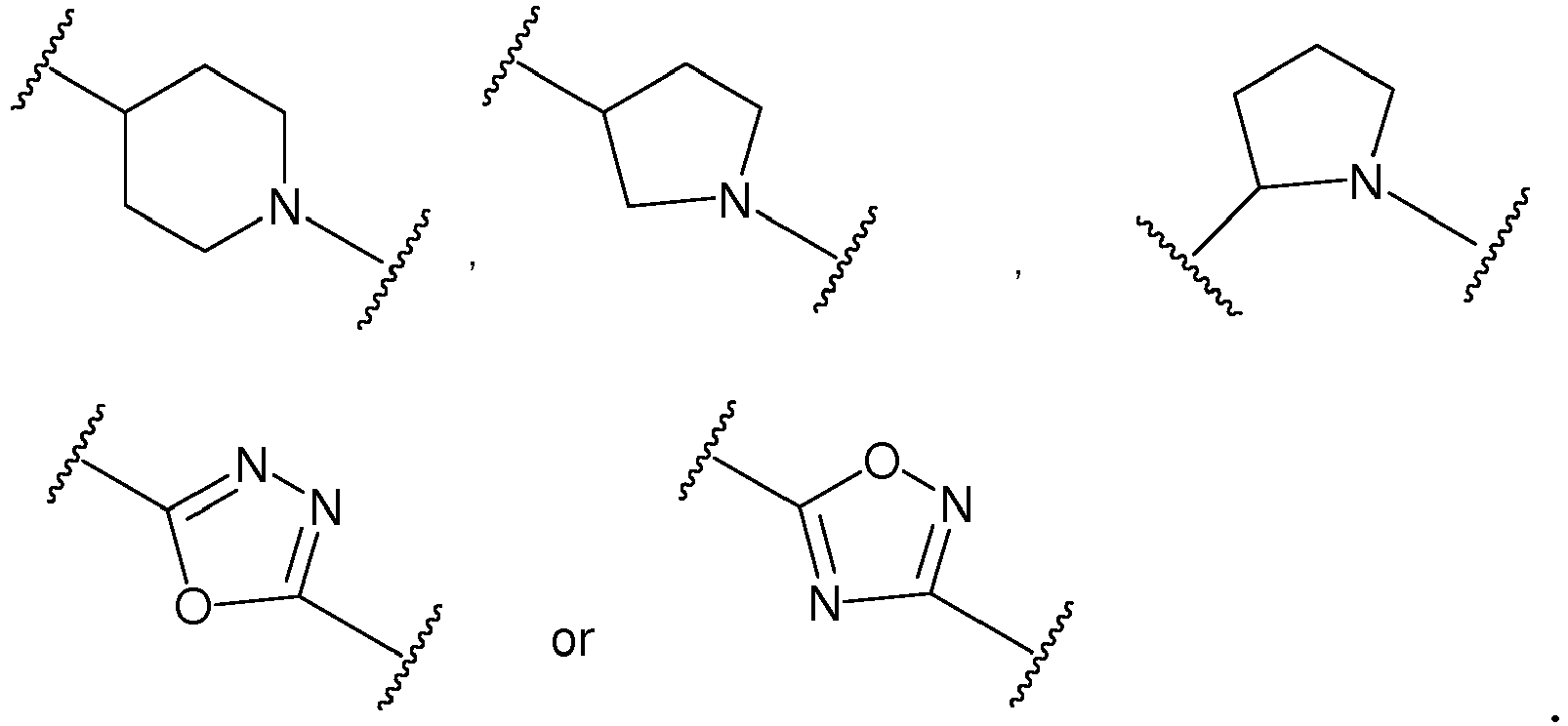
- wherein the bond of the left side is attached to G and the bond of the right side is attached to D.
- The compound or an amino-protected compound when the amino group is present on the ring in the 7-side chain, or a pharmaceutically acceptable salt thereof according to any one of Items 1, 2 4, or 5, wherein D is a single bond,-C(=O)-, -O-C(=O)-, -C(=O)-O-, -NR6-, -NR6-C(=O)-NR6-, -NR6-C(=O)- or -C(=O)-NR6- wherein R6 is as defined in Item 1.
- The compound or an amino-protected compound when the amino group is present on the ring in the 7-side chain, or a pharmaceutically acceptable salt thereof according to any one of Items 1, 2, 4 or 5, wherein the formula:


- wherein each R4 is independently hydrogen, halogen, hydroxyl group, -CN, -C(=O)-R5, -C(=O)-OH, -C(=O)-OR5 or-OR5; and R5 is as defined in Item 1.
- The compound or an amino-protected compound when the amino group is present on the ring in the 7-side chain, or a pharmaceutically acceptable salt thereof according to Item 7, wherein the formula:

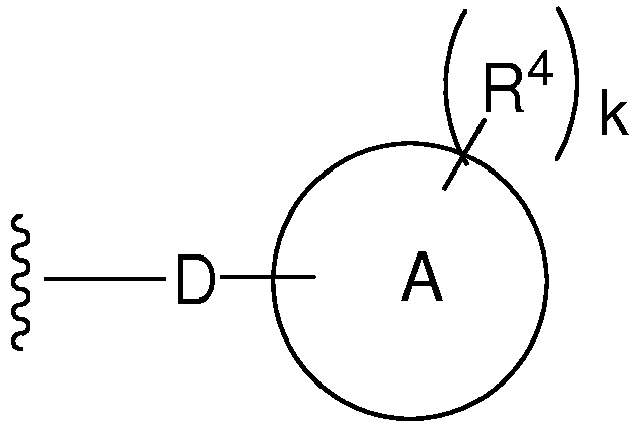


- The compound or an amino-protected compound when the amino group is present on the ring in the 7-side chain, or a pharmaceutically acceptable salt thereof according to Item 7, wherein the formula:


- The compound or an amino-protected compound when the amino group is present on the ring in the 7-side chain, or a pharmaceutically acceptable salt thereof according to any one of Items 1 to 9, wherein E is a substituted or unsubstituted, saturated or unsaturated, monocyclic or fused cyclic quaternary ammonium group having at least one nitrogen atom represented by the formula:

- the dashed line is a bond in the ring;
- the bond to the cationic nitrogen atom binds to L, and the other bond binds to R10; provided,
- when a cationic nitrogen atom binds to R10, the dashed line is absent, and
- when a cationic nitrogen atom does not bind to R10, the dashed line is a single bond between the cationic nitrogen atom and a neighboring atom or an lower alkylene group connecting the cationic nitrogen atom and any ring member atom other than said neighboring atom.
- The compound or an amino-protected compound when the amino group is present on the ring in the 7-side chain, or a pharmaceutically acceptable salt thereof according to any one of Items 1 to 9, wherein E is a group selected from the following formulae which are substituted or unsubstituted on the ring:


- wherein the bond to the quaternary nitrogen atom binds to L, and the other bond binds to R10; p is an integer from 1 to 3; n is an integer of 1 or 2; RX is a substituted or unsubstituted lower alkyl group.
- The compound or an amino-protected compound when the amino group is present on the ring in the 7-side chain, or a pharmaceutically acceptable salt thereof according to Item 11, wherein E is selected from the group consisting of the formulae (1) to (7), (10) to (12), (14), (25) to (29), (31), (41) to (44), (47), (50), (52), (53), (64) and (73).
- The compound or an amino-protected compound when the amino group is present on the ring in the 7-side chain, or a pharmaceutically acceptable salt thereof according to Item 11, wherein E is selected from the group consisting of the formulae (3), (10) to (12), (26) to (28), (31), (41), (42), (53), (64) and (73).
- The compound or an amino-protected compound when the amino group is present on the ring in the 7-side chain, or a pharmaceutically acceptable salt thereof according to any one of Items 1 to 9, wherein E is a group selected from the following formulae which are substituted or unsubstituted on the ring:


- wherein the bond to the quaternary nitrogen atom binds to L, and the other bond binds to R10.
- The compound or an amino-protected compound when the amino group is present on the ring in the 7-side chain, or a pharmaceutically acceptable salt thereof according to Item 1, wherein E-R10 is a group selected from the following formulae which are substituted or unsubstituted on the ring:


- wherein the bond to the quaternary nitrogen atom binds to L, and the other bond binds to R10.
- The compound or an amino-protected compound when the amino group is present on the ring in the 7-side chain, or a pharmaceutically acceptable salt thereof according to Item 1, wherein E-R10 is

- wherein the bond to the quaternary nitrogen atom binds to L.
- The compound or an amino-protected compound when the amino group is present on the ring in the 7-side chain, or a pharmaceutically acceptable salt thereof according to any one of Items 1 to 16, wherein the bioisoster of carboxyl ion (-COO-) is selected from -SO3 -, -S(=O)2-N--R13, -PO--(OR13), -PO2 --(OR13), -N--C(=O)-R13, -C(=O)-N--OR13, -C(=O)-NH-N--S(=O)2-R13, -C(=O)-N--S(=O)2-R13, -C(=O)-CH=C(O-)-R13, -N--S(=O)2-R13, -C(=O)-N--S(=O)2-R13, -N--S(=O)2-R13, -C(=O)-N--C(=O)-R13, -C(=O)-N--S(=O)2-R13, -N--C(=O)-R13,


- wherein R13 is selected from the group consisting of hydrogen, hydroxyl group, halogen, a substituted or unsubstituted lower alkyl group, a substituted or unsubstituted lower alkenyl group, a substituted or unsubstituted lower alkynyl group, a substituted or unsubstituted lower alkoxy group, a substituted or unsubstituted amino group, (lower alkenyl)oxy group, a substituted or unsubstituted aryloxy group, cyano, nitro, imino, mercapto, (lower alkyl)thio group, (lower alkyl)sulphonyl group, a substituted or unsubstituted carbocyclic group, a substituted or unsubstituted heterocyclic group and -CO2R17 wherein R17 is hydrogen, lower alkyl group or lower alkenyl group; and R14 is an electron-withdrawing group.
- The compound or an amino-protected compound when the amino group is present on the ring in the 7-side chain, or a pharmaceutically acceptable salt thereof according to Item 17, wherein the bioisoster of carboxyl ion (-COO-) is

- The compound or an amino-protected compound when the amino group is present on the ring in the 7-side chain, or a pharmaceutically acceptable salt thereof according to any one of Items 1 to 18, wherein U is -S-.
- The compound or an amino-protected compound when the amino group is present on the ring in the 7-side chain, or a pharmaceutically acceptable salt thereof according to any one of Items 1 to 19, wherein W is -CH2-.
- The compound or an amino-protected compound when the amino group is present on the ring in the 7-side chain, or a pharmaceutically acceptable salt thereof according to any one of Items 1 to 20, wherein R3 is a hydrogen atom or-OCH3.
- The compound or an amino-protected compound when the amino group is present on the ring in the 7-side chain, or a pharmaceutically acceptable salt thereof according to any one of Items 1 to 21, wherein R1 is a substituted or unsubstituted phenyl.
- The compound or an amino-protected compound when the amino group is present on the ring in the 7-side chain, or a pharmaceutically acceptable salt thereof according to any one of Items 1 to 21, wherein R1 is represented by the formula:

- wherein X is N, C(-H) or C(-Cl).
- The compound or an amino-protected compound when the amino group is present on the ring in the 7-side chain, or a pharmaceutically acceptable salt thereof according to Item 23, wherein X is N.
- The compound or an amino-protected compound when the amino group is present on the ring in the 7-side chain, or a pharmaceutically acceptable salt thereof according to Item 23, wherein X is C(-H) or C(-Cl).
- The compound or an amino-protected compound when the amino group is present on the ring in the 7-side chain, or a pharmaceutically acceptable salt thereof according to any one of Items 1 to 25, wherein R2A is a hydrogen atom, a substituted or unsubstituted amino group, -SO3H, a substituted or unsubstituted amino sulphonyl group, carboxyl group, a substituted or unsubstituted carbamoyl group, hydroxyl group, or substituted carbonyloxy group, and R2B is a hydrogen atom.
- The compound or an amino-protected compound when the amino group is present on the ring in the 7-side chain, or a pharmaceutically acceptable salt thereof according to any one of Items 1 to 26, wherein R2A is a substituted amino group shown below:

- a substituted amino sulfonyl group shown below:

- wherein ring B represents a substituted or unsubstituted heterocyclic group;
- a substituted carbamoyl group shown below:

- wherein ring B represents a substituted or unsubstituted heterocyclic group; or
- a substituted carbonyloxy group shown below:


- wherein ring B represents a substituted or unsubstituted heterocyclic group.
- The compound or an amino-protected compound when the amino group is present on the ring in the 7-side chain, or a pharmaceutically acceptable salt thereof according to any one of Items 1 to 25, wherein R2A and R2B are taken together to form a substituted methylidene group shown below:
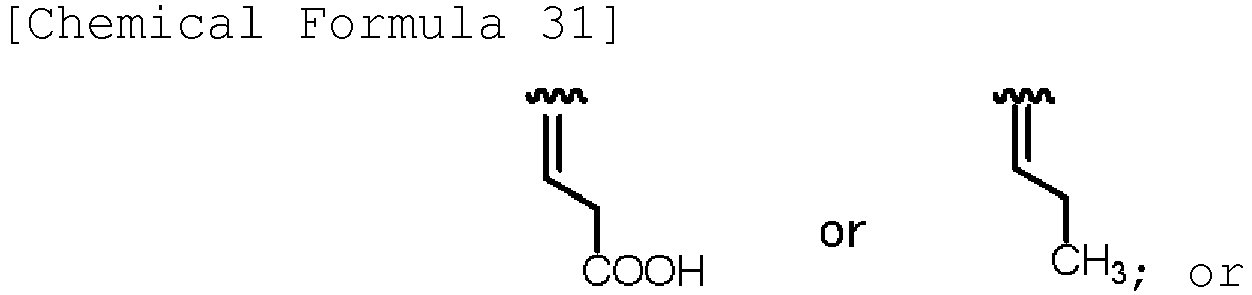
- a substituted hydroxyimino group shown below:

- wherein R9 is a substituted or unsubstituted lower alkyl group.
- The compound or an amino-protected compound when the amino group is present on the ring in the 7-side chain, or a pharmaceutically acceptable salt thereof according to any one of Items 1 to 25, wherein R2A and R2B are taken together to form a substituted hydroxyimino group shown below:


- wherein R7 and R8 are each independently a hydrogen atom, halogen, hydroxyl group, carboxyl group, a substituted or unsubstituted lower alkyl group, a substituted or unsubstituted carbocyclic group, or a substituted or unsubstituted heterocyclic group, or
- R7 and R8 may be taken together with a neighboring atom to form a substituted or unsubstituted carbocyclic group or a substituted or unsubstituted heterocyclic group;
- Q is a single bond, a substituted or unsubstituted carbocyclic group or a substituted or unsubstituted heterocyclic group; and
- m is an integer from 0 to 3.
- A pharmaceutical composition, which comprises a compound or an amino-protected compound when the amino group is present on the ring in the 7-side chain, or a pharmaceutically acceptable salt thereof according to any one of Items 1 to 29.
- The pharmaceutical composition according to Item 30, which possesses antimicrobial activity.
- A compound of the formula:


wherein - Y is a leaving group;
- U, R3 and L are as defined in claim 1;
- the group of the formula:

- is a group of the following formula:

- a group of the formula:

- P1 is a protecting group.
- The compound according to Claim 32, or a salt thereof, wherein P1 is benzhydryl group, p-methoxybenzyl group, trityl group, 2,6-dimethoxybenzyl group, methoxymethyl group, benzyloxymethyl group or 2-(trimethylsilyl)ethoxymethyl group.
- A compound of the formula:

wherein - Y is a leaving group;
- U, R3 and L are as defined in claim 1;
- the group of the formula:

- is a group of the following formula:

- a group of the following formula:

- P2 is a protecting group.
- The compound according to Claim 34, or a salt thereof, wherein P2 is benzhydryl group, p-methoxybenzyl group, trityl group, 2,6-dimethoxybenzyl group, methoxymethyl group, benzyloxymethyl group or 2-(trimethylsilyl)ethoxymethyl group.
- A method for the treatment of infection, which comprises adminstereing a compound according to any one of Items 1 to 29, an ester therof, or an amino-protected compound when the amino group is present on the ring in the 7-side chain or a pharmaceutically acceptable salt, or a solvate thereof.
- The compound according to any one of Items 1 to 29, an ester therof, or an amino-protected compound when the amino group is present on the ring in the 7-side chain or a pharmaceutically acceptable salt, or a solvate thereof for the treatment of infection.
- The compounds of the subject invention are useful as a pharmaceutical product in that the compounds have at least one of the following features:
- 1) The compounds exhibit potent antimicrobial spectrum against a variety of bacteria including Gram negative bacteria and/or Gram positive bacteria;
- 2) the compounds exhibit potent antimicrobial activity against beta-lactamase producing Gram negative bacteria;
- 3) the compounds exhibit potent antimicrobial activity against multidrug-resistant bacteria, in particular, Class B type metallo-beta-lactamase producing Gram negative bacteria;
- 4) the compounds exhibit potent antimicrobial activity against extended-spectrum beta-lactamase (ESBL) producing bacteria;
- 5) the compounds do not exhibit cross resistance with known Cephem drugs and/or Carbapenem drugs; and
- 6) the compounds do not exhibit side effects such as fever after administration into the body.
- Hereinafter, the subject invention is described with showing embodiments. It should be understood that, throughout the present specification, the expression of a singular form (for example, in the English language, "a", "an", "the", and the like; and in other languages, corresponding articles, adjectives, and the like) includes the concept of its plural form unless specified otherwise. Furthermore, it should be understood that the terms used herein are used in a meaning normally used in the art unless specified otherwise. Thus, unless defined otherwise, all technical and scientific terms used herein have the same meaning as those generally understood by those skilled in the art in the field to which the subject invention pertains. If there is a contradiction, the present specification (including definitions) precedes. Each specific definition of terms specifically used herein is described below.
- Each term in the present specification is used alone or in combination with another word, and defined as below.
- "Halogen" includes fluorine, chlorine, bromine and iodine. Preferably, halogen is fluorine, chlorine or bromine, and more preferably is chlorine.
- "Lower alkyl group" includes linear or branched alkyl group having 1-8 carbons, preferably 1-6 carbons, and more preferably 1-4 carbons, and includes, for example, methyl, ethyl, n-propyl, isopropyl, n-butyl, isobutyl, sec-butyl, tert-butyl, n-pentyl, isopentyl, neopentyl, hexyl, isohexyl, n-heptyl, isoheptyl, n-octyl, and the like.
- "Lower alkylene group" includes linear alkylene group having 1-8 carbons, preferably 1-6 carbons, more preferably 1-4 carbons, and most preferably one or two carbons, and includes, for example, methylene, ethylene, n-propylene, n-butylene, n-pentylene, n-hexylene, and the like.
- "Lower alkenylene group" includes linear alkenylene group having 2-8 carbons, preferably 2-6 carbons, more preferably 2-4 carbons, and at least one double bond at any position, and includes, for example, vinylene, allylene, propenylene, butenylene, prenylene, butadienylene, pentenylene, pentadienylene, hexenylene, hexadienylene, and the like.
- "Lower alkynylene group" includes linear alkynylene group having 2-8 carbons, preferably 2-6 carbons, more preferably 2-4 carbons, and at least one triple bond at any position, and includes, for example, ethynylene , propynylene, buthynylene, pentynylene, hexynylene, and the like.
- "Halo(lower)alkyl group" refers to a group in which at least one position of said "lower alkyl group" is substituted with the above "halogen", and includes, for example, monofluoromethyl, difluoromethyl, trifluoromethyl, monochloromethyl, dichloromethyl, trichloromethyl, monobromomethyl, monofluoroethyl, monochloroethyl, chlorodifluoromethyl, and the like. Preferably, halo(lower)alkyl group is trifluoromethyl, or trichloromethyl.
- Substituents of "a substituted or unsubstituted amino group" or "substituted or unsubstituted carbamoyl group" include substituted or unsubstituted lower alkyl (e.g., methyl, ethyl, isopropyl, benzyl, carbamoylalkyl (e.g., carbamoylmethyl), mono- or di-(lower)alkylcarbamoyl(lower)alkyl (e.g., dimethylcarbamoylethyl), hydroxy(lower)alkyl, heterocycle(lower)alkyl (e.g., morpholinoethyl, tetrahydropyranylethyl), alkoxycarbonyl(lower)alkyl (e.g., ethoxycarbonylmethyl, ethoxycarbonylethyl), mono- or di-(lower)alkylamino(lower)alkyl (e.g., dimethylaminoethyl)); (lower)alkoxy(lower)alkyl (e.g., methoxyethyl, ethoxymethyl, ethoxyethyl, isopropoxyethyl, and the like); acyl (e.g., formyl, substituted or unsubstituted lower alkylcarbonyl (e.g., acetyl, propionyl, butylyl, isobutylyl, valeryl, isovaleryl, pivaloyl, hexanoyl, octanoyl, methoxyethylcarbonyl, 2,2,2-trifluoroethylcarbonyl, alkoxycarbonylacetyl (e.g., ethoxycarbonylmethylcarbonyl), (lower)alkoxy(lower)alkylcarbonyl (e.g., methoxyethylcarbonyl), (lower)alkylcarbamoyl(lower)alkylcarbonyl (e.g., methylcarbamoylethylcarbonyl), substituted or unsubstituted arylcarbonyl (e.g., benzoyl, toluoyl); substituted or unsubstituted arylalkyl (e.g., benzyl, 4-fluorobenzyl); hydroxy; substituted or unsubstituted lower alkylsulfonyl (e.g., methanesulfonyl, ethanesulfonyl, isopropylsulfonyl, 2,2,2-trifluoroethanesulfonyl, benzylsulfonyl, methoxyethylsulfonyl); arylsulfonyl optionally having a lower alkyl or halogen as a substituent (e.g., benzenesulfonyl, toluenesulfonyl, 4-fluorobenzenesulfonyl), cycloalkyl (e.g., cyclopropyl); aryl optionally having a lower alkyl as a substituent (e.g., phenyl, tolyl); lower alkylaminosulfonyl (e.g., methylaminosulfonyl, dimethylaminosulfonyl); lower alkylaminocarbonyl (e.g., dimethylaminocarbonyl); lower alkoxycarbonyl (e.g., ethoxycarbonyl); cycloalkylcarbonyl (e.g., cyclopropylcarbonyl, cyclohexylcarbonyl); substituted or unsubstituted sulfamoyl (e.g., sulfamoyl, methylsulfamoyl, dimethylsulfamoyl); lower alkylcarbonylamino (e.g., methylcarbonylamino); heterocycle (e.g., morpholino, tetrahydropyranyl); substituted or unsubstituted amino (e.g., mono- or di-alkylamino (e.g., dimethylamino), formylamino), and the like.
- The above "substituted amino group" or "substituted carbamoyl group" may be mono-substituted or di-substituted with these substituent groups.
- "Lower alkenyl group" refers to a linear or branched alkenyl having 2 to 8 carbons and having one or more double bonds on said "lower alkyl group". Examples thereof include vinyl, 1-propenyl, 2-propenyl, 1-butenyl, 2-butenyl, 3-butenyl, 1,3-butadienyl, 3-methyl-2-butenyl, and the like. Preferred is alkenyl having 2 to 6 carbons, more preferably 2 to 4 carbons.
- With regard to an amino group of "a substituted or unsubstituted amino group" or "substituted or unsubstituted carbamoyl group", two substituents of the amino group may be taken together with the adjacent nitrogen atom to form a nitrogen-containing heterocycle which optionally includes a sulfur atom and/or an oxygen atom in the ring (preferably, the heterocycle is a 5- to 7-membered ring, and is preferably saturated). The heterocycle is substituted or unsubstituted with oxo or hydroxy. When a sulfur atom forms the heterocycle, said sulfur atom may be substituted with oxo. Examples thereof include 5- or 6-membered rings such as piperazinyl, piperidino, morpholino, pyrrolidino, 2-oxopiperidino, 2-oxopyrrolidino, 4-hydroxymorpholino, and the like.
- Substituents of "a substituted or unsubstituted lower alkyl group" include at least one group selected from Substituent Group Alpha. When substitution is carried out with a plurality of Substituent Group Alpha, the plurality of Substituent Group Alpha may be the same or different.
- Substituents of "a substituted or unsubstituted lower alkylene group", "a substituted or unsubstituted lower alkenylene group" and "a substituted or unsubstituted lower alkynylene group" include at least one group selected from Substituent Group Alpha. When substitution is carried out with a plurality of substituents, the substituents may be the same or different.
- Substituents of "a substituted or unsubstituted aminosulfonyl group" include a substituted lower alkyl and at least one group selected from Substituent Group Alpha.
- Substituents of "a substituted or unsubstituted lower alkyloxycarbonyl group" include at least one group selected from Substituent Group Alpha.
- Substituents of "a substituted carbonyloxy group" meaning "-O-C(=O)-substituent" include a substituted or unsubstituted lower alkyl, a substituted or unsubstituted lower alkenyl, a substituted or unsubstituted lower alkynyl, a substituted or unsubstituted carbocyclic group, a substituted or unsubstituted heterocyclic group, an amino having a heterocyclic group as a substituent, and at least one group selected from Substituent Group Alpha.
- Substituents of "a substituted or unsubstituted carboxyl group" include a substituted or unsubstituted lower alkyl, a substituted or unsubstituted lower alkenyl, a substituted or unsubstituted lower alkynyl, a substituted or unsubstituted carbocyclic group, a substituted or unsubstituted heterocyclic group.
- "Substituted or unsubstituted acyl group" means a carbonyl group substituted or unsubstituted with a substituted or unsubstituted lower alkyl, a substituted or unsubstituted lower alkenyl, a substituted or unsubstituted lower alkynyl, a substituted or unsubstituted carbocyclic group, a substituted or unsubstituted heterocyclic group.
- Substituents of "a substituted or unsubstituted, saturated or unsaturated, monocyclic or fused cyclic quaternary ammonium group" include a substituted or unsubstituted lower alkyl, at least one group selected from Substituent Group Alpha, or two or more substituents that are taken together to form a carbocyclic group or heterocyclic group.
- Here, "Substituent Group Alpha" is a group consisting of halogen, hydroxy, lower alkoxy, hydroxy(lower)alkoxy, (lower)alkoxy(lower)alkoxy, carboxy, amino, acylamino, lower(alkyl)amino, imino, hydroxyimino, lower(alkoxy)imino, lower(alkyl)thio, carbamoyl, lower(alkyl)carbamoyl, hydroxy(lower)alkylcarbamoyl, sulfamoyl, lower(alkyl)sulfamoyl, lower(alkyl)sulfinyl, cyano, nitro, a carbocyclic group, and a heterocyclic group.
- The lower alkyl moiety in "lower alkoxy group", "hydroxy(lower)alkoxy group", "(lower)alkoxy(lower)alkoxy group", "lower(alkyl)amino group", "lower(alkoxy)imino group", "lower(alkyl)thio group", "lower(alkyl)carbamoyl group", "hydroxy(lower)alkylcarbamoyl group", and "lower (alkyl)sulfamoyl group", "lower(alkyl)sulfinyl group", "lower(alkyl)oxycarbonyl group", "lower(alkyl)sulfonyl group", is defined the same as the above "lower alkyl group".
- The lower alkenyl moiety in "lower(alkenyl)oxy group", is defined the same as the above "lower alkenyl group".
- The aryl moiety in "aryloxy group", is defined the same as "aryl" defined below.
- Preferred embodiments of substituents in "a substituted or unsubstituted lower alkyl" include a fluorine atom, a chlorine atom, a bromine atom, hydroxy, carboxy, methoxy, ethoxy, hydroxymethoxy, hydroxyethoxy, methoxymethoxy, methoxyethoxy, amino, acetylamino, methylamino, dimethylamino, imino, hydroxyimino, methoxyimino, methylthio, carbamoyl, methylcarbamoyl, hydroxymethylcarbamoyl, sulfamoyl, methylsulfamoyl, lower alkylsulfamoyl, cyano, nitro, phenyl, cyclopropyl, cyclobutyl, cyclohexyl, pyridyl, morpholinyl, and the like.
- Preferred embodiments of "substituted or unsubstituted lower alkyl" include methyl, ethyl, isopropyl, tert-butyl, monochloromethyl, dichloromethyl, trichloromethyl, carboxymethyl, carboxyethyl, carbamoylmethyl, carbamoylethyl, hydroxymethyl, hydroxyethyl, methoxymethyl, ethoxymethyl, methoxyethyl, ethoxyethyl, methylthiomethyl, ethylthiomethyl, benzyl, phenethyl, 4-hydroxybenzyl, 4-methoxybenzyl, 4-carboxybenzyl, and the like.
- "Carbocyclic group" includes cycloalkyl, cycloalkenyl, aryl and non-aromatic fused carbocyclic groups, and the like.
- "Cycloalkyl" is a carbocyclic group having 3-10 carbons, preferably 3-8 carbons, more preferably 4-8 carbons, and includes, for example, cyclopropyl, cyclobutyl, cyclopentyl, cyclohexyl, cycloheptyl, cyclooctyl, cyclononyl, cyclodecyl, and the like.
- "Cycloalkenyl" includes those in which the ring of the cycloalkyl has at least one double bond at any position(s), and specifically includes, for example, cyclopropenyl, cyclobutenyl, cyclopentenyl, cyclohexenyl, cycloheptynyl, cyclooctynyl, and cyclohexadienyl, and the like.
- "Aryl" includes phenyl, naphthyl, anthryl, phenanthryl, and the like, and in particular, phenyl is preferable.
- "Aromatic carbocycle" means a ring derived from aryl as described above.
- "Aromatic heterocycle" means a aromatic ring, which is monocyclic or bicyclic or more, having same or different one or more hetero atom selected independently from O, S or N.
- The aromatic heterocyclic group which is bicyclic or more includes those wherein a monocyclic or bicyclic or more aromatic heterocyle is condensed with "aromatic carbocyle" described above.
- "Non-aromatic carbocyclic group" includes those selected from the above "cycloalkyl" and "cycloalkenyl" and specifically includes cyclopropyl, cyclobutyl, cyclopentyl, cyclohexyl, cycloheptyl, cyclooctyl, cyclononyl, cyclodecyl, cyclopropenyl, cyclobutenyl, cyclopentenyl, cyclohexenyl, cycloheptynyl, cyclooctynyl, and cyclohexadienyl and the like.
- "Non-aromatic fused carbocyclic group" includes a group in which one or more cyclic group selected from said "cycloalkyl" and "cycloalkenyl" is fused to said "cycloalkyl" "cycloalkenyl" and "aryl", and specifically includes, for example, indanyl, indenyl, tetrahydronaphthyl, and fluorenyl, and the like.
- "Heterocyclic group" includes heterocyclic groups having at least one hetero atom arbitrarily selected from O, S, and N, in the ring thereof, and specifically includes, for example, 5- or 6-membered heteroaryl such as pyrrolyl, imidazolyl, pyrazolyl, pyridyl, pyridazinyl, pyrimidinyl, pyrazinyl, triazolyl, triazinyl, tetrazolyl, isoxazolyl, oxazolyl, oxadiazolyl, isothiazolyl, thiazolyl, thiadiazolyl, furyl, thienyl, and the like; bicyclic fused heterocyclic groups such as indolyl, isoindolyl, indazolyl, indolizinyl, indolinyl, isoindolinyl, quinolyl, isoquinolyl, cinnolinyl, phthalazinyl, quinazolinyl, naphthyridinyl, quinoxalinyl, purinyl, pteridinyl, benzopyranyl, benzimidazolyl, benzotriazolyl, benzisoxazolyl, benzoxazolyl, benzoxadiazolyl, benzisothiazolyl, benzothiazolyl, benzothiadiazolyl, benzofuryl, isobenzofuryl, benzothienyl, benzotriazolyl, imidazopyridyl, pyrazolopyridine, triazolopyridyl, imidazothiazolyl, pyrazinopyridazinyl, quinazolinyl, quinolyl, isoquinolyl, naphthyridinyl, dihydrobenzofuryl, tetrahydroquinolyl, tetrahydroisoquinolyl, dihydrobenzoxazine, tetrahydrobenzothienyl, and the like; tricyclic fused heterocyclic groups such as carbazolyl, acridinyl, xanthenyl, phenothiadinyl, phenoxathiinyl, phenoxazinyl, dibenzofuryl, imidazoquinolyl, and the like; non-aromatic heterocyclic groups such as dioxanyl, thiiranyl, oxiranyl, oxathiolanyl, azetidinyl, thianyl, thiazolidine, pyrrolidinyl, pyrrolinyl, imidazolidinyl, imidazolinyl, pyrazolidinyl, pyrazolinyl, piperidyl, piperazinyl, morpholinyl, thiomorpholinyl, thiomorpholino, dihydropyridyl, dihyrobenzimidazolyl, tetrahydropyridyl, tetrahydrofuryl, tetrahydropyranyl, tetrahydrothiazolyl, tetrahydroisothiazolyl, dihydrooxazinyl, hexahydroazepinyl, tetrahydrodiazepinyl, and the like. Preferably, heterocyclic group is a 5- or 6-membered heteroaryl or non-aromatic heterocyclic group, and more preferably, a 5- or 6-membered heteroaryl.
- "Non-aromatic heterocyclic group" means a group which does not show aromatic character of the "heterocyclic group".
- Substituents of "a substituted or unsubstituted carbocyclic group" and "a substituted or unsubstituted heterocyclic group", "a substituted or unsubstituted non-aromatic carbocyclic group", "a substituted or unsubstituted non-aromatic heterocyclic group" include substituted or unsubstituted lower alkyl, and at least one group selected from Substituent Group Alpha.
- Preferred embodiments of substituents in "a substituted or unsubstituted carbocyclic group", "a substituted or unsubstituted heterocyclic group", "a substituted or unsubstituted non-aromatic carbocyclic group" and "a substituted or unsubstituted non-aromatic heterocyclic group" include methyl, ethyl, isopropyl, tert-butyl, a fluorine atom, a chlorine atom, a bromine atom, hydroxy, carboxy, methoxy, ethoxy, hydroxymethoxy, hydroxyethoxy, methoxymethoxy, methoxyethoxy, amino, acetylamino, methylamino, dimethylamino, imino, hydroxyimino, methoxyimino, methylthio, carbamoyl, methylcarbamoyl, hydroxymethylcarbamoyl, sulfamoyl, methylsulfamoyl, lower alkylsulfamoyl, cyano, nitro, phenyl, cyclopropyl, cyclobutyl, cyclohexyl, pyridyl, morpholinyl, and the like.
- "6-membered aromatic heterocyclic group having 1-3 nitrogen atoms" includes pyridine, pyrimidine, pyridazine, pyrazine, 1,3,5-triazine, 1,2,4-triazine, 1,2,3-triazine, and the like.
- "5- or 6-membered aromatic heterocyclic group having 1-3 nitrogen atoms" includes pyrrolyl, imidazolyl, pyrazolyl, pyridyl, pyridazinyl, pyrimidinyl, pyrazinyl, triazolyl, triazinyl, isoxazolyl, oxazolyl, oxadiazolyl, isothiazolyl, thiazolyl, thiadiazolyl, furyl, thienyl, and the like.
- Examples or embodiments of each site of Formula (I) are provided below. However, the scope of the subject invention is not limited to those described below.
- "W" is -CH2-, -S- or -O-. Preferably "W" is -CH2-.
- "U" is -CH2-, -S-, -S(=O)- or -O- when "W" is -CH2-. Preferably, "U" is -S- or -S(=O)-, more preferably "U" is-S-.
- "U" is -CH2- when "W" is -S- or -O-.
- "L" is -CH2-, -CH=CH-, -CH2-CH=CH- or -CH=CH-CH2-. Preferably, "L" is -CH2-. Binding pattern of double bond between carbon atoms in L may be cis or trans, or mixture thereof.
- Examples of "a substituted or unsubstituted carbocyclic group or substituted or unsubstituted heterocyclic group" of R1 include phenyl and hydroxyphenyl; phenyl which have a halogen as a substituent; aminothiazole; aminothiazole which have a halogen as a substituent; aminothiadiazole; thiophene; furan; benzothiazole; pyridine; pyrimidine; pyridazine; aminopyridine; and the like. Preferred Examples includes the groups as follows:

- When R2B is hydrogen atom, examples of R2A include hydrogen atom, substituted or unsubstituted amino group,-COOH, -SO3H, substituted or unsubstituted aminosulfonyl group, carboxyl group, substituted or unsubstituted carbamoyl group, hydroxyl group, or substituted carbonyloxy group, and the like. For example, preferred examples of

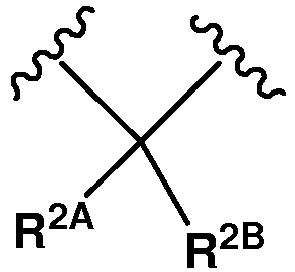
- include a substituted amino group shown below:

- a substituted aminosulfonyl group shown below:

- wherein ring B represents a substituted or unsubstituted heterocyclic group;
- a substituted carbamoyl group shown below:

- wherein ring B represents a substituted or unsubstituted heterocyclic group; or
- a substituted carbonyloxy group shown below:

- wherein ring B represents a substituted or unsubstituted.
- Alternatively, R2A and R2B may be taken together to form a substituted methylidene group shown below:

- wherein R9 is a substituted or unsubstituted lower alkyl, preferably
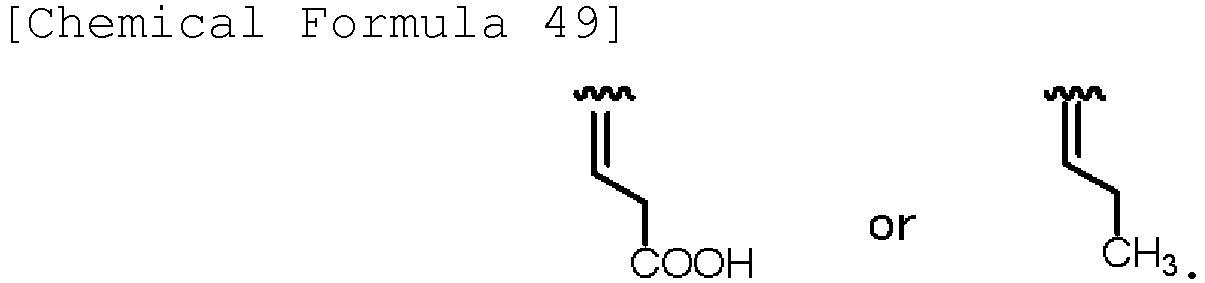
- Also, R2A and R2B may be taken together to form a substituted or unsubstituted hydroxyimino group shown below:
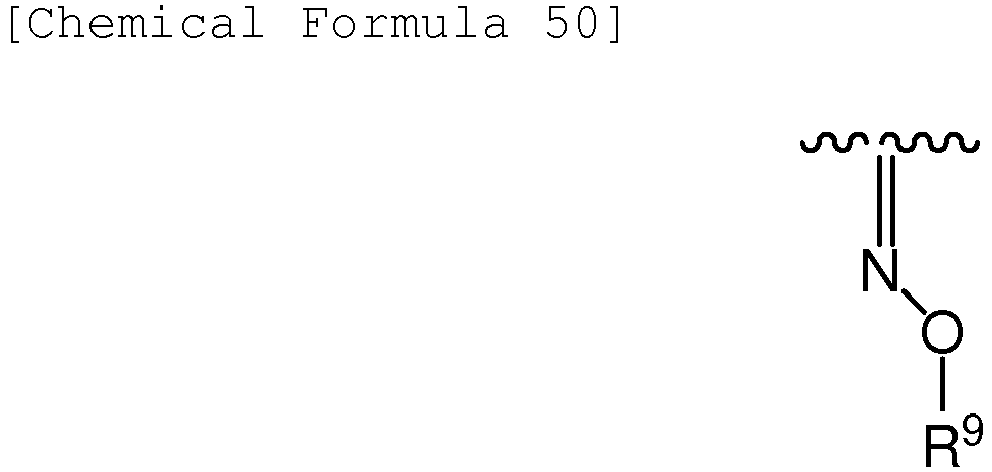
- wherein R9 is as defined above.

- wherein each symbol is as defined above is preferred.
- Examples of "R7 and R8" includes a hydrogen atom, a fluorine atom, a chlorine atom, hydroxy, carboxy, methyl, ethyl, isopropyl, tert-butyl, monofluoromethyl, difluoromethyl, trifluoromethyl, carboxymethyl, carboxyethyl, carbamoylmethyl, carbamoylethyl, hydroxymethyl, hydroxyethyl, methoxymethyl, ethoxymethyl, methoxyethyl, ethoxyethyl, methylthiomethyl, ethylthiomethyl, benzyl, 4-hydroxybenzyl, 4-methoxybenzyl, 4-carboxybenzyl, 3,4-dihydroxybenzyl, phenyl, 4-hydroxyphenyl, 3,4-dihydroxyphenyl, naphthyl, cyclopropyl, cyclobutyl, cyclopentyl, cyclohexyl, pyrrolyl, imidazolyl, pyrazolyl, pyridyl, pyridazinyl, pyrimidinyl, pyrazinyl, triazolyl, triazinyl, tetrazolyl, isoxazolyl, oxazolyl, oxadiazolyl, isothiazolyl, thiazolyl, thiadiazolyl, furyl, thienyl, and the like.
- Preferred combinations of R7 and R8 include, as (R7, R8), (a hydrogen atom, a hydrogen atom), (methyl, a hydrogen atom), (a hydrogen atom, methyl), (methyl, methyl), (ethyl, a hydrogen atom), (a hydrogen atom, ethyl), (ethyl, ethyl), (phenyl, a hydrogen atom), (a hydrogen atom, phenyl), (dihydroxyphenyl, a hydrogen atom), (a hydrogen atom, dihydroxyphenyl), (carboxymethyl, a hydrogen atom), (a hydrogen atom, carboxymethyl), (carboxyethyl, a hydrogen atom), (a hydrogen atom, carboxyethyl), (hydroxyethyl, a hydrogen atom), (a hydrogen atom, hydroxylethyl), (carbamoylmethyl, a hydrogen atom), (a hydrogen atom, carbamoylmethyl), (trifluoromethyl, a hydrogen atom), (carboxy, a hydrogen atom), (carbamoylethyl, a hydrogen atom), (benzyl, a hydrogen atom), (dihydroxybenzyl, a hydrogen atom), and the like.
- Preferred examples of the above substituted hydroxyimino group include groups shown bellow:

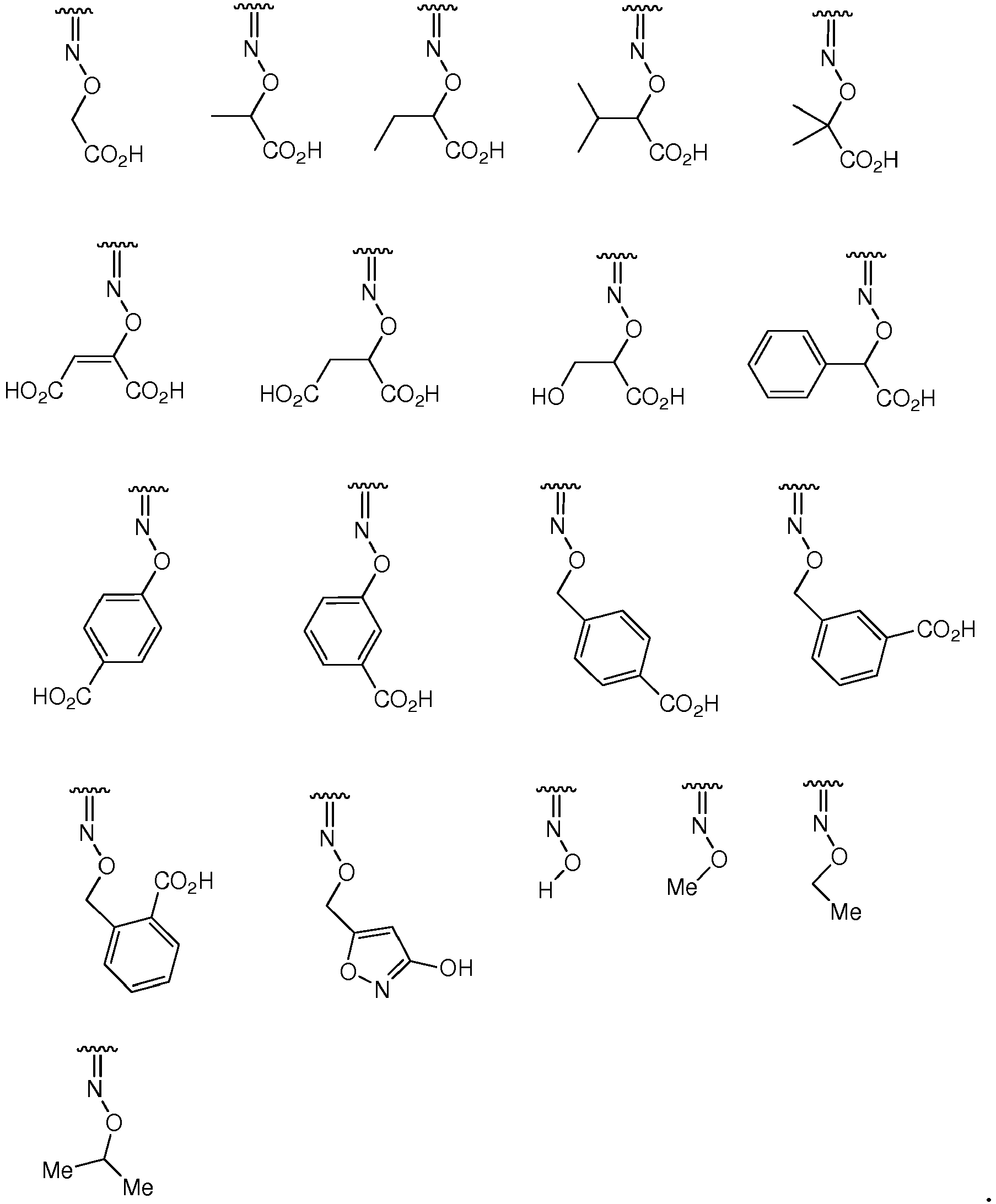
- More preferred examples of the above substituted hydroxyimino group include groups shown bellow:


- In the case where "R7 and R8 may be taken together with a neighboring atom to form a substituted or unsubstituted carbocyclic group or a substituted or unsubstituted heterocyclic group", R7 and R8 in the formula:

- wherein each symbol is as defined above is preferred, may form cycloalkane, cycloalkene, or a non-aromatic heterocycle substituted or unsubstituted on the ring with a group selected from Substituent Group Alpha. For example,

- can be a formula shown below:


- substituted or unsubstituted on the ring with a group selected from Substituent Group Alpha.
- Examples of "Q" include a single bond, phenyl, pyridyl, and the like. A single bond is particularly preferable.
- "m" is preferably an integer of 0 or 1, and 0 is particularly preferable.
- Preferred examples of this embodiment include:

- The term "bioisoster" as used herein refers to a group having chemical and physical similarities that provides similar biological properties. Accordingly, "a bioisoster of carboxyl ion (-COO-)" of the subject invention refers to any group that provides biological properties similar to those provided by carboxy ion, specifically refers to a group that is comparatively similar to "carboxyl ion (-COO-)" in its chemical structure, that is expected for physical properties, such as acidity, water solubility and/or disposition, equivalent to those of "carboxyl ion (-COO-)", and that has an acidic proton. Said acidic proton moiety may form a salt, such as an alkali metal salt (e.g., sodium salt). Examples can be found in literatures, such as J. Med. Chem. 1992, 35, 1176-1183; J. Med. Chem. 1993, 36, 2485-2493; J. Med. Chem. 1992, 35, 3691-3698; J. Med. Chem. 1995, 38, 617-628; Med. Res. Rev. 1983, 3, 91-118; J. Med. Chem. 2001, 44, 1560-1563; Bioorganic & Medicinal Chemistry Letters, Vol.4, No.1, 41-44, 1994. Preferably, it is selected from -SO3 -, -SO2-N--R13, -PO--(OR13), -PO2 --(OR13), -N--CO-R13, -CO-N--OR13, -CO-NH-N--SO2-R13, -CO-N--SO2-R13, -CO-CH=C(O-)-R13, -N--SO2-R13, -CO-N--SO2-R13, -N--SO2-R13, -CO-N--CO-R13, -CO-N--SO2-R13, -N--CO-R13


- wherein R13 is selected from the group consisting of hydrogen, hydroxyl group, halogen, a substituted or unsubstituted lower alkyl group, a substituted or unsubstituted lower alkenyl group, a substituted or unsubstituted lower alkynyl group, a substituted or unsubstituted lower alkoxy group, a substituted or unsubstituted amino group, (lower alkenyl)oxy group, a substituted or unsubstituted aryloxy group, cyano, nitro, imino, mercapto, (lower alkyl)thio group, (lower alkyl)sulphonyl group, a substituted or unsubstituted carbocyclic group, a substituted or unsubstituted heterocyclic group and -CO2R17 wherein R17 is hydrogen, lower alkyl group or lower alkenyl group; and R14 is an electron-withdrawing group.


- is more preferable.
- R14 is not limited so long as it is an electron-withdrawing group. Preferred examples of R14 include fluorine, -CHF2, -CF3, -CONH2, -CN, -C=N-OH, -SO2CH3 or-SO2NH2 .
- "R3" is preferably a hydrogen atom or -OCH3, and more preferably a hydrogen atom.
- E is a substituted or unsubstituted divalent group having at least one quaternary ammonium ion and is preferably selected from the above formulae (1) to (73) substituted or unsubstituted on the ring. Groups "selected from the formulae (1) to (73) substituted or unsubstituted on the ring" include those wherein a hydrogen atom on the carbon atom in the cyclic group is replaced with a substituted or unsubstituted lower alkyl or with same or different one ore more group selected from Substituent Group Alpha. Preferred embodiments of such substitutent include methyl, ethyl, isopropyl, tert-butyl, fluorine atom, chlorine atom, bromine atom, hydroxyl, carboxyl, methoxy, ethoxy, hydroxymethoxy, hydroxyethoxy, methoxymethoxy, methoxyethoxy, amino, acetylamino, methylamino, dimethylamino, imino, hydroxyimino, methoxyimino, methylthio, carbamoyl, methylcarbamoyl, hydroxymethylcarbamoyl, sulfamoyl, methylsulfamoyl, (lower)alkylsulfamoyl, cyano, nitro, phenyl, cyclopropyl, cyclobutyl, cyclohexyl, pyridyl, morpholinyl, and the like. More Preferred embodiments include a ring unsubstituted or mono- or di-substituted with a hydroxyl group. Such ring mono- or di-substituted with a hydroxyl group may be substituted additionally with another substituent.
- E is "an optionally subsituted divalent group having at least one quaternary ammonium ion", and more preferred examples of E include a group selected from the following formulae which are substituted or unsubstituted on the ring:


- wherein the bond to the quaternary nitrogen atom binds to L, and the other bond binds to R10; p is an integer from 1 to 3; n is an integer of 1 or 2; each RX is independently a substituted or unsubstituted lower alkyl group.
- Among the above formulae, a group selected from the group consisting of the formulae (1) to (7), (10) to (12), (14), (25) to (29), (31), (41) to (44), (47), (50), (52), (53), (64) and (73) is more preferable.
- Particularly, a group selected from the group consisting of the formulae (3), (10) to (12), (26) to (28), (31), (41), (42), (53), (64) and (73) is preferable.
- Also, the following groups are preferable:

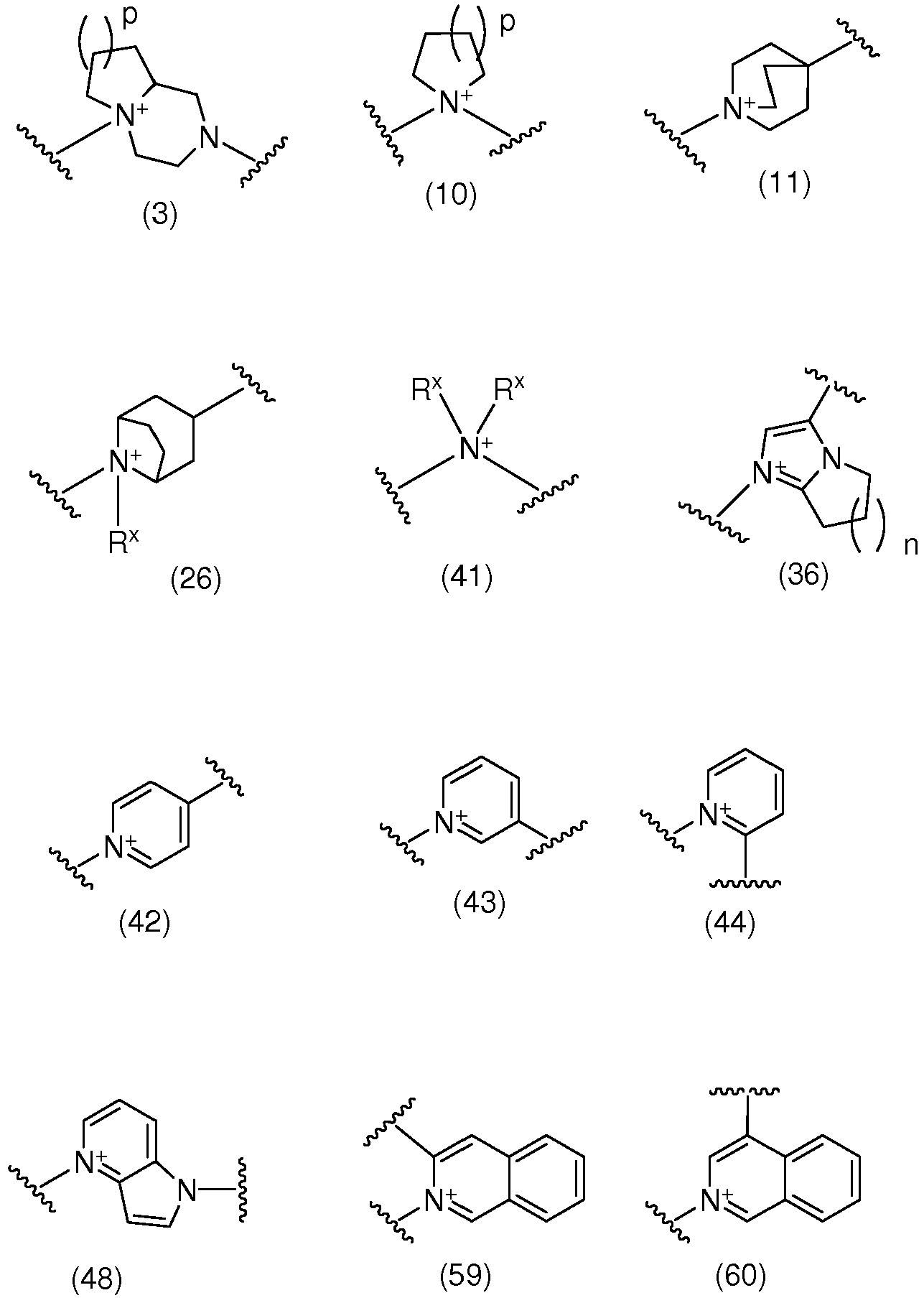
- wherein each symbol is as defined above.
- In the subject invention, E is a substituted or unsubstituted divalent group having at least one quaternary ammonium ion and divided in two embodiments as follows.
- 1) E contains an aromatic carbocyclic group or an aromatic heterocyclic group wherein a hydroxyl group binds to each of two adjacent carbon atoms on the aromatic ring; and
- 2) E contains neither an aromatic carbocyclic group nor an aromatic heterocyclic group or E contains an aromatic carbocyclic group or an aromatic heterocyclic group but a hydroxyl group does not bind to each of two adjacent carbon atoms on the aromatic ring.
- In the embodiment that E contains an aromatic carbocyclic group or an aromatic heterocyclic group wherein a hydroxyl group binds to each of two adjacent carbon atoms on the aromatic ring, preferable examples of E include:


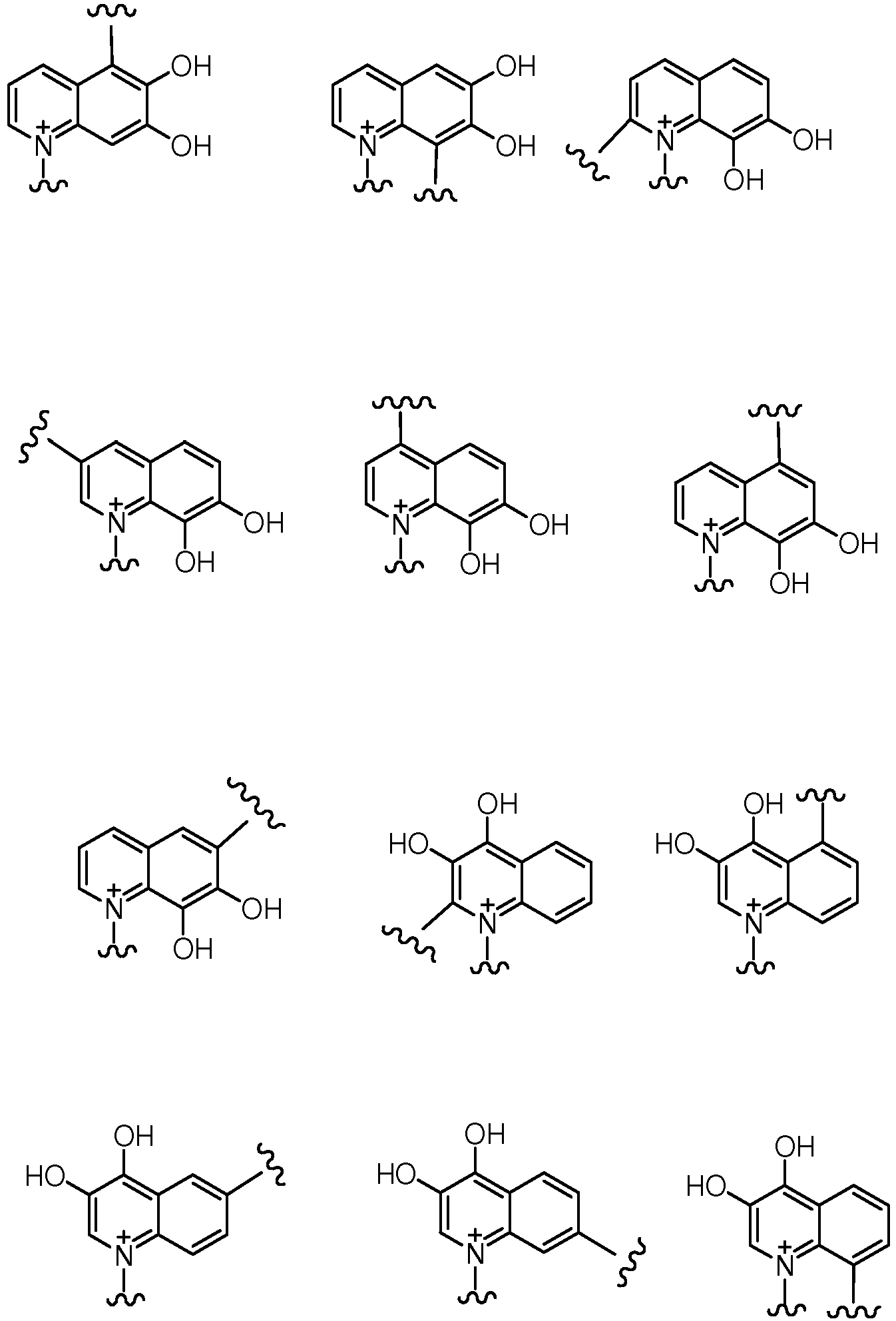


- wherein the bond to the quaternary nitrogen atom binds to L, and the other bond binds to R10.
- Preferred examples of E-R10 when E contains an aromatic carbocyclic group or an aromatic heterocyclic group wherein a hydroxyl group binds to each of two adjacent carbon atoms on the aromatic ring include:


- wherein the bond to the quaternary nitrogen atom binds to L, and R12 is as deifined in Item 1.
- Still more preferred examples of E-R10 when E contains an aromatic carbocyclic group or an aromatic heterocyclic group wherein a hydroxyl group binds to each of two adjacent carbon atoms on the aromatic ring include:

- wherein the bond to the quaternary nitrogen atom binds to L.
- Examples of R12 when R10 is -R12 include hydrogen atom, halogen, hydroxyl group, -SO3H, a substituted or unsubstituted amino group, a substituted or unsubstituted carboxyl group, a substituted or unsubstituted carbamoyl group, a substituted or unsubstituted acyl group, a substituted or unsubstituted amino sulfonyl group, a substituted or unsubstituted alkyl group, a substituted or unsubstituted alkenyl group, a substituted or unsubstituted alkynyl group, a substituted or unsubstituted non-aromatic carbocyclic group or a substituted or unsubstituted non-aromatic heterocyclic group. Preferably, R12 is hydrogen atom or an optionally subsituted alkyl group.
- Preferred embodiments wherein R10 is a group represented by the formula:

- G is preferably a single bond or a substituted or unsubstituted lower alkylene group, and more preferably a single bond, methylene or ethylene.
- B is preferably a single bond or a group represented by the formula:

- wherein the bond of the left side is attached to G and the bond of the right side is attached to D.
- B is more preferably a single bond.
- D is preferably a single bond, -C(=O)-, -O-C(=O)-, - C(=O)-O-, -NH-, -NH-C(=O)-, -C(=O)-NH-, -NH-C(=O)-NH-, -O-, -S-, -S(=O)-, -S(=O)2-NH-, -NH-S(=O)2-, -NH-CH2-, -CH2-NH- or -S(=O)2-, and more preferably -C(=O)- or -NH-C(=O)-.
- Preferable examples of "-E-G-B-D-" include the formulae as shown below:


- wherein Me represents metyl group.
- Preferred examples of a group of the formula:


- wherein each R4 is independently hydrogen atom, halogen, hydroxyl group, -CN, -C(=O)-R5, -C(=O)-OH, -C(=O)-OR5 or-OR5.
- Preferred examples of a group of the formula:


- More preferrable examples of a group of the formula:


- Examples of "R4" include hydrogen atom, chlorine atom, fluorine atom, bromine atom, cyano, hydroxy, carboxy, acetyl, methoxy, ethoxy, trifluoromethyl, and the like. Preferably, R4 is a hydrogen atom, hydroxy, carboxy, methoxy, fluorine atom, trifluoromethyl, or chlorine atom. Particularly preferably, at least two R4 are hydroxyl groups and bind respectively to adjacent carbon atoms on ring A.
- "k" is an integer of 2 to 5. As ring A is a benzene ring or a 6-membered aromatic heterocyclic group having 1-3 nitrogen atoms, for example, k is 5 when the ring A is a benzene ring, and k is 2 when the ring A is a 6-membered aromatic heterocyclic group having 3 nitrogen atoms.
- The nomenclature of the substitution position on the Cephem skeleton of Formula (I) is as follows. As used herein, 3-side chain, 4-side chain and 7-side chain respectively refer to groups binding to the 3-position, 4-position and the 7-position of the Cephem skeleton as shown below

- Esters of Formula (I) preferably include those esters at the 7-side chain. Esters at the carboxyl group on the 7-side chain include compounds having a structure in which the carboxyl group of a substituted or unsubstituted amino group, substituted or unsubstituted aminosulfonyl group, carboxyl group, substituted or unsubstituted (lower)alkyloxycarbonyl group, substituted or unsubstituted carbamoyl group, substituted carbonyloxy group, or the like at the terminal of R1, R2A or R2B shown in the formula:

- wherein each symbol is as defined above, is esterified (for example, in the case of carboxyl (-COOH), such esters are represented by the structural formula -COORa, which is shown with Ra representing an ester residue such as a carboxyl-protecting group or the like); and the like. Such esters include those esters that are easily metabolized in the body to form a carboxylic state.
- The aforementioned protecting groups for a carboxyl group or the like may be of any group as long as it can be protected and/or deprotected by a method described in Protective Groups in Organic Synthesis, written by T. W. Greene, John Wiley & Sons Inc. (1991), or the like. Examples thereof include lower alkyl (e.g., methyl, ethyl, t-butyl), (lower)alkylcarbonyloxymethyl (e.g., pivaloyl), substituted or unsubstituted aralkyl (e.g., benzyl, benzhydryl, phenethyl, p-methoxybenzyl, p-nitrobenzyl), silyl groups (t-butyldimethylsilyl, diphenyl(t-butyl)silyl), and the like.
- Amino-protected compounds at the amino on the 7-side chain of Formula (I) refer to the structures in which the amino on the ring has been protected, as shown in the formula:

- wherein each symbol is as defined above; and when R1 and/or R2A has an amino group, the protected compound is represented by the formula -NHRc wherein Rc represents an amino-protecting group. Such amino-protecting groups include those groups that are readily metabolized in the body to form amino. The aforementioned amino-protecting groups may be of any group as long as it can be protected and/or deprotected by a method described in Protective Groups in Organic Synthesis, written by T. W. Greene, John Wiley & Sons Inc. (1991), or the like. Examples thereof include (lower)alkoxycarbonyl (e.g., t-butoxycarbonyl, benzyloxycarbonyl, p-nitrobenzyloxycarbonyl), substituted or unsubstituted aralkanoyl (e.g., benzoyl, p-nitrobenzoyl), acyl (e.g., formyl, chloroacetyl), and the like.
- The Compound (I) of the subject invention is not limited to particular isomers, but includes any possible isomers (e.g., keto-enol isomer, imine-enamine isomer, diastereoisomer, optical isomer, rotamer, etc.), racemates and a mixture thereof.
- For example,


- The compound (I) of the subject invention can form a zwitter ion between a quaternary ammonium ion on the group "E" and a substituent on the 4-side chain (i.e., a bioisoster of -COO-). For example, when the substituent at the 4-position is tetrazolyl group:


- For example, the formula:

- wherein each symbol is as defined above, in Formula (I) includes the following resonance structures:
- wherein R4 is as defined above.
- Also, the group "E" in Formula (I), for example, includes the following resonance structures:


- wherein each symbol is as defined above.
- At least one hydrogen atom, carbon atom and/or another atom may be replaced with an isotope of said hydrogen atom, carbon atom and/or another atom. Examples of such isotope include hydrogen, carbon, nitrogen, oxygen, sulfur, fluorine, iodine and chlorine, such as 2H, 3H, 11C, 13C, 14C, 15N, 18O, 17O, 31P, 32P, 35S, 18F, 123I and 36Cl. The compound of Formula (I) include compounds having an atom replaced with such isotope. Such compound replaced with an isotope are useful as a pharmaceutical product, and such compound include all of radiolabeled compound of Formula (I). Also, the subject invention includes any method of radioactive labeling for the production of such radiolabeled compound, and thus, it is useful in a research for metabolic pharmacokinetics, binding assay and/or as a diagnostic tool.
- A radiolabeled compound of Formula (I) may be prepared according to the technique well known in the art. For example, tritium can be introduced into a specific compound of Formula (I) by catalytic dehalogenation using tritium to prepare a tritium-labeled compound of Formula (I). This method comprises reaction of a precursor which is a compound of Formula (I) appropriately halogenated with tritium gas in the presence of appropriate catalyst, such as Pd/C, in the presence or absence of a base. For another method for the preparation of a tritium-labeled compound, see the literature, Isotopes in the Physical and Biomedical Sciences, Vol.1, Labeled Compounds (Part A), Chapter 6 (1987). 14C-labeled compound can be prepared using a starting material having 14C.
- Salts of a compound of Formula (I) include those formed with an inorganic or organic acid by a carboxyl group in the 7-side chain and/or an amino group in the 7-side chain; and those formed with a counter anion by a quaternary amine moiety in the 3-side chain.
- Pharmaceutically acceptable salts of a compound of Formula (I) include, for example, salts formed with alkali metal (e.g. lithium, sodium, potassium, etc.), alkaline earth metal (e.g. calcium, barium, etc.), magnesium, transition metal (e.g. zinc, ferrum, etc.), ammonia, organic base (e.g. trimethylamine, triethylamine, dicyclohexylamine, ethanolamine, diethanolamine, triethanolamine, meglumine, diethanolamine, ethylenediamine, pyrydine, picoline, quinoline, etc.) and amino acid, or salts formed with inorganic acid (e.g. hydrochloric acid, sulphuric acid, nitric acid, carbonic acid, hydrobromic acid, phosphoric acid, hydroiodic acid, etc.), and organic acid (e.g. formic acid, acetic acid, propionic acid, trifluoroacetic acid, citric acid, lactic acid, tartaric acid, oxalic acid, maleic acid, fumaric acid, mandelic acid, glutaric acid, malic acid, benzoic acid, phthalic acid, ascorbic acid, benzenesulphonic acid, p-toluenesulfonic acid, methanesulphonic acid, ethanesulphonic acid, etc, particularly, salts formed with hydrochloric acid, sulphuric acid, phosphoric acid, tartaric acid, methanesulphonic acid. These salts can be formed according to the conventional method.
- The compound of Formula (I) or pharmaceutically acceptable salts thereof may form a solvate (e.g., hydrate) and/or a crystalline polymorphism, and the subject invention also includes such solvates and crystalline polymorphisms. In such "solvate", any number of solvent molecules (e.g., water molecule, etc.) may be coordinated to the compound of Formula (I). By leaving the compound of Formula (I) or pharmaceutically acceptable salt thereof in the atmosphere, it may absorb moisture to adhere with absorbed water or form a hydrate thereof. Also, a crystalline polymorphism of the compound of Formula (I) or pharmaceutically acceptable salt thereof can be formed by recrystallization.
- The compound of Formula (I) or pharmaceutically acceptable salt thereof may form a prodrug, and the subject invention includes such prodrugs. Prodrug is a derivative of the compound of the invention having a group chemically- or metabolically-degradable to be transformed into a pharamacologically active compound by solvolysis or under physiological condition in vivo. Prodrug includes compounds which can be transformed into the compound of Formula (I) by enzymatically oxidization, reduction or hydrolysis under physiological condition in vivo, or transformed into the compound of Formula (I) by hydrolysis with gastric acid, etc. Methods for selection and production of appropriate prodrug derivative can be found, for example, in Design of Prodrugs, Elsevier, Amsterdam 1985.
- Prodrug may be active compound in itself.
- When the compound of Formula (I) or pharmaceutically acceptable salt thereof has a hydroxyl group, acyloxy derivatives or sulfonyloxy derivatives can be prepared as a prodrug. For example, such compound having a hydroxyl group may be reacted with an appropriate acyl halide, acid anhydrate or an appropriate sulfonyl chloride, sulfonyl anhydrate, mixed anhydrate, etc., or may be reacted using a coupling agent, such as for examples, those having CH3COO-, C2H5COO-, t-BuCOO-, C15H31COO-, PhCOO-, (m-NaOOCPh)COO-, NaOOCCH2CH2COO-, CH3CH(NH2)COO-, CH2N(CH3)2COO-, CH3SO3-, CH3CH2SO3-, CF3SO3-, CH2FSO3-, CF3CH2SO3-, p-CH3-O-PhSO3-, PhSO3-, p-CH3PhSO3-.
- For the synthesis of a compound of Formula (I), a compound of the formula:

- wherein Y is a leaving group, U, R3 and R11 are as defined above, and P is a protecting group as defined above,
- or a pharmaceutically acceptable salt thereof is preferred as an intermediate.
- The leaving group includes halogen (Cl, Br, I, F), methanesulfonyloxy, p-toluenesulfonyloxy, trifluoromethanesulfonyloxy, etc.
- As described in the following General Synthesis and Examples, an intermediate compound described above is attached with side chain moieties at the 3-, 4- and 7-positions of the cephem skeleton to obtain a compound of Formula (I). Examples of the protecting group "P" include those described in the following General Synthesis, and preferably, benzhydryl group, p-methoxybenzyl group, trityl group, 2,6-dimethoxybenzyl group, methoxymethyl group, benzyloxymethyl group or 2-(trimethylsilyl)ethoxymethyl group, etc.
- The compounds represented by Formula (I) of the subject invention can be manufactured, for example, by a general synthesis method described below:


- wherein W, U, R1, R2A, R2B, R3, R10, R11, L and E are as defined above, P is a protecting group, and Y is a leaving group (e.g., a halogen (Cl, Br, I, F), methanesulfonyloxy, p-toluenesulfonyloxy, trifluoromethanesulfonyloxy, etc.
- Compound (X) may be obtained by subjecting Compound (VIII) to a condensation reaction with Compound (IX). The reaction solvents include, for example, ethers (e.g., anisole, dioxane, tetrahydrofuran, diethyl ether, tert-butyl methyl ether, diisopropyl ether), esters (e.g., ethyl formate, ethyl acetate, n-butyl acetate, isopropyl acetate), halogenated hydrocarbons (e.g., dichloromethane, chloroform, carbon tetarachloride), hydrocarbons (e.g., n-hexane, benzene, toluene), amides (e.g., formamide, N,N-dimethylformamide, N,N-dimethylacetamide, N-methylpyrrolidone), ketones (e.g., acetone, methyl ethyl ketone), nitriles (e.g., MeCN, propionitrile), nitros (e.g., nitromethane, nitorethane, nitrobenzene), dimethylsulfoxide, and water, or a mixed solvent selected from two or more of these solvents. The reaction temperature is usually in the range of from about -100°C to 100°C, preferably in the range of from about -80°C to 20°C, more preferably in the range of from about -60°C to -20°C. The reaction time may vary according to the reagents, solvents or reaction temperature to be employed, and usually, is 0.5 to 24 hours.
- Compound (I) may be obtained by reacting Compound (X) with Compound (XI), followed by deprotecting by a method well-known to those skilled in the art. The reaction solvents include, for example, ethers (e.g., anisole, dioxane, tetrahydrofuran, diethyl ether, tert-butyl methyl ether, diisopropyl ether), esters (e.g., ethyl formate, ethyl acetate, n-butyl acetate, isopropyl acetate), halogenated hydrocarbons (e.g., dichloromethane, chloroform, carbon tetarachloride), hydrocarbons (e.g., n-hexane, benzene, toluene), amides (e.g., formamide, N,N-dimethylformamide, N,N-dimethylacetamide, N-methylpyrrolidone), ketones (e.g., acetone, methyl ethyl ketone), nitriles (e.g., MeCN, propionitrile), nitros (e.g., nitromethane, nitorethane, nitrobenzene), dimethylsulfoxide, and water, or a mixed solvent selected from two or more of these solvents.
The reaction temperature is usually in the range of from about -100°C to 100°C, preferably in the range of from about -80°C to 50°C, more preferably in the range of from about -40°C to 0°C. The reaction time may vary according to the reagents, solvents or reaction temperature to be employed, and usually, is 0.5 to 24 hours. - If Compound of Formula (I) has a tetrazole ring at 4-position, Compound (VIII) used in the above Scheme 1 can be prepared according to Scheme 2.


- wherein W, U, R3 and L are as defined above, P is a protecting group, and Y is a leaving group (e.g., a halogen (Cl, Br, I, F), methanesulfonyloxy, p-toluenesulfonyloxy, trifluoromethanesulfonyloxy, etc.
- Compound (III) is obtained by protecting an amino group on the 7-side chain of Compound (II) with a protecting group by a method well-known to those skilled in the art. The protecting groups to be used include the amino-protecting groups as exemplified below.
- Compound (IV) is obtained by amination of a carboxyl group at 4-position of Compound (III) by a method well-known to those skilled in the art. This amination may be carried out by using an amine compound which is previously protected by a protecting group, or alternatively, an amino group on the 4-side chain may be protected after the amination. The protecting groups to be used include the amino-protecting groups as exemplified below.
The reaction solvents include, for example, ethers (e.g., dioxane, tetrahydrofuran, diethyl ether, tert-butyl methyl ether, diisopropyl ether), esters (e.g., ethyl formate, ethyl acetate, isopropyl acetate), halogenated hydrocarbons (e.g., dichloromethane, chloroform, carbon tetarachloride), hydrocarbons (e.g., n-hexane, benzene, toluene), amides (e.g., formamide, N,N-dimethylformamide, N,N-dimethylacetamide, N-methylpyrrolidone), ketones (e.g., acetone, methyl ethyl ketone), nitriles (e.g., MeCN, propionitrile), dimethylsulfoxide, and water, or a mixed solvent of these solvents. - The reaction temperature is usually in the range of from about -100°C to 100°C, preferably in the range of from about -80°C to 50°C, more preferably in the range of from about -80°C to -40°C. The reaction time may vary according to the reagents, solvents or reaction temperature to be employed, but usually is 0.5 to 24 hours.
- Compound (V) is obtained by reacting Compound (IV) with, for example, hydrogen azide, trimethylsilyl azide (TMSN3), or hydrazoates (e.g., sodium azide, tetra-n-butylammonium azide, and tetramethylguanidinium azide) to form a tetrazole ring.
- Trimethylsilyl azide is generally used in an amount of about 1 to 100 moles, preferably in an amount of 1 to 30 moles, for 1 mole of Compound (IV). The reaction solvents include, for example, water, alcohols (e.g., methanol, ethanol, etc.), carboxylic acids (e.g., acetic acid, etc.). The reaction temperature is usually in the range of from about 0°C to 100°C, preferably in the range of from about 10°C to 90°C, more preferably in the range of from about 10°C to 50°C. The reaction time may vary according to the reagents, solvents or reaction temperature to be employed, but usually is 0.5 to 24 hours.
- Compound (VI) is obtained by subjecting Compound (V) to a deprotection reaction by a method well-known to those skilled in the art.
- Compound (VII) is obtained by halogenating a hydroxyl group on the 3-side chain of Compound (VI). The halogenating agents to be used include, for example, phosgene, and triphosgene. The reaction solvents include, for example, ethers (e.g., anisole, dioxane, tetrahydrofuran, diethyl ether, tert-butyl methyl ether, diisopropyl ether), esters (e.g., ethyl formate, ethyl acetate, n-butyl acetate, isopropyl acetate), halogenated hydrocarbons (e.g., dichloromethane, chloroform, carbon tetarachloride), hydrocarbons (e.g., n-hexane, benzene, toluene), amides (e.g., formamide, N,N-dimethylformamide, N,N-dimethylacetamide, N-methylpyrrolidone), ketones (e.g., acetone, methyl ethyl ketone), nitriles (e.g., MeCN, propionitrile), nitros (e.g., nitromethane, nitorethane, nitrobenzene), dimethylsulfoxide, and water, or a mixed solvent selected from two or more of these solvents. The reaction temperature is usually in the range of from about -100°C to 100°C, preferably in the range of from about - 80°C to 50°C, more preferably in the range of from about - 20°C to 30°C. The reaction time may vary according to the reagents, solvents or reaction temperature to be employed, but usually is 0.5 to 24 hours.
- Compound (VII) is subjected to deprotection of an amino-protecting group at 7-position by a method well-known to those skilled in the art to obtain Compound (VIIIa).
- Alternatively, the compounds represented by Formula (I) can be prepared by the following synthesis method.
[Chemical Formula 97]
- wherein R1, R2A, R2B, R3, R10, R11, L and E are as defined above, U is S, P is a protecting group, and Y is a leaving group (e.g., a halogen (Cl, Br, I, F), methanesulfonyloxy, p-toluenesulfonyloxy, trifluoromethanesulfonyloxy, etc.
- Compound (XIX) is obtained by subjecting Compound (XVIII) to a condensation reaction with Compound (IX). The reaction solvents include, for example, ethers (e.g., anisole, dioxane, tetrahydrofuran, diethyl ether, tert-butyl methyl ether, diisopropyl ether), esters (e.g., ethyl formate, ethyl acetate, n-butyl acetate, isopropyl acetate), halogenated hydrocarbons (e.g., dichloromethane, chloroform, carbon tetarachloride), hydrocarbons (e.g., n-hexane, benzene, toluene), amides (e.g., formamide, N,N-dimethylformamide, N,N-dimethylacetamide, N-methylpyrrolidone), ketones (e.g., acetone, methyl ethyl ketone), nitriles (e.g., MeCN, propionitrile), nitros (e.g., nitromethane, nitorethane, nitrobenzene), dimethylsulfoxide, and water, or a mixed solvent selected from two or more of these solvents. The reaction temperature is usually in the range of from about -100°C to 100°C, preferably in the range of from about -80°C to 50°C, more preferably in the range of from about -60°C to 0°C. The reaction time may vary according to the reagents, solvents or reaction temperature to be employed, but usually is 0.5 to 24 hours.
- Compound (XX) is obtained by subjecting Compound (XIX) to an oxidation reaction using an oxidation agent well-known to those skilled in the art (e.g., m-chloroperbenzoic acid)
The reaction solvents include, for example, ethers (e.g., anisole, dioxane, tetrahydrofuran, diethyl ether, tert-butyl methyl ether, diisopropyl ether), esters (e.g., ethyl formate, ethyl acetate, n-butyl acetate, isopropyl acetate), halogenated hydrocarbons (e.g., dichloromethane, chloroform, carbon tetarachloride), hydrocarbons (e.g., n-hexane, benzene, toluene), amides (e.g., formamide, N,N-dimethylformamide, N,N-dimethylacetamide, N-methylpyrrolidone), ketones (e.g., acetone, methyl ethyl ketone), nitriles (e.g., MeCN, propionitrile), nitros (e.g., nitromethane, nitorethane, nitrobenzene), dimethylsulfoxide, and water, or a mixed solvent selected from two or more of these solvents. The reaction temperature is usually in the range of from about -100°C to 100°C, preferably in the range of from about -80°C to 50°C, more preferably in the range of from about -60°C to -30°C. The reaction time may vary according to the reagents, solvents or reaction temperature to be employed, but usually is carried out for 0.5 to 24 hours. - Compound (I) is obtained by subjecting Compound (XX) to a substitution reaction with Compound (XI) by a method well-known to those skilled in the art, followed by reducing it with a reduction agent well-known to those skilled in the art (e.g., phosphorus tribromide), and then subjecting it to a deprotection reaction. The reaction solvents include, for example, ethers (e.g., anisole, dioxane, tetrahydrofuran, diethyl ether, tert-butyl methyl ether, diisopropyl ether), esters (e.g., ethyl formate, ethyl acetate, n-butyl acetate, isopropyl acetate), halogenated hydrocarbons (e.g., dichloromethane, chloroform, carbon tetarachloride), hydrocarbons (e.g., n-hexane, benzene, toluene), amides (e.g., formamide, N,N-dimethylformamide, N,N-dimethylacetamide, N-methylpyrrolidone), ketones (e.g., acetone, methyl ethyl ketone), nitriles (e.g., MeCN, propionitrile), nitros (e.g., nitromethane, nitorethane, nitrobenzene), dimethylsulfoxide, and water, or a mixed solvent selected from two or more of these solvents. The reaction temperature is usually in the range of from about -100°C to 100°C, preferably in the range of from about -80°C to 50°C, more preferably in the range of from about -40°C to 0°C. The reaction time may vary according to the reagents, solvents or reaction temperature to be employed, but usually is 0.5 to 24 hours.
- If Compound of Formula (I) has a tetrazole ring at 4-position, Compound (XVIII) used in the above Scheme 3 can be prepared according to Scheme 4.


- wherein R3 and L are as defined above, U is S, P is a protecting group, and Y is a leaving group (e.g., a halogen (Cl, Br, I, F), methanesulfonyloxy, p-toluenesulfonyloxy, trifluoromethanesulfonyloxy, etc. In the above scheme 4, Compound (XII) has a thiophene ring, but which is not limited to and may be an alkyl group or a benzene ring.
- Compound (XIII) is obtained by isomerizing Compound (XII), followed by aminationg a carboxyl group at 4-position thereof by a method well-known to those skilled in the art. The reaction solvents include, for example, ethers (e.g., dioxane, tetrahydrofuran, diethyl ether, tert-butyl methyl ether, diisopropyl ether), esters (e.g., ethyl formate, ethyl acetate, isopropyl acetate), halogenated hydrocarbons (e.g., dichloromethane, chloroform, carbon tetarachloride), hydrocarbons (e.g., n-hexane, benzene, toluene), amides (e.g., formamide, N,N-dimethylformamide, N,N-dimethylacetamide, N-methylpyrrolidone), ketones (e.g., acetone, methyl ethyl ketone), nitriles (e.g., MeCN, propionitrile), dimethylsulfoxide, and water, or a mixed solvent of these solvents.
- The reaction temperature is usually in the range of from about -100°C to 100°C, preferably in the range of from about -50°C to 50°C, more preferably in the range of from about 10°C to 40°C. The reaction time may vary according to the reagents, solvents or reaction temperature to be employed, but usually is 0.5 to 24 hours.
- Compound (XIV) is obtained by dehydrating Compound (XIII) by a method well-known to those skilled in the art, such as dehydration reaction using anhydrous trifluoroacetic acid (TFAA).
- The reaction solvents include, for example, ethers (e.g., dioxane, tetrahydrofuran, diethyl ether, tert-butyl methyl ether, diisopropyl ether), esters (e.g., ethyl formate, ethyl acetate, isopropyl acetate), halogenated hydrocarbons (e.g., dichloromethane, chloroform, carbon tetarachloride), hydrocarbons (e.g., n-hexane, benzene, toluene), amides (e.g., formamide, N,N-dimethylformamide, N,N-dimethylacetamide, N-methylpyrrolidone), ketones (e.g., acetone, methyl ethyl ketone), nitriles (e.g., MeCN, propionitrile), dimethylsulfoxide, and water, or a mixed solvent of these solvents.
- The reaction temperature is usually in the range of from about -100°C to 100°C, preferably in the range of from about -80°C to 50°C, more preferably in the range of from about -60°C to 0°C. The reaction time may vary according to the reagents, solvents or reaction temperature to be employed, but usually is 0.5 to 24 hours.
- Compound (XV) is obtained by reacting Compound (XIV) with, for example, hydrogen azide, trimethylsilyl azide (TMSN3), or hydrazoates (e.g., sodium azide, tetra-n-butylammonium azide, and tetramethylguanidinium azide) to form a tetrazole ring. Trimethylsilyl azide is usually used in an amount of about 1 to 50 moles, preferably in an amount of 1 to 10 moles, for 1 mole of Compound (XIV). The reaction solvents include, for example, water, alcohols (e.g., methanol, ethanol), and carbonic acids (e.g., acetic acid).
- The reaction temperature is usually in the range of from about 20°C to 150°C, preferably in the range of from about 40°C to 100°C, more preferably in the range of from about 60°C to 90°C. The reaction time may vary according to the reagents, solvents or reaction temperature to be employed, but usually is 0.5 to 24 hours.
- Compound (XVI) is obtained by subjecting Compound (XV) to a protection reaction to protect nitrogen on the tetrazole ring.
- Compound (XVIIIa) is obtained by subjecting Compound (XVI) to a hydrolysis reaction to make amide on 7-side chain to an amino group, followed by treating the compound with hydrohalic acid such as hydrochloric acid. The reaction solvents include, for example, ethers (e.g., anisole, dioxane, tetrahydrofuran, diethyl ether, tert-butyl methyl ether, diisopropyl ether), esters (e.g., ethyl formate, ethyl acetate, n-butyl acetate, isopropyl acetate), halogenated hydrocarbons (e.g., dichloromethane, chloroform, carbon tetarachloride), hydrocarbons (e.g., n-hexane, benzene, toluene), amides (e.g., formamide, N,N-dimethylformamide, N,N-dimethylacetamide, N-methylpyrrolidone), ketones (e.g., acetone, methyl ethyl ketone), nitriles (e.g., MeCN, propionitrile), nitros (e.g., nitromethane, nitorethane, nitrobenzene), dimethylsulfoxide, and water, or a mixed solvent selected from two or more of these solvents. The reaction temperature is usually in the range of from about -100°C to 100°C, preferably in the range of from about -50°C to 50°C, more preferably in the range of from about -40°C to 30°C. The reaction time may vary according to the reagents, solvents or reaction temperature to be employed, but usually is 0.5 to 24 hours.
- The protecting group to be used in the above reaction such as amino-protecting groups, hydroxy-protecting groups, etc., includes, for example, protecting groups described in Protective Groups in Organic Synthesis, written by T. W. Greene, John Wiley & Sons Inc. (1991), etc. Methods for the introduction and removal of a protecting group are methods commonly used in synthetic organic chemistry (see, for example, methods described in Protective Groups in Organic Synthesis, written by T. W. Greene, John Wiley & Sons Inc. (1991)), etc., or can be obtained by a modified method thereof. Furthermore, a functional group included in each substituent can be converted by a known method (e.g., those described in Comprehensive Organic Transformations, written by R. C. Larock (1989), etc.) in addition to the above production methods. Some of the compounds of the present invention can be used as a synthetic intermediate, leading to a new derivative. Intermediates and desired compounds produced in each of the above production methods can be isolated and purified by a purification method commonly used in synthetic organic chemistry, for example, neutralization, filtration, extraction, washing, drying, concentration, recrystallization, any kind of chromatography, etc. Furthermore, intermediates can be subjected to a next reaction without any purification.
- Examples of amino-protecting group include, for example, phthalimide, a lower alkoxycarbonyl (butoxycarbonyl (Boc) etc.,), a lower alkenyloxycarbonyl (allyloxycarbonyl (Alloc), etc.), benzyloxycarbonyl, p-nitrobenzyloxycarbonyl, (substituted) aralkanoyl (p-nitrobenzoyl, etc.), an acyl (formyl, chloroacetyl, etc.), (substituted) aralkyl (trityl, etc.), benzhydryl (BH), etc.
- Examples of hydroxy-protecting group include, for example, lower alkoxycarbonyl such as a C1-C4 alkoxycarbonyl (e.g., t-butyloxycarbonyl), a halogenated lower alkoxycarbonyl such as a halogenated (C1-C3) alkoxycarbonyl (e.g., 2-iodo ethyloxycarbonyl, 2,2,2-trichloroethyloxycarbonyl), an aryl- (lower) alkoxycarbonyl such as a phenyl-(C1-C4) alkoxycarbonyl having optionally a substituent(s) on the benzene ring (benzyloxycarbonyl, o-nitrobenzyloxycarbonyl, p-nitrobenzyloxycarbonyl, p-methoxybenzyloxycarbonyl), p-methoxybenzyl (PMB), a tri-lower alkylsilyl such as a tri-(C1-C4) alkylsilyl (e.g., trimethylsilyl, t-butyldimethylsilyl), a substituted methyl such as a C1-C4 alkoxymethyl (e.g., methoxymethyl), a C1-C4 alkoxy-(C1-C4) alkoxymethyl (e.g., 2-methoxyethoxymethyl), a C1-C4 alkylthiomethyl (e.g., methylthiomethyl), tetrahydropyranyl, etc.
- The above-mentioned deprotecting reaction is carried out in a solvent such as tetrahydrofuran, dimethylformamide, diethyl ether, dichloromethane, toluene, benzene, xylene, cyclohexane, hexane, chloroform, ethyl acetate, butyl acetate, pentane, heptane, dioxane, acetone, acetonitrile, or a mixed solvent thereof, using a Lewis acid (e.g., AlCl3, SnCl4, TiCl4), a protonic acid (e.g., HCl, HBr, H2SO4, HCOOH), etc.
- The obtained compound is further chemically modified, and thereby an ester, or a compound of which an amino on the thiazole ring at the 7-position thereof is protected, or a pharmaceutically acceptable salt, or a solvate thereof can be synthesized.
- Compound (I) is obtained by the reduction of Compound (XX) using a reduction agent well-known to those skilled in the art (e.g., phosphorus tribromide), followed by reaction with Compound (XI) and then subjecting it to a deprotection reaction.
- The compounds of the present invention have a wide antimicrobial activity spectrum, and may be used for prevention or therapy against a variety of diseases caused by causative bacteria in a variety of mammals including humans, for example, airway infectious diseases, urinary system infectious diseases, respiratory system infectious diseases, sepsis, nephritis, cholecystitis, oral cavity infectious diseases, endocarditis, pneumonia, bone marrow membrane myelitis, otitis media, enteritis, empyema, wound infectious diseases, opportunistic infection, etc.
- The compounds of the present invention exhibit high antimicrobial activity in particular against Gram negative bacteria, preferably, Gram negative bacteria of enterobacteria (E. coli, Klebsiella, Serratia, Enterobacter, Citrobacter, Morganella, Providencia, Proteus, etc.), Gram negative bacteria colonized in respiratory system (Haemophilus, Moraxella, etc.), and Gram negative bacteria of glucose non fermentation (Pseudomonas aeruginosa, Pseudomonas other than P. aeruginosa, Stenotrophomonas, Burkholderia, Acinetobacter, etc.). The compounds are stable against beta-lactamase belonging to Classes A, B, C and D which is produced by these Gram negative bacteria, and have high antimicrobial activity against a variety of beta-lactam drug resistant Gram negative bacteria, such as ESBL producing bacteria, etc. These are extremely stable against metallo-beta-lactamase belonging to Class B including in particular IMP type, VIM type, L-1 type, etc. Thus, these are effective against a variety of beta-lactam drug resistant Gram negative bacteria including Cephem and Carbapenem. Moreover, the compounds of the present invention have antimicrobial activity against Gram positive bacteria including methicillin-resistant Staphylococcus aureus (MRSA), penicillin-resistant Streptococcus pneumoniae (PRSP), etc. Still more preferable compounds have features regarding kinetics in the body, such as high blood concentration, long duration of effects, and /or significant tissue migration. More preferable compounds are safe in terms of side effects, such as fever and nephrotoxty. More preferable compounds have high water solubility, and thus preferable as an injecting drug, in particular.
- The compounds of the present invention can be administered either orally or parenterally. The compounds of the present invention, when administered orally, can be used in any dosage form of normal formulations, for example, solid drug such as tablet, powder, granule, capsule, etc.; solution drug; oleaginous suspension drug; or liquid drug such as syrup or elixir. The compounds of the present invention, when administered parenterally, can be used as an aqueous or oleaginous suspended injecting agent, or nasal drops. In preparation thereof, a conventional excipient, binder, lubricant, aqueous solvent, oleaginous solvent, emulsifier, suspending agent, preservative, stabilizer, etc. can be optionally used. A formulation of the present invention is produced by combining (for example, mixing) a therapeutically effective amount of a compound of the present invention with a pharmaceutically acceptable carrier or diluent.
- The compounds of the present invention may be administered either parenterally or orally as an injecting agent, capsules, tablets, and granules, and preferably administered as an injecting agent. The dosage of the present compound may usually be, per 1 kg of body weight of a patient or animal, about 0.1 to 100 mg/day, preferably, about 0.5 to 50 mg/day, if desired, divided into 2-4 times per day. Carriers when used in an injecting agent are, for example, distilled water, brine, etc., and a base and the like may be used for pH adjustment. When used as capsules, granules, or tablets, carriers may be known excipients (e.g., starch, lactose, sucrose, calcium carbonate, calcium phosphate, etc.), binders (e.g., starch, acacia gum, carboxymethyl cellulose, hydroxypropyl cellulose, crystalline cellulose, etc.), lubricants (e.g., magnesium stearate, talc, etc.), etc.
- Hereinafter, the present invention is described in more details with Examples, Reference Examples, Experiments and Formulation Examples. However, the present invention is not construed to be limited thereto.
- The meaning of each abbreviation is as described below.
- Ac: Acetyl
- Allooc: Allyloxycarbonyl
- BH: Benzhydryl
- Boc: tert-Butoxycarbonyl
- Bzh: Benzhydryl
- DMF: N,N-dimethylformamide
- EDC: 1-ethyl-3-(3-dimethylaminopropyl)carbodiimide
- i-Pr: isopropyl
- mCPBA: m-chloroperoxybenzoic acid
- Me: methyl
- ODS: Octadecylsilyl
- PMB: para-Methoxybenzyl
- t-Bu: tert-butyl
- TFA: trifluoroacetic acid
- WSCD: N-ethyl-N'- (3-dimethylaminopropyl)carbodiimide
-


- Compound 1a (54.5 g, 200 mmol) and sodium hydrogen carbonate (42.0 g, 500 mmol) were dissolved in a mixture of water (1000 ml)/acetone (400 ml), and then allyl chloroformate (25.6 ml, 240 mmol) was added under ice-cooling. The mixture was stirred for 30 minutes under ice-cooling, and for 1 hour at room temperature. The reaction solution was concentrated in vacuo, and then diluted with ethyl acetate, and extracted with water. The aqueous layer was made acidic, extracted with ethyl acetate, washed with brine, and dried with magnesium sulfate. Magnesium sulfate was filtered off, and the liquid was concentrated in vacuo to yield the concentrated Compound 1b (66.39 g, 93%).
1H-NMR (DMSO-d6) δ: 8.42 (1H, d, J = 8.73 Hz), 5.97-5.85 (1H, m), 5.54 (1H, dd, J = 8.73, 4.84 Hz), 5.30 (1H, dd, J = 17.23, 1.53 Hz), 5.20 (1H, dd, J = 10.37, 1.53 Hz), 5.08 (1H, d, J = 4.84 Hz), 4.98 (1H, d, J = 12.73 Hz), 4.68 (1H, d, J = 12.73 Hz), 4.53 (2H, d, J = 5.19 Hz), 3.62 (1H, d, J = 18.07 Hz), 3.48 (1H, d, J = 18.07 Hz), 2.03 (3H, s). - Compound 1b (65.0 g, 182 mmol) was suspended in methylene chloride (650 ml), and then 1-chloro-N,N,2-trimethyl-1-propenylamine (29.0 ml, 219 mmol) was added thereto, and the mixture was stirred for 30 minutes under ice-cooling. The reaction solution was cooled to -60°C, and then a solution of 4-methoxybenzylamine (59.6 ml, 456 mmol) in methylene chloride (60 ml) was added dropwise. Methylene chloride (200 ml) was added to the reaction solution, and then stirred for 10 minutes at -60°C to -50°C. The reaction solution was diluted with methylene chloride/acetonitrile, and the organic layer was washed with hydrochloric acid, a saturated aqueous sodium bicarbonate and brine, and then dried with magnesium sulfate. Magnesium sulfate was filtered off, and the liquid was concentrated in vacuo, and methylene chloride/diisopropyl ether was added thereto, and then the precipitated crystals were collected by filtration to yield Compound 1c (73.94 g, 85%).
1H-NMR (DMSO-d6) δ: 8.76 (1H, t, J = 5.68 Hz), 8.46 (1H, d, J = 8.85 Hz), 7.23 (2H, d, J = 8.39 Hz), 6.85 (2H, d, J = 8.24 Hz), 5.96-5.85 (1H, m), 5.40 (1H, dd, J = 8.85, 4.80 Hz), 5.30 (1H, d, J = 17.23 Hz), 5.20 (1H, d, J = 10.37 Hz), 5.02 (1H, d, J = 4.80 Hz), 4.94 (1H, d, J = 12.58 Hz), 4.71 (1H, d, J = 12.58 Hz), 4.54 (2H, d, J = 5.68 Hz), 4.36 (1H, dd, J = 14.83, 5.76 Hz), 4.24 (1H, dd, J = 14.83, 5.76 Hz), 3.72 (3H, s), 3.56 (1H, d, J = 17.62 Hz), 3.43 (1H, d, J = 17.62 Hz), 2.02 (3H, s). - Compound 1c (39.0 g, 82 mmol) and pyridine (23.17 ml, 287 mmol) was suspended in methylene chloride (400 ml), and then, triphosgene (12.17 g, 41 mmol) was added thereto under ice-cooling, and the mixture was stirred for 30 minutes under ice-cooling. Under ice-cooling, trimethylsilylazide (12.17 g, 41 mmol) and methanol (8.32 ml, 205 mmol) were added thereto, and the mixture was allowed to stand overnight. The reaction solution was diluted with methylene chloride, and the organic layer was washed sequentially with hydrochloric acid, a saturated aqueous sodium bicarbonate and brine, and then dried with magnesium sulfate. Magnesium sulfate was filtered off, and the liquid was concentrated in vacuo and subjected to silica gel column chromatography, eluting with hexane/ethyl acetate. A fraction containing the desired compound was concentrated in vacuo to yield Compound 1d (21.29 g, 52%). 1H-NMR (DMSO-d6) δ: 8.47 (1H, d, J = 8.85 Hz), 7.25 (2H, d, J = 8.54 Hz), 6.92 (2H, d, J = 8.54 Hz), 5.98-5.85 (1H, m), 5.61-5.56 (3H, m), 5.27-5.33 (2H, m), 5.20 (1H, d, J = 9.30 Hz), 4.54 (2H, d, J = 5.34 Hz), 4.31 (1H, d, J = 12.73 Hz), 4.18 (1H, d, J = 12.73 Hz), 3.74 (3H, s), 3.66 (1H, d, J = 18.00 Hz), 3.57 (1H, d, J = 18.00 Hz), 1.90 (3H, s).
- Compound 1d (21.29 g, 42.5 mmol) was dissolved in tetrahydrofuran (300 ml), and 3M sulfuric acid (284 ml, 851 mmol) was added and stirred for 3 hours at 45°C. The reaction solution was diluted with ethyl acetate. The organic layer was washed with water, a saturated aqueous sodium bicarbonate and brine, and dried with magnesium sulfate. Magnesium sulfate was filtered off, and the liquid was concentrated in vacuo to yield Compound 1e (19.63 g, 101%). The resulting Compound 1e was used in the next step without further purification.
1H-NMR (DMSO-d6) δ: 8.45 (1H, d, J = 9.00 Hz), 7.24 (2H, d, J = 8.62 Hz), 6.91 (2H, d, J = 8.62 Hz), 5.98-5.85 (1H, m), 5.52-5.48 (3H, m), 5.33-5.18 (3H, m), 5.09 (1H, t, J = 5.34 Hz), 4.53 (2H, d, J = 5.19 Hz), 3.74 (3H, s), 3.55-3.60 (4H, m). - Compound 1e (19.63 g, 42.8 mmol) and pyridine (5.18 ml, 64.2 mmol) was suspended in methylene chloride (200 ml), and added with triphosgene (5.08 g, 17.13 mmol) under ice-cooling and stirred for 2 hours under ice-cooling. The reaction solution was diluted with methylene chloride, and the organic layer was washed sequentially with hydrochloric acid, a saturated aqueous sodium bicarbonate and brine, and dried with magnesium sulfate. Magnesium sulfate was filtered off, and the liquid was concentrated in vacuo and subjected to silica gel column chromatography, eluting with hexane/ethyl acetate. A fraction containing the desired compound was concentrated in vacuo, the compound was crystallized from diisopropyl ether to yield Compound 1f (9.15 g, 45%).
1H-NMR (DMSO-d6) δ: 8.48 (1H, d, J = 9.00 Hz), 7.24 (2H, d, J = 8.39 Hz), 6.91 (2H, d, J = 8.39 Hz), 5.97-5.85 (1H, m), 5.65-5.52 (3H, m), 5.32-5.27 (2H, m), 5.20 (1H, d, J = 10.37 Hz), 4.53 (2H, d, J = 4.88 Hz), 4.02 (1H, d, J = 11.82 Hz), 3.97 (1H, d, J = 11.82 Hz), 3.73-3.59 (5H, m). - Compound 1f (9.15 g, 19.18 mmol) and dimedone (8.07 g, 57.6 mmol) was suspended in methylene chloride (90 ml), and palladium tetrakistriphenylphosphine (1.108 g, 0.959 mmol) was added and stirred for 1 hour at room temperature. The reaction solution was diluted with methylene chloride, and washed with a saturated aqueous sodium bicarbonate and brine, and dried with magnesium sulfate. Magnesium sulfate was filtered off, and the liquid was concentrated in vacuo and subjected to silica gel column chromatography, eluting with hexane/ethyl acetate. A fraction containing the desired compound was concentrated in vacuo, and ethyl acetate/diisopropyl ether was added, and the precipitated crystals were collected by filtration to yield Compound 1g (4.89 g, 65%).
1H-NMR (DMSO-d6) δ: 7.21 (2H, d, J = 8.46 Hz), 6.90 (2H, d, J = 8.46 Hz), 5.60 (1H, d, J = 14.79 Hz), 5.49 (1H, d, J = 14.79 Hz), 5.19 (1H, d, J = 5.19 Hz), 4.82-4.74 (1H, m), 4.08 (1H, d, J = 12.12 Hz), 4.03 (1H, d, J = 12.12 Hz), 3.72 (3H, s), 3.67 (1H, d, J = 17.92 Hz), 3.57 (1H, d, J = 17.92 Hz), 2.38 (2H, d, J = 9.46 Hz). - Compound 1g (2.00 g, 5.09 mmol) and Compound 1h (2.30 g, 5.35 mmol) were dissolved in methylene chloride (20 ml), and the solution was cooled to -40°C. Dichlorophenyl phosphoric acid (1.14 ml, 7.64 mmol) was added, and N-methylmorpholine (1.68 ml, 15.27 mmol) was added dropwise at -40°C, and the mixture was stirred for 2 hours at -40°C to -30°C. The reaction solution was diluted with methylene chloride, and washed sequentially with 0.2 N hydrochloric acid, a saturated aqueous sodium bicarbonate and brine, and dried with magnesium sulfate. Magnesium sulfate was filtered off, and the liquid was concentrated in vacuo and subjected to silica gel column chromatography, eluting with hexane/ethyl acetate. A fraction containing the desired compound was concentrated in vacuo to yield Compound 1i (3.54 g, 87%).
1H-NMR (CDCl3) δ: 8.38 (1H, d, J = 8.66 Hz), 8.19 (1H, br s), 7.31 (1H, s), 7.15 (2H, d, J = 8.69 Hz), 6.87 (2H, d, J = 8.69 Hz), 5.91 (1H, dd, J = 8.66, 4.99 Hz), 5.62 (1H, d, J = 15.10 Hz), 5.44 (1H, d, J = 15.10 Hz), 5.00 (1H, d, J = 4.99 Hz), 3.96 (1H, d, J = 12.20 Hz), 3.78 (3H, s), 3.73 (1H, d, J = 12.20 Hz), 3.64 (1H, d, J = 18.00 Hz), 3.39 (1H, d, J = 18.00 Hz), 1.63 (3H, s), 1.55 (3H, s), 1.53 (9H, s), 1.39 (9H, s). - To a solution of Compound 1i (1.61 g, 2.00 mmol) in dimethylformamide (4 mL) was added with sodium iodide (600 mg, 4.00 mmol), and the mixture was stirred for 5 minutes at room temperature. The mixture was cooled to 0°C, and Compound 1k → (1.05 g, 2.00 mmol) was added thereto, and the mixture was stirred for 5 hours at 0 to 10°C. The reaction mixture was added slowly to 5% brine (40 ml) containing sodium thiosulfate (2 g) previously ice-cooled. The precipitated solid was collected by filtration, washed with water, and suspended in water. The suspension was freeze-dried to yield Compound 1j as a pale yellow solid. The resulting Compound 1j was used in the next step without further purification.
- All amount of the resulting Compound 1j was dissolved in methylene chloride (20 ml), the solution was cooled to-40°C. Anisole (3.28 ml, 30.0 mmol) and 2M aluminum chloride in nitromethane (15.00 ml, 30.0 mmol) were added subsequently, and the solution was stirred for 1 hour at 0°C. The reaction solution was dissolved in water, an aqueous solution of 2N hydrochloric acid and acetonitril, and washed with diisopropyl ether. HP20-SS resin was added to the aqueous layer, and acetonitrile was removed in vacuo. The resulting mixture was subjected to ODS column chromatography, eluting with 20 mM hydrochloric acid/acetonitrile. To a fraction containing the desired compound, HP20-SS resin was added, and acetonitrile was removed in vacuo. The resulting mixture was subjected to HP20-SS column chromatography, eluting with water/acetonitrile. To a solution of the resulting desired compound, an aqueous 0.2 N sodium hydroxide solution was added to adjust pH to 6.0, and then a piece of dry ice was added. The resulting solution was concentrated in vacuo, and then freeze-dried to yield Compound I-1 as a white powder.
Yield: 627.7 mg, (35%)
1H-NMR (D2O) δ: 6.95 (1H, s), 6.92 (1H, s), 6.89 (1H, s), 5.91 (1H, d, J = 4.96 Hz), 5.58 (1H, d, J = 4.96 Hz), 4.13 (2H, t, J = 16.78 Hz), 3.77 (1H, d, J = 17.23 Hz), 3.58-3.34 (8H, m), 1.95-2.14 (3H, m), 1.51 (3H, s), 1.48 (3H, s).
Elemental analysis for: C30H33ClN11O8S2Na(H2O)4.8
Calcd.: C,40.73; H,4.85; Cl, 4.01; N,17.42; S, 7.25; Na,2.60 (%)
Found.: C,40.72; H,4.75; Cl,3.79; N,17.53; S,6.99; Na,2.70 (%) -

- The synthesis of Compound I-2 was carried out by treating Compound I-2 (804 mg, 1.00 mmol) and Compound 2b (551 mg, 1.00 mmol) similar to Step (8) of the synthesis of Compound I-1.
Yield: 371.5 mg, (38%)
1H-NMR (D2O) δ: 6.96 (1H, s), 6.85 (2H, s), 5.91 (1H, d, J = 5.04 Hz), 5.59 (1H, d, J = 5.04 Hz), 4.64 (1H, d, J = 14.44 Hz), 4.19-4.01 (4H, m), 3.74 (1H, d, J = 16.79 Hz), 3.65-3.63 (1H, m), 2.93 (3H, s), 2.79-2.55 (2H, m), 2.37-2.01 (5H, m), 1.52 (3H, s), 1.49 (3H, s).
Elemental analysis for: C32H35ClN11O8S2Na(H2O)5.1 (NaHC03) 0.16
Calcd.: C,41.55; H,4.92; Cl,3.81; N,16.57; S,6.90; Na,2.87 (%)
Found.: C,41.49; H,5.00; Cl,3.80; N,16.74; S,6.86; Na,2.86 (%) -


- Using Compound 1g (2.00 g, 5.09 mmol) and Compound 3a (3.10 g, 5.35 mmol), Compound 3b was synthesized according to a similar procedure as described in Step (7) of the synthesis of Compound I-1.
Yield: 3.25 g, (67%)
1H-NMR (CDCl3) δ: 8.37 (1H, d, J = 8.08 Hz), 8.07 (1H, s), 7.35 (1H, s), 7.19-7.15 (4H, m), 6.88-6.80 (4H, m), 5.79 (1H, dd, J = 8.08, 5.03 Hz), 5.63 (1H, d, J = 15.02 Hz), 5.46 (1H, d, J = 15.02 Hz), 5.37-5.32 (1H, m), 5.09-4.98 (3H, m), 3.92 (1H, d, J = 12.20 Hz), 3.79 (3H, s), 3.78 (3H, s), 3.70-3.60 (2H, m), 3.36 (1H, d, J = 17.84 Hz), 2.79-2.82 (2H, m), 1.54 (9H, s), 1.39 (9H, s). - Using Compound 3b (954 mg, 1.00 mmol) and Compound 1k → (525 mg, 1.00 mmol), Compound I-3 was synthesized according to a similar procedure as described in Step (8) of the synthesis of Compound I-1.
Yield: 262.5 g, (26%)
1H-NMR (D2O) δ: 6.98 (1H, s), 6.94 (1H, d, J = 8.62 Hz), 6.89 (1H, d, J = 8.62 Hz), 5.85 (1H, d, J = 5.03 Hz), 5.55 (1H, d, J = 5.03 Hz), 4.99-4.88 (2H, m), 4.17 (1H, d, J = 14.03 Hz), 4.06 (1H, d, J = 16.93 Hz), 3.75 (1H, d, J = 16.93 Hz), 3.59-3.36 (8H, m), 2.73-2.70 (2H, m), 2.17-1.95 (3H, m), 1.55-1.46 (1H, m).
Elemental analysis for: C30H30.2ClN11O10S2Na1.8(H2O)6.8
Calcd.: C,37.21; H,4.56; Cl,3.66; N,15.91; S,6.62; Na,4.27 (%)
Found.: C,37.26; H,4.42; Cl, 3.66; N,15.86; S,6.49; Na,4.34 (%) -


- Using Compound 3b (954 mg, 1.00 mmol) and Compound 4a (537 mg, 1.00 mmol), Compound I-4 was synthesized according to a similar procedure as described in Step (8) of the synthesis of Compound I-1.
Yield: 381.7 g, (37%)
1H-NMR (D2O) δ: 7.05 (1H, br s), 6.98 (1H, s), 6.88 (1H, br s), 5.85 (1H, d, J = 4.80 Hz), 5.54 (1H, d, J = 4.80 Hz), 4.99-4.90 (2H, m), 4.31 (1H, d, J = 14.34 Hz), 4.06-3.11 (11H, m), 2.77-2.65 (2H, m), 2.23-1.82 (3H, m), 1.39-1.56 (1H, m).
Elemental analysis for: C31H30.2ClN11O10S2Na1.8(H2O)6.5
Calcd.: C,38.19; H,4.47; Cl,3.64; N,15.80; S,6.58; Na,4.24 (%)
Found.: C,38.18; H,4.34; Cl,3.71; N,15.84; S,6.43; Na,4.24 (%) -


- A known Compound 5a (100 mg, 0.252 mmol) was dissolved in 1,4-dioxane (1mL), and di-tert-butyl bicarbonate (0.076mL, 0.328 mmol), ammonium carbonate (30.3 mg, 0.315 mmol), followed by pyridine (0.010 mL, 0.126 mmol) were added thereto, and the mixture was stirred overnight. Purified water was added to the reaction solution, and the aqueous layer was extracted with a mixture solution of miethyl acetate-tetrahydrofuran. The organic layer was washed with purified water and brine, and dried over anhydrous magnesium sulfate. The magnesium sulfate was filtered off, and the solvent was removed in vacuo. The precipitated solid was collected by filtration, and washed with ethyl acetate to yield Compound 5b as a white solid.
(Yield: 75 mg, 75%)
1H-NMR (DMSO-d6) δ: 9.20 (1H, d, J = 7.5 Hz), 7.36 (1H, dt, J = 5.0, 1.1 Hz), 6.97-6.89 (2H, m), 6.72 (1H, s), 5.43 (1H, dd, J = 7.5, 3.7 Hz), 5. 15 (1H, d, J = 3.7 Hz), 4.90 (1H, s), 4.64 (2H, dd, J = 18.1, 12.7 Hz), 3.76 (2H, s), 2.02 (3H, s). - Compound 5b (13.2 g, 33.4 mmol) was suspended in tetrahydrofuran (135mL), and cooled to -20°C. Pyridine (8.11 mL, 100 mmol) and anhydrous trifluoroacetic acid (7.06 mL, 50.1 mmol) was added to the solution, and the mixture was stirred for 30 minutes at -20°C. Purified water was added to the reaction solution, and the aqueous layer was extracted with ethyl acetate. The organic layer was washed with purified water and brine, and dried over anhydrous magnesium sulfate. The magnesium sulfate was filtered off, and the solvent was removed in vacuo. The resulting residue was subjected to silica gel chromatography to yield Compound 5c as orange foam. (Yield: 13.88 g, quantitative)
1H-NMR (CDCl3) δ: 7.29-7.25 (1H, m), 7.02-6.97 (2H, m), 6.53 (1H, d, J = 1.1 Hz), 6.32 (1H, d, J = 8.2 Hz), 5.72 (1H, dd, J = 8.2, 4.1 Hz), 5.26 (1H, d, J = 1.1 Hz), 5.11 (1H, d, J = 4.1 Hz), 4.73 (1H, d, J = 13.2 Hz), 4.61 (1H, d, J = 13.2 Hz), 3.87 (2H, s), 2.09 (3H, s). - Compound 5c (273 mg, 0.723 mmol) was dissolved in 1,4-dioxane, and trimethylsilylazide (0.192 mL, 1.447 mmol), followed by oxodibutylstannane (18.01 mg, 0.072 mmol) were added thereto, and the mixture was stirred for one hour at 90°C. The reaction solution was cooled to room temperature, and the solvent was removed. Purified water and ethyl acetate were added to the residue, and the mixture was extracted.
The organic layer was washed with purified water and brine, and dried over anhydrous magnesium sulfate. The magnesium sulfate was filtered off, and the solvent was removed in vacuo. The resulting residue was subjected to silica gel chromatography to yield Compound 5d. (Yield: 169.2 mg, 56%) 1H-NMR (DMSO-d6) δ: 9.25 (1H, d, J = 7.8 Hz), 7.36 (1H, dd, J = 4.9, 1.4 Hz), 6.97-6.85 (3H, m), 5.90 (1H, d, J = 1.5 Hz), 5.44 (1H, dd, J = 7.8, 4.0 Hz), 5.14 (1H, d, J = 4.0 Hz), 4.60 (1H, d, J = 12.7 Hz), 4.53 (1H, d, J = 12.7 Hz), 3.77 (2H, s), 1.90 (3H, s). - Compound 5d (85 mg, 0.243 mmol) was dissolved in tetrahydrofuran (1 mL), and diphenyldiazomethane (47.1 mg, 0.243 mmol) were added, and the mixture was stirred for 3.5 hours. Diphenyldiazomethane (11.8 mg, 0.606 mmol) was added, and the mixture was stirred for 35 minutes. The solvent was removed in vacuo, and the resulting residue was subjected to silica gel chromatography to yield Compound 5e (Yield: 72 mg, 61%) and Compound 5f. The position of diphenylmethyl group was determined by nuclear overhauser effect in 1H NMR. Compound 5e: less polar one
1H-NMR (CDCl3) δ: 7.41-7.12 (13H, m), 7.03-6.91 (2H, m), 6.41 (1H, s), 6.37 (1H, d, J = 9.1 Hz), 5.80 (1H, s), 5.64 (1H, dd, J = 9.1, 4.0 Hz), 5.26 (1H, d, J = 4.0 Hz), 4.51 (1H, d, J = 12.8 Hz), 4.39 (1H, d, J = 12.8 Hz), 3.86 (2H, s), 1.89 (3H, s).
Compound 5f: more polar one
1H-NMR (CDCl3) δ: 7.42-7.33 (5H, m), 7.28-7.18 (4H, m), 7.13 (2H, dd, J = 6.6, 3.0 Hz), 7.02-6.95 (2H, m), 6.90 (1H, s), 6.57 (1H, d, J = 1.4 Hz), 6.30 (1H, d, J = 9.1 Hz), 5.80 (1H, d, J = 1.4 Hz), 5.01 (1H, dd, J = 9.1, 4.0 Hz), 4.64 (1H, d, J = 12.8 Hz), 4.58 (1H, d, J = 4.0 Hz), 4.51 (1H, d, J = 12.8 Hz), 3.82 (2H, s), 1.80 (3H, s). - Phosphorous pentachloride (1.249 g, 6.00 mmol) was suspended in methylene chloride (15 mL), and the suspension was cooled to 0°C. Pyridine (0.53 mL, 6.60 mmol) and Compound 5e (1.689 g, 3.00 mmol) were added sequentially to the suspension. The suspension was stirred for 40 minutes at 0°C and then warmed to room temperature and stirred for several minutes. The reaction solution was cooled to 0°C, and methanol (13.3 mL, 328 mmol) was added in one portion, and the mixture was warmed to room temperature. Purified water (130mL) was added to the reaction solution, and the aqueous layer was extracted with methylene chloride.
- The layer of methylene chloride was washed with sodium bicarbonate water and brine, and dried over anhydrous magnesium sulfate. The magnesium sulfate was filtered off, and a solution of 4 mol/L hydrochloric acid-ethyl acetate (2.25 mL., 9 mmol) was added to the organic layer, and the solution was stirred for 3 hours and 15 minutes. The solvent was removed in vacuo to yield jelly Compound 5h. (Yield: 2.02 g, 142%) Compound 5h was suspended in acetonitrile and scratched the wall surface with spatula to yield seed crystals of Compound 5h.
- Separately, phosphorous pentachloride (9.12 g, 43.8 mmol) was suspended in methylene chloride (130mL), and cooled to 0°C. Pyridine (3.90 mL, 48.2 mmol) and Compound 5e (12.8 g, 21.9 mmol) were added sequentially to the suspension, and the mixture was stirred for 45 minutes at room temperature. The reaction solution was cooled to -40°C, and methanol (13.3 mL, 328 mmol) was added in one portion, and the mixture was warmed to room temperature. Purified water (130 mL) was added to the reaction solution, and the aqueous layer was extracted with methylene chloride.
- The layer of methylene chloride was washed with water and brine, and dried over anhydrous magnesium sulfate. The magnesium sulfate was filtered off, and a solution of 4 mol/L hydrochloric acid-dioxane (27.4 mL, 109 mmol) was added to the organic layer, and the mixture was stirred for 3 hours and 15 minutes at room temperature. 1,4-dioxane (150mL) was added to the reaction solution, and the solvent was removed in vacuo to adjust the total amount about 30 mL. Acetonitrile (100 mL) was added to the resulting solution, and the above seed crystals of Compound 5h were added thereto, and the mixture was stirred at room temperature. The precipitated crystals were collected by filtration to yield Compound 5h. (Yield: 7.92 g, 73%)
1H-NMR (DMSO-d6) δ: 8.82 (2H, br s), 7.72 (1H, s), 7.45-7.26 (11H, m), 7.00 (1H, d, J = 1.2 Hz), 5.94 (1H, d, J = 1.2 Hz), 5.19 (1H, d, J = 4.2 Hz), 4.94 (1H, d, J = 4.2 Hz), 4.48 (1H, d, J = 11.8 Hz), 4.16 (1H, d, J = 11.8 Hz). - Compound 5h was suspended in ethylene chloride (40mL), and cooled to -40°C. Compound 1h (3.54 g, 8.24 mmol) was added to the suspension. Phenylphospate dichloride (1.85 mL, 12.36 mmol) was added and N-methylmorpholine (3.62 mL, 33.0 mmol) was added dropwise, and the solution was stirred for 30 minutes at -40°C. Purified water was added to the reaction solution, and the aqueous layer was extracted with ethyl acetate. The resulting organic layer was washed with purified water and brine, and dried over anhydrous magnesium sulfate. The magnesium sulfate was filtered off, and the solvent was removed in vacuo to yield Compound 5i.
(Yield: 7.8g, quantitative)
1H-NMR (CDCl3) δ: 8.32 (1H, d, J = 8.5 Hz), 7.41-7.15 (16H, m), 6.46 (1H, s), 5.99 (1H, s), 5.79 (1H, dd, J = 8.5, 4.0 Hz), 5.37 (1H, d, J = 4.0 Hz), 5.29 (1H, s), 4.15-4.01 (2H, m), 1.63 (3H, s), 1.60 (3H, s), 1.52 (9H, s), 1.42 (9H, s). - Compound 5i (2.30 g, 2.7 mmol) was dissolved in methylene chloride (25mL) and cooled to -40°C. Meta-chloroperbenzoic acid (788 mg, 2.97 mmol) was added to the solution, and the solution was stirred for 1 hour and 15 minutes at -40°C. An aqueous solution of sodium hydrogen sulfite was added to the reaction solution, and methylene chloride was removed in vacuo. The concentrated solution was extracted with ethyl acetate, and the organic layer was washed with aqueous sodium bicarbonate, purified water and brine, and dried over anhydrous magnesium sulfate. The magnesium sulfate was filtered off, and the solvent was removed in vacuo. The resulting residue was subjected to silica gel chromatography to yield Compound 5j. (Yield: 1.41 g, 60%)
- Compound 5j was suspended in ethanol, and the wall surface was scratched with spatula to yield chrystals.
1H-NMR (CDCl3) δ: 8.08 (1H, br s), 7.90 (1H, d, J = 9.9 Hz), 7.39-7.18 (20H, m), 6.29 (1H, dd, J = 9.7, 5.0 Hz), 5.13 (1H, d, J = 12.4 Hz), 4.73 (1H, d, J = 4.9 Hz), 4.29 (1H, d, J = 12.1 Hz), 3.90 (1H, d, J = 19.0 Hz), 3.50 (1H, d, J = 19.0 Hz), 1.59 (6H, d, J = 7.1 Hz), 1.56 (9H, s), 1.38 (10H, s). - Compound 5j (0.866 g, 1.00 mmol) was dissolved in N,N-dimethylformamide (3.0mL), and the solution was cooled to 10°C. Sodium iodide (0.3 g, 2.00 mmol) and Compound 5k (521 mg, 1.00 mmol) were added thereto, and stirred for 3 hours and 35 minutes at the same temperature, and allowed to stand at 4°C overnight. N,N-dimethylformamide (3.0mL) was added to the reaction solution, and the solution was cooled to -40°C. Phosphorus tribromide was added thereto, and the solution was stirred at -40°C for 30 minutes. The reaction solution was added to 5% brine, and the precipitated residue was collected by filtration, and dried in vacuo to yield Compound 51 as a powder.
- Compound 51 was dissolved in dichloromethane (15 mL), and cooled to -40°C. Anisole (1.09 mL, 10mol) and a solution of 2 mol/L aluminum chloride in nitromethane (5 mL, 10 mmol) were added thereto, and the solution was stirred for 50 minutes at 0°C. Purified water (30mL) and diisopropyl ether (50mL) were added to the reaction solution. Acetonitrile and 2N hydrochloric acid were added to the reaction solution, and the precipitation was dissolved, and the aqueous layer was separated. The organic layer was extracted with a mixture of water/acetonitrile/diluted hydrochloric acid. HP20SS was added to the combined aqueous layers, and the solution was concentrated. The concentrated suspension was subjected to HP20SS/ODS column chromatography, and eluted with water-acetonitrile. An aqueous 0.2 N sodium hydroxide solution was added dropwise to the fraction containing the desired substance to adjust pH to 5.3. The solution was concentrated in vacuo, and the concentrated solution was freeze-dried to yield Compound I-5 as a powder. (Yield: 378 mg, 48%)
1H-NMR (D2O) δ: 6.96 (1H, s), 6.90-6.74 (2H, m), 5.91 (1H, d, J = 5.0 Hz), 5.58 (1H, d, J = 5.0 Hz), 4.97-4.90 (1H, m), 4.26 (1H, t, J = 12.7 Hz), 4.13-3.84 (2H, m), 3.82-3.42 (6H, m), 3.36-3.21 (1H, m), 2.25-1.79 (3H, br m), 1.52 (3H, s), 1.46 (3H, s).
Elemental analysis for: C31H33FN11O8S2Na (H2O) 4.2
Calcd.: C, 42.66; H, 4.65; N, 17.96; S, 7.46; ;Na, 2.88; F, 2.09 (%)
Found.: C, 42.82; H, 4.80; N, 17.72; S, 7.38; Na, 2.64; F, 2.19 (%) -

- Using Compound 5j (0.866 mg, 1 mmol) and Compound 6a (535 mg, 1 mmol), Compound I-6 was synthesized according to a similar procedure as described in Step (8) of the synthesis of Compound I-5 (Yield: 237 mg, 29%).
1H-NMR (D2O) δ: 7.12-7.01 (2H, m), 6.96 (1H, d, J = 0.8 Hz), 5.91 (1H, d, J = 4.8 Hz), 5.59 (1H, d, J = 4.8 Hz), 4.66-4.60 (1H, m), 4.22-3.98 (5H, m), 3.74 (1H, d, J = 17.1 Hz), 3.63 (1H, br s), 2.94 (3H, s), 2.83-2.54 (3H, m), 2.38-2.33 (3H, m), 2.22-1.93 (3H, m), 1.52 (6H, s), 1.50 (6H, s).
Elemental analysis for: C32H35FN11O8S2Na (H2O) 5.1
Calcd.: C, 42.66; H, 4.65; N, 17.96; S, 7.46; ;Na, 2.88; F, 2.09 (%)
Found.: C, 42.82; H, 4.80; N, 17.72; S, 7.38; Na, 2.64; F, 2.19 (%) -


- Compound 5j (0.866 g, 1.00 mmol) was dissolved in N,N-dimethylformamide (3.0mL), and sodium iodide (0.3 g, 2.00 0 mmol) and Compound 1k (525 mg, 1.00 mmol) were added thereto. The solution was stirred ovenight at 10°C. Purified water was added to the reaction solution, and the aqueous layer was extracted with ethyl acetate. The organic layer was washed with purified water and brine, and dried over anhydrous magnesium sulfate. The magnesium sulfate was filtered off, and the solvent was removed in vacuo to yield Compound 7a.
- Compound 7a was dissolved in dichloromethane (15 mL) and cooled to -40°C. Anisole (1.09 mL, 10mol) and a solution of 2 mol/L aluminum chloride in nitromethane (5 mL, 10 mmol) were added thereto. The solution was stirred for 50 minutes at 0°C. Purified water (30mL) and diisopropyl ether (50mL) were added to the reaction solution. Acetonitrile and 2N hydrochloric acid were added to the reaction solution, and the precipitation was dissolved. The aqueous layer was separated, and the organic layer was extracted with a mixture of water/acetonitrile/diluted hydrochloric acid. HP20SS was added to the combined aqueous layers, and the solution was concentrated. The concentrated suspension was subjected to reverse phase column chromatography, and eluted with water-acetonitrile. An aqueous 0.2 N sodium hydroxide solution was applied to the fraction containing the desired substance to prepare a sodium salt, and the solution was concentrated in vacuo. The concentrated solution was freeze-dried to yield Compound I-7 as a powder.
(Yield: 177 mg, 22%)
1H-NMR (D2O) δ: 7.02-6.84 (3H, m), 6.19-6.16 (1H, m), 5.38-5.35 (1H, m), 5.17 (1H, d, J = 12.4 Hz), 4.36 (1H, d, J = 18.1 Hz), 4.08-4.03 (2H, m), 3.54-3.34 (6H, m), 2.11 (4H, br s), 1.53 (3H, s), 1.50 (3H, s).
Elemental analysis for: C3OH33ClN11O9S2Na (H2O) 5.9
Calcd.: C, 38.97; H, 4.75; N, 17.01; S, 7.05; ;Na, 2.70; Cl, 3.71 (%)
Found.: C, 39.14; H, 4.91; N, 16.74; S, 6.97; Na, 2.50; Cl, 3.85 (%)
MS (M+H) =792.33 -


- Using Compound 5j (0.693 mg, 0.8 mmol), Compound 8a (413 mg, 1 mmol) and sodium bromide (165 mg, 1.6 mmol), Compound I-8 was synthesized according to a similar procedure as described in Step (8) of the synthesis of Compound I-5. (Yield: 284 mg, 45)
1H-NMR (D2O) δ: 7.27-7.26 (1H, m), 7.25-7.21 (1H, m), 6.97 (1H, s), 6.94 (1H, s), 5.88 (1H, d, J = 5.0 Hz), 5.55 (1H, d, J = 5.0 Hz), 4.63 (1H, d, J = 13.9 Hz), 4.00 (1H, d, J = 17.2 Hz), 3.90 (1H, d, J = 13.9 Hz), 3.63 (1H, d, J = 17.2 Hz), 3.42-3.22 (5H, br m), 3.18-2.99 (3H, br m), 1.79 (6H, t, J = 7.2 Hz), 1.51 (3H, s), 1.49 (3H, s).
MS (m+1) = 768.36 -
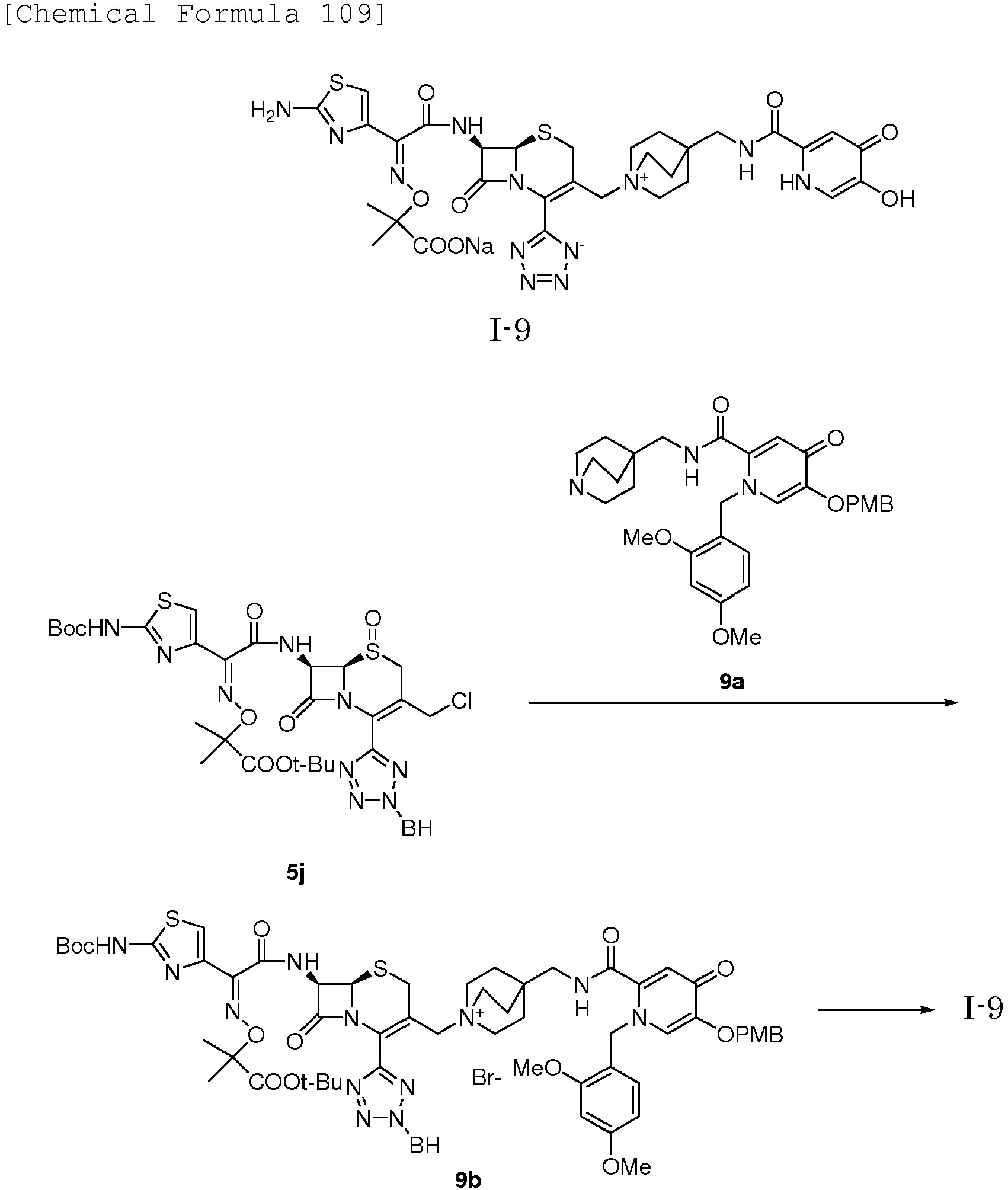
- Using Compound 5j (0.693 mg, 0.8 mmol), Compound 9a (438 mg, 1 mmol) and sodium bromide (165 mg, 1.6 mmol), Compound I-9 was synthesized according to a similar procedure as described in Step (8) of the synthesis of Compound I-5. (Yield: 249 mg, 39%)
1H-NMR (D2O) δ: 7.76 (1H, s), 7.08 (1H, s), 6.96 (1H, s), 5.90 (1H, d, J = 5.0 Hz), 5.57 (1H, d, J = 5.0 Hz), 4.64 (1H, d, J = 14.1 Hz), 4.03 (1H, d, J = 17.0 Hz), 3.92 (1H, d, J = 14.1 Hz), 3.65 (1H, d, J = 17.0 Hz), 3.43-3.29 (5H, br m), 3.18-3.04 (3H, br m), 1.91-1.76 (6H, br m), 1.52 (3H, s), 1.49 (3H, s).
Elemental analysis for: C31H35N12O8S2Na (H2O) 5.8
Calcd.: C, 41.59; H, 5.11; N, 18.75; S, 7.14; ;Na, 2.66 (%)
Found.: C, 41.59; H, 5.25; N, 18.77; S, 7.16; Na, 2.57 (%) MS (M+H) =769.35 -

- Using Compound 5j (0.693 mg, 0.8 mmol), Compound 10a (441 mg, 1 mmol) and sodium bromide (165 mg, 1.6 mmol), Compound I-10 was synthesized according to a similar procedure as described in Step (8) of the synthesis of Compound I-5. (Yield: 348 mg, 53%)
1H-NMR (D2O) δ: 6.95 (1H, s), 6.91 (1H, d, J = 8.6 Hz), 6.87 (1H, d, J = 8.6 Hz), 5.90 (1H, d, J = 5.0 Hz), 5.56 (1H, d, J = 5.0 Hz), 4.64 (1H, d, J = 14.2 Hz), 4.03 (1H, d, J = 17.1 Hz), 3.92 (1H, d, J = 14.2 Hz), 3.65 (1H, d, J = 17.1 Hz), 3.43-3.30 (3H, br m), 3.28 (2H, s), 3.20-3.02 (3H, br m), 1.90-1.76 (6H, br m), 1.52 (3H, s), 1.49 (3H, s).
Elemental analysis for: C32H35ClN11O8S2Na (H2O) 5.7
Calcd.: C, 41.42; H, 4.91; N, 16.56; S, 6.96; ;Na, 2.54; Cl, 4.19 (%)
Found.: C, 41.46; H, 5.05; N, 16.62; S, 6.92; Na, 2.48; Cl, 3.82 (%) -


- Compound 11a (2.73 g, 5.00 mmol) was dissolved in methylene chloride (300 ml), and N,N-ethylenediamine (655 µL, 6.00 mmol) was added thereto under ice-cooling. The solution was stirred overnight at room temperature. The reaction solution was diluted with methylene chloride, and washed sequentially with an aqueous 0.2 N sodium hydroxide solution, water and brine. The organic layer was dried with magnesium sulfate. Magnesium sulfate was filtered off, and the liquid was concentrated in vacuo. Diisopropyl ether was added threto, and the precipitated crystals were collected by filtration to yield Compound 11b (2.25 g, 90%). 1H-NMR (CDCl3) δ: 7.41 (1H, d, J = 8.56 Hz), 7.36-7.33 (4H, m), 6.94-6.90 (3H, m), 6.86-6.81 (3H, m), 5.07 (2H, s), 4.95 (2H, s), 3.83 (3H, s), 3.80 (3H, s), 3.49-3.54 (2H, m), 2.51 (2H, t, J = 5.96 Hz), 2.25 (6H, s).
- To a solution of Compound 11c (693 mg, 0.80 mmol) in dimethylformamide (1.5 mL) was added sodium iodide (240 mg, 1.60 mmol). The solution was stirred for 5 minutes at room temperature. The solution was cooled to 0°C, and Compound 11d (439 mg, 0.88 mmol) was added thereto. The solution was stirred for 6 hours at 0 to 10°C. Dimethylformamide (4.5 mL) was added thereto, and cooled to -40°C. Phosphate tribromide (151µL, 1.60 mmol) was added, and the solution was stirred for 30 minutes at -40°C. The reaction mixture was added slowly to a previously ice-cooled 5% brine containing sodium thiosulfate (1 g). The precipitated solid was collected by filtration, and washed with water. The solid was suspended in water, and freeze-dried to yield Compound 11e as a white solid. The resulting Compound 11e was used in the next step without further purification.
- All amount of the resulting Compound 11e was dissolved in methylene chloride (10 ml), and the solution was cooled to -40°C. Anisole (1.97 ml, 18.0 mmol) and a solution of 2M aluminum chloride in nitromethane (6.00 ml, 12.0 mmol) were added subsequently, and the solution was stirred for 1 hour at 0°C. The reaction solution was dissolved in water, a 2N hydrochloric acid and acetonitrile, and washed with diisopropyl ether. HP20-SS resin was added to the aqueous layer, and acetonitrile was removed in vacuo. The resulting mixture was purified by ODS column chromatography. To the solution of resulting desired compound, an aqueous 0.2 N sodium hydroxide was added to adjust pH to 6.0, and a piece of dry ice was then added. The resulting solution was concentrated in vacuo, and freeze-dried to yield Compound I-11 as a white powder.
Yield: 440.2 mg, (61%)
1H-NMR (D2O) δ: 6.95-6.90 (3H, m), 5.91 (1H, d, J = 5.03 Hz), 5.59 (1H, d, J = 5.03 Hz), 4.92 (1H, d, J = 14.49 Hz), 4.17 (1H, d, J = 13.42 Hz), 4.09 (1H, d, J = 17.08 Hz), 3.57-3.77 (3H, m), 3.50-3.42 (1H, m), 3.22-3.14 (1H, m), 3.07 (3H, s), 2.91 (3H, s), 1.52 (3H, s), 1.49 (3H, s). Elemental analysis for: C28H31.1ClN11O8S2Na0.9(H2O)5.2 Calcd.: C, 38.94; H,4.84; C, 4.10; N,17.84; S,7.43; Na, 2.40 (%)
Found.: C,39.03; H,4.80; Cl, 4.36; N,17.65; S,7.33; Na,2.35 (%) -


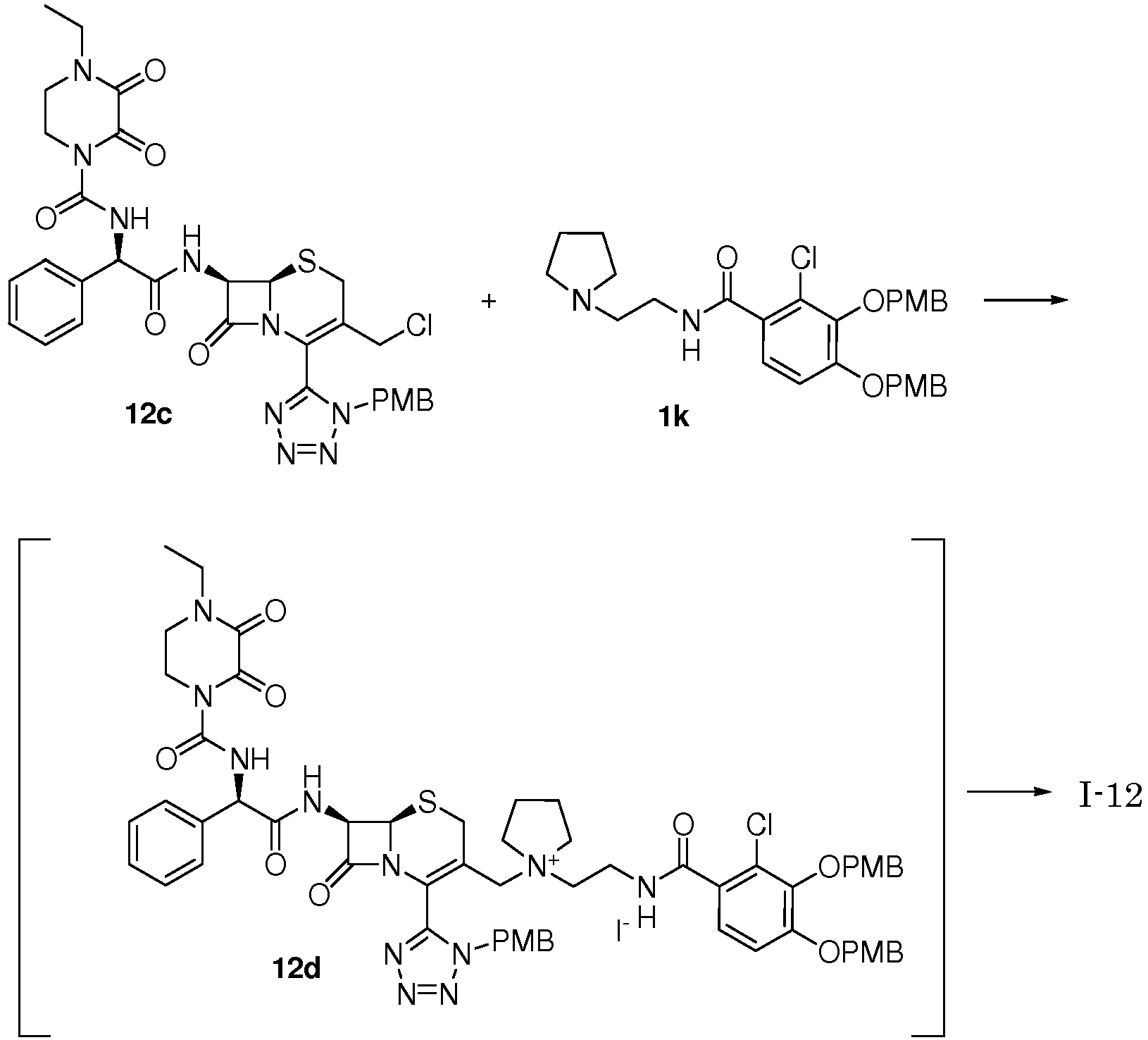
- Compound 12a (2.24 g, 7.00 mmol) was suspended in methylene chloride (20 ml), and oxalyl dichloride (735µL, 8.40 mmol) and a drop of dimethylformamide were added thereto under ice-cooling. The suspension was stirred for 3 hours at room temperature. Further, oxalyl dichloride (184µL, 2.10 mmol) was added thereto, and the mixture was stirred for 2 hours at room temperature. Toluene was added to the reaction solution, and the solution was concentrated in vacuo. Additional toluene was added thereto, and the solution was concentrated to yield Compound 12b (2.55 g, 108%). The resulting Compound 12b was used in the next step without further purification.
- All amount of the resulting Compound 12b was dissolved in methylene chloride (20 ml), and a solution of Compound 1g (2.00 g, 5.09 mmol) and pyridine (616µL, 7.64 mmol) in methylene chloride (20 ml) was added thereto at -40°C. The reaction solution was stirred for 1 hour at a temperature between -40°C and -30°C. The reaction solution was diluted with methylene chloride, the solution was washed sequentially with hydrochloric acid, a saturated aqueous sodium bicarbonate and brine, and the organic layer was dried with magnesium sulfate. Magnesium sulfate was filtered off, and the liquid was concentrated in vacuo, subjected to silica gel column chromatography, eluting with chloroform/methanol. A fraction containing the desired compound was concentrated in vacuo, and ethyl acetate/diisopropyl ether was added thereto, and the precipitated solid was collected by filtration to yield Compound 12c (2.86 g, 81%).
1H-NMR (CDCl3) δ: 9.81 (1H, d, J = 5.95 Hz), 7.44-7.27 (3H, m), 7.19-7.17 (2H, m), 7.08 (2H, d, J = 8.62 Hz), 6.84 (2H, d, J = 8.62 Hz), 5.85-5.80 (2H, m), 5.72 (1H, d, J = 15.86 Hz), 5.41 (1H, d, J = 6.25 Hz), 5.29 (1H, d, J = 15.25 Hz), 4.77 (1H, d, J = 4.88 Hz), 4.24-4.07 (3H, m), 3.94-3.80 (2H, m), 3.78 (3H, s), 3.71-3.43 (5H, m), 1.27 (3H, t, J = 7.17 Hz). - Using Compound 12c (694 mg, 1.00 mmol) and Compound 1k (578 mg, 1.10 mmol), Compound I-12 was synthesized according to a similar procedure as described in Step (8) of the synthesis of Compound I-1.
Yield: 207.2 g, (18%)
1H-NMR (DMSO-d6) δ: 9.85 (1H, d, J = 7.24 Hz), 9.47 (1H, d, J = 8.27 Hz), 8.29 (1H, s), 7.45-7.30 (5H, m), 6.74 (2H, s), 5.73 (1H, dd, J = 8.27, 5.07 Hz), 5.63 (1H, d, J = 7.24 Hz), 5.26 (1H, d, J = 5.07 Hz), 5.13 (1H, d, J = 14.18 Hz), 4.04-3.84 (4H, m), 3.62-3.53 (4H, m), 1.95-1.67 (3H, m), 1.08 (3H, t, J = 7.09 Hz).
Elemental analysis for: C36H40ClN11O8S(H2O)3.1
Calcd.: C,49.24; H,5.30; Cl,4.04; N,17.55; S,3.65 (%)
Found.: C,49.24; H,5.26; Cl, 4.05; N,17.42; S,3.61 (%) -


- Using Compound 5j (0.866 mg, 1 mmol) and Compound 13a (537 mg, 1 mmol), Compound I-13 was synthesized according to a similar procedure as described in Step (8) of the synthesis of Compound I-5. (Yield: 398 mg, 49%).
1H-NMR (D2O) δ: 7.04 (1H, s), 6.96 (1H, s), 6.88 (1H, s), 5.91 (1H, d, J = 5.1 Hz), 5.58 (1H, d, J = 5.1 Hz), 4.94 (1H, d, J = 14.1 Hz), 4.27 (1H, d, J = 14.1 Hz), 4.17-3.85 (2H, m), 3.84-3.40 (7H, m), 3.37-3.00 (3H, m), 2.25-1.75 (3H, m), 1.52 (3H, s), 1.37 (3H, dd, J = 41.8, 29.5 Hz). Elemental analysis for: C31H33ClN11O8S2Na (H2O) 5.4 (NaHCO3) 0.1
Calcd.: C, 40.61; H, 4.76; N, 16.99; S, 7.02; ;Na, 2.98; Cl, 4.27 (%)
Found.: C, 40.78; H, 4.83; N, 16.82; S, 7.00; Na, 2.76; Cl, 3.87 (%)
MS (M+H) =788.34 -

- Using Compound 3c (954 mg, 1.00 mmol) and Compound 2d (551 mg, 1.00 mmol), Compound I-14 was synthesized according to a similar procedure as described in Step (8) of the synthesis of Compound I-1.
Yield: 324.6 g, (31%)
1H-NMR (D2O) δ: 6.98 (1H, s), 6.87 (2H, s), 5.85 (1H, d, J = 4.96 Hz), 5.55 (1H, d, J = 4.96 Hz), 4.99-4.95 (1H, m), 4.62 (1H, d, J = 14.18 Hz), 4.19-4.02 (4H, m), 3.74 (1H, d, J = 16.01 Hz), 3.66-3.62 (1H, m), 2.94 (3H, br s), 2.79-2.55 (5H, m), 2.37-2.30 (2H, m), 2.02-2.15 (2H, m).
Elemental analysis for: C32H32.1ClN11O10S2Na1.9 (H2O) 7.3 Calcd.: C,38.22; H,4.68; Cl, 3.53; N,15.32; S, 6.38; Na,4.34 (%)
Found.: C,38.21; H,4.60; Cl, 3.55; N,15.26; S, 6.25; Na,4.30 (%) -


- Compound 15a (5.00 g, 11.66 mmol) was suspended in methylene chloride (50 ml), and then 1-chloro-N,N,2-trimethyl-1-propenylamine (1.70 ml, 12.82 mmol) was added thereto under ice-cooling, and the solution was stirred for 30 minutes at room temperature. 4-Aminopyridine (1.32 g, 13.99 mmol) was added thereto under ice-cooling, and then the solution was stirred overnight at room temperature. The reaction solution was diluted with methylene chloride, and washed sequentially with a saturated sodium hydrogen carbonatewater solutio and brine, and then the organic layer was dried with magnesium sulfate. Magnesium sulfate was filtered off, and the liquid was concentrated in vacuo, and methylene chloride was added to the residue, and the precipitated solid was collected by filtration to yield Compound 15b (2.23 g, 38%).
1H-NMR (CDCl3) δ: 8.53 (2H, dd, J = 4.87, 1.51 Hz), 8.23 (1H, br s), 7.58-7.55 (3H, m), 7.31-7.38 (4H, m), 7.00 (1H, d, J = 8.73 Hz), 6.93 (2H, d, J = 8.73 Hz), 6.83 (2H, d, J = 8.73 Hz), 5.12 (2H, s), 4.98 (2H, s), 3.83 (3H, s), 3.80 (3H, s). - To a solution of Compound 15c (693 mg, 0.80 mmol) in dimethylformamide (1.5 mL), sodium iodide (240 mg, 1.60 mmol) was added, and the mixture was stirred for 5 minutes at room temperature. After cooling the solution to 0°C, Compound 15b (444 mg, 0.88 mmol) was added and the solution was stirred for 6 hours at room temperature. Dimethylformamide (4.5 mL) was added, and the solution was cooled to -40°C. Phosphorus tribromide (151µL, 1.60 mmol) was added thereto, and the solution was stirred for 30 minutes at -40°C. The reaction mixture was added slowly to ice-cooled 5% brine containing sodium thiosulfate (1 g). The precipitated solid was collected by filtration, and washed with water, and then suspended in water. The suspension was freeze-dried to yield Compound 15d as a pale yellow solid. The resulting Compound 15d was used in the next step without further purification.
- All amount of the resulting Compound 15d was dissolved in methylene chloride (10 ml), and the solution was cooled to -40°C. Anisole (1.97 ml, 18.0 mmol) and a solution of 2M aluminum chloride in nitromethane (6.00 ml, 12.0 mmol) were added subsequently, and the solution was stirred for 1 hour at 0°C. The reaction solution was dissolved in water, an aqueous 2N hydrochloric acid solution and acetonitrile, and the solution was washed with diisopropyl ether. HP20-SS resin was added to the aqueous layer, and acetonitrile was removed in vacuo. The resulting mixture was purified by ODS column chromatography. To a solution of the resulting desired compound, an aqueous 0.2 N sodium hydroxide solution was added to adjust pH to 6.0, and a piece of dry ice was added. The resulting solution was concentrated in vacuo, and then freeze-dried to yield Compound I-15 as a yellow powder.
Yield: 445.3 mg, (47%)
1H-NMR (D2O) δ: 8.62 (2H, d, J = 7.02 Hz), 8.12 (2H, d, J = 7.02 Hz), 7.14 (1H, d, J = 8.16 Hz), 6.95 (1H, s), 6.90 (1H, d, J = 8.16 Hz), 5.93 (1H, d, J = 4.80 Hz), 5.51 (1H, d, J = 4.80 Hz), 5.35 (1H, d, J = 14.72 Hz), 5.25 (1H, d, J = 14.72 Hz), 3.75 (1H, d, J = 17.16 Hz), 3.47 (1H, d, J = 17.16 Hz), 1.50 (3H, s), 1.47 (3H, s).
Elemental analysis for: C29H25ClN11O8S2Na(H2O)5.1
Calcd.: C,40.03; H,4.08; Cl,4.07; N,17.71; S,7.37; Na,2.64 (%)
Found.: C,40.06; H,4.04; Cl, 4.11; N,17.70; S,7.32; Na,2.50 (%) -

- Using Compound 11c (693 mg, 0.80 mmol) and Compound 16a (482 mg, 0.88 mmol), Compound I-16was synthesized according to a similar procedure as described in Step (2) of the synthesis of Compound I-15.
Yield: 239.7 mg, (32%)
1H-NMR (D2O) δ: 7.54 (1H, s), 7.14 (1H, d, J = 8.77 Hz), 6.96 (1H, s), 6.93 (1H, d, J = 8.77 Hz), 5.89 (1H, d, J = 4.19 Hz), 5.48 (1H, d, J = 4.19 Hz), 5.10 (1H, d, J = 15.40 Hz), 3.99 (2H, br s), 3.74 (1H, d, J = 18.23 Hz), 3.52 (1H, d, J = 18.23 Hz), 2.79-2.62 (2H, m), 1.91-2.06 (4H, m), 1.51 (3H, s), 1.48 (3H, s).
Elemental analysis for: C31H30.1ClN12O8S2Na0.9(H2O)5.6
Calcd.: C,40.47; H,4.53; Cl,3.85; N,18.27; S,6.97; Na,2.25 (%)
Found.: C,40.56; H,4.57; Cl, 3.93; N,18.17; S,6.82; Na,2.16 (%) -


- Compound I-17was synthesized according to a similar procedure as described in Step (2) of the synthesis of Compound I-15 using Compound 11c (693 mg, 0.80 mmol) and Compound 17a (503 mg, 0.88 mmol).
Yield: 485.9 mg, (62%)
1H-NMR (D2O) δ: 9.00 (1H, s), 8.18 (1H, d, J = 7.22 Hz), 7.93 (1H, d, J = 7.22 Hz), 7.86 (1H, d, J = 3.36 Hz), 7.07 (1H, d, J = 3.36 Hz), 6.95 (1H, s), 6.77 (1H, d, J = 8.39 Hz), 6.60 (1H, d, J = 8.39 Hz), 5.91 (1H, d, J = 4.95 Hz), 5.46 (1H, d, J = 14.94 Hz), 5.37 (1H, d, J = 4.95 Hz), 5.28 (1H, d, J = 14.94 Hz), 4.61 (2H, t, J = 5.04 Hz), 3.84 (2H, t, J = 5.04 Hz), 3.39 (1H, d, J = 18.13 Hz), 3.30 (1H, d, J = 18.13 Hz), 1.45 (6H, s).
Elemental analysis for: C33H30.2ClN12O8S2Na0.8(H2O)4.6
Calcd.: C,42.91; H,4.30; Cl, 3.84; N,18.20; S,6.94; Na, 1.99 (%)
Found.: C,43.15; H,4.32; Cl, 3.99; N,17.92; S,6.66; Na, 2.08 (%) -

- Compound 5j (0.866 g, 1.00 mmol) was dissolved in N,N-dimethylformamide (3.0mL), and the solution was cooled to 10°C. Sodium bromide (0.3 g, 2.00 mmol) and Compound 18a (525 mg, 1.00 mmol) were added thereto, and the solution was stirred overnight at the same temperature. To the reaction solution, N,N-dimethylformamide (3.0mL) was added, and the solution was cooled to -30°C. Potassium iodide (930 mg, 5.6 mmol) and acetyl chloride (0.228 mL, 3.20 mmol) were added sequentially, and the mixture was stirred for 7 hours at 0°C. The reaction solution was added to an aqueous 5% sodium hydrogen sulfite (30mL). The precipitated solid was collected by filtration, and washed with purified water, and dried in vacuo. The resulting powder was dissolved in dichloromethane (15 mL), and the solution was cooled to -40°C. Anisole (1.09 mL, 10mol) and a solution of 2 mol/L aluminum chloride in nitromethane (5 mL, 10 mmol) were added thereto, and the solution was stirred for 50 minutes at 0°C. To the reaction solution, purified water (30mL) and diisopropyl ether (50mL) were added. To the reaction solution, acetonitrile and 2N hydrochloric acid were added to dissolve the precipitated substance, and the aqueous layer was then separated. The organic layer was extracted with a mixture of water/acetonitrile/diluted hydrochloric acid, and HP20SS was added to the combined aqueous layers, and the mixture was concentrated. The concentrated suspension was subjected to reverse phase column chromatography, eluting with water-acetonitrile to collect fractions containing Compound I-18 or Compound I-19. To each fraction, 0.2 N aqueous sodium hydroxide was added dropwise, and pH was adjusted to 5.3, and the solution was concentrated in vacuo. The each concentrated solution was freeze-dried to yield Compound I-18 and Compound I-19 as a powder.
(Compound I-18; Yield: 172 mg, 27%, Compound I-19; Yield: 122 mg, 19%)
Compound I-18
1H-NMR (D2O) δ: 7.68 (1H, s), 7.39 (1H, s), 6.97 (1H, s), 5.90 (1H, d, J = 4.8 Hz), 5.57 (1H, d, J = 4.8 Hz), 4.64 (1H, d, J = 14.4 Hz), 4.04 (1H, d, J = 17.2 Hz), 3.92 (1H, d, J = 14.4 Hz), 3.65 (1H, d, J = 17.2 Hz), 3.44-3.31 (5H, m), 3.19-3.04 (3H, m), 1.90-1.76 (6H, m), 1.51 (3H, s), 1.49 (3H, s).
MS (m+1) = 785.38
Compound I-19
1H-NMR (D2O) δ: 7.68 (1H, s), 7.39 (1H, s), 6.98 (1H, s), 6.15 (1H, d, J = 4.9 Hz), 5.35 (1H, d, J = 4.9 Hz), 4.96 (1H, d, J = 14.4 Hz), 4.23 (1H, d, J = 17.6 Hz), 3.96-3.80 (2H, m), 3.48-3.27 (5H, m), 3.21-3.05 (4H, m), 1.89-1.75 (3H, m), 1.83 (6H, s), 1.53 (3H, s), 1.50 (3H, s).
MS (m+1) = 801.14 -


- To a solution of Compound 22a (29.6 g) in toluene (300 mL), 2,2-dimethoxyethylamine (25.9 g) was added. A Dean-Stark trap was attached, and the mixture was heated to reflux for 2.5 hours. The solvent was removed, and the residue was dissolved in ethyl acetate. The solution was washed with water and brine. This solution was dried with anhydrous magnesium sulfate, filtered and concentrated to yield a crude product 22b.
- The crude product 22b obtained above was dissolved in ethanol (150 mL), sodium boron hydride (13.5 g, 92wt%) was added thereto. The mixture was stirred for 2 hours at room temperature, and then allowed to stand overnight. Water was added carefully to the reaction solution, and then the solution was eluted with dichloromethane three times. The organic layer was dried with anhydrous magnesium sulfate, filtered, and concentrated to yield crude product 22c.
- The crude product 22c obtained above was dissolved in dichloromethane (300 mL), and pyridine (16.9 g) and p-toluenesulfonyl chloride (37.5 g) were added to the solution under ice-cooling. The reaction solution was stirred for 2 hours at room temperature, and water was added thereto. The organic layer was washed with aqueous sodium bicarbonate and brine, and dried with anhydrous magnesium sulfate, filtered, and concentrated. The residue was purified by silica gel column chromatography to yield Compound 22d (53.6 g, 3 steps 77%).
1H-NMR (CDCl3) δ: 2.21 (3H, s), 2.44 (3H, s), 3.15 (1H, d, J = 5.40 Hz), 3.18 (6H, s), 3.75 (3H, s), 3.83 (3H, s), 4.21 (1H, t, J = 5.40 Hz), 4.33 (2H, s), 6.67 (1H, d, J = 8.40 Hz), 6.88 (1H, d, J = 8.40 Hz), 7.30 (2H, dd, J = 1.80, 6.60 Hz), 7.71 (1H, dd, 1.80, 6.60 Hz). - To a solution of Compound 22d (52.6 g) in 1,4-dioxane (500 mL), 6N hydrochloric acid (93 mL) was added, and the solution was heated to reflux for 3 hours. The solution was cooled to room temperature, and the solvent was removed. The residue was diluted diethyl ether and hexane. This solution was eluted with water three times. The aqueous layer was neutralized with 5N an aqueous sodium hydroxide solution, and eluted with dichloromethane. The organic layer was dried with anhydrous magnesium sulfate, filtered, and concentrated. The residue was purified by silica gel column chromatography to yield Compound 22e (20.8 g, 82%). 1H-NMR (CDCl3) δ: 2.67 (3H, s), 3.86 (3H, s), 4.00 (3H, s), 6.97 (1H, s), 7.49 (1H, d, J = 5.70 Hz), 8.42 (1H, d, J = 5.70 Hz), 9.25 (1H, s).
- To a solution of Compound 22e (6.0 g) in dichloromethane (60 mL), boron tribromide (18.5 g) was added dropwise under ice-cooling. The reaction solution was stirred for 1 hour at room temperature, and cooled to -50°C. Methanol was added carefully to degrade excess boron tribromide, and the solvent was removed. Ethyl acetate was added to the residue, and the precipitated solid was collected by filtration. Dryness in vacuo yields Compound 22f (6.6 g, 87%).
1H-NMR (DMSO-d6) δ: 2.57 (3H, s), 7.36 (1H, s), 8.14 (1H, d, J = 6.30 Hz), 8.32 (1H, d, J = 6.30 Hz), 9.37 (1H, s). - Compound 22f (6.6 g) was heated to dissolve in water (150 mL), and activated carbon was added to the solution. The solution was filtered through celite, and 28% ammonia water was added to the resulting filtrate to adjust pH to 8. The precipitated solid was collected by filtration, and dried in vacuo to yield Compound 22g (4.9 g, 109%).
1H-NMR (DMSO-d6) δ: 2.49 (3H, s), 6.93 (1H, s), 7.44 (1H, d, J = 5.70 Hz), 8.14 (1H, d, J = 5.70 Hz), 9.01 (1H, s). - To a solution of Compound 22g (1.0 g) in dichloromethane (10 mL), di-t-butyl dicarbonate (2.87 g) and N,N-diaminopyridine (35 mg) were added, and the solution was stirred for 1 hour at room temperature. Further, di-t-butyl dicarbonate (872 mg) was added, and the solution was stirred for 1 hour. The reaction solution was concentrated, and the resulting residue was purified by silica gel column chromatography to yield Compound 22h (1.76 g, 82%).
1H-NMR (CDCl3) δ: 1.58 (9H, s), 1.58 (9H, s), 2.67 (3H, s), 7.59 (2H, m), 8.54 (1H, d, J = 5.70 Hz), 9.40 (1H, s). -


- To a solution of Compound 5j (693 mg, 0.80 mmol) in dimethylformamide (1.5 mL), sodium iodide (240 mg, 1.60 mmol) was added, and the mixture was stirred for 5 minutes at room temperature. After cooling the solution to 0°C, Compound 22h (240 mg, 0.64 mmol) was added, and the mixture was stirred for 6 hours at room temperature. Dimethylformamide (4.5 mL) was added, and the solution was cooled to -40°C. Phosphorus tribromide (151 µL, 1.60 mmol) was added thereto, and the solution was stirred for 30 minutes at -40°C. The reaction mixture was added slowly to ice-cooled 5% brine containing sodium thiosulfate (1 g). The precipitated solid was collected by filtration, and washed with water, and suspended in water. The suspension was freeze-dried to yield Compound 22i as a yellow solid. The resulting Compound 22i was used in the next step without further purification.
- All amount of the resulting Compound 22i was dissolved in methylene chloride (10 ml), and the solution was cooled to -40°C. Anisole (1.97 ml, 18.0 mmol) and a solution of 2M aluminum chloride in nitromethane (6.00 ml, 12.0 mmol) were added subsequently, and the solution was stirred for 1 hour at 0°C. The reaction solution was dissolved in water, an aqueous 2N hydrochloric acid solution and acetonitrile, and then the solution was washed with diisopropyl ether. HP20-SS resin was added to the aqueous layer, and acetonitrile was removed in vacuo. The resulting mixture was purified by ODS column chromatography. To a solution of the resulting desired compound, an aqueous 0.2 N sodium hydroxide was added to adjust pH to 6.0, and a piece of dry ice was added. The resulting solution was concentrated in vacuo, and freeze-dried to yield Compound I-22as a yellow powder. Yield: 47 mg, (6%)
1H-NMR (D2O) δ: 8.68 (1H, s), 7.80 (1H, d, J = 6.29 Hz), 7.58 (1H, d, J = 6.29 Hz), 6.93 (1H, s), 6.83 (1H, s), 5.89 (1H, d, J = 4.70 Hz), 5.47 (1H, d, J = 4.70 Hz), 5.32 (1H, d, J = 14.60 Hz), 5.15 (1H, d, J = 14.60 Hz), 3.70 (1H, d, J = 17.88 Hz), 3.48 (1H, d, J = 17.88 Hz), 2.39 (3H, s), 1.48 (3H, s), 1.46 (3H, s).
Elemental analysis for: C27H25N10O7S2Na (H2O)5 (NaHC03) 0.6 Calcd.: C,39.98; H,4.33; N,18.89; S,7.73; Na,4.44 (%) Found.: C,39.98; H,4.53; N,18.99; S,7.83; Na,4.41 (%) -


- Compound 23a (10.19 g, 24.0 mmol) in dichloromethane (100 mL) was added with Compound 23b (9.62 g, 48.0 mmol) and stirred overnight at room temperature. The solvent was removed under reduced pressure, and the residue was added with water and extracted with ethyl acetate. The organic layer was washed sequentially with water and brine, and dried over anhydrous magnesium sulfate. Inorganic substances were filtered off, and the filtrate was dried under reduced pressure. The crude product thus obtained was purified by silica gel column chromatography (hexane-ethyl acetate) to yield Compound 23c (4.45 g, 39%) as an orange oil.
1H-NMR (CDCl3) δ: 1.55 (9H, s), 2.54 (1H, t, J = 6.65 Hz), 3.80 (3H, s), 3.83 (3H, s), 4.52 (2H, d, J = 6.65 Hz), 5.00 (2H, s), 5.05 (2H, s), 6.81 (2H, d, J = 8.66 Hz), 6.90 (2H, d, J = 8.66 Hz), 7.00 (1H, d, J = 8.28 Hz), 7.08 (1H, d, J = 8.28 Hz), 7.29 (2H, d, J = 8.53 Hz), 7.35 (2H, d, J = 8.53 Hz). - After cooling a solution of Compound 23c (4.45 g, 9.26 mmol) in dichloromethane (45 mL) to 0°C, Dess-Martin Periodinane (4.32 g, 10.19 mmol) was added and stirred overnight at room temperature. Water was added to the reaction mixture, and dichloromethane was removed under reduced pressure. The residue was extracted with ethyl acetate. The organic layer was washed sequentially with water and brine, and dried over anhydrous magnesium sulfate. Inorganic substances were filtered off, and the filtrate was dried under reduced pressure. The crude product thus obtained was purified by silica gel column chromatography (hexane-ethyl acetate) to yield Compound 23d (2.91 g, 66%) as a white solid.
1H-NMR (CDCl3) δ: 1.56 (9H, s), 3.80 (3H, s), 3.84 (3H, s), 4.97 (2H, s), 5.14 (2H, s), 6.80 (2H, d, J = 8.08 Hz), 6.93 (2H, d, J = 8.34 Hz), 7.10 (1H, d, J = 8.34 Hz), 7.26-7.28 (2H, m), 7.37 (2H, d, J = 8.34 Hz), 7.60 (1H, d, J = 8.34 Hz), 9.88 (1H, s). - Compound 23d (2.91 g, 6.08 mmol) was dissolved in a mixture of 1,4-doxane (30mL) water (10 mL) and cooled to 0°C. Amidosulfuric acid (1.18 g, 12.16 mmol) and sodium chlorite (1.38 g, 12.16 mmol) were added sequentially, and the mixture was stirred at 0°C for 30 minutes. The reaction mixture was added slowly with aqueous sodium bisulfite (2.53 g, 24.32 mmol) and extracted with ethyl acetate. The organic layer was washed sequentially with water and brine, and dried over anhydrous magnesium sulfate. Inorganic substances were filtered off, and the filtrate was dried under reduced pressure. The residue thus obtained was added with diisopropyl ether, and the obtained solid was filtered to yield Compound 23e (2.79 g, 93%) as a white solid.
1H-NMR (DMSO-D6) δ: 1.45 (9H, s), 3.74 (3H, s), 3.78 (3H, s), 4.84 (2H, s), 5.19 (2H, s), 6.83 (2H, d, J = 8.66 Hz), 6.98 (2H, d, J = 8.78 Hz), 7.20 (2H, d, J = 8.66 Hz), 7.31 (1H, d, J = 8.78 Hz), 7.46 (2H, d, J = 8.66 Hz), 7.69 (1H, d, J = 8.66 Hz). - After cooling a solution of Compound 23e (989 mg, 2.0 mmol) in dimethylformamide (3 mL) to 0°C, 1-hydroxybenzotriazole (324 mg, 2.4 mmol), 1-(2-aminoethyl) pyrrolidine (301 µL, 2.4 mmol), EDC•HCl (460 mg, 2.4 mmol) were added sequentially, and the solution was stirred at room temperature for 4.5 hours. Ice water was added to the reaction mixture and extracted with ethyl acetate. The organic layer was washed sequentially with 1 mol/L aqueous sodium hydroxide, water and brine, and dried over anhydrous magnesium sulfate. Inorganic substances were filtered off, and the filtrate was concentrated at 25 °C under reduced pressure. The residue was dried under reduced pressure to yield Compound 23f (1.16 g, 98%) as a yellow oil.
1H-NMR (CDCl3) δ: 1.53 (9H, s), 1.79 (4H, br s), 2.58 (4H, br s), 2.70 (2H, t, J = 5.81 Hz), 3.52 (2H, q, J = 5.56 Hz), 3.79 (3H, s), 3.83 (3H, s), 4.97 (2H, s), 5.07 (2H, s), 6.80 (2H, d, J = 8.34 Hz), 6.91 (2H, d, J = 8.34 Hz), 6.96 (1H, d, J = 8.59 Hz), 7.29 (2H, d, J = 8.34 Hz), 7.33-7.36 (3H, m). - After cooling a solution of Compound 23f (473 mg, 0.80 mmol) in DMA (1.5 mL) to 10°C, Compound 23g (693 mg, 0.80 mmol) was added, and the solution was degassed under reduced pressure. Sodium iodide (240 mg, 1.6 mmol) was added and stirred at 15°C for 6 hours. After addition of DMF (4.5 mL), the solution was cooled to -40°C. Phosphorus tribromide (151 µL, 1.6 mmol) was added and stirred at - 40°C for 30 minutes. The reaction mixture was added slowly to 5% sodium chloride solution. The precipitated solid was filtered and washed with water and suspended in water. The suspension was freeze-dried to yield Compound 23h as a brown solid. The obtained Compound 23h was used directly in the next step without purification.
- After the whole amount of Compound 23h was dissolved in dichloromethane (10 mL) and the solution was cooled to - 40°C, anisole (1.05 mL, 9.6 mmol) and 2 mol/L L-aluminum chloride/nitromethane solution (4.80 mL , 9.6 mmol) were sequentially, and the solution was stirred at 0°C for 30 minutes. The reaction mixture was added with diisopropyl ether and small amount of water and stirred to result precipitates. The supernatant was removed by decantation. The insoluble material retained in the container was added with acetonitrile and stirred to make it completely dissolved. Diisopropyl ether was added to separate aqueous layer. The organic layer was re-extracted with water, and the aqueous layers were combined. HP20-SS resin was added and acetonitrile was removed under reduced pressure. The obtained mixed solution was purified by ODS column chromatography (water-acetonitrile). 0.2 mol/L aqueous sodium hydroxide solution was added to the desired fraction to adjust pH = 6.0, small amount of dry ice was added. The obtained solution was concentrated under reduced pressure and freeze-dried to yield Compound I-23(279 mg, 42%) as a yellow powder.
1H-NMR (D2O) δ: 1.29 (1H, br s), 1.49 (3H, s), 1.51 (3H, s), 1.94-2.05 (2H, br m), 2.09-2.19 (1H, br m), 3.31-3.61 (9H, m), 3.79 (1H, d, J = 17.19 Hz), 4.12-4.16 (2H, m), 5.61 (1H, d, J = 5.02 Hz), 5.93 (1H, d, J = 5.02 Hz), 6.71 (1H, d, J = 8.16 Hz), 6.97-6.99 (2H, m).
MS (m+1) = 786.07
Elemental analysis for: C31H33N11O10S2Na2•6.2H2O
Calcd.: C,39.55; H,4.86; N,16.37; Na,4.88; S,6.81 (%)
Found.: C,39.55; H,4.99; N,16.46; Na,4.92; S,6.61 (%) -

- According to a similar procedure as described in Step (5) in Example 23 using Compound 24a (694 mg, 0.80 mmol) and Compound 23f (473 mg, 0.80 mmol), Compound I-24 (158 mg, 24%) was obtained as a yellow powder.
1H-NMR (D2O) δ: 1.29 (1H, br s), 1.53 (3H, s), 1.55 (3H, s), 1.94-2.05 (2H, br m), 2.10-2.18 (1H, br m), 3.33-3.61 (9H, m), 3.79 (1H, d, J = 17.19 Hz), 4.14 (2H, d, J = 16.06 Hz), 5.61 (1H, d, J = 5.02 Hz), 5.96 (1H, d, J = 5.02 Hz), 6.71 (1H, d, J = 8.16 Hz), 6.98 (1H, d, J = 8.16 Hz).
MS (m+1) = 787.08
Elemental analysis for: C30H32N12O10S2Na2•6.5H2O
Calcd.: C,38.01; H,4.79; N,17.73; Na,4.85; S,6.77 (%) Found.: C,37.93; H,4.79; N,17.90; Na,4.96; S,6.69 (%) - The compounds described in the following Examples were synthesized according to similar procedures as described above.
-

Elemental analysis for C31H33N11O10S2Na2(H2O)6.6
Calcd.: C,39.25; H,4.91; N,16.24; S,6.76; Na,4.85 (%) Found.: C,39.18; H,4.81; N,16.48; S,6.48; Na,4.60 (%) -

Calcd.: C,39.69; H,4.32; Cl, 3.78; N,16.42; S, 6.84; Na,4.90 (%)
Found.: C,39.43; H,4.30; Cl, 3.86; N,16.72; S,6.89; Na,4.79 (%) -

-

MS (m+1) = 830.06 -


MS (m+1) = 822.18 -

-


MS (m+1) = 803.86 -

MS (m+1) = 824.02 -


MS (m+1) = 820.13 -

MS (m+1) = 806.38 -


MS (m+1) = 796.04 -

MS (m+1) = 789.96 -

MS (m+1) = 686.96 -

MS (m+1) = 701.00 -

MS (m+1) 756.42 -

MS (m+1) 771.38 -

MS (m+1) 790.52 -


MS (m+1) 762.47 -
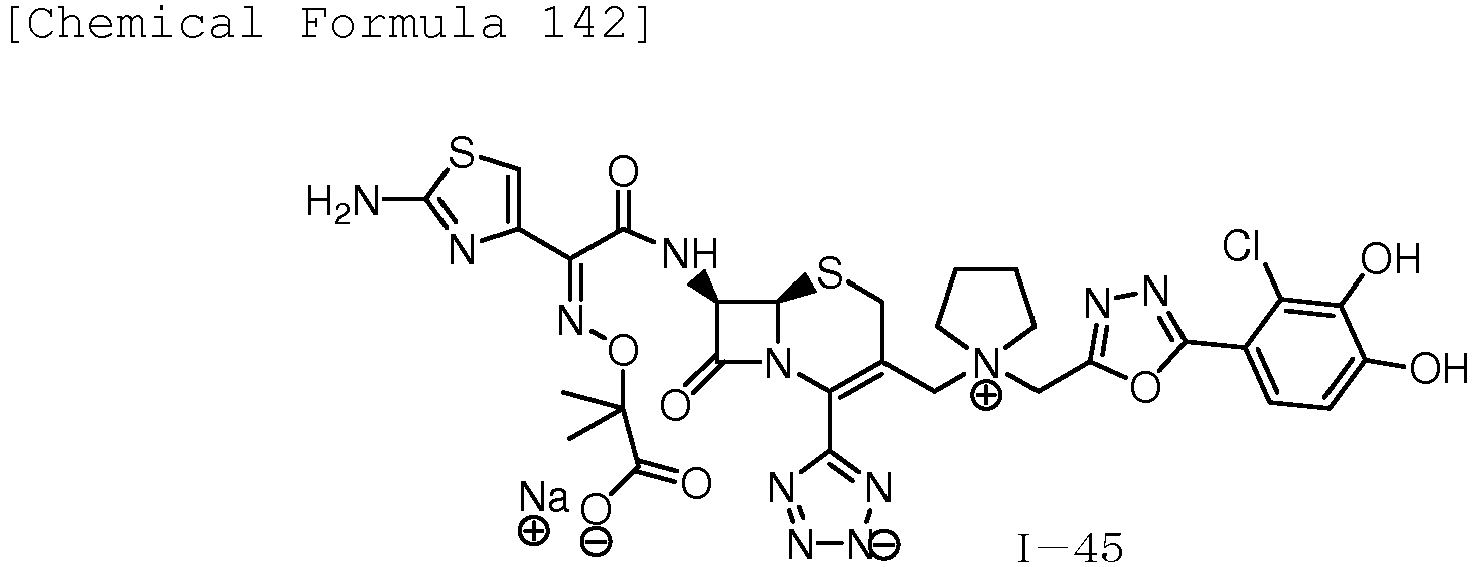
MS (m+1) 787.49 -


-
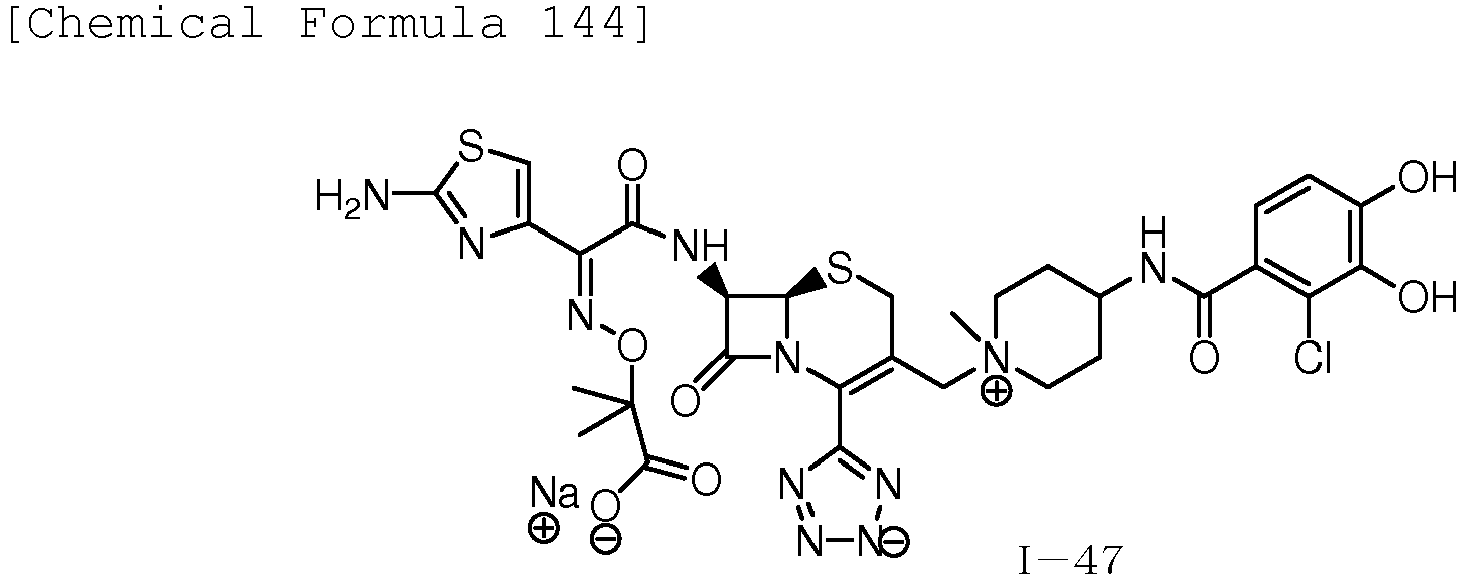
-


MS (m+1) 741.35 -

MS (m+1) 742.44 -


MS (m+1) 776.54 -
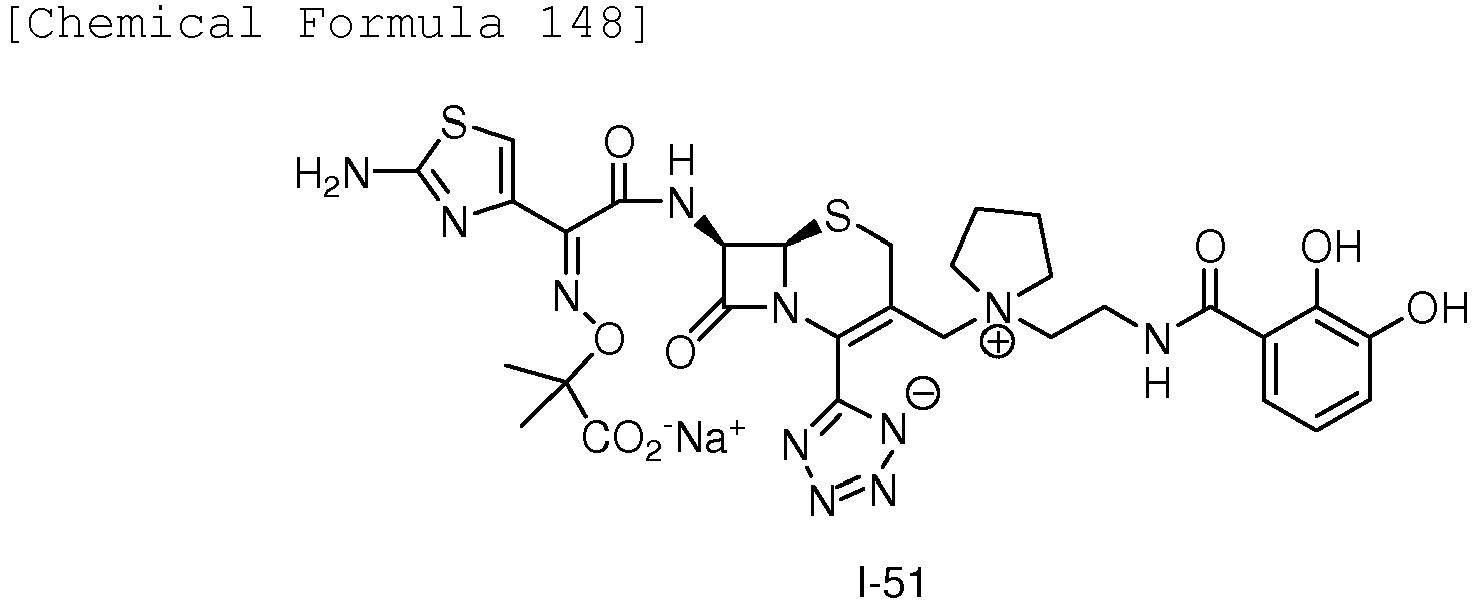
MS (m+1) 742.57 -


MS (m+1) = 776.56 -

Calcd.: C,37.82; H,4.60; N,16.01; S,6.66; Na, 3.11 (%)
Found.: C,37.69; H,4.59; N,16.25; S,6.62; Na, 3.34 (%) -


MS (m+1) = 760.60 -

MS (m+1) = 760.63 -

Elemental analysis for C30H33FN11O8S2Na(H2O)5.3
Calcd.: C,41.10; H,4.93; F, 2.23; N,17.62; S,7.24; Na, 2.70 (%)
Found.: C, 41.07; H,5.01; F, 2.17; N,17.56; S,7.31; Na, 2.62 (%) -

MS (m+1) = 818.33 -

MS (m+1) = 809.36 -

MS (m+1) = 820.02 -
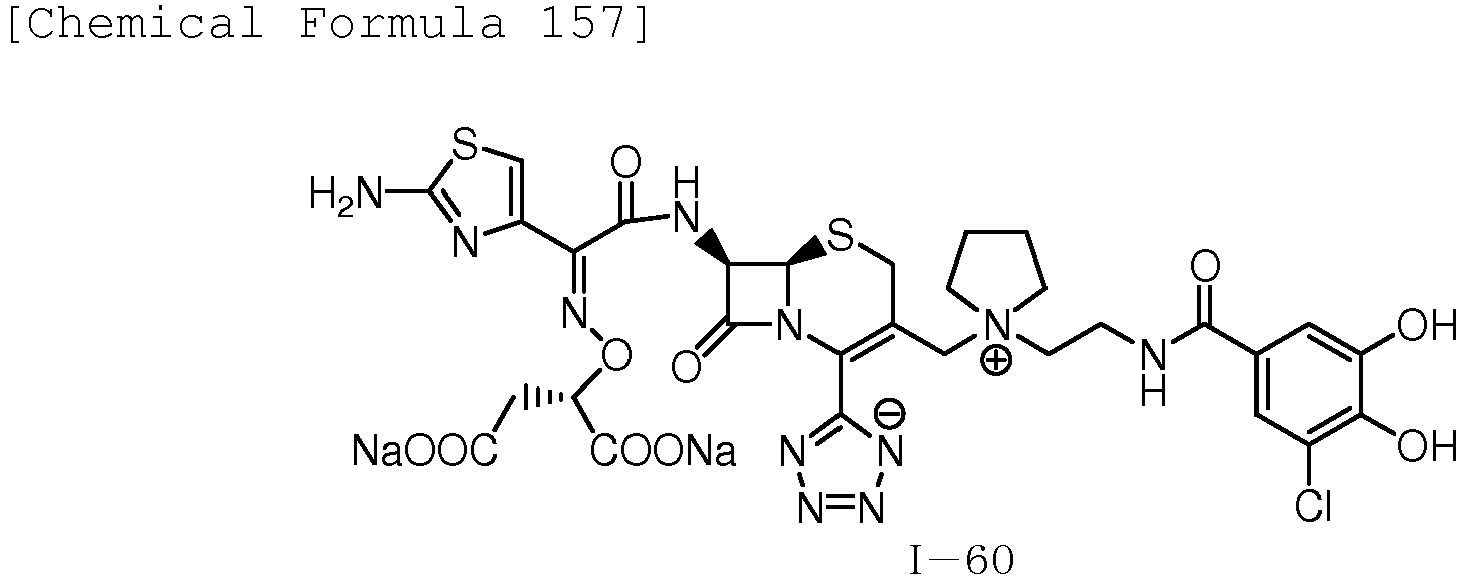
MS (m+1) = 806.02 -

MS (m+1) = 791.98 -

MS (m+1) = 816.16 -


MS (m+1) = 802.02 -

MS (m+1) = 802.02 -


MS (m+1) = 682.97 -

MS (m+1) = 825.96 -


MS (m+1) = 820.02 -

MS (m+1) = 697.01 -


MS (m+1) = 790.03 -

MS (m+1) = 799.93 -


MS (m+1) = 769.91 -

MS (m+1) = 650.93 -

MS (m+1) = 755.90 -

MS (m+1) = 772.90 -

Elemental analysis for C32H29ClN11O8S2Na(H2O)8.2(NaCl)0.1
Calcd.: C,39.55; H,4.71; Cl,4.01; N,15.85; S,6.60; Na, 2.60 (%)
Found.: C,39.80; H,4.64; Cl,4.17; N,15.20; S,6.43; Na, 2.30 (%) -

Elemental analysis for C33H27ClN11O8S2Na(H2O)8.7
Calcd.: C,40.24; H,4.54; Cl, 3.60; N,15.64; S,6.51; Na, 2.33 (%)
Found.: C,40.28; H,4.30; Cl, .83; N,15.37; S,6.57; Na, 2.30 (%) -

MS (m+1) = 652.94 -

Elemental analysis for C33H27ClN11O8S2Na(H2O)9.3(NaHCO3) 0.1
Calcd.: C, 39.59; H,4.59; Cl, 3.53; N,15.34; S,6.39; Na, 2.52 (%)
Found.: C,39.72; H,4.49; Cl, 3.71; N,15.46; S,6.40; Na, 2.59 (%) -

Elemental analysis for C28H24.2ClN10O7S2Na0.8(H2O)6.2
Calcd.: C,39.92; H,4.38; Cl,4.21; N,16.63; S,7.61; Na, 2.18 (%)
Found.: C,40.14; H,4.25; Cl,4.99; N,15.40; S,6.80; Na, 2.28 (%) -

MS (m+1) = 801.95 -

MS (m+1) = 656.98 -

MS (m+1) = 777.31 -
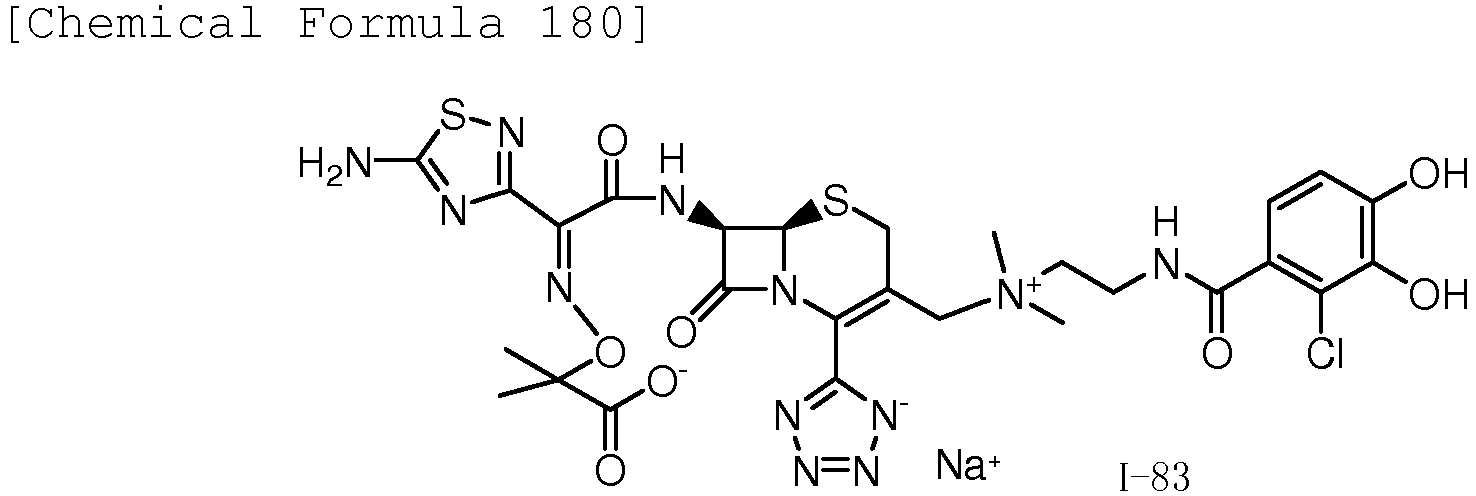
MS (m+1) = 751.12 -


MS (m+1) = 774.24 -

MS (m+1) = 784.11 -

MS (m+1) = 836.15.
MS (m+1) = 803.20 -

MS (m+1) = 810.15 -

MS (m+1) = 836.19 -

MS (m+1) = 803.24 -


MS (m+1) = 839.86 -

Elemental analysis for C28H28ClN11O10S2Na2(H2O)6
Calcd.: C,36.07; H,4.32; Cl, 3.80; N,16.53; S,6.88; Na, 4.93 (%)
Found.: C,36.04; H,4.32; Cl, 3.87; N,16.70; S,6.92; Na, 4.64 (%) -


MS (m+1) = 832.19 -

MS (m+1) = 866.15 -


MS (m+1) = 832.19 -

MS (m+1) = 865.99 -


MS (m+1) = 851.99 -

MS (m+1) = 788.02 -
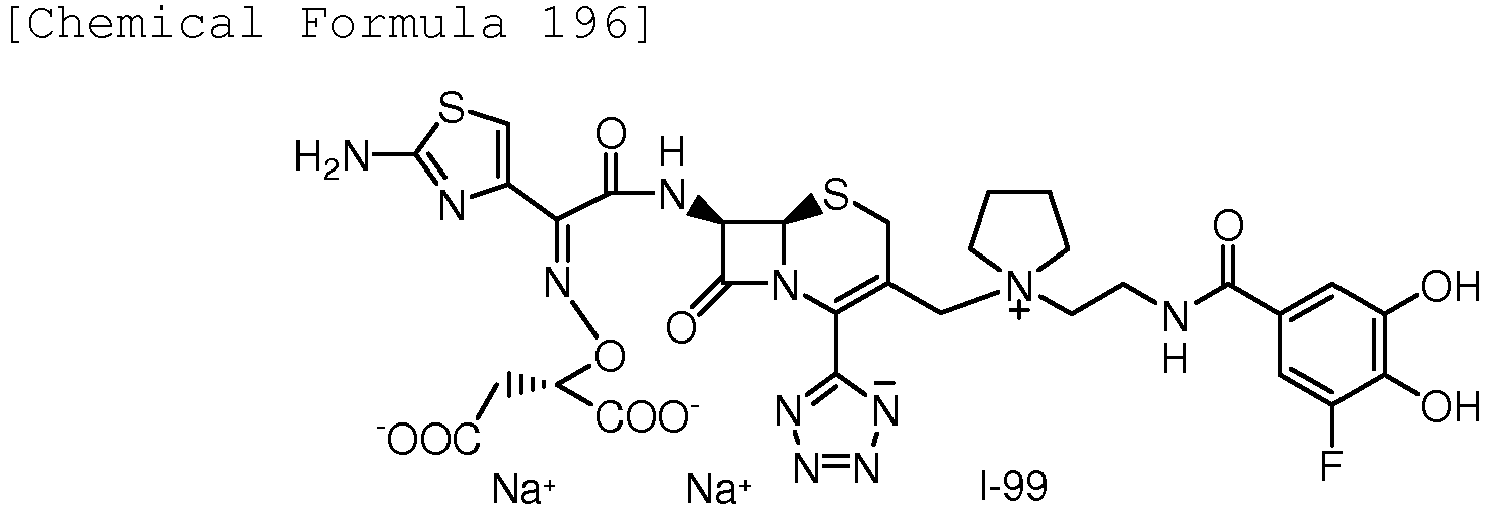
MS (m+1) = 790.03 -

MS (m+1) = 824.02 -

MS (m+1) = 813.90 -

MS (m+1) = 790.00 -

MS (m+1) = 823.98 -

MS (m+1) = 794.03 -

-


MS (m+1) = 793.92 -

MS (m+1) = 761.05 -


MS (m+1) = 760.98 -
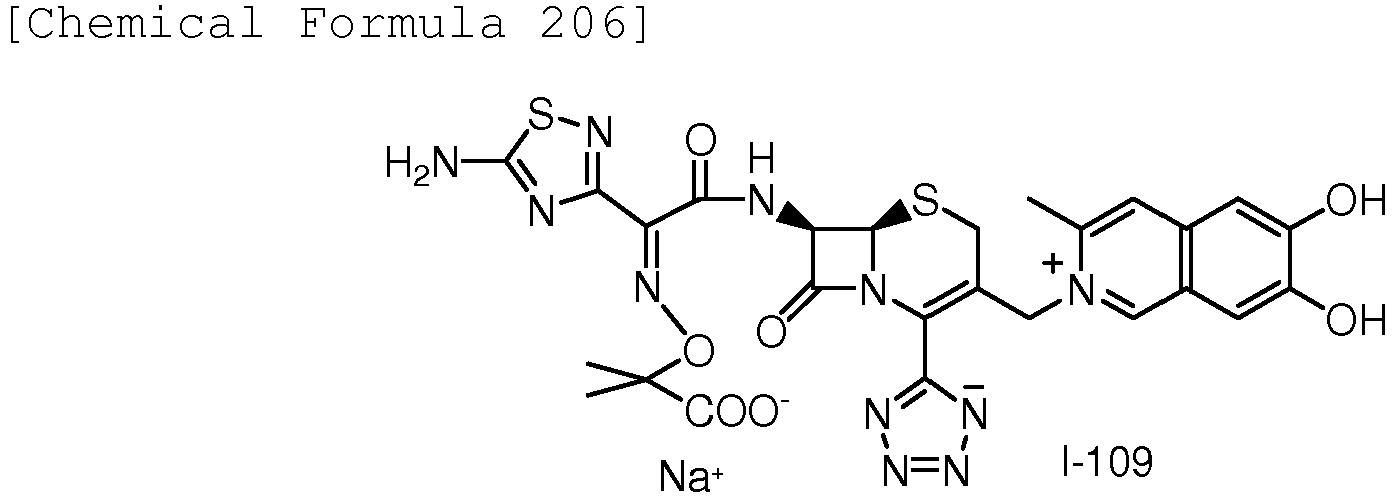
MS (m+1) = 668.03 -

MS (m+1) = 763.00 -

MS (m+1) = 773.08 -
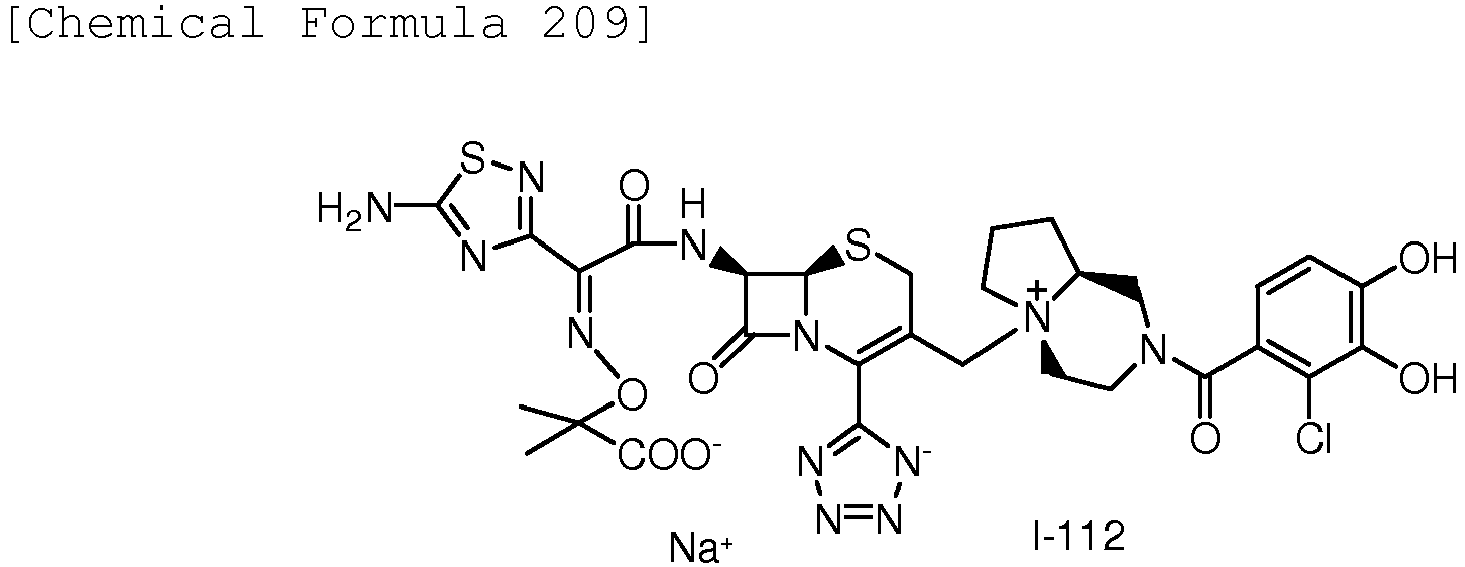
MS (m+1) = 789.02 -
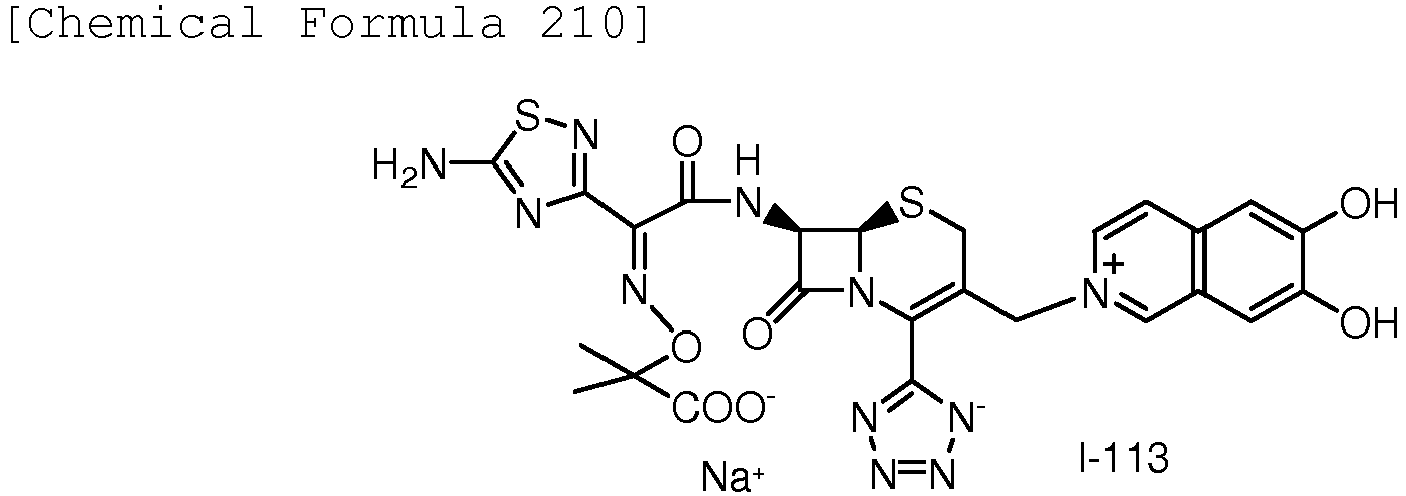
MS (m+1) = 653.99 -

MS (m+1) = 770.99 -


MS (m+1) = 797.02 -

MS (m+1) = 756.98 -


MS (m+1) = 787.04 -

MS (m+1) = 791.29 -

MS (m+1) = 777.04 -

MS (m+1) = 791.04 -

-

Elemental analysis for C30H32ClN12O8S2Na1.5(H2O)6.6
Calcd.: C,38.27; H,4.84; Cl,3.77; N,17.85; S,6.81; Na, 3.66 (%)
Found.: C,38.36; H,4.96; Cl,3.94; N,17.75; S,6.75; Na, 3.60 (%) -


-




- Known Compound 1A (100 mg, 0.252 mmol) was dissolved in 1,4-dioxane (1 mL), di-tert-butyl dicarbonate (0.076mL, 0.328mmol). Ammonium carbonate, and pyridine (30.3mg, 0.315mmol) were added and the solution was stirred overnight at room temperature. Purified water was added, and the aqueous layer was extracted with ethyl acetate/tetrahydrofuran mixture. The organic layer was washed with purified water and brine and dried over anhydrous magnesium sulfate. The desiccant agent was filtered off, and the solvent was removed under reduced pressure. The precipitated solid was filtered and washed with ethyl acetate to yield Compound 1B as a white solid (75 mg, 75%) .
1H-NMR (DMSO-d6) δ: 9.20 (1H, d, J = 7.5 Hz), 7.36 (1H, dt, J = 5.0, 1.1 Hz), 6.97-6.89 (2H, m), 6.72 (1H, s), 5.43 (1H, dd, J = 7.5, 3.7 Hz), 5. 15 (1H, d, J = 3.7 Hz), 4.90 (1H, s), 4.64 (2H, dd, J = 18.1, 12.7 Hz), 3.76 (2H, s), 2.02 (3H, s). - Compound 1B (13.2g, 33.4mmol) was suspended in tetrahydrofuran (135 mL) and cooled to -20°C. Pyridine (8.11mL, 100mmol) and anhydrous trifluoroacetic acid (7.06mL, 50.1mmol) were added to the solution and stirred at -20°C for 30 minutes. Purified water was added, and the aqueous layer was extracted with ethyl acetate. The organic layer was washed with purified water and brine and dried over anhydrous magnesium sulfate. The desiccant agent was filtered off, and the solvent was removed under reduced pressure. The residue was subjected to chromatography to yield Compound 1C (13.88g, quantitative) as an orange foam.
1H-NMR (CDCl3) δ: 7.29-7.25 (1H, m), 7.02-6.97 (2H, m), 6.53 (1H, d, J = 1.1 Hz), 6.32 (1H, d, J = 8.2 Hz), 5.72 (1H, dd, J = 8.2, 4.1 Hz), 5.26 (1H, d, J = 1.1 Hz), 5.11 (1H, d, J = 4.1 Hz), 4.73 (1H, d, J = 13.2 Hz), 4.61 (1H, d, J = 13.2 Hz), 3.87 (2H, s), 2.09 (3H, s). - Compound 1C (273mg, 0.723mmol) was dissolved in 1,4-dioxane. Trimethylsilylazide (0.192mL, 1.447mmol) and dibutyltin oxide (18.01mg, 0.072mmol) were added, and the mixture was stirred at 90°C for 1.5 hours. The mixture was cooled to room temperature, and the solvent was removed under reduced pressure. To the residue, purified water and ethyl acetate were added extracted with ethyl acetate. The organic layer was washed with purified water and brine and dried over anhydrous magnesium sulfate. The desiccant agent was filtered off, and the solvent was removed under reduced pressure. The residue was subjected to silica gel chromatography to yield Compound 1D (169.2 g, 56%).
1H-NMR (DMSO-d6) δ: 9.25 (1H, d, J = 7.8 Hz), 7.36 (1H, dd, J = 4.9, 1.4 Hz), 6.97-6.85 (3H, m), 5.90 (1H, d, J = 1.5 Hz), 5.44 (1H, dd, J = 7.8, 4.0 Hz), 5.14 (1H, d, J = 4.0 Hz), 4.60 (1H, d, J = 12.7 Hz), 4.53 (1H, d, J = 12.7 Hz), 3.77 (2H, s), 1.90 (3H, s). - Compound 1D (85mg, 0.243mmol) was dissolved in tetrahydrofuran (1 mL). Diphenyldiazomethane (47.1mg, 0.243mmol) was added and stirred for 3.5 hours. Additional Diphenyldiazomethane (11.8mg, 0.606mmol) was added and stirred for 35 minutes. The solvent was removed under reduced pressure, obtained residue was subjected to silica gel chromatography to yielded Compound 1E (72 mg, 61%) and Compound 1F. The position of diphenylmethyl group was determined by Nuclear Overhauser Effect in 1H NMR.
- 1H-NMR (CDCl3) δ: 7.41-7.12 (13H, m), 7.03-6.91 (2H, m), 6.41 (1H, s), 6.37 (1H, d, J = 9.1 Hz), 5.80 (1H, s), 5.64 (1H, dd, J = 9.1, 4.0 Hz), 5.26 (1H, d, J = 4.0 Hz), 4.51 (1H, d, J = 12.8 Hz), 4.39 (1H, d, J = 12.8 Hz), 3.86 (2H, s), 1.89 (3H, s)
- 1H-NMR (CDCl3) δ: 7.42-7.33 (5H, m), 7.28-7.18 (4H, m), 7.13 (2H, dd, J = 6.6, 3.0 Hz), 7.02-6.95 (2H, m), 6.90 (1H, s), 6.57 (1H, d, J = 1.4 Hz), 6.30 (1H, d, J = 9.1 Hz), 5.80 (1H, d, J = 1.4 Hz), 5.01 (1H, dd, J = 9.1, 4.0 Hz), 4.64 (1H, d, J = 12.8 Hz), 4.58 (1H, d, J = 4.0 Hz), 4.51 (1H, d, J = 12.8 Hz), 3.82 (2H, s), 1.80 (3H, s).
- Phosphorous pentachloride (1.249 g, 6.00 mmol) was suspended in methylene chloride (15 mL), and the suspension was cooled to 0°C. Pyridine (0.53 mL, 6.60 mmol) and Compound 1E (1.689 g, 3.00 mmol) were added sequentially to the suspension. The suspension was stirred for 40 minutes at 0°C and then warmed to room temperature and stirred for several minutes. The reaction solution was cooled to 0°C, and methanol (13.3 mL, 328 mmol) was added in one portion, and the mixture was warmed to room temperature. Purified water (130mL) was added to the reaction solution, and the aqueous layer was extracted with methylene chloride.
- The layer of methylene chloride was washed with sodium bicarbonate water and brine, and dried over anhydrous magnesium sulfate. The desiccant was filtered off, and a solution of 4 mol/L hydrochloric acid-ethyl acetate (2.25m L, 9 mmol) was added to the organic layer, and the solution was stirred for 3 hours and 15 minutes. The solvent was removed in vacuo to yield jelly Compound 1H. (Yield: 2.02 g, 142%) Compound 1H was suspended in acetonitrile and scratched the wall surface with spatula to yield seed crystals of Compound 1H.
- Separately, phosphorous pentachloride (9.12 g, 43.8 mmol) was suspended in methylene chloride (130mL), and cooled to 0°C. Pyridine (3.90 mL, 48.2 mmol) and Compound 1E (12.8 g, 21.9 mmol) were added sequentially to the suspension, and the mixture was stirred for 45 minutes at room temperature. The reaction solution was cooled to -40°C, and methanol (13.3 mL, 328 mmol) was added in one portion, and the mixture was warmed to room temperature. Purified water (130 mL) was added to the reaction solution, and the aqueous layer was extracted with methylene chloride.
- The layer of methylene chloride was washed with water and brine, and dried over anhydrous magnesium sulfate. The desiccant agent was filtered off, and a solution of 4 mol/L hydrochloric acid-dioxane (27.4 mL, 109 mmol) was added to the organic layer, and the mixture was stirred for 3 hours and 15 minutes at room temperature. 1,4-dioxane (150mL) was added to the reaction solution, and the solvent was removed in vacuo to adjust the total amount about 30 mL. Acetonitrile (100 mL) was added to the resulting solution, and the above seed crystals of Compound 1H were added thereto, and the mixture was stirred at room temperature. The precipitated crystals were collected by filtration to yield Compound 1H (Yield: 7.92 g, 73%).
1H-NMR (DMSO-d6) δ: 8.82 (2H, br s), 7.72 (1H, s), 7.45-7.26 (11H, m), 7.00 (1H, d, J = 1.2 Hz), 5.94 (1H, d, J = 1.2 Hz), 5.19 (1H, d, J = 4.2 Hz), 4.94 (1H, d, J = 4.2 Hz), 4.48 (1H, d, J = 11.8 Hz), 4.16 (1H, d, J = 11.8 Hz). - Compound 1H was suspended in ethylene chloride (40mL), and cooled to -40°C. Compound 1I (3.54 g, 8.24 mmol) was added to the suspension. Phenylphosphoricdichloride (1.85 mL, 12.36 mmol) was added and N-methylmorpholine (3.62 mL, 33.0 mmol) was added dropwise, and the solution was stirred for 30 minutes at -40°C. Purified water was added to the reaction solution, and the aqueous layer was extracted with ethyl acetate. The resulting organic layer was washed with purified water and brine, and dried over anhydrous magnesium sulfate. The magnesium sulfate was filtered off, and the solvent was removed in vacuo to yield Compound 1J. (Yield: 7.8g, quantitative)
1H-NMR (CDCl3) δ: 8.32 (1H, d, J = 8.5 Hz), 7.41-7.15 (16H, m), 6.46 (1H, s), 5.99 (1H, s), 5.79 (1H, dd, J = 8.5, 4.0 Hz), 5.37 (1H, d, J = 4.0 Hz), 5.29 (1H, s), 4.15-4.01 (2H, m), 1.63 (3H, s), 1.60 (3H, s), 1.52 (9H, s), 1.42 (9H, s). - Compound 1J (2.30 g, 2.7 mmol) was dissolved in methylene chloride (25mL) and cooled to -40°C. Meta-chlorobenzoic acid (788 mg, 2.97 mmol) was added to the solution, and the solution was stirred for 1 hour and 15 minutes at -40°C. An aqueous solution of sodium hydrogen sulfite was added to the reaction solution, and methylene chloride was removed in vacuo. The concentrated solution was extracted with ethyl acetate, and the organic layer was washed with aqueous sodium bicarbonate, purified water and brine, and dried over anhydrous magnesium sulfate. The desiccant agent was filtered off, and the solvent was removed in vacuo. The resulting residue was subjected to silica gel chromatography to yield Compound 1K (Yield: 1.41 g, 60%).
- Compound 1K was suspended in ethanol, and the wall surface was scratched with spatula to yield crystals.
1H-NMR (CDCl3) δ: 8.08 (1H, br s), 7.90 (1H, d, J = 9.9 Hz), 7.39-7.18 (20H, m), 6.29 (1H, dd, J = 9.7, 5.0 Hz), 5.13 (1H, d, J = 12.4 Hz), 4.73 (1H, d, J = 4.9 Hz), 4.29 (1H, d, J = 12.1 Hz), 3.90 (1H, d, J = 19.0 Hz), 3.50 (1H, d, J = 19.0 Hz), 1.59 (6H, d, J = 7.1 Hz), 1.56 (9H, s), 1.38 (10H, s). - A solution of 4 mol/L hydrochloric acid-ethyl acetate was added to the pentaacetate of Compound 1L (14.4 g, 33.7 mmol). The solution was stirred at room temperature for 30 minutes, and then concentrated and azeotropically dried with toluene. Tetrahydrofuran (45 mL) and ethanol (90 mL) were added, and di-tert-butyl dicarbonate (24.2 mL, 104 mmol) was added under ice-cooling and stirred at room temperature for 2.5 hours. To this solution, a solution of 5.3 mol/L sodium methoxide (45.9 mL, 243 mmol) was added and stirred at room temperature for 30 minutes. The solution was then added with silica gel, concentrated and subjected to chromatography. The fraction containing the desired compound was concentrated and dried under reduced pressure to yield Compound 1M (3.16g, 40%).
1H-NMR (CDCl3) δ: 3.54-3.53 (3H, m), 3.25-3.22 (2H, m), 2.83-2.80 (2H, m), 2.66-2.62 (2H, m), 2.38-2.35 (2H, m), 2.32 (3H, s), 1.45 (9H, s). - To a solution of Compound 1K (0.560g, 0.646mmol) in dimethylformamide (1.5 mL), sodium iodide (0.194 g, 1.29 mmol) was added. After stirring at 15°C for 10 minutes, Compound 1M (0.146 g, 0.646 mmol) was added and stirred at 15°C for two hours. To this solution, 0.2mol/L hydrochloric aced was added, extracted with ethyl acetate, washed with water and brine, and dried over magnesium sulfate. The magnesium sulfate was removed and concentrated under reduced pressure to yielded Compound 1N (0.739g). The obtained Compound 1N was used in the next step without purification.
- The whole amount of the obtained Compound 1N was dissolved in methylene chloride (7.5 ml) and cooled to-40°C. Phosphorus tribromide (0.177 mL, 1.87 mmol) was added and stirred at -40°C for one hour. To the reaction solution, anisole (0.682 mL, 6.24 mmol), 2mol/L aluminum chloride/nitromethane solution (3.12 mL, 6.24 mmol) were added and stirred at a temperature between -20°C and 0°C for 1.5 hours. After addition of 0.2mol/L hydrochloric acid and acetonitrile to make insoluble materials dissolved, the solution was washed with diisopropylether. The aqueous layer was added with HP-20SS resin and concentrated and subjected to ODS column chromatography eluting with water-acetonitrile. The fraction containing desired compound was concentrated under reduced pressure and freeze-dried to yield Compound II-1 (0.140 g, 0.227 mmol) as white powder.
MS : 618.34 (M+H)
1H-NMR (DMSO-d6) δ: 10.07-10.03 (1H, m), 7.27 (2H, br s), 6.76 (1H, s), 5.87 (1H, dd, J = 8.5, 5.1 Hz), 5.61 (1H, d, J = 5.1 Hz), 5.13-5.09 (1H, m), 4.15-2.70 (18H, m), 1.47 (3H, s), 1.40 (3H, s). -

- To a solution of Compound 2A (0.300 g, 2.38 mmol) in tetrahydrofuran (6mL), di-tert-butyl bicarbonate (0.828mL, 3.57 mmol) was added and stirred at room temperature for two hours. The suspension was filtered, washed with methanol, added with silica gel, concentrated and then subjected to silica gel chromatography. The fraction containing desired compound was concentrated and freeze-dried to yield Compound 2B (0.262g, 49%).
1H-NMR (DMSO-d6) δ: 4.07-4.01 (1H, m), 3.49 (2H, t, J = 5.8 Hz), 2.89-2.77 (6H, m), 1.88-1.79 (2H, m), 1.62-1.51 (2H, m), 1.39 (9H, s). - Compound 2C (0.141g, 35%) was obtained from Compound 1K (0.560g, 0.646mmol) according to the procedure as described in the synthesis of Compound II-1.
MS : 618.31 (M+H)
1H-NMR (DMSO-d6) δ: 9.96 (1H, br s), 7.27 (2H, br s), 6.75 (1H, s), 5.86 (1H, dd, J = 8.1, 5.2 Hz), 5.43 (1H, d, J = 5.2 Hz), 5.15 (1H, d, J = 12.6 Hz), 4.12-1.96 (18H, m), 1.46 (3H, s), 1.41 (3H, s). -

- To a solution of Compound 3A (1.00 g, 10.0 mmol) in tetrahydrofuran (10mL), di-tert-butyl dicarbonate (3.48 mL, 15.0 mmol) was added under ice-cooling and stirred at room temperature for 2 hours. The solution was concentrated and subjected to silica gel column chromatography. The fraction containing the desired compound was concentrated and dried under reduced pressure to yield Compound 3B (2.15 g, quantitative).
1H-NMR (CDCl3) δ: 3.44 (4H, t, J = 5.0 Hz), 2.34 (4H, t, J = 5.0 Hz), 2.29 (3H, s), 1.46 (9H, s). - Compound II-3 (0.172g, 36%) was obtained from Compound 1K (0.693g, 0.800mmol) and Compound 3C according to the procedure as described in the synthesis of Compound II-1. MS : 592.27 (M+H)
1H-NMR (DMSO-d6) δ: 9.50 (1H, d, J = 7.5 Hz), 7.29-7.19 (3H, m), 6.73 (1H, s), 5.83 (1H, dd, J = 8.3, 5.1 Hz), 5.42 (1H, d, J = 5.1 Hz), 5.25-5.21 (1H, m), 4.07-3.04 (12H, m), 2.22 (3H, s), 1.46-1.43 (6H, m). -


-


- Compound 4A (54.5 g, 200 mmol) and sodium bicarbonate (42.0 g, 500 mmol) were dissolved in water (1000 mL)/ acetone (400 mL) mixture, and allyl chloroformate (25.6 mL, 240 mmol) was added under ice-cooling. The solution was stirred under ice-cooling for 30 minutes and at room temperature for one hour. The reaction solution was concentrated under reduced pressure, diluted with ethyl acetate and extracted with water. The aqueous layer was acidified, extracted with ethyl acetate, washed with brine, and dried magnesium sulfate. The magnesium sulfate was filtered off, and the filtrate was concentrated under reduced pressure to yield Compound 4B (66.39 g, 93%).
1H-NMR (DMSO-d6) δ: 8.42 (1H, d, J = 8.73 Hz), 5.97-5.85 (1H, m), 5.54 (1H, dd, J = 8.73, 4.84 Hz), 5.30 (1H, dd, J = 17.23, 1.53 Hz), 5.20 (1H, dd, J = 10.37, 1.53 Hz), 5.08 (1H, d, J = 4.84 Hz), 4.98 (1H, d, J = 12.73 Hz), 4.68 (1H, d, J = 12.73 Hz), 4.53 (2H, d, J = 5.19 Hz), 3.62 (1H, d, J = 18.07 Hz), 3.48 (1H, d, J = 18.07 Hz), 2.03 (3H, s). - Compound 4B (65.0 g, 182 mmol) was suspended in methylene chloride (650 mL), and 1-chloro-N,N,2-trymethyl-1-propenylamine (29.0 mL, 219 mmol) was added under ice-cooling and stirred for 30 minutes under ice-cooling. After cooling the reaction mixture to -60°C, a solution of 4-methoxybenzylamine (59.6 mL, 456 mmol) in methylene chloride (60 mL) was added dropwise. Methylene chloride (200 mL) was added to the reaction mixture and stirred at a temperature between -60°C and -50°C for 10 minutes. The reaction mixture was diluted with methylene chloride/acetonitrile, and the organic layer was washed with hydrochloric acid, saturated aqueous sodium bicarbonate and brine, and dried over magnesium sulfate. The magnesium sulfate was filtered off, and the filtrate was concentrated under reduced pressure. Methylene chloride/diisopropyl ether was added, and precipitated crystals were flitted to yield Compound 4C (73.94 g, 85%).
1H-NMR (DMSO-d6) δ: 8.76 (1H, t, J = 5.68 Hz), 8.46 (1H, d, J = 8.85 Hz), 7.23 (2H, d, J = 8.39 Hz), 6.85 (2H, d, J = 8.24 Hz), 5.96-5.85 (1H, m), 5.40 (1H, dd, J = 8.85, 4.80 Hz), 5.30 (1H, d, J = 17.23 Hz), 5.20 (1H, d, J = 10.37 Hz), 5.02 (1H, d, J = 4.80 Hz), 4.94 (1H, d, J = 12.58 Hz), 4.71 (1H, d, J = 12.58 Hz), 4.54 (2H, d, J = 5.68 Hz), 4.36 (1H, dd, J = 14.83, 5.76 Hz), 4.24 (1H, dd, J = 14.83, 5.76 Hz), 3.72 (3H, s), 3.56 (1H, d, J = 17.62 Hz), 3.43 (1H, d, J = 17.62 Hz), 2.02 (3H, s). - Compound 4C (39.0 g, 82 mmol) and pyridine (23.17 mL, 287 mmol) were suspended in methylene chloride (400 mL). To this suspension, triphosgene (12.17 g, 41 mmol) was added and stirred for 30 min under ice-cooling. Trimethylsilylazide (12.17 g, 41 mmol) and methanol (8.32 mL, 205 mmol) were added under ice-cooling, and the reaction mixture was let stand overnight at room temperature. The reaction mixture was diluted with methylene chloride, and the organic layer was washed sequentially with hydrochloric acid, saturated aqueous sodium bicarbonate and brine, and dried over magnesium sulfate. The magnesium sulfate was filtered off, and the filtrate was concentrated under reduced pressure, and then subjected to silica gel column chromatography eluting with hexanes/ethyl acetate. The fraction containing the desired compound was concentrated under reduced pressure to yield Compound 4D (21.29 g, 52 %).
1H-NMR (DMSO-d6) δ: 8.47 (1H, d, J = 8.85 Hz), 7.25 (2H, d, J = 8.54 Hz), 6.92 (2H, d, J = 8.54 Hz), 5.98-5.85 (1H, m), 5.61-5.56 (3H, m), 5.27-5.33 (2H, m), 5.20 (1H, d, J = 9.30 Hz), 4.54 (2H, d, J = 5.34 Hz), 4.31 (1H, d, J = 12.73 Hz), 4.18 (1H, d, J = 12.73 Hz), 3.74 (3H, s), 3.66 (1H, d, J = 18.00 Hz), 3.57 (1H, d, J = 18.00 Hz), 1.90 (3H, s). - Compound 4D (21.29 g, 42.5 mmol) was dissolved in tetrahydrofuran (300 mL), and 3mol/L sulfuric acid (284 mL, 851 mmol) was added and stirred at 45°C for 3 hours. The reaction mixture was diluted with ethyl acetate, and the organic layer was washed with water, saturated aqueous sodium bicarbonate and brine, and dried over magnesium sulfate. The magnesium sulfate was filtered off, and the filtrate was concentrated under reduced pressure to yield Compound 4E (19.63 g, 101 %). The obtained Compound 4E was used directly in the next step without purification.
1H-NMR (DMSO-d6) δ: 8.45 (1H, d, J = 9.00 Hz), 7.24 (2H, d, J = 8.62 Hz), 6.91 (2H, d, J = 8.62 Hz), 5.98-5.85 (1H, m), 5.52-5.48 (3H, m), 5.33-5.18 (3H, m), 5.09 (1H, t, J = 5.34 Hz), 4.53 (2H, d, J = 5.19 Hz), 3.74 (3H, s), 3.55-3.60 (4H, m). - Compound 4E (19.63 g, 42.8 mmol) and pyridine (5.18 mL, 64.2 mmol) were suspended in methylene chloride (200 mL), and triphosgene (5.08 g, 17.13 mmol) was added and stirred for 2 hours under ice-cooling. The reaction mixture was diluted with methylene chloride, and the organic layer was washed sequentially with hydrochloric acid, saturated aqueous sodium bicarbonate and brine, and dried over magnesium sulfate. The magnesium sulfate was filtered off, and the filtrate was concentrated under reduced pressure, and then subjected to silica gel column chromatography, eluting with hexanes/ethyl acetate. The fraction containing the desired compound was concentrated under reduced pressure, and crystallized from diisopropyl ether to yield Compound 4F (9.15 g, 45 %).
1H-NMR (DMSO-d6) δ: 8.48 (1H, d, J = 9.00 Hz), 7.24 (2H, d, J = 8.39 Hz), 6.91 (2H, d, J = 8.39 Hz), 5.97-5.85 (1H, m), 5.65-5.52 (3H, m), 5.32-5.27 (2H, m), 5.20 (1H, d, J = 10.37 Hz), 4.53 (2H, d, J = 4.88 Hz), 4.02 (1H, d, J = 11.82 Hz), 3.97 (1H, d, J = 11.82 Hz), 3.73-3.59 (5H, m). - Compound 4F(9.15 g, 19.18 mmol) and dimedone (8.07 g, 57.6 mmol) were suspended in methylene chloride (90 mL) and added with tetrakis triphenylphosphine palladium (1.108 g, 0.959 mmol) and stirred at room temperature for 1 hour. The reaction mixture was diluted with methylene chloride, washed with saturated aqueous sodium bicarbonate and brine, and dried over magnesium sulfate. The magnesium sulfate was filtered off, and the filtrate was concentrated under reduced pressure, and then subjected to silica gel column chromatography eluting with hexanes/ethyl acetate. The fraction containing the desired compound was concentrated under reduced pressure, and ethyl acetate/diisopropyl ether was added and filtered and the precipitated crystals were corrected to yield Compound 4G (4.89 g, 65 %).
1H-NMR (DMSO-d6) δ: 7.21 (2H, d, J = 8.46 Hz), 6.90 (2H, d, J = 8.46 Hz), 5.60 (1H, d, J = 14.79 Hz), 5.49 (1H, d, J = 14.79 Hz), 5.19 (1H, d, J = 5.19 Hz), 4.82-4.74 (1H, m), 4.08 (1H, d, J = 12.12 Hz), 4.03 (1H, d, J = 12.12 Hz), 3.72 (3H, s), 3.67 (1H, d, J = 17.92 Hz), 3.57 (1H, d, J = 17.92 Hz), 2.38 (2H, d, J = 9.46 Hz). - Compound 4G (2.00 g, 5.09 mmol) and Compound 4H (2.30 g, 5.35 mmol) were dissolved in methylene chloride (20 mL), and the solution was cooled to -40°C. Dichlorophenylphosphoric acid (1.14 mL, 7.64 mmol) was added. N-methylmorpholine (1.68 mL, 15.27 mmol) was added dropwise at -40°C, and the solution was stirred at -40°C to -30°C for 2 hours. The reaction mixture was diluted with methylene chloride, washed sequentially with 0.2mol/L hydrochloric acid, saturated aqueous sodium bicarbonate and brine, and dried over magnesium sulfate. The magnesium sulfate was filtered off, and the filtrate was concentrated under reduced pressure, and then subjected to silica gel column chromatography eluting with hexanes/ethyl acetate. The fraction containing the desired compound was concentrated under reduced pressure to yield Compound 4I (3.54 g, 87 %).
1H-NMR (CDCl3) δ: 8.38 (1H, d, J = 8.66 Hz), 8.19 (1H, br s), 7.31 (1H, s), 7.15 (2H, d, J = 8.69 Hz), 6.87 (2H, d, J = 8.69 Hz), 5.91 (1H, dd, J = 8.66, 4.99 Hz), 5.62 (1H, d, J = 15.10 Hz), 5.44 (1H, d, J = 15.10 Hz), 5.00 (1H, d, J = 4.99 Hz), 3.96 (1H, d, J = 12.20 Hz), 3.78 (3H, s), 3.73 (1H, d, J = 12.20 Hz), 3.64 (1H, d, J = 18.00 Hz), 3.39 (1H, d, J = 18.00 Hz), 1.63 (3H, s), 1.55 (3H, s), 1.53 (9H, s), 1.39 (9H, s). - To a solution of Compound 4I (804 mg, 1.00 mmol) in dimethylformamide (2 mL), sodium iodide (300 mg, 2.00 mmol) was added, and the solution was stirred at room temperature for 5 min. The solution was cooled to 0°C, and Compound 4J (382 mg, 1.00 mmol) was added and stirred at 0-10°C for 5 hours. The reaction mixture was poured into ice-cooled solution of 5 % sodium chloride (20 mL) containing sodium thiosulfate (1 g). The precipitated solid was collected by filtration, washed with water and then suspended in water. The suspension was freeze-dried to yield Compound 4K as a pale yellow solid. The obtained Compound 4K was used directly in the next step without purification.
- The whole amount of the obtained Compound 4K was dissolved in methylene chloride (10 mL), and the solution was cooled to -40°C. To this solution, anisole (2.49 mL, 22.5 mmol) and 2mol/L aluminum chloride/nitromethane solution (7.50 mL, 15.0 mmol) were added sequentially, and the solution was stirred at 0°C for 1 hour. The reaction mixture was dissolved in water, 2mol/L hydrochloric acid and acetonitrile, and the solution was washed with diisopropyl ether. The aqueous layer was added with HP20-SS resin, and acetonitrile was removed under reduced pressure. The obtained mixture was subjected to ODS column chromatography eluting with water/acetonitrile. A solution of the desired compound was concentrated under reduced pressure and freeze-dried to yield Compound II-4 as a while powder.
Yield: 183.0 mg (22 %)
1H-NMR (D2O) δ: 6.95 (1H, s), 5.90 (1H, d, J = 4.80 Hz), 5.57 (1H, d, J = 4.80 Hz), 4.63 (1H, d, J = 14.95 Hz), 4.12-3.99 (3H, m), 3.87-3.82 (1H, m), 3.72 (1H, d, J = 16.47 Hz), 3.64-3.61 (1H, m), 2.89 (3H, br s), 2.78-2.51 (2H, m), 2.31-2.21 (2H, m), 2.10-1.94 (3H, m), 1.52 (3H, s), 1.49 (3H, s).
Elemental analysis for C26H35N13O5S2(H2O)5.2
Calcd: C,40.69; H,5.96; N,23.73; S,8.36 (%)
Found: C,40.53; H,5.71; N,23.78; S,8.60 (%) -


- A solution of Compound 4I (693 mg, 0.80 mmol) and Compound 5A (268 mg, 0.88 mmol) in dimethylformamide (1.5 mL) was cooled to 0°C, and the solution was added with sodium iodide (240 mg, 1.60 mmol) and stirred at 0-10°C for 6 hours. Dimethylformamide (4.5 mL) was added, and the solution was cooled to -40°C. Phosphorus tribromide (151 µL, 1.60 mmol) was added and the solution was stirred at -40°C for 30 min. The reaction mixture was poured into ice-cooled solution of 5 % sodium chloride (20 mL) containing sodium thiosulfate (1 g). The precipitated solid was collected by filtration, washed with water and then suspended in water. The suspension was freeze-dried to yield Compound 5B as a pale yellow solid. The obtained Compound 5B was used directly in the next step without purification.
- The whole amount of the obtained Compound 5B was dissolved in methylene chloride (10 mL), and the solution was cooled to -40°C. To this solution, anisole (1.57 mL, 14.4 mmol) and 2mol/L aluminum chloride/nitromethane solution (4.80 mL, 9.6 mmol) were added sequentially, and the solution was stirred at 0°C for 1 hour. The reaction mixture was dissolved in water, 2mol/L hydrochloric acid and acetonitrile, and the solution was washed with diisopropyl ether. The aqueous layer was added with HP20-SS resin, and acetonitrile was removed under reduced pressure. The obtained mixture was subjected to ODS column chromatography eluting with water/acetonitrile. A solution of the desired compound was concentrated under reduced pressure and freeze-dried to yield Compound II-5 as a pale yellow powder.
Yield: 259.6 mg, (43 %)
1H-NMR (D2O) δ: 6.95 (1H, s), 5.91 (1H, d, J = 4.88 Hz), 5.58 (1H, d, J = 4.88 Hz), 4.66 (1H, d, J = 14.64 Hz), 4.12-4.04 (3H, m), 3.81-3.66 (3H, m), 2.91 (3H, br s), 2.80-2.65 (2H, m), 2.43-1.88 (5H, m), 1.52 (3H, s), 1.49 (3H, s).
Elemental analysis for C25H33N11O5S2(H2O)5.6
Calcd: C,40.99; H,6.08; N,21.03; S,8.75 (%)
Found: C,40.99; H,5.87; N,21.01; S,8.91 (%) -


- To a solution of Compound 6A (26.5g), dimethoxybenzylamine (14.85g) in methylene chloride (120mL), WSCD (18.4g) was added under ice-cooling. After stirring at room temperature for 3 hours, the solution was diluted with ethyl acetate, and washed with diluted hydrochloric acid and water. The residue was crystallized from methylene chloride/ether to yield Compound 6B (26.4g).
1H-NMR (CDCl3) δ: 2.01 (3H, s), 3.41, 3.55 (2H, AB-q), 3.73 (3H, s), 3.76 (3H, s), 4.48-4.52 (2H, m), 4.70, 4.91 (2H, AB-q, J=12.6 Hz), 5.00 (1H, d, J=4.8 Hz), 5.14-5.33 (2H, m), 5.39 (1H, dd, J=4.8, 9.0 Hz), 5.86-5.93 (1H, m), 6.4-6.52 (2H, m), 7.17 (1H, d, J=8.4 Hz), 8.42 (1H, d, J=8.7 Hz), 8.50-8.53 (1H, m)
MS(ESI): 506.5+ (M+H)+ - Compound 6B (6.5g) was dissolved in methylene chloride (100mL), and pyridine (2.06mL) and then PCl5(3.48mL) were added under ice-cooling, and the solution was stirred for 80 min. MeSiN3(8.53mL), pyridine (6.68mL) and methanol (2.6mL) were added sequentially, and the solution was stirred at room temperature for 1.5 hours and at 40°C for 4 hours. The solution was washed with diluted hydrochloric acid and then brine, and concentrated. The residue was purified on silica gel chromatography to yield Compound 6C (4.02g).
1H-NMR (CDCl3) δ: 2.01 (3H, s), 3.36, 3.50 (2H, AB-q), 3.75 (3H, s), 3.81 (3H, s), 4.33, 4.41 (2H, AB-q, J=12.9Hz), 4.56-4.63 (2H, m), 4.90 (1H, d, J=4.8 Hz), 5.23-5.58 (3H, m), 5.57 (1H, dd, J=4.8, 12.0 Hz), 5.86-5.59 (1H, m), 6.43-6.50 (3H, m), 7.07 (1H, d, J=8.1Hz)
MS (ESI): 531.4+ (M+H)+ - To a solution of Compound 6C (4.00g) and dimedone (3.17g) in methylene chloride (40mL), Ph3P (250mg) and then (Ph3P)4Pd (250mg) were added at room temperature, and the solution was stirred for 2.5 hours. The solution was concentrated to 20mL and washed with aqueous NaHCO3 solution and water, and concentrated to yield Compound 6D (3.31g).
1H-NMR (CDCl3) δ: 2.00 (3H, s), 3.73 (3H, s), 3.79 (3H, s), 4.25, 4.33 (2H, AB-q, J=10.5 Hz), 4.92 (1H, d, J = 5.1 Hz), 5.51 (1H, d, J=5.1 Hz), 6.41-6.48 (2H, m), 7.08 (2H, m), 7.62-7.70 (1H, m)
MS (ESI) : 448+ (M+H)+ - WSCD (1.88g) was added to a solution of Compound 6D (3.31g) and Compound 1H (3.24g) in methylene chloride (50mL), and the solution was stirred for 30 min under ice-cooling. The solution was diluted with ethyl acetate, washed with water, aqueous NaHCO3 solution and brine, and concentrated. The residue was purified on silica gel chromatography to yield Compound 6E (3.10g).
1H-NMR (CDCl3) δ: 1.40 (9H, s), 1.41 (9H, s), 1.61 (3H, s), 1.63 (3H, s), 3.13, 3.47 (2H, AB-q, J=18.0 Hz), 3.75 (3H, s), 3.80 (3H, s), 4.23, 4.37 (2H, AB-q, J=10 Hz), 4.98 (1H, m), 7.70-3.31 (3H, m), 8.28 (1H, d, J = 8.1 Hz),
MS(ESI): 859.8+ (M+H)+ - Compound 6E (257mg) was dissolved in methylene chloride (2mL), and the solution was cooled to -60°C and Me3Si-I (0.71mL) was added. The solution was stirred for 20 min at room temperature and concentrated under reduced pressure. The residue was dissolved in DMF (2mL). Pyridine (0.15mL) was added to the solution and the solution was stirred at room temperature for 1 hour. Isopropyl ether (20mL) was added, and the precipitated gummy material was collected and dissolved in methylene chloride (0.5mL). Anisole (0.20mL) and then TFA (4mL) were added, and the solution was stirred for 40 min. Solvent was concentrated, and isopropyl ether (20mL) was added. Precipitation was corrected by filtration, which was then purified on HP-20 column chromatography. The eluted solution was freeze-dried to yield Compound II-6 (49mg).
1H-NMR (d-DMSO) δ: 1.48 (3H, s), 1.50 (3H, s), 3.28, 3.66 (2H, AB-q, J=17.7 Hz), 5.35, 5.43 (2H, AB-q, J=13.8 Hz), 5.33 (1H, d, J=5.1 Hz), 5.83 (1H, dd, J=5.1, 8.7 Hz), 7.12 (2H, s), 7.59 (1H, s), 8.20-8.24 (2H, m), 8.61-8.66 (2H, m), 9.32-9.44 (3H, m).
MS (ESI): 571.3+ (M+H)+ - Compound 6E (215mg) was dissolved in methylene chloride (2mL) and the solution was cooled to -60°C. Me3Si-I (0.21mL) was added to the solution, and the solution was stirred at room temperature for 20 min and concentrated under reduced pressure. The residue was dissolved in DMF(2mL), and methyl pyrrolidine (0.07mL) was added. The solution was stirred at room temperature for 1.5 hours and let stand at -20°C for two days. Isopropyl ether (20mL) was added, and precipitated gummy material was collected and dissolved in methylene chloride (0.5mL). Anisole (0.20mL) and then TFA (4mL) were added, and the solution was stirred for 40 min. Solvent was concentrated, and isopropyl ether (20mL) was added, and precipitation was collected by filtration and purified on HP-20 column chromatography. The eluted solution was freeze-dried to yield Compound II-7 (31mg).
1H-NMR (d6-DMSO) δ: 1.80-2.16 (4H, m), 2.77 (3H, s), 3.05-3.75 (4H, m), 3.70, 3.91 (2H, AB-q, J=17.0 Hz), 4.10, 4.89 (2H, AB-q, J=13.8 Hz), 5.43 (1H, d, J=4.8 Hz), 5.85 (1H, bb, J=4.8, 7.2 Hz), 6.72 (1H, s), 7.20 (2H, bs), 7.30 (1H, bs), 7.60 (1H, s), 9.43 (1H, d, J = 8.7 Hz)
MS(ESI): 577.3+ (M+H)+ -


- Compound 8A (5.87 g, 10 mmol) was dissolved in methylene chloride (50 mL), and 4mol/L hydrochloric acid/ethyl acetate solution (10 mL, 40 mmol) was added. The reaction solution was stirred at room temperature for 2.5 hours, and the solvent was removed under reduced pressure. Diisopropyl ether was added to the obtained residue, and the precipitated solid was collected by filtration to yield Compound 8B (5.5 g, 98 %).
1H-NMR(CDCl3) δ:3.86 (s, 2H), 4.03, 4.07 (ABq, J = 12.3Hz, 2H), 3.76 (d, J = 3.9Hz, 1H), 5.62 (dd, J = 4.2, 8.7Hz, 1H), 5.95 (s, 1H), 6.42 (s, 1H), 6.52 (d, J = 8.7Hz, 1H), 6.97-7.02 (m, 2H), 7.23-7.39 (m, 12H). - Compound 8B was dissolved in methylene chloride (50 mL) and cooled to -50°C, and a solution of mCPBA(3.43 g, 12.9 mmol) in methylene chloride (30 mL) was added dropwise over 10 min. The reaction solution was stirred at -50°C for additional 30 mi, and then sodium thiosulfate (1.36 g, 8.61 mmol) in water (50 mL) was added. To this mixture, ethyl acetate was added and concentrated under reduced pressure. The precipitated solid was collected by filtration to yield Compound 8C (2.5 g, 50 %).
1H-NMR(DMSO-d6) δ:3.81, 3.90 (ABq, J = 15.5Hz, 2H), 3.76, 4.02 (ABq, J = 17.9Hz, 2H), 4.50, 4.68 (ABq, J = 11.6Hz, 2H), 5.10 (d, J = 4.5Hz, 1H), 5.92 (dd, J = 4.8, 8.4Hz, 1H), 6.95-6.97 (m, 2H), 7.30-7.44 (m, 11H), 7.82 (s, 1H), 8.49 (d, J = 7.8Hz, 1H). - Compound 8C (4.92g, 8.5mmol) was dissolved in DMF(20mL), sodium iodide (2.55g, 17mmol) and triphenylphosphine (2.67g, 10.2mmol) were added. The solution was stirred at room temperature for 30 min. The reaction solution was poured into stirring diisopropyl ether (70mL) and water (100mL). The precipitated solid was collected by filtration. The solid was air-dried to yield Compound 8D (8.19g, 100 %).
1H-NMR(DMSO-d6) δ:3.54-3.92 (m, 4H), 5.01-5.36 (m, 2H),5.18 (d, J = 4.5Hz, 2H), 5.84-5.88 (m, 1H), 6.93-6.96 (m, 2H), 7.18-7.79 (m, 27H), 8.58 (d, J = 7.8Hz, 1H). - Compound 8D (25.54g, 26.6mmol) and 2-(tert-butylsilyl oxy)acetaldehyde were dissolved in methylene chloride (250mL). 8.4 % aqueous sodium bicarbonate (260mL) was added, and the solution was stirred at room temperature for 20 hours. The methylene chloride layer was separated and dried over anhydrous magnesium sulfate. The solvent was removed under reduced pressure. The residue was purified on silica gel chromatography (hexanes-ethyl acetate) to yield Compound 8E (2.85g, 26 %).
1H-NMR (CDCl3) δ:-0.07 (s, 6H), 0.81 (s, 9H), 3.59-3.61 (m, 1H), 3.62 (ABq, J = 18.0Hz, 2H), 4.00-4.02 (m, 1H), 4.60 (d, J = 3.3Hz, 1H), 5.61 (m, 1H), 6.11 (dd, J = 4.5, 9.9Hz, 1H), 6.18 (d, J = 11.7Hz, 1H), 6.89 (d, J = 9.6Hz, 1H), 6.97-7.00 (m, 2H), 7.22-7.36 (m, 12H). - Compound 8E (4.65g, 6.63mmol) was dissolved in tetrahydrofuran (50mL), and acetic acid (0.95mL, 16.58mmol) and 1mol/L tetrabutylammonium fluoride/tetrahydrofuran (9.95mL, 9.95mmol) were added. The reaction solution was stirred at room temperature for 4 hours, and water and ethyl acetate were added. The organic layer was separated. The organic layer was washed sequentially with aqueous sodium bicarbonate, brine and water, and dried over anhydrous magnesium sulfate. The solvent was removed, and diisopropyl ether was added to the residue. The precipitated solid was collected by filtration to yield Compound 8F (3.14g, 81 %).
1H-NMR (CDCl3) δ:3.58 (ABq, J = 19.2Hz, 2H), 3.71-3.77 (m, 1H), 3.85 (s, 1H), 4.07-4.14 (m, 1H), 4.61 (d, J = 4.8Hz, 1H), 5.69-5.77 (m, 1H), 6.06-6.12 (m, 1H), 6.94-7.00 (m, 2H), 7.23-7.40 (m, 12H). - Compound 8F (3.07g, 5.23g) was dissolved in DMF (30mL), and the solution was cooled to -50°C. Phosphorus trichloride (1.37mL, 15.7mL) was added, and the temperature of the solution was gradually elevated to 0°C with stirring. To the resultant solution, ethyl acetate and water were added, and the organic layer was separated. The organic layer was washed with water and brine, and dried over anhydrous magnesium sulfate. The solvent was removed under reduced pressure to yield Compound 8G (2.25g, 73 %, Z:E=4:6).
1H-NMR (CDCl3) δ:3.36-4.06 (m, 6H), 5.11-5.16 (m, 1H), 5.53-5.62 (m, 0.4H), 5.84-5.98 (m, 1.6H), 6.15 (d, J = 11.1Hz, 0.4H), 6.36-6.41 (m, 1H), 6.79 (d, J = 15.9Hz, 0.6H), 6.96-7.01 (m, 2H), 7.21-7.41 (m, 12H). - Phosphorus pentachloride (0.75g, 3.50mmol) was suspended in methylene chloride (10mL), and pyridine (0.32mL, 3.96mmol) was added to the suspension. The suspension was stirred for 10 minutes under ice-cooling, and then compound 8G(1.06g, 1.8mmol) was added. The reaction solution was stirred under ice-cooling for 30 min. The solution was cooled to -50°C, and methanol (2.5mL) was added. The reaction solution was stirred for 20 min under ice-cooling, and then water was added. The organic layer was separated and washed with water and diluted aqueous sodium bicarbonate, and then dried over anhydrous magnesium sulfate. To the obtained solutions, 4mol/L hydrochloric acid/ethyl acetate (1mL) was added and the solution was concentrated. The concentrated solution was 7-amino compound hydrochloride solutions.
- On the other hand, (Z)-2-(5-tert-butoxycarbonyl amino)-1,2,4-thiadiazol-3-yl)-2-(fluoromethoxyimino)acetic acid (288mg, 0.9mmol) was dissolved in DMA(3mL). Triethylamine (0.162mL, 1.17mmol) was added to the solution, and the solution was cooled to -20°C. To this solution, methanesulfonyl chloride (0.084mL, 1.08mmol) was added and stirred for 20 min at this temperature. The solution was obtained as a mixed anhydride solution.
- Then, a solution hydrochloride salt of the 7-amino compound was cooled, and 2,6-lutidine (0.314mL, 2.7mmol) was added, and then the mixed anhydride solution was added. The reaction solution was stirred under ice-cooling for 20 min, and ethyl acetate and diluted hydrochloric acid were added. The organic layer was separated and washed sequentially with water, brine water, and dried over anhydrous magnesium sulfate. The solvent was removed under reduced pressure, and purified on silica gel chromatography (hexanes-ethyl acetate) to yield Compound 8H (220mg, 32 %, Z:E=15:85).
1H-NMR (CDCl3) δ: 1.49 (s, 9H), 3.44-3.76 (m, 2H), 4.00-4.09 (m, 2H), 5.31-5.35 (m, 1H), 5.59-6.25 (m, 4.15H), 6.88 (d, J = 15.6Hz, 0.85H), 7.23-7.43 (m, 10H), 7.95 (br, 1H). - Compound 8H (220mg, 0.29mmol) was dissolved in DMF(1mL). Sodium bromide (89mg, 0.86mmol) and then 2-(ethyl(methyl)amino) acetamide (33mg, 0.287mmol) were added, and the solution was stirred at room temperature for 3 hours.
To this reaction solution, ethyl acetate and diluted hydrochloric acid were added. The organic layer was separated and washed sequentially with water and brine, and dried over anhydrous magnesium sulfate. The solvent was removed under reduced pressure, and the residue was dissolved in methylene chloride. Anisole (0.34mL, 3.12mmol) was added and the solution was cooled to -30°C. To this solution, titanium tetrachloride (0.344mL, 3.12mmol) was added under ice-cooling and stirred for 2.5 hours. To this reaction solution, diisopropyl ether, water and acetonitrile were added, and the aqueous layer was separated. The aqueous solution thus obtained was added with HP20SS resin, and the solution was concentrated under reduced pressure, and then purified on HP20SS column chromatography (water-acetonitrile). The fraction containing the desired compound was concentrated under reduced pressure, and freeze-dried to yield Compound II-8 (39mg, 23 %).
1H-NMR(DMSO-d6)δ:1.25 (t, J = 6.9Hz, 2H), 3.08 (s, 3H), 3.48-3.63 (m, 3H), 3.89-3.94 (m, 3H), 4.10 (br, 2H), 5.32 (d, J = 4.8Hz, 1H), 5.70-5.89 (m, 4H), 7.01 (d, J =15.3Hz, 1H), 7.69 (s, 1H), 7.94 (s, 1H), 8.21 (s, 2H), 9.74 (d, J = 8.4Hz, 1H).
MS (ESI) : 581 [M+H]+ -

- (Z)-2-(5-tert-butoxycarbonylamino)-1,2,4-thiadiazol-3-yl)-2-(ethoxyimino)acetic acid (696mg, 2.2mmol) was dissolved in DMA(10mL). Triethylamine (0.36mL, 2.6mmol) was added, and the solution was cooled to -20°C. A solution of methanesulfonyl chloride (0.187mL, 2.4mmol) was added and stirred at this temperature for 20 min. To this solution, 2,6-lutidine (0.699mL, 6.0mmol) and Compound 9A (0.951g, 2mmol) were added sequentially. The reaction solution was stirred under ice-cooling for 15 minutes, and ethyl acetate and diluted hydrochloric acid were added. The organic layer was separated and washed sequentially with water and brine, and dried over anhydrous magnesium sulfate. The solvent was removed under reduced pressure. The residue was dissolved in methylene chloride (20mL), and the solution was cooled to -40°C, and mCPBA (0.637g, 2.398mmol) was added. The reaction solution was stirred under ice-cooling for 15 minutes, and sodium thiosulfate (0,316g, 2mmol) in water (30mL) was added. Ethyl acetate was added to this mixture, and the mixture was concentrated under reduced pressure, and methylene chloride was removed. The organic layer was separated, washed twice with diluted sodium bicarbonate and brine, and dried over anhydrous magnesium sulfate. The solvent was removed under reduced pressure, and purified on silica gel column chromatography (hexanes-ethyl acetate) to yield Compound 9B (1.3g, 86 %).
1H-NMR (CDCl3) δ:1.36 (t, J = 6.9Hz, 3H), 1.56 (s, 9H), 3.52, 3.85 (Abq, J = 18.6Hz, 2H), 4.29-4.41 (m, 2H), 4,36, 4.96 (ABq, J = 12.5Hz, 2H), 4.84 (d, J = 3.9Hz, 1H), 6.15 (dd, J = 4.5, 8.4Hz, 1H), 7.25-7.39 (m, 10H), 8.00 (d, J = 8.4Hz, 1H). - Compound 9B (1.29g, 1.71mmol) was dissolved in DMF(10mL), and the solution was cooled to -40°C. Phosphorus trichloride (0.449mL, 5.14mmol) was added to this solution at this temperature, and the solution was stirred for 15 minutes. To this reaction solution, ethyl acetate and diluted hydrochloric acid were added. The organic layer was separated and washed sequentially with water and brine, and dried over anhydrous magnesium sulfate. The solvent was removed under reduced pressure to yield Compound 9C (1.71g, 100 %).
1H-NMR (CDCl3) δ:1.37 (t, J = 6.9Hz, 3H), 1.46 (s, 9H), 3.56, 3.78 (Abq, J = 18.2Hz, 2H), 4.38-4.48 (m, 2H), 4,39, 4.61 (ABq, J = 12.0Hz, 2H), 5.27 (d, J = 5.1Hz, 1H), 6.21 (dd, J = 5.1, 9.0Hz, 1H), 7.23-7.39 (m, 10H), 7.87 (d, J = 8.7Hz, 1H), 9.63 (br s, 1H). - Compound 9C (621mg, 0.8mmol) was dissolved in DMF(2mL). Sodium bromide (165mg, 1.6mmol), 3-(1H-imidazo[4,5-b]pyrydine-1-yl)propyl(methyl)carbamic acid-tert-butyl (232mg, 0.8mmol) were added, and the solution was stirred overnight at room temperature. To the reaction solution, ethyl acetate and water were added. The organic layer was separated and washed sequentially with water and brine, and dried over anhydrous magnesium sulfate. The solvent was removed under reduced pressure. The residue was dissolved in methylene chloride, anisole (0.78mL, 7.14mmol) was added and the solution was cooled to -30°C. 2mol/L aluminum chloride in nitroethane (3.57mL, 7.14mmol) was added and stirred for 1.5 hours under ice-cooling. Diisopropyl ether, diluted hydrochloric acid and acetonitrile were added to the reaction solution, and the aqueous layer was separated. To the obtained aqueous solution, HP20SS resin was added and concentrated under reduced pressure, and then purified on HP20SS column chromatography (water-acetonitrile). The fraction containing the desired compound was concentrated under reduced pressure and freeze-dried to yield Compound II-9 (210mg, 45 %).
1H-NMR(DMSO-d6) δ:1.21 (t, J = 6.9Hz, 3H), 2.25-2.30 (m, 3H), 2.92 (brt, J = 5.7Hz, 2H), 3.53, 3.60 (Abq, J = 18.2Hz, 2H), 4.14 (q, J = 7.2Hz, 2H), 4.69 (t, J = 7.2Hz, 2H), 5.30 (d, J = 5.1Hz, 1H), 5.62, 6.06 (ABq, J = 14.6Hz, 2H), 5.86 (dd, J = 5.1, 8.4Hz, 1H),8.01-8.06 (m, 1H), 8.18 (ds, 2H), 9.17 (s, 1H), 9.18 (d, J = 6.9Hz, 1H), 9.24 (d, J = 6.3Hz, 1H), 9.39 (br, 2H), 9.62 (d, J = 8.4Hz, 1H). -


- Compound 6E (300 mg) was dissolved in methylene chloride (3.5 mL), and the solution was cooled to -60°C. Me3Si-I (0.25 mL) was added. After stirring for 15 minutes at room temperature, the solution was concentrated under reduced pressure. The residue was dissolved in DMF (2 mL), pyridine derivative 10A (245 mg) was added and the solution was stirred at room temperature for 2 hours. Isopropyl ether (25 mL) was added and the precipitated oily material was corrected. This material was dissolved in methylene chloride (1 mL), anisole (0.25 mL) and then TFA (6 mL) were added, and the mixture was stirred for 40 min. The mixture was concentrated, and isopropyl ether (20 mL) was added. The precipitation was collected by filtration. The filtrate was purified on HP-20 column chromatography, and the eluted solution was freeze-dried to yield Compound II-10 (60 mg).
1H-NMR (d-DMSO) δ: 1.39 (3H, s), 1.50 (3H, s), 2.50 (3H, s), 3.20, 3.66 (2H, AB-q, J=18.9 Hz), 4.69, 4.97 (2H, AB-q, J=14.1 Hz), 5.36 (1H, d, J=5.1 Hz), 5.83 (1H, dd, J=5.4, 7.2 Hz), 6.74 (1H, s), 6.7 5-6.79 (1H, m), 7.00 (1H, d, J=5.7 Hz), 7.27 (2H, bs), 8.41 (1H, d, J=6.9Hz), 8.86 (1H, bs).
MS (ESI): 643.4+(M+H)+ -

Elemental analysis for C25H33N11O5S2(H2O)6.1(HCl)0.6
Calcd: C,39.33; H,6.05; Cl,2.79; N,20.18; S,8.40 (%)
Found: C,39.61; H,5.88; Cl,2.68; N,19.73; S,8.25 (%) -


Elemental analysis for C26H35N13O5S2(H2O)6(HCl)1.2
Calcd: C,37.82; H,5.88; Cl,5.15; N,22.05; S,7.77 (%)
Found: C,37.74; H,5.68; Cl,5.24; N,22.02; S,7.86 (%) -

MS (m+1) = 619.32 -


- To a solution of Compound (ii) (0.86 g, 5 mmol) in dichloromethane (25 ml), 1-chloro-N,N, 2-trimethylpropyl-1-en-1-amine (0.728 ml, 5.5 mmol) was added at 0 °C, and the solution was stirred at room temperature for 35 min. Compound (i) (0.86 g, 6 mmol) was added to the reaction solution at 0 °C, and the solution was let stand overnight at room temperature. Aqueous saturated sodium bicarbonate was added to the reaction solution, and the solution was extracted three times with chloroform. The organic layer was washed with brine, dried over anhydrous magnesium sulfate, and filtered. Concentration, washing the solid with diisopropyl ether and filtration yielded Compound (iii) (2.24 g, 80 %).
1H-NMR (CDCl3) δ: 8.96 (1H, d, J = 4.4 Hz), 8.50 (1H, br s), 8.35 (1H, d, J = 8.2 Hz), 8.09-8.01 (2H, m), 7.79-7.69 (2H, m), 7.49-7.34 (6H, m), 7.07-7.02 (1H, m), 6.97-6.92 (2H, br m), 6.86-6.83 (2H, br m), 5.14 (2H, s), 5.02 (2H, s), 3.84 (3H, s), 3.81 (3H, s). -

- To a solution of Compound (v) (1.34 g, 3.15 mmol) in 1,4-dioxane (45 ml), cesium carbonate (2.44 g, 7.50 mmol), (R)-2,2'-bis(diphenylphosphino)-1,1'-binaphythyl (112 mg, 0.18 mmol) and tris(dibenzylidene acetone)bis palladium (82 mg, 0.09 mmol) were added, and the solution was sonicated for 10 min. Compound (iv) was added and heated to reflux overnight. The reaction solution was warmed to room temperature and filtered and concentrated. The residue was purified on silica gel chromatography (hexanes-ethyl acetate) to yield Compound (vi) (453 mg, 27 %).
1H-NMR (CDCl3) δ: 9.05 (1H, br s), 8.91 (1H, d, J = 5.0 Hz), 8.48 (1H, d, J = 5.0 Hz), 8.15 (1H, d, J = 8.6 Hz), 7.91 (1H, d, J = 8.6 Hz), 7.78-7.72 (2H, m), 7.63-7.57 (1H, m), 7.40-7.34 (5H, m), 7.07 (1H, d, J = 8.9 Hz), 6.97-6.92 (2H, m), 6.88-6.84 (2H, m), 5.16 (3H, s), 5.03 (3H, s), 3.84 (4H, s), 3.81 (4H, s). -

- Under nitrogen atmosphere, Compound IIIa (1.02g, 1.50mmol) was dissolved in dichloromethane (10.0mL), and the solution was cooled to 0°C. 1-chloro-N,N,2-trimethyl-1-propenylamine (0.200g, 1.5mmol) was added, and the solution was stirred for 40 min. The solution was cooled to -30°C, and 1,2,4-thiadiazol-5-amine (0.303g, 3.0mmol) was added, and the solution was stirred for 2 hours. After the reaction was completed, the solution was added with 1mol/L hydrochloric acid and extracted. The obtained organic layer was washed with purified water, saturated aqueous sodium bicarbonate and then brine, and dried over anhydrous magnesium sulfate. The desiccant was filtered off, and the solvent was removed under reduced pressure. The obtained residue was subjected to silica gel chromatography to yield Compound IIIb (0.525g, 45.6 %).
1H-NMR (CDCl3) δ: 8.46 (d, J = 8.8 Hz, 1H), 8.35 (s, 1H), 7.34 (s, 1H), 5.8 8-5.83 (m, 1H), 5.2 2-5.18 (m, 2H), 5.07 (d, J = 14.2 Hz, 1H), 3.57 (d, J = 18.3 Hz, 1H), 3.42 (d, J = 18.3 Hz, 1H), 2.11 (s, 3H), 1.5 9-1.50 (m, 15H), 1.38 (s, 9H). - Under nitrogen atmosphere, Compound IIIb (525mg, 0.685mmol) was dissolved in dichloromethane (5.00mL), and the solution was cooled to -20°C. Anisole (0.748mL, 6.85mmo01) and 2.00mol/L aluminum chloride-nitromethane solution (3.42mL, 6.85mmol) was added, and the solution was stirred at -20°C for 1 hour. To this solution, 0.2mo1/L hydrochloric acid and diisopropyl ether were added. Acetonitrile and 0.2mol/L hydrochloric acid were added to dissolve the residue. The aqueous layer was extracted from the organic layer, added with HP20SS and concentrated under reduced pressure. The obtained suspension was subjected to ODS chromatography. The fraction containing the desired compound was concentrated and freeze-dried to yield Compound III-1 (117mg, 27.0 %).
1H-NMR (D2O) δ: 8.43 (s, 1H), 6.97 (s, 1H), 5.94 (d, J = 4.7 Hz, 1H), 5.37 (d, J = 4.7 Hz, 1H), 5.06 (d, J = 13.1 Hz, 1H), 4.8 6-4.82 (m, 1H), 3.80 (d, J = 18.6 Hz, 1H), 3.60 (d, J = 18.6 Hz, 1H), 2.08 (s, 3H), 1.52 (s, 3H), 1.49 (s, 3H). -

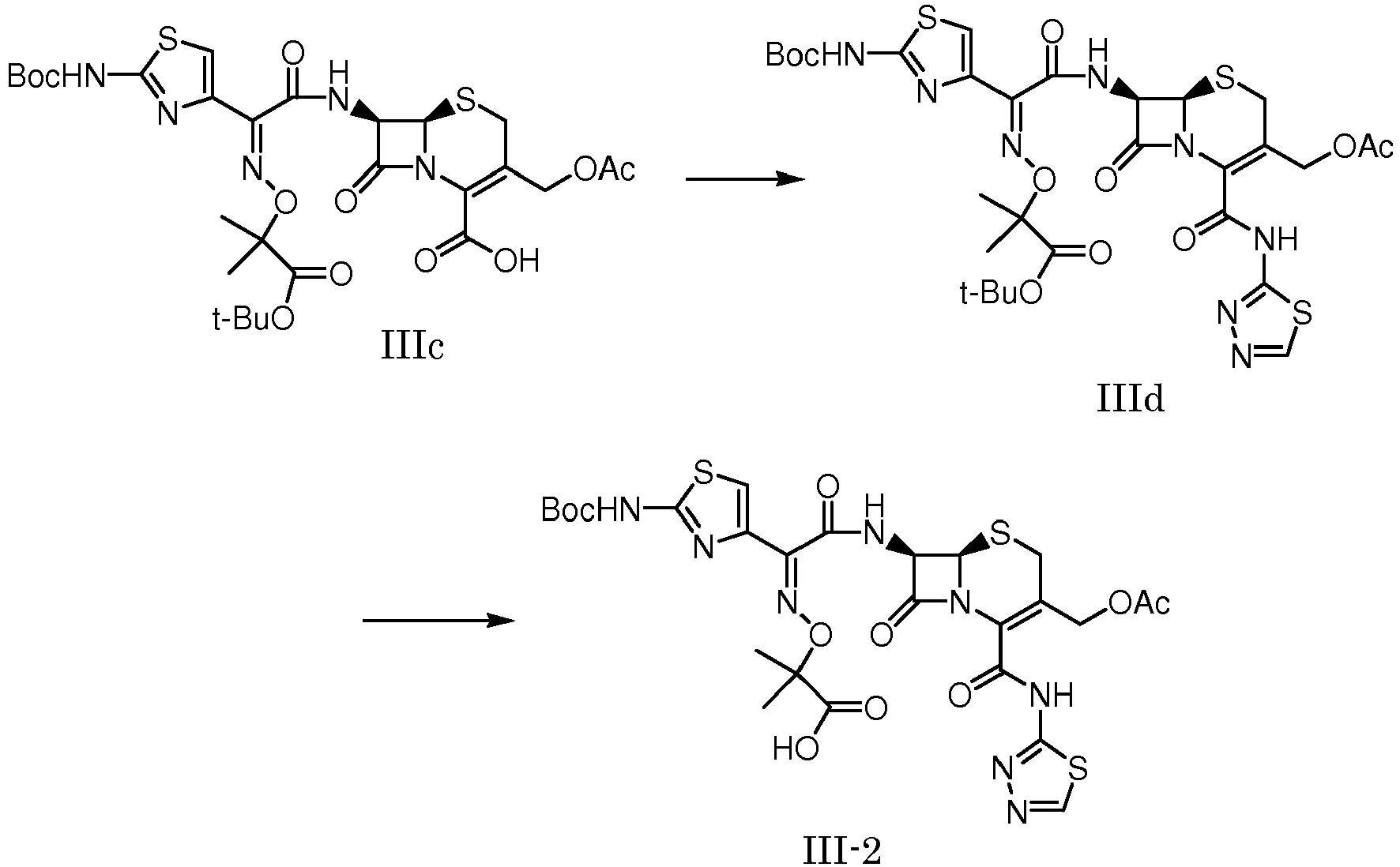
- Under nitrogen atmosphere, Compound IIIc (1.03g, 1.50mmol) was dissolved in dichloromethane (10.0mL), and the solution was cooled to 0°C. 1-chloro-N,N,2-trimethyl-1-propenylamine (0.238g, 1.2mmol) was added, and the solution was stirred for 40min.
- The solution was cooled to-40°C, 1,3,4-thiadiazol-2-amine (0.219g, 2.1mmol) was added, and the solution was stirred for 2.5 hours and at 0°C for 2 hours, and then let stand overnight at 4°C. After the reaction was completed, the solution was added with 1 mol/L hydrochloric acid and extracted. The obtained organic layer was washed with purified water, saturated aqueous sodium bicarbonate and brine, and dried over anhydrous magnesium sulfate. The desiccant was filtered off, and the solvent was removed under reduced pressure. The obtained residue was subjected to silica gel chromatography to yield Compound IIId (0.505g, 43.9 %).
1H-NMR (CDCl3) δ: 8.94 (s, 1H), 8.50 (br s, 1H), 8.11 (d, J = 8.7 Hz, 1H), 7.30 (s, 1H), 6.05 (dd, J = 8.7, 5.0 Hz, 1H), 5.41 (d, J = 5.0 Hz, 1H), 5.12 (d, J = 13.7 Hz, 1H), 4.93 (d, J = 13.7 Hz, 1H), 3.64 (d, J = 18.6 Hz, 1H), 3.45 (d, J = 18.6 Hz, 1H), 2.07 (s, 3H), 1.60 (s, 3H), 1.56 (s, 3H), 1.49 (s, 9H), 1.41 (s, 9H). - Under nitrogen atmosphere, Compound IIId (474mg, 0.618mmol) was dissolved in dichloromethane (5.00mL), and the solution was cooled to -20°C. Anisole (0.675mL, 6.18mmo01) and 2.00mol/L aluminum chloride-nitromethane solution (3.09mL, 6.18mmol) were added, and the solution was stirred at -20°C for 1 hour.
To this reaction solution, 0.2mo1/L hydrochloric acid and diisopropyl ether were added. Acetonitrile and 0.2mo1/L hydrochloric acid were added to dissolve the residue. The aqueous layer was extracted from the organic layer, added with HP20SS and concentrated under reduced pressure. The obtained suspension was subjected to ODS chromatography. The fraction containing the desired compound was concentrated and freeze-dried to yield Compound III-2 (296mg, 78.4 %).
1H-NMR (DMSO-D6) δ: 9.52 (d, J = 8.5 Hz, 1H), 9.26 (s, 1H), 7.30 (s, 2H), 6.75 (s, 1H), 5.78 (dd, J = 8.5, 4.9 Hz, 1H), 5.19 (d, J = 4.9 Hz, 1H), 5.00 (d, J = 13.2 Hz, 1H), 4.72 (d, J = 13.2 Hz, 1H), 3.70 (d, J = 18.7 Hz, 1H), 3.58 (d, J = 18.7 Hz, 1H), 2.01 (s, 3H), 1.45 (s, 3H), 1.44 (s, 3H). -


- Under nitrogen atmosphere, Compound IIIe (3.42g, 5.00mmol) was dissolved in dichloromethane (35.0mL), and the solution was cooed to 0°C. 1-chloro-N,N,2-trimethyl-1-propenylamine (0.702g, 0.425mmol) was added, and the solution was stirred for 40min.
- Separately, hydrazine hydrate (0.375g, 7.50mmol) was dissolved in dichloromethane (35.0mL). Pyridine (0.415g, 5.25mmol) was added, and the solution was cooled to -40°C. To this solution, the solution obtained above was added dropwise and stirred at -40°C. After the reaction was completed, purified water was added to this mixture, and the aqueous layer was extracted with ethyl acetate. The obtained organic layer was washed with purified water and then brine, and dried over anhydrous magnesium sulfate. The desiccant was filtered off, and the solvent was removed under reduced pressure. The obtained residue was subjected to silica gel chromatography to yield Compound IIIf (0.630g, 18.1 %).
1H-NMR (DMSO-D6) δ: 11.82 (br s, 1H), 9.59 (s, 1H), 9.53 (d, J = 8.5 Hz, 1H), 7.3 5-7.10 (m, 3H), 5.70 (dd, J = 8.5, 4.9 Hz, 1H), 5.10 (d, J = 4.9 Hz, 1H), 4.89 (d, J = 12.7 Hz, 1H), 4.72 (d, J = 12.7 Hz, 1H), 3.56 (d, J = 17.9 Hz, 1H), 3.41 (d, J = 17.9 Hz, 1H), 1.98 (s, 3H), 1.4 9-1.42 (m, 15H), 1.38 (s, 9H). - Under nitrogen atmosphere, Compound IIIf (0.600g, 0.860mmol) was dissolved in DMF (6.00mL). CDI (carbonyldiimidazole) (0.153g, 0.946mmol) was added, and the solution was stirred at 0°C for 30 min. To this solution, purified water was added, and the aqueous layer was extracted with ethyl acetate. The organic layer was washed with purified water and then brine, and dried over anhydrous magnesium sulfate. The desiccant was filtered off, the solvent was removed under reduced pressure. The obtained residue was subjected to silica gel chromatography to yield Compound IIIg (0.400g, 64.3 %).
1H-NMR (DMSO-D6) δ: 12.84 (br s, 1H), 11.84 (s, 1H), 9.56 (d, J = 8.3 Hz, 1H), 7.25 (s, 1H), 5.95 (dd, J = 8.3, 4.9 Hz, 1H), 5.30 (d, J = 4.9 Hz, 1H), 4.93 (d, J = 13.0 Hz, 1H), 4.67 (d, J = 13.0 Hz, 1H), 3.73 (d, J = 18.3 Hz, 1H), 3.59 (d, J = 18.3 Hz, 1H), 1.99 (s, 3H), 1.50-1.44 (m, 15H), 1.39 (s, 9H). - Under nitrogen atmosphere, Compound IIIg (361mg, 0.499mmol) was dissolved in dichloromethane (4.00mL), and the solution was cooled to -30°C. Anisole (0.327mL, 2.99mmo01) and 2.00mol/L aluminum chloride-nitromethane solution (1.50mL, 2.99mmol) were added, and the solution was stirred at -30°C for 20min. To this solution, purified water and diisopropyl ether were added. Acetonitrile and 2mol/L hydrochloric acid were added to dissolve the residue. The aqueous layer was extracted from organic layer, added with HP20SS and concentrated under reduced pressure. The obtained suspension was subjected to ODS chromatography. The fraction containing the desired compound was concentrated and freeze-dried to yield Compound III-3 (174mg, 61.5 %).
1H-NMR (DMSO-D6) δ: 12.87 (s, 1H), 9.50 (d, J = 8.4 Hz, 1H), 7.32 (br s, 2H), 6.75 (s, 1H), 5.96 (dd, J = 8.4, 4.9 Hz, 1H), 5.32 (d, J = 4.9 Hz, 1H), 4.97 (d, J = 13.0 Hz, 1H), 4.70 (d, J = 13.0 Hz, 1H), 3.75 (d, J = 18.2 Hz, 1H), 3.62 (d, J = 18.2 Hz, 1H), 2.05 (s, 3H), 1.51-1.40 (m, 6H). -

- Compound 15a (4.29 g, 10 mmol) was suspended in dichloromethane (40 ml), and Compound 15e (1.69 ml, 12 mmol), HOBt (1.62 g, 12 mmol), EDC (2.30 g, 12 mmol) were added sequentially and stirred overnight at room temperature. The reaction mixture was diluted with ethyl acetate, and the organic layer was then washed with aqueous sodium hydroxide,water and brine, and dried over magnesium sulfate. The magnesium sulfate was filtered off, and the filtrate was concentrated under reduced pressure. The precipitated solid was corrected by filtration to yield Compound 15f(4.55 g, 86%).
1H-NMR (CDCl3) δ: 7.47 (1H, d, J = 8.7 Hz), 7.35-7.34 (4H, m), 7.03 (1H, br s), 6.94-6.92 (3H, m), 6.83 (2H, d, J = 8.4 Hz), 5.08 (2H, s), 4.95 (2H, s), 3.83 (3H, s), 3.80 (3H, s), 3.50 (2H, q, J = 5.8 Hz), 2.64 (2H, t, J = 5.8 Hz), 2.55 (4H, q, J = 7.1 Hz), 1.01 (6H, t, J = 7.1 Hz). -


- Using Compound 15f, Compound I-139 was obtained according to similar procedures as described above.
1H-NMR (D2O) δ: 6.96-6.88 (3H, m), 5.92-5.91 (1H, m), 5.58-5.57 (1H, m), 4.15-4.06 (2H, m), 3.79-3.75 (1H, m), 3.60-3.54 (2H, m), 3.33-3.10 (6H, m), 1.50-1.48 (6H, m), 1.11-1.07 (6H, m).
Elemental analysis for: C30H35ClN11O8S2Na(H2O)5.5
Calcd: C,40.07; H,5.16; N,17.13; Cl,3.94; S,7.13; Na,2.56 (%)
Found: C,40.03; H,5.07; N,17.26; Cl,4.06; S,7.03; Na,2.44 (%) - Compound (I) of the invention was evaluated for in vitro antimicrobial activity thereof.
- Measurement of Minimum Inhibitory Concentration (MIC: µg/mL) was conducted according to CLSI (Clinical and Laboratory Standards Institute) method, and the amount of bacteria for inoculation was 5 x 10⁵ cfu/mL, and cation-adjusted Mueller Hinton broth containing human apo-transferrin was used as a test medium, and the experiment was conducted using broth microdilution method. The bacteria used are listed below.
[Table 1] No. Species Strain Name Enzyme Produced Strain Type 1 P.aeruginosa SR24 None Ceftazidime resistance strain 2 P.aeruginosa SR27060 IMP-1 MBL producing strain (carbapenem resistance strain) 3 P.aeruginosa SR24837 PER-1 ESBL producing strain 4 A.baumannii SR27323 OXA-23,OXA-58 OXA-type carbapenemase producing strain (carbapenem resistance strain) 5 K.pneumoniae ATCCBAA-1705 KPC-2 KPC-type carbapenemase producing strain (carbapenem resistance strain) 6 E.coli ATCCBAA-199 SHV-3 ESBL producing strain 7 E.coli ATCCBAA-200 SHV-4 ESBL producing strain - As a comparative compound, Comparative Compound 1 of the formula:

- The test results are shown in Tables 2 to 4. In the table, the values of inhibitory activity are expressed in microgram/mL (µg/ml).
[Table 2] Compound P.aeruginosa A.baumannii K.pneumoniae E.coli SR24 SR27060 SR24837 SR27323 ATCCBAA-1705 ATCC BAA-199 ATCC BAA-200 Comparative Compound 1 0.5 4 >32 1 0.125 2 4 Compound I-1 0.5 0.5 0.5 0.5 ≦0.031 0.063 0.125 Compound I-2 0.25 1 0.25 1 ≦0.031 0.5 1 Compound I-3 0.5 1 2 0.25 ≦0.031 ≦0.031 0.63 Compound I-4 0.5 0.5 4 0.5 ≦0.031 0.125 0.5 Compound I-5 0.25 0.5 2 0.125 0.063 0.5 1 Compound I-6 0.25 0.5 1 2 ≦0.031 0.25 0.5 Compound I-7 2 4 1 16 0.063 0.25 0.5 Compound I-9 0.25 4 2 1 0.063 0.25 0.5 Compound I-10 0.25 2 2 0.5 ≦0.031 0.5 1 Compound I-11 0.25 1 0.063 0.25 ≦0.031 0.125 0.5 Compound I-13 0.125 0.5 2 2 ≦0.031 0.5 1 Compound I-14 0.5 1 8 0.125 ≦0.031 0.25 1 Compound I-15 0.125 0.5 ≦0.031 ≦0.031 ≦0.031 0.063 0.25 [Table 3] Compound P.aeruginosa A.baumannii K.pneumoniae E.coli SR24 SR27060 SR24837 SR27323 ATCC BAA-1705 ATCC BAA-199 ATCC BAA-200 Compound I-16 0.125 0.25 1 1 ≦0.031 0.25 0.25 Compound I-18 0.5 2 1 0.125 ≦0.031 0.125 0.25 Compound I-22 ≦0.031 0.25 0.25 0.125 ≦0.031 0.063 0.125 Compound I-45 0.125 0.5 0.5 0,25 ≦0.031 0.125 0.25 Compound I-46 0,25 0.5 1 0.5 ≦0.031 0.125 0.5 Compound I-47 0.125 1 0.5 0,25 0.063 0.5 1 Compound I-48 ≦0.031 0.25 0.125 0.5 ≦0.031 0.25 0.25 Compound I-49 0.063 1 0.25 1 ≦0.031 0.25 0.5 Compound I-50 0.25 1 2 1 ≦0.031 0.25 0.5 Compound I-52 0.25 1 2 1 ≦0.031 0.125 0.5 Compound I-53 0,25 0.5 0.063 1 ≦0.031 0.063 0.125 Compound I-54 ≦0.031 0.25 0.25 1 ≦0.031 0.25 0.5 Compound I-55 0,25 1 0.5 2 ≦0.031 0.25 1 Compound I-56 ≦0.031 0.5 0.25 0.5 ≦0.031 0.125 0.25 [Table 4] Compound P.aeruginosa A.baumannii K.pneumoniae E.coli SR24 SR27060 SR24837 SR27323 ATCC BAA-1705 ATCC BAA-199 ATCC BAA-200 Compound I-58 0.125 0.5 0.5 1 ≦0.031 0.25 0.5 Compound I-71 0,063 0.25 1 1 ≦0.031 0.25 0.5 Compound I-73 0.125 0.25 0.25 0.25 ≦0.031 0.063 0.125 Compound I-74 0.125 0.25 0.5 0.5 ≦0.031 0.063 0.125 Compound I-75 0.063 0.25 0.063 1 0.063 0.125 0.5 Compound I-76 0.125 0.5 0.125 0.5 ≦0.031 0.25 0.5 Compound I-77 ≦0.031 0.25 ≦0.031 0.125 ≦0.031 ≦0.031 0.063 Compound I-78 0.125 0.25 0.125 0.25 ≦0.031 0.25 0.5 Compound I-79 ≦0.031 0.25 0.063 0.125 ≦0.031 0.5 1 Compound I-80 ≦0.031 0.25 0.125 2 ≦0,031 0.5 1 Compound I-86 0.063 0.25 ≦0.031 2 0.063 0.5 0.5 Compound I-88 0.063 0.5 ≦0.031 0.5 0.063 0.063 0.125 Compound I-91 0.063 0.125 0.063 0.5 ≦0.031 0.125 0.25 Compound I-92 0.25 2 0.25 0.5 ≦0.031 0.063 0.125 - Compound (I) of the invention was evaluated for in vitro antimicrobial activity thereof.
- Measurement of Minimum Inhibitory Concentration (MIC: µg/mL) was conducted according to CLSI (Clinical and Laboratory Standards Institute) method, and the amount of bacteria for inoculation was 5 x 10⁵ cfu/mL, and cation-adjusted Iso-Sensitest broth containing human Apo-transferrin was used as a test medium, and the experiment was conducted using broth microdilution method.
[Table 5] Species Strain Name Enzyme Produced Strain Type 1 E. coli ATCCBAA-196 TEM-10 ESBL producing strain 2 E. coli ATCCBAA-200 SHV-4 ESRL producing strain 3 E. coli SR01337 TEM-1 ESBL producing strain 4 E. cloacae NCTC13464 CTX-M group 9 ESBL producing strain 5 K. pneumoniae ATCC700603 SHV18 ESBL producing strain 6 A. baumannii SR01331 PER-1, OXA-23, 5 ESBL- & OXA-type carbapenemase producing strain (carbapenem resistance strain) 7 P. aeruginosa SR01332 VIM-11 MBL producing strain (carbapenem resistance strain) 8 P. aeruginosa SR01335 VIM-1 like MBL producing strain (carbapenem resistance strain) - As a comparative compound, Comparative Compound 2 of the formula:

W02011/125967 (aforementioned "Patent Document 23") was used. - The test results are shown in Tables 6 to 8. In the table, the values of inhibitory activity are expressed in microgram/mL (µg/ml).
[Table 6] Compound E.coli E.cloacae K.pneumoniae A.baumannii P.aeruginosa ATCC BAA-196 ATCC BAA-200 SR01337 NCTC 13464 ATCC 700603 SR01331 SR01332 SR01335 Comparative Compound 2 0.5 1 >32 0.5 0.5 >32 32 4 Compound I-28 0.125 0.5 ≦0.031 0.5 0.125 0.5 1 1 Compound I-29 ≦0.031 0.063 ≦0.031 0.063 0.125 0.5 4 2 Compound I-30 ≦0.031 0.063 ≦0.031 0.063 0.125 1 2 2 Compound I-31 0.063 0.25 ≦0.031 0.125 0.125 0.5 1 1 Compound I-32 ≦0.031 0.063 ≦0.031 0.063 ≦0.031 0.25 4 1 Compound I-33 0.063 0.25 0.063 0.25 0.25 0.5 2 4 Compound I-34 0.063 0.25 ≦0.031 0.5 0.5 1 4 2 Compound I-36 ≦0.031 0.25 ≦0.031 0.125 0.5 0.5 0.5 4 Compound I-37 ≦0.031 0.063 ≦0.031 ≦0.031 0.063 0.25 0.25 0.5 Compound I-38 0.063 0.25 ≦0.031 0.125 0.125 0.5 0.5 1 Compound I-57 0.063 0.25 0.063 0.25 0.125 0.5 8 1 Compound I-60 ≦0.031 0.063 ≦0.031 0.063 ≦0.031 0.5 4 1 Compound I-61 0.063 0.25 0.063 0.125 0.125 1 4 4 Compound I-62 0.063 0.25 0.063 0.25 0.063 0.25 8 4 Compound I-63 0.063 0.25 0.063 0.25 0.25 1 2 2 Compound I-64 ≦0.031 0.063 ≦0.031 ≦0.031 ≦0.031 0.25 0.5 4 [Table 7] Compound E.coli E.cloacae K.pneumoniae A.baumannii P.aeruginosa ATCC BAA-196 ATCC BAA-200 SR01337 NCTC 13464 ATCC 700603 SR01331 SR01332 SR01335 Compound I-65 ≦0.031 ≦0.031 ≦0.031 ≦0.031 ≦0.031 0.125 0.25 0.5 Compound I-67 ≦0.031 0.063 ≦0.031 0.063 ≦0.031 0.25 2 2 Compound I-69 0.125 0.125 ≦0.031 0.063 0.125 0.5 2 2 Compound I-70 ≦0.031 0.125 ≦0.031 0.063 ≦0.031 0.5 0.5 2 Compound I-82 0.125 0.25 ≦0.031 0.125 0.125 0.5 4 1 Compound I-86 0.125 1 ≦0.031 0.5 0.25 0.5 8 4 Compound I-94 0.063 0.5 0.063 0.5 0.5 0.5 2 1 Compound I-96 0.25 1 0.125 0.5 1 0.25 4 2 Compound I-97 0.125 0.5 0.25 0.5 0.5 0.25 4 1 Compound I-98 0.25 0.5 ≦0.031 0.125 0.25 1 8 2 Compound I-99 ≦0.031 0.063 ≦0.031 0.125 0.063 0.5 4 2 Compound I-100 ≦0.031 0.063 ≦0.031 0.25 0.125 0.25 2 2 Compound I-101 ≦0.031 0.063 ≦0.031 0.063 0.125 0.25 2 1 Compound I-102 ≦0.031 0.063 ≦0.031 0.063 ≦0.031 0.25 4 1 Compound I-103 ≦0.031 0.125 ≦0.031 0.125 0.5 0.25 2 1 Compound I-104 ≦0.031 0.063 ≦0.031 0.125 0.125 0.5 4 2 Compound I-105 0.063 0.25 ≦0.031 0.25 0.25 2 4 2 Compound I-106 ≦0.031 0.063 ≦0.031 0.063 ≦0.031 0.5 4 1 [Table 8] Compound E.coli E.cloacae K.pneumoniae A.baumannii P.aeruginosa ATCC BAA-196 ATCC BAA-200 SR01337 NCTC 13464 ATCC 700603 SR01331 SR01332 SR01335 Compound I-107 0.25 0.5 0.063 0.063 0.125 0.5 2 2 Compound I-108 0.25 0.25 ≦0.031 0.125 0.25 1 2 2 Compound I-109 0.5 1 ≦0.031 0.125 0.25 0.5 0.5 1 Compound I-110 0.5 0.063 0.25 0.25 1 8 0.5 Compound I-111 1 0.125 0.25 0.5 1 2 2 Compound I-112 0.5 0.063 0.25 0.5 1 4 2 Compound I-113 0.125 0.25 ≦0.031 ≦0.031 0.125 0.125 0.5 0.25 Compound I-114 0.5 1 ≦0.031 0.25 1 0.5 1 1 Compound I-115 1 1 ≦0.031 1 0.5 0.5 2 1 Compound I-116 0.5 1 ≦0.031 ≦0.031 0.25 0.25 2 1 Compound I-117 1 1 0.063 0.5 0.25 0.5 4 2 Compound I-118 0.25 0.25 ≦0.031 0.25 0.063 0.25 8 1 Compound I-119 0.5 0.5 ≦0.031 0.125 0.25 0.5 4 2 Compound I-121 ≦0.031 ≦0.031 ≦0.031 0.063 ≦0.031 0.125 1 0.5 Compound I-122 0.125 0.25 ≦0.031 0.063 0.125 0.25 4 1 - As shown in the above results, Compounds (I) of the invention have a wide antimicrobial spectrum, in particular, potent antimicrobial spectrum against Gram negative bacteria, and/or effectiveness against multidrug-resistant bacteria, and further to exhibit high stability against beta-lactamase producing Gram negative bacteria.
- Powder of a compound of the present invention is formulated to prepare an injecting agent.
- The compounds of the present invention have a wide antimicrobial spectrum against Gram negative bacteria and Gram positive bacteria, and are effective as an antimicrobial drug having high stability against beta-lactamase producing Gram negative bacteria. Moreover, the present compounds have good disposition, and high water solubility, and thus particularly effective as an injecting agent.


Claims (35)
- A compound of the formula:

whereinW is -CH2-, -S- or -O-;a) U is -CH2-, -S-, -S(=O)- or -O- when W is -CH2-; orb) U is -CH2- when W is -S- or -O-;L is -CH2-, -CH=CH-, -CH2-CH=CH- or -CH=CH-CH2-;R1 is a substituted or unsubstituted carbocyclic group or a substituted or unsubstituted heterocyclic group;with regard to R2A and R2B,a) R2A is a hydrogen atom, a substituted or unsubstituted amino group, -SO3H, a substituted or unsubstituted amino sulfonyl group, carboxyl group, a substituted or unsubstituted (lower alkyl)oxycarbonyl group, a substituted or unsubstituted carbamoyl group, hydroxyl group, or a substituted carbonyloxy group; and R2B is a hydrogen atom, orb) R2A and R2B are taken together to form a substituted or unsubstituted methylidene group or a substituted or unsubstituted hydroxyimino group;R3 is a hydrogen atom, -OCH3 or -NH-CH(=O);R11 is a bioisoster of carboxyl ion (-COO-);E is a substituted or unsubstituted divalent group having at least one quaternary ammonium ion;R10 is R12 or a group represented by the formula:
 k is an integer from 2 to 5;each R4 is independently a hydrogen atom, halogen, hydroxyl group, -CN, -C(=O)-R5, -C(=O)-OH, -C(=O)-OR5, or-OR5;R5 is a lower alkyl group or halo(lower)alkyl group; andG is a single bond, a substituted or unsubstituted lower alkylene group, a substituted or unsubstituted alkenylene group or a substituted or unsubstituted alkynylene group;B is a single bond or a 5- or 6-membered heterocyclic group containing at least 1-3 nitrogen atoms;D is a single bond, -C(=O)-, -O-C(=O)-, -C(=O)-O-,-NR6-, -NR6-C(=O)-, -C(=O)-NR6-, -NR6-C(=O)-NR6-, -O-, -S-,-S(=O)-, -S(=O)2-NR6-, -NR6-S(=O)2-, -NR6-CH2-, -CH2-NR6- or-S(=O)2-;each R6 is independently a hydrogen atom or a substituted or unsubstituted lower alkyl group;R12 is a hydrogen atom, halogen, hydroxyl group, -SO3H, a substituted or unsubstituted amino group, a substituted or unsubstituted carboxyl group, a substituted or unsubstituted carbamoyl group, a substituted or unsubstituted acyl group, a substituted or unsubstituted amino sulfonyl group, a substituted or unsubstituted lower alkyl group, a substituted or unsubstituted lower alkenyl group, a substituted or unsubstituted lower alkynyl group, a substituted or unsubstituted non-aromatic carbocyclic group or a substituted or unsubstituted non-aromatic heterocyclic group.
 - The compound or an amino-protected compound when the amino group is present on the ring in the 7-side chain, or a pharmaceutically acceptable salt thereof according to claim 1, wherein R10 is a group represented by the formula:

- The compound or an amino-protected compound when the amino group is present on the ring in the 7-side chain, or a pharmaceutically acceptable salt thereof according to claim 1, wherein R10 is R12 wherein R12 is as defined in claim 1.
- The compound or an amino-protected compound when the amino group is present on the ring in the 7-side chain, or a pharmaceutically acceptable salt thereof according to claim 1 or 2, wherein G is a single bond, -CH2-, -CH2-CH2-, -CH2-CH2-CH2-, -CH=CH-, -CH=CH-CH2-, -CH2-CH=CH-, -CH2-CH(CH3)-, -CH2-CH(iPr)- or -CH2-CH(Ph)- wherein iPr is isopropyl group and Ph is phenyl group.
- The compound or an amino-protected compound when the amino group is present on the ring in the 7-side chain, or a pharmaceutically acceptable salt thereof according to claim 1, 2 or 4, wherein B is a single bond or a group represented by the formula:

 wherein the bond of the left side is attached to G and the bond of the right side is attached to D.
 - The compound or an amino-protected compound when the amino group is present on the ring in the 7-side chain, or a pharmaceutically acceptable salt thereof according to any one of claims 1, 2, 4 or 5, wherein D is a single bond,-C(=O)-, -O-C(=O)-, -C(=O)-O-, -NR6-, -NR6-C(=O)-NR6-, -NR6-C(=O)- or -C(=O)-NR6-wherein R6 is as defined in claim 1.
- The compound or an amino-protected compound when the amino group is present on the ring in the 7-side chain, or a pharmaceutically acceptable salt thereof according to any one of claims 1, 2, 4 or 5, wherein the formula:


 wherein each R4 is independently hydrogen, halogen, hydroxyl group, -CN, -C(=O)-R5, -C(=O)-OH, -C(=O)-OR5 or-OR5; and R5 is as defined in claim 1.
 - The compound or an amino-protected compound when the amino group is present on the ring in the 7-side chain, or a pharmaceutically acceptable salt thereof according to claim 7, wherein the formula:


- The compound or an amino-protected compound when the amino group is present on the ring in the 7-side chain, or a pharmaceutically acceptable salt thereof according to claim7, wherein the formula:


- The compound or an amino-protected compound when the amino group is present on the ring in the 7-side chain, or a pharmaceutically acceptable salt thereof according to any one of claims 1 to 9, wherein E is a substituted or unsubstituted, saturated or unsaturated, monocyclic or fused cyclic quaternary ammonium group having at least one nitrogen atom represented by the formula:
 the dashed line is a bond in the ring;the bond to the cationic nitrogen atom binds to L, and the other bond binds to R10;provided,when a cationic nitrogen atom binds to R10, the dashed line is absent, andwhen a cationic nitrogen atom does not bind to R10, the dashed line is a single bond between the cationic nitrogen atom and a neighboring atom or an alkylene group connecting the cationic nitrogen atom to a ring member atom other than said neighboring atom.
 - The compound or an amino-protected compound when the amino group is present on the ring in the 7-side chain, or a pharmaceutically acceptable salt thereof according to any one of claims 1 to 9, wherein E is a group selected from the following formulae which are substituted or unsubstituted on the ring:


 wherein the bond to the quaternary nitrogen atom binds to L, and the other bond binds to R10; p is an integer from 1 to 3; n is an integer of 1 or 2; RX is a substituted or unsubstituted lower alkyl group.
 - The compound or an amino-protected compound when the amino group is present on the ring in the 7-side chain, or a pharmaceutically acceptable salt thereof according to claim 11, wherein E is selected from the group consisting of the formulae (1) to (7), (10) to (12), (14), (25) to (29), (31), (41) to (44), (47), (50), (52), (53), (64) and (73).
- The compound or an amino-protected compound when the amino group is present on the ring in the 7-side chain, or a pharmaceutically acceptable salt thereof according to claim 11, wherein E is selected from the group consisting of the formulae (3), (10) to (12), (26) to (28), (31), (41), (42), (53), (64) and (73).
- The compound or an amino-protected compound when the amino group is present on the ring in the 7-side chain, or a pharmaceutically acceptable salt thereof according to any one of claims 1 to 9, wherein E is a group selected from the following formulae which are substituted or unsubstituted on the ring:


 wherein the bond to the quaternary nitrogen atom binds to L, and the other bond binds to R10.
 - The compound or an amino-protected compound when the amino group is present on the ring in the 7-side chain, or a pharmaceutically acceptable salt thereof according to claim 1, wherein E-R10 is a group selected from the following formulae which are substituted or unsubstituted on the ring:

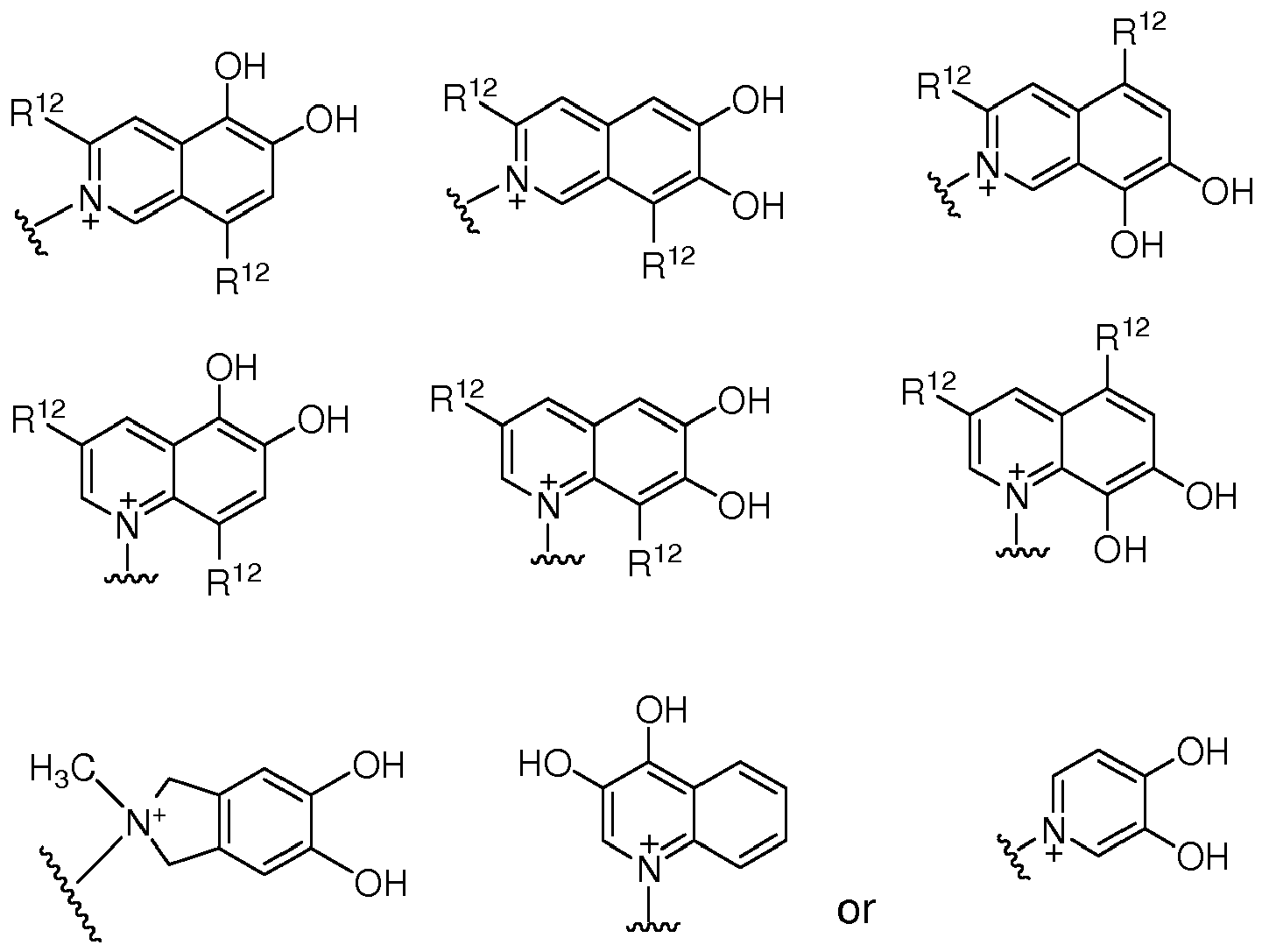 wherein the bond to the quaternary nitrogen atom binds to L, and R12 is as defined in claim 1.
 - The compound or an amino-protected compound when the amino group is present on the ring in the 7-side chain, or a pharmaceutically acceptable salt thereof according to claim 1, wherein E-R10 is
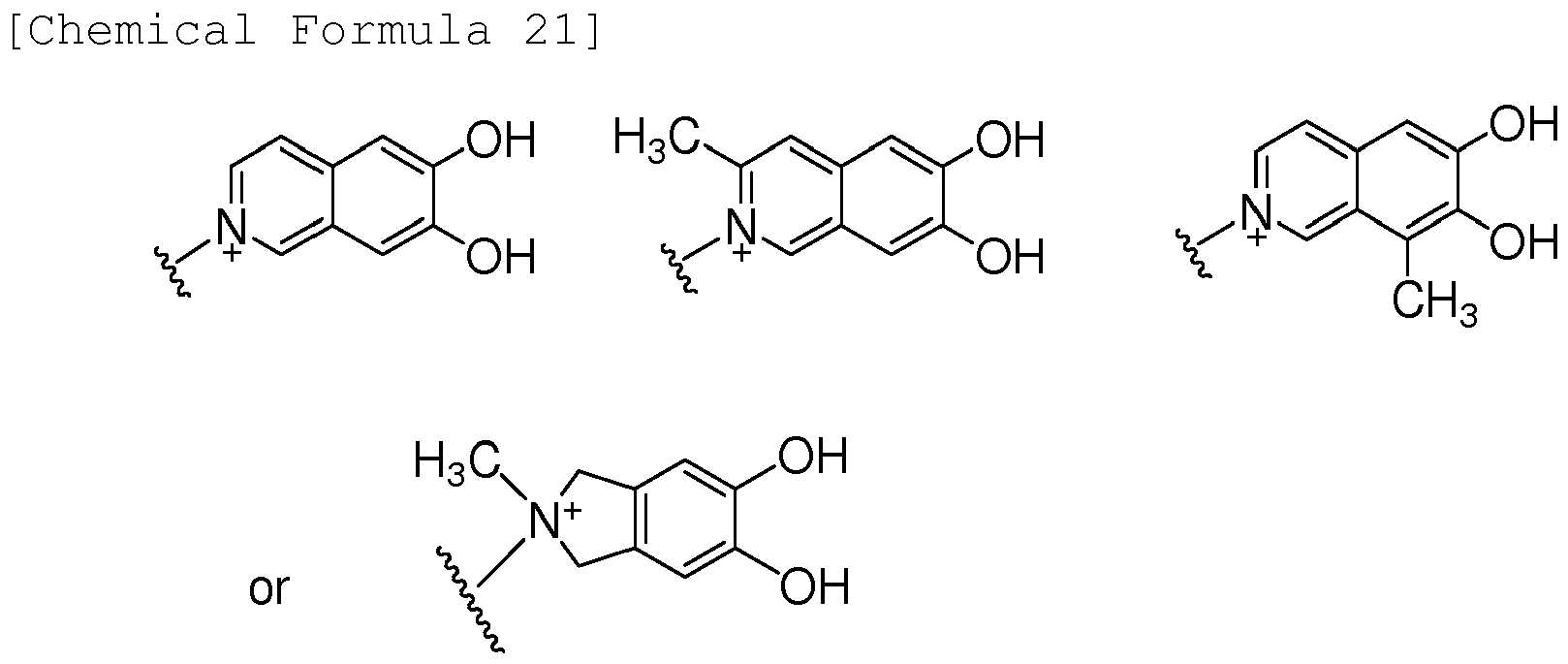 wherein the bond to the quaternary nitrogen atom binds to L.
 - The compound or an amino-protected compound when the amino group is present on the ring in the 7-side chain, or a pharmaceutically acceptable salt thereof according to any one of claims 1 to 16, wherein the bioisoster of carboxyl ion (-COO-) is selected from -SO3 -, -S(=O)2-N--R13, -PO--(OR13), -PO2 --(OR13), -N--C(=O)-R13, -C(=O)-N--OR13, -C(=O)-NH-N--S(=O)2-R13, -C (=O)-N--S(=O)2-R13, -C(=O)-CH=C(O-)-R13, -N--S(=O)2-R13, -C(=O)-N--S(=O)2-R13, -N--S(=O)2-R13, -C(=O)-N--C(=O)-R13, -C (=O)-N--S(=O)2-R13, -N--C(=O)-R13,


 wherein R13 is selected from the group consisting of hydrogen, hydroxyl group, halogen, a substituted or unsubstituted lower alkyl group, a substituted or unsubstituted lower alkenyl group, a substituted or unsubstituted lower alkynyl group, a substituted or unsubstituted lower alkoxy group, a substituted or unsubstituted amino group, (lower alkenyl)oxy group, a substituted or unsubstituted aryloxy group, cyano, nitro, imino, mercapto, (lower alkyl)thio group, (lower alkyl)sulphonyl group, a substituted or unsubstituted carbocyclic group, a substituted or unsubstituted heterocyclic group and -CO2R17 wherein R17 is hydrogen, lower alkyl group or lower alkenyl group; and R14 is an electron-withdrawing group.
 - The compound or an amino-protected compound when the amino group is present on the ring in the 7-side chain, or a pharmaceutically acceptable salt thereof according to claim 17, wherein the bioisoster of carboxyl ion (-COO-) is

- The compound or an amino-protected compound when the amino group is present on the ring in the 7-side chain, or a pharmaceutically acceptable salt thereof according to any one of claims 1 to 18, wherein U is -S-.
- The compound or an amino-protected compound when the amino group is present on the ring in the 7-side chain, or a pharmaceutically acceptable salt thereof according to any one of claims 1 to 19, wherein W is -CH2-.
- The compound or an amino-protected compound when the amino group is present on the ring in the 7-side chain, or a pharmaceutically acceptable salt thereof according to any one of claims 1 to 20, wherein R3 is a hydrogen atom or-OCH3.
- The compound or an amino-protected compound when the amino group is present on the ring in the 7-side chain, or a pharmaceutically acceptable salt thereof according to any one of claims 1 to 21, wherein R1 is a substituted or unsubstituted phenyl.
- The compound or an amino-protected compound when the amino group is present on the ring in the 7-side chain, or a pharmaceutically acceptable salt thereof according to any one of claims 1 to 21, wherein R1 is represented by the formula:

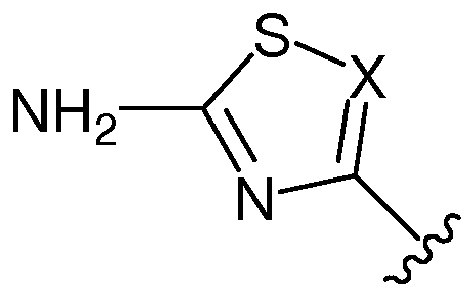 wherein X is N, C(-H) or C(-Cl).
 - The compound or an amino-protected compound when the amino group is present on the ring in the 7-side chain, or a pharmaceutically acceptable salt thereof according to claim 23, wherein X is N.
- The compound or an amino-protected compound when the amino group is present on the ring in the 7-side chain, or a pharmaceutically acceptable salt thereof according to claim 23, wherein X is C(-H) or C(-Cl).
- The compound or an amino-protected compound when the amino group is present on the ring in the 7-side chain, or a pharmaceutically acceptable salt thereof according to any one of claims 1 to 25, wherein R2A is a hydrogen atom, a substituted or unsubstituted amino group, -SO3H, a substituted or unsubstituted amino sulphonyl group, carboxyl group, a substituted or unsubstituted carbamoyl group, hydroxyl group, or substituted carbonyloxy group, and R2B is a hydrogen atom.
- The compound or an amino-protected compound when the amino group is present on the ring in the 7-side chain, or a pharmaceutically acceptable salt thereof according to any one of claims 1 to 26, wherein R2A is a substituted amino group shown below:
 a substituted amino sulfonyl group shown below:
 wherein ring B represents a substituted or unsubstituted heterocyclic group;a substituted carbamoyl group shown below:
 wherein ring B represents a substituted or unsubstituted heterocyclic group; ora substituted carbonyloxy group shown below:
 wherein ring B represents a substituted or unsubstituted heterocyclic group.
 - The compound or an amino-protected compound when the amino group is present on the ring in the 7-side chain, or a pharmaceutically acceptable salt thereof according to any one of claims 1 to 25, wherein R2A and R2B are taken together to form a substituted methylidene group shown below:
 a substituted hydroxyimino group shown below:
 wherein R9 is a substituted or unsubstituted lower alkyl group.
 - The compound or an amino-protected compound when the amino group is present on the ring in the 7-side chain, or a pharmaceutically acceptable salt thereof according to any one of claims 1 to 25, wherein R2A and R2B are taken together to form a substituted hydroxyimino group shown below:
 wherein R7 and R8 are each independently a hydrogen atom, halogen, hydroxyl group, carboxyl group, a substituted or unsubstituted lower alkyl group, a substituted or unsubstituted carbocyclic group, or a substituted or unsubstituted heterocyclic group, orR7 and R8 may be taken together with a neighboring atom to form a substituted or unsubstituted carbocyclic group or a substituted or unsubstituted heterocyclic group;Q is a single bond, a substituted or unsubstituted carbocyclic group or a substituted or unsubstituted heterocyclic group; andm is an integer from 0 to 3.
 - A pharmaceutical composition, which comprises a compound or an amino-protected compound when the amino group is present on the ring in the 7-side chain, or a pharmaceutically acceptable salt thereof according to any one of claims 1 to 29.
- The pharmaceutical composition according to claim 30, which possesses antimicrobial activity.
- A compound of the formula:

whereinY is a leaving group;U, R3 and L are as defined in claim 1;is a group of the following formula:
the group of the formula:


a group of the formula: P1 is a protecting group.
 - The compound according to Claim 32, or a salt thereof, wherein P1 is benzhydryl group, p-methoxybenzyl group, trityl group, 2,6-dimethoxybenzyl group, methoxymethyl group, benzyloxymethyl group or 2-(trimethylsilyl)ethoxymethyl group.
- A compound of the formula:

whereinY is a leaving group;U, R3 and L are as defined in claim 1;is a group of the following formula:
the group of the formula:
 a group of the following formula:
 P2 is a protecting group.
 - The compound according to Claim 34, or a salt thereof, wherein P2 is benzhydryl group, p-methoxybenzyl group, trityl group, 2,6-dimethoxybenzyl group, methoxymethyl group, benzyloxymethyl group or 2-(trimethylsilyl)ethoxymethyl group.
Applications Claiming Priority (3)
| Application Number | Priority Date | Filing Date | Title |
|---|---|---|---|
| JP2011101530 | 2011-04-28 | ||
| JP2011142005 | 2011-06-27 | ||
| PCT/JP2012/061053 WO2012147773A1 (en) | 2011-04-28 | 2012-04-25 | Novel cephem compound having catechol or pseudo-catechol structure |
Publications (2)
| Publication Number | Publication Date |
|---|---|
| EP2703406A1 true EP2703406A1 (en) | 2014-03-05 |
| EP2703406A4 EP2703406A4 (en) | 2015-08-05 |
Family
ID=47072291
Family Applications (1)
| Application Number | Title | Priority Date | Filing Date |
|---|---|---|---|
| EP12777752.2A Withdrawn EP2703406A4 (en) | 2011-04-28 | 2012-04-25 | Novel cephem compound having catechol or pseudo-catechol structure |
Country Status (9)
| Country | Link |
|---|---|
| US (1) | US9334289B2 (en) |
| EP (1) | EP2703406A4 (en) |
| JP (1) | JP6006201B2 (en) |
| KR (1) | KR20140039202A (en) |
| CN (1) | CN103635478A (en) |
| AR (1) | AR086157A1 (en) |
| CA (1) | CA2833121A1 (en) |
| TW (1) | TW201309709A (en) |
| WO (1) | WO2012147773A1 (en) |
Cited By (2)
| Publication number | Priority date | Publication date | Assignee | Title |
|---|---|---|---|---|
| WO2017096472A1 (en) | 2015-12-10 | 2017-06-15 | Naeja-Rgm Pharmaceuticals Inc. | Cephem compounds, their production and use |
| EP3634471A4 (en) * | 2017-06-09 | 2021-02-24 | FOB Synthesis, Inc. | CARBAPENEM COMPOUNDS AND COMPOSITIONS FOR THE TREATMENT OF BACTERIAL INFECTIONS |
Families Citing this family (9)
| Publication number | Priority date | Publication date | Assignee | Title |
|---|---|---|---|---|
| WO2009049086A1 (en) | 2007-10-09 | 2009-04-16 | Larry Sutton | Broad spectrum beta-lactamase inhibitors |
| UY35103A (en) * | 2012-10-29 | 2014-05-30 | Glaxo Group Ltd | 2-REPLACED CEFEM COMPOUNDS |
| US20150344502A1 (en) * | 2012-12-26 | 2015-12-03 | Shionogi & Co., Ltd. | Cephem compound |
| WO2014168105A1 (en) * | 2013-04-09 | 2014-10-16 | 塩野義製薬株式会社 | Cephem compound having carboxy bioisostere in position 4 |
| CN103588788B (en) * | 2013-11-29 | 2015-10-21 | 中国科学院长春应用化学研究所 | The preparation method of 7-phenoxy-acetamide-3-hydroxy-cepham-4-carboxylic acid-to nitrobenzyl ester |
| WO2016028670A1 (en) * | 2014-08-18 | 2016-02-25 | Merck Sharp & Dohme Corp. | Salt forms of ceftolozane |
| AR110451A1 (en) * | 2016-12-26 | 2019-03-27 | Shionogi & Co | TRICYCLIC COMPOUND THAT HAS SULFINYL AND PHARMACEUTICAL COMPOSITION THAT INCLUDES IT |
| US12371441B2 (en) | 2019-09-06 | 2025-07-29 | Ariva Med Gmbh | Siderophore cephalosporin conjugates and uses thereof |
| US12225906B1 (en) | 2024-09-26 | 2025-02-18 | Terry Earl Brady | Pathogenic affinity pathway of infectious or parasitic organisms for nanogram and picogram dosimetry prophylaxis or cure |
Family Cites Families (41)
| Publication number | Priority date | Publication date | Assignee | Title |
|---|---|---|---|---|
| NL178005C (en) | 1972-11-06 | 1986-01-02 | Merck & Co Inc | METHOD FOR PREPARING A PHARMACEUTICAL PREPARATION WITH ANTIBACTERIAL ACTION, AND METHOD FOR PREPARING A CEPHALOSPORINE ANTIBIOTIC. |
| US4032521A (en) * | 1972-12-29 | 1977-06-28 | Merck & Co., Inc. | Cephalosporin phosphonic acid, sulfonic acid and sulfonamide compounds |
| US3966719A (en) * | 1973-10-17 | 1976-06-29 | Pfizer Inc. | 4-(Tetrazol-5-yl)-Δ3 -cephem compounds |
| SE429342B (en) * | 1973-10-17 | 1983-08-29 | Pfizer | ANALOGY PROCEDURE FOR PREPARING CEPHALOSPORIN DERIVATIVES |
| IL47168A (en) | 1974-05-09 | 1979-07-25 | Toyama Chemical Co Ltd | Mono or dioxo piperazino(thio)carbonylamino derivatives ofpenicillins and cephalosporins and process for producing the same |
| US4327097A (en) | 1974-05-09 | 1982-04-27 | Toyama Chemical Co., Ltd. | Novel penicillins |
| US4410522A (en) | 1974-05-09 | 1983-10-18 | Toyama Chemical Co., Ltd. | Cephalosporins |
| US4110327A (en) | 1974-05-09 | 1978-08-29 | Toyama Chemical Co., Ltd. | 2,3 Diketo-piperazinocarbonylamino alkanoic acids and derivatives |
| US4039532A (en) | 1974-09-23 | 1977-08-02 | Pfizer Inc. | 4-(Tetrazol-5-yl)-Δ3 -cephem compounds |
| US4045436A (en) * | 1974-09-23 | 1977-08-30 | Pfizer Inc. | 4-(Tetrazol-5-yl)-Δ3 -cephem compounds |
| IE41799B1 (en) * | 1974-11-06 | 1980-03-26 | Pfizer | Process for preparing 3-methyl-4-(5-tetrazolyl)- 3-cephem compounds |
| US4045437A (en) * | 1976-02-17 | 1977-08-30 | Pfizer, Inc. | 4-(Tetrazol-5-yl)-Δ3 -cephem compounds |
| JPS57118588A (en) | 1981-11-26 | 1982-07-23 | Toyama Chem Co Ltd | Novel cephalosporin |
| AU2361184A (en) | 1983-01-21 | 1984-07-26 | Beecham Group Plc | Disubstituted 6-penicillins and 7-cephalosporins |
| EP0168177A3 (en) | 1984-06-28 | 1987-04-01 | Pfizer Limited | Cephalosporin antibiotics |
| GB8416498D0 (en) * | 1984-06-28 | 1984-08-01 | Pfizer Ltd | Cephalosporin antibiotics |
| US4699904A (en) | 1985-07-01 | 1987-10-13 | Merck & Co., Inc. | Tetrazolyl derivatives of β-lactams useful as elastase inhibitors |
| JPH068300B2 (en) * | 1985-08-02 | 1994-02-02 | 萬有製薬株式会社 | New cefalosporin derivative |
| EP0211656A3 (en) | 1985-08-10 | 1988-03-09 | Beecham Group Plc | Cephalosporin derivatives, process for their preparation and pharmaceutical compositions containing them |
| DE3789466T2 (en) * | 1986-03-17 | 1994-07-28 | Fujisawa Pharmaceutical Co | 3,7-disubstituted-3-cephem compounds and process for their preparation. |
| GB8719875D0 (en) | 1987-08-22 | 1987-09-30 | Beecham Group Plc | Compounds |
| JPH0228185A (en) | 1988-04-14 | 1990-01-30 | Tanabe Seiyaku Co Ltd | Cephalosporin compound and synthetic intermediate thereof |
| PH25965A (en) | 1988-06-06 | 1992-01-13 | Fujisawa Pharmaceutical Co | New cephem compounds which have antimicrobial activities |
| GB8813945D0 (en) | 1988-06-13 | 1988-07-20 | Fujisawa Pharmaceutical Co | New cephem compounds & process for preparation thereof |
| GB8817653D0 (en) | 1988-07-25 | 1988-09-01 | Fujisawa Pharmaceutical Co | New cephem compounds & processes for preparation thereof |
| US5143910A (en) | 1989-09-07 | 1992-09-01 | Shionogi & Co., Ltd. | Piperaziniocephalosporins |
| GB9005246D0 (en) | 1990-03-08 | 1990-05-02 | Fujisawa Pharmaceutical Co | New cephem compounds and processes for preparation thereof |
| US5095012A (en) * | 1990-08-23 | 1992-03-10 | Bristol-Myers Squibb Company | Antibiotic c-7 catechol-substituted cephalosporin compounds, compositions, and method of use thereof |
| US5126336A (en) * | 1990-08-23 | 1992-06-30 | Bristol-Myers Squibb Company | Antibiotic c-3 catechol-substituted cephalosporin compounds, compositions and method of use thereof |
| GB9111406D0 (en) | 1991-05-28 | 1991-07-17 | Fujisawa Pharmaceutical Co | New cephem compounds and processes for preparation thereof |
| FR2678273B1 (en) | 1991-06-25 | 1995-03-03 | Roussel Uclaf | NOVEL CEPHALOSPORINS COMPRISING A 2-THIA CEPHEME CORE, THEIR PREPARATION PROCESS, THEIR APPLICATION AS MEDICAMENTS, AND THE NEW INTERMEDIATES OBTAINED. |
| GB9118672D0 (en) | 1991-08-30 | 1991-10-16 | Fujisawa Pharmaceutical Co | New cephem compounds and processes for preparation thereof |
| TW200305422A (en) * | 2002-03-18 | 2003-11-01 | Shionogi & Co | Broad spectrum cefem compounds |
| TW200637559A (en) * | 2005-03-29 | 2006-11-01 | Shionogi & Co | 3-propenylcefem derivative |
| WO2007096740A2 (en) * | 2006-02-20 | 2007-08-30 | Orchid Research Laboratories Limited | Novel cephalosporins |
| WO2007119511A1 (en) | 2006-03-16 | 2007-10-25 | Astellas Pharma Inc. | Cephem compounds and use as antimicrobial agents |
| CN101108858A (en) * | 2006-07-18 | 2008-01-23 | 洛阳普莱柯生物工程有限公司 | Method for preparing sulphuric acid cephalosporium quinol |
| MX2011004636A (en) * | 2008-10-31 | 2011-06-20 | Shionogi & Co | CEPHAROSPORINS THAT HAVE A CATECOL GROUP. |
| EP2557082A4 (en) | 2010-04-05 | 2013-08-28 | Shionogi & Co | Cephem compound having catechol group |
| US8883773B2 (en) | 2010-04-05 | 2014-11-11 | Shionogi & Co., Ltd. | Cephem compound having pseudo-catechol group |
| JP5852562B2 (en) | 2010-04-28 | 2016-02-03 | 塩野義製薬株式会社 | Novel cephem derivatives |
-
2012
- 2012-04-25 US US14/113,459 patent/US9334289B2/en not_active Expired - Fee Related
- 2012-04-25 WO PCT/JP2012/061053 patent/WO2012147773A1/en not_active Ceased
- 2012-04-25 JP JP2013512397A patent/JP6006201B2/en not_active Expired - Fee Related
- 2012-04-25 EP EP12777752.2A patent/EP2703406A4/en not_active Withdrawn
- 2012-04-25 CA CA2833121A patent/CA2833121A1/en not_active Abandoned
- 2012-04-25 KR KR1020137031177A patent/KR20140039202A/en not_active Withdrawn
- 2012-04-25 CN CN201280032254.0A patent/CN103635478A/en active Pending
- 2012-04-27 AR ARP120101499A patent/AR086157A1/en not_active Application Discontinuation
- 2012-04-27 TW TW101115163A patent/TW201309709A/en unknown
Cited By (4)
| Publication number | Priority date | Publication date | Assignee | Title |
|---|---|---|---|---|
| WO2017096472A1 (en) | 2015-12-10 | 2017-06-15 | Naeja-Rgm Pharmaceuticals Inc. | Cephem compounds, their production and use |
| US9751894B2 (en) | 2015-12-10 | 2017-09-05 | Naeja-Rgm Pharmaceuticals Inc. | Cephem compounds, their production and use |
| USRE48097E1 (en) | 2015-12-10 | 2020-07-14 | Naeja-Rgm Pharmaceuticals Ulc | Cephem compounds, their production and use |
| EP3634471A4 (en) * | 2017-06-09 | 2021-02-24 | FOB Synthesis, Inc. | CARBAPENEM COMPOUNDS AND COMPOSITIONS FOR THE TREATMENT OF BACTERIAL INFECTIONS |
Also Published As
| Publication number | Publication date |
|---|---|
| AR086157A1 (en) | 2013-11-20 |
| WO2012147773A1 (en) | 2012-11-01 |
| TW201309709A (en) | 2013-03-01 |
| US20140088302A1 (en) | 2014-03-27 |
| CN103635478A (en) | 2014-03-12 |
| US9334289B2 (en) | 2016-05-10 |
| EP2703406A4 (en) | 2015-08-05 |
| JPWO2012147773A1 (en) | 2014-07-28 |
| KR20140039202A (en) | 2014-04-01 |
| JP6006201B2 (en) | 2016-10-12 |
| CA2833121A1 (en) | 2012-11-01 |
Similar Documents
| Publication | Publication Date | Title |
|---|---|---|
| US9334289B2 (en) | Cephem compound having catechol or pseudo-catechol structure | |
| DK2917223T3 (en) | 2 SUBSTITUTED CEPHEM CONNECTIONS | |
| CN102203100B (en) | Cephalosporins with catechol groups | |
| JP5852559B2 (en) | Cephem compounds having pseudo-catechol groups | |
| US9145425B2 (en) | Cephem compound having catechol group | |
| US20130096299A1 (en) | Novel cephem derivative | |
| US9290515B2 (en) | Cephem derivative having catechol group | |
| US9242999B2 (en) | Cephem compound having pyridinium group | |
| JP2016079098A (en) | Cephem compound | |
| US20150344502A1 (en) | Cephem compound | |
| WO2014168105A1 (en) | Cephem compound having carboxy bioisostere in position 4 | |
| HK1214826B (en) | 2 substituted cephem compounds |
Legal Events
| Date | Code | Title | Description |
|---|---|---|---|
| PUAI | Public reference made under article 153(3) epc to a published international application that has entered the european phase |
Free format text: ORIGINAL CODE: 0009012 |
|
| 17P | Request for examination filed |
Effective date: 20131023 |
|
| AK | Designated contracting states |
Kind code of ref document: A1 Designated state(s): AL AT BE BG CH CY CZ DE DK EE ES FI FR GB GR HR HU IE IS IT LI LT LU LV MC MK MT NL NO PL PT RO RS SE SI SK SM TR |
|
| AX | Request for extension of the european patent |
Extension state: BA ME |
|
| RIC1 | Information provided on ipc code assigned before grant |
Ipc: C07D 501/18 20060101ALI20140908BHEP Ipc: A61K 31/546 20060101ALI20140908BHEP Ipc: C07D 519/06 20060101ALI20140908BHEP Ipc: A61P 31/04 20060101ALI20140908BHEP Ipc: C07D 501/46 20060101AFI20140908BHEP |
|
| RIC1 | Information provided on ipc code assigned before grant |
Ipc: C07D 501/46 20060101AFI20141107BHEP Ipc: C07D 501/18 20060101ALI20141107BHEP Ipc: A61P 31/04 20060101ALI20141107BHEP Ipc: A61K 31/546 20060101ALI20141107BHEP Ipc: C07D 519/06 20060101ALI20141107BHEP |
|
| RIC1 | Information provided on ipc code assigned before grant |
Ipc: C07D 519/06 20060101ALI20150423BHEP Ipc: C07D 501/18 20060101ALI20150423BHEP Ipc: A61K 31/546 20060101ALI20150423BHEP Ipc: A61P 31/04 20060101ALI20150423BHEP Ipc: C07D 501/46 20060101AFI20150423BHEP |
|
| RIC1 | Information provided on ipc code assigned before grant |
Ipc: C07D 519/06 20060101ALI20150611BHEP Ipc: C07D 501/46 20060101AFI20150611BHEP Ipc: C07D 501/18 20060101ALI20150611BHEP Ipc: A61K 31/546 20060101ALI20150611BHEP Ipc: A61P 31/04 20060101ALI20150611BHEP |
|
| RA4 | Supplementary search report drawn up and despatched (corrected) |
Effective date: 20150702 |
|
| STAA | Information on the status of an ep patent application or granted ep patent |
Free format text: STATUS: THE APPLICATION IS DEEMED TO BE WITHDRAWN |
|
| 18D | Application deemed to be withdrawn |
Effective date: 20160202 |