EP2703115A1 - Lotpaste - Google Patents
Lotpaste Download PDFInfo
- Publication number
- EP2703115A1 EP2703115A1 EP12182048.4A EP12182048A EP2703115A1 EP 2703115 A1 EP2703115 A1 EP 2703115A1 EP 12182048 A EP12182048 A EP 12182048A EP 2703115 A1 EP2703115 A1 EP 2703115A1
- Authority
- EP
- European Patent Office
- Prior art keywords
- solder paste
- substrate
- solder
- block
- paste according
- Prior art date
- Legal status (The legal status is an assumption and is not a legal conclusion. Google has not performed a legal analysis and makes no representation as to the accuracy of the status listed.)
- Granted
Links
Classifications
-
- B—PERFORMING OPERATIONS; TRANSPORTING
- B23—MACHINE TOOLS; METAL-WORKING NOT OTHERWISE PROVIDED FOR
- B23K—SOLDERING OR UNSOLDERING; WELDING; CLADDING OR PLATING BY SOLDERING OR WELDING; CUTTING BY APPLYING HEAT LOCALLY, e.g. FLAME CUTTING; WORKING BY LASER BEAM
- B23K35/00—Rods, electrodes, materials, or media, for use in soldering, welding, or cutting
- B23K35/22—Rods, electrodes, materials, or media, for use in soldering, welding, or cutting characterised by the composition or nature of the material
- B23K35/36—Selection of non-metallic compositions, e.g. coatings or fluxes; Selection of soldering or welding materials, conjoint with selection of non-metallic compositions, both selections being of interest
- B23K35/3612—Selection of non-metallic compositions, e.g. coatings or fluxes; Selection of soldering or welding materials, conjoint with selection of non-metallic compositions, both selections being of interest with organic compounds as principal constituents
-
- B—PERFORMING OPERATIONS; TRANSPORTING
- B23—MACHINE TOOLS; METAL-WORKING NOT OTHERWISE PROVIDED FOR
- B23K—SOLDERING OR UNSOLDERING; WELDING; CLADDING OR PLATING BY SOLDERING OR WELDING; CUTTING BY APPLYING HEAT LOCALLY, e.g. FLAME CUTTING; WORKING BY LASER BEAM
- B23K35/00—Rods, electrodes, materials, or media, for use in soldering, welding, or cutting
- B23K35/02—Rods, electrodes, materials, or media, for use in soldering, welding, or cutting characterised by mechanical features, e.g. shape
-
- B—PERFORMING OPERATIONS; TRANSPORTING
- B23—MACHINE TOOLS; METAL-WORKING NOT OTHERWISE PROVIDED FOR
- B23K—SOLDERING OR UNSOLDERING; WELDING; CLADDING OR PLATING BY SOLDERING OR WELDING; CUTTING BY APPLYING HEAT LOCALLY, e.g. FLAME CUTTING; WORKING BY LASER BEAM
- B23K35/00—Rods, electrodes, materials, or media, for use in soldering, welding, or cutting
- B23K35/02—Rods, electrodes, materials, or media, for use in soldering, welding, or cutting characterised by mechanical features, e.g. shape
- B23K35/0222—Rods, electrodes, materials, or media, for use in soldering, welding, or cutting characterised by mechanical features, e.g. shape for use in soldering or brazing
- B23K35/0244—Powders, particles or spheres; Preforms made therefrom
-
- B—PERFORMING OPERATIONS; TRANSPORTING
- B23—MACHINE TOOLS; METAL-WORKING NOT OTHERWISE PROVIDED FOR
- B23K—SOLDERING OR UNSOLDERING; WELDING; CLADDING OR PLATING BY SOLDERING OR WELDING; CUTTING BY APPLYING HEAT LOCALLY, e.g. FLAME CUTTING; WORKING BY LASER BEAM
- B23K35/00—Rods, electrodes, materials, or media, for use in soldering, welding, or cutting
- B23K35/02—Rods, electrodes, materials, or media, for use in soldering, welding, or cutting characterised by mechanical features, e.g. shape
- B23K35/0222—Rods, electrodes, materials, or media, for use in soldering, welding, or cutting characterised by mechanical features, e.g. shape for use in soldering or brazing
- B23K35/0244—Powders, particles or spheres; Preforms made therefrom
- B23K35/025—Pastes, creams or slurries
-
- B—PERFORMING OPERATIONS; TRANSPORTING
- B23—MACHINE TOOLS; METAL-WORKING NOT OTHERWISE PROVIDED FOR
- B23K—SOLDERING OR UNSOLDERING; WELDING; CLADDING OR PLATING BY SOLDERING OR WELDING; CUTTING BY APPLYING HEAT LOCALLY, e.g. FLAME CUTTING; WORKING BY LASER BEAM
- B23K35/00—Rods, electrodes, materials, or media, for use in soldering, welding, or cutting
- B23K35/22—Rods, electrodes, materials, or media, for use in soldering, welding, or cutting characterised by the composition or nature of the material
- B23K35/24—Selection of soldering or welding materials proper
- B23K35/26—Selection of soldering or welding materials proper with the principal constituent melting at less than 400°C
-
- B—PERFORMING OPERATIONS; TRANSPORTING
- B23—MACHINE TOOLS; METAL-WORKING NOT OTHERWISE PROVIDED FOR
- B23K—SOLDERING OR UNSOLDERING; WELDING; CLADDING OR PLATING BY SOLDERING OR WELDING; CUTTING BY APPLYING HEAT LOCALLY, e.g. FLAME CUTTING; WORKING BY LASER BEAM
- B23K35/00—Rods, electrodes, materials, or media, for use in soldering, welding, or cutting
- B23K35/22—Rods, electrodes, materials, or media, for use in soldering, welding, or cutting characterised by the composition or nature of the material
- B23K35/24—Selection of soldering or welding materials proper
- B23K35/26—Selection of soldering or welding materials proper with the principal constituent melting at less than 400°C
- B23K35/262—Sn as the principal constituent
-
- B—PERFORMING OPERATIONS; TRANSPORTING
- B23—MACHINE TOOLS; METAL-WORKING NOT OTHERWISE PROVIDED FOR
- B23K—SOLDERING OR UNSOLDERING; WELDING; CLADDING OR PLATING BY SOLDERING OR WELDING; CUTTING BY APPLYING HEAT LOCALLY, e.g. FLAME CUTTING; WORKING BY LASER BEAM
- B23K35/00—Rods, electrodes, materials, or media, for use in soldering, welding, or cutting
- B23K35/22—Rods, electrodes, materials, or media, for use in soldering, welding, or cutting characterised by the composition or nature of the material
- B23K35/24—Selection of soldering or welding materials proper
- B23K35/30—Selection of soldering or welding materials proper with the principal constituent melting at less than 1550°C
- B23K35/3006—Ag as the principal constituent
-
- B—PERFORMING OPERATIONS; TRANSPORTING
- B23—MACHINE TOOLS; METAL-WORKING NOT OTHERWISE PROVIDED FOR
- B23K—SOLDERING OR UNSOLDERING; WELDING; CLADDING OR PLATING BY SOLDERING OR WELDING; CUTTING BY APPLYING HEAT LOCALLY, e.g. FLAME CUTTING; WORKING BY LASER BEAM
- B23K35/00—Rods, electrodes, materials, or media, for use in soldering, welding, or cutting
- B23K35/22—Rods, electrodes, materials, or media, for use in soldering, welding, or cutting characterised by the composition or nature of the material
- B23K35/24—Selection of soldering or welding materials proper
- B23K35/30—Selection of soldering or welding materials proper with the principal constituent melting at less than 1550°C
- B23K35/302—Cu as the principal constituent
-
- B—PERFORMING OPERATIONS; TRANSPORTING
- B23—MACHINE TOOLS; METAL-WORKING NOT OTHERWISE PROVIDED FOR
- B23K—SOLDERING OR UNSOLDERING; WELDING; CLADDING OR PLATING BY SOLDERING OR WELDING; CUTTING BY APPLYING HEAT LOCALLY, e.g. FLAME CUTTING; WORKING BY LASER BEAM
- B23K35/00—Rods, electrodes, materials, or media, for use in soldering, welding, or cutting
- B23K35/22—Rods, electrodes, materials, or media, for use in soldering, welding, or cutting characterised by the composition or nature of the material
- B23K35/24—Selection of soldering or welding materials proper
- B23K35/30—Selection of soldering or welding materials proper with the principal constituent melting at less than 1550°C
- B23K35/3033—Ni as the principal constituent
-
- B—PERFORMING OPERATIONS; TRANSPORTING
- B23—MACHINE TOOLS; METAL-WORKING NOT OTHERWISE PROVIDED FOR
- B23K—SOLDERING OR UNSOLDERING; WELDING; CLADDING OR PLATING BY SOLDERING OR WELDING; CUTTING BY APPLYING HEAT LOCALLY, e.g. FLAME CUTTING; WORKING BY LASER BEAM
- B23K35/00—Rods, electrodes, materials, or media, for use in soldering, welding, or cutting
- B23K35/22—Rods, electrodes, materials, or media, for use in soldering, welding, or cutting characterised by the composition or nature of the material
- B23K35/24—Selection of soldering or welding materials proper
- B23K35/30—Selection of soldering or welding materials proper with the principal constituent melting at less than 1550°C
- B23K35/3053—Fe as the principal constituent
-
- B—PERFORMING OPERATIONS; TRANSPORTING
- B23—MACHINE TOOLS; METAL-WORKING NOT OTHERWISE PROVIDED FOR
- B23K—SOLDERING OR UNSOLDERING; WELDING; CLADDING OR PLATING BY SOLDERING OR WELDING; CUTTING BY APPLYING HEAT LOCALLY, e.g. FLAME CUTTING; WORKING BY LASER BEAM
- B23K35/00—Rods, electrodes, materials, or media, for use in soldering, welding, or cutting
- B23K35/22—Rods, electrodes, materials, or media, for use in soldering, welding, or cutting characterised by the composition or nature of the material
- B23K35/36—Selection of non-metallic compositions, e.g. coatings or fluxes; Selection of soldering or welding materials, conjoint with selection of non-metallic compositions, both selections being of interest
- B23K35/3612—Selection of non-metallic compositions, e.g. coatings or fluxes; Selection of soldering or welding materials, conjoint with selection of non-metallic compositions, both selections being of interest with organic compounds as principal constituents
- B23K35/3613—Polymers, e.g. resins
Definitions
- solder pastes In the production of solder pastes, besides the properties of the metal powders used as solders, the properties of further additives are also of interest. These advantageously have a good burnout at the soldering temperatures. In addition, low toxicity and fire hazard are of interest. Likewise, the solder pastes should have a good storage stability, have a good adhesion to the substrate and show suitable properties for the selected processing mode.
- the present invention relates to a solder paste containing one or more metal powders suitable as solder, one or more copolymers comprising at least one styrene block and at least one block of ethylene, propylene, isoprene, butadiene, their hydrogenated equivalents or combinations thereof and an organic compound Medium.
- Metal powders suitable as solder are generally the powders of the solder alloys to be used in the solder paste.
- these are hard solders, usually nickel-based solders, copper-based solders, silver-based solders and their combinations. Grain sizes and grain size distributions can be selected according to the desired application.
- the d90 value is from about 80 ⁇ m to about 30 ⁇ m, + - 7 ⁇ m, or from about 60 ⁇ m to about 40 ⁇ m + - 7 ⁇ m, for example 55 + - 7 ⁇ m, determined by means of static light scattering.
- the D50 value is from about 10 ⁇ m to about 60 ⁇ m, or from 30 ⁇ m to about 45 ⁇ m, + - 7 ⁇ m, for example 35 + - 7 ⁇ m, determined by means of static light scattering.
- the D50 value can also be from 2.9 ⁇ m to 20 ⁇ m in special cases
- Suitable solders are powders of silver, copper, nickel, Ni76Cr14P10, Ni82.4Nr7Fe3Si4.5B3.1, Ni73.9Cr14Fe4.5Si4.5B3.1, Ni60Cr30Si4P6, Ni72Cr18Si8P2, Ni70.9Cr19Si10.1, Ag72Cu28, Ag56Cu22Zn17Sn5, Ag49Cu16Zn23Mn7, 5Ni4.5, Ag64.8Cu25.2Ti10, Ag90Ti10, Cu80P5Ag15, Cu92P8, Cu76Sn15Ni4P5, Cu78.5Sn9.3Ni5.7P6.5.
- solders are standardized according to ISO 17672 and are given the following designations according to this standard: Ni 710, Ni 620, Ni 610, Ni 650, Ag 272, Ag 156, Ag 449, Cu 110, CuP 284 or CuP 182 other solder alloys listed in the standards ISO 17672 or DIN EN 1044 are suitable.
- the metal powder is used in amounts of from about 70% to about 96% by weight, or from about 80% to about 95%, or about 85% to about 92% by weight. or from 87% to about 91% by weight.
- a copolymer which has at least one styrene block and at least one block of ethylene, propylene, isoprene, butadiene, their hydrogenated equivalents or combinations thereof. These are usually block copolymers.
- the copolymer can be used in very small amounts of less than 0.5% by weight.
- the addition has been found to be useful in amounts from about 0.5% to about 1.5%, or about 0.6% to about 1.2%, or about 0.8 Wt% to about 1.1 wt%, or about 0.9 wt% to about 1.0 wt%.
- more than 1.5% by weight may also be employed, such as from about 1.6% to about 3.1% by weight.
- block copolymers can usually be obtained by anionic polymerization. They have at least one block, which usually consists essentially or completely of polystyrene. In addition, they have at least one other block consisting of a gum, which is usually selected from the group consisting of polymerized ethylene, propylene, isoprene, butadiene, their hydrogenated equivalents and combinations thereof.
- diblock copolymers of the type SB, poly (styrene-block-butadiene) or SI, poly (styrene-block-isoprene) can be used, as well as their hydrogenated equivalents.
- triblock copolymers of the SBS type poly (styrene-block-butadiene-block-styrene) or SIS, poly (styrene-block-isoprene-block-styrene) and their hydrogenated equivalents.
- Hydrogenation converts the abovementioned triblock copolymers (SBS, SIS) to other block copolymers, using styrene-ethene-butene-styrene SBS, also known as SEBS, or using SIS in styrene-ethene products / Propylene-styrene, also known as SEPS.
- the block copolymers have the structures of formulas 1a and 1b, wherein the subscripts a, b and c may be the same or different and represent the length of the blocks.
- Many commercially available materials have the structure 1a (SB, SI) or 1b (SBS, SIS, SEBS, SEPS).
- Block is the block formed of a rubber, for example polyisoprene or polybutadiene. Common structures that the block can often have are given in Formulas 2-5. The polystyrene blocks shown alternate with the blocks of rubber.
- SEPS having a ratio of styrene to isoprene of from about 1: 2 to about 1: 6, or from about 1: 3 to about 1: 5, or from about 1: 4 to about 1: 5 ; 5.
- the ratio of styrene to isoprene is determined from the structural formula by the ratio of the sum of a and c (styrene blocks) to b (hydrogenated isoprene blocks). From the polymer, the ratio can be determined by nuclear magnetic resonance spectrometry.
- copolymers which have a weight average M w of 60,000 g / mol to 90,000 g / mol, or of 70,000 g / mol to 80,000 g / mol.
- copolymers which have a number average M n of 60,000 g / mol to 90,000 g / mol, or of 70,000 g / mol to 80,000 g / mol.
- Well suited are copolymers which have a polydispersity Q in the range of 1.01 to 1.05.
- the solder paste comprises an organic medium.
- organic solvents can be used, which evaporate or burn substantially without residue at the soldering temperatures.
- solvents are particularly suitable which do not show excessive development of carbon black, for example acetone, ethers or hydrocarbons or hydrocarbon mixtures which are liquid at room temperature.
- this condition is met by hydrocarbons having 10 to 15 carbon atoms.
- the hydrocarbon may contain at least one isoalkane having 10 to 15 carbon atoms. Unsaturated compounds and aromatics are more prone to soot.
- suitable as the organic medium are alkanes and mixtures of alkanes, for example mixtures of alkanes having substantially 10 to 15 carbon atoms.
- n-alkanes may also be mixtures of n-alkanes, isoalkanes and cycloalkanes, or mixtures of n-alkanes, iso-alkanes and cyclic compounds, or isoalkanes.
- iso-alkanes having 11 to 13 carbon atoms or mixtures of n-alkanes, iso-alkanes and cyclic compounds having substantially 11 to 14 carbon atoms are well suited.
- these can also be used if they contain less than 2% by weight of aromatics.
- the hydrocarbons can be used, which are referred to as petroleum ether 40-60 or petroleum ether 60-80.
- the organic medium is in amounts of from about 4% to about 20% by weight, or from about 5% to about 15% by weight, or about 6% % To about 14.4% by weight, or from about 6.5% to about 13.3% by weight, or from about 7% to about 11.7% by weight. % contained in the solder paste.
- the solder paste may also contain other ingredients.
- the solder paste may also contain up to 2.7 wt .-% of another polymer, which is different from component b).
- acrylates such as polymethylmethacrylate, polymethylacrylate, polyethylmethacrylate, polyethylacrylate and the like.
- EPDM polysioprene
- polyisobutylene completely or partially hydrogenated hydrocarbon resins or polyolefins such as polyethylene. These materials often show an effect even in amounts of 1% by weight or less.
- polyisobutylene examples include polyisobutylene, polyisoprene, EPDM or the other abovementioned polymers, if appropriate also in combination with polyisobutylene or with one another.
- polyisobutylene it is also possible to use polyisoprene, EPDM or the other abovementioned polymers, if appropriate also in combination with polyisobutylene or with one another.
- solder paste may contain other additives and adjuvants to modify the properties for certain applications.
- oxidizing agents may be added to improve burn-off performance.
- non-volatile, oxygen-containing compounds may also be used, such as nonvolatile organic oxides and peroxides, or polyethers.
- Thixotropic agents can also be added in order to regulate the viscosity of the solder paste within wide limits.
- the solder paste may also contain one or more fluxes. These are often boron or fluorine based compounds which may be added singly or in mixtures of the solder paste.
- the substrate and a compound partner are provided.
- a suitable substrate or a suitable connection partner of which at least the substrate, the connection partner or both are either made of a metal or metallized, that has at least one metal layer, provided with the solder paste at the desired locations.
- a suitable substrate which usually consists either of a metal or is metallized, that is often at least one metal layer, provided with the solder paste at the desired locations.
- the metal of the substrate or the bonding partner may, in principle, be any solderable surface, optionally including the surface treatment to effect the solderability.
- suitable surface treatments include metallization or plating, which makes it easier to apply solderable or wettable metal layers, but also to pickle the surface to remove oxides and scale, which can be effected, for example, with acids or alkalis.
- the solder paste can be obtained by the usual production method for solder pastes.
- the organic medium is placed in a container, at a temperature of generally about 20 ° C to about 100 ° C, or about 30 ° C to about 80 ° C, or about 40 ° C to about 60 ° C, or about 40 ° C to about 50 ° C, or about 60 ° C to about 80 ° C and maintained and added successively the copolymer, further additives and the solder powder with stirring.
- stirring times of one hour to one day, in particular 12 to 24 hours are generally sufficient for stirring the copolymer and the additives.
- the solder paste can also be obtained in multi-step process.
- the stirring of the copolymer and the additives can be carried out as described above, the addition of the solder powder later carried out to the storage time to reduce and increase the durability of the solder paste.
- the addition of the metal powder may be carried out at about 10 ° C to about 100 ° C, optionally with heating or cooling. Then the solder paste is ready for packaging or processing.
- the solder paste is applied to the substrate, the bonding partner or both. Depending on the application, this can mean a complete or partial coating. For complete coating, for example, a dip coating of the substrate is a possible procedure. A roller application (often referred to as "roller coating") can also be used, in particular if the areas of the substrate to be coated are flat. For complete and partial application of solder paste spraying or dispensing are suitable. For partial application, the substrate may be covered with stencils so that the spray will strike only part of the substrate.
- the applied solder paste can be dried.
- the drying can be carried out by a heat treatment below the glass transition temperature of the polymers used in the solder paste, but also by sufficiently long storage in the air, with adequate supply of fresh air and Brauch Kunststoffabbow is recommended, also to avoid dangers by solvent vapors. Drying can be helpful if the parts provided with solder paste (substrate, bonding partner or both) are stored temporarily and later processed further, for example in soldering in batch or contract manufacturing. For immediate further processing, drying is usually not required.
- solder paste is at least partially disposed between the substrate and the connection partner. In this way it is ensured that the solder paste is either there, where the subsequent solder joint is to be generated.
- the solder paste can also be arranged so that the solder flows only when melting to the desired location, for example by being drawn by the capillary effect in a gap between the substrate and the connection partner.
- the contacted substrates and bonding partners are heat treated.
- the heat treatment serves various purposes. If the solder paste is not dried, this causes evaporation of the organic medium and thus drying. In addition, organic components of the solder paste, such as polymers or organic auxiliaries, removed (“burned out”). Finally, the heat treatment causes the melting of the solder, which is present as a metal powder, and thus the formation of the solder joint.
- the heat treatment must therefore be carried out, at least in part, at the melting temperature of the metal powder suitable as solder, for a time sufficient to achieve the solder joint. Usually, the temperature is gradually increased in the course of the time to the necessary temperature, kept at this temperature and then cooled again.
- the atmosphere in the furnace used may be selected depending on the materials to be soldered and of which the substrate is made, the composition of the metal powder suitable as solder. Inert or reducing atmospheres, vacuum, as well as air have proved successful.
- the product is obtained, which can then optionally be further processed, such as by mounting in the intended products, mechanical post-processing such as grinding, cutting or other post-processing steps.
- Another embodiment relates to a soldered article obtainable by applying the solder paste to a substrate, applying a bonding partner to the substrate, the bonding partner having contact with the solder paste, and heat treating.
- Another embodiment relates to a structure comprising a layer of the solder paste on a substrate.
- a suitable substrate which usually consists either of a metal or is metallized, that is often at least one metal layer, provided with the solder paste at the desired locations.
- a suitable substrate for example ceramics, can also be used from the solder used.
- the metal of the substrate may, in principle, be any solderable metal surface, optionally including a surface treatment of the metal layer to effect solderability; In this case, in particular metallizing, electroplating or pickling are suitable as described above.
- the solvent a mixture of C11-C14 alkanes (mixture of n-, iso- and cyclic alkanes (CAS No. 64742-47-8) 178g (192g without feed of polyisobutylene) was weighed into a steel pot (500 ml), placed on an electric hot plate and immersed in a stirrer from above so that the stirring element (dissolver disc) dipped approximately one centimeter into the liquid.
- a thermocouple was also immersed about one centimeter, entered the target temperature in the temperature controller and the solvent heated to the desired temperature.
- 10 g of copolymer (8 g without polyisobutylene) and optionally 12 g of polyisobutylene were weighed out and added in succession.
- the pastes always had a content of 85 wt .-% copper powder.
- the paste further contained 0.6 wt .-% of copolymer and 14.4 wt .-% solvent, or when using polyisobutylene 0.8 wt .-% copolymer, 0.9 wt .-% polyisobutylene and 13.3 wt .-% solvent.
- the copolymers used and the settling behavior are listed in the following table.
- soldering tests were carried out with the solder pastes to determine the burn-out behavior.
- brass rods of rectangular cross section were coated with the solder pastes and heat-treated in a vacuum without drying in a vacuum brazing furnace with a component temperature of 1120 ° C. After cooling, the samples thus obtained were examined. The solder was metallically bright on all samples, was completely melted and evenly wetted the substrate. Soot development or black residue could not be observed in any case.
Landscapes
- Engineering & Computer Science (AREA)
- Mechanical Engineering (AREA)
- Compositions Of Macromolecular Compounds (AREA)
- Electric Connection Of Electric Components To Printed Circuits (AREA)
- Adhesives Or Adhesive Processes (AREA)
Abstract
Description
- Bei der Herstellung von Lotpasten sind neben den Eigenschaften der als Lote verwendeten Metallpulver auch die Eigenschaften von weiterer Zusatzstoffe von Interesse. Diese weisen vorteilhaft eine gute Ausbrennbarkeit bei den Löttemperaturen auf. Außerdem sind geringe Toxizität und Brandgefährlichkeit von Interesse. Ebenso sollen die Lotpasten eine gute Lagerstabilität aufweisen, eine gute Adhäsion auf dem Substrat besitzen und geeignete Eigenschaften für die gewählte Verarbeitungsweise zeigen.
- Dies wird gelöst von eine Lotpaste enthaltend
- a) eine oder mehrere als Lot geeignete Metallpulver;
- b) ein oder mehrere Copolymerer, welche mindestens einen Styrol-Block und mindestens eine Block aus Ethylen, Propylen, Isopren, Butadien, deren hydrierten Äquivalenten oder deren Kombinationen aufweist
- c) ein organisches Medium.
-
- 1. Lotpaste enthaltend
- a) eine oder mehrere als Lot geeignete Metallpulver;
- b) ein oder mehrere Copolymere, welche mindestens einen Styrol-Block und mindestens einen Block aus Ethylen, Propylen, Isopren, Butadien, deren hydrierten Äquivalenten oder deren Kombinationen aufweist.
- c) ein organisches Medium.
- 2. Lotpaste nach Punkt 1, wobei das organische Medium ein bei Raumtemperatur flüssiger Kohlenwasserstoff oder Kohlenwasserstoffgemisch ist.
- 3. Lotpaste nach Punkt 2, wobei der Kohlenwasserstoff mindestens ein Alkan mit 10 bis 15 Kohlenstoffatomen ist.
- 4. Lotpaste nach Punkt 2 oder 3, wobei der Kohlenwasserstoff mindestens ein Isoalkan mit 10 bis 15 Kohlenstoffatomen enthält.
- 5. Lotpaste nach Punkt 2 oder 3, wobei der Kohlenwasserstoff ein Gemisch aus Alkanen, Isoalkanen cyclischen Alkanen oder deren Kombinationen mit 10 bis 15 Kohlenstoffatomen ist.
- 6. Lotpaste nach einem oder mehreren der Punkte 1 bis 5, wobei das Copolymer ein Blockcopolymer aus Styrol und Isopren oder ein Blockcopolymer aus Styrol, Ethylen und Propylen ist.
- 7. Lotpaste nach einem oder mehreren der Punkte 1 bis 6, wobei das als Lot geeignete Metallpulver ein Metallpulver mit einer Schmelztemperatur von 1500°C oder weniger ist.
- 8. Lotpaste nach Punkt 1 oder 7, wobei das Metall des Metallpulvers ausgewählt ist aus der Gruppe bestehend aus Kupfer, Zinn, Eisen, Silber Nickel, Ni76Cr14P10, Ni82,4Nr7Fe3Si4,5B3,1, Ni73,9Cr14Fe4,5Si4,5B3,1, Ni60Cr30Si4P6, Ni72Cr18Si8P2, Ni70,9Cr19Si10,1, Ag72Cu28, Ag56Cu22Zn17Sn5, Ag49Cu16Zn23Mn7,5Ni4,5, Ag64,8Cu25,2Ti10, Ag90Ti10, Cu80P5Ag15, Cu92P8, Cu76Sn15Ni4P5, Cu78,5Sn9,3Ni5,7P6,5 und deren Kombinationen.
- 9. Lotpaste nach Punkt 1 enthaltend 0,5 Gew.-% bis 1,5 Gew.-% der Komponente a), des Copolymers.
- 10. Lotpaste nach Punkt 1, enthaltend mindestens ein weiteres Polymer, welches von dem Copolymer verschieden ist.
- 11. Lotpaste nach Punkt 1, enthaltend mindestens ein Flußmittel.
- 12. Lotpaste nach einem oder mehreren der Punkte 1 bis 11, enthaltend 6 Gew.-% bis 16 Gew.-% des organischen Mediums.
- 13. Lotpaste nach einem oder mehreren der Punkte 1 bis 12, enthaltend Zusatz- und Hilfsstoffe ausgewählt aus der Gruppe bestehend aus Oxidationsmittel, nichtflüchtige, sauerstoffhaltige Verbindungen, organische Oxide, organische Peroxide, Polyether, Thixotropiermittel und deren Kombinationen.
- 14. Lotpaste nach Punkt 1, wobei das Copolymer SEPS (Poly(Styrol-block-Isopren-block-Styrol))ist.
- 15. Lotpaste nach Punkt 1, wobei das Copolymer einen Styrolgehalt von mindestens 30 %, insbesondere 25% aufweist.
- 16. Lotpaste nach Punkt 1, wobei das Copolymer ein SEPS ist und ein Verhältnis von Styrol zu Isopren von etwa 1:2 bis etwa 1:6 aufweist.
- 17. Lotpaste nach Punkt 1, wobei das Copolymer ein Gewichtsmittel Mw von 60000 g/mol bis 90000 g/mol aufweist.
- 18. Lotpaste nach Punkt 1, wobei das Copolymer ein Zahlenmittel Mn von 60000 g/mol bis 90000 g/mol aufweist.
- 19. Eine Struktur, enthaltend eine Schicht der Lotpaste nach einem oder mehreren der vorstehenden Ansprüche auf einem Substrat.
- 20. Eine Struktur nach Punkt 19, wobei das Substrat mindestens eine Metallschicht aufweist.
- 21. Ein gelöteter Gegenstand, erhältlich durch Aufbringen von Lotpaste nach Punkt 1 auf ein Substrat, Aufbringen eines Verbindungspartners auf das Substrat, wobei der Verbindungspartner Kontakt zur Lotpaste besitzt, und Wärmebehandeln.
- 22. Verfahren zum Löten von einem Substrat mit einem Verbindungspartner, umfassend die Schritte
- i) Bereitstellen eines Substrates, eines Verbindungspartners und einer Lotpaste enthaltend
- a) eine oder mehrere als Lot geeignete Metallpulver;
- b) ein oder mehrere Copolymere, welche mindestens einen Styrol-Block und mindestens einen Block aus Ethylen, Propylen, Isopren, Butadien, deren hydrierten Äquivalenten oder deren Kombinationen aufweist;
- c) ein organisches Medium;
- ii) Aufbringen der Lotpaste auf das Substrat, den Verbindungspartner oder beides;
- iii) Gegebenenfalls Trocknen der Lotpaste
- iv) Kontaktieren des Substrates und des Verbindungspartners miteinander,so daß Lotpaste zumindest teilweise zwischen Substrat und Verbindungspartner angeordnet ist, und
- v) Wärmebehandeln von Substrat, Verbindungspartner und Lotpaste oder deren Kombinationen.
- i) Bereitstellen eines Substrates, eines Verbindungspartners und einer Lotpaste enthaltend
- 23. Eine Struktur, welche eine auf ein Substrat aufgebrachte teilweise oder vollständige Schicht, enthaltend
- a) eine oder mehrere als Lot geeignete Metallpulver;
- b) ein oder mehrere Copolymere, welche mindestens einen Styrol-Block und mindestens einen Block aus Ethylen, Propylen, Isopren, Butadien, deren hydrierten Äquivalenten oder deren Kombinationen
- Die vorliegende Erfindung betrifft eine Lotpaste, enthaltend eine oder mehrere als Lot geeignete Metallpulver, ein oder mehrere Copolymere, welche mindestens einen Styrol-Block und mindestens eine Block aus Ethylen, Propylen, Isopren, Butadien, deren hydrierten Äquivalenten oder deren Kombinationen aufweist und ein organisches Medium.
- Als Lot geeignete Metallpulver sind im Allgemeinen die Pulver der in der Lotpaste zu verwendenden Lotlegierungen. Insbesondere handelt es sich hierbei um Hartlote, üblicherweise um Nickelbasislote, Kupferbasislote, Silberbasislote und deren Kombinationen. Die Korngrößen und Korngrößenverteilungen können nach der gewünschten Anwendung ausgewählt werde. Oft werden Silber- Nickel- oder Kupferbasislote mit mittleren Korngrößen von kleiner als 150 µm, oder kleiner als 100 µm oder kleiner als 63 µm. bestimmt mittels statischer Lichtstreuung, eingesetzt. Der d90-Wert beträgt von etwa 80 µm bis etwa 30 µm, +- 7µm, oder von etwa 60 µm bis etwa 40 µm +- 7µm, beispielsweise 55 +- 7µm, bestimmt mittels statischer Lichtstreuung. Der D50-Wert beträgt von etwa 10 µm bis etwa 60 µm, oder von 30 µm bis etwa 45 µm, +- 7µm, beispielsweise 35 +- 7µm, bestimmt mittels statischer Lichtstreuung. Der D50-Wert kann in Sonderfällen auch beträgt von etwa 2,9 µm bis 20 µm
- Als spezifische Lote kommen in Frage Pulver von Silber, Kupfer, Nickel, Ni76Cr14P10, Ni82,4Nr7Fe3Si4,5B3,1, Ni73,9Cr14Fe4,5Si4,5B3,1, Ni60Cr30Si4P6, Ni72Cr18Si8P2, Ni70,9Cr19Si10,1, Ag72Cu28, Ag56Cu22Zn17Sn5, Ag49Cu16Zn23Mn7,5Ni4,5, Ag64,8Cu25,2Ti10, Ag90Ti10, Cu80P5Ag15, Cu92P8, Cu76Sn15Ni4P5, Cu78,5Sn9,3Ni5,7P6,5. Ein Großteil dieser Lote ist nach ISO 17672 standardisiert und nach dieser Norm mit den folgenden Bezeichnungen versehen: Ni 710, Ni 620, Ni 610, NI 650, Ag 272, Ag 156, Ag 449, Cu 110, CuP 284 oder CuP 182. Auch sonstige in den Normen ISO 17672 oder DIN EN 1044 aufgeführte Lotlegierungen sind geeignet.
- Das Metallpulver wird in Mengen von etwa 70 Gew.-% bis etwa 96 Gew.-%, oder von etwa 80 Gew.-% bis etwa 95 Gew.-%, oder etwa 85 Gew.-% bis etwa 92 Gew.-% oder 87 Gew.-% bis etwa 91 Gew.-% eingesetzt.
- Als weitere Komponente der Lotpaste wird ein Copolymer eingesetzt, welches mindestens einen Styrol-Block und mindestens eine Block aus Ethylen, Propylen, Isopren, Butadien, deren hydrierten Äquivalenten oder deren Kombinationen aufweist. Hierbei handelt es sich meist um Blockcopolymere.
- Das Copolymer kann -je nach Anwendungsfall- in sehr geringen Mengen von weniger als 0,5 Gew.-% eingesetzt werden. Bewährt hat sich die Zugabe in Mengen von etwa 0,5 Gew.-% bis etwa 1,5 Gew.-%, oder etwa 0,6 Gew.-% bis etwa 1,2 Gew.-%, oder etwa 0,8 Gew.-% bis etwa 1,1 Gew.-%, oder etwa 0,9 Gew.-% bis etwa 1,0 Gew.-%. In einer weiteren Ausführungsform können auch mehr als 1,5 Gew.-% eingesetzt werden, wie von etwa 1,6 Gew.-% bis etwa 3,1 Gew.-%.
- Diese Blockcopolymere, welche oft als TPS oder TPE-S bezeichnet werden, können normalerweise durch anionische Polymerisation erhalten werden. Sie weisen mindestens einen Block auf, welcher meist im Wesentlichen oder vollständig aus Polystyrol besteht. Außerdem weisen sie mindestens einen weiteren Block auf, der aus einem Gummi besteht, der in der Regel ausgewählt ist aus der Gruppe bestehend aus polymerisiertem Ethylen, Propylen, Isopren, Butadien, deren hydrierten Äquivalenten und deren Kombination. Prinzipiell können also Diblockcoplymere des Typs SB, Poly(Styrol-block-Butadien) oder SI, Poly(Styrol-block-Isopren) verwendet werden, ebenso wie deren hydrierte Äquivalente. Gut geeignet sind auch Triblockcopolymere des Typs SBS, Poly(Styrol-block-Butadien-block-Styrol) oder SIS, Poly(Styrol-block-Isopren-block-Styrol) und deren hydrierte Äquivalente. Durch Hydrierung werden die oben genannten Triblockcopolymere (SBS, SIS) umgewandelt in andere Blockcopolymere, bei Einsatz von SBS des Typs Styrol-Ethen/Buten-Styrol, welche auch als SEBS bekannt sind, oder bei Verwendung von SIS in Produkte des Typs Styrol-Ethen/Propen-Styrol, die auch als SEPS bekannt sind.
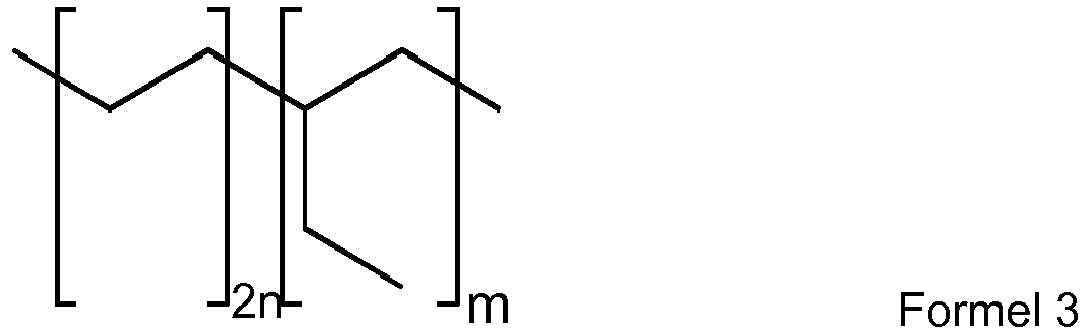
- Die Blockcopolymere weisen die Strukturen der Formeln 1a und 1b auf, wobei die Indices a, b und c gleich oder verschieden sein können und die Länge der Blöcke darstellt. Viele kommerziell erhältliche Materialien besitzen die Struktur 1a (SB, SI) oder 1b (SBS, SIS, SEBS, SEPS). "Block" ist der Block, welcher aus einem Gummi gebildet ist, also zum Beispiel Polyisopren oder Polybutadien. Verbreitete Strukturen, die der Block oft aufweisen kann, sind in den Formeln 2 bis 5 angegeben. Die abgebildeten Polystyrolblöcke wechseln sich mit den Blöcken aus Gummi ab.


- Block =



- Wird der "Block" in Formel 1a ersetzt durch Formel 2, so wird Poly(styrol-block-butadien), SB erhalten.
- Wird der "Block" in Formel 1b ersetzt durch Formel 2, so wird Poly(styrol-block-butadien-block-styrol), SBS erhalten. Wird dieses Polymer hydriert, so erhält man SEBS, dessen Struktur der Formel 1b entspricht, wobei der "Block" in Formel 1 ersetzt ist durch Formel 3. Bei den angegebenen Formeln für SEBS bzw. SBS zeigen die Indices n und m die unterschiedlichen Anteile an 1,4-verknüpftem und 1,2-verknüpftem Butadien. Die Ziffern n und m können gleich oder verschieden sein. Das Verhältnis von n und m zueinander zeigt das Verhältnis zwischen 1,2- und 1,4-Verknüpfung an und kann bei der Wahl der Herstellungsbedingungen kontrolliert werden.
- Wird der "Block" in Formel 1a ersetzt durch Formel 4, so wird Poly(styrol-block-isopren), SI erhalten. Wird der "Block" in Formel 1b ersetzt durch Formel 4, so wird Poly(styrol-block-isopren-block-styrol), SIS, erhalten. Wird dieses Polymer hydriert, so erhält man SEPS, dessen Struktur der Formel 1b entspricht, wobei der "Block" in Formel 1b ersetzt ist durch Formel 5. Spezifischer ist die Struktur von SEPS in Formel 6 dargestellt.

- Gut geeignet als Bestandteil der Lotpaste ist beispielsweise SEPS mit einem Verhältnis von Styrol zu Isopren von etwa 1:2 bis etwa 1:6, oder von etwa 1:3 bis etwa 1:5, oder von etwa 1:4 bis etwa 1:5,5. Das Verhältnis von Styrol zu Isopren wird aus der Strukturformel bestimmt durch das Verhältnis der Summe von a und c (Styrolblöcke) zu b (hydrierte Isoprenblöcke). Aus dem Polymer kann das Verhältnis durch Kernresonanzspektrometrie bestimmt werden. Gut geeignet sind Copolymere, die ein Gewichtsmittel Mw von 60000 g/mol bis 90000 g/mol, oder von 70000 g/mol bis 80000 g/mol aufweisen. Gut geeignet sind Copolymere, die ein Zahlenmittel Mn von 60000 g/mol bis 90000 g/mol, oder von 70000 g/mol bis 80000 g/mol aufweisen. Gut geeignet sind Copolymere, die eine Polydispersität Q im Bereich von 1,01 bis 1,05 aufweisen.
- Als dritte Komponente c) weist die Lotpaste ein organisches Medium auf. Im Prinzip können alle geeigneten organischen Lösemittel verwendet werden, welche bei den Löttemperaturen im Wesentlichen rückstandslos verdampfen oder verbrennen. Hierbei sind Lösemittel besonders geeignet, die keine übermäßige Rußentwicklung zeigen, beispielsweise Aceton, Ether oder Kohlenwasserstoffe bzw. Kohlenwasserstoffgemische, welche bei Raumtemperatur flüssig sind. Im Allgemeinen wird diese Bedingung von Kohlenwasserstoffen erfüllt, welche 10 bis 15 Kohlenstoffatome aufweisen. Der Kohlenwasserstoff kann mindestens ein Isoalkan mit 10 bis 15 Kohlenstoffatomen enthalten. Ungesättigte Verbindungen und Aromaten neigen dabei stärker zur Rußentwicklung. Im Allgemeinen gut geeignet als organisches Medium sind Alkane und Gemische von Alkanen, zum Beispiel Gemische von Alkanen, die im Wesentlichen 10 bis 15 Kohlenstoffatome aufweisen. Dies können auch Gemische aus n-Alkanen, Isoalkanen und Cycloalkanen sein, oder Gemische aus n-Alkanen, iso-Alkanen und cyclischen Verbindungen, oder iso-Alkane. So sind beispielsweise iso-Alkane mit 11 bis 13 Kohlenstoffatomen, oder Gemische aus n-Alkanen, iso-Alkanen und cyclischen Verbindungen mit im Wesentlichen 11 bis 14 Kohlenstoffatomen gut geeignet. Diese können auch eingesetzt werden, wenn sie weniger als 2 Gew.-% Aromaten enthalten. Beispielsweise können auch die Kohlenwasserstoffe eingesetzt werden, welche als Petrolether 40-60 oder Petrolether 60-80 bezeichnet werden. Abhängig von der für eine bestimmte Anwendung benötigten Viskosität ist das organische Medium in Mengen von etwa 4 Gew.-% bis etwa 20 Gew.-%, oder von etwa 5 Gew.-% bis etwa 15 Gew.-%, oder von etwa 6 Gew.-% bis etwa 14, 4 Gew.-%, oder von etwa 6,5 Gew.-% bis etwa 13, 3 Gew.-%, oder von etwa 7 Gew.-% bis etwa 11,7 Gew.-% in der Lotpaste enthalten.
- Die Lotpaste kann auch weitere Bestandteile enthalten. So kann die Lotpaste auch bis zu 2,7 Gew.-% eines weiteren Polymeren enthalten, welches von der Komponente b) verschieden ist. Für diesen Zweck gut geeignet sind im Allgemeinen Acrylate, wie Polymethylmethacrylat, Polymethylacrylat, Polyethylmetacrylat, Polyethylacrylat und dergleichen. Ebenso können EPDM, Polysiopren , Polyisobutylen, ganz oder teilweise hydrierte Kohlenwasserstoffharze oder Polyolefine wie Polyethylen eingesetzt werden. Diese Materialien zeigen oft auch in Mengen von einem Gew.-% oder weniger eine Wirkung. Es kann also beispielsweise etwa 0,4 Gew.-% bis 1 Gew.-%, oder von etwa 0,6 Gew.-% bis etwa 0,9 Gew.-% von Materialien wie Polyisobutylen eingesetzt werden. Statt Polyisobutylen können auch Polyisopren, EPDM oder die übrigen oben genannten Polymere eingesetzt werden, gegebenenfalls auch in Kombination mit Polyisobutylen oder miteinander. Durch den Zusatz des zweiten Polymers können Eigenschaften der Lotpaste modifiziert werden, wie zum Beispiel die Adhäsion zu bestimmten Substraten, Viskosität oder Ausbrennverhalten.
- Außerdem kann die Lotpaste noch weitere Zusatz- und Hilfsstoffe enthalten um die Eigenschaften für bestimmte Anwendungen zu modifizieren. Beispielsweise können Oxidationsmittel zugesetzt werden, um das Abbrandverhalten zu verbessern. Für den gleichen Zweck können auch nichtflüchtige, sauerstoffhaltige Verbindungen eingesetzt werden, wie beispielsweise nichtflüchtige organische Oxide und Peroxide, oder Polyether. Auch Thixotropiermittel können zugesetzt werden, um die Viskosität der Lotpaste in weiten Grenzen zu regulieren.
- Die Lotpaste kann außerdem ein oder mehrere Flußmittel enthalten. Dies sind oft Bor oder Fluor basierende Verbindungen, welche einzeln oder in Mischungen der Lotpaste zugesetzt werden können.
- Eine weitere Ausführungsform betrifft ein Verfahren zum Löten von einem Substrat mit einem Verbindungspartner, umfassend die Schritte
- i) Bereitstellen eines Substrates, eines Verbindungspartners und einer Lotpaste enthaltend
- a) eine oder mehrere als Lot geeignete Metallpulver;
- b) ein oder mehrere Copolymere, welche mindestens einen Styrol-Block und mindestens eine Block aus Ethylen, Propylen, Isopren, Butadien, deren hydrierten Äquivalenten oder deren Kombinationen aufweist;
- c) ein organisches Medium;
- ii) Applizieren der Lotpaste auf das Substrat, den Verbindungspartner oder beides;
- iii) Gegebenenfalls Trocknen der Lotpaste
- iv) Kontaktieren des Substrates und des Verbindungspartners miteinander,so daß Lotpaste zumindest teilweise zwischen Substrat und Verbindungspartner angeordnet sind, und
- v) Wärmebehandeln von Substrat, Verbindungspartner und Lotpaste oder deren Kombinationen.
- In diesem Verfahren werden das Substrat und ein Verbindungspartner bereit gestellt. Hierzu werden ein geeignetes Substrat oder ein geeigneter Verbindungspartner, wovon oft zumindest das Substrat, der Verbindungspartner oder beide entweder aus einem Metall bestehen oder metallisiert sind, also zumindest eine Metallschicht aufweist, mit der Lotpaste an den gewünschten Stellen versehen. Hierzu wird ein geeignetes Substrat, welches meist entweder aus einem Metall besteht oder metallisiert ist, also oft zumindest eine Metallschicht aufweist, mit der Lotpaste an den gewünschten Stellen versehen. Abhängig vom verwendeten Lot können jedoch auch nichtmetallische Substrate oder Verbindungspartner eingesetzt werden, beispielsweise Keramiken. Das Metall des Substrates oder des Verbindungspartners kann im Prinzip jede lötbare Oberfläche sein, was gegebenenfalls die Oberflächenbehandlung zur Bewirkung der Lötbarkeit einschließt. Beispielsweise geeignete Oberflächenbehandlungen sind Metallisierung oder Galvanisieren, wodurch besser lötbare oder benetzbare Metallschichten aufgebracht werden können, aber auch Beizen der Oberfläche, um Oxide und Verzunderungen zu entfernen, was beispielsweise mit Säuren oder Laugen bewirkt werden kann.
- Die Lotpaste kann erhalten werden durch die übliche Herstellungsweise für Lotpasten. Hierzu wird das organische Medium in einem Behälter vorgelegt, auf eine Temperatur von im Allgemeinen etwa 20°C bis etwa 100°C, oder etwa 30°C bis etwa 80°C, oder etwa 40°C bis etwa 60°C, oder etwa 40°C bis etwa 50°C, oder etwa 60°C bis etwa 80°C gebracht und gehalten und unter Rühren nacheinander das Copolymer, weitere Zusatzstoffe und das Lotpulver zugegeben. Für das Einrühren des Copolymers und der Zusatzstoffe sind je nach Ansatzgröße meist Rührzeiten von einer Stunde bis einem Tag, insbesondere 12 bis 24 Stunden ausreichend. Die Lotpaste kann aber auch in mehrstufigen Verfahren erhalten werden. Beispielsweise kann das Einrühren des Copolymers und der Zusatzstoffe wie oben beschrieben erfolgen, die Zugabe des Lotpulvers später erfolgen, um die Lagerzeit zu verringern und die Haltbarkeit der Lotpaste zu erhöhen. Die Zugabe des Metallpulvers kann -gegebenenfalls unter Heizen oder Kühlen- bei etwa 10°C bis etwa 100°C erfolgen. Anschließend ist die Lotpaste bereit für Verpackung oder Verarbeitung.
- Die Lotpaste wird auf das Substrat, den Verbindungspartner oder beide aufgetragen. Dies kann je nach Anwendung eine vollständige oder teilweise Beschichtung bedeuten. Zur vollständigen Beschichtung ist beispielsweise eine Tauchbeschichtung des Substrates eine mögliche Vorgehensweise. Auch ein Rollenauftrag (oft als "Rollercoating" bezeichnet) kann eingesetzt werden, insbesondere dann wenn die zu beschichtenden Bereiche des Substrates eben sind. Für vollständigen und teilweisen Auftrag von Lotpaste sind Sprühen oder Dispensen geeignet. Für teilweisen Auftrag kann das Substrat mit Schablonen abgedeckt werden, so daß der Sprühnebel nur auf einen Teil des Substrates trifft.
- Optional kann die aufgebrachte Lotpaste getrocknet werden. Die Trocknung kann durch eine Wärmebehandlung unterhalb der Glastemperatur der in der Lotpaste verwendeten Polymere durchgeführt werden, aber auch durch ausreichend langes Aufbewahren an der Luft, wobei ausreichende Frischluftzufuhr und Brauchluftabfuhr empfehlenswert ist, auch, um Gefahren durch Lösemitteldämpfe zu vermeiden. Das Trocknen kann hilfreich sein wenn die mit Lotpaste versehenen Teile (Substrat, Verbindungspartner oder beide) zwischengelagert und erst später weiter verarbeitet werden, beispielsweise bei Löten im Batch oder Lohnfertigung. Bei der sofortigen Weiterverarbeitung ist die Trocknung normalerweise nicht erforderlich.
- Das Substrat und der Verbindungspartner werden dann miteinander in Kontakt gebracht, so daß Lotpaste zumindest teilweise zwischen Substrat und Verbindungspartner angeordnet ist. Auf diese Weise wird sicher gestellt, daß die Lotpaste sich entweder da befindet, wo die spätere Lötverbindung erzeugt werden soll. Die Lotpaste kann aber auch so angeordnet werden, daß das Lot erst beim Schmelzen an den gewünschten Ort fließt, beispielsweise indem es durch den Kapillareffekt in einen Spalt zwischen dem Substrat und dem Verbindungspartner hineingezogen wird.
- Anschließend werden die miteinander kontaktierten Substrate und Verbindungspartner wärmebehandelt. Die Wärmebehandlung dient verschiedenen Zwecken. Wenn die Lotpaste noch nicht getrocknet ist, wird hierdurch eine Verdampfung des organischen Mediums und damit eine Trocknung bewirkt. Außerdem werden organische Bestandteile der Lotpaste, wie Polymere oder organische Hilfsstoffe, entfernt ("ausgebrannt"). Schließlich bewirkt die Wärmebehandlung das Schmelzen des Lotes, welches als Metallpulver vorliegt, und damit die Bildung der Lötverbindung. Die Wärmebehandlung muß daher zumindest teilweise bei der Schmelztemperatur des als Lot geeigneten Metallpulvers durchgeführt werden, für eine ausreichende Zeit zum Erzielen der Lötverbindung. Üblicherweise wird die Temperatur allmählich im Laufe der Zeitdauer bis zur notwendigen Temperatur erhöht, bei dieser Temperatur gehalten und anschließend wieder abgekühlt. Dies kann in einem Ofen durch Aufheizen und anschließendes Abkühlen bewirkt werden, oder durch Transport durch einen Tunnelofen mit einem eingestellten Temperaturprofil. Die Atmosphäre in dem verwendeten Ofen kann in Abhängigkeit von den zu lötenden Materialien und des aus welchen das Substrat besteht, der Zusammensetzung des als Lot geeigneten Metallpulvers gewählt werden. Bewährt haben sich inerte oder reduzierende Atmosphären, Vakuum, aber auch Luft. Nach der Wärmebehandlung wird das Produkt erhalten, was dann gegebenenfalls weiterverarbeitet werden kann, wie durch Montage in den vorgesehenen Produkten, mechanische Nachbearbeitung wie Schleifen, Schneiden oder andere Nachbearbeitungsschritte.
- Eine weitere Ausführungsform betrifft einen gelöteten Gegenstand, erhältlich durch Aufbringen der Lotpaste auf ein Substrat, Aufbringen eines Verbindungspartners auf das Substrat, wobei der Verbindungspartner Kontakt zur Lotpaste besitzt, und Wärmebehandeln. Eine weitere Ausführungsform betrifft eine Struktur, enthaltend eine Schicht der Lotpaste auf einem Substrat.
- Hierzu wird ein geeignetes Substrat, welches meist entweder aus einem Metall besteht oder metallisiert ist, also oft zumindest eine Metallschicht aufweist, mit der Lotpaste an der gewünschten Stellen versehen. Abhängig vom verwendeten Lot können jedoch auch nichtmetallische Substrate eingesetzt werden, beispielsweise Keramiken. Das Metall des Substrates kann im Prinzip jede lötbare Metalloberfläche sein, was gegebenenfalls eine Oberflächenbehandlung der Metallschicht zur Bewirkung der Lötbarkeit einschließt; hierbei sind wie oben beschrieben insbesondere Metallisieren, Galvanisieren oder Beizen geeignet.
- Das Substrat wird durch eine geeignete Vorgehensweise mit der Lotpaste versehen. Dies kann je nach Anwendung eine vollständige oder teilweise Beschichtung bedeuten. Zur vollständigen Beschichtung ist beispielsweise eine Tauchbeschichtung des Substrates eine mögliche Vorgehensweise. Auch ein Rollenauftrag (oft als "Rollercoating" bezeichnet) kann eingesetzt werden, insbesondere dann wenn die zu beschichtenden Bereiche des Substrates eben sind. Für vollständigen und teilweisen Auftrag von Lotpaste sind Sprühen oder Dispensen geeignet. Für teilweisen Auftrag kann das Substrat mit Schablonen abgedeckt werden, so daß der Sprühnebel nur auf einen Teil des Substrates trifft. Nach dem Auftrag kann die Struktur optional getrocknet werden, was insbesondere bei Lagerung oder Versand solcher Strukturen sinnvoll sein kann. Hierdurch entsteht eine Struktur, welche eine auf das Substrat aufgebrachte, teilweise oder vollständige Schicht enthaltend
- a) eine oder mehrere als Lot geeignete Metallpulver;
- b) ein oder mehrere Copolymerer, welche mindestens einen Styrol-Block und mindestens eine Block aus Ethylen, Propylen, Isopren, Butadien, deren hydrierten Äquivalenten oder deren Kombinationen
- Das Lösemittel, ein Gemisch aus C11-C14 Alkanen (Gemisch aus n-, iso- und cyclischen Alkanen (CAS-Nr. 64742-47-8) 178g (192g ohne Einsatz von Polyisobutylen) wurde in einen Stahltopf (500 ml) eingewogen, auf einer elektrischen Heizplatte angeordnet und ein Rührwerk von oben eingetaucht, so daß das Rührelement (Dissolverscheibe) ca. einen Zentimeter in die Flüssigkeit eintaucht. Zur Temperaturkontrolle wurde ein Thermoelement ebenfalls etwa einen Zentimeter eingetaucht, die Zieltemperatur in den Temperaturregler eingegeben und das Lösemittel auf die gewünschte Temperatur erwärmt. Es wurden 10g Copolymer (8g ohne Polyisobutylen) und gegebenenfalls 12g Polyisobutylen abgewogen und nacheinander zugegeben. Es wurde ca. 60 Minuten nach dem Auflösen der Polymere nachgerührt. Danach wurde die Heizung abgestellt und unter Rühren auf Raumtemperatur abgekühlt, wobei die Rührerdrehzahl an die steigende Viskosität angepaßt wurde. Nach dem Abkühlen wird eine Menge von 75g (in einem Stahltopf (500 ml) vorgelegt und ein Rührwerk von oben eingetaucht, so daß das Rührelement (Dissolverscheibe) bis ca. einen Zentimeter über dem Topfboden in die Flüssigkeit eintaucht. Unter Rühren wurden 425g Kupferpulver allmählich zugegeben und nach Abschluß der Zugabe noch ca. 2 Minuten nachgerührt und anschließend zur Bestimmung des Absetzverhaltens in einen Messzylinder gefüllt und dieser verschlossen. Das Absetzverhalten wird durch Auftreten einer Separationslinie zwischen Binder und Paste (klar-rötlich) bestimmt.
- Die Pasten hatten stets einen Gehalt von 85 Gew.-% Kupferpulver. Die Paste enthielt weiter 0,6 Gew.-% Copolymer und 14,4 Gew.-% Lösemittel, bzw. bei Verwendung von Polyisobutylen 0,8 Gew.-% Copolymer, 0,9 Gew.-% Polyisobutylen und 13,3 Gew.-% Lösemittel. Die verwendeten Copolymere und das Absetzverhalten sind in der folgenden Tabelle aufgeführt.
- *= Polymer mit 2% Succinsäureanhydrid modifiziert; #= Polymer verzweigt; Absetzverhalten: ++ länger als eine Woche ohne Absetzen ,+ länger als 3 Tagen ohne Absetzen, O länger als ein Tag ohne Absetzen, - Weniger als 12 Stunden ohne Absetzen
Copolymer Polyisobutylen Ja/nein Absetzverhalten Temperatur / °C SEPS, Styrolgehalt 37% Ja ++ 50 SEPS, Styrolgehalt 37% Nein ++ 50 SEBS, Styrolgehalt 30% Ja O 50 SEBS, Styrolgehalt 30% Nein O 50 SEBS, Styrolgehalt 13% Ja O 58 SEBS, Styrolgehalt 13% Nein O 58 SEPS Styrolgehalt 28% Ja O 56 SEPS Styrolgehalt 28% Nein O 56 SEPS Styrolgehalt 21% Ja O 53 SEPS Styrolgehalt 21% Nein O 53 SEBS, Styrolgehalt 30%*, Ja + 58 SEBS, Styrolgehalt 30%* Nein + 58 SB, Styrolgehalt 30%#, Ja O 58 SB, Styrolgehalt 30%#, Nein O 58 SIS, Styrolgehalt 15% Ja + 51 SIS, Styrolgehalt 15% Nein + 51 SB, Styrolgehalt 17%, Ja O 51 SB, Styrolgehalt 17%, Nein O 51 - Mit den Lötpasten wurden zur Bestimmung des Ausbrennverhaltens Lötversuche durchgeführt. Messingstäbe mit rechteckigem Querschnitt wurden hierzu mit den Lotpasten beschichtet und ohne Trocknung in einem Vakuumlötofen mit einer Bauteiltemperatur von 1120°C im Vakuum wärmebehandelt. Nach dem Abkühlen wurden die so erhaltenen Proben begutachtet. Das Lot war bei allen Proben metallisch blank, war vollständig aufgeschmolzen und hatte das Substrat gleichmäßig benetzt. Rußentwicklung oder schwarze Rückstände konnten in keinem Fall beobachtet werden.
Claims (14)
- Lotpaste enthaltenda) eine oder mehrere als Lot geeignete Metallpulver;b) ein oder mehrere Copolymere, welche mindestens einen Styrol-Block und mindestens einen Block aus Ethylen, Propylen, Isopren, Butadien, deren hydrierten Äquivalenten oder deren Kombinationen aufweist.c) ein organisches Medium.
- Lotpaste nach Anspruch 1, wobei das organische Medium ein bei Raumtemperatur flüssiger Kohlenwasserstoff oder Kohlenwasserstoffgemisch ist.
- Lotpaste nach Anspruch 1 oder 2, wobei der Kohlenwasserstoff ein Gemisch aus Alkanen, Isoalkanen cyclischen Alkanen oder deren Kombinationen mit 10 bis 15 Kohlenstoffatomen ist.
- Lotpaste nach einem oder mehreren der Ansprüche 1 bis 5, wobei das Copolymer ein Blockcopolymer aus Styrol und Isopren oder ein Blockcopolymer aus Styrol, Ethylen und Propylen ist.
- Lotpaste nach einem oder mehreren der Ansprüche 1 bis 6, wobei das als Lot geeignete Metallpulver ein Metallpulver mit einer Schmelztemperatur von 1500°C oder weniger ist.
- Lotpaste nach Anspruch 1 oder 7, wobei das Metall des Metallpulvers ausgewählt ist aus der Gruppe bestehend aus Kupfer, Zinn, Eisen, Silber, Nickel, Ni76Cr14P10, Ni82,4Nr7Fe3Si4,5B3,1, Ni73,9Cr14Fe4,5Si4,5B3,1, Ni60Cr30Si4P6, Ni72Cr18Si8P2, Ni70,9Cr19Si10,1, Ag72Cu28, Ag56Cu22Zn17Sn5, Ag49Cu16Zn23Mn7,5Ni4,5, Ag64,8Cu25,2Ti10, Ag90Ti10, Cu80P5Ag15, Cu92P8, Cu76Sn15Ni4P5, Cu78,5Sn9,3Ni5,7P6,5 und deren Kombinationen.
- Lotpaste nach Anspruch 1 enthaltend 0,5 Gew.-% bis 1,5 Gew.-% der Komponente b), des Copolymers.
- Lotpaste nach Anspruch 1, enthaltend mindestens ein weiteres Polymer, welches von dem Copolymer verschieden ist.
- Lotpaste nach einem oder mehreren der Ansprüche 1 bis 8, enthaltend 6 Gew.-% bis 16 Gew.-% des organischen Mediums.
- Lotpaste nach einem oder mehreren der Ansprüche 1 bis 9, enthaltend Zusatz- und Hilfsstoffe ausgewählt aus der Gruppe bestehend aus Oxidationsmittel, Flußmittel, nichtflüchtige, sauerstoffhaltige Verbindungen, organische Oxide, organische Peroxide, Polyether, Thixotropiermittel und deren Kombinationen.
- Eine Struktur, enthaltend eine Schicht der Lotpaste nach einem oder mehreren der vorstehenden Ansprüche auf einem Substrat.
- Ein gelöteter Gegenstand, erhältlich durch Aufbringen von Lotpaste nach Anspruch 1 auf ein Substrat, Aufbringen eines Verbindungspartners auf das Substrat, wobei der Verbindungspartner Kontakt zur Lotpaste besitzt, und Wärmebehandeln.
- Verfahren zum Löten von einem Substrat mit einem Verbindungspartner, umfassend die Schrittei) Bereitstellen eines Substrates, eines Verbindungspartners und einer Lotpaste enthaltenda) eine oder mehrere als Lot geeignete Metallpulver;b) ein oder mehrere Copolymere, welche mindestens einen Styrol-Block und mindestens einen Block aus Ethylen, Propylen, Isopren, Butadien, deren hydrierten Äquivalenten oder deren Kombinationen aufweist;c) ein organisches Medium;ii) Aufbringen der Lotpaste auf das Substrat, den Verbindungspartner oder beides;iii) Gegebenenfalls Trocknen der Lotpasteiv) Kontaktieren des Substrates und des Verbindungspartners miteinander, so daß Lotpaste zumindest teilweise zwischen Substrat und Verbindungspartner angeordnet ist, undv) Wärmebehandeln von Substrat, Verbindungspartner und Lotpaste oder deren Kombinationen.
- Eine Struktur, welche eine auf ein Substrat aufgebrachte teilweise oder vollständige Schicht, enthaltenda) eine oder mehrere als Lot geeignete Metallpulver;b) ein oder mehrere Copolymere, welche mindestens einen Styrol-Block und mindestens einen Block aus Ethylen, Propylen, Isopren, Butadien, deren hydrierten Äquivalenten oder deren Kombinationenaufweist.
Priority Applications (1)
| Application Number | Priority Date | Filing Date | Title |
|---|---|---|---|
| EP12182048.4A EP2703115B1 (de) | 2012-08-28 | 2012-08-28 | Lotpaste |
Applications Claiming Priority (1)
| Application Number | Priority Date | Filing Date | Title |
|---|---|---|---|
| EP12182048.4A EP2703115B1 (de) | 2012-08-28 | 2012-08-28 | Lotpaste |
Publications (2)
| Publication Number | Publication Date |
|---|---|
| EP2703115A1 true EP2703115A1 (de) | 2014-03-05 |
| EP2703115B1 EP2703115B1 (de) | 2019-10-09 |
Family
ID=46796377
Family Applications (1)
| Application Number | Title | Priority Date | Filing Date |
|---|---|---|---|
| EP12182048.4A Active EP2703115B1 (de) | 2012-08-28 | 2012-08-28 | Lotpaste |
Country Status (1)
| Country | Link |
|---|---|
| EP (1) | EP2703115B1 (de) |
Citations (4)
| Publication number | Priority date | Publication date | Assignee | Title |
|---|---|---|---|---|
| US3986899A (en) * | 1974-06-07 | 1976-10-19 | Scm Corporation | Atomized copper brazing paste |
| US4541876A (en) * | 1983-10-31 | 1985-09-17 | Scm Corporation | Nonaqueous powdered metal paste composition |
| US6140402A (en) * | 1993-07-30 | 2000-10-31 | Diemat, Inc. | Polymeric adhesive paste |
| WO2003068447A1 (en) * | 2002-02-13 | 2003-08-21 | Honeywell International Inc. | Solder paste formulations, methods of production and uses thereof |
-
2012
- 2012-08-28 EP EP12182048.4A patent/EP2703115B1/de active Active
Patent Citations (4)
| Publication number | Priority date | Publication date | Assignee | Title |
|---|---|---|---|---|
| US3986899A (en) * | 1974-06-07 | 1976-10-19 | Scm Corporation | Atomized copper brazing paste |
| US4541876A (en) * | 1983-10-31 | 1985-09-17 | Scm Corporation | Nonaqueous powdered metal paste composition |
| US6140402A (en) * | 1993-07-30 | 2000-10-31 | Diemat, Inc. | Polymeric adhesive paste |
| WO2003068447A1 (en) * | 2002-02-13 | 2003-08-21 | Honeywell International Inc. | Solder paste formulations, methods of production and uses thereof |
Also Published As
| Publication number | Publication date |
|---|---|
| EP2703115B1 (de) | 2019-10-09 |
Similar Documents
| Publication | Publication Date | Title |
|---|---|---|
| DE69515108T2 (de) | Dickfilm-Leiterzusammensetzungen mit verbesserter Haftung | |
| DE3111808C2 (de) | Elektrisch leitende Paste, ihr Herstellungsverfahren und ihre Verwendung | |
| DE60201965T2 (de) | Glas und daraus hergestellte Leitpaste | |
| DE2912402C2 (de) | ||
| DE3650210T2 (de) | Leitfähige Dickschichtzusammensetzung. | |
| DE2655085A1 (de) | Metallisierungspraeparate, enthaltend elektrisch leitfaehige metalle | |
| DE69904889T2 (de) | Elektrisch leitende Paste und Glassubstrat mit aufgetragenem elektrischen Schaltkreis | |
| EP4112587A1 (de) | Verfahren zur herstellung eines metall-keramik-substrats mittels schnellem heizen | |
| DE2610303C2 (de) | Siebdruckpaste für dicke, elektrisch leitende, Leiterbahnen bildende Schichten auf einem keramischen Substrat | |
| DE1011348B (de) | Verglasbares Flussmittel sowie keramischer Gegenstand | |
| WO2012159607A1 (de) | Lotpaste sowie verfahren zur herstellung einer lötverbindung mit hilfe der lotpaste | |
| DE102013216203A1 (de) | Lotpaste | |
| DE2125643C2 (de) | Halbleiterbauelement und Verfahren zu seiner Herstellung | |
| EP0974559B1 (de) | Komposit-Lotglas mit niedriger Aufschmelztemperatur, ein Füllstoff hierfür, sowie deren Verwendung | |
| EP2703115B1 (de) | Lotpaste | |
| DE112014006903B4 (de) | Solarzellen mit Kupferelektroden | |
| WO2015181176A1 (de) | Mo-Si-B SCHICHTEN UND VERFAHREN ZU DEREN HERSTELLUNG | |
| DE1948034C3 (de) | Halbleiterelement mit Ohm sehen Kontakt | |
| DE2450341A1 (de) | Halbleiterbauteile mit hitzebestaendigen metallschichten | |
| DE1007689B (de) | Verglasbares Flussmittel sowie keramischer Gegenstand | |
| DE2152011C3 (de) | Verfahren zum Metallisieren von Oberflächen keramischer Körper | |
| EP4112586A1 (de) | Verfahren zur herstellung eines metall-keramik-substrats mittels einem durchlaufofen | |
| EP0395961A1 (de) | Verfahren zur Herstellung von Leiterbahnmustern | |
| DE2829917A1 (de) | Verfahren zum herstellen von halbleiterbauelementen | |
| WO2010000234A1 (de) | Zusammensetzung mit pastöser konsistenz für die ausbildung elektrischer kontakte auf einem silicium-solarwafer und damit hergestellter kontakt |
Legal Events
| Date | Code | Title | Description |
|---|---|---|---|
| AK | Designated contracting states |
Kind code of ref document: A1 Designated state(s): AL AT BE BG CH CY CZ DE DK EE ES FI FR GB GR HR HU IE IS IT LI LT LU LV MC MK MT NL NO PL PT RO RS SE SI SK SM TR |
|
| AX | Request for extension of the european patent |
Extension state: BA ME |
|
| PUAI | Public reference made under article 153(3) epc to a published international application that has entered the european phase |
Free format text: ORIGINAL CODE: 0009012 |
|
| 17P | Request for examination filed |
Effective date: 20140905 |
|
| RBV | Designated contracting states (corrected) |
Designated state(s): AL AT BE BG CH CY CZ DE DK EE ES FI FR GB GR HR HU IE IS IT LI LT LU LV MC MK MT NL NO PL PT RO RS SE SI SK SM TR |
|
| STAA | Information on the status of an ep patent application or granted ep patent |
Free format text: STATUS: EXAMINATION IS IN PROGRESS |
|
| 17Q | First examination report despatched |
Effective date: 20171214 |
|
| RAP1 | Party data changed (applicant data changed or rights of an application transferred) |
Owner name: SAXONIA TECHNICAL MATERIALS GMBH |
|
| GRAP | Despatch of communication of intention to grant a patent |
Free format text: ORIGINAL CODE: EPIDOSNIGR1 |
|
| STAA | Information on the status of an ep patent application or granted ep patent |
Free format text: STATUS: GRANT OF PATENT IS INTENDED |
|
| RIC1 | Information provided on ipc code assigned before grant |
Ipc: B23K 35/36 20060101ALI20190531BHEP Ipc: B23K 35/30 20060101ALI20190531BHEP Ipc: B23K 35/26 20060101ALI20190531BHEP Ipc: B23K 35/02 20060101AFI20190531BHEP |
|
| INTG | Intention to grant announced |
Effective date: 20190628 |
|
| GRAS | Grant fee paid |
Free format text: ORIGINAL CODE: EPIDOSNIGR3 |
|
| GRAA | (expected) grant |
Free format text: ORIGINAL CODE: 0009210 |
|
| STAA | Information on the status of an ep patent application or granted ep patent |
Free format text: STATUS: THE PATENT HAS BEEN GRANTED |
|
| AK | Designated contracting states |
Kind code of ref document: B1 Designated state(s): AL AT BE BG CH CY CZ DE DK EE ES FI FR GB GR HR HU IE IS IT LI LT LU LV MC MK MT NL NO PL PT RO RS SE SI SK SM TR |
|
| REG | Reference to a national code |
Ref country code: GB Ref legal event code: FG4D Free format text: NOT ENGLISH |
|
| REG | Reference to a national code |
Ref country code: CH Ref legal event code: EP |
|
| REG | Reference to a national code |
Ref country code: IE Ref legal event code: FG4D Free format text: LANGUAGE OF EP DOCUMENT: GERMAN |
|
| REG | Reference to a national code |
Ref country code: DE Ref legal event code: R096 Ref document number: 502012015368 Country of ref document: DE |
|
| REG | Reference to a national code |
Ref country code: AT Ref legal event code: REF Ref document number: 1188218 Country of ref document: AT Kind code of ref document: T Effective date: 20191115 |
|
| REG | Reference to a national code |
Ref country code: NL Ref legal event code: MP Effective date: 20191009 |
|
| REG | Reference to a national code |
Ref country code: LT Ref legal event code: MG4D |
|
| PG25 | Lapsed in a contracting state [announced via postgrant information from national office to epo] |
Ref country code: GR Free format text: LAPSE BECAUSE OF FAILURE TO SUBMIT A TRANSLATION OF THE DESCRIPTION OR TO PAY THE FEE WITHIN THE PRESCRIBED TIME-LIMIT Effective date: 20200110 Ref country code: PT Free format text: LAPSE BECAUSE OF FAILURE TO SUBMIT A TRANSLATION OF THE DESCRIPTION OR TO PAY THE FEE WITHIN THE PRESCRIBED TIME-LIMIT Effective date: 20200210 Ref country code: ES Free format text: LAPSE BECAUSE OF FAILURE TO SUBMIT A TRANSLATION OF THE DESCRIPTION OR TO PAY THE FEE WITHIN THE PRESCRIBED TIME-LIMIT Effective date: 20191009 Ref country code: LV Free format text: LAPSE BECAUSE OF FAILURE TO SUBMIT A TRANSLATION OF THE DESCRIPTION OR TO PAY THE FEE WITHIN THE PRESCRIBED TIME-LIMIT Effective date: 20191009 Ref country code: NO Free format text: LAPSE BECAUSE OF FAILURE TO SUBMIT A TRANSLATION OF THE DESCRIPTION OR TO PAY THE FEE WITHIN THE PRESCRIBED TIME-LIMIT Effective date: 20200109 Ref country code: PL Free format text: LAPSE BECAUSE OF FAILURE TO SUBMIT A TRANSLATION OF THE DESCRIPTION OR TO PAY THE FEE WITHIN THE PRESCRIBED TIME-LIMIT Effective date: 20191009 Ref country code: LT Free format text: LAPSE BECAUSE OF FAILURE TO SUBMIT A TRANSLATION OF THE DESCRIPTION OR TO PAY THE FEE WITHIN THE PRESCRIBED TIME-LIMIT Effective date: 20191009 Ref country code: SE Free format text: LAPSE BECAUSE OF FAILURE TO SUBMIT A TRANSLATION OF THE DESCRIPTION OR TO PAY THE FEE WITHIN THE PRESCRIBED TIME-LIMIT Effective date: 20191009 Ref country code: BG Free format text: LAPSE BECAUSE OF FAILURE TO SUBMIT A TRANSLATION OF THE DESCRIPTION OR TO PAY THE FEE WITHIN THE PRESCRIBED TIME-LIMIT Effective date: 20200109 Ref country code: NL Free format text: LAPSE BECAUSE OF FAILURE TO SUBMIT A TRANSLATION OF THE DESCRIPTION OR TO PAY THE FEE WITHIN THE PRESCRIBED TIME-LIMIT Effective date: 20191009 Ref country code: FI Free format text: LAPSE BECAUSE OF FAILURE TO SUBMIT A TRANSLATION OF THE DESCRIPTION OR TO PAY THE FEE WITHIN THE PRESCRIBED TIME-LIMIT Effective date: 20191009 |
|
| PG25 | Lapsed in a contracting state [announced via postgrant information from national office to epo] |
Ref country code: IS Free format text: LAPSE BECAUSE OF FAILURE TO SUBMIT A TRANSLATION OF THE DESCRIPTION OR TO PAY THE FEE WITHIN THE PRESCRIBED TIME-LIMIT Effective date: 20200224 Ref country code: RS Free format text: LAPSE BECAUSE OF FAILURE TO SUBMIT A TRANSLATION OF THE DESCRIPTION OR TO PAY THE FEE WITHIN THE PRESCRIBED TIME-LIMIT Effective date: 20191009 Ref country code: HR Free format text: LAPSE BECAUSE OF FAILURE TO SUBMIT A TRANSLATION OF THE DESCRIPTION OR TO PAY THE FEE WITHIN THE PRESCRIBED TIME-LIMIT Effective date: 20191009 |
|
| PG25 | Lapsed in a contracting state [announced via postgrant information from national office to epo] |
Ref country code: AL Free format text: LAPSE BECAUSE OF FAILURE TO SUBMIT A TRANSLATION OF THE DESCRIPTION OR TO PAY THE FEE WITHIN THE PRESCRIBED TIME-LIMIT Effective date: 20191009 |
|
| REG | Reference to a national code |
Ref country code: DE Ref legal event code: R097 Ref document number: 502012015368 Country of ref document: DE |
|
| PG2D | Information on lapse in contracting state deleted |
Ref country code: IS |
|
| PG25 | Lapsed in a contracting state [announced via postgrant information from national office to epo] |
Ref country code: EE Free format text: LAPSE BECAUSE OF FAILURE TO SUBMIT A TRANSLATION OF THE DESCRIPTION OR TO PAY THE FEE WITHIN THE PRESCRIBED TIME-LIMIT Effective date: 20191009 Ref country code: DK Free format text: LAPSE BECAUSE OF FAILURE TO SUBMIT A TRANSLATION OF THE DESCRIPTION OR TO PAY THE FEE WITHIN THE PRESCRIBED TIME-LIMIT Effective date: 20191009 Ref country code: RO Free format text: LAPSE BECAUSE OF FAILURE TO SUBMIT A TRANSLATION OF THE DESCRIPTION OR TO PAY THE FEE WITHIN THE PRESCRIBED TIME-LIMIT Effective date: 20191009 Ref country code: CZ Free format text: LAPSE BECAUSE OF FAILURE TO SUBMIT A TRANSLATION OF THE DESCRIPTION OR TO PAY THE FEE WITHIN THE PRESCRIBED TIME-LIMIT Effective date: 20191009 Ref country code: IS Free format text: LAPSE BECAUSE OF FAILURE TO SUBMIT A TRANSLATION OF THE DESCRIPTION OR TO PAY THE FEE WITHIN THE PRESCRIBED TIME-LIMIT Effective date: 20200209 |
|
| PLBE | No opposition filed within time limit |
Free format text: ORIGINAL CODE: 0009261 |
|
| STAA | Information on the status of an ep patent application or granted ep patent |
Free format text: STATUS: NO OPPOSITION FILED WITHIN TIME LIMIT |
|
| PG25 | Lapsed in a contracting state [announced via postgrant information from national office to epo] |
Ref country code: SM Free format text: LAPSE BECAUSE OF FAILURE TO SUBMIT A TRANSLATION OF THE DESCRIPTION OR TO PAY THE FEE WITHIN THE PRESCRIBED TIME-LIMIT Effective date: 20191009 Ref country code: SK Free format text: LAPSE BECAUSE OF FAILURE TO SUBMIT A TRANSLATION OF THE DESCRIPTION OR TO PAY THE FEE WITHIN THE PRESCRIBED TIME-LIMIT Effective date: 20191009 |
|
| 26N | No opposition filed |
Effective date: 20200710 |
|
| PG25 | Lapsed in a contracting state [announced via postgrant information from national office to epo] |
Ref country code: SI Free format text: LAPSE BECAUSE OF FAILURE TO SUBMIT A TRANSLATION OF THE DESCRIPTION OR TO PAY THE FEE WITHIN THE PRESCRIBED TIME-LIMIT Effective date: 20191009 |
|
| PG25 | Lapsed in a contracting state [announced via postgrant information from national office to epo] |
Ref country code: MC Free format text: LAPSE BECAUSE OF FAILURE TO SUBMIT A TRANSLATION OF THE DESCRIPTION OR TO PAY THE FEE WITHIN THE PRESCRIBED TIME-LIMIT Effective date: 20191009 |
|
| REG | Reference to a national code |
Ref country code: CH Ref legal event code: PL |
|
| GBPC | Gb: european patent ceased through non-payment of renewal fee |
Effective date: 20200828 |
|
| PG25 | Lapsed in a contracting state [announced via postgrant information from national office to epo] |
Ref country code: LI Free format text: LAPSE BECAUSE OF NON-PAYMENT OF DUE FEES Effective date: 20200831 Ref country code: CH Free format text: LAPSE BECAUSE OF NON-PAYMENT OF DUE FEES Effective date: 20200831 Ref country code: LU Free format text: LAPSE BECAUSE OF NON-PAYMENT OF DUE FEES Effective date: 20200828 |
|
| REG | Reference to a national code |
Ref country code: BE Ref legal event code: MM Effective date: 20200831 |
|
| PG25 | Lapsed in a contracting state [announced via postgrant information from national office to epo] |
Ref country code: GB Free format text: LAPSE BECAUSE OF NON-PAYMENT OF DUE FEES Effective date: 20200828 Ref country code: IE Free format text: LAPSE BECAUSE OF NON-PAYMENT OF DUE FEES Effective date: 20200828 Ref country code: BE Free format text: LAPSE BECAUSE OF NON-PAYMENT OF DUE FEES Effective date: 20200831 |
|
| REG | Reference to a national code |
Ref country code: AT Ref legal event code: MM01 Ref document number: 1188218 Country of ref document: AT Kind code of ref document: T Effective date: 20200828 |
|
| PG25 | Lapsed in a contracting state [announced via postgrant information from national office to epo] |
Ref country code: AT Free format text: LAPSE BECAUSE OF NON-PAYMENT OF DUE FEES Effective date: 20200828 |
|
| PG25 | Lapsed in a contracting state [announced via postgrant information from national office to epo] |
Ref country code: TR Free format text: LAPSE BECAUSE OF FAILURE TO SUBMIT A TRANSLATION OF THE DESCRIPTION OR TO PAY THE FEE WITHIN THE PRESCRIBED TIME-LIMIT Effective date: 20191009 Ref country code: MT Free format text: LAPSE BECAUSE OF FAILURE TO SUBMIT A TRANSLATION OF THE DESCRIPTION OR TO PAY THE FEE WITHIN THE PRESCRIBED TIME-LIMIT Effective date: 20191009 Ref country code: CY Free format text: LAPSE BECAUSE OF FAILURE TO SUBMIT A TRANSLATION OF THE DESCRIPTION OR TO PAY THE FEE WITHIN THE PRESCRIBED TIME-LIMIT Effective date: 20191009 |
|
| PG25 | Lapsed in a contracting state [announced via postgrant information from national office to epo] |
Ref country code: MK Free format text: LAPSE BECAUSE OF FAILURE TO SUBMIT A TRANSLATION OF THE DESCRIPTION OR TO PAY THE FEE WITHIN THE PRESCRIBED TIME-LIMIT Effective date: 20191009 |
|
| PGFP | Annual fee paid to national office [announced via postgrant information from national office to epo] |
Ref country code: DE Payment date: 20250825 Year of fee payment: 14 |
|
| PGFP | Annual fee paid to national office [announced via postgrant information from national office to epo] |
Ref country code: IT Payment date: 20250825 Year of fee payment: 14 |
|
| PGFP | Annual fee paid to national office [announced via postgrant information from national office to epo] |
Ref country code: FR Payment date: 20250829 Year of fee payment: 14 |