EP2698437A1 - Method and kit for detecting 5-hydroxymethylcytosine in nucleic acids - Google Patents
Method and kit for detecting 5-hydroxymethylcytosine in nucleic acids Download PDFInfo
- Publication number
- EP2698437A1 EP2698437A1 EP12771081.2A EP12771081A EP2698437A1 EP 2698437 A1 EP2698437 A1 EP 2698437A1 EP 12771081 A EP12771081 A EP 12771081A EP 2698437 A1 EP2698437 A1 EP 2698437A1
- Authority
- EP
- European Patent Office
- Prior art keywords
- hydroxymethylcytosine
- nucleic acid
- acid
- oxidized
- salt
- Prior art date
- Legal status (The legal status is an assumption and is not a legal conclusion. Google has not performed a legal analysis and makes no representation as to the accuracy of the status listed.)
- Granted
Links
Images


Classifications
-
- C—CHEMISTRY; METALLURGY
- C12—BIOCHEMISTRY; BEER; SPIRITS; WINE; VINEGAR; MICROBIOLOGY; ENZYMOLOGY; MUTATION OR GENETIC ENGINEERING
- C12Q—MEASURING OR TESTING PROCESSES INVOLVING ENZYMES, NUCLEIC ACIDS OR MICROORGANISMS; COMPOSITIONS OR TEST PAPERS THEREFOR; PROCESSES OF PREPARING SUCH COMPOSITIONS; CONDITION-RESPONSIVE CONTROL IN MICROBIOLOGICAL OR ENZYMOLOGICAL PROCESSES
- C12Q1/00—Measuring or testing processes involving enzymes, nucleic acids or microorganisms; Compositions therefor; Processes of preparing such compositions
- C12Q1/68—Measuring or testing processes involving enzymes, nucleic acids or microorganisms; Compositions therefor; Processes of preparing such compositions involving nucleic acids
- C12Q1/6813—Hybridisation assays
- C12Q1/6827—Hybridisation assays for detection of mutation or polymorphism
-
- C—CHEMISTRY; METALLURGY
- C12—BIOCHEMISTRY; BEER; SPIRITS; WINE; VINEGAR; MICROBIOLOGY; ENZYMOLOGY; MUTATION OR GENETIC ENGINEERING
- C12Q—MEASURING OR TESTING PROCESSES INVOLVING ENZYMES, NUCLEIC ACIDS OR MICROORGANISMS; COMPOSITIONS OR TEST PAPERS THEREFOR; PROCESSES OF PREPARING SUCH COMPOSITIONS; CONDITION-RESPONSIVE CONTROL IN MICROBIOLOGICAL OR ENZYMOLOGICAL PROCESSES
- C12Q1/00—Measuring or testing processes involving enzymes, nucleic acids or microorganisms; Compositions therefor; Processes of preparing such compositions
- C12Q1/68—Measuring or testing processes involving enzymes, nucleic acids or microorganisms; Compositions therefor; Processes of preparing such compositions involving nucleic acids
- C12Q1/6806—Preparing nucleic acids for analysis, e.g. for polymerase chain reaction [PCR] assay
-
- C—CHEMISTRY; METALLURGY
- C12—BIOCHEMISTRY; BEER; SPIRITS; WINE; VINEGAR; MICROBIOLOGY; ENZYMOLOGY; MUTATION OR GENETIC ENGINEERING
- C12Q—MEASURING OR TESTING PROCESSES INVOLVING ENZYMES, NUCLEIC ACIDS OR MICROORGANISMS; COMPOSITIONS OR TEST PAPERS THEREFOR; PROCESSES OF PREPARING SUCH COMPOSITIONS; CONDITION-RESPONSIVE CONTROL IN MICROBIOLOGICAL OR ENZYMOLOGICAL PROCESSES
- C12Q1/00—Measuring or testing processes involving enzymes, nucleic acids or microorganisms; Compositions therefor; Processes of preparing such compositions
- C12Q1/68—Measuring or testing processes involving enzymes, nucleic acids or microorganisms; Compositions therefor; Processes of preparing such compositions involving nucleic acids
- C12Q1/6844—Nucleic acid amplification reactions
- C12Q1/6858—Allele-specific amplification
-
- Y—GENERAL TAGGING OF NEW TECHNOLOGICAL DEVELOPMENTS; GENERAL TAGGING OF CROSS-SECTIONAL TECHNOLOGIES SPANNING OVER SEVERAL SECTIONS OF THE IPC; TECHNICAL SUBJECTS COVERED BY FORMER USPC CROSS-REFERENCE ART COLLECTIONS [XRACs] AND DIGESTS
- Y10—TECHNICAL SUBJECTS COVERED BY FORMER USPC
- Y10T—TECHNICAL SUBJECTS COVERED BY FORMER US CLASSIFICATION
- Y10T436/00—Chemistry: analytical and immunological testing
- Y10T436/14—Heterocyclic carbon compound [i.e., O, S, N, Se, Te, as only ring hetero atom]
- Y10T436/142222—Hetero-O [e.g., ascorbic acid, etc.]
- Y10T436/143333—Saccharide [e.g., DNA, etc.]
Definitions
- the present invention relates to a method and a kit for detecting 5-hydroxymethylcytosine in a nucleic acid.
- Epigenetics includes DNA methylation in which a genome is physiologically modified and posttranslational modification of chromatin which is a complex of DNA and proteins and a large number of proteins constituting chromatin, which integrally control the gene expression.
- acetylation by a histone acetylation enzyme triggers the induction of remodeling of chromatin, so that transcription is started by general transcription factors and a RNA polymerase.
- methylation or phosphorylation of histones controls the transcription and causes silencing, chromatin condensation, and the like.
- CpG dinucleotides are methylated at the 5-carbon atom position of cytosine.
- the methylated CpG is found in heterochromatins and transposons containing many repeated sequences, and thought to suppress the activation of viruses and transposons.
- the CpG methylation and the histone modification coordinate with each other.
- CpG islands CG-rich regions present in promoter regions of many genes are not methylated.
- CpG islands are methylated in genes to be imprinted and in the inactive X chromosome of females.
- CpG islands are methylated also in the promoter regions of tumor suppressor gene in cancer cells.
- methylation of cytosine can be used as a marker of development, recurrence, and metastasis of cancer. In this respect, a simple method for detecting whether or not cytosine in a gene is methylated has been sought.
- 5-methylcytosine which is a methylated cytosine (C)
- C methylated cytosine
- Recently, a new base (5-hydroxymethylcytosine) has been discovered in a study of Purkinje cells (Non Patent Literature 1). It is pointed out that 5-hydroxymethylcytosine is a key for elucidating the mechanism of DNA demethylation (reprogramming). Hence, specifying the presence and the position of 5-hydroxymethylcytosine in a DNA is important and essential as a core technology for investigating the reprogramming of a gene function in all the fields associated with epigenetics technologies, such as the fields of cancer, aging, and regenerative medicine.
- Patent Document 1 describes a method for distinguishing cytosine from methylcytosine.
- Patent Document 2 describes a method in which a target DNA is selectively cleaved at the position of 5-methylcytosine to obtain a 5'-fragment, an enzymatic reaction is carried out by using a FRET probe capable of hybridizing with the 5'-fragment and a flap endonuclease, and then the fluorescence is detected.
- Non Patent Literatures 2 and 3 a method in which 5-hydroxymethylcytosine in a fragmented DNA sample is detected by applying the conventional immunoprecipitation method using an anti-5-hydroxymethylcytosine antibody
- Non Patent Literature 4 a method in which 5-hydroxymethylcytosine is modified with a sugar by using an enzyme capable of the sugar modification, and the modified 5-hydroxymethylcytosine is isolated
- each of the method requires that a DNA sample be fragmented in advance, and has a problem that even when a fragment containing 5-hydroxymethylcytosine is isolated, the position of the 5-hydroxymethylcytosine in the fragment cannot be specified.
- An object of the present invention is to provide a method for detecting 5-hydroxymethylcytosine in a nucleic acid.
- Another object of the present invention is to provide a kit for detecting 5-hydroxymethylcytosine in a nucleic acid.
- the present invention provides the following method and kit for detecting 5-hydroxymethylcytosine in a nucleic acid.
- the present invention makes it possible to chemically, easily, and accurately detect the presence and the position of 5-hydroxymethylcytosine in a nucleic acid. Hence, the present invention is extremely useful as a core technology for investigating the reprogramming of a gene function in all the fields associated with epigenetics technologies, such as the fields of cancer, aging, and regenerative medicine.
- nucleic acid means any compound which contains 5-hydroxymethylcytosine as a part of its structure as shown in Fig. 1 , and whose 5-hydroxymethylcytosine can be detected by the method of the present invention.
- Nucleic acid include DNAs, RNAs, nucleotides, nucleosides, nucleic acid analogs, peptides, other organic polymers, and the like. DNAs are particularly preferable.
- the method of the present invention can be applied to a nucleic acid having any chain length, and the chain length is preferably 1 to 10000 bp, and further preferably 15 to 1000 bp.
- the "tungstic acid-based oxidizing agent" used in the present invention is an oxidizing agent capable of selectively acting on and oxidizing 5-hydroxymethylcytosine in a nucleic acid.
- the "tungstic acid-based oxidizing agent” is preferably at least one selected from the group consisting of (1) peroxotungstic acid, or a salt thereof (for example, alkali metal salts such as potassium salts and sodium salts; ammonium salts; amine salts; and the like), (2) tungstic acid, or a salt thereof (for example, alkali metal salts such as potassium salts and sodium salts; ammonium salts; amine salts; and the like), and (3) combinations of peroxotungstic acid, tungstic acid, or a salt thereof with a reoxidizing agent.
- peroxotungstic acid, or a salt thereof for example, alkali metal salts such as potassium salts and sodium salts; ammonium salts; amine salts; and the like
- peroxotungstic acid, tungstic acid, or a salt thereof may be used alone or in combination with a reoxidizing agent.
- reoxidizing agent examples include hydrogen peroxide, N-methylmorpholine-N-oxide, potassium ferricyanide, peroxybenzoic acid, oxygen gas, and the like.
- the molar ratio (peroxotungstic acid, tungstic acid, or a salt thereof/reoxidizing agent) of the peroxotungstic acid, tungstic acid, or salt thereof to the reoxidizing agent is preferably 1/100000 to 1/1, further preferably 1/100 to 1/1, and generally 1/10.
- 5-hydroxymethylcytosine present in the nucleic acid can be selectively oxidized by bringing the oxidizing agent of the present invention into contact with a nucleic acid-containing sample.
- the pH of an aqueous solution of the nucleic acid sample is not particularly limited, and is desirably adjusted to preferably pH 1 to 10, and further preferably pH 5 to 9 with an appropriate buffer solution of, for example, sodium phosphate, Tris-hydrochloric acid, sodium acetate, or the like.
- the concentration of the nucleic acid sample is not particularly limited, and is preferably 10 -7 to 10 % by mass, and further preferably 10 -5 to 10 -1 % by mass.
- the amount of the oxidizing agent of the present invention added is not particularly limited, and is preferably 0. 1 to 10 6 parts by mass, and further preferably 10 2 to 10 5 parts by mass relative to 100 parts by mass of the nucleic acid sample.
- the reaction time of the oxidation reaction is preferably 1 minute to 48 hours, and further preferably 10 minutes to 10 hours, and the temperature of the oxidation reaction is preferably 0 to 100°C, and further preferably 5 to 70°C.
- a desalination operation is carried out before the detection step.
- the desalination operation can be carried out by a known method such as gel filtration, gel electrophoresis, HPLC purification, a method using a desalination filter, a method using an ion exchange column, salting-out, or the like. This desalination treatment can improve the precision of the subsequent step of determining the position of 5-hydroxymethylcytosine.
- the method for determining the position of 5-hydroxymethylcytosine in the oxidized nucleic acid is not particularly limited, and examples thereof include the following methods:
- the 5-hydroxymethylcytosine subjected to the oxidation treatment is treated under reaction conditions for inducing deamination of the cytosine 4 position (for example, heating in a buffer solution of pH 4 to 9, heating in an aqueous solution containing a salt such as lithium bromide or magnesium bromide, heating in an aqueous solution containing a basic substance such as sodium hydroxide or piperidine, or the like).
- reaction conditions for inducing deamination of the cytosine 4 position for example, heating in a buffer solution of pH 4 to 9, heating in an aqueous solution containing a salt such as lithium bromide or magnesium bromide, heating in an aqueous solution containing a basic substance such as sodium hydroxide or piperidine, or the like.
- the size of a fragment of the nucleic acid is determined based on the electrophoretic mobility determined by electrophoresis (using polyacrylamide gel, agarose gel, or the like) or based on the change in mass determined by mass spectrometry (MALDI, ESI, or the like) .
- the nucleic acid sample is desirably labeled with a fluorescent substance, 32 P-phosphoric acid, digoxigenin, or the like in advance.
- the nucleic acid sample subjected to the oxidation treatment is subjected to a heat treatment (preferably at 70 to 100°C and preferably for 5 minutes to 5 hours) in an aqueous solution containing a basic substance such as piperidine or sodium hydroxide (the concentration is preferably about 3 to 50 % by mass, and further preferably about 10 to 20 % by mass).
- a heat treatment preferably at 70 to 100°C and preferably for 5 minutes to 5 hours
- an aqueous solution containing a basic substance such as piperidine or sodium hydroxide the concentration is preferably about 3 to 50 % by mass, and further preferably about 10 to 20 % by mass.
- the position of the base of interest can be specified by, after the treatment with a basic substance, amplifying a fragment of the nucleic acid by PCR or the like, and measuring the size of the fragment of the nucleic acid by, for example, polyacrylamide gel electrophoresis or the like.
- the nucleic acid is cleaved at the position where the 5-hydroxymethylcytosine is present, and a band of a fragment of the nucleic acid can be observed, the position of 5-hydroxymethylcytosine in the sequence can be determined.
- a sequencing reaction (using an ordinary sequencer, a next generation sequencer, or the like after or without PCR amplification) of the nucleic acid subjected to the oxidation treatment is carried out, and the position of the 5-hydroxymethylcytosine is detected based on base substitution from C to T or from G to A by the sequencer.
- 5-hydroxymethylcytosine forms a complementary base pair with guanine
- oxidized 5-hydroxymethylcytosine forms a complementary base pair not with guanine but with adenine.
- the position of the 5-hydroxymethylcytosine can be specified by sequencing and comparing the nucleic acid sample before the oxidation and the oxidized nucleic acid sample.
- the position of 5-hydroxymethylcytosine present in the nucleic acid can be clearly and efficiently distinguished from those of 5-methylcytosine and cytosine, and detected.
- guanine which is the complementary base of 5-methylcytosine and cytosine, is introduced into complementary sites of 5-methylcytosine and cytosine, whereas not only guanine, but also adenine is introduced into complementary sites of 5-hydroxymethylcytosine.
- the product optionally subjected to the desalination treatment is further treated preferably in an aqueous solution of 10 to 0.1 % by mass of lithium bromide, lithium chloride, magnesium bromide, or the like (for example, a sodium phosphate, sodium acetate, or Tris hydrochloric acid buffer of pH 5 to 9) at 5 to 80°C for 0.5 to 24 hours. Consequently, the ratio of adenine to the bases (guanine and adenine) introduced into the complementary sites of 5-hydroxymethylcytosine further increases to an extent that adenine is introduced almost exclusively. Hence, the position of 5-hydroxymethylcytosine present in the nucleic acid can be further clearly and efficiently distinguished from those of 5-methylcytosine and cytosine, and detected.
- lithium bromide, lithium chloride, magnesium bromide, or the like for example, a sodium phosphate, sodium acetate, or Tris hydrochloric acid buffer of pH 5 to 9
- a desalination treatment was conducted on the reaction mixture by using Micro BioSpin Column 6 Tris (Bio-Rad Laboratories, Inc.).
- piperidine was added to the treated material at 10 % by mass, and a heat treatment was conducted at 90°C for 120 minutes.
- the treated material was subjected to a freeze dry treatment, and the residue was analyzed by polyacrylamide gel electrophoresis.
- hmC represents 5-hydroxymethylcytosine
- mC represents 5-methylcytosine
- C represents cytosine
- Fig. 2 shows the results of polyacrylamide gel electrophoresis analysis of products obtained from the DNAs of SEQ ID NO: 1 by an oxidation treatment with H 2 WO 4 /H 2 O 2 and a subsequent piperidine treatment.
- the hollow arrows represent slightly observed oxidation damage to guanine (oxidative decomposition of guanine base to 8-oxoguanine or imidazolone led to chain cleavage during the piperidine treatment).
- Table 1 shows the ratio (%) of the fluorescence concentration of each treated fragment indicated by "Fragment cleaved at X” to the fluorescence concentration of "Untreated DNA” and "Fragment cleaved at X” shown in Fig. 2 .
- Table 1 also shows the ratio (%) of the fluorescence concentration of a treated fragment to the fluorescence concentration of "Untreated DNA” and "Fragment cleaved at X,” which were obtained from results of polyacrylamide gel electrophoresis analysis of each product obtained by the oxidation treatment with an oxidizing agent other than H 2 WO 4 /H 2 O 2 , and a piperidine treatment conducted in the same manner.
- DNAs human TNF- ⁇ putative promoter region DNA fragments containing CpG, mCpG, and hmCpG, respectively
- SEQ ID NO: 2 DNAs (human TNF- ⁇ putative promoter region DNA fragments containing CpG, mCpG, and hmCpG, respectively) of SEQ ID NO: 2 were synthesized by the general purpose phosphoramidite method using a NTS H-6 DNA/RNA synthesizer.
- 1 1.25 ⁇ g of each of the DNAs having a base sequence of SEQ ID NO: 2 was dissolved, and the pH was adjusted to 7.0 with a sodium phosphate-sodium chloride buffer solution.
- 165 ⁇ g of each of the oxidizing agents shown in Table 1 was added, and a reaction was allowed to proceed at 50°C for 120 minutes.
- the reaction mixture was subjected to a desalination treatment using Micro BioSpin Column 6 Tris (Bio-Rad Laboratories, Inc.), and a treated product I was obtained.
- the treated product I was dissolved in 50 ⁇ l of water, and 435 ⁇ g of lithium bromide was added. Then, a reaction was allowed to proceed at 50°C for 5 hours to obtain a treated product II.
- the treated product II was subjected to a desalination treatment using Micro BioSpin Column 6 Tris (Bio-Rad Laboratories, Inc.).
- PCR primer having the base sequence of SEQ ID NO: 3 was added at 10 % by mass to each of the treated products I and II, which were then sequenced by using BigDye (Registered Trademark) Terminator v3.1 Cycle Sequencing Kit (Applied Biosystems).
- guanine which is a base complementary to 5-methylcytosine and cytosine, is introduced into complementary sites of 5-methylcytosine and cytosine, whereas not only guanine but also approximately 30 to 100% by mole of adenine is introduced into complementary sites of 5-hydroxymethylcytosine.
- the position of 5-hydroxymethylcytosine present in a nucleic acid can be clearly distinguished from those of 5-methylcytosine and cytosine, and detected.
- the ratio of adenine to the bases (guanine and adenine) introduced into complementary sites of 5-hydroxymethylcytosine is further increased.
- the position of 5-hydroxymethylcytosine present in a nucleic acid can be more clearly and efficiently detected from those of 5-methylcytosine and cytosine.
- the products were analyzed by polyacrylamide gel electrophoresis.
- Figs. 5 and 6 show the results.
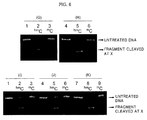
- Parts (A) to (F) of Fig. 5 are polyacrylamide gel electrophoresis images showing the results of the cases where the DNAs of SEQ ID NO: 4 to 9 were used
- Parts (G) to (K) of Fig. 6 are polyacrylamide gel electrophoresis diagrams images showing the results of the cases where the DNA of SEQ ID NO: 10 to 14 were used.
- Figs. 5 and 6 the lanes show the following samples. Lanes 1, 4, and 7: DNAs containing cytosine; Lanes 2, 5, and 8: DNAs containing 5-hydroxymethylcytosine; Lanes 3, 6, and 9: DNAs containing 5-methylcytosine.
- Figs. 5 and 6 clearly demonstrate that the method of the present invention makes it possible to distinguish and selectively detect hmC from mC, because only DNAs containing 5-hydroxymethylcytosine (hmC) are detected, and DNAs containing 5-methylcytosine (mC) are not detected.
- the present invention makes it possible to chemically, easily, and accurately detect the presence and the position of 5-hydroxymethylcytosine in a nucleic acid. Hence, the present invention is extremely useful as a core technology for investigating the reprogramming of a gene function in all the fields associated with epigenetics technologies, such as the fields of cancer, aging, and regenerative medicine.
Landscapes
- Chemical & Material Sciences (AREA)
- Organic Chemistry (AREA)
- Life Sciences & Earth Sciences (AREA)
- Zoology (AREA)
- Wood Science & Technology (AREA)
- Proteomics, Peptides & Aminoacids (AREA)
- Health & Medical Sciences (AREA)
- Engineering & Computer Science (AREA)
- Analytical Chemistry (AREA)
- Biophysics (AREA)
- Immunology (AREA)
- Microbiology (AREA)
- Molecular Biology (AREA)
- Biotechnology (AREA)
- Physics & Mathematics (AREA)
- Biochemistry (AREA)
- Bioinformatics & Cheminformatics (AREA)
- General Engineering & Computer Science (AREA)
- General Health & Medical Sciences (AREA)
- Genetics & Genomics (AREA)
- Chemical Kinetics & Catalysis (AREA)
- Measuring Or Testing Involving Enzymes Or Micro-Organisms (AREA)
Abstract
Description
- The present invention relates to a method and a kit for detecting 5-hydroxymethylcytosine in a nucleic acid.
- Epigenetics includes DNA methylation in which a genome is physiologically modified and posttranslational modification of chromatin which is a complex of DNA and proteins and a large number of proteins constituting chromatin, which integrally control the gene expression.
- Regarding modification of histones in chromatin, structural alteration of chromatin by histone modification plays an important role in the induction of transcription. For example, acetylation by a histone acetylation enzyme triggers the induction of remodeling of chromatin, so that transcription is started by general transcription factors and a RNA polymerase. In addition, methylation or phosphorylation of histones controls the transcription and causes silencing, chromatin condensation, and the like.
- In addition, in the genomes of many eukaryotes, 60 to 90% of CpG dinucleotides are methylated at the 5-carbon atom position of cytosine. The methylated CpG is found in heterochromatins and transposons containing many repeated sequences, and thought to suppress the activation of viruses and transposons. In addition, the CpG methylation and the histone modification coordinate with each other.
- An exception is that CG-rich regions (CpG islands) present in promoter regions of many genes are not methylated. In addition, an exception to the exception is that CpG islands are methylated in genes to be imprinted and in the inactive X chromosome of females. In addition, CpG islands are methylated also in the promoter regions of tumor suppressor gene in cancer cells. Hence, methylation of cytosine can be used as a marker of development, recurrence, and metastasis of cancer. In this respect, a simple method for detecting whether or not cytosine in a gene is methylated has been sought.
- As described above, 5-methylcytosine, which is a methylated cytosine (C), has been reported to be present in the DNA, and has been known to play an important role in the developmental genetics, so far. Recently, a new base (5-hydroxymethylcytosine) has been discovered in a study of Purkinje cells (Non Patent Literature 1). It is pointed out that 5-hydroxymethylcytosine is a key for elucidating the mechanism of DNA demethylation (reprogramming). Hence, specifying the presence and the position of 5-hydroxymethylcytosine in a DNA is important and essential as a core technology for investigating the reprogramming of a gene function in all the fields associated with epigenetics technologies, such as the fields of cancer, aging, and regenerative medicine.
- Various methods have been proposed for chemically and easily detecting methylcytosine in a DNA.
Patent Document 1 describes a method for distinguishing cytosine from methylcytosine. In addition,Patent Document 2 describes a method in which a target DNA is selectively cleaved at the position of 5-methylcytosine to obtain a 5'-fragment, an enzymatic reaction is carried out by using a FRET probe capable of hybridizing with the 5'-fragment and a flap endonuclease, and then the fluorescence is detected. - However, none of these methods can be applied directly to the detection of 5-hydroxymethylcytosine.
- Known methods for detecting 5-hydroxymethylcytosine in a DNA include a method in which 5-hydroxymethylcytosine in a fragmented DNA sample is detected by applying the conventional immunoprecipitation method using an anti-5-hydroxymethylcytosine antibody (
Non Patent Literatures 2 and 3), a method in which 5-hydroxymethylcytosine is modified with a sugar by using an enzyme capable of the sugar modification, and the modified 5-hydroxymethylcytosine is isolated (Non Patent Literature 4), and the like. - However, each of the method requires that a DNA sample be fragmented in advance, and has a problem that even when a fragment containing 5-hydroxymethylcytosine is isolated, the position of the 5-hydroxymethylcytosine in the fragment cannot be specified.
- Hence, there is a demand for a method for chemically and easily detecting 5-hydroxymethylcytosine in a nucleic acid such as a DNA.
-
- Patent Literature 1:
WO2006/132022 - Patent Literature 2:
WO2007/111324 -
- Non Patent Literature 1: Science Vol. 324, No. 5929, pp. 930-935 (2009)
- Non Patent Literature 2: Nature 466, 1129-1133 (2010)
- Non Patent Literature 3: Angew. Chem. Int. Ed. 49, 5375-5377 (2010)
- Non Patent Literature 4: Nature Biotechnol. 29, 68-72 (2011)
- An object of the present invention is to provide a method for detecting 5-hydroxymethylcytosine in a nucleic acid.
- Another object of the present invention is to provide a kit for detecting 5-hydroxymethylcytosine in a nucleic acid.
- The present invention provides the following method and kit for detecting 5-hydroxymethylcytosine in a nucleic acid.
- 1. A method for detecting 5-hydroxymethylcytosine in a nucleic acid, comprising the steps of:
- (1) oxidizing 5-hydroxymethylcytosine possibly present in a nucleic acid sample by treating the nucleic acid sample with a tungstic acid-based oxidizing agent; and
- (2) determining the position of the oxidized 5-hydroxymethylcytosine in the nucleic acid sample.
- 2. The method according to 1, wherein
the tungstic acid-based oxidizing agent is at least one selected from the group consisting of- (1) peroxotungstic acid, or a salt thereof,
- (2) tungstic acid, or a salt thereof, and
- (3) combinations of peroxotungstic acid, tungstic acid, or a salt thereof with a reoxidizing agent.
- 3. The method according to 1, wherein
the tungstic acid-based oxidizing agent is at least one selected from the group consisting of K2[{W(=O) (O2)2(H2O)}2(µ-O)], H2WO4/H2O2, and K2WO4/H2O2. - 4. The method according to any one of 1 to 3, wherein
the step (2) comprises a step of determining the position of the oxidized 5-hydroxymethylcytosine by cleaving the oxidized nucleic acid sample at the position of the oxidized 5-hydroxymethylcytosine by a deamination treatment, and measuring the size of a fragment of the nucleic acid. - 5. The method according to any one of 1 to 3, wherein
the step (2) comprises a step of determining the position of the oxidized 5-hydroxymethylcytosine by sequencing the oxidized nucleic acid sample. - 6. The method according to any one of 1 to 5, wherein the nucleic acid is a DNA.
- 7. Use of at least one tungstic acid-based oxidizing agent for detecting 5-hydroxymethylcytosine in a nucleic acid, the at least one tungstic acid-based oxidizing agent being selected from the group consisting of
- (1) peroxotungstic acid, or a salt thereof,
- (2) tungstic acid, or a salt thereof, and
- (3) combinations of peroxotungstic acid, tungstic acid, or a salt thereof with a reoxidizing agent.
- 8. A kit for detecting 5-hydroxymethylcytosine in a nucleic acid, comprising at least one tungstic acid-based oxidizing agent selected from the group consisting of
- (1) peroxotungstic acid, or a salt thereof,
- (2) tungstic acid, or a salt thereof, and
- (3) combinations of peroxotungstic acid, tungstic acid, or a salt thereof with a reoxidizing agent.
- 9. The kit according to 8, further comprising at least one selected from the group consisting of reagents for a deamination treatment of an oxidized nucleic acid sample, and pH buffer solutions.
- The present invention makes it possible to chemically, easily, and accurately detect the presence and the position of 5-hydroxymethylcytosine in a nucleic acid. Hence, the present invention is extremely useful as a core technology for investigating the reprogramming of a gene function in all the fields associated with epigenetics technologies, such as the fields of cancer, aging, and regenerative medicine.
-
-
Fig. 1 is a diagram illustrating an example of a nucleic acid preferable as a target of the method of the present invention. -
Fig. 2 is an image of polyacrylamide gel electrophoresis of products obtained from DNAs of SEQ ID NO: 1 by an oxidation treatment with H2WO4/H2O2 and a subsequent piperidine treatment. -
Fig. 3 is an image of polyacrylamide gel electrophoresis of products obtained from the DNAs of SEQ ID NO: 1 by an oxidation treatment with K2[{W(=O) (O2)2(H2O)}2 (µ-O)] and a subsequent piperidine treatment. -
Fig. 4 shows diagrams showing sequencing profiles (right) of products obtained from DNAs of SEQ ID NO: 2 (human TNF-β putative promoter region DNA fragments containing CpG, mCpG, and hmCpG, respectively) by an oxidation treatment with K2[{W(=O) (O2)2(H2O)}2 (µ-O)] followed by deamination and PCR amplification, and profiles (left) before the treatments, where each solid line represents adenine, each dashed line represents guanine, each dashed-dotted line represents cytosine, and each dotted line represents thymine. - Parts (A) to (F) of
Fig. 5 are images of polyacrylamide gel electrophoresis of products obtained in Example 3 from DNAs of SEQ ID NOs: 4 to 9 by an oxidation treatment with K2[{W(=O) (O2)2(H2O)}2 (µ-O)]and a subsequent piperidine treatment. - Parts (G) to (K) of
Fig. 6 are images of polyacrylamide gel electrophoresis of products obtained in Example 3 from DNAs of SEQ ID NOs: 10 to 14 by an oxidation treatment with K2[{W(=O) (O2)2(H2O)}2(µ-O)] and a subsequent piperidine treatment. - In the present invention, the "nucleic acid" means any compound which contains 5-hydroxymethylcytosine as a part of its structure as shown in
Fig. 1 , and whose 5-hydroxymethylcytosine can be detected by the method of the present invention. The meaning of "Nucleic acid" include DNAs, RNAs, nucleotides, nucleosides, nucleic acid analogs, peptides, other organic polymers, and the like. DNAs are particularly preferable. The method of the present invention can be applied to a nucleic acid having any chain length, and the chain length is preferably 1 to 10000 bp, and further preferably 15 to 1000 bp. - The "tungstic acid-based oxidizing agent" used in the present invention is an oxidizing agent capable of selectively acting on and oxidizing 5-hydroxymethylcytosine in a nucleic acid. The "tungstic acid-based oxidizing agent" is preferably at least one selected from the group consisting of (1) peroxotungstic acid, or a salt thereof (for example, alkali metal salts such as potassium salts and sodium salts; ammonium salts; amine salts; and the like), (2) tungstic acid, or a salt thereof (for example, alkali metal salts such as potassium salts and sodium salts; ammonium salts; amine salts; and the like), and (3) combinations of peroxotungstic acid, tungstic acid, or a salt thereof with a reoxidizing agent.
- As the oxidizing agent of the present invention, peroxotungstic acid, tungstic acid, or a salt thereof may be used alone or in combination with a reoxidizing agent.
- Specific examples of the peroxotungstic acid, tungstic acid, or a salt thereof include K2[{w(=O) (O2)2(H2O)2(µ-O)], H2WO4, K2WO4, Na2WO4-NH2CH2PO3H2- [CH3(n-C8H17)3N] HSO4, [C5H5N(n-C16H33)]3PW12O40, [(n-C4H9)4N]2[PhPO3{WO(O2)2}], salts of {WZn[M(H2O)]2(ZnW9O34)2} (where M represents Zn, Mn, Ru, Fe, or the like), Na2WO4-fructopyranoside, and the like.
- Specific examples of the reoxidizing agent include hydrogen peroxide, N-methylmorpholine-N-oxide, potassium ferricyanide, peroxybenzoic acid, oxygen gas, and the like.
- When a combination with a reoxidizing agent is employed, the molar ratio (peroxotungstic acid, tungstic acid, or a salt thereof/reoxidizing agent) of the peroxotungstic acid, tungstic acid, or salt thereof to the reoxidizing agent is preferably 1/100000 to 1/1, further preferably 1/100 to 1/1, and generally 1/10.
- In the present invention, 5-hydroxymethylcytosine present in the nucleic acid can be selectively oxidized by bringing the oxidizing agent of the present invention into contact with a nucleic acid-containing sample.
- In the oxidation reaction, only 5-hydroxymethylcytosine is selectively oxidized, whereas neither cytosine nor 5-methylcytosine is oxidized. Hence, only 5-hydroxymethylcytosine can be selectively detected.
- In this oxidation reaction, the pH of an aqueous solution of the nucleic acid sample is not particularly limited, and is desirably adjusted to preferably
pH 1 to 10, and further preferablypH 5 to 9 with an appropriate buffer solution of, for example, sodium phosphate, Tris-hydrochloric acid, sodium acetate, or the like. - In addition, the concentration of the nucleic acid sample is not particularly limited, and is preferably 10-7 to 10 % by mass, and further preferably 10-5 to 10-1 % by mass.
- The amount of the oxidizing agent of the present invention added is not particularly limited, and is preferably 0. 1 to 106 parts by mass, and further preferably 102 to 105 parts by mass relative to 100 parts by mass of the nucleic acid sample.
- The reaction time of the oxidation reaction is preferably 1 minute to 48 hours, and further preferably 10 minutes to 10 hours, and the temperature of the oxidation reaction is preferably 0 to 100°C, and further preferably 5 to 70°C.
- After the oxidation reaction, the position of 5-hydroxymethylcytosine is determined.
- Here, if there is a possibility that the residue of the reaction reagent may cause problems, such as amplification failure, in the subsequent detection step, a desalination operation is carried out before the detection step. The desalination operation can be carried out by a known method such as gel filtration, gel electrophoresis, HPLC purification, a method using a desalination filter, a method using an ion exchange column, salting-out, or the like. This desalination treatment can improve the precision of the subsequent step of determining the position of 5-hydroxymethylcytosine.
- The method for determining the position of 5-hydroxymethylcytosine in the oxidized nucleic acid is not particularly limited, and examples thereof include the following methods:
- (A) a method in which the position of the oxidized 5-hydroxymethylcytosine is determined by cleaving the oxidized nucleic acid sample at the position of the oxidized 5-hydroxymethylcytosine by a deamination treatment, and measuring the size of a fragment of the nucleic acid; and
- (B) a method in which the position of the oxidized 5-hydroxymethylcytosine is determined by sequencing the oxidized nucleic acid sample.
- First, the method (A) is described.
- The 5-hydroxymethylcytosine subjected to the oxidation treatment is treated under reaction conditions for inducing deamination of the
cytosine 4 position (for example, heating in a buffer solution ofpH 4 to 9, heating in an aqueous solution containing a salt such as lithium bromide or magnesium bromide, heating in an aqueous solution containing a basic substance such as sodium hydroxide or piperidine, or the like). Thus, the nucleic acid is cleaved at the position of the oxidized 5-hydroxymethylcytosine. Then, the size of a fragment of the nucleic acid is determined based on the electrophoretic mobility determined by electrophoresis (using polyacrylamide gel, agarose gel, or the like) or based on the change in mass determined by mass spectrometry (MALDI, ESI, or the like) . For the determination of the size of the fragment of the nucleic acid based on the electrophoretic mobility determined by electrophoresis or the like, the nucleic acid sample is desirably labeled with a fluorescent substance, 32P-phosphoric acid, digoxigenin, or the like in advance. - More specifically, the nucleic acid sample subjected to the oxidation treatment is subjected to a heat treatment (preferably at 70 to 100°C and preferably for 5 minutes to 5 hours) in an aqueous solution containing a basic substance such as piperidine or sodium hydroxide (the concentration is preferably about 3 to 50 % by mass, and further preferably about 10 to 20 % by mass). As a consequence, the N-glycosidic bond between the oxidized 5-hydroxymethylcytosine base and the sugar is cleaved, and phosphodiester bonds between the nucleotide having the oxidized 5-hydroxymethylcytosine and adjacent nucleotides are also cleaved. Hence, the position of the base of interest can be specified by, after the treatment with a basic substance, amplifying a fragment of the nucleic acid by PCR or the like, and measuring the size of the fragment of the nucleic acid by, for example, polyacrylamide gel electrophoresis or the like. In other words, since the nucleic acid is cleaved at the position where the 5-hydroxymethylcytosine is present, and a band of a fragment of the nucleic acid can be observed, the position of 5-hydroxymethylcytosine in the sequence can be determined.
- Next, the method (B) is described.
- A sequencing reaction (using an ordinary sequencer, a next generation sequencer, or the like after or without PCR amplification) of the nucleic acid subjected to the oxidation treatment is carried out, and the position of the 5-hydroxymethylcytosine is detected based on base substitution from C to T or from G to A by the sequencer.
- Specifically, 5-hydroxymethylcytosine forms a complementary base pair with guanine, whereas oxidized 5-hydroxymethylcytosine forms a complementary base pair not with guanine but with adenine. Hence, the position of the 5-hydroxymethylcytosine can be specified by sequencing and comparing the nucleic acid sample before the oxidation and the oxidized nucleic acid sample.
- More specifically, from a sequencing profile of a product obtained by the oxidation with the tungstic acid-based oxidizing agent, an optional desalination treatment, and the PCR amplification, the position of 5-hydroxymethylcytosine present in the nucleic acid can be clearly and efficiently distinguished from those of 5-methylcytosine and cytosine, and detected. This is because guanine, which is the complementary base of 5-methylcytosine and cytosine, is introduced into complementary sites of 5-methylcytosine and cytosine, whereas not only guanine, but also adenine is introduced into complementary sites of 5-hydroxymethylcytosine.
- After the oxidation, the product optionally subjected to the desalination treatment is further treated preferably in an aqueous solution of 10 to 0.1 % by mass of lithium bromide, lithium chloride, magnesium bromide, or the like (for example, a sodium phosphate, sodium acetate, or Tris hydrochloric acid buffer of
pH 5 to 9) at 5 to 80°C for 0.5 to 24 hours. Consequently, the ratio of adenine to the bases (guanine and adenine) introduced into the complementary sites of 5-hydroxymethylcytosine further increases to an extent that adenine is introduced almost exclusively. Hence, the position of 5-hydroxymethylcytosine present in the nucleic acid can be further clearly and efficiently distinguished from those of 5-methylcytosine and cytosine, and detected. - In 50 ml of water, 1.25 µg of each of fluorescently labeled DNAs having the base sequences of SEQ ID NO: 1, respectively, was dissolved, and the pH was adjusted to 7.0 with a sodium phosphate-sodium chloride buffer solution. To such a solution, 165 µg of each of the oxidizing agents shown in Table 1 was added, and a reaction was allowed to proceed at 50°C for 120 minutes.
- A desalination treatment was conducted on the reaction mixture by using
Micro BioSpin Column 6 Tris (Bio-Rad Laboratories, Inc.). - Subsequently, piperidine was added to the treated material at 10 % by mass, and a heat treatment was conducted at 90°C for 120 minutes.
- The treated material was subjected to a freeze dry treatment, and the residue was analyzed by polyacrylamide gel electrophoresis.
- SEQ ID NO: 1: 5'-Fluorescein-AAAAAAGXGAAAAAA-3' (X=hmC, mC, C).
- Hereinafter, hmC represents 5-hydroxymethylcytosine, mC represents 5-methylcytosine, and C represents cytosine.
-
Fig. 2 shows the results of polyacrylamide gel electrophoresis analysis of products obtained from the DNAs of SEQ ID NO: 1 by an oxidation treatment with H2WO4/H2O2 and a subsequent piperidine treatment. - Meanwhile,
Fig. 3 shows the results obtained by a similar treatment using K2[{W(=O) (O2)2 (H2O) }2 (µ-O)]as the oxidizing agent. - Lane 1: A DNA before reaction;
- Lane 2: A DNA having the same length (7 bases) as that of a DNA produced when a reaction of the oxidized 5-hydroxymethylcytosine occurs;
- Lane 3: The DNA containing 5-hydroxymethylcytosine;
- Lane 4: The DNA containing 5-methylcytosine; and
- Lane 5: The DNA containing cytosine.
- The hollow arrows represent slightly observed oxidation damage to guanine (oxidative decomposition of guanine base to 8-oxoguanine or imidazolone led to chain cleavage during the piperidine treatment).
- In addition, Table 1 shows the ratio (%) of the fluorescence concentration of each treated fragment indicated by "Fragment cleaved at X" to the fluorescence concentration of "Untreated DNA" and "Fragment cleaved at X" shown in
Fig. 2 . Table 1 also shows the ratio (%) of the fluorescence concentration of a treated fragment to the fluorescence concentration of "Untreated DNA" and "Fragment cleaved at X," which were obtained from results of polyacrylamide gel electrophoresis analysis of each product obtained by the oxidation treatment with an oxidizing agent other than H2WO4/H2O2, and a piperidine treatment conducted in the same manner. - The results shown in
Figs. 2 and 3 , and Table 1 indicates that the oxidizing agent of the present invention reacts with and oxidizes a DNA containing 5-hydroxymethylcytosine more specifically and selectively than the other oxidizing agents. This clearly indicates that the oxidizing agent of the present invention is excellent as a reagent for detecting 5-hydroxymethylcytosine in a nucleic acid.Table 1 Experimental Example oxidizing agent hmC mC C 1 peroxo-W 74.0 1.2 2.7 2 H2WO4+H2O2 66.7 4.0 6.2 3 peroxo-Mo 12.5 1.5 2.0 4 OsO4 12.3 3.6 0.5 5 MeReO3+H2O2 3.1 1.2 2.4 peroxo-W: K2[{W(=O) (O2)2(H2O)}2(µ-O)]
peroxo-Mo: K2[{Mo(=O) (O2)2(H2O)}2(µ-O)] - DNAs (human TNF-β putative promoter region DNA fragments containing CpG, mCpG, and hmCpG, respectively) of SEQ ID NO: 2 were synthesized by the general purpose phosphoramidite method using a NTS H-6 DNA/RNA synthesizer. In 50 µl of water, 1.25 µg of each of the DNAs having a base sequence of SEQ ID NO: 2 was dissolved, and the pH was adjusted to 7.0 with a sodium phosphate-sodium chloride buffer solution. To such a solution, 165 µg of each of the oxidizing agents shown in Table 1 was added, and a reaction was allowed to proceed at 50°C for 120 minutes.
- The reaction mixture was subjected to a desalination treatment using
Micro BioSpin Column 6 Tris (Bio-Rad Laboratories, Inc.), and a treated product I was obtained. - Subsequently, the treated product I was dissolved in 50 µl of water, and 435 µg of lithium bromide was added. Then, a reaction was allowed to proceed at 50°C for 5 hours to obtain a treated product II.
- The treated product II was subjected to a desalination treatment using
Micro BioSpin Column 6 Tris (Bio-Rad Laboratories, Inc.). - Subsequently, a PCR primer having the base sequence of SEQ ID NO: 3 was added at 10 % by mass to each of the treated products I and II, which were then sequenced by using BigDye (Registered Trademark) Terminator v3.1 Cycle Sequencing Kit (Applied Biosystems).
-

- SEQ ID NO: 3: 5'-GGAGATGGGG CAGGAG-3'
- The results are shown in
Fig. 4. Fig. 4 shows diagrams showing sequencing profiles (right) of products obtained from the DNAs of SEQ ID NO: 2 (the human TNF-β putative promoter region DNA fragments containing CpG, mCpG, and hmCpG, respectively) by an oxidation treatment with a tungstic acid-based oxidizing agent: K2[{W(=O) (O2)2(H2O)}2(µ-O)] of the present invention followed by deamination and PCR amplification, and profiles (left) before the treatment, where each solid line represents adenine, each dashed line represents guanine, each dashed-dotted line represents cytosine, and each dotted line represents thymine. - From the sequencing profiles (the profiles on the right in
Fig. 4 ) of the treated products I obtained by the oxidation with the tungstic acid-based oxidizing agent followed by the desalination treatment and the PCR amplification, it can be understood that guanine, which is a base complementary to 5-methylcytosine and cytosine, is introduced into complementary sites of 5-methylcytosine and cytosine, whereas not only guanine but also approximately 30 to 100% by mole of adenine is introduced into complementary sites of 5-hydroxymethylcytosine. - From a sequencing profile of a treated product II obtained by further treating the product, which was obtained by the oxidation and the desalination treatment, with lithium bromide followed by PCR amplification, it can be understood that only guanine, which is a complementary base of 5-methylcytosine and cytosine, is introduced into complementary sites of 5-methylcytosine and cytosine, whereas adenine is almost exclusively (50 to 100% by mole) introduced into complementary sites of 5-hydroxymethylcytosine.
- Hence, by comparing a sequencing profile obtained by sequencing a product obtained by oxidation with a tungstic acid-based oxidizing agent optionally followed by a desalination treatment with a sequencing profile of a nucleic acid sample before the oxidation treatment, the position of 5-hydroxymethylcytosine present in a nucleic acid can be clearly distinguished from those of 5-methylcytosine and cytosine, and detected.
- When a lithium bromide treatment is further carried out after the oxidation with a tungstic acid-based oxidizing agent and the optional desalination treatment, the ratio of adenine to the bases (guanine and adenine) introduced into complementary sites of 5-hydroxymethylcytosine is further increased. Hence, the position of 5-hydroxymethylcytosine present in a nucleic acid can be more clearly and efficiently detected from those of 5-methylcytosine and cytosine.
- Products were obtained by an oxidation treatment with K2[{W(=O) (O2)2(H2O)}2(µ-O)] and a subsequent piperidine treatment in the same manner as in Example 1, except that DNAs having the following base sequences (A) to (K) of SEQ ID NOs: 4 to 14 and being fluorescently labeled with Fluorescein were used instead of the fluorescently labeled DNAs having the base sequences of SEQ ID NO: 1 used in Example 1. The products were analyzed by polyacrylamide gel electrophoresis.
- SEQ ID NO: 4: (A) Fluo-GATACTGXGT TGCAA
- SEQ ID NO: 5: (B) Fluo-AGTGCATXGC AAGAA
- SEQ ID NO: 6: (C) Fluo-GACATACXGA AGTGA
- SEQ ID NO: 7: (D) Fluo-AAGTGCAXGA TGCGA
-

-

- SEQ ID NO: 10: (G) Fluo-GTTGTGAGGX GCTGCCCCCA
- SEQ ID NO: 11: (H) Fluo-GCAGGGCCCA CTACXGCTTC CTCCAGATGA
- SEQ ID NO: 12: (I) Fluo-GAGTGAGXAG TAAGA
- SEQ ID NO: 13: (J) Fluo-AGAGCAGXTG ATGAA
- SEQ ID NO: 14: (K) Fluo-AAGCCAGXCG TATGA
-
Figs. 5 and6 show the results. Parts (A) to (F) ofFig. 5 are polyacrylamide gel electrophoresis images showing the results of the cases where the DNAs of SEQ ID NO: 4 to 9 were used, and Parts (G) to (K) ofFig. 6 are polyacrylamide gel electrophoresis diagrams images showing the results of the cases where the DNA of SEQ ID NO: 10 to 14 were used. - In
Figs. 5 and6 , the lanes show the following samples.Lanes
Lanes Lanes - The results shown in
Figs. 5 and6 clearly demonstrate that the method of the present invention makes it possible to distinguish and selectively detect hmC from mC, because only DNAs containing 5-hydroxymethylcytosine (hmC) are detected, and DNAs containing 5-methylcytosine (mC) are not detected. - The present invention makes it possible to chemically, easily, and accurately detect the presence and the position of 5-hydroxymethylcytosine in a nucleic acid. Hence, the present invention is extremely useful as a core technology for investigating the reprogramming of a gene function in all the fields associated with epigenetics technologies, such as the fields of cancer, aging, and regenerative medicine.


Claims (9)
- A method for detecting 5-hydroxymethylcytosine in a nucleic acid, comprising the steps of:(1) oxidizing 5-hydroxymethylcytosine possibly present in a nucleic acid sample by treating the nucleic acid sample with a tungstic acid-based oxidizing agent; and(2) determining the position of the oxidized 5-hydroxymethylcytosine in the nucleic acid sample.
- The method according to claim 1, wherein
the tungstic acid-based oxidizing agent is at least one selected from the group consisting of(1) peroxotungstic acid, or a salt thereof,(2) tungstic acid, or a salt thereof, and(3) combinations of peroxotungstic acid, tungstic acid, or a salt thereof with a reoxidizing agent. - The method according to claim 1, wherein
the tungstic acid-based oxidizing agent is at least one selected from the group consisting of K2[{W(=O) (O2)2(H2O)}2(µ-O)], H2WO4/H2O2, and K2WO4/H2O2. - The method according to any one of claims 1 to 3, wherein
the step (2) comprises a step of determining the position of the oxidized 5-hydroxymethylcytosine by cleaving the oxidized nucleic acid sample at the position of the oxidized 5-hydroxymethylcytosine by a deamination treatment, and measuring the size of a fragment of the nucleic acid. - The method according to any one of claims 1 to 3, wherein
the step (2) comprises a step of determining the position of the oxidized 5-hydroxymethylcytosine by sequencing the oxidized nucleic acid sample. - The method according to any one of claims 1 to 5, wherein
the nucleic acid is a DNA. - Use of at least one tungstic acid-based oxidizing agent for detecting 5-hydroxymethylcytosine in a nucleic acid, the at least one tungstic acid-based oxidizing agent being selected from the group consisting of(1) peroxotungstic acid, or a salt thereof,(2) tungstic acid, or a salt thereof, and(3) combinations of peroxotungstic acid, tungstic acid, or a salt thereof with a reoxidizing agent.
- A kit for detecting 5-hydroxymethylcytosine in a nucleic acid, comprising at least one tungstic acid-based oxidizing agent selected from the group consisting of(1) peroxotungstic acid, or a salt thereof,(2) tungstic acid, or a salt thereof, and(3) combinations of peroxotungstic acid, tungstic acid, or a salt thereof with a reoxidizing agent.
- The kit according to claim 8, further comprising at least one selected from the group consisting of reagents for a deamination treatment of an oxidized nucleic acid sample, and pH buffer solutions.
Applications Claiming Priority (2)
| Application Number | Priority Date | Filing Date | Title |
|---|---|---|---|
| JP2011090971 | 2011-04-15 | ||
| PCT/JP2012/060265 WO2012141324A1 (en) | 2011-04-15 | 2012-04-16 | Method and kit for detecting 5-hydroxymethylcytosine in nucleic acids |
Publications (3)
| Publication Number | Publication Date |
|---|---|
| EP2698437A1 true EP2698437A1 (en) | 2014-02-19 |
| EP2698437A4 EP2698437A4 (en) | 2015-01-14 |
| EP2698437B1 EP2698437B1 (en) | 2017-05-31 |
Family
ID=47009481
Family Applications (1)
| Application Number | Title | Priority Date | Filing Date |
|---|---|---|---|
| EP12771081.2A Not-in-force EP2698437B1 (en) | 2011-04-15 | 2012-04-16 | Method for detecting 5-hydroxymethylcytosine in nucleic acids |
Country Status (4)
| Country | Link |
|---|---|
| US (1) | US8895244B2 (en) |
| EP (1) | EP2698437B1 (en) |
| JP (1) | JP5919602B2 (en) |
| WO (1) | WO2012141324A1 (en) |
Cited By (2)
| Publication number | Priority date | Publication date | Assignee | Title |
|---|---|---|---|---|
| WO2016016639A1 (en) * | 2014-07-28 | 2016-02-04 | Cambridge Epigenetix Ltd | Improved nucleic acid sample analysis using convertible tags |
| EP2940149A4 (en) * | 2012-12-28 | 2016-07-27 | Wako Pure Chem Ind Ltd | Detection method for hydroxymethylated cytosine in dna and reagent kit for detection |
Families Citing this family (5)
| Publication number | Priority date | Publication date | Assignee | Title |
|---|---|---|---|---|
| US9145580B2 (en) * | 2011-04-02 | 2015-09-29 | New England Biolabs, Inc. | Methods and compositions for enriching either target polynucleotides or non-target polynucleotides from a mixture of target and non-target polynucleotides |
| HK1198547A1 (en) * | 2011-07-29 | 2015-05-15 | 剑桥表现遗传学有限公司 | Methods for detection of nucleotide modification |
| ES2786984T3 (en) | 2012-11-30 | 2020-10-14 | Cambridge Epigenetix Ltd | Oxidizing agent for modified nucleotides |
| JP6297983B2 (en) * | 2013-01-16 | 2018-03-20 | ユニバーサル・バイオ・リサーチ株式会社 | Cell identification method |
| WO2017039002A1 (en) * | 2015-09-04 | 2017-03-09 | 国立大学法人東京大学 | Oxidizing agent for 5-hydroxymethylcytosine and method for analyzing 5-hydroxymethylcytosine |
Family Cites Families (6)
| Publication number | Priority date | Publication date | Assignee | Title |
|---|---|---|---|---|
| JPS58224183A (en) * | 1982-06-21 | 1983-12-26 | Showa Denko Kk | Composition for aqueous lithium bromide solution |
| DE50202704D1 (en) * | 2002-01-22 | 2005-05-12 | Mpb Meltec Patent Und Beteilig | Method and apparatus for sample preparation for the analysis of biological samples |
| JP5167485B2 (en) | 2005-06-08 | 2013-03-21 | 国立大学法人京都大学 | Simple detection method for methylcytosine |
| WO2007111324A1 (en) | 2006-03-29 | 2007-10-04 | Kyoto University | Method of detecting 5-methylcytosine in gene and detection kit |
| WO2010037001A2 (en) * | 2008-09-26 | 2010-04-01 | Immune Disease Institute, Inc. | Selective oxidation of 5-methylcytosine by tet-family proteins |
| WO2011025819A1 (en) * | 2009-08-25 | 2011-03-03 | New England Biolabs, Inc. | Detection and quantification of hydroxymethylated nucleotides in a polynucleotide preparation |
-
2012
- 2012-04-16 EP EP12771081.2A patent/EP2698437B1/en not_active Not-in-force
- 2012-04-16 JP JP2013510000A patent/JP5919602B2/en not_active Expired - Fee Related
- 2012-04-16 US US14/111,825 patent/US8895244B2/en not_active Expired - Fee Related
- 2012-04-16 WO PCT/JP2012/060265 patent/WO2012141324A1/en not_active Ceased
Cited By (2)
| Publication number | Priority date | Publication date | Assignee | Title |
|---|---|---|---|---|
| EP2940149A4 (en) * | 2012-12-28 | 2016-07-27 | Wako Pure Chem Ind Ltd | Detection method for hydroxymethylated cytosine in dna and reagent kit for detection |
| WO2016016639A1 (en) * | 2014-07-28 | 2016-02-04 | Cambridge Epigenetix Ltd | Improved nucleic acid sample analysis using convertible tags |
Also Published As
| Publication number | Publication date |
|---|---|
| JP5919602B2 (en) | 2016-05-18 |
| EP2698437A4 (en) | 2015-01-14 |
| WO2012141324A1 (en) | 2012-10-18 |
| JPWO2012141324A1 (en) | 2014-07-28 |
| US20140045183A1 (en) | 2014-02-13 |
| US8895244B2 (en) | 2014-11-25 |
| EP2698437B1 (en) | 2017-05-31 |
Similar Documents
| Publication | Publication Date | Title |
|---|---|---|
| EP2698437B1 (en) | Method for detecting 5-hydroxymethylcytosine in nucleic acids | |
| DK2737085T3 (en) | METHODS FOR DETECTING NUCLEOTID MODIFICATION | |
| JP2020513801A (en) | DNA amplification method in which methylation state is maintained | |
| CN114901818A (en) | Methods of targeted nucleic acid library formation | |
| WO2000043531A2 (en) | Methods and kits for characterizing gc-rich nucleic acid sequences | |
| WO2016034908A1 (en) | Methods for detection of nucleotide modification | |
| US20070190530A1 (en) | Method for bisulfite treatment | |
| JP2002525129A (en) | Methods for analyzing polynucleotides | |
| CN114134205A (en) | Deaminase-mediated N in DNA4Single base resolution positioning analysis method of-methylcytosine | |
| CN104673931A (en) | Method for rapidly determining site-specific DNA methylation | |
| CN114787385A (en) | Methods and systems for detecting nucleic acid modifications | |
| CN110923314A (en) | Primer group for detecting SNP locus rs9263726, crRNA sequence and application thereof | |
| EP4047091A1 (en) | Method for detecting target nucleic acid, method for detecting nucleic acid-binding molecule, and method for evaluating nucleic acid-binding ability | |
| CN115961001A (en) | Single base analysis method of 5-methylcytosine in DNA mediated by DNA methyltransferase combined with cytosine deaminase | |
| JP6131857B2 (en) | Detection method of methylated cytosine using bisulfite reaction | |
| US6777188B2 (en) | Genotyping by mass spectrometric analysis of allelic fragments | |
| JP5167485B2 (en) | Simple detection method for methylcytosine | |
| JP5244803B2 (en) | Method for detecting methylated cytosine | |
| CN101027407B (en) | Method for detecting mutation | |
| JP2009232761A (en) | Method for analyzing methylated dna | |
| WO2015136999A1 (en) | Method for detecting guanine-abasic site in dna | |
| US20250115960A1 (en) | Nucleic acid testing method and system | |
| US8906623B2 (en) | Kit and method for determining whether or not unmethylated cytosine conversion treatment is properly carried out and method for analyzing methylated DNA using the same | |
| CN110643702A (en) | Method for determining methylation level of DNA of specific site in biological sample and application thereof | |
| EP2660321A1 (en) | Method for detecting methylated cytosine |
Legal Events
| Date | Code | Title | Description |
|---|---|---|---|
| PUAI | Public reference made under article 153(3) epc to a published international application that has entered the european phase |
Free format text: ORIGINAL CODE: 0009012 |
|
| 17P | Request for examination filed |
Effective date: 20131104 |
|
| AK | Designated contracting states |
Kind code of ref document: A1 Designated state(s): AL AT BE BG CH CY CZ DE DK EE ES FI FR GB GR HR HU IE IS IT LI LT LU LV MC MK MT NL NO PL PT RO RS SE SI SK SM TR |
|
| DAX | Request for extension of the european patent (deleted) | ||
| A4 | Supplementary search report drawn up and despatched |
Effective date: 20141216 |
|
| RIC1 | Information provided on ipc code assigned before grant |
Ipc: C12N 15/09 20060101ALI20141210BHEP Ipc: C12Q 1/68 20060101AFI20141210BHEP |
|
| 17Q | First examination report despatched |
Effective date: 20151209 |
|
| GRAP | Despatch of communication of intention to grant a patent |
Free format text: ORIGINAL CODE: EPIDOSNIGR1 |
|
| INTG | Intention to grant announced |
Effective date: 20161107 |
|
| GRAS | Grant fee paid |
Free format text: ORIGINAL CODE: EPIDOSNIGR3 |
|
| GRAA | (expected) grant |
Free format text: ORIGINAL CODE: 0009210 |
|
| AK | Designated contracting states |
Kind code of ref document: B1 Designated state(s): AL AT BE BG CH CY CZ DE DK EE ES FI FR GB GR HR HU IE IS IT LI LT LU LV MC MK MT NL NO PL PT RO RS SE SI SK SM TR |
|
| REG | Reference to a national code |
Ref country code: CH Ref legal event code: EP Ref country code: GB Ref legal event code: FG4D |
|
| REG | Reference to a national code |
Ref country code: AT Ref legal event code: REF Ref document number: 897538 Country of ref document: AT Kind code of ref document: T Effective date: 20170615 |
|
| REG | Reference to a national code |
Ref country code: IE Ref legal event code: FG4D |
|
| REG | Reference to a national code |
Ref country code: DE Ref legal event code: R096 Ref document number: 602012033000 Country of ref document: DE |
|
| REG | Reference to a national code |
Ref country code: NL Ref legal event code: MP Effective date: 20170531 |
|
| REG | Reference to a national code |
Ref country code: LT Ref legal event code: MG4D |
|
| REG | Reference to a national code |
Ref country code: AT Ref legal event code: MK05 Ref document number: 897538 Country of ref document: AT Kind code of ref document: T Effective date: 20170531 |
|
| PG25 | Lapsed in a contracting state [announced via postgrant information from national office to epo] |
Ref country code: AT Free format text: LAPSE BECAUSE OF FAILURE TO SUBMIT A TRANSLATION OF THE DESCRIPTION OR TO PAY THE FEE WITHIN THE PRESCRIBED TIME-LIMIT Effective date: 20170531 Ref country code: ES Free format text: LAPSE BECAUSE OF FAILURE TO SUBMIT A TRANSLATION OF THE DESCRIPTION OR TO PAY THE FEE WITHIN THE PRESCRIBED TIME-LIMIT Effective date: 20170531 Ref country code: LT Free format text: LAPSE BECAUSE OF FAILURE TO SUBMIT A TRANSLATION OF THE DESCRIPTION OR TO PAY THE FEE WITHIN THE PRESCRIBED TIME-LIMIT Effective date: 20170531 Ref country code: GR Free format text: LAPSE BECAUSE OF FAILURE TO SUBMIT A TRANSLATION OF THE DESCRIPTION OR TO PAY THE FEE WITHIN THE PRESCRIBED TIME-LIMIT Effective date: 20170901 Ref country code: HR Free format text: LAPSE BECAUSE OF FAILURE TO SUBMIT A TRANSLATION OF THE DESCRIPTION OR TO PAY THE FEE WITHIN THE PRESCRIBED TIME-LIMIT Effective date: 20170531 Ref country code: FI Free format text: LAPSE BECAUSE OF FAILURE TO SUBMIT A TRANSLATION OF THE DESCRIPTION OR TO PAY THE FEE WITHIN THE PRESCRIBED TIME-LIMIT Effective date: 20170531 Ref country code: NO Free format text: LAPSE BECAUSE OF FAILURE TO SUBMIT A TRANSLATION OF THE DESCRIPTION OR TO PAY THE FEE WITHIN THE PRESCRIBED TIME-LIMIT Effective date: 20170831 |
|
| PG25 | Lapsed in a contracting state [announced via postgrant information from national office to epo] |
Ref country code: SE Free format text: LAPSE BECAUSE OF FAILURE TO SUBMIT A TRANSLATION OF THE DESCRIPTION OR TO PAY THE FEE WITHIN THE PRESCRIBED TIME-LIMIT Effective date: 20170531 Ref country code: NL Free format text: LAPSE BECAUSE OF FAILURE TO SUBMIT A TRANSLATION OF THE DESCRIPTION OR TO PAY THE FEE WITHIN THE PRESCRIBED TIME-LIMIT Effective date: 20170531 Ref country code: LV Free format text: LAPSE BECAUSE OF FAILURE TO SUBMIT A TRANSLATION OF THE DESCRIPTION OR TO PAY THE FEE WITHIN THE PRESCRIBED TIME-LIMIT Effective date: 20170531 Ref country code: BG Free format text: LAPSE BECAUSE OF FAILURE TO SUBMIT A TRANSLATION OF THE DESCRIPTION OR TO PAY THE FEE WITHIN THE PRESCRIBED TIME-LIMIT Effective date: 20170831 Ref country code: IS Free format text: LAPSE BECAUSE OF FAILURE TO SUBMIT A TRANSLATION OF THE DESCRIPTION OR TO PAY THE FEE WITHIN THE PRESCRIBED TIME-LIMIT Effective date: 20170930 Ref country code: RS Free format text: LAPSE BECAUSE OF FAILURE TO SUBMIT A TRANSLATION OF THE DESCRIPTION OR TO PAY THE FEE WITHIN THE PRESCRIBED TIME-LIMIT Effective date: 20170531 |
|
| PG25 | Lapsed in a contracting state [announced via postgrant information from national office to epo] |
Ref country code: DK Free format text: LAPSE BECAUSE OF FAILURE TO SUBMIT A TRANSLATION OF THE DESCRIPTION OR TO PAY THE FEE WITHIN THE PRESCRIBED TIME-LIMIT Effective date: 20170531 Ref country code: RO Free format text: LAPSE BECAUSE OF FAILURE TO SUBMIT A TRANSLATION OF THE DESCRIPTION OR TO PAY THE FEE WITHIN THE PRESCRIBED TIME-LIMIT Effective date: 20170531 Ref country code: CZ Free format text: LAPSE BECAUSE OF FAILURE TO SUBMIT A TRANSLATION OF THE DESCRIPTION OR TO PAY THE FEE WITHIN THE PRESCRIBED TIME-LIMIT Effective date: 20170531 Ref country code: EE Free format text: LAPSE BECAUSE OF FAILURE TO SUBMIT A TRANSLATION OF THE DESCRIPTION OR TO PAY THE FEE WITHIN THE PRESCRIBED TIME-LIMIT Effective date: 20170531 Ref country code: SK Free format text: LAPSE BECAUSE OF FAILURE TO SUBMIT A TRANSLATION OF THE DESCRIPTION OR TO PAY THE FEE WITHIN THE PRESCRIBED TIME-LIMIT Effective date: 20170531 |
|
| PG25 | Lapsed in a contracting state [announced via postgrant information from national office to epo] |
Ref country code: IT Free format text: LAPSE BECAUSE OF FAILURE TO SUBMIT A TRANSLATION OF THE DESCRIPTION OR TO PAY THE FEE WITHIN THE PRESCRIBED TIME-LIMIT Effective date: 20170531 Ref country code: PL Free format text: LAPSE BECAUSE OF FAILURE TO SUBMIT A TRANSLATION OF THE DESCRIPTION OR TO PAY THE FEE WITHIN THE PRESCRIBED TIME-LIMIT Effective date: 20170531 Ref country code: SM Free format text: LAPSE BECAUSE OF FAILURE TO SUBMIT A TRANSLATION OF THE DESCRIPTION OR TO PAY THE FEE WITHIN THE PRESCRIBED TIME-LIMIT Effective date: 20170531 |
|
| REG | Reference to a national code |
Ref country code: DE Ref legal event code: R097 Ref document number: 602012033000 Country of ref document: DE |
|
| PLBE | No opposition filed within time limit |
Free format text: ORIGINAL CODE: 0009261 |
|
| STAA | Information on the status of an ep patent application or granted ep patent |
Free format text: STATUS: NO OPPOSITION FILED WITHIN TIME LIMIT |
|
| REG | Reference to a national code |
Ref country code: FR Ref legal event code: PLFP Year of fee payment: 7 |
|
| 26N | No opposition filed |
Effective date: 20180301 |
|
| PG25 | Lapsed in a contracting state [announced via postgrant information from national office to epo] |
Ref country code: SI Free format text: LAPSE BECAUSE OF FAILURE TO SUBMIT A TRANSLATION OF THE DESCRIPTION OR TO PAY THE FEE WITHIN THE PRESCRIBED TIME-LIMIT Effective date: 20170531 |
|
| PG25 | Lapsed in a contracting state [announced via postgrant information from national office to epo] |
Ref country code: MC Free format text: LAPSE BECAUSE OF FAILURE TO SUBMIT A TRANSLATION OF THE DESCRIPTION OR TO PAY THE FEE WITHIN THE PRESCRIBED TIME-LIMIT Effective date: 20170531 |
|
| REG | Reference to a national code |
Ref country code: CH Ref legal event code: PL |
|
| REG | Reference to a national code |
Ref country code: BE Ref legal event code: MM Effective date: 20180430 |
|
| REG | Reference to a national code |
Ref country code: IE Ref legal event code: MM4A |
|
| PG25 | Lapsed in a contracting state [announced via postgrant information from national office to epo] |
Ref country code: LU Free format text: LAPSE BECAUSE OF NON-PAYMENT OF DUE FEES Effective date: 20180416 |
|
| PG25 | Lapsed in a contracting state [announced via postgrant information from national office to epo] |
Ref country code: LI Free format text: LAPSE BECAUSE OF NON-PAYMENT OF DUE FEES Effective date: 20180430 Ref country code: CH Free format text: LAPSE BECAUSE OF NON-PAYMENT OF DUE FEES Effective date: 20180430 Ref country code: BE Free format text: LAPSE BECAUSE OF NON-PAYMENT OF DUE FEES Effective date: 20180430 |
|
| PG25 | Lapsed in a contracting state [announced via postgrant information from national office to epo] |
Ref country code: IE Free format text: LAPSE BECAUSE OF NON-PAYMENT OF DUE FEES Effective date: 20180416 |
|
| PGFP | Annual fee paid to national office [announced via postgrant information from national office to epo] |
Ref country code: DE Payment date: 20190418 Year of fee payment: 8 |
|
| PGFP | Annual fee paid to national office [announced via postgrant information from national office to epo] |
Ref country code: FR Payment date: 20190418 Year of fee payment: 8 |
|
| PGFP | Annual fee paid to national office [announced via postgrant information from national office to epo] |
Ref country code: GB Payment date: 20190418 Year of fee payment: 8 |
|
| PG25 | Lapsed in a contracting state [announced via postgrant information from national office to epo] |
Ref country code: MT Free format text: LAPSE BECAUSE OF NON-PAYMENT OF DUE FEES Effective date: 20180416 |
|
| PG25 | Lapsed in a contracting state [announced via postgrant information from national office to epo] |
Ref country code: TR Free format text: LAPSE BECAUSE OF FAILURE TO SUBMIT A TRANSLATION OF THE DESCRIPTION OR TO PAY THE FEE WITHIN THE PRESCRIBED TIME-LIMIT Effective date: 20170531 |
|
| PG25 | Lapsed in a contracting state [announced via postgrant information from national office to epo] |
Ref country code: HU Free format text: LAPSE BECAUSE OF FAILURE TO SUBMIT A TRANSLATION OF THE DESCRIPTION OR TO PAY THE FEE WITHIN THE PRESCRIBED TIME-LIMIT; INVALID AB INITIO Effective date: 20120416 Ref country code: PT Free format text: LAPSE BECAUSE OF FAILURE TO SUBMIT A TRANSLATION OF THE DESCRIPTION OR TO PAY THE FEE WITHIN THE PRESCRIBED TIME-LIMIT Effective date: 20170531 |
|
| PG25 | Lapsed in a contracting state [announced via postgrant information from national office to epo] |
Ref country code: CY Free format text: LAPSE BECAUSE OF FAILURE TO SUBMIT A TRANSLATION OF THE DESCRIPTION OR TO PAY THE FEE WITHIN THE PRESCRIBED TIME-LIMIT Effective date: 20170531 Ref country code: MK Free format text: LAPSE BECAUSE OF NON-PAYMENT OF DUE FEES Effective date: 20170531 |
|
| PG25 | Lapsed in a contracting state [announced via postgrant information from national office to epo] |
Ref country code: AL Free format text: LAPSE BECAUSE OF FAILURE TO SUBMIT A TRANSLATION OF THE DESCRIPTION OR TO PAY THE FEE WITHIN THE PRESCRIBED TIME-LIMIT Effective date: 20170531 |
|
| REG | Reference to a national code |
Ref country code: DE Ref legal event code: R119 Ref document number: 602012033000 Country of ref document: DE |
|
| PG25 | Lapsed in a contracting state [announced via postgrant information from national office to epo] |
Ref country code: FR Free format text: LAPSE BECAUSE OF NON-PAYMENT OF DUE FEES Effective date: 20200430 Ref country code: DE Free format text: LAPSE BECAUSE OF NON-PAYMENT OF DUE FEES Effective date: 20201103 |
|
| GBPC | Gb: european patent ceased through non-payment of renewal fee |
Effective date: 20200416 |
|
| PG25 | Lapsed in a contracting state [announced via postgrant information from national office to epo] |
Ref country code: GB Free format text: LAPSE BECAUSE OF NON-PAYMENT OF DUE FEES Effective date: 20200416 |