EP2696346A2 - Informationsaufzeichnungsvorrichtung, Informationswiedergabevorrichtung und Formatierungsverfahren - Google Patents
Informationsaufzeichnungsvorrichtung, Informationswiedergabevorrichtung und Formatierungsverfahren Download PDFInfo
- Publication number
- EP2696346A2 EP2696346A2 EP13178182.5A EP13178182A EP2696346A2 EP 2696346 A2 EP2696346 A2 EP 2696346A2 EP 13178182 A EP13178182 A EP 13178182A EP 2696346 A2 EP2696346 A2 EP 2696346A2
- Authority
- EP
- European Patent Office
- Prior art keywords
- recording
- recording data
- data blocks
- areas
- file system
- Prior art date
- Legal status (The legal status is an assumption and is not a legal conclusion. Google has not performed a legal analysis and makes no representation as to the accuracy of the status listed.)
- Withdrawn
Links
Images







Classifications
-
- G—PHYSICS
- G11—INFORMATION STORAGE
- G11B—INFORMATION STORAGE BASED ON RELATIVE MOVEMENT BETWEEN RECORD CARRIER AND TRANSDUCER
- G11B20/00—Signal processing not specific to the method of recording or reproducing; Circuits therefor
- G11B20/10—Digital recording or reproducing
- G11B20/12—Formatting, e.g. arrangement of data block or words on the record carriers
- G11B20/1217—Formatting, e.g. arrangement of data block or words on the record carriers on discs
-
- G—PHYSICS
- G06—COMPUTING OR CALCULATING; COUNTING
- G06F—ELECTRIC DIGITAL DATA PROCESSING
- G06F11/00—Error detection; Error correction; Monitoring
- G06F11/07—Responding to the occurrence of a fault, e.g. fault tolerance
- G06F11/08—Error detection or correction by redundancy in data representation, e.g. by using checking codes
- G06F11/10—Adding special bits or symbols to the coded information, e.g. parity check, casting out 9's or 11's
- G06F11/1076—Parity data used in redundant arrays of independent storages, e.g. in RAID systems
-
- G—PHYSICS
- G11—INFORMATION STORAGE
- G11B—INFORMATION STORAGE BASED ON RELATIVE MOVEMENT BETWEEN RECORD CARRIER AND TRANSDUCER
- G11B20/00—Signal processing not specific to the method of recording or reproducing; Circuits therefor
- G11B20/10—Digital recording or reproducing
- G11B20/18—Error detection or correction; Testing, e.g. of drop-outs
- G11B20/1833—Error detection or correction; Testing, e.g. of drop-outs by adding special lists or symbols to the coded information
-
- G—PHYSICS
- G11—INFORMATION STORAGE
- G11B—INFORMATION STORAGE BASED ON RELATIVE MOVEMENT BETWEEN RECORD CARRIER AND TRANSDUCER
- G11B27/00—Editing; Indexing; Addressing; Timing or synchronising; Monitoring; Measuring tape travel
- G11B27/002—Programmed access in sequence to a plurality of record carriers or indexed parts, e.g. tracks, thereof, e.g. for editing
-
- G—PHYSICS
- G06—COMPUTING OR CALCULATING; COUNTING
- G06F—ELECTRIC DIGITAL DATA PROCESSING
- G06F2211/00—Indexing scheme relating to details of data-processing equipment not covered by groups G06F3/00 - G06F13/00
- G06F2211/10—Indexing scheme relating to G06F11/10
- G06F2211/1002—Indexing scheme relating to G06F11/1076
- G06F2211/1076—RAIP, i.e. RAID on platters
-
- G—PHYSICS
- G11—INFORMATION STORAGE
- G11B—INFORMATION STORAGE BASED ON RELATIVE MOVEMENT BETWEEN RECORD CARRIER AND TRANSDUCER
- G11B2220/00—Record carriers by type
- G11B2220/20—Disc-shaped record carriers
- G11B2220/21—Disc-shaped record carriers characterised in that the disc is of read-only, rewritable, or recordable type
- G11B2220/215—Recordable discs
- G11B2220/218—Write-once discs
-
- G—PHYSICS
- G11—INFORMATION STORAGE
- G11B—INFORMATION STORAGE BASED ON RELATIVE MOVEMENT BETWEEN RECORD CARRIER AND TRANSDUCER
- G11B2220/00—Record carriers by type
- G11B2220/20—Disc-shaped record carriers
- G11B2220/25—Disc-shaped record carriers characterised in that the disc is based on a specific recording technology
- G11B2220/2537—Optical discs
- G11B2220/2541—Blu-ray discs; Blue laser DVR discs
-
- G—PHYSICS
- G11—INFORMATION STORAGE
- G11B—INFORMATION STORAGE BASED ON RELATIVE MOVEMENT BETWEEN RECORD CARRIER AND TRANSDUCER
- G11B2220/00—Record carriers by type
- G11B2220/40—Combinations of multiple record carriers
- G11B2220/41—Flat as opposed to hierarchical combination, e.g. library of tapes or discs, CD changer, or groups of record carriers that together store one title
Definitions
- Embodiments described herein relate generally to an information recording apparatus, information playback apparatus, and formatting method.
- a recording system which divides recording data to generate a plurality of divided recording data, and distributively records these divided recording data on a plurality of information recording media.
- a recording system which divides recording data not corresponding to important data to generate a plurality of divided recording data, distributively records these divided recording data on a plurality of information recording media, and records recording data corresponding to important data on one or more information recording media without dividing it.
- a recording system which generates parity data from a plurality of divided recording data, distributively records these divided recording data on a plurality of information recording media, and records the parity data on another information recording medium.
- an information recording apparatus includes a divider, a generator, and a recorder.
- the divider is configured to divide recording data into a plurality of recording data blocks for each predetermined recording unit.
- the generator is configured to set, as a first block set, n recording data blocks recorded in corresponding areas in file system management areas of n, first to nth (n: integer, n ⁇ 2) storages, and generate first parity data from the n recording data blocks forming the first block set.
- the recorder is configured to record the n recording data blocks forming the first block set and the first parity data.
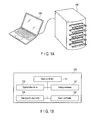
- FIG. 1A is a view exemplifying a system (information recording apparatus and information playback apparatus) according to an embodiment.
- a system 100 is formed from a plurality of optical disc drives connected parallelly.
- the system 100 is formed from five BD-R drives connected parallelly.
- the embodiment will describe a case in which five BD-R drives connected parallelly are applied.
- the recording medium is not limited to a BD-R, and various media (for example, various write-once media) are applicable.
- the system 100 can parallelly record/play back data (recording data) on/from four BD-R media out of five BD-R media inserted into the five BD-R drives, and a parity on/from one BD-R medium.
- the format of the BD-R medium uses UDF1.5.
- the system 100 includes a main controller 101, optical disc drive (recorder/reader) 102, data processor (divider/generator/parity checker) 103, data input/output unit 104, and eject controller 105.
- main controller 101 optical disc drive (recorder/reader) 102
- data processor divider/generator/parity checker
- eject controller 105 eject controller 105.
- the main controller 101 controls the overall system 100 (optical disc drive 102, data processor 103, data input/output unit 104, and eject controller 105).
- the optical disc drive 102 records various data on a plurality of optical discs, and reads various data from them, details of which will be described later.
- the data processor 103 divides various data, generates various data, and checks data (data block) based on parity data, details of which will be described later.
- the eject controller 105 controls execution of ejection.
- the data input/output unit 104 receives data from a PC 200 and outputs data to it.
- the system 100 When the system 100 is connected to the PC 200, dedicated drives (Drive Top and Drive Bottom) are installed in the five BD-R drives connected in parallel. Accordingly, the system 100 regards the five BD-R drives (five BD-R media) as one large-capacity storage device (to be referred to as a drive system hereinafter), similar to HDD RAID and the like.
- the PC 200 handles the system 100 as one large-capacity storage device.
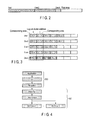
- data recorded in the system 100 seems to be recorded in one large-capacity storage, as shown in FIG. 2 , when viewed from the PC 200.
- the data is divided as shown in FIG. 3 , and the divided data are recorded in the UDF management area (file system management area) in the system 100.
- UDF stands for Universal Disc Format.
- Recorded final logical cluster address the final logical cluster address of data recorded on the media set x shown in FIGS. 9 and 10 and y shown in FIG. 12 correspond to the recorded final logical cluster address.
- Recorded final Disc the final Disc of data recorded on the media set Disc4 shown in FIG. 9 and Disc1 shown in FIGS. 10 and 12 correspond to the recorded final Disc.
- FIG. 4 is a block diagram showing the schematic arrangement of the overall system including the PC 200 and system 100.
- the PC 200 includes a main control unit, storage unit, and input/output unit, and is further formed from application software, operating system (OS), and File System.
- the system 100 is formed from built-in dedicated drives (Drive Top and Drive Bottom), BD Drive 1, BD Drive 2, BD Drive 3, BD Drive 4, and BD Drive 5.
- Recording data to be recorded and a recording destination are designated in the application software.
- the recording destination seems to be one large-capacity storage when viewed from layers above the dedicated drives, that is, the application software, OS, and File System in FIG. 4 .
- the recording destination is not represented as recording destinations corresponding to the five BD Drives, but a recording destination corresponding to the large-capacity storage.
- a recording destination and recording data corresponding to the large-capacity storage need to be converted into a recording destination and recording data corresponding to each drive.
- the dedicated drives perform this processing.
- the system 100 receives, from the PC 200, recording data (Data1 in FIG. 7 ) selected using application software (for example, Explorer). As described above, a recording destination corresponding to the large-capacity storage is designated for the received data. W-02. Creation of Divided Data
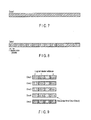
- the system 100 divides the recording data (Data1 in FIG. 7 ) received from the PC 200 (File System) for recording on the respective BD-Rs, thereby creating a plurality of divided recording data. Since the system 100 uses the UDF1.5 format, it divides the recording data into a plurality of divided recording data blocks for each 64-Kbyte cluster size. The number of divided recording data blocks is n, and the respective divided recording data blocks are D1-1, D1-2, ... , D1-n (see FIG. 8 ).
- the system 100 allocates the recording destinations of a plurality of divided recording data blocks to the respective BD-Rs (to the UDF management areas of the respective BD-Rs).
- the system 100 reads the respective BD-Rs, acquires the recorded final logical cluster address and recorded final Disc of the media set, and obtains the start logical cluster address and Disc of a recordable area.
- the system 100 successively allocates a plurality of divided recording data blocks created in W-02 to the start cluster address and Disc (recording destination) of the recordable area acquired in W-03-01.
- W-04 Calculation of Parity
- the system 100 calculates a parity to be added to a plurality of divided recording data blocks in order to improve reliability.
- the parity calculation processing is roughly divided into two, W-04-01 and W-04-02. W-04-01. Skip of Parity Calculation
- the system 100 calculates a parity based on the data to be recorded in the areas of the corresponding logical cluster addresses on Disc1 to Disc4 (W-04-02). As described above, the system 100 successively records data. Thus, if there is a divided recording data block allocated to an area of the corresponding logical cluster address on Disc4 out of areas of the corresponding logical cluster addresses on Disc1 to Disc4, the system 100 records divided recording data blocks in the areas of the corresponding logical cluster addresses on Disc1 to Disc4.
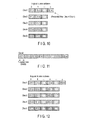
- the system 100 records divided recording data blocks D1-1, D1-2, D1-3, and D1-4 in areas of corresponding logical cluster addresses 0 on Disc1 to Disc4, records divided recording data blocks D1-5, D1-6, D1-7, and D1-8 in areas of corresponding logical cluster addresses 1 on Disc1 to Disc4, and records divided recording data blocks D1-(n-3), D1-(n-2), D1-(n-1), and D1-n in areas of corresponding logical cluster addresses x on Disc1 to Disc4.
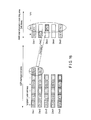
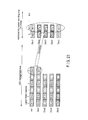
- the system 100 can calculate a parity P-0 from the four divided recording data blocks recorded in the areas of corresponding logical cluster addresses 0 on Disc1 to Disc4, calculate a parity P-1 from the four divided recording data blocks recorded in the areas of corresponding logical cluster addresses 1 on Disc1 to Disc4, and calculate a parity P-x from the four divided recording data blocks recorded in the areas of corresponding logical cluster addresses x on Disc1 to Disc4. That is, the system 100 generates divided recording data blocks shown in FIG. 8 from recording data (Data1) shown in FIG. 7 . When recording the divided recording data blocks, as shown in FIG. 9 , the system 100 calculates a parity from all the divided recording data blocks. Note that four divided recording data blocks recorded in corresponding areas of Disc1 to Disc4 will be defined as one block set.
- the system 100 when the system 100 generates divided recording data blocks shown in FIG. 8 from recording data (Data1) shown in FIG. 7 and records them as shown in FIG. 10 , the system 100 does not calculate parities from all the divided recording data blocks. That is, the system 100 does not calculate a parity from the divided recording data block D1-n.
- the system 100 additionally writes recording data (Data2) shown in FIG. 11 while data has already been recorded, as shown in FIG. 10 , a parity P-x cannot be calculated from only the divided data of Data2.
- the system 100 reads the recorded divided recording data block D1-n (W-04-c), and calculates the parity P-x from the divided recording data blocks D1-n, D2-1, D2-2, and D2-3 (W-04-02). W-05. Recording on Media set
- the system 100 instructs the respective BD Drives to record the allocated divided recording data blocks.
- the respective BD Drives can parallelly record the allocated divided recording data blocks in the respective media.
- the recording processing in the system 100 has been described.
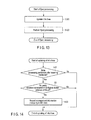
- the system 100 performs Info Area update processing upon receiving an Eject instruction (command).
- Info Area is an area where a temporary parity created from currently recorded information is recorded at a logical cluster address at which no divided recording data block has been written up to Disc4. Info Area is an area set outside the UDF management area.
- the recorded final logical cluster address is x
- the recorded final Disc is Disc1.
- the system 100 receives Eject processing for the media set, it calculates a temporary parity P-x' from recorded data at recorded final logical cluster address x (from only divided recording data block D1-n in the case of FIG. 10 ).
- the system 100 records the temporary parity P-x' at address N of Info Area of Disc2 which is a Disc next to the recorded final Disc.
- the system 100 creates and records management information (Info).
- the system 100 records Info at two portions, i.e., Disc1 and Disc5, giving redundancy to Info.
- the Info size is 64 Kbytes, which is equal to the UDF1.5 cluster size, similar to the parity.
- Info contains management information such as the recording date & time, the recorded final Disc, the recorded final logical cluster address, the Info version number (version number is incremented every time data is recorded in Info Area), and the serial ID of a media set.
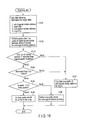
- the system 100 checks whether data recording processing has been performed after a currently set media set is inserted (I-01). If recording processing has never been performed (NO in I-01), the system 100 performs Eject processing for the media set. If recording processing has been performed, the system 100 acquires, from Drive Bottom, the final logical cluster address (to be referred to as a recorded final logical cluster address hereinafter: x shown in FIGS. 9 and 10 and y shown in FIG. 12 correspond to the recorded final logical cluster address) of divided recording data blocks recorded on the media set, and a final Disc (to be referred to as a recorded final Disc hereinafter: Disc4 in FIG. 9 and Disc1 in FIGS. 10 and 12 correspond to the recorded final Disc) on which a divided recording data block is recorded.
- the final logical cluster address to be referred to as a recorded final logical cluster address hereinafter: x shown in FIGS. 9 and 10 and y shown in FIG. 12 correspond to the recorded final logical cluster address
- a final Disc to be
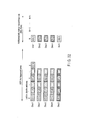
- the system 100 performs Eject processing directly. If the final Disc on which a divided recording data block is recorded is a Disc other than Disc4, as shown in FIGS. 10 and 12 , no parity has been recorded for a recorded final logical cluster address (YES in I-02), the system 100 calculates a temporary parity from the divided recording data block recorded in an area of the recorded final logical cluster address, and records it in Info Area together with Info (I-03).
- the recorded final Disc in this state is Disc2, and the recorded final logical cluster address is y.
- the system 100 calculates a temporary parity P-y' from a divided recording data block D2-m of Disc1 and a divided recording data block D3-1 of Disc2 that are recorded at the recorded final logical cluster address y. Since recording has been completed up to address N, the system 100 records the calculated temporary parity P-y' in Info Area at next address N+1 on Disc3 which is a Disc next to the recorded final Disc. Similarly, the system 100 records management information (Info) at Info Area addresses N+1 on Disc1 and Disc5.
- Info management information
- the system 100 Upon completion of recording in Info Area, as needed, the system 100 performs Eject processing for the media set.
- the system 100 may be in units of LBA (Logical Block Addresses) to access data, to reproduce the data.
- LBA Logical Block Addresses
- 32LBA 1 cluster.
- Drive Top in the system 100 checks Info Area recorded on a BD-R, and acquires a recorded final Disc and recorded final logical cluster address from Info (for example, Info1 shown in FIG. 17 ) in Info Area of the latest version number. Also, the system 100 creates data such as a list of recorded data (Data1, Data2, and Data3 shown in FIG. 17 ) and the remaining recordable capacity, and notifies the PC 200 of the data. These data are used in an application such as Explorer.
- the system 100 seems to be one large-capacity storage when viewed from the PC 200.
- Drive Top in the system 100 converts the address and size of data requested from File System, that is, the address and size of data when the system 100 is regarded as one large-capacity storage, as shown in FIG. 2 , into the start logical cluster address, start Disc, final logical cluster address, and final Disc of divided data on the media set within the system, as shown in FIG. 3 .
- Drive Top instructs Drive Bottom about Read processing for data and a parity.
- Drive Top receives data and a parity from Drive Bottom, and if there is no problem after a parity check, couples data, and sends the coupled data as a Read result.
- Drive Top Upon receiving a playback request from the PC 200, Drive Top calculates the following information for target data on the media set based on the address and size of data requested from File System (R-01):
- Drive Top performs a parity check using parities recorded on Disc5 except for the end logical cluster address (R-02).
- Drive Top checks whether a parity recorded in Info Area is usable. For data serving as the basis of parity calculation, like Data2 and Data3 in FIG. 20 , Drive Top performs a parity check based on a temporary parity (P-y') stored in Info Area and data used in calculation (YES(e) in R-05) (R-06). For data for which no parity is usable, like Data4 in FIG. 20 , no Eject processing has been performed for the media set after data recording, the possibilities of a parity error and data alteration are low, and thus the system 100 does not perform a parity check (NO(f) in R-05) (R-08).
- a temporary parity can be recorded at an arbitrary recording destination outside the UDF management area of at least one of Disc1 to Disc5.
- a plurality of temporary parities may be recorded, and a parity check may be performed using at least one temporary parity. More specifically, as shown in FIG. 21 (corresponding to FIG. 15 ), the system 100 records the temporary parities P-x' at addresses N in Info Areas of Disc2 to Disc4, and records Info0 at addresses N in Info Areas of Disc1 and Disc5.
- the system 100 records the temporary parities P-x' at three portions on Disc2 to Disc4, and records Info0 at two portions on Disc1 and Disc5, thereby giving redundancy to both the temporary parities P-x' and Info0.
- the system 100 can read the temporary parity P-x' in Info Area of a Disc (Disc2) next to the recorded final Disc (Disc1), and perform a parity check for a data block D1-n based on the temporary parity P-x'. That is, the above-described parallel processing can be executed, and the playback time can be shortened.
- the system 100 can read a plurality of temporary parities P-x' in Info Areas of Disc2 to Disc4, and confirm the identity of the temporary parities P-x'. This can improve the reliability of reading of the temporary parity.
- the system 100 when the system 100 additionally writes Data2 (D2-1 to D2-m) and Data3 (D3-1), and receives, for example, Eject processing, it creates a temporary parity P-y' from D2-m and D3-1, records it at three portions at addresses N+1 in Info Areas of Disc2 to Disc4, and records Info1 at two portions at addresses N+1 in Info Areas of Disc1 and Disc5.
- the system 100 can read the temporary parity P-y' in Info Area of a Disc (Disc2) next to the recorded final Disc (Disc1), and perform a parity check for D2-m and D3-1 based on the temporary parity P-y'.
- the system 100 can read the temporary parities P-y' in Info Areas of Disc2 to Disc4, and confirm the identity of the temporary parities P-y'. This can improve the reliability of reading of the temporary parity.
- the system 100 when the system 100 additionally writes D4-1 and D5-1, as shown in FIGS. 25 and 26 , it generates a parity P-y from D2-m, D3-1, D4-1, and D5-1, and records it in an area of logical cluster address y on Disc5.
- the embodiment has described a case in which Info Area is automatically updated in correspondence with an Eject instruction.
- the Info Area update timing is not limited to this, and Info Area can be updated at various timings.
- Info Area may be updated by a manual operation to the system 100. More specifically, upon receiving an Info Area update instruction corresponding to an Info Area update operation by the user, the system 100 performs Read for a media set, checks a logical cluster address where no parity is recorded, and records Info data and a temporary parity at this cluster address in Info Area.
- the system 100 can divide recording data, parallelly write the divided recording data blocks in parallelly connected recording media, and parallelly read them out.
- the recording and readout speeds can therefore be increased.
- the system 100 can easily implement parallel recording/playback of data using a parity in a write-once storage medium.
- the system 100 can detect a read error caused by disc damage upon carrying a storage medium, and alteration using another apparatus.
- the system 100 can prevent a parity error without wasting the capacity of a storage medium.
- the system 100 can download the program from the server, store the downloaded program, and complete the installation of the program.
- the system 100 can read the program from a computer-readable storage medium, store the read program, and complete the installation of the program.
- At least one embodiment described above can provide an information recording apparatus capable of efficiently recording parity data, and a formatting method. Also, at least one embodiment described above can provide an information playback apparatus capable of playing back recording data by using efficiently recorded parity data.
Landscapes
- Engineering & Computer Science (AREA)
- Signal Processing (AREA)
- Theoretical Computer Science (AREA)
- Quality & Reliability (AREA)
- Physics & Mathematics (AREA)
- General Engineering & Computer Science (AREA)
- General Physics & Mathematics (AREA)
- Signal Processing For Digital Recording And Reproducing (AREA)
Applications Claiming Priority (2)
| Application Number | Priority Date | Filing Date | Title |
|---|---|---|---|
| JP2012176383 | 2012-08-08 | ||
| JP2013119959A JP2014053066A (ja) | 2012-08-08 | 2013-06-06 | 情報記録装置、情報再生装置、及びフォーマット方法 |
Publications (2)
| Publication Number | Publication Date |
|---|---|
| EP2696346A2 true EP2696346A2 (de) | 2014-02-12 |
| EP2696346A3 EP2696346A3 (de) | 2017-05-31 |
Family
ID=48900799
Family Applications (1)
| Application Number | Title | Priority Date | Filing Date |
|---|---|---|---|
| EP13178182.5A Withdrawn EP2696346A3 (de) | 2012-08-08 | 2013-07-26 | Informationsaufzeichnungsvorrichtung, Informationswiedergabevorrichtung und Formatierungsverfahren |
Country Status (4)
| Country | Link |
|---|---|
| US (1) | US8760983B2 (de) |
| EP (1) | EP2696346A3 (de) |
| JP (1) | JP2014053066A (de) |
| CN (1) | CN103578497A (de) |
Cited By (1)
| Publication number | Priority date | Publication date | Assignee | Title |
|---|---|---|---|---|
| CN110291513A (zh) * | 2017-03-28 | 2019-09-27 | 日立汽车系统株式会社 | 电子控制装置、电子控制系统和电子控制装置的控制方法 |
Families Citing this family (2)
| Publication number | Priority date | Publication date | Assignee | Title |
|---|---|---|---|---|
| JP2016042401A (ja) * | 2014-08-19 | 2016-03-31 | ソニー株式会社 | 情報処理装置および方法、記録媒体、並びにプログラム |
| JP6799752B2 (ja) * | 2016-10-13 | 2020-12-16 | パナソニックIpマネジメント株式会社 | 光ディスク装置、光ディスク読み出し方法 |
Family Cites Families (15)
| Publication number | Priority date | Publication date | Assignee | Title |
|---|---|---|---|---|
| US5185746A (en) * | 1989-04-14 | 1993-02-09 | Mitsubishi Denki Kabushiki Kaisha | Optical recording system with error correction and data recording distributed across multiple disk drives |
| JPH0573226A (ja) | 1991-09-12 | 1993-03-26 | Hitachi Ltd | 外部記憶装置におけるデータ入出力方式 |
| US5666511A (en) * | 1992-10-08 | 1997-09-09 | Fujitsu Limited | Deadlock suppressing schemes in a raid system |
| JP3099930B2 (ja) * | 1993-07-16 | 2000-10-16 | 株式会社東芝 | ディスクアレイ装置 |
| US5412668A (en) * | 1994-09-22 | 1995-05-02 | International Business Machines Corporation | Parity striping feature for optical disks |
| JP3371044B2 (ja) * | 1994-12-28 | 2003-01-27 | 株式会社日立製作所 | ディスクアレイのための領域割り当て方法およびディスクアレイアクセス方法 |
| US5864655A (en) * | 1996-09-09 | 1999-01-26 | International Business Machines Corporation | Managing removable media in raid and rail environments |
| US6279134B1 (en) * | 1998-03-02 | 2001-08-21 | Hitachi, Ltd. | Storage device and storage subsystem for efficiently writing error correcting code |
| JP4265019B2 (ja) * | 1999-02-09 | 2009-05-20 | ソニー株式会社 | データ蓄積装置および方法、ならびに、データ送出装置および方法 |
| JP2004342204A (ja) | 2003-05-14 | 2004-12-02 | Sony Corp | 記録装置及び方法、再生装置及び方法、多層光ディスク |
| JP4168003B2 (ja) | 2004-04-09 | 2008-10-22 | 日立マクセル株式会社 | 複数の情報記録媒体への情報記録方法および複数の記録媒体からの情報の再生方法 |
| KR20060019383A (ko) * | 2004-08-27 | 2006-03-03 | 삼성전자주식회사 | 정보 저장 매체, 기록/재생 장치 및 기록/재생 방법 |
| US8422850B2 (en) * | 2007-04-09 | 2013-04-16 | Mitusbishi Electric Corporation | Information recording apparatus, information recording method, information record medium, information reproducing apparatus, information reproducing method, information transmitting apparatus, and information transmitting method |
| JP2010123167A (ja) | 2008-11-18 | 2010-06-03 | Nec Corp | 情報記録装置、再生装置、及び、方法 |
| KR20110106594A (ko) * | 2010-03-23 | 2011-09-29 | 주식회사 히타치엘지 데이터 스토리지 코리아 | 광디스크 드라이브 아카이브 시스템에서의 패리티 드라이브 설정 장치 및 방법 |
-
2013
- 2013-06-06 JP JP2013119959A patent/JP2014053066A/ja active Pending
- 2013-07-26 EP EP13178182.5A patent/EP2696346A3/de not_active Withdrawn
- 2013-08-02 US US13/957,874 patent/US8760983B2/en not_active Expired - Fee Related
- 2013-08-07 CN CN201310341920.5A patent/CN103578497A/zh active Pending
Non-Patent Citations (1)
| Title |
|---|
| None |
Cited By (2)
| Publication number | Priority date | Publication date | Assignee | Title |
|---|---|---|---|---|
| CN110291513A (zh) * | 2017-03-28 | 2019-09-27 | 日立汽车系统株式会社 | 电子控制装置、电子控制系统和电子控制装置的控制方法 |
| CN110291513B (zh) * | 2017-03-28 | 2023-08-22 | 日立安斯泰莫株式会社 | 电子控制装置、电子控制系统和电子控制装置的控制方法 |
Also Published As
| Publication number | Publication date |
|---|---|
| US8760983B2 (en) | 2014-06-24 |
| US20140043949A1 (en) | 2014-02-13 |
| CN103578497A (zh) | 2014-02-12 |
| EP2696346A3 (de) | 2017-05-31 |
| JP2014053066A (ja) | 2014-03-20 |
Similar Documents
| Publication | Publication Date | Title |
|---|---|---|
| US8843704B2 (en) | Stride based free space management on compressed volumes | |
| US9838043B2 (en) | Storage system, information processor, and computer-readable recording medium having stored therein program for generating parity | |
| CN101853685A (zh) | 驱动装置 | |
| US8760983B2 (en) | Information recording apparatus, information playback apparatus, and formatting method | |
| CN103092849A (zh) | 文件系统簇管理方法 | |
| US20170344269A1 (en) | Storage system, control apparatus, and method of transmitting data | |
| KR101351561B1 (ko) | 빅 데이터 추출 시스템 및 방법 | |
| US8576675B2 (en) | Data library apparatus, data archive system and server | |
| US20150012697A1 (en) | Storage control apparatus and storage control method | |
| RU2343567C2 (ru) | Носитель записи информации, устройство записи/воспроизведения и способ записи/воспроизведения | |
| US20130212428A1 (en) | Information storage medium library array apparatus, information recording method and information recording program | |
| JP2015225603A (ja) | ストレージ制御装置、ストレージ制御方法およびストレージ制御プログラム | |
| US20140059305A1 (en) | Management apparatus, storage device, and initialization method | |
| US9043544B2 (en) | Writing of new data of a first block size in a raid array that stores both parity and data in a second block size | |
| CN101707061B (zh) | 驱动装置 | |
| US10318204B2 (en) | Information processing device and information processing method for writing plurality of files on recording medium | |
| JPWO2010001548A1 (ja) | 記録装置、記録方法、再生装置、及び再生方法 | |
| CN101006510B (zh) | 驱动装置 | |
| EP1858018A2 (de) | Verfahren und Vorrichtung zum Zuweisen von Speicherplatz | |
| US9324359B2 (en) | System and server for efficient data recording on and reproduction from storage media having multiple surfaces | |
| JP2014049152A (ja) | 情報処理装置及び情報処理方法 | |
| US20170060474A1 (en) | Data erasing method | |
| WO2007114424A1 (ja) | 追記型記録媒体に対するデータ記録方法及びデータ記録装置 | |
| US20140211599A1 (en) | Method for processing information, information processing apparatus, and storage medium | |
| US20120239897A1 (en) | Storage apparatus, method for moving data, and storage system |
Legal Events
| Date | Code | Title | Description |
|---|---|---|---|
| 17P | Request for examination filed |
Effective date: 20130726 |
|
| AK | Designated contracting states |
Kind code of ref document: A2 Designated state(s): AL AT BE BG CH CY CZ DE DK EE ES FI FR GB GR HR HU IE IS IT LI LT LU LV MC MK MT NL NO PL PT RO RS SE SI SK SM TR |
|
| AX | Request for extension of the european patent |
Extension state: BA ME |
|
| PUAI | Public reference made under article 153(3) epc to a published international application that has entered the european phase |
Free format text: ORIGINAL CODE: 0009012 |
|
| PUAL | Search report despatched |
Free format text: ORIGINAL CODE: 0009013 |
|
| AK | Designated contracting states |
Kind code of ref document: A3 Designated state(s): AL AT BE BG CH CY CZ DE DK EE ES FI FR GB GR HR HU IE IS IT LI LT LU LV MC MK MT NL NO PL PT RO RS SE SI SK SM TR |
|
| AX | Request for extension of the european patent |
Extension state: BA ME |
|
| RIC1 | Information provided on ipc code assigned before grant |
Ipc: G11B 27/00 20060101ALI20170424BHEP Ipc: G06F 11/10 20060101ALI20170424BHEP Ipc: G11B 17/22 20060101ALI20170424BHEP Ipc: G11B 20/12 20060101AFI20170424BHEP Ipc: G11B 20/18 20060101ALI20170424BHEP |
|
| STAA | Information on the status of an ep patent application or granted ep patent |
Free format text: STATUS: THE APPLICATION HAS BEEN WITHDRAWN |
|
| 18W | Application withdrawn |
Effective date: 20171102 |