EP2692912A2 - Method for manufacturing polyethylene terephthalate drawn fiber, polyethylene terephthalate drawn fiber, and tire cord - Google Patents
Method for manufacturing polyethylene terephthalate drawn fiber, polyethylene terephthalate drawn fiber, and tire cord Download PDFInfo
- Publication number
- EP2692912A2 EP2692912A2 EP12762788.3A EP12762788A EP2692912A2 EP 2692912 A2 EP2692912 A2 EP 2692912A2 EP 12762788 A EP12762788 A EP 12762788A EP 2692912 A2 EP2692912 A2 EP 2692912A2
- Authority
- EP
- European Patent Office
- Prior art keywords
- ethyleneterephthalate
- poly
- fiber
- drawn
- tire cord
- Prior art date
- Legal status (The legal status is an assumption and is not a legal conclusion. Google has not performed a legal analysis and makes no representation as to the accuracy of the status listed.)
- Withdrawn
Links
Images
Classifications
-
- B—PERFORMING OPERATIONS; TRANSPORTING
- B29—WORKING OF PLASTICS; WORKING OF SUBSTANCES IN A PLASTIC STATE IN GENERAL
- B29D—PRODUCING PARTICULAR ARTICLES FROM PLASTICS OR FROM SUBSTANCES IN A PLASTIC STATE
- B29D30/00—Producing pneumatic or solid tyres or parts thereof
- B29D30/06—Pneumatic tyres or parts thereof (e.g. produced by casting, moulding, compression moulding, injection moulding, centrifugal casting)
- B29D30/0681—Parts of pneumatic tyres; accessories, auxiliary operations
-
- B—PERFORMING OPERATIONS; TRANSPORTING
- B60—VEHICLES IN GENERAL
- B60C—VEHICLE TYRES; TYRE INFLATION; TYRE CHANGING; CONNECTING VALVES TO INFLATABLE ELASTIC BODIES IN GENERAL; DEVICES OR ARRANGEMENTS RELATED TO TYRES
- B60C9/00—Reinforcements or ply arrangement of pneumatic tyres
- B60C9/0042—Reinforcements made of synthetic materials
-
- C—CHEMISTRY; METALLURGY
- C08—ORGANIC MACROMOLECULAR COMPOUNDS; THEIR PREPARATION OR CHEMICAL WORKING-UP; COMPOSITIONS BASED THEREON
- C08G—MACROMOLECULAR COMPOUNDS OBTAINED OTHERWISE THAN BY REACTIONS ONLY INVOLVING UNSATURATED CARBON-TO-CARBON BONDS
- C08G63/00—Macromolecular compounds obtained by reactions forming a carboxylic ester link in the main chain of the macromolecule
- C08G63/02—Polyesters derived from hydroxycarboxylic acids or from polycarboxylic acids and polyhydroxy compounds
- C08G63/12—Polyesters derived from hydroxycarboxylic acids or from polycarboxylic acids and polyhydroxy compounds derived from polycarboxylic acids and polyhydroxy compounds
- C08G63/16—Dicarboxylic acids and dihydroxy compounds
- C08G63/18—Dicarboxylic acids and dihydroxy compounds the acids or hydroxy compounds containing carbocyclic rings
- C08G63/181—Acids containing aromatic rings
- C08G63/183—Terephthalic acids
-
- D—TEXTILES; PAPER
- D01—NATURAL OR MAN-MADE THREADS OR FIBRES; SPINNING
- D01D—MECHANICAL METHODS OR APPARATUS IN THE MANUFACTURE OF ARTIFICIAL FILAMENTS, THREADS, FIBRES, BRISTLES OR RIBBONS
- D01D5/00—Formation of filaments, threads, or the like
- D01D5/08—Melt spinning methods
-
- D—TEXTILES; PAPER
- D01—NATURAL OR MAN-MADE THREADS OR FIBRES; SPINNING
- D01D—MECHANICAL METHODS OR APPARATUS IN THE MANUFACTURE OF ARTIFICIAL FILAMENTS, THREADS, FIBRES, BRISTLES OR RIBBONS
- D01D5/00—Formation of filaments, threads, or the like
- D01D5/12—Stretch-spinning methods
-
- D—TEXTILES; PAPER
- D01—NATURAL OR MAN-MADE THREADS OR FIBRES; SPINNING
- D01F—CHEMICAL FEATURES IN THE MANUFACTURE OF ARTIFICIAL FILAMENTS, THREADS, FIBRES, BRISTLES OR RIBBONS; APPARATUS SPECIALLY ADAPTED FOR THE MANUFACTURE OF CARBON FILAMENTS
- D01F1/00—General methods for the manufacture of artificial filaments or the like
- D01F1/02—Addition of substances to the spinning solution or to the melt
- D01F1/10—Other agents for modifying properties
-
- D—TEXTILES; PAPER
- D01—NATURAL OR MAN-MADE THREADS OR FIBRES; SPINNING
- D01F—CHEMICAL FEATURES IN THE MANUFACTURE OF ARTIFICIAL FILAMENTS, THREADS, FIBRES, BRISTLES OR RIBBONS; APPARATUS SPECIALLY ADAPTED FOR THE MANUFACTURE OF CARBON FILAMENTS
- D01F6/00—Monocomponent artificial filaments or the like of synthetic polymers; Manufacture thereof
- D01F6/58—Monocomponent artificial filaments or the like of synthetic polymers; Manufacture thereof from homopolycondensation products
- D01F6/62—Monocomponent artificial filaments or the like of synthetic polymers; Manufacture thereof from homopolycondensation products from polyesters
-
- D—TEXTILES; PAPER
- D02—YARNS; MECHANICAL FINISHING OF YARNS OR ROPES; WARPING OR BEAMING
- D02G—CRIMPING OR CURLING FIBRES, FILAMENTS, THREADS, OR YARNS; YARNS OR THREADS
- D02G3/00—Yarns or threads, e.g. fancy yarns; Processes or apparatus for the production thereof, not otherwise provided for
- D02G3/44—Yarns or threads characterised by the purpose for which they are designed
- D02G3/48—Tyre cords
-
- D—TEXTILES; PAPER
- D02—YARNS; MECHANICAL FINISHING OF YARNS OR ROPES; WARPING OR BEAMING
- D02J—FINISHING OR DRESSING OF FILAMENTS, YARNS, THREADS, CORDS, ROPES OR THE LIKE
- D02J1/00—Modifying the structure or properties resulting from a particular structure; Modifying, retaining, or restoring the physical form or cross-sectional shape, e.g. by use of dies or squeeze rollers
- D02J1/22—Stretching or tensioning, shrinking or relaxing, e.g. by use of overfeed and underfeed apparatus, or preventing stretch
-
- B—PERFORMING OPERATIONS; TRANSPORTING
- B60—VEHICLES IN GENERAL
- B60C—VEHICLE TYRES; TYRE INFLATION; TYRE CHANGING; CONNECTING VALVES TO INFLATABLE ELASTIC BODIES IN GENERAL; DEVICES OR ARRANGEMENTS RELATED TO TYRES
- B60C9/00—Reinforcements or ply arrangement of pneumatic tyres
- B60C9/02—Carcasses
- B60C9/04—Carcasses the reinforcing cords of each carcass ply arranged in a substantially parallel relationship
- B60C2009/0416—Physical properties or dimensions of the carcass cords
-
- B—PERFORMING OPERATIONS; TRANSPORTING
- B60—VEHICLES IN GENERAL
- B60C—VEHICLE TYRES; TYRE INFLATION; TYRE CHANGING; CONNECTING VALVES TO INFLATABLE ELASTIC BODIES IN GENERAL; DEVICES OR ARRANGEMENTS RELATED TO TYRES
- B60C9/00—Reinforcements or ply arrangement of pneumatic tyres
- B60C9/18—Structure or arrangement of belts or breakers, crown-reinforcing or cushioning layers
- B60C9/20—Structure or arrangement of belts or breakers, crown-reinforcing or cushioning layers built-up from rubberised plies each having all cords arranged substantially parallel
- B60C9/22—Structure or arrangement of belts or breakers, crown-reinforcing or cushioning layers built-up from rubberised plies each having all cords arranged substantially parallel the plies being arranged with all cords disposed along the circumference of the tyre
- B60C2009/2252—Physical properties or dimension of the zero degree ply cords
-
- D—TEXTILES; PAPER
- D10—INDEXING SCHEME ASSOCIATED WITH SUBLASSES OF SECTION D, RELATING TO TEXTILES
- D10B—INDEXING SCHEME ASSOCIATED WITH SUBLASSES OF SECTION D, RELATING TO TEXTILES
- D10B2331/00—Fibres made from polymers obtained otherwise than by reactions only involving carbon-to-carbon unsaturated bonds, e.g. polycondensation products
- D10B2331/04—Fibres made from polymers obtained otherwise than by reactions only involving carbon-to-carbon unsaturated bonds, e.g. polycondensation products polyesters, e.g. polyethylene terephthalate [PET]
Definitions
- the present invention relates to a preparation method for drawn fibers that enables the preparation of drawn poly(ethyleneterephthalate) fibers exhibiting with high fineness of at least 2,000 denier while having high tenacity and excellent dimensional stability and causes almost no deterioration of tenacity during the manufacturing process of tires such as vulcanization, and a drawn poly(ethyleneterephthalate) fiber and a tire cord that are obtained by the preparation method.
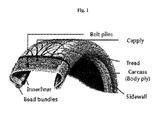
- Tire is a complex body of fiber/steel/rubber and generally has a structure as illustrated in FIG. 1 .
- the body ply which is denoted by the numeral 6 of FIG. 1 and also called as "carcass", is a cord layer included in a tire as a core reinforcement material that supports the load of a whole vehicle, maintain the shape of the tire, stands against the shock, and needs to have excellent fatigue resistance against bending and stretching movements during the drive.
- the tire cord for such a body ply is usually made of a synthetic fiber material, including polyester such as poly(ethyleneterephthalate).
- the cords made of synthetic fibers thanks to their high tenacity, greatly contribute to the enhanced durability of tires, yet with a problem that they may have deterioration in elasticity and dimensional stability after vulcanization of tires because of their high shrinkage rate under heat.
- PCI post cure inflatation
- undrawn fibers with high crystallinity are necessarily used in order to prepare HMLS tire cords.
- the undrawn fibers with high crystallinity have a relatively narrow drawing range and thus tend to break by uneven drawing or friction when they are drawn under conditions of high speed and high draw ratio in an ultrahigh speed spinning system.
- applying the undrawn fibers with high crystallinity to the ultrahigh speed spinning system is bound to limitations in the draw ratio and ends up with insufficient drawing, causing great deterioration in the tenacity of the drawn fibers.
- the preparation of drawn fibers with high fineness of 2,000 denier or greater and tire cords entails greater deterioration of properties due to its limitations in the spinning process and the cooling process and thus results in a failure to produce tire cords with uniform properties.
- the present invention provides a preparation method for drawn poly(ethyleneterephthalate) fibers that enables an efficient production of drawn poly(ethyleneterephthalate) fibers exhibiting high tenacity and excellent dimensional stability while having high fineness of at least 2,000 denier and causes almost no deterioration of tenacity during the preparation process of tires such as vulcanization.
- the present invention also provides a drawn poly(ethyleneterephthalate) fiber obtained by the preparation method.
- the present invention provides a poly(ethyleneterephthalate) tire cord having high fineness while exhibiting high tenacity and excellent dimensional stability almost without causing a deterioration of tenacity, and its preparation method.
- the present invention provides a preparation method for drawn poly(ethyleneterephthalate) fiber that comprises: melt-spinning a polymer comprising at least 90 mol% of poly(ethyleneterephthalate) having a content of terminal carboxyl group (-COOH) in the range of 20 to 30 eq/10 6 g at a spinning speed of 2,500 to 4,000 m/min to form a undrawn fiber having a fineness of at least 2,000 denier; and drawing the undrawn fiber at a draw ratio of 1.4 to 2.4.
- the present invention also provides a drawn poly(ethyleneterephthalate) fiber comprising a polymer containing at least 90 mol% of poly(ethyleneterephthalate) and having a tenacity of 7.3 to 8.5 g/d after 6-hour heat treatment at 160 °C under a load of 0.01 g/d.
- the present invention also provides a method for preparing a poly(ethyleneterephthalate) tire cord that comprises: forming drawn poly(ethyleneterephthalate) fibers using the above-specified preparation method; co-twisting the drawn fibers to form a twisted yam; and dipping the twisted yarn in an adhesive solution and then performing a heat treatment.
- the present invention also provides a poly(ethyleneterephthalate) tire cord comprising a polymer containing at least 90 mol% of poly(ethyleneterephthalate) and having a tenacity of 6.5 to 8.5 g/d after 6-hour heat treatment at 160 °C under a load of 0.01 g/d.
- a poly(ethyleneterephthalate) (hereinafter, referred to as "PET") tire cord may be prepared as a dip cord type by melt-spinning a PET polymer to prepare an undrawn fiber, drawing the undrawn fiber to form a drawn fiber, co-twisting the PET drawn fibers and dipping the twisted yarn into an adhesive. Therefore, the characteristics of the undrawn fiber prepared by melt-spinning the PET polymer and the drawn fiber prepared by drawing the undrawn fiber feed into the properties of the PET tire cord directly or indirectly.
- the inventors of the present invention have studied repeatedly on the drawn PET fibers for tire cord and found it out that applying the ultrahigh speed spinning technology to a PET polymer having a controlled content of terminal carboxyl group (-COOH) in the range of 20 to 30 eq/10 6 g in the polymerization process leads to efficient production of a drawn PET fiber and a tire cord with high fineness while having high tenacity and excellent dimensional stability almost without a deterioration of properties such as tenacity even after the manufacturing process of large-sized tires, such as long-term vulcanization, thereby completing the present invention.
- -COOH terminal carboxyl group
- a polymer having a relatively low content of terminal carboxyl group controlled in the range of 20 to 30 eq/10 6 g can suppress the hydrolysis or aminolysis reaction of the polymer under heat, making it possible to produce a drawn PET fiber and a tire cord that have more excellent heat resistance almost without a deterioration of tenacity even after long-term heat treatment such as vulcanization.
- the present invention appropriately applies the ultrahigh speed spinning technology using a PET polymer to efficiently produce a drawn PET fiber and a tire cord with high tenacity and excellent dimensional stability.
- the after-mentioned preparation method may produce a drawn PET fiber and a tire cord that have high fineness and exhibit high tenacity and excellent dimensional stability almost without a deterioration in properties such as tenacity even after the tire manufacturing process such as long-term vulcanization.
- a PET tire cord can be very desirably used as a body ply cord or a cap ply cord for pneumatic tires and particularly meet the demands in the related art for obtaining a tire cord with excellent properties and high fineness preferably applicable to large-sized tires.
- a method for preparing a drawn PET fiber comprises: melt-spinning a polymer comprising at least 90 mol% of poly(ethyleneterephthalate) having a content of terminal carboxyl group (-COOH) in the range of 20 to 30 eq/10 6 g at a spinning speed of 2,500 to 4,000 m/min to form a undrawn fiber having a fineness of at least 2,000 denier; and drawing the undrawn fiber at a draw ratio of 1.4 to 2.4.
- PET polymer comprising at least 90 mol% of poly(ethyleneterephthalate) having a content of terminal carboxyl group (-COOH) in the range of 20 to 30 eq/10 6 g.
- PET polymer a polymer having a relatively low content of terminal carboxyl group (-COOH) controlled in the range of 20 to 30 eq/10 6 g makes it possible to prepare a drawn PET fiber and a tire cord that exhibit excellent heat resistance almost without a deterioration in properties such as tenacity even after long-term heat treatment such as vulcanization.
- an extremely low content of terminal carboxyl group undesirably leads to deterioration in the basic adhesiveness of the tire cord.
- a hindered phenol- or phenolic amine-based heat-resisting agent may be used in the polymerization process for forming a PET polymer. More specifically, such a hindered phenol- or phenolic amine-based heat-resisting agent is used in an amount of 3,000 to 5,000 ppm or about 4,000 to 5,000 ppm with respect to the total weight of the PET polymer in the polymerization reaction to form a PET polymer, which has the above-defined content of terminal carboxyl group.
- hindered phenol- or phenolic amine-based heat-resisting agent as used herein may be any substance typically known to those skilled in the art without specific limitations, specific examples of which may include hindered phenol- or phenolic amine-based heat-resisting agents known as TS-1TM, Irganox 295TM, Irganox 1019TM, or Songnox 1098TM.
- TS-1TM hindered phenol- or phenolic amine-based heat-resisting agents known as TS-1TM, Irganox 295TM, Irganox 1019TM, or Songnox 1098TM.
- the polymer comprising PET used as a material for preparation of the undrawn fiber may include different additives in addition to PET but appropriately contains at least 90 mol% of PET. Using such a polymer ends up with preparation of a drawn fiber or a tire cord that exhibits good properties as will be described below.
- PET polymer refers to a polymer having a PET content of at least 90 mol% without specific explanation.
- the PET polymer may have an intrinsic viscosity of 0.8 to 1.5 dl/g, preferably 1.2 to 1.5 dl/g.
- the drawn fiber and the tire cord may be enhanced in tenacity by using a polymer with relatively high intrinsic viscosity and adopting the ultrahigh speed spinning technology. It is, however, preferable to melt-spin a polymer having an intrinsic viscosity of 1.5 dl/g or less in order to suppress a break of the fiber caused by an excessive increase of the pressure in the pack during the spinning process.
- the PET polymer having a content of terminal carboxyl group in the defined range is subjected to melt spinning at a spinning speed of 2,500 to 4,000 m/min to form an undrawn fiber with a fineness of at least 2,000 denier.
- the ultrahigh speed spinning technology leads to production of an undrawn fiber with high crystallinity, and the undrawn fiber is used in the subsequent process to prepare a tire cord with high tenacity and excellent dimensional stability.
- the polymer is subjected to melt spinning at a spinning speed of 2,500 to 4,000 m/min, preferably 3,000 to 4,000 m/min.
- the spinning speed is preferably 2,500 m/min or greater with a view to acquiring the desired properties of the undrawn fiber such as high crystallinity or productivity; and appropriately 4,000 m/min or less in consideration of the minimum cooling time as required in the preparation of a undrawn fiber and the mechanical vibration and friction occurring during the high-speed spinning process.
- the melt spinning of the polymer is preferably performed under a spinning tension of 0.8 to 1.2 g/d.
- the spinning tension is preferably 0.8 g/d or greater with a view to acquiring the desired properties of the undrawn fiber as required in the present invention, such as high crystallinity; and 1.2 g/d or less in order to prevent a break of the filament caused by unnecessarily high tension or a deterioration in the properties.
- the melt spinning process may be carried through a spinning spinneret with 400 to 700, or 450 to 650, or 500 to 600 spinning holes.
- a spinning spinneret with 400 to 700, or 450 to 650, or 500 to 600 spinning holes.
- the amount of the polymer discharge staying in the spinning chimney is greatly increased to cause non-uniform cooling between inner and outer layers, making it difficult to produce a drawn fiber and a tire cord with uniform properties and high yam quality.
- the discharge rate of the melt portion in the spinneret increases with an increase in the fineness of monofilaments, making it difficult to impose a sufficient spinning tension.
- melt-spinning a polymer through a spinning spinneret with a relatively large number of spinning holes in the range of 400 to 700 enables uniform cooling and optimizes the fineness of the monofilaments, making it relatively easier to impose the spinning tension.
- the number of spinning holes optimized to 700 or less may reduce the fiber-to-fiber interference and thereby lead to production of a drawn fiber and a tire cord with uniform, good properties and high yam quality.
- a cooling process is performed to prepare an undrawn fiber, which cooling process preferably includes blowing a cooling air at 15 to 60 °C.
- the cooling air flow is preferably controlled in the range of 0.7 to 1.5 m/s.
- An extremely low cooling air flow entails the high possibility of non-uniform cooling or poor cooling due to deficiency of the cooling air capacity, increases broken filaments and causes deterioration in yam quality and tenacity. Contrarily, an extremely high cooling air flow possibly leads to fiber-to-fiber impingement or fiber scattering due to the excessively high cooling air speed.
- the undrawn fiber obtained by the above process may have a crystallinity of 10 to 30 % and a low amorphous orientation factor of 0.08 to 0.2.
- the undrawn fiber with such crystalline characteristics is obtained and then used to prepare a drawn fiber and a tire cord, making it possible to manufacture a tire cord with high tenacity and excellent dimensional stability.
- the related technical mechanism may be predicted as follows.
- the PET polymer constituting the undrawn fiber is basically partly crystalline and hence divided into a crystalline region and an amorphous region.
- the undrawn fiber obtained under the controlled conditions of melt spinning has a crystallinity of at least 10 %, preferably 10 to 30 %, which is higher than that of the existing undrawn fibers (typically, 7 % or less) due to the orientation-induced crystallization.
- the drawn fiber and the tire cord as prepared by using the undrawn fiber may exhibit high contraction stress and high modulus.
- the undrawn fiber has an amorphous orientation factor of 0.2 or less, preferably 0.08 to 0.2, which is far lower than that of the existing undrawn fibers.
- amorphous orientation index indicates the degree of orientation of chains included in the amorphous region of the undrawn fiber. The amorphous orientation index decreases as the chains in the amorphous region are getting more entangled. Generally, the lower amorphous orientation index results in the higher degree of randomness, making the chains of the amorphous region have a relaxed structure, so the drawn fiber and the tire cord prepared from the undrawn fiber may exhibit low shrinkage rate and low contraction stress.
- the undrawn fiber may have a strained structure of the chains in the amorphous region even with a reduced amorphous orientation index, so it exhibits a developed crystalline structure and excellent orientation characteristics. Therefore, not only the undrawn fiber but also the drawn fiber and the tire cord obtained from the undrawn fiber may have high contraction stress and high modulus as well as low shrinkage rate, making it possible to provide a tire cord with excellent dimensional stability.
- the PET polymer is controlled in regards to the content of terminal carboxyl group as well as the above-defined conditions of melt spinning. This suppresses the hydrolysis of the polymer to enhance heat resistance and thus enables it to produce a drawn fiber and a tire cord with minimized deterioration of properties such as tenacity even after the manufacturing process for large-sized tires, such as long-term vulcanization.
- the undrawn fiber is drawn to produce a drawn PET fiber.
- the drawing step may be carried out by the direct spinning & drawing (hereinafter, referred to as "DSD") method, where spinning and drawing are continuously performed in a single process according to the general preparation for drawn fiber.
- DSD direct spinning & drawing
- the drawing step is performed at the draw ratio of 1.4 to 2.4, or 1.5 to 2.0, or 1.5 to 1.9.
- the draw ratio is preferably 1.4 or greater with the view to preparing a tire cord with high tenacity and excellent dimensional stability; and 2.4 or less in consideration of the limitation in controlling the draw ratio in the case of the ultrahigh speed spinning system in which the spinning speed is 2,500 to 4,000 m/min.
- the drawn fiber thus obtained by the above-described method may have minimized deterioration in the properties such as tenacity even after a heat treatment corresponding to long-term vulcanization.
- the tenacity of the drawn fiber after 6-hour heat treatment at 160 °C under a load of 0.01 g/d may be at least 7.3 g/d, more specifically, 7.3 to 8.5 g/d, or 7.5 to 8.0 g/d.
- the drawn fiber may exhibit excellences in general properties, such as a tenacity of at least 8.0 g/d, appropriately 8.0 to 9.5 g/d; an intermediate elongation at a load of 4.5 g/d in the range of 4.0 to 7.0 %; an elongation at break in the range of 10.0 to 15.0 %; and an intrinsic viscosity of 0.9 to 1.2 dl/g.
- the drawn fiber may have a high fineness of 2,000 to 6,000 denier, so it can satisfy the demands for acquiring a tire cord with excellent properties and high fineness for large-sized tires as required in the related art.
- the method of preparing a PET tire cord may comprise: forming a drawn PET fiber using the aforementioned preparation method; co-twisting the drawn fibers to form a twisted yarn; and dipping the twisted yarn in an adhesive solution and then performing a heat treatment.
- the co-twisting step may be carried out by 'Z' twisting the drawn fiber having a total fineness of 2,000 to 4,000 denier with a twisting level of 100 to 400 TPM (twists per meter), and 'S' twisting 1 to 3 plies of the 'Z' twisted fibers with a twisting level of 100 to 400 TPM to prepare a twisted yarn having a total fineness of 4,000 to 12,000 denier.
- the adhesive solution as used herein may be an adhesive solution which has been conventionally used for preparing a tire cord, such as, for example, resorcinol-formaldehyde-latex (RFL) adhesive solution.
- RTL resorcinol-formaldehyde-latex
- the heat treatment process may be carried out at the temperature of 230 to 260 °C for 90 to 360 seconds, preferably at 240 to 250 °C for 90 to 240 seconds, more preferably at 245 to 250 °C for 90 to 120 seconds.
- the twisted yarn is dipped into the adhesive solution and then subjected to the heat treatment to enhance the stability of the tire cord and further reduce the change of properties during the vulcanization of the tire.
- the drawn fiber and the tire cord may be prepared through the above-specified methods.
- each step is just an example of the preparation methods for a drawn fiber and a tire cord, so the preparation methods may further include, of course, any step typically carried out in the related art of the present invention prior to or after each of the steps.
- the tire cord prepared by such a process may have minimized deterioration in the properties such as tenacity even after the heat treatment corresponding to long-term vulcanization.
- the tenacity of the tire cord after 6-hour heat treatment at 160 °C under a load of 0.01 g/d may be at least 6.5 g/d, more specifically, 6.5 to 8.5 g/d, or 6.7 to 7.5 g/d, or 6.8 to 7.2 g/d.
- the tire cord may have a high fineness, such as a total fineness of 4,000 to 12,000 denier; a tenacity of 7.0 to 9.0 g/d; and a dimensional stability index (E-S index) of 5.5 to 7.5 %, where the E-S index is the sum of a dry heat shrinkage rate after 2-minute heat treatment in an oven at 177 °C under a load of 0.01 g/d and an intermediate elongation at a load of 2.25 g/d.
- a high fineness such as a total fineness of 4,000 to 12,000 denier; a tenacity of 7.0 to 9.0 g/d; and a dimensional stability index (E-S index) of 5.5 to 7.5 %, where the E-S index is the sum of a dry heat shrinkage rate after 2-minute heat treatment in an oven at 177 °C under a load of 0.01 g/d and an intermediate elongation at a load of 2.25 g/d.
- the 'dimensional stability index (E-S index)' is given by the sum of the 'dry heat shrinkage rate (after 2 minutes in an oven at 177 °C under a load of 0.01 g/d)' and the 'intermediate elongation (@ 2.25 g/d load)', where the lower E-S index indicates less dimensional deformation and higher tenacity of the tire cord.
- the tire cord may exhibit such properties as an intermediate elongation (@ 2.25 g/d load) of 3.5 to 6.5 % and an elongation at break of at least 10.0 %, appropriately 10.0 to 18.0 %.
- the tire cord according to the above-specified process is prepared by adopting the ultrahigh speed spinning technology using a PET polymer controlled to have a defined range of the content of terminal carboxyl group, so it may exhibit high tenacity and excellent dimensional stability while having high fineness almost without deterioration in the properties such as tenacity even after the manufacturing process of large-sized tires such as long-term vulcanization.
- a tire cord is very preferably applicable to the body ply cord for pneumatic tires, particularly large-sized tires, so as to very effectively support the whole load of a vehicle.
- the use of the tire cord is not specifically limited to that as mentioned above and may be, of course, applicable to other use purposes like cap plies and so forth.
- a tire cord and its preparation method where the tire cord exhibits excellent dimensional stability and high tenacity while having a high fineness almost without deterioration in the properties such as tenacity even after the manufacturing process of large-sized tires such as long-term vulcanization.
- a tire cord is preferably applied to the body ply cords or the like for pneumatic tires, particularly large-sized tires, to enhance controllability and ride quality of a vehicle.
- Fig. 1 is a partial cut-away perspective view illustrating the construction of a general tire.
- a hindered phenol-based heat-resisting agent IrganoxTM 295 was added in the polymerization reaction to form a PET polymer controlled in the content of terminal carboxyl group.
- the PET polymer is then subjected to the ultrahigh speed spinning technology to prepare undrawn PET fibers according to Examples 1 to 6 by melt-spinning and cooling the PET polymer chips.
- the used amount of the heat-resisting agent, the content of terminal carboxyl group, and the spinning conditions were given as presented in Table 1, and the other conditions were given as provided in the general preparation methods for PET polymers and undrawn PET fibers. Further, the undrawn fibers were drawn at a defined draw ratio as given in Table 1, heat-treated, and wound to prepare drawn PET fibers.
- drawn PET fibers were prepared by using the PET polymer not controlled in the content of terminal carboxyl group to the level of the preferred examples (Comparative Example 2) or not adopting the ultrahigh speed spinning technology (Comparative Example 1).
- the conditions for melt spinning as used in the comparative examples were as given in Table 1.
- Example Comparative Example 1 3 4 5 6 1 2 Intrinsic viscosity (dl/g) of polymer 1.40 1.40 1.40 1.20 1.50 1.40 1.05 1.40 Content of heat-resisting agent (ppm) 4,000 4,000 4,000 4,000 5,000 4,000 1,000 -COOH content (eq/10 6 g) 25 26 26 25 25 22 25 39 Number of spinning holes (ea) 500 500 500 500 500 450 500 Spinning tension (g/d) 0.85 0.99 1.12 1.04 1.15 1.13 0.61 1.12 Spinning speed (m/min) 3,000 3,200 3,500 3,500 3,500 3,500 2,400 3,500 Draw ratio 1.8 1.7 1.5 1.5 1.5 1.5 2.2 1.5 Fineness (denier) 2,000 2,000 2,000 2,000 2,000 2,000 2,000 2,000 2,000 2,000 2,000 2,000 2,000 2,000 2,000 2,000 2,000 2,000 2,000
- the drawn fiber of the Comparative Example 1 which was prepared under the conditions of low spinning tension and low spinning speed without using the ultrahigh speed spinning technology, exhibited low intermediate elongation and low elongation at break, demonstrating insufficient dimensional stability.
- the drawn fiber of the Comparative Example 2 had the content of terminal carboxyl group out of the defined range of the preferred examples and showed great deterioration in the tenacity after heat treatment.
- the drawn fibers of the Examples 1 to 6 not only had good properties, including tenacity, intermediate elongation, and elongation at break, but also showed high tenacity even after heat treatment.
- the PET tire cords were respectively prepared by 'Z' twisting the drawn fiber prepared according to any one of Examples 1 to 6 with a specific total fineness and a twisting level per unit length (TPM); 'S' twisting 2 plies of the Z twisted fibers together with the same twisting level; dipping the same in an RFL adhesive solution; and drying and heat-treating the same.
- TPM twisting level per unit length
- the drawn fibers used therein, the fineness of the drawn fibers, the number of twists per meter (TPM), and the cord heat treatment conditions were as given in Table 3, and the composition of RFL adhesive solution and the drying conditions were the same as the conditions for the conventional preparation methods of PET tire cords.
- the PET tire cords were prepared by using the drawn fibers prepared according to the conditions of Comparative Examples 1 and 2.
- the drawn fibers used therein, the fineness of the drawn fibers, the number of twists per meter (TPM), and the cord heat treatment conditions were as given in Table 3.
- TPM twists per meter
- Example 7 Example 1 2,000 330 2 245 ⁇ 260°C, 90 sec. or more
- Example 8 Example 2 2,000 330 2 245 ⁇ 260°C, 90 sec. or more
- Example 9 Example 3 2,000 330 2 245 ⁇ 260°C, 90 sec. or more
- Example 10 Example 4 2,000 330 2 245 ⁇ 260°C, 90 sec.
- Example 11 Example 5 2,000 330 2 245 ⁇ 260°C, 90 sec. or more Example 12
- Example 6 2,000 330 2 245 ⁇ 260°C, 90 sec. or more Comparative Example 3 Comparative Example 1 2,000 330 2 245 ⁇ 260°C, 90 sec. or more Comparative Example 4 Comparative Example 2 2,000 330 2 245 ⁇ 260°C, 90 sec. or more
- the tire cord of the Comparative Example 3 which was prepared under the conditions of low spinning tension and low spinning speed without using the ultrahigh speed spinning technology, exhibited low dimensional stability index (E-S index), demonstrating poor dimensional stability.
- the tire cord of the Comparative Example 4 was prepared from the PET polymer having the content of terminal carboxyl group out of the defined range of the preferred examples and showed great deterioration in the tenacity after heat treatment.
- the tire cords of the Examples 7 to 12 not only had good properties, including tenacity, intermediate elongation, elongation at break, and dimensional stability, but also showed high tenacity even after heat treatment.
Landscapes
- Engineering & Computer Science (AREA)
- Textile Engineering (AREA)
- Mechanical Engineering (AREA)
- Chemical & Material Sciences (AREA)
- Chemical Kinetics & Catalysis (AREA)
- General Chemical & Material Sciences (AREA)
- Manufacturing & Machinery (AREA)
- Health & Medical Sciences (AREA)
- Medicinal Chemistry (AREA)
- Polymers & Plastics (AREA)
- Organic Chemistry (AREA)
- Artificial Filaments (AREA)
- Yarns And Mechanical Finishing Of Yarns Or Ropes (AREA)
- Tires In General (AREA)
Abstract
Description
- The present invention relates to a preparation method for drawn fibers that enables the preparation of drawn poly(ethyleneterephthalate) fibers exhibiting with high fineness of at least 2,000 denier while having high tenacity and excellent dimensional stability and causes almost no deterioration of tenacity during the manufacturing process of tires such as vulcanization, and a drawn poly(ethyleneterephthalate) fiber and a tire cord that are obtained by the preparation method.
- Tire is a complex body of fiber/steel/rubber and generally has a structure as illustrated in
FIG. 1 . The body ply, which is denoted by the numeral 6 ofFIG. 1 and also called as "carcass", is a cord layer included in a tire as a core reinforcement material that supports the load of a whole vehicle, maintain the shape of the tire, stands against the shock, and needs to have excellent fatigue resistance against bending and stretching movements during the drive. The tire cord for such a body ply is usually made of a synthetic fiber material, including polyester such as poly(ethyleneterephthalate). - The cords made of synthetic fibers, thanks to their high tenacity, greatly contribute to the enhanced durability of tires, yet with a problem that they may have deterioration in elasticity and dimensional stability after vulcanization of tires because of their high shrinkage rate under heat. To offset this, there have been made many studies to improve the dimensional stability of cords by adopting an additional process such as post cure inflatation (PCI). Particularly, high tenacity fibers for industrial use exhibit high tenacity as achieved by increasing the draw ratio at low speed but still remain requisitely in need of the PCI process due to their high heat shrinkage rate and low elasticity.
- As the ultrahigh speed spinning technology has recently been grafted onto the preparation method of tire cords, it is now possible to prepare polyester tire cords having high-modulus low-shrinkage (HMLS) properties without a need for the PCI process.
- In this regard, undrawn fibers with high crystallinity are necessarily used in order to prepare HMLS tire cords. However, the undrawn fibers with high crystallinity have a relatively narrow drawing range and thus tend to break by uneven drawing or friction when they are drawn under conditions of high speed and high draw ratio in an ultrahigh speed spinning system. On this account, applying the undrawn fibers with high crystallinity to the ultrahigh speed spinning system is bound to limitations in the draw ratio and ends up with insufficient drawing, causing great deterioration in the tenacity of the drawn fibers. Particularly, the preparation of drawn fibers with high fineness of 2,000 denier or greater and tire cords entails greater deterioration of properties due to its limitations in the spinning process and the cooling process and thus results in a failure to produce tire cords with uniform properties.
- This problem makes difficult to meet the demand for providing tire cords with high fineness and uniform, excellent properties that is attendant to the recent increase in the use of radial tires. Furthermore, the tire cords with high fineness are usually applied to large-sized tires and thus susceptible to deterioration of tenacity under a long-term vulcanization process as a result of using an excess of rubber per vulcanization time. This further leads to a great deterioration in the properties such as tenacity, still there is no suggestion to improve the problem.
- Accordingly, the present invention provides a preparation method for drawn poly(ethyleneterephthalate) fibers that enables an efficient production of drawn poly(ethyleneterephthalate) fibers exhibiting high tenacity and excellent dimensional stability while having high fineness of at least 2,000 denier and causes almost no deterioration of tenacity during the preparation process of tires such as vulcanization.
- The present invention also provides a drawn poly(ethyleneterephthalate) fiber obtained by the preparation method.
- Further, the present invention provides a poly(ethyleneterephthalate) tire cord having high fineness while exhibiting high tenacity and excellent dimensional stability almost without causing a deterioration of tenacity, and its preparation method.
- The present invention provides a preparation method for drawn poly(ethyleneterephthalate) fiber that comprises: melt-spinning a polymer comprising at least 90 mol% of poly(ethyleneterephthalate) having a content of terminal carboxyl group (-COOH) in the range of 20 to 30 eq/106g at a spinning speed of 2,500 to 4,000 m/min to form a undrawn fiber having a fineness of at least 2,000 denier; and drawing the undrawn fiber at a draw ratio of 1.4 to 2.4.
- The present invention also provides a drawn poly(ethyleneterephthalate) fiber comprising a polymer containing at least 90 mol% of poly(ethyleneterephthalate) and having a tenacity of 7.3 to 8.5 g/d after 6-hour heat treatment at 160 °C under a load of 0.01 g/d.
- The present invention also provides a method for preparing a poly(ethyleneterephthalate) tire cord that comprises: forming drawn poly(ethyleneterephthalate) fibers using the above-specified preparation method; co-twisting the drawn fibers to form a twisted yam; and dipping the twisted yarn in an adhesive solution and then performing a heat treatment.
- The present invention also provides a poly(ethyleneterephthalate) tire cord comprising a polymer containing at least 90 mol% of poly(ethyleneterephthalate) and having a tenacity of 6.5 to 8.5 g/d after 6-hour heat treatment at 160 °C under a load of 0.01 g/d.
- Hereinafter, a description will be given as to a preparation method for drawn poly(ethyleneterephthalate) fiber, a method for preparing a tire cord, and a drawn fiber and a tire cord obtained from the methods according to the specified embodiments of the present invention. However, since the embodiments are provided as examples of the present invention, the scope of the present invention is not limited to or by them. It is obvious to those skilled in the related art that various modifications of the embodiments are possible within the scope of the present invention.
- In addition, the term 'include' or 'comprise' means that include any component (or any element) without particular limitations unless otherwise mentioned in the present entire disclosure, and it cannot be interpreted as it excludes the addition of the other components (or elements).
- A poly(ethyleneterephthalate) (hereinafter, referred to as "PET") tire cord may be prepared as a dip cord type by melt-spinning a PET polymer to prepare an undrawn fiber, drawing the undrawn fiber to form a drawn fiber, co-twisting the PET drawn fibers and dipping the twisted yarn into an adhesive. Therefore, the characteristics of the undrawn fiber prepared by melt-spinning the PET polymer and the drawn fiber prepared by drawing the undrawn fiber feed into the properties of the PET tire cord directly or indirectly.
- The inventors of the present invention have studied repeatedly on the drawn PET fibers for tire cord and found it out that applying the ultrahigh speed spinning technology to a PET polymer having a controlled content of terminal carboxyl group (-COOH) in the range of 20 to 30 eq/106g in the polymerization process leads to efficient production of a drawn PET fiber and a tire cord with high fineness while having high tenacity and excellent dimensional stability almost without a deterioration of properties such as tenacity even after the manufacturing process of large-sized tires, such as long-term vulcanization, thereby completing the present invention. In other words, using a polymer having a relatively low content of terminal carboxyl group controlled in the range of 20 to 30 eq/106g can suppress the hydrolysis or aminolysis reaction of the polymer under heat, making it possible to produce a drawn PET fiber and a tire cord that have more excellent heat resistance almost without a deterioration of tenacity even after long-term heat treatment such as vulcanization. Further, the present invention appropriately applies the ultrahigh speed spinning technology using a PET polymer to efficiently produce a drawn PET fiber and a tire cord with high tenacity and excellent dimensional stability.
- For this reason, the after-mentioned preparation method may produce a drawn PET fiber and a tire cord that have high fineness and exhibit high tenacity and excellent dimensional stability almost without a deterioration in properties such as tenacity even after the tire manufacturing process such as long-term vulcanization. Such a PET tire cord can be very desirably used as a body ply cord or a cap ply cord for pneumatic tires and particularly meet the demands in the related art for obtaining a tire cord with excellent properties and high fineness preferably applicable to large-sized tires.
- In accordance with one embodiment of the present invention, there is provided a method for preparing a drawn PET fiber. The preparation method for a drawn PET fiber comprises: melt-spinning a polymer comprising at least 90 mol% of poly(ethyleneterephthalate) having a content of terminal carboxyl group (-COOH) in the range of 20 to 30 eq/106g at a spinning speed of 2,500 to 4,000 m/min to form a undrawn fiber having a fineness of at least 2,000 denier; and drawing the undrawn fiber at a draw ratio of 1.4 to 2.4.
- Hereinafter, a detailed description will be given as to the preparation method for drawn PET fiber.
- In the preparation method, there is provided a polymer (hereinafter, referred to as "PET polymer") comprising at least 90 mol% of poly(ethyleneterephthalate) having a content of terminal carboxyl group (-COOH) in the range of 20 to 30 eq/106g. As described above, using a polymer having a relatively low content of terminal carboxyl group (-COOH) controlled in the range of 20 to 30 eq/106g makes it possible to prepare a drawn PET fiber and a tire cord that exhibit excellent heat resistance almost without a deterioration in properties such as tenacity even after long-term heat treatment such as vulcanization. But, an extremely low content of terminal carboxyl group undesirably leads to deterioration in the basic adhesiveness of the tire cord.
- In order to control the content of terminal carboxyl group of the PET polymer within the defined range, a hindered phenol- or phenolic amine-based heat-resisting agent may be used in the polymerization process for forming a PET polymer. More specifically, such a hindered phenol- or phenolic amine-based heat-resisting agent is used in an amount of 3,000 to 5,000 ppm or about 4,000 to 5,000 ppm with respect to the total weight of the PET polymer in the polymerization reaction to form a PET polymer, which has the above-defined content of terminal carboxyl group. In this regard, the hindered phenol- or phenolic amine-based heat-resisting agent as used herein may be any substance typically known to those skilled in the art without specific limitations, specific examples of which may include hindered phenol- or phenolic amine-based heat-resisting agents known as TS-1™, Irganox 295™, Irganox 1019™, or Songnox 1098™.
- Further, the polymer comprising PET used as a material for preparation of the undrawn fiber may include different additives in addition to PET but appropriately contains at least 90 mol% of PET. Using such a polymer ends up with preparation of a drawn fiber or a tire cord that exhibits good properties as will be described below. Hereinafter, the term "PET polymer" refers to a polymer having a PET content of at least 90 mol% without specific explanation.
- In order to prepare the after-mentioned undrawn fiber at high spinning speed and high spinning tension, the PET polymer may have an intrinsic viscosity of 0.8 to 1.5 dl/g, preferably 1.2 to 1.5 dl/g. The drawn fiber and the tire cord may be enhanced in tenacity by using a polymer with relatively high intrinsic viscosity and adopting the ultrahigh speed spinning technology. It is, however, preferable to melt-spin a polymer having an intrinsic viscosity of 1.5 dl/g or less in order to suppress a break of the fiber caused by an excessive increase of the pressure in the pack during the spinning process.
- The PET polymer having a content of terminal carboxyl group in the defined range is subjected to melt spinning at a spinning speed of 2,500 to 4,000 m/min to form an undrawn fiber with a fineness of at least 2,000 denier.
- In this step of preparing an undrawn fiber, using the ultrahigh speed spinning technology leads to production of an undrawn fiber with high crystallinity, and the undrawn fiber is used in the subsequent process to prepare a tire cord with high tenacity and excellent dimensional stability. To acquire such a high crystallinity of the undrawn fiber, the polymer is subjected to melt spinning at a spinning speed of 2,500 to 4,000 m/min, preferably 3,000 to 4,000 m/min. In other words, the spinning speed is preferably 2,500 m/min or greater with a view to acquiring the desired properties of the undrawn fiber such as high crystallinity or productivity; and appropriately 4,000 m/min or less in consideration of the minimum cooling time as required in the preparation of a undrawn fiber and the mechanical vibration and friction occurring during the high-speed spinning process.
- In addition, the melt spinning of the polymer is preferably performed under a spinning tension of 0.8 to 1.2 g/d. In other words, the spinning tension is preferably 0.8 g/d or greater with a view to acquiring the desired properties of the undrawn fiber as required in the present invention, such as high crystallinity; and 1.2 g/d or less in order to prevent a break of the filament caused by unnecessarily high tension or a deterioration in the properties.
- The melt spinning process may be carried through a spinning spinneret with 400 to 700, or 450 to 650, or 500 to 600 spinning holes. Typically, in the case that a drawn fiber with a high fineness of at least 2,000 denier and a tire core are manufactured using general spinning equipment, the amount of the polymer discharge staying in the spinning chimney is greatly increased to cause non-uniform cooling between inner and outer layers, making it difficult to produce a drawn fiber and a tire cord with uniform properties and high yam quality. Further, the discharge rate of the melt portion in the spinneret increases with an increase in the fineness of monofilaments, making it difficult to impose a sufficient spinning tension. As a consequence, the increased cooling difference between the inner and outer layers of the monofilaments leads to occurrence of the difference in the degree of orientation to deteriorate tenacity, and the lower spinning tension also deteriorates the dimensional stability, ending up with not satisfying the requirements of a tire cord in regards to the characteristics. However, melt-spinning a polymer through a spinning spinneret with a relatively large number of spinning holes in the range of 400 to 700 enables uniform cooling and optimizes the fineness of the monofilaments, making it relatively easier to impose the spinning tension. Further, the number of spinning holes optimized to 700 or less may reduce the fiber-to-fiber interference and thereby lead to production of a drawn fiber and a tire cord with uniform, good properties and high yam quality.
- After the step of melt-spinning the PET polymer under the above-defined conditions, a cooling process is performed to prepare an undrawn fiber, which cooling process preferably includes blowing a cooling air at 15 to 60 °C. Under the respective temperature conditions of the cooling air, the cooling air flow is preferably controlled in the range of 0.7 to 1.5 m/s. In the case of preparing a drawn fiber with a high fineness of at least 2,000 denier and a tire cord, there is a high possibility that the amount of the polymer discharge staying in the spinning chimney is greatly increased to cause non-uniform cooling or poor cooling, and the cooling air control is of a great importance. An extremely low cooling air flow entails the high possibility of non-uniform cooling or poor cooling due to deficiency of the cooling air capacity, increases broken filaments and causes deterioration in yam quality and tenacity. Contrarily, an extremely high cooling air flow possibly leads to fiber-to-fiber impingement or fiber scattering due to the excessively high cooling air speed.
- The undrawn fiber obtained by the above process may have a crystallinity of 10 to 30 % and a low amorphous orientation factor of 0.08 to 0.2. By adopting the ultrahigh speed spinning technology, the undrawn fiber with such crystalline characteristics is obtained and then used to prepare a drawn fiber and a tire cord, making it possible to manufacture a tire cord with high tenacity and excellent dimensional stability. The related technical mechanism may be predicted as follows.
- The PET polymer constituting the undrawn fiber is basically partly crystalline and hence divided into a crystalline region and an amorphous region. By the way, the undrawn fiber obtained under the controlled conditions of melt spinning has a crystallinity of at least 10 %, preferably 10 to 30 %, which is higher than that of the existing undrawn fibers (typically, 7 % or less) due to the orientation-induced crystallization. With such a high crystallinity of the undrawn fiber, the drawn fiber and the tire cord as prepared by using the undrawn fiber may exhibit high contraction stress and high modulus.
- Also, the undrawn fiber has an amorphous orientation factor of 0.2 or less, preferably 0.08 to 0.2, which is far lower than that of the existing undrawn fibers. In this regard, the term "amorphous orientation index" indicates the degree of orientation of chains included in the amorphous region of the undrawn fiber. The amorphous orientation index decreases as the chains in the amorphous region are getting more entangled. Generally, the lower amorphous orientation index results in the higher degree of randomness, making the chains of the amorphous region have a relaxed structure, so the drawn fiber and the tire cord prepared from the undrawn fiber may exhibit low shrinkage rate and low contraction stress. However, molecule chains constituting the undrawn fiber obtained under the above-defined conditions of melt spinning form a minute network structure due to sliding during the spinning process and thus provide more cross-linkages per unit volume. For this reason, the undrawn fiber may have a strained structure of the chains in the amorphous region even with a reduced amorphous orientation index, so it exhibits a developed crystalline structure and excellent orientation characteristics. Therefore, not only the undrawn fiber but also the drawn fiber and the tire cord obtained from the undrawn fiber may have high contraction stress and high modulus as well as low shrinkage rate, making it possible to provide a tire cord with excellent dimensional stability.
- As already described above, the PET polymer is controlled in regards to the content of terminal carboxyl group as well as the above-defined conditions of melt spinning. This suppresses the hydrolysis of the polymer to enhance heat resistance and thus enables it to produce a drawn fiber and a tire cord with minimized deterioration of properties such as tenacity even after the manufacturing process for large-sized tires, such as long-term vulcanization.
- After formation of the undrawn fiber, the undrawn fiber is drawn to produce a drawn PET fiber. The drawing step may be carried out by the direct spinning & drawing (hereinafter, referred to as "DSD") method, where spinning and drawing are continuously performed in a single process according to the general preparation for drawn fiber.
- Preferably, the drawing step is performed at the draw ratio of 1.4 to 2.4, or 1.5 to 2.0, or 1.5 to 1.9. In other words, the draw ratio is preferably 1.4 or greater with the view to preparing a tire cord with high tenacity and excellent dimensional stability; and 2.4 or less in consideration of the limitation in controlling the draw ratio in the case of the ultrahigh speed spinning system in which the spinning speed is 2,500 to 4,000 m/min.
- The drawn fiber thus obtained by the above-described method may have minimized deterioration in the properties such as tenacity even after a heat treatment corresponding to long-term vulcanization. For example, the tenacity of the drawn fiber after 6-hour heat treatment at 160 °C under a load of 0.01 g/d may be at least 7.3 g/d, more specifically, 7.3 to 8.5 g/d, or 7.5 to 8.0 g/d. Also, the drawn fiber may exhibit excellences in general properties, such as a tenacity of at least 8.0 g/d, appropriately 8.0 to 9.5 g/d; an intermediate elongation at a load of 4.5 g/d in the range of 4.0 to 7.0 %; an elongation at break in the range of 10.0 to 15.0 %; and an intrinsic viscosity of 0.9 to 1.2 dl/g. At the same time, the drawn fiber may have a high fineness of 2,000 to 6,000 denier, so it can satisfy the demands for acquiring a tire cord with excellent properties and high fineness for large-sized tires as required in the related art.
- In accordance with another embodiment of the present invention, there is provided a method for preparing a PET tire cord using the above-specified preparation method for drawn PET fiber. The method of preparing a PET tire cord may comprise: forming a drawn PET fiber using the aforementioned preparation method; co-twisting the drawn fibers to form a twisted yarn; and dipping the twisted yarn in an adhesive solution and then performing a heat treatment.
- In the preparation method of a tire cord, for example, the co-twisting step may be carried out by 'Z' twisting the drawn fiber having a total fineness of 2,000 to 4,000 denier with a twisting level of 100 to 400 TPM (twists per meter), and 'S' twisting 1 to 3 plies of the 'Z' twisted fibers with a twisting level of 100 to 400 TPM to prepare a twisted yarn having a total fineness of 4,000 to 12,000 denier.
- Furthermore, the adhesive solution as used herein may be an adhesive solution which has been conventionally used for preparing a tire cord, such as, for example, resorcinol-formaldehyde-latex (RFL) adhesive solution. And the heat treatment process may be carried out at the temperature of 230 to 260 °C for 90 to 360 seconds, preferably at 240 to 250 °C for 90 to 240 seconds, more preferably at 245 to 250 °C for 90 to 120 seconds. The twisted yarn is dipped into the adhesive solution and then subjected to the heat treatment to enhance the stability of the tire cord and further reduce the change of properties during the vulcanization of the tire.
- The drawn fiber and the tire cord may be prepared through the above-specified methods. However, each step is just an example of the preparation methods for a drawn fiber and a tire cord, so the preparation methods may further include, of course, any step typically carried out in the related art of the present invention prior to or after each of the steps.
- The tire cord prepared by such a process may have minimized deterioration in the properties such as tenacity even after the heat treatment corresponding to long-term vulcanization. For example, the tenacity of the tire cord after 6-hour heat treatment at 160 °C under a load of 0.01 g/d may be at least 6.5 g/d, more specifically, 6.5 to 8.5 g/d, or 6.7 to 7.5 g/d, or 6.8 to 7.2 g/d. Also, the tire cord may have a high fineness, such as a total fineness of 4,000 to 12,000 denier; a tenacity of 7.0 to 9.0 g/d; and a dimensional stability index (E-S index) of 5.5 to 7.5 %, where the E-S index is the sum of a dry heat shrinkage rate after 2-minute heat treatment in an oven at 177 °C under a load of 0.01 g/d and an intermediate elongation at a load of 2.25 g/d. In this regard, the 'dimensional stability index (E-S index)' is given by the sum of the 'dry heat shrinkage rate (after 2 minutes in an oven at 177 °C under a load of 0.01 g/d)' and the 'intermediate elongation (@ 2.25 g/d load)', where the lower E-S index indicates less dimensional deformation and higher tenacity of the tire cord. Also, the tire cord may exhibit such properties as an intermediate elongation (@ 2.25 g/d load) of 3.5 to 6.5 % and an elongation at break of at least 10.0 %, appropriately 10.0 to 18.0 %.
- As disclosed above, the tire cord according to the above-specified process is prepared by adopting the ultrahigh speed spinning technology using a PET polymer controlled to have a defined range of the content of terminal carboxyl group, so it may exhibit high tenacity and excellent dimensional stability while having high fineness almost without deterioration in the properties such as tenacity even after the manufacturing process of large-sized tires such as long-term vulcanization. Such a tire cord is very preferably applicable to the body ply cord for pneumatic tires, particularly large-sized tires, so as to very effectively support the whole load of a vehicle. However, the use of the tire cord is not specifically limited to that as mentioned above and may be, of course, applicable to other use purposes like cap plies and so forth.
- According to the present invention, there can be provided a tire cord and its preparation method, where the tire cord exhibits excellent dimensional stability and high tenacity while having a high fineness almost without deterioration in the properties such as tenacity even after the manufacturing process of large-sized tires such as long-term vulcanization. Such a tire cord is preferably applied to the body ply cords or the like for pneumatic tires, particularly large-sized tires, to enhance controllability and ride quality of a vehicle.
-
Fig. 1 is a partial cut-away perspective view illustrating the construction of a general tire. - Hereinafter, preferable examples are provided for the understanding of the present invention. The following examples are, however, only for exemplifying the present invention and not intended to limit the scope of the present invention.
- First of all, a hindered phenol-based heat-resisting agent, Irganox™ 295 was added in the polymerization reaction to form a PET polymer controlled in the content of terminal carboxyl group. The PET polymer is then subjected to the ultrahigh speed spinning technology to prepare undrawn PET fibers according to Examples 1 to 6 by melt-spinning and cooling the PET polymer chips. In this regard, the used amount of the heat-resisting agent, the content of terminal carboxyl group, and the spinning conditions were given as presented in Table 1, and the other conditions were given as provided in the general preparation methods for PET polymers and undrawn PET fibers. Further, the undrawn fibers were drawn at a defined draw ratio as given in Table 1, heat-treated, and wound to prepare drawn PET fibers.
- By contrast to Examples 1 to 6, drawn PET fibers were prepared by using the PET polymer not controlled in the content of terminal carboxyl group to the level of the preferred examples (Comparative Example 2) or not adopting the ultrahigh speed spinning technology (Comparative Example 1). The conditions for melt spinning as used in the comparative examples were as given in Table 1.
[Table 1] Example Comparative Example 1 2 3 4 5 6 1 2 Intrinsic viscosity (dl/g) of polymer 1.40 1.40 1.40 1.20 1.50 1.40 1.05 1.40 Content of heat-resisting agent (ppm) 4,000 4,000 4,000 4,000 4,000 5,000 4,000 1,000 -COOH content (eq/106g) 25 26 26 25 25 22 25 39 Number of spinning holes (ea) 500 500 500 500 500 500 450 500 Spinning tension (g/d) 0.85 0.99 1.12 1.04 1.15 1.13 0.61 1.12 Spinning speed (m/min) 3,000 3,200 3,500 3,500 3,500 3,500 2,400 3,500 Draw ratio 1.8 1.7 1.5 1.5 1.5 1.5 2.2 1.5 Fineness (denier) 2,000 2,000 2,000 2,000 2,000 2,000 2,000 2,000 - Each of the drawn fibers prepared in Examples 1 to 6 and Comparative Examples 1 and 2 was measured in regards to the properties according to the following methods. The measurement results are presented in Table 2.
- 1) Content of terminal carboxyl group in PET polymer (eq/106g): The ground polymer sample was dissolved in benzyl alcohol at 230 °C. A phenol red indicator was added to the polymer sample, and the terminal carboxyl groups in the polymer sample were then titrated with solution of Potassium hydroxide and benzyl alcohol. The content of terminal carboxyl group (eq/106g) was calculated as given by the following equation:

In the above equation, C is the content of terminal carboxyl group (eq/106g); A is the volume (ml) of the 0.1N solution of Potassium hydroxide and benzyl alcohol required to neutralize the terminal carboxyl groups in the polymer sample; B is the volume (ml) of the 0.1N solution of Potassium hydroxide and benzyl alcohol consumed in the blank test; and W is the weight (g) of the polymer sample. - 2) Intrinsic viscosity of drawn fibers: Removed of oil and fat and dried out, the drawn fiber sample was measured in regards to the intrinsic viscosity with an Oswald viscometer according to the OCP method.
- 3) Tenacity and tenacity (g/d) after heat treatment: The tenacity of the fiber was measured with a universal testing machine (UTM) according to the ASTM D885 standard method. Also, the fiber was kept in an oven at 160 °C for 6 hours under a load of 0.01 g/d and then measured in regards to the tenacity in the same manner as described above.
- 4) Intermediate elongation (%) and elongation (%) at break: The intermediate elongation (@ 4.5 g/d load) and the elongation at break were measured with a universal testing machine (UTM) according to the ASTM D885 standard method.
- As can be seen from Tables 1 and 2, the drawn fiber of the Comparative Example 1, which was prepared under the conditions of low spinning tension and low spinning speed without using the ultrahigh speed spinning technology, exhibited low intermediate elongation and low elongation at break, demonstrating insufficient dimensional stability. The drawn fiber of the Comparative Example 2 had the content of terminal carboxyl group out of the defined range of the preferred examples and showed great deterioration in the tenacity after heat treatment.
- Contrarily, the drawn fibers of the Examples 1 to 6 not only had good properties, including tenacity, intermediate elongation, and elongation at break, but also showed high tenacity even after heat treatment.
- The PET tire cords were respectively prepared by 'Z' twisting the drawn fiber prepared according to any one of Examples 1 to 6 with a specific total fineness and a twisting level per unit length (TPM); 'S' twisting 2 plies of the Z twisted fibers together with the same twisting level; dipping the same in an RFL adhesive solution; and drying and heat-treating the same. In this regards, the drawn fibers used therein, the fineness of the drawn fibers, the number of twists per meter (TPM), and the cord heat treatment conditions were as given in Table 3, and the composition of RFL adhesive solution and the drying conditions were the same as the conditions for the conventional preparation methods of PET tire cords.
- The PET tire cords were prepared by using the drawn fibers prepared according to the conditions of Comparative Examples 1 and 2. The drawn fibers used therein, the fineness of the drawn fibers, the number of twists per meter (TPM), and the cord heat treatment conditions were as given in Table 3.
[Table 3] Cords Drawn Fiber Fineness of drawn fiber (denier) Twists per meter (TPM) Ply Cord heat treatment conditions Example 7 Example 1 2,000 330 2 245∼260°C, 90 sec. or more Example 8 Example 2 2,000 330 2 245∼260°C, 90 sec. or more Example 9 Example 3 2,000 330 2 245∼260°C, 90 sec. or more Example 10 Example 4 2,000 330 2 245∼260°C, 90 sec. or more Example 11 Example 5 2,000 330 2 245∼260°C, 90 sec. or more Example 12 Example 6 2,000 330 2 245∼260°C, 90 sec. or more Comparative Example 3 Comparative Example 1 2,000 330 2 245∼260°C, 90 sec. or more Comparative Example 4 Comparative Example 2 2,000 330 2 245∼260°C, 90 sec. or more - Each of the tire cords prepared according to the Examples 7 to 12 and Comparative Examples 3 and 4 were measured in regards to the properties in the same manner as given by the following methods. The measurement results are presented in Table 4.
1) Tenacity (g/d): The tenacity of a cord was measured with a universal testing machine (UTM) according to the ASTM D885 standard method. Also, the yam was kept in an oven at 160 °C for 6 hours under a load of 0.01 g/d and then measured in regards to the tenacity in the same manner as described above.
2) Intermediate elongation (%) and elongation (%) at break: The intermediate elongation (@ 4.5 g/d load) and the elongation at break were measured with a universal testing machine (UTM) according to the ASTM D885 standard method.
3) Dry heat shrinkage rate (%): The dry heat shrinkage rate was measured with a dry heat shrinkage rate measuring device (MK-V manufactured by TESTRITE Co.) after kept in an oven at 177 °C for 2 min under a load of 0.01 g/d.
4) Dimensional stability index (E-S index): The sum of the intermediate elongation and the dry heat shrinkage rate measured by above methods was calculated.[Table 4] Properties of cords Example Comparative Example 7 8 9 10 11 12 3 4 Tenacity (g/d) 7.96 7.69 7.51 7.24 7.25 7.33 7.22 7.54 Intermediate elongation (%) 4.0 4.0 4.0 4.0 4.1 4.1 4.0 4.1 Elongation (%) at break 15.3 15.7 16.1 16.5 16.3 15.9 15.4 15.2 Dry heat shrinkage rate (%) 2.3 2.1 1.8 1.7 2.0 2.1 4.2 2.3 E-S index (%) 6.3 6.1 5.8 5.7 6.1 6.2 8.2 6.4 Tenacity (g/d) after heat treatment 7.04 6.95 6.91 6.82 6.82 6.95 6.42 6.02 - As can be seen from Tables 3 and 4, the tire cord of the Comparative Example 3, which was prepared under the conditions of low spinning tension and low spinning speed without using the ultrahigh speed spinning technology, exhibited low dimensional stability index (E-S index), demonstrating poor dimensional stability. The tire cord of the Comparative Example 4 was prepared from the PET polymer having the content of terminal carboxyl group out of the defined range of the preferred examples and showed great deterioration in the tenacity after heat treatment.
- Contrarily, the tire cords of the Examples 7 to 12 not only had good properties, including tenacity, intermediate elongation, elongation at break, and dimensional stability, but also showed high tenacity even after heat treatment.
| Properties of drawn fibers | Example | Comparative Example | ||||||
| 1 | 2 | 3 | 4 | 5 | 6 | 1 | 2 | |
| Intrinsic viscosity | 1.142 | 1.140 | 1.138 | 1.087 | 1.178 | 1.144 | 0.935 | 1.131 |
| Tenacity (g/d) | 8.9 | 8.6 | 8.4 | 8.1 | 8.2 | 8.2 | 8.3 | 8.3 |
| Tenacity (g/d) after heat treatment | 8.0 | 7.8 | 7.8 | 7.6 | 7.7 | 7.8 | 7.2 | 6.7 |
| Intermediate elongation (%) | 4.5 | 4.8 | 5.0 | 4.9 | 5.4 | 5.5 | 3.8 | 5.1 |
| Elongation (%) at break | 10.5 | 11.1 | 11.8 | 11.4 | 12.2 | 12.4 | 9.8 | 12.1 |
Claims (14)
- A preparation method for drawn poly(ethyleneterephthalate) fiber, comprising:melt-spinning a polymer comprising at least 90 mol% of poly(ethyleneterephthalate) having a content of terminal carboxyl group (-COOH) in the range of 20 to 30 eq/106g at a spinning speed of 2,500 to 4,000 m/min to form a undrawn fiber having a fineness of at least 2,000 denier; anddrawing the undrawn fiber at a draw ratio of 1.4 to 2.4.
- The preparation method as claimed in claim 1, wherein the polymer comprising poly(ethyleneterephthalate) is prepared by performing polymerization in the presence of a hindered phenol- or phenolic amine-based heat-resisting agent.
- The preparation method as claimed in claim 1, wherein the hindered phenol- or phenolic amine-based heat-resisting agent is used in an amount of 3,000 to 5,000 ppm with respect to the total weight of the polymer comprising poly(ethyleneterephthalate).
- The preparation method as claimed in claim 1, wherein the melt spinning step is performed through a spinneret with 400 to 700 spinning holes.
- The preparation method as claimed in claim 1, wherein the melt spinning step is performed under a spinning tension of 0,8 to 1.2 g/d.
- The preparation method as claimed in claim 1, wherein the polymer comprising poly(ethyleneterephthalate) has an intrinsic viscosity of 0.8 to 1.5 dl/g.
- A drawn poly(ethyleneterephthalate) fiber comprising a polymer containing at least 90 mol% of poly(ethyleneterephthalate) and having a tenacity of 7.3 to 8.5 g/d after 6-hour heat treatment at 160 °C under a load of 0.01 g/d.
- The drawn poly(ethyleneterephthalate) fiber as claimed in claim 7, wherein the drawn poly(ethyleneterephthalate) fiber, before the heat treatment, has a tenacity of 8.0 to 9.5 g/d, an intermediate elongation at a load of 4.5 g/d in the range of 4.0 to 7.0 %, an elongation at break in the range of 10.0 to 15.0 %, an intrinsic viscosity of 0.9 to 1.2 dl/g, and a fineness of 2,000 to 6,000 denier (d).
- A method for preparing a poly(ethyleneterephthalate) tire cord, comprising:forming drawn poly(ethyleneterephthalate) fibers using the preparation method as claimed in any one of claims 1 to 6;co-twisting the drawn fibers to form a twisted yarn; anddipping the twisted yam in an adhesive solution and then performing a heat treatment.
- The method as claimed in claim 9, wherein the heat treatment is performed at a temperature of 240 to 260 °C for 90 to 360 seconds.
- A poly(ethyleneterephthalate) tire cord comprising a polymer containing at least 90 mol% of poly(ethyleneterephthalate) and having a tenacity of 6.5 to 8.5 g/d after 6-hour heat treatment at 160 °C under a load of 0.01 g/d.
- The poly(ethyleneterephthalate) tire cord as claimed in claim 11, wherein the poly(ethyleneterephthalate) tire cord, before the heat treatment, has a total fineness of 4,000 to 12,000 denier, a tenacity of 7.0 to 9.0 g/d, an intermediate elongation at a load of 2.25 g/d in the range of 3.5 to 6.5 %, and an elongation at break in the range of 10.0 to 18.0%.
- The poly(ethyleneterephthalate) tire cord as claimed in claim 11, wherein the poly(ethyleneterephthalate) tire cord has a dimensional stability index (E-S index) of 5.5 to 7.5 %, wherein the E-S index is the sum of a dry heat shrinkage rate after 2-minute heat treatment in an oven at 177 °C under a load of 0.01 g/d and an intermediate elongation at a load of 2.25 g/d.
- The poly(ethyleneterephthalate) tire cord as claimed in claim 11, wherein the tire cord is used as a body ply cord or a cap ply cord for pneumatic tire.
Applications Claiming Priority (3)
| Application Number | Priority Date | Filing Date | Title |
|---|---|---|---|
| KR20110029871 | 2011-03-31 | ||
| PCT/KR2012/002402 WO2012134229A2 (en) | 2011-03-31 | 2012-03-30 | Method for manufacturing polyethylene terephthalate drawn fiber, polyethylene terephthalate drawn fiber, and tire cord |
| KR1020120032904A KR101920703B1 (en) | 2011-03-31 | 2012-03-30 | Method for manufacturing poly(ethyleneterephthalate) drawn fiber, poly(ethyleneterephthalate) drawn fiber and tire-cord |
Publications (2)
| Publication Number | Publication Date |
|---|---|
| EP2692912A2 true EP2692912A2 (en) | 2014-02-05 |
| EP2692912A4 EP2692912A4 (en) | 2014-10-15 |
Family
ID=47282506
Family Applications (1)
| Application Number | Title | Priority Date | Filing Date |
|---|---|---|---|
| EP12762788.3A Withdrawn EP2692912A4 (en) | 2011-03-31 | 2012-03-30 | Method for manufacturing polyethylene terephthalate drawn fiber, polyethylene terephthalate drawn fiber, and tire cord |
Country Status (5)
| Country | Link |
|---|---|
| US (1) | US9457528B2 (en) |
| EP (1) | EP2692912A4 (en) |
| KR (1) | KR101920703B1 (en) |
| CN (1) | CN103476976A (en) |
| WO (1) | WO2012134229A2 (en) |
Families Citing this family (3)
| Publication number | Priority date | Publication date | Assignee | Title |
|---|---|---|---|---|
| JP6659007B2 (en) * | 2015-09-08 | 2020-03-04 | 株式会社ブリヂストン | Tire fiber, rubber / fiber composite and tire |
| KR101998599B1 (en) * | 2017-11-29 | 2019-10-01 | 금호타이어 주식회사 | thin layer capply and low-weight tire using the same |
| JP6950790B1 (en) * | 2020-07-17 | 2021-10-13 | 横浜ゴム株式会社 | Pneumatic tires |
Family Cites Families (18)
| Publication number | Priority date | Publication date | Assignee | Title |
|---|---|---|---|---|
| DE2004558B2 (en) * | 1969-02-03 | 1975-03-27 | Teijin Ltd., Osaka (Japan) | Method for stretching polyester threads |
| CA1158816A (en) * | 1980-06-06 | 1983-12-20 | Kazuo Okamoto | Conductive composite filaments and methods for producing said composite filaments |
| JPS57154410A (en) | 1981-03-13 | 1982-09-24 | Toray Ind Inc | Polyethylene terephthalate fiber and its production |
| JPS5898419A (en) * | 1981-12-02 | 1983-06-11 | Touyoubou Pet Koode Kk | Polyester fiber of high strength with high thermal dimensional stability as well as chemical stability |
| DE3770623D1 (en) * | 1987-03-17 | 1991-07-11 | Unitika Ltd | POLYESTER FIBER AND METHOD FOR PRODUCING THE SAME. |
| JP3746128B2 (en) * | 1997-01-14 | 2006-02-15 | 竹本油脂株式会社 | Synthetic fiber lubricant and synthetic fiber lubrication method |
| KR100445849B1 (en) * | 1998-10-30 | 2004-08-25 | 아사히 가세이 가부시키가이샤 | Polyester resin composition and fiber |
| JP3461175B2 (en) * | 2000-09-12 | 2003-10-27 | 東洋紡績株式会社 | Polyester polymerization catalyst, polyester produced using the same, and method for producing polyester |
| KR100402838B1 (en) * | 2001-05-10 | 2003-10-22 | 주식회사 효성 | Polyester multifilament yarns |
| WO2003008479A1 (en) | 2001-07-16 | 2003-01-30 | Teijin Limited | Catalyst for polyester production and process for producing polyester with the same |
| US6818293B1 (en) * | 2003-04-24 | 2004-11-16 | Eastman Chemical Company | Stabilized polyester fibers and films |
| DE102006016157A1 (en) * | 2006-04-06 | 2007-10-11 | Mitsubishi Polyester Film Gmbh | Hydrolysis resistant polyester film with hydrolysis protection agent |
| KR101205948B1 (en) * | 2008-07-22 | 2012-11-28 | 코오롱인더스트리 주식회사 | Polyethyleneterephthalate tire cord and tire comprising the same |
| CN102864515B (en) | 2008-03-31 | 2014-11-05 | 可隆工业株式会社 | Undrawn polyethylene terephthalate (pet) fiber and tire-cord comprising the same |
| PL2257663T3 (en) * | 2008-03-31 | 2013-05-31 | Kolon Inc | Drawn polyethylene terephthalate (pet) fiber, pet tire cord, and tire comprising thereof |
| KR101231093B1 (en) * | 2008-03-31 | 2013-02-07 | 코오롱인더스트리 주식회사 | Undrawn poly(ethyleneterephthalate) fiber, drawn poly(ethyleneterephthalate) fiber, and tire-cord comprising the same |
| CN101748507B (en) * | 2008-12-05 | 2013-05-22 | 东丽纤维研究所(中国)有限公司 | Lasting anti-static polyester fiber and production method thereof |
| KR101271586B1 (en) * | 2009-06-30 | 2013-06-11 | 코오롱인더스트리 주식회사 | Poly(ethyleneterephthalate) tire cord and tire comprising the same |
-
2012
- 2012-03-30 EP EP12762788.3A patent/EP2692912A4/en not_active Withdrawn
- 2012-03-30 WO PCT/KR2012/002402 patent/WO2012134229A2/en not_active Ceased
- 2012-03-30 CN CN2012800170533A patent/CN103476976A/en active Pending
- 2012-03-30 US US14/007,900 patent/US9457528B2/en active Active
- 2012-03-30 KR KR1020120032904A patent/KR101920703B1/en active Active
Also Published As
| Publication number | Publication date |
|---|---|
| US9457528B2 (en) | 2016-10-04 |
| KR101920703B1 (en) | 2019-02-13 |
| CN103476976A (en) | 2013-12-25 |
| WO2012134229A2 (en) | 2012-10-04 |
| WO2012134229A3 (en) | 2013-01-10 |
| KR20120112206A (en) | 2012-10-11 |
| US20140018513A1 (en) | 2014-01-16 |
| EP2692912A4 (en) | 2014-10-15 |
Similar Documents
| Publication | Publication Date | Title |
|---|---|---|
| KR101580352B1 (en) | Hybrid Fiber Cord and Method for Manufacturing The Same | |
| EP2799599B1 (en) | Drawn polyethylene terephthalate fiber, polyethylene terephthalate tyre cord and method for producing same | |
| US9359696B2 (en) | Method for manufacturing poly(ethyleneterephthalate) drawn fiber, poly(ethyleneterephthalate) drawn fiber and tire-cord | |
| KR101403201B1 (en) | Aramid Fiber Cord and Method for Manufacturing The Same | |
| CN103282561B (en) | Drawn polyethylene terephthalate fiber, tire cord, and method for producing the same | |
| EP2022651B1 (en) | Run-flat pneumatic radial tire | |
| US9457528B2 (en) | Preparation method for drawn poly (ethyleneterephthalate) fiber, drawn poly (ethyleneterephthalate) fiber, and tire cord | |
| KR101338505B1 (en) | Method for manufacturing poly(ethyleneterephthalate) drawn fiber, drawn fiber, method for manufacturing poly(ethyleneterephthalate) tire-cord, and tire-cord | |
| CN101652255A (en) | Run-flat tire | |
| KR20060126101A (en) | Hybrid tire cord and manufacturing method thereof | |
| KR20130079257A (en) | Poly(ethyleneterephthalate) drawn fiber, poly(ethyleneterephthalate) tire-cord and method for manufacturing thereof | |
| KR20100006195A (en) | Aramid tire cord and method of manufacturing the smae | |
| KR101552697B1 (en) | Method for manufacturing poly(ethyleneterephthalate) drawn fiber, poly(ethyleneterephthalate) drawn fiber and tire-cord | |
| JP2011063071A (en) | Run-flat tire | |
| EP4675021A1 (en) | Tire cord and manufacturing method thereof | |
| JPH11350249A (en) | V-belt reinforcing polyester fiber, method for producing the same, and V-belt reinforcing cord | |
| KR101277158B1 (en) | Aramid tire cord and method of manufacturing the same | |
| KR101277154B1 (en) | Aramid tire cord and method of manufacturing the smae | |
| KR101277156B1 (en) | Aramid Tire Cord | |
| US20160215905A1 (en) | Brake hose | |
| JP2026512889A (en) | Pneumatic vehicle tires with carcass | |
| KR20090114131A (en) | Aramid tire cord and its manufacturing method |
Legal Events
| Date | Code | Title | Description |
|---|---|---|---|
| PUAI | Public reference made under article 153(3) epc to a published international application that has entered the european phase |
Free format text: ORIGINAL CODE: 0009012 |
|
| 17P | Request for examination filed |
Effective date: 20131028 |
|
| AK | Designated contracting states |
Kind code of ref document: A2 Designated state(s): AL AT BE BG CH CY CZ DE DK EE ES FI FR GB GR HR HU IE IS IT LI LT LU LV MC MK MT NL NO PL PT RO RS SE SI SK SM TR |
|
| DAX | Request for extension of the european patent (deleted) | ||
| A4 | Supplementary search report drawn up and despatched |
Effective date: 20140915 |
|
| RIC1 | Information provided on ipc code assigned before grant |
Ipc: D01F 1/10 20060101ALI20140909BHEP Ipc: D01F 6/62 20060101ALI20140909BHEP Ipc: C08G 63/183 20060101ALI20140909BHEP Ipc: D02J 1/22 20060101ALI20140909BHEP Ipc: D02G 3/48 20060101ALI20140909BHEP Ipc: D01D 5/08 20060101AFI20140909BHEP Ipc: D01D 10/00 20060101ALI20140909BHEP Ipc: D02J 13/00 20060101ALI20140909BHEP Ipc: D01D 5/12 20060101ALI20140909BHEP Ipc: D01D 4/02 20060101ALI20140909BHEP |
|
| RAP1 | Party data changed (applicant data changed or rights of an application transferred) |
Owner name: KOLON INDUSTRIES, INC. |
|
| 17Q | First examination report despatched |
Effective date: 20171107 |
|
| STAA | Information on the status of an ep patent application or granted ep patent |
Free format text: STATUS: THE APPLICATION HAS BEEN WITHDRAWN |
|
| 18W | Application withdrawn |
Effective date: 20180315 |