EP2690100A1 - Process for making linezolid - Google Patents
Process for making linezolid Download PDFInfo
- Publication number
- EP2690100A1 EP2690100A1 EP13190043.3A EP13190043A EP2690100A1 EP 2690100 A1 EP2690100 A1 EP 2690100A1 EP 13190043 A EP13190043 A EP 13190043A EP 2690100 A1 EP2690100 A1 EP 2690100A1
- Authority
- EP
- European Patent Office
- Prior art keywords
- compound
- reaction
- linezolid
- formula
- acid
- Prior art date
- Legal status (The legal status is an assumption and is not a legal conclusion. Google has not performed a legal analysis and makes no representation as to the accuracy of the status listed.)
- Withdrawn
Links
- TYZROVQLWOKYKF-ZDUSSCGKSA-N linezolid Chemical compound O=C1O[C@@H](CNC(=O)C)CN1C(C=C1F)=CC=C1N1CCOCC1 TYZROVQLWOKYKF-ZDUSSCGKSA-N 0.000 title claims abstract description 27
- 229960003907 linezolid Drugs 0.000 title claims abstract description 25
- 238000000034 method Methods 0.000 title claims abstract description 18
- 150000001875 compounds Chemical class 0.000 claims abstract description 37
- XLYOFNOQVPJJNP-UHFFFAOYSA-N water Substances O XLYOFNOQVPJJNP-UHFFFAOYSA-N 0.000 claims abstract description 21
- 150000003839 salts Chemical class 0.000 claims abstract description 18
- WFDIJRYMOXRFFG-UHFFFAOYSA-N Acetic anhydride Chemical compound CC(=O)OC(C)=O WFDIJRYMOXRFFG-UHFFFAOYSA-N 0.000 claims abstract description 17
- 239000002253 acid Substances 0.000 claims abstract description 17
- -1 acetyl halide Chemical class 0.000 claims abstract description 15
- 239000012736 aqueous medium Substances 0.000 claims abstract description 7
- QTBSBXVTEAMEQO-UHFFFAOYSA-N Acetic acid Chemical compound CC(O)=O QTBSBXVTEAMEQO-UHFFFAOYSA-N 0.000 claims description 6
- 150000007522 mineralic acids Chemical class 0.000 claims description 3
- 238000006243 chemical reaction Methods 0.000 description 21
- VEXZGXHMUGYJMC-UHFFFAOYSA-N Hydrochloric acid Chemical compound Cl VEXZGXHMUGYJMC-UHFFFAOYSA-N 0.000 description 16
- 239000000203 mixture Substances 0.000 description 12
- ZMXDDKWLCZADIW-UHFFFAOYSA-N N,N-Dimethylformamide Chemical compound CN(C)C=O ZMXDDKWLCZADIW-UHFFFAOYSA-N 0.000 description 9
- 150000001412 amines Chemical class 0.000 description 9
- YMWUJEATGCHHMB-UHFFFAOYSA-N Dichloromethane Chemical compound ClCCl YMWUJEATGCHHMB-UHFFFAOYSA-N 0.000 description 8
- 239000011541 reaction mixture Substances 0.000 description 8
- 239000007787 solid Substances 0.000 description 8
- 230000021736 acetylation Effects 0.000 description 7
- 238000006640 acetylation reaction Methods 0.000 description 7
- QGZKDVFQNNGYKY-UHFFFAOYSA-N Ammonia Chemical compound N QGZKDVFQNNGYKY-UHFFFAOYSA-N 0.000 description 6
- YXFVVABEGXRONW-UHFFFAOYSA-N Toluene Chemical compound CC1=CC=CC=C1 YXFVVABEGXRONW-UHFFFAOYSA-N 0.000 description 6
- 239000002585 base Substances 0.000 description 6
- 239000007858 starting material Substances 0.000 description 6
- OAKJQQAXSVQMHS-UHFFFAOYSA-N Hydrazine Chemical compound NN OAKJQQAXSVQMHS-UHFFFAOYSA-N 0.000 description 4
- BAVYZALUXZFZLV-UHFFFAOYSA-N Methylamine Chemical compound NC BAVYZALUXZFZLV-UHFFFAOYSA-N 0.000 description 4
- 229910052751 metal Inorganic materials 0.000 description 4
- 239000002184 metal Substances 0.000 description 4
- 239000002904 solvent Substances 0.000 description 4
- QTBSBXVTEAMEQO-UHFFFAOYSA-M Acetate Chemical compound CC([O-])=O QTBSBXVTEAMEQO-UHFFFAOYSA-M 0.000 description 3
- WEVYAHXRMPXWCK-UHFFFAOYSA-N Acetonitrile Chemical compound CC#N WEVYAHXRMPXWCK-UHFFFAOYSA-N 0.000 description 3
- VHUUQVKOLVNVRT-UHFFFAOYSA-N Ammonium hydroxide Chemical compound [NH4+].[OH-] VHUUQVKOLVNVRT-UHFFFAOYSA-N 0.000 description 3
- RTZKZFJDLAIYFH-UHFFFAOYSA-N Diethyl ether Chemical compound CCOCC RTZKZFJDLAIYFH-UHFFFAOYSA-N 0.000 description 3
- XEKOWRVHYACXOJ-UHFFFAOYSA-N Ethyl acetate Chemical compound CCOC(C)=O XEKOWRVHYACXOJ-UHFFFAOYSA-N 0.000 description 3
- DGAQECJNVWCQMB-PUAWFVPOSA-M Ilexoside XXIX Chemical compound C[C@@H]1CC[C@@]2(CC[C@@]3(C(=CC[C@H]4[C@]3(CC[C@@H]5[C@@]4(CC[C@@H](C5(C)C)OS(=O)(=O)[O-])C)C)[C@@H]2[C@]1(C)O)C)C(=O)O[C@H]6[C@@H]([C@H]([C@@H]([C@H](O6)CO)O)O)O.[Na+] DGAQECJNVWCQMB-PUAWFVPOSA-M 0.000 description 3
- OKKJLVBELUTLKV-UHFFFAOYSA-N Methanol Chemical compound OC OKKJLVBELUTLKV-UHFFFAOYSA-N 0.000 description 3
- 238000003436 Schotten-Baumann reaction Methods 0.000 description 3
- HEMHJVSKTPXQMS-UHFFFAOYSA-M Sodium hydroxide Chemical compound [OH-].[Na+] HEMHJVSKTPXQMS-UHFFFAOYSA-M 0.000 description 3
- 125000005278 alkyl sulfonyloxy group Chemical group 0.000 description 3
- 229910021529 ammonia Inorganic materials 0.000 description 3
- 239000000908 ammonium hydroxide Substances 0.000 description 3
- 238000013459 approach Methods 0.000 description 3
- 125000005279 aryl sulfonyloxy group Chemical group 0.000 description 3
- 239000006227 byproduct Substances 0.000 description 3
- 239000003795 chemical substances by application Substances 0.000 description 3
- 230000003292 diminished effect Effects 0.000 description 3
- 239000012065 filter cake Substances 0.000 description 3
- 125000005843 halogen group Chemical group 0.000 description 3
- 230000007062 hydrolysis Effects 0.000 description 3
- 238000006460 hydrolysis reaction Methods 0.000 description 3
- 230000004048 modification Effects 0.000 description 3
- 238000012986 modification Methods 0.000 description 3
- 239000012044 organic layer Substances 0.000 description 3
- 239000003960 organic solvent Substances 0.000 description 3
- 239000008194 pharmaceutical composition Substances 0.000 description 3
- 239000002244 precipitate Substances 0.000 description 3
- 239000000047 product Substances 0.000 description 3
- 229910052708 sodium Inorganic materials 0.000 description 3
- 239000011734 sodium Substances 0.000 description 3
- 239000000243 solution Substances 0.000 description 3
- 125000004178 (C1-C4) alkyl group Chemical group 0.000 description 2
- CSCPPACGZOOCGX-UHFFFAOYSA-N Acetone Chemical compound CC(C)=O CSCPPACGZOOCGX-UHFFFAOYSA-N 0.000 description 2
- IJGRMHOSHXDMSA-UHFFFAOYSA-N Atomic nitrogen Chemical compound N#N IJGRMHOSHXDMSA-UHFFFAOYSA-N 0.000 description 2
- CURLTUGMZLYLDI-UHFFFAOYSA-N Carbon dioxide Chemical compound O=C=O CURLTUGMZLYLDI-UHFFFAOYSA-N 0.000 description 2
- VEXZGXHMUGYJMC-UHFFFAOYSA-M Chloride anion Chemical compound [Cl-] VEXZGXHMUGYJMC-UHFFFAOYSA-M 0.000 description 2
- IAZDPXIOMUYVGZ-UHFFFAOYSA-N Dimethylsulphoxide Chemical compound CS(C)=O IAZDPXIOMUYVGZ-UHFFFAOYSA-N 0.000 description 2
- 241000192125 Firmicutes Species 0.000 description 2
- ZHNUHDYFZUAESO-UHFFFAOYSA-N Formamide Chemical compound NC=O ZHNUHDYFZUAESO-UHFFFAOYSA-N 0.000 description 2
- CPELXLSAUQHCOX-UHFFFAOYSA-N Hydrogen bromide Chemical compound Br CPELXLSAUQHCOX-UHFFFAOYSA-N 0.000 description 2
- KFZMGEQAYNKOFK-UHFFFAOYSA-N Isopropanol Chemical compound CC(C)O KFZMGEQAYNKOFK-UHFFFAOYSA-N 0.000 description 2
- 229910002651 NO3 Inorganic materials 0.000 description 2
- NHNBFGGVMKEFGY-UHFFFAOYSA-N Nitrate Chemical compound [O-][N+]([O-])=O NHNBFGGVMKEFGY-UHFFFAOYSA-N 0.000 description 2
- 229910019142 PO4 Inorganic materials 0.000 description 2
- NBIIXXVUZAFLBC-UHFFFAOYSA-N Phosphoric acid Chemical compound OP(O)(O)=O NBIIXXVUZAFLBC-UHFFFAOYSA-N 0.000 description 2
- CDBYLPFSWZWCQE-UHFFFAOYSA-L Sodium Carbonate Chemical compound [Na+].[Na+].[O-]C([O-])=O CDBYLPFSWZWCQE-UHFFFAOYSA-L 0.000 description 2
- UIIMBOGNXHQVGW-UHFFFAOYSA-M Sodium bicarbonate Chemical compound [Na+].OC([O-])=O UIIMBOGNXHQVGW-UHFFFAOYSA-M 0.000 description 2
- QAOWNCQODCNURD-UHFFFAOYSA-L Sulfate Chemical compound [O-]S([O-])(=O)=O QAOWNCQODCNURD-UHFFFAOYSA-L 0.000 description 2
- 238000004458 analytical method Methods 0.000 description 2
- 239000003242 anti bacterial agent Substances 0.000 description 2
- 239000007795 chemical reaction product Substances 0.000 description 2
- 125000001309 chloro group Chemical group Cl* 0.000 description 2
- 206010012601 diabetes mellitus Diseases 0.000 description 2
- 238000001704 evaporation Methods 0.000 description 2
- 230000008020 evaporation Effects 0.000 description 2
- 238000000605 extraction Methods 0.000 description 2
- 238000004128 high performance liquid chromatography Methods 0.000 description 2
- 239000005457 ice water Substances 0.000 description 2
- 150000002466 imines Chemical class 0.000 description 2
- 208000015181 infectious disease Diseases 0.000 description 2
- 239000000543 intermediate Substances 0.000 description 2
- 238000003760 magnetic stirring Methods 0.000 description 2
- 239000012071 phase Substances 0.000 description 2
- NBIIXXVUZAFLBC-UHFFFAOYSA-K phosphate Chemical compound [O-]P([O-])([O-])=O NBIIXXVUZAFLBC-UHFFFAOYSA-K 0.000 description 2
- 239000010452 phosphate Substances 0.000 description 2
- XKJCHHZQLQNZHY-UHFFFAOYSA-N phthalimide Chemical class C1=CC=C2C(=O)NC(=O)C2=C1 XKJCHHZQLQNZHY-UHFFFAOYSA-N 0.000 description 2
- 239000002243 precursor Substances 0.000 description 2
- 230000035484 reaction time Effects 0.000 description 2
- QJXDSDLNUKLDBP-UHFFFAOYSA-M sodium;n-formylmethanimidate Chemical compound [Na+].O=C[N-]C=O QJXDSDLNUKLDBP-UHFFFAOYSA-M 0.000 description 2
- 229910021653 sulphate ion Inorganic materials 0.000 description 2
- JOXIMZWYDAKGHI-UHFFFAOYSA-N toluene-4-sulfonic acid Chemical compound CC1=CC=C(S(O)(=O)=O)C=C1 JOXIMZWYDAKGHI-UHFFFAOYSA-N 0.000 description 2
- VZCYOOQTPOCHFL-UHFFFAOYSA-N trans-butenedioic acid Natural products OC(=O)C=CC(O)=O VZCYOOQTPOCHFL-UHFFFAOYSA-N 0.000 description 2
- 125000000229 (C1-C4)alkoxy group Chemical group 0.000 description 1
- DNIAPMSPPWPWGF-GSVOUGTGSA-N (R)-(-)-Propylene glycol Chemical compound C[C@@H](O)CO DNIAPMSPPWPWGF-GSVOUGTGSA-N 0.000 description 1
- BMYNFMYTOJXKLE-UHFFFAOYSA-N 3-azaniumyl-2-hydroxypropanoate Chemical compound NCC(O)C(O)=O BMYNFMYTOJXKLE-UHFFFAOYSA-N 0.000 description 1
- HBAQYPYDRFILMT-UHFFFAOYSA-N 8-[3-(1-cyclopropylpyrazol-4-yl)-1H-pyrazolo[4,3-d]pyrimidin-5-yl]-3-methyl-3,8-diazabicyclo[3.2.1]octan-2-one Chemical class C1(CC1)N1N=CC(=C1)C1=NNC2=C1N=C(N=C2)N1C2C(N(CC1CC2)C)=O HBAQYPYDRFILMT-UHFFFAOYSA-N 0.000 description 1
- 241000894006 Bacteria Species 0.000 description 1
- OKTJSMMVPCPJKN-UHFFFAOYSA-N Carbon Chemical compound [C] OKTJSMMVPCPJKN-UHFFFAOYSA-N 0.000 description 1
- KRKNYBCHXYNGOX-UHFFFAOYSA-K Citrate Chemical compound [O-]C(=O)CC(O)(CC([O-])=O)C([O-])=O KRKNYBCHXYNGOX-UHFFFAOYSA-K 0.000 description 1
- LFQSCWFLJHTTHZ-UHFFFAOYSA-N Ethanol Chemical compound CCO LFQSCWFLJHTTHZ-UHFFFAOYSA-N 0.000 description 1
- BDAGIHXWWSANSR-UHFFFAOYSA-M Formate Chemical compound [O-]C=O BDAGIHXWWSANSR-UHFFFAOYSA-M 0.000 description 1
- VZCYOOQTPOCHFL-OWOJBTEDSA-N Fumaric acid Chemical compound OC(=O)\C=C\C(O)=O VZCYOOQTPOCHFL-OWOJBTEDSA-N 0.000 description 1
- OFOBLEOULBTSOW-UHFFFAOYSA-L Malonate Chemical compound [O-]C(=O)CC([O-])=O OFOBLEOULBTSOW-UHFFFAOYSA-L 0.000 description 1
- FXHOOIRPVKKKFG-UHFFFAOYSA-N N,N-Dimethylacetamide Chemical compound CN(C)C(C)=O FXHOOIRPVKKKFG-UHFFFAOYSA-N 0.000 description 1
- SECXISVLQFMRJM-UHFFFAOYSA-N N-Methylpyrrolidone Chemical compound CN1CCCC1=O SECXISVLQFMRJM-UHFFFAOYSA-N 0.000 description 1
- 239000007832 Na2SO4 Substances 0.000 description 1
- MUBZPKHOEPUJKR-UHFFFAOYSA-N Oxalic acid Chemical compound OC(=O)C(O)=O MUBZPKHOEPUJKR-UHFFFAOYSA-N 0.000 description 1
- ZLMJMSJWJFRBEC-UHFFFAOYSA-N Potassium Chemical compound [K] ZLMJMSJWJFRBEC-UHFFFAOYSA-N 0.000 description 1
- NPYPAHLBTDXSSS-UHFFFAOYSA-N Potassium ion Chemical compound [K+] NPYPAHLBTDXSSS-UHFFFAOYSA-N 0.000 description 1
- XBDQKXXYIPTUBI-UHFFFAOYSA-M Propionate Chemical compound CCC([O-])=O XBDQKXXYIPTUBI-UHFFFAOYSA-M 0.000 description 1
- PMZURENOXWZQFD-UHFFFAOYSA-L Sodium Sulfate Chemical compound [Na+].[Na+].[O-]S([O-])(=O)=O PMZURENOXWZQFD-UHFFFAOYSA-L 0.000 description 1
- VMHLLURERBWHNL-UHFFFAOYSA-M Sodium acetate Chemical compound [Na+].CC([O-])=O VMHLLURERBWHNL-UHFFFAOYSA-M 0.000 description 1
- QAOWNCQODCNURD-UHFFFAOYSA-N Sulfuric acid Chemical compound OS(O)(=O)=O QAOWNCQODCNURD-UHFFFAOYSA-N 0.000 description 1
- 159000000021 acetate salts Chemical class 0.000 description 1
- 238000005903 acid hydrolysis reaction Methods 0.000 description 1
- 150000001298 alcohols Chemical class 0.000 description 1
- 125000000217 alkyl group Chemical group 0.000 description 1
- 229910000147 aluminium phosphate Inorganic materials 0.000 description 1
- 239000007900 aqueous suspension Substances 0.000 description 1
- 239000012300 argon atmosphere Substances 0.000 description 1
- 125000003118 aryl group Chemical group 0.000 description 1
- 230000015572 biosynthetic process Effects 0.000 description 1
- 125000001246 bromo group Chemical group Br* 0.000 description 1
- 125000004799 bromophenyl group Chemical group 0.000 description 1
- 229910052799 carbon Inorganic materials 0.000 description 1
- 239000001569 carbon dioxide Substances 0.000 description 1
- 229910002092 carbon dioxide Inorganic materials 0.000 description 1
- 239000007806 chemical reaction intermediate Substances 0.000 description 1
- 239000003153 chemical reaction reagent Substances 0.000 description 1
- 239000003638 chemical reducing agent Substances 0.000 description 1
- 125000000068 chlorophenyl group Chemical group 0.000 description 1
- 238000000354 decomposition reaction Methods 0.000 description 1
- 201000010099 disease Diseases 0.000 description 1
- 208000037265 diseases, disorders, signs and symptoms Diseases 0.000 description 1
- 150000002148 esters Chemical class 0.000 description 1
- 238000004880 explosion Methods 0.000 description 1
- 239000000706 filtrate Substances 0.000 description 1
- 239000012458 free base Substances 0.000 description 1
- 229910052736 halogen Inorganic materials 0.000 description 1
- 150000002367 halogens Chemical class 0.000 description 1
- 231100001261 hazardous Toxicity 0.000 description 1
- 239000008241 heterogeneous mixture Substances 0.000 description 1
- 125000002887 hydroxy group Chemical group [H]O* 0.000 description 1
- 239000012442 inert solvent Substances 0.000 description 1
- 238000001802 infusion Methods 0.000 description 1
- 150000007529 inorganic bases Chemical class 0.000 description 1
- 229910052500 inorganic mineral Inorganic materials 0.000 description 1
- 238000002955 isolation Methods 0.000 description 1
- 239000000644 isotonic solution Substances 0.000 description 1
- 239000010410 layer Substances 0.000 description 1
- 229940049920 malate Drugs 0.000 description 1
- VZCYOOQTPOCHFL-UPHRSURJSA-N maleic acid Chemical compound OC(=O)\C=C/C(O)=O VZCYOOQTPOCHFL-UPHRSURJSA-N 0.000 description 1
- BJEPYKJPYRNKOW-UHFFFAOYSA-N malic acid Chemical compound OC(=O)C(O)CC(O)=O BJEPYKJPYRNKOW-UHFFFAOYSA-N 0.000 description 1
- NBTOZLQBSIZIKS-UHFFFAOYSA-N methoxide Chemical compound [O-]C NBTOZLQBSIZIKS-UHFFFAOYSA-N 0.000 description 1
- 125000002496 methyl group Chemical group [H]C([H])([H])* 0.000 description 1
- 239000011707 mineral Substances 0.000 description 1
- 235000010755 mineral Nutrition 0.000 description 1
- 125000000449 nitro group Chemical group [O-][N+](*)=O 0.000 description 1
- 229910052757 nitrogen Inorganic materials 0.000 description 1
- 239000012038 nucleophile Substances 0.000 description 1
- 238000005580 one pot reaction Methods 0.000 description 1
- 150000007524 organic acids Chemical class 0.000 description 1
- 239000012074 organic phase Substances 0.000 description 1
- 125000000160 oxazolidinyl group Chemical group 0.000 description 1
- 125000000636 p-nitrophenyl group Chemical group [H]C1=C([H])C(=C([H])C([H])=C1*)[N+]([O-])=O 0.000 description 1
- 125000001037 p-tolyl group Chemical group [H]C1=C([H])C(=C([H])C([H])=C1*)C([H])([H])[H] 0.000 description 1
- 239000000546 pharmaceutical excipient Substances 0.000 description 1
- 125000001997 phenyl group Chemical group [H]C1=C([H])C([H])=C(*)C([H])=C1[H] 0.000 description 1
- 239000003880 polar aprotic solvent Substances 0.000 description 1
- 229910052700 potassium Inorganic materials 0.000 description 1
- 239000011591 potassium Substances 0.000 description 1
- 125000002924 primary amino group Chemical group [H]N([H])* 0.000 description 1
- 238000007363 ring formation reaction Methods 0.000 description 1
- 239000000523 sample Substances 0.000 description 1
- 238000000926 separation method Methods 0.000 description 1
- 239000001632 sodium acetate Substances 0.000 description 1
- 235000017281 sodium acetate Nutrition 0.000 description 1
- 229910000030 sodium bicarbonate Inorganic materials 0.000 description 1
- 235000017557 sodium bicarbonate Nutrition 0.000 description 1
- 229910000029 sodium carbonate Inorganic materials 0.000 description 1
- 229910052938 sodium sulfate Inorganic materials 0.000 description 1
- 235000011152 sodium sulphate Nutrition 0.000 description 1
- 239000001117 sulphuric acid Substances 0.000 description 1
- 235000011149 sulphuric acid Nutrition 0.000 description 1
- 230000001988 toxicity Effects 0.000 description 1
- 231100000419 toxicity Toxicity 0.000 description 1
- 239000003039 volatile agent Substances 0.000 description 1
- 229940061740 zyvox Drugs 0.000 description 1
Classifications
-
- C—CHEMISTRY; METALLURGY
- C07—ORGANIC CHEMISTRY
- C07D—HETEROCYCLIC COMPOUNDS
- C07D413/00—Heterocyclic compounds containing two or more hetero rings, at least one ring having nitrogen and oxygen atoms as the only ring hetero atoms
- C07D413/02—Heterocyclic compounds containing two or more hetero rings, at least one ring having nitrogen and oxygen atoms as the only ring hetero atoms containing two hetero rings
- C07D413/10—Heterocyclic compounds containing two or more hetero rings, at least one ring having nitrogen and oxygen atoms as the only ring hetero atoms containing two hetero rings linked by a carbon chain containing aromatic rings
Definitions
- the present invention relates to an improved process for making the compound linezolid.
- Linezolid is a pharmaceutically active compound useful as an antibacterial agent, e.g. for the treatment of diabetic food infections caused by Gram-positive bacteria. It is represented by the formula (I),
- compositions are a sterile isotonic solution for an i.v. infusion, a tablet for oral administration and an aqueous suspension for oral administration. They are marketed, i.e., under brand name ZYVOX by Pfizer.
- linezolid has one asymmetric carbon in the molecule allowing for 2 enantiomers; the marketed compound is the (S)-enantiomer.
- linezolid is present as a free base.
- This amine precursor (II) may be made from various starting materials, e.g.:
- each of the preceded synthetic approaches is based on a step of converting a starting material of the general formula (VII), wherein L is a suitable leaving group, for instance a halogen or an alkyl-or aryl sulfonyloxy group, by a reaction with a nitrogen nucleophile (an azide salt, phthalimide salt, ammonia or ammonium hydroxide), followed, if necessary, by a next step of conversion of the formed reaction intermediate (e.g., compound (III) or compound (IV)) into the amino/compound (II).
- a nitrogen nucleophile an azide salt, phthalimide salt, ammonia or ammonium hydroxide
- the present invention relates to a discovery of an improved process of making linezolid, which is simple in respect to process conditions and provides low amounts of reaction side products.
- the invention provides a process for making the compound 3-(3-fluoro-4-(morpholin-4-yl)phenyl)-2-oxooxazolidin-5(S)-ylmethyl)amine of formula (II) and/or an acid addition salt thereof, comprising
- a process for making linezolid comprising reacting in an aqueous medium a water soluble acid addition salt of the compound of formula (II), with acetyl halide or acetic acid anhydride in the presence of a base.
- the starting material in the process of making linezolid according to the present invention is a compound of general formula (VII), wherein L is a leaving group, typically a halo group or an alkyl- or aryl-sulfonyloxy group.
- the "halo” group comprises chloro- or bromo-group, preferably chloro-group.
- the "alkyl” comprises C1-C4 alkyl group and preferably a methyl group.
- the "aryl” comprises phenyl group, which may be optionally substituted by at least one C1-C4 alkyl group, a nitro-group, a hydroxyl group, a C1-C4 alkoxy group, and is preferably p-tolyl or p-nitrophenyl group.
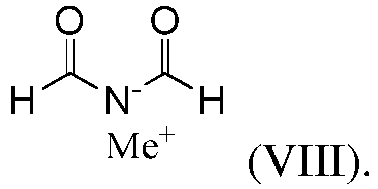
- the second reaction partner is a metal salt of diformylamide of the formula (VIII),
- the "Me + " is typically sodium or potassium, preferably sodium.
- the compound (VIII) is known in the art and is commonly obtainable by a reaction of the corresponding metal methoxide with formamide, see US5488188 and US5599986 . It may be isolated as a solid and stored at ambient conditions.
- the reaction between the compounds (VII) and (VIII) may typically proceed in an inert solvent, which preferably is a polar aprotic solvent, for instance N,N-dimethyl formamide, dimethyl sulfoxide, acetonitrile, N-methylpyrrolidone, N,N-dimethylacetamide or acetone and mixtures thereof.
- an inert solvent which preferably is a polar aprotic solvent, for instance N,N-dimethyl formamide, dimethyl sulfoxide, acetonitrile, N-methylpyrrolidone, N,N-dimethylacetamide or acetone and mixtures thereof.
- molar ratio between compound (VII) and compound (VIII) is from 1:1 to 1:3, preferably of from about 1:1.1 to about 1: 1.7.
- the reaction temperature is typically from 50 to 100°C, preferably from 60 to 90°C. At these conditions, the reaction time is about 0.5 to 2 hours.
- the course of reaction may
- the volatile residues are advantageously removed, e.g. by evaporation, and the residual metal salts are also removed, e.g. by an extraction with water.
- the reaction product comprises a mixture of compounds of formula (IXa) and (IXb),
- both compounds depends on the relative amount of the compound (VIII) in respect to the compound (VII).
- the reaction mixture comprises only the compound (IXa) and/or only the compound (IXb).
- both compounds (IXa) and (IXb) are equally convertible into the amine of the formula (II) in the next step, there is no objective need to separate them or enhance their mutual ratio in the mixture.
- both compounds of the reaction mixture are separated by a suitable separation technique, for instance for analytical purposes.
- the compounds (IXa) and (IXb) may also be obtained in the form of an acid addition salt, e.g. as a hydrochloride, hydrobromide, sulphate, nitrate, phosphate, formate, acetate, propionate, oxalate, malonate, maleate, fumarate, citrate, malate etc.
- any of the compounds (IXa) and (IXb) and/or a mixture thereof is converted, in a next step, into the compound of formula (II) by a mild acid hydrolysis.
- the acid useful for this purpose is a strong mineral or organic acid, for instance hydrochloric acid, sulphuric acid, phosphoric acid,or hydrobromic acid. In general, a molar extent of the acid is used.
- the hydrolysis may proceed in a solvent, which may be water, a lower alcohol (C1-C4 aliphatic alcohol) or a mixture of both.
- Typical reaction temperature is between 0 and 80°C.
- the course of reaction may be monitored by a suitable analytical technique, e.g. HPLC or TLC.
- the hydrolysis step may be advantageously combined with the preceded step in a one-pot arrangement.
- the product of the reaction comprises the raw amine compound of formula (II). It is formed after the hydrolysis as the corresponding acid addition salt (e.g. hydrochloride or dihydrochloride), which may be optionally neutralized into free amine, if necessary, by a treatment with an equivalent of a base, optionally followed by an extraction.
- the raw compound (II) and/or its acid addition salt, e.g. a hydrochloride or acetate may be, if necessary, purified by known processes and/or isolated in any solid state form, e.g. that as disclosed in US 2006/0258655 .
- Hydrochloride or acetate salt of the compound (II) are the preferred salts.
- Crude or purified amine (II) may be converted to linezolid by a reaction with an acetyl halide or acetic acid anhydride, under conditions known well in the art.
- the acetylation may be performed under conditions of Schotten-Baumann reaction or a modification thereof.
- Schotten-Baumann reaction conditions indicates the use of an acetylation agent in a presence of a base.
- the acetylation runs in a two-phase solvent system, consisting of water and a water immiscible organic solvent.
- a base is present within the water phase, which neutralizes the acid generated in the reaction, while the starting materials and product remain in the organic phase.
- Non-limiting examples of a water immiscible organic solvent are toluene, dichloromethane and/or diethyl ether.
- the compound (II) is converted, with or without isolation, into a water soluble acid addition salt of an inorganic acid or acetic acid, e.g. into a hydrochloride, hydrobromide, sulphate, nitrate, phosphate, and/or acetate.
- the salt is dissolved in an aqueous medium.
- aqueous medium is monophasic and comprises water and possibly water miscible solvents, such as alcohols, esters and the like, as long as the polarity is not changed such that the water soluble acid addition salts is not substantially dissolved in the aqueous medium and the linezolid formed substantially not.
- the aqueous medium preferably water
- the acetylation agent preferably acetic anhydride
- the acetylation process is started by continuous addition of a base (preferably an inorganic base, such as sodium carbonate or sodium acetate).
- a base preferably an inorganic base, such as sodium carbonate or sodium acetate.
- the desired linezolid precipitates from the aqueous reaction mixture as it is not soluble therein. In this modification, organic solvents are completely avoided.
- the produced linezolid may be isolated in any solid state form known in the art [Form I ( J.Med.Chem. 39(3), 673 (1996 )), Form II ( WO 01/057035 , US 6,559,305 ), Form III ( WO 2005/035530 ) and many others ( WO 2006/004922 , US 2006/0142283 ), amorphous form ( WO 2007/026369 ) and hydrated forms ( US 2006/111350 , EP 20033960 )] and/or may be converted in a suitable acid addition salt.
- the linezolid prepared by the process of the present invention can be formulated and used in pharmaceutical compositions.
- a suitable pharmaceutical composition may comprise linezolid and at least one pharmaceutically acceptable excipient.
- the compositions are useful as antibacterial agents, in treating various diseases caused by some types of bacteria, by administering an effective amount thereof to a patient in need of such treatment. In particular, they are useful in treatment of diabetic food infections caused by Gram-positive bacteria.
- the effective amounts range from 1 mg to 500 mg, expressed as the amount of linezolid base, per day.
- the solid was mixed with 10 ml of methanol an 0.438 ml of concentrated hydrochloric acid (5.00 mmol) was added.
- the reaction mixture was warmed up in an oil bath to 65°C and stirred at this temperature for 2 hours.
- the mixture was evaporated at diminished pressure and then co-evaporated with toluene (60°C, 25 mbar) to yield 220 mg of white glassy solid.
- the reaction mixture was transferred to a 500 ml round bottom flask and cooled down in an ice-water bath.
- Dichoromethane 150 ml was charged to the flask.
- the mixture was vigorously stirred and a solution of NaOH (54.0 g) in water (100 ml) was added, such that the internal temperature did not exceed 20°C.
- the mixture was filtered.
- the filtrate was transferred to a 500 ml separatory funnel and the organic layer was separated. The filter cake was discarded.
- the water layer was extracted with dichloromethane (2 x 50 ml).
- the combined organic layer was dried over Na2SO4 (25 g), filtered, and concentrated (60°C, 50 mbar) to provide the product as a tan crystalline solid (18.87 g).
Landscapes
- Chemical & Material Sciences (AREA)
- Organic Chemistry (AREA)
- Plural Heterocyclic Compounds (AREA)
- Pharmaceuticals Containing Other Organic And Inorganic Compounds (AREA)
Abstract
The present invention relates to a process for making linezolid comprising reacting in an aqueous medium a water soluble acid addition salt of the compound of formula (II)
with acetyl halide or acetic acid anhydride in the presence of a base.
Description
- The present invention relates to an improved process for making the compound linezolid.
- Linezolid is a pharmaceutically active compound useful as an antibacterial agent, e.g. for the treatment of diabetic food infections caused by Gram-positive bacteria. It is represented by the formula (I),

- The marketed pharmaceutical compositions are a sterile isotonic solution for an i.v. infusion, a tablet for oral administration and an aqueous suspension for oral administration. They are marketed, i.e., under brand name ZYVOX by Pfizer.
- The molecule of linezolid has one asymmetric carbon in the molecule allowing for 2 enantiomers; the marketed compound is the (S)-enantiomer. In the above-marketed compositions, linezolid is present as a free base.
- Hereinunder, the name linezolid will be used as the generic name for N-(3-(3-fluoro-4-(morpholin-4-yl)phenyl)-2-oxooxazolidin-5(S)-ylmethyl)acetamide, unless indicated to the contrary.
-
- Various processes for making linezolid are known in the art. In particular, the important ones are these, the final step of which comprises acetylation of an amine precursor of the formula (II) with an acetylhalide or acetic anhydride (see, e.g.,
WO 2005 099353 ),
- This amine precursor (II) may be made from various starting materials, e.g.:
- a) By a reduction of an azide compound of formula (III) by a suitable reductant (
WO2006/091731 ,WO 95/07271 US 5837870 ,WO2009/063505 ,US 7291614 ),
WO 2005/099353 ). - b) By a decomposition of a phthalimide compound of formula (IV), e.g. by methylamine (
WO95/07271 US 5837870 ),
WO2005/099353 ) or by a cyclization of the oxazolidine ring (WO 99/24393 WO2006/008754 ). - c) From a sulfonate compound of formula (V),

WO 95/07271 WO 97/37980 - d) By a reduction of an imine (VI),

WO 2007/116284 ). - Except of the imine (VI), each of the preceded synthetic approaches is based on a step of converting a starting material of the general formula (VII),

by a reaction with a nitrogen nucleophile (an azide salt, phthalimide salt, ammonia or ammonium hydroxide), followed, if necessary, by a next step of conversion of the formed reaction intermediate (e.g., compound (III) or compound (IV)) into the amino/compound (II). Apparently, making the starting amine-compound (II) in a good yield and purity is the key aspect of commercial success of any of the above synthetic routes yielding linezolid. However, the known approaches have various drawbacks, for instance serious toxicity and explosion hazard of the azide salts, long reaction times and hazardous agents (hydrazine, methyl amine) in using the phthalimide intermediate, low yields and many side products at the ammonium hydroxide approach, or harsh reaction conditions in reaction with ammonia. - Thus, while many synthetic processes in making the compound (II) and the linezolid are known in the art, there still exists a need of an improvement. It would be desirable to have an alternate process of making the amine-intermediate of linezolid, which process is simple, runs at moderate reaction conditions and does not exhibit the above disadvantages.
- The present invention relates to a discovery of an improved process of making linezolid, which is simple in respect to process conditions and provides low amounts of reaction side products.
- In a main aspect, the invention provides a process for making the compound 3-(3-fluoro-4-(morpholin-4-yl)phenyl)-2-oxooxazolidin-5(S)-ylmethyl)amine of formula (II) and/or an acid addition salt thereof,

- a) reacting the compound of formula (VII),


- b) subjecting the reaction product of the step (a) comprising a mixture of compounds of formula (IXa) and (IXb),

- According to another aspect of the invention is provided a process for making linezolid comprising reacting in an aqueous medium a water soluble acid addition salt of the compound of formula (II),

- The starting material in the process of making linezolid according to the present invention is a compound of general formula (VII),

- The compounds are known in the art or may be prepared according to processes known in the art, e.g. from corresponding hydroxyl-methyl compounds of the formula (X),

- The second reaction partner is a metal salt of diformylamide of the formula (VIII),
-
- The reaction between the compounds (VII) and (VIII) may typically proceed in an inert solvent, which preferably is a polar aprotic solvent, for instance N,N-dimethyl formamide, dimethyl sulfoxide, acetonitrile, N-methylpyrrolidone, N,N-dimethylacetamide or acetone and mixtures thereof. Typically, molar ratio between compound (VII) and compound (VIII) is from 1:1 to 1:3, preferably of from about 1:1.1 to about 1: 1.7. The reaction temperature is typically from 50 to 100°C, preferably from 60 to 90°C. At these conditions, the reaction time is about 0.5 to 2 hours. The course of reaction may be monitored by common analytical techniques, e.g. by TLC or HPLC.
- After the reaction is complete, the volatile residues are advantageously removed, e.g. by evaporation, and the residual metal salts are also removed, e.g. by an extraction with water.
- The reaction product comprises a mixture of compounds of formula (IXa) and (IXb),

- Mutual ratio of both compounds depends on the relative amount of the compound (VIII) in respect to the compound (VII). In borderline cases, the reaction mixture comprises only the compound (IXa) and/or only the compound (IXb). As both compounds (IXa) and (IXb) are equally convertible into the amine of the formula (II) in the next step, there is no objective need to separate them or enhance their mutual ratio in the mixture. However, it is not excluded that both compounds of the reaction mixture are separated by a suitable separation technique, for instance for analytical purposes. The compounds (IXa) and (IXb) may also be obtained in the form of an acid addition salt, e.g. as a hydrochloride, hydrobromide, sulphate, nitrate, phosphate, formate, acetate, propionate, oxalate, malonate, maleate, fumarate, citrate, malate etc.
- Any of the compounds (IXa) and (IXb) and/or a mixture thereof is converted, in a next step, into the compound of formula (II) by a mild acid hydrolysis. Typically, the acid useful for this purpose is a strong mineral or organic acid, for instance hydrochloric acid, sulphuric acid, phosphoric acid,or hydrobromic acid. In general, a molar extent of the acid is used. The hydrolysis may proceed in a solvent, which may be water, a lower alcohol (C1-C4 aliphatic alcohol) or a mixture of both. Typical reaction temperature is between 0 and 80°C. The course of reaction may be monitored by a suitable analytical technique, e.g. HPLC or TLC.
- The hydrolysis step may be advantageously combined with the preceded step in a one-pot arrangement.
- As the rests of the reagents and solvents, as well as side products formed during the reaction are volatile compounds, the easiest way for removing them is evaporation, preferably at diminished pressure.
- The product of the reaction comprises the raw amine compound of formula (II). It is formed after the hydrolysis as the corresponding acid addition salt (e.g. hydrochloride or dihydrochloride), which may be optionally neutralized into free amine, if necessary, by a treatment with an equivalent of a base, optionally followed by an extraction. The raw compound (II) and/or its acid addition salt, e.g. a hydrochloride or acetate may be, if necessary, purified by known processes and/or isolated in any solid state form, e.g. that as disclosed in
US 2006/0258655 . Hydrochloride or acetate salt of the compound (II) are the preferred salts. - Crude or purified amine (II) may be converted to linezolid by a reaction with an acetyl halide or acetic acid anhydride, under conditions known well in the art. In an advantageous way, the acetylation may be performed under conditions of Schotten-Baumann reaction or a modification thereof. The name "Schotten-Baumann reaction conditions" indicates the use of an acetylation agent in a presence of a base. Typically, the acetylation runs in a two-phase solvent system, consisting of water and a water immiscible organic solvent. A base is present within the water phase, which neutralizes the acid generated in the reaction, while the starting materials and product remain in the organic phase. Non-limiting examples of a water immiscible organic solvent are toluene, dichloromethane and/or diethyl ether.
- In a suitable modification of the Schotten-Baumann reaction conditions, the compound (II) is converted, with or without isolation, into a water soluble acid addition salt of an inorganic acid or acetic acid, e.g. into a hydrochloride, hydrobromide, sulphate, nitrate, phosphate, and/or acetate. The salt is dissolved in an aqueous medium. Such aqueous medium is monophasic and comprises water and possibly water miscible solvents, such as alcohols, esters and the like, as long as the polarity is not changed such that the water soluble acid addition salts is not substantially dissolved in the aqueous medium and the linezolid formed substantially not. The aqueous medium, preferably water, is preferably cooled as close to 0°C as possible, the acetylation agent, preferably acetic anhydride, is added, and the acetylation process is started by continuous addition of a base (preferably an inorganic base, such as sodium carbonate or sodium acetate). The desired linezolid precipitates from the aqueous reaction mixture as it is not soluble therein. In this modification, organic solvents are completely avoided.
- The produced linezolid may be isolated in any solid state form known in the art [Form I (J.Med.Chem. 39(3), 673 (1996)), Form II (
WO 01/057035 US 6,559,305 ), Form III (WO 2005/035530 ) and many others (WO 2006/004922 ,US 2006/0142283 ), amorphous form (WO 2007/026369 ) and hydrated forms (US 2006/111350 ,EP 20033960 - The linezolid prepared by the process of the present invention can be formulated and used in pharmaceutical compositions. A suitable pharmaceutical composition may comprise linezolid and at least one pharmaceutically acceptable excipient. The compositions are useful as antibacterial agents, in treating various diseases caused by some types of bacteria, by administering an effective amount thereof to a patient in need of such treatment. In particular, they are useful in treatment of diabetic food infections caused by Gram-positive bacteria. Typically the effective amounts range from 1 mg to 500 mg, expressed as the amount of linezolid base, per day.
- The invention will be further described with reference to the following non-limiting examples.
- To a 5 ml, reaction vial equipped with a magnetic stirring bar, 225 mg (0.5 mmol) of the compound (VII) [ L= p-toluenesulfonyloxy group] was added followed by 96 mg (1mmol) of sodium diformylamide and 2.5 ml of N,N-dimethylformamide. The vessel was immersed into an oil bath, which was preheated to 85°C and the mixture was stirred at external temperature of 85°C for 1 hour. The volatiles were evaporated at diminished temperature (30 mbar, 60°C), the residue was mixed with 10 ml of ethyl acetate and extracted with 10 ml of water. The organic layer was evaporated to dryness (45°C, 25 mbar) to yield a white solid.
- The solid was mixed with 10 ml of methanol an 0.438 ml of concentrated hydrochloric acid (5.00 mmol) was added. The reaction mixture was warmed up in an oil bath to 65°C and stirred at this temperature for 2 hours. The mixture was evaporated at diminished pressure and then co-evaporated with toluene (60°C, 25 mbar) to yield 220 mg of white glassy solid.
- A 250 ml, three-necked, round-bottomed flask equipped with a blade mechanical stirrer and Ar inlet combined with a temperature probe was placed under an argon atmosphere and charged with sodium diformylamide (5.6 g) and the compound (VII) [ L= p-toluenesulfonyloxy group] (20.8 g). N,N-Dimethylformamide (52 ml) was added and the reaction mixture was heated to 85°C for 2 h. Hydrochloric acid (98 ml) was carefully added into the reaction mixture, such that the internal temperature did not exceed 96°C. The heterogeneous reaction mixture was heated to 85°C and the reaction was continued for 2.5 h. The reaction mixture was transferred to a 500 ml round bottom flask and cooled down in an ice-water bath. Dichoromethane (150 ml) was charged to the flask. The mixture was vigorously stirred and a solution of NaOH (54.0 g) in water (100 ml) was added, such that the internal temperature did not exceed 20°C. The mixture was filtered. The filtrate was transferred to a 500 ml separatory funnel and the organic layer was separated. The filter cake was discarded. The water layer was extracted with dichloromethane (2 x 50 ml). The combined organic layer was dried over Na2SO4 (25 g), filtered, and concentrated (60°C, 50 mbar) to provide the product as a tan crystalline solid (18.87 g).
- To a 25 ml, round-bottomed flask equipped with a magnetic stirring bar was charged "amine" (0.49 g) followed by water (8.30 ml). A heterogeneous mixture was stirred and hydrochloric acid (0.12 mL, 35 %) was added. A homogenous solution was obtained. The solution was cooled down in an ice-water bath to 0°C. Acetic anhydride (0.31 mL) was added followed by sodium bicarbonate (0.45 g). Carbon dioxide was immediately released and a formation of white precipitate was observed. The precipitate was filtered off and the filter cake was washed with water (10 ml). The filter cake was collected and dried (100 mbar) at 70°C overnight. An off-white solid linezolid (0.26 g) was isolated.
Claims (2)
- A process for making linezolid comprising reacting in an aqueous medium a water soluble acid addition salt of the compound of formula (II)

- The process according to claim 11, wherein the water soluble acid addition salt of the compound of formula (II) is in a form of an acid addition salt with an inorganic acid or acetic acid.
Priority Applications (1)
| Application Number | Priority Date | Filing Date | Title |
|---|---|---|---|
| EP13190043.3A EP2690100A1 (en) | 2010-08-11 | 2011-07-14 | Process for making linezolid |
Applications Claiming Priority (3)
| Application Number | Priority Date | Filing Date | Title |
|---|---|---|---|
| PCT/EP2010/005209 WO2012019632A1 (en) | 2010-08-11 | 2010-08-11 | Process for making linezolid |
| EP11733678.4A EP2603506A1 (en) | 2010-08-11 | 2011-07-14 | Process for making linezolid |
| EP13190043.3A EP2690100A1 (en) | 2010-08-11 | 2011-07-14 | Process for making linezolid |
Related Parent Applications (1)
| Application Number | Title | Priority Date | Filing Date |
|---|---|---|---|
| EP11733678.4A Division EP2603506A1 (en) | 2010-08-11 | 2011-07-14 | Process for making linezolid |
Publications (1)
| Publication Number | Publication Date |
|---|---|
| EP2690100A1 true EP2690100A1 (en) | 2014-01-29 |
Family
ID=48366063
Family Applications (2)
| Application Number | Title | Priority Date | Filing Date |
|---|---|---|---|
| EP11733678.4A Withdrawn EP2603506A1 (en) | 2010-08-11 | 2011-07-14 | Process for making linezolid |
| EP13190043.3A Withdrawn EP2690100A1 (en) | 2010-08-11 | 2011-07-14 | Process for making linezolid |
Family Applications Before (1)
| Application Number | Title | Priority Date | Filing Date |
|---|---|---|---|
| EP11733678.4A Withdrawn EP2603506A1 (en) | 2010-08-11 | 2011-07-14 | Process for making linezolid |
Country Status (1)
| Country | Link |
|---|---|
| EP (2) | EP2603506A1 (en) |
Citations (19)
| Publication number | Priority date | Publication date | Assignee | Title |
|---|---|---|---|---|
| WO1995007271A1 (en) | 1993-09-09 | 1995-03-16 | The Upjohn Company | Substituted oxazine and thiazine oxazolidinone antimicrobials |
| US5488188A (en) | 1994-09-29 | 1996-01-30 | Merrell Dow Pharmaceuticals Inc. | Process for the preparation of (E)-1-amino-2-(fluoromethylene)-4-(p-fluorophenyl)butane, novel processes for preparing an intermediate thereof, and novel intermediates thereof |
| US5599986A (en) | 1994-09-29 | 1997-02-04 | Hoechst Marion Roussel Inc. | Process for the preparation of alkali metal salts of diformylamide |
| WO1997037980A1 (en) | 1996-04-11 | 1997-10-16 | Pharmacia & Upjohn Company | Process to prepare oxazolidinones |
| US5688792A (en) | 1994-08-16 | 1997-11-18 | Pharmacia & Upjohn Company | Substituted oxazine and thiazine oxazolidinone antimicrobials |
| WO1999024393A1 (en) | 1997-11-07 | 1999-05-20 | Pharmacia & Upjohn Company | Process to produce oxazolidinones |
| WO2001057035A1 (en) | 2000-02-02 | 2001-08-09 | Pharmacia & Upjohn Company | Linezolid-crystal form ii |
| US6559305B1 (en) | 2000-02-02 | 2003-05-06 | Pharmacia & Upjohn Company | Linezolid—crystal form II |
| WO2005035530A1 (en) | 2003-10-16 | 2005-04-21 | Symed Labs Limited | A novel crystalline form of linezolid |
| WO2005099353A2 (en) | 2004-04-19 | 2005-10-27 | Symed Labs Limited | A novel process for the preparation of linezolid and related compounds |
| WO2006004922A1 (en) | 2004-06-29 | 2006-01-12 | Teva Pharmaceutical Industries Ltd. | Crystalline form iv of linezolid |
| WO2006008754A1 (en) | 2004-07-20 | 2006-01-26 | Symed Labs Limited | Novel intermediates for linezolid and related compounds |
| US20060111350A1 (en) | 2004-06-29 | 2006-05-25 | Judith Aronhime | Solid forms of linezolid and processes for preparation thereof |
| WO2006091731A2 (en) | 2005-02-24 | 2006-08-31 | Teva Pharmaceutical Industries Ltd. | Processes for the preparation of linezolid intermediate |
| WO2007026369A1 (en) | 2005-08-29 | 2007-03-08 | Symed Labs Limited | A novel amorphous form of linezolid |
| WO2007116284A1 (en) | 2006-04-07 | 2007-10-18 | Pfizer Products Inc. | Process for preparing linezolid |
| EP2003396A2 (en) | 2005-09-06 | 2008-12-17 | Ernst Schenkel | Grate element |
| WO2009063505A2 (en) | 2007-10-08 | 2009-05-22 | Usv Limited | Process for preparation of (s) (n-[[3-[3-fluoro-4-(4-morpholinyl) hen l -2-oxo-5-oxazolidin l methyl]acetamide |
| WO2010081404A1 (en) * | 2009-01-13 | 2010-07-22 | 联化科技股份有限公司 | Method for preparing linezolid and intermediates thereof |
-
2011
- 2011-07-14 EP EP11733678.4A patent/EP2603506A1/en not_active Withdrawn
- 2011-07-14 EP EP13190043.3A patent/EP2690100A1/en not_active Withdrawn
Patent Citations (24)
| Publication number | Priority date | Publication date | Assignee | Title |
|---|---|---|---|---|
| WO1995007271A1 (en) | 1993-09-09 | 1995-03-16 | The Upjohn Company | Substituted oxazine and thiazine oxazolidinone antimicrobials |
| EP0717738A1 (en) | 1993-09-09 | 1996-06-26 | PHARMACIA & UPJOHN COMPANY | Substituted oxazine and thiazine oxazolidinone antimicrobials |
| US5688792A (en) | 1994-08-16 | 1997-11-18 | Pharmacia & Upjohn Company | Substituted oxazine and thiazine oxazolidinone antimicrobials |
| US5488188A (en) | 1994-09-29 | 1996-01-30 | Merrell Dow Pharmaceuticals Inc. | Process for the preparation of (E)-1-amino-2-(fluoromethylene)-4-(p-fluorophenyl)butane, novel processes for preparing an intermediate thereof, and novel intermediates thereof |
| US5599986A (en) | 1994-09-29 | 1997-02-04 | Hoechst Marion Roussel Inc. | Process for the preparation of alkali metal salts of diformylamide |
| WO1997037980A1 (en) | 1996-04-11 | 1997-10-16 | Pharmacia & Upjohn Company | Process to prepare oxazolidinones |
| US5837870A (en) | 1996-04-11 | 1998-11-17 | Pharmacia & Upjohn Company | Process to prepare oxazolidinones |
| WO1999024393A1 (en) | 1997-11-07 | 1999-05-20 | Pharmacia & Upjohn Company | Process to produce oxazolidinones |
| WO2001057035A1 (en) | 2000-02-02 | 2001-08-09 | Pharmacia & Upjohn Company | Linezolid-crystal form ii |
| US6559305B1 (en) | 2000-02-02 | 2003-05-06 | Pharmacia & Upjohn Company | Linezolid—crystal form II |
| WO2005035530A1 (en) | 2003-10-16 | 2005-04-21 | Symed Labs Limited | A novel crystalline form of linezolid |
| WO2005099353A2 (en) | 2004-04-19 | 2005-10-27 | Symed Labs Limited | A novel process for the preparation of linezolid and related compounds |
| WO2006004922A1 (en) | 2004-06-29 | 2006-01-12 | Teva Pharmaceutical Industries Ltd. | Crystalline form iv of linezolid |
| US20060111350A1 (en) | 2004-06-29 | 2006-05-25 | Judith Aronhime | Solid forms of linezolid and processes for preparation thereof |
| US20060142283A1 (en) | 2004-06-29 | 2006-06-29 | Judith Aronhime | Crystalline form IV of linezolid |
| WO2006008754A1 (en) | 2004-07-20 | 2006-01-26 | Symed Labs Limited | Novel intermediates for linezolid and related compounds |
| WO2006091731A2 (en) | 2005-02-24 | 2006-08-31 | Teva Pharmaceutical Industries Ltd. | Processes for the preparation of linezolid intermediate |
| US20060258655A1 (en) | 2005-02-24 | 2006-11-16 | Tamas Koltai | Crystalline forms of linezolid intermediate |
| US7291614B2 (en) | 2005-02-24 | 2007-11-06 | Teva Pharmaceutical Industries Ltd. | Processes for the preparation of linezolid intermediate |
| WO2007026369A1 (en) | 2005-08-29 | 2007-03-08 | Symed Labs Limited | A novel amorphous form of linezolid |
| EP2003396A2 (en) | 2005-09-06 | 2008-12-17 | Ernst Schenkel | Grate element |
| WO2007116284A1 (en) | 2006-04-07 | 2007-10-18 | Pfizer Products Inc. | Process for preparing linezolid |
| WO2009063505A2 (en) | 2007-10-08 | 2009-05-22 | Usv Limited | Process for preparation of (s) (n-[[3-[3-fluoro-4-(4-morpholinyl) hen l -2-oxo-5-oxazolidin l methyl]acetamide |
| WO2010081404A1 (en) * | 2009-01-13 | 2010-07-22 | 联化科技股份有限公司 | Method for preparing linezolid and intermediates thereof |
Non-Patent Citations (1)
| Title |
|---|
| J.MED.CHEM., vol. 39, no. 3, 1996, pages 673 |
Also Published As
| Publication number | Publication date |
|---|---|
| EP2603506A1 (en) | 2013-06-19 |
Similar Documents
| Publication | Publication Date | Title |
|---|---|---|
| JP5439168B2 (en) | Rosuvastatin zinc salt | |
| US20040242556A1 (en) | Novel crystalline form of cefdinir | |
| US11702393B2 (en) | Synthesis of a monoacylglycerol lipase inhibitor | |
| KR101653570B1 (en) | Novel Oxazolidinone derivatives and Pharmaceutical Compositions Comprising the Same | |
| WO2012019862A1 (en) | Process for making linezolid | |
| US11236050B2 (en) | Polymorphs of 4-[3-chloro-4-(n′-cyclopropyl ureido)phenoxy] -7-methoxyquinoline-6-carboxamide, its salts and process for the preparation thereof | |
| EP1999106B1 (en) | A hydride reduction process for preparing quinolone intermediates | |
| US20220306650A1 (en) | Process and polymorphic forms of bictegravir and its pharmaceutically acceptable salts or co-crystals thereof | |
| EP2690100A1 (en) | Process for making linezolid | |
| KR100307211B1 (en) | Oxazolidinone derivative, manufacturing method thereof, and antibacterial composition containing the same | |
| US20240239791A1 (en) | Processes for the synthesis of valbenazine | |
| AU2018374838A1 (en) | Process for preparing acylated amphetamine derivatives | |
| WO2001021592A1 (en) | Processes for the preparation of 4(5)-amino-5(4)-carboxamidoimidazoles and intermediates thereof | |
| EP2573084A1 (en) | Novel crystalline forms of rivaroxaban and processes for their preparation | |
| CN102803256B (en) | (R)-3-(3-fluoro-4-(1-methyl-5,6-dihydro-1,2,4-triazin-4(1H)-yl)phenyl)-5-(substituted The preparation method of methyl) oxazolidin-2-one derivative | |
| EP2917189B1 (en) | Process for making linezolid | |
| KR100467309B1 (en) | Oxazolidinone derivatives, a method for producing the same and antibacterial pharmaceutical composition | |
| US12227506B2 (en) | Crystalline polymorphs of 1-[(3R)-3-[4-amino-3-(4-phenoxyphenyl)-1H-pyrazolo[3,4-d]pyrimidin-1-yl]-1-piperidinyl]-2-propen-1-one and process for preparation thereof | |
| KR20260049231A (en) | Improved method for manufacturing avibactam and its intermediates | |
| JPH04270272A (en) | Production of aminoalkylmorpholine derivative | |
| US6063962A (en) | Process for the preparation of NMDA antagonists | |
| WO2017009746A1 (en) | An improved process for the preparation of sofosbuvir | |
| KR100463111B1 (en) | Oxazolidinone derivatives, methods for producing the same and antibacterial composition containing the said compounds | |
| JP2018197206A (en) | Method for producing azilsartan synthetic intermediate | |
| MXPA99005398A (en) | Process for the preparation of nmda antagonists |
Legal Events
| Date | Code | Title | Description |
|---|---|---|---|
| PUAI | Public reference made under article 153(3) epc to a published international application that has entered the european phase |
Free format text: ORIGINAL CODE: 0009012 |
|
| AC | Divisional application: reference to earlier application |
Ref document number: 2603506 Country of ref document: EP Kind code of ref document: P |
|
| AK | Designated contracting states |
Kind code of ref document: A1 Designated state(s): AL AT BE BG CH CY CZ DE DK EE ES FI FR GB GR HR HU IE IS IT LI LT LU LV MC MK MT NL NO PL PT RO RS SE SI SK SM TR |
|
| STAA | Information on the status of an ep patent application or granted ep patent |
Free format text: STATUS: THE APPLICATION IS DEEMED TO BE WITHDRAWN |
|
| 18D | Application deemed to be withdrawn |
Effective date: 20140730 |