EP2679360A1 - Method for manufacturing powder compact, and powder compact - Google Patents
Method for manufacturing powder compact, and powder compact Download PDFInfo
- Publication number
- EP2679360A1 EP2679360A1 EP12749534.9A EP12749534A EP2679360A1 EP 2679360 A1 EP2679360 A1 EP 2679360A1 EP 12749534 A EP12749534 A EP 12749534A EP 2679360 A1 EP2679360 A1 EP 2679360A1
- Authority
- EP
- European Patent Office
- Prior art keywords
- molded product
- slurry
- raw material
- powder molded
- molding
- Prior art date
- Legal status (The legal status is an assumption and is not a legal conclusion. Google has not performed a legal analysis and makes no representation as to the accuracy of the status listed.)
- Granted
Links
Images
Classifications
-
- C—CHEMISTRY; METALLURGY
- C04—CEMENTS; CONCRETE; ARTIFICIAL STONE; CERAMICS; REFRACTORIES
- C04B—LIME, MAGNESIA; SLAG; CEMENTS; COMPOSITIONS THEREOF, e.g. MORTARS, CONCRETE OR LIKE BUILDING MATERIALS; ARTIFICIAL STONE; CERAMICS; REFRACTORIES; TREATMENT OF NATURAL STONE
- C04B35/00—Shaped ceramic products characterised by their composition; Ceramics compositions; Processing powders of inorganic compounds preparatory to the manufacturing of ceramic products
- C04B35/622—Forming processes; Processing powders of inorganic compounds preparatory to the manufacturing of ceramic products
- C04B35/626—Preparing or treating the powders individually or as batches ; preparing or treating macroscopic reinforcing agents for ceramic products, e.g. fibres; mechanical aspects section B
- C04B35/63—Preparing or treating the powders individually or as batches ; preparing or treating macroscopic reinforcing agents for ceramic products, e.g. fibres; mechanical aspects section B using additives specially adapted for forming the products, e.g.. binder binders
- C04B35/632—Organic additives
- C04B35/634—Polymers
- C04B35/63448—Polymers obtained otherwise than by reactions only involving carbon-to-carbon unsaturated bonds
- C04B35/63456—Polyurethanes; Polyisocyanates
-
- B—PERFORMING OPERATIONS; TRANSPORTING
- B28—WORKING CEMENT, CLAY, OR STONE
- B28B—SHAPING CLAY OR OTHER CERAMIC COMPOSITIONS; SHAPING SLAG; SHAPING MIXTURES CONTAINING CEMENTITIOUS MATERIAL, e.g. PLASTER
- B28B1/00—Producing shaped prefabricated articles from the material
-
- B—PERFORMING OPERATIONS; TRANSPORTING
- B28—WORKING CEMENT, CLAY, OR STONE
- B28B—SHAPING CLAY OR OTHER CERAMIC COMPOSITIONS; SHAPING SLAG; SHAPING MIXTURES CONTAINING CEMENTITIOUS MATERIAL, e.g. PLASTER
- B28B3/00—Producing shaped articles from the material by using presses; Presses specially adapted therefor
-
- B—PERFORMING OPERATIONS; TRANSPORTING
- B28—WORKING CEMENT, CLAY, OR STONE
- B28B—SHAPING CLAY OR OTHER CERAMIC COMPOSITIONS; SHAPING SLAG; SHAPING MIXTURES CONTAINING CEMENTITIOUS MATERIAL, e.g. PLASTER
- B28B5/00—Producing shaped articles from the material in moulds or on moulding surfaces, carried or formed by, in or on conveyors irrespective of the manner of shaping
-
- C—CHEMISTRY; METALLURGY
- C04—CEMENTS; CONCRETE; ARTIFICIAL STONE; CERAMICS; REFRACTORIES
- C04B—LIME, MAGNESIA; SLAG; CEMENTS; COMPOSITIONS THEREOF, e.g. MORTARS, CONCRETE OR LIKE BUILDING MATERIALS; ARTIFICIAL STONE; CERAMICS; REFRACTORIES; TREATMENT OF NATURAL STONE
- C04B35/00—Shaped ceramic products characterised by their composition; Ceramics compositions; Processing powders of inorganic compounds preparatory to the manufacturing of ceramic products
-
- C—CHEMISTRY; METALLURGY
- C04—CEMENTS; CONCRETE; ARTIFICIAL STONE; CERAMICS; REFRACTORIES
- C04B—LIME, MAGNESIA; SLAG; CEMENTS; COMPOSITIONS THEREOF, e.g. MORTARS, CONCRETE OR LIKE BUILDING MATERIALS; ARTIFICIAL STONE; CERAMICS; REFRACTORIES; TREATMENT OF NATURAL STONE
- C04B35/00—Shaped ceramic products characterised by their composition; Ceramics compositions; Processing powders of inorganic compounds preparatory to the manufacturing of ceramic products
- C04B35/01—Shaped ceramic products characterised by their composition; Ceramics compositions; Processing powders of inorganic compounds preparatory to the manufacturing of ceramic products based on oxide ceramics
-
- C—CHEMISTRY; METALLURGY
- C04—CEMENTS; CONCRETE; ARTIFICIAL STONE; CERAMICS; REFRACTORIES
- C04B—LIME, MAGNESIA; SLAG; CEMENTS; COMPOSITIONS THEREOF, e.g. MORTARS, CONCRETE OR LIKE BUILDING MATERIALS; ARTIFICIAL STONE; CERAMICS; REFRACTORIES; TREATMENT OF NATURAL STONE
- C04B35/00—Shaped ceramic products characterised by their composition; Ceramics compositions; Processing powders of inorganic compounds preparatory to the manufacturing of ceramic products
- C04B35/622—Forming processes; Processing powders of inorganic compounds preparatory to the manufacturing of ceramic products
- C04B35/624—Sol-gel processing
-
- C—CHEMISTRY; METALLURGY
- C04—CEMENTS; CONCRETE; ARTIFICIAL STONE; CERAMICS; REFRACTORIES
- C04B—LIME, MAGNESIA; SLAG; CEMENTS; COMPOSITIONS THEREOF, e.g. MORTARS, CONCRETE OR LIKE BUILDING MATERIALS; ARTIFICIAL STONE; CERAMICS; REFRACTORIES; TREATMENT OF NATURAL STONE
- C04B35/00—Shaped ceramic products characterised by their composition; Ceramics compositions; Processing powders of inorganic compounds preparatory to the manufacturing of ceramic products
- C04B35/622—Forming processes; Processing powders of inorganic compounds preparatory to the manufacturing of ceramic products
- C04B35/626—Preparing or treating the powders individually or as batches ; preparing or treating macroscopic reinforcing agents for ceramic products, e.g. fibres; mechanical aspects section B
- C04B35/62605—Treating the starting powders individually or as mixtures
- C04B35/62625—Wet mixtures
- C04B35/6263—Wet mixtures characterised by their solids loadings, i.e. the percentage of solids
-
- C—CHEMISTRY; METALLURGY
- C04—CEMENTS; CONCRETE; ARTIFICIAL STONE; CERAMICS; REFRACTORIES
- C04B—LIME, MAGNESIA; SLAG; CEMENTS; COMPOSITIONS THEREOF, e.g. MORTARS, CONCRETE OR LIKE BUILDING MATERIALS; ARTIFICIAL STONE; CERAMICS; REFRACTORIES; TREATMENT OF NATURAL STONE
- C04B35/00—Shaped ceramic products characterised by their composition; Ceramics compositions; Processing powders of inorganic compounds preparatory to the manufacturing of ceramic products
- C04B35/622—Forming processes; Processing powders of inorganic compounds preparatory to the manufacturing of ceramic products
- C04B35/626—Preparing or treating the powders individually or as batches ; preparing or treating macroscopic reinforcing agents for ceramic products, e.g. fibres; mechanical aspects section B
- C04B35/62605—Treating the starting powders individually or as mixtures
- C04B35/62625—Wet mixtures
- C04B35/6264—Mixing media, e.g. organic solvents
-
- C—CHEMISTRY; METALLURGY
- C04—CEMENTS; CONCRETE; ARTIFICIAL STONE; CERAMICS; REFRACTORIES
- C04B—LIME, MAGNESIA; SLAG; CEMENTS; COMPOSITIONS THEREOF, e.g. MORTARS, CONCRETE OR LIKE BUILDING MATERIALS; ARTIFICIAL STONE; CERAMICS; REFRACTORIES; TREATMENT OF NATURAL STONE
- C04B35/00—Shaped ceramic products characterised by their composition; Ceramics compositions; Processing powders of inorganic compounds preparatory to the manufacturing of ceramic products
- C04B35/622—Forming processes; Processing powders of inorganic compounds preparatory to the manufacturing of ceramic products
- C04B35/626—Preparing or treating the powders individually or as batches ; preparing or treating macroscopic reinforcing agents for ceramic products, e.g. fibres; mechanical aspects section B
- C04B35/62605—Treating the starting powders individually or as mixtures
- C04B35/6269—Curing of mixtures
-
- C—CHEMISTRY; METALLURGY
- C04—CEMENTS; CONCRETE; ARTIFICIAL STONE; CERAMICS; REFRACTORIES
- C04B—LIME, MAGNESIA; SLAG; CEMENTS; COMPOSITIONS THEREOF, e.g. MORTARS, CONCRETE OR LIKE BUILDING MATERIALS; ARTIFICIAL STONE; CERAMICS; REFRACTORIES; TREATMENT OF NATURAL STONE
- C04B35/00—Shaped ceramic products characterised by their composition; Ceramics compositions; Processing powders of inorganic compounds preparatory to the manufacturing of ceramic products
- C04B35/622—Forming processes; Processing powders of inorganic compounds preparatory to the manufacturing of ceramic products
- C04B35/626—Preparing or treating the powders individually or as batches ; preparing or treating macroscopic reinforcing agents for ceramic products, e.g. fibres; mechanical aspects section B
- C04B35/63—Preparing or treating the powders individually or as batches ; preparing or treating macroscopic reinforcing agents for ceramic products, e.g. fibres; mechanical aspects section B using additives specially adapted for forming the products, e.g.. binder binders
- C04B35/6303—Inorganic additives
-
- C—CHEMISTRY; METALLURGY
- C04—CEMENTS; CONCRETE; ARTIFICIAL STONE; CERAMICS; REFRACTORIES
- C04B—LIME, MAGNESIA; SLAG; CEMENTS; COMPOSITIONS THEREOF, e.g. MORTARS, CONCRETE OR LIKE BUILDING MATERIALS; ARTIFICIAL STONE; CERAMICS; REFRACTORIES; TREATMENT OF NATURAL STONE
- C04B35/00—Shaped ceramic products characterised by their composition; Ceramics compositions; Processing powders of inorganic compounds preparatory to the manufacturing of ceramic products
- C04B35/622—Forming processes; Processing powders of inorganic compounds preparatory to the manufacturing of ceramic products
- C04B35/626—Preparing or treating the powders individually or as batches ; preparing or treating macroscopic reinforcing agents for ceramic products, e.g. fibres; mechanical aspects section B
- C04B35/63—Preparing or treating the powders individually or as batches ; preparing or treating macroscopic reinforcing agents for ceramic products, e.g. fibres; mechanical aspects section B using additives specially adapted for forming the products, e.g.. binder binders
- C04B35/632—Organic additives
-
- C—CHEMISTRY; METALLURGY
- C04—CEMENTS; CONCRETE; ARTIFICIAL STONE; CERAMICS; REFRACTORIES
- C04B—LIME, MAGNESIA; SLAG; CEMENTS; COMPOSITIONS THEREOF, e.g. MORTARS, CONCRETE OR LIKE BUILDING MATERIALS; ARTIFICIAL STONE; CERAMICS; REFRACTORIES; TREATMENT OF NATURAL STONE
- C04B35/00—Shaped ceramic products characterised by their composition; Ceramics compositions; Processing powders of inorganic compounds preparatory to the manufacturing of ceramic products
- C04B35/622—Forming processes; Processing powders of inorganic compounds preparatory to the manufacturing of ceramic products
- C04B35/626—Preparing or treating the powders individually or as batches ; preparing or treating macroscopic reinforcing agents for ceramic products, e.g. fibres; mechanical aspects section B
- C04B35/63—Preparing or treating the powders individually or as batches ; preparing or treating macroscopic reinforcing agents for ceramic products, e.g. fibres; mechanical aspects section B using additives specially adapted for forming the products, e.g.. binder binders
- C04B35/632—Organic additives
- C04B35/634—Polymers
-
- C—CHEMISTRY; METALLURGY
- C04—CEMENTS; CONCRETE; ARTIFICIAL STONE; CERAMICS; REFRACTORIES
- C04B—LIME, MAGNESIA; SLAG; CEMENTS; COMPOSITIONS THEREOF, e.g. MORTARS, CONCRETE OR LIKE BUILDING MATERIALS; ARTIFICIAL STONE; CERAMICS; REFRACTORIES; TREATMENT OF NATURAL STONE
- C04B35/00—Shaped ceramic products characterised by their composition; Ceramics compositions; Processing powders of inorganic compounds preparatory to the manufacturing of ceramic products
- C04B35/622—Forming processes; Processing powders of inorganic compounds preparatory to the manufacturing of ceramic products
- C04B35/626—Preparing or treating the powders individually or as batches ; preparing or treating macroscopic reinforcing agents for ceramic products, e.g. fibres; mechanical aspects section B
- C04B35/63—Preparing or treating the powders individually or as batches ; preparing or treating macroscopic reinforcing agents for ceramic products, e.g. fibres; mechanical aspects section B using additives specially adapted for forming the products, e.g.. binder binders
- C04B35/632—Organic additives
- C04B35/636—Polysaccharides or derivatives thereof
-
- C—CHEMISTRY; METALLURGY
- C04—CEMENTS; CONCRETE; ARTIFICIAL STONE; CERAMICS; REFRACTORIES
- C04B—LIME, MAGNESIA; SLAG; CEMENTS; COMPOSITIONS THEREOF, e.g. MORTARS, CONCRETE OR LIKE BUILDING MATERIALS; ARTIFICIAL STONE; CERAMICS; REFRACTORIES; TREATMENT OF NATURAL STONE
- C04B35/00—Shaped ceramic products characterised by their composition; Ceramics compositions; Processing powders of inorganic compounds preparatory to the manufacturing of ceramic products
- C04B35/622—Forming processes; Processing powders of inorganic compounds preparatory to the manufacturing of ceramic products
- C04B35/626—Preparing or treating the powders individually or as batches ; preparing or treating macroscopic reinforcing agents for ceramic products, e.g. fibres; mechanical aspects section B
- C04B35/63—Preparing or treating the powders individually or as batches ; preparing or treating macroscopic reinforcing agents for ceramic products, e.g. fibres; mechanical aspects section B using additives specially adapted for forming the products, e.g.. binder binders
- C04B35/632—Organic additives
- C04B35/636—Polysaccharides or derivatives thereof
- C04B35/6365—Cellulose or derivatives thereof
-
- C—CHEMISTRY; METALLURGY
- C04—CEMENTS; CONCRETE; ARTIFICIAL STONE; CERAMICS; REFRACTORIES
- C04B—LIME, MAGNESIA; SLAG; CEMENTS; COMPOSITIONS THEREOF, e.g. MORTARS, CONCRETE OR LIKE BUILDING MATERIALS; ARTIFICIAL STONE; CERAMICS; REFRACTORIES; TREATMENT OF NATURAL STONE
- C04B35/00—Shaped ceramic products characterised by their composition; Ceramics compositions; Processing powders of inorganic compounds preparatory to the manufacturing of ceramic products
- C04B35/622—Forming processes; Processing powders of inorganic compounds preparatory to the manufacturing of ceramic products
- C04B35/626—Preparing or treating the powders individually or as batches ; preparing or treating macroscopic reinforcing agents for ceramic products, e.g. fibres; mechanical aspects section B
- C04B35/63—Preparing or treating the powders individually or as batches ; preparing or treating macroscopic reinforcing agents for ceramic products, e.g. fibres; mechanical aspects section B using additives specially adapted for forming the products, e.g.. binder binders
- C04B35/638—Removal thereof
-
- C—CHEMISTRY; METALLURGY
- C08—ORGANIC MACROMOLECULAR COMPOUNDS; THEIR PREPARATION OR CHEMICAL WORKING-UP; COMPOSITIONS BASED THEREON
- C08K—Use of inorganic or non-macromolecular organic substances as compounding ingredients
- C08K3/00—Use of inorganic substances as compounding ingredients
-
- C—CHEMISTRY; METALLURGY
- C08—ORGANIC MACROMOLECULAR COMPOUNDS; THEIR PREPARATION OR CHEMICAL WORKING-UP; COMPOSITIONS BASED THEREON
- C08K—Use of inorganic or non-macromolecular organic substances as compounding ingredients
- C08K3/00—Use of inorganic substances as compounding ingredients
- C08K3/18—Oxygen-containing compounds, e.g. metal carbonyls
- C08K3/20—Oxides; Hydroxides
- C08K3/22—Oxides; Hydroxides of metals
-
- C—CHEMISTRY; METALLURGY
- C08—ORGANIC MACROMOLECULAR COMPOUNDS; THEIR PREPARATION OR CHEMICAL WORKING-UP; COMPOSITIONS BASED THEREON
- C08K—Use of inorganic or non-macromolecular organic substances as compounding ingredients
- C08K5/00—Use of organic ingredients
-
- C—CHEMISTRY; METALLURGY
- C04—CEMENTS; CONCRETE; ARTIFICIAL STONE; CERAMICS; REFRACTORIES
- C04B—LIME, MAGNESIA; SLAG; CEMENTS; COMPOSITIONS THEREOF, e.g. MORTARS, CONCRETE OR LIKE BUILDING MATERIALS; ARTIFICIAL STONE; CERAMICS; REFRACTORIES; TREATMENT OF NATURAL STONE
- C04B2235/00—Aspects relating to ceramic starting mixtures or sintered ceramic products
- C04B2235/02—Composition of constituents of the starting material or of secondary phases of the final product
- C04B2235/30—Constituents and secondary phases not being of a fibrous nature
- C04B2235/32—Metal oxides, mixed metal oxides, or oxide-forming salts thereof, e.g. carbonates, nitrates, (oxy)hydroxides, chlorides
- C04B2235/3224—Rare earth oxide or oxide forming salts thereof, e.g. scandium oxide
- C04B2235/3225—Yttrium oxide or oxide-forming salts thereof
-
- C—CHEMISTRY; METALLURGY
- C04—CEMENTS; CONCRETE; ARTIFICIAL STONE; CERAMICS; REFRACTORIES
- C04B—LIME, MAGNESIA; SLAG; CEMENTS; COMPOSITIONS THEREOF, e.g. MORTARS, CONCRETE OR LIKE BUILDING MATERIALS; ARTIFICIAL STONE; CERAMICS; REFRACTORIES; TREATMENT OF NATURAL STONE
- C04B2235/00—Aspects relating to ceramic starting mixtures or sintered ceramic products
- C04B2235/02—Composition of constituents of the starting material or of secondary phases of the final product
- C04B2235/30—Constituents and secondary phases not being of a fibrous nature
- C04B2235/32—Metal oxides, mixed metal oxides, or oxide-forming salts thereof, e.g. carbonates, nitrates, (oxy)hydroxides, chlorides
- C04B2235/327—Iron group oxides, their mixed metal oxides, or oxide-forming salts thereof
- C04B2235/3279—Nickel oxides, nickalates, or oxide-forming salts thereof
-
- C—CHEMISTRY; METALLURGY
- C04—CEMENTS; CONCRETE; ARTIFICIAL STONE; CERAMICS; REFRACTORIES
- C04B—LIME, MAGNESIA; SLAG; CEMENTS; COMPOSITIONS THEREOF, e.g. MORTARS, CONCRETE OR LIKE BUILDING MATERIALS; ARTIFICIAL STONE; CERAMICS; REFRACTORIES; TREATMENT OF NATURAL STONE
- C04B2235/00—Aspects relating to ceramic starting mixtures or sintered ceramic products
- C04B2235/02—Composition of constituents of the starting material or of secondary phases of the final product
- C04B2235/30—Constituents and secondary phases not being of a fibrous nature
- C04B2235/34—Non-metal oxides, non-metal mixed oxides, or salts thereof that form the non-metal oxides upon heating, e.g. carbonates, nitrates, (oxy)hydroxides, chlorides
- C04B2235/349—Clays, e.g. bentonites, smectites such as montmorillonite, vermiculites or kaolines, e.g. illite, talc or sepiolite
-
- C—CHEMISTRY; METALLURGY
- C04—CEMENTS; CONCRETE; ARTIFICIAL STONE; CERAMICS; REFRACTORIES
- C04B—LIME, MAGNESIA; SLAG; CEMENTS; COMPOSITIONS THEREOF, e.g. MORTARS, CONCRETE OR LIKE BUILDING MATERIALS; ARTIFICIAL STONE; CERAMICS; REFRACTORIES; TREATMENT OF NATURAL STONE
- C04B2235/00—Aspects relating to ceramic starting mixtures or sintered ceramic products
- C04B2235/60—Aspects relating to the preparation, properties or mechanical treatment of green bodies or pre-forms
- C04B2235/602—Making the green bodies or pre-forms by moulding
- C04B2235/6022—Injection moulding
-
- C—CHEMISTRY; METALLURGY
- C04—CEMENTS; CONCRETE; ARTIFICIAL STONE; CERAMICS; REFRACTORIES
- C04B—LIME, MAGNESIA; SLAG; CEMENTS; COMPOSITIONS THEREOF, e.g. MORTARS, CONCRETE OR LIKE BUILDING MATERIALS; ARTIFICIAL STONE; CERAMICS; REFRACTORIES; TREATMENT OF NATURAL STONE
- C04B2235/00—Aspects relating to ceramic starting mixtures or sintered ceramic products
- C04B2235/60—Aspects relating to the preparation, properties or mechanical treatment of green bodies or pre-forms
- C04B2235/602—Making the green bodies or pre-forms by moulding
- C04B2235/6023—Gel casting
-
- C—CHEMISTRY; METALLURGY
- C04—CEMENTS; CONCRETE; ARTIFICIAL STONE; CERAMICS; REFRACTORIES
- C04B—LIME, MAGNESIA; SLAG; CEMENTS; COMPOSITIONS THEREOF, e.g. MORTARS, CONCRETE OR LIKE BUILDING MATERIALS; ARTIFICIAL STONE; CERAMICS; REFRACTORIES; TREATMENT OF NATURAL STONE
- C04B2235/00—Aspects relating to ceramic starting mixtures or sintered ceramic products
- C04B2235/60—Aspects relating to the preparation, properties or mechanical treatment of green bodies or pre-forms
- C04B2235/602—Making the green bodies or pre-forms by moulding
- C04B2235/6025—Tape casting, e.g. with a doctor blade
-
- C—CHEMISTRY; METALLURGY
- C04—CEMENTS; CONCRETE; ARTIFICIAL STONE; CERAMICS; REFRACTORIES
- C04B—LIME, MAGNESIA; SLAG; CEMENTS; COMPOSITIONS THEREOF, e.g. MORTARS, CONCRETE OR LIKE BUILDING MATERIALS; ARTIFICIAL STONE; CERAMICS; REFRACTORIES; TREATMENT OF NATURAL STONE
- C04B2235/00—Aspects relating to ceramic starting mixtures or sintered ceramic products
- C04B2235/60—Aspects relating to the preparation, properties or mechanical treatment of green bodies or pre-forms
- C04B2235/606—Drying
-
- C—CHEMISTRY; METALLURGY
- C04—CEMENTS; CONCRETE; ARTIFICIAL STONE; CERAMICS; REFRACTORIES
- C04B—LIME, MAGNESIA; SLAG; CEMENTS; COMPOSITIONS THEREOF, e.g. MORTARS, CONCRETE OR LIKE BUILDING MATERIALS; ARTIFICIAL STONE; CERAMICS; REFRACTORIES; TREATMENT OF NATURAL STONE
- C04B2235/00—Aspects relating to ceramic starting mixtures or sintered ceramic products
- C04B2235/60—Aspects relating to the preparation, properties or mechanical treatment of green bodies or pre-forms
- C04B2235/61—Mechanical properties, e.g. fracture toughness, hardness, Young's modulus or strength
-
- C—CHEMISTRY; METALLURGY
- C08—ORGANIC MACROMOLECULAR COMPOUNDS; THEIR PREPARATION OR CHEMICAL WORKING-UP; COMPOSITIONS BASED THEREON
- C08L—COMPOSITIONS OF MACROMOLECULAR COMPOUNDS
- C08L2201/00—Properties
-
- C—CHEMISTRY; METALLURGY
- C08—ORGANIC MACROMOLECULAR COMPOUNDS; THEIR PREPARATION OR CHEMICAL WORKING-UP; COMPOSITIONS BASED THEREON
- C08L—COMPOSITIONS OF MACROMOLECULAR COMPOUNDS
- C08L2312/00—Crosslinking
Definitions
- the present invention relates to a method for producing a powder molded product from a slurry containing a powdery molding raw material, and to a powder molded product produced through molding of the slurry.
- a primary powder molded product (a preliminary molded product differing from the below-described "green product," which is a final powder molded product just before sintering) is formed through a widely known method such as injection molding or sheet molding from a slurry containing raw material powder, an organic binder, and a dispersion medium, and the primary powder molded product is dry-solidified to thereby produce an unsintered powder molded product (hereinafter referred to as a "green product”) (see, for example, Japanese Patent Application Laid-Open ( kokai ) No. H08-238613 ).
- a green product an unsintered powder molded product
- drying shrinkage is mainly caused by a reduction in distance between organic binder molecules associated with volatilization of a dispersion medium.
- percent drying shrinkage a large “variation” occurs in the degree of shrinkage (hereinafter may be referred to as "percent drying shrinkage").
- the production method disclosed in International Publication WO 2009/104703 includes the following steps: (1) preparing a slurry containing raw material powder, an isocyanate, a polyol, a urethane reaction catalyst, a dispersion medium, and a dispersant; (2) molding the slurry into a product through any technique; and (3) dry-solidifying the resultant slurry molded product.
- urethane resin serving as an organic binder is produced through chemical reaction (urethane reaction) between unreacted isocyanate and polyol, resulting in gelation (solidification) of the slurry.
- the aforementioned gel cast molding method requires a gelation (curing) time sufficient for attaining gelation to such an extent that a green product endures a mold releasing process and a handling after mold releasing. Therefore, in a conventional gel cast molding method, segregation in composition of a slurry due to difference in specific weight of slurry ingredients (i.e., a heavier component sediments) may occur during curing. When such compositional segregation occur, the obtained molded products have varied or deteriorated characteristics. Particularly in the case where the raw material powder is formed from a plurality of components (e.g. a plurality of powdered ceramic materials or powders of the same ceramic material having different particle sizes), the aforementioned compositional segregation readily occurs.
- a plurality of components e.g. a plurality of powdered ceramic materials or powders of the same ceramic material having different particle sizes
- an object of the present invention is to produce a powder molded product (green product) having excellent characteristics by preventing, to a minimum possible extent, compositional segregation of a slurry due to difference in specific weight of slurry components during curing in the gel cast molding method.
- the powder molded product of the present invention is produced through molding of a slurry containing a powdery molding raw material (e.g., ceramic powder, metal powder, transition metal compound powder serving as a ceramic raw material, or a powder mixture thereof), a dispersion medium for dispersing the powdery molding raw material, a dispersant for uniformly dispersing the molding raw material in the dispersion medium, a binder precursor for producing an organic binder (synthetic resin binder) through a chemical reaction, and a reaction promoter for promoting the chemical reaction.
- the dispersion medium is nonreactive (i.e., not directly responsible for the chemical reaction of the binder precursor), and may also serve as a solvent for the dispersant, the binder precursor, or the reaction promoter.
- the aforementioned chemical reaction may be, for example, polymerization reaction or cross-linking reaction. Therefore, the reaction promoter employed may be a catalyst or a polymerization initiator.
- the binder precursor is urethane precursors (e.g., a polyol and an isocyanate) which produce a urethane resin serving as the organic binder through urethane reaction, and the reaction promoter is a urethane reaction catalyst.
- polyol polyhydric alcohol
- -OH alcoholic hydroxyl groups (including a compound having an additional functional group such as an amino group);
- urethane reaction refers to polyaddition reaction between an alcoholic hydroxyl group and an isocyanate group.
- the method for producing a powder molded product of the present invention comprises:
- the powder molded product of the present invention is produced by molding a slurry containing the aforementioned molding raw material, dispersion medium, dispersant, binder precursor, and reaction promoter.
- pseudo-plasticity-imparting agent for imparting pseudo-plasticity to a slurry is added to the slurry.
- pseudo-plasticity refers to a viscosity-related property of a material as follows. That is, when a low shear rate is imparted to the slurry, the slurry exhibits high viscosity, whereas when the shear rate increases, the viscosity drastically decreases (see Japanese Patent Application Laid-Open ( kokai ) No. H10-130076 ).
- the slurry which is subjected to the molding step may contain the organic binder which has already been produced from the binder precursor through the chemical reaction. That is, the organic binder may be partially produced from the binder precursor before the drying-solidification step.
- the drying-solidification step may be divided into two steps; i.e., a solidification step of mainly solidifying the slurry by promoting the chemical reaction, and a drying step of mainly removing the dispersion medium through evaporation.
- a mold-releasing step of releasing the solidified primary powder molded product from a mold (e.g., a die). The dispersion medium remaining in the primary powder molded product released through the mold-releasing step (which has been solidified through the solidification step) is removed through evaporation in the subsequent drying step.
- the drying-solidification step may be a step of heating the primary powder molded product.
- the heating step may be partially carried out during the molding step. That is, the primary powder molded product may be heated in a mold or molding machine employed in the molding step.
- the drying-solidification step through the drying-solidification step, the slurry gelates (solidifies), in the primary powder molded product produced from the slurry, through production of the organic binder from the binder precursor by the action of the reaction promoter, and the dispersion medium is removed through evaporation from the molded product.
- a urethane resin serving as the organic binder may be produced through urethane reaction between a polyol and an isocyanate.
- pseudo-plasticity is imparted to a composite slurry (containing an organic component and/or a plurality of raw materials) subjected to for gel cast molding and as a result, the slurry exhibits low viscosity suitable for molding due to high shear rate, whereas when the slurry is allowed to stand after the molding process, the slurry exhibits high viscosity due to low shear rate.
- compositional segregation of the slurry due to difference in specific weight of slurry components can be effectively prevented, while excellent molding performance is maintained.
- the viscosity of the slurry is preferably 1,000 cP or less during molding.
- the viscosity of the slurry during molding is excessively low, difficulty is encountered in handling of the slurry (e.g., impairment of dispersion stability of slurry, leakage of slurry from the cast during casting, etc.).
- the viscosity in a static state is preferably 5,000 cP or more (more preferably 20,000 cP or more) from the viewpoint of effectively preventing compositional segregation.
- the aforementioned slurry is preferably prepared so as to exhibit a viscosity (in a static state) of 5,000 cP or more at a shear rate of 1 sec -1 or less, and a viscosity (in molding) of 1,000 cP or less at a shear rate of 20 sec -1 or more.
- the pseudo-plasticity-imparting agent in an amount of 1 part by weight or more and less than 3 parts by weight is added to the molding raw material in an amount of 100 parts by weight.
- the aforementioned slurry is prepared so as to exhibit a viscosity of 20,000 cP or more at a shear rate of 1 sec -1 or less, and a viscosity of 1,000 cP or less at a shear rate of 20 sec -1 or more.
- the pseudo-plasticity-imparting agent in an amount of 2 parts by weight or more and less than 3 parts by weight is added to the molding raw material in an amount of 100 parts by weight.
- a powder molded product (green product) having excellent characteristics can be produced by preventing, to a minimum possible extent, compositional segregation of a slurry due to difference in specific weight of slurry components during curing in the gel cast molding method.
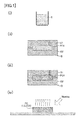
- FIG. 1 schematically shows an embodiment of the production method of the present invention.
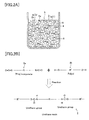
- FIG. 2A is a schematic cross-sectional view showing the components of the slurry S shown in FIG. 1 .
- a powder molded product (ceramic green product) PC is produced through the below-described procedure.
- Step 1 slurry preparation step
- a slurry S is prepared from, as essential components, a powdery ceramic raw material 1 (which may contain two or more ceramic raw materials 1 a, 1b, etc. as shown in FIG. 2A ); an isocyanate 2a and a polyol 2b, serving as binder precursors; a catalyst 3; and a dispersion medium 4.
- the ceramic raw material 1 is dispersed in the dispersion medium 4.
- the isocyanate 2a, the polyol 2b, and the catalyst 3 are dissolved in the dispersion medium 4.
- a dispersant 5 is added for the purpose of reliably and uniformly dispersing the ceramic raw material 1 (1 a, 1 b) in the dispersion medium 4.
- a pseudo-plasticity-imparting agent 6 (may be also referred to as a "rheology-controlling agent”) is added to the slurry S, which pseudo-plasticity-imparting agent imparting to the slurry low viscosity suitable for molding (at high shear rate), and high viscosity in a static state after molding (at low shear rate).
- the pseudo-plasticity-imparting agent 6 is added to the slurry S so the slurry exhibits a viscosity of 1,000 cP or less at a shear rate of 20 sec -1 or more, and a viscosity of 5,000 cP or more (more preferably 20,000 cP or more) at a shear rate of 1 sec -1 or less (the type and amount of the pseudo-plasticity-imparting agent 6 will be described hereinbelow).
- Step 2 molding step
- the slurry S prepared through step 1 is molded, through a well-known molding method, into a primary powder molded product PC1 having a specific shape (see (ii) of FIG. 1 ).
- the slurry S exhibits good fluidity suitable for molding into a complex shape by shear force applied thereto during molding.
- the primary powder molded product PC1 is suitably molded.
- the primary powder molded product PC1 produced through the aforementioned molding method is allowed to stand at ambient temperature (see (iii) of FIG. 1 ).
- chemical reaction between the isocyanate 2a and the polyol 2b (urethane reaction: see FIG. 2B ) proceeds, whereby a urethane resin 2 serving as an organic binder is produced, and the slurry S forming the primary powder molded product PC1 solidifies (gelates).
- the slurry S which forms the primary powder molded product PC1 is allowed to stand at start of gelation and exhibits high viscosity. Therefore, sedimentation of the ceramic raw material 1 during gelation can be effectively prevented.
- the slurry contains two or more ceramic raw materials 1 a, 1b, ⁇ , segregation due to difference in specific weight can be effectively prevented.
- the molded product is released from a mold and heated in a dryer for a specific period of time (see (iv) of FIG. 1 ). With this heating, the dispersion medium 4 is removed through evaporation.
- the primary powder molded product PC1 is dried and solidified under heating, to thereby produce a powder molded product PC containing the ceramic raw material 1 (1a, 1b), the urethane resin 2, the catalyst 3, the dispersant 5, and the pesudo-plasticity-imparting agent 6.
- the organic components (e.g., the urethane resin 2, the catalyst 3, the dispersant 5, and the pesudo-plasticity-imparting agent 6) contained in the powder molded product PC are removed through, for example, decomposition or scattering during sintering performed subsequent to the drying-solidification step.
- the ceramic raw material 1 (1a, 1b) corresponding to the "molding raw material" of the present invention may be an oxide ceramic material or a non-oxide ceramic material.
- the ceramic raw material employed may be metal compound powder (e.g., ZrO 2 , Al 2 O 3 , NiO, ZnO, MgO, CaO, SnO 2 , SiO 2 , Y 2 O 3 , Fe 2 O 3 , Co 3 O 4 , BaTiO 3 , SrTiO 3 , PZT, SiC, TiC, Si 3 N 4 , TiN, or AIN) which forms a ceramic material having an intended composition through sintering.
- the particle size of the ceramic raw material 1 (1a, 1b) so long as the slurry S can be prepared (i.e., the ceramic raw material can be dispersed in the dispersion medium 4 in a stable state).
- the isocyanate 2a is a substance having an isocyanate group as a functional group (a polyisocyanate having a plurality of isocyanate groups as exemplified in the drawings may be particularly preferably employed).
- a polyisocyanate having a plurality of isocyanate groups as exemplified in the drawings may be particularly preferably employed.
- tolylene diisocyanate (TDI), diphenylmethane diisocyanate (MDI), or a modified product thereof may be employed.
- an isocyanate having, in the molecule thereof, a reactive functional group other than an isocyanate group may be employed.
- polyol 2b No particular limitation is imposed on the polyol 2b, so long as it is a substance having, as a functional group, a plurality of alcoholic hydroxyl groups.
- ethylene glycol (EG), polyethylene glycol (PEG), propylene glycol (PG), polypropylene glycol (PPG), polytetramethylene ether glycol (PTMG), polyhexamethylene glycol (PHMG), or polyvinyl butyral (PVB) may be employed.
- the catalyst 3 is a substance which promotes urethane reaction.
- triethylenediamine, hexanediamine, or 6-dimethylamino-1-hexanol may be employed.
- the dispersion medium 4 is a substance which dissolves the isocyanate 2a, the polyol 2b, the catalyst 3, and the dispersant 5, and which has a molecular weight of 150 or more (more preferably 160 or more).
- esters such as dimethyl glutarate, triacetin, ethylene glycol monobutyl ether acetate, diethylene glycol monobutyl ether acetate, or propylene glycol monomethyl ether acetate may be employed.
- a substance having two or more ester bonds such as a polybasic acid ester (e.g., dimethyl glutarate) or an acid ester of a polyhydric alcohol (e.g., triacetin) may be employed.
- a polybasic acid ester e.g., dimethyl glutarate
- an acid ester of a polyhydric alcohol e.g., triacetin
- the dispersant 5 may be, for example, a polycarboxylic acid copolymer, a polycarboxylate, a sorbitan fatty acid ester, a polyglycerin fatty acid ester, a phosphate copolymer, a sulfonate copolymer, or a polyurethane-polyester copolymer having tertiary amine. Particularly preferably, for example, a polycarboxylic acid copolymer or a polycarboxylate may be employed. Addition of the dispersant 5 can reduce the viscosity of the slurry S and impart high fluidity thereto before molding of the slurry S.
- the pseudo-plasticity-imparting agent 6 is a known compound, and a variety of products are available on the market.
- modified acrylic agents, modified urea agents, or polyamide agents may be appropriately employed, depending on the type of the dispersion medium 4 or the like.
- Specific examples of the pseudo-plasticity-imparting agent 6 employed include SN Thickener 630, SN Thickener 634, SN Thickener 641, SN Thickener 4050 (products of San Nopco Limited), BYK-410, BYK-425, and BYK-430 (products of BYK).
- FIG. 1 represents a step of injecting the slurry S into a cavity provided between an upper die block D1 and a lower die block D2 of a die D.
- the primary powder molded product PC1 produced through this step contains at least the ceramic material 1 (1 a, 1 b), the isocyanate 2a, the polyol 2b, the catalyst 3, the dispersion medium 4, the dispersant 5, and the pseudo-plasticity-imparting agent 6.
- the molded product may contain the urethane resin 2, which is produced through reaction between a portion of the isocyanate 2a and a portion of the polyol 2b. That is, urethane reaction may partially proceed during step 1 and/or step 2.
- step 3 drying-solidification step
- step 3 may be divided into two steps; i.e., a gelation step of mainly allowing gelation (solidification) of the slurry to proceed by promoting the chemical reaction (see (iii) of FIG. 1 ), and a drying step of mainly removing the dispersion medium through evaporation (see (iv) of FIG. 1 ).
- the gelation step is carried out before removal of the primary powder molded product PC1 from the die D.
- the dispersion medium remaining in the primary powder molded product PC1 released through the mold-releasing step is removed through evaporation in the subsequent drying step.
- Urethane precursors (5 parts by weight) and a catalyst (0.2 parts by weight) were added to and further mixed with the secondary mixture, followed by defoaming under vacuum, to thereby prepare a ceramic slurry having pseudo-plasticity.
- the urethane precursors (binder precursors) employed were an isocyanate and a polyol.
- the isocyanate was 4,4'-diphenylmethane diisocyanate, and the polyol was ethylene glycol (EG).
- the ceramic slurry was formed, through the aforementioned injection molding method, into a primary powder molded product having a square shape (100 mm x 100 mm) and a thickness of 2 mm. After completion of molding, the primary powder molded product was allowed to stand at ambient temperature for two hours, and then released from the molding die, followed by sufficient drying and solidification in a dryer under heating at 80°C for 12 hours, to thereby produce a ceramic green molded product.
- Table 1 shows experimental results of the relationship among the amount of the pseudo-plasticity-imparting agent added (% by mass, with respect to 100 parts by mass of ceramic powder mixture), the compositional segregation and the viscosity at shear rates 1 sec -1 and 20 sec -1 .
- the amount of pseudo-plasticity-imparting agent added [wt.%] is 0.5
- the amount of added pseudo-plasticity-imparting agent is 0.5 parts by weight.
- the “compositional segregation [wit.%]” was calculated from the difference between the element composition of the top surface of the sintered ceramic green product and that of the bottom surface of the same product. The top and bottom surfaces were buffed, and the element composition was determined through X-ray fluorescence.
- the compositional segregation was more effectively prevented. Particularly when the amount was 1.0 or more, the compositional segregation was remarkably effectively prevented. That is, the compositional segregation at the addition amount of 1.0 was about the half that at the addition amount of 0.5 or less. When the addition amount was 2.0, the compositional segregation was about 1/10, which is remarkably excellent.
- the viscosity at a shear rate of 20 sec -1 was 800 cP (this was measured by means of a viscometer DV-III+ (BROOKFIELD)), and the viscosity at a shear rate of 1 sec -1 was 5,000 cP.
- the viscosity at a shear rate of 20 sec -1 was 1,000 cP
- the viscosity at a shear rate of 1 sec -1 was 20,200 cP.
- the viscosity at a shear rate of 20 sec -1 increased (2,700 cP).
- the pressure required for casting is elevated, making uniform and continuous casting difficult.
- the surface of the molded product becomes to have wavy form, and difficulty is encountered in producing a molded product having a smooth surface.
- the urethane precursors are not limited to the aforementioned specific examples.
- the polyol employed may have another functional group (e.g., a carboxyl group or an amino group) capable of reacting with an isocyanate group.
- a substance having, for example, the aforementioned carboxyl groupp or amino group may have one alcoholic hydroxyl group.
- a blocking agent may be added to the slurry, or the urethane precursors (e.g., isocyanate) may be provided with a blocking effect.
- the present invention is not limited to the case where two or more ceramic raw materials 1 a, 1b, etc. are contained as shown in FIG. 2A .
- the organic binder employed is not limited to a urethane resin.
- a well-known reaction other than urethane reaction e.g., radical polymerization
- step 3 drying-solidification step
- step 2 and step 3 may be carried out separately (i.e., so as not to overlap with each other).
- Step 3 may be a step of performing solidification and drying at one time through heating.
- step 3 may be carried out at ambient temperature without performing heating. That is, the chemical reaction for producing the organic binder may be promoted by a reaction promoter and application of energy other than thermal energy.
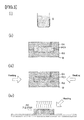
- FIG. 3 schematically shows a modification of the embodiment of the production method shown in FIG. 1 .
- gelation can be further promoted by heating a primary powder molded product PC1 in a die D.
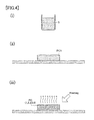
- FIG. 4 schematically shows another modification of the embodiment of the production method shown in FIG. 1 .
- step 2 molding step is a step of molding a slurry S into a thin-film-like product through the doctor blade method.
Landscapes
- Chemical & Material Sciences (AREA)
- Engineering & Computer Science (AREA)
- Ceramic Engineering (AREA)
- Manufacturing & Machinery (AREA)
- Organic Chemistry (AREA)
- Materials Engineering (AREA)
- Structural Engineering (AREA)
- Inorganic Chemistry (AREA)
- Chemical Kinetics & Catalysis (AREA)
- Polymers & Plastics (AREA)
- Health & Medical Sciences (AREA)
- Medicinal Chemistry (AREA)
- Mechanical Engineering (AREA)
- Dispersion Chemistry (AREA)
- Polyurethanes Or Polyureas (AREA)
- Compositions Of Oxide Ceramics (AREA)
Abstract
Description
- The present invention relates to a method for producing a powder molded product from a slurry containing a powdery molding raw material, and to a powder molded product produced through molding of the slurry.
- There have been known various methods for producing such a molded product. Among these methods, widely employed is a method in which a primary powder molded product (a preliminary molded product differing from the below-described "green product," which is a final powder molded product just before sintering) is formed through a widely known method such as injection molding or sheet molding from a slurry containing raw material powder, an organic binder, and a dispersion medium, and the primary powder molded product is dry-solidified to thereby produce an unsintered powder molded product (hereinafter referred to as a "green product") (see, for example, Japanese Patent Application Laid-Open (kokai) No.
H08-238613 - Such a conventionally well-known production method poses a problem in that difficulty is encountered in producing molded products of complex shapes and that when the green product is formed through dry-solidification, relatively large shrinkage occurs in the green product. Hereinafter such shrinkage may be referred to as "drying shrinkage". Such drying shrinkage is mainly caused by a reduction in distance between organic binder molecules associated with volatilization of a dispersion medium. When relatively large shrinkage occurs, naturally, a large "variation" occurs in the degree of shrinkage (hereinafter may be referred to as "percent drying shrinkage"). When the percent drying shrinkage of a green product is high, or the "variation" of the percent drying shrinkage is large, a final molded product produced through sintering of the green product exhibits poor dimensional accuracy.
- In order to solve such a problem, the present applicant previously proposed a method for producing a powder molded product (green product) through so-called "gel cast molding" (see, for example, Japanese Patent Application Laid-Open (kokai) No.
H11-48222 H11-302302, 2001-335371, 2010-241129 WO 2009/104703 ). The production method disclosed in International PublicationWO 2009/104703 includes the following steps: (1) preparing a slurry containing raw material powder, an isocyanate, a polyol, a urethane reaction catalyst, a dispersion medium, and a dispersant; (2) molding the slurry into a product through any technique; and (3) dry-solidifying the resultant slurry molded product. - In such a production method, when the slurry molded product is dry-solidified, a urethane resin serving as an organic binder is produced through chemical reaction (urethane reaction) between unreacted isocyanate and polyol, resulting in gelation (solidification) of the slurry.
- Through gel cast molding, molded products of complex shapes can easily be produced, since a slurry which is not gelled and has high fluidity is cast-molded and through gelation after cast molding, a green product having a sufficient strength for enduring a handling after mold releasing. As this gelation proceeds, cross-linking occurs between adjacent urethane resin molecules of urethane groups (-O-CO-NH-) so as to link the urethane groups in the molecules to each other. This cross-linking forms a strong network between urethane resin molecules. Therefore, even when volatilization of the dispersion medium proceeds, the distance between urethane resin molecules is less likely to be reduced, and thus the molded product exhibits low percent drying shrinkage.
- However, the aforementioned gel cast molding method requires a gelation (curing) time sufficient for attaining gelation to such an extent that a green product endures a mold releasing process and a handling after mold releasing. Therefore, in a conventional gel cast molding method, segregation in composition of a slurry due to difference in specific weight of slurry ingredients (i.e., a heavier component sediments) may occur during curing. When such compositional segregation occur, the obtained molded products have varied or deteriorated characteristics. Particularly in the case where the raw material powder is formed from a plurality of components (e.g. a plurality of powdered ceramic materials or powders of the same ceramic material having different particle sizes), the aforementioned compositional segregation readily occurs.
- The present invention has been conceived in order to solve the aforementioned problems. Thus, an object of the present invention is to produce a powder molded product (green product) having excellent characteristics by preventing, to a minimum possible extent, compositional segregation of a slurry due to difference in specific weight of slurry components during curing in the gel cast molding method.
- The powder molded product of the present invention is produced through molding of a slurry containing a powdery molding raw material (e.g., ceramic powder, metal powder, transition metal compound powder serving as a ceramic raw material, or a powder mixture thereof), a dispersion medium for dispersing the powdery molding raw material, a dispersant for uniformly dispersing the molding raw material in the dispersion medium, a binder precursor for producing an organic binder (synthetic resin binder) through a chemical reaction, and a reaction promoter for promoting the chemical reaction. The dispersion medium is nonreactive (i.e., not directly responsible for the chemical reaction of the binder precursor), and may also serve as a solvent for the dispersant, the binder precursor, or the reaction promoter.
- The aforementioned chemical reaction may be, for example, polymerization reaction or cross-linking reaction. Therefore, the reaction promoter employed may be a catalyst or a polymerization initiator. When the chemical reaction involves urethane reaction, the binder precursor is urethane precursors (e.g., a polyol and an isocyanate) which produce a urethane resin serving as the organic binder through urethane reaction, and the reaction promoter is a urethane reaction catalyst. As used herein, the term "isocyanate" refers to a compound having an isocyanate group (-N=C=O); the term "polyol (polyhydric alcohol)" refers to a compound having a plurality of alcoholic hydroxyl groups (-OH) (including a compound having an additional functional group such as an amino group); and the term "urethane reaction" refers to polyaddition reaction between an alcoholic hydroxyl group and an isocyanate group.
- The method for producing a powder molded product of the present invention comprises:
- a slurry preparation step of preparing a slurry containing the aforementioned molding raw material, dispersion medium, dispersant, binder precursor, and reaction promoter;
- a molding step of molding the prepared slurry into a primary powder molded product having a specific shape; and
- a drying-solidification step of solidifying the slurry by promoting the aforementioned chemical reaction in the primary powder molded product, and removing, through evaporation, the dispersion medium from the primary powder molded product (as used herein, the term "drying-solidification" includes gelation and curing). Meanwhile, a first molding raw material and a second molding raw material different from the first molding raw material may be contained in the molding raw material.
- The powder molded product of the present invention is produced by molding a slurry containing the aforementioned molding raw material, dispersion medium, dispersant, binder precursor, and reaction promoter.
- One characteristic feature of the present invention resides in that a pseudo-plasticity-imparting agent for imparting pseudo-plasticity to a slurry is added to the slurry. As used herein, the term "pseudo-plasticity" refers to a viscosity-related property of a material as follows. That is, when a low shear rate is imparted to the slurry, the slurry exhibits high viscosity, whereas when the shear rate increases, the viscosity drastically decreases (see Japanese Patent Application Laid-Open (kokai) No.
H10-130076 - The slurry which is subjected to the molding step may contain the organic binder which has already been produced from the binder precursor through the chemical reaction. That is, the organic binder may be partially produced from the binder precursor before the drying-solidification step. The drying-solidification step may be divided into two steps; i.e., a solidification step of mainly solidifying the slurry by promoting the chemical reaction, and a drying step of mainly removing the dispersion medium through evaporation. In this case, there may be provided, between the solidification step and the drying step, a mold-releasing step of releasing the solidified primary powder molded product from a mold (e.g., a die). The dispersion medium remaining in the primary powder molded product released through the mold-releasing step (which has been solidified through the solidification step) is removed through evaporation in the subsequent drying step.
- Also, the drying-solidification step may be a step of heating the primary powder molded product. The heating step may be partially carried out during the molding step. That is, the primary powder molded product may be heated in a mold or molding machine employed in the molding step.
- According to the present invention, through the drying-solidification step, the slurry gelates (solidifies), in the primary powder molded product produced from the slurry, through production of the organic binder from the binder precursor by the action of the reaction promoter, and the dispersion medium is removed through evaporation from the molded product. In the drying-solidification step, a urethane resin serving as the organic binder may be produced through urethane reaction between a polyol and an isocyanate.
- According to the present invention, pseudo-plasticity is imparted to a composite slurry (containing an organic component and/or a plurality of raw materials) subjected to for gel cast molding and as a result, the slurry exhibits low viscosity suitable for molding due to high shear rate, whereas when the slurry is allowed to stand after the molding process, the slurry exhibits high viscosity due to low shear rate. Thus, according to the present invention, compositional segregation of the slurry due to difference in specific weight of slurry components can be effectively prevented, while excellent molding performance is maintained.
- In order to maintain excellent molding performance, the viscosity of the slurry is preferably 1,000 cP or less during molding. However, when the viscosity of the slurry during molding is excessively low, difficulty is encountered in handling of the slurry (e.g., impairment of dispersion stability of slurry, leakage of slurry from the cast during casting, etc.). On the other hand, the viscosity in a static state is preferably 5,000 cP or more (more preferably 20,000 cP or more) from the viewpoint of effectively preventing compositional segregation.
- Thus, the aforementioned slurry is preferably prepared so as to exhibit a viscosity (in a static state) of 5,000 cP or more at a shear rate of 1 sec-1 or less, and a viscosity (in molding) of 1,000 cP or less at a shear rate of 20 sec-1 or more. In this case, specifically, the pseudo-plasticity-imparting agent in an amount of 1 part by weight or more and less than 3 parts by weight is added to the molding raw material in an amount of 100 parts by weight.
- More preferably, the aforementioned slurry is prepared so as to exhibit a viscosity of 20,000 cP or more at a shear rate of 1 sec-1 or less, and a viscosity of 1,000 cP or less at a shear rate of 20 sec-1 or more. In this case, specifically, the pseudo-plasticity-imparting agent in an amount of 2 parts by weight or more and less than 3 parts by weight is added to the molding raw material in an amount of 100 parts by weight.
- As described above, according to the present invention, a powder molded product (green product) having excellent characteristics can be produced by preventing, to a minimum possible extent, compositional segregation of a slurry due to difference in specific weight of slurry components during curing in the gel cast molding method.
-
- [
FIG. 1] FIG. 1 schematically shows an embodiment of the production method of the present invention. - [
FIG. 2A] FIG. 2A is a schematic cross-sectional view of the components of the slurry shown inFIG. 1 . - [
FIG. 2B] FIG. 2B schematically shows a chemical reaction for producing a urethane resin serving as an organic binder from binder precursors, which are components of the slurry shown inFIG. 2A . - [
FIG. 3] FIG. 3 schematically shows a modification of the embodiment of the production method shown inFIG. 1 . - [
FIG. 4] FIG. 4 schematically shows another modification of the embodiment of the production method shown inFIG. 1 . - Preferred embodiments of the present invention will next be described with reference to examples and comparative examples. The following description of the embodiments is nothing more than the specific description of mere example embodiments of the present invention to the possible extent in order to fulfill description requirements (descriptive requirement and enabling requirement) of specifications required by law.
- Thus, as will be described later, naturally, the present invention is not limited to the specific configurations of embodiments and examples to be described below. Modifications that can be made to the embodiments and examples are collectively described herein principally at the end, since insertion thereof into the description of the embodiments would disturb understanding of consistent description of the embodiments.
-
FIG. 1 schematically shows an embodiment of the production method of the present invention.FIG. 2A is a schematic cross-sectional view showing the components of the slurry S shown inFIG. 1 . Referring toFIGs. 1 and2A , in this embodiment, a powder molded product (ceramic green product) PC is produced through the below-described procedure. - A slurry S is prepared from, as essential components, a powdery ceramic raw material 1 (which may contain two or more ceramic
raw materials FIG. 2A ); anisocyanate 2a and apolyol 2b, serving as binder precursors; acatalyst 3; and adispersion medium 4. The ceramicraw material 1 is dispersed in thedispersion medium 4. Theisocyanate 2a, thepolyol 2b, and thecatalyst 3 are dissolved in thedispersion medium 4. In this case, adispersant 5 is added for the purpose of reliably and uniformly dispersing the ceramic raw material 1 (1 a, 1 b) in thedispersion medium 4. - In the present embodiment, a pseudo-plasticity-imparting agent 6 (may be also referred to as a "rheology-controlling agent") is added to the slurry S, which pseudo-plasticity-imparting agent imparting to the slurry low viscosity suitable for molding (at high shear rate), and high viscosity in a static state after molding (at low shear rate). Specifically, the pseudo-plasticity-imparting
agent 6 is added to the slurry S so the slurry exhibits a viscosity of 1,000 cP or less at a shear rate of 20 sec-1 or more, and a viscosity of 5,000 cP or more (more preferably 20,000 cP or more) at a shear rate of 1 sec-1 or less (the type and amount of the pseudo-plasticity-impartingagent 6 will be described hereinbelow). - The slurry S prepared through
step 1 is molded, through a well-known molding method, into a primary powder molded product PC1 having a specific shape (see (ii) ofFIG. 1 ). The slurry S exhibits good fluidity suitable for molding into a complex shape by shear force applied thereto during molding. Thus, the primary powder molded product PC1 is suitably molded. - The primary powder molded product PC1 produced through the aforementioned molding method is allowed to stand at ambient temperature (see (iii) of
FIG. 1 ). Thus, chemical reaction between theisocyanate 2a and thepolyol 2b (urethane reaction: seeFIG. 2B ) proceeds, whereby aurethane resin 2 serving as an organic binder is produced, and the slurry S forming the primary powder molded product PC1 solidifies (gelates). At this time, the slurry S which forms the primary powder molded product PC1 is allowed to stand at start of gelation and exhibits high viscosity. Therefore, sedimentation of the ceramicraw material 1 during gelation can be effectively prevented. Particularly when the slurry contains two or more ceramicraw materials - Thereafter, the molded product is released from a mold and heated in a dryer for a specific period of time (see (iv) of
FIG. 1 ). With this heating, thedispersion medium 4 is removed through evaporation. Thus, the primary powder molded product PC1 is dried and solidified under heating, to thereby produce a powder molded product PC containing the ceramic raw material 1 (1a, 1b), theurethane resin 2, thecatalyst 3, thedispersant 5, and the pesudo-plasticity-impartingagent 6. The organic components (e.g., theurethane resin 2, thecatalyst 3, thedispersant 5, and the pesudo-plasticity-imparting agent 6) contained in the powder molded product PC are removed through, for example, decomposition or scattering during sintering performed subsequent to the drying-solidification step. - Next will be described the respective steps in more detail.
- The ceramic raw material 1 (1a, 1b) corresponding to the "molding raw material" of the present invention may be an oxide ceramic material or a non-oxide ceramic material. For example, the ceramic raw material employed may be metal compound powder (e.g., ZrO2, Al2O3, NiO, ZnO, MgO, CaO, SnO2, SiO2, Y2O3, Fe2O3, Co3O4, BaTiO3, SrTiO3, PZT, SiC, TiC, Si3N4, TiN, or AIN) which forms a ceramic material having an intended composition through sintering. No particular limitation is imposed on the particle size of the ceramic raw material 1 (1a, 1b), so long as the slurry S can be prepared (i.e., the ceramic raw material can be dispersed in the
dispersion medium 4 in a stable state). - No particular limitation is imposed on the
isocyanate 2a, so long as it is a substance having an isocyanate group as a functional group (a polyisocyanate having a plurality of isocyanate groups as exemplified in the drawings may be particularly preferably employed). Specifically, for example, tolylene diisocyanate (TDI), diphenylmethane diisocyanate (MDI), or a modified product thereof may be employed. Alternatively, an isocyanate having, in the molecule thereof, a reactive functional group other than an isocyanate group may be employed. - No particular limitation is imposed on the
polyol 2b, so long as it is a substance having, as a functional group, a plurality of alcoholic hydroxyl groups. For example, ethylene glycol (EG), polyethylene glycol (PEG), propylene glycol (PG), polypropylene glycol (PPG), polytetramethylene ether glycol (PTMG), polyhexamethylene glycol (PHMG), or polyvinyl butyral (PVB) may be employed. - No particular limitation is imposed on the
catalyst 3, so long as it is a substance which promotes urethane reaction. For example, triethylenediamine, hexanediamine, or 6-dimethylamino-1-hexanol may be employed. - No particular limitation is imposed on the
dispersion medium 4, so long as it is a substance which dissolves theisocyanate 2a, thepolyol 2b, thecatalyst 3, and thedispersant 5, and which has a molecular weight of 150 or more (more preferably 160 or more). For example, esters (such as dimethyl glutarate, triacetin, ethylene glycol monobutyl ether acetate, diethylene glycol monobutyl ether acetate, or propylene glycol monomethyl ether acetate) may be employed. Particularly preferably, a substance having two or more ester bonds, such as a polybasic acid ester (e.g., dimethyl glutarate) or an acid ester of a polyhydric alcohol (e.g., triacetin) may be employed. - The
dispersant 5 may be, for example, a polycarboxylic acid copolymer, a polycarboxylate, a sorbitan fatty acid ester, a polyglycerin fatty acid ester, a phosphate copolymer, a sulfonate copolymer, or a polyurethane-polyester copolymer having tertiary amine. Particularly preferably, for example, a polycarboxylic acid copolymer or a polycarboxylate may be employed. Addition of thedispersant 5 can reduce the viscosity of the slurry S and impart high fluidity thereto before molding of the slurry S. - The pseudo-plasticity-imparting
agent 6 is a known compound, and a variety of products are available on the market. For example, modified acrylic agents, modified urea agents, or polyamide agents may be appropriately employed, depending on the type of thedispersion medium 4 or the like. Specific examples of the pseudo-plasticity-impartingagent 6 employed include SN Thickener 630, SN Thickener 634, SN Thickener 641, SN Thickener 4050 (products of San Nopco Limited), BYK-410, BYK-425, and BYK-430 (products of BYK). - (ii) of
FIG. 1 represents a step of injecting the slurry S into a cavity provided between an upper die block D1 and a lower die block D2 of a die D. The primary powder molded product PC1 produced through this step contains at least the ceramic material 1 (1 a, 1 b), theisocyanate 2a, thepolyol 2b, thecatalyst 3, thedispersion medium 4, thedispersant 5, and the pseudo-plasticity-impartingagent 6. The molded product may contain theurethane resin 2, which is produced through reaction between a portion of theisocyanate 2a and a portion of thepolyol 2b. That is, urethane reaction may partially proceed duringstep 1 and/orstep 2. - As gelation proceeds, cross-linking occurs between molecules of the
urethane resin 2 so as to link urethane groups (-O-CO-NH-) in the molecules to each other. This cross-linking forms a strong network between molecules of theurethane resin 2. Therefore, even when thedispersion medium 4 remaining in the primary powder molded product PC1 volatilizes under heating, reduction of the distance between molecules of theurethane resin 2 is suppressed to a minimum possible extent. Thus, when the powder molded product PC is produced from the primary powder molded product PC1 throughstep 3, percent drying shrinkage and the variation thereof can be reduced to a minimum possible extent. - As shown in
FIG. 1 , step 3 (drying-solidification step) may be divided into two steps; i.e., a gelation step of mainly allowing gelation (solidification) of the slurry to proceed by promoting the chemical reaction (see (iii) ofFIG. 1 ), and a drying step of mainly removing the dispersion medium through evaporation (see (iv) ofFIG. 1 ). In this case, the gelation step is carried out before removal of the primary powder molded product PC1 from the die D. In addition, there is carried out, between the gelation step and the drying step, a mold-releasing step of releasing the primary powder molded product PC1 from the die D, the molded product PC being stable in shape attributed to gelation even after having been released from the die D. The dispersion medium remaining in the primary powder molded product PC1 released through the mold-releasing step is removed through evaporation in the subsequent drying step. - Next, a specific embodiment of the aforementioned production method will be described, along with the evaluation thereof.
- A mixture of NiO powder and Y2O3 powder (NiO : Y2O3 (mol) = 2 : 1) (100 parts by weight), a polycarboxylic acid copolymer serving as a dispersant (3 parts by weight), and a mixture of triacetin and organic acid dibasic ester (mixture rate is 1 : 9) serving as a dispersion medium (28 parts by weight) were mixed together by means of a ball mill for 14 hours. Then, a predetermined amount (see the below description) of BYK-430, product of BYK serving as a pseudo-plasticity-imparting agent was added to the thus-obtained primary mixture to thereby produce a secondary mixture. Urethane precursors (5 parts by weight) and a catalyst (0.2 parts by weight) were added to and further mixed with the secondary mixture, followed by defoaming under vacuum, to thereby prepare a ceramic slurry having pseudo-plasticity. The urethane precursors (binder precursors) employed were an isocyanate and a polyol. The isocyanate was 4,4'-diphenylmethane diisocyanate, and the polyol was ethylene glycol (EG).
- The ceramic slurry was formed, through the aforementioned injection molding method, into a primary powder molded product having a square shape (100 mm x 100 mm) and a thickness of 2 mm. After completion of molding, the primary powder molded product was allowed to stand at ambient temperature for two hours, and then released from the molding die, followed by sufficient drying and solidification in a dryer under heating at 80°C for 12 hours, to thereby produce a ceramic green molded product.
- Table 1 shows experimental results of the relationship among the amount of the pseudo-plasticity-imparting agent added (% by mass, with respect to 100 parts by mass of ceramic powder mixture), the compositional segregation and the viscosity at
shear rates 1 sec-1 and 20 sec-1. In Table 1, when the amount of pseudo-plasticity-imparting agent added [wt.%] is 0.5, the amount of added pseudo-plasticity-imparting agent is 0.5 parts by weight. The "compositional segregation [wit.%]" was calculated from the difference between the element composition of the top surface of the sintered ceramic green product and that of the bottom surface of the same product. The top and bottom surfaces were buffed, and the element composition was determined through X-ray fluorescence. -
[Table 1] Pseudo-plasticity-im parting agent Amount [wt.%] 0 0.25 0.5 1.0 2.0 3.0 Compositional segregation [wt.%] 1.36 1.16 1.03 0.63 0.13 0.12 Viscosity [cP] (Shear rate: 1 sec-1) 1,500 2,300 3,100 5,000 20,200 38,100 Viscosity [cP] (Shear rate: 20 sec-1) 600 600 700 800 1,000 2,700 - As is clear from Table 1, as the amount of added pseudo-plasticity-imparting agent increased, the compositional segregation was more effectively prevented. Particularly when the amount was 1.0 or more, the compositional segregation was remarkably effectively prevented. That is, the compositional segregation at the addition amount of 1.0 was about the half that at the addition amount of 0.5 or less. When the addition amount was 2.0, the compositional segregation was about 1/10, which is remarkably excellent. In the case where the addition amount was 1.0, the viscosity at a shear rate of 20 sec-1 was 800 cP (this was measured by means of a viscometer DV-III+ (BROOKFIELD)), and the viscosity at a shear rate of 1 sec-1 was 5,000 cP. Also, the case where the addition amount was 2.0, the viscosity at a shear rate of 20 sec-1 was 1,000 cP, and the viscosity at a shear rate of 1 sec-1 was 20,200 cP.
- However, the case where the addition amount was 3.0, the viscosity at a shear rate of 20 sec-1 increased (2,700 cP). In this case, the pressure required for casting is elevated, making uniform and continuous casting difficult. As a result, the surface of the molded product becomes to have wavy form, and difficulty is encountered in producing a molded product having a smooth surface.
- The above-described embodiment and specific examples are, as mentioned above, mere examples of the best mode of the present invention which the applicant of the present invention contemplated at the time of filing the present application. The above-described embodiment and specific examples should not be construed as limiting the invention. Various modifications to the above-described embodiment and specific examples are possible, so long as the invention is not modified in essence.
- Several modifications will next be exemplified. In the following description of the modifications, component members similar in structure and function to those of the above-described embodiment are denoted by names and reference numerals similar to those of the above-described embodiment. The description of the component members appearing in the above description of the embodiment can be applied as appropriate, so long as no inconsistencies are involved.
- Needless to say, even modifications are not limited to those described below. Limitingly construing the present invention based on the above-described embodiment and the following modifications impairs the interests of an applicant (particularly, an applicant who is motivated to file as quickly as possible under the first-to-file system) while unfairly benefiting imitators, and is thus impermissible.
- The structure of the above-described embodiment and the structures of the modifications to be described below are entirely or partially applicable in appropriate combination, so long as no technical inconsistencies are involved.
- The urethane precursors are not limited to the aforementioned specific examples. For example, the polyol employed may have another functional group (e.g., a carboxyl group or an amino group) capable of reacting with an isocyanate group. Alternatively, in place of or together with the polyol, there may be employed a substance having, for example, the aforementioned carboxyl groupp or amino group (the substance may have one alcoholic hydroxyl group). In order to suppress the progress of urethane reaction before molding, a blocking agent may be added to the slurry, or the urethane precursors (e.g., isocyanate) may be provided with a blocking effect.
- The present invention is not limited to the case where two or more ceramic
raw materials FIG. 2A . In other words, even when one ceramicraw material 1 is contained, compositional segregation of the slurry due to difference in specific weight between ceramic raw material and organic component can be prevented to a minimum possible degree according to the present invention. The organic binder employed is not limited to a urethane resin. A well-known reaction other than urethane reaction (e.g., radical polymerization) may be suitably employed as the chemical reaction for producing the organic binder. - As described in the aforementioned specific examples, a portion of step 3 (drying-solidification step) may be carried out almost in parallel with
step 2. Alternatively, theentire step 3 may be carried out almost in parallel withstep 2. Alternatively,step 2 andstep 3 may be carried out separately (i.e., so as not to overlap with each other). -
Step 3 may be a step of performing solidification and drying at one time through heating. Alternatively,step 3 may be carried out at ambient temperature without performing heating. That is, the chemical reaction for producing the organic binder may be promoted by a reaction promoter and application of energy other than thermal energy. -
FIG. 3 schematically shows a modification of the embodiment of the production method shown inFIG. 1 . As shown in (iii) ofFIG. 3 , in this modification, gelation can be further promoted by heating a primary powder molded product PC1 in a die D. -
FIG. 4 schematically shows another modification of the embodiment of the production method shown inFIG. 1 . As shown in (ii) ofFIG. 4 , in this modification, step 2 (molding step) is a step of molding a slurry S into a thin-film-like product through the doctor blade method. - Needless to say, those modifications which are not particularly referred to are also encompassed in the technical scope of the present invention, so long as the invention is not modified in essence.
- Those components which partially constitute means for solving the problems to be solved by the present invention and are illustrated with respect to operations and functions encompass not only the specific structures disclosed above in the description of the above embodiment and modifications but also any other structures that can implement the operations and functions. Further, the contents (including specifications and drawings) of the prior application and publications cited herein can be incorporated herein as appropriate by reference.
Claims (14)
- A method for producing a powder molded product comprising:a slurry preparation step of preparing a slurry containing a powdery molding raw material, a dispersion medium for dispersing the molding raw material, a dispersant for uniformly dispersing the molding raw material in the dispersion medium, a binder precursor for producing an organic binder, which is a synthetic resin, through a chemical reaction, and a reaction promoter for promoting the chemical reaction;a molding step of molding the prepared slurry into a primary powder molded product having a specific shape; anda drying-solidification step of solidifying the slurry by promoting the aforementioned chemical reaction in the primary powder molded product, and removing, through evaporation, the dispersion medium from the primary powder molded product,wherein the slurry contains a pseudo-plasticity-imparting agent for imparting pseudo-plasticity to the slurry.
- A method for producing a powder molded product according to claim 1, wherein the slurry is prepared so as to exhibit a viscosity of 5,000 cP or more at a shear rate of 1 sec-1 or less, and a viscosity of 1,000 cP or less at a shear rate of 20 sec-1 or more.
- A method for producing a powder molded product according to claim 2, wherein the slurry contains the pseudo-plasticity-imparting agent in an amount of 1 part by weight or more and less than 3 parts by weight with respect to 100 parts by weight of the molding raw material.
- A method for producing a powder molded product according to any of claims 2 and 3, wherein the slurry is prepared so as to exhibit a viscosity of 20,000 cP or more at a shear rate of 1 sec-1 or less.
- A method for producing a powder molded product according to claim 4, wherein the slurry contains the pseudo-plasticity-imparting agent in an amount of 2 part by weight or more and less than 3 parts by weight with respect to 100 parts by weight of the molding raw material.
- A method for producing a powder molded product according to any of claims 1 to 5, wherein, in the drying-solidification step, a urethane resin serving as the organic binder is produced through urethane reaction.
- A method for producing a powder molded product according to any of claims 1 to 6, wherein the molding raw material contains a first molding raw material and a second molding raw material which differs from the first molding raw material.
- A powder molded product produced through molding of a slurry containing a powdery molding raw material, a dispersion medium for dispersing the molding raw material, a dispersant for uniformly dispersing the molding raw material in the dispersion medium, a binder precursor for producing an organic binder, which is a synthetic resin, through a chemical reaction, and a reaction promoter for promoting the chemical reaction, wherein the slurry contains a pseudo-plasticity-imparting agent.
- A powder molded product according to claim 8, wherein the slurry is prepared so as to exhibit a viscosity of 5,000 cP or more at a shear rate of 1 sec-1 or less, and a viscosity of 1,000 cP or less at a shear rate of 20 sec-1 or more.
- A powder molded product according to claim 9, wherein the slurry contains the pseudo-plasticity-imparting agent in an amount of 1 part by weight or more and less than 3 parts by weight with respect to 100 parts by weight of the molding raw material.
- A powder molded product according to any of claims 9 and 10, wherein the slurry is prepared so as to exhibit a viscosity of 20,000 cP or more at a shear rate of 1 sec-1 or less.
- A powder molded product according to claim 11, wherein the slurry contains the pseudo-plasticity-imparting agent in an amount of 2 part by weight or more and less than 3 parts by weight with respect to 100 parts by weight of the molding raw material.
- A powder molded product according to any of claims 8 to 12, wherein the binder precursor produces a urethane resin serving as the organic binder through urethane reaction, and the reaction promoter is a urethane reaction catalyst.
- A powder molded product according to any of claims 8 to 13, wherein the molding raw material contains a first molding raw material and a second molding raw material which differs from the first molding raw material.
Applications Claiming Priority (2)
| Application Number | Priority Date | Filing Date | Title |
|---|---|---|---|
| JP2011034072 | 2011-02-21 | ||
| PCT/JP2012/052733 WO2012114865A1 (en) | 2011-02-21 | 2012-02-07 | Method for manufacturing powder compact, and powder compact |
Publications (3)
| Publication Number | Publication Date |
|---|---|
| EP2679360A1 true EP2679360A1 (en) | 2014-01-01 |
| EP2679360A4 EP2679360A4 (en) | 2015-06-03 |
| EP2679360B1 EP2679360B1 (en) | 2019-07-10 |
Family
ID=46653285
Family Applications (1)
| Application Number | Title | Priority Date | Filing Date |
|---|---|---|---|
| EP12749534.9A Active EP2679360B1 (en) | 2011-02-21 | 2012-02-07 | Method for manufacturing powder compact, and powder compact |
Country Status (4)
| Country | Link |
|---|---|
| US (1) | US9051220B2 (en) |
| EP (1) | EP2679360B1 (en) |
| JP (1) | JP5907943B2 (en) |
| WO (1) | WO2012114865A1 (en) |
Families Citing this family (3)
| Publication number | Priority date | Publication date | Assignee | Title |
|---|---|---|---|---|
| DE102013200281A1 (en) * | 2013-01-11 | 2014-07-17 | Robert Bosch Gmbh | Method for producing a receptacle for a sensor element |
| WO2014156768A1 (en) * | 2013-03-26 | 2014-10-02 | 日本碍子株式会社 | Method for drying moulded body |
| CN108947484A (en) * | 2018-09-28 | 2018-12-07 | 吴亚琴 | A kind of preparation method of ceramic dielectric printing slurry |
Family Cites Families (16)
| Publication number | Priority date | Publication date | Assignee | Title |
|---|---|---|---|---|
| JP2958037B2 (en) | 1990-03-01 | 1999-10-06 | 旭光学工業株式会社 | Method for producing porous ceramic granules |
| JPH07186116A (en) * | 1993-12-24 | 1995-07-25 | Toshiba Ceramics Co Ltd | Molding of ceramics |
| EP0857702B1 (en) | 1994-11-09 | 2000-08-23 | Ngk Insulators, Ltd. | Method for producing ceramic substrate |
| JP3256112B2 (en) | 1994-11-09 | 2002-02-12 | 日本碍子株式会社 | Ceramic green sheet and method of manufacturing ceramic substrate using the same |
| JPH10130076A (en) * | 1996-10-28 | 1998-05-19 | Toshiba Ceramics Co Ltd | Production of porous ceramic |
| JP4014256B2 (en) * | 1997-08-06 | 2007-11-28 | 日本碍子株式会社 | Powder molding method |
| JPH11302302A (en) | 1998-04-20 | 1999-11-02 | Ngk Insulators Ltd | Starch for gel cast molding and molding using the same |
| JP4536943B2 (en) | 2000-03-22 | 2010-09-01 | 日本碍子株式会社 | Method for producing powder compact |
| WO2002085590A1 (en) * | 2001-04-17 | 2002-10-31 | Ngk Insulators, Ltd. | Method of manufacturing molded body, slurry for molding, core for molding, method of manufacturing core for molding, hollow ceramic molded body, and light emitting container |
| JP2003147495A (en) * | 2001-11-05 | 2003-05-21 | Taiheiyo Cement Corp | Preparation method of preform for metal-ceramic composite material |
| JP2005193573A (en) * | 2004-01-08 | 2005-07-21 | Fujikura Kasei Co Ltd | Ceramic green sheet and manufacturing method thereof |
| WO2009016698A1 (en) * | 2007-07-27 | 2009-02-05 | Ngk Insulators, Ltd. | Ceramic powder molding, ceramic burning product, and process for producing ceramic powder molding |
| US8962749B2 (en) | 2008-02-19 | 2015-02-24 | Ngk Insulators, Ltd. | Ceramic green sheet and method for producing the same |
| EP2211358A3 (en) * | 2009-01-22 | 2012-09-05 | NGK Insulators, Ltd. | A method for manufaturing a fired ceramic body including a metallic wire inside |
| JP2010241129A (en) | 2009-03-19 | 2010-10-28 | Ngk Insulators Ltd | Method of producing powder compact |
| EP2233449B1 (en) * | 2009-03-27 | 2014-12-17 | Ivoclar Vivadent AG | Use of a slip for the production of dental ceramics with hot melt inkjet printing methods |
-
2012
- 2012-02-07 WO PCT/JP2012/052733 patent/WO2012114865A1/en not_active Ceased
- 2012-02-07 JP JP2013500939A patent/JP5907943B2/en active Active
- 2012-02-07 EP EP12749534.9A patent/EP2679360B1/en active Active
- 2012-02-09 US US13/369,664 patent/US9051220B2/en not_active Expired - Fee Related
Also Published As
| Publication number | Publication date |
|---|---|
| WO2012114865A1 (en) | 2012-08-30 |
| US20120214942A1 (en) | 2012-08-23 |
| EP2679360A4 (en) | 2015-06-03 |
| US9051220B2 (en) | 2015-06-09 |
| JPWO2012114865A1 (en) | 2014-07-07 |
| JP5907943B2 (en) | 2016-04-26 |
| EP2679360B1 (en) | 2019-07-10 |
Similar Documents
| Publication | Publication Date | Title |
|---|---|---|
| EP1136461B1 (en) | Production of powder-molded ceramic or metallic body | |
| KR101813289B1 (en) | Method for producing electrostatic chuck and electrostatic chuck | |
| JP4208580B2 (en) | Composite sintered body and manufacturing method thereof | |
| EP2679360B1 (en) | Method for manufacturing powder compact, and powder compact | |
| EP2243758B1 (en) | Ceramic green sheet and process for producing the same | |
| EP2348003B1 (en) | Method for producing a ceramic green body | |
| JP2011046002A (en) | Method for manufacturing ceramic molded body product | |
| EP2674271A1 (en) | Production method for powder compact, and powder compact | |
| EP3169640B1 (en) | Production of a slip and component composed of the slip | |
| EP2546217A1 (en) | Ceramic green body and method for producing same | |
| DE69312533T2 (en) | Reaction injection molding of silicon nitride ceramics with crystallized grain boundary phases | |
| EP3192628B1 (en) | Production of thick-walled components by means of injection moulding | |
| KR20130062597A (en) | Eco-friendly castable ceramic composition and the manufacturing method of castable ceramics | |
| JPS60200874A (en) | Manufacture of ceramic foam | |
| KR100869224B1 (en) | Ceramic Compositions and Ceramic Green Sheets Made Therefrom | |
| EP2756940A1 (en) | Composite structure, molded film and composite structure manufacturing method | |
| KR102349507B1 (en) | Ceramic Materials with open-cell structures prepared by 3D printing and hydration-setting, and Manufacturing method of the same | |
| JPH06287055A (en) | Method for manufacturing ceramics sintered body | |
| JPH11322442A (en) | Production of inorganic powder sintered compact and inorganic powder sintered compact | |
| CN1654417A (en) | Process for producing high performance aluminas ceramic wafer by gel cutting and forming method | |
| EP0670189A2 (en) | Slurry compositions for cast molding purposes, a method of molding cast moldings wherein these slurry compositions are used, and sinters wherein these moldings have been fired. | |
| JP2011213530A (en) | Manufacturing method for ceramic green body, ceramic slurry, ceramic green body, ceramic sintered compact, and electronic component containing ceramic sintered compact | |
| JPH03102704A (en) | Manufacture of ceramics wire rod |
Legal Events
| Date | Code | Title | Description |
|---|---|---|---|
| PUAI | Public reference made under article 153(3) epc to a published international application that has entered the european phase |
Free format text: ORIGINAL CODE: 0009012 |
|
| 17P | Request for examination filed |
Effective date: 20130731 |
|
| AK | Designated contracting states |
Kind code of ref document: A1 Designated state(s): AL AT BE BG CH CY CZ DE DK EE ES FI FR GB GR HR HU IE IS IT LI LT LU LV MC MK MT NL NO PL PT RO RS SE SI SK SM TR |
|
| DAX | Request for extension of the european patent (deleted) | ||
| RA4 | Supplementary search report drawn up and despatched (corrected) |
Effective date: 20150508 |
|
| RIC1 | Information provided on ipc code assigned before grant |
Ipc: C04B 35/622 20060101ALI20150429BHEP Ipc: B28B 1/00 20060101AFI20150429BHEP Ipc: B28B 11/00 20060101ALI20150429BHEP |
|
| STAA | Information on the status of an ep patent application or granted ep patent |
Free format text: STATUS: EXAMINATION IS IN PROGRESS |
|
| 17Q | First examination report despatched |
Effective date: 20180711 |
|
| RIC1 | Information provided on ipc code assigned before grant |
Ipc: C04B 35/634 20060101ALI20181212BHEP Ipc: B28B 11/00 20060101ALI20181212BHEP Ipc: C04B 35/626 20060101ALI20181212BHEP Ipc: C04B 35/632 20060101ALI20181212BHEP Ipc: C04B 35/63 20060101ALI20181212BHEP Ipc: C04B 35/622 20060101ALI20181212BHEP Ipc: C04B 35/624 20060101ALI20181212BHEP Ipc: B28B 1/00 20060101AFI20181212BHEP |
|
| GRAP | Despatch of communication of intention to grant a patent |
Free format text: ORIGINAL CODE: EPIDOSNIGR1 |
|
| STAA | Information on the status of an ep patent application or granted ep patent |
Free format text: STATUS: GRANT OF PATENT IS INTENDED |
|
| INTG | Intention to grant announced |
Effective date: 20190123 |
|
| RIN1 | Information on inventor provided before grant (corrected) |
Inventor name: NAKAGAWA, HIDEMI Inventor name: HIRAIWA, TOSHIKI |
|
| GRAS | Grant fee paid |
Free format text: ORIGINAL CODE: EPIDOSNIGR3 |
|
| GRAA | (expected) grant |
Free format text: ORIGINAL CODE: 0009210 |
|
| STAA | Information on the status of an ep patent application or granted ep patent |
Free format text: STATUS: THE PATENT HAS BEEN GRANTED |
|
| AK | Designated contracting states |
Kind code of ref document: B1 Designated state(s): AL AT BE BG CH CY CZ DE DK EE ES FI FR GB GR HR HU IE IS IT LI LT LU LV MC MK MT NL NO PL PT RO RS SE SI SK SM TR |
|
| REG | Reference to a national code |
Ref country code: GB Ref legal event code: FG4D |
|
| REG | Reference to a national code |
Ref country code: CH Ref legal event code: EP Ref country code: AT Ref legal event code: REF Ref document number: 1153045 Country of ref document: AT Kind code of ref document: T Effective date: 20190715 |
|
| REG | Reference to a national code |
Ref country code: DE Ref legal event code: R096 Ref document number: 602012061901 Country of ref document: DE |
|
| REG | Reference to a national code |
Ref country code: IE Ref legal event code: FG4D |
|
| REG | Reference to a national code |
Ref country code: NL Ref legal event code: MP Effective date: 20190710 |
|
| REG | Reference to a national code |
Ref country code: LT Ref legal event code: MG4D |
|
| REG | Reference to a national code |
Ref country code: AT Ref legal event code: MK05 Ref document number: 1153045 Country of ref document: AT Kind code of ref document: T Effective date: 20190710 |
|
| PG25 | Lapsed in a contracting state [announced via postgrant information from national office to epo] |
Ref country code: NO Free format text: LAPSE BECAUSE OF FAILURE TO SUBMIT A TRANSLATION OF THE DESCRIPTION OR TO PAY THE FEE WITHIN THE PRESCRIBED TIME-LIMIT Effective date: 20191010 Ref country code: AT Free format text: LAPSE BECAUSE OF FAILURE TO SUBMIT A TRANSLATION OF THE DESCRIPTION OR TO PAY THE FEE WITHIN THE PRESCRIBED TIME-LIMIT Effective date: 20190710 Ref country code: SE Free format text: LAPSE BECAUSE OF FAILURE TO SUBMIT A TRANSLATION OF THE DESCRIPTION OR TO PAY THE FEE WITHIN THE PRESCRIBED TIME-LIMIT Effective date: 20190710 Ref country code: BG Free format text: LAPSE BECAUSE OF FAILURE TO SUBMIT A TRANSLATION OF THE DESCRIPTION OR TO PAY THE FEE WITHIN THE PRESCRIBED TIME-LIMIT Effective date: 20191010 Ref country code: LT Free format text: LAPSE BECAUSE OF FAILURE TO SUBMIT A TRANSLATION OF THE DESCRIPTION OR TO PAY THE FEE WITHIN THE PRESCRIBED TIME-LIMIT Effective date: 20190710 Ref country code: PT Free format text: LAPSE BECAUSE OF FAILURE TO SUBMIT A TRANSLATION OF THE DESCRIPTION OR TO PAY THE FEE WITHIN THE PRESCRIBED TIME-LIMIT Effective date: 20191111 Ref country code: NL Free format text: LAPSE BECAUSE OF FAILURE TO SUBMIT A TRANSLATION OF THE DESCRIPTION OR TO PAY THE FEE WITHIN THE PRESCRIBED TIME-LIMIT Effective date: 20190710 Ref country code: HR Free format text: LAPSE BECAUSE OF FAILURE TO SUBMIT A TRANSLATION OF THE DESCRIPTION OR TO PAY THE FEE WITHIN THE PRESCRIBED TIME-LIMIT Effective date: 20190710 Ref country code: FI Free format text: LAPSE BECAUSE OF FAILURE TO SUBMIT A TRANSLATION OF THE DESCRIPTION OR TO PAY THE FEE WITHIN THE PRESCRIBED TIME-LIMIT Effective date: 20190710 |
|
| PG25 | Lapsed in a contracting state [announced via postgrant information from national office to epo] |
Ref country code: GR Free format text: LAPSE BECAUSE OF FAILURE TO SUBMIT A TRANSLATION OF THE DESCRIPTION OR TO PAY THE FEE WITHIN THE PRESCRIBED TIME-LIMIT Effective date: 20191011 Ref country code: ES Free format text: LAPSE BECAUSE OF FAILURE TO SUBMIT A TRANSLATION OF THE DESCRIPTION OR TO PAY THE FEE WITHIN THE PRESCRIBED TIME-LIMIT Effective date: 20190710 Ref country code: IS Free format text: LAPSE BECAUSE OF FAILURE TO SUBMIT A TRANSLATION OF THE DESCRIPTION OR TO PAY THE FEE WITHIN THE PRESCRIBED TIME-LIMIT Effective date: 20191110 Ref country code: RS Free format text: LAPSE BECAUSE OF FAILURE TO SUBMIT A TRANSLATION OF THE DESCRIPTION OR TO PAY THE FEE WITHIN THE PRESCRIBED TIME-LIMIT Effective date: 20190710 Ref country code: LV Free format text: LAPSE BECAUSE OF FAILURE TO SUBMIT A TRANSLATION OF THE DESCRIPTION OR TO PAY THE FEE WITHIN THE PRESCRIBED TIME-LIMIT Effective date: 20190710 Ref country code: AL Free format text: LAPSE BECAUSE OF FAILURE TO SUBMIT A TRANSLATION OF THE DESCRIPTION OR TO PAY THE FEE WITHIN THE PRESCRIBED TIME-LIMIT Effective date: 20190710 |
|
| PG25 | Lapsed in a contracting state [announced via postgrant information from national office to epo] |
Ref country code: TR Free format text: LAPSE BECAUSE OF FAILURE TO SUBMIT A TRANSLATION OF THE DESCRIPTION OR TO PAY THE FEE WITHIN THE PRESCRIBED TIME-LIMIT Effective date: 20190710 |
|
| PG25 | Lapsed in a contracting state [announced via postgrant information from national office to epo] |
Ref country code: IT Free format text: LAPSE BECAUSE OF FAILURE TO SUBMIT A TRANSLATION OF THE DESCRIPTION OR TO PAY THE FEE WITHIN THE PRESCRIBED TIME-LIMIT Effective date: 20190710 Ref country code: RO Free format text: LAPSE BECAUSE OF FAILURE TO SUBMIT A TRANSLATION OF THE DESCRIPTION OR TO PAY THE FEE WITHIN THE PRESCRIBED TIME-LIMIT Effective date: 20190710 Ref country code: DK Free format text: LAPSE BECAUSE OF FAILURE TO SUBMIT A TRANSLATION OF THE DESCRIPTION OR TO PAY THE FEE WITHIN THE PRESCRIBED TIME-LIMIT Effective date: 20190710 Ref country code: EE Free format text: LAPSE BECAUSE OF FAILURE TO SUBMIT A TRANSLATION OF THE DESCRIPTION OR TO PAY THE FEE WITHIN THE PRESCRIBED TIME-LIMIT Effective date: 20190710 Ref country code: PL Free format text: LAPSE BECAUSE OF FAILURE TO SUBMIT A TRANSLATION OF THE DESCRIPTION OR TO PAY THE FEE WITHIN THE PRESCRIBED TIME-LIMIT Effective date: 20190710 |
|
| PG25 | Lapsed in a contracting state [announced via postgrant information from national office to epo] |
Ref country code: IS Free format text: LAPSE BECAUSE OF FAILURE TO SUBMIT A TRANSLATION OF THE DESCRIPTION OR TO PAY THE FEE WITHIN THE PRESCRIBED TIME-LIMIT Effective date: 20200224 Ref country code: SK Free format text: LAPSE BECAUSE OF FAILURE TO SUBMIT A TRANSLATION OF THE DESCRIPTION OR TO PAY THE FEE WITHIN THE PRESCRIBED TIME-LIMIT Effective date: 20190710 Ref country code: SM Free format text: LAPSE BECAUSE OF FAILURE TO SUBMIT A TRANSLATION OF THE DESCRIPTION OR TO PAY THE FEE WITHIN THE PRESCRIBED TIME-LIMIT Effective date: 20190710 Ref country code: CZ Free format text: LAPSE BECAUSE OF FAILURE TO SUBMIT A TRANSLATION OF THE DESCRIPTION OR TO PAY THE FEE WITHIN THE PRESCRIBED TIME-LIMIT Effective date: 20190710 |
|
| REG | Reference to a national code |
Ref country code: DE Ref legal event code: R097 Ref document number: 602012061901 Country of ref document: DE |
|
| PLBE | No opposition filed within time limit |
Free format text: ORIGINAL CODE: 0009261 |
|
| STAA | Information on the status of an ep patent application or granted ep patent |
Free format text: STATUS: NO OPPOSITION FILED WITHIN TIME LIMIT |
|
| PG2D | Information on lapse in contracting state deleted |
Ref country code: IS |
|
| 26N | No opposition filed |
Effective date: 20200603 |
|
| PG25 | Lapsed in a contracting state [announced via postgrant information from national office to epo] |
Ref country code: SI Free format text: LAPSE BECAUSE OF FAILURE TO SUBMIT A TRANSLATION OF THE DESCRIPTION OR TO PAY THE FEE WITHIN THE PRESCRIBED TIME-LIMIT Effective date: 20190710 |
|
| REG | Reference to a national code |
Ref country code: CH Ref legal event code: PL |
|
| GBPC | Gb: european patent ceased through non-payment of renewal fee |
Effective date: 20200207 |
|
| REG | Reference to a national code |
Ref country code: BE Ref legal event code: MM Effective date: 20200229 |
|
| PG25 | Lapsed in a contracting state [announced via postgrant information from national office to epo] |
Ref country code: LU Free format text: LAPSE BECAUSE OF NON-PAYMENT OF DUE FEES Effective date: 20200207 Ref country code: MC Free format text: LAPSE BECAUSE OF FAILURE TO SUBMIT A TRANSLATION OF THE DESCRIPTION OR TO PAY THE FEE WITHIN THE PRESCRIBED TIME-LIMIT Effective date: 20190710 |
|
| PG25 | Lapsed in a contracting state [announced via postgrant information from national office to epo] |
Ref country code: CH Free format text: LAPSE BECAUSE OF NON-PAYMENT OF DUE FEES Effective date: 20200229 Ref country code: LI Free format text: LAPSE BECAUSE OF NON-PAYMENT OF DUE FEES Effective date: 20200229 |
|
| PG25 | Lapsed in a contracting state [announced via postgrant information from national office to epo] |
Ref country code: FR Free format text: LAPSE BECAUSE OF NON-PAYMENT OF DUE FEES Effective date: 20200229 Ref country code: GB Free format text: LAPSE BECAUSE OF NON-PAYMENT OF DUE FEES Effective date: 20200207 Ref country code: IE Free format text: LAPSE BECAUSE OF NON-PAYMENT OF DUE FEES Effective date: 20200207 |
|
| PG25 | Lapsed in a contracting state [announced via postgrant information from national office to epo] |
Ref country code: BE Free format text: LAPSE BECAUSE OF NON-PAYMENT OF DUE FEES Effective date: 20200229 |
|
| PG25 | Lapsed in a contracting state [announced via postgrant information from national office to epo] |
Ref country code: MT Free format text: LAPSE BECAUSE OF FAILURE TO SUBMIT A TRANSLATION OF THE DESCRIPTION OR TO PAY THE FEE WITHIN THE PRESCRIBED TIME-LIMIT Effective date: 20190710 Ref country code: CY Free format text: LAPSE BECAUSE OF FAILURE TO SUBMIT A TRANSLATION OF THE DESCRIPTION OR TO PAY THE FEE WITHIN THE PRESCRIBED TIME-LIMIT Effective date: 20190710 |
|
| PG25 | Lapsed in a contracting state [announced via postgrant information from national office to epo] |
Ref country code: MK Free format text: LAPSE BECAUSE OF FAILURE TO SUBMIT A TRANSLATION OF THE DESCRIPTION OR TO PAY THE FEE WITHIN THE PRESCRIBED TIME-LIMIT Effective date: 20190710 |
|
| PGFP | Annual fee paid to national office [announced via postgrant information from national office to epo] |
Ref country code: DE Payment date: 20231228 Year of fee payment: 13 |
|
| REG | Reference to a national code |
Ref country code: DE Ref legal event code: R119 Ref document number: 602012061901 Country of ref document: DE |
|
| PG25 | Lapsed in a contracting state [announced via postgrant information from national office to epo] |
Ref country code: DE Free format text: LAPSE BECAUSE OF NON-PAYMENT OF DUE FEES Effective date: 20250902 |