EP2674765A1 - Rhodium alloy which has excellent hardness, processability and antifouling characteristics and is suitable for wire rod for probe pins - Google Patents
Rhodium alloy which has excellent hardness, processability and antifouling characteristics and is suitable for wire rod for probe pins Download PDFInfo
- Publication number
- EP2674765A1 EP2674765A1 EP12744490.9A EP12744490A EP2674765A1 EP 2674765 A1 EP2674765 A1 EP 2674765A1 EP 12744490 A EP12744490 A EP 12744490A EP 2674765 A1 EP2674765 A1 EP 2674765A1
- Authority
- EP
- European Patent Office
- Prior art keywords
- wire
- processability
- probe pin
- rhodium
- rhodium alloy
- Prior art date
- Legal status (The legal status is an assumption and is not a legal conclusion. Google has not performed a legal analysis and makes no representation as to the accuracy of the status listed.)
- Granted
Links
Images
Classifications
-
- G—PHYSICS
- G01—MEASURING; TESTING
- G01R—MEASURING ELECTRIC VARIABLES; MEASURING MAGNETIC VARIABLES
- G01R1/00—Details of instruments or arrangements of the types included in groups G01R5/00 - G01R13/00 and G01R31/00
- G01R1/02—General constructional details
- G01R1/06—Measuring leads; Measuring probes
- G01R1/067—Measuring probes
-
- G—PHYSICS
- G01—MEASURING; TESTING
- G01R—MEASURING ELECTRIC VARIABLES; MEASURING MAGNETIC VARIABLES
- G01R1/00—Details of instruments or arrangements of the types included in groups G01R5/00 - G01R13/00 and G01R31/00
- G01R1/02—General constructional details
- G01R1/06—Measuring leads; Measuring probes
- G01R1/067—Measuring probes
- G01R1/06711—Probe needles; Cantilever beams; "Bump" contacts; Replaceable probe pins
- G01R1/06755—Material aspects
-
- C—CHEMISTRY; METALLURGY
- C22—METALLURGY; FERROUS OR NON-FERROUS ALLOYS; TREATMENT OF ALLOYS OR NON-FERROUS METALS
- C22C—ALLOYS
- C22C1/00—Making non-ferrous alloys
- C22C1/02—Making non-ferrous alloys by melting
-
- C—CHEMISTRY; METALLURGY
- C22—METALLURGY; FERROUS OR NON-FERROUS ALLOYS; TREATMENT OF ALLOYS OR NON-FERROUS METALS
- C22C—ALLOYS
- C22C5/00—Alloys based on noble metals
-
- C—CHEMISTRY; METALLURGY
- C22—METALLURGY; FERROUS OR NON-FERROUS ALLOYS; TREATMENT OF ALLOYS OR NON-FERROUS METALS
- C22C—ALLOYS
- C22C5/00—Alloys based on noble metals
- C22C5/04—Alloys based on a platinum group metal
-
- C—CHEMISTRY; METALLURGY
- C22—METALLURGY; FERROUS OR NON-FERROUS ALLOYS; TREATMENT OF ALLOYS OR NON-FERROUS METALS
- C22F—CHANGING THE PHYSICAL STRUCTURE OF NON-FERROUS METALS AND NON-FERROUS ALLOYS
- C22F1/00—Changing the physical structure of non-ferrous metals or alloys by heat treatment or by hot or cold working
- C22F1/14—Changing the physical structure of non-ferrous metals or alloys by heat treatment or by hot or cold working of noble metals or alloys based thereon
Definitions
- the present invention relates to a rhodium alloy suitable for wire rod constituting a probe pin for testing electric properties of semiconductor integrated circuits or the like.
- Constituent materials of a probe pin are required to have various properties such as hardness for ensuring abrasion resistance for the test repeated several million times, oxidation resistance for preventing contamination of test objects caused by the generation of oxidation film, and low specific resistance for improving signal delay.
- Copper alloy such as beryllium copper and phosphor bronze, tungsten and palladium alloy or the like have long been known as a material for a probe pin.
- these conventional materials do not have all required properties.
- copper alloy and tungsten have sufficient mechanical properties but are relatively easily oxidized, and palladium alloy has good oxidation resistance but may be slightly inferior in hardness or the like.
- a material composed of precious metal such as iridium as a main component has been attracting attention.
- Iridium is a metal which has, for example, excellent oxidation resistance and electric properties and has sufficient hardness, and therefore, is suitable for a material of a probe pin that is subjected to repeated contact.
- precious metal such as iridium
- its processability would become a problem. Since pitches between electrode pads tend to be narrower in recent semiconductor integrated circuits due to higher density, the wire diameter of a probe pin in required to be fine.
- precious metal, particularly iridium has high hardness, and therefore is difficult to be formed into fine wire and is often broken during processing, and therefore, may not meet the requirement.
- the present inventor has conducted intensive studies to solve the above problem and has arrived at the use of precious metal rhodium (Rh) having better processability than iridium.
- Rh precious metal rhodium
- rhodium is inferior in hardness, and therefore, it is not preferable to use rhodium for a probe pin in its pure metal form.
- the present inventor has found an alloy which comprises rhodium as a main component and a plurality of additive elements added in small amounts and which has improved hardness or the like, while the processability of rhodium is maintained, and have accomplished the present invention.
- the present invention is a rhodium alloy suitable for wire for a probe pin, the rhodium alloy comprising 30 to 150 ppm of Fe, 80 to 350 ppm of Ir and 100 to 300 ppm of Pt as additive elements, and the balance being Rh.
- concentrations of the respective additive elements range as described above. This is to demonstrate the hardness and antifouling properties while the processability of Rh is maintained.
- concentrations of the additive elements are more preferably 50 to 100 ppm of Fe, 150 to 350 ppm of Ir and 150 to 300 ppm of Pt.
- the rhodium alloy according to the present invention can be formed into wire for a probe pin by producing an ingot comprising a rhodium alloy of a predetermined composition to which the additive elements are added, and by subjecting the ingot to wire processing.
- a casting method with high energy density such as arc melting or high frequency melting, is employed.
- concentrations of the respective additive elements are adjusted in the casting, and for the form of raw materials, those in the form of powder or small mass may be used at this time.
- hot forging and hot rolling are employed, and may be repeated.
- the bar is processed into fine wire from a rough-worked wire.
- hot processing swaging, drawbenching
- wire drawing under heat by electric current application means wire drawing in which wire to be processed is passed through a die and a pressure roller. Electric current is applied to the wire to be processed from outside and the resistance heat at that time is used as a heat source for ensuring processability.
- the wire drawing under heat by electric current application enables homogeneous heating at high temperatures by adjusting the current to be applied, and is capable of processing rhodium alloy having high high-temperature strength relatively easily.
- the rhodium alloy according to the present invention described above has more excellent processability than iridium that has been a promising material for a probe pin.
- the rhodium alloy also has comparable hardness and antifouling properties or the like.
- a probe pin composed of the rhodium alloy according to the present invention has excellent durability and antifouling properties, and therefore, can be used for a test of electric properties of semiconductor integrated circuits or the like for a long period. It is preferable that the probe pin is composed of so-called a solid material only, which is the rhodium alloy according to the present invention. This is because, although a probe pin with rhodium alloy formed only on the surface via plating or cladding may also be used, in such cases the strength of the tip portion of the probe pin may be decreased during use and the alloy may peel off from the base material, while the solid material does not suffer from such problems.
- Rh alloys in which the amounts of Fe, Ir and Pt to be added were appropriately changed were produced, and the resulting alloys were formed into wire for study into whether they are processable or not.
- Pure rhodium powder and metal powder of the respective additive elements were weighed and mixed in a predetermined composition, and the mixture was arc-melted to produce a bar-shaped iridium alloy ingot.
- the bar-shaped ingot was hot forged at 1000 to 1200°C to prepare a 12 mm square bar. Then the bar was hot rolled with a grooved pressing roll (temperature 900 to 1100°C) to prepare a 5 mm square wire. Further, hot swaging and drawbenching were performed several times to form a rough-worked wire having a wire diameter of 1.33 mm.
- the processability in the above wire processing step was evaluated, the hardness of the wire produced was measured, and the antifouling properties of the wire were evaluated.
- the number of times when the wire broke during the production of 1 lot of the wire (total length 300 m) in the above processing step was recorded.
- the surface hardness of the wire was measured with a Vickers hardness meter.
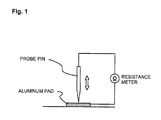
- the antifouling properties were evaluated with the simulator shown in Fig. 1 . In the simulation, the probe pin produced was set at the simulator and the electric resistance was measured while the probe pin was repeatedly brought into contact with the pad under the following conditions.
- the electric resistance increased in proportion to the increase in the number of contacts, and the time when the electric resistance exceeded 5 ⁇ was determined to be the time when cleaning for contamination is necessary, and the number of contacts before the time was measured.
- the measurement results of the number of contacts until the contact resistance exceeded 5 ⁇ are shown in Table 1.
- ⁇ The number of times when the wire broke during production is once. ⁇ : The number of times when the wire broke during production is twice. ⁇ : The number of times when the wire broke during production is three times. ⁇ : The number of times when the wire broke during production is more than three times. Antifouling ⁇ : The number of contacts until cleaning becomes necessary is 1.6 million properties times or more. ⁇ : The number of contacts until cleaning becomes necessary is about 1.2 million times to less than 1.6 million times. ⁇ : The number of contacts until cleaning becomes necessary is 800 thousand times to less than 1.2 million times. ⁇ : The number of contacts until cleaning becomes necessary is 400 thousand times to less than 800 thousand times. ⁇ : The number of contacts until cleaning becomes necessary is less than 400 thousand times.
- the wire for a probe pin according to the present invention has reliable processability, and therefore, enables finer wire production and higher strength which are difficult to be achieved with iridium.
- a probe pin with narrower pitches can be produced and its stable properties can be maintained even in environment of use subjected to repeated friction.
Landscapes
- Chemical & Material Sciences (AREA)
- Engineering & Computer Science (AREA)
- Materials Engineering (AREA)
- Mechanical Engineering (AREA)
- Metallurgy (AREA)
- Organic Chemistry (AREA)
- Physics & Mathematics (AREA)
- General Physics & Mathematics (AREA)
- Thermal Sciences (AREA)
- Crystallography & Structural Chemistry (AREA)
- Measuring Leads Or Probes (AREA)
- Conductive Materials (AREA)
Abstract
Description
- The present invention relates to a rhodium alloy suitable for wire rod constituting a probe pin for testing electric properties of semiconductor integrated circuits or the like.
- Electric properties of semiconductor integrated circuits or the like are tested with a probe pin brought into contact with a large number of electrode pads thereof. Constituent materials of a probe pin are required to have various properties such as hardness for ensuring abrasion resistance for the test repeated several million times, oxidation resistance for preventing contamination of test objects caused by the generation of oxidation film, and low specific resistance for improving signal delay.
- Copper alloy such as beryllium copper and phosphor bronze, tungsten and palladium alloy or the like have long been known as a material for a probe pin. However, these conventional materials do not have all required properties. For example, copper alloy and tungsten have sufficient mechanical properties but are relatively easily oxidized, and palladium alloy has good oxidation resistance but may be slightly inferior in hardness or the like.
-
- Patent Document 1: Japanese Patent Application Laid-Open No.
10-038922 - Patent Document 2: Japanese Patent Application Laid-Open No.
05-154719 - Patent Document 3: Japanese Patent Application Laid-Open No.
2004-093355 - Thus, as a novel constituent material of a probe pin, a material composed of precious metal such as iridium as a main component has been attracting attention. Iridium is a metal which has, for example, excellent oxidation resistance and electric properties and has sufficient hardness, and therefore, is suitable for a material of a probe pin that is subjected to repeated contact.
- When precious metal such as iridium is used for a probe pin, its processability would become a problem. Since pitches between electrode pads tend to be narrower in recent semiconductor integrated circuits due to higher density, the wire diameter of a probe pin in required to be fine. In this regard, precious metal, particularly iridium, has high hardness, and therefore is difficult to be formed into fine wire and is often broken during processing, and therefore, may not meet the requirement.
- The present invention has been made under such circumstances, and provides a precious metal alloy suitable for a probe pin, having good processability that allows miniaturization, excellent hardness and antifouling properties, while processability is ensured.
- The present inventor has conducted intensive studies to solve the above problem and has arrived at the use of precious metal rhodium (Rh) having better processability than iridium. However, rhodium is inferior in hardness, and therefore, it is not preferable to use rhodium for a probe pin in its pure metal form. Thus, the present inventor has found an alloy which comprises rhodium as a main component and a plurality of additive elements added in small amounts and which has improved hardness or the like, while the processability of rhodium is maintained, and have accomplished the present invention.
- Accordingly, the present invention is a rhodium alloy suitable for wire for a probe pin, the rhodium alloy comprising 30 to 150 ppm of Fe, 80 to 350 ppm of Ir and 100 to 300 ppm of Pt as additive elements, and the balance being Rh.
- As described above, in the invention of the present application, three additive elements of iron (Fe), iridium (Ir) and platinum (Pt) are added to rhodium. For the significance of adding these additive elements, Fe is added to improve processability, Ir is added to improve mechanical strength and Pt is added to improve oxidation resistance. It is necessary to add the three additive elements simultaneously and all is essential.
- The concentrations of the respective additive elements range as described above. This is to demonstrate the hardness and antifouling properties while the processability of Rh is maintained. The concentrations of the additive elements are more preferably 50 to 100 ppm of Fe, 150 to 350 ppm of Ir and 150 to 300 ppm of Pt.
- The rhodium alloy according to the present invention can be formed into wire for a probe pin by producing an ingot comprising a rhodium alloy of a predetermined composition to which the additive elements are added, and by subjecting the ingot to wire processing. For the casting of the alloy, since the casting is for a high melting point material such as rhodium and iridium, a casting method with high energy density, such as arc melting or high frequency melting, is employed. The concentrations of the respective additive elements are adjusted in the casting, and for the form of raw materials, those in the form of powder or small mass may be used at this time. For processing the ingot after alloy casting into a bar, hot forging and hot rolling are employed, and may be repeated. Subsequently, the bar is processed into fine wire from a rough-worked wire. For processing into a rough-worked wire, after annealing the bar appropriately, hot processing (swaging, drawbenching) is carried out. Also, for fine wire processing, hot wire drawing, more specifically, wire drawing under heat by electric current application may be employed. The wire drawing under heat by electric current application means wire drawing in which wire to be processed is passed through a die and a pressure roller. Electric current is applied to the wire to be processed from outside and the resistance heat at that time is used as a heat source for ensuring processability. The wire drawing under heat by electric current application enables homogeneous heating at high temperatures by adjusting the current to be applied, and is capable of processing rhodium alloy having high high-temperature strength relatively easily.
- The rhodium alloy according to the present invention described above has more excellent processability than iridium that has been a promising material for a probe pin. The rhodium alloy also has comparable hardness and antifouling properties or the like.
- A probe pin composed of the rhodium alloy according to the present invention has excellent durability and antifouling properties, and therefore, can be used for a test of electric properties of semiconductor integrated circuits or the like for a long period. It is preferable that the probe pin is composed of so-called a solid material only, which is the rhodium alloy according to the present invention. This is because, although a probe pin with rhodium alloy formed only on the surface via plating or cladding may also be used, in such cases the strength of the tip portion of the probe pin may be decreased during use and the alloy may peel off from the base material, while the solid material does not suffer from such problems.
-
- [
Fig.1 ] A view illustrating the constitution of a simulator for evaluating antifouling properties. - Hereinafter a preferred embodiment of the present invention will be described. In this embodiment, Rh alloys in which the amounts of Fe, Ir and Pt to be added were appropriately changed were produced, and the resulting alloys were formed into wire for study into whether they are processable or not.
- Pure rhodium powder and metal powder of the respective additive elements were weighed and mixed in a predetermined composition, and the mixture was arc-melted to produce a bar-shaped iridium alloy ingot. The bar-shaped ingot was hot forged at 1000 to 1200°C to prepare a 12 mm square bar. Then the bar was hot rolled with a grooved pressing roll (temperature 900 to 1100°C) to prepare a 5 mm square wire. Further, hot swaging and drawbenching were performed several times to form a rough-worked wire having a wire diameter of 1.33 mm.
- The rough-worked wire was drawn to a fine wire with a device for wire drawing under heat by electric current application. In the device for wire drawing under heat by electric current application, a rough-worked wire is fed from a feed roll and drawn after being passed through a die. At this time, by applying electric current to the feed roll and the die which serve as electrodes, the rough-worked wire is heated with the electric current application. In this embodiment, processing conditions included a current of 9 to 11 mA and a feed rate of 2 to 6 m/min. Also, carbon powder was applied to the wire immediately after the feed roll. Finally, cold wire drawing was carried out to prepare wire having a wire diameter of 60 µm as a final product.
- In this embodiment, the processability in the above wire processing step was evaluated, the hardness of the wire produced was measured, and the antifouling properties of the wire were evaluated. For the evaluation of the processability, the number of times when the wire broke during the production of 1 lot of the wire (total length 300 m) in the above processing step was recorded. Also, for the measurement of hardness, the surface hardness of the wire was measured with a Vickers hardness meter. Further, the antifouling properties were evaluated with the simulator shown in
Fig. 1 . In the simulation, the probe pin produced was set at the simulator and the electric resistance was measured while the probe pin was repeatedly brought into contact with the pad under the following conditions. In the simulation, the electric resistance increased in proportion to the increase in the number of contacts, and the time when the electric resistance exceeded 5 Ω was determined to be the time when cleaning for contamination is necessary, and the number of contacts before the time was measured. The measurement results of the number of contacts until the contact resistance exceeded 5 Ω are shown in Table 1. -
- Object to contact: aluminum pad
- Contact pressure: 8 g/ 1 pin
- Current applied: 100 mmA/ 1 pin
-
[Table 1] No. Composition (ppm) Evaluation of properties Fe Ir Pt Rh Hardness (Hv) Processability Antifouling properties 1 50 150 150 Balance 480 ○ ○ 2 70 200 200 Balance 500 ⊚ ⊚ 3 50 200 250 Balance 490 ○ ⊚ 4 100 250 200 Balance 500 ⊚ ⊚ 5 100 350 300 Balance 510 ⊚ ⊚ 6 10 50 50 Balance 450 ×× ×× 7 10 70 100 Balance 467 × × 8 70 600 200 Balance 530 × ○ 9 50 200 10 Balance 485 × × 10 50 400 200 Balance 515 Δ ○ 11 70 400 200 Balance 513 Δ ○ 12 70 400 80 Balance 507 Δ × 13 (Pure Rh) - - - 100% 470 ⊚ ×× 14 (Pure Ir) - 100% - - 720 Δ ⊚ Processability ⊚: The number of times when the wire broke during production is 0.
○: The number of times when the wire broke during production is once.
Δ: The number of times when the wire broke during production is twice.
×: The number of times when the wire broke during production is three times.
××: The number of times when the wire broke during production is more than three times.
Antifouling ⊚: The number of contacts until cleaning becomes necessary is 1.6 million properties times or more.
○: The number of contacts until cleaning becomes necessary is about 1.2 million times to less than 1.6 million times.
Δ: The number of contacts until cleaning becomes necessary is 800 thousand times to less than 1.2 million times.
×: The number of contacts until cleaning becomes necessary is 400 thousand times to less than 800 thousand times.
××: The number of contacts until cleaning becomes necessary is less than 400 thousand times. - Table 1 shows the results of the evaluation of each property. As described above, the respective additive elements Fe, Ir and Pt are added to improve each property including processability, mechanical strength and oxidation resistance (antifouling properties). In this regard, the effect of increasing the hardness of the alloy by the addition of Ir can be found. Also, the processability and the antifouling properties are good. However, inadequate or excessive addition of the additive elements causes decrease in some or all properties, and this shows that it is necessary to adjust the composition properly.
- As described above, the wire for a probe pin according to the present invention has reliable processability, and therefore, enables finer wire production and higher strength which are difficult to be achieved with iridium. According to the present invention, a probe pin with narrower pitches can be produced and its stable properties can be maintained even in environment of use subjected to repeated friction.
Claims (2)
- A rhodium alloy suitable for wire for a probe pin, the rhodium alloy comprising: 30 to 150 ppm of Fe, 80 to 350 ppm of Ir and 100 to 300 ppm of Pt as additive elements, and the balance being Rh.
- A probe pin comprising the rhodium alloy defined in claim 1.
Applications Claiming Priority (2)
| Application Number | Priority Date | Filing Date | Title |
|---|---|---|---|
| JP2011024540A JP5074608B2 (en) | 2011-02-08 | 2011-02-08 | Probe pin |
| PCT/JP2012/052450 WO2012108338A1 (en) | 2011-02-08 | 2012-02-03 | Rhodium alloy which has excellent hardness, processability and antifouling characteristics and is suitable for wire rod for probe pins |
Publications (3)
| Publication Number | Publication Date |
|---|---|
| EP2674765A1 true EP2674765A1 (en) | 2013-12-18 |
| EP2674765A4 EP2674765A4 (en) | 2016-06-22 |
| EP2674765B1 EP2674765B1 (en) | 2017-09-06 |
Family
ID=46638554
Family Applications (1)
| Application Number | Title | Priority Date | Filing Date |
|---|---|---|---|
| EP12744490.9A Active EP2674765B1 (en) | 2011-02-08 | 2012-02-03 | Rhodium alloy having excellent hardness, processability and antifouling properties and suitable for wire rod for probe pin |
Country Status (7)
| Country | Link |
|---|---|
| US (1) | US9297833B2 (en) |
| EP (1) | EP2674765B1 (en) |
| JP (1) | JP5074608B2 (en) |
| KR (1) | KR101683335B1 (en) |
| CN (1) | CN103348254B (en) |
| TW (1) | TWI441930B (en) |
| WO (1) | WO2012108338A1 (en) |
Families Citing this family (5)
| Publication number | Priority date | Publication date | Assignee | Title |
|---|---|---|---|---|
| EP2881479B1 (en) * | 2012-08-03 | 2017-10-04 | Yamamoto Precious Metal Co., Ltd. | Alloy material, contact probe, and connection terminal |
| WO2015067312A1 (en) * | 2013-11-07 | 2015-05-14 | Heraeus Deutschland GmbH & Co. KG | Test needle and method for producing a test needle |
| CN104894525B (en) * | 2015-06-24 | 2017-07-04 | 沈阳东创贵金属材料有限公司 | One kind is for vacuum magnetic-control sputtering platinum-rhodium alloy target and preparation method thereof |
| EP3862759B1 (en) * | 2020-02-04 | 2022-05-11 | Heraeus Deutschland GmbH & Co. KG | Sheathed wire and method for producing same |
| EP4325227B1 (en) * | 2022-08-16 | 2025-10-01 | Heraeus Precious Metals GmbH & Co. KG | Tape-like composite material for test needles |
Family Cites Families (14)
| Publication number | Priority date | Publication date | Assignee | Title |
|---|---|---|---|---|
| JPH04323339A (en) * | 1991-04-19 | 1992-11-12 | Tanaka Kikinzoku Kogyo Kk | Iridium wire and sheet |
| JPH05154719A (en) | 1991-11-29 | 1993-06-22 | Tanaka Kikinzoku Kogyo Kk | Manufacturing device for probe pin |
| JPH1038922A (en) | 1996-07-26 | 1998-02-13 | Iwaki Electron Corp Ltd | Probe pin device |
| JPH11326379A (en) * | 1998-03-12 | 1999-11-26 | Fujitsu Ltd | Contactor for electronic component, method of manufacturing the same, and contactor manufacturing apparatus |
| JP3745184B2 (en) | 1999-03-25 | 2006-02-15 | 株式会社東京カソード研究所 | Probe for probe card and manufacturing method thereof |
| JP2004093355A (en) | 2002-08-30 | 2004-03-25 | Toshiba Corp | Pd alloy based probe pin and probe pin device using the same |
| JP4216823B2 (en) * | 2005-03-04 | 2009-01-28 | 田中貴金属工業株式会社 | Probe pin and a blob card having the blob bin |
| US7333913B2 (en) * | 2005-06-27 | 2008-02-19 | General Electric Company | Clearance measurement system and method of operation |
| JP4421550B2 (en) * | 2005-12-05 | 2010-02-24 | 日本電子材料株式会社 | Probes and probe cards |
| CN101326634B (en) * | 2005-12-08 | 2011-06-01 | 富士通半导体股份有限公司 | Semiconductor device |
| JP4699932B2 (en) * | 2006-04-13 | 2011-06-15 | パナソニック株式会社 | Resistance change element, resistance change memory using the same, and manufacturing method thereof |
| JP2008019487A (en) * | 2006-07-14 | 2008-01-31 | Ishifuku Metal Ind Co Ltd | Rh-based alloy |
| JP4213761B1 (en) * | 2008-02-27 | 2009-01-21 | 田中貴金属工業株式会社 | Iridium alloy with excellent hardness, workability, and antifouling properties |
| JP6103821B2 (en) * | 2012-05-29 | 2017-03-29 | 株式会社日本マイクロニクス | Probe for current test |
-
2011
- 2011-02-08 JP JP2011024540A patent/JP5074608B2/en active Active
-
2012
- 2012-02-02 TW TW101103328A patent/TWI441930B/en active
- 2012-02-03 CN CN201280007385.3A patent/CN103348254B/en active Active
- 2012-02-03 KR KR1020137020025A patent/KR101683335B1/en active Active
- 2012-02-03 WO PCT/JP2012/052450 patent/WO2012108338A1/en not_active Ceased
- 2012-02-03 US US13/994,564 patent/US9297833B2/en active Active
- 2012-02-03 EP EP12744490.9A patent/EP2674765B1/en active Active
Also Published As
| Publication number | Publication date |
|---|---|
| US9297833B2 (en) | 2016-03-29 |
| KR20130107360A (en) | 2013-10-01 |
| CN103348254A (en) | 2013-10-09 |
| CN103348254B (en) | 2015-09-30 |
| US20130271173A1 (en) | 2013-10-17 |
| KR101683335B1 (en) | 2016-12-06 |
| TW201241192A (en) | 2012-10-16 |
| TWI441930B (en) | 2014-06-21 |
| EP2674765B1 (en) | 2017-09-06 |
| JP2012163460A (en) | 2012-08-30 |
| JP5074608B2 (en) | 2012-11-14 |
| EP2674765A4 (en) | 2016-06-22 |
| WO2012108338A1 (en) | 2012-08-16 |
Similar Documents
| Publication | Publication Date | Title |
|---|---|---|
| JP4213761B1 (en) | Iridium alloy with excellent hardness, workability, and antifouling properties | |
| EP2159581B1 (en) | Method of manufacturing probe pins | |
| EP2674765B1 (en) | Rhodium alloy having excellent hardness, processability and antifouling properties and suitable for wire rod for probe pin | |
| JP2023175747A (en) | Palladium-copper-silver-ruthenium alloy | |
| JP6074244B2 (en) | Probe pin material made of an Ag-based alloy, probe pin, and probe pin manufacturing method | |
| JP6850365B2 (en) | Precipitation hardening type Ag-Pd-Cu-In-B alloy | |
| JP2020056067A (en) | Probe pin material and probe pin | |
| JP4177221B2 (en) | Copper alloy for electronic equipment | |
| JP6372952B2 (en) | Probe pin material composed of a Pt-based alloy and method for manufacturing the probe pin | |
| JP7429011B2 (en) | Probe pin materials and probe pins | |
| JP6654608B2 (en) | Cu alloy for electric / electronic equipment and probe pin using the same | |
| JP2021092450A (en) | PROBE PIN MATERIAL COMPRISING Rh-BASED ALLOY, AND PROBE PIN |
Legal Events
| Date | Code | Title | Description |
|---|---|---|---|
| PUAI | Public reference made under article 153(3) epc to a published international application that has entered the european phase |
Free format text: ORIGINAL CODE: 0009012 |
|
| 17P | Request for examination filed |
Effective date: 20130715 |
|
| AK | Designated contracting states |
Kind code of ref document: A1 Designated state(s): AL AT BE BG CH CY CZ DE DK EE ES FI FR GB GR HR HU IE IS IT LI LT LU LV MC MK MT NL NO PL PT RO RS SE SI SK SM TR |
|
| DAX | Request for extension of the european patent (deleted) | ||
| RA4 | Supplementary search report drawn up and despatched (corrected) |
Effective date: 20160525 |
|
| RIC1 | Information provided on ipc code assigned before grant |
Ipc: C22F 1/14 20060101ALI20160519BHEP Ipc: C22C 5/00 20060101ALI20160519BHEP Ipc: C22C 5/04 20060101ALI20160519BHEP Ipc: C22C 1/02 20060101ALI20160519BHEP Ipc: G01R 1/067 20060101AFI20160519BHEP |
|
| GRAP | Despatch of communication of intention to grant a patent |
Free format text: ORIGINAL CODE: EPIDOSNIGR1 |
|
| INTG | Intention to grant announced |
Effective date: 20170405 |
|
| GRAS | Grant fee paid |
Free format text: ORIGINAL CODE: EPIDOSNIGR3 |
|
| GRAA | (expected) grant |
Free format text: ORIGINAL CODE: 0009210 |
|
| AK | Designated contracting states |
Kind code of ref document: B1 Designated state(s): AL AT BE BG CH CY CZ DE DK EE ES FI FR GB GR HR HU IE IS IT LI LT LU LV MC MK MT NL NO PL PT RO RS SE SI SK SM TR |
|
| REG | Reference to a national code |
Ref country code: GB Ref legal event code: FG4D |
|
| REG | Reference to a national code |
Ref country code: CH Ref legal event code: EP Ref country code: AT Ref legal event code: REF Ref document number: 926442 Country of ref document: AT Kind code of ref document: T Effective date: 20170915 |
|
| REG | Reference to a national code |
Ref country code: NL Ref legal event code: FP Ref country code: IE Ref legal event code: FG4D |
|
| REG | Reference to a national code |
Ref country code: DE Ref legal event code: R096 Ref document number: 602012036955 Country of ref document: DE |
|
| REG | Reference to a national code |
Ref country code: LT Ref legal event code: MG4D |
|
| PG25 | Lapsed in a contracting state [announced via postgrant information from national office to epo] |
Ref country code: FI Free format text: LAPSE BECAUSE OF FAILURE TO SUBMIT A TRANSLATION OF THE DESCRIPTION OR TO PAY THE FEE WITHIN THE PRESCRIBED TIME-LIMIT Effective date: 20170906 Ref country code: SE Free format text: LAPSE BECAUSE OF FAILURE TO SUBMIT A TRANSLATION OF THE DESCRIPTION OR TO PAY THE FEE WITHIN THE PRESCRIBED TIME-LIMIT Effective date: 20170906 Ref country code: NO Free format text: LAPSE BECAUSE OF FAILURE TO SUBMIT A TRANSLATION OF THE DESCRIPTION OR TO PAY THE FEE WITHIN THE PRESCRIBED TIME-LIMIT Effective date: 20171206 Ref country code: LT Free format text: LAPSE BECAUSE OF FAILURE TO SUBMIT A TRANSLATION OF THE DESCRIPTION OR TO PAY THE FEE WITHIN THE PRESCRIBED TIME-LIMIT Effective date: 20170906 Ref country code: HR Free format text: LAPSE BECAUSE OF FAILURE TO SUBMIT A TRANSLATION OF THE DESCRIPTION OR TO PAY THE FEE WITHIN THE PRESCRIBED TIME-LIMIT Effective date: 20170906 |
|
| REG | Reference to a national code |
Ref country code: AT Ref legal event code: MK05 Ref document number: 926442 Country of ref document: AT Kind code of ref document: T Effective date: 20170906 |
|
| REG | Reference to a national code |
Ref country code: FR Ref legal event code: PLFP Year of fee payment: 7 |
|
| PG25 | Lapsed in a contracting state [announced via postgrant information from national office to epo] |
Ref country code: RS Free format text: LAPSE BECAUSE OF FAILURE TO SUBMIT A TRANSLATION OF THE DESCRIPTION OR TO PAY THE FEE WITHIN THE PRESCRIBED TIME-LIMIT Effective date: 20170906 Ref country code: GR Free format text: LAPSE BECAUSE OF FAILURE TO SUBMIT A TRANSLATION OF THE DESCRIPTION OR TO PAY THE FEE WITHIN THE PRESCRIBED TIME-LIMIT Effective date: 20171207 Ref country code: ES Free format text: LAPSE BECAUSE OF FAILURE TO SUBMIT A TRANSLATION OF THE DESCRIPTION OR TO PAY THE FEE WITHIN THE PRESCRIBED TIME-LIMIT Effective date: 20170906 Ref country code: BG Free format text: LAPSE BECAUSE OF FAILURE TO SUBMIT A TRANSLATION OF THE DESCRIPTION OR TO PAY THE FEE WITHIN THE PRESCRIBED TIME-LIMIT Effective date: 20171206 Ref country code: LV Free format text: LAPSE BECAUSE OF FAILURE TO SUBMIT A TRANSLATION OF THE DESCRIPTION OR TO PAY THE FEE WITHIN THE PRESCRIBED TIME-LIMIT Effective date: 20170906 |
|
| PG25 | Lapsed in a contracting state [announced via postgrant information from national office to epo] |
Ref country code: RO Free format text: LAPSE BECAUSE OF FAILURE TO SUBMIT A TRANSLATION OF THE DESCRIPTION OR TO PAY THE FEE WITHIN THE PRESCRIBED TIME-LIMIT Effective date: 20170906 Ref country code: PL Free format text: LAPSE BECAUSE OF FAILURE TO SUBMIT A TRANSLATION OF THE DESCRIPTION OR TO PAY THE FEE WITHIN THE PRESCRIBED TIME-LIMIT Effective date: 20170906 Ref country code: CZ Free format text: LAPSE BECAUSE OF FAILURE TO SUBMIT A TRANSLATION OF THE DESCRIPTION OR TO PAY THE FEE WITHIN THE PRESCRIBED TIME-LIMIT Effective date: 20170906 |
|
| PG25 | Lapsed in a contracting state [announced via postgrant information from national office to epo] |
Ref country code: SM Free format text: LAPSE BECAUSE OF FAILURE TO SUBMIT A TRANSLATION OF THE DESCRIPTION OR TO PAY THE FEE WITHIN THE PRESCRIBED TIME-LIMIT Effective date: 20170906 Ref country code: IS Free format text: LAPSE BECAUSE OF FAILURE TO SUBMIT A TRANSLATION OF THE DESCRIPTION OR TO PAY THE FEE WITHIN THE PRESCRIBED TIME-LIMIT Effective date: 20180106 Ref country code: EE Free format text: LAPSE BECAUSE OF FAILURE TO SUBMIT A TRANSLATION OF THE DESCRIPTION OR TO PAY THE FEE WITHIN THE PRESCRIBED TIME-LIMIT Effective date: 20170906 Ref country code: SK Free format text: LAPSE BECAUSE OF FAILURE TO SUBMIT A TRANSLATION OF THE DESCRIPTION OR TO PAY THE FEE WITHIN THE PRESCRIBED TIME-LIMIT Effective date: 20170906 Ref country code: IT Free format text: LAPSE BECAUSE OF FAILURE TO SUBMIT A TRANSLATION OF THE DESCRIPTION OR TO PAY THE FEE WITHIN THE PRESCRIBED TIME-LIMIT Effective date: 20170906 Ref country code: AT Free format text: LAPSE BECAUSE OF FAILURE TO SUBMIT A TRANSLATION OF THE DESCRIPTION OR TO PAY THE FEE WITHIN THE PRESCRIBED TIME-LIMIT Effective date: 20170906 |
|
| REG | Reference to a national code |
Ref country code: DE Ref legal event code: R097 Ref document number: 602012036955 Country of ref document: DE |
|
| PLBE | No opposition filed within time limit |
Free format text: ORIGINAL CODE: 0009261 |
|
| STAA | Information on the status of an ep patent application or granted ep patent |
Free format text: STATUS: NO OPPOSITION FILED WITHIN TIME LIMIT |
|
| PG25 | Lapsed in a contracting state [announced via postgrant information from national office to epo] |
Ref country code: DK Free format text: LAPSE BECAUSE OF FAILURE TO SUBMIT A TRANSLATION OF THE DESCRIPTION OR TO PAY THE FEE WITHIN THE PRESCRIBED TIME-LIMIT Effective date: 20170906 |
|
| 26N | No opposition filed |
Effective date: 20180607 |
|
| PG25 | Lapsed in a contracting state [announced via postgrant information from national office to epo] |
Ref country code: SI Free format text: LAPSE BECAUSE OF FAILURE TO SUBMIT A TRANSLATION OF THE DESCRIPTION OR TO PAY THE FEE WITHIN THE PRESCRIBED TIME-LIMIT Effective date: 20170906 |
|
| REG | Reference to a national code |
Ref country code: CH Ref legal event code: PL |
|
| PG25 | Lapsed in a contracting state [announced via postgrant information from national office to epo] |
Ref country code: MC Free format text: LAPSE BECAUSE OF FAILURE TO SUBMIT A TRANSLATION OF THE DESCRIPTION OR TO PAY THE FEE WITHIN THE PRESCRIBED TIME-LIMIT Effective date: 20170906 |
|
| REG | Reference to a national code |
Ref country code: IE Ref legal event code: MM4A |
|
| REG | Reference to a national code |
Ref country code: BE Ref legal event code: MM Effective date: 20180228 |
|
| PG25 | Lapsed in a contracting state [announced via postgrant information from national office to epo] |
Ref country code: LI Free format text: LAPSE BECAUSE OF NON-PAYMENT OF DUE FEES Effective date: 20180228 Ref country code: CH Free format text: LAPSE BECAUSE OF NON-PAYMENT OF DUE FEES Effective date: 20180228 Ref country code: LU Free format text: LAPSE BECAUSE OF NON-PAYMENT OF DUE FEES Effective date: 20180203 |
|
| PG25 | Lapsed in a contracting state [announced via postgrant information from national office to epo] |
Ref country code: IE Free format text: LAPSE BECAUSE OF NON-PAYMENT OF DUE FEES Effective date: 20180203 |
|
| PG25 | Lapsed in a contracting state [announced via postgrant information from national office to epo] |
Ref country code: BE Free format text: LAPSE BECAUSE OF NON-PAYMENT OF DUE FEES Effective date: 20180228 |
|
| PG25 | Lapsed in a contracting state [announced via postgrant information from national office to epo] |
Ref country code: MT Free format text: LAPSE BECAUSE OF NON-PAYMENT OF DUE FEES Effective date: 20180203 |
|
| PG25 | Lapsed in a contracting state [announced via postgrant information from national office to epo] |
Ref country code: TR Free format text: LAPSE BECAUSE OF FAILURE TO SUBMIT A TRANSLATION OF THE DESCRIPTION OR TO PAY THE FEE WITHIN THE PRESCRIBED TIME-LIMIT Effective date: 20170906 |
|
| PGFP | Annual fee paid to national office [announced via postgrant information from national office to epo] |
Ref country code: NL Payment date: 20200219 Year of fee payment: 9 |
|
| PG25 | Lapsed in a contracting state [announced via postgrant information from national office to epo] |
Ref country code: PT Free format text: LAPSE BECAUSE OF FAILURE TO SUBMIT A TRANSLATION OF THE DESCRIPTION OR TO PAY THE FEE WITHIN THE PRESCRIBED TIME-LIMIT Effective date: 20170906 Ref country code: HU Free format text: LAPSE BECAUSE OF FAILURE TO SUBMIT A TRANSLATION OF THE DESCRIPTION OR TO PAY THE FEE WITHIN THE PRESCRIBED TIME-LIMIT; INVALID AB INITIO Effective date: 20120203 |
|
| PG25 | Lapsed in a contracting state [announced via postgrant information from national office to epo] |
Ref country code: MK Free format text: LAPSE BECAUSE OF NON-PAYMENT OF DUE FEES Effective date: 20170906 Ref country code: CY Free format text: LAPSE BECAUSE OF FAILURE TO SUBMIT A TRANSLATION OF THE DESCRIPTION OR TO PAY THE FEE WITHIN THE PRESCRIBED TIME-LIMIT Effective date: 20170906 |
|
| PG25 | Lapsed in a contracting state [announced via postgrant information from national office to epo] |
Ref country code: AL Free format text: LAPSE BECAUSE OF FAILURE TO SUBMIT A TRANSLATION OF THE DESCRIPTION OR TO PAY THE FEE WITHIN THE PRESCRIBED TIME-LIMIT Effective date: 20170906 |
|
| PGFP | Annual fee paid to national office [announced via postgrant information from national office to epo] |
Ref country code: FR Payment date: 20210225 Year of fee payment: 10 |
|
| PGFP | Annual fee paid to national office [announced via postgrant information from national office to epo] |
Ref country code: GB Payment date: 20210224 Year of fee payment: 10 |
|
| REG | Reference to a national code |
Ref country code: NL Ref legal event code: MM Effective date: 20210301 |
|
| PG25 | Lapsed in a contracting state [announced via postgrant information from national office to epo] |
Ref country code: NL Free format text: LAPSE BECAUSE OF NON-PAYMENT OF DUE FEES Effective date: 20210301 |
|
| GBPC | Gb: european patent ceased through non-payment of renewal fee |
Effective date: 20220203 |
|
| PG25 | Lapsed in a contracting state [announced via postgrant information from national office to epo] |
Ref country code: FR Free format text: LAPSE BECAUSE OF NON-PAYMENT OF DUE FEES Effective date: 20220228 |
|
| PG25 | Lapsed in a contracting state [announced via postgrant information from national office to epo] |
Ref country code: GB Free format text: LAPSE BECAUSE OF NON-PAYMENT OF DUE FEES Effective date: 20220203 |
|
| PGFP | Annual fee paid to national office [announced via postgrant information from national office to epo] |
Ref country code: DE Payment date: 20260218 Year of fee payment: 15 |