EP2674126B1 - Compensation for heart movement in a body coordinate system - Google Patents
Compensation for heart movement in a body coordinate system Download PDFInfo
- Publication number
- EP2674126B1 EP2674126B1 EP13171290.3A EP13171290A EP2674126B1 EP 2674126 B1 EP2674126 B1 EP 2674126B1 EP 13171290 A EP13171290 A EP 13171290A EP 2674126 B1 EP2674126 B1 EP 2674126B1
- Authority
- EP
- European Patent Office
- Prior art keywords
- distal end
- heart
- processor
- signals
- electrical signals
- Prior art date
- Legal status (The legal status is an assumption and is not a legal conclusion. Google has not performed a legal analysis and makes no representation as to the accuracy of the status listed.)
- Active
Links
Images




Classifications
-
- A—HUMAN NECESSITIES
- A61—MEDICAL OR VETERINARY SCIENCE; HYGIENE
- A61B—DIAGNOSIS; SURGERY; IDENTIFICATION
- A61B5/00—Measuring for diagnostic purposes; Identification of persons
- A61B5/24—Detecting, measuring or recording bioelectric or biomagnetic signals of the body or parts thereof
- A61B5/25—Bioelectric electrodes therefor
- A61B5/279—Bioelectric electrodes therefor specially adapted for particular uses
- A61B5/28—Bioelectric electrodes therefor specially adapted for particular uses for electrocardiography [ECG]
- A61B5/283—Invasive
- A61B5/287—Holders for multiple electrodes, e.g. electrode catheters for electrophysiological study [EPS]
-
- A—HUMAN NECESSITIES
- A61—MEDICAL OR VETERINARY SCIENCE; HYGIENE
- A61B—DIAGNOSIS; SURGERY; IDENTIFICATION
- A61B34/00—Computer-aided surgery; Manipulators or robots specially adapted for use in surgery
- A61B34/20—Surgical navigation systems; Devices for tracking or guiding surgical instruments, e.g. for frameless stereotaxis
-
- A—HUMAN NECESSITIES
- A61—MEDICAL OR VETERINARY SCIENCE; HYGIENE
- A61B—DIAGNOSIS; SURGERY; IDENTIFICATION
- A61B5/00—Measuring for diagnostic purposes; Identification of persons
- A61B5/06—Devices, other than using radiation, for detecting or locating foreign bodies ; Determining position of diagnostic devices within or on the body of the patient
- A61B5/065—Determining position of the probe employing exclusively positioning means located on or in the probe, e.g. using position sensors arranged on the probe
-
- A—HUMAN NECESSITIES
- A61—MEDICAL OR VETERINARY SCIENCE; HYGIENE
- A61B—DIAGNOSIS; SURGERY; IDENTIFICATION
- A61B5/00—Measuring for diagnostic purposes; Identification of persons
- A61B5/06—Devices, other than using radiation, for detecting or locating foreign bodies ; Determining position of diagnostic devices within or on the body of the patient
- A61B5/065—Determining position of the probe employing exclusively positioning means located on or in the probe, e.g. using position sensors arranged on the probe
- A61B5/068—Determining position of the probe employing exclusively positioning means located on or in the probe, e.g. using position sensors arranged on the probe using impedance sensors
-
- A—HUMAN NECESSITIES
- A61—MEDICAL OR VETERINARY SCIENCE; HYGIENE
- A61B—DIAGNOSIS; SURGERY; IDENTIFICATION
- A61B5/00—Measuring for diagnostic purposes; Identification of persons
- A61B5/68—Arrangements of detecting, measuring or recording means, e.g. sensors, in relation to patient
- A61B5/6846—Arrangements of detecting, measuring or recording means, e.g. sensors, in relation to patient specially adapted to be brought in contact with an internal body part, i.e. invasive
- A61B5/6847—Arrangements of detecting, measuring or recording means, e.g. sensors, in relation to patient specially adapted to be brought in contact with an internal body part, i.e. invasive mounted on an invasive device
- A61B5/6852—Catheters
-
- A—HUMAN NECESSITIES
- A61—MEDICAL OR VETERINARY SCIENCE; HYGIENE
- A61B—DIAGNOSIS; SURGERY; IDENTIFICATION
- A61B17/00—Surgical instruments, devices or methods
- A61B2017/00681—Aspects not otherwise provided for
- A61B2017/00694—Aspects not otherwise provided for with means correcting for movement of or for synchronisation with the body
- A61B2017/00703—Aspects not otherwise provided for with means correcting for movement of or for synchronisation with the body correcting for movement of heart, e.g. ECG-triggered
-
- A—HUMAN NECESSITIES
- A61—MEDICAL OR VETERINARY SCIENCE; HYGIENE
- A61B—DIAGNOSIS; SURGERY; IDENTIFICATION
- A61B34/00—Computer-aided surgery; Manipulators or robots specially adapted for use in surgery
- A61B34/20—Surgical navigation systems; Devices for tracking or guiding surgical instruments, e.g. for frameless stereotaxis
- A61B2034/2046—Tracking techniques
- A61B2034/2051—Electromagnetic tracking systems
-
- A—HUMAN NECESSITIES
- A61—MEDICAL OR VETERINARY SCIENCE; HYGIENE
- A61B—DIAGNOSIS; SURGERY; IDENTIFICATION
- A61B34/00—Computer-aided surgery; Manipulators or robots specially adapted for use in surgery
- A61B34/20—Surgical navigation systems; Devices for tracking or guiding surgical instruments, e.g. for frameless stereotaxis
- A61B2034/2072—Reference field transducer attached to an instrument or patient
Definitions
- the present invention relates generally to electrocardiography, and specifically to tracking a probe used in an electrocardiography procedure.
- a critical need during electrocardiography, wherein probes are positioned within the heart, is accurate tracking of the probes. Any method to improve the tracking is advantageous.
- an apparatus comprising:
- An embodiment of the present invention provides a system for tracking a distal end of a reference probe within the heart of a living subject.
- the tracked distal end may be used as a reference for tracking distal ends of other probes in the heart.
- the reference distal end comprises a position sensor and an electrode attached to the distal end.
- a processor After insertion of the reference distal end to a reference site of the heart, typically comprising the coronary sinus, a processor records position signals from the sensor and intrabody electrical signals from the electrode. The processor monitors the position signals as the heart beats. Providing the signals are repetitive over a preset number of heart beats, so that there is substantially no change in a mean position of the reference distal end, the processor uses the mean position as a mean position of the heart.
- the processor waits until the signals again become repetitive, and uses the new mean position of the distal end as a new mean position of the heart.
- the change registered by the position signals may be caused by a change in a body frame of reference used to measure the positions, and/or by a movement of the reference distal end with respect to its reference site.
- Embodiments of the present invention correct for both causes. Changes in the body frame of reference are corrected for using the mean position measurements described above. Changes because of reference distal end movement may be corrected for by generating a mapping between the intrabody electrical signals and different reference sites to where the distal end may move. In the event of distal end movement, the mapping may be used to estimate a position of a new reference site.
- the position of the reference distal end may be used as a reference for other probe distal ends positioned in the heart. Such a use averts recalibration of the body frame of reference, which in prior art systems is necessary if sensors defining the frame have changed. The use also corrects for overall movement of the heart in the thoracic cavity, such as may occur during defibrillation of the heart.
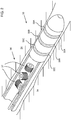
- Fig. 1 is a schematic illustration of a heart movement compensation system 20, and to Fig. 2 , which is a schematic illustration of a distal end of a probe 22 in system 20, according to embodiments of the present invention.
- System 20 operates while a medical procedure is performed on a heart 24, herein assumed to comprise a human heart, using probe 22.
- System 20 includes facilities for tracking probe 22, as well as for receiving electrical signals, also herein termed intrabody electrocardiograph (ECG) signals, detected by the probe.
- ECG intrabody electrocardiograph
- System 20 typically includes other facilities used during the medical procedure, such as a facility for ablating one or more regions of heart 24.
- Probe 22 comprises a catheter which is inserted into the body of a subject 26 during the medical procedure.
- the medical procedure is performed by a user 28 of system 20, and in the description herein user 28 is assumed, by way of example, to be a medical professional.
- a distal end 30 of the probe comprises a plurality of generally similar electrodes 32A, 32B, 32C, ... , collectively referred to herein as electrodes 32.
- Electrodes 32A, 32B, 32C, ... receive electrical signals from respective sites 33A, 33B, 33C, ... in the heart of the subject, and the signals are analyzed by system 20, as described herein.
- Distal end 30 is assumed to be positioned within a blood vessel 34 of heart 24.
- Distal end 30 comprises a position sensor 36, which is assumed herein to comprise one or more coils 37 providing signals which vary according to the position, i.e., the location and orientation, of the distal end.
- position sensor 36 which is assumed herein to comprise one or more coils 37 providing signals which vary according to the position, i.e., the location and orientation, of the distal end. The operation of sensor 36 is described in more detail below.
- probes 23 are generally similar in construction and operation to probe 22, and have respective distal ends 31A, 31B, ... collectively referred to herein as distal ends 31. For simplicity only probe 23A and distal end 31A are shown in Fig. 1 .
- System 20 is typically controlled by a system processor 38 which may be realized as a general purpose computer.
- the system processor comprises a processing unit 40 communicating with a memory 42.
- Processor 38 may be mounted in a console 44, comprising operating controls 46 that typically include a keypad and a pointing device such as a mouse or trackball that professional 28 uses to interact with the processor.
- Results of the operations performed by processor 38 are provided to the professional on a screen 47 which displays a diagram 48 of results generated by system 20.
- the screen typically displays other items of auxiliary information related to the heart while the heart is being investigated, such as the positions of distal end 30, and the positions of other catheters used by professional 28.
- Screen 47 typically also presents a graphic user interface to the professional.
- Professional 28 is able to use controls 46 to input values of parameters used by processor 38 in the operation of system 20.
- Processor 38 uses computer software, including a probe tracker module 50, to operate system 20.
- the software may be downloaded to processor 38 in electronic form, over a network, for example, or it may, alternatively or additionally, be provided and/or stored on non-transitory tangible computer-readable media, such as magnetic, optical, or electronic memory.
- Probe tracker module 50 tracks distal end 30 while the probe is within subject 26.
- the tracker module typically tracks both the location and the orientation of the distal end of the probe, within the heart of subject 26. In some embodiments module 50 tracks other sections of the probe. While the tracker module may use any method for tracking probes known in the art, using an appropriate position sensor, in the present description for clarity and simplicity module 50 is assumed to comprise a magnetic tracker, such as the Carto® system produced by Biosense Webster, of Diamond Bar, CA.
- Module 50 operates magnetic field transmitters 52 in the vicinity of subject 26, so that magnetic fields from the transmitters interact with tracking coils 37 located in distal end 30.
- tracker module 50 may track the distal end of probe 22 by measuring impedances between one or more of electrodes 32 and electrodes on the skin of subject 26. (In this case electrodes 32 also act as the position sensor, being used for both intrabody ECG detection and for tracking.)
- the Carto3® system produced by Biosense Webster uses both magnetic field transmitters and impedance measurements for tracking.
- U.S. Patent 7,848,789, to Govari et al. describes using both magnetic fields and impedance measurements for probe tracking.
- probe tracker module 50 also tracks the locations and orientations of distal ends 31.
- distal end 30 of probe 22 is typically used as a reference for tracking of distal ends 31, so that probe 22 is also referred to herein as reference probe 22, and distal end 30 is also referred to herein as reference distal end 30.
- Transmitters 52 are fixed, and define a transmitter frame of reference in terms of a first set of orthogonal axes x T , y T , z T which are fixed with respect to the transmitters.
- the signals derived from sensor 36 and the sensors of probes 23 provide coordinates of the location and orientation of distal end 30 and distal ends 31 with respect to the transmitter frame of reference
- professional 28 typically requires knowledge of the location and orientation of the distal ends with respect to subject 26.
- a set of patient position sensors 54 are attached to the skin of subject 26.
- sensors 54 are attached to known locations on the back of the subject.
- Module 50 receives signals from sensors 54, and uses the signals to define a body coordinate frame of reference in terms of a second set of body coordinate orthogonal axes x B , y B , z B which are fixed with respect to subject 26. As described below, during a procedure processor 38 registers the two frames of reference, and so is able to generate the location and orientation of the distal ends with respect to the subject.
- Fig. 3A is a schematic graph illustrating the motion of reference distal end 30, and Figs. 3B and 3C are schematic graphs illustrating signals derived from one of the electrodes on the distal end, according to embodiments of the present invention.
- a graph 100 illustrates the motion plotted spatially on body coordinate axes x B , y B , z B .
- probe 22 is assumed to be used as a reference probe, so that professional 28 places reference distal end 30 of the probe in a known position within heart 24, herein assumed to be within the coronary sinus of the heart. Once placed, professional 28 does not move distal end 30, and except as described hereinbelow, the reference distal end is assumed to remain substantially fixed within the coronary sinus. It will be understood that system 20 may use positions of distal end 30 to determine positions of heart 24, so that, for example, a mean position of the distal end corresponds to a mean position of the heart.
- distal end 30 moves according to the beating of heart 24.
- processor 38 uses signals from position sensor 36 to measure positions, i.e., locations and orientations, of the distal end. Because of the beating of the heart, locations r and orientations ⁇ of the reference distal end taken over a period of time repeat spatially, as illustrated schematically by overlapping graph lines 106. The occurrence of a substantially repetitive nature of the reference distal end motion, typically over a preset number of heart beats, defines a valid system tracking state. During such a valid system tracking state distal end positions p are assumed to vary about a mean position p 1 . Equation (1) is an identity for mean position p 1 : p 1 ⁇ r 1 , ⁇ 1
- the situation illustrated by lines 106 is after processor 38 has registered the body frame of reference with the transmitter frame of reference.
- the illustrated situation typically exists while the frames of reference registration is valid, and also while the valid system tracking state (i.e., that the reference distal end moves repetitively) exists.
- processor 38 may use distal end 30 as a reference for valid tracking of distal ends 31, by evaluating relative position vectors between distal ends 31 and reference distal end 30. (For simplicity, distal ends 31 and the relative position vectors to distal ends 31 from reference distal end 30 are not shown in the diagram.)
- the frames of reference registration exemplified by lines 106 typically continues to be valid unless there is a movement of position sensors 54 with respect to transmitters 52. Even if the registration of the two frames of reference remains valid, other factors, such as movement of heart 24 within patient 26 (due, for example, to the patient being defibrillated), may invalidate the tracking of distal end 30, and thus, since distal end 30 is used as a reference, the tracking of distal ends 31.
- embodiments of the present invention check if the tracking of reference distal end 30 has changed, and provide a method for system 20 to correct for any such changes.
- Overlapping lines 108 depict a situation where the tracking of reference distal end 30 has changed, and a new valid tracking state of the distal end exists.
- the change may be because of a movement of the body frame of reference, so that the body frame of reference depicted in Fig. 3A is no longer applicable; alternatively or additionally, the change may be because of a movement of the heart within the thoracic cavity.
- the mean position of the reference distal end changes, from its initial value p 1 to a new value p 2 , as illustrated in Fig. 3A .
- Equation (2) is an identity for mean position p 2 : p 2 ⁇ r 2 , ⁇ 2
- the transfer between the two valid tracking states of the distal end is indicated schematically by a broken arrow 110.
- a change from a valid tracking state may also occur because of a movement of reference distal end 30 within heart 24. Such a movement may happen, even if professional 28 has not moved the proximal end of probe 22, for example due to defibrillation.
- Embodiments of the present invention check if reference distal end 30 has moved within the heart. In the event of such movement, an embodiment of the present invention measures and provides a correction for the movement, as described below.
- processor 38 While processor 38 measures the position of distal end 30 using sensor 36, it also records the intrabody electrical signals received from electrodes 32.
- Graphs 102 and 104 illustrate the signals received from single electrode 32B. The signals are plotted as potential vs. time graphs, received respectively during the period within which lines 106 are generated (graph 102), and during the period within which lines 108 are generated (graph 104).
- the two graphs show the signals compared to a reference parameter, typically generated by the processor using skin ECG signals that are recorded simultaneously with the intra-cardiac signals from electrodes 32.
- a reference parameter typically generated by the processor using skin ECG signals that are recorded simultaneously with the intra-cardiac signals from electrodes 32.
- the reference parameter is assumed to comprise a local activation time (LAT) of the intrabody signals measured with respect to a reference time t R .
- LAT local activation time
- any other convenient reference parameter such as a phase of the signals, a time of occurrence of the R peak of the QRS complex, an amplitude of the peak, or a combination of such parameters, may be used as a reference parameter.
- Processor 38 applies the reference parameter in order to quantitatively compare sequential intrabody electrical signals.
- the LAT of the intrabody electrical signals is dependent on the position of electrodes 32 in heart 24. As is illustrated by graphs 102 and 104, there is no change of LAT between the two graphs. Because there is no change of LAT between graphs 102 and 104, distal end 30 has not moved within heart 24, and so is at its initial site within coronary sinus of the heart, as placed by professional 28. Thus, processor 38 is able to use the new reference distal end mean position value, p 2 , as a reference for the initial site within the coronary sinus.
- the processor is able to continue to track the positions, i.e., the locations and orientations, of distal ends 31, by applying the relative position vectors between distal ends 31 and reference distal end 30 recorded before the change in valid tracking states.
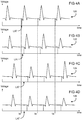
- Figs. 4A-4D are schematic graphs of intrabody electrical signals, according to embodiments of the present invention.
- Graphs 120, 122, and 124 respectively illustrate the signals conveyed from electrodes 32A, 32B, and 32C to processor 38 ( Figs. 1 and 2 ).
- the respective signals are generated by respective sites 33A, 33B, 33C in heart 24, and the sites are assumed to be within the coronary sinus. While the graphs illustrate that signals generated at the different sites are generally similar in morphology and in period, because of the different physical locations of the sites, there are differences, such as different levels of particular sections of the signals, and/or differences in phase.
- Processor 28 can record the signals from different sites, and can generate and store a mapping between the different signals and the different sites generating the signals.
- the mapping is assumed to comprise a mapping between respective LATs and site locations, and those having ordinary skill in the art will be able to modify the description, mutatis mutandis, for other types of mapping.
- the LAT increases from site 33A (graph 120), to site 33B (graph 122) to site 33C (graph 124).
- Processor 28 is able to use the mapped LATs to identify if distal end 30 has moved relative to sites 33A, 33B, and 33C. If there has been no movement, then the electrode signals are generally unchanged, as exemplified above for graphs 102 and 104 ( Figs. 3B, 3C ).
- Graph 126 ( Fig. 4D ) is a graph of signals from electrode 32B, assumed to be recorded at a time different from the time of recording of graph 122.
- the LAT of the signals of graph 126 is larger than the LAT of graph 122, indicating that electrode 32B, and thus distal end 30, has moved relative to sites 33A, 33B, and 33C.
- Processor 28 quantifies the movement by using the stored mapping, described above.
- processor 28 can determine by interpolation the new site location, between sites 33B and 33C, of electrode 33B.
- processor 28 can use interpolation and/or extrapolation to determine a new location for a given electrode, and thus a new location of the electrode's distal end, from the new intrabody electrical signals generated at the electrode. Furthermore, while the description above has referred to determining a new location for the distal end, a similar method, which will be apparent to those having ordinary skill in the art, mutatis mutandis, may be used to determine a new orientation of the distal end from the new intrabody electrical signals. Thus, the new intrabody electrical signals may be used to find a new position, i.e., a new location and a new orientation, of the reference distal end.
- Fig. 5A is a schematic graph illustrating the motion of reference distal end 30, and Figs. 5B and 5C are schematic graphs illustrating signals derived from one of the electrodes on the distal end, according to alternative embodiments of the present invention.
- a graph 140 of Fig. 5A is generally similar to graph 100 ( Fig. 3A ), and elements indicated by the same reference numerals in the graphs are generally similar in property.
- Graphs 140 and 100 both illustrate the motion of reference distal end 30 plotted spatially on body coordinate axes x B , y B , z B .
- a graph 142 of Fig. 5B is generally similar to graph 102 ( Fig. 3B ). Both graphs illustrate intrabody electrical signals derived from one of the electrodes on the distal end, herein assumed to be electrode 32B, during a first valid system tracking state illustrated by lines 106.
- distal end 30 transfers from a first valid state, illustrated by overlapping lines 106 and having a mean position p 1 defined by equation (1).
- the transfer is to a new valid tracking state, illustrated by overlapping lines 148, having a mean position p 3 defined by equation (3): P 3 ⁇ r 3 , ⁇ 3
- the transfer to the new valid tracking state is indicated schematically be a broken arrow 150.
- Graph 144 is a graph of the signals from electrode 32B taken during the new valid tracking state. As illustrated in graphs 142 and 144, there is a change in LAT between the two sets of signals: the LAT of graph 144 is larger than the LAT of graph 142. Thus, by measuring the LATs, processor 38 is able to deduce that distal end 30 has moved. In addition, as explained above with reference to Figs 4A-4D , from the values of the LATs of graphs 142 and 144, the processor is able to quantify the movement using the stored mapping, based on signals from electrodes 32A, 32B, 32C, ....
- Fig. 6 is a flowchart 200 showing steps performed in operating system 20, according to an embodiment of the present invention.
- a system setup step 202 professional 28 attaches position sensors 54 to subject 26 and activates transmitters 52.
- Processor 38 then uses module 50 to formulate a body coordinate frame of reference.
- Professional 28 may also select a value for the number of heart beats to be used as a preset value for system 20 to use in deciding if a valid system tracking state exists. A typical value is 10, although any other convenient number may be selected.
- the professional typically sets other preset values to be used in the flowchart.
- the professional defines the parameter to be used in checking if signals from electrodes 32 have changed. For simplicity, in the description of the flowchart the parameter is assumed to be the LAT of the signals.
- a probe insertion step 204 professional 28 inserts reference probe 22 into subject 26 until reference distal end 30 is in a selected site within a desired reference region, herein assumed to comprise the coronary sinus.
- the professional inserts other probes 23 into subject 26, until the distal ends of the other probes are also in desired regions.
- the distal end positions are calculated by processor 38 and module 50, and are typically displayed to the professional numerically and/or graphically on screen 47.
- the processor records the positions of reference distal end 30 over a time interval.
- the processor uses the positions of the reference distal end to provide a position for heart 24.
- the processor also records electrical signals from electrodes 32.
- the processor records the positions of distal ends 31 of other probes 23. The recordings are made for the preset number of heart beats.
- processor 38 checks if the positions of reference distal end 30 recorded in step 206 are repetitive, so that over the recording time interval the positions are substantially constant.
- the check for repetitiveness may be by any convenient means, for example by checking that the average position of the distal end, calculated for each heart beat, does not vary by more than a preset range.
- a mapping step 209 the processor generates a mapping between the LATs of the electrical signals of electrodes 32, and positions of the respective sites within the heart which the electrodes contact.
- the positions of the sites may be determined from known dimensions of reference distal end 30 and its electrodes, as well as from the position of the reference distal end as recorded in step 206.
- the flowchart then proceeds to an initial mean position step 210.
- step 210 processor 38 calculates a mean position of reference distal end 30, and uses this position as a mean position of the heart.
- the processor uses the reference distal end mean position to evaluate relative positions of distal ends 31 with respect to reference distal end 30.
- the processor may display a notice on screen 47 indicating to professional 28 that system 20 is tracking distal ends 30 and 31.
- step 210 the flowchart returns to step 206, so that steps 206, 208, and 210 repeat iteratively; however, step 209 may not need to be performed after a first iteration has occurred.
- the reiteration of the steps corresponds to the valid system tracking state illustrated by overlapping lines 106 ( Figs. 3A and 5A ).
- decision step 208 returns a negative value, so that the positions determined by position sensor 36 are no longer constant, do not correspond to the mean position found in step 210, and so that there has been a non-zero change in the mean position of the reference distal end.
- a non-zero change may be indicative of a change in the mean position of the heart, and/or a change in the body coordinate frame of reference.
- Second recording step 214 and a second decision step 216 are substantially the same as first recording step 206 and first decision step 208.
- the processor In calculating the new mean position the processor considers the electrical signals from electrodes 32. If the parameter defined in setup step 202 (assumed therein to be the LAT of the signals) has not changed, corresponding to a situation illustrated by Figs. 3A - 3C , then distal end 30 has not moved from the selected site in the coronary sinus. In this case the positions recorded in step 214 are used to calculate a new mean position for reference distal end 30, and the processor assumes the new reference distal end mean position corresponds to the reference site selected in step 204. The processor uses the new reference distal end mean position to evaluate relative positions of distal ends 31 with respect to reference distal end 30.
- step 218 If in step 218 the LAT of the signals has changed, this corresponds to a situation illustrated by Figs. 5A - 5C .
- distal end 30 has moved from the selected site in the coronary sinus to a new reference site therein.
- processor 38 analyzes the signals from electrodes 32 to determine a new reference position of the new reference site within the coronary sinus.
- the positions recorded from position sensor 36 in step 214 are used to calculate new mean position coordinates for reference distal end 30, and the processor assumes the new reference distal end mean position corresponds to the new reference site determined from the mapping. Using this correspondence, the processor uses the new reference distal end mean position to evaluate relative positions of distal ends 31 with respect to the new reference site.
- step 216 If in decision step 216 the positions do not repeat, then the flowchart continues to an invalid tracking state step 220, wherein typically a warning is issued that tracking is not valid. From step 220 the flowchart returns to step 214. Typically, steps 214, 216 and 218 reiterate until the procedure implemented by professional 28 is completed.
Landscapes
- Health & Medical Sciences (AREA)
- Life Sciences & Earth Sciences (AREA)
- Engineering & Computer Science (AREA)
- Surgery (AREA)
- Veterinary Medicine (AREA)
- General Health & Medical Sciences (AREA)
- Public Health (AREA)
- Biomedical Technology (AREA)
- Heart & Thoracic Surgery (AREA)
- Medical Informatics (AREA)
- Molecular Biology (AREA)
- Animal Behavior & Ethology (AREA)
- Physics & Mathematics (AREA)
- Biophysics (AREA)
- Pathology (AREA)
- Human Computer Interaction (AREA)
- Physiology (AREA)
- Cardiology (AREA)
- Nuclear Medicine, Radiotherapy & Molecular Imaging (AREA)
- Robotics (AREA)
- Measurement And Recording Of Electrical Phenomena And Electrical Characteristics Of The Living Body (AREA)
Applications Claiming Priority (1)
| Application Number | Priority Date | Filing Date | Title |
|---|---|---|---|
| US13/493,151 US9402556B2 (en) | 2012-06-11 | 2012-06-11 | Compensation for heart movement in a body coordinate system |
Publications (3)
| Publication Number | Publication Date |
|---|---|
| EP2674126A2 EP2674126A2 (en) | 2013-12-18 |
| EP2674126A3 EP2674126A3 (en) | 2015-09-09 |
| EP2674126B1 true EP2674126B1 (en) | 2018-12-05 |
Family
ID=48782843
Family Applications (1)
| Application Number | Title | Priority Date | Filing Date |
|---|---|---|---|
| EP13171290.3A Active EP2674126B1 (en) | 2012-06-11 | 2013-06-10 | Compensation for heart movement in a body coordinate system |
Country Status (8)
| Country | Link |
|---|---|
| US (1) | US9402556B2 (https=) |
| EP (1) | EP2674126B1 (https=) |
| JP (1) | JP6261885B2 (https=) |
| CN (1) | CN103479346B (https=) |
| AU (1) | AU2013206145B2 (https=) |
| CA (1) | CA2818663A1 (https=) |
| ES (1) | ES2707860T3 (https=) |
| IL (1) | IL226744A (https=) |
Families Citing this family (8)
| Publication number | Priority date | Publication date | Assignee | Title |
|---|---|---|---|---|
| US8945147B2 (en) * | 2009-04-27 | 2015-02-03 | Smith & Nephew, Inc. | System and method for identifying a landmark |
| US9326693B2 (en) * | 2014-04-15 | 2016-05-03 | Biosense Webster (Israel) Ltd. | Placement of electrodes in proximity to the heart |
| US9474491B2 (en) | 2014-10-15 | 2016-10-25 | St. Jude Medical, Cardiology Division, Inc. | Methods and systems for mapping local conduction velocity |
| CN104807569B (zh) * | 2015-05-08 | 2017-05-24 | 大连理工大学 | 一种基于光弹性原理的柔性微探针及其使用方法 |
| US20160331434A1 (en) * | 2015-05-11 | 2016-11-17 | Vytronus, Inc. | System and methods for ablating tissue |
| AU2016204942A1 (en) * | 2015-07-23 | 2017-02-09 | Biosense Webster (Israel) Ltd. | Surface registration of a ct image with a magnetic tracking system |
| US20170065353A1 (en) * | 2015-09-04 | 2017-03-09 | Biosense Webster (Israel) Ltd. | Identifying and presenting suspected map shifts |
| CN112057057B (zh) * | 2020-08-11 | 2022-04-26 | 上海掌门科技有限公司 | 调整脉搏测量装置、测量脉搏信号的方法与设备 |
Family Cites Families (11)
| Publication number | Priority date | Publication date | Assignee | Title |
|---|---|---|---|---|
| US5954665A (en) * | 1995-06-07 | 1999-09-21 | Biosense, Inc. | Cardiac ablation catheter using correlation measure |
| EP0888150B1 (en) | 1996-01-08 | 2004-03-24 | Biosense Inc. | Apparatus for myocardial revascularization |
| US6024739A (en) | 1997-09-05 | 2000-02-15 | Cordis Webster, Inc. | Method for detecting and revascularizing ischemic myocardial tissue |
| US20030074011A1 (en) | 1998-09-24 | 2003-04-17 | Super Dimension Ltd. | System and method of recording and displaying in context of an image a location of at least one point-of-interest in a body during an intra-body medical procedure |
| US6716166B2 (en) | 2000-08-18 | 2004-04-06 | Biosense, Inc. | Three-dimensional reconstruction using ultrasound |
| WO2002082375A2 (en) | 2001-04-06 | 2002-10-17 | Stephen Solomon | Cardiological mapping and navigation system |
| US6773402B2 (en) | 2001-07-10 | 2004-08-10 | Biosense, Inc. | Location sensing with real-time ultrasound imaging |
| US7536218B2 (en) | 2005-07-15 | 2009-05-19 | Biosense Webster, Inc. | Hybrid magnetic-based and impedance-based position sensing |
| US9173638B2 (en) | 2007-06-04 | 2015-11-03 | Biosense Webster, Inc. | Cardiac mechanical assessment using ultrasound |
| US8326419B2 (en) * | 2009-04-07 | 2012-12-04 | Pacesetter, Inc. | Therapy optimization via multi-dimensional mapping |
| US20110066203A1 (en) * | 2009-09-17 | 2011-03-17 | Pacesetter, Inc. | Electrode and lead stability indexes and stability maps based on localization system data |
-
2012
- 2012-06-11 US US13/493,151 patent/US9402556B2/en active Active
-
2013
- 2013-06-04 IL IL226744A patent/IL226744A/en active IP Right Grant
- 2013-06-04 AU AU2013206145A patent/AU2013206145B2/en not_active Ceased
- 2013-06-08 CN CN201310228461.XA patent/CN103479346B/zh active Active
- 2013-06-10 EP EP13171290.3A patent/EP2674126B1/en active Active
- 2013-06-10 JP JP2013121543A patent/JP6261885B2/ja active Active
- 2013-06-10 ES ES13171290T patent/ES2707860T3/es active Active
- 2013-06-11 CA CA2818663A patent/CA2818663A1/en not_active Abandoned
Non-Patent Citations (1)
| Title |
|---|
| None * |
Also Published As
| Publication number | Publication date |
|---|---|
| CA2818663A1 (en) | 2013-12-11 |
| EP2674126A3 (en) | 2015-09-09 |
| ES2707860T3 (es) | 2019-04-05 |
| CN103479346B (zh) | 2017-09-12 |
| JP2013255799A (ja) | 2013-12-26 |
| IL226744A (en) | 2016-09-29 |
| AU2013206145A1 (en) | 2014-01-09 |
| US20130331717A1 (en) | 2013-12-12 |
| AU2013206145B2 (en) | 2017-04-13 |
| US9402556B2 (en) | 2016-08-02 |
| EP2674126A2 (en) | 2013-12-18 |
| CN103479346A (zh) | 2014-01-01 |
| JP6261885B2 (ja) | 2018-01-17 |
| IL226744A0 (en) | 2013-09-30 |
Similar Documents
| Publication | Publication Date | Title |
|---|---|---|
| EP2674126B1 (en) | Compensation for heart movement in a body coordinate system | |
| EP1862114B1 (en) | Model-based correction of position measurements | |
| JP5323397B2 (ja) | 移動補整付き体内位置特定システム | |
| EP3138484B1 (en) | Identifying and presenting suspected map shifts | |
| US10945632B2 (en) | Navigational reference dislodgement detection method and system | |
| JP7423284B2 (ja) | システムおよびその作動方法 | |
| JP2013255799A5 (https=) | ||
| US9113824B2 (en) | Compensation for respiratory motion | |
| US12402959B2 (en) | Hybrid approach to distortion detection | |
| EP3505061B1 (en) | Improving impedance-based position tracking performance using principal component analysis | |
| HK1113457B (en) | Model-based correction of position measurements |
Legal Events
| Date | Code | Title | Description |
|---|---|---|---|
| PUAI | Public reference made under article 153(3) epc to a published international application that has entered the european phase |
Free format text: ORIGINAL CODE: 0009012 |
|
| AK | Designated contracting states |
Kind code of ref document: A2 Designated state(s): AL AT BE BG CH CY CZ DE DK EE ES FI FR GB GR HR HU IE IS IT LI LT LU LV MC MK MT NL NO PL PT RO RS SE SI SK SM TR |
|
| AX | Request for extension of the european patent |
Extension state: BA ME |
|
| RIN1 | Information on inventor provided before grant (corrected) |
Inventor name: TURGEMAN, AHARON Inventor name: NIKOLSKI, MASHA Inventor name: ZINO, ELIAHU Inventor name: LUDWIN, DORON MOSHE |
|
| PUAL | Search report despatched |
Free format text: ORIGINAL CODE: 0009013 |
|
| AK | Designated contracting states |
Kind code of ref document: A3 Designated state(s): AL AT BE BG CH CY CZ DE DK EE ES FI FR GB GR HR HU IE IS IT LI LT LU LV MC MK MT NL NO PL PT RO RS SE SI SK SM TR |
|
| AX | Request for extension of the european patent |
Extension state: BA ME |
|
| RIC1 | Information provided on ipc code assigned before grant |
Ipc: A61B 19/00 20060101AFI20150806BHEP Ipc: A61B 5/0402 20060101ALI20150806BHEP Ipc: A61B 17/00 20060101ALN20150806BHEP |
|
| 17P | Request for examination filed |
Effective date: 20151207 |
|
| RBV | Designated contracting states (corrected) |
Designated state(s): AL AT BE BG CH CY CZ DE DK EE ES FI FR GB GR HR HU IE IS IT LI LT LU LV MC MK MT NL NO PL PT RO RS SE SI SK SM TR |
|
| STAA | Information on the status of an ep patent application or granted ep patent |
Free format text: STATUS: EXAMINATION IS IN PROGRESS |
|
| 17Q | First examination report despatched |
Effective date: 20170127 |
|
| RIC1 | Information provided on ipc code assigned before grant |
Ipc: A61B 17/00 20060101ALN20180202BHEP Ipc: A61B 5/0402 20060101AFI20180202BHEP |
|
| GRAP | Despatch of communication of intention to grant a patent |
Free format text: ORIGINAL CODE: EPIDOSNIGR1 |
|
| STAA | Information on the status of an ep patent application or granted ep patent |
Free format text: STATUS: GRANT OF PATENT IS INTENDED |
|
| INTG | Intention to grant announced |
Effective date: 20180316 |
|
| RIN1 | Information on inventor provided before grant (corrected) |
Inventor name: TURGEMAN, AHARON Inventor name: LUDWIN, DORON MOSHE Inventor name: ZINO, ELIAHU Inventor name: NIKOLSKI, MASHA |
|
| RAP1 | Party data changed (applicant data changed or rights of an application transferred) |
Owner name: BIOSENSE WEBSTER (ISRAEL) LTD. |
|
| GRAJ | Information related to disapproval of communication of intention to grant by the applicant or resumption of examination proceedings by the epo deleted |
Free format text: ORIGINAL CODE: EPIDOSDIGR1 |
|
| STAA | Information on the status of an ep patent application or granted ep patent |
Free format text: STATUS: EXAMINATION IS IN PROGRESS |
|
| REG | Reference to a national code |
Ref country code: DE Ref legal event code: R079 Ref document number: 602013047686 Country of ref document: DE Free format text: PREVIOUS MAIN CLASS: A61B0019000000 Ipc: A61B0005040200 |
|
| GRAP | Despatch of communication of intention to grant a patent |
Free format text: ORIGINAL CODE: EPIDOSNIGR1 |
|
| STAA | Information on the status of an ep patent application or granted ep patent |
Free format text: STATUS: GRANT OF PATENT IS INTENDED |
|
| INTC | Intention to grant announced (deleted) | ||
| RIC1 | Information provided on ipc code assigned before grant |
Ipc: A61B 17/00 20060101ALN20180626BHEP Ipc: A61B 5/0402 20060101AFI20180626BHEP |
|
| INTG | Intention to grant announced |
Effective date: 20180712 |
|
| GRAS | Grant fee paid |
Free format text: ORIGINAL CODE: EPIDOSNIGR3 |
|
| GRAA | (expected) grant |
Free format text: ORIGINAL CODE: 0009210 |
|
| GRAA | (expected) grant |
Free format text: ORIGINAL CODE: 0009210 |
|
| STAA | Information on the status of an ep patent application or granted ep patent |
Free format text: STATUS: THE PATENT HAS BEEN GRANTED |
|
| AK | Designated contracting states |
Kind code of ref document: B1 Designated state(s): AL AT BE BG CH CY CZ DE DK EE ES FI FR GB GR HR HU IE IS IT LI LT LU LV MC MK MT NL NO PL PT RO RS SE SI SK SM TR |
|
| REG | Reference to a national code |
Ref country code: GB Ref legal event code: FG4D |
|
| REG | Reference to a national code |
Ref country code: CH Ref legal event code: EP |
|
| REG | Reference to a national code |
Ref country code: AT Ref legal event code: REF Ref document number: 1072032 Country of ref document: AT Kind code of ref document: T Effective date: 20181215 |
|
| REG | Reference to a national code |
Ref country code: IE Ref legal event code: FG4D |
|
| REG | Reference to a national code |
Ref country code: DE Ref legal event code: R096 Ref document number: 602013047686 Country of ref document: DE |
|
| REG | Reference to a national code |
Ref country code: NL Ref legal event code: FP |
|
| REG | Reference to a national code |
Ref country code: ES Ref legal event code: FG2A Ref document number: 2707860 Country of ref document: ES Kind code of ref document: T3 Effective date: 20190405 |
|
| REG | Reference to a national code |
Ref country code: AT Ref legal event code: MK05 Ref document number: 1072032 Country of ref document: AT Kind code of ref document: T Effective date: 20181205 |
|
| REG | Reference to a national code |
Ref country code: LT Ref legal event code: MG4D |
|
| PG25 | Lapsed in a contracting state [announced via postgrant information from national office to epo] |
Ref country code: BG Free format text: LAPSE BECAUSE OF FAILURE TO SUBMIT A TRANSLATION OF THE DESCRIPTION OR TO PAY THE FEE WITHIN THE PRESCRIBED TIME-LIMIT Effective date: 20190305 Ref country code: FI Free format text: LAPSE BECAUSE OF FAILURE TO SUBMIT A TRANSLATION OF THE DESCRIPTION OR TO PAY THE FEE WITHIN THE PRESCRIBED TIME-LIMIT Effective date: 20181205 Ref country code: LV Free format text: LAPSE BECAUSE OF FAILURE TO SUBMIT A TRANSLATION OF THE DESCRIPTION OR TO PAY THE FEE WITHIN THE PRESCRIBED TIME-LIMIT Effective date: 20181205 Ref country code: AT Free format text: LAPSE BECAUSE OF FAILURE TO SUBMIT A TRANSLATION OF THE DESCRIPTION OR TO PAY THE FEE WITHIN THE PRESCRIBED TIME-LIMIT Effective date: 20181205 Ref country code: HR Free format text: LAPSE BECAUSE OF FAILURE TO SUBMIT A TRANSLATION OF THE DESCRIPTION OR TO PAY THE FEE WITHIN THE PRESCRIBED TIME-LIMIT Effective date: 20181205 Ref country code: LT Free format text: LAPSE BECAUSE OF FAILURE TO SUBMIT A TRANSLATION OF THE DESCRIPTION OR TO PAY THE FEE WITHIN THE PRESCRIBED TIME-LIMIT Effective date: 20181205 Ref country code: NO Free format text: LAPSE BECAUSE OF FAILURE TO SUBMIT A TRANSLATION OF THE DESCRIPTION OR TO PAY THE FEE WITHIN THE PRESCRIBED TIME-LIMIT Effective date: 20190305 |
|
| PG25 | Lapsed in a contracting state [announced via postgrant information from national office to epo] |
Ref country code: GR Free format text: LAPSE BECAUSE OF FAILURE TO SUBMIT A TRANSLATION OF THE DESCRIPTION OR TO PAY THE FEE WITHIN THE PRESCRIBED TIME-LIMIT Effective date: 20190306 Ref country code: RS Free format text: LAPSE BECAUSE OF FAILURE TO SUBMIT A TRANSLATION OF THE DESCRIPTION OR TO PAY THE FEE WITHIN THE PRESCRIBED TIME-LIMIT Effective date: 20181205 Ref country code: SE Free format text: LAPSE BECAUSE OF FAILURE TO SUBMIT A TRANSLATION OF THE DESCRIPTION OR TO PAY THE FEE WITHIN THE PRESCRIBED TIME-LIMIT Effective date: 20181205 Ref country code: AL Free format text: LAPSE BECAUSE OF FAILURE TO SUBMIT A TRANSLATION OF THE DESCRIPTION OR TO PAY THE FEE WITHIN THE PRESCRIBED TIME-LIMIT Effective date: 20181205 |
|
| PG25 | Lapsed in a contracting state [announced via postgrant information from national office to epo] |
Ref country code: CZ Free format text: LAPSE BECAUSE OF FAILURE TO SUBMIT A TRANSLATION OF THE DESCRIPTION OR TO PAY THE FEE WITHIN THE PRESCRIBED TIME-LIMIT Effective date: 20181205 Ref country code: PT Free format text: LAPSE BECAUSE OF FAILURE TO SUBMIT A TRANSLATION OF THE DESCRIPTION OR TO PAY THE FEE WITHIN THE PRESCRIBED TIME-LIMIT Effective date: 20190405 Ref country code: PL Free format text: LAPSE BECAUSE OF FAILURE TO SUBMIT A TRANSLATION OF THE DESCRIPTION OR TO PAY THE FEE WITHIN THE PRESCRIBED TIME-LIMIT Effective date: 20181205 |
|
| PG25 | Lapsed in a contracting state [announced via postgrant information from national office to epo] |
Ref country code: SM Free format text: LAPSE BECAUSE OF FAILURE TO SUBMIT A TRANSLATION OF THE DESCRIPTION OR TO PAY THE FEE WITHIN THE PRESCRIBED TIME-LIMIT Effective date: 20181205 Ref country code: EE Free format text: LAPSE BECAUSE OF FAILURE TO SUBMIT A TRANSLATION OF THE DESCRIPTION OR TO PAY THE FEE WITHIN THE PRESCRIBED TIME-LIMIT Effective date: 20181205 Ref country code: SK Free format text: LAPSE BECAUSE OF FAILURE TO SUBMIT A TRANSLATION OF THE DESCRIPTION OR TO PAY THE FEE WITHIN THE PRESCRIBED TIME-LIMIT Effective date: 20181205 Ref country code: RO Free format text: LAPSE BECAUSE OF FAILURE TO SUBMIT A TRANSLATION OF THE DESCRIPTION OR TO PAY THE FEE WITHIN THE PRESCRIBED TIME-LIMIT Effective date: 20181205 Ref country code: IS Free format text: LAPSE BECAUSE OF FAILURE TO SUBMIT A TRANSLATION OF THE DESCRIPTION OR TO PAY THE FEE WITHIN THE PRESCRIBED TIME-LIMIT Effective date: 20190405 |
|
| REG | Reference to a national code |
Ref country code: DE Ref legal event code: R097 Ref document number: 602013047686 Country of ref document: DE |
|
| PLBE | No opposition filed within time limit |
Free format text: ORIGINAL CODE: 0009261 |
|
| STAA | Information on the status of an ep patent application or granted ep patent |
Free format text: STATUS: NO OPPOSITION FILED WITHIN TIME LIMIT |
|
| PG25 | Lapsed in a contracting state [announced via postgrant information from national office to epo] |
Ref country code: SI Free format text: LAPSE BECAUSE OF FAILURE TO SUBMIT A TRANSLATION OF THE DESCRIPTION OR TO PAY THE FEE WITHIN THE PRESCRIBED TIME-LIMIT Effective date: 20181205 Ref country code: DK Free format text: LAPSE BECAUSE OF FAILURE TO SUBMIT A TRANSLATION OF THE DESCRIPTION OR TO PAY THE FEE WITHIN THE PRESCRIBED TIME-LIMIT Effective date: 20181205 |
|
| 26N | No opposition filed |
Effective date: 20190906 |
|
| PG25 | Lapsed in a contracting state [announced via postgrant information from national office to epo] |
Ref country code: MC Free format text: LAPSE BECAUSE OF FAILURE TO SUBMIT A TRANSLATION OF THE DESCRIPTION OR TO PAY THE FEE WITHIN THE PRESCRIBED TIME-LIMIT Effective date: 20181205 |
|
| PG25 | Lapsed in a contracting state [announced via postgrant information from national office to epo] |
Ref country code: TR Free format text: LAPSE BECAUSE OF FAILURE TO SUBMIT A TRANSLATION OF THE DESCRIPTION OR TO PAY THE FEE WITHIN THE PRESCRIBED TIME-LIMIT Effective date: 20181205 |
|
| PG25 | Lapsed in a contracting state [announced via postgrant information from national office to epo] |
Ref country code: LU Free format text: LAPSE BECAUSE OF NON-PAYMENT OF DUE FEES Effective date: 20190610 |
|
| REG | Reference to a national code |
Ref country code: DE Ref legal event code: R079 Ref document number: 602013047686 Country of ref document: DE Free format text: PREVIOUS MAIN CLASS: A61B0005040200 Ipc: A61B0005318000 |
|
| PG25 | Lapsed in a contracting state [announced via postgrant information from national office to epo] |
Ref country code: CY Free format text: LAPSE BECAUSE OF FAILURE TO SUBMIT A TRANSLATION OF THE DESCRIPTION OR TO PAY THE FEE WITHIN THE PRESCRIBED TIME-LIMIT Effective date: 20181205 |
|
| PG25 | Lapsed in a contracting state [announced via postgrant information from national office to epo] |
Ref country code: HU Free format text: LAPSE BECAUSE OF FAILURE TO SUBMIT A TRANSLATION OF THE DESCRIPTION OR TO PAY THE FEE WITHIN THE PRESCRIBED TIME-LIMIT; INVALID AB INITIO Effective date: 20130610 Ref country code: MT Free format text: LAPSE BECAUSE OF FAILURE TO SUBMIT A TRANSLATION OF THE DESCRIPTION OR TO PAY THE FEE WITHIN THE PRESCRIBED TIME-LIMIT Effective date: 20181205 |
|
| PG25 | Lapsed in a contracting state [announced via postgrant information from national office to epo] |
Ref country code: MK Free format text: LAPSE BECAUSE OF FAILURE TO SUBMIT A TRANSLATION OF THE DESCRIPTION OR TO PAY THE FEE WITHIN THE PRESCRIBED TIME-LIMIT Effective date: 20181205 |
|
| PGFP | Annual fee paid to national office [announced via postgrant information from national office to epo] |
Ref country code: NL Payment date: 20220513 Year of fee payment: 10 |
|
| PGFP | Annual fee paid to national office [announced via postgrant information from national office to epo] |
Ref country code: IE Payment date: 20220510 Year of fee payment: 10 |
|
| PGFP | Annual fee paid to national office [announced via postgrant information from national office to epo] |
Ref country code: BE Payment date: 20220526 Year of fee payment: 10 |
|
| PGFP | Annual fee paid to national office [announced via postgrant information from national office to epo] |
Ref country code: ES Payment date: 20220705 Year of fee payment: 10 |
|
| PGFP | Annual fee paid to national office [announced via postgrant information from national office to epo] |
Ref country code: CH Payment date: 20220702 Year of fee payment: 10 |
|
| REG | Reference to a national code |
Ref country code: CH Ref legal event code: PL |
|
| REG | Reference to a national code |
Ref country code: NL Ref legal event code: MM Effective date: 20230701 |
|
| REG | Reference to a national code |
Ref country code: BE Ref legal event code: MM Effective date: 20230630 |
|
| REG | Reference to a national code |
Ref country code: IE Ref legal event code: MM4A |
|
| PG25 | Lapsed in a contracting state [announced via postgrant information from national office to epo] |
Ref country code: NL Free format text: LAPSE BECAUSE OF NON-PAYMENT OF DUE FEES Effective date: 20230701 |
|
| PG25 | Lapsed in a contracting state [announced via postgrant information from national office to epo] |
Ref country code: IE Free format text: LAPSE BECAUSE OF NON-PAYMENT OF DUE FEES Effective date: 20230610 |
|
| PG25 | Lapsed in a contracting state [announced via postgrant information from national office to epo] |
Ref country code: IE Free format text: LAPSE BECAUSE OF NON-PAYMENT OF DUE FEES Effective date: 20230610 Ref country code: CH Free format text: LAPSE BECAUSE OF NON-PAYMENT OF DUE FEES Effective date: 20230630 |
|
| PG25 | Lapsed in a contracting state [announced via postgrant information from national office to epo] |
Ref country code: BE Free format text: LAPSE BECAUSE OF NON-PAYMENT OF DUE FEES Effective date: 20230630 |
|
| REG | Reference to a national code |
Ref country code: ES Ref legal event code: FD2A Effective date: 20240729 |
|
| PG25 | Lapsed in a contracting state [announced via postgrant information from national office to epo] |
Ref country code: ES Free format text: LAPSE BECAUSE OF NON-PAYMENT OF DUE FEES Effective date: 20230611 |
|
| PG25 | Lapsed in a contracting state [announced via postgrant information from national office to epo] |
Ref country code: ES Free format text: LAPSE BECAUSE OF NON-PAYMENT OF DUE FEES Effective date: 20230611 |
|
| PGFP | Annual fee paid to national office [announced via postgrant information from national office to epo] |
Ref country code: DE Payment date: 20250429 Year of fee payment: 13 |
|
| PGFP | Annual fee paid to national office [announced via postgrant information from national office to epo] |
Ref country code: GB Payment date: 20250501 Year of fee payment: 13 |
|
| PGFP | Annual fee paid to national office [announced via postgrant information from national office to epo] |
Ref country code: IT Payment date: 20250522 Year of fee payment: 13 |
|
| PGFP | Annual fee paid to national office [announced via postgrant information from national office to epo] |
Ref country code: FR Payment date: 20250508 Year of fee payment: 13 |