EP2666880A1 - Steel material having superior toughness of welded heat-affected zone, and method for manufacturing same - Google Patents
Steel material having superior toughness of welded heat-affected zone, and method for manufacturing same Download PDFInfo
- Publication number
- EP2666880A1 EP2666880A1 EP12736520.3A EP12736520A EP2666880A1 EP 2666880 A1 EP2666880 A1 EP 2666880A1 EP 12736520 A EP12736520 A EP 12736520A EP 2666880 A1 EP2666880 A1 EP 2666880A1
- Authority
- EP
- European Patent Office
- Prior art keywords
- rem
- inclusions
- less
- added
- oxides
- Prior art date
- Legal status (The legal status is an assumption and is not a legal conclusion. Google has not performed a legal analysis and makes no representation as to the accuracy of the status listed.)
- Withdrawn
Links
Images

Classifications
-
- C—CHEMISTRY; METALLURGY
- C22—METALLURGY; FERROUS OR NON-FERROUS ALLOYS; TREATMENT OF ALLOYS OR NON-FERROUS METALS
- C22C—ALLOYS
- C22C38/00—Ferrous alloys, e.g. steel alloys
- C22C38/14—Ferrous alloys, e.g. steel alloys containing titanium or zirconium
-
- C—CHEMISTRY; METALLURGY
- C21—METALLURGY OF IRON
- C21C—PROCESSING OF PIG-IRON, e.g. REFINING, MANUFACTURE OF WROUGHT-IRON OR STEEL; TREATMENT IN MOLTEN STATE OF FERROUS ALLOYS
- C21C7/00—Treating molten ferrous alloys, e.g. steel, not covered by groups C21C1/00 - C21C5/00
- C21C7/04—Removing impurities by adding a treating agent
-
- C—CHEMISTRY; METALLURGY
- C21—METALLURGY OF IRON
- C21C—PROCESSING OF PIG-IRON, e.g. REFINING, MANUFACTURE OF WROUGHT-IRON OR STEEL; TREATMENT IN MOLTEN STATE OF FERROUS ALLOYS
- C21C7/00—Treating molten ferrous alloys, e.g. steel, not covered by groups C21C1/00 - C21C5/00
- C21C7/04—Removing impurities by adding a treating agent
- C21C7/06—Deoxidising, e.g. killing
-
- C—CHEMISTRY; METALLURGY
- C22—METALLURGY; FERROUS OR NON-FERROUS ALLOYS; TREATMENT OF ALLOYS OR NON-FERROUS METALS
- C22C—ALLOYS
- C22C38/00—Ferrous alloys, e.g. steel alloys
- C22C38/001—Ferrous alloys, e.g. steel alloys containing N
-
- C—CHEMISTRY; METALLURGY
- C22—METALLURGY; FERROUS OR NON-FERROUS ALLOYS; TREATMENT OF ALLOYS OR NON-FERROUS METALS
- C22C—ALLOYS
- C22C38/00—Ferrous alloys, e.g. steel alloys
- C22C38/002—Ferrous alloys, e.g. steel alloys containing In, Mg, or other elements not provided for in one single group C22C38/001 - C22C38/60
-
- C—CHEMISTRY; METALLURGY
- C22—METALLURGY; FERROUS OR NON-FERROUS ALLOYS; TREATMENT OF ALLOYS OR NON-FERROUS METALS
- C22C—ALLOYS
- C22C38/00—Ferrous alloys, e.g. steel alloys
- C22C38/005—Ferrous alloys, e.g. steel alloys containing rare earths, i.e. Sc, Y, Lanthanides
-
- C—CHEMISTRY; METALLURGY
- C22—METALLURGY; FERROUS OR NON-FERROUS ALLOYS; TREATMENT OF ALLOYS OR NON-FERROUS METALS
- C22C—ALLOYS
- C22C38/00—Ferrous alloys, e.g. steel alloys
- C22C38/02—Ferrous alloys, e.g. steel alloys containing silicon
-
- C—CHEMISTRY; METALLURGY
- C22—METALLURGY; FERROUS OR NON-FERROUS ALLOYS; TREATMENT OF ALLOYS OR NON-FERROUS METALS
- C22C—ALLOYS
- C22C38/00—Ferrous alloys, e.g. steel alloys
- C22C38/04—Ferrous alloys, e.g. steel alloys containing manganese
-
- C—CHEMISTRY; METALLURGY
- C22—METALLURGY; FERROUS OR NON-FERROUS ALLOYS; TREATMENT OF ALLOYS OR NON-FERROUS METALS
- C22C—ALLOYS
- C22C38/00—Ferrous alloys, e.g. steel alloys
- C22C38/06—Ferrous alloys, e.g. steel alloys containing aluminium
-
- C—CHEMISTRY; METALLURGY
- C22—METALLURGY; FERROUS OR NON-FERROUS ALLOYS; TREATMENT OF ALLOYS OR NON-FERROUS METALS
- C22C—ALLOYS
- C22C38/00—Ferrous alloys, e.g. steel alloys
- C22C38/08—Ferrous alloys, e.g. steel alloys containing nickel
-
- C—CHEMISTRY; METALLURGY
- C22—METALLURGY; FERROUS OR NON-FERROUS ALLOYS; TREATMENT OF ALLOYS OR NON-FERROUS METALS
- C22C—ALLOYS
- C22C38/00—Ferrous alloys, e.g. steel alloys
- C22C38/12—Ferrous alloys, e.g. steel alloys containing tungsten, tantalum, molybdenum, vanadium, or niobium
-
- C—CHEMISTRY; METALLURGY
- C22—METALLURGY; FERROUS OR NON-FERROUS ALLOYS; TREATMENT OF ALLOYS OR NON-FERROUS METALS
- C22C—ALLOYS
- C22C38/00—Ferrous alloys, e.g. steel alloys
- C22C38/16—Ferrous alloys, e.g. steel alloys containing copper
-
- C—CHEMISTRY; METALLURGY
- C22—METALLURGY; FERROUS OR NON-FERROUS ALLOYS; TREATMENT OF ALLOYS OR NON-FERROUS METALS
- C22C—ALLOYS
- C22C38/00—Ferrous alloys, e.g. steel alloys
- C22C38/18—Ferrous alloys, e.g. steel alloys containing chromium
- C22C38/28—Ferrous alloys, e.g. steel alloys containing chromium with titanium or zirconium
-
- C—CHEMISTRY; METALLURGY
- C22—METALLURGY; FERROUS OR NON-FERROUS ALLOYS; TREATMENT OF ALLOYS OR NON-FERROUS METALS
- C22C—ALLOYS
- C22C38/00—Ferrous alloys, e.g. steel alloys
- C22C38/18—Ferrous alloys, e.g. steel alloys containing chromium
- C22C38/38—Ferrous alloys, e.g. steel alloys containing chromium with more than 1.5% by weight of manganese
-
- C—CHEMISTRY; METALLURGY
- C22—METALLURGY; FERROUS OR NON-FERROUS ALLOYS; TREATMENT OF ALLOYS OR NON-FERROUS METALS
- C22C—ALLOYS
- C22C38/00—Ferrous alloys, e.g. steel alloys
- C22C38/18—Ferrous alloys, e.g. steel alloys containing chromium
- C22C38/40—Ferrous alloys, e.g. steel alloys containing chromium with nickel
- C22C38/58—Ferrous alloys, e.g. steel alloys containing chromium with nickel with more than 1.5% by weight of manganese
Definitions
- the present invention relates: to a steel material used for bridges, high-rise buildings, marine vessels, etc.; and in particular to a steel material having a superior toughness at a zone affected by heat when the steel material is welded (hereunder referred to as "welded heat-affected zone” or “HAZ” occasionally) and a method for manufacturing the steel material.
- Patent Literatures 1 to 3 a steel material that can inhibit the toughness of a HAZ from deteriorating when a high heat input welding method is adopted.
- a steel material is characterized by containing oxides of REM and/or CaO and ZrO 2 as oxides acting as nuclei of intragranular ferrite transformation.
- the oxides disperse finely in steel because they exist in the state of a liquid in molten steel.
- the oxides are thermally stable, are solute, and do not disappear even when they are exposed for a long period of time at a high temperature of about 1,400°C for example, and hence contribute largely to the improvement of HAZ toughness.
- Patent Literature 4 discloses that the size and the number of all oxide-based inclusions (not being limited to oxides acting as nuclei of intragranular ferrite transformation but including all oxides) in a steel material are greatly related to the improvement of HAZ toughness and in particular, by reducing the number of coarse oxides having circle equivalent diameters exceeding 5.0 ⁇ m to five or less, it is possible to obtain a steel material excellent in HAZ toughness even when high heat input welding is applied with a high input heat of about 50 kJ/mm.
- Patent Literature 4 since the number of coarse oxides can conspicuously be suppressed, it is possible to enhance HAZ toughness even when a material is welded with an input heat larger than the input heat adopted in a HAZ toughness evaluation method disclosed in an example of Patent Literature 1. Specifically, whereas a heat cycle of cooling a steel material for 300 sec. in the temperature range of 800°C to 500°C after the steel material is retained for 5 sec.
- Patent Literature 4 At a heating temperature of 1,400°C (heat input conditions: 1,400°C x 5 sec., cooling time Tc is 300 sec.) is applied and an absorption energy at -40°C (vE- 40 ) is measured in Patent Literature 1, in Patent Literature 4 an absorption energy is measured likewise when a heat cycle in which the retention time at 1,400°C is prolonged to 30 sec. (heat input conditions: 1,400°C x 30 sec., cooling time Tc is 300 sec.) is applied and it is confirmed that a good HAZ toughness is obtained even on this occasion.
- Patent Literatures 5 to 7 disclose: not such a technology of using both REM oxides and ZrO 2 as disclosed in Patent Literatures 1 to 4; but that HAZ toughness can be improved by adding REM into molten steel having an adjusted dissolved oxygen content when a high heat input welding exceeding about 300 kJ/cm (about 30 kJ/mm) is applied.
- the improvement of welding operation efficiency is demanded inevitably and a welding input heat increases in accordance with the demand.
- a steel material exhibiting excellent performance even under a high heat input condition of 50 kJ/mm or more that has not been much studied heretofore is desired.
- the present invention is established in view of the above situation and an object thereof is to provide: a steel material excellent in HAZ toughness even when high heat input welding is applied with a input heat of 50 kJ/mm or more; and a method for manufacturing the steel material.
- a steel material excellent in toughness at a welded heat-affected zone according to the present invention that has solved the above problem is a steel material containing C: 0.02% to 0.15% (in terms of % by mass, the same shall apply hereafter), Si: 0.5% or less (excluding 0%), Mn: 2.5% or less (excluding 0%), P: 0.03% or less (excluding 0%), S: 0.02% or less (excluding 0%), Al: 0.050% or less (excluding 0%), N: 0.010% or less (excluding 0%), Ti: 0.005% to 0.10%, Zr: 0.0005% to 0.050%, REM: 0.0003% to 0.015%, Ca: 0.0003% to 0.010%, and O: 0.0005% to 0.010%, with the balance consisting of Fe and unavoidable impurities.
- the gist thereof is to satisfy the conditions that (a) the ZrO 2 content is 5% to 50%, the REM oxide (M 2 O 3 when REM is expressed by the symbol M) content is 5% to 50%, and the CaO content is 50% or less (excluding 0%) in average when the composition of all oxide-based inclusions included in the steel material is measured and then expressed in terms of the mass of the individual oxides, (b) among all the inclusions included in the steel material, the number of inclusions having circle equivalent diameters of 0.1 to 2 ⁇ m is not less than 120 in an observation visual field area of 1 mm 2 , the number of oxides having circle equivalent diameters exceeding 3 ⁇ m is not more than 5.0 in an observation visual field area of 1 mm 2 , and the number of oxides having circle equivalent diameters exceeding 5 ⁇ m is not more than 5.0 in an observation visual field area of 1 mm 2 , and (c-1) the proportion of the number of REM and Zr containing inclusions I satisfying the condition that the molar ratio of REM to Z
- the steel material may further contain the following elements as other elements;
- a steel material according to the present invention can be manufactured: by adding REM so that a dissolved oxygen content Q of and an added REM amount Q REM in molten steel may satisfy the following expression (1), 2 ⁇ log ⁇ Q REM + 3 ⁇ log Q Of ⁇ - 12.00 when REM is added to the molten steel having the dissolved oxygen content Q of adjusted in the range of 0.0003% to 0.01% by mass; and by controlling the condition of adding elements so as to satisfy the following condition (2) and/or (3) when REM and Zr are regarded as a-group elements and Ti, Ca, and Al are regarded as b-group elements in the case of adding REM, Zr, Ti, Ca, and Al to the molten steel having the dissolved oxygen content Q of adjusted in the above range,
- oxides oxides containing Zr, REM, and Ca acting as nuclei of intragranular ⁇ transformation ( ⁇ means ferrite or a mixed structure comprising ferrite and bainite, the same shall apply hereafter) are formed and the sizes and the numbers (namely grain size distributions) of inclusions and oxides existing in a steel material and the proportion of the number of inclusions containing prescribed elements in specific relationship to the number of all inclusions are controlled appropriately, it is possible to provide a steel material excellent in HAZ toughness at high heat input welding.
- the present invention relates to a technology for obtaining a steel material having a HAZ toughness not deteriorating even when the steel material is welded with a higher input heat by improving the technology of using oxides acting as nuclei of intragranular ⁇ transformation disclosed in Patent Literatures 1 to 4.
- the present inventors have studied in order to provide a steel material excellent in HAZ toughness at high heat input welding of a higher level even after Patent Literature 4 is proposed. As a result, the present inventors have found that, in order to provide a steel material excellent in HAZ toughness even when "heat cycle of cooling a steel material for 400 sec. in the temperature range of 800°C to 500°C after the steel material is retained for 5 sec.
- Patent Literature 4 At a heating temperature of 1,450°C" (heat input conditions: 1,450°C x 5 sec., cooling time Tc is 400 sec.) that are conditions of a higher input heat than Patent Literature 4 is applied, it is insufficient to merely reduce the number of oxides having circle equivalent diameters exceeding 5.0 ⁇ m to not more than 5 like Patent Literature 4.
- the present inventors have found that it is extremely important that: the number of oxides exceeding 3.0 ⁇ m to which documents including Patent Literature 4 have not heretofore paid attention at all is reduced and, when the composition of all inclusions included in a steel material is measured, the proportion of the number of REM and Zr containing inclusions I satisfying the condition that the molar ratio of REM to Zr (REM/Zr) is 0.6 to 1.4 to the number of all the inclusions included in the steel material is 30% or more; or the proportion of the number of REM, Zr, Al, Ca, and Ti containing inclusions II satisfying the condition that the ratio of the total mole number of REM and Zr to the total mole number of Al, Ca, and Ti [(REM+Zr)/(Al+Ca+Ti)] is 0.5 to 1.2 to the number of all the inclusions included in the steel material is 40% or more; and have completed the present invention.
- the present invention is characterized by stipulating the requirements (c) and (d) in addition to the requirements (a) and (b) in relation to Patent Literature 4.
- oxides acting as nuclei of intragranular ⁇ transformation namely oxides containing Zr, REM, and Ca from all oxides included in a steel material
- the former is particularly referred to as "Zr-REM-Ca-based oxides” and the latter is particularly referred to as " all oxide-based inclusions” occasionally.
- the oxides here mean to include both individual oxides and composite oxides formed by combining inclusions other than the oxides (for example, sulfides, nitrides, carbides, or a composite compound of those).
- indispensable components (Zr, REM, and Ca) constituting Zr-REM-Ca-based oxides are particularly referred to as "intragranular ⁇ transformation forming elements" occasionally.
- Zr-REM-Ca-based oxides acting as the origins of intragranular ⁇ transformation are explained hereunder.
- the Zr-REM-Ca-based oxides mean substances indispensably including oxides of Zr, oxides of REM, and oxides of Ca.
- Elements (intragranular ⁇ transformation forming elements) constituting the Zr-REM-Ca-based oxides are Zr, REM, and Ca but, besides those, may also include oxide forming elements such as Ti, Mn, Si, and Al or other components existing in steel.
- the existence form of the Zr-REM-Ca-based oxides is not particularly limited and the Zr-REM-Ca-based oxides may exist as either individual oxides containing intragranular ⁇ transformation forming elements individually or composite oxides containing two or more intragranular ⁇ transformation forming elements.
- Examples of individual oxides are ZrO 2 in the case of Zr, CaO in the case of Ca, and M 2 O 3 , MgO 5 , and MO 2 in the case of REM when REM is represented by the symbol "M".
- the oxides may exist either in the state where they agglutinate or in the state where other compounds such as sulfides and nitrides precipitate compositely in the oxides.
- the Zr-REM-Ca-based oxides further contain oxides of Ti.
- oxides of Ti may exist either as individual oxides (Ti 2 O 3 , Ti 3 O 5 , or TiO 2 for example) or in the form of composite oxides including at least one kind of the Zr-REM-Ca-based oxides and Ti.
- oxides, sulfides, nitrides, carbides, or a composite compound of those are also included and oxides, sulfides, nitrides, carbides, and a composite compound of those contained in a steel material are collectively referred to as "all inclusions" in the present description.
- oxides having circle equivalent diameters of 0.1 to 2 ⁇ m are referred to as "fine oxides", oxides having circle equivalent diameters exceeding 3 ⁇ m as “coarse oxides”, and oxides having circle equivalent diameters exceeding 5 ⁇ m as “ultra-coarse oxides” respectively and they are distinguished from each other in some cases.
- oxides having circle equivalent diameters exceeding 5 ⁇ m are defined as “coarse oxides” in Patent Literature 4
- oxides having circle equivalent diameters exceeding 3 ⁇ m are defined as “coarse oxides” in the present description.
- a steel material excellent in HAZ toughness at high heat input welding means a steel material having an absorption energy at -40°C (vE- 40 ) of 130 J or more when a heat cycle (heat history) of retaining the steel material for 5 sec. at 1,450°C and thereafter cooling the steel material for 400 sec. from 800°C to 500°C. (heat input conditions: 1,450°C x 5 sec., cooling time Tc is 400 sec.) is given to the steel material.
- the larger a value of vE -40 the better and a preferable vE -40 value is 150 J or more.
- the above heat cycle may sometimes be referred to as "high heat input heat history".
- the input heat given by the heat cycle is larger than the input heat given by a heat cycle described in Patent Literatures 1 and 4 and in that sense the input heat level at "high heat input welding" in the present invention is different from the heat input level at "high heat input welding” described in Patent Literatures 1 and 4.
- the temperature in the heat cycle is set at 1,450°C in the present invention in consideration of the fact that heating temperature of a site particularly adjacent to weld metal (referred to as a bond site occasionally) in a HAZ exceeds 1,400°C and reaches about 1,450°C.
- a steel material according to the present invention satisfies the conditions that the ZrO 2 content is 5% to 50%, the REM oxide (M 2 O 3 when REM is expressed by the symbol M) content is 5% to 50%, and the CaO content is 50% or less (excluding 0%) in average when the composition of all oxide-based inclusions included in the steel material is measured and then expressed in terms of the mass of the individual oxides (100% in total) and thereby they function effectively as nuclei of intragranular ⁇ transformation. If the respective oxide contents are lower than the relevant lower limits, the amount of oxides acting as nuclei of intragranular ⁇ transformation during welding is insufficient and the function of improving HAZ toughness is not exhibited. On the other hand, if the respective oxide contents exceed the relevant upper limits, oxides coarsen, the number of fine oxides effectively acting as nuclei of intragranular ⁇ transformation reduces, and the function of improving HAZ toughness is not effectively exhibited.
- the ZrO 2 content is 5% or more, preferably 8% or more, and yet preferably 10% or more.
- the upper limit thereof is 50%, preferably 45%, and yet preferably 40%.
- the REM oxide content is 5% or more, preferably 10% or more, and yet preferably 13% or more.
- the upper limit thereof is 50%, preferably 45%, and yet preferably 40%.
- the REM oxides exist in the forms of M 2 O 3 , M 3 O 5 , and MO 2 in a steel material when REM is expressed by the symbol M and a REM oxide content means an amount obtained by converting all REM oxides into M 2 O 3 in the present invention.
- CaO functions effectively as nuclei of intragranular ⁇ transformation but, if it is contained excessively, the ability of intragranular ⁇ transformation rather deteriorates. Further, if CaO is contained excessively, a nozzle used during casting melts and is damaged. Consequently, the upper limit thereof is set at 50%, preferably 45% or less, yet preferably 40% or less, and still yet preferably 30% or less. In order to effectively exhibit the above function, CaO is contained by preferably 3% or more, yet preferably 5% or more, and still yet preferably 10% or more.
- the other components in the composition of the all oxide-based inclusions are not particularly limited and the examples are oxides of oxide forming elements (SiO 2 , Al 2 O 3 , and MnO for example) included in a steel material according to the present invention.
- composition of all oxide-based inclusions included in a steel material can be measured by observing the surface of the steel material with an electron probe X-ray micro analyzer (EPMA) for example and quantitatively analyzing oxides recognized in an observation visual field. Details of the measurement conditions are explained in the section of the examples that will be described later.
- EPMA electron probe X-ray micro analyzer
- a steel material according to the present invention is a steel material satisfying all of the following conditions that;
- Nos. 1 to 32 in Table 5 are the cases of satisfying all the requirements stipulated in the present invention. According to study focused on the requirements (ii) and (iii), the number of oxides exceeding 3 ⁇ m is controlled to 4.64 even in the case of No. 5 where the number of oxides exceeding 5 ⁇ m is largest (1.440 oxides) in Nos. 1 to 32 and as a result a good HAZ toughness is secured.
- Nos. 35 to 38, 49, 53, 54, and 61 in Table 6 are the cases of satisfying the requirement (iii) but not satisfying the requirement (ii). Specifically, although the oxides exceeding 5 ⁇ m are suppressed to 0.440 to 2.250 pieces, namely not more than 5.0 pieces, the oxides exceeding 3 ⁇ m are more than 5.0 pieces and increase to 5.71 to 10.65 pieces and as a result a desired HAZ toughness is not obtained.
- Nos. 35 to 38, 49, 53, 54, and 61 stated above are the cases included in the range of Patent Literature 4 on the point that they satisfy the requirement (iii) but a desired HAZ toughness stipulated in the present invention is not attained in the cases of not satisfying the requirement (ii) even when the cases are included in the range of Patent Literature 4.
- the requirement (ii) is further stipulated as a requirement for securing a desired HAZ toughness in addition to the requirement (iii) in the present invention.
- oxides exceeding 5.0 pieces may exist in the very narrow range of more than 3 ⁇ m to not more than 5 ⁇ m in some manufacturing conditions and a desired HAZ toughness is not obtained only by the existence of coarse oxides exceeding 5.0 pieces in the range of more than 3 ⁇ m to not more than 5 ⁇ m even if the number of fine oxides in the region of the requirement (i) is greatly increased and the number of ultra-coarse oxides in the region of the requirement (iii) is reduced.
- the number of coarse oxides having grain sizes exceeding 3 ⁇ m is set at 5.0 or less and the number of ultra-coarse oxides having grain sizes exceeding 5 ⁇ m is also set at 5.0 or less.
- the numbers are preferably 3.0 or less, yet preferably 2.0 or less, still yet preferably 1.0 or less, and ultimately preferably zero.
- the number of ultra-coarse oxides having grain sizes exceeding 5 ⁇ m rather than coarse oxides having grain sizes exceeding 3 ⁇ m in the range of the present invention (not more than 5.0 pieces in both the cases). More specifically, whereas a better HAZ toughness is obtained as the number of ultra-coarse oxides approaches the lower limit (zero), then the number is preferably about 1.0 or less, and a number ultimately closer to zero is the best, the number of coarse oxides may be acceptable even if the number is close to the upper limit (5.0) and even the number of 4.0 or less is preferably accepted.
- the number of oxides having circle equivalent diameters exceeding 3 ⁇ m and the number of oxides having circle equivalent diameters exceeding 5 ⁇ m can be obtained by observing a cross-section of a steel material for example with an EPMA, quantitatively analyzing the component composition of inclusions recognized in an observation visual field, regarding the inclusions having oxygen contents of 5% or more as oxides, and observing and measuring the circle equivalent diameters of the oxides for example with a scanning-type electron microscope (SEM).
- SEM scanning-type electron microscope
- the number of fine inclusions having circle equivalent diameters of 0.1 to 2 ⁇ m is set at not less than 120 in an observation visual field area of 1 mm 2 .
- the number of fine inclusions is set at not less than 120 in an observation visual field area of 1 mm 2 , preferably not less than 200 per 1 mm 2 , yet preferably not less than 500 per 1 mm 2 , and still yet preferably not less than 700 per 1 mm 2 .
- the number of fine inclusions having circle equivalent diameters of 0.1 to 2 ⁇ m may be obtained by observing and measuring a cross-section of a steel material for example with SEM.
- inclusions having circle equivalent diameters of less than 0.1 ⁇ m scarcely contribute to the improvement of HAZ toughness by the dispersion of inclusions and hence are not included in the number of the aforementioned inclusions.
- a “circle equivalent diameter” stated above is a diameter of a circle assumed so as to have the same area as inclusions (including oxides) and can be recognized on an observation plane of an SEM.
- the requirement (c-1) specifies a molar ratio of REM/Zr and the proportion of the number of the inclusions I required for realizing a desired HAZ toughness with regard to inclusions containing REM and Zr in intragranular ⁇ transformation forming elements (REM, Zr, and Ca).
- the requirement (c-2) specifies a molar ratio of (REM+Zr)/(Al+Ca+Ti) and the proportion of the number of the inclusions II required for realizing a desired HAZ toughness with regard to inclusions containing intragranular ⁇ transformation forming elements (Zr, REM, and Ca) and other elements constituting inclusions (Ti and Al).
- the inclusions I satisfying the condition that a REM/Zr ratio is 0.6 to 1.4: are superior in the ability of intragranular ⁇ transformation to inclusions having REM/Zr ratios of less than 0.6 or more than 1.4; and hence contribute to further miniaturizing a metallographic structure at a HAZ and improving HAZ toughness.
- the proportion of the number of the inclusions I is set at 30% or more, it is possible to attain an absorption energy at -40°C (vE- 40 ) of 130 J or more even when high heat input welding is applied.
- the larger the proportion of the number of the inclusions I to the number of all inclusions, the better and the proportion is preferably 40% or more and yet preferably 50% or more.
- the larger the proportion of the number of the inclusions I, the better and the proportion is ultimately preferably 100%.
- the present inventors have investigated, with regard to inclusions containing REM, Zr, and Ti, the behavior of the melting point of inclusions with a high temperature laser microscope in order to find a component composition region where the melting point lowers.
- the melting point of inclusions containing REM, Zr, and Ti is influenced by the contents of Ca and Al and, when a (REM+Zr)/(Al+Ca+Ti) ratio in terms of the mole number of the elements is in the range of 0.5 to 1.2, the melting point of the inclusions lowers locally and the ability of intragranular ⁇ transformation increases.
- the inclusions II satisfying the condition that the (REM+Zr)/(Al+Ca+Ti) ratios are 0.5 to 1.2 are excellent in intragranular ⁇ transformation in comparison with inclusions having (REM+Zr)/(Al+Ca+Ti) ratios of lower than 0.5 or higher than 1.2, hence further miniaturize a metallographic structure at a HAZ, and contribute to the improvement of HAZ toughness.
- the composition of inclusions included in a steel material may be obtained by observing a cross-section of the steel material for example with an EPMA and quantitatively analyzing the component composition of the inclusions recognized in an observation visual field and the proportion of the number of the inclusions I and the proportion of the number of the inclusions II to the number of all inclusions may be obtained after the composition of all inclusions included in the steel material is measured.
- the composition of inclusions having circle equivalent diameters of 0.1 ⁇ m or more is quantitatively analyzed. The reason is that inclusions having circle equivalent diameters of less than 0.1 ⁇ m are too small to be quantitatively analyzed with a high degree of accuracy.
- a steel material according to the present invention contains, as the basic components, C: 0.02% to 0.15%, Si: 0.5% or less (excluding 0%), Mn: 2.5% or less (excluding 0%), P: 0.03% or less (excluding 0%), S: 0.02% or less (excluding 0%), Al: 0.050% or less (excluding 0%), N: 0.010% or less (excluding 0%), Ti: 0.005% to 0.10%, Zr: 0.0005% to 0.050%, REM: 0.0003% to 0.015%, and Ca: 0.0003% to 0.010%.
- C 0.02% to 0.15%
- Si 0.5% or less
- Mn 2.5% or less
- P 0.03% or less
- S 0.02% or less
- Al 0.050% or less
- N 0.010% or less
- Ti 0.005% to 0.10%
- Zr 0.0005% to 0.050%
- REM 0.0003% to 0.015%
- Ca 0.0003% to 0.010%.
- C is an element indispensable for securing the strength of a steel material (base material) and must be contained by 0.02% or more.
- a C content is set at preferably 0.04% or more and yet preferably 0.05% or more. If a C content exceeds 0.15% however, insular martensite (MA) is formed abundantly at a HAZ during welding and not only causes the toughness of a HAZ to deteriorate but also adversely affects the weldability. Consequently, a C content is set at 0.15% or less, preferably 0.10% or less, and yet preferably 0.08% or less.
- Si is an element that has a deoxidation function and contributes to improving the strength of a steel material (base material) by solid-solution strengthening. It is preferable to contain Si by 0.01% or more in order to effectively exhibit such functions.
- An Si content is set at yet preferably 0.05% or more and still yet preferably 0.1% or more. If an Si content exceeds 0.5% however, the weldability and toughness of a steel material deteriorate and hence an Si content has to be suppressed to not more than 0.5%.
- An Si content is set at preferably 0.3% or less, yet preferably 0.25% or less, and still yet preferably 0.21% or less.
- Mn is an element contributing to improving the strength of a steel material (base material). If an Mn content exceeds 2.5% however, the weldability of a steel material (base material) deteriorates. Consequently, an Mn content must be suppressed to not more than 2.5%.
- An Mn content is set at preferably 2.30% or less and yet preferably 2.0% or less. Meanwhile, it is preferable to contain Mn by 0.2% or more in order to effectively exhibit the above effect.
- An Mn content is set at yet preferably 0.40% or more, still yet preferably 0.60% or more, and particularly preferably 0.8% or more.
- P is an element likely to segregate and deteriorates HAZ toughness particularly by segregating at crystal grain boundaries in a steel material. Consequently, a P content has to be suppressed to 0.03% or less.
- a P content is set at preferably 0.02% or less and yet preferably 0.015% or less. Meanwhile, usually P is unavoidably contained by about 0.001%.
- S is a harmful element that forms sulfides (MnS) by combining with Mn and deteriorates the toughness and ductility in the plate thickness direction of ⁇ base material. Further, if S combines with REM such as La and Ce and forms sulfides of REM (LaS and CeS for example), oxides of REM are inhibited from forming and hence HAZ toughness deteriorates. Consequently, an S content has to be suppressed to 0.02% or less. An S content is set at preferably 0.015% or less, yet preferably 0.010% or less, and still yet preferably 0.006% or less. Meanwhile, usually S is unavoidably contained by about 0.0005%.
- Al is an element functioning as a deoxidizing agent. If Al is excessively added however, Al reduces oxides, coarse Al oxides are formed, and HAZ toughness deteriorates. Consequently, an Al content has to be suppressed to 0.050% or less.
- An Al content is set at preferably 0.04% or less, yet preferably 0.03% or less, still yet preferably 0.025% or less, and particularly preferably 0.010% or less. Meanwhile, usually Al is unavoidably contained by about 0.0005%.
- N is an element precipitating nitrides (ZrN and TiN for example) and the nitrides prevent austenite grains formed at a HAZ during welding from coarsening by a pinning effect, accelerate intragranular ⁇ transformation, and contribute to the improvement of HAZ toughness.
- N forms nitrides more and accelerates the miniaturization of austenite grains more as it increases and hence N acts effectively on the improvement of toughness at a HAZ. If an N content exceeds 0.010% however, the content of solute N increases, the toughness of a base material itself deteriorates, and HAZ toughness also deteriorates. Consequently, an N content has to be suppressed to 0.010% or less.
- An N content is set at preferably 0.0090% or less and yet preferably 0.008% or less. Meanwhile, it is preferable to contain N by 0.003% or more in order to effectively exhibit the above effect.
- An N content is set at yet preferably 0.004% or more and still yet preferably 0.005% or more.
- Ti is an element that forms nitrides such as TiN and oxides containing Ti in a steel material and contributes to the improvement of HAZ toughness.
- Ti has to be contained by 0.005% or more in order to exhibit the effect.
- a Ti content is preferably 0.007% or more and yet preferably 0.010% or more. If Ti is excessively added however, a base material itself hardens by solid-solution strengthening of Ti, the lowering of HAZ toughness is caused, and hence Ti has to be suppressed to 0.10% or less.
- a Ti content is set at preferably 0.07% or less and yet preferably 0.06% or less.
- Zr is an element that forms composite oxides including Zr and contributes to the improvement of HAZ toughness.
- Zr has to be contained by 0.0005% or more in order to exhibit the function.
- a Zr content is preferably 0.0015% or more and yet preferably 0.0020% or more. If Zr is excessively added however, coarse Zr oxides (ZrO 2 for example) are formed abundantly and HAZ toughness deteriorates. Consequently, a Zr content is suppressed to 0.050% or less.
- a Zr content is set at preferably 0.04% or less, yet preferably 0.03% or less, and still yet preferably 0.01% or less.
- REM rare-earth elements
- Ca are elements necessary for forming respective oxides.
- the oxides are likely to disperse finely and the finely dispersing oxides act as nuclei of intragranular ⁇ transformation and hence contribute to the improvement of HAZ toughness.
- REM should be contained by 0.0003% or more and a REM content is set at preferably 0.001% or more and yet preferably 0.0020% or more. If REM is excessively added however, solute REM forms and segregates and thereby the toughness of a base material deteriorates. Consequently, a REM content should be suppressed to 0.015% or less.
- a REM content is set at preferably 0.010% or less and yet preferably 0.007% or less.
- REM in the present invention includes lanthanoid elements (15 elements from La to Lu), Sc (scandium), and Y (yttrium). Among those elements, it is preferable to contain at least one element selected from the group consisting of La, Ce, and Y and it is yet preferable to contain La and/or Ce.
- Ca should be added by 0.0003% or more and a Ca content is set at preferably 0.0005% or more, yet preferably 0.0008% or more, and still yet preferably 0.001% or more. If Ca is excessively added however, coarse Ca sulfides form and the toughness of a base material deteriorates. Further, if Ca is excessively added, CaO forms excessively, inclusions of high CaO concentrations form, the composition deviates from an optimum inclusion composition range, hence the effect of the inclusions in functioning as intragranular transformation nuclei weakens, and HAZ toughness rather deteriorates. Consequently, a Ca content is suppressed to 0.010% or less. A Ca content is preferably 0.009% or less, yet preferably 0.008% or less, and still yet preferably 0.005% or less.
- a steel material according to the present invention contains the above elements as indispensable components and an O (oxygen) content is 0.0005% to 0.010%.
- An oxygen content here is a total oxygen content and means the total content of oxygen constituting oxides and free oxygen dissolving in a steel material.
- the residual components of a steel material may be iron and unavoidable impurities (Mg, As, Se, etc. for example).
- a steel material according to the present invention further contains the following elements as other elements;
- Both Cu and Ni are elements contributing to enhancing the strength of a steel material and can be added individually or compositely.
- a Cu content is set at preferably 2% or less, yet preferably 1.8% or less, and still yet preferably 1.5% or less. Meanwhile, in order to effectively exhibit the function by the addition of Cu, it is preferable to contain Cu by 0.05% or more.
- a Cu content is set at yet preferably 0.1% or more and still yet preferably 0.20% or more.
- an Ni content is set at preferably 3.5% or less, yet preferably 3.0% or less, and still yet preferably 2.5% or less. Meanwhile, in order to effectively exhibit the function by the addition of Ni, it is preferable to contain Ni by 0.05% or more.
- An Ni content is set at yet preferably 0.1% or more and still yet preferably 0.2% or more.
- Both Cr and Mo are elements contributing to enhancing the strength of a steel material and can be added individually or compositely.
- a Cr content is set at preferably 3% or less, yet preferably 2% or less, and still yet preferably 1.0% or less. Meanwhile, in order to effectively exhibit the function by the addition of Cr, it is preferable to contain Cr by 0.05% or more.
- a Cr content is set at yet preferably 0.1% or more and still yet preferably 0.15% or more.
- an Mo content is set at preferably 1% or less, yet preferably 0.9% or less, and still yet preferably 0.8% or less. Meanwhile, in order to effectively exhibit the function by the addition of Mo, it is preferable to contain Mo by 0.05% or more.
- An Mo content is set at yet preferably 0.1% or more and still yet preferably 0.15% or more.
- Nb and V are elements that precipitate as carbonitrides, prevent austenite grains from coarsening during welding by the pinning effect of the carbonitrides, and have the function of improving HAZ toughness. Nb and V can be added individually or compositely.
- an Nb content is set at preferably 0.25% or less, yet preferably 0.2% or less, and still yet preferably 0.15% or less. Meanwhile, in order to effectively exhibit the function by the addition of Nb, it is preferable to contain Nb by 0.002% or more.
- An Nb content is set at yet preferably 0.010% or more and still yet preferably 0.02% or more.
- V content exceeds 0.1%, in the same manner as Nb, precipitating carbonitrides coarsen and HAZ toughness rather deteriorates. Consequently, a V content is set at preferably 0.1% or less, yet preferably 0.09% or less, and still yet preferably 0.08% or less. Meanwhile, in order to effectively exhibit the function by the addition of V, it is preferable to contain V by 0.002% or more. A V content is set at yet preferably 0.005% or more and still yet preferably 0.01% or more.
- B is an element that suppresses the formation of grain boundary ferrite and improves toughness. If a B content exceeds 0.005% however, B precipitates as BN at austenite grain boundaries and toughness is caused to lower. Consequently, a B content is set at preferably 0.005% or less, yet preferably. 0.004% or less, and still yet preferably 0.0030% or less. Meanwhile, in order to effectively exhibit the functions by the addition of B, it is preferable to contain B by 0.001% or more. A B content is set at yet preferably 0.0015% or more.
- REM, Zr, Ti, Ca, and Al are added to the molten steel having the dissolved oxygen content Q Of adjusted in the above range so that the conditions of adding the elements may satisfy the following requirements (2) and/or (3) when REM and Zr are regarded as a-group elements and Ti, Ca, and Al are regarded as b-group elements;
- the expression (1) is set in order to secure a desired HAZ toughness stipulated in the present invention and it is possible to secure a desired HAZ toughness by appropriately controlling an added REM amount Q REM in accordance with a dissolved oxygen content Q Of in molten steel on the basis of the expression (1) (refer to examples that will be described later).
- That a dissolved oxygen content Q Of and an added REM amount Q REM in molten steel satisfy the expression (1) means that an added REM amount Q REM relating to the formation of oxides of REM is set so as to be reduced. It is estimated that, as a result, the number of formed REM oxides also reduces, resultantly the numbers of coarse and ultra-coarse oxides reduce in the ranges of the present invention, and a desired HAZ toughness is secured.
- a Z value is set at -12.00 or less.
- a Z value is preferably -12.25 or less, yet preferably -12.50 or less, and still yet preferably -12.75 or less.
- the lower limit of a Z value is not particularly limited but about -15 in consideration of a REM content in steel and others.
- Patent Literature 4 the expression (1) is not taken into consideration at all in Patent Literature 4.
- an added REM amount Q REM is increased so that the value on the left side of the expression (1) (Z value) may exceed -12.00.
- Patent literatures 5 to 7 although to add REM to molten steel having an adjusted dissolved oxygen content Q Of is described, to decide an added REM amount Q REM in accordance with a dissolved oxygen content Q Of and add REM is not taken into consideration at all.
- an added REM amount Q REM may be added arbitrarily in accordance with a dissolved oxygen content Q Of as stated above.
- an added REM amount Q REM is set so as to be larger than the amount of REM contained in a steel material according to the present invention. The reason is that the REM added before casting volatilizes during a casting process and the like and disperses into slag and the amount of the REM contained in a steel material reduces.
- a dissolved oxygen content Q Of in molten steel is set in the range of 0.0003% to 0.01% by mass.
- Dissolved oxygen means oxygen that does not form oxides and exists in molten steel in a free state. That is, in order to manufacture a steel material according to the present invention, firstly as a prerequisite, a dissolved oxygen content Q Of in molten steel is adjusted in the range of 0.0003% to 0.01% by mass. If a dissolved oxygen content Q Of in molten steel is less than 0.0003% by mass, the dissolved oxygen content Q Of in the molten steel is insufficient, hence a prescribed amount of Zr-REM-Ca-based oxides acting as nuclei of intragranular ⁇ transformation are not secured, and HAZ toughness is not improved.
- a dissolved oxygen content Q Of is set at 0.0003% or more by mass.
- a dissolved oxygen content Q Of is preferably 0.001% or more by mass and yet preferably 0.0020% or more by mass.
- a dissolved oxygen content Q Of exceeds 0.01% by mass, the dissolved oxygen content in molten steel is too much, hence not only reaction between oxygen and the aforementioned elements in the molten steel intensifies and refining operation is unfavorably influenced but also coarse oxides and ultra-coarse oxides form and HAZ toughness rather deteriorates. Consequently, a dissolved oxygen content Q Of should be suppressed to 0.01% or less by mass.
- a dissolved oxygen content Q Of is set at preferably 0.008% or less by mass and yet preferably 0.007% or less by mass.
- a dissolved oxygen content Q Of in molten steel refined primarily in a converter or an electric furnace usually exceeds 0.01% by mass.
- a method of adjusting a dissolved oxygen content Q Of in molten steel a method of applying vacuum deoxidation with an RH-type degassing refiner or a method of adding deoxidizing elements such as Si, Mn, Ti, and Al is named for example and a dissolved oxygen content Q Of may be adjusted by arbitrarily combining those methods. Further, it is also possible to adjust a dissolved oxygen content Q Of with a ladle heating type refining apparatus or a simple molten steel processing apparatus in place of an RH-type degassing refiner. On this occasion, since a dissolved oxygen content Q Of cannot be adjusted by vacuum deoxidation, a method of adding an deoxidizing element such as Si may be adopted for the adjustment of the dissolved oxygen content Q Of . In the case of adopting a method of adding a deoxidizing element such as Si, it is also possible to add a deoxidizing element when molten steel is tapped from a converter to a ladle.
- REM and Zr When REM and Zr are added separately, either Zr may be added after REM is added or REM may be added after Zr is added and in any of the cases it is necessary to control the interval from the time when REM (or Zr) is added to the time when Zr (or REM) is added to not longer than 5 min.
- the interval is preferably within 4 min. and yet preferably within 3 min.
- Ti to molten steel before REM is added with the aim of further improving HAZ toughness by the miniaturization of Ti oxides. Since the interface energy of Ti oxides with molten steel is smaller than that of Zr-REM-Ca-based oxides, it is possible to miniaturize the Ti oxides and resultantly form fine oxides contributing to HAZ toughness by adding Ti before Zr, REM, and Ca are added to the molten steel. Then by adding Zr, REM, and Ca as stated above after Ti is added, desired Zr-REM-Ca-based oxides acting as nuclei of intragranular ⁇ transformation can be obtained.
- the requirement (3) stipulates the addition conditions of a-group elements and b-group elements and thereby the proportion of the number of the inclusions II can be adjusted.
- the time period to the time when the addition of a first element in the a-group elements commences means the time period to the time when a first a-group element is added.
- it means the time period to the time of simultaneous addition in the case where REM and Zr are added simultaneously and the time period to the time when REM (an element added first in the a-group elements) is added in the case where Zr is added after REM is added.
- the time period to the time when the addition of a last element in the a-group elements commences means the time period to the time when the addition of all the a-group elements terminates. For example, it means the time period to the time of simultaneous addition in the case where REM and Zr are added simultaneously and the time period to the time when Zr (an element added last in the a-group elements) is added in the case where Zr is added after REM is added.
- Fig. 1 shows an example of a sequence in the addition of elements when the b-group elements are added before and after the a-group elements are added.
- a 1 and a 2 represent the a-group elements and a symbol ⁇ shows the time when the addition of each of the elements commences.
- b 1 to b 4 represent the b-group elements and a symbol ⁇ shows the time when the addition of each of the elements commences.
- elements are added in the sequence of b 1 , b 2 , a 1 , a 2 , b 3 , and b 4 , an element added first in the a-group elements is a 1 , an element added last in the a-group elements is a 2 , an element added first in the b-group elements is b 1 , and an b-group element added first after the a-group elements are added is b 3 .
- t1 is a time period from the time when the addition of a first element in the b-group elements commences to the time when the addition of a first element in the a-group elements commences
- the time period from the time when the addition of b 1 commences to the time when the addition of a 1 commences is t1 in Fig. 1
- t2 is a time period from the time when the addition of a last element in the a-group elements commences to the time when the addition of a first element in the b-group element commences
- the time period from the time when the addition of a 2 commences to the time when the addition of b 3 commences is t2 in Fig. 1 .
- a 1 and a 2 may be added simultaneously and on this occasion the time when the addition of a first element in the a-group elements commences and the time when the addition of a last element in the a-group elements commences are the same.
- t1 means the time period from the time when the addition of Al (a b-group element added first) commences to the time when the addition of REM (an a-group element added first) commences and t2 means the time period from the time when the addition of Zr (an a-group element added last) commences to the time when the addition of Ca (a b-group element added first in the remaining b-group elements) commences.
- t1 means the time period from the time when the addition of Al (a b-group element added first) commences to the time when the simultaneous addition of REM and Zr commences
- t2 means the time period from the time when the simultaneous addition of REM and Zr commences to the time when the addition of Ca (a b-group element added first in the remaining b-group elements) commences.
- the sum of t1 and t2 is set at 3 min. or longer. By setting the sum of t1 and t2 at 3 min. or longer, it is possible to form inclusions containing REM and Zr and containing appropriate amounts of Al, Ca, and Ti.
- the sum of t1 and t2 is set at preferably 5 min. or longer and yet preferably 7 min. or longer.
- the upper limit of the sum of t1 and t2 is not particularly limited but, if the time is too long, productivity lowers and hence the upper limit is about 20 min.
- either the b-group elements may be added after the a-group elements are added or the a-group elements may be added after the b-group elements are added. Otherwise, the a-group elements may be added after the b-group elements are added and successively the b-group elements may be added.
- the b-group elements are added both before and after the a-group elements are added, it is acceptable as long as the kinds and the contents of all the b-group elements are controlled both before and after the a-group elements are added.
- either the a-group elements may be added after some of the b-group elements are added and successively the remainder of the b-group elements may be added or an identical element may be redundantly added before and after the a-group elements are added.
- the a-group elements and the b-group elements may be added simultaneously or individually in the ranges satisfying the requirement (b-2).
- the forms of REM, Ca, Zr, Al and Ti added in molten steel are not particularly limited and for example pure La, pure Ce, or pure Y as REM, pure Ca, pure Zr, pure Al, pure Ti, Fe-Si-La alloy, Fe-Si-Ce alloy, Fe-Si-Ca alloy, Fe-Si-La-Ce alloy, Fe-Ca alloy, Fe-Zr alloy, Fe-Ti alloy, Fe-Al alloy, or Ni-Ca alloy may be added. Otherwise, misch metal may be added in molten steel. Misch metal is a mixture of rare earth elements and specifically contains Ce by about 40% to 50% and La by about 20% to 40%. Since misch metal contains Ca as an impurity in many cases however, when misch metal includes Ca, the range stipulated in the present invention has to be satisfied.
- Molten steel obtained by adjusting the components in this way is continuously casted in accordance with an ordinary method to manufacture a slab and successively the slab is hot-rolled in accordance with an ordinary method.
- a steel material according to the present invention can secure an absorption energy at -40°C (vE- 40 ) of 130 J or more even when a heat cycle of cooling the steel material for 400 sec. from 800°C to 500°C after the steel material is retained for 5 sec. at 1,450°C (heat input conditions: 1,450°C x 5 sec., cooling time Tc is 400 sec.) is given.
- a steel material according to the present invention can be used as a material for structures such as bridges, high-rise buildings, and marine vessels and can prevent the toughness of a welded heat-affected zone from deteriorating not only at low-to-middle heat input welding but also at high heat input welding with a welding input heat of 50 kJ/mm or more.
- a steel material according to the present invention is applied to a heavy steel plate 3.0 mm or more in thickness or the like.
- Test steels having the component compositions (% by mass) shown in Tables 3 and 4 below (the balance consists of iron and unavoidable impurities) are melted and refined under the conditions shown in Tables 1 and 2 below with a vacuum melting furnace (capacity 150 kg), cast into ingots of 150 kg, and cooled. Successively, the ingots are heated and rolled and heavy steel plates are manufactured. It is confirmed here that the total O content of each of the test steels satisfying the requirements stipulated in the present invention among the test steels shown in Tables 3 and 4 is in the range of 0.0005% to 0.010%.
- the components of elements other than Ti, Zr, REM, and Ca are adjusted and the dissolved oxygen content Q Of in the molten steel is adjusted by deoxidizing the molten steel with at least one element selected from the group consisting of C, Si, Mn, and Al.
- the dissolved oxygen contents Q Of after adjusted are shown in Table 1.
- Ti is added in molten steel having an adjusted dissolved oxygen content Q Of , successively Zr and REM are added, and then Ca or Ca and Al is/are added.
- the addition sequence of Zr and REM is shown in Tables 1 and 2.
- Zr is added after REM is added or REM is added after Zr is added
- the time spent from the time when either of the elements is added to the time when the other of the elements is added (interval between the additions) is shown in Tables 1 and 2.
- the sum (t1 + t2) of the intervals between the addition of the a-group elements (REM and Zr) and the addition of the b-group elements (Ti, Ca, and Al) is shown in Tables 1 and 2.
- Ti is added in the form of Fe-Ti alloy
- Zr is in the form of Fe-Zr alloy
- REM in the form of a misch metal containing La by about 25% and Ce by about 50%
- Ca in the form of Ni-Ca alloy
- Al in the form of pure Al, respectively.
- REM is not added in the form of a misch metal but only Ce is added.
- the elements After the elements are added, they are casted into ingots and cooled.
- the obtained ingots are hot-rolled and heavy steel plates 30 to 80 mm in thickness are manufactured.
- a sample is cut out from each of the obtained heavy steel plates on a transverse section at a position of t/4 (here, t is the thickness of a steel plate), the component composition of all oxide-based inclusions included in the sample is measured and expressed in terms of the mass of the individual oxides, and the average composition of the oxides is computed.
- the component composition of all oxide-based inclusions is measured through the following procedure.
- the surface of a cutout sample is observed with an electron probe microanalyzer (EPMA: "JXA-8500F (equipment name)" made by JEOL DATUM Ltd. and the component composition of the inclusions having circle equivalent diameters of 0.1 ⁇ m or more is measured quantitatively.
- the acceleration voltage is set at 20 kV
- the specimen current is set at 0.01 ⁇ A
- the number of analysis is set at 100 or more as the observation conditions and the component compositions at the center parts of the inclusions are analyzed quantitatively by wavelength dispersive spectrometry of characteristic X-rays.
- the elements subjected to analysis are Si, Mn, S, Al, Ti, Zr, La, Ce, Ca and O (oxygen), the relationship between an X-ray strength and an element concentration of each element is obtained as a calibration curve with a known material beforehand, and the content of an element contained in an inclusion is measured quantitatively from the X-ray strength of the inclusion subjected to the analysis and the calibration curve.
- an inclusion having an oxygen content of 5% or more by mass is defined as an oxide.
- each of the elements is expressed in terms of the mass of the individual oxide from the ratio of the X-ray strengths showing the existence of the elements and thereby the composition of the oxide is computed.
- a value obtained by expressing the elements in terms of the mass of the individual oxides and averaging them is regarded as the average composition of the oxides.
- the average compositions of ZrO 2 , oxides of REM, and CaO are shown in Tables 5 and 6 below.
- oxides of REM exist in the forms of M 2 O 3 , M 3 O 5 , and MO 2 in a steel material when a metallic element is represented by the symbol M but the composition is computed by converting all the oxides to M 2 O 3 .
- "Others" shown in Tables 5 and 6 are oxides (AL 2 O 3 , MnO, and SiO 2 for example) other than ZrO 2 , oxides of REM, and CaO.
- the circle equivalent diameters of the quantitatively analyzed inclusions are measured by SEM observation and the number of inclusions having circle equivalent diameters (grain sizes) of 0.1 to 2.0 ⁇ m is measured.
- the numbers in an observation visual field area of 1 mm 2 are shown in Tables 5 and 6 as the observation results.
- the circle equivalent diameters of the oxides having the oxygen contents of 5% or more by mass in the obtained quantitative analysis result are measured by SEM observation and the numbers of oxides having circle equivalent diameters (grain sizes) exceeding 3 ⁇ m and the numbers of oxides having circle equivalent diameters (grain sizes) exceeding 5 ⁇ m are measured.
- the numbers of oxides in an observation visual field area of 1 mm 2 are shown in Tables 5 and 6.
- Fig. 2 The relationship between a Z value and the number of oxides having circle equivalent diameters exceeding 3 ⁇ m in an observation visual filed area of 1 mm 2 is shown in Fig. 2 .
- Fig. 2 the results of Nos. 1 to 32 ( ⁇ in Fig. 2 ) and the results in which the Z values are in the range of -12.50 to -11.50 ( ⁇ in Fig. 2 ) in the results of Nos. 35 to 40, 53, 54, and 61 shown in Tables 5 and 6 are plotted in order to represent the critical significance of Z values.
- the molar ratio of REM to Zr is computed, the proportion of the number of the REM and Zr containing inclusions I (proportion of the number of the inclusion I) satisfying the condition that a REM/Zr ratio is 0.6 to 1.4 to the number of all inclusions is computed, and the results are shown in Tables 5 and 6.
- the ratio of the total mole number of REM and Zr to the total mole number of Al, Ca, and Ti [(REM+Zr)/(Al+Ca+Ti)] is computed, the proportion of the number of the REM, Zr, Al, Ca, and Ti containing inclusions II (proportion of the number of the inclusion II) satisfying the condition that a (REM+Zr)/(Al+Ca+Ti) ratio is 0.5 to 1.2 to the number of all the inclusions is computed, and the results are shown in Tables 5 and 6.
- weld reproducing test shown below simulating high heat input welding is carried out in order to evaluate the toughness of a HAZ affected by heat during welding.
- a sample of a heavy steel plate cut out from the position of t/4 (here, t is the plate thickness) is subjected to a heat cycle of heating the sample to 1,450°C and, retaining the sample for 5 sec. at the temperature, and thereafter cooling the sample.
- the cooling rate is adjusted so that the cooling time from 800°C to 500°C may be 400 sec. (heat input conditions: 1,450°C x 5 sec., cooling time Tc is 400 sec.).
- the impact characteristic of a sample after cooled is evaluated by obtaining three V-notched Charpy test pieces in the rolling direction from a sample subjected to the heat cycle and applying impact test in accordance with JIS Z2242.
- an absorption energy at -40°C (vE- 40 ) is measured and the average of the three measurements is computed.
- vE- 40 absorption energy at -40°C
- a case where the average of vE- 4 o is 130 J or more is rated as acceptable (HAZ toughness is good).
- the measurement results are shown in Tables 5 and 6.
- Nos. 1 to 32 are the cases of satisfying the requirements stipulated in the present invention and a steel material having a good HAZ toughness is obtained by adjusting ZrO 2 , REM oxides, and CaO so as to be contained by prescribed amounts when the composition of all oxide-based inclusions included in the steel material is measured and then expressed in terms of the mass of the individual oxides, then inhibiting the oxides having circle equivalent diameters exceeding 3 ⁇ m and the oxides having circle equivalent diameters exceeding 5 ⁇ m from forming, forming the inclusions having circle equivalent diameters of 0.1 to 1.2 ⁇ m abundantly, and further controlling the proportion of the number of the inclusions I to the number of all the inclusions to 30% or more and/or the proportion of the number of the inclusions II to the number of all the inclusions to 40% or more. Further, it is understood that the HAZ toughness tends to improve as the Si content increases.
- Nos. 33 to 64 are the cases of deviating from any one of the requirements stipulated in the present invention.
- the time from the addition of REM to the addition of Zr in the cases of Nos. 33, 51, 52, 55 to 58, 62, and 64 and the time from the addition of Zr to the addition of REM in the cases of Nos. 34 and 60 do not satisfy the requirements stipulated in the present invention and hence the proportion of the number of the inclusions I is lower than 30%. Consequently, the HAZ toughness deteriorates.
- the REM content contained in a steel material is large, the amount of oxides of REM obtained by measuring the composition of all oxide-based inclusions included in the steel material and being expressed in terms of the mass of individual oxides is larger than the range stipulated in the present invention, hence the oxides coarsen, the number of fine oxides acting as nuclei of intragranular ⁇ transformation reduces, and the function of improving HAZ toughness is not exhibited.
- the Zr content contained in a steel material is too little, hence the ZrO 2 content in the composition of all oxide-based inclusions reduces, and the amount of the Zr-REM-Ca-based oxides acting as nuclei of intragranular ⁇ transformation also reduces.
- the HAZ toughness deteriorates.
- the Zr content contained in a steel material is too much and hence the ZrO 2 content in the composition of all oxide-based inclusions increases.
- the amount of oxides acting as nuclei of intragranular ⁇ transformation during welding is insufficient, a fine structure is not obtained, and the HAZ toughness deteriorates.
- the Ti content contained in a steel material is too much, hence the base material is solute-strengthened by the solid solution of Ti, and resultantly the HAZ toughness deteriorates.
- the Ti content contained in a steel material is too little and hence the amount of the formed inclusions having circle equivalent diameters of 0.1 to 2 ⁇ m acting as nuclei of intragranular ⁇ transformation is not secured. Consequently, the HAZ toughness deteriorates.
- the Al content contained in a steel material is too much, hence coarse oxides having circle equivalent diameters exceeding 3 ⁇ m form abundantly, and the HAZ toughness deteriorates.
- No. 50 is the case where the N content contained in a steel material is too much and it is estimated that the solute N content contained in the steel material is excessive and the HAZ toughness deteriorates.
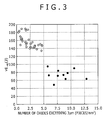
- Fig. 3 Successively, the relationship between the number of oxides having circle equivalent diameters exceeding 3 ⁇ m in an observation visual filed area of 1 mm 2 and an absorption energy at -40°C (vE- 40 ) is shown in Fig. 3 .
- the results of Nos. 1 to 32 shown in Table 5 are represented with the symbols ⁇ and the results of Nos. 35 to 40, 49, 53, 54, and 61 shown in Table 6 (the cases of exceeding 5.0 pieces in the comparative examples) are represented with the symbols ⁇ .
- vE- 40 is not less than 130 J and the HAZ toughness improves in the case where the proportion of the number of the inclusion I to the number of all inclusions is not less than 30% (No. 23).
- a steel material according to the present invention is excellent in HAZ toughness even when a high heat input welding method is applied and can be used for bridges, high-rise buildings, and marine vessels.
Landscapes
- Chemical & Material Sciences (AREA)
- Engineering & Computer Science (AREA)
- Materials Engineering (AREA)
- Metallurgy (AREA)
- Organic Chemistry (AREA)
- Mechanical Engineering (AREA)
- Treatment Of Steel In Its Molten State (AREA)
Abstract
Description
- The present invention relates: to a steel material used for bridges, high-rise buildings, marine vessels, etc.; and in particular to a steel material having a superior toughness at a zone affected by heat when the steel material is welded (hereunder referred to as "welded heat-affected zone" or "HAZ" occasionally) and a method for manufacturing the steel material.
- Properties required for a steel material used for bridges, high-rise buildings, marine vessels, etc. are increasingly stringent in recent years and notably a good toughness is required. Such a steel material is generally joined by welding in many cases and a problem is that the toughness of a welded joint, particularly a HAZ, is likely to deteriorate as a result of the influence of heat during welding. The toughness deteriorates more conspicuously as input heat increases during welding and an estimated reason is that, when input heat increases during welding, a cooling rate decreases at a HAZ, hardenability lowers, and coarse insular martensite forms. It is estimated that, in order to improve the toughness of a HAZ therefore, it is only necessary to decrease input heat to the least possible extent during welding. On the other hand, in order to increase welding operation efficiency, a high heat input welding method with a welding input heat of 50 kJ/mm or more, such as electrogas welding, electroslag welding, or submerged arc welding is desired to be adopted.
- To this end, the present applicants propose in
Patent Literatures 1 to 3 a steel material that can inhibit the toughness of a HAZ from deteriorating when a high heat input welding method is adopted. Such a steel material is characterized by containing oxides of REM and/or CaO and ZrO2 as oxides acting as nuclei of intragranular ferrite transformation. The oxides disperse finely in steel because they exist in the state of a liquid in molten steel. Moreover, the oxides are thermally stable, are solute, and do not disappear even when they are exposed for a long period of time at a high temperature of about 1,400°C for example, and hence contribute largely to the improvement of HAZ toughness. - Further the present applicants have repeatedly studied even after they have disclosed
Patent Literature 1 in order to provide a steel material excellent in HAZ toughness even at high heat input welding of a higher level and as a result have previously proposed the invention described in Patent Literature 4. Patent Literature 4 discloses that the size and the number of all oxide-based inclusions (not being limited to oxides acting as nuclei of intragranular ferrite transformation but including all oxides) in a steel material are greatly related to the improvement of HAZ toughness and in particular, by reducing the number of coarse oxides having circle equivalent diameters exceeding 5.0 µm to five or less, it is possible to obtain a steel material excellent in HAZ toughness even when high heat input welding is applied with a high input heat of about 50 kJ/mm. By Patent Literature 4, since the number of coarse oxides can conspicuously be suppressed, it is possible to enhance HAZ toughness even when a material is welded with an input heat larger than the input heat adopted in a HAZ toughness evaluation method disclosed in an example ofPatent Literature 1. Specifically, whereas a heat cycle of cooling a steel material for 300 sec. in the temperature range of 800°C to 500°C after the steel material is retained for 5 sec. at a heating temperature of 1,400°C (heat input conditions: 1,400°C x 5 sec., cooling time Tc is 300 sec.) is applied and an absorption energy at -40°C (vE-40) is measured inPatent Literature 1, in Patent Literature 4 an absorption energy is measured likewise when a heat cycle in which the retention time at 1,400°C is prolonged to 30 sec. (heat input conditions: 1,400°C x 30 sec., cooling time Tc is 300 sec.) is applied and it is confirmed that a good HAZ toughness is obtained even on this occasion. - Meanwhile, Patent Literatures 5 to 7 disclose: not such a technology of using both REM oxides and ZrO2 as disclosed in
Patent Literatures 1 to 4; but that HAZ toughness can be improved by adding REM into molten steel having an adjusted dissolved oxygen content when a high heat input welding exceeding about 300 kJ/cm (about 30 kJ/mm) is applied. -
- Patent Literature 1:
JP-A No. 2007-100213 - Patent Literature 2:
JP-A No. 2007-247004 - Patent Literature 3:
JP-A No. 2007-247005 - Patent Literature 4:
JP-A No. 2009-197267 - Patent Literature 5:
JP-A No. 2003-221643 - Patent Literature 6:
JP-A No. 2003-286540 - Patent Literature 7:
JP-A No. 2002-363687 - The improvement of welding operation efficiency is demanded inevitably and a welding input heat increases in accordance with the demand. A steel material exhibiting excellent performance even under a high heat input condition of 50 kJ/mm or more that has not been much studied heretofore is desired. The present invention is established in view of the above situation and an object thereof is to provide: a steel material excellent in HAZ toughness even when high heat input welding is applied with a input heat of 50 kJ/mm or more; and a method for manufacturing the steel material.
- A steel material excellent in toughness at a welded heat-affected zone according to the present invention that has solved the above problem is a steel material containing C: 0.02% to 0.15% (in terms of % by mass, the same shall apply hereafter), Si: 0.5% or less (excluding 0%), Mn: 2.5% or less (excluding 0%), P: 0.03% or less (excluding 0%), S: 0.02% or less (excluding 0%), Al: 0.050% or less (excluding 0%), N: 0.010% or less (excluding 0%), Ti: 0.005% to 0.10%, Zr: 0.0005% to 0.050%, REM: 0.0003% to 0.015%, Ca: 0.0003% to 0.010%, and O: 0.0005% to 0.010%, with the balance consisting of Fe and unavoidable impurities. Then the gist thereof is to satisfy the conditions that (a) the ZrO2 content is 5% to 50%, the REM oxide (M2O3 when REM is expressed by the symbol M) content is 5% to 50%, and the CaO content is 50% or less (excluding 0%) in average when the composition of all oxide-based inclusions included in the steel material is measured and then expressed in terms of the mass of the individual oxides, (b) among all the inclusions included in the steel material, the number of inclusions having circle equivalent diameters of 0.1 to 2 µm is not less than 120 in an observation visual field area of 1 mm2, the number of oxides having circle equivalent diameters exceeding 3 µm is not more than 5.0 in an observation visual field area of 1 mm2, and the number of oxides having circle equivalent diameters exceeding 5 µm is not more than 5.0 in an observation visual field area of 1 mm2, and (c-1) the proportion of the number of REM and Zr containing inclusions I satisfying the condition that the molar ratio of REM to Zr (REM/Zr) is 0.6 to 1.4 to the number of all the inclusions is 30% or more when the composition of all the inclusions included in the steel material is measured, and/or (c-2) the proportion of the number of REM, Zr, Al, Ca, and Ti containing inclusions II satisfying the condition that the ratio of the total mole number of REM and Zr to the total mole number of Al, Ca, and Ti [(REM+Zr)/(Al+Ca+Ti)] is 0.5 to 1.2 to the number of all the inclusions is 40% or more when the composition of all the inclusions included in the steel material is measured.
- The steel material may further contain the following elements as other elements;
- [1] Cu: 2% or less (excluding 0%) and/or Ni: 3.5% or less (excluding 0%),
- [2] Cr: 3% or less (excluding 0%) and/or Mo: 1% or less (excluding 0%),
- [3] Nb: 0.25% or less (excluding 0%) and/or V: 0.1% or less (excluding 0%), and
- [4] B: 0.005% or less (excluding 0%).
- A steel material according to the present invention can be manufactured: by adding REM so that a dissolved oxygen content Qof and an added REM amount QREM in molten steel may satisfy the following expression (1),

when REM is added to the molten steel having the dissolved oxygen content Qof adjusted in the range of 0.0003% to 0.01% by mass; and by controlling the condition of adding elements so as to satisfy the following condition (2) and/or (3) when REM and Zr are regarded as a-group elements and Ti, Ca, and Al are regarded as b-group elements in the case of adding REM, Zr, Ti, Ca, and Al to the molten steel having the dissolved oxygen content Qof adjusted in the above range, - (2) with regard to the a-group elements, both of REM and Zr are added simultaneously or either of REM and Zr is added firstly and then the other is added within 5 min. after the first addition, and/or
- (3) the b-group elements are added before the a-group elements are added and/or after the a-group elements are added and, when the b-group elements are added before the a-group elements are added, the time period from the time when the addition of a first element in the b-group elements commences to the time when the addition of a first element in the a-group elements commences is defined as t1 (min.) and, when the b-group elements are added after the a-group elements are added, the time period from the time when the addition of a last element in the a-group elements commences to the time when the addition of a first element in the b-group elements commences is defined as t2 (min.), and the sum of t1 and t2 is controlled to be 3 min. or longer (0 ≤ t1 and 0 ≤ t2, t1 and t2 are not zero).
- By the present invention, since a prescribed amount of oxides (oxides containing Zr, REM, and Ca) acting as nuclei of intragranular α transformation (α means ferrite or a mixed structure comprising ferrite and bainite, the same shall apply hereafter) are formed and the sizes and the numbers (namely grain size distributions) of inclusions and oxides existing in a steel material and the proportion of the number of inclusions containing prescribed elements in specific relationship to the number of all inclusions are controlled appropriately, it is possible to provide a steel material excellent in HAZ toughness at high heat input welding. In a steel material according to the present invention in particular, since not only a prescribed amount or more of fine inclusions having circle equivalent diameters of 0.1 to 2 µm that are useful for the improvement of HAZ toughness exist but also both the numbers of coarse oxides having circle equivalent diameters exceeding 3 µm and ultra-coarse oxides having circle equivalent diameters exceeding 5 µm, it having been obvious that those oxides adversely affect the improvement of HAZ toughness, are controlled significantly, and moreover the proportion of the number of REM and Zr containing inclusions I in which the molar ratio of REM to Zr satisfies a prescribed relationship and/or the proportion of the number of REM, Zr, Al, Ca, and Ti containing inclusions II in which the ratio of the total mole number of REM and Zr to the total mole number of Al, Ca, and Ti satisfies a specific relationship to the number of all the inclusions are controlled to a prescribed value or more, it is possible to enhance HAZ toughness even when welding is applied with an input heat larger than the input heat adopted in a HAZ toughness evaluation method disclosed in an example of Patent Literature 4.
-
- [
Fig. 1] Fig. 1 shows an example of a sequence in the addition of elements when b-group elements are added before and after a-group elements are added. - [
Fig. 2] Fig. 2 is a graph showing the relationship between a left-hand value (Z value) in the expression (1) stipulated in the present invention and the number of oxides having circle equivalent diameters exceeding 3 µm in an observation visual filed area of 1 mm2. - [
Fig. 3] Fig. 3 is a graph showing the relationship between the number of oxides having circle equivalent diameters exceeding 3 µm in an observation visual filed area of 1 mm2 and an absorption energy at -40°C (vE-40). - The present invention relates to a technology for obtaining a steel material having a HAZ toughness not deteriorating even when the steel material is welded with a higher input heat by improving the technology of using oxides acting as nuclei of intragranular α transformation disclosed in
Patent Literatures 1 to 4. - That is, the present inventors have studied in order to provide a steel material excellent in HAZ toughness at high heat input welding of a higher level even after Patent Literature 4 is proposed. As a result, the present inventors have found that, in order to provide a steel material excellent in HAZ toughness even when "heat cycle of cooling a steel material for 400 sec. in the temperature range of 800°C to 500°C after the steel material is retained for 5 sec. at a heating temperature of 1,450°C" (heat input conditions: 1,450°C x 5 sec., cooling time Tc is 400 sec.) that are conditions of a higher input heat than Patent Literature 4 is applied, it is insufficient to merely reduce the number of oxides having circle equivalent diameters exceeding 5.0 µm to not more than 5 like Patent Literature 4. And the present inventors have found that it is extremely important that: the number of oxides exceeding 3.0 µm to which documents including Patent Literature 4 have not heretofore paid attention at all is reduced and, when the composition of all inclusions included in a steel material is measured, the proportion of the number of REM and Zr containing inclusions I satisfying the condition that the molar ratio of REM to Zr (REM/Zr) is 0.6 to 1.4 to the number of all the inclusions included in the steel material is 30% or more; or the proportion of the number of REM, Zr, Al, Ca, and Ti containing inclusions II satisfying the condition that the ratio of the total mole number of REM and Zr to the total mole number of Al, Ca, and Ti [(REM+Zr)/(Al+Ca+Ti)] is 0.5 to 1.2 to the number of all the inclusions included in the steel material is 40% or more; and have completed the present invention.
- In this way, specific features of the present invention are that:
- (a) the number of fine oxides having circle equivalent diameters of 0.1 to 2 µm which are useful for the improvement of HAZ toughness is increased (to 120 pieces/mm2 or more);
- (b) the number of oxides having circle equivalent diameters exceeding 5 µm which adversely affect the improvement of HAZ toughness is reduced (to 5.0 pieces/mm2 or less);
- (c) further the number of oxides having circle equivalent diameters exceeding 3 µm, it having been obvious for the first time in the present invention that those oxides adversely affect the improvement of HAZ toughness, is reduced (to 5.0 pieces/mm2 or less); and
- (d) when the composition of all inclusions included in a steel material is measured, the proportion of the number of REM and Zr containing inclusions I satisfying the condition that the molar ratio of REM to Zr (REM/Zr) is 0.6 to 1.4 to the number of all the inclusions included in the steel material is 30% or more or the proportion of the number of REM, Zr, Al, Ca, and Ti containing inclusions II satisfying the condition that the ratio of the total mole number of REM and Zr to the total mole number of Al, Ca, and Ti [(REM+Zr)/(Al+Ca+Ti)] is 0.5 to 1.2 to the number of all the inclusions included in the steel material is 40% or more.
- By having such specific features, it is possible to improve HAZ toughness even when welding is applied with an input heat larger than an input heat in Patent Literature 4. That is, the present invention is characterized by stipulating the requirements (c) and (d) in addition to the requirements (a) and (b) in relation to Patent Literature 4.
- Strictly speaking, the requirement (a) is different from Patent Literature 4. The difference is that, whereas oxides are focused on and the number of fine oxides in the oxides is controlled in Patent Literature 4, not only oxides but also all inclusions existing in a steel material are focused on and the number of fine inclusions in the inclusions is controlled in the present invention. As a result of studies by the present inventors, it has been clarified that oxides having large circle equivalent diameters (hereafter abbreviated merely to "grain size" occasionally) (both oxides exceeding 3 µm and oxides exceeding 5 µm in the present invention) largely influence the realization of a good HAZ toughness. Then by controlling the large oxides so as not to be formed, it is possible to secure desired characteristics even when small inclusions having grain sizes of 0.1 to 2 µm are not limited to oxides but expanded to all inclusions.
- Further, it has been found that, in order to meet the requirement (c), it is insufficient to merely control a dissolved oxygen content in molten steel before REM is added as disclosed in Patent Literature 4 and Patent Literatures 5 to 7 and it is extremely important to control the added REM amount QREM appropriately in accordance with a dissolved oxygen content Qof in molten steel. Specifically, an amount of REM (QREM) satisfying the expression (1) below is added in accordance with a dissolved oxygen content Qof in molten steel before REM is added. By so doing, it is possible to inhibit REM-based oxides having large grain sizes and adversely influencing the realization of a desired HAZ toughness from forming. Details including technological significance and the like of the following expression (1) will be described later.

- Further, it has been clarified that, in order to meet the requirement on the proportion of the number of the inclusions I in the requirement (d), it is necessary to pay attention to the sequence in the addition of REM and Zr and the interval between the addition of REM and the addition of Zr and it is important to add both of REM and Zr simultaneously or control the interval from the time when either of REM and Zr is added to the time when the other is added to within 5 min. when REM is added to molten steel having an adjusted dissolved oxygen content Qof.
- Furthermore, it has been clarified that, in order to meet the requirement on the proportion of the number of the inclusions II in the requirement (d), it is important to control the conditions for adding REM, Zr, Ti, Ca, and Al appropriately. Specifically, when REM, Zr, Ti, Ca, and Al are divided into an a-group (REM and Zr) and a b-group (Ti, Ca, and Al), it is necessary to pay attention to the sequence in the addition of the groups and the interval between the addition of the two groups.
- Details including technological significance of the requirement (d) will be described later.
- In the present description, in order to distinguish oxides acting as nuclei of intragranular α transformation, namely oxides containing Zr, REM, and Ca from all oxides included in a steel material, for convenience of explanation, the former is particularly referred to as "Zr-REM-Ca-based oxides" and the latter is particularly referred to as " all oxide-based inclusions" occasionally. The oxides here mean to include both individual oxides and composite oxides formed by combining inclusions other than the oxides (for example, sulfides, nitrides, carbides, or a composite compound of those). Further, indispensable components (Zr, REM, and Ca) constituting Zr-REM-Ca-based oxides are particularly referred to as "intragranular α transformation forming elements" occasionally.
- Zr-REM-Ca-based oxides acting as the origins of intragranular α transformation are explained hereunder. The Zr-REM-Ca-based oxides mean substances indispensably including oxides of Zr, oxides of REM, and oxides of Ca. Elements (intragranular α transformation forming elements) constituting the Zr-REM-Ca-based oxides are Zr, REM, and Ca but, besides those, may also include oxide forming elements such as Ti, Mn, Si, and Al or other components existing in steel.
- The existence form of the Zr-REM-Ca-based oxides is not particularly limited and the Zr-REM-Ca-based oxides may exist as either individual oxides containing intragranular α transformation forming elements individually or composite oxides containing two or more intragranular α transformation forming elements. Examples of individual oxides are ZrO2 in the case of Zr, CaO in the case of Ca, and M2O3, MgO5, and MO2 in the case of REM when REM is represented by the symbol "M". Further, the oxides may exist either in the state where they agglutinate or in the state where other compounds such as sulfides and nitrides precipitate compositely in the oxides.
- It is preferable that the Zr-REM-Ca-based oxides further contain oxides of Ti. When oxides of Ti exist further, intragranular α transformation is accelerated and the improvement of HAZ toughness is enhanced further. Oxides of Ti may exist either as individual oxides (Ti2O3, Ti3O5, or TiO2 for example) or in the form of composite oxides including at least one kind of the Zr-REM-Ca-based oxides and Ti.
- Further, in a steel material according to the present invention, besides the aforementioned oxides, sulfides, nitrides, carbides, or a composite compound of those are also included and oxides, sulfides, nitrides, carbides, and a composite compound of those contained in a steel material are collectively referred to as "all inclusions" in the present description.
- In the present description furthermore, among all oxide-based inclusions included in a steel material, oxides having circle equivalent diameters of 0.1 to 2 µm are referred to as "fine oxides", oxides having circle equivalent diameters exceeding 3 µm as "coarse oxides", and oxides having circle equivalent diameters exceeding 5 µm as "ultra-coarse oxides" respectively and they are distinguished from each other in some cases. Although oxides having circle equivalent diameters exceeding 5 µm are defined as "coarse oxides" in Patent Literature 4, oxides having circle equivalent diameters exceeding 3 µm are defined as "coarse oxides" in the present description.
- In the present description, "a steel material excellent in HAZ toughness at high heat input welding" means a steel material having an absorption energy at -40°C (vE-40) of 130 J or more when a heat cycle (heat history) of retaining the steel material for 5 sec. at 1,450°C and thereafter cooling the steel material for 400 sec. from 800°C to 500°C. (heat input conditions: 1,450°C x 5 sec., cooling time Tc is 400 sec.) is given to the steel material. The larger a value of vE-40, the better and a preferable vE-40 value is 150 J or more. The above heat cycle may sometimes be referred to as "high heat input heat history". The input heat given by the heat cycle is larger than the input heat given by a heat cycle described in
Patent Literatures 1 and 4 and in that sense the input heat level at "high heat input welding" in the present invention is different from the heat input level at "high heat input welding" described inPatent Literatures 1 and 4. - The temperature in the heat cycle is set at 1,450°C in the present invention in consideration of the fact that heating temperature of a site particularly adjacent to weld metal (referred to as a bond site occasionally) in a HAZ exceeds 1,400°C and reaches about 1,450°C.
- The requirements (a) to (c) constituting the present invention are hereunder explained in detail.
- A steel material according to the present invention satisfies the conditions that the ZrO2 content is 5% to 50%, the REM oxide (M2O3 when REM is expressed by the symbol M) content is 5% to 50%, and the CaO content is 50% or less (excluding 0%) in average when the composition of all oxide-based inclusions included in the steel material is measured and then expressed in terms of the mass of the individual oxides (100% in total) and thereby they function effectively as nuclei of intragranular α transformation. If the respective oxide contents are lower than the relevant lower limits, the amount of oxides acting as nuclei of intragranular α transformation during welding is insufficient and the function of improving HAZ toughness is not exhibited. On the other hand, if the respective oxide contents exceed the relevant upper limits, oxides coarsen, the number of fine oxides effectively acting as nuclei of intragranular α transformation reduces, and the function of improving HAZ toughness is not effectively exhibited.
- The ZrO2 content is 5% or more, preferably 8% or more, and yet preferably 10% or more. On the other hand, the upper limit thereof is 50%, preferably 45%, and yet preferably 40%.
- The REM oxide content is 5% or more, preferably 10% or more, and yet preferably 13% or more. On the other hand, the upper limit thereof is 50%, preferably 45%, and yet preferably 40%. Here the REM oxides exist in the forms of M2O3, M3O5, and MO2 in a steel material when REM is expressed by the symbol M and a REM oxide content means an amount obtained by converting all REM oxides into M2O3 in the present invention.
- CaO functions effectively as nuclei of intragranular α transformation but, if it is contained excessively, the ability of intragranular α transformation rather deteriorates. Further, if CaO is contained excessively, a nozzle used during casting melts and is damaged. Consequently, the upper limit thereof is set at 50%, preferably 45% or less, yet preferably 40% or less, and still yet preferably 30% or less. In order to effectively exhibit the above function, CaO is contained by preferably 3% or more, yet preferably 5% or more, and still yet preferably 10% or more.
- Here, the other components in the composition of the all oxide-based inclusions are not particularly limited and the examples are oxides of oxide forming elements (SiO2, Al2O3, and MnO for example) included in a steel material according to the present invention.
- The composition of all oxide-based inclusions included in a steel material can be measured by observing the surface of the steel material with an electron probe X-ray micro analyzer (EPMA) for example and quantitatively analyzing oxides recognized in an observation visual field. Details of the measurement conditions are explained in the section of the examples that will be described later.
- The numbers and the sizes of all inclusions characterizing the present invention are explained hereunder. A steel material according to the present invention is a steel material satisfying all of the following conditions that;
- (i) the number of fine inclusions having circle equivalent diameters of 0.1 to 2 µm is not less than 120 in an observation visual field area of 1 mm2,
- (ii) the number of coarse oxides having circle equivalent diameters exceeding 3 µm is not more than 5.0 in an observation visual field area of 1 mm2, and
- (iii) the number of ultra-coarse oxides having circle equivalent diameters exceeding 5 µm is not more than 5.0 in an observation visual field area of 1 mm2. In particular, the greatest characteristic of the present invention is that both the conditions (ii) and (iii) are stipulated with regard to oxides having large circle equivalent diameters (grain sizes).
- Here, to satisfy both the requirements (ii) and (iii) means namely that the number of oxides having grain sizes of more than 3 µm to not more than 5 µm is as small as 5.0 or less. That is, it has been clarified for the first time as a result of the study by the present inventors that, in order to secure a very high HAZ toughness of vE-40 ≥ 130 J even when a high heat input heat history is applied in the present invention, it is extremely important to reduce the oxides having "grain sizes of more than 3 µm to not more than 5 µm which have not been focused on at all in Patent Literature 4 and, when the number of oxides in the above range cannot be controlled, the oxides act as the origin of brittle fracture and HAZ toughness deteriorates.
- The technological significance of the requirements (ii) and (iii) is hereunder explained in detail in reference to Tables 5 and 6 below of the examples.
- Nos. 1 to 32 in Table 5 are the cases of satisfying all the requirements stipulated in the present invention. According to study focused on the requirements (ii) and (iii), the number of oxides exceeding 3 µm is controlled to 4.64 even in the case of No. 5 where the number of oxides exceeding 5 µm is largest (1.440 oxides) in Nos. 1 to 32 and as a result a good HAZ toughness is secured.
- On the other hand, Nos. 35 to 38, 49, 53, 54, and 61 in Table 6 are the cases of satisfying the requirement (iii) but not satisfying the requirement (ii). Specifically, although the oxides exceeding 5 µm are suppressed to 0.440 to 2.250 pieces, namely not more than 5.0 pieces, the oxides exceeding 3 µm are more than 5.0 pieces and increase to 5.71 to 10.65 pieces and as a result a desired HAZ toughness is not obtained.
- Here, it is obvious that Nos. 35 to 38, 49, 53, 54, and 61 stated above are the cases included in the range of Patent Literature 4 on the point that they satisfy the requirement (iii) but a desired HAZ toughness stipulated in the present invention is not attained in the cases of not satisfying the requirement (ii) even when the cases are included in the range of Patent Literature 4. For that reason, the requirement (ii) is further stipulated as a requirement for securing a desired HAZ toughness in addition to the requirement (iii) in the present invention.
- Further, it is understood from the requirements (ii) and (iii) that particularly the number of oxides of more than 3 µm to not more than 5 µm deeply relates to the attainment of a desired HAZ toughness. That is, it has been an unexpected finding for the present inventors that, oxides exceeding 5.0 pieces may exist in the very narrow range of more than 3 µm to not more than 5 µm in some manufacturing conditions and a desired HAZ toughness is not obtained only by the existence of coarse oxides exceeding 5.0 pieces in the range of more than 3 µm to not more than 5 µm even if the number of fine oxides in the region of the requirement (i) is greatly increased and the number of ultra-coarse oxides in the region of the requirement (iii) is reduced.
- Detailed mechanism on why a desired HAZ toughness is secured by satisfying both the requirements (ii) and (iii) is not obvious but, if a temperature exceeds 1,400°C and reaches 1,450°C, disappearance of TiN advances acceleratedly and toughness deteriorates. It is estimated however that such deterioration of toughness can be suppressed by reducing the oxides of more than 3 µm to not more than 5 µm.
- As stated above, in the present invention, it is necessary to satisfy both the requirements (ii) and (iii) simultaneously. That is, the number of coarse oxides having grain sizes exceeding 3 µm is set at 5.0 or less and the number of ultra-coarse oxides having grain sizes exceeding 5 µm is also set at 5.0 or less. The smaller the numbers are, the better. In both the cases, the numbers are preferably 3.0 or less, yet preferably 2.0 or less, still yet preferably 1.0 or less, and ultimately preferably zero. Specifically, it is desirable to appropriately control the numbers including the balance of both the numbers and it is more desirable to reduce the number of ultra-coarse oxides having grain sizes exceeding 5 µm rather than coarse oxides having grain sizes exceeding 3 µm in the range of the present invention (not more than 5.0 pieces in both the cases). More specifically, whereas a better HAZ toughness is obtained as the number of ultra-coarse oxides approaches the lower limit (zero), then the number is preferably about 1.0 or less, and a number ultimately closer to zero is the best, the number of coarse oxides may be acceptable even if the number is close to the upper limit (5.0) and even the number of 4.0 or less is preferably accepted.
- Here, the number of oxides having circle equivalent diameters exceeding 3 µm and the number of oxides having circle equivalent diameters exceeding 5 µm can be obtained by observing a cross-section of a steel material for example with an EPMA, quantitatively analyzing the component composition of inclusions recognized in an observation visual field, regarding the inclusions having oxygen contents of 5% or more as oxides, and observing and measuring the circle equivalent diameters of the oxides for example with a scanning-type electron microscope (SEM).
- The requirements (ii) and (iii) characterizing the present invention have heretofore been described in detail.
- In a steel material according to the present invention, as stipulated in the requirement (i), it is necessary to set the number of fine inclusions having circle equivalent diameters of 0.1 to 2 µm at not less than 120 in an observation visual field area of 1 mm2. The number of fine inclusions is set at not less than 120 in an observation visual field area of 1 mm2, preferably not less than 200 per 1 mm2, yet preferably not less than 500 per 1 mm2, and still yet preferably not less than 700 per 1 mm2.
- Here, the number of fine inclusions having circle equivalent diameters of 0.1 to 2 µm may be obtained by observing and measuring a cross-section of a steel material for example with SEM.
- In a steel material according to the present invention, inclusions having circle equivalent diameters of less than 0.1 µm scarcely contribute to the improvement of HAZ toughness by the dispersion of inclusions and hence are not included in the number of the aforementioned inclusions.
- A "circle equivalent diameter" stated above is a diameter of a circle assumed so as to have the same area as inclusions (including oxides) and can be recognized on an observation plane of an SEM.
- [With regard to (c) the proportion of the number of REM and Zr containing inclusions I satisfying the condition that a REM/Zr ratio is 0.6 to 1.4 and the proportion of the number of REM, Zr, Al, Ca, and Ti containing inclusions II satisfying the condition that a (REM+Zr)/(Al+Ca+Ti) ratio is 0.5 to 1.2]
The HAZ toughness of a steel material according to the present invention is further enhanced by, in addition to appropriately adjusting the numbers and the sizes of all inclusions, satisfying the following requirements when the composition of all the inclusions included in the steel material is measured; - (c-1) the proportion of the number of REM and Zr containing inclusions I (hereunder merely referred to as inclusions I occasionally) satisfying the condition that a molar ratio of REM to Zr (REM/Zr) is 0.6 to 1.4 to the number of all the inclusions is 30% or more, or
- (c-2) the proportion of the number of REM, Zr, Al, Ca, and Ti containing inclusions II (hereunder merely referred to as inclusions II occasionally) satisfying the condition that a ratio of the total mole number of REM and Zr to the total mole number of Al, Ca, and Ti [(REM+Zr)/(Al+Ca+Ti)] is 0.5 to 1.2 to the number of all the inclusions is 40% or more.
- With regard to the requirements (c-1) and (c-2), it is only necessary to satisfy at least either of the two requirements and it is acceptable to satisfy both the two requirements as a matter of course.
- The requirement (c-1) specifies a molar ratio of REM/Zr and the proportion of the number of the inclusions I required for realizing a desired HAZ toughness with regard to inclusions containing REM and Zr in intragranular α transformation forming elements (REM, Zr, and Ca). Meanwhile, the requirement (c-2) specifies a molar ratio of (REM+Zr)/(Al+Ca+Ti) and the proportion of the number of the inclusions II required for realizing a desired HAZ toughness with regard to inclusions containing intragranular α transformation forming elements (Zr, REM, and Ca) and other elements constituting inclusions (Ti and Al).
- That is, as it will be obvious in the examples described later, it has been found that the values of toughness in steel materials vary even when the requirements (a) and (b) are nearly identical. That is, an absorption energy at -40°C (vE-40) of 100 J or more can be attained even when high heat input welding is applied by controlling the average composition of oxides and the sizes and the grain size distribution of inclusions as stipulated by the requirements (a) and (b) and further a vE-40 of 130 J or more can be attained by controlling the proportion of the number of the inclusions I stipulated in the requirement (c-1) and/or the proportion of the number of the inclusions II stipulated in the requirement (c-2), in addition to the requirements (a) and (b).
- With regard to the requirement (c-1), in No. 2 shown in Table 5 and No. 33 shown in Table 6 for example, the difference of 42 J is caused in absorption energy at -40°C (vE-40) in spite of the fact that the grain size distributions of all the inclusions stipulated in the requirement (b) are nearly identical. Then as a result of further studies by the present inventors, it has been found that, with regard to REM and Zr constituting inclusions, in the case (No. 2) where the proportion of the number of the inclusions I satisfying the condition that a molar ratio of REM to Zr (REM/Zr) is 0.6 to 1.4 to the number of all inclusions is controlled to 30% or more, the ability of intragranular α transformation is excellent and HAZ toughness is good but, in the case (No. 33) where the proportion of the number of the inclusions I satisfying the condition is less than 30%, a desired HAZ toughness is not secured. REM and Zr are elements of forming oxides acting as nuclei of intragranular α transformation and it is found that the proportion of the number of the inclusions I to the number of all inclusions and HAZ toughness are well correlated and thus the requirement (c-1) is stipulated. That is, it has been found that the inclusions I satisfying the condition that a REM/Zr ratio is 0.6 to 1.4: are superior in the ability of intragranular α transformation to inclusions having REM/Zr ratios of less than 0.6 or more than 1.4; and hence contribute to further miniaturizing a metallographic structure at a HAZ and improving HAZ toughness.
- Then by setting the proportion of the number of the inclusions I to the number of all inclusions at 30% or more, it is possible to attain an absorption energy at -40°C (vE-40) of 130 J or more even when high heat input welding is applied. The larger the proportion of the number of the inclusions I to the number of all inclusions, the better and the proportion is preferably 40% or more and yet preferably 50% or more. The larger the proportion of the number of the inclusions I, the better and the proportion is ultimately preferably 100%.
- With regard to the requirement (c-2) too, in the same manner as the requirement (c-1), in No. 17 shown in Table 5 and No. 51 shown in Table 6 for example, the difference of 36 J is caused in absorption energy at -40°C (vE-40) in spite of the fact that the grain size distributions of all the inclusions stipulated in the requirement (b) are nearly identical. Then as a result of further studies by the present inventors, it has been found that, with regard to REM, Zr, Ti, Ca, and Al constituting inclusions, in the case (No. 17) where the proportion of the number of the inclusions II satisfying the condition that a ratio of the total mole number of REM and Zr to the total mole number of Al, Ca, and Ti [(REM+Zr)/(Al+Ca+Ti)] is 0.5 to 1.2 to the number of all inclusions is controlled to 40% or more, intragranular α transformation is accelerated and HAZ toughness is good but, in the case (No. 51) where the proportion of the number of the inclusions II satisfying the ratio is less than 40%, a desired HAZ toughness is not secured.
- In the inclusions II having (REM+Zr)/(Al+Ca+Ti) ratios satisfying the aforementioned range, REM and Zr in elements acting as nuclei of intragranular α transformation are controlled appropriately in relation to other elements (Al, Ca, and Ti) constituting inclusions, hence intragranular α transformation is accelerated, a metallographic structure at a HAZ is miniaturized further, and hence HAZ toughness improves.
- That is, as a result of studies on the relationship between the component composition of inclusions dispersing in steel and HAZ toughness, it has been found that inclusions themselves acting as nuclei of intragranular α transformation have to have a good consistency with an α phase in order to miniaturize a metallographic structure by forming an intragranular α phase in a HAZ. It has been clarified through experiments by the present inventors that inclusions containing Ti, in addition to REM and Zr, are effective as inclusions having a good consistency with an α phase. In order to grow an intragranular α phase formed by using inclusions containing REM, Zr, and Ti as origins in a succeeding austenite phase however, it is also desired that the consistency between the inclusions themselves containing REM, Zr, and Ti and an austenite phase is also good. Thus the present inventors have further studied in order to improve the consistency between the inclusions containing REM, Zr, and Ti and an austenite phase and have found that it is possible to control intragranular α transformation by controlling the melting point of the inclusions. That is, when inclusions melt once in an austenite phase during welding, the affinity between the molten inclusions and the austenite phase increases and the inclusions are crystallized during cooling while the consistency with the ambient austenite phase is retained. When the temperature lowers further, an α phase starts to form, on that occasion inclusions having a good consistency with the α phase form preferentially, the α phase formed from the inclusions has a good consistency with austenite too, hence intragranular α transformation is accelerated, and the effect of improving HAZ toughness by the miniaturization of crystal is obtained.
- Then the present inventors have investigated, with regard to inclusions containing REM, Zr, and Ti, the behavior of the melting point of inclusions with a high temperature laser microscope in order to find a component composition region where the melting point lowers. As a result, it has been clarified that the melting point of inclusions containing REM, Zr, and Ti is influenced by the contents of Ca and Al and, when a (REM+Zr)/(Al+Ca+Ti) ratio in terms of the mole number of the elements is in the range of 0.5 to 1.2, the melting point of the inclusions lowers locally and the ability of intragranular α transformation increases.
- That is, it has been found that the inclusions II satisfying the condition that the (REM+Zr)/(Al+Ca+Ti) ratios are 0.5 to 1.2 are excellent in intragranular α transformation in comparison with inclusions having (REM+Zr)/(Al+Ca+Ti) ratios of lower than 0.5 or higher than 1.2, hence further miniaturize a metallographic structure at a HAZ, and contribute to the improvement of HAZ toughness.
- The composition of inclusions included in a steel material may be obtained by observing a cross-section of the steel material for example with an EPMA and quantitatively analyzing the component composition of the inclusions recognized in an observation visual field and the proportion of the number of the inclusions I and the proportion of the number of the inclusions II to the number of all inclusions may be obtained after the composition of all inclusions included in the steel material is measured. Here, in a steel material according to the present invention, the composition of inclusions having circle equivalent diameters of 0.1 µm or more is quantitatively analyzed. The reason is that inclusions having circle equivalent diameters of less than 0.1 µm are too small to be quantitatively analyzed with a high degree of accuracy.
- The component composition of a steel material (base material) according to the present invention is explained hereunder. A steel material according to the present invention contains, as the basic components, C: 0.02% to 0.15%, Si: 0.5% or less (excluding 0%), Mn: 2.5% or less (excluding 0%), P: 0.03% or less (excluding 0%), S: 0.02% or less (excluding 0%), Al: 0.050% or less (excluding 0%), N: 0.010% or less (excluding 0%), Ti: 0.005% to 0.10%, Zr: 0.0005% to 0.050%, REM: 0.0003% to 0.015%, and Ca: 0.0003% to 0.010%. The reasons why such ranges are decided are as follows.
- C is an element indispensable for securing the strength of a steel material (base material) and must be contained by 0.02% or more. A C content is set at preferably 0.04% or more and yet preferably 0.05% or more. If a C content exceeds 0.15% however, insular martensite (MA) is formed abundantly at a HAZ during welding and not only causes the toughness of a HAZ to deteriorate but also adversely affects the weldability. Consequently, a C content is set at 0.15% or less, preferably 0.10% or less, and yet preferably 0.08% or less.
- Si is an element that has a deoxidation function and contributes to improving the strength of a steel material (base material) by solid-solution strengthening. It is preferable to contain Si by 0.01% or more in order to effectively exhibit such functions. An Si content is set at yet preferably 0.05% or more and still yet preferably 0.1% or more. If an Si content exceeds 0.5% however, the weldability and toughness of a steel material deteriorate and hence an Si content has to be suppressed to not more than 0.5%. An Si content is set at preferably 0.3% or less, yet preferably 0.25% or less, and still yet preferably 0.21% or less.
- Mn is an element contributing to improving the strength of a steel material (base material). If an Mn content exceeds 2.5% however, the weldability of a steel material (base material) deteriorates. Consequently, an Mn content must be suppressed to not more than 2.5%. An Mn content is set at preferably 2.30% or less and yet preferably 2.0% or less. Meanwhile, it is preferable to contain Mn by 0.2% or more in order to effectively exhibit the above effect. An Mn content is set at yet preferably 0.40% or more, still yet preferably 0.60% or more, and particularly preferably 0.8% or more.
- P is an element likely to segregate and deteriorates HAZ toughness particularly by segregating at crystal grain boundaries in a steel material. Consequently, a P content has to be suppressed to 0.03% or less. A P content is set at preferably 0.02% or less and yet preferably 0.015% or less. Meanwhile, usually P is unavoidably contained by about 0.001%.
- S is a harmful element that forms sulfides (MnS) by combining with Mn and deteriorates the toughness and ductility in the plate thickness direction of α base material. Further, if S combines with REM such as La and Ce and forms sulfides of REM (LaS and CeS for example), oxides of REM are inhibited from forming and hence HAZ toughness deteriorates. Consequently, an S content has to be suppressed to 0.02% or less. An S content is set at preferably 0.015% or less, yet preferably 0.010% or less, and still yet preferably 0.006% or less. Meanwhile, usually S is unavoidably contained by about 0.0005%.
- Al is an element functioning as a deoxidizing agent. If Al is excessively added however, Al reduces oxides, coarse Al oxides are formed, and HAZ toughness deteriorates. Consequently, an Al content has to be suppressed to 0.050% or less. An Al content is set at preferably 0.04% or less, yet preferably 0.03% or less, still yet preferably 0.025% or less, and particularly preferably 0.010% or less. Meanwhile, usually Al is unavoidably contained by about 0.0005%.
- N is an element precipitating nitrides (ZrN and TiN for example) and the nitrides prevent austenite grains formed at a HAZ during welding from coarsening by a pinning effect, accelerate intragranular α transformation, and contribute to the improvement of HAZ toughness. N forms nitrides more and accelerates the miniaturization of austenite grains more as it increases and hence N acts effectively on the improvement of toughness at a HAZ. If an N content exceeds 0.010% however, the content of solute N increases, the toughness of a base material itself deteriorates, and HAZ toughness also deteriorates. Consequently, an N content has to be suppressed to 0.010% or less. An N content is set at preferably 0.0090% or less and yet preferably 0.008% or less. Meanwhile, it is preferable to contain N by 0.003% or more in order to effectively exhibit the above effect. An N content is set at yet preferably 0.004% or more and still yet preferably 0.005% or more.
- Ti is an element that forms nitrides such as TiN and oxides containing Ti in a steel material and contributes to the improvement of HAZ toughness. Ti has to be contained by 0.005% or more in order to exhibit the effect. A Ti content is preferably 0.007% or more and yet preferably 0.010% or more. If Ti is excessively added however, a base material itself hardens by solid-solution strengthening of Ti, the lowering of HAZ toughness is caused, and hence Ti has to be suppressed to 0.10% or less. A Ti content is set at preferably 0.07% or less and yet preferably 0.06% or less.
- Zr is an element that forms composite oxides including Zr and contributes to the improvement of HAZ toughness. Zr has to be contained by 0.0005% or more in order to exhibit the function. A Zr content is preferably 0.0015% or more and yet preferably 0.0020% or more. If Zr is excessively added however, coarse Zr oxides (ZrO2 for example) are formed abundantly and HAZ toughness deteriorates. Consequently, a Zr content is suppressed to 0.050% or less. A Zr content is set at preferably 0.04% or less, yet preferably 0.03% or less, and still yet preferably 0.01% or less.
- REM (rare-earth elements) and Ca are elements necessary for forming respective oxides. By containing such oxides, the oxides are likely to disperse finely and the finely dispersing oxides act as nuclei of intragranular α transformation and hence contribute to the improvement of HAZ toughness.
- REM should be contained by 0.0003% or more and a REM content is set at preferably 0.001% or more and yet preferably 0.0020% or more. If REM is excessively added however, solute REM forms and segregates and thereby the toughness of a base material deteriorates. Consequently, a REM content should be suppressed to 0.015% or less. A REM content is set at preferably 0.010% or less and yet preferably 0.007% or less. Here, REM in the present invention includes lanthanoid elements (15 elements from La to Lu), Sc (scandium), and Y (yttrium). Among those elements, it is preferable to contain at least one element selected from the group consisting of La, Ce, and Y and it is yet preferable to contain La and/or Ce.
- Ca should be added by 0.0003% or more and a Ca content is set at preferably 0.0005% or more, yet preferably 0.0008% or more, and still yet preferably 0.001% or more. If Ca is excessively added however, coarse Ca sulfides form and the toughness of a base material deteriorates. Further, if Ca is excessively added, CaO forms excessively, inclusions of high CaO concentrations form, the composition deviates from an optimum inclusion composition range, hence the effect of the inclusions in functioning as intragranular transformation nuclei weakens, and HAZ toughness rather deteriorates. Consequently, a Ca content is suppressed to 0.010% or less. A Ca content is preferably 0.009% or less, yet preferably 0.008% or less, and still yet preferably 0.005% or less.
- A steel material according to the present invention contains the above elements as indispensable components and an O (oxygen) content is 0.0005% to 0.010%. An oxygen content here is a total oxygen content and means the total content of oxygen constituting oxides and free oxygen dissolving in a steel material. The residual components of a steel material may be iron and unavoidable impurities (Mg, As, Se, etc. for example).
- It is also effective that a steel material according to the present invention further contains the following elements as other elements;
- [1] Cu: 2% or less (excluding 0%) and/or Ni: 3.5% or less (excluding 0%),
- [2] Cr: 3% or less (excluding 0%) and/or Mo: 1% or less (excluding 0%),
- [3] Nb: 0.25% or less (excluding 0%) and/or V: 0.1% or less (excluding 0%), and
- [4] B: 0.005% or less (excluding 0%).
- Both Cu and Ni are elements contributing to enhancing the strength of a steel material and can be added individually or compositely.
- If a Cu content exceeds 2% however, the strength of a base material increases excessively, the toughness of the base material rather deteriorates, and hence HAZ toughness also lowers. Consequently, a Cu content is set at preferably 2% or less, yet preferably 1.8% or less, and still yet preferably 1.5% or less. Meanwhile, in order to effectively exhibit the function by the addition of Cu, it is preferable to contain Cu by 0.05% or more. A Cu content is set at yet preferably 0.1% or more and still yet preferably 0.20% or more.
- If an Ni content exceeds 3.5%, in the same manner as Cu, the strength of a base material increases excessively, the toughness of the base material deteriorates, and hence HAZ toughness also lowers. Consequently, an Ni content is set at preferably 3.5% or less, yet preferably 3.0% or less, and still yet preferably 2.5% or less. Meanwhile, in order to effectively exhibit the function by the addition of Ni, it is preferable to contain Ni by 0.05% or more. An Ni content is set at yet preferably 0.1% or more and still yet preferably 0.2% or more.
- Both Cr and Mo are elements contributing to enhancing the strength of a steel material and can be added individually or compositely.
- If a Cr content exceeds 3% however, the strength of a base material increases excessively, the toughness of the base material deteriorates, and hence HAZ toughness lowers. Consequently, a Cr content is set at preferably 3% or less, yet preferably 2% or less, and still yet preferably 1.0% or less. Meanwhile, in order to effectively exhibit the function by the addition of Cr, it is preferable to contain Cr by 0.05% or more. A Cr content is set at yet preferably 0.1% or more and still yet preferably 0.15% or more.
- If an Mo content exceeds 1%, in the same manner as Cr, the strength of a base material increases excessively, the toughness of the base material deteriorates, and hence HAZ toughness lowers. Consequently, an Mo content is set at preferably 1% or less, yet preferably 0.9% or less, and still yet preferably 0.8% or less. Meanwhile, in order to effectively exhibit the function by the addition of Mo, it is preferable to contain Mo by 0.05% or more. An Mo content is set at yet preferably 0.1% or more and still yet preferably 0.15% or more.
- Both Nb and V are elements that precipitate as carbonitrides, prevent austenite grains from coarsening during welding by the pinning effect of the carbonitrides, and have the function of improving HAZ toughness. Nb and V can be added individually or compositely.
- If an Nb content exceeds 0.25% however, precipitating carbonitrides coarsen and HAZ toughness rather deteriorates. Consequently, an Nb content is set at preferably 0.25% or less, yet preferably 0.2% or less, and still yet preferably 0.15% or less. Meanwhile, in order to effectively exhibit the function by the addition of Nb, it is preferable to contain Nb by 0.002% or more. An Nb content is set at yet preferably 0.010% or more and still yet preferably 0.02% or more.
- If a V content exceeds 0.1%, in the same manner as Nb, precipitating carbonitrides coarsen and HAZ toughness rather deteriorates. Consequently, a V content is set at preferably 0.1% or less, yet preferably 0.09% or less, and still yet preferably 0.08% or less. Meanwhile, in order to effectively exhibit the function by the addition of V, it is preferable to contain V by 0.002% or more. A V content is set at yet preferably 0.005% or more and still yet preferably 0.01% or more.
- B is an element that suppresses the formation of grain boundary ferrite and improves toughness. If a B content exceeds 0.005% however, B precipitates as BN at austenite grain boundaries and toughness is caused to lower. Consequently, a B content is set at preferably 0.005% or less, yet preferably. 0.004% or less, and still yet preferably 0.0030% or less. Meanwhile, in order to effectively exhibit the functions by the addition of B, it is preferable to contain B by 0.001% or more. A B content is set at yet preferably 0.0015% or more.
- A method of manufacturing a steel material according to the present invention that can be adopted appropriately is hereunder explained.
- In order to manufacture a steel material according to the present invention,
- (1) REM has to be added to molten steel having a dissolved oxygen content QOf adjusted in the range of 0.0003% to 0.01% by mass so that the dissolved oxygen content QOf and an added REM amount QREM in the molten steel may satisfy the following expression (1),

- Further, it is also important that REM, Zr, Ti, Ca, and Al are added to the molten steel having the dissolved oxygen content QOf adjusted in the above range so that the conditions of adding the elements may satisfy the following requirements (2) and/or (3) when REM and Zr are regarded as a-group elements and Ti, Ca, and Al are regarded as b-group elements;
- (2) with regard to the a-group elements, both of REM and Zr are added simultaneously or either of REM and Zr is added firstly and then the other is added within 5 min. after the first addition, and/or
- (3) the b-group elements are added before the a-group elements are added and/or after the a-group elements are added and, when the b-group elements are added before the a-group elements are added, the time period from the time when the addition of a first element in the b-group elements commences to the time when the addition of a first element in the a-group elements commences is defined as t1 (min.) and, when the b-group elements are added after the a-group elements are added, the time period from the time when the addition of a last element in the a-group elements commences to the time when the addition of a first element in the b-group elements commences is defined as t2 (min.), and the sum of t1 and t2 is controlled to be 3 min. or longer (0 ≤ t1 and 0 ≤ t2, t1 and t2 are not zero).
- The expression (1) is set in order to secure a desired HAZ toughness stipulated in the present invention and it is possible to secure a desired HAZ toughness by appropriately controlling an added REM amount QREM in accordance with a dissolved oxygen content QOf in molten steel on the basis of the expression (1) (refer to examples that will be described later).
- Here, the coefficient on the left side of the expression (1) is a value based on the reaction formula in forming oxides of REM in molten steel shown by the following expression (2),

- That a dissolved oxygen content QOf and an added REM amount QREM in molten steel satisfy the expression (1) means that an added REM amount QREM relating to the formation of oxides of REM is set so as to be reduced. It is estimated that, as a result, the number of formed REM oxides also reduces, resultantly the numbers of coarse and ultra-coarse oxides reduce in the ranges of the present invention, and a desired HAZ toughness is secured.
- If a Z value exceeds -12.00, the balance between a dissolved oxygen content QOf and an added REM amount QREM in molten steel deteriorates, the added REM amount QREM increases, and coarse REM oxides form. As a result, HAZ toughness lowers. Consequently, a Z value is set at -12.00 or less. A Z value is preferably -12.25 or less, yet preferably -12.50 or less, and still yet preferably -12.75 or less. The lower limit of a Z value is not particularly limited but about -15 in consideration of a REM content in steel and others.
- Meanwhile, the expression (1) is not taken into consideration at all in Patent Literature 4. As a result, there have been some cases where the relationship of the expression (1) is not satisfied and an added REM amount QREM is increased so that the value on the left side of the expression (1) (Z value) may exceed -12.00. Further, in Patent literatures 5 to 7, although to add REM to molten steel having an adjusted dissolved oxygen content QOf is described, to decide an added REM amount QREM in accordance with a dissolved oxygen content QOf and add REM is not taken into consideration at all. Furthermore, in Patent literatures 5 to 7, since to use REM, Zr, and Ca in combination is not described, oxides containing Zr, REM, and Ca (Zr-REM-Ca-based oxides) having such a HAZ toughness improvement function as stipulated in the present invention are not obtained originally.
- An added REM amount QREM and a dissolved oxygen content QOf constituting the expression (1) are explained hereunder.
- Firstly, an added REM amount QREM may be added arbitrarily in accordance with a dissolved oxygen content QOf as stated above. Here, an added REM amount QREM is set so as to be larger than the amount of REM contained in a steel material according to the present invention. The reason is that the REM added before casting volatilizes during a casting process and the like and disperses into slag and the amount of the REM contained in a steel material reduces.
- Further, a dissolved oxygen content QOf in molten steel is set in the range of 0.0003% to 0.01% by mass. Dissolved oxygen means oxygen that does not form oxides and exists in molten steel in a free state. That is, in order to manufacture a steel material according to the present invention, firstly as a prerequisite, a dissolved oxygen content QOf in molten steel is adjusted in the range of 0.0003% to 0.01% by mass. If a dissolved oxygen content QOf in molten steel is less than 0.0003% by mass, the dissolved oxygen content QOf in the molten steel is insufficient, hence a prescribed amount of Zr-REM-Ca-based oxides acting as nuclei of intragranular α transformation are not secured, and HAZ toughness is not improved. Further, if a dissolved oxygen content QOf is insufficient, since Zr that has not been able to form oxides forms carbides or REM and Ca form sulfides, the toughness of a base material itself is caused to deteriorate. Consequently, a dissolved oxygen content QOf is set at 0.0003% or more by mass. A dissolved oxygen content QOf is preferably 0.001% or more by mass and yet preferably 0.0020% or more by mass.
- On the other hand, if a dissolved oxygen content QOf exceeds 0.01% by mass, the dissolved oxygen content in molten steel is too much, hence not only reaction between oxygen and the aforementioned elements in the molten steel intensifies and refining operation is unfavorably influenced but also coarse oxides and ultra-coarse oxides form and HAZ toughness rather deteriorates. Consequently, a dissolved oxygen content QOf should be suppressed to 0.01% or less by mass. A dissolved oxygen content QOf is set at preferably 0.008% or less by mass and yet preferably 0.007% or less by mass.
- Meanwhile, a dissolved oxygen content QOf in molten steel refined primarily in a converter or an electric furnace usually exceeds 0.01% by mass. In a manufacturing method according to the present invention therefore, it is necessary to adjust a dissolved oxygen content QOf in molten steel within the above range in some way.
- As a method of adjusting a dissolved oxygen content QOf in molten steel, a method of applying vacuum deoxidation with an RH-type degassing refiner or a method of adding deoxidizing elements such as Si, Mn, Ti, and Al is named for example and a dissolved oxygen content QOf may be adjusted by arbitrarily combining those methods. Further, it is also possible to adjust a dissolved oxygen content QOf with a ladle heating type refining apparatus or a simple molten steel processing apparatus in place of an RH-type degassing refiner. On this occasion, since a dissolved oxygen content QOf cannot be adjusted by vacuum deoxidation, a method of adding an deoxidizing element such as Si may be adopted for the adjustment of the dissolved oxygen content QOf. In the case of adopting a method of adding a deoxidizing element such as Si, it is also possible to add a deoxidizing element when molten steel is tapped from a converter to a ladle.
- After a dissolved oxygen content QOf in molten steel is adjusted in the above range as stated above, it is important for the condition of adding REM and Zr to satisfy the requirement (2) in order to set the proportion of the number of the inclusions I at 30% or more as stipulated in the requirement (c-1) and it is important for the condition of adding REM, Zr, Ti, Ca, and Al to satisfy the requirement (3) in order to set the proportion of the number of the inclusions II at 40% or more as stipulated in the requirement (c-2). Consequently, although any addition sequence is acceptable as long as at least one of them is satisfied, it is important to satisfy both the requirements (2) and (3) in order to set the proportion of the number of the inclusions I at 30% or more and the proportion of the number of the inclusions II at 40% or more.
- In the requirement (2), only the addition sequence of the a-group elements (REM and Zr) is stipulated and the proportion of the number of the inclusions I can be adjusted thereby.
- In order to increase the proportion of the number of the inclusions I to the number of all inclusions, it is necessary to add REM and Zr simultaneously or nearly simultaneously (within 5 min.) to molten steel having an adjusted dissolved oxygen content QOf.
- When REM and Zr are added separately, either Zr may be added after REM is added or REM may be added after Zr is added and in any of the cases it is necessary to control the interval from the time when REM (or Zr) is added to the time when Zr (or REM) is added to not longer than 5 min. The interval is preferably within 4 min. and yet preferably within 3 min.
- Meanwhile, it is preferable to pay attention to the addition sequence of the b-group elements (Ti, Ca, and Al) with the aim of further improving HAZ toughness by Zr-REM-Ca-based oxides. For example, it is recommended to add Ca after REM and Zr are added.
- Further, for example it is preferable to add Ti to molten steel before REM is added with the aim of further improving HAZ toughness by the miniaturization of Ti oxides. Since the interface energy of Ti oxides with molten steel is smaller than that of Zr-REM-Ca-based oxides, it is possible to miniaturize the Ti oxides and resultantly form fine oxides contributing to HAZ toughness by adding Ti before Zr, REM, and Ca are added to the molten steel. Then by adding Zr, REM, and Ca as stated above after Ti is added, desired Zr-REM-Ca-based oxides acting as nuclei of intragranular α transformation can be obtained.
- Even in the case of adding REM after Ti is added to molten steel having an adjusted dissolved oxygen content QOf, it is possible to appropriately control the size and the density of oxides by adding REM so that an added REM amount QREM may satisfy the expression (1) in accordance with the dissolved oxygen content QOf in the molten steel as it will be described later. This is because, if Ti is added in advance of REM, dissolved oxygen in molten steel combines with Ti, forms oxides, and hence reduces, Ti hardly combines with oxygen however in comparison with REM, Ti oxides have a small interface energy with molten steel, and hence coarse oxides having circle equivalent diameters exceeding 3 µm hardly form. Further, REM and Zr are more likely to combine with oxygen than Ti and hence the aforementioned inclusions can be formed even when Ti is added in advance of REM and Zr.
- The requirement (3) stipulates the addition conditions of a-group elements and b-group elements and thereby the proportion of the number of the inclusions II can be adjusted.
- In order to increase the proportion of the number of the inclusions II to the number of all inclusions, it is necessary to appropriately control the addition conditions of REM, Zr, Ti, Ca, and Al added in molten steel having an adjusted dissolved oxygen content QOf. Specifically, when REM and Zr are regarded as a-group elements and Ti, Ca, and Al are regarded as b-group elements, it is necessary to add the b-group elements before and/or after the a-group elements are added. That is, the a-group elements and the b-group elements are not added simultaneously but have to be added with a time lag.
- Further, it is necessary to appropriately control the interval between the addition of the a-group elements and the addition of the b-group elements. That is, when the time period from the time when the addition of a first element in the b-group elements commences to the time when the addition of a first element in the a-group elements commences is defined as t1 (min.) in the case where the b-group elements are added before the a-group elements are added and the time period from the time when the addition of a last element in the a-group elements commences to the time when the addition of a first element in the b-group elements (a b-group element added first after the a-group elements are added) commences is defined as t2 (min.) in the case where the b-group elements are added after the a-group elements are added, it is necessary to control the sum of t1 and t2 to 3 min. or longer.
- In the case of computing t1, the time period to the time when the addition of a first element in the a-group elements commences means the time period to the time when a first a-group element is added. For example, it means the time period to the time of simultaneous addition in the case where REM and Zr are added simultaneously and the time period to the time when REM (an element added first in the a-group elements) is added in the case where Zr is added after REM is added.
- Further, in the case of computing t2, the time period to the time when the addition of a last element in the a-group elements commences means the time period to the time when the addition of all the a-group elements terminates. For example, it means the time period to the time of simultaneous addition in the case where REM and Zr are added simultaneously and the time period to the time when Zr (an element added last in the a-group elements) is added in the case where Zr is added after REM is added.
- The interval between the addition of the a-group elements and the addition of the b-group elements and the addition sequence of the a-group elements and the b-group elements are hereunder explained in reference to a drawing.
Fig. 1 shows an example of a sequence in the addition of elements when the b-group elements are added before and after the a-group elements are added. InFig. 1 , a1 and a2 represent the a-group elements and a symbol ◆ shows the time when the addition of each of the elements commences. Then b1 to b4 represent the b-group elements and a symbol ● shows the time when the addition of each of the elements commences. - In
Fig. 1 , elements are added in the sequence of b1, b2, a1, a2, b3, and b4, an element added first in the a-group elements is a1, an element added last in the a-group elements is a2, an element added first in the b-group elements is b1, and an b-group element added first after the a-group elements are added is b3. Since t1 is a time period from the time when the addition of a first element in the b-group elements commences to the time when the addition of a first element in the a-group elements commences, the time period from the time when the addition of b1 commences to the time when the addition of a1 commences is t1 inFig. 1 . Further, since t2 is a time period from the time when the addition of a last element in the a-group elements commences to the time when the addition of a first element in the b-group element commences, the time period from the time when the addition of a2 commences to the time when the addition of b3 commences is t2 inFig. 1 . - In
Fig. 1 , when the a-group elements are added simultaneously, a1 and a2 may be added simultaneously and on this occasion the time when the addition of a first element in the a-group elements commences and the time when the addition of a last element in the a-group elements commences are the same. - The interval between the addition of the a-group elements and the addition of the b-group elements is explained in more detail in reference to concrete examples.
- Firstly as a first example, explanations are made on the basis of the case where Al, Ti, REM, Zr, and Ca are added in this sequence. In this case, t1 means the time period from the time when the addition of Al (a b-group element added first) commences to the time when the addition of REM (an a-group element added first) commences and t2 means the time period from the time when the addition of Zr (an a-group element added last) commences to the time when the addition of Ca (a b-group element added first in the remaining b-group elements) commences.
- Secondly as a second example, explanations are made on the basis of the case where Al, Ti, then REM and Zr simultaneously, and Ca are added in this sequence. In this case, t1 means the time period from the time when the addition of Al (a b-group element added first) commences to the time when the simultaneous addition of REM and Zr commences and t2 means the time period from the time when the simultaneous addition of REM and Zr commences to the time when the addition of Ca (a b-group element added first in the remaining b-group elements) commences.
- The sum of t1 and t2 is set at 3 min. or longer. By setting the sum of t1 and t2 at 3 min. or longer, it is possible to form inclusions containing REM and Zr and containing appropriate amounts of Al, Ca, and Ti. The sum of t1 and t2 is set at preferably 5 min. or longer and yet preferably 7 min. or longer. The upper limit of the sum of t1 and t2 is not particularly limited but, if the time is too long, productivity lowers and hence the upper limit is about 20 min.
- Here, in the case of not adding the a-group elements before the b-group elements are added or in the case of not adding the a-group elements after the b-group elements are added, it is possible to compute by setting t1 or t2 at zero. However, t1=t2=0 is excluded.
- With regard to the addition sequence of the a-group elements and the b-group elements, either the b-group elements may be added after the a-group elements are added or the a-group elements may be added after the b-group elements are added. Otherwise, the a-group elements may be added after the b-group elements are added and successively the b-group elements may be added. When the b-group elements are added both before and after the a-group elements are added, it is acceptable as long as the kinds and the contents of all the b-group elements are controlled both before and after the a-group elements are added. For example, either the a-group elements may be added after some of the b-group elements are added and successively the remainder of the b-group elements may be added or an identical element may be redundantly added before and after the a-group elements are added.
- The a-group elements and the b-group elements may be added simultaneously or individually in the ranges satisfying the requirement (b-2).
- Further, when the b-group elements are added, by adding them so that the addition conditions of REM and Zr may satisfy the requirement (b-1), it is possible to control the proportion of the number of the inclusions I to 30% or more and improve HAZ toughness.
- The forms of REM, Ca, Zr, Al and Ti added in molten steel are not particularly limited and for example pure La, pure Ce, or pure Y as REM, pure Ca, pure Zr, pure Al, pure Ti, Fe-Si-La alloy, Fe-Si-Ce alloy, Fe-Si-Ca alloy, Fe-Si-La-Ce alloy, Fe-Ca alloy, Fe-Zr alloy, Fe-Ti alloy, Fe-Al alloy, or Ni-Ca alloy may be added. Otherwise, misch metal may be added in molten steel. Misch metal is a mixture of rare earth elements and specifically contains Ce by about 40% to 50% and La by about 20% to 40%. Since misch metal contains Ca as an impurity in many cases however, when misch metal includes Ca, the range stipulated in the present invention has to be satisfied.
- Molten steel obtained by adjusting the components in this way is continuously casted in accordance with an ordinary method to manufacture a slab and successively the slab is hot-rolled in accordance with an ordinary method.
- A steel material according to the present invention can secure an absorption energy at -40°C (vE-40) of 130 J or more even when a heat cycle of cooling the steel material for 400 sec. from 800°C to 500°C after the steel material is retained for 5 sec. at 1,450°C (heat input conditions: 1,450°C x 5 sec., cooling time Tc is 400 sec.) is given. As a result, a steel material according to the present invention can be used as a material for structures such as bridges, high-rise buildings, and marine vessels and can prevent the toughness of a welded heat-affected zone from deteriorating not only at low-to-middle heat input welding but also at high heat input welding with a welding input heat of 50 kJ/mm or more. A steel material according to the present invention is applied to a heavy steel plate 3.0 mm or more in thickness or the like.
- The present invention is hereunder explained more specifically in reference to examples, but naturally is not limited by the examples, and can appropriately be modified within the range conforming to the gists described above or below and the modifications are all included in the technological scope of the present invention.
- Test steels having the component compositions (% by mass) shown in Tables 3 and 4 below (the balance consists of iron and unavoidable impurities) are melted and refined under the conditions shown in Tables 1 and 2 below with a vacuum melting furnace (capacity 150 kg), cast into ingots of 150 kg, and cooled. Successively, the ingots are heated and rolled and heavy steel plates are manufactured. It is confirmed here that the total O content of each of the test steels satisfying the requirements stipulated in the present invention among the test steels shown in Tables 3 and 4 is in the range of 0.0005% to 0.010%.
- When each of the test steels is melted and refined with a vacuum melting furnace, the components of elements other than Ti, Zr, REM, and Ca are adjusted and the dissolved oxygen content QOf in the molten steel is adjusted by deoxidizing the molten steel with at least one element selected from the group consisting of C, Si, Mn, and Al. The dissolved oxygen contents QOf after adjusted are shown in Table 1.
- Ti is added in molten steel having an adjusted dissolved oxygen content QOf, successively Zr and REM are added, and then Ca or Ca and Al is/are added. The addition sequence of Zr and REM is shown in Tables 1 and 2. On this occasion, when Zr is added after REM is added or REM is added after Zr is added, the time spent from the time when either of the elements is added to the time when the other of the elements is added (interval between the additions) is shown in Tables 1 and 2. The sum (t1 + t2) of the intervals between the addition of the a-group elements (REM and Zr) and the addition of the b-group elements (Ti, Ca, and Al) is shown in Tables 1 and 2.
- Further, an added REM amount is represented by QREM and the values of QREM are shown in Tables 1 and 2. Furthermore, the Z values each of which is computed by substituting a dissolved oxygen content QOf and an added REM amount QREM into the expression (1)' are jointly shown in Tables 1 and 2,

- Here, Ti is added in the form of Fe-Ti alloy, Zr is in the form of Fe-Zr alloy, REM in the form of a misch metal containing La by about 25% and Ce by about 50%, Ca in the form of Ni-Ca alloy, and Al in the form of pure Al, respectively. In the cases of No. 12 in Table 3 and Nos. 39 and 41 in Table 4 however, REM is not added in the form of a misch metal but only Ce is added.
- After the elements are added, they are casted into ingots and cooled. The obtained ingots are hot-rolled and heavy steel plates 30 to 80 mm in thickness are manufactured. A sample is cut out from each of the obtained heavy steel plates on a transverse section at a position of t/4 (here, t is the thickness of a steel plate), the component composition of all oxide-based inclusions included in the sample is measured and expressed in terms of the mass of the individual oxides, and the average composition of the oxides is computed.
- The component composition of all oxide-based inclusions is measured through the following procedure. The surface of a cutout sample is observed with an electron probe microanalyzer (EPMA: "JXA-8500F (equipment name)") made by JEOL DATUM Ltd. and the component composition of the inclusions having circle equivalent diameters of 0.1 µm or more is measured quantitatively. The acceleration voltage is set at 20 kV, the specimen current is set at 0.01 µA, and the number of analysis is set at 100 or more as the observation conditions and the component compositions at the center parts of the inclusions are analyzed quantitatively by wavelength dispersive spectrometry of characteristic X-rays. The elements subjected to analysis are Si, Mn, S, Al, Ti, Zr, La, Ce, Ca and O (oxygen), the relationship between an X-ray strength and an element concentration of each element is obtained as a calibration curve with a known material beforehand, and the content of an element contained in an inclusion is measured quantitatively from the X-ray strength of the inclusion subjected to the analysis and the calibration curve.
- From the obtained quantitative analysis results, an inclusion having an oxygen content of 5% or more by mass is defined as an oxide. On this occasion; when plural elements are observed from one inclusion, each of the elements is expressed in terms of the mass of the individual oxide from the ratio of the X-ray strengths showing the existence of the elements and thereby the composition of the oxide is computed. In the present invention, a value obtained by expressing the elements in terms of the mass of the individual oxides and averaging them is regarded as the average composition of the oxides. Among the oxides, the average compositions of ZrO2, oxides of REM, and CaO are shown in Tables 5 and 6 below. Here, the oxides of REM exist in the forms of M2O3, M3O5, and MO2 in a steel material when a metallic element is represented by the symbol M but the composition is computed by converting all the oxides to M2O3. Further, "Others" shown in Tables 5 and 6 are oxides (AL2O3, MnO, and SiO2 for example) other than ZrO2, oxides of REM, and CaO.
- Successively, the circle equivalent diameters of the quantitatively analyzed inclusions are measured by SEM observation and the number of inclusions having circle equivalent diameters (grain sizes) of 0.1 to 2.0 µm is measured. The numbers in an observation visual field area of 1 mm2 are shown in Tables 5 and 6 as the observation results.
- Further, the circle equivalent diameters of the oxides having the oxygen contents of 5% or more by mass in the obtained quantitative analysis result are measured by SEM observation and the numbers of oxides having circle equivalent diameters (grain sizes) exceeding 3 µm and the numbers of oxides having circle equivalent diameters (grain sizes) exceeding 5 µm are measured. The numbers of oxides in an observation visual field area of 1 mm2 are shown in Tables 5 and 6.
- The relationship between a Z value and the number of oxides having circle equivalent diameters exceeding 3 µm in an observation visual filed area of 1 mm2 is shown in
Fig. 2 . InFig. 2 , the results of Nos. 1 to 32 (○ inFig. 2 ) and the results in which the Z values are in the range of -12.50 to -11.50 (● inFig. 2 ) in the results of Nos. 35 to 40, 53, 54, and 61 shown in Tables 5 and 6 are plotted in order to represent the critical significance of Z values. - It is obvious from
Fig. 2 that it is possible to inhibit the oxides having circle equivalent diameters exceeding 3 µm from forming by adding REM so as to satisfy the expression (1) in accordance with a dissolved oxygen content QOf in molten steel. - Successively, with regard to the inclusions containing REM and Zr in the quantitatively analyzed inclusions, the molar ratio of REM to Zr is computed, the proportion of the number of the REM and Zr containing inclusions I (proportion of the number of the inclusion I) satisfying the condition that a REM/Zr ratio is 0.6 to 1.4 to the number of all inclusions is computed, and the results are shown in Tables 5 and 6. With regard to the inclusions containing REM, Zr, Ti, Ca, and Al in the quantitatively analyzed inclusions, the ratio of the total mole number of REM and Zr to the total mole number of Al, Ca, and Ti [(REM+Zr)/(Al+Ca+Ti)] is computed, the proportion of the number of the REM, Zr, Al, Ca, and Ti containing inclusions II (proportion of the number of the inclusion II) satisfying the condition that a (REM+Zr)/(Al+Ca+Ti) ratio is 0.5 to 1.2 to the number of all the inclusions is computed, and the results are shown in Tables 5 and 6.
- Successively, weld reproducing test shown below simulating high heat input welding is carried out in order to evaluate the toughness of a HAZ affected by heat during welding. In the weld reproducing test, a sample of a heavy steel plate cut out from the position of t/4 (here, t is the plate thickness) is subjected to a heat cycle of heating the sample to 1,450°C and, retaining the sample for 5 sec. at the temperature, and thereafter cooling the sample. The cooling rate is adjusted so that the cooling time from 800°C to 500°C may be 400 sec. (heat input conditions: 1,450°C x 5 sec., cooling time Tc is 400 sec.).
- The impact characteristic of a sample after cooled is evaluated by obtaining three V-notched Charpy test pieces in the rolling direction from a sample subjected to the heat cycle and applying impact test in accordance with JIS Z2242. In the impact test, an absorption energy at -40°C (vE-40) is measured and the average of the three measurements is computed. In the present invention, a case where the average of vE-4o is 130 J or more is rated as acceptable (HAZ toughness is good). The measurement results are shown in Tables 5 and 6.
- The following consideration will be given from Tables 1 to 6. Nos. 1 to 32 are the cases of satisfying the requirements stipulated in the present invention and a steel material having a good HAZ toughness is obtained by adjusting ZrO2, REM oxides, and CaO so as to be contained by prescribed amounts when the composition of all oxide-based inclusions included in the steel material is measured and then expressed in terms of the mass of the individual oxides, then inhibiting the oxides having circle equivalent diameters exceeding 3 µm and the oxides having circle equivalent diameters exceeding 5 µm from forming, forming the inclusions having circle equivalent diameters of 0.1 to 1.2 µm abundantly, and further controlling the proportion of the number of the inclusions I to the number of all the inclusions to 30% or more and/or the proportion of the number of the inclusions II to the number of all the inclusions to 40% or more. Further, it is understood that the HAZ toughness tends to improve as the Si content increases.
- On the other hand, Nos. 33 to 64 are the cases of deviating from any one of the requirements stipulated in the present invention. Among those, the time from the addition of REM to the addition of Zr in the cases of Nos. 33, 51, 52, 55 to 58, 62, and 64 and the time from the addition of Zr to the addition of REM in the cases of Nos. 34 and 60 do not satisfy the requirements stipulated in the present invention and hence the proportion of the number of the inclusions I is lower than 30%. Consequently, the HAZ toughness deteriorates.
- In Nos. 35 to 40, 53, 54, and 61, the balance between a dissolved oxygen content QOf and an added REM amount QREM in molten steel does not satisfy the expression (1) and hence oxides having circle equivalent diameters exceeding 3 µm (particularly oxides having circle equivalent diameters exceeding 3 µm but not exceeding 5 µm) form abundantly. Consequently, the HAZ toughness deteriorates. In No. 41, the amount of oxides of REM obtained by measuring the composition of all oxide-based inclusions included in a steel material and being expressed in terms of the mass of individual oxides is lower than the range stipulated in the present invention, hence the amount of the oxide acting as nuclei of intragranular α transformation during welding is insufficient, and the HAZ toughness deteriorates.
- In Nos. 42 and 59, the REM content contained in a steel material is large, the amount of oxides of REM obtained by measuring the composition of all oxide-based inclusions included in the steel material and being expressed in terms of the mass of individual oxides is larger than the range stipulated in the present invention, hence the oxides coarsen, the number of fine oxides acting as nuclei of intragranular α transformation reduces, and the function of improving HAZ toughness is not exhibited. In No. 43, it is estimated that the Zr content contained in a steel material is too little, hence the ZrO2 content in the composition of all oxide-based inclusions reduces, and the amount of the Zr-REM-Ca-based oxides acting as nuclei of intragranular α transformation also reduces. As a result, the HAZ toughness deteriorates. In Nos. 44 and 63, the Zr content contained in a steel material is too much and hence the ZrO2 content in the composition of all oxide-based inclusions increases. As a result, the amount of oxides acting as nuclei of intragranular α transformation during welding is insufficient, a fine structure is not obtained, and the HAZ toughness deteriorates.
- In No. 45, the Ca content contained in a steel material is too much and hence the CaO content in the composition of all oxide-based inclusions increases. As a result, the amount of oxides acting as nuclei of intragranular α transformation during welding is insufficient, a fine structure is not obtained, and the HAZ toughness deteriorates. In No. 46, the Ca content contained in a steel material is too little and hence CaO does not form. As a result, the amount of the Zr-REM-Ca-based oxides acting as nuclei of intragranular α transformation reduces, and the HAZ toughness deteriorates. In No. 47, the Ti content contained in a steel material is too much, hence the base material is solute-strengthened by the solid solution of Ti, and resultantly the HAZ toughness deteriorates. In No. 48, the Ti content contained in a steel material is too little and hence the amount of the formed inclusions having circle equivalent diameters of 0.1 to 2 µm acting as nuclei of intragranular α transformation is not secured. Consequently, the HAZ toughness deteriorates. In No. 49, the Al content contained in a steel material is too much, hence coarse oxides having circle equivalent diameters exceeding 3 µm form abundantly, and the HAZ toughness deteriorates. No. 50 is the case where the N content contained in a steel material is too much and it is estimated that the solute N content contained in the steel material is excessive and the HAZ toughness deteriorates.
- Successively, the relationship between the number of oxides having circle equivalent diameters exceeding 3 µm in an observation visual filed area of 1 mm2 and an absorption energy at -40°C (vE-40) is shown in
Fig. 3 . InFig. 3 , the results of Nos. 1 to 32 shown in Table 5 are represented with the symbols ○ and the results of Nos. 35 to 40, 49, 53, 54, and 61 shown in Table 6 (the cases of exceeding 5.0 pieces in the comparative examples) are represented with the symbols ●. - It is obvious from
Fig. 3 that a good HAZ toughness can be obtained even when a steel material is heated and retained for 5 sec. at 1,450°C as long as the number of the oxides having circle equivalent diameters exceeding 3 µm in an observation visual field area of 1 mm2 is 5.0 or less. - Successively, No. 2 shown in Table 5 and No. 33 shown in Table 6 are examined. The steel materials are nearly identical except that the proportions of the numbers of the inclusions I to the numbers of all inclusions are different from each other (the proportions of the numbers of the inclusions II to the numbers of all inclusions are lower than 40% in both the cases). It is understood that, whereas vE-40 is less than 130 J in the case where the proportion of the number of the inclusion I to the number of all inclusions is less than 30% (No. 33), vE-40 is not less than 130 J and the HAZ toughness improves in the case where the proportion of the number of the inclusion I to the number of all inclusions is not less than 30% (No. 2). Similar results are obtained in the cases of No. 23 shown in Table 5 and No. 62 shown in Table 6. That is, vE-40 is not less than 130 J and the HAZ toughness improves in the case where the proportion of the number of the inclusion I to the number of all inclusions is not less than 30% (No. 23).
- Successively, No. 17 and No. 51 shown in Tables 5 and 6 are examined. The steel materials are nearly identical except that the proportions of the numbers of the inclusions II to the numbers of all inclusions are different from each other (the proportions of the numbers of the inclusions I to the numbers of all inclusions are lower than 30% in both the cases). It is understood that, whereas vE-40 is less than 130 J in the case where the proportion of the number of the inclusion II to the number of all inclusions is less than 40% (No. 51), vE-40 is not less than 130 J and the HAZ toughness improves in the case where the proportion of the number of the inclusion II to the number of all inclusions is not less than 40% (No. 17). Similar results are obtained in the cases of No. 26 shown in Table 5 and No. 64 shown in Table 6. That is, vE-40 is not less than 130 J and the HAZ toughness improves in the case where the proportion of the number of the inclusion II to the number of all inclusions is not less than 40% (No. 26).
-
[Table 1] No. Qof (% by mass) QREM (% by mass) Z value Addition sequence of Zr and REM Interval between REM addition and Zr addition (min.) Sum of intervals between a-group element addition and b-group element addition (min.) 1 0.0015 0.0052 -13.04 REM→Zr 0.75 2.35 2 0.0015 0.0050 -13.07 Zr→REM 1.20 2.05 3 0.0013 0.0042 -13.41 REM→Zr 1.10 16.68 4 0.0021 0.0080 -12.23 Simultaneous - 1.82 5 0.0011 0.0250 -12.08 REM→Zr 1.50 1.88 6 0.0003 0.0800 -12.76 REM→Zr 0.83 4.65 7 0.0096 0.0010 -12.05 Zr→REM 1.28 2.15 8 0.0022 0.0075 -12.22 REM→Zr 4.25 1.93 9 0.0017 0.0060 -12.75 Simultaneous - 4.33 10 0.0023 0.0080 -12.11 REM→Zr 0.90 13.65 11 0.0019 0.0070 -12.47 REM→Zr 1.42 3.67 12 0.0025 0.0065 -12.18 REM→Zr 4.78 2.20 13 0.0024 0.0055 -12.38 REM→Zr 2.40 4.38 14 0.0032 0.0040 -12.28 Simultaneous - 1.65 15 0.0030 0.0055 -12.09 Zr→REM 1.35 2.13 16 0.0027 0.0055 -12.23 Simultaneous - 4.17 17 0.0024 0.0060 -12.30 REM→Zr 6.10 3.32 18 0.0019 0.0067 -12.51 Zr→REM 6.95 7.52 19 0.0019 0.0071 -12.46 REM→Zr 6.70 5.95 20 0.0024 0.0054 -12.39 Zr→REM 5.37 18.30 21 0.0022 0.0055 -12.49 REM→Zr 3.00 7.42 22 0.0015 0.0060 -12.92 Simultaneous - 7.70 23 0.0019 0.0050 -12.77 Simultaneous - 2.38 24 0.0011 0.0055 -13.40 REM→Zr 1.50 5.53 25 0.0014 0.0062 -12.98 Simultaneous - 1.67 26 0.0024 0.0056 -12.36 Zr→REM 7.25 8.80 27 0.0020 0.0065 -12.47 Simultaneous - 7.90 28 0.0025 0.0065 -12.18 REM→Zr 7.23 4.73 29 0.0004 0.0088 -14.30 Simultaneous - 2.52 30 0.0010 0.0080 -13.19 Zr→REM 4.00 5.28 31 0.0017 0.0065 -12.68 Simultaneous - 1.25 32 0.0014 0.0057 -13.05 REM→Zr 2.20 3.42 -
[Table 2] No. QOf (% by mass) QREM (% by mass) Z value Addition sequence of Zr and REM Interval between REM addition and Zr addition (min.) Sum of intervals between a-group element addition and b-group element addition (min.) 33 0.0018 0.0065 -12.61 REM→Zr 6.20 1.45 34 0.0016 0.0071 -12.69 Zr→REM 5.75 1.52 35 0.0024 0.0090 -11.95 REM→Zr 1.53 2.05 36 0.0036 0.0050 -11.93 REM→Zr 4.60 4.02 37 0.0095 0.0012 -11.91 REM→Zr 2.32 8.77 38 0.0011 0.0350 -11.79 REV→ZR 1.80 5.58 39 0.0086 0.0014 -11.90 Simultaneous - 2.23 40 0.0021 0.0350 -10.95 Zr→REM 3.45 9.60 41 0.0045 0.0020 -12.44 Simultaneous - 2.28 42 0.0011 0.0250 -12.08 REM→Zr 3.43 5.63 43 0.0023 0.0074 -12.18 REM→Zr 1.98 2.30 44 0.0021 0.0058 -12.51 Zr→REM 0.70 1.47 45 0.0018 0.0110 -12.15 Simultaneous - 7.70 46 0.0025 0.0070 -12.12 REM→Zr 4.67 10.93 47 0.0021 0.0066 -12.39 REM→Zr 1.10 8.95 48 0.0018 0.0075 -12.48 Simultaneous - 6.22 49 0.0018 0.0100 -12.23 REV→ZR 2.42 10.40 50 0.0027 0.0063 -12.11 Zr→REM 3.37 5.75 51 0.0018 0.0055 -12.75 REM→Zr 7.20 1.15 52 0.0019 0.0070 -12.47 Rev→Zr 6.55 1.47 53 0.0035 0.0080 -11.56 Zr→REM 3.25 2.27 54 0.0038 0.0085 -11.40 Simultaneous - 8.55 55 0.0031 0.0055 -12.05 REM→Zr 6.67 10.18 56 0.0022 0.0060 -12.42 REM→Zr 7.83 4.93 57 0.0025 0.0071 -12.10 REM→Zr 6.65 6.90 58 0.0023 0.0063 -12.32 REM→Zr 7.35 2.28 59 0.0025 0.0070 -12.12 Simultaneous - 5.60 60 0.0023 0.0056 -12.42 Zr→REM 8.45 1.85 61 0.0030 0.0090 -11.66 Zr→REM 3.63 3.73 62 0.0018 0.0060 -12.68 REM→Zr 7.28 2.35 63 0.0021 0.0050 -12.64 Simultaneous - 5.12 64 0.0024 0.0066 -12.22 REM→Zr 8.55 1.58 -


-


-
[Table 5] No. Component composition (% by mass) Number (pieces/mm2) Proportion of number of inclusions I (%) Proportion of number of inclusions II (%) vE-40 (J) ZrO2 Oxide of REM CaO Others 0.1 to 2 µm Over 3 µm Over 5 µm 1 23.1 26.8 15.2 34.9 530 0.97 0 51.0 34.7 164 2 17.5 24.0 15.4 43.1 770 1.56 0.0038 44.3 28.3 156 3 21.3 14.8 15.5 48.4 860 0.65 0.0002 46.7 53.5 170 4 14.1 24.5 10.8 50.6 675 1.88 0.086 35.5 23.4 154 5 13.5 41.1 14.9 30.5 970 4.64 1.440 55.6 32,9 148 6 11.2 48.8 9.9 30.1 1020 4.66 0.540 53.7 50.1 147 7 25.5 6.6 24.0 43.9 150 4.31 0.065 34.1 27.5 151 8 48.5 13.6 12.4 25.5 430 2.96 0.086 38.3 18.6 142 9 5.4 39.8 16.1 38.7 520 2.88 0.098 56.6 58.2 156 10 10.6 25.4 47.0 17.0 750 3.24 0.210 49.3 42.3 143 11 24.0 23.3 18.9 33.8 590 3.32 0.580 68.4 46.9 147 12 30.5 15.6 18.2 35.7 610 4.55 1.120 45.4 25.6 134 13 20.2 32.4 14.7 32.7 670 2.39 0.830 54.2 48.8 140 14 19.6 24.4 13.3 42.7 700 1.76 0.120 47.1 19.2 144 15 12.4 28.9 17.0 41.7 490 3.94 0.230 61.4 16.6 149 16 20.9 27.5 23.0 28.6 600 2.01 0.098 61.1 64.2 187 17 19.5 34.3 12.5 33.7 660 2.54 0.873 25.4 50.7 144 18 17.5 33.0 19.8 29.7 690 2.55 0.065 21.7 52.2 152 19 15.6 29.5 23.3 31.6 720 3.67 1.023 27.4 43.2 138 20 29.4 23.1 18.6 28.9 780 3.25 0.077 24.5 47.3 146 21 15.4 31.2 17.6 35.8 660 0.84 0.104 44.3 51.7 189 22 19.9 24.5 20.4 35.2 820 1.02 0.098 37.7 46.0 158 23 21.4 36.7 18.3 23.6 790 0.87 0.160 41.1 33.8 162 24 13.0 27.0 18.0 42.0 670 1.54 0.121 47.2 50.6 189 25 26.0 25.6 23.4 25.0 920 0.76 0.056 56.9 25.4 164 26 24.2 35.7 18.5 21.6 480 2.21 0.255 19.8 46.9 162 27 21.5 29.7 11.6 37.2 450 1.65 0.086 34.1 47.7 185 28 13.7 34.2 24.4 27.7 360 1.70 0.106 22.5 46.2 150 29 26.2 22.5 13.9 37.4 950 0.66 0.077 39.8 30.5 149 30 18.0 27.2 26.2 28.6 680 0.81 0.045 38.5 48.2 166 31 21.5 34.0 13.5 31.0 800 0.34 0.066 40.2 26.8 180 32 17.2 26.4 20.6 35.8 770 0.55 0.071 39.9 43.3 184 -
[Table 6] No. Component composition (% by mass) Number (pieces/mm2) Proportion of number of inclusions I (%) Proportion of number of inclusions II (%) vE-40 (J) ZrO2 Oxide of REM CaO Others 0.1 to 2 µm Over 3 µm Over 5 µm 33 20.1 23.5 13.5 42.9 710 1.47 0.017 22.1 34.8 114 34 15.0 26.6 17.7 40.7 940 0.86 0 26.8 17.9 111 35 25.5 23.2 10.2 41.1 660 5.71 0.440 47.2 28.4 95 36 13.9 40.1 8.8 37.2 810 5.93 0.440 46.3 43.1 72 37 29.1 6.4 14.6 49.9 155 7.67 0.960 35.6 53.7 84 38 10.1 47.9 11.8 30.2 560 7.62 1.250 44.2 47.0 71 39 30.7 4.2 24.0 41.1 140 9.06 1.145 57.8 20.2 63 40 16.1 54.0 11.6 18.3 840 12.88 5.230 40.1 56.5 63 41 32.4 3.5 20.5 43.6 270 2.92 0.353 63.3 17.7 75 42 9.7 53.8 13.4 23.1 880 4.30 0.960 37.4 42.1 67 43 4.4 36.4 17.5 41.7 520 3.13 0.345 47.2 26.4 62 44 54.2 15.9 13.6 16.3 630 4.28 0.644 55.7 17.8 70 45 8.7 15.6 55.0 20.7 480 4.43 0.658 58.3 62.8 65 46 25.6 29.8 0 44.6 630 2.36 0.340 48.2 45.4 67 47 35.5 26.4 10.2 27.9 640 2.08 0.942 38.5 52.3 59 48 14.8 23.2 20.5 41.5 85 0.52 0.051 46.6 44.5 50 49 18.0 25.4 13.2 43.4 350 6.89 1.870 52.5 49.7 48 50 16.6 23.4 23.9 36.1 590 3.58 0.920 47.8 52.6 55 51 14.4 25.8 16.5 43.3 610 2.81 0.880 19.4 24.9 108 52 19.1 24.6 20.0 36.3 570 3.86 1.050 23.5 15.3 110 53 20.6 35.2 13.2 31.0 480 9.43 1.380 42.9 20.6 78 54 25.6 31.1 20 23.4 240 10.65 1.996 38.8 56.3 90 55 60.2 24.0 9.8 6.0 530 4.23 0.876 22.5 47.6 85 56 19.5 18.6 26.0 35.9 660 3.68 0.983 19.8 52.2 72 57 13.0 29.2 27.5 30.3 510 4.60 1.305 15.5 44.5 60 58 13.6 36.1 26.6 23.7 630 3.45 1.415 14.6 16.8 55 59 9.4 58.5 15.1 17.0 570 3.64 1.336 33.5 45.2 86 60 12.4 28.5 17.4 41.7 420 2.17 0.898 18.4 22.8 99 61 21.2 33.4 16.5 28.9 330 8.65 2.250 37.3 45.9 73 62 18.8 32.2 14.6 34.4 610 1.65 0.788 20.9 33.3 102 63 60.2 18.7 11.5 9.6 490 2.77 1.255 36.6 47.2 91 64 21.6 34.3 16.6 27.5 580 2.64 0.950 19.4 28.6 106 - Although the present invention has been explained in detail in reference to specific embodiments, various alternations and modifications not departing from the spirit and scope of the present invention are apparent to those skilled in the art.
The present application is based on Japanese Patent Application No.2011-008258 filed on January 18, 2011 2011-206542 filed on September 21, 2011 - A steel material according to the present invention is excellent in HAZ toughness even when a high heat input welding method is applied and can be used for bridges, high-rise buildings, and marine vessels.
Claims (6)
- A steel material excellent in toughness at a welded heat-affected zone, containing:C: 0.02% to 0.15% (in terms of % by mass, the same shall apply hereafter),Si: 0.5% or less (excluding 0%),Mn: 2.5% or less (excluding 0%),P: 0.03% or less (excluding 0%),S: 0.02% or less (excluding 0%),Al: 0.050% or less (excluding 0%),N: 0.010% or less (excluding 0%),Ti: 0.005% to 0.10%,Zr: 0.0005% to 0.050%,REM: 0.0003% to 0.015%,Ca: 0.0003% to 0.010%, andO: 0.0005% to 0.010%,with the balance consisting of Fe and unavoidable impurities; andsatisfying the conditions that(a) the ZrO2 content is 5% to 50%, the REM oxide (M2O3 when REM is expressed by the symbol M) content is 5% to 50%, and the CaO content is 50% or less (excluding 0%) in average when the composition of all oxide-based inclusions included in the steel material is measured and then expressed in terms of the mass of the individual oxides,(b) among all the inclusions included in the steel material, the number of inclusions having circle equivalent diameters of 0.1 to 2 µm is not less than 120 in an observation visual field area of 1 mm2, the number of oxides having circle equivalent diameters exceeding 3 µm is not more than 5.0 in an observation visual field area of 1 mm2, and the number of oxides having circle equivalent diameters exceeding 5 um is not more than 5.0 in an observation visual field area of 1 mm2, and(c-1) the proportion of the number of REM and Zr containing inclusions I satisfying the condition that the molar ratio of REM to Zr (REM/Zr) is 0.6 to 1.4 to the number of all the inclusions is 30% or more when the composition of all the inclusions included in the steel material is measured, and/or(c-2) the proportion of the number of REM, Zr, Al, Ca, and Ti containing inclusions II satisfying the condition that the ratio of the total mole number of REM and Zr to the total mole number of Al, Ca, and Ti [(REM+Zr)/(Al+Ca+Ti)] is 0.5 to 1.2 to the number of all the inclusions is 40% or more when the composition of all the inclusions included in the steel material is measured.
- A steel material according to Claim 1, wherein the steel material further contains
Cu: 2% or less (excluding 0%) and/or
Ni: 3.5% or less (excluding 0%)
as other elements. - A steel material according to Claim 1 or 2, wherein the steel material further contains
Cr: 3% or less (excluding 0%) and/or
Mo: 1% or less (excluding 0%)
as other elements. - A steel material according to any one of Claims 1 to 3, wherein the steel material further contains
Nb: 0.25% or less (excluding 0%) and/or
V: 0.1% or less (excluding 0%)
as other elements. - A steel material according to any one of Claims 1 to 4, wherein the steel material further contains
B: 0.005% or less (excluding 0%)
as another element. - A method for manufacturing a steel material excellent in toughness at a welded heat-affected zone according to any one of Claims 1 to 5, wherein:REM is added to molten steel having a dissolved oxygen content QOf adjusted in the range of 0.0003% to 0.01% by mass so that the dissolved oxygen content QOf and an added REM amount QREM in the molten steel may satisfy the following expression (1),and

REM, Zr, Ti, Ca, and Al are added to the molten steel having the dissolved oxygen content QOf adjusted in the above range so that the conditions of adding the elements may satisfy the following condition (2) and/or (3) when REM and Zr are regarded as a-group elements and Ti, Ca, and Al are regarded as b-group elements,(2) with regard to the a-group elements, both of REM and Zr are added simultaneously or either of REM and Zr is added firstly and then the other is added within 5 min. after the first addition, and/or(3) the b-group elements are added before the a-group elements are added and/or after the a-group elements are added and, when the b-group elements are added before the a-group elements are added, the time period from the time when the addition of a first element in the b-group elements commences to the time when the addition of a first element in the a-group elements commences is defined as t1 (min.) and, when the b-group elements are added after the a-group elements are added, the time period from the time when the addition of a last element in the a-group elements commences to the time when the addition of a first element in the b-group elements commences is defined as t2 (min.), and the sum of t1 and t2 is controlled to be 3 min. or longer (0 ≤ t1 and 0 ≤ t2, t1 and t2 are not zero).
Applications Claiming Priority (3)
| Application Number | Priority Date | Filing Date | Title |
|---|---|---|---|
| JP2011008258 | 2011-01-18 | ||
| JP2011206542A JP5651090B2 (en) | 2011-01-18 | 2011-09-21 | Steel material excellent in toughness of weld heat-affected zone and method for producing the same |
| PCT/JP2012/050852 WO2012099119A1 (en) | 2011-01-18 | 2012-01-17 | Steel material having superior toughness of welded heat-affected zone, and method for manufacturing same |
Publications (2)
| Publication Number | Publication Date |
|---|---|
| EP2666880A1 true EP2666880A1 (en) | 2013-11-27 |
| EP2666880A4 EP2666880A4 (en) | 2015-02-25 |
Family
ID=46515742
Family Applications (1)
| Application Number | Title | Priority Date | Filing Date |
|---|---|---|---|
| EP12736520.3A Withdrawn EP2666880A4 (en) | 2011-01-18 | 2012-01-17 | Steel material having superior toughness of welded heat-affected zone, and method for manufacturing same |
Country Status (5)
| Country | Link |
|---|---|
| EP (1) | EP2666880A4 (en) |
| JP (1) | JP5651090B2 (en) |
| KR (1) | KR101512257B1 (en) |
| CN (1) | CN103328672B (en) |
| WO (1) | WO2012099119A1 (en) |
Cited By (5)
| Publication number | Priority date | Publication date | Assignee | Title |
|---|---|---|---|---|
| EP2977479A4 (en) * | 2013-03-22 | 2016-11-30 | Kobe Steel Ltd | Steel material having superior toughness at welding heat affected zone |
| EP3081663A4 (en) * | 2013-12-11 | 2017-06-14 | Kabushiki Kaisha Kobe Seiko Sho (Kobe Steel, Ltd.) | Steel plate with excellent sour resistance, haz toughness and haz hardness, and steep pipe for line pipe |
| US10023946B2 (en) | 2013-03-12 | 2018-07-17 | Jfe Steel Corporation | Thick steel sheet having excellent CTOD properties in multilayer welded joints, and manufacturing method for thick steel sheet |
| US10036079B2 (en) | 2013-03-12 | 2018-07-31 | Jfe Steel Corporation | Thick steel sheet having excellent CTOD properties in multilayer welded joints, and manufacturing method for thick steel sheet |
| US10081042B2 (en) | 2013-08-16 | 2018-09-25 | Nippon Steel & Sumitomo Metal Corporation | Electric resistance welded steel pipe excellent in weld zone and method of production of same |
Families Citing this family (6)
| Publication number | Priority date | Publication date | Assignee | Title |
|---|---|---|---|---|
| CN102912221B (en) * | 2012-10-12 | 2014-05-21 | 舞阳钢铁有限责任公司 | Large-thickness structural steel plate for high-rise building and production method thereof |
| JP6211296B2 (en) * | 2013-04-30 | 2017-10-11 | 株式会社神戸製鋼所 | Steel plate with excellent sour resistance and HAZ toughness |
| JP6301805B2 (en) * | 2014-10-17 | 2018-03-28 | 株式会社神戸製鋼所 | Thick steel plate for tanks with excellent toughness of weld heat affected zone |
| JP2018016890A (en) * | 2017-09-26 | 2018-02-01 | 株式会社神戸製鋼所 | Thick steel plate for tanks with excellent toughness of weld heat affected zone |
| WO2020262638A1 (en) | 2019-06-27 | 2020-12-30 | 日本製鉄株式会社 | Steel material and method for producing same |
| CN111321348B (en) * | 2020-03-30 | 2022-01-11 | 南京钢铁股份有限公司 | L-shaped steel of rib plate for LNG ship and manufacturing method thereof |
Family Cites Families (11)
| Publication number | Priority date | Publication date | Assignee | Title |
|---|---|---|---|---|
| CN1169992C (en) * | 2001-11-15 | 2004-10-06 | 住友金属工业株式会社 | Mechanical structural steel |
| JP2003221643A (en) * | 2002-01-31 | 2003-08-08 | Jfe Steel Kk | Steel material excellent in heat-affected zone toughness of ultra-high heat input welding and its manufacturing method |
| JP4950529B2 (en) * | 2006-03-16 | 2012-06-13 | 株式会社神戸製鋼所 | Steel with excellent toughness and base metal toughness of weld heat affected zone and its manufacturing method |
| JP4950528B2 (en) * | 2006-03-16 | 2012-06-13 | 株式会社神戸製鋼所 | Low yield ratio high strength steel with excellent toughness of heat affected zone and its manufacturing method |
| JP4515430B2 (en) * | 2006-09-29 | 2010-07-28 | 株式会社神戸製鋼所 | Steel with excellent toughness and base metal toughness of weld heat affected zone and its manufacturing method |
| JP4485561B2 (en) * | 2007-10-02 | 2010-06-23 | 株式会社神戸製鋼所 | High tensile steel plate for welding with excellent base metal toughness |
| JP5201665B2 (en) * | 2007-11-13 | 2013-06-05 | 株式会社神戸製鋼所 | High strength thick steel plate for welding with excellent toughness of heat affected zone during high heat input welding |
| JP2009179844A (en) * | 2008-01-30 | 2009-08-13 | Kobe Steel Ltd | High tensile strength thick steel plate having excellent toughness in weld heat affected zone |
| JP5231042B2 (en) * | 2008-02-20 | 2013-07-10 | 株式会社神戸製鋼所 | Steel material excellent in toughness of weld heat-affected zone and method for producing the same |
| JP5342902B2 (en) * | 2009-03-11 | 2013-11-13 | 株式会社神戸製鋼所 | Steel material excellent in toughness and base metal fatigue characteristics of weld heat-affected zone and its manufacturing method |
| JP5520105B2 (en) * | 2009-07-15 | 2014-06-11 | 株式会社神戸製鋼所 | Steel material excellent in toughness of weld heat-affected zone and method for producing the same |
-
2011
- 2011-09-21 JP JP2011206542A patent/JP5651090B2/en not_active Expired - Fee Related
-
2012
- 2012-01-17 EP EP12736520.3A patent/EP2666880A4/en not_active Withdrawn
- 2012-01-17 CN CN201280005110.6A patent/CN103328672B/en not_active Expired - Fee Related
- 2012-01-17 KR KR20137018728A patent/KR101512257B1/en not_active Expired - Fee Related
- 2012-01-17 WO PCT/JP2012/050852 patent/WO2012099119A1/en not_active Ceased
Cited By (5)
| Publication number | Priority date | Publication date | Assignee | Title |
|---|---|---|---|---|
| US10023946B2 (en) | 2013-03-12 | 2018-07-17 | Jfe Steel Corporation | Thick steel sheet having excellent CTOD properties in multilayer welded joints, and manufacturing method for thick steel sheet |
| US10036079B2 (en) | 2013-03-12 | 2018-07-31 | Jfe Steel Corporation | Thick steel sheet having excellent CTOD properties in multilayer welded joints, and manufacturing method for thick steel sheet |
| EP2977479A4 (en) * | 2013-03-22 | 2016-11-30 | Kobe Steel Ltd | Steel material having superior toughness at welding heat affected zone |
| US10081042B2 (en) | 2013-08-16 | 2018-09-25 | Nippon Steel & Sumitomo Metal Corporation | Electric resistance welded steel pipe excellent in weld zone and method of production of same |
| EP3081663A4 (en) * | 2013-12-11 | 2017-06-14 | Kabushiki Kaisha Kobe Seiko Sho (Kobe Steel, Ltd.) | Steel plate with excellent sour resistance, haz toughness and haz hardness, and steep pipe for line pipe |
Also Published As
| Publication number | Publication date |
|---|---|
| EP2666880A4 (en) | 2015-02-25 |
| WO2012099119A1 (en) | 2012-07-26 |
| KR20130105713A (en) | 2013-09-25 |
| KR101512257B1 (en) | 2015-04-14 |
| CN103328672A (en) | 2013-09-25 |
| CN103328672B (en) | 2015-06-03 |
| JP2012162797A (en) | 2012-08-30 |
| JP5651090B2 (en) | 2015-01-07 |
Similar Documents
| Publication | Publication Date | Title |
|---|---|---|
| EP2977479B1 (en) | Steel material having superior toughness at welding heat affected zone | |
| EP2272994B1 (en) | High-tensile strength steel and manufacturing method thereof | |
| EP2048255A1 (en) | Austenitic stainless steel welded joint and austenitic stainless steel welding material | |
| CN103328672B (en) | Steel material having superior toughness of welded heat-affected zone, and method for manufacturing same | |
| EP3617337A1 (en) | HIGH-Mn STEEL AND PRODUCTION METHOD THEREFOR | |
| EP2862953A1 (en) | Steel material having excellent toughness in weld-heat-affected zone | |
| EP3722448B1 (en) | High-mn steel and method for manufacturing same | |
| JP4825057B2 (en) | Steel with excellent toughness of weld heat affected zone and its manufacturing method | |
| JP2003213366A (en) | Steel material with excellent toughness of base metal and heat affected zone of large and small heat input welding | |
| JP5576640B2 (en) | Steel with excellent toughness in weld heat affected zone | |
| KR100997341B1 (en) | Steel sheet excellent in toughness of weld heat affected zone in high heat input welding | |
| EP2784168B1 (en) | Steel material for welding | |
| KR20160127808A (en) | High-tensile-strength steel plate and process for producing same | |
| JP2011127220A (en) | Method for manufacturing steel member excellent in toughness at weld heat-affected zone | |
| KR101124808B1 (en) | Steel having excellent toughness in welding heat affected zone | |
| EP2899289B1 (en) | Thick steel sheet having excellent welding heat-affected zone toughness | |
| KR101119378B1 (en) | Thick steel plate | |
| WO2009082156A1 (en) | Steel for welding structure having welded joint with superior ctod properties in weld heat affected zone | |
| JP4299769B2 (en) | High HAZ toughness steel for high heat input welding with heat input of 20-100 kJ / mm | |
| JP4950529B2 (en) | Steel with excellent toughness and base metal toughness of weld heat affected zone and its manufacturing method | |
| JPH11279684A (en) | Ultra-high heat input welding High-strength steel for welding with excellent heat-affected zone toughness | |
| KR101045458B1 (en) | High-tension thick steel for welding excellent in toughness of heat affected zone during high heat input welding | |
| JP2022054486A (en) | Thick steel plate and method for producing the same | |
| EP4530367A2 (en) | Austenitic stainless steel and hydrogen resistant member | |
| EP4663331A1 (en) | Gas metal arc welded joint and method for producing same |
Legal Events
| Date | Code | Title | Description |
|---|---|---|---|
| PUAI | Public reference made under article 153(3) epc to a published international application that has entered the european phase |
Free format text: ORIGINAL CODE: 0009012 |
|
| 17P | Request for examination filed |
Effective date: 20130620 |
|
| AK | Designated contracting states |
Kind code of ref document: A1 Designated state(s): AL AT BE BG CH CY CZ DE DK EE ES FI FR GB GR HR HU IE IS IT LI LT LU LV MC MK MT NL NO PL PT RO RS SE SI SK SM TR |
|
| DAX | Request for extension of the european patent (deleted) | ||
| A4 | Supplementary search report drawn up and despatched |
Effective date: 20150123 |
|
| RIC1 | Information provided on ipc code assigned before grant |
Ipc: C22C 38/14 20060101AFI20150119BHEP Ipc: C22C 38/28 20060101ALI20150119BHEP Ipc: C22C 38/12 20060101ALI20150119BHEP Ipc: C22C 38/02 20060101ALI20150119BHEP Ipc: C22C 38/08 20060101ALI20150119BHEP Ipc: C22C 38/16 20060101ALI20150119BHEP Ipc: C22C 38/04 20060101ALI20150119BHEP Ipc: C22C 38/58 20060101ALI20150119BHEP Ipc: C22C 38/00 20060101ALI20150119BHEP Ipc: C21C 7/06 20060101ALI20150119BHEP Ipc: C21C 7/04 20060101ALI20150119BHEP Ipc: C22C 38/06 20060101ALI20150119BHEP Ipc: C22C 38/38 20060101ALI20150119BHEP |
|
| STAA | Information on the status of an ep patent application or granted ep patent |
Free format text: STATUS: THE APPLICATION HAS BEEN WITHDRAWN |
|
| 18W | Application withdrawn |
Effective date: 20150728 |