EP2664319A1 - Process for production of effervescent bath agent composition - Google Patents
Process for production of effervescent bath agent composition Download PDFInfo
- Publication number
- EP2664319A1 EP2664319A1 EP20120733838 EP12733838A EP2664319A1 EP 2664319 A1 EP2664319 A1 EP 2664319A1 EP 20120733838 EP20120733838 EP 20120733838 EP 12733838 A EP12733838 A EP 12733838A EP 2664319 A1 EP2664319 A1 EP 2664319A1
- Authority
- EP
- European Patent Office
- Prior art keywords
- agent composition
- bath agent
- mass
- producing
- composition according
- Prior art date
- Legal status (The legal status is an assumption and is not a legal conclusion. Google has not performed a legal analysis and makes no representation as to the accuracy of the status listed.)
- Withdrawn
Links
- 239000000203 mixture Substances 0.000 title claims abstract description 210
- 239000013040 bath agent Substances 0.000 title claims abstract description 134
- 238000004519 manufacturing process Methods 0.000 title claims abstract description 46
- 238000000034 method Methods 0.000 title claims description 20
- 150000007524 organic acids Chemical class 0.000 claims abstract description 71
- 239000002736 nonionic surfactant Substances 0.000 claims abstract description 44
- BVKZGUZCCUSVTD-UHFFFAOYSA-L Carbonate Chemical compound [O-]C([O-])=O BVKZGUZCCUSVTD-UHFFFAOYSA-L 0.000 claims abstract description 38
- 239000003232 water-soluble binding agent Substances 0.000 claims abstract description 32
- 238000002156 mixing Methods 0.000 claims abstract description 24
- 238000000465 moulding Methods 0.000 claims abstract description 22
- CDBYLPFSWZWCQE-UHFFFAOYSA-L Sodium Carbonate Chemical compound [Na+].[Na+].[O-]C([O-])=O CDBYLPFSWZWCQE-UHFFFAOYSA-L 0.000 claims description 72
- -1 fatty acid ester Chemical class 0.000 claims description 59
- 229910000029 sodium carbonate Inorganic materials 0.000 claims description 36
- 239000000843 powder Substances 0.000 claims description 32
- 229920001223 polyethylene glycol Polymers 0.000 claims description 26
- 239000002202 Polyethylene glycol Substances 0.000 claims description 25
- 239000002253 acid Substances 0.000 claims description 19
- VZCYOOQTPOCHFL-OWOJBTEDSA-N Fumaric acid Chemical compound OC(=O)\C=C\C(O)=O VZCYOOQTPOCHFL-OWOJBTEDSA-N 0.000 claims description 18
- 235000014113 dietary fatty acids Nutrition 0.000 claims description 17
- 239000000194 fatty acid Substances 0.000 claims description 17
- 229930195729 fatty acid Natural products 0.000 claims description 17
- 239000007788 liquid Substances 0.000 claims description 15
- KRKNYBCHXYNGOX-UHFFFAOYSA-N citric acid Chemical compound OC(=O)CC(O)(C(O)=O)CC(O)=O KRKNYBCHXYNGOX-UHFFFAOYSA-N 0.000 claims description 12
- 239000003945 anionic surfactant Substances 0.000 claims description 11
- KDYFGRWQOYBRFD-UHFFFAOYSA-N Succinic acid Natural products OC(=O)CCC(O)=O KDYFGRWQOYBRFD-UHFFFAOYSA-N 0.000 claims description 10
- 239000001530 fumaric acid Substances 0.000 claims description 9
- VZCYOOQTPOCHFL-UHFFFAOYSA-N trans-butenedioic acid Natural products OC(=O)C=CC(O)=O VZCYOOQTPOCHFL-UHFFFAOYSA-N 0.000 claims description 9
- BJEPYKJPYRNKOW-REOHCLBHSA-N (S)-malic acid Chemical compound OC(=O)[C@@H](O)CC(O)=O BJEPYKJPYRNKOW-REOHCLBHSA-N 0.000 claims description 4
- BJEPYKJPYRNKOW-UHFFFAOYSA-N alpha-hydroxysuccinic acid Natural products OC(=O)C(O)CC(O)=O BJEPYKJPYRNKOW-UHFFFAOYSA-N 0.000 claims description 4
- KDYFGRWQOYBRFD-NUQCWPJISA-N butanedioic acid Chemical compound O[14C](=O)CC[14C](O)=O KDYFGRWQOYBRFD-NUQCWPJISA-N 0.000 claims description 4
- 239000001630 malic acid Substances 0.000 claims description 4
- 235000011090 malic acid Nutrition 0.000 claims description 4
- 229920001451 polypropylene glycol Polymers 0.000 claims description 4
- 239000001384 succinic acid Substances 0.000 claims description 3
- CURLTUGMZLYLDI-UHFFFAOYSA-N Carbon dioxide Chemical compound O=C=O CURLTUGMZLYLDI-UHFFFAOYSA-N 0.000 description 98
- 239000008187 granular material Substances 0.000 description 74
- 238000002360 preparation method Methods 0.000 description 66
- 239000003921 oil Substances 0.000 description 65
- 235000019198 oils Nutrition 0.000 description 65
- 239000001569 carbon dioxide Substances 0.000 description 49
- 229910002092 carbon dioxide Inorganic materials 0.000 description 49
- 238000011156 evaluation Methods 0.000 description 37
- XLYOFNOQVPJJNP-UHFFFAOYSA-N water Substances O XLYOFNOQVPJJNP-UHFFFAOYSA-N 0.000 description 37
- 235000017550 sodium carbonate Nutrition 0.000 description 34
- 238000005469 granulation Methods 0.000 description 28
- 230000003179 granulation Effects 0.000 description 28
- 229920003171 Poly (ethylene oxide) Polymers 0.000 description 27
- 239000002245 particle Substances 0.000 description 26
- 238000001125 extrusion Methods 0.000 description 25
- 239000007789 gas Substances 0.000 description 25
- 239000011369 resultant mixture Substances 0.000 description 22
- 230000033228 biological regulation Effects 0.000 description 20
- 239000000047 product Substances 0.000 description 19
- WQZGKKKJIJFFOK-VFUOTHLCSA-N beta-D-glucose Chemical compound OC[C@H]1O[C@@H](O)[C@H](O)[C@@H](O)[C@@H]1O WQZGKKKJIJFFOK-VFUOTHLCSA-N 0.000 description 18
- 229960001031 glucose Drugs 0.000 description 18
- WQZGKKKJIJFFOK-GASJEMHNSA-N Glucose Natural products OC[C@H]1OC(O)[C@H](O)[C@@H](O)[C@@H]1O WQZGKKKJIJFFOK-GASJEMHNSA-N 0.000 description 17
- 239000008103 glucose Substances 0.000 description 17
- 238000010521 absorption reaction Methods 0.000 description 15
- 239000003795 chemical substances by application Substances 0.000 description 14
- 238000009826 distribution Methods 0.000 description 12
- PEDCQBHIVMGVHV-UHFFFAOYSA-N Glycerol Natural products OCC(O)CO PEDCQBHIVMGVHV-UHFFFAOYSA-N 0.000 description 11
- 230000000052 comparative effect Effects 0.000 description 11
- 239000011521 glass Substances 0.000 description 11
- 230000001965 increasing effect Effects 0.000 description 11
- 239000004484 Briquette Substances 0.000 description 10
- 230000000694 effects Effects 0.000 description 9
- 239000012071 phase Substances 0.000 description 9
- 230000003247 decreasing effect Effects 0.000 description 8
- 239000008346 aqueous phase Substances 0.000 description 7
- LFQSCWFLJHTTHZ-UHFFFAOYSA-N Ethanol Chemical compound CCO LFQSCWFLJHTTHZ-UHFFFAOYSA-N 0.000 description 6
- XUGNVMKQXJXZCD-UHFFFAOYSA-N isopropyl palmitate Chemical compound CCCCCCCCCCCCCCCC(=O)OC(C)C XUGNVMKQXJXZCD-UHFFFAOYSA-N 0.000 description 6
- 230000000717 retained effect Effects 0.000 description 6
- 235000002639 sodium chloride Nutrition 0.000 description 6
- 239000000463 material Substances 0.000 description 5
- DNIAPMSPPWPWGF-UHFFFAOYSA-N monopropylene glycol Natural products CC(O)CO DNIAPMSPPWPWGF-UHFFFAOYSA-N 0.000 description 5
- 229920001214 Polysorbate 60 Polymers 0.000 description 4
- FAPWRFPIFSIZLT-UHFFFAOYSA-M Sodium chloride Chemical compound [Na+].[Cl-] FAPWRFPIFSIZLT-UHFFFAOYSA-M 0.000 description 4
- 210000004027 cell Anatomy 0.000 description 4
- 229920000259 polyoxyethylene lauryl ether Polymers 0.000 description 4
- 239000000244 polyoxyethylene sorbitan monooleate Substances 0.000 description 4
- 235000010482 polyoxyethylene sorbitan monooleate Nutrition 0.000 description 4
- 229920000053 polysorbate 80 Polymers 0.000 description 4
- 150000003839 salts Chemical class 0.000 description 4
- 239000007787 solid Substances 0.000 description 4
- PRAKJMSDJKAYCZ-UHFFFAOYSA-N squalane Chemical compound CC(C)CCCC(C)CCCC(C)CCCCC(C)CCCC(C)CCCC(C)C PRAKJMSDJKAYCZ-UHFFFAOYSA-N 0.000 description 4
- CSCPPACGZOOCGX-UHFFFAOYSA-N Acetone Chemical compound CC(C)=O CSCPPACGZOOCGX-UHFFFAOYSA-N 0.000 description 3
- KFZMGEQAYNKOFK-UHFFFAOYSA-N Isopropanol Chemical compound CC(C)O KFZMGEQAYNKOFK-UHFFFAOYSA-N 0.000 description 3
- 150000005215 alkyl ethers Chemical class 0.000 description 3
- 239000003963 antioxidant agent Substances 0.000 description 3
- 230000003078 antioxidant effect Effects 0.000 description 3
- 235000006708 antioxidants Nutrition 0.000 description 3
- 239000007864 aqueous solution Substances 0.000 description 3
- 230000005587 bubbling Effects 0.000 description 3
- 239000004359 castor oil Substances 0.000 description 3
- 235000015165 citric acid Nutrition 0.000 description 3
- 238000007596 consolidation process Methods 0.000 description 3
- 229940099690 malic acid Drugs 0.000 description 3
- 150000007522 mineralic acids Chemical class 0.000 description 3
- 229920002503 polyoxyethylene-polyoxypropylene Polymers 0.000 description 3
- 238000010008 shearing Methods 0.000 description 3
- 238000002791 soaking Methods 0.000 description 3
- 239000002904 solvent Substances 0.000 description 3
- 238000003860 storage Methods 0.000 description 3
- YYGNTYWPHWGJRM-UHFFFAOYSA-N (6E,10E,14E,18E)-2,6,10,15,19,23-hexamethyltetracosa-2,6,10,14,18,22-hexaene Chemical compound CC(C)=CCCC(C)=CCCC(C)=CCCC=C(C)CCC=C(C)CCC=C(C)C YYGNTYWPHWGJRM-UHFFFAOYSA-N 0.000 description 2
- ALSTYHKOOCGGFT-KTKRTIGZSA-N (9Z)-octadecen-1-ol Chemical compound CCCCCCCC\C=C/CCCCCCCCO ALSTYHKOOCGGFT-KTKRTIGZSA-N 0.000 description 2
- FFJCNSLCJOQHKM-CLFAGFIQSA-N (z)-1-[(z)-octadec-9-enoxy]octadec-9-ene Chemical compound CCCCCCCC\C=C/CCCCCCCCOCCCCCCCC\C=C/CCCCCCCC FFJCNSLCJOQHKM-CLFAGFIQSA-N 0.000 description 2
- BODMYPYTCKYRSP-UHFFFAOYSA-N 1,1-dioctylcyclohexane Chemical compound CCCCCCCCC1(CCCCCCCC)CCCCC1 BODMYPYTCKYRSP-UHFFFAOYSA-N 0.000 description 2
- OWEGMIWEEQEYGQ-UHFFFAOYSA-N 100676-05-9 Natural products OC1C(O)C(O)C(CO)OC1OCC1C(O)C(O)C(O)C(OC2C(OC(O)C(O)C2O)CO)O1 OWEGMIWEEQEYGQ-UHFFFAOYSA-N 0.000 description 2
- WAYINTBTZWQNSN-UHFFFAOYSA-N 11-methyldodecyl 3,5,5-trimethylhexanoate Chemical compound CC(C)CCCCCCCCCCOC(=O)CC(C)CC(C)(C)C WAYINTBTZWQNSN-UHFFFAOYSA-N 0.000 description 2
- LGEZTMRIZWCDLW-UHFFFAOYSA-N 14-methylpentadecyl octadecanoate Chemical compound CCCCCCCCCCCCCCCCCC(=O)OCCCCCCCCCCCCCC(C)C LGEZTMRIZWCDLW-UHFFFAOYSA-N 0.000 description 2
- YICVJSOYNBZJAK-UHFFFAOYSA-N 14-methylpentadecyl tetradecanoate Chemical compound CCCCCCCCCCCCCC(=O)OCCCCCCCCCCCCCC(C)C YICVJSOYNBZJAK-UHFFFAOYSA-N 0.000 description 2
- XDOFQFKRPWOURC-UHFFFAOYSA-N 16-methylheptadecanoic acid Chemical compound CC(C)CCCCCCCCCCCCCCC(O)=O XDOFQFKRPWOURC-UHFFFAOYSA-N 0.000 description 2
- HIQIXEFWDLTDED-UHFFFAOYSA-N 4-hydroxy-1-piperidin-4-ylpyrrolidin-2-one Chemical compound O=C1CC(O)CN1C1CCNCC1 HIQIXEFWDLTDED-UHFFFAOYSA-N 0.000 description 2
- RZVAJINKPMORJF-UHFFFAOYSA-N Acetaminophen Chemical compound CC(=O)NC1=CC=C(O)C=C1 RZVAJINKPMORJF-UHFFFAOYSA-N 0.000 description 2
- 240000000073 Achillea millefolium Species 0.000 description 2
- 235000007754 Achillea millefolium Nutrition 0.000 description 2
- NLXLAEXVIDQMFP-UHFFFAOYSA-N Ammonia chloride Chemical compound [NH4+].[Cl-] NLXLAEXVIDQMFP-UHFFFAOYSA-N 0.000 description 2
- CIWBSHSKHKDKBQ-JLAZNSOCSA-N Ascorbic acid Chemical compound OC[C@H](O)[C@H]1OC(=O)C(O)=C1O CIWBSHSKHKDKBQ-JLAZNSOCSA-N 0.000 description 2
- 241000555678 Citrus unshiu Species 0.000 description 2
- FBPFZTCFMRRESA-JGWLITMVSA-N D-glucitol Chemical compound OC[C@H](O)[C@@H](O)[C@H](O)[C@H](O)CO FBPFZTCFMRRESA-JGWLITMVSA-N 0.000 description 2
- 239000005715 Fructose Substances 0.000 description 2
- 229930091371 Fructose Natural products 0.000 description 2
- RFSUNEUAIZKAJO-ARQDHWQXSA-N Fructose Chemical compound OC[C@H]1O[C@](O)(CO)[C@@H](O)[C@@H]1O RFSUNEUAIZKAJO-ARQDHWQXSA-N 0.000 description 2
- GLZPCOQZEFWAFX-UHFFFAOYSA-N Geraniol Chemical compound CC(C)=CCCC(C)=CCO GLZPCOQZEFWAFX-UHFFFAOYSA-N 0.000 description 2
- CSNNHWWHGAXBCP-UHFFFAOYSA-L Magnesium sulfate Chemical compound [Mg+2].[O-][S+2]([O-])([O-])[O-] CSNNHWWHGAXBCP-UHFFFAOYSA-L 0.000 description 2
- GUBGYTABKSRVRQ-PICCSMPSSA-N Maltose Natural products O[C@@H]1[C@@H](O)[C@H](O)[C@@H](CO)O[C@@H]1O[C@@H]1[C@@H](CO)OC(O)[C@H](O)[C@H]1O GUBGYTABKSRVRQ-PICCSMPSSA-N 0.000 description 2
- 244000062730 Melissa officinalis Species 0.000 description 2
- 235000006679 Mentha X verticillata Nutrition 0.000 description 2
- 235000002899 Mentha suaveolens Nutrition 0.000 description 2
- 235000001636 Mentha x rotundifolia Nutrition 0.000 description 2
- 229920001213 Polysorbate 20 Polymers 0.000 description 2
- WCUXLLCKKVVCTQ-UHFFFAOYSA-M Potassium chloride Chemical compound [Cl-].[K+] WCUXLLCKKVVCTQ-UHFFFAOYSA-M 0.000 description 2
- PMZURENOXWZQFD-UHFFFAOYSA-L Sodium Sulfate Chemical compound [Na+].[Na+].[O-]S([O-])(=O)=O PMZURENOXWZQFD-UHFFFAOYSA-L 0.000 description 2
- UIIMBOGNXHQVGW-UHFFFAOYSA-M Sodium bicarbonate Chemical compound [Na+].OC([O-])=O UIIMBOGNXHQVGW-UHFFFAOYSA-M 0.000 description 2
- 229930006000 Sucrose Natural products 0.000 description 2
- BHEOSNUKNHRBNM-UHFFFAOYSA-N Tetramethylsqualene Natural products CC(=C)C(C)CCC(=C)C(C)CCC(C)=CCCC=C(C)CCC(C)C(=C)CCC(C)C(C)=C BHEOSNUKNHRBNM-UHFFFAOYSA-N 0.000 description 2
- XLOMVQKBTHCTTD-UHFFFAOYSA-N Zinc monoxide Chemical compound [Zn]=O XLOMVQKBTHCTTD-UHFFFAOYSA-N 0.000 description 2
- WNLRTRBMVRJNCN-UHFFFAOYSA-N adipic acid Chemical compound OC(=O)CCCCC(O)=O WNLRTRBMVRJNCN-UHFFFAOYSA-N 0.000 description 2
- 150000001298 alcohols Chemical class 0.000 description 2
- WPYMKLBDIGXBTP-UHFFFAOYSA-N benzoic acid Chemical compound OC(=O)C1=CC=CC=C1 WPYMKLBDIGXBTP-UHFFFAOYSA-N 0.000 description 2
- GUBGYTABKSRVRQ-QUYVBRFLSA-N beta-maltose Chemical compound OC[C@H]1O[C@H](O[C@H]2[C@H](O)[C@@H](O)[C@H](O)O[C@@H]2CO)[C@H](O)[C@@H](O)[C@@H]1O GUBGYTABKSRVRQ-QUYVBRFLSA-N 0.000 description 2
- 239000011230 binding agent Substances 0.000 description 2
- 230000017531 blood circulation Effects 0.000 description 2
- ZCCIPPOKBCJFDN-UHFFFAOYSA-N calcium nitrate Chemical compound [Ca+2].[O-][N+]([O-])=O.[O-][N+]([O-])=O ZCCIPPOKBCJFDN-UHFFFAOYSA-N 0.000 description 2
- 150000001720 carbohydrates Chemical class 0.000 description 2
- 238000006243 chemical reaction Methods 0.000 description 2
- HVYWMOMLDIMFJA-DPAQBDIFSA-N cholesterol Chemical compound C1C=C2C[C@@H](O)CC[C@]2(C)[C@@H]2[C@@H]1[C@@H]1CC[C@H]([C@H](C)CCCC(C)C)[C@@]1(C)CC2 HVYWMOMLDIMFJA-DPAQBDIFSA-N 0.000 description 2
- 125000003922 cis-vaccenoyl group Chemical group O=C([*])C([H])([H])C([H])([H])C([H])([H])C([H])([H])C([H])([H])C([H])([H])C([H])([H])C([H])([H])C([H])([H])/C([H])=C([H])\C([H])([H])C([H])([H])C([H])([H])C([H])([H])C([H])([H])C([H])([H])[H] 0.000 description 2
- NEHNMFOYXAPHSD-UHFFFAOYSA-N citronellal Chemical compound O=CCC(C)CCC=C(C)C NEHNMFOYXAPHSD-UHFFFAOYSA-N 0.000 description 2
- 239000003086 colorant Substances 0.000 description 2
- 239000013065 commercial product Substances 0.000 description 2
- 238000000748 compression moulding Methods 0.000 description 2
- UKMSUNONTOPOIO-UHFFFAOYSA-N docosanoic acid Chemical compound CCCCCCCCCCCCCCCCCCCCCC(O)=O UKMSUNONTOPOIO-UHFFFAOYSA-N 0.000 description 2
- POULHZVOKOAJMA-UHFFFAOYSA-N dodecanoic acid Chemical compound CCCCCCCCCCCC(O)=O POULHZVOKOAJMA-UHFFFAOYSA-N 0.000 description 2
- RRAFCDWBNXTKKO-UHFFFAOYSA-N eugenol Chemical compound COC1=CC(CC=C)=CC=C1O RRAFCDWBNXTKKO-UHFFFAOYSA-N 0.000 description 2
- 239000000284 extract Substances 0.000 description 2
- 239000003925 fat Substances 0.000 description 2
- 235000019197 fats Nutrition 0.000 description 2
- 150000004665 fatty acids Chemical class 0.000 description 2
- 230000002349 favourable effect Effects 0.000 description 2
- 150000002334 glycols Chemical class 0.000 description 2
- BXWNKGSJHAJOGX-UHFFFAOYSA-N hexadecan-1-ol Chemical compound CCCCCCCCCCCCCCCCO BXWNKGSJHAJOGX-UHFFFAOYSA-N 0.000 description 2
- IPCSVZSSVZVIGE-UHFFFAOYSA-N hexadecanoic acid Chemical compound CCCCCCCCCCCCCCCC(O)=O IPCSVZSSVZVIGE-UHFFFAOYSA-N 0.000 description 2
- OIKBVOIOVNEVJR-UHFFFAOYSA-N hexadecyl 6-methylheptanoate Chemical compound CCCCCCCCCCCCCCCCOC(=O)CCCCC(C)C OIKBVOIOVNEVJR-UHFFFAOYSA-N 0.000 description 2
- 230000001976 improved effect Effects 0.000 description 2
- 229940078568 isocetyl myristate Drugs 0.000 description 2
- 229940078545 isocetyl stearate Drugs 0.000 description 2
- 229940074928 isopropyl myristate Drugs 0.000 description 2
- 229940075495 isopropyl palmitate Drugs 0.000 description 2
- 229940119170 jojoba wax Drugs 0.000 description 2
- XMGQYMWWDOXHJM-UHFFFAOYSA-N limonene Chemical compound CC(=C)C1CCC(C)=CC1 XMGQYMWWDOXHJM-UHFFFAOYSA-N 0.000 description 2
- CDOSHBSSFJOMGT-UHFFFAOYSA-N linalool Chemical compound CC(C)=CCCC(C)(O)C=C CDOSHBSSFJOMGT-UHFFFAOYSA-N 0.000 description 2
- 238000005259 measurement Methods 0.000 description 2
- GLDOVTGHNKAZLK-UHFFFAOYSA-N octadecan-1-ol Chemical compound CCCCCCCCCCCCCCCCCCO GLDOVTGHNKAZLK-UHFFFAOYSA-N 0.000 description 2
- 125000000963 oxybis(methylene) group Chemical group [H]C([H])(*)OC([H])([H])* 0.000 description 2
- 239000002304 perfume Substances 0.000 description 2
- 239000000256 polyoxyethylene sorbitan monolaurate Substances 0.000 description 2
- 235000010486 polyoxyethylene sorbitan monolaurate Nutrition 0.000 description 2
- BWHMMNNQKKPAPP-UHFFFAOYSA-L potassium carbonate Chemical compound [K+].[K+].[O-]C([O-])=O BWHMMNNQKKPAPP-UHFFFAOYSA-L 0.000 description 2
- FGIUAXJPYTZDNR-UHFFFAOYSA-N potassium nitrate Chemical compound [K+].[O-][N+]([O-])=O FGIUAXJPYTZDNR-UHFFFAOYSA-N 0.000 description 2
- XOJVVFBFDXDTEG-UHFFFAOYSA-N pristane Chemical compound CC(C)CCCC(C)CCCC(C)CCCC(C)C XOJVVFBFDXDTEG-UHFFFAOYSA-N 0.000 description 2
- 239000005297 pyrex Substances 0.000 description 2
- 239000010666 rose oil Substances 0.000 description 2
- 235000019719 rose oil Nutrition 0.000 description 2
- YGSDEFSMJLZEOE-UHFFFAOYSA-N salicylic acid Chemical compound OC(=O)C1=CC=CC=C1O YGSDEFSMJLZEOE-UHFFFAOYSA-N 0.000 description 2
- 239000011780 sodium chloride Substances 0.000 description 2
- VWDWKYIASSYTQR-UHFFFAOYSA-N sodium nitrate Chemical compound [Na+].[O-][N+]([O-])=O VWDWKYIASSYTQR-UHFFFAOYSA-N 0.000 description 2
- 239000001488 sodium phosphate Substances 0.000 description 2
- 229910000162 sodium phosphate Inorganic materials 0.000 description 2
- 235000019830 sodium polyphosphate Nutrition 0.000 description 2
- 229910052938 sodium sulfate Inorganic materials 0.000 description 2
- 235000011152 sodium sulphate Nutrition 0.000 description 2
- 239000000243 solution Substances 0.000 description 2
- BXOCHUWSGYYSFW-HVWOQQCMSA-N spilanthol Chemical compound C\C=C\C=C/CC\C=C\C(=O)NCC(C)C BXOCHUWSGYYSFW-HVWOQQCMSA-N 0.000 description 2
- 229940031439 squalene Drugs 0.000 description 2
- TUHBEKDERLKLEC-UHFFFAOYSA-N squalene Natural products CC(=CCCC(=CCCC(=CCCC=C(/C)CCC=C(/C)CC=C(C)C)C)C)C TUHBEKDERLKLEC-UHFFFAOYSA-N 0.000 description 2
- 239000005720 sucrose Substances 0.000 description 2
- 239000004094 surface-active agent Substances 0.000 description 2
- 239000003826 tablet Substances 0.000 description 2
- MGSRCZKZVOBKFT-UHFFFAOYSA-N thymol Chemical compound CC(C)C1=CC=C(C)C=C1O MGSRCZKZVOBKFT-UHFFFAOYSA-N 0.000 description 2
- VLPFTAMPNXLGLX-UHFFFAOYSA-N trioctanoin Chemical compound CCCCCCCC(=O)OCC(OC(=O)CCCCCCC)COC(=O)CCCCCCC VLPFTAMPNXLGLX-UHFFFAOYSA-N 0.000 description 2
- RYFMWSXOAZQYPI-UHFFFAOYSA-K trisodium phosphate Chemical compound [Na+].[Na+].[Na+].[O-]P([O-])([O-])=O RYFMWSXOAZQYPI-UHFFFAOYSA-K 0.000 description 2
- 239000001993 wax Substances 0.000 description 2
- HDTRYLNUVZCQOY-UHFFFAOYSA-N α-D-glucopyranosyl-α-D-glucopyranoside Natural products OC1C(O)C(O)C(CO)OC1OC1C(O)C(O)C(O)C(CO)O1 HDTRYLNUVZCQOY-UHFFFAOYSA-N 0.000 description 1
- NOOLISFMXDJSKH-UTLUCORTSA-N (+)-Neomenthol Chemical compound CC(C)[C@@H]1CC[C@@H](C)C[C@@H]1O NOOLISFMXDJSKH-UTLUCORTSA-N 0.000 description 1
- DTGKSKDOIYIVQL-WEDXCCLWSA-N (+)-borneol Chemical compound C1C[C@@]2(C)[C@@H](O)C[C@@H]1C2(C)C DTGKSKDOIYIVQL-WEDXCCLWSA-N 0.000 description 1
- PFTAWBLQPZVEMU-DZGCQCFKSA-N (+)-catechin Chemical compound C1([C@H]2OC3=CC(O)=CC(O)=C3C[C@@H]2O)=CC=C(O)C(O)=C1 PFTAWBLQPZVEMU-DZGCQCFKSA-N 0.000 description 1
- REPVLJRCJUVQFA-UHFFFAOYSA-N (-)-isopinocampheol Natural products C1C(O)C(C)C2C(C)(C)C1C2 REPVLJRCJUVQFA-UHFFFAOYSA-N 0.000 description 1
- DSEKYWAQQVUQTP-XEWMWGOFSA-N (2r,4r,4as,6as,6as,6br,8ar,12ar,14as,14bs)-2-hydroxy-4,4a,6a,6b,8a,11,11,14a-octamethyl-2,4,5,6,6a,7,8,9,10,12,12a,13,14,14b-tetradecahydro-1h-picen-3-one Chemical compound C([C@H]1[C@]2(C)CC[C@@]34C)C(C)(C)CC[C@]1(C)CC[C@]2(C)[C@H]4CC[C@@]1(C)[C@H]3C[C@@H](O)C(=O)[C@@H]1C DSEKYWAQQVUQTP-XEWMWGOFSA-N 0.000 description 1
- 239000001490 (3R)-3,7-dimethylocta-1,6-dien-3-ol Substances 0.000 description 1
- JPFCOVZKLAXXOE-XBNSMERZSA-N (3r)-2-(3,5-dihydroxy-4-methoxyphenyl)-8-[(2r,3r,4r)-3,5,7-trihydroxy-2-(4-hydroxyphenyl)-3,4-dihydro-2h-chromen-4-yl]-3,4-dihydro-2h-chromene-3,5,7-triol Chemical compound C1=C(O)C(OC)=C(O)C=C1C1[C@H](O)CC(C(O)=CC(O)=C2[C@H]3C4=C(O)C=C(O)C=C4O[C@@H]([C@@H]3O)C=3C=CC(O)=CC=3)=C2O1 JPFCOVZKLAXXOE-XBNSMERZSA-N 0.000 description 1
- OYHQOLUKZRVURQ-NTGFUMLPSA-N (9Z,12Z)-9,10,12,13-tetratritiooctadeca-9,12-dienoic acid Chemical compound C(CCCCCCC\C(=C(/C\C(=C(/CCCCC)\[3H])\[3H])\[3H])\[3H])(=O)O OYHQOLUKZRVURQ-NTGFUMLPSA-N 0.000 description 1
- WRIDQFICGBMAFQ-UHFFFAOYSA-N (E)-8-Octadecenoic acid Natural products CCCCCCCCCC=CCCCCCCC(O)=O WRIDQFICGBMAFQ-UHFFFAOYSA-N 0.000 description 1
- DSSYKIVIOFKYAU-XCBNKYQSSA-N (R)-camphor Chemical compound C1C[C@@]2(C)C(=O)C[C@@H]1C2(C)C DSSYKIVIOFKYAU-XCBNKYQSSA-N 0.000 description 1
- CDOSHBSSFJOMGT-JTQLQIEISA-N (R)-linalool Natural products CC(C)=CCC[C@@](C)(O)C=C CDOSHBSSFJOMGT-JTQLQIEISA-N 0.000 description 1
- QMMJWQMCMRUYTG-UHFFFAOYSA-N 1,2,4,5-tetrachloro-3-(trifluoromethyl)benzene Chemical compound FC(F)(F)C1=C(Cl)C(Cl)=CC(Cl)=C1Cl QMMJWQMCMRUYTG-UHFFFAOYSA-N 0.000 description 1
- ABEXEQSGABRUHS-UHFFFAOYSA-N 16-methylheptadecyl 16-methylheptadecanoate Chemical compound CC(C)CCCCCCCCCCCCCCCOC(=O)CCCCCCCCCCCCCCC(C)C ABEXEQSGABRUHS-UHFFFAOYSA-N 0.000 description 1
- SAMYFBLRCRWESN-UHFFFAOYSA-N 16-methylheptadecyl hexadecanoate Chemical compound CCCCCCCCCCCCCCCC(=O)OCCCCCCCCCCCCCCCC(C)C SAMYFBLRCRWESN-UHFFFAOYSA-N 0.000 description 1
- XFOQWQKDSMIPHT-UHFFFAOYSA-N 2,3-dichloro-6-(trifluoromethyl)pyridine Chemical compound FC(F)(F)C1=CC=C(Cl)C(Cl)=N1 XFOQWQKDSMIPHT-UHFFFAOYSA-N 0.000 description 1
- XULHFMYCBKQGEE-UHFFFAOYSA-N 2-hexyl-1-Decanol Chemical compound CCCCCCCCC(CO)CCCCCC XULHFMYCBKQGEE-UHFFFAOYSA-N 0.000 description 1
- BGRXBNZMPMGLQI-UHFFFAOYSA-N 2-octyldodecyl tetradecanoate Chemical compound CCCCCCCCCCCCCC(=O)OCC(CCCCCCCC)CCCCCCCCCC BGRXBNZMPMGLQI-UHFFFAOYSA-N 0.000 description 1
- LQJBNNIYVWPHFW-UHFFFAOYSA-N 20:1omega9c fatty acid Natural products CCCCCCCCCCC=CCCCCCCCC(O)=O LQJBNNIYVWPHFW-UHFFFAOYSA-N 0.000 description 1
- ODHCTXKNWHHXJC-VKHMYHEASA-N 5-oxo-L-proline Chemical compound OC(=O)[C@@H]1CCC(=O)N1 ODHCTXKNWHHXJC-VKHMYHEASA-N 0.000 description 1
- QSBYPNXLFMSGKH-UHFFFAOYSA-N 9-Heptadecensaeure Natural products CCCCCCCC=CCCCCCCCC(O)=O QSBYPNXLFMSGKH-UHFFFAOYSA-N 0.000 description 1
- 244000205574 Acorus calamus Species 0.000 description 1
- 235000006480 Acorus calamus Nutrition 0.000 description 1
- 241000157282 Aesculus Species 0.000 description 1
- 235000019489 Almond oil Nutrition 0.000 description 1
- GUBGYTABKSRVRQ-XLOQQCSPSA-N Alpha-Lactose Chemical compound O[C@@H]1[C@@H](O)[C@@H](O)[C@@H](CO)O[C@H]1O[C@@H]1[C@@H](CO)O[C@H](O)[C@H](O)[C@H]1O GUBGYTABKSRVRQ-XLOQQCSPSA-N 0.000 description 1
- 244000144725 Amygdalus communis Species 0.000 description 1
- 235000011437 Amygdalus communis Nutrition 0.000 description 1
- 241000213006 Angelica dahurica Species 0.000 description 1
- 241000722818 Aralia Species 0.000 description 1
- 241000086254 Arnica montana Species 0.000 description 1
- 241000132012 Atractylodes Species 0.000 description 1
- 241000132011 Atractylodes lancea Species 0.000 description 1
- 235000021357 Behenic acid Nutrition 0.000 description 1
- 239000005711 Benzoic acid Substances 0.000 description 1
- JMGZEFIQIZZSBH-UHFFFAOYSA-N Bioquercetin Natural products CC1OC(OCC(O)C2OC(OC3=C(Oc4cc(O)cc(O)c4C3=O)c5ccc(O)c(O)c5)C(O)C2O)C(O)C(O)C1O JMGZEFIQIZZSBH-UHFFFAOYSA-N 0.000 description 1
- 235000008499 Canella winterana Nutrition 0.000 description 1
- 244000080208 Canella winterana Species 0.000 description 1
- 239000004215 Carbon black (E152) Substances 0.000 description 1
- 240000003538 Chamaemelum nobile Species 0.000 description 1
- 235000007866 Chamaemelum nobile Nutrition 0.000 description 1
- NPBVQXIMTZKSBA-UHFFFAOYSA-N Chavibetol Natural products COC1=CC=C(CC=C)C=C1O NPBVQXIMTZKSBA-UHFFFAOYSA-N 0.000 description 1
- 241000723346 Cinnamomum camphora Species 0.000 description 1
- WTEVQBCEXWBHNA-UHFFFAOYSA-N Citral Natural products CC(C)=CCCC(C)=CC=O WTEVQBCEXWBHNA-UHFFFAOYSA-N 0.000 description 1
- 241000212948 Cnidium Species 0.000 description 1
- 235000015655 Crocus sativus Nutrition 0.000 description 1
- 244000124209 Crocus sativus Species 0.000 description 1
- 229920000858 Cyclodextrin Polymers 0.000 description 1
- FBPFZTCFMRRESA-FSIIMWSLSA-N D-Glucitol Natural products OC[C@H](O)[C@H](O)[C@@H](O)[C@H](O)CO FBPFZTCFMRRESA-FSIIMWSLSA-N 0.000 description 1
- ZZZCUOFIHGPKAK-UHFFFAOYSA-N D-erythro-ascorbic acid Natural products OCC1OC(=O)C(O)=C1O ZZZCUOFIHGPKAK-UHFFFAOYSA-N 0.000 description 1
- NOOLISFMXDJSKH-UHFFFAOYSA-N DL-menthol Natural products CC(C)C1CCC(C)CC1O NOOLISFMXDJSKH-UHFFFAOYSA-N 0.000 description 1
- 239000004375 Dextrin Substances 0.000 description 1
- 229920001353 Dextrin Polymers 0.000 description 1
- FEWJPZIEWOKRBE-JCYAYHJZSA-N Dextrotartaric acid Chemical compound OC(=O)[C@H](O)[C@@H](O)C(O)=O FEWJPZIEWOKRBE-JCYAYHJZSA-N 0.000 description 1
- ZDQWESQEGGJUCH-UHFFFAOYSA-N Diisopropyl adipate Chemical compound CC(C)OC(=O)CCCCC(=O)OC(C)C ZDQWESQEGGJUCH-UHFFFAOYSA-N 0.000 description 1
- 240000005636 Dryobalanops aromatica Species 0.000 description 1
- WEEGYLXZBRQIMU-UHFFFAOYSA-N Eucalyptol Chemical compound C1CC2CCC1(C)OC2(C)C WEEGYLXZBRQIMU-UHFFFAOYSA-N 0.000 description 1
- 239000005770 Eugenol Substances 0.000 description 1
- 239000001293 FEMA 3089 Substances 0.000 description 1
- 240000006927 Foeniculum vulgare Species 0.000 description 1
- 235000004204 Foeniculum vulgare Nutrition 0.000 description 1
- 244000111489 Gardenia augusta Species 0.000 description 1
- 239000005792 Geraniol Substances 0.000 description 1
- GLZPCOQZEFWAFX-YFHOEESVSA-N Geraniol Natural products CC(C)=CCC\C(C)=C/CO GLZPCOQZEFWAFX-YFHOEESVSA-N 0.000 description 1
- 240000002045 Guettarda speciosa Species 0.000 description 1
- 235000001287 Guettarda speciosa Nutrition 0.000 description 1
- 235000013717 Houttuynia Nutrition 0.000 description 1
- 240000000691 Houttuynia cordata Species 0.000 description 1
- GUBGYTABKSRVRQ-QKKXKWKRSA-N Lactose Natural products OC[C@H]1O[C@@H](O[C@H]2[C@H](O)[C@@H](O)C(O)O[C@@H]2CO)[C@H](O)[C@@H](O)[C@H]1O GUBGYTABKSRVRQ-QKKXKWKRSA-N 0.000 description 1
- 239000005639 Lauric acid Substances 0.000 description 1
- 235000019501 Lemon oil Nutrition 0.000 description 1
- 241001673966 Magnolia officinalis Species 0.000 description 1
- 239000005913 Maltodextrin Substances 0.000 description 1
- 229920002774 Maltodextrin Polymers 0.000 description 1
- 235000007232 Matricaria chamomilla Nutrition 0.000 description 1
- 235000010654 Melissa officinalis Nutrition 0.000 description 1
- 235000021360 Myristic acid Nutrition 0.000 description 1
- TUNFSRHWOTWDNC-UHFFFAOYSA-N Myristic acid Natural products CCCCCCCCCCCCCC(O)=O TUNFSRHWOTWDNC-UHFFFAOYSA-N 0.000 description 1
- 241000772415 Neovison vison Species 0.000 description 1
- 239000005642 Oleic acid Substances 0.000 description 1
- ZQPPMHVWECSIRJ-UHFFFAOYSA-N Oleic acid Natural products CCCCCCCCC=CCCCCCCCC(O)=O ZQPPMHVWECSIRJ-UHFFFAOYSA-N 0.000 description 1
- 235000019502 Orange oil Nutrition 0.000 description 1
- 240000007594 Oryza sativa Species 0.000 description 1
- 235000007164 Oryza sativa Nutrition 0.000 description 1
- 235000006484 Paeonia officinalis Nutrition 0.000 description 1
- 244000170916 Paeonia officinalis Species 0.000 description 1
- 235000019482 Palm oil Nutrition 0.000 description 1
- 235000021314 Palmitic acid Nutrition 0.000 description 1
- 240000004371 Panax ginseng Species 0.000 description 1
- 235000005035 Panax pseudoginseng ssp. pseudoginseng Nutrition 0.000 description 1
- 235000003140 Panax quinquefolius Nutrition 0.000 description 1
- 241000972673 Phellodendron amurense Species 0.000 description 1
- 239000004793 Polystyrene Substances 0.000 description 1
- 241001619461 Poria <basidiomycete fungus> Species 0.000 description 1
- 229920001991 Proanthocyanidin Polymers 0.000 description 1
- UVMRYBDEERADNV-UHFFFAOYSA-N Pseudoeugenol Natural products COC1=CC(C(C)=C)=CC=C1O UVMRYBDEERADNV-UHFFFAOYSA-N 0.000 description 1
- 235000019774 Rice Bran oil Nutrition 0.000 description 1
- 244000178231 Rosmarinus officinalis Species 0.000 description 1
- 235000008422 Schisandra chinensis Nutrition 0.000 description 1
- 240000006079 Schisandra chinensis Species 0.000 description 1
- 241000951376 Schizonepeta tenuifolia Species 0.000 description 1
- 241001558929 Sclerotium <basidiomycota> Species 0.000 description 1
- 241000207929 Scutellaria Species 0.000 description 1
- ABBQHOQBGMUPJH-UHFFFAOYSA-M Sodium salicylate Chemical compound [Na+].OC1=CC=CC=C1C([O-])=O ABBQHOQBGMUPJH-UHFFFAOYSA-M 0.000 description 1
- 235000021355 Stearic acid Nutrition 0.000 description 1
- CZMRCDWAGMRECN-UGDNZRGBSA-N Sucrose Chemical compound O[C@H]1[C@H](O)[C@@H](CO)O[C@@]1(CO)O[C@@H]1[C@H](O)[C@@H](O)[C@H](O)[C@@H](CO)O1 CZMRCDWAGMRECN-UGDNZRGBSA-N 0.000 description 1
- NINIDFKCEFEMDL-UHFFFAOYSA-N Sulfur Chemical compound [S] NINIDFKCEFEMDL-UHFFFAOYSA-N 0.000 description 1
- FEWJPZIEWOKRBE-UHFFFAOYSA-N Tartaric acid Natural products [H+].[H+].[O-]C(=O)C(O)C(O)C([O-])=O FEWJPZIEWOKRBE-UHFFFAOYSA-N 0.000 description 1
- 241000736892 Thujopsis dolabrata Species 0.000 description 1
- 239000005844 Thymol Substances 0.000 description 1
- GWEVSGVZZGPLCZ-UHFFFAOYSA-N Titan oxide Chemical compound O=[Ti]=O GWEVSGVZZGPLCZ-UHFFFAOYSA-N 0.000 description 1
- HDTRYLNUVZCQOY-WSWWMNSNSA-N Trehalose Natural products O[C@@H]1[C@@H](O)[C@@H](O)[C@@H](CO)O[C@@H]1O[C@@H]1[C@H](O)[C@@H](O)[C@@H](O)[C@@H](CO)O1 HDTRYLNUVZCQOY-WSWWMNSNSA-N 0.000 description 1
- 241001505102 Valeriana fauriei Species 0.000 description 1
- 229930003268 Vitamin C Natural products 0.000 description 1
- 235000010724 Wisteria floribunda Nutrition 0.000 description 1
- 235000006886 Zingiber officinale Nutrition 0.000 description 1
- 244000273928 Zingiber officinale Species 0.000 description 1
- JBBRZDLNVILTDL-XNTGVSEISA-N [(3s,8s,9s,10r,13r,14s,17r)-10,13-dimethyl-17-[(2r)-6-methylheptan-2-yl]-2,3,4,7,8,9,11,12,14,15,16,17-dodecahydro-1h-cyclopenta[a]phenanthren-3-yl] 16-methylheptadecanoate Chemical compound C([C@@H]12)C[C@]3(C)[C@@H]([C@H](C)CCCC(C)C)CC[C@H]3[C@@H]1CC=C1[C@]2(C)CC[C@H](OC(=O)CCCCCCCCCCCCCCC(C)C)C1 JBBRZDLNVILTDL-XNTGVSEISA-N 0.000 description 1
- 230000001133 acceleration Effects 0.000 description 1
- DPXJVFZANSGRMM-UHFFFAOYSA-N acetic acid;2,3,4,5,6-pentahydroxyhexanal;sodium Chemical compound [Na].CC(O)=O.OCC(O)C(O)C(O)C(O)C=O DPXJVFZANSGRMM-UHFFFAOYSA-N 0.000 description 1
- 239000001361 adipic acid Substances 0.000 description 1
- 235000011037 adipic acid Nutrition 0.000 description 1
- 238000004220 aggregation Methods 0.000 description 1
- 230000002776 aggregation Effects 0.000 description 1
- 125000000217 alkyl group Chemical group 0.000 description 1
- BXOCHUWSGYYSFW-UHFFFAOYSA-N all-trans spilanthol Natural products CC=CC=CCCC=CC(=O)NCC(C)C BXOCHUWSGYYSFW-UHFFFAOYSA-N 0.000 description 1
- 235000020224 almond Nutrition 0.000 description 1
- 239000008168 almond oil Substances 0.000 description 1
- HDTRYLNUVZCQOY-LIZSDCNHSA-N alpha,alpha-trehalose Chemical compound O[C@@H]1[C@@H](O)[C@H](O)[C@@H](CO)O[C@@H]1O[C@@H]1[C@H](O)[C@@H](O)[C@H](O)[C@@H](CO)O1 HDTRYLNUVZCQOY-LIZSDCNHSA-N 0.000 description 1
- OBETXYAYXDNJHR-UHFFFAOYSA-N alpha-ethylcaproic acid Natural products CCCCC(CC)C(O)=O OBETXYAYXDNJHR-UHFFFAOYSA-N 0.000 description 1
- DTOSIQBPPRVQHS-PDBXOOCHSA-N alpha-linolenic acid Chemical compound CC\C=C/C\C=C/C\C=C/CCCCCCCC(O)=O DTOSIQBPPRVQHS-PDBXOOCHSA-N 0.000 description 1
- 235000020661 alpha-linolenic acid Nutrition 0.000 description 1
- 235000019270 ammonium chloride Nutrition 0.000 description 1
- 150000001450 anions Chemical class 0.000 description 1
- 230000000844 anti-bacterial effect Effects 0.000 description 1
- 230000000845 anti-microbial effect Effects 0.000 description 1
- 239000004599 antimicrobial Substances 0.000 description 1
- 125000004429 atom Chemical group 0.000 description 1
- 238000001210 attenuated total reflectance infrared spectroscopy Methods 0.000 description 1
- 239000012752 auxiliary agent Substances 0.000 description 1
- 235000021302 avocado oil Nutrition 0.000 description 1
- 239000008163 avocado oil Substances 0.000 description 1
- 239000003899 bactericide agent Substances 0.000 description 1
- 238000003287 bathing Methods 0.000 description 1
- 239000010620 bay oil Substances 0.000 description 1
- 229940116226 behenic acid Drugs 0.000 description 1
- 235000010233 benzoic acid Nutrition 0.000 description 1
- 230000000740 bleeding effect Effects 0.000 description 1
- KGBXLFKZBHKPEV-UHFFFAOYSA-N boric acid Chemical compound OB(O)O KGBXLFKZBHKPEV-UHFFFAOYSA-N 0.000 description 1
- 239000004327 boric acid Substances 0.000 description 1
- CKDOCTFBFTVPSN-UHFFFAOYSA-N borneol Natural products C1CC2(C)C(C)CC1C2(C)C CKDOCTFBFTVPSN-UHFFFAOYSA-N 0.000 description 1
- 229940116229 borneol Drugs 0.000 description 1
- 239000010629 calamus oil Substances 0.000 description 1
- 238000004364 calculation method Methods 0.000 description 1
- 229960000846 camphor Drugs 0.000 description 1
- 229930008380 camphor Natural products 0.000 description 1
- 239000010624 camphor oil Substances 0.000 description 1
- 229960000411 camphor oil Drugs 0.000 description 1
- 125000004432 carbon atom Chemical group C* 0.000 description 1
- 239000001768 carboxy methyl cellulose Substances 0.000 description 1
- 239000005018 casein Substances 0.000 description 1
- BECPQYXYKAMYBN-UHFFFAOYSA-N casein, tech. Chemical compound NCCCCC(C(O)=O)N=C(O)C(CC(O)=O)N=C(O)C(CCC(O)=N)N=C(O)C(CC(C)C)N=C(O)C(CCC(O)=O)N=C(O)C(CC(O)=O)N=C(O)C(CCC(O)=O)N=C(O)C(C(C)O)N=C(O)C(CCC(O)=N)N=C(O)C(CCC(O)=N)N=C(O)C(CCC(O)=N)N=C(O)C(CCC(O)=O)N=C(O)C(CCC(O)=O)N=C(O)C(COP(O)(O)=O)N=C(O)C(CCC(O)=N)N=C(O)C(N)CC1=CC=CC=C1 BECPQYXYKAMYBN-UHFFFAOYSA-N 0.000 description 1
- 235000021240 caseins Nutrition 0.000 description 1
- 235000019438 castor oil Nutrition 0.000 description 1
- ADRVNXBAWSRFAJ-UHFFFAOYSA-N catechin Natural products OC1Cc2cc(O)cc(O)c2OC1c3ccc(O)c(O)c3 ADRVNXBAWSRFAJ-UHFFFAOYSA-N 0.000 description 1
- 235000005487 catechin Nutrition 0.000 description 1
- 229960000541 cetyl alcohol Drugs 0.000 description 1
- 235000012000 cholesterol Nutrition 0.000 description 1
- 229940107161 cholesterol Drugs 0.000 description 1
- 229950001002 cianidanol Drugs 0.000 description 1
- 229930007050 cineol Natural products 0.000 description 1
- 229960005233 cineole Drugs 0.000 description 1
- 229940017545 cinnamon bark Drugs 0.000 description 1
- 239000010630 cinnamon oil Substances 0.000 description 1
- 229940043350 citral Drugs 0.000 description 1
- 229930003633 citronellal Natural products 0.000 description 1
- 235000000983 citronellal Nutrition 0.000 description 1
- 239000001926 citrus aurantium l. subsp. bergamia wright et arn. oil Substances 0.000 description 1
- 239000004927 clay Substances 0.000 description 1
- 239000010634 clove oil Substances 0.000 description 1
- 235000019868 cocoa butter Nutrition 0.000 description 1
- 229940110456 cocoa butter Drugs 0.000 description 1
- 239000000571 coke Substances 0.000 description 1
- 150000001875 compounds Chemical class 0.000 description 1
- 238000007906 compression Methods 0.000 description 1
- 230000006835 compression Effects 0.000 description 1
- 238000012937 correction Methods 0.000 description 1
- 230000001955 cumulated effect Effects 0.000 description 1
- 239000010639 cypress oil Substances 0.000 description 1
- GVJHHUAWPYXKBD-UHFFFAOYSA-N d-alpha-tocopherol Natural products OC1=C(C)C(C)=C2OC(CCCC(C)CCCC(C)CCCC(C)C)(C)CCC2=C1C GVJHHUAWPYXKBD-UHFFFAOYSA-N 0.000 description 1
- SASYSVUEVMOWPL-NXVVXOECSA-N decyl oleate Chemical compound CCCCCCCCCCOC(=O)CCCCCCC\C=C/CCCCCCCC SASYSVUEVMOWPL-NXVVXOECSA-N 0.000 description 1
- 235000019425 dextrin Nutrition 0.000 description 1
- IJKVHSBPTUYDLN-UHFFFAOYSA-N dihydroxy(oxo)silane Chemical compound O[Si](O)=O IJKVHSBPTUYDLN-UHFFFAOYSA-N 0.000 description 1
- 238000007599 discharging Methods 0.000 description 1
- DTGKSKDOIYIVQL-UHFFFAOYSA-N dl-isoborneol Natural products C1CC2(C)C(O)CC1C2(C)C DTGKSKDOIYIVQL-UHFFFAOYSA-N 0.000 description 1
- LQZZUXJYWNFBMV-UHFFFAOYSA-N dodecan-1-ol Chemical compound CCCCCCCCCCCCO LQZZUXJYWNFBMV-UHFFFAOYSA-N 0.000 description 1
- 235000013399 edible fruits Nutrition 0.000 description 1
- 210000002969 egg yolk Anatomy 0.000 description 1
- 230000001804 emulsifying effect Effects 0.000 description 1
- 230000002708 enhancing effect Effects 0.000 description 1
- IVTMALDHFAHOGL-UHFFFAOYSA-N eriodictyol 7-O-rutinoside Natural products OC1C(O)C(O)C(C)OC1OCC1C(O)C(O)C(O)C(OC=2C=C3C(C(C(O)=C(O3)C=3C=C(O)C(O)=CC=3)=O)=C(O)C=2)O1 IVTMALDHFAHOGL-UHFFFAOYSA-N 0.000 description 1
- 239000010642 eucalyptus oil Substances 0.000 description 1
- 229940044949 eucalyptus oil Drugs 0.000 description 1
- 229960002217 eugenol Drugs 0.000 description 1
- 238000011049 filling Methods 0.000 description 1
- 235000011087 fumaric acid Nutrition 0.000 description 1
- 230000000855 fungicidal effect Effects 0.000 description 1
- 239000000417 fungicide Substances 0.000 description 1
- WTEVQBCEXWBHNA-JXMROGBWSA-N geranial Chemical compound CC(C)=CCC\C(C)=C\C=O WTEVQBCEXWBHNA-JXMROGBWSA-N 0.000 description 1
- 229940113087 geraniol Drugs 0.000 description 1
- 235000008397 ginger Nutrition 0.000 description 1
- 235000008434 ginseng Nutrition 0.000 description 1
- 125000005456 glyceride group Chemical group 0.000 description 1
- ZEMPKEQAKRGZGQ-XOQCFJPHSA-N glycerol triricinoleate Natural products CCCCCC[C@@H](O)CC=CCCCCCCCC(=O)OC[C@@H](COC(=O)CCCCCCCC=CC[C@@H](O)CCCCCC)OC(=O)CCCCCCCC=CC[C@H](O)CCCCCC ZEMPKEQAKRGZGQ-XOQCFJPHSA-N 0.000 description 1
- 238000010438 heat treatment Methods 0.000 description 1
- 241000411851 herbal medicine Species 0.000 description 1
- DWMMZQMXUWUJME-UHFFFAOYSA-N hexadecyl octanoate Chemical compound CCCCCCCCCCCCCCCCOC(=O)CCCCCCC DWMMZQMXUWUJME-UHFFFAOYSA-N 0.000 description 1
- 235000010181 horse chestnut Nutrition 0.000 description 1
- 229930195733 hydrocarbon Natural products 0.000 description 1
- 150000002430 hydrocarbons Chemical class 0.000 description 1
- 230000002209 hydrophobic effect Effects 0.000 description 1
- 238000002329 infrared spectrum Methods 0.000 description 1
- 238000002347 injection Methods 0.000 description 1
- 239000007924 injection Substances 0.000 description 1
- 229910052500 inorganic mineral Inorganic materials 0.000 description 1
- 229910000358 iron sulfate Inorganic materials 0.000 description 1
- BAUYGSIQEAFULO-UHFFFAOYSA-L iron(2+) sulfate (anhydrous) Chemical compound [Fe+2].[O-]S([O-])(=O)=O BAUYGSIQEAFULO-UHFFFAOYSA-L 0.000 description 1
- QXJSBBXBKPUZAA-UHFFFAOYSA-N isooleic acid Natural products CCCCCCCC=CCCCCCCCCC(O)=O QXJSBBXBKPUZAA-UHFFFAOYSA-N 0.000 description 1
- 229940060384 isostearyl isostearate Drugs 0.000 description 1
- 229940113915 isostearyl palmitate Drugs 0.000 description 1
- 239000010656 jasmine oil Substances 0.000 description 1
- 239000008101 lactose Substances 0.000 description 1
- 239000000171 lavandula angustifolia l. flower oil Substances 0.000 description 1
- 239000010501 lemon oil Substances 0.000 description 1
- 235000001510 limonene Nutrition 0.000 description 1
- 229940087305 limonene Drugs 0.000 description 1
- 229930007744 linalool Natural products 0.000 description 1
- 229960004488 linolenic acid Drugs 0.000 description 1
- KQQKGWQCNNTQJW-UHFFFAOYSA-N linolenic acid Natural products CC=CCCC=CCC=CCCCCCCCC(O)=O KQQKGWQCNNTQJW-UHFFFAOYSA-N 0.000 description 1
- 229940057995 liquid paraffin Drugs 0.000 description 1
- 230000007774 longterm Effects 0.000 description 1
- 239000000395 magnesium oxide Substances 0.000 description 1
- CPLXHLVBOLITMK-UHFFFAOYSA-N magnesium oxide Inorganic materials [Mg]=O CPLXHLVBOLITMK-UHFFFAOYSA-N 0.000 description 1
- 235000012245 magnesium oxide Nutrition 0.000 description 1
- 229910052943 magnesium sulfate Inorganic materials 0.000 description 1
- 235000019341 magnesium sulphate Nutrition 0.000 description 1
- AXZKOIWUVFPNLO-UHFFFAOYSA-N magnesium;oxygen(2-) Chemical compound [O-2].[Mg+2] AXZKOIWUVFPNLO-UHFFFAOYSA-N 0.000 description 1
- 230000014759 maintenance of location Effects 0.000 description 1
- 229940035034 maltodextrin Drugs 0.000 description 1
- 239000003550 marker Substances 0.000 description 1
- 238000002844 melting Methods 0.000 description 1
- 230000008018 melting Effects 0.000 description 1
- 239000001525 mentha piperita l. herb oil Substances 0.000 description 1
- 229940041616 menthol Drugs 0.000 description 1
- 239000010445 mica Substances 0.000 description 1
- 229910052618 mica group Inorganic materials 0.000 description 1
- 239000004200 microcrystalline wax Substances 0.000 description 1
- 235000019808 microcrystalline wax Nutrition 0.000 description 1
- 229940114937 microcrystalline wax Drugs 0.000 description 1
- 235000010755 mineral Nutrition 0.000 description 1
- 239000011707 mineral Substances 0.000 description 1
- 230000003020 moisturizing effect Effects 0.000 description 1
- 229940078812 myristyl myristate Drugs 0.000 description 1
- WQEPLUUGTLDZJY-UHFFFAOYSA-N n-Pentadecanoic acid Natural products CCCCCCCCCCCCCCC(O)=O WQEPLUUGTLDZJY-UHFFFAOYSA-N 0.000 description 1
- JXTPJDDICSTXJX-UHFFFAOYSA-N n-Triacontane Natural products CCCCCCCCCCCCCCCCCCCCCCCCCCCCCC JXTPJDDICSTXJX-UHFFFAOYSA-N 0.000 description 1
- GOQYKNQRPGWPLP-UHFFFAOYSA-N n-heptadecyl alcohol Natural products CCCCCCCCCCCCCCCCCO GOQYKNQRPGWPLP-UHFFFAOYSA-N 0.000 description 1
- 230000007935 neutral effect Effects 0.000 description 1
- 238000006386 neutralization reaction Methods 0.000 description 1
- 230000003472 neutralizing effect Effects 0.000 description 1
- 235000012149 noodles Nutrition 0.000 description 1
- QIQXTHQIDYTFRH-UHFFFAOYSA-N octadecanoic acid Chemical compound CCCCCCCCCCCCCCCCCC(O)=O QIQXTHQIDYTFRH-UHFFFAOYSA-N 0.000 description 1
- OQCDKBAXFALNLD-UHFFFAOYSA-N octadecanoic acid Natural products CCCCCCCC(C)CCCCCCCCC(O)=O OQCDKBAXFALNLD-UHFFFAOYSA-N 0.000 description 1
- 229940073665 octyldodecyl myristate Drugs 0.000 description 1
- ZQPPMHVWECSIRJ-KTKRTIGZSA-N oleic acid Chemical compound CCCCCCCC\C=C/CCCCCCCC(O)=O ZQPPMHVWECSIRJ-KTKRTIGZSA-N 0.000 description 1
- 235000021313 oleic acid Nutrition 0.000 description 1
- 229940055577 oleyl alcohol Drugs 0.000 description 1
- XMLQWXUVTXCDDL-UHFFFAOYSA-N oleyl alcohol Natural products CCCCCCC=CCCCCCCCCCCO XMLQWXUVTXCDDL-UHFFFAOYSA-N 0.000 description 1
- 239000004006 olive oil Substances 0.000 description 1
- 235000008390 olive oil Nutrition 0.000 description 1
- 239000010502 orange oil Substances 0.000 description 1
- 235000005985 organic acids Nutrition 0.000 description 1
- 230000003647 oxidation Effects 0.000 description 1
- 238000007254 oxidation reaction Methods 0.000 description 1
- 239000002540 palm oil Substances 0.000 description 1
- FJKROLUGYXJWQN-UHFFFAOYSA-N papa-hydroxy-benzoic acid Natural products OC(=O)C1=CC=C(O)C=C1 FJKROLUGYXJWQN-UHFFFAOYSA-N 0.000 description 1
- 229940056211 paraffin Drugs 0.000 description 1
- 239000012188 paraffin wax Substances 0.000 description 1
- 230000036961 partial effect Effects 0.000 description 1
- 238000005192 partition Methods 0.000 description 1
- 239000006072 paste Substances 0.000 description 1
- 235000019477 peppermint oil Nutrition 0.000 description 1
- 230000000704 physical effect Effects 0.000 description 1
- 239000010665 pine oil Substances 0.000 description 1
- 229920000223 polyglycerol Polymers 0.000 description 1
- 150000008442 polyphenolic compounds Chemical class 0.000 description 1
- 235000013824 polyphenols Nutrition 0.000 description 1
- 229920002223 polystyrene Polymers 0.000 description 1
- 229910000027 potassium carbonate Inorganic materials 0.000 description 1
- 235000011181 potassium carbonates Nutrition 0.000 description 1
- 239000001103 potassium chloride Substances 0.000 description 1
- 235000011164 potassium chloride Nutrition 0.000 description 1
- 239000004323 potassium nitrate Substances 0.000 description 1
- 235000010333 potassium nitrate Nutrition 0.000 description 1
- 239000003755 preservative agent Substances 0.000 description 1
- 230000002335 preservative effect Effects 0.000 description 1
- 230000001737 promoting effect Effects 0.000 description 1
- 238000010298 pulverizing process Methods 0.000 description 1
- 229940079889 pyrrolidonecarboxylic acid Drugs 0.000 description 1
- FDRQPMVGJOQVTL-UHFFFAOYSA-N quercetin rutinoside Natural products OC1C(O)C(O)C(CO)OC1OCC1C(O)C(O)C(O)C(OC=2C(C3=C(O)C=C(O)C=C3OC=2C=2C=C(O)C(O)=CC=2)=O)O1 FDRQPMVGJOQVTL-UHFFFAOYSA-N 0.000 description 1
- 230000002829 reductive effect Effects 0.000 description 1
- 230000000979 retarding effect Effects 0.000 description 1
- 235000009566 rice Nutrition 0.000 description 1
- 239000008165 rice bran oil Substances 0.000 description 1
- 238000005096 rolling process Methods 0.000 description 1
- 238000010079 rubber tapping Methods 0.000 description 1
- IKGXIBQEEMLURG-BKUODXTLSA-N rutin Chemical compound O[C@H]1[C@H](O)[C@@H](O)[C@H](C)O[C@@H]1OC[C@H]1[C@H](O)[C@@H](O)[C@H](O)[C@@H](OC=2C(C3=C(O)C=C(O)C=C3OC=2C=2C=C(O)C(O)=CC=2)=O)O1 IKGXIBQEEMLURG-BKUODXTLSA-N 0.000 description 1
- 235000005493 rutin Nutrition 0.000 description 1
- ALABRVAAKCSLSC-UHFFFAOYSA-N rutin Natural products CC1OC(OCC2OC(O)C(O)C(O)C2O)C(O)C(O)C1OC3=C(Oc4cc(O)cc(O)c4C3=O)c5ccc(O)c(O)c5 ALABRVAAKCSLSC-UHFFFAOYSA-N 0.000 description 1
- 229960004555 rutoside Drugs 0.000 description 1
- 239000004248 saffron Substances 0.000 description 1
- 235000013974 saffron Nutrition 0.000 description 1
- 239000010670 sage oil Substances 0.000 description 1
- 229960004889 salicylic acid Drugs 0.000 description 1
- 239000004576 sand Substances 0.000 description 1
- HFHDHCJBZVLPGP-UHFFFAOYSA-N schardinger α-dextrin Chemical compound O1C(C(C2O)O)C(CO)OC2OC(C(C2O)O)C(CO)OC2OC(C(C2O)O)C(CO)OC2OC(C(O)C2O)C(CO)OC2OC(C(C2O)O)C(CO)OC2OC2C(O)C(O)C1OC2CO HFHDHCJBZVLPGP-UHFFFAOYSA-N 0.000 description 1
- 238000012216 screening Methods 0.000 description 1
- 238000004062 sedimentation Methods 0.000 description 1
- 239000003352 sequestering agent Substances 0.000 description 1
- 239000008159 sesame oil Substances 0.000 description 1
- 235000011803 sesame oil Nutrition 0.000 description 1
- 238000005029 sieve analysis Methods 0.000 description 1
- RMAQACBXLXPBSY-UHFFFAOYSA-N silicic acid Chemical compound O[Si](O)(O)O RMAQACBXLXPBSY-UHFFFAOYSA-N 0.000 description 1
- 235000012239 silicon dioxide Nutrition 0.000 description 1
- 229920002545 silicone oil Polymers 0.000 description 1
- 235000020183 skimmed milk Nutrition 0.000 description 1
- 239000000344 soap Substances 0.000 description 1
- 239000011734 sodium Substances 0.000 description 1
- 229910052708 sodium Inorganic materials 0.000 description 1
- 229910000030 sodium bicarbonate Inorganic materials 0.000 description 1
- 235000017557 sodium bicarbonate Nutrition 0.000 description 1
- 235000019812 sodium carboxymethyl cellulose Nutrition 0.000 description 1
- 229920001027 sodium carboxymethylcellulose Polymers 0.000 description 1
- 239000004317 sodium nitrate Substances 0.000 description 1
- 235000010344 sodium nitrate Nutrition 0.000 description 1
- 235000011008 sodium phosphates Nutrition 0.000 description 1
- 229960004025 sodium salicylate Drugs 0.000 description 1
- AKHNMLFCWUSKQB-UHFFFAOYSA-L sodium thiosulfate Chemical compound [Na+].[Na+].[O-]S([O-])(=O)=S AKHNMLFCWUSKQB-UHFFFAOYSA-L 0.000 description 1
- 235000019345 sodium thiosulphate Nutrition 0.000 description 1
- 239000000600 sorbitol Substances 0.000 description 1
- 238000001228 spectrum Methods 0.000 description 1
- 239000010675 spruce oil Substances 0.000 description 1
- 229940032094 squalane Drugs 0.000 description 1
- 239000008117 stearic acid Substances 0.000 description 1
- 229940012831 stearyl alcohol Drugs 0.000 description 1
- 150000005846 sugar alcohols Polymers 0.000 description 1
- 239000011593 sulfur Substances 0.000 description 1
- 229910052717 sulfur Inorganic materials 0.000 description 1
- 239000000454 talc Substances 0.000 description 1
- 229910052623 talc Inorganic materials 0.000 description 1
- 239000003760 tallow Substances 0.000 description 1
- 239000011975 tartaric acid Substances 0.000 description 1
- 235000002906 tartaric acid Nutrition 0.000 description 1
- 150000003505 terpenes Chemical class 0.000 description 1
- 235000007586 terpenes Nutrition 0.000 description 1
- TUNFSRHWOTWDNC-HKGQFRNVSA-N tetradecanoic acid Chemical compound CCCCCCCCCCCCC[14C](O)=O TUNFSRHWOTWDNC-HKGQFRNVSA-N 0.000 description 1
- BORJONZPSTVSFP-UHFFFAOYSA-N tetradecyl 2-hydroxypropanoate Chemical compound CCCCCCCCCCCCCCOC(=O)C(C)O BORJONZPSTVSFP-UHFFFAOYSA-N 0.000 description 1
- DZKXJUASMGQEMA-UHFFFAOYSA-N tetradecyl tetradecanoate Chemical compound CCCCCCCCCCCCCCOC(=O)CCCCCCCCCCCCC DZKXJUASMGQEMA-UHFFFAOYSA-N 0.000 description 1
- 229920001169 thermoplastic Polymers 0.000 description 1
- 239000004416 thermosoftening plastic Substances 0.000 description 1
- 239000010678 thyme oil Substances 0.000 description 1
- 229960000790 thymol Drugs 0.000 description 1
- OGIDPMRJRNCKJF-UHFFFAOYSA-N titanium oxide Inorganic materials [Ti]=O OGIDPMRJRNCKJF-UHFFFAOYSA-N 0.000 description 1
- 229960001295 tocopherol Drugs 0.000 description 1
- 229930003799 tocopherol Natural products 0.000 description 1
- 235000010384 tocopherol Nutrition 0.000 description 1
- 239000011732 tocopherol Substances 0.000 description 1
- 230000007704 transition Effects 0.000 description 1
- JREYOWJEWZVAOR-UHFFFAOYSA-N triazanium;[3-methylbut-3-enoxy(oxido)phosphoryl] phosphate Chemical compound [NH4+].[NH4+].[NH4+].CC(=C)CCOP([O-])(=O)OP([O-])([O-])=O JREYOWJEWZVAOR-UHFFFAOYSA-N 0.000 description 1
- 229940099259 vaseline Drugs 0.000 description 1
- 235000019154 vitamin C Nutrition 0.000 description 1
- 239000011718 vitamin C Substances 0.000 description 1
- 239000000341 volatile oil Substances 0.000 description 1
- 239000011787 zinc oxide Substances 0.000 description 1
- GVJHHUAWPYXKBD-IEOSBIPESA-N α-tocopherol Chemical compound OC1=C(C)C(C)=C2O[C@@](CCC[C@H](C)CCC[C@H](C)CCCC(C)C)(C)CCC2=C1C GVJHHUAWPYXKBD-IEOSBIPESA-N 0.000 description 1
Classifications
-
- A—HUMAN NECESSITIES
- A61—MEDICAL OR VETERINARY SCIENCE; HYGIENE
- A61K—PREPARATIONS FOR MEDICAL, DENTAL OR TOILETRY PURPOSES
- A61K8/00—Cosmetics or similar toiletry preparations
- A61K8/18—Cosmetics or similar toiletry preparations characterised by the composition
- A61K8/30—Cosmetics or similar toiletry preparations characterised by the composition containing organic compounds
- A61K8/33—Cosmetics or similar toiletry preparations characterised by the composition containing organic compounds containing oxygen
- A61K8/36—Carboxylic acids; Salts or anhydrides thereof
- A61K8/361—Carboxylic acids having more than seven carbon atoms in an unbroken chain; Salts or anhydrides thereof
-
- A—HUMAN NECESSITIES
- A61—MEDICAL OR VETERINARY SCIENCE; HYGIENE
- A61K—PREPARATIONS FOR MEDICAL, DENTAL OR TOILETRY PURPOSES
- A61K8/00—Cosmetics or similar toiletry preparations
- A61K8/02—Cosmetics or similar toiletry preparations characterised by special physical form
- A61K8/0216—Solid or semisolid forms
- A61K8/022—Powders; Compacted Powders
- A61K8/0225—Granulated powders
-
- A—HUMAN NECESSITIES
- A61—MEDICAL OR VETERINARY SCIENCE; HYGIENE
- A61K—PREPARATIONS FOR MEDICAL, DENTAL OR TOILETRY PURPOSES
- A61K8/00—Cosmetics or similar toiletry preparations
- A61K8/18—Cosmetics or similar toiletry preparations characterised by the composition
- A61K8/30—Cosmetics or similar toiletry preparations characterised by the composition containing organic compounds
- A61K8/33—Cosmetics or similar toiletry preparations characterised by the composition containing organic compounds containing oxygen
- A61K8/36—Carboxylic acids; Salts or anhydrides thereof
-
- A—HUMAN NECESSITIES
- A61—MEDICAL OR VETERINARY SCIENCE; HYGIENE
- A61K—PREPARATIONS FOR MEDICAL, DENTAL OR TOILETRY PURPOSES
- A61K8/00—Cosmetics or similar toiletry preparations
- A61K8/18—Cosmetics or similar toiletry preparations characterised by the composition
- A61K8/30—Cosmetics or similar toiletry preparations characterised by the composition containing organic compounds
- A61K8/33—Cosmetics or similar toiletry preparations characterised by the composition containing organic compounds containing oxygen
- A61K8/36—Carboxylic acids; Salts or anhydrides thereof
- A61K8/362—Polycarboxylic acids
-
- A—HUMAN NECESSITIES
- A61—MEDICAL OR VETERINARY SCIENCE; HYGIENE
- A61K—PREPARATIONS FOR MEDICAL, DENTAL OR TOILETRY PURPOSES
- A61K8/00—Cosmetics or similar toiletry preparations
- A61K8/18—Cosmetics or similar toiletry preparations characterised by the composition
- A61K8/30—Cosmetics or similar toiletry preparations characterised by the composition containing organic compounds
- A61K8/33—Cosmetics or similar toiletry preparations characterised by the composition containing organic compounds containing oxygen
- A61K8/36—Carboxylic acids; Salts or anhydrides thereof
- A61K8/365—Hydroxycarboxylic acids; Ketocarboxylic acids
-
- A—HUMAN NECESSITIES
- A61—MEDICAL OR VETERINARY SCIENCE; HYGIENE
- A61K—PREPARATIONS FOR MEDICAL, DENTAL OR TOILETRY PURPOSES
- A61K8/00—Cosmetics or similar toiletry preparations
- A61K8/18—Cosmetics or similar toiletry preparations characterised by the composition
- A61K8/30—Cosmetics or similar toiletry preparations characterised by the composition containing organic compounds
- A61K8/33—Cosmetics or similar toiletry preparations characterised by the composition containing organic compounds containing oxygen
- A61K8/39—Derivatives containing from 2 to 10 oxyalkylene groups
-
- A—HUMAN NECESSITIES
- A61—MEDICAL OR VETERINARY SCIENCE; HYGIENE
- A61K—PREPARATIONS FOR MEDICAL, DENTAL OR TOILETRY PURPOSES
- A61K8/00—Cosmetics or similar toiletry preparations
- A61K8/18—Cosmetics or similar toiletry preparations characterised by the composition
- A61K8/72—Cosmetics or similar toiletry preparations characterised by the composition containing organic macromolecular compounds
- A61K8/84—Cosmetics or similar toiletry preparations characterised by the composition containing organic macromolecular compounds obtained by reactions otherwise than those involving only carbon-carbon unsaturated bonds
- A61K8/86—Polyethers
-
- A—HUMAN NECESSITIES
- A61—MEDICAL OR VETERINARY SCIENCE; HYGIENE
- A61Q—SPECIFIC USE OF COSMETICS OR SIMILAR TOILETRY PREPARATIONS
- A61Q19/00—Preparations for care of the skin
- A61Q19/10—Washing or bathing preparations
-
- A—HUMAN NECESSITIES
- A61—MEDICAL OR VETERINARY SCIENCE; HYGIENE
- A61K—PREPARATIONS FOR MEDICAL, DENTAL OR TOILETRY PURPOSES
- A61K2800/00—Properties of cosmetic compositions or active ingredients thereof or formulation aids used therein and process related aspects
- A61K2800/20—Chemical, physico-chemical or functional or structural properties of the composition as a whole
- A61K2800/22—Gas releasing
- A61K2800/222—Effervescent
Definitions
- the present invention relates to a method for producing an effervescent bath agent composition.
- JP-B 3230327 discloses an effervescent bath agent, containing an organic acid, a carbonate, and a binder. This bathing agent, however, generates coarse gas bubbles of carbon dioxide during bubbling and is insufficient to satisfy bubbling performance of carbon dioxide.
- JP-A 2011-021005 published on Feb. 3, 2011 , discloses a powdered effervescent bath agent composition, containing granules including an organic acid, an oil component, a nonionic surfactant, and a water-soluble binder, and a carbonate.
- JP-A2011-021004 published on Feb. 3, 2011 , discloses a method for producing a powdered effervescent bath agent composition, using granules containing an organic acid, an oil component, a nonionic surfactant, and a water-soluble binder, and a carbonate.
- JP-B 05-069805 discloses a bath agent containing an organic acid and a carbonate.
- the present invention provides a method for producing an effervescent bath agent composition, including the following steps:
- the present invention provides a method for producing an effervescent bath agent composition having sufficient effects to warm the body and well generating gas bubbles of carbon dioxide.
- an effervescent bath agent composition produced by mixing an organic acid, a nonionic surfactant at a specific amount ratio to the organic acid, and a water-soluble binder to obtain a mixture, granulating, compress-molding, or granulating and compress-molding the mixture to form a granulated or compress-molded product, and mixing the granulated or compress-molded product with a carbonate, generates very fine gas bubbles of carbon dioxide in bathwater, or an effervescent bath agent composition having good effects to warm the body is reduced to practice this way, accomplished the present invention.
- an effervescent bath agent composition that can generate very fine gas bubbles of carbon dioxide in bathwater to dissolve an increased amount of carbon dioxide in the bathwater or increase a carbon dioxide concentration in the bathwater, thereby achieving good effects to promote blood circulation.
- the generation of fine bubbles makes the bathwater cloudy through a bathtub.
- the appearance of the bathwater provides a feeling of sufficient bubbling to build a comfortable feeling of greater bath time.
- An effervescent bath agent composition produced by the method of the present invention, includes a granulated or compress-molded product, prepared by mixing an organic acid, not less than 0.1 parts by mass of nonionic surfactant, to organic acid 100 parts by mass, and a water-soluble binder to obtain a mixture, granulating, compress-molding, or granulating and compress-molding the mixture, and a carbonate.
- the bath agent composition includes a solid matter formed by granulating or compress-molding. The solid matter may be in a form of tablet, briquette, powder, or the like.
- the organic acid used in the present invention is a component for neutralizing a carbonate to generate carbon dioxide.
- the organic acid preferably has an oil absorption capacity of not less than 0.02 ml/g, and more preferably 0.05 ml/g.
- the oil absorption capacity is a value determined by the method described in Examples.
- the organic acid preferably has an oil absorption capacity of not more than 1.0 ml/g.
- the organic acid is preferably water-soluble and in the solid state.
- organic acid examples include succinic acid, fumaric acid, malic acid, adipic acid, tartaric acid, benzoic acid, citric acid, pyrrolidonecarboxylic acid, and salicylic acid.
- the organic acid is, among others, preferably at least one acid selected from fumaric acid, succinic acid, malic acid and citric acid. From the viewpoints of easiness in handling, a low hygroscopicity and economic efficiency, more preferable are succinic acid and fumaric acid. These organic acids may be used alone or optionally in combination of two or more of them.
- the organic acid preferably has a mean particle diameter of not more than 250 ⁇ m, more preferably not more than 200 ⁇ m, and even more preferably not more than 150 ⁇ m.
- the mean particle diameter is particularly preferably not more than 100 ⁇ m, and more preferably not more than 50 ⁇ m.
- the lower limit of the mean particle diameter is preferably not less than 10 ⁇ m.
- crushed into an appropriate size with a crushing means examples include mechanical impact crushers such as a hammer crusher, mechanical impact pulverizers such as an atomizer and a pin mill, and shearing crushers such as a flush mill. Larger granules may be crushed in a one step or in multiple steps with a kind of crusher or different crushers.
- a content of the organic acid in the bath agent composition is preferably 30 to 80% by mass, more preferably 40 to 70% by mass, and even more preferably 40 to 60% by mass.
- the lower limit, above shown, is preferable for the organic acid to carry a liquid component stably and to maintain the shape retention of granules.
- the effervescent bath agent composition of the present invention includes the nonionic surfactant in an amount of not less than 0.1 parts by mass to 100 parts by mass of organic acid.
- the amount is preferably not less than 1 part by mass, more preferably not less than 3 parts by mass, and even more preferably not less than 5 parts by mass to 100 parts by mass of organic acid.
- the upper limit of the amount is not specifically limited. However, for preventing powder from caking or a liquid component from bleeding out during compress-molding, the amount is preferably not more than 20 parts by mass, and more preferably not more than 15 parts by mass to 100 parts by mass of organic acid.
- the amount is preferably 0.1 to 20 parts by mass, more preferably 1 to 20 parts by mass, even more preferably 1 to 15 parts by mass, still even more preferably 3 to 15 parts by mass, and yet still even more preferably 5 to 15 parts by mass to 100 parts by mass of organic acid.
- nonionic surfactant examples include glycerol fatty acid esters, propylene glycol fatty acid esters, sorbitan fatty acid esters, polyoxyethylene sorbitan fatty acid esters, sucrose fatty acid esters, tetraoleic acid polyoxyethylene sorbits, polyoxyethylene alkyl ethers, polyoxyethylene alkenyl ethers, polyoxyethylene polyoxypropylene glycols, polyoxyethylene polyoxypropylene alkyl ethers, polyoxyethylene polyoxypropylene alkenyl ethers, polyethylene glycol fatty acid esters, polyoxyethylene castor oils, polyoxyethylene hydrogenated castor oils, and polyglycerol fatty acid esters.
- fatty acid esters having a polyoxyalkylene group preferred are polyoxyethylene sorbitan fatty acid esters.
- nonionic surfactants may be used alone or optionally in combination of two or more of them.
- the nonionic surfactant may be in a liquid, powder, paste, or wax form at an ambient temperature (25°C).
- the nonionic surfactant preferably has a melting point of not higher than 40°C and is in the form of liquid or paste, and more preferably in a liquid form at an ambient temperature (25°C).
- the nonionic surfactant preferably has HLB of 7 to 20, more preferably 7.5 to 20, even more preferably 8 to 20, still even more preferably 8 to 18, and yet still even more preferably 8 to 15.
- a content of the nonionic surfactant in the bath agent composition is preferably 0.5 to 12% by mass, more preferably 1 to 10% by mass, and even more preferably 2 to 8% by mass.
- the water-soluble binder used in the present invention is a component for increasing strength of a granulated or compress-molded product.
- the organic acid is coated with the water-soluble binder to prevent the organic acid and the carbonate from being in contact with each other and reacting each other in a package during storage and then preventing carbon dioxide from generating and prevent the package from expanding.
- the water-soluble binder is preferably thermoplastic.
- the water-soluble binder may be in the form of an aqueous solution or not.
- the aqueous solution of the water-soluble binder should be dried to be separated from water before granulating in order to suppress the reaction between the organic acid and the carbonate.
- the water-soluble binder is preferably not in the form of aqueous solution.
- water-soluble binder examples include polyoxyalkylene glycols such as polyethylene glycol and polypropylene glycol. Polyethylene glycol and polypropylene glycol are particularly preferred.
- the water-soluble binder preferably has a number average-molecular weight of 4,000 to 20,000, more preferably 6,000 to 13,000, and even more preferably 7,000 to 9,000 as measured by GPC based on a polystyrene standard.
- a number average-molecular weight thereof was measured using water/ethanol as a solvent.
- the water-soluble binder may be a mixture of two or more binders having different number-average-molecular weights.
- a content of the water-soluble binder in the bath agent composition is preferably 2 to 20% by mass, and more preferably 5 to 15% by mass.
- the content equal to or higher than the lower limit, the produced granule has increased particle strength and hardly breaks during transportation in production.
- the bath agent composition has increased solubility in bathwater and generates more bubbles.
- the carbonate used in the present invention is a component for generating carbon dioxide through neutralization by reacting with the organic acid.
- the carbonate is preferably selected from sodium carbonate, potassium carbonate, and sodium hydrogen carbonate, and more preferably sodium carbonate (Na 2 CO 3 ).
- a content of the carbonate in the bath agent composition is preferably 20 to 70% by mass, more preferably 30 to 60% by mass, and even more preferably 30 to 50% by mass.
- a content of sodium carbonate in the carbonate is preferably 70 to 100% by mass, more preferably 80 to 100% by mass, and even more preferably 85 to 100% by mass.
- Amass ratio of the organic acid to the carbonate, organic acid/carbonate is preferably 30/70 to 80/20, more preferably 40/60 to 70/30, and even more preferably 40/60 to 60/40.
- the carbonate preferably has a mean particle size of 100 to 750 ⁇ m, more preferably 200 to 500 ⁇ m, and even more preferably 250 to 400 ⁇ m.
- the bath agent composition of the present invention can further contain an optional component other than those described above within the range that the purpose of the present invention can be achieved.
- the bath agent composition of the present invention may further contain an oil component. Carbon dioxide generated from the bath agent composition in bathwater becomes distributed not only into the bathwater, but the oil component. Accordingly, a higher concentration of carbon dioxide is delivered to the skin to provide a stronger feel of having warmed after taking a bath.
- the oil component is effective for enhancing a feeling of having warmed after taking a bath, it undesirably tends to decrease dispersibility/solubility of the organic acid in water and generation of fine bubbles of carbon dioxide. Further, a granulated or compress-molded product containing the oil component may have decreased particle strength. Considering these properties and for generating fine bubbles of carbon dioxide and achieving sufficient particle strength, the oil component is preferably added in a specific amount.
- the amount of the oil component is preferably 0 to 4 parts by mass, more preferably 0 to 3 parts by mass, more preferably 0 to 2 parts by mass, more preferably 0 to 1 parts by mass, more preferably 0 to 0.5 parts by mass, more preferably 0 to 0.1 parts by mass to 100 parts by mass of organic acid.
- the oil component is even more preferably not contained, or 0 part by mass.
- the oil component used preferably provides partition of carbon dioxide into an oil phase and an aqueous phase at a ratio, oil phase/aqueous phase, of not less than 1.1 to enhance a feeling of having warmed after taking a bath.
- the distribution ratio is preferably not less than 1.3, more preferably not less than 1.5, even more preferably not less than 1.6, and still even more preferably not less than 1.7.
- oil component examples include: fatty acid esters such as cetyl octanoate, cetyl isooctanoate, myristyl lactate, cetyl lactate, isopropyl myristate, myristyl myristate, isocetyl myristate, octyldodecyl myristate, isopropyl palmitate, isostearyl palmitate, isopropyl adipate, butyl stearate, isocetyl stearate, isostearyl isostearate, isotridecyl isononanoate, decyl oleate, and cholesterol isostearate; fatty acid triglycerides such as glycerol tri-(caprylate-caprate) and glyceryl tricaprylate; natural fats and oils such as soy oil, rice bran oil, jojoba oil, avocado oil, almond oil, olive oil, cocoa butter, ses
- the above shown distribution ratio is a ratio in a mixture thereof. Even an oil component that provides the distribution ratio of lower than 1.1 in itself can provide the distribution ratio of not lower than 1.1 when it is combined with another oil component.
- the distribution ratio of carbon dioxide between an oil phase/an aqueous phase is measured by a method described in JP-A 2005-314233 , paragraph 26.
- a distribution ratio of carbon dioxide between an oil phase and an aqueous phase is determined by the method described in Examples.
- the bath agent composition preferably contains an oil component that can provide the distribution ratio of not lower than 1.7 by itself, selected from those described above, and it more preferably has the distribution ratio of not less than 1.1.
- the oil component is preferably combined with at least one nonionic surfactant selected from polyoxyethylene alkyl ethers and polyoxyethylene alkenyl ethers and at least one nonionic surfactant selected from tetraoleic acid polyoxyethylene sorbit and polyoxyethylene sorbitan fatty acid esters.
- the dispersibility/solubility of the organic acid in water is improved by further containing an anion surfactant in addition to the nonionic surfactants. Even when an oil component is contained, generation of fine gas bubbles of carbon dioxide is enhanced. Accordingly, it is also a preferred embodiment to further add the oil component and the anionic surfactant in step 1.
- anion surfactant examples include sodium alkylsulfates, polyoxyethylene alkyl ether sulfuric acid sodium salts, polyoxyethylene alkyl ether acetic acid sodium salts, fatty acid soaps, monoalkylphosphate salts, N-acylglutamic acid salts, and N-acylmethyltaurine salts, of which an alkyl group preferably has 8 to 20 carbon atoms, and more preferably 8 to 14 atoms.
- An amount of the anion surfactant added is preferably 0.1 to 3 parts by mass, more preferably 0.2 to 2 parts by mass, and even more preferably 0.3 to 1 parts by mass to 100 parts by mass of organic acid.
- the oil component is preferably used in an amount of 0.3 to 4 parts by mass, more preferably 0.5 to 3 parts by mass, and even more preferably 1 to 3 parts by mass to 100 parts by mass of organic acid.
- An amount of the anion surfactant is preferably 5 to 60 parts by mass, and more preferably 10 to 40 parts by mass to 100 parts by mass of oil component.
- the bath agent composition can further contain a disintegrating agent.
- the disintegrating agent facilitates disintegration of a granulated or compress-molded product to increase the disintegration and the solubility in bathwater.
- the disintegrating agent is preferably selected from saccharides and inorganic acids.
- sugar examples include glucose, fructose, lactose, maltose, sucrose, dextrin, maltodextrin, cyclodextrin, maltose, fructose, and trehalose.
- Examples of the inorganic acid include sodium sulfate, magnesium sulfate, sodium chloride, potassium chloride, magnesium oxide, sodium polyphosphate, and sodium phosphate.
- the disintegrating agent preferably has a mean particle size of not more than 300 ⁇ m, more preferably not more than 200 ⁇ m, and even more preferably not more than 100 ⁇ m.
- the disintegrating agent used preferably has a mean particle size of not more than 50 ⁇ m, and more preferably not more than 30 ⁇ m.
- a content of the disintegrating agent in the bath agent composition is preferably not less than 0.1% by mass, and more preferably not less than 1% by mass. From the cost viewpoint, the content is preferably not more than 10% by mass, and more preferably not more than 5% by mass for the upper limit. Collecting them together, the content of the disintegrating agent in the bath agent composition is preferably 0.01 to 10% by mass, more preferably 0.1 to 10% by mass, and even more preferably 1 to 6% by mass.
- the bath agent composition preferably further contains an antioxidant such as rutin, polyphenols such as proanthocyanidin and catechin, vitamin C and tocopherol.
- a content of the antioxidant in the bath agent composition is preferably 0.01 to 5% by mass, more preferably 0.02 to 1% by mass, and even more preferably 0.03 to 0.1% by mass.
- the bath agent composition can further contain other auxiliary agent such as a perfume, a bactericide/fungicide, and a colorant.
- the bath agent composition can further contain a component commonly used in bath agents within the range that does not impair the effects of the present invention.
- the component include, but not limited to, inorganic salts thereof such as disintegrating agents such as saccharides and inorganic acid as described above, sodium chloride, sodium sulfate, potassium nitrate, sodium nitrate, calcium nitrate, sodium polyphosphate, ammonium chloride, iron sulfate, sodium phosphate, sodium thiosulfate, boric acid, metasilicic acid, and anhydrous silicic acid; herbal medicines such as Atractylodes lancea rhizome, white Atractylodes rhizome, Valeriana fauriei rhizome/root, Schizonepeta tenuifolia, magnolia bark, Cnidium rhizome, orange peel, Japanese Angelica root, ginger powder, Ginseng, Cinnamon bark, Peony root, mint leaf, Scutellaria root
- the method for producing an effervescent bath agent composition of the present invention includes the following steps:
- a part of the carbonate may be added in step 1 and/or step 2 insofar as the effects of the present invention is achieved.
- Step 1 is to mix 100 parts by mass of an organic acid, not less than 0.1 part by mass of a nonionic surfactant and a water-soluble binder to obtain a mixture.
- Step 1 is preferably conducted by first mixing 100 parts by mass of an organic acid and not less than 0.1 part by mass of a nonionic surfactant and then adding a water-soluble binder and mixing them.
- the water-soluble binder may be partially or fully molten in advance to be applied or applied in a solid state and molten by heating in a mixer.
- the water-soluble binder is preferably applied in a molten state in advance.
- step 1 is preferably conducted by first mixing the organic acid and at least a part of not less than 0.1 part by mass of the nonionic surfactant to 100 parts by mass of the organic acid, and then mixing with the water-soluble binder, the rest of the nonionic surfactant, and the oil component.
- any apparatus can be used for mixing components, provided that the apparatus does not apply so strong a shearing force as causing a heavy consolidation.
- the apparatus include a drum mixer, a ribbon mixer, and a Nauta mixer.
- mixers essentially applying high shearing force such as a Schugi mixer, a Henschel mixer, a Loedige mixer having a main impeller and a crushing blade in a horizontal or vertical system, and a high-speed mixer can be used under limited conditions to a small rotation number and a low Froude number described below for controlling consolidation.
- a Froude number which is defined by the following equation, of the mixing apparatus is preferably set to not more than 20, more preferably not more than 10, even more preferably not more than 5, still even more preferably not more than 3, and yet still even more preferably not more than 2.
- V and R are values based on a main shaft.
- V and R are values based on a rotation axis on its own axis.
- step 1 for suppressing the organic acid from subliming, components are preferably mixed at a temperature of not higher than 150°C, more preferably 20°C to 150°C, even more preferably 30°C to 100°C, and still even more preferably 40°C to 80°C.
- Step 2 is to granulate, compress, or granulate and compress the mixture, obtained in step 1, to form a granulated or compress-molded product.
- Granulation can be performed with a known extrusion granulator, such as Pereter double (twin-screw extruder), Dome granulator, Twin Dome granulator, Disk pereter (manufactured by Dalton Co.
- extrusion granulator such as Pereter double (twin-screw extruder), Dome granulator, Twin Dome granulator, Disk pereter (manufactured by Dalton Co.
- the granulation is preferably extrusion granulator (Kikusui Seisakusho Ltd.), or a known tumbling granulator, such as Henschel mixer (manufactured by Nippon Coke & Engineering Co., Ltd.), High-speed mixer (manufactured by Fukae Powtech or Earth Technica Co., Ltd.), Vertical granulator (manufactured by Powrex Corporation), Loedige mixer (manufactured by Matsubo corporation), Ploughshare mixer (manufactured by Pacific Machinery & Engineering Co., Ltd.), V-Shaped mixer (manufactured by Fuji Paudal Co., Ltd.), Ribbon mixer (manufactured by Hosokawa Micron Group), Nauta mixer (manufactured by Hosokawa Micron Group), or SV mixer (manufactured by Shinko Pantech or Kobelco Eco-Solutions Co., Ltd.).
- the granulation is preferably
- the granulator preferably uses a screen with an opening size of 0.3 to 2.0 mm, more preferably 0.5 to 2.0 mm, and even more preferably 0.7 to 1.0 mm. Use of such a screen enables to form a bar or noodle of granules.
- the product from extrusion granulation is cooled for suppressing from unifying or aggregation, and if needed, can be subjected to size regulation.
- a known grinder or crusher
- High-speed mixer manufactured by Earthtechnica Co., Ltd.
- Marmerizer manufactured by Dalton Co., Ltd.
- Spir-A-Flow manufactured by Freund Corporation
- Fitz mill manufactured by Dalton Co. , Ltd.
- Power Mill manufactured by Powrex Corporation
- Comil manufactured by Quadro Engineering
- Compression molding can be performed with a briquetting machine, a tableting machine, or a known apparatus that can produce a briquette or a tablet.
- a briquetting machine includes two rotatable rolls, each roll having briquetting pockets in an outer periphery thereof to serve as a mother die of a desired briquette, the rolls being arranged to be engaged into each other, rotating at the same rate as each other, continuously feeding a material between the rotating rolls to compress the material to form briquettes.
- a briquetting machine manufactured by Sintokogio Ltd. etc. can be used.
- a tableting machine is an apparatus, including dies, with which a material is fed in the die and the material is compressed and molded with the dies.
- dies There is a single stroke type containing one die and a pair of dies moving up and down for compressing.
- tableting machines such as a single stroke tableting machine manufactured by Riken and a rotary tableting machine manufactured by Kikusui Seisakusho Ltd.
- the compression is preferably performed after the granulation of the mixture obtained in step 1.
- a produced briquette preferably has a particle size of not more than 10 mm, more preferably not more than 7 mm, and even more preferably not more than 5 mm.
- a produced briquette can be in any form. Examples of a preferred form include a so-called briquette, an almond, a pillow, a finger, and a lens forms.
- a produced tablet preferably has a cylindrical diameter (or a length of a polygon side) of not more than 80 mm and a thickness of not more than 20 mm.
- a produced tablet can be in any form. Examples of a preferred form include a cylindrical and a polygonal forms.
- Step 3 is to mix the granulated or compress-molded product from step 2 with a carbonate.
- Step 3 can be conducted by any method, provided that the method can provide a substantially uniform mixture of the granulated or compress-molded product obtained in step 2 with the carbonate.
- mixing may be performed with the mixer described in step 1, or with a V-shaped blender (manufactured by Powrex Corporation), a W cone blender (manufactured by Tokuju Corporation), a Ribbon blender (manufactured by Hosokawa Micron Group), or an SV MIXER (manufactured by Kobelco Eco-Solutions Co., Ltd.), or the like.
- the method of the present invention may further include step 4 of granulating or compress-molding the mixture resulting from step 3 to form a granulated or compress-molded product.
- step 4 for granulating or compress-molding, as described in step 2, an extrusion granulator, a tumbling granulator, a briquetting machine, and a tableting machine can be used.
- step 4 the granulated or compress-molded product resulting from step 3 can be mixed with a part of the water-soluble binder using the mixer shown in step 1 and then granulated or compress-molded.
- the bath agent composition of the present invention preferably has pH of 5 to 7, and more preferably 5.5 to 6.5 in an aqueous 0.01% by mass solution at 25°C. At pH of 5 to 7, generated carbon dioxide dissolves in bathwater in a larger amount to enhance effects of promoting blood circulation.
- the pH is measured with a Horiba pH meter (D-51S).
- the bath agent composition of the present invention When dissolving in bathwater, the bath agent composition of the present invention generates fine bubbles in a large amount for a long time. Generation of fine bubbles can be confirmed as fast clouding of bathwater with these bubbles when the bath agent composition of the present invention in an amount of 30 to 80 g is dissolved in 180 L of bathwater.
- the bath agent composition of the present invention When used, the bath agent composition of the present invention is dissolved in bathwater to generate gas bubbles of carbon dioxide.
- the bath agent composition of the present invention can also be used in partial soaking such as foot and arm baths, as well as full soaking in taking a bath.
- the bath agent composition of the present invention has good fluidity and can be put in a pillow or bottle to be used.
- the present invention includes the following preferred aspects:
- a particle size of a carbonate was a median diameter determined by screening through standard sieves of JIS K 8801 (mesh opening: 2000 to 125 ⁇ m) with vibration for five minutes, and calculating 50% particle size by mass.
- this sieve analysis used nine sieves with mesh openings of 125 ⁇ m, 180 ⁇ m, 250 ⁇ m, 355 ⁇ m, 500 ⁇ m, 710 ⁇ m, 1000 ⁇ m, 1400 ⁇ m, and 2000 ⁇ m and a saucer.
- Nine sieves were stacked on the saucer from the smallest mesh opening to the largest.
- 100 g of a granular carbonate was added to put the topmost sieve with 2000 ⁇ m mesh opening and covered with a lid.
- a column of the sieves and the saucer was mounted on a Ro-Tap sieve shaker (Heiko Seisakusyo, tapping: 156 times/min, rolling: 290 rounds/min) and shaken for five minutes. Masses of granules retained on each sieve and the saucer were measured and divided by the total mass to obtain respective percentages by mass (%). by mass
- the mass proportions of the particles in the order beginning from the receiving tray to those sieves having smaller sieve openings are cumulated, and a particle size at which a total is 50% mass proportions is defined as an average particle size.
- Average particle sizes of an organic acid and a disintegrating agent were a median diameter determined in a dispersed state in a solvent in which they are insoluble with a laser diffraction/scattering particle size distribution analyzer LA-920 (Horiba Ltd.). In order to determine mean particle sizes of fumaric acid and a disintegrating agent used in Examples, acetone was used as the solvent.
- An oil absorption capacity of an organic acid was determined by the following method.
- an apparatus for measuring an absorption amount (Asahisouken Co., Ltd., model: S410)
- 45 g of powder sample was charged and agitated with a driving blade at 200 rpm.
- An amount of the nonionic surfactant added that resulted 70% torque of the maximum torque was divided by the amount of the powder charged to obtain an oil absorption capacity.
- Distribution of carbon dioxide was made by the following procedure at an ambient temperature (25°C): inserting a nozzle at the bottom in a 15 mL screw vial containing 2 mL of oil component and 8 mL of ion-exchanged water and injecting a sufficient amount of carbon dioxide continuously over four minutes; stopping the injection and allowing the vial to stand for separating into phases; when an oil phase was formed on the interface, immediately taking a sample of the oil phase from the vial for measuring an amount of carbon dioxide; and gently slipping a pipette in the bottom of the vial and tasking a sample of the aqueous phase for measuring an amount of carbon dioxide.
- a concentration of carbon dioxide was measured by ATR-IR spectroscopy.
- Carbon dioxide is known to have a strong band in its IR spectrum at about 2350 cm -1 .
- This absorption band includes one vibration mode. In a gas state, a rotational transition of carbon dioxide is superimposed on the vibration mode, and the absorption accordingly provides two apparent splitting bands in a measurement with a low resolution. In a dissolved state in a liquid, carbon dioxide is restricted in rotation, and the absorption accordingly provides a single band. The difference distinguishes a gaseous carbon dioxide from a dissolved carbon dioxide.
- measurement conditions apparatus PerkinElmer Spectrum One/Universal ATR unit resolution: 16 cm -1 scanning: 16 times (for about 25 seconds) atmospheric correction: OFF measuring order: oil background ⁇ oil phase ⁇ water background ⁇ aqueous phase
- Rating scale of fine bubble generation (turbidity) 8 In evaluation in a 2 L glass beaker (2.25 L of hot water), a bath agent composition generates fine gas bubbles of carbon dioxide with clouding enough to obscure the letter under the beaker (pass) 7 : In evaluation in a 2 L glass beaker (2.0 L of hot water), a bath agent composition generates fine gas bubbles of carbon dioxide for clouding enough to obscure the letter under the beaker (pass) 6: In evaluation in a 2 L glass beaker (1.75 L of hot water), a bath agent composition generates fine gas bubbles of carbon dioxide for clouding enough to obscure the letter under the beaker (pass) 5 : In evaluation in a 2 L glass beaker (1.5 L of hot water), a bath agent composition generates fine gas bubbles of carbon dioxide for clouding enough to obscure the letter under the beaker (pass) 4: In evaluation in a 2 L glass beaker (1.5 L of hot water), a bath agent composition generates fine gas bubbles of carbon dioxide for clouding, but the
- the composition generates fine gas bubbles of carbon dioxide for clouding enough to obscure the letter under the beaker (pass) 3: In evaluation in a 1 L glass beaker (1 L of hot water), a bath agent composition generates fine gas bubbles of carbon dioxide for clouding to obscure the letter under the beaker (pass) 2: In evaluation in a 1 L glass beaker (1 L of hot water), a bath agent composition generates fine gas bubbles of carbon dioxide for a weak clouding, and the letter under the beaker can be faintly seen (fail) 1: In evaluation in a 1 L glass beaker (1 L of hot water), a bath agent composition fail to cloud the water with fine gas bubbles, and the letter under the beaker can be clearly seen (fail)
- the resultant mixture was subjected to extrusion granulation with a Dome granulator (Dalton Co., Ltd., model: DG-L1, screen: 0.7 mm opening, rotation speed: 20 rpm).
- the extruded granules were laid over a tray, cooled at 25°C, and subjected to size regulation with a Power Mill (Dalton Co., Ltd., model: P-02S, screen: 2.5 mm opening) to obtain granules of Preparation Example 1.
- the resultant mixture was subjected to extrusion granulation with a Twin Dome Granulator (Dalton Co., Ltd., model: TDG-110, screen: 0.7 mm opening, rotation speed: 36 rpm) .
- the extruded granules were laid over a tray, cooled at 25°C, and subjected to size regulation with a Power Mill (Dalton Co., Ltd., model: P-02S, screen: 2.5 mm opening) to obtain granules of Preparation Example 2.
- the resultant mixture was subjected to extrusion granulation with a Twin Dome granulator (Dalton Co., Ltd., model: TDG-110, screen: 0.7 mm opening, rotation speed: 36 rpm).
- the extruded granules were laid over a tray, cooled at 25°C, and subjected to size regulation with a Power Mill (Dalton Co., Ltd.., model: P-02S, screen: 2.5 mm opening) to obtain granules of Preparation Example 3.
- the resultant mixture was subjected to extrusion granulation with a Twin Dome granulator (Dalton Co., Ltd., model: TDG-110, screen: 0.7 mm opening, rotation speed: 36 rpm).
- the extruded granules were laid over a tray, cooled at 25°C, and subjected to size regulation with a Power Mill (Dalton Co., Ltd., model: P-02S, screen: 2.5 mm opening) to obtain granules of Preparation Example 4.
- the resultant mixture was subjected to extrusion granulation with a Twin Dome granulator (Dalton Co., Ltd., model: TDG-110, screen: 0.7 mm opening, rotation speed: 36 rpm) .
- the extruded granules were laid over a tray, cooled at 25°C, and subjected to size regulation with a Power Mill (Dalton Co., Ltd., model: P-02S, screen: 2.5 mm opening) to obtain granules of Preparation Example 5.
- the resultant mixture was subjected to extrusion granulation with a Twin Dome granulator (Dalton Co., Ltd., model: TDG-110, screen: 0.7 mm opening, rotation speed: 36 rpm).
- the extruded granules were laid over a tray, cooled at 25°C, and subjected to size regulation with a Power Mill (Dalton Co., Ltd., model: P-02S, screen: 2.5 mm opening) to obtain granules of Preparation Example 6.
- the resultant mixture was subjected to extrusion granulation with a Twin Dome granulator (Dalton Co., Ltd., model: TDG-110, screen: 0.7 mm opening, rotation speed: 36 rpm).
- the extruded granules were laid over a tray, cooled at 25°C, and subjected to size regulation with a Power Mill (Dalton Co., Ltd., model: P-02S, screen: 2.5 mm opening) to obtain granules.
- the resultant mixture was subjected to extrusion granulation with a Twin Dome granulator (Dalton Co., Ltd., model: TDG-110, screen: 0.7 mm opening, rotation speed: 36 rpm) .
- the extruded granules were laid over a tray, cooled at 25°C, and subjected to size regulation with a Power Mill (Dalton Co., Ltd., model: P-02S, screen: 2.5 mm opening) to obtain granules of Preparation Example 8.
- the resultant mixture was subjected to extrusion granulation with a Twin Dome granulator (Dalton Co., Ltd., model: TDG-110, screen: 0.7 mm opening, rotation speed: 36 rpm) .
- the extruded granules were laid over a tray, cooled at 25°C, and subjected to size regulation with a Power Mill (Dalton Co., Ltd., model: P-02S, screen: 2.5 mm opening) to obtain granules of Preparation Example 9.
- the resultant mixture was subjected to extrusion granulation with a Twin Dome granulator (Dalton Co., Ltd., model: TDG-110, screen: 0.7 mm opening, rotation speed: 36 rpm).
- the extruded granules were laid over a tray, cooled at 25°C, and subjected to size regulation with a Power Mill (Dalton Co., Ltd., model: P-02S, screen: 2.5 mm opening) to obtain granules of Preparation Example 10.
- the resultant mixture was subjected to extrusion granulation with a Twin Dome granulator (Dalton Co., Ltd., model: TDG-110, screen: 0.7 mm opening, rotation speed: 36 rpm).
- the extruded granules were laid over a tray, cooled at 25°C, and subjected to size regulation with a Power Mill (Dalton Co., Ltd., model: P-02S, screen: 2.5 mm opening) to obtain granules of Preparation Example 11.
- the resultant mixture was subjected to extrusion granulation with a Twin Dome granulator (Dalton Co., Ltd., model: TDG-110, screen: 0.7 mm opening, rotation speed: 36 rpm).
- the extruded granules were laid over a tray, cooled at 25°C, and subjected to size regulation with a Power Mill (Dalton Co., Ltd., model: P-02S, screen: 2.5 mm opening) to obtain granules of Preparation Example 14.
- the resultant mixture was subjected to extrusion granulation with a Twin Dome granulator (Dalton Co., Ltd., model: TDG-110, screen: 0.7 mm opening, rotation speed: 36 rpm).
- the extruded granules were laid over a tray, cooled at 25°C, and subjected to size regulation with a Power Mill (Dalton Co., Ltd., model: P-02S, screen: 2.5 mm opening) to obtain granules of Preparation Example 14.
- the resultant mixture was subjected to extrusion granulation with a Twin Dome granulator (Dalton Co., Ltd., model: TDG-110, screen: 0.7 mm opening, rotation speed: 36 rpm).
- the extruded granules were laid over a tray, cooled at 25°C, and subjected to size regulation with a Power Mill (Dalton Co., Ltd., model: P-02S, screen: 2.5 mm opening) to obtain granules of Preparation Example 14.
- the resultant mixture was subjected to extrusion granulation with a Twin Dome granulator (Dalton Co., Ltd., model: TDG-110, screen: 0.7 mm opening, rotation speed: 36 rpm).
- the extruded granules were laid over a tray, cooled at 25°C, and subjected to size regulation with a Power Mill (Dalton Co., Ltd., model: P-02S, screen: 2.5 mm opening) to obtain granules of Preparation Example 15.
- the resultant mixture was subjected to extrusion granulation with a Twin Dome granulator (Dalton Co., Ltd., model: TDG-110, screen: 0.7 mm opening, rotation speed: 36 rpm).
- the extruded granules were laid over a tray, cooled at 25°C, and subjected to size regulation with a Power Mill (Dalton Co., Ltd., model: P-02S, screen: 2.5 mm opening) to obtain granules of Preparation Example 16.
- the resultant mixture was subjected to extrusion granulation with a Twin Dome granulator (Dalton Co., Ltd., model: TDG-110, screen: 0.7 mm opening, rotation speed: 36 rpm).
- the extruded granules were laid over a tray, cooled at 25°C, and subjected to size regulation with a Power Mill (Dalton Co., Ltd., model: P-02S, screen: 2.5 mm opening) to obtain granules of Preparation Example 17.
- the resultant mixture was subjected to extrusion granulation with a Dome granulator (Dalton Co., Ltd., model: DG-L1, screen: 0.7 mm opening, rotation speed: 20 rpm).
- the extruded granules were laid over a tray, cooled at 25°C, and subjected to size regulation with a Power Mill (Dalton Co., Ltd., model: P-02S, screen: 2.5 mm opening) to obtain granules of Comparative Preparation Example 1.
- Example 1 In a 2.5 L Nauta mixer (Hosokawa Micron Corporation, model: LABOMIXER LV-1, rotation speed: set to a maximum scale value, without a jacket), 120 g of granules of Preparation Example 1 and 80 g of sodium carbonate were mixed for 5 minutes to obtain an effervescent bath agent composition in a powder form.
- the composition of Example 1 had 4 rating on the evaluation of fine bubble generation.
- Example 2 In a 2.5 L Nauta mixer (Hosokawa Micron Corporation, model: LABOMIXER LV-1, rotation speed: set to a maximum scale value, without a jacket), 120 g of granules of Preparation Example 2 and 80 g of sodium carbonate were mixed for 5 minutes to obtain an effervescent bath agent composition in a powder form.
- the composition of Example 2 had 5 rating on the evaluation of fine bubble generation.
- Example 3 In a 2.5 L Nauta mixer (Hosokawa Micron Corporation, model: LABOMIXER LV-1, rotation speed: set to a maximum scale value, without a jacket), 120 g of granules of Preparation Example 3 and 80 g of sodium carbonate were mixed for 5 minutes to obtain an effervescent bath agent composition in a powder form.
- the composition of Example 3 had 6 rating on the evaluation of fine bubble generation.
- Comparison among Examples 1 to 3 showed an increasing fine bubble generation with an increasing amount of nonionic surfactant added.
- Example 4 In a 2.5 L Nauta mixer (Hosokawa Micron Corporation, model: LABOMIXER LV-1, rotation speed: set to a maximum scale value, without a jacket), 120 g of granules of Preparation Example 4 and 80 g of sodium carbonate were mixed for 5 minutes to obtain an effervescent bath agent composition in a powder form.
- the composition of Example 4 had 7 rating on the evaluation of fine bubble generation. Comparison between Examples 3 and 4 showed that the organic acid having the smaller average particle size resulted in the greater fine bubble generation (higher turbidity).
- Example 5 In a 2.5 L Nauta mixer (Hosokawa Micron Corporation, model: LABOMIXER LV-1, rotation speed: set to a maximum scale value, without a jacket), 120 g of granules of Preparation Example 5 and 80 g of sodium carbonate were mixed for 5 minutes to obtain an effervescent bath agent composition in a powder form.
- the composition of Example 5 had 8 rating on the evaluation of fine bubble generation. Comparison between Examples 4 and 5 showed that the larger amount of nonionic surfactant resulted in the greater fine bubble generation.
- Example 6 In a 2.5 L Nauta mixer (Hosokawa Micron Corporation, model: LABOMIXER LV-1, rotation speed: set to a maximum scale value, without a jacket), 120 g of granules of Preparation Example 6 and 80 g of sodium carbonate were mixed for 5 minutes to obtain an effervescent bath agent composition in a powder form.
- the composition of Example 6 had 7 rating on the evaluation of fine bubble generation.
- Example 7 In a 2.5 L Nauta mixer (Hosokawa Micron Corporation, model: LABOMIXER LV-1, rotation speed: set to a maximum scale value, without a jacket), 120 g of briquettes of Preparation Example 7 and 80 g of sodium carbonate were mixed for 5 minutes to obtain an effervescent bath agent composition in a granule form (briquette/powder mixture). The composition of Example 7 had 5 rating on the evaluation of fine bubble generation.
- the resultant mixture was compress-molded with a briquetter (Sintokogio Ltd., model: BSS501-010, briquetting size: 5 mm) to form briquettes.
- the resultant briquettes were screened through sieves with 4 mm opening and 5.6 mm opening to obtain briquettes retained on the sieve with 4 mm opening, while passing through the sieve with 5.6 mm opening.
- These briquettes were used as an effervescent bath agent composition.
- the composition of Example 8 had 5 rating on the evaluation of fine bubble generation.
- Example 9 In a 2.5 L Nauta mixer (Hosokawa Micron Corporation, model: LABOMIXER LV-1, rotation speed: set to a maximum scale value, without a jacket), 120 g of granules of Preparation Example 6 and 80 g of sodium carbonate were mixed for 5 minutes to obtain an effervescent bath agent composition. 7 g of the resultant composition was filled in a tableting cell with a diameter of 25 mm and compress-molded under 20 MPa with a tableting machine (Riken) to form a tablet of the effervescent bath agent composition having dimensions of 25 mm diameter and 7 mm thickness. The composition of Example 9 had 4 rating on the evaluation of fine bubble generation. It is noted in comparison of Examples 6 to 9 that generation of fine bubbles was better, according to the form of a bath agent composition, in order of from powder, briquette, and then tablet.
- Example 10 In a 2.5 L Nauta mixer (Hosokawa Micron Corporation, model: LABOMIXER LV-1, rotation speed: set to a maximum scale value, without a jacket), 120 g of granules of Preparation Example 8 and 80 g of sodium carbonate were mixed for 5 minutes to obtain an effervescent bath agent composition in a powder form.
- the composition of Example 10 had 5 rating on the evaluation of fine bubble generation. Comparison between Examples 6 and 10 showed that addition of the oil component resulted in decreased fine bubble generation (decreased turbidity).
- the resultant mixture was compress-molded with a briquetter (Sintokogio Ltd., model: BSS501-010, briquetting size: 5 mm) to form briquettes.
- the resultant briquettes were screened through sieves with 4 mm opening and 5.6 mm opening to obtain briquettes retained on the sieve with 4 mm opening, while passing through the sieve with 5.6 mm opening.
- These briquettes were used as an effervescent bath agent composition.
- the composition of Example 11 had 4 rating on the evaluation of fine bubble generation. Comparison between Examples 8 and 11 showed that addition of the oil component resulted in decreased fine bubble generation (decreased turbidity).
- Example 13 In a 2.5 L Nauta mixer (Hosokawa Micron Corporation, model: LABOMIXER LV-1, rotation speed: set to a maximum scale value, without a jacket), 120 g of granules of Preparation Example 9 and 80 g of sodium carbonate were mixed for 5 minutes to obtain an effervescent bath agent composition in a powder form.
- the composition of Example 13 had 7 rating on the evaluation of fine bubble generation.
- Example 14 In a 2.5 L Nauta mixer (Hosokawa Micron Corporation, model: LABOMIXER LV-1, rotation speed: set to a maximum scale value, without a jacket), 120 g of granules of Preparation Example 10 and 80 g of sodium carbonate were mixed for 5 minutes to obtain an effervescent bath agent composition in a powder form.
- the composition of Example 14 had 8 rating on the evaluation of fine bubble generation.
- Example 15 In a 2.5 L Nauta mixer (Hosokawa Micron Corporation, model: LABOMIXER LV-1, rotation speed: set to a maximum scale value, without a jacket), 120 g of granules of Preparation Example 11 and 80 g of sodium carbonate were mixed for 5 minutes to obtain an effervescent bath agent composition in a powder form.
- the composition of Example 15 had 8 rating on the evaluation of fine bubble generation.
- Example 16 In a 2.5 L Nauta mixer (Hosokawa Micron Corporation, model: LABOMIXER LV-1, rotation speed: set to a maximum scale value, without a jacket), 120 g of granules of Preparation Example 12 and 80 g of sodium carbonate were mixed for 5 minutes to obtain an effervescent bath agent composition in a powder form.
- the composition of Example 16 had 3 rating on the evaluation of fine bubble generation.
- Example 17 In a 2.5 L Nauta mixer (Hosokawa Micron Corporation, model: LABOMIXER LV-1, rotation speed: set to a maximum scale value, without a jacket), 120 g of granules of Preparation Example 13 and 80 g of sodium carbonate were mixed for 5 minutes to obtain an effervescent bath agent composition in a powder form.
- the composition of Example 17 had 7 rating on the evaluation of fine bubble generation.
- Example 18 In a 2.5 L Nauta mixer (Hosokawa Micron Corporation, model: LABOMIXER LV-1, rotation speed: set to a maximum scale value, without a jacket), 120 g of granules of Preparation Example 14 and 80 g of sodium carbonate were mixed for 5 minutes to obtain an effervescent bath agent composition in a powder form.
- the composition of Example 18 had 6 rating on the evaluation of fine bubble generation.
- Example 19 In a 2.5 L Nauta mixer (Hosokawa Micron Corporation, model: LABOMIXER LV-1, rotation speed: set to a maximum scale value, without a jacket), 120 g of granules of Preparation Example 15 and 80 g of sodium carbonate were mixed for 5 minutes to obtain an effervescent bath agent composition in a powder form.
- the composition of Example 19 had 6 rating on the evaluation of fine bubble generation.
- Example 20 In a 2.5 L Nauta mixer (Hosokawa Micron Corporation, model: LABOMIXER LV-1, rotation speed: set to a maximum scale value, without a jacket), 120 g of granules of Preparation Example 16 and 80 g of sodium carbonate were mixed for 5 minutes to obtain an effervescent bath agent composition in a powder form.
- the composition of Example 20 had 6 rating on the evaluation of fine bubble generation. Comparison between Examples 10 and 20 showed that the smaller amount of the oil component resulted in the greater fine bubble generation (higher turbidity).
- the resultant mixture was compress-molded with a briquetter (Sintokogio Ltd., model: BSS501-010, briquetting size: 5 mm) to form briquettes.
- the resultant briquettes were screened through sieves with 4 mm opening and 5.6 mm opening to obtain briquettes retained on the sieve with 4 mm opening while passing through the sieve with 5.6 mm opening. These briquettes were used as an effervescent bath agent composition.
- the composition of Example 21 had 5 rating on the evaluation of fine bubble generation.
- Example 22 In a 2.5 L Nauta mixer (Hosokawa Micron Corporation, model: LABOMIXER LV-1, rotation speed: set to a maximum scale value, without a jacket), 120 g of granules of Preparation Example 16 and 80 g of sodium carbonate were mixed for 5 minutes to obtain an effervescent bath agent composition. 7 g of the resultant composition was put in a tableting cell with a diameter of 25 mm and compress-molded under 20 MPa with a tableting machine (Riken) to form a tablet of the effervescent bath agent composition having dimensions of 25 mm diameter and 7 mm thickness. The composition of Example 22 had 4 rating on the evaluation of fine bubble generation.
- Example 23 In a 2.5 L Nauta mixer (Hosokawa Micron Corporation, model: LABOMIXER LV-1, rotation speed: set to a maximum scale value, without a jacket), 120 g of granules of Preparation Example 17 and 80 g of sodium carbonate were mixed for 5 minutes to obtain an effervescent bath agent composition in a powder form.
- the composition of Example 23 had 7 rating on the evaluation of fine bubble generation. Comparison between Examples 20 and 23 showed that addition of the anion surfactant resulted in increased fine bubble generation (increased turbidity).
- the resultant mixture was compress-molded with a briquetter (Sintokogio Ltd., model: BSS501-010, briquetting size: 5 mm) to form briquettes.
- the resultant briquettes were screened through sieves with 4 mm opening and 5.6 mm opening to obtain briquettes retained on the sieve with 4 mm opening, while passing through the sieve with 5.6 mm opening.
- the composition of Example 24 had 6 rating on the evaluation of fine bubble generation.
- Example 25 In a 2.5 L Nauta mixer (Hosokawa Micron Corporation, model: LABOMIXER LV-1, rotation speed: set to a maximum scale value, without a jacket), 120 g of granules of Preparation Example 17 and 80 g of sodium carbonate were mixed for 5 minutes to obtain an effervescent bath agent composition. 7 g of the resultant composition was put in a tableting cell with a diameter of 25 mm and compress-molded under 20 MPa with a tableting machine (Riken) to form a tablet of the effervescent bath agent composition having dimensions of 25 mm diameter and 7 mm thickness. The composition of Example 25 had 5 rating on the evaluation of fine bubble generation.
Landscapes
- Health & Medical Sciences (AREA)
- Life Sciences & Earth Sciences (AREA)
- Animal Behavior & Ethology (AREA)
- General Health & Medical Sciences (AREA)
- Public Health (AREA)
- Veterinary Medicine (AREA)
- Birds (AREA)
- Epidemiology (AREA)
- Emergency Medicine (AREA)
- Dermatology (AREA)
- Cosmetics (AREA)
Abstract
step 1: mixing an organic acid, not less than 0.1 parts by mass, to 100 parts by mass of the organic acid, of a nonionic surfactant and a water-soluble binder to obtain a mixture;
step 2: granulating, compress-molding, or and compress-molding after granulating, the mixture obtained in step 1 to obtain a granulated or compress-molded product; and
step 3 : mixing the granulated or compress-molded product obtained in step 2 with a carbonate.
Description
- The present invention relates to a method for producing an effervescent bath agent composition.
- There have been known bath tablets generating carbon dioxide through a reaction of a carbonate and an organic acid (
JP-A 59-70609 JP-B 3230327 -
JP-B 3230327 - Under such circumstances, there has been a demand for an effervescent bath agent composition having sufficient effects to warm the body and well generating gas bubbles of carbon dioxide.
JP-A 2011-021005, published on Feb. 3, 2011
JP-A2011-021004, published on Feb. 3, 2011
JP-B 05-069805 - The present invention provides a method for producing an effervescent bath agent composition, including the following steps:
- step 1: mixing an organic acid, a nonionic surfactant in the amount of not less than 0.1 part by mass, to 100 parts by mass of the organic acid, and a water-soluble binder to obtain a mixture;
- step 2: granulating, or compress-molding, or granulating and then compress-molding, the mixture obtained in step 1 to obtain a granulated or compress-molded product; and
- step 3 : mixing the granulated or compress-molded product obtained in step 2 with a carbonate.
- The present invention provides a method for producing an effervescent bath agent composition having sufficient effects to warm the body and well generating gas bubbles of carbon dioxide.
- The present inventors have found that an effervescent bath agent composition, produced by mixing an organic acid, a nonionic surfactant at a specific amount ratio to the organic acid, and a water-soluble binder to obtain a mixture, granulating, compress-molding, or granulating and compress-molding the mixture to form a granulated or compress-molded product, and mixing the granulated or compress-molded product with a carbonate, generates very fine gas bubbles of carbon dioxide in bathwater, or an effervescent bath agent composition having good effects to warm the body is reduced to practice this way, accomplished the present invention.
- According to the method of the present invention, provided is an effervescent bath agent composition that can generate very fine gas bubbles of carbon dioxide in bathwater to dissolve an increased amount of carbon dioxide in the bathwater or increase a carbon dioxide concentration in the bathwater, thereby achieving good effects to promote blood circulation.
- The generation of fine bubbles makes the bathwater cloudy through a bathtub. The appearance of the bathwater provides a feeling of sufficient bubbling to build a comfortable feeling of greater bath time.
- An effervescent bath agent composition, produced by the method of the present invention, includes a granulated or compress-molded product, prepared by mixing an organic acid, not less than 0.1 parts by mass of nonionic surfactant, to organic acid 100 parts by mass, and a water-soluble binder to obtain a mixture, granulating, compress-molding, or granulating and compress-molding the mixture, and a carbonate. The bath agent composition includes a solid matter formed by granulating or compress-molding. The solid matter may be in a form of tablet, briquette, powder, or the like.
- The organic acid used in the present invention is a component for neutralizing a carbonate to generate carbon dioxide.
- For carrying a liquid nonionic surfactant, the organic acid preferably has an oil absorption capacity of not less than 0.02 ml/g, and more preferably 0.05 ml/g. The oil absorption capacity is a value determined by the method described in Examples. Although the upper limit of the oil absorption capacity is not specifically limited, the organic acid preferably has an oil absorption capacity of not more than 1.0 ml/g.
- From the viewpoints of solubility and easiness in handling, the organic acid is preferably water-soluble and in the solid state.
- Examples of the organic acid preferably used include succinic acid, fumaric acid, malic acid, adipic acid, tartaric acid, benzoic acid, citric acid, pyrrolidonecarboxylic acid, and salicylic acid. The organic acid is, among others, preferably at least one acid selected from fumaric acid, succinic acid, malic acid and citric acid. From the viewpoints of easiness in handling, a low hygroscopicity and economic efficiency, more preferable are succinic acid and fumaric acid. These organic acids may be used alone or optionally in combination of two or more of them.
- From the viewpoints of granulation, solubility, and oil absorption capacity, the organic acid preferably has a mean particle diameter of not more than 250 µm, more preferably not more than 200 µm, and even more preferably not more than 150 µm. For achieving higher satisfaction with granulation, solubility, and oil absorption capacity, the mean particle diameter is particularly preferably not more than 100 µm, and more preferably not more than 50 µm. From the viewpoint of productivity, the lower limit of the mean particle diameter is preferably not less than 10 µm.
- Larger granules than the aforementioned diameter are preferably crushed into an appropriate size with a crushing means. Examples of the crushing means include mechanical impact crushers such as a hammer crusher, mechanical impact pulverizers such as an atomizer and a pin mill, and shearing crushers such as a flush mill. Larger granules may be crushed in a one step or in multiple steps with a kind of crusher or different crushers.
- A content of the organic acid in the bath agent composition is preferably 30 to 80% by mass, more preferably 40 to 70% by mass, and even more preferably 40 to 60% by mass. The lower limit, above shown, is preferable for the organic acid to carry a liquid component stably and to maintain the shape retention of granules.
- The effervescent bath agent composition of the present invention includes the nonionic surfactant in an amount of not less than 0.1 parts by mass to 100 parts by mass of organic acid. For increasing dispersibility/solubility of the organic acid and generating fine gas bubbles of carbon dioxide, the amount is preferably not less than 1 part by mass, more preferably not less than 3 parts by mass, and even more preferably not less than 5 parts by mass to 100 parts by mass of organic acid. The upper limit of the amount is not specifically limited. However, for preventing powder from caking or a liquid component from bleeding out during compress-molding, the amount is preferably not more than 20 parts by mass, and more preferably not more than 15 parts by mass to 100 parts by mass of organic acid. Collecting them together, the amount is preferably 0.1 to 20 parts by mass, more preferably 1 to 20 parts by mass, even more preferably 1 to 15 parts by mass, still even more preferably 3 to 15 parts by mass, and yet still even more preferably 5 to 15 parts by mass to 100 parts by mass of organic acid.
- Examples of the nonionic surfactant include glycerol fatty acid esters, propylene glycol fatty acid esters, sorbitan fatty acid esters, polyoxyethylene sorbitan fatty acid esters, sucrose fatty acid esters, tetraoleic acid polyoxyethylene sorbits, polyoxyethylene alkyl ethers, polyoxyethylene alkenyl ethers, polyoxyethylene polyoxypropylene glycols, polyoxyethylene polyoxypropylene alkyl ethers, polyoxyethylene polyoxypropylene alkenyl ethers, polyethylene glycol fatty acid esters, polyoxyethylene castor oils, polyoxyethylene hydrogenated castor oils, and polyglycerol fatty acid esters. For generating fine gas bubbles of carbon dioxide, preferred are fatty acid esters having a polyoxyalkylene group, and more preferred are polyoxyethylene sorbitan fatty acid esters.
- These nonionic surfactants may be used alone or optionally in combination of two or more of them.
- The nonionic surfactant may be in a liquid, powder, paste, or wax form at an ambient temperature (25°C). For increasing dispersibility/solubility of the nonionic surfactant in bathwater, the nonionic surfactant preferably has a melting point of not higher than 40°C and is in the form of liquid or paste, and more preferably in a liquid form at an ambient temperature (25°C).
- For generating fine gas bubbles of carbon dioxide, the nonionic surfactant preferably has HLB of 7 to 20, more preferably 7.5 to 20, even more preferably 8 to 20, still even more preferably 8 to 18, and yet still even more preferably 8 to 15.
- As used herein, the "HLB" is a value commonly used for expressing a balance between hydrophilic property and hydrophobic property of a surfactant. It can be determined by several calculation methods, including Kawakami's method, used commonly in the art. The present invention employs the Kawakami's method as shown below:
HLB = 7 + 11.7 log10 (Mw/M0)
wherein,
Mw is the total molecular mass of a hydrophilic portion; and
M0 is the total molecular mass of a lipophilic portion.
From the viewpoints of amount of carbon dioxide generating and size of a gas bubble, a content of the nonionic surfactant in the bath agent composition is preferably 0.5 to 12% by mass, more preferably 1 to 10% by mass, and even more preferably 2 to 8% by mass. - The water-soluble binder used in the present invention is a component for increasing strength of a granulated or compress-molded product. The organic acid is coated with the water-soluble binder to prevent the organic acid and the carbonate from being in contact with each other and reacting each other in a package during storage and then preventing carbon dioxide from generating and prevent the package from expanding.
- From the viewpoint of granulation, the water-soluble binder is preferably thermoplastic. The water-soluble binder may be in the form of an aqueous solution or not. The aqueous solution of the water-soluble binder should be dried to be separated from water before granulating in order to suppress the reaction between the organic acid and the carbonate. From the viewpoints of production cost and productivity, the water-soluble binder is preferably not in the form of aqueous solution.
- Examples of such a water-soluble binder include polyoxyalkylene glycols such as polyethylene glycol and polypropylene glycol. Polyethylene glycol and polypropylene glycol are particularly preferred.
- From the viewpoints of viscosity control and easiness in handling in granulating or compress-molding, the water-soluble binder preferably has a number average-molecular weight of 4,000 to 20,000, more preferably 6,000 to 13,000, and even more preferably 7,000 to 9,000 as measured by GPC based on a polystyrene standard. In cases of using polyethylene glycol as the water-soluble binder, a number average-molecular weight thereof was measured using water/ethanol as a solvent.
- The water-soluble binder may be a mixture of two or more binders having different number-average-molecular weights.
- From the viewpoint of particle strength, a content of the water-soluble binder in the bath agent composition is preferably 2 to 20% by mass, and more preferably 5 to 15% by mass. With the content equal to or higher than the lower limit, the produced granule has increased particle strength and hardly breaks during transportation in production. With the content equal to or lower than the upper limit, the bath agent composition has increased solubility in bathwater and generates more bubbles.
- The carbonate used in the present invention is a component for generating carbon dioxide through neutralization by reacting with the organic acid.
- For producing finer gas bubbles of carbon dioxide, the carbonate is preferably selected from sodium carbonate, potassium carbonate, and sodium hydrogen carbonate, and more preferably sodium carbonate (Na2CO3).
- From the viewpoints of amount and fineness of gas bubbles of carbon dioxide generating, a content of the carbonate in the bath agent composition is preferably 20 to 70% by mass, more preferably 30 to 60% by mass, and even more preferably 30 to 50% by mass.
- For producing fine gas bubbles, a content of sodium carbonate in the carbonate is preferably 70 to 100% by mass, more preferably 80 to 100% by mass, and even more preferably 85 to 100% by mass.
- Amass ratio of the organic acid to the carbonate, organic acid/carbonate, is preferably 30/70 to 80/20, more preferably 40/60 to 70/30, and even more preferably 40/60 to 60/40.
- From the viewpoints of fineness, stability of bubbles, and sedimentation, the carbonate preferably has a mean particle size of 100 to 750 µm, more preferably 200 to 500 µm, and even more preferably 250 to 400 µm.
- The bath agent composition of the present invention can further contain an optional component other than those described above within the range that the purpose of the present invention can be achieved.
- The bath agent composition of the present invention may further contain an oil component. Carbon dioxide generated from the bath agent composition in bathwater becomes distributed not only into the bathwater, but the oil component. Accordingly, a higher concentration of carbon dioxide is delivered to the skin to provide a stronger feel of having warmed after taking a bath.
- Although the oil component is effective for enhancing a feeling of having warmed after taking a bath, it undesirably tends to decrease dispersibility/solubility of the organic acid in water and generation of fine bubbles of carbon dioxide. Further, a granulated or compress-molded product containing the oil component may have decreased particle strength. Considering these properties and for generating fine bubbles of carbon dioxide and achieving sufficient particle strength, the oil component is preferably added in a specific amount. The amount of the oil component is preferably 0 to 4 parts by mass, more preferably 0 to 3 parts by mass, more preferably 0 to 2 parts by mass, more preferably 0 to 1 parts by mass, more preferably 0 to 0.5 parts by mass, more preferably 0 to 0.1 parts by mass to 100 parts by mass of organic acid. The oil component is even more preferably not contained, or 0 part by mass.
- The oil component used preferably provides partition of carbon dioxide into an oil phase and an aqueous phase at a ratio, oil phase/aqueous phase, of not less than 1.1 to enhance a feeling of having warmed after taking a bath. The distribution ratio is preferably not less than 1.3, more preferably not less than 1.5, even more preferably not less than 1.6, and still even more preferably not less than 1.7.
- Examples of the oil component include: fatty acid esters such as cetyl octanoate, cetyl isooctanoate, myristyl lactate, cetyl lactate, isopropyl myristate, myristyl myristate, isocetyl myristate, octyldodecyl myristate, isopropyl palmitate, isostearyl palmitate, isopropyl adipate, butyl stearate, isocetyl stearate, isostearyl isostearate, isotridecyl isononanoate, decyl oleate, and cholesterol isostearate;
fatty acid triglycerides such as glycerol tri-(caprylate-caprate) and glyceryl tricaprylate;
natural fats and oils such as soy oil, rice bran oil, jojoba oil, avocado oil, almond oil, olive oil, cocoa butter, sesame oil, persic oil, castor oil, palm oil, mink oil, tallow, and lard, hardened oil obtained by hydrogenating the natural fats and oils, and glycerides such as myristic acid glyceride and 2-ethylhexanoic acid glyceride;
hydrocarbon oils such as liquid paraffin, Vaseline, paraffin, microcrystalline wax, ceresin, squalane, squalene, dioctylcyclohexane, and pristane;
higher fatty acids such as lauric acid, myristic acid, palmitic acid, stearic acid, behenic acid, oleic acid, linoleic acid, linolenic acid, lanolic acid, and isostearic acid;
higher alcohols such as lauryl alcohol, cetyl alcohol, stearyl alcohol, oleyl alcohol, cholesterol, and 2-hexyldecanol;
essential oils such as mint oil, jasmine oil, camphor oil, cypress oil, spruce oil, ryu-yu, turpentine oil, cinnamon oil, bergamot oil, orange oil, calamus oil, pine oil, lavender oil, bay oil, clove oil, Hiva (Thujopsis dolabrata) oil, rose oil, eucalyptus oil, lemon oil, thyme oil, peppermint oil, rose oil, sage oil, menthol, cineol, eugenol, citral, citronellal, borneol, linalool, geraniol, camphor, thymol, spilanthol, pinene, limonene, and terpenes; and
silicone oils. - When two kinds of oil components are contained, the above shown distribution ratio is a ratio in a mixture thereof. Even an oil component that provides the distribution ratio of lower than 1.1 in itself can provide the distribution ratio of not lower than 1.1 when it is combined with another oil component. The distribution ratio of carbon dioxide between an oil phase/an aqueous phase is measured by a method described in
JP-A 2005-314233 - Examples of the oil component that can provide the distribution ratio of not lower than 1.7 by itself include jojoba oil, squalene, isopropyl myristate, isocetyl myristate, isopropyl palmitate, isocetyl stearate, cetyl isooctanoate, isotridecyl isononanoate, dioctylcyclohexane, glycerol tri-(caprylate-caprate), and glyceryl tricaprylate.
- The bath agent composition preferably contains an oil component that can provide the distribution ratio of not lower than 1.7 by itself, selected from those described above, and it more preferably has the distribution ratio of not less than 1.1.
- In cases of formulating the oil component, for homogeneously emulsifying the oil component in bathwater, the oil component is preferably combined with at least one nonionic surfactant selected from polyoxyethylene alkyl ethers and polyoxyethylene alkenyl ethers and at least one nonionic surfactant selected from tetraoleic acid polyoxyethylene sorbit and polyoxyethylene sorbitan fatty acid esters.
- Even when an oil component is contained, the dispersibility/solubility of the organic acid in water is improved by further containing an anion surfactant in addition to the nonionic surfactants. Even when an oil component is contained, generation of fine gas bubbles of carbon dioxide is enhanced.
Accordingly, it is also a preferred embodiment to further add the oil component and the anionic surfactant in step 1. - Examples of the anion surfactant include sodium alkylsulfates, polyoxyethylene alkyl ether sulfuric acid sodium salts, polyoxyethylene alkyl ether acetic acid sodium salts, fatty acid soaps, monoalkylphosphate salts, N-acylglutamic acid salts, and N-acylmethyltaurine salts, of which an alkyl group preferably has 8 to 20 carbon atoms, and more preferably 8 to 14 atoms.
Among these anion surfactants, preferred are polyoxyethylene alkyl ether acetic acid sodium salts having 1 to 20 mole number of polyoxyethylene groups on the average, because they increase the dispersibility/solubility of the organic acid in water even in a small amount.
An amount of the anion surfactant added is preferably 0.1 to 3 parts by mass, more preferably 0.2 to 2 parts by mass, and even more preferably 0.3 to 1 parts by mass to 100 parts by mass of organic acid.
In cases of using the anion surfactant, the oil component is preferably used in an amount of 0.3 to 4 parts by mass, more preferably 0.5 to 3 parts by mass, and even more preferably 1 to 3 parts by mass to 100 parts by mass of organic acid.
An amount of the anion surfactant is preferably 5 to 60 parts by mass, and more preferably 10 to 40 parts by mass to 100 parts by mass of oil component. - The bath agent composition can further contain a disintegrating agent. The disintegrating agent facilitates disintegration of a granulated or compress-molded product to increase the disintegration and the solubility in bathwater. The disintegrating agent is preferably selected from saccharides and inorganic acids.
- Examples of the sugar include glucose, fructose, lactose, maltose, sucrose, dextrin, maltodextrin, cyclodextrin, maltose, fructose, and trehalose.
- Examples of the inorganic acid include sodium sulfate, magnesium sulfate, sodium chloride, potassium chloride, magnesium oxide, sodium polyphosphate, and sodium phosphate.
- From the viewpoint of disintegration effect, the disintegrating agent preferably has a mean particle size of not more than 300 µm, more preferably not more than 200 µm, and even more preferably not more than 100 µm. In granulation by extrusion, the disintegrating agent used preferably has a mean particle size of not more than 50 µm, and more preferably not more than 30 µm.
- For increasing solubility in bathwater, a content of the disintegrating agent in the bath agent composition is preferably not less than 0.1% by mass, and more preferably not less than 1% by mass. From the cost viewpoint, the content is preferably not more than 10% by mass, and more preferably not more than 5% by mass for the upper limit.
Collecting them together, the content of the disintegrating agent in the bath agent composition is preferably 0.01 to 10% by mass, more preferably 0.1 to 10% by mass, and even more preferably 1 to 6% by mass. - In cases of using a compound having an unsaturated carbon bond as the oil component or the nonionic surfactant, for preventing scent from changing due to oxidation under temperature conditions during production and storage of the bath agent composition, the bath agent composition preferably further contains an antioxidant such as rutin, polyphenols such as proanthocyanidin and catechin, vitamin C and tocopherol.
- For controlling a change in scent and retarding reduction of generation of fine bubbles of carbon dioxide after a long-term storage, a content of the antioxidant in the bath agent composition is preferably 0.01 to 5% by mass, more preferably 0.02 to 1% by mass, and even more preferably 0.03 to 0.1% by mass.
- The bath agent composition can further contain other auxiliary agent such as a perfume, a bactericide/fungicide, and a colorant.
- The bath agent composition can further contain a component commonly used in bath agents within the range that does not impair the effects of the present invention. Examples of the component include, but not limited to, inorganic salts thereof such as disintegrating agents such as saccharides and inorganic acid as described above, sodium chloride, sodium sulfate, potassium nitrate, sodium nitrate, calcium nitrate, sodium polyphosphate, ammonium chloride, iron sulfate, sodium phosphate, sodium thiosulfate, boric acid, metasilicic acid, and anhydrous silicic acid;
herbal medicines such as Atractylodes lancea rhizome, white Atractylodes rhizome, Valeriana fauriei rhizome/root, Schizonepeta tenuifolia, magnolia bark, Cnidium rhizome, orange peel, Japanese Angelica root, ginger powder, Ginseng, Cinnamon bark, Peony root, mint leaf, Scutellaria root, Gardenia fruit, Poria sclerotium, Aralia rhizome, Acorus calamus rhizome, gaiyou, Schisandra vine, Angelica dahurica root, Houttuynia herb, Dryobalanops aromatica extract, saffron, Phellodendron bark extract, Citrus unshiu peel, fennel, Citrus unshiu peel powder, chamomile, melissa (lemon balm), rosemary, horse chestnut, yarrow (Achillea millefolium), and arnica;
alcohols such as ethanol and isopropyl alcohol;
polyhydric alcohols such as glycerol, propylene glycol, and sorbitol;
and other components in production such as titanium oxide, zinc oxide, talc, sulfur, mineral sand, yunohana (deposits from hot springs), casein, neutral clay, sodium salicylate, sodium carboxymethylcellulose, yolk powder, roasted rice bran, mica powder, skim milk powder, an antimicrobial preservative, a moisturizing agent, a sequestering agent, a perfume, a colorant. - The method for producing an effervescent bath agent composition of the present invention includes the following steps:
- step 1: mixing 100 parts by mass of an organic acid, not less than 0.1 parts by mass of a nonionic surfactant, and a water-soluble binder to obtain a mixture;
- step 2: granulating, compress-molding, or granulating and compress-molding the mixture obtained in step 1 to form a granulated or compress-molded product; and
- step 3: mixing the granulated or compress-molded product obtained in step 2 with a carbonate.
- A part of the carbonate may be added in step 1 and/or step 2 insofar as the effects of the present invention is achieved.
- Step 1 is to mix 100 parts by mass of an organic acid, not less than 0.1 part by mass of a nonionic surfactant and a water-soluble binder to obtain a mixture.
- Step 1 is preferably conducted by first mixing 100 parts by mass of an organic acid and not less than 0.1 part by mass of a nonionic surfactant and then adding a water-soluble binder and mixing them.
- The water-soluble binder may be partially or fully molten in advance to be applied or applied in a solid state and molten by heating in a mixer. The water-soluble binder is preferably applied in a molten state in advance.
- In cases of adding the oil component in step 1, for generating fine gas bubbles of carbon dioxide in bathwater, step 1 is preferably conducted by first mixing the organic acid and at least a part of not less than 0.1 part by mass of the nonionic surfactant to 100 parts by mass of the organic acid, and then mixing with the water-soluble binder, the rest of the nonionic surfactant, and the oil component.
- In step 1, any apparatus can be used for mixing components, provided that the apparatus does not apply so strong a shearing force as causing a heavy consolidation. Examples of the apparatus include a drum mixer, a ribbon mixer, and a Nauta mixer.
- Even mixers essentially applying high shearing force such as a Schugi mixer, a Henschel mixer, a Loedige mixer having a main impeller and a crushing blade in a horizontal or vertical system, and a high-speed mixer can be used under limited conditions to a small rotation number and a low Froude number described below for controlling consolidation.
- For controlling consolidation during granulation, a Froude number, which is defined by the following equation, of the mixing apparatus is preferably set to not more than 20, more preferably not more than 10, even more preferably not more than 5, still even more preferably not more than 3, and yet still even more preferably not more than 2.
-

V: circumferential speed [m/s]
R: radius of a circle of a rotating object [m] g: gravitational acceleration [m/s2]
In cases of vertical or horizontal mixing apparatuses having a main impeller and a crushing blade, V and R are values based on a main shaft. In cases of a Nauta mixer having a mixing unit with rotation on its own axis and revolution, V and R are values based on a rotation axis on its own axis. - In step 1, for suppressing the organic acid from subliming, components are preferably mixed at a temperature of not higher than 150°C, more preferably 20°C to 150°C, even more preferably 30°C to 100°C, and still even more preferably 40°C to 80°C.
- Step 2 is to granulate, compress, or granulate and compress the mixture, obtained in step 1, to form a granulated or compress-molded product.
- Granulation can be performed with a known extrusion granulator, such as Pereter double (twin-screw extruder), Dome granulator, Twin Dome granulator, Disk pereter (manufactured by Dalton Co. , Ltd.), or a basket granulator (Kikusui Seisakusho Ltd.), or a known tumbling granulator, such as Henschel mixer (manufactured by Nippon Coke & Engineering Co., Ltd.), High-speed mixer (manufactured by Fukae Powtech or Earth Technica Co., Ltd.), Vertical granulator (manufactured by Powrex Corporation), Loedige mixer (manufactured by Matsubo corporation), Ploughshare mixer (manufactured by Pacific Machinery & Engineering Co., Ltd.), V-Shaped mixer (manufactured by Fuji Paudal Co., Ltd.), Ribbon mixer (manufactured by Hosokawa Micron Group), Nauta mixer (manufactured by Hosokawa Micron Group), or SV mixer (manufactured by Shinko Pantech or Kobelco Eco-Solutions Co., Ltd.). The granulation is preferably extrusion granulation performed with an extrusion granulator.
- In cases of using an extrusion granulator, the granulator preferably uses a screen with an opening size of 0.3 to 2.0 mm, more preferably 0.5 to 2.0 mm, and even more preferably 0.7 to 1.0 mm. Use of such a screen enables to form a bar or noodle of granules.
- The product from extrusion granulation is cooled for suppressing from unifying or aggregation, and if needed, can be subjected to size regulation. In size regulation, a known grinder (or crusher) can be used, including High-speed mixer (manufactured by Earthtechnica Co., Ltd.), Marmerizer (manufactured by Dalton Co., Ltd.), Spir-A-Flow (manufactured by Freund Corporation), Fitz mill (manufactured by Dalton Co. , Ltd.), Power Mill (manufactured by Powrex Corporation), and Comil (manufactured by Quadro Engineering), and the like.
- Compression molding can be performed with a briquetting machine, a tableting machine, or a known apparatus that can produce a briquette or a tablet. A briquetting machine includes two rotatable rolls, each roll having briquetting pockets in an outer periphery thereof to serve as a mother die of a desired briquette, the rolls being arranged to be engaged into each other, rotating at the same rate as each other, continuously feeding a material between the rotating rolls to compress the material to form briquettes. As a well-known briquetting machine, a briquetting machine, manufactured by Sintokogio Ltd. etc. can be used. A tableting machine is an apparatus, including dies, with which a material is fed in the die and the material is compressed and molded with the dies. There is a single stroke type containing one die and a pair of dies moving up and down for compressing. There is a rotary type containing a horizontal turntable having dies equally spaced along the periphery, where the turntable rotates and a continued sequence of operations of filling, compressing and discharging. There are well-known tableting machines such as a single stroke tableting machine manufactured by Riken and a rotary tableting machine manufactured by Kikusui Seisakusho Ltd.
- In cases of compress-molding the mixture in step 2, from the viewpoint of easiness in handling such as in feeding to a compression molding machine, the compression is preferably performed after the granulation of the mixture obtained in step 1.
- In cases of using a briquetting machine, from the viewpoint of solubility of a briquette, a produced briquette preferably has a particle size of not more than 10 mm, more preferably not more than 7 mm, and even more preferably not more than 5 mm. A produced briquette can be in any form. Examples of a preferred form include a so-called briquette, an almond, a pillow, a finger, and a lens forms.
- In cases of using a tableting machine, a produced tablet preferably has a cylindrical diameter (or a length of a polygon side) of not more than 80 mm and a thickness of not more than 20 mm. A produced tablet can be in any form. Examples of a preferred form include a cylindrical and a polygonal forms.
- Step 3 is to mix the granulated or compress-molded product from step 2 with a carbonate. Step 3 can be conducted by any method, provided that the method can provide a substantially uniform mixture of the granulated or compress-molded product obtained in step 2 with the carbonate. For example, mixing may be performed with the mixer described in step 1, or with a V-shaped blender (manufactured by Powrex Corporation), a W cone blender (manufactured by Tokuju Corporation), a Ribbon blender (manufactured by Hosokawa Micron Group), or an SV MIXER (manufactured by Kobelco Eco-Solutions Co., Ltd.), or the like.
- The method of the present invention may further include step 4 of granulating or compress-molding the mixture resulting from step 3 to form a granulated or compress-molded product. For granulating or compress-molding, as described in step 2, an extrusion granulator, a tumbling granulator, a briquetting machine, and a tableting machine can be used.
- In step 4, the granulated or compress-molded product resulting from step 3 can be mixed with a part of the water-soluble binder using the mixer shown in step 1 and then granulated or compress-molded.
- The bath agent composition of the present invention preferably has pH of 5 to 7, and more preferably 5.5 to 6.5 in an aqueous 0.01% by mass solution at 25°C. At pH of 5 to 7, generated carbon dioxide dissolves in bathwater in a larger amount to enhance effects of promoting blood circulation. In the present invention, the pH is measured with a Horiba pH meter (D-51S).
- When dissolving in bathwater, the bath agent composition of the present invention generates fine bubbles in a large amount for a long time. Generation of fine bubbles can be confirmed as fast clouding of bathwater with these bubbles when the bath agent composition of the present invention in an amount of 30 to 80 g is dissolved in 180 L of bathwater.
- When used, the bath agent composition of the present invention is dissolved in bathwater to generate gas bubbles of carbon dioxide. The bath agent composition of the present invention can also be used in partial soaking such as foot and arm baths, as well as full soaking in taking a bath.
- The bath agent composition of the present invention has good fluidity and can be put in a pillow or bottle to be used.
- The present invention includes the following preferred aspects:
- [1] A method for producing an effervescent bath agent composition, including the following steps:
- step 1: mixing an organic acid, a nonionic surfactant in the amount of not less than 0.1 part by mass to 100 parts by mass of the organic acid, preferably not less than 3 parts by mass, more preferably not less than 5 parts by mass, and preferably not more than 20 parts by mass, more preferably not more than 15 parts by mass, to 100 parts by mass of the organic acid, and a water-soluble binder to obtain a mixture;
- step 2: granulating, or compress-molding, or compress-molding after granulating, the mixture obtained in step 1 to obtain a granulated or compress-molded product; and
- step 3 : mixing the granulated or compress-molded product obtained in step 2 with a carbonate.
- [2] the method for producing an effervescent bath agent composition according to [1], wherein the nonionic surfactant has HLB of 7 to 20, preferably 7.5 to 20, more preferably 8 to 20, even more preferably 8 to 18, and still even more preferably 8 to 15;
- [3] the method for producing an effervescent bath agent composition according to [1] or [2], wherein an amount of the nonionic surfactant mixed in step 1 with 100 parts by mass of organic acid in step 1 is 0.1 to 20 parts by mass, preferably 1 to 20 parts by mass, more preferably 1 to 15 parts by mass, even more preferably 3 to 15 parts by mass, and still even more preferably 5 to 15 parts by mass;
- [4] the method for producing an effervescent bath agent composition according to any one of [1] to [3], further including step 4 of granulating or compress-molding the mixture, obtained in step 3, to form a granulated or compress-molded product;
- [5] the method for producing an effervescent bath agent composition according to any one of [1] to [4], wherein step 1 further includes mixing an oil component in an amount of not more than 4 parts by mass to 100 parts by mass of organic acid;
- [6] the method for producing an effervescent bath agent composition according to any one of [1] to [5], wherein the water-soluble binder is polyethylene glycol or polypropylene glycol;
- [7] the method for producing an effervescent bath agent composition according to any one of [1] to [6], wherein the nonionic surfactant is a fatty acid ester having a polyoxyalkylene group, and preferably a polyoxyethylene sorbitan fatty acid ester;
- [8] the method for producing an effervescent bath agent composition according to any one of [1] to [7], wherein the nonionic surfactant is in the form of liquid or paste, preferably in a liquid form at an ambient temperature (25°C);
- [9] the method for producing an effervescent bath agent composition according to any one of [1] to [8], wherein a content of the water-soluble binder in the bath agent composition is 2 to 20% by mass, and preferably 5 to 15% by mass;
- [10] the method for producing an effervescent bath agent composition according to any one of [1] to [9], wherein a content of the organic acid in the bath agent composition is 30 to 80% by mass, preferably 40 to 70% by mass, and more preferably 40 to 60% by mass;
- [11] the method for producing an effervescent bath agent composition according to any one of [1] to [10], wherein a content of the carbonate in the bath agent composition is 20 to 70% by mass, preferably 30 to 60% by mass, and more preferably 30 to 50% by mass;
- [12] the method for producing an effervescent bath agent composition according to any one of [1] to [11], wherein a content of the nonionic surfactant in the bath agent composition is 0.5 to 12% by mass, preferably 1 to 10% by mass, and more preferably 2 to 8% by mass;
- [13] the method for producing an effervescent bath agent composition according to any one of [1] to [12], wherein the organic acid is at least one acid selected from the group consisting of fumaric acid, succinic acid, malicacid and citric acid;
- [14] the method for producing an effervescent bath agent composition according to any one of [1] to [13], wherein the organic acid is at least one of fumaric acid and succinic acid;
- [15] the method for producing an effervescent bath agent composition according to any one of [1] to [14], wherein a mass ratio of the organic acid to the carbonate, organic acid/carbonate, is 30/70 to 80/20, preferably 40/60 to 70/30, and more preferably 40/60 to 60/40;
- [16] the method for producing an effervescent bath agent composition according to any one of [1] to [15], wherein a content of sodium carbonate in the carbonate is 70 to 100% by mass;
- [17] the method for producing an effervescent bath agent composition according to any one of [1] to [16], wherein step 1 further includes mixing an oil component and an anionic surfactant;
- [18] An effervescent bath agent composition produced by the method according to any one of [1] to [17];
- [19] the effervescent bath agent composition according to [18], which is in the form of tablet, briquette, or powder; and
- [20] the effervescent bath agent composition according to [18] or [19], which has pH of 5 to 7, and more preferably 5.5 to 6.5, in an aqueous 0.01% by mass solution at 25°C.
- The following Examples demonstrate the present invention. Examples are intended to illustrate the present invention and not to limit the present invention.
- Two methods of measuring a particle size were employed.
(1) A particle size of a carbonate was a median diameter determined by screening through standard sieves of JIS K 8801 (mesh opening: 2000 to 125 µm) with vibration for five minutes, and calculating 50% particle size by mass. - More specifically, this sieve analysis used nine sieves with mesh openings of 125 µm, 180 µm, 250 µm, 355 µm, 500 µm, 710 µm, 1000 µm, 1400 µm, and 2000 µm and a saucer. Nine sieves were stacked on the saucer from the smallest mesh opening to the largest. 100 g of a granular carbonate was added to put the topmost sieve with 2000 µm mesh opening and covered with a lid. A column of the sieves and the saucer was mounted on a Ro-Tap sieve shaker (Heiko Seisakusyo, tapping: 156 times/min, rolling: 290 rounds/min) and shaken for five minutes. Masses of granules retained on each sieve and the saucer were measured and divided by the total mass to obtain respective percentages by mass (%). by mass
- The mass proportions of the particles in the order beginning from the receiving tray to those sieves having smaller sieve openings are cumulated, and a particle size at which a total is 50% mass proportions is defined as an average particle size.
- (2) Average particle sizes of an organic acid and a disintegrating agent were a median diameter determined in a dispersed state in a solvent in which they are insoluble with a laser diffraction/scattering particle size distribution analyzer LA-920 (Horiba Ltd.). In order to determine mean particle sizes of fumaric acid and a disintegrating agent used in Examples, acetone was used as the solvent.
- An oil absorption capacity of an organic acid was determined by the following method. In an apparatus for measuring an absorption amount (Asahisouken Co., Ltd., model: S410), 45 g of powder sample was charged and agitated with a driving blade at 200 rpm. Here was added a nonionic surfactant (Nikkol GO-440V, HLB = 12.6, manufactured by Nikko Chemicals Co., Ltd.) dropwise at a supply rate of 2 ml/min to determine a point for a maximum torque. An amount of the nonionic surfactant added that resulted 70% torque of the maximum torque was divided by the amount of the powder charged to obtain an oil absorption capacity.
- Distribution of carbon dioxide was made by the following procedure at an ambient temperature (25°C): inserting a nozzle at the bottom in a 15 mL screw vial containing 2 mL of oil component and 8 mL of ion-exchanged water and injecting a sufficient amount of carbon dioxide continuously over four minutes; stopping the injection and allowing the vial to stand for separating into phases; when an oil phase was formed on the interface, immediately taking a sample of the oil phase from the vial for measuring an amount of carbon dioxide; and gently slipping a pipette in the bottom of the vial and tasking a sample of the aqueous phase for measuring an amount of carbon dioxide.
A concentration of carbon dioxide was measured by ATR-IR spectroscopy. Carbon dioxide is known to have a strong band in its IR spectrum at about 2350 cm-1. This absorption band includes one vibration mode. In a gas state, a rotational transition of carbon dioxide is superimposed on the vibration mode, and the absorption accordingly provides two apparent splitting bands in a measurement with a low resolution. In a dissolved state in a liquid, carbon dioxide is restricted in rotation, and the absorption accordingly provides a single band. The difference distinguishes a gaseous carbon dioxide from a dissolved carbon dioxide.
measurement conditions
apparatus: PerkinElmer Spectrum One/Universal ATR unit
resolution: 16 cm-1
scanning: 16 times (for about 25 seconds)
atmospheric correction: OFF
measuring order: oil background → oil phase → water background → aqueous phase - On circular filter papers having a 50-mm diameter, "A" was written with an oily black marker (width: 2 mm), within a 30 mm square frame, a 1 L glass beaker (outer diameter of the body: 110 mm, height: 150 mm, IWAKI•PYREX (registered trademark)) containing 1 L of hot water at 40°C or 2 L glass beakers (outer diameter of the body: 135 mm, height: 200 mm, IWAKI•PYREX (registered trademark)) containing 1.5/1.75/2.0/2.25 L of hot water at 40°C, respectively, were placed on the filter papers. 7 g of each bath agent composition of Examples and Comparative Examples was incorporated in the beakers and observed from the side and from above. After one minute from the input of the bath agent composition, fine bubble generation (turbidity) was graded on the following scale. In the scale, an 8 rating is most favorable, and the smaller number is the less favorable.
Rating scale of fine bubble generation (turbidity)
8: In evaluation in a 2 L glass beaker (2.25 L of hot water), a bath agent composition generates fine gas bubbles of carbon dioxide with clouding enough to obscure the letter under the beaker (pass)
7 : In evaluation in a 2 L glass beaker (2.0 L of hot water), a bath agent composition generates fine gas bubbles of carbon dioxide for clouding enough to obscure the letter under the beaker (pass)
6: In evaluation in a 2 L glass beaker (1.75 L of hot water), a bath agent composition generates fine gas bubbles of carbon dioxide for clouding enough to obscure the letter under the beaker (pass)
5 : In evaluation in a 2 L glass beaker (1.5 L of hot water), a bath agent composition generates fine gas bubbles of carbon dioxide for clouding enough to obscure the letter under the beaker (pass)
4: In evaluation in a 2 L glass beaker (1.5 L of hot water), a bath agent composition generates fine gas bubbles of carbon dioxide for clouding, but the letter under the beaker can be faintly seen. Then in evaluation in a 1 L glass beaker (1 L of hot water), the composition generates fine gas bubbles of carbon dioxide for clouding enough to obscure the letter under the beaker (pass)
3: In evaluation in a 1 L glass beaker (1 L of hot water), a bath agent composition generates fine gas bubbles of carbon dioxide for clouding to obscure the letter under the beaker (pass)
2: In evaluation in a 1 L glass beaker (1 L of hot water), a bath agent composition generates fine gas bubbles of carbon dioxide for a weak clouding, and the letter under the beaker can be faintly seen (fail)
1: In evaluation in a 1 L glass beaker (1 L of hot water), a bath agent composition fail to cloud the water with fine gas bubbles, and the letter under the beaker can be clearly seen (fail) - In a 2 L High-speed mixer (Earthtechnica Co. Ltd., model: LFS-2, agitator rotation speed: 200 r.p.m., chopper rotation: 500 r.p.m., Froude number: 1.7, hot-water temperature in a jacket: 60°C), 178 g of fumaric acid-1 and 1 g of tetraoleic acid polyoxyethylene sorbit (with 40 EO groups) were mixed for 1 minute.
To this was added 21 g of polyethylene glycol and mixed for 3 minutes to obtain the mixture. - The resultant mixture was subjected to extrusion granulation with a Dome granulator (Dalton Co., Ltd., model: DG-L1, screen: 0.7 mm opening, rotation speed: 20 rpm).
The extruded granules were laid over a tray, cooled at 25°C, and subjected to size regulation with a Power Mill (Dalton Co., Ltd., model: P-02S, screen: 2.5 mm opening) to obtain granules of Preparation Example 1. - In a 30 L Nauta mixer (Hosokawa Micron Corporation, model: NX-S, axial rotation speed: 100 r.p.m., Froude number: 0. 84, hot-water temperature in a jacket: 60°C), 7500 g of fumaric acid-1 and 300 g of tetraoleic acid polyoxyethylene sorbit (with 40 EO groups) were mixed for 30 minutes.
To this was added 1200 g of polyethylene glycol and mixed for 15 minutes. To this was further added 1000 g of glucose and mixed for 5 minutes to obtain the mixture. - The resultant mixture was subjected to extrusion granulation with a Twin Dome Granulator (Dalton Co., Ltd., model: TDG-110, screen: 0.7 mm opening, rotation speed: 36 rpm) .
The extruded granules were laid over a tray, cooled at 25°C, and subjected to size regulation with a Power Mill (Dalton Co., Ltd., model: P-02S, screen: 2.5 mm opening) to obtain granules of Preparation Example 2. - In a 30 L Nauta mixer (Hosokawa Micron Corporation, model: NX-S, axial rotation speed: 100 r.p.m., Froude number: 0.84, hot-water temperature in a jacket: 60°C), 7500 g of fumaric acid-1 and 700 g of tetraoleic acid polyoxyethylene sorbit (with 40 EO groups) were mixed for 30 minutes.
To this was added 1200 g of polyethylene glycol and mixed for 15 minutes. To this was further added 600 g of glucose and mixed for 5 minutes to obtain the mixture. - The resultant mixture was subjected to extrusion granulation with a Twin Dome granulator (Dalton Co., Ltd., model: TDG-110, screen: 0.7 mm opening, rotation speed: 36 rpm).
The extruded granules were laid over a tray, cooled at 25°C, and subjected to size regulation with a Power Mill (Dalton Co., Ltd.., model: P-02S, screen: 2.5 mm opening) to obtain granules of Preparation Example 3. - In a 30 L Nauta mixer (Hosokawa Micron Corporation, model: NX-S, axial rotation speed: 100 r.p.m. , Froude number: 0.84, hot-water temperature in a jacket: 60°C), 7500 g of fumaric acid-2 and 700 g of tetraoleic acid polyoxyethylene sorbit (with 40 EO groups) were mixed for 30 minutes.
To this was added 1200 g of polyethylene glycol and mixed for 15 minutes. To this was further added 600 g of glucose and mixed for 5 minutes to obtain the mixture. - The resultant mixture was subjected to extrusion granulation with a Twin Dome granulator (Dalton Co., Ltd., model: TDG-110, screen: 0.7 mm opening, rotation speed: 36 rpm).
The extruded granules were laid over a tray, cooled at 25°C, and subjected to size regulation with a Power Mill (Dalton Co., Ltd., model: P-02S, screen: 2.5 mm opening) to obtain granules of Preparation Example 4. - In a 30 L Nauta mixer (Hosokawa Micron Corporation, model: NX-S, axial rotation speed: 100 r.p.m. , Froude number: 0.84, hot-water temperature in a jacket: 60°C), 7500 g of fumaric acid-2 and 1000 g of tetraoleic acid polyoxyethylene sorbit (with 40 EO groups) were mixed for 30 minutes.
To this was added 1200 g of polyethylene glycol and mixed for 15 minutes. To this was further added 300 g of glucose and mixed for 5 minutes to obtain the mixture. - The resultant mixture was subjected to extrusion granulation with a Twin Dome granulator (Dalton Co., Ltd., model: TDG-110, screen: 0.7 mm opening, rotation speed: 36 rpm) .
The extruded granules were laid over a tray, cooled at 25°C, and subjected to size regulation with a Power Mill (Dalton Co., Ltd., model: P-02S, screen: 2.5 mm opening) to obtain granules of Preparation Example 5. - In a 30 L Nauta mixer (Hosokawa Micron Corporation, model: NX-S, axial rotation speed: 100 r.p.m., Froude number: 0.84, hot-water temperature in a jacket: 60°C), 7500 g of fumaric acid-2 and 700 g of tetraoleic acid polyoxyethylene sorbit (with 40 EO groups) were mixed.
To this was added 1600 g of polyethylene glycol and mixed for 15 minutes. To this was further added 200 g of glucose and mixed for 5 minutes to obtain the mixture. - The resultant mixture was subjected to extrusion granulation with a Twin Dome granulator (Dalton Co., Ltd., model: TDG-110, screen: 0.7 mm opening, rotation speed: 36 rpm).
The extruded granules were laid over a tray, cooled at 25°C, and subjected to size regulation with a Power Mill (Dalton Co., Ltd., model: P-02S, screen: 2.5 mm opening) to obtain granules of Preparation Example 6. - In a 30 L Nauta mixer (Hosokawa Micron Corporation, model: NX-S, axial rotation speed: 100 r.p.m., Froude number: 0.84, hot-water temperature in a jacket: 60°C), 7500 g of fumaric acid-2 and 700 g of tetraoleic acid polyoxyethylene sorbit (with 40 EO groups) were mixed.
To this was added 1600 g of polyethylene glycol and mixed for 15 minutes. To this was further added 200 g of glucose and mixed for 5 minutes to obtain the mixture. - The resultant mixture was subjected to extrusion granulation with a Twin Dome granulator (Dalton Co., Ltd., model: TDG-110, screen: 0.7 mm opening, rotation speed: 36 rpm).
The extruded granules were laid over a tray, cooled at 25°C, and subjected to size regulation with a Power Mill (Dalton Co., Ltd., model: P-02S, screen: 2.5 mm opening) to obtain granules. - These granules were compress-molded with a briquetter (Sintokogio Ltd., model: BSS501-010, briquetting size: 5 mm) to form briquettes. These briquettes were screened through sieves with 4 mm opening and 5.6 mm opening to obtain briquettes retained on the sieve with 4 mm opening, while passing through the sieve with 5.6 mm opening of Preparation Example 7.
- In a 30 L Nauta mixer (Hosokawa Micron Corporation, model: NX-S, axial rotation speed: 100 r.p.m., Froude number: 0.84, hot-water temperature in a jacket: 60°C), 7500 g of fumaric acid-2 and 700 g of tetraoleic acid polyoxyethylene sorbit (with 40 EO groups) were mixed for 10 minutes.
300 g of isopropyl palmitate was added and mixed for 20 minutes. 1500 g of polyethylene glycol was added and mixed for 15 minutes to obtain the mixture. - The resultant mixture was subjected to extrusion granulation with a Twin Dome granulator (Dalton Co., Ltd., model: TDG-110, screen: 0.7 mm opening, rotation speed: 36 rpm) .
The extruded granules were laid over a tray, cooled at 25°C, and subjected to size regulation with a Power Mill (Dalton Co., Ltd., model: P-02S, screen: 2.5 mm opening) to obtain granules of Preparation Example 8. - In a 30 L Nauta mixer (Hosokawa Micron Corporation, model: NX-S, axial rotation speed: 100 r.p.m., Froude number: 0.84, hot-water temperature in a jacket: 60°C), 7500 g of fumaric acid-2 and 700 g of polyoxyethylene oleyl ether (with 13 EO groups) heated to 70°C were mixed for 30 minutes.
To this was added 1200 g of polyethylene glycol and mixed for 15 minutes. To this was further added 600 g of glucose and mixed for 5 minutes to obtain the mixture. - The resultant mixture was subjected to extrusion granulation with a Twin Dome granulator (Dalton Co., Ltd., model: TDG-110, screen: 0.7 mm opening, rotation speed: 36 rpm) .
The extruded granules were laid over a tray, cooled at 25°C, and subjected to size regulation with a Power Mill (Dalton Co., Ltd., model: P-02S, screen: 2.5 mm opening) to obtain granules of Preparation Example 9. - In a 30 L Nauta mixer (Hosokawa Micron Corporation, model: NX-S, axial rotation speed: 100 r.p.m., Froude number: 0. 84, hot-water temperature in a jacket: 60°C), 7500 g of fumaric acid -2 and 700 g of polyoxyethylene lauryl ether (with 5 EO groups) were mixed for 30 minutes.
To this was added 1200 g of polyethylene glycol and mixed for 15 minutes. To this was further added 600 g of glucose and mixed for 5 minutes to obtain the mixture. - The resultant mixture was subjected to extrusion granulation with a Twin Dome granulator (Dalton Co., Ltd., model: TDG-110, screen: 0.7 mm opening, rotation speed: 36 rpm).
The extruded granules were laid over a tray, cooled at 25°C, and subjected to size regulation with a Power Mill (Dalton Co., Ltd., model: P-02S, screen: 2.5 mm opening) to obtain granules of Preparation Example 10. - In a 30 L Nauta mixer (Hosokawa Micron Corporation, model: NX-S, axial rotation speed: 100 r.p.m., Froude number: 0.84, hot-water temperature in a jacket: 60°C), 7500 g of fumaric acid-2 and 700 g of polyoxyethylene sorbitan monooleate (with 6 EO groups) were mixed for 30 minutes.
To this was added 1200 g of polyethylene glycol and mixed for 15 minutes. To this was further added 600 g of glucose and mixed for 5 minutes to obtain the mixture. - The resultant mixture was subjected to extrusion granulation with a Twin Dome granulator (Dalton Co., Ltd., model: TDG-110, screen: 0.7 mm opening, rotation speed: 36 rpm).
The extruded granules were laid over a tray, cooled at 25°C, and subjected to size regulation with a Power Mill (Dalton Co., Ltd., model: P-02S, screen: 2.5 mm opening) to obtain granules of Preparation Example 11. - In a 30 L Nauta mixer (Hosokawa Micron Corporation, model: NX-S, axial rotation speed: 100 r.p.m., Froude number: 0.84, hot-water temperature in a jacket: 60°C), 7500 g of fumaric acid-2 and 700 g of polyoxyethylene stearyl ether (with 6 EO groups) heated to 70°C were mixed for 30 minutes.
To this was added 1200 g of polyethylene glycol and mixed for 15 minutes. To this was further added 600 g of glucose and mixed for 5 minutes to obtain the mixture. - The resultant mixture was subjected to extrusion granulation with a Twin Dome granulator (Dalton Co., Ltd., model: TDG-110, screen: 0.7 mm opening, rotation speed: 36 rpm).
The extruded granules were laid over a tray, cooled at 25°C, and subjected to size regulation with a Power Mill (Dalton Co., Ltd., model: P-02S, screen: 2.5 mm opening) to obtain granules of Preparation Example 14. - In a 30 L Nauta mixer (Hosokawa Micron Corporation, model: NX-S, axial rotation speed: 100 r.p.m., Froude number: 0.84, hot-water temperature in a jacket: 60°C), 7500 g of fumaric acid-2 and 700 g of polyoxyethylene sorbitan monooleate (with 20 EO groups) were mixed for 30 minutes.
To this was added 1200 g of polyethylene glycol and mixed for 15 minutes. To this was further added 600 g of glucose and mixed for 5 minutes to obtain the mixture. - The resultant mixture was subjected to extrusion granulation with a Twin Dome granulator (Dalton Co., Ltd., model: TDG-110, screen: 0.7 mm opening, rotation speed: 36 rpm).
The extruded granules were laid over a tray, cooled at 25°C, and subjected to size regulation with a Power Mill (Dalton Co., Ltd., model: P-02S, screen: 2.5 mm opening) to obtain granules of Preparation Example 14. - In a 30 L Nauta mixer (Hosokawa Micron Corporation, model: NX-S, axial rotation speed: 100 r.p.m., Froude number: 0.84, hot-water temperature in a jacket: 60°C), 7500 g of fumaric acid-2 and 700 g of polyoxyethylene sorbitan monolaurate (with 20 EO groups) were mixed for 30 minutes.
To this was added 1200 g of polyethylene glycol and mixed for 15 minutes. To this was further added 600 g of glucose and mixed for 5 minutes to obtain the mixture. - The resultant mixture was subjected to extrusion granulation with a Twin Dome granulator (Dalton Co., Ltd., model: TDG-110, screen: 0.7 mm opening, rotation speed: 36 rpm).
The extruded granules were laid over a tray, cooled at 25°C, and subjected to size regulation with a Power Mill (Dalton Co., Ltd., model: P-02S, screen: 2.5 mm opening) to obtain granules of Preparation Example 14. - In a 30 L Nauta mixer (Hosokawa Micron Corporation, model: NX-S, axial rotation speed: 100 r.p.m., Froude number: 0.84, hot-water temperature in a jacket: 60°C), 7500 g of fumaric acid-2 and 700 g of polyoxyethylene lauryl ether (with 41 EO groups) heated to 70°C were mixed for 30 minutes.
To this was added 1200 g of polyethylene glycol and mixed for 15 minutes. To this was further added 600 g of glucose and mixed for 5 minutes to obtain the mixture. - The resultant mixture was subjected to extrusion granulation with a Twin Dome granulator (Dalton Co., Ltd., model: TDG-110, screen: 0.7 mm opening, rotation speed: 36 rpm).
The extruded granules were laid over a tray, cooled at 25°C, and subjected to size regulation with a Power Mill (Dalton Co., Ltd., model: P-02S, screen: 2.5 mm opening) to obtain granules of Preparation Example 15. - In a 30 L Nauta mixer (Hosokawa Micron Corporation, model: NX-S, axial rotation speed: 100 r.p.m., Froude number: 0.84, hot-water temperature in a jacket : 60°C), 7500 g of fumaric acid-2 and 700 g of tetraoleic acid polyoxyethylene sorbit (with 40 EO groups) were mixed for 10 minutes.
To this was added 200 g of isopropyl palmitate and mixed for 20 minutes.
To this was further added 1500 g of polyethylene glycol and mixed for 15 minutes. To this was further added 100 g of glucose and mixed for 5 minutes to obtain the mixture. - The resultant mixture was subjected to extrusion granulation with a Twin Dome granulator (Dalton Co., Ltd., model: TDG-110, screen: 0.7 mm opening, rotation speed: 36 rpm).
The extruded granules were laid over a tray, cooled at 25°C, and subjected to size regulation with a Power Mill (Dalton Co., Ltd., model: P-02S, screen: 2.5 mm opening) to obtain granules of Preparation Example 16. - In a 30 L Nauta mixer (Hosokawa Micron Corporation, model: NX-S, axial rotation speed: 100 r.p.m., Froude number: 0.84, hot-water temperature in a jacket: 60°C), 7500 g of fumaric acid-2, 700 g of tetraoleic acid polyoxyethylene sorbit (with 40 EO groups), and 50 g of polyoxyethylene tridecyl ether acetic acid sodium salt (with 3 EO groups) were mixed for 10 minutes.
To this was added 200 g of isopropyl palmitate and mixed for 20 minutes.
To this was further added 1500 g of polyethylene glycol and mixed for 15 minutes. To this was further added 50 g of glucose and mixed for 5 minutes to obtain the mixture. - The resultant mixture was subjected to extrusion granulation with a Twin Dome granulator (Dalton Co., Ltd., model: TDG-110, screen: 0.7 mm opening, rotation speed: 36 rpm).
The extruded granules were laid over a tray, cooled at 25°C, and subjected to size regulation with a Power Mill (Dalton Co., Ltd., model: P-02S, screen: 2.5 mm opening) to obtain granules of Preparation Example 17. - In a 2 L High-speed mixer (Earthtechnica Co.Ltd. , model: LFS-2, agitator rotation speed: 200 r.p.m., chopper rotation: 500 r.p.m., Froude number: 1.7, hot-water temperature in a jacket: 60°C), 178 g of fumaric acid-1 and 22 g of polyethylene glycol were mixed for 3 minutes to obtain the mixture.
- The resultant mixture was subjected to extrusion granulation with a Dome granulator (Dalton Co., Ltd., model: DG-L1, screen: 0.7 mm opening, rotation speed: 20 rpm).
The extruded granules were laid over a tray, cooled at 25°C, and subjected to size regulation with a Power Mill (Dalton Co., Ltd., model: P-02S, screen: 2.5 mm opening) to obtain granules of Comparative Preparation Example 1.

- In Preparation Examples and Comparative Preparation Examples, the following materials were used.
- (organic acid)
- fumaric acid-1: commercial product available from Nippon Shokubai Co., Ltd. , oil absorption capacity: 0.112 mL/g, a mean particle size: 140 µm
- fumaric acid-2: prepared by pulverizing a commercial product available from Nippon Shokubai Co., Ltd., oil absorption capacity: 0.286 mL/g, a mean particle size: 35 µm (nonionic surfactant) The added mole number of EO groups is an average added mole number.
- tetraoleic acid polyoxyethylene sorbit (with 40 EO groups) : Nikkol GO440V available from Nikko Chemicals Co., Ltd., liquid at ambient temperature, HLB = 10.1 according to the Kawakami's method, in which the total molecular mass of hydrophilic portions is [sorbitol moiety (C6H10O6)] + [polyoxyethylene moiety (C2H4O)ra40] = 1938, and the total molecular mass of lipophilic portions is [tetraoleate moiety ((C18H33O) x 4)] = 1060, and accordingly HLB = 7 + 11.7 log (1938/1060).
- polyoxyethylene oleyl ether (with 13 EO groups):
- Emulgen 420 available from Kao Corporation, paste at ambient temperature HLB = 10.9 according to the Kawakami's method, in which the total molecular mass of hydrophilic portions is [polyoxyethylene moiety ((C2H4O) ra13 + 1)] = 573, and the total molecular mass of lipophilic portions is [oleyl alcohol moiety (C18H33O)] = 265, and accordingly HLB = 7 + 11.7 log (573/265).
- polyoxyethylene lauryl ether (with 5 EO groups) :
- Emulgen 106 available from Kao Corporation, liquid at ambient temperature, HLB = 8.0.
- polyoxyethylene sorbitan monooleate (with 6 EO groups) Rheodol TW-O 106V available from Kao Corporation, liquid at ambient temperature, HLB = 9.6.
- polyoxyethylene stearyl ether (with 6 EO groups) :
- Emulgen 306V available from Kao Corporation, wax at ambient temperature, HLB = 7.0.
- polyoxyethylene sorbitan monooleate (with 20 EO groups) : Rheodol TW-O 120V available from Kao Corporation, liquid at ambient temperature HLB = 14.0.
- polyoxyethylene sorbitan monolaurate (with 20 EO groups) : Rheodol TW-L 120 available from Kao Corporation, liquid at ambient temperature, HLB = 15.9.
- polyoxyethylene lauryl ether (with 41 EO groups) :
- Emulgen 130K available from Kao Corporation, flakes at ambient temperature, HLB = 18.6.
- (water-soluble binder)
- polyethylene glycol: K-PEG 6000LA available from Kao Corporation, number average-molecular weight: 8500
- (oil component)
- isopropyl palmitate: Exceparl IPP available from Kao Corporation
- (anionic surfactant)
- polyoxyethylene tridecyl ether acetic acid sodium salt (with 3 EO groups): Nikkol ECTD-3NEX available from Nikko Chemicals Co., Ltd.
- (disintegrating agent)
- glucose: anhydrous glucose crystalline #900 available from Nihon Shokuhin Kako Co., Ltd., a mean particle size: 25 µm
- (carbonate)
- sodium carbonate: Dense soda ash available from Central Glass Co., Ltd., a mean particle size: 290 µm
- In a 2.5 L Nauta mixer (Hosokawa Micron Corporation, model: LABOMIXER LV-1, rotation speed: set to a maximum scale value, without a jacket), 120 g of granules of Preparation Example 1 and 80 g of sodium carbonate were mixed for 5 minutes to obtain an effervescent bath agent composition in a powder form.
The composition of Example 1 had 4 rating on the evaluation of fine bubble generation. - In a 2.5 L Nauta mixer (Hosokawa Micron Corporation, model: LABOMIXER LV-1, rotation speed: set to a maximum scale value, without a jacket), 120 g of granules of Preparation Example 2 and 80 g of sodium carbonate were mixed for 5 minutes to obtain an effervescent bath agent composition in a powder form.
The composition of Example 2 had 5 rating on the evaluation of fine bubble generation. - In a 2.5 L Nauta mixer (Hosokawa Micron Corporation, model: LABOMIXER LV-1, rotation speed: set to a maximum scale value, without a jacket), 120 g of granules of Preparation Example 3 and 80 g of sodium carbonate were mixed for 5 minutes to obtain an effervescent bath agent composition in a powder form.
The composition of Example 3 had 6 rating on the evaluation of fine bubble generation. Comparison among Examples 1 to 3 showed an increasing fine bubble generation with an increasing amount of nonionic surfactant added. - In a 2.5 L Nauta mixer (Hosokawa Micron Corporation, model: LABOMIXER LV-1, rotation speed: set to a maximum scale value, without a jacket), 120 g of granules of Preparation Example 4 and 80 g of sodium carbonate were mixed for 5 minutes to obtain an effervescent bath agent composition in a powder form.
The composition of Example 4 had 7 rating on the evaluation of fine bubble generation. Comparison between Examples 3 and 4 showed that the organic acid having the smaller average particle size resulted in the greater fine bubble generation (higher turbidity). - In a 2.5 L Nauta mixer (Hosokawa Micron Corporation, model: LABOMIXER LV-1, rotation speed: set to a maximum scale value, without a jacket), 120 g of granules of Preparation Example 5 and 80 g of sodium carbonate were mixed for 5 minutes to obtain an effervescent bath agent composition in a powder form.
The composition of Example 5 had 8 rating on the evaluation of fine bubble generation. Comparison between Examples 4 and 5 showed that the larger amount of nonionic surfactant resulted in the greater fine bubble generation. - In a 2.5 L Nauta mixer (Hosokawa Micron Corporation, model: LABOMIXER LV-1, rotation speed: set to a maximum scale value, without a jacket), 120 g of granules of Preparation Example 6 and 80 g of sodium carbonate were mixed for 5 minutes to obtain an effervescent bath agent composition in a powder form.
The composition of Example 6 had 7 rating on the evaluation of fine bubble generation. - In a 2.5 L Nauta mixer (Hosokawa Micron Corporation, model: LABOMIXER LV-1, rotation speed: set to a maximum scale value, without a jacket), 120 g of briquettes of Preparation Example 7 and 80 g of sodium carbonate were mixed for 5 minutes to obtain an effervescent bath agent composition in a granule form (briquette/powder mixture).
The composition of Example 7 had 5 rating on the evaluation of fine bubble generation. - In a 2.5 L Nauta mixer (Hosokawa Micron Corporation, model: LABOMIXER LV-1, rotation speed: set to a maximum scale value, without a jacket), 300 g of granules of Preparation Example 6 and 200 g of sodium carbonate were mixed for 5 minutes to obtain a mixture.
- The resultant mixture was compress-molded with a briquetter (Sintokogio Ltd., model: BSS501-010, briquetting size: 5 mm) to form briquettes.
The resultant briquettes were screened through sieves with 4 mm opening and 5.6 mm opening to obtain briquettes retained on the sieve with 4 mm opening, while passing through the sieve with 5.6 mm opening. These briquettes were used as an effervescent bath agent composition.
The composition of Example 8 had 5 rating on the evaluation of fine bubble generation. - In a 2.5 L Nauta mixer (Hosokawa Micron Corporation, model: LABOMIXER LV-1, rotation speed: set to a maximum scale value, without a jacket), 120 g of granules of Preparation Example 6 and 80 g of sodium carbonate were mixed for 5 minutes to obtain an effervescent bath agent composition. 7 g of the resultant composition was filled in a tableting cell with a diameter of 25 mm and compress-molded under 20 MPa with a tableting machine (Riken) to form a tablet of the effervescent bath agent composition having dimensions of 25 mm diameter and 7 mm thickness.
The composition of Example 9 had 4 rating on the evaluation of fine bubble generation. It is noted in comparison of Examples 6 to 9 that generation of fine bubbles was better, according to the form of a bath agent composition, in order of from powder, briquette, and then tablet. - In a 2.5 L Nauta mixer (Hosokawa Micron Corporation, model: LABOMIXER LV-1, rotation speed: set to a maximum scale value, without a jacket), 120 g of granules of Preparation Example 8 and 80 g of sodium carbonate were mixed for 5 minutes to obtain an effervescent bath agent composition in a powder form.
The composition of Example 10 had 5 rating on the evaluation of fine bubble generation. Comparison between Examples 6 and 10 showed that addition of the oil component resulted in decreased fine bubble generation (decreased turbidity). - In a 2.5 L Nauta mixer (Hosokawa Micron Corporation, model: LABOMIXER LV-1, rotation speed: set to a maximum scale value, without a jacket), 300 g of granules of Preparation Example 8 and 200 g of sodium carbonate were mixed for 5 minutes to obtain a mixture.
- The resultant mixture was compress-molded with a briquetter (Sintokogio Ltd., model: BSS501-010, briquetting size: 5 mm) to form briquettes.
The resultant briquettes were screened through sieves with 4 mm opening and 5.6 mm opening to obtain briquettes retained on the sieve with 4 mm opening, while passing through the sieve with 5.6 mm opening. These briquettes were used as an effervescent bath agent composition.
The composition of Example 11 had 4 rating on the evaluation of fine bubble generation. Comparison between Examples 8 and 11 showed that addition of the oil component resulted in decreased fine bubble generation (decreased turbidity). - In a 2.5 L Nauta mixer (Hosokawa Micron Corporation, model: LABOMIXER LV-1, rotation speed: set to a maximum scale value, without a jacket), 120 g of granules of Preparation Example 8 and 80 g of sodium carbonate were mixed for 5 minutes to obtain an effervescent bath agent composition. 7 g of the resultant composition was filled in a tableting cell with a diameter of 25 mm and compress-molded under 20 MPa with a tableting machine (Riken) to form a tablet of the effervescent bath agent composition having dimensions of 25 mm diameter and 7 mm thickness.
The composition of Example 12 had 3 rating on the evaluation of fine bubble generation. Comparison between Examples 9 and 12 showed that addition of the oil component resulted in decreased fine bubble generation (decreased turbidity). - In a 2.5 L Nauta mixer (Hosokawa Micron Corporation, model: LABOMIXER LV-1, rotation speed: set to a maximum scale value, without a jacket), 120 g of granules of Preparation Example 9 and 80 g of sodium carbonate were mixed for 5 minutes to obtain an effervescent bath agent composition in a powder form.
The composition of Example 13 had 7 rating on the evaluation of fine bubble generation. - In a 2.5 L Nauta mixer (Hosokawa Micron Corporation, model: LABOMIXER LV-1, rotation speed: set to a maximum scale value, without a jacket), 120 g of granules of Preparation Example 10 and 80 g of sodium carbonate were mixed for 5 minutes to obtain an effervescent bath agent composition in a powder form.
The composition of Example 14 had 8 rating on the evaluation of fine bubble generation. - In a 2.5 L Nauta mixer (Hosokawa Micron Corporation, model: LABOMIXER LV-1, rotation speed: set to a maximum scale value, without a jacket), 120 g of granules of Preparation Example 11 and 80 g of sodium carbonate were mixed for 5 minutes to obtain an effervescent bath agent composition in a powder form.
The composition of Example 15 had 8 rating on the evaluation of fine bubble generation. - In a 2.5 L Nauta mixer (Hosokawa Micron Corporation, model: LABOMIXER LV-1, rotation speed: set to a maximum scale value, without a jacket), 120 g of granules of Preparation Example 12 and 80 g of sodium carbonate were mixed for 5 minutes to obtain an effervescent bath agent composition in a powder form.
The composition of Example 16 had 3 rating on the evaluation of fine bubble generation. - In a 2.5 L Nauta mixer (Hosokawa Micron Corporation, model: LABOMIXER LV-1, rotation speed: set to a maximum scale value, without a jacket), 120 g of granules of Preparation Example 13 and 80 g of sodium carbonate were mixed for 5 minutes to obtain an effervescent bath agent composition in a powder form.
The composition of Example 17 had 7 rating on the evaluation of fine bubble generation. - In a 2.5 L Nauta mixer (Hosokawa Micron Corporation, model: LABOMIXER LV-1, rotation speed: set to a maximum scale value, without a jacket), 120 g of granules of Preparation Example 14 and 80 g of sodium carbonate were mixed for 5 minutes to obtain an effervescent bath agent composition in a powder form.
The composition of Example 18 had 6 rating on the evaluation of fine bubble generation. - In a 2.5 L Nauta mixer (Hosokawa Micron Corporation, model: LABOMIXER LV-1, rotation speed: set to a maximum scale value, without a jacket), 120 g of granules of Preparation Example 15 and 80 g of sodium carbonate were mixed for 5 minutes to obtain an effervescent bath agent composition in a powder form.
The composition of Example 19 had 6 rating on the evaluation of fine bubble generation. - In a 2.5 L Nauta mixer (Hosokawa Micron Corporation, model: LABOMIXER LV-1, rotation speed: set to a maximum scale value, without a jacket), 120 g of granules of Preparation Example 16 and 80 g of sodium carbonate were mixed for 5 minutes to obtain an effervescent bath agent composition in a powder form.
The composition of Example 20 had 6 rating on the evaluation of fine bubble generation. Comparison between Examples 10 and 20 showed that the smaller amount of the oil component resulted in the greater fine bubble generation (higher turbidity). - In a 2.5 L Nauta mixer (Hosokawa Micron Corporation, model: LABOMIXER LV-1, rotation speed: set to a maximum scale value, without a jacket), 300 g of granules of Preparation Example 16 and 200 g of sodium carbonate were mixed for 5 minutes to obtain a mixture.
- The resultant mixture was compress-molded with a briquetter (Sintokogio Ltd., model: BSS501-010, briquetting size: 5 mm) to form briquettes.
The resultant briquettes were screened through sieves with 4 mm opening and 5.6 mm opening to obtain briquettes retained on the sieve with 4 mm opening while passing through the sieve with 5.6 mm opening. These briquettes were used as an effervescent bath agent composition.
The composition of Example 21 had 5 rating on the evaluation of fine bubble generation. - In a 2.5 L Nauta mixer (Hosokawa Micron Corporation, model: LABOMIXER LV-1, rotation speed: set to a maximum scale value, without a jacket), 120 g of granules of Preparation Example 16 and 80 g of sodium carbonate were mixed for 5 minutes to obtain an effervescent bath agent composition. 7 g of the resultant composition was put in a tableting cell with a diameter of 25 mm and compress-molded under 20 MPa with a tableting machine (Riken) to form a tablet of the effervescent bath agent composition having dimensions of 25 mm diameter and 7 mm thickness.
The composition of Example 22 had 4 rating on the evaluation of fine bubble generation. - In a 2.5 L Nauta mixer (Hosokawa Micron Corporation, model: LABOMIXER LV-1, rotation speed: set to a maximum scale value, without a jacket), 120 g of granules of Preparation Example 17 and 80 g of sodium carbonate were mixed for 5 minutes to obtain an effervescent bath agent composition in a powder form.
The composition of Example 23 had 7 rating on the evaluation of fine bubble generation. Comparison between Examples 20 and 23 showed that addition of the anion surfactant resulted in increased fine bubble generation (increased turbidity). - In a 2.5 L Nauta mixer (Hosokawa Micron Corporation, model: LABOMIXER LV-1, rotation speed: set to a maximum scale value, without a jacket), 300 g of granules of Preparation Example 17 and 200 g of sodium carbonate were mixed for 5 minutes to obtain a mixture.
- The resultant mixture was compress-molded with a briquetter (Sintokogio Ltd., model: BSS501-010, briquetting size: 5 mm) to form briquettes.
The resultant briquettes were screened through sieves with 4 mm opening and 5.6 mm opening to obtain briquettes retained on the sieve with 4 mm opening, while passing through the sieve with 5.6 mm opening.
The composition of Example 24 had 6 rating on the evaluation of fine bubble generation. - In a 2.5 L Nauta mixer (Hosokawa Micron Corporation, model: LABOMIXER LV-1, rotation speed: set to a maximum scale value, without a jacket), 120 g of granules of Preparation Example 17 and 80 g of sodium carbonate were mixed for 5 minutes to obtain an effervescent bath agent composition. 7 g of the resultant composition was put in a tableting cell with a diameter of 25 mm and compress-molded under 20 MPa with a tableting machine (Riken) to form a tablet of the effervescent bath agent composition having dimensions of 25 mm diameter and 7 mm thickness.
The composition of Example 25 had 5 rating on the evaluation of fine bubble generation. - In a 2.5 L Nauta mixer (Hosokawa Micron Corporation, model: LABOMIXER LV-1, rotation speed: set to a maximum scale value, without a jacket), 120 g of granules of Comparative Preparation Example 1 and 80 g of sodium carbonate were mixed for 5 minutes to obtain an effervescent bath agent composition in a powder form.
The composition of Comparative Example 1 had 1 rating on the evaluation of fine bubble generation. It was proved that an organic acid without carrying a nonionic surfactant could not provide fine bubble generation. - In a 2.5 L Nauta mixer (Hosokawa Micron Corporation, model: LABOMIXER LV-1, rotation speed: set to a maximum scale value, without a jacket), 79.4 g of sodium carbonate and 0.6 g of tetraoleic acid polyoxyethylene sorbit (with 40 EO groups) were mixed for 5 minutes. To the mixture was added 120 g of granules of Comparative Preparation Example 1 and mixed for 3 minutes to obtain an effervescent bath agent composition in a powder form.
The composition of Comparative Example 2 had 2 rating on the evaluation of fine bubble generation. It was proved that a carbonate carrying a nonionic surfactant resulted in a decreased amount of fine bubbles.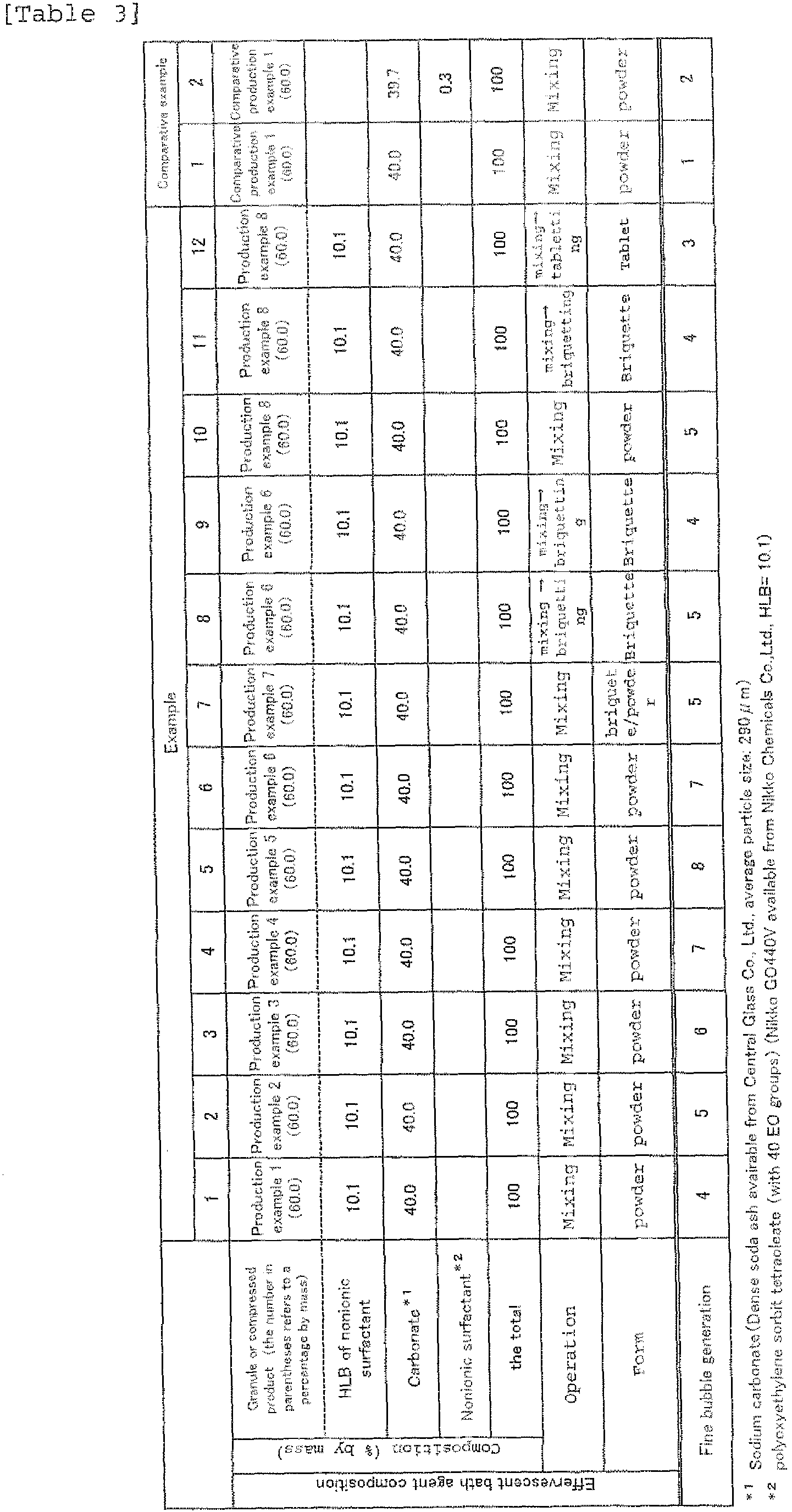

- In Examples and Comparative Examples, the same sodium carbonate was used as in Preparation Examples.
Claims (20)
- A method for producing an effervescent bath agent composition, comprising the following steps:step 1: mixing an organic acid, a nonionic surfactant in the amount of not less than 0.1 part by mass, to 100 parts by mass of the organic acid, and a water-soluble binder to obtain a mixture;step 2: granulating, or compress-molding, or granulating and then compress-molding, the mixture obtained in step 1 to obtain a granulated or compress-molded product; andstep 3: mixing the granulated or compress-molded product obtained in step 2 with a carbonate.
- The method for producing an effervescent bath agent composition according to claim 1, wherein the nonionic surfactant has an HLB of 7 to 20.
- The method for producing an effervescent bath agent composition according to claim 1 or 2, wherein the amount of the nonionic surfactant, mixed in step 1, is 1 to 20 parts by mass to 100 parts by mass of the organic acid.
- The method for producing an effervescent bath agent composition according to any one of claims 1 to 3, further comprising step 4 of granulating or compress-molding the mixture, obtained in step 3, to obtain a granulated or compress-molded product.
- The method for producing an effervescent bath agent composition according to any one of claims 1 to 4, wherein, in step 1, an oil component is further mixed in the amount of not more than 4 parts by mass to 100 parts by mass of organic acid.
- The method for producing an effervescent bath agent composition according to any one of claims 1 to 5, wherein the water-soluble binder is polyethylene glycol or polypropylene glycol.
- The method for producing an effervescent bath agent composition according to any one of claims 1 to 6, wherein the nonionic surfactant is a fatty acid ester having a polyoxyalkylene group.
- The method for producing an effervescent bath agent composition according to any one of claims 1 to 7, wherein the nonionic surfactant is in the form of liquid or paste at an ambient temperature (25°C).
- The method for producing an effervescent bath agent composition according to any one of claims 1 to 8, wherein the content of the water-soluble binder in the bath agent composition is 2 to 20% by mass.
- The method for producing an effervescent bath agent composition according to any one of claims 1 to 9, wherein the content of the organic acid in the bath agent composition is 30 to 80% by mass.
- The method for producing an effervescent bath agent composition according to any one of claims 1 to 10, wherein the content of the carbonate in the bath agent composition is 20 to 70% by mass.
- The method for producing an effervescent bath agent composition according to any one of claims 1 to 11, wherein the content of the nonionic surfactant in the bath agent composition is 0.5 to 12% by mass.
- The method for producing an effervescent bath agent composition according to any one of claims 1 to 12, wherein the organic acid is at least one acid selected from the group consisting of fumaric acid, succinic acid, malic acid and citric acid.
- The method for producing an effervescent bath agent composition according to any one of claims 1 to 13, wherein the organic acid is fumaric acid and/or succinic acid.
- The method for producing an effervescent bath agent composition according to any one of claims 1 to 14, wherein a mass ratio of the organic acid to the carbonate, organic acid/carbonate, is 30/70 to 80/20.
- The method for producing an effervescent bath agent composition according to any one of claims 1 to 15, wherein the content of sodium carbonate in the carbonate is 70 to 100% by mass.
- The method for producing an effervescent bath agent composition according to any one of claims 1 to 16, wherein, in step 1, an oil component and an anionic surfactant are further mixed.
- An effervescent bath agent composition, obtained by the method according to any one of claims 1 to 17.
- The effervescent bath agent composition according to claim 18, which is in the form of tablets, briquettes or powder.
- The effervescent bath agent composition according to claim 18 or 19, which has an pH of 5 to 7 in the form of an aqueous 0.01% by mass solution thereof at 25°C.
Applications Claiming Priority (2)
| Application Number | Priority Date | Filing Date | Title |
|---|---|---|---|
| JP2011003624 | 2011-01-12 | ||
| PCT/JP2012/050327 WO2012096278A1 (en) | 2011-01-12 | 2012-01-11 | Process for production of effervescent bath agent composition |
Publications (2)
| Publication Number | Publication Date |
|---|---|
| EP2664319A1 true EP2664319A1 (en) | 2013-11-20 |
| EP2664319A4 EP2664319A4 (en) | 2015-05-13 |
Family
ID=46507176
Family Applications (1)
| Application Number | Title | Priority Date | Filing Date |
|---|---|---|---|
| EP12733838.2A Withdrawn EP2664319A4 (en) | 2011-01-12 | 2012-01-11 | Process for production of effervescent bath agent composition |
Country Status (3)
| Country | Link |
|---|---|
| EP (1) | EP2664319A4 (en) |
| JP (1) | JP5883655B2 (en) |
| WO (1) | WO2012096278A1 (en) |
Cited By (1)
| Publication number | Priority date | Publication date | Assignee | Title |
|---|---|---|---|---|
| WO2025125362A1 (en) * | 2023-12-14 | 2025-06-19 | Basf Se | Solid granular material for the preparation of personal care products |
Families Citing this family (16)
| Publication number | Priority date | Publication date | Assignee | Title |
|---|---|---|---|---|
| JP5987162B2 (en) * | 2012-08-27 | 2016-09-07 | 株式会社バスクリン | Briquette bath |
| JP6209323B2 (en) * | 2012-10-12 | 2017-10-04 | 花王株式会社 | Effervescent compression formulation |
| JP6420538B2 (en) * | 2013-12-13 | 2018-11-07 | 花王株式会社 | Bath agent composition |
| JP6209079B2 (en) * | 2013-12-20 | 2017-10-04 | 花王株式会社 | Method for producing foamable composition |
| GB201404178D0 (en) * | 2014-03-10 | 2014-04-23 | Cosmetic Warriors Ltd | Composition |
| JP6530641B2 (en) * | 2015-06-02 | 2019-06-12 | 株式会社 八重椿本舗 | Powdered foamable bath agent |
| JP2017066102A (en) * | 2015-09-30 | 2017-04-06 | アース製薬株式会社 | Effervescent compression molding bath |
| WO2018047443A1 (en) * | 2016-09-09 | 2018-03-15 | 花王株式会社 | Crystals of dicarboxylic acid and production process therefor |
| JP2018089603A (en) * | 2016-12-07 | 2018-06-14 | 花王株式会社 | Method for producing granule |
| JPWO2018180158A1 (en) * | 2017-03-29 | 2019-04-04 | 株式会社メンテック | Crepe film conditioner |
| JP6917055B2 (en) * | 2017-05-22 | 2021-08-11 | 株式会社 八重椿本舗 | Effervescent powder bath agent |
| JP7053220B2 (en) | 2017-06-15 | 2022-04-12 | 花王株式会社 | Method for producing dicarboxylic acid crystals |
| JP6975636B2 (en) * | 2017-12-28 | 2021-12-01 | 花王株式会社 | Solid bath composition |
| JP7081946B2 (en) * | 2018-03-13 | 2022-06-07 | 花王株式会社 | Method for producing fumaric acid crystals |
| JP7398775B2 (en) * | 2019-07-24 | 2023-12-15 | 株式会社クロイスターズ | Foaming molded bath agent |
| JP6886672B1 (en) * | 2020-02-29 | 2021-06-16 | Yoshimoto R&D株式会社 | Manufacturing method of effervescent cosmetics |
Family Cites Families (10)
| Publication number | Priority date | Publication date | Assignee | Title |
|---|---|---|---|---|
| JPS5970609A (en) | 1982-10-14 | 1984-04-21 | Kao Corp | Weakly acidic bathing agent |
| JPS61176519A (en) * | 1985-01-30 | 1986-08-08 | Kao Corp | Production of tablet |
| CA1329134C (en) * | 1988-03-17 | 1994-05-03 | Yuji Ichii | Bathing preparation |
| JPH01238520A (en) * | 1988-03-17 | 1989-09-22 | Kao Corp | Bathing agent |
| JPH04128218A (en) * | 1990-09-20 | 1992-04-28 | Nonogawa Shoji Kk | Bathing agent |
| JP3230327B2 (en) | 1993-03-22 | 2001-11-19 | 株式会社ツムラ | Surface foaming bath agent |
| CA2292546A1 (en) * | 1996-05-31 | 1997-12-04 | R & D Ventures, Inc. | Effervescent bath tablet compositions |
| JP4504729B2 (en) * | 2004-04-27 | 2010-07-14 | 花王株式会社 | Two-component bath agent |
| JP5670653B2 (en) | 2009-06-16 | 2015-02-18 | 花王株式会社 | Foaming powder bath composition |
| JP2012001469A (en) * | 2010-06-16 | 2012-01-05 | Kao Corp | Method for manufacturing granulated substance for bathing agent |
-
2012
- 2012-01-10 JP JP2012002027A patent/JP5883655B2/en active Active
- 2012-01-11 EP EP12733838.2A patent/EP2664319A4/en not_active Withdrawn
- 2012-01-11 WO PCT/JP2012/050327 patent/WO2012096278A1/en not_active Ceased
Cited By (1)
| Publication number | Priority date | Publication date | Assignee | Title |
|---|---|---|---|---|
| WO2025125362A1 (en) * | 2023-12-14 | 2025-06-19 | Basf Se | Solid granular material for the preparation of personal care products |
Also Published As
| Publication number | Publication date |
|---|---|
| EP2664319A4 (en) | 2015-05-13 |
| JP5883655B2 (en) | 2016-03-15 |
| JP2012158588A (en) | 2012-08-23 |
| WO2012096278A1 (en) | 2012-07-19 |
Similar Documents
| Publication | Publication Date | Title |
|---|---|---|
| JP5883655B2 (en) | Method for producing foaming bath agent composition | |
| JP5670653B2 (en) | Foaming powder bath composition | |
| JP5534988B2 (en) | Granular bath agent composition | |
| HUE032296T2 (en) | Granular washing, cleaning or treatment agent additive | |
| EP1537174A1 (en) | Cyclodextrin particle | |
| US11839687B2 (en) | Solid composition | |
| JP5412220B2 (en) | Organic acid-containing granules | |
| JP5441529B2 (en) | Granular foam bath agent | |
| JP5531177B1 (en) | Skin preparation kit | |
| JP2012001469A (en) | Method for manufacturing granulated substance for bathing agent | |
| JP6108363B2 (en) | Skin preparation kit | |
| JP2012144474A (en) | Method for manufacturing bubbling powder bathing agent composition | |
| CN104171207A (en) | Hangover-alleviating tea and preparation method thereof | |
| JP5291922B2 (en) | Lipophilic component-containing powder | |
| JP4189921B2 (en) | Method for producing oily particles | |
| JP5388561B2 (en) | Method for producing hydrogel particles | |
| WO2010071095A1 (en) | Method for producing hydrogel particles | |
| JP6530641B2 (en) | Powdered foamable bath agent | |
| JP5888566B2 (en) | Skin preparation kit | |
| JP2018089603A (en) | Method for producing granule | |
| CN101693110B (en) | Method for improving dispersibility of lipid-containing traditional Chinese medicine formula granules in water | |
| JP7042106B2 (en) | Effervescent bath composition | |
| JP2006077001A (en) | Lipophilic component-containing powder | |
| JP6975636B2 (en) | Solid bath composition | |
| JP2025067673A (en) | Carbonate foaming bath agent |
Legal Events
| Date | Code | Title | Description |
|---|---|---|---|
| PUAI | Public reference made under article 153(3) epc to a published international application that has entered the european phase |
Free format text: ORIGINAL CODE: 0009012 |
|
| 17P | Request for examination filed |
Effective date: 20130704 |
|
| AK | Designated contracting states |
Kind code of ref document: A1 Designated state(s): AL AT BE BG CH CY CZ DE DK EE ES FI FR GB GR HR HU IE IS IT LI LT LU LV MC MK MT NL NO PL PT RO RS SE SI SK SM TR |
|
| DAX | Request for extension of the european patent (deleted) | ||
| RA4 | Supplementary search report drawn up and despatched (corrected) |
Effective date: 20150415 |
|
| RIC1 | Information provided on ipc code assigned before grant |
Ipc: A61K 8/02 20060101ALI20150409BHEP Ipc: A61K 8/365 20060101ALI20150409BHEP Ipc: A61Q 19/10 20060101ALI20150409BHEP Ipc: A61K 8/86 20060101ALI20150409BHEP Ipc: A61K 8/19 20060101ALI20150409BHEP Ipc: A61K 8/39 20060101ALI20150409BHEP Ipc: A61K 8/36 20060101AFI20150409BHEP Ipc: A61K 8/362 20060101ALI20150409BHEP |
|
| GRAP | Despatch of communication of intention to grant a patent |
Free format text: ORIGINAL CODE: EPIDOSNIGR1 |
|
| INTG | Intention to grant announced |
Effective date: 20170307 |
|
| STAA | Information on the status of an ep patent application or granted ep patent |
Free format text: STATUS: THE APPLICATION IS DEEMED TO BE WITHDRAWN |
|
| 18D | Application deemed to be withdrawn |
Effective date: 20170718 |