EP2647531A1 - Airbag device - Google Patents
Airbag device Download PDFInfo
- Publication number
- EP2647531A1 EP2647531A1 EP11845069.1A EP11845069A EP2647531A1 EP 2647531 A1 EP2647531 A1 EP 2647531A1 EP 11845069 A EP11845069 A EP 11845069A EP 2647531 A1 EP2647531 A1 EP 2647531A1
- Authority
- EP
- European Patent Office
- Prior art keywords
- airbag
- knee
- protective panel
- base
- base section
- Prior art date
- Legal status (The legal status is an assumption and is not a legal conclusion. Google has not performed a legal analysis and makes no representation as to the accuracy of the status listed.)
- Withdrawn
Links
- 230000001681 protective effect Effects 0.000 claims abstract description 147
- 210000003127 knee Anatomy 0.000 description 199
- 239000004744 fabric Substances 0.000 description 30
- 238000010586 diagram Methods 0.000 description 13
- 230000000694 effects Effects 0.000 description 4
- 239000011800 void material Substances 0.000 description 4
- 238000002347 injection Methods 0.000 description 2
- 239000007924 injection Substances 0.000 description 2
- 230000001105 regulatory effect Effects 0.000 description 2
- 238000009958 sewing Methods 0.000 description 2
- 239000000853 adhesive Substances 0.000 description 1
- 230000001070 adhesive effect Effects 0.000 description 1
- 229910003460 diamond Inorganic materials 0.000 description 1
- 239000010432 diamond Substances 0.000 description 1
- 210000003141 lower extremity Anatomy 0.000 description 1
- 238000004519 manufacturing process Methods 0.000 description 1
- 230000000149 penetrating effect Effects 0.000 description 1
- 230000002093 peripheral effect Effects 0.000 description 1
- 230000000452 restraining effect Effects 0.000 description 1
- 238000007789 sealing Methods 0.000 description 1
- 239000000243 solution Substances 0.000 description 1
- 229920003002 synthetic resin Polymers 0.000 description 1
- 239000000057 synthetic resin Substances 0.000 description 1
Images



Classifications
-
- B—PERFORMING OPERATIONS; TRANSPORTING
- B60—VEHICLES IN GENERAL
- B60R—VEHICLES, VEHICLE FITTINGS, OR VEHICLE PARTS, NOT OTHERWISE PROVIDED FOR
- B60R21/00—Arrangements or fittings on vehicles for protecting or preventing injuries to occupants or pedestrians in case of accidents or other traffic risks
- B60R21/02—Occupant safety arrangements or fittings, e.g. crash pads
- B60R21/16—Inflatable occupant restraints or confinements designed to inflate upon impact or impending impact, e.g. air bags
- B60R21/23—Inflatable members
- B60R21/231—Inflatable members characterised by their shape, construction or spatial configuration
-
- B—PERFORMING OPERATIONS; TRANSPORTING
- B60—VEHICLES IN GENERAL
- B60R—VEHICLES, VEHICLE FITTINGS, OR VEHICLE PARTS, NOT OTHERWISE PROVIDED FOR
- B60R21/00—Arrangements or fittings on vehicles for protecting or preventing injuries to occupants or pedestrians in case of accidents or other traffic risks
- B60R21/02—Occupant safety arrangements or fittings, e.g. crash pads
- B60R21/16—Inflatable occupant restraints or confinements designed to inflate upon impact or impending impact, e.g. air bags
- B60R21/20—Arrangements for storing inflatable members in their non-use or deflated condition; Arrangement or mounting of air bag modules or components
- B60R21/205—Arrangements for storing inflatable members in their non-use or deflated condition; Arrangement or mounting of air bag modules or components in dashboards
- B60R21/206—Arrangements for storing inflatable members in their non-use or deflated condition; Arrangement or mounting of air bag modules or components in dashboards in the lower part of dashboards, e.g. for protecting the knees
-
- B—PERFORMING OPERATIONS; TRANSPORTING
- B60—VEHICLES IN GENERAL
- B60R—VEHICLES, VEHICLE FITTINGS, OR VEHICLE PARTS, NOT OTHERWISE PROVIDED FOR
- B60R21/00—Arrangements or fittings on vehicles for protecting or preventing injuries to occupants or pedestrians in case of accidents or other traffic risks
- B60R21/02—Occupant safety arrangements or fittings, e.g. crash pads
- B60R21/16—Inflatable occupant restraints or confinements designed to inflate upon impact or impending impact, e.g. air bags
- B60R21/20—Arrangements for storing inflatable members in their non-use or deflated condition; Arrangement or mounting of air bag modules or components
- B60R21/215—Arrangements for storing inflatable members in their non-use or deflated condition; Arrangement or mounting of air bag modules or components characterised by the covers for the inflatable member
-
- B—PERFORMING OPERATIONS; TRANSPORTING
- B60—VEHICLES IN GENERAL
- B60R—VEHICLES, VEHICLE FITTINGS, OR VEHICLE PARTS, NOT OTHERWISE PROVIDED FOR
- B60R21/00—Arrangements or fittings on vehicles for protecting or preventing injuries to occupants or pedestrians in case of accidents or other traffic risks
- B60R21/02—Occupant safety arrangements or fittings, e.g. crash pads
- B60R21/16—Inflatable occupant restraints or confinements designed to inflate upon impact or impending impact, e.g. air bags
- B60R21/20—Arrangements for storing inflatable members in their non-use or deflated condition; Arrangement or mounting of air bag modules or components
- B60R21/215—Arrangements for storing inflatable members in their non-use or deflated condition; Arrangement or mounting of air bag modules or components characterised by the covers for the inflatable member
- B60R2021/21512—Arrangements for storing inflatable members in their non-use or deflated condition; Arrangement or mounting of air bag modules or components characterised by the covers for the inflatable member the lid being displaced towards the occupant during deployment
-
- B—PERFORMING OPERATIONS; TRANSPORTING
- B60—VEHICLES IN GENERAL
- B60R—VEHICLES, VEHICLE FITTINGS, OR VEHICLE PARTS, NOT OTHERWISE PROVIDED FOR
- B60R21/00—Arrangements or fittings on vehicles for protecting or preventing injuries to occupants or pedestrians in case of accidents or other traffic risks
- B60R21/02—Occupant safety arrangements or fittings, e.g. crash pads
- B60R21/16—Inflatable occupant restraints or confinements designed to inflate upon impact or impending impact, e.g. air bags
- B60R21/20—Arrangements for storing inflatable members in their non-use or deflated condition; Arrangement or mounting of air bag modules or components
- B60R21/215—Arrangements for storing inflatable members in their non-use or deflated condition; Arrangement or mounting of air bag modules or components characterised by the covers for the inflatable member
- B60R2021/21525—Arrangements for storing inflatable members in their non-use or deflated condition; Arrangement or mounting of air bag modules or components characterised by the covers for the inflatable member the lid being fixed on the bag, or forming part of the bag wall, or the bag itself being used as wall liner
-
- B—PERFORMING OPERATIONS; TRANSPORTING
- B60—VEHICLES IN GENERAL
- B60R—VEHICLES, VEHICLE FITTINGS, OR VEHICLE PARTS, NOT OTHERWISE PROVIDED FOR
- B60R21/00—Arrangements or fittings on vehicles for protecting or preventing injuries to occupants or pedestrians in case of accidents or other traffic risks
- B60R21/02—Occupant safety arrangements or fittings, e.g. crash pads
- B60R21/16—Inflatable occupant restraints or confinements designed to inflate upon impact or impending impact, e.g. air bags
- B60R21/23—Inflatable members
- B60R21/231—Inflatable members characterised by their shape, construction or spatial configuration
- B60R2021/23169—Inflatable members characterised by their shape, construction or spatial configuration specially adapted for knee protection
Definitions
- the present invention relates to an airbag device to be mounted on a vehicle such as an automobile.
- a knee airbag device In order to protect occupants in a vehicle and pedestrians, various airbag devices have prevailed.
- a knee airbag device is used.
- the knee airbag device is mounted on an instrument panel and disposed in front of the knee part of the occupant.
- the knee airbag device In an emergency or a collision of the vehicle, the knee airbag device inflates and deploys an airbag and moves a protective panel for knees by the airbag to the knee part of the occupant.
- the knee part of the occupant is brought into contact with the protective panel, and movement of the knee part is prevented. As a result, the knee part is protected.
- an airbag device provided with an inflatable bag main body and a surface member covering the bag main body is known (See Patent Document 1).
- This prior-art airbag device inflates the bag main body between the instrument panel and the surface member.
- the surface member is moved by the bag main body, and the knee part of the occupant is protected by the surface member.
- a volume of the bag main body becomes large.
- time until the bag main body is fully inflated and deployed tends to become long.
- a moving speed of the surface member also becomes slow, and thus moving time of the surface member might become long.
- the moving time of the surface member is time until the surface member moves to a position where the surface member protects the knee part of the occupant (position the closest to the knee part). Therefore, from the viewpoint of protecting the knee part of the occupant early and reliably, improvement is required.
- the present invention has been made in view of the above-described prior-art problems and an object is to reduce the capacity of an airbag provided in an airbag device so as to inflate and deploy the airbag in a short time.
- Another obj ect is to rapidly move a protective panel by the airbag.
- the present invention is an airbag device disposed on a base section of a vehicle, the airbag device including a protective panel covering the base section; an airbag which inflates and deploys between the base section and the protective panel, to move the protective panel; and an inflator which inflates and deploys the airbag by generating a gas.
- the airbag has at least two standing sections which stand up from the base section through inflation and move the protective panel.
- the capacity of the airbag provided in the airbag device can be made small, and the airbag can be inflated and deployed in a short time. Moreover, the protective panel can be rapidly moved.
- the knee airbag device is an airbag device for protecting knees.
- the knee airbag device is mounted in a vehicle and protects an occupant seated on a seat (a driver' s seat or a front occupant's seat).
- the knee airbag device is disposed in front of the knee part of an occupant.
- the knee airbag device suppresses movement of the knee part of the occupant and protects mainly the knee part of the occupant.
- the knee airbag device disposed in an instrument panel in front of the driver's seat will be explained.
- Fig. 1 is a cross-sectional diagram of a vehicle on which the knee airbag device of this embodiment is mounted.
- the vicinity of the driver's seat of the vehicle is illustrated when viewed from the side.
- a part of the vehicle 80 and the occupant 90 are illustrated in a side view.
- Fig. 2 is a perspective view of the knee airbag device 1 mounted on the vehicle 80.
- parts of the vehicle 80 and the occupant 90 are also illustrated.
- the vehicle 80 is a general automobile. As shown in the figure, the vehicle 80 is provided with a driver's seat 81 and a seatbelt 82 which restrains the occupant 90 to the driver's seat 81.
- the vehicle 80 is provided with, in front of the occupant 90 (left in Fig. 1 ), a steering wheel 83, a steering shaft 84 to which the steering wheel 83 is fixed, and an instrument panel 85.
- the instrument panel 85 is provided below a front windshield 86.
- the instrument panel 85 is located above the shank part 91 and in front of the knee part 92 (referred to as knee-part front) of the occupant 90.
- the knee airbag device 1 is disposed in the instrument panel 85 on the knee-part front of the occupant 90.
- the knee airbag device 1 is mounted below the steering wheel 83 in the vehicle 80.
- the knee airbag device 1 is disposed on a base section 2 of the vehicle 80 so as to face the right and left knee part 92.
- the base section 2 is provided on the knee-part front in the vehicle 80.
- the base section 2 is a member or a portion serving as a base of the knee airbag device 1 and is provided at a predetermined position of the instrument panel 85.
- the base section 2 is made up of a plate on which the knee airbag device 1 is attached or a casing which contains a part of the knee airbag device 1, for example.
- the base section 2 is constituted by a member fixed to the instrument panel 85.
- the base section 2 may be a predetermined portion of the instrument panel 85. In this case, the knee airbag device 1 is directly attached to the instrument panel 85.
- the knee airbag device 1 is provided with a knee protective panel 10 that is a protection panel for knees covering the base section 2.
- the knee protective panel 10 is a member for protecting the knee part 92 of the occupant 90.
- the knee protective panel 10 prevents movement of the knee part 92 by coming in contact with the knee part 92.
- the knee protective panel 10 is formed into a plate shape by using a synthetic resin and the like and is disposed in the knee-part front so as to face the knee part 92.
- the knee protective panel 10 is separably connected by connecting means (a connecting member, an adhesive and the like) to the base section 2 or the instrument panel 85.
- the knee protective panel 10 is connected to the base section 2 or the instrument panel 85 by the connecting means until the knee airbag device 1 is operated.
- the connecting means prevents removal of the knee protective panel 10.
- the knee protective panel 10 is disconnected from the base section 2 or the instrument panel 85.
- the knee protective panel 10 moves from the base section 2 toward the knee part 92.
- the knee protective panel 10 is made up of a lower panel provided in the vehicle 80.
- the knee protective panel 10 is connected to the instrument panel 85 and constitutes a part of the surface of the instrument panel 85.
- the knee protective panel 10 has a rectangular shape.
- a part of the knee protective panel 10 is formed into being curved in accordance with the surface shape of the instrument panel 85.
- the knee protective panel 10 has a void 11 in an upper part.
- a steering column 87 is disposed.
- the steering column 87 surrounds the steering shaft 84.
- Figs. 3A and 3B are plan views illustrating the airbag of this embodiment in a deployed manner.
- a configuration in the airbag 20 is indicated by a dotted line.
- Fig. 3A is a diagram illustrating the airbag 20 when viewed from the knee protective panel 10 side (referred to as a front side) .
- Fig. 3B is a diagram illustrating the airbag 20 when viewed from the base section 2 side (referred to as a back side).
- the knee airbag device 1 is, as illustrated in the figure, provided with the airbag 20 capable of being inflated and deployed and an inflator 3 disposed in the airbag 20.
- the inflator 3 is a cylinder-type gas generating device.
- the inflator 3 generates a gas in the airbag 20 in a vehicle emergency or at the time of detecting an impact.
- the airbag 20 is inflated and deployed by a gas supplied from the inflator 3 from a state folded into a predetermined shape.
- the inflator 3 is contained at the center part in the airbag 20 and disposed in a car width direction.
- the inflator 3 has a plurality of gas injection ports (not shown) on one end portion. The inflator 3 radially blows out the gas from the plurality of gas injection ports.
- the airbag 20 is a bag body formed into a rectangular shape on plan view.
- the airbag 20 is disposed in the knee protective panel 10 in a state where the inflator 3 is contained inside.
- the airbag 20 is inflated and deployed by the gas generated by the inflator 3 on the back side of the knee protective panel 10.
- the airbag 20 has a front-side base cloth 21 disposed on the front side and a back-side base cloth 22 disposed on the back side.
- Each of the front-side base cloth 21 and the back-side base cloth 22 is made up of a rectangular cloth, and constitutes the front surface and the back surface of the airbag 20, respectively.
- the front-side base cloth 21 and the back-side base cloth 22 define an inflatable gas chamber 23 inside the airbag 20.
- the airbag 20 is formed by joining a plurality of overlapped base cloths 21 and 22.
- the base cloths 21 and 22 are joined by sewing or adhesion (sewing is used here) at an outer edge joint portion 24.
- the outer edge joint portion 24 defines the inside and outside of the airbag 20 and defines an outer edge shape of the gas chamber 23.
- the base cloths 21 and 22 are sewn in a row or in a plurality of rows along the outer edge joint portion 24. Between the base cloths 21 and 22, the gas chamber 23 is formed.
- the airbag 20 has an opening portion 25.
- the opening portion 25 is formed in the airbag 20 by partially not joining the base clothes 21 and 22.
- the inflator 3 is inserted into the airbag 20 through the opening portion 25.
- the inflator 3 After the inflator 3 is disposed at a predetermined position in the gas chamber 23, the portion of the opening portion 25 in the airbag 20 is sewn (or folded) for sealing the opening portion 25. In that state, the inflator 3 is fixed to the base section 2 by a fixing member.
- the airbag 20 is attached to the base section 2 and the knee protective panel 10.
- the airbag 20 has attaching portions for the base section (referred to as base attaching portions) 26 and 27 and an attaching portion for the knee protective panel (referred to as a panel attaching portion) 28.
- the base attaching portions 26 and 27 are attached to the base section 2.
- the panel attaching portion 28 is attached to the knee protective panel 10.
- the airbag 20 is fixed to the base section 2 or the knee protective panel 10 by one or more fixing members (not shown).
- the airbag 20 is attached to the base section 2 or the knee protective panel 10.
- the base attaching portions 26 and 27 are attached to a surface (front surface) of the base section 2 facing the knee protective panel 10.
- the panel attaching portion 28 is attached to a surface (back surface) of the knee protective panel 10 facing the base section 2.
- the four base attaching portions 26 and 27 are provided at predetermined intervals in the longitudinal direction (right and left direction in Figs. 3A and 3B ) of the airbag 20.
- the base attaching portions 26 and 27 are fixed to the base section 2 at two spots, respectively.
- One of the base attaching portions 26 is located outside the gas chamber 23 on the both ends of the airbag 20.
- the both base cloths 21 and 22 are attached to the base section 2.
- the other of the base attaching portions 27 is located on the both sides of the inflator 3 in the gas chamber 23.
- only the back-side base cloth 22 is attached to the base section 2.
- the panel attaching portion 28 is provided each (2 in total) between one and the other of the base attaching portions 26 and 27. Each of the panel attaching portions 28 is fixed to the knee protective panel 10 at one spot. The panel attaching portion 28 is located in the gas chamber 23. At the panel attaching portion 28, only the front-side base cloth 21 is attached to the knee protective panel 10.
- the airbag 20 is attached to the base section 2 and the knee protective panel 10 by each of the attaching portions 26, 27, and 28 and is disposed between the base section 2 and the knee protective panel 10.
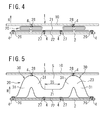
- Fig. 4 is a cross-sectional diagram illustrating the airbag 20 contained between the base section 2 and the knee protective panel 10.
- the airbag 20 before inflation is schematically illustrated when viewed from an arrow X direction in Fig. 2 .
- the attaching portions 26, 27, and 28 of the airbag 20 are, as illustrated in the figure, attached to the surface of the plate-shaped base section 2 and the back surface of the knee protective panel 10, by fixing members 4.
- the fixing member 4 is formed of a screw, a rivet or the like, penetrating the base cloths 21 and 22.
- the airbag 20 is disposed in a folded state, in the car width direction (right and left direction in Fig. 4 ).
- the airbag 20 is held in a state of being sandwiched between the base section 2 and the knee protective panel 10.
- the peripheral portion of the panel attaching portion 28 is folded in the state where the base cloths 21 and 22 are overlapped.
- the airbag 20 inflates from the folded shape toward a predetermined shape.
- the airbag 20 inflates and deploys between the base section 2 and the knee protective panel 10.
- the airbag 20 moves the knee protective panel 10 from the base section 2 toward the knee part 92 of the occupant 90 (an arrow R in Fig. 4 ).
- Fig. 5 is a cross-sectional diagram illustrating the inflated and deployed airbag 20.
- the airbag 20 is, as illustrated in the figure, inflated and deployed by filling a gas in the gas chamber 23.
- the knee protective panel 10 is pressed by the inflating airbag 20 and moves to a position where the knee part 92 of the occupant 90 is protected from the position covering the base section 2.
- the airbag 20 inflates so as to bend in the vicinity of the attaching portions 26, 27, and 28.
- the airbag 20 between the bent portions separates from the base section 2 and gradually stands between the base section 2 and the knee protective panel 10.
- the airbag 20 in this embodiment has at least two (here, two) standing portions 30.
- the two standing portions 30 are cylindrical portions constituting a part of the airbag 20 and are formed integral with a predetermined portion (both end portions, here) of the airbag 20.
- the insides of the two standing portions 30 communicate with each other via a non-standing portion 35.
- the standing portion 30 inflates to stand up from the base section 2 toward the knee protective panel 10, along with the inflation of the airbag 20.
- the standing portion 30 stands up from the base section 2 through inflation and protrudes toward the knee protective panel 10.
- the standing portion 30 moves the knee protective panel 10 from the base section 2 toward the knee part 92 of the occupant 90, along with the standing.
- the knee protective panel 10 separates from the base section 2 and is disposed at a position where the knee part 92 is protected.
- the airbag 20 contacts the knee protective panel 10 at the tip of the standing portion 30 when inflating and deploying.
- the portion between the standing portions 30 of the airbag 20 separates from the knee protective panel 10. Therefore, between the airbag 20 and the knee protective panel 10, a relatively large space 5 is formed.
- the standing portion 30 has the two each base attaching portions 26 and 27 and one panel attaching portion 28 disposed between the two base attaching portions 26 and 27. Since the standing portion 30 is attached to the base section 2 and the knee protective panel 10 by the attaching portions 26, 27, and 28, the standing portion 30 inflates in the shape of inverted V with the vicinities of the attaching portions 26, 27, and 28 as apexes.
- the standing portion 30 bends around the panel attaching portion 28 and forms a pair of inclined portions 31.
- the pair of inclined portions 31 extend from the panel attaching portion 28 with inclination in directions opposite to each other and are attached to the base section 2 and the knee protective panel 10, respectively.
- the pair of inclined portions 31 maintain the standing portion 30 in the standing state by supporting each other.
- the airbag 20 in a state where the airbag 20 is folded (See Fig. 4 ), the overlapped both base cloths 21 and 22 are disposed so as to be orthogonal to a standing direction R of the standing portion 30. As a result of inflation of the gas chamber 23, the base cloths 21 and 22 separate from each other, and the airbag 20 inflates and deploys in the thickness direction. Moreover, in a state where the attaching portions 26, 27, and 28 are attached to the base section 2 or the knee protective panel 10, the two standing portions 30 of the airbag 20 stand up. As a result, the airbag 20 moves the knee protective panel 10 only by a predetermined distance. At that time, the two standing portions 30 stand up at the same timing and move the whole knee protective panel 10 equally. The knee protective panel 10 moves without bias as a result of inflation of the airbag 20 and standing of the standing portion 30. As a result, fluctuation in attitude of the knee protective panel 10 is suppressed.
- the knee airbag device 1 After the knee airbag device 1 is mounted on the vehicle 80, the knee airbag device 1 operates the inflator 3 in an emergency or the like of the vehicle 80.
- the inflator 3 generates a gas and supplies the gas into the gas chamber 23 of the airbag 20 (See Fig. 5 ).
- the airbag 20 is inflated while the folded shape is dissolved.
- the airbag 20 is inflated and deployed between the base section 2 and the knee protective panel 10.
- the knee protective panel 10 separates from the instrument panel 85 by the force of inflation of the airbag 20. Moreover, movement of the knee protective panel 10 starts. Subsequently, along with standing up of the standing portion 30, the knee protective panel 10 is pushed by the standing portion 30.
- the knee protective panel 10 moves toward the knee part 92 of the occupant 90.
- the knee airbag device 1 moves the knee protective panel 10 and arranges it at a predetermined position in the knee-part front by the standing portion 30 of the airbag 20.
- the knee part 92 of the occupant 90 is brought into contact with the knee protective panel 10 and is restrained by the knee airbag device 1.
- the knee airbag device 1 receives the knee part 92 by the knee protective panel 10 and prevents movement of the knee part 92.
- by absorbing impact energy by the inflated and deployed airbag 20 an impact applied to the knee part 92 is alleviated.
- the knee airbag device 1 protects the knee part 92.
- the standing portion 30 is provided in the airbag 20, the capacity of the airbag 20 can be reduced. As a result, time required for the airbag 20 to fully inflate and deploy can be reduced, and thus the airbag 20 inflates to a set shape earlier. Furthermore, since the standing portion 30 quickly inflates and stands up, the moving speed of the knee protective panel 10 is also expedited. As a result, the knee protective panel 10 moves, in a short time, to the position where the knee part 92 of the occupant 90 is protected, and is brought into contact with the knee part 92 earlier. Moreover, the knee protective panel 10 can be stably supported by at least two standing portions 30. By receiving the knee part 92 by the knee protective panel 10, the lower limb of the occupant 90 can be protected.
- the capacity of the airbag 20 can be reduced, and the airbag 20 can be inflated and deployed in a short time.
- the knee protective panel 10 can be rapidly moved by the airbag 20 toward the knee part 92 of the occupant 90 so as to protect the knee part 92 early and reliably.
- the forward movement of waist part of the occupant 90 can be regulated, the effect of the seat belt 82 of restraining the occupant 90 can be also improved. Even if the knee protective panel 10 is cracked, the knee part 92 is received by the airbag 20, and the impact energy can be absorbed, and thus the knee part 92 can be protected.
- the airbag 20 By joining the overlapped base cloths 21 and 22, the airbag 20 can be easily formed. As a result, a labor and a cost of manufacturing the airbag 20 can be reduced. Since the airbag 20 formed of the base cloths 21 and 22 can be folded in a compact manner, a containing space for the airbag 20 can be also reduced. Moreover, when the back-side base cloth 22 on one side of the overlapped cloths is attached to the base section 2 and the front-side base cloth 21 on the other side of the overlapped cloths is attached to the knee protective panel 10, the flat surfaces of the base cloths 21 and 22 are attached to the base section 2 and the knee protective panel 10. Therefore, the base cloths 21 and 22 can be easily attached to the base section 2 and the knee protective panel 10. The attachment of the base cloths 21 and 22 is also facilitated. Moreover, since the airbag 20 is in contact with the base section 2 and the knee protective panel 10 in a wider area, the knee protective panel 10 can be supported more stably.
- the standing portion 30 inflates without fluctuation in its shape or position between the base section 2 and the knee protective panel 10.
- the standing portion 30 stands to a set height.
- the standing portion 30 it is preferable that two base attaching portions 26 and 27 and one panel attaching portion 28 disposed between the base attaching portions 26 and 27 are provided.
- the standing portion 30 bends around the panel attaching portion 28 at the center.
- the pair of inclined portions 31 of the standing portion 30 support each other by pressing each other.
- the standing portion 30 is made stable, and thus the knee protective panel 10 can be firmly supported by the standing portion 30.
- impact-energy absorbing capacity can be improved.
- the force applied to the knee protective panel 10 is also distributed toward the two base attaching portions 26 and 27, the force applied to each of the base attaching portions 26 and 27 can be made small. Therefore, the airbag 20 does not have to be attached firmly to the base section 2 by the base attaching portions 26 and 27.
- the standing portions 30 are provided as appropriate at a plurality of spots in the airbag 20 corresponding to each condition.
- the conditions include, for example, the shapes of the airbag 20 and the knee protective panel 10, the sizes of the airbag 20 and the knee protective panel 10, a movement mode of the knee protective panel 10 or a contact position of the knee part 92.
- Three or more standing portions 30 may be provided in the airbag 20.
- the airbag 20 may be formed into a shape other than a rectangle (an oval shape, a diamond shape and the like).
- the airbag 20 may be formed into a semispherical shape, a U-shape or a V-shape in accordance with the shape of the knee protective panel 10 (See Fig. 2 ).
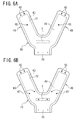
- Figs. 6A and 6B are plan views illustrating an airbag 40 formed into the V-shape in a deployed manner.
- the configuration in the airbag 40 is indicated by a dotted line.
- Fig. 6A is a diagram illustrating the airbag 40 when viewed from the front side.
- Fig. 6B is a diagram illustrating the airbag 40 when viewed from the back side.
- This airbag 40 is basically configured in the same way as the airbag 20 having been already explained. Therefore, in the following, the same configuration as that of the airbag 20 is given the same name and the detailed explanation will be omitted.
- the airbag 40 has the V-shape on plan view as illustrated in the figure.
- the airbag 40 is disposed in the knee protective panel 10 in a state of containing the inflator 3 inside.
- the airbag 40 has a front-side base cloth 41 and a back-side base cloth 42.
- the front-side base cloth 41 and the back-side base cloth 42 are joined by an outer edge joint portion 43, and a gas chamber 44 is formed between the base cloths 41 and 42.
- the inflator 3 is inserted into the airbag 40 from an opening portion 45.
- the airbag 40 has base attaching portions 46 and 47 and a panel attaching portion 48.
- the base attaching portions 46 and 47 are located at two tips of the airbag 40 and on the both sides of the inflator 3.
- the panel attaching portion 48 is located between the base attaching portions 46 and 47.
- Each of the attaching portions 46, 47, and 48 of the airbag 40 is attached to the base section 2 or the knee protective panel 10.
- the airbag 40 is disposed between the base section 2 and the knee protective panel 10.
- the airbag 40 inflates so as to bend at positions of the attaching portions 46, 47, and 48. Through the inflation, a portion between the base attaching portions 46 and 47 of the airbag 40 (standing portion 49) stands up.
- the standing portion 49 has two base attaching portions 46 and 47 and the one panel attaching portion 48 disposed between the base attaching portions 46 and 47.
- the standing portion 49 bends around the panel attaching portion 48 at the center and inflates into the inverted V-shape.
- the airbag 40 is contained in a folded state, between the base section 2 and the knee protective panel 10 so as to surround the void 11 of the knee protective panel 10 (See Fig. 2 ).
- the airbag 40 is disposed along the periphery of the steering column 87 below the steering column 87. That is, the airbag 40 is disposed surrounding a part of the steering shaft 84 of the vehicle 80 from below.
- the base attaching portions 46 and 47 are attached to the base section 2 on the both sides of the steering shaft 84.
- the base attaching portions 46 and 47 are attached at positions separated by a distance in the vertical direction of the base section 2.
- the standing portion 49 stands up from the base section 2 as a result of the inflation and protrudes toward the knee protective panel 10.
- the standing portion 49 stands up on the both sides of the steering shaft 84.
- the standing portion 49 moves the knee protective panel 10 and also supports the knee protective panel 10.
- FIGs. 7A and 7B are diagrams illustrating an airbag 50 of another embodiment.
- Fig. 7A is a plan view illustrating the airbag 50 in a deployed manner.
- Fig. 7B is an enlarged diagram of a part of the airbag 50 when viewed from an arrow Y direction in Fig. 7A .
- the configuration in the airbag 50 is indicated by a dotted line.
- the airbag 50 is formed of a plurality of base cloths 52 and 53, on which at least two projecting portions 51 are provided as illustrated in the figure.
- the projecting portion 51 is a projecting piece for a standing portion serving as a standing portion 54 of the airbag 50.
- the projecting portion 51 is formed on the same sides of the base cloths 52 and 53 so as to protrude in the same direction.
- the base cloths 52 and 53 are formed of the first base cloth 52 and the second base cloth 53 and overlapped and joined at an outer edge joint portion 55.
- a gas chamber 56 is formed between the base cloths 52 and 53 of the airbag 50.
- the inflator 3 is inserted into the airbag 50 from an opening portion 57.
- the projecting portion 51 of the joined base cloths 52 and 53 inflates into a projecting shape (columnar shape) by inflation of the airbag 50.
- the projecting portion 51 protrudes from the base section 2 toward the knee protective panel 10 and stands up from the base section 2 (an arrow S in Fig. 7A ).
- the airbag 50 has a plane portion 60 (See Fig. 7B ) in contact with the knee protective panel 10 at the tip of the protruding projecting portion 51.
- the plane portion 60 is made up of a circular third base cloth 61.
- the third base cloth 61 is disposed between the first base cloth 52 and the second base cloth 53 at the tip of the projecting portion 51.
- An outer periphery of the third base cloth 61 is joined to the base cloths 52 and 53.
- the plane portion 60 and the third base cloth 61 are deployed along the knee protective panel 10 when the standing portions 54 stand up and are pressed onto the back surface of the knee protective panel 10.
- the airbag 50 has an attaching piece 58 disposed on the side opposite to each of the projecting portions 51, a base attaching portion 59 provided on the attaching piece 58, and a panel attaching portion 62 provided on the plane portion 60.
- the tip (the plane portion 60, here) of the protruding projecting portion 51 is attached to the knee protective panel 10.
- the attaching portions 59 and 62 of the airbag 50 are attached to the base section 2 and the knee protective panel 10, respectively.
- the airbag 50 is disposed between the base section 2 and the knee protective panel 10. End portions of the standing portion 54 are attached to the base section 2 and the knee protective panel 10. In that state, the standing portion 54 inflates between the base section 2 and the knee protective panel 10 and stands up from the base section 2.
- the airbag 50 is contained in a folded state, between the base section 2 and the knee protective panel 10. At that time, the standing portion 54 is bent in a direction orthogonal to the standing direction S, for example, and folded in the shape of bellows. When the airbag 50 is inflated and deployed, the standing portion 54 stands up. The standing portion 54 moves the knee protective panel 10. The knee protective panel 10 is disposed in the knee part front of the occupant 90 and is supported by the standing portion 54.
- the standing portion 54 can be smoothly made to stand because of protrusion of the joined projecting portion 51. Since the tip of the projecting portion 51 is attached to the knee protective panel 10, a moving distance of the knee protective panel 10 can be adjusted by the length of the projecting portion 51. As a result, the moving distance and the arrangement position of the knee protective panel 10 can be also easily changed.
- the knee protective panel 10 can be supported by using a wide area. As a result, since the knee protective panel 10 is made stable, the knee protective panel 10 can be moved without inclination.
- the airbag 50 may be extended straight and attached to the base section 2.
- the airbag 50 may be bent in the middle and disposed by surrounding a part of the steering shaft 84 from below.
- the present invention is not limited to the knee airbag device 1 but can be applied to other airbag devices. That is, an airbag similar to the above may be provided between the base section and the protective panel of various types of airbag devices.
- the airbag device in an airbag device for side collision of the vehicle 80, the airbag device is disposed in a base section of the vehicle 80 provided in a door. The base section is covered by a door trim that is a protective panel for the occupant 90.
- the airbag inflates and deploys between the base section and the door trim.
- the standing portions of the airbag stand up and move the door trim toward the occupant 90.
- the airbag device protects the occupant 90 in contact with the door trim.
- the entire door trim may be moved toward the occupant 90.
- a part of the door trim may be moved toward the occupant 90.
- a part of the door trim functions both as a door trim and a protective panel.
- the protective panel is connected to the door trim and constitutes the part of the door trim. At the time of inflation and deployment of the airbag, only the protective panel moves toward the occupant 90.
- the airbag device for a pedestrian, the airbag device is disposed in the base section of the vehicle 80 provided in a bonnet.
- the base section is covered by the bonnet that is the protective panel for a pedestrian.
- the airbag inflates and deploys between the base section and the bonnet.
- the standing portions of the airbag stand up and move the bonnet.
- the bonnet is lifted up by the standing portions of the airbag.
- the airbag device protects a pedestrian in contact with the bonnet.
- the present invention can be applied to various types of airbag devices which move the protective panel by the airbag.
- the capacity of the airbag can be made small and the airbag can be inflated and deployed in a short time.
- the protective panel can be moved rapidly. An effect similar to the above-described effects can be also obtained.
- the protective panel refers to a panel which is moved by the airbag and is for protecting a person (the occupant 90 or a pedestrian, for example).
Landscapes
- Engineering & Computer Science (AREA)
- Mechanical Engineering (AREA)
- Air Bags (AREA)
Abstract
An airbag is inflated and deployed in a short time, and a protective panel is moved rapidly. An airbag device (1) is disposed in a base section (2) of a vehicle. The airbag device (1) is provided with a protective panel (10) covering the base section (2), an airbag (20), and an inflator. The inflator inflates and deploys the airbag (20) by generating a gas. The airbag (20) has at least two standing portions (30) and inflates and deploys between the base section (2) and the protective panel (10). The standing portion (30) stands up from the base section (2) through inflation and moves the protective panel (10).
Description
- The present invention relates to an airbag device to be mounted on a vehicle such as an automobile.
- In order to protect occupants in a vehicle and pedestrians, various airbag devices have prevailed. For example, in order to protect an occupant seated on a seat in a vehicle, a knee airbag device is used. The knee airbag device is mounted on an instrument panel and disposed in front of the knee part of the occupant. In an emergency or a collision of the vehicle, the knee airbag device inflates and deploys an airbag and moves a protective panel for knees by the airbag to the knee part of the occupant. The knee part of the occupant is brought into contact with the protective panel, and movement of the knee part is prevented. As a result, the knee part is protected. As this knee airbag device, an airbag device provided with an inflatable bag main body and a surface member covering the bag main body is known (See Patent Document 1).
- This prior-art airbag device inflates the bag main body between the instrument panel and the surface member. The surface member is moved by the bag main body, and the knee part of the occupant is protected by the surface member. However, with this airbag device, since the bag main body is brought into contact with the whole back surface of the surface member and deployed into a flat rectangular shape, a volume of the bag main body becomes large. As a result, time until the bag main body is fully inflated and deployed tends to become long. Along with this tendency, a moving speed of the surface member also becomes slow, and thus moving time of the surface member might become long. The moving time of the surface member is time until the surface member moves to a position where the surface member protects the knee part of the occupant (position the closest to the knee part). Therefore, from the viewpoint of protecting the knee part of the occupant early and reliably, improvement is required.
-
- PTL 1 : Japanese Patent No.
4165372 - The present invention has been made in view of the above-described prior-art problems and an object is to reduce the capacity of an airbag provided in an airbag device so as to inflate and deploy the airbag in a short time. Another obj ect is to rapidly move a protective panel by the airbag.
- The present invention is an airbag device disposed on a base section of a vehicle, the airbag device including a protective panel covering the base section; an airbag which inflates and deploys between the base section and the protective panel, to move the protective panel; and an inflator which inflates and deploys the airbag by generating a gas. The airbag has at least two standing sections which stand up from the base section through inflation and move the protective panel.
- According to the present invention, the capacity of the airbag provided in the airbag device can be made small, and the airbag can be inflated and deployed in a short time. Moreover, the protective panel can be rapidly moved.
-
- [
Fig. 1] Fig. 1 is a cross-sectional diagram of a vehicle on which a knee airbag device of an embodiment of the present invention is mounted. - [
Fig. 2] Fig. 2 is a perspective view of the knee airbag device mounted on the vehicle. - [
Figs. 3A] Fig. 3A is a plan view illustrating an airbag of this embodiment in a deployed manner. - [
Figs. 3B] Fig. 3B is a plan view illustrating an airbag of this embodiment in a deployed manner. - [
Fig. 4] Fig. 4 is a cross-sectional diagram illustrating the airbag contained between a base section and a knee protective panel. - [
Fig. 5] Fig. 5 is a cross-sectional view illustrating the airbag inflated and deployed. - [
Fig. 6A] Fig. 6A is a plan view illustrating the airbag formed into the V-shape in a deployed manner. - [
Fig. 6B] Fig. 6B is a plan view illustrating the airbag formed into the V-shape in a deployed manner. - [
Fig. 7A] Fig. 7A is a diagram illustrating an airbag of another embodiment. - [
Fig. 7B] Fig. 7B is a diagram illustrating an airbag of another embodiment. - An embodiment of an airbag device of the present invention will be described below by referring to the attached drawings.
In this embodiment, a knee airbag device is used as an example for explanation. The knee airbag device is an airbag device for protecting knees. The knee airbag device is mounted in a vehicle and protects an occupant seated on a seat (a driver' s seat or a front occupant's seat). Moreover, the knee airbag device is disposed in front of the knee part of an occupant. The knee airbag device suppresses movement of the knee part of the occupant and protects mainly the knee part of the occupant. In the following, the knee airbag device disposed in an instrument panel in front of the driver's seat will be explained. -
Fig. 1 is a cross-sectional diagram of a vehicle on which the knee airbag device of this embodiment is mounted. InFig. 1 , the vicinity of the driver's seat of the vehicle is illustrated when viewed from the side. InFig. 1 , a part of thevehicle 80 and theoccupant 90 are illustrated in a side view.Fig. 2 is a perspective view of theknee airbag device 1 mounted on thevehicle 80. InFig. 2 , parts of thevehicle 80 and theoccupant 90 are also illustrated. - The
vehicle 80 is a general automobile. As shown in the figure, thevehicle 80 is provided with a driver'sseat 81 and aseatbelt 82 which restrains theoccupant 90 to the driver'sseat 81. Thevehicle 80 is provided with, in front of the occupant 90 (left inFig. 1 ), asteering wheel 83, a steeringshaft 84 to which thesteering wheel 83 is fixed, and aninstrument panel 85. Theinstrument panel 85 is provided below afront windshield 86. Theinstrument panel 85 is located above theshank part 91 and in front of the knee part 92 (referred to as knee-part front) of theoccupant 90. - The
knee airbag device 1 is disposed in theinstrument panel 85 on the knee-part front of theoccupant 90. Theknee airbag device 1 is mounted below thesteering wheel 83 in thevehicle 80. Theknee airbag device 1 is disposed on abase section 2 of thevehicle 80 so as to face the right andleft knee part 92. Thebase section 2 is provided on the knee-part front in thevehicle 80. Thebase section 2 is a member or a portion serving as a base of theknee airbag device 1 and is provided at a predetermined position of theinstrument panel 85. Thebase section 2 is made up of a plate on which theknee airbag device 1 is attached or a casing which contains a part of theknee airbag device 1, for example. As described above, thebase section 2 is constituted by a member fixed to theinstrument panel 85. However, thebase section 2 may be a predetermined portion of theinstrument panel 85. In this case, theknee airbag device 1 is directly attached to theinstrument panel 85. - The
knee airbag device 1 is provided with a kneeprotective panel 10 that is a protection panel for knees covering thebase section 2. The kneeprotective panel 10 is a member for protecting theknee part 92 of theoccupant 90. The kneeprotective panel 10 prevents movement of theknee part 92 by coming in contact with theknee part 92. The kneeprotective panel 10 is formed into a plate shape by using a synthetic resin and the like and is disposed in the knee-part front so as to face theknee part 92. Moreover, the kneeprotective panel 10 is separably connected by connecting means (a connecting member, an adhesive and the like) to thebase section 2 or theinstrument panel 85. The kneeprotective panel 10 is connected to thebase section 2 or theinstrument panel 85 by the connecting means until theknee airbag device 1 is operated. The connecting means prevents removal of the kneeprotective panel 10. When theknee airbag device 1 is operated, the kneeprotective panel 10 is disconnected from thebase section 2 or theinstrument panel 85. The kneeprotective panel 10 moves from thebase section 2 toward theknee part 92. - Here, the knee
protective panel 10 is made up of a lower panel provided in thevehicle 80. The kneeprotective panel 10 is connected to theinstrument panel 85 and constitutes a part of the surface of theinstrument panel 85. Moreover, the kneeprotective panel 10 has a rectangular shape. A part of the kneeprotective panel 10 is formed into being curved in accordance with the surface shape of theinstrument panel 85. The kneeprotective panel 10 has a void 11 in an upper part. In the void 11, asteering column 87 is disposed. Thesteering column 87 surrounds the steeringshaft 84. Between the kneeprotective panel 10 and thebase section 2, an airbag and an inflator are contained. -
Figs. 3A and 3B are plan views illustrating the airbag of this embodiment in a deployed manner. InFigs. 3A and 3B , a configuration in theairbag 20 is indicated by a dotted line.Fig. 3A is a diagram illustrating theairbag 20 when viewed from the kneeprotective panel 10 side (referred to as a front side) .Fig. 3B is a diagram illustrating theairbag 20 when viewed from thebase section 2 side (referred to as a back side).
Theknee airbag device 1 is, as illustrated in the figure, provided with theairbag 20 capable of being inflated and deployed and aninflator 3 disposed in theairbag 20. - The
inflator 3 is a cylinder-type gas generating device. Theinflator 3 generates a gas in theairbag 20 in a vehicle emergency or at the time of detecting an impact. Theairbag 20 is inflated and deployed by a gas supplied from theinflator 3 from a state folded into a predetermined shape. Theinflator 3 is contained at the center part in theairbag 20 and disposed in a car width direction. Theinflator 3 has a plurality of gas injection ports (not shown) on one end portion. Theinflator 3 radially blows out the gas from the plurality of gas injection ports. - The
airbag 20 is a bag body formed into a rectangular shape on plan view. Theairbag 20 is disposed in the kneeprotective panel 10 in a state where theinflator 3 is contained inside. Theairbag 20 is inflated and deployed by the gas generated by theinflator 3 on the back side of the kneeprotective panel 10. Theairbag 20 has a front-side base cloth 21 disposed on the front side and a back-side base cloth 22 disposed on the back side. Each of the front-side base cloth 21 and the back-side base cloth 22 is made up of a rectangular cloth, and constitutes the front surface and the back surface of theairbag 20, respectively. The front-side base cloth 21 and the back-side base cloth 22 define aninflatable gas chamber 23 inside theairbag 20. - The
airbag 20 is formed by joining a plurality of overlappedbase cloths joint portion 24. The outer edgejoint portion 24 defines the inside and outside of theairbag 20 and defines an outer edge shape of thegas chamber 23. The base cloths 21 and 22 are sewn in a row or in a plurality of rows along the outer edgejoint portion 24. Between thebase cloths gas chamber 23 is formed. Theairbag 20 has an openingportion 25. The openingportion 25 is formed in theairbag 20 by partially not joining the base clothes 21 and 22. Theinflator 3 is inserted into theairbag 20 through the openingportion 25. After theinflator 3 is disposed at a predetermined position in thegas chamber 23, the portion of the openingportion 25 in theairbag 20 is sewn (or folded) for sealing the openingportion 25. In that state, theinflator 3 is fixed to thebase section 2 by a fixing member. Theairbag 20 is attached to thebase section 2 and the kneeprotective panel 10. - Between the
base section 2 and the kneeprotective panel 10, one side and the other side of the overlappedbase cloths airbag 20 are attached to the kneeprotective panel 10 and thebase section 2, respectively. Therefore, theairbag 20 has attaching portions for the base section (referred to as base attaching portions) 26 and 27 and an attaching portion for the knee protective panel (referred to as a panel attaching portion) 28. Thebase attaching portions base section 2. Thepanel attaching portion 28 is attached to the kneeprotective panel 10. At each position of the attachingportions airbag 20 is fixed to thebase section 2 or the kneeprotective panel 10 by one or more fixing members (not shown). As a result, theairbag 20 is attached to thebase section 2 or the kneeprotective panel 10. At that time, thebase attaching portions base section 2 facing the kneeprotective panel 10. Thepanel attaching portion 28 is attached to a surface (back surface) of the kneeprotective panel 10 facing thebase section 2. - Here, the four
base attaching portions Figs. 3A and 3B ) of theairbag 20. Thebase attaching portions base section 2 at two spots, respectively. One of thebase attaching portions 26 is located outside thegas chamber 23 on the both ends of theairbag 20. At thebase attaching portions 26, the bothbase cloths base section 2. The other of thebase attaching portions 27 is located on the both sides of theinflator 3 in thegas chamber 23. At thebase attaching portion 27, only the back-side base cloth 22 is attached to thebase section 2. In contrast to this, thepanel attaching portion 28 is provided each (2 in total) between one and the other of thebase attaching portions panel attaching portions 28 is fixed to the kneeprotective panel 10 at one spot. Thepanel attaching portion 28 is located in thegas chamber 23. At thepanel attaching portion 28, only the front-side base cloth 21 is attached to the kneeprotective panel 10. Theairbag 20 is attached to thebase section 2 and the kneeprotective panel 10 by each of the attachingportions base section 2 and the kneeprotective panel 10. -
Fig. 4 is a cross-sectional diagram illustrating theairbag 20 contained between thebase section 2 and the kneeprotective panel 10. InFig. 4 , theairbag 20 before inflation is schematically illustrated when viewed from an arrow X direction inFig. 2 .
The attachingportions airbag 20 are, as illustrated in the figure, attached to the surface of the plate-shapedbase section 2 and the back surface of the kneeprotective panel 10, by fixingmembers 4. The fixingmember 4 is formed of a screw, a rivet or the like, penetrating thebase cloths airbag 20 is disposed in a folded state, in the car width direction (right and left direction inFig. 4 ). Theairbag 20 is held in a state of being sandwiched between thebase section 2 and the kneeprotective panel 10. In thisairbag 20, the peripheral portion of thepanel attaching portion 28 is folded in the state where thebase cloths airbag 20 inflates from the folded shape toward a predetermined shape. Theairbag 20 inflates and deploys between thebase section 2 and the kneeprotective panel 10. As a result, theairbag 20 moves the kneeprotective panel 10 from thebase section 2 toward theknee part 92 of the occupant 90 (an arrow R inFig. 4 ). -
Fig. 5 is a cross-sectional diagram illustrating the inflated and deployedairbag 20.
Theairbag 20 is, as illustrated in the figure, inflated and deployed by filling a gas in thegas chamber 23. The kneeprotective panel 10 is pressed by the inflatingairbag 20 and moves to a position where theknee part 92 of theoccupant 90 is protected from the position covering thebase section 2. At that time, since the positions of the attachingportions base section 2 and the kneeprotective panel 10, theairbag 20 inflates so as to bend in the vicinity of the attachingportions airbag 20 between the bent portions separates from thebase section 2 and gradually stands between thebase section 2 and the kneeprotective panel 10. - The
airbag 20 in this embodiment has at least two (here, two) standingportions 30. The two standingportions 30 are cylindrical portions constituting a part of theairbag 20 and are formed integral with a predetermined portion (both end portions, here) of theairbag 20. The insides of the two standingportions 30 communicate with each other via anon-standing portion 35. The standingportion 30 inflates to stand up from thebase section 2 toward the kneeprotective panel 10, along with the inflation of theairbag 20. The standingportion 30 stands up from thebase section 2 through inflation and protrudes toward the kneeprotective panel 10. The standingportion 30 moves the kneeprotective panel 10 from thebase section 2 toward theknee part 92 of theoccupant 90, along with the standing. As a result, the kneeprotective panel 10 separates from thebase section 2 and is disposed at a position where theknee part 92 is protected. Theairbag 20 contacts the kneeprotective panel 10 at the tip of the standingportion 30 when inflating and deploying. The portion between the standingportions 30 of theairbag 20 separates from the kneeprotective panel 10. Therefore, between theairbag 20 and the kneeprotective panel 10, a relativelylarge space 5 is formed. - Here, the standing
portion 30 has the two eachbase attaching portions panel attaching portion 28 disposed between the twobase attaching portions portion 30 is attached to thebase section 2 and the kneeprotective panel 10 by the attachingportions portion 30 inflates in the shape of inverted V with the vicinities of the attachingportions portion 30 bends around thepanel attaching portion 28 and forms a pair ofinclined portions 31. The pair ofinclined portions 31 extend from thepanel attaching portion 28 with inclination in directions opposite to each other and are attached to thebase section 2 and the kneeprotective panel 10, respectively. The pair ofinclined portions 31 maintain the standingportion 30 in the standing state by supporting each other. - Note that, in a state where the
airbag 20 is folded (SeeFig. 4 ), the overlapped bothbase cloths portion 30. As a result of inflation of thegas chamber 23, thebase cloths airbag 20 inflates and deploys in the thickness direction. Moreover, in a state where the attachingportions base section 2 or the kneeprotective panel 10, the two standingportions 30 of theairbag 20 stand up. As a result, theairbag 20 moves the kneeprotective panel 10 only by a predetermined distance. At that time, the two standingportions 30 stand up at the same timing and move the whole kneeprotective panel 10 equally. The kneeprotective panel 10 moves without bias as a result of inflation of theairbag 20 and standing of the standingportion 30. As a result, fluctuation in attitude of the kneeprotective panel 10 is suppressed. - After the
knee airbag device 1 is mounted on thevehicle 80, theknee airbag device 1 operates theinflator 3 in an emergency or the like of thevehicle 80. Theinflator 3 generates a gas and supplies the gas into thegas chamber 23 of the airbag 20 (SeeFig. 5 ). By means of this gas, theairbag 20 is inflated while the folded shape is dissolved. Theairbag 20 is inflated and deployed between thebase section 2 and the kneeprotective panel 10. By the fact that theairbag 20 is first inflated entirely, the thickness of theairbag 20 is increased. The kneeprotective panel 10 separates from theinstrument panel 85 by the force of inflation of theairbag 20. Moreover, movement of the kneeprotective panel 10 starts. Subsequently, along with standing up of the standingportion 30, the kneeprotective panel 10 is pushed by the standingportion 30. The kneeprotective panel 10 moves toward theknee part 92 of theoccupant 90. - The
knee airbag device 1 moves the kneeprotective panel 10 and arranges it at a predetermined position in the knee-part front by the standingportion 30 of theairbag 20. Theknee part 92 of theoccupant 90 is brought into contact with the kneeprotective panel 10 and is restrained by theknee airbag device 1. At that time, theknee airbag device 1 receives theknee part 92 by the kneeprotective panel 10 and prevents movement of theknee part 92. At the same time, by absorbing impact energy by the inflated and deployedairbag 20, an impact applied to theknee part 92 is alleviated. As a result, theknee airbag device 1 protects theknee part 92. - In the
knee airbag device 1 described above, since the standingportion 30 is provided in theairbag 20, the capacity of theairbag 20 can be reduced. As a result, time required for theairbag 20 to fully inflate and deploy can be reduced, and thus theairbag 20 inflates to a set shape earlier. Furthermore, since the standingportion 30 quickly inflates and stands up, the moving speed of the kneeprotective panel 10 is also expedited. As a result, the kneeprotective panel 10 moves, in a short time, to the position where theknee part 92 of theoccupant 90 is protected, and is brought into contact with theknee part 92 earlier. Moreover, the kneeprotective panel 10 can be stably supported by at least two standingportions 30. By receiving theknee part 92 by the kneeprotective panel 10, the lower limb of theoccupant 90 can be protected. - Therefore, according to the
knee airbag device 1 of this embodiment, the capacity of theairbag 20 can be reduced, and theairbag 20 can be inflated and deployed in a short time. Moreover, the kneeprotective panel 10 can be rapidly moved by theairbag 20 toward theknee part 92 of theoccupant 90 so as to protect theknee part 92 early and reliably. At the same time, since the forward movement of waist part of theoccupant 90 can be regulated, the effect of theseat belt 82 of restraining theoccupant 90 can be also improved. Even if the kneeprotective panel 10 is cracked, theknee part 92 is received by theairbag 20, and the impact energy can be absorbed, and thus theknee part 92 can be protected. - By joining the overlapped
base cloths airbag 20 can be easily formed. As a result, a labor and a cost of manufacturing theairbag 20 can be reduced. Since theairbag 20 formed of thebase cloths airbag 20 can be also reduced. Moreover, when the back-side base cloth 22 on one side of the overlapped cloths is attached to thebase section 2 and the front-side base cloth 21 on the other side of the overlapped cloths is attached to the kneeprotective panel 10, the flat surfaces of thebase cloths base section 2 and the kneeprotective panel 10. Therefore, thebase cloths base section 2 and the kneeprotective panel 10. The attachment of thebase cloths airbag 20 is in contact with thebase section 2 and the kneeprotective panel 10 in a wider area, the kneeprotective panel 10 can be supported more stably. - Since the
base attaching portions panel attaching portion 28 are provided on the standingportion 30 of theairbag 20, the standingportion 30 inflates without fluctuation in its shape or position between thebase section 2 and the kneeprotective panel 10. The standingportion 30 stands to a set height. As a result, since the movement of the kneeprotective panel 10 is regulated, the kneeprotective panel 10 can be reliably moved to a predetermined position. By changing the height to which the standingportion 30 stands, the position to which the kneeprotective panel 10 is moved can be easily adjusted. - In the standing
portion 30, it is preferable that twobase attaching portions panel attaching portion 28 disposed between thebase attaching portions portion 30 bends around thepanel attaching portion 28 at the center. Moreover, as described above, the pair ofinclined portions 31 of the standingportion 30 support each other by pressing each other. As a result, the standingportion 30 is made stable, and thus the kneeprotective panel 10 can be firmly supported by the standingportion 30. In addition, since the impact energy can be distributed and absorbed when theknee part 92 is brought into contact with the kneeprotective panel 10, impact-energy absorbing capacity can be improved. Since the force applied to the kneeprotective panel 10 is also distributed toward the twobase attaching portions base attaching portions airbag 20 does not have to be attached firmly to thebase section 2 by thebase attaching portions - Note that, the standing
portions 30 are provided as appropriate at a plurality of spots in theairbag 20 corresponding to each condition. The conditions include, for example, the shapes of theairbag 20 and the kneeprotective panel 10, the sizes of theairbag 20 and the kneeprotective panel 10, a movement mode of the kneeprotective panel 10 or a contact position of theknee part 92. Three or morestanding portions 30 may be provided in theairbag 20. Theairbag 20 may be formed into a shape other than a rectangle (an oval shape, a diamond shape and the like). Theairbag 20 may be formed into a semispherical shape, a U-shape or a V-shape in accordance with the shape of the knee protective panel 10 (SeeFig. 2 ). -
Figs. 6A and 6B are plan views illustrating anairbag 40 formed into the V-shape in a deployed manner. InFigs. 6A and 6B , the configuration in theairbag 40 is indicated by a dotted line.Fig. 6A is a diagram illustrating theairbag 40 when viewed from the front side.Fig. 6B is a diagram illustrating theairbag 40 when viewed from the back side.
Thisairbag 40 is basically configured in the same way as theairbag 20 having been already explained. Therefore, in the following, the same configuration as that of theairbag 20 is given the same name and the detailed explanation will be omitted. - The
airbag 40 has the V-shape on plan view as illustrated in the figure. Theairbag 40 is disposed in the kneeprotective panel 10 in a state of containing theinflator 3 inside. Theairbag 40 has a front-side base cloth 41 and a back-side base cloth 42. The front-side base cloth 41 and the back-side base cloth 42 are joined by an outer edgejoint portion 43, and agas chamber 44 is formed between thebase cloths inflator 3 is inserted into theairbag 40 from an openingportion 45. - The
airbag 40 hasbase attaching portions panel attaching portion 48. Thebase attaching portions airbag 40 and on the both sides of theinflator 3. Thepanel attaching portion 48 is located between thebase attaching portions portions airbag 40 is attached to thebase section 2 or the kneeprotective panel 10. Theairbag 40 is disposed between thebase section 2 and the kneeprotective panel 10. Theairbag 40 inflates so as to bend at positions of the attachingportions base attaching portions portion 49 has twobase attaching portions panel attaching portion 48 disposed between thebase attaching portions portion 49 bends around thepanel attaching portion 48 at the center and inflates into the inverted V-shape. - The
airbag 40 is contained in a folded state, between thebase section 2 and the kneeprotective panel 10 so as to surround the void 11 of the knee protective panel 10 (SeeFig. 2 ). Theairbag 40 is disposed along the periphery of thesteering column 87 below thesteering column 87. That is, theairbag 40 is disposed surrounding a part of the steeringshaft 84 of thevehicle 80 from below. Thebase attaching portions base section 2 on the both sides of the steeringshaft 84. Thebase attaching portions base section 2. When theairbag 40 is inflated and deployed, the standingportion 49 stands up from thebase section 2 as a result of the inflation and protrudes toward the kneeprotective panel 10. The standingportion 49 stands up on the both sides of the steeringshaft 84. The standingportion 49 moves the kneeprotective panel 10 and also supports the kneeprotective panel 10. - In this
airbag 40, since the both side portions of the kneeprotective panel 10 can be supported in front of the driver'sseat 81, stability of the kneeprotective panel 10 is improved. Furthermore, since inclination of the kneeprotective panel 10 can be suppressed when theknee part 92 is received by the kneeprotective panel 10, theknee part 92 of theoccupant 90 can be protected more safely. - Subsequently, an airbag of another embodiment will be described.
Figs. 7A and 7B are diagrams illustrating anairbag 50 of another embodiment.Fig. 7A is a plan view illustrating theairbag 50 in a deployed manner.Fig. 7B is an enlarged diagram of a part of theairbag 50 when viewed from an arrow Y direction inFig. 7A . InFig. 7A , the configuration in theairbag 50 is indicated by a dotted line. - The
airbag 50 is formed of a plurality ofbase cloths portions 51 are provided as illustrated in the figure. The projectingportion 51 is a projecting piece for a standing portion serving as a standingportion 54 of theairbag 50. The projectingportion 51 is formed on the same sides of thebase cloths first base cloth 52 and thesecond base cloth 53 and overlapped and joined at an outer edgejoint portion 55. Agas chamber 56 is formed between thebase cloths airbag 50. Theinflator 3 is inserted into theairbag 50 from an openingportion 57. The projectingportion 51 of the joinedbase cloths airbag 50. The projectingportion 51 protrudes from thebase section 2 toward the kneeprotective panel 10 and stands up from the base section 2 (an arrow S inFig. 7A ). - The
airbag 50 has a plane portion 60 (SeeFig. 7B ) in contact with the kneeprotective panel 10 at the tip of the protruding projectingportion 51. Here, theplane portion 60 is made up of a circularthird base cloth 61. Thethird base cloth 61 is disposed between thefirst base cloth 52 and thesecond base cloth 53 at the tip of the projectingportion 51. An outer periphery of thethird base cloth 61 is joined to thebase cloths plane portion 60 and thethird base cloth 61 are deployed along the kneeprotective panel 10 when the standingportions 54 stand up and are pressed onto the back surface of the kneeprotective panel 10. - The
airbag 50 has an attachingpiece 58 disposed on the side opposite to each of the projectingportions 51, abase attaching portion 59 provided on the attachingpiece 58, and apanel attaching portion 62 provided on theplane portion 60. In thisairbag 50, the tip (theplane portion 60, here) of the protruding projectingportion 51 is attached to the kneeprotective panel 10. The attachingportions airbag 50 are attached to thebase section 2 and the kneeprotective panel 10, respectively. Theairbag 50 is disposed between thebase section 2 and the kneeprotective panel 10. End portions of the standingportion 54 are attached to thebase section 2 and the kneeprotective panel 10. In that state, the standingportion 54 inflates between thebase section 2 and the kneeprotective panel 10 and stands up from thebase section 2. - The
airbag 50 is contained in a folded state, between thebase section 2 and the kneeprotective panel 10. At that time, the standingportion 54 is bent in a direction orthogonal to the standing direction S, for example, and folded in the shape of bellows. When theairbag 50 is inflated and deployed, the standingportion 54 stands up. The standingportion 54 moves the kneeprotective panel 10. The kneeprotective panel 10 is disposed in the knee part front of theoccupant 90 and is supported by the standingportion 54. - In this
airbag 50, the standingportion 54 can be smoothly made to stand because of protrusion of the joined projectingportion 51. Since the tip of the projectingportion 51 is attached to the kneeprotective panel 10, a moving distance of the kneeprotective panel 10 can be adjusted by the length of the projectingportion 51. As a result, the moving distance and the arrangement position of the kneeprotective panel 10 can be also easily changed. By means of theplane portion 60 provided at the tip of the projectingportion 51, the kneeprotective panel 10 can be supported by using a wide area. As a result, since the kneeprotective panel 10 is made stable, the kneeprotective panel 10 can be moved without inclination. At the same time, since inclination of the kneeprotective panel 10 can be suppressed when theknee part 92 is brought into contact with the kneeprotective panel 10, theknee part 92 of theoccupant 90 can be protected safely. Theairbag 50 may be extended straight and attached to thebase section 2. Theairbag 50 may be bent in the middle and disposed by surrounding a part of the steeringshaft 84 from below. - It should be noted that the present invention is not limited to the
knee airbag device 1 but can be applied to other airbag devices. That is, an airbag similar to the above may be provided between the base section and the protective panel of various types of airbag devices. For example, in an airbag device for side collision of thevehicle 80, the airbag device is disposed in a base section of thevehicle 80 provided in a door. The base section is covered by a door trim that is a protective panel for theoccupant 90. The airbag inflates and deploys between the base section and the door trim. The standing portions of the airbag stand up and move the door trim toward theoccupant 90. The airbag device protects theoccupant 90 in contact with the door trim. At the time of inflation and deployment of the airbag, the entire door trim may be moved toward theoccupant 90. Alternatively, a part of the door trim may be moved toward theoccupant 90. In this case, a part of the door trim functions both as a door trim and a protective panel. The protective panel is connected to the door trim and constitutes the part of the door trim. At the time of inflation and deployment of the airbag, only the protective panel moves toward theoccupant 90. - In the airbag device for a pedestrian, the airbag device is disposed in the base section of the
vehicle 80 provided in a bonnet. The base section is covered by the bonnet that is the protective panel for a pedestrian. The airbag inflates and deploys between the base section and the bonnet. The standing portions of the airbag stand up and move the bonnet. The bonnet is lifted up by the standing portions of the airbag. The airbag device protects a pedestrian in contact with the bonnet. - As described above, the present invention can be applied to various types of airbag devices which move the protective panel by the airbag. In each of the various types of the airbag devices, the capacity of the airbag can be made small and the airbag can be inflated and deployed in a short time. Moreover, by means of the airbag, the protective panel can be moved rapidly. An effect similar to the above-described effects can be also obtained. Note that the protective panel refers to a panel which is moved by the airbag and is for protecting a person (the
occupant 90 or a pedestrian, for example). -
- 1
- Knee airbag device
- 2
- Base section
- 3
- Inflator
- 4
- Fixing member
- 5
- Space
- 10
- Knee protective panel
- 11
- Void
- 20
- Airbag
- 21
- Front-side base cloth
- 22
- Back-side base cloth
- 23
- Gas chamber
- 24
- Outer edge joint portion
- 25
- Opening portion
- 26, 27
- Base attaching portion
- 28
- Panel attaching portion
- 30
- Standing portion
- 31
- Inclined portion
- 35
- Non-standing portion
- 40
- Airbag
- 41
- Front-side base cloth
- 42
- Back-side base cloth
- 43
- Outer edge joint portion
- 44
- gas chamber
- 45
- Opening portion
- 46, 47
- Base attaching portion
- 48
- Panel attaching portion
- 49
- Standing portion
- 50
- Airbag
- 51
- Projecting portion
- 52
- First base cloth
- 53
- Second base cloth
- 54
- Standing portion
- 55
- Outer edge joint portion
- 56
- Gas chamber
- 57
- Opening portion
- 58
- Attaching piece
- 59
- Base attaching portion
- 60
- Plane portion
- 61
- Third base cloth
- 62
- Panel attaching portion
- 80
- Vehicle
- 81
- Driver's seat
- 82
- Seatbelt
- 83
- Steering wheel
- 84
- Steering shaft
- 85
- Instrument panel
- 86
- Front windshield
- 87
- Steering column
- 90
- Occupant
- 91
- Shank part
- 92
- Knee part
Claims (7)
- An airbag device disposed on a base section of a vehicle, comprising:a protective panel which covers the base section;an airbag which is inflated and deployed between the base section and the protective panel and moves the protective panel; andan inflator which inflates and deploys the airbag by generating a gas, whereinthe airbag has at least two standing portions, each of which stands up from the base section through inflation and moves the protective panel.
- The airbag device according to claim 1, wherein
each of the standing portions of the airbag has a base attaching portion attached to the base section and a panel attaching portion attached to the protective panel. - The airbag device according to claim 2, wherein
each of the standing portions of the airbag has two base attaching portions and one panel attaching portion disposed between the base attaching portions. - The airbag device according to any one of claims 1 to 3, wherein
the airbag is formed by joining overlapped base cloths; and
one side and the other side of the overlapped base cloths are attached to the base section and the protective panel, respectively. - The airbag device according to claim 1 or 2, wherein
the airbag is formed of base cloths having a projecting portion for a standing portion, the base cloths being overlapped and joined; and
the joined projecting portion protrudes from the base section toward the protective panel through inflation and stands up from the base section. - The airbag device according to claim 5, wherein
a tip of the protruding projecting portion is attached to the protective panel. - The airbag device according to claim 5 or 6, wherein
the airbag has a plane portion in contact with the protective panel at the tip of the protruding projecting portion.
Applications Claiming Priority (2)
| Application Number | Priority Date | Filing Date | Title |
|---|---|---|---|
| JP2010267456 | 2010-11-30 | ||
| PCT/JP2011/074152 WO2012073612A1 (en) | 2010-11-30 | 2011-10-20 | Airbag device |
Publications (1)
| Publication Number | Publication Date |
|---|---|
| EP2647531A1 true EP2647531A1 (en) | 2013-10-09 |
Family
ID=46171564
Family Applications (1)
| Application Number | Title | Priority Date | Filing Date |
|---|---|---|---|
| EP11845069.1A Withdrawn EP2647531A1 (en) | 2010-11-30 | 2011-10-20 | Airbag device |
Country Status (4)
| Country | Link |
|---|---|
| US (1) | US8833798B2 (en) |
| EP (1) | EP2647531A1 (en) |
| JP (1) | JP5784039B2 (en) |
| WO (1) | WO2012073612A1 (en) |
Families Citing this family (3)
| Publication number | Priority date | Publication date | Assignee | Title |
|---|---|---|---|---|
| DE102011109635A1 (en) * | 2011-08-05 | 2013-02-07 | GM Global Technology Operations LLC (n. d. Gesetzen des Staates Delaware) | Motor vehicle with a safety device |
| JP2018127116A (en) * | 2017-02-09 | 2018-08-16 | タカタ株式会社 | Knee airbag and knee airbag device |
| CN116547174B (en) * | 2020-11-10 | 2026-04-17 | 奥托立夫开发公司 | Inflatable airbag |
Family Cites Families (16)
| Publication number | Priority date | Publication date | Assignee | Title |
|---|---|---|---|---|
| JP3716582B2 (en) * | 1997-11-11 | 2005-11-16 | 日産自動車株式会社 | Airbag device for vehicle |
| US6170871B1 (en) * | 1998-06-24 | 2001-01-09 | Breed Automotive Technology, Inc. | Inflatable trim panel assembly for safety restraint systems |
| US6517103B1 (en) * | 2000-01-25 | 2003-02-11 | Autoliv Asp, Inc. | Inflatable knee bolster module assembly |
| JP4029678B2 (en) * | 2002-06-26 | 2008-01-09 | タカタ株式会社 | Passenger leg protection device |
| US6874811B2 (en) * | 2002-07-11 | 2005-04-05 | Autoliv Asp, Inc. | Expandable rigid knee airbag system |
| JP4165372B2 (en) | 2003-10-31 | 2008-10-15 | 三菱自動車工業株式会社 | Airbag device |
| US7980589B2 (en) * | 2005-11-17 | 2011-07-19 | Salflex Polymers Ltd. | Inflatable bolster |
| JP4235223B2 (en) * | 2006-11-07 | 2009-03-11 | トヨタ自動車株式会社 | Knee airbag device for vehicle |
| US7581749B2 (en) * | 2007-10-12 | 2009-09-01 | Nissan Technical Center North America, Inc. | Integrated airbag panel |
| JP5380187B2 (en) * | 2008-07-17 | 2014-01-08 | 三光合成株式会社 | Airbag device, vehicle occupant leg protection device and vehicle-side collision occupant protection device using the airbag device |
| DE102008039180A1 (en) * | 2008-08-19 | 2010-02-25 | A.Raymond Et.Cie | Reinforcing part and airbag arrangement |
| JP5448159B2 (en) | 2009-11-12 | 2014-03-19 | 三光合成株式会社 | Airbag device, vehicle occupant leg protection device and vehicle-side collision occupant protection device using the airbag device |
| WO2011137517A1 (en) * | 2010-05-05 | 2011-11-10 | Salflex Polymers Ltd. | Injection molded inflatable active bolster |
| US8579325B2 (en) * | 2010-11-09 | 2013-11-12 | Salflex Polymers Ltd. | Active bolster |
| US8336910B1 (en) * | 2011-10-03 | 2012-12-25 | Ford Global Technologies, Llc | Active bolster with integrated tear seam |
| US8414024B1 (en) * | 2011-10-17 | 2013-04-09 | Ford Global Technologies, Llc | Blow-molded active side bolster with tear tabs |
-
2011
- 2011-10-20 US US13/990,343 patent/US8833798B2/en active Active
- 2011-10-20 EP EP11845069.1A patent/EP2647531A1/en not_active Withdrawn
- 2011-10-20 WO PCT/JP2011/074152 patent/WO2012073612A1/en not_active Ceased
- 2011-10-20 JP JP2012546738A patent/JP5784039B2/en active Active
Non-Patent Citations (1)
| Title |
|---|
| See references of WO2012073612A1 * |
Also Published As
| Publication number | Publication date |
|---|---|
| JP5784039B2 (en) | 2015-09-24 |
| US8833798B2 (en) | 2014-09-16 |
| US20130270803A1 (en) | 2013-10-17 |
| JPWO2012073612A1 (en) | 2014-05-19 |
| WO2012073612A1 (en) | 2012-06-07 |
Similar Documents
| Publication | Publication Date | Title |
|---|---|---|
| CN111201163B (en) | Side airbag device | |
| EP3900985B1 (en) | Side airbag device, vehicle seat provided with same, and method for manufacturing side airbag device | |
| CN111094077B (en) | Airbag module for a vehicle seat of a motor vehicle | |
| CN110293929B (en) | Airbag device | |
| ES2716959T3 (en) | Vehicle seat with side airbag device | |
| EP3604047B1 (en) | Passenger protection device | |
| JP2014037159A (en) | Curtain airbag device for vehicle | |
| US7213837B2 (en) | Airbag module | |
| EP3521109B1 (en) | Side airbag apparatus | |
| CN114585542A (en) | Side airbag device | |
| EP3696028B1 (en) | Occupant restraint system | |
| US10112568B2 (en) | Low mass passenger airbag | |
| US8833798B2 (en) | Airbag device | |
| JP2022145179A (en) | Air bag device for vehicle | |
| CN110871765B (en) | Airbag device | |
| KR20220029133A (en) | Airbag apparatus for vehicle | |
| EP4163159B1 (en) | Far-side airbag device of vehicle | |
| EP1431131A1 (en) | Vehicle with occupant's leg protection system | |
| JP5026026B2 (en) | Airbag | |
| WO2003074332A1 (en) | Occupant knee part protective device for vehicle | |
| JP5990156B2 (en) | Curtain airbag device | |
| JPH10175497A (en) | Side airbag device | |
| CN113811465A (en) | Airbag device for driver's seat | |
| JP6017270B2 (en) | Airbag device | |
| JP2001071856A (en) | Head protection airbag device |
Legal Events
| Date | Code | Title | Description |
|---|---|---|---|
| PUAI | Public reference made under article 153(3) epc to a published international application that has entered the european phase |
Free format text: ORIGINAL CODE: 0009012 |
|
| STAA | Information on the status of an ep patent application or granted ep patent |
Free format text: STATUS: THE APPLICATION HAS BEEN WITHDRAWN |
|
| 17P | Request for examination filed |
Effective date: 20130603 |
|
| AK | Designated contracting states |
Kind code of ref document: A1 Designated state(s): AL AT BE BG CH CY CZ DE DK EE ES FI FR GB GR HR HU IE IS IT LI LT LU LV MC MK MT NL NO PL PT RO RS SE SI SK SM TR |
|
| 18W | Application withdrawn |
Effective date: 20130906 |