EP2644702A1 - Multivalent recombinant avian herpes virus and vaccine for immunizing avian species - Google Patents
Multivalent recombinant avian herpes virus and vaccine for immunizing avian species Download PDFInfo
- Publication number
- EP2644702A1 EP2644702A1 EP20120305390 EP12305390A EP2644702A1 EP 2644702 A1 EP2644702 A1 EP 2644702A1 EP 20120305390 EP20120305390 EP 20120305390 EP 12305390 A EP12305390 A EP 12305390A EP 2644702 A1 EP2644702 A1 EP 2644702A1
- Authority
- EP
- European Patent Office
- Prior art keywords
- recombinant
- promoter
- protein
- nucleotide sequence
- fragment
- Prior art date
- Legal status (The legal status is an assumption and is not a legal conclusion. Google has not performed a legal analysis and makes no representation as to the accuracy of the status listed.)
- Withdrawn
Links
- 241000271566 Aves Species 0.000 title claims abstract description 110
- 241001529453 unidentified herpesvirus Species 0.000 title claims abstract description 99
- 229960005486 vaccine Drugs 0.000 title claims description 43
- 230000003053 immunization Effects 0.000 title claims description 20
- 239000002773 nucleotide Substances 0.000 claims abstract description 97
- 125000003729 nucleotide group Chemical group 0.000 claims abstract description 97
- 101150093191 RIR1 gene Proteins 0.000 claims abstract description 65
- 101150048066 UL45 gene Proteins 0.000 claims abstract description 65
- 101150117989 UL46 gene Proteins 0.000 claims abstract description 41
- 108090000765 processed proteins & peptides Proteins 0.000 claims abstract description 41
- 101150102071 TRX1 gene Proteins 0.000 claims abstract description 40
- 108091028043 Nucleic acid sequence Proteins 0.000 claims abstract description 39
- 230000000890 antigenic effect Effects 0.000 claims abstract description 37
- 101150104684 UL44 gene Proteins 0.000 claims abstract description 25
- 101150002378 gC gene Proteins 0.000 claims abstract description 25
- 230000003612 virological effect Effects 0.000 claims abstract description 16
- 108091092724 Noncoding DNA Proteins 0.000 claims abstract description 15
- 239000012634 fragment Substances 0.000 claims description 102
- 238000003780 insertion Methods 0.000 claims description 84
- 230000037431 insertion Effects 0.000 claims description 84
- 101710081079 Minor spike protein H Proteins 0.000 claims description 79
- 241001502481 Meleagrid alphaherpesvirus 1 Species 0.000 claims description 59
- 210000004027 cell Anatomy 0.000 claims description 58
- 108090000623 proteins and genes Proteins 0.000 claims description 53
- 241000711404 Avian avulavirus 1 Species 0.000 claims description 43
- 241000702626 Infectious bursal disease virus Species 0.000 claims description 43
- 108010068327 4-hydroxyphenylpyruvate dioxygenase Proteins 0.000 claims description 37
- 241000287828 Gallus gallus Species 0.000 claims description 33
- 241000700605 Viruses Species 0.000 claims description 30
- 102000004169 proteins and genes Human genes 0.000 claims description 22
- 238000000034 method Methods 0.000 claims description 17
- 244000052769 pathogen Species 0.000 claims description 15
- 244000144977 poultry Species 0.000 claims description 13
- 238000002255 vaccination Methods 0.000 claims description 13
- 201000010099 disease Diseases 0.000 claims description 12
- 208000037265 diseases, disorders, signs and symptoms Diseases 0.000 claims description 12
- 102000004196 processed proteins & peptides Human genes 0.000 claims description 12
- 229940031348 multivalent vaccine Drugs 0.000 claims description 9
- 241000701063 Gallid alphaherpesvirus 1 Species 0.000 claims description 8
- 101710154606 Hemagglutinin Proteins 0.000 claims description 7
- 101710093908 Outer capsid protein VP4 Proteins 0.000 claims description 7
- 101710135467 Outer capsid protein sigma-1 Proteins 0.000 claims description 7
- 101710176177 Protein A56 Proteins 0.000 claims description 7
- 239000000185 hemagglutinin Substances 0.000 claims description 7
- 230000000694 effects Effects 0.000 claims description 6
- 241000712461 unidentified influenza virus Species 0.000 claims description 6
- 108010052285 Membrane Proteins Proteins 0.000 claims description 5
- 241000204031 Mycoplasma Species 0.000 claims description 5
- 241000894007 species Species 0.000 claims description 5
- 102400000368 Surface protein Human genes 0.000 claims description 4
- 210000002950 fibroblast Anatomy 0.000 claims description 4
- 101000834253 Gallus gallus Actin, cytoplasmic 1 Proteins 0.000 claims description 3
- 241000701024 Human betaherpesvirus 5 Species 0.000 claims description 3
- 241000701029 Murid betaherpesvirus 1 Species 0.000 claims description 3
- 206010039491 Sarcoma Diseases 0.000 claims description 3
- 210000001161 mammalian embryo Anatomy 0.000 claims description 3
- 230000000740 bleeding effect Effects 0.000 claims description 2
- 230000002103 transcriptional effect Effects 0.000 claims 2
- 108020004414 DNA Proteins 0.000 description 49
- 239000000523 sample Substances 0.000 description 37
- 235000013330 chicken meat Nutrition 0.000 description 32
- 239000013612 plasmid Substances 0.000 description 26
- 238000002474 experimental method Methods 0.000 description 16
- 238000002105 Southern blotting Methods 0.000 description 14
- LOKCTEFSRHRXRJ-UHFFFAOYSA-I dipotassium trisodium dihydrogen phosphate hydrogen phosphate dichloride Chemical compound P(=O)(O)(O)[O-].[K+].P(=O)(O)([O-])[O-].[Na+].[Na+].[Cl-].[K+].[Cl-].[Na+] LOKCTEFSRHRXRJ-UHFFFAOYSA-I 0.000 description 14
- 239000002953 phosphate buffered saline Substances 0.000 description 14
- 235000013594 poultry meat Nutrition 0.000 description 13
- 230000014509 gene expression Effects 0.000 description 12
- 150000007523 nucleic acids Chemical class 0.000 description 12
- 108091007433 antigens Proteins 0.000 description 11
- 238000010276 construction Methods 0.000 description 11
- 239000000203 mixture Substances 0.000 description 11
- 241000701047 Gallid alphaherpesvirus 2 Species 0.000 description 10
- 241000283973 Oryctolagus cuniculus Species 0.000 description 8
- 210000002966 serum Anatomy 0.000 description 8
- 108091023045 Untranslated Region Proteins 0.000 description 7
- 238000004458 analytical method Methods 0.000 description 7
- 239000001963 growth medium Substances 0.000 description 7
- 230000001717 pathogenic effect Effects 0.000 description 7
- 239000013598 vector Substances 0.000 description 7
- 238000002965 ELISA Methods 0.000 description 6
- LFQSCWFLJHTTHZ-UHFFFAOYSA-N Ethanol Chemical compound CCO LFQSCWFLJHTTHZ-UHFFFAOYSA-N 0.000 description 6
- 239000000427 antigen Substances 0.000 description 6
- 102000036639 antigens Human genes 0.000 description 6
- 238000008157 ELISA kit Methods 0.000 description 5
- 108700026244 Open Reading Frames Proteins 0.000 description 5
- 108020005202 Viral DNA Proteins 0.000 description 5
- 238000004113 cell culture Methods 0.000 description 5
- 239000012528 membrane Substances 0.000 description 5
- 239000013603 viral vector Substances 0.000 description 5
- 241000272517 Anseriformes Species 0.000 description 4
- 101500001532 Avian infectious bursal disease virus Capsid protein VP2 Proteins 0.000 description 4
- IAZDPXIOMUYVGZ-UHFFFAOYSA-N Dimethylsulphoxide Chemical compound CS(C)=O IAZDPXIOMUYVGZ-UHFFFAOYSA-N 0.000 description 4
- KCXVZYZYPLLWCC-UHFFFAOYSA-N EDTA Chemical compound OC(=O)CN(CC(O)=O)CCN(CC(O)=O)CC(O)=O KCXVZYZYPLLWCC-UHFFFAOYSA-N 0.000 description 4
- 101710160621 Fusion glycoprotein F0 Proteins 0.000 description 4
- 208000010359 Newcastle Disease Diseases 0.000 description 4
- 238000005119 centrifugation Methods 0.000 description 4
- 235000013312 flour Nutrition 0.000 description 4
- 230000036039 immunity Effects 0.000 description 4
- 208000015181 infectious disease Diseases 0.000 description 4
- 244000005700 microbiome Species 0.000 description 4
- 238000010369 molecular cloning Methods 0.000 description 4
- 230000035772 mutation Effects 0.000 description 4
- 108020004707 nucleic acids Proteins 0.000 description 4
- 102000039446 nucleic acids Human genes 0.000 description 4
- 238000002360 preparation method Methods 0.000 description 4
- 238000012546 transfer Methods 0.000 description 4
- 238000001262 western blot Methods 0.000 description 4
- 102000004190 Enzymes Human genes 0.000 description 3
- 108090000790 Enzymes Proteins 0.000 description 3
- 241001465754 Metazoa Species 0.000 description 3
- 108020004511 Recombinant DNA Proteins 0.000 description 3
- 239000007984 Tris EDTA buffer Substances 0.000 description 3
- 239000000654 additive Substances 0.000 description 3
- 238000007796 conventional method Methods 0.000 description 3
- 238000001514 detection method Methods 0.000 description 3
- 235000013601 eggs Nutrition 0.000 description 3
- 238000004520 electroporation Methods 0.000 description 3
- 238000005516 engineering process Methods 0.000 description 3
- 239000007924 injection Substances 0.000 description 3
- 238000002347 injection Methods 0.000 description 3
- 238000004519 manufacturing process Methods 0.000 description 3
- 230000000644 propagated effect Effects 0.000 description 3
- 230000001681 protective effect Effects 0.000 description 3
- 238000000746 purification Methods 0.000 description 3
- 230000006798 recombination Effects 0.000 description 3
- 238000005215 recombination Methods 0.000 description 3
- 239000000243 solution Substances 0.000 description 3
- 238000013518 transcription Methods 0.000 description 3
- 230000035897 transcription Effects 0.000 description 3
- 239000003656 tris buffered saline Substances 0.000 description 3
- 238000005406 washing Methods 0.000 description 3
- DGVVWUTYPXICAM-UHFFFAOYSA-N β‐Mercaptoethanol Chemical compound OCCS DGVVWUTYPXICAM-UHFFFAOYSA-N 0.000 description 3
- -1 i.e . Proteins 0.000 description 2
- ZAINTDRBUHCDPZ-UHFFFAOYSA-M Alexa Fluor 546 Chemical compound [H+].[Na+].CC1CC(C)(C)NC(C(=C2OC3=C(C4=NC(C)(C)CC(C)C4=CC3=3)S([O-])(=O)=O)S([O-])(=O)=O)=C1C=C2C=3C(C(=C(Cl)C=1Cl)C(O)=O)=C(Cl)C=1SCC(=O)NCCCCCC(=O)ON1C(=O)CCC1=O ZAINTDRBUHCDPZ-UHFFFAOYSA-M 0.000 description 2
- 102000002260 Alkaline Phosphatase Human genes 0.000 description 2
- 108020004774 Alkaline Phosphatase Proteins 0.000 description 2
- IJGRMHOSHXDMSA-UHFFFAOYSA-N Atomic nitrogen Chemical compound N#N IJGRMHOSHXDMSA-UHFFFAOYSA-N 0.000 description 2
- 208000027312 Bursal disease Diseases 0.000 description 2
- 241000283707 Capra Species 0.000 description 2
- 101150034814 F gene Proteins 0.000 description 2
- 208000032843 Hemorrhage Diseases 0.000 description 2
- 241000711450 Infectious bronchitis virus Species 0.000 description 2
- 101710136297 Protein VP2 Proteins 0.000 description 2
- FAPWRFPIFSIZLT-UHFFFAOYSA-M Sodium chloride Chemical compound [Na+].[Cl-] FAPWRFPIFSIZLT-UHFFFAOYSA-M 0.000 description 2
- 108090000631 Trypsin Proteins 0.000 description 2
- 102000004142 Trypsin Human genes 0.000 description 2
- 101150093578 VP2 gene Proteins 0.000 description 2
- 238000007792 addition Methods 0.000 description 2
- 239000000443 aerosol Substances 0.000 description 2
- 239000000872 buffer Substances 0.000 description 2
- 210000001669 bursa of fabricius Anatomy 0.000 description 2
- 239000003795 chemical substances by application Substances 0.000 description 2
- 230000004186 co-expression Effects 0.000 description 2
- 238000012761 co-transfection Methods 0.000 description 2
- 238000012217 deletion Methods 0.000 description 2
- 230000037430 deletion Effects 0.000 description 2
- 238000010586 diagram Methods 0.000 description 2
- 238000010790 dilution Methods 0.000 description 2
- 239000012895 dilution Substances 0.000 description 2
- 230000009977 dual effect Effects 0.000 description 2
- 210000000416 exudates and transudate Anatomy 0.000 description 2
- 239000003889 eye drop Substances 0.000 description 2
- 235000013305 food Nutrition 0.000 description 2
- 239000000499 gel Substances 0.000 description 2
- 238000012215 gene cloning Methods 0.000 description 2
- 230000028993 immune response Effects 0.000 description 2
- 238000000338 in vitro Methods 0.000 description 2
- 230000002458 infectious effect Effects 0.000 description 2
- 238000007918 intramuscular administration Methods 0.000 description 2
- 210000003292 kidney cell Anatomy 0.000 description 2
- 239000012139 lysis buffer Substances 0.000 description 2
- 239000002609 medium Substances 0.000 description 2
- 238000001823 molecular biology technique Methods 0.000 description 2
- 239000003147 molecular marker Substances 0.000 description 2
- 239000013642 negative control Substances 0.000 description 2
- 239000008188 pellet Substances 0.000 description 2
- 239000007921 spray Substances 0.000 description 2
- 238000010186 staining Methods 0.000 description 2
- UCSJYZPVAKXKNQ-HZYVHMACSA-N streptomycin Chemical compound CN[C@H]1[C@H](O)[C@@H](O)[C@H](CO)O[C@H]1O[C@@H]1[C@](C=O)(O)[C@H](C)O[C@H]1O[C@@H]1[C@@H](NC(N)=N)[C@H](O)[C@@H](NC(N)=N)[C@H](O)[C@H]1O UCSJYZPVAKXKNQ-HZYVHMACSA-N 0.000 description 2
- 238000007920 subcutaneous administration Methods 0.000 description 2
- 239000000126 substance Substances 0.000 description 2
- 239000006228 supernatant Substances 0.000 description 2
- 208000024891 symptom Diseases 0.000 description 2
- 238000013519 translation Methods 0.000 description 2
- 239000012588 trypsin Substances 0.000 description 2
- 108091032973 (ribonucleotides)n+m Proteins 0.000 description 1
- 102000040650 (ribonucleotides)n+m Human genes 0.000 description 1
- HZAXFHJVJLSVMW-UHFFFAOYSA-N 2-Aminoethan-1-ol Chemical compound NCCO HZAXFHJVJLSVMW-UHFFFAOYSA-N 0.000 description 1
- 239000012103 Alexa Fluor 488 Substances 0.000 description 1
- 206010003694 Atrophy Diseases 0.000 description 1
- 241001519465 Avian metapneumovirus Species 0.000 description 1
- 241000894006 Bacteria Species 0.000 description 1
- 241001260012 Bursa Species 0.000 description 1
- 241000224483 Coccidia Species 0.000 description 1
- 102000004127 Cytokines Human genes 0.000 description 1
- 108090000695 Cytokines Proteins 0.000 description 1
- 102000053602 DNA Human genes 0.000 description 1
- 230000007023 DNA restriction-modification system Effects 0.000 description 1
- 102000007260 Deoxyribonuclease I Human genes 0.000 description 1
- 108010008532 Deoxyribonuclease I Proteins 0.000 description 1
- 108010067770 Endopeptidase K Proteins 0.000 description 1
- 241000588724 Escherichia coli Species 0.000 description 1
- 241000701959 Escherichia virus Lambda Species 0.000 description 1
- 241001524679 Escherichia virus M13 Species 0.000 description 1
- 241000233866 Fungi Species 0.000 description 1
- 206010062016 Immunosuppression Diseases 0.000 description 1
- 208000002979 Influenza in Birds Diseases 0.000 description 1
- 208000032420 Latent Infection Diseases 0.000 description 1
- 102000018697 Membrane Proteins Human genes 0.000 description 1
- 241001430197 Mollicutes Species 0.000 description 1
- 241000204022 Mycoplasma gallisepticum Species 0.000 description 1
- 241000202942 Mycoplasma synoviae Species 0.000 description 1
- 229930193140 Neomycin Natural products 0.000 description 1
- 101710163270 Nuclease Proteins 0.000 description 1
- 239000004677 Nylon Substances 0.000 description 1
- 241001135620 Ornithobacterium rhinotracheale Species 0.000 description 1
- 239000002033 PVDF binder Substances 0.000 description 1
- 108020002230 Pancreatic Ribonuclease Proteins 0.000 description 1
- 102000005891 Pancreatic ribonuclease Human genes 0.000 description 1
- 241000606856 Pasteurella multocida Species 0.000 description 1
- 208000037581 Persistent Infection Diseases 0.000 description 1
- 241000286209 Phasianidae Species 0.000 description 1
- ISWSIDIOOBJBQZ-UHFFFAOYSA-N Phenol Chemical compound OC1=CC=CC=C1 ISWSIDIOOBJBQZ-UHFFFAOYSA-N 0.000 description 1
- 102000004160 Phosphoric Monoester Hydrolases Human genes 0.000 description 1
- 108090000608 Phosphoric Monoester Hydrolases Proteins 0.000 description 1
- 101100388690 Plasmodium falciparum (isolate K1 / Thailand) MEF-1 gene Proteins 0.000 description 1
- 239000004365 Protease Substances 0.000 description 1
- 108010076504 Protein Sorting Signals Proteins 0.000 description 1
- 108091028664 Ribonucleotide Proteins 0.000 description 1
- 241001478212 Riemerella anatipestifer Species 0.000 description 1
- 241000607142 Salmonella Species 0.000 description 1
- 241000490596 Shewanella sp. Species 0.000 description 1
- 101710172711 Structural protein Proteins 0.000 description 1
- 210000001744 T-lymphocyte Anatomy 0.000 description 1
- 239000007983 Tris buffer Substances 0.000 description 1
- 241000251539 Vertebrata <Metazoa> Species 0.000 description 1
- HMNZFMSWFCAGGW-XPWSMXQVSA-N [3-[hydroxy(2-hydroxyethoxy)phosphoryl]oxy-2-[(e)-octadec-9-enoyl]oxypropyl] (e)-octadec-9-enoate Chemical compound CCCCCCCC\C=C\CCCCCCCC(=O)OCC(COP(O)(=O)OCCO)OC(=O)CCCCCCC\C=C\CCCCCCCC HMNZFMSWFCAGGW-XPWSMXQVSA-N 0.000 description 1
- 238000004115 adherent culture Methods 0.000 description 1
- 239000011543 agarose gel Substances 0.000 description 1
- 238000000246 agarose gel electrophoresis Methods 0.000 description 1
- 238000007605 air drying Methods 0.000 description 1
- 125000003275 alpha amino acid group Chemical group 0.000 description 1
- 239000003242 anti bacterial agent Substances 0.000 description 1
- 239000012062 aqueous buffer Substances 0.000 description 1
- 239000008346 aqueous phase Substances 0.000 description 1
- 238000003149 assay kit Methods 0.000 description 1
- 230000037444 atrophy Effects 0.000 description 1
- 229940031567 attenuated vaccine Drugs 0.000 description 1
- 206010064097 avian influenza Diseases 0.000 description 1
- 230000003115 biocidal effect Effects 0.000 description 1
- 230000015572 biosynthetic process Effects 0.000 description 1
- 229910000389 calcium phosphate Inorganic materials 0.000 description 1
- 239000001506 calcium phosphate Substances 0.000 description 1
- 235000011010 calcium phosphates Nutrition 0.000 description 1
- 244000309466 calf Species 0.000 description 1
- 239000013592 cell lysate Substances 0.000 description 1
- 239000006285 cell suspension Substances 0.000 description 1
- 230000007969 cellular immunity Effects 0.000 description 1
- 238000001311 chemical methods and process Methods 0.000 description 1
- 238000006243 chemical reaction Methods 0.000 description 1
- 210000003837 chick embryo Anatomy 0.000 description 1
- YTRQFSDWAXHJCC-UHFFFAOYSA-N chloroform;phenol Chemical compound ClC(Cl)Cl.OC1=CC=CC=C1 YTRQFSDWAXHJCC-UHFFFAOYSA-N 0.000 description 1
- 239000007979 citrate buffer Substances 0.000 description 1
- 238000003776 cleavage reaction Methods 0.000 description 1
- 238000010835 comparative analysis Methods 0.000 description 1
- 230000000052 comparative effect Effects 0.000 description 1
- 239000005547 deoxyribonucleotide Substances 0.000 description 1
- 125000002637 deoxyribonucleotide group Chemical group 0.000 description 1
- 238000002845 discoloration Methods 0.000 description 1
- 208000037771 disease arising from reactivation of latent virus Diseases 0.000 description 1
- 230000002255 enzymatic effect Effects 0.000 description 1
- 235000013861 fat-free Nutrition 0.000 description 1
- 238000009472 formulation Methods 0.000 description 1
- 239000012737 fresh medium Substances 0.000 description 1
- 230000006801 homologous recombination Effects 0.000 description 1
- 238000002744 homologous recombination Methods 0.000 description 1
- 229940088597 hormone Drugs 0.000 description 1
- 239000005556 hormone Substances 0.000 description 1
- 238000009396 hybridization Methods 0.000 description 1
- 210000000987 immune system Anatomy 0.000 description 1
- 238000003125 immunofluorescent labeling Methods 0.000 description 1
- 230000002163 immunogen Effects 0.000 description 1
- 230000002434 immunopotentiative effect Effects 0.000 description 1
- 230000000091 immunopotentiator Effects 0.000 description 1
- 230000001506 immunosuppresive effect Effects 0.000 description 1
- 238000001727 in vivo Methods 0.000 description 1
- 229940031551 inactivated vaccine Drugs 0.000 description 1
- 238000010348 incorporation Methods 0.000 description 1
- 230000001939 inductive effect Effects 0.000 description 1
- 238000007912 intraperitoneal administration Methods 0.000 description 1
- 238000001990 intravenous administration Methods 0.000 description 1
- 230000003902 lesion Effects 0.000 description 1
- 239000007788 liquid Substances 0.000 description 1
- 239000006166 lysate Substances 0.000 description 1
- 230000036244 malformation Effects 0.000 description 1
- NIQQIJXGUZVEBB-UHFFFAOYSA-N methanol;propan-2-one Chemical compound OC.CC(C)=O NIQQIJXGUZVEBB-UHFFFAOYSA-N 0.000 description 1
- 239000008267 milk Substances 0.000 description 1
- 235000013336 milk Nutrition 0.000 description 1
- 210000004080 milk Anatomy 0.000 description 1
- 238000002703 mutagenesis Methods 0.000 description 1
- 231100000350 mutagenesis Toxicity 0.000 description 1
- 229960004927 neomycin Drugs 0.000 description 1
- 229910052757 nitrogen Inorganic materials 0.000 description 1
- 238000010899 nucleation Methods 0.000 description 1
- 229920001778 nylon Polymers 0.000 description 1
- 238000005457 optimization Methods 0.000 description 1
- 230000017448 oviposition Effects 0.000 description 1
- 229940051027 pasteurella multocida Drugs 0.000 description 1
- 101150074470 pecF gene Proteins 0.000 description 1
- 230000002085 persistent effect Effects 0.000 description 1
- 239000008363 phosphate buffer Substances 0.000 description 1
- 239000002504 physiological saline solution Substances 0.000 description 1
- 229920002981 polyvinylidene fluoride Polymers 0.000 description 1
- 239000013641 positive control Substances 0.000 description 1
- 239000000843 powder Substances 0.000 description 1
- 239000000047 product Substances 0.000 description 1
- 230000001902 propagating effect Effects 0.000 description 1
- 108091008146 restriction endonucleases Proteins 0.000 description 1
- 239000011369 resultant mixture Substances 0.000 description 1
- 239000002336 ribonucleotide Substances 0.000 description 1
- 125000002652 ribonucleotide group Chemical group 0.000 description 1
- 230000007017 scission Effects 0.000 description 1
- 238000007790 scraping Methods 0.000 description 1
- 239000011780 sodium chloride Substances 0.000 description 1
- 238000002415 sodium dodecyl sulfate polyacrylamide gel electrophoresis Methods 0.000 description 1
- 239000002904 solvent Substances 0.000 description 1
- 229960005322 streptomycin Drugs 0.000 description 1
- 238000006467 substitution reaction Methods 0.000 description 1
- 239000000758 substrate Substances 0.000 description 1
- 238000003786 synthesis reaction Methods 0.000 description 1
- 238000012360 testing method Methods 0.000 description 1
- 238000001890 transfection Methods 0.000 description 1
- QORWJWZARLRLPR-UHFFFAOYSA-H tricalcium bis(phosphate) Chemical compound [Ca+2].[Ca+2].[Ca+2].[O-]P([O-])([O-])=O.[O-]P([O-])([O-])=O QORWJWZARLRLPR-UHFFFAOYSA-H 0.000 description 1
- LENZDBCJOHFCAS-UHFFFAOYSA-N tris Chemical compound OCC(N)(CO)CO LENZDBCJOHFCAS-UHFFFAOYSA-N 0.000 description 1
- 238000012795 verification Methods 0.000 description 1
- 238000003260 vortexing Methods 0.000 description 1
- XLYOFNOQVPJJNP-UHFFFAOYSA-N water Substances O XLYOFNOQVPJJNP-UHFFFAOYSA-N 0.000 description 1
Images



Classifications
-
- A—HUMAN NECESSITIES
- A61—MEDICAL OR VETERINARY SCIENCE; HYGIENE
- A61K—PREPARATIONS FOR MEDICAL, DENTAL OR TOILETRY PURPOSES
- A61K39/00—Medicinal preparations containing antigens or antibodies
- A61K39/12—Viral antigens
- A61K39/245—Herpetoviridae, e.g. herpes simplex virus
-
- A—HUMAN NECESSITIES
- A61—MEDICAL OR VETERINARY SCIENCE; HYGIENE
- A61K—PREPARATIONS FOR MEDICAL, DENTAL OR TOILETRY PURPOSES
- A61K39/00—Medicinal preparations containing antigens or antibodies
- A61K39/12—Viral antigens
-
- A—HUMAN NECESSITIES
- A61—MEDICAL OR VETERINARY SCIENCE; HYGIENE
- A61K—PREPARATIONS FOR MEDICAL, DENTAL OR TOILETRY PURPOSES
- A61K39/00—Medicinal preparations containing antigens or antibodies
- A61K39/12—Viral antigens
- A61K39/155—Paramyxoviridae, e.g. parainfluenza virus
- A61K39/17—Newcastle disease virus
-
- A—HUMAN NECESSITIES
- A61—MEDICAL OR VETERINARY SCIENCE; HYGIENE
- A61P—SPECIFIC THERAPEUTIC ACTIVITY OF CHEMICAL COMPOUNDS OR MEDICINAL PREPARATIONS
- A61P31/00—Antiinfectives, i.e. antibiotics, antiseptics, chemotherapeutics
- A61P31/12—Antivirals
- A61P31/20—Antivirals for DNA viruses
- A61P31/22—Antivirals for DNA viruses for herpes viruses
-
- A—HUMAN NECESSITIES
- A61—MEDICAL OR VETERINARY SCIENCE; HYGIENE
- A61P—SPECIFIC THERAPEUTIC ACTIVITY OF CHEMICAL COMPOUNDS OR MEDICINAL PREPARATIONS
- A61P37/00—Drugs for immunological or allergic disorders
- A61P37/02—Immunomodulators
- A61P37/04—Immunostimulants
-
- C—CHEMISTRY; METALLURGY
- C12—BIOCHEMISTRY; BEER; SPIRITS; WINE; VINEGAR; MICROBIOLOGY; ENZYMOLOGY; MUTATION OR GENETIC ENGINEERING
- C12N—MICROORGANISMS OR ENZYMES; COMPOSITIONS THEREOF; PROPAGATING, PRESERVING, OR MAINTAINING MICROORGANISMS; MUTATION OR GENETIC ENGINEERING; CULTURE MEDIA
- C12N15/00—Mutation or genetic engineering; DNA or RNA concerning genetic engineering, vectors, e.g. plasmids, or their isolation, preparation or purification; Use of hosts therefor
- C12N15/09—Recombinant DNA-technology
- C12N15/63—Introduction of foreign genetic material using vectors; Vectors; Use of hosts therefor; Regulation of expression
- C12N15/79—Vectors or expression systems specially adapted for eukaryotic hosts
- C12N15/85—Vectors or expression systems specially adapted for eukaryotic hosts for animal cells
- C12N15/86—Viral vectors
-
- C—CHEMISTRY; METALLURGY
- C12—BIOCHEMISTRY; BEER; SPIRITS; WINE; VINEGAR; MICROBIOLOGY; ENZYMOLOGY; MUTATION OR GENETIC ENGINEERING
- C12N—MICROORGANISMS OR ENZYMES; COMPOSITIONS THEREOF; PROPAGATING, PRESERVING, OR MAINTAINING MICROORGANISMS; MUTATION OR GENETIC ENGINEERING; CULTURE MEDIA
- C12N7/00—Viruses; Bacteriophages; Compositions thereof; Preparation or purification thereof
-
- A—HUMAN NECESSITIES
- A61—MEDICAL OR VETERINARY SCIENCE; HYGIENE
- A61K—PREPARATIONS FOR MEDICAL, DENTAL OR TOILETRY PURPOSES
- A61K39/00—Medicinal preparations containing antigens or antibodies
- A61K2039/51—Medicinal preparations containing antigens or antibodies comprising whole cells, viruses or DNA/RNA
- A61K2039/525—Virus
- A61K2039/5256—Virus expressing foreign proteins
-
- A—HUMAN NECESSITIES
- A61—MEDICAL OR VETERINARY SCIENCE; HYGIENE
- A61K—PREPARATIONS FOR MEDICAL, DENTAL OR TOILETRY PURPOSES
- A61K39/00—Medicinal preparations containing antigens or antibodies
- A61K2039/55—Medicinal preparations containing antigens or antibodies characterised by the host/recipient, e.g. newborn with maternal antibodies
- A61K2039/552—Veterinary vaccine
-
- A—HUMAN NECESSITIES
- A61—MEDICAL OR VETERINARY SCIENCE; HYGIENE
- A61K—PREPARATIONS FOR MEDICAL, DENTAL OR TOILETRY PURPOSES
- A61K39/00—Medicinal preparations containing antigens or antibodies
- A61K2039/70—Multivalent vaccine
-
- C—CHEMISTRY; METALLURGY
- C12—BIOCHEMISTRY; BEER; SPIRITS; WINE; VINEGAR; MICROBIOLOGY; ENZYMOLOGY; MUTATION OR GENETIC ENGINEERING
- C12N—MICROORGANISMS OR ENZYMES; COMPOSITIONS THEREOF; PROPAGATING, PRESERVING, OR MAINTAINING MICROORGANISMS; MUTATION OR GENETIC ENGINEERING; CULTURE MEDIA
- C12N2710/00—MICROORGANISMS OR ENZYMES; COMPOSITIONS THEREOF; PROPAGATING, PRESERVING, OR MAINTAINING MICROORGANISMS; MUTATION OR GENETIC ENGINEERING; CULTURE MEDIA dsDNA viruses
- C12N2710/00011—Details
- C12N2710/16011—Herpesviridae
- C12N2710/16311—Mardivirus, e.g. Gallid herpesvirus 2, Marek-like viruses, turkey HV
- C12N2710/16321—Viruses as such, e.g. new isolates, mutants or their genomic sequences
-
- C—CHEMISTRY; METALLURGY
- C12—BIOCHEMISTRY; BEER; SPIRITS; WINE; VINEGAR; MICROBIOLOGY; ENZYMOLOGY; MUTATION OR GENETIC ENGINEERING
- C12N—MICROORGANISMS OR ENZYMES; COMPOSITIONS THEREOF; PROPAGATING, PRESERVING, OR MAINTAINING MICROORGANISMS; MUTATION OR GENETIC ENGINEERING; CULTURE MEDIA
- C12N2710/00—MICROORGANISMS OR ENZYMES; COMPOSITIONS THEREOF; PROPAGATING, PRESERVING, OR MAINTAINING MICROORGANISMS; MUTATION OR GENETIC ENGINEERING; CULTURE MEDIA dsDNA viruses
- C12N2710/00011—Details
- C12N2710/16011—Herpesviridae
- C12N2710/16311—Mardivirus, e.g. Gallid herpesvirus 2, Marek-like viruses, turkey HV
- C12N2710/16334—Use of virus or viral component as vaccine, e.g. live-attenuated or inactivated virus, VLP, viral protein
-
- C—CHEMISTRY; METALLURGY
- C12—BIOCHEMISTRY; BEER; SPIRITS; WINE; VINEGAR; MICROBIOLOGY; ENZYMOLOGY; MUTATION OR GENETIC ENGINEERING
- C12N—MICROORGANISMS OR ENZYMES; COMPOSITIONS THEREOF; PROPAGATING, PRESERVING, OR MAINTAINING MICROORGANISMS; MUTATION OR GENETIC ENGINEERING; CULTURE MEDIA
- C12N2710/00—MICROORGANISMS OR ENZYMES; COMPOSITIONS THEREOF; PROPAGATING, PRESERVING, OR MAINTAINING MICROORGANISMS; MUTATION OR GENETIC ENGINEERING; CULTURE MEDIA dsDNA viruses
- C12N2710/00011—Details
- C12N2710/16011—Herpesviridae
- C12N2710/16311—Mardivirus, e.g. Gallid herpesvirus 2, Marek-like viruses, turkey HV
- C12N2710/16341—Use of virus, viral particle or viral elements as a vector
- C12N2710/16343—Use of virus, viral particle or viral elements as a vector viral genome or elements thereof as genetic vector
-
- C—CHEMISTRY; METALLURGY
- C12—BIOCHEMISTRY; BEER; SPIRITS; WINE; VINEGAR; MICROBIOLOGY; ENZYMOLOGY; MUTATION OR GENETIC ENGINEERING
- C12N—MICROORGANISMS OR ENZYMES; COMPOSITIONS THEREOF; PROPAGATING, PRESERVING, OR MAINTAINING MICROORGANISMS; MUTATION OR GENETIC ENGINEERING; CULTURE MEDIA
- C12N2720/00—MICROORGANISMS OR ENZYMES; COMPOSITIONS THEREOF; PROPAGATING, PRESERVING, OR MAINTAINING MICROORGANISMS; MUTATION OR GENETIC ENGINEERING; CULTURE MEDIA dsRNA viruses
- C12N2720/00011—Details
- C12N2720/10011—Birnaviridae
- C12N2720/10034—Use of virus or viral component as vaccine, e.g. live-attenuated or inactivated virus, VLP, viral protein
-
- C—CHEMISTRY; METALLURGY
- C12—BIOCHEMISTRY; BEER; SPIRITS; WINE; VINEGAR; MICROBIOLOGY; ENZYMOLOGY; MUTATION OR GENETIC ENGINEERING
- C12N—MICROORGANISMS OR ENZYMES; COMPOSITIONS THEREOF; PROPAGATING, PRESERVING, OR MAINTAINING MICROORGANISMS; MUTATION OR GENETIC ENGINEERING; CULTURE MEDIA
- C12N2760/00—MICROORGANISMS OR ENZYMES; COMPOSITIONS THEREOF; PROPAGATING, PRESERVING, OR MAINTAINING MICROORGANISMS; MUTATION OR GENETIC ENGINEERING; CULTURE MEDIA ssRNA viruses negative-sense
- C12N2760/00011—Details
- C12N2760/18011—Paramyxoviridae
- C12N2760/18111—Avulavirus, e.g. Newcastle disease virus
- C12N2760/18134—Use of virus or viral component as vaccine, e.g. live-attenuated or inactivated virus, VLP, viral protein
Definitions
- the present invention relates generally to the field of vaccine preparations.
- the present invention specifically relates to multivalent recombinant herpes virus, in which at least two foreign genes have been inserted, and their uses for inducing simultaneously a protective immunity against a plurality of avian diseases.
- Poultry meat and eggs are important food sources, whose consumption increases continually due to the growth of the human population and their great quality-price ratio.
- the recent epidemic of avian influenza focused the public opinion on poultry health as well as food safety and security.
- Poultry vaccine technology became a worldwide concern.
- Viral vectors expressing pathogen proteins are commonly used as poultry vaccines against targeted pathogens. Vaccines including such viral vectors induce expression of foreign pathogen proteins within infected cells, and thereby induce corresponding T cell immunity.
- herpes viruses including herpes virus of turkey (HVT) and Marek's disease virus (MDV), can permanently survive in the body of an infected animal in the state of latent or persistent infection. Consequently, recombinant herpes viruses, in which a foreign gene derived from a pathogen has been integrated, have been developed to be used as viral-vectored vaccines increasing the duration of immunity to an immunized animal.
- HVT herpes virus of turkey
- MDV Marek's disease virus
- Vaccine preparations have been developed to achieve effective avian vaccinations, using recombinant herpes virus which incorporate a gene of foreign antigen. Such vaccine preparations allow to vaccine against both MDV and another avian disease, through the additional foreign DNA sequence.
- vaccine preparations provide efficient results to vaccine avian species against many fatal diseases, competition and immunosuppression between pathogens can occurred when birds are injected with two or more recombinant herpes viruses, each harboring a different foreign antigen gene.
- multivalent recombinant herpes viruses i.e. harboring at least two different antigen genes
- rHVTs recombinant HVTs
- rHVTs recombinant HVTs
- the present invention relates to a recombinant avian herpes virus, which comprises at least two recombinant nucleotide sequences, each recombinant nucleotide sequence encoding and expressing in cells of avian species an antigenic peptide, wherein at least two recombinant nucleotide sequences are inserted into distinct non-coding region of the viral genome chosen among the region located between UL44 and UL45, the region located between UL45 and UL46, the region located between US10 and SORF3, the region located between SORF3 and US2
- the applicant has surprisingly found that the combination of both the region located between UL45 and UL46, and the region located between UL44 and UL45, the region located between US10 and SORF3, or the region located between SORF3 and US2, as insertion sites, each integrating a single foreign nucleotide sequence, provides recombinant avian herpes viruses particularly stable and suitable for co-expressing the two corresponding antigenic peptides in infected avian species cells.
- the two, or more, recombinant nucleotide sequences are co-expressed in cells of avian species, and more particularly in Chicken Embryo Fibroblast (CEF) cells, even after 10 or more passages, and preferentially even after 15 passages.
- CEF Chicken Embryo Fibroblast
- the recombinant nucleotide sequences are advantageously under the control of particular promoters.
- the promoters are preferentially chosen among the chicken beta-actin (Bac) promoter, the Pec promoter, the Murine Cytomegalovirus (Mcmv) immediate-early (ie)1 promoter, Human Cytomegalovirus (Hcmv) promoter, the Simian virus (SV)40 promoter, and the Raus Sarcoma virus (RSV) promoter, or any fragments thereof which retain a promoter activity.
- each recombinant nucleotide sequence is under the control of a distinct promoter.
- the foreign genes are advantageously chosen among an antigenic peptide of avian paramyxovirus type 1, and preferentially the F protein of Newcastle disease virus (NDV), an antigenic peptide of Gumboro disease virus, preferentially the VP2 protein of the Infectious bursal disease virus (IBDV), an antigenic peptide of the infectious laryngotracheitis virus (ILTV), preferentially the gB protein, an antigenic peptide of Mycoplasma galisepticum, preferentially the 40K protein, and an antigenic peptide of the avian influenza virus, preferentially a surface protein hemagglutinin (HA).
- NDV Newcastle disease virus
- IBDV Infectious bursal disease virus
- ILTV infectious laryngotracheitis virus
- gB protein an antigenic peptide of Mycoplasma galisepticum
- 40K protein an antigenic peptide of the avian influenza virus
- HA hemagglutinin
- the recombinant avian herpes virus comprises a first recombinant nucleotide sequence encoding a first antigenic peptide inserted into the non-coding region located between UL44 and UL45, and a second recombinant nucleotide sequence encoding a second antigenic peptide inserted into the non-coding region located between UL45 and UL46, between US 10 and SORF3, or between SORF3 and US2.
- the recombinant avian herpes virus comprises a first recombinant nucleotide sequence encoding a first antigenic peptide inserted into the non-coding region located between UL45 and UL46, and a second recombinant nucleotide sequence encoding a second antigenic peptide inserted into the non-coding region located between US 10 and SORF3, or between SORF3 and US2.
- the recombinant avian herpes virus comprises a first recombinant nucleotide sequence encoding a first antigenic peptide inserted into the non-coding region located between US 10 and SORF3, and a second recombinant nucleotide sequence encoding a second antigenic peptide inserted into the non-coding region located between SORF3 and US2.
- a further object of the invention relates to a multivalent vaccine for immunizing avian species, such as poultry, which comprises an effective immunizing amount of recombinant avian herpes virus of the invention. And, this vaccine can be used for immunizing avian species, such as poultry.
- a further object of the invention concerns an antiserum directed against avian herpes virus obtained by immunizing avian species with an effective amount of recombinant avian herpes virus of the invention and recovering the antiserum after bleeding the bird.
- the invention further relates to method of immunizing avian species comprising administering to said species an effective immunizing amount of the vaccine according to the invention.
- a vaccination kit for immunizing avian species which comprises an effective amount of the vaccine of the invention, and a means for administering said components to said species.
- the present invention generally relates to multivalent recombinant herpes virus to be used for immunizing avian species against at least two diseases in the same time.
- the foreign DNA sequences are specifically inserted in insertion sites located between UL44 and UL45, and/or between UL45 and UL46, and/or between US 10 and SORF3, and/or between SORF3 and US2.
- the constructs of the invention are advantageously stable through enough passages, and no less than 10 passages, to be used routinely into a vaccine composition.
- the term " reconstructed " or " recombinant " in relation to a sequence, nucleic acid, or unit in a microorganism indicates a sequence, nucleic acid or unit which does not exist naturally in the microorganism and has been assembled and/or inserted in said microorganism or an ancestor thereof, using recombinant DNA technology, (also called gene cloning or molecular cloning) which refers to techniques of transfer of DNA from one organism to another.
- recombinant in relation to a herpes virus refers to an existing herpes virus whose genome has been modified by insertion of at least one heterologous nucleic acid sequence, i.e ., DNA which corresponds to a gene or part thereof not identical to the nucleic acid sequence of a gene naturally present in the existing herpes virus.
- the existing herpes virus may be genetically modified by the incorporation into the virus genome of a homologous nucleic acid sequence, i.e ., DNA which corresponds to a gene or part thereof identical of a gene naturally present in existing herpes virus.
- the resulting recombinant herpes virus can be manufactured by a variety of methods, and once made, can be reproduced without use of further recombinant DNA technology.
- the structure of the "recombinant herpes virus” is therefore described in terms of DNA insertion.
- nucleic acid refers to a sequence of deoxyribonucleotides and/or ribonucleotides.
- the nucleotide sequence may be first prepared by e.g., recombinant, enzymatic and/or chemical techniques, and subsequently replicated in a host cell or an in vitro system.
- the nucleotide sequence preferentially comprises an open reading frame encoding a peptide.
- the nucleotide sequence may contain additional sequences such as a transcription terminator, a signal peptide, an IRES, an intron, etc.
- the gene does not contain an intron.
- heterologous nucleic acid sequence refers to a DNA which corresponds to a gene or part thereof not identical to the nucleic acid sequence of a gene naturally present in herpes virus.
- homologous nucleic acid sequence refers to a DNA which corresponds to a gene or part thereof identical of a gene naturally present in herpes virus.
- untranslated regions refer to a region of nucleotides that has no ORF and do not define an amino acid sequence of protein to be expressed by translation, or a region of nucleotides in which the ORF is not involved in any of transcription, translation, or protein expression.
- the nucleotide sequences contained in this region may be those that have substitutions, deletions, or additions of bases, unless they include an ORF.
- avian species is intended to encompass all kinds of birds of the class of Aves, i.e. vertebrate animals which are feathered, winged, bipedal, endothermic and egg-laying.
- avian species refer more particularly to birds with economical and/or agronomical interests, such as poultry. More particularly, the scope of the invention covers poultry (such as chickens, and turkeys), waterfowl poultry (such as ducks and geese) and ornamental birds (such as swans and psittacines).
- vaccine as used herein includes an agent which may be used to cause, stimulate or amplify the immune system.
- Viruses for use in the present invention are those that belong generally to the genus avian herpes virus, as long as being non-pathogenic to targeted avian species.
- avian herpes viruses for use in the present invention include, but are not limited to, a herpes virus of turkeys (HVT), a serotype 2 Marek's disease virus, preferably the SB1 strain of the serotype 2 Marek's disease virus, or a serotype 1 Marek's disease virus, preferably the CVI988/Rispens strain of the serotype 1 Marek's disease virus.
- HVT herpes virus of turkeys
- a serotype 2 Marek's disease virus preferably the SB1 strain of the serotype 2 Marek's disease virus
- a serotype 1 Marek's disease virus preferably the CVI988/Rispens strain of the serotype 1 Marek's disease virus.
- An object of the invention relates to recombinant avian herpes viruses suitable for immunizing avian species against at least two diseases, with improved stability through passages. Particular insertion sites have been designated by the inventors to provide improved stability for foreign antigen genes.
- An object of the invention therefore relates to a recombinant avian herpes virus, which comprises at least two recombinant nucleotide sequences, each recombinant nucleotide sequence encoding a distinct antigenic peptide, wherein at least two recombinant nucleotide sequences are inserted into distinct non-coding region of the viral genome chosen among the region located between UL44 and UL45, the region located between UL45 and UL46, the region located between US 10 and SORF3, the region located between SORF3 and US2, as disclosed in Kingham and al. ("The genome of herpesvirus of turkeys: comparative analysis with Marek's disease viruses" - Journal of General Virology (2001) 82, 1123-1135 ).
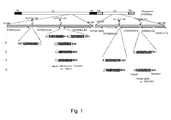
- the region located between UL44 and UL45 corresponds to nucleotides 94243-94683 of the HVT genome
- the region located between UL45 and UL46 corresponds to nucleotides 95323-95443 of the HVT genome
- the region located between US 10 and SORF3 corresponds to nucleotides138688-138825 of the HVT genome
- the region located between SORF3 and US2 corresponds to nucleotides 139867-140064 of the HVT genome.
- genes of interest for insertion into the genome of herpes virus may be homologous or heterologous nucleotide sequences which are obtained from any pathogenic organism which are capable of causing infection in avian species.
- the genes of interest may be derived from pathogens which cause diseases that have an economic impact on the poultry industry. Examples of pathogens that cause infection in avian include viruses, bacteria, fungi, protozoa, etc.
- the homologous or heterologous nucleotide sequence for insertion into the viral genome may thus be any sequence coding for an antigenic peptide of bird pathogenic agents.
- the nucleic acid sequence according to the present invention can be derived from any source, e.g ., viral, prokaryotic, eukaryotic or synthetic.
- the genes of interest encode immunogenic peptides of a pathogen, and preferably represent surface proteins, secreted proteins and structural proteins.
- the nucleotide sequence may encode for example an antigenic peptide derived from avian influenza virus, avian paramyxovirus type 1, also called Newcastle disease virus (NDV), avian metapneumovirus, Marek's disease virus, Gumboro disease virus, also called infectious bursal disease virus (IBDV), Infectious laryngotracheitis virus (II,VT), Infectious bronchitis virus (IBV), Escherichia coli, Salmonella species, Pasteurella multocida, Riemerella anatipestifer, Ornithobacterium rhinotracheale, Mycoplasma gallisepticum, Mycoplasma synoviae, Mycoplasmas microorganisms infecting avian species or coccidian.
- NDV Newcastle disease virus
- avian metapneumovirus avian metapneumovirus
- Marek's disease virus Gumboro disease virus, also called infectious bursal disease virus (IBDV), Infectious laryn
- the nucleotide sequences inserted into the viral genome are chosen among the F protein of NDV, the VP2 protein of IBDV, the gB protein of ILTV, the 40K protein of Mycoplasma galisepticum, and the surface protein hemagglutinin (HA) of the avian influenza virus.
- antigenic peptides may present great interest, depending on several factors, such as avian species, rearing-country, rearing-conditions etc.
- the multivalent recombinant avian herpes virus of the invention incorporates into its genome the nucleotide sequence coding for the F protein of NDV and the nucleotide sequence coding for the VP2 protein of IBDV.
- three or more nucleotide sequences may be inserted into the viral genome.
- the recombinant herpes virus of the invention can further express two or more antigens from a same pathogen.
- the homologous or heterologous nucleotide sequences coding for the antigens of interest may be operably linked to a promoter and further inserted into the insertion site of the viral genome.
- the promoter used may be either a synthetic or natural, endogenous or heterologous promoter.
- the promoter is not limited as long as it can effectively function in cells of birds infected with rHVT. Hence the choice of a promoter extends to any eukaryotic, prokaryotic or viral promoter capable of directing gene transcription in cells of birds infected by the rHVT.
- the promoters are chosen among the chicken beta-actin (Bac) promoter, the Pec promoter, the Murine Cytomegalovirus (Mcmv) ie1 promoter, the Human Cytomegalovirus (Hcmv) promoter, the Simian virus (SV)40 promoter, and the Raus Sarcoma virus (RSV) promoter, or any fragments thereof which retain a promoter activity.
- Bac chicken beta-actin
- Pec promoter the Murine Cytomegalovirus
- Mcmv Murine Cytomegalovirus
- Hcmv Human Cytomegalovirus
- SV Simian virus
- RSV Raus Sarcoma virus
- sequence of the chicken Bac promoter is that shown in SEQ ID NO. 1 and/or the sequence of the Pec promoter is that shown in SEQ NO. 2 and/or the sequence of the Mcmv ie1 promoter is that shown in SEQ ID NO. 3 and/or the sequence of the Hcmv promoter is that shown in SEQ ID NO. 4 and/or the sequence of SV40 promoter is that shown in SEQ ID NO. 5 and/or the sequence of RSV promoter is that shown in SEQ ID NO.6.
- the herpes virus is propagated in a suitable host cell and then the genomic DNA is obtained.
- the host and the conditions for propagating the virus are selected as appropriate.
- host cells cells derived from chicken are preferred, and CEF (chick embryo fibroblast), chicken kidney cells, and the like, can be used. It may be cultured in a culture medium such as Eagle's MEM, Leibowitz-L-15/McCoy 5A (1:1 mixture) culture medium at about 37°C for 3 to 4 days.
- DNA is extracted from the virus infected cells cultured as above according to a conventional method. After protein is denatured in the lysis buffer and removed, DNA is extracted with phenol and ethanol.
- Plasmid with insertion site sequence Plasmid with insertion site sequence
- One possibility to insert a foreign gene in one of the untranslated region of the invention may be to clone first a sequence containing the targeted untranslated region into a plasmid, or other suitable vector.
- sequence is chosen among the sequence of the region located between UL44 and UL45, the sequence of the region located between UL45 and UL46, the sequence of the region located between US 10 and SORF3, and the sequence of the region located between SORF3 and US2.
- Examples of plasmids comprise pBR322, pBR325, pBR327, pBR328, pUC18, pUC19, pUC7, pUC8, and pUC9
- examples of phages comprise lambda phage and M13 phage
- example of cosmids comprises pHC79.
- the untranslated region sequence is integrated into the plasmid according to a conventional method.
- the insertion region sequences which flank each nucleic acid sequence are of appropriate length so as to allow in vivo homologous recombination with the viral genome.
- mutation may be carried out at a specific site of the untranslated region to make a new cleavage site for restriction enzymes.
- a method of carrying out mutation may be a conventional method, and a method commonly used by a person skilled in the art such as in vitro mutagenesis and PCR can be used.
- a mutation such as the deletion, replacement, or addition of 1 to 2 nucleotides in the PCR primer is carried out, and the primer is then used to create a mutation.
- Plasmid further containing targeted foreign nucleotide sequence(s)
- nucleotide and promoter sequences for insertion into the virus, are further inserted into the insertion region of the viral genome in the plasmid.
- nucleotide and promoter sequences are introduced into a fragment of genomic herpes virus DNA containing insertion region sequences, subcloned in the recombinant DNA molecule.
- a plasmid can be prepared, which contains two or more foreign nucleic acid sequences, e.g ., derived from the same or different pathogens, said sequences being flanked by insertion region sequences as described herein.
- Viral genome comprising a foreign nucleotide sequence in an insertion site
- Plasmids in which at least nucleotide sequences have been inserted into the untranslated region obtained as above may be introduced into an HVT-infected cell or HVT genome-transfected cells using electroporation, calcium phosphate, a lipofectin-based method or the like.
- the amount of the plasmid to be introduced is in the range of 0.1 to 1000 ⁇ g, the efficiency of generation of recombinant viruses by recombination between the homologous regions of HVT-DNA and the plasmid becomes high in cells.
- the multivalent of the invention may be obtained by co-transfecting in the same cell culture a plasmid containing, as described above, an insertion site sequence in which is integrated a foreign nucleotide sequence, and a recombinant herpes virus containing, as described above, the same insertion site free of foreign nucleotide sequence and a second insertion site in which is integrated a distinct foreign nucleotide sequence.
- This co-transfection results in the recombination of the plasmid DNA into the viral genome.
- the multivalent of the invention may be obtained by co-transfecting in the same cell culture two plasmids each containing a distinct insertion site sequence in which is integrated a distinct foreign nucleotide sequence, and an herpes virus containing, as described above, the same insertion sites free of foreign nucleotide sequence.
- the co-transfection results in the recombination of the both plasmid DNAs into the viral genome.
- the resulting multivalent recombinant virus may be selected genotypically or phenotypically using known techniques of selection, e.g ., by hybridization, detecting enzyme activity encoded by a gene co-integrated along with the recombinant nucleic acid sequences or detecting the antigenic peptide expressed by the recombinant herpes virus immunologically.
- the selected recombinant herpes virus can be cultured on a large scale in cell culture after which, recombinant herpes virus containing peptides can be collected.
- the Applicant has surprisingly found that particular combinations present a high level of stability, allowing their use for preparing improved multivalent vaccines.
- Preferred multivalent recombinant avian herpes virus of the invention comprises two recombinant nucleotide sequences, each recombinant nucleotide sequence encoding a distinct antigenic peptide and being inserted into a distinct non-coding region of the viral genome chosen among the region located between UL44 and UL45, the region located between UL45 and UL46, the region located between US 10 and SORF3, and the region located between SORF3 and US2.
- Preferred antigenic peptides of the invention are chosen among the F protein of NDV, the VP2 protein of IBDV, the gB protein of ILTV, the 40K protein of Mycoplasma galisepticum, and the surface protein HA of the avian influenza virus.
- the promoters used with nucleotide sequences inserted in the insertion site between UL44 and UL45 are chosen among the Pec promoter, the Mcmv ie1 promoter, the Hcmv promoter, the SV40 promoter, and the RSV promoter, or any fragments thereof which retain a promoter activity. More precisely, the applicant has surprisingly found that the use of the Bac promoter inserted between UL44 and UL45 does not provide efficient recombinant avian herpes virus, since the related inserted nucleotide sequence is unstable through successive passages.
- the recombinant avian herpes virus comprises in the insertion site between UL45 and UL46 a recombinant nucleotide sequence encoding the F protein of NDV, or a fragment thereof, preferentially under the control of the Pec promoter, and in the insertion site between UL44 and UL45 a recombinant nucleotide sequence encoding the VP2 protein of IBDV or a fragment thereof, preferentially under the control of SV40 promoter (FW130).
- the recombinant avian herpes virus comprises in the insertion site between UL45 and UL46 a recombinant nucleotide sequence encoding the F protein of NDV, or a fragment thereof, preferentially under the control of the Pec promoter, and in the insertion site between UL44 and UL45 a recombinant nucleotide sequence encoding the VP2 protein of IBDV or a fragment thereof, preferentially under the control of the RSV promoter (FW129).
- the recombinant avian herpes virus comprises in the insertion site between UL45 and UL46 a recombinant nucleotide sequence encoding the F protein of NDV, or a fragment thereof, preferentially under the control of the Pec promoter, and in the insertion site between UL44 and UL45 a recombinant nucleotide sequence encoding the VP2 protein of IBDV or a fragment thereof, preferentially under the control of the Mcmv ie1 promoter (FW141).
- the recombinant avian herpes virus comprises in the insertion site between UL45 and UL46 a recombinant nucleotide sequence encoding the F protein of NDV, or a fragment thereof, preferentially under the control of the Pec promoter, and in the insertion site between SORF3 and US2 a recombinant nucleotide sequence encoding the VP2 protein of IBDV or a fragment thereof, preferentially under the control of the Mcmv ie1 promoter (FW144).
- the recombinant avian herpes virus comprises in the insertion site between UL45 and UL46 a recombinant nucleotide sequence encoding the F protein of NDV, or a fragment thereof, preferentially under the control of the Pec promoter, and in the insertion site between SORF3 and US2 a recombinant nucleotide sequence encoding the VP2 protein of IBDV or a fragment thereof, preferentially under the control of the Bac promoter (FW146).
- the recombinant avian herpes virus comprises in the insertion site between UL44 and UL45 a recombinant nucleotide sequence encoding the F protein of NDV, or a fragment thereof, preferentially under the control of the Pec promoter, and in the insertion site between UL45 and UL46 a recombinant nucleotide sequence encoding the VP2 protein of IBDV or a fragment thereof, preferentially under the control of the Mcmv ie1 promoter (FW143).
- the recombinant avian herpes virus comprises in the insertion site between UL44 and UL45 a recombinant nucleotide sequence encoding the F protein of NDV, or a fragment thereof, preferentially under the control of the Mcmv ie1 promoter, and in the insertion site between UL45 and UL46 a recombinant nucleotide sequence encoding the VP2 protein of IBDV or a fragment thereof, preferentially under the control of the Bac promoter (FW142).
- the recombinant avian herpes virus comprises in the insertion site between SORF3 and US2 a recombinant nucleotide sequence encoding the F protein of NDV, or a fragment thereof, preferentially under the control of the Pec promoter, and in the insertion site between UL45 and UL46 a recombinant nucleotide sequence encoding the VP2 protein of IBDV or a fragment thereof, preferentially under the control of the Bac promoter (FW147).
- the recombinant avian herpes virus comprises in the insertion site between UL45 and UL46 a recombinant nucleotide sequence encoding the VP2 protein of IBDV, or a fragment thereof, preferentially under the control of the Bac promoter, and in the insertion site between SORF3 and US2 a recombinant nucleotide sequence encoding the F protein of NDV or a fragment thereof, preferentially under the control of the Mcmv ie1 promoter (FW145).
- the recombinant avian herpes virus comprises in the insertion site between UL45 and UL46 a recombinant nucleotide sequence encoding the VP2 protein of IBDV, or a fragment thereof, preferentially under the control of the Bac promoter, and in the insertion site between SORF3 and US2 a recombinant nucleotide sequence encoding the F protein of NDV or a fragment thereof, preferentially under the control of the SV40 promoter (FW149).
- the recombinant avian herpes virus comprises in the insertion site between UL45 and UL46 a recombinant nucleotide sequence encoding the F protein of NDV, or a fragment thereof, preferentially under the control of the SV40 promoter, and in the insertion site between SORF3 and US2 a recombinant nucleotide sequence encoding the VP2 protein of IBDV or a fragment thereof, preferentially under the control of the Bac promoter (FW148).
- the recombinant avian herpes virus comprises in the insertion site between UL45 and UL46 a recombinant nucleotide sequence encoding the F protein of NDV, or a fragment thereof, preferentially under the control of the Pec promoter, and in the insertion site between US 10 and SORF3 a recombinant nucleotide sequence encoding the VP2 protein of IBDV or a fragment thereof, preferentially under the control of the Mcmv ie1 promoter (FW 153).
- the recombinant avian herpes virus comprises in the insertion site between UL45 and UL46 a recombinant nucleotide sequence encoding the F protein of NDV, or a fragment thereof, preferentially under the control of the Pec promoter, and in the insertion site between US 10 and SORF3 a recombinant nucleotide sequence encoding the VP2 protein of IBDV or a fragment thereof, preferentially under the control of the Bac promoter (FW 154).
- the recombinant avian herpes virus comprises in the insertion site between UL45 and UL46 a recombinant nucleotide sequence encoding the VP2 protein of IBDV or a fragment thereof, preferentially under the control of the Bac promoter, and in the insertion site between US 10 and SORF3 a recombinant nucleotide sequence encoding the F protein of NDV, or a fragment thereof, preferentially under the control of the Mcmv ie1 promoter (FW155).
- the recombinant avian herpes virus comprises in the insertion site between UL45 and UL46 a recombinant nucleotide sequence encoding the VP2 protein of IBDV or a fragment thereof, preferentially under the control of the Bac promoter, and in the insertion site between US 10 and SORF3 a recombinant nucleotide sequence encoding the F protein of NDV, or a fragment thereof, preferentially under the control of the Pec promoter (FW 156).
- the recombinant avian herpes virus comprises in the insertion site between US 10 and SORF3 a recombinant nucleotide sequence encoding the F protein of NDV, or a fragment thereof, preferentially under the control of the Pec promoter, and in the insertion site between SORF3 and US2 a recombinant nucleotide sequence encoding the VP2 protein of IBDV or a fragment thereof, preferentially under the control of the Mcmv ie1 promoter (FW 157).
- the recombinant avian herpes virus comprises in the insertion site between US 10 and SORF3 a recombinant nucleotide sequence encoding the F protein of NDV, or a fragment thereof, preferentially under the control of the Mcmv ie1 promoter, and in the insertion site between SORF3 and US2 a recombinant nucleotide sequence encoding the VP2 protein of IBDV or a fragment thereof, preferentially under the control of the Bac promoter (FW 158).
- the recombinant avian herpes virus comprises in the insertion site between US 10 and SORF3 a recombinant nucleotide sequence encoding the VP2 protein of IBDV, or a fragment thereof, preferentially under the control of the Bac promoter, and in the insertion site between SORF3 and US2 a recombinant nucleotide sequence encoding the F protein of NDV or a fragment thereof, preferentially under the control of the Mcmv ie1 promoter (FW 159).
- the recombinant avian herpes virus comprises in the insertion site between US 10 and SORF3 a recombinant nucleotide sequence encoding the VP2 protein of IBDV, or a fragment thereof, preferentially under the control of the Mcmv ie1 promoter, and in the insertion site between SORF3 and US2 a recombinant nucleotide sequence encoding the F protein of NDV or a fragment thereof, preferentially under the control of the Pec promoter (FW160).
- the resulting recombinant viruses of the present invention may be propagated in cell cultures in which said recombinant virus can propagate and grow. After required growth of the viruses is achieved the cells may be detached from the wells using a scraper or with trypsin and the infected cells may be separated from the supernatant by centrifugation.
- CEF CEF, embryonated egg, chicken kidney cell, and the like may be used as the host cells for the propagation of recombinant herpes viruses.
- Multivalent recombinant viruses of the present invention may be cultured in a culture medium such as Eagle's MEM, Leibowitz-L-15/McCoy 5A (1:1 mixture) culture medium at about 37° C for 3 to 4 days.
- the infected cells thus obtained are suspended in a culture medium containing 10% dimethyl sulfoxide (DMSO) and stored frozen under liquid nitrogen.
- DMSO dimethyl sulfoxide
- the recombinant multivalent herpes viruses of the invention present a high level of stability through passages, which corresponds to a coexpression of the recombinant nucleotide sequences in cells of avian species even after 10 or more passages.
- a "passage" or “cell passaging” means a culture of cells in suitable conditions for allowing their growth and keeping them alive until they are 90% to 100% confluent.
- the passaging step consists on transferring a small number of cells of the previous confluent culture into a new culture medium. An aliquot of the previous confluent culture, containing a few cells, may be diluted in a large volume of fresh medium.
- cells may be first detached, for example by using a mixture of trypsin and EDTA, or any suitable enzyme, before to use a few number of detached cells for seeding a new culture medium.
- CEF cells transfected with recombinant avian herpes viruses of the invention still coexpress the corresponding antigenic peptides after at least 10 passages.
- CEF cells resulting from 10 or more passages of CEF cells transfected with recombinant avian herpes viruses of the invention, and more particularly resulting from 15 passages still contain the foreign nucleotide sequences of the recombinant avian herpes virus used for the initial cell transfection and express the at least two corresponding antigenic peptides.
- cells of a said passage still express the antigenic peptides if the level of production is greater than 80% of the level of production of the first passage, and preferentially greater than 85%.
- the invention also relates to a multivalent vaccine for immunizing avian species, such as poultry, which comprises an effective immunizing amount of a multivalent recombinant avian herpes virus of the invention.
- vaccines of the invention are able to cause or stimulate or amplify immunity against at least two pathogens chosen among avian paramyxovirus type 1, Gumboro disease virus, the infectious laryngotracheitis virus, Mycoplasma galisepticum, and the avian influenza virus.
- Vaccines of the invention comprise an immunologically effective amount of a multivalent recombinant herpes virus as described above, in a pharmaceutically acceptable vehicle.
- a multivalent recombinant herpes virus according to the invention may be preferably used as a live vaccine although other alternatives like inactivated vaccines or attenuated vaccines are well within the skill of a person skilled in the art.
- the vaccine according to the present invention may further comprise a suitable solvent, such as for example an aqueous buffer or a phosphate buffer.
- a suitable solvent such as for example an aqueous buffer or a phosphate buffer.
- the vaccine also comprises additives.
- Additives of the present invention may be obtained from any of a number of sources including various proteins and peptides derived from animals (e.g., hormones, cytokines, co-stimulatory factors), and novel nucleic acids derived from viruses and other sources (e.g., double stranded RNA, CpG), and the like which are administered with the vaccine in an amount sufficient to enhance the immune response.
- any number of combinations of the aforementioned substances may provide an immunopotentiation effect, and therefore, can form an immunopotentiator of the present invention.
- the vaccines of the present invention may further be formulated with one or more further additives to maintain isotonicity, physiological pH and stability, for example, a buffer such as physiological saline (0.85%), phosphate-buffered saline (PBS), citrate buffers, Tris(hydroxymethyl aminomethane (TRIS), Tris-buffered saline and the like, or an antibiotic, for example, neomycin or streptomycin, etc.
- a buffer such as physiological saline (0.85%), phosphate-buffered saline (PBS), citrate buffers, Tris(hydroxymethyl aminomethane (TRIS), Tris-buffered saline and the like, or an antibiotic, for example, neomycin or streptomycin, etc.
- the route of administration can be any route including oral, ocular (e.g., by eyedrop), oculo-nasal administration using aerosol, intranasal, Cloacal in feed, in water, or by spray, in ovo, topically, or by injection (e.g., intravenous, subcutaneous, intramuscular, intraorbital, intraocular, intradermal, and/or intraperitoneal) vaccination.
- injection e.g., intravenous, subcutaneous, intramuscular, intraorbital, intraocular, intradermal, and/or intraperitoneal
- the skilled person will easily adapt the formulation of the vaccine composition for each type of route of administration.
- Each vaccine dose may contain a suitable dose sufficient to elicit a protective immune response in avian species. Optimization of such dose is well known in the art.
- the amount of antigen per dose may be determined by known methods using antigen/anti-body reactions, for example by the ELISA method.
- the vaccines of the invention can be administered as single doses or in repeated doses, depending on the vaccination protocol.
- the vaccines of the present invention are further advantageous in that they confer to bird species up to 80% protection against the targeted avian pathogens after 3 weeks of vaccination.
- the present invention further relates to the use of the vaccine as described above for immunizing avian species, such as poultry, and to method of immunizing avian species by administering an immunologically effective amount of the vaccine according to the invention.
- the vaccine may be advantageously administered intradermally, subcutaneously, intramuscularly, orally, in ovo, by mucosal administration or via oculo-nasal administration.
- the present invention further relates to vaccination kits for immunizing avian species which comprises an effective amount of the multivalent vaccine as descri bed above and a means for administering said components to said species.
- kit comprises an injection device filled with the multivalent vaccine according to the invention and instructions for intradermic, subcutaneous, intramuscular, or in ovo injection.
- the kit comprises a spray/aerosol or eye drop device filled with the multivalent vaccine according to the invention and instructions for oculo-nasal administration, oral or mucosal administration.
- herpes virus monovalent or mulytivalent according to the invention
- HVT/first insertion site-first foreign gene/second insertion site-second foreign gene recombinant herpes virus
- the plasmid construction was essentially performed by the standard molecular biology techniques ( Molecular Cloning: A Laboratory Manual. 3rd Edition, Cold Spring Harbor Laboratory, Cold Spring Harbor, N.Y. 2001 ). DNA restriction fragments were electrophoresed on agarose gels and purified with Plasmid plus Midi Kit (QIAGEN, Cat # 12945)
- gC homologue (gCh) gene of MDV serotype 1 Coussens et al., J. Virol. 62:2373-2379, 1988
- BamHI-B fragment Japanese Unexamined Patent Publication No. H6-292583
- HVT DNA was prepared from CEF cells infected with the HVT FC126 strain according to the method of Lee et al. (J. Gen. Virol., 51 : 245-253, 1980 ).
- PCR was performed with two pairs of primers.
- the first pair was SEQ NO.7 (5'-CCCCGAATTCATGGAAGAAATTTCC-3') and SEQ NO.8 (5'-CGCGGGCCAATAAGGCCAACATCGGGACGTACATC-3').
- the second pair was SEQ NO.9 (5'-GCGCGGCCTTATTGGCCTTAAATACCGCGTTTGGAG-3') and SEQ NO.10 (5'-CCCCAAGCTTTCAAGTGATACTGCGTGA-3').
- UL46 gene was deleted from p44/45Sfi.
- p45/46Sfi US 7569365 ) digested with EcoRI and SfiI was ligated with dSfiI-EcoRI linker, resulting in plasmid p44/45d46.
- HVT DNA was prepared from CEF cells infected with the HVT FC126 strain according to the method of Lee et al. (J. Gen. Virol., 51 : 245-253, 1980 ). Using the obtained HVT DNA as a template, PCR was performed with two pairs of primers. Each primer was designed on the information of Genbank X68653.1. A DNA fragment having a SfiI site between two ORFs, US2 (HVT088) and SORF3 (HVT087), was prepared by PCR and cloned into pUC18. The first pair was SEQ NO.11 (5'-GGGAATTCGAAGAGCCCCCGCGGACGCATG-3') and SEQ NO.
- the first resulting fragment was digested with EcoRI and NheI.
- the second resulting fragment was digested with NheI and HindIII. These cleaved fragments were integrated into pUC18 cleaved with EcoRI and HindIII, resulting the plasmid pHVT 87-88.
- HVT DNA was prepared from CEF cells infected with the HVT FC126 strain according to the method of Lee et al. (J. Gen. Virol., 51 : 245-253, 1980 ). Using the obtained HVT DNA as a template, PCR was performed with two pairs of primers. Each primer was designed on the information of Genbank X68653.1. A DNA fragment having a SfiI site between two ORFs, US 10 (HVT086) and SORF3 (HVT087), was prepared by PCR and cloned into pUC18.
- the first pair was SEQ NO.15 (5'-GGGGGAATTCATTATCCCATCTAACAGTTATATACG-3') and SEQ NO.16 (5'-GCCGCTAGCGGCCGCCTTTATTAACAACCTTAC-3')
- the second pair was SEQ NO.17 (5'-GCGGCCGCTAGCGGCCTTATTGGCC GTTTATTCTATGTAAGAC-3') and SEQ NO.18 (5'-CCCAAGCTTAAGTTCCTTCACCATG-3')
- the first resulting fragment was digested with EcoRI and NheI.
- the second resulting fragment was digested with NheI and HindIII. These cleaved fragments were integrated into pUC18 cleaved with EcoRI and HindIII, resulting the plasmid pHVT 86-87.
- Mcmv ie1 promoter (SEQ NO.19) was synthesized on the information of 191-4731bp in Gene Bank L06816.1 reported by Koszinowski, U. H.. Synthesized Mcmv ie1 promoter was designed that BglI-PstI sites were added in front of it and XbaI-NotI sites were added at the end.
- SfiI-cleaved p44-45d46Sfi was dephosphorylated by using Alkaline Phosphatase Shewanella sp. S1B1 Recombinant (PAP) (Funakoshi #DE110). The fragment was ligated with BglI-cleaved p45/46BacVP2, resulting in the plasmid, p44/45d46 BacVP2.
- Mcmv ie1 promoter (BglI/XbaI) was ligated with p44/45d46 BacVP2 cleaved with EcoRV and XbaI, and p44/45d46 Bac VP2 cleaved with EcoRV and BglI, resulting in p44/45d46 Mcmv ie1 VP2.
- the synthetized short polyA signal (SPA: SEQ NO.20 CTGCAGGCGGCCGCTCTAGAGTCGACAATAAAAGATCTTTATTTTCATTAGATC TGTGTGTTGGTTTTTTGTGTGGCCAATAAGGCC) was integrated into p44/45d46 Mcmv ie1 VP2 cleaved with SalI and SfiI, resulting in the homology plasmid, p44/45d46 Mcmv ie1 VP2 SPA
- Viral DNA of the HVT wild type, FC126 strain was prepared as described by Morgan et al. (Avian Diseases, 34:345-351, 1990 ).
- Viral DNAs of FW029 rHVT/45-46PecF
- FW023 rHVT/45-46BacVP2
- the first double rHVT pattern was that the CEF cells were transfected with the prepared wt-HVT DNA and p45/46sv40VP2 PecF (ex. FW137).
- the second pattern was that the CEF cells were transfected with the prepared FW029 DNA and p44/45 Mcmv ie1 VP2 (ex. FW141).
- the third pattern was that the CEF cells were transfected with the prepared FW023 DNA and p44/45 Mcmv ie1 F (ex. FW142).
- the fourth pattern was that the CEF were transfected with the prepared FW029 DNA and pHVT87-88Bac VP (ex. FW144).
- the fifth pattern was that the CEF were transfected with the prepared FW023 and pHVT87-88Pec F (ex. FW145). These resulting recombinant viruses were plaque purified by staining plaques with the anti-NDV-F antibody and anti-IBDV-VP2 antibody..
- 10 7 primary CEF cells were suspended in 100 ⁇ l of MEF-1(Lonza LNJVD-1004) and co-transfected with 1 ⁇ g of the homology vector, for example, p44/45 Mcmv ie1 F and pHVT Bac VP2, and 2 ⁇ g of HVT DNA, for instance, FC126 , FW029 and FW023 by electroporation. Electroporation was performed on Nucleofector II. Transfected cells were diluted in 20ml of Leibovitz's L-15 (GIBCO BRL, Cat. #41300-39), McCoy's 5A Medium (GIBCO BRL, Cat. #21500-061) (1:1) and 4% calf serum (named solution LM (+) medium), spread 100ul per well of 96 well plate.
- the homology vector for example, p44/45 Mcmv ie1 F and pHVT Bac VP2
- HVT DNA for instance, FC126 , FW029 and FW023
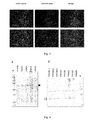
- the double rHVT candidate was stained by the anti-NDV-F antibody 3-1G/5 ( Morrison, T. G., Proc. Natl. Acad. Sci. U.S.A. 84: 1020-1024, 1987 ) or anti F rabbit serum. Finally, Expression of proteins of the every plaques of the candidate rHVT was confirmed by dual IFA staining. CEFs infected by each rHVT were fixed with cold Acetone-Methanol (2:1), washed with PBS, reacted with antibody mixture (1:1000 diluted anti F rabbit serum #35 and anti-VP2 mouse Mab R63) at 37C in 60 minutes.
- the cells After washing 3 times with PBS, the cells reacted with fluorescent antibody mixture (1:1000 diluted Alexa Fluor488 anti rabbit and Alexa Fluor546 anti mouse provided by Invitrogen) at 37C in 60 minutes. After washing 3 times with PBS, they are observed by fluorescence microscope at magnification by 400 times. Protein VP2 expression was detected by anti-VP2 Mab (R63) and Alexa Flour 546. Protein F expression was detected by anti-F #35 rabbit serum and Alexa Flour 488. When all plaques were expressed both F and VP2, we concluded purification was completed.
- fluorescent antibody mixture (1:1000 diluted Alexa Fluor488 anti rabbit and Alexa Fluor546 anti mouse provided by Invitrogen) at 37C in 60 minutes. After washing 3 times with PBS, they are observed by fluorescence microscope at magnification by 400 times. Protein VP2 expression was detected by anti-VP2 Mab (R63) and Alexa Flour 546. Protein F expression was detected by anti-F #35 rabbit serum and Alexa Flour
- the purified recombinant HVT was designated rHVT/ND/IBD.
- the table 1 below shows the expression of the VP2 and protein F obtained from the different rHVT/ND/IBD.
- Strain FW023 (HVT/45-46 Bac VP2) corresponds to a monovalent recombinant herpes virus used as control for VP2 expression
- FW029 (HVT/45-46 PecF) corresponds to a monovalent recombinant herpes virus used as control for protein F expression.
- Table 1 shows the expression of the VP2 and protein F obtained from the different rHVT/ND/IBD.
- the culture was centrifuged at 300 g for 3minutes, and the precipitated cells were resuspended in 100ul.
- Laemmli buffer (100ul) was added to the cell suspension.
- the resultant mixture was then boiled for 5 min and 5 ul of them was subjected to 10% SDS-polyacrylamide gel electrophoresis.
- the electrophoresed proteins were transferred from SDS-GEL to a PVDF membrane (Immobilon-P, Millipore), which was blocked in 1% w/v non-fat milk powder in PBS at room temperature for one hour.
- the treated membrane was then reacted with the anti-F rabbit antiserum #35 in 500-fold dilution at room temperature for one hour, washed three times with PBS, and incubated for one hour with the biotinylated anti-rabbit goat antiserum.
- the treated membrane was then reacted with the anti-VP2 Mab R63 in 500-fold dilution at room temperature for one hour, washed three times with PBS, and incubated for one hour with the biotinylated anti-mouse goat antiserum.
- Figure 3B showed VP2 protein was observed at 38-kilodaltons (kd) in the lanes of each rHVT/ND/IBD ( ⁇ ). On the contrary, there was no band in the lane of rHVT/PecF (FW029) ( Fig.1 B ).
- the 38-kd is the mature VP2 protein ( A. A. Azad et al., 1987, Virol. 161:145-152 , K. J., Fahey et al., 1985 J. Gen. Virol. 66:1479-1488 ).
- Double recombinant HVTs according to the invention expressed both NDV-F and IBDV VP2.
- the purified rHVT/ND/IBD was propagated on CEF cells of one 25-cm 2 flask to obtain the confluent plaques.
- Cells were recovered from dishes by scraping, transferred to Falcon tubes and subjected to centrifugation at 300 xg for 5 min.
- Harvested cells were washed with PBS, re-suspended in 0.6 ml of PBS and 0.4 ml of lysis buffer (1.25% TritonX-100, 250 mM 2-ME, and 50 mM EDTA in PBS), and lysed by vortexing for 3 min.
- the lysates were then centrifuged at 600 xg for 5 min at room temperature and the supernatants were transferred to a 15 ml Falcon tubes.
- the viruses were collected by centrifugation at 20,400 xg for 20 min.
- the resultant pellets were then suspended in 0.33 ml of a nuclease solution (12.5 mM Tris-Cl (pH7.5), 1 ⁇ g/ml DNase I and 1 ⁇ g/ml RNase A), incubated at 37°C for 30 min, and disrupted by incubating at 55°C for 30 min with 83 ⁇ l of SDS-protease solution (50 mM EDTA, 5% SDS, 0.5mg/ml protease K, and 28.5 mM 2-mercaptoethanol).
- a nuclease solution 12.5 mM Tris-Cl (pH7.5), 1 ⁇ g/ml DNase I and 1 ⁇ g/ml RNase A
- the obtained mixture was treated twice with phenol-chloroform, and NaCl was added to the aqueous phase to the final concentration of 0.2 M.
- the viral DNA was precipitated by adding 2.5 volumes of ice-cold ethanol, washed with 70% ethanol and subjected to centrifugation at 20,400 xg for 20 min at 4°C. After air-drying, the pellets were dissolved in TE buffer (10 mM Tris-Cl (pH8.0), 1 mM EDTA).
- the viral DNA in TE buffer was digested with XhoI, SphI and SmaI, and subjected to 0.8% agarose gel electrophoresis.
- the electrophoresed DNA fragments on the single gel were transferred simultaneously to two nylon membranes ( Molecular Cloning: A Laboratory Manual, third edition, 6.35, Sambrook, J., and Russell, D.W. Cold Spring Harbor Laboratory ).
- the immobilized DNA was hybridized with DIG-labeled probe, "VP2 probe", or "IS44/45 probe” which was prepared with PCR DIG Probe Synthesis Kit (ROCHE DIAGNOSTICS, Cat. #1636090).
- the viral DNA in TE buffer was digested with XhoI and SphI, and hybridized with DIG-labeled probe, "F probe”, "IS45/46 probe” by the same procedure mentioned above.
- VP2 probe was prepared with VP2 STC-F (SEQ ID NO.21) and VP2 STC-R (SEQ ID NO.22) as primers and p45/46bacVP2-STC as a template.
- F probe was prepared with F-F (SEQ ID NO.23) and F-R (SEQ ID NO.24) as primers and p45/46PecF as a template.
- IS45/46 probe was prepared with 45/46-F (SEQ ID NO.25) and 45/46-R (SEQ ID NO.26) as primers and pNZ45/46Sfi as a template.
- IS44/45 probe was prepared with 44/45-F (SEQ ID NO.27) and 44/45-R (SEQ ID NO.28) as primers and pNZ44/45d46Sfi as a template.
- NDV-F-F (SEQ ID NO.23) 5'-CTAGCAGTGGCAGTTGGGAAGAT-3'
- NDV-F-R (SEQ ID NO.24) 5'-GTTAAGGCAGGGGAAGTGATTTGT-3'
- 2744-bp fragment was hybridized to F probe in the DNA from each double recombinant HVTs. No band was detected in the p45/46 SfiI. 2077-bp and 1228-bp fragments to IS44/45 probe in the DNA from FW129. 1350-bp fragment to IS44/45 probe in p45/46 PecF, which was inserted no gene at the IS44/45 site. 2744-bp and 770-bp fragments to IS45/46 probe in the DNA from each double recombinant HVT.
- Figure 5A-5D indicated that the obtained double recombinants HVT/ND/IBD have the expected genomic structure.
- Double recombinant HVTs were passaged serially (up to 15 times) on chicken embryo fibroblasts (CEF). Then Cell lysates were applied to Western blot analysis. In a first panel ( figure 6A ), the blot was reacted with an anti-F rabbit serum (#35). In a second panel ( figure 6B ) the blot was reacted with an anti-VP2 Mab (R63). Mock: non-infected CEF M: Precision Plus Protein Standards Bio Rad #161-0374
- TP-24 transfer plasmid p44-45d46SV40VP2
- FIG. 7B shows that 2077-bp and 1228-bp fragments were hybridized to IS44/45 probe in the DNA from FW129, and 2334-bp and 1022-bp fragments were hybridized to IS44/45 probe in the DNA from FW130. 1350-bp fragment was hybridized to IS44/45 probe in p45/46 PecF, which contained no gene at the IS44/45 site.
- Figure 7D shows that 2744-bp and 770-bp fragments were hybridized to IS45/46 probe in the DNA from each double recombinant HVT.
- Southern blot with 44/45 probe and 45/46 probe showed VP2 gene or F gene stably maintained at the insertion site 44/45 or 45/46 respectively in FW129 and FW130.
- Figure 8A shows change of anti-NDV titer.
- Figure 8B shows change of anti-IBDV titer. Double recombinant HVT using two sites stably induced both anti-NDV and anti-IBDV titers.
- rHVT/ND/IBD FW130, FW135, FW137, FW129
- Chickens of the positive control group were vaccinated at 14 day of age with a commercial NDV live vaccine according to the vender's recommendation. Chickens of the negative control group were not administered with any vaccine.
- the protection was evaluated by two criteria which are as follows. (1) The weight ratio of the bursa to the body (B/B index) was not statistically different from that of non-vaccinated, non-challenged chickens. (2) No malformation of the Bursa of Fabricius such as edematization, hemorrhage, yellowish exudate, discoloration, atrophy, or gelatinous exudate was detected. The results were summarized in Table 3. Table 3.
Landscapes
- Health & Medical Sciences (AREA)
- Life Sciences & Earth Sciences (AREA)
- Virology (AREA)
- Chemical & Material Sciences (AREA)
- General Health & Medical Sciences (AREA)
- Immunology (AREA)
- Genetics & Genomics (AREA)
- Microbiology (AREA)
- Engineering & Computer Science (AREA)
- Medicinal Chemistry (AREA)
- Veterinary Medicine (AREA)
- Pharmacology & Pharmacy (AREA)
- Animal Behavior & Ethology (AREA)
- Public Health (AREA)
- Zoology (AREA)
- Organic Chemistry (AREA)
- Bioinformatics & Cheminformatics (AREA)
- Epidemiology (AREA)
- Mycology (AREA)
- Wood Science & Technology (AREA)
- Biotechnology (AREA)
- Biomedical Technology (AREA)
- General Engineering & Computer Science (AREA)
- Biochemistry (AREA)
- Molecular Biology (AREA)
- Pulmonology (AREA)
- Plant Pathology (AREA)
- Biophysics (AREA)
- Physics & Mathematics (AREA)
- Chemical Kinetics & Catalysis (AREA)
- Nuclear Medicine, Radiotherapy & Molecular Imaging (AREA)
- General Chemical & Material Sciences (AREA)
- Oncology (AREA)
- Communicable Diseases (AREA)
- Medicines Containing Antibodies Or Antigens For Use As Internal Diagnostic Agents (AREA)
- Micro-Organisms Or Cultivation Processes Thereof (AREA)
- Peptides Or Proteins (AREA)
- Medicines That Contain Protein Lipid Enzymes And Other Medicines (AREA)
Abstract
The present invention relates to a recombinant avian herpes virus, which comprises at least two recombinant nucleotide sequences, each recombinant nucleotide sequence encoding a distinct antigenic peptide, wherein said at least two recombinant nucleotide sequences are inserted into distinct non-coding region of the viral genome chosen among the region located between UL44 and UL45, the region located between UL45 and UL46, the region located between US 10 and SORF3, the region located between SORF3 and US2.
Description
- The present invention relates generally to the field of vaccine preparations. The present invention specifically relates to multivalent recombinant herpes virus, in which at least two foreign genes have been inserted, and their uses for inducing simultaneously a protective immunity against a plurality of avian diseases.
- Poultry meat and eggs are important food sources, whose consumption increases continually due to the growth of the human population and their great quality-price ratio. The recent epidemic of avian influenza focused the public opinion on poultry health as well as food safety and security. Poultry vaccine technology became a worldwide concern.
- Viral vectors expressing pathogen proteins are commonly used as poultry vaccines against targeted pathogens. Vaccines including such viral vectors induce expression of foreign pathogen proteins within infected cells, and thereby induce corresponding T cell immunity.
- It is well known that all herpes viruses, including herpes virus of turkey (HVT) and Marek's disease virus (MDV), can permanently survive in the body of an infected animal in the state of latent or persistent infection. Consequently, recombinant herpes viruses, in which a foreign gene derived from a pathogen has been integrated, have been developed to be used as viral-vectored vaccines increasing the duration of immunity to an immunized animal.
- The genomic structure of HVT, its wide-spread usage as a vaccine against MDV and its ability to remain persistent in chickens, make this virus an attractive vector for producing recombinant poultry vaccines.
- Vaccine preparations have been developed to achieve effective avian vaccinations, using recombinant herpes virus which incorporate a gene of foreign antigen. Such vaccine preparations allow to vaccine against both MDV and another avian disease, through the additional foreign DNA sequence.
- Although such vaccine preparations provide efficient results to vaccine avian species against many fatal diseases, competition and immunosuppression between pathogens can occurred when birds are injected with two or more recombinant herpes viruses, each harboring a different foreign antigen gene.
- Therefore, multivalent recombinant herpes viruses (i.e. harboring at least two different antigen genes) for immunizing simultaneously against different diseases, are particularly studied. However, up to now, recombinant HVTs (rHVTs) expressing multiple foreign genes inserted in one site of their genome are unstable, and all or part of the foreign genes is deleted during repeating passaging in culture cells. And such unstable multivalent virus vectors do not provide efficient vaccines.
- Accordingly, there is a need for stable multivalent recombinant viral-vectors, allowing the co-expression of the foreign genes in infected cells.
- Work conducted by the applicant has led to the surprising finding that a set of particular insertion sites in the herpes virus genome can be used for stably inserting two or more antigen genes and thereby providing efficient multivalent viral vectors for vaccination of birds. More particularly, the applicant has found that a few number of insertion sites can be used simultaneously for incorporating distinct antigen genes, providing stable multivalent recombinant viral-vectors.
- Therefore, the present invention relates to a recombinant avian herpes virus, which comprises at least two recombinant nucleotide sequences, each recombinant nucleotide sequence encoding and expressing in cells of avian species an antigenic peptide, wherein at least two recombinant nucleotide sequences are inserted into distinct non-coding region of the viral genome chosen among the region located between UL44 and UL45, the region located between UL45 and UL46, the region located between US10 and SORF3, the region located between SORF3 and US2
- More particularly, the applicant has surprisingly found that the combination of both the region located between UL45 and UL46, and the region located between UL44 and UL45, the region located between US10 and SORF3, or the region located between SORF3 and US2, as insertion sites, each integrating a single foreign nucleotide sequence, provides recombinant avian herpes viruses particularly stable and suitable for co-expressing the two corresponding antigenic peptides in infected avian species cells.
- Advantageously, the two, or more, recombinant nucleotide sequences are co-expressed in cells of avian species, and more particularly in Chicken Embryo Fibroblast (CEF) cells, even after 10 or more passages, and preferentially even after 15 passages.
- According to the invention, the recombinant nucleotide sequences are advantageously under the control of particular promoters. The promoters are preferentially chosen among the chicken beta-actin (Bac) promoter, the Pec promoter, the Murine Cytomegalovirus (Mcmv) immediate-early (ie)1 promoter, Human Cytomegalovirus (Hcmv) promoter, the Simian virus (SV)40 promoter, and the Raus Sarcoma virus (RSV) promoter, or any fragments thereof which retain a promoter activity. Preferentially, each recombinant nucleotide sequence is under the control of a distinct promoter.
- According to the invention, the foreign genes are advantageously chosen among an antigenic peptide of
avian paramyxovirus type 1, and preferentially the F protein of Newcastle disease virus (NDV), an antigenic peptide of Gumboro disease virus, preferentially the VP2 protein of the Infectious bursal disease virus (IBDV), an antigenic peptide of the infectious laryngotracheitis virus (ILTV), preferentially the gB protein, an antigenic peptide of Mycoplasma galisepticum, preferentially the 40K protein, and an antigenic peptide of the avian influenza virus, preferentially a surface protein hemagglutinin (HA). - In a preferred embodiment, the recombinant avian herpes virus comprises a first recombinant nucleotide sequence encoding a first antigenic peptide inserted into the non-coding region located between UL44 and UL45, and a second recombinant nucleotide sequence encoding a second antigenic peptide inserted into the non-coding region located between UL45 and UL46, between US 10 and SORF3, or between SORF3 and US2.
- In another preferred embodiment, the recombinant avian herpes virus comprises a first recombinant nucleotide sequence encoding a first antigenic peptide inserted into the non-coding region located between UL45 and UL46, and a second recombinant nucleotide sequence encoding a second antigenic peptide inserted into the non-coding region located between US 10 and SORF3, or between SORF3 and US2.
- In further preferred embodiment, the recombinant avian herpes virus comprises a first recombinant nucleotide sequence encoding a first antigenic peptide inserted into the non-coding region located between US 10 and SORF3, and a second recombinant nucleotide sequence encoding a second antigenic peptide inserted into the non-coding region located between SORF3 and US2.
- A further object of the invention relates to a multivalent vaccine for immunizing avian species, such as poultry, which comprises an effective immunizing amount of recombinant avian herpes virus of the invention. And, this vaccine can be used for immunizing avian species, such as poultry.
- A further object of the invention concerns an antiserum directed against avian herpes virus obtained by immunizing avian species with an effective amount of recombinant avian herpes virus of the invention and recovering the antiserum after bleeding the bird.
- The invention further relates to method of immunizing avian species comprising administering to said species an effective immunizing amount of the vaccine according to the invention.
- Accordingly, it is a further object of the invention to provide a vaccination kit for immunizing avian species which comprises an effective amount of the vaccine of the invention, and a means for administering said components to said species.
-
-
Figure 1 illustrates the schematic diagram of the HVT genome. The location of the Unique Long (UL) 44, UL45 and UL46 and the location of the Unique Short (US)10, SORF3 and US2 are marked. The recombinant nucleotide sequences can be inserted at PCR generated SfiI sites between UL44 and UL45, and/or between UL45 and UL46, and/or between US 10 and SORF3, and/or between SORF3 and US2. -
Figure 2A and2B illustrates schematic diagrams of the HVT genome integrating different clusters of nucleotide sequences and promoters, according to particular embodiments of the invention. -
Figure 3 shows immunofluorescence staining of CEFs infected with double recombinant HVTs according to embodiments of the invention (FW129 and FW141) co-expressing NDV-F and IBDV-VP2 (rHVT/ND/IBD infected cells). Protein VP2 expression was detected by anti-VP2 Mab (R63) and Alexa Flour 546. Protein F expression was detected byanti-F # 35 rabbit serum and Alexa Flour 488. The results show that both cells infected with FW129 or FW141 express both the inserted NDV-F protein and the inserted IBDV-VP2 protein. -
Figures 4A and 4B are western blotting analysis showing the expression of VP2 protein and/or F protein in CEF infected with rHVTs of the invention. As shown inFigure 4A , a protein band of 60 kilodaltons (kDa) was observed only in the lane with rHVT/ND/IBD infected cells, which was the expected size of the F protein (➲). There was no band in the lane of rHVT/44-45BacVP2 (FW123). As shown inFigure 4B , VP2 protein was observed at 38-kilodaltons (kd) in the lanes of each rHVT/ND/IBD (➲). On the contrary, there was no band in the lane of rHVT/45-46 PecF (FW029). The 38-kd is the mature VP2 protein (A. A. Azad et al., 1987, Virol. 161:145-152, K. J., Fahey et al., 1985 J. Gen. Virol. 66:1479-1488). Double rHVTs of the invention expressed both NDV-F and IBDV-VP2. -
Figures 5A to 5D shows results of a southern blotting analysis for genome structure check of purified FW129 (rHVT/45-46 pecF/44-45 Rsv VP2), indicating that double recombinant HVT/ND/IBD of the invention had the expected genomic structure. More precisely, the results of southern blotting showed that- a 2077-bp fragment was hybridized to VP2 probe in the DNA from each double recombinant HVT FW129 (
columns Figure 5A ). In contrast, no band was detected in p45/46Pec F (Figure 5A ). - a 2744-bp fragment was hybridized to F probe in the DNA from each double recombinant HVT FW129 (
columns Figure 5C ). No band was detected in the p45/46 SfiI. - 2077-bp and 1228-bp fragments were hybridized to IS44/45 probe in the DNA from each double recombinant HVT FW129 (
columns Figure 5B ). No band was detected for the molecular marker ramda HindIII digest (column MFigure 5B ). - 2744-bp and 770-bp fragments were hybridized to IS45/46 probe in the DNA from each double recombinant HVT FW129 (
columns Figure 5D ).
- a 2077-bp fragment was hybridized to VP2 probe in the DNA from each double recombinant HVT FW129 (
-
Figures 6A and 6B show results of a western blotting analysis for stability check of recombinant HVT FW129 in successive passages, indicating that after 15 passages F protein and VP2 protein were expressed stably in CEF infected with the rHVT FW129 of the invention. -
Figures 7A to 7D show results of a southern blotting analysis for stability check of recombinant HVTs after 15 passages. (Figure 7A ) The results of southern blotting show that a 2077-bp fragment was hybridized to VP2 probe in the DNA from FW129. 2334-bp fragment was hybridized to VP2 probe in the DNA from FW130. In contrast, no band was detected in p45/46Pec F. (Figure 7C ) The results of southern blotting show that a 2744-bp fragment was hybridized to F probe in the DNA from each double recombinant HVT FW129 and FW130. No band was detected in the p45/46 SfiI. (Figure 7B ) The results of southern blotting show that 2077-bp and 1228-bp fragments were hybridized to IS44/45 probe in the DNA from FW129, and that 2334-bp and 1022-bp fragments were hybridized to IS44/45 probe in the DNA from FW130. A 1350-bp fragment was hybridized to IS44/45 probe in p45/46 PecF, which contained no gene at the IS44/45 site. (Figure 7D ) The results of southern blotting show that 2744-bp and 770-bp fragments were hybridized to IS45/46 probe in the DNA from each double recombinant HVT FW129 and FW130. Southern blot with 44/45 probe and 45/46 probe showed VP2 gene or F gene stably maintained at the insertion site 44/45 or 45/46 respectively in FW129 and FW130. These results indicate that after 15 passages F protein and VP2 protein were expressed stably in CEF infected with the rHVT FW129 of the invention -
Figures 8A and 8B show comparative results of anti-NDV titers (Figure 8A ) and anti-IBDV titers (Figure 8B ) obtained from chicken inoculated with double recombinant HVTs (FW122, FW137, FW129, FW130, FW135), compared to titers obtained from chicken inoculated with single recombinant HVTs (FW029 and FW023 respectively). - The present invention generally relates to multivalent recombinant herpes virus to be used for immunizing avian species against at least two diseases in the same time. According to the invention, the foreign DNA sequences are specifically inserted in insertion sites located between UL44 and UL45, and/or between UL45 and UL46, and/or between
US 10 and SORF3, and/or between SORF3 and US2. The constructs of the invention are advantageously stable through enough passages, and no less than 10 passages, to be used routinely into a vaccine composition. - The present disclosure will be best understood by reference to the following definitions:
- In the context of the invention, the term "reconstructed" or "recombinant" in relation to a sequence, nucleic acid, or unit in a microorganism, indicates a sequence, nucleic acid or unit which does not exist naturally in the microorganism and has been assembled and/or inserted in said microorganism or an ancestor thereof, using recombinant DNA technology, (also called gene cloning or molecular cloning) which refers to techniques of transfer of DNA from one organism to another.
- The term "recombinant" in relation to a herpes virus refers to an existing herpes virus whose genome has been modified by insertion of at least one heterologous nucleic acid sequence, i.e ., DNA which corresponds to a gene or part thereof not identical to the nucleic acid sequence of a gene naturally present in the existing herpes virus. Alternatively, the existing herpes virus may be genetically modified by the incorporation into the virus genome of a homologous nucleic acid sequence, i.e ., DNA which corresponds to a gene or part thereof identical of a gene naturally present in existing herpes virus. It will be understood that the resulting recombinant herpes virus can be manufactured by a variety of methods, and once made, can be reproduced without use of further recombinant DNA technology. The structure of the "recombinant herpes virus" is therefore described in terms of DNA insertion.
- In the present description, the terms "nucleic acid" "nucleic sequence," and "nucleotide sequence" are used interchangeably and refer to a sequence of deoxyribonucleotides and/or ribonucleotides. The nucleotide sequence may be first prepared by e.g., recombinant, enzymatic and/or chemical techniques, and subsequently replicated in a host cell or an in vitro system. The nucleotide sequence preferentially comprises an open reading frame encoding a peptide. The nucleotide sequence may contain additional sequences such as a transcription terminator, a signal peptide, an IRES, an intron, etc. Preferably, the gene does not contain an intron.
- The term "heterologous nucleic acid sequence" refers to a DNA which corresponds to a gene or part thereof not identical to the nucleic acid sequence of a gene naturally present in herpes virus. The term "homologous nucleic acid sequence" refers to a DNA which corresponds to a gene or part thereof identical of a gene naturally present in herpes virus.
- The terms "untranslated regions" as used herein refer to a region of nucleotides that has no ORF and do not define an amino acid sequence of protein to be expressed by translation, or a region of nucleotides in which the ORF is not involved in any of transcription, translation, or protein expression. The nucleotide sequences contained in this region may be those that have substitutions, deletions, or additions of bases, unless they include an ORF.
- The term "avian species" is intended to encompass all kinds of birds of the class of Aves, i.e. vertebrate animals which are feathered, winged, bipedal, endothermic and egg-laying. In the context of the invention, avian species refer more particularly to birds with economical and/or agronomical interests, such as poultry. More particularly, the scope of the invention covers poultry (such as chickens, and turkeys), waterfowl poultry (such as ducks and geese) and ornamental birds (such as swans and psittacines).
- The term "vaccine" as used herein includes an agent which may be used to cause, stimulate or amplify the immune system.
- Viruses for use in the present invention are those that belong generally to the genus avian herpes virus, as long as being non-pathogenic to targeted avian species.
- For example, avian herpes viruses for use in the present invention include, but are not limited to, a herpes virus of turkeys (HVT), a
serotype 2 Marek's disease virus, preferably the SB1 strain of theserotype 2 Marek's disease virus, or aserotype 1 Marek's disease virus, preferably the CVI988/Rispens strain of theserotype 1 Marek's disease virus. - An object of the invention relates to recombinant avian herpes viruses suitable for immunizing avian species against at least two diseases, with improved stability through passages. Particular insertion sites have been designated by the inventors to provide improved stability for foreign antigen genes.
- An object of the invention therefore relates to a recombinant avian herpes virus, which comprises at least two recombinant nucleotide sequences, each recombinant nucleotide sequence encoding a distinct antigenic peptide, wherein at least two recombinant nucleotide sequences are inserted into distinct non-coding region of the viral genome chosen among the region located between UL44 and UL45, the region located between UL45 and UL46, the region located between
US 10 and SORF3, the region located between SORF3 and US2, as disclosed in Kingham and al. ("The genome of herpesvirus of turkeys: comparative analysis with Marek's disease viruses" - Journal of General Virology (2001) 82, 1123-1135). - For example, in FC126 complete genome (GenBank: AF291866.1), the region located between UL44 and UL45 corresponds to nucleotides 94243-94683 of the HVT genome, the region located between UL45 and UL46 corresponds to nucleotides 95323-95443 of the HVT genome, the region located between
US 10 and SORF3 corresponds to nucleotides138688-138825 of the HVT genome, and the region located between SORF3 and US2 corresponds to nucleotides 139867-140064 of the HVT genome. - The genes of interest for insertion into the genome of herpes virus may be homologous or heterologous nucleotide sequences which are obtained from any pathogenic organism which are capable of causing infection in avian species. Typically, the genes of interest may be derived from pathogens which cause diseases that have an economic impact on the poultry industry. Examples of pathogens that cause infection in avian include viruses, bacteria, fungi, protozoa, etc.
- The homologous or heterologous nucleotide sequence for insertion into the viral genome may thus be any sequence coding for an antigenic peptide of bird pathogenic agents. The nucleic acid sequence according to the present invention can be derived from any source, e.g ., viral, prokaryotic, eukaryotic or synthetic. Typically, the genes of interest encode immunogenic peptides of a pathogen, and preferably represent surface proteins, secreted proteins and structural proteins.
- The nucleotide sequence may encode for example an antigenic peptide derived from avian influenza virus,
avian paramyxovirus type 1, also called Newcastle disease virus (NDV), avian metapneumovirus, Marek's disease virus, Gumboro disease virus, also called infectious bursal disease virus (IBDV), Infectious laryngotracheitis virus (II,VT), Infectious bronchitis virus (IBV), Escherichia coli, Salmonella species, Pasteurella multocida, Riemerella anatipestifer, Ornithobacterium rhinotracheale, Mycoplasma gallisepticum, Mycoplasma synoviae, Mycoplasmas microorganisms infecting avian species or coccidian. - Preferentially, the nucleotide sequences inserted into the viral genome are chosen among the F protein of NDV, the VP2 protein of IBDV, the gB protein of ILTV, the 40K protein of Mycoplasma galisepticum, and the surface protein hemagglutinin (HA) of the avian influenza virus.
- Various combinations of antigenic peptides may present great interest, depending on several factors, such as avian species, rearing-country, rearing-conditions etc.
- For example, in an embodiment, the multivalent recombinant avian herpes virus of the invention incorporates into its genome the nucleotide sequence coding for the F protein of NDV and the nucleotide sequence coding for the VP2 protein of IBDV.
- According to a particular embodiment, three or more nucleotide sequences may be inserted into the viral genome. The recombinant herpes virus of the invention can further express two or more antigens from a same pathogen.
- The homologous or heterologous nucleotide sequences coding for the antigens of interest may be operably linked to a promoter and further inserted into the insertion site of the viral genome. The promoter used may be either a synthetic or natural, endogenous or heterologous promoter.
- The promoter is not limited as long as it can effectively function in cells of birds infected with rHVT. Hence the choice of a promoter extends to any eukaryotic, prokaryotic or viral promoter capable of directing gene transcription in cells of birds infected by the rHVT.
- Preferentially, the promoters are chosen among the chicken beta-actin (Bac) promoter, the Pec promoter, the Murine Cytomegalovirus (Mcmv) ie1 promoter, the Human Cytomegalovirus (Hcmv) promoter, the Simian virus (SV)40 promoter, and the Raus Sarcoma virus (RSV) promoter, or any fragments thereof which retain a promoter activity.
- In particular embodiment the sequence of the chicken Bac promoter is that shown in SEQ ID NO. 1 and/or the sequence of the Pec promoter is that shown in SEQ NO. 2 and/or the sequence of the Mcmv ie1 promoter is that shown in SEQ ID NO. 3 and/or the sequence of the Hcmv promoter is that shown in SEQ ID NO. 4 and/or the sequence of SV40 promoter is that shown in SEQ ID NO. 5 and/or the sequence of RSV promoter is that shown in SEQ ID NO.6.
- Gene cloning and plasmid construction are well known to one person of ordinary skill in the art and may be essentially performed by the standard molecular biology techniques (Molecular Cloning: A Laboratory Manual. 3rd Edition, Cold Spring Harbor Laboratory Press, Woodbury, N.Y. 2001).
- In order to construct a multivalent recombinant herpes virus of the present invention, initially, the herpes virus is propagated in a suitable host cell and then the genomic DNA is obtained. The host and the conditions for propagating the virus are selected as appropriate. As host cells, cells derived from chicken are preferred, and CEF (chick embryo fibroblast), chicken kidney cells, and the like, can be used. It may be cultured in a culture medium such as Eagle's MEM, Leibowitz-L-15/McCoy 5A (1:1 mixture) culture medium at about 37°C for 3 to 4 days.
- DNA is extracted from the virus infected cells cultured as above according to a conventional method. After protein is denatured in the lysis buffer and removed, DNA is extracted with phenol and ethanol.
- One possibility to insert a foreign gene in one of the untranslated region of the invention may be to clone first a sequence containing the targeted untranslated region into a plasmid, or other suitable vector. According to the invention, such sequence is chosen among the sequence of the region located between UL44 and UL45, the sequence of the region located between UL45 and UL46, the sequence of the region located between
US 10 and SORF3, and the sequence of the region located between SORF3 and US2. - Examples of plasmids comprise pBR322, pBR325, pBR327, pBR328, pUC18, pUC19, pUC7, pUC8, and pUC9, examples of phages comprise lambda phage and M13 phage, and example of cosmids comprises pHC79.
- The untranslated region sequence is integrated into the plasmid according to a conventional method. The insertion region sequences which flank each nucleic acid sequence are of appropriate length so as to allow in vivo homologous recombination with the viral genome. In order to insert one or more foreign sequence(s) into the untranslated region, mutation may be carried out at a specific site of the untranslated region to make a new cleavage site for restriction enzymes. A method of carrying out mutation may be a conventional method, and a method commonly used by a person skilled in the art such as in vitro mutagenesis and PCR can be used. Thus, in the PCR method, a mutation such as the deletion, replacement, or addition of 1 to 2 nucleotides in the PCR primer is carried out, and the primer is then used to create a mutation.
- The nucleotide and promoter sequences, for insertion into the virus, are further inserted into the insertion region of the viral genome in the plasmid.
- More precisely, the nucleotide and promoter sequences are introduced into a fragment of genomic herpes virus DNA containing insertion region sequences, subcloned in the recombinant DNA molecule.
- If desired, a plasmid can be prepared, which contains two or more foreign nucleic acid sequences, e.g ., derived from the same or different pathogens, said sequences being flanked by insertion region sequences as described herein.
- Plasmids in which at least nucleotide sequences have been inserted into the untranslated region obtained as above may be introduced into an HVT-infected cell or HVT genome-transfected cells using electroporation, calcium phosphate, a lipofectin-based method or the like. When the amount of the plasmid to be introduced is in the range of 0.1 to 1000 µg, the efficiency of generation of recombinant viruses by recombination between the homologous regions of HVT-DNA and the plasmid becomes high in cells.
- The multivalent of the invention may be obtained by co-transfecting in the same cell culture a plasmid containing, as described above, an insertion site sequence in which is integrated a foreign nucleotide sequence, and a recombinant herpes virus containing, as described above, the same insertion site free of foreign nucleotide sequence and a second insertion site in which is integrated a distinct foreign nucleotide sequence. This co-transfection results in the recombination of the plasmid DNA into the viral genome. Otherwise, the multivalent of the invention may be obtained by co-transfecting in the same cell culture two plasmids each containing a distinct insertion site sequence in which is integrated a distinct foreign nucleotide sequence, and an herpes virus containing, as described above, the same insertion sites free of foreign nucleotide sequence. The co-transfection results in the recombination of the both plasmid DNAs into the viral genome.
- The resulting multivalent recombinant virus may be selected genotypically or phenotypically using known techniques of selection, e.g ., by hybridization, detecting enzyme activity encoded by a gene co-integrated along with the recombinant nucleic acid sequences or detecting the antigenic peptide expressed by the recombinant herpes virus immunologically. The selected recombinant herpes virus can be cultured on a large scale in cell culture after which, recombinant herpes virus containing peptides can be collected.
- It is an object of the invention to propose multivalent recombinant herpes viruses which present at least two foreign nucleotide sequences each being inserted in particular insertion sites, in suitable manner for encoding and expressing the corresponding antigenic peptides in avian cells.
- Among the plurality of possible embodiment based on the combination of the targeted insertion sites and the preferred recombinant nucleotide sequences, and eventually the preferred promoters, the Applicant has surprisingly found that particular combinations present a high level of stability, allowing their use for preparing improved multivalent vaccines.
- Based on this noticing, it is a purpose of the invention to propose specific multivalent recombinant avian herpes viruses with a high level of stability.
- Preferred multivalent recombinant avian herpes virus of the invention comprises two recombinant nucleotide sequences, each recombinant nucleotide sequence encoding a distinct antigenic peptide and being inserted into a distinct non-coding region of the viral genome chosen among the region located between UL44 and UL45, the region located between UL45 and UL46, the region located between
US 10 and SORF3, and the region located between SORF3 and US2. - Preferred antigenic peptides of the invention are chosen among the F protein of NDV, the VP2 protein of IBDV, the gB protein of ILTV, the 40K protein of Mycoplasma galisepticum, and the surface protein HA of the avian influenza virus.
- Advantageously, the promoters used with nucleotide sequences inserted in the insertion site between UL44 and UL45 are chosen among the Pec promoter, the Mcmv ie1 promoter, the Hcmv promoter, the SV40 promoter, and the RSV promoter, or any fragments thereof which retain a promoter activity. More precisely, the applicant has surprisingly found that the use of the Bac promoter inserted between UL44 and UL45 does not provide efficient recombinant avian herpes virus, since the related inserted nucleotide sequence is unstable through successive passages.
- According to a first embodiment, the recombinant avian herpes virus comprises in the insertion site between UL45 and UL46 a recombinant nucleotide sequence encoding the F protein of NDV, or a fragment thereof, preferentially under the control of the Pec promoter, and in the insertion site between UL44 and UL45 a recombinant nucleotide sequence encoding the VP2 protein of IBDV or a fragment thereof, preferentially under the control of SV40 promoter (FW130).
- According to a second embodiment, the recombinant avian herpes virus comprises in the insertion site between UL45 and UL46 a recombinant nucleotide sequence encoding the F protein of NDV, or a fragment thereof, preferentially under the control of the Pec promoter, and in the insertion site between UL44 and UL45 a recombinant nucleotide sequence encoding the VP2 protein of IBDV or a fragment thereof, preferentially under the control of the RSV promoter (FW129).
- According to a third embodiment, the recombinant avian herpes virus comprises in the insertion site between UL45 and UL46 a recombinant nucleotide sequence encoding the F protein of NDV, or a fragment thereof, preferentially under the control of the Pec promoter, and in the insertion site between UL44 and UL45 a recombinant nucleotide sequence encoding the VP2 protein of IBDV or a fragment thereof, preferentially under the control of the Mcmv ie1 promoter (FW141).
- According to a fourth embodiment, the recombinant avian herpes virus comprises in the insertion site between UL45 and UL46 a recombinant nucleotide sequence encoding the F protein of NDV, or a fragment thereof, preferentially under the control of the Pec promoter, and in the insertion site between SORF3 and US2 a recombinant nucleotide sequence encoding the VP2 protein of IBDV or a fragment thereof, preferentially under the control of the Mcmv ie1 promoter (FW144).
- According to a fifth embodiment, the recombinant avian herpes virus comprises in the insertion site between UL45 and UL46 a recombinant nucleotide sequence encoding the F protein of NDV, or a fragment thereof, preferentially under the control of the Pec promoter, and in the insertion site between SORF3 and US2 a recombinant nucleotide sequence encoding the VP2 protein of IBDV or a fragment thereof, preferentially under the control of the Bac promoter (FW146).
- According to a sixth embodiment, the recombinant avian herpes virus comprises in the insertion site between UL44 and UL45 a recombinant nucleotide sequence encoding the F protein of NDV, or a fragment thereof, preferentially under the control of the Pec promoter, and in the insertion site between UL45 and UL46 a recombinant nucleotide sequence encoding the VP2 protein of IBDV or a fragment thereof, preferentially under the control of the Mcmv ie1 promoter (FW143).
- According to a seventh embodiment, the recombinant avian herpes virus comprises in the insertion site between UL44 and UL45 a recombinant nucleotide sequence encoding the F protein of NDV, or a fragment thereof, preferentially under the control of the Mcmv ie1 promoter, and in the insertion site between UL45 and UL46 a recombinant nucleotide sequence encoding the VP2 protein of IBDV or a fragment thereof, preferentially under the control of the Bac promoter (FW142).
- According to an eighth embodiment, the recombinant avian herpes virus comprises in the insertion site between SORF3 and US2 a recombinant nucleotide sequence encoding the F protein of NDV, or a fragment thereof, preferentially under the control of the Pec promoter, and in the insertion site between UL45 and UL46 a recombinant nucleotide sequence encoding the VP2 protein of IBDV or a fragment thereof, preferentially under the control of the Bac promoter (FW147).
- According to a ninth embodiment, the recombinant avian herpes virus comprises in the insertion site between UL45 and UL46 a recombinant nucleotide sequence encoding the VP2 protein of IBDV, or a fragment thereof, preferentially under the control of the Bac promoter, and in the insertion site between SORF3 and US2 a recombinant nucleotide sequence encoding the F protein of NDV or a fragment thereof, preferentially under the control of the Mcmv ie1 promoter (FW145).
- According to a tenth embodiment, the recombinant avian herpes virus comprises in the insertion site between UL45 and UL46 a recombinant nucleotide sequence encoding the VP2 protein of IBDV, or a fragment thereof, preferentially under the control of the Bac promoter, and in the insertion site between SORF3 and US2 a recombinant nucleotide sequence encoding the F protein of NDV or a fragment thereof, preferentially under the control of the SV40 promoter (FW149).
- According to an eleventh embodiment, the recombinant avian herpes virus comprises in the insertion site between UL45 and UL46 a recombinant nucleotide sequence encoding the F protein of NDV, or a fragment thereof, preferentially under the control of the SV40 promoter, and in the insertion site between SORF3 and US2 a recombinant nucleotide sequence encoding the VP2 protein of IBDV or a fragment thereof, preferentially under the control of the Bac promoter (FW148).
- According to a twelfth embodiment, the recombinant avian herpes virus comprises in the insertion site between UL45 and UL46 a recombinant nucleotide sequence encoding the F protein of NDV, or a fragment thereof, preferentially under the control of the Pec promoter, and in the insertion site between
US 10 and SORF3 a recombinant nucleotide sequence encoding the VP2 protein of IBDV or a fragment thereof, preferentially under the control of the Mcmv ie1 promoter (FW 153). - According to a thirteenth embodiment, the recombinant avian herpes virus comprises in the insertion site between UL45 and UL46 a recombinant nucleotide sequence encoding the F protein of NDV, or a fragment thereof, preferentially under the control of the Pec promoter, and in the insertion site between
US 10 and SORF3 a recombinant nucleotide sequence encoding the VP2 protein of IBDV or a fragment thereof, preferentially under the control of the Bac promoter (FW 154). - According to a fourteenth embodiment, the recombinant avian herpes virus comprises in the insertion site between UL45 and UL46 a recombinant nucleotide sequence encoding the VP2 protein of IBDV or a fragment thereof, preferentially under the control of the Bac promoter, and in the insertion site between
US 10 and SORF3 a recombinant nucleotide sequence encoding the F protein of NDV, or a fragment thereof, preferentially under the control of the Mcmv ie1 promoter (FW155). - According to a fifteenth embodiment, the recombinant avian herpes virus comprises in the insertion site between UL45 and UL46 a recombinant nucleotide sequence encoding the VP2 protein of IBDV or a fragment thereof, preferentially under the control of the Bac promoter, and in the insertion site between
US 10 and SORF3 a recombinant nucleotide sequence encoding the F protein of NDV, or a fragment thereof, preferentially under the control of the Pec promoter (FW 156). - According to a sixteenth embodiment, the recombinant avian herpes virus comprises in the insertion site between
US 10 and SORF3 a recombinant nucleotide sequence encoding the F protein of NDV, or a fragment thereof, preferentially under the control of the Pec promoter, and in the insertion site between SORF3 and US2 a recombinant nucleotide sequence encoding the VP2 protein of IBDV or a fragment thereof, preferentially under the control of the Mcmv ie1 promoter (FW 157). - According to a seventeenth embodiment, the recombinant avian herpes virus comprises in the insertion site between
US 10 and SORF3 a recombinant nucleotide sequence encoding the F protein of NDV, or a fragment thereof, preferentially under the control of the Mcmv ie1 promoter, and in the insertion site between SORF3 and US2 a recombinant nucleotide sequence encoding the VP2 protein of IBDV or a fragment thereof, preferentially under the control of the Bac promoter (FW 158). - According to an eighteenth embodiment, the recombinant avian herpes virus comprises in the insertion site between
US 10 and SORF3 a recombinant nucleotide sequence encoding the VP2 protein of IBDV, or a fragment thereof, preferentially under the control of the Bac promoter, and in the insertion site between SORF3 and US2 a recombinant nucleotide sequence encoding the F protein of NDV or a fragment thereof, preferentially under the control of the Mcmv ie1 promoter (FW 159). - According to a nineteenth embodiment, the recombinant avian herpes virus comprises in the insertion site between
US 10 and SORF3 a recombinant nucleotide sequence encoding the VP2 protein of IBDV, or a fragment thereof, preferentially under the control of the Mcmv ie1 promoter, and in the insertion site between SORF3 and US2 a recombinant nucleotide sequence encoding the F protein of NDV or a fragment thereof, preferentially under the control of the Pec promoter (FW160). - The resulting recombinant viruses of the present invention may be propagated in cell cultures in which said recombinant virus can propagate and grow. After required growth of the viruses is achieved the cells may be detached from the wells using a scraper or with trypsin and the infected cells may be separated from the supernatant by centrifugation.
- In preferred embodiments of the invention, CEF, embryonated egg, chicken kidney cell, and the like may be used as the host cells for the propagation of recombinant herpes viruses. Multivalent recombinant viruses of the present invention may be cultured in a culture medium such as Eagle's MEM, Leibowitz-L-15/McCoy 5A (1:1 mixture) culture medium at about 37° C for 3 to 4 days. The infected cells thus obtained are suspended in a culture medium containing 10% dimethyl sulfoxide (DMSO) and stored frozen under liquid nitrogen.
- Advantageously, the recombinant multivalent herpes viruses of the invention present a high level of stability through passages, which corresponds to a coexpression of the recombinant nucleotide sequences in cells of avian species even after 10 or more passages. In the context of the invention a "passage" or "cell passaging" means a culture of cells in suitable conditions for allowing their growth and keeping them alive until they are 90% to 100% confluent. The passaging step consists on transferring a small number of cells of the previous confluent culture into a new culture medium. An aliquot of the previous confluent culture, containing a few cells, may be diluted in a large volume of fresh medium. In case of adherent cultures, cells may be first detached, for example by using a mixture of trypsin and EDTA, or any suitable enzyme, before to use a few number of detached cells for seeding a new culture medium.
- According to preferred embodiments of the invention, CEF cells transfected with recombinant avian herpes viruses of the invention still coexpress the corresponding antigenic peptides after at least 10 passages. In other words, CEF cells resulting from 10 or more passages of CEF cells transfected with recombinant avian herpes viruses of the invention, and more particularly resulting from 15 passages, still contain the foreign nucleotide sequences of the recombinant avian herpes virus used for the initial cell transfection and express the at least two corresponding antigenic peptides. In the context of the invention, one considers that cells of a said passage still express the antigenic peptides if the level of production is greater than 80% of the level of production of the first passage, and preferentially greater than 85%.
- The invention also relates to a multivalent vaccine for immunizing avian species, such as poultry, which comprises an effective immunizing amount of a multivalent recombinant avian herpes virus of the invention.
- Preferentially, vaccines of the invention are able to cause or stimulate or amplify immunity against at least two pathogens chosen among
avian paramyxovirus type 1, Gumboro disease virus, the infectious laryngotracheitis virus, Mycoplasma galisepticum, and the avian influenza virus. - Vaccines of the invention comprise an immunologically effective amount of a multivalent recombinant herpes virus as described above, in a pharmaceutically acceptable vehicle. A multivalent recombinant herpes virus according to the invention may be preferably used as a live vaccine although other alternatives like inactivated vaccines or attenuated vaccines are well within the skill of a person skilled in the art.
- The vaccine according to the present invention may further comprise a suitable solvent, such as for example an aqueous buffer or a phosphate buffer. Preferably, the vaccine also comprises additives. Additives of the present invention may be obtained from any of a number of sources including various proteins and peptides derived from animals (e.g., hormones, cytokines, co-stimulatory factors), and novel nucleic acids derived from viruses and other sources (e.g., double stranded RNA, CpG), and the like which are administered with the vaccine in an amount sufficient to enhance the immune response. In addition, any number of combinations of the aforementioned substances may provide an immunopotentiation effect, and therefore, can form an immunopotentiator of the present invention.
- The vaccines of the present invention may further be formulated with one or more further additives to maintain isotonicity, physiological pH and stability, for example, a buffer such as physiological saline (0.85%), phosphate-buffered saline (PBS), citrate buffers, Tris(hydroxymethyl aminomethane (TRIS), Tris-buffered saline and the like, or an antibiotic, for example, neomycin or streptomycin, etc.
- The route of administration can be any route including oral, ocular (e.g., by eyedrop), oculo-nasal administration using aerosol, intranasal, Cloacal in feed, in water, or by spray, in ovo, topically, or by injection (e.g., intravenous, subcutaneous, intramuscular, intraorbital, intraocular, intradermal, and/or intraperitoneal) vaccination. The skilled person will easily adapt the formulation of the vaccine composition for each type of route of administration.
- Each vaccine dose may contain a suitable dose sufficient to elicit a protective immune response in avian species. Optimization of such dose is well known in the art. The amount of antigen per dose may be determined by known methods using antigen/anti-body reactions, for example by the ELISA method.
- The vaccines of the invention can be administered as single doses or in repeated doses, depending on the vaccination protocol.
- The vaccines of the present invention are further advantageous in that they confer to bird species up to 80% protection against the targeted avian pathogens after 3 weeks of vaccination.
- The present invention further relates to the use of the vaccine as described above for immunizing avian species, such as poultry, and to method of immunizing avian species by administering an immunologically effective amount of the vaccine according to the invention. The vaccine may be advantageously administered intradermally, subcutaneously, intramuscularly, orally, in ovo, by mucosal administration or via oculo-nasal administration.
- The present invention further relates to vaccination kits for immunizing avian species which comprises an effective amount of the multivalent vaccine as described above and a means for administering said components to said species. For example, such kit comprises an injection device filled with the multivalent vaccine according to the invention and instructions for intradermic, subcutaneous, intramuscular, or in ovo injection. Alternatively, the kit comprises a spray/aerosol or eye drop device filled with the multivalent vaccine according to the invention and instructions for oculo-nasal administration, oral or mucosal administration.
- The present invention will now be explained in more detail with reference to the following experiments and examples, but it must not be construed that the present invention is limited by these experiments and examples.
- In the experiments, several recombinant herpes virus (monovalent or mulytivalent according to the invention) have been used, designated as follow (HVT/first insertion site-first foreign gene/second insertion site-second foreign gene):
- FW122: HVT/45-46 Hcmv VP2 Bac F
- FW123: HVT/44-45 Bac VP2,
- FW125: HVT/45-46 Bac F/44-45 Hcmv VP2
- FW129: HVT/45-46 PecF/44-45 Rsv VP2
- FW130: HVT/45-46 PecF/44-45 SV40 VP2
- FW135: HVT/45-46 sv40 F/44-45 Bac VP2
- FW137: HVT/45-46 Pec F sv40 VP2
- FW141: HVT/45-46 PecF/44-45 Mcmv ie1VP2
- FW142: HVT/45-46 Bac VP2/44-45 Mcmv ie1 F
- FW144: HVT/45-46 Pec F/87-88 Mcmv ie1 VP2
- FW145: HVT/45-46 Bac VP2/87-88 Mcmv ie1 F
- FW023: HVT/45-46 Bac VP2
- FW029: HVT/45-46 Pec F
- The plasmid construction was essentially performed by the standard molecular biology techniques (Molecular Cloning: A Laboratory Manual. 3rd Edition, Cold Spring Harbor Laboratory, Cold Spring Harbor, N.Y. 2001). DNA restriction fragments were electrophoresed on agarose gels and purified with Plasmid plus Midi Kit (QIAGEN, Cat # 12945)
- Based on the information of the gC homologue (gCh) gene of MDV serotype 1 (Coussens et al., J. Virol. 62:2373-2379, 1988) and its adjacent BamHI-B fragment (Japanese Unexamined Patent Publication No.
H6-292583 - The second pair was SEQ NO.9 (5'-GCGCGGCCTTATTGGCCTTAAATACCGCGTTTGGAG-3') and SEQ NO.10 (5'-CCCCAAGCTTTCAAGTGATACTGCGTGA-3').
- Using the mixture of the obtained two PCR products as template, another PCR was conducted with SEQ NO.7 and SEQ NO.10 to generate a fragment having an SfiI site between two ORFs, UL44h and UL45h. The resulting fragment was then digested with EcoRI and HindIII and ligated to pUC18, which had been digested with EcoRI and HindIII. The obtained plasmid was designated p44/45Sfi.
- For construction of double recombinant HVT in which two genes inserted at the UL44/45 and UL45/46 respectively, UL46 gene was deleted from p44/45Sfi. p45/46Sfi (
US 7569365 ) digested with EcoRI and SfiI was ligated with dSfiI-EcoRI linker, resulting in plasmid p44/45d46. p44/45Sfi cleaved with SphI and PstI was ligated with p44/45d46 cleaved with the same enzymes, resulting in plasmid p44/45d46Sfi. - HVT DNA was prepared from CEF cells infected with the HVT FC126 strain according to the method of Lee et al. (J. Gen. Virol., 51 : 245-253, 1980). Using the obtained HVT DNA as a template, PCR was performed with two pairs of primers. Each primer was designed on the information of Genbank X68653.1. A DNA fragment having a SfiI site between two ORFs, US2 (HVT088) and SORF3 (HVT087), was prepared by PCR and cloned into pUC18. The first pair was SEQ NO.11 (5'-GGGAATTCGAAGAGCCCCCGCGGACGCATG-3') and SEQ NO. 125'-CCGCTAGCGGCCGCAAGTTCCTTCACCATGACCAG-3') The second pair was SEQ NO.13 (5'-GCGGCCGCTAGCGGCCTTATTGGCCGTAGCATAAAGACGCAGG-3') and SEQ NO.14 (5'-CCAAGCTTCTAGTACATATATATACATGAC-3')
- The first resulting fragment was digested with EcoRI and NheI. The second resulting fragment was digested with NheI and HindIII. These cleaved fragments were integrated into pUC18 cleaved with EcoRI and HindIII, resulting the plasmid pHVT 87-88.
- HVT DNA was prepared from CEF cells infected with the HVT FC126 strain according to the method of Lee et al. (J. Gen. Virol., 51 : 245-253, 1980). Using the obtained HVT DNA as a template, PCR was performed with two pairs of primers. Each primer was designed on the information of Genbank X68653.1. A DNA fragment having a SfiI site between two ORFs, US 10 (HVT086) and SORF3 (HVT087), was prepared by PCR and cloned into pUC18.
- The first pair was SEQ NO.15 (5'-GGGGGAATTCATTATCCCATCTAACAGTTATATACG-3') and SEQ NO.16 (5'-GCCGCTAGCGGCCGCCTTTATTAACAACCTTAC-3')
- The second pair was SEQ NO.17 (5'-GCGGCCGCTAGCGGCCTTATTGGCC GTTTATTCTATGTAAGAC-3') and SEQ NO.18 (5'-CCCAAGCTTAAGTTCCTTCACCATG-3')
- The first resulting fragment was digested with EcoRI and NheI. The second resulting fragment was digested with NheI and HindIII. These cleaved fragments were integrated into pUC18 cleaved with EcoRI and HindIII, resulting the plasmid pHVT 86-87.
- Mcmv ie1 promoter (SEQ NO.19) was synthesized on the information of 191-4731bp in Gene Bank L06816.1 reported by Koszinowski, U. H.. Synthesized Mcmv ie1 promoter was designed that BglI-PstI sites were added in front of it and XbaI-NotI sites were added at the end.


- SfiI-cleaved p44-45d46Sfi was dephosphorylated by using Alkaline Phosphatase Shewanella sp. S1B1 Recombinant (PAP) (Funakoshi #DE110). The fragment was ligated with BglI-cleaved p45/46BacVP2, resulting in the plasmid, p44/45d46 BacVP2. The synthesized Mcmv ie1 promoter (BglI/XbaI) was ligated with p44/45d46 BacVP2 cleaved with EcoRV and XbaI, and p44/45d46 Bac VP2 cleaved with EcoRV and BglI, resulting in p44/45d46 Mcmv ie1 VP2. The synthetized short polyA signal (SPA: SEQ NO.20 CTGCAGGCGGCCGCTCTAGAGTCGACAATAAAAGATCTTTATTTTCATTAGATC TGTGTGTTGGTTTTTTGTGTGGCCAATAAGGCC) was integrated into p44/45d46 Mcmv ie1 VP2 cleaved with SalI and SfiI, resulting in the homology plasmid, p44/45d46 Mcmv ie1 VP2 SPA
- Viral DNA of the HVT wild type, FC126 strain (wt-HVT) was prepared as described by Morgan et al. (Avian Diseases, 34:345-351, 1990). Viral DNAs of FW029 (rHVT/45-46PecF) and FW023 (rHVT/45-46BacVP2) were prepared in the similar method. The first double rHVT pattern was that the CEF cells were transfected with the prepared wt-HVT DNA and p45/46sv40VP2 PecF (ex. FW137). The second pattern was that the CEF cells were transfected with the prepared FW029 DNA and p44/45 Mcmv ie1 VP2 (ex. FW141). The third pattern was that the CEF cells were transfected with the prepared FW023 DNA and p44/45 Mcmv ie1 F (ex. FW142). The fourth pattern was that the CEF were transfected with the prepared FW029 DNA and pHVT87-88Bac VP (ex. FW144). The fifth pattern was that the CEF were transfected with the prepared FW023 and pHVT87-88Pec F (ex. FW145). These resulting recombinant viruses were plaque purified by staining plaques with the anti-NDV-F antibody and anti-IBDV-VP2 antibody..
- Briefly, 107 primary CEF cells were suspended in 100 µl of MEF-1(Lonza LNJVD-1004) and co-transfected with 1 µg of the homology vector, for example, p44/45 Mcmv ie1 F and pHVT Bac VP2, and 2 µg of HVT DNA, for instance, FC126 , FW029 and FW023 by electroporation. Electroporation was performed on Nucleofector II. Transfected cells were diluted in 20ml of Leibovitz's L-15 (GIBCO BRL, Cat. #41300-39), McCoy's 5A Medium (GIBCO BRL, Cat. #21500-061) (1:1) and 4% calf serum (named solution LM (+) medium), spread 100ul per well of 96 well plate.
- Incubate at 37°C in 5% CO2 until the plaques became visible, the cells were detached from plates by trypsinization, diluted in freshly prepared secondary CEF cells, transferred equally to two 96-well plates and incubated for 3 days to visualize the plaques. One of two plates was then stained with anti-VP2 monoclonal antibody R63 (ATCC #: HB-9490) as the primary antibody. After detecting the well containing the stained recombinant plaques, cells from the corresponding well of the other plate were recovered, diluted in fresh secondary CEF cells and transferred equally to two 96-well plates to complete the first round of purification. The purification procedure was repeated until every obtained plaque was stained positively by monoclonal antibody R63. After then, the double rHVT candidate was stained by the anti-NDV-F antibody 3-1G/5 (Morrison, T. G., Proc. Natl. Acad. Sci. U.S.A. 84: 1020-1024, 1987) or anti F rabbit serum. Finally, Expression of proteins of the every plaques of the candidate rHVT was confirmed by dual IFA staining. CEFs infected by each rHVT were fixed with cold Acetone-Methanol (2:1), washed with PBS, reacted with antibody mixture (1:1000 diluted anti F
rabbit serum # 35 and anti-VP2 mouse Mab R63) at 37C in 60 minutes. After washing 3 times with PBS, the cells reacted with fluorescent antibody mixture (1:1000 diluted Alexa Fluor488 anti rabbit and Alexa Fluor546 anti mouse provided by Invitrogen) at 37C in 60 minutes. After washing 3 times with PBS, they are observed by fluorescence microscope at magnification by 400 times. Protein VP2 expression was detected by anti-VP2 Mab (R63) and Alexa Flour 546. Protein F expression was detected byanti-F # 35 rabbit serum and Alexa Flour 488. When all plaques were expressed both F and VP2, we concluded purification was completed. -
Figure 3 showed some examples of dual IFA. - The purified recombinant HVT was designated rHVT/ND/IBD.
- The table 1 below shows the expression of the VP2 and protein F obtained from the different rHVT/ND/IBD. Strain FW023 (HVT/45-46 Bac VP2) corresponds to a monovalent recombinant herpes virus used as control for VP2 expression, and FW029 (HVT/45-46 PecF) corresponds to a monovalent recombinant herpes virus used as control for protein F expression.
Table 1. Expression of the inserted NDV-F and IBDV-VP2gene by rHVT/ND/IBD (Detection of fluorescence) Primary antibody anti-F anti-VP2 monoclonal PBS Virus antiserum antibody (R63) rabbit FW137 +w +w - FW129 + + - FW130 + + - FW141 + + - FW142 + + - FW144 + + - FW145 + + - FW023 + - - FW029 - + - FC126 - - - None - - - +: detected, +w; weakly detected, -: not detected - 2 ml containing 2X10⁵ CEF cells was infected with recombinant HVTs, and incubated at 37°C in 5% CO2 for 3days.
- Then the culture was centrifuged at 300 g for 3minutes, and the precipitated cells were resuspended in 100ul. Laemmli buffer (100ul) was added to the cell suspension. The resultant mixture was then boiled for 5 min and 5 ul of them was subjected to 10% SDS-polyacrylamide gel electrophoresis. The electrophoresed proteins were transferred from SDS-GEL to a PVDF membrane (Immobilon-P, Millipore), which was blocked in 1% w/v non-fat milk powder in PBS at room temperature for one hour.
- For F detection (
Figure 4A ), the treated membrane was then reacted with the anti-Frabbit antiserum # 35 in 500-fold dilution at room temperature for one hour, washed three times with PBS, and incubated for one hour with the biotinylated anti-rabbit goat antiserum. - For VP2 detection (
Figure 4B ), the treated membrane was then reacted with the anti-VP2 Mab R63 in 500-fold dilution at room temperature for one hour, washed three times with PBS, and incubated for one hour with the biotinylated anti-mouse goat antiserum. - After washing three times with PBS, the membrane was incubated for one hour with an avidin-alkaline phosphatase complex, washed three times with PBS and one time with TBS (Tris Buffered Saline), and reacted with BCIP-NBT(a substrate of alkaline phosphatase.) As shown in
Figure 4A , a protein band of 60 kilodaltons (kDa) was observed only in the lane with rHVT/ND/IBD infected cells, which was the expected size of the F protein (➲). There was no band in the lane of rHVT/44-45BacVP2 (FW123). -
Figure 3B showed VP2 protein was observed at 38-kilodaltons (kd) in the lanes of each rHVT/ND/IBD (➲). On the contrary, there was no band in the lane of rHVT/PecF (FW029) (Fig.1 B ). The 38-kd is the mature VP2 protein (A. A. Azad et al., 1987, Virol. 161:145-152, K. J., Fahey et al., 1985 J. Gen. Virol. 66:1479-1488). - Double recombinant HVTs according to the invention expressed both NDV-F and IBDV VP2.
- The purified rHVT/ND/IBD was propagated on CEF cells of one 25-cm2 flask to obtain the confluent plaques. Cells were recovered from dishes by scraping, transferred to Falcon tubes and subjected to centrifugation at 300 xg for 5 min. Harvested cells were washed with PBS, re-suspended in 0.6 ml of PBS and 0.4 ml of lysis buffer (1.25% TritonX-100, 250 mM 2-ME, and 50 mM EDTA in PBS), and lysed by vortexing for 3 min. The lysates were then centrifuged at 600 xg for 5 min at room temperature and the supernatants were transferred to a 15 ml Falcon tubes. The viruses were collected by centrifugation at 20,400 xg for 20 min. The resultant pellets were then suspended in 0.33 ml of a nuclease solution (12.5 mM Tris-Cl (pH7.5), 1 µg/ml DNase I and 1 µg/ml RNase A), incubated at 37°C for 30 min, and disrupted by incubating at 55°C for 30 min with 83 µl of SDS-protease solution (50 mM EDTA, 5% SDS, 0.5mg/ml protease K, and 28.5 mM 2-mercaptoethanol). The obtained mixture was treated twice with phenol-chloroform, and NaCl was added to the aqueous phase to the final concentration of 0.2 M. The viral DNA was precipitated by adding 2.5 volumes of ice-cold ethanol, washed with 70% ethanol and subjected to centrifugation at 20,400 xg for 20 min at 4°C. After air-drying, the pellets were dissolved in TE buffer (10 mM Tris-Cl (pH8.0), 1 mM EDTA).
- The viral DNA in TE buffer was digested with XhoI, SphI and SmaI, and subjected to 0.8% agarose gel electrophoresis. The electrophoresed DNA fragments on the single gel were transferred simultaneously to two nylon membranes (Molecular Cloning: A Laboratory Manual, third edition, 6.35, Sambrook, J., and Russell, D.W. Cold Spring Harbor Laboratory). After fixing DNA by baking, the immobilized DNA was hybridized with DIG-labeled probe, "VP2 probe", or "IS44/45 probe" which was prepared with PCR DIG Probe Synthesis Kit (ROCHE DIAGNOSTICS, Cat. #1636090). In addition, the viral DNA in TE buffer was digested with XhoI and SphI, and hybridized with DIG-labeled probe, "F probe", "IS45/46 probe" by the same procedure mentioned above. VP2 probe was prepared with VP2 STC-F (SEQ ID NO.21) and VP2 STC-R (SEQ ID NO.22) as primers and p45/46bacVP2-STC as a template. F probe was prepared with F-F (SEQ ID NO.23) and F-R (SEQ ID NO.24) as primers and p45/46PecF as a template. IS45/46 probe was prepared with 45/46-F (SEQ ID NO.25) and 45/46-R (SEQ ID NO.26) as primers and pNZ45/46Sfi as a template. IS44/45 probe was prepared with 44/45-F (SEQ ID NO.27) and 44/45-R (SEQ ID NO.28) as primers and pNZ44/45d46Sfi as a template.
- VP2 STC-F (SEQ ID NO.21) 5'-CACCGTCCTCAGCTTACCCACATC-3'
- VP2 STC-R (SEQ ID NO.22) 5'-ACGACGGATCCTGTTGCCACTCT-3'
- NDV-F-F (SEQ ID NO.23) 5'-CTAGCAGTGGCAGTTGGGAAGAT-3'
- NDV-F-R (SEQ ID NO.24) 5'-GTTAAGGCAGGGGAAGTGATTTGT-3'
- 45/46-F (SEQ ID NO.25) 5'-GGGGAAGTCTTCCGGTTAAGGGAC-3'
- 45/46-R (SEQ ID NO.26) 5'-GGTGCAATTCGTAAGACCGATGGG-3'
- 44/45-F (SEQ ID NO.27) 5'-GTACTATAGAATGTGTTCC-3'
- 44/45-R (SEQ ID NO.28) 5'-GTATCCAACGCCTCAAGATC-3'
- The results of southern blotting showed (
Figures 5A-5D ) that a 2077-bp fragment was hybridized to VP2 probe in the DNA from FW129. In contrast, no band was detected in p45/46Pec F. - In addition 2744-bp fragment was hybridized to F probe in the DNA from each double recombinant HVTs. No band was detected in the p45/46 SfiI. 2077-bp and 1228-bp fragments to IS44/45 probe in the DNA from FW129. 1350-bp fragment to IS44/45 probe in p45/46 PecF, which was inserted no gene at the IS44/45 site. 2744-bp and 770-bp fragments to IS45/46 probe in the DNA from each double recombinant HVT.
Figure 5A-5D indicated that the obtained double recombinants HVT/ND/IBD have the expected genomic structure. - Double recombinant HVTs were passaged serially (up to 15 times) on chicken embryo fibroblasts (CEF). Then Cell lysates were applied to Western blot analysis. In a first panel (
figure 6A ), the blot was reacted with an anti-F rabbit serum (#35). In a second panel (figure 6B ) the blot was reacted with an anti-VP2 Mab (R63). Mock: non-infected CEF M: Precision Plus Protein Standards Bio Rad #161-0374 - After 15 passages, F and VP2 were expressed stably in CEF infected with double recombinant HVT. However, FW137 expressed no signal of F and VP2 antigens after 15 passages indicating that recombinant HVT which has two genes at the single site is unstable.
- M: Molecular marker ramda HindIII digest
- TP-24: transfer plasmid p44-45d46SV40VP2
- TP-25: transfer plasmid p44-45d46RsvVP2
- Each rHVT/ND/IBD was passaged fifteen times in CEF cells and subjected to Southern blot analysis as described in
Experiment 4. The results were the same with those obtained inExperiment 4, indicating that the recombinant virus was stable even after 15 passages. The results of southern blotting showedfigure 7A that a 2077-bp fragment was hybridized to VP2 probe in the DNA from FW129. 2334-bp fragment was hybridized to VP2 probe in the DNA from FW130. In contrast, no band was detected in p45/46Pec F.Figure 7C shows that a 2744-bp fragment was hybridized to F probe in the DNA from each double recombinant HVTs. No band was detected in the p45/46 SfiI.Figure 7B shows that 2077-bp and 1228-bp fragments were hybridized to IS44/45 probe in the DNA from FW129, and 2334-bp and 1022-bp fragments were hybridized to IS44/45 probe in the DNA from FW130. 1350-bp fragment was hybridized to IS44/45 probe in p45/46 PecF, which contained no gene at the IS44/45 site.Figure 7D shows that 2744-bp and 770-bp fragments were hybridized to IS45/46 probe in the DNA from each double recombinant HVT. - Southern blot with 44/45 probe and 45/46 probe showed VP2 gene or F gene stably maintained at the insertion site 44/45 or 45/46 respectively in FW129 and FW130.
- 3,000 PFU/200µl/bird of each rHVT/ND/IBD were inoculated subcutaneously into the back of ten one-day-old SPF chickens (LineM, Japan Biological Laboratories) using 20Gauge syringe. From three weeks post vaccination onward, the serum was collected from the vaccinated birds. Anti-NDV antibody titer was measured by a commercial ELISA kit (IDEXX, ELISA kit to diagnose Newcastle Disease). Anti-IBDV antibody was titrated by a commercial ELISA kit, Flock Check Infectious Bursal Disease Antibody Test Kits (IDEXX Laboratory, Inc.). Chickens of the negative control group (non-immun) were not administered with any vaccine.
-
Figure 8A shows change of anti-NDV titer.Figure 8B shows change of anti-IBDV titer. Double recombinant HVT using two sites stably induced both anti-NDV and anti-IBDV titers. - The efficacy of rHVT/ND/IBD (FW130, FW135, FW137, FW129) as ND vaccine was evaluated using the efficacy test as a Newcastle disease vaccine.
- 3,000 PFU/200µl/bird of rHVT/ND were inoculated subcutaneously into the back of ten one-day-old SPF chickens (LineM, Japan Biological Laboratories) using 20Gauge syringe. From three weeks post vaccination onward, the serum was collected from the vaccinated birds and anti-NDV antibody titer was measured by a commercial ELISA kit (IDEXX, ELISA kit to diagnose Newcastle Disease).
- Chickens of the positive control group were vaccinated at 14 day of age with a commercial NDV live vaccine according to the vender's recommendation. Chickens of the negative control group were not administered with any vaccine.
- At 43 days of age (42 days post vaccination), chickens of all seven groups were challenged with 103EID50 of NDV-TexasGB, the standard challenge strain in the United States, by intra-muscularly to the femoral region. The challenged chickens were observed daily to check mortality and to detect any symptoms of Newcastle disease.
Table 2. Challenge experiments of rHVT/ND/IBD-vaccinated SPF chickens with virulent NDV Vaccination Dose (PFU/chick en) No. of chickens No. of symptom/total (%) HI (ELISA) titer at hatch ELISA titer at challenge FW130 3000 10 0/10 (0) 0 0.649 FW135 3600 10 2/10(20) 0.085 FW137 3600 10 3/10(30) 0.050 FW129 3000 10 0/10(0) 0.233 FW029 4000 10 0/10(0) 0.544 Commercial NDV Live vaccine On label 10 0/10 (0) 1.089 Challenge N/ A 1 11/12(92) 0.089 Controls 0 Non-challenge N/ A 1 0/5 (0) N/ A Controls 0 - As shown in Table 2, chickens vaccinated with rHVT/ND/IBD of the invention did not show any clinical signs and the ELISA titer at the day of challenge was significantly elevated. As expected, both chickens vaccinated with FW137 (wherein two recombinant nucleotide sequences are inserted into the same insertion site) or FW135 (wherein the Bac promoter is inserted between UL44 and UL45) show clinical signs, and the ELISA titer was weak.
- The efficacy of FW129 and FW141 (HVT/45-46 PecF/44-45 Mcmv ie1VP2) as IBD vaccine was evaluated by challenge IBDV STC.
- First, 2,000 pfu of rHVT/ND/IBD were inoculated into SPF embryonating chicken eggs at day 18 or subcutaneously into the back of one-day-old SPF chicken. At three weeks old, vaccinated chickens were challenged orally with 103.5EID50/bird of IBDV STC. One week later, all chickens were weighed and necropsied to recover the Bursa of Fabricius, which were observed for any lesions caused by Infectious Bursal Disease.
- The protection was evaluated by two criteria which are as follows. (1) The weight ratio of the bursa to the body (B/B index) was not statistically different from that of non-vaccinated, non-challenged chickens. (2) No malformation of the Bursa of Fabricius such as edematization, hemorrhage, yellowish exudate, discoloration, atrophy, or gelatinous exudate was detected. The results were summarized in Table 3.
Table 3. Challenge experiments of rHVT/ND/IBD -vaccinated SPF chickens with virulent IBDV Vaccination # Protected/total Vaccine Route (%) FW129 SQ 7/8 (88%) FW141 SQ 8/8 (100%) FW023 SQ 8/8 (100%) FW129 In ovo 8/10 (80%) FW141 In ovo 9/10(90%) FW023 In ovo 9/10(90%) None N/ A 0/4(0%) None N/ A 5/5 (100%) - More than 80% of all vaccinated chickens were protected against the challenge with IBDV STC strain, indicating that rHVT/ND/IBD can induce protective immunity in chickens against virulent IBDV.


Claims (23)
- A recombinant avian herpes virus, which comprises at least two recombinant nucleotide sequences, each recombinant nucleotide sequence encoding a distinct antigenic peptide, wherein said at least two recombinant nucleotide sequences are inserted into distinct non-coding region of the viral genome chosen among the region located between UL44 and UL45, the region located between UL45 and UL46, the region located between US 10 and SORF3, the region located between SORF3 and US2.
- The recombinant avian herpes virus of claim 1, wherein the at least two recombinant nucleotide sequences are coexpressed in Chicken Embryo Fibroblast (CEF) cells even after 10 or more passages.
- The recombinant avian herpes virus of claim 1 or 2, wherein the recombinant nucleotide sequences encode antigenic peptides from avian pathogens.
- The recombinant avian herpes virus of any one of the preceding claims, wherein the recombinant nucleotide sequences encode antigenic peptides chosen among an antigenic peptide of avian paramyxovirus type 1, preferably the F protein of Newcastle disease virus (NDV) or fragment thereof, an antigenic peptide of Gumboro disease virus, preferably the VP2 protein of the Infectious bursal disease virus (IBDV) or fragment thereof, an antigenic peptide of the infectious laryngotracheitis virus (ILTV), preferably the gB protein or fragment thereof, an antigenic peptide of Mycoplasma galisepticum, preferably the 40K protein or fragment thereof, and an antigenic peptide of the avian influenza virus, preferentially a surface protein hemagglutinin (HA) or fragment thereof.
- The recombinant avian herpes virus of any one of the preceding claims, comprising a first recombinant nucleotide sequence encoding a first antigenic peptide inserted into the non-coding region located between UL44 and UL45, and a second recombinant nucleotide sequence encoding a second antigenic peptide inserted into the non-coding region located between UL45 and UL46, between US 10 and SORF3, or between SORF3 and US2.
- The recombinant avian herpes virus of any one of claims 1 to 4, comprising a first recombinant nucleotide sequence encoding a first antigenic peptide inserted into the non-coding region located between UL45 and UL46, and a second recombinant nucleotide sequence encoding a second antigenic peptide inserted into the non-coding region located between US 10 and SORF3, or between SORF3 and US2.
- The recombinant avian herpes virus of any one of the preceding claims, wherein the recombinant nucleotide sequence(s) inserted in the region located between UL45 and UL46 is(are) in the same transcriptional orientation as UL46, opposite to the transcriptional orientation of UL45.
- The recombinant avian herpes virus of any one of the preceding claims, wherein each recombinant nucleotide sequence is under the control of a distinct promoter.
- The recombinant avian herpes virus of claim 6, wherein the promoters controlling the recombinant nucleotide sequences are chosen among the chicken beta-actin (Bac) promoter, the Pec promoter, the Murine Cytomegalovirus (Mcmv) immediate-early (ie)1 promoter, the Human Cytomegalovirus promoter (Hcmv), the Simian virus (SV)40 promoter, and the Raus Sarcoma virus (RSV) promoter, or any fragments thereof which retain a promoter activity.
- The recombinant avian herpes virus of any one of the preceding claims, which comprises in the insertion site between UL45 and UL46 a recombinant nucleotide sequence encoding the F protein of NDV, or a fragment thereof, preferentially under the control of the Pec promoter, and in the insertion site between UL44 and UL45 a recombinant nucleotide sequence encoding the VP2 protein of IBDV or a fragment thereof, preferentially under the control of RSV promoter.
- The recombinant avian herpes virus of any one of claims 1 to 9, which comprises in the insertion site between UL45 and UL46 a recombinant nucleotide sequence encoding the F protein of NDV, or a fragment thereof, preferentially under the control of the Pec promoter, and in the insertion site between UL44 and UL45 a recombinant nucleotide sequence encoding the VP2 protein of IBDV or a fragment thereof, preferentially under the control of SV40 promoter.
- The recombinant avian herpes virus of any one of claims 1 to 9, which comprises in the insertion site between UL45 and UL46 a recombinant nucleotide sequence encoding the F protein of NDV, or a fragment thereof, preferentially under the control of the Pec promoter, and in the insertion site between UL44 and UL45 a recombinant nucleotide sequence encoding the VP2 protein of IBDV or a fragment thereof, preferentially under the control of Mcmv ie1 promoter.
- The recombinant avian herpes virus of any one of claims 1 to 9, which comprises in the insertion site between UL45 and UL46 a recombinant nucleotide sequence encoding the VP2 protein of IBDV, or a fragment thereof, preferentially under the control of the Bac promoter, and in the insertion site between UL44 and UL45 a recombinant nucleotide sequence encoding the F protein of NDV or a fragment thereof, preferentially under the control of the Mcmv ie 1 promoter.
- The recombinant avian herpes virus of any one of claims 1 to 9, which comprises in the insertion site between UL45 and UL46 a recombinant nucleotide sequence encoding the F protein of NDV, or a fragment thereof, preferentially under the control of the Pec promoter, and in the insertion site between SORF3 and US2 a recombinant nucleotide sequence encoding the VP2 protein of IBDV or a fragment thereof, preferentially under the control of the Mcmv ie 1 promoter.
- The recombinant avian herpes virus of any one of claims 1 to 9, which comprises in the insertion site between UL45 and UL46 a recombinant nucleotide sequence encoding the F protein of NDV, or a fragment thereof, preferentially under the control of the Pec promoter, and in the insertion site between SORF3 and US2 a recombinant nucleotide sequence encoding the VP2 protein of IBDV or a fragment thereof, preferentially under the control of the Bac promoter.
- The recombinant avian herpes virus of any one of claims 1 to 9, which comprises in the insertion site between UL45 and UL46 a recombinant nucleotide sequence encoding the VP2 protein of IBDV or a fragment thereof, preferentially under the control of the Bac promoter and in the insertion site between SORF3 and US2 a recombinant nucleotide sequence encoding the F protein of NDV, or a fragment thereof, preferentially under the control of the Pec promoter.
- The recombinant avian herpes virus of any one of claims 1 to 9, which comprises in the insertion site between UL45 and UL46 a recombinant nucleotide sequence encoding the VP2 protein of IBDV or a fragment thereof, preferentially under the control of the Bac promoter and in the insertion site between SORF3 and US2 a recombinant nucleotide sequence encoding the F protein of NDV, or a fragment thereof, preferentially under the control of the Mcmv ie1 promoter.
- The recombinant avian herpes virus of any one of the preceding claims, which is a recombinant herpes virus of turkeys (rHVT)
- A multivalent vaccine which comprises an effective immunizing amount of recombinant avian herpes virus of any one of the preceding claims.
- Use of the vaccine of claim 19 for immunizing avian species, such as poultry.
- A method for vaccinating avian species simultaneously against at least two pathogens, comprising administering to avian species a multivalent vaccine of claim 19.
- Antiserum directed against avian herpes virus obtained by immunizing avian species with an effective amount of recombinant avian herpes virus as defined in any one of claims 1 to 18 and recovering the antiserum after bleeding the bird.
- A vaccination kit for immunizing avian species which comprises the following components:a. an effective amount of the vaccine of claim 19, andb. a means for administering said components to said species.
Priority Applications (39)
| Application Number | Priority Date | Filing Date | Title |
|---|---|---|---|
| EP20120305390 EP2644702A1 (en) | 2012-03-30 | 2012-03-30 | Multivalent recombinant avian herpes virus and vaccine for immunizing avian species |
| RU2018116857A RU2766003C2 (en) | 2012-03-30 | 2013-03-29 | Multivalent recombinant avian herpes viruses and vaccines for immunisation of birds |
| EP13713195.9A EP2831246B2 (en) | 2012-03-30 | 2013-03-29 | Multivalent recombinant avian herpes viruses and vaccines for immunizing avian species |
| PL17168632T PL3219802T3 (en) | 2012-03-30 | 2013-03-29 | Multivalent recombinant avian herpes viruses and vaccines for immunizing avian species |
| US14/388,268 US10251951B2 (en) | 2012-03-30 | 2013-03-29 | Multivalent recombinant avian herpes viruses and vaccines for immunizing avian species |
| PT171686322T PT3219802T (en) | 2012-03-30 | 2013-03-29 | Multivalent recombinant avian herpes viruses and vaccines for immunizing avian species |
| HUE13713195A HUE035395T2 (en) | 2012-03-30 | 2013-03-29 | Multivalent recombinant avian herpes viruses and vaccines for immunizing avian species |
| ES13713195T ES2636464T5 (en) | 2012-03-30 | 2013-03-29 | Multivalent recombinant avian herpes viruses and vaccines for immunizing avian species |
| CN202010638645.3A CN111733143A (en) | 2012-03-30 | 2013-03-29 | Multivalent recombinant fowl herpes virus and vaccine for immunizing poultry |
| CA2868132A CA2868132C (en) | 2012-03-30 | 2013-03-29 | Multivalent recombinant avian herpes viruses and vaccines for immunizing avian species |
| JP2015502378A JP6505593B2 (en) | 2012-03-30 | 2013-03-29 | Multivalent recombinant avian herpesvirus and vaccine for immunizing birds |
| MX2014011754A MX357365B (en) | 2012-03-30 | 2013-03-29 | Multivalent recombinant avian herpes viruses and vaccines for immunizing avian species. |
| EP17168632.2A EP3219802B1 (en) | 2012-03-30 | 2013-03-29 | Multivalent recombinant avian herpes viruses and vaccines for immunizing avian species |
| BR112014024094A BR112014024094A2 (en) | 2012-03-30 | 2013-03-29 | recombinant avian herpes virus, multivalent vaccine, method for vaccination of one bird simultaneously against at least two pathogens, antiserum directed against avian herpes virus, and vaccination kit for the immunization of bird species |
| PE2014001487A PE20150334A1 (en) | 2012-03-30 | 2013-03-29 | MULTIVALENT RECOMBINANT AVIAN HERPES VIRUSES AND VACCINES TO IMMUNIZE AVIAN SPECIES |
| PCT/EP2013/056839 WO2013144355A1 (en) | 2012-03-30 | 2013-03-29 | Multivalent recombinant avian herpes viruses and vaccines for immunizing avian species |
| ES17168632T ES2807952T3 (en) | 2012-03-30 | 2013-03-29 | Recombinant Multivalent Avian Herpesviruses and Vaccines to Immunize Avian Species |
| PT137131959T PT2831246T (en) | 2012-03-30 | 2013-03-29 | Multivalent recombinant avian herpes viruses and vaccines for immunizing avian species |
| PL13713195.9T PL2831246T5 (en) | 2012-03-30 | 2013-03-29 | Multivalent recombinant avian herpes viruses and vaccines for immunizing avian species |
| KR1020147030643A KR102070217B1 (en) | 2012-03-30 | 2013-03-29 | Multivalent recombinant avian herpes viruses and vaccines for immunizing avian species |
| HUE17168632A HUE050602T2 (en) | 2012-03-30 | 2013-03-29 | Multivalent recombinant avian herpes viruses and vaccines for immunizing avian species |
| CN201380028558.4A CN104364381B (en) | 2012-03-30 | 2013-03-29 | Multivalent recombinant fowl herpes virus and vaccine for immunizing poultry |
| RU2014143830A RU2658439C2 (en) | 2012-03-30 | 2013-03-29 | Multivalent recombinant avian herpes viruses and vaccines for immunising avian species |
| MYPI2014002789A MY173016A (en) | 2012-03-30 | 2013-03-29 | Multivalent recombinant avian herpes viruses and vaccines for immunizing avian species |
| EP20171262.7A EP3708670A1 (en) | 2012-03-30 | 2013-03-29 | Multivalent recombinant avian herpes viruses and vaccines for immunizing avian species |
| UAA201411726A UA118335C2 (en) | 2012-03-30 | 2013-03-29 | Multivalent recombinant avian herpes viruses and vaccines for immunizing avian species |
| PE2019002000A PE20191704A1 (en) | 2012-03-30 | 2013-03-29 | MULTIVALENT RECOMBINANT AVIAN HERPES VIRUSES AND VACCINES TO IMMUNIZE AVIAN SPECIES |
| TNP2014000392A TN2014000392A1 (en) | 2012-03-30 | 2014-09-19 | Multivalent recombinant avian herpes viruses and vaccines for immunizing avian species |
| ZA2014/06979A ZA201406979B (en) | 2012-03-30 | 2014-09-25 | Multivalent recombinant avian herpes viruses and vaccines for immunizing avian species |
| PH12014502162A PH12014502162B1 (en) | 2012-03-30 | 2014-09-26 | Multivalent recombinant avian herpes viruses and vaccines for immunizing avian species |
| CO14215115A CO7160021A2 (en) | 2012-03-30 | 2014-09-29 | Multivalent recombinant avian herpes virus and vaccines to immunize avian species |
| MA37446A MA37446B1 (en) | 2012-03-30 | 2014-10-22 | Multivalent recombinant avian herpes virus and vaccines to immunize avian species |
| US15/972,283 US10500270B2 (en) | 2012-03-30 | 2018-05-07 | Multivalent recombinant avian herpes viruses and vaccines for immunizing avian species |
| US15/972,277 US10245315B2 (en) | 2012-03-30 | 2018-05-07 | Multivalent recombinant avian herpes viruses and vaccines for immunizing avian species |
| JP2019005280A JP6845266B2 (en) | 2012-03-30 | 2019-01-16 | Vaccines for immunizing multivalent recombinant herpesviruses and birds |
| PH12019501067A PH12019501067A1 (en) | 2012-03-30 | 2019-05-14 | Multivalent recombinant avian herpes viruses and vaccines for immunizing avian species |
| US16/707,106 US11123425B2 (en) | 2012-03-30 | 2019-12-09 | Multivalent recombinant avian herpes viruses and vaccines for immunizing avian species |
| US17/475,385 US11730807B2 (en) | 2012-03-30 | 2021-09-15 | Multivalent recombinant avian herpes viruses and vaccines for immunizing avian species |
| US18/452,624 US12440555B2 (en) | 2012-03-30 | 2023-08-21 | Multivalent recombinant avian herpes viruses and vaccines for immunizing avian species |
Applications Claiming Priority (1)
| Application Number | Priority Date | Filing Date | Title |
|---|---|---|---|
| EP20120305390 EP2644702A1 (en) | 2012-03-30 | 2012-03-30 | Multivalent recombinant avian herpes virus and vaccine for immunizing avian species |
Publications (1)
| Publication Number | Publication Date |
|---|---|
| EP2644702A1 true EP2644702A1 (en) | 2013-10-02 |
Family
ID=48040245
Family Applications (4)
| Application Number | Title | Priority Date | Filing Date |
|---|---|---|---|
| EP20120305390 Withdrawn EP2644702A1 (en) | 2012-03-30 | 2012-03-30 | Multivalent recombinant avian herpes virus and vaccine for immunizing avian species |
| EP17168632.2A Active EP3219802B1 (en) | 2012-03-30 | 2013-03-29 | Multivalent recombinant avian herpes viruses and vaccines for immunizing avian species |
| EP13713195.9A Active EP2831246B2 (en) | 2012-03-30 | 2013-03-29 | Multivalent recombinant avian herpes viruses and vaccines for immunizing avian species |
| EP20171262.7A Pending EP3708670A1 (en) | 2012-03-30 | 2013-03-29 | Multivalent recombinant avian herpes viruses and vaccines for immunizing avian species |
Family Applications After (3)
| Application Number | Title | Priority Date | Filing Date |
|---|---|---|---|
| EP17168632.2A Active EP3219802B1 (en) | 2012-03-30 | 2013-03-29 | Multivalent recombinant avian herpes viruses and vaccines for immunizing avian species |
| EP13713195.9A Active EP2831246B2 (en) | 2012-03-30 | 2013-03-29 | Multivalent recombinant avian herpes viruses and vaccines for immunizing avian species |
| EP20171262.7A Pending EP3708670A1 (en) | 2012-03-30 | 2013-03-29 | Multivalent recombinant avian herpes viruses and vaccines for immunizing avian species |
Country Status (22)
| Country | Link |
|---|---|
| US (6) | US10251951B2 (en) |
| EP (4) | EP2644702A1 (en) |
| JP (2) | JP6505593B2 (en) |
| KR (1) | KR102070217B1 (en) |
| CN (2) | CN111733143A (en) |
| BR (1) | BR112014024094A2 (en) |
| CA (1) | CA2868132C (en) |
| CO (1) | CO7160021A2 (en) |
| ES (2) | ES2807952T3 (en) |
| HU (2) | HUE035395T2 (en) |
| MA (1) | MA37446B1 (en) |
| MX (1) | MX357365B (en) |
| MY (1) | MY173016A (en) |
| PE (2) | PE20191704A1 (en) |
| PH (2) | PH12014502162B1 (en) |
| PL (2) | PL3219802T3 (en) |
| PT (2) | PT3219802T (en) |
| RU (2) | RU2658439C2 (en) |
| TN (1) | TN2014000392A1 (en) |
| UA (1) | UA118335C2 (en) |
| WO (1) | WO2013144355A1 (en) |
| ZA (1) | ZA201406979B (en) |
Cited By (6)
| Publication number | Priority date | Publication date | Assignee | Title |
|---|---|---|---|---|
| CN104212802A (en) * | 2014-09-25 | 2014-12-17 | 中国人民解放军第二军医大学东方肝胆外科医院 | A broad-spectrum high-activity promoter for tumor cells and its use |
| EP2845904A1 (en) * | 2013-09-06 | 2015-03-11 | Ceva Sante Animale | Recombinant Marek's disease viruses and uses thereof |
| WO2019072964A1 (en) * | 2017-10-12 | 2019-04-18 | Intervet International B.V. | RECOMBINANT NON-PATHOGENIC MAREK DISEASE VIRUS CONSTRUCTS ENCODING MULTIPLE HETEROLOGOUS ANTIGENS |
| WO2022079160A3 (en) * | 2020-10-15 | 2022-05-27 | Ceva Sante Animale | Recombinant hvt and uses thereof |
| RU2780160C2 (en) * | 2017-10-12 | 2022-09-20 | Интервет Интернэшнл Б.В. | Recombinant non-pathogenic structures of marek's disease virus, encoding set of heterologous antigens |
| US11596687B2 (en) | 2016-06-17 | 2023-03-07 | Intervet Inc. | Recombinant non-pathogenic Marek's disease virus constructs encoding infectious laryngotracheitis virus and infectious bursal disease virus antigens |
Families Citing this family (22)
| Publication number | Priority date | Publication date | Assignee | Title |
|---|---|---|---|---|
| EP2644702A1 (en) * | 2012-03-30 | 2013-10-02 | Ceva Sante Animale | Multivalent recombinant avian herpes virus and vaccine for immunizing avian species |
| CN104120110B (en) * | 2014-07-11 | 2017-01-18 | 中国农业科学院哈尔滨兽医研究所 | Duck plague virus recombinant vaccine strain expressing enhanced green fluorescent protein gene and construction method and application thereof |
| AR103245A1 (en) | 2014-12-24 | 2017-04-26 | Intervet Int Bv | HVT-BASED VECTOR VACCINE (HERPES VIRUS DE LOS PAVOS) AGAINST ND (NEWCASTLE DISEASE) - IMPROVED IBD (GUMBOR DISEASE) |
| MX2018001815A (en) * | 2015-08-10 | 2018-09-06 | Texas A & M Univ Sys | Recombinant turkey herpesvirus vaccines and uses thereof. |
| CN106350475A (en) * | 2016-08-26 | 2017-01-25 | 江苏省农业科学院 | Novel bacterial artificial chromosome of turkey herpes virus, construction method and application |
| KR102617503B1 (en) | 2016-12-14 | 2023-12-29 | 뵈링거 잉겔하임 애니멀 헬스 유에스에이 인코포레이티드 | Recombinant HVT vectors expressing multiple antigens of avian pathogens and vaccines containing them |
| CN106929483B (en) * | 2017-01-19 | 2020-09-25 | 北京邦卓生物科技有限公司 | Construction and application of recombinant turkey herpesvirus expressing newcastle disease virus F gene |
| CN107815469A (en) * | 2017-10-16 | 2018-03-20 | 北京市农林科学院 | A kind of recombinant herpesvirus of turkeys and preparation method thereof |
| CN108060141B (en) * | 2017-12-14 | 2021-05-28 | 天津瑞普生物技术股份有限公司 | VP2 gene and NP gene recombinant adenovirus and its application |
| CN109402071B (en) * | 2018-11-08 | 2021-04-27 | 中国农业大学 | Recombinant turkey herpesvirus expressing H9N2 subtype avian influenza virus H9 protein |
| JP7590329B2 (en) | 2018-12-21 | 2024-11-26 | セヴァ サンテ アニマレ | Recombinant avian herpesviruses containing multiple foreign genes |
| EP3902561A1 (en) | 2018-12-27 | 2021-11-03 | Ceva Santé Animale | Recombinant viruses and the uses thereof |
| BR112022004488A2 (en) | 2019-09-11 | 2022-05-31 | Zoetis Services Llc | Recombinant herpesviruses from turkey vectors expressing avian pathogen antigens and their uses |
| CN110684744A (en) * | 2019-10-22 | 2020-01-14 | 青岛易邦生物工程有限公司 | Recombinant turkey herpes virus strain for expressing chicken infectious bursal disease virus VP2 gene |
| MX2022007579A (en) | 2019-12-20 | 2022-07-19 | Intervet Int Bv | MULTIVALENT HVT VECTOR VACCINE. |
| MA58717A1 (en) | 2020-06-17 | 2023-06-28 | Boehringer Ingelheim Vetmedica Gmbh | RECOMBINANT HVT VECTORS EXPRESSING INFLUENZA HEMAGGLUTININ AND IMMUNOGENIC COMPOSITIONS, AND THEIR MANUFACTURE AND USES |
| CN114369580B (en) * | 2020-10-15 | 2026-05-01 | 浙江诗华诺倍威生物技术有限公司 | Recombinant HVT and uses thereof |
| WO2022136623A1 (en) | 2020-12-24 | 2022-06-30 | Intervet International B.V. | Multivalent hvt vector vaccine |
| US20250352642A1 (en) | 2022-05-05 | 2025-11-20 | Intervet Inc. | New multivalent hvt vector vaccine |
| EP4619031A1 (en) | 2022-11-18 | 2025-09-24 | Ceva Sante Animale | Recombinant marek's disease virus and uses thereof |
| WO2025046412A2 (en) | 2023-08-25 | 2025-03-06 | Boehringer Ingelheim Vetmedica Gmbh | Hvt aiv vectors and uses thereof |
| CN120555370A (en) * | 2024-02-29 | 2025-08-29 | 诗华动保科技(杭州)有限公司 | Recombinant HVT and its application |
Citations (4)
| Publication number | Priority date | Publication date | Assignee | Title |
|---|---|---|---|---|
| JPH06292583A (en) | 1992-03-17 | 1994-10-21 | Nippon Zeon Co Ltd | Antigenic protein derived from marek disease virus, recombinant of gene thereof and vaccine using the same |
| WO2003064595A2 (en) * | 2002-01-31 | 2003-08-07 | Zeon Corporation | Recombinant herpesvirus of turkeys and use thereof |
| US7569365B2 (en) | 2007-03-20 | 2009-08-04 | Zeon Corporation | Promoter gene, recombinant turkey herpesvirus having the novel promoter gene, and poultry vaccine including the recombinant herpes virus of turkey |
| WO2010119112A1 (en) * | 2009-04-15 | 2010-10-21 | Ceva Sante Animale | Recombinant avian herpes virus vectors and vaccine for immunizing waterfowl species |
Family Cites Families (27)
| Publication number | Priority date | Publication date | Assignee | Title |
|---|---|---|---|---|
| US5965138A (en) | 1985-09-06 | 1999-10-12 | Syntro Corporation | Recombinant chimeric virus and uses thereof |
| EP0256092B1 (en) | 1986-01-27 | 1998-04-08 | Syntro Corporation | Attenuated herpesviruses, herpesviruses which include foreign dna encoding an amino acid sequence and vaccine containing same |
| ES2070997T3 (en) | 1989-12-04 | 1995-06-16 | Akzo Nobel Nv | RECOMBINANT HERPES VIRUSES OF TURKEYS AND LIVING VECTOR VACCINES DERIVED FROM THEM. |
| FR2659349B1 (en) † | 1990-03-12 | 1993-12-24 | Rhone Merieux | RECOMBINANT HERPIC VIRUSES ESPECIALLY FOR THE PRODUCTION OF VACCINES, THEIR PREPARATION PROCESS, THE PLASMIDS MADE DURING THIS PROCESS AND THE VACCINES OBTAINED. |
| US6241989B1 (en) † | 1991-07-09 | 2001-06-05 | Cornell Research Foundation, Inc. | Recombinant multivalent viral vaccine |
| US6913751B2 (en) * | 1992-06-12 | 2005-07-05 | Schering-Plough Veterinary Corporation | Recombinant avian herpesvirus useful in vaccine production |
| RU2120126C1 (en) * | 1994-08-08 | 1998-10-10 | Всероссийский научно-исследовательский ветеринарный институт птицеводства | Method for detecting lymphocytes sensibilized relative to mark disease vaccine |
| FR2728794B1 (en) * | 1994-12-30 | 1997-03-21 | Rhone Merieux | AVIAN RECOMBINANT VACCINE BASED ON AVIAN HERPES VIRUS, PARTICULARLY AGAINST GUMBORO DISEASE |
| FR2728795B1 (en) * | 1994-12-30 | 1997-03-21 | Rhone Merieux | AVIAN RECOMBINANT LIVING VACCINE USING AVIAN HERPES VIRUS AS A VECTOR |
| JPH103635A (en) * | 1996-06-12 | 1998-01-06 | Hitachi Ltd | Magnetic head slider and magnetic disk drive using this slider |
| JPH1028586A (en) * | 1996-07-18 | 1998-02-03 | Nippon Zeon Co Ltd | Non-essential region of avipoxvirus, recombinant avipoxvirus and vaccine using the same |
| WO1999018215A1 (en) | 1997-10-03 | 1999-04-15 | Nippon Zeon Co., Ltd. | Avian infectious herpesvirus recombinants and recombinant vaccines prepared with the use of the same |
| JP2002112770A (en) † | 2000-10-05 | 2002-04-16 | Kyoritsu Seiyaku Kk | Recombinant feline herpesvirus type 1 and multivalent vaccine using the same |
| US6764684B2 (en) | 2001-09-28 | 2004-07-20 | Zeon Corporation | Avian herpesvirus-based recombinant infectious bursal disease vaccine |
| US7029681B2 (en) * | 2002-03-08 | 2006-04-18 | Schweitzer Chemical Corporation | Multiple and multivalent DNA vaccines in ovo |
| JP4390423B2 (en) † | 2002-03-29 | 2009-12-24 | 共立製薬株式会社 | Novel recombinant feline herpesvirus type 1 and multivalent vaccine using the same |
| JPWO2005093070A1 (en) | 2004-03-29 | 2008-02-14 | 日本ゼオン株式会社 | Recombinant herpes virus and use thereof |
| CA2571560C (en) † | 2004-06-25 | 2016-04-12 | Merial Limited | Avipox recombinants expressing foot and mouth disease virus genes |
| ES2620789T3 (en) * | 2005-08-15 | 2017-06-29 | Altimmune Inc. | Immunization of birds by administration of vaccines with non-replicating vectors |
| US20080241188A1 (en) * | 2007-03-30 | 2008-10-02 | Zeon Corporation | Turkey herpesvirus vectored recombinant containing avian influenza genes |
| KR20100038323A (en) † | 2007-05-30 | 2010-04-14 | 와이어쓰 엘엘씨 | Raccoon poxvirus expressing genes of feline antigens |
| JP2009195136A (en) | 2008-02-20 | 2009-09-03 | Nippon Zeon Co Ltd | New recombinant herpesvirus of turkey, and vaccine for domestic fowl utilizing the same |
| WO2010026239A1 (en) * | 2008-09-05 | 2010-03-11 | Ceva Sante Animale Sa | Composition comprising chitosan for ocular administration of vaccine(s) to avians |
| CN107805631B (en) | 2011-10-21 | 2021-10-01 | 英特维特国际股份有限公司 | Recombinant non-pathogenic Marek's disease virus constructs encoding infectious laryngotracheitis virus and Newcastle disease virus antigens |
| SMT201900188T1 (en) | 2011-11-30 | 2019-05-10 | Merial Inc | Recombinant gallid herpesvirus 3 (mdv serotype 2) vectors expressing antigens of avian pathogens and uses thereof |
| EP2644702A1 (en) | 2012-03-30 | 2013-10-02 | Ceva Sante Animale | Multivalent recombinant avian herpes virus and vaccine for immunizing avian species |
| EP2845904A1 (en) | 2013-09-06 | 2015-03-11 | Ceva Sante Animale | Recombinant Marek's disease viruses and uses thereof |
-
2012
- 2012-03-30 EP EP20120305390 patent/EP2644702A1/en not_active Withdrawn
-
2013
- 2013-03-29 CN CN202010638645.3A patent/CN111733143A/en active Pending
- 2013-03-29 PL PL17168632T patent/PL3219802T3/en unknown
- 2013-03-29 RU RU2014143830A patent/RU2658439C2/en active
- 2013-03-29 ES ES17168632T patent/ES2807952T3/en active Active
- 2013-03-29 EP EP17168632.2A patent/EP3219802B1/en active Active
- 2013-03-29 PT PT171686322T patent/PT3219802T/en unknown
- 2013-03-29 MX MX2014011754A patent/MX357365B/en active IP Right Grant
- 2013-03-29 ES ES13713195T patent/ES2636464T5/en active Active
- 2013-03-29 PT PT137131959T patent/PT2831246T/en unknown
- 2013-03-29 CN CN201380028558.4A patent/CN104364381B/en active Active
- 2013-03-29 EP EP13713195.9A patent/EP2831246B2/en active Active
- 2013-03-29 CA CA2868132A patent/CA2868132C/en active Active
- 2013-03-29 HU HUE13713195A patent/HUE035395T2/en unknown
- 2013-03-29 RU RU2018116857A patent/RU2766003C2/en active
- 2013-03-29 EP EP20171262.7A patent/EP3708670A1/en active Pending
- 2013-03-29 JP JP2015502378A patent/JP6505593B2/en active Active
- 2013-03-29 WO PCT/EP2013/056839 patent/WO2013144355A1/en not_active Ceased
- 2013-03-29 PE PE2019002000A patent/PE20191704A1/en unknown
- 2013-03-29 PL PL13713195.9T patent/PL2831246T5/en unknown
- 2013-03-29 US US14/388,268 patent/US10251951B2/en active Active
- 2013-03-29 UA UAA201411726A patent/UA118335C2/en unknown
- 2013-03-29 KR KR1020147030643A patent/KR102070217B1/en active Active
- 2013-03-29 PE PE2014001487A patent/PE20150334A1/en not_active Application Discontinuation
- 2013-03-29 HU HUE17168632A patent/HUE050602T2/en unknown
- 2013-03-29 MY MYPI2014002789A patent/MY173016A/en unknown
- 2013-03-29 BR BR112014024094A patent/BR112014024094A2/en not_active Application Discontinuation
-
2014
- 2014-09-19 TN TNP2014000392A patent/TN2014000392A1/en unknown
- 2014-09-25 ZA ZA2014/06979A patent/ZA201406979B/en unknown
- 2014-09-26 PH PH12014502162A patent/PH12014502162B1/en unknown
- 2014-09-29 CO CO14215115A patent/CO7160021A2/en unknown
- 2014-10-22 MA MA37446A patent/MA37446B1/en unknown
-
2018
- 2018-05-07 US US15/972,277 patent/US10245315B2/en active Active
- 2018-05-07 US US15/972,283 patent/US10500270B2/en active Active
-
2019
- 2019-01-16 JP JP2019005280A patent/JP6845266B2/en active Active
- 2019-05-14 PH PH12019501067A patent/PH12019501067A1/en unknown
- 2019-12-09 US US16/707,106 patent/US11123425B2/en active Active
-
2021
- 2021-09-15 US US17/475,385 patent/US11730807B2/en active Active
-
2023
- 2023-08-21 US US18/452,624 patent/US12440555B2/en active Active
Patent Citations (4)
| Publication number | Priority date | Publication date | Assignee | Title |
|---|---|---|---|---|
| JPH06292583A (en) | 1992-03-17 | 1994-10-21 | Nippon Zeon Co Ltd | Antigenic protein derived from marek disease virus, recombinant of gene thereof and vaccine using the same |
| WO2003064595A2 (en) * | 2002-01-31 | 2003-08-07 | Zeon Corporation | Recombinant herpesvirus of turkeys and use thereof |
| US7569365B2 (en) | 2007-03-20 | 2009-08-04 | Zeon Corporation | Promoter gene, recombinant turkey herpesvirus having the novel promoter gene, and poultry vaccine including the recombinant herpes virus of turkey |
| WO2010119112A1 (en) * | 2009-04-15 | 2010-10-21 | Ceva Sante Animale | Recombinant avian herpes virus vectors and vaccine for immunizing waterfowl species |
Non-Patent Citations (11)
| Title |
|---|
| "Molecular Cloning: A Laboratory Manual,3rd Edition,", 2001, COLD SPRING HARBOR LABORATORY PRESS |
| A. A. AZAD ET AL., VIROL., vol. 161, 1987, pages 145 - 152 |
| COUSSENS ET AL., J. VIROL., vol. 62, 1988, pages 2373 - 2379 |
| K. J., FAHEY ET AL., J. GEN. VIROL., vol. 66, 1985, pages 1479 - 1488 |
| KINGHAM: "The genome of herpesvirus of turkeys: comparative analysis with Marek's disease viruses", JOURNAL OF GENERAL VIROLOGY, vol. 82, 2001, pages 1123 - 1135, XP002357289 |
| LEE ET AL., J. GEN. VIROL., vol. 51, 1980, pages 245 - 253 |
| MORGAN ET AL., AVIAN DISEASES, vol. 34, 1990, pages 345 - 351 |
| MORRISON, T. G., PROC. NATL. ACAD. SCI. U.S.A., vol. 84, 1987, pages 1020 - 1024 |
| REDDY S K ET AL: "Protective efficacy of a recombinant herpesvirus of turkeys as an in ovo vaccine against Newcastle and Marek's diseases in specific-pathogen-free chickens", VACCINE, ELSEVIER LTD, GB, vol. 14, no. 6, 1 April 1996 (1996-04-01), pages 469 - 477, XP004057273, ISSN: 0264-410X, DOI: 10.1016/0264-410X(95)00242-S * |
| SAMBROOK, J.; RUSSELL, D.W.: "Molecular Cloning: A Laboratory Manual, third edition, , 6.35,", COLD SPRING HARBOR LABORATORY |
| TSUKAMOTO K ET AL: "Complete, long-lasting protection against lethal infectious bursal disease virus challenge by a single vaccination with an avian herpesvirus vector expressing VP2 antigens", JOURNAL OF VIROLOGY, vol. 76, no. 11, 1 June 2002 (2002-06-01), pages 5637 - 5645, XP002967899, ISSN: 0022-538X, DOI: 10.1128/JVI.76.11.5637-5645.2002 * |
Cited By (16)
| Publication number | Priority date | Publication date | Assignee | Title |
|---|---|---|---|---|
| US10188720B2 (en) | 2013-09-06 | 2019-01-29 | Ceva Sante Animale | Recombinant Marek's disease viruses and uses thereof |
| EP2845904A1 (en) * | 2013-09-06 | 2015-03-11 | Ceva Sante Animale | Recombinant Marek's disease viruses and uses thereof |
| WO2015032910A1 (en) * | 2013-09-06 | 2015-03-12 | Ceva Sante Animale | Recombinant marek's disease viruses and uses thereof |
| EP3524682A1 (en) * | 2013-09-06 | 2019-08-14 | Ceva Sante Animale | Recombinant marek's disease viruses and uses thereof |
| EP3041939B1 (en) | 2013-09-06 | 2019-03-27 | Ceva Sante Animale | Recombinant marek's disease viruses and uses thereof |
| CN104212802B (en) * | 2014-09-25 | 2017-09-12 | 中国人民解放军第二军医大学东方肝胆外科医院 | A broad-spectrum high-activity promoter for tumor cells and its use |
| CN104212802A (en) * | 2014-09-25 | 2014-12-17 | 中国人民解放军第二军医大学东方肝胆外科医院 | A broad-spectrum high-activity promoter for tumor cells and its use |
| CN107043774A (en) * | 2014-09-25 | 2017-08-15 | 中国人民解放军第二军医大学东方肝胆外科医院 | A kind of chimeric strong promoter and application thereof |
| CN107043774B (en) * | 2014-09-25 | 2021-05-04 | 中国人民解放军第二军医大学东方肝胆外科医院 | Chimeric strong promoter and application thereof |
| US11596687B2 (en) | 2016-06-17 | 2023-03-07 | Intervet Inc. | Recombinant non-pathogenic Marek's disease virus constructs encoding infectious laryngotracheitis virus and infectious bursal disease virus antigens |
| US12514922B2 (en) | 2016-06-17 | 2026-01-06 | Intervet Inc. | Recombinant non-pathogenic marek's disease virus constructs encoding infectious laryngotracheitis virus and infectious bursal disease virus antigens |
| WO2019072964A1 (en) * | 2017-10-12 | 2019-04-18 | Intervet International B.V. | RECOMBINANT NON-PATHOGENIC MAREK DISEASE VIRUS CONSTRUCTS ENCODING MULTIPLE HETEROLOGOUS ANTIGENS |
| US11229698B2 (en) | 2017-10-12 | 2022-01-25 | Intervet Inc. | Recombinant non-pathogenic Marek's Disease virus constructs encoding multiple heterologous antigens |
| RU2780160C2 (en) * | 2017-10-12 | 2022-09-20 | Интервет Интернэшнл Б.В. | Recombinant non-pathogenic structures of marek's disease virus, encoding set of heterologous antigens |
| US12239704B2 (en) | 2017-10-12 | 2025-03-04 | Intervet Inc. | Recombinant non-pathogenic Marek's disease virus constructs encoding multiple heterologous antigens |
| WO2022079160A3 (en) * | 2020-10-15 | 2022-05-27 | Ceva Sante Animale | Recombinant hvt and uses thereof |
Also Published As
Similar Documents
| Publication | Publication Date | Title |
|---|---|---|
| US12440555B2 (en) | Multivalent recombinant avian herpes viruses and vaccines for immunizing avian species | |
| EP3391903B1 (en) | Recombinant gallid herpesvirus 3 vaccines encoding heterologous avian pathogen antigens | |
| EP2419132A1 (en) | Recombinant avian herpes virus vectors and vaccine for immunizing waterfowl species | |
| JP7590329B2 (en) | Recombinant avian herpesviruses containing multiple foreign genes | |
| EP4619031A1 (en) | Recombinant marek's disease virus and uses thereof | |
| RU2812979C2 (en) | Recombinant avian herpes viruses containing several alien genes |
Legal Events
| Date | Code | Title | Description |
|---|---|---|---|
| PUAI | Public reference made under article 153(3) epc to a published international application that has entered the european phase |
Free format text: ORIGINAL CODE: 0009012 |
|
| AK | Designated contracting states |
Kind code of ref document: A1 Designated state(s): AL AT BE BG CH CY CZ DE DK EE ES FI FR GB GR HR HU IE IS IT LI LT LU LV MC MK MT NL NO PL PT RO RS SE SI SK SM TR |
|
| AX | Request for extension of the european patent |
Extension state: BA ME |
|
| STAA | Information on the status of an ep patent application or granted ep patent |
Free format text: STATUS: THE APPLICATION IS DEEMED TO BE WITHDRAWN |
|
| 18D | Application deemed to be withdrawn |
Effective date: 20140403 |