EP2631063A1 - Method for producing hose with protector layer - Google Patents
Method for producing hose with protector layer Download PDFInfo
- Publication number
- EP2631063A1 EP2631063A1 EP11872324.6A EP11872324A EP2631063A1 EP 2631063 A1 EP2631063 A1 EP 2631063A1 EP 11872324 A EP11872324 A EP 11872324A EP 2631063 A1 EP2631063 A1 EP 2631063A1
- Authority
- EP
- European Patent Office
- Prior art keywords
- component
- hose
- vulcanization
- rubber
- layer
- Prior art date
- Legal status (The legal status is an assumption and is not a legal conclusion. Google has not performed a legal analysis and makes no representation as to the accuracy of the status listed.)
- Granted
Links
Images
Classifications
-
- C—CHEMISTRY; METALLURGY
- C08—ORGANIC MACROMOLECULAR COMPOUNDS; THEIR PREPARATION OR CHEMICAL WORKING-UP; COMPOSITIONS BASED THEREON
- C08L—COMPOSITIONS OF MACROMOLECULAR COMPOUNDS
- C08L23/00—Compositions of homopolymers or copolymers of unsaturated aliphatic hydrocarbons having only one carbon-to-carbon double bond; Compositions of derivatives of such polymers
- C08L23/02—Compositions of homopolymers or copolymers of unsaturated aliphatic hydrocarbons having only one carbon-to-carbon double bond; Compositions of derivatives of such polymers not modified by chemical after-treatment
- C08L23/16—Ethylene-propylene or ethylene-propylene-diene copolymers
-
- B—PERFORMING OPERATIONS; TRANSPORTING
- B29—WORKING OF PLASTICS; WORKING OF SUBSTANCES IN A PLASTIC STATE IN GENERAL
- B29C—SHAPING OR JOINING OF PLASTICS; SHAPING OF MATERIAL IN A PLASTIC STATE, NOT OTHERWISE PROVIDED FOR; AFTER-TREATMENT OF THE SHAPED PRODUCTS, e.g. REPAIRING
- B29C48/00—Extrusion moulding, i.e. expressing the moulding material through a die or nozzle which imparts the desired form; Apparatus therefor
- B29C48/03—Extrusion moulding, i.e. expressing the moulding material through a die or nozzle which imparts the desired form; Apparatus therefor characterised by the shape of the extruded material at extrusion
- B29C48/09—Articles with cross-sections having partially or fully enclosed cavities, e.g. pipes or channels
-
- B—PERFORMING OPERATIONS; TRANSPORTING
- B29—WORKING OF PLASTICS; WORKING OF SUBSTANCES IN A PLASTIC STATE IN GENERAL
- B29C—SHAPING OR JOINING OF PLASTICS; SHAPING OF MATERIAL IN A PLASTIC STATE, NOT OTHERWISE PROVIDED FOR; AFTER-TREATMENT OF THE SHAPED PRODUCTS, e.g. REPAIRING
- B29C48/00—Extrusion moulding, i.e. expressing the moulding material through a die or nozzle which imparts the desired form; Apparatus therefor
- B29C48/15—Extrusion moulding, i.e. expressing the moulding material through a die or nozzle which imparts the desired form; Apparatus therefor incorporating preformed parts or layers, e.g. extrusion moulding around inserts
- B29C48/151—Coating hollow articles
-
- B—PERFORMING OPERATIONS; TRANSPORTING
- B29—WORKING OF PLASTICS; WORKING OF SUBSTANCES IN A PLASTIC STATE IN GENERAL
- B29C—SHAPING OR JOINING OF PLASTICS; SHAPING OF MATERIAL IN A PLASTIC STATE, NOT OTHERWISE PROVIDED FOR; AFTER-TREATMENT OF THE SHAPED PRODUCTS, e.g. REPAIRING
- B29C48/00—Extrusion moulding, i.e. expressing the moulding material through a die or nozzle which imparts the desired form; Apparatus therefor
- B29C48/16—Articles comprising two or more components, e.g. co-extruded layers
- B29C48/18—Articles comprising two or more components, e.g. co-extruded layers the components being layers
- B29C48/21—Articles comprising two or more components, e.g. co-extruded layers the components being layers the layers being joined at their surfaces
-
- B—PERFORMING OPERATIONS; TRANSPORTING
- B32—LAYERED PRODUCTS
- B32B—LAYERED PRODUCTS, i.e. PRODUCTS BUILT-UP OF STRATA OF FLAT OR NON-FLAT, e.g. CELLULAR OR HONEYCOMB, FORM
- B32B1/00—Layered products having a non-planar shape
- B32B1/08—Tubular products
-
- B—PERFORMING OPERATIONS; TRANSPORTING
- B32—LAYERED PRODUCTS
- B32B—LAYERED PRODUCTS, i.e. PRODUCTS BUILT-UP OF STRATA OF FLAT OR NON-FLAT, e.g. CELLULAR OR HONEYCOMB, FORM
- B32B25/00—Layered products comprising a layer of natural or synthetic rubber
- B32B25/04—Layered products comprising a layer of natural or synthetic rubber comprising rubber as the main or only constituent of a layer, which is next to another layer of the same or of a different material
- B32B25/08—Layered products comprising a layer of natural or synthetic rubber comprising rubber as the main or only constituent of a layer, which is next to another layer of the same or of a different material of synthetic resin
-
- B—PERFORMING OPERATIONS; TRANSPORTING
- B32—LAYERED PRODUCTS
- B32B—LAYERED PRODUCTS, i.e. PRODUCTS BUILT-UP OF STRATA OF FLAT OR NON-FLAT, e.g. CELLULAR OR HONEYCOMB, FORM
- B32B25/00—Layered products comprising a layer of natural or synthetic rubber
- B32B25/14—Layered products comprising a layer of natural or synthetic rubber comprising synthetic rubber copolymers
-
- B—PERFORMING OPERATIONS; TRANSPORTING
- B32—LAYERED PRODUCTS
- B32B—LAYERED PRODUCTS, i.e. PRODUCTS BUILT-UP OF STRATA OF FLAT OR NON-FLAT, e.g. CELLULAR OR HONEYCOMB, FORM
- B32B27/00—Layered products comprising a layer of synthetic resin
- B32B27/06—Layered products comprising a layer of synthetic resin as the main or only constituent of a layer, which is next to another layer of the same or of a different material
- B32B27/08—Layered products comprising a layer of synthetic resin as the main or only constituent of a layer, which is next to another layer of the same or of a different material of synthetic resin
-
- B—PERFORMING OPERATIONS; TRANSPORTING
- B32—LAYERED PRODUCTS
- B32B—LAYERED PRODUCTS, i.e. PRODUCTS BUILT-UP OF STRATA OF FLAT OR NON-FLAT, e.g. CELLULAR OR HONEYCOMB, FORM
- B32B27/00—Layered products comprising a layer of synthetic resin
- B32B27/30—Layered products comprising a layer of synthetic resin comprising vinyl (co)polymers; comprising acrylic (co)polymers
- B32B27/304—Layered products comprising a layer of synthetic resin comprising vinyl (co)polymers; comprising acrylic (co)polymers comprising vinyl halide (co)polymers, e.g. PVC, PVDC, PVF, PVDF
-
- B—PERFORMING OPERATIONS; TRANSPORTING
- B32—LAYERED PRODUCTS
- B32B—LAYERED PRODUCTS, i.e. PRODUCTS BUILT-UP OF STRATA OF FLAT OR NON-FLAT, e.g. CELLULAR OR HONEYCOMB, FORM
- B32B27/00—Layered products comprising a layer of synthetic resin
- B32B27/32—Layered products comprising a layer of synthetic resin comprising polyolefins
- B32B27/322—Layered products comprising a layer of synthetic resin comprising polyolefins comprising halogenated polyolefins, e.g. PTFE
-
- B—PERFORMING OPERATIONS; TRANSPORTING
- B32—LAYERED PRODUCTS
- B32B—LAYERED PRODUCTS, i.e. PRODUCTS BUILT-UP OF STRATA OF FLAT OR NON-FLAT, e.g. CELLULAR OR HONEYCOMB, FORM
- B32B27/00—Layered products comprising a layer of synthetic resin
- B32B27/34—Layered products comprising a layer of synthetic resin comprising polyamides
-
- C—CHEMISTRY; METALLURGY
- C08—ORGANIC MACROMOLECULAR COMPOUNDS; THEIR PREPARATION OR CHEMICAL WORKING-UP; COMPOSITIONS BASED THEREON
- C08K—Use of inorganic or non-macromolecular organic substances as compounding ingredients
- C08K13/00—Use of mixtures of ingredients not covered by one single of the preceding main groups, each of these compounds being essential
- C08K13/02—Organic and inorganic ingredients
-
- C—CHEMISTRY; METALLURGY
- C08—ORGANIC MACROMOLECULAR COMPOUNDS; THEIR PREPARATION OR CHEMICAL WORKING-UP; COMPOSITIONS BASED THEREON
- C08K—Use of inorganic or non-macromolecular organic substances as compounding ingredients
- C08K3/00—Use of inorganic substances as compounding ingredients
- C08K3/02—Elements
- C08K3/06—Sulfur
-
- C—CHEMISTRY; METALLURGY
- C08—ORGANIC MACROMOLECULAR COMPOUNDS; THEIR PREPARATION OR CHEMICAL WORKING-UP; COMPOSITIONS BASED THEREON
- C08K—Use of inorganic or non-macromolecular organic substances as compounding ingredients
- C08K5/00—Use of organic ingredients
- C08K5/36—Sulfur-, selenium-, or tellurium-containing compounds
- C08K5/39—Thiocarbamic acids; Derivatives thereof, e.g. dithiocarbamates
-
- C—CHEMISTRY; METALLURGY
- C08—ORGANIC MACROMOLECULAR COMPOUNDS; THEIR PREPARATION OR CHEMICAL WORKING-UP; COMPOSITIONS BASED THEREON
- C08K—Use of inorganic or non-macromolecular organic substances as compounding ingredients
- C08K5/00—Use of organic ingredients
- C08K5/36—Sulfur-, selenium-, or tellurium-containing compounds
- C08K5/45—Heterocyclic compounds having sulfur in the ring
- C08K5/46—Heterocyclic compounds having sulfur in the ring with oxygen or nitrogen in the ring
- C08K5/47—Thiazoles
-
- F—MECHANICAL ENGINEERING; LIGHTING; HEATING; WEAPONS; BLASTING
- F16—ENGINEERING ELEMENTS AND UNITS; GENERAL MEASURES FOR PRODUCING AND MAINTAINING EFFECTIVE FUNCTIONING OF MACHINES OR INSTALLATIONS; THERMAL INSULATION IN GENERAL
- F16L—PIPES; JOINTS OR FITTINGS FOR PIPES; SUPPORTS FOR PIPES, CABLES OR PROTECTIVE TUBING; MEANS FOR THERMAL INSULATION IN GENERAL
- F16L11/00—Hoses, i.e. flexible pipes
- F16L11/04—Hoses, i.e. flexible pipes made of rubber or flexible plastics
- F16L11/06—Hoses, i.e. flexible pipes made of rubber or flexible plastics with homogeneous wall
-
- F—MECHANICAL ENGINEERING; LIGHTING; HEATING; WEAPONS; BLASTING
- F16—ENGINEERING ELEMENTS AND UNITS; GENERAL MEASURES FOR PRODUCING AND MAINTAINING EFFECTIVE FUNCTIONING OF MACHINES OR INSTALLATIONS; THERMAL INSULATION IN GENERAL
- F16L—PIPES; JOINTS OR FITTINGS FOR PIPES; SUPPORTS FOR PIPES, CABLES OR PROTECTIVE TUBING; MEANS FOR THERMAL INSULATION IN GENERAL
- F16L11/00—Hoses, i.e. flexible pipes
- F16L11/04—Hoses, i.e. flexible pipes made of rubber or flexible plastics
- F16L11/12—Hoses, i.e. flexible pipes made of rubber or flexible plastics with arrangements for particular purposes, e.g. specially profiled, with protecting layer, heated, electrically conducting
- F16L11/125—Hoses, i.e. flexible pipes made of rubber or flexible plastics with arrangements for particular purposes, e.g. specially profiled, with protecting layer, heated, electrically conducting non-inflammable or heat-resistant hoses
-
- F—MECHANICAL ENGINEERING; LIGHTING; HEATING; WEAPONS; BLASTING
- F16—ENGINEERING ELEMENTS AND UNITS; GENERAL MEASURES FOR PRODUCING AND MAINTAINING EFFECTIVE FUNCTIONING OF MACHINES OR INSTALLATIONS; THERMAL INSULATION IN GENERAL
- F16L—PIPES; JOINTS OR FITTINGS FOR PIPES; SUPPORTS FOR PIPES, CABLES OR PROTECTIVE TUBING; MEANS FOR THERMAL INSULATION IN GENERAL
- F16L55/00—Devices or appurtenances for use in, or in connection with, pipes or pipe systems
- F16L55/16—Devices for covering leaks in pipes or hoses, e.g. hose-menders
- F16L55/1616—Devices for covering leaks in pipes or hoses, e.g. hose-menders the material forming the pipe or hose being self-sealing
-
- B—PERFORMING OPERATIONS; TRANSPORTING
- B29—WORKING OF PLASTICS; WORKING OF SUBSTANCES IN A PLASTIC STATE IN GENERAL
- B29D—PRODUCING PARTICULAR ARTICLES FROM PLASTICS OR FROM SUBSTANCES IN A PLASTIC STATE
- B29D23/00—Producing tubular articles
- B29D23/001—Pipes; Pipe joints
-
- B—PERFORMING OPERATIONS; TRANSPORTING
- B32—LAYERED PRODUCTS
- B32B—LAYERED PRODUCTS, i.e. PRODUCTS BUILT-UP OF STRATA OF FLAT OR NON-FLAT, e.g. CELLULAR OR HONEYCOMB, FORM
- B32B2250/00—Layers arrangement
- B32B2250/02—2 layers
-
- B—PERFORMING OPERATIONS; TRANSPORTING
- B32—LAYERED PRODUCTS
- B32B—LAYERED PRODUCTS, i.e. PRODUCTS BUILT-UP OF STRATA OF FLAT OR NON-FLAT, e.g. CELLULAR OR HONEYCOMB, FORM
- B32B2250/00—Layers arrangement
- B32B2250/03—3 layers
-
- B—PERFORMING OPERATIONS; TRANSPORTING
- B32—LAYERED PRODUCTS
- B32B—LAYERED PRODUCTS, i.e. PRODUCTS BUILT-UP OF STRATA OF FLAT OR NON-FLAT, e.g. CELLULAR OR HONEYCOMB, FORM
- B32B2250/00—Layers arrangement
- B32B2250/24—All layers being polymeric
-
- B—PERFORMING OPERATIONS; TRANSPORTING
- B32—LAYERED PRODUCTS
- B32B—LAYERED PRODUCTS, i.e. PRODUCTS BUILT-UP OF STRATA OF FLAT OR NON-FLAT, e.g. CELLULAR OR HONEYCOMB, FORM
- B32B2270/00—Resin or rubber layer containing a blend of at least two different polymers
-
- B—PERFORMING OPERATIONS; TRANSPORTING
- B32—LAYERED PRODUCTS
- B32B—LAYERED PRODUCTS, i.e. PRODUCTS BUILT-UP OF STRATA OF FLAT OR NON-FLAT, e.g. CELLULAR OR HONEYCOMB, FORM
- B32B2305/00—Condition, form or state of the layers or laminate
- B32B2305/72—Cured, e.g. vulcanised, cross-linked
-
- B—PERFORMING OPERATIONS; TRANSPORTING
- B32—LAYERED PRODUCTS
- B32B—LAYERED PRODUCTS, i.e. PRODUCTS BUILT-UP OF STRATA OF FLAT OR NON-FLAT, e.g. CELLULAR OR HONEYCOMB, FORM
- B32B2597/00—Tubular articles, e.g. hoses, pipes
-
- C—CHEMISTRY; METALLURGY
- C08—ORGANIC MACROMOLECULAR COMPOUNDS; THEIR PREPARATION OR CHEMICAL WORKING-UP; COMPOSITIONS BASED THEREON
- C08K—Use of inorganic or non-macromolecular organic substances as compounding ingredients
- C08K5/00—Use of organic ingredients
- C08K5/0008—Organic ingredients according to more than one of the "one dot" groups of C08K5/01 - C08K5/59
- C08K5/0025—Crosslinking or vulcanising agents; including accelerators
-
- C—CHEMISTRY; METALLURGY
- C08—ORGANIC MACROMOLECULAR COMPOUNDS; THEIR PREPARATION OR CHEMICAL WORKING-UP; COMPOSITIONS BASED THEREON
- C08K—Use of inorganic or non-macromolecular organic substances as compounding ingredients
- C08K5/00—Use of organic ingredients
- C08K5/36—Sulfur-, selenium-, or tellurium-containing compounds
- C08K5/39—Thiocarbamic acids; Derivatives thereof, e.g. dithiocarbamates
- C08K5/40—Thiurams, i.e. compounds containing groups
-
- C—CHEMISTRY; METALLURGY
- C08—ORGANIC MACROMOLECULAR COMPOUNDS; THEIR PREPARATION OR CHEMICAL WORKING-UP; COMPOSITIONS BASED THEREON
- C08L—COMPOSITIONS OF MACROMOLECULAR COMPOUNDS
- C08L2205/00—Polymer mixtures characterised by other features
- C08L2205/02—Polymer mixtures characterised by other features containing two or more polymers of the same C08L -group
-
- C—CHEMISTRY; METALLURGY
- C08—ORGANIC MACROMOLECULAR COMPOUNDS; THEIR PREPARATION OR CHEMICAL WORKING-UP; COMPOSITIONS BASED THEREON
- C08L—COMPOSITIONS OF MACROMOLECULAR COMPOUNDS
- C08L23/00—Compositions of homopolymers or copolymers of unsaturated aliphatic hydrocarbons having only one carbon-to-carbon double bond; Compositions of derivatives of such polymers
- C08L23/02—Compositions of homopolymers or copolymers of unsaturated aliphatic hydrocarbons having only one carbon-to-carbon double bond; Compositions of derivatives of such polymers not modified by chemical after-treatment
- C08L23/04—Homopolymers or copolymers of ethene
- C08L23/08—Copolymers of ethene
- C08L23/0807—Copolymers of ethene with unsaturated hydrocarbons only containing four or more carbon atoms
- C08L23/0815—Copolymers of ethene with unsaturated hydrocarbons only containing four or more carbon atoms with aliphatic 1-olefins containing one carbon-to-carbon double bond
Definitions
- the present invention relates to a method for manufacturing a hose with a protector layer having a protector layer formed on an outer periphery of a tubular polyamide resin layer, and more particularly to a method for continuously manufacturing a hose with a protector layer used for a fuel hose, a refrigerant-transporting hose, and the like.
- a fuel hose has a protector layer made of a rubber composition formed so as to cover an outer periphery of a resin layer made of fluorine resin or polyamide resin.
- a protector layer is formed in this manner to prevent a fire or the like when a resin layer of the fuel hose is torn and fuel is leaked on a vehicle clash.
- a high activation vulcanization accelerator for example, a thiuram vulcanization accelerator has been used for such a protector layer of the fuel hose to accelerate vulcanization (to reduce vulcanization time) (for example, see Patent Literature 1).
- a high activation vulcanization accelerator as described above can accelerate vulcanization, but facilitates occurrence of a scorch (a phenomenon causing vulcanization). Leaving at the room temperature also causes a vulcanization reaction to proceed. Therefore, a problem such as significant degradation of storage stability occurs.
- an increase in the vulcanization temperature can accelerate vulcanization.
- the increased vulcanization temperature causes a problem such as melt and thermal degradation of resin.
- the present invention has been made in consideration of such a situation, and aims to provide a method for manufacturing a hose with a protector layer having excellent storage stability and capable of accelerating vulcanization.
- a method for manufacturing a hose with a protector layer is a method for manufacturing a hose with a protector layer having a protector layer formed on an outer periphery of a tubular polyamide resin layer, the method including steps of: preparing a rubber composition for forming the protector layer by separately preparing a first rubber material that contains the following components (A) to (C) and a second rubber material that contains the following components (a) and (b) but does not substantially contain a sulfur vulcanization agent and mixing these materials in a mixer; and forming the protector layer by continuously vulcanizing unvulcanized rubber after the rubber composition is continuously extruded onto the outer periphery of the previously formed polyamide resin layer.
- a formation of a rubber composition for forming a protector layer was divided into two formulation systems: a formulation system (a first rubber material) that contains the particular thiuram vulcanization accelerator (component C), which is a so-called sulfur releasing primary accelerator, and a sulfur vulcanization agent (component B); and a formulation system (a second rubber material) that contains the particular vulcanization accelerator (component b), which is a sulfur non-releasing secondary accelerator, but does not substantially contain a sulfur vulcanization agent.
- a formulation system a first rubber material that contains the particular thiuram vulcanization accelerator (component C), which is a so-called sulfur releasing primary accelerator, and a sulfur vulcanization agent (component B)
- a formulation system a second rubber material that contains the particular vulcanization accelerator (component b), which is a sulfur non-releasing secondary accelerator, but does not substantially contain a sulfur vulcanization agent.
- a formulation of a rubber composition for forming a protector layer is divided into two formulation systems: a formulation system (a first rubber material) that contains the particular thiuram vulcanization accelerator (component C), which is a so-called sulfur releasing primary accelerator, and a sulfur vulcanization agent (component B); and a formulation system (a second rubber material) that contains the particular vulcanization accelerator (component b), which is a sulfur non-releasing secondary accelerator, but does not substantially contain a sulfur vulcanization agent.
- a formulation system a first rubber material that contains the particular thiuram vulcanization accelerator (component C), which is a so-called sulfur releasing primary accelerator, and a sulfur vulcanization agent (component B)
- a formulation system a second rubber material that contains the particular vulcanization accelerator (component b), which is a sulfur non-releasing secondary accelerator, but does not substantially contain a sulfur vulcanization agent.
- a vulcanization rate can be appropriately controlled. Therefore, excellent storage stability and accelerated vulcanization can be achieved.
- this unvulcanized hose is moved to a vulcanization can to carry out a vulcanization process. That is, an extruding process and a vulcanization process are carried out separately (not consecutively).
- an extruding process and a vulcanization process are carried out consecutively. Therefore, improved workability, lower cost, and reduced manufacturing time can be achieved.
- the component C is tetraethylthiuram disulfide, or if the component b is at least one of zinc dimethyldithiocarbamate and 2-mercaptobenzothiazole, preferred dispersibility is achieved when the first rubber material and the second rubber material are mixed.
- a polyamide resin layer made of polyamide 12 is preferred than a polyamide resin layer made of polyamide 11 (PA11) or polyamide 6 (PA6) in terms of hydrolysis resistance property and chemical resistance property.
- the vulcanization temperature of 100 to 170 °C is preferred in terms of the fact that there is no influence of melt or thermal degradation of a hose forming material.
- each component described above set within a particular range is preferred in terms of a vulcanization rate (acceleration) at the time when the first rubber material and the second rubber material are mixed.
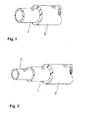
- An example of a hose with a protector layer obtained by a manufacturing method of the present invention has a protector layer 2 formed on an outer periphery surface of a tubular polyamide resin layer 1, as shown in Fig. 1 .
- the method for manufacturing a hose with a protector layer according to the present invention is characterized by including steps of: preparing a rubber composition for forming the protector layer by separately preparing a first rubber material that contains the following components (A) to (C) and a second rubber material that contains the following components (a) and (b) but does not substantially contain a sulfur vulcanization agent and mixing these materials in a mixer; and forming the protector layer 2 by continuously vulcanizing unvulcanized rubber after the rubber composition is continuously extruded onto the outer periphery of the previously formed polyamide resin layer 1.
- polyamide resin for forming the polyamide resin layer 1 examples include polyamide 6 (PA6), polyamide 46 (PA46), polyamide 66 (PA66), polyamide 92 (PA92), polyamide 99 (PA99), polyamide 610 (PA610), polyamide 612 (PA612), polyamide 1010 (PA1010), polyamide 11 (PA11), polyamide 912 (PA912), polyamide 12 (PA12), copolymer of polyamide 6 and polyamide 66 (PA6/66), copolymer of polyamide 6 and polyamide 12 (PA6/12), and aromatic nylon. These substances may be used alone or in combination of two or more. Among these substances, PA12 is preferred in terms of hydrolysis resistance property and chemical resistance property.
- the rubber composition is made of the first rubber material that contains the components A to C and the second rubber material that contains the components a and b but does not substantially contain a sulfur vulcanization agent.
- the second rubber material does not substantially contain a sulfur vulcanization agent
- sulfur as a vulcanization agent is not included in the rubber material.
- ethylene-propylene rubber examples include ethylene-propylene copolymer (EPM) and ethylene-propylene-diene terpolymer (EPDM). These substances may be used alone or in combination.
- EPM ethylene-propylene copolymer
- EPDM ethylene-propylene-diene terpolymer
- the EPDM preferably has an iodine value of 6 to 30 and an ethylene proportion of 45 to 75 weight %, more preferably an iodine value of 10 to 24 and an ethylene proportion of 50 to 65 weight %.
- a diene monomer (third component) contained in the EPDM is preferably a diene monomer having 5 to 20 carbon atoms.
- examples of the diene monomer (third component) include 1,4-pentadiene, 1,4-hexadiene, 1,5-hexadiene, 2,5-dimethyl-1,5-hexadiene, 1,4-octadiene, 1,4-cyclohexadiene, cyclooctadiene, dicyclopentadiene (DCP), 5-ethylidene-2-norbomene (ENB), 5-butylidene-2-norbornene, 2-methallyl-5-norbomene, and 2-isopropenyl-5-norbomene.
- dicyclopentadiene (DCP) and 5-ethylidene-2-norbornene (ENB) are preferred.
- the sulfur vulcanization agent (component B) to be used is sulfur such as powdered sulfur, precipitated sulfur, or insoluble sulfur.
- the content of the sulfur vulcanization agent (component B) is preferably 1 to 4 parts by weight, more preferably 2 to 3 parts by weight with respect to 100 parts by weight of the ethylene-propylene rubber (component A). If the content of the component B is too small, a vulcanization rate is likely to be lower when the first rubber material and the second rubber material are mixed. If the content of the component B is too large, heat resistance property tends to be degraded.
- the melting point of the particular thiuram vulcanization accelerator (component C) to be used is 66 to 105 °C. If the melting point of the particular thiuram vulcanization accelerator (component C) is too low, storage stability will be degraded when the first rubber material and the second rubber material are mixed. If the melting point is too high, dispersibility will be degraded and the vulcanization rate will be lower when the first rubber material and the second rubber material are mixed.
- thiuram vulcanization accelerator component C
- tetraethylthiuram disulfide melting point 65 °C or higher
- tetramethylthiuram monosulfide melting point 103 °C or higher
- dipentamethylenethiuram tetrasulfide melting point 105 °C.
- tetraethylthiuram monosulfide and dipentamethylenethiuram tetrasulfide is preferred because the vulcanization rate will be higher when the first rubber material and the second rubber material are mixed.
- the content of the particular thiuram vulcanization accelerator (component C) is preferably 0.1 to 3 parts by weight, more preferably 1 to 1.4 parts by weight with respect to 100 parts by weight of the ethylene-propylene rubber (component A). If the content of the component C is too small, the vulcanization rate is likely to be lower when the first rubber material and the second rubber material are mixed. If the content of the component C is too large, heat resistance property will be degraded.
- the first rubber material may be suitably mixed with carbon black, a retrograde inhibitor, a vulcanization aid agent, a processing aid agent, a white filler, a plasticizer, a softening agent, an acid acceptor, a colorant, a scorch inhibitor, and the like in addition to the ethylene-propylene rubber (component A), the sulfur vulcanization agent (component B), and the particular thiuram vulcanization accelerator (component C).
- the ethylene-propylene rubber (component a) to be used may be the same as the ethylene-propylene rubber (component A) described as a component of the first rubber material.
- the particular vulcanization accelerator (component b) to be used has the melting point of 120 °C or higher, preferably 120 to 245 °C. If the melting point of the particular vulcanization accelerator (component b) is too low, the vulcanization rate will be lower when the first rubber material and the second rubber material are mixed.
- vulcanization accelerator (component b) examples include a dithiocarbamate vulcanization accelerator, a thiazole vulcanization accelerator, a xanthate vulcanization accelerator, and the like. These substances may be used alone or in combination of two or more.
- dithiocarbamate vulcanization accelerator examples include piperidinium pentamethylenedithiocarbamate (melting point 160 °C or higher), pipecolin pipecolyldithiocarbamate (melting point 120 °C or higher), zinc diethyldithiocarbamate (melting point 175 °C or higher), zinc N-ethyl-N-phenyldithiocarbamate (melting point 195 °C or higher), zinc dibenzyldithiocarbamate (melting point 170 °C or higher), zinc N-pentamethylenedithiocarbamate (melting point 220 °C or higher), and zinc dimethyldithiocarbamate (melting point 245 °C or higher).
- thiazole vulcanization accelerator examples include 2-mercaptobenzothiazole (melting point 173 °C or higher), dibenzothiazyl disulfide (melting point 170 °C), zinc salt of 2-mercaptobenzothiazole (melting point 200 °C or higher), cyclohexylamine salt of 2-mercaptobenzothiazole (melting point 150 °C or higher), and 2-(4'-morpholinodithio)benzothiazole (melting point 123 °C or higher).
- a specific example of the xanthate vulcanization accelerator includes zinc isopropylxanthate (melting point 145 °C).
- the content of the particular vulcanization accelerator (component b) is preferably 2 to 6 parts by weight, more preferably 2.6 to 5.2 parts by weight with respect to 100 parts by weight of the ethylene-propylene rubber (component a). If the content of the component b is too small, the vulcanization rate is likely to be lower when the first rubber material and the second rubber material are mixed. If the content of the component b is too large, heat resistance property will be degraded.
- the second rubber material may suitably be mixed with carbon black, a retrograde inhibitor, a vulcanization aid agent, a processing aid agent, a white filler, a plasticizer, a softening agent, an acid acceptor, a colorant, a scorch inhibitor, and the like in addition to the ethylene-propylene rubber (component a) and the particular vulcanization accelerator (component b).
- a hose with a protector layer according to the present invention can be manufactured as follows. First, pellets made of polyamide resin are extruded into a hose-like shape to form a tubular polyamide resin layer 1. On the other hand, the first rubber material that contains the components A to C and the second rubber material that contains the components a and b but does not substantially contain a sulfur vulcanization agent are separately prepared. Next, the two rubber materials are mixed in an extruding machine to prepare a rubber composition for forming a protector layer. The temperature at the time of mixing is preferably 70 to 90 °C. Subsequently, this rubber composition is continuously extruded onto an outer periphery of the polyamide resin layer 1 to make an unvulcanized hose.
- This unvulcanized hose is continuously supplied to a hot-air furnace, a steam tube, and the like.
- the unvulcanized rubber is vulcanized to form a protector layer 2.
- a hose with a protector layer having the protector layer 2 formed on the outer periphery surface of the polyamide resin layer 1 can be continuously manufactured.
- the extruding machine to be used may be, for example, a screw type mixer that can simultaneously stir and mix the first rubber material and the second rubber material.
- the screw type mixer houses a screw having spiral rotating vanes. The rotation axis of the screw is rotated by a rotation force of a motor.
- a supply port for the first rubber material and a supply port for the second rubber material are provided on an upstream part of the screw type mixer.
- the vulcanization temperature is preferably 100 to 170 °C, more preferably 135 to 160 °C. If the vulcanization temperature is too low, vulcanization cannot be efficiently carried out. If the vulcanization temperature is too high, a problem such as melt and thermal degradation of the polyamide resin layer 1 occurs.
- the configuration of a hose with a protector layer obtained by the manufacturing method of the present invention is not limited to a two-layer structure including the polyamide resin layer 1 and the protector layer 2 as shown in Fig. 1 , but various layer configurations may be adopted according to an application of the hose.
- a hose with a protector layer obtained by the manufacturing method of the present invention may have a layer configuration in which another layer is provided between the polyamide resin layer 1 and the protector layer 2.
- a three-layer structure in which a fluorine resin layer (innermost layer) 3 is formed on an inner periphery surface of the polyamide resin layer 1, may be adopted. If needed, an adhesive may be used among the layers.
- fluorine resin for forming the fluorine resin layer 3 examples include polyvinyl fluoride (PVF), polyvinylidene fluoride (PVDF), polychlorotrifluoroethylene (CTFE), polytetrafluoroethylene (PTFE), tetrafluoroethylene-hexafluoro copolymer (FEP), tetrafluoroethylene-perfluoroalkylvinylether copolymer (PFA), tetrafluoroethylene-hexafluoropropylene-vinylidene fluoride copolymer (THV), ethylene-tetrafluoroethylene copolymer (ETFE), and ethylene-polychlorotrifluoroethylene copolymer (ECTFE), and a modified copolymer and various graft polymers thereof.
- PVDF polyvinyl fluoride
- CTFE polychlorotrifluoroethylene
- PTFE polytetrafluoroethylene
- FEP tetraflu
- the fluorine resin to be used may be a conductive fluorine resin to which conductivity is imparted by the addition of carbon black, carbon fiber, carbon nanotube, a conductive polymer, and the like.
- the inner diameter of a hose with a protector layer obtained by the manufacturing method of the present invention is usually 1 to 40 mm, preferably 2 to 36 mm, though it depends on an application of the hose.
- the thickness of the fluorine resin layer (innermost layer) 3 is usually 0.02 to 1.0 mm, preferably 0.05 to 0.6 mm.
- the thickness of the polyamide resin layer 1 is usually 0.03 to 1.5 mm, preferably 0.05 to 1.0 mm.
- the thickness of the protector layer 2 is usually 0.5 to 4.0 mm, preferably 1.0 to 2.5 mm.
- Examples of an application of a hose with a protector layer obtained by the manufacturing method of the present invention include a fuel hose and a refrigerant-transporting hose.
- An example of the fuel hose includes a hose for transporting automobile fuel such as gasoline, alcohol-mixed gasoline, diesel fuel, compressed natural gas (CNG), and liquefied petroleum gas (LPG).
- examples of the refrigerant-transporting hose include an air conditioner hose and a radiator hose of an automobile. These hoses can be used not only in automobiles but also for other transportation machines (including airplanes, industrial transport vehicles such as forklifts, loading shovels, and cranes, and rail cars) and the like.
- FEF class carbon black SEAST SO, manufactured by Tokai Carbon Co., Ltd.
- DIANA PROCESS NM280 manufactured by Idemitsu Kosan Co., Ltd.
- Zinc dimethyldithiocarbamate (NOKSELER PZ, manufactured by Ouchi Shinko Chemical Industrial Co., Ltd., melting point 245 °C or higher)
- TMTD Tetramethylthiuram disulfide
- N-cyclohexyl-2-benzothiazolylsulfenamide (NOKSELER CZ-G(CZ), manufactured by Ouchi Shinko Chemical Industrial Co., Ltd., melting point 94 °C or higher)
- Each rubber material was left at the room temperature (25 °C) for 90 days, and a scorch time at the time when the value has risen by 5M from the lowest value in the reading of Mooney was measured according to JIS K6300-1. In this measurement, VR-1132 manufactured by Ueshima Seisakusho Co., Ltd. was used. If the scorch time was 10 minutes or more, storage stability was evaluated as good. If the scorch time was less than 10 minutes, storage stability was evaluated as poor.
- a hose with a protector layer was made by using the rubber materials as follows.
- Pellets of a copolymer of ethylene, hexafluoropropylene, and tetrafluoroethylene (EFEP) (NEOFLON RP5000, manufactured by Daikin Industries, Ltd.) and pellets of polyamide 12 (PA12) (RILSAN AESN NOIR P20TL, manufactured by Arkema, melting point 170 °C) were extruded into a hose-like shape to make a resin hose having an inner layer (polyamide resin layer) on an outer periphery surface of an innermost layer (fluorine resin layer).
- a rubber composition for forming a protector layer was prepared by separately preparing the first rubber material and the second rubber material and mixing these rubber materials in a screw type mixer (60G-12D-HB, manufactured by Mitsuba MFG. Co., Ltd.). The temperature at the time of mixing was controlled to be 80 to 105 °C. Then, this rubber composition was continuously extruded onto an outer periphery of the inner layer (polyamide resin layer) to make an unvulcanized hose. The protector layer was formed by continuously supplying the unvulcanized hose to a hot-air furnace and carrying out vulcanization (150 °C x 5 minutes).
- a hose inner diameter 3 mm having an inner layer (thickness 1.5 mm) formed on an outer periphery surface of an innermost layer (thickness 0.5 mm) and a protector layer (thickness 2 mm) formed on an outer periphery surface of the inner layer was continuously made.
- the composition of the rubber composition for forming a protector layer was changed to the combination shown in Table 2 below (rubber material A and rubber material C). Other than that, a hose having an inner layer formed on an outer periphery surface of an innermost layer and a protector layer formed on an outer periphery surface of the inner layer was continuously made in the same manner as the first example.
- a hose having an inner layer formed on an outer periphery surface of an innermost layer and a protector layer on an outer periphery surface of the inner layer was continuously made in the same manner as the first example except that only the rubber material D was used as a rubber composition for forming the protector layer.
- Example Comparative example 1 1 2 First rubber material A A D Second rubber material B C Temperature responsiveness SN ratio (evaluation) 50.08 good 48.74 poor 43.33 poor
- Temperature responsiveness was evaluated by the Taguchi method (reference: Taguchi Method. Union of Japanese Principles and Engineers, 2004 , and Taguchi Method Nyuumon. Nikkei Inc., 2009 ) by using vulcanization curves at 160 °C and 135 °C. That is, the vulcanization curves at the respective temperatures (test temperature: 160 °C and 135 °C, test time: 30 minutes) were obtained by a rheometer measuring device. Next, torque values (average values) at approximately 5 to 30 minutes after the start of the measurement were obtained.
- the comparative examples 1 and 2 were inferior in temperature responsiveness.
- Examples of applications of a hose with a protector layer obtained by the manufacturing method of the present invention include a hose for transporting automobile fuel such as gasoline and a refrigerant-transporting hose in an automobile (such as an air conditioner hose and a radiator hose).
Landscapes
- Engineering & Computer Science (AREA)
- Chemical & Material Sciences (AREA)
- Mechanical Engineering (AREA)
- General Engineering & Computer Science (AREA)
- Medicinal Chemistry (AREA)
- Organic Chemistry (AREA)
- Polymers & Plastics (AREA)
- Health & Medical Sciences (AREA)
- Chemical Kinetics & Catalysis (AREA)
- Compositions Of Macromolecular Compounds (AREA)
- Rigid Pipes And Flexible Pipes (AREA)
- Extrusion Moulding Of Plastics Or The Like (AREA)
- Laminated Bodies (AREA)
Abstract
Description
- The present invention relates to a method for manufacturing a hose with a protector layer having a protector layer formed on an outer periphery of a tubular polyamide resin layer, and more particularly to a method for continuously manufacturing a hose with a protector layer used for a fuel hose, a refrigerant-transporting hose, and the like.
- Generally, a fuel hose has a protector layer made of a rubber composition formed so as to cover an outer periphery of a resin layer made of fluorine resin or polyamide resin. A protector layer is formed in this manner to prevent a fire or the like when a resin layer of the fuel hose is torn and fuel is leaked on a vehicle clash. Heretofore, a high activation vulcanization accelerator, for example, a thiuram vulcanization accelerator has been used for such a protector layer of the fuel hose to accelerate vulcanization (to reduce vulcanization time) (for example, see Patent Literature 1).
-
- Patent Literature 1: Japanese Patent No.
3959215 - However, the use of a high activation vulcanization accelerator as described above can accelerate vulcanization, but facilitates occurrence of a scorch (a phenomenon causing vulcanization). Leaving at the room temperature also causes a vulcanization reaction to proceed. Therefore, a problem such as significant degradation of storage stability occurs. In addition, an increase in the vulcanization temperature can accelerate vulcanization. However, in a product integrated with a resin material, the increased vulcanization temperature causes a problem such as melt and thermal degradation of resin.
- The present invention has been made in consideration of such a situation, and aims to provide a method for manufacturing a hose with a protector layer having excellent storage stability and capable of accelerating vulcanization.
- In order to achieve the above object, a method for manufacturing a hose with a protector layer according to the present invention is a method for manufacturing a hose with a protector layer having a protector layer formed on an outer periphery of a tubular polyamide resin layer, the method including steps of: preparing a rubber composition for forming the protector layer by separately preparing a first rubber material that contains the following components (A) to (C) and a second rubber material that contains the following components (a) and (b) but does not substantially contain a sulfur vulcanization agent and mixing these materials in a mixer; and forming the protector layer by continuously vulcanizing unvulcanized rubber after the rubber composition is continuously extruded onto the outer periphery of the previously formed polyamide resin layer.
- (A) Ethylene-propylene rubber
- (B) Sulfur vulcanization agent
- (C) Thiuram vulcanization accelerator with the melting point of 66 to 105 °C
- (a) Ethylene-propylene rubber
- (b) Vulcanization accelerator with the melting point of 120 °C or higher
- The present inventors have intensively researched on a method for manufacturing a hose with a protector layer having excellent storage stability and capable of accelerating vulcanization. In course of the research, a formation of a rubber composition for forming a protector layer was divided into two formulation systems: a formulation system (a first rubber material) that contains the particular thiuram vulcanization accelerator (component C), which is a so-called sulfur releasing primary accelerator, and a sulfur vulcanization agent (component B); and a formulation system (a second rubber material) that contains the particular vulcanization accelerator (component b), which is a sulfur non-releasing secondary accelerator, but does not substantially contain a sulfur vulcanization agent. These formulation systems were then mixed together, followed by being subjected to an extruding process and a vulcanization process. As a result, the present inventors have found that excellent storage stability and accelerated vulcanization can be attained because a vulcanization rate can be appropriately controlled, and completed the present invention.
- As described above, in a method for manufacturing a hose with a protector layer according to the present invention, a formulation of a rubber composition for forming a protector layer is divided into two formulation systems: a formulation system (a first rubber material) that contains the particular thiuram vulcanization accelerator (component C), which is a so-called sulfur releasing primary accelerator, and a sulfur vulcanization agent (component B); and a formulation system (a second rubber material) that contains the particular vulcanization accelerator (component b), which is a sulfur non-releasing secondary accelerator, but does not substantially contain a sulfur vulcanization agent. These formulation systems are mixed, and then subjected to an extruding process and a vulcanization process. As a result, a vulcanization rate can be appropriately controlled. Therefore, excellent storage stability and accelerated vulcanization can be achieved.
In a conventional method for manufacturing a hose, after a rubber composition for forming a protector layer is extruded, this unvulcanized hose is moved to a vulcanization can to carry out a vulcanization process. That is, an extruding process and a vulcanization process are carried out separately (not consecutively). However, in a manufacturing method of the present invention, an extruding process and a vulcanization process are carried out consecutively. Therefore, improved workability, lower cost, and reduced manufacturing time can be achieved. - In addition, if the component C is tetraethylthiuram disulfide, or if the component b is at least one of zinc dimethyldithiocarbamate and 2-mercaptobenzothiazole, preferred dispersibility is achieved when the first rubber material and the second rubber material are mixed.
- Further, a polyamide resin layer made of polyamide 12 (PA12) is preferred than a polyamide resin layer made of polyamide 11 (PA11) or polyamide 6 (PA6) in terms of hydrolysis resistance property and chemical resistance property.
- In addition, the vulcanization temperature of 100 to 170 °C is preferred in terms of the fact that there is no influence of melt or thermal degradation of a hose forming material.
- Furthermore, the content of each component described above set within a particular range is preferred in terms of a vulcanization rate (acceleration) at the time when the first rubber material and the second rubber material are mixed.
-
-
Fig. 1 is a perspective view illustrating a schematic configuration of a hose with a protector layer obtained by a manufacturing method of the present invention. -
Fig. 2 is a perspective view illustrating a schematic configuration of another hose with a protector layer obtained by a manufacturing method of the present invention. - Next, embodiments of the present invention will be described in detail. However, the present invention is not limited to the embodiments.
- An example of a hose with a protector layer obtained by a manufacturing method of the present invention has a
protector layer 2 formed on an outer periphery surface of a tubularpolyamide resin layer 1, as shown inFig. 1 . - The method for manufacturing a hose with a protector layer according to the present invention is characterized by including steps of: preparing a rubber composition for forming the protector layer by separately preparing a first rubber material that contains the following components (A) to (C) and a second rubber material that contains the following components (a) and (b) but does not substantially contain a sulfur vulcanization agent and mixing these materials in a mixer; and forming the
protector layer 2 by continuously vulcanizing unvulcanized rubber after the rubber composition is continuously extruded onto the outer periphery of the previously formedpolyamide resin layer 1. - (A) Ethylene-propylene rubber
- (B) Sulfur vulcanization agent
- (C) Thiuram vulcanization accelerator with the melting point of 66 to 105 °C
- (a) Ethylene-propylene rubber
- (b) Vulcanization accelerator with the melting point of 120 °C or higher
- Examples of polyamide resin for forming the
polyamide resin layer 1 include polyamide 6 (PA6), polyamide 46 (PA46), polyamide 66 (PA66), polyamide 92 (PA92), polyamide 99 (PA99), polyamide 610 (PA610), polyamide 612 (PA612), polyamide 1010 (PA1010), polyamide 11 (PA11), polyamide 912 (PA912), polyamide 12 (PA12), copolymer of polyamide 6 and polyamide 66 (PA6/66), copolymer of polyamide 6 and polyamide 12 (PA6/12), and aromatic nylon. These substances may be used alone or in combination of two or more. Among these substances, PA12 is preferred in terms of hydrolysis resistance property and chemical resistance property. - Next, each component of the rubber composition for forming the protector layer will be described. The rubber composition is made of the first rubber material that contains the components A to C and the second rubber material that contains the components a and b but does not substantially contain a sulfur vulcanization agent.
- In the present invention, "the second rubber material does not substantially contain a sulfur vulcanization agent" means that sulfur as a vulcanization agent is not included in the rubber material.
- Examples of the ethylene-propylene rubber (component A) include ethylene-propylene copolymer (EPM) and ethylene-propylene-diene terpolymer (EPDM). These substances may be used alone or in combination.
- The EPDM preferably has an iodine value of 6 to 30 and an ethylene proportion of 45 to 75 weight %, more preferably an iodine value of 10 to 24 and an ethylene proportion of 50 to 65 weight %.
- A diene monomer (third component) contained in the EPDM is preferably a diene monomer having 5 to 20 carbon atoms. Specifically, examples of the diene monomer (third component) include 1,4-pentadiene, 1,4-hexadiene, 1,5-hexadiene, 2,5-dimethyl-1,5-hexadiene, 1,4-octadiene, 1,4-cyclohexadiene, cyclooctadiene, dicyclopentadiene (DCP), 5-ethylidene-2-norbomene (ENB), 5-butylidene-2-norbornene, 2-methallyl-5-norbomene, and 2-isopropenyl-5-norbomene. Among these diene monomers (third components), dicyclopentadiene (DCP) and 5-ethylidene-2-norbornene (ENB) are preferred.
- The sulfur vulcanization agent (component B) to be used is sulfur such as powdered sulfur, precipitated sulfur, or insoluble sulfur.
- The content of the sulfur vulcanization agent (component B) is preferably 1 to 4 parts by weight, more preferably 2 to 3 parts by weight with respect to 100 parts by weight of the ethylene-propylene rubber (component A). If the content of the component B is too small, a vulcanization rate is likely to be lower when the first rubber material and the second rubber material are mixed. If the content of the component B is too large, heat resistance property tends to be degraded.
- The melting point of the particular thiuram vulcanization accelerator (component C) to be used is 66 to 105 °C. If the melting point of the particular thiuram vulcanization accelerator (component C) is too low, storage stability will be degraded when the first rubber material and the second rubber material are mixed. If the melting point is too high, dispersibility will be degraded and the vulcanization rate will be lower when the first rubber material and the second rubber material are mixed.
- Specific examples of the particular thiuram vulcanization accelerator (component C) include tetraethylthiuram disulfide (melting point 65 °C or higher), tetramethylthiuram monosulfide (melting point 103 °C or higher), and dipentamethylenethiuram tetrasulfide (melting point 105 °C). These substances may be used alone or in combination of two or more. Among these substances, a combination of tetraethylthiuram monosulfide and dipentamethylenethiuram tetrasulfide is preferred because the vulcanization rate will be higher when the first rubber material and the second rubber material are mixed.
- The content of the particular thiuram vulcanization accelerator (component C) is preferably 0.1 to 3 parts by weight, more preferably 1 to 1.4 parts by weight with respect to 100 parts by weight of the ethylene-propylene rubber (component A). If the content of the component C is too small, the vulcanization rate is likely to be lower when the first rubber material and the second rubber material are mixed. If the content of the component C is too large, heat resistance property will be degraded.
- If needed, the first rubber material may be suitably mixed with carbon black, a retrograde inhibitor, a vulcanization aid agent, a processing aid agent, a white filler, a plasticizer, a softening agent, an acid acceptor, a colorant, a scorch inhibitor, and the like in addition to the ethylene-propylene rubber (component A), the sulfur vulcanization agent (component B), and the particular thiuram vulcanization accelerator (component C).
- The ethylene-propylene rubber (component a) to be used may be the same as the ethylene-propylene rubber (component A) described as a component of the first rubber material.
- The particular vulcanization accelerator (component b) to be used has the melting point of 120 °C or higher, preferably 120 to 245 °C. If the melting point of the particular vulcanization accelerator (component b) is too low, the vulcanization rate will be lower when the first rubber material and the second rubber material are mixed.
- Examples of the particular vulcanization accelerator (component b) include a dithiocarbamate vulcanization accelerator, a thiazole vulcanization accelerator, a xanthate vulcanization accelerator, and the like. These substances may be used alone or in combination of two or more.
- Specific examples of the dithiocarbamate vulcanization accelerator include piperidinium pentamethylenedithiocarbamate (melting point 160 °C or higher), pipecolin pipecolyldithiocarbamate (melting point 120 °C or higher), zinc diethyldithiocarbamate (melting point 175 °C or higher), zinc N-ethyl-N-phenyldithiocarbamate (melting point 195 °C or higher), zinc dibenzyldithiocarbamate (melting point 170 °C or higher), zinc N-pentamethylenedithiocarbamate (melting point 220 °C or higher), and zinc dimethyldithiocarbamate (melting point 245 °C or higher).
- Specific examples of the thiazole vulcanization accelerator include 2-mercaptobenzothiazole (melting point 173 °C or higher), dibenzothiazyl disulfide (melting point 170 °C), zinc salt of 2-mercaptobenzothiazole (melting point 200 °C or higher), cyclohexylamine salt of 2-mercaptobenzothiazole (melting point 150 °C or higher), and 2-(4'-morpholinodithio)benzothiazole (melting point 123 °C or higher).
- A specific example of the xanthate vulcanization accelerator includes zinc isopropylxanthate (melting point 145 °C).
- The content of the particular vulcanization accelerator (component b) is preferably 2 to 6 parts by weight, more preferably 2.6 to 5.2 parts by weight with respect to 100 parts by weight of the ethylene-propylene rubber (component a). If the content of the component b is too small, the vulcanization rate is likely to be lower when the first rubber material and the second rubber material are mixed. If the content of the component b is too large, heat resistance property will be degraded.
- If needed, the second rubber material may suitably be mixed with carbon black, a retrograde inhibitor, a vulcanization aid agent, a processing aid agent, a white filler, a plasticizer, a softening agent, an acid acceptor, a colorant, a scorch inhibitor, and the like in addition to the ethylene-propylene rubber (component a) and the particular vulcanization accelerator (component b).
- Here, the mixture ratio by weight of the first rubber material (X) and the second rubber material (Y) is preferably in a range of X/Y = 30/70 to 70/30, more preferably in a range of X/Y = 40/60 to 60/40.
- A hose with a protector layer according to the present invention can be manufactured as follows. First, pellets made of polyamide resin are extruded into a hose-like shape to form a tubular
polyamide resin layer 1. On the other hand, the first rubber material that contains the components A to C and the second rubber material that contains the components a and b but does not substantially contain a sulfur vulcanization agent are separately prepared. Next, the two rubber materials are mixed in an extruding machine to prepare a rubber composition for forming a protector layer. The temperature at the time of mixing is preferably 70 to 90 °C. Subsequently, this rubber composition is continuously extruded onto an outer periphery of thepolyamide resin layer 1 to make an unvulcanized hose. This unvulcanized hose is continuously supplied to a hot-air furnace, a steam tube, and the like. The unvulcanized rubber is vulcanized to form aprotector layer 2. In this manner, a hose with a protector layer having theprotector layer 2 formed on the outer periphery surface of the polyamide resin layer 1 (seeFig. 1 ) can be continuously manufactured. - The extruding machine to be used may be, for example, a screw type mixer that can simultaneously stir and mix the first rubber material and the second rubber material. For example, the screw type mixer houses a screw having spiral rotating vanes. The rotation axis of the screw is rotated by a rotation force of a motor. In addition, a supply port for the first rubber material and a supply port for the second rubber material are provided on an upstream part of the screw type mixer.
- The vulcanization temperature is preferably 100 to 170 °C, more preferably 135 to 160 °C. If the vulcanization temperature is too low, vulcanization cannot be efficiently carried out. If the vulcanization temperature is too high, a problem such as melt and thermal degradation of the
polyamide resin layer 1 occurs. - The configuration of a hose with a protector layer obtained by the manufacturing method of the present invention is not limited to a two-layer structure including the
polyamide resin layer 1 and theprotector layer 2 as shown inFig. 1 , but various layer configurations may be adopted according to an application of the hose. A hose with a protector layer obtained by the manufacturing method of the present invention may have a layer configuration in which another layer is provided between thepolyamide resin layer 1 and theprotector layer 2. In addition, in terms of fuel low permeability, as shown inFig. 2 , a three-layer structure, in which a fluorine resin layer (innermost layer) 3 is formed on an inner periphery surface of thepolyamide resin layer 1, may be adopted. If needed, an adhesive may be used among the layers. - Examples of fluorine resin for forming the
fluorine resin layer 3 include polyvinyl fluoride (PVF), polyvinylidene fluoride (PVDF), polychlorotrifluoroethylene (CTFE), polytetrafluoroethylene (PTFE), tetrafluoroethylene-hexafluoro copolymer (FEP), tetrafluoroethylene-perfluoroalkylvinylether copolymer (PFA), tetrafluoroethylene-hexafluoropropylene-vinylidene fluoride copolymer (THV), ethylene-tetrafluoroethylene copolymer (ETFE), and ethylene-polychlorotrifluoroethylene copolymer (ECTFE), and a modified copolymer and various graft polymers thereof. These substances may be used alone or in combination of two or more. The fluorine resin to be used may be a conductive fluorine resin to which conductivity is imparted by the addition of carbon black, carbon fiber, carbon nanotube, a conductive polymer, and the like. - The inner diameter of a hose with a protector layer obtained by the manufacturing method of the present invention is usually 1 to 40 mm, preferably 2 to 36 mm, though it depends on an application of the hose. The thickness of the fluorine resin layer (innermost layer) 3 is usually 0.02 to 1.0 mm, preferably 0.05 to 0.6 mm. The thickness of the
polyamide resin layer 1 is usually 0.03 to 1.5 mm, preferably 0.05 to 1.0 mm. The thickness of theprotector layer 2 is usually 0.5 to 4.0 mm, preferably 1.0 to 2.5 mm. - Examples of an application of a hose with a protector layer obtained by the manufacturing method of the present invention include a fuel hose and a refrigerant-transporting hose. An example of the fuel hose includes a hose for transporting automobile fuel such as gasoline, alcohol-mixed gasoline, diesel fuel, compressed natural gas (CNG), and liquefied petroleum gas (LPG). In addition, examples of the refrigerant-transporting hose include an air conditioner hose and a radiator hose of an automobile. These hoses can be used not only in automobiles but also for other transportation machines (including airplanes, industrial transport vehicles such as forklifts, loading shovels, and cranes, and rail cars) and the like.
- Next, an example will be described together with comparative examples. However, the present invention is not limited to the example.
- Prior to describing the example and the comparative examples, rubber materials for forming a protector layer described below were prepared.
- ESPRENE 522, manufactured by Sumitomo Chemical Co., Ltd.
- ESPRENE 601, manufactured by Sumitomo Chemical Co., Ltd.
- STEARIC ACID SAKURA BEAD, manufactured by NOF Corporation
-
ZINC OXIDE TYPE 2, manufactured by Sakai Chemical Industry Co., Ltd. - FEF class carbon black (SEAST SO, manufactured by Tokai Carbon Co., Ltd.)
- WHITON SB, manufactured by Shiraishi Calcium Kaisha, Ltd.
- DIANA PROCESS NM280, manufactured by Idemitsu Kosan Co., Ltd.
- Zinc dimethyldithiocarbamate (NOKSELER PZ, manufactured by Ouchi Shinko Chemical Industrial Co., Ltd., melting point 245 °C or higher)
- Tetramethylthiuram disulfide (TMTD) (SANCELER TT-G, manufactured by Sanshin Chemical Industry Co., Ltd., melting point 140 °C or higher)
- Tetraethylthiuram disulfide (SANCELER TET-G, manufactured by Sanshin Chemical Industry Co., Ltd., melting point 66 °C or higher)
- Dipentamethylenethiuram tetrasulfide (NOKSELER TRA, manufactured by Ouchi Shinko Chemical Industrial Co., Ltd., melting point 105 °C or higher)
- N-cyclohexyl-2-benzothiazolylsulfenamide (NOKSELER CZ-G(CZ), manufactured by Ouchi Shinko Chemical Industrial Co., Ltd., melting point 94 °C or higher)
- 2-mercaptobenzothiazole (NOKSELER M-P, manufactured by Ouchi Shinko Chemical Industrial Co., Ltd., melting point 173 °C or higher)
- SULFAX T-10, manufactured by Karuizawa Seirenjo Co.
- Components shown in Table 1 below were mixed at a ratio shown in Table 1 to prepare rubber materials.
-
[Table 1] (parts by weight) Rubber Material A B C D EPDM (i) 80 80 80 80 EPDM (ii) 34 34 34 34 Stearic acid 0.5 0.5 0.5 0.5 Zinc oxide 3 3 3 3 Carbon black 85 85 85 85 Heavy calcium carbonate 70 70 70 70 Naphthene process oil 70 70 70 70 Dithiocarbamate vulcanization accelerator 2.4 - - - Thiuram vulcanization accelerator (i) - - 0.4 0.6 Thiuram vulcanization accelerator (ii) - 0.4 - 0.4 Thiuram vulcanization accelerator (iii) - - - 0.6 Sulfenamide vulcanization accelerator - 2 2 0.5 Thiazole vulcanization accelerator 2.8 - - 0.4 Sulfur vulcanization agent - 2.68 2.68 2.68 Total 347.7 349.98 349.98 347.14 Storage stability good good good poor - The rubber materials obtained in the above manner were subjected to evaluation of their storage stabilities in accordance with the following criteria. The results are shown in Table 1 above
- Each rubber material was left at the room temperature (25 °C) for 90 days, and a scorch time at the time when the value has risen by 5M from the lowest value in the reading of Mooney was measured according to JIS K6300-1. In this measurement, VR-1132 manufactured by Ueshima Seisakusho Co., Ltd. was used. If the scorch time was 10 minutes or more, storage stability was evaluated as good. If the scorch time was less than 10 minutes, storage stability was evaluated as poor.
- Next, a hose with a protector layer was made by using the rubber materials as follows.
- Pellets of a copolymer of ethylene, hexafluoropropylene, and tetrafluoroethylene (EFEP) (NEOFLON RP5000, manufactured by Daikin Industries, Ltd.) and pellets of polyamide 12 (PA12) (RILSAN AESN NOIR P20TL, manufactured by Arkema, melting point 170 °C) were extruded into a hose-like shape to make a resin hose having an inner layer (polyamide resin layer) on an outer periphery surface of an innermost layer (fluorine resin layer). In addition, a rubber composition for forming a protector layer was prepared by separately preparing the first rubber material and the second rubber material and mixing these rubber materials in a screw type mixer (60G-12D-HB, manufactured by Mitsuba MFG. Co., Ltd.). The temperature at the time of mixing was controlled to be 80 to 105 °C. Then, this rubber composition was continuously extruded onto an outer periphery of the inner layer (polyamide resin layer) to make an unvulcanized hose. The protector layer was formed by continuously supplying the unvulcanized hose to a hot-air furnace and carrying out vulcanization (150 °C x 5 minutes). In this manner, a hose (
inner diameter 3 mm) having an inner layer (thickness 1.5 mm) formed on an outer periphery surface of an innermost layer (thickness 0.5 mm) and a protector layer (thickness 2 mm) formed on an outer periphery surface of the inner layer was continuously made. - The composition of the rubber composition for forming a protector layer was changed to the combination shown in Table 2 below (rubber material A and rubber material C). Other than that, a hose having an inner layer formed on an outer periphery surface of an innermost layer and a protector layer formed on an outer periphery surface of the inner layer was continuously made in the same manner as the first example.
- A hose having an inner layer formed on an outer periphery surface of an innermost layer and a protector layer on an outer periphery surface of the inner layer was continuously made in the same manner as the first example except that only the rubber material D was used as a rubber composition for forming the protector layer.
-
[Table 2] Example Comparative example 1 1 2 First rubber material A A D Second rubber material B C Temperature responsiveness SN ratio (evaluation) 50.08 good 48.74 poor 43.33 poor - The hoses thus obtained in the example and the comparative examples were subjected to evaluation of temperature responsiveness according to criteria described below. The results are shown in Table 2 above.
- Temperature responsiveness was evaluated by the Taguchi method (reference: Taguchi Method. Union of Japanese Scientists and Engineers, 2004, and Taguchi Method Nyuumon. Nikkei Inc., 2009) by using vulcanization curves at 160 °C and 135 °C. That is, the vulcanization curves at the respective temperatures (test temperature: 160 °C and 135 °C, test time: 30 minutes) were obtained by a rheometer measuring device. Next, torque values (average values) at approximately 5 to 30 minutes after the start of the measurement were obtained. An SN ratio (calculated by η =10 log (β2/σ2)) was obtained from a slope (β) of a regression line (slope at the time of straight-line approximation) using a least-square method and a standard deviation (σ) of data around the regression line. If the SN ratio was 50 or more, temperature responsiveness was evaluated as good. If the SN ratio was less than 50, temperature responsiveness was evaluated as poor.
- From the result shown in Table 2 above, the product according to the example could accelerate vulcanization since it was excellent in temperature responsiveness.
- On the other hand, the comparative examples 1 and 2 were inferior in temperature responsiveness.
- In the example, a specific embodiment of the present invention is described. However, the example is only illustrative and should not be construed as restrictive. All changes which come within the meaning and range of equivalency of the claims are therefore intended to be embraced therein.
- Examples of applications of a hose with a protector layer obtained by the manufacturing method of the present invention include a hose for transporting automobile fuel such as gasoline and a refrigerant-transporting hose in an automobile (such as an air conditioner hose and a radiator hose).
-
- 1
- Polyamide resin layer
- 2
- Protector layer
Claims (6)
- A method for manufacturing a hose with a protector layer having a protector layer formed on an outer periphery of a tubular polyamide resin layer, the method comprising steps of:preparing a rubber composition for forming the protector layer by separately preparing a first rubber material that contains following components (A) to (C) and a second rubber material that contains following components (a) and (b) but does not substantially contain a sulfur vulcanization agent and mixing these materials in a mixer; andforming the protector layer by continuously vulcanizing unvulcanized rubber after the rubber composition is continuously extruded onto the outer periphery of the previously formed polyamide resin layer.(A) Ethylene-propylene rubber(B) Sulfur vulcanization agent(C) Thiuram vulcanization accelerator with the melting point of 66 to 105°C(a) Ethylene-propylene rubber(b) Vulcanization accelerator with the melting point of 120°C or higher
- The method for manufacturing a hose with a protector layer according to claim 1, wherein
the component (C) is tetraethylthiuram disulfide. - The method for manufacturing a hose with a protector layer according to claim 1 or 2, wherein
the component (b) is at least one of zinc dimethyldithiocarbamate and 2-mercaptobenzothiazole. - The method for manufacturing a hose with a protector layer according to any one of claims 1 to 3, wherein
the polyamide resin layer is a layer made of polyamide 12 (PA12). - The method for manufacturing a hose with a protector layer according to any one of claims 1 to 4, wherein
a vulcanization temperature is 100 to 170°C. - The method for manufacturing a hose with a protector layer according to any one of claims 1 to 5, wherein
the content of the component (B) is 1 to 4 parts by weight with respect to 100 parts by weight of the component (A),
the content of the component (C) is 0.1 to 3 parts by weight with respect to 100 parts by weight of the component (A), and
the content of the component (b) is 2 to 6 parts by weight with respect to 100 parts by weight of the component (a).
Applications Claiming Priority (1)
| Application Number | Priority Date | Filing Date | Title |
|---|---|---|---|
| PCT/JP2011/070741 WO2013038471A1 (en) | 2011-09-12 | 2011-09-12 | Method for producing hose with protector layer |
Publications (3)
| Publication Number | Publication Date |
|---|---|
| EP2631063A1 true EP2631063A1 (en) | 2013-08-28 |
| EP2631063A4 EP2631063A4 (en) | 2014-08-06 |
| EP2631063B1 EP2631063B1 (en) | 2016-07-13 |
Family
ID=47016555
Family Applications (1)
| Application Number | Title | Priority Date | Filing Date |
|---|---|---|---|
| EP11872324.6A Not-in-force EP2631063B1 (en) | 2011-09-12 | 2011-09-12 | Method for producing hose with protector layer |
Country Status (5)
| Country | Link |
|---|---|
| US (1) | US8747951B2 (en) |
| EP (1) | EP2631063B1 (en) |
| JP (1) | JP5027342B1 (en) |
| CN (1) | CN103140348B (en) |
| WO (1) | WO2013038471A1 (en) |
Families Citing this family (5)
| Publication number | Priority date | Publication date | Assignee | Title |
|---|---|---|---|---|
| JP3448517B2 (en) | 1998-07-02 | 2003-09-22 | 株式会社豊田中央研究所 | Antenna device |
| JP5027342B1 (en) * | 2011-09-12 | 2012-09-19 | 東海ゴム工業株式会社 | Manufacturing method of hose with protector layer |
| USD770601S1 (en) * | 2015-04-23 | 2016-11-01 | Teknor Apex Company | Hose with sleeve |
| US20170074427A1 (en) * | 2015-09-16 | 2017-03-16 | Cooper-Standard Automotive, Inc. | Fuel tube for a gasoline engine |
| CN118355071A (en) * | 2021-12-09 | 2024-07-16 | 住友理工株式会社 | Rubber composition for vehicle coolant delivery hose and vehicle coolant delivery hose obtained using the same |
Family Cites Families (10)
| Publication number | Priority date | Publication date | Assignee | Title |
|---|---|---|---|---|
| JPH0527342A (en) * | 1991-07-22 | 1993-02-05 | Brother Ind Ltd | Image forming device |
| JPH06256600A (en) * | 1993-03-04 | 1994-09-13 | Bridgestone Corp | Rubber composition and rubber hose using the same |
| JP3959215B2 (en) | 1999-11-04 | 2007-08-15 | ヤンマー農機株式会社 | Passenger rice transplanter |
| US6619329B2 (en) * | 2000-10-03 | 2003-09-16 | Tokai Rubber Industries, Ltd. | Hose |
| JP4556333B2 (en) * | 2000-10-03 | 2010-10-06 | 東海ゴム工業株式会社 | Automotive hose |
| TW593511B (en) * | 2003-04-25 | 2004-06-21 | Posaidon Entpr Co Ltd | An interpenetrating network elastomeric composition and process for producing gloves by using such composition |
| JP2006272898A (en) * | 2005-03-30 | 2006-10-12 | Tokai Rubber Ind Ltd | Resin hose with protector layer and manufacturing method thereof |
| CN100374470C (en) * | 2006-04-14 | 2008-03-12 | 戴近禹 | Special curing agent of 3-element EPR |
| JP4683154B2 (en) * | 2009-08-12 | 2011-05-11 | 横浜ゴム株式会社 | Refrigerant transfer hose |
| JP5027342B1 (en) * | 2011-09-12 | 2012-09-19 | 東海ゴム工業株式会社 | Manufacturing method of hose with protector layer |
-
2011
- 2011-09-12 JP JP2012501041A patent/JP5027342B1/en active Active
- 2011-09-12 WO PCT/JP2011/070741 patent/WO2013038471A1/en not_active Ceased
- 2011-09-12 EP EP11872324.6A patent/EP2631063B1/en not_active Not-in-force
- 2011-09-12 CN CN201180009171.5A patent/CN103140348B/en not_active Expired - Fee Related
-
2012
- 2012-10-10 US US13/648,676 patent/US8747951B2/en active Active
Also Published As
| Publication number | Publication date |
|---|---|
| WO2013038471A1 (en) | 2013-03-21 |
| US8747951B2 (en) | 2014-06-10 |
| EP2631063A4 (en) | 2014-08-06 |
| JPWO2013038471A1 (en) | 2015-03-23 |
| EP2631063B1 (en) | 2016-07-13 |
| US20130064980A1 (en) | 2013-03-14 |
| CN103140348B (en) | 2015-05-13 |
| JP5027342B1 (en) | 2012-09-19 |
| CN103140348A (en) | 2013-06-05 |
Similar Documents
| Publication | Publication Date | Title |
|---|---|---|
| US11719364B2 (en) | Barrier layer for hoses | |
| CN101407602B (en) | Rubber composition for non-aqueous pipe for automobile and non-aqueous pipe using same | |
| CN100540971C (en) | Fuel hose | |
| EP2752607B1 (en) | Resin fuel inlet pipe and production method therefor | |
| EP2631063B1 (en) | Method for producing hose with protector layer | |
| WO2007100157A1 (en) | Elastomer composition, method for producing same, and pneumatic tire using same | |
| JP2000160024A (en) | Thermoplastic elastomer composition with excellent gas barrier properties and laminated product using the same | |
| CN105885317B (en) | Heat-resistant hose acrylic rubber composition and heat-resistant hose and its preparation method | |
| WO2015177838A1 (en) | Rubber composition, rubber composition metal laminate, and vulcanized rubber product | |
| WO2012114634A1 (en) | Resin composition for refrigerant transport hose, method for producing same, and refrigerant transport hose | |
| WO2014175186A1 (en) | Rubber composition adhesive to metallic surface, rubber composition metal laminate, vulcanized rubber product, and method for producing vulcanized rubber product | |
| US6759109B2 (en) | Process for manufacturing a multilayer rubber hose and a product thereof | |
| JP6052040B2 (en) | Rubber composition metal laminate, vulcanized rubber product, and method for producing vulcanized rubber product | |
| CN113950502B (en) | Oil hose | |
| JP2003064262A (en) | Thermoplastic elastomer composition and method for producing the same | |
| CN107955275A (en) | Hose rubber composition and hose | |
| JP5259203B2 (en) | Manufacturing method of rubber products | |
| JP6182957B2 (en) | Rubber composition metal laminate, vulcanized rubber product, and method for producing vulcanized rubber product | |
| US20250264168A1 (en) | Fluid hose | |
| JP7382213B2 (en) | Rubber composition for fuel hose and fuel hose obtained using the same | |
| US20220268377A1 (en) | Sustainable industrial hose | |
| JP5293008B2 (en) | hose | |
| JP4970998B2 (en) | Fuel system hose | |
| CN103890473B (en) | Resin-made fuel pipe | |
| JP2006306015A (en) | Rubber hose for fuel |
Legal Events
| Date | Code | Title | Description |
|---|---|---|---|
| PUAI | Public reference made under article 153(3) epc to a published international application that has entered the european phase |
Free format text: ORIGINAL CODE: 0009012 |
|
| 17P | Request for examination filed |
Effective date: 20130516 |
|
| AK | Designated contracting states |
Kind code of ref document: A1 Designated state(s): AL AT BE BG CH CY CZ DE DK EE ES FI FR GB GR HR HU IE IS IT LI LT LU LV MC MK MT NL NO PL PT RO RS SE SI SK SM TR |
|
| A4 | Supplementary search report drawn up and despatched |
Effective date: 20140703 |
|
| RIC1 | Information provided on ipc code assigned before grant |
Ipc: C08L 23/08 20060101ALN20140629BHEP Ipc: B32B 27/08 20060101ALN20140629BHEP Ipc: F16L 11/12 20060101ALN20140629BHEP Ipc: B29C 47/00 20060101ALN20140629BHEP Ipc: F16L 55/16 20060101ALN20140629BHEP Ipc: F16L 11/06 20060101ALN20140629BHEP Ipc: B29D 23/00 20060101ALI20140629BHEP Ipc: C08L 23/16 20060101ALI20140629BHEP Ipc: B32B 25/14 20060101ALN20140629BHEP Ipc: B32B 27/34 20060101ALN20140629BHEP Ipc: B32B 27/30 20060101ALN20140629BHEP Ipc: F16K 11/04 20060101ALI20140629BHEP Ipc: C08K 5/00 20060101ALN20140629BHEP Ipc: B32B 27/32 20060101ALI20140629BHEP Ipc: C08K 5/40 20060101ALN20140629BHEP Ipc: C08K 5/36 20060101ALI20140629BHEP Ipc: B29C 47/06 20060101ALN20140629BHEP Ipc: B29C 47/02 20060101ALI20140629BHEP Ipc: B32B 25/08 20060101ALI20140629BHEP Ipc: B32B 1/08 20060101AFI20140629BHEP |
|
| RAP1 | Party data changed (applicant data changed or rights of an application transferred) |
Owner name: SUMITOMO RIKO COMPANY LIMITED |
|
| DAX | Request for extension of the european patent (deleted) | ||
| 17Q | First examination report despatched |
Effective date: 20150319 |
|
| RIC1 | Information provided on ipc code assigned before grant |
Ipc: F16L 55/16 20060101ALN20151012BHEP Ipc: C08K 5/36 20060101ALI20151012BHEP Ipc: F16K 11/04 20060101ALI20151012BHEP Ipc: B29C 47/00 20060101ALN20151012BHEP Ipc: B32B 25/08 20060101ALI20151012BHEP Ipc: B32B 1/08 20060101AFI20151012BHEP Ipc: B32B 25/14 20060101ALN20151012BHEP Ipc: B32B 27/34 20060101ALN20151012BHEP Ipc: C08L 23/16 20060101ALI20151012BHEP Ipc: C08L 23/08 20060101ALN20151012BHEP Ipc: B29C 47/02 20060101ALI20151012BHEP Ipc: C08K 5/00 20060101ALN20151012BHEP Ipc: B29D 23/00 20060101ALI20151012BHEP Ipc: F16L 11/12 20060101ALN20151012BHEP Ipc: B29C 47/06 20060101ALN20151012BHEP Ipc: B32B 27/30 20060101ALN20151012BHEP Ipc: C08K 5/40 20060101ALN20151012BHEP Ipc: B32B 27/08 20060101ALN20151012BHEP Ipc: B32B 27/32 20060101ALI20151012BHEP Ipc: F16L 11/06 20060101ALN20151012BHEP |
|
| RIC1 | Information provided on ipc code assigned before grant |
Ipc: B29D 23/00 20060101ALI20151218BHEP Ipc: F16K 11/04 20060101ALI20151218BHEP Ipc: B29C 47/00 20060101ALN20151218BHEP Ipc: F16L 55/16 20060101ALN20151218BHEP Ipc: C08K 5/40 20060101ALN20151218BHEP Ipc: B32B 25/08 20060101ALI20151218BHEP Ipc: C08L 23/08 20060101ALN20151218BHEP Ipc: B32B 27/30 20060101ALN20151218BHEP Ipc: B32B 27/32 20060101ALI20151218BHEP Ipc: B32B 27/34 20060101ALN20151218BHEP Ipc: F16L 11/12 20060101ALN20151218BHEP Ipc: C08L 23/16 20060101ALI20151218BHEP Ipc: F16L 11/06 20060101ALN20151218BHEP Ipc: B29C 47/06 20060101ALN20151218BHEP Ipc: B32B 1/08 20060101AFI20151218BHEP Ipc: B32B 25/14 20060101ALN20151218BHEP Ipc: B32B 27/08 20060101ALN20151218BHEP Ipc: C08K 5/36 20060101ALI20151218BHEP Ipc: C08K 5/00 20060101ALN20151218BHEP Ipc: B29C 47/02 20060101ALI20151218BHEP |
|
| GRAP | Despatch of communication of intention to grant a patent |
Free format text: ORIGINAL CODE: EPIDOSNIGR1 |
|
| INTG | Intention to grant announced |
Effective date: 20160224 |
|
| GRAS | Grant fee paid |
Free format text: ORIGINAL CODE: EPIDOSNIGR3 |
|
| GRAA | (expected) grant |
Free format text: ORIGINAL CODE: 0009210 |
|
| AK | Designated contracting states |
Kind code of ref document: B1 Designated state(s): AL AT BE BG CH CY CZ DE DK EE ES FI FR GB GR HR HU IE IS IT LI LT LU LV MC MK MT NL NO PL PT RO RS SE SI SK SM TR |
|
| REG | Reference to a national code |
Ref country code: GB Ref legal event code: FG4D |
|
| RIN1 | Information on inventor provided before grant (corrected) |
Inventor name: OYAIZU NAOKI Inventor name: KATAYAMA KAZUTAKA |
|
| REG | Reference to a national code |
Ref country code: AT Ref legal event code: REF Ref document number: 811936 Country of ref document: AT Kind code of ref document: T Effective date: 20160715 Ref country code: CH Ref legal event code: EP |
|
| REG | Reference to a national code |
Ref country code: IE Ref legal event code: FG4D |
|
| REG | Reference to a national code |
Ref country code: DE Ref legal event code: R096 Ref document number: 602011028240 Country of ref document: DE |
|
| REG | Reference to a national code |
Ref country code: LT Ref legal event code: MG4D |
|
| REG | Reference to a national code |
Ref country code: NL Ref legal event code: MP Effective date: 20160713 |
|
| REG | Reference to a national code |
Ref country code: AT Ref legal event code: MK05 Ref document number: 811936 Country of ref document: AT Kind code of ref document: T Effective date: 20160713 |
|
| PG25 | Lapsed in a contracting state [announced via postgrant information from national office to epo] |
Ref country code: IT Free format text: LAPSE BECAUSE OF FAILURE TO SUBMIT A TRANSLATION OF THE DESCRIPTION OR TO PAY THE FEE WITHIN THE PRESCRIBED TIME-LIMIT Effective date: 20160713 Ref country code: NL Free format text: LAPSE BECAUSE OF FAILURE TO SUBMIT A TRANSLATION OF THE DESCRIPTION OR TO PAY THE FEE WITHIN THE PRESCRIBED TIME-LIMIT Effective date: 20160713 Ref country code: NO Free format text: LAPSE BECAUSE OF FAILURE TO SUBMIT A TRANSLATION OF THE DESCRIPTION OR TO PAY THE FEE WITHIN THE PRESCRIBED TIME-LIMIT Effective date: 20161013 Ref country code: FI Free format text: LAPSE BECAUSE OF FAILURE TO SUBMIT A TRANSLATION OF THE DESCRIPTION OR TO PAY THE FEE WITHIN THE PRESCRIBED TIME-LIMIT Effective date: 20160713 Ref country code: HR Free format text: LAPSE BECAUSE OF FAILURE TO SUBMIT A TRANSLATION OF THE DESCRIPTION OR TO PAY THE FEE WITHIN THE PRESCRIBED TIME-LIMIT Effective date: 20160713 Ref country code: RS Free format text: LAPSE BECAUSE OF FAILURE TO SUBMIT A TRANSLATION OF THE DESCRIPTION OR TO PAY THE FEE WITHIN THE PRESCRIBED TIME-LIMIT Effective date: 20160713 Ref country code: IS Free format text: LAPSE BECAUSE OF FAILURE TO SUBMIT A TRANSLATION OF THE DESCRIPTION OR TO PAY THE FEE WITHIN THE PRESCRIBED TIME-LIMIT Effective date: 20161113 Ref country code: LT Free format text: LAPSE BECAUSE OF FAILURE TO SUBMIT A TRANSLATION OF THE DESCRIPTION OR TO PAY THE FEE WITHIN THE PRESCRIBED TIME-LIMIT Effective date: 20160713 |
|
| PG25 | Lapsed in a contracting state [announced via postgrant information from national office to epo] |
Ref country code: PT Free format text: LAPSE BECAUSE OF FAILURE TO SUBMIT A TRANSLATION OF THE DESCRIPTION OR TO PAY THE FEE WITHIN THE PRESCRIBED TIME-LIMIT Effective date: 20161114 Ref country code: ES Free format text: LAPSE BECAUSE OF FAILURE TO SUBMIT A TRANSLATION OF THE DESCRIPTION OR TO PAY THE FEE WITHIN THE PRESCRIBED TIME-LIMIT Effective date: 20160713 Ref country code: PL Free format text: LAPSE BECAUSE OF FAILURE TO SUBMIT A TRANSLATION OF THE DESCRIPTION OR TO PAY THE FEE WITHIN THE PRESCRIBED TIME-LIMIT Effective date: 20160713 Ref country code: GR Free format text: LAPSE BECAUSE OF FAILURE TO SUBMIT A TRANSLATION OF THE DESCRIPTION OR TO PAY THE FEE WITHIN THE PRESCRIBED TIME-LIMIT Effective date: 20161014 Ref country code: AT Free format text: LAPSE BECAUSE OF FAILURE TO SUBMIT A TRANSLATION OF THE DESCRIPTION OR TO PAY THE FEE WITHIN THE PRESCRIBED TIME-LIMIT Effective date: 20160713 Ref country code: BE Free format text: LAPSE BECAUSE OF NON-PAYMENT OF DUE FEES Effective date: 20160713 Ref country code: LV Free format text: LAPSE BECAUSE OF FAILURE TO SUBMIT A TRANSLATION OF THE DESCRIPTION OR TO PAY THE FEE WITHIN THE PRESCRIBED TIME-LIMIT Effective date: 20160713 Ref country code: SE Free format text: LAPSE BECAUSE OF FAILURE TO SUBMIT A TRANSLATION OF THE DESCRIPTION OR TO PAY THE FEE WITHIN THE PRESCRIBED TIME-LIMIT Effective date: 20160713 |
|
| REG | Reference to a national code |
Ref country code: DE Ref legal event code: R097 Ref document number: 602011028240 Country of ref document: DE |
|
| PG25 | Lapsed in a contracting state [announced via postgrant information from national office to epo] |
Ref country code: EE Free format text: LAPSE BECAUSE OF FAILURE TO SUBMIT A TRANSLATION OF THE DESCRIPTION OR TO PAY THE FEE WITHIN THE PRESCRIBED TIME-LIMIT Effective date: 20160713 Ref country code: RO Free format text: LAPSE BECAUSE OF FAILURE TO SUBMIT A TRANSLATION OF THE DESCRIPTION OR TO PAY THE FEE WITHIN THE PRESCRIBED TIME-LIMIT Effective date: 20160713 Ref country code: MC Free format text: LAPSE BECAUSE OF FAILURE TO SUBMIT A TRANSLATION OF THE DESCRIPTION OR TO PAY THE FEE WITHIN THE PRESCRIBED TIME-LIMIT Effective date: 20160713 |
|
| REG | Reference to a national code |
Ref country code: CH Ref legal event code: PL |
|
| PLBE | No opposition filed within time limit |
Free format text: ORIGINAL CODE: 0009261 |
|
| STAA | Information on the status of an ep patent application or granted ep patent |
Free format text: STATUS: NO OPPOSITION FILED WITHIN TIME LIMIT |
|
| PG25 | Lapsed in a contracting state [announced via postgrant information from national office to epo] |
Ref country code: DK Free format text: LAPSE BECAUSE OF FAILURE TO SUBMIT A TRANSLATION OF THE DESCRIPTION OR TO PAY THE FEE WITHIN THE PRESCRIBED TIME-LIMIT Effective date: 20160713 Ref country code: SK Free format text: LAPSE BECAUSE OF FAILURE TO SUBMIT A TRANSLATION OF THE DESCRIPTION OR TO PAY THE FEE WITHIN THE PRESCRIBED TIME-LIMIT Effective date: 20160713 Ref country code: CZ Free format text: LAPSE BECAUSE OF FAILURE TO SUBMIT A TRANSLATION OF THE DESCRIPTION OR TO PAY THE FEE WITHIN THE PRESCRIBED TIME-LIMIT Effective date: 20160713 Ref country code: SM Free format text: LAPSE BECAUSE OF FAILURE TO SUBMIT A TRANSLATION OF THE DESCRIPTION OR TO PAY THE FEE WITHIN THE PRESCRIBED TIME-LIMIT Effective date: 20160713 Ref country code: BG Free format text: LAPSE BECAUSE OF FAILURE TO SUBMIT A TRANSLATION OF THE DESCRIPTION OR TO PAY THE FEE WITHIN THE PRESCRIBED TIME-LIMIT Effective date: 20161013 |
|
| 26N | No opposition filed |
Effective date: 20170418 |
|
| GBPC | Gb: european patent ceased through non-payment of renewal fee |
Effective date: 20161013 |
|
| REG | Reference to a national code |
Ref country code: IE Ref legal event code: MM4A |
|
| REG | Reference to a national code |
Ref country code: FR Ref legal event code: ST Effective date: 20170531 |
|
| PG25 | Lapsed in a contracting state [announced via postgrant information from national office to epo] |
Ref country code: LI Free format text: LAPSE BECAUSE OF NON-PAYMENT OF DUE FEES Effective date: 20160930 Ref country code: IE Free format text: LAPSE BECAUSE OF NON-PAYMENT OF DUE FEES Effective date: 20160912 Ref country code: GB Free format text: LAPSE BECAUSE OF NON-PAYMENT OF DUE FEES Effective date: 20161013 Ref country code: FR Free format text: LAPSE BECAUSE OF NON-PAYMENT OF DUE FEES Effective date: 20160930 Ref country code: CH Free format text: LAPSE BECAUSE OF NON-PAYMENT OF DUE FEES Effective date: 20160930 |
|
| PG25 | Lapsed in a contracting state [announced via postgrant information from national office to epo] |
Ref country code: SI Free format text: LAPSE BECAUSE OF FAILURE TO SUBMIT A TRANSLATION OF THE DESCRIPTION OR TO PAY THE FEE WITHIN THE PRESCRIBED TIME-LIMIT Effective date: 20160713 Ref country code: LU Free format text: LAPSE BECAUSE OF NON-PAYMENT OF DUE FEES Effective date: 20160912 |
|
| PG25 | Lapsed in a contracting state [announced via postgrant information from national office to epo] |
Ref country code: CY Free format text: LAPSE BECAUSE OF FAILURE TO SUBMIT A TRANSLATION OF THE DESCRIPTION OR TO PAY THE FEE WITHIN THE PRESCRIBED TIME-LIMIT Effective date: 20160713 Ref country code: HU Free format text: LAPSE BECAUSE OF FAILURE TO SUBMIT A TRANSLATION OF THE DESCRIPTION OR TO PAY THE FEE WITHIN THE PRESCRIBED TIME-LIMIT; INVALID AB INITIO Effective date: 20110912 |
|
| PG25 | Lapsed in a contracting state [announced via postgrant information from national office to epo] |
Ref country code: TR Free format text: LAPSE BECAUSE OF FAILURE TO SUBMIT A TRANSLATION OF THE DESCRIPTION OR TO PAY THE FEE WITHIN THE PRESCRIBED TIME-LIMIT Effective date: 20160713 Ref country code: MK Free format text: LAPSE BECAUSE OF FAILURE TO SUBMIT A TRANSLATION OF THE DESCRIPTION OR TO PAY THE FEE WITHIN THE PRESCRIBED TIME-LIMIT Effective date: 20160713 Ref country code: MT Free format text: LAPSE BECAUSE OF NON-PAYMENT OF DUE FEES Effective date: 20160930 |
|
| PG25 | Lapsed in a contracting state [announced via postgrant information from national office to epo] |
Ref country code: AL Free format text: LAPSE BECAUSE OF FAILURE TO SUBMIT A TRANSLATION OF THE DESCRIPTION OR TO PAY THE FEE WITHIN THE PRESCRIBED TIME-LIMIT Effective date: 20160713 |
|
| REG | Reference to a national code |
Ref country code: DE Ref legal event code: R084 Ref document number: 602011028240 Country of ref document: DE |
|
| PGFP | Annual fee paid to national office [announced via postgrant information from national office to epo] |
Ref country code: DE Payment date: 20190827 Year of fee payment: 9 |
|
| REG | Reference to a national code |
Ref country code: DE Ref legal event code: R119 Ref document number: 602011028240 Country of ref document: DE |
|
| PG25 | Lapsed in a contracting state [announced via postgrant information from national office to epo] |
Ref country code: DE Free format text: LAPSE BECAUSE OF NON-PAYMENT OF DUE FEES Effective date: 20210401 |