JP5259203B2 - Manufacturing method of rubber products - Google Patents
Manufacturing method of rubber products Download PDFInfo
- Publication number
- JP5259203B2 JP5259203B2 JP2008016627A JP2008016627A JP5259203B2 JP 5259203 B2 JP5259203 B2 JP 5259203B2 JP 2008016627 A JP2008016627 A JP 2008016627A JP 2008016627 A JP2008016627 A JP 2008016627A JP 5259203 B2 JP5259203 B2 JP 5259203B2
- Authority
- JP
- Japan
- Prior art keywords
- rubber
- filler
- kneading
- uncrosslinked
- manufacturing
- Prior art date
- Legal status (The legal status is an assumption and is not a legal conclusion. Google has not performed a legal analysis and makes no representation as to the accuracy of the status listed.)
- Expired - Fee Related
Links
Images

Landscapes
- Treatments Of Macromolecular Shaped Articles (AREA)
- Compositions Of Macromolecular Compounds (AREA)
- Processes Of Treating Macromolecular Substances (AREA)
Description
本発明は、架橋ゴムで形成された他材接触部を有し、その他材接触部が他材との接触により摩耗するゴム製品の製造方法に関する。 The present invention relates to a method for manufacturing a rubber product having an other material contact portion formed of a crosslinked rubber, and the other material contact portion is worn by contact with the other material.
相溶しないポリマーの混合やポリマーへの無機物の混合を超臨界流体の存在下で実施することにより、それらのモルフォロジーを制御する研究が近年盛んに行われている。 In recent years, researches on controlling the morphology of polymers that are incompatible with each other and mixing inorganic substances into the polymers in the presence of a supercritical fluid have been actively conducted.
特許文献1には、熱可塑性樹脂及び無機充填材を超臨界流体と接触せしめて混練することにより、無機充填材とりわけ二次凝集を起こしやすい微細な無機充填材を均一に熱可塑性樹脂に配合し、優れた機械的特性を発現する樹脂組成物を得ることができる、と記載されている。 In Patent Document 1, a thermoplastic resin and an inorganic filler are brought into contact with a supercritical fluid and kneaded to uniformly mix the inorganic filler, particularly a fine inorganic filler that easily causes secondary aggregation, into the thermoplastic resin. It is described that a resin composition exhibiting excellent mechanical properties can be obtained.
特許文献2には、オレフィン系重合体を50〜98重量%、カルボン酸変性オレフィン系重合体を1〜49重量%、及び無機層状粘土鉱物を1〜30重量%を含有する混合物を、超臨界流体の存在下で溶融混練することにより、オレフィン系重合体、カルボン酸変性オレフィン系重合体、及び無機層状粘土鉱物を含有する混合物を微細分散させて、強度と比重とのバランスが良好なオレフィン系樹脂組成物を得ることができる、と記載されている。
本発明の目的は、耐摩耗性が優れるゴム製品を得ることである。 An object of the present invention is to obtain a rubber product having excellent wear resistance.
本発明は、架橋ゴムで形成された他材接触部を有し該他材接触部が他材との接触により摩耗するゴム製品の製造方法であって、
混練装置を用いて、超臨界流体又は亜臨界流体の存在下において、未架橋ゴムとフィラーとを混練した後、同一の混練装置又は別の混練装置を用いて、得られた混練物と架橋剤とを混練してフィラー含有未架橋ゴムを調製するゴム調製工程と、
上記ゴム調製工程で調製したフィラー含有未架橋ゴムを、他材接触部に対応するように成形して架橋させる成形架橋工程と、
を備え、
上記ゴム調製工程において、超臨界流体又は亜臨界流体として、亜臨界二酸化炭素若しくは超臨界二酸化炭素、又は、亜臨界窒素若しくは超臨界窒素を用いる。
The present invention is a method for producing a rubber product having an other material contact portion formed of a crosslinked rubber, wherein the other material contact portion is worn by contact with the other material,
After kneading uncrosslinked rubber and filler in the presence of a supercritical fluid or subcritical fluid using a kneading device, the resulting kneaded product is crosslinked with the same kneading device or another kneading device. A rubber preparation step of kneading an agent to prepare a filler-containing uncrosslinked rubber;
A molding and crosslinking step in which the filler-containing uncrosslinked rubber prepared in the rubber preparation step is molded and cross-linked so as to correspond to the other material contact portion;
Equipped with a,
In the rubber preparation step, subcritical carbon dioxide or supercritical carbon dioxide, or subcritical nitrogen or supercritical nitrogen is used as the supercritical fluid or subcritical fluid .
本発明によれば、未架橋ゴムとフィラーとの混練を超臨界流体又は亜臨界流体の存在下で行ってフィラー含有未架橋ゴムを調製し、そして、そのフィラー含有未架橋ゴムで他材接触部を形成することにより、他材接触部の耐摩性が優れるゴム製品を得ることができる。 According to the present invention, the filler-containing uncrosslinked rubber is prepared by kneading the uncrosslinked rubber and the filler in the presence of a supercritical fluid or a subcritical fluid, and the filler-containing uncrosslinked rubber is used to contact the other material. By forming the rubber product, it is possible to obtain a rubber product having excellent wear resistance at the contact portion of the other material.
以下、実施形態について詳細に説明する。 Hereinafter, embodiments will be described in detail.
本実施形態が対象とするゴム製品は、架橋ゴムで形成された他材接触部を有し、その他材接触部が他材との接触により摩耗するものである。具体的には、ゴム製品として、例えば、伝動ベルト、コンベヤベルト、タイヤ、帯電ローラーや現像ローラー等のローラー類、靴等が挙げられる。そして、伝動ベルトではプーリ接触部、コンベヤベルトでは搬送部、タイヤでは地面接地部、ローラー類ではローラー表面部、靴では靴底がそれぞれ他材接触部に相当する。 The rubber product targeted by the present embodiment has an other material contact portion formed of a crosslinked rubber, and the other material contact portion is worn by contact with the other material. Specifically, examples of the rubber product include a transmission belt, a conveyor belt, a tire, rollers such as a charging roller and a developing roller, shoes, and the like. In the transmission belt, the pulley contact portion, in the conveyor belt, the conveyance portion, in the tire, the ground contact portion, in the rollers, the roller surface portion, and in the shoe, the shoe sole corresponds to the other material contact portion.
図1は、そのゴム製品の一例であるVリブドベルトを示す。VリブドベルトBは、例えば、自動車補機駆動用途に好適に用いられるものであり、ベルト周長700〜3000mm、ベルト幅10〜36mm、及びベルト厚さ4.0〜5.0mmに形成されている。 FIG. 1 shows a V-ribbed belt as an example of the rubber product. The V-ribbed belt B is suitably used for, for example, an automotive accessory driving application, and is formed to have a belt circumferential length of 700 to 3000 mm, a belt width of 10 to 36 mm, and a belt thickness of 4.0 to 5.0 mm. .
このVリブドベルトBは、ベルト外周側の接着ゴム層11とベルト内周側の圧縮ゴム層12との二重層に構成されたVリブドベルト本体10を備えており、そのVリブドベルト本体10のベルト外周側表面に補強布17が貼設されている。また、接着ゴム層11には、ベルト幅方向にピッチを有する螺旋を形成するように設けられた心線16が埋設されている。
The V-ribbed belt B includes a V-ribbed belt
接着ゴム層11は、断面横長矩形の帯状に構成され、例えば、厚さ1.0〜2.5mmに形成されている。
The
接着ゴム層11は、原料ゴムに種々のゴム配合剤が配合されて混練された未架橋ゴムが加熱及び加圧されて架橋剤により架橋した架橋ゴムで形成されている。
The
圧縮ゴム層12は、プーリ接触部を構成する複数のVリブ13がベルト内周側に垂下するように設けられている。これらの複数のVリブ13は、各々がベルト長さ方向に延びる断面略逆三角形の突条に形成されていると共に、ベルト幅方向に並設されている。各Vリブ13は、例えば、リブ高さが2.0〜3.0mm、基端間の幅が1.0〜3.6mmに形成されている。また、リブ数は、例えば、3〜6個である(図1では、リブ数が6)。
The
圧縮ゴム層12は、原料ゴムにフィラー及び種々のゴム配合剤が配合されて混練されたフィラー含有未架橋ゴムが加熱及び加圧されて架橋剤等により架橋した架橋ゴムで形成されている。なお、圧縮ゴム層12には、ベルト幅方向に配向するように設けられ、また、Vリブ13表面から突出するように設けられた短繊維14が含まれていてもよい。短繊維14としては、例えば、繊維長1〜3mmのナイロン短繊維、ビニロン短繊維、ポリエステル短繊維、綿短繊維、アラミド短繊維等が挙げられる。
The
接着ゴム層11と圧縮ゴム層12とは、別々の架橋ゴムで形成されていてもよく、また、全く同じ架橋ゴムで形成されていてもよい。
The
補強布17は、例えば、綿、ポリアミド繊維、ポリエステル繊維、アラミド繊維等の糸で形成された平織、綾織、朱子織等に製織した織布で構成されている。補強布17は、Vリブドベルト本体10に対する接着性を付与するために、成形加工前にRFL水溶液に浸漬して加熱する接着処理及び/又はVリブドベルト本体10側となる表面にゴム糊をコーティングして乾燥させる接着処理が施されている。なお、補強布17が設けられず、ベルト外周側表面部分が架橋ゴムで構成されていてもよい。また、補強布17は、編物で構成されていてもよい。
The reinforcing
心線16は、ポリエステル繊維(PET)、ポリエチレンナフタレート繊維(PEN)、アラミド繊維、ビニロン繊維等の撚り糸で構成されている。心線16は、Vリブドベルト本体10に対する接着性を付与するために、成形加工前にRFL水溶液に浸漬した後に加熱する接着処理及び/又はゴム糊に浸漬した後に乾燥させる接着処理が施されている。
The
次に、本実施形態に係るゴム製品の製造方法、特に、他材接触部を含む部分の製法について説明する。 Next, a method for manufacturing a rubber product according to this embodiment, particularly a method for manufacturing a portion including the other material contact portion will be described.
<ゴム調製工程>
本実施形態のゴム製品の製造方法では、超臨界流体又は亜臨界流体の存在下において、未架橋ゴムとフィラーとを混練してフィラー含有未架橋ゴムを調製する。
<Rubber preparation process>
In the method for producing a rubber product of this embodiment, uncrosslinked rubber and a filler are kneaded in the presence of a supercritical fluid or a subcritical fluid to prepare a filler-containing uncrosslinked rubber.
ここで、超臨界流体とは、超臨界状態の流体をいう。超臨界状態とは、温度が流体の臨界温度(Tc)以上で且つ圧力が流体の臨界圧力(Pc)以上である状態をいう。 Here, the supercritical fluid refers to a fluid in a supercritical state. The supercritical state refers to a state where the temperature is equal to or higher than the critical temperature (Tc) of the fluid and the pressure is equal to or higher than the critical pressure (Pc) of the fluid.
亜臨界流体とは、亜臨界状態の流体をいう。亜臨界状態とは、温度及び圧力の一方のみが臨界状態に達し且つ他方が臨界状態に達していない状態、或いは、温度及び圧力の両方が臨界状態に達していないが、温度及び圧力の少なくとも一方が常温常圧より十分高く臨界状態に近い状態をいう。本出願において、亜臨界状態とは、温度をT(摂氏)及び圧力をPとしたとき、0.5<T/Tc<1.0且つ0.5<P/Pc、又は、0.5<T/Tc且つ0.5<P/Pc<1.0の条件を満たす状態をいう。ゴムの混練にとって好ましい亜臨界状態は、0.6<T/Tc<1.0且つ0.6<P/Pc、又は、0.6<T/Tc且つ0.6<P/Pc<1.0の条件を満たす状態である。なお、臨界温度Tc(摂氏)がマイナスである場合には温度条件は満たされるものとし、超臨界状態の条件が満たされず且つ0.5<P/Pcの圧力条件が満たされれば亜臨界状態にあるものとする。 A subcritical fluid refers to a fluid in a subcritical state. A subcritical state is a state where only one of temperature and pressure reaches a critical state and the other does not reach a critical state, or both temperature and pressure do not reach a critical state, but at least one of temperature and pressure Is a state that is sufficiently higher than room temperature and normal pressure and close to the critical state. In the present application, the subcritical state is defined as 0.5 <T / Tc <1.0 and 0.5 <P / Pc, or 0.5 <T where temperature is T (Celsius) and pressure is P. A state where T / Tc and 0.5 <P / Pc <1.0 are satisfied. Preferred subcritical states for rubber kneading are 0.6 <T / Tc <1.0 and 0.6 <P / Pc, or 0.6 <T / Tc and 0.6 <P / Pc <1. This is a state that satisfies the condition of 0. When the critical temperature Tc (Celsius) is negative, the temperature condition is satisfied. If the supercritical condition is not satisfied and the pressure condition of 0.5 <P / Pc is satisfied, the subcritical state is obtained. It shall be.
超臨界流体又は亜臨界流体を生じる物質としては、例えば、二酸化炭素、窒素、水素、キセノン、エタン、アンモニア、メタノール、水等が挙げられる。これらのうちゴムの混練には二酸化炭素及び窒素が好適である。 Examples of the substance that generates the supercritical fluid or subcritical fluid include carbon dioxide, nitrogen, hydrogen, xenon, ethane, ammonia, methanol, and water. Of these, carbon dioxide and nitrogen are suitable for rubber kneading.
二酸化炭素の臨界温度(Tc)は31.1℃であり、臨界圧力(Pc)は7.38MPaである。従って、超臨界二酸化炭素は、温度Tが31.1℃以上であり且つ圧力Pが7.38MPa以上である状態の二酸化炭素である。亜臨界二酸化炭素は、15.6℃<T<31.1℃且つ3.69MPa<P、又は、15.55℃<T且つ3.69MPa<P<7.38MPaの条件を満たす状態の二酸化炭素である。 Carbon dioxide has a critical temperature (Tc) of 31.1 ° C. and a critical pressure (Pc) of 7.38 MPa. Therefore, supercritical carbon dioxide is carbon dioxide in a state where the temperature T is 31.1 ° C. or higher and the pressure P is 7.38 MPa or higher. Subcritical carbon dioxide is carbon dioxide in a state satisfying the conditions of 15.6 ° C. <T <31.1 ° C. and 3.69 MPa <P, or 15.55 ° C. <T and 3.69 MPa <P <7.38 MPa. It is.
窒素の臨界温度(Tc)は−147.0℃であり、臨界圧力(Pc)は3.40MPaである。従って、超臨界窒素は、温度Tが−147.0℃以上であり且つ圧力Pが3.40MPa以上である状態の窒素である。亜臨界窒素は、超臨界窒素の条件を満たさず且つ1.70MPa<Pの条件を満たす状態の窒素である。 The critical temperature (Tc) of nitrogen is −147.0 ° C., and the critical pressure (Pc) is 3.40 MPa. Therefore, the supercritical nitrogen is nitrogen in a state where the temperature T is −147.0 ° C. or higher and the pressure P is 3.40 MPa or higher. Subcritical nitrogen is nitrogen that does not satisfy the condition of supercritical nitrogen and satisfies the condition of 1.70 MPa <P.
なお、超臨界流体又は亜臨界流体の存在下には、ゴムの混練に支障を及ぼさない範囲で、その他の液体や気体を共存させてもよい。 In the presence of a supercritical fluid or a subcritical fluid, other liquids or gases may coexist within a range that does not hinder rubber kneading.
このような超臨界流体又は亜臨界流体の存在下でのゴムの混練は、耐熱性及び耐圧性に優れた密閉式のゴム混練室内にローターやスクリュー等の混練部材が設けられた混練装置を用いることにより行うことができる。混練装置は、未架橋ゴム及びフィラーの供給並びにフィラー含有未架橋ゴムの排出を連続的に行う連続方式のものであってもよく、また、各々、所定量の未架橋ゴム及びフィラーを単回で混練して回収するバッチ方式のものであってもよい。前者としては、例えば、特開2002−355880号公報に開示されている2軸押出混練装置等が挙げられる。また、後者としては、例えば、ニーダー、バンバリーミキサー等が挙げられる。 For kneading rubber in the presence of such supercritical fluid or subcritical fluid, a kneading apparatus in which a kneading member such as a rotor or screw is provided in a sealed rubber kneading chamber having excellent heat resistance and pressure resistance is used. Can be done. The kneading apparatus may be of a continuous type that continuously supplies uncrosslinked rubber and filler and discharges the filler-containing uncrosslinked rubber, and each of the predetermined amounts of uncrosslinked rubber and filler can be supplied once. A batch method of kneading and collecting may be used. Examples of the former include a biaxial extrusion kneader disclosed in JP-A-2002-355880. Examples of the latter include a kneader and a Banbury mixer.
未架橋ゴムは、原料ゴム(生ゴム)であってもよく、また、原料ゴムに予めフィラー以外のゴム配合剤を添加したゴム組成物であってもよく、さらに、それらの混合物であってもよい。 The uncrosslinked rubber may be raw rubber (raw rubber), may be a rubber composition in which a rubber compounding agent other than a filler is added to the raw rubber in advance, or may be a mixture thereof. .
原料ゴムとしては、例えば、天然ゴム(NR)、スチレンブタジエンゴム(SBR)、イソプレンゴム(IR)、ニトリルゴム(NBR)、水素添加ニトリルゴム(H−NBR)、クロロプレンゴム(CR)、エチレン−α−オレフィン共重合体ゴム(例えば、EPDM、EPRなど)、ブチルゴム(IIR)、アクリルゴム(ACM)、クロロスルホンかポリエチレンゴム(CSM)、シリコーンゴム(Q)、フッ素ゴム(FKM)、ウレタンゴム(U)等が挙げられる。原料ゴムは、単一種だけを用いてもよく、また、複数種を混合して用いてもよい。 Examples of the raw rubber include natural rubber (NR), styrene butadiene rubber (SBR), isoprene rubber (IR), nitrile rubber (NBR), hydrogenated nitrile rubber (H-NBR), chloroprene rubber (CR), ethylene- α-olefin copolymer rubber (for example, EPDM, EPR, etc.), butyl rubber (IIR), acrylic rubber (ACM), chlorosulfone or polyethylene rubber (CSM), silicone rubber (Q), fluorine rubber (FKM), urethane rubber (U) and the like. As the raw rubber, only a single type may be used, or a plurality of types may be mixed and used.
原料ゴムに予め添加されるフィラー以外のゴム配合剤としては、例えば、老化防止剤、可塑剤、架橋剤、架橋促進剤等が挙げられる。 Examples of the rubber compounding agent other than the filler added in advance to the raw rubber include an anti-aging agent, a plasticizer, a cross-linking agent, and a cross-linking accelerator.
未架橋ゴムの形態は、粉状であってもよく、また、粒状であってもよく、さらに、ペレット状であってもよい。 The form of the uncrosslinked rubber may be in the form of powder, may be granular, and may be in the form of pellets.
フィラーとしては、例えば、カーボンブラック、シリカ、クレイ、炭酸カルシウム、タルク、酸化チタン、マイカ、珪藻土、ウォラストナイト、ゼオライト、瀝青質微粉体、珪砂、軽石粉、スレート粉、アルミナ、硫酸アルミニウム、硫酸バリウム、リトポン、硫酸カルシウム、酸化マグネシウム、二硫化モリブデン、グラファイト、ガラス繊維、ガラス玉、ガラス中空体、カーボン繊維、炭素中空体無煙炭粉末、クリオライト、シリコーン樹脂微粉末、シリカ球状微粒子、アラミド短繊維やアルミナ短繊維などの短繊維等が挙げられる。フィラーは、単一種だけを用いてもよく、また、複数種を混合して用いてもよい。耐摩性付与効果が高いことから、カーボンブラックを用いることが好ましい。 Examples of fillers include carbon black, silica, clay, calcium carbonate, talc, titanium oxide, mica, diatomaceous earth, wollastonite, zeolite, bituminous fine powder, quartz sand, pumice powder, slate powder, alumina, aluminum sulfate, sulfuric acid Barium, lithopone, calcium sulfate, magnesium oxide, molybdenum disulfide, graphite, glass fiber, glass ball, glass hollow body, carbon fiber, carbon hollow body anthracite powder, cryolite, silicone resin fine powder, silica spherical fine particle, aramid short fiber And short fibers such as alumina short fibers. As the filler, only a single type may be used, or a plurality of types may be mixed and used. It is preferable to use carbon black because the effect of imparting abrasion resistance is high.
フィラーとして用いるカーボンブラックとしては、例えば、チャネルブラック;SAF、ISAF、N−339、HAF、N−351、MAF、FEF、SRF、GPF、ECF、N−234などのファーネスブラック;FT、MTなどのサーマルブラック;アセチレンブラック等が挙げられる。カーボンブラックの添加量は、原料ゴム100質量部に対して30〜130質量部とすることが好ましい。 As carbon black used as a filler, for example, channel black; furnace black such as SAF, ISAF, N-339, HAF, N-351, MAF, FEF, SRF, GPF, ECF, N-234; FT, MT, etc. Thermal black; acetylene black etc. are mentioned. The amount of carbon black added is preferably 30 to 130 parts by mass with respect to 100 parts by mass of the raw rubber.
この超臨界流体又は亜臨界流体の存在下での混練において、未架橋ゴム及びフィラーの他にゴム配合剤を添加してもよい。かかるゴム配合剤としては、例えば、老化防止剤、可塑剤、架橋剤、架橋促進剤等が挙げられる。 In the kneading in the presence of the supercritical fluid or subcritical fluid, a rubber compounding agent may be added in addition to the uncrosslinked rubber and the filler. Examples of such rubber compounding agents include anti-aging agents, plasticizers, cross-linking agents, and cross-linking accelerators.
老化防止剤としては、例えば、アミン系、キノリン系、ヒドロキノン誘導体、モノフェノール系、ポリフェノール系、チオビスフェノール系、ヒンダート・フェノール系、亜リン酸エステル系のもの等が挙げられる。老化防止剤は、単一種だけを用いてもよく、また、複数種を混合して用いてもよい。老化防止剤の添加量は、原料ゴム100質量部に対して1〜10質量部とすることが好ましい。 Examples of the anti-aging agent include amine-based, quinoline-based, hydroquinone derivatives, monophenol-based, polyphenol-based, thiobisphenol-based, hindered phenol-based, and phosphite-based compounds. Only one type of anti-aging agent may be used, or a plurality of types may be used in combination. The addition amount of the antioxidant is preferably 1 to 10 parts by mass with respect to 100 parts by mass of the raw rubber.
可塑剤としては、例えば、フタル酸誘導体、イソフタル酸誘導体、テトラヒドロフタル酸誘導体、アジピン酸誘導体、アゼライン酸誘導体、セバシン酸誘導体、ドデカン−2−酸誘導体、マレイン酸誘導体、フマル酸誘導体、トリメリット酸誘導体、ピロメリット酸誘導体、クエン酸誘導体、イタコン酸誘導体、オレイン酸誘導体、リシノール酸誘導体、ステアリン酸誘導体、スルホン酸誘導体、リン酸誘導体、グルタール酸誘導体、グリコール誘導体、グリセリン誘導体、パラフィン誘導体、エポキシ誘導体等が挙げられる。可塑剤は、単一種だけを用いてもよく、また、複数種を混合して用いてもよい。可塑剤の添加量は、原料ゴム100質量部に対して5〜100質量部とすることが好ましい。 Examples of the plasticizer include phthalic acid derivatives, isophthalic acid derivatives, tetrahydrophthalic acid derivatives, adipic acid derivatives, azelaic acid derivatives, sebacic acid derivatives, dodecane-2-acid derivatives, maleic acid derivatives, fumaric acid derivatives, trimellitic acid. Derivatives, pyromellitic acid derivatives, citric acid derivatives, itaconic acid derivatives, oleic acid derivatives, ricinoleic acid derivatives, stearic acid derivatives, sulfonic acid derivatives, phosphoric acid derivatives, glutaric acid derivatives, glycol derivatives, glycerin derivatives, paraffin derivatives, epoxy derivatives Etc. Only one kind of plasticizer may be used, or a plurality of kinds may be mixed and used. The addition amount of the plasticizer is preferably 5 to 100 parts by mass with respect to 100 parts by mass of the raw rubber.
架橋剤としては、例えば、硫黄、硫黄化合物、オキシム類、ニトロソ化合物、ポリアミン、有機過酸化物等が挙げられる。架橋剤は、単一種だけを用いてもよく、また、複数種を混合して用いてもよい。架橋剤の添加量は、原料ゴム100質量部に対して0.5〜5質量部とすることが好ましい。なお、成形架橋工程で電子線架橋等の架橋剤を用いない加工を行う場合には、架橋剤は必ずしも必要でない。 Examples of the crosslinking agent include sulfur, sulfur compounds, oximes, nitroso compounds, polyamines, and organic peroxides. Only one kind of the crosslinking agent may be used, or a plurality of kinds may be mixed and used. The addition amount of the crosslinking agent is preferably 0.5 to 5 parts by mass with respect to 100 parts by mass of the raw rubber. In addition, when performing the process which does not use crosslinking agents, such as electron beam crosslinking, at a shaping | molding bridge | crosslinking process, a crosslinking agent is not necessarily required.
架橋促進剤としては、例えば、グァニジン系、アルデヒド−アミン系、アルデヒド−アンモニア系、チアゾール系、スルフェンアミド系、チオ尿素系、チウラム系、ジチオカルバメート系、ザンテート系のもの等が挙げられる。架橋促進剤は、単一種だけを用いてもよく、また、複数種を混合して用いてもよい。架橋促進剤の添加量は、原料ゴム100質量部に対して1〜10質量部とすることが好ましい。 Examples of the crosslinking accelerator include guanidine, aldehyde-amine, aldehyde-ammonia, thiazole, sulfenamide, thiourea, thiuram, dithiocarbamate, and xanthate. As the crosslinking accelerator, only one kind may be used, or a plurality of kinds may be mixed and used. The addition amount of the crosslinking accelerator is preferably 1 to 10 parts by mass with respect to 100 parts by mass of the raw rubber.
混練時間等の混練条件については、ゴム配合組成等に基づいて適宜設定する。 About kneading conditions, such as kneading | mixing time, it sets suitably based on a rubber compounding composition etc.
そして、超臨界流体又は亜臨界流体の存在下でのゴムの混練時には、未架橋ゴム及びフィラーが超臨界流体又は亜臨界流体に溶解すると共に、混練部材によって機械的に攪拌混練される。 When rubber is kneaded in the presence of the supercritical fluid or subcritical fluid, the uncrosslinked rubber and filler are dissolved in the supercritical fluid or subcritical fluid and mechanically stirred and kneaded by the kneading member.
このゴム調製工程では、超臨界流体又は亜臨界流体の存在下で未架橋ゴム、フィラー、及び架橋剤を含まないゴム配合剤を混練した後、同一の混練装置又は別の混練装置を用いて、得られた混練物と架橋剤とをさらに混練してフィラー含有未架橋ゴムを調製してもよい。このように超臨界流体又は亜臨界流体の存在下での混練の後に架橋剤を添加することにより、超臨界流体又は亜臨界流体の存在下での混練時における架橋反応の進行を防止することができる。 In this rubber preparation step, after kneading uncrosslinked rubber, filler, and rubber compounding agent not containing a crosslinking agent in the presence of a supercritical fluid or subcritical fluid, the same kneading apparatus or another kneading apparatus is used. The obtained kneaded product and a crosslinking agent may be further kneaded to prepare a filler-containing uncrosslinked rubber. Thus, by adding a crosslinking agent after kneading in the presence of a supercritical fluid or subcritical fluid, it is possible to prevent the progress of the crosslinking reaction during kneading in the presence of the supercritical fluid or subcritical fluid. it can.
また、このゴム調製工程では、超臨界流体又は亜臨界流体の存在下で原料ゴムの未架橋ゴム及びフィラーを混練した後、同一の混練装置又は別の混練装置を用いて、得られた混練物と架橋剤を含むその他のゴム配合剤とを混練してフィラー含有未架橋ゴムを調製してもよい。 In this rubber preparation step, after kneading the raw rubber uncrosslinked rubber and filler in the presence of a supercritical fluid or subcritical fluid, the kneaded product obtained using the same kneading device or another kneading device. And other rubber compounding agents containing a crosslinking agent may be kneaded to prepare a filler-containing uncrosslinked rubber.
上記のいずれの場合においても、同一の混練装置を用いれば、原材料の投入から架橋剤を含むフィラー含有未架橋ゴムの調製までを一連の操作で行うことができる。 In any of the above cases, if the same kneading apparatus is used, the process from the introduction of the raw material to the preparation of the filler-containing uncrosslinked rubber containing the crosslinking agent can be performed by a series of operations.
なお、超臨界流体又は亜臨界流体の存在下で混練する前には、未架橋ゴム及びフィラーを混練して予め可塑化させることが好ましく、また、超臨界流体又は亜臨界流体の存在下で混練した後には、混練物を脱気することが好ましい。 Before kneading in the presence of a supercritical fluid or subcritical fluid, it is preferable to knead the uncrosslinked rubber and filler in advance and plasticize them. In addition, kneading in the presence of the supercritical fluid or subcritical fluid. After this, it is preferable to deaerate the kneaded product.
<成形架橋工程>
本実施形態のゴム製品の製造方法では、ゴム調製工程で調製したフィラー含有未架橋ゴムを、他材接触部に対応するように成形して架橋させる。
<Molding cross-linking step>
In the rubber product manufacturing method of this embodiment, the filler-containing uncrosslinked rubber prepared in the rubber preparation step is molded and cross-linked so as to correspond to the other material contact portion.
ここで、かかる成形架橋加工方法としては、例えば、プレス、加硫缶、連続加硫機、高周波架橋や放射線架橋や電子線架橋により架橋する特殊架橋機等を用いた加工、トランスファー成形、射出成形、押出成形、射出成形等が挙げられる。 Here, as such a molding crosslinking processing method, for example, processing using a press, a vulcanizer, a continuous vulcanizer, a high-frequency crosslinking, a special crosslinking machine that bridges by radiation crosslinking or electron beam crosslinking, transfer molding, injection molding, etc. , Extrusion molding, injection molding and the like.
温度、圧力、及び時間等の成形架橋条件については、フィラー含有未架橋ゴムの組成やゴム製品の要求品質等に基づいて適宜設定する。 The molding and crosslinking conditions such as temperature, pressure, and time are appropriately set based on the composition of the filler-containing uncrosslinked rubber, the required quality of the rubber product, and the like.
そして、この成形架橋時には、フィラー含有未架橋ゴムに含まれる原料ゴムの分子間が架橋剤により或いは電子線により架橋されてネットワーク構造が形成される。 And at the time of this shaping | molding bridge | crosslinking, the molecule | numerator of the raw material rubber | gum contained in a filler containing uncrosslinked rubber is bridge | crosslinked by a crosslinking agent or an electron beam, and a network structure is formed.
以上により、他材接触部が架橋ゴムで形成されたゴム製品が製造される。 As described above, a rubber product in which the other material contact portion is formed of the crosslinked rubber is manufactured.
(試験評価試料)
<実施例1>
混練装置として、同方向回転完全噛み合い型の二軸押出混練装置(日本製鋼社製 型番:TEX30α)を用いた。
(Test evaluation sample)
<Example 1>
As a kneading apparatus, a twin-screw extrusion kneading apparatus (model number: TEX30α manufactured by Nippon Steel) was used.
この二軸押出混練装置は、長尺のゴム混練室を備え、その上流端に原料供給部及び下流端に練りゴム排出部がそれぞれ設けられている。ゴム混練室には、各々、外径が30mmであり且つその外径に対する長さの比が59.9である一対のスクリューが並列に長さ方向に沿って設けられていると共に、長さ方向に沿って17個のシリンダC1〜C17に空間が仕切られている。 This biaxial extrusion kneader includes a long rubber kneading chamber, and is provided with a raw material supply section at the upstream end and a kneaded rubber discharge section at the downstream end. In the rubber kneading chamber, a pair of screws each having an outer diameter of 30 mm and a length ratio to the outer diameter of 59.9 are provided in parallel along the length direction. Is divided into 17 cylinders C1 to C17.
この二軸押出混練装置では、原料供給部直下のシリンダC1に水冷式の温調機構が設けられており、これにより原料の融解を防止するように構成されている。また、その他のシリンダC2〜17のそれぞれに温調機構が設けられており、これにより独立した加熱及び冷却が可能なように構成されている。 In this biaxial extrusion kneader, a water-cooled temperature control mechanism is provided in the cylinder C1 directly below the raw material supply unit, thereby preventing the raw material from melting. In addition, a temperature control mechanism is provided in each of the other cylinders C2 to C17, so that independent heating and cooling are possible.
この二軸押出混練装置では、シリンダC7にガス供給管が接続されており、これによりガス供給管から供給した二酸化炭素又は窒素によって、逆ニーディングディスク及びシールリングが設けられたシリンダC7〜10を超臨界流体又は亜臨界流体の存在下とし、そこでシリンダC1〜6で混練して可塑化した材料を、超臨界流体又は亜臨界流体の存在下において混練するように構成されている。また、シリンダC11及び12にベント口が設けられており、これによりシリンダC10から送られた混練物を脱気するように構成されている。さらに、シリンダC15にサイドフィーダーが設けられており、これによりサイドフィーダーから混練物にさらにゴム配合剤を添加して混練するように構成されている。また、シリンダC17にフランジ及びダイプレートが設けられており、これによりダイプレートから練り上がったフィラー含有未架橋ゴムを押出排出するように構成されている。 In this biaxial extrusion kneading apparatus, a gas supply pipe is connected to the cylinder C7, and thereby the cylinders C7 to C10 provided with the reverse kneading disk and the seal ring are made of carbon dioxide or nitrogen supplied from the gas supply pipe. In the presence of a supercritical fluid or subcritical fluid, the material kneaded and plasticized in the cylinders C1 to C6 is kneaded in the presence of the supercritical fluid or subcritical fluid. Further, the cylinders C11 and 12 are provided with vent ports, whereby the kneaded material sent from the cylinder C10 is degassed. Further, a side feeder is provided in the cylinder C15, whereby a rubber compounding agent is further added and kneaded from the side feeder to the kneaded product. Further, the cylinder C17 is provided with a flange and a die plate so that the filler-containing uncrosslinked rubber kneaded from the die plate is extruded and discharged.
以上の構成の二軸押出機の原料供給部に、重量式定量供給機を用い、ペレット状のEPDM(デュポン・ダウ・エラストマージャパン社製 商品名:ノーデル4725P)と、そのEPDM100質量部に対して70質量部のカーボンブラックHAF(東海カーボン株式会社製 商品名:シースト3)、5質量部の酸化亜鉛(堺化学工業社製 商品名:酸化亜鉛3種)、及び1質量部のステアリン酸(新日本理化社製 商品名:ステアリン酸50S)とを連続的に投入した。また、サイドフィーダーには、EPDM100質量部に対して2質量部の架橋剤(鶴見化学工業社製 商品名:オイル硫黄)及び1質量部の架橋促進剤(大内新興化学社製 商品名:ノクセラーPZ)が添加されるようにそれらを仕込んだ。なお、ゴム配合を表1に示す。 For the raw material supply part of the twin-screw extruder having the above-described configuration, using a gravimetric metering feeder, pellet-shaped EPDM (trade name: Nodel 4725P manufactured by DuPont Dow Elastomer Japan Co., Ltd.) and its EPDM 100 parts by mass 70 parts by mass of carbon black HAF (trade name: SEAST 3 manufactured by Tokai Carbon Co., Ltd.), 5 parts by mass of zinc oxide (trade name: 3 types of zinc oxide manufactured by Sakai Chemical Industry Co., Ltd.), and 1 part by mass of stearic acid (new) Nippon Rika Co., Ltd. product name: stearic acid 50S) was continuously added. The side feeder includes 2 parts by mass of a crosslinking agent (trade name: oil sulfur manufactured by Tsurumi Chemical Co., Ltd.) and 1 part by mass of a crosslinking accelerator (trade name: Noxeller manufactured by Ouchi Shinsei Chemical Co., Ltd.) with respect to 100 parts by mass of EPDM. They were charged such that PZ) was added. The rubber composition is shown in Table 1.
そして、スクリュー回転数を200rpm、ガス供給管からシリンダC7への二酸化炭素の供給量を0.5kg/時、シリンダC11及び12の圧力を1.73Pa、フィラー含有未架橋ゴムの押出排出量を6kg/時にそれぞれ設定した。また、逆ニーディングディスク及びシールリングの構成、並びにシリンダC7〜10の設定温度の組合せにより、シリンダC7〜10内を温度120℃及び圧力9MPaの超臨界二酸化炭素の存在条件下とした。なお、温度はシリンダC7〜10内の混練物の温度であり、圧力はシリンダC10内の圧力である。 The screw rotation speed is 200 rpm, the supply amount of carbon dioxide from the gas supply pipe to the cylinder C7 is 0.5 kg / hour, the pressure of the cylinders C11 and C12 is 1.73 Pa, and the extrusion discharge amount of the filler-containing uncrosslinked rubber is 6 kg. Each time was set. Moreover, the inside of the cylinder C7-10 was made into the presence conditions of supercritical carbon dioxide with the temperature of 120 degreeC and the pressure of 9 Mpa by the combination of the structure of a reverse kneading disk and a seal ring, and the setting temperature of the cylinder C7-10. The temperature is the temperature of the kneaded material in the cylinders C7 to C10, and the pressure is the pressure in the cylinder C10.
このとき、シリンダC7〜10内では、EPDM、カーボンブラック、酸化亜鉛、及びステアリン酸が超臨界二酸化炭素の存在条件下において混練された。シリンダC15では、超臨界流体の存在下で混練されて得られた混練物に架橋剤及び架橋促進剤が添加され、シリンダC15〜17で、それらはさらに混練された。シリンダC17では、架橋剤及び架橋促進剤が添加されて混練されたフィラー含有未架橋ゴムが厚さ0.8mmのシート状に加工されて押出排出された。 At this time, EPDM, carbon black, zinc oxide, and stearic acid were kneaded in the presence of supercritical carbon dioxide in the cylinders C7 to C10. In the cylinder C15, a crosslinking agent and a crosslinking accelerator were added to the kneaded material obtained by kneading in the presence of a supercritical fluid, and these were further kneaded in the cylinders C15 to C17. In the cylinder C17, the filler-containing uncrosslinked rubber kneaded with the addition of the crosslinking agent and the crosslinking accelerator was processed into a sheet having a thickness of 0.8 mm and extruded and discharged.
そして、得られたシート状のフィラー含有未架橋ゴムにより圧縮ゴム層を形成したVリブドベルトを作製し、これを実施例1とした。 And the V-ribbed belt which formed the compression rubber layer with the obtained sheet-like filler containing uncrosslinked rubber was produced, and this was made into Example 1. FIG.
なお、接着ゴム層を圧縮ゴム層とは異なる配合のEPDMゴム組成物、補強布をナイロン製の織布をRFL処理及びゴム糊処理したもの、並びに心線をポリエステル繊維(PET)製の撚り糸をRFL処理及びゴム糊処理したものでそれぞれ構成し、ベルト周長を1000mm、ベルト幅を10mm及びベルト厚さを4mmとし、そして、リブ数を3個とした。 An EPDM rubber composition having a different composition from the compression rubber layer for the adhesive rubber layer, a woven fabric made of nylon treated with RFL treatment and rubber paste treatment, and a cord made of polyester fiber (PET) twisted yarn Each of them was constituted by RFL treatment and rubber paste treatment, the belt peripheral length was 1000 mm, the belt width was 10 mm, the belt thickness was 4 mm, and the number of ribs was three.
<実施例2>
逆ニーディングディスク及びシールリングの構成、並びにシリンダC7〜10の設定温度の組合せにより、混練シリンダー内を温度120℃及び圧力15MPaの超臨界二酸化炭素の存在条件下としたことを除いて実施例1と同様に得られたシート状のフィラー含有未架橋ゴムにより圧縮ゴム層を形成したVリブドベルトを作製し、これを実施例2とした。
<Example 2>
Example 1 except that the inside of the kneading cylinder was made to be in the presence of supercritical carbon dioxide at a temperature of 120 ° C. and a pressure of 15 MPa by combining the configuration of the reverse kneading disk and the seal ring and the set temperature of the cylinders C7 to C10. A V-ribbed belt having a compressed rubber layer formed of a sheet-like filler-containing uncrosslinked rubber obtained in the same manner as in Example 2 was prepared.
<実施例3>
逆ニーディングディスク及びシールリングの構成、並びにシリンダC7〜10の設定温度の組合せにより、混練シリンダー内を温度160℃及び圧力15MPaの超臨界二酸化炭素の存在条件下としたことを除いて実施例1と同様に得られたシート状のフィラー含有未架橋ゴムにより圧縮ゴム層を形成したVリブドベルトを作製し、これを実施例3とした。
<Example 3>
Example 1 except that the inside of the kneading cylinder was made to be in the presence of supercritical carbon dioxide at a temperature of 160 ° C. and a pressure of 15 MPa by the combination of the configuration of the reverse kneading disk and the seal ring and the set temperature of the cylinders C7 to C10. A V-ribbed belt having a compressed rubber layer formed of a sheet-like filler-containing uncrosslinked rubber obtained in the same manner as in Example 3 was prepared, and this was designated as Example 3.
<実施例4>
逆ニーディングディスク及びシールリングの構成、並びにシリンダC7〜10の設定温度の組合せにより、混練シリンダー内を温度200℃及び圧力15MPaの超臨界二酸化炭素の存在条件下としたことを除いて実施例1と同様に得られたシート状のフィラー含有未架橋ゴムにより圧縮ゴム層を形成したVリブドベルトを作製し、これを実施例4とした。
<Example 4>
Example 1 except that the inside of the kneading cylinder was brought into the presence of supercritical carbon dioxide at a temperature of 200 ° C. and a pressure of 15 MPa by the combination of the configuration of the reverse kneading disk and the seal ring and the set temperature of the cylinders C7 to C10. A V-ribbed belt in which a compressed rubber layer was formed from a sheet-like filler-containing uncrosslinked rubber obtained in the same manner as in Example 4 was prepared.
<実施例5>
逆ニーディングディスク及びシールリングの構成、並びにシリンダC7〜10の設定温度の組合せにより、混練シリンダー内を温度120℃及び圧力3MPaの超臨界窒素の存在条件下としたことを除いて実施例1と同様に得られたシート状のフィラー含有未架橋ゴムにより圧縮ゴム層を形成したVリブドベルトを作製し、これを実施例5とした。
<Example 5>
Example 1 except that the kneading cylinder is made to be in the presence of supercritical nitrogen at a temperature of 120 ° C. and a pressure of 3 MPa, by the combination of the configuration of the reverse kneading disk and the seal ring and the set temperature of the cylinders C7 to C10. Similarly, a V-ribbed belt in which a compressed rubber layer was formed from the obtained sheet-like filler-containing uncrosslinked rubber was produced.
<実施例6>
逆ニーディングディスク及びシールリングの構成、並びにシリンダC7〜10の設定温度の組合せにより、混練シリンダー内を温度120℃及び圧力9MPaの超臨界窒素の存在条件下としたことを除いて実施例1と同様に得られたシート状のフィラー含有未架橋ゴムにより圧縮ゴム層を形成したVリブドベルトを作製し、これを実施例6とした。
<Example 6>
Example 1 except that the kneading cylinder was made to be in the presence of supercritical nitrogen at a temperature of 120 ° C. and a pressure of 9 MPa by combining the configuration of the reverse kneading disk and the seal ring and the set temperature of the cylinders C7 to C10. Similarly, a V-ribbed belt in which a compressed rubber layer was formed from the obtained sheet-like filler-containing uncrosslinked rubber was produced.
<実施例7>
逆ニーディングディスク及びシールリングの構成、並びにシリンダC7〜10の設定温度の組合せにより、混練シリンダー内を温度120℃及び圧力15MPaの超臨界窒素の存在条件下としたことを除いて実施例1と同様に得られたシート状のフィラー含有未架橋ゴムにより圧縮ゴム層を形成したVリブドベルトを作製し、これを実施例7とした。
<Example 7>
Example 1 except that the kneading cylinder was made to be in the presence of supercritical nitrogen at a temperature of 120 ° C. and a pressure of 15 MPa by combining the configuration of the reverse kneading disk and the seal ring and the set temperature of the cylinders C7 to C10. Similarly, a V-ribbed belt in which a compressed rubber layer was formed from the obtained sheet-like filler-containing uncrosslinked rubber was produced.
<実施例8>
逆ニーディングディスク及びシールリングの構成、並びにシリンダC7〜10の設定温度の組合せにより、混練シリンダー内を温度160℃及び圧力15MPaの超臨界窒素の存在条件下としたことを除いて実施例1と同様に得られたシート状のフィラー含有未架橋ゴムにより圧縮ゴム層を形成したVリブドベルトを作製し、これを実施例8とした。
<Example 8>
Example 1 except that the kneading cylinder was made to be in the presence of supercritical nitrogen at a temperature of 160 ° C. and a pressure of 15 MPa by combining the configuration of the reverse kneading disk and the seal ring and the set temperature of the cylinders C7 to C10. Similarly, a V-ribbed belt in which a compressed rubber layer was formed from the obtained sheet-like filler-containing uncrosslinked rubber was produced.
<実施例9>
逆ニーディングディスク及びシールリングの構成、並びにシリンダC7〜10の設定温度の組合せにより、混練シリンダー内を温度200℃及び圧力15MPaの超臨界窒素の存在条件下としたことを除いて実施例1と同様に得られたシート状のフィラー含有未架橋ゴムにより圧縮ゴム層を形成したVリブドベルトを作製し、これを実施例9とした。
<Example 9>
Example 1 except that the kneading cylinder was made to be in the presence of supercritical nitrogen at a temperature of 200 ° C. and a pressure of 15 MPa by the combination of the configuration of the reverse kneading disk and the seal ring and the set temperature of the cylinders C7 to C10. Similarly, a V-ribbed belt in which a compressed rubber layer was formed from the obtained sheet-like filler-containing uncrosslinked rubber was produced.
<実施例10>
逆ニーディングディスク及びシールリングの構成、並びにシリンダC7〜10の設定温度の組合せにより、混練シリンダー内を温度120℃及び圧力5MPaの亜臨界二酸化炭素の存在条件下としたことを除いて実施例1と同様に得られたシート状のフィラー含有未架橋ゴムにより圧縮ゴム層を形成したVリブドベルトを作製し、これを実施例10とした。
<Example 10>
Example 1 except that the inside of the kneading cylinder was made to be in the presence of subcritical carbon dioxide at a temperature of 120 ° C. and a pressure of 5 MPa by the combination of the configuration of the reverse kneading disk and the seal ring and the set temperature of the cylinders C7 to C10. A V-ribbed belt having a compressed rubber layer formed of a sheet-like filler-containing uncrosslinked rubber obtained in the same manner as in Example 10 was prepared.
<比較例1>
ガス供給管からのガス供給を行わず、混練シリンダー内を温度120℃及び圧力5MPaの条件下としたことを除いて実施例1と同様に得られたシート状のフィラー含有未架橋ゴムにより圧縮ゴム層を形成したVリブドベルトを作製し、これを比較例1とした。
<Comparative Example 1>
Compressed rubber by sheet-like filler-containing uncrosslinked rubber obtained in the same manner as in Example 1 except that the gas supply pipe is not supplied and the inside of the kneading cylinder is set at a temperature of 120 ° C. and a pressure of 5 MPa. A V-ribbed belt having a layer formed thereon was produced, and this was designated as Comparative Example 1.
<比較例2>
ガス供給管からのガス供給を行わず、混練シリンダー内を温度120℃及び圧力9MPaの条件下としたことを除いて実施例1と同様に得られたシート状のフィラー含有未架橋ゴムにより圧縮ゴム層を形成したVリブドベルトを作製し、これを比較例1とした。
<Comparative example 2>
Compressed rubber by sheet-like filler-containing uncrosslinked rubber obtained in the same manner as in Example 1 except that the gas supply pipe is not supplied and the inside of the kneading cylinder is set to a temperature of 120 ° C. and a pressure of 9 MPa. A V-ribbed belt having a layer formed thereon was produced, and this was designated as Comparative Example 1.
(試験評価方法)
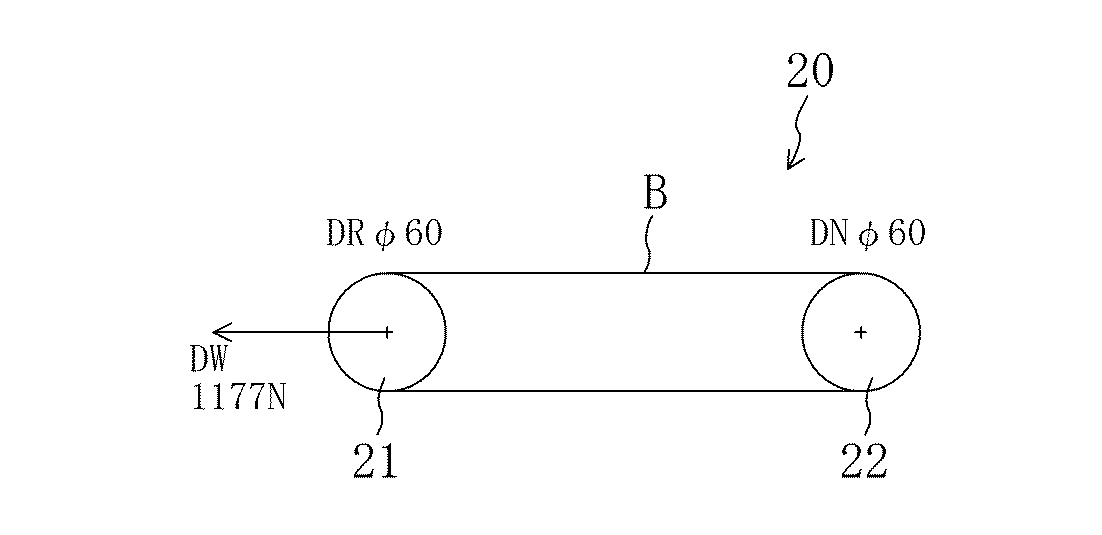
図2は、Vリブドベルトの耐摩耗性試験評価用のベルト走行試験機20のプーリレイアウトを示す。このベルト耐久評価試験機20は、左右に配されたプーリ径60mmの一対のリブプーリ(左側が駆動プーリ、右側が従動プーリ)21,22からなる。
(Test evaluation method)
FIG. 2 shows a pulley layout of the belt running
実施例1〜10並びに比較例1及び2のそれぞれのVリブドベルトBについて、ベルト質量(初期ベルト質量)を計測した後、Vリブ側が接触するように両リブプーリ21,22に巻き掛け、1177Nのデッドウェイトが負荷されるように駆動プーリである左側のリブプーリ21を側方に引っ張ると共に、7Wの回転負荷を従動プーリである右側のリブプーリ22にかけ、室温の下で左側の駆動プーリであるリブプーリ21を3500rpmの回転速度で24時間回転させるベルト走行試験を実施した。そして、ベルト走行後のベルト質量(走行後ベルト質量)を測定し、次式に基づいて摩耗率を算出した。
For each of the V-ribbed belts B of Examples 1 to 10 and Comparative Examples 1 and 2, the belt mass (initial belt mass) was measured, and then wound around both rib pulleys 21 and 22 so that the V-rib side contacted, and a dead of 1177 N Pull the
(試験評価結果)
表2は試験評価の結果を示す。
(Test evaluation results)
Table 2 shows the results of the test evaluation.
表2及び3によれば、超臨界流体又は亜臨界流体の存在下において未架橋ゴムとフィラーとを混練した実施例1〜10の方が、亜臨界流体も超臨界流体も存在しない条件下で混練した比較例1及び2に比べて摩耗率が小さい、つまり、耐摩耗性が優れることが分かる。これは、亜臨界流体或いは超臨界流体の存在下での混練により、未架橋ゴムへのフィラーの分散性が高められるためではないかと推測される。 According to Tables 2 and 3, Examples 1 to 10 in which the uncrosslinked rubber and the filler were kneaded in the presence of the supercritical fluid or the subcritical fluid are under the condition where neither the subcritical fluid nor the supercritical fluid exists. It can be seen that the wear rate is small compared to the kneaded comparative examples 1 and 2, that is, the wear resistance is excellent. This is presumably because the dispersibility of the filler in the uncrosslinked rubber is enhanced by kneading in the presence of a subcritical fluid or supercritical fluid.
また、特に、亜臨界流体を用いた実施例10よりも超臨界流体を用いた実施例1〜9の方がその効果が顕著であることが分かる。 In particular, it can be seen that the effects of Examples 1 to 9 using the supercritical fluid are more remarkable than those of Example 10 using the subcritical fluid.
本発明は、架橋ゴムで形成された他材接触部を有し該他材接触部が他材との接触により摩耗するゴム製品の製造方法について有用である。 INDUSTRIAL APPLICATION This invention is useful about the manufacturing method of the rubber product which has another material contact part formed with the crosslinked rubber, and this other material contact part wears by contact with another material.
B Vリブドベルト(ゴム製品)
13 Vリブ(プーリ接触部)
B V-ribbed belt (rubber product)
13 V rib (pulley contact part)
Claims (7)
混練装置を用いて、超臨界流体又は亜臨界流体の存在下において、未架橋ゴムとフィラーとを混練した後、同一の混練装置又は別の混練装置を用いて、得られた混練物と架橋剤とを混練してフィラー含有未架橋ゴムを調製するゴム調製工程と、
上記ゴム調製工程で調製したフィラー含有未架橋ゴムを、他材接触部に対応するように成形して架橋させる成形架橋工程と、
を備え、
上記ゴム調製工程において、超臨界流体又は亜臨界流体として、亜臨界二酸化炭素若しくは超臨界二酸化炭素、又は、亜臨界窒素若しくは超臨界窒素を用いるゴム製品の製造方法。 A method for producing a rubber product having an other material contact portion formed of a crosslinked rubber, wherein the other material contact portion is worn by contact with the other material,
After kneading uncrosslinked rubber and filler in the presence of a supercritical fluid or subcritical fluid using a kneading device, the resulting kneaded product is crosslinked with the same kneading device or another kneading device. A rubber preparation step of kneading an agent to prepare a filler-containing uncrosslinked rubber;
A molding and crosslinking step in which the filler-containing uncrosslinked rubber prepared in the rubber preparation step is molded and cross-linked so as to correspond to the other material contact portion;
Equipped with a,
A method for producing a rubber product using subcritical carbon dioxide or supercritical carbon dioxide, or subcritical nitrogen or supercritical nitrogen as the supercritical fluid or subcritical fluid in the rubber preparation step .
上記ゴム調製工程で用いる未架橋ゴムがエチレン‐α‐オレフィン共重合体ゴムを含むゴム製品の製造方法。 In the manufacturing method of the rubber product according to claim 1,
A method for producing a rubber product, wherein the uncrosslinked rubber used in the rubber preparation step contains an ethylene-α-olefin copolymer rubber.
上記ゴム調製工程で用いるフィラーがカーボンブラックを含むゴム製品の製造方法。 In the manufacturing method of the rubber product according to claim 1,
A method for producing a rubber product, wherein the filler used in the rubber preparation step contains carbon black.
上記ゴム製品が、架橋ゴムで形成された他材接触部がプーリ接触部に相当する伝動ベルトであるゴム製品の製造方法。 In the manufacturing method of the rubber product according to claim 1,
A method for producing a rubber product, wherein the rubber product is a transmission belt in which the other material contact portion formed of a crosslinked rubber corresponds to a pulley contact portion.
上記ゴム調製工程において、未架橋ゴム及びフィラーの供給並びにフィラー含有未架橋ゴムの排出を連続的に行う連続方式の混練装置を用いるゴム製品の製造方法。 In the manufacturing method of the rubber product according to claim 1,
In the rubber preparation step, a rubber product manufacturing method using a continuous kneading apparatus that continuously supplies uncrosslinked rubber and filler and discharges filler-containing uncrosslinked rubber.
上記ゴム調製工程において、架橋剤以外のゴム配合剤を、未架橋ゴム及びフィラーと共に、超臨界流体又は亜臨界流体の存在下において混練するゴム製品の製造方法。A method for producing a rubber product, wherein a rubber compounding agent other than a crosslinking agent is kneaded together with uncrosslinked rubber and a filler in the presence of a supercritical fluid or a subcritical fluid in the rubber preparation step.
上記ゴム調製工程において、超臨界流体又は亜臨界流体の存在下で未架橋ゴムとフィラーとを混練した後、得られた混練物と架橋剤及びそれ以外のゴム配合剤とを混練するゴム製品の製造方法。In the rubber preparation step, after kneading the uncrosslinked rubber and the filler in the presence of a supercritical fluid or subcritical fluid, the kneaded product obtained is kneaded with the crosslinking agent and the other rubber compounding agent. Production method.
Priority Applications (1)
| Application Number | Priority Date | Filing Date | Title |
|---|---|---|---|
| JP2008016627A JP5259203B2 (en) | 2008-01-28 | 2008-01-28 | Manufacturing method of rubber products |
Applications Claiming Priority (1)
| Application Number | Priority Date | Filing Date | Title |
|---|---|---|---|
| JP2008016627A JP5259203B2 (en) | 2008-01-28 | 2008-01-28 | Manufacturing method of rubber products |
Publications (2)
| Publication Number | Publication Date |
|---|---|
| JP2009173839A JP2009173839A (en) | 2009-08-06 |
| JP5259203B2 true JP5259203B2 (en) | 2013-08-07 |
Family
ID=41029276
Family Applications (1)
| Application Number | Title | Priority Date | Filing Date |
|---|---|---|---|
| JP2008016627A Expired - Fee Related JP5259203B2 (en) | 2008-01-28 | 2008-01-28 | Manufacturing method of rubber products |
Country Status (1)
| Country | Link |
|---|---|
| JP (1) | JP5259203B2 (en) |
Cited By (2)
| Publication number | Priority date | Publication date | Assignee | Title |
|---|---|---|---|---|
| WO2019093130A1 (en) | 2017-11-07 | 2019-05-16 | 株式会社神戸製鋼所 | Mixing apparatus |
| WO2019093131A1 (en) | 2017-11-07 | 2019-05-16 | 株式会社神戸製鋼所 | Mixing apparatus |
Families Citing this family (3)
| Publication number | Priority date | Publication date | Assignee | Title |
|---|---|---|---|---|
| JP4616403B1 (en) * | 2009-11-27 | 2011-01-19 | イチカワ株式会社 | Process belt for papermaking |
| JP7160743B2 (en) * | 2019-04-01 | 2022-10-25 | 株式会社神戸製鋼所 | Kneading device and additive supply method in this |
| JP7513036B2 (en) * | 2019-12-27 | 2024-07-09 | 日本ゼオン株式会社 | Method for manufacturing rubber molded body |
Family Cites Families (3)
| Publication number | Priority date | Publication date | Assignee | Title |
|---|---|---|---|---|
| JPH11310656A (en) * | 1998-04-28 | 1999-11-09 | Yokohama Rubber Co Ltd:The | Thermoplastic elastomer foam and its production |
| JP2001342262A (en) * | 2000-06-01 | 2001-12-11 | Asahi Kasei Corp | Manufacturing method of rubber composition |
| JP2005068275A (en) * | 2003-08-22 | 2005-03-17 | Yokohama Rubber Co Ltd:The | Method for producing rubber composition |
-
2008
- 2008-01-28 JP JP2008016627A patent/JP5259203B2/en not_active Expired - Fee Related
Cited By (6)
| Publication number | Priority date | Publication date | Assignee | Title |
|---|---|---|---|---|
| WO2019093130A1 (en) | 2017-11-07 | 2019-05-16 | 株式会社神戸製鋼所 | Mixing apparatus |
| WO2019093131A1 (en) | 2017-11-07 | 2019-05-16 | 株式会社神戸製鋼所 | Mixing apparatus |
| KR20200057079A (en) | 2017-11-07 | 2020-05-25 | 가부시키가이샤 고베 세이코쇼 | Mixing device |
| KR20200057080A (en) | 2017-11-07 | 2020-05-25 | 가부시키가이샤 고베 세이코쇼 | Mixing device |
| US11931709B2 (en) | 2017-11-07 | 2024-03-19 | Kobe Steel, Ltd. | Apparatus for mixing materials dissolved in a high-pressure working fluid |
| US11944944B2 (en) | 2017-11-07 | 2024-04-02 | Kobe Steel, Ltd. | Mixing apparatus |
Also Published As
| Publication number | Publication date |
|---|---|
| JP2009173839A (en) | 2009-08-06 |
Similar Documents
| Publication | Publication Date | Title |
|---|---|---|
| JP3489838B2 (en) | Nitrile group-containing highly saturated copolymer rubber, heat-resistant rubber composition containing the same, and composite of rubber and fiber | |
| JP4197784B2 (en) | Thermoplastic elastomer composition excellent in gas barrier property and laminate using the same | |
| KR101360831B1 (en) | Transmission belt and process for producing the same | |
| CN111918883A (en) | Method for producing acrylic rubber, method for producing acrylic rubber composition, and biaxial extrusion dryer for acrylic rubber | |
| CN103298877B (en) | Fluoro-rubber composite and bladder for use in manufacturing tires | |
| CN107531955A (en) | Rubber composition, transmission belt and its manufacture method | |
| JP2010053495A (en) | Steel cord for reinforcing tire, and pneumatic tire using the same | |
| JPWO1997036956A1 (en) | Nitrile group-containing highly saturated copolymer rubber, its production method, heat-resistant rubber composition containing the same, and rubber-fiber composite | |
| JP2009227859A (en) | Rubber molded product, and method for producing rubber composition | |
| JP2008261473A (en) | Power transmission belt | |
| JP2009173839A (en) | Manufacturing method of rubber products | |
| JPWO2015198537A1 (en) | Recycled rubber, method for producing the same, and transmission belt using the same | |
| KR20160064176A (en) | Flat belt and production method therefor | |
| JP2021017586A (en) | Rubber composition, method for producing the same, and transmission belt | |
| JP6008479B2 (en) | Tire, manufacturing method thereof, and rubber member for repair used in manufacturing method of tire | |
| CN111108306B (en) | Toothed belt | |
| RU2456311C2 (en) | Method for efficient mixing when producing thermoplastic elastomer composition | |
| CN105330906B (en) | A kind of impact resistance tear-proof steel cable core conveying belt rubber cover and preparation method | |
| JP2003064262A (en) | Thermoplastic elastomer composition and method for producing the same | |
| JPWO2015194116A1 (en) | Transmission belt | |
| CN103140348B (en) | How to make a hose with a protective layer | |
| CN107226942A (en) | A kind of aramid fiber short fibre orients enhanced rubber composite and preparation method thereof with short basalt fiber | |
| JP3622470B2 (en) | Polyamide fiber reinforced rubber composition and production method thereof | |
| JP6649678B2 (en) | tire | |
| CN104629191B (en) | Rubber plastic blend composition, dynamic vulcanization thermoplastic elastomer and preparation method thereof |
Legal Events
| Date | Code | Title | Description |
|---|---|---|---|
| A621 | Written request for application examination |
Free format text: JAPANESE INTERMEDIATE CODE: A621 Effective date: 20100916 |
|
| A977 | Report on retrieval |
Free format text: JAPANESE INTERMEDIATE CODE: A971007 Effective date: 20120323 |
|
| RD02 | Notification of acceptance of power of attorney |
Free format text: JAPANESE INTERMEDIATE CODE: A7422 Effective date: 20121107 |
|
| A131 | Notification of reasons for refusal |
Free format text: JAPANESE INTERMEDIATE CODE: A131 Effective date: 20121127 |
|
| A521 | Written amendment |
Free format text: JAPANESE INTERMEDIATE CODE: A523 Effective date: 20130118 |
|
| TRDD | Decision of grant or rejection written | ||
| A01 | Written decision to grant a patent or to grant a registration (utility model) |
Free format text: JAPANESE INTERMEDIATE CODE: A01 Effective date: 20130402 |
|
| A61 | First payment of annual fees (during grant procedure) |
Free format text: JAPANESE INTERMEDIATE CODE: A61 Effective date: 20130424 |
|
| FPAY | Renewal fee payment (event date is renewal date of database) |
Free format text: PAYMENT UNTIL: 20160502 Year of fee payment: 3 |
|
| R150 | Certificate of patent or registration of utility model |
Free format text: JAPANESE INTERMEDIATE CODE: R150 |
|
| LAPS | Cancellation because of no payment of annual fees |