EP2630483B1 - Method for monitoring the deposition of organic materials in a papermaking process - Google Patents
Method for monitoring the deposition of organic materials in a papermaking process Download PDFInfo
- Publication number
- EP2630483B1 EP2630483B1 EP11834960.4A EP11834960A EP2630483B1 EP 2630483 B1 EP2630483 B1 EP 2630483B1 EP 11834960 A EP11834960 A EP 11834960A EP 2630483 B1 EP2630483 B1 EP 2630483B1
- Authority
- EP
- European Patent Office
- Prior art keywords
- aqueous medium
- deposition
- organic material
- monitoring
- papermaking process
- Prior art date
- Legal status (The legal status is an assumption and is not a legal conclusion. Google has not performed a legal analysis and makes no representation as to the accuracy of the status listed.)
- Active
Links
Images




Classifications
-
- D—TEXTILES; PAPER
- D21—PAPER-MAKING; PRODUCTION OF CELLULOSE
- D21G—CALENDERS; ACCESSORIES FOR PAPER-MAKING MACHINES
- D21G9/00—Other accessories for paper-making machines
- D21G9/0009—Paper-making control systems
-
- G—PHYSICS
- G01—MEASURING; TESTING
- G01N—INVESTIGATING OR ANALYSING MATERIALS BY DETERMINING THEIR CHEMICAL OR PHYSICAL PROPERTIES
- G01N33/00—Investigating or analysing materials by specific methods not covered by groups G01N1/00 - G01N31/00
- G01N33/34—Paper
-
- D—TEXTILES; PAPER
- D21—PAPER-MAKING; PRODUCTION OF CELLULOSE
- D21C—PRODUCTION OF CELLULOSE BY REMOVING NON-CELLULOSE SUBSTANCES FROM CELLULOSE-CONTAINING MATERIALS; REGENERATION OF PULPING LIQUORS; APPARATUS THEREFOR
- D21C5/00—Other processes for obtaining cellulose, e.g. cooking cotton linters ; Processes characterised by the choice of cellulose-containing starting materials
- D21C5/02—Working-up waste paper
-
- D—TEXTILES; PAPER
- D21—PAPER-MAKING; PRODUCTION OF CELLULOSE
- D21F—PAPER-MAKING MACHINES; METHODS OF PRODUCING PAPER THEREON
- D21F1/00—Wet end of machines for making continuous webs of paper
- D21F1/30—Protecting wire-cloths from mechanical damage
-
- D—TEXTILES; PAPER
- D21—PAPER-MAKING; PRODUCTION OF CELLULOSE
- D21G—CALENDERS; ACCESSORIES FOR PAPER-MAKING MACHINES
- D21G9/00—Other accessories for paper-making machines
- D21G9/0009—Paper-making control systems
- D21G9/0027—Paper-making control systems controlling the forming section
-
- D—TEXTILES; PAPER
- D21—PAPER-MAKING; PRODUCTION OF CELLULOSE
- D21G—CALENDERS; ACCESSORIES FOR PAPER-MAKING MACHINES
- D21G9/00—Other accessories for paper-making machines
- D21G9/0009—Paper-making control systems
- D21G9/0036—Paper-making control systems controlling the press or drying section
-
- G—PHYSICS
- G01—MEASURING; TESTING
- G01N—INVESTIGATING OR ANALYSING MATERIALS BY DETERMINING THEIR CHEMICAL OR PHYSICAL PROPERTIES
- G01N29/00—Investigating or analysing materials by the use of ultrasonic, sonic or infrasonic waves; Visualisation of the interior of objects by transmitting ultrasonic or sonic waves through the object
- G01N29/02—Analysing fluids
- G01N29/022—Fluid sensors based on microsensors, e.g. quartz crystal-microbalance [QCM], surface acoustic wave [SAW] devices, tuning forks, cantilevers, flexural plate wave [FPW] devices
-
- G—PHYSICS
- G01—MEASURING; TESTING
- G01N—INVESTIGATING OR ANALYSING MATERIALS BY DETERMINING THEIR CHEMICAL OR PHYSICAL PROPERTIES
- G01N33/00—Investigating or analysing materials by specific methods not covered by groups G01N1/00 - G01N31/00
- G01N33/26—Oils; Viscous liquids; Paints; Inks
-
- G—PHYSICS
- G01—MEASURING; TESTING
- G01N—INVESTIGATING OR ANALYSING MATERIALS BY DETERMINING THEIR CHEMICAL OR PHYSICAL PROPERTIES
- G01N33/00—Investigating or analysing materials by specific methods not covered by groups G01N1/00 - G01N31/00
- G01N33/34—Paper
- G01N33/343—Paper pulp
-
- G—PHYSICS
- G01—MEASURING; TESTING
- G01N—INVESTIGATING OR ANALYSING MATERIALS BY DETERMINING THEIR CHEMICAL OR PHYSICAL PROPERTIES
- G01N2291/00—Indexing codes associated with group G01N29/00
- G01N2291/02—Indexing codes associated with the analysed material
- G01N2291/024—Mixtures
- G01N2291/02416—Solids in liquids
-
- G—PHYSICS
- G01—MEASURING; TESTING
- G01N—INVESTIGATING OR ANALYSING MATERIALS BY DETERMINING THEIR CHEMICAL OR PHYSICAL PROPERTIES
- G01N2291/00—Indexing codes associated with group G01N29/00
- G01N2291/02—Indexing codes associated with the analysed material
- G01N2291/025—Change of phase or condition
- G01N2291/0256—Adsorption, desorption, surface mass change, e.g. on biosensors
-
- G—PHYSICS
- G01—MEASURING; TESTING
- G01N—INVESTIGATING OR ANALYSING MATERIALS BY DETERMINING THEIR CHEMICAL OR PHYSICAL PROPERTIES
- G01N2291/00—Indexing codes associated with group G01N29/00
- G01N2291/04—Wave modes and trajectories
- G01N2291/042—Wave modes
- G01N2291/0426—Bulk waves, e.g. quartz crystal microbalance, torsional waves
-
- Y—GENERAL TAGGING OF NEW TECHNOLOGICAL DEVELOPMENTS; GENERAL TAGGING OF CROSS-SECTIONAL TECHNOLOGIES SPANNING OVER SEVERAL SECTIONS OF THE IPC; TECHNICAL SUBJECTS COVERED BY FORMER USPC CROSS-REFERENCE ART COLLECTIONS [XRACs] AND DIGESTS
- Y02—TECHNOLOGIES OR APPLICATIONS FOR MITIGATION OR ADAPTATION AGAINST CLIMATE CHANGE
- Y02W—CLIMATE CHANGE MITIGATION TECHNOLOGIES RELATED TO WASTEWATER TREATMENT OR WASTE MANAGEMENT
- Y02W30/00—Technologies for solid waste management
- Y02W30/50—Reuse, recycling or recovery technologies
- Y02W30/64—Paper recycling
Definitions
- This invention is in the field of papermaking. Specifically, this invention is in the field of monitoring organic deposit formation in a papermaking process.
- Organic materials such as pitch, stickies, and tackies, are major obstacles in paper manufacturing because these materials when liberated during a papermaking process can become both undesirable components of papermaking furnishes and troublesome to the mill equipment, e.g. preventing proper operation of mechanical parts when these materials deposit on the mechanical parts.
- White pitch is a particular obstacle in the manufacture of paper and tissue using recycled fiber (mixed office waste, old corrugated containers, old newsprint) and coated broke.
- these non-polar, tacky contaminants when liberated during processing repulping, can become both undesirable components of papermaking furnishes and troublesome deposits on the mill equipment, e.g. wires of the tissue machine.
- Stickies and tackies are organic materials that do not have precise definitions; they are tacky substances contained in the pulp and process water system that deposit on paper/tissue machine clothing, cylinders, and/or rolls. They vary in chemical structure: natural wood pitch consists of fatty acids, fatty esters and rosin acids, while stickies and white pitch originating from synthetic additives (adhesives, coating binders, printing ink) contain styrene butadiene rubber, ethylene vinyl acetate, polyvinyl acetate, polyvinyl acrylate, polyvinyl butyral, polybutadicnc, wax, alkyd resins, polyol acrylates, etc.
- micro stickies are those that can pass the 0.10-0.15 mm screening slots) using a of conventional quartz crystal microbalance (QCM).
- U.S. Patent Application Publication No. 2006/0281191 discloses using a quartz crystal microbalance (QCM) in monitoring of organic deposits.
- QCM quartz crystal microbalance
- Coating of the QCM surface to affect the rate of deposition generally, is a known idea. Moreover, a polymer coating composition including an epoxy resin (the preferred coating in the parent application) was described, though with a different aim. However, the special method of coating developed here and the application of a specially designed polymer and a class of polymers, effectively providing a sensitizing coating for stickies monitoring using QCM is now identified.
- hydrophobic materials in pulp slurries are known to have relatively low surface energy; for stickies it is in the range 30-45 dynes/cm2, and, for example, the tack for pressure-sensitive adhesives (PSA) depends on the surface energy.
- PSA pressure-sensitive adhesives
- Surface energy quantifies the disruption of intermolecular bonds that occurs when a surface is created. The surface energy may be defined as the excess energy at the surface of a material compared to the bulk
- An efficacious and enhanced method of monitoring the deposition of organic materials is thus desired. Furthermore, a method of monitoring the effectiveness of inhibitors that prevent/reduce deposition of organic materials in a papermaking process is also desired. Even further, a method of measuring microstickies in deinked pulp processes using a QCM technique is ultimately desired.
- US 2009/0056897 A1 discloses a method for measuring the effectiveness of inhibitors that decrease a rate of deposition of organic material, and the rate of deposition itself, in a papermaking process. This document discloses measuring the rate of deposition of the at least one organic material from the aqueous medium onto a quartz crystal microbalance having a top and a bottom side, wherein the top side contacts the aqueous medium and is coated with a coating material and wherein the bottom side is isolated from the aqueous medium.”
- the present invention provides a method for monitoring the deposition of hydrophobic materials from a liquid or slurry comprising measuring the rate of deposition onto a coated quartz crystal according to claim 1.
- the present invention provides a method for measuring the effectiveness of inhibitors that decrease such depositions, in a papermaking or simulated papermaking process according to claims 11 and 12.
- Papermaking process means a method of making any kind of paper products (e.g. paper, tissue, board, etc.) from pulp comprising forming an aqueous cellulosic papermaking furnish, draining the furnish to form a sheet and drying the sheet. The steps of forming the papermaking furnish, draining and drying may be carried out in any conventional manner generally known to those skilled in the art.
- the papermaking process may also include a pulping stage, i.e. making pulp from woody raw material and bleaching stage, i.e. chemical treatment of the pulp for brightness improvement.
- QCM quartz crystal microbalance
- DRM deposit rate monitor
- SRM means scale rate monitor.
- U.S. Patent No. 6,375,829 and U.S. Patent No. 6,942,782 describe Nalco's scale rate monitor, and are herein incorporated by reference.
- An SRM contains a QCM.
- RQCM research quartz crystal microbalance, which is commercially available from Maxtek, Inc., Cypress, California.
- the top side of the quartz crystal microbalance is made up of one or more conductive materials selected from the group consisting of: platinum; titanium; silver; gold; lead; cadmium; diamond-like thin film electrodes with or without implanted ions; silicides of titanium, niobium, and tantalum; lead-selenium alloys; mercury amalgams; and silicone.
- Coating the top side of a quartz crystal microbalance with a layer containing a non-swelling epoxy resin or a silicone containing polymer facilitates adhesion of organic deposits to the surface of the quartz crystal microbalance.
- a non-swelling epoxy resin applied to a quartz crystal microbalance has the characteristic of not substantially swelling in an aqueous environment, e.g. aqueous medium in a papermaking process.
- aqueous environment e.g. aqueous medium in a papermaking process.
- One of ordinary skill in the art can determine whether a resin is non-swelling without undue experimentation.
- the resin is selected from the group consisting of: a cresol-novolac epoxy resin; a phenol novolac epoxy resin; a bisphenol F (4,4'-, 2,4'- or 2,2'-dihydroxydiphenylmethanes or a mixture thereof) epoxy resin; a polynuclear phenol-glycidyl ether-derived resin; a tetraglycidylmethylenedianiline-derived resin; a triglycidyl-p-aminophenol derived resin; a triazine-derived resin; and a hydantoin epoxy resin.
- the resin is derived from epichlorohydrin and 4,4'-dihydroxy-2,2-diphenylpropane (bisphenol A; may also contain 2,4'- or/and 2,2'-isomers).
- the resin contains an aromatic backbone, aliphatic backbone, cycloaliphatic backbone, or a heterocyclic backbone.
- a silicone containing polymer can also be applied to the surface of a quartz crystal microbalance.
- the silicone containing polymer is selected from the group consisting of: silicone rubber, and room temperature vulcanizing silicone rubber.
- a cellulose coating can also be applied to the surface of a quartz crystal microbalance.
- a coupling agent may be utilized to facilitate the adhesion of the resin to the QCM surface.
- the coupling agent is 3-glycidoxypropyltrimethox-silane, which is available from Dow Corning® Corporation, as DOW CORNING Z-6040® SILANE.
- DOW CORNING Z-6040® SILANE is a heterobifunctional coupling agent.
- DOW CORNING Z-6040® SILANE is prepared as a 0.1 - 0.5% solution in acidified water and applied to the active face of the crystal, and then after applying the silane, the crystal is dried at 104°C-121°C, resulting in an epoxide functionalized surface that is covalently linked to the quartz crystal. The surface is then coated with a thin layer of epoxy.
- the epoxy resin and silicone containing polymer may be applied to the QCM surface by various methods that would apparent to one of ordinary skill in the art.
- the epoxy resin or silicone containing polymer are applied to the QCM surface by a drop coating method or a spin coating method.
- the epoxy resin or silicone containing polymer After the epoxy resin or silicone containing polymer is applied to the QCM surface, the epoxy resin and silicone containing polymer are hardened/cured.
- the epoxy resin is hardened/cured by a curing agent.
- the type of curing agent utilized would be apparent to one of ordinary skill in the art without undue experimentation and is chosen so that the resin becomes a cured/hardened non-swelling resin.
- the silicone containing polymer does not require a curing agent.
- the silicone containing polymer should be chosen so that it hardens subsequent to its application to the QCM surface. This can be determined without undue experimentation.
- the curing agent is selected from the group consisting of: short chain aliphatic polyamines; oxyalkylated short chain polyamines; long chain polyamine adducts; aromatic polyamines; polyaminoamides; and polythiols.
- the organic materials are hydrophobic.
- organic materials include natural and/or synthetic contaminants. Under the guise of synthetic contaminants, there are stickies and tackies. White pitch is a common term that correlates to stickies and tackies.
- the stickies are microstickies.
- the microstickies do not exceed approximately 0.10-0.15 mm in size.
- the stickies and tackies are components of printing ink.
- the stickies and tackies are selected from the group consisting of: adhesives; coating binders; styrene butadiene rubber; ethylene vinyl acetate; polyvinyl acetate; polyvinyl acrylate; polyvinyl butyral; polybutadiene; wax; alkyd resins; polyol acrylates; and sizing chemicals.
- the monitoring occurs in a papermaking process at a location selected from the group consisting of: pulp processing; recycling; a refiner, a repulper; a bleaching chest; a deinking stage; a water loop; a headbox of a paper or tissue machine, and a combination thereof.
- Papermaking processes encompassed by this invention include, but are not limited to, board production, and papermaking processes that involve recycled pulp and/or broke.
- the aqueous medium in a papermaking process includes liquids and slurries.
- the aqueous medium is a pulp slurry.
- inhibitors are added to the papermaking process.
- the inhibitors serve to reduce/eliminate deposition of unwanted organic materials in a papermaking process.
- anti-pitch or anti-stickies treatments that are currently employed to reduce deposition of the organic materials. Therefore by using the protocols of this invention, the efficacy of these inhibitors can be determined.
- paper chemistry programs may be developed based upon information obtained from the monitoring procedures of this invention.
- feedback protocols may be developed to provide not only monitoring but control of chemistry added to the papermaking process so that the process becomes more cost-efficient, more efficacious, and produces a better paper product.
- the method for coating the crystals used in the DRM, SRM and RQCM experiments was based on spin coating the epoxy resin onto the crystal when removed from the sensor.
- the crystals were cleaned of any organic contaminants by washing with acetone followed by 0.5N HCl and deionized water (“DI”) water.
- DI deionized water
- the clean crystals were dried under a flow of nitrogen and fitted to a spin coater.
- the two-part epoxy resin was homogenized in acetone or tetrahydrofuran (THF) at a concentration of 10% by wt.
- the epoxy solution was deposited onto the top side of the crystal, covering the entire surface.
- the crystal was spun at 2500 revolutions per minute (RPM) for 50 seconds, yielding a thin layer of epoxy, which was allowed to cure at room temperature for three days.
- RPM revolutions per minute
- model stickies suspension consisting of emulsified acrylate microspheres was added to a suspension of pulp at 0.3 to 3% consistency.
- the effect of pulp consistency in the tested system on the rate of deposition is an important question related to the development of monitoring techniques for mill applications.
- the standard DRM or SRM batch system which employs a magnetic stirrer, works well when the pulp is present at very low consistency, but it is not suitable to analyze higher-consistency slurries.
- This system was modified by using a wide propeller stirrer connected to a motor. The cell was firmly attached to a stand, and the stirrer was reaching the cell through a slot in the lid normally used by the heating rod. This system provided uniform stirring at 400 RPM of the pulp of up to 5% consistency.
- This cell allows measurements to be made on flowing pulp slurries, as to mimic the conditions the sensor undergoes when installed at a paper mill. It is composed of a reserve of pulp slurry in a kettle fitted with a wide propeller stirrer connected to a motor and a drain valve. The valve is connected to a centrifugal pump that drives the flow of stock up through a 55 cm long tubular cell with an inner diameter of 2.6 cm, which has fittings to accommodate three individual QCM sensors and a temperature sensor. Upon exiting the flow cell, the slurry is guided back through a hose to the reserve kettle for recirculation. The deposition and temperature were recorded continuously on all three crystals using the Maxtek RQCM instrument.
- the RQCM is fitted to the cell described in Protocol B and is installed in the pulp line or paper/tissue machine (a sidestream connection), to assure a continuous flow of the slurry (mill water).
- the deposition is recorded continuously as the pulp slurry flows by the faces of the sensors at a rate of 7.57-11.36 litres per minute (2.0-3.0 gallons per minute (gpm)).
- a crystal was coated with room temperature vulcanizing (RTV) silicone, available from Dow Coming Corporation, tested positive for affinity to artificial stickies.
- RTV room temperature vulcanizing
- the mass was increasing over time, as shown in Figure 4 . Without surfactant, no mass increase is observed, so the hydrophobic RTV silicone coated crystal appears to be pulling the surfactant out of the slurry.
- an artificial stickies furnish was created by re-pulping Post-It® Notes, 3M Corporation, and adhesive labels with plain copy paper.
- the repulped furnish was diluted to a 0-5% consistency and tested with the epoxy coated and uncoated crystals using the RQCM.
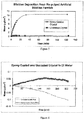
- the epoxy-coated crystal gathered a significantly higher amount of mass ("stickies"). The measurements were taken immediately after the samples came out of the repulper, and the majority of the mass on the crystal was accumulating in the first 30 minutes.
- the slurry was stirred for 1.5 hours after re-pulping before measuring with the epoxy-coated crystal. A similar trend in deposition was observed, demonstrating the epoxy-coated crystal's ability to detect stickies that are stable in solution.
- Protocol B the effects of swelling of the polymer coating in an aqueous environment were tested in deionized water and Kraft slurry (0.5% consistency) using the RQCM and the recirculation flow cell. As shown in Figure 6 , the results clearly show that the signal from swelling is minimal in comparison to the deposition observed from microstickies.
- pre-treating the slurry with a surfactant before measuring reduces the deposition on the epoxy coated crystal by over 95%.
- a 1% synthetic pitch solution was prepared by mixing 5 g synthetic softwood pitch (a homogenized mixture of 50% abietic acid, 10% oleic acid, 10% palmitic acid, 10% corn oil, 5% oleyl alcohol, 5% methyl stearate, 5% beta-sitosterol, and 5% cholesteryl caproate) in 633 ml iso-propanol. 1ml of this solution of was added to 10L of DI water at pH 7.3. A solution of calcium chloride (5000 ppm as Ca ions, 50 ml) was added.
- synthetic softwood pitch a homogenized mixture of 50% abietic acid, 10% oleic acid, 10% palmitic acid, 10% corn oil, 5% oleyl alcohol, 5% methyl stearate, 5% beta-sitosterol, and 5% cholesteryl caproate
- the epoxy coated crystal has an increased sensitivity for detecting wood pitch in an aqueous environment.
- Concentration of synthetic pitch was intentionally maintained at a very low level in this experiment. While wood pitch can be monitored using a QCM at high concentrations, it is not so at low concentrations. The experiment shows that the claimed method improves sensitivity of the method, thus making such monitoring possible.
- the low-density polyethylene (LDPE) was also tested as a crystal coating to attract microstickies from recycled furnish. The hypothesis was that the hydrophobic microstickies would be attracted to the highly hydrophobic LDPE coated crystal. The results in Figure 12 show that this is not the case.
- Synthetic pitch accumulation was monitored in a benchtop experiment using a DRM setup.
- a 1% synthetic pitch solution was prepared by mixing 5 g synthetic softwood pitch (a homogenized mixture of 50% abietic acid, 10% oleic acid, 10% palmitic acid, 10% corn oil, 5% oleyl alcohol, 5% methyl stearate, 5% beta-sitosterol, and 5% cholesteryl caproate) in 633 ml iso-propanol.
- the epoxy coated crystal has an increased sensitivity for detecting wood pitch in an aqueous environment.
- Concentration of synthetic pitch was intentionally maintained at a very low level in this experiment. While wood pitch can be monitored using a QCM at high concentrations, it is not so at low concentrations. The experiment shows that the claimed method improves sensitivity of the method, thus making such monitoring possible.
- Example 6 1000 ml of 0.5% softwood kraft pulp slurry was placed in a benchtop cell of a DRM instrument (see Figure 3a in Shevchenko, Sergey M.; Duggirala, Prasad Y.; Deposit management for the bleach plant; IPPTA Journal (2010), 22(1), 135-140 ). Under mixing, the chemical (3 ml providing 300 ppm product concentration in the sample) and, 5 min later, 100 ml of 1% solution of synthetic softwood pitch (Nalco formulation TX-6226) in iso-propanol were added. Upon hornogenization, 5 ml of 5000 ppm (as Ca++ ions) solution of calcium chloride was added and the pH adjusted to 3.5 with dilute hydrochloric acid. The deposit accumulation was recorded using a deposit rate monitor in continuous mode. The same test was done with coated unpolished, uncoated unpolished, and uncoated polished Au/Ti sensor crystals.
- Figure 13 illustrates accumulation of synthetic pitch in standard benchtop experiments using uncoated and coated crystals. This graph illustrates the difference between the proposed surfaces and surfaces with higher surface energies. The rates illustrated by the lines in Figure 13 are as follows: Coated:Uncoated unpolished 17:1, Coated:Uncoated polished 21:1, Uncoated unpolished:Uncoated polished 1.25:1. The test shows that the coating provides almost twentyfold increase in sensitivity towards hydrophobic deposits. This is a pitch test, but it can be reasonably assumed that the effect on stickies is similar.
- the on-line DRM instrument was directly connected via a slipstream connection to the pulp line or paper machine to assure a continuous flow of the aqueous pulp slurry.
- the deposition was recorded continuously as the pulp slurry did flow by the faces of the sensor at a rate of 18.93 litres per minute (5.0 gallons per minute (gpm)).
- Figure 14 illustrates the difference between the proposed surfaces and surfaces with lower surface energies.
Landscapes
- Life Sciences & Earth Sciences (AREA)
- Chemical & Material Sciences (AREA)
- Health & Medical Sciences (AREA)
- Physics & Mathematics (AREA)
- General Health & Medical Sciences (AREA)
- Analytical Chemistry (AREA)
- Biochemistry (AREA)
- General Physics & Mathematics (AREA)
- Immunology (AREA)
- Pathology (AREA)
- Medicinal Chemistry (AREA)
- Food Science & Technology (AREA)
- Engineering & Computer Science (AREA)
- Acoustics & Sound (AREA)
- Paper (AREA)
Applications Claiming Priority (2)
| Application Number | Priority Date | Filing Date | Title |
|---|---|---|---|
| US12/907,478 US8500957B2 (en) | 2007-08-29 | 2010-10-19 | Enhanced method for monitoring the deposition of organic materials in a papermaking process |
| PCT/US2011/056639 WO2012054430A2 (en) | 2010-10-19 | 2011-10-18 | Enhanced method for monitoring the deposition of organic materials in a papermaking process |
Publications (3)
| Publication Number | Publication Date |
|---|---|
| EP2630483A2 EP2630483A2 (en) | 2013-08-28 |
| EP2630483A4 EP2630483A4 (en) | 2014-03-26 |
| EP2630483B1 true EP2630483B1 (en) | 2017-02-08 |
Family
ID=45975825
Family Applications (1)
| Application Number | Title | Priority Date | Filing Date |
|---|---|---|---|
| EP11834960.4A Active EP2630483B1 (en) | 2010-10-19 | 2011-10-18 | Method for monitoring the deposition of organic materials in a papermaking process |
Country Status (9)
| Country | Link |
|---|---|
| US (1) | US8500957B2 (enExample) |
| EP (1) | EP2630483B1 (enExample) |
| JP (1) | JP2013542339A (enExample) |
| KR (1) | KR101904372B1 (enExample) |
| CN (1) | CN103180728B (enExample) |
| AU (1) | AU2011317311B2 (enExample) |
| CA (1) | CA2813261C (enExample) |
| MX (1) | MX2013004199A (enExample) |
| WO (1) | WO2012054430A2 (enExample) |
Families Citing this family (9)
| Publication number | Priority date | Publication date | Assignee | Title |
|---|---|---|---|---|
| US8133356B2 (en) * | 2008-06-19 | 2012-03-13 | Nalco Company | Method of monitoring microbiological deposits |
| CN104081200B (zh) * | 2011-09-02 | 2016-11-09 | 凯米罗总公司 | 用于表征存在于液体中的固体物质的设备和方法 |
| US20130245158A1 (en) * | 2012-03-19 | 2013-09-19 | Kemira Oyj | Methods of measuring a characteristic of a creping adhesive film and methods of modifying the creping adhesive film |
| GB201418288D0 (en) * | 2014-10-15 | 2014-11-26 | Nopco Paper Technology Gmbh | A method for controlling the deposition of stickies in pulping and papermaking processes |
| CN104594111A (zh) * | 2014-12-25 | 2015-05-06 | 合肥丹盛包装有限公司 | 一种含有改性乙烯-醋酸乙烯酯共聚物的瓦楞纸及其制备方法 |
| CN105136605B (zh) * | 2015-10-09 | 2018-07-13 | 上海市环境科学研究院 | 一种测定碳纤维和石墨纤维上浆剂含量的方法 |
| WO2017089501A1 (de) * | 2015-11-25 | 2017-06-01 | Voith Patent Gmbh | Hochgenauer sensor für fasersuspensionen |
| US10519602B2 (en) | 2017-06-15 | 2019-12-31 | Ecolab Usa Inc. | Polymer for pitch and stickies deposition control in papermaking |
| FI20195550A1 (en) * | 2019-06-20 | 2020-12-21 | Kemira Oyj | Risk level assessment in an aqueous process |
Family Cites Families (13)
| Publication number | Priority date | Publication date | Assignee | Title |
|---|---|---|---|---|
| US3266291A (en) * | 1962-10-29 | 1966-08-16 | Exxon Research Engineering Co | Piezo crystal fluid analyzer |
| SE434438B (sv) * | 1980-02-21 | 1984-07-23 | Gambro Engstrom Ab | Anordning for detektering av forekomsten av en given gaskomponent i en gasblandning |
| US5224972A (en) * | 1990-09-11 | 1993-07-06 | Frye Gregory C | Coatings with controlled porosity and chemical properties |
| US5942322A (en) * | 1997-09-11 | 1999-08-24 | The Procter & Gamble Company | Reduced surface energy limiting orifice drying medium process of making and process of making paper therewith |
| US6250140B1 (en) * | 1999-06-22 | 2001-06-26 | Nalco Chemical Company | Method for measuring the rate of a fouling reaction induced by heat transfer using a piezoelectric microbalance |
| US6357278B1 (en) * | 1999-08-09 | 2002-03-19 | General Electric Company | Polymer coatings for chemical sensors |
| US20060281191A1 (en) * | 2005-06-09 | 2006-12-14 | Prasad Duggirala | Method for monitoring organic deposits in papermaking |
| US7449086B2 (en) * | 2005-09-21 | 2008-11-11 | Nalco Company | Use of synthetic metal silicates for decreasing the deposition of contaminants during a papermaking process |
| JP4772563B2 (ja) * | 2006-03-31 | 2011-09-14 | 日本製紙株式会社 | 異物の沈積度合を測定する方法 |
| JP2008255498A (ja) * | 2007-03-30 | 2008-10-23 | Nippon Paper Industries Co Ltd | 再生パルプの製造方法 |
| US7985318B2 (en) * | 2007-05-10 | 2011-07-26 | Nalco Company | Method of monitoring and inhibiting scale deposition in pulp mill evaporators and concentrators |
| US7842165B2 (en) * | 2007-08-29 | 2010-11-30 | Nalco Company | Enhanced method for monitoring the deposition of organic materials in a papermaking process |
| US8133356B2 (en) * | 2008-06-19 | 2012-03-13 | Nalco Company | Method of monitoring microbiological deposits |
-
2010
- 2010-10-19 US US12/907,478 patent/US8500957B2/en active Active
-
2011
- 2011-10-18 KR KR1020137012882A patent/KR101904372B1/ko active Active
- 2011-10-18 CA CA2813261A patent/CA2813261C/en active Active
- 2011-10-18 MX MX2013004199A patent/MX2013004199A/es active IP Right Grant
- 2011-10-18 CN CN201180050497.2A patent/CN103180728B/zh active Active
- 2011-10-18 EP EP11834960.4A patent/EP2630483B1/en active Active
- 2011-10-18 WO PCT/US2011/056639 patent/WO2012054430A2/en not_active Ceased
- 2011-10-18 JP JP2013534991A patent/JP2013542339A/ja active Pending
- 2011-10-18 AU AU2011317311A patent/AU2011317311B2/en active Active
Non-Patent Citations (1)
| Title |
|---|
| None * |
Also Published As
| Publication number | Publication date |
|---|---|
| WO2012054430A3 (en) | 2012-07-12 |
| CA2813261A1 (en) | 2012-04-26 |
| AU2011317311A1 (en) | 2013-05-23 |
| KR101904372B1 (ko) | 2018-10-05 |
| CN103180728A (zh) | 2013-06-26 |
| KR20130129204A (ko) | 2013-11-27 |
| EP2630483A2 (en) | 2013-08-28 |
| JP2013542339A (ja) | 2013-11-21 |
| CN103180728B (zh) | 2015-04-15 |
| CA2813261C (en) | 2018-10-16 |
| AU2011317311B2 (en) | 2016-05-19 |
| EP2630483A4 (en) | 2014-03-26 |
| US20110073263A1 (en) | 2011-03-31 |
| US8500957B2 (en) | 2013-08-06 |
| MX2013004199A (es) | 2013-06-05 |
| WO2012054430A2 (en) | 2012-04-26 |
Similar Documents
| Publication | Publication Date | Title |
|---|---|---|
| US7842165B2 (en) | Enhanced method for monitoring the deposition of organic materials in a papermaking process | |
| EP2630483B1 (en) | Method for monitoring the deposition of organic materials in a papermaking process | |
| US20120073775A1 (en) | Method for monitoring organic deposits in papermaking | |
| RU2422779C2 (ru) | Способ отслеживания органических осадков в бумажном производстве | |
| EP2310856B1 (en) | Method of monitoring microbiological deposits |
Legal Events
| Date | Code | Title | Description |
|---|---|---|---|
| PUAI | Public reference made under article 153(3) epc to a published international application that has entered the european phase |
Free format text: ORIGINAL CODE: 0009012 |
|
| 17P | Request for examination filed |
Effective date: 20130509 |
|
| AK | Designated contracting states |
Kind code of ref document: A2 Designated state(s): AL AT BE BG CH CY CZ DE DK EE ES FI FR GB GR HR HU IE IS IT LI LT LU LV MC MK MT NL NO PL PT RO RS SE SI SK SM TR |
|
| DAX | Request for extension of the european patent (deleted) | ||
| A4 | Supplementary search report drawn up and despatched |
Effective date: 20140226 |
|
| RIC1 | Information provided on ipc code assigned before grant |
Ipc: D21F 1/30 20060101ALI20140220BHEP Ipc: G01N 33/00 20060101AFI20140220BHEP Ipc: D21G 9/00 20060101ALI20140220BHEP Ipc: D21C 5/02 20060101ALI20140220BHEP Ipc: G01N 33/26 20060101ALI20140220BHEP Ipc: G01N 29/02 20060101ALI20140220BHEP Ipc: G01N 33/34 20060101ALI20140220BHEP |
|
| GRAP | Despatch of communication of intention to grant a patent |
Free format text: ORIGINAL CODE: EPIDOSNIGR1 |
|
| INTG | Intention to grant announced |
Effective date: 20161004 |
|
| GRAS | Grant fee paid |
Free format text: ORIGINAL CODE: EPIDOSNIGR3 |
|
| GRAA | (expected) grant |
Free format text: ORIGINAL CODE: 0009210 |
|
| AK | Designated contracting states |
Kind code of ref document: B1 Designated state(s): AL AT BE BG CH CY CZ DE DK EE ES FI FR GB GR HR HU IE IS IT LI LT LU LV MC MK MT NL NO PL PT RO RS SE SI SK SM TR |
|
| REG | Reference to a national code |
Ref country code: GB Ref legal event code: FG4D |
|
| REG | Reference to a national code |
Ref country code: CH Ref legal event code: EP Ref country code: AT Ref legal event code: REF Ref document number: 867095 Country of ref document: AT Kind code of ref document: T Effective date: 20170215 |
|
| REG | Reference to a national code |
Ref country code: IE Ref legal event code: FG4D |
|
| REG | Reference to a national code |
Ref country code: DE Ref legal event code: R096 Ref document number: 602011034963 Country of ref document: DE |
|
| REG | Reference to a national code |
Ref country code: SE Ref legal event code: TRGR |
|
| REG | Reference to a national code |
Ref country code: LT Ref legal event code: MG4D |
|
| REG | Reference to a national code |
Ref country code: NL Ref legal event code: MP Effective date: 20170208 |
|
| REG | Reference to a national code |
Ref country code: AT Ref legal event code: MK05 Ref document number: 867095 Country of ref document: AT Kind code of ref document: T Effective date: 20170208 |
|
| PG25 | Lapsed in a contracting state [announced via postgrant information from national office to epo] |
Ref country code: HR Free format text: LAPSE BECAUSE OF FAILURE TO SUBMIT A TRANSLATION OF THE DESCRIPTION OR TO PAY THE FEE WITHIN THE PRESCRIBED TIME-LIMIT Effective date: 20170208 Ref country code: GR Free format text: LAPSE BECAUSE OF FAILURE TO SUBMIT A TRANSLATION OF THE DESCRIPTION OR TO PAY THE FEE WITHIN THE PRESCRIBED TIME-LIMIT Effective date: 20170509 Ref country code: NO Free format text: LAPSE BECAUSE OF FAILURE TO SUBMIT A TRANSLATION OF THE DESCRIPTION OR TO PAY THE FEE WITHIN THE PRESCRIBED TIME-LIMIT Effective date: 20170508 Ref country code: LT Free format text: LAPSE BECAUSE OF FAILURE TO SUBMIT A TRANSLATION OF THE DESCRIPTION OR TO PAY THE FEE WITHIN THE PRESCRIBED TIME-LIMIT Effective date: 20170208 |
|
| PG25 | Lapsed in a contracting state [announced via postgrant information from national office to epo] |
Ref country code: AT Free format text: LAPSE BECAUSE OF FAILURE TO SUBMIT A TRANSLATION OF THE DESCRIPTION OR TO PAY THE FEE WITHIN THE PRESCRIBED TIME-LIMIT Effective date: 20170208 Ref country code: RS Free format text: LAPSE BECAUSE OF FAILURE TO SUBMIT A TRANSLATION OF THE DESCRIPTION OR TO PAY THE FEE WITHIN THE PRESCRIBED TIME-LIMIT Effective date: 20170208 Ref country code: ES Free format text: LAPSE BECAUSE OF FAILURE TO SUBMIT A TRANSLATION OF THE DESCRIPTION OR TO PAY THE FEE WITHIN THE PRESCRIBED TIME-LIMIT Effective date: 20170208 Ref country code: PT Free format text: LAPSE BECAUSE OF FAILURE TO SUBMIT A TRANSLATION OF THE DESCRIPTION OR TO PAY THE FEE WITHIN THE PRESCRIBED TIME-LIMIT Effective date: 20170608 Ref country code: LV Free format text: LAPSE BECAUSE OF FAILURE TO SUBMIT A TRANSLATION OF THE DESCRIPTION OR TO PAY THE FEE WITHIN THE PRESCRIBED TIME-LIMIT Effective date: 20170208 Ref country code: BG Free format text: LAPSE BECAUSE OF FAILURE TO SUBMIT A TRANSLATION OF THE DESCRIPTION OR TO PAY THE FEE WITHIN THE PRESCRIBED TIME-LIMIT Effective date: 20170508 Ref country code: NL Free format text: LAPSE BECAUSE OF FAILURE TO SUBMIT A TRANSLATION OF THE DESCRIPTION OR TO PAY THE FEE WITHIN THE PRESCRIBED TIME-LIMIT Effective date: 20170208 |
|
| PG25 | Lapsed in a contracting state [announced via postgrant information from national office to epo] |
Ref country code: CZ Free format text: LAPSE BECAUSE OF FAILURE TO SUBMIT A TRANSLATION OF THE DESCRIPTION OR TO PAY THE FEE WITHIN THE PRESCRIBED TIME-LIMIT Effective date: 20170208 Ref country code: SK Free format text: LAPSE BECAUSE OF FAILURE TO SUBMIT A TRANSLATION OF THE DESCRIPTION OR TO PAY THE FEE WITHIN THE PRESCRIBED TIME-LIMIT Effective date: 20170208 Ref country code: RO Free format text: LAPSE BECAUSE OF FAILURE TO SUBMIT A TRANSLATION OF THE DESCRIPTION OR TO PAY THE FEE WITHIN THE PRESCRIBED TIME-LIMIT Effective date: 20170208 Ref country code: EE Free format text: LAPSE BECAUSE OF FAILURE TO SUBMIT A TRANSLATION OF THE DESCRIPTION OR TO PAY THE FEE WITHIN THE PRESCRIBED TIME-LIMIT Effective date: 20170208 |
|
| REG | Reference to a national code |
Ref country code: DE Ref legal event code: R097 Ref document number: 602011034963 Country of ref document: DE |
|
| PG25 | Lapsed in a contracting state [announced via postgrant information from national office to epo] |
Ref country code: SM Free format text: LAPSE BECAUSE OF FAILURE TO SUBMIT A TRANSLATION OF THE DESCRIPTION OR TO PAY THE FEE WITHIN THE PRESCRIBED TIME-LIMIT Effective date: 20170208 Ref country code: DK Free format text: LAPSE BECAUSE OF FAILURE TO SUBMIT A TRANSLATION OF THE DESCRIPTION OR TO PAY THE FEE WITHIN THE PRESCRIBED TIME-LIMIT Effective date: 20170208 Ref country code: PL Free format text: LAPSE BECAUSE OF FAILURE TO SUBMIT A TRANSLATION OF THE DESCRIPTION OR TO PAY THE FEE WITHIN THE PRESCRIBED TIME-LIMIT Effective date: 20170208 |
|
| PLBE | No opposition filed within time limit |
Free format text: ORIGINAL CODE: 0009261 |
|
| STAA | Information on the status of an ep patent application or granted ep patent |
Free format text: STATUS: NO OPPOSITION FILED WITHIN TIME LIMIT |
|
| 26N | No opposition filed |
Effective date: 20171109 |
|
| PG25 | Lapsed in a contracting state [announced via postgrant information from national office to epo] |
Ref country code: SI Free format text: LAPSE BECAUSE OF FAILURE TO SUBMIT A TRANSLATION OF THE DESCRIPTION OR TO PAY THE FEE WITHIN THE PRESCRIBED TIME-LIMIT Effective date: 20170208 |
|
| PG25 | Lapsed in a contracting state [announced via postgrant information from national office to epo] |
Ref country code: MC Free format text: LAPSE BECAUSE OF FAILURE TO SUBMIT A TRANSLATION OF THE DESCRIPTION OR TO PAY THE FEE WITHIN THE PRESCRIBED TIME-LIMIT Effective date: 20170208 |
|
| REG | Reference to a national code |
Ref country code: CH Ref legal event code: PL |
|
| GBPC | Gb: european patent ceased through non-payment of renewal fee |
Effective date: 20171018 |
|
| REG | Reference to a national code |
Ref country code: IE Ref legal event code: MM4A |
|
| REG | Reference to a national code |
Ref country code: FR Ref legal event code: ST Effective date: 20180629 |
|
| PG25 | Lapsed in a contracting state [announced via postgrant information from national office to epo] |
Ref country code: GB Free format text: LAPSE BECAUSE OF NON-PAYMENT OF DUE FEES Effective date: 20171018 Ref country code: CH Free format text: LAPSE BECAUSE OF NON-PAYMENT OF DUE FEES Effective date: 20171031 Ref country code: LI Free format text: LAPSE BECAUSE OF NON-PAYMENT OF DUE FEES Effective date: 20171031 Ref country code: LU Free format text: LAPSE BECAUSE OF NON-PAYMENT OF DUE FEES Effective date: 20171018 |
|
| REG | Reference to a national code |
Ref country code: BE Ref legal event code: MM Effective date: 20171031 |
|
| PG25 | Lapsed in a contracting state [announced via postgrant information from national office to epo] |
Ref country code: FR Free format text: LAPSE BECAUSE OF NON-PAYMENT OF DUE FEES Effective date: 20171031 Ref country code: BE Free format text: LAPSE BECAUSE OF NON-PAYMENT OF DUE FEES Effective date: 20171031 |
|
| PG25 | Lapsed in a contracting state [announced via postgrant information from national office to epo] |
Ref country code: MT Free format text: LAPSE BECAUSE OF NON-PAYMENT OF DUE FEES Effective date: 20171018 |
|
| PG25 | Lapsed in a contracting state [announced via postgrant information from national office to epo] |
Ref country code: IE Free format text: LAPSE BECAUSE OF NON-PAYMENT OF DUE FEES Effective date: 20171018 |
|
| PG25 | Lapsed in a contracting state [announced via postgrant information from national office to epo] |
Ref country code: HU Free format text: LAPSE BECAUSE OF FAILURE TO SUBMIT A TRANSLATION OF THE DESCRIPTION OR TO PAY THE FEE WITHIN THE PRESCRIBED TIME-LIMIT; INVALID AB INITIO Effective date: 20111018 |
|
| PG25 | Lapsed in a contracting state [announced via postgrant information from national office to epo] |
Ref country code: CY Free format text: LAPSE BECAUSE OF NON-PAYMENT OF DUE FEES Effective date: 20170208 |
|
| PG25 | Lapsed in a contracting state [announced via postgrant information from national office to epo] |
Ref country code: MK Free format text: LAPSE BECAUSE OF FAILURE TO SUBMIT A TRANSLATION OF THE DESCRIPTION OR TO PAY THE FEE WITHIN THE PRESCRIBED TIME-LIMIT Effective date: 20170208 |
|
| PG25 | Lapsed in a contracting state [announced via postgrant information from national office to epo] |
Ref country code: TR Free format text: LAPSE BECAUSE OF FAILURE TO SUBMIT A TRANSLATION OF THE DESCRIPTION OR TO PAY THE FEE WITHIN THE PRESCRIBED TIME-LIMIT Effective date: 20170208 |
|
| PG25 | Lapsed in a contracting state [announced via postgrant information from national office to epo] |
Ref country code: AL Free format text: LAPSE BECAUSE OF FAILURE TO SUBMIT A TRANSLATION OF THE DESCRIPTION OR TO PAY THE FEE WITHIN THE PRESCRIBED TIME-LIMIT Effective date: 20170208 Ref country code: IS Free format text: LAPSE BECAUSE OF FAILURE TO SUBMIT A TRANSLATION OF THE DESCRIPTION OR TO PAY THE FEE WITHIN THE PRESCRIBED TIME-LIMIT Effective date: 20170608 |
|
| PGFP | Annual fee paid to national office [announced via postgrant information from national office to epo] |
Ref country code: DE Payment date: 20240820 Year of fee payment: 14 |
|
| PGFP | Annual fee paid to national office [announced via postgrant information from national office to epo] |
Ref country code: FI Payment date: 20241015 Year of fee payment: 14 |
|
| PGFP | Annual fee paid to national office [announced via postgrant information from national office to epo] |
Ref country code: IT Payment date: 20250922 Year of fee payment: 15 |
|
| PGFP | Annual fee paid to national office [announced via postgrant information from national office to epo] |
Ref country code: SE Payment date: 20250812 Year of fee payment: 15 |