EP2628906A1 - Control system - Google Patents
Control system Download PDFInfo
- Publication number
- EP2628906A1 EP2628906A1 EP13155815.7A EP13155815A EP2628906A1 EP 2628906 A1 EP2628906 A1 EP 2628906A1 EP 13155815 A EP13155815 A EP 13155815A EP 2628906 A1 EP2628906 A1 EP 2628906A1
- Authority
- EP
- European Patent Office
- Prior art keywords
- sensor
- signals
- sensors
- processor circuit
- central processor
- Prior art date
- Legal status (The legal status is an assumption and is not a legal conclusion. Google has not performed a legal analysis and makes no representation as to the accuracy of the status listed.)
- Granted
Links
Images

Classifications
-
- F—MECHANICAL ENGINEERING; LIGHTING; HEATING; WEAPONS; BLASTING
- F02—COMBUSTION ENGINES; HOT-GAS OR COMBUSTION-PRODUCT ENGINE PLANTS
- F02C—GAS-TURBINE PLANTS; AIR INTAKES FOR JET-PROPULSION PLANTS; CONTROLLING FUEL SUPPLY IN AIR-BREATHING JET-PROPULSION PLANTS
- F02C9/00—Controlling gas-turbine plants; Controlling fuel supply in air- breathing jet-propulsion plants
-
- F—MECHANICAL ENGINEERING; LIGHTING; HEATING; WEAPONS; BLASTING
- F01—MACHINES OR ENGINES IN GENERAL; ENGINE PLANTS IN GENERAL; STEAM ENGINES
- F01D—NON-POSITIVE DISPLACEMENT MACHINES OR ENGINES, e.g. STEAM TURBINES
- F01D17/00—Regulating or controlling by varying flow
-
- F—MECHANICAL ENGINEERING; LIGHTING; HEATING; WEAPONS; BLASTING
- F01—MACHINES OR ENGINES IN GENERAL; ENGINE PLANTS IN GENERAL; STEAM ENGINES
- F01D—NON-POSITIVE DISPLACEMENT MACHINES OR ENGINES, e.g. STEAM TURBINES
- F01D17/00—Regulating or controlling by varying flow
- F01D17/02—Arrangement of sensing elements
-
- F—MECHANICAL ENGINEERING; LIGHTING; HEATING; WEAPONS; BLASTING
- F01—MACHINES OR ENGINES IN GENERAL; ENGINE PLANTS IN GENERAL; STEAM ENGINES
- F01D—NON-POSITIVE DISPLACEMENT MACHINES OR ENGINES, e.g. STEAM TURBINES
- F01D21/00—Shutting-down of machines or engines, e.g. in emergency; Regulating, controlling, or safety means not otherwise provided for
- F01D21/003—Arrangements for testing or measuring
-
- F—MECHANICAL ENGINEERING; LIGHTING; HEATING; WEAPONS; BLASTING
- F23—COMBUSTION APPARATUS; COMBUSTION PROCESSES
- F23N—REGULATING OR CONTROLLING COMBUSTION
- F23N5/00—Systems for controlling combustion
- F23N5/24—Preventing development of abnormal or undesired conditions, i.e. safety arrangements
-
- G—PHYSICS
- G01—MEASURING; TESTING
- G01P—MEASURING LINEAR OR ANGULAR SPEED, ACCELERATION, DECELERATION, OR SHOCK; INDICATING PRESENCE, ABSENCE, OR DIRECTION, OF MOVEMENT
- G01P21/00—Testing or calibrating of apparatus or devices covered by the preceding groups
-
- G—PHYSICS
- G05—CONTROLLING; REGULATING
- G05B—CONTROL OR REGULATING SYSTEMS IN GENERAL; FUNCTIONAL ELEMENTS OF SUCH SYSTEMS; MONITORING OR TESTING ARRANGEMENTS FOR SUCH SYSTEMS OR ELEMENTS
- G05B19/00—Program-control systems
- G05B19/02—Program-control systems electric
- G05B19/04—Program control other than numerical control, i.e. in sequence controllers or logic controllers
- G05B19/042—Program control other than numerical control, i.e. in sequence controllers or logic controllers using digital processors
- G05B19/0428—Safety, monitoring
-
- G—PHYSICS
- G05—CONTROLLING; REGULATING
- G05B—CONTROL OR REGULATING SYSTEMS IN GENERAL; FUNCTIONAL ELEMENTS OF SUCH SYSTEMS; MONITORING OR TESTING ARRANGEMENTS FOR SUCH SYSTEMS OR ELEMENTS
- G05B9/00—Safety arrangements
- G05B9/02—Safety arrangements electric
-
- F—MECHANICAL ENGINEERING; LIGHTING; HEATING; WEAPONS; BLASTING
- F05—INDEXING SCHEMES RELATING TO ENGINES OR PUMPS IN VARIOUS SUBCLASSES OF CLASSES F01-F04
- F05D—INDEXING SCHEME FOR ASPECTS RELATING TO NON-POSITIVE-DISPLACEMENT MACHINES OR ENGINES, GAS-TURBINES OR JET-PROPULSION PLANTS
- F05D2260/00—Function
- F05D2260/80—Diagnostics
-
- F—MECHANICAL ENGINEERING; LIGHTING; HEATING; WEAPONS; BLASTING
- F05—INDEXING SCHEMES RELATING TO ENGINES OR PUMPS IN VARIOUS SUBCLASSES OF CLASSES F01-F04
- F05D—INDEXING SCHEME FOR ASPECTS RELATING TO NON-POSITIVE-DISPLACEMENT MACHINES OR ENGINES, GAS-TURBINES OR JET-PROPULSION PLANTS
- F05D2260/00—Function
- F05D2260/84—Redundancy
-
- F—MECHANICAL ENGINEERING; LIGHTING; HEATING; WEAPONS; BLASTING
- F05—INDEXING SCHEMES RELATING TO ENGINES OR PUMPS IN VARIOUS SUBCLASSES OF CLASSES F01-F04
- F05D—INDEXING SCHEME FOR ASPECTS RELATING TO NON-POSITIVE-DISPLACEMENT MACHINES OR ENGINES, GAS-TURBINES OR JET-PROPULSION PLANTS
- F05D2260/00—Function
- F05D2260/96—Preventing, counteracting or reducing vibration or noise
-
- F—MECHANICAL ENGINEERING; LIGHTING; HEATING; WEAPONS; BLASTING
- F05—INDEXING SCHEMES RELATING TO ENGINES OR PUMPS IN VARIOUS SUBCLASSES OF CLASSES F01-F04
- F05D—INDEXING SCHEME FOR ASPECTS RELATING TO NON-POSITIVE-DISPLACEMENT MACHINES OR ENGINES, GAS-TURBINES OR JET-PROPULSION PLANTS
- F05D2270/00—Control
- F05D2270/01—Purpose of the control system
- F05D2270/08—Purpose of the control system to produce clean exhaust gases
- F05D2270/083—Purpose of the control system to produce clean exhaust gases by monitoring combustion conditions
-
- F—MECHANICAL ENGINEERING; LIGHTING; HEATING; WEAPONS; BLASTING
- F23—COMBUSTION APPARATUS; COMBUSTION PROCESSES
- F23N—REGULATING OR CONTROLLING COMBUSTION
- F23N2227/00—Ignition or checking
- F23N2227/12—Burner simulation or checking
- F23N2227/16—Checking components, e.g. electronic
-
- Y—GENERAL TAGGING OF NEW TECHNOLOGICAL DEVELOPMENTS; GENERAL TAGGING OF CROSS-SECTIONAL TECHNOLOGIES SPANNING OVER SEVERAL SECTIONS OF THE IPC; TECHNICAL SUBJECTS COVERED BY FORMER USPC CROSS-REFERENCE ART COLLECTIONS [XRACs] AND DIGESTS
- Y02—TECHNOLOGIES OR APPLICATIONS FOR MITIGATION OR ADAPTATION AGAINST CLIMATE CHANGE
- Y02B—CLIMATE CHANGE MITIGATION TECHNOLOGIES RELATED TO BUILDINGS, e.g. HOUSING, HOUSE APPLIANCES OR RELATED END-USER APPLICATIONS
- Y02B70/00—Technologies for an efficient end-user side electric power management and consumption
- Y02B70/30—Systems integrating technologies related to power network operation and communication or information technologies for improving the carbon footprint of the management of residential or tertiary loads, i.e. smart grids as climate change mitigation technology in the buildings sector, including also the last stages of power distribution and the control, monitoring or operating management systems at local level
-
- Y—GENERAL TAGGING OF NEW TECHNOLOGICAL DEVELOPMENTS; GENERAL TAGGING OF CROSS-SECTIONAL TECHNOLOGIES SPANNING OVER SEVERAL SECTIONS OF THE IPC; TECHNICAL SUBJECTS COVERED BY FORMER USPC CROSS-REFERENCE ART COLLECTIONS [XRACs] AND DIGESTS
- Y04—INFORMATION OR COMMUNICATION TECHNOLOGIES HAVING AN IMPACT ON OTHER TECHNOLOGY AREAS
- Y04S—SYSTEMS INTEGRATING TECHNOLOGIES RELATED TO POWER NETWORK OPERATION, COMMUNICATION OR INFORMATION TECHNOLOGIES FOR IMPROVING THE ELECTRICAL POWER GENERATION, TRANSMISSION, DISTRIBUTION, MANAGEMENT OR USAGE, i.e. SMART GRIDS
- Y04S20/00—Management or operation of end-user stationary applications or the last stages of power distribution; Controlling, monitoring or operating thereof
- Y04S20/20—End-user application control systems
Definitions
- the invention relates to control systems for steam and gas turbines and/or power plants or the like, having a sensor system which is intended to monitor predefined operating parameters and the measurement data from which can be supplied to an input side of a central processor arrangement of the control system, which in turn communicates, on the output side, with operation control elements of the turbines or power plant or the like, the sensor system having redundant sensors.
- the invention relates to sensor arrangements for such control systems.
- the central processor arrangement must carry out extensive preliminary work before generating output commands for operation control elements or elements for controlling the supply of fuel or air to a combustion process. This is synonymous with various processor functions having to be adapted to the sensor system used in each case.
- WO 2004/005938 A1 discloses an apparatus for determining the rotational speed of a rotating machine part with redundant sensors and evaluation circuits.
- the apparatus disclosed there is constructed from two partial apparatuses which are arranged in a parallel manner and are each in the form of separate channels.
- One of the partial apparatuses suffices to perform the task of monitoring the rotational speed.
- a sensor signal is evaluated by two evaluation circuits in each case.
- "Two out of three" redundancy is provided with respect to the rotational speed signals in each partial apparatus, that is to say one of the at least three rotational speed signals applied to the signal inputs of each partial apparatus may be erroneous without the monitoring function of each partial apparatus being jeopardized thereby.
- the invention accordingly comprises sensor arrangements which are characterized by sensors with an assigned processor circuit which continuously monitors or checks the sensors for error-free operation and, on the output side, transmits only signals having a predefinable correlation to signals from a sensor which has been identified as error-free.
- the invention is based on the general concept of checking sensors for error-free operation and conditioning sensor signals for a central process controller outside the central process controller, with the result that the latter must only undertake "core functions" for controlling the operating sequence of the respective installation.
- the work of the central processor arrangement can thus be restricted to pure computer functions for determining optimum manipulated variables for the operating elements.
- the production and formatting of the input variables needed for the respective computer process are "outsourced".
- the invention preferably provides for a separate processor circuit to be assigned to the redundant sensors forming a sensor group, which processor circuit monitors each sensor for error-free operation and, if a sensor in the group is defective, further processes only the signals from an error-free sensor in this group to form an input signal for the central processor arrangement.
- the processor circuit assigned to the sensor group may control a display, with the result that an error signal is initiated there and the defective sensor can be replaced at the next opportunity.
- the sensor-side processor circuit assigned to the sensor group in any case further processes only the signals from an error-free sensor and passes said signals to the central processor arrangement, it is possible, in principle, to replace a defective sensor during operation of the respective installation, provided that the sensors are arranged in a manner suitable for replacing sensors during operation.
- the work of the control system is not impaired on account of the sensor system being networked to the central processor arrangement according to the invention via sensor-side processor circuits.
- a power plant may have redundant sensors 1 to 3 which can be used to detect a predefined parameter.
- the sensors 1 to 3 might detect noise of a combustion chamber arrangement of a gas turbine installation or noise of a steam turbine installation or the like.
- the redundant sensors 1 to 3 are assigned a sensor-side processor circuit 4, the operation of which is explained further below.
- This processor circuit 4 forwards the sensor signals, after predefinable conditioning, to a central processor arrangement 5 of a control system of the power plant.
- the central processor arrangement 5 then generates, in a fundamentally known manner, signals for drivers 6 which in turn control operation control elements, for example for supplying fuel.
- This sensor-side processor circuit 4 has at least one input-side processor unit 4' which receives the signals from the sensors 1 to 3 and checks said signals for the absence of errors. This check can be carried out, for example, by evaluating the noise spectrum of the sensors. In principle, however, any desired type of error checking is possible. If the signals from all sensors 1 to 3 are error-free, one of the sensors 1 to 3 is selected to forward the respective sensor signals according to a basically arbitrary stipulation in a further processor unit 4" which functionally operates in the manner of a switch.
- the processor unit 4" selects one of the sensors operating in an error-free manner to forward the respective sensor signals. In any case, the sensor operating in a defective manner is excluded from forwarding its signals.
- the sensor signals respectively forwarded by the processor unit 4" can still be "conditioned” in a downstream processor unit 4"'.
- This is expedient, for example, when the central processor arrangement 5 is not suitable for directly processing the respective sensor signals because it can process only signals derived from the sensor signals by means of transformation, for example.
- the sensors 1 to 3 may detect noise. In the case of error-free operation, each sensor 1 to 3 then generates an output signal A on the basis of the time t according to image A in figure 2 .
- A may represent the amplitude of the movement of a diaphragm which vibrates analogously to the sound vibrations of the noise to be detected.
- the central processor arrangement 5 is not intended to directly process the output signals A at all. Rather, the central processor arrangement 5 may be designed to process the spectrum of the sound vibrations in order to determine its output signals. This spectrum is illustrated, by way of example, in image B in fig. 2 , the intensity I of the sound vibrations being depicted on the basis of the frequency f.
- the processor unit 4'" of the sensor-side processor circuit 4 can carry out a spectral analysis and, in this manner, can transform the signals according to image A into signals according to image B in fig. 2 .
- the processor unit 4'" is thus used to transform the signals from a sensor 1 to 3 operating in an error-free manner into signals suitable for the work of the central processor arrangement.
- the processor unit 4'" therefore has an interface function such that signals which are intended for the central processor arrangement 5 and can be processed by the processor arrangement only in transformed form are accordingly transformed.
- the central processor arrangement can be "relieved” or designed exclusively for carrying out “core activities".
- the central processor arrangement 5 can have a comparatively simple design because the type of operations to be carried out remains unchanged even if the sensor system is changed. Another possibility for signal transformation is explained using images A and C in figure 2 :
- the sensors 1 to 3 may detect vibrations, the output signal A then being able to represent the amplitude of the detected vibrations. It is now assumed that only the frequency distribution of the different amplitudes is essential for the work of the central processor arrangement 5. In such a case, the processor unit 4'" can transform the sensor signals illustrated in image A into a representation according to image C which represents the frequency distribution H of the different amplitudes A.
- the invention can be characterized to the effect that a group of redundant sensors 1 to 3 is assigned a sensor-side processor circuit 4 which, on the one hand, checks the sensors for error-free operation and respectively selects one of the redundant sensors operating in an error-free manner to forward its sensor signals.
- a sensor-side processor circuit 4 which, on the one hand, checks the sensors for error-free operation and respectively selects one of the redundant sensors operating in an error-free manner to forward its sensor signals.
- the redundancy of the sensors is thus increased in order to achieve a higher degree of reliability and availability in a single-channel protection system.
- the sensor-side processor circuit 4 is used to transform the sensor signals to be forwarded in a manner optimum for the work of the central processor arrangement 5, with the result that the central processor arrangement only needs to perform "core functions".
- the sensor-side processor circuit 4 therefore undertakes preliminary work for the central processor arrangement, with the result that the latter is considerably relieved and ultimately can have a higher degree of reliability.
- the sensor-side processor circuit 4 Since the sensor-side processor circuit 4 suppresses all signals from sensors operating in a defective manner, the possibility of replacing sensors during installation operation is enabled at the same time. In this context, provision is advantageously made for the sensor-side processor circuit 4 to control a display 7 for indicating the sensor to be replaced. Inspection work to be carried out can also be displayed, if necessary, on this display 7. In principle, the display 7 can also be previously controlled by the central processor arrangement 5 if the respective sensor-side processor circuit 4 forwards corresponding information to the central processor arrangement 5, but control of the display 7 by the sensor-side processor circuit 4 is advantageous because the circuit 4 must detect the defective sensors anyway.
Landscapes
- Engineering & Computer Science (AREA)
- Mechanical Engineering (AREA)
- General Engineering & Computer Science (AREA)
- Chemical & Material Sciences (AREA)
- Combustion & Propulsion (AREA)
- Physics & Mathematics (AREA)
- General Physics & Mathematics (AREA)
- Automation & Control Theory (AREA)
- Safety Devices In Control Systems (AREA)
- Control Of Turbines (AREA)
- Testing And Monitoring For Control Systems (AREA)
- Arrangements For Transmission Of Measured Signals (AREA)
Abstract
Description
- The invention relates to control systems for steam and gas turbines and/or power plants or the like, having a sensor system which is intended to monitor predefined operating parameters and the measurement data from which can be supplied to an input side of a central processor arrangement of the control system, which in turn communicates, on the output side, with operation control elements of the turbines or power plant or the like, the sensor system having redundant sensors.
- For the rest, the invention relates to sensor arrangements for such control systems.
- Various parameters are monitored in gas and steam turbine installations in order to enable optimum operation. In this context, reference can be made, for example, to sensor system arrangements which are used to detect noise in combustion chambers of gas turbines or vibrations in or on turbine parts in order to control operating parameters such that a low-vibration or optimum operating sequence is ensured.
- In this case, there is regularly the need to monitor the sensor system for error-free operation and/or to use the sensor signals to derive correlated variables which are needed for the operation of the control system.
- Therefore, the central processor arrangement must carry out extensive preliminary work before generating output commands for operation control elements or elements for controlling the supply of fuel or air to a combustion process. This is synonymous with various processor functions having to be adapted to the sensor system used in each case.
- This results in the problem of a subsequent design modification of the sensor system not being readily possible, for example because the design modification results in a modified signal format of the sensor system and this modified signal format cannot be readily processed.
-
WO 2004/005938 A1 discloses an apparatus for determining the rotational speed of a rotating machine part with redundant sensors and evaluation circuits. The apparatus disclosed there is constructed from two partial apparatuses which are arranged in a parallel manner and are each in the form of separate channels. One of the partial apparatuses suffices to perform the task of monitoring the rotational speed. A sensor signal is evaluated by two evaluation circuits in each case. "Two out of three" redundancy is provided with respect to the rotational speed signals in each partial apparatus, that is to say one of the at least three rotational speed signals applied to the signal inputs of each partial apparatus may be erroneous without the monitoring function of each partial apparatus being jeopardized thereby. Although a high degree of availability and reliability of the installation is achieved with this technical solution, an increased outlay on apparatus must be disadvantageously accepted. - This is the starting point of the invention which is based on the object of providing a control system in which a high degree of flexibility in terms of the sensor system and thus a higher degree of reliability and availability of the installation can be ensured with relatively little outlay.
- This object is achieved, according to the invention, by virtue of the fact that at least some redundant sensors of the sensor system are assigned a sensor-side processor circuit which continuously checks the associated sensor(s) for error-free operation and protects or blocks the input side of the central processor arrangement from erroneous signals from the sensor(s), and the sensor-side processor circuit only respectively forwards or further processes the signals from a sensor which has been identified as error-free in one channel.
- The invention accordingly comprises sensor arrangements which are characterized by sensors with an assigned processor circuit which continuously monitors or checks the sensors for error-free operation and, on the output side, transmits only signals having a predefinable correlation to signals from a sensor which has been identified as error-free.
- The invention is based on the general concept of checking sensors for error-free operation and conditioning sensor signals for a central process controller outside the central process controller, with the result that the latter must only undertake "core functions" for controlling the operating sequence of the respective installation.
- As a result, the work of the central processor arrangement can thus be restricted to pure computer functions for determining optimum manipulated variables for the operating elements. In contrast, the production and formatting of the input variables needed for the respective computer process are "outsourced".
- According to one preferred embodiment of the invention, provision is made, in a fundamentally known manner, to provide a sensor system having a plurality of sensor groups each consisting of redundant sensors in order to be able to ensure an optimum operating sequence even in the case of faults of an individual sensor.
- In the case of such an embodiment of the installation, the invention preferably provides for a separate processor circuit to be assigned to the redundant sensors forming a sensor group, which processor circuit monitors each sensor for error-free operation and, if a sensor in the group is defective, further processes only the signals from an error-free sensor in this group to form an input signal for the central processor arrangement.
- At the same time, the processor circuit assigned to the sensor group may control a display, with the result that an error signal is initiated there and the defective sensor can be replaced at the next opportunity.
- Since the sensor-side processor circuit assigned to the sensor group in any case further processes only the signals from an error-free sensor and passes said signals to the central processor arrangement, it is possible, in principle, to replace a defective sensor during operation of the respective installation, provided that the sensors are arranged in a manner suitable for replacing sensors during operation. In any case, the work of the control system is not impaired on account of the sensor system being networked to the central processor arrangement according to the invention via sensor-side processor circuits.
- Further important features and advantages of the invention emerge from the subclaims, from the drawings and from the associated description of the figures using the drawings.
- It goes without saying that the features mentioned above and the features yet to be explained below can be used not only in the respectively stated combination but also in other combinations or alone without departing from the scope of the present invention.
- Preferred exemplary embodiments of the invention are illustrated in the drawings and are explained in more detail in the following description, identical reference symbols referring to identical or similar or functionally identical components.
- In the drawings
- fig. 1
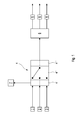
- schematically shows a schematic diagram of a sensor group with an assigned processor circuit, and
- fig. 2
- schematically shows exemplary processing of sensor signals by the sensor-side processor circuit.
- According to
fig. 1 , a power plant (not illustrated in any more detail) may have redundant sensors 1 to 3 which can be used to detect a predefined parameter. For example, the sensors 1 to 3 might detect noise of a combustion chamber arrangement of a gas turbine installation or noise of a steam turbine installation or the like. According to the invention, the redundant sensors 1 to 3 are assigned a sensor-side processor circuit 4, the operation of which is explained further below. Thisprocessor circuit 4 forwards the sensor signals, after predefinable conditioning, to a central processor arrangement 5 of a control system of the power plant. The central processor arrangement 5 then generates, in a fundamentally known manner, signals fordrivers 6 which in turn control operation control elements, for example for supplying fuel. - This sensor-
side processor circuit 4 has at least one input-side processor unit 4' which receives the signals from the sensors 1 to 3 and checks said signals for the absence of errors. This check can be carried out, for example, by evaluating the noise spectrum of the sensors. In principle, however, any desired type of error checking is possible. If the signals from all sensors 1 to 3 are error-free, one of the sensors 1 to 3 is selected to forward the respective sensor signals according to a basically arbitrary stipulation in afurther processor unit 4" which functionally operates in the manner of a switch. - If the processor unit determines that one of the sensors 1 to 3 is operating in a defective manner, the
processor unit 4" selects one of the sensors operating in an error-free manner to forward the respective sensor signals. In any case, the sensor operating in a defective manner is excluded from forwarding its signals. - The sensor signals respectively forwarded by the
processor unit 4" can still be "conditioned" in adownstream processor unit 4"'. This is expedient, for example, when the central processor arrangement 5 is not suitable for directly processing the respective sensor signals because it can process only signals derived from the sensor signals by means of transformation, for example. - This is explained below using
fig. 2 . Without restricting generality, the sensors 1 to 3 may detect noise. In the case of error-free operation, each sensor 1 to 3 then generates an output signal A on the basis of the time t according to image A infigure 2 . In this case, A may represent the amplitude of the movement of a diaphragm which vibrates analogously to the sound vibrations of the noise to be detected. - It is now assumed, by way of example, that the central processor arrangement 5 is not intended to directly process the output signals A at all. Rather, the central processor arrangement 5 may be designed to process the spectrum of the sound vibrations in order to determine its output signals. This spectrum is illustrated, by way of example, in image B in
fig. 2 , the intensity I of the sound vibrations being depicted on the basis of the frequency f. - If the central processor arrangement 5 now requires signals according to image B in
fig. 2 , the processor unit 4'" of the sensor-side processor circuit 4 can carry out a spectral analysis and, in this manner, can transform the signals according to image A into signals according to image B infig. 2 . In the present example, the processor unit 4'" is thus used to transform the signals from a sensor 1 to 3 operating in an error-free manner into signals suitable for the work of the central processor arrangement. The processor unit 4'" therefore has an interface function such that signals which are intended for the central processor arrangement 5 and can be processed by the processor arrangement only in transformed form are accordingly transformed. - In this manner, the central processor arrangement can be "relieved" or designed exclusively for carrying out "core activities". This simultaneously provides the advantage that, in the case of a design change of the sensors and an associated change in the structure of the sensor signals, it is only necessary to ensure an accordingly adapted sensor-
side processor circuit 4; in contrast, the central processor arrangement 5 may remain completely unchanged. This is simultaneously associated with the advantage that the central processor arrangement 5 can have a comparatively simple design because the type of operations to be carried out remains unchanged even if the sensor system is changed. Another possibility for signal transformation is explained using images A and C infigure 2 : - In this example, the sensors 1 to 3 may detect vibrations, the output signal A then being able to represent the amplitude of the detected vibrations. It is now assumed that only the frequency distribution of the different amplitudes is essential for the work of the central processor arrangement 5. In such a case, the processor unit 4'" can transform the sensor signals illustrated in image A into a representation according to image C which represents the frequency distribution H of the different amplitudes A.
- In summary, the invention can be characterized to the effect that a group of redundant sensors 1 to 3 is assigned a sensor-
side processor circuit 4 which, on the one hand, checks the sensors for error-free operation and respectively selects one of the redundant sensors operating in an error-free manner to forward its sensor signals. In this solution according to the invention, there is thus always one sensor which provides the signals for the central processor arrangement 5. The redundancy of the sensors is thus increased in order to achieve a higher degree of reliability and availability in a single-channel protection system. - On the other hand, the sensor-
side processor circuit 4 is used to transform the sensor signals to be forwarded in a manner optimum for the work of the central processor arrangement 5, with the result that the central processor arrangement only needs to perform "core functions". The sensor-side processor circuit 4 therefore undertakes preliminary work for the central processor arrangement, with the result that the latter is considerably relieved and ultimately can have a higher degree of reliability. - Since the sensor-
side processor circuit 4 suppresses all signals from sensors operating in a defective manner, the possibility of replacing sensors during installation operation is enabled at the same time. In this context, provision is advantageously made for the sensor-side processor circuit 4 to control adisplay 7 for indicating the sensor to be replaced. Inspection work to be carried out can also be displayed, if necessary, on thisdisplay 7. In principle, thedisplay 7 can also be previously controlled by the central processor arrangement 5 if the respective sensor-side processor circuit 4 forwards corresponding information to the central processor arrangement 5, but control of thedisplay 7 by the sensor-side processor circuit 4 is advantageous because thecircuit 4 must detect the defective sensors anyway. -
- 1
- Sensor
- 2
- Sensor
- 3
- Sensor
- 4
- Sensor-side processor circuit
- 5
- Central processor arrangement
- 6
- Driver
- 7
- Display
- A
- Amplitude
- f
- Frequency
- H
- Frequency
- l
- Intensity
Claims (3)
- A control system for steam and gas turbines and/or power plants, having a sensor system which is intended to monitor predefined operating parameters and has redundant sensors (1 to 3), the measurement data from the sensor system being able to be supplied to an input side of a central processor arrangement (5) of the control system, which in turn communicates, on the output side, with operation control elements of the turbines or power plants or the like,
characterized in that
at least the redundant sensors (1 to 3) of the sensor system are assigned a sensor-side processor circuit (4) which continuously checks the associated sensors (1 to 3) for error-free operation and protects or blocks the input side of the central processor arrangement (5) from erroneous signals, and the sensor-side processor circuit (4) only respectively forwards or further processes the signals from a sensor which has been identified as error-free in one channel. - The control system as claimed in claim 1,
characterized in that
the sensor-side processor circuit (4) transforms the signals from a sensor operating in an error-free manner according to a predefined requirement profile of the central processor arrangement. - The control system as claimed in either of claims 1 and 2,
characterized in that
the sensor-side processor circuit (4) controls a display (7) for reporting defective sensors.
Applications Claiming Priority (1)
| Application Number | Priority Date | Filing Date | Title |
|---|---|---|---|
| CH2152012 | 2012-02-20 |
Publications (2)
| Publication Number | Publication Date |
|---|---|
| EP2628906A1 true EP2628906A1 (en) | 2013-08-21 |
| EP2628906B1 EP2628906B1 (en) | 2019-05-01 |
Family
ID=47710058
Family Applications (1)
| Application Number | Title | Priority Date | Filing Date |
|---|---|---|---|
| EP13155815.7A Active EP2628906B1 (en) | 2012-02-20 | 2013-02-19 | Control method for a gas turbine |
Country Status (7)
| Country | Link |
|---|---|
| US (1) | US9376964B2 (en) |
| EP (1) | EP2628906B1 (en) |
| JP (1) | JP6099427B2 (en) |
| KR (1) | KR101554474B1 (en) |
| CN (1) | CN103257599A (en) |
| CA (1) | CA2805286C (en) |
| RU (1) | RU2543102C2 (en) |
Cited By (1)
| Publication number | Priority date | Publication date | Assignee | Title |
|---|---|---|---|---|
| WO2015058858A1 (en) * | 2013-10-24 | 2015-04-30 | IfTA Ingenieurbüro für Thermoakustik GmbH | Display device, method and controller for analysing an oscillation behaviour of a firing system |
Families Citing this family (2)
| Publication number | Priority date | Publication date | Assignee | Title |
|---|---|---|---|---|
| CN103629692B (en) * | 2013-11-26 | 2016-03-16 | 浙江工商大学 | The decentralized control method of boiler-burner |
| CN104712435B (en) * | 2013-12-12 | 2017-06-23 | 中航商用航空发动机有限责任公司 | Engine electronic control |
Citations (6)
| Publication number | Priority date | Publication date | Assignee | Title |
|---|---|---|---|---|
| EP0677830A1 (en) * | 1994-04-13 | 1995-10-18 | K.A. SCHMERSAL GmbH & Co. | Monitoring apparatus |
| US20030061008A1 (en) * | 2001-09-10 | 2003-03-27 | Smith George A. | Techniques for distributed machinery monitoring |
| WO2004005938A1 (en) | 2002-07-04 | 2004-01-15 | Siemens Aktiengesellschaft | Device for determining the rotational speed of a rotating machine part using redundant sensors and evaluation circuits |
| WO2007021425A1 (en) * | 2005-08-17 | 2007-02-22 | Xtek, Inc. | Data acquisition system for system monitoring |
| US20070214797A1 (en) * | 2006-03-17 | 2007-09-20 | Siemens Power Generation, Inc. | Combustion dynamics monitoring |
| EP2149832A2 (en) * | 2008-07-28 | 2010-02-03 | General Electric Company | Method and systems for monitoring gas turbine engine temperature |
Family Cites Families (8)
| Publication number | Priority date | Publication date | Assignee | Title |
|---|---|---|---|---|
| SU1059709A1 (en) * | 1981-12-23 | 1983-12-07 | Харьковский Ордена Ленина Авиационный Институт Им.Н.Е.Жуковского | Multiple channel control device |
| SU1325485A1 (en) * | 1986-01-20 | 1987-07-23 | Научно-Производственное Объединение "Импульс" Им.Хху Съезда Кпсс | Device for majority selection of signals |
| JPH1182908A (en) * | 1997-09-16 | 1999-03-26 | Mitsubishi Heavy Ind Ltd | Method for automatically controlling process based on multiplexed detection signal |
| US6217288B1 (en) * | 1998-01-20 | 2001-04-17 | Compressor Controls Corporation | Method and apparatus for limiting a critical variable of a group of compressors or an individual compressor |
| RU2126903C1 (en) * | 1998-06-09 | 1999-02-27 | Открытое акционерное общество Научно-производственное предприятие "Электронно-гидравлическая автоматика" | Pickup failure detection and object condition checking method |
| JP2001290519A (en) * | 2000-04-10 | 2001-10-19 | Hitachi Ltd | Sequence controller |
| US7389204B2 (en) * | 2001-03-01 | 2008-06-17 | Fisher-Rosemount Systems, Inc. | Data presentation system for abnormal situation prevention in a process plant |
| DE10392864D2 (en) * | 2002-07-04 | 2005-04-07 | Siemens Ag | Device for determining the rotational speed of a rotating machine part |
-
2013
- 2013-02-06 CA CA2805286A patent/CA2805286C/en not_active Expired - Fee Related
- 2013-02-19 JP JP2013029629A patent/JP6099427B2/en not_active Expired - Fee Related
- 2013-02-19 RU RU2013107360/06A patent/RU2543102C2/en active
- 2013-02-19 US US13/769,966 patent/US9376964B2/en not_active Expired - Fee Related
- 2013-02-19 EP EP13155815.7A patent/EP2628906B1/en active Active
- 2013-02-20 KR KR1020130018272A patent/KR101554474B1/en not_active Expired - Fee Related
- 2013-02-20 CN CN2013100540344A patent/CN103257599A/en active Pending
Patent Citations (6)
| Publication number | Priority date | Publication date | Assignee | Title |
|---|---|---|---|---|
| EP0677830A1 (en) * | 1994-04-13 | 1995-10-18 | K.A. SCHMERSAL GmbH & Co. | Monitoring apparatus |
| US20030061008A1 (en) * | 2001-09-10 | 2003-03-27 | Smith George A. | Techniques for distributed machinery monitoring |
| WO2004005938A1 (en) | 2002-07-04 | 2004-01-15 | Siemens Aktiengesellschaft | Device for determining the rotational speed of a rotating machine part using redundant sensors and evaluation circuits |
| WO2007021425A1 (en) * | 2005-08-17 | 2007-02-22 | Xtek, Inc. | Data acquisition system for system monitoring |
| US20070214797A1 (en) * | 2006-03-17 | 2007-09-20 | Siemens Power Generation, Inc. | Combustion dynamics monitoring |
| EP2149832A2 (en) * | 2008-07-28 | 2010-02-03 | General Electric Company | Method and systems for monitoring gas turbine engine temperature |
Cited By (1)
| Publication number | Priority date | Publication date | Assignee | Title |
|---|---|---|---|---|
| WO2015058858A1 (en) * | 2013-10-24 | 2015-04-30 | IfTA Ingenieurbüro für Thermoakustik GmbH | Display device, method and controller for analysing an oscillation behaviour of a firing system |
Also Published As
| Publication number | Publication date |
|---|---|
| CN103257599A (en) | 2013-08-21 |
| EP2628906B1 (en) | 2019-05-01 |
| KR101554474B1 (en) | 2015-09-21 |
| JP6099427B2 (en) | 2017-03-22 |
| JP2013171586A (en) | 2013-09-02 |
| RU2013107360A (en) | 2014-08-27 |
| CA2805286C (en) | 2016-04-05 |
| US9376964B2 (en) | 2016-06-28 |
| KR20130095690A (en) | 2013-08-28 |
| RU2543102C2 (en) | 2015-02-27 |
| CA2805286A1 (en) | 2013-08-20 |
| US20130212999A1 (en) | 2013-08-22 |
Similar Documents
| Publication | Publication Date | Title |
|---|---|---|
| US20120263309A1 (en) | Loudspeaker Control Apparatus and Method for Inspecting Loudspeaker | |
| KR101635947B1 (en) | System and method of surveillance of preload of ball screw | |
| US20120086474A1 (en) | Field Device for Process Automation | |
| EP2628906B1 (en) | Control method for a gas turbine | |
| JP7528035B2 (en) | Vibration monitoring device for machinery and equipment | |
| JP5371674B2 (en) | Test equipment | |
| CN114846420A (en) | Method and system for synchronizing signals | |
| JP6247247B2 (en) | Control system | |
| KR20150008516A (en) | System and method for measuring and diagnosing signal | |
| ATE524014T1 (en) | DIAGNOSTIC DEVICE FOR COMMUNICATION LINES AND DETECTION METHOD FOR SYNCHRONIZED/CORRELATED ANOMALIES | |
| JP2005265454A (en) | Fault diagnosis device for vehicles | |
| US7576643B2 (en) | Sensor for measuring physical variables and for passing on the measured variable, circuit having such a sensor and method for operating the sensor and the circuit | |
| KR102210068B1 (en) | Inspection and distributing device for encoder signal | |
| US9383385B2 (en) | System and method for speed sensor position detection in a multiple channel control system | |
| JP7369028B2 (en) | Communication circuit and unit with noise environment diagnosis function | |
| US11378934B2 (en) | Shadow function for protection monitoring systems | |
| JP2021012032A (en) | Abnormality diagnosis device and robot controller | |
| KR102645635B1 (en) | Apparatus for vibration analysis | |
| JP2014232462A (en) | Control system | |
| KR20150074353A (en) | Error detection device for protection system of nuclear power plants | |
| JP6230889B2 (en) | Laser processing apparatus and laser processing method | |
| KR101292456B1 (en) | Methods of sunroof fault detection and appararuses for using the same | |
| JP2013003717A (en) | Plant monitoring and control device | |
| JP2005321946A (en) | Monitoring device | |
| JP2009121909A (en) | Inspection method for parts |
Legal Events
| Date | Code | Title | Description |
|---|---|---|---|
| PUAI | Public reference made under article 153(3) epc to a published international application that has entered the european phase |
Free format text: ORIGINAL CODE: 0009012 |
|
| AK | Designated contracting states |
Kind code of ref document: A1 Designated state(s): AL AT BE BG CH CY CZ DE DK EE ES FI FR GB GR HR HU IE IS IT LI LT LU LV MC MK MT NL NO PL PT RO RS SE SI SK SM TR |
|
| AX | Request for extension of the european patent |
Extension state: BA ME |
|
| 17P | Request for examination filed |
Effective date: 20131024 |
|
| RBV | Designated contracting states (corrected) |
Designated state(s): AL AT BE BG CH CY CZ DE DK EE ES FI FR GB GR HR HU IE IS IT LI LT LU LV MC MK MT NL NO PL PT RO RS SE SI SK SM TR |
|
| RAP1 | Party data changed (applicant data changed or rights of an application transferred) |
Owner name: GENERAL ELECTRIC TECHNOLOGY GMBH |
|
| RAP1 | Party data changed (applicant data changed or rights of an application transferred) |
Owner name: ANSALDO ENERGIA IP UK LIMITED |
|
| GRAP | Despatch of communication of intention to grant a patent |
Free format text: ORIGINAL CODE: EPIDOSNIGR1 |
|
| STAA | Information on the status of an ep patent application or granted ep patent |
Free format text: STATUS: GRANT OF PATENT IS INTENDED |
|
| INTG | Intention to grant announced |
Effective date: 20181122 |
|
| GRAS | Grant fee paid |
Free format text: ORIGINAL CODE: EPIDOSNIGR3 |
|
| GRAA | (expected) grant |
Free format text: ORIGINAL CODE: 0009210 |
|
| STAA | Information on the status of an ep patent application or granted ep patent |
Free format text: STATUS: THE PATENT HAS BEEN GRANTED |
|
| AK | Designated contracting states |
Kind code of ref document: B1 Designated state(s): AL AT BE BG CH CY CZ DE DK EE ES FI FR GB GR HR HU IE IS IT LI LT LU LV MC MK MT NL NO PL PT RO RS SE SI SK SM TR |
|
| REG | Reference to a national code |
Ref country code: GB Ref legal event code: FG4D |
|
| REG | Reference to a national code |
Ref country code: CH Ref legal event code: EP Ref country code: AT Ref legal event code: REF Ref document number: 1127172 Country of ref document: AT Kind code of ref document: T Effective date: 20190515 |
|
| REG | Reference to a national code |
Ref country code: DE Ref legal event code: R096 Ref document number: 602013054525 Country of ref document: DE |
|
| REG | Reference to a national code |
Ref country code: IE Ref legal event code: FG4D |
|
| REG | Reference to a national code |
Ref country code: NL Ref legal event code: MP Effective date: 20190501 |
|
| REG | Reference to a national code |
Ref country code: LT Ref legal event code: MG4D |
|
| PG25 | Lapsed in a contracting state [announced via postgrant information from national office to epo] |
Ref country code: FI Free format text: LAPSE BECAUSE OF FAILURE TO SUBMIT A TRANSLATION OF THE DESCRIPTION OR TO PAY THE FEE WITHIN THE PRESCRIBED TIME-LIMIT Effective date: 20190501 Ref country code: LT Free format text: LAPSE BECAUSE OF FAILURE TO SUBMIT A TRANSLATION OF THE DESCRIPTION OR TO PAY THE FEE WITHIN THE PRESCRIBED TIME-LIMIT Effective date: 20190501 Ref country code: NL Free format text: LAPSE BECAUSE OF FAILURE TO SUBMIT A TRANSLATION OF THE DESCRIPTION OR TO PAY THE FEE WITHIN THE PRESCRIBED TIME-LIMIT Effective date: 20190501 Ref country code: ES Free format text: LAPSE BECAUSE OF FAILURE TO SUBMIT A TRANSLATION OF THE DESCRIPTION OR TO PAY THE FEE WITHIN THE PRESCRIBED TIME-LIMIT Effective date: 20190501 Ref country code: HR Free format text: LAPSE BECAUSE OF FAILURE TO SUBMIT A TRANSLATION OF THE DESCRIPTION OR TO PAY THE FEE WITHIN THE PRESCRIBED TIME-LIMIT Effective date: 20190501 Ref country code: AL Free format text: LAPSE BECAUSE OF FAILURE TO SUBMIT A TRANSLATION OF THE DESCRIPTION OR TO PAY THE FEE WITHIN THE PRESCRIBED TIME-LIMIT Effective date: 20190501 Ref country code: SE Free format text: LAPSE BECAUSE OF FAILURE TO SUBMIT A TRANSLATION OF THE DESCRIPTION OR TO PAY THE FEE WITHIN THE PRESCRIBED TIME-LIMIT Effective date: 20190501 Ref country code: PT Free format text: LAPSE BECAUSE OF FAILURE TO SUBMIT A TRANSLATION OF THE DESCRIPTION OR TO PAY THE FEE WITHIN THE PRESCRIBED TIME-LIMIT Effective date: 20190901 Ref country code: NO Free format text: LAPSE BECAUSE OF FAILURE TO SUBMIT A TRANSLATION OF THE DESCRIPTION OR TO PAY THE FEE WITHIN THE PRESCRIBED TIME-LIMIT Effective date: 20190801 |
|
| PG25 | Lapsed in a contracting state [announced via postgrant information from national office to epo] |
Ref country code: GR Free format text: LAPSE BECAUSE OF FAILURE TO SUBMIT A TRANSLATION OF THE DESCRIPTION OR TO PAY THE FEE WITHIN THE PRESCRIBED TIME-LIMIT Effective date: 20190802 Ref country code: LV Free format text: LAPSE BECAUSE OF FAILURE TO SUBMIT A TRANSLATION OF THE DESCRIPTION OR TO PAY THE FEE WITHIN THE PRESCRIBED TIME-LIMIT Effective date: 20190501 Ref country code: RS Free format text: LAPSE BECAUSE OF FAILURE TO SUBMIT A TRANSLATION OF THE DESCRIPTION OR TO PAY THE FEE WITHIN THE PRESCRIBED TIME-LIMIT Effective date: 20190501 Ref country code: BG Free format text: LAPSE BECAUSE OF FAILURE TO SUBMIT A TRANSLATION OF THE DESCRIPTION OR TO PAY THE FEE WITHIN THE PRESCRIBED TIME-LIMIT Effective date: 20190801 |
|
| REG | Reference to a national code |
Ref country code: AT Ref legal event code: MK05 Ref document number: 1127172 Country of ref document: AT Kind code of ref document: T Effective date: 20190501 |
|
| PG25 | Lapsed in a contracting state [announced via postgrant information from national office to epo] |
Ref country code: IS Free format text: LAPSE BECAUSE OF FAILURE TO SUBMIT A TRANSLATION OF THE DESCRIPTION OR TO PAY THE FEE WITHIN THE PRESCRIBED TIME-LIMIT Effective date: 20190901 |
|
| PG25 | Lapsed in a contracting state [announced via postgrant information from national office to epo] |
Ref country code: RO Free format text: LAPSE BECAUSE OF FAILURE TO SUBMIT A TRANSLATION OF THE DESCRIPTION OR TO PAY THE FEE WITHIN THE PRESCRIBED TIME-LIMIT Effective date: 20190501 Ref country code: SK Free format text: LAPSE BECAUSE OF FAILURE TO SUBMIT A TRANSLATION OF THE DESCRIPTION OR TO PAY THE FEE WITHIN THE PRESCRIBED TIME-LIMIT Effective date: 20190501 Ref country code: CZ Free format text: LAPSE BECAUSE OF FAILURE TO SUBMIT A TRANSLATION OF THE DESCRIPTION OR TO PAY THE FEE WITHIN THE PRESCRIBED TIME-LIMIT Effective date: 20190501 Ref country code: AT Free format text: LAPSE BECAUSE OF FAILURE TO SUBMIT A TRANSLATION OF THE DESCRIPTION OR TO PAY THE FEE WITHIN THE PRESCRIBED TIME-LIMIT Effective date: 20190501 Ref country code: DK Free format text: LAPSE BECAUSE OF FAILURE TO SUBMIT A TRANSLATION OF THE DESCRIPTION OR TO PAY THE FEE WITHIN THE PRESCRIBED TIME-LIMIT Effective date: 20190501 Ref country code: EE Free format text: LAPSE BECAUSE OF FAILURE TO SUBMIT A TRANSLATION OF THE DESCRIPTION OR TO PAY THE FEE WITHIN THE PRESCRIBED TIME-LIMIT Effective date: 20190501 |
|
| REG | Reference to a national code |
Ref country code: DE Ref legal event code: R097 Ref document number: 602013054525 Country of ref document: DE |
|
| PG25 | Lapsed in a contracting state [announced via postgrant information from national office to epo] |
Ref country code: IT Free format text: LAPSE BECAUSE OF FAILURE TO SUBMIT A TRANSLATION OF THE DESCRIPTION OR TO PAY THE FEE WITHIN THE PRESCRIBED TIME-LIMIT Effective date: 20190501 Ref country code: SM Free format text: LAPSE BECAUSE OF FAILURE TO SUBMIT A TRANSLATION OF THE DESCRIPTION OR TO PAY THE FEE WITHIN THE PRESCRIBED TIME-LIMIT Effective date: 20190501 |
|
| PLBE | No opposition filed within time limit |
Free format text: ORIGINAL CODE: 0009261 |
|
| STAA | Information on the status of an ep patent application or granted ep patent |
Free format text: STATUS: NO OPPOSITION FILED WITHIN TIME LIMIT |
|
| PG25 | Lapsed in a contracting state [announced via postgrant information from national office to epo] |
Ref country code: TR Free format text: LAPSE BECAUSE OF FAILURE TO SUBMIT A TRANSLATION OF THE DESCRIPTION OR TO PAY THE FEE WITHIN THE PRESCRIBED TIME-LIMIT Effective date: 20190501 |
|
| 26N | No opposition filed |
Effective date: 20200204 |
|
| PG25 | Lapsed in a contracting state [announced via postgrant information from national office to epo] |
Ref country code: PL Free format text: LAPSE BECAUSE OF FAILURE TO SUBMIT A TRANSLATION OF THE DESCRIPTION OR TO PAY THE FEE WITHIN THE PRESCRIBED TIME-LIMIT Effective date: 20190501 |
|
| PG25 | Lapsed in a contracting state [announced via postgrant information from national office to epo] |
Ref country code: SI Free format text: LAPSE BECAUSE OF FAILURE TO SUBMIT A TRANSLATION OF THE DESCRIPTION OR TO PAY THE FEE WITHIN THE PRESCRIBED TIME-LIMIT Effective date: 20190501 |
|
| REG | Reference to a national code |
Ref country code: CH Ref legal event code: PL |
|
| REG | Reference to a national code |
Ref country code: BE Ref legal event code: MM Effective date: 20200229 |
|
| PG25 | Lapsed in a contracting state [announced via postgrant information from national office to epo] |
Ref country code: LU Free format text: LAPSE BECAUSE OF NON-PAYMENT OF DUE FEES Effective date: 20200219 Ref country code: MC Free format text: LAPSE BECAUSE OF FAILURE TO SUBMIT A TRANSLATION OF THE DESCRIPTION OR TO PAY THE FEE WITHIN THE PRESCRIBED TIME-LIMIT Effective date: 20190501 |
|
| PG25 | Lapsed in a contracting state [announced via postgrant information from national office to epo] |
Ref country code: LI Free format text: LAPSE BECAUSE OF NON-PAYMENT OF DUE FEES Effective date: 20200229 Ref country code: CH Free format text: LAPSE BECAUSE OF NON-PAYMENT OF DUE FEES Effective date: 20200229 |
|
| PG25 | Lapsed in a contracting state [announced via postgrant information from national office to epo] |
Ref country code: FR Free format text: LAPSE BECAUSE OF NON-PAYMENT OF DUE FEES Effective date: 20200229 Ref country code: IE Free format text: LAPSE BECAUSE OF NON-PAYMENT OF DUE FEES Effective date: 20200219 |
|
| PG25 | Lapsed in a contracting state [announced via postgrant information from national office to epo] |
Ref country code: BE Free format text: LAPSE BECAUSE OF NON-PAYMENT OF DUE FEES Effective date: 20200229 |
|
| PG25 | Lapsed in a contracting state [announced via postgrant information from national office to epo] |
Ref country code: MT Free format text: LAPSE BECAUSE OF FAILURE TO SUBMIT A TRANSLATION OF THE DESCRIPTION OR TO PAY THE FEE WITHIN THE PRESCRIBED TIME-LIMIT Effective date: 20190501 Ref country code: CY Free format text: LAPSE BECAUSE OF FAILURE TO SUBMIT A TRANSLATION OF THE DESCRIPTION OR TO PAY THE FEE WITHIN THE PRESCRIBED TIME-LIMIT Effective date: 20190501 |
|
| PG25 | Lapsed in a contracting state [announced via postgrant information from national office to epo] |
Ref country code: MK Free format text: LAPSE BECAUSE OF FAILURE TO SUBMIT A TRANSLATION OF THE DESCRIPTION OR TO PAY THE FEE WITHIN THE PRESCRIBED TIME-LIMIT Effective date: 20190501 |
|
| P01 | Opt-out of the competence of the unified patent court (upc) registered |
Effective date: 20240430 |
|
| PGFP | Annual fee paid to national office [announced via postgrant information from national office to epo] |
Ref country code: GB Payment date: 20260219 Year of fee payment: 14 |
|
| PGFP | Annual fee paid to national office [announced via postgrant information from national office to epo] |
Ref country code: DE Payment date: 20260217 Year of fee payment: 14 |