EP2619569B1 - Wetting of a plastic bed support for a chromatography column - Google Patents
Wetting of a plastic bed support for a chromatography column Download PDFInfo
- Publication number
- EP2619569B1 EP2619569B1 EP11827057.8A EP11827057A EP2619569B1 EP 2619569 B1 EP2619569 B1 EP 2619569B1 EP 11827057 A EP11827057 A EP 11827057A EP 2619569 B1 EP2619569 B1 EP 2619569B1
- Authority
- EP
- European Patent Office
- Prior art keywords
- bed support
- column
- plastic bed
- propanol
- plastic
- Prior art date
- Legal status (The legal status is an assumption and is not a legal conclusion. Google has not performed a legal analysis and makes no representation as to the accuracy of the status listed.)
- Active
Links
Images


Classifications
-
- B—PERFORMING OPERATIONS; TRANSPORTING
- B01—PHYSICAL OR CHEMICAL PROCESSES OR APPARATUS IN GENERAL
- B01D—SEPARATION
- B01D15/00—Separating processes involving the treatment of liquids with solid sorbents; Apparatus therefor
- B01D15/08—Selective adsorption, e.g. chromatography
- B01D15/10—Selective adsorption, e.g. chromatography characterised by constructional or operational features
-
- G—PHYSICS
- G01—MEASURING; TESTING
- G01N—INVESTIGATING OR ANALYSING MATERIALS BY DETERMINING THEIR CHEMICAL OR PHYSICAL PROPERTIES
- G01N30/00—Investigating or analysing materials by separation into components using adsorption, absorption or similar phenomena or using ion-exchange, e.g. chromatography or field flow fractionation
- G01N30/02—Column chromatography
- G01N30/50—Conditioning of the sorbent material or stationary liquid
- G01N30/52—Physical parameters
-
- G—PHYSICS
- G01—MEASURING; TESTING
- G01N—INVESTIGATING OR ANALYSING MATERIALS BY DETERMINING THEIR CHEMICAL OR PHYSICAL PROPERTIES
- G01N30/00—Investigating or analysing materials by separation into components using adsorption, absorption or similar phenomena or using ion-exchange, e.g. chromatography or field flow fractionation
- G01N30/02—Column chromatography
- G01N30/50—Conditioning of the sorbent material or stationary liquid
- G01N30/56—Packing methods or coating methods
-
- G—PHYSICS
- G01—MEASURING; TESTING
- G01N—INVESTIGATING OR ANALYSING MATERIALS BY DETERMINING THEIR CHEMICAL OR PHYSICAL PROPERTIES
- G01N30/00—Investigating or analysing materials by separation into components using adsorption, absorption or similar phenomena or using ion-exchange, e.g. chromatography or field flow fractionation
- G01N30/02—Column chromatography
- G01N30/50—Conditioning of the sorbent material or stationary liquid
- G01N30/52—Physical parameters
- G01N2030/524—Physical parameters structural properties
- G01N2030/525—Physical parameters structural properties surface properties, e.g. porosity
-
- G—PHYSICS
- G01—MEASURING; TESTING
- G01N—INVESTIGATING OR ANALYSING MATERIALS BY DETERMINING THEIR CHEMICAL OR PHYSICAL PROPERTIES
- G01N30/00—Investigating or analysing materials by separation into components using adsorption, absorption or similar phenomena or using ion-exchange, e.g. chromatography or field flow fractionation
- G01N30/02—Column chromatography
- G01N30/50—Conditioning of the sorbent material or stationary liquid
- G01N30/56—Packing methods or coating methods
- G01N2030/567—Packing methods or coating methods coating
Definitions
- the present invention relates generally to separation and specifically to process chromatography. More particularly it relates to wetting of bed supports for chromatography columns.
- Chromatography columns may be used in industrial processes to purify process liquids and separate substances of interest from process liquids.
- One important application is in bioprocessing, where proteins and other biopharmaceuticals are purified from complex biological feedstocks.
- Typical chromatography columns comprise a column wall in the form of hollow column tube which is connected to a removable upper end plate assembly and a removable lower end plate assembly.
- One end plate assembly is provided with a process fluid inlet arrangement, typically comprising an inlet pipe and an inlet valve and the other end plate assembly is provided with a process fluid outlet arrangement, typically comprising an outlet pipe and an outlet valve.
- Each end of the column tube is usually provided with a removable distributor plate in the interior of the column.
- inlet and outlet distributor plates may be attached to the respective end plate assembly or the upper distributor plate may be arranged to be movable towards or away from the end plate assembly.
- the space in the column between the distributor plates is usually filled with a chromatography medium.
- a porous bed support is normally provided between each distribution system and the media in order to prevent media particles from escaping the column.
- the inlet distributor plate is intended to distribute incoming fluid evenly over the surface of the media at the inlet end of the column while the outlet distributor plate is intended to collect fluid evenly from the surface of the media at the outlet end of the column.
- Such a column may weigh several tons.
- the porous bed supports extend across substantially the whole internal diameter of the column and are normally fixed along the outer perimeter of the column and at the center of the column.
- the supports can be prepared from woven threads of either metals or polymers or they can be made from sintered particles. They can also be multilayer constructions of e.g. several woven meshes joined by sintering.
- corrosive liquids such as solutions with high concentrations of chlorides, acidic buffers, hypochlorite etc and in these cases it is often preferred to use plastic bed supports to eliminate corrosion of stainless steels etc.
- a commonly used type of plastic bed support comprises porous frits prepared from sintered polymer particles. These frits are available in several materials, such as polyethylene, polypropylene etc from companies like Porvair PLC (UK) and Porex Corp (US).
- solvents are flammable and may only be handled in explosion classified locations where all electrical equipment is explosion proof. Since solvents are not normally handled in most bioprocessing facilities this involves substantial extra costs. Solvents may also attack materials in bioprocessing columns designed primarily for use with aqueous systems.
- An issue with surfactants is that they cause foaming and that they adsorb strongly to the pore surfaces, causing potential slow desorption and resulting leakage of surfactant traces into the biopharmaceutical product.
- surfactants are non-desirable contaminants in parenteral pharmaceuticals, as they are irritants and disrupt cell membranes.
- One aspect of the present invention is to provide efficient chromatography in a column equipped with a plastic bed support, where the bed support is free from air. This is achieved with a wetting method as defined in claim 1 and with a chromatography method as defined in claim 10.
- One advantage with such a method is that no surfactants or flammable solutions have to be used.
- non-surfactant wetting agent means herein a wetting agent for the plastic bed support, which is not a surfactant.
- a surfactant (as defined e.g. in Kirk-Othmer Encyclopedia of Chemical Technology vol. 24, http://onlinelibrary.wiley.com/doi/10.1002/0471238961.1921180612251414.a01.pub2/abstract ) is a species comprising a C8-C18 hydrocarbon or fluorocarbon chain and a hydrophilic group (polar or ionic). Hence, a surfactant has a molecular weight above 130 D.
- a wetting agent is an additive that increases the spreading and penetrating power of an aqueous liquid on a solid substrate. Examples of non-surfactant wetting agents are water soluble solvents and alkali metal hydroxides.
- flash point means herein the lowest temperature at which a volatile liquid can vaporize to form an ignitable mixture in air.
- the flash point can be measured e.g. by the ASTM D3828 or ASTM D93 closed-cup methods and is an indication of the flammability of the liquid.
- water soluble herein means that a substance is soluble in water at room temperature, i.e. about 25°C, to a concentration of at least 2 wt. %.
- water miscible herein means that a substance is soluble in water at room temperature, i.e. about 25°C, over the entire 0-100 % concentration range.
- One aspect of the present invention relates to providing efficient air removal from a plastic bed support without using surfactants or flammable solutions. This is achieved with a method where a porous plastic bed support having air in the pore structure is provided, the plastic bed support is soaked in an aqueous solution comprising 12-21wt % of n-propanol as a non-surfactant wetting agent, resulting in the removal of at least about 60% of the air from the pore structure. The method can also result in the removal of at least about 80%, such as at least about 90% of the air or substantially all air from the pore structure. It is to be understood that the air in the pore structure may comprise any gaseous materials e.g.
- the removal of the air can be checked e.g. by weighing the soaked bed support - complete air removal is indicated by a weight increase corresponding to the entire pore volume being filled.
- the pore volume is usually provided by the material supplier, but can also be measured either by porosimetric or densitometric methods known in the art.
- An alternative method to monitor the air removal can be by measuring the chromatographic performance of a column comprising the treated bed support - removal of substantially all air is here indicated by reaching the theoretically accessible plate number for the given packing material and column construction, as well as by a stable plate number when performing repeated packings of media in the column.
- the method also comprises a step of applying at least 10 kPa, such as at least 50 kPa or at least 100 kPa, overpressure to said plastic bed support when soaked in said aqueous solution and/or vibrating said plastic bed support when soaked in said aqueous solution.
- the vibration may be continuous or intermittent and may comprise vibrations of constant or varying frequencies.
- the application of overpressure can be done to a separate soaking vessel or to a chromatography column comprising the soaked plastic bed support.
- the overpressure can be applied as one or more pulses of with a release of pressure after each pulse.
- the pulse length can be up to several hours, such as at least one hour.
- the treatment may also comprise one or more pulses of reduced pressure, e.g. vacuum.
- the method further comprises a step of mounting the plastic bed support in a chromatography column.
- This step can be carried out after the soaking of the bed support in the non-surfactant wetting agent solution and the vibration or pressurizing.
- the bed support can be soaked and vibrated or pressurized in a separate soaking vessel or trough and afterwards mounted in the column.
- This method is particularly advantageous for smaller bed supports, e.g. of up to 300 mm diameter.
- the mounting step can also be carried out before the soaking and vibration or pressurizing, in which case the soaking and vibration or pressurizing will take place in the column.
- the soaking can in this case conveniently be done by partially or completely filling the column with an aqueous solution comprising a non-surfactant wetting agent.
- Such a method is particularly advantageous for larger bed supports, e.g. of at least 300 mm diameter.
- the method also comprises a step of washing the plastic bed support to remove the non-surfactant wetting agent.
- the washing can be done when the bed support is mounted in the column, e.g. by passing a washing fluid through the column, or alternatively by replacing the wetting agent solution in the soaking vessel or trough with washing fluid.
- the washing fluid can be an aqueous fluid, such as water or a buffer or salt solution.
- the step of vibrating the soaked bed support comprises applying ultrasound to the plastic bed support.
- the ultrasound can comprise vibrations in the 20-400 kHz frequency range and can be applied e.g. by immersing an ultrasound transducer in the non-surfactant wetting agent solution, by contacting an ultrasound transducer with the walls of the soaking vessel/trough/column or by using an ultrasound bath as the soaking vessel or trough.
- Ultrasound transducers and baths are well known in the art and are available from many suppliers.
- An advantage of applying ultrasound is that the penetration of the non-surfactant wetting agent solution into the pore structure of the plastic bed support is improved and the air is dispersed as small bubbles that can easily be removed from the bed support.
- the frequency and/or the amplitude of the ultrasound is tuned to provide optimal air removal from a particular combination of bed support and soaking vessel/trough.
- the step of vibrating the soaked bed support can also comprise applying vibrations of non-ultrasound frequencies (i.e. outside the 20-400 kHz range) to the plastic bed support.
- the vibration frequency can be below 20 kHz, such as e.g. in the 25-500 Hz interval where commercial equipment for vibration of e.g. concrete is readily available.
- Both internal "poker" vibrators and external vibrators mounted on the vessel/trough/column can be used.
- the non-surfactant wetting agent has a molecular weight of less than 130 D, such as less than 110 D or even less than 70 D. It can also have a molecular weight between 50 and 130 D, such as between 50 and 110 D.
- An advantage of having a low molecular weight is that it is easier to wash out the wetting agent, while it can be advantageous to avoid the lowest molecular weights in order to reduce volatility and flammability.
- water soluble C3-C6 alcohols examples include n-propanol, isopropanol, n-butanol, isobutanol, 2-butanol, tert-butanol, pentanols, hexanols and benzyl alcohol, of which n-propanol, n-butanol, n-pentanol, n-hexanol and benzyl alcohol are primary alcohols.
- N-propanol and isopropanol are completely water-miscible at room temperature.
- Examples of water soluble (and completely water-miscible) C3-C6 glycols include 1,2-propanediol, 1,2-butanediol, 1,2-pentanediol, 1,2-hexanediol, 1,3-propanediol, 1,4-butanediol, diethylene glycol etc.
- Examples of water soluble (and completely water-miscible) C3-C6 glycol ethers include ethylene glycol methyl ether, ethylene glycol ethyl ether, ethylene glycol propyl ether, ethylene glycol butyl ether, diethylene glycol methyl ether, diethylene glycol ethyl ether, propylene glycol methyl ether, propylene glycol ethyl ether etc.
- An advantage of using water soluble C3-C6 alcohols, glycols or glycol ethers is that they are better wetting agents than e.g. ethanol and can hence be used in lower concentrations. At equal concentration their aqueous solutions also have higher flame points than ethanol solutions.
- the aqueous non-surfactant wetting agent solution comprises 2-30 wt %, such as 10-25 %, 12-21 % or 12-17 % of one or more C3-C6 alcohols, glycols or glycol ethers.
- One advantage of not exceeding 30 % concentration of the alcohols, glycols or glycol ethers is that the flash point of the solution can be kept above the operating temperature. Another advantage is that at these concentrations the solution is less likely to attack sensitive materials in some bioprocess columns, e.g. acrylic column tubes and rubber gaskets.
- the solution can be homogeneous, i.e. the concentration of the aqueous non-surfactant wetting agent does not exceed its room temperature water solubility.
- the room temperature water solubility of the aqueous non-surfactant wetting agent can be at least 4 wt %, such as at least 12 wt % or it can be completely water-miscible.
- non-surfactant wetting agents are also considered. They can be mixtures of different alcohols, glycols and glycol ethers, as well as mixtures of one or more of these substances with one or more alkali metal hydroxides.
- the total concentration of non-surfactant wetting agents can be 0.1-30 wt %, such as 0.1-20 wt %, 0.1-17 wt % or 12-17 wt %.
- said aqueous solution in step b. has either no flash point or a (closed-cup) flash point of at least about 30 C, such as higher than about 35 C or about 40 C.
- a (closed-cup) flash point of at least about 30 C, such as higher than about 35 C or about 40 C.
- Isopropanol and particularly n-propanol are more efficient wetting agents than ethanol and can hence be used in lower concentrations, resulting in higher flash points. Due to their higher molecular weights and corresponding lower volatilities, water soluble C4-C6 alcohols, glycols and glycol ethers can generally be expected to have higher flash points in aqueous solution than the C2-C3 alcohols listed in the table.
- The_aqueous non-surfactant wetting agent solution comprises 12-21 wt %, such as 12-17 wt %, n-propanol.
- the plastic bed support has a diameter of at least 5 cm, such as at least 10 cm or at least 30 cm. Proper removal of air is particularly important for large-diameter process columns and flammability is also a more important issue for large diameter bed supports due to the larger exposed surface and the difficulty of working in ventilated fume hoods etc.
- the plastic bed support comprises a sintered porous plastic.
- Sintered porous plastics as obtainable from e.g. Porvair PLC (UK) and Porex Corp (US) have suitable pore structures and good mechanical properties for use as chromatography bed supports.
- the plastic support comprises a polyolefin, such as polyethylene (high or low density), polyopropylene or ethylene/propylene copolymers. It can also comprise other plastics such as polytetrafluoroethylene or polyethetherketone.
- the plastic bed support can comprise a woven or non-woven fibrous structure, optionally in a multilayer construction.
- the fibers can be prepared e.g. from polyolefins like polyethylene or polypropylene.
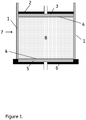
- a further aspect of the invention illustrated by Figs 1 and 4 relates to performing a chromatographic separation of a biomolecule on a column 7 equipped with at least one plastic bed support 4 from which air has been removed without using surfactants or flammable solutions.
- This is achieved by a method where a. a column 7 comprising a porous plastic bed support 4 having air in the pore structure is provided, b. the plastic bed support 4 is soaked in an aqueous solution comprising 0.1-30 wt %, such as 0.1-20 wt %, 0.1-17 wt % or 12-17 wt %, of a non-surfactant wetting agent, c.
- the column can comprise a column tube 1, an upper end plate 2, an upper distributor plate 3, a lower distributor 5 and a lower end plate 6.
- the biomolecule can be a nucleic acid, a vaccine or a protein, e.g. an immunoglobulin such as a monoclonal antibody.
- the liquid can be e.g. a clarified cell culture, blood plasma or an eluate or flow-through from a previous chromatography column.
- At least about 80%, such as at least about 90% or substantially all air is removed from the pore structure.
- the aqueous solution in step b has either no flash point or a flash point of at least 30 C, such as higher than 35 C.
- the aqueous solution in step b comprises 12-21 wt % n-propanol (e.g. 12-17 wt % n-propanol)
- the plastic bed support comprises a sintered porous plastic.
- the plastic bed support comprises_a polyolefin such as polyethylene.
- the plastic bed support has a diameter of at least 10 cm, such as at least 30 cm.
- PE frit disks 100 mm diameter sintered polyethylene (PE) frit disks (Porvair PLC Vyon® F HDPE, thickness 3.2 mm, pore size 20 microns, pore volume 36 %) were cut into approx. 8 pieces. Each piece was weighed dry and the dry weight was noted. A drop of each solution was first added to a piece to see the degree of absorption by the sinter. The PE frit pieces were then immersed in the different solutions and weighed at 2, 6, and 24 hours after immersion. The pieces were then placed on a shaker (Edmund Buehler SM) for 30 minutes and finally rinsed with running purified water.
- PE polyethylene
- Petri dishes of glass (19.5 cm diameter) were filled with the respective solutions and a piece of frit material was placed into each solution.
- the frits were more or less floating on the surface of the liquid i.e. they were not totally immersed in the liquid.
- a plastic pipette was used to press the frits down and slightly knocking on them in the aim to get rid of air. After 1 hour they were turned over and after additional 1 hour the pieces were weighed (a total of 2 hours) and the weights were noted. The pieces were put back into the Petri dishes and turned over after 2 hours. After additional 2 hours the pieces were weighed (a total of 6 hours) and the weights noted. The pieces were again placed in the Petri dishes and allowed to stay overnight.
- the pieces were weighed and the weights noted.
- the pieces placed in their solutions were then put on a shaker for 30 min, weighed and the weights noted. Finally, the pieces were rinsed with running water for about 1 minute and 30 seconds. Before the frit pieces were weighed, the edges were quickly wiped with a soft tissue by pressing the edges against a tissue placed on a lab bench.
- PE frit was wetted in an ultrasound bath (Elma S 450H) with 1 M (4 wt %) NaOH for 15 minutes on each side. The piece was then rinsed with running water and quickly wiped with a soft tissue to get rid of drops.
- Table 4 shows results for the different concentrations performed with 1-propanol and 2-propanol.
- 1-propanol seems to have better effect of wetting the pieces of PE frit. 17 wt % 1-propanol gave 53 % increase in weight while 2-propanol only gave 29 % after 2 hours. For 2-propanol 21 wt % was required to achieve the same effect. For the lower concentrations 8 and 12 % an increase in weight could be seen after 24 hours and after rinsing with water. The same effect applies to 17 wt % 2-propanol. Table 4. Results shown with increase in weight for different concentrations of 2-propanol and 1-propanol Cone.
- Porvair PLC Vyon® F sintered PE - thickness 3.2 mm, pore size 20 microns - was immersed in 1 M NaOH, treated in an ultrasonic bath for 2*15 min and then washed with 17 wt % aqueous ethanol before mounting in a 300 mm column.
- Porvair PLC Vyon® F sintered PE - thickness 3.2 mm, pore size 20 microns was directly mounted in the 300 mm column, which was filled with 17 wt % aqueous 1-propanol, pressurized to 100 kPa overpressure and incubated for 2 hours.
Landscapes
- Chemical & Material Sciences (AREA)
- Analytical Chemistry (AREA)
- Physics & Mathematics (AREA)
- Health & Medical Sciences (AREA)
- Life Sciences & Earth Sciences (AREA)
- Biochemistry (AREA)
- General Health & Medical Sciences (AREA)
- General Physics & Mathematics (AREA)
- Immunology (AREA)
- Pathology (AREA)
- Chemical Kinetics & Catalysis (AREA)
- Solid-Sorbent Or Filter-Aiding Compositions (AREA)
Applications Claiming Priority (2)
| Application Number | Priority Date | Filing Date | Title |
|---|---|---|---|
| SE1050993 | 2010-09-24 | ||
| PCT/SE2011/051132 WO2012039670A1 (en) | 2010-09-24 | 2011-09-21 | Wetting of a plastic bed support for a chromatography column |
Publications (3)
| Publication Number | Publication Date |
|---|---|
| EP2619569A1 EP2619569A1 (en) | 2013-07-31 |
| EP2619569A4 EP2619569A4 (en) | 2015-04-08 |
| EP2619569B1 true EP2619569B1 (en) | 2018-05-23 |
Family
ID=45874052
Family Applications (1)
| Application Number | Title | Priority Date | Filing Date |
|---|---|---|---|
| EP11827057.8A Active EP2619569B1 (en) | 2010-09-24 | 2011-09-21 | Wetting of a plastic bed support for a chromatography column |
Country Status (5)
| Country | Link |
|---|---|
| US (1) | US20130175219A1 (https=) |
| EP (1) | EP2619569B1 (https=) |
| JP (1) | JP5941469B2 (https=) |
| CN (1) | CN103109182B (https=) |
| WO (1) | WO2012039670A1 (https=) |
Families Citing this family (2)
| Publication number | Priority date | Publication date | Assignee | Title |
|---|---|---|---|---|
| JP2670615B2 (ja) | 1988-04-27 | 1997-10-29 | 株式会社名南製作所 | ベニヤ単板接合糸の製造方法 |
| GB201610792D0 (en) * | 2016-06-21 | 2016-08-03 | Ge Healthcare Bioprocess R&D Ab | Method for packing chromatography columns |
Family Cites Families (15)
| Publication number | Priority date | Publication date | Assignee | Title |
|---|---|---|---|---|
| US3116161A (en) * | 1959-09-14 | 1963-12-31 | Foxboro Co | Method for preparing a chromato graphic column support |
| US3275548A (en) * | 1963-08-14 | 1966-09-27 | Dow Chemical Co | Removal of dissolved substances from aqueous dispersions |
| US4352570A (en) * | 1980-05-27 | 1982-10-05 | Applied Plastics Co., Inc. | Vibratory treatment apparatus and method |
| IT1197667B (it) * | 1983-06-24 | 1988-12-06 | Enea | Fasi stazionarie per cromatografia e procedimento di preparazione delle stesse |
| JPH02191533A (ja) * | 1989-01-18 | 1990-07-27 | Kitazawa Valve:Kk | 湿式滅菌済精密フィルターエレメントとその保存方法 |
| US5648274A (en) * | 1991-05-29 | 1997-07-15 | Smithkline Diagnostics, Inc. | Competitive immunoassay device |
| US5368729A (en) * | 1993-07-23 | 1994-11-29 | Whatman, Inc. | Solid phase extraction device |
| US5882521A (en) * | 1996-04-18 | 1999-03-16 | Waters Investment Ltd. | Water-wettable chromatographic media for solid phase extraction |
| US6136187A (en) * | 1997-12-09 | 2000-10-24 | The Board Of Trustees Of The Leland Stanford Junior University | Separation column containing porous matrix and method of packing column |
| AU4437399A (en) * | 1998-06-12 | 1999-12-30 | Waters Investments Limited | Novel ion exchange porous resins for solid phase extraction and chromatography |
| US7510848B2 (en) * | 2003-04-04 | 2009-03-31 | North Carolina State University | Prion protein binding materials and methods of use |
| SG150501A1 (en) * | 2004-02-05 | 2009-03-30 | Millipore Corp | Porous adsorptive or chromatographic media |
| US20080057528A1 (en) * | 2006-08-30 | 2008-03-06 | Kimberly-Clark Worldwide, Inc. | Detection of hydrogen peroxide released by enzyme-catalyzed oxidation of an analyte |
| GB0704603D0 (en) * | 2007-03-09 | 2007-04-18 | Ge Healthcare Bio Sciences Ab | Packing system and method for chromatography columns |
| EP2304423B1 (en) * | 2008-07-18 | 2019-02-20 | Waters Technologies Corporation | Devices having an inert surface and methods of making same |
-
2011
- 2011-09-21 EP EP11827057.8A patent/EP2619569B1/en active Active
- 2011-09-21 US US13/825,905 patent/US20130175219A1/en not_active Abandoned
- 2011-09-21 WO PCT/SE2011/051132 patent/WO2012039670A1/en not_active Ceased
- 2011-09-21 JP JP2013530114A patent/JP5941469B2/ja active Active
- 2011-09-21 CN CN201180045678.6A patent/CN103109182B/zh active Active
Also Published As
| Publication number | Publication date |
|---|---|
| WO2012039670A1 (en) | 2012-03-29 |
| EP2619569A4 (en) | 2015-04-08 |
| CN103109182A (zh) | 2013-05-15 |
| US20130175219A1 (en) | 2013-07-11 |
| CN103109182B (zh) | 2015-07-01 |
| EP2619569A1 (en) | 2013-07-31 |
| JP2013537977A (ja) | 2013-10-07 |
| JP5941469B2 (ja) | 2016-06-29 |
Similar Documents
| Publication | Publication Date | Title |
|---|---|---|
| KR101381494B1 (ko) | 불소계 용매-함유 용액의 정제 방법 | |
| Li et al. | Effect of SO2 on CO2 absorption in flue gas by ionic liquid 1-ethyl-3-methylimidazolium acetate | |
| EP2619569B1 (en) | Wetting of a plastic bed support for a chromatography column | |
| AU2022258304A1 (en) | Sorbents and methods for the capture and defluorination of per and poly fluoroalkyl substances (pfas) | |
| Ying et al. | High efficiency regeneration performance of exhausted activated carbon by superheated steam and comparison with conventional chemical regeneration method | |
| KR102319635B1 (ko) | 수처리 시설에 설치할 수 있는 초음파를 이용한 물 중의 휘발성 유기화합물 추출 가속 장치 | |
| JP2011077135A (ja) | 基板の超音波洗浄条件決定方法及びこれを用いた基板洗浄装置 | |
| JP2521494B2 (ja) | 脱ガス機構 | |
| CN110183723A (zh) | 石墨烯基吸油海绵及其制备方法和应用 | |
| TWI852099B (zh) | 在連續層析操作中監測層析樹脂之方法 | |
| JP6043084B2 (ja) | 半導体基板の洗浄方法および洗浄装置 | |
| CN110643441A (zh) | 一种液晶屏生产用屏幕表面清洗工艺 | |
| CN110128696A (zh) | 疏水性石墨烯吸油海绵及其制备方法和应用 | |
| CN205165267U (zh) | 一种新型超声清洗仪 | |
| CN209006294U (zh) | 一种用于实验室超声波清洗机的容器固定装置 | |
| CA2393607A1 (en) | Ultrasonic horn assembly | |
| Jiang et al. | Silica Aerogels with Tunable Hydrophobicity for Organic-Water Separation | |
| CN103760285B (zh) | 一种氟利昂色谱柱及其制备方法 | |
| ES2361329T3 (es) | Procedimiento de sorción que utiliza partículas móviles. | |
| CN204924760U (zh) | 一种中体积样品提取液的层析净化柱 | |
| CN213134478U (zh) | 一种表面活性剂处理污染土壤装置 | |
| US8733150B2 (en) | Column and method of evaluation of contaminated condition of gas | |
| CN219112361U (zh) | 一种用于病毒样品采样试管清洗装置 | |
| JP5103643B2 (ja) | 使用済触媒の再生法および触媒再生装置 | |
| CN210572142U (zh) | 一种液相色谱装置 |
Legal Events
| Date | Code | Title | Description |
|---|---|---|---|
| PUAI | Public reference made under article 153(3) epc to a published international application that has entered the european phase |
Free format text: ORIGINAL CODE: 0009012 |
|
| 17P | Request for examination filed |
Effective date: 20130325 |
|
| AK | Designated contracting states |
Kind code of ref document: A1 Designated state(s): AL AT BE BG CH CY CZ DE DK EE ES FI FR GB GR HR HU IE IS IT LI LT LU LV MC MK MT NL NO PL PT RO RS SE SI SK SM TR |
|
| DAX | Request for extension of the european patent (deleted) | ||
| RA4 | Supplementary search report drawn up and despatched (corrected) |
Effective date: 20150311 |
|
| RIC1 | Information provided on ipc code assigned before grant |
Ipc: B01D 15/10 20060101AFI20150305BHEP |
|
| 17Q | First examination report despatched |
Effective date: 20150616 |
|
| REG | Reference to a national code |
Ref country code: DE Ref legal event code: R079 Ref document number: 602011048651 Country of ref document: DE Free format text: PREVIOUS MAIN CLASS: G01N0030600000 Ipc: B01D0015100000 |
|
| RIC1 | Information provided on ipc code assigned before grant |
Ipc: G01N 30/56 20060101ALI20171201BHEP Ipc: B01D 15/10 20060101AFI20171201BHEP Ipc: G01N 30/52 20060101ALI20171201BHEP |
|
| GRAP | Despatch of communication of intention to grant a patent |
Free format text: ORIGINAL CODE: EPIDOSNIGR1 |
|
| INTG | Intention to grant announced |
Effective date: 20180117 |
|
| GRAS | Grant fee paid |
Free format text: ORIGINAL CODE: EPIDOSNIGR3 |
|
| GRAA | (expected) grant |
Free format text: ORIGINAL CODE: 0009210 |
|
| AK | Designated contracting states |
Kind code of ref document: B1 Designated state(s): AL AT BE BG CH CY CZ DE DK EE ES FI FR GB GR HR HU IE IS IT LI LT LU LV MC MK MT NL NO PL PT RO RS SE SI SK SM TR |
|
| REG | Reference to a national code |
Ref country code: GB Ref legal event code: FG4D |
|
| REG | Reference to a national code |
Ref country code: CH Ref legal event code: EP |
|
| REG | Reference to a national code |
Ref country code: IE Ref legal event code: FG4D |
|
| REG | Reference to a national code |
Ref country code: AT Ref legal event code: REF Ref document number: 1001075 Country of ref document: AT Kind code of ref document: T Effective date: 20180615 |
|
| REG | Reference to a national code |
Ref country code: DE Ref legal event code: R096 Ref document number: 602011048651 Country of ref document: DE |
|
| REG | Reference to a national code |
Ref country code: FR Ref legal event code: PLFP Year of fee payment: 8 |
|
| REG | Reference to a national code |
Ref country code: NL Ref legal event code: MP Effective date: 20180523 |
|
| REG | Reference to a national code |
Ref country code: LT Ref legal event code: MG4D |
|
| PG25 | Lapsed in a contracting state [announced via postgrant information from national office to epo] |
Ref country code: BG Free format text: LAPSE BECAUSE OF FAILURE TO SUBMIT A TRANSLATION OF THE DESCRIPTION OR TO PAY THE FEE WITHIN THE PRESCRIBED TIME-LIMIT Effective date: 20180823 Ref country code: FI Free format text: LAPSE BECAUSE OF FAILURE TO SUBMIT A TRANSLATION OF THE DESCRIPTION OR TO PAY THE FEE WITHIN THE PRESCRIBED TIME-LIMIT Effective date: 20180523 Ref country code: SE Free format text: LAPSE BECAUSE OF FAILURE TO SUBMIT A TRANSLATION OF THE DESCRIPTION OR TO PAY THE FEE WITHIN THE PRESCRIBED TIME-LIMIT Effective date: 20180523 Ref country code: LT Free format text: LAPSE BECAUSE OF FAILURE TO SUBMIT A TRANSLATION OF THE DESCRIPTION OR TO PAY THE FEE WITHIN THE PRESCRIBED TIME-LIMIT Effective date: 20180523 Ref country code: ES Free format text: LAPSE BECAUSE OF FAILURE TO SUBMIT A TRANSLATION OF THE DESCRIPTION OR TO PAY THE FEE WITHIN THE PRESCRIBED TIME-LIMIT Effective date: 20180523 Ref country code: NO Free format text: LAPSE BECAUSE OF FAILURE TO SUBMIT A TRANSLATION OF THE DESCRIPTION OR TO PAY THE FEE WITHIN THE PRESCRIBED TIME-LIMIT Effective date: 20180823 |
|
| PG25 | Lapsed in a contracting state [announced via postgrant information from national office to epo] |
Ref country code: RS Free format text: LAPSE BECAUSE OF FAILURE TO SUBMIT A TRANSLATION OF THE DESCRIPTION OR TO PAY THE FEE WITHIN THE PRESCRIBED TIME-LIMIT Effective date: 20180523 Ref country code: HR Free format text: LAPSE BECAUSE OF FAILURE TO SUBMIT A TRANSLATION OF THE DESCRIPTION OR TO PAY THE FEE WITHIN THE PRESCRIBED TIME-LIMIT Effective date: 20180523 Ref country code: NL Free format text: LAPSE BECAUSE OF FAILURE TO SUBMIT A TRANSLATION OF THE DESCRIPTION OR TO PAY THE FEE WITHIN THE PRESCRIBED TIME-LIMIT Effective date: 20180523 Ref country code: LV Free format text: LAPSE BECAUSE OF FAILURE TO SUBMIT A TRANSLATION OF THE DESCRIPTION OR TO PAY THE FEE WITHIN THE PRESCRIBED TIME-LIMIT Effective date: 20180523 Ref country code: GR Free format text: LAPSE BECAUSE OF FAILURE TO SUBMIT A TRANSLATION OF THE DESCRIPTION OR TO PAY THE FEE WITHIN THE PRESCRIBED TIME-LIMIT Effective date: 20180824 |
|
| REG | Reference to a national code |
Ref country code: AT Ref legal event code: MK05 Ref document number: 1001075 Country of ref document: AT Kind code of ref document: T Effective date: 20180523 |
|
| PG25 | Lapsed in a contracting state [announced via postgrant information from national office to epo] |
Ref country code: EE Free format text: LAPSE BECAUSE OF FAILURE TO SUBMIT A TRANSLATION OF THE DESCRIPTION OR TO PAY THE FEE WITHIN THE PRESCRIBED TIME-LIMIT Effective date: 20180523 Ref country code: SK Free format text: LAPSE BECAUSE OF FAILURE TO SUBMIT A TRANSLATION OF THE DESCRIPTION OR TO PAY THE FEE WITHIN THE PRESCRIBED TIME-LIMIT Effective date: 20180523 Ref country code: CZ Free format text: LAPSE BECAUSE OF FAILURE TO SUBMIT A TRANSLATION OF THE DESCRIPTION OR TO PAY THE FEE WITHIN THE PRESCRIBED TIME-LIMIT Effective date: 20180523 Ref country code: RO Free format text: LAPSE BECAUSE OF FAILURE TO SUBMIT A TRANSLATION OF THE DESCRIPTION OR TO PAY THE FEE WITHIN THE PRESCRIBED TIME-LIMIT Effective date: 20180523 Ref country code: PL Free format text: LAPSE BECAUSE OF FAILURE TO SUBMIT A TRANSLATION OF THE DESCRIPTION OR TO PAY THE FEE WITHIN THE PRESCRIBED TIME-LIMIT Effective date: 20180523 Ref country code: DK Free format text: LAPSE BECAUSE OF FAILURE TO SUBMIT A TRANSLATION OF THE DESCRIPTION OR TO PAY THE FEE WITHIN THE PRESCRIBED TIME-LIMIT Effective date: 20180523 Ref country code: AT Free format text: LAPSE BECAUSE OF FAILURE TO SUBMIT A TRANSLATION OF THE DESCRIPTION OR TO PAY THE FEE WITHIN THE PRESCRIBED TIME-LIMIT Effective date: 20180523 |
|
| REG | Reference to a national code |
Ref country code: DE Ref legal event code: R097 Ref document number: 602011048651 Country of ref document: DE |
|
| PG25 | Lapsed in a contracting state [announced via postgrant information from national office to epo] |
Ref country code: SM Free format text: LAPSE BECAUSE OF FAILURE TO SUBMIT A TRANSLATION OF THE DESCRIPTION OR TO PAY THE FEE WITHIN THE PRESCRIBED TIME-LIMIT Effective date: 20180523 Ref country code: IT Free format text: LAPSE BECAUSE OF FAILURE TO SUBMIT A TRANSLATION OF THE DESCRIPTION OR TO PAY THE FEE WITHIN THE PRESCRIBED TIME-LIMIT Effective date: 20180523 |
|
| PLBE | No opposition filed within time limit |
Free format text: ORIGINAL CODE: 0009261 |
|
| STAA | Information on the status of an ep patent application or granted ep patent |
Free format text: STATUS: NO OPPOSITION FILED WITHIN TIME LIMIT |
|
| PG25 | Lapsed in a contracting state [announced via postgrant information from national office to epo] |
Ref country code: MC Free format text: LAPSE BECAUSE OF FAILURE TO SUBMIT A TRANSLATION OF THE DESCRIPTION OR TO PAY THE FEE WITHIN THE PRESCRIBED TIME-LIMIT Effective date: 20180523 |
|
| REG | Reference to a national code |
Ref country code: CH Ref legal event code: PL |
|
| 26N | No opposition filed |
Effective date: 20190226 |
|
| GBPC | Gb: european patent ceased through non-payment of renewal fee |
Effective date: 20180921 |
|
| PG25 | Lapsed in a contracting state [announced via postgrant information from national office to epo] |
Ref country code: SI Free format text: LAPSE BECAUSE OF FAILURE TO SUBMIT A TRANSLATION OF THE DESCRIPTION OR TO PAY THE FEE WITHIN THE PRESCRIBED TIME-LIMIT Effective date: 20180523 |
|
| REG | Reference to a national code |
Ref country code: BE Ref legal event code: MM Effective date: 20180930 |
|
| PG25 | Lapsed in a contracting state [announced via postgrant information from national office to epo] |
Ref country code: LU Free format text: LAPSE BECAUSE OF NON-PAYMENT OF DUE FEES Effective date: 20180921 |
|
| PG25 | Lapsed in a contracting state [announced via postgrant information from national office to epo] |
Ref country code: LI Free format text: LAPSE BECAUSE OF NON-PAYMENT OF DUE FEES Effective date: 20180930 Ref country code: CH Free format text: LAPSE BECAUSE OF NON-PAYMENT OF DUE FEES Effective date: 20180930 Ref country code: BE Free format text: LAPSE BECAUSE OF NON-PAYMENT OF DUE FEES Effective date: 20180930 |
|
| PG25 | Lapsed in a contracting state [announced via postgrant information from national office to epo] |
Ref country code: GB Free format text: LAPSE BECAUSE OF NON-PAYMENT OF DUE FEES Effective date: 20180921 |
|
| PG25 | Lapsed in a contracting state [announced via postgrant information from national office to epo] |
Ref country code: AL Free format text: LAPSE BECAUSE OF FAILURE TO SUBMIT A TRANSLATION OF THE DESCRIPTION OR TO PAY THE FEE WITHIN THE PRESCRIBED TIME-LIMIT Effective date: 20180523 |
|
| PG25 | Lapsed in a contracting state [announced via postgrant information from national office to epo] |
Ref country code: MT Free format text: LAPSE BECAUSE OF NON-PAYMENT OF DUE FEES Effective date: 20180921 |
|
| PG25 | Lapsed in a contracting state [announced via postgrant information from national office to epo] |
Ref country code: TR Free format text: LAPSE BECAUSE OF FAILURE TO SUBMIT A TRANSLATION OF THE DESCRIPTION OR TO PAY THE FEE WITHIN THE PRESCRIBED TIME-LIMIT Effective date: 20180523 |
|
| PG25 | Lapsed in a contracting state [announced via postgrant information from national office to epo] |
Ref country code: PT Free format text: LAPSE BECAUSE OF FAILURE TO SUBMIT A TRANSLATION OF THE DESCRIPTION OR TO PAY THE FEE WITHIN THE PRESCRIBED TIME-LIMIT Effective date: 20180523 Ref country code: HU Free format text: LAPSE BECAUSE OF FAILURE TO SUBMIT A TRANSLATION OF THE DESCRIPTION OR TO PAY THE FEE WITHIN THE PRESCRIBED TIME-LIMIT; INVALID AB INITIO Effective date: 20110921 |
|
| PG25 | Lapsed in a contracting state [announced via postgrant information from national office to epo] |
Ref country code: MK Free format text: LAPSE BECAUSE OF NON-PAYMENT OF DUE FEES Effective date: 20180523 Ref country code: CY Free format text: LAPSE BECAUSE OF FAILURE TO SUBMIT A TRANSLATION OF THE DESCRIPTION OR TO PAY THE FEE WITHIN THE PRESCRIBED TIME-LIMIT Effective date: 20180523 |
|
| PG25 | Lapsed in a contracting state [announced via postgrant information from national office to epo] |
Ref country code: IS Free format text: LAPSE BECAUSE OF FAILURE TO SUBMIT A TRANSLATION OF THE DESCRIPTION OR TO PAY THE FEE WITHIN THE PRESCRIBED TIME-LIMIT Effective date: 20180923 |
|
| REG | Reference to a national code |
Ref country code: DE Ref legal event code: R081 Ref document number: 602011048651 Country of ref document: DE Owner name: CYTIVA SWEDEN AB, SE Free format text: FORMER OWNER: GE HEALTHCARE BIO-SCIENCES AB, UPPSALA, SE |
|
| P01 | Opt-out of the competence of the unified patent court (upc) registered |
Effective date: 20230526 |
|
| PGFP | Annual fee paid to national office [announced via postgrant information from national office to epo] |
Ref country code: DE Payment date: 20250926 Year of fee payment: 15 |
|
| PGFP | Annual fee paid to national office [announced via postgrant information from national office to epo] |
Ref country code: FR Payment date: 20250925 Year of fee payment: 15 |
|
| PGFP | Annual fee paid to national office [announced via postgrant information from national office to epo] |
Ref country code: IE Payment date: 20250917 Year of fee payment: 15 |