EP2612781A2 - Energy storage apparatus for urban railways using bidirectional dc to dc converter - Google Patents
Energy storage apparatus for urban railways using bidirectional dc to dc converter Download PDFInfo
- Publication number
- EP2612781A2 EP2612781A2 EP12162393.8A EP12162393A EP2612781A2 EP 2612781 A2 EP2612781 A2 EP 2612781A2 EP 12162393 A EP12162393 A EP 12162393A EP 2612781 A2 EP2612781 A2 EP 2612781A2
- Authority
- EP
- European Patent Office
- Prior art keywords
- signal
- unit
- board
- energy storage
- storage apparatus
- Prior art date
- Legal status (The legal status is an assumption and is not a legal conclusion. Google has not performed a legal analysis and makes no representation as to the accuracy of the status listed.)
- Withdrawn
Links
Images




Classifications
-
- B—PERFORMING OPERATIONS; TRANSPORTING
- B60—VEHICLES IN GENERAL
- B60L—PROPULSION OF ELECTRICALLY-PROPELLED VEHICLES; SUPPLYING ELECTRIC POWER FOR AUXILIARY EQUIPMENT OF ELECTRICALLY-PROPELLED VEHICLES; ELECTRODYNAMIC BRAKE SYSTEMS FOR VEHICLES IN GENERAL; MAGNETIC SUSPENSION OR LEVITATION FOR VEHICLES; MONITORING OPERATING VARIABLES OF ELECTRICALLY-PROPELLED VEHICLES; ELECTRIC SAFETY DEVICES FOR ELECTRICALLY-PROPELLED VEHICLES
- B60L1/00—Supplying electric power to auxiliary equipment of vehicles
-
- B—PERFORMING OPERATIONS; TRANSPORTING
- B60—VEHICLES IN GENERAL
- B60L—PROPULSION OF ELECTRICALLY-PROPELLED VEHICLES; SUPPLYING ELECTRIC POWER FOR AUXILIARY EQUIPMENT OF ELECTRICALLY-PROPELLED VEHICLES; ELECTRODYNAMIC BRAKE SYSTEMS FOR VEHICLES IN GENERAL; MAGNETIC SUSPENSION OR LEVITATION FOR VEHICLES; MONITORING OPERATING VARIABLES OF ELECTRICALLY-PROPELLED VEHICLES; ELECTRIC SAFETY DEVICES FOR ELECTRICALLY-PROPELLED VEHICLES
- B60L15/00—Methods, circuits, or devices for controlling the traction-motor speed of electrically-propelled vehicles
- B60L15/002—Methods, circuits, or devices for controlling the traction-motor speed of electrically-propelled vehicles for control of propulsion for monorail vehicles, suspension vehicles or rack railways; for control of magnetic suspension or levitation for vehicles for propulsion purposes
-
- B—PERFORMING OPERATIONS; TRANSPORTING
- B60—VEHICLES IN GENERAL
- B60L—PROPULSION OF ELECTRICALLY-PROPELLED VEHICLES; SUPPLYING ELECTRIC POWER FOR AUXILIARY EQUIPMENT OF ELECTRICALLY-PROPELLED VEHICLES; ELECTRODYNAMIC BRAKE SYSTEMS FOR VEHICLES IN GENERAL; MAGNETIC SUSPENSION OR LEVITATION FOR VEHICLES; MONITORING OPERATING VARIABLES OF ELECTRICALLY-PROPELLED VEHICLES; ELECTRIC SAFETY DEVICES FOR ELECTRICALLY-PROPELLED VEHICLES
- B60L15/00—Methods, circuits, or devices for controlling the traction-motor speed of electrically-propelled vehicles
- B60L15/007—Physical arrangements or structures of drive train converters specially adapted for the propulsion motors of electric vehicles
-
- B—PERFORMING OPERATIONS; TRANSPORTING
- B60—VEHICLES IN GENERAL
- B60L—PROPULSION OF ELECTRICALLY-PROPELLED VEHICLES; SUPPLYING ELECTRIC POWER FOR AUXILIARY EQUIPMENT OF ELECTRICALLY-PROPELLED VEHICLES; ELECTRODYNAMIC BRAKE SYSTEMS FOR VEHICLES IN GENERAL; MAGNETIC SUSPENSION OR LEVITATION FOR VEHICLES; MONITORING OPERATING VARIABLES OF ELECTRICALLY-PROPELLED VEHICLES; ELECTRIC SAFETY DEVICES FOR ELECTRICALLY-PROPELLED VEHICLES
- B60L50/00—Electric propulsion with power supplied within the vehicle
- B60L50/40—Electric propulsion with power supplied within the vehicle using propulsion power supplied by capacitors
-
- B—PERFORMING OPERATIONS; TRANSPORTING
- B60—VEHICLES IN GENERAL
- B60L—PROPULSION OF ELECTRICALLY-PROPELLED VEHICLES; SUPPLYING ELECTRIC POWER FOR AUXILIARY EQUIPMENT OF ELECTRICALLY-PROPELLED VEHICLES; ELECTRODYNAMIC BRAKE SYSTEMS FOR VEHICLES IN GENERAL; MAGNETIC SUSPENSION OR LEVITATION FOR VEHICLES; MONITORING OPERATING VARIABLES OF ELECTRICALLY-PROPELLED VEHICLES; ELECTRIC SAFETY DEVICES FOR ELECTRICALLY-PROPELLED VEHICLES
- B60L50/00—Electric propulsion with power supplied within the vehicle
- B60L50/50—Electric propulsion with power supplied within the vehicle using propulsion power supplied by batteries or fuel cells
- B60L50/53—Electric propulsion with power supplied within the vehicle using propulsion power supplied by batteries or fuel cells in combination with an external power supply, e.g. from overhead contact lines
-
- B—PERFORMING OPERATIONS; TRANSPORTING
- B60—VEHICLES IN GENERAL
- B60L—PROPULSION OF ELECTRICALLY-PROPELLED VEHICLES; SUPPLYING ELECTRIC POWER FOR AUXILIARY EQUIPMENT OF ELECTRICALLY-PROPELLED VEHICLES; ELECTRODYNAMIC BRAKE SYSTEMS FOR VEHICLES IN GENERAL; MAGNETIC SUSPENSION OR LEVITATION FOR VEHICLES; MONITORING OPERATING VARIABLES OF ELECTRICALLY-PROPELLED VEHICLES; ELECTRIC SAFETY DEVICES FOR ELECTRICALLY-PROPELLED VEHICLES
- B60L7/00—Electrodynamic brake systems for vehicles in general
- B60L7/10—Dynamic electric regenerative braking
- B60L7/16—Dynamic electric regenerative braking for vehicles comprising converters between the power source and the motor
-
- B—PERFORMING OPERATIONS; TRANSPORTING
- B60—VEHICLES IN GENERAL
- B60L—PROPULSION OF ELECTRICALLY-PROPELLED VEHICLES; SUPPLYING ELECTRIC POWER FOR AUXILIARY EQUIPMENT OF ELECTRICALLY-PROPELLED VEHICLES; ELECTRODYNAMIC BRAKE SYSTEMS FOR VEHICLES IN GENERAL; MAGNETIC SUSPENSION OR LEVITATION FOR VEHICLES; MONITORING OPERATING VARIABLES OF ELECTRICALLY-PROPELLED VEHICLES; ELECTRIC SAFETY DEVICES FOR ELECTRICALLY-PROPELLED VEHICLES
- B60L9/00—Electric propulsion with power supply external to the vehicle
-
- B—PERFORMING OPERATIONS; TRANSPORTING
- B60—VEHICLES IN GENERAL
- B60M—POWER SUPPLY LINES, AND DEVICES ALONG RAILS, FOR ELECTRICALLY- PROPELLED VEHICLES
- B60M3/00—Feeding power to supply lines in contact with collector on vehicles; Arrangements for consuming regenerative power
- B60M3/06—Arrangements for consuming regenerative power
-
- H—ELECTRICITY
- H02—GENERATION; CONVERSION OR DISTRIBUTION OF ELECTRIC POWER
- H02J—ELECTRIC POWER NETWORKS; CIRCUIT ARRANGEMENTS OR SYSTEMS FOR SUPPLYING OR DISTRIBUTING ELECTRIC POWER; SYSTEMS FOR STORING ELECTRIC ENERGY
- H02J7/00—Circuit arrangements for charging or discharging batteries or for supplying loads from batteries
- H02J7/34—Parallel operation in networks using both storage and other DC sources, e.g. providing buffering
- H02J7/345—Parallel operation in networks using both storage and other DC sources, e.g. providing buffering using capacitors as storage or buffering devices
-
- B—PERFORMING OPERATIONS; TRANSPORTING
- B60—VEHICLES IN GENERAL
- B60L—PROPULSION OF ELECTRICALLY-PROPELLED VEHICLES; SUPPLYING ELECTRIC POWER FOR AUXILIARY EQUIPMENT OF ELECTRICALLY-PROPELLED VEHICLES; ELECTRODYNAMIC BRAKE SYSTEMS FOR VEHICLES IN GENERAL; MAGNETIC SUSPENSION OR LEVITATION FOR VEHICLES; MONITORING OPERATING VARIABLES OF ELECTRICALLY-PROPELLED VEHICLES; ELECTRIC SAFETY DEVICES FOR ELECTRICALLY-PROPELLED VEHICLES
- B60L2200/00—Type of vehicles
- B60L2200/26—Rail vehicles
-
- B—PERFORMING OPERATIONS; TRANSPORTING
- B60—VEHICLES IN GENERAL
- B60L—PROPULSION OF ELECTRICALLY-PROPELLED VEHICLES; SUPPLYING ELECTRIC POWER FOR AUXILIARY EQUIPMENT OF ELECTRICALLY-PROPELLED VEHICLES; ELECTRODYNAMIC BRAKE SYSTEMS FOR VEHICLES IN GENERAL; MAGNETIC SUSPENSION OR LEVITATION FOR VEHICLES; MONITORING OPERATING VARIABLES OF ELECTRICALLY-PROPELLED VEHICLES; ELECTRIC SAFETY DEVICES FOR ELECTRICALLY-PROPELLED VEHICLES
- B60L2210/00—Converter types
- B60L2210/10—DC to DC converters
- B60L2210/12—Buck converters
-
- B—PERFORMING OPERATIONS; TRANSPORTING
- B60—VEHICLES IN GENERAL
- B60L—PROPULSION OF ELECTRICALLY-PROPELLED VEHICLES; SUPPLYING ELECTRIC POWER FOR AUXILIARY EQUIPMENT OF ELECTRICALLY-PROPELLED VEHICLES; ELECTRODYNAMIC BRAKE SYSTEMS FOR VEHICLES IN GENERAL; MAGNETIC SUSPENSION OR LEVITATION FOR VEHICLES; MONITORING OPERATING VARIABLES OF ELECTRICALLY-PROPELLED VEHICLES; ELECTRIC SAFETY DEVICES FOR ELECTRICALLY-PROPELLED VEHICLES
- B60L2210/00—Converter types
- B60L2210/10—DC to DC converters
- B60L2210/14—Boost converters
-
- B—PERFORMING OPERATIONS; TRANSPORTING
- B60—VEHICLES IN GENERAL
- B60L—PROPULSION OF ELECTRICALLY-PROPELLED VEHICLES; SUPPLYING ELECTRIC POWER FOR AUXILIARY EQUIPMENT OF ELECTRICALLY-PROPELLED VEHICLES; ELECTRODYNAMIC BRAKE SYSTEMS FOR VEHICLES IN GENERAL; MAGNETIC SUSPENSION OR LEVITATION FOR VEHICLES; MONITORING OPERATING VARIABLES OF ELECTRICALLY-PROPELLED VEHICLES; ELECTRIC SAFETY DEVICES FOR ELECTRICALLY-PROPELLED VEHICLES
- B60L2270/00—Problem solutions or means not otherwise provided for
- B60L2270/10—Emission reduction
- B60L2270/14—Emission reduction of noise
- B60L2270/147—Emission reduction of noise electro magnetic [EMI]
-
- B—PERFORMING OPERATIONS; TRANSPORTING
- B60—VEHICLES IN GENERAL
- B60L—PROPULSION OF ELECTRICALLY-PROPELLED VEHICLES; SUPPLYING ELECTRIC POWER FOR AUXILIARY EQUIPMENT OF ELECTRICALLY-PROPELLED VEHICLES; ELECTRODYNAMIC BRAKE SYSTEMS FOR VEHICLES IN GENERAL; MAGNETIC SUSPENSION OR LEVITATION FOR VEHICLES; MONITORING OPERATING VARIABLES OF ELECTRICALLY-PROPELLED VEHICLES; ELECTRIC SAFETY DEVICES FOR ELECTRICALLY-PROPELLED VEHICLES
- B60L2270/00—Problem solutions or means not otherwise provided for
- B60L2270/40—Problem solutions or means not otherwise provided for related to technical updates when adding new parts or software
-
- H—ELECTRICITY
- H02—GENERATION; CONVERSION OR DISTRIBUTION OF ELECTRIC POWER
- H02M—APPARATUS FOR CONVERSION BETWEEN AC AND AC, BETWEEN AC AND DC, OR BETWEEN DC AND DC, AND FOR USE WITH MAINS OR SIMILAR POWER SUPPLY SYSTEMS; CONVERSION OF DC OR AC INPUT POWER INTO SURGE OUTPUT POWER; CONTROL OR REGULATION THEREOF
- H02M3/00—Conversion of DC power input into DC power output
- H02M3/02—Conversion of DC power input into DC power output without intermediate conversion into AC
- H02M3/04—Conversion of DC power input into DC power output without intermediate conversion into AC by static converters
- H02M3/10—Conversion of DC power input into DC power output without intermediate conversion into AC by static converters using discharge tubes with control electrode or semiconductor devices with control electrode
- H02M3/145—Conversion of DC power input into DC power output without intermediate conversion into AC by static converters using discharge tubes with control electrode or semiconductor devices with control electrode using devices of a triode or transistor type requiring continuous application of a control signal
- H02M3/155—Conversion of DC power input into DC power output without intermediate conversion into AC by static converters using discharge tubes with control electrode or semiconductor devices with control electrode using devices of a triode or transistor type requiring continuous application of a control signal using semiconductor devices only
- H02M3/156—Conversion of DC power input into DC power output without intermediate conversion into AC by static converters using discharge tubes with control electrode or semiconductor devices with control electrode using devices of a triode or transistor type requiring continuous application of a control signal using semiconductor devices only with automatic control of output voltage or current, e.g. switching regulators
- H02M3/158—Conversion of DC power input into DC power output without intermediate conversion into AC by static converters using discharge tubes with control electrode or semiconductor devices with control electrode using devices of a triode or transistor type requiring continuous application of a control signal using semiconductor devices only with automatic control of output voltage or current, e.g. switching regulators including plural semiconductor devices as final control devices for a single load
- H02M3/1582—Buck-boost converters
-
- Y—GENERAL TAGGING OF NEW TECHNOLOGICAL DEVELOPMENTS; GENERAL TAGGING OF CROSS-SECTIONAL TECHNOLOGIES SPANNING OVER SEVERAL SECTIONS OF THE IPC; TECHNICAL SUBJECTS COVERED BY FORMER USPC CROSS-REFERENCE ART COLLECTIONS [XRACs] AND DIGESTS
- Y02—TECHNOLOGIES OR APPLICATIONS FOR MITIGATION OR ADAPTATION AGAINST CLIMATE CHANGE
- Y02T—CLIMATE CHANGE MITIGATION TECHNOLOGIES RELATED TO TRANSPORTATION
- Y02T10/00—Road transport of goods or passengers
- Y02T10/60—Other road transportation technologies with climate change mitigation effect
- Y02T10/70—Energy storage systems for electromobility, e.g. batteries
-
- Y—GENERAL TAGGING OF NEW TECHNOLOGICAL DEVELOPMENTS; GENERAL TAGGING OF CROSS-SECTIONAL TECHNOLOGIES SPANNING OVER SEVERAL SECTIONS OF THE IPC; TECHNICAL SUBJECTS COVERED BY FORMER USPC CROSS-REFERENCE ART COLLECTIONS [XRACs] AND DIGESTS
- Y02—TECHNOLOGIES OR APPLICATIONS FOR MITIGATION OR ADAPTATION AGAINST CLIMATE CHANGE
- Y02T—CLIMATE CHANGE MITIGATION TECHNOLOGIES RELATED TO TRANSPORTATION
- Y02T10/00—Road transport of goods or passengers
- Y02T10/60—Other road transportation technologies with climate change mitigation effect
- Y02T10/7072—Electromobility specific charging systems or methods for batteries, ultracapacitors, supercapacitors or double-layer capacitors
-
- Y—GENERAL TAGGING OF NEW TECHNOLOGICAL DEVELOPMENTS; GENERAL TAGGING OF CROSS-SECTIONAL TECHNOLOGIES SPANNING OVER SEVERAL SECTIONS OF THE IPC; TECHNICAL SUBJECTS COVERED BY FORMER USPC CROSS-REFERENCE ART COLLECTIONS [XRACs] AND DIGESTS
- Y02—TECHNOLOGIES OR APPLICATIONS FOR MITIGATION OR ADAPTATION AGAINST CLIMATE CHANGE
- Y02T—CLIMATE CHANGE MITIGATION TECHNOLOGIES RELATED TO TRANSPORTATION
- Y02T10/00—Road transport of goods or passengers
- Y02T10/60—Other road transportation technologies with climate change mitigation effect
- Y02T10/72—Electric energy management in electromobility
-
- Y—GENERAL TAGGING OF NEW TECHNOLOGICAL DEVELOPMENTS; GENERAL TAGGING OF CROSS-SECTIONAL TECHNOLOGIES SPANNING OVER SEVERAL SECTIONS OF THE IPC; TECHNICAL SUBJECTS COVERED BY FORMER USPC CROSS-REFERENCE ART COLLECTIONS [XRACs] AND DIGESTS
- Y02—TECHNOLOGIES OR APPLICATIONS FOR MITIGATION OR ADAPTATION AGAINST CLIMATE CHANGE
- Y02T—CLIMATE CHANGE MITIGATION TECHNOLOGIES RELATED TO TRANSPORTATION
- Y02T90/00—Enabling technologies or technologies with a potential or indirect contribution to GHG emissions mitigation
- Y02T90/10—Technologies relating to charging of electric vehicles
- Y02T90/16—Information or communication technologies improving the operation of electric vehicles
Definitions
- the present invention relates to an energy storage apparatus for urban railways using a bidirectional DC to DC converter, and more particularly to an energy storage apparatus for urban railways using a bidirectional DC to DC converter which increases charge and discharge efficiency through design of a controller taking into consideration operation of associated devices and increases economic efficiency and use convenience through change or addition of a minimal configuration for energy storage capacity increase or variation.
- Some recent subway trains employ a regenerative braking system to save energy.
- the regenerative braking system converts kinetic energy of the subway train into electrical energy and collects the converted electrical energy.
- the regenerative braking system can not only reduce power consumption of the entire system but also can prevent noise generation by mechanical brakes and wear of brake shoes. Regenerative braking systems have been increasingly adopted due to such advantages.
- the conventional regenerative braking system has a problem in that the efficiency of charging and discharging through energy storage components is not high since the functionality of a controller of the energy storage apparatus is greatly limited such that the controller merely checks voltage or current while monitoring supercapacitors as energy storage components without taking into consideration operation of associated devices.
- the energy storage apparatus of the conventional regenerative braking system also has a problem in that a DC/DC converter and a storage medium should be redesigned when there is a need to increase or change capacity of the energy storage apparatus.
- a DC/DC converter and a storage medium should be redesigned when there is a need to increase or change capacity of the energy storage apparatus.
- a recently developed technology connects a plurality of 750V, 10MJ storage media to achieve the 750V, 20MJ storage medium, thereby increasing use efficiency of existing components.
- an energy storage apparatus which employs such technology needs to include a plurality of units for almost all components (for example, charging units, filter units, current and voltage detectors, and controllers, DC/DC converters, and storage media) and also needs to include an additional current balancing controller to achieve current balancing. Therefore, the energy storage apparatus has problems in that it is necessary to include an additional component such as the current balancing controller without advantages such as a small number of parts and a small volume.
- the present invention has been made in view of the above problems, and it is an object of the present invention to provide an energy storage apparatus for urban railways using a bidirectional DC to DC converter, which increases charge and discharge efficiency through design of a controller taking into consideration operation of associated devices and increases economic efficiency and use convenience through change or addition of a minimal configuration for energy storage capacity variation or increase.
- an energy storage apparatus for urban railways using a bidirectional DC-DC converter
- the energy storage apparatus including a power receiving portion that is electrically connected to an overhead line to receive power and that includes a disconnector therein, a filter unit that is electrically connected to the overhead line to remove high frequency components, a charging unit that is electrically connected between the overhead line and the filter unit to prevent excess current from flowing into the filter unit during charging of a capacitor of the filter unit, the charging unit including a block switch that opens and closes the electrical connection between the charging unit and the overhead line, at least one storage unit including a plurality of supercapacitors to store electrical energy, at least one capacitor monitoring unit that monitors measurements of capacity, input/output current, and power of the storage unit and outputs a monitoring result to a controller, a plurality of bidirectional DC-DC converters provided in parallel, the bidirectional DC-DC converters being electrically connected between the filter unit and the storage unit and being controlled by turning on or off first to
- the number of the at least one capacitor monitoring unit is equal to the number of the bidirectional DC-DC converters.
- the number of the at least one storage unit is equal to the number of the bidirectional DC-DC converters.
- the controller includes an analog interface board that receives a detected DC link voltage and supercapacitor voltage in real time from a PT unit and receives a DC link current and a supercapacitor charging and discharging current from a CT unit, a signal identification board that is provided in parallel with the analog interface board and identifies a feedback signal of a contactor, a fuse contact, a temperature contact, and a switch contact of a front panel and performs drive sequence and guard operations of the controller, a signal control board that receives a signal from the analog interface board and the signal identification board and performs sequence and guard operations and communication operations of the apparatus, a digital output contact portion that receives a signal from the signal control board and outputs a contact signal, a communication board that receives a signal from the signal control board and performs communication with a GP monitor and also performs communication with a supercapacitor monitoring unit, a PWM control board that receives a signal from each of the analog interface board and the signal control board and provides a P
- the PWM control board includes a sensor input circuit that receives an analog signal, an A/D converter that converts an output signal from the sensor input circuit into a digital signal, a calculation unit that receives, as inputs, a reference malfunction value and an output signal of the sensor input circuit and outputs a malfunction detection signal and an interrupt request signal, a calculation control processor that receives an output signal of the calculation unit, creates a charge and discharge current instruction, generates a pulse pattern of a bidirectional chopper, and controls a duty ratio of the chopper, and a power monitoring unit that monitors power state.
- the signal control board performs communication with another board, a main circuit, and a TMS unit and stores general drive information and a malfunction record and also stores state information of each part in an NVSRAM when the energy storage apparatus malfunctions.
- the signal identification board includes an input circuit that receives a 100V input signal, a surge blocking unit that is connected to an output terminal of the input circuit to block surge in the input signal, a filter circuit that filters an output signal of the surge blocking unit, and an insulation circuit that insulates the signal identification board from external signals.
- the digital output contact portion includes an insulation circuit for separating output signals of a motherboard from external signals, and a relay driver for driving a contactor relay.
- the optical output board includes an optical signal converter that receives 12-channel gate PWM signals from the PWM control board and converts the same into optical signals to drive the gate driver to turn a corresponding IGBT on or off.
- the controller sequentially activates GCK, MCB, and HSCB units when 220V AC power is applied to the controller and each contactor is in normal state, turns a CHK unit on to enter an initial charging mode of the supercapacitors for charging and discharging when FC voltage exceeds a reference voltage, and identifies, when initial charging is completed, an operating mode of the supercapacitors according to a voltage state of the overhead line and alternately drives the bidirectional DC-DC converters in a buck mode and a booster mode.
- the energy storage apparatus for urban railways using a bidirectional DC-DC converter according to the present invention has advantages in that it is possible to easily add a storage unit including supercapacitors in the form of a box module as capacity increases or changes and it is possible to achieve accurate and efficient charging and discharging of the storage unit through various sensors and signal checks (inspections).
- FIG. 1 is a circuit diagram of an energy storage apparatus for urban railways using a bidirectional DC-DC converter according to an embodiment of the present invention.
- the energy storage apparatus 2 for urban railways using a bidirectional DC-DC converter increases charge and discharge efficiency through design of a controller taking into consideration operation of associated devices and increases economic efficiency and use convenience through change or addition of a minimal configuration for energy storage capacity variation or increase.
- the energy storage apparatus 2 for urban railways using a bidirectional DC-DC converter includes a power receiving portion 4, a filter unit 8, and storage units 28a, 28b, and 28c.
- the power receiving portion 4 is electrically connected to an overhead line to receive power and includes a disconnector 6 therein.
- the filter unit 8 is electrically connected to the overhead line to remove high frequency components.
- the storage units 28a, 28b, and 28c include a plurality of supercapacitors to store electrical energy.
- the energy storage apparatus 2 for urban railways using a bidirectional DC-DC converter also includes a plurality of bidirectional DC-DC converters 20a, 20b, and 20c, a voltage detector 18, a current detector 16, and a controller 32.
- the bidirectional DC-DC converters 20a, 20b, and 20c are provided in parallel and are electrically connected between the filter unit 8 and the storage units 28a, 28b, and 28c.
- the bidirectional DC-DC converters 20a, 20b, and 20c are controlled by turning on or off first to sixth transistors 22a to 22f according to a control signal.
- the voltage detector 18 is electrically connected to the filter unit 8 to detect voltage of the overhead line.
- the current detector 16 detects the amount of current flowing into the filter unit 8 and outputs the same to the controller 32.
- the controller 32 receives the current and voltage of the overhead line detected by the current detector 16 and the voltage detector 18 and outputs an on/off control signal to each of the first to sixth transistors 22a to 22f of the bidirectional DC-DC converters 20a, 20b, and 20c.
- the energy storage apparatus 2 for urban railways using a bidirectional DC-DC converter may further include a plurality of capacitor monitoring units 30a, 30b, and 30c and a charging unit 10.
- the capacitor monitoring units 30a, 30b, and 30c monitor measurements of capacity, input/output current, and power of the storage units 28a, 28b, and 28c and output the monitoring result to the controller 32.
- the charging unit 10 is electrically connected between the overhead line and the filter unit 8 to prevent excess current from flowing into the filter unit 8 during charging of a capacitor of the filter unit 8 and includes a block switch that opens and closes the electrical connection between the charging unit 10 and the overhead line.
- Reference numerals 12 and 14 that are not described above denote a current sensor and a voltage sensor, respectively.
- the controller 32 in each energy storage module configured as described above opens the block switch of the charging unit when excess current is detected by the current detector.
- the controller 32 In a charging mode, the controller 32 outputs a control signal for turning the 1st, 3rd, and 5th transistors off when the storage unit has been fully charged.
- the controller 32 In a power supply mode, the controller 32 outputs a control signal for turning the 2nd, 4th, and 6th transistors off to control charging and discharging of the storage unit when a voltage input from the capacitor monitoring unit is less than or equal to a reference voltage.
- the disconnector 6 includes an electric disconnector for connecting or disconnecting the main circuit to or from the secondary side of a substation upon ESS maintenance and repair or inspection and also includes a 64P relay, which is the same ground relay as that of an existing substation facility, and an input smoothing filter reactor.
- the disconnector 6 safely and reliably separates and reconnects an overhead line voltage from and to the energy storage apparatus when the energy storage apparatus is subjected to maintenance and repair and inspection of malfunction.
- the disconnector 6 can be operated to perform such separation and reconnection simply by pressing on and off buttons through an RS relay and a switch included in the disconnector.
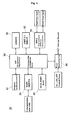
- FIG. 2 is a block diagram of a controller included in the energy storage apparatus for urban railways using a bidirectional DC-DC converter according to an embodiment of the present invention.
- the controller 32 included in the energy storage apparatus 2 for urban railways using a bidirectional DC-DC converter includes an analog interface board (INF23-1, 2) 34, a signal identification board (DIP13 & DIP-AUX) 36, a signal control board (PUZ33) 38, a digital output contact portion (RY045) 46, a communication board (INF79) 48, a PWM control board (PWM33) 40, an optical output board (EOC09-1) 42, and an external gate driver (IGBT Gate Driver) 44.
- the analog interface board 34 receives a detected DC link voltage and supercapacitor voltage in real time from a PT unit and receives a DC link current and a supercapacitor charging and discharging current from a CT unit.
- the signal identification board 36 is provided in parallel with the analog interface board 34 and identifies a feedback signal of a contactor, a fuse contact, a temperature contact, and a switch contact of a front panel and performs drive sequence and guard operations of the controller 32.
- the signal control board 38 receives a signal from the analog interface board 34 and the signal identification board 36 and performs sequence and guard operations and communication operations of the system.
- the digital output contact portion 46 receives a signal from the signal control board 38 and outputs a contact signal.
- the communication board 48 receives a signal from the signal control board 38 and performs communication with a GP monitor and also performs communication with the supercapacitor monitoring units 30a, 30b, and 30c.
- the PWM control board 40 receives a signal from each of the analog interface board 34 and the signal control board 38 and provides a PWM pulse signal.
- the optical output board 42 receives the PWM pulse signal from the PWM control board 40 and converts the PWM pulse signal into a PWM optical signal.
- the external gate driver 44 receives the PWM optical signal from the optical output board 42 and generates an external gate drive signal.
- controller 32 is located in the main box to perform all sequence, control, guard operations and communication functions of the system.
- a 32-bit, high-performance microprocessor (TMS320VC33) is used to perform such functions of the controller 32.
- the controller 32 is designed such that boards are classified and arranged by functions to facilitate system extension.
- the INF23-1/2 board is an analog interface board wherein an INF23-1 board receives a detected DC link voltage and a supercapacitor voltage in real time from the PT unit of the system and an INF23-2 board receives a DC link current and a supercapacitor charging and discharging current from the CT unit of the system.
- the IS026 board is designed to monitor control sequence and analog values of the controller using a DA converter.
- the DIP13 & DIP-AUX board identifies a feedback signal of a contactor of the system, a fuse contact, a temperature contact, and a switch contact of the front panel and performs drive sequence and guard operations of the controller 32 using the identified results.
- a total of 32 contacts may be used as such digital contacts.
- the RY045 board may output a total of 8 digital output contact signals and perform functions such as a function to drive exciting coils of the relay and the contactor or a function to turn on a lamp of the front panel.
- the EOC09 board is an optical output board that functions to convert a PWM pulse signal that is provided by the PWM33 board into an optical signal and transmits the optical signal to the external gate driver (IGDU).
- the purpose of optical conversion is to avoid the influence of externally generated electrical noise.
- the INF79 board is a communication board that is designed such that the communication interface can be changed to RS-485/422 according to setting of jumper pins therein.
- the INF79 board may use up to 2 channels, channel A and channel B.
- channel A uses an RS-422 communication scheme to perform communication with the GP monitor provided on the front side of the main device and channel B uses an RS-485 communication scheme to perform communication with the supercapacitor status monitoring module.
- All signals of such external interface devices are transmitted to the PWM33 board and the PUZ33 board to perform control, sequence, and guard operations.
- the PUZ33 board manages sequence, guard, and communication operations of the apparatus and is controlled using 2 processors.
- the PWM33 board receives sequence-related information of the PUZ33 board through a DPRAM and performs control functions of a power conversion device.
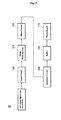
- FIG. 3 is a detailed block diagram of a PWM control board included in the controller of the energy storage apparatus for urban railways using a bidirectional DC-DC converter according to an embodiment of the present invention.
- the PWM control board (PWM33) 40 includes a sensor input circuit 62, an A/D converter 64, a calculation unit 68, a calculation control processor 72, and a power monitoring unit 80.
- the sensor input circuit 62 receives an analog signal 60.
- the A/D converter converts an output signal from the sensor input circuit 62 into a digital signal.
- the calculation unit 68 receives, as inputs, a reference malfunction value and an output signal of the sensor input circuit 62 and outputs a malfunction detection signal and an interrupt request signal.
- the calculation control processor 72 receives an output signal of the A/D converter 64 and an output signal of the calculation unit 68, creates a charge and discharge current instruction, generates a pulse pattern of a bidirectional chopper, and controls the duty ratio of the chopper.
- the power monitoring unit 80 monitors power state.
- the PWM33-1 CARD uses a TMS320VC33 processor from Texas Instruments Inc., which is a high-performance 32-bit digital signal processor, as a main calculation unit (arithmetic unit) for executing a control algorithm in real time.
- a flash memory is used as the memory to allow a program to be directly downloaded to the ROM to facilitate maintenance and repair.
- This board serves as a central part of the energy storage apparatus and thus implements various processes by software using a 32-bit DSP.
- This board receives various analog signals and creates a charge and discharge current instruction for the energy storage apparatus and generates a pulse pattern of the bidirectional chopper.
- the board has a function to control the duty ratio of the chopper in order to control a varying input overhead line voltage at a regular DC voltage
- a PWM pulse waveform generated by this board is transmitted to the EOC09 board and is then converted into an optical signal which is used to drive each gate driver, thereby turning the IGBT on or off.
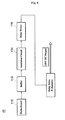
- FIG. 4 is a detailed block diagram of a signal control board included in the controller of the energy storage apparatus for urban railways using a bidirectional DC-DC converter according to an embodiment of the present invention.
- the signal control board (PUZ33) 38 performs communication with another board, the main circuit and a TMS unit and stores general drive information and a malfunction record and also stores state information of each part in an NVSRAM when the energy storage apparatus malfunctions.
- the PUZ33A board is an interface card for communicating with the PWM33-1 card, the main circuit, and the TMS unit in order to control the energy storage apparatus.
- This card communicates with the PWM33-1 to receive various information and stores general information, a malfunction record, and the like and communicates with the TMS unit.
- This card also regularly stores various state information in the NVSRAM when the energy storage apparatus malfunctions and stores a malfunction record and the like therein.
- the user may download the stored malfunction record to a PC through RS232 communication between the PC and the card to allow the user to be notified of the state of the energy storage apparatus when the energy storage apparatus malfunctions.
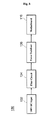
- FIG. 5 is a detailed block diagram of a signal identification board included in the controller of the energy storage apparatus for urban railways using a bidirectional DC-DC converter according to an embodiment of the present invention.
- the signal identification board (DIP13 & DIP-AUX) 36 includes an input circuit 100, a surge blocking unit 102, a filter circuit 104, and an insulation circuit 106.
- the input circuit 100 receives a 100V input signal.
- the surge blocking unit 102 is connected to an output terminal of the input circuit 100 to block surge in the input signal.
- the filter circuit 104 filters an output signal of the surge blocking unit 102.
- the insulation circuit 106 insulates this board from external signals.
- the DIP13-1/DIP-AUX board includes a digital input circuit 100 for receiving a 100V input signal, a surge blocking circuit for blocking surge in the input signal, a filter circuit for performing filtering, and an insulation circuit for providing insulation from external signals.
- the DIP13-1 board is designed to receive digital signals of a total of 24 channels and the DIP-AUX board is designed to receive digital signals of 8 channels.
- the received signals are transmitted to the PUZ33A board through a motherboard and are then used for control.
- FIG. 6 is a detailed block diagram of a digital output contact portion included in the controller of the energy storage apparatus for urban railways using a bidirectional DC-DC converter according to an embodiment of the present invention.
- the digital output contact portion (RY045) 46 includes an insulation circuit 114 for separating output signals of the motherboard 110 from external signals and a relay driver 116 for driving a contactor relay.
- the digital output (RY045) board includes a power separation circuit for separating output signals from external power and a relay circuit for driving the contactor relay.
- the controller 32 of the energy storage apparatus includes 8-channel digital output circuits to drive each contactor of the energy storage apparatus or to externally output digital signals.
- FIG. 7 is a detailed block diagram of an optical output board included in the controller of the energy storage apparatus for urban railways using a bidirectional DC-DC converter according to an embodiment of the present invention.
- the optical output board (EOC09-1) 42 includes an optical signal converter 122 that receives 12-channel gate PWM signals from the PWM control board 40 and converts the same into optical signals to drive the gate driver 44, thereby turning the IGBT on or off.
- the EOC09-1 board receives 12-channel gate PWM signals from the PWM33-1 unit and converts the same into optical signals to drive the gate driver, thereby turning the IGBT on or off.
- FIG. 8 is a detailed block diagram of a power input board included in the controller of the energy storage apparatus for urban railways using a bidirectional DC-DC converter according to an embodiment of the present invention
- FIG. 9 is a detailed block diagram of a power control board included in the controller of the energy storage apparatus for urban railways using a bidirectional DC-DC converter according to an embodiment of the present invention.
- the power input board (PWS24A) 130 included in the controller 32 receives DC 100V and inputs the same to the motherboard through a filter circuit and a power stabilization circuit to provide the same to the PWS27 board which is a control power unit.
- the PWS27 board receives DC 100V from the PWS24 board and generates and provides control power required for each controller component through a Switch Mode Power Supply (SMPS).
- SMPS Switch Mode Power Supply
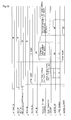
- FIG. 10 is an operation sequence diagram of the energy storage apparatus for urban railways using a bidirectional DC-DC converter according to an embodiment of the present invention.
- the controller 32 starts operation and sequentially activates GCK, MCB, and HSCB units at short intervals when each contactor is in normal state.
- a CHK unit When FC voltage exceeds a reference voltage, a CHK unit is turned on to enter an initial charging mode of the supercapacitors for charging and discharging.
- the controller When initial charging is completed, the controller identifies the operating mode of the supercapacitors according to a voltage state of the overhead line and performs a normal operation by alternately driving the bidirectional DC-DC converters in a buck mode and a booster mode.
- an energy storage apparatus for urban railways using a bidirectional DC-DC converter has advantages in that it is possible to easily add a storage unit including supercapacitors in the form of a box module as capacity increases or changes and it is possible to achieve accurate and efficient charging and discharging of the storage unit through various sensors and signal checks (inspections).
- the energy storage apparatus for urban railways using a bidirectional DC-DC converter according to the present invention is not limited to the above embodiments and may be modified into various forms without departing from the spirit of the present invention.
Landscapes
- Engineering & Computer Science (AREA)
- Power Engineering (AREA)
- Mechanical Engineering (AREA)
- Transportation (AREA)
- Life Sciences & Earth Sciences (AREA)
- Sustainable Development (AREA)
- Sustainable Energy (AREA)
- Dc-Dc Converters (AREA)
- Electric Propulsion And Braking For Vehicles (AREA)
- Charge And Discharge Circuits For Batteries Or The Like (AREA)
Abstract
An energy storage apparatus for urban railways using a bidirectional DC to DC converter (20a, 20b, 20c) increases charge and discharge efficiency through design of a controller (32) taking into consideration operation of associated devices and increases economic efficiency and use convenience through change or addition of a minimal configuration for energy storage capacity variation or increase. It is possible to easily add a storage unit (28a, 28b, 28c) including supercapacitors in the form of a box module as capacity increases or changes and it is also possible to achieve accurate and efficient charging and discharging of the storage unit (28a, 28b, 28c) through various sensors (16, 18) and signal checks (30a, 30b, 30c, 32).
Description
- The present invention relates to an energy storage apparatus for urban railways using a bidirectional DC to DC converter, and more particularly to an energy storage apparatus for urban railways using a bidirectional DC to DC converter which increases charge and discharge efficiency through design of a controller taking into consideration operation of associated devices and increases economic efficiency and use convenience through change or addition of a minimal configuration for energy storage capacity increase or variation.
- As is well known, worldwide climate change results in environmental destruction and high oil prices and also results in natural resource depletion. As fossil fuel energy depletion and environmental pollution have accelerated, the Kyoto protocol was established to prevent global warming, and development of renewable energy for reducing CO2 emissions has emerged as an urgent issue.
- Under such circumstances, technology development has focused upon development of renewable energy using natural energy such as wind, tide, solar, or water energy. However, technology has also been intensively developed to improve conventional energy generation and storage systems or apparatuses, which have a certain rate of loss, to minimize the loss rate.
- Some recent subway trains employ a regenerative braking system to save energy. When a subway train decelerates, the regenerative braking system converts kinetic energy of the subway train into electrical energy and collects the converted electrical energy. The regenerative braking system can not only reduce power consumption of the entire system but also can prevent noise generation by mechanical brakes and wear of brake shoes. Regenerative braking systems have been increasingly adopted due to such advantages.
- However, the conventional regenerative braking system has a problem in that the efficiency of charging and discharging through energy storage components is not high since the functionality of a controller of the energy storage apparatus is greatly limited such that the controller merely checks voltage or current while monitoring supercapacitors as energy storage components without taking into consideration operation of associated devices.
- The energy storage apparatus of the conventional regenerative braking system also has a problem in that a DC/DC converter and a storage medium should be redesigned when there is a need to increase or change capacity of the energy storage apparatus. For example, when there is a need to increase the capacity of the energy storage apparatus associated with the DC/DC converter and the storage medium from 750V and 10MJ to 750V and 15MJ, it is not possible to obtain an energy storage apparatus with a capacity of 750V and 15MJ by modifying the existing regenerative power storage system with a capacity of 750V and 10MJ and thus it is necessary to design and manufacture a new regenerative power storage system with 750V and 15MJ.
- When a 750V, 20MJ storage medium is needed, a recently developed technology connects a plurality of 750V, 10MJ storage media to achieve the 750V, 20MJ storage medium, thereby increasing use efficiency of existing components.
- However, an energy storage apparatus which employs such technology needs to include a plurality of units for almost all components (for example, charging units, filter units, current and voltage detectors, and controllers, DC/DC converters, and storage media) and also needs to include an additional current balancing controller to achieve current balancing. Therefore, the energy storage apparatus has problems in that it is necessary to include an additional component such as the current balancing controller without advantages such as a small number of parts and a small volume.
- Therefore, the present invention has been made in view of the above problems, and it is an object of the present invention to provide an energy storage apparatus for urban railways using a bidirectional DC to DC converter, which increases charge and discharge efficiency through design of a controller taking into consideration operation of associated devices and increases economic efficiency and use convenience through change or addition of a minimal configuration for energy storage capacity variation or increase.
- In accordance with the present invention, the above and other objects can be accomplished by the provision of an energy storage apparatus for urban railways using a bidirectional DC-DC converter, the energy storage apparatus including a power receiving portion that is electrically connected to an overhead line to receive power and that includes a disconnector therein, a filter unit that is electrically connected to the overhead line to remove high frequency components, a charging unit that is electrically connected between the overhead line and the filter unit to prevent excess current from flowing into the filter unit during charging of a capacitor of the filter unit, the charging unit including a block switch that opens and closes the electrical connection between the charging unit and the overhead line, at least one storage unit including a plurality of supercapacitors to store electrical energy, at least one capacitor monitoring unit that monitors measurements of capacity, input/output current, and power of the storage unit and outputs a monitoring result to a controller, a plurality of bidirectional DC-DC converters provided in parallel, the bidirectional DC-DC converters being electrically connected between the filter unit and the storage unit and being controlled by turning on or off first to sixth transistors according to a control signal, a voltage detector electrically connected to the filter unit to detect voltage of the overhead line, a current detector that detects the amount of current flowing into the filter unit and outputs the same to the controller, and the controller that receives the current and voltage of the overhead line detected by the current detector and the voltage detector and outputs an on/off control signal to each of the first to sixth transistors of the bidirectional DC-DC converters.
- Preferably, the number of the at least one capacitor monitoring unit is equal to the number of the bidirectional DC-DC converters.
- Preferably, the number of the at least one storage unit is equal to the number of the bidirectional DC-DC converters.
- Preferably, the controller includes an analog interface board that receives a detected DC link voltage and supercapacitor voltage in real time from a PT unit and receives a DC link current and a supercapacitor charging and discharging current from a CT unit, a signal identification board that is provided in parallel with the analog interface board and identifies a feedback signal of a contactor, a fuse contact, a temperature contact, and a switch contact of a front panel and performs drive sequence and guard operations of the controller, a signal control board that receives a signal from the analog interface board and the signal identification board and performs sequence and guard operations and communication operations of the apparatus, a digital output contact portion that receives a signal from the signal control board and outputs a contact signal, a communication board that receives a signal from the signal control board and performs communication with a GP monitor and also performs communication with a supercapacitor monitoring unit, a PWM control board that receives a signal from each of the analog interface board and the signal control board and provides a PWM pulse signal, an optical output board that receives the PWM pulse signal from the PWM control board and converts the PWM pulse signal into a PWM optical signal, and an external gate driver that receives the PWM optical signal from the optical output board and generates an external gate drive signal.
- Preferably, the PWM control board includes a sensor input circuit that receives an analog signal, an A/D converter that converts an output signal from the sensor input circuit into a digital signal, a calculation unit that receives, as inputs, a reference malfunction value and an output signal of the sensor input circuit and outputs a malfunction detection signal and an interrupt request signal, a calculation control processor that receives an output signal of the calculation unit, creates a charge and discharge current instruction, generates a pulse pattern of a bidirectional chopper, and controls a duty ratio of the chopper, and a power monitoring unit that monitors power state.
- Preferably, the signal control board performs communication with another board, a main circuit, and a TMS unit and stores general drive information and a malfunction record and also stores state information of each part in an NVSRAM when the energy storage apparatus malfunctions.
- Preferably, the signal identification board includes an input circuit that receives a 100V input signal, a surge blocking unit that is connected to an output terminal of the input circuit to block surge in the input signal, a filter circuit that filters an output signal of the surge blocking unit, and an insulation circuit that insulates the signal identification board from external signals.
- Preferably, the digital output contact portion includes an insulation circuit for separating output signals of a motherboard from external signals, and a relay driver for driving a contactor relay.
- Preferably, the optical output board includes an optical signal converter that receives 12-channel gate PWM signals from the PWM control board and converts the same into optical signals to drive the gate driver to turn a corresponding IGBT on or off.
- Preferably, the controller sequentially activates GCK, MCB, and HSCB units when 220V AC power is applied to the controller and each contactor is in normal state, turns a CHK unit on to enter an initial charging mode of the supercapacitors for charging and discharging when FC voltage exceeds a reference voltage, and identifies, when initial charging is completed, an operating mode of the supercapacitors according to a voltage state of the overhead line and alternately drives the bidirectional DC-DC converters in a buck mode and a booster mode.
- The energy storage apparatus for urban railways using a bidirectional DC-DC converter according to the present invention has advantages in that it is possible to easily add a storage unit including supercapacitors in the form of a box module as capacity increases or changes and it is possible to achieve accurate and efficient charging and discharging of the storage unit through various sensors and signal checks (inspections).
- The above and other objects, features and other advantages of the present invention will be more clearly understood from the following detailed description taken in conjunction with the accompanying drawings, in which:
-
FIG. 1 is a circuit diagram of an energy storage apparatus for urban railways using a bidirectional DC-DC converter according to an embodiment of the present invention; -
FIG. 2 is a block diagram of a controller included in the energy storage apparatus for urban railways using a bidirectional DC-DC converter according to an embodiment of the present invention; -
FIG. 3 is a detailed block diagram of a PWM control board included in the controller of the energy storage apparatus for urban railways using a bidirectional DC-DC converter according to an embodiment of the present invention; -
FIG. 4 is a detailed block diagram of a signal control board included in the controller of the energy storage apparatus for urban railways using a bidirectional DC-DC converter according to an embodiment of the present invention; -
FIG. 5 is a detailed block diagram of a signal identification board included in the controller of the energy storage apparatus for urban railways using a bidirectional DC-DC converter according to an embodiment of the present invention; -
FIG. 6 is a detailed block diagram of a digital output contact portion included in the controller of the energy storage apparatus for urban railways using a bidirectional DC-DC converter according to an embodiment of the present invention; -
FIG. 7 is a detailed block diagram of an optical output board included in the controller of the energy storage apparatus for urban railways using a bidirectional DC-DC converter according to an embodiment of the present invention; -
FIG. 8 is a detailed block diagram of a power input board included in the controller of the energy storage apparatus for urban railways using a bidirectional DC-DC converter according to an embodiment of the present invention; -
FIG. 9 is a detailed block diagram of a power control board included in the controller of the energy storage apparatus for urban railways using a bidirectional DC-DC converter according to an embodiment of the present invention; and -
FIG. 10 is an operation sequence diagram of the energy storage apparatus for urban railways using a bidirectional DC-DC converter according to an embodiment of the present invention. - Embodiments of the present invention will now be described in detail with reference to the drawings.
-
FIG. 1 is a circuit diagram of an energy storage apparatus for urban railways using a bidirectional DC-DC converter according to an embodiment of the present invention. - Referring to
FIG. 1 , theenergy storage apparatus 2 for urban railways using a bidirectional DC-DC converter according to an embodiment of the present invention increases charge and discharge efficiency through design of a controller taking into consideration operation of associated devices and increases economic efficiency and use convenience through change or addition of a minimal configuration for energy storage capacity variation or increase. - More specifically, the
energy storage apparatus 2 for urban railways using a bidirectional DC-DC converter according to an embodiment of the present invention includes apower receiving portion 4, afilter unit 8, andstorage units power receiving portion 4 is electrically connected to an overhead line to receive power and includes adisconnector 6 therein. Thefilter unit 8 is electrically connected to the overhead line to remove high frequency components. Thestorage units - The
energy storage apparatus 2 for urban railways using a bidirectional DC-DC converter according to an embodiment of the present invention also includes a plurality of bidirectional DC-DC converters voltage detector 18, acurrent detector 16, and acontroller 32. The bidirectional DC-DC converters filter unit 8 and thestorage units DC converters sixth transistors 22a to 22f according to a control signal. Thevoltage detector 18 is electrically connected to thefilter unit 8 to detect voltage of the overhead line. Thecurrent detector 16 detects the amount of current flowing into thefilter unit 8 and outputs the same to thecontroller 32. Thecontroller 32 receives the current and voltage of the overhead line detected by thecurrent detector 16 and thevoltage detector 18 and outputs an on/off control signal to each of the first tosixth transistors 22a to 22f of the bidirectional DC-DC converters - The
energy storage apparatus 2 for urban railways using a bidirectional DC-DC converter according to an embodiment of the present invention may further include a plurality ofcapacitor monitoring units charging unit 10. Thecapacitor monitoring units storage units controller 32. Thecharging unit 10 is electrically connected between the overhead line and thefilter unit 8 to prevent excess current from flowing into thefilter unit 8 during charging of a capacitor of thefilter unit 8 and includes a block switch that opens and closes the electrical connection between thecharging unit 10 and the overhead line. -
Reference numerals - The
controller 32 in each energy storage module configured as described above opens the block switch of the charging unit when excess current is detected by the current detector. In a charging mode, thecontroller 32 outputs a control signal for turning the 1st, 3rd, and 5th transistors off when the storage unit has been fully charged. In a power supply mode, thecontroller 32 outputs a control signal for turning the 2nd, 4th, and 6th transistors off to control charging and discharging of the storage unit when a voltage input from the capacitor monitoring unit is less than or equal to a reference voltage. - The
disconnector 6 includes an electric disconnector for connecting or disconnecting the main circuit to or from the secondary side of a substation upon ESS maintenance and repair or inspection and also includes a 64P relay, which is the same ground relay as that of an existing substation facility, and an input smoothing filter reactor. - The
disconnector 6 safely and reliably separates and reconnects an overhead line voltage from and to the energy storage apparatus when the energy storage apparatus is subjected to maintenance and repair and inspection of malfunction. Thedisconnector 6 can be operated to perform such separation and reconnection simply by pressing on and off buttons through an RS relay and a switch included in the disconnector. -
FIG. 2 is a block diagram of a controller included in the energy storage apparatus for urban railways using a bidirectional DC-DC converter according to an embodiment of the present invention. - Referring to
FIG. 2 , thecontroller 32 included in theenergy storage apparatus 2 for urban railways using a bidirectional DC-DC converter according to an embodiment of the present invention includes an analog interface board (INF23-1, 2) 34, a signal identification board (DIP13 & DIP-AUX) 36, a signal control board (PUZ33) 38, a digital output contact portion (RY045) 46, a communication board (INF79) 48, a PWM control board (PWM33) 40, an optical output board (EOC09-1) 42, and an external gate driver (IGBT Gate Driver) 44. Theanalog interface board 34 receives a detected DC link voltage and supercapacitor voltage in real time from a PT unit and receives a DC link current and a supercapacitor charging and discharging current from a CT unit. Thesignal identification board 36 is provided in parallel with theanalog interface board 34 and identifies a feedback signal of a contactor, a fuse contact, a temperature contact, and a switch contact of a front panel and performs drive sequence and guard operations of thecontroller 32. Thesignal control board 38 receives a signal from theanalog interface board 34 and thesignal identification board 36 and performs sequence and guard operations and communication operations of the system. The digitaloutput contact portion 46 receives a signal from thesignal control board 38 and outputs a contact signal. Thecommunication board 48 receives a signal from thesignal control board 38 and performs communication with a GP monitor and also performs communication with thesupercapacitor monitoring units PWM control board 40 receives a signal from each of theanalog interface board 34 and thesignal control board 38 and provides a PWM pulse signal. Theoptical output board 42 receives the PWM pulse signal from thePWM control board 40 and converts the PWM pulse signal into a PWM optical signal. Theexternal gate driver 44 receives the PWM optical signal from theoptical output board 42 and generates an external gate drive signal. - More specifically, the
controller 32 is located in the main box to perform all sequence, control, guard operations and communication functions of the system. - A 32-bit, high-performance microprocessor (TMS320VC33) is used to perform such functions of the
controller 32. Thecontroller 32 is designed such that boards are classified and arranged by functions to facilitate system extension. - First, the INF23-1/2 board is an analog interface board wherein an INF23-1 board receives a detected DC link voltage and a supercapacitor voltage in real time from the PT unit of the system and an INF23-2 board receives a DC link current and a supercapacitor charging and discharging current from the CT unit of the system.
- The IS026 board is designed to monitor control sequence and analog values of the controller using a DA converter. The DIP13 & DIP-AUX board identifies a feedback signal of a contactor of the system, a fuse contact, a temperature contact, and a switch contact of the front panel and performs drive sequence and guard operations of the
controller 32 using the identified results. A total of 32 contacts may be used as such digital contacts. - The RY045 board may output a total of 8 digital output contact signals and perform functions such as a function to drive exciting coils of the relay and the contactor or a function to turn on a lamp of the front panel.
- The EOC09 board is an optical output board that functions to convert a PWM pulse signal that is provided by the PWM33 board into an optical signal and transmits the optical signal to the external gate driver (IGDU). The purpose of optical conversion is to avoid the influence of externally generated electrical noise.
- The INF79 board is a communication board that is designed such that the communication interface can be changed to RS-485/422 according to setting of jumper pins therein. The INF79 board may use up to 2 channels, channel A and channel B. In the current system, channel A uses an RS-422 communication scheme to perform communication with the GP monitor provided on the front side of the main device and channel B uses an RS-485 communication scheme to perform communication with the supercapacitor status monitoring module.
- All signals of such external interface devices are transmitted to the PWM33 board and the PUZ33 board to perform control, sequence, and guard operations. The PUZ33 board manages sequence, guard, and communication operations of the apparatus and is controlled using 2 processors. The PWM33 board receives sequence-related information of the PUZ33 board through a DPRAM and performs control functions of a power conversion device.
-
FIG. 3 is a detailed block diagram of a PWM control board included in the controller of the energy storage apparatus for urban railways using a bidirectional DC-DC converter according to an embodiment of the present invention. - Referring to
FIG. 3 , the PWM control board (PWM33) 40 includes asensor input circuit 62, an A/D converter 64, acalculation unit 68, acalculation control processor 72, and apower monitoring unit 80. Thesensor input circuit 62 receives ananalog signal 60. The A/D converter converts an output signal from thesensor input circuit 62 into a digital signal. Thecalculation unit 68 receives, as inputs, a reference malfunction value and an output signal of thesensor input circuit 62 and outputs a malfunction detection signal and an interrupt request signal. Thecalculation control processor 72 receives an output signal of the A/D converter 64 and an output signal of thecalculation unit 68, creates a charge and discharge current instruction, generates a pulse pattern of a bidirectional chopper, and controls the duty ratio of the chopper. Thepower monitoring unit 80 monitors power state. - Specifically, the PWM33-1 CARD uses a TMS320VC33 processor from Texas Instruments Inc., which is a high-performance 32-bit digital signal processor, as a main calculation unit (arithmetic unit) for executing a control algorithm in real time. In addition, a flash memory is used as the memory to allow a program to be directly downloaded to the ROM to facilitate maintenance and repair.
- This board serves as a central part of the energy storage apparatus and thus implements various processes by software using a 32-bit DSP. This board receives various analog signals and creates a charge and discharge current instruction for the energy storage apparatus and generates a pulse pattern of the bidirectional chopper. The board has a function to control the duty ratio of the chopper in order to control a varying input overhead line voltage at a regular DC voltage
- A PWM pulse waveform generated by this board is transmitted to the EOC09 board and is then converted into an optical signal which is used to drive each gate driver, thereby turning the IGBT on or off.
-
FIG. 4 is a detailed block diagram of a signal control board included in the controller of the energy storage apparatus for urban railways using a bidirectional DC-DC converter according to an embodiment of the present invention. - Referring to
FIG. 4 , the signal control board (PUZ33) 38 performs communication with another board, the main circuit and a TMS unit and stores general drive information and a malfunction record and also stores state information of each part in an NVSRAM when the energy storage apparatus malfunctions. - Specifically, the PUZ33A board is an interface card for communicating with the PWM33-1 card, the main circuit, and the TMS unit in order to control the energy storage apparatus. This card communicates with the PWM33-1 to receive various information and stores general information, a malfunction record, and the like and communicates with the TMS unit.
- This card also regularly stores various state information in the NVSRAM when the energy storage apparatus malfunctions and stores a malfunction record and the like therein. The user may download the stored malfunction record to a PC through RS232 communication between the PC and the card to allow the user to be notified of the state of the energy storage apparatus when the energy storage apparatus malfunctions.
-
FIG. 5 is a detailed block diagram of a signal identification board included in the controller of the energy storage apparatus for urban railways using a bidirectional DC-DC converter according to an embodiment of the present invention. - Referring to
FIG. 5 , the signal identification board (DIP13 & DIP-AUX) 36 includes aninput circuit 100, asurge blocking unit 102, afilter circuit 104, and aninsulation circuit 106. Theinput circuit 100 receives a 100V input signal. Thesurge blocking unit 102 is connected to an output terminal of theinput circuit 100 to block surge in the input signal. Thefilter circuit 104 filters an output signal of thesurge blocking unit 102. Theinsulation circuit 106 insulates this board from external signals. - Specifically, the DIP13-1/DIP-AUX board includes a
digital input circuit 100 for receiving a 100V input signal, a surge blocking circuit for blocking surge in the input signal, a filter circuit for performing filtering, and an insulation circuit for providing insulation from external signals. - The DIP13-1 board is designed to receive digital signals of a total of 24 channels and the DIP-AUX board is designed to receive digital signals of 8 channels. The received signals are transmitted to the PUZ33A board through a motherboard and are then used for control.
-
FIG. 6 is a detailed block diagram of a digital output contact portion included in the controller of the energy storage apparatus for urban railways using a bidirectional DC-DC converter according to an embodiment of the present invention. - Referring to
FIG. 6 , the digital output contact portion (RY045) 46 includes aninsulation circuit 114 for separating output signals of themotherboard 110 from external signals and arelay driver 116 for driving a contactor relay. - The digital output (RY045) board includes a power separation circuit for separating output signals from external power and a relay circuit for driving the contactor relay.
- The
controller 32 of the energy storage apparatus includes 8-channel digital output circuits to drive each contactor of the energy storage apparatus or to externally output digital signals. -
FIG. 7 is a detailed block diagram of an optical output board included in the controller of the energy storage apparatus for urban railways using a bidirectional DC-DC converter according to an embodiment of the present invention. - Referring to
FIG. 7 , the optical output board (EOC09-1) 42 includes anoptical signal converter 122 that receives 12-channel gate PWM signals from thePWM control board 40 and converts the same into optical signals to drive thegate driver 44, thereby turning the IGBT on or off. - That is, the EOC09-1 board receives 12-channel gate PWM signals from the PWM33-1 unit and converts the same into optical signals to drive the gate driver, thereby turning the IGBT on or off.
-
FIG. 8 is a detailed block diagram of a power input board included in the controller of the energy storage apparatus for urban railways using a bidirectional DC-DC converter according to an embodiment of the present invention andFIG. 9 is a detailed block diagram of a power control board included in the controller of the energy storage apparatus for urban railways using a bidirectional DC-DC converter according to an embodiment of the present invention. - Referring to
FIGS. 8 and9 , the power input board (PWS24A) 130 included in thecontroller 32 receivesDC 100V and inputs the same to the motherboard through a filter circuit and a power stabilization circuit to provide the same to the PWS27 board which is a control power unit. - The PWS27 board receives
DC 100V from the PWS24 board and generates and provides control power required for each controller component through a Switch Mode Power Supply (SMPS). -
FIG. 10 is an operation sequence diagram of the energy storage apparatus for urban railways using a bidirectional DC-DC converter according to an embodiment of the present invention. - Referring to
FIG. 10 , first, when 220V AC power is applied to thecontroller 32 included in the energy storage apparatus for urban railways using a bidirectional DC-DC converter according to an embodiment of the present invention, thecontroller 32 starts operation and sequentially activates GCK, MCB, and HSCB units at short intervals when each contactor is in normal state. - When FC voltage exceeds a reference voltage, a CHK unit is turned on to enter an initial charging mode of the supercapacitors for charging and discharging.
- In the initial charging mode, an operation for protecting the supercapacitor from surge current is performed as described above.
- When initial charging is completed, the controller identifies the operating mode of the supercapacitors according to a voltage state of the overhead line and performs a normal operation by alternately driving the bidirectional DC-DC converters in a buck mode and a booster mode.
- As is apparent from the above description, an energy storage apparatus for urban railways using a bidirectional DC-DC converter according to the present invention has advantages in that it is possible to easily add a storage unit including supercapacitors in the form of a box module as capacity increases or changes and it is possible to achieve accurate and efficient charging and discharging of the storage unit through various sensors and signal checks (inspections).
- The energy storage apparatus for urban railways using a bidirectional DC-DC converter according to the present invention is not limited to the above embodiments and may be modified into various forms without departing from the spirit of the present invention.
Claims (10)
- An energy storage apparatus for urban railways using a bidirectional DC-DC converter, the energy storage apparatus comprising:a power receiving portion 4 that is electrically connected to an overhead line to receive power and that includes a disconnector therein;a filter unit 8 that is electrically connected to the overhead line to remove high frequency components;a charging unit 10 that is electrically connected between the overhead line and the filter unit 8 to prevent excess current from flowing into the filter unit 8 during charging of a capacitor of the filter unit 8, the charging unit 10 including a block switch that opens and closes the electrical connection between the charging unit 10 and the overhead line;at least one storage unit 28a, 28b, or 28c including a plurality of supercapacitors to store electrical energy;at least one capacitor monitoring unit 30a, 30b, or 30c that monitors measurements of capacity, input/output current, and power of the storage unit 28a, 28b, or 28c and outputs a monitoring result to a controller 32;a plurality of bidirectional DC-DC converters 20a, 20b, or 20c provided in parallel, the bidirectional DC-DC converters 20a, 20b, or 20c being electrically connected between the filter unit 8 and the storage unit 28a, 28b, or 28c and being controlled by turning on or off first to sixth transistors 22a to 22f according to a control signal;a voltage detector 18 electrically connected to the filter unit 8 to detect voltage of the overhead line;a current detector 16 that detects the amount of current flowing into the filter unit 8 and outputs the same to the controller 32; andthe controller 32 that receives the current and voltage of the overhead line detected by the current detector 16 and the voltage detector 18 and outputs an on/off control signal to each of the first to sixth transistors 22a to 22f of the bidirectional DC-DC converters 20a, 20b, or 20c.
- The energy storage apparatus according to claim 1, wherein the number of the at least one capacitor monitoring unit 30a, 30b, or 30c is equal to the number of the bidirectional DC-DC converters 20a, 20b, or 20c.
- The energy storage apparatus according to claim 1, wherein the number of the at least one storage unit 28a, 28b, or 28c is equal to the number of the bidirectional DC-DC converters 20a, 20b, or 20c.
- The energy storage apparatus according to claim 1, wherein the controller 32 includes:an analog interface board 34 that receives a detected DC link voltage and supercapacitor voltage in real time from a PT unit and receives a DC link current and a supercapacitor charging and discharging current from a CT unit;a signal identification board 36 that is provided in parallel with the analog interface board 34 and identifies a feedback signal of a contactor, a fuse contact, a temperature contact, and a switch contact of a front panel and performs drive sequence and guard operations of the controller 32;a signal control board 38 that receives a signal from the analog interface board 34 and the signal identification board 36 and performs sequence and guard operations and communication operations of the apparatus;a digital output contact portion 46 that receives a signal from the signal control board 38 and outputs a contact signal;a communication board 48 that receives a signal from the signal control board 38 and performs communication with a GP monitor and also performs communication with a supercapacitor monitoring unit 30a, 30b, or 30c;a PWM control board 40 that receives a signal from each of the analog interface board 34 and the signal control board 38 and provides a PWM pulse signal;an optical output board 42 that receives the PWM pulse signal from the PWM control board 40 and converts the PWM pulse signal into a PWM optical signal; andan external gate driver 44 that receives the PWM optical signal from the optical output board 42 and generates an external gate drive signal.
- The energy storage apparatus according to claim 4, wherein the PWM control board 40 includes:a sensor input circuit 62 that receives an analog signal;an A/D converter 64 that converts an output signal from the sensor input circuit 62 into a digital signal;a calculation unit 68 that receives, as inputs, a reference malfunction value and an output signal of the sensor input circuit 62 and outputs a malfunction detection signal and an interrupt request signal;a calculation control processor 72 that receives an output signal of the calculation unit 68, creates a charge and discharge current instruction, generates a pulse pattern of a bidirectional chopper, and controls a duty ratio of the chopper; anda power monitoring unit 80 that monitors power state.
- The energy storage apparatus according to claim 4, wherein the signal control board 38 performs communication with another board, a main circuit, and a TMS unit and stores general drive information and a malfunction record and also stores state information of each part in an NVSRAM when the energy storage apparatus malfunctions.
- The energy storage apparatus according to claim 4, wherein the signal identification board 36 includes:an input circuit 100 that receives a 100V input signal;a surge blocking unit that is connected to an output terminal of the input circuit 100 to block surge in the input signal;a filter circuit 104 that filters an output signal of the surge blocking unit; andan insulation circuit 106 that insulates the signal identification board 36 from external signals.
- The energy storage apparatus according to claim 4, wherein the digital output contact portion 46 includes:an insulation circuit 114 for separating output signals of a motherboard 110 from external signals; anda relay driver 116 for driving a contactor relay.
- The energy storage apparatus according to claim 4, wherein the optical output board 42 includes an optical signal converter 122 that receives 12-channel gate PWM signals from the PWM control board 40 and converts the same into optical signals to drive the gate driver 44 to turn a corresponding IGBT on or off.
- The energy storage apparatus according to claim 1, wherein the controller 32 sequentially activates GCK, MCB, and HSCB units when 220V AC power is applied to the controller 32 and each contactor is in normal state, turns a CHK unit on to enter an initial charging mode of the supercapacitors for charging and discharging when FC voltage exceeds a reference voltage, and identifies, when initial charging is completed, an operating mode of the supercapacitors according to a voltage state of the overhead line and alternately drives the bidirectional DC-DC converters 20a, 20b, or 20c in a buck mode and a booster mode.
Applications Claiming Priority (1)
| Application Number | Priority Date | Filing Date | Title |
|---|---|---|---|
| KR1020120001618A KR101191244B1 (en) | 2012-01-05 | 2012-01-05 | Power storage apparatus of city railway with a both direction dc/dc converter |
Publications (1)
| Publication Number | Publication Date |
|---|---|
| EP2612781A2 true EP2612781A2 (en) | 2013-07-10 |
Family
ID=46052535
Family Applications (1)
| Application Number | Title | Priority Date | Filing Date |
|---|---|---|---|
| EP12162393.8A Withdrawn EP2612781A2 (en) | 2012-01-05 | 2012-03-30 | Energy storage apparatus for urban railways using bidirectional dc to dc converter |
Country Status (5)
| Country | Link |
|---|---|
| US (1) | US9440539B2 (en) |
| EP (1) | EP2612781A2 (en) |
| JP (1) | JP5744786B2 (en) |
| KR (1) | KR101191244B1 (en) |
| CN (1) | CN103199629B (en) |
Families Citing this family (17)
| Publication number | Priority date | Publication date | Assignee | Title |
|---|---|---|---|---|
| CN103885351B (en) * | 2014-03-21 | 2016-02-24 | 南车南京浦镇车辆有限公司 | Integrated-type logic control method |
| CN103991455A (en) * | 2014-05-29 | 2014-08-20 | 株洲今朝轨道电气有限公司 | Special vehicle-mounted locomotive power supply device |
| US9771001B2 (en) * | 2014-10-09 | 2017-09-26 | The Boeing Company | Hybrid electrically powered transportation system utilizing renewable energy stored in supercapacitors |
| CN105162178B (en) * | 2015-06-18 | 2018-01-19 | 安徽天瞳智能科技有限公司 | A kind of control system of super capacitor energy storage device |
| CN105365598B (en) * | 2015-12-08 | 2018-08-07 | 上海航天电源技术有限责任公司 | A kind of rail friendship train traction car lithium battery energy-storage system |
| US10300791B2 (en) * | 2015-12-18 | 2019-05-28 | Ge Global Sourcing Llc | Trolley interfacing device having a pre-charging unit |
| CN107284252A (en) * | 2016-12-20 | 2017-10-24 | 中铁电气化局集团有限公司 | A kind of metro traction power system and method |
| WO2018225194A1 (en) * | 2017-06-07 | 2018-12-13 | 三菱電機株式会社 | Dc feed voltage calculation apparatus, dc feed voltage control system, dc feed voltage calculation program, and dc feed voltage calculation method |
| CN109256764A (en) * | 2018-11-23 | 2019-01-22 | 西南交通大学 | A kind of vehicle-mounted grid-side converter suitable for middle pressure direct-current traction power supply |
| KR102199760B1 (en) | 2019-02-26 | 2021-01-07 | 효성중공업 주식회사 | Dc-dc converting device |
| DE102019214870A1 (en) * | 2019-06-17 | 2020-12-17 | Volkswagen Aktiengesellschaft | Circuit arrangement for a motor vehicle and method for stabilizing a direct voltage of a high-voltage direct voltage intermediate circuit in a motor vehicle |
| CN110649565B (en) * | 2019-10-23 | 2021-04-13 | 西南交通大学 | Protection method of regenerative braking energy feedback system of high-speed rail |
| CN110979029B (en) * | 2019-10-30 | 2023-05-05 | 国电南瑞科技股份有限公司 | Charging device and charging method for super-capacitor energy storage type tramcar |
| CN110936821B (en) * | 2019-11-26 | 2021-04-02 | 中国第一汽车股份有限公司 | Automobile motor controller, control system and automobile |
| CN112477608A (en) * | 2020-12-19 | 2021-03-12 | 陕西航空电气有限责任公司 | Energy feedback device for aviation electric drive system and control method |
| CN113612390B (en) * | 2021-08-06 | 2023-04-07 | 北京航空航天大学 | Airborne bidirectional energy conversion device |
| KR20250111565A (en) * | 2024-01-15 | 2025-07-22 | 국립한국교통대학교산학협력단 | High voltage igbt gate driver for railwaly |
Family Cites Families (14)
| Publication number | Priority date | Publication date | Assignee | Title |
|---|---|---|---|---|
| JP3324737B2 (en) * | 1997-08-04 | 2002-09-17 | 株式会社日立製作所 | Power conversion system for grid connection |
| JP2001037004A (en) * | 1999-07-26 | 2001-02-09 | Hitachi Ltd | Inverter type electric car control device |
| JP3770110B2 (en) * | 2001-06-28 | 2006-04-26 | 株式会社明電舎 | DC system voltage stabilizer |
| JP2003102132A (en) * | 2001-09-25 | 2003-04-04 | Nisshinbo Ind Inc | Storage power supply device and charge control method thereof |
| JP4978354B2 (en) * | 2007-07-17 | 2012-07-18 | 株式会社明電舎 | DC power storage device |
| JP5358990B2 (en) * | 2008-03-21 | 2013-12-04 | 株式会社明電舎 | Power converter |
| JP2010206864A (en) * | 2009-02-27 | 2010-09-16 | Panasonic Corp | Power supply device |
| JP5347780B2 (en) * | 2009-07-07 | 2013-11-20 | 株式会社明電舎 | Discharge control method in feeder voltage compensator for electric railway |
| CN201484208U (en) * | 2009-08-24 | 2010-05-26 | 青岛易特优电子有限公司 | Railway track regenerated braking energy storage device |
| JP5493604B2 (en) * | 2009-09-03 | 2014-05-14 | 株式会社明電舎 | DC electric railway power storage device |
| KR101169343B1 (en) * | 2009-09-11 | 2012-07-30 | 한국철도기술연구원 | Restoration-electric power storage system of DC electric railway car |
| US8384343B2 (en) * | 2010-04-27 | 2013-02-26 | Honeywell International Inc. | Electric accumulators having self regulated battery with integrated bi-directional power management and protection |
| US20120025614A1 (en) * | 2010-07-28 | 2012-02-02 | Pasi Taimela | Uninterruptible Power Supply Apparatus and Methods Using Reconfigurable Energy Storage Networks |
| KR101200554B1 (en) * | 2010-12-24 | 2012-11-13 | 한국에너지기술연구원 | Multi-phase interleaved bidirectional dc-dc converter |
-
2012
- 2012-01-05 KR KR1020120001618A patent/KR101191244B1/en not_active Expired - Fee Related
- 2012-03-13 US US13/418,573 patent/US9440539B2/en not_active Expired - Fee Related
- 2012-03-30 EP EP12162393.8A patent/EP2612781A2/en not_active Withdrawn
- 2012-04-02 JP JP2012084024A patent/JP5744786B2/en not_active Expired - Fee Related
- 2012-12-26 CN CN201210573007.3A patent/CN103199629B/en not_active Expired - Fee Related
Non-Patent Citations (1)
| Title |
|---|
| None |
Also Published As
| Publication number | Publication date |
|---|---|
| CN103199629B (en) | 2017-08-25 |
| US9440539B2 (en) | 2016-09-13 |
| CN103199629A (en) | 2013-07-10 |
| JP2013141382A (en) | 2013-07-18 |
| KR101191244B1 (en) | 2012-10-18 |
| US20130175855A1 (en) | 2013-07-11 |
| JP5744786B2 (en) | 2015-07-08 |
Similar Documents
| Publication | Publication Date | Title |
|---|---|---|
| EP2612781A2 (en) | Energy storage apparatus for urban railways using bidirectional dc to dc converter | |
| CN107636950B (en) | The control method of power-converting device and power-converting device | |
| JP5798887B2 (en) | Power storage system | |
| CN103545901B (en) | The high-power charging device of a kind of tramcar | |
| EP2700534B1 (en) | Charging apparatus | |
| EP2183125A2 (en) | Battery charging based on cost and life | |
| JP2010213560A (en) | Charging system for electric vehicle | |
| CN204497817U (en) | The wireless charging system of electric automobile | |
| CN110535163B (en) | Energy storage control system and method based on retired power battery pack | |
| EP2352216B1 (en) | Power converter | |
| CN105291868A (en) | Vehicle power system and vehicle comprising same | |
| CN110854889B (en) | Energy storage system and multi-stage protection method thereof | |
| KR20170014665A (en) | Control device for chanring/discharging battery | |
| JP5661075B2 (en) | Charge / discharge device | |
| CN103580271A (en) | Modularized pluggable emergency power supply and working method thereof | |
| KR101398224B1 (en) | Current detecting apparatus for low voltage dc-dc converter of electric vehicle | |
| JP2013255360A (en) | Charge/discharge apparatus | |
| JP6786268B2 (en) | Power storage system | |
| CN101959710B (en) | Energy storage systems for rail vehicles | |
| JP5401239B2 (en) | Battery control device | |
| KR20210055109A (en) | Removable electric vehicle charging system equipped with smart energy storage unit | |
| US20100013435A1 (en) | Charging Station | |
| CN205846801U (en) | Electric automobile integral type DC charging motor | |
| KR20140065209A (en) | Electric vehicle and control method thereof | |
| CN201797363U (en) | Intelligent distributed direct-current power supply |
Legal Events
| Date | Code | Title | Description |
|---|---|---|---|
| PUAI | Public reference made under article 153(3) epc to a published international application that has entered the european phase |
Free format text: ORIGINAL CODE: 0009012 |
|
| AK | Designated contracting states |
Kind code of ref document: A2 Designated state(s): AL AT BE BG CH CY CZ DE DK EE ES FI FR GB GR HR HU IE IS IT LI LT LU LV MC MK MT NL NO PL PT RO RS SE SI SK SM TR |
|
| AX | Request for extension of the european patent |
Extension state: BA ME |
|
| STAA | Information on the status of an ep patent application or granted ep patent |
Free format text: STATUS: THE APPLICATION IS DEEMED TO BE WITHDRAWN |
|
| 18D | Application deemed to be withdrawn |
Effective date: 20171003 |