EP2610147A2 - Tractor - Google Patents
Tractor Download PDFInfo
- Publication number
- EP2610147A2 EP2610147A2 EP12184151.4A EP12184151A EP2610147A2 EP 2610147 A2 EP2610147 A2 EP 2610147A2 EP 12184151 A EP12184151 A EP 12184151A EP 2610147 A2 EP2610147 A2 EP 2610147A2
- Authority
- EP
- European Patent Office
- Prior art keywords
- hood
- engine
- engine hood
- support
- orientation
- Prior art date
- Legal status (The legal status is an assumption and is not a legal conclusion. Google has not performed a legal analysis and makes no representation as to the accuracy of the status listed.)
- Granted
Links
Images



Classifications
-
- B—PERFORMING OPERATIONS; TRANSPORTING
- B62—LAND VEHICLES FOR TRAVELLING OTHERWISE THAN ON RAILS
- B62D—MOTOR VEHICLES; TRAILERS
- B62D25/00—Superstructure or monocoque structure sub-units; Parts or details thereof not otherwise provided for
- B62D25/08—Front or rear portions
- B62D25/082—Engine compartments
- B62D25/084—Radiator supports
-
- B—PERFORMING OPERATIONS; TRANSPORTING
- B60—VEHICLES IN GENERAL
- B60Q—ARRANGEMENT OF SIGNALLING OR LIGHTING DEVICES, THE MOUNTING OR SUPPORTING THEREOF OR CIRCUITS THEREFOR, FOR VEHICLES IN GENERAL
- B60Q1/00—Arrangement of optical signalling or lighting devices, the mounting or supporting thereof or circuits therefor
- B60Q1/02—Arrangement of optical signalling or lighting devices, the mounting or supporting thereof or circuits therefor the devices being primarily intended to illuminate the way ahead or to illuminate other areas of way or environments
- B60Q1/04—Arrangement of optical signalling or lighting devices, the mounting or supporting thereof or circuits therefor the devices being primarily intended to illuminate the way ahead or to illuminate other areas of way or environments the devices being headlights
- B60Q1/0408—Arrangement of optical signalling or lighting devices, the mounting or supporting thereof or circuits therefor the devices being primarily intended to illuminate the way ahead or to illuminate other areas of way or environments the devices being headlights built into the vehicle body, e.g. details concerning the mounting of the headlamps on the vehicle body
- B60Q1/0433—Arrangement of optical signalling or lighting devices, the mounting or supporting thereof or circuits therefor the devices being primarily intended to illuminate the way ahead or to illuminate other areas of way or environments the devices being headlights built into the vehicle body, e.g. details concerning the mounting of the headlamps on the vehicle body the housing being fastened onto the vehicle body using screws
-
- B—PERFORMING OPERATIONS; TRANSPORTING
- B62—LAND VEHICLES FOR TRAVELLING OTHERWISE THAN ON RAILS
- B62D—MOTOR VEHICLES; TRAILERS
- B62D25/00—Superstructure or monocoque structure sub-units; Parts or details thereof not otherwise provided for
- B62D25/08—Front or rear portions
- B62D25/10—Bonnets or lids, e.g. for trucks, tractors, busses, work vehicles
-
- B—PERFORMING OPERATIONS; TRANSPORTING
- B60—VEHICLES IN GENERAL
- B60Q—ARRANGEMENT OF SIGNALLING OR LIGHTING DEVICES, THE MOUNTING OR SUPPORTING THEREOF OR CIRCUITS THEREFOR, FOR VEHICLES IN GENERAL
- B60Q2800/00—Features related to particular types of vehicles not otherwise provided for
- B60Q2800/20—Utility vehicles, e.g. for agriculture, construction work
Definitions
- the present invention relates to a tractor that includes a body, an engine room formed in the front region of the body, a headlamp unit, and an engine hood that is supported to the body so as to be capable of being displaced between a closed orientation of covering the engine room from above and an open orientation of exposing the engine room, the engine hood having a top panel, a front panel, and side panels.
- tractors include an engine hood that can move up and down about a shaft core that extends in the horizontal direction of the body in the rear portion of the engine hood. Headlamps are also mounted in the front panel that constitutes the engine hood.
- One know example of such a tractor is disclosed in JP 2010-069925A .
- JP 2010-069925A the shape of the support structure body for attaching the headlamps to a front end portion of the engine hood tends to be influenced by the shape of the front panel of the engine hood, and is complicated.
- the shape of the engine hood also becomes complicated, thus raising the cost of manufacturing.
- a stay structure member is provided in order to support the headlamps to the front end portion of the engine hood, and this stay structure member has a complicated shape due to the end portions and edge portions thereof being notched and bent so as to conform to the shape of the engine hood.
- US Patent No. 6068675 discloses a tractor in which the engine hood is constituted from a top panel that swings and a non-swinging front panel that is fixed to the body, and the headlamps are attached to the front panel.
- the front panel structure is complicated since the headlamps are attached to the front panel.
- the present invention is directed to a tractor that includes; a body; an engine room formed in a front region of the body; a headlamp unit; and an engine hood supported to the body so as to be capable of being displaced between a closed orientation of covering the engine room from above and an open orientation of exposing the engine room, the engine hood including a top panel, a front panel, and side panels.
- a feature of the present invention is that a support unit is disposed in front of the engine room, the support, unit having a left perpendicular support column and a right perpendicular support column that are provided upright on the body with a space therebetween in a transverse direction of the body, and a cross beam that connects upper portions of the left perpendicular support, column and the right perpendicular support column to each other; the headlamp unit is supported to an upper portion of the support unit; and a light transmitting portion is provided in the front panel, the light transmitting portion being disposed so as to transmit illumination light from the headlamp unit when the engine hood is in the closed orientation.
- the support unit has a U-shaped structure consisting of left and right perpendicular support columns and the cross beam, the perpendicular support columns can be disposed using the limited amount of space in the engine room, and the cross beam can be disposed at the top of the engine room, which relatively has leeway with respect to space. Since the headlamp unit is attached to the upper portion of the support unit having this stable structure, the optical axes of the headlamp unit can also be reliably positioned. Also, the fixing component such as brackets for attaching the headlamp unit to the support unit can have a simple shape.
- light transmitting portions that can transmit illumination light over peripheral regions centered on the optical axes are formed in the front panel of the engine hood.
- These light transmitting portions need only be able to transmit light, and the simplest mode thereof is aperture portions formed in the front panel.
- a front panel in which a transparent material is used for only the light transmitting portions is also possible.
- a mode is possible in which a transparent, material such as transparent, plastic is fitted in the aperture portions serving as the light, transmitting portions in order to prevent infiltration by water and foreign objects.
- the structure of the front portion of the engine hood is simplified since there is no need to attach the headlamp unit to the engine hood.
- the support unit has a U-shaped structure, an accessory that is attached to the body can be disposed between the left and right perpendicular support columns, that is to say, below the cross beam. In other words, even if there is an accessory that is attached to the body, the support unit can be attached to the body while avoiding that accessory, that is to say, so as to cross over that accessory. This contributes to the effective utilization of the engine room. Also, since the support unit crosses over the battery, gaps are formed between the support unit and the battery, which also has the advantage of facilitating the flow of air to the engine since air flowing from the front of the body toward the rear of the body is not obstructed by the support unit or the battery.
- the harness when a harness is connected to the headlamp unit in order to supply power to the lights for example, if the headlamp unit is attached to the engine hood, the harness needs to be given extra length in order to accommodate the movement of the headlamp unit that accompanies the opening and closing of the engine hood.
- the headlamp unit is attached to the support unit and does not move up and down along with the engine hood, thus eliminating the need to give the harness extra length.
- a fixing member for fixing an accessory such as a battery is attached to the support unit. This enables the integration of the structure for supporting the headlamp unit and the structure for fixing the accessory such as the battery, thus reducing manufacturing cost, assembly cost, and maintenance cost.
- a locking mechanism that holds the engine hood in the closed orientation is provided in a portion of the frame that is in front of the battery. Accordingly, the engine hood is reliably held in the closed orientation, thus ensuring stable use of the headlamp unit.
- a tractor of the present invention includes a body 1 and an engine 21.
- the body 1 includes a front portion frame 3 that supports the front portion of the engine 21 in an orientation of extending toward the front of the vehicle, a clutch housing 4 that is coupled to the rear portion of the engine 21, an intermediate transmission case 5 that is coupled to the rear portion of the clutch housing 4 so as to extend in the rearward direction of the vehicle, and a transmission case 90 that is coupled to the rear portion of the intermediate transmission case 5.
- the tractor also includes a drivable pair of left and right front wheels 8 that support the front portion frame 3, and a drivable pair of left and right rear wheels 9 that support the transmission case 90, and thus is configured having four-wheel drive specifications.
- an engine room 20 is formed in the front half portion of the body 1, which is constituted by the front portion frame 3, the clutch housing 4, and the front end portion of the intermediate transmission case 5.
- the engine room 20 is covered from above by an engine hood 60.
- a driving portion 10 that can be ridden by a user is provided above a location that is behind the front end portion of the intermediate transmission case 5, which corresponds to the rear half portion of the body.
- the rear end portion of the body also includes a coupling device 6 that enables the coupling of a work device (not shown) such as a tillage rotor or a plow, and a PTO shaft 7 that can transmit power to the work device that is coupled to the coupling device 6.
- a work device such as a tillage rotor or a plow
- PTO shaft 7 that can transmit power to the work device that is coupled to the coupling device 6.
- the driving portion 10 includes a driver's seat 11, an accelerator pedal 14, an accelerator lever 16, a brake pedal 15 that can slow down the traveling tractor when pressed, and a steering wheels 13 that enables steering of the left and right front wheels 8.
- a steering post 12 formed so as to have a hollow interior is disposed in front of the driver's seat 11, and the steering post 12 includes the steering wheel 13 and the accelerator lever 16.
- the front portion frame 3 is formed so as to be U-shaped in a plan view.
- the front portion frame 3 is constituted by a pair of left and right first members 3A that consist of vertically-oriented plates that extend from left and right side portions of the engine 21 toward the front of the vehicle, and a second member 3B that consists of a vertically-oriented plate that is fixed by welding so as to connect the front end portions of the left and right first members 3A.
- a support plate 3F that consists of a horizontally-oriented plate member is fixed by welding so as to span the left and right first members 3A in the front portion of the front portion frame 3, that is to say, in front of the engine 21.
- a headlamp unit 440 is disposed inside the engine room 20 in the front region thereof, and the engine 21, a fuel tank 22, a radiator 23, an air cleaner 24, and a muffler 25 are disposed inside the engine room 20 behind the headlamp unit 440.
- a first partition member 5A that consists of a plate member that partitions the engine 21 from the region behind the engine 21 is provided above the clutch housing 4, that is to say, behind the engine 21, and the fuel tank 22 is provided behind the first partition member 5A.
- the engine 21 and the fuel tank 22 are partitioned from each other by the first partition member 5A.
- the rear portion of the fuel tank 22 is located inside the steering post 12 of the driving portion 10.
- the air cleaner 24 is disposed above the engine 21 on one side in the left-right direction of the body.
- An air intake pipe 24A that extends forward from the air cleaner 24 has a tip portion that has an air intake opening 24B, and the tip portion passes through a notch 3D in a later-described second partition member 3C.
- the muffler 25 is coupled to the engine 21 and disposed above the engine 21 at a position on the other side in the left-right direction of the body, that is to say, on the side opposite from the air cleaner 24 in the left-right direction of the body.
- an exhaust pipe 25A extending out from the muffler 25 passes between the engine 21 and the region behind the later-described second partition member 3C, and extends below the support plate 3F such that an exhaust opening 25B of the exhaust pipe 25A is located outward of one of the first members 3A of the front portion frame 3 (the first member 3A on the left side of the body in the present embodiment) with respect to the horizontal direction of the body.
- the radiator 23 is disposed so as to be fixed upright in front of the engine 21, that is to say, on the rear portion of the upper surface of the support, plate 3F, so as to face the later-described second partition member 3C.
- a cooling fan 23D for supplying outside air to the radiator 23 is attached to the engine 21 behind the radiator 23.
- a water supply opening 23A that allows a cooling fluid to be supplied to the radiator 23 is provided in the central portion of the upper end portion of the radiator 23, which is central with respect to the left-right direction.
- the vertically-oriented second partition member 3C is disposed behind the radiator 23, that is to say, on the rear end portion of the support, plate 3F, and the second partition member 3C partitions the radiator 23 from the engine 21 with the exception of the portion where the radiator 23 and the cooling fan 23D face each other.
- the radiator 23 is located lower than the tip portion of the air intake pipe 24A of the air cleaner 24 that passes through the notch 3D of the second partition member 3C. Accordingly, the radiator 23 and the tip portion of the air intake pipe 24A of the air cleaner 24 do not interfere with each other, thus making it possible to compactly dispose the engine 21 and the radiator 23 in the front-rear direction of the body.
- a battery 46 that is one of various accessories is disposed so as to be placed in front of the radiator 23.
- an overflow tank 23B for the radiator 23 is disposed on one side of the battery 46 with respect to the horizontal direction.
- the upper end portion of the overflow tank 23B and the water supply opening of the radiator 23 are joined together by an overflow pipe 23C, thus achieving a configuration in which cooling fluid that has overflowed from the radiator 23 can flow through the overflow pipe 23C and be accumulated in the overflow tank 23B.
- a support, unit 40 formed so as to be U-shaped in a front view is fixed by welding to the upper surface of the support plate 3F constituting the body 1, so as to cross over the battery 46 and the overflow tank 23B.
- the support unit 40 is constituted by a pair of left and right perpendicular support columns 41 and a cross beam 42.
- the pair of left and right perpendicular support columns 41 consist of vertically-oriented elongated plates that are fixed upright, so as to sandwich the battery 46 and the overflow tank 23B on the horizontal sides thereof, and as shown in FIGS. 4 to 7 , the cross beam 42 consists of a horizontally-oriented plate member that is fixed by welding so as connect the upper end portions of the left and right perpendicular support columns 41.
- the front, portion of the cross beam 42 extends forward beyond the perpendicular support columns 41, and a front end portion 42A of the cross beam 42 is bent in the downward direction of the body.
- a sub cross beam 43 consisting of a horizontally-oriented plate member is fixed by welding so as to span the left and right perpendicular support columns 41 at a portion of the support unit 40 that is located between the cross beam 42, and the battery 46 and the overflow tank 23B with respect to the up-down direction of the body.
- the sub cross beam 43 is fixed such that the front portion thereof extends forward beyond the left and right perpendicular support columns 41, a front end portion 43A is bent in the upward direction of the body, and the front end portion 43A is located farther toward the front of the body in a side view than the downward-bent front end portion 42A of the cross beam 42.
- the headlamp unit 440 is supported to the upper portion of the support, unit 40, that is to say, to the cross beam 42 and the sub cross beam 43.
- This headlamp unit is constituted by a pair of left and right lights 44.
- the pair of left and right lights 44 may be integrated in advance with an adapter, or may be attached to the support unit 40 as members that are separate from each other.
- the lights 44 are attached in a positional relationship that is within a predetermined allowable range, with the optical axes of their illumination light facing the region in front of the body 1.
- a first attachment, portion 44A that projects in the upward direction of the body is formed in the central portion of the upper end of each of the lights 44, and second attachment portions 44B that project in the downward direction of the body are respectively formed in left and right side portions of the lower end of each of the lights 44.
- the first attachment, portions 44A are fixed by bolts to the downward-bent front end portion 42A of the cross beam 42 from behind with respect to the body, and the left and right second attachment portions 44B are fixed by bolts to the upward-bent front end portion 43A of the sub cross beam 43 from in front with respect to the body, thus supporting the lights 44.
- the cross beam 42 and the sub cross beam 43 of the support unit 40 which correspond to the upper portion of the support unit 40, correspond to a stay for supporting the lights 44, and the pair of left and right lights 44 are each supported at three points by the first attachment portion 44A and the left and right second attachment portions 44B.
- the lights 44 are connected to the battery 46 via a harness (not shown) and a control device (not shown) that can control the lighting and extinguishing of the lights 44.
- a horn 45 is attached in the central portion of the cross beam 42 of the support unit 40 so as to be located between the pair of left and right lights 44.
- a stay 42B for the horn 45 is fixed by bolts so as to extend in the downward direction of the body in the central portion of the downward-bent front end portion 42A of the cross beam 42, which is central in the left-right direction of the body, and the horn 45 is attached to the stay 42B for the horn 45 so as to face forward.
- the sub cross beam 43 of the support unit 40 is fixed at a position at which a gap is formed between it and the upper surface of the battery 46 and the upper surface of the overflow tank 23B.
- the left and right perpendicular support columns 41 are also fixed such that gaps are formed between them and the battery 46 and the overflow tank 23B in the left-right direction of the body.
- the battery 46 and the overflow tank 23B are also disposed such that a gap is formed therebetween in the left-right direction of the body.
- the battery 46 and the overflow tank 23B are disposed such that a gap is formed between the front surface of the radiator 23 and the rear surfaces of the battery 46 and the overflow tank 23B.
- the pair of left and right lights 44 and the horn 45 are also disposed such that gaps are formed therebetween in the left-right direction of the body.
- the support unit 40 includes a fixing member 50 that allows the battery 46, which is disposed so as to be placed on the front portion frame 3, to be fixed so as to be immobile.
- the fixing member 50 is constituted by a pressing component 51 that comes into contact with the upper surface of the battery 46, and a constricting component 52 that is a constricting means for fixing the battery 46 by constricting it from above and below with the pressing component 51 and the support plate 3F.
- the pressing component 51 consists of a round bar member that is formed in a bent manner so as to include a front portion 51A that is U-shaped in a plan view and left and right rear portions 51B that respectively extend from the left and right rear end portions of the U-shaped front portion 51A in a diagonally upward and horizontally outward direction with respect to the body, and furthermore extend in the rearward direction of the body. Also, as shown in FIG.
- the rear end portions of the left and right rear portions 51B of the pressing component 51 are formed so as to be bent in the left-right direction of the body, left and right brackets 43B are formed as projections on the lower surface of the sub cross beam 43 of the support unit 40, and the abovementioned left and right rear end portions are supported to the left and right brackets 43B so as to enable the pressing component 51 to swing up and down about an axis in the left-right direction of the body.
- the pressing component 51 is constituted such that when it is swung in the up-down direction, the U-shaped front portion 51A comes into contact with the upper surface of the battery 46, and furthermore the tip portion of the U-shaped front portion 51A extends forward beyond the front edge portion of the upper surface of the battery 46.
- the U-shaped front portion 51A of the pressing component 51 will be referred to as the contact portion 51A.
- the constricting component. 52 consists of a constricting rod 52A that is a round bar member, and a constricting wing nut 52B, and as shown in FIGS. 4 and 5 , the lower end portion of the constricting rod 52A is formed so as to be hook-shaped, and a screw portion is formed in the upper end portion of the constricting rod 52A.
- the constricting wing nut 52B is constituted so as to be capable of being screwed onto the screw portion of the constricting rod 52A.
- a hole that penetrates in the front-rear direction of the vehicle is formed in the lower end portion of a locking bracket 81 of a later-described locking mechanism 80 that is fixed to the upper surface of the support plate 3F in front of the battery 46, and the hook-shaped lower end portion of the constricting rod 52A is engaged in this hole. Also, when the contact portion 51A of the pressing component 51 is in contact with the upper surface of the battery 46, the screw portion of the upper end portion can be inserted into the tip portion of the contact portion 51A that extends forward beyond the front edge portion of the upper surface of the battery 46.
- the fixing member 50 is constituted as described above, when the screw portion of the upper end portion of the constricting rod 52A of the constricting component 52 is inserted into the tip portion of the contact portion 51A of the pressing component 51, which extends forward beyond the front edge portion of the upper surface of the battery 46, and the constricting wing nut 52B is screwed on the screw portion from above the contact portion 51A, the upper surface of the battery 46 is pressed by the pressing component 51, and the lower surface of the battery 46 is pressed by the support plate 3F.
- the battery 46 can be fixed by being constrained from above and below by the fixing member 50 with which the support unit 40 is provided.
- a ring-shaped elastic member 51C made of rubber or the like may be fit onto the contact portion 51A of the pressing component 51, without covering the tip portion that extends forward beyond the front edge of the upper surface of the battery 46.
- a third partition member 5C is fixed by coupling above the front end portion of the intermediate transmission case 5, and the third partition member 5C partitions the steering post 12 from the region in front of the steering post 12 while supporting the steering post 12 and surrounding the periphery of the fuel tank 22 in the up-down direction and the left-right, direction of the body.
- a pair of left and right brackets 5D (referred to hereinafter as “first brackets 5D") extend forward from the upper portion of the front, surface of the third partition member 5C.
- the engine hood 60 is axially supported to the left and right first brackets 5D of the third partition member 5C so as to be able to swing up and down between a lower closed orientation and an upper open orientation.
- the engine hood 60 covers the engine room 20 from above with the lower portion of the front portion of the engine hood 60 being in contact with the support plate 3F, as shown in FIGS. 1 and 3 , and in the open orientation, the front portion of the engine hood 60 separates away from the support plate 3F in the upward direction of the body so as to expose the region above the engine room 20, as shown in FIG. 7 .
- the engine hood 60 when the engine hood 60 is in the open orientation, the engine 21 (including the engine accessories), the battery 46, the overflow tank 23B, the support unit 40, the lights 44, and the horn 45 are exposed to the outside and can be accessed.
- the engine hood 60 When the engine hood 60 is in the closed orientation, it covers these elements.
- the engine hood 60 is constituted by a plate member and includes a first hood portion 61 that is a top panel, a second hood portion 62 and a fourth hood portion 64 that are a front panel 620, and third hood portions 63 that are a pair of left and right side panels.
- the second hood portion 62 is located directly below the front end of the first hood portion 61.
- a front grill portion 62A is disposed between the second hood portion 62 and the fourth hood portion 64, and the second hood portion 62, the front grill portion 62A, and the fourth hood portion 64 constitute the front panel 620.
- the engine hood 60 includes a pair of left right brackets 61A (referred to hereinafter as the "second brackets 61A") on the rear end portion of the under surface of the first hood portion 61.
- the left and right second brackets 61A are axially supported to the left and right first brackets 5D of the third partition member 5C so as to be able to swing about an axis in the left-right direction of the body. This enables the engine hood 60 to swing up and down about a rear fulcrum point.
- the first hood portion 61 includes a pair of left and right, side portions 61B.
- the left and right third hood portions 63 are configured so as to extend from the front end portion of the left and right side portions 61B of the first hood portion 61 in a diagonally downward and forward direction with respect to the body in a side view of the body, and face each other in the left-right direction of the body.
- the fourth hood portion 64 is configured so as to connect the forward part of the lower end portions of the left and right third hood portions 63.
- an elongated plate-shaped stay 69 is fixed in the up-down direction of the body to the front end portion of the under surface of the first hood portion 61 and the central portion of the under surface of the fourth hood portion 64, which is central in the left-right direction of the body, so as to connect the front end portion and the central portion.
- the second hood portion 62 is supported so as to be fixed by the stay 69, the left and right third hood portions 63, and the fourth hood portion 64.
- the engine hood 60 is configured such that when it is in the closed orientation, the lower end portions of the fourth hood portion 64 and the left and right third hood portions 63 are located immediately above and conform to the front edge portion and the left and right side edge portions of the support plate 3F.
- the sides, front, and top of the support plate 3F are covered by the front portion of the first hood portion 61, the second hood portion 62, the left and right third hood portions 63, and the fourth hood portion 64.
- the front grill portion 62A that can allow air to pass from the front when the engine hood 60 is in the closed orientation is provided in a lower portion of the second hood portion 62.
- a pair of left and right aperture portions 62B are formed so as to penetrate the upper portion of the second hood portion 62, and when the engine hood 60 is in the closed orientation, these aperture portions 62B oppose the pair of left and right, lights 44 that are attached to the upper portion of the support unit 40.
- the pair of left and right aperture portions 62B include an upper surface, a lower surface, and left and right side surfaces as aperture edges that extend from the front surface of the second hood portion 62 in the rearward direction of the body, and these aperture edges have substantially the same shape as the front surface of the lights 44. Note that as shown in FIG. 6 , the rear end portions of the aperture edges of the aperture portions 62B are in close proximity with the peripheral edge portions of the front surfaces of the lights 44 when the engine hood 60 is in the closed orientation.
- the pair of left and right lights 44 are supported to the support unit 40, not the engine hood 60, and shine light toward the front of the body through the aperture portions 62B.
- the positions of the pair of left and right lights 44 do not change, and this has the advantage of facilitating replacement and maintenance and having favorable serviceability.
- the lights 44 are fixed to the support unit 40 and do not move along with the opening and closing of the engine hood 60.
- a holding portion 65 is provided in the central portion of the lower end portion of the fourth hood portion 64, which is central in the left-right direction of the body, and the holding portion 65 consists of a recessed portion that is formed facing the interior of the body and can be grabbed by the user's hand when opening the engine hood 60 from the closed orientation to the open orientation.
- the holding portion 65 is formed so as to open in the forward direction of the body and the downward direction of the body so as to have left and right side surfaces 65A and a rear surface 65B, and the rear surface 65B is in a forward tilted orientation in a side view.
- the left and right side surfaces 65A of the holding portion 65 are formed such that the distance therebetween increases toward the front of the body.
- the holding portion 65 is formed so as to be large enough to be capable of being grabbed by the user's hand.
- the holding portion 65 consisting of the recessed portion is formed integrally with the engine hood 60, there is no need for a special-purpose member that is to be grabbed by the user's hand when opening the engine hood 60 from the closed orientation to the open orientation.
- a projection portion 66 that is bent so as to project toward the interior of the body is formed in the lower end portion of the engine hood 60 that is below the holding portion 65 and the lower end portion of the engine hood 60 that is on both horizontal sides of the holding portion 65, that is to say, in the lower end portion of the fourth hood portion 64 and the lower end portions of the left and right third hood portions 63 (the projection portion 66 of the left and right third hood portions 63 is not shown), and the projection portion 66 serves as the lower portion of the front portion of the engine hood 60.
- the part of the projection portion 66 of the fourth hood portion 64 that is at the holding portion 65 is formed so as to project in conformity with the lower end portions of the left and right side surfaces and the lower end portion of the rear surface of the holding portion 65.
- a sealing member 67 consisting of an elastic member is attached to the projection portion 66 of the lower end portions of the fourth hood portion 64 and the left and right third hood portions 63 so as to conform to the projection portion 66.
- the sealing member 67 is constituted by an upper portion that can be attached to the projection portion 66 by fitting around it so as to conform to it, and a lower portion that comes into contact with and conforms to the upper surfaces of the front edge portion and the left and right side edge portions of the support plate 3F.
- the lower portion of the sealing member 67 undergoes compression deformation in the up-down direction of the body due to being sandwiched from above and below by the left and right third hood portions 63 and the fourth hood portion 64 and the support, plate 3F when the engine hood 60 is held in the closed orientation by the locking mechanism 80.
- a tight seal is achieved between the lower portion of the front portion of the engine hood 60 and the support plate 3F, and dust and the like does not easily enter the radiator 23.
- the projection portion 66 at the holding portion 65 is formed so as to project, in conformity with the lower end portion of the holding portion 65 as described above, as shown in FIGS. 9 and 10 , the sealing member 67 at the projection portion 66 at the holding portion 65 comes into contact, with a region of the upper surface of the support plate 3F that is rearward of the front edge portion thereof.
- a support mechanism 70 that can hold the engine hood 60 in the open orientation is provided in the rear portion of the engine hood 60 having the above-described configuration.
- the support mechanism 70 is constituted by a support rod 71 that consists of a round bar member disposed on the engine hood 60 side, a coil spring 73 disposed on the support rod 71, and a support bracket 72 on the engine 21 side.
- one end portion of the support rod 71 is bent in the leftward direction of the body (or in the rightward direction of the body), and the support rod 71 is axially supported to the rear portion of the under surface of the first hood portion 61 so as to be able to swing forward and backward about an axis the left-right direction of the body.
- the other end portion of the support rod 71 is formed so as to be bent in the shape of a clasp hook.
- the coil spring 73 is attached to the bent end portion of the support rod 71 and biases the support rod 71 in the rearward direction of the body.
- the support bracket 72 is fixed so as to be coupled to the upper portion of the engine 21 so as to extend in the upward direction of the body, and an elongated hole 72A that is oriented in the up-down direction of the body and penetrates in the front-rear direction of the body is formed in the upper end portion of the support bracket 72.
- the support rod 71 is inserted through the elongated hole 72A of the support bracket 72.
- the clasp hook-shaped other end portion of the support rod 71 that is biased in the rearward direction of the body by the coil spring 73 automatically engages with the lower end portion of the elongated hole 72A of the support, bracket 72 as shown in FIGS. 7 and 8 , and thus the engine hood 60 can be held in the open orientation.
- the clasp hook-shaped other end portion of the support rod 71 is disengaged from the elongated hole 72A of the support bracket 72, and the support rod 71 is inserted through the elongated hole 72A while swinging the engine hood 60 in the downward direction of the body.
- the locking mechanism 80 is provided on the upper surface of the support plate 3F of the support unit 40, in a portion of the upper surface that is in front of the battery 46.
- the locking mechanism 80 is constituted by the locking bracket 81 that is fixed to the support plate 3F in an upright manner so as to be oriented in the left-right direction of the body, a retaining latch 82 that can latch a later-described latch target 68 provided on the engine hood 60 side, a spring 83 that biases the retaining latch 82 so as to be in a later-described retaining orientation, and an operation lever 84 serving as an operation component that allows the retaining latch 82 to be operated from the later-described retaining orientation to a later-described non-retaining orientation.
- the latch target 68 consists of a round bar member that is fixed to the lower end portion of the stay 69, which support the second hood portion 62, so as to extend in the rearward direction of the body.
- a recessed portion 81A that opens in the front-rear direction of the body and in the upward direction of the body is formed in the upper portion of the locking bracket 81.
- the latch target 68 engagedly enters the recessed portion 81A from above with respect to the body as shown in FIG. 11
- the latch target 68 separates from the recessed portion 81A in the upward direction of the body as shown in FIG. 12 .
- the recessed portion 81A of the locking bracket 81 will be referred to as the engagement, recessed portion 81A.
- sloping surfaces 81B that increase in height outward away from the engagement recessed portion 81A in the horizontal direction of the body are formed on the left and right sides of the engagement, recessed portion 81A of the locking bracket 81 with respect to the left-right direction of the body, and thus the latch target 68 is reliably guided to the engagement recessed portion 81A when the engine hood 60 is put in the closed orientation.
- a notch 81C for penetration by a later-described stopper portion 82B of the retaining latch 82 is formed in one lateral side portion (on the right side of the body in the present embodiment) of the locking bracket 81 so as to be oriented in the left-right direction of the body.
- the retaining latch 82 is constituted such that the lower portion thereof is axially supported to the lower end portion of the locking bracket 81, and thus can swing left and right relative to the locking bracket 81 about an axis in the front-rear direction of the body.
- a retaining projection portion 82A is formed as a projection in one side portion (on the left side of the body in the present embodiment) of the upper portion of the retaining latch 82 so as to be located above the latch target 68 when the latch target 68 has engagedly entered the engagement recessed portion 81A and the retaining latch 82 has been swung, and thus the retaining projection portion 82A can prevent the latch target. 68 from coming free in the upward direction of the body.
- the retaining latch 82 is constituted so as to be able to swing between the retaining orientation in which it can prevent the latch target 68 from coming free in the upward direction of the body as shown in FIG. 11 , and the non-retaining orientation in which the retaining projection portion 82A separates away from the region above the latch target 68, and the latch target 68 can come free in the upward direction of the body as shown in FIG. 12 .
- the stopper portion 82B which consists of a projection piece that projects so as to extend in the rearward direction of the body, is provided in the other side portion (on the right side of the body in the present embodiment) of the retaining latch 82.
- the stopper portion 82B penetrates the notch 81C of the locking bracket 81 and comes into contact with the edge of the upper end of the notch 81C of the locking bracket 81 when the retaining latch 82 is in the retaining orientation as shown in FIG. 11 .
- a sloping surface 82C is formed in the retaining latch 82 in order to apply component force for swinging the retaining latch 82 from the retaining orientation to the non-retaining orientation upon coming into contact with the latch target 68 that descends from above toward the engagement recessed portion 81A in order to engagedly enter it.
- the spring 83 is attached so as to be on one transverse side (on the left transverse side of the body in the present embodiment) of the locking bracket 81 and so as to span between the support plate 3F and a hole formed penetrating in the front-rear direction of the body in the lower portion of the retaining latch 82, and the spring 83 biases the retaining latch 82 toward the retaining orientation.
- one end portion of the operation lever 84 which is an operation component consisting of a round bar member, is formed in the shape of a hook, and an operation portion 84A for manual operation is formed in the other end portion.
- the hook-shaped end portion of the operation lever 84 is engaged with the hole formed so as to penetrate in the front-rear direction of the body on the tip side of the retaining latch 82, and as shown in FIGS. 4 , 11, and 12 , the other end portion that has the operation portion 84A is inserted through an elongated hole 3G that is oriented in the left-right direction of the body and formed so as to penetrate in the up-down direction of the body in a portion of the support, plate 3F that is located on the other transverse side (the right transverse side of the body in the present embodiment) of the locking bracket. 81.
- the operation portion 84A of the operation lever 84 is located at a position that is below support plate 3F and outward of the first member 3A (the first member 3A on the right side of the body in the present embodiment) of the front portion frame 3 in the horizontal direction of the body, and by pulling the operation portion 84A in the other end portion of the operation lever 84, it is possible to perform an operation for swinging the retaining latch 82 from the retaining orientation to the non-retaining orientation, against, the biasing action of the spring 83 as shown in FIGS. 11 and 12 .
- the latch target 68 of the engine hood 60 comes into contact with the sloping surface 82C of the retaining latch 82 that is in the retaining orientation due to the biasing action of the spring 83.
- the retaining latch 82 is swung toward the non-retaining orientation in conjunction with the descending latch target 68, and then the latch target 68 engagedly enters the engagement recessed portion 81A of the locking bracket 81.
- the retaining latch 82 is then no longer subjected to force from the latch target 68 for being swung toward the non-retaining orientation, and returns to the retaining orientation due to the biasing action of the spring 83.
- the retaining projection portion 82A of the retaining latch 82 is located above the latch target 68 that has engagedly entered the engagement recessed portion 81A, and since the retaining latch 82 is biased toward the retaining orientation by the spring 83, the latch target 68 is prevented from coming free in the upward direction of the body, thus making it possible to hold the engine hood 60 in the closed orientation.
Landscapes
- Engineering & Computer Science (AREA)
- Mechanical Engineering (AREA)
- Chemical & Material Sciences (AREA)
- Combustion & Propulsion (AREA)
- Transportation (AREA)
- Superstructure Of Vehicle (AREA)
- Body Structure For Vehicles (AREA)
- Lighting Device Outwards From Vehicle And Optical Signal (AREA)
Abstract
Description
- The present invention relates to a tractor that includes a body, an engine room formed in the front region of the body, a headlamp unit, and an engine hood that is supported to the body so as to be capable of being displaced between a closed orientation of covering the engine room from above and an open orientation of exposing the engine room, the engine hood having a top panel, a front panel, and side panels.
- Many tractors include an engine hood that can move up and down about a shaft core that extends in the horizontal direction of the body in the rear portion of the engine hood. Headlamps are also mounted in the front panel that constitutes the engine hood. One know example of such a tractor is disclosed in
JP 2010-069925A -
US Patent No. 6068675 discloses a tractor in which the engine hood is constituted from a top panel that swings and a non-swinging front panel that is fixed to the body, and the headlamps are attached to the front panel. In this case as well, the front panel structure is complicated since the headlamps are attached to the front panel. - In light of the above circumstances, there is demand for a headlamp support, structure in a tractor that enables the simple and accurate adjustment of the optical axes of the headlamps.
- The present invention is directed to a tractor that includes; a body; an engine room formed in a front region of the body; a headlamp unit; and an engine hood supported to the body so as to be capable of being displaced between a closed orientation of covering the engine room from above and an open orientation of exposing the engine room, the engine hood including a top panel, a front panel, and side panels. A feature of the present invention is that a support unit is disposed in front of the engine room, the support, unit having a left perpendicular support column and a right perpendicular support column that are provided upright on the body with a space therebetween in a transverse direction of the body, and a cross beam that connects upper portions of the left perpendicular support, column and the right perpendicular support column to each other; the headlamp unit is supported to an upper portion of the support unit; and a light transmitting portion is provided in the front panel, the light transmitting portion being disposed so as to transmit illumination light from the headlamp unit when the engine hood is in the closed orientation.
- Since the support unit has a U-shaped structure consisting of left and right perpendicular support columns and the cross beam, the perpendicular support columns can be disposed using the limited amount of space in the engine room, and the cross beam can be disposed at the top of the engine room, which relatively has leeway with respect to space. Since the headlamp unit is attached to the upper portion of the support unit having this stable structure, the optical axes of the headlamp unit can also be reliably positioned. Also, the fixing component such as brackets for attaching the headlamp unit to the support unit can have a simple shape.
- Also, in order to transmit illumination light from the headlamp unit when in the closed orientation, light transmitting portions that can transmit illumination light over peripheral regions centered on the optical axes are formed in the front panel of the engine hood. These light transmitting portions need only be able to transmit light, and the simplest mode thereof is aperture portions formed in the front panel. A front panel in which a transparent material is used for only the light transmitting portions is also possible. Furthermore, a mode is possible in which a transparent, material such as transparent, plastic is fitted in the aperture portions serving as the light, transmitting portions in order to prevent infiltration by water and foreign objects. In any of these cases, the structure of the front portion of the engine hood is simplified since there is no need to attach the headlamp unit to the engine hood.
- Since the support unit has a U-shaped structure, an accessory that is attached to the body can be disposed between the left and right perpendicular support columns, that is to say, below the cross beam. In other words, even if there is an accessory that is attached to the body, the support unit can be attached to the body while avoiding that accessory, that is to say, so as to cross over that accessory. This contributes to the effective utilization of the engine room. Also, since the support unit crosses over the battery, gaps are formed between the support unit and the battery, which also has the advantage of facilitating the flow of air to the engine since air flowing from the front of the body toward the rear of the body is not obstructed by the support unit or the battery.
- Furthermore, when a harness is connected to the headlamp unit in order to supply power to the lights for example, if the headlamp unit is attached to the engine hood, the harness needs to be given extra length in order to accommodate the movement of the headlamp unit that accompanies the opening and closing of the engine hood. However, with the present invention, the headlamp unit is attached to the support unit and does not move up and down along with the engine hood, thus eliminating the need to give the harness extra length.
- According to one preferred embodiment of the present invention, a fixing member for fixing an accessory such as a battery is attached to the support unit. This enables the integration of the structure for supporting the headlamp unit and the structure for fixing the accessory such as the battery, thus reducing manufacturing cost, assembly cost, and maintenance cost.
- According to another preferred embodiment of the present invention, a locking mechanism that holds the engine hood in the closed orientation is provided in a portion of the frame that is in front of the battery. Accordingly, the engine hood is reliably held in the closed orientation, thus ensuring stable use of the headlamp unit.
-
-
FIG. 1 is a left view showing the entirety of a tractor. -
FIG. 2 is a plan view showing a front half portion and part of a rear half portion of the tractor. -
FIG. 3 is a front view of relevant portions of the tractor. -
FIG. 4 is a perspective view showing relevant portions of the front half portion of the tractor, with the engine hood in a detached state. -
FIG. 5 is a front view showing relevant portions in the periphery of a support unit. -
FIG. 6 is a side view of a longitudinal cross-section showing the engine hood in a orientation. -
FIG. 7 is a side view of a longitudinal cross-section showing the engine hood in an open orientation. -
FIG. 8 is a rear view showing relevant portions of an engine hood support mechanism when the engine hood is in the open orientation. -
FIG. 9 is a perspective view showing the periphery of a holding portion of the engine hood. -
FIG. 10 is a side view of a longitudinal cross-section showing the periphery of the holding portion of the engine hood. -
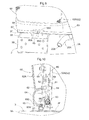
FIG. 11 is a front view showing a locking mechanism of the engine hood, with a retaining latch in a retaining orientation. -
FIG. 12 is a front view showing the locking mechanism of the engine hood, with the retaining latch in a non-retaining orientation. - As shown in
FIG. 1 , a tractor of the present invention includes abody 1 and anengine 21. Thebody 1 includes afront portion frame 3 that supports the front portion of theengine 21 in an orientation of extending toward the front of the vehicle, aclutch housing 4 that is coupled to the rear portion of theengine 21, anintermediate transmission case 5 that is coupled to the rear portion of theclutch housing 4 so as to extend in the rearward direction of the vehicle, and atransmission case 90 that is coupled to the rear portion of theintermediate transmission case 5. - The tractor also includes a drivable pair of left and right
front wheels 8 that support thefront portion frame 3, and a drivable pair of left and rightrear wheels 9 that support thetransmission case 90, and thus is configured having four-wheel drive specifications. - As shown in
FIG. 1 , anengine room 20 is formed in the front half portion of thebody 1, which is constituted by thefront portion frame 3, theclutch housing 4, and the front end portion of theintermediate transmission case 5. Theengine room 20 is covered from above by anengine hood 60. - Also, a
driving portion 10 that can be ridden by a user is provided above a location that is behind the front end portion of theintermediate transmission case 5, which corresponds to the rear half portion of the body. - The rear end portion of the body also includes a
coupling device 6 that enables the coupling of a work device (not shown) such as a tillage rotor or a plow, and a PTO shaft 7 that can transmit power to the work device that is coupled to thecoupling device 6. - As shown in
FIG. 1 , thedriving portion 10 includes a driver'sseat 11, anaccelerator pedal 14, anaccelerator lever 16, abrake pedal 15 that can slow down the traveling tractor when pressed, and asteering wheels 13 that enables steering of the left and rightfront wheels 8. - Note that a
steering post 12 formed so as to have a hollow interior is disposed in front of the driver'sseat 11, and thesteering post 12 includes thesteering wheel 13 and theaccelerator lever 16. - As shown in
FIGS. 2 and4 , thefront portion frame 3 is formed so as to be U-shaped in a plan view. Specifically, thefront portion frame 3 is constituted by a pair of left and rightfirst members 3A that consist of vertically-oriented plates that extend from left and right side portions of theengine 21 toward the front of the vehicle, and asecond member 3B that consists of a vertically-oriented plate that is fixed by welding so as to connect the front end portions of the left and rightfirst members 3A. - As shown in
FIG. 4 , asupport plate 3F that consists of a horizontally-oriented plate member is fixed by welding so as to span the left and rightfirst members 3A in the front portion of thefront portion frame 3, that is to say, in front of theengine 21. - As shown in
FIGS. 1 ,6 , and7 , aheadlamp unit 440 is disposed inside theengine room 20 in the front region thereof, and theengine 21, afuel tank 22, aradiator 23, anair cleaner 24, and amuffler 25 are disposed inside theengine room 20 behind theheadlamp unit 440. - Specifically, as shown in
FIGS. 1 ,6 , and7 , afirst partition member 5A that consists of a plate member that partitions theengine 21 from the region behind theengine 21 is provided above theclutch housing 4, that is to say, behind theengine 21, and thefuel tank 22 is provided behind thefirst partition member 5A. In other words, theengine 21 and thefuel tank 22 are partitioned from each other by thefirst partition member 5A. - Also, the rear portion of the
fuel tank 22 is located inside thesteering post 12 of thedriving portion 10. - Also, as shown in
FIG. 4 , theair cleaner 24 is disposed above theengine 21 on one side in the left-right direction of the body. Anair intake pipe 24A that extends forward from theair cleaner 24 has a tip portion that has anair intake opening 24B, and the tip portion passes through anotch 3D in a later-describedsecond partition member 3C. - As shown in
FIG. 4 , themuffler 25 is coupled to theengine 21 and disposed above theengine 21 at a position on the other side in the left-right direction of the body, that is to say, on the side opposite from theair cleaner 24 in the left-right direction of the body. As shown inFIGS. 3 to 7 and9 , anexhaust pipe 25A extending out from themuffler 25 passes between theengine 21 and the region behind the later-describedsecond partition member 3C, and extends below thesupport plate 3F such that anexhaust opening 25B of theexhaust pipe 25A is located outward of one of thefirst members 3A of the front portion frame 3 (thefirst member 3A on the left side of the body in the present embodiment) with respect to the horizontal direction of the body. - As shown in
FIGS. 4 ,6 , and7 , theradiator 23 is disposed so as to be fixed upright in front of theengine 21, that is to say, on the rear portion of the upper surface of the support,plate 3F, so as to face the later-describedsecond partition member 3C. A coolingfan 23D for supplying outside air to theradiator 23 is attached to theengine 21 behind theradiator 23. - Note that as shown in
FIG. 4 , awater supply opening 23A that allows a cooling fluid to be supplied to theradiator 23 is provided in the central portion of the upper end portion of theradiator 23, which is central with respect to the left-right direction. - Also, as shown in
FIGS. 4 ,6 , and7 , the vertically-orientedsecond partition member 3C is disposed behind theradiator 23, that is to say, on the rear end portion of the support,plate 3F, and thesecond partition member 3C partitions theradiator 23 from theengine 21 with the exception of the portion where theradiator 23 and the coolingfan 23D face each other. - As shown in
FIG. 4 , thenotch 3D through which the tip portion of theair intake pipe 24A of theair cleaner 24 is formed in the side portion on one side of the upper end of thesecond partition member 3C so as to extend to a position at a predetermined height from the upper end, and anelastic body 3E, which is made of a sealing material that comes into contact with the under surface of the upper portion of theengine hood 60 when theengine hood 60 is in the later-described closed orientation, is attached to the edge portion of thesecond partition member 3C with the exception of thenotch 3D, so as to conform to the edge portion. - In this case, the
radiator 23 is located lower than the tip portion of theair intake pipe 24A of theair cleaner 24 that passes through thenotch 3D of thesecond partition member 3C. Accordingly, theradiator 23 and the tip portion of theair intake pipe 24A of theair cleaner 24 do not interfere with each other, thus making it possible to compactly dispose theengine 21 and theradiator 23 in the front-rear direction of the body. - As shown in
FIGS. 1 and4 to 7 , on the upper face of thesupport plate 3F of thefront portion frame 3, abattery 46 that is one of various accessories is disposed so as to be placed in front of theradiator 23. - Also, as shown in
FIGS. 4 and5 , anoverflow tank 23B for theradiator 23 is disposed on one side of thebattery 46 with respect to the horizontal direction. The upper end portion of theoverflow tank 23B and the water supply opening of theradiator 23 are joined together by anoverflow pipe 23C, thus achieving a configuration in which cooling fluid that has overflowed from theradiator 23 can flow through theoverflow pipe 23C and be accumulated in theoverflow tank 23B. - As shown in
FIGS. 4 and5 , a support,unit 40 formed so as to be U-shaped in a front view is fixed by welding to the upper surface of thesupport plate 3F constituting thebody 1, so as to cross over thebattery 46 and theoverflow tank 23B. - Specifically, as shown in
FIG. 5 , thesupport unit 40 is constituted by a pair of left and rightperpendicular support columns 41 and across beam 42. The pair of left and rightperpendicular support columns 41 consist of vertically-oriented elongated plates that are fixed upright, so as to sandwich thebattery 46 and theoverflow tank 23B on the horizontal sides thereof, and as shown inFIGS. 4 to 7 , thecross beam 42 consists of a horizontally-oriented plate member that is fixed by welding so as connect the upper end portions of the left and rightperpendicular support columns 41. - Note that as shown in
FIGS. 4 and6 , in a side view, the front, portion of thecross beam 42 extends forward beyond theperpendicular support columns 41, and afront end portion 42A of thecross beam 42 is bent in the downward direction of the body. - As shown in
FIGS. 4 to 7 , asub cross beam 43 consisting of a horizontally-oriented plate member is fixed by welding so as to span the left and rightperpendicular support columns 41 at a portion of thesupport unit 40 that is located between thecross beam 42, and thebattery 46 and theoverflow tank 23B with respect to the up-down direction of the body. - Specifically, as shown in
FIGS. 4 and6 , thesub cross beam 43 is fixed such that the front portion thereof extends forward beyond the left and rightperpendicular support columns 41, afront end portion 43A is bent in the upward direction of the body, and thefront end portion 43A is located farther toward the front of the body in a side view than the downward-bentfront end portion 42A of thecross beam 42. - As shown in
FIGS. 4 to 7 , theheadlamp unit 440 is supported to the upper portion of the support,unit 40, that is to say, to thecross beam 42 and thesub cross beam 43. This headlamp unit is constituted by a pair of left and right lights 44. The pair of left andright lights 44 may be integrated in advance with an adapter, or may be attached to thesupport unit 40 as members that are separate from each other. Thelights 44 are attached in a positional relationship that is within a predetermined allowable range, with the optical axes of their illumination light facing the region in front of thebody 1. - Specifically, as shown in
FIGS. 4 to 6 , a first attachment,portion 44A that projects in the upward direction of the body is formed in the central portion of the upper end of each of thelights 44, andsecond attachment portions 44B that project in the downward direction of the body are respectively formed in left and right side portions of the lower end of each of thelights 44. As shown inFIGS. 4 to 6 , the first attachment,portions 44A are fixed by bolts to the downward-bentfront end portion 42A of thecross beam 42 from behind with respect to the body, and the left and rightsecond attachment portions 44B are fixed by bolts to the upward-bentfront end portion 43A of thesub cross beam 43 from in front with respect to the body, thus supporting thelights 44. - In other words, the
cross beam 42 and thesub cross beam 43 of thesupport unit 40, which correspond to the upper portion of thesupport unit 40, correspond to a stay for supporting thelights 44, and the pair of left andright lights 44 are each supported at three points by thefirst attachment portion 44A and the left and rightsecond attachment portions 44B. - Note that in the present embodiment, the
lights 44 are connected to thebattery 46 via a harness (not shown) and a control device (not shown) that can control the lighting and extinguishing of thelights 44. - As shown in
FIGS. 4 and5 , ahorn 45 is attached in the central portion of thecross beam 42 of thesupport unit 40 so as to be located between the pair of left and right lights 44. - Specifically, a
stay 42B for thehorn 45 is fixed by bolts so as to extend in the downward direction of the body in the central portion of the downward-bentfront end portion 42A of thecross beam 42, which is central in the left-right direction of the body, and thehorn 45 is attached to thestay 42B for thehorn 45 so as to face forward. - Note that in the present embodiment, as shown in
FIGS. 4 to 7 , thesub cross beam 43 of thesupport unit 40 is fixed at a position at which a gap is formed between it and the upper surface of thebattery 46 and the upper surface of theoverflow tank 23B. Also, as shown inFIG. 5 , the left and rightperpendicular support columns 41 are also fixed such that gaps are formed between them and thebattery 46 and theoverflow tank 23B in the left-right direction of the body. Furthermore, as shown inFIG. 5 , thebattery 46 and theoverflow tank 23B are also disposed such that a gap is formed therebetween in the left-right direction of the body. Moreover, as shown inFIGS. 6 and7 , thebattery 46 and theoverflow tank 23B are disposed such that a gap is formed between the front surface of theradiator 23 and the rear surfaces of thebattery 46 and theoverflow tank 23B. As shown inFIG. 5 , the pair of left andright lights 44 and thehorn 45 are also disposed such that gaps are formed therebetween in the left-right direction of the body. - Accordingly, even though the
battery 46, theoverflow tank 23B, thesupport unit 40, thelights 44, and thehorn 45 are disposed in front theradiator 23, outside air is supplied from the front of the body to theradiator 23 through the gaps without being obstructed by these members. - As shown in
FIGS. 4 to 7 , thesupport unit 40 includes a fixingmember 50 that allows thebattery 46, which is disposed so as to be placed on thefront portion frame 3, to be fixed so as to be immobile. As shown inFIGS. 4 to 6 , the fixingmember 50 is constituted by apressing component 51 that comes into contact with the upper surface of thebattery 46, and a constrictingcomponent 52 that is a constricting means for fixing thebattery 46 by constricting it from above and below with thepressing component 51 and thesupport plate 3F. - As shown in
FIGS. 4 to 6 , thepressing component 51 consists of a round bar member that is formed in a bent manner so as to include afront portion 51A that is U-shaped in a plan view and left and rightrear portions 51B that respectively extend from the left and right rear end portions of theU-shaped front portion 51A in a diagonally upward and horizontally outward direction with respect to the body, and furthermore extend in the rearward direction of the body. Also, as shown inFIG. 5 , the rear end portions of the left and rightrear portions 51B of thepressing component 51 are formed so as to be bent in the left-right direction of the body, left andright brackets 43B are formed as projections on the lower surface of thesub cross beam 43 of thesupport unit 40, and the abovementioned left and right rear end portions are supported to the left andright brackets 43B so as to enable thepressing component 51 to swing up and down about an axis in the left-right direction of the body. - Note that as shown in
FIGS. 4 to 6 , thepressing component 51 is constituted such that when it is swung in the up-down direction, theU-shaped front portion 51A comes into contact with the upper surface of thebattery 46, and furthermore the tip portion of theU-shaped front portion 51A extends forward beyond the front edge portion of the upper surface of thebattery 46. Hereinafter, theU-shaped front portion 51A of thepressing component 51 will be referred to as thecontact portion 51A. - As shown in
FIG. 5 , the constricting component. 52 consists of a constrictingrod 52A that is a round bar member, and a constrictingwing nut 52B, and as shown inFIGS. 4 and5 , the lower end portion of the constrictingrod 52A is formed so as to be hook-shaped, and a screw portion is formed in the upper end portion of the constrictingrod 52A. As shown inFIG. 5 , the constrictingwing nut 52B is constituted so as to be capable of being screwed onto the screw portion of the constrictingrod 52A. - Also, as shown in
FIGS. 4 and5 , a hole that penetrates in the front-rear direction of the vehicle is formed in the lower end portion of a lockingbracket 81 of a later-describedlocking mechanism 80 that is fixed to the upper surface of thesupport plate 3F in front of thebattery 46, and the hook-shaped lower end portion of the constrictingrod 52A is engaged in this hole. Also, when thecontact portion 51A of thepressing component 51 is in contact with the upper surface of thebattery 46, the screw portion of the upper end portion can be inserted into the tip portion of thecontact portion 51A that extends forward beyond the front edge portion of the upper surface of thebattery 46. - Note that the hook-shaped lower end portion of the constricting
rod 52A is engaged at a position at which it does not interfere with the members constituting the later-describedlocking mechanism 80. - Since the fixing
member 50 is constituted as described above, when the screw portion of the upper end portion of the constrictingrod 52A of the constrictingcomponent 52 is inserted into the tip portion of thecontact portion 51A of thepressing component 51, which extends forward beyond the front edge portion of the upper surface of thebattery 46, and the constrictingwing nut 52B is screwed on the screw portion from above thecontact portion 51A, the upper surface of thebattery 46 is pressed by thepressing component 51, and the lower surface of thebattery 46 is pressed by thesupport plate 3F. - In other words, the
battery 46 can be fixed by being constrained from above and below by the fixingmember 50 with which thesupport unit 40 is provided. - Note that as shown in
FIGS. 5 and6 , in order to more reliably press down the upper surface of thebattery 46 with thepressing component 51, a ring-shapedelastic member 51C made of rubber or the like may be fit onto thecontact portion 51A of thepressing component 51, without covering the tip portion that extends forward beyond the front edge of the upper surface of thebattery 46. - As shown in
FIGS. 1 ,6 , and7 , athird partition member 5C is fixed by coupling above the front end portion of theintermediate transmission case 5, and thethird partition member 5C partitions the steering post 12 from the region in front of the steeringpost 12 while supporting the steeringpost 12 and surrounding the periphery of thefuel tank 22 in the up-down direction and the left-right, direction of the body. A pair of left andright brackets 5D (referred to hereinafter as "first brackets 5D") extend forward from the upper portion of the front, surface of thethird partition member 5C. - The
engine hood 60 is axially supported to the left and rightfirst brackets 5D of thethird partition member 5C so as to be able to swing up and down between a lower closed orientation and an upper open orientation. In the closed orientation, theengine hood 60 covers theengine room 20 from above with the lower portion of the front portion of theengine hood 60 being in contact with thesupport plate 3F, as shown inFIGS. 1 and3 , and in the open orientation, the front portion of theengine hood 60 separates away from thesupport plate 3F in the upward direction of the body so as to expose the region above theengine room 20, as shown inFIG. 7 . In other words, when theengine hood 60 is in the open orientation, the engine 21 (including the engine accessories), thebattery 46, theoverflow tank 23B, thesupport unit 40, thelights 44, and thehorn 45 are exposed to the outside and can be accessed. When theengine hood 60 is in the closed orientation, it covers these elements. - Specifically, as shown in
FIGS. 2 to 4 , theengine hood 60 is constituted by a plate member and includes afirst hood portion 61 that is a top panel, asecond hood portion 62 and afourth hood portion 64 that are afront panel 620, andthird hood portions 63 that are a pair of left and right side panels. Thesecond hood portion 62 is located directly below the front end of thefirst hood portion 61. Afront grill portion 62A is disposed between thesecond hood portion 62 and thefourth hood portion 64, and thesecond hood portion 62, thefront grill portion 62A, and thefourth hood portion 64 constitute thefront panel 620. - Furthermore, as shown in
FIGS. 6 to 8 , theengine hood 60 includes a pair of leftright brackets 61A (referred to hereinafter as the "second brackets 61A") on the rear end portion of the under surface of thefirst hood portion 61. The left and rightsecond brackets 61A are axially supported to the left and rightfirst brackets 5D of thethird partition member 5C so as to be able to swing about an axis in the left-right direction of the body. This enables theengine hood 60 to swing up and down about a rear fulcrum point. As shown inFIGS. 2 to 4 , thefirst hood portion 61 includes a pair of left and right,side portions 61B. - As shown in
FIGS. 2 to 4 , the left and rightthird hood portions 63 are configured so as to extend from the front end portion of the left andright side portions 61B of thefirst hood portion 61 in a diagonally downward and forward direction with respect to the body in a side view of the body, and face each other in the left-right direction of the body. - As shown in
FIGS. 2 to 4 and9 , thefourth hood portion 64 is configured so as to connect the forward part of the lower end portions of the left and rightthird hood portions 63. - Also, as shown in
FIGS. 6 and7 , an elongated plate-shapedstay 69 is fixed in the up-down direction of the body to the front end portion of the under surface of thefirst hood portion 61 and the central portion of the under surface of thefourth hood portion 64, which is central in the left-right direction of the body, so as to connect the front end portion and the central portion. - As shown in
FIGS. 2 to 4 , thesecond hood portion 62 is supported so as to be fixed by thestay 69, the left and rightthird hood portions 63, and thefourth hood portion 64. - Note that as shown in
FIGS. 1 ,3 , and9 , theengine hood 60 is configured such that when it is in the closed orientation, the lower end portions of thefourth hood portion 64 and the left and rightthird hood portions 63 are located immediately above and conform to the front edge portion and the left and right side edge portions of thesupport plate 3F. - In other words, when the
engine hood 60 is in the closed orientation, the sides, front, and top of thesupport plate 3F are covered by the front portion of thefirst hood portion 61, thesecond hood portion 62, the left and rightthird hood portions 63, and thefourth hood portion 64. - As shown in
FIGS. 1 ,3 ,4 ,6 , and9 , thefront grill portion 62A that can allow air to pass from the front when theengine hood 60 is in the closed orientation is provided in a lower portion of thesecond hood portion 62. As an example of light transmitting portions, a pair of left andright aperture portions 62B are formed so as to penetrate the upper portion of thesecond hood portion 62, and when theengine hood 60 is in the closed orientation, theseaperture portions 62B oppose the pair of left and right, lights 44 that are attached to the upper portion of thesupport unit 40. - Specifically, the pair of left and
right aperture portions 62B include an upper surface, a lower surface, and left and right side surfaces as aperture edges that extend from the front surface of thesecond hood portion 62 in the rearward direction of the body, and these aperture edges have substantially the same shape as the front surface of thelights 44. Note that as shown inFIG. 6 , the rear end portions of the aperture edges of theaperture portions 62B are in close proximity with the peripheral edge portions of the front surfaces of thelights 44 when theengine hood 60 is in the closed orientation. - The pair of left and
right lights 44 are supported to thesupport unit 40, not theengine hood 60, and shine light toward the front of the body through theaperture portions 62B. - Even when the
engine hood 60 is in the open orientation, the positions of the pair of left andright lights 44 do not change, and this has the advantage of facilitating replacement and maintenance and having favorable serviceability. Thelights 44 are fixed to thesupport unit 40 and do not move along with the opening and closing of theengine hood 60. - As shown in
FIGS. 3 ,4 ,6 ,7 ,9, and 10 , in the lower portion of the front portion of theengine hood 60, a holdingportion 65 is provided in the central portion of the lower end portion of thefourth hood portion 64, which is central in the left-right direction of the body, and the holdingportion 65 consists of a recessed portion that is formed facing the interior of the body and can be grabbed by the user's hand when opening theengine hood 60 from the closed orientation to the open orientation. - Specifically, as shown in
FIGS. 9 and 10 , the holdingportion 65 is formed so as to open in the forward direction of the body and the downward direction of the body so as to have left and right side surfaces 65A and arear surface 65B, and therear surface 65B is in a forward tilted orientation in a side view. Note that the left and right side surfaces 65A of the holdingportion 65 are formed such that the distance therebetween increases toward the front of the body. Note that the holdingportion 65 is formed so as to be large enough to be capable of being grabbed by the user's hand. - Since the holding
portion 65 consisting of the recessed portion is formed integrally with theengine hood 60, there is no need for a special-purpose member that is to be grabbed by the user's hand when opening theengine hood 60 from the closed orientation to the open orientation. - As shown in
FIG. 10 , in the front portion of theengine hood 60, aprojection portion 66 that is bent so as to project toward the interior of the body is formed in the lower end portion of theengine hood 60 that is below the holdingportion 65 and the lower end portion of theengine hood 60 that is on both horizontal sides of the holdingportion 65, that is to say, in the lower end portion of thefourth hood portion 64 and the lower end portions of the left and right third hood portions 63 (theprojection portion 66 of the left and rightthird hood portions 63 is not shown), and theprojection portion 66 serves as the lower portion of the front portion of theengine hood 60. - Note that the part of the
projection portion 66 of thefourth hood portion 64 that is at the holdingportion 65 is formed so as to project in conformity with the lower end portions of the left and right side surfaces and the lower end portion of the rear surface of the holdingportion 65. - A sealing
member 67 consisting of an elastic member is attached to theprojection portion 66 of the lower end portions of thefourth hood portion 64 and the left and rightthird hood portions 63 so as to conform to theprojection portion 66. - Specifically, as shown in
FIG. 10 , the sealingmember 67 is constituted by an upper portion that can be attached to theprojection portion 66 by fitting around it so as to conform to it, and a lower portion that comes into contact with and conforms to the upper surfaces of the front edge portion and the left and right side edge portions of thesupport plate 3F. - Note that as shown in
FIGS. 3 ,6 ,9, and 10 , the lower portion of the sealingmember 67 undergoes compression deformation in the up-down direction of the body due to being sandwiched from above and below by the left and rightthird hood portions 63 and thefourth hood portion 64 and the support,plate 3F when theengine hood 60 is held in the closed orientation by thelocking mechanism 80. In other words, a tight seal is achieved between the lower portion of the front portion of theengine hood 60 and thesupport plate 3F, and dust and the like does not easily enter theradiator 23. - Also, since the
projection portion 66 at the holdingportion 65 is formed so as to project, in conformity with the lower end portion of the holdingportion 65 as described above, as shown inFIGS. 9 and 10 , the sealingmember 67 at theprojection portion 66 at the holdingportion 65 comes into contact, with a region of the upper surface of thesupport plate 3F that is rearward of the front edge portion thereof. - Accordingly, when the
engine hood 60 is in the closed orientation, a gap is formed between the holdingportion 65 and the upper face of the front edge portion of thesupport plate 3F even while the region below the holdingportion 65 is tightly sealed, thus making it possible to facilitate the grabbing of the holdingportion 65 by the user's hand. - When the holding of the
engine hood 60 in the closed orientation by thelocking mechanism 80 is canceled, the sealingmember 67 that had undergone compression deformation returns to its original state through elastic deformation, the front portion of theengine hood 60 is pressed upward, and the gap between the holdingportion 65 and the upper surface of thesupport plate 3F becomes larger. - As shown in
FIGS. 6 to 8 , asupport mechanism 70 that can hold theengine hood 60 in the open orientation is provided in the rear portion of theengine hood 60 having the above-described configuration. Thesupport mechanism 70 is constituted by asupport rod 71 that consists of a round bar member disposed on theengine hood 60 side, acoil spring 73 disposed on thesupport rod 71, and asupport bracket 72 on theengine 21 side. - Specifically, as shown in
FIGS. 6 to 8 , one end portion of thesupport rod 71 is bent in the leftward direction of the body (or in the rightward direction of the body), and thesupport rod 71 is axially supported to the rear portion of the under surface of thefirst hood portion 61 so as to be able to swing forward and backward about an axis the left-right direction of the body. The other end portion of thesupport rod 71 is formed so as to be bent in the shape of a clasp hook. - The
coil spring 73 is attached to the bent end portion of thesupport rod 71 and biases thesupport rod 71 in the rearward direction of the body. - Also, the
support bracket 72 is fixed so as to be coupled to the upper portion of theengine 21 so as to extend in the upward direction of the body, and anelongated hole 72A that is oriented in the up-down direction of the body and penetrates in the front-rear direction of the body is formed in the upper end portion of thesupport bracket 72. Thesupport rod 71 is inserted through theelongated hole 72A of thesupport bracket 72. - According to the
support mechanism 70 having the above-described configuration, when theengine hood 60 is swung in the upward direction of the body about the rear fulcrum point so as to be put in the open orientation as shown inFIG. 7 , the clasp hook-shaped other end portion of thesupport rod 71 that is biased in the rearward direction of the body by thecoil spring 73 automatically engages with the lower end portion of theelongated hole 72A of the support,bracket 72 as shown inFIGS. 7 and8 , and thus theengine hood 60 can be held in the open orientation. - In order to return the
engine hood 60 to the closed orientation, the clasp hook-shaped other end portion of thesupport rod 71 is disengaged from theelongated hole 72A of thesupport bracket 72, and thesupport rod 71 is inserted through theelongated hole 72A while swinging theengine hood 60 in the downward direction of the body. - As shown in
FIGS. 4 to 7 , thelocking mechanism 80 is provided on the upper surface of thesupport plate 3F of thesupport unit 40, in a portion of the upper surface that is in front of thebattery 46. - Specifically, as shown in
FIGS. 4 ,5 , and10 to 12 , thelocking mechanism 80 is constituted by the lockingbracket 81 that is fixed to thesupport plate 3F in an upright manner so as to be oriented in the left-right direction of the body, a retaininglatch 82 that can latch a later-describedlatch target 68 provided on theengine hood 60 side, aspring 83 that biases the retaininglatch 82 so as to be in a later-described retaining orientation, and anoperation lever 84 serving as an operation component that allows the retaininglatch 82 to be operated from the later-described retaining orientation to a later-described non-retaining orientation. - Note that as shown in
FIGS. 6 ,7 , and10 , thelatch target 68 consists of a round bar member that is fixed to the lower end portion of thestay 69, which support thesecond hood portion 62, so as to extend in the rearward direction of the body. - As shown in
FIGS. 5 ,11, and 12 , a recessedportion 81A that opens in the front-rear direction of the body and in the upward direction of the body is formed in the upper portion of the lockingbracket 81. Specifically, when theengine hood 60 is put in the closed orientation, thelatch target 68 engagedly enters the recessedportion 81A from above with respect to the body as shown inFIG. 11 , and when theengine hood 60 is put in the open orientation, thelatch target 68 separates from the recessedportion 81A in the upward direction of the body as shown inFIG. 12 . Hereinafter, the recessedportion 81A of the lockingbracket 81 will be referred to as the engagement, recessedportion 81A. - Note that as shown in
FIGS. 11 and 12 , slopingsurfaces 81B that increase in height outward away from the engagement recessedportion 81A in the horizontal direction of the body are formed on the left and right sides of the engagement, recessedportion 81A of the lockingbracket 81 with respect to the left-right direction of the body, and thus thelatch target 68 is reliably guided to the engagement recessedportion 81A when theengine hood 60 is put in the closed orientation. - Also, a
notch 81C for penetration by a later-describedstopper portion 82B of the retaininglatch 82 is formed in one lateral side portion (on the right side of the body in the present embodiment) of the lockingbracket 81 so as to be oriented in the left-right direction of the body. - As shown in
FIG. 11 , the retaininglatch 82 is constituted such that the lower portion thereof is axially supported to the lower end portion of the lockingbracket 81, and thus can swing left and right relative to the lockingbracket 81 about an axis in the front-rear direction of the body. - Also, as shown in
FIGS. 11 and 12 , a retainingprojection portion 82A is formed as a projection in one side portion (on the left side of the body in the present embodiment) of the upper portion of the retaininglatch 82 so as to be located above thelatch target 68 when thelatch target 68 has engagedly entered the engagement recessedportion 81A and the retaininglatch 82 has been swung, and thus the retainingprojection portion 82A can prevent the latch target. 68 from coming free in the upward direction of the body. - Specifically, the retaining
latch 82 is constituted so as to be able to swing between the retaining orientation in which it can prevent thelatch target 68 from coming free in the upward direction of the body as shown inFIG. 11 , and the non-retaining orientation in which the retainingprojection portion 82A separates away from the region above thelatch target 68, and thelatch target 68 can come free in the upward direction of the body as shown inFIG. 12 . - Also, as shown in
FIGS. 11 and 12 , thestopper portion 82B, which consists of a projection piece that projects so as to extend in the rearward direction of the body, is provided in the other side portion (on the right side of the body in the present embodiment) of the retaininglatch 82. Thestopper portion 82B penetrates thenotch 81C of the lockingbracket 81 and comes into contact with the edge of the upper end of thenotch 81C of the lockingbracket 81 when the retaininglatch 82 is in the retaining orientation as shown inFIG. 11 . - Furthermore, a
sloping surface 82C is formed in the retaininglatch 82 in order to apply component force for swinging the retaininglatch 82 from the retaining orientation to the non-retaining orientation upon coming into contact with thelatch target 68 that descends from above toward the engagement recessedportion 81A in order to engagedly enter it. - As shown in
FIGS. 5 and11 , thespring 83 is attached so as to be on one transverse side (on the left transverse side of the body in the present embodiment) of the lockingbracket 81 and so as to span between thesupport plate 3F and a hole formed penetrating in the front-rear direction of the body in the lower portion of the retaininglatch 82, and thespring 83 biases the retaininglatch 82 toward the retaining orientation. - As shown in
FIGS. 11 and 12 , one end portion of theoperation lever 84, which is an operation component consisting of a round bar member, is formed in the shape of a hook, and anoperation portion 84A for manual operation is formed in the other end portion. - As shown in
FIGS. 11 and 12 , the hook-shaped end portion of theoperation lever 84 is engaged with the hole formed so as to penetrate in the front-rear direction of the body on the tip side of the retaininglatch 82, and as shown inFIGS. 4 ,11, and 12 , the other end portion that has theoperation portion 84A is inserted through anelongated hole 3G that is oriented in the left-right direction of the body and formed so as to penetrate in the up-down direction of the body in a portion of the support,plate 3F that is located on the other transverse side (the right transverse side of the body in the present embodiment) of the locking bracket. 81. - Specifically, as shown in
FIGS. 3 and5 , theoperation portion 84A of theoperation lever 84 is located at a position that is belowsupport plate 3F and outward of thefirst member 3A (thefirst member 3A on the right side of the body in the present embodiment) of thefront portion frame 3 in the horizontal direction of the body, and by pulling theoperation portion 84A in the other end portion of theoperation lever 84, it is possible to perform an operation for swinging the retaininglatch 82 from the retaining orientation to the non-retaining orientation, against, the biasing action of thespring 83 as shown inFIGS. 11 and 12 . - According to the
locking mechanism 80 having the above-described configuration, as theengine hood 60 in the open orientation is swung in the downward direction of the body, thelatch target 68 of theengine hood 60 comes into contact with thesloping surface 82C of the retaininglatch 82 that is in the retaining orientation due to the biasing action of thespring 83. Next, when theengine hood 60 is further swung in the downward direction of the body, the retaininglatch 82 is swung toward the non-retaining orientation in conjunction with the descendinglatch target 68, and then thelatch target 68 engagedly enters the engagement recessedportion 81A of the lockingbracket 81. The retaininglatch 82 is then no longer subjected to force from thelatch target 68 for being swung toward the non-retaining orientation, and returns to the retaining orientation due to the biasing action of thespring 83. In this case, as shown inFIG. 11 , the retainingprojection portion 82A of the retaininglatch 82 is located above thelatch target 68 that has engagedly entered the engagement recessedportion 81A, and since the retaininglatch 82 is biased toward the retaining orientation by thespring 83, thelatch target 68 is prevented from coming free in the upward direction of the body, thus making it possible to hold theengine hood 60 in the closed orientation. -
- (1) In the above embodiment, the holding
portion 65 consisting of a recessed portion is formed in the lower portion of the front portion of theengine hood 60, more specifically in the central portion of the lower end portion of thefourth hood portion 64, which is central in the left-right direction of the body, as shown inFIGS. 3 ,4 ,6 ,7 ,9, and 10 . However, the holdingportion 65 is not limited to being formed at this position, and can be formed at any position as long as it is in the lower portion of the fourth hood portion 64 (including regions other than the lower end portion) and in the lower portion of the left and right third hood portions 63 (including regions other than the lower end portion).
Also, in the above embodiment, the holdingportion 65 consisting of a recessed portion is formed so as to open in the forward direction of the body and in the downward direction of the body so as to have the left and right side surfaces 65A and therear surface 65B. However, the holdingportion 65 is not limited to having this shape as long as it is large enough to be grabbed by the user's hand. Furthermore, although one holdingportion 65 is provided in the above embodiment, a plurality of holdingportions 65 may be formed. - (2) In the configuration of the above embodiment, the
operation portion 84A of theoperation lever 84 is located outward of the right-sidefirst member 3A of thefront portion frame 3 of thesupport plate 3F in the horizontal direction of the body, and the exhaust, opening 25B of theexhaust pipe 25A of themuffler 25 is located outward of the left-sidefirst member 3A of thefront portion frame 3 in the horizontal direction of the body. However, a configuration is possible in which theoperation portion 84A of theoperation lever 84 is located outward of the left-sidefirst member 3A of thefront portion frame 3 of thesupport plate 3F in the horizontal direction of the body, and the various configurations of thelocking mechanism 80 are accordingly also reversed in the left-right direction.
In the case of a configuration in which theoperation portion 84A of theoperation lever 84 is located outward of the left-sidefirst member 3A of thefront portion frame 3 of thesupport plate 3F in the horizontal direction of the body as described above, theexhaust opening 25B of theexhaust pipe 25A of themuffler 25 is configured so as to be located outward of the right-sidefirst member 3A of thefront portion frame 3 in the horizontal direction of the body. - (3) In the above embodiment, the pair of left and
right aperture portions 62B formed so as to penetrate thesecond hood portion 62 are applied as the light transmitting portions provided in thesecond hood portion 62 that constitutes thefront panel 620 of theengine hood 60.
The function of the light transmitting portions is to make it possible for the optical of thelights 44 of theheadlamp unit 440 to be transmitter and illuminate the region in front of the vehicle when the engine hood is in the closed orientation. Accordingly, instead of theaperture portions 62B, it is possible to apply an embodiment, in which a transparent material is fitted into the portions corresponding to theaperture portions 62B. In other words, the light transmitting portions can have any structure as long as they allow the transmission of light beams that emitted from theheadlamp unit 440. - (4) Although the
locking mechanism 80 is configured so as to be included in thesupport plate 3F in the above embodiment, a configuration is possible in which thelocking mechanism 80 is included in theengine hood 60, and thelatch target 68 is included in thesupport plate 3F. Also, thelocking mechanism 80 is not limited to the above-described configuration, and can have any configuration as long as it can hold theengine hood 60 in the close orientation. - (5) although a configuration applying four-wheel drive specification in which the left and right
front wheels 8 and the left and rightrear wheels 9 are the drive wheels is described in the above embodiment, a configuration applying two-wheel drive specifications in which only the left and rightrear wheels 9 are the drive wheels is possible. -
- 1
- Body
- 3
- Front portion frame
- 3A
- First member
- 3B
- Second member
- 3C
- Second partition member
- 3E
- Elastic body
- 3F
- Support plate
- 20
- Engine room
- 21
- Engine
- 40
- Support unit
- 41
- Perpendicular support column
- 42
- Cross beam
- 42A
- Front end portion
- 42B
- Stray
- 43
- Sub cross beam
- 43A
- Front end portion
- 43B
- Bracket
- 440
- Headlamp unit
- 44
- Light
- 44A
- First attachment portion
- 44B
- Second attachment portion
- 45
- Horn
- 46
- Battery (accessory)
- 50
- Fixing member
- 51
- Pressing component
- 52
- Constricting component
- 60
- Engine hood
- 61
- First, hood portion (top panel)
- 61A
- Bracket
- 61A
- Second bracket
- 61B
- Side portion
- 620
- Front panel
- 62
- Second hood portion (front panel)
- 62A
- Front grill portion
- 62B
- Aperture portion (light transmitting portion)
- 63
- Third hood portion (side panel)
- 64
- Fourth hood portion (front panel)
- 65
- Latch target
- 66
- Projection portion
- 67
- Sealing member
- 68
- Latch target
- 69
- Stay
- 80
- Locking mechanism
- 81
- Locking bracket
- 82
- Retaining latch
- 82
- Operation portion
- 83
- Spring
- 84
- Operation lever
Claims (8)
- A tractor comprising:a body (1);an engine room (20) formed in a front region of the body (1);a headlamp unit (440); andan engine hood (60) supported to the body so as to be capable of being displaced between a closed orientation of covering the engine room from above and an open orientation of exposing the engine room, the engine hood includinga top panel (61),a front panel (620), andside panels (63),characterised in that a support unit (40) is disposed in front of the engine room (20), the support unit (40) having a left perpendicular support column (41) and a right perpendicular support column (41) that are provided upright on the body (1) with a space therebetween in a transverse direction of the body, and a cross beam (42) that connects upper portions of the left perpendicular support column (41) and the right perpendicular support column (41) to each other,the headlamp unit (440) is supported to an upper portion of the support unit (40), anda light transmitting portion (62B) is provided in the front panel (620), the light transmitting portion (62B) being disposed so as to transmit illumination light from the headlamp unit (440) when the engine hood (60) is in the closed orientation.
- The tractor according to claims 1. characterised in that an accessory (46) attached to the body (1) is disposed between the left perpendicular support column (41) and the right perpendicular support column (41).
- The tractor according to claim 2, characterised in that, the accessory (46) is a battery.
- The tractor according to claim 3, characterised in that a fixing member (50) that the battery (46) is attached to the support unit (40).
- The tractor according to any of claims 2 to 4, characterised in that a locking mechanism (80) that locks the engine hood (60) in the closed orientation is disposed in front of the accessory (46).
- The tractor according to any of claims 1 to 5, characterised in that the light transmitting portion (62B) is an aperture portion formed in the front panel (620).
- The tractor according to any of claims 1 to 5, characterised in that the light transmitting portion (62B) is a transparent plate fitted in the front panel (620).
- The tractor according to any of claims 1 to 7, characterised in that a front grill panel (62A) having a mesh configuration is disposed in the front panel (620).
Applications Claiming Priority (1)
| Application Number | Priority Date | Filing Date | Title |
|---|---|---|---|
| JP2011289247A JP2013136359A (en) | 2011-12-28 | 2011-12-28 | Tractor |
Publications (3)
| Publication Number | Publication Date |
|---|---|
| EP2610147A2 true EP2610147A2 (en) | 2013-07-03 |
| EP2610147A3 EP2610147A3 (en) | 2014-09-24 |
| EP2610147B1 EP2610147B1 (en) | 2016-03-09 |
Family
ID=47008298
Family Applications (1)
| Application Number | Title | Priority Date | Filing Date |
|---|---|---|---|
| EP12184151.4A Active EP2610147B1 (en) | 2011-12-28 | 2012-09-13 | Tractor |
Country Status (2)
| Country | Link |
|---|---|
| EP (1) | EP2610147B1 (en) |
| JP (1) | JP2013136359A (en) |
Cited By (6)
| Publication number | Priority date | Publication date | Assignee | Title |
|---|---|---|---|---|
| FR3035850A1 (en) * | 2015-05-05 | 2016-11-11 | Renault Sa | "CLOSURE COVER OF A COMPARTMENT OF A VEHICLE" |
| EP3269597A4 (en) * | 2015-03-11 | 2019-04-10 | Kubota Corporation | WORKING VEHICLE |
| EP3798103A1 (en) * | 2019-09-27 | 2021-03-31 | Kubota Corporation | Work vehicle |
| US11173962B2 (en) * | 2017-03-14 | 2021-11-16 | Yanmar Power Technology Co., Ltd. | Tractor hood lock unit |
| US11364790B2 (en) * | 2019-04-25 | 2022-06-21 | Kubota Corporation | Straightening plate mounting structure and work vehicle |
| US11370289B2 (en) * | 2019-08-30 | 2022-06-28 | Iseki & Co., Ltd. | Work vehicle |
Families Citing this family (7)
| Publication number | Priority date | Publication date | Assignee | Title |
|---|---|---|---|---|
| JP6151167B2 (en) * | 2013-12-17 | 2017-06-21 | 株式会社クボタ | Working machine |
| JP6151168B2 (en) * | 2013-12-17 | 2017-06-21 | 株式会社クボタ | Working machine |
| JP6198657B2 (en) | 2014-03-28 | 2017-09-20 | 株式会社クボタ | Tractor |
| JP6403480B2 (en) * | 2014-07-31 | 2018-10-10 | 株式会社クボタ | Driving part of work vehicle |
| CN109664749A (en) * | 2018-12-05 | 2019-04-23 | 长沙桑铼特农业机械设备有限公司 | A kind of tractor convenient for adding water |
| JP7267132B2 (en) * | 2019-07-17 | 2023-05-01 | ヤンマーパワーテクノロジー株式会社 | work vehicle |
| JP7474402B2 (en) * | 2022-01-28 | 2024-04-25 | 井関農機株式会社 | Work vehicles |
Family Cites Families (10)
| Publication number | Priority date | Publication date | Assignee | Title |
|---|---|---|---|---|
| JPS5576717U (en) * | 1978-11-24 | 1980-05-27 | ||
| DE3216531A1 (en) * | 1982-05-03 | 1983-11-03 | International Harvester Company Mbh, 4040 Neuss | Foldable engine bonnet |
| JPS60148783A (en) * | 1984-01-12 | 1985-08-06 | ヤマハ発動機株式会社 | Cowling device in car such as motorcycle |
| JPH0825494B2 (en) * | 1985-11-12 | 1996-03-13 | ヤマハ発動機株式会社 | Cowling attachment device for vehicles such as motorcycles |
| JPH09207848A (en) * | 1996-02-09 | 1997-08-12 | Koito Mfg Co Ltd | Headlamps for motorcycles |
| JPH1178987A (en) * | 1997-09-05 | 1999-03-23 | Kanzaki Kokyukoki Mfg Co Ltd | Prime mover part structure of tractor |
| US6401851B1 (en) * | 2000-09-14 | 2002-06-11 | Deere & Company | Hood assembly |
| JP2004224274A (en) * | 2003-01-24 | 2004-08-12 | Kubota Corp | Bonnet structure of running vehicle |
| JP2005029125A (en) * | 2003-07-11 | 2005-02-03 | Yanmar Co Ltd | Tractor |
| JP4981775B2 (en) * | 2008-09-16 | 2012-07-25 | 株式会社クボタ | Agricultural machine |
-
2011
- 2011-12-28 JP JP2011289247A patent/JP2013136359A/en active Pending
-
2012
- 2012-09-13 EP EP12184151.4A patent/EP2610147B1/en active Active
Cited By (8)
| Publication number | Priority date | Publication date | Assignee | Title |
|---|---|---|---|---|
| EP3269597A4 (en) * | 2015-03-11 | 2019-04-10 | Kubota Corporation | WORKING VEHICLE |
| US10377425B2 (en) | 2015-03-11 | 2019-08-13 | Kubota Corporation | Work vehicle |
| FR3035850A1 (en) * | 2015-05-05 | 2016-11-11 | Renault Sa | "CLOSURE COVER OF A COMPARTMENT OF A VEHICLE" |
| US11173962B2 (en) * | 2017-03-14 | 2021-11-16 | Yanmar Power Technology Co., Ltd. | Tractor hood lock unit |
| US11364790B2 (en) * | 2019-04-25 | 2022-06-21 | Kubota Corporation | Straightening plate mounting structure and work vehicle |
| US11370289B2 (en) * | 2019-08-30 | 2022-06-28 | Iseki & Co., Ltd. | Work vehicle |
| EP3798103A1 (en) * | 2019-09-27 | 2021-03-31 | Kubota Corporation | Work vehicle |
| US11708116B2 (en) | 2019-09-27 | 2023-07-25 | Kubota Corporation | Work vehicle |
Also Published As
| Publication number | Publication date |
|---|---|
| EP2610147A3 (en) | 2014-09-24 |
| JP2013136359A (en) | 2013-07-11 |
| EP2610147B1 (en) | 2016-03-09 |
Similar Documents
| Publication | Publication Date | Title |
|---|---|---|
| EP2610147B1 (en) | Tractor | |
| CN105408168B (en) | Work vehicle | |
| CN105579291B (en) | Tractor | |
| JP5963444B2 (en) | Tractor | |
| JP6329878B2 (en) | Work vehicle | |
| JP6647153B2 (en) | Work vehicle | |
| JP6816998B2 (en) | Tractor | |
| JP2007076557A (en) | Assembling method of tractor | |
| JP2014034242A (en) | Side cowl structure of motor cycle | |
| JP2512417B2 (en) | Structure of the mounting parts for pedals of passenger vehicles | |
| JP2019069743A (en) | Work vehicle | |
| JP4373151B2 (en) | Tractor | |
| JP4891889B2 (en) | Cabin device for traveling vehicle | |
| JP2011162051A (en) | Self-propelled vehicle | |
| JP4269146B2 (en) | Work vehicle | |
| JP2020104823A (en) | Work vehicle | |
| EP3495249A1 (en) | Working vehicle | |
| WO2006092907A1 (en) | Tractor | |
| JP5588294B2 (en) | Management machine | |
| JP2008080872A (en) | Cabin mounting structure for work vehicles | |
| JPH0121051Y2 (en) | ||
| JP2007076560A (en) | Tractor front supporting element | |
| JP6866886B2 (en) | How to assemble the work vehicle and fuel tank to the airframe | |
| JPS626928Y2 (en) | ||
| JP2005343350A (en) | Tractor |
Legal Events
| Date | Code | Title | Description |
|---|---|---|---|
| PUAI | Public reference made under article 153(3) epc to a published international application that has entered the european phase |
Free format text: ORIGINAL CODE: 0009012 |
|
| AK | Designated contracting states |
Kind code of ref document: A2 Designated state(s): AL AT BE BG CH CY CZ DE DK EE ES FI FR GB GR HR HU IE IS IT LI LT LU LV MC MK MT NL NO PL PT RO RS SE SI SK SM TR |
|
| AX | Request for extension of the european patent |
Extension state: BA ME |
|
| PUAL | Search report despatched |
Free format text: ORIGINAL CODE: 0009013 |
|
| AK | Designated contracting states |
Kind code of ref document: A3 Designated state(s): AL AT BE BG CH CY CZ DE DK EE ES FI FR GB GR HR HU IE IS IT LI LT LU LV MC MK MT NL NO PL PT RO RS SE SI SK SM TR |
|
| AX | Request for extension of the european patent |
Extension state: BA ME |
|
| RIC1 | Information provided on ipc code assigned before grant |
Ipc: B62D 25/10 20060101ALI20140820BHEP Ipc: B60Q 1/04 20060101ALI20140820BHEP Ipc: B62D 49/00 20060101ALI20140820BHEP Ipc: B62D 25/08 20060101AFI20140820BHEP |
|
| 17P | Request for examination filed |
Effective date: 20150316 |
|
| RBV | Designated contracting states (corrected) |
Designated state(s): AL AT BE BG CH CY CZ DE DK EE ES FI FR GB GR HR HU IE IS IT LI LT LU LV MC MK MT NL NO PL PT RO RS SE SI SK SM TR |
|
| GRAP | Despatch of communication of intention to grant a patent |
Free format text: ORIGINAL CODE: EPIDOSNIGR1 |
|
| INTG | Intention to grant announced |
Effective date: 20150902 |
|
| GRAS | Grant fee paid |
Free format text: ORIGINAL CODE: EPIDOSNIGR3 |
|
| GRAA | (expected) grant |
Free format text: ORIGINAL CODE: 0009210 |
|
| AK | Designated contracting states |
Kind code of ref document: B1 Designated state(s): AL AT BE BG CH CY CZ DE DK EE ES FI FR GB GR HR HU IE IS IT LI LT LU LV MC MK MT NL NO PL PT RO RS SE SI SK SM TR |
|
| REG | Reference to a national code |
Ref country code: GB Ref legal event code: FG4D |
|
| REG | Reference to a national code |
Ref country code: AT Ref legal event code: REF Ref document number: 779254 Country of ref document: AT Kind code of ref document: T Effective date: 20160315 Ref country code: CH Ref legal event code: EP |
|
| REG | Reference to a national code |
Ref country code: IE Ref legal event code: FG4D |
|
| REG | Reference to a national code |
Ref country code: DE Ref legal event code: R096 Ref document number: 602012015354 Country of ref document: DE |
|
| REG | Reference to a national code |
Ref country code: LT Ref legal event code: MG4D |
|
| REG | Reference to a national code |
Ref country code: NL Ref legal event code: MP Effective date: 20160309 |
|
| PG25 | Lapsed in a contracting state [announced via postgrant information from national office to epo] |
Ref country code: NO Free format text: LAPSE BECAUSE OF FAILURE TO SUBMIT A TRANSLATION OF THE DESCRIPTION OR TO PAY THE FEE WITHIN THE PRESCRIBED TIME-LIMIT Effective date: 20160609 Ref country code: FI Free format text: LAPSE BECAUSE OF FAILURE TO SUBMIT A TRANSLATION OF THE DESCRIPTION OR TO PAY THE FEE WITHIN THE PRESCRIBED TIME-LIMIT Effective date: 20160309 Ref country code: GR Free format text: LAPSE BECAUSE OF FAILURE TO SUBMIT A TRANSLATION OF THE DESCRIPTION OR TO PAY THE FEE WITHIN THE PRESCRIBED TIME-LIMIT Effective date: 20160610 Ref country code: HR Free format text: LAPSE BECAUSE OF FAILURE TO SUBMIT A TRANSLATION OF THE DESCRIPTION OR TO PAY THE FEE WITHIN THE PRESCRIBED TIME-LIMIT Effective date: 20160309 Ref country code: ES Free format text: LAPSE BECAUSE OF FAILURE TO SUBMIT A TRANSLATION OF THE DESCRIPTION OR TO PAY THE FEE WITHIN THE PRESCRIBED TIME-LIMIT Effective date: 20160309 |
|
| REG | Reference to a national code |
Ref country code: AT Ref legal event code: MK05 Ref document number: 779254 Country of ref document: AT Kind code of ref document: T Effective date: 20160309 |
|
| PG25 | Lapsed in a contracting state [announced via postgrant information from national office to epo] |
Ref country code: PL Free format text: LAPSE BECAUSE OF FAILURE TO SUBMIT A TRANSLATION OF THE DESCRIPTION OR TO PAY THE FEE WITHIN THE PRESCRIBED TIME-LIMIT Effective date: 20160309 Ref country code: LT Free format text: LAPSE BECAUSE OF FAILURE TO SUBMIT A TRANSLATION OF THE DESCRIPTION OR TO PAY THE FEE WITHIN THE PRESCRIBED TIME-LIMIT Effective date: 20160309 Ref country code: RS Free format text: LAPSE BECAUSE OF FAILURE TO SUBMIT A TRANSLATION OF THE DESCRIPTION OR TO PAY THE FEE WITHIN THE PRESCRIBED TIME-LIMIT Effective date: 20160309 Ref country code: NL Free format text: LAPSE BECAUSE OF FAILURE TO SUBMIT A TRANSLATION OF THE DESCRIPTION OR TO PAY THE FEE WITHIN THE PRESCRIBED TIME-LIMIT Effective date: 20160309 Ref country code: SE Free format text: LAPSE BECAUSE OF FAILURE TO SUBMIT A TRANSLATION OF THE DESCRIPTION OR TO PAY THE FEE WITHIN THE PRESCRIBED TIME-LIMIT Effective date: 20160309 Ref country code: LV Free format text: LAPSE BECAUSE OF FAILURE TO SUBMIT A TRANSLATION OF THE DESCRIPTION OR TO PAY THE FEE WITHIN THE PRESCRIBED TIME-LIMIT Effective date: 20160309 |
|
| REG | Reference to a national code |
Ref country code: FR Ref legal event code: PLFP Year of fee payment: 5 |
|
| PG25 | Lapsed in a contracting state [announced via postgrant information from national office to epo] |
Ref country code: EE Free format text: LAPSE BECAUSE OF FAILURE TO SUBMIT A TRANSLATION OF THE DESCRIPTION OR TO PAY THE FEE WITHIN THE PRESCRIBED TIME-LIMIT Effective date: 20160309 Ref country code: IS Free format text: LAPSE BECAUSE OF FAILURE TO SUBMIT A TRANSLATION OF THE DESCRIPTION OR TO PAY THE FEE WITHIN THE PRESCRIBED TIME-LIMIT Effective date: 20160709 |
|
| PG25 | Lapsed in a contracting state [announced via postgrant information from national office to epo] |
Ref country code: CZ Free format text: LAPSE BECAUSE OF FAILURE TO SUBMIT A TRANSLATION OF THE DESCRIPTION OR TO PAY THE FEE WITHIN THE PRESCRIBED TIME-LIMIT Effective date: 20160309 Ref country code: AT Free format text: LAPSE BECAUSE OF FAILURE TO SUBMIT A TRANSLATION OF THE DESCRIPTION OR TO PAY THE FEE WITHIN THE PRESCRIBED TIME-LIMIT Effective date: 20160309 Ref country code: SM Free format text: LAPSE BECAUSE OF FAILURE TO SUBMIT A TRANSLATION OF THE DESCRIPTION OR TO PAY THE FEE WITHIN THE PRESCRIBED TIME-LIMIT Effective date: 20160309 Ref country code: RO Free format text: LAPSE BECAUSE OF FAILURE TO SUBMIT A TRANSLATION OF THE DESCRIPTION OR TO PAY THE FEE WITHIN THE PRESCRIBED TIME-LIMIT Effective date: 20160309 Ref country code: PT Free format text: LAPSE BECAUSE OF FAILURE TO SUBMIT A TRANSLATION OF THE DESCRIPTION OR TO PAY THE FEE WITHIN THE PRESCRIBED TIME-LIMIT Effective date: 20160711 Ref country code: SK Free format text: LAPSE BECAUSE OF FAILURE TO SUBMIT A TRANSLATION OF THE DESCRIPTION OR TO PAY THE FEE WITHIN THE PRESCRIBED TIME-LIMIT Effective date: 20160309 |
|
| REG | Reference to a national code |
Ref country code: DE Ref legal event code: R097 Ref document number: 602012015354 Country of ref document: DE |
|
| PG25 | Lapsed in a contracting state [announced via postgrant information from national office to epo] |
Ref country code: BE Free format text: LAPSE BECAUSE OF FAILURE TO SUBMIT A TRANSLATION OF THE DESCRIPTION OR TO PAY THE FEE WITHIN THE PRESCRIBED TIME-LIMIT Effective date: 20160309 |
|
| PLBE | No opposition filed within time limit |
Free format text: ORIGINAL CODE: 0009261 |
|
| STAA | Information on the status of an ep patent application or granted ep patent |
Free format text: STATUS: NO OPPOSITION FILED WITHIN TIME LIMIT |
|
| PG25 | Lapsed in a contracting state [announced via postgrant information from national office to epo] |
Ref country code: DK Free format text: LAPSE BECAUSE OF FAILURE TO SUBMIT A TRANSLATION OF THE DESCRIPTION OR TO PAY THE FEE WITHIN THE PRESCRIBED TIME-LIMIT Effective date: 20160309 |
|
| 26N | No opposition filed |
Effective date: 20161212 |
|
| PG25 | Lapsed in a contracting state [announced via postgrant information from national office to epo] |
Ref country code: BG Free format text: LAPSE BECAUSE OF FAILURE TO SUBMIT A TRANSLATION OF THE DESCRIPTION OR TO PAY THE FEE WITHIN THE PRESCRIBED TIME-LIMIT Effective date: 20160609 |
|
| PG25 | Lapsed in a contracting state [announced via postgrant information from national office to epo] |
Ref country code: MC Free format text: LAPSE BECAUSE OF FAILURE TO SUBMIT A TRANSLATION OF THE DESCRIPTION OR TO PAY THE FEE WITHIN THE PRESCRIBED TIME-LIMIT Effective date: 20160309 |
|
| REG | Reference to a national code |
Ref country code: CH Ref legal event code: PL |
|
| GBPC | Gb: european patent ceased through non-payment of renewal fee |
Effective date: 20160913 |
|
| PG25 | Lapsed in a contracting state [announced via postgrant information from national office to epo] |
Ref country code: SI Free format text: LAPSE BECAUSE OF FAILURE TO SUBMIT A TRANSLATION OF THE DESCRIPTION OR TO PAY THE FEE WITHIN THE PRESCRIBED TIME-LIMIT Effective date: 20160309 |
|
| REG | Reference to a national code |
Ref country code: IE Ref legal event code: MM4A |
|
| PG25 | Lapsed in a contracting state [announced via postgrant information from national office to epo] |
Ref country code: LI Free format text: LAPSE BECAUSE OF NON-PAYMENT OF DUE FEES Effective date: 20160930 Ref country code: CH Free format text: LAPSE BECAUSE OF NON-PAYMENT OF DUE FEES Effective date: 20160930 Ref country code: GB Free format text: LAPSE BECAUSE OF NON-PAYMENT OF DUE FEES Effective date: 20160913 Ref country code: IE Free format text: LAPSE BECAUSE OF NON-PAYMENT OF DUE FEES Effective date: 20160913 |
|
| REG | Reference to a national code |
Ref country code: FR Ref legal event code: PLFP Year of fee payment: 6 |
|
| PG25 | Lapsed in a contracting state [announced via postgrant information from national office to epo] |
Ref country code: LU Free format text: LAPSE BECAUSE OF NON-PAYMENT OF DUE FEES Effective date: 20160913 |
|
| PG25 | Lapsed in a contracting state [announced via postgrant information from national office to epo] |
Ref country code: CY Free format text: LAPSE BECAUSE OF FAILURE TO SUBMIT A TRANSLATION OF THE DESCRIPTION OR TO PAY THE FEE WITHIN THE PRESCRIBED TIME-LIMIT Effective date: 20160309 Ref country code: HU Free format text: LAPSE BECAUSE OF FAILURE TO SUBMIT A TRANSLATION OF THE DESCRIPTION OR TO PAY THE FEE WITHIN THE PRESCRIBED TIME-LIMIT; INVALID AB INITIO Effective date: 20120913 |
|
| PG25 | Lapsed in a contracting state [announced via postgrant information from national office to epo] |
Ref country code: MT Free format text: LAPSE BECAUSE OF NON-PAYMENT OF DUE FEES Effective date: 20160930 Ref country code: TR Free format text: LAPSE BECAUSE OF FAILURE TO SUBMIT A TRANSLATION OF THE DESCRIPTION OR TO PAY THE FEE WITHIN THE PRESCRIBED TIME-LIMIT Effective date: 20160309 Ref country code: MK Free format text: LAPSE BECAUSE OF FAILURE TO SUBMIT A TRANSLATION OF THE DESCRIPTION OR TO PAY THE FEE WITHIN THE PRESCRIBED TIME-LIMIT Effective date: 20160309 |
|
| REG | Reference to a national code |
Ref country code: FR Ref legal event code: PLFP Year of fee payment: 7 |
|
| PG25 | Lapsed in a contracting state [announced via postgrant information from national office to epo] |
Ref country code: AL Free format text: LAPSE BECAUSE OF FAILURE TO SUBMIT A TRANSLATION OF THE DESCRIPTION OR TO PAY THE FEE WITHIN THE PRESCRIBED TIME-LIMIT Effective date: 20160309 |
|
| REG | Reference to a national code |
Ref country code: DE Ref legal event code: R082 Ref document number: 602012015354 Country of ref document: DE Representative=s name: CBDL PATENTANWAELTE GBR, DE Ref country code: DE Ref legal event code: R082 Ref document number: 602012015354 Country of ref document: DE Representative=s name: CBDL PATENTANWAELTE EGBR, DE |
|
| PGFP | Annual fee paid to national office [announced via postgrant information from national office to epo] |
Ref country code: DE Payment date: 20250730 Year of fee payment: 14 |
|
| PGFP | Annual fee paid to national office [announced via postgrant information from national office to epo] |
Ref country code: IT Payment date: 20250825 Year of fee payment: 14 |
|
| PGFP | Annual fee paid to national office [announced via postgrant information from national office to epo] |
Ref country code: FR Payment date: 20250808 Year of fee payment: 14 |