EP2609210B1 - Verfahren zur bestimmung der enzymaktivität der heparanase - Google Patents
Verfahren zur bestimmung der enzymaktivität der heparanase Download PDFInfo
- Publication number
- EP2609210B1 EP2609210B1 EP10763588.0A EP10763588A EP2609210B1 EP 2609210 B1 EP2609210 B1 EP 2609210B1 EP 10763588 A EP10763588 A EP 10763588A EP 2609210 B1 EP2609210 B1 EP 2609210B1
- Authority
- EP
- European Patent Office
- Prior art keywords
- heparanase
- fondaparinux
- solution
- fluorescence intensity
- activity
- Prior art date
- Legal status (The legal status is an assumption and is not a legal conclusion. Google has not performed a legal analysis and makes no representation as to the accuracy of the status listed.)
- Not-in-force
Links
Images




Classifications
-
- C—CHEMISTRY; METALLURGY
- C12—BIOCHEMISTRY; BEER; SPIRITS; WINE; VINEGAR; MICROBIOLOGY; ENZYMOLOGY; MUTATION OR GENETIC ENGINEERING
- C12Q—MEASURING OR TESTING PROCESSES INVOLVING ENZYMES, NUCLEIC ACIDS OR MICROORGANISMS; COMPOSITIONS OR TEST PAPERS THEREFOR; PROCESSES OF PREPARING SUCH COMPOSITIONS; CONDITION-RESPONSIVE CONTROL IN MICROBIOLOGICAL OR ENZYMOLOGICAL PROCESSES
- C12Q1/00—Measuring or testing processes involving enzymes, nucleic acids or microorganisms; Compositions therefor; Processes of preparing such compositions
- C12Q1/34—Measuring or testing processes involving enzymes, nucleic acids or microorganisms; Compositions therefor; Processes of preparing such compositions involving hydrolase
-
- G—PHYSICS
- G01—MEASURING; TESTING
- G01N—INVESTIGATING OR ANALYSING MATERIALS BY DETERMINING THEIR CHEMICAL OR PHYSICAL PROPERTIES
- G01N2333/00—Assays involving biological materials from specific organisms or of a specific nature
- G01N2333/90—Enzymes; Proenzymes
- G01N2333/914—Hydrolases (3)
- G01N2333/924—Hydrolases (3) acting on glycosyl compounds (3.2)
Definitions
- the invention relates to a method for determining the activity of heparanase
- heparanase also called heparan sulfate endoglycosidase or endo- ⁇ -D-glucuronidase
- heparanase is an endoglycosidase that specifically cleaves heparan sulfate chains of cell surface and basement membrane heparan sulfate proteoglycans and has been implicated in numerous important biological processes, e.g. Inflammatory reactions, but also in tumor invasion and metastasis, is involved.
- inhibitors of heparanase are considered potential candidates for tumor therapy.
- heparanase activity is determined by the breakdown of the natural substrate heparan sulfate (Nakajima et al 1986).
- the heparan sulfate used in this case is a complex and very variably composed glycaosaminoglycan and therefore difficult to standardize in its composition.
- it must be labeled, for example, with a radioactive marker to detect the enzyme activity (Freeman et al 1997).
- the synthetically prepared fondaparinux is cleaved by the heparanase and can therefore be used as an alternative to labeled heparan sulfate as a substrate of heparanase.
- Fondaparinux is a drug used as an antithrombotic drug like heparins. It is a chemically defined, synthetically produced sulfated pentasaccharide that corresponds to the natural pentasaccharide sequence that also occurs in heparin molecules.
- Fondaparinux is a so-called indirect selective factor Xa inhibitor; it has an antithrombotic effect by selectively binding with high affinity to antithrombin (AT) and its inhibitory effect on the coagulation factor Xa accelerates about 340 times); this AT-mediated inhibition of Factor Xa causes decreased formation of thrombin, the key enzyme of coagulation.
- AT antithrombin
- the heparanase splits the fondaparinux into a di- and a trisaccharide:
- a method which can also be carried out for the screening of potential heparanase inhibitors is currently to determine the degradation of fondaparinux indirectly, by means of its inhibitory activity on the coagulation factor Xa, the decrease in the inhibitory activity of fondaparinux measurable after incubation of fondaparinux with heparanase Factor Xa is a measure of the enzyme activity of heparanase (Alban et al 2009).
- the object of the present invention is therefore to provide a simpler and faster method for determining heparanase activity.
- the basic idea of the invention is to provide an assay for determining the enzyme activity of the enzyme heparanase, in which fondaparinux is used as substrate and quantified directly with the fluorescent sensor substance Polymer-H.
- Fig. 1 shows the relationship between the concentration of fondaparinux and the fluorescence intensity obtained with polymer-H. It can be clearly seen that the increase in fluorescence intensity is linear with increasing concentrations and thus suitable for reliable quantitation in a method for the determination of heparanase activity.
- Fig. 2 Initially, 15 ⁇ l of a 100 ⁇ g / ml fondaparinux solution were pipetted into the wells of an MTP, then 135 ⁇ l of heparanase solution of varying activity were added. After incubation at 37 ° C for the given time, 100 ⁇ l aliquots were pipetted off and incubated for 3 min at 100 ° C to inactivate the heparanase. Subsequently, the fluorescence measurement was carried out after addition of polymer H solution.
- Fig. 2 shows that the degradation depends on the one hand on the incubation time, on the other hand on the heparinase concentration. While the highest concentration of heparanase (2.0 IU / ⁇ l) provides complete degradation of fondaparinux within 30 minutes, it is reached at 0.25 IU / ⁇ l after 240 minutes. The "residual fluorescence" corresponds to that of the control solution without fondaparinux (cf. Fig. 6 ).
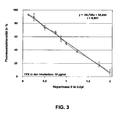
- heparanase concentration range the degradation of fondaparinux and thus the fluorescence intensity shows a linear dependence on the enzyme concentration.
- heparanase concentrations of 0.1 to 2.0 IU / ⁇ l resulted in incomplete fondaparinux degradation, although it can clearly be seen that the fluorescence intensity decreases linearly with the heparanase concentration.
- the heparanase concentrations 0.1, 0.5 and 1.0 IU / ⁇ l were each incubated for 30 min with 10.0 ⁇ g / ml fondaparinux and the lower concentrations 5.0 and 2.5 mg / ml.
- the incubation solutions were then diluted 1: 4, 1: 2, or used undiluted (i.e., uniformly 2.5 ⁇ g / ml fondaparinux).
- Fig. 4 shows that by reducing the substrate concentration, the measurement range can be shifted to lower heparinase concentrations.
- the linear concentration range of the fluorescence intensity enhancement of polymer H by fondaparinux even lower concentrations can be used to increase the sensitivity.
- heparanase activity on heparan sulfate is increased by calcium ions. Therefore, it was investigated whether this is possible even when using fondaparinux as a substrate.
- the standard heparanase working solution (1.5 IU / ⁇ l) was diluted on the one hand with the 10 mM CaCl 2 solution and on the other hand with the standard buffer 1: 2 (0.75 IU / ⁇ l).
- Fig. 4 shows that CaCl 2 increases heparanase activity by almost 100%. This demonstrates, by way of example, that very small heparanase concentrations are detected not only by prolonging the incubation time but also by modifying the incubation buffer.
- Fig. 6 the measured FI values of the different assay components are shown, ie without subtraction of the blank value.
- the indication of the concentration refers to the incubation solution; the concentration of fondaparinux in the fluorescence measurement is 2.5 ⁇ g / ml.
- the sodium acetate buffer (“NaAc”) used in the incubation has no effect on the fluorescence intensity (FI) of Polymer-H.
- Heparanase leads to a slight increase in the fluorescence intensity, which is also reflected in the fluorescence intensity of "FPX inc.” (Sample inactivated immediately after heparanase addition so that fondaparinux is not degraded) compared to a fondaparinux solution without heparanase.
- the fluorescence intensity measured after degradation of fondaparinux is nearly equal to that of "NaCl + heparanase" and illustrates complete degradation.
- Fig. 7 shows the result of an experiment to inhibit heparanase activity by a known heparanase inhibitor, namely curdlansulfate.
- the inhibitor was added to the usual incubation solution.
- Test scheme 7.5 ⁇ l of a 200 ⁇ g / ml FPX solution (final conc. During incubation 10 ⁇ g / ml), 7.5 ⁇ l of curdlansulfate solution in 0.9% NaCl (final conc. In Fig. 7 indicated) and 135 ⁇ l 1.5 IU / ul heparanase solution were incubated for 30 min at 37 ° C, then inactivated, diluted and measured after polymer H addition.
- the method can be used to determine enzyme kinetic factors, such as K M or v max , in the presence or absence of (potential) inhibitors.
- enzyme kinetic factors such as K M or v max
- the expert knows how to take care of control approaches.
- each of the fondaparinux solution 200 ⁇ g / ml
- 7.5 ⁇ l of the respective sample solution in the examples: antithrombin, inhibitor, 0.9% NaCl as control
- 15 ⁇ l of the fondaparinux solution 100 ⁇ g / ml
- two wells are covered with the same solution.
- the heparanase is inactivated by, for example, heated for 3 minutes at 100 ° C water bath.
- the MTP is subjected to step 2 either immediately and in a timely manner (Example, see Fig. 5 ) (automated in the Novostar ® ).
- Example 2 differs from Example 1 in that both steps are performed in a microtiter plate. This procedure is particularly suitable for automation (eg when using the Novostar ® )
- Example 3 differs from Example 2 in that a lower substrate concentration is used, which is not diluted prior to polymer H addition.
- a lower substrate concentration is used, which is not diluted prior to polymer H addition.
- the inhibition of degradation is examined, but the activity of a heparanase-containing sample using a calibration line with different concentrations of a reference heparanase.
Landscapes
- Chemical & Material Sciences (AREA)
- Organic Chemistry (AREA)
- Life Sciences & Earth Sciences (AREA)
- Zoology (AREA)
- Wood Science & Technology (AREA)
- Proteomics, Peptides & Aminoacids (AREA)
- Health & Medical Sciences (AREA)
- Engineering & Computer Science (AREA)
- Microbiology (AREA)
- Immunology (AREA)
- Physics & Mathematics (AREA)
- Molecular Biology (AREA)
- Biotechnology (AREA)
- Biophysics (AREA)
- Analytical Chemistry (AREA)
- Biochemistry (AREA)
- Bioinformatics & Cheminformatics (AREA)
- General Engineering & Computer Science (AREA)
- General Health & Medical Sciences (AREA)
- Genetics & Genomics (AREA)
- Measuring Or Testing Involving Enzymes Or Micro-Organisms (AREA)
Description
- Die Erfindung betrifft ein Verfahren zur Bestimmung der Aktivität der Heparanase
- Das Enzym Heparanase, auch Heparansulfat-Endoglycosidase oder Endo-β-D-glucuronidase genannt, ist eine Endoglycosidase, die spezifisch Heparansulfat-Ketten von Zelloberflächen-und Basalmembran-Heparansulfat-Proteoglycanen spaltet und an zahlreichen wichtigen biologischen Prozessen, wie z.B. Entzündungsreaktionen, aber auch bei der Tumor-Invasion und Metastasierung, beteiligt ist.
- Aufgrund seiner zentralen Rolle bei der Invasion und Metastasierung von Tumoren werden daher Inhibitoren der Heparanase als potenzielle Kandidaten für die Tumortherapie angesehen.
- Als schwierig erweist sich jedoch das Screening nach wirkungsvollen Heparanaseinhibitoren, da keine für ein Screening mit hohem Durchsatz geeigneten Testverfahren zur Bestimmung der Enzymaktivität der Heparanase zur Verfügung stehen.
- In herkömmlichen Assays wird die Heparanaseaktivität bzw. -hemmung anhand des Abaus des ntürlichen Substrates Heparansulfat bestimmt (Nakajima et al 1986). Das hierbei verwendete Heparansulfat ist ein komplex und sehr variabel zusammengesetztes Glycaosaminoglycan und daher in seiner Zusammensetzung schwierig zu standardisieren. Außerdem muss es zum Nachweis der Enzymaktivität beispielsweise mit einem radioaktiven Marker markiert werden (Freeman et al 1997).
- Auch neuere Verfahren, die nicht radioaktiv markiertes Substrat, sondern Hapransulfat verwenden, das beispielsweise mit Biotin oder fluoreszierenden Markern (z.B. FITC oder Europium-Chelaten) gekoppelt ist, sind arbeits- und zeitaufwändig, da die Spaltprodukte jeweils abgetrennt werden müssen (Behzad et al 2003; Huang et al 2004).
- Darüber hinaus weisen alle Markierungsverfahren den Nachteil auf, dass nicht nur das Heparansulfat selbst, sondern auch die Markierung chargenabhängigen Schwankungen unterliegt und dass die biochemischen Eigenschaften des Substrates und damit sein Verhalten im Messsystem durch die Markierung verändert werden können.
- Es ist bekannt, dass neben dem natürlich vorkommenden Heparansulfat auch das synthetisch hergestellte Fondaparinux von der Heparanase gespalten wird und daher als Alternative zu markiertem Heparansulfat als Substrat der Heparanase verwendet werden kann.
- Fondaparinux ist ein Arzneistoff, der wie Heparine als Antithrombotikum eingesetzt wird. Es handelt sich um ein chemisch definiertes, synthetisch hergestellters sulfatiertes Pentasaccharid, das der natürlichen Pentasaccharidsequenz entspricht, die auch in Heparinmolekülen vorkommt. Fondaparinux ist ein sogenannter indirekter selektiver Faktor Xa-Inhibitor; es wirkt antithrombotisch, indem es mit hoher Affinität selektiv an Antithrombin (AT) bindet und dessen Hemmwirkung gegenüber dem Gerinnungsfaktor Xa ca. 340fach beschleunigt); diese AT-vermittelte Inhibierung von Faktor Xa bewirkt eine verminderte Bildung von Thrombin, dem Schlüsselenzym der Gerinnung.
- Die Heparanase spaltet das Fondaparinux in ein Di- und ein Trisaccharid:

- Hierzu ist beispielsweise ein Verfahren bekannt, bei dem die reduzierenden Eigenschaften des Disaccharids mit Hilfe des Tatrazoliumsalzes WST-1, das zu einem bei 584 nm vermessbarem Farbstoff oxidiert wird, genutzt werden (Hammond et al 2010).
- Allerdings ist die Nutzbarkeit dieses Verfahren in der Praxis sehr begrenzt, da dieses System, insbesondere die Farbreaktion, extrem störanfällig ist.
- Ein auch für das Screening von potenziellen Heparanase-Inhibitoren durchführbares Verfahren besteht derzeit darin, den Abbau von Fondaparinux indirekt, und zwar mittels dessen inhibitorischer Aktivität auf den Gerinnungsfaktor Xa zu ermitteln, wobei die nach Inkubation von Fondaparinux mit Heparanase messbare Abnahme der inhibitorischen Aktivität des Fondaparinux auf Faktor Xa ein Maß für die Enzymaktivität der Heparanase ist (Alban et al 2009).
- Allerdings ist dieses Verfahren mit der indirekten Qantifizierung von Fondaparinux, trotz guter Ergebnisse, nicht ideal als robuster Test für ein Hochdurchsatz-Screening von potenteillen Inhibitoren oder Routinemessungen. Denn die indirekte Quantifizierung des Substrates anhand einer biologischen Aktivität umfasst mehrere Schritte, benötigt eine Kalibrierung des Systems und unterliegt gewissen Störfaktoren.
- Aufgabe der vorliegenden Erfindung ist es daher, ein einfacheres und schneller durchzuführendes Verfahren zur Bestimmung der Heparanaseaktivität zu schaffen.
- Diese Aufgabe wird durch das Verfahren mit den Merkmalen von Anspruch 1 gelöst. Die Unteransprüche geben vorteilhafte Ausgestaltungen der Erfindung wieder.
- Grundgedanke der Erfindung ist es, einen Assay zur Bestimmung der Enzymaktivität des Enzyms Heparanase bereitzustellen, bei dem Fondaparinux als Substrat verwendet und direkt mit der fluoreszierenden Sensor-Substanz Polymer-H quantifiziert wird.

- Es ist zwar bekannt, dass das synthetisch hergestellte Fondaparinux, obgleich es im Verhältnis zu anderen Glycosaminoglycanen ein sehr kurzkettiges Pentasaccharid ist, die Fluoreszenzintensität von Polymer-H konzentrationsabhängig steigert und somit mittels dieser Sensor-Substanz detektiert werden kann (Lühn et al 2010).
- Überraschend ist jedoch, dass die nach Inkubation von Fondaparinux mit Heparanase vorliegenden Fondaparinux-Spaltprodukte keine Steigerung der Fluoresenzintensität von Polymer-H mehr hervorrufen, wobei in Voruntersuchungen zur vorliegenden Erfindung gezeigt werden konnte, dass nach Inkubation Fondaparinux mit Heparinase die Fluoresenzintensität bis zu einer bestimmten Menge Substrat ungefähr auf den Kontrollwert ohne Fondaparinux absinkt und erst ab einer bestimmten Substratmenge ansteigt.
- Die Erfindung wird anhand der in den beigefügten Abbildungen dargestellten experimentellen Ergebnisse näher erläutert. Es zeigen:
- Fig. 1
- die Konzentrationsabhängigkeit der Steigerung der Polymer-H-Fluoreszenzintensität durch Fondaparinux;
- Fig. 2
- die Abhängigkeit des Abbaus von Fondaparinux (FPX) von der Heparanase-Konzentration und der Inkubationszeit;
- Fig. 3
- die Abhängigkeit des Abbaus von Fondaparinux (FPX) von der Heparanase-Konzentration nach jeweils 30 min;
- Fig. 4
- die Abhängigkeit des Abbaus von Fondaparinux (FPX) von der Fondaparinux- und Heparanasekonzentration
- Fig. 5
- den Einfluss von Calcium-Ionen auf die Heparanaseaktivität;
- Fig. 6
- den Einfluss von Antithrombin (AT) auf den Abbau von Fondaparinux durch Heparanase;
- Fig. 7
- den Einfluss verschiedener Assaykomponenten auf die gemessene Fluoreszenzintensität; und
- Fig. 8
- die konzentrationsabhängige Hemmung der Heparanase durch Curdlansulfat.
-
Fig. 1 zeigt den Zusammenhang zwischen der Konzentration von Fondaparinux und der mit Polymer-H erhaltenen Fluoreszenzintensität. Es ist deutlich zu erkennen, dass die Zunahme der Fluoreszenzintensität bei zunehmenden Konzentrationen linear verläuft und damit für eine zuverlässige Quantifizierung in einem Verfahren zur Bestimmung der Heparanaseaktivität geeignet ist. -
Fig. 2 gezeigte Versuchsergebnis wurden zunächst wurden 15 µl einer 100 µg/ml Fondaparinux-Lösung in die Wells einer MTP pipettiert, anschließend 135 µl Heparanase-Lösung unterschiedlicher Aktivität zugegeben. Nach Inkubation bei 37 °C für die jeweils angegebene Zeit wurden 100 µl Aliquots abpipettiert und zur Inaktivierung der Heparanase 3min lang bei 100 °C inkubiert. Anschließend erfolgte die Fluoreszenzmessung nach Zugabe von Polymer-H-Lösung. -
Fig. 2 zeigt, dass der Abbau einerseits von der Inkubationszeit, andererseits von der Heparinase-Konzentration abhängt. Während die höchste Heparanase-Konzentration (2,0 IU/µl) innerhalb von 30 min für einen vollständigen Abbau von Fondaparinux sorgt, ist er mit 0,25 IU/µl nach 240 min erreicht. Die "Restfluoreszenz" entspricht der der Kontrolllösung ohne Fondaparinux (vgl.Fig. 6 ). - Aufgrund des in
Fig. 2 dargestellten Ergebnisses sollte geprüft werden, in welchem Heparanase-Konzentrationsbereich der Abbau von Fondaparinux und damit die Fluoreszenzintensität eine lineare Abhängigkeit von der Enzymkonzentration zeigt. Wie inFig. 3 zu sehen, ergaben Heparanase-Konzentrationen von 0,1 bis 2,0 IU/µl einen unvollständigen Fondaparinux-Abbau, wobei deutlich jedoch zu erkennen ist, dass die Fluoreszenzintensität linear mit der Heparanase-Konzentration abnimmt. - Aufgrund dieses linearen Zusammenhangs ergibt sich die Option, mit einer Referenz-Heparanase eine Kalibriergerade zu erstellen und anhand dieser die Heparanase-Aktivität einer unbekannten Probe zu bestimmen.
- Da bei geringen Heparanase-Konzentrationen nach einer bestimmten Inkubationszeit ein erheblicher Anteil von Fondaparinux erhalten bleibt und der Abbau nicht messbar ist, sollte untersucht werden, ob eine Verringerung der Substratkonzentration die Empfindlichkeit steigert. Hierzu wurden die Heparanase-Konzentrationen 0,1, 0,5 und 1,0 IU/µl jeweils 30 min mit 10,0 µg/ml Fondaparinux und den geringeren Konzentrationen 5,0 und 2,5 mg/ml inkubiert. Für die Fluoreszenzmessung nach Polymer-H-Zugabe wurden die Inkubationslösungen dann 1:4, 1:2 verdünnt bzw. unverdünnt verwendet (d.h. einheitlich 2,5 µg/ml Fondaparinux).
-
Fig. 4 zeigt, dass durch Verringerung der Substratkonzentration der Messbereich zu niedrigeren Heparinase-Konzentrationen verschoben werden kann. Angesichts des linearen Konzentrationsbereiches der Fluoresenzintensitätssteigerung von Polymer-H durch Fondaparinux können auch noch geringere Konzentrationen zwecks Steigerung der Empfindlichkeit eingesetzt werden. - Bekanntlich wird die Heparanase-Aktivität gegenüber Heparansulfat durch Calcium-Ionen gesteigert, Daher wurde untersucht, ob dies auch bei Verwendung von Fondaparinux als Substrat möglich ist. Dazu wurde die als Standard festgelegte Heparanase-Arbeitslösung (1,5 IU/µl) zum einen mit der 10 mM CaCl2-Lösung, zum anderen mit dem Standardpuffer 1:2 verdünnt (0,75 IU/µl).
- Wie
Fig. 4 zeigt, steigert CaCl2 die Heparanaseaktivität um fast 100 %. Dies demonstriert beispielhaft, dass nicht nur durch eine Verlängerung der Inkubationszeit, sondern auch durch Modifiaktion des Inkubationsbuffers auch sehr geringe Heparanase-Konzentrationen nachgewiesen werden. - Für den in
Fig. 5 dargestellten Versuch wurden zu gleichen Volumenanteilen 1 IU/ml Antithrombin bzw. 0,1 IU/ml Antithrombin und 200 µg/ml Fondaparinux (je 7,5 µl) mit 135 µl Heparanase-Lösung (1,5 IU/µl) inkubiert. Die Antithrombin-Konzentration von 1,0 IU/ml, die der Antithrombin-Konzentration im Plasma entspricht, stört den Abbau von Fondaparinux. Wird das Antithrombin aber um 1:10 auf 0,1 IU/ml verdünnt (entspricht einer Plasmaverdünnung von 1:10), kann der Einfluss des Antithrombin auf den Assay eliminiert werden. - In
Fig. 6 sind die gemessenen FI-Werte der verschiedenen Assay-Komponenten dargestellt, d.h. ohne Abzug des Blank-Wertes. Die Angabe der Konzentration bezieht sich auf die Inkubationslösung; die Konzentration von Fondaparinux bei der Fluoreszenzmessung beträgt 2,5µg/ml. - Der bei der Inkubation verwendete Natriumacetat-Puffer ("NaAc") hat keinerlei Einfluss auf die Fluoreszenzintensität (FI) von Polymer-H.
- Heparanase führt zu einer geringfügigen Erhöhung der Fluoreszenzintensität, die sich auch in der Fluoreszenzintensität von "FPX ink." (Probe nach Heparanase-Zugabe sofort inaktiviert, so dass Fondaparinux nicht abgebaut wird) im Vergleich zu einer Fondaparinux-Lösung ohne Heparanase manifestiert.
- Die nach Abbau von Fondaparinux gemessene Fluoreszenzintensität ist nahezu gleich mit der von "NaCl + Heparanase" und veranschaulicht einen vollständigen Abbau.
- Keinerlei Einfluss auf die Fluoreszenzintensität von Polymer-H zeigt Galactose (2,5 µg/ml). Hieraus ergibt sich ein Vorteil gegenüber dem Heparanase-Assay von Hammond (s.o.). Dort führt Galactose in der Detektionsreaktion zu einem Signal, das identisch mit dem der Fondaparinux-Spaltprodukte ist, denn jegliche Art reduzierende und oxidierender Komponenten stört diesen Test.
- Schließlich zeigt
Fig. 7 exemplarisch das Ergebnis eines Versuchs zur Hemmung der Heparanase-Aktivität durch einen bekannten Heparanase-Inhibitor, nämlich Curdlansulfat. Hierzu wurden der Inhibitor der üblichen Inkubationslösung zugesetzt. Testschema: 7,5 µl einer 200 µg/ml FPXLösung (Endkonz. während der Inkubation 10 µg/ml), 7,5 µl Curdlansulfat-Lösung in 0,9 % NaCl (Endkonz. inFig. 7 angegeben) und 135µl 1,5 IU/µl Heparanase-Lösung wurden jeweils 30 min bei 37 °C inkubiert, anschließend inaktiviert, verdünnt und nach Polymer-H-Zugabe vermessen. - Gegenüber den vorbekannten Verfahren zur Bestimmung der Enzymaktivität von Heparanase besitzt das erfindungsgemäße Verfahren folgende Vorteile:
- Das hier vorgeschlagene Verfahren ist im Kern eine direkte Quantifizierung des Substrates Fondaparinux mittels Fluoreszenzmessung. Das Verfahren ist damit einfach, schnell und ohne strenge Sicherheitsvorkehrungen durchzuführen.
- Durch die Verwendung von Fondaparinux als Substrat ist der Test erheblich preiswerter, besser standardisierbar und leichter reproduzierbar als Verfahren mit chemisch oder radioaktiv markiertem Heparansulfat.
- Als Verfahren, das in Mikrotiterplatten durchgeführt wird, ist der Test voll vollautomatisierbarer und innerhalb von 45 min inkl Inkubationsreaktion durchführbar.
- Da es sich bei der Detektionsreaktion um eine direkte Bestimmung von Fondaparinux handelt und die Fluoreszenintensität linear von der Fondaparinux-Konzentration. abhängt, braucht man bei der Detektionsreaktion keine Kalibrierkurve, sondern lediglich einen Fondaparinux-Kontrollwert, nämlich die Fluoreszenzintensität von nicht abgebautem Fondaparinux (entspricht 100 % Fluoreszenzintensität).
- Das Verfahren eignet sich nicht nur zum Inhibitor-Screening, sondern auch zur Quantifizierung bekannter Heparanase-Inhibitoren in biologischen Proben (z.B. Blutplasma). Darüber hinaus eignet sich das Verfahren zur Prüfung einer unbekannten Heparanase im Vergleich zu einer Referenz (Qualitätskontrolle) sowie zur Bestimmung der Heparanase-Aktivität in biologischen und Proben anderer Art.
- Da Fondaparinux mit keinen anderen Zellen und Proteinen interagiert als Antithrombin (Petitou et al. 2004), ist der Test breit einsetzbar und der Abbau wird nicht durch "Matrixeffekte" gestört. Zur Abtrennung der Lösung für die Detektion von komplexen Proben (Zelllysate, Zellen, Gewebelysate), können aus diesem Grund auch Ultrafiltrations-Mikrotiterplatten (z.B. von DoctorLab.com) verwendet werden, die nach der Inkubation zentrifugiert werden, wodurch restliches Fondaparinux, dessen Abbauprodukte durch eine Membran mit einem cut-off 5 kDa in eine untere Platte überführt werden und alle größeren Moleküle (z.B. Proteine) und Partikel in der oberen Platte bleiben.
- Obwohl Fondaparinux an Antithrombin im Blutplasma bindet, kann der Test ohne weitere Modifikationen verwendet werden, wenn die Plasmaproben 1:10 (z.B. für das Drug-Monitoring) verdünnt werden.
- Wird jedoch unverdünntes Plasma vermessen, konkurriert die Bindung an Antithrombin mit dem Abbau durch die Heparanase. Um dieses Problem zu lösen, muss Antithrombin in dem Plasma abgefangen werden. Eine Strategie besteht nun darin, dem Plasma Idraparinux zuzusetzen, da dieses chemisch modifizierte Analogon von Fondaparinux 800mal stärker als Fondaprinux an Antithrombin bindet (Hjelm et al. 2007), selbst aber nicht von der Gruppe der Heparanasen abgebaut wird (Daud et al. 2001, unpublizierte Daten). Demzufolge wird Fondaprinux kompetitiv aus der Bindung zu Antihrombin durch Idraparinux verdrängt und kann durch die Heparanase abgebaut werden. Eine andere Option ist das Abfangen von Antithrombin in der Probe durch Zugabe von Antithrombin-Antikörpern.
- Das Verfahren kann zur Bestimmung der enzymkinetischen Faktoren, wie KM oder vmax, in Anwesenheit oder Abwesenheit von (potenziellen) Inhibitoren verwendet werden. Zur Bestimmung der Enzymaktivität reicht es, beispielsweise für Screening-Tests, aber auch aus, bei bestimmten Konzentrationen von Enzym, Substrat und Inhibitorkandidat Punktmessungen vorzunehmen, um zu überprüfen, ob die Fluoreszenzintensität aufgrund einer Hemmung der Heparanase durch den potenziellen Inhibitor beeinflusst wird - für entsprechende Kontrollansätze weiß der Fachmann zu sorgen.
- Ist ein Inhibitor der Heparanase dadurch identifiziert, dass eine niedrigere Fluoreszenzintensitätsänderung eintritt als im Kontrollansatz ohne Inhibitor, wird der Fachmann auch die weiteren Eigenschaften eines mit dem vorgeschlagenen Verfahren identifizierten Inhibitors ohne weiteres gemäß dem Stand der Technik ermitteln können.
-
- Mikrotiterplatten (MTP)-Reader für Fluoreszenz-Messung:
- z.B. Optima® (BMG LABTECH GmbH), Filter: λex 320nm und λem 510 nm
- z.B. Omega® (BMG LABTECH GmbH), Filter: λex 320nm und λem 510 nm
- z.B. Novostar® (BMG LABTECH GmbH) mit Titrator; λex 320nm und λcm 510 nm
- Flachboden-Mikrotiterplatten (MTP):
- MTP für Inkubationsreaktion: Best.Nr. 269620 (nunc GmbH & Co.KG)
- MTP für Detektionsreaktion: Maxisorp®, Best.Nr. 437111 (nunc GmbH & Co.KG)
- Inkubationsschüttler für Heparanase-Inkubation (37 °C, 600 RPM):
- z.B. Hybridization Oven/Shaker (Amersham Pharmacia biotech, Wien, Österreich)
-
- Fondaparinux:
- Bulkware von Glaxo Smith Kline und Fertigspritze Arixtra® (2,5 mg/0,5 ml) Fondaparinux-Substratlösung: Fondaparinux. wird zu 100 µg/ml oder 200 µg/ml in 0,9 % NaCl gelöst
- Heparanase:
- Heparinase II (Flavobacterium heparinum) (Sigma, Best.Nr. H 6512, Charge: 076K3777 155 Sigma-Units (SU)/mg; 1 SU = 600 Internationale Units (IU)) Arbeitslösung: z.B. 1,2 oder 0,9 SU/ml = 2,0 oder 1,5 IU/µl Heparanase
- Heparanase-Puffer:
- für die Herstellung der Stammlösung: pH 7,0, 100 mM Natriumacetat mit 0,01 % BSA für die Herstellung der Arbeitslösung: pH 7,0, 100 mM Natriumacetat
- Polymer-H
- Synthese nach Sun et al. (2007)
- Arbeitslösung: 75 µg/ml in 0,9 % NaCl
-
- humanes Antithrombin (Haemochrom Diagnostics GmbH, Best.Nr. 41220, 10 IU)
- 10 mM Calciumchlorid-Löung (CaCl2) mit Heparanase-Puffer verdünnt auf 5mM in Inkubationslösung
- Heparanase-Inhibitor: Curdlansulfat, ein semisynthetisches β-1,3-Glucansulfat
- In die Wells einer MTP werden zunächst jeweils 7,5 µl der Fondaparinux-Lösung (200 µg/ml) und 7,5 µl der jeweiligen Probenlösung (in den Beispielen: Antithrombin, Inhibitor, 0,9% NaCl dann als Kontrolle) pipettiert oder alternativ 15 µl der Fondaparinux-Lösung (100 µg/ml) (wenn die Heparanase-Aktivität in Proben bestimmt werden soll). Es werden jeweils zwei Wells mit der gleichen Lösung belegt.
- Dann werden jeweils 135 µl der Heparanase-Arbeitslösung bzw. ggf. 135 µl einer Heparanasehaltigen Probenlösung zupipettiert, so dass die Substrat-Konzentration 10 µg/ml beträgt. Es folgt eine Inkubation von 30 min bei 37 °C unter Schütteln (600 RPM) (für Kinetik-Untersuchungen wurde die Probe für den 0 min-Wert 1 min bei 37 °C geschüttelt und dann gleich inaktiviert).
- Nach Ablauf der Inkubationszeit wird die Heparanase inaktiviert, indem sie z.B. für 3 Minuten bei 100 °C Wasserbad erhitzt wird. Alternativ wird die MTP entweder sofort und zeitlich standardisiert dem Schritt 2 unterzogen (Beispiel, siehe
Fig. 5 ) (automatisiert möglich im Novostar®). - Aus jedem Well werden jeweils zwei 45 µl Aliquots der inkubierten Lösung in zwei Wells einer Maxisorp®-MTP überführt (d.h. insgesamt 4 Werte pro Probe) und jeweils 1:4 mit 135 µl 0,9 % NaCl verdünnt.
- Anschließend werden jeweils 20 µl Polymer-H-Arbeitslösung (75 µg/ml) zupipettiert. Dann wird die MTP zunächst 5 min geschüttelt, weitere 5 min bei RT im MTP-Reader äquilibriert und nach nochmaligem Schütteln für 30 s von oben vermessen (λex 320-10nm, λem 510-10 nm).
- Beispiel 2 unterscheidet sich von Beispiel 1 dadurch, dass beide Schritte in einer Mikrotiterplatte durchgeführt werden. Dieses Vorgehen ist besonders für die Automatisierung geeignet (z.B. bei Verwendung des Novostar®)
-
- 3,0 µl bzw. 6,0 µl der Fondaparinux-Lösung (200 bzw. 100 µg/ml)
- 3,0 µl bzw. 0,0 µl Probenlösung
- 54 µl der Heparanase-Arbeitslösung
- Inkubation
- 180 µl 0,9 % NaCl
- 25 µl Polymer-H-Arbeitslösung (80 µg(ml)
- Fluoreszenzmessung
- Beispiel 3 unterscheidet sich von Beispiel 2 dadurch, dass eine geringere Substratkonzentration verwendet wird, die vor der Polymer-H-Zugabe nicht verdünnt wird. Außerdem wird in diesem Beispiel nicht die Hemmung des Abbaus untersucht, sondern die Aktivität einer Heparanase-haltigen Probe anhand einer Kalibriergerade mit verschiedenen Konzentrationen einer Referenz-Heparanase.
-
- 20,0 µl der Fondaparinux-Lösung (25 µg/ml)
- 180 µl der Referenz-Heparanase-Lösung und Probelösung
- Inkubation
- 22 µl Polymer-H-Arbeitslösung (75 µg(ml)
- Fluoreszenzmessung
-
- Alban S, Schiemann S. Development of a novel heparanase activity assay and identification of potent heparanase inhibitors. XII Congress of the International Society on Thrombosis and Haemostasis, Boston, 11.-16.07.2009. Abstract publiziert in: J Thromb Haemost (2009) 7, Suppl.2: PP-WE-506.
- Bisio A, Mantegazza A, Urso E, Naggi A, Torri G, Viskov C, Casu B. High-performance liquid chromatographic/mass spectrometric studies on the susceptibility of heparin species to cleavage by heparanase. Semin Thromb Hemost. 2007 Jul;33(5):488-95.
- Freeman C, Parish CR. A rapid quantitative assay for the detection of mammalian heparanase activity. Biochem J. 1997 Jul 1;325 (Pt 1):229-37.
- Hammond E, Li CP, Ferro V. Development of a colorimetric assay for heparanase activity suitable for kinetic analysis and inhibitor screening. Anal Biochem. 2010 Jan 1;396(1):112-6.
- Huang KS, Holmgren J, Reik L, Lucas-McGady D, Roberts J, Liu CM, Levin W. Highthroughput methods for measuring heparanase activity and screening potential antimetastatic and anti-inflammatory agents. Anal Biochem. 2004 Oct 15;333(2):389-98.
- Lühn S, Schrader T, Sun W, Alban S.Development and evaluation of a fluorescence microplate assay for quantification of heparins and other sulfated carbohydrates. J Pharm Biomed Anal. 2010 May 1;52(1):1-8. Epub 2009 Dec 23.
- S Lühn, T Schrader, W Sun, S Alban. Development and evaluation of a fluorescence microplate assay for quantification of heparins and other sulfated carbohydrates. J Pharm Biomed Anal 52 (2010): 1-8
- Nakajima M, Irimura T, Nicolson GL. A solid-phase substrate of heparanase: its application to assay of human melanoma for heparan sulphate degradative activity. Anal Biochem. 1986 Aug 15;157(1):162-71.
- Schiemann S. Entwicklung eines Heparinase II-Testes. Diplomarbeit, CAU Kiel, 2008.
- Schiemann S, Alban S. Detecting heparanase inhibitors with a novel heparanase activity assay fit for routine. 53rd Annual Meeting of the GTH (Gesellschaft für Thrombose- und Hämostaseforschung), Wien, 04.-07.02.2009. Abstract publiziert in: Hämostaseologie (2009) 29: A73 (PP6.6-3).
Claims (11)
- Verfahren zur Bestimmung der Enzymaktivität der Heparanase,
gekennzeichnet durch die Schritte- Inkubieren einer Fondaparinux und Polymer-H enthaltenden Lösung mit Heparanase, und- Erfassen der Veränderung der Fluoreszenzintensität des Polymer-H innerhalb wenigstens eines vorbestimmten Zeitintervalls, wobei die Fluoreszenzintensitätsänderung ein direktes Maß für die Enzymaktivität der Heparanase ist. - Verfahren nach Anspruch 1, dadurch gekennzeichnet, dass die Lösung eine die Aktivität der Heparanase steigernde Substanz enthält.
- Verfahren nach Anspruch 2, dadurch gekennzeichnet, dass die Lösung Ca2+-Ionen enthält.
- Verfahren nach einem der vorhergehenden Ansprüche, dadurch gekennzeichnet, dass die Lösung eine 1:10 verdünnte Plasmalösung ist.
- Verfahren nach einem der vorhergehenden Ansprüche, dadurch gekennzeichnet, dass die Lösung Idraparinux enthält.
- Verfahren nach einem der vorhergehenden Ansprüche, dadurch gekennzeichnet, dass die Lösung einen Antithrombin-Antikörper enthält.
- Verfahren nach einem der vorhergehenden Ansprüche, dadurch gekennzeichnet, dass die Lösung eine die Enzymaktivität der Heparanase inhibierende Substanz enthält.
- Verfahren nach einem der vorhergehenden Ansprüche, dadurch gekennzeichnet, dass die Heparanase in gelöster Form vorliegt.
- Verfahren nach einem der vorhergehenden Ansprüche, dadurch gekennzeichnet, dass die Heparanase aus einer biologischen Probe stammt.
- Verfahren nach einem der vorhergehenden Ansprüche, dadurch gekennzeichnet, dass die Fluoreszenzintensität bei einer Emissionswellenlänge von 510 nm erfasst wird.
- Verfahren nach einem der vorhergehenden Ansprüche, dadurch gekennzeichnet, dass die Veränderung der Fluoreszenzintensität bei Licht mit einer Anregungswellenlänge von 320 nm erfasst wird.
Applications Claiming Priority (1)
| Application Number | Priority Date | Filing Date | Title |
|---|---|---|---|
| PCT/DE2010/000992 WO2012025069A1 (de) | 2010-08-27 | 2010-08-27 | Verfahren zur bestimmung der enzymaktivität der heparanase |
Publications (2)
| Publication Number | Publication Date |
|---|---|
| EP2609210A1 EP2609210A1 (de) | 2013-07-03 |
| EP2609210B1 true EP2609210B1 (de) | 2015-06-24 |
Family
ID=43038009
Family Applications (1)
| Application Number | Title | Priority Date | Filing Date |
|---|---|---|---|
| EP10763588.0A Not-in-force EP2609210B1 (de) | 2010-08-27 | 2010-08-27 | Verfahren zur bestimmung der enzymaktivität der heparanase |
Country Status (2)
| Country | Link |
|---|---|
| EP (1) | EP2609210B1 (de) |
| WO (1) | WO2012025069A1 (de) |
Family Cites Families (1)
| Publication number | Priority date | Publication date | Assignee | Title |
|---|---|---|---|---|
| GB9913415D0 (en) * | 1999-06-10 | 1999-08-11 | Central Manchester Healthcare | Heparanase assay |
-
2010
- 2010-08-27 EP EP10763588.0A patent/EP2609210B1/de not_active Not-in-force
- 2010-08-27 WO PCT/DE2010/000992 patent/WO2012025069A1/de not_active Ceased
Also Published As
| Publication number | Publication date |
|---|---|
| EP2609210A1 (de) | 2013-07-03 |
| WO2012025069A1 (de) | 2012-03-01 |
Similar Documents
| Publication | Publication Date | Title |
|---|---|---|
| Xu et al. | Study of urinary 8-hydroxydeoxyguanosine as a biomarker of oxidative DNA damage in diabetic nephropathy patients | |
| EP2079849B1 (de) | Verfahren und vorrichtungen zur elektrochemischen bestimmung von faktor xa-inhibitoren in blutproben | |
| EP0915340B1 (de) | Verfahren zur Bestimmung des antikoagulatorischen Potentials einer Probe und Verfahren zur Bestimmung der Glykosilierung von Thrombomodulin | |
| CH642749A5 (de) | Verfahren zur bestimmung der biologischen aktivitaet von heparin im plasma und reagens zur durchfuehrung des verfahrens. | |
| EP2484775A1 (de) | Heparin-insensitives Verfahren zur Bestimmung von direkten Gerinnungsfaktorinhibitoren | |
| EP0776374B1 (de) | Verfahren und vorrichtung zur bestimmung der aktivität von enzymen in flüssigkeiten, beziehungsweise der konzentration und/oder aktivität von inhibitoren in flüssigkeiten | |
| Stang et al. | Performance of the comet assay in a high-throughput version | |
| Barrowcliffe et al. | The anticoagulant activity of heparin: measurement and relationship to chemical structure | |
| DE19540098C2 (de) | Verfahren und Mehrkanalbiosensor zur Mehrkomponentenanalyse von Mischungen und/oder Gemischen | |
| EP1624072A1 (de) | Verfahren zur Bestimmung der Aktivität der Faktor VII-aktivierenden Protease aus Proteinlösungen | |
| EP0198322A2 (de) | Verfahren zur Bestimmung von Plasminogenaktivatoren (PA) | |
| EP1752772A1 (de) | Faktor Xa basiertes Heparin-Testverfahren unter Verwendung einer Heparin-modifizierenden Komponente | |
| DE69717001T2 (de) | Verfahren zur Bestimmung des Endpunktes von enzymatischen Nachweisverfahren | |
| DE4429660B4 (de) | Zusatzmittel für diagnostische Tests zur Bestimmung der Gerinnungsfähigkeit des Blutes, Verfahren zur Reduzierung der Beeinflussung von diagnostischen Tests durch Heparin und Verwendung von Metallsalzen zu diesen Zwecken | |
| Matysiak et al. | A new method for determination of hyaluronidase activity in biological samples using capillary zone electrophoresis | |
| DE3430906A1 (de) | Verfahren zur bestimmung von fibrinmonomer in plasma | |
| EP0190766B1 (de) | Bestimmung von Prokallikrein | |
| EP0185335A2 (de) | Verfahren zum Nachweis des Vorliegens einer Allergie und zum spezifischen Nachweis des für die Allergie verantwortlichen Allergens | |
| DE112006003476T5 (de) | Verfahren und Systeme zum Nachweisen und Quantifizieren indirekter Thrombininhibitoren | |
| DE102009024720B4 (de) | Massenspektrometrischer Endopeptidasen-Assay | |
| WO2012025069A1 (de) | Verfahren zur bestimmung der enzymaktivität der heparanase | |
| EP2843416A1 (de) | Kontroll- und Kalibratormaterial für die Bestimmung von direkten Antikoagulanzien | |
| Matějčková et al. | Determination of uric acid in plasma and allantoic fluid of chicken embryos by capillary electrophoresis | |
| EP2473856B1 (de) | Verfahren zur bestimmung der qualität von heparin | |
| EP3535410B1 (de) | Universales kontrollmaterial für gerinnungsfaktorinhibitor-test |
Legal Events
| Date | Code | Title | Description |
|---|---|---|---|
| PUAI | Public reference made under article 153(3) epc to a published international application that has entered the european phase |
Free format text: ORIGINAL CODE: 0009012 |
|
| 17P | Request for examination filed |
Effective date: 20130325 |
|
| AK | Designated contracting states |
Kind code of ref document: A1 Designated state(s): AL AT BE BG CH CY CZ DE DK EE ES FI FR GB GR HR HU IE IS IT LI LT LU LV MC MK MT NL NO PL PT RO SE SI SK SM TR |
|
| DAX | Request for extension of the european patent (deleted) | ||
| GRAP | Despatch of communication of intention to grant a patent |
Free format text: ORIGINAL CODE: EPIDOSNIGR1 |
|
| INTG | Intention to grant announced |
Effective date: 20150108 |
|
| GRAS | Grant fee paid |
Free format text: ORIGINAL CODE: EPIDOSNIGR3 |
|
| GRAA | (expected) grant |
Free format text: ORIGINAL CODE: 0009210 |
|
| AK | Designated contracting states |
Kind code of ref document: B1 Designated state(s): AL AT BE BG CH CY CZ DE DK EE ES FI FR GB GR HR HU IE IS IT LI LT LU LV MC MK MT NL NO PL PT RO SE SI SK SM TR |
|
| REG | Reference to a national code |
Ref country code: GB Ref legal event code: FG4D Free format text: NOT ENGLISH |
|
| REG | Reference to a national code |
Ref country code: CH Ref legal event code: EP |
|
| REG | Reference to a national code |
Ref country code: AT Ref legal event code: REF Ref document number: 732909 Country of ref document: AT Kind code of ref document: T Effective date: 20150715 |
|
| REG | Reference to a national code |
Ref country code: IE Ref legal event code: FG4D Free format text: LANGUAGE OF EP DOCUMENT: GERMAN |
|
| REG | Reference to a national code |
Ref country code: DE Ref legal event code: R096 Ref document number: 502010009741 Country of ref document: DE |
|
| PG25 | Lapsed in a contracting state [announced via postgrant information from national office to epo] |
Ref country code: FI Free format text: LAPSE BECAUSE OF FAILURE TO SUBMIT A TRANSLATION OF THE DESCRIPTION OR TO PAY THE FEE WITHIN THE PRESCRIBED TIME-LIMIT Effective date: 20150624 Ref country code: NO Free format text: LAPSE BECAUSE OF FAILURE TO SUBMIT A TRANSLATION OF THE DESCRIPTION OR TO PAY THE FEE WITHIN THE PRESCRIBED TIME-LIMIT Effective date: 20150924 Ref country code: LT Free format text: LAPSE BECAUSE OF FAILURE TO SUBMIT A TRANSLATION OF THE DESCRIPTION OR TO PAY THE FEE WITHIN THE PRESCRIBED TIME-LIMIT Effective date: 20150624 Ref country code: HR Free format text: LAPSE BECAUSE OF FAILURE TO SUBMIT A TRANSLATION OF THE DESCRIPTION OR TO PAY THE FEE WITHIN THE PRESCRIBED TIME-LIMIT Effective date: 20150624 |
|
| REG | Reference to a national code |
Ref country code: CH Ref legal event code: NV Representative=s name: TROESCH SCHEIDEGGER WERNER AG, CH |
|
| REG | Reference to a national code |
Ref country code: LT Ref legal event code: MG4D |
|
| PG25 | Lapsed in a contracting state [announced via postgrant information from national office to epo] |
Ref country code: GR Free format text: LAPSE BECAUSE OF FAILURE TO SUBMIT A TRANSLATION OF THE DESCRIPTION OR TO PAY THE FEE WITHIN THE PRESCRIBED TIME-LIMIT Effective date: 20150925 Ref country code: LV Free format text: LAPSE BECAUSE OF FAILURE TO SUBMIT A TRANSLATION OF THE DESCRIPTION OR TO PAY THE FEE WITHIN THE PRESCRIBED TIME-LIMIT Effective date: 20150624 Ref country code: BG Free format text: LAPSE BECAUSE OF FAILURE TO SUBMIT A TRANSLATION OF THE DESCRIPTION OR TO PAY THE FEE WITHIN THE PRESCRIBED TIME-LIMIT Effective date: 20150924 |
|
| REG | Reference to a national code |
Ref country code: NL Ref legal event code: MP Effective date: 20150624 |
|
| REG | Reference to a national code |
Ref country code: FR Ref legal event code: PLFP Year of fee payment: 6 |
|
| PG25 | Lapsed in a contracting state [announced via postgrant information from national office to epo] |
Ref country code: EE Free format text: LAPSE BECAUSE OF FAILURE TO SUBMIT A TRANSLATION OF THE DESCRIPTION OR TO PAY THE FEE WITHIN THE PRESCRIBED TIME-LIMIT Effective date: 20150624 |
|
| PG25 | Lapsed in a contracting state [announced via postgrant information from national office to epo] |
Ref country code: PT Free format text: LAPSE BECAUSE OF FAILURE TO SUBMIT A TRANSLATION OF THE DESCRIPTION OR TO PAY THE FEE WITHIN THE PRESCRIBED TIME-LIMIT Effective date: 20151026 Ref country code: ES Free format text: LAPSE BECAUSE OF FAILURE TO SUBMIT A TRANSLATION OF THE DESCRIPTION OR TO PAY THE FEE WITHIN THE PRESCRIBED TIME-LIMIT Effective date: 20150624 Ref country code: PL Free format text: LAPSE BECAUSE OF FAILURE TO SUBMIT A TRANSLATION OF THE DESCRIPTION OR TO PAY THE FEE WITHIN THE PRESCRIBED TIME-LIMIT Effective date: 20150624 Ref country code: RO Free format text: LAPSE BECAUSE OF NON-PAYMENT OF DUE FEES Effective date: 20150624 Ref country code: IS Free format text: LAPSE BECAUSE OF FAILURE TO SUBMIT A TRANSLATION OF THE DESCRIPTION OR TO PAY THE FEE WITHIN THE PRESCRIBED TIME-LIMIT Effective date: 20151024 Ref country code: CZ Free format text: LAPSE BECAUSE OF FAILURE TO SUBMIT A TRANSLATION OF THE DESCRIPTION OR TO PAY THE FEE WITHIN THE PRESCRIBED TIME-LIMIT Effective date: 20150624 Ref country code: SK Free format text: LAPSE BECAUSE OF FAILURE TO SUBMIT A TRANSLATION OF THE DESCRIPTION OR TO PAY THE FEE WITHIN THE PRESCRIBED TIME-LIMIT Effective date: 20150624 |
|
| REG | Reference to a national code |
Ref country code: DE Ref legal event code: R097 Ref document number: 502010009741 Country of ref document: DE |
|
| PG25 | Lapsed in a contracting state [announced via postgrant information from national office to epo] |
Ref country code: LU Free format text: LAPSE BECAUSE OF FAILURE TO SUBMIT A TRANSLATION OF THE DESCRIPTION OR TO PAY THE FEE WITHIN THE PRESCRIBED TIME-LIMIT Effective date: 20150827 Ref country code: MC Free format text: LAPSE BECAUSE OF FAILURE TO SUBMIT A TRANSLATION OF THE DESCRIPTION OR TO PAY THE FEE WITHIN THE PRESCRIBED TIME-LIMIT Effective date: 20150624 |
|
| PG25 | Lapsed in a contracting state [announced via postgrant information from national office to epo] |
Ref country code: IT Free format text: LAPSE BECAUSE OF FAILURE TO SUBMIT A TRANSLATION OF THE DESCRIPTION OR TO PAY THE FEE WITHIN THE PRESCRIBED TIME-LIMIT Effective date: 20150624 Ref country code: DK Free format text: LAPSE BECAUSE OF FAILURE TO SUBMIT A TRANSLATION OF THE DESCRIPTION OR TO PAY THE FEE WITHIN THE PRESCRIBED TIME-LIMIT Effective date: 20150624 |
|
| PLBE | No opposition filed within time limit |
Free format text: ORIGINAL CODE: 0009261 |
|
| STAA | Information on the status of an ep patent application or granted ep patent |
Free format text: STATUS: NO OPPOSITION FILED WITHIN TIME LIMIT |
|
| 26N | No opposition filed |
Effective date: 20160329 |
|
| REG | Reference to a national code |
Ref country code: IE Ref legal event code: MM4A |
|
| PG25 | Lapsed in a contracting state [announced via postgrant information from national office to epo] |
Ref country code: IE Free format text: LAPSE BECAUSE OF NON-PAYMENT OF DUE FEES Effective date: 20150827 |
|
| REG | Reference to a national code |
Ref country code: FR Ref legal event code: PLFP Year of fee payment: 7 |
|
| PG25 | Lapsed in a contracting state [announced via postgrant information from national office to epo] |
Ref country code: SI Free format text: LAPSE BECAUSE OF FAILURE TO SUBMIT A TRANSLATION OF THE DESCRIPTION OR TO PAY THE FEE WITHIN THE PRESCRIBED TIME-LIMIT Effective date: 20150624 |
|
| PG25 | Lapsed in a contracting state [announced via postgrant information from national office to epo] |
Ref country code: MT Free format text: LAPSE BECAUSE OF FAILURE TO SUBMIT A TRANSLATION OF THE DESCRIPTION OR TO PAY THE FEE WITHIN THE PRESCRIBED TIME-LIMIT Effective date: 20150624 |
|
| PG25 | Lapsed in a contracting state [announced via postgrant information from national office to epo] |
Ref country code: SM Free format text: LAPSE BECAUSE OF FAILURE TO SUBMIT A TRANSLATION OF THE DESCRIPTION OR TO PAY THE FEE WITHIN THE PRESCRIBED TIME-LIMIT Effective date: 20150624 Ref country code: HU Free format text: LAPSE BECAUSE OF FAILURE TO SUBMIT A TRANSLATION OF THE DESCRIPTION OR TO PAY THE FEE WITHIN THE PRESCRIBED TIME-LIMIT; INVALID AB INITIO Effective date: 20100827 |
|
| PG25 | Lapsed in a contracting state [announced via postgrant information from national office to epo] |
Ref country code: CY Free format text: LAPSE BECAUSE OF FAILURE TO SUBMIT A TRANSLATION OF THE DESCRIPTION OR TO PAY THE FEE WITHIN THE PRESCRIBED TIME-LIMIT Effective date: 20150624 Ref country code: SE Free format text: LAPSE BECAUSE OF FAILURE TO SUBMIT A TRANSLATION OF THE DESCRIPTION OR TO PAY THE FEE WITHIN THE PRESCRIBED TIME-LIMIT Effective date: 20150624 Ref country code: NL Free format text: LAPSE BECAUSE OF FAILURE TO SUBMIT A TRANSLATION OF THE DESCRIPTION OR TO PAY THE FEE WITHIN THE PRESCRIBED TIME-LIMIT Effective date: 20150624 |
|
| PG25 | Lapsed in a contracting state [announced via postgrant information from national office to epo] |
Ref country code: BE Free format text: LAPSE BECAUSE OF NON-PAYMENT OF DUE FEES Effective date: 20150831 |
|
| REG | Reference to a national code |
Ref country code: FR Ref legal event code: PLFP Year of fee payment: 8 |
|
| PGFP | Annual fee paid to national office [announced via postgrant information from national office to epo] |
Ref country code: GB Payment date: 20170824 Year of fee payment: 8 Ref country code: FR Payment date: 20170823 Year of fee payment: 8 Ref country code: CH Payment date: 20170830 Year of fee payment: 8 |
|
| PGFP | Annual fee paid to national office [announced via postgrant information from national office to epo] |
Ref country code: AT Payment date: 20170821 Year of fee payment: 8 |
|
| PG25 | Lapsed in a contracting state [announced via postgrant information from national office to epo] |
Ref country code: MK Free format text: LAPSE BECAUSE OF FAILURE TO SUBMIT A TRANSLATION OF THE DESCRIPTION OR TO PAY THE FEE WITHIN THE PRESCRIBED TIME-LIMIT Effective date: 20150624 Ref country code: TR Free format text: LAPSE BECAUSE OF FAILURE TO SUBMIT A TRANSLATION OF THE DESCRIPTION OR TO PAY THE FEE WITHIN THE PRESCRIBED TIME-LIMIT Effective date: 20150624 |
|
| PG25 | Lapsed in a contracting state [announced via postgrant information from national office to epo] |
Ref country code: AL Free format text: LAPSE BECAUSE OF FAILURE TO SUBMIT A TRANSLATION OF THE DESCRIPTION OR TO PAY THE FEE WITHIN THE PRESCRIBED TIME-LIMIT Effective date: 20150624 |
|
| REG | Reference to a national code |
Ref country code: CH Ref legal event code: PL |
|
| REG | Reference to a national code |
Ref country code: AT Ref legal event code: MM01 Ref document number: 732909 Country of ref document: AT Kind code of ref document: T Effective date: 20180827 |
|
| GBPC | Gb: european patent ceased through non-payment of renewal fee |
Effective date: 20180827 |
|
| PG25 | Lapsed in a contracting state [announced via postgrant information from national office to epo] |
Ref country code: LI Free format text: LAPSE BECAUSE OF NON-PAYMENT OF DUE FEES Effective date: 20180831 Ref country code: AT Free format text: LAPSE BECAUSE OF NON-PAYMENT OF DUE FEES Effective date: 20180827 Ref country code: CH Free format text: LAPSE BECAUSE OF NON-PAYMENT OF DUE FEES Effective date: 20180831 |
|
| PG25 | Lapsed in a contracting state [announced via postgrant information from national office to epo] |
Ref country code: FR Free format text: LAPSE BECAUSE OF NON-PAYMENT OF DUE FEES Effective date: 20180831 |
|
| PG25 | Lapsed in a contracting state [announced via postgrant information from national office to epo] |
Ref country code: GB Free format text: LAPSE BECAUSE OF NON-PAYMENT OF DUE FEES Effective date: 20180827 |
|
| REG | Reference to a national code |
Ref country code: DE Ref legal event code: R082 Ref document number: 502010009741 Country of ref document: DE Representative=s name: WITTHOFF JAEKEL STEINECKE PATENTANWAELTE PARTG, DE |
|
| PGFP | Annual fee paid to national office [announced via postgrant information from national office to epo] |
Ref country code: DE Payment date: 20220822 Year of fee payment: 13 |
|
| REG | Reference to a national code |
Ref country code: DE Ref legal event code: R119 Ref document number: 502010009741 Country of ref document: DE |
|
| PG25 | Lapsed in a contracting state [announced via postgrant information from national office to epo] |
Ref country code: DE Free format text: LAPSE BECAUSE OF NON-PAYMENT OF DUE FEES Effective date: 20240301 |