EP2597752A2 - Lamellenstapel für Rotoren und/oder Statoren von Elektromotoren und Generatoren, Rotor mit einem solchen Lamellenstapel sowie Verfahren zur Herstellung eines Rotors und/oder Stators - Google Patents
Lamellenstapel für Rotoren und/oder Statoren von Elektromotoren und Generatoren, Rotor mit einem solchen Lamellenstapel sowie Verfahren zur Herstellung eines Rotors und/oder Stators Download PDFInfo
- Publication number
- EP2597752A2 EP2597752A2 EP12007889.4A EP12007889A EP2597752A2 EP 2597752 A2 EP2597752 A2 EP 2597752A2 EP 12007889 A EP12007889 A EP 12007889A EP 2597752 A2 EP2597752 A2 EP 2597752A2
- Authority
- EP
- European Patent Office
- Prior art keywords
- stack
- cavities
- pockets
- rotor
- lamella
- Prior art date
- Legal status (The legal status is an assumption and is not a legal conclusion. Google has not performed a legal analysis and makes no representation as to the accuracy of the status listed.)
- Granted
Links
Images

Classifications
-
- H—ELECTRICITY
- H02—GENERATION; CONVERSION OR DISTRIBUTION OF ELECTRIC POWER
- H02K—DYNAMO-ELECTRIC MACHINES
- H02K1/00—Details of the magnetic circuit
- H02K1/06—Details of the magnetic circuit characterised by the shape, form or construction
- H02K1/12—Stationary parts of the magnetic circuit
- H02K1/17—Stator cores with permanent magnets
-
- B—PERFORMING OPERATIONS; TRANSPORTING
- B22—CASTING; POWDER METALLURGY
- B22D—CASTING OF METALS; CASTING OF OTHER SUBSTANCES BY THE SAME PROCESSES OR DEVICES
- B22D19/00—Casting in, on, or around objects which form part of the product
- B22D19/0054—Casting in, on, or around objects which form part of the product rotors, stators for electrical motors
-
- H—ELECTRICITY
- H02—GENERATION; CONVERSION OR DISTRIBUTION OF ELECTRIC POWER
- H02K—DYNAMO-ELECTRIC MACHINES
- H02K1/00—Details of the magnetic circuit
- H02K1/06—Details of the magnetic circuit characterised by the shape, form or construction
- H02K1/22—Rotating parts of the magnetic circuit
- H02K1/27—Rotor cores with permanent magnets
- H02K1/2706—Inner rotors
- H02K1/272—Inner rotors the magnetisation axis of the magnets being perpendicular to the rotor axis
- H02K1/274—Inner rotors the magnetisation axis of the magnets being perpendicular to the rotor axis the rotor consisting of two or more circumferentially positioned magnets
- H02K1/2753—Inner rotors the magnetisation axis of the magnets being perpendicular to the rotor axis the rotor consisting of two or more circumferentially positioned magnets the rotor consisting of magnets or groups of magnets arranged with alternating polarity
- H02K1/276—Magnets embedded in the magnetic core, e.g. interior permanent magnets [IPM]
-
- H—ELECTRICITY
- H02—GENERATION; CONVERSION OR DISTRIBUTION OF ELECTRIC POWER
- H02K—DYNAMO-ELECTRIC MACHINES
- H02K15/00—Processes or apparatus specially adapted for manufacturing, assembling, maintaining or repairing of dynamo-electric machines
- H02K15/02—Processes or apparatus specially adapted for manufacturing, assembling, maintaining or repairing of dynamo-electric machines of stator or rotor bodies
- H02K15/021—Magnetic cores
- H02K15/023—Cage rotors
-
- H—ELECTRICITY
- H02—GENERATION; CONVERSION OR DISTRIBUTION OF ELECTRIC POWER
- H02K—DYNAMO-ELECTRIC MACHINES
- H02K21/00—Synchronous motors having permanent magnets; Synchronous generators having permanent magnets
- H02K21/46—Motors having additional short-circuited winding for starting as an asynchronous motor
Definitions
- the invention relates to a lamella stack for rotors and / or stators of electric motors and generators according to the preamble of claim 1, a rotor according to the preamble of claim 8 and a method for producing a rotor and / or stator according to the preamble of claim. 9
- Lamella stacks are used for rotors and stators of electric motors.
- the lamella stack consists of stacked and interconnected laminations. If the lamella stack is used for rotors of synchronous motors, then the rotor has a starting cage as start-up aid.
- the invention has the object of providing the generic fin stack, the generic rotor and the generic method in such a way that they can be produced inexpensively and reliably.
- axially extending cavities are provided between adjacent pockets for receiving the magnets.
- the cavities significantly reduce the leakage flux of the magnets.
- the cavities are closed in the fin stack at both ends when the run-up cage is manufactured by die casting.
- the cavities are therefore not filled in the die casting process with the Druckgitmaterial, although they have only a small distance from the starting cage.
- the distance between the pockets and the starting cage to be produced is so large because of the closed cavities that the Druckg phonevorgang the pressure can be reduced so far that the Druckgit material does not get into the pockets. It is thereby possible to insert the magnets into the pockets of the lamella stack only after the die casting process.
- the cavities are closed at both ends by at least one lamination. It forms in an advantageous manner in each case an end sheet metal plate of the plate stack.
- the two ends of the cavities can also be closed by plug-shaped closure pieces in another embodiment.
- the cavities advantageously have a smaller radial distance from the starting cage than the pockets for the magnets.
- the end-side laminations may consist of magnetic or non-magnetic material.
- Aluminum, aluminum alloys, copper, copper alloys and materials having a conductance 58 MS / m are advantageously used as the die casting material.
- the rotor according to the invention is characterized in that it comprises a lamella stack in which axially between adjacent pockets extending cavities are present, which are closed at both ends.
- windows are punched in the laminations in the region between the openings, which form the cavities in the lamella stack.
- the windows or the cavities formed therefrom are closed at the end for the pressure casting process.
- the cavities are closed by laminations, which are provided only with the pockets for the magnets forming openings and arranged at both ends of the plate stack.
- the lamella stack is advantageously provided in the Druckgit device with the starting cage and the short-circuiting rings, which surrounds the lamella stack.
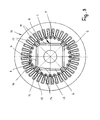
- Fig. 1 shows a rotor 1, which has a lamination stack 2. It consists of individual, stacked laminations 3, which are connected in a known manner.
- the lamella stack 2 is surrounded by a starter cage 4, which is produced by die casting.
- the starting cage 4 projects beyond the lamella stack 2 axially at both ends.
- the starting cage 4 is arranged on the circumference of the lamella stack 2, which has a cylindrical outer jacket.
- the lamella stack 2 magnets 5 are housed, which are located in pockets 6 of the lamella stack 2.
- the lamella stack 2 has four mutually perpendicular pockets 6 for the magnets 5.
- the lamella stack 2 may also have a different number of pockets 6 and thus of magnets 5, the pockets are then at different angles to each other can.
- the pockets 6 each have a rectangular outline and are the same. All pockets 6 each terminate at a small distance from the run-up cage 4 or the lateral surface of the slat stack 2.
- the individual laminations 3 have openings 6a ( Fig. 5 ), which form the pockets 6 of the lamination stack 2 for receiving the magnets 5.
- Each lamination 3 has a central annular opening 7.
- the openings 7 form in the lamella stack 2, a cylindrical receptacle for a (not shown) rotor shaft on which the lamella stack 2 rotatably seated.
- the starting cage 4 has axially extending damper rods 8, which are arranged distributed uniformly spaced along the circumference of the rotor 1. After Dieg electvorgang are located at both ends of the plate stack 2 (not shown) short-circuit rings, each in a receiving space 9, 10 ( Fig. 1 ).
- the cavities 11 have approximately trapezoidal outline with a longitudinal side 12, which advantageously extends parallel to the inside of the starting cage 4.
- the opposite shorter longitudinal side 13 of the cavity 11 lies on an imaginary, the inner corners of the mutually perpendicular adjacent pockets 6 connecting plane.
- the ends of the two longitudinal sides 12, 13 are connected by narrow sides 14, 15 with each other, each extending parallel to the narrow sides of each adjacent pocket 6.
- the longer one Longitudinal side 12 of the cavities 11 has smaller radial distance from the starting cage 4 than the radially outer corners of the pockets 6.
- each lamination 3 has openings 11 which form the axial cavities 11 in the lamella stack 2, which advantageously have the same design.
- the run-up cage 4 is produced inexpensively by pressure casting. It is advantageous if the magnets 5 are pushed into the pockets 6 only after the die casting process. Since a high pressure is used in die casting, a distance between the starter cage 4 and the pockets 6 of a few millimeters is required. The cavities 11 would be filled during die casting with Dieg facedmaterial. Because of the small distance to the pockets 6, the pressure during die casting could not be reduced due to the small distance between the cavities 11 and the pockets 6. This would mean that the pockets 6 would also be filled with the diecasting material.
- the lamella stack 2 is formed so that the cavities 11 are covered at the ends by at least one lamination 3a.
- This lamination 3a differs from all other laminations 3 of the lamella stack 2 in that it has no windows. If, therefore, such a lamination 3a is placed on the two end faces of the lamella stack 2, the cavities 11 are closed, so that the starting cage 4 can be easily prepared by die casting.
- the end sheet metal laminations 3 a serve as covers which prevent the access of the diecasting material into the cavities 11. The distance between the starting cage 4 and the pockets 6 is now so large because of the covered cavities 11 that the pressure can be reduced during die casting so far that the die-casting material does not get into the pockets 6.
- the two end sheet metal laminations 3 a may consist of a magnetic or a non-magnetic material. It is readily possible to provide at the two ends of the lamella stack 2 in each case more than just a lamination 3a.
- the different laminations 3 and 3a can be very easily punched from a sheet metal strip.
- the stacking of the different laminations 3 and 3a to the lamella stack 2 takes place automatically in a known manner.
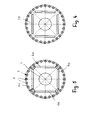
- the rotor 1 is surrounded by a stator 16. It also consists of stacked laminations, which are provided on the inner edge with grooves 17 for receiving the winding 18.
- This training is part of a permanent magnet synchronous motor with the embedded magnets 5 and the starting cage 4.
- Such a synchronous motor is suitable for direct switching into the network. He is able to independently accelerate and synchronize without the use of an inverter. After the asynchronous startup, the synchronous motor runs synchronously on the grid and has a high degree of efficiency. The asynchronous start has the advantage that a converter is not required.
- the arrangement according to Fig. 3 is part of an internal rotor synchronous motor.
- the windows 11 need not have the described trapezoidal outline.
- the shape of the windows 11 depends, for example, on the position of the pockets 6 relative to one another within the lamella stack and the shape of the pockets 6. Since in the described embodiment, the pockets 6 are at right angles to each other and the windows 11 are arranged between adjacent pockets 6, the described trapezoidal shape of the window 11 is advantageous.
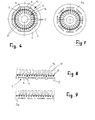
- the 6 and 7 show a lamination stack, which is intended for an external rotor motor.
- the rotor 1 surrounds the stator 16. It has the grooves 17 for receiving the winding (s).
- the rotor 1 surrounds the stator 16 to form an air gap.
- the rotor 1 and the stator 16 in turn each consist of a lamella stack.
- the lamella stack 2 of the rotor 1 is annular and has over the circumference evenly distributed arranged pockets 6, between each of which a window 11 is located.
- eight pockets 6 for receiving the magnets are provided in the lamella stack 2.
- the pockets 6 are identical and each have a rectangular outline.
- the windows 11 have an exemplary trapezoidal shape, wherein the radially inner longitudinal side 13 is shorter than the radially outer longitudinal side 12.
- the longitudinal side 13 has a small distance from the starting cage 4, which has the evenly distributed over the circumference of the plate stack 2, axially extending damper rods 8 ,
- the starting cage 4 is located on the inner circumferential surface of the lamella stack. 2
- the Druckgitmaterial does not get into the window 11 and from there into the pockets 6 during Diecasting, the cavities formed by the window 11 of the lamella stack 2 during die casting end by at least one sheet metal 3a are closed ( Fig. 7 ).
- These end plate laminations 3a are basically the same design as the lamellae 3, which form the lamella stack 2. However, the end sheet metal laminations 3a have no windows 11. If the end sheet metal laminations 3a are attached to both ends of the laminar stack 2, the cavities 11 of the laminar stack 2 are closed. Then the starting cage 4 can be easily manufactured by die casting. As in the previous embodiment, the end-side laminations 3a in the manner described prevent the access of the die-cast material into the pockets 6.
- the lamella stack 2 can also be used in a linear motor ( 8 and 9 ).
- the slat stack 2 of the rotor 1 has the pockets 6 for Recording the magnets.
- the pockets 6 are in line with each other at a distance. Between the pockets 6 are the windows 11, which form the cavities within the lamella stack 2. They have a rectangular outline and are the same size. The windows 11 protrude beyond both sides of the pockets 6 and extend to close to the damper rods 8, which are arranged along the straight edge of the rotor 11.
- the rotor 1 moves along the stator 16, which is also formed from a lamination stack and has the grooves 17 for receiving the winding (s).
- the cavities 11 can be closed in the described embodiments also by plug-like closure pieces, which are used in both ends of the cavities. In this way, it is ensured during the die casting process that the pressure in the die casting process can be reduced so much due to the large distance between the starter cage 4 and the pockets 6 that no die casting material gets into the pockets 6.
- the closure pieces replace in this case, the end-side laminations of the embodiments described above.
- the lamella stack can also be used for generators.
- Suitable diecasting materials are advantageously aluminum, aluminum alloys, copper, copper alloys and materials having a conductivity of ⁇ 58 MS / m.
Landscapes
- Engineering & Computer Science (AREA)
- Power Engineering (AREA)
- Manufacturing & Machinery (AREA)
- Mechanical Engineering (AREA)
- Manufacture Of Motors, Generators (AREA)
- Permanent Field Magnets Of Synchronous Machinery (AREA)
- Iron Core Of Rotating Electric Machines (AREA)
Abstract
Description
- Die Erfindung betrifft einen Lamellenstapel für Rotoren und/oder Statoren von Elektromotoren und Generatoren nach dem Oberbegriff des Anspruches 1, einen Rotor nach dem Oberbegriff des Anspruches 8 sowie ein Verfahren zur Herstellung eines Rotors und/oder Stators nach dem Oberbegriff des Anspruches 9.
- Lamellenstapel werden für Rotoren und Statoren von Elektromotoren eingesetzt. Der Lamellenstapel besteht aus aufeinandergesetzten und miteinander verbundenen Blechlamellen. Wird der Lamellenstapel für Rotoren von Synchronmotoren eingesetzt, dann hat der Rotor als Anlaufhilfe einen Anlaufkäfig.
- Der Erfindung liegt die Aufgabe zugrunde, den gattungsgemäßen Lamellenstapel, den gattungsgemäßen Rotor und das gattungsgemäße Verfahren so auszubilden, dass sie kostengünstig und zuverlässig hergestellt werden können.
- Diese Aufgabe wird beim gattungsgemäßen Lamellenstapel erfindungsgemäß mit den kennzeichnenden Merkmalen des Anspruches 1, beim gattungsgemäßen Rotor erfindungsgemäß mit den Merkmalen des Anspruches 8 und beim gattungsgemäßen Verfahren erfindungsgemäß mit den kennzeichnenden Merkmalen des Anspruches 9 gelöst.
- Beim erfindungsgemäßen Lamellenstapel sind zwischen benachbarten Taschen zur Aufnahme der Magnete axial verlaufende Hohlräume vorgesehen. Die Hohlräume reduzieren den Streufluss der Magnete wesentlich. Die Hohlräume sind im Lamellenstapel an beiden Enden geschlossen, wenn der Anlaufkäfig im Druckgießverfahren hergestellt wird. Die Hohlräume werden darum beim Druckgießverfahren nicht mit dem Druckgießmaterial gefüllt, obwohl sie nur geringen Abstand vom Anlaufkäfig haben. Der Abstand zwischen den Taschen und dem herzustellenden Anlaufkäfig ist wegen der geschlossenen Hohlräume so groß, dass beim Druckgießvorgang der Druck so weit abgebaut werden kann, dass das Druckgießmaterial nicht in die Taschen gelangt. Es ist dadurch möglich, erst nach dem Druckgießvorgang die Magnete in die Taschen des Lamellenstapels einzusetzen.
- Vorteilhaft werden die Hohlräume an beiden Enden durch jeweils wenigstens eine Blechlamelle geschlossen. Sie bildet in vorteilhafter Weise jeweils eine endseitige Blechlamelle des Lamellenstapels.
- Die beiden Enden der Hohlräume können bei einer anderen Ausbildung auch durch stöpselartige Verschlussstücke geschlossen werden.
- Die Hohlräume haben vorteilhaft kleineren radialen Abstand vom Anlaufkäfig als die Taschen für die Magnete.
- Die endseitigen Blechlamellen können aus magnetischem oder nichtmagnetischem Material bestehen.
- Als Druckgießmaterial wird vorteilhaft Aluminium, Aluminiumlegierungen, Kupfer, Kupferlegierungen und Materialien mit einem Leitwert ≥ 58 MS/m verwendet.
- Der erfindungsgemäße Rotor ist dadurch gekennzeichnet, dass er einen Lamellenstapel aufweist, bei dem zwischen benachbarten Taschen axial verlaufende Hohlräume vorhanden sind, die an beiden Enden geschlossen sind.
- Beim erfindungsgemäßen Verfahren werden in die Blechlamellen im Bereich zwischen den Öffnungen Fenster gestanzt, die im Lamellenstapel die Hohlräume bilden. Die Fenster bzw. die daraus gebildeten Hohlräume werden für den Druckgießvorgang endseitig geschlossen. Dadurch ist der Abstand zwischen dem herzustellenden Anlaufkäfig und den Taschen für die Magnete so groß, dass beim Druckgießen der Druck so weit abgebaut werden kann, dass das Druckgießmaterial nicht in die Taschen gelangt.
- Vorteilhaft werden die Hohlräume durch Blechlamellen geschlossen, die nur mit den die Taschen für die Magnete bildenden Öffnungen versehen und an beiden Enden des Lamellenstapels angeordnet werden.
- Es ist bei einer anderen Ausführungsform auch möglich, die Hohlräume durch stöpselartige Verschlussstücke zu schließen, die in beide Enden der Hohlräume eingesetzt werden.
- Der Lamellenstapel wird vorteilhaft in der Druckgieß-Vorrichtung mit dem Anlaufkäfig und den Kurzschlussringen versehen, der den Lamellenstapel umschließt.
- Weitere Merkmale der Erfindung ergeben sich aus den weiteren Ansprüchen, der Beschreibung und den Zeichnungen.
- Die Erfindung wird anhand eines in den Zeichnungen dargestellten Ausführungsbeispieles näher erläutert. Es zeigen
- Fig. 1
- im Axialschnitt einen erfindungsgemäßen Lamellenstapel, der Teil eines Rotors eines Elektromotors in Form eines Innenläufers ist,
- Fig. 2
- eine Stirnansicht des Lamellenstapels gemäß
Fig. 1 ohne endseitige Blechlamellen, - Fig. 3
- den erfindungsgemäßen Lamellenstapel gemäß
Fig. 2 in Verbindung mit einem als Stator dienenden weiteren Lamellenstapel in Axialansicht, - Fig. 4
- eine Stirnansicht des Lamellenstapels gemäß
Fig. 1 , - Fig. 5
- in einer Darstellung entsprechend
Fig. 4 den Lamellenstapel ohne endseitige Blechlamellen, - Fig. 6
- eine Stirnansicht einer weiteren Ausführungsform eines erfindungsgemäßen Lamellenstapels, der Teile eines Rotors eines Elektromotors in Form eines Außenläufers ist,
- Fig. 7
- eine Stirnansicht des Lamellenstapels gemäß
Fig. 6 mit endseitigen Blechlamellen, - Fig. 8
- einen für einen Linearmotor vorgesehenen erfindungsgemäßen Lamellenstapel ohne endseitige Blechlamellen,
- Fig. 9
- den Lamellenstapel gemäß
Fig. 8 mit endseitigen Blechlamellen. -
Fig. 1 zeigt einen Rotor 1, der einen Lamellenstapel 2 aufweist. Er besteht aus einzelnen, aufeinandergesetzten Blechlamellen 3, die in bekannter Weise miteinander verbunden sind. - Der Lamellenstapel 2 wird von einem Anlaufkäfig 4 umgeben, der im Druckgießverfahren hergestellt wird. Der Anlaufkäfig 4 überragt den Lamellenstapel 2 axial an beiden Enden. Der Anlaufkäfig 4 ist am Umfang des Lamellenstapels 2 angeordnet, der einen zylindrischen Außenmantel aufweist.
- Im Lamellenstapel 2 sind Magnete 5 untergebracht, die sich in Taschen 6 des Lamellenstapels 2 befinden. Im Ausführungsbeispiel hat der Lamellenstapel 2 vier rechtwinklig zueinander liegende Taschen 6 für die Magnete 5. Je nach Ausbildung des Rotors 1 kann der Lamellenstapel 2 auch eine andere Zahl von Taschen 6 und damit von Magneten 5 haben, wobei die Taschen dann unter anderen Winkeln zueinander liegen können. Die Taschen 6 haben jeweils rechteckigen Umriss und sind gleich ausgebildet. Sämtliche Taschen 6 enden jeweils mit geringem Abstand vom Anlaufkäfig 4 bzw. der Mantelfläche des Lamellenstapels 2.
- Die einzelnen Blechlamellen 3 weisen Öffnungen 6a auf (
Fig. 5 ), die die Taschen 6 des Lamellenstapels 2 zur Aufnahme der Magnete 5 bilden. Jede Blechlamelle 3 hat eine zentrische kreisringförmige Öffnung 7. Die Öffnungen 7 bilden im Lamellenstapel 2 eine zylindrische Aufnahme für eine (nicht dargestellte) Rotorwelle, auf welcher der Lamellenstapel 2 drehfest sitzt. - Der Anlaufkäfig 4 hat axial verlaufende Dämpferstäbe 8, die längs des Umfangs des Rotors 1 mit Abstand gleichmäßig verteilt angeordnet sind. Nach dem Druckgießvorgang befinden sich an beiden Enden des Lamellenstapels 2 (nicht dargestellte) Kurzschlussringe, die sich jeweils in einem Aufnahmeraum 9, 10 befinden (
Fig. 1 ). - Damit die in den Taschen 6 befindlichen Magnete 5 keinen großen Streufluss erzeugen, befinden sich im Bereich zwischen den Taschen 6 Hohlräume 11, die den Streufluss wesentlich reduzieren. Die Hohlräume 11 haben etwa trapezförmigen Umriss mit einer Längsseite 12, die vorteilhaft parallel zur Innenseite des Anlaufkäfigs 4 verläuft. Die gegenüberliegende kürzere Längsseite 13 des Hohlraumes 11 liegt auf einer gedachten, die inneren Ecken der rechtwinklig zueinander liegenden benachbarten Taschen 6 verbindenden Ebene. Die Enden der beiden Längsseiten 12, 13 sind durch Schmalseiten 14, 15 miteinander verbunden, die jeweils parallel zu den Schmalseiten der jeweils benachbarten Tasche 6 verlaufen. Die längere Längsseite 12 der Hohlräume 11 hat geringeren Radialabstand vom Anlaufkäfig 4 als die radial äußeren Ecken der Taschen 6. Der Abstand der Hohlräume 11 von den Schmalseiten der benachbarten Taschen 6 ist wesentlich kleiner als der Radialabstand, den die Hohlräume 11 bzw. die Längsseiten 12 vom Anlaufkäfig 4 haben. Jede Blechlamelle 3 hat Öffnungen 11, die im Lamellenstapel 2 die axialen Hohlräume 11 bilden, die vorteilhaft gleich ausgebildet sind.
- Der Anlaufkäfig 4 wird im Druckgießverfahren kostengünstig hergestellt. Hierbei ist es vorteilhaft, wenn die Magnete 5 erst nach dem Druckgießvorgang in die Taschen 6 geschoben werden. Da beim Druckgießen ein hoher Druck angewendet wird, ist ein Abstand zwischen dem Anlaufkäfig 4 und den Taschen 6 von einigen Millimetern erforderlich. Die Hohlräume 11 würden beim Druckgießen mit dem Druckgießmaterial gefüllt. Wegen des geringen Abstandes zu den Taschen 6 könnte der Druck beim Druckgießvorgang wegen des geringen Abstandes zwischen den Hohlräumen 11 und den Taschen 6 nicht abgebaut werden. Dies hätte zur Folge, dass auch die Taschen 6 mit dem Druckgießmaterial gefüllt würden.
- Um den Anlaufkäfig 4 vorteilhafterweise im Druckgießverfahren herzustellen und andererseits den Streufluss der Magnete 5 durch Anbringen der Hohlräume 11 zu reduzieren, ist der Lamellenstapel 2 so ausgebildet, dass die Hohlräume 11 endseitig durch jeweils wenigstens eine Blechlamelle 3a abgedeckt werden. Diese Blechlamelle 3a (
Fig. 4 ) unterscheidet sich von allen anderen Blechlamellen 3 des Lamellenstapels 2 dadurch, dass sie keine Fenster aufweist. Wenn darum auf die beiden Stirnseiten des Lamellenstapels 2 jeweils eine solche Blechlamelle 3a aufgesetzt wird, sind die Hohlräume 11 geschlossen, so dass der Anlaufkäfig 4 problemlos im Druckgießverfahren hergestellt werden kann. Die endseitigen Blechlamellen 3a dienen als Deckel, die den Zutritt des Druckgießmaterials in die Hohlräume 11 verhindern. Der Abstand zwischen dem Anlaufkäfig 4 und den Taschen 6 ist wegen der abgedeckten Hohlräume 11 nunmehr so groß, dass der Druck beim Druckgießvorgang so weit abgebaut werden kann, dass das Druckgießmaterial nicht in die Taschen 6 gelangt. - Die beiden endseitigen Blechlamellen 3a können aus einem magnetischen oder einem nichtmagnetischen Werkstoff bestehen. Es ist ohne Weiteres möglich, an den beiden Enden des Lamellenstapels 2 jeweils auch mehr als nur eine Blechlamelle 3a vorzusehen.
- Die unterschiedlichen Blechlamellen 3 und 3a lassen sich sehr einfach aus einem Blechband stanzen. Das Stapeln der unterschiedlichen Blechlamellen 3 und 3a zum Lamellenstapel 2 erfolgt in bekannter Weise automatisch.
- Wie
Fig. 3 zeigt, ist der Rotor 1 von einem Stator 16 umgeben. Er besteht ebenfalls aus gestapelten Blechlamellen, die am inneren Rand mit Nuten 17 zur Aufnahme der Wicklung 18 versehen sind. Diese Ausbildung ist Teil eines permanentmagneterregten Synchronmotors mit den eingebetteten Magneten 5 und dem Anlaufkäfig 4. Ein solcher Synchronmotor ist für ein direktes Einschalten ins Netz geeignet. Er ist in der Lage, ohne Einsatz eines Umrichters selbstständig zu beschleunigen und zu synchronisieren. Nach dem asynchronen Hochlauf läuft der Synchronmotor synchron am Netz und hat einen hohen Wirkungsgrad. Der asynchrone Anlauf hat den Vorteil, dass ein Umrichter nicht erforderlich ist. Die Anordnung gemäßFig. 3 ist Teil eines Innenläufer-Synchronmotors. - Die Fenster 11 müssen nicht den beschriebenen trapezförmigen Umriss haben. Die Form der Fenster 11 hängt beispielsweise von der Lage der Taschen 6 relativ zueinander innerhalb des Lamellenstapels und der Form der Taschen 6 ab. Da bei der beschriebenen Ausführungsform die Taschen 6 rechtwinklig zueinander liegen und die Fenster 11 zwischen benachbarten Taschen 6 angeordnet sind, ist die beschriebene Trapezform der Fenster 11 vorteilhaft.
- Die
Fig. 6 und 7 zeigen einen Lamellenstapel, der für einen Außenläufermotor vorgesehen ist. In diesem Falle umgibt der Rotor 1 den Stator 16. Er hat die Nuten 17 zur Aufnahme der Wicklung(en). Der Rotor 1 umgibt den Stator 16 unter Bildung eines Luftspaltes. - Der Rotor 1 und der Stator 16 bestehen wiederum jeweils aus einem Lamellenstapel. Der Lamellenstapel 2 des Rotors 1 ist ringförmig ausgebildet und weist über den Umfang gleichmäßig verteilt angeordnete Taschen 6 auf, zwischen denen sich jeweils ein Fenster 11 befindet. Im Ausführungsbeispiel sind im Lamellenstapel 2 acht Taschen 6 zur Aufnahme der Magnete vorgesehen. Die Taschen 6 sind gleich ausgebildet und haben jeweils rechteckigen Umriss. Die Fenster 11 haben beispielhaft Trapezform, wobei die radial innere Längsseite 13 kürzer ist als die radial außen liegende Längsseite 12. Die Längsseite 13 hat geringen Abstand vom Anlaufkäfig 4, der die über den Umfang des Lamellenstapels 2 gleichmäßig verteilt angeordneten, axial verlaufenden Dämpferstäben 8 aufweist. Der Anlaufkäfig 4 befindet sich an der inneren Mantelfläche des Lamellenstapels 2.
- Damit beim Druckgießvorgang das Druckgießmaterial nicht in die Fenster 11 und von dort in die Taschen 6 gelangt, sind die durch die Fenster 11 gebildeten Hohlräume des Lamellenstapels 2 beim Druckgießvorgang endseitig durch jeweils wenigstens eine Blechlamelle 3a geschlossen (
Fig. 7 ). Diese endseitigen Blechlamellen 3a sind grundsätzlich gleich ausgebildet wie die Lamellen 3, die den Lamellenstapel 2 bilden. Die endseitigen Blechlamellen 3a haben jedoch keine Fenster 11. Werden die endseitigen Blechlamellen 3a an beiden Enden des Lamellenstapels 2 angebracht, werden die Hohlräume 11 des Lamellenstapels 2 geschlossen. Dann kann der Anlaufkäfig 4 problemlos im Druckgießverfahren hergestellt werden. Wie beim vorigen Ausführungsbeispiel verhindern die endseitigen Blechlamellen 3a in der beschriebenen Weise den Zutritt des Druckgießmaterials in die Taschen 6. - Der Lamellenstapel 2 kann auch bei einem Linearmotor eingesetzt werden (
Fig. 8 und 9 ). Der Lamellenstapel 2 des Läufers 1 hat die Taschen 6 zur Aufnahme der Magnete. Die Taschen 6 liegen in einer Linie mit Abstand hintereinander. Zwischen den Taschen 6 befinden sich die Fenster 11, die innerhalb des Lamellenstapels 2 die Hohlräume bilden. Sie haben rechteckigen Umriss und sind jeweils gleich groß. Die Fenster 11 ragen über beide Seiten der Taschen 6 vor und reichen bis nahe an die Dämpferstäbe 8, die längs des geraden Randes des Läufers 11 angeordnet sind. Der Läufer 1 bewegt sich längs des Stators 16, der ebenfalls aus einem Lamellenstapel gebildet wird und die Nuten 17 zur Aufnahme der Wicklung(en) aufweist. - Damit beim Druckgießvorgang das Druckgießmaterial nicht in die Hohlräume 11 gelangt, wird auf beide Enden des Lamellenstapels 2 jeweils mindestens eine Blechlamelle 3a aufgelegt, bei der die Fenster 11 fehlen. Dadurch werden die Hohlräume 11 des Lamellenstapels 2 durch die endseitigen Blechlamellen 3a während des Druckgießvorganges geschlossen.
- Die Hohlräume 11 lassen sich bei den beschriebenen Ausführungsbeispielen auch durch stöpselartige Verschlussstücke schließen, die in beide Enden der Hohlräume eingesetzt werden. Auch auf diese Weise wird beim Druckgießvorgang sichergestellt, dass der Druck beim Druckgießvorgang infolge des großen Abstandes zwischen dem Anlaufkäfig 4 und den Taschen 6 so weit abgebaut werden kann, dass kein Druckgießmaterial in die Taschen 6 gelangt. Die Verschlussstücke ersetzen in diesem Fall die endseitigen Blechlamellen der zuvor beschriebenen Ausführungsbeispiele.
- Der Lamellenstapel kann auch für Generatoren eingesetzt werden.
- Als Druckgießmaterial kommen vorteilhaft Aluminium, Aluminiumlegierungen, Kupfer, Kupferlegierungen und Materialien mit einem Leitwert von ≥ 58 MS/m in Betracht.
Claims (12)
- Lamellenstapel für Rotoren und/oder Statoren von Elektromotoren und Generatoren, mit Taschen zur Aufnahme von Magneten und mit einem Anlaufkäfig,
dadurch gekennzeichnet, dass zwischen benachbarten Taschen (6) axial verlaufende Hohlräume (11) vorgesehen sind, die an beiden Enden geschlossen sind. - Lamellenstapel nach Anspruch 1,
dadurch gekennzeichnet, dass die beiden Enden der Hohlräume (11) durch jeweils wenigstens eine Blechlamelle (3a) geschlossen sind. - Lamellenstapel nach Anspruch 2,
dadurch gekennzeichnet, dass die Blechlamelle (3a) jeweils eine endseitige Blechlamelle des Lamellenstapels (2) bildet. - Lamellenstapel nach Anspruch 1,
dadurch gekennzeichnet, dass die beiden Enden der Hohlräume (11) durch jeweils wenigstens ein stöpselartiges Verschlussstück geschlossen sind. - Lamellenstapel nach einem der Ansprüche 1 bis 4,
dadurch gekennzeichnet, dass die Hohlräume (11) kleineren radialen Abstand vom Anlaufkäfig (4) haben als die Taschen (6). - Lamellenstapel nach einem der Ansprüche 2, 3 und 5,
dadurch gekennzeichnet, dass die Blechlamelle (3a) aus magnetischem oder nichtmagnetischem Material besteht. - Lamellenstapel nach einem der Ansprüche 1 bis 6,
dadurch gekennzeichnet, dass das Druckgießmaterial Aluminium, Aluminiumlegierungen, Kupfer, Kupferlegierungen und Materialien mit einem Leitwert ≥ 58 MS/m ist. - Rotor mit einem Lamellenstapel nach einem der Ansprüche 1 bis 7.
- Verfahren zur Herstellung eines Rotors und/oder Stators, bei dem Blechlamellen mit Öffnungen zu einem Lamellenstapel zusammengesetzt werden,
dadurch gekennzeichnet, dass in die Blechlamellen (3) im Bereich zwischen den Öffnungen (6) Fenster (11) gestanzt werden, die im Lamellenstapel (2) Hohlräume bilden, die endseitig für einen Druckgießvorgang geschlossen werden. - Verfahren nach Anspruch 9,
dadurch gekennzeichnet, dass die Hohlräume (11) durch Blechlamellen (3a) geschlossen werden, die nur mit den Öffnungen (6) versehen und an beiden Enden des Lamellenstapels (2) angeordnet werden. - Verfahren nach Anspruch 10,
dadurch gekennzeichnet, dass die Hohlräume (11) durch stöpselartige Verschlussstücke geschlossen werden, die in beide Enden der Hohlräume (11) eingesetzt werden. - Verfahren nach einem der Ansprüche 1 bis 11,
dadurch gekennzeichnet, dass der Lamellenstapel (2) in einer Druckgieß-Vorrichtung mit einem Anlaufkäfig (4) umschlossen wird.
Priority Applications (1)
| Application Number | Priority Date | Filing Date | Title |
|---|---|---|---|
| PL12007889T PL2597752T3 (pl) | 2011-11-28 | 2012-11-23 | Stos lameli do wirników i/lub stojanów silników elektrycznych i generatorów, wirnik z takim stosem lameli |
Applications Claiming Priority (1)
| Application Number | Priority Date | Filing Date | Title |
|---|---|---|---|
| DE102011119922A DE102011119922A1 (de) | 2011-11-28 | 2011-11-28 | Lamellenstapel für Rotoren und/oder Statoren von Elektromotoren und Generatoren,Rotor mit einem solchen Lamellenstapel sowie Verfahren zur Herstellung eines Rotors und/oder Stators |
Publications (3)
| Publication Number | Publication Date |
|---|---|
| EP2597752A2 true EP2597752A2 (de) | 2013-05-29 |
| EP2597752A3 EP2597752A3 (de) | 2017-08-16 |
| EP2597752B1 EP2597752B1 (de) | 2021-04-21 |
Family
ID=47594190
Family Applications (1)
| Application Number | Title | Priority Date | Filing Date |
|---|---|---|---|
| EP12007889.4A Active EP2597752B1 (de) | 2011-11-28 | 2012-11-23 | Lamellenstapel für Rotoren und/oder Statoren von Elektromotoren und Generatoren, Rotor mit einem solchen Lamellenstapel |
Country Status (5)
| Country | Link |
|---|---|
| EP (1) | EP2597752B1 (de) |
| DE (1) | DE102011119922A1 (de) |
| ES (1) | ES2881173T3 (de) |
| HU (1) | HUE056164T2 (de) |
| PL (1) | PL2597752T3 (de) |
Cited By (1)
| Publication number | Priority date | Publication date | Assignee | Title |
|---|---|---|---|---|
| US12355306B2 (en) | 2021-02-02 | 2025-07-08 | Siemens Gamesa Renewable Energy A/S | Rotor body for a permanent magnet machine |
Families Citing this family (2)
| Publication number | Priority date | Publication date | Assignee | Title |
|---|---|---|---|---|
| US20180205302A1 (en) * | 2017-01-19 | 2018-07-19 | Hamilton Sundstrand Corporation | Permanent magnet (pm) brushless machine with outer rotor |
| CN111106733B (zh) * | 2019-12-11 | 2022-04-01 | 南京理工大学 | 异步起动永磁同步直线电机及其控制方法 |
Family Cites Families (11)
| Publication number | Priority date | Publication date | Assignee | Title |
|---|---|---|---|---|
| DE886337C (de) * | 1944-01-14 | 1953-08-13 | Bosch Gmbh Robert | Verfahren zur Herstellung von Kurzschlusskaefiglaeufern, insbesondere fuer gekapselte Kaeltemaschinen |
| JPS57186966A (en) * | 1981-05-11 | 1982-11-17 | Hitachi Ltd | Rotor for permanent-magnet type synchronous motor |
| DE3150770A1 (de) * | 1981-12-22 | 1983-06-30 | Kienle & Spiess Stanz- und Druckgießwerk GmbH, 7123 Sachsenheim | Verfahren zur herstellung von aus blechteilen bestehenden paketen sowie vorrichtung zur durchfuehrung eines solchen verfahrens |
| JPS61102157A (ja) * | 1984-10-22 | 1986-05-20 | Mitsubishi Electric Corp | かご形回転子の製造方法 |
| JPS61102155A (ja) * | 1984-10-22 | 1986-05-20 | Mitsubishi Electric Corp | かご形回転子の製造方法 |
| JPH05122877A (ja) * | 1991-10-30 | 1993-05-18 | Matsushita Electric Ind Co Ltd | 永久磁石式同期電動機の回転子 |
| JP3676242B2 (ja) * | 2001-01-30 | 2005-07-27 | 三洋電機株式会社 | 誘導同期電動機 |
| JP2003009483A (ja) * | 2001-06-21 | 2003-01-10 | Sumitomo Heavy Ind Ltd | 永久磁石埋込み型誘導電動機 |
| JP2004096850A (ja) * | 2002-08-30 | 2004-03-25 | Toyo Electric Mfg Co Ltd | 誘導始動形同期回転電機の回転子 |
| DE10254967A1 (de) * | 2002-11-26 | 2004-06-09 | Danfoss Compressors Gmbh | Läufer eines Elektromotors |
| KR100531818B1 (ko) * | 2003-06-18 | 2005-11-30 | 엘지전자 주식회사 | 유도동기기의 회전자 구조 |
-
2011
- 2011-11-28 DE DE102011119922A patent/DE102011119922A1/de active Pending
-
2012
- 2012-11-23 PL PL12007889T patent/PL2597752T3/pl unknown
- 2012-11-23 HU HUE12007889A patent/HUE056164T2/hu unknown
- 2012-11-23 ES ES12007889T patent/ES2881173T3/es active Active
- 2012-11-23 EP EP12007889.4A patent/EP2597752B1/de active Active
Non-Patent Citations (1)
| Title |
|---|
| None |
Cited By (1)
| Publication number | Priority date | Publication date | Assignee | Title |
|---|---|---|---|---|
| US12355306B2 (en) | 2021-02-02 | 2025-07-08 | Siemens Gamesa Renewable Energy A/S | Rotor body for a permanent magnet machine |
Also Published As
| Publication number | Publication date |
|---|---|
| DE102011119922A1 (de) | 2013-05-29 |
| PL2597752T3 (pl) | 2021-11-22 |
| ES2881173T3 (es) | 2021-11-29 |
| EP2597752A3 (de) | 2017-08-16 |
| EP2597752B1 (de) | 2021-04-21 |
| HUE056164T2 (hu) | 2022-01-28 |
Similar Documents
| Publication | Publication Date | Title |
|---|---|---|
| DE102011054250B4 (de) | Belüfteter Rotor und Stator für dynamoelektrische Maschine | |
| EP3669439B1 (de) | Rotor für eine elektrische maschine, insbesondere eines kraftfahrzeugs, sowie verfahren zum herstellen eines solchen rotors | |
| DE102017223824B4 (de) | Elektrodrehmaschinenrotor | |
| EP1657800B1 (de) | Permanentmagnet-Rotor | |
| DE112015002516B4 (de) | Elektrische Rotationsmaschine und Herstellungsverfahren für eine elektrische Rotationsmaschine | |
| DE102011008092A1 (de) | Ständer für einen Elektromotor | |
| DE102009045101A1 (de) | Elektrische Maschine mit minimiertem Rastmoment | |
| DE112015001725T5 (de) | Drehende elektrische Maschine mit eingebetteten Permanentmagneten | |
| DE102014213159A1 (de) | Anordnung zur Statorkühlung eines elektrischen Motors | |
| EP2742578A2 (de) | Dynamoelektrische maschine mit einem selbsttragenden gehäuse | |
| DE102015215762A1 (de) | Blechpaket und Verfahren zu dessen Herstellung | |
| DE102004007322A1 (de) | Statoranordnung für eine elektrische Maschine | |
| DE102008026648A1 (de) | Rotor für einen elektronisch kommutierten Elektromotor, Verfahren zur Herstellung eines solchen Rotors sowie bei der Herstellung eines solchen Rotors verwendbares Zwischenprodukt | |
| DE102015122848A1 (de) | Elektromotor | |
| DE102011118475A1 (de) | Elektromotor | |
| EP3955424A1 (de) | Dynamoelektrische maschine mit flüssigkeitskühlung | |
| DE102016120374A1 (de) | Ständer und bürstenloser Gleichstrommotor mit demselben | |
| EP3205004B1 (de) | Käfigläufer für eine elektrische asynchronmaschine mit einen kurzschlussring stabilisierender stützscheibe | |
| EP2597752B1 (de) | Lamellenstapel für Rotoren und/oder Statoren von Elektromotoren und Generatoren, Rotor mit einem solchen Lamellenstapel | |
| DE202017100616U1 (de) | Stator für einen Elektromotor | |
| EP2549630A1 (de) | Kurzschlussläufer einer Asynchronmaschine und Verfahren zur Herstellung eines derartigen Läufers | |
| EP3648309B1 (de) | Ec-motor für ein elektrisches handwerkzeug sowie verfahren zur herstellung eines rotors für einen ec-motor | |
| EP3391511B1 (de) | Läufer für eine permanentmagneterregte synchronmaschine, pollückenstab für einen solchen läufer und verfahren zum herstellen eines solchen läufers | |
| DE102015219488A1 (de) | Elektrischer Antriebsmotor | |
| DE102014019218A1 (de) | Blechpaket für eine elektrische Maschine |
Legal Events
| Date | Code | Title | Description |
|---|---|---|---|
| PUAI | Public reference made under article 153(3) epc to a published international application that has entered the european phase |
Free format text: ORIGINAL CODE: 0009012 |
|
| AK | Designated contracting states |
Kind code of ref document: A2 Designated state(s): AL AT BE BG CH CY CZ DE DK EE ES FI FR GB GR HR HU IE IS IT LI LT LU LV MC MK MT NL NO PL PT RO RS SE SI SK SM TR |
|
| AX | Request for extension of the european patent |
Extension state: BA ME |
|
| PUAL | Search report despatched |
Free format text: ORIGINAL CODE: 0009013 |
|
| RIC1 | Information provided on ipc code assigned before grant |
Ipc: H02K 1/17 20060101ALI20170706BHEP Ipc: H02K 21/46 20060101ALI20170706BHEP Ipc: H02K 1/22 20060101AFI20170706BHEP Ipc: H02K 15/00 20060101ALI20170706BHEP Ipc: H02K 1/27 20060101ALI20170706BHEP Ipc: B22D 19/00 20060101ALI20170706BHEP |
|
| AK | Designated contracting states |
Kind code of ref document: A3 Designated state(s): AL AT BE BG CH CY CZ DE DK EE ES FI FR GB GR HR HU IE IS IT LI LT LU LV MC MK MT NL NO PL PT RO RS SE SI SK SM TR |
|
| AX | Request for extension of the european patent |
Extension state: BA ME |
|
| STAA | Information on the status of an ep patent application or granted ep patent |
Free format text: STATUS: REQUEST FOR EXAMINATION WAS MADE |
|
| 17P | Request for examination filed |
Effective date: 20180216 |
|
| RBV | Designated contracting states (corrected) |
Designated state(s): AL AT BE BG CH CY CZ DE DK EE ES FI FR GB GR HR HU IE IS IT LI LT LU LV MC MK MT NL NO PL PT RO RS SE SI SK SM TR |
|
| STAA | Information on the status of an ep patent application or granted ep patent |
Free format text: STATUS: EXAMINATION IS IN PROGRESS |
|
| 17Q | First examination report despatched |
Effective date: 20180503 |
|
| GRAP | Despatch of communication of intention to grant a patent |
Free format text: ORIGINAL CODE: EPIDOSNIGR1 |
|
| STAA | Information on the status of an ep patent application or granted ep patent |
Free format text: STATUS: GRANT OF PATENT IS INTENDED |
|
| INTG | Intention to grant announced |
Effective date: 20201106 |
|
| GRAS | Grant fee paid |
Free format text: ORIGINAL CODE: EPIDOSNIGR3 |
|
| GRAA | (expected) grant |
Free format text: ORIGINAL CODE: 0009210 |
|
| STAA | Information on the status of an ep patent application or granted ep patent |
Free format text: STATUS: THE PATENT HAS BEEN GRANTED |
|
| AK | Designated contracting states |
Kind code of ref document: B1 Designated state(s): AL AT BE BG CH CY CZ DE DK EE ES FI FR GB GR HR HU IE IS IT LI LT LU LV MC MK MT NL NO PL PT RO RS SE SI SK SM TR |
|
| REG | Reference to a national code |
Ref country code: GB Ref legal event code: FG4D Free format text: NOT ENGLISH |
|
| REG | Reference to a national code |
Ref country code: CH Ref legal event code: EP |
|
| REG | Reference to a national code |
Ref country code: DE Ref legal event code: R096 Ref document number: 502012016730 Country of ref document: DE Ref country code: IE Ref legal event code: FG4D Free format text: LANGUAGE OF EP DOCUMENT: GERMAN |
|
| REG | Reference to a national code |
Ref country code: AT Ref legal event code: REF Ref document number: 1385671 Country of ref document: AT Kind code of ref document: T Effective date: 20210515 |
|
| REG | Reference to a national code |
Ref country code: LT Ref legal event code: MG9D |
|
| REG | Reference to a national code |
Ref country code: NL Ref legal event code: MP Effective date: 20210421 |
|
| REG | Reference to a national code |
Ref country code: SK Ref legal event code: T3 Ref document number: E 37965 Country of ref document: SK |
|
| PG25 | Lapsed in a contracting state [announced via postgrant information from national office to epo] |
Ref country code: FI Free format text: LAPSE BECAUSE OF FAILURE TO SUBMIT A TRANSLATION OF THE DESCRIPTION OR TO PAY THE FEE WITHIN THE PRESCRIBED TIME-LIMIT Effective date: 20210421 Ref country code: LT Free format text: LAPSE BECAUSE OF FAILURE TO SUBMIT A TRANSLATION OF THE DESCRIPTION OR TO PAY THE FEE WITHIN THE PRESCRIBED TIME-LIMIT Effective date: 20210421 Ref country code: NL Free format text: LAPSE BECAUSE OF FAILURE TO SUBMIT A TRANSLATION OF THE DESCRIPTION OR TO PAY THE FEE WITHIN THE PRESCRIBED TIME-LIMIT Effective date: 20210421 Ref country code: BG Free format text: LAPSE BECAUSE OF FAILURE TO SUBMIT A TRANSLATION OF THE DESCRIPTION OR TO PAY THE FEE WITHIN THE PRESCRIBED TIME-LIMIT Effective date: 20210721 Ref country code: HR Free format text: LAPSE BECAUSE OF FAILURE TO SUBMIT A TRANSLATION OF THE DESCRIPTION OR TO PAY THE FEE WITHIN THE PRESCRIBED TIME-LIMIT Effective date: 20210421 |
|
| REG | Reference to a national code |
Ref country code: ES Ref legal event code: FG2A Ref document number: 2881173 Country of ref document: ES Kind code of ref document: T3 Effective date: 20211129 |
|
| PG25 | Lapsed in a contracting state [announced via postgrant information from national office to epo] |
Ref country code: RS Free format text: LAPSE BECAUSE OF FAILURE TO SUBMIT A TRANSLATION OF THE DESCRIPTION OR TO PAY THE FEE WITHIN THE PRESCRIBED TIME-LIMIT Effective date: 20210421 Ref country code: SE Free format text: LAPSE BECAUSE OF FAILURE TO SUBMIT A TRANSLATION OF THE DESCRIPTION OR TO PAY THE FEE WITHIN THE PRESCRIBED TIME-LIMIT Effective date: 20210421 Ref country code: GR Free format text: LAPSE BECAUSE OF FAILURE TO SUBMIT A TRANSLATION OF THE DESCRIPTION OR TO PAY THE FEE WITHIN THE PRESCRIBED TIME-LIMIT Effective date: 20210722 Ref country code: LV Free format text: LAPSE BECAUSE OF FAILURE TO SUBMIT A TRANSLATION OF THE DESCRIPTION OR TO PAY THE FEE WITHIN THE PRESCRIBED TIME-LIMIT Effective date: 20210421 Ref country code: IS Free format text: LAPSE BECAUSE OF FAILURE TO SUBMIT A TRANSLATION OF THE DESCRIPTION OR TO PAY THE FEE WITHIN THE PRESCRIBED TIME-LIMIT Effective date: 20210821 Ref country code: PT Free format text: LAPSE BECAUSE OF FAILURE TO SUBMIT A TRANSLATION OF THE DESCRIPTION OR TO PAY THE FEE WITHIN THE PRESCRIBED TIME-LIMIT Effective date: 20210823 Ref country code: NO Free format text: LAPSE BECAUSE OF FAILURE TO SUBMIT A TRANSLATION OF THE DESCRIPTION OR TO PAY THE FEE WITHIN THE PRESCRIBED TIME-LIMIT Effective date: 20210721 |
|
| REG | Reference to a national code |
Ref country code: DE Ref legal event code: R097 Ref document number: 502012016730 Country of ref document: DE |
|
| REG | Reference to a national code |
Ref country code: HU Ref legal event code: AG4A Ref document number: E056164 Country of ref document: HU |
|
| PG25 | Lapsed in a contracting state [announced via postgrant information from national office to epo] |
Ref country code: EE Free format text: LAPSE BECAUSE OF FAILURE TO SUBMIT A TRANSLATION OF THE DESCRIPTION OR TO PAY THE FEE WITHIN THE PRESCRIBED TIME-LIMIT Effective date: 20210421 Ref country code: CZ Free format text: LAPSE BECAUSE OF FAILURE TO SUBMIT A TRANSLATION OF THE DESCRIPTION OR TO PAY THE FEE WITHIN THE PRESCRIBED TIME-LIMIT Effective date: 20210421 Ref country code: DK Free format text: LAPSE BECAUSE OF FAILURE TO SUBMIT A TRANSLATION OF THE DESCRIPTION OR TO PAY THE FEE WITHIN THE PRESCRIBED TIME-LIMIT Effective date: 20210421 Ref country code: SM Free format text: LAPSE BECAUSE OF FAILURE TO SUBMIT A TRANSLATION OF THE DESCRIPTION OR TO PAY THE FEE WITHIN THE PRESCRIBED TIME-LIMIT Effective date: 20210421 Ref country code: RO Free format text: LAPSE BECAUSE OF FAILURE TO SUBMIT A TRANSLATION OF THE DESCRIPTION OR TO PAY THE FEE WITHIN THE PRESCRIBED TIME-LIMIT Effective date: 20210421 |
|
| PLBE | No opposition filed within time limit |
Free format text: ORIGINAL CODE: 0009261 |
|
| STAA | Information on the status of an ep patent application or granted ep patent |
Free format text: STATUS: NO OPPOSITION FILED WITHIN TIME LIMIT |
|
| 26N | No opposition filed |
Effective date: 20220124 |
|
| PG25 | Lapsed in a contracting state [announced via postgrant information from national office to epo] |
Ref country code: IS Free format text: LAPSE BECAUSE OF FAILURE TO SUBMIT A TRANSLATION OF THE DESCRIPTION OR TO PAY THE FEE WITHIN THE PRESCRIBED TIME-LIMIT Effective date: 20210821 Ref country code: AL Free format text: LAPSE BECAUSE OF FAILURE TO SUBMIT A TRANSLATION OF THE DESCRIPTION OR TO PAY THE FEE WITHIN THE PRESCRIBED TIME-LIMIT Effective date: 20210421 |
|
| PG25 | Lapsed in a contracting state [announced via postgrant information from national office to epo] |
Ref country code: MC Free format text: LAPSE BECAUSE OF FAILURE TO SUBMIT A TRANSLATION OF THE DESCRIPTION OR TO PAY THE FEE WITHIN THE PRESCRIBED TIME-LIMIT Effective date: 20210421 |
|
| PG25 | Lapsed in a contracting state [announced via postgrant information from national office to epo] |
Ref country code: LU Free format text: LAPSE BECAUSE OF NON-PAYMENT OF DUE FEES Effective date: 20211123 Ref country code: BE Free format text: LAPSE BECAUSE OF NON-PAYMENT OF DUE FEES Effective date: 20211130 |
|
| REG | Reference to a national code |
Ref country code: BE Ref legal event code: MM Effective date: 20211130 |
|
| PG25 | Lapsed in a contracting state [announced via postgrant information from national office to epo] |
Ref country code: IE Free format text: LAPSE BECAUSE OF NON-PAYMENT OF DUE FEES Effective date: 20211123 |
|
| PG25 | Lapsed in a contracting state [announced via postgrant information from national office to epo] |
Ref country code: CY Free format text: LAPSE BECAUSE OF FAILURE TO SUBMIT A TRANSLATION OF THE DESCRIPTION OR TO PAY THE FEE WITHIN THE PRESCRIBED TIME-LIMIT Effective date: 20210421 |
|
| P01 | Opt-out of the competence of the unified patent court (upc) registered |
Effective date: 20230824 |
|
| REG | Reference to a national code |
Ref country code: DE Ref legal event code: R081 Ref document number: 502012016730 Country of ref document: DE Owner name: FEINTOOL INTERNATIONAL HOLDING AG, CH Free format text: FORMER OWNER: KIENLE + SPIESS GMBH, 74343 SACHSENHEIM, DE |
|
| REG | Reference to a national code |
Ref country code: AT Ref legal event code: PC Ref document number: 1385671 Country of ref document: AT Kind code of ref document: T Owner name: FEINTOOL INTERNATIONAL HOLDING AG, CH Effective date: 20240122 |
|
| REG | Reference to a national code |
Ref country code: HU Ref legal event code: GB9C Owner name: FEINTOOL INTERNATIONAL HOLDING AG, CH Free format text: FORMER OWNER(S): KIENLE + SPIESS GMBH, DE Ref country code: HU Ref legal event code: FH1C Free format text: FORMER REPRESENTATIVE(S): GOEDOELLE, KEKES, MESZAROS & SZABO SZABADALMI ES VEDJEGY IRODA, HU Representative=s name: GOEDOELLE, KEKES, MESZAROS & SZABO SZABADALMI ES VEDJEGY IRODA, HU |
|
| PG25 | Lapsed in a contracting state [announced via postgrant information from national office to epo] |
Ref country code: MK Free format text: LAPSE BECAUSE OF FAILURE TO SUBMIT A TRANSLATION OF THE DESCRIPTION OR TO PAY THE FEE WITHIN THE PRESCRIBED TIME-LIMIT Effective date: 20210421 |
|
| PG25 | Lapsed in a contracting state [announced via postgrant information from national office to epo] |
Ref country code: MT Free format text: LAPSE BECAUSE OF FAILURE TO SUBMIT A TRANSLATION OF THE DESCRIPTION OR TO PAY THE FEE WITHIN THE PRESCRIBED TIME-LIMIT Effective date: 20210421 |
|
| REG | Reference to a national code |
Ref country code: ES Ref legal event code: PC2A Owner name: FEINTOOL SYSTEM PARTS SACHSENHEIM GMBH Effective date: 20241031 |
|
| REG | Reference to a national code |
Ref country code: ES Ref legal event code: PC2A Owner name: FEINTOOL INTERNATIONAL HOLDING AG Effective date: 20241105 |
|
| PGFP | Annual fee paid to national office [announced via postgrant information from national office to epo] |
Ref country code: PL Payment date: 20250922 Year of fee payment: 14 |
|
| REG | Reference to a national code |
Ref country code: CH Ref legal event code: U11 Free format text: ST27 STATUS EVENT CODE: U-0-0-U10-U11 (AS PROVIDED BY THE NATIONAL OFFICE) Effective date: 20251201 |
|
| PGFP | Annual fee paid to national office [announced via postgrant information from national office to epo] |
Ref country code: GB Payment date: 20251103 Year of fee payment: 14 |
|
| PGFP | Annual fee paid to national office [announced via postgrant information from national office to epo] |
Ref country code: AT Payment date: 20251114 Year of fee payment: 14 |
|
| PGFP | Annual fee paid to national office [announced via postgrant information from national office to epo] |
Ref country code: IT Payment date: 20251103 Year of fee payment: 14 |
|
| PGFP | Annual fee paid to national office [announced via postgrant information from national office to epo] |
Ref country code: HU Payment date: 20251204 Year of fee payment: 14 Ref country code: FR Payment date: 20251103 Year of fee payment: 14 |
|
| PGFP | Annual fee paid to national office [announced via postgrant information from national office to epo] |
Ref country code: TR Payment date: 20251014 Year of fee payment: 14 |
|
| PGFP | Annual fee paid to national office [announced via postgrant information from national office to epo] |
Ref country code: CH Payment date: 20251201 Year of fee payment: 14 |
|
| PGFP | Annual fee paid to national office [announced via postgrant information from national office to epo] |
Ref country code: SK Payment date: 20251128 Year of fee payment: 14 |
|
| PGFP | Annual fee paid to national office [announced via postgrant information from national office to epo] |
Ref country code: ES Payment date: 20251203 Year of fee payment: 14 |
|
| PGFP | Annual fee paid to national office [announced via postgrant information from national office to epo] |
Ref country code: DE Payment date: 20260128 Year of fee payment: 14 |